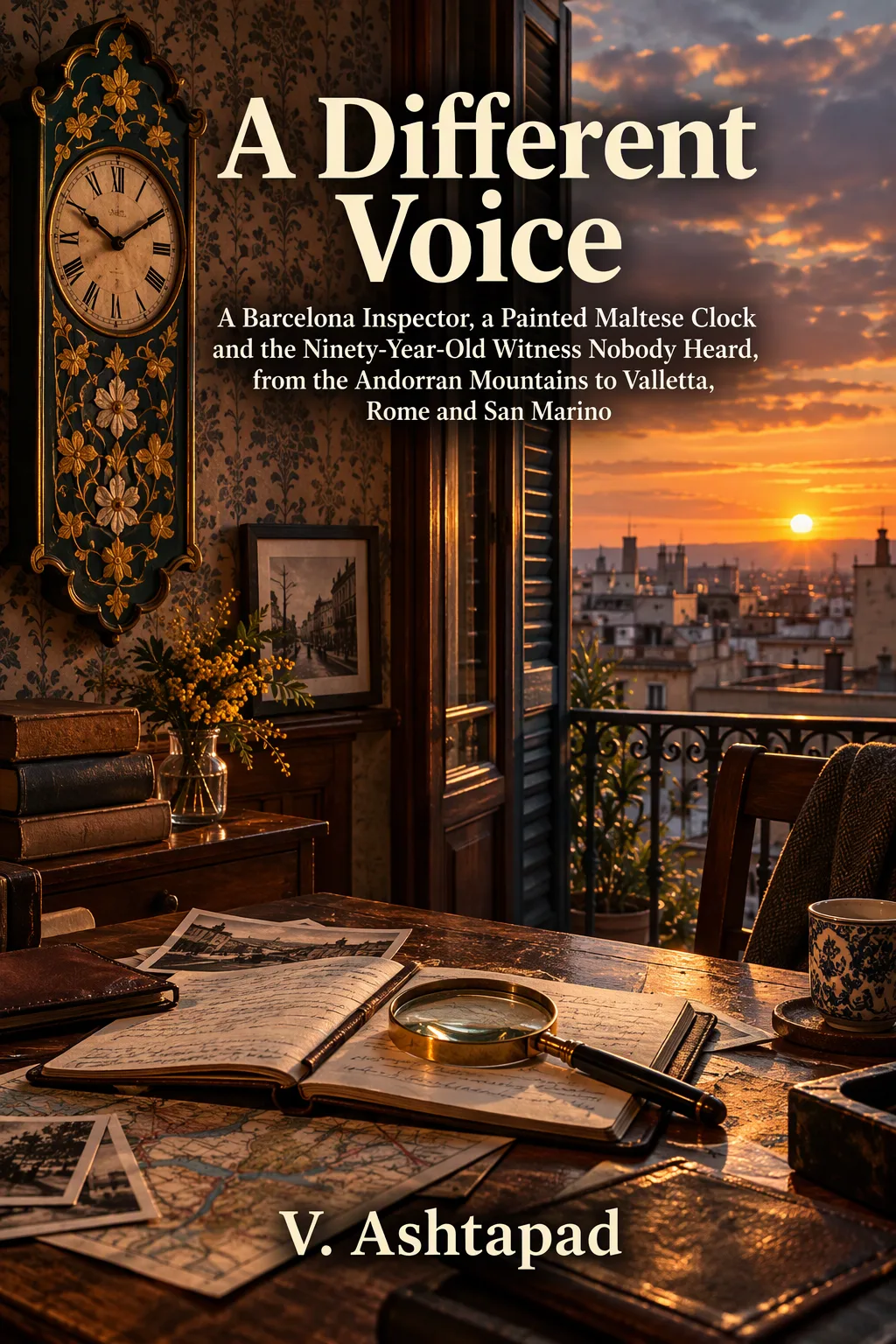
A Different Voice
A Barcelona Inspector, a Painted Maltese Clock and the Ninety-Year-Old Witness Nobody Heard, from the Andorran Mountains to Valletta, Rome and San Marino
by V. Ashtapad
Foreword
This is a work of fiction. The painted lira clocks of Malta, the drying barns and mountain cooking of Andorra, the festival of roses and books in Barcelona, the clock and instrument workshops of the papal museums and the crossbowmen of San Marino are all real. The Ferrer and Camilleri families, the clock, the shops, the restorers and every person in this book are invented.
For the old ones who said it first.
Monday 20 April. Headquarters
*Case 0419/H. Entry 1. Monday 20 April, 08:05. Received from the Gràcia district desk.*
*Item reported missing: one wall clock, Maltese, of the kind the islanders call a lira clock. Case of carved and painted wood, waisted, about ninety centimeters tall. Painted ground dark green. Upper crest of gilded leaves. Face painted with a fishing boat, two eyes on its bow, on a blue sea, and five red roses in a ring around the numerals. Pendulum door at the waist, painted with a sixth rose. Maker believed to be Salvu Camilleri of Valletta, 1898. Reported by Andreu Soler Ferrer, son of the owner, Montserrat Ferrer Camilleri, aged 90. Missing from the dining room wall of the owner's flat, Carrer de Verdi, between approximately 17:30 and 18:05 on Sunday 19 April, during a family lunch for the owner's ninetieth birthday. Fourteen persons present. No sign of forced entry. Insured value 18,000 euros. Complainant requests specialist unit.*
Inspector Núria Vidal read the description twice, the second time with her finger on the lines, the way her father read newspapers. Then she put the sheet face down on her desk and looked out of the window at the narrow strip of sky above the old city, where a pigeon was arguing with a television aerial.
"Fourteen people," she said. "A birthday lunch. A son who wants the specialists."
"Commissioner's note on the back," said Pau Roig, who had brought it in with two coffees and the satisfied look of a young man who has read something before his superior. He was twenty-eight, broad through the shoulders from five years of standing at the base of human towers on festival days, and he still put sugar in his coffee as if it were a medical requirement. "The complainant went to school with the commissioner. Same class at a boys' school in Sarrià. He rang him at home last night at half past nine."
"Of course he did."
She turned the sheet over. The commissioner's handwriting was small and slanted, the writing of a man who had once wanted to be an architect. *Núria. Please give this a day. The family is upset and the old lady is very old. Be gentle and be quick. J.*
"Be gentle and be quick," she said. "He wants me to find a clock behind a sofa."
"Could be behind a sofa," Pau said. "Ninety centimeters. That's a big sofa."
The Heritage Property Unit was four people, two rooms and a cabinet of photographs of things that had gone missing from village halls, museums, auction houses and the backs of vans. Núria had run it for six years. In those six years she had recovered a fourteenth-century painted panel from a garage in Terrassa, four hundred letters by a dead poet from a flea market in Valencia, and a Roman milestone from the garden of a man who said he had always thought it was a bench. She had never been asked to be gentle and quick. Usually she was asked to be thorough and to stop sending reports that were nine pages long.
She pulled the photograph that Andreu Soler had emailed at midnight. It showed the clock on its wall above a sideboard with a lace runner, behind a table set for a celebration, and it was more beautiful than the description had prepared her for. The green was the deep green of a bottle held up to the sun. The gold leaves at the top curled like the crest of a wave. The little fishing boat on the face rode a sea of short white strokes, and its painted eyes, one on each side of the bow, looked straight out of the photograph at her, watchful and slightly amused.
"Those eyes," Pau said, leaning over. "Is that a thing?"
"In Malta the fishing boats have eyes painted on the bow. To see the way home." She did not know where she had learned that. Then she did. Her father had told her, years ago, standing in front of a lira clock in an antique shop window on Carrer de la Palla, when she was eleven and wanted an ice cream and had not been listening.
---
Ramon Vidal had been at the kitchen table that morning when she left the flat in Sant Antoni, as he was every morning, in his cardigan with the leather buttons, with the radio on low and a piece of toast held in the air while he made a point. He was eighty-four. He had made furniture in a workshop in Poblenou for fifty-one years, chairs and tables and cabinets and, once, a staircase for a bank, and since he had retired and since her mother had died and since he had come to live with her in the spare room that still smelled of linseed oil from the boxes of tools he would not throw away, he made points. He made them about the radio and about the price of artichokes and about the way the city had cut down the plane trees on his old street and about the young man in the flat below who parked his scooter in the hall.
"A clock," he had said, when she told him over her coffee what the night duty officer had texted. "What kind?"
"Maltese. Painted."
"A lira clock." He had put the toast down. That was rare. "Núria. Listen to me. Those are not clocks, those are families. Every one of them is different. The case is made by one man and painted by another and the movement inside comes from somewhere else, and the people who own them know the sound of them the way they know the sound of their own mother on the stairs. You ask the old lady what it sounded like."
"Papa, I have to go."
"You ask her what it sounded like."
"I'll ask her." She had kissed the top of his head, which was mostly scalp now, warm and freckled, and gone out, and on the metro she had forgotten that he had said anything at all.
Now, looking at the boat with its two eyes, she remembered, and was faintly annoyed with herself, and wrote on the pad next to her keyboard: *Ask what it sounded like.* Then, because it seemed foolish, she put a question mark after it.
---
The district desk had done the basics. Núria read their notes while Pau pulled up a map of the street.
The flat was on the second floor of a building from the 1890s on Carrer de Verdi, in the upper part of Gràcia where the streets ran narrow and straight and the balconies nearly touched across them. One stair, one old lift that took three people if they were friendly, one front door to the street with a code and a buzzer. The flat had a long corridor, a sitting room on the street side with two balconies, a dining room in the middle, a kitchen at the back opening onto a small terrace above the inner courtyard of the block, and three bedrooms. Montserrat Ferrer had lived there since 1961.
Fourteen people. The duty officer had listed them, with ages, in the order in which Andreu Soler had given them, which was the order of how much he thought they mattered. Andreu Soler Ferrer, 66, son, retired harbor pilot. Pilar Gómez, 64, his wife. Oriol Soler Gómez, 35, their son, sound engineer. Roser Soler Ferrer, 62, daughter, resident in Andorra. Xavier Pujol Armengol, 66, her husband, Andorran, restaurateur. Laia Pujol Soler, 34, their daughter, Andorran, mountain guide. Ġorġ Camilleri, 78, cousin, resident in Malta, clockmaker. Adela Ruiz, 58, the owner's carer, five days a week. Three neighbors from the floors above and below, who had come up for cake. Two school friends of the owner, both over eighty, who had been brought by taxi and taken home by taxi. And the owner herself, who had been born on a Sunday ninety years before and had spent her birthday, according to the duty officer's note, "mostly in her chair by the window, very calm, saying little."
*Note,* the officer had added at the bottom. *Owner made two remarks I recorded as given. When told the clock was missing: "It had a different voice." When asked if she knew who had moved it: "It has gone where somebody listens." Son says owner is sometimes confused in the evenings.*
Núria read the two remarks a third time.
"She's ninety," Pau said, kindly. "My great-grandmother used to tell us the television was listening to her."
"Maybe it was."
"Inspector."
"Fourteen people in a flat, Pau, and nobody saw a ninety-centimeter clock leave the wall. Either it's still in the building or one of them carried it out, and if one of them carried it out, somebody else in that flat knows. Families always know. They just don't say." She stood and took her jacket from the back of her chair. "Bring the camera and the tape. And the evidence bags, the big ones."
"For a clock behind a sofa?"
"For whatever we find behind the sofa."
On the way down the stairs she took the pad out of her pocket and looked at what she had written. *Ask what it sounded like?* She crossed out the question mark. It was not, she told herself, because of her father. It was because the old woman had said *voice*, and an inspector who had spent six years among stolen things knew that people only used that word about objects they loved.
Outside, the morning had turned bright and windy, and down at the end of the street the stalls for Thursday's festival of roses and books were already going up in stacks of folded trestles, with nobody yet to sell to. A florist's van was unloading buckets of red buds still tight as fists. Pau stopped to let it pass and said, "Three days. My mother wants a book about the history of the castellers. Again."
"Buy her a rose too," Núria said. "You always forget the rose."
They took the unmarked car up through the Eixample toward Gràcia, through traffic that moved like a slow argument, and Núria watched the balconies go by and thought about a boat with two painted eyes, looking for the way home.
© 2026 CRUNOD LLC. All rights reserved.
Monday 20 April. Carrer de Verdi
*Case 0419/H. Entry 2. 09:40. Scene visit with Agent P. Roig. Present: complainant A. Soler, carer A. Ruiz, owner M. Ferrer.*
The rectangle on the wall was the first thing Núria saw, and it told her more than the photograph had.
The dining room wallpaper had once been cream with a pattern of small blue sprigs. Sixty-five years of light from the street balconies had turned it the color of milky tea, all except a tall waisted shape above the sideboard, where the paper was still cream and the sprigs were still blue, as fresh as the day somebody had pasted them up. The shape had the outline of the clock exactly: the swell at the top, the narrow waist, the rounded base. It looked like a door into an earlier year.
In the middle of the shape, at head height, was a single brass hook, screwed into a wooden plug in the plaster. Below it, at the height of the clock's base, were two smaller brass pins that would have held it steady against the wall. The sideboard beneath had a lace runner, a bowl of oranges, a framed photograph of a wedding in black and white, and a fine dusting of gray along its back edge where the base of the clock had touched it.
"Nobody has cleaned in here," Núria said.
"I told Adela not to touch it," said Andreu Soler. "I watch the programs."
He was a big man, with the build of somebody who had spent forty years climbing rope ladders up the sides of ships in the harbor at night, and he filled the doorway of the dining room in a pressed blue shirt with the sleeves rolled to the elbow. He had his mother's long jaw and none of her stillness. He had shaken Núria's hand at the door with both of his, said her commissioner's first name twice in the first minute, and was now standing with his arms folded, watching her as if she were a pilot boat late for its ship.
"Thank you," she said. "That helps."
She had Pau photograph the wall, the hook, the pins and the sideboard from four angles and then close, with the scale ruler, and she put on gloves and looked at the hook herself. It was clean and slightly bright on its upper curve where the clock's hanging plate had rubbed it for years. There was no fresh scratch in the plaster around it, no flake of paint on the sideboard, no gouge in the wallpaper. Whoever had lifted the clock had lifted it straight up and off and away, carefully, with both hands, and had known how it hung.
"It's heavy," Andreu said. "Eleven kilos. I weighed it when we had it cleaned last year. You need to know the trick, you lift and then you tilt it toward you or the pins catch."
"Who knows the trick?"
"Me. My son. My sister. My brother-in-law, maybe. Adela, she dusts it. The cousin from Malta, of course, he's a clockmaker." He paused. "Everybody, really."
"Everybody," Núria said, and wrote it down.
---
Montserrat Ferrer Camilleri was in the sitting room, in a high-backed chair by the left-hand balcony, where the morning light came in sideways through a lace curtain and laid a pattern of flowers across her lap. She was small and very straight, with white hair cut short as a boy's and a pair of tortoiseshell glasses on a cord around her neck. She was wearing a navy dress with a white collar, and a brooch at the collar in the shape of a silver ship, and her hands, folded on top of a closed book, were large for her size, the knuckles swollen, the fingers still long. They were a seamstress's hands. The district note had not said so, but Núria had grown up among cabinetmakers and she knew the hands of somebody who had worked with them all her life.
"Senyora Ferrer," she said. "I'm Inspector Vidal. I'm sorry about your clock."
"Sit down," said Montserrat. "Not there. That one is for my son and he will want it in a minute. Sit there, where I can see you."
Núria sat on a low stool covered in green velvet, close enough that their knees nearly touched. The old woman looked at her for a long time through the glasses, which she had lifted from the cord to her nose with one practiced movement.
"You are young," she said at last.
"I'm fifty-four."
"That's young. You have a good face. Tired. Do you sleep?"
"Not very much."
"No. Nobody does, now." Montserrat let the glasses fall back to her chest. "Ask me what you came to ask me, Inspector. I am ninety years and one day old and I do not have a great deal of morning left in me. In the afternoon I sleep and in the evening my son tells people I am confused."
From the corridor, Andreu said, "Mama."
"You see?" said Montserrat, without turning her head.
---
Núria took her through the day, gently, in order, the way she would have taken anyone. She had learned long ago that the old were often the best witnesses in a room, not because they saw more but because they had stopped trying to look as if they saw everything. They were not in a hurry to be right.
The family had arrived from half past one. Roser and Xavier and Laia had driven down from Andorra that morning, three hours, and had brought a whole cured ham and a basket of cheese and a box of the cakes Xavier made with pine nuts. Ġorġ had come by taxi from his hotel near the port, in a gray suit, with a bunch of yellow roses and a white cake box tied with ribbon, which had held pastries from Valletta, carried on the plane on his knees. Andreu and Pilar and Oriol had come with the main dishes, because Pilar did not trust anybody else with the rice. The neighbors had come up at five for the cake. The two old school friends had come at four and been taken home at seven.
"And the clock," said Núria. "When did you last hear it?"
"At half past five." Montserrat did not hesitate. "It struck the half. One stroke. I was at the table with the cake in front of me and my son was trying to light ninety candles, which is foolish, there are not ninety candles in all of Gràcia, and Oriol had his telephone up to make a film. At half past five the clock struck, and I thought, it still has that voice."
"What voice?"
The old woman's eyes came up sharply, and for an instant Núria saw something in them that was very nearly gratitude.
"A different voice," Montserrat said. "Since last summer. I have told my son. I have told Adela. I told Ġorġ in a letter in January. Since it came back from the man who cleaned it, it does not sound like itself. The strike is too short. It used to ring. Like a glass when you touch it with a fork at a wedding, it went on after the stroke, you could hear it in the kitchen and down the stairs. Now it says *tok* and stops. And the tick is faster. My clock never hurried. Now it hurries."
"Mama," said Andreu, from the doorway. He had come in, as she had said he would, and was standing by the chair that was meant for him, not sitting. "The man said it was clean and oiled and running perfectly. It keeps better time than it ever did. It's in the receipt."
"It keeps time," his mother said, "like a stranger keeps time."
Núria wrote both sentences down. Then she said, "After half past five. Where was everyone?"
"On the terrace. All of them. For the photograph." Montserrat lifted one hand from the book and made a small sweeping gesture toward the back of the flat. "Oriol wanted a photograph of everyone together with the courtyard behind, because the light was good, and he made them all go out, and he stood on the stool to see them. I said I would not go. My hip. It was cold. So they went, and I stayed at the table with the cake, and Adela brought me my shawl."
"And you were alone in the dining room?"
"For a little while."
"How long?"
"Long enough," said Montserrat Ferrer, "to eat a piece of my own birthday cake without anybody watching me do it." And for the first time she smiled, a small, sly, private smile that took twenty years off her face and then put them back.
"Did anyone come back into the dining room while the others were on the terrace?"
The smile stayed. "People came and went. It was a party."
"Who?"
"I was eating cake, Inspector."
Núria let the silence stretch. Outside a delivery scooter went past in the street below with a noise like a wasp in a jar, and somewhere in the building a radio was playing the morning news. Andreu shifted his weight from one foot to the other.
"Senyora Ferrer," Núria said quietly. "Last night you told the officer that the clock has gone where somebody listens. What did you mean?"
Montserrat looked at her for a long moment. Then she looked past her, at the pale rectangle on the dining room wall, which she could see through the open double doors from her chair. She would have seen it, Núria realized, every hour of every day for sixty-five years, with the clock on it.
"I meant what I said," she said. "Nobody listens to anything an old woman says, so I say exactly what I mean and nobody notices. It is a great freedom. You should try it when you are ninety." She closed her eyes. "Now I would like my coffee, and then I would like you to go and talk to my family, who will tell you a great many things, all of them very loudly."
---
In the corridor, out of earshot, Andreu put a hand on Núria's arm and then took it away again, because she had looked at it.
"She's not always like this," he said. "In the mornings she's sharp as a needle. But she gets ideas. Last year it was the man in the flat below stealing her post. In January it was the clock's voice. She writes letters to Malta. She writes letters to people who have been dead for twenty years. The doctor says it's normal at her age."
"The man in the flat below," Núria said. "Was he stealing her post?"
Andreu opened his mouth and shut it again.
"Some of it," he admitted. "It turned out he was taking the advertisements. For the paper. He made papier-mâché masks for the children's parade." He rubbed his face with both hands. "Look. That clock is the one thing of value in this flat. It's worth eighteen thousand euros, the insurance man says. My mother needs a carer at night as well as in the day, now, and that costs money, and the clock is part of what there is. Somebody in this family has taken it, and I want to know who, and I want it back on that wall."
"Somebody in this family," Núria said. "You're sure."
"Who else?"
She did not answer him. She was thinking about a ninety-year-old woman alone at a table with a cake, for a little while, long enough, while everybody else stood on a terrace in the good light and looked at a young man on a stool. She was thinking about the word *listens*. And she was thinking, with a small, unwelcome jolt, about her father at the kitchen table with a piece of toast in the air, saying, *You ask the old lady what it sounded like.*
She had asked. The old lady had told her. It had a different voice.
She wrote it on the pad again and underlined it twice.
© 2026 CRUNOD LLC. All rights reserved.
Monday 20 April. The Terrace
*Case 0419/H. Entry 3. 10:50. Statements taken at the flat: P. Gómez, O. Soler, A. Ruiz. Telephone: R. Soler (Andorra). Photographs of 19 April copied from O. Soler's phone, 23 images, 17:36 to 17:58.*
The terrace was not much bigger than a dining table, a square of red tiles with a wrought-iron rail, three pots of geraniums and a lemon tree in a barrel that had been producing small hard lemons, Pilar said, since the year Oriol was born. Beyond the rail was the inner courtyard of the block, a deep well of light and laundry, with other terraces and other lemon trees and a cat asleep on a corrugated roof two floors down. From the terrace you could see into the kitchen through its glass door, and from the kitchen you could see a slice of the corridor. You could not see the dining room at all.
"I thought of that this morning," said Pilar Gómez, standing at the rail with her hands around a cup of coffee she had not drunk. "At four in the morning, lying awake. You can't see anything from here. We were all out here like sheep, looking at Oriol, and anybody could have walked down that corridor with an elephant."
She was a neat, quick woman with reading glasses pushed up into gray-blond hair, a retired secretary from a shipping agent's office on the port, and she had made the black rice for fourteen people the day before in two enormous pans with the squid ink that stains everything, and she said so twice, as if it were a kind of alibi. Núria believed her. The tips of two of her fingernails were still faintly gray.
"Who wasn't on the terrace?"
"My mother-in-law, of course. She stayed at the table. And Adela went in and out, with the shawl, with the coffee. And Ġorġ." Pilar frowned. "Ġorġ went back in quite soon. He said it was cold. He's from Malta, he thinks fifteen degrees is winter. And Laia went down to the car."
"Why?"
"She said the cheese. They'd forgotten a cheese in the car. I don't know. She came back up without any cheese, now I think of it." Pilar turned the cup in her hands. "Inspector, I don't want to say things about my family."
"You're not saying things. You're telling me where people stood."
"That's what saying things is," said Pilar.
---
Oriol Soler had set himself up at the kitchen table with a laptop and a pair of headphones around his neck. He was thirty-five, thin and dark and untidy, with his grandmother's long jaw and none of his father's bulk, and he worked, he said, for a theater company in the Raval, building the sound for plays: the rain and the doors and the footsteps and the music that came out of radios on the stage. He had the slightly hunted look of a young man who has been shouted at by his father since breakfast.
"He thinks it was me," Oriol said. "Because I organized the photo. Because I got everyone out of the way. As if I'm some kind of mastermind. I just wanted a photo of everyone together. When was the last time we were all together? Her eighty-third birthday. Seven years ago."
"Can I see the photos?"
He turned the laptop toward her. There were twenty-three of them, in a grid. Pau, at her shoulder, began copying them to a drive.
Núria looked at them one at a time, slowly, with the timestamps. The first was at 17:36. The family squeezed in rows against the rail with the lemon tree on one side and the courtyard behind them going blue with evening. Andreu in the middle with his arm around his sister. Roser, small and dark and smiling, a little like her mother. Xavier, tall and weathered, with a white mustache and the expression of a man who has been asked to stand still against his will. Laia beside him in a red quilted jacket, her hair in a long braid. Pilar. The neighbors, one of them in a hat. Ġorġ Camilleri at one end, a narrow gray man in a gray suit, holding himself very upright, not quite touching anybody.
She went through them. In the third, Adela was at the edge of the frame, half in the kitchen doorway, holding a folded shawl. By the fifth, at 17:40, Adela was gone. In the sixth, at 17:41, Ġorġ was still there, looking not at the camera but over his shoulder toward the kitchen; in the seventh, at 17:42, he was gone too, and Xavier had moved into his place. Laia was in every photograph up to the ninth, at 17:44, laughing at something her father had said, with her head thrown back. From the tenth, at 17:47, she was not in any of them. The last photograph, at 17:58, showed the whole family squashed together in a single row, out of focus, everybody laughing, and Oriol himself at the front with his arm out, holding the phone.
"Three people left the terrace," Núria said. "Adela at about 17:40. Your cousin Ġorġ at 17:42. Laia at about 17:45. Laia's back in none of the later pictures. Is that right?"
Oriol looked. "I suppose so. I wasn't counting. I was trying to get my father to stop talking."
"Did anybody come back?"
"Adela came back with a tray of coffee at some point, but she didn't want to be in the photos. She never does. Ġorġ didn't come back. Laia..." He frowned at the screen. "I don't think Laia came back until after. She was in the hall when my mother started shouting."
"When was that?"
"Five past six. My mother went in to start clearing and there was this noise, like when she burns herself." He pushed his hair off his forehead. "I ran in. The wall was empty. My grandmother was sitting at the table exactly where she'd been, with her cake, and she said, very calmly, *It had a different voice.* And my father went completely mad."
---
"Tell me about the voice," Núria said.
Oriol looked at her as if she had said something in a language he had not expected her to speak.
"You've been talking to my grandmother."
"Yes."
"Nobody listens to her about that. My father thinks she's imagining it." He pulled the headphones off his neck and turned them over in his hands. "But it's true. I noticed it too. At Christmas. I didn't say anything because I wasn't sure, and because my father had paid for the cleaning and he gets very offended about money. But it's true."
"How do you know?"
"Because I recorded it." He said it simply, as a fact of his trade. "In 2019, for her birthday, her eighty-third. I was building a library of sounds for a play about a family in an old flat, and I asked her if I could record the clock, and she said yes, and I set up two microphones in the dining room and recorded it for a whole day. The tick, the half-hour, the hours. Twelve o'clock, all twelve strokes. It's beautiful. It's got this long ring after each stroke, it goes on for three or four seconds." He was already scrolling through folders on the laptop. "And then at Christmas I was here, and it struck six, and I thought, that's not right. That's short. That's a different bell. But I told myself the cleaning had changed it, you know, like when you tune a guitar."
"Do you have the recording now?"
"I have it everywhere. I have it backed up three times." He found it. He found something else, too. "And I have yesterday. I was filming the candles at half past five. Listen." He held out the headphones to her.
She put them on. First the recording from 2019, a file with a date in its name: a slow, unhurried ticking like somebody walking carefully across a wooden floor, and then a single stroke, half past the hour, a clear round note that hung in the air and opened and faded and was still there, very faintly, when she thought it must be gone. Then the film from yesterday, the noise of the family, Andreu's voice shouting about matches, laughter, and under it a faster, lighter tick, and one stroke, a flat *tok* like a spoon on a saucepan lid, and nothing after it at all.
She took the headphones off and sat for a moment with them in her lap.
"That's not the same clock," she said.
"It is the same clock," Oriol said. "It's the same case, it's the same face, I'd know that boat anywhere. But it's not the same sound. The cleaner did something to it. My father says I'm being dramatic." He looked at her, and for an instant his face was very like his grandmother's. "Am I being dramatic?"
"I don't know yet," said Núria. "Send me both files. The originals, not copies."
---
Adela Ruiz was in the laundry room off the kitchen, folding tablecloths that did not need folding. She was fifty-eight, from a village outside Murcia, solid and soft-voiced, and she had looked after Montserrat five days a week for three years, since the fall that had first slowed her down. She called her *the senyora* with a respect that was also, Núria thought, a kind of love.
"I went in with the shawl," Adela said. "Then I made the coffee. I went in and out. The senyora was at the table. Ġorġ came in and sat with her. They talked very quietly, I couldn't hear, I didn't try. She was holding his hand. He looked upset. Then I took the coffee out to the terrace, and when I came back the senyora was alone and the wall was..." She stopped. "No. That's not right. When I came back the senyora was alone. I didn't look at the wall. I wasn't looking at the wall, I was looking at the senyora, because she was crying a little. Not much. She told me it was the cake."
"What time was that?"
"I don't know. Before six. Before the shouting."
"Was anybody else in the room?"
Adela folded a tablecloth into a square, and then into a smaller square, and then held it against her chest.
"Laia was in the corridor," she said. "With the striped cloth from the sideboard drawer. The big one, for Christmas. I thought she was helping to clear. I thought nothing." She looked at Núria with frightened eyes. "Inspector, that girl carried the senyora up and down these stairs on her back when the lift broke last winter. Two floors, twice a day, for a week. Like a sack of flour, laughing the whole way. She would never take anything from her grandmother."
"I'm not saying she would," said Núria.
---
Roser Soler answered the telephone in Andorra on the second ring, as if she had been sitting beside it. She had the same unhurried voice as her mother, with the mountain Catalan of thirty-five years in the Valira valley laid over the city vowels.
"We left at seven," she said. "We were home by ten. My husband drove. Laia slept in the back. We knew nothing until my brother rang at eleven, shouting. He shouts. He has always shouted. When he was a pilot in the harbor he used to shout at the ships." A pause, and the sound of a door closing. "Inspector, my daughter is out on the mountain today, guiding a group of walkers on the high path. She will be back tonight. If you want to talk to her you can talk to her. We have nothing to hide."
"I'd like to come up and see you," Núria said. "All three of you. Wednesday, perhaps."
Another pause.
"Come for lunch," said Roser Soler. "My husband will cook. He cooks when he is worried. He has been cooking since six o'clock this morning."
When she had hung up, Núria stood in the kitchen with the phone in her hand and looked out at the little terrace, at the lemon tree and the geraniums and the iron rail where fourteen people had stood in a row and laughed while a clock went quietly away behind them.
"Laia Pujol," said Pau, beside her. "The striped cloth. The car. The not coming back."
"Yes."
"And the cousin, who was holding the old lady's hand, upset."
"Yes."
"And a clock," said Pau slowly, "that doesn't sound like itself."
"Yes," said Núria. "That's the one I don't understand." She put the phone in her pocket. "Ġorġ Camilleri flies home to Malta at three this afternoon. Get the car."
© 2026 CRUNOD LLC. All rights reserved.
Monday 20 April. Terminal One
*Case 0419/H. Entry 4. 13:15. Statement of G. Camilleri, taken in a side office of the airport police post, Terminal One, before his 15:05 flight to Malta. Witness cooperative. Not under caution.*
Ġorġ Camilleri sat on a plastic chair in a room with no window and a poster on the wall about unattended luggage, and he held his small leather bag on his knees with both hands, exactly as Montserrat had said he held the box of pastries on the plane. He had taken off his hat. His hair was white and very fine and lay flat across his head as if it had been combed with water. He was seventy-eight, he said, born in January 1948 in a flat above his grandfather's workshop in Valletta, and he had been making clocks since he was eleven years old.
"Lira clocks," he said. "Like Salvu's. There are not many of us left. Maybe five in the whole of Malta who make the whole thing, case and movement, the old way. The tourists buy the cheap ones made somewhere else, with a battery. I don't mind. Let them have something on the wall. But I make them the old way."
His English was careful and old-fashioned, with the rolled Maltese r and the habit of putting a small pause before the last word of a sentence, as if he were setting it down on a bench. Núria had offered to find a Maltese interpreter and he had waved the idea away.
"You knew the clock well," she said.
"I knew it before I saw it. My grandfather Pawlu, Rożi's brother, used to talk about it. The clock his father made for his little sister the year she was born. In 1898. The one with the boat and the roses. When she married the Catalan carpenter in 1920 and went to Barcelona, she took it with her in a crate full of straw on the deck of a cargo ship, and my grandfather never forgave her." He smiled faintly. "He forgave her for going. Not for the clock. It was the best clock Salvu ever made. Every clockmaker in our family has heard about it for a hundred years. I saw it for the first time in 1974, when I was twenty-six and came to Barcelona for a trade fair. Montserrat gave me lunch. I sat in that dining room under it and I listened to it strike two, and I cried into my soup like a child."
"Yesterday," said Núria. "You went in from the terrace at about 17:42."
"Yes."
"Why?"
He looked down at the bag on his knees.
"Because at half past five it struck," he said, "and I heard it."
---
Pau had a recorder on the table, and Núria had her pad, and for a little while neither of them needed either. Ġorġ Camilleri told it slowly, as if he were taking a movement apart on a cloth and laying each piece in its place.
He had been in the flat since two. He had sat at the table under the clock through the black rice and the ham and the long talk, and the clock had struck the hours, and he had told himself it was the noise of the family, the clatter of plates, his own old ears. At three it struck three and he thought, *that is thin.* At four it struck four and he thought, *that is not right.* At half past five, in the hush while Andreu tried to light the candles, it struck the half, one stroke, alone, in a quiet room, and there was no doubt.
"Salvu cast his own bells," he said. "In the yard behind the workshop, in a little furnace, from brass he bought from the dockyard. Every bell he made has the same voice. You strike it and it sings and goes on singing. Like this." He lifted one finger and drew a long slow line in the air, rising and then falling away. "That is the voice of our family's clocks. My father's had it, my clocks have it, I learned to cast the bells from him and he from his father. What struck half past five yesterday was not one of Salvu's bells. It was a cheap gong. A coiled wire. It says *tok,*" he made the sound, flat, against his teeth, "and it dies. And the tick was wrong. Too quick. A different escapement. Inspector, somebody has taken out the heart of that clock and put another one in."
"You're certain?"
"I have been listening to clocks for sixty-seven years," said Ġorġ Camilleri. "I am certain."
"Did you tell anybody?"
"I went in to tell Montserrat. I sat beside her at the table and I told her." He closed his eyes. "She knew already. She had written to me in January, a long letter, three pages, saying that since the clock came back from the cleaner it had a stranger's voice. I thought she was an old woman with old ears, like me. I wrote back and said, perhaps the man changed the bell, perhaps he oiled it too much, it will settle. I did not believe her." He opened his eyes again, and they were wet. "That is my shame, Inspector. Not anything else. She told me and I did not listen. She told her son and he did not listen. She told everyone. And yesterday when I sat down and said, Montserrat, you were right, it is not Salvu's heart, she held my hand and cried."
Núria waited.
"And then?" she said.
"And then I said I would take it to Malta and open it and see. I said it without thinking. I said, wrap it up, I will carry it on the plane tomorrow, and I will put it right." He shook his head slowly. "And then I thought of Andreu. And of the insurance. And of what it would look like. The Maltese cousin, who has always wanted the clock, who comes to the birthday and goes home with it under his arm. My grandfather's grudge, walking out of the door in my hands. I could not. I told her I could not. I told her she must tell her son, and he must take it to a proper man in Barcelona and have it opened in front of witnesses. And she said..." He hesitated.
"What did she say?"
"She said, *My son has already taken it to a proper man in Barcelona.*" Ġorġ almost smiled. "She is not a stupid woman, my cousin."
"And after that?"
He was quiet for a long time. On the poster behind his head, a cartoon suitcase sat alone on a cartoon floor with a red exclamation mark above it.
"After that I went to the bathroom," he said, "because I did not want anybody to see an old man crying at a birthday. And when I came out, the party was going on, and I went to the sitting room and sat by the window. And at six o'clock Pilar screamed."
"You didn't see the clock taken."
"I did not see it taken."
"Do you know who took it?"
Ġorġ Camilleri looked at her steadily with his wet gray eyes.
"Inspector," he said. "I am a guest in my cousin's house and in your country. The clock belongs to Montserrat. If you want to know what happened in her dining room, you must ask her. She will tell you. She always tells everyone. That is the whole trouble." He lifted the leather bag an inch off his knees and set it down again. "You may look in my bag. You may look in my suitcase, it is already on the airplane, I am sorry. There is no clock in it. There are two shirts and my good shoes and a box of turrón for my granddaughter and a book of Catalan poems I cannot read."
---
They looked in his bag. There was a folding magnifier in a leather case, a bottle of pills, a pen, a ticket, a passport, a wallet with a photograph in it of a young woman in a ferry pilot's uniform standing on a quay with a wide harbor behind her, and a paper bag with two pastries left in it, flaky and diamond-shaped, slightly crushed.
"Pastizzi," said Ġorġ, as Pau held up the bag. "With peas. From my corner, in Valletta. I brought twenty for the birthday and those were for my flight. Please. Take one each. They are better warm but they are good cold."
Pau looked at Núria. Núria looked at the paper bag.
"We'll log them as returned," she said, and Pau, with great solemnity, handed one to her and kept the other, and wrote on the evidence sheet *Item: paper bag, contents consumed with consent of owner,* and Ġorġ Camilleri laughed out loud for the first time, a dry surprised bark like the sound of a hinge.
The pastry was rich and crumbling and tasted of butter and curried peas, and it shattered into flakes all down the front of Núria's jacket. She brushed them off and asked the next question with her mouth still half full.
"If the movement was changed. When could it have been done?"
"When it was cleaned. Last summer. There is no other time a clock is open long enough." Ġorġ spread his hands. "The case is the case. It is wood and paint and gold leaf, and people look at it. The movement is brass, inside, in the dark, and nobody looks at it, not even the people who love it. They listen to it. That is all. Someone who wanted Salvu's movement could take it out and put in another one, an old one, from some other clock, and put the case back on the wall, and nobody would ever know." He touched his own ear. "Except somebody who listens."
"Is a movement like that worth taking?"
"To a collector? Salvu's? Signed and dated?" Ġorġ considered. "Five thousand euros. Six. More, to the right man. There are men in Italy and in England who collect only Maltese movements. They have them in glass cases with no clocks around them, like teeth." His mouth tightened. "And this one has a history. In 1977 the striking train broke and nobody in Barcelona could mend it. My father wrote to an old friend in Rome, a clockmaker called Aldo Marchetti, who worked on the great clocks in the papal collections, the astronomical clocks, the ones nobody else could touch. Montserrat's husband was a ship's engineer, and his ship went to Civitavecchia that summer, and he carried the movement to Rome in a biscuit tin on the train. Aldo repaired it and sent it back. My father always said it was the best repair he ever saw. Aldo would have kept notes. He kept notes on everything. He used to write the date inside the plates of the clocks he mended, very small. Most of us do."
Núria wrote *Aldo Marchetti, Rome, 1977, notes, date inside plate* and drew a box around it.
"Signor Camilleri," she said. "Who cleaned the clock last summer?"
"I don't know his name. Andreu found him. A man in the old city. Andreu said he was very good and very reasonable." Ġorġ stood, slowly, using the table, and put his hat back on. A voice over the loudspeaker was calling his flight. "Inspector. If you open that clock and find what I think you will find, come to Valletta. I will show you Salvu's book, with his drawings. I will show you what his heart looked like. Then you will know it if you see it."
He shook her hand and then Pau's, formally, and picked up his bag, and at the door he turned back.
"Montserrat told you something yesterday, I think. Something that sounded like nonsense."
"She said the clock has gone where somebody listens."
Ġorġ Camilleri nodded slowly, as if a small piece had fallen into place in a mechanism only he could see.
"Then you should go to the mountains," he said, "and listen."
© 2026 CRUNOD LLC. All rights reserved.
Tuesday 21 April. The Pharmacy Camera
*Case 0419/H. Entry 5. 09:20. Footage obtained with consent from the security camera of the pharmacy at the corner of Carrer de Verdi, covering the pavement and four parking spaces. Relevant interval 17:50 to 18:00, 19 April. Reviewed by Agent P. Roig. Copy logged.*
The pharmacist was a cheerful woman in a white coat with a pair of reading glasses on her head and another pair on her nose, and she had found the footage before they arrived, because she had heard about the clock from the woman at the bakery, who had heard about it from one of the neighbors who had come up for cake.
"The whole street knows," she said, pressing keys on an old gray computer behind the counter while a queue of patient pensioners waited with their prescriptions. "The senyora's clock. We used to set our watches by it in summer, with the balcony doors open. You could hear it strike from here." She turned the screen toward them. "There. Your young lady."
The camera looked down the pavement from above the green cross of the pharmacy sign, at a slant, so that people came toward it with their heads foreshortened and their feet very large. At 17:51:40 the street door of Montserrat Ferrer's building opened, at the edge of the frame, and a young woman came out sideways, backing through it, carrying something long and heavy in both arms against her chest. She wore a red quilted jacket. Her hair was in a long braid that swung as she turned. The thing in her arms was wrapped in a striped cloth, broad bands of red and white and green, and its shape under the cloth was unmistakable even at that angle: a swell at the top, a narrowing, a rounded base.
She walked carefully along the pavement, not fast, past the bakery and the shuttered shoe repairer, to a gray estate car parked in the second of the four spaces in front of the pharmacy. She shifted the bundle onto one hip, unlocked the car, opened the rear door and laid the bundle on the back seat with great care, like somebody putting a sleeping child down. Then she stood for a moment with one hand on the roof of the car and her head bowed. Then she took a folded blanket from the rear compartment and tucked it in around the bundle, and closed the door, and locked the car, and walked back.
At 17:58:10 she went in through the street door again with her hands empty.
"Andorran plates," said Pau quietly, freezing the image. The rear plate of the estate car was clear: the blue strip, the coat of arms, the short number. "It's the Pujol car. I ran it this morning."
"Play it again," said Núria. "From when she puts it down."
She watched the young woman stand with her hand on the car roof and her head bowed. It lasted eleven seconds. She was not looking up and down the street. She was not looking at the windows. She was not behaving like a thief, who would have been quick and would have looked everywhere, or like a family member who expected to be caught, who would have been quick and looked nowhere. She was standing still, the way people stand still beside a grave or at the end of a long climb, gathering herself.
"She's not hiding," Pau said. "She parked under a camera with a green light on it. She walked down the middle of the pavement."
"No. She's doing something somebody asked her to do," said Núria. "And it's heavier than she thought."
---
Andreu Soler took it badly.
He came to headquarters at eleven, because he did not want to talk about his niece in his mother's flat, and he sat in the small interview room with the borrowed carpet and watched the footage on Pau's laptop with his big hands flat on the table. When it finished he did not say anything for a long moment. Then he pushed back his chair so hard it hit the wall.
"Laia," he said. "Laia. My sister's girl. I taught her to swim. In the harbor, off the pilot boat, when she was six, she screamed the whole time and then she wouldn't get out." He stood up and walked to the window and back. "I'll ring Roser. I'll ring her now. They've had it in Andorra since Sunday night, they've been sitting up there all this time, letting me make a fool of myself with the police..."
"Please don't ring anybody," said Núria.
"It's my mother's clock."
"Yes. And it's my case. Sit down, Senyor Soler."
He looked at her. He had not, she thought, been told to sit down by a woman since he had stopped being a boy. Then he sat.
"Your niece didn't take that clock to sell it," Núria said. "I'm going to go to Andorra tomorrow and find out why she took it, and I'd like her family not to have spent a night shouting at each other on the phone first. Can you give me that?"
He rubbed his face. "Fine."
"Good. Now tell me about the cleaning."
His face changed. It was a small change, a tightening at the corners of the mouth, and she would not have seen it if she had not been watching for it.
"What about it?"
"Who did it. When. What he said. What it cost." She opened her pad. "Everything."
---
It came out slowly, and with the air of a man laying out his own accounts in front of a stranger.
In May of the year before, Montserrat had fallen in the kitchen, nothing dramatic, a slip on a wet tile, and broken her left wrist. She had been in plaster for six weeks. Andreu had been in and out of the flat every day, and he had noticed that the clock was running fast, five or six minutes a day, which it had never done in his memory. A man at his club, a retired notary who collected barometers, had given him the name of a restorer in the old city who was very good and very discreet and did not cost a fortune. Sergi Bosch. A shop on Carrer dels Banys Nous, among the antique dealers, with a window full of carriage clocks and a cat asleep among them.
"I took it down on the twelfth of June," Andreu said. "In the car. Wrapped up in a quilt. He looked at it for a long time, he was very respectful, he said it was a beautiful case, he said he'd clean the movement and regulate it and it would be back in a month. It was back in three weeks. Second of July. He brought it up himself and hung it. Four hundred and eighty euros. I have the receipt. It's run perfectly ever since."
"Your mother says it had a different voice."
"My mother," said Andreu Soler, and stopped, and started again more quietly. "My mother said that within a week. I thought it was the plaster. I thought it was the painkillers. I thought, she's old, she's had a fall, everything sounds different to her. I said, Mama, it's clean, it's oiled, that's why it sounds different, it's running properly for the first time in forty years." He looked at his hands. "Oriol said something at Christmas too. I told him not to encourage her."
"Did Bosch say anything about the movement? When he brought it back?"
"He said..." Andreu frowned, remembering. "He said the movement was tired. That it was an ordinary movement, not the original, probably changed fifty or a hundred years ago, the way they often were. That the case was the valuable part. He said that a lot. The case is the valuable part."
"Did you see the movement yourself? Before or after?"
"I'm a harbor pilot, Inspector. I've seen inside a lot of engines. I've never seen inside a clock." He made a helpless gesture. "No."
"And since then. Has Bosch been in touch?"
The tightening again, at the corners of the mouth.
"In March," Andreu said. "He rang me. He said he had a client, a collector in Madrid, who was looking for a good Maltese case. He offered four thousand euros. For the whole clock."
"The insurance values it at eighteen."
"The insurance valuation is from 2008. Bosch said it was wildly out of date. He said the market for those clocks had collapsed, that the tourists had ruined it with the cheap copies, that with an ordinary movement nobody would pay more than three or four." Andreu's voice had become very flat. "And my mother needs somebody at night now. Adela can't do nights. A night carer is two thousand a month. My sister helps, but the restaurant has had a bad winter. I thought..."
He did not finish.
"Did your mother know about the offer?"
"I talked to Pilar about it. In the kitchen. In March." He closed his eyes. "My mother's hearing is perfect, Inspector. That's the one thing about her that is perfect. I told everybody she was getting deaf so that I wouldn't have to admit she heard everything I said."
Núria wrote for a while without speaking. Then she put down the pen.
"I'm going to need the receipt," she said. "And Sergi Bosch's telephone number. And I'm going to need you not to call him either."
Andreu looked up. Something was arriving in his face, slowly, from a long way off, the way a ship arrives at the mouth of a harbor in fog, first a shape, then lights, then the whole bulk of it.
"You think he changed it," he said.
"I think your mother told you something in July," said Núria, "and I'd like to find out if it was true."
---
She got home at nine. The flat in Sant Antoni smelled of roasted peppers and eggplant and onions, the smoky sweet smell of escalivada, and her father was at the stove in his cardigan with a wooden spoon in one hand, conducting the radio.
"You're late," he said. "I made the vegetables. I made them in the oven, not on the fire, because the young man downstairs complained about the smoke last time. A man can't burn a pepper in his own kitchen."
"It's my kitchen, Papa."
"A man can't burn a pepper in his daughter's kitchen." He put a plate in front of her, with the long silky strips of red pepper and eggplant laid over bread and dressed with oil, and sat down opposite her, and watched her eat with the expression he had worn when she was twelve and had come home from school with a bad mark she had not mentioned yet.
She ate half of it before she spoke.
"You told me to ask the old lady what it sounded like."
"Did I?"
"Yesterday. At breakfast. You said, ask her what it sounded like." She put her fork down. "I asked her. She said it had a different voice. Since last summer. Since it came back from being cleaned. Nobody believed her. Her son, the cousin from Malta, the doctor. Everybody told her she was old."
Ramon Vidal sat very still.
"And?" he said.
She took out her phone and found the two files Oriol had sent and put them on the table between them and played them, one after the other, on the little speaker, without saying anything. The slow tick from 2019, and the stroke that rang and rang and went on ringing. The quick tick from Sunday, and the stroke that said *tok* and died.
Her father listened with his head on one side, the way he used to listen to a joint as he tapped it home with the mallet, waiting for the note that told him it was seated. He made her play the first one again. Then the second. Then he took his reading glasses off and folded them and put them in the pocket of his cardigan.
"That's not the same clock," he said.
"It's the same case."
"Then it's not the same heart." He tapped the table twice with one finger, as if marking a place for a hinge. "Núria. The case is furniture. I know furniture. The movement is the clock. That second one is a cheap French movement from a factory, a hundred years old, maybe, with a wire gong. You can buy a box of them at the flea market for fifty euros. The first one is something else. That first one was made by a man who cared what it sounded like in another room." He looked at her across the table. "Somebody has had that old lady's clock open and taken out the best part of it and left her the box."
"Yes," said Núria. "I think so too."
Her father looked at her for a long moment. Then he got up and went to the stove and came back with the pan and put the rest of the escalivada on her plate, all of it, without asking.
"You listened to her," he said. "Good. Eat."
"I listened to you first," she said, and it surprised them both.
© 2026 CRUNOD LLC. All rights reserved.
Wednesday 22 April. The Valira
*Case 0419/H. Entry 6. 07:00. Depart Barcelona for Andorra la Vella with Agent P. Roig. Liaison arranged with Sergeant E. Mas of the Principality's police, who will attend as observer. Purpose: to interview R. Soler, X. Pujol and L. Pujol and, with their consent, to recover the item.*
They drove north out of the city in the early light with the sea behind them, through the industrial towns and the vineyards and then up into the hills, where the road began to follow the Segre and the river ran green and fast between walls of rock. Pau drove. He drove the way he stood at the base of a human tower, Núria thought, with his whole body braced and his attention on everything at once, and he talked the whole way, about his mother and the book she wanted for Thursday, about the colla he had joined in Gràcia when he moved from Reus, about the night in September when they had built a tower nine levels high and his shoulders had held three people for forty seconds and he had not felt his own feet for an hour afterward.
"What do you think about?" Núria asked. "When they're standing on you."
"Nothing," said Pau. "You can't. If you think, you wobble. You just listen. To the people next to you. You can hear them breathing. If the man on your left changes his breathing, you know before he does that he's going to move, and you move with him." He glanced at her. "That's the whole thing. Everybody listening to everybody, all at once, and nobody talking."
She looked out of the window at the river.
"That's not a bad method," she said.
In the gorge at Organyà the walls closed in so high that the sky was a strip of blue far above, and then the valley opened again into fields and orchards and the town of La Seu d'Urgell with its stone roofs, and the mountains stood up in front of them with snow still on their shoulders, very white and very close. At the border the road climbed into a narrow green valley with steep terraced slopes, and on the slopes stood the old drying sheds for tobacco, tall and narrow, built of stone with wooden slats for walls so the wind could get through, some of them still in use and some of them turned into houses with flowerpots on the steps.
"My mother says you used to come up here to buy cheap butter," Pau said, as they passed the first long row of shops selling perfume and cameras and cigarettes and whisky in great glittering windows. "Her whole family. Every December. They'd come back with the car sitting on its axles."
"Everybody did," said Núria. "My father bought a drill here in 1979. He still talks about it."
---
Sergeant Esteve Mas met them at the roundabout above Andorra la Vella, a compact gray-haired man in a dark blue uniform jacket with a fleece collar, who shook hands with both of them and then stood looking at Núria with a slightly pained expression, like a host whose guest has arrived with a large dog.
"The Pujols," he said. "From the borda above Santa Coloma. I know them. Everybody knows them. My wedding lunch was at Xavier's father's place, thirty years ago. The lamb was a scandal. It was so good my mother-in-law cried." He sighed. "I have been asked to observe. I would like very much to observe a family having lunch and then giving you back your clock and everybody shaking hands. I would not like very much to observe anything else."
"Neither would I," said Núria.
"Then we understand each other." He looked at Pau. "You will follow my car. The road is narrow and the cows do not know the rules."
The road was narrow, and it climbed out of the town in tight turns above the rooftops and the river, past terraced fields and the gray stone walls of the old houses, until the shops and the traffic were a long way below and there was nothing above them but pasture and pine and the white mountains. The cows were the brown long-horned mountain kind, and they stood in the road with great composure and looked at the two cars with soft enormous eyes and did not move until Sergeant Mas got out and spoke to them by name.
The borda stood by itself on the slope with its back to the mountain: a long low building of rough gray stone with a slate roof weighted down at the eaves with flat stones, a wooden balcony running along the upper floor, and at one end, attached to it like an older brother, a taller narrow stone barn with slatted wooden sides. A painted board by the gate said *Borda Pujol* in green letters. Smoke was coming from the chimney and, more thickly, from a fire pit in the yard, where a tall man in a white apron was turning something on a grill with a long-handled fork, very slowly, as if it might answer back.
"He's been cooking since six," said Roser Soler, coming out to meet them at the gate. "On Monday. And yesterday. And today. We'll be eating lamb until Christmas."
She was small and dark and very like her mother at the jaw and around the eyes, in a gray wool sweater and jeans, with her hair pinned up and a pair of reading glasses pushed into it, and she did not offer her hand. She looked at Núria, and at Pau, and at Sergeant Mas, whom she kissed on both cheeks, and then back at Núria.
"My daughter's at the top pasture," she said. "With the dogs. She knows you're coming. She'll be down when she's ready." She turned. "Come in. My husband won't talk until you've eaten. It's an Andorran custom. It may be the only one he really believes in."
---
The restaurant took up the whole ground floor of the borda: one long room with a stone floor and a low ceiling of dark beams, eight wooden tables with checked cloths, an enormous open hearth at one end with a fire burning in it, and on the walls the old tools of a mountain farm, scythes and rakes and wooden hay forks and a yoke for oxen and a pair of snowshoes made of bent wood and leather straps. It was closed on Wednesdays. One table near the fire had been set for six.
Xavier Pujol came in from the yard carrying a wooden board loaded with lamb chops, black at the edges and pink in the middle and smelling of rosemary and smoke, and set it in the center of the table, and took off his apron, and shook hands with Núria and with Pau, firmly and briefly, and with Sergeant Mas for rather longer. He was sixty-six, tall and stooped and weathered as a fence post, with a white mustache and pale blue eyes in a face the color of a walnut, and when he spoke it was in the mountain Catalan of the valley, slow and economical, as if he had worked out long ago how few words a man really needed and saw no reason to go over the limit.
"Sit," he said. "Eat. Then talk."
They sat. They ate.
There was a dish of trinxat first, cabbage and potato mashed together with a fork and fried in a heavy pan until the bottom was crisp and brown, with strips of bacon fried with garlic on top and the fat poured over, so that it was soft and crunchy and salty and sweet at once. There was the lamb, and bread from a wood oven, thick-crusted and gray inside, rubbed with tomato and garlic and oil. There were thin slices of a dark dried sausage that tasted of pepper and the mountain. There was a red wine from a bottle with no label that Xavier poured into small thick glasses without asking anybody whether they wanted it, and a jug of water from the spring behind the house that was so cold it hurt the teeth.
"The trinxat," said Sergeant Mas, with his mouth full, to Núria, "is the only thing in Andorra all the parishes agree on. We have seven parishes and they argue about everything. Roads. Snow clearing. Who has the best festival. Everybody agrees on the trinxat."
"Not the bacon," said Xavier.
"Not the bacon," Mas agreed. "Some use bacon. Some use ham. There have been families who didn't speak for a generation."
Xavier ate without talking, steadily, with the concentration of a man who knows what everything on his plate had cost. When he had finished he wiped his mustache with his napkin and folded the napkin and put it beside his plate and looked at Núria for the first time directly.
"My father grew tobacco," he said. "Down in Sant Julià, by the river. You passed the sheds. When I was a boy, in the summer, we hung the leaves in the sheds on poles, row on row, and the wind came through the slats and dried them, and the whole valley smelled of it, sweet, like hay and honey and something burned. In the autumn my father took the leaves to the factory and they paid him. In the winter he sat by the fire and mended the tools. My grandfather the same. And his father, over the passes with mules, carrying salt and cloth and oil, back when there were no roads, before there was anything up here but cows and snow." He paused. "We do not have very much in the mountains. Stone. Grass. Water. Weather. Each other. We have learned to keep what we have."
"I understand," said Núria.
"No," said Xavier, not unkindly. "You will." He looked at his wife, and then at the window, where a figure was coming down the slope from the high pasture with two black-and-white dogs running in circles around her. "When my mother-in-law came up here for the first time, in 1990, for our wedding, she sat at that table where you are sitting. She was fifty-four. My father made the lamb. She ate it all and then she went outside and stood in the yard by herself and looked at the mountains for an hour. When she came in she said to me, *Xavier, you are a quiet man. Good. In my family everybody talks and nobody listens.*" He almost smiled. "She has said that to me every year since. Thirty-six years. I thought it was a joke."
"Was it?"
The door opened and let in a gust of cold air smelling of snow and pine, and the two dogs, and Laia Pujol, red-cheeked, in walking boots and a fleece and the same red quilted jacket, with her long braid coming loose and a wooden staff in one hand. She stopped in the doorway and looked at the table: her mother, her father, Sergeant Mas whom she had known since she was a child, the young man from the city, and the inspector with the tired face.
She leaned the staff very carefully against the wall.
"It's in the loft," she said. "In the drying barn. It's quite safe. It's wrapped up." Her voice was steady, and then it was not. "Iaia asked me to. She asked me on Sunday at the table. She held my hand and she said, *Laia, take it up the mountain where somebody will listen to it, and don't tell your uncle.* So I did."
Nobody said anything. The fire cracked and settled. One of the dogs lay down with a groan on the warm stones of the hearth.
"I'm sorry," said Laia Pujol. "I'm not sorry I took it. I'm sorry you had to drive all this way. Would you like to see it?"
© 2026 CRUNOD LLC. All rights reserved.
Wednesday 22 April. The Drying Loft
*Case 0419/H. Entry 7. 14:35. Item located in the upper floor of the drying barn at Borda Pujol, in good condition, hung and running. Located by L. Pujol, who states she removed it from the flat on 19 April at the owner's request. Observer: Sgt E. Mas. Photographs taken in place before handling.*
The drying barn was older than the house. Laia said it was the oldest building on the slope, older than anyone could remember, and that her great-grandfather had hung tobacco in it, and before that somebody had hung hay, and before that, probably, nobody knew. The ground floor was a cart shed full of firewood and a tractor with a flat tire. A wooden ladder went up through a square hole in the boards to the loft.
The loft was a long narrow room under the slates, with walls made of wooden slats set a finger's width apart, so that the light came through in stripes and lay across the floor in bands of gold and shadow, and the wind came through with it, cold and clean and smelling of snow. Across the roof beams, from one end of the loft to the other, ran the old drying poles, gray with age, with iron hooks still on them every hand's breadth where the bundles of leaves had hung. There was a faint sweetness in the air even now, decades after the last leaf, like the memory of a smell.
On the end wall, hung from one of the iron hooks on a short loop of new rope, in the striped light, was the clock.
Núria stood at the top of the ladder and looked at it, and for a little while she did not move.
It was more beautiful than the photograph. It was more beautiful than the description she had read on Monday morning with her finger on the lines. The green of the case was not the green of a bottle; up close it was a dozen greens, laid over one another in thin glazes, so that the color moved as the striped light moved across it. The gilding on the crest was worn through to red clay in places, where hands had lifted it for a hundred and twenty-eight years. The fishing boat on the face rode its sea of white strokes with its two painted eyes, one on each side of the bow, and the five red roses stood around the numerals, each one slightly different, as if the painter had been thinking about five different people. On the narrow door at the waist was the sixth rose, larger than the others, half open.
And it was ticking. Quick and light and regular, under the sound of the wind through the slats.
"I hung it up on Sunday night," Laia said, behind her, very quietly. "When we got home. I waited till Mama and Papa went to bed and I carried it up the ladder in the dark with a head torch. I didn't want it lying on its back in a cupboard like it was dead. Iaia said, *take it where somebody will listen to it.* So I set it going. I come up every morning and wind it before I go out." She swallowed. "It's the only clock up here. It's the only thing up here that makes any noise at all, except the wind."
---
They sat on hay bales in the loft, Núria and Laia, with Pau on the top rung of the ladder and Sergeant Mas below in the cart shed, observing, as he had promised, with his hands in his pockets and his face turned tactfully away. Pau photographed the clock on its hook from every angle. Then Núria asked, and Laia told.
She was thirty-four. She guided walkers in the summer, on the high paths between the lakes, and in the winter she worked on the ski patrol at the big resort two valleys over, in the red jacket, with the dogs. She had trained in avalanche rescue in her twenties. The job, she said, was mostly listening: to the snow, to the forecast, to the creak of the cornices on a warm afternoon, to the people in your group who said they were fine when they were not. She went down to Barcelona once a month to see her grandmother, on the bus, and sat with her on Saturday afternoons in the sitting room by the balcony and read to her, because Iaia's eyes had got too bad for small print, and they talked about everything. About Laia's work. About the boy in Encamp who wanted to marry her and the reasons she had not decided. About Rożi, Iaia's mother, who had come from Malta in 1920 with a clock in a crate of straw and never learned to make the rice properly.
"In January she told me about the voice," Laia said. "She said, *the clock is not itself, and nobody believes me.* I didn't know what to say. I don't know anything about clocks. But she made me sit with her one afternoon and listen to it strike four, and then she told me how it used to sound, she sang it to me, like this, *dong*, and held it, and let it go, very long. And then she said, *now it says tok.* And it did. It said *tok.*" Laia rubbed her eyes with the heel of her hand. "I told my uncle. At Easter. He laughed and said I was as bad as she was."
On Sunday, she said, she had been on the terrace for the photographs. She had seen Ġorġ go in. She had seen him through the kitchen door, sitting beside Iaia at the table, holding her hand, both of them very still. When she went in a few minutes later, saying she needed something from the car, Ġorġ had gone, and Iaia was alone with her cake and her eyes were wet.
"She held my hand," said Laia. "She said Ġorġ heard it too. She said it's not Salvu's heart, somebody has taken it. She said Ġorġ wouldn't take the clock to Malta because he was afraid of what my uncle would say. She said my uncle was going to sell it, she'd heard him in March, to a man for four thousand euros, and the man would take it away and nobody would ever find out where the heart went. She said, *Laia, take it up the mountain. Somebody will listen up there. Don't tell your uncle. Not until somebody listens.*" Laia looked down at her hands. "So I got the Christmas cloth out of the drawer. I lifted it off the wall the way she told me, up and then toward you, and it came. I carried it down the stairs, I didn't use the lift. I put it in the car. I came back up. And then I stood in the hall for ten minutes trying to stop shaking, and then my aunt screamed."
"Did you tell your parents?"
"Monday night. When I got back from the walk and Mama said you'd rung." She glanced at the ladder. "Papa went up to look at it. He stood here for a long time. Then he came down and said, *the inspector is coming on Wednesday, and you will tell her everything, and we will not ring your uncle, and I will cook.*"
Núria wrote. Then she said, "You understand there's been no crime. Not by you. Your grandmother is the owner. She asked you."
"I know."
"Your uncle reported it stolen. He'll have to withdraw that."
"He'll hate that," said Laia, and laughed, wetly, in spite of herself. "He'll hate that more than anything."
---
At three o'clock the clock struck.
It struck while Núria was in the middle of a sentence, and she stopped, and Laia stopped, and Pau on the ladder turned his head, and below in the cart shed Sergeant Mas took his hands out of his pockets.
*Tok. Tok. Tok.*
Three flat strokes, each dying the instant it was made, like a pebble falling into sand. Then the quick light tick again, hurrying.
Núria took her phone out and found Oriol's file from 2019, the recording of a whole day in a dining room in Gràcia, and moved through it to three in the afternoon, and played it, there in the striped light of the loft.
*Dong.* It filled the loft. It opened like a flower and hung in the cold air and went on, and on, and on, and faded so slowly that she could not say when it ended. *Dong. Dong.* The slow walking tick behind it, unhurried, like somebody crossing a wooden floor in no particular hurry to arrive.
Laia had her hand over her mouth.
"That's it," she said. "That's what she sang to me."
---
With Sergeant Mas as witness, and Laia's consent, and gloves, Núria lifted the clock from its hook, up and toward her, the way Montserrat had taught her granddaughter to do it, and laid it face down on a clean blanket across two hay bales. It was heavy, and it smelled of old wood and linseed and very faintly of the tobacco of the loft.
The narrow door at the waist, with the sixth rose painted on its front, was held by a small brass catch. She opened it.
On the inside of the door, on the bare wood, there was writing.
It was in ink, in many hands, small, in neat lines going down the length of the door. The first line was in a fine copperplate, brown with age: *Rożi. 3 March 1898. A quarter past four in the morning.* Below it, in a different ink and a firmer, plainer hand: *Montserrat. 19 April 1936. Twenty to six in the morning, a Sunday.* Below that, in a hand Núria thought she would recognize, the long looped hand of a seamstress who had written labels for the hems of a thousand dresses: *Andreu. 2 February 1960. Ten past eleven at night.* And: *Roser. 14 September 1963. Half past two in the afternoon.* And then, in two different hands that she did not know: *Oriol. 30 August 1990. Midday exactly.* And: *Laia. 7 January 1992. Ten to nine in the evening, in the snow.*
"The hour of everybody," said Laia, very softly, kneeling by the bale. "She told me about this. I'd never seen it. Salvu wrote the first one when Rożi was born. Every time somebody's born, somebody writes in the door." She touched her own line, very lightly, with one fingertip, and did not quite touch it. "My papa wrote mine. He drove down to Barcelona the day after I was born, through the snow, to write it. Mama told me. I thought it was a story."
Through the open door, behind the long pendulum rod, Núria could see the back of the movement. She did not know clocks. But she had her father's voice in her head, *a cheap French movement from a factory, with a wire gong,* and she could see a plain brass plate with a stamped number on it, and beside it, coiled like a flat spring, a spiral of wire on a little iron block. There was no bell. There was no cup of brass on a stalk, the way Ġorġ had described it to her at the airport. There was a coil of wire, and a small hammer resting against it.
She rang Valletta from the loft, on video, with Laia holding the phone and Pau holding a torch. Ġorġ Camilleri answered from his workshop, with a magnifying loupe pushed up on his forehead and a row of clock faces behind him on the wall, and when Laia turned the phone toward the open door of the clock and the plate and the coil, he looked at it for a long time without speaking.
Then he took the loupe off his forehead and put it down on his bench.
"That is not his heart," he said. "That is a French factory movement, from about 1890, with a gong. It is worth perhaps eighty euros. Somebody has had the real one." He looked up out of the screen at her, an old man very far away on an island in the sun. "Inspector. Montserrat was right."
"Yes," said Núria. "She was right on Sunday and she was right last July." She looked at the inside of the door, at the hour of everybody. "This isn't a family case anymore, Signor Camilleri. It's mine."
© 2026 CRUNOD LLC. All rights reserved.
Thursday 23 April. Roses and Books
*Case 0419/H. Entry 8. 08:30. Item (case and substitute movement) logged into the unit evidence store under seal. Theft report of 19 April withdrawn by complainant at 08:50 at the owner's direction; owner's consent to removal by L. Pujol recorded. New matter opened: suspected substitution of the original movement during repair, June 2025. Interview with S. Bosch arranged for 11:00 at his premises.*
They had come down from the mountains in the dark the night before, with the clock lying on the back seat of the unmarked car between folded blankets, in its striped Christmas cloth, and Laia beside it with one hand resting on the cloth the whole way, as if it might roll. She had asked to come. *I took it out of the flat,* she had said, standing in the yard with her bag already packed, *I'll take it back in.* Her father had come out of the house with a cloth parcel of cured sausage and a round loaf and a jar of honey from his cousin's hives in Ordino and put them in Pau's arms without a word, and then he had put his hand on the roof of the car, the way Laia had done on Sunday in the street in Gràcia, and stood there for a moment with his head bowed.
"Tell my mother-in-law," Xavier Pujol said through the window to Núria, "that a quiet man is not the same as a man who doesn't hear."
On the long drive down through the gorge, with the headlights picking out the rock walls and the river invisible below, Núria had rung Ġorġ again in Valletta, on the car speaker, and asked him one more question.
"How would I know it? Salvu's movement. If I saw it on a bench, among others."
"Three ways." His voice came out of the dashboard, thin and careful, with the clink of a teaspoon somewhere behind it. "The bell first. A cup of brass on a stalk, the size of half an orange, with a little ridge around the rim, because he cast them in a mold he made himself, and the mold had a flaw. Every Salvu bell has that ridge. Second, the front plate. His name, *S. Camilleri, Valletta,* and the year, engraved in the brass, and under the name a small rose. Five petals and a leaf. He put it on every movement he ever made, for his wife, whose name was Rożina. Third, inside, if you take the plates apart, Aldo Marchetti's mark from 1977. He scratched his initials and the year on the inside of every plate he mended, very small, near the pillar. My father told me. I have never seen it. Nobody sees it, unless they take the movement down."
"A rose," Núria said. "Five petals and a leaf."
"A rose," said Ġorġ. "Like the one on the door."
---
On the morning of the festival of roses and books, the whole city was out in the street. The stalls were up on every corner and along the avenues, trestle tables piled with new books in bright jackets and old books with cracked spines, and between them buckets of red roses, each one wrapped in cellophane with a stalk of wheat and a ribbon striped red and yellow. Couples walked hand in hand carrying a book and a rose each. Schoolchildren in groups went from stall to stall with lists. An old man on Carrer Gran de Gràcia was selling roses he had grown himself on his balcony, out of a bucket, for a euro each, with a hand-lettered sign that said *These ones smell.*
Pau bought his mother a thick history of the human towers with photographs and, after a hard look from Núria, a rose. Laia bought her grandmother a rose from the old man with the bucket, because it smelled.
Montserrat Ferrer was in her chair by the window when they came in, in the same navy dress, with the same silver ship at her collar. The pale rectangle was still on the dining room wall behind her, with its hook and its two pins. She looked at Laia, and at the rose, and at Núria, and at Pau, and at Andreu, who had come in behind them very quietly for a man of his size and was standing by his chair, not sitting, with his hands at his sides.
"Well?" she said.
"It's safe, Iaia," said Laia, and knelt by the chair and gave her the rose and put her head in her grandmother's lap like a child. "It's at the police. It's safe. She listened."
Montserrat put one big seamstress's hand on her granddaughter's braid and looked over her head at Núria.
"Did you?"
"Yes, Senyora Ferrer. You were right. Since last July. The heart's been taken out of your clock and another one put in." Núria did not soften it. She had decided, in the car, that this woman had been softened at for long enough. "Your grandson's recording proves it. Your cousin Ġorġ has seen the substitute and identified it. My father, who made furniture for fifty years, heard the two recordings at my kitchen table on Tuesday night and said it before I did. You told your family in July, and you told your cousin in January, and nobody listened. I'm sorry."
Montserrat was quiet for a long time. Then she held the rose up to her face and breathed it in, slowly, with her eyes closed.
"It does smell," she said. "Most of them don't, now." She opened her eyes. "Andreu."
"Mama."
"Sit down."
He sat.
"You will go with the inspector and tell her everything about the man who cleaned my clock," said Montserrat Ferrer, "and then you will come back here and have lunch with me and your niece, and you will not talk while you eat. Do you understand?"
Andreu Soler, who had shouted at ships, looked at the pale rectangle on the wall for a long moment.
"Yes, Mama," he said.
---
Sergi Bosch's shop was in the narrow streets behind the old cathedral square, among the antique dealers, on a lane so deep and dark that the sun reached the pavement for only an hour at midday. The window was full of carriage clocks in brass cases, a dozen of them, all showing different times, and in the middle of them, as Andreu had said, a large gray cat lay asleep on a velvet cushion. A brass bell rang on a coil of spring when they opened the door.
Bosch was fifty-seven. He was a slight, neat man in a gray cardigan and a green apron, with a jeweler's loupe on a cord around his neck and the long, very clean fingers of somebody who handled small things all day. The shop smelled of oil and brass polish and coffee. Every wall was covered in clocks, ticking, dozens of them, hundreds, all slightly out of step, so that the sound in the room was like rain on a tin roof. He shook hands with Núria and Pau, and nodded to Andreu, and offered them coffee, and when they refused he sat down behind his bench, under a lamp, and folded his clean hands, and waited.
"The Ferrer clock," Núria said. "The Maltese clock you cleaned for Senyor Soler last June."
"A lovely case," said Bosch at once. "A very fine case. I remember it well."
"Tell me about the movement."
"Tired. Very tired." He spread his hands. "It was an ordinary French factory movement. The kind they put in thousands of clocks at the end of the last century, the century before. A coiled gong. Somebody must have changed it a long time ago, which they often did with these Maltese pieces, because the island movements were difficult to repair. I cleaned it and regulated it and put in new screws where the old ones were worn. That's all. I told Senyor Soler at the time."
"You told him in March, when you offered to buy the clock."
"I told him in July, also."
"He doesn't remember that."
"Clients often don't." Bosch smiled faintly. "They remember the bill."
Núria opened her folder and laid a photocopy on the bench in the lamplight. It was the receipt Andreu had brought to headquarters on Tuesday: Bosch's letterhead, his signature, the date, the sum. "*Maltese wall clock, painted case,*" she read aloud. "*Original movement dismantled, cleaned, bushed where worn, reassembled and regulated. Strike adjusted.*" She looked up. "Original movement."
Bosch looked at the receipt for a moment.
"A form of words," he said. "It means the movement that came in with the clock. Not the original to the case. It's what we always write."
"You write it on every receipt?"
"On most."
"May I see your workshop book? The record of what came in and what went out. You must keep one."
"My records are private," said Sergi Bosch pleasantly. "My clients are private people. I would need to see a judge's order, Inspector, and I'm sure you would need a reason to get one."
"I have a recording of the clock striking in 2019," said Núria, "and a recording of it striking last Christmas, and a recording from Sunday. And I have the owner, who told her son within a week of your returning the clock that it had changed its voice. And I have a Maltese clockmaker who has examined the substitute movement and says it is a French factory movement worth eighty euros, recently fitted to this case with new screws."
"The new screws are mine," said Bosch. "As I said. The old ones were worn."
"And the original. Salvu Camilleri's movement. With the brass bell."
"There was no brass bell," Bosch said. "I told you. It was a gong. It was an ordinary French movement. Unsigned. No maker's name, no date, nothing. No rose, no nothing. A factory movement."
The clocks ticked around them on every wall. The cat in the window stretched one paw out into the sunless lane and drew it back.
"Thank you, Senyor Bosch," said Núria, and closed her folder, and stood up. "That's very helpful."
---
Out in the lane, she walked fast, with Pau half a step behind her and Andreu lumbering after them both, until they came out into the light of the cathedral square, where the book stalls were packed so close that you could not see the paving between them and a choir of schoolchildren on the steps was singing something with a great many verses.
"He said rose," said Pau. "*No rose.* We never said anything about a rose."
"No."
"How would he know there was supposed to be a rose? On a factory movement?"
"He wouldn't," said Núria. "Unless he'd seen one."
Andreu Soler stood in the middle of the square with books and roses and singing children all around him, a big man in a pressed blue shirt with his hands hanging at his sides.
"I took it to him," he said. "I chose him. A man at my club. I wrapped it in a quilt and I carried it down there and I left it with him for three weeks and I paid him." He was very pale. "And then my mother told me, and I laughed at her."
Núria looked at him. She thought of her own father at the kitchen table on Monday with a piece of toast in the air, and of herself on the metro, forgetting him.
"You're not the only one," she said. "Come on. You're having lunch with your mother, and you're not to talk while you eat. I need a judge."
© 2026 CRUNOD LLC. All rights reserved.
Friday 24 April. The Ledger
*Case 0419/H. Entry 9. 10:15. Order of the duty investigating judge received: production of the workshop book of S. Bosch and his business bank statements, January 2025 to date. Book recovered from premises 11:40. Bank statements received 14:20. S. Bosch interviewed under caution at headquarters 16:00, with counsel.*
The workshop book was a long ledger bound in black cloth, with red corners, the kind that stationers in the old city had sold for a hundred years. Bosch kept it in a drawer under his bench, and when the two uniformed officers had come in with the judge's order he had taken it out and handed it to them without a word, and then sat down again under his lamp and gone on working on the carriage clock in front of him, very slowly, with his clean fingers, while the cat watched from the window.
Núria read it at her desk with a coffee going cold beside her and Pau reading the bank statements on his screen across the room.
Bosch wrote a neat small hand in blue ink, and he wrote everything. The date each piece came in. The client's name. A description. The work to be done. The price quoted. The date each piece went out. The price paid. Some pages had little sketches in the margin, of a click spring or a broken tooth on a wheel. It was the book of a careful man who loved his trade, and she found that she minded that more than she would have minded if it had been the book of a careless one.
*12 June 2025. Soler, A. (for M. Ferrer, Verdi). Maltese wall clock, painted, green, boat and roses. Movt. signed S. Camilleri Valletta 1898, rose mark. Brass bell. Very fine. Fast 5 min/day, worn pivots, strike train dirty. Clean, bush, regulate. Quote 480.*
And below it, in the same blue ink, but smaller, and crammed in at the end of the line as if written later:
*Movt. to reserve. French 1890 in stock (no. 2214) fitted to case. New screws.*
*2 July 2025. Soler. Returned, hung. Paid 480.*
She sat back in her chair. Around her the unit's office went on: a phone ringing, the hiss of the coffee machine, a colleague at the next desk explaining to somebody in Seville that no, a medieval sword found in a lake was not automatically the property of the man whose dog had found it. Out of the window the pigeon was back on the television aerial.
She thought of the old woman at the table on Sunday, alone with her cake for a little while, long enough.
"Pau."
"I have it," said Pau, without turning round. "Sixth of February. Transfer into Bosch's business account, six thousand two hundred euros. From an account in the Republic of San Marino. The account holder is a company. *Casali, clocks and stamps.* Reference line says *Maltese movement S.C. 1898, as described.*" He turned round. "That's the only foreign payment in fifteen months. Everything else is people in Barcelona paying him to fix their grandparents' clocks."
---
Sergi Bosch's lawyer was a young woman with a gray suit and a very firm handshake who did not want her client to say anything, and her client, after ten minutes of looking at the photocopied page of his own workshop book on the table in front of him, said everything.
He did it quietly, with his clean hands flat on the table, in the small interview room with the borrowed carpet, while the recorder ran and Pau took notes and the lawyer sat with her pen motionless above her pad.
The shop had been failing for five years. Nobody wanted clocks mended anymore. People threw them away or put them in cupboards. The rent on the lane had doubled since the tourists came. He had a daughter at university in Valencia and a mother in a home in Badalona. And then a man from his club had sent him a retired harbor pilot with a Maltese clock in a quilt, and he had opened it on his bench and seen the movement, and he had known at once what it was, because he had seen photographs of Salvu Camilleri's work in a collectors' journal, and had never thought he would hold one.
"It was perfect," he said. "It was the most beautiful thing I have ever had on my bench. That bell. When I cleaned it and struck it the first time, the whole shop went quiet. Even the cat." He looked down at his hands. "And the son didn't know what it was. He said the case was the family heirloom. He said, *my grandmother's mother brought it from Malta, the boat and the roses.* The case. He didn't know about the inside at all."
"So you kept it," Núria said.
"I told myself I would keep it safe. I told myself I would buy the case from them one day, when they wanted to sell, and put it back together, and it would be whole again and it would be mine. That's why I offered for the whole clock in March. Four thousand. I thought, they'll take it, the old lady can't last forever, they'll want the money. And then the movement would go back into its own case, and nobody would ever have lost anything." He stopped. "That's what I told myself."
"But you sold it in February."
"My mother's home put the fees up in January." He did not look up. "I had a collector in San Marino who'd asked me for years if I ever had a Maltese movement. Signora Casali. A dealer. An old woman, very respectable, she's been in the trade fifty years. I sent her photographs. She sent me six thousand two hundred. I sent it by courier in a box with foam. I told her it came from a Barcelona clock whose case had been ruined by damp and thrown out." His voice was barely audible. "She didn't know. She asked me twice if it was clean and I said yes. She's an honest woman. Don't let her be in trouble for what I did."
"Where is it now?"
"I don't know. With her, I think. She said she had a buyer in mind, a collector in Rome or Milan. She said she'd have it authenticated first." He lifted his head at last. "Inspector. I would like it to go back. To the old lady. I would like it to go back into its own case and strike in that dining room. I never wanted..." He closed his eyes. "I wanted to own something perfect. Once. That's all."
The lawyer put her pen down.
"My client has no more to say," she said.
---
Sergi Bosch was charged with misappropriation of property entrusted to him and with fraud, and released on his own word to appear before the judge in June, with his passport held. He walked out of the side door of headquarters at six in the evening into the narrow street with his lawyer, a slight man in a gray cardigan, and stood for a moment on the pavement looking lost, and then went off toward the old city without looking back.
Núria wrote the notice herself. It went to the European network that the police forces of the continent used for stolen cultural objects, in Spanish and English and Italian, with photographs of the clock case and the substitute movement, Oriol's recordings attached as sound files, and the description of the original that Ġorġ had given her in the car on the road down from Andorra: the cup bell with the ridge, the front plate engraved *S. Camilleri, Valletta, 1898,* the small rose of five petals and a leaf, the possible scratched mark of a Rome repair in 1977.
Then she rang the police of the Republic of San Marino. A tired voice put her through to another tired voice, which put her through to a third voice, which was not tired at all.
"Ugolini," it said, in a warm, rapid Italian with the broad vowels of Romagna in it. "Inspector Davide Ugolini. Signora Casali? Fosca Casali? Of course I know her. Everyone on the mountain knows her. She sold my grandfather his first stamp album. She's seventy-one and she has never told a lie in her life, she says, except about her age." A pause. "She's not here. She goes every spring to the collectors' fairs, Verona, Bologna, she comes back the last day of April for our own fair on the first of May. Her shop's shut. I can ask her by telephone if she has your movement, Inspector, but if I ask her by telephone she will be very upset and she will drive home through the night at seventy-one, and since she was a friend of my own grandmother I would rather she didn't."
"Thursday, then," said Núria. "I'll come to you."
"Bring me something that proves it," said Ugolini. "Not for me. For her. She's a careful woman. If you're going to take something out of her safe she'll want to see paper."
When she put the phone down Pau was looking at her.
"Ġorġ's book," he said. "The pattern book. With the drawings."
"Yes."
"Valletta?"
"Tomorrow," said Núria. "The early flight." She rubbed her eyes. "Ring the Maltese police and ask for a liaison. And book two seats. And ring your mother and tell her you'll miss Sunday lunch."
"She'll be fine," said Pau. "She's got a book."
---
Her father was in the spare room when she got home, on his knees on the floor among his tool boxes, with the lid of the biggest one open and the smell of linseed oil and old wood coming up out of it. He had his reading glasses on and a chisel in one hand, wrapped in an oily cloth, and he was turning it over in the light from the window.
"I was looking for something," he said. "I didn't find it."
She sat on the edge of the bed.
"They took the heart out of it," she said. "A man in the old city. A good restorer. He loved it. He sold it to a woman in San Marino for six thousand euros to pay for his mother's home."
Ramon Vidal put the chisel down on the cloth.
"That happens," he said. "With good men. That's the worst kind. A bad man would have sold it the same week." He was quiet for a moment. Then he reached up, slowly, and took hold of the edge of the old pine desk beside the bed, the desk she had done her homework at from the age of seven to the age of eighteen, which had come with him from Poblenou along with the tools and which she had never thought about in her life, and he pulled open the top drawer, all the way out, and turned it over in his hands.
On the bottom of the drawer, underneath, in pencil, in the square plain hand of a man who had learned to write properly only after he had learned to cut a dovetail, it said: *For Núria, who is seven. R. Vidal, September 1979. Oak runners. Do not let her put her feet on it.*
She sat and looked at it.
"Every piece," said her father. "Every piece I ever made. Under a drawer or behind the back panel or inside the top. My name and the date and who it was for. My father did it. His father did it. You never knew." He set the drawer upside down on the bed beside her, carefully, so as not to smudge the pencil. "Your Maltese clockmaker, the one in Rome. He'll have done it too. That's how you'll know it. Not by the rose. By what's written inside where nobody looks."
"I never knew," she said.
"You never asked," said Ramon Vidal, and then, because he was her father and could see her face, he said, more gently, "It doesn't matter. You're asking now."
© 2026 CRUNOD LLC. All rights reserved.
Saturday 25 April. Valletta
*Case 0419/H. Entry 10. 11:30. Arrived Malta with Agent P. Roig. Met by Inspector R. Zammit of the Malta police, who will attend as liaison. Purpose: expert statement of G. Camilleri on the identifying marks of the original movement, with copies of the maker's drawings, for presentation to the San Marino authorities.*
From the air the island was the color of a biscuit, a long low shape of pale stone set down in a sea so blue it looked painted, with the capital on its tongue of land between two deep harbors and the walls of the old fortifications going straight down into the water. From the ground it was hotter than Barcelona by five degrees and brighter by a great deal more, and the light came up off the limestone of every wall and step and pavement so that Núria walked out of the airport with her eyes screwed half shut and did not open them properly until they were inside the city gate.
Inspector Rita Zammit drove them in. She was a broad, cheerful woman of forty-five with her hair in a short gray crop and a police radio clipped to her belt that she ignored entirely, and she talked from the airport to the gate without stopping, in an English that went up and down like a song and had Italian words tucked into it and Maltese words between those.
"Ġorġ Camilleri," she said. "On St Ursula Street. My grandmother bought her clock from his father in 1962. It still goes. It's on the wall in my mother's kitchen and it strikes like a fire bell in an empty town and drives my mother mad, she says she should have bought a cheap one." She swung the car around a bus, dark green and white, that was taking up most of the road and all of the hill. "If he tells you something about a clock, Inspector, it's true. He doesn't know how to say anything else about clocks. About everything else he lies like a fisherman."
Valletta was a grid of straight streets running down the spine of the peninsula and falling away on either side toward the harbors in long flights of shallow steps, worn into hollows by four hundred years of feet. The buildings were all of the same honey-colored stone, three and four stories high, and every one of them had at least one enclosed wooden balcony fixed to the front of it at the first floor, like a cupboard with windows hung on the outside of the house: painted green, or red, or deep blue, or yellow, with the paint peeling or fresh, with lace curtains or plants or a cat asleep on the sill inside. Looking down one of the steep streets toward the water, Núria saw them in rows on both sides, dozens of them, one above another, all leaning out a little over the street, as if the houses were trying to talk to each other across it.
"The balconies," said Rita Zammit. "So the women could see out without being seen, my grandmother said. So they could watch the street and gossip across it and see who was coming home late." She grinned. "My mother still does."
---
Ġorġ Camilleri's workshop was the ground floor of a narrow house halfway down one of the stepped streets, with a green door and a green balcony above it and a brass plate by the door so worn by polishing that the name on it was only a shadow. Inside it was a single long room going back into the cool dark of the house, with a bench under the window covered in tools and small brass wheels laid out on cloths, and on every wall, from floor to ceiling, clocks.
Lira clocks, all of them. Painted green and red and blue and black and cream, with gold crests and painted faces, some with landscapes and some with flowers and some with ships, some finished and ticking and some with no face yet and the bare movement showing, some waiting for paint, a few with nothing but the carved wooden case standing on the floor like an empty coat. And they were striking. It was ten minutes to twelve, and Ġorġ had set every clock in the room a few seconds apart, and as they came in the first of them reached the hour and struck, and then the next, and the next, until the whole long room was full of bells, all with the same voice, rising and opening and ringing on, overlapping, so that the sound did not stop but rolled down the room like a wave and back again.
Pau stood in the doorway with his mouth open.
Núria stood beside him. She found that her eyes had filled, and did not entirely know why, and blinked hard.
"That," said Ġorġ Camilleri from his bench, when the last bell had faded, "is the voice. Now you know what she lost."
---
He had Salvu's pattern book on the bench, on a clean cloth, waiting for them.
It was a thick book bound in brown leather, cracked along the spine, with a brass clasp that no longer closed, and the pages were heavy cream paper gone the color of tea at the edges. Salvu had begun it in 1884, Ġorġ said, when he was twenty-three and had just opened the workshop, and he had used it until the year before he died, in 1934, fifty years. Every clock he made was in it, numbered, with drawings of the case and the face and the movement, in pencil and pen and sometimes in watercolor, with notes beside them in Maltese and Italian and a little English in a fine slanting hand.
Ġorġ turned the pages with a pair of white cotton gloves. He went slowly. Clock after clock went past: number 12, a black case with gold stars for a captain in Sliema; number 31, painted with lemons, for a widow in Rabat; number 38, with a face showing the harbor at sunset, for a merchant who wanted to remember his father's ship. Then he stopped.
"Number forty-four," he said. "Nineteen March, 1898."
The left-hand page was the clock. Núria knew it at once. Salvu had drawn it in pen and then washed it with color, the waisted case in green, the gold crest of leaves at the top, the face with the fishing boat with its two eyes on a sea of short white strokes, the five red roses around the numerals. On the door at the waist, the sixth rose, half open. And under the drawing, in the fine slanting hand, a single line.
"*For my Rożi,*" read Ġorġ, "*who was born on the third of this month at a quarter past four in the morning, and has her mother's eyes and my temper.*"
Pau laughed, and then looked embarrassed, and Ġorġ smiled at him, the first full smile Núria had seen on his narrow face.
"He was right about the temper," Ġorġ said. "My grandfather said she threw a shoe at the postman once. For being late." He turned to the right-hand page. "Here. The heart."
It was a technical drawing, beautifully made, of the movement from the front and the side and the back, the two brass plates, the pillars between them, the wheels, the escapement, the hammer. The bell was drawn separately in the corner, in section, a cup of metal on a stalk, with the rim shown thickened in a little ridge, and an arrow pointing to it and a note: *the mold again, the flaw, it sings better for it, leave it.* And below the front plate, a drawing of the engraving, exactly as Ġorġ had described it in the car coming down from Andorra: *S. Camilleri, Valletta, 1898,* and under the name, a small rose, five petals and a single leaf.
"The flaw in the mold," said Ġorġ. He reached up to a shelf above the bench and took down something heavy wrapped in a rag and unwrapped it on the cloth. It was a two-part mold of dark fired clay, cracked and mended with wire, the inside smooth and shaped like the inside of a small cup. Running around the inner rim was a fine raised line, like a scar. "Salvu's. He made it in 1886. My father used it. I use it. Every bell from this mold has the ridge. Every bell from this mold sings like that." He nodded at the walls. "I cast those last year. In the yard behind. Same mold, same brass, same voice. A hundred and forty years."
Núria looked at the mold for a long time.
"I'll need a statement," she said. "Under oath, with Inspector Zammit. Describing the three marks. The bell and the ridge, the engraving and the rose, and anything else you know. And copies of these two pages, certified."
"You can have them," said Ġorġ. "You can have anything. Bring it home."
"It won't come here," Núria said gently. "It'll go back to Barcelona. To your cousin. It's hers."
The old man was quiet for a while, looking down at the open book, at the line in Salvu's hand. *For my Rożi.* Rita Zammit had taken a chair by the door and was looking at her phone, tactfully.
"I know," Ġorġ said at last. "I know it's hers. My grandfather knew it too. For fifty years he told everybody that his sister had stolen the best clock his father ever made and taken it to Spain. And every year at Christmas he sent her a card." He closed the book, very gently, and rested his gloved hand on the cover. "And in 1974, when I came back from Barcelona and told him I had heard it strike two, he made me tell him about it three times. What room it was in. Which wall. What the light was like. Whether it was kept wound. Whether they listened to it." He looked up. "I told him Montserrat said she set her day by it. That she could hear it from the kitchen. He sat for a long time. Then he said, *good, then it's home.* He was seventy-nine. It was the only time I ever saw him cry."
---
They took the statement in the afternoon, at the police headquarters outside the city walls, with Rita Zammit and a clerk and an interpreter whom Ġorġ waved away again, and then he insisted on walking them back through the city to the gardens at the top of the walls, because, he said, at four o'clock there was something they should hear.
The Upper Barrakka was a long terrace of arches high above the Grand Harbour, with a little formal garden of palms and roses and benches, and below it, on a lower terrace, a row of old black cannon pointing out over the water. The view went all the way across the harbor to the three old towns on the far side, with their walls and towers and domes and the boats moving between them, little and bright, and the big ships at their moorings, and the whole of it shining.
At four o'clock, men in old uniforms came out onto the lower terrace and loaded one of the guns, with great ceremony and a great deal of shouting, and fired it, and the noise went out across the harbor and came back off the far walls, and a thousand pigeons went up off every roof in the city at once, and a group of schoolchildren on the terrace screamed with delight.
"Every day," said Ġorġ, "at noon and at four. Since before anyone can remember. The whole city sets its watch by it." He looked at Núria sideways. "My cousin set her watch by a clock. We set ours by a gun. I don't know which is better."
"The clock," said Pau firmly. "It's quieter."
Ġorġ laughed his dry hinge of a laugh. Then he pointed down across the water, to where a small passenger ferry, white with a blue stripe, was pulling away from the landing below the walls and turning toward the far side, very neatly, in a wide curve.
"My granddaughter," he said. "Marija. She drives that. She is twenty-six and she has a pilot's license and she has never once hit anything. Tomorrow she has the morning off and we will all go across to Birgu, and you will eat rabbit at my sister-in-law's, and she will ask you a great many questions." He paused. "She is like Montserrat. She listens to everything and says exactly what she means."
"Then I'd better be careful," said Núria.
"Yes," said Ġorġ Camilleri. "You had."
In the evening, at the hotel, there was a message from Barcelona on her phone. It was from the night duty officer at the unit, and it was short.
*Call received 21:10 from Rome in response to your notice. A Dr. Livia Marchetti, conservator, says she has seen photographs of the movement. Says her father repaired it in 1977. Says she would like to speak to you in person. Left a number. Says she is free on Tuesday.*
© 2026 CRUNOD LLC. All rights reserved.
Sunday 26 April. Grand Harbour
*Case 0419/H. Entry 11. 08:00. Telephone contact with Dr. L. Marchetti, Rome. Meeting agreed for Tuesday 28 April, 10:00, at the entrance to her workplace. She will bring her father's workshop notebook for 1977 and the photographs sent to her in March. Morning otherwise free; witness G. Camilleri has invited the officers to a family lunch, which they have accepted as guests.*
Marija Camilleri brought the ferry across from the far side of the harbor at half past nine, swung it in a tight neat curve under the great walls and laid it against the landing stage as gently as somebody setting a cup down on a saucer, and when the passengers had come off she leaned out of the wheelhouse window and shouted something in Maltese at her grandfather that made a fisherman on the quay laugh out loud.
"She says I'm late," said Ġorġ, who was not. "She says I'm always late. She says it's because I spend my life with clocks and think time belongs to me."
She came down from the wheelhouse to meet them during the turnaround, a small square young woman with her grandfather's narrow gray eyes and a pilot's white shirt with epaulettes and black hair pulled back so tight it seemed to pull her eyebrows up with it, and she shook Núria's hand hard and looked at her the way Montserrat had looked at her on Monday, a long measuring look through invisible glasses.
"You're the one who listened," she said in English. "Nannu told me. He said nobody listened for nine months and then a Spanish policewoman came and listened in three days." She let go of Núria's hand. "It's a good thing you came. He was very sad. He doesn't say so. He shuts himself in the workshop and casts bells."
"Marija," said Ġorġ.
"He cast eleven bells in March," said Marija. "Eleven. We don't need eleven bells. Come on. You can stand in the wheelhouse if you don't touch anything."
---
The crossing took ten minutes. Núria stood in the wheelhouse beside Marija with Pau squeezed in behind them, and the harbor opened out around them, enormous and calm and blue, walled on every side by the old fortifications in their honey-colored stone, with Valletta rising behind them in its steps and balconies and the three old towns coming toward them across the water. The ferry moved through it all with a low steady hum, past moored yachts and a gray tug and the open wooden fishing boats tied up along the creeks, painted blue and yellow and red and green in bands, with their high curved prows, and on every prow, on both sides, a pair of eyes.
They were painted exactly like the eyes on the boat on the face of the clock. Almond-shaped, with heavy lids, looking forward. Watchful and slightly amused.
"So they can see where they're going," said Marija, without looking away from the water. "That's what Nannu says. My other grandmother says it's so they can see the bad luck coming and turn round. My father says it's because fishermen are vain and want their boats to look pretty." She eased the wheel a touch to port. "I think it's so they can find their way home in the dark. When you've been out all night and you're tired and you can't see the harbor mouth, you want something on the boat that's still looking."
Núria thought of the face of the clock in the striped light of the loft in the mountains, the little boat with its two eyes riding its sea of white strokes, which had looked out over a dining room in Gràcia for a hundred years.
"Your great-great-grandfather painted them on the clock," she said.
"I know. I've seen the drawing a thousand times." Marija glanced at her. "He wanted Rożi to find her way home."
"She didn't come home."
"No," said Marija Camilleri. "She made one somewhere else. That's also finding your way." She brought the ferry round in a wide slow turn toward the landing at Birgu, under walls even higher than Valletta's, and her face was entirely calm. "Nannu doesn't understand that. He thinks home is a place. I've driven this boat across this harbor nine thousand times. Home is where they wait for you to come in."
---
Ġorġ's sister-in-law, Ċettina, lived in a narrow house on a narrow lane in Birgu, so close to the next house across that the two green balconies nearly touched above the street, and a woman leaning out of one was holding a conversation with a woman leaning out of the other about somebody's son-in-law, at full volume, as the Camilleris and their guests went in underneath.
Lunch was at one and went on until five. There were eleven people at a table built for eight in a room with a stone floor and a lira clock on the wall, red and gold, with a face painted with lemons, which struck the hours in the same long ringing voice as every clock in Ġorġ's workshop and which nobody at the table seemed to hear at all, the way people stop hearing the sea. There was a widowed cousin and her two teenage sons, Ċettina's daughter and her husband and their baby, Marija, Ġorġ, Núria and Pau, and Ċettina herself, a tiny woman of eighty with enormous forearms, who did not sit down once in four hours.
There was bread first, a round crusty loaf cut thick and rubbed with ripe tomato, drizzled with oil and piled with tuna and capers and olives and thin slices of onion, and a plate of small round sheep's cheeses, some fresh and soft and white, some dried hard and rolled in crushed black pepper. There were the pastizzi Ġorġ had brought from his corner in Valletta, still warm in their paper. And then there was the rabbit.
It came to the table in a deep earthenware pot that Ċettina carried in from the kitchen against her chest with both arms, and when she lifted the lid the whole room filled with the smell of it: rabbit stewed slowly for hours in red wine with garlic and bay and tomatoes and peas, so tender that it came away from the bone at the touch of a fork. Ċettina served it herself, onto every plate, with potatoes roasted in the same oven with fennel seeds and onions, and stood over each person until they had tasted it and said it was good, and only then moved on to the next.
"On the island," said Ġorġ to Núria, while Ċettina was occupied with Pau, who had said it was very good and then said it again because he was frightened of her, "everybody's grandmother makes the best rabbit. It's a well-known fact. There are half a million people and every one of them has a grandmother who makes the best rabbit. It's a mathematical impossibility and we have lived with it for centuries."
"In Catalonia it's the rice," said Núria. "Everybody's mother makes the best rice."
"Then you understand the problem."
"My father makes the best vegetables," said Núria. "He says."
"Ah," said Ġorġ. "Fathers. Fathers are worse."
---
It was Marija who asked the questions, as Ġorġ had said she would. She waited until the rabbit had been cleared and the coffee had come, thick and sweet in small cups, and a plate of small diamond-shaped date pastries fried and soaked in syrup, and then she put her elbows on the table and looked across it at Núria.
"Why did you listen?" she said. "When nobody else did."
The table had gone quiet. Even Ċettina had stopped, with the coffee pot in her hand.
Núria thought about it. She thought about lying, and saying something about method and training and the old being good witnesses, which was all true. Then she thought of a woman on a velvet stool in a sitting room in Gràcia saying *I say exactly what I mean and nobody notices,* and of the girl in the photograph in Ġorġ's wallet, standing on a quay in a uniform that was a little too big for her, who had become this young woman leaning across a table full of crumbs.
"Because my father told me to," she said. "On Monday morning, at breakfast. He said, ask the old lady what it sounded like. And I didn't listen to him. I went to work and forgot. And then I saw the clock in a photograph, and I remembered him telling me about the eyes on the boats when I was eleven, and I realized I'd been not listening to him for about forty years. He's eighty-four. He lives with me. He makes points." She turned her coffee cup in its saucer. "So I asked her. I suppose I was really asking him."
Marija looked at her for a long moment. Then she looked at her grandfather.
"Nannu," she said, quite quietly. "I asked you in January if you would teach me to cast the bells."
Ġorġ Camilleri put his coffee cup down.
"You have a job," he said. "You drive a boat."
"I asked you in January. And in February. And in March, while you were casting your eleven bells, I stood in the yard and asked you again." She did not raise her voice. "You said, *Marija, it's hot, it's dirty, it's not for a pilot.* You never said no. You just didn't hear me. Like Uncle Andreu with the clock."
The lemon clock on the wall struck four. Its long voice rose and opened and went on ringing, and for the first time that afternoon, Núria saw, every person at the table heard it, and sat still until it was gone.
Ġorġ Camilleri was looking at his granddaughter as if he had never seen her before.
"The mold is a hundred and forty years old," he said at last. "It's cracked. It's held together with wire. If you hold it wrong it breaks and there will never be another one."
"Then show me how to hold it right," said Marija.
The old man looked down at his hands on the tablecloth. They were narrow and spotted and very steady, and there was a small white scar across the back of the left one, the shape of a crescent moon, where, he had told Núria the day before, he had splashed himself with hot brass at the age of fourteen and his father had said *now you are a bell-caster.*
"Next Saturday," he said. "Six in the morning. Before it's hot. Wear old shoes."
Marija nodded once, briskly, as if it had been settled long ago, and reached for a date pastry. But Núria, across the table, saw her hand shaking.
---
On the last ferry back to Valletta, in the long gold light of the evening, Marija let Pau steer for thirty seconds in the middle of the harbor, standing behind him with one hand an inch from the wheel the whole time, and Pau steered with the face of a man holding up three people on his shoulders, and the ferry went slightly to the left and then slightly to the right and then Marija took the wheel back and said, "Good. Never again," and Pau laughed so hard he had to sit down.
Núria stood at the rail on the open deck with Ġorġ beside her and watched the walls of Valletta come toward them, glowing, with the balconies catching the last light in rows of red and green and blue.
"She'll be good," Ġorġ said. "Better than me. She listens to the bell. I listen to my own ideas about the bell." He was quiet. "Montserrat taught me that. On Sunday, at the table. I sat down and told her she was right and she said, *Ġorġ, it took you three months to believe a letter. Imagine how long it takes them to believe me when I'm in the room.*"
The ferry slowed. Marija brought it in under the walls in a long smooth curve and laid it against the landing as gently as before.
"Tuesday you go to Rome," Ġorġ said. "To Aldo's daughter."
"Yes."
"I met her once. In 1983. She was eighteen and she was already better than all of us." He smiled faintly. "She will have her father's notebook. He wrote down everything. He wrote down what he had for lunch." He put his hat on. "Inspector. If she has seen the heart, then it is still in one piece. Tell me as soon as you know."
"I will."
"And tell Montserrat," said Ġorġ Camilleri, stepping carefully off the ferry onto the old stones of the landing, "that I am teaching a girl to cast bells. She'll like that. She always said the family needed a woman in the yard."
© 2026 CRUNOD LLC. All rights reserved.
Tuesday 28 April. Inside the Walls
*Case 0419/H. Entry 12. 10:00. Rome. Statement of Dr. L. Marchetti, conservator of clocks and scientific instruments in the papal museum workshops, given voluntarily inside the walls in the presence of an officer of the city's own police. Agent P. Roig returned to Barcelona on 27 April to complete the Bosch file. Witness produced: (a) workshop notebook of A. Marchetti, 1977; (b) printed photographs received from F. Casali, San Marino, 9 March 2026.*
Livia Marchetti was waiting at the side gate on the street where the delivery vans queued in the morning, between a florist's truck and a van full of bread, a tall woman of sixty-one in a cream linen jacket with her gray hair cut in a straight bob and a bicycle leaning against her hip. She had a canvas bag over one shoulder, very full, and she held it against her side with her elbow as if it contained something alive.
"Inspector Vidal," she said, in a precise Roman Italian, and then, seeing Núria's face, in a careful English. "Or Spanish, if you prefer. My Catalan is bad. My father's was worse; he learned it from a sailor. Come. I have a pass for you. Walk with me, it's not far, and I'll show you where I grew up on the way, because you'll be wondering, everybody wonders."
She showed a card to the young man at the gate in his dark uniform and spoke to him by name, and asked after his mother, and they went in, Livia wheeling her bicycle, along a street that looked at first like any quiet street in any old Italian town: a petrol station, a post office with a queue of people outside holding envelopes, a pharmacy with a green cross, a low building that turned out to be a supermarket, delivery men unloading crates of oranges. Then the street turned, and the buildings rose up honey and ochre on either side, very tall and very old, and there were gardens behind walls, and the sound of the traffic of the city outside fell away behind them as if somebody had closed a door.
"Everybody thinks it's all marble and paintings," said Livia. "It's a village. A very small, very strange village, with a few hundred people and a lot of offices. When I was a girl we had the run of it, the children of the people who lived inside, there weren't many of us. My father was a clockmaker in the workshops. We had a flat up there, behind the gardens." She pointed with her chin toward a long building of yellow stone with green shutters. "Four rooms and a balcony. My mother grew tomatoes on the balcony and my father grew lemons in a pot and they argued about the water. I learned to ride a bicycle on that lane, and I fell off on that corner and broke my wrist when I was nine. I went to school outside in the city, on the bus, like everybody. But I came home here."
"And the post office," said Núria. "Why the queue?"
Livia laughed. "Because it's quicker than the one outside, and the stamps are prettier. People come from all over the city to post their letters here. My mother used to say it was the one thing in Rome that always worked." She stopped by a door in a long wall and leaned her bicycle against it. "I've had the city's passport most of my life. First as my father's daughter. Then, after a while away studying, for my own post. It's the only passport I've ever had that means I go to work in the morning by walking down the stairs." She took out a key. "Here. The workshops."
---
The clock workshop was a long, high, bright room on the ground floor with tall windows looking onto a garden, and it was full of time.
There were clocks on every bench and every shelf, but they were not like the clocks in Ġorġ's workshop in Valletta, all of one family. These were every kind of clock that had ever been made, it seemed to Núria, and many things she did not know were clocks at all. There were tall standing clocks in carved and gilded cases, and small table clocks in brass and silver, and a clock the size of a wardrobe with seven dials on its face showing the hours and the days and the months and the phases of the moon and the positions of the planets, with its back open and its innards laid out on cloths on the bench in front of it in hundreds of pieces, like a meal laid for a giant. There were brass globes of the heavens on stands, with the stars engraved on them. There were astrolabes, flat disks of engraved brass with pointers, laid out on velvet in a glass case. There were sundials. There was an orrery, a model of the sun and the planets on brass arms, which a young conservator in a white coat was turning very slowly with a small crank, frowning, listening.
"He's listening for a tooth," said Livia. "One of the gear teeth is worn. You can hear it, a click, once a revolution. He's been trying to find it since Easter." She raised her voice slightly. "Tommaso. It's Saturn."
The young man stopped cranking, looked up, looked down, and went pink.
"It's always Saturn," Livia said to Núria, not unkindly. "My father taught me that. He used to say that restorers spend their lives listening to things that cannot talk. You have to be very quiet, and very patient, and you have to believe what you hear even when it makes no sense." She sat down at a bench by the window, in a patch of garden light, and set her canvas bag on it, and took out of it, carefully, a small notebook bound in black oilcloth, worn soft at the corners, and a brown envelope. "And I didn't believe it. So I'm partly to blame."
---
The young officer of the city's own police who sat in on the statement was perhaps twenty-five, in a dark blue suit, and he took notes in a small book and said almost nothing, and once, when Livia opened her father's notebook, leaned forward a little to look, in spite of himself.
Aldo Marchetti's hand was small, square and upright, in black ink, and he had written down everything, as Ġorġ had said, including his lunch. Livia turned to June 1977. *14 June. Tuesday. Hot. Rice with peas, an apple.* And below it:
*Received by the hand of Sr. E. Soler, ship's engineer, of Barcelona, on the recommendation of my friend W. Camilleri of Valletta: a Maltese movement in a biscuit tin, wrapped in a lady's shawl. Signed on the front plate S. Camilleri Valletta 1898 with a small rose. Brass cup bell, very fine, with a ridge at the rim from a flawed mold, which sings. Strike train jammed: pin on the count wheel sheared, two teeth bent on the warning wheel. The engineer says nobody in Barcelona would touch it. He says his wife has not slept properly since it stopped. He waited all afternoon on the bench outside and would not go and see the sights.*
Under that, there were drawings: the count wheel, the broken pin, the bent teeth, very clear. Then:
*22 June. Repaired. New pin turned from old brass, to match. Teeth straightened and dressed. Cleaned, oiled. Marked inside the front plate by the lower left pillar, A.M. 77, as always. Sent back by the same hand. The engineer listened to it strike twelve on my bench and wept. He said, now she will sleep.*
Núria read it twice. Then she sat back on the stool and looked out of the window at the garden, where an old man in green overalls was kneeling at a rose bed with a trowel.
"Montserrat's husband," she said. "Enric Soler. He died in 2009."
"I didn't know his name until I read your notice on Saturday night," said Livia. "I'd read this page, of course. I read all my father's notebooks after he died, in 2011. Forty-six notebooks. It took me two years. But it was just a page. A Maltese clock, a sailor who cried." She opened the brown envelope. "And then in March these came."
There were six photographs, printed on good paper. They showed a clock movement on a dark cloth, from the front, from the back, from each side. Núria knew it before Livia said anything, because she had seen its drawing on Saturday on the right-hand page of Salvu's book in a workshop in Valletta: the two brass plates with their pillars, the wheels, the cup of brass on its stalk with the faint thickening at its rim. In the fourth photograph, close, the front plate, with the engraved name and the date and, beneath them, small and perfect, a rose of five petals and a single leaf.
In the fifth photograph the movement had been taken apart. The front plate lay by itself on the cloth with its inside face up, and the photographer had put a ruler beside it and taken the picture close, with a strong light from one side. By the lower left pillar hole, scratched into the brass so finely that it looked like a hair, were two letters and two numbers.
*A.M. 77.*
"My father's hand," said Livia Marchetti. "I'd know it if it were written on the moon."
---
She told it plainly, with her hands folded on the bench.
The photographs had come by post from Fosca Casali, a dealer in clocks and stamps in San Marino whom Livia had known for thirty years, a little, the way people in a small trade know each other: from fairs, from conferences, from the occasional letter asking for an opinion. Casali had written that she had bought a Maltese movement of 1898 from a restorer in Barcelona, from his old stock, the case having been lost to damp years ago. She had found a mark inside the front plate when she cleaned it and wondered whether it was a known restorer's mark and whether it added to the value. She was thinking of selling it, at the first of May fair on the mountain, to a collector of Maltese movements from Milan.
"And I looked at the mark," said Livia, "and I knew it was my father's, and I went and found this notebook, and I read about the sailor who cried. And I thought, but that clock had a case. It was in a flat in Barcelona. The sailor's wife couldn't sleep without it." She was silent for a moment. "And then I thought, it's fifty years. Anything can happen in fifty years. Cases are lost. Flats are cleared. Families sell things. Signora Casali has been in the trade since before I was born and she wrote *from his old stock* and I believed her, because I wanted to, because it was easier. I wrote back and told her the mark was my father's and that it certainly added to the value, and that I'd very much like to see the movement before she sold it. She said she'd bring it to the fair on the first. I was going to go." She looked at Núria. "I was going to go and hold my father's repair in my hand and feel sentimental about it. And all the time there was an old woman in Barcelona who couldn't sleep because her clock had a stranger's voice."
"You didn't know that."
"No. But I heard something. In March. Something was wrong with that story, and I heard it, and I didn't listen." Livia shook her head slowly. "*Believe what you hear even when it makes no sense.* My father would have been ashamed of me. And then on Saturday night I read your notice, and there was a recording attached, from 2019, and I played it, and there it was. I'd never heard that bell in my life. But I'd read about it in his hand. *Which sings.*"
The young officer of the city's police had stopped writing. In the garden outside the window, the old gardener had finished at the rose bed and was standing up, slowly, one hand in the small of his back.
"Signora Casali comes home on Thursday," Núria said. "To San Marino. I'll be there to meet her, with the police of the Republic. I'll need this page, certified, and the photographs. And your statement."
"You'll have them," said Livia Marchetti. "Today." She closed her father's notebook, gently, and put her hand flat on the cover, exactly, Núria thought, the way Ġorġ Camilleri had put his gloved hand on Salvu's book in Valletta three days before. "And Inspector. I'd like to come."
"To San Marino?"
"I'd like to see it. I'd like to be the one who opens it and finds his mark and tells you, under oath, that it's his. Not from a photograph." She smiled, a little crookedly. "And I've taken no holiday since 2019. My director will be delighted. He thinks I'm married to Saturn."
© 2026 CRUNOD LLC. All rights reserved.
Thursday 30 April. Mount Titano
*Case 0419/H. Entry 13. 13:00. Arrived Rimini by air; met Dr. L. Marchetti off the Rome train. Collected by Inspector D. Ugolini of the police of the Republic of San Marino. Certified documents handed over: statement and drawings of G. Camilleri (Valletta), notebook page and photographs of L. Marchetti (Rome), workshop book entry and bank record of S. Bosch (Barcelona). F. Casali expected home this evening.*
The mountain stood up out of the plain like the prow of a ship. From the coast road at Rimini it was a single long ridge of pale rock, sheer on its eastern side, rising alone above the flat green fields and the vineyards and the low red roofs of the farms, and along the very top of the ridge, on three separate peaks, stood three towers, small and square and far apart, each with a little crown of battlements, joined by the line of an old wall that ran along the edge of the cliff between them.
"Our three towers," said Davide Ugolini, driving with one hand and pointing with the other. "The first, the second, the third. The first is the oldest. The second is the prettiest. The third is the smallest and you can't go inside it, and it's my favorite, because nobody bothers it." He changed down a gear as the road began to climb in long loops up the flank of the mountain. "They're on the cake. You'll see. My mother will give you the cake. You can't stop her. Don't try."
He was forty-seven, a round, quick, cheerful man with a short beard going gray and a habit of talking with both hands that made Núria grip the edge of her seat on the bends. He wore a dark suit with a crossbow badge in enamel on the lapel, and he had shaken her hand at the airport and then Livia's, and then, on hearing that Livia worked in the papal workshops and had a different passport from everybody else in the car, had laughed with delight.
"Two little countries in one car," he said. "And Spain, which is very big. Inspector, you're outnumbered."
"I'm used to it," said Núria. "I live with my father."
---
The old town sat on the top of the mountain inside its walls, a steep tangle of stone streets and stairs and archways, all of the same pale gray stone as the rock it stood on, so that it seemed to have grown out of the mountain rather than been built on it. The main street wound up from the gate past shops selling stamps and coins in glass cases, ceramics painted with the three towers, liqueurs in bottles shaped like towers, leather goods, cuckoo clocks, swords, and the occasional small, serious crossbow, to a square at the top with a view that made Livia stop in the middle of it and put her hand flat on her chest.
The whole of the plain lay below them, green and gold and hazy, with the line of the coast and the sea beyond it, silver, and the hills going back toward the Apennines in folds of blue. The wind came up the cliff and over the parapet, cool and clean, and lifted the flags.
"I've lived my whole life inside a wall," said Livia, after a while, "in the smallest country in the world. I've never stood on top of one."
"We're bigger than you," said Davide Ugolini, pleased. "Sixty-one square kilometers. You are less than half of one. And we're older." He grinned. "Don't tell anyone in Rome I said so."
Signora Casali's shop was a few doors down from the square, a narrow window between a café and a ceramics shop, with a sign in faded gold on dark green, *F. Casali, clocks, stamps, coins*, and behind the glass a display of postage stamps under a magnifier and a single carriage clock, stopped at ten past ten. The shutter was half down. A paper notice taped inside said she was at the fairs and would return on the first of May.
"She'll be back tonight," said Davide. "She rang her neighbor at the café this morning to say so. The neighbor rang my mother. My mother rang me." He spread his hands. "On the mountain, Inspector, we don't need your European notices. We have the café."
---
His mother's bakery was in a lower street on the far side of the town, built into the wall itself, with a tiny shop at the front and an oven at the back so old that its arch was black with a hundred years of fire. Maria Ugolini was seventy-four, small and quick and floury to the elbows, and she kissed Núria on both cheeks and Livia on both cheeks and her son on the forehead, reaching up, and sat them down at the one table in the shop and fed them.
First there was a flatbread from the griddle, thin and soft and blistered brown in patches, folded around soft fresh cheese and bitter wild greens and thin slices of ham, so hot that Núria had to hold it in a paper and wait. Then there was the cake.
It was round and flat and wrapped in silver paper, and when Maria unwrapped it on a board and cut it into wedges with a long knife, it was made of layer upon layer of very thin crisp wafer, like the wafers of an ice cream cone, sandwiched together with a cream of chocolate and hazelnut, and the whole thing was coated in more chocolate. On the top, pressed into the chocolate, was a picture of the three towers on their peaks.
"The cake of the three mountains," said Maria. "My mother made it. Her mother made it. Every bakery on the mountain makes it and every one says theirs is the true one." She cut Núria a second piece before she had finished the first. "Mine is the true one."
"In Malta it's the rabbit," said Núria. "In Andorra it's the trinxat. In Barcelona it's the rice."
"Then you've been to all the important places," said Maria Ugolini. "Eat."
---
At five o'clock Davide took them down into the old dry moat below the walls, where the crossbowmen practiced.
It was a long, grassy trench between the cliff of the town walls and a lower outer wall, with a wooden shelter at one end and, at the far end, thirty-six meters away, a small round target on a wooden stand, painted in black and white rings, no bigger than a dinner plate. Four men and a woman in shirtsleeves were standing in the shelter with the crossbows, and an old man was sitting on a bench at the back with a box of tools open beside him and one of the crossbows across his knees.
The crossbows were not like anything Núria had imagined. They were huge, heavy things of wood and steel, longer than a man's arm, the bows made of thick bands of steel, the stocks carved and polished dark with age. They did not hold them up to shoot. Each one rested on a wooden stand with a fork at the top, and the shooter stood behind it and leaned in close, cheek to the stock, and took a very long time.
"Mine," said Davide, laying his hand on one. "My grandfather's. Then my father's. Then mine. Two hundred years old, maybe. The steel's newer. My father keeps them alive." He nodded at the old man on the bench. "Papa. These are the police from Spain and the lady from inside the walls in Rome. They've come about Fosca's clock."
Gino Ugolini looked up from the crossbow on his knees. He was seventy-six, with his son's round face gone thin and creased and a white stubble on his chin, and his hands were stained black with oil to the wrist.
"Fosca," he said. "Poor Fosca. She'll be very upset."
"You've heard?"
"The café," said Gino, and went back to the crossbow, which had its trigger mechanism out on a cloth beside him in a dozen small pieces of brass and steel.
Davide shot. He wound the steel bow back with a heavy iron crank, slowly, click by click, until it was drawn, and laid the short thick bolt in its groove, and settled the crossbow on its fork, and put his cheek against the stock. And then he stood there, entirely still, for what seemed to Núria like a full minute. The wind came along the moat. A swift went screaming overhead. The other shooters in the shelter had stopped talking.
"What's he waiting for?" whispered Livia.
"The wind," said Gino Ugolini from his bench, without looking up. "He's listening for the wind to stop. It comes along the moat in pulses, see. Off the cliff. If you shoot in a pulse, the bolt goes left. You have to feel it on your cheek. You have to wait for the quiet between." He fitted a small spring back into place with a pair of tweezers. "The young ones don't wait. They think it's the aim. It's not the aim. It's the listening."
The crossbow went off with a sound like a heavy door slamming, and a long way down the moat there was a hard small knock, and the shooters in the shelter murmured.
"Inner ring," said Davide, straightening, rubbing his cheek. "Not the center. I got impatient." He looked at Núria. "We shoot every year in September, on the third, in the moat, in the old costumes. For the honor of the town. My grandfather won it four times. My father won it twice. I've never won it."
"You will," said his father, "when you learn to wait."
---
Fosca Casali's car came up through the gate at ten past nine in the evening, a small old gray car loaded to the windows with boxes, and stopped outside the shop with its engine ticking, and a thin woman with white hair in a long braid wound around her head got out of it slowly, holding the door, and looked at the three people waiting for her on the pavement in the lamplight: Davide, whom she had sold his first stamp album, and a tired Spanish woman with a folder, and a tall Roman woman with a canvas bag held against her side.
She looked at Livia longest.
"Dr. Marchetti," she said. "You've come for the movement." Her voice was dry and very steady. "I know why. I've been driving for five hours from Verona thinking about why. Davide's mother rang the café this afternoon and the café rang my cousin in Verona and my cousin found me at my stall." She closed the car door. "I haven't sold it. It's in my safe. I'm seventy-one years old and I have never in my life handled a stolen thing, and I'll open the safe for you tomorrow morning at eight with my own hand, and you will take it away. But not tonight. Tonight I'm going to sit in my kitchen and be ashamed of myself."
"Signora," said Núria. "You have nothing to be ashamed of. You were lied to."
Fosca Casali looked at her in the lamplight.
"Inspector," she said. "Dr. Marchetti wrote to me in March and told me the mark was her father's, and that she wanted to see it, and I heard something in her letter, a kind of worry, and I put it away because I wanted the sale. Fifty years in the trade. I know that sound." She turned to her shop door with her key in her hand. "I heard it and I didn't listen. Eight o'clock."
© 2026 CRUNOD LLC. All rights reserved.
Friday 1 May. The Dealer's Safe
*Case 0419/H. Entry 14. 08:00. Premises of F. Casali, San Marino. Item produced voluntarily from the safe by the dealer. Examined in place by Dr. L. Marchetti in the presence of Inspector D. Ugolini (seizure officer for the Republic) and the undersigned. Identification against the three marks described by G. Camilleri: see below.*
The shop was narrower inside than it looked from the street, a single long room with a counter of dark wood down one side and glass cases of stamps and coins down the other, and at the back, behind a curtain, a tiny office with a desk, a kettle, a chair, a calendar from a stamp dealers' association, and a green iron safe as tall as a child, with brass handles and a dial and the name of a long-dead safe maker from Bologna painted on its door in gold.
Fosca Casali had not slept. It showed in the gray skin under her eyes and the precision of her movements, which were the movements of somebody who had decided that if she did everything very carefully she would not cry. She had changed into a dark dress with a white collar, almost exactly like the one Montserrat Ferrer had worn on the morning after her birthday, and she had made coffee for all of them in a small steel pot on the kettle stand and poured it into four cups with saucers and put a sugar bowl beside them, and nobody had touched it.
"My husband bought this safe in 1971," she said, kneeling in front of it with her back very straight. "The year we opened. He collected the stamps and I did the clocks. He died in 2004. I've kept the stamps for him." She turned the dial, left, right, left, and listened to it, her head tilted, the way the young conservator in Rome had listened to the orrery. "He used to say that the stamps were the history of the world, and the clocks were the history of families, and you should never mix them up." The safe clicked. She pulled the heavy door open.
On the middle shelf, among flat cardboard boxes of stamps and small velvet bags of coins, was a wooden box about the size of a loaf of bread, with a sliding lid and a label on the end in neat handwriting: *Maltese movement, S. Camilleri 1898. From S. Bosch, Barcelona, Feb. 2026. Reserved.*
She lifted it out with both hands and set it on the desk and stood back.
"I can't," she said. "You open it, Dr. Marchetti. Please."
---
Livia Marchetti had brought her own tools.
She took them out of the canvas bag one by one and laid them on a clean white cloth on the desk, in a row, the way Ġorġ had laid out the pieces in his workshop in Valletta and the way Fosca had laid out her stamps under their glass: a roll of soft chamois, a pair of white cotton gloves, three small screwdrivers with handles of polished wood, a pair of brass tweezers, a little wooden block, a soft brush, a loupe on a cord, and a small brass hammer with a head no bigger than the tip of her little finger. She put on the gloves. She slid the lid off the wooden box.
The movement lay on a bed of gray foam, and in the light from the desk lamp it shone.
Núria had seen it in Salvu's drawing in Valletta and in the photographs in Rome, and she had thought she knew what it would look like. She had not known it would be so small, or so warm. The two brass plates were the color of honey, polished to a soft glow by a hundred and twenty-eight years of careful hands. Between them, held by four turned pillars, the wheels sat one behind another like the works of a tiny mill, their teeth fine as eyelashes. On top, on its curved stalk of steel, sat the bell: a cup of darker brass, the size of half an orange, and around its rim, faint but clear in the lamplight, a thin raised ridge, like a scar.
"One," said Livia quietly, and touched the air above the ridge with one gloved fingertip, not the metal. "The bell, with the ridge from the flawed mold, as described in the maker's drawing and in the statement of G. Camilleri."
Davide Ugolini, standing by the curtain with a form on a clipboard, wrote.
Livia lifted the movement from its foam with both hands, very slowly, and turned it to face the lamp. The front plate was engraved in a flowing script, the letters cut deep and then softened by time: *S. Camilleri. Valletta. 1898.* And beneath the name, no bigger than a fingernail, a rose of five petals and a single leaf.
"Two," said Livia. "The engraving and the rose."
Fosca Casali had her hand over her mouth.
"Now," said Livia, and set the movement down on the little wooden block on its back, and took up the smallest of her screwdrivers. "Three. This will take me a quarter of an hour. Please don't talk to me."
Nobody talked. Outside in the street the mountain was waking up for the first of May; there was the sound of shutters going up and a delivery van in low gear and, somewhere, a brass band warming up badly for the holiday. In the café next door somebody laughed and a cup rattled in a saucer. In the little office behind the curtain, four people stood in the lamplight and watched a woman from inside the walls of Rome take apart a clock movement made in Valletta, which had been repaired in Rome and stolen in Barcelona and sold in San Marino and was now, Núria thought, a little bit of all of them.
Livia took out the screws that held the pillars to the front plate one by one and laid them in a row on the chamois, in order. She lifted off the hammer and the bell on its stalk and laid them aside. She worked the front plate free of the pillars with tiny movements of her fingertips, a fraction at a time, easing it up and off over the ends of the arbors without disturbing a single wheel, and lifted it away, and turned it over in her two gloved hands, and held it to the lamp with the inside face toward her. Then she took up the loupe and put it to her eye and bent very close to the plate, near the lower left pillar hole, and was still.
She stayed still for a long time.
When she straightened up her eyes were wet, and she did not wipe them, because of the gloves.
"Three," said Livia Marchetti, in a perfectly steady voice. "Inside the front plate, by the lower left pillar, scratched into the brass: *A.M. 77.* The mark of my father, Aldo Marchetti, conservator in the papal clock workshop, made on twenty-two June 1977 on the completion of his repair, as recorded in his notebook." She held the plate out across the desk toward Núria, flat on her two palms, like a plate of bread. "Look."
Núria bent and looked through the loupe. The letters were fine as hairs and very sure, small square upright capitals, exactly like the square upright hand in the black oilcloth notebook. *A.M. 77.* A man had leaned over his bench on a hot day in June in a workshop full of time, and written his name where nobody would ever see it, and then listened to the clock strike twelve while a ship's engineer from Barcelona wept on the bench beside him.
"That's it," she said. "That's the heart."
---
It took Livia another half an hour to put it back together, and when she had done it, with the bell back on its stalk and the hammer in its place and every screw in its hole, she did not hand it over at once.
"May I?" she said, to Fosca, and to Davide, and last to Núria. "Just once. So that we know it's whole."
Núria looked at Davide. Davide looked at his clipboard, and then put it down.
"The Republic has no objection," he said.
Livia lifted the little brass hammer from the cloth, the one with the head no bigger than a fingertip. She held the movement steady on its block with her left hand. And she tapped the rim of the bell, once, very lightly.
It sang.
It filled the tiny office and went out through the curtain into the long room of the shop and out through the glass of the window into the street. It rose and opened and rang and went on ringing, round and clear and endlessly patient, the voice Núria had heard in the drying loft in the mountains coming out of a telephone, the voice of every clock in Ġorġ's long room in Valletta, the voice of the lemon clock on Ċettina's wall that everybody heard at once when Marija asked her question. It went on long after it should have stopped. It went on until the brass band in the street outside, by some coincidence, also stopped, and in the silence that followed, Núria realized, the voice was still there, so faint now that she could not have said whether she was hearing it or remembering it.
In the street outside the window, three people had stopped on the pavement and were looking in.
Fosca Casali sat down heavily in her chair and put her face in her hands.
---
"Ring her," said Livia, after a while. "Ring the lady in Barcelona. Now. Before we put it in the box."
Núria took out her phone and rang Laia, who was in Barcelona for the long weekend, and who had said she would be with her grandmother all day, and who answered on the first ring as if she had been holding the phone in her hand since dawn.
"Is it?" said Laia.
"Put her on," said Núria. "Put the phone close to her ear. And tell her to listen."
There was a shuffling and a murmur, and the sound of a radio being turned off, and the faint noise of a street in Gràcia through an open balcony door, a scooter, a child calling, and then an old woman's voice, very close, a little impatient.
"I'm listening," said Montserrat Ferrer. "I'm always listening. Nobody ever says anything worth it."
Núria held the phone out to Livia. Livia held it beside the bell, an inch away. And with the little brass hammer, very lightly, she struck it once again.
It sang into the phone. It sang down the line from a mountaintop in the middle of Italy to a sitting room in Barcelona, round and long and patient, and they all stood in the little office and listened to it go, and waited.
When it was gone, there was nothing from the phone at all for so long that Núria thought the call had been lost. Then there was a sound she did not at first recognize, small and broken. It was an old woman laughing and crying at the same time.
"That's it," said Montserrat Ferrer, from a long way off. "That's my mother's clock. Tell whoever that is to stop hitting it. It isn't a doorbell."
Livia laughed out loud, a startled happy bark, and put the hammer down.
---
The formalities took the rest of the morning, at the police station of the Republic, a small stone building near the top of the town with a flag over the door and a view from its back windows that went all the way to the sea. Davide did them with great care, in Italian and in triplicate, with stamps, because, he said, on the mountain they understood stamps. The movement was formally seized by the Republic, identified, recorded, and released under the agreement between the police of the two countries to the custody of Inspector Núria Vidal for return to its lawful owner. Fosca Casali signed a statement that she had bought it in good faith and surrendered it freely, and that she would seek her six thousand two hundred euros from Sergi Bosch through the courts and not from anybody else. Livia signed a statement as an expert witness. Núria signed everything twice.
When it was done, Fosca came round from her side of the table and took Núria's hand in both of hers, which were dry and thin and cool.
"Take it home," she said. "And give the lady this." She pressed something small and flat into Núria's palm. It was a stamp in a little glassine envelope, an old one, a San Marino stamp printed in green and gold, showing the three towers on their mountain. "My husband's. From his first album. Tell her it's from the history of the world to the history of her family, with apologies for mixing them up."
Outside, the first of May had arrived on the mountain. The brass band was playing properly now, in the square, something brisk with a great many trumpets. Davide's mother had sent up a whole cake of the three mountains in its silver paper for the journey, with a note in pencil that said *For the old lady in Spain. The true one.* The wind came up the cliff and over the walls, and in the moat below, Núria could see, the crossbowmen were already out on the grass in their shirtsleeves, waiting for the quiet between.
Livia held the wooden box against her chest on her lap in the back of Davide's car all the way down the mountain, both arms around it, the way Laia had carried the clock to the car in Carrer de Verdi, the way Montserrat said Ġorġ had carried his box of pastries on the plane.
"Will you come?" said Núria. "To Barcelona. When it goes back in."
"I wouldn't miss it," said Livia Marchetti. "I want to hear it in its own room."
© 2026 CRUNOD LLC. All rights reserved.
Sunday 10 May. The True Hour
*Case 0419/H. Entry 15. 10:30. Carrer de Verdi. Original movement returned to the owner, M. Ferrer Camilleri, in the presence of the family. Case released from the evidence store on 8 May. Refitting to be done in the owner's dining room by G. Camilleri, clockmaker, assisted by Dr. L. Marchetti. S. Bosch to appear before the judge on 16 June; he has written to the owner. Present at the owner's request: Inspector N. Vidal, Agent P. Roig, and R. Vidal, retired cabinetmaker.*
Ramon Vidal put on a tie. He had not worn a tie, as far as Núria knew, since her mother's funeral, and he stood in front of the hall mirror in the flat in Sant Antoni for ten minutes tying it and untying it while she waited by the door with her keys, and when she said, "Papa, nobody will mind," he said, "She's ninety. She was born on a Sunday. She'll mind," and tied it again.
He also brought his tools. Not all of them. A small canvas roll, tied with a tape, that he carried under his arm on the metro and up the hill through Gràcia, and that he would not explain.
The street was bright and quiet in the Sunday morning, with the shutters of the shops down and the balconies open and somebody's laundry hanging out across a railing above the pharmacy, where a woman in a white coat was not working today but was sitting on a folding chair outside her own front door with a coffee, and raised the cup to them as they passed.
"It's today?" she called.
"At noon," said Núria.
"I'll be listening," said the pharmacist.
---
The flat was full. It was fuller than on the day of the birthday, Pilar said, and the rice was bigger, and she had made it in three pans this time instead of two, and nobody was to go out on the terrace for any photographs whatsoever until the clock was on the wall.
They were all there. Roser and Xavier had driven down from Andorra before dawn with a basket of cheeses and a whole leg of cured ham and a box of the pine-nut cakes, and Xavier had gone straight to the kitchen and put on an apron and been sent out again by Pilar, and was now standing in the corridor with his hands behind his back looking at the wall of family photographs as if he were going to be examined on them. Laia was sitting on the arm of her grandmother's chair. Oriol had two microphones on stands in the dining room, pointed at the pale rectangle on the wall, and a pair of headphones around his neck, and was checking the levels for the fourth time. Adela was going in and out with coffee. Pau had brought his mother, a small round woman from Reus who had read the whole history of the human towers in a week and now wanted to discuss it with anybody who would stand still.
And from the airport, at nine, in two taxis, had come the others. Ġorġ Camilleri in his gray suit and his hat, with his leather bag on his knees. Marija beside him, not in her pilot's shirt but in a blue dress, with a cardboard box on her lap that she would not let anybody else carry. And Livia Marchetti, in her cream linen jacket, with her canvas bag, and in the canvas bag the wooden box with the sliding lid, which she had brought from Rome, she said, without once putting it on the floor.
Montserrat Ferrer sat in her high-backed chair by the window, in the navy dress with the white collar and the silver ship, with the rose from the festival of roses and books still in a glass of water at her elbow, dried now and dark, and she watched them all come in, and counted them, Núria saw, with small movements of her lips.
When Ramon came in behind Núria, in his tie, with his canvas roll, the old woman's eyes went to him and stayed.
"You're the father," she said.
"Ramon Vidal." He made a small stiff bow, from the waist, the way men had bowed in Poblenou when he was a boy. "Cabinetmaker. Retired."
"You heard it before she did. She told me. On the recording."
"She'd have heard it herself," said Ramon. "Eventually. She takes after her mother. She hears everything and then pretends she hasn't, until she's sure." He looked at the empty rectangle on the dining room wall through the open double doors. "May I look at your hook, senyora? Before they hang it."
Montserrat Ferrer looked at him for a long moment through her glasses.
"Sit down first," she said. "Next to me. Not there. That's my son's." She patted the green velvet stool where Núria had sat on the morning after her birthday. "You're the first person in three weeks who's asked my permission for anything."
Ramon sat. Núria, in the doorway, watched her father and the old woman put their heads close together and begin to talk, very quietly, about something she could not hear, and found that she did not need to.
---
Andreu came to her in the kitchen, while the rice was resting under its cloths and Ġorġ and Livia were in the dining room with the clock case laid face down on a blanket on the table, and the movement on its block beside it, and their two gray heads bent together over the open back of the case.
He was in the pressed blue shirt again, and he stood by the terrace door with his big hands in his pockets and looked out at the lemon tree.
"He wrote to her," he said. "Bosch. A letter. By hand. Three pages. She read it to me." He was quiet for a moment. "He said he'd never wanted anything so much in his life as that bell. He said he was sorry. He said he would pay back Signora Casali every cent if it took him ten years, and that he was closing the shop." He rubbed his jaw. "My mother wrote back. She told him she forgave him, and that he should not close the shop, because there were not enough people left in the city who could hear what was wrong with a clock, and he was one of them, and she had been one, and now she was too old."
"That's generous."
"She's not generous," said Andreu. "She's right. It's worse." He turned from the window. "I'm not selling it, Inspector. It was never mine to sell. I told myself it was for her, for the nights. It was for me. So I didn't have to sit with her in the evenings and listen to her tell me things I didn't want to hear." He took a breath. "Oriol's going to move in. Into the back bedroom, for the nights. He asked. He says the flat sounds better than his. He says he'll record it."
"And you?"
"I'm going to come on Sunday afternoons," said Andreu Soler, "and sit in that chair she keeps for me, and not talk." He almost smiled. "We'll see how long I last."
---
At twenty past eleven Ġorġ Camilleri straightened up from the table in the dining room and took off his loupe.
"It's in," he said.
It had taken them an hour. Núria had watched part of it from the doorway: the two old clockmakers working together over the case without needing to speak, Ġorġ lifting out the French movement with its coiled gong and setting it aside on a cloth, Livia unwrapping Salvu's heart from its foam, the two of them easing it into its place behind the painted face where it had sat from 1898 to 2025, and the screws going in one by one, and the hands going back on, and the pendulum hooked onto its suspension. Twice Ġorġ had stopped and said something in Maltese that made Marija, by the window, laugh. Once Livia had stopped and held the movement still for a long moment in her two gloved hands before letting it go into the case, and nobody had asked her why.
Now Ramon got up from the velvet stool beside Montserrat and came into the dining room with his canvas roll, and untied it on the sideboard, beside the bowl of oranges and the black and white wedding photograph, and took out a small bradawl, a screwdriver with a worn beech handle, a tiny tin of beeswax and a wooden plug, turned and tapered, that he had made, he said, on Friday night, on the kitchen table, out of an offcut of oak left over from the runners of a child's desk, kept in his tool box since 1979.
"The plug's loose," he said to Ġorġ, pointing at the hook in the wall. "In the plaster. It's been loose for years. You can see the crack. One day it would have let go." He looked at Montserrat, through the double doors, and she nodded once. He took the hook out and the old plug with it, and fitted his own, tapping it home with the handle of the screwdriver, his head on one side, listening, until it gave the small dull note that meant it was seated. Then he put the hook back.
"Now," said Ramon Vidal. "Now it'll hold another hundred years."
---
Laia and Ġorġ lifted the clock up onto its hook together, up and toward them and then back, the way Montserrat had taught her granddaughter, and settled the base on its two pins, and stood back. The green case filled the pale rectangle on the wallpaper exactly, edge to edge, as if it had never been away, and the little boat with its two painted eyes looked out across the dining room at all of them, watchful and slightly amused, and the five roses stood around its numerals, and on the door at its waist the sixth rose was half open.
Ġorġ reached up and opened the glass over the face and set the hands to the time by his own watch, eleven thirty-six, and then he opened the narrow door with the sixth rose on it and put one finger to the pendulum, and gave it a small push.
It began to tick. Slowly. Unhurried. Like somebody walking across a wooden floor in no particular hurry to arrive.
Montserrat Ferrer, in her chair by the window, closed her eyes.
Nobody moved. Nobody went to the terrace. The rice sat under its cloths in the kitchen. Oriol, with his headphones on, sat on the floor beside his microphones with his knees drawn up and did not breathe. Xavier stood in the corridor with his hands behind his back. Andreu sat down, at last, in the chair his mother kept for him, and folded his big hands in his lap. Marija, by the window, had opened her cardboard box, and inside it, on a nest of newspaper, was a small brass bell, new and bright, with a faint raised ridge around its rim, the first she had ever cast, on Saturday the second of May, at six in the morning, before it was hot, in old shoes. She held it in her lap with both hands.
At noon the clock struck twelve.
The first stroke came out of the green case and went through the whole flat at once, through the dining room and the sitting room and down the corridor and into the kitchen and out of the balcony doors into Carrer de Verdi and down the stairwell, round and full and long, and opened like a flower and hung in the air, and before it had faded the second stroke came in under it and lifted it, and then the third, and the fourth, so that the strokes did not follow one another but grew one out of another, overlapping, ringing on, the same voice Núria had heard in Ġorġ's long room on the hill in Valletta and in Fosca's little office on the mountain and coming out of a phone in a drying loft above the Valira, the voice of a family, a hundred and twenty-eight years old, coming home. Eleven. Twelve. And then the long fall of the last stroke, going on and on into the silence after it, so faint at the end that every person in the room was leaning slightly forward in their chair to keep hearing it.
From the street below, through the open balcony doors, came the sound of somebody clapping. It was the pharmacist, on her folding chair, with her coffee on the pavement beside her.
---
Afterward, when the rice had been eaten, all three pans of it, and the ham and the cheeses and the pine-nut cakes and Maria Ugolini's cake of the three mountains, which Montserrat pronounced better than any cake she had eaten in ninety years and asked Núria to tell its maker so in writing, and when the photographs had been taken on the terrace with the lemon tree, and with everybody in them this time, and the clock had struck one and two and the half after two, Montserrat asked for the door.
Laia lifted the clock down and laid it face down on the table on a clean blanket, and opened the narrow door with the sixth rose, and there inside, on the bare wood, was the hour of everybody. *Rożi. Montserrat. Andreu. Roser. Oriol. Laia.*
"There's room," said Montserrat, from her chair. "At the bottom." She held out a pen. It was an old fountain pen with a marbled green barrel, and she held it out not to her son or her daughter or her grandchildren or her cousin, but across the room, to Núria.
"Senyora, no," said Núria. "That's for your family. That's births."
"It's for hours," said Montserrat Ferrer. "My father wrote the births because that's what he had. Write the hour it came home. And who brought it." She did not lower the pen. "You listened, Inspector. Write it."
Núria took the pen. She bent over the open door in the afternoon light from the balcony, with fourteen people watching and two microphones on the floor, and wrote, in the small upright hand she used for evidence labels, under Xavier's long loops for Laia in the snow:
*The heart came home. 10 May 2026. Noon exactly. N. Vidal.*
Then she stopped, and looked at her father, sitting on the green velvet stool beside the old woman's chair in his tie, with his canvas roll of tools across his knees, watching her. And she added, smaller, underneath:
*And R. Vidal, who heard it first.*
---
They walked home through Gràcia in the long gold evening, down the hill, past the squares where children were playing football against a garage door and old men were playing cards at tables outside the bars, and her father walked slowly and did not take her arm, and then, at the corner of Carrer Gran, did.
"She says the clock will stay on her wall while she lives," Núria said. "Then a year with Oriol, in the flat. Then a year at the borda, in Andorra. Then a year with the girl in Valletta who drives the ferry. Then round again. Whoever has the next baby writes in the door."
"That's sensible," said Ramon. "A clock should be heard."
They walked. A scooter went past with a noise like a wasp in a jar. Somewhere above them, through an open window, somebody was playing a piano, badly, the same few bars over and over.
"Papa," said Núria. "Your father. You said once he had a clock. When I was a girl. You started to tell me, at dinner. I wasn't listening."
Ramon Vidal stopped on the pavement and looked at her.
"It was in the workshop," he said slowly. "In Poblenou. On the wall over his bench. A plain thing in an oak case that he made himself, the year I was born. It struck the half hours. He said..." He stopped, and began again, and she stood still in the street in the evening light and waited, the way Davide had waited by the crossbow for the quiet between the wind, the way the shooters waited, the way Pau waited at the base of the tower for the breath of the man beside him.
"Tell me," she said. "I'm listening."
© 2026 CRUNOD LLC. All rights reserved.
About this book
On the afternoon of her ninetieth birthday, while fourteen relatives crowd onto a small terrace in Gràcia for a photograph, Montserrat Ferrer's painted Maltese clock vanishes from her dining room wall. It came from Valletta in 1920 in a crate of straw, and it has struck the hours in her flat for sixty-five years. Her son wants it found by Monday. He also wants everyone to know that his mother gets confused in the evenings.
Inspector Núria Vidal of the Heritage Property Unit expects a family quarrel and a clock behind a sofa. Instead she finds a pale shape on the wallpaper, a granddaughter caught on a pharmacy camera, a cousin from Malta who will not quite answer, and a witness who keeps saying exactly what she means. The clock, Montserrat says, has a different voice. It has had it since last summer. Nobody believed her.
The trail runs up into the Andorran mountains, across the Grand Harbour of Valletta, inside the walls of a workshop in Rome full of astronomical clocks, and to the top of Mount Titano, where the crossbowmen wait for the wind to fall quiet. To follow it, Núria will have to do the one thing her own eighty-four-year-old father has been asking of her for years.
Members can react to this book and talk about it in the members' Library.
Ownership
© 2026 CRUNOD LLC. All rights reserved.
This book is owned by CRUNOD LLC. It is free to read on EternalCurrent.Online. No part of it may be copied, reprinted, sold, recorded or adapted, including as audio, film or translation, without written permission from CRUNOD LLC.
© 2026 CRUNOD LLC. All rights reserved.