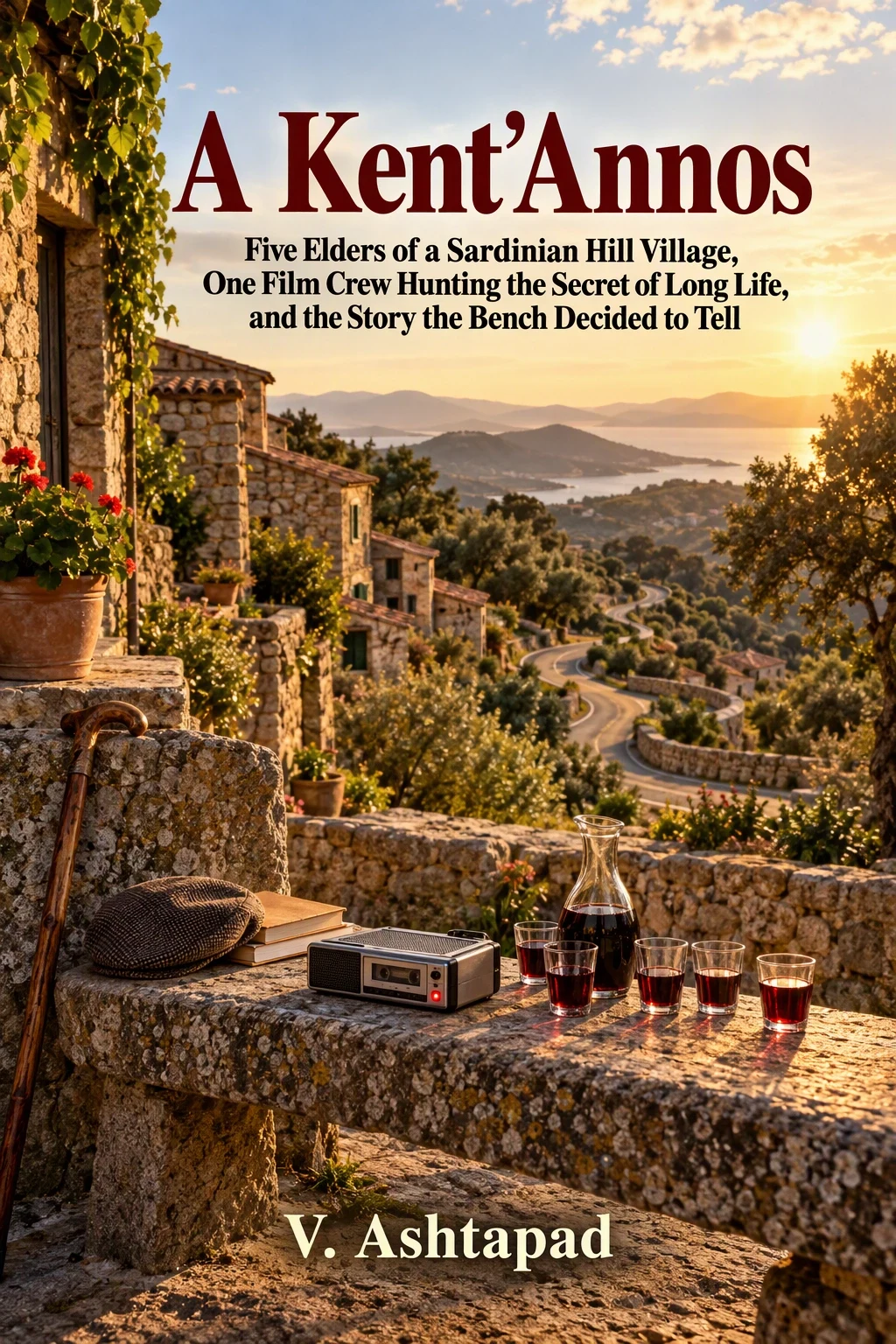
A Kent'Annos
Five Elders of a Sardinian Hill Village, One Film Crew Hunting the Secret of Long Life, and the Story the Bench Decided to Tell
by V. Ashtapad
Foreword
This is a work of fiction. The long-lived elders of Sardinia's Ogliastra, culurgiones, pane carasau, seadas, Cannonau wine, cantu a tenore, the ballu tundu and the toast a kent'annos are real, and so is the medical evidence that shared laughter eases pain, lowers blood pressure and helps recovery. The village of Bardula, its families and nicknames, the film crew and every named person are invented.
For every bench outside every bar where the old ones sit from four until the bells.
Tape One: Sa Puntura
Is the little red light on? Good. Then I am talking to the machine, and not to you, Gavino, because if I talk to you I will start asking if you have eaten and whether your mother knows you are wearing those trousers, and the machine does not have a mother.
My name is Grazietta Murru. I am ninety-four years old. I was born in this village of Bàrdula in the year of the big snow, which the government will tell you was 1932 and my mother would tell you was the year the priest's mule went through the ice on the trough, but she would only say that to make the other women laugh, so you can put down 1932.
In Bàrdula nobody calls me Grazietta. Nobody has called me Grazietta since I was nine. I am Sa Puntura. The Stitch. The Needle Prick, if you want to be precise, and I always want to be precise, which is how I got the name.
I will tell you how I got the name. But not first. First I will tell you where you are, because your director, the one with the scarf, has been here two days and he still thinks he is in a postcard.
---
You are in a village of six hundred and forty people, counting the ones who come back in August and complain about the road. We are in the mountains of Ogliastra, on the east side of the island, where the hills come down to the sea in steps like a giant's staircase. From the bench outside the bar, if you turn your head to the right, you see the sea, very far down, blue like a bruise in the morning and blue like a plate at noon. If you turn your head to the left you see the mountains, the Gennargentu, which means the silver gate, which has snow on it in winter that the young people drive up to look at and the old people remember walking through.
The houses are stone. Gray granite, with the doors painted green or blue, and the old ones have outside stairs that go up the side of the house to the second floor, because in the old days the animals lived downstairs. Some of the walls have paintings on them now. A boy from the art school in Cagliari came twenty years ago and painted the walls by the fountain. He painted a shepherd, a woman baking bread, a donkey, and Tziu Efisio, who sat for him three days and then complained that his nose was too big in the painting, which it is not, it is exactly the size of his nose.
The road comes up from the sea in thirty-one curves. I know because when I was a girl my father made me count them on the bus so I would not be sick. I was sick anyway. At curve nineteen. Every time.
That is where you are. Now you can tell your director.
---
He told me yesterday what he wants. Your director. Corrado. From Milan, with the scarf in July. He sat on my sister's chair in my kitchen, the good chair, the one with the rush seat my brother-in-law made, and he leaned forward with his elbows on his knees like a doctor about to tell you bad news, and he said:
"Signora Murru. We are making a film about the secret of long life."
He said it slowly, in very correct Italian, like I was a foreigner. I have spoken Italian since 1938, when the teacher hit our hands with a ruler for speaking Sardinian in the classroom. I speak it better than he does. He says "long life" like he is selling a soap.
"In this part of Sardinia," he said, "there are more people over a hundred than almost anywhere in the world. Scientists have come. Doctors. They have written papers. Is it the diet? The wine? The genes? The walking?"
He waited for me. He had a little notebook in his lap and a pen ready.
"Signor Corrado," I said. "What is your secret?"
"Mine?"
"For long life. What do you do?"
He laughed. He has a short laugh, from the nose, like a cat sneezing. "I'm forty-six," he said. "I don't have a secret. I have an ulcer."
"Then you came to the right place," I said, and gave him a biscuit.
---
Now. Sa Puntura.
When I was nine, my mother sent me to learn sewing from Tzia Lucia, who lived across the square and was the best seamstress in the valley. She made the festival dresses, the old ones, with the red skirts and the black bodices and the white shirts with the pleated collars that took a week to iron. Tzia Lucia was small and had no teeth and could thread a needle in the dark. She had seven girls learning from her in the room over her kitchen, all of us sitting in a row on little chairs with cloth on our knees, and she walked up and down behind us like a sergeant.
I was not a good student. I was a good talker. I talked so much that one day Tzia Lucia said, "Grazietta, if you sew the way you talk, you will be the best seamstress on the island, and if you talk the way you sew, you will be silent."
The other girls laughed. I did not like that. So the next time Tzia Lucia walked behind me, I said something about her. Not loud. Just loud enough. I said that her hair looked like a goat had been sleeping on it. Which it did. It was not my fault. It was true.
And Tzia Lucia did not say anything. She just reached over my shoulder, took the needle out of my hand, and gave me one little prick with it in the back of the hand. Here. You can see the mark if you look closely. No, you cannot. I am lying. There is no mark. But I felt it for a week.
And then she said: "That is what your tongue does to people, Grazietta. A little prick. It does not kill. But it makes them jump."
And from that day the girls called me Sa Puntura.
And I made the whole village jump for eighty-five years.
---
You are laughing. Good. The machine can hear you laughing. That is all right. That is the first thing I want to say into your machine, and I want you to keep it, even if your director cuts everything else.
In Bàrdula, everybody has a name that is not their name. Every family. Every person. Some families have had the same nickname for two hundred years, and nobody remembers why. The Pisu family are Sos Mudos, the silent ones, and they are the loudest family in the village. The Loi family are Sas Cabras, the goats, because a great-grandfather in 1890 climbed a cliff to rescue a goat and then could not get down and had to be rescued himself by a goat. Or so they say. I was not there. The Ladu family are Sos Pipiris, the peppers, because they are small and they burn.
Nobody is offended. Or, everybody is offended, and everybody laughs. That is the point. The name is a little prick. It says: we see you. We know what you are. We know where you came from and what your grandfather did in 1890 with the goat. And we are still sitting on the bench with you.
When the people from the government come, or the doctors from the university, they ask your name, and you give them the one on your identity card. Grazietta Murru, born 1932. And they write it down.
But that is not who I am. Ask anyone at the bench who Grazietta Murru is, and they will look at you like you are speaking Chinese.
Ask them for Sa Puntura, and they will point.
---
Gavino. Turn the red light off for a moment. I want to ask you something and the machine does not need to hear it.
All right. It is back on. Your director can wonder what we said.
What I said, machine, was: Gavino, your family is from where? And he said Cagliari. And I said, before that? And he said his grandmother was from a village near Sorgono, in the middle of the island. And I said, and what was her name, at the bench? And he did not know.
He does not know. He is twenty-six and he holds a microphone at the end of a long pole like he is fishing for words, and he does not know his grandmother's name.
So that is the first thing we will do while you are here, you and I. We will find it.
© 2026 CRUNOD LLC. All rights reserved.
Tape Two: The Minestrone Question
Red light. Good.
This is the second night. Your director went to bed at nine with his stomach, and Antje the German producer is on the telephone in the square again, walking up and down, saying "ja, ja, ja" to somebody in Hamburg, and Tullio the camera man is in the bar with Tziu Efisio, losing money at cards. I can hear Efisio laughing from here. When Efisio laughs like that, someone is losing money.
So it is you and me and the machine and the cat. The cat's name is Bobore. Say hello to the machine, Bobore. He will not. He has never said anything useful in his life, like most men.
---
Today your director came to the bench.
The bench is outside the bar. It is stone, long, with a back of stone, built into the wall of the old wine cellar, and it has been there since before anybody alive, and in the afternoon, from four until the bells, which I hear and nobody else rings anymore, the old people of Bàrdula sit there. Not all of them. The ones who can still walk. The others sit at their doors.
Today on the bench there was me, Sa Puntura. There was Tzia Bonaria, who is Sa Reina, the Queen, who is one hundred and one years old and sat at the end with her hands on her stick like she was waiting for her coronation. There was Tziu Antioco, who is Su Mudu, the Mute, though he is not mute, I will tell you about him another night. He had his walker. There was Tziu Efisio, Su Fumu, the Smoke, ninety-six, who is called that because you never see him come and you never see him go. And there was Tziu Zuanne Ladu, one of the Peppers, ninety-three, small, red, angry.
Five of us. Four hundred and seventy-five years, said Efisio, who did the adding. Zuanne said he was overcharged and he wanted his eleven years back.
And your director came with the camera, and Tullio, and you with your pole, and Antje with her clipboard, and he stood in front of us in the sun, in his scarf, and he said:
"Ladies and gentlemen. Please. Tell me. What do you eat?"
---
Now. You must understand something about the bench.
Fifteen years ago, maybe more, the scientists started coming. First one, from the university in Sassari, a nice young man with a beard, who asked us about our grandparents and took blood. Then more. Then the Americans. Then the newspapers. Then the television. Every year, two or three groups. They all ask the same thing. What do you eat, what do you drink, do you walk, did your grandparents live long, how many children, do you go to the doctor.
And we answer. We have always answered. We are polite. Our mothers raised us. But after fifteen years of answering the same questions, you start to feel like the goat on the cliff. Everybody is looking up at you and nobody is coming up.
So two years ago, at the bench, Efisio said: "The next ones who ask what we eat, we tell them something else."
And Zuanne said, "What else?"
And Efisio said, "Something better."
And we have been waiting two years for the next ones. And the next ones were you.
---
So when your director said "what do you eat," Tzia Bonaria lifted one hand off her stick, very slowly, like a queen giving a blessing, and said:
"Worms."
Your director's face. Gavino. You had the headphones on, so you only heard it. You did not see his face. I want to tell the machine about his face. His face went from Milan to Naples in one second.
"Worms?"
"In the cheese," said Bonaria. "The cheese with the little worms. Every morning, one spoon. Since I was three."
This is a real cheese. I must tell the machine that this is a real cheese, because the people in Hamburg will think we invented it. It is a pecorino that is left until the flies lay their eggs in it, and the little worms make it soft, and it is very strong, and some people love it and some people faint. It is not something you eat every morning with a spoon. It is something you eat at a wedding, when everybody is drunk, to show off. Bonaria has eaten it perhaps six times in her life. She told me once it tasted like the inside of a shoe.
"Every morning," said Bonaria. "One spoon. With the worms jumping. You have to close your eyes so they don't jump in them."
Tullio the camera man made a noise. The camera shook.
"And," said Efisio, "a glass of wine. Before breakfast."
"Before breakfast," said Zuanne.
"Red," said Antioco. Very slowly. Like each word was a stone he had to pick up. "Black. Red."
"Cannonau," I explained. "The wine of the valley. Black and red. Antioco means very dark."
"And then," said Bonaria, "a nap."
"In the morning?" said your director.
"Of course in the morning," said Bonaria. "When else? After the worms and the wine you cannot stand up."
---
He wrote it down.
Gavino, I swear to you on my husband's grave, which is up the hill and needs weeding, your director wrote it down in his little notebook. Worms. Wine before breakfast. Morning nap. He wrote it down and underlined it.
Then he said, "And the minestrone?"
Because they all know about the minestrone. Somebody wrote a book. There is a soup, a minestrone, beans and fava and chickpeas and fennel and potato and tomato and onion and a little pasta and a lot of olive oil and pecorino on top, that the old women here make, that the scientists say is one of the secrets. It is very good. My mother made it. I make it. I am not saying it does not help. A bowl of beans never hurt anybody except the people sitting next to them later.
"Minestrone," said Efisio, shaking his head sadly. "No, no, no. We stopped the minestrone."
"Stopped?"
"In 2009," said Zuanne. "Bad for you."
"Very bad," said Bonaria. "Too many beans. Too much wind. You see Antioco? Minestrone."
And Antioco, who cannot say long sentences since the stroke, who works every word up out of his chest like water from a well, lifted his hand off his walker and pointed at his own stomach and nodded, very seriously, and said:
"Boom."
---
That was when your director understood.
I watched it go across his face, slowly, like a cloud shadow over the hill. First he looked at his notebook. Then he looked at us. Five old faces, very serious, very wrinkled, in a row on a stone bench, with the sea behind and the mountains to the left. Then he looked at Antioco's hand on his stomach.
And Efisio, who cannot hold anything in, Efisio who in 1951 laughed at his own wedding so hard he could not say yes, Efisio began to shake. His shoulders first. Then his hat. Then the bench.
And then all of us.
And your director stood there with his notebook in the sun, with his scarf, with the camera on him, Tullio had turned the camera on him, and he went red, red like Zuanne, red like a pepper, and I thought, now he will be angry, now he will go back to Milan, now Antje will shout "ja, ja, ja" into the telephone.
And then he laughed.
The cat sneeze first. Then more. He sat down on the stone step in front of the bench, right on the step in his good trousers, and he put his notebook over his face, and he laughed until he coughed, and Bonaria hit him on the back with her stick, not hard, the way you hit a donkey to say good donkey.
"Good," said Bonaria. "Now we can talk."
---
That is the second thing I want you to keep, Gavino. Even if he cuts everything else.
For fifteen years they have asked us what we eat.
Nobody has asked us what we laugh at.
© 2026 CRUNOD LLC. All rights reserved.
Tape Three: Su Mudu
Red light.
Tonight I want to tell you about Antioco. He said I could. He said it today at the bench, in three words, which for him now is a speech. He said: "Tell. Puntura. Tell."
So.
---
Antioco Lai was born in 1927, which makes him ninety-nine. In September he will be a hundred, if he does not die out of spite before then, which he is capable of. He was the third of eleven children. His father had sheep in the high pastures, up toward the Gennargentu, and from the time he was six years old Antioco went up with the sheep in the spring and came down in the autumn, and for six months of every year he saw nobody but his father and his brothers and the sheep and the eagles.
When he came down to the village for the winter, to go to school, he did not talk. Not to the teacher. Not to the other children. He sat at his desk with his hands flat on it and he looked out of the window toward the mountains, and if you spoke to him he looked at you with his big dark eyes and said nothing.
The teacher thought he was simple. The other boys threw things at him. And the bench, the old people on the bench, who were not us then, who were our grandparents, named him Su Mudu. The Mute.
And he stayed Su Mudu. Even when he started to talk. Even when he grew up and married Tzia Speranza and had six children and became the best shepherd in the valley and then the best cheese maker and then, when the sheep were gone, the best storyteller on the bench. He talked so much that Speranza used to put a cork in his mouth at dinner. A real cork. From a wine bottle. She would push it in and say "now, Mudu, eat." And he would take it out and keep talking.
That is the joke of Bàrdula. The man who talked the most was called the Mute.
Until eleven months ago.
---
Eleven months ago, in August, Antioco was at the bench and he was telling the story of the eagle that took the lamb in 1938, which he tells every year, and which gets bigger every year, so that by last August the eagle was the size of a small airplane and the lamb was a full sheep with a bell. And in the middle of the story he stopped.
Just stopped. Mouth open. And his right hand fell off his stick. And his face on the right side went down, like a curtain.
Zuanne saw it first. Zuanne ran into the bar. Zuanne has not run since 1970, and he ran into the bar shouting for the telephone, and the ambulance came up the thirty-one curves from Lanusei in forty minutes, which is a miracle, and they took him down.
A stroke. In the left side of the brain. The side for words.
He was in the hospital in Lanusei for three weeks and then in a place in Cagliari for two months to learn to walk again. And when he came back to Bàrdula in November, on a gray day with the rain coming sideways off the sea, he could walk with the walker, very slowly. And he could understand everything. Everything. You could see it in his eyes. But the words would not come out.
They were in there. You could see him reaching for them. Like reaching for a cup on a high shelf.
And the first afternoon he came back to the bench, he sat down, very slowly, with the walker in front of him, and we all looked at him, and nobody knew what to say, and finally Efisio, who always says the wrong thing, which is why we love him, said:
"So. Mudu. Now it's true."
---
I thought Bonaria would hit Efisio with her stick. She lifted it.
But Antioco's face moved. The left side. Only the left side, because the right was still down. The left side of his mouth went up. And a sound came out of him. Not a word. A sound, a kind of bark. And then another. And his shoulders shook.
He was laughing.
Su Mudu, who could not say his own wife's name, was laughing so hard on the bench that the walker shook, and Bonaria put her stick down, and then we were all laughing, and the woman from the bar came out with a towel over her shoulder to see if someone was dying.
And when he stopped, he said one word, clear as a bell, the first word anybody had heard him say since August:
"Bastard."
To Efisio. With love.
---
Now. Here is the part your director will want. Here is the part for the scientists.
After that, Antioco came to the bench every afternoon. The physiotherapist came to his house three mornings a week from Tortolì, a young man named Stefano with big hands and a ponytail, and he made Antioco walk up and down the hall with the walker, and lift his right arm, and squeeze a rubber ball. And Stefano wrote everything down. How many steps. How long. How high the arm.
And after a month Stefano came to find me. Me. Sa Puntura. Because he had heard that I was the one who knew everybody's business, which is a terrible thing to say about a person, and true.
He said, "Tzia Grazietta, what happens at the bench?"
I said, "Nothing. We sit. We talk. We tell lies."
He said, "Tziu Antioco walks better on the days after the bench."
I said, "He walks better because he wants to get to the bench."
He said, "No. I measured. On the mornings after he goes to the bench, he takes more steps, and they are longer, and his blood pressure is lower when I take it. On the mornings after he stays home, because of the rain, worse. Every time."
I said, "So?"
He said, "So what do you do there?"
And I said, "We laugh at him."
---
Stefano did not believe me. So he came to the bench. In the afternoon, in his tracksuit, with his little machine for the blood pressure, the kind with the cuff that puffs up. And he sat on the step, where your director sat, and he waited, and he watched.
And that afternoon, Zuanne told the story of the tourist from Turin who asked for directions to the nuraghe, the old stone tower on the hill from three thousand years ago, and Zuanne sent him to the cemetery instead, and the man came back an hour later and said "very impressive, but it seems to be full of graves," and Zuanne said "they are very old Sardinians." And Antioco laughed his bark laugh until the tears came out of his good eye.
And Stefano took his blood pressure. Before and after.
And it was lower after.
And then Stefano, who is a serious young man with a ponytail, put the cuff on Bonaria. And on Efisio. And on Zuanne. And on me. Before the stories and after.
All of us. Lower after.
"Mamma mia," said Stefano. He looked at the numbers on his little machine. "You are a pharmacy."
"No," said Bonaria. "A pharmacy charges."
---
Stefano went home and looked it up, he told me. It is known, it seems. The doctors know it. When you laugh, a real laugh, from the stomach, the blood vessels open wider, and the blood moves better. The body makes its own little medicines for pain. The stress goes down, the hormones for stress, I don't remember the name, Stefano said it twice, something that sounds like a Spanish dance. You breathe deeper. The muscles of the chest and the stomach work, like exercise. And for a man like Antioco, Stefano said, whose brain is building new roads around the broken one, the laughing helps the brain to build, because it lights up many parts of the brain at once, and the brain is happy, and a happy brain builds faster.
"So," I said, "the bench is the hospital."
"The bench is the gym," said Stefano. "The hospital was the hospital."
That is the third thing, Gavino. Put it in your machine. Even if he cuts everything else.
Since November, Antioco has learned four hundred words again. Stefano counts. Most of them he learned at the bench. Most of them are rude.
© 2026 CRUNOD LLC. All rights reserved.
Tape Four: Sa Reina
Red light. Is it on? Gavino, you keep the machine on the table so close to my mouth that I can see my own nose in it. Move it back. No. Back. A little forward. There.
Tonight Bonaria.
---
Bonaria Mereu was born on the eleventh of March, 1925. She is the oldest person in Bàrdula and the second oldest in the whole Ogliastra, after a man in Arzana who is a hundred and three and who she says is cheating because he was born at the end of a month.
She is Sa Reina, the Queen. She got the name when she was twenty-two, at the festival in the summer of 1947, the first one after the war, when the village chose a girl to lead the dancing in the square. They chose her. She wore the dress, the red skirt and the black bodice and the white shirt, the one Tzia Lucia made, and gold buttons, and the long gold earrings that her grandmother left her, and she danced the ballu tundu in the circle in the square for three hours without stopping, holding hands with the men on either side, the little steps, the circle going round and round with the launeddas playing, the reed pipes, you know them, three pipes together, played without stopping, the player breathing in through the nose and out through the mouth at the same time, which is a thing no one can explain.
And at the end, at midnight, when everybody had stopped, Bonaria was still dancing. Alone. In the middle of the circle. With her eyes closed.
The old men on the bench, our grandfathers, said: look at her. Like a queen. Like she owns the square.
And she has owned it since.
---
Your director was very excited about Bonaria. A hundred and one! He wanted to film her alone, in her kitchen, with the light from the window, telling the secret.
Bonaria said yes.
Bonaria said yes the way the sea says yes to a boat. Yes, come out. Let's see how you do.
So this morning, nine o'clock, your director and Tullio and you with the pole and Antje with the clipboard went into Bonaria's kitchen, which is small and has a fireplace where she still bakes bread sometimes, and the light comes in through one window over the sink in a square on the floor, and he sat her in the square of light in her black dress with her white hair pulled back, very beautiful, like a painting in a museum.
And he said, "Signora Mereu. You are one hundred and one years old. What is the secret?"
And Bonaria looked into the camera, into the big black eye of it,, without blinking, and said:
"I had three husbands."
---
Now, Gavino, you know this is not true. You know this because I told you on the first night that Bonaria was married once, to Tziu Raimondo, for sixty-four years, until he died in 2010. You know this because her house is full of photographs of Raimondo. Raimondo at the wedding. Raimondo with the mule. Raimondo with the grandchildren. Raimondo is on the wall right behind her head, in the shot, in his army uniform from 1943, looking surprised.
But your director did not know.
"Three husbands?"
"Three," said Bonaria. "The first died of a fever. The second died of a fall. The third—"
She stopped. She looked out the window. She sighed, a long sigh, a hundred and one years long.
"The third," said your director, very softly, leaning forward.
"The third died of the mushrooms," said Bonaria.
"Mushrooms?"
"He would not eat them."
And she kept her face perfectly still. Perfectly sad. In the square of light. For seven seconds. I counted, because I was in the doorway.
And then she winked at the camera.
---
The director laughed the cat sneeze. Tullio laughed so hard he had to put the camera down on the table. Antje, the German, the serious one, who has not laughed once in three days, who walks up and down the square on the telephone saying "ja, ja, ja," Antje made a noise like a kettle and had to go outside.
And you, Gavino. You with your headphones. I saw you. You bent over your pole and your shoulders went up and down.
Bonaria sat in her chair in the square of light and watched all of you, very pleased, like a cat with a lizard. Then she said, to me, in Sardinian, in the doorway, so the camera would not understand:
"These ones are better than the Americans. The Americans didn't laugh. They asked if it was the mushrooms."
---
Here is a true thing about Bonaria, which she told me fifty years ago and has never told anyone else, and which she said this afternoon at the bench I can tell your machine, because, she said, "I am a hundred and one, and soon it will not matter, and somebody should know why I am so annoying."
In 1944, when she was nineteen, her two brothers were in the war, far away, and the news came that one of them, Bachisio, was dead. In the north. In the snow. The news came in a letter and her mother read it at the table and then went into her room and lay down and did not get up.
For two weeks, her mother did not get up. She did not eat. She did not speak. The priest came. The doctor came. Nothing. She lay in the bed with her face to the wall.
And Bonaria, nineteen, had no idea what to do. So she did what a girl of nineteen with no medicine and no money could do. Every evening, she went into her mother's room and perched at the foot of the bed and told her what had happened in the village that day. But not the true version. A better version. A stupider version. That Tziu So-and-so's donkey had eaten his hat. That the mayor's wife had fallen in the trough. That the eagle had taken a lamb the size of a small cow.
Every night. Two weeks. Her mother lay with her face to the wall.
And on the fifteenth night, when Bonaria said that the schoolteacher had sat on a hedgehog and had to be carried home on a door, her mother's back started to shake.
And she turned over. And she was crying and laughing at the same time, so you could not tell which. And she said, "Bonaria, you are a terrible liar," and she sat up, and she asked for soup.
"And she lived to ninety-one," Bonaria said at the bench this afternoon. "And she never stopped telling me I was a terrible liar. And I never stopped lying to her. Every day. Until the end. On the last day she said, 'Tell me one,' and I told her one, and she laughed, and then she went to sleep."
Nobody on the bench said anything after that for a while. Not even Efisio.
Then Antioco said, slowly, one word at a time:
"Bachisio. Came. Home."
Because he did. Bonaria's brother. The letter was wrong. He came home in 1946, thin as a stick, from a camp in Germany. He had been missing, not dead. He walked into the kitchen one evening and his mother screamed so loud they heard her at the bench.
"Yes," said Bonaria. "And when he came in, my mother looked at him and said, 'Bachisio, your sister told me you were eaten by a bear.'"
And then we were laughing again. All of us. The whole bench. Because that is how it goes. You go down, down, to the bottom of the well, and then somebody says something stupid and you come back up.
Put that in the machine, Gavino. That is the fourth thing.
© 2026 CRUNOD LLC. All rights reserved.
Tape Five: The Council at the Bench
Red light.
Tonight I am going to tell you a secret, Gavino, and it is a real secret, so you must promise me you will not play this tape to your director until we say. Promise. Say it into the machine.
Good. "I promise, Tzia." Very good. Your grandmother would be proud of your manners.
---
This afternoon we had a meeting.
Not at the bench. At the bench there are too many ears, the woman from the bar, the boys on their motorbikes, the tourists from Germany who walk through in short trousers asking where the nuraghe is so that Zuanne can send them to the cemetery. We met in Bonaria's kitchen. Five of us. Bonaria in her chair, me, Efisio, Zuanne, and Antioco, who came in his son's car and up Bonaria's front step with his walker, eleven minutes for four steps, which Zuanne timed, and which everybody said was a record, which it was.
And we had a vote.
---
The question was: what film are we making?
Because, you see, your director came here to make a film about us. About the old people of Bàrdula and the secret of long life. And he has a story already, in his head. I can see it in his head, behind the scarf. Beautiful mountains. Beautiful sea. Old women baking bread. Old men with sheep. A bowl of minestrone, steaming, in the window light. A glass of black wine. Some music. A man in a white coat from the university saying "genetics" and "diet" and "community." And at the end, Bonaria, a hundred and one, looking into the camera, very wise.
We have seen that film. We have seen it eleven times. The Americans made it, the French made it, the Japanese made it. The Japanese one was the best because they filmed the goats.
And every time the film comes out, more people come. In buses. To look at us. Like the goat on the cliff.
So the question was: do we let him make that film again? Or do we make our film?
---
Efisio spoke first. He always speaks first.
"I say we tell them everything is because of the worms," he said. "Every interview. Only worms. By the end of the film, the whole world will be eating worms, and the cheese makers in Barbagia will be rich, and they will build us a statue."
"A statue of what?" said Zuanne.
"Of a worm," said Efisio.
Antioco laughed his bark. Bonaria hit Efisio's foot with her stick. Vote on worms: one for, four against.
---
Zuanne spoke second. Zuanne is always angry, which is why he is called the Pepper, and he was angry now.
"I say we tell them to go home," he said. "Fifteen years. Fifteen years of microphones in our faces. 'Tziu, what did you eat in 1940?' Nothing! I ate nothing in 1940! There was a war! I ate grass! Put that in the film! The secret of long life is starvation!"
He went very red. We all waited. Zuanne gets red and then he gets less red, like a coal.
"But," he said, less red, "the boy with the pole is all right."
That is you, Gavino. You have a fan.
Vote on going home: one for, four against. Zuanne voted against himself, for the boy with the pole.
---
Then Bonaria spoke. She did not stand up. She does not stand up. She sat in her chair with her hands on her stick and she said:
"I am a hundred and one. I have lived through a king, Mussolini, a war, a republic, the television, the motorway in the valley, the telephone in the bar, the telephone in the pocket, and my grandson's girlfriend with the ring in her nose. I have buried a husband, two sons, a brother, and every friend I had when I was twenty. Every single one. And I am still here, and I want to know why, as much as the man in the scarf does."
Nobody said anything.
"And I know why," said Bonaria. "And so do you."
She looked at Antioco.
"Mudu," she said. "When you came back from Cagliari, in November, in the rain, and you sat on the bench and you could not say one word, and Efisio said 'now it's true,' what happened?"
Antioco looked at her a while. Then he worked the words up. You can see him doing it. His jaw. His good hand on the walker going tighter.
"I," he said. "Was. Dead. Inside." A breath. "Then. Bastard. Made. Me. Laugh."
"And then?"
"Then. Alive."
---
So that was the vote.
We will make the film. We will let your director film the mountains and the bread and the black wine and the minestrone. Fine. We are not monsters. He has a budget and a German.
But the story, the real story, the one in the middle of the film, will be the bench. The names. The lies. The pricks of the needle. The laughing. Antioco learning his words. Bonaria and her mother. Not "what do you eat." What do you laugh at, and who with, and every afternoon, from four until the bells, for eighty years.
Five votes for. Antioco voted with both hands, the strong one lifting the weak one, lifting the bad one off the walker with the good one, which was the first time any of us had seen him lift it at all, and Efisio stood up and kissed him on the head.
---
There are rules. We made rules. I am the secretary, because I can write fastest, so I wrote them on the back of Bonaria's electricity bill.
One. No more questions about what we eat. If they ask, we say worms.
Two. Every interview at the bench, all together. Not one by one in a kitchen with a sad light. Together. Because nobody here is funny alone. Alone you are just an old person in a chair. Together you are a council.
Three. They must let us ask them questions too. The director, the German, the camera man, and the boy with the pole. Everyone sits on the bench. Everyone gets a name.
Four. Antioco tells his story himself. However long it takes. Even if it takes all day. Even if the German has to call Hamburg and say "ja, he is still on the second word."
Five. At the end, in the square, they show us the film first. Before anyone. Before Milan, before Hamburg, before the television. In the square, on a sheet, on a wall. And if we don't like it, we tell them, and they listen.
Six, added by Efisio, which I wrote down to make him happy: the director takes off the scarf. It is July.
---
So now you know, Gavino. Tomorrow at four we will tell your director. Not you. You must look surprised. Practice. Look surprised for the machine.
That is very bad. You look like Bobore when he sees a dog. Practice in the mirror.
© 2026 CRUNOD LLC. All rights reserved.
Tape Six: Gavino's Grandmother
Red light, but tonight I am going to talk to you, Gavino, not the machine. The machine can listen. It is a very good listener. Better than most husbands.
You asked me today, on the walk down to the fountain with the water jugs, why I keep asking about your grandmother.
I will tell you.
---
When you came here on the first day, with your pole and your headphones and your Cagliari trousers, you said "buongiorno" to everybody, in Italian, very nicely. You have very good manners. Your mother did well.
And at the bench Zuanne said to you, in Sardinian, the way we talk, "Who are you, then, and where are you from, and who is your family?" Which is the question. The only question. Everyone who comes to the bench is asked that question, from babies in prams to the Japanese. And you understood him. I saw it. You understood every word.
And you answered in Italian.
I saw your face. You knew the words. You opened your mouth for them. And then they did not come, and the Italian ones came instead, and you went red, and you said "Scusi, I understand but I don't speak it well."
---
Do you know how many young people have said that to me? On this bench? In this square? "I understand but I don't speak it." My own grandchildren. My great-grandchildren in Turin, who come in August and call me Nonna, not Mannai, and ask for the password for the internet.
It is not your fault. It is not their fault. In 1938 the teacher hit our hands with the ruler. In 1960 the mothers stopped speaking it to the children because the children would need Italian to get jobs in Turin and Milan and Germany. In 1980 the television came and spoke Italian all day. By the time you were born, in Cagliari, in a flat with a balcony and a television, your mother spoke Italian to you because her mother spoke Italian to her, because her mother wanted her to have a job.
And your grandmother. From near Sorgono. She spoke it. You remember her speaking it?
Yes. You said yes. To your mother, on the telephone. To her sisters. Never to you.
And you don't know her name. Her name at the bench.
---
So I telephoned this afternoon.
Don't make that face. I am ninety-four. I am allowed. I have a cousin. Everybody in Sardinia has a cousin. My cousin is married to a man whose sister lives near Sorgono, in the village, and she is eighty-eight, and she knows everybody, because that is the job of a woman of eighty-eight in a village. I asked her: an old woman, dead maybe five years, a Pisano by marriage, whose daughter married in Cagliari, whose grandson is a boy with a pole.
She knew in four minutes.
Your grandmother's name, Gavino, was Giovanna Pisano, born Floris. That is the name on her card. But in her village, at her bench, the bench outside the bakery there, where she sat every afternoon until she went to live with your mother in Cagliari, she was called Sa Cantadora.
The Singer.
---
You didn't know.
No. You didn't. I can see it. Look at you. Turn the machine off if you want. No? All right.
Because when she was a girl, my cousin's sister-in-law says, Giovanna Floris sang. At weddings, at the harvest, at the end of the grape picking, when everybody was tired. She had a voice that came out of her like water out of the rock at the fountain, very clear, very cold. They say when she sang at the end of the grape picking in 1958, the men stopped drinking to listen. Which nobody has seen before or since.
And they say she stopped singing when she married and moved to Cagliari, because in Cagliari, in the flat, it was not the kind of thing you did, sing the old songs in the old words. And when she came back to the village in the summers, she sang again. Only there. At the bench. For the old women. Never in the city.
"She sang to you, I think," said my cousin's sister-in-law on the telephone. "When the boy was small. When he came to the village with his mother in August. She sang him to sleep on the bench outside the bakery. Ask him."
---
You remember.
Good. Cry. It's good for the blood vessels. Stefano said so. Crying is laughing's sister. They live in the same house.
What do you remember?
You remember a voice. And a bench. And the smell of bread. And the sea is not there, because Sorgono is in the middle of the island, but you remember the hills. And the song. You remember one line of the song. Sing it.
No. Sing it. The machine wants to hear it.
---
There. Gavino. That is a lullaby from the middle of the island. "Ninna nanna." It is the song every mother in Sardinia sings, with different words in every village. Your grandmother's words were about a little bird that sleeps in the oak, and the wind that rocks the oak, and the mother that rocks the wind. I know it. My mother sang it with different words, about a little lamb. Everybody has it. It is the first thing we hear and the last thing we forget.
You sang it in Sardinian, Gavino.
You didn't notice? You sang it in Sardinian. The whole line. Not one Italian word. It was in there. All the time. In a drawer. Like her.
---
Now. Here is what we do. Tomorrow at the bench, when we tell your director the rules, and he has to sit on the bench and get his name, you will sit too. And Zuanne will ask you, the way he asked you the first day, "Who are you, and where are you from, and who is your family?"
And you will answer in Sardinian. You will say: I am Gavino, the grandson of Sa Cantadora of Sorgono.
Practice it. Now. Into the machine.
Again.
Again. Slower. "Nebode." The grandson. Good.
Your accent is terrible, Gavino. You sound like a man from Cagliari. Which is what you are. That is all right. Zuanne will laugh at you. Everybody will laugh at you. And then you will be on the bench.
That is how you get on the bench. Someone laughs at you, and you laugh too.
Turn it off now. Go to bed. And Gavino. Kiss your mother when you get home. She didn't take it away from you on purpose. Nobody did. It just got put in a drawer.
© 2026 CRUNOD LLC. All rights reserved.
Tape Seven: Culurgiones on Sunday
Red light. Gavino, there is flour on the machine. Wipe it. No, with a cloth, not your shirt. You are a disaster. Your grandmother would have hit you with a spoon.
Today was Sunday and today the bench came to my kitchen, because on Sunday we make culurgiones, and the director wanted to film it, and I said yes, if everybody makes them. Everybody. The director, the German, the camera man, and you.
And so I have flour everywhere. On the table, on the floor, on the cat, on the machine, in Antje's hair, and on Efisio, who did not even make any, who only sat in the corner eating the filling with a spoon when he thought I was not looking.
---
I must explain culurgiones to the machine, for the people in Hamburg.
They are the pasta of Ogliastra. Ours. Not from anywhere else, whatever they say in the restaurants in Rome. A little pocket of dough, the size of a walnut, filled with potato, and fresh pecorino and a little old pecorino, and mint, a lot of mint, and garlic, and a little onion fried slowly in olive oil. Some families put a little lard. Some put a little nutmeg. My family puts the mint from my sister's garden, which is better than anyone's mint, which I will say into the machine so my sister's daughter can hear it in Rome.
And then you close it.
That is the whole art. The closing. You hold the little circle of dough with the ball of filling in your left palm, and you fold the edge over with your right thumb and finger, a pinch on one side, a pinch on the other, a pinch on one side, a pinch on the other, all the way up, so the seam goes up the middle like a braid, like the ear of the wheat, and at the top you close it with a little twist.
It is called the spighitta. The little ear of wheat.
My mother could close one in four seconds. I could close one in five, when I was thirty. Now I am slower. Bonaria still does it in six. A hundred and one years old. Six seconds.
Your director took four minutes for his first one and it looked like a dead mouse.
---
Now. The machine must hear what happened, because what happened is the fourth thing and the fifth thing together.
We sat at my big table, which was my mother's, which has a crack in the middle from the year my father brought a lamb in and put it on the table and the lamb jumped. Me at the head. Bonaria at my right in the good chair with the rush seat. Antioco at my left, with his walker beside him, and a towel on his lap, because I said, Mudu, you are making them too. Zuanne and Efisio. My niece Tonina, who is sixty and still my niece. And the crew. Corrado without the scarf, finally, it is July. Antje with her hair tied up. Tullio with his camera on a tripod in the corner, because he was making them too and the camera had to look after itself. And you.
I put the dough out, a long sheet, rolled thin, and the little cup to cut the circles, and the bowl of filling, and I showed everybody. Pinch, pinch. Pinch, pinch. Twist.
And everybody tried.
---
Antje the German was terrible. Antje is a very intelligent woman, she has a diploma and she speaks five languages and she has produced films in Iceland and Argentina and Japan. She held the dough like it was a bomb. She pinched too hard and the filling came out the side. She pinched too soft and it opened again. She said "ja, ja, ja" to the culurgione like it was Hamburg on the telephone. After ten minutes she had one, and it looked like a small potato that had been in a fight.
And she held it up and looked at it.
And she started to laugh.
I want the machine to know about this. Antje had not laughed in five days. Not really. She laughed the kettle laugh at Bonaria's three husbands, and then she went outside. But today, at my table, with flour in her hair, looking at her terrible culurgione, she laughed and did not go outside. She laughed until she had to sit back in the chair, and she put the culurgione down on the table in front of her very gently like a baby bird, and she laughed, and she said something in German that Tullio says means "I have not done anything with my hands in fifteen years except hold a telephone."
And Bonaria, who does not speak German, said "Eja," which means yes in Sardinian. Yes, I know.
---
Then Antioco.
He has his right hand now. Some of it. Stefano has been working on it for nine months. He can lift it, and hold a cup if it is not too full, and squeeze the rubber ball. But fine things. Little things. The fingers do not do what he tells them.
He held the circle of dough in his left palm, on the towel. He put the filling in with a spoon in his left hand. And then he had to close it with the right.
We all watched. Nobody said anything. Even Efisio stopped eating filling.
The first pinch did not close. The fingers would not come together. They hovered, the thumb and the finger, like two people who have had a fight and do not want to be the first to speak.
He tried again. Nothing.
And I saw his face. The left side, the side that moves. It started to fall. You know what I mean. Not the stroke. The other falling. The falling inside.
And then Zuanne said:
"Mudu. Antje's is worse."
And Antioco looked across the table at Antje's culurgione, the potato in a fight, sitting on the table in front of her like a baby bird.
And he barked.
And the fingers closed.
---
I am not making this up for your director. I swear on the crack in the table. He laughed, and his whole chest went up and down, and his right hand on the dough, the thumb and the finger, came together. Pinch.
He stopped laughing and looked at it.
"Again," said Bonaria.
He tried. Nothing.
"Mudu," said Efisio, "it looks like your face in 1953 when Speranza's father said yes."
Bark. Pinch.
"Mudu," said Zuanne, "it looks like Bonaria's third husband."
Bark. Pinch. Pinch.
And so it went, Gavino. You were there, you heard it, it is in your machine, which was on the windowsill with the red light. For forty minutes the whole table told jokes to Antioco's right hand. Bad jokes. Old jokes. Jokes about everyone at the table, about the mayor, about the Pope, sorry, about the tourists from Turin, about Antje's hair. And every time Antioco laughed, really laughed, from the bottom of his chest, his fingers came together a little more.
At the end of forty minutes, he had closed one culurgione.
It was not good. The seam went up crooked like a road in the hills. The top did not twist; it just stopped, like the road ran out. But it was closed. The filling was inside. It was a culurgione.
He put it on the tray with the others, with mine and Bonaria's and Tonina's and the director's dead mouse and Antje's baby bird. And he looked at it on the tray.
Then he said, slowly, clearly, without stopping between the words:
"I want that one on my plate."
Eight words. Without stopping.
Tonina started to cry. Antje started to cry. Efisio said, "Tonina, you'll make the dough wet," and Tonina hit him with the rolling pin, and we were laughing again.
---
We boiled them at one o'clock and ate them with my tomato sauce, the one with the basil from the pot on the step, and grated pecorino, and black wine, Cannonau, a glass for everybody, even Antioco, half a glass, which Stefano does not need to know about. Antioco got his own culurgione on his plate, the crooked one, on top, and he ate it last, very slowly.
And your director, Corrado, who has an ulcer, who has eaten nothing for four days but crackers and white rice and the biscuits I give him, ate eleven culurgiones and two helpings of sauce and had a glass of wine.
"My stomach," he said, afterward, sitting back in the chair with his hand on it, looking surprised, "doesn't hurt."
"Of course it doesn't hurt," said Bonaria. "You've been laughing for two hours. Your stomach was too busy."
---
Stefano came at four, for the afternoon exercises, and Tonina told him about the culurgione, and he went very quiet, and then he asked to see it. But Antioco had eaten it.
So Stefano sat down at my table and asked us to make more, and to tell the jokes again, and he watched Antioco's hand, and he wrote things in his notebook. And then he said a long thing about the brain, about the new roads, about how the brain builds new paths around a broken place when the person is happy and calm and paying attention to something they love, and that the laughing makes the body loose and the breath deep and the blood move and the pain small, and in a body like that, the hand can learn faster.
"I can't put a bench in his house," Stefano said. "But I can come to the bench. I'll come to the bench. Three afternoons a week. We'll do the hand at the bench."
"With the jokes," I said.
"With the jokes," he said.
"Then you have to be on the bench," said Zuanne. "You need a name."
Stefano looked worried.
"Su Coa," said Efisio. "The Tail." He meant the ponytail.
And Stefano laughed, and that was that. Su Coa. The Tail. He has been on the bench since half past four.
That is the fifth thing, Gavino. The hand. Keep it.
© 2026 CRUNOD LLC. All rights reserved.
Tape Eight: Su Fumu
Red light. You're late. Where were you? With Efisio? Then I don't want to know. Did he take your money? How much? Mamma mia. Never play cards with the Smoke. I told you on the first day. No, I didn't. I'm telling you now.
---
Tonight I will tell the machine about Efisio, because Efisio asked me to, and because Efisio cannot tell it himself, because every time he starts to tell it he laughs so hard he can't finish.
Efisio Carta. Born 1930. Su Fumu. The Smoke.
He got the name in 1946, when he was sixteen, when he and three other boys stole the mayor's bicycle and hid it at the top of the bell tower. Don't ask me how. Nobody knows how. You cannot carry a bicycle up those stairs; they are like a ladder. But the next morning there it was, at the top, hanging from the bell rope like a sausage. And the mayor went to the bench and said, "Who did this?" And the old men said, "Efisio Carta." And the mayor went to Efisio's house. And Efisio was at his aunt's in Lanusei. Eleven kilometers away. His mother swore it. His aunt swore it. The whole family swore it.
He had been at the top of the bell tower at five in the morning and at his aunt's in Lanusei by seven. On foot. Down the mountain.
Nobody saw him go. Nobody saw him come. Like smoke.
---
He has been doing it for eighty years. You never see Efisio arrive at the bench. You look away, and you look back, and he is sitting there. You never see him leave. You turn to say something and he is gone, and there is a little warm place on the stone. My husband, may he rest, used to say Efisio was not a man at all but a ghost who forgot to die, and then he would look over his shoulder in case Efisio was standing behind him, which he usually was.
Efisio laughs at everything. That is the other thing about him. He laughs at weddings. He laughed at his own wedding, in 1951, when the mayor asked him if he took Maria Grazia as his wife, he looked at her in her white dress and her mother's veil and the bunch of flowers, and he started to laugh, and he could not stop, and he could not say yes. For four minutes. Maria Grazia stood there. The whole village stood there. And finally Maria Grazia said, "Efisio, if you don't say yes, I'll marry Zuanne." And Zuanne, who was eighteen, shouted "I'm here!" from the back.
And Efisio said yes.
They were married fifty-eight years. She died in 2009. He laughed at the funeral too. Not because he was happy. Because she would have wanted it. She left a letter, she knew him, it said "Efisio, if you cry at my funeral I'll come back and haunt you." So he laughed. He stood at the grave and laughed with the tears coming down, and the whole village laughed with him, and cried with him, both, at once, and it was the strangest funeral I have ever been to and the best one.
---
But here is the story he wanted me to tell.
In 2019, when he was eighty-nine, Efisio had a heart attack. A big one. At the bench, of course. Everything happens at the bench. He was telling the story of the bicycle in the bell tower, for the nine hundredth time, and he went white and put his hand on his chest and said, "Ah. This is new."
The ambulance came up the thirty-one curves. They took him to Lanusei. They put him in the heart room with the machines and the wires and the screen that goes beep, beep, beep.
And the doctor, a young woman, very serious, said to his son, "He's ninety. It's very bad. We'll do what we can. You should call the family."
And his son called the family. And the family came. Fourteen of them, from the village, from Cagliari, from Turin. And they stood around the bed in the heart room, crying, with the beep, beep, beep, and Efisio lying there gray in the bed with the wires on him like a puppet.
And his great-granddaughter, who was six, who had never met him before because she lived in Turin, said very loudly:
"Why does Nonno have a nose like a potato?"
---
That's it. That's the story.
Because Efisio opened his eyes. In the bed. In the heart room. And he looked at the little girl. And he started to laugh.
And the screen went beep-beep-beep-beep-beep, faster, and the nurse ran in, and the doctor ran in, and they said "Stop him, stop him," and nobody could stop him, because nobody has ever been able to stop him, and the whole family started laughing too, the fourteen of them, around the bed, and the little girl was crying because she thought she had done something terrible.
And the doctor, the young serious woman, stood at the foot of the bed watching the screen. And the screen, after the fast part, slowed down. And then it went steady. Beep. Beep. Beep. Strong.
And Efisio said, "Tell her my nose is perfect. It's the right size for my face. Tell her the painter on the wall agrees."
And he went home ten days later. And he has been at the bench every afternoon since. Seven years.
---
The doctor came to see him, after. In the village. The young serious woman. Dottoressa Ledda. She was doing a study. She sat at the bench with us one afternoon and asked questions. Not about what we eat. About the bench. How long we sit. How much we talk. How often we laugh.
"Laugh?" said Zuanne. "Who counts?"
"I want to," she said.
So she counted. For a month, she came three afternoons a week and sat on the step in front of the bench with a little clicker in her hand, the kind for counting people at a door, and every time somebody on the bench laughed, a real laugh, she clicked it.
She clicked one hundred and forty-two times in one afternoon. The record. The day Bonaria told the story of the schoolteacher and the hedgehog.
Then she went back to the hospital and looked at her papers and she said there are studies, from other countries, real ones, that show the people who laugh with others every day have less trouble with the heart, and with the blood pressure, and less pain, and they sleep better, and they live longer. Not a lot longer. A little. But a little every day for eighty years, she said, is a lot.
"Then put it in the papers," said Bonaria. "Put us in the papers. Not the beans."
"I will," said the doctor. "But the beans help too."
"Of course the beans help," said Bonaria. "Everything helps. But you can't laugh at a bean."
"You can," said Efisio. "I've seen Zuanne."
---
That's Efisio, Gavino. The sixth thing. Put it in the machine.
And give me back the money he took from you. No. I mean it. I will give it back to you, from him. He owes me. He's owed me since 1946. He took my bicycle too. Didn't I tell you? It was my bicycle at the top of the bell tower. Not the mayor's. Mine. Everybody says the mayor's because it's a better story.
© 2026 CRUNOD LLC. All rights reserved.
Tape Nine: Sos Pipiris
Red light. Zuanne is here tonight, machine. He is sitting in my sister's chair, the good one, with a glass of my mirto, the myrtle liqueur, the purple one, which he says is too sweet, and which is his third glass. He has agreed to be on the tape on one condition, which is that I tell it and he corrects me. He says I always tell it wrong. I have told it wrong for seventy years. He has corrected me for seventy years. It is the longest conversation in Bàrdula.
Say hello, Zuanne.
He says hello. Very rudely. You can cut that, Gavino.
---
Giovanni Ladu. Born 1933. Zuanne to his mother, Tziu Zuanne to everyone under eighty, and at the bench, Pipiri. The Pepper. One of Sos Pipiris, the Ladu family, the Peppers, small and red and hot, all of them, the grandfather and the father and the three brothers, and the sisters too, though the sisters were prettier peppers.
Nobody knows where the family name came from. Zuanne says it was because the first Ladu in Bàrdula, in seventeen-something, grew peppers in a garden by the fountain and sold them in Lanusei. I say it was because the first Ladu bit a mayor. Zuanne says that is a lie.
He says that is a lie, machine. He is saying it now.
---
But that is not the story. The story is why Zuanne does not laugh.
He laughs now. A little. You have heard it, Gavino, it is on the tapes, it sounds like a door being slammed in a high wind, once, bang, and then nothing. But when I was a girl, Zuanne did not laugh at all. Not at the bench, not in school, not at weddings. Never.
In 1940, when he was seven, his father went to the war. In 1941 the food ran out. Not only for the Ladus. For everybody. There was no flour from the mainland. The sheep were taken for the army. The men were gone and the women and the children and the old ones were in the village with the gardens and the acorns and the wild greens from the hills. Zuanne says they ate grass. He said it on the first day to your director. It is true. They boiled the wild chicory and the fennel and the nettles, and they ground acorns for flour and mixed it with clay, the old way, the way from before anybody remembers, to take the bitterness out, and baked it on the stones. It tasted, Zuanne says, like eating a wall.
He was the oldest boy in the house. His mother sent him up the hill every morning with a sack for greens. He was seven, eight, nine. While the other children played in the square, he was on the hill with the sack.
And his little brother, Nanni, who was three, got sick in the winter of 1942. The fever. There was no doctor in the village, the doctor was in the war too, and no medicine, and no food to make him strong.
He's nodding. I'm telling it right. Machine, he's nodding.
---
Nanni did not die.
That is the part that surprises people. Everybody thinks the story is going to end with the little brother dying. It doesn't. Nanni lived. He lived to eighty-one. He was a builder in Germany for thirty years and came back and built the house with the blue door behind the fountain.
He lived because of Zuanne.
For six weeks, in the winter of 1942, while Nanni was sick in the bed, nine-year-old Zuanne went up the hill every morning with his sack and came back with greens and acorns and sometimes, when he was lucky, a bird he caught with a snare, or a hedgehog, and his mother cooked it, and Nanni got the broth. And every evening Zuanne sat on the end of Nanni's bed.
And he did not tell jokes. He did not know how. He was not a funny boy. He was a serious, angry little pepper of nine.
So he did the only thing he knew. He made faces.
Terrible faces. Zuanne's faces. Pulling his ears out, pushing his nose up, crossing his eyes, putting his lower lip over his upper lip. The face of the mayor. The face of the teacher with the ruler. The face of the donkey. The face of Mussolini, which was very dangerous in 1942. Every evening. While his own stomach was empty.
And Nanni, three years old, with the fever, laughed.
---
He is saying something. He wants me to stop. No, Zuanne, I will not stop, it is my tape.
He is saying: "I stopped making faces after Nanni was better. Because it was for Nanni. It wasn't for me."
That is what he said, machine. In 1942 a boy of nine made faces at his brother for six weeks to keep him alive and laughing, with no food in his own stomach. And when the brother was better, the boy put the faces away in a drawer, and didn't take them out again, for eighty years. Because they were for Nanni.
Nanni died in 2017. The funeral was in the summer, when the Germans come. And at the end of the funeral, at the house with the blue door, with everybody standing in the street, Nanni's grandson, who was twelve, who lives in Stuttgart, who speaks German and Italian and no Sardinian at all, came up to Zuanne and said, in Italian, "Zio, Nonno said you could make the best faces in Sardinia. He said you saved his life with them. Can you show me one?"
And Zuanne, eighty-four years old, in his funeral suit, in the street, made the face of the donkey.
And the boy laughed until his legs gave and he sat on the step.
And Zuanne laughed too. For the first time since 1942. Bang. Like a door. Once.
---
He is making the face now. Machine, he is making it. In my sister's chair. With the mirto. Gavino is laughing so hard he's going to lose the pole. You have to imagine it, machine. You can't hear a face. Imagine a donkey who has been told the price of hay.
---
Here is the last part. I want this one in, Zuanne. Don't argue.
Nanni's grandson in Stuttgart, the boy who asked for the face, is twenty-one now. He is studying to be an engineer. Last year he wrote to Zuanne. Not a letter. One of those family places on the telephone, a private one, with a tree of names and photographs, that his mother set up so the Ladus in Stuttgart and Turin and Bàrdula could see each other. You can put little recordings on it. Pictures. Voices.
He asked Zuanne to put the faces on it. For his children, someday. He said, "Zio, nobody in Germany will believe me."
And Zuanne said no. Absolutely not. He said it in Sardinian and then in Italian so the boy would understand. No.
And then, last month, after your director cried on the bench, after he made Corrado laugh with the handkerchief, Zuanne went home and asked his great-granddaughter to hold up her telephone. And he made them. All the faces. The mayor, the teacher, the donkey. Even the dangerous one. One after the other, in his kitchen, in front of the little camera, with no sound. Twenty minutes of faces.
And she put them in the family place. Under his name. Under both his names, the one on his card and the other one. Giovanni Ladu. Pipiri.
And under that the boy in Stuttgart wrote one line, which Zuanne had his great-granddaughter read to him, and which he will not let me tell you, and which is why he has gone red.
He's going red now, machine. Pepper red.
All right. Fine. I'll say it. It said: "Now I believe it. Thank you for saving my grandfather."
That's the ninth thing, Gavino. Put it in.
He says he wants more mirto.
© 2026 CRUNOD LLC. All rights reserved.
Tape Ten: The Director's Stomach
Red light. You look tired, Gavino. Is the German shouting at you? No? Then you look tired for a good reason. You were up at the fountain with Tonina's granddaughter last night. Don't argue, the whole village saw you, there is a window in every house.
Tonight I'll tell the machine about your director.
---
Corrado Bellini. Born 1980, in Milan. He told me himself, this afternoon, at the bench, because it was his day.
Because that was rule three. They must let us ask them questions too. Everyone sits on the bench. Everyone gets a name.
So today, at four, after the hand exercises, after Stefano and Antioco did the rubber ball and the jokes, Bonaria lifted her stick and pointed it at the director and said, "Now you."
And he sat down. On the bench. Between me and Zuanne. With Tullio's camera pointing at him for once instead of at us, and you with the pole over his head instead of ours, and Antje with the clipboard writing down what he said. He looked like a man in a dentist's chair.
---
"Who are you," said Zuanne, "and where are you from, and who is your family?"
He said Milan. He said his father was an engineer and his mother was a teacher and he was an only child. He said he went to film school in Rome and then made advertisements for twelve years. Cars, coffee, shampoo. Then documentaries, because he wanted to make something true. He said he had made nine of them. About the sea, about factories, about a choir in Naples.
"Married?" said Bonaria.
"Divorced."
"Children?"
"One. A daughter. Fourteen. She lives with her mother."
"Do you see her?"
He was quiet for a moment.
"Every second weekend," he said. "When I'm not filming."
"And how many weekends are you filming?"
He looked at the ground. "Most of them."
---
Then Efisio asked him why he has an ulcer.
And he said, the doctor says, stress.
"Stress from what?"
He said, the films. The money. The deadlines. The producers in Hamburg. The phone at night. Not sleeping. Four hours a night, five hours. Lying awake thinking about the next film and the one after. Thinking about his daughter. Thinking about his father, who died two years ago, who he did not see enough. Eating at the desk. Coffee, coffee, coffee. Antacids from the pharmacy in a big jar.
"And when did you last laugh?" said Bonaria. "Before you came here."
He opened his mouth to answer. And then he closed it.
He thought about it. Really thought. We all watched him think. The sea was very bright down below, and a hawk was going around over the valley in slow circles, and the boys on their motorbikes went past, and nobody said anything.
And then he said, "I don't know."
---
That was all. He just said "I don't know," in a small voice, a boy's voice, on the stone bench, in his good trousers, without his scarf.
And Bonaria put her old hand on his knee.
"Then you have the same thing Mudu had," she said. "You are dead inside. Only you are walking around. That's worse. At least Mudu had the decency to fall down."
Antioco barked.
And then the director laughed too. A real one, not the cat sneeze. And then he couldn't stop. And then, I don't know how it happened, he was crying. On the bench. In front of his own camera. And Tullio did not turn it off, and you did not take the pole away, and Antje stopped writing and put the clipboard down, and Zuanne, of all people, Zuanne the Pepper, took a handkerchief out of his pocket, a big white one, ironed, his wife irons them, and gave it to him.
And Corrado blew his nose into it like a trumpet.
And Efisio said, "That's how you know he's from Milan. Even his nose is loud."
And we were laughing again.
---
Then it was time for his name.
There was a lot of argument. Efisio wanted Su Sciallu, the Scarf, for the first two days. Zuanne wanted Su Malaidu, the Sick One, for the stomach. Tonina, who had come out of the bar, wanted Su Bellu, the Handsome One, which made Corrado go red and made Tonina's husband, who was in the bar, come out and stand in the doorway with his arms folded.
And then Antioco lifted his right hand. The bad one. Off the walker. Without the good one helping. Slowly.
And everybody went quiet, because everybody knew what that meant.
"Su," Antioco said. A breath. "Notesu."
The Notebook.
Because of the first day. Because he wrote down the worms. In his little notebook. And underlined it.
And Corrado laughed until he had to lie down on the bench. All the way down, on his back, on the warm stone, with his head on Bonaria's lap, which nobody has done since Raimondo, and Bonaria let him, and stroked his hair like a baby, and said, "Su Notesu. Welcome to Bàrdula."
---
He slept last night, Gavino. Did you know? He told me this morning when I brought him the biscuits. He slept eight hours. He said he lay down in the room at Tonina's and he was thinking about the bench and the worms and Antioco's hand and Bonaria's lap, and he laughed again in the dark, by himself, and then he was asleep, and the next thing it was morning and the cockerel from the Loi house was shouting.
Eight hours. The first time in four years, he said.
And he called his daughter. At seven in the morning. And she was angry because it was seven in the morning. And he told her about the worms, and she laughed, and he said he could hear her laughing through the telephone and it was the best sound he'd heard since she was four.
And he asked if she would come. In September. For Antioco's hundredth birthday. To see the film in the square.
And she said maybe.
"Maybe is good," Bonaria said, when I told her. "Maybe is a yes that's wearing a hat."
That is the seventh thing, Gavino. Put it in.
© 2026 CRUNOD LLC. All rights reserved.
Tape Eleven: Four Voices
Red light. This is the last one before the end, Gavino. Tomorrow you go down the thirty-one curves with your pole and your machine and your terrible accent, and in September you come back for the square. You promised. Say it again into the machine. Good. If you don't come back, Zuanne will come to Cagliari and find you, and you know he can't drive.
Tonight I want to tell the machine about the singing. Because tonight there was singing, and you were there, and I want you to have it in my words as well as in your headphones.
---
You know the tenores. Everybody knows them now, the tourists, the Japanese, the people in Hamburg. Four men stand in a little circle, close, shoulder to shoulder, facing in, and sing. One sings the words, the voice, sa boghe. And three make the sound under it. The bassu, the deep one, from the throat, like a bull. The contra, the middle, also from the throat, like a sheep. And the mesu boghe, the half voice, high, like the wind in the oak. The sound they make together does not sound like four men. It sounds like the mountain singing. People say it comes from the shepherds, from the animals, from the wind. I don't know where it comes from. It comes from here.
When I was a girl every village had a tenore, two, three. The men sang in the bar, in the street, at weddings, at the end of the shearing. Now there are fewer. The young men go to Cagliari and Milan and Germany. In Bàrdula there has been one tenore for forty years. Four men. Then three. Then, eleven months ago, two.
Antioco was the bassu.
---
You know why I am telling you this. You were there.
Tonight, after dinner, after the culurgiones from Sunday, because Tonina froze some, after the wine, the tenore of Bàrdula, the two that are left, Tziu Ignazio and his nephew Mauro, came to the bench. Because I asked them. Because your director asked if he could film them, and I said yes, but not in a kitchen with a sad light. At the bench. In the dark. With the lamp from the bar.
And they came. And they brought a boy. Mauro's son. Seventeen. Daniele. Who has been learning the contra for a year, in his bedroom, with the door shut, because he is embarrassed, because his friends listen to music from America on their telephones and think the tenores are for old men and tourists.
Three. Ignazio for the voice. Mauro for the half. Daniele for the contra.
No bassu.
---
They stood in their little circle in front of the bench, under the lamp. Shoulder to shoulder. The boy Daniele was so nervous his hand was shaking where it held his father's shoulder. Ignazio began. The words. An old one, about a shepherd who comes down from the mountain in the autumn and sees the lights of the village and knows his mother is waiting. Every village has a version. In ours the mother is making bread.
Then Mauro came in with the half voice, high and thin.
Then Daniele with the contra. From the throat. And it was not good. It was a sheep with a cold. You could hear him being afraid. But he kept going. His father's hand on his shoulder. He kept going.
And underneath it, where the bull should be, there was nothing. A hole. The song had no floor.
I looked at Antioco. On the bench. With his walker. Under the lamp. His eyes were shut.
---
Stefano was there. Su Coa. The Tail. He comes every afternoon now, not only three. He sat on the step. He had been reading, he told me later, at night, in his room in Tortolì, about people who lose their words after a stroke and can still sing. It is known. The doctors have a name for it, long, I don't remember. The words are on one side of the head and the singing is on the other, or both sides, more. A man who cannot say "water" can sometimes sing "water" if it's in a song he knew. Some of the hospitals use it. They make the people sing what they want to say.
He had told me this on Thursday. I had told Bonaria. Bonaria had told Ignazio. Ignazio had brought the boy.
None of us had told Antioco.
---
They finished the first verse. The hole underneath. The boy's voice shaking.
And Ignazio stopped. And he turned around in the circle, slowly, and looked at the bench. At Antioco.
And he said: "Mudu. We need a floor."
Antioco opened his eyes.
You were there, Gavino. You saw it. I'll tell the machine anyway.
He put his good hand on the walker. And his bad hand. And he stood up. Not fast. It took a long time. Stefano stood up too, from the step, ready, his big hands out. Antioco got up. He pushed the walker forward. One step. One. Another. Three steps, from the bench, across the stones, under the lamp, to the circle. And Mauro opened the circle, moved his shoulder, and Antioco put his walker down in the gap and stood in it. Between Ignazio and the boy. And put his good hand on the boy's shoulder.
And Ignazio started again. The shepherd on the mountain. The lights of the village.
And the half voice came in.
And the contra came in, the boy, shaking.
And then from the bottom, from the floor of the world, from the chest of a man of ninety-nine who could not say eight words without stopping, came the bassu.
The bull.
---
I can't describe it. I've tried. I lay in bed after you went to Tonina's and I tried to find the words for the machine, and I can't. My mother would have been able to. She could describe anything. I can only tell you what happened after.
The boy, Daniele, stopped shaking. You could see it. The moment the bass came in underneath him, his voice found it, like a foot finding the bottom step in the dark, and it went steady and strong, and suddenly the contra was not a sheep with a cold, it was a real contra, the sheep on the mountain at evening, and the four voices locked together, and the sound came up out of the circle under the lamp and went up past the bar and past the painted wall with Efisio's nose and up into the dark over the square, and the people came out of their houses. All of them. Tonina's husband. The woman from the bar. The boys on their motorbikes turned off the engines. The Loi family, Sas Cabras, came down their outside stairs in their slippers. The tourists from Germany who are staying at Tonina's came out in their short trousers and stood with their mouths open.
And Antioco sang. All the verses. Seven. The shepherd, the mountain, the lights, the mother, the bread, the door, the coming in.
He did not say one word. The bassu has no words. It is only the floor.
But he sang every note.
---
When it was finished, the square stayed still. In Bàrdula you do not applaud the tenores. You are quiet for a while, and then somebody says "eja," yes, and then everybody says it, and then you go to the bar.
The square was quiet. The lamp hummed. A dog barked down the hill, the Loi dog, Mustazzu, who barks at everything, and then even he stopped.
And then Antioco, standing in the circle with his walker, with his hand on the boy's shoulder, said:
"Again. Daniele. The contra. Was. Good."
Six words. Five stops. For the boy.
And the boy started to cry, standing up, in front of everybody, the way Corrado did on the bench, the way you did in my kitchen. And his father put his arm around him. And Bonaria said, very loudly, from the end of the bench, "Why is everybody crying in my village this month? Did someone put onions in the water?"
And Efisio said, "It's Zuanne. He's been cutting them since 1940."
And then everybody said "eja," and everybody went to the bar.
---
Stefano measured his blood pressure after. Of course he did. I don't know the number. I know Stefano looked at it and laughed and put the machine away and said, "I'm not going to tell you. You'll put it in a book."
Then he sat down on the step and put his face in his hands for a while.
Then he said to me, "We'll do the words that way. Singing. Every afternoon. The hand at the bench with the jokes, and the words at the bench with the songs. He knows a hundred songs. More."
"He knows four hundred," I said. "I've heard them all. Some of them twice a day for seventy years."
"Good," said Stefano. "That's four hundred words a day."
That's the eighth thing, Gavino. The floor. Keep it.
© 2026 CRUNOD LLC. All rights reserved.
Tape Twelve: A Kent'Annos
Red light. Is it on? This is September, machine. This is the last tape. Gavino came back. He came up the thirty-one curves yesterday in a car with the director and the German and Tullio and a sheet, a big white sheet, and a machine to make the picture on it, and a girl of fourteen with a ring in her eyebrow, who is Corrado's daughter, who came, who is sitting right now on the bench between Bonaria and Zuanne eating a seada with honey, which is a pastry with cheese inside and honey on top, which you eat with your hands, which she has all over her face.
And Antioco is a hundred. Today. The eleventh of September.
---
We showed the film in the square last night. Rule five.
They put the sheet up on the wall of the old wine cellar, over the bench, so the bench was under the film, and they put chairs out in the square, all the chairs in the village, from every kitchen, so that the square looked like a furniture shop that had exploded. And the whole village came. Six hundred and forty, counting the ones who came back in August and stayed for the birthday. And people from the next villages. And Stefano, and Dottoressa Ledda, and the man from the university in Sassari with the beard, who is not so young now, who came because Corrado invited him, and who sat at the back looking worried.
And the light went off in the bar, and the picture came on the sheet.
---
I won't tell the machine all of it. You were there. You made it.
But I'll tell the machine how it starts, because that was our idea, and Corrado said yes, and Antje said "ja," and Hamburg said, after three telephone calls, "fine."
It starts with Bonaria. In the square of light in her kitchen. Looking into the camera. Saying "I had three husbands." And then it keeps going. The whole thing. The fever, the fall, the mushrooms. And the wink.
And then it goes to black.
And on the black, in white letters, in Italian and Sardinian and English and German, it says:
Everything she just told you is a lie.
And then it says:
The rest of this film is true.
---
The square laughed so loud the Loi dog started barking. Bonaria sat in the front row in her good black dress with her stick across her knees, and when her face came up on the sheet the size of a house she said, out loud, "Ugly," and everybody laughed again, and she was very pleased.
And then the film was the bench. All of it. The worms, and the minestrone that goes boom, and Su Mudu and his first word, and Stefano with his blood-pressure cuff on everybody, and Bonaria's mother and the hedgehog and Bachisio and the bear. And the culurgiones, Antje's baby bird, and Antioco's hand closing, and the forty minutes of terrible jokes. Efisio in the heart room, which they told with drawings, a cartoon, because there was no camera, with a little girl with a big voice and a nose like a potato. Dottoressa Ledda with her clicker. A hundred and forty-two. Corrado on the bench, saying "I don't know," and crying into Zuanne's handkerchief, which made Zuanne stand up in the square in the dark and say "That's my handkerchief!" and sit down again.
And then the four voices. The floor.
And at the very end, the last thing, they put the sound only. No picture. Just black. And the sound of a young man's voice, with a Cagliari accent, very bad, saying in Sardinian:
I am Gavino, the grandson of Sa Cantadora of Sorgono.
And then an old woman's voice, mine, saying: "Your accent is terrible."
And then laughing. Everybody's. The whole bench. All the tapes, all the laughing, every laugh from every tape, Stefano found them, Gavino cut them together, one after the other, Bonaria's and Efisio's and Antioco's bark and Antje's kettle and Corrado's sneeze and Zuanne, who almost never laughs, who laughs like a door slamming, and mine, which I didn't know I had, which sounds like a goat. Two minutes of laughing in the dark, in the square, on the speakers, with no picture.
And the square laughed with it. Of course. You can't hear two minutes of laughing and not laugh. It's like yawning. The whole village, six hundred and forty and the next villages and the man from Sassari with the beard, laughing at the sound of laughing, in the dark, under a sheet on a wall.
And then the title came up.
---
We chose the title. That was in the rules too, later, rule seven, which Efisio added on the back of another electricity bill.
The title is what you say here when you lift a glass. At weddings, at baptisms, sorry, Gavino, cut that, at birthdays, at the end of the shearing, at the table on Sunday. You lift your glass of black wine and you look at everyone and you say:
A kent'annos.
To a hundred years.
Not to long life. Not to health. Not to the secret. A hundred years. Like it's normal. Like it's the least you can expect. Like you're a little disappointed in anyone who doesn't make it.
That's the title. In every language. A Kent'Annos. Hamburg wanted "The Laughing Elders of Sardinia." Antje told Hamburg if they put that title on it she would come back here and live with us and eat worms. Hamburg said fine.
---
This morning, the eleventh of September, Antioco Lai, Su Mudu, born 1927, walked from his house to the bench. With the walker. Down his front step, along the lane past the fountain and the painted wall, across the square. Eighty-three meters. Stefano measured it in the spring. In November it took him a car and two men. In June, with the walker, it took him twenty-two minutes. This morning it took him nine.
The whole village was in the square. And the next villages. And the man from Sassari. And Corrado's daughter with the ring in her eyebrow, holding up her telephone to film him, and her father next to her, holding nothing. Just watching. No notebook.
And when he got to the bench, and he turned around, slowly, with the walker, and sat down, slowly, in his place, between Bonaria and Efisio, everybody lifted a glass. Six hundred glasses, in the square, at ten o'clock in the morning, black wine before breakfast, the worms rule.
And Bonaria lifted hers. And looked at him. And said, "A kent'annos, Mudu."
And he lifted his. With his right hand. The bad one. Not full. Half full. And it did not shake.
And he looked at all of us. The bench. The square. The village. Gavino with his pole. Stefano with his ponytail. The girl with the ring.
And he said it all at once, without stopping, eleven words, I counted, everybody counted:
"A kent'annos to all of you, and I am starting again."
---
Turn it off now, Gavino. It's the end. Go and eat. There's porceddu, Tonina's husband has been turning the pig over the fire since four this morning, and there's bread, the thin one, the carasau, that the women baked yesterday, and Bonaria made seadas, and my sister's daughter came from Rome with the mint.
No. Wait. Leave it on. One more thing.
Your director asked me this morning, at the bench, for the last time. He said, "Tzia Grazietta. Really. What is the secret?"
And I said: "Su Notesu. I'll tell you. Sit down. Every day, from four until the bells, you sit down with people who know your name. Not the one on your card. The other one. The one that pricks. And you let them laugh at you. And you laugh back. For eighty years. And you eat a little minestrone, and you drink a little black wine, and you walk up and down the hill to the fountain, and you climb the bell tower when you are sixteen with a bicycle that isn't yours. Those help. But they are not the secret."
"What is the secret?"
"The bench," I said. "The secret is the bench."
He didn't write it down. He just laughed. And put his arm around his daughter.
All right. Now turn it off.
© 2026 CRUNOD LLC. All rights reserved.
If this book stayed with you
The Loukoum Fund and Other Stories
Ten stories of the 1970s, told by the people who lived through them
Another shelf-mate for readers who laugh until they cry: ten stories from the Library's humor shelf.
About this book
Grazietta Murru is ninety-four, and in her village nobody has called her Grazietta since she was nine. She is Sa Puntura, the Needle Prick.
When a film crew from Milan comes up the thirty-one curves to find the secret of long life, the five elders on the stone bench outside the bar have had fifteen years of scientists asking what they eat. So they tell the director: worms. Wine before breakfast. A nap in the morning.
Then a stroke survivor of ninety-nine learns his words again through jokes, a widow's lies bring her mother back from grief, and the director with the ulcer finally sleeps.
Twelve tapes, told into the sound man's machine at night: a comedy about laughter as medicine, and about the names a village gives you.
Members can react to this book and talk about it in the members' Library.
Ownership
© 2026 CRUNOD LLC. All rights reserved.
This book is owned by CRUNOD LLC. It is free to read on EternalCurrent.Online. No part of it may be copied, reprinted, sold, recorded or adapted, including as audio, film or translation, without written permission from CRUNOD LLC.
© 2026 CRUNOD LLC. All rights reserved.