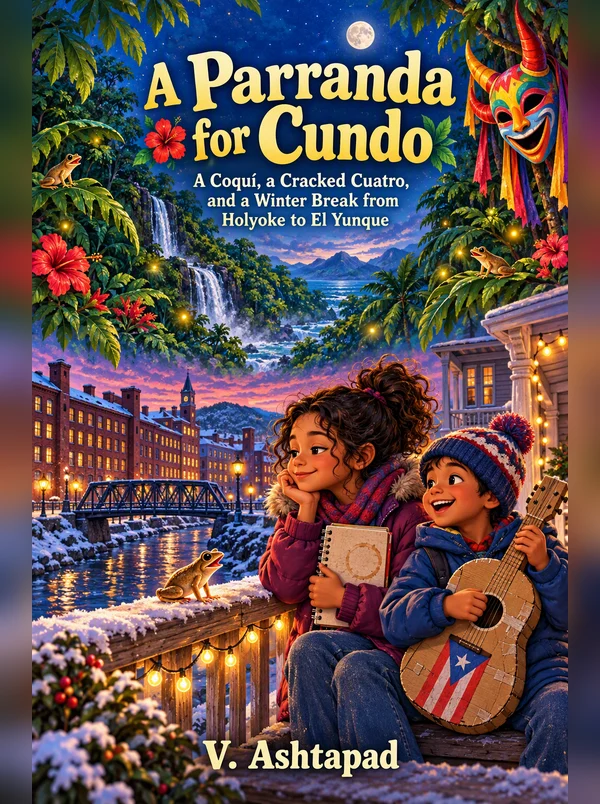
A Parranda for Cundo
A Coquí, a Cracked Cuatro, and a Winter Break from Holyoke to El Yunque
by V. Ashtapad
Foreword
This is a work of fiction for young readers, written to be read aloud. It is told in turns by two children, Yari, who is ten, and her brother Teo, who is seven and dictates his chapters while his sister types and fact-checks. Holyoke, El Yunque, Luquillo and Loíza are real places, and the roads, waterfalls, tower, beaches and kiosks in the story are drawn from them as faithfully as possible; trail closures and road access in El Yunque change, so visitors should check the current rules. The barrio of Las Pomarrosas in Río Grande is invented, and so are the Rosado family, their neighbors, the musicians, the mask maker, the cuatro maker and every other character. Coquís do not talk, as far as anyone knows. Everything else they do in this book, a father guarding his eggs and the babies hatching as tiny frogs, is true. The songs sung at doors in this story are described and never quoted, because they belong to everyone on the island who has ever sung them in the dark.
For every child who understands the question and is still working up the courage to answer it, and for the grandparents who wait.
The Notebook With the Coffee Ring
*Yari's turn*
This notebook has a coffee ring on the cover, and the coffee ring is not my fault.
I want that on the record before anything else, because my brother Teo is going to tell you it was me, and Teo is seven, and Teo also told our whole street that he once ate a whole snowball the size of a car. It was Mami's coffee. She put her cup down on the notebook at the kitchen table while she was reading the airline email, and when she picked the cup up again, there was the ring, brown and perfect, like a stamp that says APPROVED.
So it is an approved notebook. Good.
My name is Yarimar Rosado, but everybody says Yari, except my teacher on the first day of every school year, who says "Yari-MAR?" like she is asking if it is a beach. I am ten. I live in Holyoke, Massachusetts, on the third floor of a triple-decker that leans a tiny bit toward the canal, as if it wants to look at the water but is too polite to stare.
If you have never been to Holyoke, here is what you need to know. Holyoke is a city of red brick. The old mills are red brick, and the houses are red brick or painted wood, and even the sky in December looks a little like it has been made out of brick, flat and reddish-gray over the Mount Tom hills. This city used to make so much paper that people called it the Paper City. To run the mills, somebody dug three canals through the middle of town, one above the other like steps, and they are still here, long and dark, with iron bridges over them. In summer the canal water is green and smells like pennies. In December it is black and still, with a skin of ice along the edges that cracks into puzzle pieces if you throw a stone at it. I am not allowed to throw stones at it. I know about the puzzle pieces from Teo.
Half the people in Holyoke, or almost half, are Puerto Rican, or their grandparents were, or their great-grandparents came up a long time ago to pick tobacco in the valley and stayed for the snow. Nobody stays for the snow. That is a joke my father makes. There are Puerto Rican flags on half the porches on our street, the kind with one white star in a blue triangle and red and white stripes, and in the summer there is a Puerto Rican festival so big that the whole city smells like fried food and the music from the stage makes the windows hum.
So you would think I would speak Spanish.
I don't. Not really.
I understand it. That's the strange part. If Mami says, "Yari, recoge esos tenis del pasillo antes de que alguien se mate," I know she means pick up my sneakers from the hallway before someone kills themselves on them, and I pick them up. I know all the food words. I know all the yelling words. I know the words for "hurry up" and "be careful" and "what a mess" and "come eat." I could live my whole life on those words, almost.
But when somebody asks me something in Spanish and waits for me to answer, my mouth turns into a closed door. The Spanish is in there. I can hear it moving around. It just won't come out. It's like when you know a song on the radio and the second someone says, "Okay, sing it," the song runs away and hides under the bed.
Last summer my cousin Yaneris, who lives in Orlando, Florida, and is eleven and wears earrings shaped like tiny avocados, heard me try to tell our great-aunt that I liked her house. I said it so slowly and so wrong that my great-aunt patted my hand like I was sick. Afterward Yaneris said I talked Spanish "like a tourist with a sunburn." She laughed. I laughed too, so she wouldn't see that I wanted to throw her avocado earrings into the lake.
I have not tried a lot since then.
My brother Teo is the opposite. Teo knows about nine words of Spanish and uses all of them on everybody. He says "¡Hola, señor!" to the mailman, who is from Vietnam. He says "¡Gracias, mi amor!" to the lady at the pharmacy, because that's what our grandmother says to him on the phone and he thinks it is the regular way to say thank you. When he does not know a word he just says the English word in a Spanish voice. Last week he asked Papi for "el remoto-control-o, por favor," and Papi laughed so hard he had to sit on the floor.
Teo is not afraid of anything. I think that might be because he does not know enough to be afraid yet.
---
Here is why I have this notebook.
On the first Saturday in December, it snowed for the first time this winter. Just enough to make the sidewalk look sugared. Mami was at the table with her coffee and her tablet, and she said, "Ay, Dios mío," in a voice that was half happy and half scared, which is the voice she uses for both airline prices and for babies.
Then she said, "Edwin. Edwin, ven acá."
Papi came in with shaving cream on half his face.
Mami turned the tablet around. On the screen there was the family page, the private one where our family puts everything, which my grandmother on the island calls "la cosa." On its calendar somebody had made a long green bar that went from December nineteenth all the way into January. Across the green bar, in letters, it said: ROSADOS A PUERTO RICO.
"Did you do that?" Papi asked.
"I booked it," said Mami. "Last night. Before I could think too much." She looked at him the way you look at someone when you're hoping they won't be mad. "It's been too long, Edwin. It's been since before the hurricane. Mami says Papi is..." She stopped and looked at me and Teo. "Mami says your abuelo misses us."
Teo was under the table with a toy garbage truck. He came out so fast that he banged his head and did not even notice.
"Puerto Rico?" he said. "Puerto RICO? With the beach? With Abuelo's truck? With the frogs?"
"With the frogs," said Mami.
Teo ran around the kitchen three times shouting "¡COQUÍ! ¡COQUÍ!" which is what the little frogs in Puerto Rico say, and the downstairs neighbor, Mr. Bouchard, banged on his ceiling with a broom. Teo shouted "¡Perdón, señor!" at the floor.
I did not run around the kitchen. I was happy too. I was happy in a way that had a stone inside it.
Because I know what happens when we go to Puerto Rico. Everybody talks to you. The man at the gas station. The neighbors who come to the fence to look at you and say "¡Mira qué grande está!" (look how big she is) as if growing were a magic trick I had done on purpose. And they all wait for you to answer.
---
Mami says I should start this notebook "because you remember things better when you write them down, and because you'll want to remember this." She says I can write in English. She says she will not read it unless I say so.
Teo says he gets turns.
I said no. He said he would tell Mami about the time I used her good hair dryer to dry a wet library book. I said fine, he gets turns, but he cannot write well enough yet, so he talks and I type, and I am not responsible for what he says. He agreed, because he does not know what "responsible" means.
So this is our notebook. Mine and Teo's. The odd chapters are mine. The even chapters are Teo's. If you see something in square brackets in Teo's chapters, that's me, being a fact-checker. Somebody has to.
---
Before every trip, Mami looks at the pin map. It is on the family page too, and every person in our family is a little pin on it. There's a cluster of pins in Holyoke: us, and Papi's mother, and Papi's two brothers, and Titi Millie on Northampton Street who is not really our aunt but who babysat Mami when Mami was a baby so she counts. There's a cluster in Orlando, Florida: Titi Zoraida, who is Mami's sister, and her husband, and Yaneris of the avocado earrings, and Yaneris's little brother.
And then there's the island.
On the island there are pins all over, but the two that matter most are close together, on the northeast corner, at the edge of a big green blot on the map with no roads in it. The green blot is El Yunque, the rainforest. The two pins are Abuelo and Abuela, Mami's parents, in a town called Río Grande, in a barrio called Las Pomarrosas, in a yellow house with a balcony that looks up at the mountains.
"Look," Mami said, and she touched Abuelo's pin. A little window opened with his picture. It is the only picture of him on the whole family page, because Abuelo does not like pictures. In it he is squinting at the camera from under a straw hat with the brim chewed by something, and he is holding up a fish, and he is laughing with his whole face, the way a pumpkin laughs at Halloween.
"He looks happy," said Teo.
"He always looks happy," said Mami. "That's how you can't tell."
"Can't tell what?"
Mami didn't answer. She clicked on Abuela's pin, and up came a picture of Abuela Lali at her lace pillow, the long round cushion she makes lace on, with about a hundred wooden bobbins hanging off it on threads. Abuela Lali is from a town called Moca on the other side of the island, where the women have made lace this way for a very long time. The lace is called mundillo, which also is the name for the pillow, which is confusing, but in a good way, like a cake called cake.
"Can't tell what?" Teo said again. Teo does not let questions go.
Mami sighed. "Your abuelo had a parranda," she said. "Every year since he was a young man. You know what a parranda is?"
Teo said, "A party in a car?"
"Close." Mami smiled for the first time all evening. "A parranda is when a bunch of friends get together at night around the holidays, with their instruments, a cuatro and a güiro and maracas and panderos, and they go to somebody's house, very quietly, and stand outside the door in the dark, and then they all start playing and singing at once. Loud. Like a surprise attack. And the people inside wake up and have to open the door and let them in and feed them. And then the people from that house join the parranda, and everybody goes on to the next house. All night. Until the sun comes up."
"That," said Teo, "is the best thing I ever heard."
"Your abuelo's parranda was famous in the barrio. He played the cuatro. Since the hurricane..." Mami stopped. She did her lips into a straight line. "Since the hurricane, the parranda doesn't go. His cuatro got wet when the roof went, and it cracked. And half the people in it moved away after the storm. Don Chago moved up north, Tito went to Orlando, the Martínez brothers went to Pennsylvania. Abuelo says, 'Ya no hay con quién.' There's nobody left to do it with."
"I'll do it with him," said Teo.
"I know you would, papito."
I kept quiet. In my head was the picture of Abuelo laughing like a pumpkin, and about how you can't tell.
---
The night before we left, it snowed for real. Big flakes, slow and fat, falling past the streetlight outside my window like they had all the time in the world. Down on the street a plow went by with its orange light turning, and the scrape of its blade made a long sound like the world clearing its throat.
I sat in bed with this notebook and practiced.
"Hola, Abuelo," I whispered. "¿Cómo estás? Te extrañé." (Hi, Grandpa. How are you? I missed you.)
That part I could do. It was the next part I was afraid of, the part where he would answer, fast, in the island Spanish that drops its s's and swallows the ends of words like candy, and then wait for me to say something back.
I practiced anyway. I practiced until Teo, in the other bed, said, "Yari, you sound like a ghost that's learning Spanish," and threw his sock at me.
Then he said, "Do you think the coquís will remember us?"
"They're frogs," I said. "They don't remember anybody."
"They might," said Teo. "Maybe they're like elephants. Maybe they're like frog elephants."
And he went to sleep, just like that, the way he does, like somebody turned him off.
I lay there and listened to the snow, which makes no sound at all, which is the loudest kind of quiet there is. I thought: tomorrow night there will be no snow. Tomorrow night there will be frogs.
I did not know yet that one of them was waiting for us.
The Frog on the Railing
*Teo's turn. Teo talks, I type. — Y.*
Okay. Okay okay okay. Is it on? Yari, is it on?
[It's a notebook. It's always on. — Y.]
Okay. My name is Mateo Rosado and everybody calls me Teo and I am seven and three-quarters and I am the one who is going to tell about the plane, because Yari slept on the plane with her mouth open and so she doesn't know anything.
[I closed my eyes for four minutes. — Y.]
The plane was from the big airport near Hartford, which is in Connecticut, which is about half an hour from our house if Papi drives and almost an hour if Mami drives, because Mami stops for coffee. We left when it was still dark and the snow on the parking lot was blue. I had my winter coat on and my hat with the ears, and Mami said, "You won't need any of that where we're going," and I said, "I need it right now, Mami," because it was so cold my nose hairs were crunchy.
The plane was full of Puerto Rican people going home for Christmas, with giant bags and boxes, and one man had a box that said FRÁGIL on every side, even the bottom. Then there was the ocean, which went on so long that I counted to two hundred and it was still the ocean.
Then I fell asleep a little bit. Not like Yari. A different way.
[The same way. — Y.]
When I woke up the pilot was talking and everybody on the plane was looking out the windows, and I looked too, and the ocean was a different color. It wasn't gray anymore. It was blue like a crayon, the bright blue one in the box that nobody uses because it's too bright, and near the land it turned green, a see-through green like a lime freeze pop, and there were white lines of waves, and then there was the land.
It was so GREEN. You don't even know. In Holyoke in December there is no green except the Christmas trees at the gas station, and they are kind of brown. Here everything was green. The mountains were green and the trees were green and even the water was green, and there were white houses and pink houses and yellow houses and houses the color of the inside of a mango, all stuck on the hills like stickers.
And when the plane landed, all the people clapped.
I am not lying. The whole plane clapped for the pilot, like he did a magic trick, and a man in front of us whistled through his fingers. I clapped the hardest. I clapped so hard my hands buzzed. Papi said Puerto Ricans always clap when the plane lands on the island, it's just something they do. I think everybody should do it everywhere.
[This is true. I checked with Mami. Not everybody does it, but a lot of people do. — Y.]
---
When we walked out of the airport it was like opening the dishwasher when it's still hot.
The air came up and hugged me. That's what it felt like, a big wet hug that smelled like flowers and gasoline and the ocean. I was still wearing my winter coat. I took it off right there on the sidewalk and then my hat with the ears and then my sweater and Mami said "¡Teo, por Dios, aquí no!" because I was about to take off my shirt too.
And there was Abuelo.
He was standing by his truck, which is white, or was white once. Now it's sort of white with a lot of rust coming through, like a cow with orange spots. The truck's name is La Yegua, which means the mare, which is a girl horse. Abuelo says he named it that because it's old and it's stubborn and it knows the way home by itself.
Abuelo is big. Not tall big. Round big, in the middle, like he swallowed a basketball, and his arms are brown and strong and covered in white hair like frost. He had on his straw hat with the brim chewed by the goat. There used to be a goat. I'll tell about the goat later.
[Please don't. — Y.]
He threw his arms out wide and shouted, so loud that a man getting out of a taxi jumped:
"¡AY, PERO MIRA ESTO! ¡LLEGARON LOS GRINGUITOS!"
That means, "Oh, but look at this! The little gringos are here!" Gringos means people from the United States. Yari said it's kind of rude but he says it to tease, because we're from Holyoke and Holyoke is so cold. Then he grabbed me and lifted me up all the way off the sidewalk and kissed me on both cheeks and on my forehead and on my hair and I said "¡Hola, Abuelo! ¡Gracias, mi amor!" and he laughed so loud that his hat fell off.
Then he put me down and turned to Yari.
[Teo. — Y.]
I'm telling it.
[Then tell it right. — Y.]
He turned to Yari, and he said something to her very fast, I don't know what, and Yari opened her mouth and said, "Hola, Abuelo, ¿cómo estás?" like a robot from a movie, and Abuelo said something else fast, and Yari didn't say anything else. She just smiled a big fake smile. And Abuelo looked at her a second, and then he took her face in his two big hands and said, very slow, "Mi nena. Qué bueno que viniste." Which is "My girl. How good that you came." And Yari said, "Sí," and her eyes got wet, but it was very hot out there, so maybe it was sweat.
[It was sweat. — Y.]
---
The drive from the airport to Abuelo's house is about forty minutes. We went on a big highway with palm trees in the middle of it and the ocean somewhere off to the left that you couldn't see but you could smell. Me and Yari sat in the back of La Yegua with the windows down because the air conditioning is "en huelga," Abuelo says, which means it's on strike.
There were so many things to see I didn't know where to look. There were stands by the road selling coconuts with straws stuck in them, and big green bunches of plantains hanging upside down like bats. There was a guy on a horse. A REAL HORSE. Just riding on the side of the road next to the cars, with no saddle, eating a piece of bread. There were dogs sleeping in the shade who didn't belong to anybody, or maybe to everybody. Abuelo calls them satos. Satos are the island dogs, yellow and skinny, with curly tails, and they sleep wherever they want.
And then Abuelo pointed out the front window and said, "Mira. Ahí está."
There it is.
There were mountains in front of us, and they were the greenest of everything, so green they were almost black, with white clouds sitting right on top of them like a hat. Not floating above. SITTING on them. You could see the clouds touching the trees. And some of the trees on the mountains were silver, little silver spots everywhere, flashing when the wind turned their leaves over, like the mountain was winking at us.
"El Yunque," said Mami, in a quiet voice.
El Yunque is the rainforest. It's the only tropical rainforest in the whole United States National Forest, Papi said, and it rains there almost every day, and the clouds live there. I asked if the clouds pay rent. Abuelo said yes, they pay in water.
[He actually said that. In Spanish. Mami translated. — Y.]
---
Abuelo's house is in Las Pomarrosas, which is a barrio, which is a neighborhood, on a road that goes up and up and curves so much that I almost threw up my airplane pretzels. On one side there are houses and on the other side there's a ditch full of leaves bigger than umbrellas, and banana plants, and a tree with pink fruits on it like little bells. Those are pomarrosas. That's what the barrio is named after. They taste like a rose smells. I ate one later. It was weird but good.
The house is yellow, like Mami said. It is one floor, with a gate in front with curly iron bars painted white, and a balcony with a red tile floor that is always cool. There's a hammock on the balcony, a striped one, red and yellow and green, and Abuelo said it's his and nobody else can lie in it, and then he picked me up and put me in it. So I don't think that's true.
Abuela Lali came out the door with her arms open and she smelled like coffee and soap and something sweet and she kissed me nine times. Abuela Lali is small and she has glasses on a chain and her hair is short and gray and curly, and she talks soft, not like Abuelo. She hugged Yari and held on and said things into her hair.
There was food. Arroz con gandules, which is rice with little green peas in it, and pork, and tostones, which are smashed fried plantains that you dip in a garlic sauce so strong it could knock down a wall. And there was the crunchy rice from the bottom of the pot, which is called pegao, and which is the best part, and Abuelo and me fought over it with our forks like swords, and he let me win.
[He did not let you win. You stabbed his hand. — Y.]
A little bit.
---
Okay. Now the important part.
When it got dark, it got dark fast. Not like in Holyoke where it goes gray and then grayer. Here the sun went down behind the mountains and then BOOM it was night, like somebody hit the switch. And the second it was dark, they started.
The coquís.
I don't know how to tell you. It's like this. First there's one. Somewhere in the bushes. CO-KÍ! Very loud for a frog. Like a whistle and a squeak at the same time. Then another one answers. CO-KÍ! And then another one, and another one, and then it's a hundred, and then it's a thousand, and then the whole mountain is singing it. CO-KÍ! CO-KÍ! CO-KÍ! Everywhere. It doesn't stop. It's like the night is made out of it.
Abuelo was in his hammock and he closed his eyes and said, "Eso. Eso es Puerto Rico." That. That is Puerto Rico.
Then he said something else, quieter. Mami told me later what it was. He said that after the hurricane, for weeks, the coquís didn't sing. The whole mountain was quiet. He said it was the worst sound he ever heard, the sound of no coquís.
Then he fell asleep in the hammock with his mouth open.
[Like someone else we know. — Y.]
So everybody went inside except me. Mami said five minutes. I went to the end of the balcony where the railing is, the white iron railing with the curly parts, and there's a big pot there with a plant in it that Abuela Lali loves, a plant with stiff pointy leaves in a circle like a crown, and water sitting in the middle of it. And I listened to the coquís.
And I noticed something.
All of them were saying CO-KÍ. All of them. Except one.
One of them, very close, right by my hand, was going: "...ffft. ...fffft. ...ffft."
Like a sneaker that's wet. Like a balloon with a tiny hole.
I looked. And there on the railing, right on the curly part, was a frog. He was so small. He was as small as the end of my thumb. He was brown, kind of gold-brown, with a lighter stripe, and big shiny black eyes, and his fingers had little round pads on the ends like suction cups. He was puffing out his throat, which made a little bubble, like gum, and then letting it go. Puff. Fffft. Puff. Fffft.
I said, "Hi."
He stopped puffing.
He looked at me with his black shiny eyes.
And then he said, in English, very clearly, in a little scratchy voice like a tiny old man:
"Please stay on the marked trail."
[I need everyone reading this to know that I did not believe this at the time. — Y.]
I don't care. That's what he said.
Secundino, Second Egg
*Yari's turn*
Teo deserves a witness, so here is what I saw with my own eyes on our first morning on the island.
I woke up because a rooster was screaming directly into my ear. That is not an exaggeration for a change. The rooster belonged to the neighbor, Doña Tula, and it was standing on the wall between her yard and Abuela's yard, about one foot from the window, with its chest out and its tail feathers shining green and copper in the early light, and it was screaming as if the sun owed it money.
It was five fifty in the morning, which in Holyoke was four fifty, because in winter the island is one hour ahead. In summer it isn't, because Massachusetts moves its clocks and Puerto Rico never bothers.
I gave up on sleeping and went out to the balcony.
The mountains were right there, so close I felt I could reach out and pet them, wearing their cloud hats, pink on the bottom from the sun. The air was cool, for about ten minutes, and smelled like dirt and flowers and somebody's coffee. A tiny green lizard with a pink flap under its chin did push-ups on the railing, looked at me, decided I was not important, and ran away.
Abuelo was already up, in a plastic chair at the end of the balcony with his coffee and a little radio, arguing with a man talking very fast about the winter baseball league. The radio is older than Mami. After the hurricane it stopped working, and a neighbor's nephew in Miami took it all the way to a repair shop in Hialeah, Florida, and it came back working, with a little sticker on the back that says LEDESMA RADIO, which Abuelo shows to everybody as if it were a medal.
"¡Embuste!" he said to the radio. (Liar!) Then he saw me. "¡Buenos días, mi reina! ¿Dormiste?"
My queen. Did you sleep? I knew that one.
"Sí," I said. Then, because I had practiced, "El gallo... el gallo es muy... loud."
Abuelo laughed so hard he spilled his coffee. "¡Ruidoso! El gallo es ruidoso. Ese gallo es un sinvergüenza." That rooster is a shameless person. He said it was the third rooster Doña Tula had owned with the same voice, and he suspected she had been feeding them radios.
I understood about half of that. But I laughed, and he laughed, and I thought: okay. Okay. That wasn't so bad.
Then he asked me something else, longer, with a question at the end, and my door closed. I smiled. He waited. I smiled harder. He patted my knee and turned back to the baseball.
---
I went to the end of the balcony, where Abuela's plant sits in its big clay pot.
The plant is a bromeliad. Abuela told me the name later, and also that some of the ones that grow wild on the trees here have an old name from before Spanish, from the Taíno people who lived on the island first. The plant looks like a crown made of stiff green swords, with red at the tips, and in the center the leaves come together to make a little cup, and the cup holds water. Rainwater, clear as glass, with a few dead leaves floating in it like tiny boats.
And sitting on the edge of that cup, with his tiny gold-brown back to me, was the frog.
He was exactly the way Teo said. Smaller than the end of my thumb. Gold-brown, with a pale stripe, and four little fingers on each front hand with round pads on the tips. He was not doing anything. He was just sitting there, looking down into one of the folds of the plant, where two leaves curled close together.
I bent down to see what he was looking at.
In the fold of the leaf, stuck together in a bunch, there were eggs. Tiny, clear, round eggs, like a little pile of tapioca pearls. Each one had a little dark spot in it.
"Oh," I said.
The frog turned around.
He looked at me with his big black eyes, which shone like two drops of oil. And he said, in a scratchy little voice, not in English, in Spanish:
"No se toca."
Do not touch.
I had my hand halfway to the leaf. I pulled it back so fast I hit my own chin.
I didn't scream. I sat down on the cool red tiles very suddenly, the way your legs decide to sit for you sometimes, and the radio down the balcony said something about a home run, and none of it seemed real.
"You talk," I said.
"Hablo," said the frog. Then he puffed up his throat, the little bubble of skin under his chin swelling like gum, and tried to make a sound, and the sound that came out was: fffft.
He let the bubble go down. He looked at the floor.
"Bueno," he said. "Hablo. Pero no canto." I talk. But I don't sing.
---
This is going to be hard to write, because the frog talks mostly in Spanish, and fast, the island way, and with words I don't know, and also a lot of English he picked up from signs and tourists that he uses in strange places. So I will write what he said the way I understood it.
The frog's name is Secundino. He told me this first, very proudly, sitting up straight. "Secundino," he said, "porque fui el segundo huevo." Because I was the second egg. His father, he said, had guarded thirty-one eggs on a leaf high up on the mountain, and he, Secundino, had been the second one to hatch, a little after midnight, in a rainstorm. The first egg had hatched only a minute before him and never let him forget it.
"Everybody calls me Cundo," he said. "You can call me Don Cundo."
"Can I call you Cundo?"
He thought about it. "Okay," he said in English. Then: "Thank you for visiting El Yunque."
He used to live up there. Up on the mountain, near the trail that goes down to a waterfall, where every day hundreds of people used to walk past, talking in every language in the world. That's where he learned English. From the people, and from the signs, and from the rangers in their hats who say the same things over and over. "Please stay on the marked trail." "Do not feed the wildlife." "Flash flood area." "Watch your step." He says them whenever he's nervous, or when he doesn't have a better word, or sometimes just because he likes the sound.
He lived in a tree fern by that trail. He said he sang from that fern every night of his life, and that he had the best voice on that whole side of the mountain, "sin exagerar," without exaggerating. I believed him.
Then the hurricane came.
He didn't tell this part well, or maybe I didn't understand it well. He said first there was wind, then rain, then wind again from the other direction, and it went on all night, and the noise of it was so big that you couldn't hear yourself, and he held on to the underside of a leaf with all four hands and all his toes and his chin, and he held on, and held on, and then the leaf wasn't on the tree anymore. And he was flying.
"Volando," he said. "Como un pájaro. Pero sin saber."
Flying like a bird. But without knowing how.
When the wind put him down again, he was in a ditch full of mud, at the bottom of the mountain, a long way from his fern. He didn't know where. Everything looked different. The trees had no leaves. He climbed up the first thing he found, which was a white iron railing on a yellow house, and he sat on it, and when night came he puffed up his throat to sing, the way he had every night of his life.
And nothing came out.
"Se lo llevó el viento," he said. The wind took it.
---
All I could find to say was "I'm sorry."
He looked at me for a while with his oily black eyes. Then he said, "Gracias." And then, a little rudely: "You talk very little Spanish for a Puerto Rican girl."
"I know," I said.
"Why?"
That is the question everybody always asks, and I never have a good answer, so I said the truth. "Because when I try, it comes out wrong, and people laugh."
"Hm," said Cundo. He scratched his eye with his back foot, which is a thing coquís can do. "Yo también. When I try, it comes out wrong." Fffft, he went, puffing and letting go, to show me. "And the other coquís laugh."
I said, "They do?"
"No," he admitted. "But I think they do."
That was when Teo came out in his underwear, shouting, "IS HE STILL THERE? IS THE FROG STILL THERE?" and Cundo jumped about two feet straight up into the air and landed on my head.
---
Teo wanted to hold him. Cundo said, in Spanish, that he was not a toy and not a pet and that he had been hatched before Teo was "even an idea in his mother's head." Teo said "¡Sí, gracias, mi amor!" which made Cundo so offended that he turned his back on us for ten minutes.
Then we figured out the most important thing.
Abuela Lali came out with a cup of coffee for each of us that was mostly milk, sweet as a dessert, which Mami would not let us drink at home. She saw us crouched by her plant and smiled and said, "Ah, ¿encontraron al coquí?" Ah, you found the coquí?
"He talks!" said Teo. "Abuela! He talks! Say something, Cundo!"
Cundo looked straight at Abuela and said, very clearly, "Buenos días, señora. Su planta es la mejor planta del barrio." Good morning, ma'am. Your plant is the best plant in the barrio.
Abuela bent down, close, her glasses sliding down, and listened.
"Fffft," she said. "Pobrecito. Ese está ronco." Poor little thing. That one is hoarse.
She hadn't heard him. Not the words. Only the little wet-sneaker sound.
After she went back in, Cundo explained it, sitting on the edge of the pot with his chin up. Grown-ups, he said, don't hear him. They hear what they already know. They already know what a coquí sounds like, so that's all they hear. Children are different. Especially, he said, looking at me and then at Teo, children like us. Children who are in the middle.
"In the middle of what?" said Teo.
"De dos idiomas," said Cundo. Of two languages. "The door is open. Both ways. Things come in."
I thought about my closed door. I thought, it doesn't feel open. But I could understand him. I could understand almost all of him. Maybe more than I understood anybody.
Then he showed us the eggs again, and told us the thing that made Teo stop jumping around.
There were twenty-eight eggs in the fold of the leaf. A lady coquí had laid them there, and then gone on her way, which is what lady coquís do. It is the fathers who stay and guard the eggs, Cundo said, sitting on them to keep them wet, chasing away the ants and anything else hungry. In eight nights, the eggs would hatch. Not into tadpoles. Coquís skip the tadpole part completely. Each egg would open, and out would come a tiny coquí, already a frog, no bigger than a grain of rice.
"And the first thing a coquí hears," Cundo said, "on the night it hatches, is its father singing. That's how it knows. That's how it knows it's a coquí. That's how it knows it's home."
"What happens if it doesn't hear it?" I said.
Cundo looked down into the fold of the leaf for a long while without answering. The lizard with the pink chin came back and did its push-ups on the railing. Down the balcony, Abuelo's radio cheered.
"Then they will never know where they are from," Cundo said. "They will live their whole life on this railing, and never know what they are. Like..." He looked at me. He didn't finish.
He didn't have to.
---
That afternoon, while Abuela worked at her lace pillow, the bobbins clicking like rain on a tin roof, I sat on the floor next to her and asked her, in my bad Spanish, what the names of the things were. The pillow: mundillo. The little wooden sticks with the thread wound on them: bolillos. The pins that hold the pattern: alfileres. The pattern itself, pricked out in tiny holes on a strip of cardboard: el picado. She said each word slowly, and I said each one back, and she didn't laugh once. I recorded her saying them on Mami's phone and saved them in the family page, on the list where you can keep a word next to the voice saying it. Abuela said, "¿Y eso para qué?" And that for what? And I said, "Para no olvidar." So I don't forget.
She peered at me over the top of her glasses. Then she clicked her bobbins, and smiled.
Over the TV, on the wall, there was something I hadn't noticed the night before. A small wooden guitar shape, with a long neck and lots of tuning pegs, hanging on a nail by a faded red ribbon. Its belly was the color of honey, and down the middle of the belly, from the hole almost to the bottom, ran a crack. Thin and dark, like a line drawn with a pencil. Like a river on a map.
"Is that Abuelo's cuatro?" I asked.
Abuela's bobbins stopped. Then they started again.
"Sí," she said. "Desde el huracán, ahí está." Since the hurricane, there it is.
Outside, on the railing, I could hear a very small sound, going on and on. Fffft. Fffft. Fffft.
Doña Neblina's List
*Teo's turn. Teo talks, I type, I fix nothing unless it is wrong. — Y.*
On Monday we went up the mountain to the rainforest and I carried a frog in my hat the whole way and nobody knew. That's the first thing. Write that first.
[Done. — Y.]
Here's how. Cundo said he had to go up the mountain to ask somebody something, somebody old, who lived by the waterfall where he used to live. He said it was too far to hop. He said, "It is eleven kilometers and I am two centimeters." I don't know how long a kilometer is, but it sounds far. So I said he could ride with me.
Yari said a frog can't ride in a hat. Cundo said coquís need to stay wet or their skin dries out and they get sick, which is true, Yari looked it up. So I put a big wet leaf from Abuela's banana plant inside my baseball hat, folded up like a little bed, and Cundo got in it, and I put the hat on my head. It was cold and wet on my hair and it felt GREAT, because the day was hot. Cundo said, "Watch your step," every time I jumped. I jumped a lot.
[He jumped off the balcony steps eleven times before we even got in the truck. — Y.]
---
Abuelo drove. Papi stayed home because Abuela said the gutter had been hanging down "since the storm" and Papi was the only one tall enough and silly enough to climb up there. Papi laughed.
You can't just drive up into the rainforest whenever you want. There's a gate on the road, and when too many cars are already up there, they close it, and you wait in a line until some cars come down. Abuelo was very mad about this. He said he had been going up that mountain since he was a baby and nobody ever made him wait in line, and now he has to wait to visit his own mountain, like it's a restaurant. That's why we left before it was even light. We were the fourth car. When the gate opened at eight, the officer waving the cars through was a young lady with a ponytail, and Abuelo leaned out the window and said to her, "Mija, ¿y yo tengo que hacer fila pa' entrar a mi casa?" (Mija, and I have to wait in line to go into my house?) and she laughed and said, "Sí, Don, hasta usted." Yes, sir, even you.
And from inside my hat, Cundo said, "Thank you for visiting El Yunque."
I almost laughed out loud. I had to pretend I was coughing.
---
The road up the mountain is called 191 and there are curves on the curves. The trees close in on both sides and make a tunnel, and then the tunnel opens and you can see all the way down to the ocean, and then it closes again. The air coming in the window got cooler and wetter until it felt like the inside of a cloud. Mami said it was.
There were ferns. You don't understand about the ferns. In Holyoke there are ferns in the woods and they come up to your knee. Here there are ferns that are TREES. They have a trunk, a hairy brown trunk like a monkey's leg, and then at the top there's a big round burst of fern leaves, like a firework that stopped in the middle. Cundo said, "That's my house. That's the kind of house I had." He said it very sad.
There were trees with silver leaves. They're called yagrumos. The leaves are big, like a hand with all the fingers spread out, green on top and silver underneath, and when the wind blows they flip over and the whole tree flashes silver. Abuelo said that when the yagrumo shows you its silver side, rain is coming. Then all the yagrumos on the side of the road flipped over at once, flash, silver, like they were waving at us.
And then it rained.
It rained so hard the wipers on La Yegua couldn't keep up, and it was so loud on the roof it sounded like a million people drumming their fingers on a table. Then, in like three minutes, it stopped. The sun came out. Everything was dripping and shining. Steam came up off the road.
"¿Ves?" said Abuelo. "El yagrumo no miente." See? The yagrumo doesn't lie.
[I have to say that I was impressed by this. — Y.]
---
We stopped at a waterfall right next to the road. It's called La Coca. It comes down a big wall of black rock, wide and white, like the rock is wearing a wedding dress. Mami took a picture of us in front of it and put it on the family page, and in about one minute Titi Zoraida in Orlando wrote under it, "¡¡¡QUÉ ENVIDIA!!!" which means "SO JEALOUS," with the exclamation points upside down at the front too, because that's Spanish. Six exclamation points. Titi Zoraida is a lot.
Then we went to a tower. The Yokahú tower. It's a round stone tower like a castle, sticking up out of the trees, and you climb the stairs around and around until you're dizzy, and then you come out at the top and you can see EVERYTHING. The whole forest, green, bumpy, like a giant broccoli. The ocean. Little towns by the ocean. Clouds below you. BELOW you. I never saw clouds below me except from an airplane.
Abuelo stood at the top and breathed hard from the stairs. He pointed down the mountain, toward the ocean.
"Allá," he said. That way. "¿Ven aquel barrio? Esa es la casa de Chago. Era." See that barrio? That's Chago's house. It was.
Mami told us later what he said next. Every year the parranda started at Chago's house, because Chago had the güiro and also the best coffee, and went from there to the Martínez house, and to Tito's, and all the way up the hill to our house, and Abuela would be waiting with asopao, which is a soup with chicken and rice, at four in the morning. He said that from up here, on a clear night, you could see the parranda moving, if you knew where to look, because people would turn their lights on as it came. One house, then the next, then the next. A line of lights going up the hill.
Then he said, "Bueno," and went down the stairs, and on the way down he sang something under his breath, but just a little bit, like he forgot he was doing it.
---
[This next part Teo told me twice and I will put it in the way he told it the second time, because the first time he was jumping. — Y.]
Okay. La Mina. The waterfall where Cundo used to live.
We couldn't go to it.
There's a trail that goes down to it from the picnic place, with stone steps and a river next to you the whole way. Mami walked down it when she was my age. But now there's a gate across the top of the trail and a sign that says it's closed. Mami said they are still fixing it. Cundo read the sign out loud from my hat. He had never seen that one before. He said it slowly, like a new word: "Trail... closed."
Then he looked down past the gate, where the steps went into the green, and said, "Down there. My fern was down there."
You couldn't see any fern. Only green, and more green, and the sound of the river under it, the kind of sound that's like a lot of people far away talking at a party.
Cundo didn't say anything for a while.
Then he said, "It doesn't matter. She doesn't live at the bottom. She lives up here. She always said the bottom was for tourists."
By the picnic shelters there's a little stream that runs down toward the river, over big round rocks, clear like glass, and the air over it is cold and wet. Abuelo found a bench and sat on it and took his hat off and fanned himself and talked to a man he didn't know about the baseball. Abuelo can talk to anybody about the baseball. Mami and Yari went down to the edge of the stream to put their hands in.
And Cundo said, "Ahora. Llévame a la piedra grande." Now. Take me to the big rock.
There's a big rock at the edge of the stream, black and wet and covered in green moss like a sweater, and under it there's a crack, dark, where the stream keeps everything wet all the time. I went over to it and pretended I was looking for crabs. I took my hat off and held it next to the crack.
Cundo said into the dark, "¿Doña Neblina?"
Nothing.
He said it again, louder. "¡Doña Neblina! ¡Soy yo! ¡Secundino! ¡El segundo huevo de Fello!"
And from inside the crack, a voice said, "Ya sé quién tú eres, muchacho. Con esa bulla." I know who you are, boy. With all that noise.
And out came the oldest frog in the world.
---
She was bigger than Cundo, but not a lot. She was dark, almost black, with little bumps all over her like the moss on the rock, and her eyes were cloudy, milky, like when you breathe on a window. She moved very slow. She sat at the edge of the crack and turned her face to me, and she didn't look at me, she kind of smelled at me.
"¿Y este?" she said. And this one?
"A boy," said Cundo. "From... the north. From the cold. He's in the middle. He hears me."
"Hm," said Doña Neblina. Then, to me, in English, slow and perfect, like a teacher: "Hello, little boy from the cold."
I said, "Hello! ¡Gracias, mi amor!"
She made a sound like a frog laughing. I didn't know frogs could laugh. It sounds like a little rusty gate.
[I came back from the stream just then and heard the rusty gate. I'm a witness. — Y.]
Yari came and crouched next to me, with her hands still dripping, and she listened, and sometimes she whispered in my ear what they were saying when it was too fast for me. And this is what Doña Neblina said.
She said she was the oldest coquí on that side of the mountain. She said she never sang one note in her life, because lady coquís don't sing, and that she knew every song on the mountain anyway. She said she had heard Cundo sing every night of his life from his fern, and that she was glad to know he wasn't dead, and that he had always been a show-off.
Cundo said, "Gracias."
She said it wasn't a compliment.
Then Cundo told her about his song. How the wind took it. And she listened with her milky eyes closed, and the stream rattled over its rocks.
And then she said a long thing. Yari made me be quiet so she could hear it. She said it was like a poem. This is what Yari wrote down after, in Spanish first and then in English.
"Lo que el viento se lleva, no se pierde. Se reparte."
What the wind takes isn't lost. It gets shared out.
She said the hurricane didn't throw Cundo's song away. It blew it all over the island, into everything, into everybody. Into the trees and the rivers and the houses and the people. A little bit everywhere. And if he wanted it back, he couldn't go looking for it. You can't find a song by looking. You have to call it home. You have to wake it up in everybody at once, the way you wake up a house.
"Like a parranda," Yari said. She said it out loud, without thinking, in Spanish. "Como una parranda."
Doña Neblina turned her cloudy eyes to Yari.
"Exacto, nena."
Then she told us what we needed.
Yari wrote it on her arm with Mami's pen, and here it is.
One. Un cuatro que vuelva a llorar. A cuatro that cries again.
Two. Panderos que se contesten. Hand drums that answer each other.
Three. Un barril que obedezca a un pie. A barrel drum that obeys a foot.
Four. Una cara que espante el susto. A face that scares away the fright.
Five. Una voz que no se sepa la letra, y cante de todas formas. A voice that doesn't know the words, and sings anyway.
"And then," said Doña Neblina, "on the night the eggs open, you knock on the door of the house where they are. All of you. Loud. And you don't stop until they let you in."
Then she said, "Now go away. The boy's grandfather is coming and he walks like a cow."
And she went back into her crack.
---
Abuelo walked up behind us. He did kind of walk like a cow.
"¿Qué hacen?" What are you doing?
"Looking for crabs," said Yari.
Abuelo looked at us. Then he looked at the crack under the rock. Then he looked at my hat, which I was holding like a bowl, with a wet banana leaf in it, and a frog in the banana leaf, looking up at him.
He looked at Cundo for a long time.
[Teo, Abuelo looked at him for maybe three seconds. — Y.]
For three seconds. Which is long for Abuelo.
Then he said, "Hm," exactly like Doña Neblina did, and put my hat on my head for me, frog and all, and said, "Vámonos, que va a llover." Let's go, it's going to rain.
All the yagrumos on the hill flipped over, flash, silver.
On the way down the mountain, in the back of La Yegua, Yari read the list on her arm out loud three times. Number one, number two, number three, number four, number five. And I counted on my fingers. And Cundo, in my hat, counted on his.
He has four fingers on each hand. So he ran out at four. I gave him one of mine.
"Eight nights," Cundo said. "Seven now."
I said, "We can do it."
I don't know if that was true. But it's what you say.
The Cardboard Cuatro
*Yari's turn*
Number one on the list was a cuatro that cries again, and there was only one cuatro we knew, and it was hanging over the TV with a crack down its belly.
The problem was Abuelo.
Abuelo is everywhere in that house. He is in the hammock. He is in the kitchen, lifting lids off pots and getting his hand slapped by Abuela. He is on the balcony arguing with the baseball. He is in the yard, talking to Doña Tula over the wall about her rooster, which he calls "el tenor." He is under La Yegua, saying words I should not write down. If you want to steal something from Abuelo's living room, you need a plan.
So I made one, Tuesday morning, on the back steps, in this notebook, with Teo and Cundo. Cundo sat on my knee in a wet paper towel like a man in a bathrobe.
The plan had three parts.
Part one: find somebody who could fix a cracked cuatro.
Part two: get the cuatro to them without Abuelo knowing.
Part three: put something on the nail so he wouldn't see it was gone.
Teo said he would do part three. I should have asked more questions.
---
For part one, I needed help from a grown-up, and the only grown-up I could think of who might keep a secret from Abuelo was Abuela Lali.
She was on the balcony at her lace pillow. The lace she was making was pinned to it, white and fine as frost on a car window, and from the edge of it hung the bobbins on their threads, dozens of them, shaped like tiny bowling pins. Her hands moved over them without looking. Pick up two, cross them, twist them, put them down, move a pin. Click, click, tick. Click, click, tick. The pattern grew a tiny bit every time, like a plant you can't see growing but is.
I sat down next to her. I had practiced what I was going to say all through breakfast, while Teo blew bubbles in his coffee-with-milk.
"Abuela," I said. "Quiero... arreglar..." I want to fix. I pointed at the living room, at the wall. "El cuatro. De Abuelo. Para... una sorpresa."
My face was hot. My voice was shaking. It came out very slow, like a car in snow. But it came out.
Abuela's hands stopped on the bobbins.
She looked at me without saying anything, and I was sure I had said it wrong, that "sorpresa" meant something like "garbage" in island Spanish and she was going to laugh. She didn't laugh. She took off her glasses and wiped them on her blouse and put them back on.
Then she said, quietly, and slowly, so I could follow: "Ese cuatro lo hizo Wilo." That cuatro was made by Wilo.
"¿Wilo?"
"Don Wilo. Arriba, en la cuesta." Up on the hill. She pointed up the road with her chin, the way people do on the island, pushing out their lips toward the place they mean. "Él hace cuatros. Hace cuarenta años, le hizo ese a tu abuelo." He makes cuatros. Forty years ago, he made that one for your grandfather.
Then she did something I did not expect. She leaned close to me and whispered, "Tu abuelo va a la plaza a jugar dominó a las diez. Los martes. Vuelve a las doce." Your grandfather goes to the plaza to play dominoes at ten. On Tuesdays. He comes back at twelve.
And she winked.
I have never seen my grandmother wink. I didn't know she could. It was like seeing a cat whistle.
---
At ten o'clock exactly, La Yegua coughed, and roared, and backed out of the carport with Abuelo in it, wearing a clean shirt and his good hat, the one without goat bites. We watched the last puff of blue smoke disappear around the curve.
"Now," said Cundo, from Teo's hat.
I took the cuatro off the nail.
It was lighter than I thought. The wood was smooth and warm, and the honey color of the top was darker around the edges, where somebody's arm had rubbed it for years and years. It had ten strings, in five pairs, and the strings were rusty and loose, and when my sleeve touched them they made a tiny, sad, out-of-tune sound, like somebody sighing in their sleep.
On Teo's head, Cundo's throat jumped. Just once. He didn't say anything.
Papi drove us. He was in on it now, because he had seen us carrying a cuatro wrapped in a beach towel to the car. Mami stayed home "to keep the coast clear," which is a thing she said like a spy in a movie, and which made Teo so happy he saluted her.
---
Don Wilo's house is at the very top of the hill, where the road turns into two lines of concrete with grass growing between them and then just stops. The house is pink, a bright faded pink like old bubble gum, with a zinc roof that's new and shiny on one half and old and rusty on the other half, so it looks like a house wearing one new shoe.
His workshop is the carport. It has a roof but no walls, just a fence of hibiscus bushes with red flowers like little trumpets, and hummingbirds going in and out of the flowers so fast they look like mistakes. And hanging from the beams of the carport, on strings, were cuatros.
Cuatros that weren't finished yet. Some were just the shape, plain pale wood, like a cuatro's skeleton. Some were almost done, shining with varnish, turning slowly in the breeze. They hung there like hams in a deli, and the whole carport smelled of sawdust and something spicy and sweet, like cinnamon and pencils.
Don Wilo was sitting on a stool in the middle of it, sanding something. He was very old and very thin, with arms like ropes, and white stubble on his chin, and one ear that he cupped with his hand whenever anybody talked. He was wearing a T-shirt that said ORLANDO on it with a picture of a dolphin. I found out later that his granddaughter sent it, and he wears it every day, and he has never been to Orlando and never plans to go.
Papi said, "Buenos días, Don Wilo."
Don Wilo said, "¿AH?"
Papi said it louder. Don Wilo said, "¡Ah! ¡El yerno de Monchi!" Monchi's son-in-law! Monchi is what everybody calls Abuelo. And then he saw the beach towel, and what was in it, and he put down his sandpaper and stood up very slowly.
He didn't say anything. He just held out his hands. And I put the cuatro in them.
He turned it over and back, and ran his thumb down the crack, gently, the way you'd touch a cut on somebody's arm. He held it up to his good ear and knocked on the wood with one knuckle, here, and here, and here, listening. He looked like a doctor.
Then he said a lot of things, fast and loud, the way people talk who can't hear well, and Papi translated some of it.
He said he made this cuatro forty-one years ago. He said he carved the body and the neck out of one single block of wood, a wood called laurel, the way the old cuatro makers did it, because a cuatro made of one piece, he said, has one heart. He said the top, the flat face of it with the hole in the middle, the part that sings, he made out of yagrumo.
"Yagrumo," I said. "The tree with the silver leaves."
Don Wilo cupped his ear. "¿AH?"
"¡YAGRUMO!" I said, much louder than I meant to. "¡EL ÁRBOL... CON LAS HOJAS DE PLATA!" The tree with the leaves of silver.
He stared at me. Then he grinned. He had about half his teeth.
"¡Eso!" he said. That's it! "El árbol que avisa la lluvia." The tree that warns about the rain. He knocked on the cuatro's top again. "Por eso canta. Sabe cuándo viene el agua." That's why it sings. It knows when the water's coming.
Then he said he could fix it. The crack was in the yagrumo top, along the grain, and it wasn't as bad as it looked. He'd have to open it, and glue it, and clamp it, and the glue would have to sit for days and days. New strings. New pegs, maybe; two were broken. He said: Saturday night. Not before.
The eggs would hatch Sunday night. I counted on my fingers, very fast. It would be close.
"Gracias," I said. "¿Cuánto... cuesta?" How much does it cost?
Don Wilo laughed until he had to sit down. He said that Monchi had played at his wedding, and at his daughter's wedding, and at his wife's funeral, and that if he took one penny for this cuatro, his wife would come back from the cemetery and smack him with a shoe.
"Pero," he said. But. And he held up one long, bony finger.
"There's always a 'pero,'" Papi said to me, in English, out of the side of his mouth.
Don Wilo said that I had to learn the names of all the parts of a cuatro. All of them. In Spanish. And when I came back on Saturday, I had to tell him every single one, out loud, with nobody helping. So that when I gave the cuatro back to my grandfather, I could tell him exactly what was done to it, "como una persona que sabe." Like a person who knows.
My stomach went cold. Out loud. With nobody helping. To a man who couldn't hear, so I'd have to shout.
"Okay," I said. Then: "Sí. Está bien."
---
He taught me, right there, with Papi and Teo watching and Cundo very still in Teo's hat.
He touched each part and said its name, slow and loud, and I said it back. The long neck: el mástil. The little wooden pegs at the top that tighten the strings, five on each side: las clavijas. The flat face, the singing part: la tapa. The round hole in the middle of it: la boca, the mouth, which made Teo laugh because a guitar with a mouth is a monster. The little metal lines across the neck where your fingers press: los trastes. The piece of wood on the tapa where the strings are tied: el puente, the bridge, like the bridges over the canals at home. The strings: las cuerdas. And the shape of the body itself, which on this cuatro had two little points on each side, like the shoulders of a man in a fancy jacket, and which Don Wilo said was the shape of a violin that went to the island and liked it.
I recorded him saying them on Papi's phone and saved them to the word list on the family page, next to Abuela Lali's lace words. The list is getting long. Mundillo. Bolillos. Alfileres. Picado. Mástil. Clavijas. Tapa. Boca. Trastes. Puente. Cuerdas. Each one with a voice next to it.
Before we left, Don Wilo showed us a picture, curling at the corners, stuck to the side of his tool cabinet with yellow tape. It was a picture of a bunch of men and two ladies, standing on somebody's balcony at night, with the flash making their eyes shine. They were all holding instruments. Maracas. Panderos, round, like big tambourines without the jingles. A güiro, the long dried gourd with lines cut in it that you scrape with a fork. And in the middle, young, with a big black mustache and all his hair, and a cuatro, this cuatro, held up against his chest like a baby, was Abuelo.
He was laughing with his whole face. The pumpkin laugh. Exactly the same.
Papi asked if he could take a picture of the picture. He put it with the old photos, in the album where Abuela keeps them, and in about thirty seconds Titi Zoraida wrote from Orlando, "¡¡¡EL BIGOTE!!!" THE MUSTACHE. Six exclamation points again.
---
Now, part three.
When we got home, I found out what Teo had done for part three, and I need you to imagine it.
Teo had drawn a cuatro on the box Abuela's new fan came in. A sort of cuatro. It had a body like a peanut and a neck like a hockey stick and a hole in the middle, colored in with black marker, and strings, which he had drawn with a ruler, and there were eleven of them, not ten. He had colored the whole thing with a yellow crayon so hard that the crayon had broken in three places. And on the yellow top he had drawn a crack, very carefully, with a brown marker, "so it looks real."
He had cut it out with kitchen scissors and hung it on the nail with the red ribbon.
It was hanging there, over the TV, when Abuelo came home from dominoes at twelve o'clock.
We all stood in the kitchen doorway and did not breathe. Mami. Papi. Abuela. Me. Teo, with a frog on his head.
Abuelo came in. He put his hat on the table, sat down in his chair right under the cardboard cuatro, and watched the news for five minutes.
Then he looked up.
He looked at the cardboard cuatro for a long time.
[Teo would want me to say that this time it really was a long time. It was. — Y.]
Then he looked at us. Abuela was biting her lip so hard it went white.
Abuelo said, "Hm."
And went back to the news.
Nobody said anything. Nobody moved. On Teo's head, very faintly, Cundo said, "Do not feed the wildlife."
That night, in bed, Teo whispered, "Did he see it?"
"He saw it," I said.
"Then why didn't he say anything?"
I didn't know. I lay there and listened to the coquís, thousands of them, CO-KÍ, CO-KÍ, and under them, from the railing, the one small sound that didn't fit. And I said the cuatro words in my head, over and over, until I fell asleep. Mástil. Clavijas. Tapa. Boca.
Six nights.
The Newspaper You Can Dance To
*Teo's turn. He has asked me to say that this is the best chapter. I have not agreed. — Y.*
It IS the best chapter, because it has the beach and the fried things and the drums and me singing.
On Wednesday Abuelo said, "Hoy, playa." Today, beach. He said it at breakfast like a king making a law, and he banged his coffee cup on the table, and the spoon jumped out.
We went to Luquillo, which is the next town, and it's about fifteen minutes in La Yegua, and the road goes down from the mountains to the ocean, and you can see the ocean getting closer and bluer through the trees, and then you're there.
The beach at Luquillo is a big curve, like a smile, with sand the color of the inside of bread, and palm trees bent over toward the water like they're trying to get a drink. The water is calm and WARM. Like a bath somebody forgot about. You walk in and walk in and it only comes up to your belly. There's a reef out far, Papi said, where the waves break, so by the time they come to the beach they're tired.
And when you turn around in the water and look back at the land, there's the mountain. El Yunque, right there, big and green behind the palm trees, with its cloud hat on. You can be in the ocean and look at the rainforest. I don't think there's anywhere else like that. Maybe there is. But I never went there.
Cundo couldn't come in the water, because salt water is bad for coquís. So I left him in my hat in the shade of a palm tree, inside a plastic cup with a wet napkin in it, with Abuela watching. Abuela doesn't swim. She sat on a folding chair with a big hat and her lace pillow on her lap and made lace at the beach. People stopped to watch her hands go. Abuela pretended not to notice and sat up straighter.
---
Then we were hungry. When you swim you get SO hungry.
Next to the beach, on the side of the big road, there's a long line of little restaurants all in a row, like a train. They're called the kioskos. There are about sixty of them, Mami said, each one with a number and painted a different color, and each one playing different music, so when you walk along you go through about twenty songs in one minute.
And they all smell like frying.
Here are the things I ate. Write them all, Yari.
[Fine. — Y.]
An alcapurria. It's long, like a fat finger, and brown and crunchy outside, and inside it's soft and made of green banana and a root called yautía, which Abuelo said is a Taíno food, from the people who were here first, and there's meat inside in the middle like a surprise.
A bacalaíto. It's a big flat crispy pancake with little bits of salty fish in it, and it's as big as my face, and it's so crunchy at the edges that it sounds like walking on leaves when you bite it. Mami says they're even better in Piñones, by Loíza. Abuelo said that was a lie and Luquillo's are the best. They argued about it all through lunch. I ate both of theirs.
Abuelo had a mofongo, which is green plantain smashed up with garlic and pork skin into a sort of hill, with shrimp on the top. He let me have a bite. It was the best thing I ever ate in my life. Then he fell asleep.
Right there, in the plastic chair, with his hat over his face. Snoring. Abuela said, "Siempre," always, and Mami said that Abuelo could sleep on a motorcycle.
[This was the important part, because it meant he wasn't watching. — Y.]
---
That's when we heard the drums.
From further down the line of kioskos, from one that was painted bright purple, there was a sound like somebody knocking on a door, very fast. Then another sound, lower, like a bigger door. Then a third, very high and quick, like a woodpecker. They were going together, but not exactly together. Like they were talking.
And from inside my hat, Cundo said, "Ahí. Ahí." There. There.
Mami walked us down the line of kioskos, with sand in our flip-flops, to the purple one. It had a sign over it painted with a big red crab wearing sunglasses, and under the sign, at the plastic tables, there were six people with drums.
The drums were round and flat, like big tambourines without the jingly metal parts, and the skin on them was stretched tight. Each person held one in one hand, up against their shoulder, and hit it with the other hand. They were different sizes. The biggest ones made the low sound, BUM, BUM, steady, like walking. The medium ones went in between. And there was one little one, the smallest, and the person playing it was a lady.
She had glasses with purple frames and gold earrings like hula hoops and her hair in a bun on top of her head with a pencil stuck through it, and she was the best. Her little drum was going crazy. It went fast, then faster, then stopped, then BAP BAP, then rolled, like it was laughing, like it was arguing with the big drums, like it was telling jokes. And the big drums kept going, BUM, BUM, like grown-ups not listening to a kid. And then she'd stop and they'd answer her, and she'd answer back.
"Panderos que se contesten," Yari whispered. Drums that answer each other.
Number two.
---
The lady's name is Doña Bruni. She found that out by asking me my name first, when they stopped. I was standing right in front of her, very close, with my mouth open, and she said, "¿Y tú, quién eres, mi amor?"
And you, who are you, my love?
"¡Teo! ¡Gracias, mi amor!" I said.
All six of the drum people laughed. Doña Bruni laughed so hard her bun wobbled. Then she explained some things. Mami helped.
She said the drums are called panderos. The biggest one is called the seguidor, because it follows, it keeps the beat, it's the one everybody can count on. The middle one plays a little different, a pattern that goes around and around. And the little one, her one, is the requinto, and it's the one that's allowed to do whatever it wants, "como un nene de siete años." Like a seven-year-old boy. She looked at me when she said it. I liked her very much.
And the music they were playing is called plena. Plena is from Puerto Rico. It started a long time ago in Ponce, on the south side of the island, by people who lived near the train tracks and the docks, and it's for telling the news.
"The NEWS?" I said.
Doña Bruni said yes. She said that plena is the periódico cantado. The sung newspaper. That a long time ago, when something happened in a barrio, a fire, or a storm, or a cow getting loose in the plaza, somebody made a plena about it, and everybody learned it, and that's how the news got around. One person sings a line, telling what happened. Then everybody sings back the same little part, over and over, like a chorus. Then the person sings the next part of the news.
"So you can sing about anything?" I said.
"Lo que sea," she said. Anything.
And I don't know why, I didn't plan it, but I said, "Can I sing some news?"
Yari grabbed my arm. [I grabbed his arm because I knew what he was going to sing about. — Y.] But Doña Bruni said, "¡Claro que sí!" Of course! And she hit the requinto, BAP BAP, and the big drums started, BUM, BUM, walking, and they all looked at me.
---
Okay. I'm going to tell what I sang. It was in Spanish. My Spanish. Yari says it was "about forty percent Spanish." I think it was more.
I sang, "¡Hay un coquí que se llama Cundo!" There is a coquí whose name is Cundo.
That part was good. I know "coquí." I know "se llama." That's from school.
Then I sang, "¡Y el viento... took... su canción!" And the wind took his song.
And Doña Bruni yelled, "¡Se la llevó!" Which is the right way to say "took it away." And then all six of them sang it back to me. "¡SE LA LLEVÓ!" Like a chorus. Like I was the newspaper.
So I sang the next part. "¡Y ahora el coquí dice... FFFFT!"
And they all sang back, "¡FFFFT!" And they laughed, and they kept drumming, and some people from the other kioskos came over to see, and a man in a fishing hat started clapping on the beat, and two ladies at the next table started dancing in their chairs.
And I sang, "¡Pero vamos a hacer... una PARRANDA!"
And they ALL yelled, "¡UNA PARRANDA!"
And I sang, "¡Pa' que vuelva!" So it comes back. Yari told me that one, right then, in my ear. [I did. I didn't even think. It just came out. — Y.]
And they sang "¡PA' QUE VUELVA!" and Doña Bruni did a crazy roll on the requinto, brrrrrrap, and stopped. And everybody clapped. Everybody in the whole kiosko. The man in the fishing hat shouted "¡Bravo, gringuito!" and the lady at the cash register gave me a free piece of candy made of coconut and brown sugar, chewy, called a coconut... I forget.
[Dulce de coco. — Y.]
Dulce de coco. Yes.
---
But here's the real thing that happened.
When all the panderos were going at the same time, when the requinto was arguing with the seguidor and the seguidor was walking and walking and the middle one was going around and around, I felt something on my head. In my hat. A little jump. And I heard, very, very small, from inside the hat, a sound that wasn't a fffft.
It was a click. Like a tongue on the roof of your mouth. A little "c."
Just a "c." Not the "o." Not the rest. But something.
Cundo didn't say anything about it. When I looked at him later, he was sitting very still on his wet napkin, with his throat going in and out, in and out, very fast.
---
And then the most lucky thing.
Doña Bruni asked Mami where we were staying, and Mami said, "Con mis papás, en Las Pomarrosas, en Río Grande," and Doña Bruni stopped with her hand in the air over her drum.
"¿Las Pomarrosas? ¿Tú eres hija de quién?"
You're whose daughter? Mami says on the island your name is only half the answer. The other half is your people.
"De Monchi," said Mami. "Monchi y Lali."
And Doña Bruni put her drum down on the table. She said, "¿Monchi el del cuatro?" Monchi with the cuatro?
She was in the parranda. In the old picture. Yari found her later, in Papi's picture of Don Wilo's picture. One of the two ladies. Young, skinny, with a pandero held up by her face and her mouth open in the middle of a shout. Same big earrings. Same hair on top.
She said that Monchi owed her a parranda. She said he had owed her a parranda since the hurricane. She said, "¡Ese hombre me debe cuatro Navidades!" That man owes me four Christmases!
And then Yari did a thing.
Yari said, in Spanish, all by herself, with her face as red as the crab on the sign: "Doña Bruni. El domingo. En la noche. ¿Puede venir? Con los panderos. A la casa de Abuelo. Es... una sorpresa."
Sunday. At night. Can you come? With the panderos. To Abuelo's house. It's a surprise.
It was a lot of words. It was so many words for Yari. She said them like she was walking across a river on stones.
Doña Bruni looked at her. Then she looked at Mami. Then she looked at me, with a frog on my head, which she didn't seem to think was weird.
Then she picked up her requinto and hit it three times. BAP. BAP. BAP.
"Allí estaremos," she said. We'll be there.
---
Mami put it in the family calendar on the walk back. She made it so only some people can see it. Not Abuelo. Not that Abuelo looks at the calendar ever, but Mami says you can't be too careful. She called it "Reunión de Lali," Lali's meeting, so if he did see it he'd think it was something boring about lace.
When we got back to the kiosko with the umbrellas, Abuelo was still asleep. His hat was still on his face. His belly was still going up and down.
But on the table in front of him, next to his plate, his fingers were tapping. Tap, tap-tap, tap. Like a pandero. Like a seguidor, walking.
He was asleep. I'm sure he was asleep.
[I'm not. — Y.]
Five nights.
Pasteles, String, and the Word That Came from Here
*Yari's turn*
On the island, the big night is the night before Christmas. Nochebuena. The Good Night. That's the night the whole family comes, and the food is made, and nobody goes to bed. Christmas Day itself, Abuela says, is for sleeping and eating what's left.
So on Thursday the house woke up early and loud, and it stayed loud until about three in the morning.
The first loud thing was a car horn, at seven, playing the first notes of a song very badly. That was Titi Zoraida, who had flown in from Orlando with her husband Tío Germán, my cousin Yaneris, and my little cousin Jandro, who is four and was wearing a superhero cape and nothing else except shorts. Titi Zoraida drove their rented red car up the hill honking the whole way, so that every dog in Las Pomarrosas came out to bark at it.
Titi Zoraida came through the gate with her arms full of bags and shouted "¡LLEGÓ LA QUE FALTABA!" which means "The one who was missing has arrived!" and kissed Abuelo four times on top of his bald head, and he pretended to hate it.
And then Yaneris got out of the car.
She was taller than last summer. Her hair was in two long braids. She was wearing the avocado earrings. She looked at me, and smiled, and said, "Hi, Yari," in English, and then turned to Abuela and said a whole long happy fast sentence in perfect Spanish, and Abuela laughed and hugged her.
I felt my door close. Click. Like a lock.
---
The second loud thing was the pasteles.
You have to understand that pasteles are not a food you just make. They are a food that a whole family makes, all together, at a long table, in a line, like a factory. I had heard about this my whole life and never seen it.
Abuela was the boss. She stood at the head of the kitchen table with her glasses on and her sleeves rolled up and a wooden spoon in her hand like a captain's sword.
The first station was the grating. Green bananas and a root called yautía, peeled, grated on a metal grater into a big bowl, by hand. Papi and Tío Germán did it, standing at the sink, and they had to be careful, because Abuela said the grater "se come los dedos," eats fingers. The green bananas make your hands sticky and black if you don't oil them first. Papi did not oil them first. Papi's hands were black for two days.
The grated stuff becomes the masa, the dough, soft and pale and gluey, and Abuela stirred into it some bright orange-red oil that she had cooked with seeds in a little pot. The seeds are called achiote, and they make everything turn a color like a sunset. The kitchen smelled like that oil and like pork stewing on the stove with peppers and olives and chickpeas, which is the filling.
The second station was the leaves. Plantain leaves, giant and green, cut in rectangles, and Titi Zoraida passed each one quickly over the flame of the gas stove, whoosh, whoosh, and the leaf changed color, it went dark and shiny and soft, and suddenly smelled like a green field after rain. That's so the leaf will fold without tearing.
The third station was the assembly. That was Mami and Yaneris and me. You put a leaf down. You spread a spoonful of the orange oil on the leaf. Then a big spoon of the masa, spread flat. Then a spoon of the filling in the middle. Then you fold it, one side over, the other side over, then the ends, like wrapping a present.
The fourth station was the tying.
The fourth station was Abuelo.
He sat at the far corner with a big ball of white string, and every time somebody slid a folded pastel down to him, he grabbed two of them, put them together face to face, and tied them up with the string, around and around and across and a knot, in about four seconds. Zip. Zip. Done. His big fingers moved so fast you couldn't see them. Teo sat next to him and tried to do it and ended up tied to the table leg.
Abuelo laughed so hard he had to stop tying. "¡Mira! ¡Este nene es un pastel!" Look! This boy is a pastel!
And Jandro, in his cape, climbed up into Abuelo's lap and said, "¡Amárrame a mí, Abuelo!" Tie me up too! And Abuelo did, gently, with one loop of string around his cape, and then Jandro said, "¡Soy un pastel!" and everybody laughed, and the kitchen was so loud and so hot and so full that the windows fogged up even though they were open.
---
I was next to Yaneris at the assembly station, and for a while neither of us said anything. We just folded.
Then she said, in English, quietly, "I'm sorry I said that thing. Last summer. About the tourist."
I was so surprised that I dropped a spoon of masa on the floor.
"It was mean," she said. "My mom told me it was mean. I didn't think it was mean when I said it." She folded a pastel very carefully. "When we moved to Orlando I didn't speak any English. In school they put me in the corner with a girl from Brazil and we just looked at each other all day. Kids made fun of me. I forgot that, I guess."
"Oh," I said.
I didn't know that. I didn't know Yaneris didn't speak English when she was little. I thought she was born speaking everything.
"So," she said. "Sorry."
"It's okay," I said. And then, because I had been carrying it around all week like a stone in my pocket, I said, "Yaneris. Have you ever heard a coquí talk?"
She looked at me like I'd asked if she had ever seen a fish ride a bike.
"Like, talk talk?"
"Like talk talk."
"No," she said. "They just say 'co-kí.' Why?"
"No reason," I said.
And I thought: she can't hear him. She speaks both languages perfectly, all the way, both doors open wide, and she can't hear him. Cundo said it's children in the middle. Not children who are on one side, or on the other. In the middle. Where I am. Where it's hard.
I don't know why, but that made me feel better than I'd felt in a long time.
---
The third loud thing was the pig.
Doña Tula's son, who is named Papo even though he is fifty years old, roasted a whole pig in his yard on a metal pole over hot coals, turning it by hand since five in the morning. That's called lechón asado. The skin of the pig turns into something gold and hard and shiny, like glass, and when Papo chopped it with a big knife the skin cracked like a frozen puddle. The smoke from the fire came over the wall all day long and made everybody in our kitchen hungry while they were cooking food.
Papo brought a whole tray of it over at dinner, still hot, and Abuelo and Papo hugged and slapped each other's backs and talked about the baseball.
Then dinner.
There were the pasteles, boiled in a big pot, then untied and unwrapped on the plate, the leaf opening like a present and the steam coming up orange. There was a dessert called tembleque, which is a white pudding made of coconut milk that is so wobbly it shakes when you walk past the table, like it's scared of you. That's what tembleque means. Shaky. It had cinnamon on top.
The grown-ups had a drink called coquito, made from coconut and something that smelled like a lot of something, and the kids were not allowed to have any, and Teo asked eleven times.
The house was strung with blinking Christmas lights, red and green and blue, all along the balcony railing and the gate, and they made Doña Tula's rooster crow every few minutes because it thought the sun was coming up.
On the railing, at the end, half inside the bromeliad, Cundo sat and watched it all, his eyes shining red, green, blue, red, green, blue.
---
The fourth loud thing was quiet.
Late, very late, after Jandro was asleep in a pile of wrapping paper, and the grown-ups were on the balcony with their coffee and their coquito, Abuelo told a story.
Yaneris asked him for it. She said, "Abuelo, ¿cómo fue el huracán?" Abuelo, what was the hurricane like? And everybody got quiet, because I think nobody had ever asked him.
Abuelo rocked a little in his hammock. Then he started to talk, slowly, I think because of me. Yaneris whispered the hard parts to me, and I whispered them to Teo.
He said, first, that the word "huracán" comes from here. From the Taíno, the people who lived on this island before Columbus came. They had a word for that great wind that comes from the sea and spins, and the Spanish took the word from them, and then the English took it from the Spanish, and now the whole world says it. Hurricane. Huracán. "Esa palabra salió de aquí," he said. That word came out of here. "Igual que hamaca." Same as hammock. He patted the hammock under him. "Y barbacoa. Y canoa. Y Borinquen." And barbecue. And canoe. And Borinquen, which is the old name for the island, the Taíno name. "Las palabras se van, pero nos dejan dicho de dónde son." Words go away, but they leave word of where they're from.
Then he told about the night.
He said the wind started in the evening and didn't stop until the next afternoon. He said it sounded like a train that never finished passing. He said he and Abuela stayed in the bathroom, because it had no windows, with a mattress over their heads, and the little radio, until the radio stopped. He said around three in the morning the roof of the balcony went, the old zinc roof that used to be there, and it made a sound like the sky tearing a piece of paper in half. He said water came in under the doors. He said the cuatro was on the wall, and the water came down the wall, and in the morning there was the crack.
He said in the morning they went outside and the mountain was brown. Every leaf, gone. "Pelao," he said. Peeled. "Como si alguien le hubiera pasado una navaja." As if someone had passed a razor over it.
And he said that the first night after, when it got dark, he went out on the balcony and waited for the coquís.
"Y nada," he said. And nothing.
He said that was the worst night. Worse than the wind. The silence. The whole mountain, quiet. No coquís. He said he stood there until morning.
On the railing, in the dark, I saw Cundo's throat go in and out. In and out.
Then Abuelo said that the people of the barrio came out into the road. Everybody's food was going bad because there was no electricity, so everybody brought what they had and cooked it together in big pots in the street. For weeks. He said Wilo brought his whole freezer of meat. He said Bruni brought rice. He said Chago brought coffee, "como siempre." He laughed a little. He said it was the best food he ever ate, and the worst time.
And then, little by little, people left. The electricity didn't come back for months. Houses were broken. Jobs were gone. Chago left first, up north. "Al frío," Abuelo said. To the cold. Then Tito, to Orlando. Then the Martínez brothers. Then their kids.
"Y la parranda," Abuelo said, "se quedó sin gente." And the parranda was left without people.
He rocked in the hammock. Nobody said anything.
Then Teo, from the floor, half asleep with his head on Abuela's feet, said, "Abuelo, ¿y el cuatro de cartón? ¿Ese suena?"
And the cardboard cuatro? Does that one play?
Everybody on the balcony froze. Mami's coffee cup stopped halfway to her mouth. Abuela closed her eyes.
Abuelo stopped rocking.
Then he started to laugh. It started small, in his belly, and it got bigger and bigger, until the whole hammock was shaking and the hooks in the wall were creaking, and he was wiping his eyes, and he said, "¡Ese cuatro de cartón suena mejor que yo!" That cardboard cuatro sounds better than me!
And everybody laughed, and the moment passed, and nobody had to answer anything.
---
Before bed, Yaneris showed me something on her phone. She keeps the family tree. I didn't know that. On the family page, she's the one who adds everybody, and checks the dates, and calls the old aunts to ask who was married to who. She showed me Abuelo's branch. His father. His mother. His grandparents, back and back, with little question marks where nobody knew.
"Abuelo told me three new names tonight," she said, "while you were washing dishes. His grandmother's sisters." She typed them in while I watched. "Nobody had them. They were only in his head."
"That's cool," I said. And it was.
Then I said, "Can I ask you something in Spanish? And you don't laugh?"
She said, "I promise."
So I asked, very slowly: "¿Cómo se dice... 'Open the door, we came to sing'?"
And she told me. She said it slowly, twice. And she didn't laugh. And she didn't ask why.
Four nights.
The Face That Scares the Fright Away
*Teo's turn. Teo talks, I type. Teo also wants it noted that he is wearing the mask right now, while he talks, and that I cannot see his face. — Y.*
Christmas Day everybody slept. Except me and Jandro, who got up at six and ate cold pastel with our fingers standing in front of the open fridge until Abuela caught us and said "¡Ay, bendito!" and laughed and made us sit down.
In the afternoon we went to Loíza.
Tío Germán, who is married to Titi Zoraida, is from Loíza. His whole family is from there, all the way back, for hundreds of years. Every Christmas Day they have a big party at his aunt's house, in the yard, and Tío Germán said, "Vengan. Come. Everybody." So we went. In the red rental car and in La Yegua. Abuelo didn't come. He said his back hurt from tying pasteles. Abuela stayed with him. Yari says he was pretending. I don't know.
[He was pretending. He wanted to sleep in the hammock. — Y.]
The road to Loíza goes along the ocean. On one side there's the water, with big waves this time, crashing white, and on the other side there are coconut palms. Thousands of them, tall and skinny and bent, with coconuts hanging under their hair in bunches. Tío Germán said if you park under one you might come back and find a coconut through your windshield. I made Mami not park under one.
We went over a bridge over a big river, brown and wide and slow, with little boats on it and white birds standing on the edges on one leg. That's the Río Grande de Loíza. It's one of the biggest rivers on the island. It comes all the way down from the mountains in the middle and goes into the ocean right there.
Loíza is a town where most of the people are Black, Tío Germán said, like him. Their ancestors were brought from Africa a long time ago, by force, to work on the sugar farms, and they kept a lot of things from Africa, even when people tried to take them away. The drums. The dances. The way of cooking. The masks. "Aquí se guardó," Tío Germán said. Here it was kept. He said it proud, like a man showing you his house.
---
Tío Germán's aunt's house is a wooden house painted bright green, up on short legs, with a porch in the front and a big yard of hard dirt in the back, swept clean, with a mango tree in the middle and coconut trees around the edges and a lot of plastic chairs. There were SO MANY people. Aunts and uncles and cousins and babies and old ladies and teenagers on their phones and dogs. Everybody kissed me. A very old lady with a white headwrap kissed me and said, "¿Y este gringuito de quién es?" And this little gringo, whose is he?
I said, "¡De Holyoke!"
Everybody laughed. I don't know why. That's where I'm from.
There was food again. There were alcapurrias again, filled with crab this time, because Loíza is famous for crabs. There was something called arroz con jueyes, rice with land crabs, which Yari didn't want to try and I did, and it was the best.
[It was good. I tried it eventually. — Y.]
But that's not the important thing. The important thing was in the garage.
---
Tío Germán's uncle is named Don Faustino. He's very tall with a gray beard short and curly like a sheep, and big hands with paint dried in the cracks of his knuckles. He doesn't talk a lot. When everybody else was in the yard he took me by the shoulder and walked me to the garage, and Yari came too, and Cundo was in my hat.
He opened the garage door.
And there were FACES.
On the walls, on shelves, hanging from nails, a hundred faces, looking at me. And they were all monsters.
They had horns. Not two horns. LOTS of horns. Some of them had four, some had six, some had ten, sticking out of their heads in every direction, like a crown made of horns, long ones and short ones and curly ones. They had big eyes with holes in them. They had mouths open wide, and teeth, and some of them had tongues sticking out, long and red. And they were painted every color there is. Red with yellow dots. Black with green stripes. Yellow with red and black zigzags. Purple. Orange. Blue with white polka dots, like a monster wearing pajamas.
I stood there with my mouth open. I wasn't scared. I was a LITTLE scared.
From my hat, Cundo said, very small, "Flash flood area."
"Vejigantes," said Don Faustino.
He took one down and gave it to me. It was lighter than I thought. He showed me the back. It was rough and hairy and brown, like the outside of a coconut.
Because it WAS a coconut.
The masks in Loíza are made of coconut shells, he said. Not the little brown coconut you see at the store. The whole big coconut, the one with the thick outside, the husk. You find a good one, dry, big, the right shape. You cut it in half the long way. You scrape out the inside. The hard outside, with the hairs, is the back of the head. Then you cut out holes for the eyes and the mouth. Then you make the horns, out of bamboo or pieces of other coconuts, and the teeth, out of bamboo, and you stick them on. Then you paint it. All of it, by hand.
"¿Cuánto tiempo?" Yari asked. How much time?
Don Faustino held up fingers. Days. Many days for one mask. He said he had been making them since he was younger than me. His father taught him. His father's father taught his father.
He said the vejigantes come out every summer, in July, for the big festival in Loíza, when the whole town is in the street for days. The vejigantes run around in their masks and their costumes, which have big wings under the arms, like bats, in bright colors, and they chase the kids, and scare everybody, and everybody screams and laughs.
"¿Por qué?" I said. "¿Por qué asustar?" Why scare people?
Don Faustino looked at me. Then he got down on one knee so his face was in front of my face. He held up the mask with the most horns, the red one with the yellow dots and ten horns, and he put it in front of his face.
And he ROARED.
I screamed. Yari screamed. Cundo jumped straight out of my hat and landed on Don Faustino's mask, right on the nose.
And then Don Faustino took the mask down, and he was laughing, a quiet deep laugh, and I was laughing, and Yari was laughing, and I was shaking all over but in a good way, the way you shake after a roller coaster.
"¿Ves?" he said. See?
He said that when you're scared of something, it stays inside you, like a little hard rock in your stomach. He said that's called a susto. A fright. And sometimes the only way to get it out is to get scared again, on purpose, by something that isn't really scary, by something that's going to laugh with you afterwards. Then the susto comes out with the scream. "Sale con el grito," he said. It comes out with the scream.
Una cara que espante el susto.
A face that scares away the fright.
Number four.
---
And here's the thing. Cundo was sitting on the nose of the mask. He was shaking. He was shaking so much his little fingers made a tapping sound on the paint.
Yari crouched down and whispered to him, and Cundo whispered back, and Yari told me after what he said.
He said that ever since the hurricane, every time the wind blows hard, even a little, even the wind from a car going by, he holds on. He grabs whatever he's sitting on with all his hands and all his toes and he holds on and can't let go until the wind stops. He said he's been holding on for four years. He said he's tired.
Then he looked up at the mask. The giant red face with the ten horns and the teeth. And he said:
"Otra vez." Again.
So Don Faustino did it again. Not as loud. He held up the mask in front of his face and went, "Grrraaah," and Cundo, sitting right there on the nose, went "AAAAAH!" in his little scratchy voice, so loud for a frog. And then he laughed. A frog laugh, like a rusty gate, like Doña Neblina's.
And when the wind came in the garage door a second later, a big warm wind off the ocean that made all the masks on the walls knock against each other, clack, clack, clack, like they were clapping, Cundo didn't hold on.
He just sat there and let it blow.
Don Faustino didn't see any of that. He just heard a little squeak. He said, "¡Coquí atrevido!" Brave little coquí! and set the mask down gently with Cundo still on it.
---
Then Don Faustino gave me a present.
It was a mask that wasn't finished. A small one. The coconut was cut and the eyes were cut and the mouth was cut and there were four horns, short ones, but there was no paint. It was just brown and white, raw, like a monster in its underwear.
He gave me the paints. Little jars, with brushes. And he sat with me at his table in the garage, the whole rest of the afternoon, while everybody else was in the yard eating and dancing, and he helped me paint it.
I made it yellow, with red polka dots, and the horns black with white stripes, like zebras. I made the teeth white with one gold tooth, because Abuelo has a gold tooth. I made the eyes have red around them. And the tongue I made purple, because Don Faustino said all the tongues are red, and I wanted a different one. He said, "Está bien. Es tuyo." That's fine. It's yours.
Yari painted too. Don Faustino gave her a little one, the size of her hand, with just two horns. She painted it green and gold, very carefully, with tiny dots, like the lace Abuela makes. It looks like a monster that's very polite.
Yari recorded Don Faustino saying all the words for the parts, for the word list on the family page. Careta, which is the mask. Cuernos, the horns. Coco, the coconut. Dientes, teeth. Lengua, tongue. Pintura, paint. Don Faustino said them so slow and deep into the phone, like a man on the radio, and then he asked Yari what it was for, and she said, "Para mi abuelo, y para mis hijos, cuando tenga." For my grandfather, and for my kids, when I have some.
Don Faustino nodded slowly. He said, "Eso."
---
When we finished, it was getting dark. The coquís started in the coconut trees. CO-KÍ. CO-KÍ. Hundreds. Loíza coquís are the same as Río Grande coquís. Cundo said so. He said they have a little bit of an accent.
[I'm not sure that's true. — Y.]
Cundo said it. Not me.
I put on my mask. It smelled like paint and like coconut. The eyeholes were a little too far apart, so I had to look out of one at a time, like a pirate.
I went out into the yard and jumped out from behind the mango tree at Jandro and went GRAAAAH.
Jandro screamed. Then he laughed. Then he made me do it eleven more times.
[Fourteen. I counted. — Y.]
And then, from the other side of the yard, where all the grown-ups were, I heard a new sound.
BOOM. Low. Deep. Big. Like somebody knocking on the door of the whole earth.
Then: BOOM... BOOM... BOOM-ba-BOOM.
And everybody in the yard stood up.
"Bomba," said Tío Germán, and grinned at Yari.
But that's Yari's chapter. She made me promise.
[He did promise. — Y.]
Three nights.
The Drum That Follows
*Yari's turn*
I am going to try to write this exactly, because it is the most important thing that has ever happened to me, and I am afraid that if I don't write it down tonight it will turn into a dream.
When the first boom came, everybody in the yard stood up, and then everybody moved. The plastic chairs got pulled back to the edges. Somebody turned on a light on the porch, a yellow bulb with moths already going around it, and somebody else pulled a string of Christmas lights across from the mango tree to the fence, and in the middle of the yard there was suddenly an empty space of swept dirt, a circle, with all the people standing around the outside of it.
On one side of the circle, against the porch, were the drums.
They weren't like the panderos. They were barrels. Real barrels, wooden boards held together with metal hoops, like barrels in a pirate movie, about as high as my waist. On top of each one, stretched tight, was a skin, pale and thin, with the light shining through it. Tío Germán said the skin is from a goat. The men sat on the barrels sideways, or with the barrels tipped between their knees, and played them with their bare hands.
There were two. The first one was played by a heavy man with a gray mustache, and he played the same thing, over and over, steady, low. BOOM, ba-BOOM, ba-BOOM. Tío Germán said that one is called the buleador. It holds everything together. It never stops. It's like the floor.
The second barrel was played by a young man with his hair in short twists and a T-shirt with no sleeves, and he wasn't playing anything yet. He was just sitting there, with his hands resting on the skin, waiting, watching the empty circle.
"Ese es el primo," Tío Germán said. That one is the primo. "O el subidor. Ese no toca lo que él quiere." That one doesn't play what he wants. "Toca lo que ella quiere." He plays what she wants.
"What who wants?" I said.
He pointed with his chin at the circle. "La que baila." The one who dances.
---
Behind the barrels there was a girl, maybe sixteen, hitting two sticks on the wooden side of a barrel. Cuá, cuá, ca-cuá, cuá. That sound is called the cuá too. And a woman, older, standing next to the drums, was holding a single maraca, round, on a handle, shaking it, and she started to sing.
I'm not going to write what she sang. Partly because I didn't understand all of it, and partly because it was hers. But I can tell you how it went. She sang one line, high and strong, and the whole yard sang back one short line, all together, the same every time. Then she sang a new line. Then the whole yard sang back. Like the plena, a little, but different. Deeper. Older. Like the song came up out of the ground of the yard.
Her name is Maestra Ivelisse. She's Tío Germán's cousin, and she teaches bomba to kids in Loíza on Saturdays. She had on a long white skirt, very wide, with ruffles at the bottom.
And then a woman stepped into the empty circle.
She walked slowly toward the drums. Right up to the primo, the young man who was waiting. She bowed to him, a little. And he nodded back. That's called the saludo, Tío Germán whispered. The greeting. You greet the drum before you dance.
Then she turned around, and walked back into the middle of the circle, and held up the edges of her wide skirt in her hands like wings, and she started to move.
And this is the part I need to tell right.
Every time she moved, the drum moved.
She stepped hard with her right foot, and BAP, the primo hit at the exact same second. She flicked her skirt out to the side, and BRRAP, the primo rolled. She turned her shoulder, quick, and pop, a little hit. She stopped dead, frozen, and the primo stopped too, totally, and the whole yard held still with her, and only the buleador kept going underneath, BOOM, ba-BOOM, like a heart. Then she kicked, and BAM.
She wasn't dancing to the drum. The drum was playing to her.
Tío Germán said each one of those sharp moves is called a piquete. And the primo has to catch every one. He has to watch the dancer so close, every finger, every foot, every flick of the skirt, and hit his drum at the exact moment. It's like a conversation. Except the dancer talks with her body, and the drum answers.
"Un barril que obedezca a un pie," I said, very quietly.
From my shoulder, where he was sitting under my hair, Cundo said, "Sí."
Number three.
---
People went in and out of the circle. An old man in a white hat, who could barely walk to it, and once he was in it, danced like he was twenty, and the primo followed every step. A little girl, maybe six, in a pink skirt, who mostly spun around, and the primo laughed and rolled on the drum for her the whole time she spun, brrrrrrrrrr, so it sounded like she was a helicopter.
And then Maestra Ivelisse looked at me.
She was still singing, but she was looking right at me. Then she held out her hand.
My door closed. All the way. Click. Lock. Chain.
I shook my head. I didn't know the dance. I didn't know the words the people were singing back. I was the girl from Holyoke who talks Spanish like a tourist with a sunburn, and everyone here was from here, and they all knew everything, and I was going to step wrong and the drum was going to go wrong and everyone was going to look at me.
Maestra Ivelisse stopped singing. The girl with the sticks kept going, and the buleador kept going. Maestra Ivelisse walked over to me, and she took off her own white skirt, she had shorts on under it, and she held it out.
Then she said something I will remember my whole life, and she said it slowly, in Spanish, so I'd understand.
She said: "Aquí no hay que saber las palabras. El pie habla. El tambor escucha."
Here you don't have to know the words. The foot talks. The drum listens.
---
I put on the skirt.
I don't remember walking into the circle. I just remember being there. The dirt under my sneakers, still warm from the sun. The yellow bulb. The moths. The Christmas lights swinging a little in the wind between the mango tree and the fence. All the faces around the edge of the circle, brown faces and old faces and baby faces, and Mami's face, with her hand over her mouth, holding up her phone, and Teo, in his yellow mask with red polka dots, one eye looking out.
I walked to the primo. The young man with the twists. I did the bow. A little bow, the way the woman did it. He nodded back. He had a kind face. He was waiting for me.
I walked back to the middle.
And I didn't do anything. For a long second. Just stood there. The buleador going BOOM, ba-BOOM. The cuá going. The skirt in my hands.
And then I thought: the foot talks.
So I stamped my foot.
BAP.
The drum answered. Right then. Right with me.
I stamped the other foot. BAP. I flicked the skirt out to the side, like the woman did. BRRRAP. I turned around, fast. Pop. I stopped. The drum stopped. The whole yard stopped. I could hear the coquís in the coconut trees. I could hear my heart. I kicked, as hard as I could, and BAM, the primo hit so hard the barrel jumped, and somebody in the crowd shouted "¡ESO!"
I don't know how long I danced. Maybe one minute. Maybe five. I didn't think about anything. I didn't think about Spanish or English or what people were thinking. My foot talked, and the drum listened, and every single thing I said, the drum understood. Exactly. Without one mistake. It was the first time in my life that I said something, in Puerto Rico, to Puerto Rico, and it answered back right away.
When I stopped, I was breathing like I had run around the whole Holyoke canal. I went back to the primo and bowed again, and he took one hand off the drum and touched his heart with it.
And all the people in the yard clapped and shouted. And Maestra Ivelisse came and hugged me, and said, "¡Eso, nena! ¡Así mismo!" That's it, girl! Just like that!
And from my shoulder, under my hair, came a sound.
---
It was not a fffft. It was not a click.
It was a "CO."
Just "CO." Loud, clear, a little scratchy, like a door opening after a long time. One syllable. The first half of the song.
I put my hand up to my shoulder. Cundo was sitting there with his throat puffed up as big as I'd ever seen it, like a little balloon, shining in the yellow light, and he was staring at nothing with his black oily eyes, and he did it again.
"CO."
Then again. "CO. CO."
He couldn't do the "KÍ." I could see him trying. His throat would puff up for the second part and then just... stop. Like a song with the end cut off. But the "CO" was real. It was his. He had it back.
Teo came running with his mask pushed up on top of his head and his face shining. "I HEARD IT! I HEARD IT! YARI, HE SAID CO!"
The people around us thought Teo was talking about the coquís in the trees. A man laughed and said, "¡Hay miles, mijo!" There are thousands, kid!
But there weren't thousands. There was one.
---
On the way home, in the dark, in the back of La Yegua, Cundo said "CO" about every ten seconds, the whole way. Very proud. Like a kid with a new whistle.
Teo, half asleep against my arm, with his mask on his lap, mumbled, "Co. Co. Co."
Mami was driving. She didn't say anything until the bridge over the big river. Then she said, quietly, "I sent the video to Abuela. To the family page. I hope that's okay."
I said it was okay.
When we got to the yellow house, it was almost midnight. All the lights were off, except the Christmas lights on the railing, blinking. Abuela was asleep. But Abuelo was on the balcony, in the dark, in his hammock. Awake. He had Abuela's phone on his chest, and the screen was still lit up, and from it, very small, I could hear drums.
BOOM, ba-BOOM. BAP. BRRRAP.
He was watching it again. I think he had been watching it again and again.
He didn't say anything when we came up the steps. He just reached out of the hammock with one big hand, as I walked by, and put it on top of my head, and left it there for a second, heavy and warm, like a hat.
Then he said, very quietly, "Bailaste." You danced.
"Sí," I said.
That was all.
But I went to bed and lay in the dark, with the "CO" coming in through the window, over and over, from the railing, and the thousand other coquís answering it, and I cried a little. Not a sad cry. The other kind.
It was after midnight when I finished writing this, so it is Saturday now.
Two nights.
Chago Is in the Snow
*Teo's turn. Teo talks, I type. He is not wearing the mask this time because Mami took it away at breakfast. — Y.*
On Saturday I woke up and I knew I was number five.
Number five on Doña Neblina's list was "a voice that doesn't know the words and sings anyway." And I thought about it, and I thought: that's ME. I don't know ANY words. I sing ALL the time. I sang at the kioskos. I sing in the bathtub. I sing in the car so much that Papi made a rule, the rule is called "Ten Minutes of Quiet," and I sing during Ten Minutes of Quiet too, just with my mouth closed.
So I went out to the balcony and told Cundo. "Cundo. It's me. I'm number five."
Cundo was sitting on the edge of the bromeliad, by his eggs, with his throat going. He said, "CO." Then he said, "Maybe." Then he said, "CO." He says CO all the time now. He says it the way Abuelo says "Hm."
I said, "What do you mean, maybe?"
He said Doña Neblina never says anything just one way. He said she's like a river: you think it's going one way, and then it turns.
I said, "Well, I'm going to practice anyway."
And Cundo said, "Please stay on the marked trail," which I think means "okay."
---
Yari was very busy all morning walking up and down the balcony with her lips moving, mástil, clavijas, tapa, boca, because tonight she had to say all the cuatro words to Don Wilo, by herself, out loud. She was so nervous that she put salt in her coffee instead of sugar. She drank it anyway. She didn't even notice.
[I noticed. I just didn't want to talk about it. — Y.]
So I had a job by myself. My job was to figure out about the güiro.
Because you can't have a parranda without a güiro. In the old picture at Don Wilo's, there was a güiro, and the person holding it was Chago, Abuelo's best friend, the one who had the best coffee, the one the parranda always started with. And Chago was gone. Up north. "Al frío." To the cold.
So at breakfast, when Abuelo went out to the carport to lie under La Yegua, I asked Abuela.
"Abuela. ¿Dónde está Chago?"
Abuela was cutting a papaya. A papaya is like a melon shaped like a football, and inside it's pink-orange and full of shiny black seeds, like caviar, Papi says, which is a fancy fish egg food I never had. She thought for a long time.
[For about ten seconds. — Y.]
She said, "Se fue pa' Massachusetts. A un pueblo que empieza con H." He went to Massachusetts. To a town that starts with H.
I said, "HOLYOKE?"
She said, "¡Eso! ¡Holyoke!"
I almost fell off my chair. I DID fall off my chair, onto Jandro, who was under the table eating a banana, and he gave me a piece.
---
Holyoke. Chago lives in HOLYOKE. Where WE live. With the canals and the brick and the snow.
I ran and got Mami. Mami was in the shower. I banged on the door and shouted, "MAMI! CHAGO LIVES IN HOLYOKE!" and she shouted, "¿QUIÉN?" and I shouted "CHAGO!" and she shouted "¡TEO, POR FAVOR, ESTOY EN LA DUCHA!" Teo, please, I'm in the shower!
When she came out, with a towel on her head like a big ice cream, I told her again, and she sat down on the bed and opened the family page on her tablet. Chago isn't family, so he isn't on it. But Mami did a smart thing. She wrote one message to the whole family at the same time, every aunt and cousin and in-law, and she typed:
"¿Alguien en Holyoke conoce a un señor que se llama Chago, de Río Grande, que se mudó después del huracán? Toca güiro. Le gusta el café."
Does anybody in Holyoke know a man named Chago, from Río Grande, who moved after the hurricane? He plays güiro. He likes coffee.
And she sent it.
And we waited.
And I asked if anybody answered yet about every ten seconds and Mami said, "Teo, it's been ten seconds."
---
While we waited, Abuela took me to a closet.
It's the hallway closet that's full of everything. And on the top shelf, behind a box, there was a long thing wrapped in a plastic bag from a supermarket. Abuela got on a chair to get it. I held the chair. She said, "No me sueltes," don't let go of me, and I said, "¡Nunca, mi amor!" and she laughed so hard she almost fell anyway.
She unwrapped it.
It was a güiro. An old one. Long, like a fat banana, brown and hard and hollow, with a hole in the back for your fingers, and on the front, hundreds of little grooves side by side, like the lines on a corduroy jacket.
"Era de Chago," Abuela said. It was Chago's. "El viejo. Se compró uno nuevo, y me dejó este." The old one. He bought a new one, and left me this one.
She said the güiro is made from a gourd, a big hard fruit that grows on a tree here called the higüero. You let the fruit dry until it's hard as wood, and then you clean out the inside and cut the lines in it. She said everybody on the island says the güiro came from the Taíno, the word and the instrument both, like hamaca, like huracán. That the Taíno were scraping gourds here before the Spanish. Before the Africans. Before everybody.
"Es el instrumento más viejo de la parranda," she said. It's the oldest instrument in the parranda.
Then she gave me a thing to play it with. It looked like a fork with no handle, just the metal teeth, stuck in a little wooden knob. You hold the knob and you scrape the teeth down the lines.
I scraped.
Shhhhk.
I scraped again. Shhk-shk-shk. Shhhhk-shk-shk.
It sounded like a big bug. It sounded like somebody walking on gravel. It sounded GREAT.
From the balcony, through the window, I heard Cundo: "CO!"
---
Then Mami came running down the hallway with her tablet, with the towel falling off her head.
"¡TEO! ¡TEO! ¡ABUELA NANDA CONTESTÓ!"
Abuela Nanda is Papi's mother. In Holyoke. She wrote on the family page, and Mami read it out loud, and her voice was going up and up like a siren:
"¡¿CHAGO BENÍTEZ?! ¡VIVE EN MI EDIFICIO! ¡Tercer piso, atrás! ¡Todos los días me saluda en la escalera! ¡Me trae café!"
CHAGO BENÍTEZ?! HE LIVES IN MY BUILDING! Third floor, at the back! He says hi to me on the stairs every day! He brings me coffee!
He lives in Abuela Nanda's building. On the next street from our street. Next to the canal. I have probably walked past him a hundred times. I have probably said "¡Hola, señor!" to him. I say it to everybody.
Abuela Lali sat down on the chair she had been standing on. She pressed her hand to her chest. "Ay, Chago. Ay, Dios mío. Tan lejos y tan cerca." So far and so close.
---
Abuela Nanda went upstairs right away and knocked on Chago's door. She took Mami's phone number. Chago called Mami in about five minutes. I heard his voice through the phone. It was a big, rough, happy voice, like a truck that's also laughing.
Mami went out to the yard to talk, behind the mango tree, so Abuelo wouldn't hear, because Abuelo was still under La Yegua in the carport, banging on something and saying words.
When she came back her eyes were wet and she was smiling. She said Chago said yes. Yes, yes, yes. He said he couldn't come, it's too far and too much money and his knees are bad and there's snow on his car up to the windows. But he said: tomorrow night. Sunday. Call him. On the video. And he'll play.
"With the new güiro?" I said.
"With the new güiro."
"From HOLYOKE?"
"From Holyoke. From the snow."
Mami put it on the secret part of the calendar. Sunday, 11 at night, island time. Which is 10 at night in Holyoke. "Llamar a Chago." Call Chago.
I asked if Chago would be in his pajamas. Mami said probably.
---
That afternoon I practiced being number five.
I sat on the back steps with the old güiro and I scraped it and I sang. I didn't know the words to any parranda songs. So I sang the words I knew. I sang, "¡Pastel! ¡Pegao! ¡Coquí! ¡Gracias, mi amor!" I sang "¡Holyoke! ¡Holyoke!" I sang the names of everybody in our family. I sang about the rooster. I sang about the goat that ate Abuelo's hat.
[There it is. The goat. — Y.]
Abuelo came out of the carport with grease on his hands up to his elbows and stood there watching me. He had a rag. He was wiping his hands with it.
"¿Y esa canción?" he said. And that song?
"Es mía," I said. It's mine. "No sé las palabras. Las otras." I don't know the words. The other ones.
He came and sat down next to me on the step, which was too small for him. He smelled like oil and coffee.
He said, slow, so I'd understand: "Las parrandas no son pa' cantar bonito." Parrandas aren't for singing pretty.
"¿No?"
"No. Son pa' cantar." They're for singing. "Chago no sabía cantar. Wilo canta como un perro con dolor de muela." Chago couldn't sing. Wilo sings like a dog with a toothache. "Yo me olvido de la letra siempre. Siempre." I always forget the words. Always.
"¿Y qué haces?" And what do you do?
He grinned at me. His gold tooth shined.
"Me la invento," he said. I make them up.
Then he took the güiro from me and scraped it, shhhk-shk-shk, shhhhk-shk-shk, very fast, a pattern like a train going over the tracks, and he sang something, just a little, very low, with his eyes closed. Something with words that I didn't know, and I don't think he knew either, because in the middle he went "la-la-la, la-la-la" and laughed.
Then he gave me back the güiro and stood up and went inside, and I heard him in the kitchen, saying to Abuela, "¿Y ese güiro?" And that güiro? And Abuela said, "¿Cuál güiro?" Which güiro? And Abuelo said, "Hm."
---
At sundown, I went to tell Cundo everything. About Chago. About Holyoke. About the güiro. About Abuelo singing la-la-la.
He was on the edge of the bromeliad. Looking down at the eggs. In the fold of the leaf, the eggs had changed. They weren't clear anymore. Each one had a tiny dark shape inside, curled up, and if you looked really close, really really close, you could see that each tiny shape had eyes. Little dark dots. Looking out.
And one of them moved.
"Mañana," Cundo said. Tomorrow. "Mañana por la noche."
He puffed up his throat. "CO." He tried for the second part. Nothing. His throat just went down, slowly, like a sad balloon.
"Tomorrow night you'll get it," I said.
He didn't answer for a while. Then he said, very small, in English: "Watch your step."
I don't think he meant me.
Tomorrow night. Just one more sleep.
Every Word, Out Loud
*Yari's turn*
On Saturday night, at seven o'clock, Papi drove me up the hill to Don Wilo's to say the words.
Only me and Papi. Teo wanted to come and I said no, because if Teo came he would help, and Don Wilo said nobody could help. Teo said he would hold his mouth closed with his hands. I said he would help through his hands. So he went to sit with Cundo, who was not talking much now, just sitting by his eggs saying "CO" every few minutes, like a clock.
It was dark already. The road up the hill had no streetlights, just the headlights pushing a tunnel through the trees, and the coquís shouting from every side so loud I could hear them over the engine. Somewhere a dog barked, and another dog answered, and another, all the way down the hill, like a message being passed.
Don Wilo's carport had one bulb on, hanging from a wire, and the unfinished cuatros turned slowly above it, throwing shadows around the walls like the hands of slow clocks. Don Wilo was on his stool in his ORLANDO dolphin T-shirt, and on the workbench in front of him, on a folded towel, was a cuatro.
Abuelo's cuatro.
I almost didn't know it. It was so shiny. The crack was gone, really gone, I couldn't find it at all, until Don Wilo took my finger and ran it down the top, and then I could feel it, just barely, a line thinner than a hair. The top was the same honey color, and the dark worn place where Abuelo's arm had rested for forty years was still there. He hadn't sanded that away. He said, later, that he would never sand that away, that it was the most important part.
There were ten new strings, shining silver and bronze, and two new pegs of a darker wood, so you could see which ones were new. The bridge had been glued down again. It looked like it had just woken up from a very long nap and taken a shower.
Don Wilo said, "Bueno." He folded his arms across the dolphin. He cupped his good ear toward me.
He waited.
---
I was more scared than at the bomba. At the bomba, I didn't need words. Here, all I had was words.
My door was closed. I could feel it, the lock, the chain, all of it.
I put my hand on the cuatro.
And I thought about Maestra Ivelisse. The foot talks. The drum listens. And I thought: maybe the hand can talk too. Maybe I just touch each part, and the word comes with it, the way the drum came with my foot.
So I touched the long neck.
"El mástil," I said. Loud.
Don Wilo didn't move.
I touched the little wooden pegs at the top, one by one. "Las clavijas." I touched the new ones. "Dos clavijas... nuevas."
His eyebrows went up a tiny bit.
I touched the flat face. "La tapa. De... yagrumo. El árbol que..." I didn't know how to say "warns." I said, "El árbol que dice que viene la lluvia." The tree that says the rain is coming.
I touched the round hole. "La boca."
I touched the metal lines on the neck. "Los trastes."
I touched the piece where the strings tie on. "El puente." And then, because it just came out, "Como los puentes de mi pueblo. En Holyoke. Sobre los canales." Like the bridges in my town. In Holyoke. Over the canals.
I touched the strings. "Las cuerdas. Diez. Cinco pares." Ten. Five pairs.
And then I ran my finger down the place where the crack had been. And I didn't know a word for crack. And I didn't know a word for glued. So I said, "Aquí estaba la herida. Y usted la curó."
Here was the wound. And you healed it.
I don't know where those words came from. I didn't know I knew them. Herida. Curó. I think maybe from Abuela, when Teo scraped his knee on the first day and she put something on it and said them over and over. I think they were in there, in the room behind the door, and they just walked out.
Don Wilo didn't say anything.
Then he uncrossed his arms and wiped his eyes with the bottom of his dolphin shirt, and said, very quietly for him, "Eso es. Así se dice." That's it. That's how you say it.
Behind me, Papi blew his nose. Very loud. He says he has allergies.
---
Then Don Wilo picked up the cuatro and tuned it.
He turned the pegs, one at a time, and plucked each pair of strings with his thumb, and listened with his good ear, and turned the pegs again. The strings went from flat to sharp to just right. Then he put his hand on the neck and played.
I can't describe it right. A cuatro doesn't sound like a guitar. It's higher, brighter, it rings, like there are little bells inside it. And because the strings are in pairs, every note is two notes, close together, shimmering, like a voice and its echo at the same time. He played something fast, with his old fingers running up and down the neck like spiders, and the notes went ringing out of the carport into the dark, and then he played something slow, and the slow thing was the part I mean.
It cried.
Not sad crying. The other kind. The kind I did after the bomba. A sound that's too full to hold still. The notes bent at the ends, and hung there in the air, under the turning shadows of the unfinished cuatros.
Un cuatro que vuelva a llorar. A cuatro that cries again.
Number one.
Out in the dark of the trees around the carport, the coquís went quiet. All of them. For about three seconds. The way people go quiet when somebody starts to sing at a party. Then they started up again, louder than before.
Don Wilo laid the cuatro back on its towel and wrapped it in the beach towel we'd brought it in. He gave it to me. Then he said he would be at Doña Tula's house tomorrow night before eleven, and that if Monchi didn't take that cuatro out of my hands and play it, he, Wilo, would take it back and play it at Monchi's funeral, and play it badly, on purpose.
---
Sunday.
I will try to tell Sunday in order, but it went like a bag of marbles spilled on a floor.
In the morning, Abuelo kept saying "¿Qué están tramando?" which means "What are you plotting?" He said it to Mami. He said it to Titi Zoraida, who laughed too loud and dropped a plate. He said it to the rooster.
The cuatro was hidden under my bed, wrapped in the towel, behind my suitcase. The cardboard cuatro was still on the nail. Every time Abuelo walked past it, he looked at it. And said "Hm."
In the morning, Yaneris took me to the very end of the yard, by the banana plants, where nobody could hear, and we practiced.
There is a kind of song for parrandas called an aguinaldo. Yaneris explained it. There are lots of them, old ones, and everybody on the island knows a few. One kind is sung at the door, in the dark, after the parranda has woken up the house. It asks to come in. It says the singers have come from far away, and they're hungry, and could the people inside please open up. And then the people inside open the door, laughing, in their pajamas.
I'm not going to write the words, because they're old and they belong to everybody who sings them on the island, not to my notebook. But I learned one verse. Four lines. Yaneris sang each line, and I sang it back. Over and over. In the shade of the banana leaves, with the ants walking over our feet. Twenty times. Thirty.
I kept forgetting the third line. Every single time. It has a word in it that I can't hold onto, it slides out of my head like a wet bar of soap.
"It's okay," Yaneris said. "Just sing anything there. Nobody's going to care."
"I'll care."
"Abuelo forgets words all the time," she said. "Everybody knows that. He makes them up. Everybody in the barrio knows that, he's famous for it."
And then I stopped. Because I thought of Doña Neblina's list. Number five. Una voz que no se sepa la letra, y cante de todas formas. A voice that doesn't know the words, and sings anyway.
Teo thinks it's him. Teo doesn't know any words at all. That's not the same.
It's me. It's somebody who knows some of the words, and is scared of the ones she doesn't, and sings anyway.
I didn't tell Teo. I think he should get to keep thinking it's him. And maybe it's both of us. Doña Neblina is like a river. That's what Cundo says.
---
In the afternoon it rained. Hard. The yagrumos on the hill all turned silver at once, and then the sky went dark green, and then the rain came down so loud on the roof that nobody could talk, and the street turned into a river, and little waterfalls came off the edge of the balcony like curtains. Teo stood at the window and said "What if it doesn't stop?" about forty times.
Cundo loved it. Coquís love rain. He sat on the very edge of the bromeliad with the water running over him and his eyes closed, and he looked happy for the first time in days.
At five, it stopped. Just like that. Click. The sun came out sideways and made everything steam and shine, and a rainbow came out over the mountain, a whole one, both ends, and Titi Zoraida took a picture for the family page and wrote nothing under it at all, which is the first time I have ever seen her do that.
Abuela was cooking all afternoon. A huge pot. Asopao. Rice and chicken in a thick soup, with peppers and olives and a red color from the achiote. Abuelo lifted the lid and said, "¿Y esto pa' qué? ¿Quién viene?" And this, for what? Who's coming?
"Es pa' mañana," Abuela said. It's for tomorrow. "Pa' el almuerzo." For lunch.
"Hm," said Abuelo, and put the lid back.
At nine o'clock, Abuela yawned a huge fake yawn and said she was tired, and that Abuelo looked tired too. And Abuelo said he was not one bit tired. And Abuela took him by the arm and walked him to the bedroom, and he went, saying "¡No estoy cansado!" all the way down the hall, and the door closed, and we heard him say it one more time through the door, and then, about four minutes later, we heard him snoring.
Everybody in the living room let out their breath at the same time.
---
At ten-thirty, I went out on the balcony to check on Cundo.
He was in the fold of the bromeliad leaf, sitting right on top of his eggs, which you're not supposed to see a coquí do, because it happens in the dark. His throat was going fast.
The eggs were moving. I could see them. Inside each clear little ball, the tiny dark shape with its two dots for eyes was turning, stretching, pushing. Twenty-eight of them. Like a bag of popcorn just before it starts.
"Cundo," I whispered. "It's time to go to Doña Tula's. Everybody's meeting there."
"No," he said. "I can't leave them. Not now."
"But you have to come. You have to be there."
He looked up at me with his black eyes. "Nena. I don't have to go to the parranda. The parranda has to come here." He said it in Spanish, slowly, so I'd understand every word. "That's what a parranda is. It comes to you. Even when you can't go anywhere. Even when you're stuck on a railing. It comes. You just have to be awake."
Then he said, "CO."
Then he said, "Go. And come back loud."
So I went inside and got the cuatro from under my bed. And Teo got his mask, and the old güiro. And Mami got the phone, charged all the way. And Titi Zoraida and Tío Germán and Yaneris and Jandro, asleep in his cape, carried on Tío Germán's shoulder, and Abuela, in her nightgown with a sweater over it, who slipped out of the bedroom like a cat, all of us went out the gate as quietly as we could, which wasn't very.
Behind us, the bromeliad. And on it, a very small frog. Awake.
Abran la Puerta
*Teo's turn. This is the one he has been waiting to tell since the very first page. I have promised not to interrupt unless it's really necessary. — Y.*
Doña Tula's yard was FULL.
When we came through her gate in the dark, everybody was already there, standing under her mango tree, under one light bulb on a wire, whispering. And when they saw us, they all whispered "¡Llegaron!" at the same time, which is a loud whisper, louder than talking.
Doña Bruni was there, with her hair up in the bun with the pencil, and two other plena people from the kiosko, and their panderos, in a stack, like big round cookies. Don Wilo was there, in a white shirt with buttons instead of the dolphin. Yari said that's how you know it's serious. Tío Germán's cousin Maestra Ivelisse was there in her white skirt, and the young man with the twists who plays the primo, whose name is Kelvin, and they had brought a barril, a real bomba barrel, in the back of the red rental car, and Tío Germán and Kelvin carried it like a sleeping person. Papo, Doña Tula's son, the pig man, had maracas, two of them, round and brown, and he shook them a little to test them, chk-chk, and everybody went "SHHHH!" at him.
And Doña Tula was in her bathrobe with curlers in her hair and she was so excited she was bouncing. She had the rooster under her arm. I don't know why. Nobody asked.
[It was necessary to say that she had the rooster. That's all. — Y.]
---
At eleven o'clock exactly, Mami called Chago.
Yaneris held the phone up high so everybody could see, and everybody crowded around, and on the little screen there was a kitchen. A small kitchen with yellow walls and a window. And in the window, behind, it was snowing. Big flakes, coming down in the dark, past a streetlight. I knew that streetlight. I knew that snow. It was HOLYOKE.
And there was Chago.
He's old and skinny, with big ears and a red wool hat with a pompom on top, and a puffy jacket, inside his own kitchen, because, he said, the heat in that building "no sirve pa' na'," is good for nothing. And he was holding a güiro. A shiny new one, painted with a Puerto Rican flag. Next to him, squeezed into the screen, in a pink bathrobe, was Abuela Nanda, holding a cup of coffee and waving.
Chago saw all of us, all the faces in Doña Tula's yard, and he said, "Ay." Just "ay." And he put his hand over his mouth.
Then Doña Bruni put her face right up to the phone and said, "¡Chago Benítez! ¡Tú me debes cuatro Navidades también!" Chago Benítez! You owe me four Christmases too!
And Chago laughed, the big truck laugh, and the whole yard laughed, and everybody went "SHHHH!" at everybody.
---
Then we went.
We went out Doña Tula's gate in a line, in the dark, along the wall to Abuelo's gate. It's about twenty steps. It took forever. Papo's maracas went chk once by accident and Doña Bruni smacked his arm. Jandro woke up on Tío Germán's shoulder and said "¿Ya?" Already? and Tío Germán put a hand over his mouth, gently.
I had the old güiro. I had my mask on top of my head, pushed up, ready.
We got to Abuelo's gate. The white iron gate with the curly bars. Abuela opened it with her key, very slowly, so it didn't squeak, and we all went in, and stood in the little front yard, in front of the balcony, under the blinking Christmas lights. Red, green, blue. Red, green, blue. Everybody's face changing colors.
The house was dark. Inside, through the window, you could hear Abuelo snoring. A big snore. Like a motorcycle going up a hill.
And at the end of the balcony, in the bromeliad, so small that nobody but me and Yari knew he was there, Cundo. Awake. Waiting.
Doña Bruni held up her hand. Three fingers.
Two fingers.
One.
---
EVERYTHING.
Everything started at once. The panderos went BAM BAM BA-BAM, all three, the big one walking, the little one going crazy. Kelvin hit the barril so hard it sounded like the ground cracked open. Papo's maracas went CHK-CHK-CHK-CHK. Chago, on the phone, held up high by Yaneris, scraped his güiro in Holyoke, SHHHK-shk-shk, and I scraped mine in Puerto Rico, SHHHK-shk-shk, at the same time, almost, a little late because the phone is a little late. And everybody sang. EVERYBODY. As loud as they could. The song for the door. The one that asks to come in.
Doña Tula's rooster crowed. Dogs barked all the way down the hill. Lights came on in the house across the street, and then in the next house, and the next, like Abuelo said, a line of lights going down the hill, and people came out on their balconies in their pajamas, and some of them started singing too.
Inside Abuelo's house, the snoring stopped.
A light came on in the bedroom.
A light came on in the hallway.
And then the front door opened, BANG, and there was Abuelo.
He was in his undershirt and his blue shorts, with no shoes, and his hair, what's left of it, was standing straight up on one side like a rooster. And he was holding a broom. Like a sword. He had his angry face on. The one he uses on the radio.
"¿¡QUÉ ES ESTA ESCANDALERA!?" he shouted. WHAT IS THIS RACKET!?
And then he saw.
He saw Bruni. And Wilo. And Papo and Doña Tula and the rooster. And Abuela, in her nightgown with a sweater on it, standing right in the middle of the parranda, with a pandero somebody had given her, grinning at him like a girl. And the phone, held up high, and on it, in a snowy kitchen in a pompom hat, Chago.
Abuelo's mouth opened. Nothing came out.
The broom fell out of his hand. Clack.
---
Then Doña Bruni stopped everybody with one hand. Everything went quiet, all at once. Just the coquís in the trees, and the Christmas lights blinking.
And Yari stepped forward.
[It's necessary for me to say that my legs were shaking so much that I thought they would fall off. — Y.]
She stepped forward to the bottom of the balcony steps. She was holding the cuatro, wrapped in the beach towel. Abuelo couldn't see what it was. She looked up at him. And she sang.
By herself. Nobody else. In Spanish. The verse. The one she practiced thirty times with Yaneris in the banana plants. Four lines.
Her voice was very small at the start, and it shook. Then it got bigger. The first line. The second line.
Then the third line, the one she always forgot.
She forgot it.
I saw it happen. I saw her mouth open and nothing there. Her door. The lock. Everybody waiting.
And then she just sang something else. Something she made up. Right there. In Spanish. I don't know exactly what. Yaneris told me later. She sang something about a little coquí who was waiting on the railing, and that he couldn't sing either, and that's why we came.
It didn't rhyme. It didn't fit. It was the wrong number of words.
And Abuelo laughed.
Not a mean laugh. The pumpkin laugh. The whole face. And at the same time, both his eyes filled up and ran over, and he was laughing and crying both, standing on the balcony in his undershirt, and he came down the steps, and he sang the fourth line WITH her. The last line. Together.
---
Then Yari held up the beach towel. And unwrapped it.
Abuelo stopped laughing.
He looked at the cuatro. The honey-colored top, shining in the Christmas lights. The new strings. The two new pegs, darker. The worn place where his arm used to go.
He didn't touch it. He looked at Wilo. Wilo nodded.
Then Yari said, in Spanish, slowly, all by herself, like she had at Don Wilo's: "Abuelo. Don Wilo le cambió las cuerdas. Diez. Le puso dos clavijas nuevas. Pegó el puente. Y aquí..." She ran her finger down the top, where the crack used to be. "Aquí estaba la herida. Y él la curó."
Grandpa. Don Wilo changed the strings. Ten. He put on two new pegs. He glued the bridge. And here... here was the wound. And he healed it.
Abuelo took the cuatro.
He held it the way you'd hold a baby that somebody just handed you, very carefully, like it might break, and also like it was his. He turned it over. He knocked on it with one knuckle, here and here, just like Don Wilo. He put it up against his chest.
And that's when I did it.
I pulled my mask down. The yellow one with the red polka dots and the zebra horns and the gold tooth and the purple tongue. And I jumped out from behind Papi's legs. And I went:
"GRRRRAAAAAAAHHHH!"
Abuelo SCREAMED.
He jumped about a foot in the air, with the cuatro in his arms, and his shorts almost fell down, and the whole parranda fell apart laughing. Doña Bruni had to sit down on the steps. Papo dropped his maracas. Chago was laughing on the phone so hard the screen was just his pompom going up and down.
And then Abuelo was laughing too. Harder than anybody. He had to wipe his eyes on his undershirt.
"¡Un vejigante!" he said. "¡Me asustó un vejigante de Holyoke!" A vejigante scared me! A vejigante from Holyoke!
He grabbed me with one arm and squeezed me so hard my mask fell off, holding the cuatro out of the way with the other.
And he whispered in my ear, in English. Abuelo almost never speaks English. He whispered:
"I know. Since Tuesday. The cardboard. You two whisper louder than the rooster."
---
Then he played.
He sat down on the top step of the balcony, in his undershirt, and he tuned the cuatro, quick, quick, and he looked at Wilo and Wilo nodded and he looked at Bruni and Bruni held up her pandero. And he looked at the phone. At Chago. In the snow.
"¿Listo, compay?" he said. Ready, friend?
"Desde hace cuatro años," said Chago. For four years.
And Abuelo played.
The cuatro rang out over the yard, bright, like little bells, two notes for every note, and the panderos came in under it, and the güiros and the maracas and the barril, and everybody sang again, a different song, a happy one, fast. Abuelo sang the loudest. He forgot the words in the second verse and sang "la-la-la, la-la-la," and everybody laughed and sang la-la-la with him. Then Maestra Ivelisse pulled Yari onto the grass, and Kelvin switched to the bomba, BOOM ba-BOOM, and Yari danced, and the barril followed her feet, and people on the balconies across the street clapped.
And that's when I heard it.
Over everything. Over all of it. From the end of the balcony. From the bromeliad.
"CO-KÍ!"
---
Everybody heard coquís. There are thousands of coquís. Nobody looked.
But me and Yari looked. We ran. Both of us, at the same time, up the steps, past Abuelo, to the end of the balcony, to the bromeliad.
Cundo was standing on the very edge of the leaf. Standing up tall on his back legs, which I didn't know coquís could do. His throat was puffed up so big it was almost bigger than his head, shining, gold, in the Christmas lights. And he sang.
"CO-KÍ! CO-KÍ! CO-KÍ!"
The whole thing. Both halves. Loud. So loud. The loudest coquí in the world. The "CO" was big and round and the "KÍ" went up, high, high, like a question and an answer at the same time, like "here I am" and "come here," like Yari's foot and the drum.
And all around us, from every tree, from the whole hill all the way down to the ocean and up to the clouds on El Yunque, the other coquís answered him. CO-KÍ. CO-KÍ. CO-KÍ. A million of them. Like the whole mountain was saying, "There you are."
And in the fold of the leaf, under him, the first egg opened.
It didn't crack like a chicken egg. It just went soft, and split, and out came a coquí. A whole one. A tiny, tiny coquí, the size of a grain of rice, with four little legs and two eyes like pepper flakes. It sat there, all wet, blinking.
Then the next egg. And the next. And the next. One by one. Popping open, slow. Twenty-eight tiny coquís, sitting on the leaf, blinking up at the lights, at the noise, at their father singing over them with his whole body.
And their father didn't stop. He sang and sang. He sang through the whole song Abuelo played, and the next one, and the one after that.
"They heard it," Yari whispered. "Teo. They heard it."
I couldn't say anything. My throat was too big. Like Cundo's.
---
The parranda went on all night.
After Abuelo's house, we went down the hill to a house where a man named Cuco lives, who used to play maracas in the old parranda, and we woke him up, and he came out crying and got his maracas and came with us. And at the next house, a teenager with a trumpet who didn't know any of the songs and played anyway. Every house the parranda got bigger. Chago came the whole way, on the phone, in Yaneris's hand, until the battery died at two in the morning in the middle of a song, and his face froze in the middle of a laugh, and that was okay.
And at four in the morning, when the sky over the ocean was turning gray, we all came back up the hill to Abuelo's yellow house, about forty people, and Abuela took the lid off the pot of asopao, the one that was "pa' mañana," and everybody ate it out of paper cups standing on the balcony and in the yard and on the steps, hot and thick and orange, with the steam going up into the cold morning air.
[It's not cold. It was about seventy degrees. Teo just thinks it was cold because he was tired. — Y.]
I fell asleep in the hammock. With Abuelo. He was in it first. I climbed in. He didn't say anything. He just moved over, and the hammock tipped, and we both almost fell out, and then it didn't. He had the cuatro on his chest. His hand was on the strings. Every time he breathed, the strings went "mmmm."
And the last thing I heard before I fell asleep was from the end of the balcony.
CO-KÍ. CO-KÍ.
And then, so small you could hardly hear it, from twenty-eight very small somebodies, all at once, trying:
"...co."
A Coquí in the Snow
*Yari's turn. The last one. Teo says he gets an extra one later. We'll see.*
Everybody in Las Pomarrosas slept until two in the afternoon on Monday. Even the rooster. Doña Tula said he crowed so much during the parranda that he lost his voice, and that it was the most peaceful morning she'd had in eleven years.
When I woke up, the house smelled like coffee and the end of asopao, and from the balcony there was a sound I had never heard in that house in my whole life.
Abuelo was playing the cuatro.
Not for anybody. Not a song, exactly. Just playing, in his chair by the railing, with his coffee going cold beside him. The baseball radio was off. The sound went out over the yard and the wall and Doña Tula's mango tree and down the hill, ringing, two notes for every note.
Abuela was at her lace pillow, inside, by the window, where she could hear. Her bobbins were going with him. Click, click, tick. Like a second instrument.
I sat on the floor next to Abuelo's chair. He didn't stop. He nodded at me, once, and kept playing.
And at the end of the balcony, on the edge of the bromeliad, Cundo was sitting with his eyes half closed, like a cat in the sun, listening.
---
The baby coquís were leaving.
Not all at once. Cundo explained it. Most had climbed out of the bromeliad while we were at the other houses, tiny as rice, and gone off into the yard, into the leaves and the banana plants and the ditch. A few were still on the leaf next to him. By Wednesday those were gone too. That's what baby coquís do. Some stay with their father a day or two, and then each one hops off its own way, to find its own leaf.
"But they heard you," I said.
"They heard me," Cundo said. "They'll know." He scratched his eye with his back foot. "Wherever they go."
Then I asked him something I'd been thinking about.
"Are you going to go back? Up the mountain? To where your fern was?"
He was quiet for a while. Abuelo's cuatro went up a little run of notes and stopped.
"No," he said. "Mi helecho ya no está." My fern isn't there anymore. Then he patted the stiff green leaf of the bromeliad with one of his little round-tipped hands. "Esta es mi casa ahora. La señora tiene la mejor planta del barrio." This is my house now. The lady has the best plant in the barrio.
He said it the same way he said it the first morning, to Abuela, when she couldn't hear him. But this time it was different. This time it wasn't a joke.
I thought about Chago in Holyoke, in his yellow kitchen with the snow in the window. And Tío Germán's family, who came here on ships a long time ago and kept their drums. And Titi Zoraida in Orlando. And Yaneris in the corner of a classroom with a girl from Brazil. And me.
I thought: you can be from somewhere, and live somewhere else, and sing there. You can be blown off your fern by a wind. And you can climb up on the first railing you find, and it can be home, if you sing on it.
I didn't say any of that to Cundo. He would have said "Watch your step."
---
The last five days went very fast.
On Tuesday, I recorded Cundo.
I did it at night, on the balcony, with Mami's phone, holding it very close to the bromeliad. He sat up tall and puffed his throat out and sang, CO-KÍ, CO-KÍ, CO-KÍ, maybe twenty times, showing off, and then he said, "Okay. That's enough. Thank you for visiting." And I saved it on the family page, on the word list, next to all the other words. Abuela's lace words. Don Wilo's cuatro words. Don Faustino's mask words.
Next to the recording, in the box where you write what the word means, I wrote this:
CO-KÍ. Two parts. "CO" means: this is my place. "KÍ" means: come here, I'm glad you're here.
I don't know if that's exactly right. Scientists say the "co" part is for telling other coquís to stay away, and the "kí" part is for calling. But Cundo read what I wrote, sitting on my thumb, and said, "Sí. Eso." Yes. That.
When Mami listens to the recording, she hears a coquí. A very loud one. When Teo and I listen, we hear Cundo. We hear him say "That's enough" at the end. We always will, I think. Even when we're grown-ups.
At least I hope so. Cundo says the door doesn't close all the way, once you've been in the middle. He says it just gets harder to see.
---
On Wednesday, Abuelo made a video.
Yaneris helped him, because he hates the phone. He held it out at the end of his arm like it might bite him, and he said "¿Y ahora qué? ¿Y ahora qué?" every five seconds. Yaneris showed him where to look. Then she came out on the balcony and said he wanted to be alone.
He made one for each of us grandkids. Me, Teo, Yaneris, Jandro. Each one is sealed, on the family page, so it won't open until a date he picked. He won't say what the dates are. Yaneris knows, but she won't tell. She says mine opens "on a day you'll know when you see it." Teo's says, on the little locked picture, only "Para el vejigante." For the vejigante.
I asked Abuelo what he said in mine.
"Embuste," he said. Lies. "Puros embustes." Nothing but lies. And went back to his baseball.
---
On New Year's Eve the parranda went out again.
This time it wasn't a surprise. Everybody knew. Doña Bruni brought her whole plena group, Cuco brought his maracas, and the teenager came with his trumpet and still didn't know any of the songs. Chago called from his yellow kitchen at midnight his time, which was one in the morning ours, and scraped his güiro for two whole songs before Abuela Nanda made him go to bed.
And at the end of it, sitting on the balcony steps with his cuatro, Abuelo said that next year the parranda would go again. And the year after. And that anybody from the old parranda, anywhere, Orlando or Pennsylvania or Holyoke, who wanted to come back for it, could come. And Mami took out her tablet and put it on the family calendar, right then, for next December, a long green bar, and called it what Abuelo told her to call it, which was "LA PARRANDA DE LAS POMARROSAS. SIN EXCUSAS." The Las Pomarrosas Parranda. No excuses.
She made it so everybody could see it. Even Abuelo.
---
On Saturday, we left.
Saying goodbye to Cundo was the hardest thing. Teo cried so hard he got hiccups. He asked if Cundo could come with us, in his hat. I had to explain, for the fifteenth time, that coquís can't live in Holyoke. That they need the warm and the wet. That he'd freeze in one minute on our street.
"He could live in the bathroom," Teo said. "In the shower. I'd keep it hot."
Cundo said, "Do not feed the wildlife."
Then he hopped onto Teo's finger, and then onto mine, and he looked at us, one at a time, with his black oily eyes. He said, in Spanish, slowly, the last thing he said to us:
"Ustedes me trajeron la parranda. Ahora llévensela." You brought me the parranda. Now take it with you.
And he hopped back to the bromeliad, and turned around, and puffed up his throat.
It was the middle of the morning. Coquís don't sing in the middle of the morning. They sing at night. Everybody knows that.
He sang anyway. Once. "CO-KÍ."
From the car, Abuelo, who was driving us to the airport in La Yegua, honked the horn twice. Like an answer.
---
At the airport, Abuelo kissed us both on the cheeks and the forehead and the hair, nine times each, and lifted Teo off the ground, and then he took my face in his two big hands the way he did the first day. And this time, when he said something to me in Spanish, fast, I understood it, and I answered him. Not much. A sentence. But I answered. And he answered back. And I answered that.
I'm not going to write down what we said. Some things stay off the page.
When the plane took off I saw the island underneath us, getting smaller, green and bumpy, and El Yunque in the corner with its cloud hat on.
When the plane landed in Connecticut, nobody clapped. Teo clapped anyway, all by himself. And then a man across the aisle clapped too. And then a lady. And then about six people. And then the flight attendant laughed and said, "Welcome to Hartford," and it was nineteen degrees outside.
---
Holyoke was white. It had snowed while we were gone, a lot, and then snowed again. The canals had ice most of the way across, gray and white, with snow lying on it and the tracks of some animal, a fox, Papi said, going along the edge. The Connecticut River was steaming in the cold below the dam. Every porch on our street had snow on its railings, and the Puerto Rican flags on the porches were frozen stiff, sticking straight out, like they were pointing somewhere.
Here is the last thing I want to write.
On the second Saturday in January, at eleven o'clock at night, we had a parranda in Holyoke.
Chago organized it. He said the parranda season isn't over until the middle of January, so we still had time. Abuela Nanda brought a pandero that still had the price sticker. Papi's brothers came. Titi Millie from Northampton Street came, with a bag of maracas and a thermos. I had Chago's old güiro, which Abuela Lali gave me to bring home. Teo had his mask.
We went up the back stairs of Abuela Nanda's building, which smell like radiators and somebody's fried plantains, very quietly, to the door of a lady on the second floor named Doña Pura, who is ninety-one and came from Cayey in 1958 and hasn't been back since. We stood outside her door in our coats and hats.
And Chago counted. Three. Two. One.
And everything.
Güiros, and a pandero with a price sticker, and maracas, and Papi's brothers singing very badly, and Teo going "GRAAAAH" in his mask for no reason, and all of us in a hallway in Holyoke, Massachusetts, with snow outside on the fire escape.
Then Chago stopped everybody. And looked at me.
So I sang the verse. At the door. In Spanish. The asking one.
And when I got to the third line, I didn't forget it. I knew it now. But I sang Cundo's line anyway, the one I made up on the island, about the coquí waiting on the railing. On purpose. Because it's mine.
Doña Pura's door opened. She was in a pink robe, with her hair in a net, and her hands were up by her face. She didn't say anything. She couldn't.
And then I took out Mami's phone, and found the recording, and held it up in the hallway.
CO-KÍ. CO-KÍ. CO-KÍ.
In the hallway. In Holyoke. In January. With the radiators clanking and the snow coming down past the window at the end of the hall.
Doña Pura put her hand on her heart. She said, "Ay. Un coquí." Then she said it again, very soft, the way Abuelo said it on the balcony the first night. "Eso. Eso es Puerto Rico."
At the end of the recording, a little scratchy voice said, "Okay. That's enough. Thank you for visiting."
Doña Pura, of course, didn't hear that part.
But Teo and I did. And we laughed so hard that we had to sit down on the stairs.
And then Doña Pura opened her door all the way, and said what you say. Come in. Come in. There's food.
So we did.
About this book
Yari Rosado understands Spanish perfectly. She just can't make it come out. Her little brother Teo can't speak it either, but that has never stopped him from talking to everyone. When their family flies from snowy Holyoke, Massachusetts, to their grandparents' yellow house below El Yunque for winter break, the two of them find a coquí on the balcony railing who has lost his song in a hurricane. His name is Cundo. He is guarding twenty-eight eggs that will hatch in eight nights, and the babies must hear their father sing, or they will never know where they are from. An old frog under a mossy rock high in the rainforest gives the children a list: a cuatro that cries again, drums that answer each other, a barrel drum that obeys a foot, a face that scares away the fright, and a voice that sings without knowing the words. That is a parranda. And their grandfather, Abuelo Monchi, has not had one since the storm. Told in turns in one coffee-stained notebook, A Parranda for Cundo is a funny, warm adventure about music, family, and being brave in the middle of two languages.
Members can react to this book and talk about it in the members' Library.