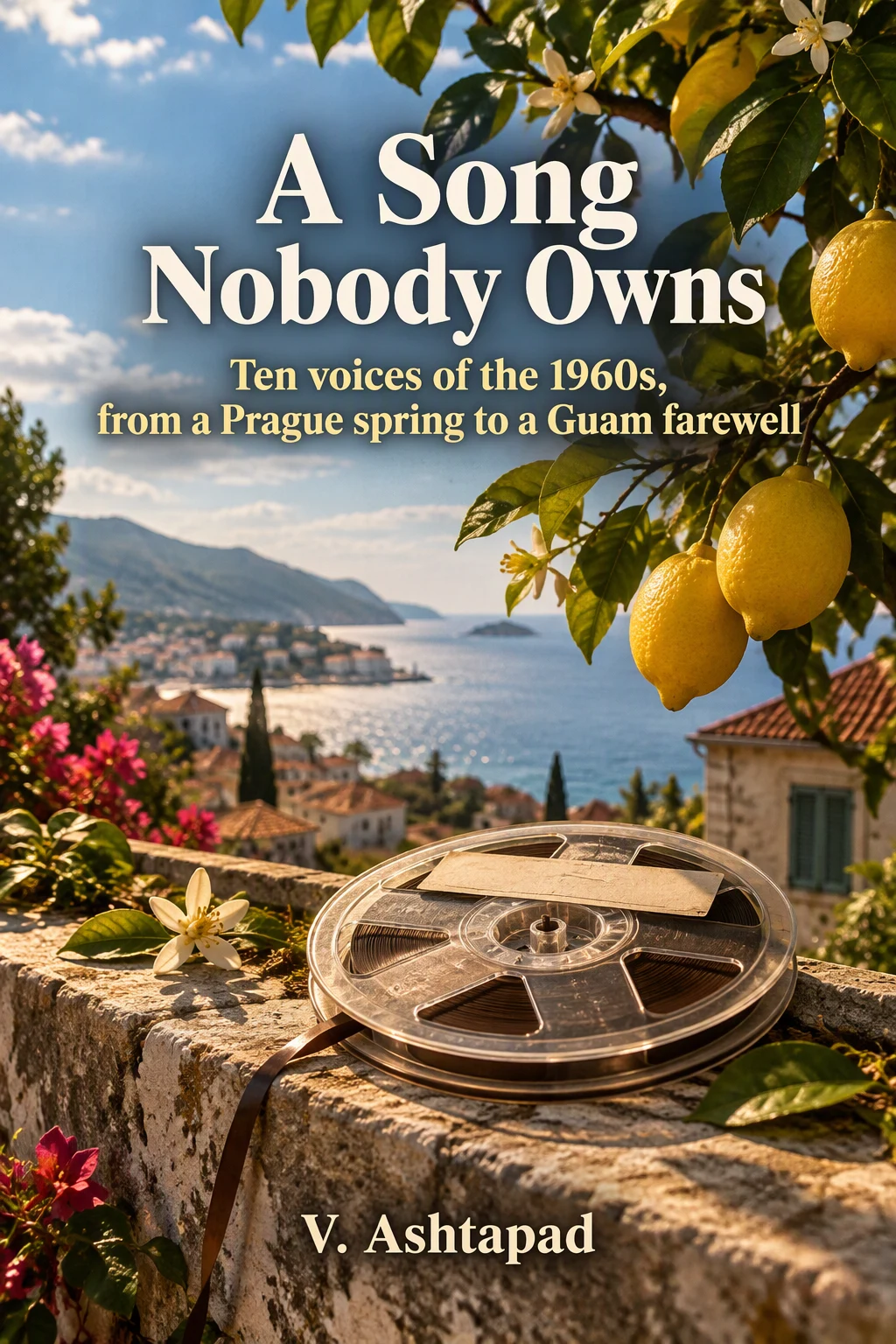
A Song Nobody Owns
Ten voices of the 1960s, from a Prague spring to a Guam farewell
by V. Ashtapad
Leave the Words In
*I have sung in rooms that held eleven people and a cat, and in rooms that held four hundred and a fire marshal. The size never mattered. What mattered was the moment, about halfway through a set, when the room stopped being polite and started being honest. You can hear it. Chairs stop creaking. Somebody laughs too loud and doesn't apologize. I've chased that sound across six decades and a lot of bad highways. Tonight's story is about a city that found it for one spring, and a young woman whose whole job, until then, was cutting it out. Pull your chair in. This one is quiet before it's loud.*
* * *
The kettle clicks off. Věra Holubová does not get up for it.
"Let it sit," she says. "Water should rest. So should people."
She is seventy-seven. Her flat is on the fourth floor of a building in Vinohrady, and the stairwell rings like a bell when anyone below drops their keys. Her grandson Matěj is nineteen. He has brought his own headphones and a small black microphone that clips to the edge of the table. He studies sound engineering. She thinks that is funny. She does not tell him why yet.
On the table is a flat cardboard box. Inside it is a reel of quarter-inch tape on a grey plastic hub. The box says nothing. She wrote nothing on it in 1968, on purpose.
"Is it playing?"
"It's recording. You. Not the tape."
"Good. The tape can wait. It has waited fifty-eight years."
A tram goes by on Vinohradská, three streets down. The windows hum. She lifts one finger and holds it up until the sound is gone.
"There. That is where I worked. That street. Listen to it first."
* * *
In the winter of 1968 I was nineteen and I cut words out of people.
That was the job. I was a junior tape editor at Czechoslovak Radio, in the big building on Vinohradská. I had a splicing block, a single-edge razor, a roll of white tape for joining, and a grease pencil. I had a chair with one short leg. The editing rooms were on the third floor at the back. The windows faced a courtyard where the drivers smoked. You could hear them coughing at seven in the morning. You could hear the boiler knocking in the cellar. You could hear everything in that building except what people actually thought.
An interview would come in. A factory foreman. A teacher. A farmer from Moravia talking about the harvest. A senior editor named Bartoš would listen with me. He had a cardigan the color of wet cement and fingers stained brown to the second knuckle. He would lift his hand. I would stop the reel. He would say, "From 'but' to 'anyway.'" I would rock the reels back and forth by hand until I found the 'b' of 'but' under the playback head. Mark it. Find the end. Mark it. Lay the tape in the block. Cut. Cut. Join.
The farmer's complaint about the fertilizer quota was gone. What was left said the harvest was good.
You get fast at it. I was very fast. I could take a breath out of the middle of a sentence and you would never know it had been there. That is a strange skill to be proud of. I was proud of it anyway. My hands were proud. My head was quiet about it.
At home I had my brother.
Ludvík was twenty-six. He had been blind since he was four. Scarlet fever. He tuned pianos. He went all over the city with a canvas bag of tools, a tuning hammer, felt mutes, a fork that sang an A when he knocked it on his knee. He knew Prague by sound. He knew which streets had cobbles and which had asphalt by how his cane rang. He knew which courtyards had pigeons. He knew the bells. He said the city was a big instrument nobody bothered to tune.
We lived with our mother in two rooms off Korunní Street. Our father had been an engineer at a radio factory. In 1952 he said something at a meeting. I never learned what. He was moved to a job loading freight at the Žižkov station. He died in 1954. Ludvík remembered his voice. I didn't. I was five.
Ludvík used to say, "He whistled. Through his teeth, like this." And he would whistle a little falling tune, five notes, and stop, and not finish it.
"Why don't you finish it?"
"He never did."
* * *
Matěj takes one headphone off. "They fired him for talking?"
"Moved. Not fired. Moved is quieter. They liked quiet."
"And you never found out what he said."
"You are too fast. You'd have made a good editor in 1967." She smiles. "That's not a compliment."
* * *
In January the government changed at the top. People will tell you they knew right away. They didn't. Nobody knew. It came in slow, like water coming up through floorboards.
The first sign I heard was Bartoš not lifting his hand.
A man from a steel plant in Kladno was on the tape. He said the plant ran on lies, that the numbers going up to the ministry were invented, that everyone knew it. I waited for the hand. Bartoš sat there. He smoked. He looked at the window.
"Well?" I said.
"Leave it."
"Leave which part?"
"All of it. Leave the words in."
I didn't know how to do that. I mean my hands didn't know. I sat with the razor and I could feel where the cuts should go, the way you can feel a stair in the dark. I put the razor down. The reel ran out. The tail slapped around and around against the machine. Flap. Flap. Flap. Bartoš reached over and stopped it.
"Get used to that sound," he said.
* * *
By March the censorship office had been told to stop. Officially. I want you to understand how strange that was. There was a building, with people in it, whose job was to read everything before you could. And one day they were told to go home and read for pleasure.
The city got loud.
Not loud like a party. Loud like a room after a long illness when someone opens a window. Newspapers sold out by eight in the morning. People read them standing up at the tram stops. Out loud. To each other. I would come down the stairs at Korunní and hear the woman on the second floor reading an article to her husband through the door. She had a high voice. He coughed after every paragraph. That was their conversation.
At work the phones rang all day. People called in. Ordinary people. They wanted to speak on the radio. Nobody had ever wanted that before, because it had never meant anything.
Bartoš came into the editing room on a Tuesday in April with a portable recorder. A Tesla machine, green, heavy as a sack of potatoes, with a leather strap. He set it on my table.
"You're going out."
"I'm an editor."
"You're nineteen. Go and listen to your own generation. Bring me back what they say. Don't cut any of it in the street. Cut nothing until you're back here, and then cut only the coughing."
* * *
I carried that machine all over Prague. My shoulder had a red line on it until June.
I went to Wenceslas Square. The trams still ran down the middle then. Bells, brakes, the flat clang of the points. People stood in knots around anyone talking. I stood at the edge of one knot and held the microphone up, and they didn't flinch from it. That was the first thing I noticed. They didn't flinch. A year before, a microphone would have emptied the square.
A woman of sixty with a string bag of onions told me she wanted to visit her sister in Vienna before one of them died.
A student with a cardboard sign said he wanted to read whatever he liked. He was very serious. Then he laughed at himself.
A tram driver on his break, drinking from a bottle of beer at nine in the morning, said, "I want to say a thing and not look behind me after." And he looked behind him after. Out of habit. Then he looked embarrassed. I recorded that too. The look you can't hear. But the little pause before he laughed, that you can.
I went to the Charles Bridge on a Sunday. Long-haired boys played guitars against the stone. Somebody had a harmonica. They were playing a song I didn't know, in English with a bad accent, and they didn't care about the accent. A girl had painted a small flower on her cheek in green ink. A policeman walked by and looked at the flower and kept walking.
I recorded the guitars. I recorded the river under the arches, that low sliding sound. I recorded the gulls. You get gulls on the Vltava in spring, they come up from somewhere. I never knew where.
* * *
Ludvík wanted to hear all of it.
At night I'd set the green machine on our kitchen table and play him the day. He'd sit very still. His hands flat on the oilcloth. Our mother would be at the stove frying bread in lard with garlic, and the smell would get in everything, the curtains, my hair, and the fat would spit, and Ludvík would say, "Mama. The spitting. I can't hear the man from Kladno."
"The man from Kladno can wait," she said. "The bread can't."
She never listened to my tapes. She'd leave the room when I played them. Once I asked why.
"I heard enough people say true things in 1952," she said. "Then I heard what it cost."
She took the pan off the flame. That was all.
* * *
Matěj is quiet. "Your mom was scared."
"My mother was sensible. Those are cousins. Not twins."
"Did Ludvík make tapes too?"
"Ah." Věra points at him. "Now you're listening."
* * *
In May there was Majáles. The student festival. Forbidden most of my life, allowed once, forbidden again, and now it came back, all at once, like it had been waiting in a cupboard. Floats. Costumes. A king of May on a cart. Bands on trucks. The whole parade went through the city and you heard it coming from streets away, drums and brass and somebody with a megaphone who couldn't stop laughing.
I took the green machine. I took Ludvík.
He held my elbow. He'd never been in a crowd that big. He had his cane folded in his jacket. He didn't need it. The crowd held him up.
"Turn it on and don't point it. Hold it low. At your hip."
"It'll get nothing."
"It'll get everything. You keep pointing it at mouths. Point it at the street."
So I did. I held the machine at my hip and let the microphone hang by its cord and I didn't aim it at anyone. I got feet. Thousands of feet. I got a dog barking at a man on stilts. I got a child crying because she lost a balloon, and then her father saying, "There it goes, wave to it." I got a brass band playing out of tune and a second band answering them on purpose, worse. I got glass breaking somewhere, a bottle dropped, and a big cheer for the bottle.
At home I played it for him. He laughed for an hour. He picked out sounds I hadn't noticed I had. "There. That's a tram on Národní, behind the band. There. That's a woman in clogs. Wooden. She's on the left. Listen to the left speaker."
"It's one speaker, Ludvík."
"Listen to the left side of it."
I did, and I swear she was on the left.
* * *
*I've played on the back of a flatbed truck in a parade, friends, and I can tell you the best sound in the world is not the band. It's the street answering the band. That's what he was asking her to catch. All right. Back to Prague.*
* * *
In June I started a reel of my own.
Not for the station. For me. Bartoš gave me ends of tape. Leftovers. Scraps too short for broadcast. I spliced them together, dozens of them, into one long reel. I'd carry it home in my bag and record onto it at night, or on Sundays. People in our building. People in the bakery on Slezská. A man who sold ice from a horse cart, yes, still, in 1968, in Vinohrady, with a horse that sneezed. I asked everyone the same thing.
"What do you want to be able to say?"
Not what do you want. What do you want to be able to *say*.
Most people said something small. I want to tell my boss his plan is stupid. I want to tell my mother-in-law I'm not coming at Christmas. I want to write a letter to a cousin in Canada without imagining a stranger opening it first. One old woman in the bakery queue said she wanted to say her husband's name in public. She said it. Into the microphone. A plain name. She said it twice and then she bought her rolls.
And on the Charles Bridge, on a hot evening at the end of June, there was a boy.
He was sitting on the parapet with his legs over the water side, which you were not supposed to do. He had a sketchbook. He was drawing the Malá Strana roofs, the red tiles, the green copper domes. I asked him my question. He didn't look up from the drawing.
"I want to be able to say I don't know," he said. "Out loud. In a meeting. And have that be all right. I want to say I'm not sure what I believe yet and have nobody write it down." Then he did look up. "Are you writing this down?"
"Recording it."
"Ha." He went back to his roofs. "Well. Keep it, then. But don't cut out the part where I'm not sure."
I didn't ask his name. That was the rule I'd made. No names on the reel. Names were where trouble started.
* * *
The kettle has gone cold. Věra doesn't care. She puts her palm on the box.
"July was the best month," she says. "I want to tell you it was the best month of my life and I want you to believe me. Things were possible. Everyone was sunburned. Ludvík tuned the piano at a jazz club in Old Town for free, in exchange for listening. He came home at two in the morning smelling of cigarettes and slivovice and someone else's perfume, and he sat on the edge of my bed and played me the club out of his mouth. The bass. The drums. The trumpet. He did the trumpet with his lips. Badly."
She laughs once. A dry sound.
"And then it was August."
* * *
I'm not going to tell you about August the way the books do.
I'll tell you what I heard.
On the night of the twentieth I was asleep. Ludvík woke me. It was after midnight. He had his hand on my shoulder.
"Listen."
I listened. I heard nothing. A dog. A tram bell far off, the last one.
"Under that."
Then I heard it. Aircraft. Not one. Many. Low. A drone that didn't change pitch. It came up through the floor more than through the window. The glass in our cupboard started to tick against the shelf.
"Those aren't ours," Ludvík said. "Ours don't come in that many."
By morning there were engines in the streets. Heavy ones. The cobbles took the weight and gave a sound I'd never heard and never heard again, a grinding that went on and on. People shouting. Not screaming. Shouting, arguing, the way you argue with someone you can't believe is standing in your kitchen.
The radio kept broadcasting. You'll read about that. The station on Vinohradská kept going on the air as long as it could, and then from other places, hidden transmitters, so people could hear a voice they knew. I won't tell you what happened outside the building. It's in the books. People were hurt. That's enough. I wasn't there that morning. Bartoš had telephoned at five and told me to stay home. It's the only order he ever gave me in a shouting voice.
I sat in the kitchen. Our mother made coffee. Real coffee, which she'd been saving in a tin since Easter. She didn't say anything. Ludvík sat with the radio pressed against his ear. Voices came and went. Then music, sometimes, to fill the gaps. Then the voices again, telling people not to fight, to stay calm, to take down the street signs so the strangers would get lost.
People did. All over the city. By evening there was not a street sign left in Prague. Every corner said nothing.
Ludvík laughed when he heard that. "Now everyone has to find their way like me," he said.
* * *
Matěj has taken both headphones off. He is holding them in his lap.
"What happened to the reel?"
"I'm getting to that."
"And Bartoš?"
"Bartoš was moved. Next year. Like my father. Quiet. He sold tickets at a cinema in Karlín for nineteen years. I went sometimes. He'd tear my ticket and hand it back and say, 'Leave the words in, Holubová.' Every time. Nineteen years."
* * *
In September people came to the station to go through things. New people. Or old people with new jobs. They wanted tapes. Anything recorded that spring. They boxed reels and took them away. A lot of reels were erased. Wiped on a big magnet in the cellar. You'd walk past the door and hear it. A hum, then a thump, then the hum again.
I had my reel in my bag. My scraps. My hundred voices.
I took it home. I didn't put a name on the box. I didn't write the date. I wrapped it in a dish towel and put it inside the piano.
Not our piano. We didn't have one. Ludvík did the hiding. He was tuning an upright in a flat on Mánesova Street for an old music teacher who couldn't play anymore, her hands were gone, but she liked to have the piano kept in tune, she said, so it would be ready. He opened the bottom panel, the one by the pedals, where nobody ever looks. He laid the reel flat on the wooden floor of the case behind the pedal rods. He closed the panel.
"It'll be in tune," he said. "It'll be ready."
* * *
Věra lifts the lid of the box. Not the reel yet. Just the lid. She looks at the grey hub and then at her grandson.
"I married your grandfather in 1972."
"Děda Karel."
"Karel. Yes. He was an architect. He drew stairs for housing blocks for twenty years. Thousands of stairs. He used to say he'd drawn more stairs than anyone in Bohemia who wasn't climbing them."
"I know. He told me that every visit."
"He told everyone. It was his joke. He had three." She sets the lid down. "I met him at a friend's birthday in a wine cellar in Malá Strana. He sat in the corner and drew the ceiling. I thought he was rude. He was shy. Those are cousins too."
* * *
The music teacher on Mánesova died in 1977. Ludvík went to the flat with her nephew, who was selling the piano. He opened the bottom panel while the nephew was counting money in the kitchen. The reel was there. Dusty. Fine. He brought it home in his tool bag with the tuning forks.
We kept it in a drawer for twelve years. Under the tablecloths. I never played it. I don't know why. That's a lie. I know why. I was afraid that if I played it, it would be just tape. Just noise. That the spring would turn out to be smaller than I remembered. People were very small in those years. Everyone was small. You made yourself small to fit.
Then it was November 1989.
You know this part. Everyone knows this part. Wenceslas Square again. Hundreds of thousands. And the sound. Keys. People held up their keys and shook them. All of them at once. Like a city full of little bells. Ludvík stood in the square holding my arm, he was forty-seven then, grey already, and he cried. He said, "That's the sound I've been waiting for. I didn't know what it would be. It's keys."
That Christmas I got the reel out.
We still had a machine. Karel had bought an old one from a colleague. Reel to reel. It took me an hour to thread it because my hands had forgotten. I played it in our kitchen in Vinohrady, this kitchen, with Karel and Ludvík and your mother, who was sixteen and thought we were all crazy.
The first voice was the woman with the onions. Vienna. Her sister.
The tram driver. I want to say a thing and not look behind me after.
The woman in the bakery queue saying her husband's name.
Feet. Majáles. The brass band and the worse brass band. The woman in clogs, left side.
Ludvík was smiling with his whole face.
And then the bridge. The gulls. The river. The boy on the parapet.
*I want to be able to say I don't know. Out loud. In a meeting.*
Karel put his cup down.
He put it down very carefully. Like it might go off. He listened to the whole thing. *Are you writing this down? Recording it. Ha. Well. Keep it, then. But don't cut out the part where I'm not sure.*
I stopped the machine.
Karel was looking at the table. "I was drawing the roofs. From the Malá Strana side. The Mikuláš dome. I never finished it. A girl with a green machine asked me a question."
Nobody in that kitchen said anything for a while.
"You didn't recognize me."
"You didn't recognize *me*."
"You were a voice behind a microphone. I didn't look at you. I looked at the roofs."
"You were a voice on the river. I didn't ask your name. That was my rule."
Ludvík started laughing. He laughed so hard he had to hold the edge of the table. Your mother said, "What, what is it, what is funny," and nobody could explain it to her for ten minutes.
That's the thing, Matěj. We'd been married seventeen years. I'd had his voice in a drawer under the tablecloths for twelve of them. Three years before I met him at the birthday, I'd met him on a bridge. He'd told me the truest thing anyone told me that whole spring. And I'd put it in a piano.
* * *
Matěj is staring at the box.
"That's not possible."
"It's not likely. Possible is a bigger room."
"Did he ever finish the drawing?"
"He finished it that night. Christmas 1989. From memory. It's in the hallway. You walk past it every time you come."
Matěj turns in his chair. Through the doorway the drawing hangs over the coat hooks. Red-brown ink. Tiles, chimneys, the great green dome. He has walked past it for nineteen years. He has hung his jacket on the hook under it.
"I thought that was a print."
"Everyone thinks that."
* * *
She takes the reel out now. She holds it by the hub the way you're supposed to, never by the edge.
"Here is what I need from you. You study sound. Good. Make it into a file. A clean one. Don't take the hiss out. I mean it. The hiss is the year. Leave it."
"Okay."
"Then we keep it with the family things. Your mother has set it up, the place where we keep the photographs and the letters and your grandfather's drawings. You know it. Where we decide who can see what."
"I know it."
"Not everyone gets this. You understand? These are people's voices. I asked them a question in 1968 and they answered, but they didn't answer for the whole world in 2026. So I've been finding them. Since 1990. Thirty-six years. The woman with the onions, her granddaughter is in Brno. She said yes. She wanted to hear it. She cried on the telephone. The tram driver, his son said yes but only family, not strangers. Fine. Only family. The bakery woman, I never found anyone. So she stays private. Just me. And now you."
"And Děda?"
Věra puts the reel down.
"Your grandfather said yes in 1989. In this kitchen. He said, 'Put my name on it now.' So we will. We'll put his name on the part on the bridge. The first name on the whole reel. Fifty-eight years without one. He can have one now."
Matěj nods. He doesn't say anything. He's learning.
"And Ludvík?"
"Ludvík died in 2011. You were four. He held you once and said you had loud lungs. That's a compliment from a piano tuner." She looks at the reel. "He's on it, you know. At the end. I didn't know until 1989 either."
"On the reel?"
"On the last scrap. After the bridge. There's a click where I stopped recording. Then there's a bit of tape I didn't make. He must have done it in August, before he hid it. He knew how to work the green machine better than I did. He just never said."
She nods at the grey reel.
"It's ten seconds. It's a man whistling. Five notes, falling. Through his teeth." She stops. "And then the sixth."
"He finished it?"
"Somebody did. Ludvík always said he couldn't. He had eight years of our father by ear and never once heard the end." She shrugs, a small, old shrug. "I asked him in 1989. He said, 'That wasn't me.' He said it very seriously. Then he went to bed."
The stairwell rings. Someone below has dropped their keys.
Věra lifts one finger. They both wait until the sound is gone.
"Thread it. Let's hear the hiss first."
* * *
*Some springs only last a season. Some only last a sentence. The part I keep coming back to is the boy on the bridge saying he didn't know yet, and asking her not to cut that out. I keep picturing somebody else, an ocean away and a few years off, an old woman at the end of a long wait in the heat, holding a piece of paper she'd been told her whole life wasn't hers, and when somebody finally said go ahead, her hands shook just the same as that tram driver's. Leave the words in, friends. Goodnight.*
© 2026 CRUNOD LLC. All rights reserved.
The Lemon Tree on the Party Wall
*I once traded a harmonica for a bowl of bean soup in a town whose name I never learned, and I've never regretted it. The soup was better than my playing. I'm Juniper Ash, and I've sung in a lot of kitchens. The best songs I know were written in them, by people who'd never call themselves songwriters, while they were doing something else with their hands. This one's from Santiago, Chile, in 1967, a spring when the young people were writing new songs about ordinary life and the old people were pretending not to listen. There's a lemon tree in it, and a stubborn grandmother, and a dog who couldn't keep out of the music. Get comfortable.*
* * *
"No, no, no. Not like that. You're drowning them."
Rodrigo Valdivia, seventy-six, takes the slotted spoon out of his granddaughter's hand with the authority of a man who has been frying sopaipillas since before her mother was born. The oil in the big black pan shivers. He lowers in a round of dough, orange with mashed squash, pricked three times with a fork, and it sinks, thinks about it, and rises, puffing, golden at the edges.
"You see? It has to want to come up. You don't push it."
"Tata, it's a pastry. It doesn't want anything."
"Everything wants something." He lifts it out, lays it on a sheet of brown paper to drain. "Now turn on your telephone, Antonia. Your mother says you have a school project. Your mother says I should tell you about the song."
Antonia, fifteen, in a school pullover with the sleeves pushed up, props her phone against the sugar bowl. Through the open window of the kitchen in Ñuñoa comes the smell of the jacarandas on the street, purple and heavy in the late November heat, and the sound of a neighbour's radio, and a bus groaning up Avenida Irarrázaval two blocks away. On the windowsill, a lemon in a saucer, very yellow.
"It's recording, Tata."
"Good. First, put down that I was handsome."
"I'm not putting that down."
"Then the rest is lies." He drops in another sopaipilla. "Fine. It was 1967. I was seventeen. And there was a lemon tree."
* * *
The lemon tree grew in the corner of our patio, against the wall we shared with the Echeverrías. A party wall, they call it, a *medianera*, which is a strange word for a wall, because there was nothing friendly about it, and nobody had a party anywhere near it for eleven years.
The tree was very old even then. It leaned. Half its branches came over onto our side and half went over onto the Echeverrías' side, and the lemons fell wherever they liked, which was the whole problem.
Let me tell you who lived in our house, so you understand what kind of noise we are talking about.
My father, Arturo, a clerk at the state railway, who came home every evening at seven, kissed my mother, put his hat on the hook by the door, sat in the armchair by the Philips radio, and did not move again until the football results. If Colo-Colo had lost, he did not speak until morning. If they had won, he sang tangos, very badly, while my mother did the dishes, and she hit him with the dish towel. That was their marriage. Thirty-one years. Very happy.
My mother, Inés, who taught second grade at the school on Avenida Grecia, and who had an opinion on everything, and who said every night at dinner, "I'm not going to say anything," and then said it.
My sister Carmen, nineteen, who was studying to be a pharmacist and who spent every evening on the telephone in the hall with a boy named Patricio, whispering, with the cord stretched under the bathroom door so that she could close it on herself. Every evening my father said, "That telephone is not a garden hose." Every evening she ignored him.
My cousin Tito, twenty-two, my mother's sister's son, who was supposed to be studying architecture at the university and who was actually studying the guitar, the charango and revolution, mostly in that order. He had come to live with us in 1966 because his mother in Talca said he needed "the influence of a stable home." Our home was not stable. He fitted right in.
Our dog, Cachupín. A quiltro. You know what that is. A dog of no particular breed and every particular breed, brown and white, with one ear up and one ear down, and a tail like a question. He was afraid of the gas man, the postman, the wind, and fireworks, and he loved, with his whole soul, my grandmother.
And my grandmother.
Mamá Chela.
* * *
Rodrigo stops talking. He flips a sopaipilla with great care.
"Tata?"
"I'm thinking how to say her," he says. "You can't just say her. She was too big for a sentence."
* * *
Mamá Chela was my mother's mother. Graciela Oyarzún Barría. She came from Chiloé, the big island in the south, from a town on the water called Castro, where the houses stand on stilts over the tide and everything is made of wood and painted every colour, and it rains three hundred days a year, and the people, she said, grow moss instead of hair. She was seventy-one in 1967. Small, round, very strong, with white hair she put up in a bun with eleven pins, every morning, I counted, and she wore black every day, not because anyone had died but because, she said, "black doesn't show the flour."
She had moved in with us in 1955, when my grandfather died down south. She brought one trunk, a sack of dried potatoes from Chiloé that we were still eating in 1958, a wooden spoon so old it was black, and a habit of singing in the kitchen in a voice like a rusty gate.
She sang the songs from the island. Songs about the sea and the fishermen and the witches who lived in the forest and the ghost ship that sails the channels at night, all lit up, with music playing on it. Every one of them was sad and every one of them had a chorus you couldn't get out of your head. She sang while she made the bread. She sang while she shelled the beans for porotos granados in the summer, sitting on the back step with a bowl on her knees, and Cachupín lay beside her with his chin on her slipper. She sang while she fought with Don Hernán.
Because Mamá Chela had been fighting with Don Hernán Echeverría, next door, for eleven years.
* * *
It started, everybody said, in March 1956, about the lemons.
The story in our family was this. That autumn there were a great many lemons, and half of them fell on the Echeverrías' side, and Mamá Chela, who believed that a lemon belongs to whoever owns the roots, went to the Echeverrías' front door and asked for them back. And Don Hernán, who was then a retired railway inspector, a tall thin man with a moustache like a broom, who believed that a lemon belongs to whoever it lands on, said no.
And that was it. Eleven years.
They did not speak. Not one word. If they met at the bakery on the corner buying marraquetas in the morning, they stood at opposite ends of the counter and looked at the ceiling. If Don Hernán's wife, Señora Pilar, said good morning to my mother over the front gate, Mamá Chela went inside and banged the pots. When lemons fell on our side, Mamá Chela picked them up and used them with great ceremony, where Don Hernán could see her from his window. When lemons fell on his side, he left them on the ground to rot, on purpose, where she could see them from hers. My mother said it was the stupidest war in the history of Chile, and she taught second grade, so she knew about stupid wars.
The worst was the singing.
Every evening, at about six, when Mamá Chela went into the patio to bring in the washing, she sang. Her island songs, loud, in her rusty-gate voice. And every evening, at about one minute past six, on the other side of the wall, Don Hernán put on his gramophone with a tango. Loud. Louder. And she sang louder. And the tango went louder. And Cachupín, who could not stand either of them when they did this, sat in the middle of the patio and howled.
So every evening at six in our street in Ñuñoa you had a Chilota grandmother, an Argentine tango, and a dog, all at full volume, and my father in his armchair saying, "Every night. Every night. A man works all day."
* * *
*I'll be honest, friend. I've played in bars quieter than that patio. But I'll tell you what I hear in it: two people who can't stop answering each other. That isn't a war. That's a conversation that forgot how to use words.*
* * *
Now. Tito.
In 1967 every young person in Santiago with a guitar wanted to write a new kind of song. You have to understand how it was. For years the radio had been all boleros and American rock and roll and the big orchestra kind of folk music, men in ponchos singing about how beautiful the countryside was, which it is, but not the way they sang it. And then, a few years before, people started going back. To the north and the south. To the old instruments, the charango and the quena and the bombo. To the old songs that grandmothers sang. And then writing new songs, in that way, about real life. About miners and fishermen and the people living in the shacks by the Mapocho river, and about love, and about whatever was happening to you that week. A woman who had collected the old songs all over the country, and written new ones, had died that February, and every young person with a guitar knew her songs by heart, and was trying to be worthy of them.
There was a house on calle Carmen, downtown, an old house, where they had what they called a peña. You went at night, you sat on little benches, they gave you a glass of red wine and an empanada, and people got up and sang their songs. Candles in bottles. Smoke. Ponchos. Very serious young men with beards. Tito went every Friday.
And every Friday he came home and said at breakfast, "I'm going to write a song that matters."
And my mother said, "I'm not going to say anything," and then said, "Finish architecture."
And Mamá Chela said nothing and gave him an extra piece of bread with butter and manjar.
* * *
In August 1967, the students took over the Catholic University, downtown, to demand that the university be changed, made more open, more fair. Tito wasn't a student there, but he went down every day with his guitar to sing to the ones inside, and came home with his voice in pieces. He said it was the most important thing that had ever happened in Chile. My father said the most important thing that had ever happened in Chile was the 1962 World Cup. They argued about this until September.
Then, on the first of September, Tito had his idea.
* * *
"The lemon tree," Antonia says.
"Patience. The sopaipilla has to want to come up." He fishes one out. "Here. Eat this. Put chancaca syrup on it. No, more. More. Your grandmother would have been ashamed of that amount."
* * *
Tito was sitting on the back step with his charango, a little ten-string guitar, the back made of wood (in the old days they made them from an armadillo shell, but Tito's was wood, he was a sensitive young man), trying to write a song about the students. It was going badly. Everything rhymed with *revolución*, which is not difficult in Spanish, and that was the problem: it was too easy, and it sounded like a pamphlet.
Mamá Chela was beside him with a bowl of beans. Cachupín was at her feet. Six o'clock. The washing on the line. And on the other side of the wall the gramophone started. A tango. A very sad one.
And Mamá Chela, instead of singing over it, sat still. Shelling beans. Listening.
Tito looked at her. He told me later, he had never in his life seen her listen to Don Hernán's tango before. She always sang over it.
And she said, to the beans, not to him: "That fool always picks that one. He knows I hate that one."
And Tito, who was not stupid, only twenty-two, said, "Mamá Chela. What actually happened with the lemons?"
And she said: "Nothing happened with the lemons. Lemons are lemons." And she split a pod with her thumb. "Write me a song, Tito. Not about your students. About a tree that grows on both sides of a wall and doesn't know which side it's on."
* * *
So he did. Or, that is the story. That is what everyone in the family said for fifty years, that Tito wrote it.
He sat up three nights. He came down to breakfast with his eyes like two holes burned in a blanket. My mother said she wasn't going to say anything and then said four things. And he had a song.
It was called "El limonero de la medianera." The lemon tree on the party wall. It went in the rhythm of a cueca, the dance we dance at the Fiestas Patrias in September, with the handkerchiefs, but slower, and sadder, with a little bit of the island songs in it, the ones Mamá Chela sang, that rocking feeling, like a boat, and a little bit of tango at the end of every chorus, a little sigh, just one phrase. A Chilota cueca with a tango tail. It shouldn't have worked. It worked.
The verses were about a tree that grows on a wall between two houses. The roots on one side, the shade on the other. Every year it gives its fruit to both and every year both sides fight over the fruit and nobody looks up at the tree. And the tree says, in the chorus, *I was planted by two hands, not one*.
That line. *Me plantaron dos manos, no una.* Everybody who heard it cried. Nobody knew why.
I was in the song. I want that on the record. Tito needed a bombo, the big drum, the goatskin one you hit with a padded mallet on the skin and a bare stick on the rim, and I had never touched one in my life, and he said, "It's easy, you're a Valdivia, we have rhythm," which was a lie, we have no rhythm at all, my father dances like a coat rack falling over. But I learned. I practised in the garage every afternoon for two weeks, and Cachupín sat outside the garage door and howled at every beat, and the gas man refused to deliver the cylinder because he thought there was a mad animal in there, which, in a way, there was.
And our friend Lucho from the next street played the quena, the flute made of cane, with a sound like wind in a bottle. Every time he played it, Cachupín put his head back and sang along. We tried to stop him. We could not stop him. In the end Tito said, "Leave him. He's in the band."
* * *
Rodrigo laughs, and wipes his eyes with the back of his hand that isn't holding the spoon.
"He was in the band. A quiltro with one ear up. He was the best musician of all of us."
* * *
The fiesta was on the seventeenth of September, the night before the national holiday. Our street had a neighbourhood committee, the junta de vecinos, and every year they closed the end of the street by the little plaza and put up a fonda, a sort of shelter with branches and leaves and paper flags in red, white and blue, and people sold empanadas de pino, beef and onion and an olive and a piece of hard-boiled egg inside, baked in a clay oven that Señor Muñoz from number 40 had built himself and was very proud of. There was chicha, the sweet new cider, in clay jugs. There were anticuchos on sticks, smoking on an iron grate set across two piles of bricks. Children with kites, because September is kite month, the sky over Santiago full of paper kites, all colours, and children running in the plaza with the strings, getting them caught in the electric wires. A man with a cart of mote con huesillo, the wheat and the dried peaches in their sweet brown juice, which you drink out of a tall glass with a spoon, very cold.
And at nine o'clock, a little stage made of beer crates, and anyone could get up and sing.
Tito had told everyone. He had told the whole street that he had a new song, a song that mattered. My mother had told the whole school. Carmen had told Patricio, who had told his entire family, who came from La Reina in a borrowed van. By nine o'clock there were two hundred people in that little plaza, maybe more, with chicha and empanadas and kites caught in the trees.
And standing at the back, on opposite sides of the plaza, as far apart as two people could possibly stand: Mamá Chela, in her black dress, with her bun of eleven pins, and Don Hernán, in his best suit, with his broom moustache, and Señora Pilar on his arm looking extremely embarrassed.
* * *
We got up on the beer crates. Tito with the charango, Lucho with the quena, me with the bombo, and Cachupín, who had followed Mamá Chela to the plaza and then decided to sit down at the front of the stage with his ears in two different directions as if he had bought a ticket.
Tito said into the microphone, which belonged to the junta and screamed if you went too close: "This is a new song. It's about a tree."
And someone shouted, "Revolution!" and everybody laughed, because everyone knew Tito.
And Tito said, "No. Just a tree."
And we played it.
* * *
I'm going to tell you what happened, Antonia, and you are going to think I'm exaggerating, because I'm your Tata and that's what Tatas do. I'm not exaggerating.
On the first verse, people were talking and eating empanadas.
On the first chorus, *I was planted by two hands, not one*, they went quiet.
On the second verse, a woman near the front, Señora Lagos, whose husband had not spoken to his brother since 1959 over a matter of a truck, began to cry into her handkerchief.
By the second chorus, people were singing it. A song they'd heard once, thirty seconds before. They were singing it, because the cueca rhythm is in every Chilean like a second heartbeat, and the chorus was so simple, and it had that island rocking under it, and that tango sigh at the end.
And at the end of the second chorus, Lucho played the quena solo, the wind in a bottle, and Cachupín put back his head and sang with it. Howled. In tune. I swear to you. In tune. And two hundred people laughed and cried at the same time, which is a thing I've only seen happen at weddings and at that fiesta.
And on the last chorus, everybody sang. The whole plaza. Old people and children. Patricio's family from La Reina in the borrowed van. Señor Muñoz with his clay oven. And at the back, on one side of the plaza, Don Hernán Echeverría, in his best suit. Singing. I could see his moustache moving.
And on the other side, Mamá Chela was not singing.
She was walking.
* * *
*Friend, I can count on one hand the songs I've watched do what they're supposed to do. They don't make people agree. They make people walk across a room.*
* * *
She walked across the plaza through the crowd, very slowly, small and round and in black, and the people moved aside for her without knowing why, and she walked right up to Don Hernán.
The song ended. Two hundred people clapped. Under the clapping, nobody else heard what they said to each other. I didn't. I was on the beer crates with a bombo stick in each hand, staring. Tito was staring. Cachupín jumped off the stage and ran straight through the crowd to her, the way he always did, and sat at her feet with his chin on her slipper.
They talked. Two minutes, maybe three. Señora Pilar let go of her husband's arm and stood a little way off, holding her handbag in front of her with both hands. Then Don Hernán took his handkerchief out of his breast pocket, a big white one, and gave it to Mamá Chela. And she used it, and gave it back.
Then she came home. She didn't stay for the cueca dancing, or the fireworks, which Cachupín was grateful for. She came home and went to bed.
The next morning, the eighteenth of September, the national holiday, there was a bag on our front step. A string bag, the kind you take to the market. Full of lemons. With a note in it, in an old railwayman's careful hand: *Your side. H. E.*
And that evening at six, when Mamá Chela went out to bring in the washing, she sang one of her island songs. And on the other side of the wall the gramophone started. And it was not a tango. It was her song. The same island song she was singing, a scratchy old record from the south, from Chiloé, that none of us had ever heard him play. He had it all along. And they sang along together with the wall between them, and Cachupín lay in the middle of the patio with his chin on his paws and did not howl at all.
My father, in his armchair, said, "Finally, some peace," and turned on the football.
* * *
"So they made up," Antonia says. Her phone has been propped against the sugar bowl for an hour. There are eleven sopaipillas on the brown paper and she has eaten four of them.
"They made up. The tango stopped. For three years after that, every evening at six, the island songs, on both sides of the wall. And sometimes she went over there for onces, for tea, in the afternoon, and sat in Señora Pilar's front room with her hands in her lap and drank tea and ate toasted marraqueta with avocado, very polite, and talked about the south. Señora Pilar told my mother she was a delightful woman. My mother nearly fell over."
"And the song?"
"Oh, the song." He shakes his head. "The song went everywhere. That's the other part. Patricio's cousins from La Reina sang it at a peña. Then the students sang it, in the university, all through the next year, they changed the words a little, it became about the two sides of the country, the rich side and the poor side of the wall. Then people sang it at union meetings, at demonstrations, at birthdays. People who didn't agree about anything sang it together. For a while you could hear it all over Santiago. It was never on the radio, not really. It didn't need the radio. Tito never got a peso for it. He didn't care. He went back to architecture. He built schools in Concepción for forty years. He died in 2015, and they played it at his funeral, and the whole church sang the chorus."
Rodrigo turns off the gas under the oil. The kitchen goes quiet except for the bus on Irarrázaval and the neighbour's radio.
"That was the story," he says. "That was always the story. Tito wrote a song about a lemon tree and two old people stopped fighting. Very nice. A little sweet. I told it at every family lunch for fifty-nine years."
"Was it not true?"
"It was true. It was only half of it."
* * *
He goes to the cupboard over the refrigerator, on his toes, and takes down a round cardboard hatbox. Inside, wrapped in a plastic bag from a supermarket that closed in 1994, there is a small reel of brown tape, no wider than a jam-jar lid. On a label on the reel, in blue ink, in a young man's sloppy hand: *Limonero. 17-IX-67. Plaza.*
"Tito had a tape recorder. A Geloso, Italian, grey, with a handle on top, like a little suitcase. He paid for it in instalments for two years. He brought it to the fiesta to record the song. He put the microphone on top of the beer crates. And then he forgot to turn it off."
Antonia puts down her fifth sopaipilla.
"Your mother," Rodrigo says, "took this to a man in Providencia last month, a young man who works with old tapes, and he put it in a computer. And then she put it in the family's place, with the photographs from that night and the pictures of the house. Where only we can listen. Us, and your cousins in Talca, and the Echeverría grandchildren in Viña, because I asked her to. And she listened to the whole thing, all forty minutes. Not just the song. Nobody had ever listened to the whole thing. And then she called me."
He picks up Antonia's phone, finds the family's page with a frown and a long finger, and plays it.
* * *
Out of the small speaker: the plaza. Crowd noise, faint and far. The tail of the song, the last chorus, two hundred voices. The clapping. A dog barking. Then the clapping fading and the sound of the microphone being knocked, and moved, and a long rattle of somebody carrying the beer crates. And then, very close, because the microphone has ended up on a crate at the back of the plaza where the crates were stacked, near the side wall of Señor Muñoz's house, two old voices, low, under the noise of the crowd.
A woman's voice, with the rocking of the island in it.
*"You kept it. All this time. The record."*
A man's voice, dry, precise.
*"You kept the tree."*
*"I didn't keep the tree. The tree was here. I moved in next to it. I didn't know whose house was on the other side until I saw you at your window. Nearly fifty years, Hernán. I nearly fell down."*
*"I know. I saw you see me. So I bought the tango."*
*"You did that on purpose? Every evening?"*
*"What was I supposed to do? Knock on the door and say, Graciela, do you remember Castro, 1908, two children planting a lemon seed in a tin can on the jetty, because yours had come from the boat from the north and you wanted to see if it would grow in the rain? Do you remember I carried the tin can to Santiago when my father got the railway job? Do you remember I wrote and you didn't answer? Do you remember you married Oyarzún?"*
A long pause. Crowd. A child shouting about a kite.
*"I didn't get the letters."*
*"I know that now. My sister told me, years later. Your mother kept them. I'm sorry."*
*"Don't be sorry. I had a good husband. I had Inés. I had all of them. You had Pilar. She's a lovely woman. She's too good for you."*
*"She is."*
*"Hernán. That tree in the tin can. You planted it here?"*
*"In 1923. When I bought the house. It was the only thing I brought from the south. Then in 1931 I had to sell off the back of the lot, and they built the wall, and the tree came out on the wrong side of it by a metre. And then you moved in. Into the house with my tree."*
Another long pause.
*"Me plantaron dos manos, no una,"* says the woman's voice, very quietly. *"I told the boy to write a song about a tree on both sides of a wall. I gave him that line. I didn't tell him why."*
*"I know you did,"* says the man's voice. *"I heard it. I heard you in it. That's why I sang."*
A dog barks, very near. Something rustles, a slipper perhaps, and the dog is quiet.
*"Here,"* says the man's voice. *"Take the handkerchief. You never had one, even in Castro."*
* * *
Rodrigo stops the recording.
The kitchen is very quiet. Outside, a jacaranda flower falls past the window, purple, and lands on the sill beside the lemon in the saucer.
"Mamá Chela wrote the chorus," Antonia says at last. "Not Tito."
"Mamá Chela wrote the chorus. Tito wrote the verses around it, and the cueca, and the tango tail, he was very talented. But the line, the line everybody sang, that was hers. She gave it to him on the back step with a bowl of beans, and she never told a soul what it meant. She died in 1970 and she never told. Don Hernán died in 1972 and he never told. Señora Pilar, I think, knew. She came to Mamá Chela's funeral and put a lemon on the coffin and my mother thought she'd gone mad."
He sits down at the table, heavily, and pulls the brown paper of sopaipillas toward him and takes one, and looks at it.
"Fifty-nine years I told that story at lunch. Tito and the lemon tree. And the whole time, on a reel of tape in a hatbox over my refrigerator, the real one was waiting. With the microphone on. Your mother cried for two days. Then she phoned the Echeverrías in Viña. Hernán's granddaughter, Pilar, named for her grandmother. They'd never known either. She's coming at Christmas. She's bringing something."
"What?"
"A tin can," says Rodrigo. "A very old, very rusty tin can. She says it's been on a shelf in their family for a hundred years and nobody ever knew why her grandfather wouldn't throw it away. It has a label from a fish cannery in Castro, 1908. There's still dirt in the bottom."
He bites into the sopaipilla. Chews. Considers.
"Too much squash," he says. "Mamá Chela would have said too much squash. Turn off your telephone, Antonia. Go and get the chancaca. Not the bottle, the real one, the block, in the pantry. If we're going to cry we should at least have the right syrup."
* * *
*There it is. A tree with two sets of roots, a dog in the band, and a song everybody sang without knowing what it was about. That's how songs work, friend. I keep thinking there were other neighbours that year, far from any lemon tree, with their own old grudge and their own wall, who found themselves on the same chorus before they could decide not to be. They'd have understood Mamá Chela. They'd have known that line by the second time round. I'm Juniper Ash. Go call somebody you've stopped talking to. Sing them the chorus first, if you have to.*
© 2026 CRUNOD LLC. All rights reserved.
The Hem Letters
*Hello, friends. Juniper Ash here, with the guitar case at my feet and a cup of something gone cold beside it. I have sung in a lot of rooms where two kinds of people were not supposed to sit together, and the thing I have noticed is that they usually manage it anyway, so long as somebody starts a song nobody owns. Tonight's story is about two girls on either side of a line that was older than both of them. It happens in Kuala Lumpur in 1963, the year a new country was stitched together out of old pieces. Somebody had to hold the needle.*
* * *
The parcel comes on a Thursday in the wet season, when the afternoon storms over Petaling Jaya arrive so punctually that Lim Siew Peng sets the kettle on before the first thunder and is never wrong. It is a flat box wrapped in brown paper and then in plastic against the rain, and the courier, a boy in a yellow vest dripping onto the tiles, has to wait while Sari fetches the old woman's spectacles so she can sign for it.
"From Kuala Terengganu?" Sari reads the label aloud, turning it in her hands. She is thirty-four, from a village outside Semarang, and has looked after Siew Peng for three years, long enough to know that very little arrives in this flat that is not a bill or a prescription. "Ibu, you know someone there?"
"I knew someone who went there," Siew Peng says, and then she sits down rather quickly on the rattan chair by the window, and Sari puts the box on her knees and goes to turn off the kettle, which has begun to scream.
It is a long while before the old woman opens it. The rain comes, as expected, white and loud against the louvres. The smell of wet earth and the frangipani by the car park rises through the flat. Sari brings two cups of Chinese tea, which is what Siew Peng drinks in the afternoon, and sits on the floor with her own cup because that is where she sits when she can see that a story is coming. She has learned to recognise the look: a looseness about the old woman's mouth, as though something inside her has untied.
"You should know," Siew Peng says at last, "that your country and mine were quarrelling, the year this begins. Did they teach you that in school?"
"Konfrontasi," Sari says. "A little. Not much."
"Not much is right. It was mostly radio speeches and soldiers in the jungle we never saw. For a girl of sixteen it meant the evening news was angry. That is all." She lays her hand flat on the brown paper. "But it is a good place to start, because this is a story about two people who were told they were on different sides, and decided not to be."
* * *
My father was a tailor on Batu Road, she says. Not one of the grand ones near the Coliseum, where the planters had their white drill suits made. A small shop opposite the long side of the Coliseum cinema, between a goldsmith and a shop that sold Chinese medicine, so that all day long you could smell dried orange peel and ginseng through one wall and hear the little hammer of the goldsmith through the other. We lived upstairs, my parents and my grandmother and my two small brothers and I, and at night, after the last show let out and the trishaw men rang their bells for fares along the five-foot way, the ceiling fan turned so slowly you could count its arms.
I was the eldest and I could sew before I could read properly. My father said I had a straight eye. He meant that I could look at a person standing in a doorway and know the measurement of their shoulders to within half an inch, and that I could cut cloth without chalk if I had to. It was the only praise he ever gave me, and I lived on it.
In June of 1963 a man came to the shop in a black songkok and a pressed grey suit, and he did not sit down when my father offered him the stool. He was Encik Hashim, the steward of a royal household from up the coast. I won't tell you which house. They are an old family, and some of them are still living, and in her letters she only ever called it the House of Kenanga, after the trees in the garden of their residence on Ampang Road, so that is what I will call it too. The household kept a house in Kuala Lumpur for the season, and that September there would be celebrations for the new federation, Malaysia, which was to be born on the sixteenth, and the younger members of the family needed clothes.
My father was not the household's usual tailor. Their usual tailor had gone to Singapore and taken his best cutter with him. Someone had told Encik Hashim that Lim on Batu Road was honest and fast and did not gossip, which was true of my father in all three particulars.
"There is a granddaughter," Encik Hashim said. "Tengku Nur Aisyah. Sixteen. She will need three baju kurung and one for the evening of the sixteenth. The silk will be supplied." He looked at me where I sat behind the counter with a basting needle in my mouth. "The fittings are at the house. A man cannot fit a young lady of the household. Is this your daughter?"
My father said yes.
"She will come with the measuring tape," Encik Hashim said. "And she will speak only when spoken to."
* * *
Siew Peng stops, and laughs, a dry small sound like paper.
"I did not speak only when spoken to," she says. "Not even on the first day."
Sari pulls her knees up to her chin. Outside the rain has thinned to a steady hiss. "What was she like?"
"Rude," says Siew Peng. "Wonderful. Bored out of her mind."
* * *
The house on Ampang Road was white, she says, with green shutters and a porch held up by pillars, and a drive of red laterite that stained the hem of my samfu the colour of rust. There were kenanga trees along the drive, and if you have never smelled kenanga in the evening I cannot help you; it is sweet the way overripe fruit is sweet, heavy, almost sad. There was a jaga at the gate, an old Sikh watchman with a white beard and a chair he never sat in, who called me "little tailor" and later, when he knew me, used to save me a guava from his tree.
They put me in a sewing room at the back of the house, near the kitchens. I remember the smell of santan cooking, coconut milk and pandan and something frying in shallots, and the sound of women laughing in Malay faster than I could follow. I spoke Malay the way the shop spoke it, for prices and directions. I spoke English better, from school. I spoke Cantonese to my mother and Hokkien to my grandmother and a mixture of everything to my brothers.
The girl came in with an older woman, an aunt or a governess, I never learned which, who sat in the corner and fell asleep almost immediately. Tengku Aisyah was taller than I was and thinner, with a long face and a habit of looking at the ceiling while you spoke to her, as if the answer to every question was written up there. She wore a plain cotton baju kurung, pale blue, and she had ink on the side of her middle finger.
I measured her. Shoulders, bust, waist, the length from nape to wrist. She stood very still and I worked very carefully and neither of us said anything, and the aunt snored, and through the window a koel was calling the same two notes over and over, rising, the way they do before rain.
Then she said, in English, still looking at the ceiling: "Do you have to be here?"
I said: "Do you?"
It was a terrible thing to say. My father would have fainted. Encik Hashim would have had me thrown down the laterite drive. But she looked down at me, at last, and her whole long face changed, and she laughed. She laughed so loudly that the aunt woke up and said "Apa? Apa?" and we both had to pretend I had pricked her with a pin.
* * *
There were nine fittings before the sixteenth of September, she says, and by the fourth we were friends, and by the sixth we were something I did not have a word for then and am not sure I have one now.
What did we talk about? Everything that sixteen-year-old girls talk about when they are not supposed to be talking. She was at the girls' school on Bukit Nanas, and she wanted to be a doctor, and her grandmother, the old Tengku, thought this was a passing fever that a good marriage would cure. I wanted to design clothes, not just sew them, and my father thought this was a passing fever that a good marriage would cure. So we had that in common straightaway.
She lent me books. Jane Eyre, which I hated, and a book of Malay pantun, which I loved and could barely read, and she made me read them aloud so she could correct my pronunciation and laugh at me. I brought her things from Batu Road wrapped in newspaper: kuih lapis from the stall on the corner, nine layers of red and white, and once a paper cone of chestnuts roasted in black sand in a great iron wok by the man outside the cinema, which she had never eaten, because nobody in that house would buy food from a hawker. She ate them on the floor of the sewing room with her legs folded under her and cracked the shells with her teeth, and when the aunt looked over she put one in the aunt's mouth too.
There was a radio in the sewing room. On Saturday afternoons there was a request programme on Radio Malaya, people writing in to dedicate songs, and we listened with the volume low. One week a song came on that I had heard a thousand times from the jukebox in the coffee shop downstairs, Sampan Terakhir, a slow sad song about the last boat leaving a river mouth at dusk. I knew every word of it; the coffee shop boys sang it at closing time with their brooms. She had only ever heard it played on the piano at school, by a music mistress who did not approve of it. So I sang it under my breath, in my shop Malay, and she played it on the edge of the cutting table with her fingers, as if the wood were keys, and every time I got a word wrong she pressed a wrong note on purpose to tell me. When it was finished we were both crying a little for no reason at all, and then laughing at ourselves for crying.
That was the day she said: "You should write to me. When we go back up the coast."
I said a tailor's daughter does not write letters to a royal house.
She said: "Then don't write to a royal house. Write to me."
* * *
"Ibu," Sari says. "The box."
"Yes," Siew Peng says. "I know. Be patient with me. I have been patient with it for sixty years."
But she does take the scissors Sari brings from the kitchen drawer, and she does cut the tape, and under the brown paper is a cardboard box of the kind that shoes come in, and under the lid is tissue paper, and on the tissue paper is a letter in a white envelope addressed in a careful modern hand, in English. Siew Peng reads it silently, her lips moving, and then hands it down to Sari.
*Dear Puan Lim,*
*You do not know me. My name is Nurul Aisyah binti Tengku Iskandar. I am the granddaughter of Tengku Nur Aisyah, who died in April of this year at the age of seventy-nine. She was a paediatrician in Kuala Terengganu for forty-one years. I think you may have known that, or guessed it.*
*In her instructions to the family office she asked that this box be sent to you, and that the letters inside be returned to their writer. I am sorry it has taken so long. There were many instructions, and many people to agree.*
*She also asked me to tell you one thing, in these words exactly: "Tell her the hem is still good."*
*I hope this means something to you. I confess it does not mean anything to me.*
*With respect,*
*Nurul*
Sari reads it twice. "The hem?"
The old woman is lifting the tissue paper. Beneath it, folded in the old way, in thirds and then in half, is silk the colour of a bruised mango, gold-threaded at the border. She does not lift it out. She touches it with two fingers, the way you touch the forehead of someone sleeping.
"That," she says, "is the evening dress. I made it for the sixteenth of September 1963." She looks up, and her eyes are wet but her mouth is smiling. "Let me tell you about the hem."
* * *
The silk came from the household, she says, from their own looms up the coast, songket with the gold woven right into it, a pattern of little bamboo shoots climbing up from the border. My father would not let me cut it. He cut it himself, at night, with the shop shutters down and the fan off so the pieces would not move, and I held the lamp. But he let me sew the hem, because I had the smallest stitches in the family, and he said a hem on a royal dress should be invisible.
So I sewed it invisible. And on the inside, where no one would ever see, in thread the same colour as the silk, I sewed a single little kenanga flower, five petals no bigger than a grain of rice, and the letter P beside it, for Peng. It took me an hour. If my father had found it he would have unpicked it and then unpicked me.
On the night of the sixteenth there were fireworks over the padang in front of the Selangor Club. Everyone in Kuala Lumpur was out on the streets, Malays and Chinese and Indians and the few remaining British in their pale suits, all of us looking up. My father took the whole family. My grandmother had never seen fireworks that were not for the New Year and she held my youngest brother up so he could see and kept saying, in Hokkien, "For a country? All this for a country?" There were stalls selling satay and the smoke of it drifted over the crowd, and somewhere a band was playing kroncong, a guitar and a ukulele and a cello plucked with the fingers, that lazy rocking music that sounds like a boat at anchor.
I did not see her. Of course I did not see her. She was at some reception in a hall with chandeliers. But at ten o'clock, when the big rockets went up and the whole sky turned gold, I knew she was wearing my hem, and that the flower was against her ankle, and I thought: she is there and I am here and we are both under the same gold. That was enough. At sixteen that was more than enough.
Three days later a boy from the household came to the shop on a bicycle with a parcel. It was the blue cotton baju kurung, the plain one, with a note from Encik Hashim saying the hem had come down and could it be repaired before the family left for the coast. My father handed it to me. When I turned it inside out there was a tiny slit in the hem, cut carefully with scissors, and inside the hem, folded into a strip as thin as a ribbon, was a letter.
* * *
Siew Peng has lifted the evening dress at last. Beneath it, in the shoebox, are letters. Many letters. Some in old blue airmail envelopes gone soft as cloth, some on lined school paper, some on thick cream paper with an embossed crest that has been carefully cut away with scissors, leaving a little window in each sheet. They are tied in bundles with sewing thread, and the thread on each bundle is a different colour.
"These are mine," Siew Peng says. "My letters to her. She kept them all." She unties the first bundle, red thread, and lifts out a strip of paper folded lengthwise many times. It has been flattened since. The handwriting on it is a girl's, round and careful, in English.
"Read it to me," she says. "My eyes."
Sari unfolds it on her knee.
*Tengku,*
*I found it. You are mad. If my father had found it first he would have used it to light the stove. You must not cut your clothes anymore, you have only so many. Next time send a button that needs sewing and put it under the button.*
*The fireworks were very beautiful. My grandmother asked if there would be fireworks every time there is a new country and I said I hoped not, it would be too expensive. Did you wear it? Was it heavy? Did anybody step on it? I watched the sky the whole time and thought the gold was your hem.*
*Here is a pantun I wrote. Correct it. I know it is bad.*
*Kenanga flowers on the drive,*
*Red dust stains a tailor's shoe.*
*As long as needle and thread survive,*
*There's a line between me and you.*
*I mean a line of thread. Not the other kind of line.*
*Peng*
Sari looks up. "Ibu. You wrote poems."
"Bad ones," says the old woman. "She wrote back that the rhyme was a crime against the Malay language and that she was keeping it forever."
* * *
Her letters came in the clothes, she says. For four years.
A baju with a loose button. A selendang with a torn fringe. A pair of trousers belonging to one of her brothers that did not need anything at all, which my father puzzled over for a whole afternoon before deciding the household was testing his honesty and sending them back with a note saying no repair was necessary. I had already taken the letter out of the waistband.
What did she write? I can tell you without looking, because I read them so often that the folds wore through. She wrote about her grandmother's house in Kuala Terengganu by the sea, where the fishing boats came in at dawn painted red and green and yellow with eyes on their prows, and the women on the beach split the fish and laid them on racks to dry, so that the whole town smelled of salt and sun and fish. She wrote about the keropok, the fish crackers, being fried in great black woks. She wrote about the songket weavers in the kampung, the click of the looms, the old woman who had been weaving for the family for fifty years and could not read but could hold eighty threads in her head.
She wrote about her lessons, and how she had passed her examinations, and how her grandmother had said nothing at all, which was the worst thing her grandmother could say.
She wrote, in 1964, after the troubles in Singapore in July, when there was fighting in the streets between Malays and Chinese and the radio was full of curfews: *Peng, are you all right. Is your family all right. Write in the next thing I send, even if it is only one word. My grandmother says these things are the work of a few bad men and that most people want only to sell their fish and eat their rice. For once I think she is right.*
I wrote back one word. I wrote: *Yes.* And then under it, because I could not help myself, *And you?*
She sent back the whole hem of a kain, unpicked and resewn around one sentence: *And me.*
* * *
The rain has stopped. The light that comes through the louvres is yellow, washed, and the drip from the balcony above ticks on the ledge. Sari has refilled the tea without being asked. Siew Peng holds a letter on cream paper, the crest cut out of its corner, and does not read it.
*You think that is the end of the story. The girl writes, the girl writes back, they grow old, a box comes in the rain. That is the shape of it, isn't it, from the outside. But the inside of a hem is where the work is, and the inside of this one is a little crooked. Stay with me.*
* * *
In 1967 she went to Singapore to study medicine, Siew Peng says. I was twenty and I was cutting my own patterns by then, in the back of my father's shop, and selling dresses to secretaries who wanted something that was not from England and not from their grandmother's trunk either. A shift with a Mandarin collar. A kebaya cut short and sharp and worn with slacks. I was very pleased with myself.
Our letters went by post now. No more hems. She wrote from her hostel about cadavers and night duty and a boy from Penang who played the guitar badly outside her window. I wrote about my dresses and the secretaries and a boy from Seremban who did not play anything at all but who had very kind hands. That was your grandfather, Sari, I mean, that was Ah Kow, who you never met. I tell you this so you understand: we had both begun to have lives. It was all happening as it should.
And then it was May of 1969.
* * *
Siew Peng puts down the letter.
"I will not tell you what happened on the streets," she says. "You can look it up. Everyone knows the date. Here it is still a date people say quietly. I will only tell you that we were inside our shop on Batu Road with the shutters down for four days, and my grandmother sat in the corner saying the names of everyone she knew, over and over, as if saying them would keep them, and my father did not sleep. And that the goldsmith next door, who was a Malay man named Pak Yusof, came round to the back door on the second night with a pot of rice and a pot of curry from his wife and stood in our kitchen talking to my father in low voices for an hour, and that when the trouble came to the end of our street he went and stood in front of our shutters with two of his sons and simply did not move until it went away again."
"Ibu," Sari says.
"No. No, I am all right. Nobody in our house was hurt. Many people were. That is not my story to tell." She folds her hands. "My story is that in June a letter came from Singapore, and I did not answer it."
Sari waits.
"I was afraid," the old woman says. "That is the whole of it. I was afraid, and I was angry, though I did not know at whom. At the street. At the country we had watched being born under the fireworks. At everyone who was not Chinese and everyone who was. It was not fair and I knew it was not fair; Pak Yusof had stood in front of our door. But I was twenty-two and I had sat for four days listening to my grandmother say names. And a letter came from a royal house, on cream paper with a crest, and I looked at that crest and I could not make my hand pick up a pen."
She lifts the cream letter. She unfolds it, and this time she reads it aloud herself, in a slow clear voice that does not shake.
*Peng,*
*I have heard nothing and I am frightened for you. My father telephoned Encik Hashim, who is old now but still keeps the house in KL, and he says Batu Road was not burned and that the tailor's shop is shut but standing. That is all he knows. I am writing to every address I have for you.*
*Please write one word. You know which word.*
*If you cannot write it, I will understand. I would not want to write to me either, this month. I would not want to write to anyone with a hat like the one my grandfather wears in the photographs. I know what the hat means to people. I know what it meant to some of the men in the street.*
*But I am not a hat, Peng. I am the girl who ate chestnuts on the floor.*
*A.*
* * *
Sari is crying. She wipes her face with the heel of her hand and is cross with herself for it.
"You never answered," she says.
"I never answered. I married Ah Kow that December. I had children. I opened my own shop in Petaling Jaya in 1974, and I made dresses for thirty years, and some of them were very good. Every year on the sixteenth of September, when they set off the fireworks for Malaysia Day, I thought: I will write this year. And every year I did not. You get used to not doing a thing. It becomes a kind of furniture. You walk around it." She smooths the cream paper against her knee. "Then one year I read in the newspaper that a Dr. Tengku Nur Aisyah had opened a children's clinic in Kuala Terengganu, and I cut the article out and put it in a drawer, and I thought: she has a life. She does not need a tailor's silence in it."
"But she kept your letters."
"She kept my letters," Siew Peng says. She looks at the evening dress in the box, the mango silk, the bamboo shoots of gold. "And she sent back the dress. Pass me my sewing basket, child. The one under the television."
* * *
The basket is woven rattan, older than Sari, with a lid that does not quite close. Inside it there are spools of thread, a pincushion shaped like a tomato, scissors with orange handles, and a seam ripper with a handle of yellowed bone. Siew Peng takes the seam ripper. She lifts the dress out of the box at last and lays it across her knees, and the gold catches what light there is and throws it in small pieces onto the ceiling.
She finds the inside of the hem by touch. She runs her thumb along it, slowly, and stops.
"There," she says. "My flower."
Sari leans close. In the silk, nearly invisible, the same colour as the cloth, there is a tiny embroidered shape with five petals and beside it the letter P.
The old woman keeps moving her thumb. A little further along she stops again, and her breath catches, and she says something in Hokkien that Sari does not understand.
"What? Ibu, what?"
"These are not my stitches," Siew Peng says. "Look. Here. My stitches are small. These are — " she laughs, unsteadily, " — these are terrible. These are a doctor's stitches. These are sutures."
For six inches along the hem, the sewing has been redone. The thread is a slightly different gold. The stitches are even, tight, each one knotted separately, in the way a surgeon closes a wound so that one broken thread will not undo the rest.
"She learned," Siew Peng whispers. "She must have learned in medical school and thought of me. She opened my hem and closed it again."
She slides the point of the seam ripper under the first of the surgeon's stitches and cuts it. Then the next. Then the next. Each one gives with a small sound, like a seed splitting. Sari holds her breath. When the six inches are open, Siew Peng slides two fingers into the hem and draws out a strip of paper folded lengthwise into a ribbon, exactly as a sixteen-year-old girl once taught a sixteen-year-old girl to fold it.
She hands it to Sari. "Read it. I cannot."
Sari unfolds it. The paper is new. The ink is blue, from a ballpoint pen, and the handwriting is an old woman's, large and wandering, but it is the same hand.
*Peng,*
*The sixteenth of September again. Fireworks on the television. I am too old to go out and see them and too stubborn to admit I would like to.*
*I have written to you every year on this date since 1969. I did not post them. I put them in a drawer, and the drawer became a box, and the box will come to you after me, I have made sure of it. You will find them under your own letters. Fifty-six of them. Most are boring. I talk about my patients and my grandchildren and my knees. One or two are angry. Forgive those. I forgave you in about 1972, and then I forgot to stop writing.*
*I knew why you could not answer. I knew in June of that year. I was not angry that you were afraid. I was only sorry that I could not stand in front of your door like your neighbour did. Encik Hashim told me about him. I have thought about that man all my life. When I go into a room of frightened children I try to be Pak Yusof.*
*I have redone your hem, as you can see, very badly. Sutures are not stitches. But I wanted you to have to open it. I wanted you to have to come and find me one more time.*
*Here is a pantun. Correct it. I know it is bad.*
*Kenanga petals, dry and brown,*
*Pressed in a book from long ago.*
*The thread was never broken down.*
*It only went where you could not go.*
*The hem is still good.*
*A.*
* * *
Under the dress, under the bundles tied in red and green and white thread, there is a second layer of the shoebox, and in it, rubber-banded together, there are fifty-six envelopes, each with a date on the front and nothing else.
Siew Peng does not open them that afternoon. She sits with them in her lap while the light goes from yellow to orange to the blue of the hour when the lamps come on along the road, and the neighbour's television starts its evening drama, and somewhere below a motorcycle coughs into life. Sari makes rice and steams a fish with ginger and soy and spring onion, the way the old woman likes it, and they eat at the small table by the window without saying very much.
Afterwards, Siew Peng asks for the telephone.
She has the number from the bottom of Nurul's letter. She talks for twenty minutes, slowly, in a Malay that goes stiff and old-fashioned in places and then suddenly loose and laughing, and Sari, washing the plates, hears her say: yes. Yes, of course. If you would. Yes, beside hers.
When she puts the phone down she explains. The family keeps an archive, she says, the young woman told her. Their office keeps it. Photographs of the old house, the deeds, the songket patterns the weavers made for each generation, all of it recorded, who made what and when and for whom. Dr. Aisyah's papers are going into it, her notebooks, her letters. Nurul asked if Siew Peng's letters might sit beside them, photographed, with her name on them as their writer, so that the family could read both sides of the conversation. Only the family, and whoever Siew Peng herself chose to let in. Nobody else.
"And I said yes," Siew Peng says. "And I said, put the dress in too. With a note. Made by Lim Ah Choon and his daughter, Batu Road, September 1963. Hem resewn by Dr. Tengku Nur Aisyah, Kuala Terengganu, date unknown."
"You should add one more line," Sari says from the sink.
"What line?"
"Opened again by Lim Siew Peng, Petaling Jaya, November 2026." Sari dries her hands. "So they know you came and found her."
The old woman considers this for a long moment. Then she nods and points at Sari's phone on the counter.
"Record me," she says. "I will read them one each year. Starting with the first. On the sixteenth of September, with the fireworks on. And you will send the recordings to the girl, Nurul, and only to her, and she can put them beside the letters, and if her own children want to hear an old Chinese woman correcting their great-grandmother's terrible pantun, they will be able to." She pauses. "And when I am gone, you will finish reading them."
"Ibu, I can't promise — "
"You can. It is only fifty-six years. You are young." She closes the shoebox lid gently over the envelopes. "And Sari. Your Malay is better than mine. When you read hers, read them properly. She always laughed at my pronunciation."
* * *
That night, after Sari has gone to bed, Siew Peng takes the dress out once more and threads a needle under the lamp. Her hands shake now, they have shaken for years, and her eyes are not what they were, and it takes her a long time. But she closes the six inches of hem again, not with a tailor's invisible stitch and not with a surgeon's knot, but with something in between: small, tight, and every few stitches a knot of its own.
When she is done she smooths it flat and folds the silk in thirds and then in half. Outside, very far off, above the city, there is a flash of light that might be lightning or might be someone, somewhere, setting off a single firework for no reason anyone will ever know.
She watches the window until it fades. Then she turns out the lamp.
* * *
*That's the one, friends. Two girls and a hem. I've played a lot of songs about walls and fences and lines in the sand, and the truth is most lines aren't drawn by the people standing on either side of them. They just inherit them, like a coat that doesn't fit. Some folks wear the coat their whole lives. Some folks, quietly, take it in at the seams.*
*The same years she was sewing, half a world away, two kinds of working people who'd been kept apart on purpose ended up feeding each other out of the same kitchen. I've always liked to think a girl in one of those places and a girl on Batu Road would have known each other on sight. Same look on the face. The look of somebody deciding.*
*That's all I've got tonight. Somebody look out the window for me before you go.*
© 2026 CRUNOD LLC. All rights reserved.
The Road the Dog Remembered
*Juniper again, friends. I played a little town in the north once, years and years back, a hall with a stove in the middle and everybody sitting on benches with their coats still on, and after the show an old man came up and asked if he could hold my guitar. He didn't play it. He just held it against his chest and closed his eyes, the way you'd hold a sleeping cat, and he said, it hums. I've never forgotten that. This story has a fiddle in it, and a truck, and a girl who listened with her hands. It starts on the grass and it ends nine floors up. Let it take its time.*
* * *
"You have been very patient with me, Anujin, and I shall try to be worthy of your patience. An old man's story is like a caravan. It must stop at every well. If you will indulge me, I shall try not to stop at all of them.
"But first, if you would be so kind, the curtain. A little wider. I like to see the hills while I speak, though the smoke has taken most of them this morning. There. You see, just past the chimney of the power station, where the gers begin to climb the slope like sheep going up to the evening pasture? That is where we lived, the first winter. That hill. It had no name then. It has three names now, and a bus that goes there, and a shop that sells Korean noodles. Everything in this city acquires names faster than it acquires trees.
"Your great-aunt is comfortable? Ask her, please. In her language, not in mine."
Anujin, who is twenty-three and home for the winter from her university in Seoul, turns to the woman on the sofa beside the radiator and signs the question. The woman, small and white-haired in a quilted deel of deep green silk with a sash of orange, answers with a flick of two fingers and a raised eyebrow that needs no translation.
"She says she is comfortable, and that you should stop asking, and that I should begin before I am dead."
"She is very gracious, as always. Very well. Your recorder is on? And your great-aunt consents to be part of the recording? Ask her that too, please. She may not wish it. She has opinions on these matters that would fill a library."
Anujin signs. Saraa watches her hands, then looks for a long moment at her brother, and then signs something brief.
"She says yes, but if you put her on the internet she will haunt you."
"Ah. Then we understand one another. Let us begin."
* * *
"The summer of 1964. I was fifteen years old, and I had never seen a building taller than the winter shed of the collective, which was one storey of logs with a tin roof that sang in the hail.
"We were herders, Anujin. My father, Dorj, kept the horses of the collective in the valley of the Tamir, in Arkhangai, where the river is cold enough in August to stop your heart and so clear you can count the stones on the bottom. My mother, Tsetseg, kept everything else: the cows, the sheep, the goats, the ger, the stove, my father, me, and our grandmother, who did not consent to be kept by anyone. And my sister. Saraa.
"Saraa was ten. She had been born unable to hear. Not a sound. Not the wind, not the dogs, not the horses, not my mother's voice. When she was small the people of the valley said many foolish things about her, as people will. Some said she had been born this way because of some fault of my mother's. Some said she would never be able to learn. My grandmother said nothing to these people at all, which was much worse for them than anything she might have said.
"Saraa and I had our own language. Every family with such a child does, I have since learned. A hundred signs. Horse, milk, cold, Grandmother is angry, there is a wolf, Father is coming, I am sorry, look. That last one most of all. Look. She would touch my arm and make the sign and I would look, and there would be an eagle turning on the wind above the ridge, or a marmot standing up by its hole, or our mother laughing at something with her head thrown back. Saraa saw everything, Anujin. Everything that I, with my two good ears, walked straight past.
"In the spring of that year a letter came. It came to the collective office, carried by a rider, and was read aloud to my father by the secretary, because my father could read but preferred not to. It said that in the capital, a new school was opening, a school for children who could not hear. It said there were teachers there who would teach such children a proper language of the hands, and letters, and numbers, and a trade. It said there were places for twenty children from the countryside. It said Saraa was one of them.
"My father listened to the letter twice. Then he walked out to the horse lines and did not come back until after dark.
"And in the morning, he said that we were going."
* * *
"Now I must tell you about leaving, and I must ask your forgiveness, for I shall be brief. One does not linger at that particular well.
"In our country, a family moves its home four times a year, so you would think we would be good at leaving. But to move to new pasture is not to leave. You take the ger down and you put it up again under the same sky, and your neighbors are the same neighbors, and the river is the same river a little further along. This was a different thing. My father had arranged with the collective to take work at the great meat combine in the capital, where they slaughtered and packed the animals that we and families like us had raised, and send it in tins on the train to the Soviet Union. A herder becomes a man in a white apron on a concrete floor. He did it, Anujin, without a word of complaint, for his daughter. I want you to have that on your recording.
"We took the ger down in the dawn. You have done this, at the summer camp? Then you know. The felt covers first, heavy as wet sheep, and then the canvas. The roof poles slide out of the crown one by one, eighty-one of them, orange, painted by my grandfather. Then the lattice walls fold up like a concertina. And the crown itself, the toono, the wheel at the top through which the smoke goes out and the light comes in, my father lifted down last, alone, and held it a moment against his chest.
"The collective lent us a truck. A GAZ, green, with a flat bed and wooden sides and a cab that smelled of petrol and tobacco and the sheepskin on the seat. The driver was a man called Tömör. Remember him, please. He will be important, not for any great deed, but because he sang.
"Into the truck went everything we owned. The ger, folded. The stove, iron, with its chimney in three pieces. Two painted chests, orange, with blue cloud patterns on their lids. A sack of flour. A sack of dried curd. A bag of dried meat. Our felt boots, our winter deels rolled up and tied. My father's saddle. And my father's fiddle, the horsehead fiddle, in a case of felt my mother had sewn, which my father would not allow on the truck bed but held on his lap in the cab the whole way.
"And my grandmother did not get into the truck.
"She stood at the place where our ger had been, where there was now only a circle of pale grass and the black mark of the hearth, and she held our dog by the scruff of his neck. His name was Khasar. He was a big black dog of the old herding kind, with tan marks over each eye like a second pair of eyes, so that the wolves would think he was always watching. He had been born the same spring as Saraa.
"My grandmother said she was too old for the city. She said she would go to my uncle's ger at the head of the valley. She said Khasar would stay with her, because a dog like that would die in the city, closed up in a fence, with nothing to guard.
"My mother wept. My father did not argue. One does not argue with such a woman. Saraa knelt down in the grass in front of Khasar and put her forehead against his, and stayed there, until my father lifted her by the waist and put her in the back of the truck on top of the felts.
"Tömör started the engine. My grandmother did not wave. And Khasar sat beside her and watched us go, with all four of his eyes."
* * *
*Juniper here. Just a moment. I've noticed that every family that ever moved has one person who stays behind and one animal that doesn't understand. I don't know why that should be true everywhere. It just is. Carry on, grandfather.*
* * *
"The dog followed us, of course.
"For the first hour he was a black spot in the dust behind the truck. For the second hour he was a smaller black spot. My mother would not look. Saraa would not look away. I made the sign at her, I am sorry, over and over, and she did not even look at my hands.
"At the ford of the Tamir, Tömör stopped the truck to let the engine cool, and Khasar caught up. He came out of the river shaking himself, and ran three times around the truck, and sat down at the back wheel and looked up at Saraa and barked once. My father got out. He spoke to the dog very quietly, as he spoke to young horses. Then he took the dried meat from the sack, a whole strip of it, and walked back along the road a hundred paces, and laid it on a flat stone. Khasar followed him to the stone. And while he ate it, we drove on.
"We did not see him again that day. Saraa did not sign one word to me until the evening.
"And that evening, Anujin, the journey began."
* * *
"I should explain that in 1964 the road from Arkhangai to the capital was not a road. It was an agreement among many trucks that they would generally go in the same direction. There were twenty tracks across the grass, spreading and joining like the braids of a river, and you chose one, and it would take you up a pass or down into a bog or across a stream with no bridge, and Tömör knew every one of them and chose by some method he could not explain. We went four hundred and fifty kilometers in four days, and Tömör said it was a good crossing, because the bridge at the Orkhon was still standing.
"And everywhere we stopped, Anujin, there was a ger. That is the thing I wish you to understand above all. On the open steppe, a traveler who comes to your door is not a stranger. He is a guest who has not arrived yet. You give him tea before you ask his name.
"The first night it was a family of camel herders near the Orkhon. Five children and a grandfather with no teeth who laughed at everything my father said. They gave us milk tea, salty, with a little butter melting on top, in bowls so hot I had to hold mine by the rim. They gave us boortsog, the fried dough, still warm, and a plate of their dried curds, hard as stones and sour as a scolding. Their oldest girl brought out a bowl of airag, the fermented mare's milk, cold from the leather bag that hung by the door. It was the height of the airag season. It fizzed on my tongue. I was fifteen. I had two bowls. I will say no more about that.
"And after the meal, the grandfather asked my father to play.
"My father took the fiddle from its felt. You know the instrument. Two strings of horsehair. A box of wood covered in skin at the bottom. And at the top, the carved head of a horse, with its ears up, as though it had just heard something on the wind. My father had carved this one himself, when he was a young man, from a larch that fell in a storm.
"He played the long songs. The songs that go on and on, with one word stretched over a whole breath, so that the words become the shape of the land, rising and falling the way the hills do. And the grandfather sang with him, and the camel herder's wife sang, and Tömör, who was a Buryat from the north and had been in the army, sang the bits he knew and then sang some Russian songs nobody else knew, very loudly and very badly, and everybody laughed, and the children fell asleep on the felts one after another like puppies.
"And my sister did a thing then that I had never seen her do.
"She went and sat at my father's feet, on the floor, and she put her hand flat on the sound box of the fiddle while he played. And she closed her eyes.
"My father did not stop. He looked down at her hand once, and then he looked at my mother across the stove, and then he went on playing. And Saraa sat with her palm on the skin of that fiddle for a whole song, the longest song, the song about the horse who crossed the Gobi to find its master. And when it ended, she opened her eyes and looked at me, and made the sign we had for look. And then a new sign. One I had never seen. She put her hand on her chest, over her heart, and moved it out and back. Out and back. Like a breath. Like the bow.
"I did not know what it meant. I made the sign back. And for the rest of our lives, Anujin, that has been our sign for music."
* * *
"I shall tell you the other wells more quickly, for we are nearly at the city and your great-aunt is becoming impatient. She has seen me tell this before.
"The second night, near the old capital, at a ger where the man had fought at Khalkhin Gol and had a wooden leg he had carved with horses. He gave us mutton boiled with potatoes and the fat floating in gold coins on the broth. My father played. The wooden-legged man stamped the rhythm with his wooden leg on the floor of the ger. Saraa put her hand on the floor.
"The third day, a river with no bridge and the truck stuck to its axles in the middle, and every person from three gers came down to push, and a boy on a horse with a rope, and Tömör shouting instructions in two languages, and my mother standing on the bank with her deel tucked up holding Saraa's hand and laughing so hard she had to sit down in the grass. We came out the far side covered in mud to the eyebrows. Somebody's grandmother made khuushuur for all of us, the fried pastries with the mutton inside, so hot the juice burned your chin, and we ate them standing in the river in our boots.
"The third night, nothing but the truck and a fire and the stars. You do not see stars like that in this city, Anujin. Not anymore. On the open grass at night the sky comes all the way down to the ground on every side, and you are standing inside it, and it is so full of stars that the dark parts look like the strange thing. Tömör lay on his back on the truck bed and sang, very softly for once, a Buryat song about a white horse. And Saraa lay beside him with her hand on his chest.
"And in the morning, the fourth morning, we came over a pass and down onto the plain of the Tuul River, and there it was."
* * *
"I should like to describe it to you as I saw it then, not as it is now.
"A haze. A long brown smear in the bottom of the valley, with smoke rising from it in a hundred columns that leaned all one way in the wind. And sticking up out of the haze, buildings. Square ones. Tall ones. Pale yellow and pale pink and grey, like teeth. Four storeys. Five. A chimney taller than any tree I had ever seen, with smoke pouring out of it. Straight lines everywhere. I had never seen so many straight lines. On the grass there are no straight lines at all.
"And all around the edges, climbing up the slopes of the hills, gers. Thousands of gers. White dots, packed close as sheep in a snowstorm, each one inside its khashaa, its fence of raw planks, with a little yard and an outhouse in the corner and a dog barking from every yard. And to the south, above all of it, the long dark ridge of the Bogd Khan mountain, with real forest on its flank, larch, the first trees I had seen in two days. It was the only thing in that whole valley that looked as if it had been there before the people.
"My mother put her hand over her mouth.
"My father said, 'There. That hill.' And pointed.
"We set up the ger that evening, in a khashaa on the slope that the meat combine had found for us, with a wooden fence on three sides and on the fourth a ditch, and on the other side of the ditch another family's ger, so close I could hear their radio. We put up the lattice walls, and my father lifted the toono into place, and the eighty-one orange poles went into it one by one, and the felts went on, and the canvas, and the stove went in the middle, and the chimney went up through the crown. And that was our home. The same home. On a different hill, with a coal merchant's cart going past the fence ringing a bell, and a woman next door shouting at her son in an accent from the Gobi.
"Saraa started at the school in September. It was a long single-storey building of yellow plaster near the river, and the teachers were young women in white blouses who moved their hands as fast as birds. On the first day, Saraa came home and stood in the doorway of the ger and made twelve signs at me that I did not know. The second day she made thirty. By the end of the month, Anujin, I was the one who could not understand."
* * *
"Now. The dog.
"It was February. The worst of the winter. Forty degrees below, and the coal smoke from all the gers on the hill lying in the valley so thick you could taste it, like iron and old fires. My father came home from the combine after dark smelling of blood and frost. My mother had made buuz, the steamed dumplings, because it was nearly the New Year, and the whole ger was full of steam.
"And Saraa stood up from the table and went to the door.
"Nobody had knocked. No one had called out. She simply stood up, with a dumpling in her hand, and went to the door and opened it, and the cold came in like a wall.
"And there, sitting in the snow in our yard, inside our fence, was Khasar.
"He was thin as a broom. His coat was matted with ice. His feet were bleeding. He did not bark. He looked at Saraa with all four of his eyes, and then he lay down on his side in the snow and closed them.
"And behind him, at the gate in the fence, holding on to the gatepost with one hand, in her winter deel and her fox hat with the snow on it, was our grandmother."
Anujin's hands have gone still. On the sofa, Saraa is signing something, small and fast, to no one in particular.
"She had come four hundred and fifty kilometers, Anujin. Seventy-one years old. On a hay truck and a mail truck and a truck full of soldiers and, for the last part, on foot. She said the dog had not eaten since the day we left. She said he lay at the place where the ger had stood and would not move, through the autumn, through the first snows, and that he was dying, and that she had decided she was not going to sit and watch a dog die of a broken heart when she herself was perfectly capable of walking.
"And then she said a thing I have never understood. She said she did not know which hill we were on. Nobody at the combine office could tell her. There were thousands of gers. She had been walking among them since the afternoon. And at dusk, the dog had stood up out of the snow beside her, and lifted his nose, and walked straight up this hill, through a hundred yards, past a hundred barking dogs, to our gate, and sat down.
"My father said it must have been the smell of the buuz.
"My grandmother said, 'Buuz. Yes. Of course.' In a voice that meant she had no intention of discussing it further."
* * *
"She lived with us eleven more years, in the city she had sworn never to see, and complained about it every single day, and was, I believe, entirely happy. Khasar lived nine more. He never went beyond the fence again. He did not need to. Everything he guarded was inside it.
"My father played the fiddle every New Year until he died. Saraa always sat at his feet. When he was gone, she kept the fiddle. She has it now. There, in its felt. Behind her on the cabinet. You see the horse's head, with its ears up?
"She became a teacher at that school. Forty-one years. She taught a thousand children their first words. She taught them with her hands on a drum, on a table, on a fiddle, on the floor, so they could feel the beat. Out and back. Out and back.
"Now, Anujin, I have a request, and then I shall be quiet, which your great-aunt will be very glad of.
"You have the recording of your great-grandfather playing. The one the radio people made in 1971, on the tape that we had copied. You have put it, you told me, with all the family's things, where only we can find it, with his name and the year beside it. I should like this recording to be put beside it. Mine, and your great-aunt's hands. So that someone, someday, a child of yours perhaps, can listen to the fiddle and then hear an old man explain why a girl is sitting at the fiddler's feet with her hand on the wood.
"And I should like you to put in the names. Tömör. The camel herders at the Orkhon, I never knew their names, put 'the camel herders.' The man with the wooden leg. Our grandmother, Khorloo. And Khasar. Put him in too. He was family. Anyone who walks four hundred and fifty kilometers to find you is family, whatever the records say."
* * *
On the sofa, Saraa has stood up. She goes to the cabinet and lifts down the fiddle in its felt, and brings it to her brother, and puts it in his lap. He looks at it a long moment.
"I have not played in nine years, sister. My hands."
She signs one word. Look.
So he unwraps it, slowly. He sets the box on his knee, and the horse's head against his shoulder. He draws the bow once across both strings. The note is rough, shaky, very low. It fills the small apartment the way water fills a bowl.
And Saraa sits down at his feet, on the carpet, an old woman of seventy-two in green silk, and puts her palm flat against the wood.
* * *
*That's how Anujin left the recording: one long rough note, and then a few bars of a tune that kept losing its way and finding it again, and under it, if you listen close, the radiator ticking and the city traffic nine floors down. She sent it to me with a message that just said, "for the hums." I've listened to it more times than I'll admit.*
*And you know, somewhere on the other side of the world, a year or so after, there was another long road across another enormous dry country, and a bus full of young people singing their hearts out, and a driver at the front who never said a word, and kept a little book in his pocket. I don't know why it is that the quietest person on a journey so often turns out to be the one carrying the most. Maybe they're just listening harder. Here, hand me that guitar. I want to feel it hum.*
© 2026 CRUNOD LLC. All rights reserved.
The Mamey Dress
*Hey there, friends, pull your chairs in. Juniper Ash, sawdust from last night's stage still on my boots. Tonight's story comes from Mexico City in the autumn of 1968, when the whole world was getting ready to come watch the Olympic Games, and the young people of that city had some things of their own they wanted the world to see. There's a dress in this one. Keep an eye on the dress.*
* * *
The closet in Colonia Narvarte smells of mothballs, cedar, old shoe polish, dog, and something else, faint, sweet, almost orange. Iván finds the dress behind the winter coats, in a dry-cleaner's bag gone yellow and brittle as onion skin. Hanger wire rusted. Paper tag pinned at the collar, the ink gone the color of weak coffee.
"Tía Rocío. What is this?"
From the kitchen: the slap of tortillas on the comal, the hiss of a pot, the radio playing a bolero low, a spoon tapping a rim, Chicharrón the dog's claws clicking on the tile, then Rocío herself in the doorway, seventy-seven, small, quick, gray braid down her back, apron printed with lemons, reading glasses pushed up into her hair like a second pair of eyes.
She looks at the dress in her grandnephew's hands. She doesn't say anything for a while. The dog sits on her foot.
"Put it on the bed," she says. "Careful. Then come eat. Then I'll tell you. You'll want your phone."
Iván is twenty-four, down from Guadalajara for a semester of architecture classes, sleeping on her sofa bed, eating her food, walking her dog, charging his laptop at her one good outlet. He lays the dress on the bedspread. Through the plastic: short, sleeveless, a high round collar, a color like the inside of a mamey fruit, that hot pink-orange, that sunset in a cut-open skin. Across the chest, a band of white stripes, curving, rippling, five lines that bend into the shape of numbers. 6. 8.
Mexico 68.
* * *
She tells it at the table. Tortillas in a cloth basket, blue corn, still breathing steam. Black beans with epazote. A bowl of salsa verde, the tomatillos charred at the edges. Queso fresco crumbling. A glass bottle of tamarind water sweating on the oilcloth. The phone, recording, propped against the sugar bowl.
"Who can hear this?" she asks first.
"Whoever you say, tía."
"Your mother. Your cousins. Beto's grandchildren, yes, all of them. The rest of the family when I'm gone. Not before. Not some stranger on a screen."
"Okay."
"Okay." She tears a tortilla in half. "1968. I was nineteen."
* * *
Nineteen. Colonia Guerrero. A third-floor apartment in a vecindad, a courtyard building, laundry on the roof, chickens on the roof, a rooster who thought dawn came at three. Stairs of cracked red tile. A shared sink in the courtyard where the women washed dishes and gossip at the same time. Smell of frying lard, of wet cement, of the bakery on the corner pulling bolillos at five, of the bus exhaust from the avenue, of rain on hot stone every afternoon at four.
My father drove a bus. A green-and-cream one, the route from the Zócalo out to Tacuba, rattling, coughing, windows that didn't close. My mother sewed. Hems, zippers, wedding dresses, school uniforms, anything with a needle, at a Singer machine by the window, treadle going like a heartbeat late into the night. My brother Beto was seventeen, at a vocational prep school, thin as a broom, hair long enough to make my father yell, a transistor radio pressed to his ear day and night.
And me. Rocío. Student at the university, Philosophy and Letters, first in the family. I took two buses and a long walk across the campus, past the library with its whole outside covered in mosaic, stones of a hundred colors, red, ochre, turquoise, black, the history of everything spelled out in pebbles three stories tall. I spoke English because a strict school I'd gone to drilled it into us. I spoke French because I liked the sound. I read poetry on the bus. I wore my hair ironed straight with a real iron on the ironing board, my mother screaming I'd burn it off.
That summer the city went electric.
* * *
You have to understand what it felt like. Not what the books say. What it felt like.
It started in July with a fight between schools, a fight like any fight, and the police came in hard, harder than anyone had ever seen, and broke into a school, and after that, everything. Every school. Every faculty. The prep schools, the Poli, the university. Strikes. Assemblies. Brigades. Thousands of kids who had never been political in their lives, meeting in classrooms until midnight, voting, arguing, eating, singing.
Singing. Iván, there was so much singing. Somebody always had a guitar. On the esplanade in front of our faculty there were kids sitting on the grass in circles, ponchos, sandals, sunglasses, flowers stuck behind ears, flowers painted on cheeks, singing protest songs from Spain and folk songs from Veracruz and songs in English off the radio, whatever the radio was playing that week. Someone would start, and the whole lawn would pick it up. Somebody would pass a cup of coffee sweet with piloncillo and cinnamon. Somebody would pass a bag of oranges. Peace and love, they said, in English, laughing, because it sounded silly and true at the same time.
And the brigades. Little groups, five, six of us, who went out into the city in borrowed cars and on buses with leaflets. Mimeograph leaflets. You don't know mimeograph. The smell. Purple ink, alcohol, warm paper, a drum you cranked by hand, ka-chunk, ka-chunk, the pages coming out damp and curling. Our fingers purple to the knuckles. We'd go to the markets, La Merced, Sonora, Jamaica, and stand by the chili stalls and the stacks of mangos and the women selling live turkeys and say, read this, señora, please, read what's happening, and the market women would wipe their hands on their aprons and take the leaflet and read it right there, moving their lips. Some of them gave us tacos. Some of them gave us oranges. One gave me a whole papaya and said, you're too skinny for a revolution.
We painted. Walls, buses, the backs of trucks. Doves. Everywhere doves. Because the government had made the dove the symbol of the Olympics, white doves on every poster, PEACE IS THE OLYMPIC IDEAL, so we painted doves too, and we painted what we wanted them to carry.
My friend Tomás painted the best doves. Tall, curly hair, a mustache he couldn't really grow, glasses taped at the hinge, a sweater with holes in both elbows that his grandmother kept darning in the wrong color. He was studying engineering. He could draw a bird with one line, never lifting the brush. He used to sing off-key on purpose to make me laugh.
He was in my brigade. Beto was not. Beto was in his own, with his own school. We didn't talk about it at home. My father didn't want to know.
* * *
*Juniper here, just a breath. When I was that age I learned you can't sing a song alone and call it a movement. But you also can't make a movement without each person picking up their own note. Hang on to Rocío. She's about to pick hers.*
* * *
In August, an announcement went up on a board outside the language department. The Organizing Committee of the Games needed hostesses. Young women, students, who spoke languages. To greet the foreign athletes, the delegations, the journalists. To guide them. To translate. To smile. A uniform would be provided. There would be pay. Good pay. More than my father made in two months.
I read it three times. Then I took a form from the little box under the notice and filled it in on my knee on the bus home, and posted it in the morning, and didn't say a word about it at home.
But here's the thing, Iván. My mother's eyes were going. She sewed by the window until dark and then by a bare bulb and she was squinting, holding the needle out at arm's length, cursing the thread. She needed glasses she couldn't afford. My father's bus broke down twice that month and they docked his pay for it, as if it were his fault. The rent went up. The rooster died and my mother cried, not about the rooster.
In September a letter came inviting me to sit the test. So I went. A room in an office building, typewriters clacking, a woman with a beehive and cat-eye glasses asking me questions in English, then French. What would you say to a Kenyan runner who was lost? To a Swedish journalist who was angry? Smile, she said. Smile while you say it. I smiled. My face hurt. I passed.
They told me I'd get my uniform at a fitting. October 2nd. Four in the afternoon. An office in Polanco.
I didn't tell my brigade. I didn't tell Tomás. Most of all, I didn't tell Beto.
* * *
He found out anyway. Of course he did. In a vecindad, nothing stays secret longer than it takes to walk across the courtyard to the shared sink.
He came home on a Sunday night in September, a few days after the silent march, tens of thousands walking down Reforma to the Zócalo without one word, tape over their mouths, only the sound of feet. I had been there. He had been there. We hadn't seen each other in the crowd. He came into the kitchen, eyes red from no sleep, and put a piece of paper on the table.
My acceptance letter. From the Committee.
"Where did you get that?"
"Doña Pili's daughter cleans that office. She saw your name." He sat down. He didn't look at me. "So you're going to work for them."
"I'm going to work for the Games. It's not the same."
"It's the same. It's their party. They're throwing a party for the whole world so nobody looks at what they're doing to us. And you're going to stand at the door in a little dress and smile."
"Mamá needs glasses."
"Mamá needs a country."
I threw a tortilla at him. It hit him in the chest and fell on the floor and he looked at it and then at me, and I saw he was not angry. He was frightened. Seventeen and frightened. I thought then that he was frightened for himself.
"Don't go to the fitting," he said.
"Why not?"
"Just don't."
He went to bed. He wouldn't speak to me for three days.
* * *
October 2nd.
I remember everything, the way you remember a day you didn't know was going to matter. The sky high and white, a wind off the mountains that smelled of dust and pine. My mother at her machine. My father gone on his route. Beto gone since morning, his radio with him.
There was a meeting that afternoon. A big rally. At the Plaza of the Three Cultures, in Tlatelolco, among the tall apartment blocks, where the old stones of the ancient city sat next to the colonial walls next to the new concrete towers. Everyone was going. Tomás was going. He'd said, see you there, compañera, and drawn a dove on the back of my hand with a ballpoint pen.
I stood in the courtyard at two o'clock with the dove on my hand and my bus fare in my pocket.
North to Tlatelolco. Or west to Polanco.
I want to tell you I was thinking about history. I wasn't. I was thinking about my mother's eyes, and the money, and the girl from Puebla with the good French who would get the dress if I didn't. There will be other rallies, I thought. That summer there was a rally every day.
I went west.
* * *
The fitting. A big white room, mirrors on wheels, racks of dresses in that color, mamey, sunset, all of them glowing under fluorescent light. Fifty girls in slips. Seamstresses with pins in their mouths. Smell of new fabric, hairspray, nervous sweat, cigarettes from the hallway. Somebody's transistor playing a happy song in English. White boots lined up on the floor like ducks.
A seamstress with gold teeth pinned my hem. Higher. Higher. "This is the style," she said. "Paris. London. Don't be shy." The fabric was stiff, a little scratchy at the collar, the white stripes of 68 rippling across my chest like a wave about to break. I looked in the mirror. A stranger. A modern girl. A girl in a magazine.
I didn't hear anything. That's the truth. Polanco is far from Tlatelolco, the windows were closed, and the seamstress talked about her son's motorcycle. At six-thirty they gave me the dress in a paper bag and a schedule and told me to come back Tuesday for the boots.
The buses were strange going home. People were quiet. A man with a newspaper folded and refolded it. The driver, not my father, a man I didn't know, turned off his route without saying why and went around, a long way, through streets I didn't know, and nobody complained.
I got home at eight. My mother was standing in the courtyard, not at her machine. All the women were in the courtyard. Nobody was washing anything. The radio in Doña Pili's window was playing music. Only music. Every station. Music.
"Where's Beto?" my mother said.
I didn't know.
* * *
He came home at three in the morning. I was awake. All of us were awake. He came up the red tile stairs one step at a time like an old man and opened the door and stood there. He had lost a shoe. His sweater was torn. He didn't have his radio. He looked at my mother, at my father, at me. He didn't say anything. He sat down at the kitchen table and put his hands flat on it and stared at them.
My mother made him coffee. He didn't drink it.
He never told us. Not that night, not in the fifty years after. We heard things. Flares in the sky. Men in white gloves. The plaza closed for days, the newspapers saying very little and that little not true. People missing. People in prison. People never seen again. The numbers changed every time someone said them. They are still changing.
Tomás didn't come back.
Not dead. That's what I want you to know first. Not dead. He was taken that night with hundreds of others to the military camp, and then to the prison at Lecumberri, the old round prison with the tower in the middle, and he stayed there two and a half years. His grandmother took him darned sweaters every Sunday. I didn't know where he was for a month. I found out from the papaya woman at La Merced, who knew somebody, who knew somebody.
The dove on the back of my hand was still there, faint, when I went back for the boots. I had tried to wash it off. I hadn't tried hard.
Those ten days I collected names. Nobody asked me to. I did it in a school notebook with a green cover and a multiplication table on the back. The faculty was locked, soldiers at the gate, so I went where the mothers were. The courtyard sink. The bakery line at five in the morning. The steps of the prison, where grandmothers sat on newspapers with baskets of tortas and clean socks and waited all day to be told nothing.
I'd sit down next to one. Say who I was. Say, who are you waiting for? They'd tell me. A name, an age, a school, a street. Sometimes a photograph from a wallet, a boy in a graduation tie, a girl with a bow in her hair. Sometimes just crying, and I'd wait, and then the name. The papaya woman gave me six names from her own street and a bag of guavas I couldn't eat. A tamale seller outside the prison gave me two, and a tamal de rajas in its husk, and told me to keep my mouth shut and my notebook in my underwear. I kept it in my underwear.
At night I copied them onto clean paper by my mother's bulb. Name. Age. School. Where last seen. My mother sewed beside me and didn't ask. Once I looked up and Beto was in the doorway in his undershirt, looking at the notebook. He went back to bed without a word.
Forty-one names by the eleventh. I knew it wasn't everyone. I knew it was what I could carry.
* * *
Ten days later the Games opened.
October 12th. The stadium at the university, the big one shaped like a volcano rim, with the giant mosaic on the side. A hundred thousand people. The sun blazing. Bands. Flags. Athletes in tracksuits of every color, red, green, gold, blue, white, marching in. Me in my mamey dress and white boots and a smile so wide my cheeks shook, standing in a line of girls in mamey dresses with our hands clasped behind our backs.
And then the doves. They released them from boxes on the field, thousands, white, a roar of wings, a storm of white going up over the stadium into the blue, wheeling, circling, feathers falling down on all of us like snow in October.
The crowd cheered. The girls on either side of me cheered.
I didn't cheer. Not because I was brave. Because there was a piece of paper in my boot, folded small, against my ankle, and it was all I could feel.
Forty-one names, typed in English on Doña Pili's typewriter the night before. People from our faculty, from Beto's school, from the brigades, in prison or missing. Tomás's name third.
The second week, I was assigned to the press center. Journalists from everywhere. Smoke, typewriters, telephones ringing in ten languages, the smell of bad coffee. I was supposed to answer questions. Where is the bus. Where is the bathroom. When does the marathon start.
A woman from a newspaper in Canada, or England, I never knew for sure, gray hair cut short like a boy's, a cardigan, a pencil behind her ear, asked me where she could buy aspirin. I took her to the pharmacy counter. While she paid, I took the paper out of my boot and put it in her hand.
"Please," I said. In English. Smiling. Because they told us to always smile. "These people are not in your newspaper."
She looked at the paper. She looked at me. At my dress, my boots, my stripes. She folded the paper and put it in her cardigan pocket and said, "Thank you, dear. Where can I buy postcards?" Loud. Smiling too.
I took her to buy postcards.
Two weeks after the Games ended, the Committee let me go. No reason. A letter. Thank you for your service. They never said anything else. Maybe someone saw. Maybe they let everyone go. The Games were over. Nobody needed a mamey girl anymore.
I took the money home. My mother got her glasses. Thick, black frames. She could see the needle again. She cried. Not about the needle.
* * *
*Friends, I've stood on a lot of stages and seen a lot of brave things, and most of them weren't done with a guitar or a bullhorn. Most of them were done by somebody quietly passing a piece of paper. One more turn in this one. You'll feel it coming.*
* * *
The tortillas are cold. The tamarind water has gone warm. Chicharrón is asleep under the table, snoring, his paws twitching.
"Tomás?" Iván says.
"Came out in 1971. Married a girl from Oaxaca. Built bridges, real ones, for forty years. Died in 2014. We stayed friends. He never asked me why I wasn't at the plaza. I never told him. Maybe I should have."
"And Beto?"
She takes her glasses down out of her hair and puts them on and looks at her grandnephew.
"Beto," she says, "didn't speak to me properly for twenty years. He thought I'd taken their money. He thought I'd gone to the party. When he got married, I sat at the back. When his daughter had her first birthday, I sent a gift and he sent it back. It's how we were. He was hard. I was hard. Your grandmother tried, she really tried. Then we got old and it got easier, the way stone gets easier with water. We had coffee on Sundays. We never talked about 1968."
"Never?"
"Never. He died in 2019. And then..."
She gets up, slow, and goes to the bedroom. Iván hears the closet. The plastic. She comes back with the dress over her arm, out of its bag, the color still shocking after fifty-eight years, the stripes still rippling. She lays it on the table across the cold tortillas and the salsa and the phone.
"After he died, his daughter brought me his papers. Things he'd kept. You know what was in them?"
Iván shakes his head.
She reaches into the other thing she has brought from the bedroom, an old accordion file, the elastic gone slack, and takes out a school notebook. Red cover. A multiplication table on the back. The same kind as hers, from the same stationer on the same corner; she would swear to it.
Inside, in pencil, in her brother's small backward-leaning hand: names. Name. Age. School. Where last seen. The same four columns.
Thirty-three names. From the Poli, from his prep school, from the vocational schools out past Tacuba where nobody from the university ever went. Eleven of them are on her list too. Tomás is on both.
"He was doing it the same ten days," she says. "The same columns. He must have seen my notebook that night from the doorway, gone back to bed, and started his own. Or he had started first, and saw mine, and said nothing. I will never know which."
"Did he give it to anyone?"
"Turn to the back."
Iván turns it over. On the inside of the back cover, in ink this time, three lines:
*12 Oct. Stadium, the cheap seats. Saw R. in the line of girls. She did not cheer. She did not see me. I did not wave.*
*20 Oct. Gave a copy to a photographer from Italy at the gate of the Village. He put it in his camera bag and shook my hand.*
*Whose list was longer, hers or mine? Never ask her.*
"He was in the stadium," Rocío says. "Up in the cheap seats with the crowd, with his list in his shoe, I would bet, the same as me. He watched me not cheer. And then he came home and let me think, for twenty years, that he thought I had gone to their party. And I let him think I had."
Iván doesn't say anything.
"Two lists," Rocío says. "Two shoes. One kitchen table, and neither of us said one word across it for twenty years. That's brothers. That's sisters, too."
* * *
Later Iván puts the red notebook in a clear sleeve. He photographs every page, and the back cover twice. He photographs the dress, front and back, the stripes, the tag, the rusted hanger. He asks her to say into the phone where each thing came from. She does.
"The dress: from the fitting in Polanco, October 2nd, 1968, the afternoon I didn't go north. The red notebook: from Beto's papers, given to me by his daughter Mariana in 2019. His hand, not mine. Write that down. The green one was mine. The red one is his."
He writes it down. He puts it with the recording, in the place where the family keeps things, the place only the people she named can open.
"Tía," he says. "Can I tell my cousins? Beto's grandkids?"
She thinks about it. Chicharrón wakes up and puts his chin on her knee.
"Yes," she says. "Tell them their grandfather carried a list in his shoe. Tell them we were both too proud to say so. And tell them their tía Rocío wore the dress anyway, and that it fit."
* * *
*There you go, friends. Two lists, two shoes, and a dress the color of a sunset somebody cut open. I've been singing a long time, and the songs that stay with me are the ones where somebody stands up without anybody seeing them do it. That same year, up north across a border, other kids were deciding what to risk, and a whole boulevard had opinions about it. I could hum you that chord from either city and you'd never know which one I started in.*
*Thanks for sitting with me. I'll see you down the road.*
© 2026 CRUNOD LLC. All rights reserved.
Rested Batteries
*Hey there, friends. Juniper Ash. Get yourself comfortable. I was twenty-one in the summer of '69 and playing for tips in a coffeehouse with a tin ceiling and one working radiator, and on the night they put those two men on the moon, the owner propped a transistor radio on top of the espresso machine and we all just stopped. Mid-song. I had my capo on the third fret and I never moved it. Later I found out half the world had been sitting the same way, around some little box with a voice in it, under whatever sky they had. This is one of those skies. It's a cold one, up high in the hills of Kenya, with a fire going and a radio running out of juice. Get yourself a blanket. You'll want it.*
* * *
"You are going to record this?"
"If that's all right, Guka."
"It's all right. I don't talk any differently for a machine. Put it there by the teapot."
Kamau Njoroge is seventy-four. He was an electrician for forty-one years, most of them in Nyeri town, some in Nairobi, three in Mombasa that he does not recommend. He has a bad hip, a good pension, and a house on the slope above Othaya with a tin roof he put on himself in 1988 and has been meaning to replace since 2010. November. The short rains have come. The tea bushes down the hill are bright, almost too bright, that wet green that makes your eyes ache. The air smells of red earth and woodsmoke and the eucalyptus at the top of the property, which his father planted and which he has been meaning to cut down since 1995.
His granddaughter Wambui is twenty-five. She is doing a master's degree in Nairobi in something to do with data and the weather. She has come up for a week. She asked him on the first evening about the night of the moon landing, because a professor mentioned it, and he said he'd tell her when it rained.
It is raining now. He pours the tea. It is milky, the way he likes, with too much sugar, the way his wife used to tell him was going to kill him.
"So," he says. "The radio."
* * *
My father bought it in 1967 with coffee money. The cooperative had a good year and paid out in October and he walked to Nyeri and came back with a National Panasonic in a leather case with a strap. Brown. It had a dial with the stations painted on, cities he'd never see. It took four batteries, the big round ones. My mother made a cover for it, crocheted, white, like it was a baby.
He was proud of it. I'll say that plainly. There were maybe three radios on our ridge then, and his was the newest, so people came to hear the news and the football and whatever else the box felt like telling them. He'd sit on a stool in the yard with it on his knee and turn the dial like a man defusing something, while the neighbors stood around and waited. He liked that. He was a good man. He liked to be waited on.
My mother didn't care about the radio. My mother cared about the batteries. They cost money. Every time he turned it on she looked at it like it was eating her children's school fees, which in a way it was.
* * *
The news said the Americans would land on a Sunday night. It said it for a week. The man on the radio said it in English, and then later another man said it in Swahili, and my father said it in Kikuyu to anyone who walked past our gate. "Sunday night. Come. You'll hear it."
My grandmother lived with us. My father's mother. She was small and dry and she took snuff from a little horn and she did not believe a word of it.
"A man walking on the moon," she said. "And what's he going to do there? Dig?"
"They're going to look around, Maitũ."
"Look around. They have a whole earth to look around. They can't find their way to the market." She sniffed her snuff. "It's because they've used up their own place. That's why white men go anywhere."
Nobody argued with her, my father least of all. She'd buried a husband and four of her children, and she had earned the right to be wrong whenever she wanted.
I was seventeen, in Form Three at the day school down the valley, and I believed this was the most important thing that would ever happen to anybody. I'd read about the rocket in an old Nairobi newspaper the teacher brought in, the one with the picture, and I'd drawn it in my exercise book. I didn't say any of that to my grandmother.
* * *
On the Sunday the radio was weak.
My father turned it on at noon to check it, and the voice came out thin, like someone talking from the bottom of a well. He turned it off fast. He looked at my mother. She looked back.
"We don't have batteries," she said.
"I know we don't have batteries."
"I told you on Thursday we didn't have batteries."
"Wanjiku."
"I'm only saying I told you."
He stood there with the radio. Forty people were coming that night, probably more; he'd told the whole ridge. You understand what that meant to him. If the radio didn't talk, he would be the man who invited everyone to hear the moon and gave them silence.
So he sent me.
The nearest shop that might have batteries was at the trading centre. Mama Wairimu's. Six kilometers down and around the ridge and up the other side. He gave me a shilling and fifty cents and the old torch and told me to run.
It was nearly seven, and in July up there it's dark by then, and cold. People think Kenya, they think hot. Not the highlands in July. July is the coldest month, when the mist comes down off the mountain in the late afternoon and sits in the valleys like milk in a bowl. You see your breath.
I ran.
* * *
"Six kilometers," Wambui says.
"Each way. In the dark. In my school shoes because I had no others."
"Guka."
"I'm not complaining. I'm telling you. I was seventeen. Seventeen-year-olds can run anywhere. It's walking back they can't do."
* * *
The path went down through the tea and across the stream on two logs and up through the maize of the Gitau farm and along the road. The road was murram, red, though in the dark it was just dark. I had the torch but hardly used it, because it was weak too. Everything in our house was weak that day. I knew the path with my feet.
Mama Wairimu's shop was closed. Of course it was. It was Sunday night. I went around the back to where she lived and knocked and her dogs went crazy and she came to the door with a lamp and a panga and said, "Who is it?"
"Kamau. Son of Njoroge. From the other ridge."
"Do you know what time it is?"
"I need batteries. For the radio. For the moon."
She looked at me a long time. She was a big woman with a gap in her teeth and a voice that could stop a cow.
"For the moon," she said.
"Yes."
She went in. She came out with the shop key and opened the side door and went behind the counter with her lamp and looked along the shelf. The shelf had sugar in paper cones, and salt, and Kimbo, and matches, and paraffin in a drum that made the whole place smell, and soap in long bars, and right at the end, on its own, a little stack of batteries. Black ones with a cat on them. Dusty. I could see the dust in the lamplight.
"Four," I said.
"I've got two."
"I need four."
"I've got two. Your father can put two good ones with two old ones and hope."
"How much?"
She told me. It was more than a shilling and fifty. She looked at my face.
"Take them," she said. "Tell your father he owes me. And tell me what the man says when he gets there."
* * *
I'll tell you now so I don't forget. We paid her. My father paid her the next market day and she asked him what the man had said, and he told her his version, and she told it to everyone who came in the shop that week. I'll get to the versions.
* * *
I ran back. Up the road, down through the maize, across the logs, where I fell once, one leg into the stream to the knee. That water comes straight off the mountain. It's so cold it feels like burning. I got up the last hill with my leg on fire and my lungs on fire. Then I came over the top of the slope, and there was the yard. And there was the fire.
I want you to see it. Our compound was on a little shelf in the hill. Our house, with the iron roof my father was also proud of, and my grandmother's house, the round one, older, with the thatch, and the kitchen hut, and the cattle boma at the back with two cows and a calf. And in the middle a fire. A big one. Somebody had brought wood. And around it, people. The whole ridge, forty or fifty of them, on stools, on logs, on gunny sacks on the ground. Women with babies tied on their backs in shawls. Old men in their blankets and their hats. Young men standing. Kids running in and out of the dark at the edges.
Somebody had sweet potatoes in the ashes. Somebody had a sack of maize, the green cobs, and they were roasting them on the coals so the kernels went black and popped. My mother had the big sufuria going on three stones with tea in it, milk and leaves and sugar all boiled up together, and girls were taking it around in tin cups.
And Kimani, the Gitau boy, had his guitar. He'd made it himself. A box from a paraffin tin and a neck from a piece of muhugu wood and wire strings. It sounded like a goat with a cold. He could play it, though. He played the tunes from the radio, the ones from Nairobi bars that we'd never been in, and the girls sang and some of the young men danced, a little, in the firelight, the twist, which we'd seen once in a film at the cinema hall in Nyeri.
My father was on his stool by the fire with the radio on his knee in its white crochet. He saw me come over the slope and his face changed. Relief. That's what it was. I'd never seen my father relieved before. I didn't know he could be.
I gave him the two batteries and told him about the other two.
He opened the back and took out the four and weighed them in the firelight, one by one, and chose the two that felt heaviest, the way you'd choose eggs. In they went, with the new ones. He closed it up. He turned the knob.
A voice came out. Not strong. But a voice. A man speaking English, fast, and other men, crackly, saying numbers.
Fifty people made a sound together. I don't know what to call it. Not a cheer. Like when you put down something heavy.
* * *
*I'm going to step in here for half a breath, friends, because I know that sound. I've heard it at the end of long drives into a town I didn't know, pulling up to a hall where the lights are on and people are waiting. It's the sound of a room deciding to stay. Okay. Back up the hill.*
* * *
The teacher was there. Mr. Gichuru, from the secondary school. He was the only man on the ridge with good English, so he sat close to the radio and listened hard and every few minutes he'd tell us what they were saying. "They are going around the moon. They are coming down now. They are checking their machines."
"Ask him what he's going to dig," my grandmother said.
"Maitũ, he can't hear you, it's a radio."
"I know what a radio is."
The sky cleared around ten. Up there it does that sometimes in July: the mist sinks back into the valleys, and the sky over you opens up so full of stars you think somebody spilled them. You've seen it. You haven't seen it like that. There was no electricity anywhere on the ridge then, not one bulb, nothing between you and it, and the stars went right down to the hills on every side.
And the moon was there. In the west, over the ridge behind the Gitau place. A thin piece of it. Not full. People think it was full that night because of the pictures. It wasn't. It was a young moon, a slice, lying on its back. Mr. Gichuru pointed. "That is where they're going." Everyone turned around and looked at it. Fifty people with their faces turned to that little bent piece of light.
"It's going down," my grandmother said.
It was. It was setting. It sank lower all evening behind the dark ridge.
"They're going to a moon that's going to bed," she said. And people laughed. Even my father. And then they stopped laughing and watched it go down. Because she was right, it was sinking, and they were up there on it somewhere, and in an hour it would be gone behind the hill and they'd be on the other side of the world from us with it.
It went down a little before midnight. The landing was before that. I'll tell you about the landing in a minute. I wanted you to know the moon was on its way down when they got there. I always remembered that. They came down on it while it was going down on us.
* * *
The landing was at about a quarter past eleven, our time. The radio was very weak by then. Everyone was close around it, the old men and the women with the babies and the kids on the ground. Mr. Gichuru had his ear almost on it. There was a lot of talking in English, men saying numbers, a man counting, and then quiet, and then a man said something short, and then a lot of men in a room somewhere were shouting.
Mr. Gichuru sat back. "They've landed," he said. "He said the bird has sat down."
Nobody said anything for a second. And then Kimani hit his paraffin-tin guitar, one big chord, and the girls screamed, and everybody was up, and my mother was hugging Mama Gitau, and the old men were shaking hands like they'd done it themselves, and somebody started singing, one of those old songs for when a thing is finished, the harvest in or a house built, and everyone sang it. My grandmother sang it. She'd said all evening she didn't believe it. She sang anyway.
I looked at my father. He was holding the radio up over his head. Like a man holding up a child at a wedding. I'll never forget that. My father, who never did anything in a hurry, holding a radio over his head in the firelight and shouting.
* * *
They didn't come out of the thing right away. That was the trouble. Mr. Gichuru listened and said they would rest and check things and then come out, which meant hours. People settled down. Some went home, but most had walked a long way in the dark and weren't going to miss the part where he stepped on it.
The radio got weaker. By midnight you could barely hear it. By one it was a hiss. By two my father turned it off to save it. Everybody understood. Nobody said anything.
The fire went low and somebody built it up. People lay down on the sacks and the ground with their blankets over them. The babies slept. The old men slept sitting up. I sat on a log by the fire with my wet leg stuck out to dry.
Nyokabi sat down on the other end of the log.
She was the daughter of our neighbor on the uphill side. Sixteen. I'd known her my whole life. She'd thrown a stone at me when I was nine and I'd deserved it. She was wearing her mother's old sweater, a man's sweater, brown, with the sleeves pulled down over her hands, and a blanket around her shoulders. She looked at my leg.
"You fell in the stream," she said.
"Yes."
"Idiot."
"Thank you."
She moved down the log and put half her blanket over my leg. That was all. That was the whole thing. We sat there. We didn't talk much. We looked at the stars, which had moved, the whole field of them turning slow over us, and at the place behind the Gitau ridge where the moon had gone down, and at the dark where the mountain was, which you couldn't see but you could feel, the way you feel a big man standing behind you.
I fell asleep. I'm not ashamed of it. I'd run twelve kilometers.
* * *
When I woke up the sky was going gray.
The fire was coals. There was frost, a little, on the grass at the edge of the yard, white. People were waking up and coughing and stretching. My mother was already at the tea. Nyokabi was not on the log. She was standing by my father's stool, where the radio was, sitting in its crochet where he'd left it when he dozed off. My father was asleep with his chin on his chest.
Then the radio made a noise.
A crackle. Loud. Every head came round. My father's chin came up off his chest and he nearly went backward off the stool, and his hands found the radio before his eyes were open. He hadn't turned it on, I'm sure of that, I'd seen him turn it off at two. But it was on, and it was crackling, and then out of the crackle came a voice.
It was very far away, further than anything I've heard since. A man's voice, slow, with a hiss over it like rain on a roof, saying something short. Five, six words. Then a lot of noise, and the voice again, something I couldn't catch. Then nothing. Dead. My father turned the knob all the way up and all the way down and shook it. Nothing.
Mr. Gichuru had been sleeping on a sack about three meters away. He was on his knees by then, his face all creased from the sack.
"What did he say?" everybody said. "What did he say?"
"I don't know," Mr. Gichuru said. "I couldn't. Something about a man. Something about a step."
The sky was getting lighter. Over the mountain, east, there was a line of pink. The moon was on the other side of the world. The man was walking on it. We'd heard him do it, and none of us knew what he'd said.
* * *
The versions started that morning.
Mr. Gichuru said he'd said something about one step being small and something else being big. He wasn't sure which was which. My father said the man had said hello to everybody on earth. Mama Gitau said he'd said it was cold. Kimani said he'd said it looked like the Gitau farm. My grandmother said, "He said, I'm here, now what do I do?" And everybody laughed, and that was the one that went around. That was the one Mama Wairimu told in her shop. I heard it at the market in Othaya six months later from a man I didn't know. He told it like he'd heard it himself.
My father said the batteries had rested. That's why it came back. "Batteries rest like people," he said. "You leave them a few hours, they wake up a little."
* * *
"Is that true?" Wambui says. "Do they?"
"A little. A zinc battery, the old kind, if you take it off the load and let it sit, the voltage comes back some. For a few minutes. It's chemistry. I spent forty-one years with my hands in wires and I can tell you that's true."
"So that's what happened."
He drinks his tea. Outside the rain is steady on the tin. A rooster that has never once known what time it is crows from somewhere down the hill.
"That's what I thought for six years," he says.
* * *
We got married in 1975. Nyokabi and me. You know that part. At the wedding, at the end of it, at night, we were sitting outside her father's house. Everybody else was inside eating. And I said, I don't know why, it just came, "Do you remember the moon?"
She said, "Of course I remember the moon."
"The batteries rested," I said. "My father always says. They woke up and gave us the step."
And she laughed at me. Your grandmother. She had a laugh like dropping a pan.
"The batteries didn't rest," she said. "I changed them."
I said, "What?"
"I got up before it was light. Everybody was asleep, you were asleep with your mouth open. I went home to my father's house and I took the batteries out of his torch, and I came back and took two out of your father's radio and put my father's in. Then I turned it on and the voice came. Your father woke up and grabbed it and he never even looked in the back."
I sat there in my wedding suit. Six years. Six years I'd been telling people about the rested batteries.
"You never said."
"Your father was so happy," she said. "He thought his radio did it. I wasn't going to take that away. A man needs to think his radio did it."
And then she said the other thing.
"Anyway, it shouldn't have worked. My father's torch hadn't worked for a month. That's why he was in the dark every night going to the latrine. Those batteries were dead. I only tried because there was nothing else."
* * *
Wambui has stopped writing in her notebook. She looks at her grandfather. He looks at the rain.
"So which was it?" she says.
"I've thought about that for fifty years."
"And?"
"I know what two dead batteries do in a radio, Wambui. I've put dead batteries in things. A lot of things. For a living. Sometimes on purpose, to show an apprentice." He sets down his cup. "They don't do anything."
"Then —"
"I didn't say I knew what happened. I said I know what dead batteries do." He shrugs. It is a very small shrug. "She said she'd hoped. Maybe that's a kind of current. I never found a meter that measures it."
He doesn't say anything else for a while. Wambui doesn't either.
"Have you heard it since?" she asks. "The real words? I can play them for you. I've got it on my phone."
"I've heard them. Many times. On television. At Nyokabi's sister's house in Karatina, we watched a program about it. I know what he said." He picks up his cup again, finds it empty, puts it down. "It's a good line. It's a fine line. Your great-great-grandmother's is better."
"I'm here. Now what do I do?"
"That's the one," he says. "That's what a man says when he gets somewhere far."
* * *
That evening, when the rain stops, she walks him up the slope. It takes a long time with the hip. The old compound is gone, the round house and the boma and the kitchen hut, all of it. There is a cousin's house there now, cement, with a satellite dish. But the shelf in the hill is the same, and the eucalyptus is there, and the line of the ridge behind the Gitau place, where a young moon went down on the twentieth of July in 1969, is exactly where it was.
"The fire was there," he says, and points. "Your grandmother's log was there. My father's stool. The radio."
She takes out her phone and stands where he points and marks the spot. Then she walks him down toward the stream and marks the two logs, which are concrete now, a little bridge the county put in. She marks where Mama Wairimu's shop stood at the trading centre, though it is a phone-credit kiosk now. She puts a line between them, the way he ran. She adds his words to the first mark, and her grandmother's name, and the date. She shows him. It is a map of the family's places, she explains, and it's only for the family. Her mother can see it. Her uncle in Thika. Her cousins. Nobody else.
"Put something on it," he says.
"What?"
He thinks.
"Put: this is where your Cucu Nyokabi put dead batteries in a radio and the moon talked."
She types it exactly.
"Is that all right?" she asks. "It's not very scientific."
"It's accurate," he says. "I was there."
* * *
*That was Kamau Njoroge, retired electrician, on the slope above Othaya. Friends, I've got no science for you. I just know I've seen that look, on a lot of faces, around a lot of little boxes. Somewhere far from those hills, on that very same night, a girl sat up late in the dark and sang a question into the mountains and waited to see what came back. Other mountains, and I'd swear the very question. I'll play you out.*
© 2026 CRUNOD LLC. All rights reserved.
Victoria, Provisionally
*Hello, love. Juniper Ash. Come and sit by me. In my time I've played church halls and pub back rooms and one wool shed where the sheep kept better time than the drummer, and there was never a one of them without somebody in it doing the translating. Not always words. Sometimes it's a kid explaining the grown-ups to each other. Sometimes it's a girl with a guitar explaining a city to a family that just got off a boat. Tonight it's both. Melbourne, the autumn of 1964, an inner suburb full of terraces and lanes and the smell of the brewery when the wind came the wrong way. A Greek family is about to have its first baby on Australian soil. Everybody has an opinion about what to call her. Only one person gets asked.*
* * *
"Victoria," said Eleni Kostakis, before Theo had even found a place for the phone. "You want to know about Victoria. Sit down, then."
Eleni Kostakis, seventy-four, retired from thirty-one years of court interpreting and fifteen of telling people what to do anyway, sat at the head of her sister's dining table in Northcote with a cup of coffee she had made herself because nobody else in the family boiled it properly. The coffee was in the small cup with the chipped gold rim. The chipped gold rim was hers. Everyone knew not to use it.
Her great-nephew Theo, nineteen, studying something at university that she had been told twice and still could not describe, adjusted the phone against the sugar bowl.
"You don't have to do the whole story," he said. "I just need to know about the certificate. For the tree. Yiayia's birth certificate says Victoria. Everyone calls her Vicky. But Mum says she was supposed to be Vasiliki, after your grandmother. I can't work out where it changed."
"It changed at a counter in Queen Street on a Thursday in April," said Eleni. "At about ten past eleven. I was there."
From the kitchen came the sound of a pot lid being set down with more force than a pot lid needs.
"Your grandmother is listening," Eleni said. "She always listens. She just likes to pretend she's making something."
"I am making something," came Vicky's voice. "I'm making lunch for people who talk."
"Then make it quietly." Eleni turned back to the phone. "It changed because I lied to a government. I was twelve. It is the only time I have ever lied to a government, and I spent the next thirty years translating for one, so I think we're square."
* * *
We came out in 1958, on a ship from Piraeus, five weeks of it, my mother sick for four of them, my father playing cards with men from Crete who cheated in a dialect he couldn't follow. I was six. I remember the ship mostly as a smell: diesel, oranges, someone's cheese, vomit, the sea. When we got off at Station Pier it was winter, and I remember being astonished that it could be winter in a place everyone had told us was hot. That was my first lesson about this country. Nobody tells you the truth about the weather.
By 1964 we had a terrace in Richmond. Not ours. Rented, from a man called Mr. Dowling who wore a hat indoors and lived in a better suburb and came on the first of every month to stand in our front room and look at the ceiling as though it owed him money. Two rooms down, two up, a lean-to kitchen at the back with a copper for the washing and a lavatory down the end of the yard behind a paling fence that leaned like a drunk. The lane behind us was bluestone, the old cobbles, and when the trams went by on Swan Street the whole terrace hummed through your feet.
My father worked at the tram depot, on the night shift mostly, cleaning and then later fitting. He came home at six in the morning smelling of grease and electric heat and lay down on the bed in his singlet with his boots still on, and my mother took them off him without waking him, one and then the other, and put them by the door. My mother did piecework for a clothing factory in Collingwood, sleeves mostly, at the treadle machine in the front room, by the window, for the light. The machine went all day, a sound like rain on a tin roof that never quite arrived.
And I was the Department of Foreign Affairs.
You think I'm joking. I'm not. By twelve I had a desk. It was the end of the kitchen table, next to the bread. People came to it. My mother came to it with letters from the gas. My father came with forms from the depot. Mrs. Stavrou from number eighteen came with her husband's compensation papers. Mr. Halloran from number twenty, who was Irish and spoke perfectly good English, came once with his own letter from the council, because he said I read things better than he did and he'd rather hear the bad news from a child, it was gentler. I went with my mother to the doctor and told him where it hurt. I went with my father to the bank and told the clerk what my father wanted and then told my father what the clerk had actually agreed to, which was less. I told the school what my parents thought about the school, edited.
I was very good at it. Too good. A child who translates for her parents learns early that every sentence passes through her and comes out the other side a little bit different. You learn that you can smooth things. You learn that you can leave out the word that would start a fight. You learn, God help you, that you are in charge.
* * *
"Is this going to take long?" Vicky called. "Because the lentils won't wait."
"The lentils have waited for sixty-two years. They can wait a bit more."
"That doesn't even make sense."
"It makes sense to me." To Theo: "She was born in the autumn. You'll see. Everything in this story happens in the autumn. The leaves on the plane trees along Swan Street going brown and blowing into the gutters. Nobody in Greece had told us about the plane trees either."
* * *
My mother found out she was expecting in the winter of 1963. She was thirty-eight. In the village that was old for a baby, and the women of Clarke Lane let her know it, with great tenderness, every single day. They brought her things. Mrs. Stavrou brought a jar of quince spoon-sweet. Mrs. Halloran brought a knitted thing for the baby in a lemon yellow so bright it was almost a noise. The woman from the milk bar on the corner, Mrs. Quong, whose family had been in Melbourne since the gold rush and who was more Australian than anyone on the street and was therefore treated by everyone as a foreigner, gave my mother a tin of condensed milk every Friday and said it was for strength.
Everybody had a theory about sweet cravings and salt cravings. She craved only sleep, and a hard rusk from a Greek bakery on Lonsdale Street that my father brought home on the tram once a week in newspaper, and which she ate dipped in tea at four in the morning while he was at the depot.
Then there was the matter of the name.
In our family, as in most Greek families of that time and place, children did not get names. They got assigned them. The first son is named for the father's father. The first daughter for the father's mother. Then the mother's side gets a turn. I had been the first daughter, and I was Eleni, after my father's mother, who had died in the occupation and whom I never met and whose single photograph hung in our front room above the sewing machine looking disappointed in everybody.
So the second daughter, if it was a daughter, would be named for my mother's mother. Vasiliki. Yiayia Vasiliki, alive and well and seventy-two years old, in the village outside Kalamata, with her olive trees and her one goat and her three teeth. She could not read or write. She sent us letters four times a year, dictated to the village schoolteacher, a young man with handwriting so beautiful it looked like embroidery. My mother had me read them aloud to her even though she could read them perfectly well herself. She said they sounded more like her mother coming out of a child.
Vasiliki. It was settled. It was always settled. It had been settled, I think, in about 1890.
There was only one person on Clarke Lane who thought it was a problem, and that was me.
* * *
I should tell you about Maureen.
Maureen Halloran was the Hallorans' daughter, nineteen in 1964, and to me she was the most extraordinary human being in the southern hemisphere. She worked in the day at the glove counter of a department store in Bourke Street, in a navy skirt and white blouse and her hair pinned up like a librarian. At night she let it down, all of it, red and straight to her waist, and put on black stockings and a black jumper and walked into the city carrying an autoharp in a canvas case, to sing at a coffee lounge in a basement off a laneway, where nobody clapped at the end of songs; they clicked their fingers, because clapping, Maureen said, was bourgeois.
I did not know what bourgeois meant. I looked it up in the school dictionary. It turned out it meant my parents.
She taught me to sing harmony in the Hallorans' back yard on Sunday afternoons, sitting on upturned fruit boxes among her father's tomato plants, the autoharp flat across her knees. Not the tune. The line above the tune, the one that leans on it. She said anyone could sing a melody, it was the harmony that told you who was listening. She sang me songs about trains and drowned miners and girls who left home and rivers in America that neither of us would ever see. She had a voice like a cold creek, clear and a bit sad and always moving somewhere else.
And she was the only person I could tell.
"They're going to call her Vasiliki," I said, on one of those afternoons. "If it's a girl."
"That's pretty."
"It's not pretty. It's long. They'll call her Basil at school."
Maureen considered this. She was very serious about children. She took you seriously in a way grown-ups mostly didn't.
"What do they call you?"
I didn't answer. I plucked one of the autoharp's strings, the low one, and let it buzz. What they called me at school was not my name. It was a word, a short ugly word that people threw at Greek kids and Italian kids and later at a lot of other kids. I won't say it into your phone, Theo. You know it. Your mother knows it. I heard it every day for six years, and there were days I heard it in my sleep. A shorter name wouldn't have stopped it. But a long foreign name gave them a handle. Vasiliki was a long foreign name. I had a sister coming who was going to be born here, in this city, in this country, the first of us who would never have to learn English because she would already have it, and I did not want her to have a handle.
"They call me Ellie," I said finally. "The nice ones."
"Well," said Maureen. She pressed down a minor chord bar and strummed and let it hang over the tomatoes. "Vasiliki's a bit like Victoria, isn't it? Sort of? And that's the state you're in." She laughed. "Literally, I mean."
I didn't laugh. I was writing it down in my head.
* * *
*I'll just stop us there for a breath. You can see it coming, can't you? A girl with a pencil and a problem. Every one of us who's ever carried a message for someone else has felt that little pull, the moment you realize the words are in your hands now. What you do with it is who you are. I'm not going to tell you she was right. I'm just going to tell you she was twelve.*
* * *
The baby came on the twelfth of April, a Sunday, at the Women's Hospital in Carlton, in the middle of the afternoon.
My father was at the depot on an extra shift, because extra shifts paid time and a half and a baby is expensive. So it was Mrs. Stavrou who took my mother to the hospital on the tram with her bag on her knees, and it was me who went with them, because Mrs. Stavrou's English was worse than my mother's, and the hospital, as everyone on Clarke Lane knew, was a place where they spoke very fast and wrote everything down.
I sat on a bench in a green corridor for five hours. I remember the smell, carbolic and floor polish and boiled cabbage from somewhere far off. I remember a nurse in a starched veil like a folded sail who kept coming out to ask me questions. Was this her first? No. Her age? Thirty-eight. Had she any conditions? I didn't know the word for her conditions. I said she was tired. The nurse wrote down tired. I have always wondered where that piece of paper ended up, and whether somewhere in a government basement there is a record of a Greek woman admitted with tiredness.
Around four the nurse came out and said, "It's a girl," and then, because I was twelve and alone on a bench, she sat down next to me for one minute and said, "Your mum did very well," and patted my hand. I have translated for perhaps ten thousand people since. I remember that nurse.
My father arrived at six, straight from the depot, still in his overalls, carrying a white cake box from a Greek pastry shop in Lonsdale Street with string around it in a bow. Inside were galaktoboureko, the custard pie with the syrup, enough for a ward. He gave one to every nurse on the floor. He did not speak a word of English to any of them. He put the pastry in their hands and bowed, and the nurses, who were mostly Irish girls from the country, ate them standing up in the corridor with syrup running down their wrists, laughing.
I have never seen my father so happy. Not before, not after. He held the baby in the crook of one enormous arm, a man who could lift a tram wheel, and he said, in Greek, to nobody in particular: "She was born here. She is from here. Nobody can ever tell her she is from somewhere else."
I was standing right there, and I thought: that is not true. They will tell her every day. And she will be called Vasiliki while they do it.
* * *
The registration was the following Thursday.
My father took the morning off and wore the suit he had been married in, let out twice. I wore my school uniform because it was the most official thing I owned. We took the tram to the grey stone office in Queen Street where births were registered and waited on a wooden bench under a clock that ticked loudly enough to give everyone a headache.
The clerk was bald, about fifty, with the face of a man who had been registering foreign babies for ten years and had stopped expecting to understand anyone. He asked his questions and I put them into Greek and my father answered and I put the answers back into English. Father's name. Mother's name. Address. Occupation. Place of birth of the father. Place of birth of the mother. All of it went through me, smooth as anything. I was very good.
Then: "Child's name?"
"Vasiliki," said my father.
The clerk looked at me.
"Can you spell that, dear?"
And I could. Of course I could. V-A-S-I-L-I-K-I. Eight letters. I had written it a hundred times on the margins of my exercise books, trying it on her, the way you'd try a coat on a doll.
I said: "Victoria."
The clerk wrote it down. He wrote it in that beautiful flat government handwriting they had then, all the loops the same height. He did not ask why a Greek man had said four syllables and his daughter had said four different ones. He did not care. He had a waiting room.
"Middle name?"
There wasn't one. I said there wasn't one.
My father didn't read English. He watched the pen move. He looked at me. I said, in Greek, "He is writing her name," which was true. Then the clerk turned the form around and pointed, and my father signed it, Ioannis Kostakis, in his careful capital letters, and the clerk blotted it and stamped it and said, "Congratulations," in the voice of a man reading a bus timetable, and that was that.
On the tram home my father was very quiet and very happy and held the envelope with the certificate in it on his lap like a sandwich he was saving. I sat next to him with my hands under my thighs and looked out of the window at Flinders Street going by and felt, I can tell you exactly, like a person who has stolen a car and been thanked for it.
* * *
"You never told him," said Theo.
"I never told anyone." Eleni turned the gold-rimmed cup in its saucer. "At home she was Vasiliki. In church, at the christening, she was Vasiliki. On the certificate she was Victoria. And then she went to kinder, and the teacher read the certificate, and from that day on in English she was Vicky, and by the time she was seven she wouldn't answer to anything else, and my mother just started saying Vicky too, because that is what mothers do. They follow the child. Nobody ever looked at the certificate and asked a question. Why would they? It's a government form. Everyone assumes the government knows what it's doing."
From the kitchen, the sound of a wooden spoon being knocked very deliberately on the edge of a pot. Three times.
"That's not the end," said Eleni. "There's the letter."
* * *
The letter from Yiayia came three weeks after the birth. It came in the usual blue airmail envelope with the usual beautiful handwriting of the village schoolteacher, and my mother handed it to me at the kitchen table, at my desk, next to the bread, and said, "Read it."
And I read it. And I can tell you every word, because I read it again last month, when Theo here asked me to find the old papers.
*My daughter. I write to you through the hand of Kyrios Dimitris, who says he will make my words look better than they are. I hope you are well and the child is coming well. Last night I dreamed of her. She was standing in a street with very tall trees and leaves on the ground like brown paper and she was talking in a language I did not know, very fast, and laughing. In the dream I called her by my name and she did not turn around. When I woke I understood. Do not give her my name. It is too heavy for that country. Give her a name her new mouth can hold. She will be mine anyway. I kiss your hands. Your mother, Vasiliki.*
My mother sat at the table with her face in her hands for a long time.
The letter was dated the twelfth of April. The day she was born. The schoolteacher had written it on the morning after the dream. Nobody in the village could have known. The telegram my father sent from the post office in Swan Street didn't go until the Monday.
We got another telegram in May. Yiayia had died, quietly, under her olive trees, in the middle of an afternoon. My mother wore black for a year and did piecework in it.
And I sat with what I had done, and with a dead woman's handwriting telling me I'd done the right thing, and I want to be clear with you, Theo, that it did not make me feel better. It made me feel worse. It is a terrible thing at twelve to be forgiven before you've confessed. It takes away your chance to be brave.
* * *
The kitchen door opened.
Vicky Kostakis Marinos, sixty-two, grandmother of three, retired from a long career teaching English to newly arrived adults in a TAFE classroom in Broadmeadows, came in drying her hands on a tea towel with a map of the Peloponnese on it. She sat down at the table across from her sister. She did not look at the phone.
"I found the form," she said. "The registration form. In 1982, when I applied for my first passport, I needed the long certificate, and they sent me a copy of the original registration. Dad's signature. Your handwriting in the margin, Ellie, where you wrote the address for him because the clerk asked you to. And my name in the clerk's writing, which was not what Dad would have said, because Dad couldn't have said Victoria if you'd paid him."
Eleni said nothing.
"I worked it out on the tram home," said Vicky. "Same tram. The 70. I sat there and I thought, my sister did that. My sister stood at a counter when she was twelve and changed my name and never said."
"And you never said."
"No."
"Forty-four years."
"Forty-four years," Vicky agreed. "I was waiting for you. You were waiting for something. I don't know what. A better time. There's never a better time with you, Ellie, there's only a better grammar."
Eleni looked at her coffee for a while.
"Were you angry?"
Vicky folded the tea towel into a square and then into a smaller square.
"For about a week. Then I thought about school. Your school. I remembered you coming home with your socks wet because they'd pushed you in the gutter on Church Street, and you told Mum you'd stepped in a puddle, in Greek, very calmly, and then you went upstairs and I heard you crying through the floor. I was three, maybe four. I didn't know what it was about. I worked that out later too." She put the folded tea towel on the table between them. "Nobody ever pushed me in a gutter. Maybe that was Victoria. Maybe it was just the year. I'll never know. But I wasn't going to make you stand at another counter and explain yourself."
"I should have told you."
"Yes. You should have told me. You still should. Go on, then. It's on. He's recording."
Eleni looked at the phone, propped against the sugar bowl. She looked at her sister.
"I changed your name," she said. "I'm sorry I didn't ask."
"Thank you," said Vicky. "I'd have said yes. And I'd have chosen something better. Victoria. I sound like a railway station."
* * *
Theo spent that evening at the dining table after everyone had gone, with the scanner from his room and a box of things that had come out of the bottom of his great-aunt's wardrobe in Preston. He was building it for the family, slowly, the way you'd build a stone wall: the village outside Kalamata on a map only they could see, with a pin for the olive trees and a pin for the terrace in Clarke Lane and a pin for the hospital in Carlton and one, at Vicky's insistence, for a counter in Queen Street that no longer existed. A tree, with Vasiliki the elder at the top in her one photograph, and below her two names joined by a line where there might have been one.
He scanned the blue airmail letter with the schoolteacher's embroidered handwriting and noted where it had been kept for sixty-two years, in a biscuit tin, in a wardrobe, by Eleni. He scanned the registration form Vicky had brought from her own drawer, and noted that one, too: who had found it, and when, and on which tram she had worked it out. He uploaded the recording of the afternoon, and asked both his great-aunt and his grandmother who could hear it, and they argued for twenty minutes, and settled on family only, and then Eleni added Maureen's daughter, in Bendigo, because Maureen had taught her to sing the line above the tune and she thought that counted.
Under Vicky's name, in the field for other names, he typed *Vasiliki*. Then, after a moment, under Eleni's, he typed *the Department of Foreign Affairs*, and left it there for someone to find.
* * *
*That one gets me every time, I'll be honest. A name's a small thing. It's also the first thing anyone ever gives you, and most of us don't get a say. I've been introducing songs for sixty years, and nearly every one I love had a word changed somewhere on its way to me. Somewhere far north of that Melbourne autumn, in a city where the snow comes sideways off a lake, there was another little girl that same decade getting handed a new name at an airport gate, by people who loved her and couldn't pronounce the old one. I like to think she kept both, the way you keep two keys on one ring. Goodnight, loves.*
© 2026 CRUNOD LLC. All rights reserved.
Inside the Door Panel
*Hey, friends. Juniper Ash here, and if you can hear a little rattle in my voice tonight, that's the van heater, which has been dying since 1974 and refuses to finish the job. I played Detroit a lot in the old days. Little rooms on Cass Avenue, a ballroom on Grand River with a floor that bounced when the crowd did. What I remember most is that everybody in that city could fix something. The bass player fixed transmissions. The girl who ran the door wired lamps. You'd blow a fuse in the middle of a set and six people would stand up. Tonight's story is about one of those people, a man whose hands were his whole living, and the spring the line kept moving without him. It's 1967. Pull your chair in close.*
* * *
"You're going to make me late for my own nap, Noor."
Lamar Pettiford is eighty-five years old and has lived for fifty-one of those years in the same brick two-story on a curving street in the Russell Woods neighborhood on Detroit's west side, where the elms that once met over the road are mostly gone and the newer maples have not yet made up their minds. It is October. The leaves are coming down orange on the lawn he is no longer permitted to rake. He sits in a recliner by the front window with a blanket over his knees and a cup of tea he did not ask for, and his home aide, Noor Haddad, who is twenty-six and drives in every weekday morning from Dearborn in a Honda with a cracked windshield, sits across from him holding her phone.
"You can nap after," she says. "I need you to look at something first."
"Another cat video?"
"It's from my uncle Sami." She turns the phone toward him. "He restores old cars. Mopar mostly. He's got a '67 Coronet in his garage in Dearborn Heights, came out of a barn in Ohio. He pulled the driver's door panel last week and found writing on the back of it. Grease pencil. He sent it to the whole family group chat because he thought it was cute."
Lamar does not reach for the phone at first. He looks at it the way you look at a letter in your mother's handwriting that arrives years after her death.
"Turn the brightness up. No. Wait. First I tell you a long story, and you put that notebook away and listen."
* * *
Every city has a reason for being where it is, and Detroit's reason is the river.
It is not truly a river at all, the old French knew, but a strait, *le détroit*, the narrow neck of water through which the whole weight of the upper Great Lakes pours south toward Lake Erie, deep and green and swift, carrying ice in March and freighters in August and the smell of iron and diesel and lake weed all year round. A French officer built a fort on its bank in 1701 to control the fur trade. The British took it, and the Americans took it from them. Through the nineteenth century the city grew rich on stoves and ships and railroad cars and pharmaceuticals, and on the far side of the narrow water lay Canada, which is why so many people fleeing slavery once looked across that strait as though it were the edge of the world.
Then, in the first years of the twentieth century, a handful of men in that city began building automobiles, and within a generation the whole place had remade itself around a single idea: that a thing could be built by a line of people each doing one task, over and over, while the thing moved past them on a belt. The idea paid five dollars a day, a fortune, and the fortune called people from everywhere. From Poland and Hungary and Lebanon and Malta. From the hills of Kentucky and Tennessee. And from Alabama and Georgia and Mississippi, in a great slow tide of families who rode the trains north with shoeboxes of fried chicken on their laps and the address of a cousin written inside the brim of a hat. By the middle of the century Detroit was the fifth-largest city in America, and the whole country rode in the work of its hands.
But a line is only as permanent as the reason for it. By the 1960s the plants were moving out to the suburbs and the South. Machines were learning to do what men had done. And the neighborhoods where the newcomers had first settled, Black Bottom and Paradise Valley, with their jazz clubs and barbershops and churches and hotels, had been bulldozed for a freeway and a housing project. People who had come north for the line found that the line had a mind of its own, and that it was not thinking about them.
That is the city. Now I will give you one man on the line.
* * *
I came up from Lowndes County, Alabama, in 1958, when I was seventeen, on a Greyhound out of Montgomery with my uncle Raymond's address on a card in my shirt pocket and two dollars and a pound cake from my grandmother wrapped in wax paper. Uncle Raymond had a room for me in his flat on Hastings Street, what was left of Hastings Street, and a cousin on the trim line at Dodge Main in Hamtramck, and by 1962 I had a badge with my picture on it and a place on that line myself.
You young people have no idea what Dodge Main was. It was a city. Five floors high and a mile around, and twenty, thirty thousand people working it at the height. Hamtramck was a Polish town, all bakeries and bars and old women in black coats sweeping their stoops, and the plant sat in the middle of it like a battleship that had run aground. You smelled it before you saw it: hot metal, paint, burned oil, and from the bakery on Joseph Campau the smell of paczki on Fat Tuesday so thick the whole line would go quiet for a moment, everybody breathing it in. You heard it before you smelled it: a roar that never stopped, day or night, the line running two shifts and the presses stamping fenders out of steel sheet with a sound that came up through the soles of your shoes and lived in your back teeth.
My job was door panels. The Coronets came down our line with their doors on but naked inside, just steel, and the man ahead of me hung the window crank and the armrest bracket, and I set the panel, vinyl over fiberboard, with the clips along the edges, and seated it with the heel of my hand, *bam bam bam bam*, four strikes, and the man after me ran the screws. Forty-five seconds a door. Two doors a car. Eight hours. I could do it asleep and sometimes did.
The men on the trim line had a custom, and I do not know who started it. Before the panel went on, some of them would take a grease pencil, the yellow ones we used for marking defects, and write something on the back of the fiberboard where nobody would ever see it. A girlfriend's name. A ball score. *Hello from Hamtramck.* A foreman found it once and said it was a firing offense, and the next day there was *Hello Mr. Kowalczyk* on the back of a panel, and nobody was fired, and the custom went on.
I never did it. I thought it was foolishness. I was a serious young man with a wife and an apartment on Linwood and a plan.
* * *
My wife was Cecile. She was from Detroit proper, born at Harper Hospital, and she had been a switchboard girl at Hudson's downtown, where she wore white gloves and said "Good morning, J. L. Hudson Company" four hundred times a day. We had been married three years. In February of 1967, in the week of the worst snow in a decade, she gave birth to our daughter, Dorothea, at Women's Hospital, and I came home from my shift and stood at the window of the nursery in my work clothes with the grease and the paint still on my hands and could not stop shaking.
The first week of March, they posted the list.
There had been talk for months. The model changeover was coming, and the new lines would need fewer men, and there were machines coming for some of the welding, and orders were down, and there had been a lot of overtime the year before that would not come again. Everybody knew. Everybody also knew it would not be them. That is the trick a line plays on you. You stand in one place so long you forget the line is the thing that moves.
My name was on the list. Pettiford, L. Last day Friday, the tenth of March. Recall: indefinite.
I did not tell Cecile that night. I held Dorothea, who weighed less than a door panel, and walked her up and down the hall of our apartment while the radiator knocked and the radio played low from across the river, and I told her that her daddy had a good job and was going to keep it.
* * *
On my last shift I took a grease pencil from the box by the defects board.
I don't know why. I had laughed at the other men for years. But I had stood in that place five years setting those panels, maybe four hundred thousand doors, and on the last afternoon of it I could not bear that not one of them would know I had been there.
So on the last car before the whistle, a two-door Coronet painted bronze, I stopped, and the man ahead of me looked back, and I took the panel off the rack and turned it over and wrote, in big yellow letters on the brown fiberboard, *L. PETTIFORD — TRIM — LAST DAY 3/10/67 — FOR CECILE AND BABY DOROTHEA. SHE IS 3 WEEKS OLD.*
Then I set the panel. *Bam bam bam bam.* And the car moved on down the line, and the man after me ran the screws, and I took off my gloves and walked out through the gate into the slush of Joseph Campau and did not look back, because I had a feeling that if I did, I would see myself still standing there.
* * *
*Juniper again. I want to stop here for a second, because I know that feeling, the one where you walk off a stage for the last time and you can still hear the room. Nobody tells you how much of your life lives in your hands. You think it's in your head. Then you lose the thing your hands did all day, and they just hang there at the ends of your arms, like a dog waiting at the door for somebody who isn't coming home. All right. Back to Lamar.*
* * *
That spring I was a man without a shape.
I got up at five because my body did, and sat in the kitchen with coffee, and then there was nowhere to go. I stood in line at the unemployment office on Grand River with men I knew from the plant, all of us pretending we did not know each other. I looked for work at Ford Rouge, at the Cadillac plant on Clark Street, at a body shop on Dexter, at a dry cleaner. Cecile went back to Hudson's part-time and her mother came to watch the baby, and her mother did not say anything, and the not-saying filled the apartment like steam.
My cousin Bertrand saved me. Bertie was twenty-two, worked the cleanup crew at Dodge Main and was still on the line, and was the only person I knew who wore beads and a fringed suede vest over his work shirt. He had fallen in with the crowd around Plum Street, which was a little stretch near the Lodge freeway where somebody had painted all the old storefronts in purples and oranges and stars, and there were head shops and poster shops and a coffeehouse that sold something called a chai, and kids sat on the curbs with guitars and talked about love as if it were a plan you could file at City Hall.
"Get out of that kitchen, man," Bertie said. "Belle Isle, Sunday. A love-in. Free music. Bring the baby."
I said I was not taking my daughter to a hippie picnic.
Cecile said, "Lamar, go."
* * *
It was the last day of April, a blue cold day with the wind coming off the river so hard the willows on Belle Isle were streaming sideways like the hair of women running. There were thousands of people on that island, more than I had ever seen in one place outside the plant. White kids from Royal Oak with flowers in their hair, and Black kids from the east side, and Wayne State students with bongos, and a man in an Uncle Sam costume on stilts, and somebody's grandmother selling coney dogs out of a cooler. The smell was cut grass and patchouli and charcoal grills and the cold green smell of the strait. Across the water you could see Windsor, Canada, sitting there, calm as ever.
I held Dorothea inside my coat, against my chest, her little face poking out of my collar in a knitted cap Cecile's mother had made, and I stood at the back of a crowd in front of a flatbed truck where a band was trying to play. They were three white boys and a girl singer with hair to her waist, and they were not bad, but every time the drummer came in hard their big amplifier cut out with a pop and a hiss and the whole crowd groaned.
The fourth time it happened, the girl singer said into the dead microphone, "Does anybody here know electricity?" And six people did not stand up. Nobody did.
I don't know why I did it. I was a door-panel man. But I had been taking apart radios since I was nine years old on my grandmother's porch in Lowndes County, and I had wired the whole of our apartment on Linwood myself when the landlord wouldn't, and I had kept a little Heathkit soldering iron in a shoebox under the bed for years like some men keep a bottle.
I handed Dorothea to Bertie and climbed up on that flatbed.
It was the input jack. The solder joint had cracked from the cold, and every time the drummer hit the kick the vibration broke the contact. I didn't have my iron, but a boy in the crowd ran to his car and came back with a pocketknife and a book of matches and a spool of picture wire, and I scraped the joint bright and twisted it tight and wrapped it and heated the wire with three matches at once, and when I put the back on that amplifier and the girl hit her first chord, it rang across Belle Isle all the way to the water.
The crowd cheered. Not for the band. For me.
The girl singer's name was Rosalind, and she was from Ferndale, and she kissed me on the cheek, and I told her I was a married man with a baby ten weeks old, and she laughed and said, "So is my bass player," and pointed at a skinny kid with a beard who waved.
That was the first time in seven weeks I had felt my hands belong to me.
* * *
By June I had a bench.
Rosalind knew a man named Walt who ran a record shop on Plum Street with a back room full of busted equipment, guitar amps and tape machines and PA speakers that every band in the Cass Corridor had blown up and then brought to Walt because Walt had once been a radio repairman in the Navy. But Walt's eyes were going. He offered me the back room and a split of the money. Sixty-forty, his way. I took it.
I would like to tell you I made a fortune. I did not. But that summer every band in Detroit seemed to be playing louder than the band before, and every one of them was blowing tubes and frying speakers, and they came in through the back door at all hours with their gear in their arms like wounded animals. Kids with long hair and kids with processed hair, kids who played at the ballroom on Grand River and kids who played basements on Twelfth Street, and every so often a quiet older man with careful hands who did session work for one of the studios on West Grand Boulevard and wanted his bass rig to sound exactly like it had sounded yesterday and not one hair different. I learned the difference between a Fender and an Ampeg by the smell when they burned. I learned to hear a bad capacitor before I opened the case. I fixed a tape recorder for a poet who read to a jazz trio in a coffeehouse on Prentis Street, and he paid me in poems, and I have three of them still.
The back room smelled of hot solder and incense from Walt's front counter and the coffee I made on a hot plate, and the radio played all summer, every station in town trying to shout down the others. People came in to get their amps fixed and stayed to talk. A girl brought her rabbit once because it was hot outside. Bertie came on his lunch break in his beads and his work shirt. Cecile came on Saturdays with the baby and sat on a stool while I worked, and the kids from the bands made a fuss over Dorothea and taught her to grab their beads, and one of them drew her a picture of a sun with a face, which hung on my bench for twenty years.
I was making about two-thirds of what the plant had paid me. I was happier than I had been in my life.
* * *
In late July the city came apart for five days.
I am not going to tell you about those five days, Noor, because you've read about them, and because what I saw is mine. I will only tell you that I stayed with Cecile and the baby in the apartment on Linwood with the lights out and the radio on low, and that when it was over and I went back to Plum Street, the record shop was standing and the window was whole and Walt was sitting on the step out front with his cane across his knees, and he said, "Nobody touched it. You know why? Half the kids who'd have done it had their amps in your back room."
That might not have been true. It's the only thing anybody said that week that made me laugh.
* * *
In September, Dodge Main posted a recall.
I got the letter. Pettiford, L. Report Monday. Trim, second shift. The model changeover was done and they needed men again, for a while.
I sat at the kitchen table with that letter for two days. The plant meant a pension. It meant the union. It meant health insurance for Dorothea and a steady check and a place in the world that people understood when you named it. The back room meant sixty-forty and burned fingers and the hope that kids would keep blowing up their speakers.
Cecile came and sat across from me on the second night. She did not tell me what to do. She asked me questions instead, and then she listened to the answers, all the way to the end, which is a rarer thing than you would believe. She asked what I thought about while I set the door panels. I said, nothing; that was the point. She asked what I thought about while I fixed an amplifier. I said, everything; that was the point too. She asked me which one I would want Dorothea to see me do.
I tore up the letter. Then I taped it back together and kept it, because I am not a fool. It is in the cedar box in the hall closet with the poems.
In 1971 I opened Pettiford Sound and Repair in a storefront on Linwood. I ran it for thirty-eight years. I fixed amplifiers and then stereos and then VCRs and then, God help me, cellular telephones. I put Dorothea through Wayne State on soldering. She is a hospital administrator now. She has a daughter at Michigan State who calls me when her laptop does something she does not understand.
* * *
Lamar Pettiford stops talking. Outside the window a man is blowing leaves on the lawn next door, and the sound comes and goes.
Noor has not written anything down. She has been holding her phone in her lap the whole time with the screen dark.
"Okay. Show me now."
She turns up the brightness and turns the phone toward him.
It is a photograph taken in a garage, under a work light, of the back of an old car door panel, the brown fiberboard water-stained and curling at one corner, the clips rusted. And across it, in yellow grease pencil gone pale as straw but perfectly readable, in the big square capitals of a careful young man:
*L. PETTIFORD — TRIM — LAST DAY 3/10/67 — FOR CECILE AND BABY DOROTHEA. SHE IS 3 WEEKS OLD.*
Lamar Pettiford looks at it for a long time. He does not reach for the phone. His hands lie on the blanket, and Noor notices that they are moving very slightly, the right one curling and pressing down, four times, the heel of the hand against the wool. *Bam bam bam bam.*
"Bronze?"
Noor checks her uncle's message. "He says it's bronze. A two-door. Came off a farm outside Lima, Ohio. One owner, a schoolteacher, died last year. Sixty-one thousand miles."
"Fifty-nine years in the dark. Only one I ever wrote."
* * *
Uncle Sami drives over on Saturday with the door panel in a moving blanket in the back of his pickup. He is a big soft-spoken man with grease in the creases of his knuckles who has rebuilt engines since he came from Bint Jbeil as a teenager, and when he carries the panel into the living room he holds it level in both arms the way Lamar once carried his daughter in her knitted cap on Belle Isle.
Dorothea comes too. She is fifty-nine years old, a heavyset woman in a camel coat with her father's long hands, and she stands in the doorway reading her own name off the back of a door that was built three weeks after she was born, and for a while nobody in the room says anything at all.
Sami clears his throat. "I'll put a new panel in the car. This one's yours."
They take photographs of it, front and back, and Noor records Lamar telling the story again, shorter this time, with Dorothea asking the questions. Dorothea's daughter, on a video call from East Lansing, asks whether it is all right to save it with the family's things, and her grandfather says yes, and then asks her who else would see it, and she tells him: only the family, unless he says otherwise, and anyone he chooses. He chooses Sami, and Noor, and Bertie's grandchildren in Atlanta, and after some thought the great-granddaughter of Walt from the record shop, whom Dorothea finds in Ferndale. Sami says the ground on Joseph Campau where Dodge Main stood a mile around is a different plant entirely now. They build trucks there that run on batteries, and the line, he says, mostly moves itself.
"Then who writes on the doors?" Lamar asks. Nobody has an answer.
Under the photograph of the door panel she types what it is and where it came from: *Written by Lamar Pettiford, trim line, Dodge Main, on his last shift, March 10, 1967. Found inside the driver's door of a bronze 1967 Coronet by Sami Haddad of Dearborn Heights, October 2026.*
"Put in that the right one still does it," Lamar says from the recliner.
"Does what, Granddaddy?"
"Four strikes. Heel of the hand. Every time somebody says Dodge."
She types it in.
* * *
*That was Lamar Pettiford, and that's Detroit, a city that has been told more times than any of us can count that the work was leaving, and keeps finding work anyway. I've been thinking all night about that grease pencil. A man writes his name on the inside of something nobody will ever see, just so that some part of his day stays in the world after he's gone. Across an ocean, in a narrow green valley where the rivers ran black, there was, I've heard, a man who put his hand on the flank of a thing he loved on the last day of his work and could not say goodbye to it either. Put those two side by side, friends, and you could sing one right over the other. This is Juniper Ash, and the heater has finally quit. Good night.*
© 2026 CRUNOD LLC. All rights reserved.
Two Columns on the Blackboard
*Hey there. Juniper Ash. Pull a chair up close to the stove, it's a cold one tonight. Friends, I've played church basements and bus stations, and my favorite audience of all time was a dozen kids in a schoolhouse that had no glass in the windows. They sang along to every chorus in a language I didn't speak. That's the kind of story this is. It takes place high in the Andes of Bolivia, in a farming valley outside Cochabamba, in 1961, when a schoolteacher jumped off a truck with a leather ball under her arm and told the children the one thing a teacher never says: I don't know. Tuck your feet in. Here we go.*
* * *
"Wara. Wawa. Bring me the other cushion, this chair was built by an enemy."
Felicidad Choque Mamani is seventy-six and has a voice that carries. It has always carried. For thirty-four years it carried out of a radio booth above the old stadium in Cochabamba and into kitchens and minibuses and market stalls all over the valley, and men who had never heard a woman call a football match would turn up the volume to see if she knew what she was talking about. She did. She still does. On the shelf behind her, between a dented brass trophy from a 1987 press-box tournament and a chipped mug of coca tea, there is a microphone with its cord cut off. A retirement present. She calls it her walking stick.
Her granddaughter Wara, seventeen, brings the cushion and sets her phone on the table between them, beside a round of Arani bread still warm from the bakery on the corner and two cups of api, the thick purple corn drink, so hot that the steam stands up in the cold Cochabamba evening like a little flag.
"It's for school," Wara says. "We have to record an elder speaking about education. In Quechua. Then we transcribe it and translate it."
"In Quechua." Felicidad sits back. "Good. Good. Then you have chosen correctly, because this story begins with a teacher who could not speak a word of it."
"That's not hard to believe, Abuela. Half my teachers can't."
"Ah, but this one was lying."
Wara presses the red button.
* * *
Here is the pitch. Here are the conditions.
August, 1961. The Valle Alto, east of the city, at two thousand seven hundred meters. The wind month. In August the wind comes down off the Tunari and goes across the valley like a wing three hours wide, and it picks up everything that is not tied down: dust, maize husks, the hats off old men, chicken feathers, the white flags the chicha houses hang out on poles to tell you the fresh batch is ready. You walk with your eyes half shut and your mouth full of the valley.
The village is Sank'ayani. Forty houses. Adobe walls the color of bread crust, roofs of red clay tile, a eucalyptus grove that sounds like the sea when the wind is in it, though none of us had ever seen the sea. Maize fields on all sides, stubble now, after the harvest. Molle trees with their pink peppercorns. A threshing ground, flat and hard as a table, where in May they beat the wheat. One store that sold candles, matches, kerosene, sugar, coca, and on Sundays, warm bottles of orange soda. And a school.
The school was one room. It had been built three years before, after the land reform, after the big change of 1953 when the haciendas were broken up and the fields went to the families who had worked them. Suddenly everyone owned a piece of the valley, and everyone wanted their children to be able to read the paper that said so. So the men made the adobe bricks themselves and the government sent tin for the roof and a blackboard and a box of chalk and, every year or so, a teacher.
The teachers did not last.
* * *
Let me give you the record. Three seasons, three teachers.
First season: Señor Arce. Fifty years old, from the city, wore a tie every day in the dust as a matter of principle. Taught us the alphabet and the national anthem and that the capital of Bolivia was Sucre, which caused a fight with my father, who said it was La Paz, and they were both a little right. Señor Arce did not allow Quechua in the room. If he heard it, he rapped the desk beside you with a ruler, hard, like a gunshot. Lasted seven months. Left at Carnival and did not return.
Second season: Señorita Paz. Twenty-two. Cried every afternoon. Lasted eleven weeks.
Third season: nobody. The school stood empty from March to August. Goats used it. The goats were better behaved than we were.
And then, on the second Monday of August 1961, with the wind blowing so hard that the eucalyptus grove was roaring, a truck came down the road from Cliza carrying sacks of fertilizer and a young woman sitting on top of them, holding her hat on with one hand and a leather football with the other.
* * *
"A football?" Wara says.
"Under her arm. Like a baby. She jumped off the back of the truck before it stopped. She landed in the dust, she went down on one knee, she came back up with the ball still under her arm. And I thought, ah. This one has played."
* * *
Her name was Elvira Quiroga Vargas. She was nineteen. She had just finished the rural teachers' college at Paracaya, on the other side of Punata. She had short hair, which nobody in Sank'ayani had ever seen on a woman, and trousers under her skirt for the truck, and a cardigan the color of a ripe tomato, and city shoes already white with dust. She had a cardboard suitcase tied with twine. And she spoke only Spanish.
That was the first thing she told us. She stood in front of the blackboard on Tuesday morning, twenty-three of us on benches, the little ones in front, the big ones in back, the wind making the door bang, and she said in Spanish, slowly, "My name is Señorita Elvira. I am your teacher. I do not speak Quechua. Not one word. I am very sorry about that."
My cousin Teodoro, who was twelve and the worst boy in the valley, said in Quechua, very loud, "Then she won't know when we're insulting her."
Everybody laughed. And Señorita Elvira laughed with us, a beat late, like a person who hasn't understood the joke but likes the sound of people laughing. Then she picked up the chalk.
She drew a line down the middle of the blackboard. Top to bottom. Two columns.
On the left she wrote: MESA.
Then she put her hand flat on her own table and looked at us.
"Mesa," she said. "In Spanish, this is mesa. I need to know what it is in your language. I cannot teach you if I cannot speak to you. So you will have to teach me first. Who will tell me?"
Nobody spoke. You have to understand. For three years, the one rule of that room was that the language we spoke at home did not come in through the door. Señor Arce's ruler had seen to that. And now this tomato-colored stranger was asking for it. It felt like a trap.
Then, from the back bench, a voice.
"Mesa," said Teodoro. "It's mesa in Quechua too. We borrowed it."
She looked at him. "Is that true?"
"No," said Teodoro. Everybody laughed again.
And she laughed again, and she said, "Then I need someone honest," and she looked along the benches, and she looked at me.
* * *
I was eleven. I was the smallest of the big ones. I had one braid, because my mother had no time to do two, and a pollera that had been my sister's and was too long, so I tied it up with a cord, and I had a voice that was already too loud for a girl, everybody said so. I did not want to be looked at.
I said, "Hamp'atu."
Every child in the room burst out laughing. Hamp'atu is a toad.
Señorita Elvira wrote it on the right side of the board. HAMP'ATU. She spelled it wrong. She put the apostrophe in the wrong place. Then she stepped back and looked at it and said, "Hamp'atu. Mesa. Thank you, Felicidad."
That was the end of being afraid of her. Not because she was kind. Because she had been fooled twice in two minutes and did not seem to mind. When a referee lets two fouls go and keeps smiling, you know it is going to be a fast, loose game.
* * *
*Juniper here. I want you to hold onto that blackboard. A line down the middle, two languages, one on each side. I've seen that line drawn a hundred ways in a hundred places, on the back of a menu, on a napkin in a bus depot. It's what you draw when you mean to meet someone halfway and you're not sure yet where halfway is. Back to the valley.*
* * *
The table became tawla, which is the true word, after Teodoro's mother heard about the toad and gave him a smack on the ear in front of the whole village. Chalk became tiza, because we had no word for chalk, and that was an interesting day, because she asked why not, and we had to think. Window became t'uqu, which really means a hole, which was correct because our windows had no glass. By the end of the first week, the right side of the board had forty words on it, and the left side had forty words, and every morning she made us read both sides aloud, Spanish first, then Quechua, then Spanish again, and every morning she said the Quechua side worse than any of us, and every morning we corrected her, and every morning she wrote the corrections down in a little brown notebook she kept in her cardigan pocket.
That notebook. Remember it.
The second week she said, "Now I will teach you something, and you will tell me how to say it." And she taught us to write our names. My name in Spanish letters on the slate. FELICIDAD. It took me the whole morning. Then she asked me what my name meant, and I told her, and she said, "In Quechua?" and I thought, and I said, "Kusikuy." Being glad. And she wrote that underneath. And I looked at the slate with my name twice on it, the government's way and my grandmother's way, one on top of the other, and I can tell you, Wara, I have called four World Cup qualifiers and a national final and the night Wilstermann came back from two goals down at the stadium in the rain, and I have never felt what I felt looking at that slate.
* * *
Now. The football.
On the third Friday she took the ball out from under her desk and walked out of the school, and we followed her because we followed her everywhere by then. She went to the threshing ground. She put the ball on the hard earth in the middle. She took off her city shoes and stood in her stockings.
"Who plays?" she said.
Every boy put his hand up.
She said, "And the girls?"
There was a very particular silence, Wara. You have to understand the valley. Girls did not play. Girls watched, if there was nothing to cook, which there always was. Girls carried water and minded the small ones and spun wool on a drop spindle while they walked, and a girl who ran was a girl who would get a reputation. My mother ran. When she was young, she told me later, she was the fastest girl in Sank'ayani, and they called her wayra, the wind. And then she was married at sixteen and she stopped.
Señorita Elvira looked at us, the six girls in a cluster at the edge of the threshing ground with our polleras and our braids, and she did not ask again. She picked up the ball and she rolled it, very gently, across the hard earth, right to my feet.
And it stopped there.
Felicidad Choque. Eleven years old. Ball at her feet. No instructions. No experience. Teodoro coming in from the left like a bull at a fiesta. She looks up. She looks down. And she hits it, Wara, she hits it with the side of her foot in her rubber tire sandal, and it goes, it goes, under Teodoro, through his legs, all the way to the molle tree on the far side, and that is a goal in any league in the world.
* * *
Wara is laughing. "You're making that up."
"Ask your great-uncle Teodoro. He is seventy-seven and he still says the ball hit a stone."
* * *
So it began. Every Friday after lessons. Boys and girls together, which made the old women click their tongues as they went by with their sheep. A goal at each end made of two stones. No referee, at first, until Señorita Elvira realized that without one the matches would end in murder, and appointed herself. And no commentator, at first. Until me.
Because I could not stop talking. That was my trouble. I played and I talked, I talked the whole time, under my breath, then above it: here comes Teodoro, he's lost it, Saturnina has it, Saturnina, Saturnina, oh she is fast, the little one is fast, and in the third week Señorita Elvira blew her whistle and stopped the game and walked over and took a newspaper out of her cardigan pocket, an old copy of a city paper, and she rolled it into a cone.
"Felicidad," she said. "You are not playing anymore."
I wanted the earth to swallow me.
"You are talking," she said. "Sit on that wall and talk. Talk for the people who cannot see. Talk for your mother in the field. Talk for the old women going by. Tell them what is happening. In whatever language comes out."
And she handed me the cone.
So I sat on the adobe wall at the edge of the threshing ground with a rolled-up newspaper to my mouth and the wind in my teeth, and I called my first match. Half in Spanish, half in Quechua, mostly in shouting. And the old women stopped. And the men coming back from the fields stopped. And my mother, who was cutting stubble on the slope with a sickle and a baby on her back, my mother put down the sickle and stood up and shaded her eyes to watch.
* * *
Here is the part where the trouble comes, because in every season there is a match where the crowd turns ugly.
In October, Don Hilarión, who owned the most land after the reform and therefore had the loudest opinions, called a meeting at the store. The men came. The women stood in the back, because women stood in the back. I crouched under the store window with Teodoro and listened.
Don Hilarión said the teacher was ruining the girls. Running about. Kicking. In front of everybody. He said the girls would not marry. He said the teacher had short hair and wore trousers and was obviously from a family with no shame, and that the school was for reading and writing and the national anthem, not for games and not, here he raised his voice, for the Indian language, which the government had said was holding the campesinos back. If the children wanted to speak Quechua they could speak it at home, he said. In Quechua.
Some of the men nodded. Some looked at their feet.
And then from the back, where the women stood, came a voice. And it was my mother's.
She said, "When I was a girl, they called me wayra."
Nobody answered. The men turned around. My mother was not a woman who spoke at meetings. She was holding my baby brother on her hip, and she had a smear of dirt across one cheekbone, and she was trembling, I could see it from under the window.
"When I was a girl," she said again, "I could outrun every boy in this valley. Including you, Hilarión. You remember."
And Don Hilarión, who was fifty-three years old and owned eleven hectares, went red as a chili.
"My daughter is learning to write her name," my mother said. "Both ways. My daughter is teaching the teacher our words. My daughter is telling the whole valley what happens on Fridays. And on Fridays, Hilarión, I stop work and I watch her. I have never stopped work for anything in my life."
Then she turned around and walked out. And three other women walked out with her. And the meeting, as they say in my trade, never recovered from that early setback.
* * *
So the season went on. November. December, the rains coming, the valley going green again almost overnight, the irrigation ditches running, the frogs starting up in the fields at dusk, all those hamp'atus singing. The blackboard's two columns ran out of room and Señorita Elvira made us copy them onto big sheets of brown paper, and we pinned the sheets around the walls of the schoolroom until the room was papered in our language and hers, side by side, and when the wind blew through the glassless windows the sheets breathed in and out like a chest.
At Christmas we had a fiesta at the school. Somebody's uncle brought a charango, the little ten-string guitar, and somebody's father a drum, and Señorita Elvira had taught us a song she said she'd learned at the college, and she asked us to put it into Quechua, line by line, which took three Fridays and several fights. And on the night, with candles in the t'uqus and chicha for the grown-ups and api and buñuelos for the children, sticky with syrup, twenty-three children sang it twice through. Once in Spanish. Once in our words. And the mothers sang the second one with us, because by then they had heard us practicing in every kitchen in the village.
* * *
In January, the last big match. The boys of Sank'ayani against the boys of Ch'aki Mayu, the next village down the river, on the flat ground behind the Sunday fair at Cliza, between the pens of black pigs and the women selling chicharrón out of copper pans as wide as cartwheels. The smell, Wara. Pork fat and wood smoke and wet wool and oranges, because the orange trucks had come up from the lowlands. Half the valley there, buying and selling, and the other half there to watch.
Señorita Elvira put two girls in our team. Saturnina, who was fast, and me, who was loud. Ch'aki Mayu laughed when they saw us. Their captain said something about the market needing more cooks.
And I will give you the line I gave the crowd, because I was not on the wall that day, I was on the field, and I called it anyway, from the left side, out of breath:
Sixty minutes gone. One goal each. Ch'aki Mayu pressing. Teodoro clears it, badly, it goes up into the wind and the wind, ladies and gentlemen, the wind is a Sank'ayani supporter today, the wind carries it, it drops, Saturnina is under it, Saturnina, she has left her sandals behind, she is in her bare feet, she goes past one, past two, she squares it, she squares it, and it's the loud one, it's the little loud one, and she, oh, she has hit the pig pen.
We lost two to one. It did not matter. On the walk home, eleven kilometers in the dusk with the frogs going, the women from our village walked beside us and they were singing the Christmas song, the second version, our version, and Ch'aki Mayu's mothers, walking a little way behind, were trying to learn the words.
* * *
She left in February.
Transferred. That was the government's way. A letter came, and a truck came, and the cardboard suitcase went up on top of the sacks, and she went up after it. She hugged every one of us. She hugged my mother, which caused comment. She gave me the leather ball.
I said, in Spanish, because it was the language I had learned to say important things in by then, "Will you come back?"
And she said, "Ari, Felicidad." Yes. And I stood in the dust staring after that truck all the way to the bend in the Cliza road, because Señorita Elvira had said yes in Quechua, perfectly, with the right sound in the back of the throat that strangers can never get. And I thought: she has learned it. From us. In six months.
I believed that for twenty-eight years.
* * *
"Abuela," Wara says. "You said she was lying."
"Patience. The match has a second half."
* * *
In 1989 I was calling a cup match at the stadium. I had been on the radio by then for seven years. I was the first woman to do it in Cochabamba and some people still wrote letters to the station saying a woman's voice was too high for goals. I always read those letters on the air. In Quechua. Then in Spanish. Twice the audience, I told my producer.
At halftime, a boy came up to the booth with an envelope. Somebody downstairs had left it with the guard, he said, for the commentator. On the front, in an old-fashioned looping hand, was written: Felicidad Choque, Kusikuy.
Nobody in the city knew that name. Nobody.
The producer was waving at me. Forty-five seconds. I put the envelope inside my jacket, against my ribs, and I called the whole second half like that. Aurora pressing, Wilstermann holding, a penalty claim in the seventieth minute, and all the time that envelope, stiff, with something square inside it, poking me every time I leaned to the microphone. I do not remember who won. It is the only match of my life I cannot tell you the score of.
At the final whistle I opened it on my knee in the booth with the crowd going out below.
Inside was the little brown notebook.
* * *
Felicidad reaches behind her, past the cut microphone, past the dented trophy, and lifts down a cedar cigar box, its paper label long gone. She opens it. The notebook inside is no bigger than her palm, its cover soft as cloth.
"There was a letter with it. From her niece. Señorita Elvira had died that winter, in Oruro. The niece found the notebook with my name on the first page and asked around until somebody said: that is the radio woman. So she came to the stadium."
She opens the notebook and turns it toward Wara.
The first page is the blackboard. Two columns, in a young woman's hand. MESA on the left. HAMP'ATU on the right. Then crossed out. TAWLA, corrected.
Then, below it, in pencil, in the same hand but smaller, pressed hard, as if written at night by a candle:
*I lied to them today. I said I do not speak it. I was born in a village like this one. My grandmother spoke nothing else. At the school in Oruro the teacher hit our hands for it until I stopped. I have not said a word of it in nine years. I do not know if I still can. So I will let them teach me. If I am the one who does not know, they are the ones who know. Let them be the teachers. Maybe I will get it back.*
Wara reads it twice. She does not say anything. Outside, the minibuses on Avenida Aroma honk at each other in the dark, and somewhere a radio is playing a cueca, and the api has stopped steaming.
"Every word she wrote down," Felicidad says. "Every correction. Every word we gave her. She was not learning it. She was remembering it. And the last page is a letter to her grandmother. All in Quechua. In the same pencil. Dated the day she left us."
"She was getting it back," Wara says.
"We gave it back to her. Twenty-three children. And she gave us the other side of the board. That is what a good match looks like. Both teams leave the field with more than they brought."
* * *
Wara looks at her phone. The recording is still running. "Can I use the notebook? For the project?"
"Better than that." Felicidad nods at the phone. "Your cousin Iván has photographed every page. Front and back. Put them in the family's collection, on the computer, where only the people we choose can see. He wrote down where it has been: Oruro, Paracaya, Sank'ayani, the stadium, this kitchen. Who held it and when. The niece in Oruro said yes, and she can see it too, and her children. And Iván has my old match recordings in there. Some of them. The ones I said he could keep. You can listen to your grandmother calling the 1994 final in two languages and losing her voice in the eighty-ninth minute."
"I've heard that one," Wara says. "Mamá plays it when she's cleaning."
"Of course she does. It is a very good goal."
* * *
Wara reaches over and turns the notebook to the last page. The letter to the grandmother. She begins to read it aloud, slowly, in Quechua, stumbling on a word. Felicidad corrects her. Wara says it again. Felicidad nods.
Then, without being asked, Wara takes the pen from the table and a page from her school folder, and she draws a line down the middle of it, top to bottom. On the left she writes MAESTRA. On the right, after a moment, she writes YACHACHIK, with a k at the end, where the sound in the back of the throat should be.
Felicidad sees it. She does not say anything. She reaches behind her for the microphone with the cut cord and holds it to her mouth.
"And the girl has the ball," she says, low, the way you call it when the stadium goes quiet. "Nobody near her. She has drawn the line. She has put the letter in the wrong place, ladies and gentlemen, and nobody is going to tell her yet."
Wara laughs and looks at the page. "What's wrong with it?"
"Next Friday," says her grandmother.
* * *
*Juniper Ash, still here. Still a little misty, I'll admit it. You know what I love about that brown notebook? A grown woman pretended she didn't know something so a room full of children could find out how much they did. That's the oldest teaching trick there is, and the hardest, because you have to be willing to look foolish for six whole months.*
*And somewhere far from that valley, around that same time, in a hot city loud with brass bands and the noise of a whole new country being born, another teacher was sending a stubborn kid home with a question only an old person could answer. Horns instead of a charango. I'd have liked to play a set for both of those classrooms.*
*Sleep well, now. Leave the window open a crack.*
© 2026 CRUNOD LLC. All rights reserved.
The Verse Nobody Answered
*Hi, friends. Juniper Ash. Find a spot on the bench. Church basements turned folk clubs, back porches, a ferry once in a storm: I've played them all, and the songs that last never made it onto a set list. Somebody's aunt starts them in the kitchen while she's cutting onions, and the whole house picks up. Tonight we're going to Guam, 1966, to a going-away party on a family ranch at the south end of the island, where the reef is close and the wind smells like salt and charcoal. A boy's leaving. His grandmother sang him a question. He's been working on the answer for about sixty years. His family has some thoughts about that.*
* * *
The tarp is blue and it snaps in the trade wind like a sail that wants to go somewhere. Under it, in the backyard of the concrete house in Inarajan, four folding tables are pushed end to end under aluminum trays: red rice stained orange with achiote, chicken kelaguen bright with lemon and green onion and hot pepper and grated coconut, short ribs off the grill glazed dark, lumpia stacked like firewood, a whole tray of titiyas, the flat coconut tortillas, and the finadene in a jar, soy sauce and vinegar and onion and the donne' peppers that nobody under twelve is allowed near. Uncle Joey has the grill going behind the carport, and the smoke rolls under the tarp and over the tables and out toward the ocean, which you can hear but not see, past the coconut palms and the breadfruit tree.
"Tasi, is it on? Is the little light on?"
"It's on, Grandpa."
"Okay. Don't let your auntie take it over."
"I heard that, Ben."
"You were supposed to hear it, Ana."
Tomorrow morning Kai Taitano, nineteen, will fly to Texas for Air Force basic training. Ninety people are coming tonight. The family is setting up. And Kai's sister, Tasi, fourteen, with braces and a ponytail and a school project on oral history, has finally talked her grandfather into telling the story he only tells in pieces.
Vicente Cruz Taitano, called Ben, is seventy-nine. He sits in a plastic chair at the head of the first table in a shirt with hibiscus flowers on it, which his wife bought him and which he pretends not to like. His cane is hooked over the chair back. A boonie dog named Pugua, brindle with one white sock, lies under the table with her eyes half open, keeping watch over the kelaguen.
"So, 1966," says Tasi.
"So, 1966," says Ben. "I was nineteen. Like your brother."
"He was skinnier than your brother," says Auntie Ana from the next table, where she is cutting cucumbers. Ana is eighty-two. She has been cutting cucumbers at family parties since the Truman administration and she will not stop now.
"I was not skinnier."
"You were a stick, Ben. You were a stick with ears."
"Grandma," Tasi calls, "was Grandpa skinny?"
Mary Lou Taitano, seventy-seven, is wrapping silverware in paper napkins with a granddaughter on either side of her. She doesn't look up. "Like a fishing pole," she says.
"See," says Ana.
"Okay, okay. I was skinny. Tasi, write that down. *Grandpa was skinny.* Now can I tell it?"
* * *
It was June. Rainy season coming in. That year the island was full of noise, because the bombers had started coming to the base up north, and they came over day and night. You'd be eating and the plates would buzz on the table. You'd be in the ocean and feel it in the water, like a fish the size of a bus going by under you. My mother used to say, those planes are going to shake the coconuts off the trees before they're ripe.
"She did say that," says Ana.
I enlisted. A lot of boys did. There were already boys from the village over there and more going. I wasn't brave about it, I want you to know that, Tasi. I just didn't want to be the one who stayed. And there wasn't much work for a skinny boy with ears. So I signed the papers in Agana and they gave me a date, and the date was the twenty-third of June, and my mother said, *Then on the twenty-second we're having a party.*
The party was at the lancho. You know the lancho, past the bridge, where the old house was. Back then it was still the ranch house, wood up on posts, and a tin roof. My grandfather built it after the typhoon in '62 knocked the first one over. Karen, that typhoon. It took everything. It took the breadfruit trees and the chickens and the outhouse and the roof off the school, and my uncle's whole boat, which they found in a mango tree in Malesso'—
"Ben."
"I'm just saying what it took, Ana. It was a big wind."
So the party. My mother started cooking three days before. You know how it is. The aunties came and the cousins came and every house in the village sent something. Somebody brought a pig. My uncle Kiko brought a deer he got up in the hills and he didn't tell anybody where. We had chicken and rice and kelaguen, and tinaktak, the meat in coconut milk, and the bowls of empanada, and big pots of corn soup, and my grandmother—
"Biha," says Ana. "Say her name."
My grandmother, Tan Maria. My Biha. She was grating coconut on the kåmyo. You know the kåmyo, Tasi?
"The bench thing. With the blade."
The bench thing with the blade. You sit on it like a horse, and there's the iron grater sticking out the front like teeth, and you hold the half coconut and turn it, turn it, turn it, and the white comes out in snow into the bowl underneath. She'd been doing that since five in the morning. She was seventy-one. She had arms like a sailor.
* * *
"Wait," says Mary Lou. "You're skipping Frankie."
"I'm getting to Frankie."
"You always skip Frankie. Frankie was the best part."
"Frankie was not the best part. Frankie set the video camera on fire."
"There was no video camera in 1966," says Ana.
"Whatever he had. The camera. The film camera."
"It was a Super 8," says Uncle Joey, coming in under the tarp with a tray of ribs, smoke rising off them. "I've seen it. It's in the garage."
"It's not in the garage."
"Dad, it's in the garage. Behind the Christmas lights."
"Joey, put the ribs down and go away."
Joey puts the ribs down and does not go away.
* * *
So. Frankie. My cousin Frankie Quinata had been in California for two years, in San Diego and then up north, by San Francisco, going to college. Or that's what he told his mother. He came home for my party with his hair down to here—
"Down to his collar," says Ana.
—down past his collar, and a beard like a goat, and a shirt with no buttons, and beads, and a guitar on a strap made of a seatbelt. A seatbelt! His mother cried when she saw him. His father wouldn't talk to him for a whole day. But by that night everybody was sitting around him, because he could play.
He knew all the new songs from the mainland. The ones on the radio. He played those, and people sang. But then he did this thing nobody had ever heard. He'd take an old Chamorro song, one the aunties sang, and he'd play it on the guitar slow, like a folk song, like the kids sang in the coffeehouses up there. And the aunties looked at each other like, what is this hippie doing to our song? And then they started singing along.
And he had the camera, that's true, whirring away, with a lamp on top he ran off a car battery so it lit up everybody's faces like a rocket going by. And he painted, on the side of my uncle's jeep, in white house paint, that sign. The peace sign. The circle with the lines. My uncle Kiko came out and saw it and he said, *What's that, a chicken foot?* And Frankie said, *It's peace, Uncle.* And Uncle Kiko looked at it a long time, and then he went and got the paint and put a flower next to it.
"That's true," says Ana. "A red one."
"Hibiscus," says Mary Lou.
"A blob," says Ana. "He couldn't paint."
* * *
*If I can just slip in here. Every family has a Frankie. The one who went away to the big city and came back with long hair and a guitar and opinions, and you're all embarrassed until about ten o'clock at night, and then you're all singing his songs. I've been the Frankie in a few families. It's a good job. Doesn't pay. Okay, Ben, go ahead.*
* * *
And there were girls. There were a lot of girls.
"Ben."
"I'm only saying there were girls. It's history. Tasi, is that history?"
"It's history, Grandpa."
There was one girl from Merizo who came with her cousins in a pickup. She had a white flower behind her ear and a yellow dress and she didn't say a word to me all night.
Mary Lou, wrapping forks, says, "She was shy."
"She was not shy. She ate four pieces of my mother's coconut candy and didn't say one word."
"She was watching."
"Watching what?"
"Watching you be a stick with ears."
The table laughs. Kai, who has wandered over with his phone and his new short haircut, sits down at the end and says, "Wait, Grandma, was that you?"
"Who else would it be," says Ana. "He only ever had one girl. He was too scared to get two."
* * *
Okay. So here's the thing I'm supposed to be telling.
Late, after everybody had eaten, after the pig was mostly bones, the old people sat in a ring near the cooking fire. And the women started doing the kantan.
"Explain it, Grandpa," says Tasi. "For the project."
The kantan chamorrita. It's the old way of singing. One person makes up a verse right there, on the spot, four lines, and they sing it to somebody. Teasing, usually. Like, *Your nose is so big, the rain can't reach your feet.* Or about a girl, or a boy, or the neighbor's goat. And the person it's sung to has to answer. Right there. With their own four lines. Same tune. And then somebody else answers that. And it goes around and around, and it can go all night. My grandmother told me in the old days the women would sing it while they husked corn, all night, back and forth across the field, and you'd hear verses from far away coming over the corn.
"It's like a rap battle," says Kai.
"It's not a rap battle."
"It's kind of a rap battle, Grandpa."
"It's older than a rap battle. Okay, it's a little like a rap battle."
So the aunties are going around. Auntie Rosa sings one about Frankie's hair, that he could hide a chicken in it. Frankie answers, terrible, everybody boos. Somebody sings one about Uncle Kiko and the chicken-foot painting. And then it gets quiet, and my grandmother stands up from the kåmyo.
She was little. Little and brown and wrinkled, with her hair in a knot, and coconut all over her skirt. And she looked at me across the fire.
And she sang.
* * *
"Sing it," says Tasi.
Ben shakes his head.
"Grandpa. Sing it. That's the whole project."
"I don't remember it exactly."
"You remember it," says Ana, putting down the knife.
"I remember it different than you remember it."
"Then I'll sing mine and you sing yours."
"Ana—"
"No, let them," says Mary Lou. "Let them both. Tasi, you're getting this?"
Tasi holds up the phone.
So Auntie Ana, eighty-two, with cucumber on her fingers, sings in a thin, true voice, half in Chamorro and half in English the way the family has always talked. Translated for the project, it goes something like:
*The skinny boy is going past the reef tomorrow,*
*his hair cut short as a husk.*
*Count the stars on the far side for me, little fishing pole,*
*and come home and tell your Biha if they're the same.*
Ben is quiet. Then he says, "That's not it."
"That's it."
"There was a line about the coconut. Not a husk. *Bald as a coconut.*"
"There was no coconut."
"She was grating coconut, Ana!"
"That doesn't mean she sang about coconut!"
"And it wasn't *little fishing pole.* She called me *ga'lagu.* Little dog."
"She called everybody little dog."
Under the table, Pugua lifts her head at the word, decides it's not about her, and puts it down again.
"Okay, okay," says Kai. "Grandpa, what did you answer?"
* * *
That's the thing.
Ben looks at his hands.
I didn't answer.
You have to understand. I was nineteen. The whole village was there. All the girls from Merizo. Frankie had his camera going, with the lamp in my eyes. My grandmother sang that to me, in front of everybody, in that old voice, and everybody turned around and looked at me, and they were waiting. You're supposed to answer. That's the rule. You always answer. Even little kids answer. Even bad answers. Frankie answered with a terrible one.
And I opened my mouth, and nothing came. Not one word. My face was hot as the fire. I couldn't think of anything to rhyme with anything. The girl from Merizo was looking at me. And I just sat there with my mouth open like a fish.
And then my grandmother laughed. Not mean. She just laughed and put her hand on my head, on my new haircut, and said, *Okay. You answer me when you come home.*
And then she went back to her coconut.
"And the morning?" says Tasi. "When you left?"
"You want the morning too?"
"It's a going-away project, Grandpa. The going away is the morning."
The morning. Okay. We drove up to Agana in my uncle's jeep, the one with the chicken foot and the blob on it, six of us in a jeep made for four, my mother in the front holding a bag of titiyas wrapped in a dish towel so I'd have something on the plane. The coast road was wet from the night rain and the sun was coming up behind us out of the ocean, and all the way through Talofofo and Yona the flame trees were blooming, red, red, red, the whole road, like somebody had planned it.
"They were not blooming in June," says Ana.
"They were blooming, Ana."
"They bloom in May. By June they're done."
"These ones were late. For me."
"Okay," says Ana, "the trees were late for you," and she rolls her eyes at Tasi, and Tasi writes it down anyway.
At the airport there were other families. Other boys. Everybody holding food. One mother had a whole pot of rice with a lid tied on with string, and the man at the counter said she couldn't take it, and she said, *Then you tell my son he's not eating,* and he let her take it. Frankie came in the back of a pickup with his guitar and played on the steps outside, and some soldiers going the other way, coming home, stopped and listened. One of them was crying. Nobody said anything about it. Frankie just kept playing.
My grandmother didn't come. She said her knees couldn't do the jeep. She said goodbye at the lancho at four in the morning, in the dark, by the kåmyo. She didn't sing again. She just held my face in her two hands, and her hands smelled like coconut, and she looked at me like she was memorizing, and she said, *Count them right.*
"That's all?" says Kai.
"That's all. *Count them right.*"
"She said that to me too," says Ana, "when I went to Honolulu for nursing school. Exactly that. *Count them right.* I thought she meant the money."
"Maybe she meant the money."
"She never meant the money, Ben."
Mary Lou says, without looking up from her forks, "The girl from Merizo was at the airport too."
Ben stares at her. "You were not."
"I was behind the pillar. With my cousin Lina. We took the bus. Two hours."
"Why didn't you come say anything?"
"You were busy being a stick with ears," says Mary Lou, and the whole table laughs again, and Ben shakes his head and says, sixty years, sixty years, and nobody tells me anything in this family.
"Tell the rest," says Ana, very quietly.
Ben doesn't, for a moment.
"I'll tell it," says Ana. "Biha passed in March. 1967. In her sleep. Ben was still over there."
"I got the letter on a Tuesday," says Ben. "My mother wrote it. She put a hibiscus in it. It was flat and brown when it got there."
The tarp snaps. Uncle Joey has gone back to the grill without anybody noticing. The smoke drifts. Kai has put his phone face down on the table.
"So I never answered her."
* * *
He doesn't talk about the war at the party, because it's a party, and because Tasi's project is about the going-away and not the being-away, and because he never talks about it. He says only: I was there a year. I was a mechanic. I fixed trucks. It was hot like here but the heat was different, it was heavy, it sat on your chest. It rained different. And at night when I couldn't sleep I would go out and look up, and I'd try to count the stars, because she asked. And I'd try to make the verse. Four lines. Same tune. Answer her. And every time I'd get two lines, and then I'd lose it.
"And on the ship home," says Mary Lou.
Everybody turns.
Ben turns too. "What about the ship home?"
"You made it on the ship home," Mary Lou says. She sets down the napkins and the forks. "The whole thing. All four lines."
"How do you know that?"
"Because you sing it in your sleep, Ben."
The table goes very still.
"I do not."
"You've sung it in your sleep for fifty-eight years," says Mary Lou. "Since our wedding night. I thought it was a song from over there at first. Then I figured out the tune. It's the kantan tune. It's your answer. Four lines, every time. Sometimes once a month. Sometimes three nights in a row. Always the same words." She shrugs. "I never told you because I thought you knew."
"I don't know it."
"I know it."
Ana's mouth has fallen open. "Mary Lou. Fifty-eight years and you never said?"
"Who would I say it to? You? You'd sing it at Christmas."
"I would not!"
"You'd sing it at Christmas, Ana."
Kai is grinning. "Grandma. Sing it."
"No," says Mary Lou. "It's not my verse. It's his."
"He doesn't know it!"
"He knows it." Mary Lou looks down the table at her husband. "You know it, Vicente. You've just been too shy for sixty years. Like at the fire."
* * *
*Friends, I've played a lot of last songs. Last set at a club that's closing. Last song at a wedding when the band wants to go home. But I have never once seen a man that age blush like that. Hold on. He's going to do it.*
* * *
Ben puts both hands flat on the table, the way he does when he's going to stand, and then he doesn't stand. He looks at Kai. Kai, with the haircut short as a husk. Kai, who is leaving at six in the morning.
"Okay," he says. "But it's not for her now. She can't—it's for you."
"For me?"
"That's the rule. You sing it to somebody. She's not here. You're the one going past the reef."
And he sings. His voice cracks on the second line, and the tune comes up out of him anyway, the tune the women sang across the cornfields, the tune that went around the fire in 1966. Translated for the project, it goes something like:
*They are the same stars, Biha, I counted them twice,*
*but over there nobody sang while they worked.*
*So I came home to hear the grater on the coconut,*
*and you'd gone, so I'm telling the next skinny boy.*
Nobody says anything.
Then Ana, crying, says, "It's *fishing pole.* Not *skinny boy.*"
"It's my verse, Ana."
"It doesn't rhyme in English."
"It rhymes in Chamorro!"
"It barely rhymes in Chamorro!"
And Mary Lou is laughing, and wiping her eyes with one of the paper napkins she just folded, and Tasi is laughing so hard the phone is shaking, and Kai—
Kai stands up.
"Wait," says Tasi. "Kai, what are you doing?"
"I have to answer," Kai says. "That's the rule. Right, Grandpa? You always answer."
He's red to the ears. Nineteen and red to the ears. He opens his mouth and for a terrible second nothing comes, and the whole table holds its breath, and Ben closes his eyes like a man watching a ball he can't catch.
Then Kai sings. In English, mostly, and the tune is wobbly, and it's a terrible verse.
*Okay, Grandpa, I'll count the stars in Texas,*
*but they've got way more sky than us,*
*so I'll probably lose count around a thousand,*
*and come home and tell you anyway.*
The whole tarp erupts. Uncle Joey comes running from the grill with the tongs. Pugua barks twice at nothing. Ana says it's the worst verse she's heard since Frankie and she's going to remember it until she dies. Ben is laughing with his face in his hands. Past the coconut palms the reef keeps up its hush, and up the hill, in the old breadfruit tree that Tan Maria planted after the typhoon, something heavy lets go of a branch and comes down through the leaves with a sound like a door closing, and lands in the grass.
Pugua goes to look. It's a breadfruit. Green and round and the size of a man's head. In June, when the tree hasn't fruited in years.
"Huh," says Joey.
"Leave it," says Ana. "That's hers."
* * *
The guests start arriving at six, in pickups and minivans, with more trays. A cousin from Dededo brings a cooler of red rice that nobody needed. Kai's friends from the high school come in a pack and stand around the grill with Joey, being nineteen. The aunties hear about the verse within ten minutes, because Ana tells them, and by seven o'clock three of them have made up verses about Kai's haircut and one about Ben singing in his sleep, which is not kind, and which Ben answers, out loud, in front of everybody, with a verse about Ana's cucumbers that makes the whole tarp groan.
"Look at him," Mary Lou says to Tasi. "Sixty years he couldn't, and now he won't stop."
Frankie's daughter Leilani comes late, with her own grown kids, and when somebody tells her what happened she goes straight to the garage and digs behind the Christmas lights and comes out with a gray camera furred with dust, a pistol grip, a cracked leather strap, and a yellow film cartridge still loaded inside it. Nobody knows anywhere left on the island that develops that kind of film. They agree to ask around next week.
Later, when the ninety people have come and eaten and gone and the tarp is still snapping in the dark, Tasi sits next to her grandfather by the cooler with the phone.
"Grandpa, can I put it with her? On the tree. On her page."
She shows him. Tan Maria's page, the one Tasi built for the project. A photo of a woman with her hair in a knot sitting on a kåmyo, coconut snow in the bowl. Her name and her dates. Her husband's name beside her, and the line going down to Ben's mother, and then to Ben and Ana, and then to Joey and his brothers, and then to Kai and Tasi. There's a little pin on a map where the old lancho stood before the typhoon, and another where it was rebuilt.
"I want to put her verse there, the way Auntie Ana sang it," says Tasi. "And your verse under it. And Kai's under that. So whoever's next finds them together. In order."
"Ana's version is wrong."
"I'll put both versions."
Ben thinks about that. "Only family," he says. "And Frankie's kids, if they want. They should have it. He was there."
"Only family and Frankie's kids."
"And when they get that film developed, if there's anything on it, ask Leilani first. It's her father's."
"It was behind the Christmas lights," says Joey from the dark. "I told you."
"Go to bed, Joey."
Tasi saves it. Ben sits with his cane across his knees and looks up through a gap in the tarp, where the stars are out over Inarajan, thick as grated coconut. He starts to count them out of habit, and gets to about forty, and loses his place.
* * *
*That's the story, friends. A grandmother's question, sixty years of a man singing the answer in his sleep, and a skinny kid with a new haircut who wasn't too shy to rhyme badly. I sing for a living and I'll tell you, the bad verses are the brave ones.*
*And I was thinking, about a year later, across that same ocean, in a foggy city where I used to pass the hat, a roomful of young people threw a goodbye for one of their own, and something got said there that took a lifetime to land. Other music, other reasons for leaving, and somebody in every family slow on the answer. Here's to the ones who answer anyway, late and badly. Good night, friends.*
© 2026 CRUNOD LLC. All rights reserved.
About this book
A reel of tape with nothing written on the box. A lemon tree growing on both sides of a garden wall. A tailor's daughter and a royal granddaughter with one hem between them. A truck crossing the open steppe toward a city of straight lines, a dress the color of a cut fruit, a radio running on batteries everybody said were dead. Across ten kitchens, courtyards and backyard parties of the 1960s, from Santiago to the Kenyan highlands to Melbourne and Detroit, the people who were there tell it quietly to the family who asked. Your host is a folk singer who never stopped touring, and she would like you to notice who is doing the translating. Pull your chair in.
Members can react to this book and talk about it in the members' Library.
Ownership
© 2026 CRUNOD LLC. All rights reserved.
This book is owned by CRUNOD LLC. It is free to read on EternalCurrent.Online. No part of it may be copied, reprinted, sold, recorded or adapted, including as audio, film or translation, without written permission from CRUNOD LLC.
© 2026 CRUNOD LLC. All rights reserved.