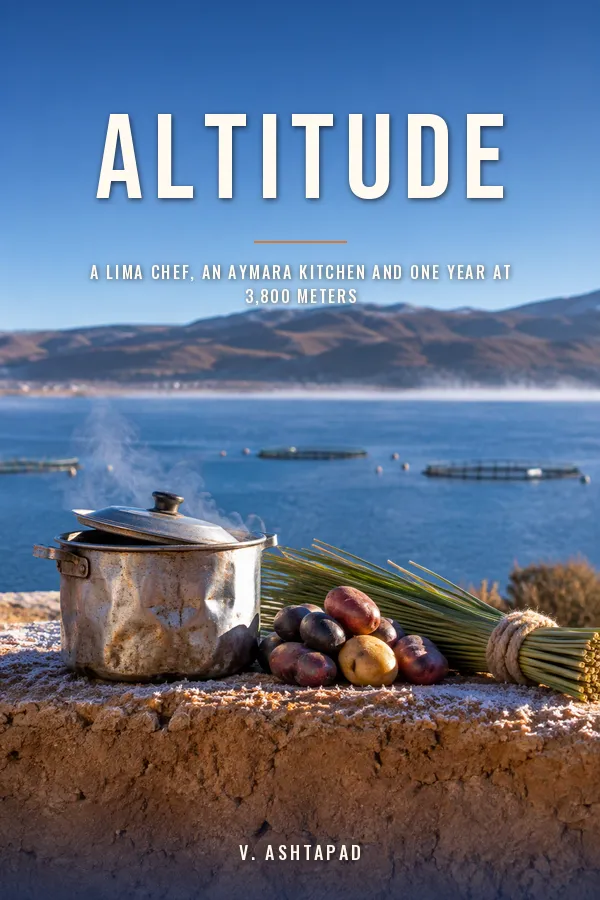
Altitude
A Lima Chef, an Aymara Kitchen and One Year at 3,800 Meters
by V. Ashtapad
Foreword
This is a work of fiction. Lucía, Rubén, Doña Justina, Teodoro, Rosa, Nilda, Yesenia, Efraín, Wilber, the Sotomayor family in Lima, Renzo Quiroga and the critic Tomás Ugarte are all made up, and so are their words.
The places are real. Lake Titicaca, Puno and its markets, Chucuito, Juli, Ilave, the reed islands of the bay and the airport at Juliaca are on the Peruvian shore; Barranco, Miraflores and the Surquillo market are in Lima. The potatoes are real too, and so are chuño and tunta, the earth oven in the field, and the music and costumes of Candelaria in Puno each February.
Invented outright are the Mamani trout farm and its cages, the house on its forty-one steps, the shore kitchen, the Lima restaurant La Ballena Gris, the newspaper column and every price. A few potato names are given in English as Justina translates them; some are traditional, some belong only to this family.
For every cook who married into a family and had to earn a place at somebody else's stove.
Thirty-Eight Hundred
The path from the road to the house was forty-one steps, and Lucía Sotomayor stopped on the ninth.
She told herself it was to look at the lake. It was partly true. Below her the water lay flat and hard and so blue it seemed lit from underneath, a blue she had only ever seen on the enamel of an expensive pan. There was no haze on anything. The far shore, which Rubén said was twenty kilometers off, looked close enough to throw a lime at, every brown fold of hill sharp as if someone had gone over it with a pencil. On the near water sat a row of round floating cages, black rings with nets hung inside, and between them a wooden walkway that moved very slightly, the way a sleeping animal moves.
The other part of the truth was that she could not breathe.
"Slowly," Rubén said, from the twelfth step, where he had stopped with both suitcases because he had seen her stop. "Nobody walks fast here the first week. Not even the dogs from Lima."
"I'm not a dog from Lima."
"No. You are a chef from Lima, which is worse. Chefs think they can do everything faster."
She wanted to say something sharp about engineers, but her lungs were busy. The air came in cold and thin and seemed to stop halfway down, as if it had changed its mind. Her heart was knocking at the base of her throat. It was early July, and the sun was fierce on her cheekbones while the shade under the eucalyptus raised the skin on her arms. She had worn a linen shirt. She had packed two chef's jackets, her knife roll, a jar of her mother's ají amarillo paste wrapped in a sweater, and nothing a sensible person would wear at three thousand eight hundred meters in winter.
"Twenty-nine steps," Rubén said. "You can do twenty-nine steps."
"You counted them?"
"I grew up on them."
She did the twenty-nine the way you do the last hour of a Saturday service, without thinking past the next plate. At the top was a low adobe wall the color of toasted bread, a blue metal gate tied shut with wire, and beyond it a yard of packed earth where three chickens stood in a patch of sun like old men at a bus stop. The house was two stories of adobe with a tin roof and a newer brick room added on one side, unplastered. Smoke came from a pipe in the kitchen wall, smelling of eucalyptus and onions and something flat, earthy and sour that she would learn later was chuño soaking in a bucket.
A woman came out of the kitchen door wiping her hands on a cloth.
Lucía had seen photographs. In the wedding photographs in Lima, Doña Justina Mamani had stood at the edge of every group in a dark green pollera and a black bowler hat, her face perfectly polite, like a guest who has arrived at the wrong party and intends to be gracious about it. In person she was shorter than Lucía expected and much more solid, with forearms like a baker's and two long braids joined at the ends by a black woolen tie. She wore a brown pollera today, over at least two others, so the hem swung out stiff and wide when she walked, and a cardigan the color of wet moss, and the bowler sat on the very top of her head at an angle that Lucía would never in her life be able to copy.
"You came," Justina said, in Spanish.
"We came," said Rubén, and put the suitcases down, and hugged his mother. She let him. Over his shoulder she looked at the shirt.
"You'll be cold," she said.
"I'm fine," said Lucía. Her teeth chose that exact second to start chattering.
---
There were nine men at lunch.
They came up from the cages at half past twelve, in rubber boots and knitted hats with flaps over the ears, their faces burned dark across the cheeks by the light that came off the water. They washed their hands at a plastic tub by the kitchen door, talking in Aymara, and then they sat on two long benches under a roof of corrugated plastic at the side of the yard, where the sun came through yellow and warm. Teodoro Mamani, Rubén's father, a thin man with a white mustache who looked at everything as though estimating its weight, shook her hand and said she was welcome. It was the last full sentence she heard from him that day.
Lucía went into the kitchen, because in any house that was where she went.
It was dark after the yard, and warm, and crowded. A clay stove fed with wood stood against the back wall and on it a dented aluminum pot the size of a car tire was steaming. A second woman was at the table, a broad-faced woman of about forty in a red cardigan, frying whole trout four at a time in a pan of oil that spat. There was no steel, no rail of tickets. There were baskets, and sacks along one wall folded over at the tops, and a radio playing a man's high voice over a harp and a fast, light drum.
"This is Nilda," said Justina. "She helps me."
"Hello," said Nilda, and looked at Lucía with frank, cheerful interest, and flipped four trout without looking at them.
"Can I help?" Lucía said. "Please. I'd like to."
Justina considered this. She considered it for long enough that Lucía felt herself redden. Then she reached into a basket and brought out a potato and held it up.
It was the ugliest potato Lucía had ever seen. It was the size of a fist and the shape of a fist too, a fist with too many knuckles, purple-black and deeply creased, with eyes sunk in hollows so tight you could have lost a lentil in them. Justina put it in Lucía's hand. Then she gave her a small knife with a wooden handle bound in wire, and a bowl of water, and a basket with perhaps thirty more.
"Peeled," she said. "For tonight. Thin, please. We don't waste."
Lucía looked at the knife. She looked at the potato. In her suitcase was a Japanese petty knife that had cost half a month's salary and could take the skin off a cherry tomato in one ribbon. To go and get it, she understood at once, would be to lose.
"Thin," she said. "Of course."
She took the low stool beside the doorway, where the light was, with the basket between her feet. The first potato took her four minutes. She followed the creases and the knife kept slipping into the hollows, taking bites of the flesh, which was almost blue-white and darkened fast. She dropped it in the water and took another.
Behind her the kitchen went on. Nilda took the trout out of the oil and laid them on a tray, gold and stiff, tails curled. Justina ladled soup into the aluminum bowls, and Lucía, without turning her head, watched how she did it: she put a spoonful of something red and soft from a jar into each bowl first, then a handful of chopped green herb, then the soup over it. The soup was pale gold and thick and full of small round pearls. Quinoa. A piece of white cheese went into each bowl at the end and began, slowly, to soften at the edges. The smell was warm and nutty and grassy and there was a bright, cool, minty note in it that she couldn't place.
"What's the herb?"
"From the hill," said Justina.
"Which hill?"
"Behind the house." Justina carried four bowls out at once, two in each hand, the steam rising past her face into the cold doorway.
Lucía peeled. By the sixth potato she had stopped losing flesh to the knife. By the tenth she had worked out that the trick was not to go around the creases but to go into them, with the point, first, cleaning each hollow before she took the long skin off the smooth parts, the way you clean an artichoke before you turn it. She was not quick. She was not wasteful, either. She laid the peelings in a little pile so that anyone could see how thin they were.
The men outside were laughing about something. Rubén's voice was among them, in Aymara, and she was surprised at how different he sounded in it, his voice lower and looser, like a man who has taken off a tie. She had married him in May, in a garden in Miraflores, with a sea mist on the cliffs all afternoon that her mother kept calling romantic in a tone that meant disaster. In two years she had never once heard him laugh like that.
Justina came back in with the empty tray. She stopped by the stool and looked into the bowl of water. Then she looked at the pile of peelings.
Then she picked up one of the peeled potatoes, turned it in her fingers, and put it back.
"That one," she said, "is called the one that makes the daughter-in-law cry."
Lucía looked up.
"In Aymara it has its own name. That's what the name means." Justina's face was entirely serious, but at the table behind her Nilda had put a hand flat on the oilcloth and her shoulders were shaking. "In the old days a mother would give it to her son's new wife, to see."
"To see what?"
"If she cries."
Lucía held the little knife. Her nose was running from the cold. Her fingers were the color of the potato skins. Her lungs were still doing their strange half-job, and up the yard nine men and her husband were eating soup and laughing in a language she did not speak, and none of them had asked whether the Lima girl was all right in the kitchen.
"And if she doesn't cry?" she said.
Justina picked up the basket. There were nineteen potatoes left in it. She took twelve out and put them back in a sack. She left seven.
"Then she gets to eat," she said, and went back to the stove.
---
Lucía ate at three, alone at the end of the bench in the yard, while the men went back down to the cages and the shadow of the house slid across the earth. The soup was still hot. It was better, if she was honest, than the cream of quinoa that La Ballena Gris had served in Barranco with a foam on it that she had made herself. It was grassy and deep and the cheese had gone soft and stringy and the red paste in the bottom was a mild, sweet pepper that warmed the back of her throat. The trout was crisp to the bone. She ate the tail like a cracker.
The light on the lake had gone from blue to hammered silver, and the wind had come up from the south, and small waves were slapping the sides of the cages. Out on the walkway she could see Rubén and his father lifting a net between them, and in the net a quick boil of silver as the fish turned, all at once, like a flock.
Nilda came and sat beside her with a cup of tea.
"She liked you," Nilda said.
"She gave me the potato that makes the daughter-in-law cry."
"She gave Rosa's fiancé, when he came, the one that makes the son-in-law cry, and he cut his thumb." Nilda drank her tea. "They didn't marry. She liked you."
---
The room was upstairs in the new brick part, with a window that looked straight out over the lake. There were three blankets on the bed, woven ones, thick as carpets, striped in brown and cream and a dark rose red, and a fourth folded at the foot, and Lucía, who had laughed when she saw them, was under all four by nine o'clock, wearing her husband's sweater and two pairs of his socks. The cold came through the walls and the glass, which had begun to grow feathers of frost at the corners, and there was no heater, because, as Rubén explained, getting in beside her with his feet like two trout from the cage, nobody on this shore had ever had one.
"You have frost," she said, "inside the window."
"It's July."
"In Lima in July we have a little gray. We have a mist. We complain."
"You can complain here too. Nobody will stop you." He put his cold nose against her neck and she shrieked and hit him. Then they lay laughing with their breath making clouds above the blankets, and outside the stars came out over the lake in such numbers that she thought at first it was a fault in the glass, a spill of salt.
She photographed the frosted window and added it to the private family page her brother Gonzalo had set up for the wedding, which only the two families could see. Her mother answered from Lima inside a minute with a picture of the gray sea and the word *jealous*.
"Rubén."
"Mm."
"I'm going to open a restaurant."
He was quiet. Down on the shore a dog barked twice.
"Here?" he said.
"On the shore. With your trout. Small. Ten tables. Tourists drive past every day to Chucuito and Juli and they eat in those terrible places by the road. I can do something with this fish nobody in Lima has ever tasted."
"Go to sleep," he said, but not unkindly. "You can't breathe. Tomorrow you'll try to make bread."
"How do you know?"
"Because I know you. Everybody from Lima tries to make bread up here. Go to sleep."
She lay awake a long time with her heart going fast, listening to his breathing even out. She was thinking about the seven potatoes, and the soup, and what the red paste was, and the herb from the hill behind the house, and how many kinds of potato might be in those sacks along the kitchen wall, and how long it would take her to learn the name of every one.
The Workers Eat First
Justina got up at half past four, as she had every morning for thirty-nine years, and the first thing she did was put her hand flat on the kitchen wall.
The adobe told her the night. If it was cold enough to sting her palm, the frost had come down hard on the fields above the house and the water in the yard tub would have a skin of ice she'd have to break with the ladle. If it was only cool, the wind had blown all night and kept the frost off, and the dust would be in everything by noon. This morning it stung. She lit the stove in the dark by feel, eucalyptus bark first, then the split sticks, then two pieces of the dried dung cake from the sack for the long, slow heat, and she sat on the low stool with her shawl around her shoulders and watched the fire take while the kettle began to tick.
Outside, the lake was steaming.
It did that in July. The water held the day's warmth all night, and the air above it was colder than the water, so at dawn a white breath came up off the whole surface and lay over the bay in slow, curling sheets. The cages were black circles floating in it. The far hills were gone. When the sun came over the ridge behind the house, at a little after six, the steam would turn gold for perhaps ten minutes and then burn away all at once, and the lake would be there again, blue as a slap, as though it had never been anywhere else. She had seen it ten thousand times and still went to the door.
Teodoro came down at five in his hat and his oldest sweater and drank his tea standing up, as he always did, looking out at the cages.
"The girl," he said.
"Asleep."
"She'll be cold."
"She's under four blankets and my son. If she's cold she has a problem I can't help with."
He made the sound in his nose that was his laugh. He was a man of very few words, and over the years Justina had learned to hear the paragraphs in them. This one meant: be kind. It also meant: I know you won't be, quite, and I'm going to enjoy watching.
"The middle cages need feed by seven," he said, and went out.
---
By six she had the soup on. Quinoa first, washed four times in the cold water from the tub, rubbed between her palms until the water stopped running cloudy and bitter, because if you didn't wash it properly it tasted like soap and the men would say nothing and eat it anyway and she would know. Then the onion and garlic sweated in a little fat, then the mild red pepper paste she made every March and kept in jars, then the potatoes, the yellow floury ones that fell apart and thickened everything, then the quinoa and the water and a leg bone of lamb for the depth. The wild mint from the hill went in at the end, by the handful, and the cheese in the bowls. Nilda came at seven with fresh cheese wrapped in a cloth, and her daughter Yesenia's school sweater on under her own because Yesenia had refused to wear it, and the news from the bus, which was that a pickup had gone into the ditch at the curve near Chucuito, nobody hurt, a lot of onions lost.
The Lima girl came down at a quarter past eight.
She came in the doorway wearing Rubén's brown sweater with the sleeves rolled four times, and leggings, and her own white sneakers, which were going to be the color of the yard by tomorrow. She had tied her hair up very tight on top of her head. Her lips were faintly blue. She had a cloth roll under her arm, a black canvas roll tied with a strap, and she held it the way some people hold a baby that is not theirs: carefully, but as if they mean to keep it.
"Good morning, Doña Justina."
"Good morning. Sit. There's tea."
"I wanted to ask." The girl sat, and took the tea, and held it in both hands, and did not drink it. "I wanted to ask if I could make lunch today. For the men. Just one day. You can tell me no."
Nilda, at the table, became very busy with the cheese.
Justina looked at the cloth roll. She looked at the girl's face, which was lifted at her with a kind of nervous, insolent hope that Justina had seen before. She had seen it in the mirror, a long time ago, in this kitchen, when her own suegra was standing where she now stood.
"What would you make?"
"Ceviche. With your trout. I'd go down and choose the fish myself. I've brought ají amarillo from Lima, and I'd do a little corn, a little sweet potato, red onion. It's what I'm best at. I'd like them to taste it."
"The men," said Justina, "have been in the water since five."
"I know."
"It's cold."
"I know. It will be the freshest fish they've ever had."
"They eat that fish every day," said Justina, and then, because it was true and because Teodoro's paragraph was still sitting in the kitchen like a third person, she said, "Make it. The soup is already on. If they don't want yours, they'll have mine."
---
She went down to the shore at ten to see what the girl would choose.
The walkway out to the cages was made of planks laid over floating drums, and it moved under your feet, and Justina had watched people from Arequipa and Cusco and once a man from the bank walk out on it like cats on a wet roof. The Lima girl walked out on it like a cat on a wet roof. She stopped at the first cage and looked down into it, where the trout were turning slowly in the dark water, hundreds of them, gray-backed and pale-bellied, the sun catching the pink stripe along their sides every time one rolled. Wilber, the youngest of the men, nineteen and too handsome for his own good, was showing her how the hand net worked. She was not watching the net. She was watching the fish.
"Those," she said, and pointed. "Those ones at the edge. Not the big ones."
Wilber looked up at Justina on the shore, surprised. Justina said nothing. The girl was right. The big ones in that cage were nearly ready for the trucks to Arequipa and their flesh would be firm, but the medium ones, a few weeks younger, were sweeter and finer in the grain. Most people from the city pointed at the biggest fish they could see.
The girl took six. She killed them on the walkway with one hard knock each behind the head, which surprised Justina, and laid them in a plastic basin, and carried the basin up the forty-one steps without stopping, which surprised her more. At the top she was gray in the face and breathing like a dog in summer. She went straight into the kitchen and unrolled the cloth.
Justina had expected one knife. There were seven. They lay in their canvas pockets in a row from large to small, and the blades were not shiny like the knives in the market at Puno, but cloudy, with a pattern in the steel like water moving over sand. The girl took out a long thin one and a short one and put the roll aside.
Then she began, and Justina, who had come in to put more wood on the stove, stayed to put more wood on the stove for a quarter of an hour.
It was not that the girl was fast. She was fast, but Justina had seen fast. Nilda was fast. Justina herself could gut and clean a basin of trout in the time it took to boil water. It was that she was exact. She went down the backbone of each fish in one stroke, and turned it, and went down the other side, and the two fillets came away clean with the frame behind them as bare as a comb. She ran a finger along each fillet and took the pin bones out with a pair of tweezers, small steel tweezers, from the cloth roll. She laid each fillet skin side down and slid the long knife between flesh and skin so that the skin came away whole, silver and gray, in one sheet. Then she cut. The flesh was a deep coral pink, because Teodoro and Rubén fed the fish well, and she cut it into cubes as even as dice from one box. There was no waste. When she was done she put the heads and frames in a pot without being asked and pushed it to the back of the stove.
"For stock," she said. "If that's all right."
"Mm," said Justina.
The lime was the problem. Justina could have told her and did not. Limes came up from the coast on the trucks, small and green and hard, and by the time they reached the shore they had been on the road for two days and had shriveled a little in the dry air and given up some of their juice and gotten expensive. The girl had bought twenty in Puno the day before. She cut them and squeezed them by hand, one by one, and Justina saw her face as the juice came out thin.
"They're dry," the girl said.
"They came a long way," said Justina. "Farther than you."
The girl stared at her, and then, unexpectedly, laughed. She squeezed all twenty. She sliced red onion so fine you could see the knife through it, and soaked it in cold water, and mixed the yellow pepper paste from her jar into the lime with salt and a little of something from a bottle, and in the end there was a big enamel basin of ceviche, the fish turning white at the edges in the juice, the onion purple on top, and beside it a pot of corn and a tray of sweet potato, boiled and sliced into orange coins. She had spent the morning on it. The kitchen smelled like the coast, sharp and green.
At half past twelve the men came up.
---
They ate it. Justina would give them that, later, in her own mind. They washed their hands at the tub and sat on the benches, in the cold shade, with the wind coming off the lake hard enough to make the plastic roof drum, and the Lima girl brought them each a plate of raw fish in lime juice, and they ate it politely, with their hats on, and said it was good.
Efraín, who was sixty-four and had worked the cages since there were cages, ate his slowly and carefully, the way you eat food at someone else's wedding. Then he said, to the air in general, in Aymara, "Cold food on a cold day."
"What did he say?" said the girl.
"He said it's very fresh," said Rubén.
Justina was standing in the kitchen doorway. Her son did not look at her. She did not look at him. She went inside and ladled out nine bowls of quinoa soup, and put the cheese in, and the red paste, and the mint, and carried them out four and four and one. The men took them without a word and drank them the way you drink water after a walk. The steam went up past their faces. The girl stood by the bench with her empty tray.
"They work in the water," Justina said to her, not unkindly. "At noon they want something hot inside."
"I know that now," said the girl.
"Yes."
"I should have known it before."
Justina did not answer that, because it was the right thing to say and there was nothing to add to it. She went back into the kitchen. And it was then, with her back to the yard, that she heard Wilber say, in Spanish, a little too loud, the way boys do when they mean you to hear it, "Is there more of the fish?"
There was. The girl brought it out. Wilber ate a second plate. So did Rubén, who was her husband and therefore did not count. So, after a long, considering pause, did Teodoro.
---
That evening Justina sat alone in the kitchen with the stock the girl had made.
She had strained it and put it in a jar on the shelf. She opened the jar. It was clear, and pale, and it had set into a soft jelly in the cold, and it smelled clean, of fish and onion and something green, the stalks of the coriander perhaps. She would put it in the soup tomorrow. She would not say so.
Upstairs she could hear them, the two of them, laughing about something under the blankets. It was the blankets she was thinking about. Last year Rosa had come home from Puno with her phone and gone through the house photographing every weaving in it, every blanket, every shawl, every belt, and asking Justina who had made each one, and in what year, and for whom. Justina had said it was a waste of a Saturday. Then she had sat with Rosa for six hours. The rose-striped blanket on the newlyweds' bed was her own mother's work, woven at Ilave before Justina was born, and it was in Rosa's careful list now with her mother's name beside it, so that a girl from Lima could one day find out, if she cared to, whose hands had made the thing that was keeping her warm.
Justina did not know if she would care to. It was too early to say.
She put her hand on the kitchen wall before she went to bed. It was already cold. It would be a hard frost again.
In the morning, she thought, she would ask the girl what the something in the bottle was.
Bread at Altitude
In August the wind came up the lake from Bolivia every afternoon at two, as punctual as a bus that doesn't stop for you.
It came across the water first, so that Lucía, at the window, could watch it arrive: the far blue going dark and crinkled, then the middle blue, then the bay below the house, the cages starting to rock and knock together and the walkway jerking on its drums. Then it hit the shore and picked up the dry fields and carried them through the yard. The dust was fine and pale brown and got into her teeth, her eyelashes, the seams of her jeans, the pages of her notebook. Out on the stubble small whirlwinds rose and walked about, tall and leaning, like drunks looking for a door, and fell apart. The sky above it all stayed a hard, flawless, ridiculous blue.
She made bread on a Tuesday.
She did it partly because Rubén had said she would, and partly because she wanted, badly, to put something on Justina's table that Justina could not make. Justina, as far as Lucía had seen in five weeks, did not bake. There was a domed adobe oven at the back of the yard, crusted black at the mouth, which Nilda said was only lit for festival bread at the start of November, and the rest of the year the family bought rolls from a woman who passed on a tricycle at seven with a basket under a blanket.
Lucía had made bread every day for four years at La Ballena Gris. Her starter had lived in her mother's refrigerator in Lima for five years. She knew dough the way a nurse knows a pulse.
She mixed it at nine in an enamel basin: flour from the store in Chucuito, water, salt, a packet of dried yeast because her starter was a thousand kilometers away, a little of Justina's lard. She kneaded it on the oilcloth until it was smooth and springy as an earlobe. She covered it with a cloth and set it in the sun on the kitchen windowsill, where the light came in so strong it laid a bright rectangle on the dough like a slab of butter.
"One hour," she told Nilda, who was peeling potatoes and watching her with the expression of someone at the cinema who has already seen the film.
At twenty-five minutes the dough had doubled.
At forty it had pushed the cloth up into a dome and was leaning over the edge of the basin like a man looking over a balcony. At fifty, when Lucía, in disbelief, lifted the cloth, it sighed. She heard it. A long soft exhale, and then the whole thing sank into itself and lay there, slack and pocked, smelling powerfully of beer.
"Ah," said Nilda.
"It's the sun," said Lucía. "It's too warm in the window."
"It's the height," said Nilda. "Everything goes up fast here and then comes down. Like men."
Lucía reshaped it. She was not going to stop. She punched it down and made it into rolls, and proofed them again, for half the time, and by now Justina was back inside, at the stove with her back turned in a way that was louder than speaking. Lucía got Rubén to light the adobe oven. He did it with eucalyptus and dried dung and a great deal of smoke, and when he said it was hot she put her hand in the mouth and counted, the way she had been taught by an old baker in Surquillo, and only reached four, which meant it was hotter than she wanted, and she put the rolls in anyway.
They came out at one. They were brown, at least, and flat. They had spread out on the tray into wide, low, cracked shapes like cow pats, and when she broke one open the inside was full of big ragged holes and the crust was thick and hard and the crumb was gummy, and the taste was sour and yeasty and wrong.
The men ate it.
They ate it with the soup, dunking it, and Teodoro said, "Good for soup," and Efraín said something in Aymara that made the others laugh into their bowls, and Wilber, who had decided in the last month that he was her friend and defender, said that it was very good bread for soup, it was better than the tricycle woman's, and everyone, including Lucía, knew he was lying.
Justina ate a piece too. She chewed it slowly and looked out at the lake. She didn't say anything at all. That was the worst of it.
That night Lucía put a photograph of the rolls on the family page, because if you are going to be humiliated you might as well get some laughs out of it. Her brother Gonzalo replied from Lima with a picture of a dog asleep on a rug and the words "your bread, before and after". Her mother sent a long message about a cousin of a cousin in Huancayo who said that in the mountains you used half the yeast, more water, and a hotter oven. Rosa, Rubén's sister, replied from Puno with a single heart, and then, a minute later: *Saturday. Market. I'm taking you.*
---
Puno on a Saturday morning was cold and loud and smelled of diesel, frying, wet earth and oranges.
Rosa met her off the minibus at the stop by the stadium. She was twenty-six, a primary teacher, short and quick like her mother, with her mother's forearms and her father's way of going quiet before a joke. She wore jeans and a fleece and a pompom hat, and she spoke to Lucía in a rapid, cheerful, merciless Spanish that made Lucía feel instantly at home.
"You made bread," Rosa said, taking her arm.
"Don't."
"Everybody from Lima makes bread. My cousin's wife from Tacna tried to make a cake. The cake went up like a balloon and then, Lucía, I swear to you, it went into the oven door. We had to scrape it off with a spatula. She cried. Mamá gave her the one that makes the daughter-in-law cry the next day, which I think was unfair, because she was already crying."
"Your mother gave me that one the first day."
"Of course she did. She's very efficient."
The central market was a long low building of concrete and tin, and around it on every side, on the pavements and in the streets, the market had spilled out under blue tarps and plastic sheets that cracked in the wind. Women sat on low stools behind their goods in wide layered skirts and bowler hats and striped shawls, some knitting, some eating soup from enamel bowls, some asleep with their hands folded over their stomachs.
And potatoes. Lucía had not known.
There were heaps of them on cloths on the ground, dozens of heaps, and no two heaps the same. There were potatoes yellow as egg yolk and potatoes red as brick. There were long thin ones like fingers and round ones like marbles and knobbly ones that looked like ginger root. There were purple ones that were purple all the way through when the woman cut one open to show her, a deep inky violet with a white star in the middle. There were pale pink ones blotched like a cow. There was one, Rosa said, that you only ate roasted in the field, and one that you only ate in soup, and one that was so bitter you couldn't eat it at all until it had been frozen and dried, and one that the woman selling it called by a name that meant "the cat's nose," and when Lucía looked at it she saw that it was, yes, a little like a cat's nose.
"How many kinds does your mother know?"
Rosa thought about it. "By name? She'd say she doesn't know. She'd say she knows a few. Then she'd name you fifty. Then she'd tell you what each one is for and which field it grows in and which year the frost got it. Ask her. No, don't ask her. Wait for her to tell you. If you ask she'll make you peel them."
They came to the chuño.
Lucía had eaten chuño in five weeks of soups and not been sure what it was. Now there were sacks of it, open at the top, and it looked like nothing she had ever been expected to eat. Little black shrunken stones, wrinkled and light and dusty, like something you would find in the bottom of a riverbed or a fireplace. Beside them were sacks of something white and chalky, the same shapes, the same wrinkles, but bleached the color of old bone.
"Black is chuño," said Rosa. "White is tunta. Same potato, nearly. The bitter kind, the ones you can't eat. In June, when the frost is hardest, you spread them on the ground in the high fields and leave them out at night to freeze. In the day the sun thaws them. Then you freeze them again. Three nights, four, five. Then you walk on them."
"You walk on them."
"With your bare feet. To squeeze the water out. Then you dry them in the sun and they go black and keep for years. Years, Lucía. Mamá has chuño in a sack in the storeroom older than me."
"And the white?"
"The white you freeze, then you put in the river, in running water, in a sack, for weeks. Then freeze again, then dry. It washes out the bitterness. It's more work. It's more expensive. It's lighter, softer. Mamá makes a tunta with egg and cheese for breakfast that will make you want to divorce my brother and marry her."
Lucía picked up a piece of tunta. It weighed almost nothing. It was cold and smooth and slightly powdery and when she smelled it, it smelled faintly of earth and stone and cold water.
"Can I taste it raw?"
The woman behind the sack, who had a face as brown and creased as the chuño and who had been listening to all of this with polite interest, laughed until her knitting slid off her lap.
---
They went down to the port afterward to eat fried trout from a stall, and to look at the reed islands floating out in the bay, low yellow mats on the water with houses of reed on them and boats of bundled totora drawn up at their edges, the boats curved up at both ends like slippers. The wind had come. The water in the bay was brown-green and choppy and smelled of weed and diesel and the reeds rattled along the shore like dry paper.
"You want to do something," Rosa said. "With the fish. Rubén told me."
"Rubén told you?"
"Rubén tells me everything. He's terrible at it. He thinks if he tells me he doesn't have to tell Mamá." Rosa ate a piece of trout skin. "What do you want to do?"
So Lucía told her. The net shed down at the road, where the farm kept old nets and drums and broken oars, with the wall that faced the lake and the space in front where you could put tables in the sun. Ten tables, maybe eight. Lunch only. Tourists in vans came along that road every day on the way to Chucuito and Juli and stopped to photograph the lake and then went and ate terrible rice in a roadside place with a picture of a trout painted on the wall. She could cook the farm's trout so that people in Lima would come for it. She could do ceviche, trout sliced thin as paper, a whole fish fried crisp, a trout cured with the yellow pepper, a soup.
"Mamá's soup," said Rosa.
"A soup."
Rosa wiped her fingers on a paper napkin and looked at the islands for a while.
"I'll tell you what she'll say," she said. "She'll say the kitchen is for the family and the men. She'll say she's fed those men every working day for thirty-nine years and she's not going to start feeding tourists with cameras so they can say it was very authentic. She'll say the fish goes to Arequipa and the money is the money. She'll say it's your kitchen or hers and there's only one stove." Rosa crumpled the napkin. "And then she'll go quiet for about a month. That's the bad part."
"And then?"
"I don't know. Nobody's ever got past the month."
---
Rubén was down at the shore when she got back, on the walkway at the last cage, with the low sun behind him turning the whole bay into beaten copper. She walked out to him. She did it without stopping now. Her lungs were better; or she was better at ignoring them.
She told him she wanted to talk to his mother about the shed.
He was mending a net with a wooden needle, and he kept mending it for a long time.
"She's going to say no," he said.
"I know. Rosa told me exactly what she'll say. Rosa did the voice."
"Rosa does a good voice." He tied off a knot. "Lucía. I came home because my father couldn't do the cages alone anymore and because I wanted to make the farm better. Oxygen, feed, the cages that don't break in a storm. I've been fighting with my father about feed for two years. I've won about half. If you go to her about the kitchen, I'm going to be in the middle. I hate the middle."
"You're always in the middle. You're an engineer. You build bridges."
"I build water pipes."
"Pipes have two ends."
He laughed. He put the net down and pulled her against him on the cold planks, both of them in too many sweaters, the walkway rocking under them, the fish below boiling silver at the surface as the sun went, and she put her cold face into his collar where it smelled of lake water and wool and diesel and him.
"Not yet," he said into her hair. "Learn the potatoes first."
"How long does that take?"
"For my mother? About forty years."
Names
The seed potatoes had been asleep in the storeroom since May, and in September they woke up.
Justina could smell it when she opened the door. A green, sharp, cellar smell, like crushed stems. The storeroom was the oldest room in the house, adobe walls thick as her arm was long, no window, a floor of beaten earth, and the potatoes lay on it in low heaps on beds of dry straw and eucalyptus leaves, each heap a different kind, and in the dark they had put out shoots. Pale purple shoots, white shoots, shoots like little fists, shoots like the horns of snails. She lit the candle and set it on the shelf and the room filled with long trembling shadows of shoots on the walls.
She sat down on the stool in the middle and began to sort.
This was a job she liked. She did it every year with Teodoro, though really she did it and he sat on a sack and talked about the weather on the far shore, and this year Teodoro was out at the cages with a man from Arequipa about the price, so she did it alone, with the candle and the radio on low. You took each seed potato and looked at its eyes. The good ones, three shoots, strong and short, went in this basket. The ones that had shoots too long and weak, because they'd been near the door where it was warm, went in that one, to be eaten. The soft ones went to the pig. You did not plant a soft potato, the same way you did not marry a soft man.
She heard the girl before she saw her. The girl breathed loudly. Everyone from below did, for the first months, a small catch at the top of each breath like a door that sticks.
"Can I come in?"
"It's a storeroom. You don't need to ask."
"Rosa said I should wait for you to tell me things." The girl came in and stood just inside the door with her arms crossed against the cold. She had bought herself a sweater in Puno, a thick cream one with a pattern of llamas across the chest that no one on the shore would have been seen dead in, and a fleece hat, and proper boots. She looked, Justina thought, like a tourist who had been robbed by a cheerful salesman. "But I'm not very good at waiting."
"No," Justina agreed.
The girl looked at the heaps on the floor in the candlelight. Her lips moved. Justina knew she was counting.
"Twenty-two," the girl said.
"Twenty-six. Four are in the back."
"Twenty-six kinds."
"In this room. In this house. For the planting." Justina put a potato with two good shoots in the basket. "There are more in the big field above the road that the cousins keep. There are more in the market. There are more on the other side of the lake, and on the other side of the other side, and in Bolivia, and some of them nobody grows anymore because they don't sell. But these are ours."
"Will you tell me their names?"
Justina did not answer at once. She picked up another seed potato and turned it in the light and looked at its eyes. The truth was that she wanted to. The truth was that she had wanted, for a month, to see what the girl's face would do. But she was a woman who had been made to wait three years by her own suegra before she was allowed to stir a pot in this kitchen, and there was a part of her, small and hard and not very nice, like a stone in a bean, that thought: why should this one have it in two months?
"Sit," she said.
---
She did them in order, from the door to the wall.
The girl sat on an upturned crate with a notebook on her knee and a pencil, and Justina held up each one and said its name in Aymara, slowly, and then again, and then told her what it meant, because the girl asked, and then what it was for, because the girl asked that too. The candle burned down a centimeter. The radio played a woman singing high and sad over a mandolin and then a man selling fertilizer.
"This one is the girl. Because she's pretty. Yellow inside, smooth outside. For boiling. You eat her with cheese and a little hot sauce and nothing else. This one is the black girl, her sister. Same, but purple skin. Firmer."
"The girl," said the girl, writing.
"This one is the bitter one. You can't eat it fresh. It makes your mouth go small. It's for chuño. It grows in the high field, by the rocks, where nothing else will, because the frost doesn't hurt it. This one is the cat's nose. You saw it in Puno. For soup. It holds its shape. This one is the sheep's tongue."
"Why?"
"Look at it."
The girl looked at it. It was long and flat and slightly curled, pinkish, with a rough dimpled skin. She laughed out loud in the dark room. "It is. It's a tongue."
"This one is the one that's ashamed. Because it's red. When you dig it out, it blushes. This one is the fox's foot. This one is the one that makes the daughter-in-law cry, which you know."
"I know."
"And this one is the one that makes the son-in-law cry, which is the same but worse."
"Nilda told me about Rosa's fiancé."
"Nilda talks too much." But Justina felt the corner of her mouth go. "That boy was useless. He tried to peel it with a potato peeler. A metal one, from a shop. He'd brought it with him in his pocket, like a pistol."
The girl put her pencil down and laughed until she had to hold her side, gasping, because laughing at that height took more air than she had. Justina watched her. When the girl had finished, wiping her eyes on the llama sleeve, Justina held up the next one. Then the next. Then the next.
At the end the girl's notebook had twenty-six names in it. Justina could see them upside down. The girl had written each Aymara name the way it sounded to a Lima ear, with a lot of k's and q's in the wrong places, and the meaning beside it, and then in a third column, very small, what it might be good for in a restaurant. *Girl: boiled, crushed, under the fish? Sheep's tongue: chips, very thin? Ashamed: color, salad, raw?*
Justina pretended not to read the third column.
"Can I ask you one thing?" said the girl.
"You've asked a hundred."
"Can I record you saying them? On my phone. Just your voice, and your hands holding each one up. So I can hear how they really sound. I'm going to forget. I'm writing them wrong. I know I'm writing them wrong."
"No," said Justina.
The girl closed the notebook. She didn't argue, which Justina noticed. "All right."
"A potato is not a film star."
"No."
"You'll learn them or you won't."
"Yes, Doña Justina."
Justina sorted three more seeds into the basket. Then she said, because it was nagging at her, "You want them for your restaurant."
The girl looked at the candle for a moment. Then she said, "Yes. And I want them because they're the most beautiful things I've ever seen in a kitchen and I've worked in kitchens since I was sixteen. Both."
It was an honest answer. Justina disliked it for being honest, because it made it harder to be angry.
---
The girl asked at Sunday lunch.
Rosa was home from Puno, and Teodoro had come back from the cages with a good price from the Arequipa man and was in what, for him, passed for a cheerful mood, which meant he had said two things at breakfast instead of one. They ate in the kitchen because the wind was too strong in the yard: chuño cooked soft with fresh cheese and egg, and a stew of lamb and broad beans, and the girl had made a salad of the red potatoes, the ashamed ones, boiled and cooled and dressed with lime and her yellow pepper and chopped wild mint. It was good. It was annoying that it was good.
Then the girl put her fork down and said, "I want to ask about the net shed."
Rubén looked at the ceiling. Rosa looked at her plate, then at her mother, then at her plate. Teodoro went on eating.
The girl explained. She did it well; Justina would give her that, too. She had numbers. She had counted the tourist vans on the road on four different mornings with a notebook, which Justina had seen her doing and had assumed was some kind of Lima nerves. She had spoken to the man who sold the farm its feed, who had a cousin who did roofs. She wanted eight tables, lunch only, four days a week, the farm's trout, a small menu. She would do the work herself. She would not use this kitchen. She would not touch the workers' lunch. She would pay for the fish.
When she had finished, there was the sound of the wind against the door and the stew ticking on the stove.
Justina said, "Who feeds the men when the tourists come at noon?"
"You do. Like always. I said, I won't touch—"
"And when I'm in the fields, in October, and November, and April? When I'm at the harvest all day? Nilda can't do it alone. Who feeds them then?"
"I could—"
"You'll be feeding tourists." Justina put her own fork down. "This kitchen is for this family. It's for the men who work our water. I've fed those men every working day for thirty-nine years. Efraín has eaten from my pots since before Rubén could walk. It isn't a show. I'm not going to stand at a stove so somebody from Germany can take a photograph of a woman in a hat and say she was very real."
"That isn't what I—"
"The fish goes to Arequipa," Justina said. "That's the money. That's what pays for Rosa's school and the new cages and the boat motor. The money is the money."
She stopped. She was aware of Rosa, across the table, very slowly mouthing the words "the money is the money" along with her. She would deal with Rosa later.
"The shed has a bad roof," said Teodoro, to his stew.
Everyone looked at him. He did not elaborate. He took another piece of lamb.
Rubén said, carefully, "Mamá, maybe we could just think about it."
"Think," said Justina. "Yes. Think."
And she got up and washed her plate, and went out into the wind to feed the chickens, though she had fed them two hours ago.
---
She didn't speak to the girl about it again.
She spoke to her about everything else. Pass the salt. The water's ready. Your sneakers are in the yard, a dog will eat them. But not about that. The girl, to her credit, didn't push. She went to the storeroom on her own once or twice and Justina found the notebook there, open, with corrections in the first column, so that the k's and q's were moving slowly into the right places.
On the Wednesday, Rubén came into the kitchen in the evening with his laptop, which he set on the oilcloth very carefully, as if it were a cake.
"I want to show you something," he said. "Don't be angry."
"Why would I be angry?"
"You're already angry. I'm asking you not to be angrier."
On the screen there was the lake, seen from the sky, blue as an eye. There was the shore, and the road, and the house, a tiny brown square. And over it, in thin colored lines, Rubén had drawn all their fields. The little one by the house. The long one above the road. The high one by the rocks for the bitter potatoes. The strip the cousins worked. The field that had been his grandfather's. He had drawn the cages too, and the fishing grounds out past the point where Teodoro's father had set nets for the small lake fish, and the reed beds where they cut totora.
"For the farm," Rubén said. "So we know what we have. For the bank, and for us. But I don't know what to call them." He looked at her. "The fields. They all have names, and I only know half. Papá says you know all of them."
Justina sat down.
She looked for a long time at the little colored shapes on the screen. Her whole life was in them. The field where she had planted her first potatoes in this family, at nineteen, with her suegra standing over her saying she was putting them too close. The field where Rubén had broken his arm falling off the wall at six. The field that had flooded the year the lake came up.
"That one," she said, and pressed a fingertip to the screen, which you were not supposed to do. "That's the one where the wall fell down. That's its name. And that one is the one below the eucalyptus. And that one is the one that belonged to Felipa's brother."
Rubén typed.
She went on. He typed. The candle wasn't needed; the screen lit both their faces blue. Upstairs she could hear the girl moving about, and once, quietly, in a voice that had been practicing, the girl said a name out loud to herself in the bedroom, the name of the black girl, the purple potato, and very nearly got it right.
Justina heard it. She didn't stop naming the fields.
Eighty-Seven Degrees
Teodoro turned sixty-two on the third Saturday in October, and Lucía decided she would cook him a Lima dinner if it killed her.
It very nearly killed the rice.
She planned it for a week. She planned it the way she used to plan a tasting menu at La Ballena Gris, on squared paper with times down the side, working backward from the moment the plates went out. Seven o'clock: plates out. Six-forty: causa unmolded. Six-thirty: rice rested. She had asked Rosa what her father liked and Rosa had said, "Food," and then, when pressed, "Chicken. He'd never say so. He thinks a man who keeps trout shouldn't love chicken. He loves chicken." So: a green rice with chicken, the way her grandmother made it in Surquillo, with coriander blended into the stock until the whole pot went the color of a lawn. A causa first, the cold layered potato with yellow pepper worked through it, with trout instead of the usual tuna, because she was here and the trout was here. And for after, her mother's dessert, the one every family in Lima claimed as its own: a sweet milk caramel cooked down for hours, with a cloud of port-wine meringue on top.
She went to Puno on the Thursday for chicken and coriander and a bottle of port and a can of evaporated milk. She brought it all back on the minibus on her knees. She was, she noticed, no longer breathing hard on the forty-one steps. She was breathing hard on about thirty of them.
Rubén's map was open on the laptop on the kitchen table when she came in. He had left it there. The fields had their names now, typed in small letters in Rubén's careful engineer's hand: the one where the wall fell down, the one below the eucalyptus, the one that belonged to Felipa's brother, the high one by the rocks, which was just called the high one by the rocks. Lucía stood over it, reading, while the chicken went warm in its bag. Every name was a story she did not know. She wanted to know all of them. She wanted it with the same greedy, impatient ache she had once felt for a job she did not have yet.
She put the chicken in the cold storeroom, next to the potatoes, and said good evening to the potatoes by name, quietly, so that nobody would hear.
---
The causa was fine. The causa was more than fine.
She made it on Saturday afternoon while the clouds built over the far shore. It was October and the sky had begun to change. The hard winter blue was still there in the mornings, but by two o'clock great white towers stood up over the hills on the Bolivian side, bulging and bright at the top and gray at the bottom, and once she heard thunder, a long way off, like furniture being moved in a flat upstairs. Nilda said it would be a month before the rain came properly. The air smelled different. It smelled of dust waiting for something.
She boiled the girl potatoes, the yellow ones, and pushed them through a sieve while they were hot, and worked in lime and oil and the yellow pepper paste until the mash was smooth and bright and tasted sharp and warm and rich all at once. She cured the trout lightly in lime and salt and folded it with a little mayonnaise she made by hand in a bowl, and red onion, and coriander. She layered it in a ring: potato, trout, potato, and pressed it, and set it in the storeroom to firm.
The chicken she browned in the big pot on the gas ring, and set aside, and sweated onion and garlic and a pepper in the fat. She blended the coriander with stock in Justina's old blender, which had a crack in the jug held together with tape and made a noise like a small motorcycle. The green was glorious. The kitchen smelled of her grandmother's house. She put in the rice, the stock, the chicken, the peas, the carrot, put the lid on, turned it down low.
"Eighteen minutes," she told Nilda.
Nilda, peeling garlic for tomorrow, made a small noncommittal sound.
At eighteen minutes Lucía lifted the lid. The rice had drunk the liquid. It looked perfect. She tasted a grain and it was hard in the middle, chalky, like biting a tooth.
"Ten more," she said.
At ten more, it was still hard. The bottom had begun to catch. She could smell it, that flat brown smell. She added a little water. She put the lid back on. At ten more, the bottom was burned and the top was still crunchy and the chicken had gone stringy and gray and she gripped the spoon and felt the panic rising, the old Saturday-night panic when a sauce split with forty covers on the board, except that there was no board here, there was only one pot, and a sixty-two-year-old man who loved chicken and would never say so, and his wife.
"It's the water," said Nilda.
"What about the water?"
"It boils cold." Nilda put down her garlic. "Up here. Doña Justina says it boils before it gets properly hot. You can put your finger in it nearly. Rice doesn't like that. Beans hate it. That's why she uses that." She nodded at the shelf.
On the shelf, behind the jars of red pepper paste, was a pressure cooker. A big aluminum one, dented, with a rubber ring and a weight on top like a little hat. Lucía had seen it every day for three months. She had assumed it was for some peasant ritual of soup that she did not need to understand. She felt her whole face go hot, standing there, a slow burn from the collar up.
"Why didn't anyone tell me?"
Nilda looked at her with great kindness. "You didn't ask."
---
They ate at half past seven. The meringue had wept. In the dry air it had collapsed in little beads of amber syrup, and she had piped it anyway, and it sat on top of the caramel in sad slumped peaks like old snow at a bus stop.
The causa went first. Teodoro ate it and stopped, with his fork up, and looked at it on the plate, and ate the rest without a word, which Rosa told her afterward was the equivalent of a long speech. Rosa had two slices. Rubén had two slices and said, with his mouth full, that this was what she had made the night they met, which was not true, it had been a ceviche, but she loved him for it. Even Justina ate it slowly and with attention, as though she were reading it. She asked which potato. Lucía told her: the girl. Justina nodded and said nothing, but she took a second slice herself, a small one, and finished it.
Then the rice.
No one complained about the rice. That was almost worse than if they had. They ate the crunchy rice and the stringy chicken and Teodoro said it was a good green, and Efraín, who had come up for the birthday in a clean shirt, said that in his day they'd have kissed the pot for rice like that, and Rosa kicked him under the table. Justina ate hers. When she had finished she said, quite gently, "Next time, the pot on the shelf."
"Nilda told me."
"Twenty minutes in the pot. Less water than you think." Justina wiped her mouth with the back of her hand. "It's not your fault. Water's different here. People from below never believe it."
"I'm a chef," said Lucía. It came out of her too quickly. "I should know that. I knew it from school. I knew it from a textbook. It never crossed my mind, because I thought I knew how to cook."
The table was quiet. Outside the wind had dropped and the lake was making its small night sounds against the shore.
Teodoro said, to his plate, "The chicken was good."
"It was terrible."
"It was chicken," said Teodoro, and it was so obviously the best thing anyone had said to him all year that Rosa burst out laughing, and then Rubén, and then, after a moment, holding on to the edge of the table, Lucía.
They ate the dessert. It was too sweet, and it was perfect, and Justina had two spoons and said it was too sweet.
---
Afterward Rubén found her on the bench in the yard with her knees up inside her sweater.
"Come on," he said.
"Where?"
"The cages. I have to check the oxygen on the far ones. Come with me."
The boat was a long wooden one, painted blue a long time ago, with a small outboard at the back that coughed and caught. He gave her an orange life jacket that smelled of fish and she sat in the bow with her hands in her sleeves, and he took them out into the dark.
She had not been on the lake at night.
There was no moon. There was no need for one. The stars were so thick over the water that they seemed to be pressing down, and the lake was so flat and black and still that it held all of them, every one, so that the boat seemed to be traveling through the middle of the sky with stars above and stars below and nothing at all on either side but the low black line of the shore. The cold was absolute. It came off the water and into her face like the breath of an open freezer. The motor was the only sound, and then, when Rubén cut it at the far cages, there was no sound at all except the drip from the propeller and the small slap of water against the hull, and from the cage beside them a soft, continuous, wet whisper, which was the trout, hundreds of them, breaking the surface in the dark.
Rubén clipped a meter to the side of the cage and dropped the probe in on its cable. A small green screen lit up his face from below.
"It's fine," he said. "It's always fine in October. It's January I worry about. When it's warm and the water's still."
"Why did you come back?"
He looked up. The green light made him look younger, and very tired.
"I told you. My father's back. The farm."
"I know what you told me. Why did you come back?"
He took the probe out and coiled the cable on the bottom of the boat and sat looking at the cage for a while. A trout jumped, a slap and a scatter of black water.
"In Lima," he said, "I lived for six years under a lid. You know. That gray. Nine months a year. You look up and there's a lid on the city. I'd go to work and come home and never see a shadow. I'd go to sleep and never see a star. I'd go to the sea and the sea was the same color as the sky and I couldn't tell where one stopped. I thought it was normal. I thought I was just tired." He shook his head. "Then I came home for Rosa's graduation and I got off the plane at Juliaca and the light hit me like somebody had thrown a bucket of water in my face. And I sat in the minibus all the way here crying like a child. I'm not joking. The woman next to me gave me a candy."
Lucía didn't laugh. She was too surprised.
"Then I went back to Lima for a year and met a chef who ate at the bar of the place next to my office every night like she was in a fight with the food. And I thought, I'll marry her and then I'll take her home and show her where the light comes from."
"That's a terrible plan."
"It's a very good plan. It's working."
"The rice didn't work."
"The rice was a side issue."
She reached forward over the coiled cable and took his face in her cold hands, which made him yelp, and kissed him in the bottom of the blue boat with the stars on every side and the trout whispering in the dark beside them like a crowd that has been told to be quiet and can't quite manage it.
---
In the morning she came down at six instead of eight. Justina was at the stove. The pressure cooker was already hissing, its little hat-weight jumping and spitting steam.
"Show me," said Lucía.
Justina looked at her over her shoulder for a moment. Then she moved one step to the side, which in that kitchen was a very long way.
Hail
Justina knew it was coming at noon, because the dogs went under the house.
The morning had been bright and close and too warm, the first warm day since March, and the lake had lain flat as a plate with the cages sitting on it like spilled buttons. The potatoes in the field below the eucalyptus were up a hand's width, dark green and crinkled, in their long rows. The broad beans were flowering. Everything had that look things have in late November, when the rain has come twice and the ground has believed it, a look of having made a decision.
Then at noon the dogs went under the house and stayed there, and the light changed.
It went yellow first. A thick, sick, brassy yellow, as if the sun were shining through a jar of oil. The far shore vanished behind a wall of slate. The air went still and then cold all at once, a cold that dropped on the yard like a sheet, and the chickens, who had been dust-bathing by the gate, stood up and walked very fast into the shed with their heads down.
"Close the windows," Justina said. "All of them. Upstairs too."
The girl, who was at the table with the notebook, looked up. "It's sunny."
"Close them."
The girl went. Justina went out to the yard and looked down at the cages. The men were already pulling the boats up on the shore. Teodoro was out on the walkway checking the moorings with Rubén, the two of them moving fast and bent like people crossing a road in traffic. Efraín was waving at her from the boat, pointing at the sky over Bolivia. She waved back. She knew.
It hit at twenty past twelve.
First the rain, big drops spaced wide, each one punching a dark spot the size of a fist into the dust of the yard. Then, with no change at all between one second and the next, the hail. It was small at first, the size of chickpeas, white and hard, and it bounced on the yard and on the tin roof with a noise like gravel thrown at a door. Then it was the size of grapes. Then it was the size of the eggs of small birds, and the noise on the roof was so loud that Justina, standing in the kitchen doorway, could not hear the girl shouting at her from the stairs.
The lake had disappeared. Where it had been there was only a moving gray wall, and the hail was coming down so thick and white that in a minute the yard was white, the wall was white, the bench was white. Lightning went into the water somewhere very close, a white crack and a noise like the sky splitting, and the girl came down the last stairs and stood beside her in the doorway, and Justina felt her flinch and did not hold it against her. She had flinched at fifty-eight. She had flinched at that noise every year of her life.
"The potatoes," said the girl. She was looking up the slope at the field below the eucalyptus, which had gone white.
"Yes."
"Will they—"
"I don't know yet."
---
It lasted fourteen minutes. Justina knew because the radio, which was still on, went from the news to the last verses of a long ballad about a runaway horse to a commercial for a bank, and then it stopped.
The sun came out. It came out at once, hard and bright, as if nothing had happened, and the whole white shore glittered so fiercely it hurt the eyes, and the hail began immediately to melt, smoking a little in the sun, running off the roof and the wall in a hundred small silver streams. The air smelled of crushed leaves and cold earth and ozone. Justina put on her boots and went up the slope.
The girl came behind her without being asked, in the stupid white sneakers, which were going to be ruined.
The field below the eucalyptus looked as if someone had beaten it with a stick. The leaves of the potatoes were torn, shredded, hanging in strips, and many of the plants were flattened against the white ground with the ice still lying in the furrows between them. Justina crouched and took one plant between her fingers. She ran her thumb down the stem. She did the next. She did the next. The girl crouched beside her, not touching anything, watching.
"The stems are whole," Justina said eventually. "Most of them. If the stem is whole, the plant comes back. Not all of it. We'll lose some. Not all."
"How do you know?"
"I've seen it twenty times."
The girl said nothing. She took a plant in her fingers the way she had seen Justina do it, and ran her thumb down the stem, and frowned, and moved to the next. They went down the row together. Then the next row. The ice crunched and melted under their knees. Justina's pollera was soaked to the third skirt, and the cold came through it like water through a sieve, and the sun on her neck was hot, and she counted under her breath, the way her mother had counted, and the girl, beside her, began to count too, under her breath, in Spanish.
When they were halfway down the fourth row Rubén shouted from the shore.
---
One of the moorings had gone on the outermost cage. The big one, the one with the fish nearly ready for Arequipa, four thousand of them. The anchor line had sawed through on a rock in the storm and the cage was pulling on its last two lines and turning slowly, a big black ring tilting in the water, and the wind that had come up behind the hail was pushing it toward the point, where the rocks were.
The men worked until dark.
Justina could see them from the yard. Teodoro and Rubén in the blue boat, Efraín and Wilber in the other one, a borrowed one, two men from the next farm in a third. They had a new line on the cage, then it slipped. They had it again. They were throwing an anchor and it would not hold on the soft bottom. The wind dropped and came back and dropped. At five the light went copper on the water and at six it went red and at half past six it went, all at once, and then there was only the beam of a flashlight moving across the black lake and the sound of the motors, and the men's voices calling to each other in Aymara, high and thin over the water.
Justina put on the big pot.
She did it without thinking. It was what you did. Water, the big pot, the dried lamb in. The girl came and stood in the doorway.
"What can I do?"
Justina looked at her. The girl had changed into Rubén's oldest boots, finally, and two sweaters, and her face was pinched with cold and something else. She had stopped breathing badly some weeks ago, Justina realized. She had not noticed when.
"They'll be in at midnight," Justina said. "Or later. They'll be frozen. Wet through. Some of them haven't eaten since breakfast. They'll want soup, and they'll want it at once, and then they'll want something to hold in their hands, and then they'll want soup again."
"Something to hold in their hands."
"Something hot."
The girl went to the storeroom and came back with an armful of the cat's nose potatoes and the black girl and a bag of quinoa and the cheese. She stood at the end of the table and looked at what she had for perhaps half a minute. Then she unrolled her knives.
They worked for six hours.
It was not like cooking with Nilda. Nilda knew what Justina was going to do before Justina did and was already doing the thing after. The girl did not know. But the girl watched, and she asked only once for each thing, and she was fast, and she was clean, and she cleaned as she went, a habit Justina had not seen in anyone since her own mother. Justina made the soup. A thick one, with the lamb and the chuño and the cat's nose potatoes that held their shape and a great deal of the mint from the hill. The girl boiled quinoa in the pressure cooker, timing it by the hiss without asking how long, and mashed it with potato and cheese and egg and a little of her yellow pepper and shaped it into flat cakes the size of a palm and fried them in a pan on the gas ring, in batches, crisp and brown at the edges, and stacked them in a cloth in a basket by the stove. Then she fried trout, small ones from the near cage, dusted in flour, whole, a dozen at a time, the oil spitting at her wrists. She didn't flinch at that.
At eleven Justina sent her down to the shore with a bag of cakes and a thermos of sweet tea.
She watched her go down the forty-one steps in the dark with the flashlight in one hand and the bag held against her chest, and she watched the little light go out along the walkway and stop at the end, and she heard Rubén's voice from the water, surprised, and then laughing, and the girl's voice calling back, and the boat coming in. When the girl came back up the steps, without stopping, she was out of breath and her eyes were bright.
"They've got it," she said. "They've got it on four lines. They're coming in."
---
They came in at twenty past two. Seven men in the kitchen, nine with Rubén and Teodoro, steaming in the heat of the stove, their faces burned raw by the wind and their hands like boiled roots, too cold to hold a spoon. Justina gave them tea first, with a lot of sugar, and made them stand by the stove. Then she gave them soup. They drank it without speaking. Then the girl went round with the basket of quinoa cakes and the fried trout on a tray, and they took them in their fingers and ate them standing up, burning their mouths, and one of the men from the next farm said something in Aymara about the cakes, and Efraín answered him.
The girl looked at Justina.
"He asked who made the cakes," Justina said.
"What did Efraín say?"
Justina ladled more soup.
"He said the daughter-in-law."
The girl stood very still for a moment with the tray. Then she went on round the room with it.
---
Justina slept three hours and went up to the field at seven. The ice had gone in the night. The potatoes lay battered and dark in the mud, but some had already lifted their heads a little toward the light. She counted. It was perhaps a third lost. It could have been worse. It had been worse, other years.
When she came back down the girl was in the kitchen washing the big pot. She had washed everything else. The kitchen was cleaner than Justina had left it, which was irritating, and also not.
Justina sat down at the table. She looked at the girl's back for a while.
"The soup," she said.
The girl turned off the water.
"The quinoa soup. The one from the first day." Justina lifted off her hat, laid it by the bowls and smoothed her braids. "You can record it, if you want. On your phone. My hands. My voice. The names as I say them, not as you write them. And my name on it, not yours. Not the restaurant's. Mine."
The girl dried her hands on a cloth very slowly.
"Only the soup," said Justina.
"Only the soup," said the girl. "Yes. Thank you."
"Don't thank me. You'll get it wrong the first ten times."
"I know," said the girl, and smiled at her, and it was not the nervous smile from July. It was another one. Justina had seen it at two in the morning, going round the kitchen with a tray.
Handfuls
The first recording lasted four minutes and contained, by Lucía's later count, eleven corrections, two insults and no soup.
She had set her phone up against a jar of red pepper paste on the kitchen table, at the angle she had seen in the cooking videos she used to watch on her breaks in Barranco, looking down at the oilcloth, so that it would see Justina's hands and the bowl and nothing else. Justina had refused to be filmed above the wrist. She had said it twice. She had put on her second-best cardigan anyway, a dark red one with horn buttons, and Lucía had noticed and said nothing.
It was the second week of December, a little after six in the morning, the only hour of the day when the kitchen was quiet. The rains had come properly now. Every afternoon the clouds built over the hills and came down the lake in slate-gray curtains, and the rain hit the tin roof like applause, and by night it had stopped and the sky was washed and enormous and full of stars and the yard was a lake of its own, red mud, with the chickens walking around it on tiptoe like offended aunts. But at six in the morning it was clear. The light came in the open door low and sideways and gold, and through the door Lucía could see the lake, no longer the hard blue of winter but a soft gray-green with a skin of mist on it, and the reed beds along the shore grown tall and bright green, a green so vivid it looked painted on. Frogs were going somewhere in the reeds. The air smelled of wet earth and eucalyptus.
"Ready," said Lucía, and pressed the red circle.
Justina's hands came into the frame with a bowl of quinoa. They were broad hands, brown, with short nails and, on the back of the left one, an old burn like a pale coin. They put the bowl down.
"Quinoa," said Justina's voice.
"How much?"
The hands stopped.
"What do you mean, how much?"
"How much quinoa? For the soup. For how many people?"
"For the men."
"How many cups?"
"I don't use a cup." The hands picked up the bowl and showed it to the phone. "That much."
"But how much is that?"
"That much," said Justina, slowly and clearly, as if to a child or a tourist. "Is this recording?"
"Yes."
"Then it's recording you asking stupid questions. Stop it. Start again."
---
By the fourth morning they had a method.
Lucía did not ask how much. She brought a small kitchen scale from the market in Puno and put it on the table out of the frame, and when Justina had put a handful of anything into the bowl, Lucía would lift the bowl off camera and weigh it and write the number down in the notebook and put it back, while Justina watched her with an expression of deep contempt and said nothing. It turned out that Justina's handful of quinoa was very nearly a hundred grams every time, which Lucía found astonishing and Justina found entirely uninteresting.
"Your hand is a scale," said Lucía.
"My hand is a hand."
What Lucía could not weigh, she learned to listen for. Justina washed the quinoa in four changes of cold water from the tub, rubbing it between her palms, and the first water came off cloudy and foamed a little, like soap, and she said into the phone, "That is the bitter. You wash until there's no foam. If there's foam, they'll taste it, and they won't say, and they'll eat it anyway, and you'll know." She toasted it dry in the pan for a minute until it began to pop, a tiny dry crackling like rain beginning on the roof, and said, "When it talks, it's ready." She put the onion in the fat and said, "Not brown. Soft. When it stops shouting." Lucía, behind the phone, mouthed it. *When it stops shouting.* She had spent four years learning to hear a sauce. This was the same thing in a different language.
Then the herb.
It was a gray-green plant with small leaves on woody stems and Justina picked it every second day from the hill behind the house. Close up it smelled like mint, but colder, with something peppery and resinous in it, like pine, and it numbed the tongue very slightly when you chewed a leaf. Justina said its name in Aymara for the phone. Then she said it again. Then she said, "Write it."
Lucía wrote it on the notebook and held it up.
"No," said Justina.
Lucía wrote it again.
"Closer." A hand came into the frame and took the pencil and, very slowly, in large careful capitals, corrected two letters. "Like that."
"Can I put your writing in? With the recording?"
"Why?"
"So people know you wrote it. So it's in your hand."
The hand put the pencil down. It lay on the oilcloth for a moment, the brown hand with the pale coin of the burn scar, very still in the gold light.
"If you want," said Justina's voice.
That evening Lucía put the four mornings together, the hands and the voice, the bowl and the foam and the popping quinoa and the onion that stopped shouting, and the potato names said slowly as Justina said them, the cat's nose, the girl, and Justina's pencil correcting the name of the herb, and at the top, in the family's private space, where only the people Justina chose could see it, she wrote: *Quinoa soup, from Justina Mamani's kitchen, Chucuito. Her hands, her voice, her names.* And under it, smaller: *Recorded with her permission. Weights by Lucía, who needed them.*
Rosa saw it at nine o'clock and sent a row of crying faces. Lucía's mother saw it at nine-fifteen and asked whether Justina would mind if she tried it in Lima with ordinary potatoes and Lucía said that Justina would mind very much.
Justina, as far as Lucía knew, never looked at it. But the next morning, at six, before Lucía had even propped the phone against the jar, Justina put a sack of chuño on the table and said, "this one is not only soup. Ask your questions."
So Lucía asked, and the hands answered. The chuño went into a bucket of cold water the night before, and the water went the brown of river mud and was thrown out and changed, twice, because the black skin carried an earthy taste that was good in a stew and bad in anything delicate. In the morning the hands rubbed each piece until the skin came away in dark flakes and the flesh underneath showed gray and dense and springy, like a cork that had been in the sea. "Now it will take anything you give it," said Justina's voice. "Cheese. Egg. Lamb. It has no pride. That's why it lasts."
---
It was Rosa who showed her the weavings.
She came home the Saturday before Christmas with a box of sweet bread from Puno and a big tin of cocoa for the men's Christmas hot chocolate, a farm habit older than the cages, and she found Lucía in the bedroom under the rose-striped blanket with the notebook, writing the chuño recipe out for the fourth time.
"Did you know who made that?" Rosa said, and pointed at the blanket.
Lucía didn't.
Rosa sat on the bed and took out her phone and showed her. It was a list, a long careful list, made over a Saturday the year before, of every woven thing in the house. Each had a photograph, taken on the bed or the kitchen table in the flat morning light, and under each a name and a year and the person who had made it, and what it was for, and who had worn it or slept under it. There were blankets. There were the striped carrying cloths the women knotted across their shoulders to hold babies or potatoes or both. There were narrow belts, bright as parrots, with tiny patterns of birds and diamonds and zigzags like lightning. There was a man's knitted hat with earflaps that Teodoro's father had made for his own wedding, red and black, with a pattern of little horses and lakes. There were shawls. There were three of Justina's polleras, the old ones, the good ones, with the hems bound in velvet.
The rose-striped blanket was the twelfth on the list. *Blanket, sheep's wool, natural dyes. Woven by Basilia Quispe, Justina's mother, at Ilave, around 1965. Brought here when Justina married. For the bed.*
"Her mother," said Lucía.
"Mamá's mother. She was a famous weaver at Ilave. People came from Juli to buy her belts. Mamá can't weave like that. Nobody can now. That blanket's sixty years old."
"And she put it on our bed."
"She put it on your bed," said Rosa, "the day before you came. I watched her. She stood there for ten minutes deciding. I thought she was going to give you the brown one. That one's from the shop in Puno. She gave you that."
Lucía looked at the blanket. The rose was not a bright rose. It was dark and soft, like the inside of a fired clay pot, and the cream stripes were the cream of sheep that had not been washed too often, and when she put her hand flat on it she could feel the twist in every thread.
She had nothing to say that was good enough, so she kept quiet.
---
Renzo called on the Tuesday.
She took it in the yard because the signal was better by the gate, standing in the red mud in Rubén's boots in the half hour before the afternoon rain, with the clouds coming down the lake toward her like a slow gray wall. She had not spoken to Renzo since the wedding. He had been her head chef for four years at La Ballena Gris, a big, loud, generous, impossible man who threw pans and remembered every cook's birthday, and she had loved him and been afraid of him in roughly equal measure.
"Lucía. Lucía. How is the moon?"
"It's not the moon. It's a lake."
"It's a lake on the moon. Listen to me. Tomás Ugarte is doing a series."
She knew who Tomás Ugarte was. Everyone who cooked in Lima knew who Tomás Ugarte was. He wrote a column every Sunday that could fill a dining room for six months or empty one by Wednesday, and he had once described a soup of Renzo's as "a bath someone else had been in," and Renzo had framed it.
"High kitchens," said Renzo. "Cusco, Arequipa, the lake. Kitchens above three thousand meters. He's going in May. I told him about you. I told him my best cook ran away with a fish farmer to the top of the world and is doing who knows what with trout. He's interested, Lucía. He's very interested. Do you have a place?"
The first drops of rain hit the mud around her boots, big and cold and far apart. Down at the shore she could see the net shed, its tin roof rusted orange, its door hanging by one hinge, a heap of old nets against the lake wall. In the kitchen behind her she could hear Justina talking to Nilda in Aymara, and Nilda laughing.
"Yes," she said.
"Good! Good. May. I'll send him to you. He'll want to eat what the place really eats, you know how he is, nothing for tourists, nothing fancy, the real thing. Can you do that?"
"Yes," said Lucía. "Yes. I can do that."
She hung up. The rain came all at once, and she stood in it for a moment longer than she needed to, with the phone in her hand, looking at the shed with its door hanging by one hinge, and then she went inside, and she did not tell anyone.
Not Rubén, that night under the rose-striped blanket. Not Rosa, who went back to Puno on the Wednesday. Not Justina, who was at the table every morning at six now with the sack of whatever they were recording that day, saying, "Ask your questions."
She would tell them after Christmas. She would tell them when her mother had come and gone. She would find the right moment, and she would explain it properly, and it would be fine.
Two Mothers
Carmen Sotomayor came off the minibus on the twenty-seventh of December in a white quilted jacket, white trousers and a pair of gold sandals, and lay down on the bench in the yard twenty minutes later and did not get up for two days.
Justina had known she would. Everyone from the coast did it. They came up in the plane from sea level to Juliaca in an hour and a half, which was not natural, a bird would not do it, and they got off the plane talking and kept talking all the way to the lake, and then the air caught up with them. With Carmen it caught up halfway through a sentence about the price of avocados in Surquillo. She stopped, and put a hand to her forehead, and said, in a small, surprised voice, "Oh, my head," and sat down on the bench, and then lay down on it, in her white jacket, with her gold sandals in the red mud.
"Mamá," said the girl. "I told you. I told you to wear boots. I told you to walk slowly."
"I walked slowly."
"You ran up the steps."
"I was excited," said Carmen with her eyes shut. "I haven't seen you for seven months. A mother is allowed to run."
Justina went to fill the kettle.
---
She put Carmen in Rosa's room, which was on the ground floor in the old part of the house where the walls were thickest and held the warmth longest. She put three blankets on her, and a hot stone from the stove wrapped in a cloth at her feet, and she brought her a tea of the mint from the hill, the cold-tasting one, and made her drink it sitting up.
"What is it?" said Carmen. "It's like toothpaste. It's like toothpaste from a mountain."
"For the head. And the stomach."
"My stomach is fine."
Carmen was sick into a bucket ten minutes later. Justina held her hair. It was thick and dyed a dark reddish brown and set in waves that had cost money, and it smelled of a Lima salon, sweet and chemical, and Justina held it back out of the bucket with one hand and rubbed the woman's back with the other in slow circles, the way she had done for Rubén and Rosa when they were small and had eaten something they found on the shore.
"I'm so sorry," said Carmen, into the bucket. "I'm so sorry. This is a terrible way to meet properly. We met at the wedding, but you know, that wasn't properly. I was doing the seating. I am never sick. I have a stomach like a seagull. Lucía will tell you."
"Lie down."
"I'm lying down."
"Lie down more."
Carmen lay down more. Justina took the bucket out and washed it in the yard. Outside it was the green season, the best and worst of the year. The rain had come every afternoon for a month and the hills that were brown and bare in winter had turned a soft deep green, so green it was almost blue in the shadows, and the potato field below the eucalyptus had recovered from the hail and was a thick dark carpet of leaves with small purple and white flowers. The lake was high. It had come up a hand's width since November, swallowing the bottom step of the walkway, and the reeds stood up out of it in great green walls taller than a man, and the water was the color of wet jade, with the clouds lying on it. There was a smell of growing things and wet adobe and wood smoke and, from the reed beds, something sweet and green and slightly rotten, like cut grass left in a pile. Justina stood in it for a moment with the bucket.
She did not mind looking after the woman. It was something to do with her hands that did not involve the girl.
---
On the second day Carmen ate soup, and on the third she sat up and talked.
She talked the way the lake wind blew in August, steadily, from one direction, for hours. Justina sat with her because she had been told by Rubén that it would be polite, and because it was raining, and because, she discovered by the end of the first hour, she was enjoying it.
Carmen had run a sandwich shop in Surquillo for twenty-eight years, by the big market. Pork sandwiches with sweet potato and onion salsa. Chicken sandwiches. A fried egg sandwich at six in the morning for the taxi drivers. She had sold it two years ago and now her mornings were empty and she hated it. Her husband, Óscar, had worked in a bank for thirty-one years and spoke even less than Teodoro, which Justina doubted until Carmen did an impression of him reading the newspaper, which consisted of Carmen holding up an invisible newspaper and sighing every forty seconds. Justina laughed out loud. She hadn't meant to. Teodoro, passing in the yard with a coil of rope, stopped at the door and looked in at the two of them, as if he had heard a bird he did not know and wanted to see what color it was.
"And Lucía," said Carmen. "From the day she was born she was in the shop. At five she was making the onion salsa. At ten she was telling the customers they were holding the sandwich wrong. At sixteen she got a job in a restaurant in Miraflores washing pots and in a year she was on the line. She never stopped. She never stopped to breathe."
"She does now," said Justina. "Up here. She has to."
Carmen laughed, and then stopped laughing, and looked at her.
"You know about the job?"
"What job?"
"At the restaurant. In Barranco. With Renzo." Carmen lowered her voice, although there was nobody in the room. "In April they offered her the kitchen. Head chef. Twenty-nine years old, a woman, head chef at La Ballena Gris. Do you know what that is? That's the top. That's what she wanted from when she was sixteen. And she said no. She said she was getting married and going to the lake." Carmen shook her head on the pillow. "I cried for a week. Óscar didn't speak for a month. Well. He didn't speak more than usual."
Justina was very still on the stool. Outside, the first of the afternoon rain had begun on the tin roof, a few hard drops, then many.
"She didn't tell you," said Carmen.
"No."
"Of course she didn't. She'd never tell you. She'd think it looked like she was asking for something." Carmen reached out and patted Justina's hand, which nobody did. "She's proud. She gets it from me. Don't tell her I told you."
---
On New Year's Eve Carmen gave everyone yellow.
It was a thing they did in Lima, she explained, unpacking a plastic bag on the kitchen table in front of the whole family, Rosa home again, Nilda and Yesenia come for the evening, Efraín and Wilber because they were always there. You wore yellow on the last night of the year for luck in the new one. Yellow anything. Most people wore yellow underwear. She had brought yellow underwear for everybody.
There was a silence in the kitchen of a kind Justina had not heard in it before.
Then Wilber picked up a pair of men's yellow briefs by the corner, held them up to the light like a fish he'd been asked to judge, and said, with great seriousness, "Thank you, Doña Carmen," and Rosa fell off the bench.
Justina got yellow socks. Carmen had thought of that. Justina put them on, over her own socks, under her pollera, and wore them all evening, and did not tell anyone, and the girl saw and did not say anything either, but Justina saw her see.
Carmen had brought something else. She took it out of the bottom of her suitcase wrapped in tissue paper: a tablecloth, white linen, embroidered all along the edges with small blue flowers and green leaves, a little yellowed at the folds.
"My mother made it," she said. "In Chincha, before she came to Lima. For her wedding. I thought, Lucía has your blankets on her bed now. I heard about the list, Rosa's list, with who made what. I thought maybe this could go on it. So her side is there too."
Rosa photographed it on the kitchen table, in the lamplight, with Carmen holding one corner up so the embroidery showed. *Tablecloth, linen, hand-embroidered. Made by Elvira Huamán, Carmen's mother, Chincha, about 1958. For her wedding. Brought up to the lake by Carmen, New Year.* It went on the list after Justina's mother's blanket. Justina watched Rosa type it. She found that she did not mind at all.
---
It was the day after, the first of January, in the morning, that Carmen said it.
They were in the kitchen, the two of them, early, Carmen in a borrowed sweater of Rosa's with her gold sandals finally replaced by a pair of Teodoro's old rubber boots. Justina was peeling the white base of a totora reed for her. She did it with her thumbnail, stripping back the green outer leaves until the core showed, pale and crisp and wet, the thickness of a finger.
"Eat it," she said.
Carmen bit into it suspiciously. Her face changed. "It's sweet. It's like a cucumber. Like a cucumber and a little bit of corn."
"Children eat it on the way home from school. They pull it out of the lake."
"Can you cook it?"
"You don't need to cook it."
"Lucía will want to cook it." Carmen ate more. "She'll want to put it in something for the man from the newspaper."
Justina stopped peeling.
"What man?"
Carmen looked up. Justina saw her understand, in one second, what she had done. It went across her face like the shadow of a cloud across the lake.
"Oh," said Carmen. "Oh, no."
"What man from the newspaper?"
"I thought she'd told you. She told me on the phone in December. I thought—" Carmen put down the reed. "Renzo. Her old chef. He's sending a critic. A very famous critic. Tomás Ugarte. He writes on Sundays. He's coming to the lake in May, and Renzo told him Lucía has a place, and she said yes, she said she'd cook for him, the real food, the food of the place. She said—" Carmen stopped. "She was going to tell you. I'm sure she was going to tell you."
Justina picked up the reed again and finished peeling it. She did it very carefully. She stripped back the last leaf and the white core lay on her palm, cold and wet and clean.
"What place?" she said.
"I don't know."
"There is no place." Justina put the reed down on the table in front of Carmen. "There's a shed with a broken door. There's my kitchen."
"Justina—"
"Eat the reed. It's good for the head."
She went out into the yard. It had rained in the night and the morning was clear and cold and brilliant, the lake jade green and flat, the hills shining wet in the low sun, every reed on the shore distinct and bright. Down at the water she could see the net shed, its rust-orange roof, its door hanging from one hinge.
The real food. The food of the place. For a man from a newspaper in Lima who could fill a dining room or empty it.
She stood in the yard with her arms folded until her hands were cold. Then she went back into the kitchen, where Carmen was sitting very small on the stool with the half-eaten reed, and she put the kettle on, because the woman was a guest, and her head still hurt, and none of it was her fault.
When the girl came down at six-thirty for the recording, with the phone and the jar and the notebook, the table was bare.
"No recording today," said Justina, and did not look round from the stove.
Sea Level
The quarrel happened at night, under the rose-striped blanket, in whispers, which made it worse.
"You told a critic," Rubén said, "that you had a place."
"I told Renzo I had a place."
"Renzo told the critic. Lucía. You promised my mother's kitchen to a man from a newspaper in Lima without asking her. Without asking me."
"I didn't promise her kitchen. I said I'd have a place by May. I'm going to build one. That's the point. That's the whole point of the shed."
"There is no shed. There's a heap of nets."
"Then I'll move the nets."
"With what? With whose money? On whose land? That's my father's land. That's my mother's—" He stopped himself. She could feel him breathing in the dark, fast and angry, his elbow against her ribs. Outside, the rain had stopped and the frogs in the reed beds were shouting. "She found out from your mother. Do you know what that's like for her? A woman she's known for four days told her, over a reed."
"I was going to tell her."
"When?"
"When it was the right time."
"There's no right time with my mother. There's only now or too late." He turned over and lay with his back to her. "You should have asked me. I'd have helped you ask her. That's what I'm for."
Lucía lay looking at the ceiling. There was a sentence in her mouth, a sharp, ugly, perfect sentence about what she had given up to lie in this cold bed at the top of the world being whispered at. She had been carrying it around since April without knowing it. It had edges. She could feel exactly where it would go in.
She did not say it. She lay there and held it in her teeth until it went soft, which took most of the night.
---
Her mother flew home on the third of January and Lucía went with her.
"Ten days," she told Rubén at the bus. "To see my father. To get my starter. To think."
"Ten days," said Rubén. He held her for a long time by the minibus door, his chin on the top of her head, while Carmen inside the bus pretended very hard to look at the lake. He didn't ask her to stay. She noticed, and she didn't know whether to be grateful or hurt, and decided, in the end, to be both.
Justina had not come down to the road. Justina had said goodbye in the kitchen, to Carmen, with a hug and a bag of chuño and a jar of the red pepper paste, and to Lucía with a nod.
---
Lima in January hit her like a wet towel.
She came out of the airport into heat she had forgotten existed, a soft, heavy, sticky heat that sat on her skin and filled her mouth, and air so thick she felt she could have bitten off a piece of it and chewed. Her lungs, after six months of scrabbling for every breath, opened all at once and drank. She was dizzy with it. In the taxi along the coast road she put her hand out of the window and felt the air pour through her fingers like water from a tap. The sea beside the road was a flat, oily, brown-green, the beaches below the cliffs crowded with umbrellas and families and boys selling ice cream from boxes on their shoulders, and over it all the sky was white. Not gray, it was summer, the lid was off. But white, a hazy, glaring, featureless white, like the inside of a paper bag with a lamp behind it, and the sun was a blur in it.
She looked for her shadow on the pavement outside her parents' building in Surquillo and found it, faint and blurred at the edges, like a drawing someone had smudged.
She slept twelve hours the first night, in her old room with the fan turning, and woke up breathing like a baby, and lay there feeling wonderful and strange and entirely out of place, like a fish taken out of one tank and dropped into another.
---
On the fourth day she went to La Ballena Gris.
Barranco was the same. Of course it was. The old painted mansions with their wooden balconies, pink and yellow and pale blue, the paint peeling in the salt air. The bougainvillea pouring over the walls in waterfalls of magenta. The wooden bridge over the ravine down to the sea, with couples photographing each other on it and an old man selling caramel apples on sticks at one end. The smell of the sea, salt and kelp and somewhere a sewer, and frying, and jasmine, and diesel from the buses grinding up the hill. Music came out of every second doorway. She walked down to the restaurant through all of it with her knife roll under her arm and felt her heart going faster with every step, and this time it was not the altitude.
Renzo saw her through the kitchen door and dropped a pan. He came out with his arms open and lifted her off the ground, a big, sweating, shouting man in a stained white jacket, and carried her into the kitchen like a sack of potatoes, and the whole line turned around and cheered.
She worked the Saturday night.
She hadn't planned to. It just happened, the way it always had: someone was short, someone handed her an apron, and then it was eight o'clock and the board was full and the tickets were coming and she was on the fish station with the heat of six burners on her face and the extractor roaring overhead and the steel cold under her palms, calling back to Renzo, "yes chef, two minutes chef, behind", her hands moving faster than her thinking. Everything was where it should be. Everything was where she had left it. The steel. The squeeze bottles. The salt in its tub. The sea bass, the scallops, the octopus, the limes, fat green Lima limes heavy with juice that ran down her wrist when she cut them. She had forgotten that limes could be like this. She stood at the station for a moment with a lime in her hand, squeezing it, watching the juice pour out of it, and felt like crying, and didn't know why.
At midnight, when it was over, she made bread.
She took her starter out of the bag she had brought it in from her mother's refrigerator and fed it in the empty kitchen, and the next morning she came back at six and mixed the dough, and it rose. It rose in two hours, slowly, steadily, the way it was supposed to, like a sleeper breathing. She shaped it and it held its shape. She baked it in the big steel oven and it came out tall and brown and blistered and sang when she put it on the rack, that faint crackling song a good crust makes as it cools. She broke it open and the crumb was even and glossy and the smell was sweet and sour and perfect.
She stood in the empty kitchen in Barranco with the most perfect bread she had ever made in her life, and she thought about the flat, cracked, sour cow pats in Justina's adobe oven, and Teodoro saying, "Good for soup," and Wilber lying for her, and she thought: that was the better morning.
---
Renzo made the offer on the eighth day, over coffee, at the bar.
The man they'd hired in April as head chef had gone to Madrid. The kitchen was Renzo's again and Renzo did not want it. Renzo wanted to open a second place in Miraflores and he wanted her to have this one.
"You're the best cook I've had in twenty years," he said, "and you're wasting yourself on the moon."
"It's a lake."
"It's a lake on the moon. Come back. Bring the fish farmer. He can farm fish in the Pacific. We have fish here, Lucía. A whole ocean of fish."
She drank her coffee. Outside the bar window a girl on a bicycle went past with a surfboard under her arm and a dog running alongside. The sky was white. The air was soft and thick and easy and smelled of salt and coffee and Renzo's cologne, and everything she had ever wanted from the age of sixteen was sitting on the bar beside her coffee cup, waiting for her to pick it up.
"I'll tell you tomorrow," she said.
---
That night she couldn't sleep, and it wasn't the heat.
She lay on her childhood bed with the fan turning and the window open on the noise of Surquillo, cars and dogs and somebody's radio and the deep hum of the city that never quite stopped. She looked out of the window for the stars and there weren't any. There was an orange glow over the roofs where the stars should be, and the white haze reflecting it back, and one blinking red light on a tower.
She found the family's private page on her phone and played the soup.
Justina's hands came on, brown and broad, with the pale coin of the burn on the back of the left. The bowl. The handful of quinoa. The water going cloudy and the hands rubbing, and Justina's voice, rough and dry and patient and contemptuous, saying, *That is the bitter. You wash until there's no foam.* The quinoa popping in the dry pan. *When it talks, it's ready.* The onion. *When it stops shouting.* And then the names of the potatoes, slowly, the cat's nose, the girl, and then the name of the herb, and the hand taking the pencil and correcting two letters in large careful capitals in the gold morning light.
She played it three times. The third time through, she found she was saying the names along with Justina, under her breath, in the dark in Lima, and getting them nearly right.
In the morning she went down to the kitchen where her father was reading the newspaper, sighing every forty seconds.
"Papá. Did Mamá ask you before she bought the shop?"
Óscar lowered the paper. He considered the question with the seriousness he gave to everything, interest rates, football, the weather.
"No," he said. "She bought it and then she told me."
"Were you angry?"
"Very."
"Would you have said yes if she'd asked?"
"No," said her father. He raised the paper again. Then he lowered it. "I'd have been wrong," he said. "But she should have asked."
He went back to the paper. That was all he said about it that day, or ever.
She went to Barranco at eleven and told Renzo no. He threw a dish towel at her and then hugged her and then said he would still send Ugarte in May, and that she had better have something to give him, and that if she did not have something to give him he would personally come up to the moon and drown her in the lake.
Then she went to the market in Surquillo and bought three kilos of fat green limes and a bag of fresh yellow peppers, bright as egg yolks, and packed them in her suitcase in a sweater.
---
The plane came down into Juliaca on the thirteenth of January at noon, in the hour before the afternoon storms.
She came down the steps onto the tarmac and the light hit her.
She had forgotten. In ten days she had forgotten. It came down out of a sky so blue and so high and so empty it seemed to ring, and it struck every surface, the tarmac and the white wing of the plane and the brown hills and her own hands, with such force that everything had two edges, the thing and its shadow, black and sharp as if cut with scissors. The air was thin and cold and went into her lungs and stopped halfway, and her heart started knocking at the base of her throat, and she stood at the bottom of the steps with her suitcase full of limes and could not breathe and could not stop smiling.
On the minibus to Puno she cried, quietly, the whole way, looking out at the green plain and the cloud shadows racing over it and the far white peaks on the Bolivian side standing up out of the haze like teeth.
The old woman beside her, in a pollera and a bowler and a shawl, with a sack of onions on her knees, watched her all the way to the first village. Then she reached into a fold of her skirt and took out a candy wrapped in clear paper and held it out without a word.
Lucía took it. She laughed so hard she started coughing, and the old woman, not knowing why, laughed too.
Candelaria
The girl had come home in January with three kilos of limes in a suitcase and stood in the kitchen doorway and apologized.
She had done it properly, Justina would admit that. She had not cried and she had not made excuses. She had put the bag of limes on the table, fat green ones from the coast, so heavy and so full you could smell them through the plastic, and she had said that she should have asked, and that she hadn't asked because she was afraid of the answer, and that being afraid of an answer was not a reason. Then she had stood there.
Justina had taken the limes. She had cut one in half with the small knife and squeezed it over her palm, and the juice had run off her wrist and onto the floor, more juice than she had seen come out of a lime in her life, and she had licked her palm and said, "These are good limes."
That was all. She had not said anything about the apology. She had not meant to be cruel. She simply did not know yet what she thought, and Justina did not say things before she knew what she thought; it was a habit that had kept her out of a great deal of trouble for fifty-eight years and she was not going to drop it for a girl from Lima, however good her limes.
So January went by in the green rain, and the recordings did not start again, and the girl fed the chickens and peeled the potatoes and cooked when she was asked to and asked nothing. Rosa called it the month. Justina knew Rosa called it the month. She let her.
---
On the last day of January the girl said, "I'll do the lunch on Sunday."
Justina looked up from the stove.
"For the men," said the girl. "So you can go to Puno. For the parade. Rosa says you haven't missed it in thirty years. Rosa says Yesenia's dancing for the first time. Nilda will want to go too. I can do it alone. I'll do your soup. The way you showed me. I won't change anything."
"You'll change something."
"I won't."
"You'll put lime in it."
"I will not put lime in your soup, Doña Justina."
Justina turned back to the stove. Behind her she heard Nilda, at the table, holding her breath.
"Wash the quinoa four times," Justina said. "Not three."
---
Puno at Candelaria was not a city. It was a noise with a city inside it.
Justina heard it from the minibus a kilometer before they reached the edge of town, a great dull thudding underneath the engine that she felt first in her feet and then in her chest. Drums. Hundreds of drums, not together, a dozen bands in a dozen streets each beating its own time, and over the drums, as the bus came down the hill, the brass, trumpets and trombones and the deep farting bellow of the tubas, and over the brass the high thin wailing of the panpipes, and under all of it, steady as the lake, the sound of a hundred thousand people talking.
She got off at the stadium with Teodoro and Rosa and Nilda and Rubén, and the crowd took them like a current.
Every street was full. Along both sides of the long avenue that ran down to the stadium people had built stands out of planks and scaffolding and plastic chairs, and they sat on them in tiers in hats and blankets and sunglasses with their food in their laps, and in the street between them the dancers came.
They came in blocks, forty, sixty, a hundred dancers at a time, each block with its own band behind it. There were the heavy dancers first, the ones Justina liked best, in costumes so thick with embroidery and sequins and little mirrors that they flashed like fish turning in a cage, the men in great swollen jackets and masks with bulging eyes and silver beards, swinging wooden rattles that clattered like carts over stones, moving slowly, rolling, as though the costume weighed as much as they did, which some of them nearly did. The women of the blocks danced beside them in short wide polleras, five or six layers, in colors that had no business existing together, violet over orange over lime green, so that when they spun, all together, the whole street bloomed like a field of something nobody had a name for. They wore bowlers. They wore shawls with long silk fringes. They carried handkerchiefs, which they flicked. Every woman in every block had her hair in two braids and every braid had a tassel and every tassel swung.
Then the light dancers, young men in tall boots hung with bells, jumping and kicking so high and so together that the bells crashed like a single bell the size of a house. Then a block of sikuri, the panpipe players, a hundred of them, men and women in ponchos and enormous headdresses of dyed feathers that swayed over their heads like reeds in a wind, playing the long pipes in pairs, each pair passing the tune back and forth between them so the melody seemed to be going round and round in the air like a bird that could not find a place to land, and the big drums under it, slow, slow, slow, like a heart at night.
It was a quarter past two and the sky was a hard bright blue at the zenith and slate gray to the south, where the afternoon storm was coming up off the lake. The sun burned. The wind off the water was cold. The air smelled of beer and fried trout and grilled meat on skewers and sweet fritters in syrup and diesel and wet wool and dust, and the dust was kicked up by ten thousand feet and hung over the avenue in a gold haze through which the sequins flashed.
Justina had put on her best pollera for it. The black one, the top skirt of fine wool with the hem bound in black velvet, over four others. Her shawl with the long fringes. Her good bowler, the black one with the narrow band, which sat on the top of her head exactly right, as it had sat for forty years. Rosa said she looked like a queen. Rosa said that every year.
She found Yesenia's block at three.
They were the pale blue and silver ones, a block of girls from Chucuito and Juli, and Yesenia was in the fourth row from the front, sixteen years old, in a pollera that Nilda had been sewing since October, her face fierce with concentration and her cheeks bright red with sun and effort. She was dancing very well. She was dancing exactly as she had been taught, every step, every turn of the handkerchief, and a little too carefully, the way you do the first time. Nilda, beside Justina at the barrier, was gripping the plank so hard her knuckles were yellow.
"She's good," said Justina.
"She's stiff."
"She's sixteen. You were stiffer. I saw you."
Nilda laughed, and wiped her eyes, and didn't take her hands off the plank.
Justina had danced in a block like this, once. At seventeen, at Ilave, in a pollera her mother had made, in the street outside the house where the rose-striped blanket was woven. She did not remember the steps. She remembered the weight of the skirts swinging out and pulling her round, and the drum in her chest, and her mother's face at the side of the street, very still. It had been years since that street had come back to her.
---
The girl came at half past four.
The storm had come. It came the way they always did at Candelaria, as though it too wanted to see: the slate wall came up the lake and over the town and the light went dim and green and the rain hit the avenue like gravel, and then hail, small hail, bouncing on the costumes and the bowlers and the tubas and the plank stands, and not one dancer stopped. The bands played through it. The crowd put plastic bags on their heads and cheered. Justina pulled her shawl up over her hat and stood under the edge of a stand with Teodoro and watched the hail bounce off the sequins of the heavy dancers like rice thrown at a wedding.
Then the rain stopped. And down the side of the avenue, squeezing between the crowd and the barrier, in Rubén's old jacket and the stupid llama sweater, with her hair wet and plastered flat and her cheeks raw, came the girl.
She was looking for them. Justina watched her look. She looked at every face, along the barrier, one by one, her lips moving, and Justina knew what she was saying under her breath. She was saying their names.
Rubén saw her first. He shouted, and pushed out through the crowd, and Justina saw the girl's face when she saw him. Then the girl saw Justina, over his shoulder, and her face did something else, something careful and hopeful and frightened, and she came across.
"The men ate," the girl said, before anyone could ask. She was out of breath. "All nine. Efraín had two bowls. I washed it four times. I didn't put lime in it. I didn't put anything in it. I didn't change anything."
"Did they say anything?"
"Efraín said something in Aymara. I don't know what. Wilber wouldn't tell me."
Justina looked at her. The girl had come on the last minibus, alone, through a hailstorm, into a crowd of a hundred thousand, to tell her that the soup was not changed.
She took off her shawl.
It was the good one, the black one with the silk fringes, which had been her mother-in-law's before her, and which was on Rosa's list as number nine. She shook the hail off it and put it round the girl's shoulders and tied it in front, across the llama sweater, the way the women tied them, with the knot low on the breastbone.
"You're wet," she said. "You'll get sick. Don't get sick."
The girl looked down at the shawl. Then up.
"Go," Justina said. "Go and dance with your husband. Everybody dances when the light dancers come past. It's allowed."
---
She watched them from the stand. The light dancers came by in their bell boots, and at the end of their block the crowd spilled out into the street behind them as it always did, couples and children and old men, and danced along after the band, a great stamping, laughing, wet crowd in the green after-storm light, and among them her son and his wife, the girl in Justina's shawl with the fringes flying, laughing, her bowler-less wet head thrown back, Rubén holding both her hands and spinning her, both of them bad at it, both of them not caring at all.
Teodoro, beside her, made the sound in his nose.
"Yes," said Justina.
He did not ask her what she meant. He never did. It was one of the reasons she had married him.
---
They went home on the last minibus at ten, squeezed in, damp, the windows fogged, everyone smelling of wet wool and beer and fried food and smoke. Yesenia was asleep on Nilda's shoulder with her pale blue pollera spread over three laps. The girl sat next to Justina by the window, still in the shawl, looking out at the dark, where the lake was a long black nothing with the lights of the far shore strung along it like a necklace dropped on a floor.
Justina had been thinking since four o'clock. She knew what she thought now.
"Your man," she said. "From the newspaper."
The girl turned from the window.
"In May. He'll come to the kitchen." Justina kept her eyes on the seat back in front of her. "Not the shed. Not yet. My kitchen. He'll eat at the bench. With the men. At half past twelve, when they eat. What they eat."
"Doña Justina—"
"And you'll cook it with me. And it'll be your fish and my potatoes, and it'll have my soup in it, and you'll put the lime where the lime goes and nowhere else." She laced her fingers over her skirts. "And afterward we'll talk about the shed."
The girl was silent. The minibus swung round the curve above Chucuito and all the passengers leaned together, and leaned back.
"Thank you," said the girl.
"Don't thank me. Fix the roof first. Teodoro's right about the roof."
Beside her, the girl began, very quietly, to laugh, and Justina, after a while, let her own mouth go too, in the dark of the bus, where nobody could see.
Terms
They did it at the kitchen table on the first Sunday in March, with Rubén as witness and Rosa as, she said, the press.
Justina sat at the head with her hands folded on the oilcloth. Lucía sat at the side with the notebook. Rubén sat between them with his laptop open, which he had promised to use only to write things down and not to draw anything. Rosa sat at the foot with a cup of tea and the bright, delighted face of someone who has bought a ticket to a very good fight. Teodoro was not there. Teodoro had said, that morning, that he would agree to whatever the women agreed, and then he had gone to the cages and taken the blue boat out into the middle of the bay and sat in it, as far as Lucía could see from the window, doing nothing whatsoever.
Outside it was the end of the rains. The mornings had begun to come in clear again, cold and brilliant, the lake back to blue, a deep summer blue with the hills reflected in it upside down, green going to gold at the tops. The potatoes in the field below the eucalyptus were in full flower, white and purple, and the bees were in them. You could hear them from the kitchen door. In the afternoons the storms still came, but smaller, and later, and they passed.
"Well," said Justina.
"Well," said Lucía.
"The men eat first."
"Yes."
"Half past twelve. In the shed, when the roof is done. It's out of the wind. They'll like it better than the yard." Justina looked at Rubén's screen to make sure he was typing. "Anyone else who comes, from the road, from Lima, from Germany, eats at the same time. Not before. They eat what the men eat first. My soup. Then they can have what you make."
"Then they have my menu."
"Then they have your menu."
"Which I write."
Justina moved one hand on the oilcloth, a small, flat gesture, like smoothing a crease. "Which you write. With my potatoes."
"From the market—"
"Not from the market. From our fields. From the cousins. When there aren't any, there aren't any, and you make something else." Justina leaned forward slightly. "I choose them. Every week. You tell me what you're cooking, and I tell you which ones."
Lucía thought about it. She thought about the twenty-six heaps in the storeroom, and the twenty-six names in her notebook, all in the right places now, and the third column in very small writing. She thought about a cook in Barranco who would never in her life have let anyone else choose her vegetables, and how that cook had never known there were twenty-six kinds to choose from.
"Yes," she said.
Rosa, at the foot of the table, put her cup down very carefully, as though afraid to make a noise.
---
It went on for two hours.
It went like the market in Puno, and it was, Lucía thought afterward, the most fun she had had at a table since she came up. Lucía had watched Justina buy cheese there once, from a woman at Ilave, and it had taken twenty minutes and four changes of price and a discussion of the woman's grandmother, and at the end both women had looked deeply satisfied and slightly offended. This was the same. Justina named a thing. Lucía pushed back. Justina pushed harder. Lucía found a third way round it. Justina looked at the third way for a long time and then accepted it as though it had been her own idea, which, in a sense, by then, it was.
Thursday to Sunday, lunch only. Justina had wanted three days. Lucía had wanted five. Rubén typed *four* and nobody stopped him.
Closed for the planting, and the harvest, and the chuño days in June, and the week of Candelaria. "And when someone dies on the shore," said Justina, "and when someone is born. Everyone on the shore will need feeding. They come first."
"Yes."
The fish paid for at the Arequipa price, to the farm. Teodoro would set it. The medium fish, not the big ones. "You knew that already," said Justina. "On the first day. You chose the medium ones."
Lucía looked up. She hadn't known Justina had noticed.
"I noticed," said Justina.
Nilda would be paid more. Yesenia would work the weekends, for school money, and would not be allowed to touch the knives until Lucía said so. "Or me," said Justina.
"Or you."
No photographs of Justina. Photographs of the food, if they must. "Not of my hands," said Justina. "My hands are not on the menu."
"And the soup?"
"What about the soup?"
"On the menu," said Lucía. "It's going on the menu. With your name. Every recipe you give me goes on it with your name, the way it's on the recording. The quinoa soup, from Justina Mamani's kitchen. The chuño with cheese and egg, from Justina Mamani's kitchen. If you give me the name of a potato, I write the name of the potato the way you say it, in your writing, not mine."
Justina was quiet for a while.
"In my writing," she said.
"In capitals. Like the herb."
There was a long pause. The bees went on in the potato flowers. Then Justina said, "And your fish. What will you call that?"
"Ceviche," said Lucía.
"After the soup."
"After the soup."
"Not at noon on a cold day without the soup."
"Never," said Lucía, "without the soup."
Rubén stopped typing and looked at his mother, then his wife, then his mother. Rosa was biting her own knuckle. Justina sat back in her chair and adjusted her hat, a small, precise movement, and for a second, in the morning light from the door, Lucía saw something go across her face that she had not seen on it before. It was not a smile. It was the expression of a woman who has haggled the price of cheese down to exactly what she intended to pay.
"Good," said Justina. "Now the roof."
---
The roof took three weeks and four men and one argument, which Teodoro won.
The feed seller's cousin, a small, silent, sunburned roofer called Hilario who came on a motorcycle with a ladder tied to it, wanted new steel sheets. Teodoro wanted eucalyptus poles from the grove above the house, cut and stripped and seasoned, as the house had been built. Rubén did calculations. Teodoro listened to the calculations and nodded and said, "Eucalyptus," and that was what they used. They pulled off the old rusted sheets and the men carried out forty years of nets and drums and broken oars and a dead outboard motor and, at the very back, under a heap of old floats, a nest of mice and a pair of boots that Efraín swore were his and had been missing since 1998.
Justina came down on the second Saturday and looked at the bare walls and said they would be cold.
"I'll put in a stove," said Lucía.
"You'll put in reeds."
She showed them. The totora was cut from the reed beds along the shore, the tall green stems hacked off at the waterline with a sickle by Wilber and Efraín from the boats and carried up on their backs in great swaying sheaves, and laid out on the shore to dry in the sun until they went from green to straw gold. Then Justina and Nilda, sitting on the ground in the sun with their skirts spread around them, wove them into mats. They did it with string and their fingers and nothing else, fast, talking the whole time, the reeds clicking and whispering, and the mats came off their laps one after another, long and thick and gold and smelling of the lake. Lucía tried. Her first mat looked like a bird's nest that had been in an accident. Nilda took it gently from her and unpicked it and gave it back. Hilario, up on his ladder, stopped hammering to watch the two older women's hands, and said it was the first time in his life he had seen a mat made faster than he could nail one up, and then, when Justina looked at him, went back to nailing.
The mats went up on the inside of the walls and under the new roof, and the shed went quiet. The wind that had roared through the old cracks went soft and far away. The room smelled of dry reed and fresh eucalyptus and lake. Light came in through the door and the one new window, which faced the water, and lay on the floor in a long gold slab.
Rubén put the shed on the map that night, a small square at the edge of the shore below the house. He asked his mother what to call it. Justina said it was a kitchen and didn't need a name. "People will know where the smoke is," she said.
He typed "the shore kitchen." She didn't stop him.
---
The bread came right in the last week of March.
Lucía had been fighting it for seven months. Every Tuesday, on her own, in the adobe oven at the back of the yard, with a different change each time, writing it all down: less yeast, more water, a shorter rise, a hotter fire. The bread had gone from cow pats to bricks to something that Teodoro said was good for soup and Wilber said was good for soup and Efraín said, in Aymara, something that Wilber at last translated as "it's getting there, the poor thing." She had used her starter, which had survived the flight up in a jar wrapped in a sweater and was now living on the shelf in Justina's kitchen next to the red pepper paste, and which rose so fast up here that she had to feed it twice a day like a baby goat.
The last week of March she used half the starter she would have used in Lima, and a third more water, and a handful of cooked quinoa folded through the dough, and a rise of exactly forty minutes, and she fired the oven until she could only hold her hand in the mouth for a count of three, and she put the loaves in on a wet board and shut the door and walked away and made herself not look for twenty-five minutes.
They came out tall. They came out brown and blistered, with the little pale seeds of quinoa showing in the crust. She put them on the bench in the yard to cool and stood over them, and in the cold dry air, very faintly, she heard them sing.
Justina came out of the kitchen. She picked one up and turned it over and rapped her knuckle on the bottom, the way you knock on a door, and listened. Then she tore off the end and ate it, standing in the yard, chewing slowly, looking at the lake.
"Good for soup," said Justina.
Lucía's heart dropped.
"Good for anything," said Justina, and went back inside, and took the loaf with her.
---
That night on the family page Lucía's mother posted a photograph from Lima of Óscar in her kitchen in Surquillo, in an apron, frowning at a pot, with the recording of Justina's soup playing on a phone propped against a jar beside him.
*He has watched it six times,* Carmen wrote. *He says he can't do the foam. He says tell Justina he is washing it four times and it is still foaming. He says what is he doing wrong.*
Lucía read it out in the kitchen. Justina was at the stove with her back turned.
"Tell him," said Justina, without turning round, "he's using cheap quinoa. The cheap kind still has all the bitter on it. Tell him to rub it harder, between his palms, like he's cold." She stirred. "Tell him well done for washing it four times."
Lucía typed it. All of it, word for word, and under it, because it was true and because she could not help it: "From Justina, in her kitchen, just now."
Huatia
The potatoes came out of the field where the wall fell down on the third Monday in April, and Justina knew before the first fork went in that it would be a good year.
She knew from the plants. They had gone yellow and dry and lay flat now along the rows in long brown tangles, the way they should, the way they did when the tubers underneath had taken everything the leaves had to give. She knew from the earth. She picked up a handful at the end of the first row and squeezed it and opened her hand and it fell apart in crumbs, dark and soft and cool, smelling of rain gone deep. Not wet. Not dust. The year had been kind after the hail. The hail had taken a third and the rest had grown fat out of spite.
It was the dry season again. The rains had gone at the start of April as abruptly as a tap shut off, and now the mornings were cold and the nights were colder and the sky had gone back to the hard, high, polished blue of the winter, without a cloud from one shore to the other. The lake was the blue of a gas flame. The hills had begun to turn from green to gold to brown, and the long grass at the edges of the fields hissed in the wind. At dawn the stubble wore a thin white frost, gone by eight.
Everyone came to dig. The cousins from the big field above the road, three of them with their wives and children. Nilda and Yesenia. Rosa, home for the week. Efraín and Wilber, who should have been at the cages and whom Teodoro had sent up anyway because he said the fish would not miss them for a morning and the potatoes would. Teodoro himself, slow and steady with the foot plow, turning the earth back along the row in long dark curls. Rubén with a fork. And the girl, in the right boots now, and an old pollera of Rosa's over her jeans because Nilda had told her it would keep the cold off her legs and she had believed it, which was true.
They went down the rows in a line, stooping. The plow turned the earth and the potatoes came up out of it in clusters, like eggs out of a nest, the girl ones yellow and smooth, the black girl purple, the ashamed ones red, the cat's nose knobbly and gray-brown with earth. The children ran ahead to gather them into the striped carrying cloths. The women sorted as they went: the big good ones for eating, the middling ones for seed, the small and cut and damaged ones for chuño in June, the green ones that had been too near the surface for the pig. They talked the whole time, in Aymara and Spanish and the mixture of both that everyone spoke when their hands were busy, about the price of fertilizer and a cousin's new baby in Juliaca and whether the dance group that Yesenia was in would go to Lima next year. The sun climbed and burned. The wind came off the lake cold. Justina's back hurt in the place it always hurt.
The girl worked beside her all morning and asked only two things.
The first, at about ten, holding up a small dark potato with a pink blush in its eyes, was, "Which one is this?"
Justina told her. The girl said the name back. She said it right. Justina said nothing about it, but she felt something sit down in her chest like a cat on a warm stone.
The second, at about eleven, was, "When do we cook them?"
"Now," said Justina. "In the field."
---
The men built the oven at the top of the field where the stubble had already been cleared, on a patch of flat ground where the soil was dry and full of clods. Justina had built a hundred of them and watched a thousand. You did not use bricks or stones. You used the field itself. You dug a small pit, the size of a bucket, and over it you built a dome of clods of earth, each clod chosen for its shape and laid against the others, round and round and up and in, like a beehive, like a little house for something small, leaving a door at the bottom for the fire. The clods had to be dry. They had to be from this field. If you built a huatia from another field's clods, said Justina's mother, the potatoes would taste homesick.
The girl watched Teodoro and Rubén build one. Then she built one herself, a little way off, with Yesenia helping.
It fell down. It fell down when it was knee-high, because she had used clods that were too round, and then again when it was nearly finished, because she had made the door too big, and the children who had gathered round to watch made a long happy sound like a crowd at a football match. The girl sat back on her heels with earth on her face and laughed.
"It's like the bread," she said.
"It's nothing like the bread," said Justina. "The bread is in an oven somebody else built. Here you build the oven. Again. Flatter ones at the bottom. Smaller door."
The girl built it again. Justina crouched beside her and handed her clods, one at a time, and did not touch the oven. When it was done it was lopsided and too tall and it stood. The children cheered. The girl gazed at it like someone handed a prize at a contest she had not entered.
They lit the fires through the doors. Straw first, then dried dung, then eucalyptus sticks, pushed in and fed, and the smoke came out through the gaps between the clods in a hundred small gray threads, and the fire roared inside the little domes, and the clods began to change. They went dark first. Then they went gray. Then, after the best part of an hour, they began to go pale, an ashy, glowing white, and the heat that came off them was so fierce you could feel it on your face from two meters away, and the air above them wobbled like water.
"Now," said Justina.
They raked the embers out. They dropped in the potatoes through the top, by the armful, the girl ones and the cat's nose and a few of the ashamed ones and some oca, the small sweet tubers that came in pink and yellow, and a handful of broad beans in their pods. Then Teodoro took a stick and broke the dome. He hit the top of it once, hard, and it fell in on itself, all those white-hot clods collapsing onto the potatoes in a rush of smoke and dust and a smell of scorched earth so strong that it went into Justina's mouth. The men shoveled more earth on top and stamped it down. Then there was nothing there at all but a low mound in the field, smoking a little at the edges, like a grave for a very small giant.
"How long?" said the girl.
"Until it's ready."
"How long is that?"
Justina looked at her.
"Half an hour," Justina said. "A bit more for the cat's nose. You'll smell it."
---
The girl's oven had not been broken yet.
It stood a little way off, glowing white, lopsided, with the potatoes already in it, and the girl was looking at it and then at Teodoro, who was walking toward it with the stick.
Justina said, "Teodoro."
He stopped.
She got up off her knees, slowly, because her back hurt, and walked across the stubble to him and held out her hand for the stick. He gave it to her without a word and walked back to the other mound and sat down beside it with Efraín.
Justina stood by the girl's oven with the stick in her hand.
"I came here at nineteen," she said. She didn't look at the girl. She looked at the oven, at the heat coming off it, at the lake behind it, blue as an eye. "From Ilave, across the water. My mother wove blankets. My father fished. I could cook anything you put in front of me. And Felipa, Teodoro's mother, would not let me near the pot. Three years. Three years I peeled for her. Three years I washed quinoa four times and she washed it again behind me. Three years I said nothing." The wind moved the grass. "And then one April, here, in this field, at the huatia, she gave me the stick."
The girl had gone very still.
"She didn't say anything. She just gave it to me. I broke her oven. That was all." Justina turned the stick in her hand. "I didn't like her for a long time. Then I did. I don't know when. You don't know when."
She held out the stick.
The girl looked at it. She looked at Justina. Then she took it, and turned to her own lopsided white-hot oven, and lifted the stick, and hit the top of it once, hard. It fell in with a roar of smoke and earth and the smell of the field burning, and the children cheered as though it were the end of a match, and Rubén and Rosa and the cousins shoveled the earth over, and stamped it down, and there was a second small mound in the field next to the first one, smoking.
The girl stood with the stick and earth all down her front and her eyes very bright.
"You can keep the stick," said Justina. "It's only a stick."
---
They smelled it at a quarter past one: a deep, sweet, smoky, earthy smell, like bread and chestnuts and a fireplace and the inside of the ground. They dug the mounds open with their hands, carefully, because the clods were still hot, and the potatoes came out of the earth blackened and dusty, steaming, their skins split and crackling, and inside, when you broke them, the flesh was soft and floury and fragrant and so hot it burned your fingers. They ate them in the field, sitting on the stubble on the striped cloths, with fresh cheese from Nilda, and a green sauce Justina had made that morning of the wild mint and green chili and more cheese crushed together, and the oca, which had gone sticky and sweet as candy in the heat, and the broad beans, which you popped out of their charred pods with your thumb. Everybody's hands went black. Everybody's faces went black. The children were black to the elbows.
The girl ate four potatoes, one after another, without speaking. Then she said, to nobody, "This is the best thing I have ever eaten."
"It's a potato," said Rosa.
"It's the best potato I have ever eaten."
"It's your potato," said Justina. "From your oven."
The girl looked at her.
Justina reached for another one and broke it and blew on it.
---
That evening Rubén brought the laptop to the kitchen table and opened the map, and Justina gave him the year's harvest field by field, as she did every April now: which kinds had come up where, and how many sacks, and which field would rest next year and which would go to quinoa and which to beans. He typed it into each little colored shape. Then she leaned over and put her finger on the screen, which he had stopped telling her not to do, on a small square of ground at the edge of the field below the eucalyptus, the corner by the stone wall, where nothing much had grown for years.
"That's for her," she said. "For the herbs. For the shore kitchen. She'll want mint and coriander and whatever else they eat in Lima."
"What do I call it?"
Justina thought.
"The Lima girl's corner," she said.
Rubén laughed and typed it.
Upstairs, the girl was in the shower, singing something from the coast, loudly, badly, with earth still in her hair. Justina sat at the table and listened to it, with her black hands folded on the oilcloth, and found that she did not mind the noise at all.
The Tasting
Tomás Ugarte arrived an hour early, which Lucía would never forgive him for, in a hired car from Puno, on the second Thursday in May, in a cold so clear and still that she could hear the car door shut from the kitchen.
She was in the shore kitchen with her hands in a basin of trout. She heard the car and looked at the clock on her phone, which said twenty-five to twelve, and her whole body went cold from the scalp down, as if someone had poured the lake over her.
"He's early," she said.
Nilda, at the stove, looked out of the window. "He's thin."
"He's early. The men aren't up till half past twelve. The soup's not ready. The huatia isn't out. I haven't cut the fish."
"He's very thin," said Nilda, with interest. "He'll be cold."
Lucía wiped her hands. She went to the door.
He was standing on the shore by the car, looking at the lake. A tall, narrow man of about sixty-five in a long gray wool coat and a scarf the color of red pepper paste wound three times round his neck, with a short white beard and a pair of small round glasses that flashed in the sun. He had a notebook in one hand. He was breathing the way she had breathed on the ninth step, in short surprised sips, and his face had gone a delicate gray around the mouth.
Behind him the lake lay flat and enormous under the blue, and on its far shore the hills were brown and gold and sharp as cut paper, and the cages sat on the bay like spilled buttons, and on the sand beside the shore kitchen, where Justina and Teodoro had built it at nine that morning, the huatia was smoking, a low mound of earth with thin gray threads rising from it into the still air.
"Mr. Ugarte," she said. Her voice came out in the quick Lima way she had not heard from herself in months. "You're early."
"I'm a terrible person," said Tomás Ugarte. "I always arrive early. It's the only way to see what a kitchen looks like before it's put its makeup on." He looked at her over the small round glasses. "You'll be Lucía. Renzo says you're the best cook he's had in twenty years and that you've lost your mind. I can't breathe. Is that normal?"
"It's normal."
"How long does it last?"
"About three months."
"I'm here for two days," said Tomás Ugarte. "Excellent. I'll write about it."
---
She took him into the shore kitchen and sat him down on the long bench under the window, where the lake threw its glare in, and her mind went white.
She did not remember, afterward, deciding to cut the fish. She remembered standing at the board. She remembered the knife in her hand, and the trout, six medium fish from the near cage, pink and cold and perfect, and her hands doing what her hands did, down the backbone, turn, down the other side, skin off in one sheet. She remembered thinking: if I cut it now, I'll have it ready. If I have it ready, he won't wait. She remembered squeezing the limes, the last of the big green Lima limes, kept since January in the cold storeroom like jewels, and folding them over the coral cubes with the yellow pepper and salt.
And she remembered, ten minutes later, tasting it.
The fish had gone white all the way through. It had gone soft at the edges and grainy in the middle, the way ceviche goes when it has sat in the lime too long, the way it went on a bad night in Barranco when a table didn't sit down when they said they would. Up here, in the dry cold, with the fish so fresh and so fine, it had gone faster than she had ever seen. It was cooked. It was not ceviche. It was fish salad.
She stood at the board with the spoon in her mouth. Across the room, Tomás Ugarte was writing something in his notebook.
Then Justina came in.
She came in from the huatia with earth on her hands and her hat on the top of her head and her best brown pollera swinging, and she looked at the critic on the bench, and she looked at Lucía at the board, and she looked at the basin, and Lucía saw her understand everything in about a second and a half.
Justina went to the critic first.
"You're cold," she said.
Tomás Ugarte stood up, which surprised Lucía. "Doña Justina. I've heard a great deal—"
"Sit. You're cold. You came up too fast." Justina put the kettle on the gas ring. She took a stem of the wild mint from the jar by the window and crushed it between her palms and dropped it in a cup. "Drink this. It's for the head. The men eat at half past twelve. We wait for them."
"Of course," said Tomás Ugarte. "I wouldn't dream—"
"You came early," said Justina. "So you'll wait longer." She took a totora reed from the bundle by the door, thick and green, cut that morning, and sat down on the bench beside him, and began, with her thumbnail, to peel it. "Do you know what this is?"
"A reed?"
"Eat it," said Justina. "Children eat it on the way home from school."
He ate it. Lucía, at the board, saw his face change, the same change she had seen on her mother's face in January. Then Justina began to tell him, in her flat, dry, unhurried Spanish, how you cut the reeds from the boat, and how far down, and what month, and what the reeds were for, roofs and mats and boats and cattle feed and children's snacks, and she did not look at Lucía once.
Lucía tipped the basin of white fish into a bowl for the dogs. She took six more trout out of the cold box.
Then she felt someone beside her. Justina had left the critic with the reed and the tea and was at her elbow, at the end of the board, with the red onions and the small knife with the wire-bound handle.
Justina began to slice the onion. Not fast. Very fine. Fine enough to see the knife through.
Lucía cut the fish.
They did not speak. There was the sound of the two knives on the two boards, Lucía's long blade going down the backbones, Justina's little knife ticking through the onion, and the kettle, and the critic turning a page in his notebook, and from outside, very faint, the sound of the cages creaking on the still water. Lucía's hands stopped shaking somewhere around the third fish. By the sixth she was breathing again. Justina put the onion in a bowl of cold water without being asked and set it beside her. Then she returned to her pot and stirred.
"Don't put the lime on it," said Justina, without turning round, "until they're sitting down."
"I know."
"I know you know. I'm saying it so you hear it."
---
The men came up at twenty-five past twelve, all nine of them, in their rubber boots and their knitted hats with the earflaps, washing their hands at the tub by the shore kitchen door, and saw the man in the gray coat and the red scarf sitting on their bench, and went quiet.
Efraín sat down beside him. He looked at him for a while. Then he said, in Spanish, "Are you the one from the newspaper?"
"I'm afraid so," said Tomás Ugarte.
"Hm," said Efraín. "Do you know anything about trout?"
"Very little."
Efraín settled himself on the bench. "I started on these cages," he said, "when there was one cage, and it was made of eucalyptus and old fishing net and it broke in the first storm, and the trout went back into the lake, and everybody in Chucuito ate trout for a month, and we started again."
He talked for twenty minutes. Tomás Ugarte wrote down every word.
The soup came first. Justina carried it out herself, four bowls and four bowls and two, with the red pepper paste in the bottom, and the mint, and the cheese going soft at the edges, and she set the last bowl in front of the critic. There was a small card beside it, which Lucía had written out that morning and Justina had corrected, in capitals, two letters: *Quinoa soup, from Justina Mamani's kitchen.*
The critic read the card. He drank the soup. He drank it the way the men did, without stopping, holding the bowl, and when he had finished he set it down and frowned into it, as though it had spoken to him.
Then the huatia. Teodoro and Rubén had dug it open, and the potatoes came in on a woven tray, blackened, split, steaming, smelling of smoke and earth and the inside of the ground, with the green sauce of mint and chili and cheese, and a card: *Earth-oven potatoes, the girl, the black girl, the cat's nose. Potatoes chosen by Justina Mamani.* The names were in Justina's capitals. The critic broke a potato open with his fingers, burned them, swore politely, and ate it anyway.
Then the ceviche. Lucía dressed it at the board while they were sitting down, as she had been told, squeezing the last limes, folding in the yellow pepper, and she laid it on the crushed yellow potatoes, the girl ones, cold and bright with lime, and scattered over it fine rounds of the white core of the totora reed, raw, sweet and crisp, and mint and coriander from the Lima girl's corner, and the purple onion, so fine you could see the plate through it. It went out to the critic and to the nine men at once, the same plate. Efraín looked at it, and at the soup bowl in front of him, empty, and at the cold blue noon outside.
"After the soup," he said, in Aymara, and then in Spanish, for the newspaper, "this is good."
Then the whole trout, fried crisp, curled, the skin blistered gold. Then Justina's tunta, the white freeze-dried potato soaked and cooked soft with egg and fresh cheese, the dish Rosa had said would make you want to divorce her brother. Then Lucía's mother's dessert, the milk caramel and the meringue, and the meringue held. She had cooked the sugar into a syrup first, hot, and beaten it into the whites, so the dry air couldn't get at it, and it stood up on the caramel in tall glossy peaks like snow on the far peaks on the Bolivian side, and did not weep at all.
The critic ate everything. He ate the tail of the trout like a cracker. He ate two helpings of the tunta. When it was over he sat back on the bench, in the low slant of afternoon sun from the window, among the nine men in their earflap hats, with his red scarf unwound and his notebook closed on his knee, and looked for a long time at the lake.
---
He found Justina at the stove before he left.
"Doña Justina," he said. "The soup."
"What about it?"
"I would very much like the recipe."
Justina went on stirring.
"It's recorded," she said. "My hands. My voice. For the family."
"Is there any way—"
"Marry into it," said Justina.
Tomás Ugarte laughed. It was a high, startled, delighted laugh, like a bird going up out of the reeds, and he took off his small round glasses and wiped them on the red scarf and laughed again, and Nilda, at the sink, had to put a hand flat on the counter.
At the car he shook Lucía's hand. He did not say what he would write. She had known he wouldn't. He looked at her over the round glasses for a moment, then up at the house on its forty-one steps, and the eucalyptus, and the field below it, gold and bare and harvested, and the small square corner by the stone wall where the coriander was coming up green.
"Who chose the potatoes?" he said.
"She did."
"Yes," said Tomás Ugarte. "I thought so." And he got into the hired car and was driven away along the shore road toward Puno, with his notebook on his knee, past the reed beds, past the cages, past the far white peaks, until the car was a small bright point on the edge of the enormous blue.
The Shore Kitchen
The column came out on the last Sunday in May, and Justina did not read it, because she was busy, and because Rosa read it to her four times.
The first time was at seven in the morning, in the kitchen up at the house, before Justina had even put her hand on the wall. Rosa came down the stairs in her pajamas and two sweaters carrying her phone in both hands like a hot plate, saying, "Mamá, Mamá, Mamá, sit down," and Justina did not sit down, she lit the stove, and Rosa read it to her back.
It was long. Justina had expected it to be short. It was about all the high kitchens, Cusco and Arequipa and somewhere near Huancayo, and a man in Cusco who made foams out of corn, and a woman in Arequipa with a famous stew, and the lake came at the end. Rosa skipped to the end. The man had written about the steps, forty-one of them, and the light, which he said was like being slapped by a clean hand. He had written about the bench and the nine men and Efraín's first cage that broke in a storm. He had written about the reed. He had written that nothing in three weeks of travel had beaten the quinoa soup and that he had been refused the recipe in four words by its author, a woman in a bowler hat who had told him how to deal with altitude while peeling a reed with her thumbnail, and that he had never been happier to be refused anything.
He had written the names of the potatoes. All of them, the girl, the black girl, the cat's nose, in Spanish, and he had written that they were chosen by Justina Mamani and that you could taste it.
"He wrote your name six times," said Rosa. "I counted. Six. Lucía's four."
"Read the part about the ceviche," said Justina, to the stove.
"I read it."
"Read it again."
Rosa read it again. The man had written that the trout ceviche, eaten after the soup and never before, on a cold noon at three thousand eight hundred meters, was the best he had eaten above sea level, and possibly the best he had eaten below it, and that the cook was a woman from Lima who had learned to put the lime where the lime goes.
Justina stirred the kettle, which did not need stirring.
"He was very thin," she said.
---
The second time Rosa read it was to Teodoro, at the cages. The third time was to Nilda and Yesenia, at the shore kitchen, in the morning, while they peeled. The fourth time was on the family page, where Carmen had posted it from Lima at six in the morning with eleven exclamation marks and a photograph of the newspaper itself, the real paper one, lying on the table in Surquillo next to a bowl of soup.
*Óscar's,* Carmen had written under the photograph. *No foam.*
Justina looked at the photograph on Rosa's phone for a long time. The soup in the bowl was the wrong color. It was too pale. He had used the wrong potatoes, the shop ones from the coast, and there was no mint in it, they didn't have the mint, and the cheese was the wrong cheese, a hard yellow one. It was a soup in a kitchen in Lima, a thousand kilometers away, at the bottom of the sea of air, made by a man who sighed every forty seconds, from a recording of her own hands.
"Tell him," she said. "Tell him well done."
---
They had opened on the Thursday before.
There had been no sign. Lucía had wanted a sign and Justina had said that people would know where the smoke was, and Rubén had said that tourists did not know anything about smoke, and in the end Teodoro, without discussing it with anyone, had painted a small trout on a flat stone and set it up on the wall by the road, pointing down at the shore, and nobody was allowed to touch it after that.
At half past twelve the men came up from the cages and sat on the long bench under the window in the shore kitchen, in the warm, out of the wind, with the reed mats on the walls and the light coming off the water, and they took off their hats, which they had never done in the yard, and Justina brought them their soup.
And then a van stopped on the road.
It was a small white van with a driver and six people in it, and they had stopped to photograph the lake, as the vans did every day, and the driver had seen the trout on the stone and said something, and two of them had come down the path to look. A couple from somewhere cold, in matching blue jackets. They stood in the door of the shore kitchen looking at the nine men on the bench eating soup and the woman in the bowler at the stove and the young woman at the board with seven knives.
"Is this a restaurant?" the man said, in careful Spanish.
Justina looked at Lucía. Lucía looked at Justina.
"Sit down," said Justina. "You eat what the men eat first."
They sat down. They ate what the men ate first. Then four more came down from the van, and then the driver, and Lucía cut fish and Nilda fried trout and Yesenia carried plates, not touching the knives, and by two o'clock the van people were sitting among the men on the bench, all mixed together, the couple in the blue jackets next to Wilber, who was teaching them a word for trout in Aymara and laughing every time they got it wrong, and the light coming off the lake through the window and lying across all their plates in one long gold slab.
The driver came back to the stove at the end, while the others were climbing up to the van, and asked if he could bring people on Thursdays.
"Thursday to Sunday," said Justina. "Half past twelve. Not before."
"Not before," the driver agreed, and went away up the path, and Justina heard him on his phone at the top, telling someone that there was a woman at the lake who would not let you eat before the fishermen.
---
There were more on the Friday, and on the Saturday, and on the Sunday a family from Arequipa who had driven up because a cousin had read the column already in the morning, and two young women from Lima who wanted to photograph everything and did, though not Justina's hands, because Lucía told them, and they listened.
Justina stood at the stove in the shore kitchen all four days. It was not her kitchen. Her kitchen was up the forty-one steps, with the clay stove and the sacks along the wall and the radio, and it was still there, and she still lit it every morning in the dark at half past four and put her hand on the wall. But the soup was made here now, in a big pot on a new stove that Rubén had built, with a chimney that drew so well that the fire roared like a lion, and the reed walls kept the heat in, and the window looked at the water, and when she lifted her head from the pot she could see the cages, and the men on the walkway, and Teodoro in the blue boat, and the whole blue bay. She had not expected that. She had not expected to like it.
She had not expected to like the noise, either. The van people talked. They asked questions. They wanted to know what the herb was, and Justina told them, in Aymara, and made them say it, and they said it wrong, and she made them say it again, and they did not mind. A woman from Arequipa asked how many kinds of potato she knew, and Justina said she didn't know, a few, and then named her forty, and the woman wrote them all down on a napkin, wrong.
On the Sunday evening, after the last of them had gone and the men had gone and Nilda and Yesenia had gone home along the shore in the cold blue dusk, Justina sat down on the bench under the window. Her feet hurt. Her back hurt in the usual place. The girl was at the sink washing the big pot.
The lake outside was going from blue to silver to gray. It was cold now, the end of May. The frosts had come back. In the mornings there was ice on the tub again, a thin white skin she broke with the ladle, and the potato stubble on the hill was white until eight, and the sky was the hard high blue of the winter with not one cloud in it from shore to shore. In two weeks, maybe three, the hard frosts would come, the real ones, and it would be time to take the bitter potatoes up to the high field by the rocks.
"I made you something," said the girl.
She had dried her hands. She came across the shore kitchen with something rolled in her fist and held it out, and her face was red, and not from the sink.
It was a belt. A narrow woven belt, the kind the women wore under their skirts to hold the layers, sheep's wool, red and black and cream, the width of three fingers and as long as an arm. Justina unrolled it on her knee.
It was terrible.
It was very nearly the worst belt she had ever seen. The edges wandered in and out like a drunk on a path. The pattern, which was meant to be the small diamonds that her mother had woven at Ilave, was a row of shapes that might have been diamonds, or potatoes, or the faces of sheep, and in two places the girl had lost count entirely and there was simply a lump. One end was wider than the other. It had taken, Justina could see, a very long time.
"Nilda's been teaching me," said the girl. "In the evenings. Since Candelaria. It's very bad. I know it's very bad. I just wanted to make you something with my hands that wasn't food."
Justina looked at the belt for a long time.
Then she stood up, and turned her back, and lifted the edge of her cardigan, and wound the belt twice round her waist over her top skirt, and tied it, with the lumps at the back where nobody would see them. It was too short for a third turn. She let the cardigan fall over it.
"It's warm," she said.
---
That night Rosa added it to the list.
She photographed it at the kitchen table up at the house, in the lamplight, the terrible belt laid out straight on the oilcloth next to Justina's mother's rose-striped blanket, the one from Ilave, the sixty-year-old one, which Justina had brought down from the newlyweds' bed for the picture and would take back up. Rosa typed under it slowly, saying the words out loud, while Justina sat across the table in the yellow socks from New Year, which she had been wearing since New Year whenever her feet were cold, and which nobody had said a word about.
*Belt, sheep's wool, red, black and cream. Woven by Lucía Sotomayor, at the lake, between February and May. Taught by Nilda. For Justina. Very uneven.*
"Take out 'very uneven,'" said Justina.
Rosa looked up.
"It's uneven," said Justina. "It's not very uneven. Take out 'very.'"
Rosa took it out. Upstairs, the girl and Rubén were laughing about something under the blanket that was not there, the brown one from the shop in Puno, the one Justina had nearly given her in July.
Justina listened to them for a while. Then she said, "Tell Lucía to be up at four on the tenth. For the high field. She'll want her warm boots."
Rosa wrote it down. And then Rosa, who was her daughter, and who missed nothing, put the phone down on the table and looked at her mother across the lamplight with her mouth slightly open.
"What?" said Justina.
"You said Lucía."
"That's her name," said Justina, and got up to put the kettle on.
Chuño Frost
On the tenth of June Lucía put her hand flat on the kitchen wall at four in the morning and it stung.
She did it without thinking, the way she had seen it done every morning for a year, and then she stood in the dark with her palm against the cold adobe and laughed at herself, quietly, so as not to wake the house. The wall was cold enough to hurt. Somewhere outside, in the black, a dog was barking at nothing and stopping and barking again. The kettle had not been lit. Justina, for once, was not yet down.
Lucía lit the stove. Eucalyptus bark first, then the split sticks, then two pieces of the dried dung cake from the sack, for the long slow heat, by feel, in the dark. She sat on the low stool with Rubén's old sweater pulled down over her knees and watched the fire take while the kettle began to tick, and she did not think about anything at all, which was new.
Justina came down at twenty past four in her oldest pollera and two cardigans and a knitted hat under the bowler, and stopped in the kitchen doorway, and looked at the lit stove and the girl from Lima on her stool.
"You're up," said Justina.
"You said four."
"I said four to Rosa. I didn't think Rosa would tell you."
"Rosa tells everyone everything," said Lucía. "She's terrible at it."
Justina snorted softly through her nose, Teodoro's laugh, which Lucía had never heard from her before, and sat down at the table, and let Lucía make the tea.
---
They spent the day getting ready and the evening going up.
The bitter potatoes had been sorted in May, after the harvest, and lay in sacks in the storeroom: the small ones, the cut ones, the ones that were good for nothing fresh, and the bitter kind from the high field by the rocks, which made your mouth go small. There were fourteen sacks. In the afternoon Teodoro and Rubén loaded them into the back of the farm's old pickup, which was older than Rubén and started only when it wanted to, and Lucía and Justina climbed into the cab with a basket of food and four blankets, and Rubén drove them up the track behind the house, past the field where the wall fell down and the field below the eucalyptus and the Lima girl's corner, where the coriander had gone black in the first frosts and the wild mint was still gray and stubborn, and on up, through the grove, and out onto the open hill above everything.
The high field by the rocks was not really a field. It was a long slope of bare ground and gray tussock grass below a broken cliff, at the very top of the family's land, so high that from it you could see the whole bay at once, and the point, and the far shore, and the long blue body of the lake going away north toward Puno until it went pale and was lost in the sky. The grass was short and dry and the color of a lion. The rocks above were stained orange and green with lichen. Nothing grew here but the bitter potatoes and the grass, and in June nothing grew at all; it was simply the coldest place the family owned, and that was what it was for.
Rubén unloaded the sacks. He laid them in a row along the slope. Then he stood beside the pickup with his hands in his armpits and looked at his wife, and Lucía looked back at him, and between them was a year.
"You'll be cold," he said.
"I'll be fine."
"You said that in July."
"In July I was lying."
He kissed her, there on the hill, with his mother ten meters away pretending to examine a sack, his face cold and his mouth warm, and he put a thermos in her hands and said he would come back in the morning, at seven, with the pickup, if it started. Then he got in and drove off down the track, the engine coughing, the red lights bumping away between the eucalyptus, and the sound went on for a long time after the lights had gone, and then it was gone too.
---
They spread the potatoes as the sun went down.
You did it on the grass. You cut the tussock short in a long strip the day before, Justina had done this with Teodoro on Sunday, and you spread straw over the strip, and on the straw you laid out the potatoes in a single layer, not touching, each one alone, so that the frost could get at all of it. That was the whole thing. That was what Lucía had been waiting a year to see, and it was so simple that at first she did not trust it.
They worked from opposite ends of the strip toward the middle. Lucía opened a sack and knelt and began to lay them out, one by one, the small dark knobbly bitter potatoes, in rows, a hand's width apart. The straw prickled through her jeans and through the old pollera of Rosa's that she wore over them now without being told. The grass under the straw was already stiff. The sun was going down over the hills on the Puno side in a long, cold, clear, brass-colored blaze, and every potato she set down threw a shadow three times its length across the straw, a long blue finger pointing up the slope, and then the sun touched the hills, and all the shadows ran together and went out.
The cold came at once.
It came up out of the ground. It came down out of the sky. It came off the lake below, which had turned in a few minutes from blue to steel to a deep dark violet, and it got into her fingers through the gloves and into her knees through the straw and into her lungs, which drew it in, she noticed, without that small catch at the top. She had not noticed when the catch had gone. Some time in the rains, perhaps. Some time while she was not paying attention.
They kept working. The sky above the cliff went green, then a deep clear blue like the bottom of the lake, then black. The first star came out over Bolivia, then the next, and then so many at once that it was not like stars coming out at all but like a cloth being pulled off something that had been there the whole time. Justina had brought a flashlight and did not turn it on. They did not need it. The starlight lay on the straw and on the potatoes and on their hands, a thin, gray, silver light, and their breath went up in front of their faces in clouds that caught it.
Lucía could see Justina working at the other end of the strip, a dark shape with a bowler on its head, bending and straightening. Bending and straightening. The shape came slowly closer. So did she.
By nine o'clock the frost had begun. Lucía saw it first on the straw at the top of the strip, a whitening, as if someone had breathed on it. Then on the grass beyond. Then on the potatoes themselves, the first ones she had laid down, three hours ago, which had a skin on them now, a fine, pale, glittering skin, every potato furred with white in the starlight. She touched one with her bare finger, taking the glove off. It was hard as a stone and so cold it burned.
A year ago, she thought, she would have wanted to improve this. She would have wanted a thermometer in the straw and a better way to lay the rows and a note on how many hours. There was a third column for chuño in her notebook already, four ideas long, a broth, a crisp, something with the white tunta and lake fish roe. The notebook was down in the house on the table, under the jar of red pepper paste. She had left it there on purpose.
By ten they had met in the middle.
There was one sack left. They opened it together. Justina held one side and Lucía held the other, and they knelt on the frozen straw, facing each other across the last gap in the strip, and laid out the last of the bitter potatoes, one from Justina, one from Lucía, one from Justina, one from Lucía, their hands moving in and out of the starlight in turn.
There was no talk. There was the small dry tick of each potato set down on the straw.
Down below, the lake lay black and huge and still, and held all the stars, the way it had held them the night in the blue boat in October, so that the whole hill seemed to hang in the middle of the sky. Far off along the shore the lights of Chucuito were a small scatter of gold, and farther off, at the very edge, the glow of Puno, and nearer, at the bottom of the hill, one small yellow window that was the kitchen of the house, where Teodoro had left the lamp on. On the bay she could just make out the cages, black rings on the black water, and if she listened very hard, in the enormous quiet, she thought she could hear them creaking. Somewhere in the dark below, a dog barked twice. The frost cracked in the grass. Her breath and Justina's went up between them in two clouds that met over the last row and went up together and were lost.
It was cold. It was the coldest she had ever been in her life. It was, she understood, kneeling there with a bitter potato in her bare frozen fingers, exactly the cold it was supposed to be, the cold that the potatoes needed, the cold that turned something you could not eat into something that would keep for twenty years, and there was nothing wrong with it at all.
Justina set down the last potato. Lucía set down the one beside it.
Then Justina sat back on her heels and looked along the whole strip, the long pale row of frost-furred potatoes going away from them in both directions under the stars, every one alone, every one turning white. She looked for a long time. Lucía watched her look, and then looked too.
After a while Justina reached into the basket and took out the thermos that Rubén had left, and unscrewed it, and poured the tea, which was still hot, steaming up into the starlight. She drank half. She held out the cup.
Lucía took it. It was the mint from the hill, the cold-tasting one, for the head and the stomach. She drank the rest.
They wrapped themselves in the four blankets, the brown ones and the gray ones, and sat side by side on the empty sacks at the top of the strip with their backs to the rock, where the frost would leave them alone, and the cold went on coming down, and the potatoes went on turning white below them, and the stars went on turning slowly over the cliff, and whatever talk there was could keep until morning, when they would be up at dawn to cover the potatoes from the sun, and there would be four more nights of this, and then the walking, and then the drying, and then the black chuño in the sacks in the storeroom for years.
Some time after midnight Lucía felt Justina's shoulder settle against hers under the blankets, heavy and warm.
She did not move. She let it rest there and looked out over the lake, and listened to the frost cracking in the grass, and counted the potatoes in the nearest row under her breath, in Spanish, the way Justina counted, and when she got to the end of the row she began, without meaning to, on the next.
About this book
Lucía Sotomayor is twenty-nine, newly married, and the fastest knife in any kitchen in Lima. Then she follows her husband home to his family's trout farm on the shore of Lake Titicaca, where the light is hard enough to cut, the water boils too cool to cook rice, bread rises like a balloon and falls like a promise, and she cannot climb the forty-one steps to the house without stopping to breathe.
The kitchen belongs to Doña Justina Mamani, Rubén's mother, who has fed the farm's workers every day for thirty-nine years and who greets her new daughter-in-law with a basket of the potato that makes daughters-in-law cry. Justina knows dozens of potatoes by name and by field. She knows how to freeze them into chuño under the June stars. She knows exactly what she thinks of a Lima girl who wants to open a restaurant for tourists on the shore.
Through a winter of frost, a summer of hail and green rain, the brass and feathers of Candelaria in Puno, a harvest cooked in an oven built from the field itself, and the visit of a famous critic from Lima, two proud cooks and one patient husband find out what a kitchen is for.
Altitude is a funny, warm, prickly love story told in two voices, about a marriage and about the slow regard between two women at one stove.
Wash the quinoa four times. Not three.
Members can react to this book and talk about it in the members' Library.