
Banga
Two Brothers and the Last Night of a Luanda Dance Hall
by V. Ashtapad
Foreword
This is a work of fiction. Semba is real: the music and dance of Luanda, born in the sand neighborhoods in the 1940s and 1950s, grandmother of kizomba. The Estrela do Mar, the studio in Mouraria and the Cardoso family are invented.
For everyone who has ever been walked across a floor by someone who would not let go.
The Embrace
Every semba begins with an embrace, and Nelson Cardoso has been teaching it for twenty years to people who do not want to be held.
They come to his studio on the third floor of an old building on a steep street in Mouraria, in Lisbon, up a stone staircase worn into hollows by four hundred years of feet, into a long room with a wooden floor that creaks and tall windows that look across the red roofs of the old city to the castle and the river, and walls covered to the height of a man's shoulder in blue and white tiles. Portuguese tiles, painted by hand in the 1700s, of ships and saints and a man fishing and a woman carrying a jar on her head. Some of them are cracked. Some of them are missing. Nelson has never replaced them. He says the room should remember it is old.
They come on Tuesday and Thursday nights at eight. Office workers from the banks on the Avenida. Nurses. Students from the university. Retired Portuguese couples who have danced the waltz for fifty years and want to try something with more hips. Young Angolans born in Lisbon who have never been to Luanda and want to know what their grandparents danced. Brazilians, who think they already know. A German engineer who has come every Tuesday for three years and still steps on everyone.
And every one of them, on the first night, does the same thing when Nelson tells them to take their partner in their arms.
They hold each other like two people carrying a sofa up a staircase.
---
"No," says Nelson. "Closer."
He walks between the couples on the creaking floor in his black trousers and his white shirt with the sleeves rolled to the elbow and his old leather shoes with the soles worn thin, and he stops in front of a young Portuguese couple, a girl in a gray office skirt and a boy in a blue shirt, both of them stiff as boards, both of them looking at the ceiling.
"You are not shaking hands," he says. "You are not at a job interview." He takes the boy's right hand, gently, and moves it from the girl's shoulder blade, where it is hovering an inch from her back as if she were hot, to the small of her back, where it should be, flat, warm, firm. "Here. Your hand is her floor. She stands on it. If your hand is afraid, she falls."
The boy goes red. The girl laughs.
"Now breathe," says Nelson. "Together. In." The couple breathes in. "Out." They breathe out. "Again." In, out. "Now you are one animal with four legs. Now you can dance."
He walks back to the front of the room, past the tiles, to the old stereo on the shelf by the window, and puts on the music.
It comes into the room like weather. A guitar first, bright and quick, running down the strings in a pattern that turns back on itself and goes around again, and then a bass under it, warm and round, and then the percussion, a shaker and a drum and something wooden being struck, and then a man's voice, rough and sweet, singing in Portuguese and in Kimbundu, the language of the people around Luanda, about a woman and a street and a night by the sea.
Semba. The music of Angola. Older than the country. Older than the war. Born in the musseques, the sand neighborhoods of Luanda, in the 1940s and 1950s, in backyards and clubs and on the sand by the bay, the grandmother of half the music of Africa and the great-grandmother of the kizomba that the whole of Europe danced now in clubs at two in the morning without knowing where it came from.
Nelson closes his eyes for a moment and listens to the guitar.
Then his phone rings.
---
He does not answer it. He never answers it in class. He lets it ring, in his back pocket, through the whole first song, while the couples shuffle and step on each other and laugh, and he walks among them correcting a hand here, a shoulder there.
It rings again during the second song.
On the third ring, he takes it out to turn it off.
The number on the screen begins with +244. Angola.
He stands in the middle of the creaking floor with the semba playing and the couples dancing around him and the phone in his hand, looking at the number. He knows it. He has not seen it on his screen in eleven years. He has not deleted it.
It is his brother.
© 2026 CRUNOD LLC. All rights reserved.
The Walk
He calls back at eleven o'clock, after class, after the last couple has gone down the hollowed stone stairs into the warm September night, after he has swept the floor and turned off the old stereo and closed the tall windows on the red roofs and the castle, lit gold now against the dark.
He sits on the floor with his back against the tiles, under the woman carrying the jar on her head, and dials.
It rings for a long time. In Luanda it is the same hour. He imagines the phone ringing in the old house in Bairro Operário, the blue house with the yellow door, in the kitchen where their mother used to sit at the oilcloth table in the evenings with the radio on and her glasses on her forehead, doing the accounts for the dance hall.
"Nelson," says his brother.
His voice is deeper than Nelson remembers. Rougher. Older. Augusto is fifty. He was thirty-nine the last time they spoke.
"Guto."
Nobody has called him Guto in eleven years, probably. Nelson hears him breathe.
"The salão is closing," says Augusto.
Nelson does not say anything.
"Estrela do Mar," says his brother, as if Nelson might have forgotten the name of the place where they were both born, practically. Where their father taught the semba for forty years. Where their mother kept the accounts and the bar. Where Nelson learned to walk, holding onto the edge of the stage, and to dance, holding onto his mother. "The building is sold. To a company. They're putting up apartments. Twenty floors. With a view of the bay." A pause. "Last night is the twenty-fourth of October. A Saturday. The old dancers are coming. Everybody who's still alive." Another pause. "There's a class. At the start. Before the dance. Like Papá used to do. The last class."
"Who's teaching it?"
"Me," says Augusto.
The line goes quiet.
"I thought you should know," says his brother. "That's all. I thought you should know before it was gone."
And he hangs up.
---
Nelson sits on the floor of his studio in Mouraria for a long time with the phone in his hand and the tiles cold against his back.
Then he gets up, because his legs have gone to sleep, and locks the studio, and goes down the hollowed stairs into the street.
Mouraria at midnight is narrow and steep and full of voices. The little bars have their doors open and their plastic chairs out on the cobbles, and old men are playing cards under a streetlamp, and from a doorway somewhere above him a woman is singing a fado to a single guitar, a slow sad song about the sea, and a cat is sitting on a windowsill watching all of it. He walks down through the alleys to the square at the bottom and up again the other side, past the church and the tram lines, to the small flat in Graça where he has lived alone for nine years, two rooms and a balcony the size of a door, and lets himself in without turning on the light.
On the shelf over the sink, behind the coffee tin, there is a photograph. He does not need the light to find it.
Two boys on the sand of the Ilha, in 1986 or 1987. The bigger one is ten or eleven, in swimming shorts, grinning, with a smaller boy sitting on his shoulders, holding onto his ears. The smaller boy is shrieking at the camera. The bigger boy's hands are around his brother's ankles, holding on, so he cannot fall.
Nelson stands in the dark kitchen with the photograph and the noise of the city coming in through the balcony door, and thinks that he cannot remember, now, ever once being afraid of falling off.
---
The walk is the second thing he teaches. After the embrace. You hold your partner, close, one animal with four legs, and you walk. Not dance. Walk. Forward and back. On the beat. Slowly. You learn to walk together before you learn anything else, because if you cannot walk together, you will never turn together, or dip, or pause, or do anything at all.
He has not walked anywhere with his brother since 2006.
© 2026 CRUNOD LLC. All rights reserved.
The Lead
He does not book a flight.
He means to. He opens the airline's page on his laptop on Wednesday morning at the kitchen table, and looks at the prices, and closes it. He opens it again on Thursday. He looks at the flights from Lisbon to Luanda, the one at night that leaves at eleven and gets in the next afternoon, and the cheaper one through somewhere else that takes a day and a half, and he puts the cursor over the button, and then he closes it again and goes to teach.
On Tuesday night, a week after the call, the German engineer steps on everyone, as usual.
His name is Matthias. He is fifty-four, very tall, very polite, with a gray beard trimmed square and glasses that slide down his nose when he concentrates, and he works for a company that builds bridges. He has come every Tuesday for three years. Nobody knows why he keeps coming. He is the worst dancer Nelson has ever taught, and the most faithful, and he apologizes to every partner in four languages.
"I am leading her," Matthias says, distressed, holding a retired nurse from Setúbal at arm's length in the middle of the creaking floor. "I am leading very strongly. She does not go."
"That is why she does not go," says Nelson.
He takes the nurse's hand and moves Matthias aside, gently.
"Look," he says to the whole room, and the couples stop and turn. "The lead is not pushing. If you push her, she will go, yes. She will go where you push. Like a shopping cart." The room laughs. "But a shopping cart does not dance. The lead is an offer. You offer with your chest. Here." He touches his own breastbone. "Your chest goes a little forward, a little to the side, and you wait, and she feels it, and she decides. She says yes with her feet. Then you go together." He stands with the nurse in his arms and does it, so small that nobody can see it, only a lean of his body to the left, a breath, a waiting, and the nurse steps left with him as if it had been her own idea. "You see? I asked. She answered. That is the lead."
"And if she does not answer?" says Matthias.
"Then you ask again," says Nelson. "Or you listen to why not."
Matthias pushes his glasses up his nose and writes this down in a small notebook he keeps in his jacket pocket. He writes everything down. He has three years of notebooks.
---
After class, while the others are putting on their coats, a young woman stays behind by the window.
Luena. Twenty-two, a nursing student, born in Amadora on the north edge of Lisbon to a mother from Luanda and a father from Benguela, with her hair in long braids tied up in a yellow scarf. She has been coming for a year with her boyfriend, who is Portuguese and stiff and adores her. She is the best dancer in the room and does not know it.
"Professor," she says. Everyone in the class calls him that, as a joke, and Luena calls him that seriously. "Can I ask you something?"
"You can ask."
"My avó." She means her grandmother, who lives with them in Amadora. "She says you dance like the old ones. From before. She saw a video I made, from class, on my phone. She watched it four times. She said you dance like the people at the salões in Luanda in the sixties, when she was a girl." Luena hesitates. "She asked where you learned."
Nelson is coiling the cord of the old stereo around his hand. He keeps coiling it.
"From my father," he says.
"In Luanda?"
"In Luanda."
"She wants to go back," says Luena. "My avó. Every year she says next year. She's seventy-six. She has her ticket money in a tin in the kitchen. She's had it for six years." Luena laughs a little, embarrassed. "Every year there's a reason. My mother's work. Her hip. The price. Next year." She looks out the tall window at the castle, lit gold on its hill. "I've never been. I want to go with her. Before." She does not finish the sentence. Nobody ever finishes that sentence.
Nelson puts the coiled cord on the shelf.
"Tell her," he says, and then does not know what to tell her.
Luena waits.
"Tell her she's right," he says. "About the old ones. Tell her I learned at the Estrela do Mar. In Bairro Operário. She'll know it."
Luena's face changes. "She talks about it," she says. "The Estrela. She went there before she came here. She met my grandfather there." She stares at him. "That was your father's?"
"That was my father's."
She goes down the stairs, at last, with her boyfriend waiting at the bottom, and Nelson hears her on the stone steps already on the phone, talking fast, in the Portuguese of Luanda, which is softer and quicker than the Portuguese of Lisbon and swallows the ends of its words, and he hears his father's name.
---
His father taught him the lead when he was six.
Not on purpose. Nobody taught children the lead. Children were followers, at the salão, until they were twelve or thirteen and tall enough to hold a partner. But on Saturday afternoons, before the dance, when the room was empty and the band was setting up and his mother was counting bottles behind the bar, his father would put a record on the old player and stand in the middle of the red floor and say, *Come here, little one,* and Nelson would run across the floor and climb onto his father's shoes.
Bare feet on black leather. His father's big hands on his shoulders. And they would dance like that, his father's feet carrying his, forward and back, around and around, the whole length of the empty salão, while the band laughed and his mother shook her head over her bottles.
*Feel that?* his father would say. *Before I move. Feel that?* And Nelson would feel it, through the black leather, through the soles of his own feet: the tiny lean, the breath, the waiting. Every step his father took, he asked first. *That's the lead. You don't make anybody go anywhere. You ask with your whole body and you wait for the answer.*
Augusto watched from the bar. He was ten. He sat on a stool with his elbows on the counter and his chin on his fists and watched his little brother riding on their father's shoes, and when Nelson looked over his father's arm at him and stuck out his tongue, Augusto stuck out his tongue back, and their mother swatted them both with a bar towel, one after the other, without looking up from the bottles.
At two in the morning, when the dance was over and Nelson had long ago fallen asleep on a pile of coats behind the stage, it was Augusto who carried him home. Every Saturday. Through the dark streets of Bairro Operário, past the church and the mechanic's shop and the houses with their doors shut, with Nelson asleep on his back and his arms around Augusto's neck, the three blocks to the blue house with the yellow door. Nelson remembers the smell of his brother's shirt. Sweat and the sea and the cigarette smoke of the salão. He remembers waking, once, halfway, and seeing the stars over the tin roofs bobbing up and down with his brother's walking, and going back to sleep because there was no reason in the world not to.
He sits at his kitchen table in Graça at one in the morning, after the Tuesday class, and opens the airline's page again.
He does not book it. Not yet. But he leaves it open, all night, on the table, with the screen gone dark.
© 2026 CRUNOD LLC. All rights reserved.
The Pause
Twenty years ago, in July of 2006, Nelson Cardoso left Luanda for Lisbon with one suitcase, a pair of good shoes and a letter from a dance company in Lisbon that had seen him win a competition at a hotel on the Ilha and offered him a contract for one year.
He was twenty-six. He was the best semba dancer in Luanda under thirty. Everybody said so. His father said so, though only once, at the bar of the Estrela do Mar at two in the morning after the competition, with a glass of whisky in his hand and his eyes very bright: *You are better than I was.* His mother said so every day. The old dancers who came to the salão on Saturday nights said so, the old men in their white shirts and the old women in their wraps, who had danced the semba in the 1960s when the music was new and the city was full of it and the war had not yet come.
His brother did not say so. His brother was thirty and worked at the port, unloading container ships, twelve-hour shifts, and on Saturday nights he tended the bar at the salão for their mother, and he did not dance. He had stopped dancing at fifteen. Nelson never knew why.
The contract was for one year. Nelson stayed twenty.
---
It was Augusto who drove him to the airport.
In the port's pickup truck, which he was not supposed to take home, white with the harbor authority's crest on the door and a crack across the windshield, on a Thursday night in July, with Nelson's one suitcase rattling in the open back. Their mother did not come. She said she would cry at the airport and she would not give the people of Luanda the satisfaction; she said goodbye in the kitchen, at the oilcloth table, holding his face in both hands for so long that his father finally said *Mariana, the plane,* and she let go. Their father did not come either. He said he had a class. He did not have a class. Nelson saw him standing in the yellow door as the truck pulled away, in his white shirt, with one hand raised, not waving, just raised, and then the truck turned the corner.
So it was the two of them. Down through the Baixa, around the bay, the Marginal lit up along the water, the windows of the truck open and the hot night coming in.
Augusto drove the way he did everything, slowly and very carefully, with both hands on the wheel. He did not put the radio on. At a red light near the airport, he reached behind the seat without looking and brought out a box and put it on Nelson's knees.
A shoebox. New. From a shop in the Baixa that sold Italian shoes to bank managers and politicians' wives.
Inside, in tissue paper, a pair of dancing shoes. Black leather. Soft as a glove. With thin flexible soles of the kind you could not buy anywhere in Luanda, the kind Nelson had looked at through the window of that shop for two years every time he passed it, and never once gone inside, because they cost more than a month of what the salão made.
Nelson stared at them.
"Guto. Where did you—"
"Overtime," said his brother. The light changed. He drove on. "You can't go to Lisbon in those things you wear. They'll laugh at you."
"These cost—"
"I know what they cost." Augusto kept his eyes on the road. "Put them in the suitcase. Don't tell Mamã. She'll say I'm mad."
At the airport he did not get out of the truck. He parked by the curb under the yellow lights with the engine running and the taxis honking behind him, and Nelson got out with his suitcase and the shoebox under his arm and stood by the open window.
"One year," said Nelson.
"One year," said Augusto.
He put his hand out of the window. Nelson took it. Big and hard and warm. His brother held on for a moment longer than a handshake and then let go and put the truck in gear.
"Dance well," he said, and drove away, slowly, carefully, both hands on the wheel, the crest on the door catching the light, and Nelson stood on the curb and watched the red taillights go all the way down the airport road until he could not tell them from any others.
The shoes have been resoled four times. He has never worn another pair.
---
He did not mean to. He tells himself that, sometimes, on the floor of the studio at night. He meant to go back. After the first year. Then after the second, when the company renewed him. Then after the fourth, when he left the company and started teaching on his own, in a rented room in Arroios, and then the studio in Mouraria, with its tiles. He meant to go back for Christmas. Every Christmas. There was never money for the ticket. There was always money for the rent.
His father died in 2011. Nelson did not go back. He could not get a flight. That was true. It was also true that he did not try very hard. He sent money for the funeral. His brother sent a photograph of the coffin in the salão, on the dance floor, with the old dancers standing around it in their white shirts and their wraps, and a single line: *We danced for him.*
His mother died in 2015.
That was the year of the phone call. The last one. His brother called at four in the morning, Lisbon time, and said that she was in the hospital, the Josina Machel, and that it was bad, and that she was asking for Nelson. And Nelson said he would come. And then he did not come. Because there was a show that week, the biggest show of his career, at a theater in Porto, three nights, and he was the choreographer, and if he left it would collapse. And he told himself she would recover. She always recovered. She was the strongest woman in Luanda.
She died on the second night of the show.
His brother called again. Nelson was backstage. He saw the number and did not answer. He let it ring. He finished the show.
When he called back the next morning, his brother answered and said one thing.
*She asked for you until she couldn't ask anymore.*
And hung up. And that was the last time they spoke. Eleven years.
---
The pause is the hardest thing to teach in semba. Harder than the turns. Harder than the dips. You are walking with your partner, on the beat, forward and back, and then, without warning, in the middle of the music, you stop. Both of you. Completely. You hold still for one beat, or two, or four, in each other's arms, while the music goes on around you. And then you start again.
Beginners hate it. They think it is a mistake. They think they have lost the rhythm. They want to keep moving.
"The pause is not nothing," Nelson tells them, every Thursday. "The pause is where you listen. To the music. To your partner. To what comes next." He holds still in the middle of the floor with his arms around a student, one beat, two, three, four, while the guitar runs on. "If you never pause, you never hear anything. You only hear yourself."
He has been pausing, he understands, sitting on the floor of the studio at midnight with the phone in his hand, for eleven years.
He books a flight.
© 2026 CRUNOD LLC. All rights reserved.
The Basic
He tells the class on the Tuesday before he leaves.
He had not planned to tell them anything. He had planned to put a note on the door and ask Rui to cover. Rui danced with him in the company in the first years, a Portuguese boy from Porto with long legs and no sense of rhythm at all for the first six months and then, one night, suddenly, all the rhythm in the world. Rui teaches salsa now, in a gym in Alcântara, and owes Nelson a favor he has never been allowed to repay.
But at the end of class, when the couples are flushed and laughing and the guitar has stopped, Luena says, from the back of the room, loudly, "Professor. Tell them."
So he tells them.
He stands at the front of the long room by the old stereo with the tiles behind him and thirty people in front of him, office workers and nurses and students and Matthias, and tells them that he is going to Luanda for three weeks. That his father's dance hall is closing. That there will be a last class. He does not tell them about his brother. He does not tell them about Porto. He tells them about the Estrela do Mar, the red floor and the tin roof and the photographs on the walls, and he finds that once he starts, he cannot stop, and he tells them about the old dancers in their white shirts and the bar and the band and the Saturday afternoons on his father's shoes, and they stand there in their coats and listen to him for twenty minutes without moving.
When he stops, it is very quiet in the studio.
Then the retired couple from Setúbal, who have danced the waltz for fifty years, start to clap. And then everyone.
Matthias comes up to him afterward with his small notebook.
"I would like to ask," he says, very formally, "what I should practice. For three weeks. Alone."
Nelson looks at him. At the tall polite bridge engineer who steps on everyone, who has come every Tuesday for three years and never once missed.
"The basic," he says.
Matthias writes it down. "Only the basic?"
"Only the basic. Every night. Ten minutes. In your kitchen. With the music on." Nelson shows him: the simple step that every semba is built on, the step you do when you are not doing anything else, forward and together and back and together, the hips easy, the knees soft, the weight passing from foot to foot on the beat like water poured from one cup to another. "Everything else comes from this. Every turn. Every dip. When you are lost in the middle of a song and you do not know what to do, you come back to the basic. It is home. It is always there."
Matthias watches very carefully. He tries it, right there, on the creaking floor, alone, in his coat. He is terrible. He is a little less terrible than he was three years ago.
"Good," says Nelson, and means it.
"Thank you," says Matthias. He closes the notebook. Then, after a moment, he says, "Professor. May I say something personal?"
"You can say it."
"My father was a dancer," says Matthias. "In Leipzig. Ballroom. Before the wall came down. He wanted me to dance. I did not want to. I wanted to build bridges." He pushes his glasses up his nose. "He died in 2019. I did not dance with him even one time." He puts the notebook in his pocket. "That is why I come on Tuesdays. I am not good. I know. But I come."
He shakes Nelson's hand, formally, and goes down the hollowed stairs.
---
Rui comes up the stairs ten minutes later, two at a time, in a tracksuit, with his long legs and his gym bag and his hair still wet from a shower, and finds Nelson sitting on the floor under the tiles.
"I passed your German on the stairs," he says. "He bowed to me."
"He bows to everyone."
Rui sets his bag down by the door and sits down on the floor beside him, the way they used to sit in the corridor of the company's rehearsal rooms in 2006, two boys from far away with sore feet, sharing a sandwich. He is forty-four now. He has two daughters and a bad knee and a gym in Alcântara full of people who want to learn salsa for weddings.
Nelson gives him the keys. The big iron key to the street door and the small brass one to the studio and the one for the window lock, which sticks.
"The stereo," he says. "If it cuts out, you hit it. On the side. Gently."
"I know about the stereo. I've known about the stereo for ten years." Rui weighs the keys in his palm. "Tuesday and Thursday. Eight. Embrace, walk, pause, turn. Don't let anybody leave without breathing together. Don't let the Brazilians show off. Don't let the German partner the old ladies, he'll break their feet." He looks sideways. "I know, Nelson. I've watched you teach for sixteen years."
"Three weeks."
"Three weeks." Rui puts the keys in the pocket of his tracksuit. Then he says, without looking at him, "You know you can stay longer."
Nelson does not answer.
"If it goes well," says Rui. "With your brother. You can stay longer. I'll keep them dancing. They won't forget how." He stands up, knees cracking, and picks up his gym bag, and looks down at his friend on the floor under the woman with the jar. "And if it goes badly, you come home and I'll buy you dinner and you can tell me all of it. Either way. The room will still be here."
"The room is four hundred years old," says Nelson. "It'll outlast both of us."
"That's what I'm saying," says Rui, and goes down the stairs.
---
He packs on the Sunday night, in the flat in Graça, with the balcony door open and the trams going by below.
One suitcase. The same size as the one he came with in 2006, though not the same one; that one fell apart in 2012. Trousers. White shirts. A jacket he will not need. A bag of Portuguese sweets for Tó's children, if Tó has children, if Tó is still alive, if Tó is still on the same street; he does not know. A bottle of the port wine their father liked, for Augusto, which he takes out of the suitcase twice and puts back twice.
And his shoes. The good ones. Black leather, old, the soles worn thin, resoled four times by a cobbler in Rossio who scolds him every time and says there is nothing left to sew into. He wraps them in a shirt and puts them in last, on top, where he can reach them.
He flies on Monday night, the nineteenth of October. The plane leaves Lisbon at eleven and goes south over the dark of Morocco and the dark of the desert, which from the window is nothing at all, no lights, for hours, as if the world had been switched off below them, and then the coast of the Gulf of Guinea, a scatter of lights along the black edge of the sea, and then nothing again, ocean, and then, at dawn, a long low green coast under a gray haze, and rivers coming out of it the color of milky coffee, spreading brown into the blue.
He does not sleep. He sits by the window with his hands folded and practices the basic in his head, forward and together and back and together, the weight passing from foot to foot, ten thousand times, over the dark of Africa.
He lands in Luanda on Tuesday afternoon, four days before the last night, with the basic still going in his feet.
© 2026 CRUNOD LLC. All rights reserved.
The Ilha
Luanda in October is hot and hazy and smells of the sea and diesel and frying fish and the dust that blows in off the desert to the south, and when Nelson walks out of the airport into the heat for the first time in twenty years, he stops on the sidewalk with his suitcase and does not know where he is.
The city has grown. That is the first thing. It had grown before he left, in the years after the war ended in 2002, when the oil money came and the cranes went up. But now. Now there are towers. Glass towers, dozens of them, along the bay, along the Marginal, the long curved seaside avenue lined with palm trees where his father used to walk him on Sunday mornings to buy ice cream. Towers with the names of banks and oil companies on them, and hotels, and apartments. The bay is lined with them like the teeth of a comb. And between them, behind them, on every hill, the old city, the musseques, the sand neighborhoods, the cinder-block houses with tin roofs going up the slopes in every direction, thousands of them, hundreds of thousands, the city of seven million where there had been four.
He takes a taxi. A blue and white minibus, a candongueiro, crammed with people and bags and a woman with a basket of fish on her lap, with music playing so loud from a speaker by the driver that the windows rattle. Kuduro, the fast hard electronic music of the young people, that came after semba and kizomba, that is everywhere now. Nelson sits wedged between a schoolboy and the woman with the fish and watches the city go by through the dusty window, and does not recognize anything, and recognizes everything.
The candongueiro drops him on the Marginal at dusk.
---
He walks to the end of the bay. To the Ilha.
The Ilha de Luanda is not really an island. It is a long thin finger of sand, a spit, curving out into the Atlantic from the bottom of the city, with the bay on one side and the open ocean on the other, and in Nelson's childhood it was all fishing villages and beach bars and sand and palm trees, where the whole city came on Sundays to eat grilled fish and drink beer and dance.
It is restaurants now. Expensive ones. With white tablecloths and valet parking. But the sand is the same. And the bay is the same. And at dusk, when Nelson walks out onto the sand with his shoes in his hand and stands at the edge of the water, the bay does what it has always done, what it did when he was five and ten and fifteen and twenty-six: it turns to gold.
The sun goes down behind the end of the Ilha, out over the Atlantic, enormous and red, and the whole bay catches the light and holds it, the water going from blue to silver to gold to copper to red, and the glass towers along the Marginal catch it too, so that the whole curve of the city across the bay is burning, every window a mirror full of sun. Fishing boats are coming in, small wooden boats with outboard motors, low in the water with the day's catch, black against the gold. Children are swimming. A man is selling roasted peanuts from a basket on his head. Somewhere behind him, on the Ilha, in one of the beach bars that has survived, someone is playing a semba on a radio.
He knows the song. His father used to teach to it.
Nelson stands at the edge of the bay with the warm water around his ankles and his shoes in his hand and the semba playing behind him and cries, for the first time in twenty years, in front of everyone, and nobody on the Ilha de Luanda pays him the slightest attention, because in Luanda at dusk on the edge of the bay, people have always cried, and laughed, and danced, and nobody has ever thought it strange.
© 2026 CRUNOD LLC. All rights reserved.
The Rhythm
He sleeps that night in a pensão on the Ilha, a narrow pink building squeezed between two restaurants, with a room on the top floor that has a ceiling fan, a crucifix, a bed with a sagging middle and a window that looks over the restaurant parking lot to a slice of the bay. The woman at the desk downstairs is watching a soap opera from Brazil on a small television and takes his money without looking away from it.
He does not sleep, much. Luanda does not sleep, much.
Until two in the morning there is music from the restaurants on either side, kizomba from one and kuduro from the other, fighting each other through the wall. A car alarm. Dogs. Motorbikes. Men arguing cheerfully in the parking lot about a football match. Then, when the restaurants close, the sea, which he had forgotten, the long slow breathing of the Atlantic on the ocean side of the Ilha, which he can hear through the open window under everything else, the way you hear a bass under a guitar.
He lies on the sagging bed under the fan and listens to it and counts.
That is the first thing his father taught him about the music, before the lead, before anything. At four, at five, sitting on the edge of the stage with his legs swinging. *Listen. Don't dance yet. Listen. Where is the one?* And Nelson would listen to the band, the guitar running and the bass walking and the drums and the shaker all at once, a wall of sound, and could not find it, and his father would tap it out on his knee. *There. And there. That is the one. Everything else hangs from it. Like laundry on a line.* And slowly, Saturday by Saturday, Nelson learned to hear it. The one, the heavy beat, where the foot comes down. And then the spaces between, and the way the guitar played against it and around it and ahead of it and behind it, teasing it, the way the shaker filled the gaps, the way the singer came in late, always a little late, on purpose, so that you leaned toward him waiting.
He lies in the pensão on the Ilha with the fan turning and finds the one in the sea. It is slower than any semba. But it is there.
---
In the morning he walks.
Through the Baixa, the old lower town, past the pink governor's palace and the old bank and the cathedral and the shops with their shutters going up, with his suitcase bumping behind him on the broken sidewalk. Across the wide avenues where the traffic does not stop for anyone. Up the hill past the hospital. Into Bairro Operário.
It is smaller than he remembered and louder and more crowded and exactly the same. The same low colonial buildings with their peeling paint and their iron balconies and the laundry hanging off them, more laundry than he remembered, and satellite dishes now, on every roof. The same smell of charcoal and frying and drains. Women selling bread from basins on their heads. A man repairing shoes on the sidewalk with a last between his knees. Small boys playing football with a ball made of plastic bags tied with string, exactly the ball he and Tó used to play with, in exactly this street, and he stops to watch them, and one of them kicks it to him, and he kicks it back, badly, and they shout at him in contempt.
He walks on, grinning, past the bakery where their mother sent him every morning at six for bread, which is still a bakery, with a different name painted over the door and the same smell coming out of it, warm and yeasty, so that he stops on the sidewalk and breathes it in with his eyes shut. A girl behind the counter, a teenager with her hair in a net, looks at him through the window as if he were mad. He goes in and buys a roll, because he has to, and stands on the sidewalk eating it with his suitcase at his feet.
It is the same bread. Soft and white and a little sweet, with a crust that cracks and goes everywhere. He used to eat the end of one on the way home every morning, and their mother always knew, and always said, *Who ate the nose of the bread?*, and he always said Guto, and Guto, at the table, always said yes, it was me, without looking up from his coffee, and took the slap on the back of the head that was meant for Nelson, every single morning, for years.
Nelson had forgotten that. He finishes the roll on the sidewalk outside the bakery in Bairro Operário and brushes the crumbs off his shirt and stands for a moment with his hand flat on his chest, where the crumbs were, and then he picks up his suitcase and goes on.
He does not go to the Estrela first. He goes to the blue house.
It is on a side street two blocks from the salão, behind a wall with broken glass set along the top and a metal gate painted yellow, and the house behind it is still blue, though a paler blue than in his memory, bleached by twenty more years of sun. The yellow door is closed. There is a window beside it with a curtain he does not know, a new curtain, green, and on a line strung across the little yard behind the gate, drying in the morning heat, two pairs of port worker's overalls, orange, with reflective strips, and four white shirts, and a towel.
His brother's laundry.
Nelson stands at the yellow gate with his suitcase and his hand on the latch. He can hear a radio inside. The news, from the national station. The same station their mother used to listen to at the oilcloth table in the evenings with her glasses on her forehead.
He does not open the gate.
He tells himself it is because Augusto will not be home, it is a weekday, he will be at the port. That is probably true. He tells himself it would be wrong to go into the house before he has gone to the salão. That might also be true. But mostly, standing there with his hand on the hot metal latch and the radio playing inside and his brother's orange overalls moving a little on the line in a wind he cannot feel, he is listening for the one. For the place where the foot comes down. And he cannot find it.
A woman comes out of the house across the street with a basin of washing water and throws it in the gutter and looks at him with great interest.
He takes his hand off the latch and walks the two blocks to the corner.
© 2026 CRUNOD LLC. All rights reserved.
The Turn
The Estrela do Mar is in Bairro Operário, the old workers' neighborhood behind the port, on a street of low colonial buildings with peeling paint and wrought-iron balconies and laundry hanging off them, between a mechanic's shop and a church, and when Nelson comes around the corner on the Wednesday before the last night, it is exactly where it has always been, and it is smaller than his entire childhood.
A long low building of whitewashed concrete with a tin roof, the whitewash gone gray and streaked. A wide double door painted blue, peeling. Over the door, in tiles set into the wall, blue and white, Portuguese, like the tiles in his studio, the name: ESTRELA DO MAR. And a star. Five-pointed, in yellow tiles. Three of the tiles have fallen out.
On the wall beside the door, a sign. New. Printed. A drawing of a glass tower, twenty floors, with balconies and palm trees and smiling people. RESIDENCIAL BAÍA. BREVEMENTE. Coming soon.
The blue door is open.
Nelson stands in the street with his suitcase for a long time. A man comes out of the mechanic's shop next door, wiping his hands on a rag, and looks at him.
"Nelson?" he says. "Nelson Cardoso?"
It is Tó. Tó, who was seven when Nelson was seven, who learned to dance in this salão on the same Saturday afternoons, who stepped on Nelson's feet for three years and then stopped, who was at the competition at the hotel on the Ilha in 2006 and lifted Nelson onto his shoulders afterward. He is forty-six now, and bald, and heavy, with a gray beard and a mechanic's hands.
"Tó."
Tó looks at him for a long time. Then he puts down the rag and comes across the street and puts his arms around Nelson, oil and all, in the middle of the street in Bairro Operário, and holds on.
"He's inside," says Tó, into his shoulder. "Your brother. He's been inside every day for a month. Fixing things. For the last night." He lets go. He looks at Nelson. "He doesn't know you're coming."
"I didn't tell him."
"I know," says Tó. "He'd have said don't."
---
The inside of the Estrela do Mar is a long room with a concrete floor painted red, worn pink in the middle by seventy years of feet, and a low stage at one end with a curtain the color of old wine, and a bar along one side with a mirror behind it and bottles on glass shelves, and along the other side, on the wall, photographs.
Hundreds of them. Black and white and color. Framed and unframed. Pinned and taped and nailed. Dancers. Bands. Couples in white shirts and wraps, in the 1950s, the 1960s, mid-turn, mid-dip, laughing. A band on the stage in 1972 with a guitar and a bass and drums and a singer in a white suit with his arms spread. Children dancing in the 1980s, during the war, in clothes that do not fit, with serious faces. A wedding. A funeral. A man with a magnificent mustache in a white shirt, standing in the middle of the floor with his arms around a woman in a yellow wrap, both of them looking straight at the camera, unsmiling, proud.
Their father and mother. In 1975. The year the salão opened, the year of independence.
And on a ladder, under the tin roof, at the far end of the room, replacing a fluorescent tube, a big heavy man of fifty in a port worker's overalls with gray in his short hair, who has not yet turned around.
---
The turn is the third thing Nelson teaches. After the embrace and the walk and the pause. The man leads. With his hand on the small of her back, the floor she stands on, he turns her. Not with his arms. With his whole body. He turns, and she turns with him, around him, and comes back to him, and they are face to face again, closer than before.
"The turn is not about the turning," he tells his students, every Tuesday. "It's about the coming back."
His brother comes down the ladder with the old fluorescent tube in his hand, and turns around, and sees him.
© 2026 CRUNOD LLC. All rights reserved.
The Banga
Augusto does not say anything.
He stands at the bottom of the ladder with the dead fluorescent tube in his big hand and looks at his younger brother standing in the doorway of their father's dance hall with a suitcase, and his face does nothing at all, the way it did nothing when he was fifteen and stopped dancing, the way it did nothing at their father's funeral in the photograph, standing at the head of the coffin with his hands folded.
Then he puts the fluorescent tube down on the bar, very carefully, as if it might break, which it already is.
"You came," he says.
"I came."
Augusto looks at him for a long time across the red floor.
"Twenty years," he says.
"I know."
"You missed Papá."
"I know."
"You missed Mamã." His voice does not change. "She asked for you. Until she couldn't ask anymore."
"I know." Nelson's voice breaks. "Guto. I know."
His brother picks up the dead fluorescent tube again. He looks at it. He puts it down.
"There's a class," he says. "On Saturday. At six. Before the dance." He turns back to the ladder. "If you're staying, you can sweep."
---
Nelson sweeps.
He sweeps the red floor every day for three days, while his brother fixes things: the fluorescent tubes, the curtain on the stage, the leg of the bar, the old sound system, which their father bought in 1988 and which still works if you hit it in the right place. They do not talk. They work in the same room, in the heat, under the tin roof, with the blue doors open to the street and the dust blowing in, and they do not say one word to each other that is not about a broom, or a screwdriver, or where the extension cord is.
On Thursday, at one o'clock, in the worst of the heat, his brother stops work and sits on the edge of the stage with a metal lunch tin, the port kind, dented, with a clip lid, and opens it. Bread. Half a grilled fish wrapped in paper. Two bananas. A plastic bottle of water gone warm.
Nelson keeps sweeping. He has not eaten since Lurdes's coffee at seven. He did not think to bring anything. He sweeps the far end of the red floor, slowly, around the legs of the bar, with his back turned.
Behind him he hears the paper being unwrapped. The tin lid. Then nothing for a while.
When he turns around, there is half a bread roll on the stage, on a piece of the fish paper, a little apart from his brother, at the edge. With half of the half fish on it. And a banana.
Augusto is eating his own half and looking at the photographs on the wall.
Nelson leans the broom against the bar. He comes and sits on the edge of the stage, not next to his brother, a few feet away, with the bread and the fish between them on the paper, and eats. The fish is cold and salty and has been grilled over charcoal, and the bread is the soft white bread of the bakeries of Luanda that is gone stale by evening and is perfect at noon. He eats all of it. He eats the banana. Neither of them says anything. Under the tin roof the heat ticks. In the street a candongueiro goes by with its music shaking the walls and fades away.
When they are done, Augusto folds the fish paper in four, very neatly, and puts it back in the tin, and puts the banana skins in on top, and closes the clip lid.
"Tomorrow," he says, to the photographs, "bring your own."
He goes back up the ladder. But the next day, Friday, when Nelson comes in with bread and fish from the bakery on the corner, enough for two, his brother's tin is already open on the edge of the stage, and there is half a roll on a piece of paper at the edge, a little apart, waiting.
Tó comes in the afternoons with beer and sits on the edge of the stage and watches them both and says nothing, which for Tó is a heroic act.
At night Nelson sleeps at Tó's. Nobody discusses it. On the first evening, when Augusto locks the blue doors of the salão and walks off toward the blue house without a word, Tó simply picks up Nelson's suitcase and carries it across the street and through the mechanic's shop, between a car with no wheels and a car with no doors, to the little house behind it where he lives with his wife and four children and his mother-in-law and a parrot.
Tó's wife is called Lurdes. She is small and round and fierce and has heard about Nelson Cardoso for twenty-five years, she says, and is not impressed. She feeds him anyway. Funge, the soft gray cassava porridge that you eat with your fingers, pulling off a piece and pressing a hollow into it with your thumb, and a fish stew with palm oil and okra and sweet potato leaves that is so exactly his mother's that he has to put his hands in his lap for a moment and look at the table.
"She gave me the recipe," says Lurdes, watching him. "Your mother. In 2009. She said I was doing it wrong for eleven years and she couldn't stand it anymore."
The children stare at him. The parrot says something rude. The mother-in-law falls asleep in front of the television.
Later, when the house is quiet, Tó and Nelson sit on two plastic chairs in the yard behind the mechanic's shop, among the engine parts, with two beers and the noise of the city all around, and Tó talks. Tó always talked. One afternoon of keeping quiet has clearly been too much for him.
"Your father was sick three years," he says. "At the end. You know that?"
"I knew he was sick."
"Three years. His lungs. He couldn't climb the stairs at the salão. Couldn't stand. Couldn't breathe, at the end, without the machine." Tó turns the bottle in his hands. "Guto did the port in the day and the salão on Saturday and your father every night. Every night. He slept in a chair by the bed. Three years. He'd come to work at the port in the morning with his eyes like this." Tó makes two narrow slits with his fingers. "The foreman wanted to fire him. The men wouldn't let him. They covered his shifts."
Nelson does not say anything.
"Then the band quit," says Tó. "In the war years, before, a lot of them had already gone. But in 2010, the last of them. Too old. No money. Guto bought a cassette player. A cheap one. He ran the Saturday dances on cassettes for two years. Your father's cassettes. The old songs. Thirty people some nights. Twelve some nights. He never closed. Not one Saturday." Tó laughs, shortly. "He doesn't dance. He sat at the bar and changed the cassettes."
"He never told me."
"You never asked." Tó says it without any cruelty at all, the way he would say a car needed oil. He drinks. "And I'll tell you another thing. Twenty years, people asked him about you. At the salão. At the port. Everybody. *Where's your brother? Is it true he's famous? When's he coming home?*" Tó shakes his head. "And every time, he said the same thing. *He's busy. He's working. He's doing well.* Like that. Flat. Like a man telling you the sun is hot." Tó looks at him in the dark. "Not one bad word. Not one, Nelson. Twenty years. I'd have said a hundred."
The city goes on around them. Somewhere a radio is playing a semba, very faintly, and Nelson finds the one without trying.
"Why are you telling me?" he says.
"Because he won't," says Tó, and finishes his beer.
Other people come too. The old dancers. They hear Nelson is back. They come in the afternoons, slowly, from all over the city, in taxis and candongueiros and on foot, old men in their white shirts and old women in their wraps, seventy and eighty years old, and they stand in the doorway of the salão and see him with the broom and put their hands to their mouths. Dona Esperança, eighty-two, who danced with his father in 1965 and won a competition at the old Cine Restauração, kisses him on both cheeks and then slaps him, quite hard, on the arm, and then kisses him again. Senhor Kalunga, seventy-nine, who played bass in the house band from 1975 to 1998, sits on a chair by the bar and tells Nelson every story about his father he has ever told anyone, and some he has clearly just made up. Dona Fatinha, ninety, who cannot walk anymore, is carried in by two grandsons and set in a chair by the stage, and holds Nelson's hand for an hour without letting go, and calls him by his father's name.
His brother sees all of this. Nelson sees him see it. He does not say anything.
---
On Friday afternoon the sound system will not work.
Augusto has it on the bar, the old amplifier their father bought in 1988, gray metal, the size of a suitcase, with silver knobs and a needle meter behind a scratched glass window, and two speakers the height of a child standing on the stage. He has been at it for an hour. He has taken the back off and put it on again. He has checked every cable. The needle does not move.
He hits it. On the right side, with the flat of his hand, hard.
Nothing.
Nelson stops sweeping. He stands with the broom and watches his brother hit the amplifier three more times, harder each time, with his big hand, his face doing nothing at all.
"Left side," says Nelson.
Augusto does not turn around. "I know where."
"Two fingers above the volume. Papá used to—"
"I know where, Nelson." His brother's voice is very even. "I've been hitting it for fifteen years. It's not the place. It's broken."
He stands there with his hand flat on top of the old machine. In the doorway, Tó, with his beer, goes very still. The old dancers who have come this afternoon, Senhor Kalunga and two of the women, look at each other.
Nelson puts the broom against the bar. He comes and stands beside his brother at the amplifier. He looks at it. At the scratched window of the needle meter, which he used to press his nose against when he was five, to watch the needle jump with the bass. He puts his own hand on the left side, two fingers above the volume, next to his brother's.
"Together," he says. "On the one."
Augusto looks at him for the first time all day.
Then Nelson counts it, quietly, the way their father used to, out loud, the way he counts it for beginners in Lisbon. "Five, six, seven—"
They hit it together. Two hands, one big, one not, on the same old gray metal, on the one.
The needle jumps. The speakers crackle. And out of them, very loud, halfway through, comes a semba from the cassette that has been in the machine since 2012, a guitar running down the strings, and in the doorway Tó throws up his arms, and Senhor Kalunga laughs so hard he has to hold onto the bar.
Augusto takes his hand off the amplifier. He looks at it.
"It was the place," he says, after a moment. "It was the place after all."
He does not say anything else. He goes back to his ladder. But at the end of the afternoon, when Nelson is wiping the bar, he finds a piece of paper there, under a bottle, that his brother has left out, or forgotten.
It is lined paper torn from a school notebook, and on it in Augusto's square block capitals, in pencil, pressed hard, is a list.
EMBRACE.
WALK.
PAUSE.
TURN.
Their father's order. The order of every Saturday class at the Estrela do Mar for forty years. Beside TURN, his brother has drawn a question mark, and crossed it out, and drawn it again.
Nelson looks at the list for a long time. Then he puts it back under the bottle exactly where it was, and goes on wiping the bar, and does not say anything.
---
On the third night, Friday, after everyone has gone, Nelson finds his brother sitting alone at the bar under the photographs, with a beer, looking at the one of their parents in 1975.
He sits down on the stool beside him.
They sit there for a long time.
"Banga," says Augusto finally.
Nelson looks at him.
"That's what Papá had," says his brother, still looking at the photograph. "In the semba. You know. Banga. The style. The attitude. The way you carry yourself. Not the steps. Anybody can learn the steps." He turns his beer bottle on the bar. "Banga is what you are when you dance. He had it. Mamã had it." He drinks. "You had it. From the time you were six. Everybody saw it. Everybody said, *that boy has banga.* Like Papá."
Nelson does not say anything.
"I didn't," says Augusto.
He puts the bottle down.
"I was fifteen," he says. "There was a competition. Here. At the salão. For the young ones. Papá entered me. I practiced for six months. Every night. I was good. I was really good." He laughs, a little, without any humor in it. "And then the night came, and I danced, and you were nine, and you were sitting on the edge of the stage, watching. And when I was done, everybody clapped. Very nice. Very good. And then somebody put the music on again, for fun, while the judges were deciding, and you got up off the stage and danced. By yourself. Nine years old. In your school shorts." He shakes his head. "And the whole salão stopped. Everybody. They stopped and watched you. Papá's face." He looks at the photograph. "I saw Papá's face. Watching you. I'd never seen him look at me like that."
The bar is very quiet.
"So I stopped," says Augusto. "I put my shoes in a box. I never danced again. I tended the bar. I worked at the port. I took care of Mamã's accounts. I took care of Mamã. I took care of Papá when he got sick. I took care of the salão." He turns and looks at his brother for the first time. "And you went to Lisbon and got famous and didn't come back. And that was fine. That was what happened to people with banga. They left." His voice cracks. "But you didn't come for Mamã. Nelson. You didn't come for Mamã."
Nelson puts his face in his hands at the bar of the Estrela do Mar, under seventy years of photographs, and cannot speak.
© 2026 CRUNOD LLC. All rights reserved.
The Break
He tells his brother about Porto.
All of it. The show. The three nights. The phone ringing backstage on the second night and his hand on it and his hand not moving. Finishing the show. Bowing. Going back to the hotel. Lying on the bed. Calling back in the morning.
He tells it badly. Out of order. In Portuguese and in pieces of Kimbundu their mother used to use, words he has not said out loud in twenty years, that come up out of him now in the dark bar like water out of sand. He tells his brother that he has not choreographed a show since. That he teaches beginners on Tuesday and Thursday nights in a room with old tiles because he cannot bear to stand on a stage again. That he has never once, in eleven years, let himself sit still for one minute without music playing, because in the silence he hears the phone ringing backstage.
"I told myself she'd get better," he says. "She always got better. I told myself one more night. One more night. I'll fly tomorrow." He wipes his face. "I was a coward, Guto. I'm sorry. I was a coward, and I've been a coward for eleven years, and I'm sorry."
His brother does not say anything for a long time.
Then he gets up off the bar stool. He walks to the end of the bar, to the cupboard under the till where their mother kept the accounts, and kneels down, and opens it, and takes out a shoebox.
It is very old. Cardboard, soft at the corners, from a shop in the Baixa that closed during the war. He brings it back and puts it on the bar in front of Nelson and opens it.
Inside, wrapped in a newspaper from 1991, a pair of dancing shoes. Black leather. A boy's size. Worn thin at the soles.
"Mine," says Augusto. "From the competition. I put them in here when I was fifteen." He takes them out. He holds them in his big port worker's hands. "Mamã kept them. In the accounts cupboard. All this time. I didn't know. I found them in September. When the building sold." He turns them over. "There was a note. In one of the shoes. In her writing."
He takes it out. A small folded piece of paper, yellowed. He hands it to Nelson.
Nelson unfolds it. It is their mother's handwriting, round and careful, in blue ink, in Portuguese.
*For when the two of them dance together again. — M.*
---
The break, in semba, is when the music stops.
Not a pause. A pause is a choice the dancers make. A break is the music's choice. The guitar stops, the bass stops, the drums stop, all at once, in the middle of the song, for one bar, two, and there is silence, and the dancers have to hold, in each other's arms, in the silence, not knowing exactly when it will come back, listening.
And then it comes back. All at once. Louder. And they go on.
Nelson sits at the bar of the Estrela do Mar with his mother's note in his hand and his brother's fifteen-year-old shoes on the counter in front of him and the silence of the empty salão all around them under the tin roof, and does not say anything at all, and neither does Augusto, for a long time.
Then his brother reaches over and takes the note back, and folds it, and puts it back in the shoe, very carefully, the way their mother must have.
"Six o'clock," says Augusto. "Tomorrow. The class."
"You're teaching."
"No," says his brother. He looks at the photograph of their parents on the wall. "We are."
© 2026 CRUNOD LLC. All rights reserved.
The Footwork
On Saturday morning Augusto comes to Tó's at seven.
He stands in the door of the mechanic's shop in a clean white shirt and his port trousers, with a plastic bag in his hand, while Lurdes's chickens pick around his feet, and when Nelson comes out of the back of the house in yesterday's clothes with his hair on end, his brother looks at him the way he used to look at him when they were boys and Nelson was late for school.
"Come," he says. "Before it's hot."
They walk the two blocks to the blue house without talking. Augusto opens the yellow gate. The orange overalls are gone from the line. He opens the yellow door.
---
The kitchen has not changed.
That is what undoes Nelson, standing in the doorway. Not the photographs in the salão, not the bay at dusk, not the old dancers. This. The oilcloth on the table, a new oilcloth but the same pattern, red and white checks with little blue flowers, because there is a woman in the Mercado dos Congolenses who has sold the same oilcloth for fifty years. The radio on the shelf, the same radio, brown plastic, with a wire coat hanger for an aerial. The calendar from a pharmacy on the wall. The blue enamel coffee pot on the stove. Their mother's chair, at the end of the table by the window, with the cushion she made from an old wrap, yellow, flattened to the shape of her.
Nobody sits in it. He can tell by the cushion.
Augusto puts water on for coffee. Nelson stands by the table and does not sit, either.
"I keep it," says Augusto, with his back to him, at the stove. "The same. I don't know why. I eat at the port, mostly. I come home and sleep." He spoons coffee into the pot. "Sometimes I sit here at night with the radio on. Like she used to." A pause. "Don't tell Tó."
"I won't."
"He'd tell the whole city."
"I know."
His brother almost smiles. Then he turns and goes to the shelf beside the window, the long wooden shelf under their mother's chair where the accounts books live, and takes one down and puts it on the oilcloth in front of Nelson.
They are school exercise books. Dozens of them. Blue covers, then green, then red, depending on the year and what the shop on the corner had. Their mother's accounts for the Estrela do Mar, from 1975 to 2015, in her round careful handwriting in blue ink. Every Saturday. Every bottle sold, every bottle bought, every payment to the band, every repair, the electricity, the price of a beer through forty years of war and peace and money that was worth nothing and then worth something and then nothing again.
And in the margin, beside each Saturday, in smaller writing, a note.
Nelson turns the pages of the one his brother has given him. 1986. *Rain. 40 people. Kalunga's string broke. E. danced with A., very good.* *Hot. 120 people. New song from the radio, everybody asked for it twice.* *Power cut at ten. Danced to candles and the drum only. Best night this year.* *Nelson fell asleep behind the stage at eleven. Guto carried him home.*
He stops at that one.
"She wrote everything," says Augusto, at the stove. "Every Saturday. Who came. What they played. Who danced well. If somebody died. If somebody got married. Forty years." He brings two cups of coffee to the table and puts them down and does not sit. "I found that one in September too. When the building sold. With the shoes."
He takes down another book, from near the end of the shelf. Green. 2007. He opens it and finds a page and turns it around and pushes it across the oilcloth.
At the top of every month, on the first line, before the bottles and the band and the electricity, their mother has written a line by itself.
*N. — Lisbon. Second year with the company.*
He turns the pages. Another month. *N. — Lisbon. They gave him a solo. Guto saw it in the newspaper.* Another. *N. — Lisbon. Teaching now. His own students.* A newspaper clipping, folded, pasted in with rice glue gone brown: a photograph from a Lisbon paper, very small, of a stage and dancers, and in the corner, circled in blue ink, a figure too small to recognize.
He takes down the next book himself. And the next. 2010. 2012. 2014. Every month. Every first line. *N. — Lisbon.* What he was doing. Where he was dancing. The name of a show, spelled wrong. *N. — Arroios. A room of his own.* *N. — Mouraria. Old tiles, he says. Guto found a picture.*
Guto found a picture. Guto read the newspapers. Guto, who did not speak to him, who said he was busy like a man saying the sun was hot, had been bringing their mother every scrap of him he could find for nine years.
The last book is red. 2015. Their mother's handwriting is shakier in it, larger, the lines sloping down the page. He turns to September. To the first line.
*N. — Porto. Choreographer. The whole show is his.*
And under it, in the margin, smaller, shakier, the last thing she wrote in the accounts of the Estrela do Mar:
*So proud.*
Nelson sits down. He does not mean to. His legs do it. He sits down in the nearest chair, which is not hers, and puts both hands flat on the oilcloth on either side of the red book, and looks at the two words for a long time.
"She knew," he says. "About the show. When she was in the hospital."
"She knew." Augusto sits down at last, across from him. "I told her. I read her the newspaper. In the hospital. Every day." He turns his coffee cup on the oilcloth. "She wasn't angry, Nelson. That's the thing. I told you she asked for you. That was true. She asked for you. But she wasn't angry. Not one time. She said, *He's doing the thing. Let him do the thing.*" He stops. "I was angry. Not her. It was me. For eleven years I let you think it was her, because it was easier to say she was angry than that I was."
The radio on the shelf is playing, low. The news. The price of oil.
"Why didn't you tell me?" says Nelson.
"You didn't come." Augusto looks at the red book. "And then you came. And I didn't know how." He reaches across the table and closes it, gently. "So I'm telling you now."
---
Afterward, Augusto takes the shoebox out of the plastic bag he brought, and takes out the boy's shoes, and sits in the doorway of the kitchen with the yellow door open to the yard and the sun coming in, and tries to put them on.
They do not go. Of course they do not go. He is fifty, and big, and has the feet of a man who has stood on concrete docks for thirty years, and the shoes are from 1991 and were made for a boy of fifteen. He gets his toes in and nothing else. He sits there with his heels sticking out of the backs of them, looking at his feet.
"Wear mine," says Nelson. "My good ones. We're nearly the same size."
"No."
"Guto."
"No." Augusto gets up and goes to the kitchen drawer and comes back with their mother's big knife, the one with the black handle that she used for fish, and sits back down in the doorway. "These ones. She kept these ones. For when the two of them dance together again." He turns one of the shoes over in his hands and looks at the heel. "She didn't keep yours."
He cuts. Carefully. Down the back of each shoe, through the old leather and the stitching, a long straight slit from the top of the heel to the sole, so that the back of the shoe opens like a mouth. Then he puts them on again, and his whole foot goes in, and his heels sit on the cut leather with the backs of the shoes splayed open behind them.
He stands up. He takes two steps across the kitchen floor. The shoes flap.
Nelson watches him.
"Don't lift your feet," he says.
Augusto stops.
"When you walk. In those. Don't lift them. They'll come off." Nelson gets up from the table. He comes and stands in the middle of the small kitchen, between the stove and their mother's chair, in his socks. "Footwork. In semba, the feet stay close to the floor. Close. They don't step, they slide. Like this." He shows him. Forward, the sole of the foot brushing the cement, never leaving it. Together. Back. Together. "Papá danced like that. You remember? You could hear him from the bar. Like somebody sweeping."
"I remember." Augusto looks at the floor. "I'm not practicing."
"I'm not asking you to practice."
"Papá said you don't practice on the last night. You only dance." His brother's jaw is tight. "If I practice I'll think. If I think I'll stop."
"Then don't practice," says Nelson. "Just walk to the door. Like you're sweeping."
Augusto looks at him for a long time across their mother's kitchen.
Then he walks to the door. Sliding. The soles of the cut-open shoes from 1991 whispering on the cement, forward, together, forward, together, his big body very straight and very careful, his eyes on the floor. At the door he stops. He turns around, slowly, sliding, and walks back.
The shoes stay on.
"Like sweeping," says Augusto.
"Like sweeping," says Nelson.
His brother takes the shoes off, and puts them back in the box, and puts the box back in the bag, and takes the two coffee cups to the sink and washes them, and does not say another word about it. But when they walk back to the salão at noon, through the hot streets of Bairro Operário with the box in the bag between them, Nelson hears him, beside him, very quietly, on the broken sidewalk, sliding his feet.
© 2026 CRUNOD LLC. All rights reserved.
The Bass
At three o'clock on Saturday afternoon, Nelson goes next door to the mechanic's shop to hear the band.
They have been rehearsing there all week, among the cars, because the salão was full of ladders and dust and Augusto would not have them underfoot. Five old men. Senhor Kalunga on the bass, seventy-nine, on a stool by a car with no wheels, his instrument propped against his knee: an old electric bass, sunburst brown fading to yellow, with a strap made from a seat belt. A guitarist called Mestre Zeca, eighty-one, very thin, in a straw hat, with a guitar that has a crack in the body mended with tape. A drummer and a shaker player who are brothers, both in their seventies, both bald, who argue in a steady murmur between songs like two radios tuned to the same station. And a singer, Senhor Bento, the youngest at sixty-eight, who sang with the house band from 1980 until 1998, when Kalunga left and the band first broke apart, and has spent the years since selling insurance and has not lost one note of it.
They stop when Nelson comes in. Then they start again, because they are musicians and he is only a dancer.
He sits on an oil drum by the door with Tó and listens.
They are good. They are better than good. They are slow, sometimes, and Mestre Zeca's fingers are not what they were, and the shaker player comes in a half-beat early twice and his brother tells him so, at length. But the thing is there. The thing that is not in any recording, that Nelson has been trying to put into a room in Mouraria for twenty years with an old stereo on a shelf. The guitar running ahead and the bass walking under it and pulling it back. The way they listen to each other. The way they breathe.
When the song finishes, Senhor Kalunga sets the bass down against his knee and looks at Nelson.
"Which one?" he says. "For the two of you. At the end."
Nelson had not known there would be an end. A song for the two of them. Nobody has said so. He looks at Tó, and Tó looks at the ceiling.
"He told us," says Kalunga. "Your brother. On Thursday night. He came in here and said, *At the end of the class, when the floor clears, play the one Papá taught to.*" The old man smiles. "Then he went out again before anybody could ask him anything. Like his father. Never explains."
"He didn't tell me."
"No," says Kalunga. "He wouldn't." He picks up the bass. "So. Which one did your father teach to? He taught to a hundred."
Nelson knows. He has known since the bay. Since the radio on the Ilha on his first night, standing in the warm water with his shoes in his hand.
He hums it. The first line of the guitar. Bright and quick, running down and turning back on itself.
Mestre Zeca, in his straw hat, laughs out loud and plays it back to him at once, exactly.
"That one," says Kalunga, and nods slowly. "Yes. That one. Of course that one." He settles the bass on his knee. "You know about the break? In that one?"
"I know about the break."
"No," says the old man. "Not the break everybody knows. In that song, the old way, the way we played it here, the break is long. Two bars. Not one. Your father wanted it that way. He made us play it that way for twenty years, and every other band in Luanda played one bar, and he said they were wrong." He plucks a low string, once, and lets it hum. "He said one bar is not long enough to be afraid in. He said you have to stand in the silence long enough to think the music is not coming back. Then it comes. Then you know something."
Nelson does not say anything.
"Two bars," says Kalunga. "Tonight. I'm telling you so you know. So you don't let go in the middle." He looks at Nelson over the bass. "Tell your brother."
"You tell him," says Nelson. "He'll listen to you."
The old man considers this.
"No," he says, finally. "I think it's better if he doesn't know. Your father never told anybody either." He turns to the band. "From the top. And Bento. Don't come in early on the second verse. The girl in that song is waiting. Let her wait."
---
When Nelson goes back across the street, the salão is empty except for his brother, who is up the ladder again, under the tin roof, at the far end of the room, hanging a string of colored bulbs from the beams, red and yellow and green and blue, the way their mother used to on the nights of the big dances, the bulbs that have been in a box under the stage since Nelson cannot remember.
Augusto does not look down.
"Hold the ladder," he says.
Nelson holds the ladder. It is an old wooden ladder, rope-tied at one joint, and it shifts under his brother's weight on the cement, and Nelson holds it with both hands and his whole body, the way his brother once held his ankles on the sand of the Ilha, and does not let it move.
They hang the lights all the length of the room. Augusto on the ladder. Nelson below, moving it, holding it, passing up the string. When they are done, Augusto comes down and goes to the switch by the bar and turns it on, and the whole long room under the tin roof fills with colored light, red and yellow and green and blue on the red floor and the photographs and the faces of seventy years of dancers on the walls.
Two of the bulbs are dead. Augusto looks at them for a long time. He does not climb up to change them.
"Leave them," says Nelson.
"Mamã would change them."
"Mamã would leave them," says Nelson. "She'd say the room should remember it's old."
His brother turns and looks at him. And then, slowly, for the first time since Nelson walked through the blue doors, Augusto Cardoso smiles.
"She did say that," he says. "She always said that." He looks up at the two dead bulbs. "Where do you think you got it from?"
© 2026 CRUNOD LLC. All rights reserved.
The Close
On Saturday, the twenty-fourth of October, at six o'clock in the evening, the last class at the Estrela do Mar began, and there were three hundred people in a room built for one hundred and fifty.
They came from everywhere. From Bairro Operário and from every musseque in the city. From the Ilha and from the glass towers on the Marginal. Old dancers in their white shirts and their wraps, the ones who could still walk and the ones who were carried. Their children. Their grandchildren, teenagers in sneakers and baseball caps who had grown up on kuduro and had never danced a semba in their lives. Tó and his wife and their four children. Dona Esperança, who had slapped Nelson. Senhor Kalunga, with his old bass, which he had not played in twenty-eight years, and the five surviving members of the house band, who had rehearsed for a week in Tó's mechanic's shop next door, among the cars. Dona Fatinha, ninety, carried in by her grandsons, set in the chair by the stage. A man from the company that was going to put up the twenty-floor tower, who came, he said, because his grandmother had met his grandfather on this floor in 1968, and who stood at the back, by the door, with his tie loosened, and did not say anything.
The blue doors were open to the street. People stood in the street, too, and on the balconies across the street, and on the roof of the mechanic's shop.
At the front of the room, in the middle of the red floor worn pink in the middle by seventy years of feet, under the photographs, stood two brothers.
One in black trousers and a white shirt with the sleeves rolled to the elbow and old leather shoes with the soles worn thin. One in black trousers and a white shirt that did not fit him very well, borrowed from Tó, and a pair of black leather shoes that were much too small, a boy's size, from 1991, which he had cut open at the heels with a knife that afternoon so his feet would fit.
---
They taught the embrace first.
"Closer," said Nelson, walking among the three hundred people on the crowded floor, the teenagers in their baseball caps and the old men in their white shirts, the grandmothers and the grandchildren, the man from the tower company, who had been pulled onto the floor by Dona Esperança. "Closer. You are not shaking hands."
"Your hand is her floor," said Augusto, beside him, to a boy of sixteen in a Barcelona shirt holding his grandmother as if she were made of glass. "She stands on it. If your hand is afraid, she falls."
Nelson stopped. He looked at his brother.
"Papá used to say that," said Augusto, not looking at him. "You didn't make it up."
"I know," said Nelson. "I always knew."
---
They taught the walk. Forward and back. On the beat. Three hundred people, walking together, slowly, on the red floor, to the guitar.
Then the pause.
Augusto taught the pause. Nelson had meant to; it was the hardest thing, and he knew how to say it. But when they came to it, his brother stepped forward into the middle of the crowded floor before Nelson could open his mouth, and stood there, big and straight in Tó's borrowed shirt, and said, in the voice he used at the port to make himself heard over the cranes, "Stop."
Three hundred people stopped.
"No," said Augusto. "Not like that. You stopped like a bus. Stop like a person." He walked among them in the cut-open shoes, sliding, the way Nelson had shown him in the kitchen. He stopped beside a girl of fourteen in braids and sneakers, holding her grandfather, who had rolled her eyes through the embrace and the walk. "What are you doing?"
"Nothing," said the girl. "You said stop."
"Wrong. You're listening." He bent down to her, a long way. "Listen. What's the guitar doing?"
The girl looked up at him, suspicious. Then, because three hundred people were waiting, she listened. The band was playing softly, under everything, the guitar running its pattern around and around.
"Going round," she said finally.
"And your grandfather? What's he doing?"
The girl looked at her grandfather. The old man was standing very still with his hand on the small of her back and his eyes shut, smiling, and she could feel, Nelson saw, the breath going in and out of him under her hand.
"Breathing," she said.
"So you weren't doing nothing," said Augusto. He straightened up. "You were listening to the guitar go round and your grandfather breathe. That's the pause." He turned to the room. "Everybody. Walk. And when I say, stop. And listen to what's there."
They walked. He said stop. Three hundred people stopped, and stood, and listened, in each other's arms, on the red floor, and for four beats there was nothing in the Estrela do Mar but the guitar and the breathing of three hundred people.
Nelson stood by the stage and watched his brother.
He had taught for twenty years. He had taught in a company and in a rented room in Arroios and in a studio with old tiles, and he was a good teacher, people said. But he had always taught the way he danced: from the inside, from the banga, as if the students only had to see it to catch it. His brother taught like a man explaining a crane to a new worker on the dock. Slowly. Plainly. One thing at a time. Bending down to the ones who could not see. And the girl in braids, who had rolled her eyes through everything, was standing with her eyes shut and her head on her grandfather's shoulder, listening to him breathe.
Then the turn.
Augusto looked at Nelson. The question mark, Nelson thought. The one crossed out and drawn again.
Nelson stepped forward and taught the turn.
Then, at seven o'clock, when the class was over and the sun was going down over the Ilha and the light was coming in gold through the blue doors, Senhor Kalunga lifted his bass, and the five surviving members of the house band of the Estrela do Mar began to play.
It was the song. The one their father used to teach to. The one Nelson had heard from a radio on the Ilha on his first night, standing in the bay with his shoes in his hand. A guitar first, bright and quick, running down the strings in a pattern that turned back on itself and went around again. Then the bass, warm and round. Then the drums.
The three hundred people on the floor stepped back. All of them. Without being asked. To the walls, to the bar, to the doors, to the edge of the stage, leaving the red floor empty in the middle.
And the two brothers stood there.
---
They did not know how to do it. That was the strange thing. Nelson had danced the semba with a thousand partners. Never with a man. Never with his brother. In semba, one leads and one follows. One is the floor and one stands on it.
Augusto looked at him. Nelson looked at Augusto.
Then Augusto held out his arms. And Nelson stepped into them.
His brother's hand on the small of his back was big and hard and warm and absolutely steady, a port worker's hand, the hand of a man who had carried a dance hall and a mother and a father for twenty years. Nelson put his own hand on his brother's shoulder. They breathed in. Together. They breathed out.
And Augusto, who had not danced since he was fifteen, led.
He was not good. His steps were heavy. His timing was a half-beat late. The cut-open shoes from 1991 flapped at the heels. He did not have banga. He would never have banga. He walked Nelson forward and back across the red floor of the Estrela do Mar like a man walking a heavy box across a dock, carefully, so as not to let it fall.
But he did not let go. Not once. And Nelson, who had followed no one in twenty years, let himself be walked.
They paused. In the middle of the floor. One beat, two, three, four, while the guitar ran on. Holding still, in each other's arms, in front of three hundred people. Listening.
Then Augusto turned him.
Badly. Too wide, too slow, his big hand pushing instead of leading. Nelson went around his brother, all the way, in a long slow circle, and came back to him, and they were face to face again, closer than before.
Augusto's face, a foot from his, was wet.
"The turn is not about the turning," said Nelson, very quietly, so only his brother could hear.
"It's about the coming back," said Augusto. "Papá said that too."
---
Around them, the three hundred people did not make a sound. The band played on. The old dancers stood along the walls with their hands pressed together. Tó was crying openly by the bar. Dona Fatinha, ninety, in her chair by the stage, lifted one thin hand from her lap, and moved it in the air, slowly, in time.
And then, when the song came around to the place where the music breaks, where the guitar and the bass and the drums all stop at once, for one bar, two, and there is nothing but silence, and the dancers have to hold, not knowing exactly when it will come back, listening, the two brothers held. In the middle of the red floor. In the silence.
And in the silence, from the back of the room, by the open blue doors, very softly, somebody began to clap the rhythm.
It was the man from the tower company. With his tie loosened. Clapping the semba, slowly, the way his grandmother must have taught him.
Then Dona Esperança. Then Tó. Then the teenagers in their baseball caps. Then all of them, three hundred people and the people in the street and on the balconies and on the roof of the mechanic's shop, clapping the rhythm into the silence of the Estrela do Mar, until the band came back in, all at once, louder, and the floor filled, and everyone danced.
---
They danced until two.
Nelson danced with everyone. With Dona Esperança, who led him, firmly, and told him in his ear that he was still too proud in the shoulders, exactly as his father had been, and that his father had also been impossible. With Lurdes, who danced better than she had any right to and was still not impressed. With the girl in braids from the class, who stood on his feet on purpose and laughed. With the wife of the man from the tower company, who had come late, in a silk dress, and who cried the whole song and apologized and kept dancing.
At midnight, he went out through the blue doors into the street, where people were dancing on the sidewalk and on the hood of a car outside the mechanic's shop, and took out his phone and called Lisbon.
Luena answered on the first ring. It was the same hour in Lisbon. She was in the kitchen in Amadora; he could see the yellow scarf and a pot on a stove behind her.
"Professor?"
"Is your avó awake?"
Luena looked at him on the screen for a moment. Then she turned and called into the next room, and there was a noise of a chair, and slippers, and a small old woman in a flowered housecoat and reading glasses came into the frame and peered at the phone, suspicious, the way old people in Luanda have always looked at telephones.
Nelson turned the screen around.
He held it up in the open blue doorway of the Estrela do Mar, so that it looked in over the heads of the crowd, down the long room under the colored bulbs, at the red floor full of dancers and the band on the stage and Senhor Kalunga with his sunburst bass and Mestre Zeca in his straw hat and Dona Fatinha in her chair by the stage moving her hand in time, and the photographs, hundreds of them, all along the wall.
On the little screen, in a kitchen in Amadora, Luena's grandmother put both hands over her mouth.
He held it there for the whole song. He did not say anything, and she did not say anything, and behind her Luena was crying and laughing and holding her grandmother's shoulders. When the song ended, the old woman took her hands from her mouth and leaned in close to the screen, so close that he could see only her eyes behind her glasses, and said, in the soft quick Portuguese of Luanda, the name of Luena's grandfather, whom she had met on that floor in 1975, the year it opened, and then the name of the song.
"The tin in the kitchen," said Nelson. "The ticket money."
"Yes," said the old woman.
"Spend it," said Nelson. "Next year. Not the year after. Next year."
She looked at him through the glasses, a long, sharp, Luanda look, the look of Dona Esperança and Lurdes and his mother, the look of every woman in that city who had ever listened to a man telling her something she already knew.
"Look who's talking," she said, and hung up.
---
Later, much later, at three in the morning, when the salão had emptied and the band had packed up and the last old dancer had been carried home and the blue doors had been closed and locked for the last time, Nelson and his brother sat on the edge of the stage in the dark with two beers and the shoebox between them.
Augusto took out their mother's note. He unfolded it. He read it again, in the light of a phone screen, and then he gave it to Nelson.
*For when the two of them dance together again.*
Nelson read it. He folded it. He put it in his shirt pocket, against his chest.
"Lisbon," said Augusto, after a long time. "Tuesday and Thursday nights. At eight."
Nelson looked at him.
"I'm fifty," said his brother. "I'm a terrible dancer. I have no banga." He drank his beer. "But I need to learn the dip. Before I die. Papá never let me."
Nelson started to laugh. He could not help it. He sat on the edge of the stage of the Estrela do Mar at three in the morning on the last night and laughed until he cried, and his brother laughed too, the big rough laugh of a port worker, and the sound went up into the dark under the tin roof among the photographs and the ghosts of seventy years of music.
"The dip," said Nelson, "is the easy part. You just have to trust that someone will bring you back up."
"I know," said Augusto. "I've been waiting twenty years."
© 2026 CRUNOD LLC. All rights reserved.
About this book
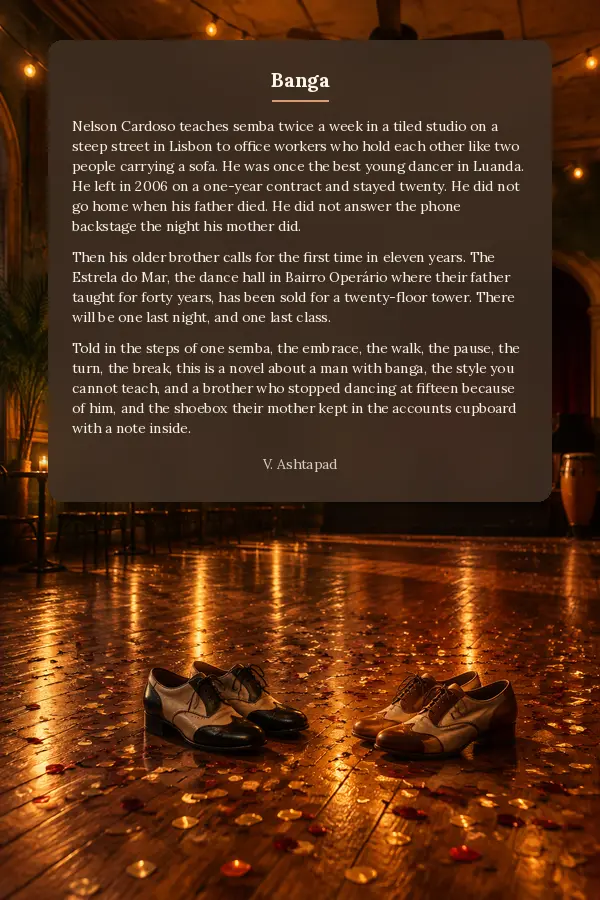
Nelson Cardoso teaches semba twice a week in a tiled studio on a steep street in Lisbon to office workers who hold each other like two people carrying a sofa. He was once the best young dancer in Luanda. He left in 2006 on a one-year contract and stayed twenty. He did not go home when his father died. He did not answer the phone backstage the night his mother did.
Then his older brother calls for the first time in eleven years. The Estrela do Mar, the dance hall in Bairro Operário where their father taught for forty years, has been sold for a twenty-floor tower. There will be one last night, and one last class.
Told in the steps of one semba, the embrace, the walk, the pause, the turn, the break, this is a novel about a man with banga, the style you cannot teach, and a brother who stopped dancing at fifteen because of him, and the shoebox their mother kept in the accounts cupboard with a note inside.
Members can react to this book and talk about it in the members' Library.
Ownership
© 2026 CRUNOD LLC. All rights reserved.
This book is owned by CRUNOD LLC. It is free to read on EternalCurrent.Online. No part of it may be copied, reprinted, sold, recorded or adapted, including as audio, film or translation, without written permission from CRUNOD LLC.
© 2026 CRUNOD LLC. All rights reserved.