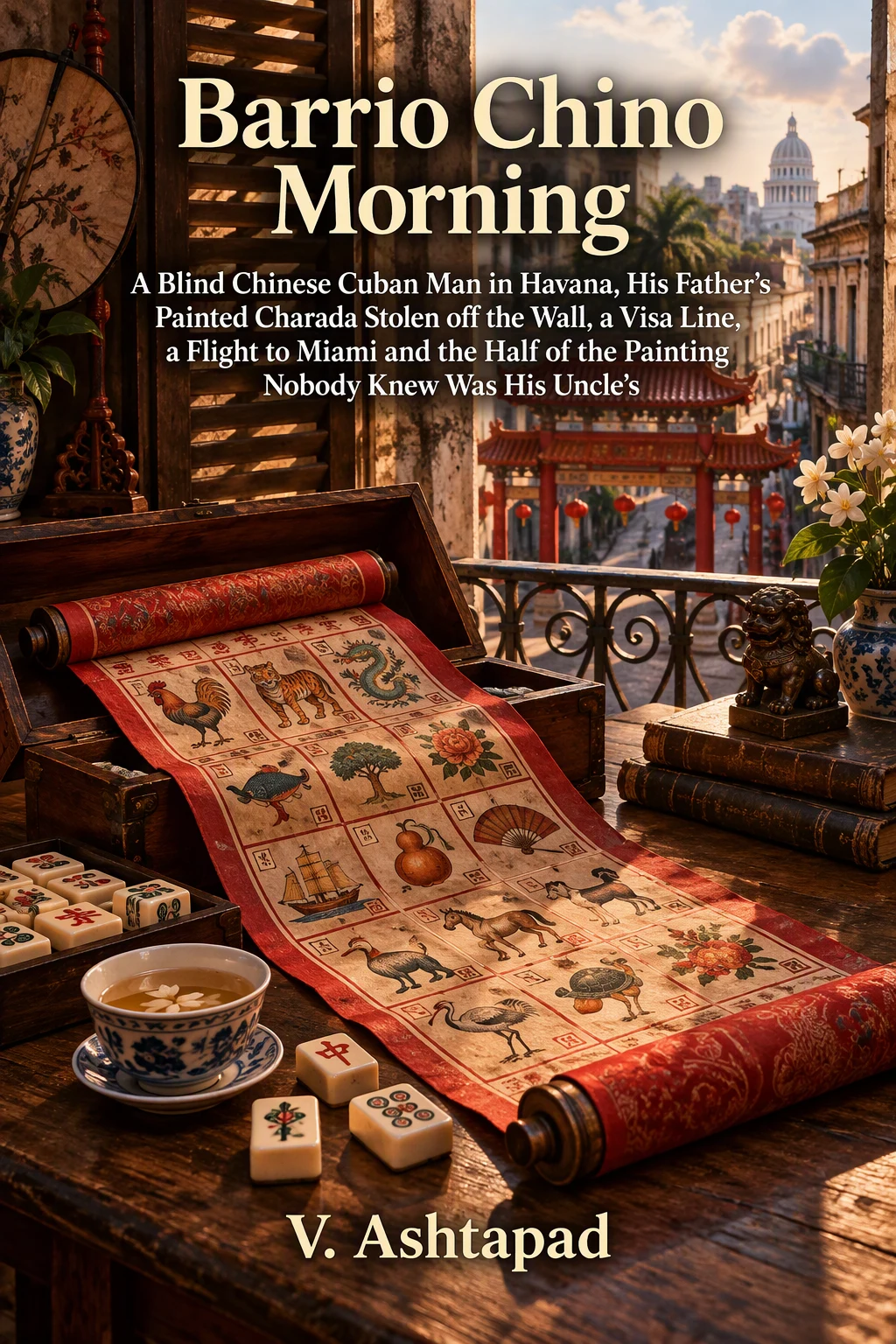
Barrio Chino Morning
A Blind Chinese Cuban Man in Havana, His Father's Painted Charada Stolen off the Wall, a Visa Line, a Flight to Miami and the Half of the Painting Nobody Knew Was His Uncle's
by V. Ashtapad
Foreword
This is a work of fiction. The Chinese of Cuba, the Barrio Chino of Havana, the Casino Chung Wah, the charada number game, the Mariel boatlift and the Chinese Cuban families of Miami are real. The charada painting, the families and every named person in the story are invented.
For the sign painters, and everyone who came in because of a sign.
One: Caballo
I know it's six in the morning on Calle Dragones because the man with the bread cart has just gone by under my window, and his left wheel squeaks on every second turn, and he calls "¡Pan caliente!" in a voice that cracks on the last syllable like a boy's, although he has been calling it for thirty years.
I know it's June because the air coming through the shutters is already wet and heavy, and it smells of the harbor, diesel and salt and rotting fruit from the market on Zanja, and the pigeons on the roof of the old Chinese casino across the street are making the low sound they only make when the heat is coming.
I know the scroll is gone because when I put my hand on the wall above the little table where it has hung for seventy-one years, my fingers touch plaster.
My name is Leoncio Chiu Valdés. I am seventy-six years old. I have been blind since I was forty-four, from a disease of the eye with a long name that I stopped saying when it stopped mattering. I live alone on the second floor of a building on Calle Dragones, in what is left of the Barrio Chino of Havana, above a shop that used to sell herbs and now sells phone cards and plastic sandals. And somebody, sometime between ten o'clock last night when I went to bed and six this morning when I woke, came into my apartment and took my father's charada off the wall.
I stand there with my hand on the plaster for a long time.
Then I say, out loud, to the empty room: "Uno. Caballo."
Number one. The horse. That is how the charada begins.
---
For those who are not Cuban, I will explain, although every Cuban knows.
The charada is a list of numbers. One to a hundred. Each number has a picture. One is the horse. Two, the butterfly. Three, the sailor. Four, the cat. Five, the nun, which we always said as the woman in black, to keep the old ladies from scolding. Six, the turtle. Seven, the snail. Eight, the dead man. And so on, up to a hundred, which is the toilet, because the Chinese who made it had a sense of humor.
The Chinese brought it to Cuba. In the 1800s, when they came as contract laborers, thousands of them, men from Guangdong, to cut cane on the sugar plantations beside the Africans. They brought a lottery game from home, the white pigeon ticket, a game of numbers and characters. And here, in Cuba, the numbers got pictures, Cuban pictures, and the game became the charada. You dream of a horse, you play the number one. You see a dead man, heaven help you, you play the eight. You find a cat in your kitchen, you play the four.
Everybody in Cuba knows it. My neighbors who have never met a Chinese person in their lives know that fifty-three is the street lamp and seventy-seven is the flag. The game is outlawed and played anyway, in every barrio, in every kitchen, in every line for bread.
But my father's charada was not a list. It was a painting.
A long scroll of rice paper, two meters tall, mounted on red silk, with a wooden rod at the top and bottom. On it, in black ink and red and green and gold, a Chinese man in the shape of a person, standing, and on every part of his body, a number and a small picture. The horse on his head. The butterfly on his mouth. The sailor on his hand. The cat on his ear. The turtle on his knee. And beside each picture, a Chinese character, and beside each character, in my father's small careful hand, the Spanish word.
My father, Chiu Wing Fai, painted it in 1955, in this room, at this table, when he was forty and I was five. He was a painter of signs. He painted the signs for half the shops on Zanja and Dragones and Manrique, the restaurants and the laundries and the pharmacies, in Chinese characters and in Spanish. On Sundays, he painted the charada. It took him a year. When he finished, he hung it on this wall. It never came down. Not when he died in 1978. Not when my mother died in 1990. Not when I went blind.
Until last night.
---
I go to the door. It is locked. I locked it last night; I remember the sound of the bolt. The key is in the bowl on the shelf beside the door, where it always is. The windows are shuttered, the shutters hooked. I check each one with my fingers. Hooked.
So whoever took the charada had a key.
There are three keys. One is mine. One belongs to Mercedes, the woman who comes on Tuesdays and Fridays to clean and to read my mail to me and to tell me the news of the barrio, which is mostly who is sleeping with whom. One belongs to my nephew, Julio, my sister's son, who lives in Miami.
Mercedes has been coming for eleven years. She would take my teeth before she took my father's charada.
Julio has not been in Havana for six years.
I go back to the wall. I put my hand on the plaster again. I feel along it, slowly, from left to right, the way I feel everything now. The nail is still there. My father's nail, the one he drove in 1955, square, hand-forged, the head a little bent. And on the plaster, below it, a thin line of something dusty. I rub it between my fingers. I smell it.
Sawdust. And something sweet. Cedar.
The rods on my father's scroll were not cedar. They were pine, painted red.
I stand in the middle of my room, in the heat, with the pigeons making their low sound across the street, and I think: somebody wanted that charada badly enough to bring a cedar box to carry it in.
---
I sit in my chair by the window. I listen to the street wake up.
The bread man's squeaking wheel goes back the other way. A truck goes by on Zanja, a big one, an old Soviet one by the sound, coughing black smoke I can smell. Two women argue about the price of eggs. A radio somewhere plays a son, a Benny Moré song, from before I was born.
And I think: one, the horse.
The horse is the first number. It means beginnings. It also means a man who moves quickly. A man who comes and goes.
It's a long time since I played the charada. My father didn't like it. He said it was a fool's game and he painted it only because it was beautiful, and because it was ours, Chinese and Cuban both, and because he wanted something to show me that proved it.
But this morning, I would play the one.
I pick up my phone, the old one with the big buttons that my nephew sent me from Miami, and I press the button for Mercedes. It rings four times.
"Don Leoncio?" she says. Her voice is full of sleep. "It's six o'clock. Are you dying?"
"No," I say. "Somebody stole my father."
© 2026 CRUNOD LLC. All rights reserved.
Two: Mariposa
Mercedes comes at seven, with coffee in a thermos and a loaf of bread from the squeaking cart and her granddaughter, Yarelis, who is nine and who is not in school because, Mercedes says, the teacher has gone to Spain. Yarelis has lived with Mercedes since she was three, since her mother went to Miami on a visa that was for six months and is now six years. Her mother calls on Sundays when the signal holds. Some Sundays it doesn't. Mercedes never says anything bad about her daughter in front of the girl, but on those Sundays she irons things that don't need ironing.
Mercedes stands in the doorway for a long time. I can hear her breathing. She is a big woman, Afro-Cuban, sixty-eight, with a laugh that shakes the walls and a temper that shakes them harder. When she breathes like this, slowly through her nose, it means she's angry.
"The wall is empty," she says.
"I know the wall is empty."
"Who would take it? Who even knows it's here?"
"Everybody in the barrio knows it's here."
"Everybody in the barrio is seventy years old and can't climb stairs." She comes in. She puts the thermos on the table. I hear her walk to the wall. "There's a mark on the plaster. A clean mark, where the paper was. Like a ghost."
"Two," I say. "Mariposa."
"What?"
"Butterfly. In the charada, two is the butterfly." I hold out my cup. She pours. "The butterfly is the soul leaving. Something light that was here and now is gone."
Mercedes says something under her breath that is not polite.
Yarelis says, from the doorway, in a small voice: "Don Leoncio, there were people last night."
The room goes quiet.
"What people, mija?" I say.
"On the stairs. When Abuela sent me to bring the clothes in from the roof. Late. Two men." She stops.
"Go on," says Mercedes.
"One was old. He walked with a stick. I heard the stick on every step. Tok. Tok. And one was young. He had a phone. The light from the phone was on his face. He was Chinese. Like Don Leoncio. But not from here."
"How do you know not from here?" I ask.
Yarelis thinks.
"His shoes," she says. "They were white. Very white. Nobody here has shoes that white."
Mercedes sits Yarelis on the stool by the stove and makes her tell it again, slowly, from the beginning. Which stairs. What time. How many steps between the stick and the phone. Mercedes was a clerk at the ministry of light industry for twenty-six years before her pension, and she questions a child the way she used to question a delivery driver who swore the forty bolts of cloth had left the warehouse.
Yarelis tells it three times. Each time she adds something. The second time, the young man said "permiso" when he passed her, very politely, with an accent that made the word sound like it had too many letters. The third time, the old man with the stick stopped on the landing and breathed hard, and said something to the young man in a language that was not Spanish, and the young man laughed.
"Chinese?" I ask.
"I don't know Chinese," says Yarelis. "It went up and down. Like a song when you don't know the words."
"Cantonese," I say. Mandarin goes up and down too, but Cantonese goes up and down and sideways, my mother used to say, like a cat walking on a piano.
Mercedes pours me more coffee. I hear her sit down hard in the other chair, the one with the broken cane seat that she always says she'll fix.
"Don Leoncio," she says, "who in this barrio speaks Cantonese and walks with a stick?"
We both know. Neither of us says it yet.
---
Mercedes lives two streets away, on Manrique, in three rooms above what used to be a Chinese laundry and is now a place that fixes cell phones. She lives there with her daughter, who drives a bicitaxi, and her daughter's husband, who is in Spain working construction and sends money when he remembers, and Yarelis, and Yarelis's two little brothers, and Mercedes's own mother, who is ninety and sits by the window all day and calls out the names of everyone who walks by, whether she knows them or not.
Seven people in three rooms. Mercedes comes to my apartment on Tuesdays and Fridays and says it's to clean. I know it's also to sit in a quiet room for two hours where nobody needs anything from her except an old blind man, who needs very little and pays her in dollars that his nephew sends.
I pay her more than she asks. She doesn't know. I fold the extra bill inside the regular ones, and she never counts in front of me, out of pride, and I never mention it, out of the same thing.
"Abuela," says Yarelis, "what's a charada?"
Mercedes makes a sound like a kettle. "You don't know the charada? Nine years old?"
"Nobody plays it at school."
"Nobody plays it at school," Mercedes repeats, to me, as if this is the end of civilization. Then, to Yarelis: "You'd better ask Don Leoncio. He knows all hundred. His papá painted them."
So I tell her the first ten. Caballo, mariposa, marinero, gato, monja, jicotea, caracol, muerto, elefante, pescado grande. I tell her the way my father told me, at this table, with his hand on the back of my neck: you don't learn them, Leoncio, you meet them, like neighbors.
She says them back. She gets seven of ten. She mixes up the snail and the turtle, which everybody does at first, because they're both slow and they both carry houses.
"Remember it this way," I tell her. "The turtle is old and the snail is wet."
She laughs. She says it again. She gets all ten.
"What's eleven?" she says.
"Come back Friday," I say, "and I'll tell you eleven."
© 2026 CRUNOD LLC. All rights reserved.
Three: Marinero
The Barrio Chino of Havana is very small now. A few streets. A gate with a pagoda roof at the corner of Dragones and Amistad, that the Chinese government paid to paint in 1999. A pedestrian street of restaurants, Cuchillo, where they sell fried rice with ham to tourists and call it Cantonese. A few old men, the last ones born in China, playing mahjong in the Casino Chung Wah, the Chinese society building, in the afternoons.
When I was a boy, it was the biggest Chinatown in Latin America. Forty thousand people. Theaters with Cantonese opera every night. Newspapers in Chinese. Laundries on every corner. Pharmacies that smelled of dried roots and deer horn. Restaurants that served food no Cuban had heard of. My father knew everybody, because he had painted everybody's sign.
Then came the revolution in 1959, and the businesses were taken by the state, and most of the Chinese left. To Miami. To New York. To Hong Kong. To Taiwan. To Peru. My sister Lourdes went to Miami in 1980, on the boats from Mariel, with her husband and her baby son, Julio, two years old. I stayed. Somebody had to stay with our mother. And then somebody had to stay with my father's charada.
Now there are maybe a hundred of us left who were born to Chinese fathers. We are all old. Our children are Cuban. Our grandchildren don't know a word of Cantonese, and why would they.
So when Yarelis says a young Chinese man with white shoes came up my stairs last night, I know he was not from the barrio.
And when she says an old man with a stick came with him, I know exactly who it was.
---
I go to the Casino Chung Wah at three o'clock, when the old men play.
Mercedes walks me. I don't need her to walk me. I have walked these streets for seventy-six years, and blind for thirty-two of them, and I know every broken step and every pile of rubble and every place where the drain is open. But she insists. She holds my elbow like it's a chicken she's taking to market.
The Casino is on the second floor of an old building on Amistad, up a long stairway that smells of mold and mothballs and cooking oil. At the top, a big room with high ceilings and ceiling fans that turn very slowly, I can hear them, a soft whup whup whup. And under the fans, the sound I have known all my life: tiles. Mahjong tiles, being shuffled on four tables, a sound like rain on a tin roof, like a hundred small bones.
The old men stop shuffling when I come in.
"Chiu," says someone. "Chiu Sin Saang. Mr. Chiu. You came to play?"
"I came to see Wong," I say.
The silence goes on a little too long.
"Wong is not here," says the someone. It is Lee, I think. Lee Ka Ming, eighty-two, who used to run the laundry on Manrique.
"Wong is always here," I say. "Wong has been here every afternoon since the Casino opened. Wong will be here after he's dead. Where is he?"
Another silence.
Then, from the corner, a voice. Old, thin, with the accent of someone who learned Spanish late and never liked it.
"I am here, Chiu."
And then the sound. Tok. Tok. Tok. A walking stick on the tile floor. Coming toward me.
I remember the barrio by its sounds, because that is how I remember everything now, even the years when I could see.
The Teatro Pacífico on Zanja, on Saturday nights, the gongs and the cymbals and the high thin singing of the Cantonese opera coming out through the doors into the street, and Cuban boys my age standing outside imitating it and getting chased by the old men. My father painting a sign on a ladder at the pharmacy on Dragones, the bristle of the brush on the board, shhh, shhh, and the pharmacist below telling him the character for "health" was too thin, it looked sick, and my father saying, then the customer will know to come in. The clack of the abacus in the grocery on Rayo. The hiss of the woks in the kitchens, all night. The slap of mahjong. My mother calling me in Spanish from the window, "¡Leoncio! ¡A comer!", and my father calling me in Cantonese from the same window a second later, the same words, because he liked to make my mother laugh.
My mother was Cuban. Caridad Valdés, from Guanabacoa, across the bay. Her own grandmother had been born a slave on a sugar estate in Matanzas. She met my father when she was nineteen and he came to paint the sign for her uncle's shoe shop. She said he climbed down the ladder and asked her name in the worst Spanish she had ever heard, and she answered him in the best Spanish he had ever heard, and that was that.
They had two children. Lourdes, my sister, in 1947. Me, in 1950. Four people in two rooms on Dragones, and later, when the man downstairs died, four people in four rooms.
That was the most room I ever had. Now I have four rooms and one person, and it's too much.
---
I lost my sight slowly, the way the barrio lost its Chinese. A little at the edges first. Then the middle went grey. By forty-four I could tell light from dark and nothing else. I was a mechanic, then, for the state bus company, and you cannot fix a bus engine by smell, though I tried for a year.
After the buses, I learned the barrio again. Not with eyes. With counting.
From my door to the corner of Dragones and Rayo is sixty-one steps. Then the curb, which is high, and broken on the left. From there to the gate with the pagoda roof is a hundred and twelve, past the bakery, whose smell I always know, and the vent from the restaurant kitchen, where hot air comes out at the level of my knees. From the gate to the Casino Chung Wah is two hundred and four. I have counted them so many times that my feet count them without me.
The stairs to my apartment are twenty-two. There is a loose tile on the landing, between the eleventh and the twelfth step, that rocks when you step on it. I always step over it. Thirty years of stepping over it, and I never once thought about why my father left it loose.
---
Lourdes left on the twenty-ninth of April, 1980.
That spring, the government opened the port of Mariel and said anybody who wanted to leave could leave, if somebody came from Miami in a boat to get them. Lourdes's husband, Rigoberto, had a cousin in Key West with a shrimp boat. The cousin came. Two thousand boats came, that spring, a whole fleet of them, shrimpers and yachts and fishing boats and things that were barely boats at all, rocking in the harbor at Mariel like ducks.
We weren't allowed on the dock. Only the ones leaving. But I talked my way through, I don't remember how anymore. I was thirty, and I could still see, a little, at the center. I remember the colors more than the shapes: the blue of the water, the white of the boats, the green of the soldiers' uniforms, and Lourdes's dress, yellow, with small flowers.
She handed me Julio while she climbed over the side. He was two. He was heavy and sweaty and he had a piece of bread in his fist and he looked at me with my father's eyes and said, "Tío," which was one of his eleven words.
Then Rigoberto reached up from the boat and Lourdes said, "Leoncio," and I handed him down.
That was it. A boy going from my arms to his father's arms over a gap of green water a meter wide.
Lourdes said, from the deck: "Take care of Mamá. Take care of Papá's wall."
I said: "Take care of the boy."
The boat pulled away. The engine was loud. I stood on the dock until I couldn't see the yellow anymore, which wasn't long, with my eyes the way they were.
When I got home, my mother was sitting at the table, under the charada, with her hands flat on the wood. She didn't ask me anything. I sat down next to her. We stayed like that until it got dark, and then she got up and turned on the light and made rice, enough for four, out of habit, and we ate half and put the rest away.
© 2026 CRUNOD LLC. All rights reserved.
Four: Gato
Wong Siu Tak is eighty-nine years old, the last man in Havana who was born in China. He came in 1950, at thirteen, sent by his family to work for an uncle who had a restaurant on Zanja. He worked there until the restaurant was taken in 1968. Then he worked for the state restaurant that replaced it, cooking the same food for a quarter of the pay. Then he retired. Now he sits in the corner of the Casino Chung Wah and plays mahjong and is the president of the society, which is mostly a job of arguing with the Chinese embassy about money for roof repairs.
He was my father's friend. He was at my father's funeral. He has been in my apartment a hundred times. He knew exactly where the charada hung.
He stops in front of me. I can smell him: tiger balm, cigarettes, mothballs, and something sweet. Cedar.
"Four," I say. "Gato."
"Chiu," says Wong. "Don't play games with me."
"I'm not playing. Four is the cat. The cat is a thief who comes at night." I turn my face toward his voice. "You came last night. With a young man. A young man with white shoes. And you took my father's charada."
The tiles have stopped. Every man in the room is listening. The fans go whup whup whup.
Wong is quiet for a long time.
Then he says, in Cantonese, very quietly so only I can hear: "Not here. Come outside."
---
We stand on the balcony of the Casino, over Amistad Street. I can hear the traffic below, and a man selling peanuts in paper cones, "¡Maní! ¡Maní!", and the radio from the restaurant across the street. The sun is on my face. Wong is next to me. His stick taps once, twice, on the iron rail.
"You're right," he says. "I took it."
I don't say anything. I have learned, in thirty-two years of blindness, that if you don't say anything, people fill the silence with the truth.
"The young man," says Wong, "is called Evan Chiu. Chiu, like you. He came from Miami last week. He came to the Casino, asking questions. About your father. About the charada. He said he was family. He said he was the grandson of your sister's husband's cousin, or some such. He had papers. Photographs. A family tree printed out from the internet, very long, with your father's name on it. And yours."
"I don't know any Evan Chiu."
"He said you wouldn't. He said your sister's family lost touch with his family after Mariel." Wong taps the rail. "He said he wanted to see the charada. To photograph it. For a museum in Miami. A Chinese Cuban museum. He said they are collecting the history of the barrio before everyone dies."
"So why didn't he knock on my door?"
"He said he did. Three times. He said you didn't answer."
I think. Last week. I was at the clinic on Monday, for my blood pressure. On Wednesday I was at Mercedes's daughter's for lunch. On Thursday I was asleep in the afternoon, the way I'm asleep every afternoon now.
"So he asked you for the key," I say.
"He asked me if I knew anyone who had a key. And I said I knew where you hid the spare." Wong's voice gets smaller. "Under the loose tile on the landing. Your father hid it there in 1955, and you never moved it."
I had forgotten. Three keys. Four. The fourth one under the tile, where my father put it, where my mother used it, where I haven't thought about it for thirty years.
"He said he only wanted to photograph it," says Wong. "He said he would bring it back the same night. He had a box, a cedar box, very fine, he said to protect it. We went up at eleven. You were snoring. He took it down. He put it in the box." Wong's stick taps. "And then on the stairs, he said, Uncle Wong, I'll take it to my hotel to photograph in the good light. I'll bring it back tomorrow. And I said, tomorrow is fine. And I went home."
"And this morning?"
Wong is quiet.
"This morning," he says, "the hotel says he checked out at five. His flight to Miami was at nine."
Below us, the peanut man calls. "¡Maní! ¡Maní caliente!"
"Chiu," says Wong. "I am eighty-nine years old. I am a fool. I'm sorry."
I go back down the two hundred and four steps alone. Mercedes wants to walk me. I tell her I need to think. She lets me go, which is how I know she understands.
At the gate with the pagoda roof, I stop and put my hand on the post. It's concrete, painted red, and the paint is flaking off under my fingers like the skin of a fish. I stand there a long time.
My father's charada was not a valuable thing. Not to anyone but me. If you sold it, maybe a few hundred dollars to a tourist who liked the colors. Maybe less. Wong knows that. Wong is a lot of things, stubborn and vain and a terrible loser at mahjong, but he isn't stupid, and he has never in his life done anything for money that he could do for pride instead.
So what did the young man with the white shoes tell him?
What did he say that made an eighty-nine-year-old man climb twenty-two stairs at eleven at night with a stick, step over a loose tile, and lift the key his dead friend hid there seventy-one years ago?
I stand at the gate and the people of the barrio go by me. A woman with a bag of plantains that knock together. Two teenagers sharing headphones, the music leaking out, reggaeton. A man pushing a cart of mangoes and singing about them. A bicitaxi, its bell going ting ting ting.
And I think of my father on his ladder, with his cigarette, saying to the pharmacist: then the customer will know to come in.
My father always said the sign was not for the shop. The sign was for the person who didn't know they needed the shop yet.
---
Before I leave the Casino that afternoon, I sit down at Lee's table and play one hand.
I haven't played in years. I have a set at home, my father's, with tiles of real bone backed with bamboo, and I can read them all with my thumb, the dots and the bamboo sticks and the characters, every one cut a little differently. But it's no fun to play alone, and the old men stopped coming up my stairs a long time ago.
Lee pushes the tiles toward me. I build my wall by touch. Thirteen tiles. I feel each one. A red dragon. Three of bamboo. Two winds, east and north. A mess.
"You're still terrible," says Lee, after four turns, watching what I discard.
"I'm blind."
"You were terrible before you were blind."
Around the table the others laugh, and somebody pours tea into a cup with no handle and puts it in my hand, and for a few minutes it's 1971 again and I'm twenty-one and my father is behind me looking over my shoulder and clicking his tongue every time I throw away a tile he wanted.
Wong does not come back to the table. He sits in the corner. I hear his stick tap once on the floor every few minutes, like a clock.
I lose the hand. I lose it badly. Lee takes three pesos off me and buys everybody a round of the terrible sweet soda the Casino sells.
When I get up to go, Lee puts his hand on my arm.
"Chiu," he says, quietly. "He's ashamed. Let him be ashamed for a while. Then forgive him. He's eighty-nine. There isn't a lot of while left."
© 2026 CRUNOD LLC. All rights reserved.
Five: Monja
I am angry for one day. Then I am not angry. Then I have a plan.
My nephew Julio has lived in Miami for forty-six years. He is forty-eight. He sells insurance in Hialeah and has two daughters and a wife who calls me tío and sends me vitamins I don't take. He calls me every Sunday at four o'clock and asks if I need anything and I say no and he sends it anyway.
I call him on Thursday, which is not Sunday, which means he knows it's bad before I say anything.
"Tío? What's wrong? Are you sick?"
"Julio," I say. "Do you know a Evan Chiu?"
Silence on the line. A long one. Long enough that I hear a television in the background, an English-language television, a man shouting about a sale on mattresses.
"Tío," says Julio. "Why are you asking me that?"
"Because Evan Chiu came to Havana with a family tree that has my name on it. And he took Papá's charada off my wall with Wong Siu Tak's help in the middle of the night and flew to Miami."
The mattress man shouts. Julio doesn't.
"Five," I say. "Monja."
"What?"
"The nun. The woman in black. In the charada. Five means a secret. Something hidden under a veil." I wait. "What do you know, Julio?"
I hear him get up. I hear a door close. The mattress man goes away.
"Tío," he says. "There's a museum. Here in Miami. Not a big one. A room, really, in a building in Little Havana, run by an association, Chinese Cubans, the ones who left. They're collecting things. Photographs, letters, menus from the restaurants on Zanja, mahjong sets, opera costumes. For an exhibition. Next month. The barrio before the revolution." He stops. "I gave them some photographs. Of Abuelo Wing Fai. Of the signs he painted. Mamá kept them."
"And?"
"And they asked me what else. And I said, well, my tío in Havana has a painting. A charada, a big one, that Abuelo made. It's beautiful. It's the most beautiful thing I ever saw. I saw it when I was a boy, before Mariel. I still dream about it." His voice cracks a little. "And they said, can we borrow it? And I said, my tío will never let it leave the wall. And they said, can we at least photograph it? And I said, maybe. Somebody could go. And this young man, Evan, a volunteer, a grad student at the university here, he said he was going to Havana anyway, to see his own grandmother's grave. He said he'd do it."
"And you gave him my name. And your family tree."
"I put it online, Tío. The tree. Last year. For the girls. So they would know who they are. I didn't think..." He breathes. "I didn't think anybody would take it. I swear to you. I didn't know."
I believe him. Julio has never lied to me in forty-eight years. He has never been able to. His voice goes up at the end, like a child's.
"Where is this museum?" I say.
"Tío. No."
"Where, Julio?"
"Calle Ocho. Near Twenty-Seventh Avenue. Above a cigar shop." He pauses. "Tío, you can't come here. You're seventy-six. You're blind. You haven't been on a plane in your life. You don't have a passport."
"I have a passport," I say. "Your mother made me get one in 1995. In case."
"It's expired!"
"So I'll renew it."
"Tío, it takes months. And the visa. You'll never get a visa."
"Julio," I say. "I have nothing but months. And I'm a blind old man with a sister's son in Miami who sends me vitamins. I'll get a visa."
That Sunday, Julio calls at four, as he always does, and doesn't mention Thursday, and neither do I. We talk about the weather, which is hot in both places. He tells me his younger daughter, Camila, made the honor roll. He tells me his wife, Marisela, wants to repaint the kitchen yellow and he wants white and they have been arguing about it for a month.
Then, at the end, when I think he is going to say goodbye, he says: "Tío. The family tree. I'm taking it down. Off the internet."
"Don't," I say.
"What?"
"Don't take it down. It's not the tree's fault." I think about it. "A tree is a sign, Julio. Like your abuelo's signs. It's for the person who doesn't know yet that they're looking for us."
He is quiet a long time.
"Evan found us through it," he says.
"Yes. And maybe that's not the worst thing."
"Tío, he robbed you."
"He did," I say. "And I want to know why. And the only way I know to find out why a person does a thing is to stand in front of him and listen."
---
Lourdes, my sister, died in 2009. In Miami. Of her heart. I didn't go. I couldn't go. There was no visa, there was no money, and I was fifty-nine and blind and had never been on an airplane.
Julio called me from the hospital. He held the phone to her ear. She couldn't talk anymore. I talked to her for twenty minutes. I told her about the barrio. I told her about the bakery and our mother's grave and the loose tile on the landing. I told her I still had Papá's charada on the wall. I told her the first ten numbers, the way we used to say them as children, racing each other, to see who could get to a hundred first.
Julio said afterwards that she smiled at number eight.
I keep thinking about that. She smiled at the dead man.
© 2026 CRUNOD LLC. All rights reserved.
Six: Jicotea
It takes four months.
Four months of lines. Lines at the passport office on Calle 17. Lines at the embassy on the Malecón, the big glass building facing the sea, where I stand in the heat with three hundred other people for six hours, holding a folder of papers that Mercedes has organized for me with colored clips, red for identity, green for money, yellow for Julio's letter of invitation.
Six, in the charada, is the turtle. The jicotea. Slow. Patient. Carries its house on its back. Lives a hundred years.
I am the turtle.
Mercedes comes to every line. She brings coffee in the thermos and a folding stool for me to sit on and Yarelis to read me the forms, because Mercedes's own eyes are going too, she says, and she won't admit it. Yarelis reads well. She reads the forms in a loud clear voice, in front of everyone, every question. "Have you ever been a member of a terrorist organization?" "Have you ever been involved in genocide?" "Do you intend to engage in prostitution?" And the people in line around us laugh and laugh, and an old woman behind us gives Yarelis a caramelo.
At the embassy interview, the consul is a young man with a voice like a radio announcer. He asks me why I want to go to the United States.
"To visit my nephew," I say. "And to get back my father."
There's a pause.
"Your father?" says the consul.
"A painting he made," I say. "In 1955. It was taken. It's in Miami now. In a museum. I want to see it. I want to touch it." I hold up my hands. "I'm blind. Touching is how I see."
The consul doesn't say anything for a long time. I hear him typing.
"Mr. Chiu," he says. "What's in the painting?"
So I tell him. The horse and the butterfly and the sailor. The cat and the nun and the turtle. My father at his table on Sundays, with his brushes, for a year. The characters and the Spanish words. The man made of numbers.
When I finish, the consul is quiet again.
Then he says: "My grandmother played the charada. In Hialeah. She was from Matanzas. She played the twenty-one every week, the saint, because it was her birthday. Never won."
"Twenty-one is the woman," I say. "Not the one you are thinking of. That one is a different number."
"Is it?" The consul laughs. "She was wrong for forty years." He types something. "Your visa is approved, Mr. Chiu. Go get your father."
In the middle of those four months, a storm comes. Not a hurricane, only a tropical storm, but the old buildings of Centro Habana don't like rain. Two of them fall down in one night, three streets away, and in the morning there are firemen and dust and a woman screaming for her cat.
My ceiling leaks over the place where the charada hung. A long brown stain grows down the plaster, from the ceiling to the nail. Mercedes puts a bucket under it and stands looking at it with her hands on her hips.
"If it was still there," she says, "it would be ruined."
I sit in my chair and listen to the drops hit the bucket. Plink. Plink.
"Don't say that," I say.
"I'm only saying."
"I know what you're saying." I listen. Plink. "Say it again. Slower."
She doesn't. She goes to find a rag.
---
On Fridays now, Yarelis learns ten more numbers.
By September she knows sixty. She knows that thirty-one is the deer and that thirty-two is the pig and that the pig means money, good money, not lottery money. She knows that forty-five is the president and that everybody in Cuba plays it during elections, and that it has never won anyone anything. She knows that fifty-three is the street lamp, and she runs out on the balcony and points at the one on our corner and shouts, "¡Cincuenta y tres!", and the old woman on the balcony across the street shouts back, "¡Qué niña más rara!"
She draws them. Mercedes brings her paper and an old box of colored pencils from the school storeroom, half of them broken. She draws them on the backs of my electric bills, a horse with six legs, a butterfly with a face, a cat wearing a sailor's hat because she has decided the cat and the sailor are married.
I can't see them. She describes them to me. Every line.
"It's not the same as your papá's," she says one Friday, worried.
"No," I say. "It's yours. That's better."
She doesn't believe me. Nine-year-olds never believe you when you say the true thing.
---
The embassy calls on a Tuesday in October. Mercedes answers. I hear her say, "Yes. Yes. Yes, he's here. Yes, he's blind. Yes, I'll tell him." Then a pause. Then: "What do you mean, he has to come in person? Where else would he come?"
She hangs up and comes and kneels next to my chair, which she never does, because of her knees.
"Don Leoncio," she says. "Pack a bag."
© 2026 CRUNOD LLC. All rights reserved.
Seven: Caracol
The plane is the worst thing that has ever happened to me.
Worse than going blind. Worse than the Special Period in the nineties, when there was no food and I lost fifteen kilos and ate grapefruit peel fried in a pan. The plane is a metal tube full of strangers and noise and the smell of other people's feet, and it shakes, and it drops, and my ears hurt, and I hold the armrest so hard Mercedes says my knuckles look like garlic.
Mercedes is with me. Julio paid for her ticket too. She has never been on a plane either. She is sixty-eight and she counts out loud the whole fifty minutes, under her breath, to a thousand and back again, and when we land she says, "Never again. I'll swim home."
Seven, in the charada, is the snail. Caracol. A thing that moves slowly and carries its shell. Also a thing that hears: the spiral of the ear.
When we come out of the airport doors in Miami, I hear everything.
The air is the same as Havana, almost, wet and hot and full of the sea. But the sound is completely different. Cars, so many cars, new cars that don't cough, that just hiss, thousands of them, on roads above roads. Air conditioners. Everywhere, air conditioners, a hum under everything, like the city is breathing through a machine. People talking, in Spanish and in English and in Spanish that is English and English that is Spanish. A loudspeaker. A child screaming. A woman laughing.
And then a voice I know.
"¡Tío!"
Julio. He grabs me. He's crying. He smells of cologne and car air freshener and coffee. He's bigger than I remember. He was two when he left. I was thirty. I held him on the dock at Mariel and his mother took him from my arms and got on a boat. That's the last time I touched him.
Now he's forty-eight and he's holding me so tight I can't breathe.
"Tío," he says. "Tío, Tío."
"Julio," I say. "You need to lose weight."
He laughs so hard he has to let me go.
In the car, Julio holds my hand on the gear shift as he drives. He doesn't let go even when he has to change lanes. He drives with his left hand and keeps his right hand on mine, and he talks the whole way, because I think if he stops talking he'll start crying again.
He tells me everything we pass. "That's the Palmetto Expressway, Tío. Six lanes. That's a Publix, a supermarket, there's one on every corner, you'll see. That's a laundromat, Haitian. That's a cafetería. Cuban. That's a cafetería. Cuban. That's a cafetería. Nicaraguan, but they make Cuban coffee too."
Mercedes is in the back seat. She says nothing for twenty minutes. Then she says: "Julio. How much does a pound of rice cost here?"
"I don't know. A dollar? Two?"
"A dollar," says Mercedes. Then she is quiet for another ten minutes. Then, very softly, to herself: "A dollar."
I know what she is thinking. She is thinking about the lines for rice at the bodega on Manrique, where you show your ration book and get your five pounds a month and stand an hour for it. She is thinking about her daughter driving the bicitaxi twelve hours a day. She is thinking about her husband, who died in 2003, and who always wanted to come here, and never did.
I reach back between the seats with my free hand. She takes it. Her hand is rough and hot and holds mine very hard.
We drive like that, the three of us, holding hands across a car, all the way to Hialeah.
---
At the house, the girls are waiting on the step.
Daniela, twenty-two, who hugs me carefully, like I'm made of paper, and says "Bienvenido, Tío Leoncio" in a Spanish so American it makes Mercedes snort. And Camila, sixteen, who doesn't hug me, who stands back, and who I can hear is nervous by the way she keeps clicking something, a pen maybe, click click click.
"Camila," says Julio. "Say hello to your tío abuelo."
"Hi," says Camila. Click click.
"Come here," I say.
She comes. Slowly. I hold out my hands. "May I?" I say. "This is how I see."
She doesn't say anything for a second. Then she takes my hands and puts them on her face.
I feel it, very lightly. A round forehead. Straight eyebrows, thick. A nose that turns up at the end, my mother's nose, Caridad Valdés's nose from Guanabacoa. High cheekbones, my father's. A small chin. Braces on her teeth; I can feel the wires when she smiles under my fingers.
"You look like your bisabuela," I tell her. "And your bisabuelo. Both. At the same time."
She's quiet. Click. Then: "Papá never told me what they looked like. He was too little to remember."
"Then I'll tell you," I say. "Tonight. Everything I remember. You write it down."
She writes it down. Until one in the morning, at the kitchen table, in a notebook with a cat on the cover, while Mercedes falls asleep on the sofa and Julio pretends not to listen from the doorway. My mother's laugh. My father's cigarettes. The ladder. The blue bicycle. The bakery window. The yellow dress at Mariel.
When she's done, she reads it back to me. Four pages.
"Is that right?" she says.
"It's all right," I say. "Every word."
© 2026 CRUNOD LLC. All rights reserved.
Eight: Muerto
Julio's house is in Hialeah, in a neighborhood where every house is the same, a low concrete box with a flat roof and a carport and a chain-link fence and a mango tree. The neighbors are all Cuban. They come over the first night to look at me, the blind tío from Havana, like I'm a comet. They bring food. Arroz con pollo, croquetas, a whole roast pig's leg, flan. They ask me questions about the barrio they left forty years ago. Is the bakery on Zanja still there? Is the Chinese pharmacy? Is old Lee still running the laundry?
"Lee is eighty-two," I tell them. "The laundry is a state cafeteria. The pharmacy sells phone cards."
They go quiet. One of the women starts to cry.
That night, I lie in Julio's younger daughter's bed, which is pink and smells of strawberry shampoo, and listen to the air conditioner hum, and I can't sleep.
Eight, in the charada, is the dead man. El muerto. Everyone is afraid of the eight.
But my father always said the eight was not bad. The eight was the ancestors. The ones who came before. The ones who are still watching. In Chinese, he said, eight is the luckiest number, because it sounds like the word for prosperity. In Cuba, it's the dead man. Both are true, he said. The dead are our fortune. That's why we remember them.
I lie in the pink bed and I think about my father, painting the eight on the charada. Where did he put it? On the man's chest. Over the heart.
---
In the morning, Julio's older daughter drives me to the museum. Her name is Daniela. She's twenty-two. She studies something at the university called public history, and she talks very fast, in an English that is half Spanish, and she drives very fast, in a car that smells of vanilla.
"Tío Leoncio," she says. "Can I ask you something?"
"Ask."
"Are you going to call the police?"
I think about it.
"No," I say.
"Why not? He stole it. Evan. That's, like, a crime. Theft. International theft."
"Because," I say, "the police will take it away from the museum, and put it in a box in a room with a number on it, and lawyers will argue about it for five years, and I'll be dead." I turn my face to the window. The sun is warm through the glass. "And because I want to meet him first."
Before the neighbors leave that first night, an old man stays behind.
He is very small, I can tell by where his voice comes from, low, and he has a cough that rattles. He sits next to me on Julio's sofa, which is leather and squeaks, and says in Cantonese, very quietly: "You are Chiu Wing Fai's son."
"I am."
"Your father painted my father's sign. The Restaurante Kwong Chow. On Zanja. Number 413. In 1952. Red characters on yellow. My father said it was the best sign in the barrio."
I know the sign. I remember it. A big rectangle over the door, the characters three feet tall, and underneath, smaller, in Spanish: COMIDA CHINA Y CRIOLLA.
"I was six when we left," the old man says. "In 1961. My father took the sign down himself. He cut it in pieces with a saw so it would fit in a suitcase. He carried two pieces. My mother carried two. I carried the smallest one, the one with the last character." He coughs. "We got to Miami. My father opened a restaurant on Flagler Street. He put the sign back together over the door, in pieces, with the cracks showing. People said, Mr. Lam, get a new sign. He said no. That's my sign."
"Is it still there?"
"The restaurant closed in 1988. My father died in 1990." He coughs again. "The sign is in my garage. In pieces. Under a tarp. I go out and look at it sometimes."
We sit there on the squeaking sofa. In the kitchen, Mercedes and Julio's wife are arguing about how much garlic goes in the black beans.
"I heard about your charada," says Mr. Lam. "Everybody's heard. The whole Chinese Cuban community in Miami. There are maybe three hundred of us left. We all know." He pats my knee. "I hope you get it back. I hope you hang it on the wall. And I hope," he says, getting up, slowly, "you don't cut it into pieces to carry it."
---
Julio's wife, Marisela, is from Holguín. She came in 1994, on a raft, with her brother. She was seventeen. She doesn't talk about it. She runs a daycare out of the house, six children every weekday from seven to six, and the house smells of crayons and baby wipes and the coffee she drinks all day from a little metal pot.
On the second morning, I hear the children arrive. Six small voices, talking in English and Spanish at once. One of them comes and stands in front of me. I can hear him breathing, the way small children breathe, through the mouth.
"Are you blind?" he asks, in English.
"Yes," I say, in English. My English is very bad. I learned it from the radio, from Miami stations, at night, in the eighties.
"Can you see me?"
"No."
"Can you see this?" I hear him wave his hand in front of my face. The air moves.
"No. But I feel the wind."
He thinks about that. Then he says, "I'm four," and goes away.
Marisela laughs from the kitchen. "That's Mateo. His father's from Peru and his mother's from Venezuela and he thinks he's from Hialeah."
"He is from Hialeah," I say.
"Yes," says Marisela, after a moment. "I suppose he is."
© 2026 CRUNOD LLC. All rights reserved.
Nine: Elefante
The museum is above a cigar shop on Calle Ocho, exactly where Julio said.
I know before we go up the stairs. The smell of the cigar shop is the smell of Havana, tobacco leaves and cedar and old men, and underneath it, from upstairs, coming down the stairwell, something else. Ink. Old paper. Mothballs. Jasmine tea.
The stairs are narrow and steep. Daniela holds my elbow, exactly the way Mercedes does, like a chicken.
At the top, a door. A bell that rings when it opens. And a room. I can feel the size of it from the sound: not big. Low ceiling. Carpet. An air conditioner, louder than Julio's. People talking softly.
A woman's voice, older, Cuban, with that particular accent of Chinese Cubans who grew up in the barrio, the Spanish with a little lift at the end of every sentence. "Welcome to the Chinese Cuban Heritage Room. Can I help you?"
"I'm looking for my father," I say.
---
Her name is Amalia Fong. She's seventy-one. She grew up on Calle Manrique, three streets from me. Her father ran a bakery that made Chinese buns and Cuban bread. She left in 1970, at fifteen. She remembers my father. She remembers his signs.
When I tell her who I am, she sits down. I hear the chair creak.
"Chiu Wing Fai's son," she says. "Ay, no. Ay, no. Leoncio? Little Leoncio? You had a blue bicycle."
"I had a blue bicycle."
"You crashed it into our bakery window. In 1962. My father chased you down Zanja with a broom."
"He didn't catch me."
Amalia laughs. Then she stops laughing.
"Leoncio," she says. "I know why you're here."
"Is it here?"
She doesn't answer right away. I hear her get up. I hear her walk across the carpet. I hear a door open, at the back of the room, and a light switch, and the hum of a different air conditioner, colder.
"Come," she says.
---
Nine, in the charada, is the elephant. The elephant is memory. The elephant never forgets.
The back room is cold and dry and smells of cedar. Strongly. Like a closet.
Amalia takes my hand. She leads me across the room. She puts my hand on a table.
On the table, a box. Cedar. Long. Smooth. The wood is fine, polished, I can feel the grain. The lid is open.
Inside, rolled, on its rods, wrapped in tissue paper, my father.
I know it's him before I touch the paper. I know from the rods. Pine, painted red, with the little chip at the bottom end where my mother dropped it in 1967 when she was dusting. My thumb finds the chip.
I stand there with my thumb on the chip for a long time.
"Evan brought it in four months ago," Amalia says, quietly. "He said your nephew had arranged a loan. He said you'd agreed. He had a letter. Signed. With your name." She pauses. "I didn't question it. I wanted it too much. I should have questioned it."
"I can't write," I say. "I'm blind. I sign with a stamp."
"I know that now," says Amalia. "I found out last week. Your nephew called. He told me everything. I've been waiting for you to come."
"Where's Evan?"
Amalia is quiet.
"Leoncio," she says. "Evan is here. He's been coming every day for a week. Since your nephew called. He sits in the front room, waiting. He says he won't leave until you come."
Before we went up, Daniela walked me down Calle Ocho for a block, because she said I had to hear it.
I heard it. The dominoes first. A sound I know better than my own voice. The clack of the tiles slapped down on a table, and the swish of them being shuffled, and old men arguing about who should have played the double six. It came from a little park with a wall around it, Daniela said. Máximo Gómez Park. Old Cuban men, the same ones every day, playing since morning.
"It's like the Casino," I said. "Like the mahjong."
"It's exactly like the Casino," said Daniela. "Except louder. And they fight about Fidel instead of the roof."
Then the music, coming out of a shop. A son, the same kind that plays on my street in Havana, but cleaner, a recording made with money. Then the smell of a ventanita, a little window in the wall of a café where you buy coffee standing on the sidewalk. Daniela bought me a cortadito. It was sweeter than mine. Too sweet. I drank it all.
"Tío Leoncio," said Daniela, on the sidewalk, with the dominoes going behind us. "Do you think you'll ever move here? To Miami?"
"No."
"Why not? Papá would take care of you. You'd have a doctor. You'd have air conditioning."
"I have a doctor," I said. "Doctora Pérez. She's very good. She has no medicine, but she's very good." I finished the coffee. "And somebody has to stay. For the barrio. For the sign."
"What sign?"
"There's always a sign," I said, and she laughed, but I wasn't joking.
---
While Amalia goes to bring Evan, Daniela walks me around the Heritage Room.
It's one room, really, divided by panels, and every panel has something on it. Daniela reads me the cards. She has a good reading voice, clear, the voice of someone who reads to people for her studies, and she describes every object before she reads its card, the way I would describe it if I could see.
A menu from El Pacífico, the famous restaurant on the roof of a building on Cuchillo, from 1957. Cardboard, folded, a dragon on the front, the prices in pesos: chop suey, sixty centavos. A pair of wooden clogs from a laundry, worn down in the shape of a man's feet. A photograph of the Teatro Pacífico with its lights on and a line of people in hats going around the corner. A Cantonese opera costume, heavy silk, red and gold, behind glass; Daniela puts my hand on the glass so I can feel how cold it is. A tin box of herbs from a pharmacy on Zanja, still with the smell inside when she opens it, bitter and dusty and sweet. A Cuban flag and a Chinese flag folded together in a frame, from a wedding in 1948.
And then a panel with nothing on it. A blank space on the wall, a long rectangle, two meters tall, with a little card beside it.
"What does that one say?" I ask.
Daniela is quiet.
"It says: *Charada, Chiu Wing Fai, Havana, 1955. On loan from the family. Coming soon.*"
I put my hand on the empty wall.
Plaster. Cool. Smooth.
Exactly like mine.
© 2026 CRUNOD LLC. All rights reserved.
Ten: Pescado Grande
He's young. I can hear it in his voice before he says anything else. Young and frightened and trying not to be.
"Mr. Chiu," he says. "I'm Evan. Evan Chiu Delgado. I'm sorry. I'm so sorry."
I sit in a chair in the front room. Amalia has brought me jasmine tea in a cup with no handle, the way my father drank it. Daniela stands behind me with her hand on my shoulder. I can feel her fingers tense, like she's ready to hit him.
"Ten," I say. "Pescado grande."
"What?"
"In the charada. Ten is the big fish. A big fish is a big lie." I drink my tea. "Tell me the big lie, Evan."
He is silent a long while. Then he says, very fast, like water coming out of a pipe: "It's not a lie. It's not exactly a lie. My grandfather was Chiu Wing Kwan. Your father's brother. His younger brother. They came from the same village in Taishan, in Guangdong. Your father came to Cuba in 1935. My grandfather came in 1938. They worked together. They painted signs together, the first years. Then they had a fight. In 1950. A big fight. Nobody ever told me what about. My grandfather moved to Cienfuegos, on the south coast. He married a Cuban woman. He never spoke to your father again. In 1961 he left for Miami. He died here in 2001. I was born in 2002. I never met him."
I put down my tea.
My father had a brother. I didn't know that. Nobody ever told me that.
"My grandmother," Evan goes on, "his wife, she's ninety-four. She lives in Kendall. Before she started forgetting things, she told me one story about my grandfather. She said that before the fight, the two brothers painted something together. A charada. A big one. On a scroll. They started it together in 1949. Then they had the fight and my grandfather left and your father kept it and finished it alone." He takes a breath. "She said my grandfather talked about it until he died. He said, half of that painting is mine. Half of those numbers are my hand. He said it was the only thing he regretted. Leaving it."
The air conditioner hums.
"So when I heard about the exhibition," Evan says, "and your nephew said there was a charada in Havana, and I saw the photograph he had, a little old photograph from the seventies, I knew. I knew it was the one. And I thought, if I could just bring it here. Just for my grandmother to see it. Before she forgets everything. Before she forgets him." His voice breaks. "I was going to bring it back. I swear. After the exhibition. I was going to fly back and put it on your wall and you'd never know."
"I'd know," I say.
"I know that now," says Evan.
When he finishes, I let the silence sit for a while.
"Evan," I say. "What do you study?"
He's surprised. "What?"
"At the university. My nephew said you're a student. What do you study?"
"History." He clears his throat. "Latin American history. My dissertation is on Chinese contract laborers in Cuba. The coolie trade. 1847 to 1874. A hundred and twenty-five thousand men from Guangdong, shipped to Havana, sold for eight years of work on the sugar plantations. Most of them never went home." He stops. "I've read thousands of their contracts. In the archives. In Seville, in Havana, in Matanzas. Every one of them has a name, and a number, and a price."
"Did you find our family?"
"No. Your father and my grandfather came later. They were free laborers. They paid their own passage." He hesitates. "But I found men from their village. From Taishan. Dozens of them. Their names in the contracts. Their ages. Seventeen, nineteen, twenty-two. Sold for four hundred pesos."
"And that's why you took the charada."
He doesn't answer for a long time.
"I spend all day reading about men who had everything taken from them," says Evan. "Their names, their country, their time, their bodies. And then my grandmother started forgetting. And I thought, the one thing my grandfather wanted back, the one thing, is hanging on a wall in Havana, in the apartment of a man who doesn't even know it's half his." His voice is very quiet now. "I thought I was taking it back. Not stealing it. Taking it back."
"From me."
"I know," says Evan. "I know. That's why I've been sitting here for a week."
I drink my tea. Jasmine. It's good. Amalia makes it the right way, the water not quite boiling.
"Evan," I say. "Your family. Your father, your mother. What do they think?"
"My father's a dentist in Coral Gables. My mother's a pharmacist. They think I've lost my mind." He laughs, not happily. "They think history is something you get a degree in and then you get a real job. My father hasn't spoken Spanish since high school and he's never spoken a word of Chinese. He says, Evan, we're American. Why do you keep digging?"
"What do you tell him?"
"I tell him somebody has to."
I put down the cup.
"Yes," I say. "Somebody does."
© 2026 CRUNOD LLC. All rights reserved.
Eleven: Gallo
I ask Amalia to bring the charada out of the back room.
She and Daniela carry it together. They lay it on the long table in the front room and unroll it, slowly, from the top rod to the bottom. I hear the paper whisper as it unrolls. I hear Daniela catch her breath. I hear Evan make a sound I can't describe.
I stand up. I go to the table. Amalia guides my hands.
And I touch it.
I have not touched it since 1994. That was the year it got too fragile, and my mother's friend from the museum in Havana said, don't touch it, Leoncio, the oil from your fingers. I stopped. For thirty-two years I have stood in front of it and put my hand on the wall beside it and imagined.
Now I put my fingertips on the rice paper. Very lightly. Like touching water.
It's not smooth. The ink is raised, very slightly, where it's thick. I can feel the lines. A curve. Another curve. A long straight stroke.
"Where am I?" I ask.
"The head," says Daniela. "The horse. Number one."
I move my fingers down. Slowly.
"The mouth. The butterfly. Two."
Down.
"The hand. The sailor. Three."
I go on down the body of the man made of numbers. Daniela tells me where I am. The cat on the ear. The woman in black on the shoulder. The turtle on the knee. The snail on the foot. The dead man on the chest, over the heart. The elephant on the forehead. The big fish on the belly.
And then I stop.
Because under my fingers, on the left side of the scroll, from the ear down to the knee, the lines feel different.
On the right side, my father's side, I know his hand. I have known it my whole life, on signs and letters and the back of my school notebooks. Small, careful, steady strokes, each one starting heavy and ending thin, like a bird landing.
On the left side, the strokes are different. Bolder. Faster. They start thin and end heavy. Like a bird taking off.
"Evan," I say. "Come here."
He comes. I can feel him beside me, trembling.
"Give me your hand."
He gives it to me. It's damp. I take it and I put his fingers on the paper, on the left side, next to mine.
"Feel," I say. "Feel the stroke. How it ends."
He's quiet. His fingers move very slowly under mine.
"It ends heavy," he says. "Like pressing down."
"Now feel this." I move his hand to the right side. "Feel how it ends."
"Light. Like lifting off."
"That's my father," I say. "The right side. Chiu Wing Fai." I move his hand back to the left. "And that's not."
Evan's hand is shaking under mine.
"Eleven," I say. "Gallo. The rooster. The rooster is the one who crows. Who announces the truth at dawn." I take my hand away. "Your grandmother was right. Half of this is your grandfather's."
Evan makes a sound. He puts his head down on the table, next to the paper, not touching it, and cries like a child.
I put my hand on his back. I don't say anything. I let him cry.
Across the room, Amalia is crying too. And Daniela. And I'm not, because I'm seventy-six and blind and I have cried enough for one life.
But my hand on his back is shaking.
That night, at Julio's house, I can't sleep again.
I go out to the carport, feeling along the wall. Julio has a plastic chair there, under the mango tree, where he smokes the one cigarette a day his wife allows him. I sit in it. The night is warm and loud with insects, and somewhere a dog barks, and somewhere else a television is playing a baseball game, and the mangoes are falling, one every few minutes, thump, on the roof of the car.
I think about my father and his brother. Two young men from a village in Taishan, sitting at a table in Havana in 1949, painting a man made of numbers. One starting from the left, one from the right. Arguing, probably. My father would have said the horse was too big. His brother would have said the butterfly was too small. They would have argued about the Spanish words, which neither of them could spell yet. They would have laughed.
And then, one day, they would have shouted. About China, Evan's grandmother said. About whether to stay or go back. In 1949, the year the revolution in China won. The year everybody in the barrio was deciding. Stay in Cuba, where you were poor and foreign but alive. Go back to China, where everything was new and nobody knew what that meant.
My father stayed. His brother said he'd go back and didn't. Went to Cienfuegos. Then Miami. Then nowhere.
And the charada stayed on the wall, half one brother, half the other, for seventy-one years, and nobody knew.
Julio comes out in the dark. I hear the screen door. He sits on the step next to me. He doesn't light his cigarette.
"Tío," he says. "I heard. From Daniela. About the other half."
"Yes."
"Are you angry? At Abuelo? For never telling you?"
A mango falls on the roof of his car. Thump.
"I'm seventy-six, Julio," I say. "I'm too old to be angry at a dead man. I'm only sorry I can't ask him."
© 2026 CRUNOD LLC. All rights reserved.
Twelve: Mujer Santa
Evan drives me to Kendall that afternoon. To his grandmother.
She lives in a nursing home, a big low building with a fountain in front that I can hear and air conditioning so cold that Daniela gives me her sweater. Her name is Engracia Delgado de Chiu. She's ninety-four. She was born in Cienfuegos. She married my uncle, the uncle I didn't know I had, in 1952.
She doesn't know who I am. She doesn't know who Evan is, today. She calls him by his father's name. She asks if it's going to rain.
Evan puts a photograph in her hands. A photograph he took this morning at the museum, of the whole charada, unrolled on the table.
She looks at it for a long time. I can hear her breathing.
Then she says, in a clear voice, a young voice almost: "Wing Kwan's horse."
Evan goes very still.
"He painted the horse," Engracia says. "He always said he painted the horse, and his brother painted the butterfly. Because Wing Kwan was the one who ran, and Wing Fai was the one who flew." She laughs, a little. "He was so angry. When he left. He said his brother wanted to stay in Havana forever and be a Cuban. And he wanted to go back to China. And they shouted. And his brother said, then go. And he went. Not to China. To Cienfuegos. He never got to China. He never got anywhere." She touches the photograph. "He said, Engracia, my brother kept my half. He kept it safe. That's the only good thing I know about him."
She hands the photograph back to Evan.
"Is it going to rain?" she asks.
---
Twelve, in the charada, is the woman who knows. Some people call her the good woman. My father, when he painted it, called her the woman who remembers.
I sit in the cold room and I listen to Engracia Delgado de Chiu, who doesn't remember her own grandson, remember my uncle's horse.
And I think: my father never told me. He kept his brother's half on our wall for seventy-one years and never told me whose hand it was. Maybe he was still angry. Maybe he was ashamed. Maybe he just thought that if he kept it on the wall, his brother would come back for it.
His brother never came.
His brother's grandson did.
---
On the way out, in the hallway of the nursing home, Evan stops walking.
"She hasn't said his name in a year," he says. "Wing Kwan. A year. She calls my father by it sometimes, by mistake, but she hasn't said it like that. Like she knew who he was."
"The elephant," I say.
"What?"
"Nine. Memory. You can forget your grandson and remember a horse." I find his arm. "That's not her fault. That's what memory is like when it gets old. It keeps the oldest things. The things it held the longest."
"Is that what happened to you? With the charada?"
I think about it. The hallway smells of floor polish and lunch, some kind of soup, carrots.
"No," I say. "I just never let go of it."
He walks me to the car. Daniela is already inside with the engine running and the air conditioning turned all the way up.
"Mr. Chiu," says Evan, at the car door. "Can I record you? Telling the numbers? For my grandmother. I'd play it to her. Every day. One to a hundred. Maybe she'd remember more."
"In Spanish or in Cantonese?"
He thinks. "Both. One in each. Like the scroll."
"Then you'd better bring a long tape," I say.
He laughs. It's the first time I've heard him laugh. It sounds like Julio's laugh when he was two, on the dock at Mariel, before the boat. High and surprised, like he didn't know he could.
---
We record it the next day, at Julio's kitchen table, with the daycare children shrieking in the next room and Mateo, the four-year-old from Hialeah, sitting under the table holding my ankle because he says I might fall.
One to a hundred. In Cantonese, the way my father said it. In Spanish, the way my mother said it. Evan holds the phone. Daniela writes down every word. Mateo, under the table, says "caballo" after me every time, whatever the number, because it's the only one he likes.
It takes an hour and ten minutes.
When we finish, Evan says, "Mr. Chiu, what's twenty-two?"
"Sapo. The toad."
"What's it mean?"
"It means," I say, "a man who talks too much."
Everybody at the table laughs. I don't know why. Then I realize I have been talking for an hour and ten minutes.
© 2026 CRUNOD LLC. All rights reserved.
Thirteen: Pavo Real
Here is what we decided. Amalia and Evan and Julio and Daniela and Mercedes and me, around the table in the front room of the Heritage Room above the cigar shop, with jasmine tea and Cuban coffee and pastelitos de guayaba from the bakery on the corner.
The charada will be in the exhibition. For three months. Both brothers' names on the card beside it. Chiu Wing Fai and Chiu Wing Kwan. Havana, 1949 to 1955. The first time their names have been side by side in seventy-six years.
Then it will come home. To Calle Dragones. To the nail my father drove. Evan will bring it himself, in the cedar box, on a plane, with a letter I will stamp with my stamp, and a visa he will stand in line for like everyone else.
And before it comes home, Daniela will photograph it. Every centimeter. In the good light. So that it lives in two places. So that Julio's daughters can see it in Miami, and Evan's grandmother can hold it in her hands, and the people in the barrio who don't have stairs can see it on their phones. Daniela says she will put it on the family tree, the one Julio made, next to both brothers' names. With a recording of me telling the story. And a recording of Engracia saying, Wing Kwan's horse.
It was not a quiet decision. Nothing with Mercedes in it is quiet.
Amalia wanted six months. Mercedes said three. Amalia said the exhibition had a grant, from the county, and the grant said six months, and if they closed early they'd have to give money back. Mercedes said the grant could talk to her. Amalia said, señora, with respect, you're not the family. Mercedes stood up from the table so fast her chair fell over and said, I have cleaned that wall twice a week for eleven years, I have carried that man up and down twenty-two stairs when his knee was bad, I have stood in every line in Havana for his visa with my granddaughter reading him questions about genocide, and you tell me I'm not the family?
Nobody said anything after that. Amalia picked up the chair. She said, three months. Mercedes sat down.
Julio wanted to pay for insurance on the scroll, the kind with a policy and a number. He sells insurance; he couldn't help himself. Daniela wanted to scan it at the university with a special camera that sees under the paint, to know which brother painted which stroke. Evan didn't say anything for an hour. He sat at the end of the table, not eating his pastelito, until Amalia asked him what he wanted.
"I want to put my grandmother's name on the card too," he said. "Engracia Delgado. She's the only one who remembered."
So that's on the card. Three names. Two brothers and the woman who kept the story.
---
And one more thing. My idea.
Evan will learn the charada. All hundred. The numbers and the pictures and the characters and the Spanish words. From me. On the phone, every Sunday, at four o'clock, after Julio's call.
"Why?" he asked me.
"Because," I told him, "somebody has to know it after I'm dead. And you have your grandfather's hand."
---
---
On the evening before we fly home, Evan comes to Julio's house at seven with a box of pastelitos and a folder.
He sits at the kitchen table with me and Mercedes and Julio and Marisela, while the daycare children shriek in the next room. He opens the folder. Papers rustle.
"I went through everything," he says. "Last night. Everything my grandmother kept. In her closet, in shoeboxes. I wanted to find something to give you. Something of his. To make it, I don't know. Less uneven."
"And?" says Julio.
"And I found this."
He takes my hand and puts something in it. Paper. Thin, soft, folded many times. Old. It smells of mothballs and something sweeter, like dried orange peel.
"It's a letter," Evan says. "In Chinese. From your father to my grandfather. Dated 1977. Addressed to Miami. It was opened. My grandfather kept it. He never answered it."
Nobody says anything. Even the children in the next room seem to go quiet.
"Read it," I say.
Evan reads it. In Cantonese first, slowly, stumbling, the way a person reads who learned from books and not from a mother. Then in Spanish.
*Younger brother. I am sixty-two. The doctor says my lungs are tired. I don't know how much longer. I want you to know the painting is still on the wall. I finished it. Your half I did not touch. I tried once to finish your peacock, number thirteen, because you left it with no tail, and I could not do it. My hand would not do it. So it has no tail still. When you come, you finish it. The wall is waiting. Leoncio is twenty-seven. He is a mechanic. He looks like you. Your brother, Wing Fai.*
Mercedes is crying. Marisela is crying. Julio has gone outside.
I sit with the paper in my hand.
"The peacock," I say. "Evan. Look at the scroll. In the photographs. Number thirteen."
I hear him tapping on his phone. Swiping. Then he stops.
"It has no tail," he says. "It's just a body. A neck and a head. I thought it was faded. I thought the paint had flaked off."
"It didn't flake," I say. "It was never painted. For seventy-seven years, my father's been waiting for his brother to come and paint the tail."
Thirteen, in the charada, is the peacock. Pavo real. The peacock is pride. The peacock is the thing you show off, the thing you're too proud to finish because then you'd have to admit you needed help.
Evan is very quiet. Then he says, "Mr. Chiu. I can't paint. I've never painted anything in my life."
"Neither had my father," I say, "until he picked up a brush."
---
On the last morning in Miami, I wake up early in the pink bed.
I know it's six o'clock because a garbage truck is going by on the street, beeping as it backs up. I know it's October because the air coming in the window is a little cooler, and smells of cut grass and someone's coffee. I know I'm going home today because Mercedes is already up, in the kitchen, telling Julio's wife that Cuban coffee in Miami is weak and how to fix it.
I lie there and think about the numbers.
Thirteen is the peacock. Fourteen, the cemetery. Fifteen, the pretty girl. Sixteen, the bull. Seventeen, the moon. Eighteen, the little fish. Nineteen, the worm. Twenty, the cat again, but a fine cat, a cat with a collar.
Twenty-one is the woman, not the saint. I hope the consul's grandmother forgives me.
And somewhere in the middle, I don't remember which number anymore, there's the shark. Tiburón. The shark is the thing that comes out of the deep water and takes what's yours.
But the shark is also the thing that crosses the whole sea. That doesn't stop. That keeps moving to stay alive.
My father crossed the sea. His brother crossed it twice. Julio crossed it at two years old in my sister's arms. Evan crossed it with a cedar box and a lie. And now I've crossed it, an old blind man in a metal tube, with Mercedes counting to a thousand beside me.
All of us sharks.
I get up. I put on my shoes. I go into the kitchen, where the coffee is.
"Uno," I say, to nobody in particular. "Caballo."
The horse. The beginning.
Evan's grandfather's horse.
© 2026 CRUNOD LLC. All rights reserved.
Fourteen: Escalera
Evan comes to Havana in January.
He comes on a Tuesday, with the cedar box and a visa he stood in line for, like everyone else, and a set of brushes and a small block of ink and an ink stone that Amalia Fong gave him from her father's bakery, where her father used to write the prices on red paper every morning.
Mercedes meets him at the bottom of the stairs. She says, "So you're the thief," and he says, "Yes, ma'am," and she says, "Good. At least you're honest now," and makes him carry her bag of groceries up all twenty-two steps.
He steps on the loose tile. It rocks. He jumps.
"Leave it," I say from the top. "My father left it loose for a reason."
We open the cedar box on my table, my father's table. Evan unrolls the charada. Yarelis is there, sitting on the floor with her drawings, very still, for once. Wong is there, in the chair with the broken cane seat, holding his stick between his knees, not saying anything. He hasn't said much to me since September. He came to my door in October with a bag of lychees from somewhere, I don't know where you find lychees in Havana, and said "I'm sorry" again, and I said "I know," and that was all.
Evan grinds the ink. I hear the stone, a slow wet circle. Shhh. Shhh. The same sound as my father's brush on the boards. The smell comes up, pine soot and something like smoke.
"Where do I start?" he says.
"Start where your grandfather stopped," I say.
---
It takes him three hours. Three hours for a tail. He practices on newspaper first, a hundred tails, two hundred. Wong watches him. After an hour, Wong gets up, and taps over on his stick, and stands behind Evan, and says in Cantonese, "Not like that. From the wrist. Your grandfather painted from the wrist. Your great-uncle from the elbow. Do it like your grandfather."
"You knew my grandfather?"
"I was thirteen," says Wong. "He gave me candy. He told terrible jokes. He drew a horse on my arm in ink once and my mother beat me." He takes Evan's hand. Puts it right. "Like that. Now. Again."
When Evan finally paints the tail on the scroll, everybody in the room holds their breath. I can hear it. Five people not breathing.
Then Yarelis says: "It's beautiful."
And Wong says: "It's too long."
And Mercedes says: "Leave him alone, viejo."
And I put my fingers on it, very lightly, after it's dry. The strokes start thin and end heavy. Like a bird taking off.
---
That evening, after everybody leaves, Wong stays.
He sits in the broken chair and I sit in mine, and the charada hangs on the wall between us with its new tail, and outside the street goes quiet the way it does around nine, the radios turning down, the last bicitaxi bell, a dog.
"Chiu," says Wong. "I want to tell you why."
"You don't have to."
"I want to." His stick taps the floor once. "When the boy came to the Casino in June, with his papers and his family tree, he showed me a photograph of his grandfather. Wing Kwan. At twenty-five. In Havana. Standing in front of the sign your father painted for the Kwong Chow on Zanja, with a brush in his hand." Wong stops. "I hadn't thought about Wing Kwan in fifty years. He was the one who gave me candy. When I was thirteen and new, and nobody else talked to me, and I cried every night for my mother in Taishan. Wing Kwan took me to the Teatro and bought me peanuts and told me jokes in our village dialect so I could laugh at something. Then one day he was gone. Nobody said where. Your father wouldn't say his name."
The fan on my ceiling turns. I don't have air conditioning. I have a fan from 1987 that clicks every turn.
"So when his grandson asked me," Wong says, "I thought, this is Wing Kwan coming back. This is the candy. I owe him the candy." He laughs, a dry small laugh. "An eighty-nine-year-old fool. I owed him candy, so I stole from his brother's son."
"You didn't steal it," I say. "You returned it. For a while."
He doesn't answer.
"Wong," I say. "Next Saturday. At the Casino. One hand of mahjong."
"You're terrible at mahjong."
"I know," I say. "That's why I want to play you. So you can win something back."
His stick taps once. Then twice.
"Saturday," he says.
© 2026 CRUNOD LLC. All rights reserved.
Fifteen: Cien
We hang it on the wall that afternoon. On my father's nail. Over the stain from the storm, which Mercedes painted white in December with a can of paint she won't tell me where she found.
Evan holds the bottom rod. Wong points with his stick and says, "Left. No, right. No, too much. There." Mercedes stands back with her arms folded. Yarelis holds my hand.
When it's hung, I put my hand on the wall beside it. Not on it. Beside it. The way I have for thirty-two years.
Then I take my hand off the wall, and I put it on the paper. Just for a moment. On the horse.
"Uno," I say. "Caballo."
Evan says, "Dos. Mariposa."
Yarelis says, "Tres. Marinero."
Wong says, "Cuatro. Gato." And then, in Cantonese, very quietly, "Thief."
Everybody laughs, even Evan.
And we go around the room like that, the five of us, saying the numbers. An old blind Cuban man, the son of a Chinese sign painter and the great-granddaughter of an enslaved woman. A young man from Coral Gables with a dentist for a father and a coolie contract in his dissertation. A girl of nine from three rooms on Manrique with seven people in them. A widow who was a clerk for twenty-six years and now cleans for a blind man. The last man in Havana born in China.
We say all hundred. It takes a long time. Yarelis gets eighty-seven of them right. Evan gets sixty. Wong gets all of them and pretends he missed three so Yarelis won't feel bad.
One hundred, in the charada, is the toilet. Inodoro.
When Yarelis says it, she falls over laughing on the floor and can't get up.
And I think: my father would have liked this. A room full of people, all wrong in different ways, all saying his numbers out loud. The sign working. Bringing in the people who didn't know yet they needed to come.
Thirteen has a tail now.
The wall is not waiting anymore.
---
In February, Daniela sends the photographs.
Julio prints them in Miami and sends them with a man from the barrio who is visiting his mother, in an envelope, with a letter Marisela wrote. Mercedes reads me the letter. The kitchen is yellow now, Marisela won. Camila got a B in chemistry and cried for a day. Mr. Lam put his father's sign up, all four pieces, cracks and all, over the door of the Heritage Room, next to the space where the charada hung for three months. Mateo asks every day when the blind tío is coming back.
Daniela's letter is folded inside. She has put the photographs of the charada on the family tree, she writes. Every number, one to a hundred, each one on its own page, with the recording of me saying it in two languages, and the recording of Engracia saying "Wing Kwan's horse," and a photograph of Evan painting the tail, which Yarelis took on my old phone. Under both brothers' names, side by side.
She writes that eleven people have found the tree since then. Chius and Valdéses and Delgados. A woman in Lima whose grandfather was from Taishan. A man in Toronto whose mother grew up on Calle Rayo. A girl in Madrid who is Mercedes's husband's cousin's granddaughter and didn't know she had a Chinese great-grandmother until she saw a photograph of a woman in a cheongsam at a wedding in 1948, in a frame with two flags.
"You see," I say to Mercedes. "A sign."
"For the person who didn't know they were looking," says Mercedes.
She's heard me say it so many times. She says it before I can.
Yarelis comes on Friday. She's ten now. She knows all hundred. She's started on the Chinese characters, which Evan sends her on Sundays, one a week, on Mercedes's daughter's phone.
She has one question today.
"Don Leoncio," she says. "Is there a number after a hundred?"
I think about it.
"No," I say. "After a hundred you start again. At one."
"Caballo," says Yarelis.
"Caballo," I say. The horse. The one who runs.
Outside, the bread man goes by under the window. His left wheel squeaks on every second turn. "¡Pan caliente!" he calls, and his voice cracks on the last syllable, like a boy's.
© 2026 CRUNOD LLC. All rights reserved.
If this book stayed with you
Clap on the Names
The Town She Drew from Memory
Another Cuban story about the names a family keeps, and the voices that carry them.
About this book
Leoncio Chiu Valdés has been blind since he was forty-four. He knows Calle Dragones by its sounds: the bread cart's squeaking wheel, the pigeons on the old Chinese casino, the mahjong tiles on Amistad. And one June morning his fingers find bare plaster where his father's painting has hung since 1955.
The charada: a man made of a hundred numbers, the horse on his head and the butterfly on his mouth, painted by a Chinese sign painter for his Cuban son.
The thief came with a key, a cedar box and white shoes. The clues lead to an eighty-nine-year-old man with a cane, to a family tree on the internet, to four months of lines at the embassy, and to a room above a cigar shop on Calle Ocho in Miami.
But when Leoncio finally touches the painting again, the brushstrokes on one side are not his father's. Whose are they?
Members can react to this book and talk about it in the members' Library.
Ownership
© 2026 CRUNOD LLC. All rights reserved.
This book is owned by CRUNOD LLC. It is free to read on EternalCurrent.Online. No part of it may be copied, reprinted, sold, recorded or adapted, including as audio, film or translation, without written permission from CRUNOD LLC.
© 2026 CRUNOD LLC. All rights reserved.