
Bay Rum and Talc
One Summer on St. Nicholas Avenue, Told by the Men Who Never Leave
by V. Ashtapad
Foreword
This is a novel. Barbería Quelo, its barbers, its regulars and the families on its wall are invented, as are the barbershop in Los Pepines, the tobacco barn outside Tamboril and every person who works or dances in them. Washington Heights, Santiago de los Caballeros, Tamboril and the National Dominican Day Parade on Sixth Avenue are real places and a real event, used here fictionally; streets, distances and schedules have been bent where the story needed them.
The story is told by a collective voice, the old men and barbers who sit in the shop all day, and they are not always right. Spanish is used the way it is used on the avenue, a word at a time. The haircut called the long shade is the author's invention; the mangú, the sancocho, the perico ripiao trio and the curing barns of the Cibao are not.
For every child who cried in the chair, and every grandparent who held the camera.
The New Chair
We were there the morning she opened the gate, because we are always there. That is the first thing to know about us, and the thing our wives say most often, usually through a window, usually with a dishrag in one hand. Barbería Quelo sits on St. Nicholas Avenue between a cell phone repair counter and a botánica that sells mostly candles and lottery dreams, four steps down from the sidewalk, so that from the old barber chair by the window you see the city at the level of its ankles. Sneakers, sandals, the wheels of shopping carts, a pigeon that has walked the same route since before the A train got air conditioning. We have watched the avenue's ankles for forty years. We know them better than faces.
The gate went up at seven-forty that Tuesday in June with the sound it always makes, a long complaint of steel that the super has promised to oil every spring since 1994. Then she ducked under it before it was halfway, the way Don Quelo used to, and we all noticed that, and none of us said so.
Massiel Pichardo. Twenty-six. The granddaughter. We had known her since she was a round thing in a car seat that Doña Tata set on the counter by the cash drawer while she argued with the man from the Con Edison. We had watched her sweep this floor at eleven, at fourteen, at sixteen with headphones in and a face that said the floor was a personal insult. Then she went to beauty school in the Bronx and cut women's hair at a salon on Fordham Road for six years, and we heard about her the way you hear about weather in another state.
Then in May Don Quelo had his stroke, on a Sunday, in the bathtub upstairs, and Doña Tata found him with the water gone cold and his right hand floating like a glove somebody had dropped. He lived. He is living still, four floors above the shop, in the apartment he has rented since before most of us had gray in our mustaches. But his right hand will not close on a comb, not yet, and his mouth pulls left when he talks, and the doctors at Presbyterian said months, and they said maybe.
So the shop was closed for three weeks. Three weeks. We stood on the sidewalk in front of the gate like men waiting for a bus that had been discontinued. Bisonó, who drove a bread truck for a Bronx bakery for thirty-one years and cannot sit still unless he is sitting in this shop, walked to the barbershop on 181st and came back with a lineup so crooked that Chuchú said it looked like a coastline drawn by a man with the hiccups. We laughed, and then we were ashamed of laughing with the gate still down.
Then Massiel opened it.
She had a cardboard box under one arm and her own clippers in a canvas roll under the other, and she said, "Buenos días, señores," as if she had said it every morning of her life, and went to the back to plug in the coffee.
We want to be honest about what we thought, since later we will want credit for being honest. We thought she had come to clean up and sell. We thought a girl who cut women's hair on Fordham Road would not know a skin fade from a skin rash. We thought, may our mothers forgive us, that a woman behind the chair would change the talk, and that the talk was the shop, and the shop was the talk, and without the talk a man might as well get his hair cut by a lawn mower.
Chuchú Almonte was the first to sit in his own chair that morning, the second chair, the one nearest the back. Chuchú is fifty-six and has cut in this shop for twenty-four years, and he does a lineup so clean you could slice a lime with it. Robertico Peña, thirty-four, has the third chair and the best sneakers on the avenue and an opinion about every person who has ever walked past. Those two are barbers. The rest of us are something else. Don Evaristo Tejada, eighty-three, owns the dominoes table at the front by the window in the way a king owns a country, by having sat there longer than anyone can dispute. Pupi Liriano brings a radio that is older than Robertico. Bisonó. Others who come and go. On a busy Saturday there are eleven of us. On a Tuesday in June there were six, and every one of us watched Massiel walk past the first chair, Don Quelo's chair, and set her box down beside it.
She did not sit in it. That was the second thing we noticed.
The first chair is a Belmont from 1981, burgundy upholstery patched at the left arm with tape that Don Quelo matched to the color by mixing two kinds of marker. Its hydraulic pump wheezes on the third pump and catches on the fourth. The chrome footrest has a dent from the time Pupi's nephew kicked it during a haircut in 1996. Behind it is the mirror, the long one, and across the shop on the opposite wall is the other long mirror, and between them the shop goes on forever in both directions, a hallway of barbers and old men and the backs of heads, smaller and greener the farther they go, until the last reflection is just a light the size of a lentil.
Massiel stood in front of the first mirror and looked at the thousand of her standing in the long green hallway, and she plugged in her clippers and ran them once against the air. The buzz filled the shop. You do not think a sound has a smell, but that buzz brings back talc to us, and bay rum, and the warm plastic of the cape, and we all sat up a little the way dogs do when they hear the can opener.
"Who's first?" she said.
Nobody was first.
This is the part we are least proud of, and we will tell it fully. Bisonó looked at the floor. Pupi turned the radio up. Don Evaristo shuffled the dominoes facedown with the flat of his palms, the long clattering wash of bone on wood, and said to no one, "Chuchú takes walk-ins." Chuchú, who is a decent man, became very busy with a spray bottle.
Massiel did not say anything. She put the clippers down. She took a broom from the corner and swept the floor, which was already clean because Doña Tata had cleaned it the night before, and then she went to the back and came out with a tray of cafecitos in the little plastic cups, and handed one to each of us, black and very sweet, the way Don Quelo makes it, in the old aluminum greca with the dent in the spout. We drank. It was right. It was exactly right, and that bothered us more than if it had been wrong.
At ten-fifteen a woman came down the four steps with a boy of maybe seven on her hip, too big to be carried and being carried anyway. The boy's hair stood up in every direction like a hedge after a hurricane.
"Is Don Quelo working?" the woman asked.
"I am," Massiel said.
The woman looked at us. We looked at the woman. Whatever it was, she set the boy in the first chair.
So it happened in the first chair after all. Massiel put the booster board across the arms, though the boy was nearly too big for it, and snapped the cape around his neck, and asked him his name.
"Kelvin," he said.
"Kelvin what do you want?"
Kelvin wanted lightning bolts. He wanted two lightning bolts on the left side and his name on the right side. His mother wanted him to look like a person who goes to school. They negotiated across his head while Massiel combed out the hedge, and we watched the comb, because you can tell everything from the comb. Don Quelo's comb moves like a man walking home. Chuchú's comb moves like a man late for work. Massiel's comb moved like someone reading. It paused. It went back. It lifted a section and let it fall.
Then the clippers, and here we will admit we leaned. Even Don Evaristo turned his chair. She took the sides down with a number one guard, then a half, then opened the lever and closed it with her thumb, short little flicks, and the hair came off in a fine gray-black dust that drifted onto the cape and onto the floor and into the light from the window, where it hung in the June morning like pollen. The buzz changed pitch as she went from the guard to the bare blade. She did not use the trimmer for the lightning bolts. She used the corner of the bare clipper blade and then a straight razor, turned on its side, and when she was done there were two small bolts above Kelvin's left ear that looked like they had been drawn by the sky.
His mother said, "Ay, no," and then, "Ay, pero mira qué lindo," which in this neighborhood is the same sentence.
Massiel dusted the boy's neck with talc from the round tin, the old tin, the one with the faded woman in a bathing cap on the lid, and the smell rose up into the shop, sweet and chalky, and settled. Then she tipped bay rum into her palm and patted it on the back of his neck, and Kelvin hissed, and we laughed, and the smell of cloves and something like a kitchen cabinet in a grandmother's house came over us. That is the smell of this shop. Forty years of it is in the plaster.
The mother paid. Massiel opened the cash drawer and then, instead of making change from it, she opened the drawer beneath it, and took out a spiral notebook with a green cover gone soft as cloth, and looked at it for a long time.
We knew that notebook. It is Don Quelo's book. The shop's money, the shop's debts, who paid and who said next week. It is written in pencil in his small square hand, and in places in Doña Tata's looping blue pen, and in places gone wavy from the year the pipe burst. Every one of us has a page in that book. Some of us have several.
Massiel read a page. Then she turned it. Then she wrote Kelvin's twelve dollars in the margin in her own hand, which slants forward like a person running, and closed the book, and put it back in the drawer, and we saw her take her phone out and photograph the page before she did.
"What's she doing?" Pupi whispered. Pupi does not know how to whisper, so it was not a whisper.
"Mind your radio," Don Evaristo said.
By noon the heat had come up. June in Washington Heights is a soft heat in the morning and a hard heat by noon, and the shop has one ceiling fan with three speeds, slow, slower and decoration. The window unit died in 2019 and nobody has had the money or the faith to replace it. The talc smelled sweeter. From the street came the chimi truck's generator and the smell of its grill, onions and cabbage and pork smashed flat, and the bachata from a car stopped at the light, and a man selling frío-frío shaved ice off a cart, scraping the block with a sound like a skate on a pond.
At one o'clock Bisonó got up. We watched him do it. He walked to the first chair and stood beside it and looked at Massiel, and Massiel looked at him.
"I want it like your grandfather does it," Bisonó said.
"How does my grandfather do it?"
"You know."
"I know how he does it on Kelvin," Massiel said. "I don't know how he does it on you."
And Bisonó sat down, and told her. It took a long time. Bisonó has been getting the same haircut since 1979, and he explained the whole history of it, the year it was too short, the year his wife said he looked like a bank teller, the year he lost the hair on top and Don Quelo said, "Bisonó, we will make a monument to what is left." Massiel listened to all of it with the comb in her hand. She asked two questions. Then she cut.
We will not say it was the same. It was not the same. It was close, and the line at the back of his neck was a little higher than Don Quelo puts it, and Bisonó said so, and she lowered it, and he said thank you, and she said, "De nada," and then, "Next time I'll know."
Next time. We all heard it.
"Same time tomorrow?" she said.
"We're always here," Chuchú said.
"I know," she said. "That's why I came back."
She pulled the gate down. It complained the whole way. We went home to our wives, who asked how it was, and each of us said, "Bueno, we'll see," which is what we say about everything from a new subway map to a new brand of rice. But Pupi told his wife that the girl had done the lightning bolts with a razor, sideways, freehand, and that a boy named Kelvin had walked out looking like the weather. And Don Evaristo, who is eighty-three and has outlived two wives and both his brothers and the Polo Grounds, sat at his kitchen table that night and could not stop thinking about the way she held the comb, like it was a question she already knew the answer to.
Forty Years of Firsts
The back wall is not a wall. We should say that first. It is a sheet of plywood that Don Quelo screwed over the cracked plaster in 1986, painted the green of a pool table, and covered over the years with cork squares bought from the stationery store on 175th that is now a vape shop. On the cork, with thumbtacks of every color the world has made, are the first haircuts.
Every child whose first haircut happened in Barbería Quelo is on that wall. That is the rule. A child comes down the four steps for the first time with hair grown wild since birth, a mother or a father or an aunt or once a very nervous uncle holding the child on the board across the arms of the first chair, and Don Quelo cuts, and the child cries, mostly, and at the end Doña Tata comes out of the back with the camera, the square white instant camera that weighs as much as a brick, and the child is photographed in the chair with the cape still on and the cut hair on the cape like confetti. The photo slides out of the camera's mouth with a whir, gray and blank, and is shaken, though Doña Tata says you are not supposed to shake them and shakes them anyway, and the picture comes up slowly out of the gray like a face coming up out of water, and then Don Quelo writes the date and the name on the white strip at the bottom in pencil, and tapes a little curl of the cut hair to the back in a twist of wax paper, and pins it to the wall.
There are, Massiel counted, one thousand two hundred and sixteen.
She counted on the second Saturday. It took her most of the morning, between clients, standing on a milk crate at the top rows and kneeling at the bottom with her knees on a folded towel. We helped by telling her which ones were which, and by being wrong.
"That's Chuchú's boy, Fernandito," Pupi said, pointing at a fat child in a striped shirt screaming with his whole body.
"That is not Fernandito," Chuchú said. "Fernandito never cried."
"He's crying in the picture."
"That is a different baby."
Massiel took the photo down and turned it over. On the white strip it said, in Don Quelo's square pencil, Fernando Almonte, 3-14-1998. And taped to the back in its wax paper was a curl of hair so fine it was almost gold.
"He cried," Chuchú said, after some time. "A little."
That is how it went. We argued over the wall the way other men argue over the lottery numbers. Robertico found himself in the third row, 1992, with a face like an onion and both hands in fists, and he said it was the light, and we said it was the lightning bolts his mother must have asked for, and he said they didn't do lightning bolts in 1992, and Don Evaristo said, "In 1992 they did everything," which settled nothing. Bisonó found two of his grandchildren and one child he was certain was his grandchild and was not, a boy named Dariel Polanco, 1994, who Bisonó said looked exactly like his son-in-law, and we said every bald baby looks like a son-in-law. Pupi could not find his nephew, the one who dented the footrest, and became upset, and Massiel found him on the bottom row behind the trash can, 1996, with his foot already kicking, and Pupi took the photograph in both hands and laughed so hard he had to sit down.
We need to explain why the wall matters, because if you are not from here you might think it is only pictures.
Washington Heights is a neighborhood of people who came from somewhere else and are going somewhere else. Families go to the Bronx, to Paterson, to Lawrence, to Providence, to Allentown, back to Santiago, to Florida when the knees give out. The building you were born in is condos now, or the bodega where your mother bought you a Malta is a bank. But the wall stays. A boy who left at nine comes back at thirty with his own son, and walks down the four steps, and finds himself crying in the third row, and points, and his son laughs at him, and then his son sits in the chair. We have seen it happen maybe a hundred times. We have seen grown men stand at that wall with their hands in their pockets for ten minutes and leave without a haircut. We have seen a woman bring her mother, who had trouble with stairs, down the four steps one at a time, just to see a photograph of her son, who was in the Army and is now buried in Puerto Rico because his wife's family is there. We have seen men steal their own photos. Don Quelo lets them. He says the hair on the back is theirs anyway.
The wall goes in order, more or less, from the top left corner, 1986, a girl's hand at the edge of the frame holding a container of habichuelas con dulce with a spoon in it, because it was spring and that mother had brought some for Doña Tata, and Doña Tata had stood at the edge of the picture with it. That is the first Polaroid. That sweet bean cream with the evaporated milk and the little cookies on top, the raisins, the cinnamon floating, in a glass container with a blue lid, and a hand holding it. Doña Tata says it is her hand. Don Quelo says it is the mother's hand. Every spring they argue about it, and every spring someone brings them habichuelas con dulce, and the argument tastes of cloves.
Then the photos go across and down, across and down, the late eighties with their giant sleeves, the nineties with their gold chains on the fathers, two thousands, the tens, until the bottom right corner, where the last photograph is from April of this year. A boy named Santiago Batista in a clip-on necktie, his mother's idea. The last first haircut Don Quelo gave before the bathtub.
Massiel stood in front of the wall with the curl of Fernandito's gold hair in her palm and said, "There are no girls."
We said that was not true. We looked. Robertico looked so hard he went down on one knee like he was proposing.
There were girls on the wall. Six. They were in their mothers' laps, or standing beside a brother in the chair, or in one case wearing a cape over a dress at the age of four because she had refused to let her brother be photographed alone. But the first haircuts on the wall, the children in the chair with the clippings on the cape, were boys. One thousand two hundred and ten boys. In this neighborhood a little girl's first trim happens at home, in a kitchen, on a chair with a phone book on it, by an aunt with the sewing scissors, and nobody takes a picture, because nobody thinks of it as a first. The first is the ear piercing, or the first day of school, or the quinceañera.
"Mine was in the kitchen," Massiel said. "Tata did it. She says I bit her."
"You did bite her," Don Evaristo said. "She came down here with a Band-Aid and told everybody."
"You remember that?"
"I remember everything. That's my curse."
It was hot that Saturday. It had been ninety-one at noon by the bank sign on the corner, and inside it was worse, the air under the ceiling like the air inside a parked car. The cork on the wall goes damp in summer, Massiel discovered. It gives off a smell of old bark and glue, and the Polaroids curl slightly at their corners, and the tape on the backs goes soft. She found three where the wax paper had come loose and the curl of hair had fallen down behind the plywood into the wall itself, where it is now, presumably, with forty years of dust and one of Pupi's lottery tickets.
That was when she started taking them down.
This is where we were wrong, and we were wrong loudly. When we saw her lift down a whole row of 1988, and lay them on a clean towel on the counter by the cash drawer, and photograph each one front and back with her phone and a little lamp she clipped to the mirror, we decided among ourselves, by looking at one another, that she was dismantling the wall to sell the shop. Pupi said it out loud. Pupi says everything out loud.
"You can't take the wall. You can't. Those are people."
Massiel did not look up. She photographed the front of Dariel Polanco, the boy who was not Bisonó's grandson. She photographed the back, the pencil, the date, the twist of wax paper with its curl of black hair. She pinned him back up in his exact place in the eighth row, and took the next one down.
"I'm not taking the wall," she said. "I'm keeping it."
We did not understand, so she showed us. On her phone there was a family space, private, with only her family in it so far, a few cousins in Tamboril and her mother in Lawrence and Doña Tata, who had joined and then forgotten the password twice. She had made a folder in it for the shop. In the folder were the Polaroids, every one she had done so far, front and back, with the name and date typed underneath from the pencil, so that you could put in a name and find a face. She held up Fernandito for Chuchú to see on the screen, and the screen made him brighter than the Polaroid, and you could see the tears on his cheeks.
"The wall gets damp," she said. "The tape goes. One day a family is going to come in looking for a picture and it's going to be on the floor behind the plywood with Pupi's lottery tickets."
"I don't keep my lottery tickets behind the wall," Pupi said.
"I found four."
He took the stack from her and inspected them as if they might still win.
"So whoever comes looking," Massiel said, "if the photo is gone, it's not gone. And if the family is in Allentown, they can see it in Allentown. Abuelo said yes."
"Abuelo said yes?"
"Abuelo said, more or less, 'if you lose a single one I will haunt this shop from the fourth floor.'" She did the left side of her mouth pulling down. It was very good. It was so good that Bisonó looked at the ceiling.
We watched her the rest of the afternoon. She did ninety-eight that day. The towel on the counter filled with rows of babies, crying, and the lamp clipped to the mirror threw light across them, and in the long mirror the towel went on forever, babies crying all the way down the green hallway into nothing. Kelvin's mother came back with Kelvin, who wanted his lightning refreshed, and while Massiel worked on his head the mother stood at the wall and looked for her brother. She found him. 1991. She stood with the Polaroid in her hand for a long time and then asked if she could have a copy of the picture, and Massiel said yes, and she would send her the photo of the back too, with the hair, and the mother said, "The hair?" and laughed, and then did not laugh.
When we were leaving that evening, Robertico stopped at the bottom right corner of the wall and looked at Santiago Batista in his clip-on necktie, April of this year, the last first.
"Who does the next one?" he said.
Nobody answered. The fan turned on its slowest speed. Out on the avenue someone had opened the hydrant at the corner of 177th, and you could hear it through the window, a long hard rush like a river, and the shrieking of the kids running through it, and the slap of their bare feet on the wet sidewalk, and the hiss of the spray where a man held a coffee can with both ends cut out against the mouth of the hydrant to throw the water in an arc across the street. The heat had a smell. Wet asphalt and sun on garbage bags and the cherry ice from the frío-frío cart. Massiel stood in the doorway with her hair up, watching the water, and we stood behind her, and in the long mirror behind us, all of us, standing in the shop's door, a thousand of us looking out.
"I'll do the next one," she said. "When there is a next one."
That was the first thing she said that summer that we did not believe and should have.
Fourth Floor
Doña Tata allowed two of us at a time. She made this rule on the first Sunday he was home and enforced it with the authority of a woman who has run a cash drawer for forty years and a husband for fifty-two. Two at a time, thirty minutes, no cigars, no talk about the rent because it raises his pressure, and nobody tells him about the shop unless he asks, and he will ask, so tell him it is fine.
The building is a six-story walk-up of yellow brick with a fire escape that zigzags down the front like stitches. The lobby has a floor of little white hexagonal tiles with a pattern of black ones that make a flower, or a star, depending on who you ask, and the mailboxes are brass, and one of them still says PICHARDO in Don Quelo's own label-maker capitals from a time when a label maker was a luxury. Four floors up the stairs are steep and the light is a single bulb per landing, and on the third landing there is always the smell of somebody's sofrito, and on the fourth there is Doña Tata's door with the little brass knocker in the shape of a hand.
Bisonó and Chuchú went up first, the second Sunday in June. We know what happened because Bisonó told it at the dominoes table on Monday, in detail, three times, and because Chuchú corrected him every time.
The apartment smelled of mangú. Doña Tata had been up since six boiling the green plantains in salted water until they went soft and the color of old ivory, and then mashing them with butter and some of the cooking water and a little cold water at the end, which she says is the secret and which every Dominican woman in Washington Heights also says is her secret. On top she had made the red onions, sliced thin and softened in vinegar and oil until they went pink and limp. And beside the mangú, los tres golpes: the salami sliced thick and fried until its edges curled up like the brim of a hat, the queso de freír cut in slabs and fried until it went gold and blistered on the outside and soft and squeaking inside, and two eggs fried in the salami fat with the edges gone lacy and brown. It was eleven in the morning. Don Quelo was eating it with his left hand.
"With your left hand?" Bisonó said.
"The right one is on vacation," Don Quelo said. "It sends postcards."
That was the first thing he said, and it took him some time to say it. His words come out now as if each one has to be carried down a staircase. The right side of his face does not follow the left. But his eyes, Bisonó says, are the same eyes, small and black and amused, the eyes of a man looking at the back of your head in a mirror and seeing what you did to it.
He sat in the armchair by the window that looks down on St. Nicholas. From there, if he leans, he can see the four steps down to the shop and the edge of the gate and the people going in and out. Doña Tata had put a pillow behind his back and a towel over his lap for the mangú and on the windowsill two cereal bowls, one full of dried red beans and one empty, because the therapist from Presbyterian wants him to move the beans from one bowl to the other with his right hand, one at a time, a hundred a day. Chuchú says he saw him do it while they were there, and it was not a hundred, it was four, and two of them went on the floor. But the fingers moved. The fingers found the beans.
The apartment is small and full. Plastic covers on the good sofa, still, after fifty years, which Doña Tata says is because the sofa is still good. A glass cabinet with the porcelain figurines of ladies with parasols and the bottle of Brugal nobody opens. A photograph of Don Quelo as a young man in a white shirt and a narrow tie on a street that Bisonó thought was in Santiago and Chuchú said was Tamboril and Doña Tata said was neither, it was a studio in Puerto Plata with a painted backdrop. And on the wall over the television, framed, the first dollar the shop ever took, which is not a dollar, but a five, because Don Quelo said in 1983 a dollar was an insult to the scissors.
"How is the shop?" Don Quelo asked.
"Fine," Chuchú said.
"Liar," Don Quelo said. "How is the shop?"
So they told him. They told him about the lightning bolts and Bisonó's haircut and the line that was a little high, and Don Quelo laughed at that, the left half of his face laughing, and said, "It is always a little high on you, Bisonó, your neck is shaped like an argument." They told him about the counting of the wall, and the family folder, and the lamp clipped to the mirror, and he nodded. He knew. He said she showed him on the phone, every evening, the day's ninety or hundred babies, and he told her the ones he remembered, which was most of them. Chuchú says he named a boy from 1989 from the shape of his ears.
Then Massiel came in. She had come up the back stairs with a bag from the pharmacy and a quart of morir soñando from the juice counter on the corner, orange juice and evaporated milk and sugar shaken over ice until it goes pale and foamy, which her grandfather loves and his doctor does not, and she set it on the table and did not give it to him.
"Later," she said.
"I am dying here," Don Quelo said.
"You're not dying. You're doing your hand."
He moved one bean, with enormous ceremony, and held out his left hand for the cup. She gave him two sips. Bisonó says it was the most tender thing he ever saw, and Chuchú says Bisonó cries at insurance commercials.
The thing we want to tell from that Sunday is the tree.
Massiel had her laptop on the kitchen table with its screen turned toward the armchair, and on the screen was the family. Not drawn on paper, like the one Pupi's daughter made for school with leaves cut from construction paper. It was in the same private place where she kept the wall. You could see a little card for each person with a photo when there was one, and lines connecting them, and the cards were split, Massiel said, into two islands. On the left were the Pichardos and their in-laws who lived here, in New York, in the Heights and the Bronx and Lawrence and one great-nephew in Orlando who doesn't count, Don Quelo said, because Orlando is not an island, it is a parking lot. On the right were the ones in the Cibao. Tamboril, mostly, and Santiago, and a branch in Moca, and a cousin in Licey al Medio who raises chickens and sends a photograph of a rooster every year on Don Quelo's birthday.
The two halves were connected by lines that went across the middle of the screen like telephone wires between two buildings.
"Two islands," Don Quelo said, and he said it slowly, and Bisonó says he looked at it a long time.
It was not simple, building it. Bisonó and Chuchú were there for twenty minutes of it and Bisonó says it was the most violent twenty minutes he has witnessed since the blackout of 2003. Doña Tata said Don Quelo's cousin Fefa had married a Rodríguez. Don Quelo said Fefa had married a Rodríguez but the children were from the first one, a Núñez, who went to Venezuela and was never discussed. Doña Tata said the children were from the Rodríguez and the Núñez was a different Fefa. Massiel sat in the middle typing, and every time one of them said a name she made a card, and every time the other one said no she moved the card, and Rosanna, Massiel's cousin in Tamboril, was on the phone propped against the sugar bowl, on video, saying, "No, no, that's Tía Fefa who has the colmado, the other Fefa is dead," and Don Quelo saying, "Which one died?" and Rosanna saying, "Yours," and everybody laughing, even Doña Tata.
Rosanna is thirty. She is the daughter of Don Quelo's youngest brother, who never left Tamboril. She keeps the right side of the tree. Massiel keeps the left. They have never met in person. They have known each other their whole lives.
"It is a strange thing," Don Quelo said, when the arguing had stopped, "to see where everybody went." He pointed with his left hand at the screen, at the lines between the islands. "My father had nine children. Five came. Four stayed. And now the ones who came have more children than the ones who stayed, and the ones who stayed have more land." He laughed with half his face. "Which is the rich side? Nobody knows."
Then he said a name.
We should explain. Bisonó says Don Quelo said it to the screen, not to anybody. He had been looking at the right side, the island side, Tamboril, at the little card of his own father, which had a photograph Rosanna had found, a man in a straw hat in front of a barn so dark and tall it looked like a ship turned upside down. And Don Quelo said, "Eligio."
"Who's Eligio?" Massiel said.
"He is not on the tree," Don Quelo said. "He is not family. He is my first one."
"Your first what?"
"My first apprentice. In Tamboril. Before I came here. He was eleven and he swept. Like you." The left corner of his mouth went up. "He did not bite anybody."
Doña Tata said, "Eligio Durán," the way you say the name of a song you had forgotten you knew. She said he had the barbershop in Santiago now, in Los Pepines, for forty years, and that he was the only man alive who could do the fade the way Don Quelo did it before there were clipper guards, with the scissors and the comb only, the long shade, they called it, la sombra larga, from the temple down to the neck without a single line, like smoke going up a wall.
"I can do a fade," Massiel said.
"You can do a fade," Don Quelo said. "You cannot do that one."
Bisonó says the room went quiet then, except for the window unit in the bedroom, which works, and the radio from the apartment below playing a bachata about a man whose heart was a broken refrigerator. Massiel looked at her grandfather. Her grandfather looked at the bowls on the windowsill.
"Can you teach me?" she said.
He held up his right hand. The fingers moved, a little, like the legs of something asleep.
"Not with this," he said. "Not this summer."
Then he reached for the beans. Chuchú swears this. He picked one up, really picked it up, between his thumb and two fingers, and carried it across to the empty bowl and let it go, and it landed with a small dry tick, and Doña Tata stopped clearing the plates and stood very still, and Massiel stood very still, and Bisonó and Chuchú, who had been told thirty minutes and were at fifty, stood very still in the doorway with their hats in their hands.
"Eligio can teach you," Don Quelo said.
We heard all of this on Monday at the dominoes table, three times, with corrections. Don Evaristo washed the tiles facedown under his palms with that long bone clatter and said nothing until the third telling was over. Then he said, "She'll go," and set the double six in the middle of the table, which is his right as the oldest man in the shop, and his right as the man who always seems to have the double six.
"She won't go," Pupi said. "Who would run the shop?"
"We would," Don Evaristo said.
We all looked at each other, and at the first chair by the window, empty that morning with the sun on its patched burgundy arm, and then at our own hands, which can wash a set of dominoes in the dark and could not, any of them, cut smoke up a wall.
The Man from Edgeline
He came down the four steps on the last Thursday of June at two in the afternoon, which is the dead hour, when the heat sits in the shop like a fat cat on a windowsill and nobody wants a haircut, only a chair.
We knew he was not from here before his second foot touched the floor. It was not his skin, which was the pink of a man who burns in a parking lot. It was his sneakers. They were white. Not white the way a pair of sneakers is white on the avenue, which is white that has been defended, scrubbed with a toothbrush on a fire escape, stuffed with newspaper at night so the toe box does not crease. These were white the way a refrigerator is white. They had never been defended in their lives.
He had a polo shirt the color of a swimming pool with a little logo on the chest, a pair of scissors made into a lightning bolt, and under the scissors the word EDGELINE in thin letters. He had a leather folder under his arm. He had a smile that he had been taught.
"Hi there," he said. "Is the owner around?"
Massiel was at the first mirror, sweeping. She did not stop sweeping.
"I'm around," she said.
He looked at her and then at us, sitting along the wall on the bench with the split vinyl, and then at Don Evaristo at the dominoes table by the window with his tiles stood up in a little wall in front of him like teeth. He looked at the back wall with its Polaroids, at the ceiling fan, at the talc tin, at the calendar from the travel agency on Dyckman that still shows December, because it is a nice picture of Samaná and nobody wanted to turn the page. Then he looked at her again and the taught smile came back, a little faster.
"Brent Cahill," he said, and held out his hand. "I'm with Edgeline. We're a barbershop group, we've got forty-one locations in the tri-state, we just opened on Dyckman, maybe you've seen it."
We had seen it. Robertico had gone in to look, for professional reasons, and come back and reported to us at length. Big windows. Black chairs. A screen by the door where you type your name and it tells you how many minutes. Music, but music with no words, the kind they play in a dentist's office. No dominoes, no radio, no talk. Every barber in a black apron with the lightning scissors on it. Thirty-eight dollars for a fade. Robertico said it was beautiful and that he would rather be dead.
Massiel shook the man's hand, because she was raised right, and then she went back to sweeping. Brent Cahill stood holding his leather folder. A drop of sweat went down from his hairline to the hinge of his jaw. The fan made one of its slow turns.
"Hot in here," he said.
"It's almost July," Massiel said.
He laughed, though she had not made a joke. Then he opened the folder.
We will try to tell what he said in the order he said it, which is not easy, because he talked for a long time and Pupi kept turning the radio up and Don Evaristo kept turning it down. As we understood it: Edgeline wanted this block. The lease on the shop ran out on the thirtieth of September. Edgeline had already talked to the landlord, Bexley Holdings, a company that owns eleven buildings in the Heights and has never once fixed the gate. Edgeline was prepared to offer Bexley a new lease at a rent we will not repeat because Pupi fainted, or claims he did. And Edgeline was prepared to offer the current tenant, that is, Massiel, that is, Don Quelo, a sum of money to give up her right to renew. And a job. Lead stylist. At the new Edgeline location. Right here. Same address.
"Same four steps," he said. "Totally reimagined."
We all looked at the four steps. They did not look as if they wanted to be reimagined.
"And the wall?" Massiel asked. She had stopped sweeping. She leaned on the broom.
"The—" He looked over his shoulder at the Polaroids. "Oh, sure, of course, we could absolutely preserve some kind of, like a heritage element."
"A heritage element."
"A feature wall. Curated."
"There are twelve hundred and sixteen," Massiel said.
Brent Cahill did not know what to say to that, and we will give him credit, he did not pretend. He closed the folder halfway. He looked at the wall again for longer, and something in his face changed, very slightly, as if he had remembered something about himself. Then the taught smile came back over it like a cape snapped around a neck.
"Look, there's no pressure. Take it, read it, think about it. I'll leave my card."
And this is where Massiel did the thing we still talk about.
"Sit down," she said.
"Sorry?"
"You came into a barbershop. Sit down. On the house."
He looked at the first chair. He looked at us. We looked at him with the faces of eleven men who had been waiting forty years for exactly this, which was in fact six men on a Thursday, but we made up the difference with our eyebrows. And Brent Cahill, of Edgeline, of forty-one locations in the tri-state, set his leather folder on the counter by the cash drawer and sat down in the patched burgundy chair of Don Quelo, and the pump wheezed on the third pump and caught on the fourth, and Massiel snapped the cape around his neck.
He had a regular man's haircut, short on the sides and a little longer on top and parted with something that smelled like a pine forest. Massiel combed it out. She took her time. She asked him where he lived. Hoboken. Where he got his hair cut. An Edgeline, he said, laughing. Which one. Hoboken. Who cuts it. A guy named Tyler. Does Tyler know his kids' names.
"I don't have kids."
"Does Tyler know you don't have kids?"
Brent Cahill opened his mouth and closed it.
She ran the clippers. The buzz filled the hot shop and the man in the chair went still, the way every man goes still under that sound, as if something in him older than his job remembers being small. She took the sides down with the number two and then the one and then she did not use a guard at all, only the lever and her thumb. She blended upward with the scissors over the comb, which she does more and more since the Sunday upstairs, the comb lifting the hair and the scissors following along the teeth of the comb with a sound like a bird eating seed. It is not the long shade. She does not know the long shade. But it was more than Tyler in Hoboken knows, and Brent Cahill, watching himself in the long mirror, knew it.
Then the hot towel.
We need to say about the hot towel. Don Quelo keeps them in a steamer cabinet in the back, an old white enamel box that hisses and drips and smells of eucalyptus because he puts a drop of oil in the water. You do not put a hot towel on a man in June. You do not do it on the last Thursday of June at two in the afternoon in a shop with no air conditioning, with the bank sign on the corner saying ninety-three. But Massiel went to the back and came out with the towel folded over her forearm, steaming, and laid it across Brent Cahill's face, and pressed it to his cheeks and his eyes and his forehead with both palms, and he made a sound under the towel that we will not describe because a man has his dignity, even a man from Edgeline.
She left it there a full minute. Don Evaristo set a tile down. Pupi turned the radio off. In the quiet there was the fan and the generator of the chimi truck outside and the scraper on the frío-frío cart and a woman two buildings down calling a child named Yeison to come upstairs right now. And under the towel the man breathed.
When she took it off, his face was red and soft and the eyes had a look of having been somewhere far away.
She dusted him with talc. She tipped the bay rum. He hissed like Kelvin.
"Thirty-eight dollars," Massiel said, "at Edgeline."
"About that."
"Twenty here. You don't pay. Tell Bexley what you saw."
He looked at himself in the mirror for a while. In the opposite mirror there were a thousand of him, smaller and greener, every one with a fresh haircut and a red face. Then he got up and took his folder and his card and went up the four steps, and at the top he turned and looked down at us at the level of our ankles, or we at his, and said, "It's a good cut."
"I know," Massiel said.
The moment he was gone we all started talking at once. Robertico said she should have thrown him out. Pupi said she should have charged him forty. Bisonó said he had felt sorry for him, under the towel, and we said Bisonó feels sorry for pigeons. And then Robertico said the thing that started the trouble.
"Lead stylist," he said. "She'd take it. Why wouldn't she take it? She cut women on Fordham Road. Lead stylist with a black apron is a promotion."
"She gave him a free haircut," Chuchú said.
"She was showing him she was worth it."
We did not want to believe him, but Robertico is often right about people and wrong about everything else, so the idea went into us like a splinter and stayed. We decided, by a silence that went around the bench, that she was going to take the money. She was twenty-six. Don Quelo might never cut again. Who could blame her. We blamed her immediately and with our whole hearts.
What we did not see, because we were busy being wrong, was what she did after closing. Chuchú saw it, because he stayed late to clean his clippers. She sat at the counter by the cash drawer with the leather folder open on one side, and on the other side Don Quelo's green notebook, the soft one with the pencil and the blue pen and the water damage, and between them her laptop.
"What are you doing?" Chuchú asked.
"The landlord's going to want numbers," she said. "Abuelo's numbers are in here." She tapped the green notebook. "And in his head. And Tata's head. Bexley isn't going to look at a notebook that has a footprint on page nine."
"There's a footprint?"
"It's Pupi's nephew, I think. 1996."
So she was moving it. Every page. Into one of those tools that a small office uses for its books, with columns for the date and the money in and the money out, and a place for receipts you photograph, and a page that adds itself up. She had started in January of this year and was going backward, and by the time Chuchú left at nine-thirty she had reached March and had typed, he says, maybe four hundred haircuts. In the column for notes she was copying exactly what Don Quelo wrote. Bisonó - pagó. Evaristo - mañana. Pupi - mañana. Pupi - mañana. Pupi - he says Thursday.
"You're going to see some things in there," Chuchú told her.
"I'm already seeing them," Massiel said, and did not look up.
Chuchú went up the four steps into the hot night. The hydrant on 177th was still open and the street shone under the lights like the floor of a lake. Somebody had put a chair out on the sidewalk and was sitting in the spray in his undershirt with his eyes closed. The chimi truck had a line. The smell of the grill, smoke and pork fat and the sweet pink sauce, came across the wet street, and Chuchú stood and breathed it and looked down the four steps at the light in the shop, where a young woman sat between her grandfather's green notebook and a stranger's folder, and the notebook was open, and the folder was not.
Double Six
The dominoes table is older than the shop. Don Evaristo brought it with him in 1983 from a social club on 157th Street that closed when the owner went back to Moca, a square of plywood on folding legs with a lip of molding nailed around the edge to keep the tiles from going over, and a surface worn so smooth by forty years of palms washing tiles that it shines in the window light like a dish. The tiles are bone-white with black pips, heavy, from a set Don Evaristo will not let anyone else touch on weekdays. On Saturdays he allows the younger men to use the second set, the yellow one, which he calls the children's set. The youngest man who uses it is sixty-one.
Every morning Don Evaristo turns the tiles facedown and washes them, both palms flat, a long circling clatter like surf on gravel, and then each of the four players draws seven and stands them on edge in a little wall facing himself. Whoever has the double six puts it down first. Don Evaristo has the double six, by our count, roughly four mornings in five. We have discussed this for forty years. We have never caught him at anything. He says luck loves the old. We say luck has nothing to do with it.
In the second week of July, Massiel sat down at the table.
It was a Wednesday, slow, the heat already ninety by ten. She had cut three heads before nine. She had finished entering the green notebook back to 2023 at the counter at night, Chuchú told us, and now she was going through the page that had nobody's name on it, only numbers, which turned out to be Don Quelo's private record of how much he had spent every year on talc. She was tired. She came out from behind the first chair and sat down in the fourth seat at the dominoes table, which was empty because Bisonó had gone to the clinic about his feet.
Don Evaristo looked at her over his reading glasses for a long time.
"You play?" he said.
"Abuelo taught me."
"Your abuelo plays like a man pushing a car."
"So beat me."
He washed the tiles. The clatter went on longer than usual. We all turned on the bench to watch. Pupi turned his radio down to a mutter. They drew. Don Evaristo stood his tiles on edge, and Massiel stood hers, and then Don Evaristo, slowly, put down the double six.
"Every time," Robertico said.
"Not every time," Don Evaristo said.
They played. Dominoes in this shop is played in partners, and Massiel's partner was Pupi, which is a sentence of death, because Pupi plays dominoes the way he follows baseball, with total loyalty and no strategy. Don Evaristo's partner was Chuchú, who put his scissors down for it. The tiles went down with that slap that is the whole sound of a Dominican summer, a tile slammed flat on wood so hard the others jump, and then the next, and then a knock on the table with two knuckles when a man cannot play, and a groan, and someone's arithmetic said out loud.
Massiel played well. We will say that. She counted the tiles that were down and the tiles that were left and she knew, by the fourth round, which numbers Don Evaristo did not have. She blocked him twice. She made Pupi look like a man with a plan, which nobody has ever done. And at the end of the second hand, with the fives closed on one end and the threes on the other, she slammed down her last tile so hard that the talc tin on the counter jumped, and said "Dominó," which is the one word in this shop that nobody argues with.
Don Evaristo took his glasses off and cleaned them on his shirt.
"Your grandfather does not play like that," he said.
"No," she said. "Tata does."
Everybody laughed except Don Evaristo, who said, "Again," and washed the tiles.
This was the day the tíguere came in. We need to tell it because it was the day she decided to go.
His name was Jhonatan Ureña, and he was twenty-four, and he wore a gold chain with a little gold plantain on it and a white undershirt and basketball shorts and slides with socks, and he walked down the four steps like a man walking onto a stage he had rented. He was a tíguere, as we say: a street tiger, a sharp one, a young man who knows every angle and is proud of knowing it and is not, at heart, a bad person, only a person who has never once in his life been told no by a woman with clippers. His father was Wilfredo Ureña, who has been coming to the shop since 1990 and who has, every month for thirty-six years, had his hair cut by Don Quelo in the long shade, scissors and comb only, temple to neck with no line.
"I want what my father has," Jhonatan said.
"I can do you a fade," Massiel said.
"I don't want a fade. I want what my father has. The thing your grandfather does. The smoke."
"I don't do that one yet."
He laughed. He looked at us, wanting us to laugh with him. We did not, and we will take some credit for that, though Robertico's mouth twitched.
"Then what are you doing here?" Jhonatan said. He said it lightly, the way a tíguere says the worst things, so that if you are hurt it is your fault for not understanding the joke. "This is a barbería, mami. Not a salón."
Massiel did not answer that. She did not do anything. She stood there with the clippers in her hand, and the clippers were on, buzzing, and the sound went on in the shop for a long moment, the sound that smells to us of talc and bay rum, and Jhonatan Ureña heard it and looked at the clippers and something in him, the same small thing that goes still in every man under that buzz, went still.
"Chuchú," Massiel said, without turning. "Can you take him?"
Chuchú took him. Chuchú gave him a fade, a good one, a mid skin with a hard part. It was not the smoke. Jhonatan knew it. He paid and tipped too much, which is how a tíguere apologizes, and went up the four steps, and at the top he called down, "Tell your abuelo Wilfredo's son said hello," and was gone.
Massiel turned the clippers off. She went to the back. We heard the greca on the hot plate, the gurgle and spit when the water comes up through the coffee, and smelled it, dark and bitter and burnt at the edges the way it should be, and then she came out with the little cups on the tray and handed them around, and then she went and stood in front of the wall.
Pupi's radio was on again, low. In the summer Pupi follows one thing only, and it is a shortstop named Yandel Castillo who is from Tamboril and plays for Kansas City, and whom Pupi has decided is the greatest shortstop in the history of the sport despite his batting average, which Pupi says is a conspiracy. Whenever Castillo comes up, Pupi turns the radio up and shouts "¡Ese es de Tamboril!" and whenever he strikes out, Pupi turns the radio down and says nothing. That Wednesday he struck out twice. Pupi said nothing twice.
"Ese es de Tamboril," Massiel said, at the wall.
"What?" said Pupi.
"Nothing."
That night she went up to the fourth floor with her laptop under her arm and the green notebook, and we will tell what happened from what Doña Tata told Bisonó's wife, who told Bisonó, who told us, so take it with salt. She sat down on the plastic-covered sofa across from her grandfather in his armchair by the window. She said, "I want to go."
He did not ask where. He moved a bean from one bowl to the other. Then another.
"Two weeks," Massiel said. "Rosanna will meet me. I'll stay with her in Tamboril and go into Santiago every day. Eligio said yes. I called him."
"You called Eligio?"
"You gave me the number in May. Before the bathtub. You wrote it in the notebook. Page fourteen." She opened the green notebook and showed him, and there it was, in his small square pencil, a phone number with the country code and the name, Eligio, and next to it, in the same pencil, a word Doña Tata had never seen before and could not read and Massiel could, because she had read every page of that book by then. The word was enséñala. Teach her.
Don Quelo looked at it for a long time. Doña Tata says he said, "I wrote that?" and Massiel said, "You wrote that," and he said, "I don't remember," and then he said, "Yes, I do," and then he laughed with half his face and said, "Vaina, you're nosy."
"Who's going to run the shop?" Doña Tata asked.
"Chuchú and Robertico," Massiel said. "And the regulars."
"The regulars don't run anything. The regulars sit."
"They're good at sitting. Somebody has to keep the chairs warm."
So it was settled. We learned about it the next morning from Massiel herself, who came down the four steps under the half-lifted gate and set a box on the dominoes table between the tiles. In the box were the keys to the cash drawer and the back door, the combination to the steamer cabinet's broken latch written on a sticky note, and a sheet of paper on which she had typed, in large letters, the rules.
We will not reproduce the rules in full. They were long. They included no smoking in the back even with the door open, the hot towels only for regulars in August, the Polaroid camera stays in the drawer, Pupi pays cash, and Don Evaristo must play one hand a day with the yellow set, so that the children's set is not lonely.
"I'm not doing that," Don Evaristo said.
"You'll do it," Massiel said.
He did it. He did it every day she was gone, one hand with the yellow set at three in the afternoon, and lost every time, and blamed the tiles.
She left on the third Saturday of July at five in the morning from the curb in front of the shop. Bisonó drove her to Kennedy in his son-in-law's silver minivan, whose sliding door has to be lifted while you pull it, with a beach towel over the back seat and a little cloth flag hanging from the mirror that belonged to his mother and that he says is for luck. We were there. Not all of us. Chuchú and Pupi and Robertico and Don Evaristo, who does not get up at five for anyone, and who was standing on the sidewalk in his undershirt and his good hat with a paper bag of pastelitos from the bakery on 181st.
"For the plane," he said.
"Thank you, Don Evaristo."
"The guava ones are for you. The cheese ones are for Eligio. Tell him Evaristo Tejada says he still owes me a dollar from 1974."
"Do I tell him that?"
"Tell him I'm dead. See what he says."
She had a big suitcase full of things for the cousins in Tamboril that Doña Tata had packed in the manner of a Dominican grandmother, which is to say like a woman loading a ship for a long war. Vitamins. Towels. A box of the talc in the old tin. Two pounds of a certain kind of salami that Rosanna's mother swears tastes different here. Sneakers for four boys whose shoe sizes Doña Tata had not checked in two years. And in her own small bag, her clippers in their canvas roll, and the scissors that she had bought on Fordham Road when she was nineteen and had never let anyone else touch, and Don Quelo's old comb, the black one with the tooth missing near the end, which he had given her from his left hand the night before without a word.
Bisonó put the suitcase in the trunk. It took two of us. The gate of the shop was down, still. The avenue was blue and empty and the streetlights were going off one by one and the first truck was unloading at the bodega, cases of Presidente clinking. Massiel stood at the top of the four steps for a second and looked down at the gate.
"Don't let anybody sit in the first chair," she said.
"Nobody sits in the first chair," Chuchú said.
Then she got in the minivan, and Bisonó lifted and pulled the door shut. It went down St. Nicholas toward the bridge with its taillights red in the blue morning, and we stood there on the sidewalk, four old men and a paper bag, until Don Evaristo said, "Well," and we went to the bakery for coffee, because the shop did not open until nine, and because we did not know what else to do with our hands.
While She Was Gone
We should say now, before we go on, that the next part of this story happened in a place most of us have not seen in decades, and some of us never. Chuchú left Baní at nine. Robertico was born at Columbia Presbyterian and has been to the island four times, all four to a resort in Punta Cana, which Don Evaristo says is like saying you have been to New York because you changed planes at Kennedy. Pupi is from Santiago but left in 1971 and says it has changed so much he would need a map, and then refuses a map. Don Evaristo is from Moca and has not gone back since his second wife's funeral. Bisonó goes every two years and comes back with a sunburn and a suitcase of cheese.
So what we tell about Santiago and Tamboril we have from her. From what she told us when she came back, and from the photographs she put in the family folder, which Doña Tata showed us on her phone every afternoon at four with her reading glasses on her nose. Some of it we have from Rosanna, through Doña Tata. Some we have made up and then had corrected. We will try to mark the places where we are guessing. We will probably fail.
But first, the two weeks in the shop without her.
It was the hottest July since the one when the transformer on 178th caught fire. The bank sign said ninety-six, ninety-eight, ninety-four. Inside, under the ceiling, the air was a solid thing. The fan on its fastest speed only moved the heat from one side of the shop to the other, like a man rearranging furniture in a burning house. The cork wall went damp. The Polaroids curled. The talc in the tin went clumpy and Chuchú had to break it up with the handle of a comb. The plastic capes stuck to the clients' necks and came away with a sound like tape. The mirrors fogged at the edges every morning and cleared by noon and in the long green hallway between them there was always a faint haze, as if the hundredth reflection of the shop was a shop in a steam bath.
Chuchú ran the first chair's appointments from the second chair. He did not sit in the first chair and did not let anyone sit in it, as promised, and every time a new client came down the four steps and made for the burgundy seat by the window, all of us on the bench said "¡No!" at once, so loudly that one man, a delivery cyclist with his helmet still on, put his hands up as if he had been robbed.
The empty chair had an effect on us that we did not expect. In the mirror it was not one empty chair. It was a thousand. All down the green hallway, chair after chair after chair, patched burgundy arms, chrome footrests, every one of them empty, getting smaller, until the last was a dark spot like a seed. We would catch ourselves looking at it. Pupi said it was like a dentist's office in a dream.
Robertico took the Saturday walk-ins and did more lightning bolts in two weeks than in the previous year, because Kelvin had told his whole school. Robertico's lightning bolts are good. He uses the trimmer, not a razor. He said that was a choice. We said it was a fear. He said fear is a choice. Then he did a boy's name, Yandiel, in script on the right side, and spelled it with one L, and the mother came back and Robertico said it was a style and the mother said it was her son's name and Robertico fixed it for free.
Don Evaristo played his one hand a day with the yellow set at three o'clock and lost it every day. On the ninth day Chuchú observed that he was losing on purpose, because he did not want to win with the children's tiles and have it count, and Don Evaristo said that was a lie and lost the tenth day too, by forty points, smiling.
Pupi's shortstop went three games without a hit and then hit a home run in Detroit, and Pupi stood up from the bench and shouted "¡Ese es de Tamboril!" and knocked over the talc, and the white dust went up into the hot air and turned slowly in the light from the window, and everybody coughed, and nobody minded.
Dana Merriweather came on the second Tuesday.
She is the property manager for Bexley Holdings, and she has come to the shop four times in the eleven years she has managed the building, and every time she wore the same blue blazer, even in July. She is a tall woman with short gray hair and a clipboard, and she is not unkind. She asked for the owner. We told her the owner was recovering upstairs and the owner's granddaughter was in Santiago learning a haircut. She wrote that down. She asked who was in charge. We all pointed at Chuchú. Chuchú pointed at Don Evaristo. Don Evaristo pointed at the ceiling.
"Mr. Pichardo's lease is up September thirtieth," Dana Merriweather said. "We have another offer. I'm not going to pretend we don't. If your family wants to renew, I need three years of revenue by September first. Real numbers. Not—" She glanced at the counter, where the green notebook used to live in the drawer and now did not, because Massiel had taken it with her. "Not a notebook."
"Real numbers," Chuchú said.
"It's not personal. The company needs to see the business is stable."
Don Evaristo said, from the dominoes table, without looking up, "Señora, this business has been stable since the Walkman."
She smiled, a little. She looked at the wall of Polaroids for a while, as Brent Cahill had. Everyone looks at the wall. Then she went up the four steps in her blue blazer in the ninety-six degrees, and we watched her ankles go along the avenue until they turned the corner.
"September first," Chuchú said.
"She's doing the books," Robertico said. "Chuchú saw. She's putting the notebook into the—the thing."
"For who?" said Pupi. "For Bexley? Or for the Edgeline man? You put the books in order to sell, too. You have to show the buyer what he's buying."
That shut us up for a while, because it was true. You put the books in order to sell. Nobody had thought of it. We sat with it all afternoon, in the heat, and it sat with us.
At four o'clock Doña Tata came down the four steps one at a time, holding the rail, phone in one fist, reading glasses low on her nose, and sat on the bench, and showed us the photographs.
We have to explain about Doña Tata and the phone. In the first week of the family folder, Doña Tata had pressed something and deleted the photograph of the rooster from the cousin in Licey al Medio, which had been taken on Don Quelo's birthday and had been, Doña Tata said, the best rooster in years. It could not be found. Rosanna had to ask the cousin to send it again, and the cousin did not have it anymore, because he had eaten the rooster. So Massiel, before she left, had set Doña Tata's place in the folder so that she could look at everything and not change anything. Doña Tata was not pleased. She said it was like being allowed into a kitchen and told not to touch the pots. But she looked at everything, every afternoon, and showed it to us, and touched nothing, and complained about it, and that was how we followed Massiel through the Cibao.
Day one. A photo out the airplane window of green, so much green that Bisonó, who goes every two years, said "Ay" as if he had been punched. Then a parking lot at the airport in Santiago in white light with palm trees. Then Rosanna. We had seen her on the video and the tree, but here she was in the sun, a short round woman in a yellow blouse with her arms open, and Massiel in her arms, and both of them crying, and both of them, we noticed, with the same nose, the Pichardo nose, a nose that turns up slightly at the end like it is asking a question.
"That's Quelo's nose," Doña Tata said. "Look at that. Two islands, one nose."
Day two. A road through hills, red earth and banana trees and a man on a motorcycle with three children and a goat. A colmado painted the green of a lime with a hand-lettered sign. A plate of mangú, which Doña Tata inspected closely and pronounced too dry. Then a street in Santiago, two-story houses with balconies, painted every color, pink and lime and violet, with ironwork on the windows, and electric wires overhead in tangles like a bird's nest. And then a doorway with a striped pole beside it, red and white and faded nearly to pink, and a sign above, hand painted on a board: BARBERÍA DURÁN.
"Los Pepines," Doña Tata said. "That's Eligio's."
In the next photo there was a man in the doorway. Small. Old. White hair cut very short in a way that made us all lean forward and squint, because there was something in how the hair went from the temple to the neck, without a line, like smoke going up a wall.
"That's him," Doña Tata said, and took her glasses off, and put them back on.
That evening Massiel put one more photograph in the folder, very late, and Doña Tata showed it to us the next afternoon. It was the inside of Eligio's shop. Two chairs, not one, both old, green leather. A ceiling fan, a mirror on the wall. Only one mirror. Not two facing. So it did not go on forever. It was just a shop, and a mirror, and in the mirror Massiel holding up the phone with a black comb in her other hand, the one with the tooth missing near the end, and behind her an old man laughing so hard his eyes were closed.
Underneath, she had typed: He says Don Evaristo can come and collect his dollar in person.
"Ay, no," Don Evaristo said, from the dominoes table. "He remembers."
We laughed. Then we were quiet. Then Chuchú said, "She only has twelve days."
"Thirteen," Pupi said.
"Twelve. She lost one to the airport."
We argued about that for the rest of the afternoon, and through the evening, and the next day too, with the empty chair by the window in the long mirror, a thousand times empty, and the fan moving the heat from one wall to the other. And upstairs, on the fourth floor, Don Quelo sat in the armchair by the window with the bowls of beans on the sill, moving them one at a time with his right hand, and when we went up the four steps at closing and looked up from the sidewalk, he was there behind the glass, small, his white undershirt a pale spot in the dark of the window, and he raised his left hand to us, and we raised ours.
Los Pepines
This is how she told it to us, sitting in the first chair with her feet on the dented chrome, the second week of August, with all of us on the bench and Don Evaristo turned around backward in his chair at the dominoes table so he could see her face. We have added nothing. Well. We have added a little. Where we added, she has said so.
Eligio Durán's shop is on a street in Los Pepines, one of the old neighborhoods of Santiago, down toward the river, where the houses lean on one another like men at a bar. You go in out of a white light so hard it is almost a sound. The street is narrow and the sun hits the painted walls, salmon and mint and a blue like the inside of a mussel shell, and bounces off them into your eyes, and there is a smell of diesel and frying dough and the sweet rot of mangoes in a crate outside the colmado on the corner, and somewhere always a radio, and somewhere always a rooster who does not know what time it is. Then you step through the door with the faded pole and it is dark and almost cool, because the walls are thick, and the ceiling is high, and the floor is cement painted red and worn pink in a path from the door to the two chairs.
Two chairs. Green leather, cracked like old varnish, older than Don Quelo's. One mirror on the long wall facing them. Under the mirror a shelf with a tall glass jar of alcohol, the combs standing in it like spoons in a glass, a leather strop on a hook, a bottle of bay rum with a hand-lettered label, and a can of talc that was, Massiel said, the same can. The same faded woman in a bathing cap. "We buy it at the same store," Eligio told her. "Your grandfather sends me six cans every Christmas, and I send him six bottles of this," and he lifted the bay rum, "from a man in Moca who makes it in his patio."
That is our bay rum, then. We have been smelling Moca for forty years and not knowing.
Eligio is seventy-two. He is a small man, smaller than Don Quelo, with very straight shoulders and a white short-sleeved shirt that he irons himself every morning, and that white hair cut close, temple to nape, in the long shade. He had been eleven when he started sweeping in Don Quelo's first shop in Tamboril. Don Quelo was nineteen. "He was the bossiest nineteen-year-old in the Cibao," Eligio said. "He told me how to hold the broom." He showed her. You hold it low and pull, never push, so the hair rolls ahead of the bristles in a little wave and does not fly up into the clients' eyes. Massiel has held the broom that way since she was eleven. Nobody told her why.
He did not let her cut for three days.
She told us this with her face doing something we had not seen it do. Three days. She had flown fifteen hundred miles with her clippers and her Fordham Road scissors and her grandfather's comb, and on the first day Eligio sat her in the second chair, the client's chair, and cut her hair.
"What did he do?" Robertico said.
"Took an inch off the ends," Massiel said. "And talked."
He talked about her grandfather. He talked about Tamboril in the 1960s, the shop in the front room of a wooden house painted blue, the men in from the tobacco fields on Saturday with the leaf-dust in their hair, brown and fine as cinnamon, so that when you cut it the clippings were two colors. He talked about the old way. Before the guards. When there were only hand clippers, the kind you squeezed like pliers, that pulled if they were dull, and scissors, and the comb, and your eyes. "There was no number two," he said. "There was no number one. There was the comb. You lift with the comb, and the angle of the comb is the length. Tilt it out, more hair. Tilt it in, less. Turn it as you go up and the hair goes from nothing to something so slow nobody can see where it changes. That's the shade. The scissors only follow. The comb is the whole thing." While he talked he combed her hair and cut the ends and she watched him in the mirror, and on the second day she realized he was not looking in the mirror at all.
"In New York you cut in the mirror," Eligio said, when she asked. "Two mirrors. Your grandfather wrote me. You look at the back of a man's head in one, and the front in the other. You cut a picture of a head." He shook his head. "Here I have one mirror. It's for the client. I look at the head."
That was the second day. On the third day he gave her the strop and the straight razor and made her sharpen it, all morning, the blade laid flat and drawn back along the leather, flipped on its spine and drawn again, until the leather was dark with oil and her wrist ached and the edge shaved the hair off her forearm without her feeling it. In the afternoon he let her sweep. She pulled the broom, never pushed. He nodded once.
We asked what she did at night. She said the nights were the best part and the worst. Rosanna had come to fetch her, the first two evenings, on the back of a motorcycle driven by Eligio's grandson Wilkin, nineteen, who has a motoconcho, a motorcycle taxi, and drives it like a man being chased by his mother. They would go through Santiago in the purple dusk, through traffic with no rules that anybody would admit to, past the big white monument on its hill that you can see from everywhere, lit gold in the evening, and the students on its steps, and down along the river, and up the road north and east to Tamboril, which is not far, and is less far if Wilkin is driving. On the third night Rosanna had to work and Massiel stayed in Santiago with Eligio and his wife, Doña Mireya, in the rooms behind the shop.
Doña Mireya. We need to tell about Doña Mireya, though she was in the story only a little, because she made the sancocho.
It was a Sunday, the first Sunday, the end of the third day. Eligio closes on Sunday afternoon. Doña Mireya had started at seven in the morning in a pot so big Massiel says you could have bathed a child in it, and when she took the lid off at two the steam came up into the kitchen and the whole back of the house went soft with it. Seven meats, she said, though Massiel counted and could only find five, and Doña Mireya said the other two were in spirit. Beef and goat and chicken and smoked pork ribs and longaniza. And the roots and the vegetables gone soft in the broth so it was thick and golden as a stew: yuca and yautía and ñame, green plantain cut in rounds, auyama, the squash that melts and turns everything orange, and corn on the cob in short pieces, and the sour orange and cilantro and the little green ají peppers that look hot and are not. It was ninety-four degrees. They ate it at the kitchen table with the fan on, with white rice on the side and slices of avocado so big they lay on the plate like boats, sweating, three of them and then Wilkin and then two neighbors who came because they smelled it.
"Sancocho in a heat wave," Bisonó said, with deep respect. "That's courage."
"That's a Dominican kitchen," Don Evaristo said. "Courage is for people with air conditioning."
It was at the table that Eligio asked to see the shop.
Massiel took out her phone. She showed him the wall of Polaroids, the counting, the folder with the babies, front and back. He went through them slowly, his reading glasses shoved up into his white hair and his nose nearly on the glass. He found Don Quelo's own son, Massiel's uncle, who is in Lawrence now with her mother. He found Wilfredo Ureña's boy, Jhonatan, 2001, crying with the gold plantain chain already around his neck. Then he asked to see the chair.
She did not have a good picture of the chair. She sent a message to Chuchú. This is where we come back into the story, and we remember it, because it was a Sunday, and Chuchú was at his daughter's in the Bronx and had to go home first and get the keys. So at nine o'clock at night on a Sunday in July, Chuchú Almonte, fifty-six, opened the gate of Barbería Quelo for no customer at all, the steel complaining the whole way up, and went down the four steps into the dark, hot, empty shop, and turned on the lights, and photographed the first chair. From the front. From the side. From the window, with the avenue behind it. In the mirror, so that there were a thousand chairs. The dent in the footrest. The tape on the left arm, colored with two markers.
"I sent eleven," Chuchú said. "Then I sat for a while. Then I went home."
In Santiago, at the kitchen table, Eligio looked at all eleven. He took the phone in both hands for the one of the burgundy arm with the tape. He touched the screen there with his thumb, Massiel said. Like you'd touch a horse.
"He did that himself," Eligio said. "The tape. Two markers. I know him. He'd never pay for upholstery."
On the fourth day he let her cut.
The first head was a man named Don Rufino, eighty-one, a retired tailor who lived two doors down and who had volunteered for the girl from New York because he had heard she was free. He had very little hair. Eligio said that was perfect. "When there's not much, you can't hide," he said. You learn the comb on a head where every hair counts.
So she lifted with the comb. She tilted it out at the bottom, near the neck, then in, then turned it as she went up. The scissors followed. Snip, snip, the little bird-eating-seed sound, and the white hairs coming down onto the cape like dandelion fluff. She was looking at the mirror. Eligio reached over and put his palm flat on the glass.
"Look at the head," he said.
She looked at the head. It was harder, she says. In the mirror the head is a picture and you can judge it. Looking straight at it, close, the head is a landscape, a field, and you are in it, and you cannot see the whole thing. You have to know the whole thing without seeing it. She said it was like walking through tall grass at night and knowing where the road is.
It took her an hour. Eligio does it in fifteen minutes. When she was done, Don Rufino looked in the mirror for a long time and said, "Bueno," which in the Cibao, like in the Heights, means everything from a miracle to a crime. Eligio walked all the way around him once. Then he took the comb from her, the black one with the tooth missing, and made three tiny passes at the left temple, snip, snip, snip, so small she could not see what changed. Then he handed the comb back.
"Again tomorrow," he said. "Somebody with more hair."
That was the fourth day. She told us that at the end of it, when the shop was closed and the street outside had gone from white to orange to blue, she sat on the step of Barbería Durán with her clippers in her lap, never once used, and a café colado that Doña Mireya brought her in a little cup from the greca on the stove, bitter and thick with sugar at the bottom, and listened to the street. The motoconchos going by. A woman selling avocados calling out, Aguacate, aguacate, as if they were in danger. Somewhere a television with a telenovela, a woman shouting at a man about an inheritance. The bats came out and went zigzag across the blue between the electric wires. And she thought about the long hallway of mirrors in the Heights, and the thousand of her in it, all of them looking at pictures of heads, and for the first time since May, she said, she missed nobody, and wanted nothing, and was only tired in her wrist.
"Not even us?" Pupi said.
"Not even you."
"Mentirosa," said Pupi, and she laughed, and did not deny it, and that is the first place where we know for certain she was lying, because she has told us since.
The Barns at Tamboril
On the second weekend, Eligio closed the shop on Saturday at noon and told her to go to Tamboril and not come back until Monday. "Go see where your hands come from," he said, which she says sounded wise when he said it and silly when she repeated it to Rosanna, and wise again later.
Wilkin took her on the motoconcho. She held on to the back of his shirt with one hand and her bag with the other and they went out of the city through the heat, past the car washes and the tire shops and the stands selling coconuts with a machete through the top, and then the road climbed a little and the land opened up. The Cibao is a valley, she told us, but it does not feel like one. It feels like the whole world has been made green on purpose. The hills are low and soft and folded into each other, and the fields go up them in patches, dark green and pale green and the red of the turned earth, and the palms stand up out of everything like exclamation points. There were cows lying in the shade of a single tree. There was a man walking a horse loaded with sacks. There was a girl in a school uniform on a fence eating a mango with her whole face.
Tamboril is a town of tobacco. You can smell it before you see it, she said, and we believed her, because Pupi stood up from the bench when she said this and said, "Yes," and sat down again. It is a heavy brown smell, like raisins soaking and like hay that has been rained on and dried in the sun, with something under it sharp as pepper on the back of the tongue. It comes from the barns.
Rosanna met her at the edge of town at her father's house. Tío Frank is Don Quelo's youngest brother, sixty-eight, the one who stayed. He has the Pichardo nose and the Pichardo eyes and none of the Pichardo hair, and he wore a straw hat with the brim worn soft and a shirt with no buttons left at the top. He held Massiel by both arms and looked at her face as if he were reading it.
"You don't look like him," he said. "You look like her. Tata. But you stand like him." Then he said, "Come see the barns," before she had even put down her bag.
We need to describe the barns, and we need to say that she described them to us better than we can, and that Chuchú asked her to say it twice, and she did.
They are called ranchos. They stand in the fields at the edge of town, and they are tall, much taller than a house, with steep roofs that come almost to the ground on both sides, so from a distance they look like great dark tents, or ships turned over on a beach. Some of the old ones are still roofed in dried palm gone gray, more of them have zinc now, and a few are patched both ways. The walls are slats of wood with gaps between them for the air. Inside, they are full of tobacco.
You step in, she said, and it is dark, and then it is not dark. The light comes in through every gap in the slats, hundreds of stripes of white sun lying across the dirt floor and across your arms, and the dust in the air turns in the stripes like gold. Above you, from the floor almost to the peak of the roof, there are long wooden poles laid across, row after row after row, and from every pole hang the tobacco leaves, strung by their stems, hundreds and hundreds of them, so that you are standing under a ceiling of hanging leaves. The lowest ones are still green-yellow at the edges. The higher ones are gold. The highest, under the roof where the heat is worst, are the brown of strong coffee, and curled, and quiet.
It is hot in there. Hotter than outside. A dry, sweet, close heat, Massiel said, like the inside of a loaf of bread. And there is a sound. When the wind comes through the slats the leaves move, all of them, a little, and they rub against each other, and the sound is a whisper that goes up and down the length of the barn, like a crowd in a theater before the lights go down.
"How long do they hang?" Massiel asked.
"Weeks," Tío Frank said. "As many as it takes. You can't hurry it. You open the doors when it's too wet, you close them when it's too dry. You smell. You touch." He reached up and took a gold leaf between his fingers and rubbed it, and it made a dry soft sound like a match being struck slowly. "Your great-grandfather could tell you the day it was ready by the smell. My father couldn't. Your grandfather couldn't. I can, a little."
This was Tío Frank's barn. It had been their father's. The family does not grow anymore, much. They rent out the fields and Tío Frank cures for a neighbor and sells to a small workshop in town where four men and two women roll cigars at long tables, by hand, with curved blades and pots of a paste made from plant gum, under a radio. Massiel went there, too, on Sunday morning. She told us the rollers did not look at their hands, the way Eligio does not look at the mirror, and that the finished cigars lay in wooden molds in rows, like dominoes waiting in a box. She said the sound of the room was the radio and the soft slap of palms on wood and the click of the blade, and that the smell was so strong her eyes watered, and that one of the women, the oldest, looked at her and said, "Your grandfather's people," and nothing more.
But it was the barn where she found the mirror.
It was hanging on the center post, just inside the big door, at about the height of a man's face. It was not large. Maybe the size of a cutting board, in a frame of dark wood that had once been varnished and was now just wood, smooth at the corners from hands. The glass was old and the silvering behind it had gone in places, so that at the edges it was clouded and freckled, like frost on a car window, and in the middle it was still clear, a little wavy, giving back a face a little pulled, as if seen through warm air.
"What's this doing here?" she asked.
"Combing," Tío Frank said. "Saturdays. The men who worked the barn would wash at the pump and comb their hair in that before they went into town. Your great-grandfather hung it. My father hung it back up every time it fell."
"Where's it from?"
Tío Frank took it down off its nail. He turned it over. On the back, on the bare gray wood of the frame, someone had scratched letters with a blade, crooked, careful: A.P. And below that a year. 1963.
"Aniceto Pichardo," Tío Frank said. "That's your grandfather. That's from the shop. His first one, in the front room of the blue house. He had one chair and this mirror and a stool for the boy who swept. Eligio. When he left for New York he gave the chair to a man in Licey and the stool to the fire, it was rotten, and he brought this here and hung it on the post and said the men would need it more than he would. He said in New York there would be mirrors." He laughed. "There were. You've seen. A hundred of them."
"A thousand," Massiel said.
There was another thing about that barn and that mirror that she told us only later, in September, and then only to Chuchú, who told us. Don Quelo's father had cut hair too, a little, for the family and the neighbors, on the stool in front of the barn, in the years when every barbershop in the country had the same portrait on its wall and nobody spoke of it. That is all she said and all we will say.
Rosanna took a photograph of the mirror on the post, with the stripes of light across it. Then she took one of Massiel holding it, and one of the back, the letters, A.P. 1963. That night, sitting in the kitchen of the house with the door open to the yard and the frogs going like a thousand tiny engines in the dark, Rosanna showed her the family's map.
It was in the same private place as the tree and the wall. A map of the two islands, theirs, with pins. On the left side there were pins in the Heights, the shop and the building with the hexagon tiles, and one in Lawrence for Massiel's mother, and one in Orlando, which Rosanna had made very small. On the right side there were pins in Tamboril and Santiago and Moca and Licey, and every pin had a note and some had photographs, old ones Rosanna had scanned at the copy shop near the park: the blue house with the front room, a wedding in a yard, a man on a horse. Now Rosanna dropped a new pin at the edge of town on Tío Frank's field, and put the photograph of the barn in it, and the mirror on its post, and typed underneath, Rancho de los Pichardo. El espejo de Quelo. 1963.
Then she sent it to the other island. To Doña Tata in Washington Heights, who could see it and could not change it.
We know what happened next on our side because Doña Tata told us the next afternoon. She took her phone into the other room, where Don Quelo was in the armchair by the window moving his beans from bowl to bowl with the radio on low, and showed him. She said he looked at it for a very long time. The barn. The light in stripes. The mirror on the post with its frosted edges and the face of his granddaughter in the middle of it, a little wavy, as if seen through heat.
"She found it," he said.
Doña Tata asked him if he wanted it back.
"It isn't mine," he said. "It belongs to the barn."
The next morning in Tamboril, Massiel tried to hang it back on the post, and Tío Frank stopped her.
"He says that because he's proud," Tío Frank said. "Take it."
"He said it belongs to the barn."
"The barn has a hundred mirrors," Tío Frank said. He pointed up at the ceiling of leaves, at the stripes of light lying across them, gold and brown, and the dust in the air, and Massiel looked and did not understand, and then she did, she said, a little. It was not mirrors. It was light, falling through slats onto things that were changing slowly in the heat. She says she cannot explain it better than that, and that if Pupi asks her again she will cut his ears off.
"Take it," Tío Frank said. "Tell him I said the men comb their hair in their phones now anyway."
So she took it. She wrapped it in two of the towels Doña Tata had packed for the cousins, the blue ones with the anchors on them, and put it in the big empty suitcase, where the sneakers and vitamins and salami had been. Before she left that Sunday, she stood in the barn one more time, alone, in the stripes. The leaves whispered overhead. It was so hot her shirt stuck to her back. She took out Don Quelo's black comb, the one with the missing tooth, and held it up, and looked at it in the light, and she said she did not know why she did that, except that she had the feeling of being in a room where her hands had been before her hands were born.
Rosanna was in the door, waiting. Wilkin's motorcycle was idling in the road. A rooster was objecting to something.
"Ready?" Rosanna said.
"No," Massiel said. "Tomorrow I cut Wilfredo Ureña's cousin."
"Who's that?"
"I don't know. Eligio found him. He has a lot of hair."
Rosanna laughed, and they went out into the white noon, and the barn closed its door behind them, and the mirror was gone from the post, and Tío Frank put an old calendar on the nail instead, from a feed store in Santiago, with a picture of a horse.
Three Instruments
Wilfredo Ureña's cousin turned out to be a man named Arsenio who sold lottery tickets from a folding table on Calle del Sol and had more hair than any man Massiel has ever touched. Black and thick and coarse, with a cowlick at the crown like a whirlpool and another at the front that his mother had apparently given up on in 1979. Eligio sat him in the green chair on Monday morning and said, "There. Now learn."
She cut Arsenio's hair on Monday. On Tuesday she cut it again, because Eligio said it was wrong, and Arsenio said he did not care, it was free, and his wife liked it. On Wednesday Eligio brought in a different man, a bus driver, and on Thursday two schoolboys whose grandmother wanted them to look like their grandfather, and the grandfather came too and sat on the bench by the door and supervised. Every head, she lifted with the comb, tilted out, tilted in, turned. Every head, she looked at the head and not the mirror. Every head, Eligio walked around once when she was done and took the comb from her and made his three small passes somewhere, at the temple or behind the ear or at the nape, and handed the comb back.
On Thursday afternoon, after the schoolboys, he walked around the bus driver's head. He did not take the comb.
"Bueno," he said.
She asked him what he had been fixing all week with those three passes. He said, "Nothing." She did not believe him. He said, "The first day, something. The second day, a little something. After that, nothing. I wanted you to think I was still fixing." He shrugged. "Your grandfather did the same thing to me for two years."
We have discussed this at length at the dominoes table and are divided on whether it was a kind thing to do. Don Evaristo says it was a lie and the best kind. Robertico says he would have quit. Chuchú says Robertico would have quit on the first day and blamed the comb.
Friday was her last night in Santiago. Saturday was for Tamboril and the cousins, and Sunday for the plane. Eligio closed early and they went to a colmado three streets over, near the river, where the neighbor's granddaughter was turning fifteen, and the family had hired a trio.
We need to tell this part slowly, because she told it slowly, and because she asked us not to say "and then there was music," the way we had said it when she started. She said it was not music, the way the barn was not a building. She said it was weather in a room.
The colmado was a single room, concrete floor painted green, open to the street on one side with a rolled-up metal shutter. Shelves to the ceiling with cans of tomato paste and bars of laundry soap and bottles of rum and bags of rice, and a counter with a glass case of cigarettes sold one at a time, and an old cooler humming with beer. Plastic chairs, white and red, pushed back against the shelves. A string of colored lights. Maybe forty people inside and another forty on the sidewalk, and children everywhere, between legs, under the counter, on the cooler. And in the corner, by the shelf of soap, on three plastic chairs, the trio.
An accordion. A güira. A tambora. Three old men, she said, though the güira player was maybe forty and only looked old because he had played in rooms like that every weekend of his life.
They did not start so much as arrive. The accordion first. She said it sounded like breathing, but a big animal breathing, in and out, push and pull, a reedy sweet sound that was both happy and complaining at the same time, the bellows opening and closing on the old man's knee, his fingers going so fast on the buttons she could not see them, the left hand pumping bass notes like a heart. Then the güira came in under it, and she said this was the part she was not ready for. The güira is a metal cylinder, like a big cheese grater, punched all over with little holes, and the man held it by a handle and scraped it with a wire brush, fast, short strokes and long ones, chhk-chhk-chhhhk, chhk-chhk-chhhhk, a sound like frying, like rain on a zinc roof, she said, like gravel in a bucket, so bright and hard and steady that it got inside your teeth. And then the tambora. A small two-headed drum laid across the player's knees. One side he hit with a stick, the other with his bare palm, and the stick on the rim made a crack like a branch breaking, and the palm on the skin made a deep round pat like somebody slapping a melon to see if it was ripe, and he went back and forth between them so quick it sounded like two drummers, and sometimes he hit the wood of the drum's body, and that was a third.
And then the room was full. Not of sound, she said. Of motion. The güira was the floor and the tambora was the walls and the accordion was the ceiling coming down and going up. The cans on the shelves rattled. The beer bottles in the cooler clinked. The colored lights swung because people were bumping the string. And everybody was dancing. The fifteen-year-old in her pink dress with her father. Grandmothers. Two boys of about seven dancing together very seriously with their hands on each other's shoulders. Arsenio from Calle del Sol, with his new haircut, which looked, she said, very good. Wilkin with a girl from the next street. Eligio and Doña Mireya.
She watched Eligio and Doña Mireya. He is seventy-two and small and stiff in the shoulders from fifty years of standing at a chair, and when the trio played a fast merengue he stood up from the plastic chair and held out his hand to his wife without looking at her, and she took it without looking at him, and they danced as if they had never done anything else. Small steps. Hips only. His hand flat on her back. Her hand on his shoulder. Their feet hardly left the green floor. They turned once, twice, and the accordion pushed and pulled and the güira fried and the tambora cracked and slapped, and Doña Mireya laughed with her eyes closed. Massiel said she had seen her grandparents dance like that in the kitchen on the fourth floor exactly once, when she was nine, and had forgotten until that moment.
"What song was it?" Pupi asked. "Was it one I know?"
She did not know the name. She said the accordion player sang a little, in a high hoarse voice, something about a woman who sold sweets and a man who could not pay, and that everyone in the room sang the last line of each verse with him, shouting it, and she did not know the words and sang anyway.
Don Rufino, the retired tailor with very little hair, asked her to dance. She did. He was a good dancer. He kept saying, "Look at the feet, not the mirror," and laughing at his own joke, because Eligio had told the whole street.
She was dancing with Don Rufino when the heat went out of her, she said. Not out of the room, the room was ninety degrees and every face was shining with sweat and the concrete floor was slippery and the air was beer and perfume and cigar smoke and fried salami from the kitchen in the back. Out of her. The heat she had carried since May. The bathtub. The first morning under the gate. The tíguere. The man from Edgeline. The green notebook with its columns of mañana. She said it went out of her through the bottoms of her feet into the green concrete, because of the güira, she thinks, that steady frying scrape that does not stop, that does not let you think about anything except the next step.
They walked back to Barbería Durán at one in the morning down the narrow street under the electric wires, Eligio and Doña Mireya ahead with their arms linked, Massiel behind with her shoes in her hand. The town was still loud. Somewhere else another trio. A motorcycle with a speaker on the back playing a bachata. The smell of the river and of somebody's late frying and of the jasmine on a wall. At the door of the shop Eligio unlocked the padlock and the metal shutter went up with a groan almost exactly like ours.
"Sit," he said.
She thought he meant on the step. He meant in the chair. The green leather chair, the client's chair. He turned on the one bulb. Then he sat down in the other chair, and turned it to face her, and held out a hand, and she understood that he wanted the comb.
He did not cut her hair. He took off his own pressed white shirt, carefully, and folded it on the shelf, and sat in his undershirt in the second chair, and handed her his own comb from the jar of alcohol.
"You do me," he said.
"Now?"
"Now. Sunday you'll be on a plane and you'll lie to your grandfather about what I said. Now I'll know."
So at one-thirty in the morning in Los Pepines, with the trio still going somewhere a few streets away and coming in through the door on the hot air, the accordion breathing, the güira frying faintly like a pan on another stove, Massiel Pichardo cut Eligio Durán's hair in the long shade. He did not have much. It was already short. She said it was the hardest haircut of her life, because there was almost nothing to cut, and every hair counted, and the man in the chair had invented half the haircut. She lifted with the comb. Tilted out. Tilted in. Turned as she went up. The scissors followed. She looked at the head. Not the mirror. The head.
When she was done he got up and walked all the way around the chair once, the other way, so that he was looking at his own reflection only for a second, at the end. He looked at the side of his head, his temple, his neck, where the white hair went from nothing to something like smoke going up a wall.
He did not take the comb.
"Tell Quelo," he said, "the girl can do it."
"That's it?"
"Tell him I said the girl does it better than he did at your age, and he knew she would, and that is why he sent you to me instead of teaching you himself. He was afraid of being the second-best barber in his own shop." He put his shirt back on, button by button. "And tell Evaristo Tejada I'm not dead either."
From his wallet he took a dollar, an old one, soft as cloth, and folded it twice, and put it in her hand.
"For Evaristo," he said. "Fifty years late. Tell him I owe him the interest."
The Low Mirror
She came back on the first Sunday of August in the worst heat of the year, and the first thing she said, coming down the four steps with the big suitcase bumping behind her, was "Why is it so hot in here?" as if she had not left from this exact oven fifteen days before.
"Fifteen?" said Pupi. "Fourteen."
"Fifteen," said Chuchú. "She left on a Saturday and came back on a Sunday. Count."
Pupi counted on his fingers, ran out, and borrowed Bisonó's. Massiel sat down on the bench between Bisonó and Don Evaristo, which nobody does, because the bench is ours, and leaned back against the wall under the Polaroids with her eyes closed and her face shining, and said, "Ay, mi barbería," the way you say the name of somebody who has disappointed you and whom you love.
It was a hundred and one by the bank sign. The city had opened the hydrants up and down the avenue and the gutters were running like creeks. Kids in swim trunks and sneakers ran in and out of the spray on 177th, and a man had set up a folding table under the arc of water from the coffee-can nozzle and was playing dominoes in it with three friends, soaked to the skin, slamming the tiles down into puddles. Don Evaristo said that was not dominoes, that was swimming. The chimi truck had a line around the corner. The frío-frío man had run out of ice by noon and was sitting on his cart with his shirt off, eating the last cherry one himself. Inside the shop, under the ceiling, the air shimmered. You could see it shimmer in the mirrors, the long green hallway of reflections gone soft and trembling at the edges like a road in the desert.
She went upstairs first. Of course. Two at a time, Doña Tata's rule, and she went with Doña Tata, which counts as one, and we were not there, and we will not pretend we were. We know only that she was up there an hour and a half, and that when she came back down the four steps her eyes were red and she was smiling, and she said Abuelo had said, when she told him what Eligio said, "That viejo was always a liar," and then cried, and then made her tell it again.
Then she opened the suitcase on the dominoes table.
There were gifts. We will be quick. Bottles of the bay rum from the man in Moca, six, which she lined up on the shelf under the long mirror, where they glowed amber in the reflected light and multiplied down the hallway into a thousand bottles. A bag of coffee from the Cibao that Doña Mireya sent for the greca. A box of cigars from the workshop in Tamboril for Pupi, who does not smoke but held one under his nose for a full minute with his eyes shut. A dollar for Don Evaristo, folded twice, soft as a handkerchief, which he took without a word and put in his shirt pocket and touched, from time to time, all afternoon, as if checking that it was still there.
And at the bottom, wrapped in two blue towels with anchors on them, the mirror.
She unwrapped it on the dominoes table. We gathered. It was smaller than we had pictured from Doña Tata's phone. The dark wood frame, smooth at the corners. The glass a little wavy, clear in the middle, gone to frost and freckles at the edges where the silver had given up. She turned it over and showed us the back. A.P. 1963. The letters scratched in with a blade.
Nobody said anything. Then Bisonó said, "That's his hand," and it was true, it was the same square careful hand as the pencil on the white strips of the Polaroids, only younger, and done with a razor instead of a pencil, and Chuchú said, "Where are you going to put it?"
We assumed, of course, at the first chair. Beside the long mirror, maybe, or over it. A place of honor. Robertico said it should go at the back, by the wall, like a museum. Pupi said in the window, facing out, so the avenue could see it. Don Evaristo said in a box, because old glass is bad luck when it cracks and it would crack, in this heat.
She put it on the post.
There is a post in the shop, a steel column painted green that holds up the building, at the front, beside the dominoes table, between the window and the bench. Nobody has ever looked at it. It is where Pupi hangs his radio on a hook. Massiel moved the radio over a few inches and drove a nail into the plaster beside the column, and hung the mirror there. Low. Not at the height of a man's face. At the height of a child's.
"Why so low?" Robertico said.
"You'll see," she said.
And then, because she is a Pichardo and does nothing halfway, she stood in front of it and turned around and looked across the shop.
Here is what we did not understand until she showed us. The little mirror on the post faces back into the shop. The long mirror behind the first chair faces forward. So the little mirror catches the long one, and the long one catches the opposite wall, and the opposite wall is the wall of Polaroids. When you crouch, and look into the low mirror on the post, you see the whole shop backward, and behind it, very small and wavy and framed in frost, the wall. All twelve hundred and sixteen babies. And behind them, in the long mirror, the hallway going on forever, and in every reflection of the hallway, the wall again, and again, smaller and greener, until the babies are only a pale speckle like stars.
"Ay, Dios," said Bisonó, crouched with his knees cracking. "It's all of them."
And it was. We took turns. Old men crouching in front of a mirror the size of a cutting board on a hot Sunday in August, cracking our knees, saying "ay" and "mira," and seeing ourselves too, of course, in the low mirror, our faces in front of the wall, wavy, old, small against forty years of crying children. Don Evaristo would not crouch. He said a man of eighty-three does not crouch for anything less than a dropped dollar. Then he crouched. He stayed down there a long time, and we did not hurry him.
That was the first change. The second came on Tuesday, and it is the one that matters.
On Tuesday morning a young woman named Yohanny came down the four steps with her daughter on her hip. Yohanny is twenty-four and works at the pharmacy on 181st and is the granddaughter of a man Don Quelo cut for thirty years who is now in Bonao, and she is on the wall herself, standing at the edge of her brother's first haircut in 2004, in a yellow dress, scowling. Her daughter was two. Her name was Aylin. She had never had a haircut. She had a cloud of brown curls that went in every direction and fell into her eyes, and she was holding a plastic giraffe by the neck.
"I heard," Yohanny said, and looked at us, and stopped, and started again. "I heard you do girls now."
"I do anybody," Massiel said.
"Her bangs. Just her bangs. My mother says the kitchen, with the sewing scissors, but she moves, and I'm scared I'll—" She made a snipping gesture at her own eye.
We want to tell what we did, which was nothing. Then we want to tell what we thought, which was that a girl's first trim does not happen in a barbería. It happens in a kitchen, on a phone book, with the sewing scissors and an aunt. That is how it has been done since there were kitchens. We thought that, all of us, sitting on the bench in the heat, and not one of us said it, and that is the only thing we did right.
Massiel put the board across the arms of the first chair. She sat Aylin on it. Aylin looked at the long mirror and saw a thousand Aylins going down a green hallway and screamed.
Not crying. Screaming. A long high furious scream with the giraffe held up like a weapon. Yohanny went to grab her. Massiel said, "Wait," and picked Aylin up off the board, giraffe and all, and carried her to the front of the shop, past the dominoes table, and crouched in front of the low mirror on the post.
Aylin stopped screaming.
In the low mirror there was one Aylin. One, wavy, framed in dark wood and frost, a little girl with a cloud of brown curls and a plastic giraffe, at exactly her height. And behind her, small and far, the wall. All those faces.
"Who's that?" Massiel said.
"Aylin," said Aylin.
"And who's that?"
Aylin looked past herself at the tiny pale speckle of the wall. She did not know. She was two.
"That's everybody," Massiel said. "Want to be there?"
So she cut Aylin's bangs at the post. Sitting on the floor of the shop, cross-legged, with Aylin in her lap facing the low mirror, and the cape around both of them, and Don Quelo's black comb with the missing tooth lifting the brown curls one section at a time and the scissors following, snip, snip, the little seed-eating sound. Aylin watched herself in the mirror the whole time. She watched the curls fall onto the cape. She said, "Oh," every time. When it was done, Massiel dusted her neck with talc from the old tin, and Aylin sneezed, and we laughed, and she laughed, and then Massiel tipped a single drop of bay rum on her own fingertip and touched it behind the little girl's ear, and Aylin smelled it and said, "Abuelo," because, as Yohanny explained, crying now herself, her grandfather in Bonao smells exactly like that.
Doña Tata came down the four steps with the camera.
We had not heard her come. Nobody had called her. She came down holding the rail with one hand and the brick of the instant camera in the other, and she stood in front of the first chair, and said, "Up," and Massiel set Aylin on the board, and this time she did not scream, because Massiel crouched beside the chair and held the giraffe. And the flash went, and the camera whirred, and the photograph slid out of its mouth gray and blank, and Doña Tata shook it, though you are not supposed to, and we all watched the gray, and the face came up out of it slowly, like a face coming up out of water.
Massiel wrote on the white strip in pencil. Not in her own running slant. She wrote it square and careful. Aylin Rosario, 8-4. She cut one small brown curl from the cape and twisted it in wax paper and taped it to the back. Then she handed the Polaroid to Doña Tata.
Doña Tata went to the wall. She went to the bottom right corner, to Santiago Batista in his clip-on necktie, April, the last first haircut Don Quelo gave before the bathtub. And beside him, with a yellow thumbtack, she pinned Aylin Rosario, the first girl.
We were all looking at the wall. Then, one after another, without discussing it, we crouched in front of the little mirror on the post, cracking our knees, to see it the other way. And there it was, very small and wavy and framed in frost, at the end of the long green hallway, the wall, and in the bottom right corner a speck of pink, which was Aylin's shirt, and a speck of yellow, which was the thumbtack.
That night Massiel photographed the new Polaroid front and back and put it in the folder in the family space with the others, and typed under it the name and the date. In the morning there was a message from Yohanny's grandfather in Bonao, who had been sent the picture, and who had written, in a message Yohanny read to us aloud at the pharmacy counter at lunch, Tell Quelo's girl her grandfather would be proud, and tell Quelo I said so, and tell him I miss the bay rum.
That was the week girls started coming. Not many. Two, that week. Two the next. Then Pupi's granddaughter, which we will come to. But we want to say here, before the parade, before Edgeline comes back, before September and the books and the landlord: it was the low mirror. Not the haircut. The haircut you can get in any kitchen. It was the little mirror at the height of a child, on the green post, with A.P. 1963 on the back, where a girl who has never been in a barbershop can see herself once, not a thousand times, and see behind her, very small, everybody.
Don Evaristo, for the record, says the mirror is bad for dominoes. He says it shows his tiles to whoever sits in the second seat. On Wednesday he turned his chair around so his back was to it, for the first time in forty-three years, and washed the tiles, and drew, and put down the double six.
Sixth Avenue
The parade is the second Sunday in August, and the shop closes for it. That is a rule older than the Polaroid wall. Don Quelo used to close at ten in the morning on parade day, after cutting the early men who wanted to look right on Sixth Avenue, and hang a sign in the window, written in marker on the back of a calendar page: CERRADO. ESTAMOS EN LA PARADA. IF YOU ARE NOT AT THE PARADE WHAT IS WRONG WITH YOU.
Massiel found the sign in the drawer under the cash drawer, with the Polaroid camera and the round tin of spare talc and the steamer cabinet's broken latch. She hung it at ten o'clock. But first there were the early men, and before them, at seven in the morning, Pupi's granddaughter.
Her name is Daniela Liriano and she is nine, and she had decided, on her own, after hearing about Aylin, that she was going to the parade with a design. Not a haircut. She has long hair and has no intention of losing it. A design. On one side, above the ear, under her hair where her mother could not see it unless she lifted it, Daniela wanted a small shaved patch the size of a playing card, with the flag in it.
Pupi stood at the bottom of the four steps with his radio under his arm and the face of a man who has been outmaneuvered by a child and is proud of it.
"Her mother said no," Pupi said.
"And you said?"
"I said, 'Ask the barber.'"
Massiel looked at Daniela. Daniela looked back, nine years old, with a face exactly like Pupi's in the photograph from 1957 that he carries in his wallet. Massiel said, "Robertico."
So Robertico, who had been waiting his whole life for this, sat Daniela in the third chair and lifted a section of hair above her left ear and pinned the rest up, and with the bare clipper blade took a patch down to the skin no bigger than his palm. Then, with the trimmer, so steady we did not know he had it in him, he drew the cross in the middle, the four squares, and with a little brush and the temporary colors he keeps for the boys who want their team on their heads, blue in two squares and red in two and white in the cross, which was just Daniela's own scalp, and in the very center, a tiny dot he said was the shield, because there was no way to do the shield, and he would not insult it by trying. Then he let the hair down. The patch disappeared. Daniela lifted the hair with her finger and looked at it in the long mirror and lifted it again and looked at it in the low mirror on the post, crouching, and the flag was there in both, once in the low one, a thousand times in the long one.
"I'm going to show everybody," she said.
"You'll show your mother," Pupi said, "and then I'll be living here."
By ten we had cut nineteen heads, eleven of them lineups so sharp you could have struck a match on them, and the sign went up in the window, and the gate came down with its complaint, and we went to the A train.
We need to describe the A train on the Sunday of the parade for anyone who has not been on it. It is a train full of flags. Flags as capes, flags as skirts, flags pinned to babies' strollers and tied to the handles of grandmothers' canes, a flag folded into a pocket square by a man otherwise dressed for a wedding. Red and blue and white in every direction, so that the subway car looks like it has been wrapped as a present. Somebody has a speaker playing merengue, loud, and nobody asks them to turn it down, and at 125th Street a man gets on with a güira and starts scraping along, and everybody in the car claps on the beat, and the train goes down under Manhattan rocking and full of noise and the smell of cologne and sunscreen and somebody's empanadas in a foil pan. We have done it every year for forty years, all of us, and it is never old.
We got off at Fifty-ninth and walked east to Sixth in the heat. Massiel walked in the middle of us like a daughter at a wedding. Chuchú carried a folding chair for Don Evaristo, who said he did not need it and sat in it the moment it opened.
And then the avenue. Sixth Avenue, which on every other day of the year is a canyon of glass where men in ties walk fast without looking at anything, on parade day is a river of people with the blue and red going all the way down it as far as you can see, between the towers. The towers have their mirror windows, and the mirror windows give back the parade, so that you see the floats going by on the street and then going by again up the sides of the buildings, bent and stretched in the glass, the dancers forty stories tall and thin as noodles. Massiel stood on the corner and looked up at it and laughed and said, "Even here," and we did not know what she meant, and then we did. Even here, the reflection. Even here, the hallway that goes on.
The floats came by with their trucks and their speakers. Merengue and bachata and dembow from every one of them, fighting each other. A float from a radio station with a DJ in sunglasses throwing T-shirts. A float of a town in the Cibao, with a giant papier-mâché tobacco leaf and girls in white dresses and straw hats dancing a merengue típico in front of it, and Massiel grabbed Chuchú's arm and pointed and said "Tamboril," and it was not Tamboril, it was Villa González, on the other side of Santiago, which grows tobacco too, and Pupi said that was close enough, and a woman next to us from Villa González said it was not.
The Diablos Cojuelos came by from La Vega in their masks, horns and teeth and mirrors sewn into the costumes, little round mirrors all over the capes that flashed in the sun as the dancers whirled, and they swung their inflated bladders at the crowd, and a child next to us screamed and laughed at the same time. There was a marching band from a high school in the Bronx. There was a group of grandmothers in matching blue T-shirts dancing in a line with their arms linked, all of them shouting the words to a song. There were politicians, which we will not discuss, waving from convertibles.
And there was, we are sorry to report, an Edgeline float.
It was a flatbed with three black barber chairs bolted to it and three barbers in black aprons with the lightning scissors on them, giving lineups to men on the float while it moved, which is a stunt, and a bad one, because you cannot do a lineup at three miles an hour, and we saw one of them nick a man and the man yell. On the side of the truck, a banner: EDGELINE PROUDLY CELEBRATES DOMINICAN HERITAGE. And beside the truck, walking, handing out coupons from a stack, in a swimming-pool-blue polo and those white sneakers, Brent Cahill.
He saw Massiel. We saw him see her. He stopped handing out coupons.
What happened next is the part we got completely wrong, and which we are going to tell exactly as we saw it, and then correct.
Brent Cahill left the float. He came over to the curb. He said something to Massiel we could not hear over the trucks. She said something back. He pointed up the avenue. She looked at us, and said, "I'll be back," and went with him. Up Sixth, through the crowd, and into a coffee place on a side street with a green awning, and through its window we could see them sit down at a table across from each other, and he opened his leather folder.
Robertico said, "There it is."
Pupi turned off his radio, which is how you know.
Bisonó sat down on the curb, an old man in a flag cap in the heat with merengue going by, and put his head in his hands.
Chuchú said nothing at all, which from Chuchú is the loudest thing there is.
Don Evaristo, in his folding chair, took the dollar from his shirt pocket and unfolded it and looked at it, and folded it up again, and put it back.
We stood there for forty minutes. We did not watch the parade. Floats went by. A float from Puerto Plata with a giant fish. A woman on stilts. The heat came up off the asphalt in waves and the towers gave it back. Robertico bought us morir soñandos from a cart, the orange juice and milk and sugar shaken pale with ice in big plastic cups, and the ice melted before we could finish them, and they went thin and sweet and warm, and we drank them anyway, because what else do you do when the girl you have decided to love is selling your chairs out from under you in a coffee shop off Sixth Avenue.
When she came out, she was alone. She walked back down to us through the crowd. She was holding a folded paper. Her face was doing nothing. We had all agreed, without speaking, that nobody would ask. Pupi asked.
"Well?"
"Edgeline raised the offer," she said.
Pupi made a sound like a tire.
"And Bexley told him they'd take Edgeline's rent unless we show them three years of real numbers by September first. He told me that. He didn't have to. He said he thought it was fair I should know the date, in case nobody told me." She looked at the folded paper. "He said he came down the four steps in June and had his first hot towel in his life and he hasn't been able to stop thinking about it. He said he called his grandmother. In Scranton. He said she cried. He doesn't know why he told me that."
"So you didn't sell," Bisonó said, from the curb.
She looked at him. She looked at all of us. And she understood, we saw it come into her face, what we had been thinking for forty minutes in the heat.
"You thought I sold," she said.
Nobody said anything.
"In a coffee shop. On parade day. In front of the Diablos Cojuelos." She put her hands on her hips. "You thought I'd sell Abuelo's chair to a man with refrigerator sneakers on parade day."
"Robertico thought so," said Pupi.
"Pupi thought so," said Robertico.
"I thought so," said Bisonó, and stood up off the curb, and took off his flag cap, and stood there in the heat with it in his hands like a man in a doorway. "I thought so, mi'ja, and I'm sorry. We're old. We think the worst thing first because it saves time."
She laughed. She did not want to, and she did. Then she unfolded the paper. It was not a contract. It was a printed page, the first page of the books she had been building at the counter every night since June, Don Quelo's green notebook moved line by line into the office tool, with its columns. Money in. Money out. And a total at the bottom of a column that had a heading she had typed herself. FIAO. Credit. What is owed to the shop.
"Brent asked to see this," she said. "He wanted to know how a shop with no screen by the door and no apron and no music without words has made the same money every year for eleven years. I showed him. I didn't let him keep it." She held it up so we could see the total in the FIAO column.
It was three thousand one hundred and forty dollars.
"Who owes that?" Don Evaristo said.
Massiel looked at him. And at Pupi. And at Bisonó. And at Robertico, who has a page. And at Chuchú, who does not, but whose son Fernandito does. And at the whole wide river of red and blue and white going down Sixth Avenue, at the floats and the grandmothers and the reflections forty stories tall in the glass.
"Señores," she said. "You do."
On the train home nobody talked. A man played the güira at 125th, going the other way, and the car clapped, and we did not. At 175th we got off and went up into the hot dark of St. Nicholas Avenue, where the hydrants were still running and the gutters were full and the chimi trucks were lit up like little ships, and stood at the top of the four steps of Barbería Quelo, at the gate, with the sign in the window in the dark. IF YOU ARE NOT AT THE PARADE WHAT IS WRONG WITH YOU.
Then we each went home and, separately, without telling the others, did arithmetic.
And upstairs, on the fourth floor, Massiel sat with her grandfather and showed him on the laptop the page she had started that week, for his birthday in September, his eighty-first, where people could leave wishes, in the same private place as the tree. She told him who had written so far. Rosanna and Tío Frank. Eligio, who wrote one line, Still a liar. Doña Mireya. Yohanny's grandfather in Bonao. Kelvin, who had sent a drawing of two lightning bolts. Brent Cahill, whom she had not invited, and whom she let stay, because he had written only, Thank you for the towel.
Fiao
Fiao is the most Dominican word we know. It means on credit, more or less, from fiado, trusted, and it is the whole economy of a neighborhood like ours. You buy the rice at the bodega fiao and pay Friday. You get your haircut fiao and pay when the check clears. Don Quelo has run a fiao page in the green notebook since 1983, and in forty-three years, Massiel told us, he wrote off almost nothing. He just carried it. Pupi - mañana. Pupi - mañana. Pupi - Thursday. The mañanas rolled forward from page to page like the hair rolling ahead of a broom that is pulled, not pushed, and never quite reached the dustpan.
We did our arithmetic, separately, on the Sunday night of the parade. On Monday morning we each came to the shop early and, without telling the others, tried to pay.
Bisonó came first, at seven-fifteen, before the gate. He waited on the sidewalk with an envelope until Massiel came down from the fourth floor with her keys, and he gave her the envelope and said, "Don't open it until I'm gone," and left, and came back four minutes later because he had nowhere to go, and sat on the bench while she opened it. Two hundred and eighty dollars. In twenties. She checked the books. He had owed two hundred and sixty. He would not take the change.
Chuchú came at seven-forty and paid Fernandito's page, which was ninety-five dollars from 2012 to 2016, when Fernandito was in high school and did not think his father's shop counted as a shop, and therefore did not count as a debt. Chuchú paid it with a check. Nobody has written a check in this neighborhood since 2009. Massiel looked at it as if it were a fossil.
Robertico paid with his phone, by some method we do not understand, and sent with it a little picture of a crying face.
Pupi paid in coins.
We need to tell this, because it was magnificent. Pupi came down the four steps at eight-fifteen with a jar, a gallon jar of thick plastic that once held pickled peppers from the bodega, and set it on the dominoes table between Don Evaristo's tiles, and it landed with a sound like a small car accident. It was full of quarters. Pupi had been putting his quarters in that jar since, he said, 1998, for his retirement, and he had been retired since 2017, and he had forgotten.
"How much do I owe?" Pupi said.
Massiel looked at the books on the laptop. Pupi's page went back to 1989. Mañana. Mañana. He says Thursday. He says his knee. He says his sister. He says he forgot his wallet. He says he will bring a pernil. "Four hundred and twelve," she said. "But that's counting a pernil you never brought."
"Count the pernil," Pupi said.
So we counted the quarters. All of us, around the dominoes table, in stacks of four, on the smooth wood that Don Evaristo's palms have polished for forty years. It took an hour. It was ninety-two degrees. The fan turned. The quarters were warm and smelled of old metal and, faintly, of vinegar, and some of them were from Puerto Rico and some were from Canada and one was a subway token from before the MetroCard, which Pupi said was worth more than a quarter and Don Evaristo said was worth exactly a ride he would never take again. When we were done there were four hundred and nineteen dollars and fifty cents and a token. Massiel took the four hundred and twelve and gave him back the change and the token. He put the token in his pocket. He put the rest of the quarters back in the jar and set it on the shelf under the long mirror, between two bottles of bay rum from Moca, and in the long mirror there were a thousand jars of quarters going down the green hallway, and Pupi looked at them for a long time.
Don Evaristo paid last. He paid at noon. He took out his wallet, which is older than Robertico, and counted out from it three hundred and six dollars, which was his page to the dollar, and he set it down on the counter by the cash drawer, and then he took from his shirt pocket the soft folded dollar that Eligio had sent from Santiago, and unfolded it, and set it on top.
"Interest," he said.
"That's yours," Massiel said. "From 1974."
"I know whose it is. It's the shop's now." He looked at her over his reading glasses. "Your grandfather lent Eligio that dollar. In Tamboril. Eligio borrowed it from me to pay him back. So it was always Quelo's. I was the bank."
Nobody, including Massiel, has ever fully understood this explanation. But she wrote it in the books, in the notes column, exactly as he said it. Evaristo - pagó. Plus one dollar, 1974, Tamboril, see Eligio.
By the end of the week the FIAO column read zero. Three thousand one hundred and forty dollars of mañana, forty-three years of it, paid in envelopes and checks and quarters and one dollar folded twice. And here is a thing we did not expect: it felt terrible. We had paid our debts and we felt as if we had moved out. The fiao page was where we lived. Without it we were customers.
On Thursday Massiel fixed it. She opened a new page in the books with the heading FIAO and the date and put one line in it, under Don Evaristo's name: Café, one, mañana. And bought him a coffee from the bakery and did not take his money. He drank it slowly with great satisfaction.
That was also the week Jhonatan Ureña came back.
He came on Saturday, at eleven, with his father. Wilfredo Ureña is sixty and wide in the shoulders and has worn the long shade from Don Quelo's hand every month for thirty-six years, and since May he has worn nothing, because he went to no one else, and he had the look of a man who has been growing a garden on his head out of loyalty. Jhonatan came down the four steps first, in the gold plantain and the slides with socks, and stood in the middle of the shop and said, loudly, "My cousin Arsenio in Santiago says you cut him."
"Twice," Massiel said.
"He sent a picture."
"I know. Eligio sent it to me."
"He says you do the smoke."
"I do the smoke," she said.
Jhonatan looked at his father. His father looked at the first chair. Massiel did not say anything. She put the clippers in the drawer. She took Don Quelo's black comb with the missing tooth from her apron and her Fordham Road scissors from their roll, and she pumped the first chair, and it wheezed on the third pump and caught on the fourth.
Wilfredo sat down.
We want to say that time stopped. That is a thing people say, and it is not true, and we are trying to be truthful. What we did was this: Pupi turned his radio off. Don Evaristo stopped washing the tiles with his palms flat on them, and they lay facedown under his hands in the middle of the shuffle. Robertico put down his trimmer. Bisonó took off his cap. And Chuchú, who was in the middle of a lineup on a delivery man in the second chair, took the clippers off the man's head and held them in the air and turned them off, and the delivery man said, "Bro?" and Chuchú said, "Wait," and the delivery man waited, with half a lineup.
She lifted with the comb. Wilfredo's hair had grown three months and it was gray and thick at the sides and thin on top, and she combed it all out first, slowly, reading, and then she began at the left temple. Comb tilted out. Scissors following, the seed-eating sound, snip, snip, snip, gray hair falling on the cape. Tilted in. Turned as she went up. She did not look at the long mirror. She looked at the head.
It took her thirty-five minutes. Eligio does it in fifteen. Don Quelo did it in twelve. Nobody said a word the whole time and the shop was so quiet you could hear the fan's motor ticking, and the hydrant on 177th that someone had opened again, and the chimi truck's generator, and from the fourth floor, through the ceiling, faintly, the radio in the apartment upstairs.
When she was done she did not dust him with talc. Not yet. She stepped back, and crouched, and looked at the left side of his head in the low mirror on the post, at the height of a child, very small and wavy, framed in frost. Then she stood and went to the back for the towel. She came out with it over her forearm, steaming. In August. In ninety-two degrees. She laid it over Wilfredo Ureña's face and pressed it to his cheeks and his eyes with both palms, and held it, and he breathed under it, and when she took it off his face was red and his eyes were wet, which he said was the towel.
Then the talc. Then the bay rum from Moca.
Wilfredo looked at himself in the long mirror. Then he turned the chair, with his foot on the dented chrome, and looked at the side of his head in the opposite mirror, the reflection of the reflection, the long green hallway with a thousand Wilfredos turning their heads, every one of them with the hair going from nothing to something at the temple, without a line, like smoke going up a wall.
"Hm," he said.
Jhonatan said, "Pa?"
"It's not the same," Wilfredo said. He was still looking. "It's lower at the back. Quelo goes higher. Quelo goes higher because he thinks my neck is too long." He touched the back of his neck. "My neck is not too long." He looked at Massiel in the mirror. "Next month, same."
Then Jhonatan sat down.
We will not tell Jhonatan's haircut, because it was the same and it was different, and because when it was done he paid and did not tip too much, he tipped exactly right, which is how a tíguere says you are one of us.
On the first of September, a Tuesday, at ten in the morning, Dana Merriweather came down the four steps in her blue blazer with her clipboard.
Massiel was ready. She had been ready since the parade. She sat Dana Merriweather on the bench, between Bisonó and Don Evaristo, because there was nowhere else, and gave her a café from the greca with the coffee from Doña Mireya in the Cibao, and opened the laptop on her knees. And there were the books. Three years, then six, then eleven. Money in, money out, by month, by week, by chair. The receipts for the talc and the capes and the bay rum photographed and filed. The fiao page, at zero, and then one café. A page that added itself up and turned itself into a chart that went along steady as a heartbeat with a little dip every May, which Massiel explained was when the tax refunds ran out, and a little rise every August, which was the parade.
"This is all from the notebook?" Dana Merriweather said.
"All from the notebook. And Tata. And the bank."
Dana went through every page. She was slow and careful, and she asked good questions, and once she laughed, at a note in the notes column that said only Pupi - pernil (counted). Then she closed the laptop.
"Bexley's going to want more rent," she said.
"I know."
"Edgeline will go to one-eighty-first. There's a space by the bank." She looked at the wall. "My company would rather have a tenant who's been here forty years than one who might be gone in four. That's not sentiment. Retail's hard up here. But I'll need a number."
Massiel gave her a number. It was higher than Don Quelo pays and lower than Edgeline offered. Dana wrote it on the clipboard. Then Massiel said, "And the gate."
"The gate?"
"Oil the gate. And the window unit. It died in 2019. Bexley fixes the window unit, I'll sign for five years."
Dana Merriweather looked at the dead window unit over the door, its plastic face gone yellow, its vents full of forty years of talc and lint. She looked at the ceiling fan turning on its slowest speed. She looked at the eleven old men on the bench, which was in fact seven, and at their faces, which made up the difference. She was sweating in her blazer.
"I'll ask," she said.
She went up the four steps. At the top she turned around and looked down at us, the way they all do.
"Mr. Pichardo," she said. "Is he—will he come back down?"
"Ask him yourself," Massiel said. "His birthday's the nineteenth. He's coming down for a haircut."
We all turned and looked at her. Nobody had told us that.
Sit Down, Don Quelo
The window unit came on the fourteenth of September, five days before his birthday, when the heat had already broken.
Two men from Bexley pulled the dead one out of the hole over the door, in a gray cloud of forty years of talc and lint, and put the new one in. It hummed. Cold air came out. The fog that had sat at the edges of the long mirrors every morning since June went away in twenty minutes and did not come back. The mirrors were clear. The long green hallway between them went down and down with every reflection sharp as a pin, all the way to the last one, the light the size of a lentil.
We hated it.
We will be honest. We sat on the bench in the cold and felt like men in a bank. The talc did not smell as sweet. The bay rum stayed on the skin instead of rising. Pupi said his ears were cold. Bisonó zipped a windbreaker to his chin, in September, in Washington Heights, which no Dominican man has ever done. On the second day Don Evaristo got up from the dominoes table in the middle of a hand, went to the window unit, and turned it off, and sat down again, and played the double six, and nobody said anything, and from then on it was understood that the unit went on only for the clients, and only when they asked, and when they left it went off.
The gate was oiled on the sixteenth. The next morning Massiel came down from the fourth floor and put her key in the lock and pulled the gate up, and it went up without a sound. Not one. A long silent roll of steel like a curtain at the theater. We were all on the sidewalk. We looked at each other. Robertico said, "That's not right," and Chuchú said, "Leave it," and Pupi said, very quietly, "I miss it," and we went down the four steps into the shop, and it was the first morning in thirty years we had not been told the shop was open by a complaint.
The nineteenth was a Saturday.
He had decided it himself, in August, after the parade, after Massiel had shown him the wishes page for his birthday. He had looked at all of it, Doña Tata said, the drawings and the lines from Santiago and Tamboril and Bonao and Lawrence and Scranton, and he had moved one bean across, and said, "I want a haircut," and Massiel had said, "I'll come up," and he had said, "No. I'm going down."
So we prepared. We argued about it for three weeks. Robertico wanted balloons. Don Evaristo said if there were balloons he would leave and take the tiles. Pupi wanted a cake. Doña Tata said there would be no cake in the shop because the cake would get hair in it and there would be a cake upstairs, after, for family, and that we were family, and that we could come up two at a time. In the end nobody got what he wanted, which is how you know it was fair. There were the regulars on the bench, eleven of us, a real eleven, the first real eleven since the spring, and some people who were not regulars, standing at the back by the wall, who had heard.
Kelvin was there, with his lightning. Yohanny with Aylin on her hip, Aylin with her bangs grown out already, and her giraffe. Wilfredo Ureña and Jhonatan, both in the long shade. Daniela Liriano, who lifted her hair to show everybody the flag, which had faded to a pale ghost of blue and red, and Pupi beside her with his radio, off. And at the back, by the wall, in a gray T-shirt with no logo and sneakers that had begun, at last, to look defended, Brent Cahill, who was on his day off, and who stood with his hands in his pockets and his eyes on the Polaroids.
At ten o'clock the door at the back of the shop opened, the one to the hallway and the building's stairs, and Doña Tata came through it backward, holding his left arm, and Chuchú came through holding his right, and between them, slowly, in a pale blue short-sleeved shirt ironed by his wife with the creases sharp as a razor, came Don Quelo.
He had come down four flights. It took him forty minutes, one step at a time, with a rest on every landing, and Bisonó walking backward in front of him the whole way in case.
He stopped in the doorway. He stood there in his pressed shirt with his wife on one side and Chuchú on the other, leaning a little to the left, with the right side of his face not quite following, and he looked at his shop.
What we saw him see. We will try. The long mirror behind his chair, clear now, without fog. The opposite mirror, and the green hallway between them going on forever with all of us in it, every one, smaller and greener, a thousand Bisonós in windbreakers, a thousand Pupis with radios. The patched burgundy chair with the tape on the left arm colored with two markers. The back wall, the twelve hundred and twenty-three, the cork and the colored tacks and the faces. And the post, the green steel post at the front that nobody had ever looked at, and beside it, low, at the height of a child, in a dark wood frame smooth at the corners with the silver gone to frost at its edges, his mirror.
He looked at that for a long time.
"Ay, mi'ja," he said. "You put it too low."
"It's not for you," Massiel said.
He laughed, with half his face.
Then he walked to the first chair. Doña Tata let go. Chuchú let go. He did the last six steps alone, across the floor that Massiel had swept that morning, pulling the broom, never pushing, and he put his left hand on the burgundy arm with the tape and turned, carefully, and sat. The chair took him. Massiel pumped it, and it wheezed on the third pump and caught on the fourth, and we heard him sigh, a long sound, out of his whole body, like a man who has carried a suitcase up a hill and put it down at last at his own door.
She snapped the cape around his neck.
She did not use the clippers. She did not even take them out. She took Don Quelo's own black comb, the one with the missing tooth near the end, from her apron, and the Fordham Road scissors. His hair had grown four months too, white and soft, and he had let no one touch it, not Chuchú, not Doña Tata with the sewing scissors, though she had offered. Massiel combed it out slowly, reading. Then she began at the left temple.
She did not look at the long mirror. She looked at the head.
He did. He looked at the long mirror the whole time, at his granddaughter behind him, and at the comb lifting and tilting out and tilting in and turning as it went up, and at the scissors following, the seed-eating sound, snip, snip, and the white hair coming down onto the cape. He watched it the way we have watched him, for forty years, from the bench. And once, when she got to the back of his neck, he said, "Higher," and she said, "No," and he did not say it again.
It took her twenty-two minutes. When she was done, Chuchú said "twenty-two" out loud, the way you would say a man's time in a race.
She brought the hot towel. In September, with the window unit off, in seventy-eight degrees, which is cool for us now. She laid it over his face and pressed it to his cheeks and his eyes and his forehead with both palms and held it. And under the towel Don Quelo breathed, and we saw his right hand, on the burgundy arm, close. Not on a bean. On the tape his own hand had colored with two markers. The fingers closed and held.
Then the talc from the old tin, and the bay rum from Moca, and he did not hiss. He has never hissed. He says hissing is for the young and for Edgeline.
She turned the chair so he could see the side of his head in the opposite mirror. The white hair at his temple going from nothing to something, without a line. He looked at it. Then he turned his own head, slowly, the left side and then the right, the side of his face that doesn't follow, and in the long green hallway there were a thousand Don Quelos turning their heads.
"Bueno," he said.
Which in Tamboril, and Los Pepines, and St. Nicholas Avenue, means everything.
Then he held up his right hand.
Massiel did not understand. Then she did. She gave him the comb. He held it. His fingers did not close on it all the way, and the comb shook a little, the black comb with the missing tooth near the end, and she bent her head down to him in the chair, so he could reach. And he lifted her hair at the left temple, one section, with the comb, and tilted it out, and held it there. He did not cut. He had no scissors. He only lifted, and tilted, and turned the comb as it went up, three times, three small passes over the side of his granddaughter's head, so small that none of us could see what he had done, and then he let her hair fall.
"There," he said. "Now it's right."
We have argued since about whether he was fixing anything. Don Evaristo says he was. Robertico says he was not, and that it was the most beautiful lie ever told in a barbershop. Chuchú says it doesn't matter. We think Chuchú is right, which we do not say often, and which he will not let us forget.
Doña Tata had the camera. She had brought it down from the drawer without anyone seeing. She stood in front of the first chair and said, "Up," to no one, out of habit, and then laughed at herself, and pointed the brick of the camera at her husband in his chair with the cape still on and the white hair on the cape, and his granddaughter beside him holding the comb. The flash went. The camera whirred. The photograph slid out gray and blank, and she shook it, and the faces came up out of the gray.
"That's not a first haircut," Pupi said. "The rule is first haircuts."
"It is a first haircut," Don Quelo said. "My first one from her."
Massiel wrote on the white strip in pencil, in her grandfather's square hand, which she had been practicing all summer without telling anyone, Aniceto Pichardo, 9-19. She cut one small curl of white hair from the cape and twisted it in wax paper and taped it to the back. And Doña Tata pinned it to the wall, in the bottom right corner, after Santiago Batista in his clip-on necktie, and Aylin Rosario with her giraffe, and the four girls who came after Aylin in August, and Pupi's granddaughter Daniela, who had come back in September for an actual trim, and Kelvin's baby cousin from Paterson. With a red thumbtack.
That night Massiel photographed it front and back and put it in the folder in the family space, with the twelve hundred and twenty-three others, and typed under it his name, and the date, and the thing he had said. And then she sent it, from one island to the other, to Rosanna and Tío Frank in Tamboril, who pinned it on the map, on the barn, beside the photograph of the mirror on its post. And to Eligio in Los Pepines, who wrote back, in the middle of the night, one line: Liar. Still too low at the back.
We should end, and we are bad at ending. We are men who sit. We said at the beginning that the talk was the shop and the shop was the talk and that a woman behind the chair would change the talk. We were wrong. She did not change the talk. She changed what the talk was about. We used to talk about the past. Now we argue about next month. Who is coming in. Whose girl wants a design. Whether Edgeline on 181st is busy (it is) and whether that is a problem (it is not, Brent Cahill says, on his day off, in the second chair, where Chuchú does his lineups now). Whether Pupi's shortstop will ever hit. He batted .231. Pupi admits it was not a conspiracy.
In October the cold will come down off the Palisades and the hydrants will be capped and the chimi trucks will go to the Bronx for the winter. The gate will go up every morning without a sound, and we will miss the sound, and nobody will put the complaint back, though Robertico has offered to pour sand in the track. And every morning Don Evaristo will wash the tiles facedown under his palms, the long clatter of bone on wood, and draw his seven, and stand them on edge, with his back to the low mirror on the post. And put down the double six.
We still do not know how he does it. We have decided we do not want to know. Some things in a shop should stay where they are, like a curl of hair behind the plywood, or a dollar folded twice, or a mirror hung too low for any of us, at the height of whoever comes next.
About this book
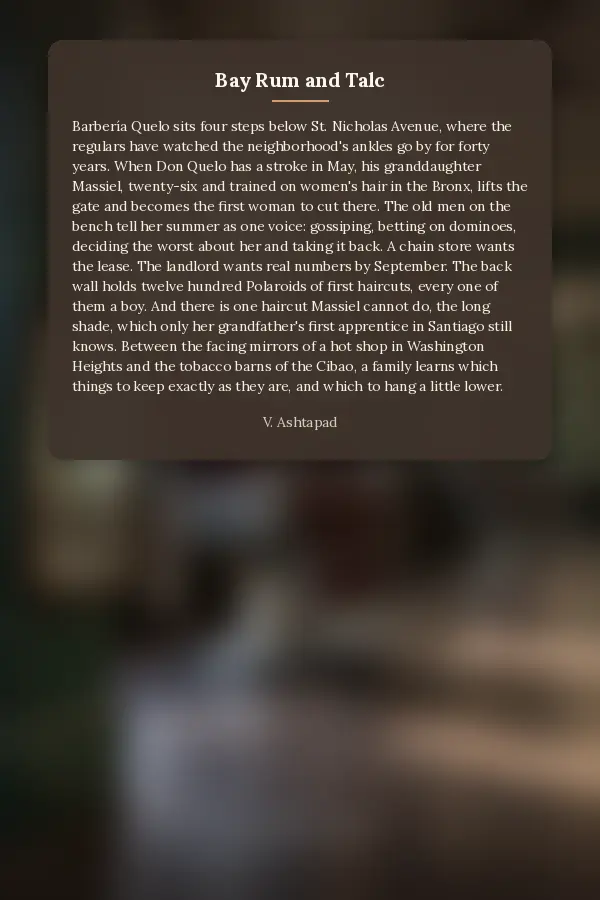
Barbería Quelo sits four steps below St. Nicholas Avenue, where the regulars have watched the neighborhood's ankles go by for forty years. When Don Quelo has a stroke in May, his granddaughter Massiel, twenty-six and trained on women's hair in the Bronx, lifts the gate and becomes the first woman to cut there. The old men on the bench tell her summer as one voice: gossiping, betting on dominoes, deciding the worst about her and taking it back. A chain store wants the lease. The landlord wants real numbers by September. The back wall holds twelve hundred Polaroids of first haircuts, every one of them a boy. And there is one haircut Massiel cannot do, the long shade, which only her grandfather's first apprentice in Santiago still knows. Between the facing mirrors of a hot shop in Washington Heights and the tobacco barns of the Cibao, a family learns which things to keep exactly as they are, and which to hang a little lower.
Members can react to this book and talk about it in the members' Library.