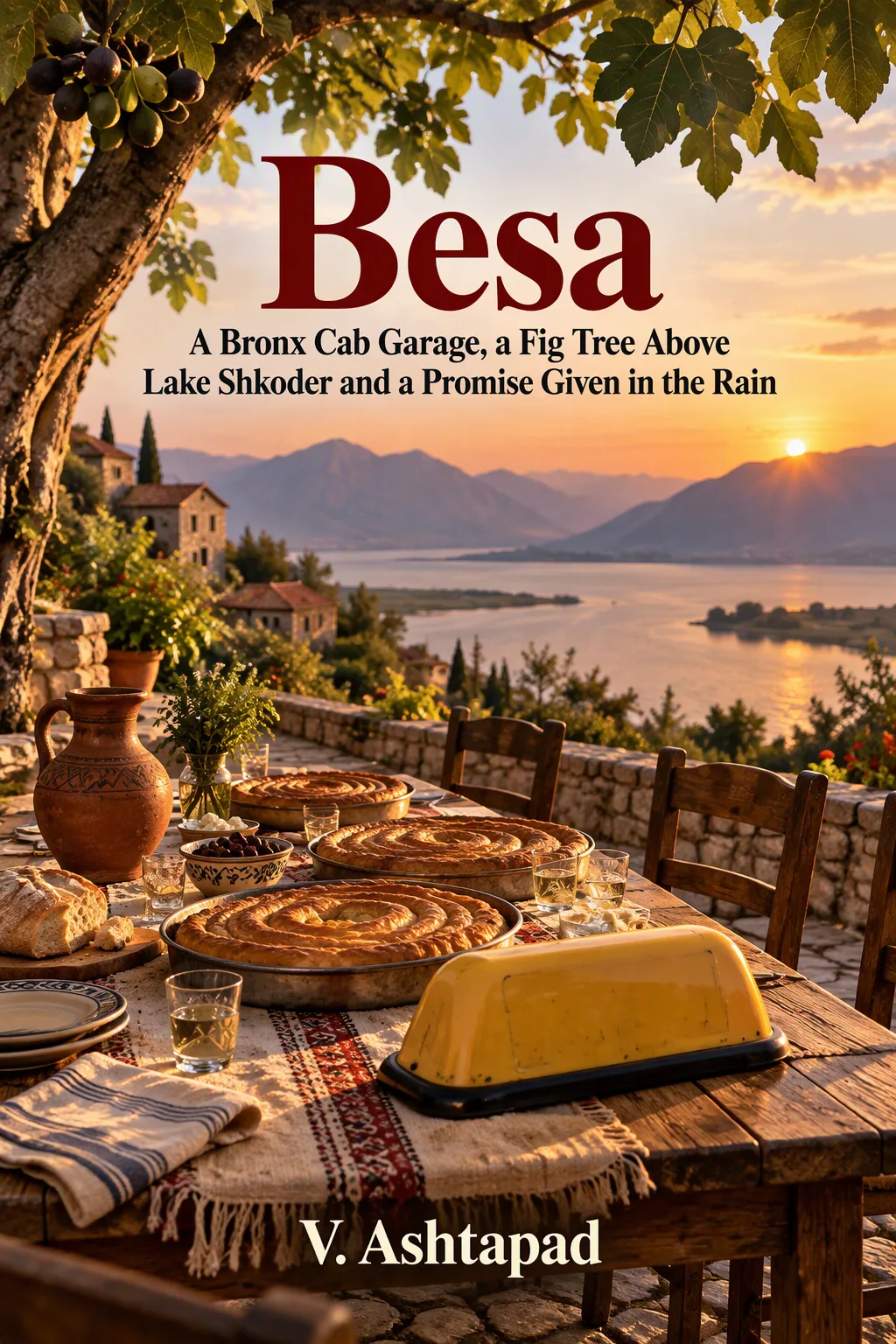
Besa
A Bronx Cab Garage, a Fig Tree Above Lake Shkoder and a Promise Given in the Rain
by V. Ashtapad
Foreword
This is a work of fiction. The Bronx is home to one of the largest Albanian communities in the United States, and besa, the Albanian word of honor, coiled burek rolled thin by hand, and the many-voiced songs held over a single drone are all real and living traditions. Lika's Garage, the families in this book and everyone in it are invented.
For everyone who opened the door before they knew who was knocking.
November
At two in the morning the rain on the roof of Lika's Garage sounds like gravel poured from a bucket, and Gjon Marku is sitting in his cab with the engine off and the dome light on, counting the night's money into a cigar box.
Eighty-one dollars in cash. A hundred and forty on cards. A Tuesday in November, the fourth, the kind of night when the whole Bronx stays home and the only fares are nurses coming off shift at the hospital on the Grand Concourse and one man in a tuxedo, alone, who asked to be driven to the end of City Island and back and did not say why. Gjon did not ask. In twenty-two years of driving a yellow cab he has learned that the fares who want to talk will talk, and the ones who don't are paying for the quiet.
The garage is on a side street below Fordham Road, a long brick shed with a tin roof and a steel door that rolls up with a scream. Fadil Lika has rented space in it to cab drivers for thirty years. There are eleven cabs parked in two rows tonight, nose to tail, smelling of wet tires and motor oil and the cold. At the back, past the lift and the tire machine, there is a room with a space heater and a table where the old men play cards on Friday and sing on Saturday, and the light in that room is on, which means Fadil is still here, asleep in his chair with the radio murmuring the news from Tirana.
Gjon snaps the cigar box shut. He is fifty-six years old. His back hurts in the place it always hurts, low on the left, where the seat spring broke in 2014 and the cab company replaced the seat but not the back. He thinks about Lindita asleep at home on Arthur Avenue, about the leftover burek she will have left on the stove under a dish towel, and he reaches for the door handle.
Someone knocks on the window.
---
It is a young man. Thirty, maybe, thin, soaked to the skin, in a jacket meant for some other weather and sneakers that have gone dark with water. He has a duffel bag over one shoulder and a piece of paper in his hand, folded small, which he is holding against his chest to keep it dry.
Gjon rolls the window down four inches.
"I'm closed," he says, in English.
The young man looks at him. He has a long face, a narrow nose, a mouth that turns down at the corners even when it is not unhappy. Something in the face goes into Gjon like a key into a lock, and turns, and stops, before he can tell what it is.
"Gjon Marku?" says the young man. In Albanian. In the accent of Shkoder, of the lake, the one Gjon hears now only on the phone to his mother on Sundays.
"Who's asking?"
The young man unfolds the paper and holds it against the glass. It is a page torn from a school notebook, with squared lines, and on it, in an old woman's careful hand, someone has written: Gjon Marku. Taxi. The garage of Fadil Lika, the Bronx, near Fordham. And under that, a phone number Gjon knows by heart, because it is his own mother's.
"My mother wrote it," says the young man. "She got it from your mother. I'm Ilir. Ilir Dedaj. Tereza's son."
The rain comes down on the tin roof.
Dedaj.
Gjon sits very still with his hand on the window crank. He has not heard that name spoken aloud by anyone but himself, in his own head, in thirty years.
---
What he knows about Ilir Dedaj fits on the page the young man is holding. His mother's youngest sister, Tereza, had a son late, at forty-one, in the spring of 1994, when Gjon was twenty-five and still lived in Shkoder and still went to his aunt's house on Sundays. He remembers a baby in a basket on a kitchen table. He remembers holding it once, at a party for the new baby, and handing it back quickly, the way young men do.
Then came the summer of 1995 and the dinner. After the dinner, the two families did not speak again. Not at weddings. Not at funerals. When Gjon's father, Ndue, died in 2010, Tereza came to the church, and sat in the back, and left before the burial, and Kol Dedaj, her husband, did not come at all.
And now Kol Dedaj's son is standing in the rain outside Fadil Lika's garage at two in the morning with a duffel bag and a piece of notebook paper.
"What do you want?" Gjon says.
He hears it come out harder than he meant, and he sees the young man hear it too. Ilir's chin goes up a little. Gjon knows that gesture. His own father did it. His mother does it still, at eighty-four, when the doctor tells her to stop salting her food.
"I came in May," Ilir says. "To work. At a restaurant in Astoria, for a man from Shkoder who knew my father. Kitchen work. It was for one year." He stops. Water runs off his hair into his eyes and he does not wipe it. "The restaurant was sold. Last week. The new owner has his own people. The room I had was over the restaurant. Today I had to leave it."
"So go home."
"My ticket home is for next November," Ilir says. "It cannot be changed without money I don't have. And I can't go home with nothing. My father is sick. His heart. He needs an operation in Tirana and the money I was sending was for that." He looks down at the paper in his hand, then back up. "My mother called your mother. I don't know what they said. Your mother gave her this. My mother told me, if I have nowhere, go to this man. She said he is the son of her sister, and that he will remember the baby in the basket."
Gjon looks at him for a long time.
The thing about a promise, his grandmother Prenda used to say, sitting under her fig tree above the lake with her hands in a bowl of dough, is that you do not choose the day it comes due. It comes like rain. It comes when you are tired and it is two in the morning and your back hurts. That is how you know it is a real one.
He rolls the window all the way down.
"Get in," he says. "Get in out of the rain."
---
Ilir gets in the back, the way a fare would, and sits with the duffel bag on his knees, dripping onto the floor mats. Gjon turns around in his seat to look at him.
"Listen to me," he says. "There is something between your father's house and mine. You know this?"
"I know there is something. Nobody ever told me what."
"Good. Then nobody will tell you now. That is between old men, and some of them are dead." Gjon holds up one hand, palm out, the way his father held up his hand to swear on things, the way men in the north have done it for longer than anyone has written down. "But you came to my door. So hear me. My house is your house until you are on your feet. A month, if it takes a month. A year, if it takes a year. Besa."
Ilir stares at him. He is young, and from the city, and Gjon can see that he has heard the word all his life in songs and in the stories old men tell at weddings, and never once said to his face.
"Besa," Ilir says, quietly. And then, because he does not know what else to do, he puts out his hand, and Gjon takes it over the seat back, and it is cold as the lake in March.
From the back room, past the lift, Fadil Lika's voice calls out in the accent of the south, of Gjirokastër and its stone roofs, thick with sleep: "Gjon? Who is it? Who are you talking to?"
"Family," Gjon calls back.
He starts the engine.
---
Lindita is awake when they come in. She is always awake when he comes in; she says she sleeps better after she hears the key. She is standing in the kitchen doorway in her bathrobe with her hair in a braid over her shoulder, fifty-two years old and still able to see everything in a room at once, and she looks at Gjon, and at the wet young man behind him, and at the duffel bag, and her face asks the question.
"This is Ilir," Gjon says. "Tereza's son."
Lindita's eyebrows go up very slowly.
"Dedaj," she says.
"Dedaj."
She looks at him for a long time, the same long look he gave the young man in the rain. Lindita is from Shkoder too. She was at the dinner in 1995. She was a girl of twenty-two, a friend of the bride who was going to be, and she remembers it better than anyone.
Then she turns and lifts the dish towel off the pan on the stove. Under it is half a burek, the spinach and cheese one she makes on Tuesdays, cold now, the top crust gone soft and gold.
"Sit," she says to Ilir. "You'll eat. Then a towel. Then the couch. Dren's old room is full of boxes. Tomorrow we'll see."
"Thank you," says Ilir. "Zonja. Thank you."
"Don't thank me," says Lindita. "Thank my husband. He's the one who's going to have to explain it to his brother."
© 2026 CRUNOD LLC. All rights reserved.
December
Pashko Marku finds out on the eighth of December, a Monday, from a cousin's wife who saw Ilir carrying groceries up Arthur Avenue with Lindita and recognized the Dedaj nose.
He comes to the garage at four in the afternoon, when Gjon is changing his wiper blades, and he does not take off his coat.
Pashko is fifty-one, five years younger than Gjon and wider, with a belly from nearly twenty years of owning a pizzeria on Williamsbridge Road and a voice built for shouting orders over the ovens. He was twenty-one in 1995. He was in the room. When their father stood up from the table that night, Pashko stood up with him, and he has been standing ever since.
"Tell me it's not true."
"It's true."
"In your house. Sleeping in your house. Eating at your table. The son of Kol Dedaj."
"On my couch," says Gjon. "Dren's room is full of boxes."
"Don't joke. Don't you dare joke with me." Pashko's face has gone a dark red, all the way to his ears. "You know what that man said to our father. You were there. You know what he did to you after. Valbona—"
"I know what I know."
"Then put him on the street."
Gjon fits the new blade into the arm and clips it. It makes a small satisfying sound. He does the other side. Behind him, under the lift, Fadil Lika has stopped working on a transmission and is pretending very hard to be invisible.
"I gave my word," Gjon says.
"To who? To the son of a snake?"
"To the boy who stood at my window in the rain."
Pashko stares at him. Then he says something Gjon will remember for a long time, not because it is cruel but because it is the thing their father would have said, in exactly that voice, with exactly that lift of the chin.
"Then you're not a Marku," says Pashko. "You're a cab driver."
He walks out. The steel door screams up and screams back down behind him.
Fadil comes out from under the lift, wiping his hands.
"Your brother," he says, "has a very loud door."
"It's your door."
"Today," says Fadil, "it's his."
---
Christmas is at Pashko's. It has been at Pashko's for fifteen years, since their father died, in the big house in Pelham Gardens with the stone lions on the steps. Pashko's wife, Drita, makes flija for thirty people, the old northern dish of thin batter layers baked one at a time under a hot lid, a whole afternoon's work, and lamb, and the round loaves with the patterns pressed in, and after the meal the men sit in the den and drink raki and argue about football and the women sit in the kitchen and argue about everything else.
On the twenty-third of December, Drita calls Lindita. Gjon hears half of it from the hallway.
"Of course we're coming." A pause. "Ilir too, yes." A longer pause. "I understand. No, Drita, I understand." A long silence. "Then I'll come with the children for an hour. Gjon stays home."
She hangs up and stands for a moment with her hand on the phone.
"He says not the boy," she says. "He says if the boy comes, he will stand up and leave his own table."
"Then you go. You and the kids."
"And you sit here on Christmas Eve with a Dedaj."
"With a cousin," says Gjon. "My mother's sister's boy."
Lindita looks at him the way she looks at a recipe that has come out wrong. Then she shakes her head and goes into the kitchen, and he hears the big bowl come down from the cabinet over the stove, and the flour bin open.
---
So on Christmas Eve, a Wednesday, Lindita takes Arta and Dren to Pashko's at four, with a plate of baklava wrapped in foil, and is back by six, early, before the raki, and finds the kitchen table set for five.
Ilir has cooked. He has made fish the lake way, the way they do it in Shkoder, a carp from the market on Arthur Avenue baked whole with onions and tomatoes and bay leaves. Gjon has made nothing; Gjon cannot cook, and has stood in the kitchen doorway for an hour giving advice that nobody took. Fadil Lika has come, because Fadil's wife died four years ago and his children are in Toronto and Michigan and he will not go to anyone's house where there are grandchildren, he says, because it makes him eat too much. He has brought a bottle of raki from his village that he keeps for funerals and the birth of sons.
"Christmas," he says, "is close enough."
And Lindita has made burek. Two of them, one cheese and one meat, in the big round pan, the layers rolled out by hand on the kitchen table this morning until you could read the newspaper through the dough, the way her mother-in-law taught her, the way Gjon's grandmother Prenda taught his mother.
She sets them on the table and cuts them. The crust shatters under the knife.
Ilir looks at the burek. He looks at it for a long moment, at the way the dough has been folded, at the spiral of it, a coil laid round and round the pan from the center out like a sleeping snake.
"My mother makes it like this," he says. "With the coil. Everyone else in Shkoder makes the flat layers. But my mother rolls it. She says her mother did."
Lindita, with the knife in her hand, goes very still.
"So did mine," says Gjon. "So did my mother's mother. Prenda. Your grandmother too."
They all look at the burek.
"It's the same hands," says Fadil, after a while, softly, in his southern accent. "That's all. Two kitchens, thirty years, no talking. And it's the same hands."
Arta, who is twenty-four and teaches third grade in a school off Tremont Avenue and who has been watching all of this with the expression of a person taking notes for later, says, "Can we please eat? I didn't get anything at Uncle Pashko's. Nobody would sit down. Uncle Pashko kept looking at the door."
© 2026 CRUNOD LLC. All rights reserved.
January
Snow comes on the seventeenth of January, a Saturday, the first real snow of the winter, eleven inches by nightfall, and the Bronx goes white and silent and every cab in Fadil Lika's garage stays parked.
Ilir has been working at the garage since the second week of December. It was Fadil's idea. Fadil had watched him for three days, sitting in the back room drinking coffee and waiting for Gjon's shift to end, and on the fourth day he had handed him a wrench and pointed at a cab with a bad alternator.
"You know engines?"
"Boat engines," Ilir said. "I worked on the ferry on Lake Koman for six years. Before the restaurant."
"A boat engine," said Fadil, "is a car engine that went to sea and got proud. Fix that."
He fixed it. Then he fixed a radiator, and a starter motor, and a cab that had been making a noise for a month that nobody could find, which turned out to be a pigeon's nest in the air intake, empty, built from cigarette filters and a single blue hair ribbon. Fadil pays him in cash at the end of the week, not much, and Ilir sends almost all of it home by wire on Fridays from the shop on Crescent Avenue, and keeps twenty dollars for himself, and gives Lindita forty for food, which she accepts without comment and puts in a coffee can on top of the refrigerator labeled ILIR in marker.
"What's that for?" Gjon asks her.
"For when he goes," Lindita says. "He'll need it. He won't know he has it."
---
On the night of the snow, the old men come to the garage anyway. They come on foot through the drifts from their apartments on Bainbridge and Kingsbridge and Valentine, seven of them, in fur hats and scarves and two pairs of gloves, because it is Saturday, and on Saturday they sing.
Gjon has been coming to the Saturday nights for twenty years without singing. He sits at the card table and drinks his coffee and listens. The songs are not his. They are from the south, from Fadil's mountains around Gjirokastër and the villages of Labëria, and they are sung the southern way, in parts, three or four voices weaving over a long held drone.
That drone is the iso. Fadil explained it to him years ago. Everyone else sings the song. The iso holds one note under it, low, steady, on a single breathed vowel, without stopping, for as long as the song lasts. The singers go up and down over it and around it, the leading voice and the one who answers and the one who turns the song, and the iso does not move. Gjon tried it once, in 2009, after a funeral, with raki in him. He lost the note in twelve seconds and laughed so hard Fadil had to slap his back.
"The north," Fadil says, every time, mournfully. "You people sing alone. One man, a lahuta, a mountain. You don't know how to stand under someone else's song."
Tonight, with the snow muffling the street outside and the space heater ticking and the light from the one bulb falling on the card table, Fadil starts the first song, a long lament about a shepherd and a well, and the old men come in under him, and Gjon sits with his coffee, and then Ilir, who has been sitting in the corner on an upturned crate, opens his mouth and comes in on the answering line.
He does it softly at first. Then not softly.
The old men look at each other. Fadil does not stop singing, but his eyebrows go all the way up.
The song goes on. Ilir's voice is high and clear, with a roughness at the bottom of it like the grain in wood. It is not a southern voice. It is a voice from the lake, from the boats, from the north, and it has no business in this song, and it fits in it anyway, sliding between Fadil's lead and the old men's drone like water finding the low places in a field.
When the song ends nobody speaks. The space heater ticks. The snow hisses against the high window.
"Where did you learn that?" Fadil says.
"On the ferry," Ilir says. He is embarrassed, Gjon can see, his ears pink. "There was a captain from Vlorë. He sang all day. Six years. You learn."
Fadil looks at him for a long time with his old eyes that have seen a great many young men come through this garage.
"You," he says at last, "sing the second voice. Every Saturday." Then he turns to Gjon. "And you. Northern man. You will learn the iso."
"I can't hold it. You know I can't."
"You can hold a promise to a Dedaj for three months," says Fadil, "against your own brother. You can hold one note."
---
Gjon cannot hold one note.
He tries for the rest of January. Every Saturday, under the bulb, with the old men singing and Ilir's voice going up and down above him like a bird over a lake, he takes a breath from the bottom of his belly and makes the sound, a long low eh, and holds it, and holds it, and somewhere around the fifteenth second his voice begins to climb on its own, pulled up toward the song like a dog straining on a leash, and he loses it.
"Again," says Fadil.
"I'm fifty-six years old."
"The iso doesn't care how old you are. It only cares if you stop."
On the last Saturday of January, the twenty-fourth, Gjon holds it for forty seconds. The old men keep singing over him and Ilir's voice goes up and turns and comes down, and he feels for the first time how it works, how the song leans on the drone the way a man leans on a wall, how the drone does nothing at all except stay where it is, and how the whole song would fall down without it.
He loses it at forty-one seconds. He coughs.
But Fadil, at the end of the song, reaches over and pats him on the knee twice, which in twenty years he has never done.
---
That night, driving home through the plowed streets with Ilir in the passenger seat, with the snow piled gray along the curbs and the streetlights buzzing orange and the Bronx so quiet you can hear the tires on the slush, Ilir says, "Can I ask you something?"
"You can ask."
"What happened? At the dinner. In 1995."
Gjon drives for three blocks. A plow passes the other way with its yellow light turning.
"Not yet," he says.
"When?"
"When I can tell it without making your father the devil," says Gjon. "I'm not there yet."
© 2026 CRUNOD LLC. All rights reserved.
February
He tells it in February anyway, in the cab, at three in the morning, on the fifteenth, a Sunday, because Ilir has asked him to drive him out to see the water.
That is the thing Ilir misses most, he says. Not his mother, not his father, not the food. The water. Six years on Lake Koman, on the ferry that goes up through the gorge between mountains that stand straight up out of the lake like the walls of a fortress, the water green as bottle glass, so still in the mornings that the boat seems to be sailing through the sky upside down. And before that, a childhood on the shore of the big lake at Shkoder, with the mountains on the far side going purple at evening and the fishermen out in their long flat boats.
"There's no water in the Bronx," Ilir says.
"There's plenty of water," says Gjon, and drives him to Orchard Beach.
At three in the morning in February Orchard Beach is a long empty crescent of frozen sand under a few streetlights, and the Long Island Sound beyond it is black and moving, with the lights of Queens far off on the left. Gjon parks in the empty lot and leaves the engine running for the heat. They sit and look at the water.
"It's the sea," says Ilir. "It's not a lake."
"It's close enough."
"It moves too much."
"So go home," says Gjon, and they both laugh, and then for a while they don't.
---
"Your grandmother Prenda had a house," he says at last. "Above the lake. On the hill over a village on the shore, south of the city. A stone house, two rooms, with a fig tree in front that was older than her and six olive trees down the slope. You've been there?"
"Once. When I was small. My father took me. He stood at the gate and didn't go in."
"She died in the spring of 1993. No paper. No will. In those years, nobody had paper for anything. She had two daughters living. My mother, Mrika, the oldest. Your mother, Tereza, the youngest. Everybody said, it goes to the daughters, half and half. That was simple. What wasn't simple was the husbands."
Gjon rubs his eyes. The heater blows on his ankles.
"Your father wanted to sell it. He had a man from Tirana who wanted to build a guesthouse, for foreigners, for the view. Good money. More money than either family had seen. My father said no. My father said Prenda was born in that house and her mother was, and you don't sell the fig tree your grandmother sat under to a man from Tirana so he can put foreigners on it. They argued about it for two years."
"And then the dinner."
"And then the dinner." Gjon looks out at the black water. "June 1995. My engagement. I was twenty-six. Her name was Valbona Gjeka. A teacher's daughter, from your father's village. Your father knew her family; her mother was his cousin. He was the one who introduced us, at a wedding. He was happy for us. Really happy. He gave a toast."
"So what happened?"
"Raki happened," says Gjon. "The dinner was at our house. Forty people. And at the end, with the raki, my father stood up and made a toast to the family, and he said something about the house above the lake. He said, here's to a family that knows what can't be sold. And he looked at your father when he said it."
Ilir closes his eyes.
"And your father stood up," says Gjon, "and he said, here's to a family that would let a fig tree rot before it would share its shade. And then he said—" Gjon stops.
"Say it."
"He said, and here's to the groom. A good boy. He'll never be more than a man who drives other people where they want to go." Gjon laughs, once, without much in it. "I was driving a delivery van for the brewery. It was a joke. He meant it as a joke, maybe. Half. But my father heard the other half. He told your father to get out of his house. Pashko stood up. I stood up. Your mother was crying. My mother was crying. Your father took your mother and the baby, you, in the basket, and he left. And two weeks later Valbona's father came to our house and gave back the ring."
The Sound moves in the dark. Far out, a single boat light blinks.
"Everyone knew why," Gjon says. "Your father had been to see them. Everyone said so. He went to the Gjeka house and he told them the Marku were a family with no future and a son who would drive a van his whole life. And her father listened. And that was that. In the spring I came here. I've driven a cab for twenty-two years." He looks at Ilir. "So your father was right about me, in the end."
Ilir is quiet for a long time.
"Did you ask him?" he says. "My father. If he went to the Gjeka house?"
"My father would have disowned me for speaking to him."
"Did you ask Valbona?"
Gjon opens his mouth and closes it. The heater blows. The boat light out on the Sound has gone.
"No," he says.
---
They drive home along Pelham Parkway in the first gray light. At a red light on White Plains Road, Ilir says, without looking at him, "When I came to your window in November, did you know? That it was me?"
"I knew the face before you said the name."
"And you still said besa."
"You knocked," says Gjon. "That's the whole law. Somebody knocks, you open. It doesn't ask what their father said at a dinner thirty years ago." The light turns green. He drives. "My grandmother used to say the door doesn't know who's on the other side. That's what makes it a door."
"She was my grandmother too."
"I know," says Gjon. "That's the trouble."
---
At home, at six in the morning, Lindita is up, as always. She is standing at the kitchen table in her robe, rolling out dough for Sunday's burek with the long thin rolling pin, the oklagija, that came from Shkoder in her suitcase in 1997. Thirty years of hands have worn it smooth as bone.
Ilir stands in the doorway watching her.
"Can I?" he says.
Lindita looks at him. Then she moves over.
He takes the rolling pin. He lays a ball of dough on the floured table and begins, the way Gjon has seen his mother begin and his grandmother before her, pressing from the center out, turning the dough a quarter turn, pressing again, and then wrapping the edge of the sheet around the pin and rolling it forward and back, forward and back, so the dough thins and stretches and grows across the whole table, round and pale and so thin the grain of the wood shows through.
Lindita watches him with her arms folded.
"Your mother taught you."
"She said a man who can't make burek will starve on the boats. She was right. The captain from Vlorë couldn't. He ate bread and onions for six years."
Lindita laughs, a real laugh, surprised out of her.
Gjon goes to bed. He lies in the dark with his back aching in the place it always aches and listens to the rolling pin in the kitchen, forward and back, forward and back, and to his wife's voice and the young man's voice talking low over the table, and he does not think about Valbona Gjeka at all, or tells himself he doesn't, until he is asleep.
© 2026 CRUNOD LLC. All rights reserved.
March
Kol Dedaj calls on the eighth of March, a Sunday, at seven in the morning New York time, which is one in the afternoon by the lake, and Gjon knows who it is before he answers, because nobody else in the world would call a cab driver at seven on a Sunday morning except a man who has decided to do a hard thing and wants to get it over with before lunch.
He takes the phone out onto the fire escape so as not to wake the house. The air is raw and gray. Down on the street a man is hosing the sidewalk in front of the bakery, and the smell of bread comes up five stories.
"Marku," says the voice on the phone.
It is an old man's voice now. Thinner than Gjon remembers, with a wheeze at the edges. But it is the same voice that stood up at the table in June 1995 with a glass of raki in its hand.
"Dedaj," says Gjon.
There is a long silence on the line, full of the sound of a television in another room, on another continent, and a woman's voice calling something, and a rooster, very far off.
"My son is in your house," says Kol.
"He is."
"I didn't ask you for this."
"No," says Gjon. "Your son did. He knocked on my window at two in the morning in the rain. He had a paper in my mother's handwriting. Your wife's handwriting. One of them."
"Tereza's," says Kol. "Your mother gave her the address. I didn't know until he was already there." The wheeze gets worse, and he stops to breathe. "I want him to come home."
"Then tell him."
"I've told him. He doesn't listen. He says he has a ticket for November and he has work and he is sending money." Kol's voice goes rough. "He's sending money for my heart. Did you know this? The doctors in Tirana say I need a valve. My son is in your garage fixing taxis so a surgeon can cut me open. I would rather die in my chair."
"That's between you and him."
"It's between me and you," says Kol Dedaj. "He's under your roof. That makes it yours. That's the law."
Gjon looks down at the street. The man with the hose has finished and is coiling it on a hook by the bakery door, slowly, like a man winding up a long thought.
"The law," Gjon says, "is that he knocked and I opened. I gave him my word. Until he's on his feet. A year, if it takes a year. I don't take my word back because his father calls me at seven in the morning thirty years too late."
There is a silence so long Gjon thinks the line has gone dead.
Then Kol says, "You sound like Ndue."
"I'll take that."
"I didn't mean it as a compliment."
"I know," says Gjon. "I'll take it anyway."
Kol hangs up. Gjon stands on the fire escape with the phone in his hand and his heart going like a man who has run up five flights of stairs, though he has only been standing still.
---
His mother calls at noon. She calls every Sunday at noon, which is six in the evening in Shkoder, after her supper, and has done since he left in 1996, and in thirty years she has missed four Sundays, three for hospitals and one for a wedding in Ulcinj.
Mrika Marku is eighty-four. She lives in the old house in the old quarter of the city, on a street of high stone walls and iron gates, with Gjon's sister Lule, who is forty-eight and a nurse and has never married and says she never will because she has already raised one stubborn old person and has no time for another. His mother's voice on the phone is the same as it has always been, high and quick and full of small exclamations, and her mind is as sharp as a fish knife.
"He called you," she says, before Gjon has said anything.
"How do you know?"
"Because Tereza told me he was going to. Yesterday."
Gjon sits down on the edge of the bed.
"Mama," he says slowly, "how often do you talk to Tereza?"
There is a pause on the line. He can hear his mother deciding.
"Every Sunday," she says. "Since October. Since before the boy went to your garage. She called me in October when the restaurant was in trouble, to ask what to do. I said, send him to Gjon. And then we kept talking. Every Sunday. After you, I call her." Another pause. "Thirty years, Gjon. Thirty years I didn't hear my baby sister's voice. Because of two men and a house and a glass of raki. And now I'm eighty-four and she's seventy-two and we talk on Sundays like girls."
"You never told me."
"You never asked. Nobody in this family asks anything. They just stand up and walk out." His mother clicks her tongue, a sound he has known since before he could talk. "Your father. Your brother. Kol. All the same. Like roosters on a wall."
"And me?"
"You," says his mother, "opened a door. Prenda would be happy. She would cry. She cried at everything, your grandmother. She cried when the figs came in." Her voice changes. "Is he eating? Ilir? Tereza worries. He's thin."
"Lindita feeds him like a goose."
"Good. Tell her, from me, more salt in the cheese. She never uses enough."
---
That afternoon Arta comes to Sunday lunch, as she does, and sits at the kitchen table with her laptop open next to her plate, grading spelling tests from her third graders, and listens to her father tell her mother about the phone calls.
"So Grandma and Aunt Tereza have been talking all along," she says. "Since October. And nobody knew."
"Nobody knew."
"That is so this family." Arta puts down her red pen. She has her mother's eyes, the kind that see a whole room, and her father's way of tilting her head when she is about to say something nobody will like. "Dad. Can I ask about Valbona?"
Lindita goes still at the stove.
"What about her?"
"Ilir told me. The engagement. The ring." Arta looks from her father to her mother and back. "Everybody always says Kol Dedaj went to her family and ruined it. But did anybody ever actually ask her? I could find her. It would take me ten minutes. Everybody's online."
"No," says Gjon.
"Why not?"
"Because she is a woman in her fifties with a life," he says. "And I am a married man of fifty-six with a daughter who grades spelling tests at lunch. And it was thirty years ago. And because it's not your business."
Arta looks at her mother. Lindita has turned back to the stove and is stirring a pot of beans with great attention.
"Mom?"
"Your father said no," says Lindita, without turning around. And then, after a moment, very quietly, so that only Arta could have heard it, if she was listening, which she was: "For now."
© 2026 CRUNOD LLC. All rights reserved.
April
Pashko comes to the garage again on the twelfth of April, a Sunday, at closing time, and this time he takes off his coat.
Gjon is alone. Ilir has gone with Dren to a soccer game in Van Cortlandt Park, a league of Albanian teams that plays every Sunday in spring, and Fadil has gone home to sleep. The steel door is half down. The cabs sit in their rows in the long dim shed, and the last of the light comes slanting in under the door across the oil-stained concrete, gold and full of dust.
Pashko folds his coat over the back of a chair in the card room and sits down at the table where the old men sing. He looks at it, at the scarred wood, the rings from twenty years of coffee cups. He has never been in this room. He doesn't drive.
"Drita says I'm being a fool," he says.
"Drita's a smart woman."
"She says it every night. In bed. With the light off, so I can't see her face." Pashko rubs his own face with both hands. He looks tired, older than fifty-one, gray at the temples in a way Gjon has not noticed. "I'm not here to fight."
"Then why are you here?"
Pashko is quiet for a long time. A pigeon walks in under the half-closed door, looks around, and walks out again.
"Do you remember," Pashko says at last, "what Papa did after the dinner? After everyone left?"
"He went to bed."
"No. That's what you remember because you went to bed. You went to your room and shut the door and you didn't come out until the next afternoon." Pashko looks up at him. "I stayed. I was twenty-one. I sat in the kitchen with him. All night. Mama went to bed crying. And Papa sat at the table with the bottle and he didn't drink it. He just sat there. And around four in the morning he started crying. Our father. I'd never seen it. Not when his own father died. Not ever. He cried like a child, Gjon, with his face in his hands, at the kitchen table, and he said, I've lost my wife's sister. I've lost my wife's sister and my son's bride in one night, over a fig tree."
Gjon sits down slowly across from his brother.
"He never told me that."
"He made me promise not to. He said, your brother has enough. Let him go to America and start over. So I stayed. For ten years I stayed with him in Shkoder, before I came here, and every time someone said the name Dedaj in his hearing, he went gray. And when he was dying, in 2010, I flew home and sat with him in the hospital, and he asked if Tereza was coming. And she came. She sat in the back. And he was already gone." Pashko's jaw works. "And Kol never came. Not to the hospital. Not to the funeral. Never."
The light under the door has gone from gold to gray.
"So I'm holding his side," says Pashko. "That's all. Somebody has to. He can't hold it himself anymore. If I stop holding it, then it's like it never happened, all those years he went gray. Then it was nothing."
Gjon looks at his brother across the old men's table. He thinks of the iso, the drone, the one note held under the song while everybody else goes up and down. How it doesn't do anything. How it only stays.
"Pashko," he says. "It wasn't nothing."
"Then why are you feeding his son?"
"Because the boy didn't do it," says Gjon. "Because the boy was in a basket. Because if Papa sat up all night crying about losing Tereza, then maybe Papa would want somebody in this family to stop losing her."
Pashko stares at him.
"That's a nice speech," he says finally. "You should have been a lawyer instead of a cab driver."
"Kol Dedaj said I'd never be more than a cab driver."
"Kol Dedaj," says Pashko, and stands up, and puts on his coat, "was wrong about a lot of things. But he was right about that." At the door he stops, with his hand on the chain that raises it. "I'm not saying you're wrong. I'm saying I can't. Not yet. Tell Drita I came. She'll want to know."
He hauls the chain. The door screams up. He goes out under it into the April evening, and the door screams down, and Gjon sits alone at the singing table until it is full dark.
---
Ilir comes back at nine, sunburned and limping, because Dren put him in as goalkeeper and the team from Staten Island had a striker built like a refrigerator. He finds Gjon still in the card room with the light off.
"Your brother was here," he says. It isn't a question. "Fadil's neighbor saw him."
"He was here."
"About me."
"About our father." Gjon reaches over and switches on the bulb. In its yellow light Ilir's face is pink with sun and tired and worried. "Sit."
Ilir sits.
"I want to ask you something," says Gjon. "Your father. Did he ever say anything about mine? In all those years. Anything at all."
Ilir thinks about it for a long time. He is a careful young man, Gjon has learned, careful with his words the way he is careful with an engine, turning each one over before he puts it in.
"Once," he says. "I was maybe twelve. We were on the lake, in my father's boat, fishing for carp. Early. The mist was still on the water and you couldn't see the mountains. And a boat came past us in the mist, an old man rowing, alone. My father watched him go. And he said, that's how Ndue Marku rowed. With his back so straight. Like a soldier." Ilir stops. "I asked him who Ndue Marku was. He said, nobody. A man I used to know. And he didn't talk the rest of the morning."
Gjon sits very still under the bulb.
"My father rowed like that," he says. "He did. Exactly like that. Like he was being watched by the whole lake."
© 2026 CRUNOD LLC. All rights reserved.
May
On the ninth of May, a Saturday, at six-fifteen in the evening, on the Bruckner Expressway in the left lane with a fare in the back going to LaGuardia, Gjon's cab makes a sound like a man stepping on a tin can, and then a sound like nothing at all, and coasts, with no power, across three lanes of honking traffic onto the shoulder below the Hunts Point exit.
The fare, a businessman with a roller bag, gets out and stands on the shoulder and calls for another car on his phone without looking at Gjon. Gjon calls Fadil.
"Transmission," says Fadil, an hour later, lying on his back on a creeper under the cab in the garage, after the tow truck has gone. "Finished. Dead. Gone to the big junkyard." He slides out and sits up, wiping his hands on a rag. "A new one, installed, from the dealer, thirty-eight hundred. Maybe four thousand."
Gjon sits down on an oil drum.
Four thousand dollars. He does the arithmetic in his head the way he has done it every month for twenty-two years: the lease on the medallion, the insurance, the gas, the garage, Dren's tuition, the rent on Arthur Avenue, the money he sends his mother on the first of each month, the money he has not sent Pashko for his share of their father's stone because Pashko won't take it. Four thousand dollars is two months of his life. And without a cab, there is no month.
"A used one," says Ilir. He is standing by the lift with his arms folded, looking at the cab as if it were a patient. "From a junkyard. There's a yard in Hunts Point; I've been there with Fadil for parts. They have three of this model, wrecked from the front. The transmissions are probably good. Four hundred dollars. Maybe five."
"And to put it in?"
"Me," says Ilir. "And Fadil. Three nights. Maybe four."
Fadil looks at him, then at Gjon, and shrugs the shrug of the south, the whole upper body involved. "The boy can do it," he says. "I've watched him. He has good hands. Better than mine now."
---
It takes four nights.
Gjon cannot help. He doesn't know engines. He has driven a car for thirty-five years and could not tell you what a transmission looks like if it sat down next to him on the subway. So he sits on the oil drum under the hanging work light with a thermos of coffee Lindita sends, and he hands them things when they ask, and he watches.
The garage at night is a different place. The other drivers are out on the roads, and the long brick shed is nearly empty, and the sounds of the Bronx come in faintly through the high windows: the elevated train on Jerome Avenue, a siren, somebody's radio, a dog. Under the cab on the lift, in the white light, Ilir and Fadil talk in low voices in a language that is half Albanian and half the names of parts. Ilir's hands are black to the wrist. He works the way he sings, Gjon thinks. Carefully, then not carefully, then exactly.
On the second night, around two in the morning, Fadil goes home to sleep, and Gjon and Ilir are alone.
"Tell me about the ferry," Gjon says.
Ilir is lying on the creeper under the cab with a socket wrench. His voice comes up from under it, muffled.
"It's a car ferry, old, from the sixties, I think. It goes from the dam at Koman up the lake to Fierza. Two and a half hours. The lake isn't really a lake. It's a river they stopped with the dam, so it's long and narrow and winding, and the mountains come straight down into it on both sides. Sometimes the walls are so close you think the boat won't fit. And the water is green. Not blue. Green like—" He stops, thinking. "Like the inside of a grape."
"I've never been."
"You're from Shkoder and you've never been on the Koman ferry?"
"I was poor," says Gjon. "And then I was here."
Ilir slides out from under the cab and lies on the creeper looking up at him, his face streaked with grease.
"In the mornings," he says, "before the tourists, it's only the people from the villages up the lake. Old women with chickens in boxes. Men with sacks of flour. A schoolteacher, sometimes. Kids going to school in Fierza. And the captain would sing. Every morning when we came around the first big bend, where the cliffs open and you see the whole lake going up into the mountains, he would sing. The same song. About a girl who waits at a well for a man who went away to work in a foreign country, and he doesn't come, and he doesn't come, and she keeps going to the well."
"And does he come?"
"Nobody knows. The song stops before you find out." Ilir smiles a little. "The captain said that's the point. That's why it's still a song."
Gjon looks at the cab hanging on the lift above them, its insides opened to the light.
"Your father said I'd never be more than a man who drives other people where they want to go," he says.
Ilir is quiet.
"I've been thinking about that," says Gjon. "For thirty years I thought it was the worst thing anyone ever said to me. And maybe he meant it that way. But I've driven, I don't know, two hundred thousand people. Nurses home from the night shift. Mothers to the hospital having babies; I've had two born in the back of this cab. Old men to their wives' graves on Sundays. A man in a tuxedo to the end of City Island and back. Kids to the airport going home." He turns the thermos cup in his hands. "Maybe it's not such a small thing. Taking people where they want to go."
Ilir looks at him from the creeper for a long time.
"Your ferry captain," says Gjon, "he takes people where they want to go."
"Yes."
"So." Gjon shrugs. "Same job. Different water."
Ilir laughs, and slides back under the cab, and the wrench starts again, click, click, click, a small steady sound in the big quiet garage, like a clock.
---
On the fourth night, at a quarter to five in the morning, Ilir lowers the cab off the lift and turns the key, and the engine catches and settles into its rumble, and he puts it in drive and rolls it forward six feet across the concrete, and it goes.
He gets out and stands beside it with his black hands hanging at his sides, looking at it, saying nothing. Gjon stands up off the oil drum. His back cracks.
"Four hundred and sixty dollars," says Ilir. "For the part. I paid for it from the can."
"What can?"
"The coffee can. On your refrigerator. With my name on it. Lindita gave it to me Tuesday and told me it was mine. I didn't know there was any money in it." He looks at Gjon. "There was sixteen hundred dollars. I used four sixty. The rest I'll put back."
"Ilir—"
"Besa goes both ways," says Ilir. "That's what my father says. You give a man your word, and he owes you his." He wipes his hands on a rag, slowly. "So I owe you a transmission."
Gjon looks at the young man in the white light of the garage at a quarter to five in the morning, the son of Kol Dedaj, with grease to his elbows and his mother's careful mouth, and finds he cannot say anything at all.
© 2026 CRUNOD LLC. All rights reserved.
June
The engagement of Pashko's daughter Elira to a dentist from Yonkers is on the thirteenth of June, a Saturday, in the party room of a restaurant on City Island with a view of the water, and Gjon is not going.
He is not going because Drita has called Lindita again, crying this time, and said that Pashko says the same thing as at Christmas: if the boy comes, he will stand up at his own daughter's engagement and leave, and Elira will never forgive any of them, and please, Lindita, please, just this once, for the girl.
"So go," Gjon says. "All of you. Take Ilir's gift."
Ilir has bought a gift. A set of six small coffee cups, white with a gold rim, from the shop on Arthur Avenue that sells everything a bride could need. He has wrapped it himself in paper with silver bells and written a card in his careful hand: For Elira, with every good wish for your new home, from your cousin Ilir Dedaj. Gjon has seen the card. He has seen how long Ilir took over the word cousin.
"And you?" says Lindita.
"I have plans."
---
His plans are to sing.
Fadil's old men have been asked, for the first time in their twenty years of Saturdays, to sing in public: at a summer gathering of Albanian families in a park in the north Bronx, on a field by the parkway, with grills and folding tables and children everywhere and a little wooden stage where a man from Kosovo plays the clarinet so well the old women weep into their napkins.
There are seven old men. And Ilir, on the second voice. And Gjon, who has been practicing the iso for five months every Saturday under the bulb, and who, two weeks ago, held it for the whole length of the shepherd's lament, three minutes and twenty seconds, without climbing once.
"You're ready," Fadil told him that night.
"I'm not."
"Nobody's ready," Fadil said. "Ready is just a word for afraid that's had its hair combed."
So on the afternoon of the thirteenth of June, while his wife and his children are on their way to City Island with a box of six coffee cups wrapped in silver bells, Gjon Marku stands on a wooden stage in a park in the Bronx in a white shirt that Lindita ironed, between an old man from Tepelenë and an old man from Delvinë, with Ilir Dedaj on the end, and two hundred people on folding chairs and blankets in front of him, eating grilled meat and looking up, and his heart is going so hard he can see his shirt move.
Fadil starts the song. It is the one about the well. The one the ferry captain sang. Ilir asked for it.
The old men come in under Fadil, and Gjon comes in under them, at the very bottom, on the long low sound, eh, and holds it.
He holds it. The song goes up over him. Fadil's lead, high and cracked and full of the mountains of the south. Ilir's answer, clear and northern, from the lake. The old men's voices weaving and turning between them, around the girl and the well and the man who went away to work in a foreign country and did not come, and did not come. And under all of it, Gjon, holding one note, doing nothing at all except staying where he is.
He feels it again. How the song leans on him. How it can go anywhere because he is not going anywhere.
He thinks of his father at the kitchen table at four in the morning in June 1995, crying for his wife's sister. He thinks of his brother, holding their father's side for thirty years because their father cannot hold it anymore. He thinks of his mother and Tereza, on the phone on Sundays, like girls. He thinks of Kol Dedaj, alone in a boat in the mist, watching an old man row past with his back straight as a soldier's.
The song ends. The girl is still at the well. Nobody knows if he comes.
Gjon stops. He has held it the whole way.
There is a silence in the park, and then the old women are weeping into their napkins, and the man from Kosovo with the clarinet is standing up and clapping with the clarinet under his arm, and Fadil reaches over and puts his hand flat on Gjon's chest, over his pounding heart, and holds it there.
---
Lindita and the children come home from City Island at eleven. Dren goes straight to bed. Arta sits down at the kitchen table where Gjon and Ilir are eating the last of the grilled lamb Fadil sent home with them, and Lindita sets a foil-covered plate on the table between them.
"From Drita," she says.
Under the foil are two pieces of the engagement cake, white with yellow roses. On top of the foil, in Drita's round handwriting on the back of a napkin: From Pashko. One for each.
Ilir looks at the napkin for a long time.
"He said that?" says Gjon.
"He didn't say it," says Lindita. "He cut two pieces and put them on a plate and gave it to Drita and walked away. She wrote the note. But it was his knife."
"He opened the gift," says Arta. "Ilir's. In front of everybody. He read the card out loud. Your cousin Ilir Dedaj. And the whole room went quiet, and Uncle Pashko just stood there holding one of the little cups. And then he said, they're good cups. And he put it back in the box."
Ilir picks up a fork and eats a bite of the cake. Then another.
"They are good cups," he says. "I looked at every set in the store."
© 2026 CRUNOD LLC. All rights reserved.
July
The doctors in Tirana set the date for Kol Dedaj's operation in the first week of July: the fourteenth of August, a Friday, a new valve, a surgeon with a good name. Ilir hears it from his mother on the phone in the card room at the garage and sits afterward for a long time with the phone face down on the old men's table.
"How much more?" Gjon asks him.
"Eleven hundred," says Ilir. "Euros. By the end of the month. After that the hospital will wait."
He has been sending money every Friday since December, from the wire shop on Crescent Avenue. Gjon does not know how much. He has never asked. But he has seen Ilir's shoes, which are the same sneakers he arrived in, resoled by a man on 187th Street, and he has seen what Ilir eats for lunch at the garage, which is bread and cheese and an onion, like the captain from Vlorë.
"I'll drive Sundays," Gjon says.
"You already drive Sundays."
"Then I'll drive Sunday nights."
"No," says Ilir. He turns the phone over and looks at it. "It's my father. It's my besa to pay. You gave me yours already. That was the roof."
---
Arta does it on the eleventh of July, a Saturday, without asking anyone, because, she says afterward, someone in this family has to ask something before everybody is dead.
It takes her not ten minutes but forty. Valbona Gjeka married in 2001 and took her husband's name, and there are a great many women named Valbona in Albania. But Arta is a third-grade teacher and has spent three years finding lost lunch boxes and missing permission slips, and she is patient, and at the end of forty minutes she has found a pediatrician in Shkoder, at a children's clinic near the lake, fifty-four years old, with a photograph on the clinic's page of a woman in a white coat with gray-streaked hair and a wide, tired, friendly face. And under her name, in small letters, her maiden name, for the parents who knew her family. Gjeka.
Arta writes her a message. She shows it to Gjon only afterward, at nine o'clock that night, in the kitchen, with her laptop open on the table and her chin up the way her grandmother's goes up.
"I didn't say anything bad," she says. "I just said who I was. And I said my father never knew why. And I said if she ever wanted to tell him, I would make sure he read it."
"Arta—"
"She already answered, Dad."
Gjon looks at his daughter. Then he looks at Lindita, who is standing at the sink with a dish towel in her hands and has not moved.
"You knew she was doing this."
"I said for now," says Lindita. "In March. It's July." She folds the towel. "Read it, Gjon. I'm going to read it after you. I've wondered for thirty years too."
---
He reads it on the fire escape, on Arta's laptop, in the warm dark, with the Bronx going on below him: radios, a fire hydrant open on the corner, children shrieking in the spray, the smell of someone's grill. Valbona has written in Albanian, in the long careful sentences of a person who learned to write letters before anyone had a phone.
She writes that she remembers him. That she remembers the brewery van, and the way he drove it, with one elbow out the window, singing badly to the radio. That she was very fond of him, and that she wants him to know that before anything else, because it is true and because it was never the trouble.
She writes that in the spring of 1995, before the engagement dinner, she received a letter from the medical faculty in Tirana. She had applied in secret. Nobody knew, not her mother, not her father, not Gjon. She had been accepted. A place to study medicine, which was the thing she had wanted since she was nine years old and her little brother had died of a fever in a village with no doctor.
She writes that her father would never have allowed it. Not for an engaged girl. A girl engaged was a girl promised; she would marry, and live in Shkoder, and that would be her life, and her father had given his word to the Marku family, and her father was a man who did not take back his word for anything. To break it, there would have to be a reason. A reason that was not her.
So she went to her mother's cousin. Kol Dedaj.
She writes that she went to him because he was the one who had introduced her to Gjon, and because he was the only grown man she knew who had ever asked her what she wanted to do with her life. She told him everything. The letter. Tirana. Medicine. Her brother. She told him she could not bear to marry a good young man and spend her life wishing she had not.
And Kol Dedaj sat at his kitchen table for a long time, she writes, and then he said: Leave it with me.
A week later came the engagement dinner. She was there. She heard the toast about the fig tree. She heard what Kol said about the groom who would only ever drive other people where they wanted to go. She saw Gjon's father's face.
And two days after that, Kol went to her father's house and told him, man to man, that the Marku family was a family with no future, that the old man was a fool over a piece of land, that the son would drive a van his whole life, that a Gjeka girl could do better, and that he, Kol, who had made the match, was ashamed of it and would take the blame for it before the whole city.
Her father broke the engagement. She went to Tirana in the autumn.
Before she went, she writes, she asked Kol to let her tell Gjon the truth. Kol said no. He said if Gjon knew, Gjon might tell his father, and Ndue would tell the city, and the city would say the Gjeka girl broke her word for a book, and her father would bring her home from Tirana in a week. He said: I have already lost that family. Let me at least have lost them for something. And he gave her his besa that he would never tell anyone. Not his wife. Not his children. Not Gjon. Not as long as she lived.
She writes that he kept it. For thirty years. She knows, because Tereza does not know, and Ilir does not know, and the whole of Shkoder still believes that Kol Dedaj went to the Gjeka house out of spite over a fig tree.
She writes that she is a pediatrician. That she has two sons, both grown. That every time a child comes into her clinic with a fever she thinks of her brother, and of a man sitting at a kitchen table saying, leave it with me.
She writes that she heard from Tereza, at a wedding last month, that Kol's heart is failing and that Ilir is in America, living with the Marku family. And that when she heard that, she sat down on a chair in the middle of the wedding and could not stand up for some time.
She writes: I have kept quiet for thirty years because he asked me to. But he is old and sick, and I am fifty-four, and it is his son under your roof. I think the besa he gave me was for my sake. I think I am allowed to release him from it. I am releasing him. Please forgive me for the years. And please, if you can, forgive him.
At the bottom she has signed her full name, the married one and then the old one, Gjeka, in brackets, as if for a parent who might remember her family.
---
Gjon sits on the fire escape for a long time after he has finished.
Below him the children are still shrieking in the hydrant spray. Somebody on the fourth floor across the street is playing a song from the north on a loudspeaker, a single voice and a lahuta, a mountain song, one man alone.
He thinks of Kol Dedaj at the dinner in June 1995, standing up with his glass. He thinks of what it must have taken to stand up at that table, at the engagement of a girl he had already promised to free, and say the worst thing he could think of about the groom, so that when he went to her father two days later the whole city would already believe him. He thinks of thirty years of weddings and funerals. Of Kol standing at a gate above the lake with his small son and not going in. Of Kol in a boat in the mist, watching an old man row past with his back straight, and saying: nobody. A man I used to know.
He thinks: he kept his word to a girl for thirty years and it cost him his wife's sister.
He thinks: I kept mine to his son for eight months and it cost me a Christmas.
Behind him the window slides up. Lindita climbs out onto the fire escape in her robe and sits down next to him on the iron grating, and he hands her the laptop without a word.
She reads it. It takes her a long time. When she gets to the end, she closes the laptop and holds it on her knees and looks out at the street.
"I always wondered," she says. "She was my friend. She never said a word to me either. She went to Tirana and wrote me two letters about anatomy and then nothing. I thought she was ashamed of what Kol did to you." She shakes her head slowly. "She was protecting him. And he was protecting her. And everybody else was standing on a wall like roosters."
"My mother said that. Roosters."
"Your mother," says Lindita, "is the smartest person in Shkoder."
Ilir comes home from the garage at midnight. They are still on the fire escape. Gjon climbs in through the window and sits him down at the kitchen table and gives him the laptop and goes and stands at the window, because he cannot watch.
When Ilir has finished he sits very still for a long time with his hands flat on the table on either side of the computer.
"He never told my mother," he says at last. His voice is not steady. "Thirty years. She cried about her sister every winter. Every one. And he sat there and let her think it was his temper."
"He gave his word."
"I know." Ilir looks up. His eyes are wet, and he does not wipe them, the same as in the rain in November. "I know what that is now. I didn't before I came here."
© 2026 CRUNOD LLC. All rights reserved.
August
The operation is on the fourteenth of August, a Friday. It begins at eight in the morning in Tirana, which is two in the morning in the Bronx, and Gjon and Ilir sit through it in the card room at Fadil Lika's garage with the space heater off and the high window open to the hot night, and Fadil asleep in his chair with the radio murmuring.
Ilir has his phone on the old men's table. Tereza is to call when it's over. At four-thirty Gjon goes out to the street and buys two coffees and two pieces of burek from the all-night bakery on Fordham Road, cheese, in the flat layers, not the coil, and brings them back, and Ilir does not eat his.
At six-ten in the morning, the phone rings.
Ilir picks it up. He listens. He says, "Mama," and then he says nothing for a long time, and then he puts his free hand over his eyes and his shoulders begin to shake, and Gjon's heart turns over in his chest like a cab rolling on ice, and then Ilir takes his hand away from his face and Gjon sees he is laughing.
"He's awake," Ilir says. "He's awake and the first thing he said was, did anyone feed the chickens."
Fadil, in his chair, without opening his eyes, says, "That's a northern man," and goes back to sleep.
---
Gjon goes to see his brother that night.
Pashko's pizzeria on Williamsbridge Road closes at eleven. Gjon gets there at ten-fifty and sits in the cab across the street and watches through the window as the last customers leave, a couple with a sleeping toddler, two teenagers sharing a slice. Pashko is behind the counter in a white apron, scraping down the oven deck with a long steel peel, his face red in the heat of it. He has done this every night for nearly twenty years. Gjon has never once come to watch him do it.
At eleven, he crosses the street and knocks on the glass. Pashko looks up, sees him, and stands for a moment with the peel in his hands. Then he comes and unlocks the door.
"Who died?"
"Nobody. Kol Dedaj had his operation this morning. He's alive."
"So you came to tell me that."
"No." Gjon holds up Arta's laptop. "I came to show you something."
---
Pashko reads it standing up, at the counter, under the fluorescent lights, with the ovens ticking as they cool. He reads it slowly. He reads it twice. Gjon stands across the counter from him with his hands in his pockets and waits.
When Pashko is finished he closes the laptop and pushes it back across the counter with one finger, and turns away, and picks up a ball of dough from the tray of tomorrow's dough rising under a cloth, and begins to work it with his hands on the floured marble, pressing it out from the center, turning it, pressing.
He does this for a long time. The dough grows under his hands. Thin. Round. He lifts it on his fists and turns it in the air, stretching it, the way he has done ten thousand times, and lays it down again on the marble, a perfect pale circle, and looks at it.
"He sat up all night," Pashko says, "crying. Papa. For nothing."
"Not for nothing."
"For a lie."
"For a girl who wanted to be a doctor," says Gjon. "And a man who gave her his word. Papa didn't know. If he had known, he'd have been the first one to drive her to Tirana. You know he would. He'd have bought her the books."
Pashko presses his palms flat on the dough.
"He'd have bought her the books," he says, very low. And then he puts his floury hands over his face and stands there at the counter of his own pizzeria in the Bronx at eleven at night, fifty-one years old, in his white apron, and weeps, the way he told Gjon in April their father wept in 1995, with his face in his hands.
Gjon comes around the counter. He has not been behind his brother's counter in twenty years. He puts his arm around Pashko's shoulders, and Pashko leans on him, heavy, the way a song leans on the iso, and they stand there together while the ovens tick.
"I'm going home in September," Gjon says, when it's over. "With Ilir. To sit with Kol. And Mama."
Pashko wipes his face with the back of his wrist and leaves a streak of flour across his cheek like a boy who has been into the flour bin.
"I'll come," he says.
---
The plan is made at Gjon's kitchen table, over the next three nights, with everyone talking at once.
Ilir's ticket is for the fourth of November, a year to the day from his knock on the window, and it costs three hundred dollars to change. Gjon pays it. Ilir argues for twenty minutes, and Gjon listens to every word, and then pays it anyway, and says, "A year if it takes a year. It took ten months. You're on your feet. My word is kept. Now I'm just a man buying his cousin a plane ticket."
They will fly on the fifteenth of September, Gjon and Pashko and Ilir, and land in Tirana on the sixteenth and drive north to Shkoder. Lindita will come two weeks later, with Arta, who has three personal days and has already arranged a substitute. Drita will come with them. Dren will stay in the Bronx because classes have started, and will feed the cat, and will, he swears, not have a party.
"There's going to be a table," says Lindita. "You know that. There has to be a table."
"Where?"
Lindita looks at Ilir. Ilir looks at Gjon.
"At Prenda's," says Ilir. "Under the fig tree. My mother asked yours on Sunday. They want it at the house."
---
On the last Saturday before they leave, the old men sing at Fadil's garage as always.
At the end of the night, after the shepherd's lament and the song about the well and four others, Fadil Lika takes Gjon aside in the doorway of the card room, where the light from the bulb falls on the oil-stained floor.
"Over there," Fadil says, "they will sing. At the table. They always sing."
"Northern songs. One man and a lahuta."
"Maybe. Maybe not." Fadil puts his hand on Gjon's chest again, the way he did in the park in June. "But if anybody sings in parts, you hold the iso. You hear me? Northern man. You hold it. Whoever goes up and down over you, your brother, the old snake, the boy, you stay where you are. That's your job. That's all the iso is. Somebody who doesn't leave."
"I know," says Gjon.
"I know you know," says Fadil. "I'm saying it so you'll remember I said it."
© 2026 CRUNOD LLC. All rights reserved.
September
The lake is the first thing.
It comes over the last rise of the road north from Tirana in the late afternoon of the sixteenth of September, a Wednesday, all at once, the way it always did when Gjon was a boy on the bus coming home from his uncle's in Lezhë: the flat silver plain of it, enormous, stretching away north and west to the far shore, with the mountains standing up blue on the other side, the ones that go on into Montenegro, and the castle of Rozafa on its hill above the city where the rivers meet, brown stone in the gold light, exactly where he left it.
He has not seen it in sixteen years. Not since his father's funeral.
Pashko, in the back seat of the rented car, says nothing. Ilir, driving, slows down without being asked, and pulls onto the shoulder, and turns the engine off, and the three of them sit there and look.
"It's not the sea," says Ilir after a while.
"No," says Gjon. "It's not the sea."
---
His mother is at the iron gate of the house in the old quarter when they pull up. She has been there, Lule says later, since three o'clock, in a chair someone brought her from the kitchen, with a cushion, waiting. She is smaller than the last time, much smaller, eighty-four and bent, in a black skirt and a gray cardigan in the September heat, but she gets up out of the chair by herself and stands, and when Gjon gets out of the car she puts her two hands on either side of his face and holds it, and looks at it, the way she looked at it on the morning in 1996 when he left.
"Too thin," she says. "Lindita doesn't feed you."
"She feeds me fine, Mama."
"Then you drive too much." She lets go of his face and turns to Pashko and holds his face the same way, and then she turns to Ilir.
Ilir stands by the car. He does not know what to do. Mrika looks at him for a long time.
"Tereza's," she says.
"Yes, Teze."
"You have your grandmother's mouth," says Mrika, and holds his face too.
---
The bicycles are the second thing. Shkoder has always been a city of bicycles, flat as a table between the lake and the rivers, and in the evening the streets of the old quarter fill with them, old men in caps riding slowly with their hands behind their backs, girls riding two to a bicycle, a man with a crate of grapes balanced on his handlebars, children on bicycles too big for them, standing on the pedals. The air smells of grilling fish and dust and the lake. Gjon sits on the step of his mother's house with a glass of raki that Lule has poured him and watches them go by in the long gold light, and finds he is crying, and does not know since when.
Lule sits down next to him. She is forty-eight, with their father's straight back, and she puts her arm through his.
"Kol is home from Tirana," she says. "Since Monday. At their house by the lake, in the village. Tereza says he sits in the yard in the sun and complains."
"Does he know we're here?"
"He knows." Lule looks at him. "Tereza says he asked her to tell you to come on Sunday. Not before. He says he wants to be able to stand up."
---
That night, late, when Pashko and Ilir have gone to sleep in the two narrow beds in the room where Gjon and Pashko slept as boys, Gjon finds his mother still awake in the kitchen, sitting at the table under the one lamp with a bowl of figs in front of her, splitting them with her thumbs.
"From the tree," she says. "Prenda's. Tereza sent them with the neighbor's boy. The last ones. They're late this year."
He sits down across from her. She pushes the bowl toward him. The figs are purple-black outside and inside the color of a garnet, soft and warm from the day, and when he bites one the taste goes straight back fifty years, to a boy of six under a gray tree on a hillside, with his grandmother's floury hand on the back of his neck.
"Did she ever tell you," his mother says, "why she always kept the door open? Up there. Summer and winter. Even when the wind came off the lake."
"She said it was for the cat."
"She didn't have a cat." Mrika splits another fig. "When she was a girl, in a hard winter long before she married, a man came to that door at night. A stranger. From the mountains, lost in the snow, nobody ever knew where he was going. Her father let him in and gave him the bed by the fire and fed him for a month and never asked his name. That was the law, he said. Whoever comes to the door. And when the man left, he cried, and he said, I will never forget this house. And they never saw him again." She lays the two halves of the fig on the table, side by side, open. "Prenda used to say, that's the whole thing. You don't open the door for the person. You open it for the door. So that it stays a door."
"She said that to me," says Gjon. "When I was small. I never understood it."
"And now?"
He looks at the two halves of the fig on the table.
"Now I drive a cab," he says. "People knock on the window all night. I open it for the window."
His mother laughs, the high quick laugh he has heard on the phone every Sunday for thirty years and has not heard across a table since 2010. She reaches over and puts her hand on his, small and dry and spotted, and holds it.
"When Tereza called me last October," she says, "crying, about the boy and the restaurant, I didn't think about Kol. I didn't think about your father or the dinner or the fig tree. I thought about my mother at that open door in the wind. And I thought, which of my children would open it." She squeezes his hand. "I knew it would be you. Pashko would have stood in the rain arguing. Lule would have opened it and then lectured him for a year. You would just open it."
"How did you know?"
"Because you're the one who left," says his mother. "The ones who leave know what it is to stand outside."
---
On Saturday, the nineteenth, before Sunday, Ilir takes them to the mountains.
It is his idea, and he will not be argued out of it. They drive at five in the morning, in the dark, up the winding road east along the river into the mountains, two hours of switchbacks and tunnels and goats on the road, until they come to the dam at Koman, a great gray wall in a gorge, and the old car ferry tied up below it at a concrete landing, rusted white, with the name painted on the bow in letters taller than a man.
The captain is still the captain. A huge old man from Vlorë in the south, with a white mustache and a voice like a foghorn, who sees Ilir coming down the landing and throws both arms in the air and roars his name so that it echoes off the walls of the gorge.
"You came back from America!"
"I came back, Kapiten."
"Did they feed you bread and onions?"
"They fed me burek," says Ilir. "Every Sunday."
The captain looks at Gjon and Pashko. "And these?"
"My cousins," says Ilir.
---
The ferry goes up the lake at seven, with the sun not yet over the mountains and the water lying in the gorge like a long green mirror. It is as Ilir said, all of it. The walls of rock go straight up on both sides, hundreds of feet, gray and rust and streaked with water, with trees growing out of cracks at impossible angles, and the lake winds between them so narrow in places that Gjon thinks the boat cannot possibly fit, and then the walls open, and it does. The water is green. Not blue. Green like the inside of a grape, as Ilir said, and so still that the cliffs stand in it upside down, perfect, every crack and tree, so that the ferry seems to be sailing through the middle of the sky.
There are old women with chickens in boxes. There is a man with sacks of flour. There are three schoolchildren in uniforms, and two young Dutch hikers with enormous packs, and a dog that belongs to no one.
Gjon and Pashko stand at the rail. Neither of them speaks for a long time.
"Papa would have liked this," says Pashko.
"Papa would have said the captain is driving too fast."
"Papa would have said the captain is from the south," says Pashko, "and what can you expect."
They are laughing, the two of them, at the rail, when the ferry comes around the first big bend, where the cliffs fall back and the whole lake opens out ahead, going up and up into the mountains in long green reaches, with the sun just now coming over the ridge and lighting the water gold at the far end. And the captain, at the wheel in his little wheelhouse, opens the window and begins to sing.
It is the song about the well. Of course it is.
Ilir, beside them at the rail, comes in on the answering line. His voice goes out over the water and comes back from the walls of the gorge, doubled, so that it sounds like two young men singing.
And Gjon, without deciding to, comes in under them on the iso. Eh. Low. Steady.
He holds it. The captain's voice goes up, cracked and southern and enormous. Ilir's answers, clear, from the lake. The cliffs throw it all back. The old women with their chickens look up. The Dutch hikers take out their phones. And beside Gjon at the rail, Pashko, who has never sung a note in his life, who stood up from the table in 1995 and has been standing ever since, opens his mouth after a minute and finds the note his brother is holding, and comes in on it, on the iso, rough and wavering, and holds it with him.
Two brothers, holding one note under a song on a green lake in the mountains, while the girl waits at the well, and nobody knows if he comes.
---
On Sunday they go to Kol's.
The Dedaj house is in the village on the lakeshore south of the city, below the hill where Prenda's stone house stands. A low white house with a vine over the door and a yard of packed earth with chickens and a plastic table under a walnut tree. Tereza meets them at the gate. She is seventy-two, small and round, with her sister's quick eyes, and she does not hold their faces. She puts her arms around Gjon and holds on to him for a long time without saying anything, and then she does the same to Pashko, and then she lets them go and wipes her eyes with her apron and says, "He's in the yard. He made me put a chair out for him at noon so he could be sitting up straight when you came. It's two o'clock. He's been sitting up straight for two hours."
Kol Dedaj is under the walnut tree. He is eighty-one, thin as a fence post, in a clean white shirt buttoned to the throat, with a long pink scar showing at the top of it. His face is the face of Ilir at thirty years past, the long jaw, the narrow nose, the mouth that turns down at the corners.
He does stand up. It takes him a long time, with both hands on the arms of the chair, but he does it.
"Marku," he says.
"Dedaj," says Gjon.
They look at each other under the walnut tree.
"She told you," says Kol.
"She told me."
Kol nods slowly. He sits down again, carefully, with Tereza's hand under his elbow, and looks at his own knees.
"I gave her my word," he says.
"I know," says Gjon. "I know what it costs now. I gave your son mine."
Kol looks up. Something goes across his face, and stays.
"He said you'd say that. On the phone. He said, Papa, he'll say he knows what it costs." Kol shakes his head. "I didn't believe him. I thought a Marku would say I was a fool."
"You were a fool," says Pashko. It is the first thing he has said. He is standing just inside the gate with his hands at his sides, and his voice is rough. "You let my father die thinking you hated him. You never came to the hospital. You never came to the funeral."
Kol Dedaj looks at Pashko for a long time.
"I came to the hospital," he says. "In 2010. Every day for a week. I sat in the car in the parking lot. I couldn't go in. If I went in, he would ask me why. And I'd given my word." He looks down at his hands. "On the last day, I saw you come out the front door. You were crying. I knew then. I drove home. I didn't come to the funeral because I couldn't have stood at the back of the church like Tereza and kept my mouth shut. I'd have told everyone. So I stayed home and sat in the boat."
Pashko stands at the gate with his face working.
Then he crosses the yard, through the chickens, and pulls up the other plastic chair, and sits down across the table from Kol Dedaj, and puts his two big hands flat on the table between them.
"Next Saturday," he says. "Two weeks. At Prenda's. There's going to be a table. My mother and your wife have already decided, so you and I don't get a vote." He looks at Kol. "You'll come up the hill?"
"I'll come up the hill," says Kol Dedaj, "if I have to be carried up it on a door."
© 2026 CRUNOD LLC. All rights reserved.
October
They carry him up it in a chair.
It is the third of October, a Saturday, a clear blue day with the first cool in it, and the path from the village up to Prenda's house is steep and stony, a goat track between dry walls, and Ilir and Pashko carry Kol up it in a kitchen chair with two broom handles tied under the seat, one at each end, while Kol sits in the middle in his white shirt with his hands gripping the sides and says, the whole way up, "Slower. Slower. You'll finish me before the doctor does. Slower."
Gjon walks behind them carrying two burek pans, one stacked on the other, wrapped in towels.
The stone house sits on a shelf of the hillside above the village with the whole lake below it. Two rooms, with a roof of old red tiles that Ilir and Gjon and Pashko spent the last two weeks putting back where the wind had moved them, and a new door that Ilir hung on Tuesday, of pine, not painted yet. In front of the house is the fig tree. It is enormous, older than anyone, older than Prenda, its trunk gray and twisted as an old rope, its leaves broad as hands, and under it on the flat stony ground the families have set up three tables end to end, borrowed from three houses, covered with three different cloths.
Down the slope are the six olive trees. Below them, the roofs of the village. Below the village, the lake, silver-blue to the far shore, and the mountains standing up on the other side with the first snow on the highest one, and the castle of Rozafa far off to the north on its hill above the city, small as a thumbnail.
---
There are thirty-one people at the table.
Gjon counts them, later, because Arta asks him to, for the notebook she has started keeping. Mrika at one end in the best chair, and Tereza beside her, the two sisters with their shoulders touching. Kol at the other end, in the kitchen chair with the broom handles still tied under it, in case. Lule. Lindita, who came on Tuesday with Arta and Drita, and who has spent three days in Mrika's kitchen and Tereza's kitchen, going back and forth on the bus. Pashko and Drita. Ilir and his older sister Mira, who came from Durrës with her husband and three children. Cousins Gjon has not seen in thirty years, and cousins he has never seen at all, and their children, and a neighbor from the village who brought a lamb.
And at the middle of the table, invited by Kol, a pediatrician of fifty-four with gray-streaked hair and a wide, tired, friendly face, and her husband, an engineer who builds bridges.
Valbona comes up the hill at noon, with a basket of grapes. She stops at the edge of the shade under the fig tree, and Gjon stands up from the table, and for a moment neither of them moves.
Then Lindita gets up, and goes to her, and puts her arms around her, and the two women stand under the edge of the fig tree holding each other and laughing and crying, and everybody at the table looks politely at the lake.
When it is Gjon's turn, Valbona takes his hand in both of hers.
"You still drive with your elbow out the window?" she says.
"Every day."
"Still sing badly to the radio?"
"Worse," says Gjon. "But now I can hold one note."
---
The burek comes out at one.
There are three of them. One from Mrika's kitchen, made by Lindita and Lule under Mrika's eye. One from Tereza's kitchen, made by Tereza and Mira. And one that Ilir made himself, at five o'clock this morning, on the floured table in the stone house, with the old rolling pin that came out of Lindita's suitcase from the Bronx, because Lindita said it had come home and should be used.
They set the three pans down on the table side by side, in the shade, and take off the towels.
All three are coiled. All three are the same spiral, laid round and round the pan from the center out, with the same folds, the same thickness, the same crust gone gold and shattering at the edges. Three kitchens, two families, thirty years without a word, an ocean, and it is the same hands.
The table goes quiet looking at them.
"Prenda," says Tereza.
"Prenda," says Mrika.
And the two old women at the end of the table, eighty-four and seventy-two, sisters who did not speak for thirty years and now talk on Sundays like girls, take each other's hands on the tablecloth and hold on.
---
Kol Dedaj makes the toast. Nobody asks him to. After the burek and the lamb and the salads and the first round of raki, he puts both hands on the table and pushes himself up out of his kitchen chair, slowly, with Ilir on one side ready to catch him, and he stands, thin as a fence post, in his white shirt, with his glass.
The table goes quiet again.
"In June 1995," says Kol, "at a table like this one, Ndue Marku made a toast. He said, here's to a family that knows what can't be sold. And I answered him with something ugly, for reasons some of you know now and most of you don't, and I'll tell all of you after, because I'm released from my word and I'm too old to keep secrets anymore."
He looks down the long table, at the three cloths, at the faces.
"Ndue was right," he says. "There are things that can't be sold. This house. This tree. A girl's chance. A sister's voice on a Sunday. A man's word." He looks at Gjon. "A door that opens at two in the morning in the rain."
He lifts his glass toward the fig tree.
"So I say what he said. Here's to a family that knows what can't be sold." He pauses. "The house belongs to the tree. Nobody sells it. Not my children, not Ndue's. It's for whoever comes to the door."
"Gëzuar," says the table, all at once, and drinks.
Kol sits down. He has gone pale with the effort, and Tereza puts her hand on his arm. Across the table, Pashko reaches over, past the burek pans, and fills Kol's glass from the bottle himself, and Kol looks at him, and nods, and that is all, and it is everything.
---
He tells them after the coffee, as he promised. He tells it plainly, sitting down, in the voice of an old man who has carried something a long way and is setting it on a table: the letter from Tirana, the girl at his kitchen table, the toast he made on purpose, the visit to the Gjeka house, the word he gave. Valbona sits in the middle of the table with her husband's hand in hers and nods at each part, and once, when Kol stops because his breath has gone, she says the next part for him, and he lets her.
When he is finished, nobody speaks.
Then Tereza, beside him, seventy-two years old, small and round, who cried about her sister every winter for thirty years and believed it was her husband's temper, turns in her chair and hits him on the arm. Not hard. The way you would swat a fly that has been bothering you for a long time.
"Thirty years," she says.
"I gave my word."
"Thirty years I made you coffee every morning and you never said."
"If I'd told you," says Kol, "you'd have told your sister before the coffee was cold."
Tereza looks at him. Then she looks down the table at Mrika, at the other end, and the two sisters look at each other for a long moment, and Mrika begins to laugh, and then Tereza is laughing, and she takes her husband's thin face in both hands, the way Mrika held her sons' faces at the gate, and kisses him on the top of his head, hard, where the hair has gone.
"Yes," she says. "I would have."
Down the table, Valbona's husband the bridge engineer leans over to Gjon and says quietly, "She told me the whole story the night we got engaged. I've been waiting twenty-five years to see that man's face when his wife found out."
"And?"
"Worth it," says the engineer, and refills Gjon's glass.
---
The singing starts in the late afternoon, when the shade of the fig tree has gone long down the slope and the lake below has turned from silver to gold.
It starts the northern way, the way it always would here. An old cousin from the mountains above the lake, with a lahuta across his knees, a single string under a bow, sings alone about a hero and a horse and a bridge. One voice. A mountain. The table listens with its chin in its hands.
Then Ilir stands up.
"There's a song," he says, "from the south. I learned it on the ferry. I sang it all winter in a garage in the Bronx with seven old men from the south." He looks down the table at Gjon. "It needs an iso."
Gjon puts down his glass.
He stands up. Pashko, across the table, after a moment, stands up too. And then, from the middle of the table, Valbona's husband the bridge engineer, who it turns out is from Përmet in the south and has sung in parts since he was a boy, stands up, smiling, and comes to stand beside them.
Ilir starts the song. It is the song about the well.
The engineer comes in on the answering line, and Gjon and Pashko come in under them both, on the iso, eh, low, steady, two brothers on one note, and hold it.
The song goes up over them, under the fig tree, above the lake. The girl at the well. The man who went away to work in a foreign country. He doesn't come. He doesn't come. She keeps going to the well. Ilir's voice is clear and northern and full of the lake, and the engineer's is southern and warm, and they turn around each other, up and down, and under them Gjon holds his note and does nothing at all except stay where he is.
He feels the song lean on him. He feels his brother beside him, holding the same note, wavering a little and then not. He looks down the table and sees his mother and Tereza with their hands together on the cloth, and Lindita with her eyes shut, and Arta writing in her notebook without looking at the page, and Valbona in the middle with her hand over her mouth, and Kol Dedaj at the far end in his kitchen chair with the broom handles under it, an old man with a scar at his throat, singing too, very softly, the iso, with them, on the same note, his eyes on the lake.
Below them the water goes on turning gold. The snow on the far mountain has gone pink. Somewhere down in the village a rooster is crowing at the wrong time of day, and a bicycle bell rings on the shore road, and the fig tree moves its broad leaves over all of them in the evening wind off the lake.
The song ends where it always ends, before anyone knows whether he comes.
But Gjon, holding the last of the note until it runs out of breath, looking down the long table at thirty-one people and three pans of burek with the same coil in them, thinks that this time, at least, they know. He came. He knocked at two in the morning in the rain with a paper in his grandmother's daughter's hand. And somebody opened the door.
He lets the note go. The table is quiet.
Then Kol Dedaj, at the far end, lifts his glass again, and does not say anything, and does not need to, and the whole table lifts theirs with him.
© 2026 CRUNOD LLC. All rights reserved.
About this book
Gjon Marku is fifty-six and has driven a yellow cab in the Bronx for twenty-two years. At two in the morning on a rainy Tuesday in November, a soaked young man knocks on his window in Fadil Lika's garage holding a page from a school notebook in Gjon's own mother's handwriting.
The young man is Ilir Dedaj, his cousin from Shkoder, and he has nowhere to go. He is also the son of Kol Dedaj, the man whose toast at Gjon's engagement dinner in 1995 split two families over a stone house and a fig tree above the lake, and who, everyone says, broke Gjon's engagement out of spite. Gjon gives him his word anyway: his house is Ilir's house, a year if it takes a year. Besa.
It costs him a Christmas at his brother's table and his brother's patience, and it brings him burek rolled in a coil only one grandmother ever taught, a winter of learning to hold a single note under the old men's Saturday songs, and a cab engine rebuilt by hand over four nights. And it leaves him with a question nobody in either family ever thought to ask about the girl who gave back his ring.
Members can react to this book and talk about it in the members' Library.
Ownership
© 2026 CRUNOD LLC. All rights reserved.
This book is owned by CRUNOD LLC. It is free to read on EternalCurrent.Online. No part of it may be copied, reprinted, sold, recorded or adapted, including as audio, film or translation, without written permission from CRUNOD LLC.
© 2026 CRUNOD LLC. All rights reserved.