Bobbin and Thread
A Detroit Autoworker's Widow, Her Mother's Lace Pillow and the Collar Left Unfinished
by V. Ashtapad
Foreword
This is a work of fiction. Detroit's Flemish community on the east side is real, as are featherbowling, Lake St. Clair, the auto plants and the old lace school by the Jerusalem chapel in Bruges, Uitkerke and the polders near the coast. Bobbin lace really is worked with only two motions, cross and twist, and lacemakers really did keep their own private marks on their prickings.
Everything else is invented. There is no Lakeshore Commons, no Mapleridge house, no Annick or Madame Rosalie, and Margie, Linda, Kayla, Theo, Odessa, Earl and everyone else in these pages are imagined. Any likeness to real people is an accident.
For the women who sat at kitchen tables after the factory shift and made something fine with their hands.
The Pillow in the Cedar Chest
The movers were coming Thursday, so on Tuesday my daughter Linda stood in the doorway of my bedroom on Mapleridge with a roll of tape in one hand and a marker in the other and said, "Ma, the cedar chest. Keep, give, or toss."
Forty-one years in that house. Ray and I bought it in 1985 with the overtime from the new model year at the plant, a brick bungalow on the east side with a cherry tree that never once gave us cherries and a basement that smelled like his cigars long after the doctor made him quit. Now Ray was four years gone and the stairs had gotten taller, and I had signed a paper for a one-bedroom at Lakeshore Commons in St. Clair Shores, where the windows face the water and somebody else shovels.
"Keep," I said. "I haven't even looked in it."
"That's my point."
Linda is fifty-two and a nurse manager at a hospital in Royal Oak, and she says "that's my point" the way her father used to say "end of discussion." She means well. She has been meaning well at me since she was nine.
I knelt down, which took a while, and lifted the lid. Wool blankets. Ray's Army jacket. A shoebox of Linda's report cards. And underneath, wrapped in a pillowcase I recognized from my mother's house on Cadieux, something round and heavy and firm, about the size of a loaf of bread.
I knew what it was before I unwrapped it. My hands knew.
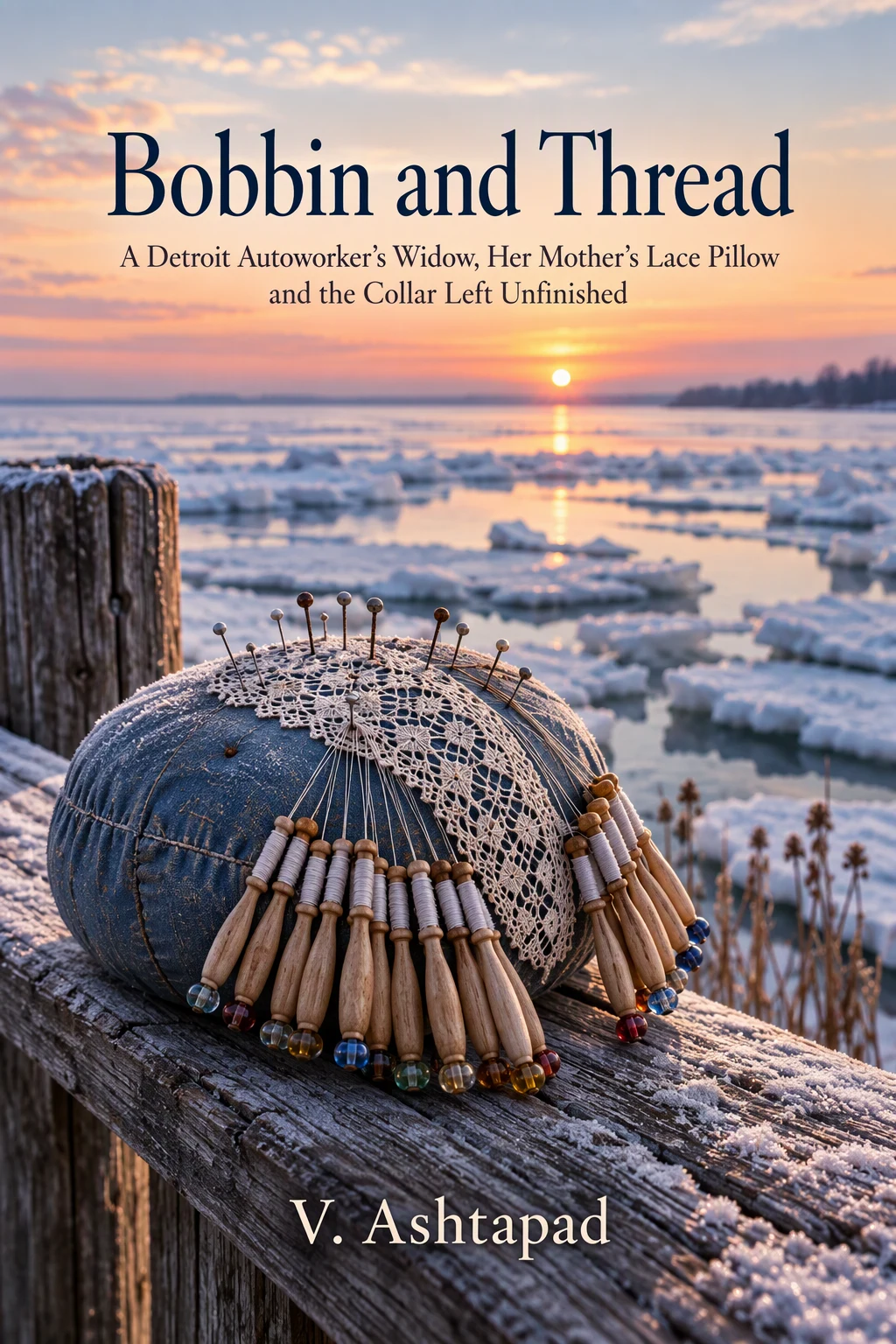
It was my mother's lace pillow. A hard, round cushion stuffed tight with straw, covered in faded blue cotton, with a strip of yellowed card pinned around the top and twenty-two wooden bobbins hanging off it in pairs, their threads still wound, still crossed, still holding a half inch of lace that my mother had started and never finished. A brass pin stuck up at every point where the threads turned. Some of the pins had rusted into the card.
"Oh," Linda said, in a different voice. "That's Oma's."
My mother, Godelieve Verhaeghe De Waele, came to Detroit from a village outside Bruges in 1951 with my father, a suitcase and that pillow. My father went to work at the Chrysler plant on Jefferson. My mother cleaned houses in Grosse Pointe three days a week and made lace the other four, at the kitchen table, under the hanging lamp, while the radio played the Flemish hour on Sunday and the Tigers the rest of the week. She sold collars and handkerchief edges to the ladies at the Belgian club and to a shop downtown that is a parking garage now. When I was small I sat under that table and listened to the bobbins. They make a sound like rain on a tin roof, or like a lot of people quietly agreeing.
She tried to teach me once, when I was eleven. I lasted a week. I wanted to be outside with my cousins, and the threads tangled, and she slapped my hands lightly, not hard, and said in Flemish that a lacemaker has patience or she has a knot, and I said in English that I would rather have a knot, and I went outside. She never asked again. She made lace until her eyes went, in 1989, and then the pillow disappeared into her closet and then into my cedar chest, and I forgot it the way you forget the things that hurt a little.
I held it on my lap on the bedroom floor. The bobbins swung and clicked.
"You want me to put it in the donate pile?" Linda asked. "The historical society might—"
"Keep," I said.
"Ma, your new place is six hundred square feet."
"Then I'll keep it in six hundred square feet."
She looked at me for a long moment, and I saw her decide not to say whatever she had been about to say, and she put the marker down. That's new, the not saying. Since her father died she has been trying. I gave her credit for it.
---
At Lakeshore Commons they give you a welcome basket with a calendar of activities and a tablet in a purple case, the kind with the big letters, already set up. A young woman named Priya, who is the life-enrichment director, which I believe means the activities lady, sat with me the second morning and showed me how it worked.
"Your family can share photos with you here," she said, touching a picture of a little house. "This is your family's private space. Only the people you invite can see it. Your daughter set it up last week. See? There's Linda, there's Kayla."
There was my granddaughter Kayla, in a photo I had never seen, holding a baby wrapped in a yellow blanket. Theo. My great-grandson, three weeks old. He looked like Ray when Ray was angry about something on the news.
"You can tap here to record a voice message," Priya said. "Some residents like to tell stories that way. It saves them in your family's collection. Your grandkids can listen whenever."
"I don't have stories," I said.
Priya smiled the way they teach them to smile. "Everybody says that the first week."
I put the lace pillow on the table by the window, where the light comes off Lake St. Clair in the morning like it's been polished. I did not touch the bobbins. I looked at the strip of card around the top. It was pricked all over with tiny holes, hundreds of them, in rows that bent and crossed, with ink lines connecting some holes and not others, and little marks in my mother's hand, a dot, a cross, a circle with a tail. It was a map, and I could not read one word of it.
At the bottom of the card, in her small upright handwriting, she had written: *Voor Margrietje. Kraag.*
For Margie. Collar.
She had been making something for me. And she had never said.
I sat with that for a while. The lake went from silver to gray. Somebody down the hall was playing a Motown record too loud, and somebody else was complaining about it, also too loud, and a lawn mower started up on the grounds even though it was October.
That afternoon I picked up the tablet and pressed the little red circle the way Priya had shown me.
"This is Grandma," I said to it. "Kayla, this is for you and for the baby. I found Oma's lace pillow. Your great-great-grandmother's. She was making a collar for me and she never finished it. I don't know how to read the pattern. I don't know how to make lace. I'm seventy-six years old." I stopped. The lawn mower went by again. "I think I'm going to learn."
I sent it before I could think better of it.
Torchon Ground
Kayla called back within the hour, on the video, with Theo asleep on her shoulder and her hair in a knot on top of her head.
"Grandma. You're going to make lace?"
"I said I'm going to learn. That's different."
"I looked it up. There's a lace school in Bruges. Like, still. They have classes online. One of the teachers does lessons in English."
My granddaughter is twenty-eight and works for a company in Ann Arbor that makes software for hospitals, which I do not understand, and she can find anything. She found me a teacher before I had finished my coffee.
The teacher's name was Annick. She was sixty or so, with short gray hair and reading glasses on a beaded chain and a voice like a pharmacist's, calm and exact. She taught from a room in Bruges with whitewashed walls and a window behind her, and through the window I could see a brick wall with ivy and the corner of a stepped gable, and once, during our first lesson, a bicycle went by with a dog in the basket.
"First," she said, "show me the pillow."
I held it up to the camera. She leaned in.
"Ah," she said. "This is a good pillow. Old straw, hard. They do not make them like this now. And the bobbins—turn one for me? Yes. Those are Flemish bobbins, from the coast, see the little bulb at the end? Your mother's mother maybe. Do not touch the lace on it. We do not touch that yet. We will learn on a new pillow, and when you are ready, we come back to your mother's."
"How long until I'm ready?"
Annick took off her glasses and let them fall on the chain. "How long until you are ready to read her handwriting? I do not know. Let us start with the alphabet."
She mailed me a beginner's kit from Belgium. Priya helped me order a foam roll pillow and pins and a starter set of bobbins from a shop in Ohio while I waited, because the Belgian box would take two weeks. Twenty bobbins in light wood, plain, with paper labels. They felt like toys next to my mother's.
The alphabet of bobbin lace, it turns out, has two letters. Cross and twist. You work with two pairs of bobbins at a time, four threads. Cross means the middle two threads pass over each other, left over right. Twist means each pair turns, right over left. Everything else in lace, every rose and fan and snowflake and collar ever made in Bruges or anywhere, is those two motions, in different orders, over and over, with pins to hold the work in place.
"Cross, twist, cross," Annick said. "That is a whole stitch. Say it."
"Cross, twist, cross."
"Again. With your hands."
My hands were not as good as they used to be. I worked the line at the Ford plant in Dearborn for twenty-six years, front seat assembly and then quality inspection, and my knuckles are big and my right thumb does not like to bend in cold weather. The bobbins slid out of my fingers. Two of them knotted. I said a word my mother would have slapped my hands for.
Annick laughed, the first time I heard her laugh. "Good," she said. "Now you are a lacemaker. Every lacemaker has said that word. In every language."
Our first real piece was torchon ground. Torchon is the plain, practical lace, the kind they made in farmhouses for pillowcases and aprons, a grid of little diamonds like a chain-link fence. You work it on the diagonal. Pin, cross, twist, twist. Pin, cross, twist, twist. The pins go into the holes on the pricking—that's what they call the card with the holes, the pricking—and the threads go around the pins, and when you pull the pins out at the end the lace holds its shape on its own.
It took me three weeks to make four inches of torchon ground. It was crooked. I had pulled too tight on one side and the diamonds leaned like a fence after a storm. I sent Annick a photo through the screen.
"Your tension is your mood," she said. "This side, you were angry about something."
I had been. That was the side I worked on the morning Linda came for lunch and asked, very carefully, whether I had thought about the assisted living wing on the third floor, "just for the future, Ma, just to know the options," and I had said I would think about it when I was dead, and she had left early.
"Unpick it," Annick said.
"All of it?"
"No. Only the angry part. Then do it again, and this time, think about the person you were angry at. Not about what they said. Think about why they said it."
I unpicked the angry inch. It took longer than making it had. And while I did it I thought about Linda, who is a nurse manager and has watched, I don't know, a few hundred families do this, and who lost her father in a hospital bed after six days when we all thought he had six months, and who calls me every night at eight-fifteen and pretends it is because she happens to be driving home.
When I redid the inch, it came out straight. Not perfect. But straight.
---
Downstairs at Lakeshore Commons there is a community room with a big television that is always on a game show, and a piano nobody plays, and two long tables where the quilting ladies meet on Tuesdays. I started bringing my practice pillow down there because the light was better and, if I am being forthright, because I was lonely in six hundred square feet.
The head of the quilters was Odessa Pruitt, eighty-one, a retired schoolteacher from the west side who had pieced a quilt for every child she ever taught that made it to graduation. Three hundred and some quilts. She watched me work for a full Tuesday without saying a word, and then she pulled her chair over and said, "Show me that again. The crossing."
"Cross, twist, cross."
"Huh," she said. "That's a braid. My grandmother braided rag rugs on a frame in Alabama. Same thing. You cross the middle and you turn the outsides."
She was right. It was the same thing. Women had been crossing and twisting threads on two continents, in farmhouses and shotgun houses, to make something out of almost nothing, and neither of our grandmothers had known the other one existed.
"You should record that," I said. "Your grandmother's rugs. For your family."
Odessa looked at me over her glasses. "Now you sound like that Priya."
"I know," I said. "It's catching."
Cloth Stitch
The second pattern was cloth stitch, which is what Annick called the solid part of lace, the part that looks woven. One pair travels sideways across all the others, crossing and twisting at each one, back and forth like a shuttle on a loom. In my mother's collar, Annick said, looking at the photo of the pricking that I had scanned and sent her, the petals of the flowers would be cloth stitch. The leaves would be half stitch. The background would be a ground she wanted to see in person before she named it.
"Some of these marks," she said, "I know. This dot means a pin. This cross means a twist before the pin. But this"—she pointed at the circle with a tail—"this I do not know. This is your mother's own sign. Maybe her mother's. Every lacemaker had her own little marks. Like a recipe written by a grandmother. 'A handful.' How big is a handful?"
"So nobody can read it."
"Somebody can read it. We just have to find who."
I worked on cloth stitch through November. The lake froze along the edges and the ducks stood on the ice looking surprised. In cloth stitch, the traveling pair has to keep an even pull, or the whole strip narrows like an hourglass. I made a lot of hourglasses.
On the tablet, in my family's space, a little picture of a tree had appeared, and when I tapped it, there was my family, laid out branch by branch. Kayla had done it. She had put in Ray and me, and Linda and her ex-husband, and Kayla and her husband Marcus, and Theo at the bottom like a new leaf, and above me my parents, Godelieve and Achiel De Waele, and above them a blank where my grandparents should be.
"I don't know their names," Kayla wrote underneath. "Grandma do you?"
I sat with the pillow on my lap and thought. My mother's mother was Maria. Everybody's mother's mother in Flanders was Maria. Maria Vandenberghe? Vandenbroucke? She made lace too, my mother said, in a village with a church tower you could see from the polders, and she sold it to a dealer who came on Fridays on a bicycle and paid by the inch.
I recorded that. Just that. The dealer on the bicycle, paying by the inch. Then I recorded the kitchen on Cadieux, the hanging lamp, the Flemish hour on Sunday, the smell of my mother's stoemp, which is mashed potatoes with carrots and leeks, and her Sunday rabbit stewed with prunes, which I refused to eat as a child because I had seen the rabbit in the window of the butcher on Mack Avenue, and which I would give anything now to taste.
Then I recorded the club. The Belgian club on the east side, with the long sanded floor in the back where the men played featherbowling, rolling wooden wheels down a curved lane toward a pigeon feather stuck in the dirt, arguing in Flemish and English and a mix of both while the women sat at the tables with beer and pastries and talked about whose daughter was marrying a Polish boy. My father was a good featherbowler. He had a way of releasing the wheel with a little flick that made it curl at the end like a cat settling down to sleep.
I had not thought about the club in years. Once I started recording, I couldn't stop. Kayla messaged me at eleven at night: *Grandma it's almost midnight. Go to sleep. Also I'm crying. Also I love you. Also MORE.*
---
On a Thursday in December the maintenance man came to fix my radiator and saw the lace pillow by the window.
"My mother had one of those," he said. He was in his sixties, heavy-set, with a mustache and a name stitched on his shirt: Earl. "Not lace. She did tatting. With the little shuttle. But her sister did bobbins."
"Belgian?"
"Polish. Hamtramck. Same idea, different pillow. Theirs were long, like a roll of paper towels." He looked at my plain practice bobbins from Ohio. "You know, I could turn you some of those. I got a lathe in the workshop downstairs. Residents use it for pens, birdhouses. I got some cherry left over from a bench."
"You'd make bobbins?"
"Lady, I made car parts for thirty-one years at the axle plant. I can make a stick with a groove in it."
He made me twelve pairs out of cherry wood in two weeks, with a little bulb at the end like my mother's Flemish ones, which he copied from a photo. They were heavier than the practice bobbins and they sat in the hand like they belonged there. The threads ran smoother on them. Annick saw them on camera and put her glasses on to look.
"Who made these?"
"A man named Earl. He fixes the radiators."
"Tell Earl," she said, "that in Bruges a good bobbin maker would be invited to dinner."
I told Earl. He went red under his mustache and said that was all right, he'd take a beer, and the next Tuesday he came to the community room with a bag of tallies—little leftover cherry blanks—and asked Odessa if quilters ever used wooden buttons.
Half Stitch
My mother's collar was not torchon. Annick made that clear in January, after she had studied the pricking for two weeks.
"It is Flemish," she said. "A kind of Bruges flower lace, but with a ground I see only in a few villages to the north. Toward the coast. Your mother had it from her mother, I think. It is not in the books."
"So how do I learn it?"
"You come here," Annick said. "And we find someone who still works it."
I laughed. Then I saw she wasn't joking.
"I'm seventy-six. I have a hip that clicks. I haven't been on a plane since Ray's sister's funeral in Phoenix in 2015."
"I have a student who is ninety-one," Annick said. "She comes every Wednesday on the bus. The bus has a step this high." She held up her hand. "You have a hip that clicks. She has two."
That night at eight-fifteen Linda called, as she does, driving home that she isn't driving home.
"Kayla says you're thinking about going to Belgium," she said.
I want to set down what happened next carefully, because it was the most important conversation I had that winter, and because I almost ruined it.
My first feeling was that I was being reported on. My granddaughter had told my daughter, and my daughter was now going to tell me why I couldn't, and I opened my mouth to say that I was a grown woman who had run a quality inspection station for eleven years and I could get on an airplane if I pleased.
But I was holding a half-stitch sampler at the time, and half stitch is a strange thing. It's the stitch that makes the lacy, see-through part of a pattern, the leaves and the shading. Cross, twist, and then you don't cross again. You leave it half done, open, so the light comes through. Annick had told me that morning that half stitch was the hardest to keep even, because it was the stitch that didn't close. "You must trust it," she said, "to be finished without being closed."
So I closed my mouth. And I said, "What are you worried about?"
There was a silence on the line, long enough that I heard her turn signal ticking.
"Everything," Linda said. "Your hip. The flight. Blood clots. You getting turned around in the airport in Brussels. You falling on cobblestones. You getting there and it being too much and you being alone in a hotel room in a country where you don't speak the language—"
"I speak some of the language."
"You speak kitchen Flemish from 1960, Ma."
That was fair.
"Okay," I said. "What else?"
"What else?"
"You said everything. You said hip, flight, clots, airport, cobblestones, hotel. What else?"
Another silence. The turn signal stopped. I think she had pulled over.
"I don't want you to go somewhere and not come back," she said, and her voice did a thing it hadn't done since the funeral. "Dad went in for a test on a Tuesday."
"I know."
"I didn't get to—he was making a joke about the hospital pudding and then he was—"
"I know, honey."
We sat there, she in her car on Woodward somewhere, me with the half stitch on my lap and the lake black out the window. I didn't tell her she was being silly. She wasn't being silly. I didn't tell her I was going anyway. I didn't say anything for a while. I just let her say it, all of it, the pudding, the Tuesday, the six months that were six days, and when she was done, I said back what I'd heard.
"You're afraid if I go, it'll be like Dad. That something will happen and you won't be there and you won't get to say goodbye."
"Yes."
"And you'd rather I be safe and bored here than happy and far away."
A sniff. "That sounds terrible when you say it."
"It doesn't sound terrible. It sounds like you love me. I'm just saying it back so I know I heard right."
"You heard right."
"Okay," I said. "Then here's what I want you to hear from me. I'm not going to Belgium to see Belgium. I'm going to finish something my mother started for me. She made me a collar, Linda. She never said. She was making it and her eyes went and she put it in a closet. I walked away from her table when I was eleven and I never came back to it, and she never asked again. I'd like to come back to it now. Before my eyes go."
Linda didn't say anything for a long time. Then she said, "Kayla could go with you."
"Kayla has a three-month-old."
"Marcus has paternity leave until April. I'll help." She blew her nose. "And you'll wear the compression socks. On the plane. The real ones, from the pharmacy, not the cute ones."
"I'll wear the ugly socks."
"And you'll share your location with me on that tablet. The whole time."
"I don't know how to do that."
"Kayla does," Linda said. "Kayla knows how to do everything."
Spiders
They call it a spider in lace when several pairs of threads come together in the middle of a diamond and cross over each other in a little knot of legs, and then part again. It's a hard stitch to get right because all the pairs have to be pulled in at the same tension, or the spider looks lopsided, like it's limping.
I learned spiders in February, while Kayla planned our trip in the shared family space on the tablet: the flights, a small hotel near the old lace school that had an elevator, a wheelchair at both airports "just in case, Grandma, you don't have to use it," a list of things to pack that included my blood pressure pills, the ugly socks, and my mother's pillow, which I insisted on carrying on the plane.
"It's a cushion stuffed with straw from 1951," Kayla said. "TSA is going to love that."
"Then I'll explain it to them."
Meanwhile the residents of Lakeshore Commons had taken an interest. Odessa's quilters had started calling themselves the Thread Ladies, and had invited Earl, who said he wasn't a lady, and they said nobody was perfect. A retired couple from Grosse Pointe who had lived in Antwerp in the seventies for his job came down to practice their Flemish with me, and we discovered their Flemish was better than mine and mine was funnier. A man named Mr. Szymanski brought me a photograph of his aunt's lace from Hamtramck, the long Polish pillow Earl had described, and asked if I could tell him what kind it was. I couldn't. Annick could, from the photo, in one minute.
Priya came down one Tuesday with a camera on a little stand.
"I want to do a thing," she said. "A series. 'Hands That Remember.' Residents who still do a craft their family brought here. Odessa's quilts, Margie's lace, Earl's lathe. Mr. Szymanski's pierogi—he says he'll do pierogi. We record each one doing it and telling where it came from, and it goes into each family's collection, and we show it on the big screen on family night." She looked at me. "If you're willing."
"Why me first?"
"Because you're the one who said she didn't have stories," Priya said, "and Kayla tells me you've recorded forty-one."
I had not counted.
We did it on a Thursday. Priya filmed my hands working a spider while I told about the kitchen on Cadieux and the dealer on the bicycle who paid by the inch. She filmed Odessa's hands piecing a nine-patch while Odessa told about her grandmother's rag rugs in Alabama and how she walked to the colored school four miles each way. She filmed Earl at the lathe turning a bobbin, the cherry shavings coming off in long curls, and Earl, who I had never heard say more than three sentences in a row, talked for twenty minutes about his mother's tatting shuttle and his father's union card and how the axle plant smelled in August.
On family night they showed all three on the big screen in the community room. Linda came. Kayla came, with Marcus and Theo, who slept through the whole thing. Odessa's grandson drove in from Chicago. Earl's daughter, who he said didn't call much, came from Flint and sat next to him and held his hand through his whole segment, and afterward she asked him for the recording, and he said it was already in the family's collection, she just had to look, and she said, "Daddy, you're on the computer?" like he'd grown wings.
Rose Ground
We flew out of Detroit on the first of March. I wore the ugly socks. The TSA agent in the terminal looked at the X-ray of my mother's lace pillow for a long time, and then called over a second agent, and the two of them looked at it together.
"Ma'am," the first one said, "what is this?"
"It's a lace pillow," I said. "My mother brought it from Belgium in 1951. I'm taking it back."
The second agent, an older woman with braids pinned up under her cap, leaned close to the screen. "Bobbins," she said. "My grandmother had one in Trinidad. Hers was a cushion too. Round like that." She looked at me. "You make the lace?"
"I'm learning."
"Good for you," she said, and waved me through, and I saw her say something to the first agent and the first agent laugh.
Kayla slept on the plane. I didn't. I watched the little airplane on the screen cross the ocean and thought about my mother crossing it the other way, on a ship, eleven days, in March too, she always said, with the sea so gray it looked like dishwater and the pillow in her lap the whole time because she didn't trust the steward with it.
Bruges in March was cold and bright and smelled like woodsmoke and waffles and the canals. The houses lean into each other like old friends at a party. There are swans on the water that the town has kept, my mother told me, for five hundred years, and they glide past the stepped gables as if they own the place, which they do. The streets are cobblestones, and my hip clicked over every one, and Kayla held my elbow, and I let her.
Annick was waiting for us at the door of the lace school in a long gray coat. She was smaller than she looked on the screen, and she smelled like lavender, and she kissed me three times on the cheeks, the Flemish way, left, right, left, which I had forgotten until her face was coming at me and then my body remembered and I turned my cheek right on time.
"So," she said. "The pillow."
I gave it to her. She held it the way you'd hold a baby someone hands you—carefully, but like she'd done it before. She carried it inside to a long table under a window, where six women were working, and every one of them stopped.
The oldest was the ninety-one-year-old, Madame Rosalie, in a black cardigan with a brooch, with hands like tree roots and eyes so clear they looked wet. She leaned over my mother's pillow and studied the pricking for a long minute without touching it. Then she put one finger on the little circle with a tail, the mark nobody could read, and she said something in a dialect so thick that even Annick had to ask her to say it twice.
"She says," Annick translated slowly, "that is the sign of the north. Near the coast. Toward Blankenberge. It means rose ground with a twist on the return. She says her aunt used that mark." Annick listened again. "She says nobody uses it now. She says she has not seen it written in sixty years."
Madame Rosalie looked up at me and said something else.
"She asks who was your mother."
"Godelieve De Waele," I said. "Verhaeghe before that. Her mother was Maria. Vandenberghe, I think."
Madame Rosalie closed her eyes. She said something to Annick, and Annick put her hand over her mouth.
"She says," Annick said, "that a Maria Vandenberghe made lace in Uitkerke, near the coast, and sold to a dealer on a bicycle. She says the dealer was her uncle."
Kayla grabbed my arm.
I don't know how long we stood there. A swan went by on the canal outside. Somebody's bobbins on the other end of the table clicked once, by accident, and stopped. Madame Rosalie reached out her old root of a hand and took mine, and turned it over, and looked at my knuckles, the big ones from twenty-six years at the plant.
She said something short.
"She says," Annick said, "you have working hands. Good. Lace is work."
Tallies
Madame Rosalie taught me the rose ground with a twist on the return over the next five mornings, at the long table by the window, in a dialect I mostly couldn't follow and didn't need to, because she showed me with her hands, slowly, then faster, then slowly again when I tangled it. Rose ground is a background of little four-petaled flowers, each one made of two pairs crossing and twisting around four pins. My mother's version added an extra twist on the way back out of each little flower, so the ground came out tighter and the flowers sat up off the background like they were raised.
Annick sat beside us and translated when it mattered and kept quiet when it didn't. I came to see that she was doing what she'd done with me on the screen all winter—listening first, before she taught. She asked Madame Rosalie questions about the old village, the dealer, the lacemakers' school where girls of seven sat on benches from morning to night, about which Madame Rosalie had opinions that took a while to translate and made Annick laugh and then look sad. She asked me about my mother's kitchen. She asked Kayla what she did for work, and Kayla tried to explain hospital software, and Madame Rosalie said, through Annick, that it sounded like lace: a lot of threads, and if one is wrong, the whole thing comes undone.
"That's exactly what it is," Kayla said.
In the afternoons, while I rested my hip at the hotel, Kayla walked around Bruges with her phone and recorded everything for our family's collection: the swans, the bell tower ringing the hour, a fishmonger in the old fish market under a stone colonnade, a woman selling lace in a shop window who turned out to be from Kortrijk and whose cousin lived in Warren, Michigan. On the third day she took a train to Uitkerke, which turned out to be a village of brick houses and flat green polder fields running to the dunes, and found the church tower you could see from the fields, just like my mother said, and a small cemetery behind it, and in the cemetery, after an hour of looking, a gray stone with the names Maria Vandenberghe and Petrus Verhaeghe on it.
She called me from there on the video, standing in the wind with her hair whipping around, and turned the phone so I could see the stone.
"Grandma," she said. "I found them. Your grandparents. They're right here."
I asked her to hold the phone still. She did. I looked at the names a long while. Then I asked her to say something to them, because I couldn't.
Kayla thought for a moment. Then she said, to the stone, in English, with the wind taking half of it: "Hi. I'm Kayla. My son's name is Theo. My grandma is learning your lace."
When she came back that night, she added two names to the tree in our family's space, above my mother: Maria Vandenberghe, Petrus Verhaeghe, Uitkerke. And a photo of the stone. And a photo of the church tower over the flat fields. And a recording of the bells.
---
Tallies, in lace, are little solid leaves woven with one thread going back and forth through three others, like darning. They're the hardest thing I learned that week, because the weaving thread has to be pulled just so, or the leaf comes out shaped like a bean or a fish. My mother's collar had a ring of tallies around each flower, like petals around a petal.
My first eleven tallies were beans. The twelfth was a fish. Madame Rosalie watched me unpick the fish and said something to Annick that made Annick snort.
"She says," Annick said, "her first tallies, the teacher threw them in the stove."
"What did she do?"
"She says she made more."
The thirteenth tally was a leaf. A small, slightly lopsided leaf, but a leaf. Madame Rosalie touched it with one finger and nodded once, and that nod was worth more to me than my retirement watch from Ford.
On the last morning, she gave me a gift: a little bundle of six bobbins, very old, very dark, with the bulb at the end and initials burned into the side. *M.V.*
"Maria Vandenberghe?" I said.
Annick asked. Madame Rosalie shook her head and said something.
"She says no. M.V. is for Marie Vroman. Her own mother. She wants them to work again. She says, you will finish your mother's collar with your mother's bobbins and with her mother's bobbins, and then the two families will be together on one pillow."
I could not say anything. I kissed her three times, left, right, left. She smelled like cold air and cough drops.
Picots
Back in St. Clair Shores, the lake was breaking up. Big gray plates of ice drifted past my window and knocked against each other with a sound like distant furniture being moved. I set my mother's pillow on the table by the window, and Madame Rosalie's six bobbins next to Earl's twelve pairs of cherry, and I looked at it for three days before I touched it.
On the fourth day, Annick came on the screen at nine in the morning her time, three in the morning mine, because I had told her I wanted to start at the hour my mother started, which was before the house woke up.
"Today," she said, "we do picots. Then we go back to your mother's lace. Not before."
Picots are the little loops along the edge of lace, like the tiny points on a doily or the edge of a christening gown. You make them by twisting a pair several times and wrapping it around a pin, so it forms a small knot that sticks out. They are the last thing, the finish. Annick said a lace without picots is a sentence without a period.
I made a strip of edging, one inch, with a picot every three pins. It took two hours. When I was done, the sun was coming up over the lake, orange through the ice plates, and the gulls were starting.
"Now," Annick said. "Your mother's pillow. Slowly. Read me the first pin."
I looked at the pricking. At my mother's half inch of lace, with the pins rusted in. At her marks. The dot. The cross. The circle with a tail, which I could read now.
"Cross," I said. "Twist. Twist on the return."
"Go."
I picked up my mother's bobbins, which had not moved since 1989. The threads were stiff from thirty-seven years of waiting. I wet my fingers and eased them. I made one stitch. Then another. The bobbins clicked, my mother's on the left, Earl's cherry on the right where I'd had to add pairs for a new section, and Madame Rosalie's mother's six in the middle, and for the first time in my life I heard that sound and I was not under the table. I was at it.
I worked until noon. Then I recorded a message.
"This is for whoever is listening, years from now," I said. "Theo, if it's you. I'm seventy-seven now. My birthday was Tuesday. This morning I made the first inch of your great-great-great-grandmother's collar that she didn't get to finish. Your Oma—that's my mother—she sat at a table on Cadieux in Detroit and made lace to help pay for our house. Her mother sat in a farmhouse near the sea in Belgium and made lace for a man on a bicycle who paid by the inch. I worked on a car line in Dearborn and I never thought I'd sit still long enough to do this. You don't have to make lace. But I want you to know your family made things with their hands, and they were patient, and sometimes they were not, and sometimes they had to unpick a whole inch because they were angry, and they did it over. That's what I want you to know. You can do it over."
The Bruges Flower
The collar took me until September.
Some weeks I worked every day. Some weeks my hands hurt too much in the mornings and I did nothing but look at it and drink my coffee. In June Linda brought me to an appointment and the doctor said my hands had arthritis, which I knew, and that the fine motor work was probably good for them, which I didn't, and Linda drove me home and said, "Did you hear that? The lace is medical." I told her I'd bill the insurance.
Odessa sat with me on Tuesdays and pieced a crib quilt for Theo in yellow and blue, the colors of the blanket in the first picture I ever saw of him. Earl turned me two more pairs when I ran short for the flower section, and came up once a week to fix my radiator, which did not need fixing. Mr. Szymanski brought pierogi. The couple from Grosse Pointe brought a book of Flemish proverbs and read me one every week; my favorite was *Wie het onderste uit de kan wil hebben, krijgt het deksel op zijn neus*, which means if you want the very bottom of the jug, the lid falls on your nose, which my mother said whenever I tried to finish the pop.
Annick came on the screen every Wednesday. Sometimes Madame Rosalie sat beside her, wrapped in a shawl, and watched my work through the camera and said a few words, which Annick passed on: "Tighter on the left." "Good." "Your mother was a good lacemaker; you can see it in her half inch. You are becoming one."
The center of the collar was a Bruges flower, five petals of cloth stitch with veins of half stitch running through them, sitting in the rose ground with my mother's twist on the return, ringed by tallies. There were seven of them around the curve of the collar, each one slightly different, because my mother had drawn each one slightly different. I asked Annick why. She asked Madame Rosalie. Madame Rosalie thought about it and said something that Annick translated carefully.
"She says, maybe one for each person in the family. Maybe your mother was counting."
I counted. My mother, my father, me, Ray, Linda, and two more. In 1989, when she stopped, Kayla was a baby, and my mother had held her once, in the kitchen on Cadieux, and said she had my hands. That was six. I didn't know who the seventh was for.
"Maybe it is for someone who was not born yet," Annick said. "Lacemakers plan ahead."
---
In August Linda came for dinner on a Sunday and sat across from me at my little table and watched me work the last flower. She had brought stoemp—she had found the recipe in my recordings, my description of my mother's carrots and leeks, and made it from that, and it was not right, and it was close, and I told her so, and she laughed.
"Ma," she said. "Can I ask you something without you getting your back up?"
"You can ask."
"Last fall when I brought up the third floor. The assisted wing. You said you'd think about it when you were dead."
"I remember."
"I'm not bringing it up now. I'm just saying—I listened to all your recordings. Every one. The club, the featherbowling, Oma's rabbit, the dealer on the bike. Kayla made me. And I realized I never knew any of it. You never told me. You were always just Ma who worked at Ford and made us do our homework."
"You never asked."
"I know. I'm asking now." She reached across the table and put her hand over mine, over the bobbins. "When it's time for the third floor—and it will be time, someday, I'm a nurse, I know—I want it to be your decision. Not mine. I want to sit with you and hear what you want. Like you did with me in the car that night. I want to do it back."
I looked at her hand on mine. Nurse's hands, clean and dry and strong, with short nails. Not working hands like mine. Not lace hands like my mother's. But careful. Listening hands.
"Okay," I said. "When it's time, we'll talk. And I'll tell you what I want, and you'll say it back to me so I know you heard."
"Deal."
"And I'll wear the ugly socks."
The Collar
I finished it on the third of September, at four in the morning, by the window, with the lake black and the first gulls starting. I made the last picot, and tied off the last pair, and then, very slowly, I began to pull the pins.
You have to understand that until the pins come out, you don't know. The lace is held in its shape by the pins, and if the tension is wrong anywhere, when you pull them, it shrinks, or puckers, or goes slack. I pulled them one at a time, starting with the rusted ones from my mother's half inch, and they came out of the old card with a little dry squeak, and the lace stayed.
It all stayed.
When I lifted it off the pillow it was the size of a child's collar, white, with seven Bruges flowers around the curve, rose ground with the twist on the return between them, tallies like little leaves, and a picot edge as fine as the frost on the inside of a winter window. The first half inch, my mother's, was a shade more cream than the rest, from thirty-seven years in the dark. You could see the line where she had stopped and I had started, if you knew to look. I didn't hide it. Annick said not to.
"In Bruges," she said, when I held it up to the camera that morning, "when two lacemakers work on one piece, they leave the join. So you know there were two."
Madame Rosalie was beside her. She leaned in close to her screen. She looked for a long time. Then she said one word.
"Proper," Annick translated. "She says it is proper lace."
---
Theo was christened at the end of September, at the church in Royal Oak where Linda goes on Christmas and Easter. He wore a plain white gown that Kayla bought online, and over it, around his neck, the collar.
Odessa came, and gave Kayla the crib quilt. Earl came in a tie, which his daughter had picked out, and his daughter came with him. Priya came and filmed it for our family's collection, and for "Hands That Remember," and for the big screen on family night. Mr. Szymanski brought pierogi to the lunch afterward, even though nobody asked, and everybody ate them.
Annick watched on the video, propped on a table in the church hall, and Madame Rosalie with her, with a little glass of something that Annick said was medicinal. They were seven hours ahead. It was evening in Bruges, and through the window behind them I could see the brick wall and the ivy, and the light going gold on the stepped gable.
Theo spat up on the collar right after the service. Kayla gasped. I laughed so hard I had to sit down.
"It's linen," I said. "It washes. My mother's lace went through a lot worse than a baby."
Later, when the lunch was winding down, Kayla brought him to me and put him in my lap. He was heavy and warm and smelled like milk and church candles, and he looked up at me with Ray's angry eyebrows, and grabbed one of the picots on the collar in his fist.
"Grandma," Kayla said. "The seventh flower. Annick said maybe Oma was counting. Six people. And one more."
"I know."
"I think the seventh one's for him."
I held my great-grandson in my lap and looked at the collar my mother started in 1989, in a kitchen on Cadieux, under a hanging lamp, with the Tigers on the radio, for a daughter who walked away from her table, and that the daughter finished thirty-seven years later, by a window on Lake St. Clair, with her mother's bobbins and a stranger's mother's bobbins and a radiator man's cherry, for a boy who wasn't born yet.
"I think so too," I said.
Then I took out my tablet and pressed the red circle, and Theo grabbed at that too, and I let him, and I told the story one more time, from the beginning, so he'd have it.
About this book
Margie De Waele is seventy-six, four years a widow, and moving into a one-bedroom apartment by the lake when she finds her mother's lace pillow in the cedar chest: twenty-two wooden bobbins still hanging, a half inch of lace still pinned, and a strip of pricked card that says, in her mother's hand, For Margie. Collar.
Margie walked away from her mother's lace table at eleven and never came back. She worked twenty-six years on a Ford line, and her knuckles show it. She cannot read one mark of the pattern.
With a patient teacher in Bruges on a tablet screen, a retired quilter, a maintenance man who turns bobbins on the lathe downstairs, and a daughter who is afraid of losing her, Margie learns bobbin lace one stitch at a time, from plain torchon to the Bruges flower, and crosses the ocean to find the one woman alive who can read her mother's secret mark.
A warm, funny novel about what our mothers start for us, and what it takes to finish it.
Members can react to this book and talk about it in the members' Library.