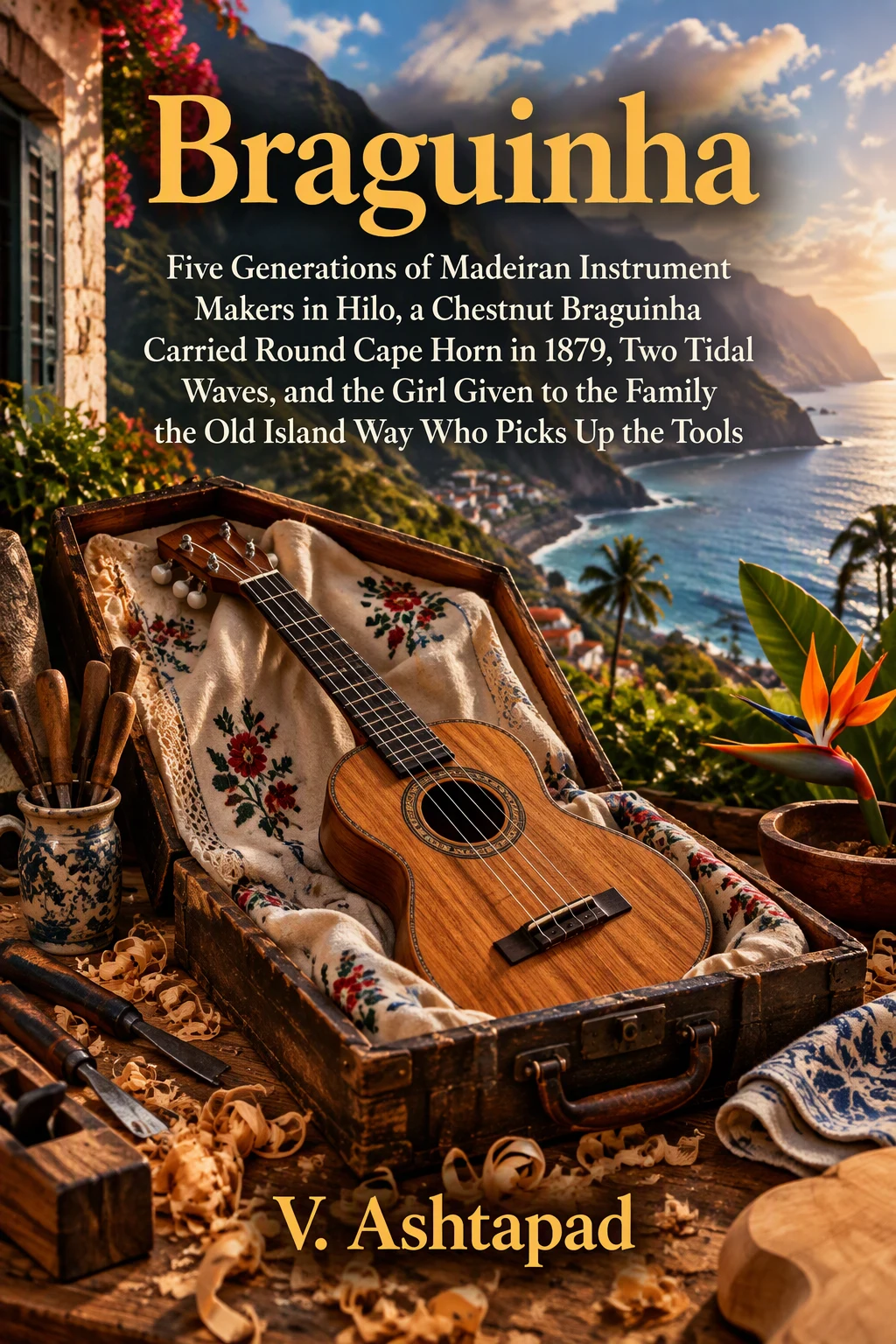
Braguinha
Five Generations of Madeiran Instrument Makers in Hilo, a Chestnut Braguinha Carried Round Cape Horn in 1879, Two Tidal Waves, and the Girl Given to the Family the Old Island Way Who Picks Up the Tools
by V. Ashtapad
Foreword
This is a work of fiction. The Madeiran migration to the Kingdom of Hawaii, the voyage of the Ravenscrag in 1879, the Madeiran makers who built the first small four-string instruments in Honolulu, the vine blights and the embroidery outwork trade of nineteenth-century Madeira, the sugar plantation camps of the Hamakua coast, and the tsunamis that struck Hilo in 1946 and 1960 are real. The customary practice of a child being given to another household to raise is real and is described here without its own name, out of respect. The Nóbrega family, their shop on Keawe Street, the Holt family and every named person in the story are invented.
For the hands that came from somewhere else and stayed.
Marlee: Hilo, the Wet Side
It rained the morning my grandfather forgot the word for clamp, and it rained the morning he remembered it, and in between, which was about four seconds, I watched his face go somewhere I had never seen it go.
"Hand me the," he said, and held out his palm, and stopped.
I was sitting on the low stool by the bending iron with my homework on my knees, a worksheet on cell membranes that I had no intention of finishing before third period. The shop smelled the way it always smells when the rain comes off the bay and pushes through the louvers: wet cedar, hide glue warming in its little pot, the sour green smell of the ginger that grows wild along the drainage ditch behind the building, and under it all the sweet sawdust of the curly island acacia, which is the smell of my whole childhood, the smell that came home on my grandfather's shirts and lived in the couch cushions and got into my hair if I so much as walked through the door.
"The clamp," I said. "The little spool one?"
"Clamp," he said. "Sim. Clamp. Of course." And he laughed, the short laugh he does through his nose, and took it from me and screwed it down on the brace he was gluing, and that was all. A grown man forgets a word. My science teacher forgets my name every Tuesday. But I had seen his face in those four seconds, and it was the face of a man standing in a doorway of a house he has lived in for eighty years and not knowing which way the kitchen is.
I'm fourteen. I'm telling you this up front so you know I'm not a little kid who doesn't notice things.
The shop is on Keawe Street, in the old downtown, the part of Hilo that faces the bay and gets the rain first. It's the bottom floor of a two-story wooden building painted a green that used to be bright, between a place that fixes outboard motors and a place that sells crack seed and shave ice and those dried plum things my best friend Brielle eats until her tongue turns white. Upstairs there's a lawyer who only comes in on Thursdays. The sign over our door is painted by hand on a plank, and it says NÓBREGA & SON, INSTRUMENTS, REPAIRS, EST. 1883, and the "& Son" was painted over and repainted at least four times, because the son kept changing. Florêncio, then Vitorino, then Ambrósio, then my grandfather, Teodósio, who everybody on the street calls Uncle Dósio and who I call Vovô.
After him there is nobody to put on the sign except me, and I'm not a son, and that's a whole conversation my grandmother started before she died and never got to finish.
On the wall behind the workbench, in a glass case my grandfather built with no nails, hangs the first one. The braguinha Florêncio Nóbrega carried from Madeira in 1879 in a box made of chestnut, four strings, a body no bigger than a loaf of sweet bread, a neck the color of strong coffee. It doesn't get played. It hasn't been played since 1946, which is a story. Under it, on a card in my grandmother's handwriting, it says: Funchal, 1876. Made by F. Nóbrega. Came on the Ravenscrag. Do not touch, Marlee, I mean it.
She wrote the card when I was four. I had touched it.
---
Let me tell you about the rain, because if you're not from here you'll think I'm exaggerating.
Hilo gets more rain than any city in the United States. People in Kona say this like it's an insult. People in Hilo say it like it's a medal. It comes in off the ocean every afternoon, sometimes every morning too, and it doesn't fall so much as arrive, the way a truck arrives. The gutters on Kamehameha Avenue turn into rivers and the mynah birds go quiet and the tourists who came over from the dry side stand under the awnings in their rubber slippers looking betrayed. Everything grows. Mold grows. The backs of your closets grow. My grandmother used to keep a light bulb burning in the closet where she kept her good shoes, to keep them from going green.
For an instrument maker this is a problem the size of the island. Wood breathes. It takes in water from the air and swells and gives it back and shrinks, and if you glue a top to a body on a wet day and then ship that instrument to Phoenix, it cracks right down the middle in a month, and the man in Phoenix calls you and yells. So the shop has a back room we call the dry room, with a dehumidifier that runs day and night and costs us, my grandfather says, more than the lawyer upstairs costs his clients. Every piece of spruce and every board of acacia sits in the dry room for at least a year before it's allowed to become anything. Some of the boards in there were cut before my grandfather was born.
"Wood remembers," he told me once. "Everything that ever happened to it. Every rain. Your job is to make it forget just enough."
---
On Thursday, the forgetting happened again.
I came in after school, soaked from the walk from the bus, my backpack on my front so the books wouldn't get wet, and he was at the bench with a body clamped in the cradle and the purfling channel half cut, and he looked at me as if I was a customer.
"Can I help you," he said. Polite. His shop voice.
"Vovô. It's me."
He blinked. It took a long time, the blink. Then he said, "Of course it's you. What, you think I don't know my own girl? Go get a towel, you're dripping on my floor," and he went back to the channel, and his hand on the cutter was steady as anything.
I got a towel. I stood in the doorway of the dry room with it over my head, breathing the cool air, my heart going so fast it hurt.
I'll tell you something else, since I'm telling you things. I'm not his granddaughter by blood. Not his, and not my grandmother's. My birth mom is Rochelle Holt, who grew up two houses down on Ponahawai Street and was seventeen when she had me, and who gave me to Teodósio and Glória Nóbrega when I was six weeks old, in their kitchen, with her own grandmother sitting at the table nodding. The way it used to be done here, the old island way, the way it's still done in some families: a baby goes to the house that can hold her. Nobody signed anything that day. My grandmother made everyone sign everything later, for the school and the doctor and the insurance, because she was a Portuguese woman from the Papaikou camp and she believed in papers the way other people believe in the weather. But the day I became theirs was the day in the kitchen, and nobody in this family has ever, not once, called it anything other than the day I came home.
Rochelle is my auntie-mom. She lives in Kona now and works at the airport and comes over the Saddle Road every few weeks with a box of chocolate-covered macadamia nuts that she knows I'm sick of and a hug that goes on too long. I love her. It's not complicated. Well. It's not complicated the way people think it would be.
What's complicated is the sign.
---
That night I made dinner because there was nobody else to make it. Rice, of course. Portuguese sausage from KTA, the spicy kind, fried in slices till the edges curled black. Two fried eggs. A can of corn. My grandmother would have made sopa, the bean soup with the ham hock and the cabbage and the macaroni, the one that took all Saturday, and she would have made it so there was enough for the whole street. I can make it. I just can't make it on a Thursday.
He ate like he always eats, fast and bent over the plate, a habit he says he got from his father, who got it from a plantation camp where if you ate slow somebody took your rice. Then he pushed the plate away and wiped his mouth on the back of his hand and said, "The Medeiros order."
"The one for the man in Lisbon."
"Sim. He wants it by March."
"Okay."
"I'm not going to make it by March."
He said it so plainly that for a second I thought he meant something else, like he was going to sell the order to somebody, or the man in Lisbon had died. Then he held out his right hand above the table between us, flat, the way you'd show somebody you're not carrying anything, and I saw it. The tremble. Small. Like the surface of a cup of coffee on a table when a truck goes by outside.
"Since when," I said.
"Since a while."
"And the. The other thing. The words."
He put his hand down. His eyes went to the louvered window. Rain was coming sideways now and the streetlight on Ponahawai was a smear of orange.
"Your grandmother," he said, "would know what to do."
That was the first time since the funeral he had said "your grandmother" without his voice breaking in the middle, and I understood that this was worse, not better. When it broke, it meant he still had somewhere to put it.
"I know what to do," I said. I didn't. I said it the way you say it when somebody has to.
He looked at me. A long look, the kind he gives a piece of wood before he decides which way the grain wants to go.
"Then tomorrow," he said, "you come in at six. Before school. We start you on the Medeiros."
"Me?"
"You've been sitting on that stool for ten years. You think I didn't see you watching?"
"I've never made a whole one."
"Nobody has," he said, "until they have."
---
Once he was asleep I took my phone to the kitchen table and opened the family space where my grandmother had started putting things the year before she got sick. Photos she'd scanned at the library, a few at a time. The 1946 newspaper. Florêncio's contract with the Board of Immigration, in a handwriting so curled it looked like vines. A photo of Ambrósio in a white undershirt holding a five-string rajão, laughing at somebody off the edge of the picture. And a recording, eleven minutes long, of my grandmother asking my grandfather about his father, and him talking, and her laughing, and the rain on the roof underneath both of them like a third person in the room.
I listened to it twice. Then I pressed the red button and said, quietly, so as not to wake him, "Today is Thursday. Vovô forgot me for about five seconds. His hand is shaking. Tomorrow I start the Medeiros order." And I saved it, and labeled it, the way she taught me, with the date and a word for what it was.
Then I went into the shop in my socks, with the lights off, and stood in front of the glass case, and looked at Florêncio's braguinha in the light that came in from the street.
A hundred and fifty years, give or take. Five of us now. Five generations of hands, and the last pair is mine, and they were never supposed to be anybody's.
© 2026 CRUNOD LLC. All rights reserved.
Florêncio: Rua de Santa Maria, 1878
In the year the oranges failed, as they said in the lower town, though it was the vines that failed first and the oranges only after, I was twenty-seven years of age and a maker of furniture and small instruments in a shop the width of a coffin on the Rua de Santa Maria in Funchal, and I had a wife who embroidered for the English, and a daughter of three who would not sleep, and no money, and no prospect of money, and an opinion, which I held stubbornly against all evidence, that the world would come back to me if I only kept my tools sharp.
You must understand the street to understand me. It runs east from the market along the bottom of the town, close to the sea wall, narrow enough that two donkeys must agree on who goes first. The houses lean together overhead. In the morning the fishermen come up from the beach with their baskets of black scabbard fish, long as a man's leg and ugly as sin, with eyes like a horse's and teeth like a saw, and the women come down with their buckets, and the bargaining starts, and you can hear it from the bed. In the evening the light goes gold on the stones and the smell of the wine shops comes out into the street, the sweet heavy smell of the Madeira that we made for the English and the Americans and could not afford to drink, and the cobbles sweat it back at you.
My father was a cooper. He made the casks that the wine went to the world in. When the oidium came, in the year of my birth, it killed the vines up and down the island, a white dust on the leaves that turned the grapes to ash, and half the coopers of Funchal had nothing to bind. My father switched to furniture. He taught me to make a chair without a nail, a chest with a dovetail so tight you could carry water in it, a coffin that a man could be proud of. And he taught me, for our own pleasure and because he loved it, to make the little machete: four strings, a body you can hold in one hand, tuned high and bright, the instrument every boy on the island learns on.
Some call it the braguinha. Some call it the machete de braga, after the town in the north of Portugal where the thing first came from, and the old men in the wine shops will argue about the name until their wives come and pull them home. I never cared what it was called. I cared about how it sang.
You play it fast, with the fingers of the right hand rolling, so the strings ring one after another like water off a roof. With a rajão beside it, the five-string, which is deeper, and a guitar to hold the bottom, and somebody to sing, you have a night. On the terraces above the town at harvest time, when there was still a harvest, the pickers would carry a machete up the hill along with the baskets and the bread, and when the light went they would sit on the walls of the poios, the stepped fields cut into the mountain like the steps of a giant's house, and play until the moon came over the Desertas.
I was a good maker. I say it plainly, because I am an old man telling this, or a young man telling it to an old man, I am not always sure which, and there is no use in false modesty at either end of a life. My bodies were thin. My necks were straight. I set the frets with a hammer the weight of a sparrow and I never once split a fingerboard. The English ladies who wintered in the hotels above the Pontinha would send their maids down to buy one of mine to take home as a curiosity, and pay me in silver, and I would sit on my doorstep and watch the maid walk back up the hill with my instrument wrapped in her shawl, and think, There it goes, to London, to hang on a wall.
But the English ladies were not enough. Nothing was enough, by then.
---
Joaquina embroidered.
Every woman in Funchal embroidered, or nearly. The English merchants had begun it, a woman named Miss Phelps, the story went, who had taught the island girls the white work on linen, and then the merchants saw what our women could do with a needle and how little they could be paid for it, and the trade took hold of the island like the vines once had. Agents came round to the houses with bundles of linen, the patterns already stamped on in blue, and the women sat in their doorways with the light on their laps and worked eyelets and satin stitch and the little bridges of thread the English called broderie, and after three weeks the agent came round again and took the work, and counted the stitches, and paid by the piece, and the piece paid less every year.
My wife had the best hands on the Rua de Santa Maria. I am not being a husband when I say it. The agent said it himself, a fat man from the Rua da Carreira with a waxed mustache, and then paid her the same as the woman next door, whose eyelets were as round as a potato.
Joaquina would sit with the cloth from dawn until her eyes ran, and then she would put a cold wet rag over them and lie on the bed for an hour, and then sit again. Our daughter, Leocádia, played on the floor between us with the offcuts of my wood, building towers, knocking them down. In the evening Joaquina would hold up the day's work to the lamp, a tablecloth for some table in Liverpool or Boston that would never know her name, and she would say, "Look, Florêncio. A whole garden," and it was. Flowers and vines and leaves, all in white, all on white, so you could only see them when the light came through.
"A garden nobody will ever walk in," she said one night.
"Somebody will eat dinner on it," I said.
"Somebody," she said, "who has dinner."
---
The recruiter came in the spring.
He was not the first. There had been men before, offering passage to Demerara in British Guiana, where the sugar planters wanted hands, and men came back from Demerara with fevers and empty pockets or did not come back at all, and the women on our street said Demerara the way you say the name of a sickness. This one was different. He had a printed paper, very clean, in Portuguese, with a royal seal at the top that was not our royal seal. A kingdom in the middle of the Pacific Ocean, he said. The Sandwich Islands, the English called them, but they had their own king, and their own name, and they wanted Madeirans. Not only men. Families. Wives and children. Free passage. Three years of work on the sugar plantations, ten dollars a month for a man, six for a woman, a house provided, a garden, a doctor. And at the end of the three years, you could stay. You could own land.
"Land," said Joaquina, when I told her. She had put down her needle. "Our own?"
"That's what the paper says."
"Papers," she said. "Show me."
I showed her. She read it at the table by the lamp, slowly, with her finger, because she had only two years of school, from the nuns. She read it all the way to the bottom and then turned it over to see if there was anything written on the back, which there was not.
"Where is it?" she said.
"In the middle of the ocean."
"Which ocean?"
"The other one," I said. "The one past America."
Her eyes stayed on me a long while. Then they moved to Leocádia, asleep on the bed with a block of chestnut in her fist, and then at the white garden on her lap, and then at her own hands, the fingers so pricked at the tips that the skin had gone hard and yellow like a goat's hoof.
"Can you make your little instruments there?"
"I can make them anywhere."
"Then we'll go," she said, and picked up the needle, and that was the whole conversation. Thirty years of marriage after that and I never once won an argument with her, and I never once lost one either, because she never started one she didn't already know the end of.
---
I had one braguinha in the shop that was not for sale. I had made it two winters before, from a piece of chestnut out of my father's last cask and a top of spruce from a crate that had come in on an English ship, and I had made it slowly, in the evenings, for no one, the way you sometimes make a thing just to see if you can. The neck was a little long for the body; I knew it, and I left it. The rosette around the sound hole I cut from the mother-of-pearl of a single button Joaquina gave me off her wedding dress, a tiny ring of white set into the dark. It had a voice like a bird that has seen something it shouldn't have.
When the recruiter's men came with the cart for our trunks, I built a box for it out of the rest of the cask. I lined it with a piece of Joaquina's linen, a spoiled corner she couldn't sell, with three white flowers on it where the needle had slipped. I nailed the lid. I did not use a nail anywhere else on that box, but I nailed the lid, because I wanted to be sure that no matter what happened to us on the ocean, it would not fall open.
Joaquina watched me do it. She said, "You're bringing that one."
"I'm bringing that one."
"Not to sell."
"Not to sell."
"Then to what?"
I didn't have an answer. I was twenty-seven. I said, "To have something to play, when we get there."
She laughed. But she put Leocádia's little shoes in the trunk on top of the box, the ones Leocádia had already outgrown, and I understood that she was bringing something she didn't need, too.
© 2026 CRUNOD LLC. All rights reserved.
Teodósio: What My Father Said About Rice
She's asleep. The girl. I hear her breathing through the wall; she breathes like Glória did, a little click at the top, like a latch. Funny thing, when she's not even blood. Or not funny. Glória would say there's no such thing as funny, there's only what you're handed and what you do with it, and then she'd go back to her rice, and I'd say, Gló, nobody handed us this girl but Rochelle, in a pink blanket from Ross, and she'd swat me with the rice paddle.
All right. I'll talk into the thing. Marlee set it up for me, she said just press and talk, Vovô, like you're talking to Vovó, so. I'm talking to Glória. It's the first thing that's been easy all week.
Gló. Your girl started on the Medeiros today. Six in the morning, sharp, she came down with her hair still wet and her school shoes in her hand. I gave her the body I'd already bent, the acacia one, the curly board from the 1987 stack, and I gave her the template for the top, and I watched her trace it, and her pencil didn't wander once. Not once. She has your hands, Gló. I know that's not possible. I'm saying it anyway.
She doesn't know about the word thing. I mean she knows. She saw. But she doesn't know how much. Yesterday I stood in the kitchen and I couldn't find the name of the thing you put rice in to cook it. The pot. The cooker. The rice — I stood there with the bag of Calrose in my hand and the measuring cup and the name wouldn't come, and I thought, Teodósio Nóbrega, eighty-one years of age, if you can't name a rice cooker you're no better than a tourist. And then it came. It always comes. So far.
The doctor at the clinic on Waianuenue wants me to go to Honolulu to see a specialist. I said, Doctor, I've been to Honolulu, it hasn't improved. She didn't laugh. They don't laugh anymore, the young ones.
---
I'll tell you about my father and the rice. Because the girl asked me last night, why do you eat so fast, Vovô, and I told her the short version, and the short version is a lie, like all short versions.
My father was Ambrósio Nóbrega. Born in 1918 at the Papaikou camp, up the coast, in the house next to the mill. His father Vitorino had come out of the cane field by then and was making instruments in town, the shop was going, but there was a bad time after the first war when nobody bought anything, and Vitorino took the family back up to Papaikou and went back into the field, and my father was born in the camp with the cane growing up to the back door.
The camps were by nation, you know this, Gló. You grew up at the edge of one. The Portuguese camp, the Japanese camp, the Filipino camp, the Puerto Rican. The field boss was Portuguese or Scotch, mostly, and the men under him were everybody else, and the Portuguese in the middle, not quite boss and not quite field, and nobody liked us for it. My father told me that. He said the Japanese boys would call him "boss boy" to make him mad, and he'd fight them, and then on Saturday they'd all go to the river together and catch prawns with their hands. That's the camp. You fight on Friday and share your rice on Saturday.
But the rice. At the long table in the camp mess, where the single men ate, there was a big pot of rice in the middle and everybody served from it, and if you were a boy, if you were nine or ten and working water boy for the gang, you got what was left when the men were done, and the men were not slow. So you learned to eat fast. Not for the hunger. For the being last. For the knowing that if you stopped to talk, the pot would be scraped.
That's what he said. I'm just telling it the way he told it. He never said it was sad. He said it was funny, and he'd laugh, and then he'd eat his whole plate in four minutes with his elbow out like a fence.
---
My father could make anything. I want the girl to know that. Anything with strings. He made a five-string rajão for a man from Kohala that the man played every Saturday for fifty years. He made the little four-string for half the island, the jumping one, the island one, the one that came out of our braguinha and that the whole world now thinks was born here in a grass shack. I'm not saying that to be bitter. It was born here. It was born out of us and out of the people here, both. Florêncio and the other Madeira men built them, and the Hawaiian players took them and did things with them that nobody in Funchal ever dreamed of, slack and slide and the strumming that sounds like rain on a roof, and the instrument changed in their hands until it was something new. That's how a thing gets born. Two people hold it.
My father understood that better than anybody. His best friend his whole life was a fisherman from Keaukaha, a Hawaiian man named Samuel Holt, whose great-granddaughter is Rochelle. You see? It goes around. Sam Holt played the slack-key guitar like nobody, and my father played the rajão, and they'd sit on the sea wall by the Wailuku River on a Friday night with a cooler of Primo and play until the police came, and then play for the police.
---
All right. The tsunami. She asked me about the tsunami, because Florêncio's braguinha hasn't been played since. Let me get this right.
April first, 1946. April Fool's Day. I was a baby, I was two. So this is not my memory, it's my mother's. My mother, Ludovina, who was a hard woman, Gló, you remember, harder than you, which is saying something.
It was early, before seven. My father was already at the shop on Keawe, because he'd been up all night with a guitar for a wedding. The water went out first. The bay drained like somebody pulled a plug. People went down onto the reef to look at the fish flopping, the boys went down to pick them up. My father went to the door of the shop and saw the bay empty and he knew. He didn't know how he knew. He said later it was the sound, there was no sound, the bay had always made a sound and now it didn't.
He had about a minute.
He did not take the money box. He did not take the good tools, which were Vitorino's, and Florêncio's before that. He took the braguinha off the wall, the chestnut one, Florêncio's, in its box, and he ran up the hill toward Kapiolani Street, and the first wave came in behind him and took the front of the building off like you peel an orange.
A hundred and fifty-nine people died that day on this island. Ninety-six in Hilo. My father saw the wave take a man he knew off the bridge over the Wailuku. He saw it from the hill, with the box in his arms. He said for years after he could not understand why he had taken that, of all things. He said, I had a wife and a baby at home up the hill and I didn't know if they were alive and I was holding a little box of wood like it was a child.
And he never played it again. He kept it. He built a case for it, later, the one before the one I built. But when somebody asked, he'd say, That one's done its work. Let it rest.
So I never played it either. Out of respect. Or out of — I don't know. Glória played it once, when we were young, at a party, before I could stop her, and my father didn't speak to her for a month.
And now the girl stands in front of it at night. I hear her. She thinks I don't.
Gló. If it was you, would you let her play it?
You'd say, Dósio, that's not my decision. You'd say, that's the thing about being dead, I don't have to decide anything anymore.
All right. Stopping the thing. How do you stop it. Marlee. Marlee, how do you —
© 2026 CRUNOD LLC. All rights reserved.
Joaquina: Four Months of Water
I was seasick for nineteen days, and then I wasn't, and I never found out why it stopped, any more than I ever understood why it started. The other women said it was the bread. That once the bread on board went hard enough, your stomach gave up and agreed to the ship. I don't know. I only know that on the twentieth day I woke in the dark of the hold with Leocádia's foot in my ribs and the boards groaning around us like an old man getting out of bed, and I was hungry, and I thought, Well. Here we are, then.
The Ravenscrag was a barque, three masts, built in Scotland, Florêncio said, as if that told me something. Four hundred and some of us below. Families from Funchal and Machico and Santa Cruz and all the villages up the north side where the land falls into the sea. A few from the Azores, who talked faster and laughed at our accent. The single men were forward and the families aft, with a canvas wall between, and the canvas wall was not much of a wall. You heard everything. You heard a man in Machico crying for his mother in his sleep and you heard a couple from São Vicente making a baby, which they did, Florêncio counted later, on at least eleven nights between the Cape Verdes and the equator, and the woman from São Vicente was not ashamed in the morning, either, she came up to the water line with her bucket and her hair wild and a look on her face like a cat in a dairy.
I tell you this because the stories they tell about the crossing now are all about suffering. And there was suffering, I'm not a fool. A child died off the coast of Brazil, a little boy, two years, of the flux, and they put him over the side in a sack with a piece of iron, and his mother stood at the rail all the next day and the day after that and wouldn't come down. A man from the north broke his arm in a storm when a cask got loose and the arm set crooked. The water went green in the barrels. The salt meat went something worse than green.
But there was life on that ship, too. I want somebody to know that, after I'm gone. There was a wedding, two young people from Caniço who had met on board, the captain did it on deck with the whole ship singing. There were card games every night and fights over the card games. There was a woman who made bolo do caco on a griddle over the cook's fire, the flat round bread with the garlic butter, when she could get the flour, and traded it for anything, buttons, thread, a promise. And there was music every night, every single night, once we were past the Canaries and the weather turned soft.
Florêncio did not play his braguinha. He'd nailed it shut. He had two other instruments in the trunk that he'd made to sell, and he played those, and so did half the men in the hold, and the children danced, and Leocádia danced, in her stocking feet, holding her skirt out the way she'd seen the big girls do at the harvest in Camacha.
---
The first time I saw the Horn I didn't know it was the Horn.
We'd been going south for so long that the sun did the wrong thing at noon. It sat in the north. I don't know how to explain to you what that does to a person. I had been looking at the sun my whole life over the Desertas, over the sea, rising on the right side of the world, and now it was in the wrong half of the sky and the stars at night were stars I had never seen, a whole sky of strangers, and a great white smear across it like a dropped bag of flour, and the sailors told us the names and the names meant nothing.
Then it got cold. Cold like nothing in Madeira, not even on the top of the Pico in January. We wore every piece of clothing we had brought. I wore my wedding skirt under my work skirt under Florêncio's coat. The water came over the deck in sheets and ran down into the hold and we slept wet, all of us, for eight days, and the children coughed, and the old woman from Ponta do Sol who had been telling everyone's fortune with a deck of cards since Funchal stopped telling fortunes. That was how we knew it was bad.
On the fifth night of the cold, in the worst of it, with the ship standing up on her end and slamming down again so hard I thought the boards would come apart in my hands, Florêncio got up in the dark and went to the trunk.
"What are you doing?" I said. I had Leocádia under me like a hen on an egg.
He didn't answer. I heard the trunk open. I heard him lift out Leocádia's old shoes and set them aside, and lift out the box, and I heard the scrape of the claw of his hammer on the lid, a nail, and another nail.
"Florêncio, for the love of —"
"Quiet, Joaquina."
He sat down next to me on the boards with his back against a rib of the ship. I couldn't see him. It was black dark; they'd taken the lanterns for fear of fire. I heard the strings, just the sound of his thumb tuning them, the first string, the second, a turn of the peg, the fourth.
And then he played.
Not a dance. Not anything I'd heard before. He played very slowly, one note at a time, the way you'd talk to a horse that's frightened. And all around us in the dark, the hold went quiet. The children stopped crying. The man from Machico stopped calling for his mother. You could hear the water pounding on the hull and the ship groaning and over it, small as a candle, that bird voice, the chestnut and the spruce and my wedding button, going around and around a tune he was making up as he went.
He played until the sky came gray in the hatch. Then he put it back in the box, and put the lid on, and didn't nail it.
In the morning the mate came down and said we were round. We were in the other ocean.
---
I asked him once, years later, in Hilo, what he'd been playing that night.
He was planing a top. He didn't look up.
"I don't know," he said. "I was just trying to keep the boat in one piece."
"With a braguinha?"
"It was all I had."
Then he did look up, and gave me a look I had seen only a few times. It was a look as if he were the one who had been frightened.
"It worked, didn't it?" he said.
We'd been married eleven years by then. I put my hand on his head, on the curls that were going gray at the back, and kissed it, and went to check on the bread.
© 2026 CRUNOD LLC. All rights reserved.
Marlee: Bending
The bending iron is a length of aluminum pipe with a heating element inside, shaped like a fat teardrop, clamped in a vise at the end of the bench. You wet the side of the instrument, the thin strip of wood that will be the curve of its hip and waist, and you lay it against the hot iron, and it hisses and steams and smells like the inside of a toaster, and you rock it back and forth, slow, with the heels of your hands, and you wait for the wood to give.
You can't force it. If you force it, it cracks, and then you've lost a board that dried for thirty years in a back room so you could crack it in four seconds. You have to feel it soften. It's like when you're holding somebody's hand who's scared and you feel the exact moment they stop being scared, the fingers go loose. That.
"Feel it?" Vovô said, behind me.
"No."
"Wait."
I waited. The steam came up into my face. My wrists were starting to burn. Outside the louvers it was raining in that thin way it rains in December, more like the air is wet than like anything is falling, and the outboard motor guy next door was running something with a cough to it, over and over. Then, under my hands, the wood went. Just a little. Like a breath out.
"There," he said.
"There," I said.
And I rolled it into the waist, and it went, and I didn't crack it. I didn't crack it. I held it up to the light and it was a curve, a real curve, the beginning of the body of something, and I made a noise I'm not going to describe.
Vovô laughed. Not the nose laugh. The real one, the one that comes out of his belly and makes him have to sit down on the stool and hold his knees.
"Your grandmother," he said, when he could. "Did the same thing. Exact same noise. 1967."
"Vovó bent sides?"
"Who do you think bent the sides in this shop for thirty years while I was up front talking to customers? Florêncio's ghost?"
I didn't know that. Nobody told me that. I'd thought she did the books and the orders and the cleanup and the papers. I stood there holding the side with steam coming off it and something rearranged itself inside my head, like a room where somebody moves the couch, and you walk in and it's the same room but it's not.
"Why didn't her name go on the sign?"
He stopped laughing.
"She didn't want it," he said.
"Why?"
"Ask her."
"Vovô."
He scrubbed at his face with his palms, hard, like washing without water. Then he looked at me and I couldn't tell for a second which Vovô it was, the one who was here, or the other one. Then he said, slowly, like he was reading it off something: "Because she said the sign was a man's business. And the work was hers. And she didn't need a plank to know the difference."
---
After school on Friday, Brielle came to the shop because her mom works late on Fridays at the hospital and the shop is a better place to wait than the bus bench. She sat on the stool where I used to sit and ate li hing mui gummies out of a bag and watched me plane the brace.
"So that's going to be one of those little airport guitars," she said.
"It's going to be a braguinha."
"What's the difference?"
I'd known this question was coming my whole life. Every tourist who comes in the door asks it. My grandfather has three answers depending on how much he likes them, a one-minute answer, a five-minute answer, and the long answer, which he gives only to people who buy something. I gave her the one-minute answer.
"The braguinha came first. From Madeira. My family brought it, them and some other families, in 1879. Then people here took it and changed it, the tuning and the way you play it and the wood, and it became the other thing. So it's like, the grandmother."
"Ho. So it's the grandma of the airport guitar."
"Kind of."
"Cute." She ate a gummy. "So is it Hawaiian or Portuguese?"
"Both. That's the point."
She looked at me sideways. Brielle's family is Filipino and Japanese and a little Puerto Rican and a little something her grandma won't talk about, and she knows exactly what I mean, she's just giving me a hard time.
"Like you," she said.
"Shut up."
"I'm just saying. Portuguese family. Hawaiian Rochelle. You're a grandma airport guitar, brah."
I threw a wood shaving at her. She threw a gummy back. Vovô, at the front counter, didn't even look up from the invoice he was writing, but I saw his shoulders shake.
---
Here's something I've never told anybody. Not Brielle, not Rochelle, not my counselor at school, who asks a lot of questions in a soft voice like she's trying to get a cat out from under a car.
When I was little I used to think I was a mistake. Not that I wasn't wanted, I always knew I was wanted, nobody in this family ever let me think otherwise for even a minute. I mean a mistake in the story. Like, there was this line going back, Florêncio, Vitorino, Ambrósio, Teodósio, the "& Son" on the sign, and then there was supposed to be another son, my grandparents' son, and there wasn't. They only had one baby, a boy, and he died when he was a few days old in 1972, and they never talked about him, and his name was Paulo, and I only found out his name from a paper in the family space. And then, thirty-nine years later, instead of a son, there was me, from down the street, in a blanket from Ross.
So I thought: the line skipped. It jumped the fence. It landed in the wrong yard.
I told my grandmother this once, when I was about nine. We were picking lychee off the tree in the backyard, the one that's so old the branches go over the fence into the neighbor's, and the neighbor's mean dog was barking at us, and she had the long pole with the basket on the end.
She brought the pole down. She looked at me.
"Who told you that?" she said.
"Nobody. I thought it."
"Well, stop thinking it." She handed me the pole. "The lychee tree. You know where it came from?"
"China?"
"My grandfather brought a seed from a Chinese man in Papaikou camp who brought it from Canton who brought it from who knows where. You think the tree cares? You think it grows less? Look at it." She pointed. It was huge. It was covered in fruit. The mean dog was lying in its shade now, panting. "Things grow where they're planted, Marlee. That's all. There's no wrong yard."
Then she made me climb the ladder because her knees were bad.
I think about that more than almost anything she ever said. I thought about it on Friday, with Brielle eating gummies and the brace coming smooth under my plane, curl after curl of acacia falling to the floor like the peel off a mango.
© 2026 CRUNOD LLC. All rights reserved.
Florêncio: The Dock at Honolulu
They say that when the Ravenscrag came into Honolulu harbor at the end of August, after four months and something like fifteen thousand miles, a man from our ship borrowed a braguinha from another passenger and jumped down onto the wharf and played, right there among the bales and the carts, for joy, and the people of the island who had come down to see the new ship heard it and loved it from that first minute.
I'll tell you what I saw. It is not so different, and it is not exactly the same.
It was hot. That is the first thing. Not the heat of Funchal in August, which is a heavy heat, wet and close, the heat of a kitchen. This was a heat with wind in it, a wind that came down off the green mountains behind the town and smelled of flowers I didn't know and of horses and of the sea. And the colors. The water in the harbor was a color I had no name for, between green and blue and the white of the reef under it. The mountains were green the way a new leaf is green, every fold of them, with clouds caught in the tops like wool on a fence.
We came up out of the hold blinking. Four months in the dark. Some of the old people had to be carried. Leocádia held onto my leg and would not let go and would not look at anything, and Joaquina stood at the rail with her hand flat on her chest as if she were holding something in.
On the wharf there were people. Officials in white suits and men from the Board of Immigration with their papers and their lists, and porters, and sailors from other ships, and Chinese merchants in long blue shirts, and women. Island women, in long loose dresses, with flowers in their hair and around their necks, and some of them were laughing and pointing at us, not cruelly, the way you'd point at a new boat. And men, island men, big men, many of them, with brown shoulders and bare feet, standing at the edge of the wharf watching.
And yes. Somebody played. I'll say it was João, because João said it was, and João was a friend of mine for forty years after and I'll not take a story away from a friend. He had his braguinha out before the gangway was even down, and he went down it playing and stood on the wharf with the sun on his bald head and played the fastest thing he knew, the fingers of his right hand going like a hummingbird's wings, and the people on the wharf stopped.
I watched an island man, very tall, with a white shirt and a face like a carved door, come right up close to João and watch his hand. Not his face. His hand. The way I would watch a man work wood. And then he laughed, a big laugh, and said something to the man beside him and wiggled his own fingers in the air, fast, like João's, and the man beside him laughed too.
I didn't know the words. I didn't need to. I knew the look. It was a man seeing a tool he wanted.
---
They did not keep us in Honolulu. Most of us were sent out on the inter-island steamers to the plantations, and we were sent to the big island, to the wet side, to a sugar plantation on the Hamakua coast north of Hilo, where the land comes down to the sea in cliffs, and the gulches cut down through it so deep and green that the first time I looked into one I had to sit down.
It was like Madeira. That was what nobody had told us. The cliffs, the falling water, the green, the terraces of cane going up the hill instead of the terraces of vines. The rain. Joaquina put her hand over her mouth when she saw it. She said, "They've brought us home." And then the rain came, the first afternoon, the real rain, not Madeira rain, and she said, "No. Not home."
The camp was a row of board houses on stilts with tin roofs. Ours had two rooms and a porch. There was a garden plot behind, as promised. There was a doctor, as promised, who came once a week on a horse and was drunk on alternate weeks. The pay was ten dollars a month for me and six for Joaquina when she worked, which was in the stripping gang, pulling the dead leaves off the cane, with her hands wrapped in rags against the edges. The leaves cut like a knife. The fields were hot and full of centipedes and the dust of the cane got into your lungs and your eyes and stayed there.
I had been a maker of furniture and instruments. Now I cut cane. The field boss was a Scotchman with a whip he carried and did not use, mostly, and a voice that could be heard across three fields. In the morning the mill whistle blew at half past four and we lined up with the Chinese and the island men and the Norwegians, who had come the year before and hated it more than any of us, and we walked out into the green in the dark.
I will not lie and say I didn't think about going back. Every night. Every night for three years.
---
But in the evenings.
In the evenings I sat on the porch with my tools, the few I had carried. A small saw, a knife, a set of chisels from my father, a plane with a blade I had sharpened so many times it was half its old length. And I looked at the wood.
There was a tree on the island, on the slopes above the camp, a great tree with a curl in its grain, red-brown and gold when you cut it and polished it, like nothing in Madeira. The island people used it for canoes, for paddles, for bowls. They had their own name for it, a short one, and they said it with a respect I understood, and I am not going to put that name in this story; it is theirs and it should be said by them. I'll call it the island acacia, which is what it is, near enough. A Hawaiian man I worked beside in the gang, a big quiet man named David Lindell who knew more about wood than anyone I'd ever met, took me up into the gulch on a Sunday and showed me a fallen limb, long dead and dried, and said, in English, which was the only language we shared and which neither of us spoke well, "You like?"
I liked.
He helped me carry it down. I paid him with a pair of boots I didn't need. He didn't want the boots. He took them so I wouldn't feel bad.
I cut that limb into boards on the porch with my little saw, which took me most of a month of evenings, and I let the boards sit under the house in the dark for a year, which was the hardest thing I have ever done, harder than the Horn. And then I made a braguinha from it. A body of island acacia and a neck of the same, and a top of spruce I'd traded from a ship's carpenter in Hilo for a week's tobacco.
When I strung it, it did not sound like a Madeiran braguinha. It sounded warmer. Rounder at the bottom. As if the wood had taken some of the island's weather into it and was giving it back.
David Lindell heard it from the next porch over and came to sit on mine. I handed it to him. He had big hands, a fisherman's hands before he was a cane cutter's, and the little instrument looked like a toy in them. He held it wrong. He held it like you'd hold a guitar, flat against his chest, and he didn't roll his fingers like João, he brushed them, down and up, down and up, his whole hand loose at the wrist, and the strings rang all together in a wash, like the rain on the tin roof over our heads.
I opened my mouth to tell him he was doing it wrong.
And I didn't. I sat there and listened. Because it wasn't wrong. It was a different thing. It was a thing I had never heard and that was coming out of a thing I had made, and it was as if I'd made a cradle and somebody else's baby was asleep in it and smiling.
He played until Joaquina came out with two bowls of the bean soup she'd learned to make with what the plantation store sold, and he ate his and thanked her and went home.
The next Sunday he brought two friends. They wanted one each.
© 2026 CRUNOD LLC. All rights reserved.
Teodósio: Glória
All right, Gló. I'm going to talk about you now. Marlee says I have to. She says the space has eleven minutes of you and four hours of me and that's not fair, and she's right, and also she's fourteen and she's bossy, and you made her that way, so here's your punishment.
I met you at the Palace Theater in 1963, and it rained.
That's the joke, isn't it. Every story in Hilo starts with it rained. But it did. It was a Saturday matinee, it was a western, I don't remember which one, they were all the same, and I came out the door and you were standing under the marquee with your cousin Deolinda, both of you in white dresses with the umbrella between you, and the umbrella was broken, one of the spokes was sticking out, and you were trying to fix it with a bobby pin.
I said, I can fix that.
You said, I can fix it myself.
I said, You're not fixing it, you're stabbing it.
And Deolinda laughed until she sat right down on the wet curb in her white dress, and you gave me the umbrella to shut her up.
I fixed it. It took me twenty minutes, standing there in the rain under the marquee with a bobby pin and my pocketknife, and you stood next to me the whole time telling me I was doing it wrong. And when I was done, you said, Hm. And put it up. And walked away with Deolinda without saying thank you.
The next Saturday you came into the shop with the same umbrella and said a different spoke was broken.
It wasn't. I checked. I fixed it anyway.
---
You were from Papaikou, from the camp, the same camp where my father was born, though by your time it was mostly the old people left and the young ones were moving to town. Your father worked at the mill. Your mother made the best vinha d'alhos on the coast, the pork in the wine and the garlic, three days in the crock, the smell of it came through the walls of the camp house and the dogs would sit outside in a line. You told me that on our first date, at Café 100, over loco moco. You said, If you want to marry me you have to learn to make my mother's vinha d'alhos, and I said, Who said anything about marrying, and you said, Nobody, I'm just telling you the rule.
I learned. It took me six years. You said mine was still wrong when you died. It was. I put too much vinegar. I did it on purpose, after a while. So you'd have something to say.
---
The baby.
I'm going to say it, Gló. I know you never wanted to. But the girl found the paper. She asked me. She's a Nóbrega, she finds things.
Paulo was born in October 1972 at the old hospital, and he had something wrong with his heart, and he lived four days. You held him the whole four days. You wouldn't let the nurses take him. On the fourth day he went in your arms, in the morning, while I was out in the hall buying a coffee from the machine, and when I came back in with the coffee you looked at me and I dropped it.
We took him home and buried him at Homelani, up the hill, by your mother. You planted a red-leafed shrub from your mother's yard on the grave. Then you came home and went into the shop and bent sides for a week straight, from five in the morning till midnight, I couldn't stop you, I didn't try after the second day. You bent sides for forty instruments. We sold them over the next two years. Every one of those instruments, Gló, I knew which side you bent that week, I could tell, there was something in the curve, a little hard, a little tight, like you'd held on too long.
You never cried in front of me. Not then, not after. You'd go out to the lychee tree and stand under it. That was where you cried. I'd watch from the kitchen window and wash the dishes slow.
We didn't have another. We tried and we didn't. And then we stopped trying and got old, and I thought, all right, the sign stops with me. The shop is a building, the building will be sold, somebody will put a coffee shop in it with a fancy machine, that's all right. Florêncio's braguinha will go to the museum in Honolulu. It's a hundred and something years, it's a good run.
And then Rochelle.
---
You remember the night. Of course you do, you're the one who said yes. I'm the one who said, Gló, we're sixty-seven years old.
Rochelle's grandmother, old Aunty Lavinia, Sam Holt's son's wife, came down the street at nine o'clock at night in the rain with an umbrella and rubber slippers and knocked on our kitchen door. We knew Rochelle was having the baby, everybody knew, the whole street knew, she was seventeen and the boy was gone to the mainland on the Army, and her mother was in no shape, you remember how her mother was then, and there were already four kids in that house and Lavinia was raising all of them.
Lavinia sat down at our table. You made her coffee. She drank it. She said, The baby needs a house.
You said, She has a house.
Lavinia said, A quiet house. A house with room. She said, I raised a child that came to me from my cousin when I was twenty, and my mother raised two from her sister, and that's how we do it, the baby goes where the baby can be held. She'll know Rochelle. She'll know all of us. But she needs a house.
And then she looked at you, Gló, only you, not me, and said, You have arms.
You didn't look at me. You didn't ask me. You said, When?
Lavinia said, She's six weeks. Sunday.
And then you did look at me. And I opened my mouth to say we're sixty-seven, and you said, Dósio, and that was all you said, just my name, and I shut my mouth.
That Sunday Rochelle came with her and Lavinia and the baby in the pink blanket, and Rochelle cried and Lavinia didn't and you didn't and I did. And Rochelle put her in your arms and said, Her name's Marlee, I picked it, you can't change it. And you said, I wouldn't dream of it. And Lavinia sat at the table and nodded and nodded like she was agreeing with something somebody had said a long time ago.
Then you went into the shop and got Florêncio's braguinha out of the case.
I know. I KNOW. I'm telling it anyway.
You got it out of the case, the one my father hadn't let anybody touch since 1946, and you came back into the kitchen with it, and you didn't play it. You held it down to the baby, in Rochelle's arms by then, and you took the baby's hand, this little fist, and you opened it with your thumb and you put her fingers on the strings. And they rang. A tiny sound. Four strings, a baby's fingers.
You said, There. Now she's touched it. Now it's hers.
And you put it back in the case, and you never said another word about it, and when she was four and touched it again you wrote that card. Do not touch, Marlee, I mean it.
Because you were Glória. Because you wanted it both ways. You always did.
---
That's enough. That's enough for tonight. Marlee, if you're listening to this, that's enough.
I'm putting the phone down.
She has your arms, Gló. Whatever Lavinia said. She has your arms.
© 2026 CRUNOD LLC. All rights reserved.
Rochelle: The Old Way
I drive the Saddle Road on the second Saturday of every month. Leave Kona at six, before the heat. Up through the ranch land where the grass is gold and the cattle stand around looking like they've lost their keys, up past the military camp where the Army boys train on the lava, past the turnoff to the mountain, where the air gets thin and cold and the fog comes in so thick some mornings you drive with your window down and your head out like a dog so you can see the line. And then over, and down, and the whole world goes green again, and wet, and by the time I'm at the bottom of Kaumana Drive I've got the wipers going and the heater on and I'm crying, every single time, for no reason I can explain.
Not sad crying. Just. Coming home crying. Even though it's not my home anymore. Even though it is.
I'm thirty-one. I'm a supervisor for the airline ground crew at the Kona airport. I make decent money, I have a one-bedroom in a building with a pool nobody swims in, I have a boyfriend named Kurt who works for the county and is very patient with me. I don't have any other kids. People ask me why. I say, I have a kid. She lives in Hilo.
---
Let me tell you how it was. Because people don't understand. My coworkers, the mainland ones, when they find out, they put on a face. The sad face. They say, Oh, that must have been so hard. Giving her up.
And I want to say, I didn't give her up. I gave her over. There's a difference, and it's the whole difference.
My grandma Lavinia was raised by her mother's cousin in Keaukaha. Her own mother was alive the whole time, lived three streets away, came to every birthday. Lavinia called them both Mama. That's just how it was. Lavinia had a sister who went the other way, went to an auntie on the Kohala side, and they grew up close as twins anyway, back and forth on the bus every summer. There are people in my family I didn't know were adopted till I was twenty, because nobody would have thought to say it. You don't say your hand is your hand.
It's an old way. Older than the Portuguese, older than the sugar, older than any of it. A child doesn't belong to one house. A child belongs to the family, and the family decides which house is best for that child, and sometimes it's the house down the street. It's not a law. It's not a court. It's not a paper. It's a kitchen and some coffee and the old people at the table.
I was seventeen. Marlee's father was nineteen and he'd joined the Army and gone to Fort Hood and he called twice and then stopped calling. My mom was drinking then. I won't say more than that. My grandma Lavinia had four of us kids already in that house, and her back was bad, and she was working nights at the cannery. And I wanted to finish school. I wanted it so bad. I was going to be the first one.
So Lavinia looked around. She looked at every house on the street. And she picked Uncle Dósio and Aunty Glória's. Not because they had money, they didn't, not really. Not because they were Portuguese, though you better believe some people had something to say about that. Because, she said, that house is quiet, and those two have been waiting for something for forty years and they don't even know it.
Uncle Dósio's dad, Ambrósio, and Lavinia's father-in-law, Sam Holt, had been best friends. Did you know that? Our families had been on that street together since before the war. Aunty Glória used to babysit me. I took my first steps in the Nóbrega shop, holding onto the leg of the workbench. So it wasn't strangers. It was never strangers. That's what the mainland people don't get. They think it's a stranger thing.
---
I finished high school. Waiakea, class of 2012. Marlee was at the graduation, eleven months old, on Aunty Glória's lap, wearing a necklace I made her out of gummy candy, and she threw up on Uncle Dósio's good shirt. Then I went to Hawaii Community College for two years. Then I got the job with the airline and they sent me to Kona, and I went, and I cried the whole Saddle Road the first time too.
Every month I come back. Birthdays. Christmas, Thanksgiving, when I can switch shifts. She knows me. She's always known me. When she was little she called me Shell, because she couldn't say Rochelle, and then when she was about eight she started calling me Auntie-Mom, all one word, and I don't know where she got it but it's perfect, it's exactly right, I could kiss whoever she got it from.
When Aunty Glória got sick, the second time, the time it didn't go away, I came every weekend for four months. I'd sit with her in the hospital in the afternoons so Uncle Dósio could go home and sleep. She'd tell me things. Some of it I'm not going to tell anybody. Some of it I will.
She said, one afternoon, very clear, with the rain on the window: "Rochelle. You know she's going to want the shop."
I said, "Marlee? She's twelve."
She said, "She's going to want it. Dósio's going to say it's a man's trade and a dying trade and he's going to try to talk her out of it to protect her. You don't let him."
I said, "Aunty, I don't get a vote. She's yours."
And Aunty Glória rolled her head sideways on the pillow toward me, and she was so thin by then, her face was all bone and eyes, and she said: "She's ours. All of ours. That's the whole point of the old way, girl. You don't stop being her mother because she sleeps in my house."
Then she closed her eyes and said, "Get me some ice chips," like nothing had happened.
---
So this Saturday I came down Kaumana Drive with the wipers going and the heater on and the tears and the box of chocolate macadamia nuts that I know she's sick of, I buy them on purpose, it's our joke. And I pulled up on Keawe Street in front of the shop, and the light was on in the back, and I could see her through the louvers. Bent over the bench. Her hair tied up in one of Aunty Glória's old scarves, the blue one with the white flowers. A little brush in her hand. Doing something very careful to the edge of a piece of wood.
I didn't go in right away. I sat in the car with the engine running and watched.
Uncle Dósio was sitting on the stool by the door to the dry room. Just sitting. With his hands in his lap. Not working, not talking. Watching her. And his hands were shaking. I could see it from the car. Shaking in his lap like two little animals.
She looked up and said something to him, and he answered, and she laughed and shook her head and went back to the brush.
I turned off the car. I sat there a minute more.
You don't stop being her mother. That's what Aunty Glória said. And I'm not. I haven't. But sitting in that car I understood something else, which is that I was never going to be the one in the shop with her. That chair was always going to be his. That scarf was always going to be Aunty Glória's. I'm the one with the box of candy and the long hug and the Saddle Road. That's mine.
It's enough. It's a lot. It's not the same.
I got out and ran through the rain and banged on the door with the side of my fist the way I've done since I was six, and she yelled "Auntie-Mom!" from the back without even looking up, and Uncle Dósio got up off the stool slow, slow, with one hand on the wall, to let me in.
© 2026 CRUNOD LLC. All rights reserved.
Joaquina: Hilo, the Shop on the Water
We finished our three years in the cane in the spring of 1882, and in the summer of 1882 Florêncio rented a room in Hilo town, on the street along the bay, at the bottom of a building that belonged to a Chinese storekeeper named Ah Fong who sold everything from rice to rope to opium, which was legal then and which he sold out of the back with a face like a judge. The room had a dirt floor. Florêncio put down boards. It had no window on the street. Florêncio cut one. Ah Fong came down to complain about the window and stayed two hours watching Florêncio work and went away with a braguinha for his son, and never mentioned the window again.
In the spring of 1883, Florêncio painted the sign. NÓBREGA, INSTRUMENTS, REPAIRS. That was all, then. No "& Son." Our son was born that September, in the room behind the shop, in the rain, with a Hawaiian midwife named Mrs. Lindsey and a Portuguese midwife named Senhora Bettencourt, who disagreed on everything and both turned out to be right. We named him Vitorino, after Florêncio's father.
Leocádia was seven by then and went to the school on the hill run by the Board of Education, where the teacher was a white man from Massachusetts who made them all speak English and slapped their hands with a ruler when they didn't. Leocádia came home and spoke English to her brother in the cradle and Portuguese to me and a mix of the island language and English to the neighbor girls, and by the time she was ten she could curse in five languages and count change in two, and I would hear her in the yard with the Chinese boys and the Hawaiian girls and the Japanese family who'd come on the next ship, all of them talking in a soup of words that was no language and all of them, so that a person from outside would have understood not one word in five, and I'd stand at the washtub and think, This is what the ship was for. Not the land. This.
---
The shop did well. Not rich, never rich. But well.
The island people loved the little instrument. I want to say this correctly, because the stories they tell now make it sound as if the Portuguese brought a gift and the islanders received it, and that is not how it happened. They took it. They took it the way you take a new road to a place you've been going your whole life. They played it differently from us, and then they asked Florêncio to make it differently, and he did. A little larger in the body, some of them. Strung with gut instead of wire. Tuned the way they wanted, which was not the way of Funchal. Made of the island acacia instead of chestnut or mahogany. And they gave it a name in their own language, a name I'll leave for them to say, and the name was a joke, Leocádia told me, something about the fingers jumping like a little animal, and the joke stuck, the way good jokes do, and the whole world knows it now.
The king himself played it. The last king. Florêncio never made him one; that honor went to the other men, Manuel, Augusto, José, who'd come on the Ravenscrag with us and set up their shops in Honolulu and got the royal trade. Florêncio was bitter about it for a year and then not. He said, "They're in the capital. We're on the wet side. On the wet side, a man plays for his own supper." And he played for his own supper, Saturday nights, on the sea wall, with David Lindell and Ah Fong's son and a Japanese boy named Tanaka who played the flute, and anybody else.
---
There is a thing I have never told anybody, and I'm old now, I'm past seventy, my eyes are gone for embroidery, though not for this. So I'll tell it.
In the second year in Hilo, I lost a baby. Before Vitorino. Early. Nobody knew but Florêncio and Mrs. Lindsey.
I lay in the room behind the shop for a week in the rain and didn't eat. Florêncio sat beside me and didn't work. On the fifth day Mrs. Lindsey came, the Hawaiian midwife, a big woman in a long black dress with a straw hat on top, and sat on the edge of the bed and took my hand and didn't say anything for a very long time.
Then she said, in English, slowly, so I'd understand: "Next one, you keep. And if you can't keep it, somebody give you one. That's how."
I didn't understand her. I thought she meant it as comfort. The kind of thing people say.
She didn't. She meant it as fact. She meant: this is how we do it here. Children move between houses like water moves between pools in the river. It isn't a sorrow. It's a road.
I didn't understand her until many years later, when our Leocádia married a man from Kona and had six children and gave the fifth one, a girl, to her husband's sister who had none, right there in the hospital, and the sister's face, Florêncio said, was the face of a woman seeing the sun come up for the first time.
I was angry at first. My own granddaughter. My Leocádia's girl. Florêncio said, "Joaquina. It's the same family. She'll be at every Christmas."
She was. She is. She calls me Vovó. She's grown now and she makes the best sweet bread on the coast.
---
Florêncio died in 1919, after the influenza, not of it but weakened by it, in the bed behind the shop where Vitorino was born. Vitorino had the shop by then. He'd painted on the "& Son" in 1905, the first time.
Florêncio's last week he couldn't hold a tool. He asked for the chestnut braguinha, his first one, the one he'd played on the ship, and Vitorino brought it to him and he held it on his chest and plucked the strings with his thumb, one at a time, while he slept and woke and slept. It sounded like rain starting. Like the first drops on a tin roof, before the real rain.
On the last morning he said, very clearly, in Portuguese, the way he'd talked in Funchal when we were young: "Joaquina. Did we ever get round?"
He meant the Horn. He meant the night in the dark.
I said, "We got round, Florêncio. We're in the other ocean."
He said, "Good." And then, "Don't nail it."
And he slept, and in the evening he was gone.
I didn't nail it. I put it on the wall of the shop on two pegs, above the bench, where any of them could reach it. Vitorino played it. His boy Ambrósio played it, the minute he was big enough to hold it. It's sung on that wall ever since. It will sing there until the water comes, because water always comes to the bayfront in the end.
I won't be there for that part. I'm telling you anyway. I've had a long life and I know how water works.
© 2026 CRUNOD LLC. All rights reserved.
Marlee: The Rosette
The rosette is the ring of decoration around the sound hole, and on a braguinha from Funchal it's often inlaid with tiny pieces of shell or bone or contrasting wood, set into a channel you cut with a tool like a compass with a blade on the end. Florêncio's has one thin ring of mother-of-pearl, cut from a button off Joaquina's wedding dress. Ambrósio's are black and white wood in a rope pattern, like a candy cane. Vovô's are always plain, a single line of dark wood. He says plain is harder, because there's nowhere to hide.
For the Medeiros, I wanted to do something.
I'd been thinking about it for a week. On the bus. In the shower. In math, instead of math. The Medeiros order was for a man in Lisbon whose great-grandparents had been born in Hilo, Portuguese, who'd gone back to the old country in the twenties when a lot of families did, when the plantations were bad. He found us on the internet. He wrote a long email in an English that was very formal and very sad, about how his grandmother had told him stories about the rain, and how he wanted a braguinha made of the island wood, to hold something from the place she had never stopped talking about.
So I thought: what's from here? What's from her?
And I went into the backyard in the dark with a flashlight and picked up a piece of shell. A cowry, a little broken one, that my grandmother kept in a dish on the windowsill over the sink with a bunch of others she'd picked up at Richardson's beach over fifty years. They were sitting there gathering dust. She'd have said, Marlee, those are garbage, and then she'd have hit me if I threw them away.
I took three. I cut them into slivers on the bandsaw with a fine blade, which took four tries and one cut on my thumb that I didn't tell Vovô about. And I set them into the rosette channel between two rings of the dark wood, three tiny white curves, like three white flowers on a dark cloth.
When it was done I sanded it flush and wiped it with a little naphtha to see the color, and the shell came up out of the wood the way the moon comes up out of the ocean at Coconut Island in summer, all at once and too bright.
---
Vovô looked at it for a long time.
He had his glasses on, the strong ones, and he held the top up to the window, and then down to the bench lamp, and then up to the window again. He didn't say anything. The rain was going. It was a Saturday and the outboard motor guy was closed and the shave ice place was closed and the only sound was the rain and the dehumidifier humming in the dry room like a big tired animal.
"Where'd you get the shell?" he said.
"Vovó's windowsill."
He set the top down very gently. He took the glasses off his nose, folded the arms in, and tucked them into his shirt pocket. His hands were shaking worse today, both of them, and I watched him fold the glasses with them, slow, the way you'd fold a letter.
"Three flowers," he said.
"I didn't — they're just curves. They're not supposed to be anything."
"Three white flowers on a dark cloth." He looked at me. "You've never seen it. The linen in the box. Florêncio's box. Joaquina's spoiled corner, with the three flowers where her needle slipped."
"No," I said. "I've never seen it." I hadn't. The box is in the glass case and the linen is folded in the bottom under the braguinha and you can't see it unless you take everything out, and nobody takes everything out.
He sat down on the stool.
"Huh," he said.
"Vovô, I swear, I didn't —"
"I know." He waved his hand. "I know you didn't. That's what's —" He stopped. He looked for the word. I watched him look for it, the way you watch somebody feel for a light switch in a dark room, and I held my breath, and this time it came. "That's what's strange."
---
Later, after he went to lie down, I took out my phone and played the oldest recording in the family space. The one my grandmother made. I'd listened to it maybe thirty times by now and I still found new things, things in the background, the radio in the kitchen, a dog, my own voice once, very small, saying "Vovó, I'm hungry," which means I was in the room and don't remember it.
Near the end of the eleven minutes, my grandmother says: "Dósio, tell about the linen."
And Vovô says, "What linen?"
And she says, "In the box. Joaquina's."
And he says, "Oh, that. It's just a piece of embroidery. It was ruined, the needle slipped. She was going to throw it out and Florêncio used it to line the box. Three flowers where they shouldn't be."
And she says, quietly, so quietly I had to turn the phone all the way up and hold it to my ear: "Nothing's where it shouldn't be. It's just where it is."
And then the recording ends, because somebody, probably me, wanted a snack.
I sat at the kitchen table with my thumb throbbing where I'd cut it and listened to that line eleven more times.
Then I went into the shop. I turned on the bench lamp. I opened the glass case, with the little brass key that hangs on a nail behind the dry room door, the key nobody's supposed to know about and everybody knows about. And I lifted out Florêncio's braguinha with both hands, the way you'd lift a baby out of a crib, and set it on the bench on a towel. And I lifted out the box. And in the bottom of the box, folded in four, gone the color of weak tea, was the linen.
I unfolded it.
Three flowers. White on white. Exactly where they shouldn't be. Exactly where they were.
I didn't play it. Florêncio's braguinha. I didn't even touch the strings. I put it back with the linen under it and locked the case and hung the key on the nail and went to bed, and lay awake listening to the rain, and the click of my own breathing at the top of each breath like a latch, and my grandfather's breathing through the wall, slower than it used to be, slower every week.
© 2026 CRUNOD LLC. All rights reserved.
Teodósio: The Water, Again
It's May. I think it's May. Marlee wrote it on the calendar on the fridge in big letters so I'd see it every morning, MAY, like a sign at a bus stop. The jacaranda on Waianuenue is purple. That's May.
They moved my bed downstairs, into the front room. Rochelle came and her boyfriend, a nice boy, big, Kurt, and they carried it down between them, and now I sleep where the couch used to be, and I can see out the window to the street, and the shop door across the side yard, and the light in the back room at night where she's working.
She finished the Medeiros on Tuesday. Strung it up. Brought it to me in bed. Played it.
Gló, I can't tell you. I can't — I don't have the. The word. The. Let me —
She played the old one. The tune from Funchal Florêncio used to play on the sea wall, the one my father taught me and I taught her. The one with the fast roll in the right hand like rain off the roof. And it was fine, it was good, the instrument sounded like it should, warm at the bottom, bright at the top, the acacia doing what it does, and then right in the middle she stopped rolling and started brushing, down and up, loose at the wrist, the island way, the way David Lindell did it on Florêncio's porch, and the tune changed under her hand into something else, the same and not the same, and she kept going and then went back into the roll, back and forth, Madeira and the island, the roll and the brush, like she was sewing them together.
I didn't teach her that. Nobody taught her that.
I cried. Of course I cried. I'm eighty-one and dying in my own front room, I'm allowed.
---
Let me finish my father's story. I've been putting it off.
1960. May. The second one.
There was an earthquake in Chile, the biggest ever, they said, and they said on the radio a wave was coming, it would reach Hilo after midnight. There were sirens. This time the town had sirens. Some people went up the hill. Some people didn't, because in 1946 there'd been no warning and in 1952 there'd been a warning and nothing much came, and so people said, Ah, it's nothing, it's the radio, and they went down to the bayfront to watch.
I was sixteen. My father said, Get the box.
I said, What box.
He said, Don't be stupid.
I went into the shop and got Florêncio's braguinha off the wall, in the case my father had made for it after 1946, and I carried it up the hill to Kapiolani Street, to a friend's house, and we sat on the friend's porch in the dark with the box between us and the sirens going.
My father didn't come.
He'd stayed at the shop. He said he'd come in a minute, he had to get the good tools, Vitorino's tools, Florêncio's tools, he wasn't going to lose them again. My mother screamed at him. He said, Ludovina, it's an hour. I'll be up in ten minutes.
The wave came at one in the morning. Higher than '46. It came over the bayfront and took the whole bottom of town. Sixty-one people.
I sat on the porch on Kapiolani Street holding the box and listening to the sound, which you never forget, which is not a crash, it's a kind of tearing, like the whole world being ripped down a seam. And the lights went out down the hill, all at once, block by block.
At four in the morning my father walked up the hill. Soaked to the chest, missing a shoe, a cut over his eye. Carrying a canvas bag over his shoulder. The tools. Every one. He'd climbed onto the roof of the building next door with them, the old Ah Fong building, which had a second floor, and held on to the chimney while the water went under him.
He walked up onto the porch. He put down the bag. He looked at me. He looked at the box in my lap.
He said, "Good boy."
He sat down on the porch step and lit a cigarette with his hands shaking and didn't say anything else till the sun came up.
---
We rebuilt on Keawe, one street back, which is where the shop is now. The old place was gone. My father painted the sign again. "& Son." For me.
He never played the braguinha again. I told you that. But I didn't tell you why, because I didn't know why until he told me, and he told me only once, the year before he died, at the kitchen table, drunk on Glória's mother's wine.
He said, "Dósio. In '46, when I ran up the hill with that box. I didn't go home first. I didn't go to your mother and you. I went up the other street, the short way, to where I could see the bay. Because I wanted to see. I wanted to see the wave. And then I went home. Ten minutes. Your mother never knew. She thought I came straight."
He said, "I chose a box over my wife and child for ten minutes because I wanted to see the water. And I never forgave it. The box. I know it's stupid. A box. But I couldn't."
I said, "Pai. We were fine."
He said, "I know you were fine. That's not the point."
He drank. He said, "The point is, a thing can be precious and you can hate it at the same time. Don't let anybody tell you different."
---
Marlee. I know you're listening to this later, I know that's how you do it, so I'm talking to you now, not your grandmother.
Play it.
Florêncio's. The chestnut one. Take it out and string it with new strings, the old ones are dead, and play it. It's been resting since '46. Eighty years. That's enough rest for anything.
Don't play it for me. I don't want any of that. Play it for — I don't know. For Florêncio, on the ship. For him in the dark, trying to keep the boat in one piece. Play it so he knows we got round.
And then put it back on the wall where you can reach it. Not in the case. On the pegs.
Joaquina said that. Don't nail it. My father told me she said that.
All right. All right. That's it. That's the thing I wanted to say.
Turn it off now. How do you turn it off. Marlee —
© 2026 CRUNOD LLC. All rights reserved.
Joaquina: What the Rain Keeps
I'm going to tell you about the last time I saw Funchal, which was in a dream, last night, in my bed behind the shop where Florêncio died and Vitorino was born, with Leocádia's fifth girl, the one her husband's sister is raising, asleep in the chair beside me because she's taken it on herself to sit with the old woman.
In the dream it was morning on the Rua de Santa Maria and the fishermen were coming up with the black scabbard fish over their shoulders, long and silver-black, and the sun was coming over the Desertas, on the right side of the sky, where it belongs. And I was sitting in my doorway with a piece of linen in my lap and a needle, and the light coming through it, and I was working a garden. White on white.
And I looked up from the needle and the street was full of people I knew. Not Funchal people. Hilo people. Mrs. Lindsey in her straw hat and Senhora Bettencourt arguing with her. David Lindell with a fish over his shoulder instead of a fisherman. Ah Fong's son, who's an old man now himself and still has the braguinha Florêncio made him. Tanaka with his flute. My Leocádia with all six of her children, the fifth one too, the girl who went to her aunt, who is not lost, who was never lost, who is right there holding her mother's hand. And Vitorino with his boy Ambrósio, who's nine and has his grandfather's hands already, I've seen him with a chisel, he's frightening.
They were all walking down the Rua de Santa Maria in the sun, in Funchal, as if they'd always lived there. As if the island and the island were one place.
And Florêncio came out of the shop behind me with the chestnut braguinha and sat down beside me in the doorway, young, twenty-seven, with his curls all black, and he didn't play. He just held it on his knee and looked at the street.
"Look at that," he said.
"I'm looking."
"We did that."
"We didn't do anything," I said. "We got on a boat."
"Same thing," he said, and then I woke up, and it was raining, of course it was, it's Hilo, and Leocádia's girl was asleep in the chair with her mouth open.
---
I'm going to die soon. I'm not saying it to be sad. I'm seventy-four and my heart flutters like a moth in a jar and I know.
I want to say something to whoever has the shop after Ambrósio. I don't know who that will be. Ambrósio's a baby. I want to say it anyway, the way Florêncio sent that little box across two oceans not knowing who'd open it.
The sign doesn't matter.
The "& Son" doesn't matter. I know they all think it does. Florêncio thought it did, and Vitorino, and they'll go on painting it over and painting it on, the men in this family, like a dog marking a post. Let them. It's only a plank.
What matters is the hands. Whose hands are on the wood. Who's sitting on the stool watching. Who's learning. And I'll tell you something I learned on that ship and in the cane and in forty years of this shop: the hands don't have to come from where you think. The best hands I ever saw on an instrument were David Lindell's, and he wasn't ours. The best embroidery I ever saw was mine, and the English never knew my name. Leocádia's girl is being raised by her aunt and she has Florêncio's chin, I swear it, and she can't play a note, and she makes bread like nobody's business. It goes where it goes.
Mrs. Lindsey said it. Somebody give you one. That's how.
So whoever you are. Whatever your name is. Whoever you came from. If you're holding his tools, you're ours.
Don't nail it.
© 2026 CRUNOD LLC. All rights reserved.
Marlee: Rua de Santa Maria
He died on the ninth of June, in the front room, at five in the morning, which is the hour he always got up, and it was not raining. I want that on the record. It was the first dry dawn in two weeks. The sky over the bay was pink and clear and you could see the mountain, both mountains, the snow still on the top of the big one, and the mynahs were going crazy in the monkeypod tree outside, and he was holding my hand and Rochelle's, one each, and he looked at the window, at the light, and said, "Huh. No rain," and that was the last thing.
You'd think that would be sad. It was. It also made Rochelle laugh so hard she had to go in the kitchen, and then she came back and we both sat there laughing and crying, holding his hands, until the sun was all the way up and the nurse from hospice came and found us like that and didn't say a word, just went and put the coffee on.
---
The funeral was at the funeral home on Kinoole and then up at Homelani, next to Vovó and the baby, Paulo, under the red-leafed shrub that's taller than me now. Half the street came. The outboard motor guy. Brielle and her whole family. The lawyer from upstairs, in a suit, on a Saturday. A man from Kohala I'd never met who'd driven two hours with a rajão his father had bought from Ambrósio in 1951, and he stood at the grave and played the tune, the old one from Funchal, badly and slow, with his eyes shut, and everybody stood still in the wet grass and listened.
I played after him. On the Medeiros. The man in Lisbon had said he could wait. I'd written to him and told him what was happening and he wrote back four lines, very formal, saying it would be an honor if the instrument was played first for my grandfather, and that he would wait as long as it took.
I didn't play Florêncio's. Not there. I'd decided.
---
Rochelle and I went to Madeira in October.
She said she'd always wanted to see it and she'd never had a reason, and I said I'd never had a reason either and now I had about a hundred and fifty years of them. She used her airline miles. Kona to Honolulu to San Francisco to New York to Lisbon to Funchal. Thirty-one hours. I slept through most of it with my head on her shoulder and Florêncio's braguinha in a hard case under the seat in front of me, between my feet, the whole way, and when the flight attendant on the Lisbon flight asked me to put it in the overhead I said no in a voice I didn't know I had, and she looked at me and let it go.
The plane into Funchal comes in over the sea and turns hard at the last second and lands on a runway built out over the water on concrete stilts, and Rochelle grabbed my arm so hard she left marks, and the whole plane clapped when we landed. And then we walked out into the air, and I stopped walking.
Because it was Hilo.
I mean it wasn't. But it was. The cliffs going straight up out of the sea, green all the way. The houses stacked up the hills, white and orange instead of green and white, but stacked the same. Banana trees. I swear to you, banana trees, and a breadfruit, and bougainvillea coming over every wall, and the clouds caught on the tops of the mountains like wool on a fence. And it smelled like rain that hadn't come yet.
Rochelle said, "Oh."
That's all. Oh. And then, "Your Vovô never told you it looked like this?"
"He never saw it," I said. "None of them ever came back. Not one. Florêncio was the last one who saw it."
She took my hand.
---
The Rua de Santa Maria is still there. It's narrow and it runs along the bottom of the old town by the sea wall, and it's full of restaurants now, and every door on the whole street is painted. I mean painted with pictures, art, an artist project from some years back, so you walk down a street of doors with faces on them and boats and flowers and a fish, and the old men still sit in the wine shops and the tourists walk by with their phones up. But there are still fishermen. There's still the black scabbard fish in the market, long and silver-black with those horse eyes, and I stood in front of the fish counter and looked at it for so long the man asked me if I was okay.
I didn't know which door was Florêncio's. Nobody did. The old records, there's an archive, Rochelle went and asked, and a nice woman with glasses spent an afternoon on it and found the street but not the number. "Many of these houses were rebuilt," she said. "Many times. I'm sorry."
So I picked one.
It was green. That's why. It was a narrow wooden door painted green, a little faded, like the shop on Keawe, and somebody had painted on it, small, in the corner, a little guitar. Or a braguinha. You couldn't tell. Just four strings.
I sat down on the doorstep. Rochelle sat on the curb across the street with her phone up, recording, because I'd asked her to, because Vovó would have wanted it in the family space and I'm the one who keeps the space now.
I opened the case. I took out Florêncio's braguinha. I'd restrung it at home before we left, with new strings, and it had taken me a whole week to work up the nerve, and when I finally tuned it up the first time in the shop, alone, at night, the sound that came out was so bright and so small and so strange that I'd had to put it down and go stand in the yard under the lychee tree for a while.
I held it on my knee. The chestnut from the cask. The spruce from the English crate. The ring of white from the wedding button.
I didn't think about what to play. I just started. The old tune, the Funchal one, the roll in the right hand like water off a roof. And then the brush, the island way, loose at the wrist. And back. And then I did a thing I'd never done, I don't know where it came from. I slowed down. All the way down. One note at a time. The way Joaquina said he played it that night on the ship, in the dark, at the bottom of the world. Like you'd talk to a horse that's scared.
People stopped. Not a lot. A few. An old woman with a shopping bag. Two kids. A waiter from the restaurant next door with a towel over his shoulder. They stood in the street and listened.
When I stopped, the old woman said something to me in Portuguese, fast, and I only understood about half, because my Portuguese is my grandmother's kitchen Portuguese, it's for food and scolding. But I understood the end. She pointed at the braguinha and she said, "Isso é daqui." That's from here.
And I said, "Sim. E de lá." Yes. And from there.
She looked at me for a second like I was crazy. Then she laughed and patted my head, actually patted it, like I was a dog, and walked away down the Rua de Santa Maria with her shopping bag.
---
We flew home on a Thursday. It was raining in Hilo, of course. It was raining so hard when we landed that the ground crew were wearing those yellow coats that make them look like big bananas, and Rochelle waved at them out the window like they were her people, which I guess they were.
The shop smelled the way it always smells. Wet cedar and hide glue and the ginger in the ditch and the acacia. The dehumidifier was humming in the dry room. The glass case on the wall was empty, with the door open.
I took two pegs out of the drawer. Old ones, Ambrósio's, turned on the lathe, dark with handling. I drilled two holes in the wall above the bench, right where Joaquina said the first two had been on the old shop wall on the bayfront before the water came. I tapped the pegs in with the little hammer, the sparrow-weight one.
And I hung it there. Florêncio's braguinha. On the pegs, over the bench, where anybody could reach it.
I didn't put the "& Son" back on the sign. I didn't take it off, either. I'm still thinking about that. Some days I think I'll paint "& Daughter" and some days I think I'll paint nothing and let it say what it says, and Brielle thinks I should put "& Grandma Airport Guitar" and Rochelle thinks I should put "& Whoever's Holding the Tools," which is too long, and also kind of right.
The man from Lisbon got his braguinha in November. He sent a photo. He was standing in a narrow street with his grandmother's picture in one hand and the instrument in the other. He'd written underneath, in his careful English: It sounds like the rain she told me about.
I printed it out and taped it to the wall next to the pegs.
Then I went and sat on the stool, the low one by the bending iron, the one I sat on for ten years watching, and I looked at the empty bench, and the clamps on the rack, and the rain on the louvers, and his reading glasses that are still in the cup by the lamp because I can't move them yet, and I sat there for a while.
And then I got up and went into the dry room and picked out a board.
© 2026 CRUNOD LLC. All rights reserved.
If this book stayed with you
The Lion-Dog of Waipahu
Night Rides on the Oʻahu Trade Wind
Another Hawaii plantation-family story in which an instrument carried from far away is passed to the next pair of hands.
About this book
In 1879, a furniture maker from the Rua de Santa Maria in Funchal nails a small chestnut braguinha into a box lined with his wife's spoiled embroidery and carries it four months across the ocean to the Kingdom of Hawaii. On the worst night off Cape Horn, in the black dark of the hold, he pries the lid open and plays.
Nearly a hundred and fifty years later, the braguinha hangs in a glass case in a rainy shop on Keawe Street in Hilo. Nobody has played it since the morning of the 1946 wave. The sign over the door still says NÓBREGA & SON.
Marlee is fourteen. She came to Teodósio and Glória Nóbrega at six weeks old, in their kitchen, from the girl two doors down, the way it has long been done in island families. Now Glória is gone, Teodósio's hands have begun to shake, and his words have begun to slip, and there is an order from a man in Lisbon that someone has to finish.
Told by five voices across two centuries, from the cane fields to a narrow green door in Funchal, Braguinha is about grief, rain, wood that remembers, and who gets to carry a family's craft.
Whose hands does an inheritance belong to?
Members can react to this book and talk about it in the members' Library.
Ownership
© 2026 CRUNOD LLC. All rights reserved.
This book is owned by CRUNOD LLC. It is free to read on EternalCurrent.Online. No part of it may be copied, reprinted, sold, recorded or adapted, including as audio, film or translation, without written permission from CRUNOD LLC.
© 2026 CRUNOD LLC. All rights reserved.