
Breath Games
One Winter, Two Cousins and the Throat-Singing Game Between a Northern Community and Montreal
by V. Ashtapad
Foreword
This is a work of fiction. The Inuit communities of northern Quebec are real, and so are the throat-singing games played face to face by two people, the bannock of family kitchens and the char jigged through the lake ice in spring. The community in this book is unnamed, and its families, its school and everyone in this book are invented.
For every pair of cousins who started out as strangers.
Tessa: The Bus Window
On the bus, Tessa Lavoie kept score against her own reflection.
It was a game she had made up in fifth grade and never told anyone about. At night, when the inside of the bus was bright and the street outside was dark, the window turned into a mirror, and a second Tessa rode along beside the first one, fainter, with the city running through her face. Shop signs went through her forehead. A man walking a dog went through her mouth. Headlights slid across her eyes and out the back of her head. The game was to hold still, perfectly still, from one stop to the next, without blinking and without smiling at the ghost girl in the glass. If she managed it, she got a point. If she blinked or smiled, the ghost got one.
That Tuesday in the middle of November, riding home from school with her backpack on her knees and her hands inside her sleeves, she was losing nine to two.
She kept smiling. It made no sense. Nothing was funny. Her parents had sat her down at the kitchen table six weeks earlier, on a Sunday in October, both of them in the chairs they always sat in, and told her in the careful, rehearsed voices of people who had practiced in the car that they were not going to be married anymore. Her father had moved into an apartment above a dry cleaner's near the canal, with a mattress on the floor and a borrowed kettle. Her mother had started working nights at the hospital and sleeping in the afternoons with a towel over the window. The apartment on the third floor, the one with the radiator that knocked like a person asking to come in, was going to be given up at the end of December, because one nurse could not pay for three bedrooms.
None of that was funny. And still, every time the ghost girl looked back at her, Tessa's mouth did something on its own.
"Ten to two," she said under her breath, and pulled the cord for her stop.
---
Her mother was awake, which was the first strange thing. She was sitting at the kitchen table in her blue hospital scrubs with a cup of tea she had not touched, and there was a cardboard box on the chair beside her, and in the box was Tessa's winter coat, the puffy black one, folded, with a price tag still on a sleeve from last year.
"Sit with me," her mother said.
Joanna Lavoie was thirty-nine and had come to Montreal at nineteen, from a community on the coast so far north in Quebec that the trees gave up long before you got there. She had come for nursing school and stayed for a man who played bass in a band that never quite became anything and later became a sound technician who mixed concerts for other bands. She had a soft voice for a nurse and a laugh that came out of her nose, and she said Tessa's name in a particular way, with the stress on the first syllable, the way nobody else said it.
"I talked to your aunt Lizzie," she said.
Tessa sat. She knew who Aunt Lizzie was the way she knew who the prime minister was: a fact, a face in photographs, a voice on the phone at Christmas. Her mother's middle sister. The one who had stayed. She lived up north in the community with Uncle Peter and their two kids, and every year she sent down a package in December with a frozen fish wrapped in newspaper and a pair of mittens that Tessa's grandmother had sewn. The fish went in the freezer and came out on New Year's Day. The mittens were always too big, because her grandmother sewed for the size she thought Tessa ought to be.
"I'm going to be moving," her mother said. "You know that. The new place won't be ready until spring. I'm going to be on nights at least until March, maybe longer, and your father..." She stopped and chose another sentence. "Your father is going to be on tour with the festival people most of the winter. Toronto, then the States."
"I can stay by myself."
"You're thirteen."
"Maude's thirteen and she stays by herself."
"Maude's mother lives four minutes away and checks on her every hour, and Maude's mother is not your mother." Joanna put her hand flat on the table, between them, the way she did when she was about to say something she had decided not to apologize for. "You're going up north. To Lizzie and Peter. For the winter. You'll go to school there, they have an English stream. You'll come back in the spring."
Tessa looked at the box. Then at the coat in the box. Then at her mother.
"The north," she said.
"Home," said her mother. "My home. Your grandmother's there. Your cousins."
"I don't know my cousins."
"You know Sadie."
Tessa knew Sadie. She had been six and Sadie had been six, the one summer Tessa had gone north, and on the third day Sadie had pushed her into a puddle the size of a swimming pool behind the co-op store, in front of four other kids, and every one of them had laughed, and Tessa had walked back to her grandmother's house with mud in her ears and had refused to go outside for the rest of the trip.
"Sadie hates me," Tessa said.
"Sadie was six."
"People don't change."
Her mother laughed through her nose, which made Tessa want to throw the box across the room. "Oh, my girl," Joanna said. "People do nothing else."
---
The flight was on the first Saturday in December, early, from the small terminal at the edge of the big airport where the northern flights left. Her father drove her. He had borrowed a car from the drummer of a band he had once mixed, and the heater only worked on the highest setting, so they drove through the gray morning with the fan roaring and their faces going red, not talking, until he pulled into the lot and turned the engine off and the silence was enormous.
Marc Lavoie was a big, slow-moving man with a short beard and headphones always around his neck, even when they were not plugged into anything. He listened to everything.
"You know what I'm going to miss?" he said.
"Me."
"Obviously you. But also, you know how you hum when you're doing your homework? The same three notes. Over and over. You've done it since you were four."
"I don't hum."
"You hum. It drives your mother crazy. I love it." He looked out the windshield at the gray terminal with its row of gray chairs inside, where people were already sitting with coolers and duffel bags and cardboard boxes taped all the way around. "Up north they've got a kind of singing. Did your mother ever tell you? Two people face to face. Breath and voice. It's the most incredible sound I've ever heard in my life, and I have heard a lot of sounds. Your mom used to do it with Lizzie when they were girls. She won't do it now. I asked her for fifteen years."
"Why won't she?"
He shrugged. "Ask her. Or ask Lizzie." He reached over and pulled her hood up over her head, the way he had done when she was little, and tugged the string so the hood closed around her face until only her nose showed. "Go on, ghost girl. Go north."
She had never told him about the game. She had never told anyone. She sat for a second with the hood pulled tight, so he could not see her face, and found that once again, against her will, she was smiling.
---
The plane was small and loud and had propellers, and it stopped twice before it got where it was going, at two other communities on the coast, where the door opened and the cold came in like a hand and people got off with their boxes and other people got on with theirs. Everyone seemed to know everyone. A woman across the aisle with a baby in a sling asked Tessa whose girl she was, and when Tessa said Joanna's, the woman said, "Joanna who went south? The nurse?" and nodded slowly and looked at her for a long time, as if checking Tessa's face against a picture in her memory.
Below, there was nothing. White, and more white, and then the edge of the white where it met the dark of open water, and then white again. No roads. No trees, after the first hour. Tessa pressed her forehead against the little window and found that up here, in the daylight, it did not turn into a mirror. There was no ghost girl in the glass. There was only the land, going on and on, the color of a sheet of paper nobody had written on yet.
She put her earbuds in and turned the music up and did not look out again until the wheels hit the gravel.
© 2026 CRUNOD LLC. All rights reserved.
Sadie: The Runway
Sadie May had given up half her room, half her closet and the top bunk, and nobody had asked her about any of it.
That was the part she kept coming back to, kneeling on the floor on Friday night pulling her hockey bag out from under the bottom bunk to make space for a person she did not want. It was not the room. The room was small anyway. It was that her mother had come in two weeks earlier and said, "Your cousin Tessa is coming for the winter. She'll sleep up top," the way she would say the store was out of eggs. As if it had already happened. As if it were weather.
"Up top is mine."
"Up top is Tessa's for the winter."
"I've had up top since I was nine."
"And now you're thirteen and you can be generous," said her mother, Lizzie May, who was forty-two and worked as a clerk at the health center and had a way of ending conversations by walking out of the room while you were still in the middle of yours.
Sadie's little brother, Jonah, who was eight and slept in the room across the hall with a poster of a snowmobile on the wall and a lot of opinions, came and stood in the doorway in his socks.
"Is she nice?"
"No."
"How do you know?"
"I just know." Sadie shoved the hockey bag into the corner by the window, where it would be in the way forever. "She's from the city. She'll think we're weird. She'll say everything is expensive and the internet is slow."
"The internet is slow."
"That's not the point."
Jonah thought about this. "Does she play hockey?"
"No," said Sadie, who had no idea.
---
On Saturday the wind was coming hard off the bay, the kind of wind that found the gap between your hood and your neck and got in there and stayed. It was minus twenty-six, and the sun, which in December barely bothered, was sitting low and orange over the hills behind the airstrip at eleven in the morning as if it had just woken up and was thinking about going back to bed.
Half the community seemed to be at the little terminal building, because half the community was always at the terminal building when the plane came. Sadie stood outside with her father, Peter, beside his snowmobile and the long wooden sled hitched behind it, with a tarp folded on the sled for the bags. Her father was forty-four, quiet, a heavy-equipment operator for the municipality who drove the water truck in winter and spent every weekend he could on the land. He had a face that looked serious until he was about to say something funny, and then it looked exactly the same, so that you never knew which was coming.
"You're making a face," he said.
"I'm not making a face."
"You're making the face your mother makes when someone parks in front of the house."
Sadie's best friend, Annie Gordon, came across the gravel with her hands jammed in her armpits. Annie was small and quick and had been Sadie's best friend since they were three.
"Is that her plane?"
"There's only one plane."
"Okay, but is she on it?"
They heard it before they saw it, a low drone coming in off the bay, and then the plane came out of the gray in a long, tilting curve, and the noise got big, and the wheels came down and hit the gravel and threw up a spray of snow, and it rolled to the end of the strip and turned and came back, roaring, and stopped, and the propellers wound down slower and slower until you could see each blade.
The door opened. A set of stairs folded out. An elder came down first, slowly, then a family with two small kids. Then a pause.
Then Tessa.
She stood at the top of the stairs for a second as if she had arrived on the moon. She had on a black puffy coat that came only to her waist, jeans, and white sneakers. White sneakers, in December. Her hair was long and dark and loose and immediately went sideways in the wind and across her face, and she put up a hand to hold it, and with the other hand she held her phone, and there were white cords coming out of her ears.
"Oh no," said Annie.
Tessa came down the stairs carefully, the way you would come down stairs made of glass, and stepped onto the gravel and the snow, and the wind hit her full in the face, and she gasped. Sadie heard her gasp from twenty feet away.
Annie leaned over and said, in their own language, quietly but not quietly enough, "Look at her shoes. She thinks she's going to the mall."
Sadie laughed. She did not mean to. It was not even very funny. It came out of her, short and sharp, a laugh of nerves as much as anything, and at the same moment Tessa looked up from the ground and found the two of them standing there, and saw Sadie laughing, and Sadie watched her understand, without understanding a single word, exactly what had been said.
Tessa's face closed. It was like watching a window go dark.
---
Peter loaded the bags onto the sled. There were two big duffels and a backpack and a cardboard box that said FRAGILE on all four sides in black marker. He strapped them down under the tarp with a length of yellow rope, and then he stood back and looked at his niece, who was standing very straight in her white sneakers with her hands shoved into her short coat and her chin tucked down against the wind.
"Welcome home," he said, which was a thing people said to anyone who came north and had family here, even if they had never lived here a day.
"It's not my home," said Tessa.
"Well," said Peter, mildly, "it's somebody's. You might as well use it."
He climbed onto the snowmobile and patted the seat behind him. Tessa looked at the snowmobile. Then at the sled. Then at Sadie.
"Where do I sit?"
"Behind my dad," said Sadie. "Hold on to him. Don't let go."
"What do you do?"
"I ride on the sled."
"On the bags?"
"On the bags." Sadie climbed onto the sled and sat on the tarp with her knees up and grabbed the rope on either side. She looked at Tessa's sneakers again. She could not help it. She had decided, the night before, to be at least fair, and she was already failing, and she knew she was failing, and that made it worse. "Your feet are going to freeze," she said.
Tessa climbed onto the snowmobile behind Peter, stiff as a board, and put her arms around his waist like someone hugging a tree. "My feet," she said, without turning around, "are none of your business."
Her father started the engine. The snowmobile jerked and the sled jerked behind it, and they went off down the trail toward the houses, the snow spraying up gold in the low sun, and Sadie, bouncing on the bags with her hood pulled tight, watched the back of her cousin's head all the way home, the long hair whipping out from under a hood that was not warm enough, and thought: this is going to be the longest winter of my life.
She was not wrong. She was just not right in the way she meant.
© 2026 CRUNOD LLC. All rights reserved.
Tessa: The Top Bunk
The house was blue. Not a pretty blue. A tired, scraped, practical blue, the color of a shed somebody meant to paint and never got around to, standing up on short stilts above the snow in a row of houses that were also standing up on stilts, green and yellow and red and blue, with their porches facing every which way and snowmobiles parked beside them like horses tied to posts. Tessa had seen pictures. She had not understood that the houses would be standing on legs.
"Because of the ground," said Uncle Peter, when she asked. "It's frozen underneath. Year round. If you put a warm house straight on it, it melts and the house sinks. So we stand them up a little. Let the wind go under."
"Like a table," said Jonah, who had come running down the steps in his socks and then run back up again because the steps were metal and it was minus twenty-six.
Inside, the heat hit her like a wall. It smelled of coffee and laundry soap and something frying and, under that, faintly, of gasoline and fish, which turned out to be the smell of the porch, where the boots and parkas and a chest freezer lived, and which she would stop noticing in about four days and then never be able to stop noticing again whenever she smelled gasoline anywhere for the rest of her life.
Aunt Lizzie came out of the kitchen drying her hands and looked at her, up and down, the same way the woman on the plane had looked at her, as if checking against a picture.
"You have her chin," she said. "Your mother's."
Then she hugged her. It was a hard, quick hug, the kind that did not ask permission, and when she let go she was already turning back toward the stove. "Take off those shoes before you lose a toe. There are boots in the porch. Sadie, find her boots. Are you hungry? You're hungry. Sit."
---
There was bannock. That was the first good thing.
It came out of a cast-iron pan on the stove in a round, golden slab the size of a dinner plate, cracked across the top, steaming, and Aunt Lizzie cut it into wedges with a big knife and put a wedge in front of Tessa with a tub of margarine and a jar of jam. Tessa had eaten bannock before, in Montreal, at a community center event her mother had dragged her to once, where it had been dry and cold and served on paper plates. This was not that. This was crisp on the outside and soft and a little chewy inside, with a taste of flour and fat and salt, and the steam came off it when she broke it open.
She ate one wedge and then, without being asked, reached for another, and saw that everyone at the table was watching her.
"What?"
"Nothing," said Aunt Lizzie, and Tessa could not tell whether she was pleased.
"Granny makes it better," said Jonah.
"Granny makes everything better," said Sadie, "according to Granny."
"Your grandmother," said Aunt Lizzie, "will be over tomorrow, and she will tell you that herself, and she will also tell you that you are too skinny and your hair is too long and you look like your mother, which is two insults and a compliment, and you will not know which is which."
Tessa did not laugh. Jonah did.
---
The room was the size of her closet in Montreal. Two bunks against one wall, a dresser, a window with a sheet of plastic taped over it for extra warmth so that the world outside looked blurred and milky, and in the corner, a huge black hockey bag that took up most of the floor and smelled exactly like a hockey bag.
"That's yours?" said Tessa.
"That's mine," said Sadie. "This is my room."
"It's our room."
"It's my room, and you're in it."
Tessa looked at the top bunk. There was a sleeping bag on it, rolled out, and a pillow in a case with faded cartoon fish on it, and taped to the wall beside it at the level of a sleeping head, a lot of photographs: a girl in goalie pads; the same girl on a snowmobile; the same girl holding up a fish nearly as long as her arm; the same girl and another girl, the small one from the runway, laughing into the camera with their hoods up. Sadie's pictures. Sadie's wall. Somebody had made the bed up there for Tessa without taking any of them down.
"I'll take the bottom," Tessa said.
"Mom said you're up top."
"I don't want up top. It's yours. I don't want your stuff."
Sadie's face did something complicated. "Fine," she said, and climbed up the little ladder, and sat on the top bunk with her legs hanging over, and looked down at Tessa as if she had won something and was not sure what it was.
Tessa unpacked. She put her clothes in the two drawers Sadie had emptied. She put her phone charger in the outlet behind the dresser. She opened the box that said FRAGILE and took out, carefully, wrapped in two sweaters, a small speaker shaped like a stone that her father had given her, and a framed photograph of her and her mother and father on a pier in the summer, all three of them squinting, before anything had happened. She put the photograph on the dresser, turned it face down, then face up again.
From the top bunk, Sadie watched all of this and said nothing.
---
The next three days were a kind of long, cold argument conducted mostly without words.
The school was a big, low building full of kids who all knew each other and all switched between their own language and English and French in the middle of sentences, sometimes in the middle of words, so fast that Tessa could not follow where one ended and the next began. The younger grades learned in the language. The older grades split into English and French. Tessa was put in Sadie's class, in the English stream, at a desk by the window, and the teacher, a tall young man from Ontario named Mr. Halvorsen, introduced her to the class as "Tessa, Sadie's cousin, from Montreal," and twenty faces turned to look at her, and then turned, every one, to look at Sadie, who was looking at her desk.
At the co-op store, which was the only store and also the post office and also the place everybody went to see everybody, Tessa picked up a box of cereal and looked at the price and said, out loud, before she could stop herself, "Eleven dollars?"
The woman at the till, a large, laughing woman with reading glasses on a beaded string around her neck, looked over the top of the glasses at her. "Welcome to the north," she said. "Everything flies first class. Even the cornflakes."
That was Aunt Martha, though Tessa did not know it yet.
On Monday night Tessa said, at supper, trying to make conversation, that it was strange there was nothing to do here. She meant it as a question. She meant: what do people do? It came out as a statement, and it landed on the table like a plate knocked off a shelf, and Uncle Peter looked at his fish and Aunt Lizzie looked at Uncle Peter, and Jonah said, "There's the arena," and Sadie said, very quietly, "There's everything to do here. You just don't know how to do any of it."
On Tuesday night, in the dark, from the top bunk, Sadie said, "Can you turn that off?"
Tessa had been playing music on her phone, very low, with one earbud out. "It's barely on."
"It's on. I can hear it buzzing. It's like a mosquito."
"It's not like a mosquito."
"It's exactly like a mosquito. You don't know what a mosquito is like. Wait until July."
"I won't be here in July."
"Good."
The word sat in the dark between them. Tessa turned off the music. She lay on her back on the bottom bunk with the slats of the top bunk over her face, so close she could have touched them, and she listened to Sadie breathing above her, and to the wind finding every gap in the house, and to the furnace coming on and going off, and she thought about her bedroom in Montreal with the knocking radiator, which by now somebody else might be looking at, measuring for their own bed.
---
On Wednesday she called her mother from the porch, because it was the only place in the house where nobody could hear. She sat on the chest freezer with her legs pulled up and her back against the wall, among the boots and the parkas and a rifle case and a sack of dog food for a dog the family no longer had, and she held the phone to her ear and heard it ring in the apartment in Montreal, four times, five, and then her mother's voice, sleepy and alarmed.
"Tess? What's wrong?"
"Everything."
"Are you hurt?"
"No."
"Are you sick?"
"No."
A long breath, down the line, two thousand kilometers of it. "Then it isn't everything, love. It's something. Tell me the something."
Tessa told her. She told her about the sneakers and the laugh on the runway and the eleven-dollar cereal and the top bunk and the mosquito, and by the time she got to the mosquito she was crying, the hot, ugly kind of crying that makes you angrier the longer it goes on, and her mother listened to all of it without interrupting and then said, "Is Martha still at the co-op?"
"I don't know who Martha is."
"Big woman. Glasses on a string. Laughs like a goose."
"Oh," said Tessa. "Her."
"Okay," said her mother, and Tessa could hear that she was smiling, which was the last thing in the world she wanted to hear. "Okay. Go to bed. I'll make a call."
© 2026 CRUNOD LLC. All rights reserved.
Sadie: Aunt Martha's Kitchen
The thing that finally did it was the speaker.
It was Thursday, after school. Sadie came into the room to get her skates for practice, and Tessa was sitting on the bottom bunk with the little stone-shaped speaker in her lap, playing a song Sadie did not know, and Sadie, reaching for her hockey bag in the corner, pulled the strap, and the strap caught the speaker's cord, and the speaker flew off Tessa's lap and hit the floor and bounced and skidded under the dresser, and when Tessa fished it out, it was in two pieces.
Sadie did not mean it. That was the truth. But she also did not say she was sorry fast enough, because she was surprised, and because a part of her, the small mean part that had been growing all week like frost on a window, thought: good.
Tessa held the two pieces of the speaker in her two hands and looked at them, and then looked up at Sadie, and her eyes were wet, and her voice, when it came, was very calm.
"My dad gave me this," she said. "It's the only thing he gave me that I brought."
"I didn't..."
"You did. You did it on purpose. You've been doing everything on purpose since I got off the plane." Tessa stood up. She was the same height as Sadie, almost exactly, which Sadie had not noticed until now, standing nose to nose in a room too small for two. "You laughed at me on the runway. I know you did. I don't know what your friend said, but I know you laughed."
"She said..." Sadie stopped. She was not going to translate it. Not now.
"I don't care what she said." Tessa's voice broke, finally, in the middle. "I didn't ask to come here. I don't want your room. I don't want your bunk. I don't want any of it. I just want to go home, and I don't even have one anymore, and you broke my dad's speaker."
She walked out of the room. Sadie heard the porch door, and then the outside door, and then the metal steps, and then nothing.
---
Aunt Martha lived three houses down, in a yellow house with a satellite dish on the roof bigger than her truck, alone, which was unusual in the community, where houses were generally full to the walls. She was fifty, the oldest of the three sisters, and she had run the till at the co-op store for twenty-two years and knew what every family in the community ate, and when, and how much they owed, and she never told anyone any of it. She had never married, and said she had been too busy having fun.
She was also, though Sadie did not think of it this way, because to Sadie it was just a fact like the color of the sky, the best throat singer in the community. She taught it in the culture class at the school on Tuesday afternoons, and she had once sung in a concert hall in Europe, which she talked about only if you asked, and even then mostly about the hotel breakfast.
At six o'clock that evening she came up the metal steps of the blue house with Tessa beside her, and came into the kitchen without knocking, and took off her boots in the porch, and came to the table in her socks, and sat down, and said, "Sadie. Come here."
Sadie came. She had been sitting in the room for an hour, not going to practice, staring at the two pieces of the speaker on the dresser, trying to work out whether a speaker could be glued.
"Sit across from your cousin," said Aunt Martha.
Sadie sat. Tessa was across the table, with her face blotched from cold and crying, and she did not look at Sadie.
Aunt Lizzie stood at the stove with her back to them, stirring a pot that did not need stirring. Jonah was on the stairs, listening, and everybody knew he was there.
"Your mother called me," said Aunt Martha to Tessa. "And your mother," she said to Sadie, "told me about the speaker. And I have been in this community fifty years and I have been an aunt for thirteen of them, and I know two girls who need to stop talking."
"We're not talking," said Sadie.
"Exactly," said Aunt Martha. "You're not talking, very loudly, all the time. The whole street can hear you not talking. So." She put her two hands flat on the table. They were broad hands, with short nails and a ring on the smallest finger, and they were the most steady thing in the room. "Starting tomorrow, every day after school, you two come to my house. Half an hour. Before supper. And you are going to sing together."
There was a silence.
"Sing," said Tessa.
"The throat-singing game," said Sadie, flatly. "She means the throat-singing game."
"I can't sing," said Tessa.
"Nobody can, at first," said Aunt Martha. "That's the beauty of it. Sadie, explain it to her. Properly. Not like you're explaining it to a dog."
---
So Sadie explained it, across the kitchen table, in front of everybody, which was its own kind of punishment.
You stand face to face, she said. Close. Closer than you would stand to anyone normally. You hold each other, by the arms, here, at the elbows, or by the shoulders. One person starts. She makes a sound, a pattern of sounds, low, from deep in the throat, on the breath going out and the breath coming in. Like a rhythm. Like something repeating. And the other person answers. Not the same sound. A different one, in the gaps. So the two sounds fit together, like two hands with the fingers laced, and they go faster, and they chase each other, and it becomes one sound made by two people, and you can't tell anymore who is doing which part.
"And then?" said Tessa.
"And then someone loses."
"How?"
"By laughing," said Sadie. "Or by running out of breath. Or by losing the rhythm. But mostly by laughing. It's a game. It's a contest. You're standing right in front of the other person's face and you can see their eyes and they can see yours, and they're making these sounds, and you're making these sounds, and it gets funnier and funnier, and you're trying so hard not to laugh, and the first one who laughs loses."
"That's it?"
"That's it."
Tessa looked at Aunt Martha. "And what happens to the one who loses?"
Aunt Martha smiled a slow, enormous smile. "She does my dishes."
---
The first time was in Aunt Martha's kitchen, the next afternoon, a Friday, at four o'clock, with the light already gone outside and the window over the sink showing nothing but black and the reflection of the three of them under the kitchen bulb. Aunt Martha's kitchen was hot and smelled of tea and of the bannock she had made for them, which sat on a plate under a dish towel and which they were not allowed to touch until afterward. A radio on the counter was playing the community station, and Aunt Martha turned it off.
"Stand up," she said. "Face each other."
They stood. They were the same height. Their faces were a foot apart.
"Closer."
They came closer. Six inches. Sadie could see the little pale scar on Tessa's chin, and the eyelashes, and a tiny smudge of mascara under one eye that had not come off after the crying.
"Take each other's arms."
Tessa's hands closed on Sadie's elbows. Her hands were cold. Sadie took Tessa's elbows, and they stood there, holding on, like two people about to dance badly.
"Sadie leads," said Aunt Martha. "Tessa, just listen. Just breathe. Don't try anything. Feel what she's doing."
Sadie closed her eyes for a second, out of habit, and found the sound. It was a sound she had known for as long as she had known anything, a low pulse in the back of the throat, two beats on the breath out and one on the breath in, rough as a saw going through a board. She opened her eyes and made it. Huh-hah, huh. Huh-hah, huh. Steady. Right into Tessa's face.
Tessa's eyes went very wide.
Then they went wider.
Then her whole face folded, and she let go of Sadie's elbows, and bent over, and burst out laughing. Not a giggle. A great helpless shout of a laugh, the kind that comes out of you before you have any say in it, and she put her hands on her knees and laughed and laughed until she was gasping, and between gasps she said, "You sound like a..." and could not finish, and laughed more.
Sadie had stopped. She stood there with her arms still out, holding nothing, and felt her face go hot, and opened her mouth to say something mean.
And then she laughed too.
She could not help it. Tessa's laugh was ridiculous, high and then low and then a sort of honk at the end that was exactly like Aunt Martha's, and Sadie had never heard anything so stupid, and it got into her and she laughed, and Tessa looked up from her knees and saw Sadie laughing and that made her laugh harder, and the two of them stood there in the hot kitchen in their socks, bent over, laughing, until Sadie had to sit on the floor.
Aunt Martha watched them with her arms folded and her reading glasses on her chest.
"Well," she said, when they had mostly stopped. "That was four seconds. I've seen worse. I've seen better. Both of you laughed. So both of you lost." She pointed at the sink. "Two sets of dishes. Wash and dry. And then you can have the bannock."
Tessa, still wiping her eyes, looked at the sink, which was full, and then at Sadie, and then said, in a voice that was still wobbling, "You really did sound like a saw."
"That's the point," said Sadie. "It's supposed to sound like a saw."
"It's very good," said Tessa. "It's a very good saw."
And Sadie, filling the sink, with her back turned, smiled into the hot water where nobody could see.
© 2026 CRUNOD LLC. All rights reserved.
Tessa: Breath Fog
Granny Ruth came on that first Sunday, in a red parka with a fur ruff that framed her whole face like a sunflower, and she did exactly what Aunt Lizzie had promised. She held Tessa by both shoulders in the porch and looked at her and said that she was too skinny, that her hair was too long, and that she looked like her mother. Then she let go and went into the kitchen and took over the stove from Aunt Lizzie without a word, as if the stove had always been hers and Lizzie had only been minding it.
She was seventy-one and small and wore thick glasses that made her eyes look enormous and slightly surprised, and she spoke English slowly, choosing each word as if from a bin at the co-op, turning it over first to check it for bruises. With the family she spoke their own language, fast and full of jokes Tessa could tell were jokes by the way everybody else at the table groaned. When she made bannock she did not measure anything. Flour from the bag into the bowl, until it looked right. Baking powder in her palm, until it looked right. Salt. Lard, worked in with her fingers. Water, a little at a time, until the dough came together and stopped sticking to the side of the bowl.
"How do you know how much?" Tessa asked, standing beside her.
Granny Ruth looked at her through the enormous glasses. "My hands know," she said. "Your hands don't know yet. They will." She took Tessa's right hand, turned it over, put a little heap of flour in the palm. "That's how much. Look at it. Feel it."
Tessa looked at the heap of flour in her own palm. It was a strange thing to be asked to remember.
"Now put it in."
Tessa put it in.
"Good," said Granny Ruth, which was, Tessa would learn, the highest thing she said about anything.
---
They went to Aunt Martha's every day after school, and every day they lost.
The second day Tessa lasted nine seconds. The third, she managed to make a sound, a thin, wheezing hum that was nothing like Sadie's saw and made Sadie's mouth twitch at the corners, and Sadie held it, held it, and then snorted through her nose, and Aunt Martha said, "Sadie loses," and Tessa felt a thrill go through her as sharp as cold water.
"That doesn't count," said Sadie. "She wasn't even doing it right."
"Doing it right isn't the game," said Aunt Martha. "Not laughing is the game. Dishes."
The dishes were endless. Aunt Martha seemed to cook all day for an army that never came. By the end of the first week Tessa knew where every bowl in that kitchen lived and which cupboard door had to be lifted a little to close.
But slowly, under Aunt Martha's hands, she began to find the sound.
"Not in your mouth," Aunt Martha said, tapping Tessa's lips. "Your mouth is for talking. Lower." She put her palm flat on Tessa's breastbone. "Here. Like you're going to clear your throat but you never do. Push the air out from your belly, and let it scrape on the way. Good. Now in. Pull it in the same way. Scrape it in. It's not singing. Forget singing. It's breathing that makes a noise."
Tessa scraped it in. It came out as a croak.
"Good," said Aunt Martha. "Ugly, but good. Again."
Aunt Martha named the sounds in English for Tessa's sake. There was one like a goose. One like a saw. One like a river running under ice. One like the wind going over the mouth of a bottle. One like a mosquito, which was so high and thin and silly that Tessa laughed the first time Sadie made it, and lost, and did not mind.
"You said I sounded like a mosquito," she said, drying a pot.
"You do," said Sadie. "Now you know what one sounds like."
---
On Thursday, Aunt Martha sent them outside.
"Why?" said Tessa.
"Because you're starting to like my kitchen," said Aunt Martha, "and that's not the point. Out. On the steps. Fifteen minutes."
It was minus thirty with the wind. They stood on the metal landing of Aunt Martha's yellow house under the porch light, in borrowed sealskin mitts that came to their elbows and parkas that Granny Ruth had sewn, Tessa's an old one of Sadie's, a size too big, with the ruff pulled forward around their faces. Above them the sky was black and enormous and full of stars, more stars than Tessa had known there were, so many they looked like spilled sugar. The houses down the hill had their lights on. A snowmobile went by on the road with its single headlight bouncing. A dog barked somewhere and stopped.
They took each other's arms. Mittens on elbows, thick and clumsy.
Sadie started. Huh-hah, huh. And her breath came out of her in a cloud, white in the porch light, and hung between their faces.
Tessa answered. In the gap. The croak, lower now, steadier, the way Aunt Martha had shown her. And her breath came out too, and met Sadie's in the air, and the two clouds mixed and rose together and drifted off over the railing into the dark.
Huh-hah, huh. Hah. Huh-hah, huh. Hah.
It was working. For the first time, it was working. The two sounds were fitting together, rough against rough, and the breath was going back and forth between them like something being handed over and handed back, and Tessa could see Sadie's eyes over the fog, dark and steady and fierce, and Sadie could see hers, and neither of them was laughing.
Ten seconds. Fifteen. The cold burned her throat. Her eyes watered, and the water froze on her lashes, and she could feel her face stiffening, and still the sound went on.
Then a voice came from the road below, a boy's voice, Jonah's, shouting up the hill: "Sadie! Mom says supper!"
And both girls broke at the same instant and burst out laughing, and the fog of their laughter went up in a single cloud into the porch light and hung there.
From inside, behind the door, they heard Aunt Martha's goose laugh.
"Twenty-one seconds," she called. "Both of you. Dishes."
---
On Friday night Tessa went to the arena, because there was nothing else to do and because Jonah begged her and because she wanted, privately, to see whether Sadie was any good.
The arena was a big tin barn at the edge of the community, colder inside than out, it felt like, with wooden benches and a canteen that sold hot chocolate and fries. Grandmothers in parkas sat on the benches with thermoses.
Sadie was the goalie. Tessa had seen the photographs on the wall, but it was different watching her: huge in her pads, crouched in the crease, completely still, and then not still at all, exploding sideways across the ice, kicking out a leg, flinging her glove up so fast Tessa never saw the puck go into it. Every time she made a save, the grandmothers on the benches made a sound together, a sort of approving hum, and Annie, who played forward, skated past and smacked Sadie's pads with her stick.
They won four to one. Afterward, Sadie came out of the dressing room with her wet hair stuck to her forehead and her bag over her shoulder and found Tessa and Jonah by the canteen.
"You came," she said, as though accusing her of something.
"You're good," said Tessa. She had meant to say it differently. It came out sounding surprised.
Sadie looked at her. Then at the fries in Tessa's hand. Then she took one, without asking, and ate it, and said, "I know," and walked out ahead of them into the dark, and Tessa followed her home, and was surprised to find she did not mind that either.
© 2026 CRUNOD LLC. All rights reserved.
Sadie: The Snowmobile Trail
The week before Christmas her father announced at supper that he was going out to the cabin on Saturday to check it after the last storm, and that he was taking the kids.
"All the kids?" said Sadie.
"All the kids."
"She's never been on a trail."
"Then it's about time," said Peter, and passed Tessa the bannock.
The cabin was two hours out by snowmobile, on a long lake in the hills to the east where the family had fished for as long as anyone could remember and where Granny Ruth had spent every summer of her childhood. It was one room, plywood, with a woodstove and four bunks and a table, and in winter it sat in the snow up to its windows with its stovepipe sticking out the top like a raised hand.
They left at nine in the morning, in the dark. It would not get light until nearly ten. Her father drove the big snowmobile with Jonah in front of him, wedged between his arms. Sadie drove the second one, her mother's, which she had been allowed to drive on the trail by herself since the spring, and behind each machine was a long wooden sled packed with gas cans and a tarp and a box of food and an auger for the ice. Tessa rode behind Sadie.
"Hold on," Sadie said, over her shoulder.
"I am holding on."
"Hold on more. If you fall off, I'm not stopping."
Tessa's arms tightened around her waist. Sadie felt, through all the layers, the small solid shape of her cousin's forehead against her back.
---
The trail ran out of the community past the dump and the water treatment plant and the last house, and then there was nothing. Just the land. White, folding away in every direction under a dark blue sky going slowly lighter at one edge, and the trail running ahead of them, two packed grooves in the snow marked every so often by a stick with a strip of orange tape on it, curving over the low hills, down across a frozen creek, up again. Her father's taillight bounced ahead of them. The cold came at their faces even through the scarves.
Sadie loved this. She had always loved this. On the trail there was nobody to argue with. There was just the engine and the snow and the long shapes of the hills, and the light coming, and the feeling of going somewhere on purpose.
She did not expect Tessa to love it. She expected Tessa to complain, or to be frightened, or to ask how much longer every ten minutes. Instead, for the first hour, her cousin said nothing at all. And when the sun finally came up, a little before ten, over the hills to the south, and turned the whole white world pink and then gold, so that every ridge of snow had a shadow and every shadow was blue, Sadie felt the arms around her waist go suddenly tight, and heard, even over the engine, a sound behind her ear. A small gasp. The same gasp, she realized, that Tessa had made on the runway when the wind hit her, but different. Turned around.
---
Halfway, on a long downhill, Sadie hit a soft drift too fast and the sled behind them slewed sideways and the snowmobile tipped and Tessa went off the back into the deep snow, all at once, arms out, like a starfish.
Sadie stopped. She had said she would not, and she stopped, and jumped off, and ran back through the snow up to her knees, her heart hammering.
Tessa was lying on her back in a hole the exact shape of herself, with snow in her hood and snow in her eyebrows and snow in her mouth. She was not moving.
"Tessa!"
Tessa opened her eyes. She looked up at the sky. She spat out a mouthful of snow.
And then she started to laugh.
She lay in the snow-hole and laughed at the sky, a huge, loose, ridiculous laugh, the one that ended in a honk, and Sadie stood over her with her heart still going and found that she was laughing too, in relief, mostly, and then because of the honk, and she reached down and grabbed Tessa's mitten and pulled, and Tessa came up out of the drift covered in snow from head to foot like a cake rolled in sugar.
"You said you weren't stopping," said Tessa.
"I lied."
"You lost," said Tessa. "You laughed first."
"We're not playing."
"We're always playing," said Tessa, and brushed the snow off her face, and climbed back onto the seat behind her, still laughing a little, and put her arms around Sadie's waist, and this time she did not hold on like someone hugging a tree. She held on like someone who had decided to stay on.
---
The cabin was fine. Her father shoveled the snow away from the door and got the stove going and checked the roof, while Jonah ran in circles and Sadie and Tessa took the auger down onto the lake.
Sadie showed her how. You picked a spot, not too near the shore. You stood the auger up, a long steel spiral with a motor on top, and pulled the cord, and it roared, and you leaned on it, and it bit into the ice and chewed down, spitting white shavings up around your boots, a foot, two feet, three, until suddenly it went through and the hole filled up from below with black water and slush. Then you scooped the slush out with a ladle with holes in it. Then you sat on an overturned bucket with a short rod and a line with a lure on the end, a little silver fish-shaped thing, and you let it down into the dark, and you jigged it. Up, down. Up, down. And you waited.
"For how long?" said Tessa.
"Until something happens."
"What if nothing happens?"
"Then nothing happens." Sadie jigged her line. "Then you sit on the ice and look at the hills and think about stuff. It's not bad."
They sat side by side on two buckets at two holes six feet apart, jigging, for an hour. Nothing happened. Tessa's nose went red and then white at the tip, and Sadie told her, and she rubbed it with her mitten. Out on the lake the wind had smoothed the snow into long ripples like sand at low tide. The light was already starting to go again, at one in the afternoon, the sun sliding sideways along the hills as if it had somewhere else to be.
Tessa caught nothing. Sadie caught one small lake trout, which flopped on the ice and froze stiff in about three minutes. Tessa watched it freeze with an expression Sadie could not read.
"Next time," Sadie said, "in the spring. For char. When the light comes back. They come up then. You'll catch one."
"I won't be here in the spring."
"You will," said Sadie. "Until the festival. Mom said."
Tessa jigged her line. Up, down. "And then I'll go home," she said.
Sadie did not say anything. She was surprised at how much she did not want to.
---
That night, back in the room, Tessa was in the shower and her phone was on the bottom bunk, face up, and it lit up with a message, and Sadie, climbing the ladder to the top, saw it. She did not mean to. It was right there.
It was from someone called Maude. It said: *lol how is the frozen wasteland*
And under it, scrolled up just above, was the message Tessa had sent the first week, the one Maude was answering a week late. It said: *I'm going to die here. Nobody here likes me. I hate everything.*
Sadie climbed up onto the top bunk and lay on her back with her face a foot from the ceiling and looked at the photographs on the wall beside her head. Herself in goalie pads. Herself on a snowmobile. Herself and Annie, laughing.
She thought about the runway. About the laugh. About what Annie had said and how quickly she had laughed at it, as if it were nothing.
When Tessa came back, with her hair in a towel, Sadie was asleep, or pretending to be. And the next morning, when Tessa got up, the stone-shaped speaker was sitting on the dresser beside the photograph of the pier, in one piece, the crack along its seam sealed with a neat line of glue and wrapped round twice with black electrical tape, and when Tessa pressed the button, it played.
Sadie had sat in the kitchen with her father until after midnight with a soldering iron, a tube of glue and a lot of patience, and when Tessa came out of the bedroom holding the speaker and looked at her across the table, Sadie looked at her cereal and said nothing at all, and neither, for once, did Tessa.
© 2026 CRUNOD LLC. All rights reserved.
Tessa: Two Christmases
Montreal at Christmas was gray.
That was the first thing. She had remembered it white. She had remembered snow on the balconies and lights in the trees along the avenue and the mountain in the middle of the city like a big white pillow. And it was all there, the lights and the balconies and the mountain, but the snow on the streets was the color of dishwater, churned into slush by tires and salt, and the sky was low and brown, and everything dripped.
Her father met her at the small terminal. He had his headphones around his neck and a paper cup of hot chocolate in each hand, and when she came out through the doors he put both cups down on a ledge and picked her up off the floor, all the way, as he had not done since she was nine, and she let him.
"You smell like a campfire," he said into her hair.
"It's the parka. Granny made it. It's Sadie's old one."
He put her down and looked at her. "You look different."
"I look the same."
"You stand different." He picked up the hot chocolates and handed her one. "Like you're expecting wind."
---
She had two Christmases. That was how it was going to be from now on. Christmas Eve with her father in the apartment above the dry cleaner's, which now had a real bed and a little tree on the windowsill with one string of lights, and a borrowed kettle that whistled out of tune, so that her father winced every time. They ate a frozen tourtière from the grocery store and watched an old movie and he gave her a new pair of headphones, good ones, and she gave him a pair of sealskin mitts that Granny Ruth had made when Tessa told her about him, which had cost Tessa three Saturdays of washing Granny's floor.
He put them on. He held up his hands in the mitts and looked at them for a long time.
"She made these for me?"
"She said a man who listens all day needs warm hands to cover his ears."
He did not say anything. He just kept the mitts on, all evening, even while they ate.
Christmas Day was with her mother, in the new apartment, which was not finished yet, which was why Tessa was up north. It was two small rooms over a bakery in a neighborhood Tessa did not know, with boxes stacked up the walls and a mattress in one room and a folding table in the other, and the whole place smelled of bread every morning at five. Her mother had put up paper snowflakes in the window. She had made a turkey breast in a toaster oven. They sat on the mattress with their plates on their knees.
"Tell me everything," said Joanna.
Tessa told her. Not everything. She told her about the bannock and Granny Ruth's palm full of flour. She told her about the trail and the sunrise and falling off into the drift. She told her about the arena and Sadie's glove. She did not tell her about the speaker, either part. She did tell her about Aunt Martha's kitchen and the throat-singing game and the dishes.
Her mother put her fork down.
"She's making you do that? Martha?"
"Every day. Since the speaker." Tessa caught herself. "Since the first week."
Joanna laughed, the nose laugh, but it was not quite right. It had something else in it. "Of course she is," she said. "Of course she is. That's exactly what she did to us."
"To who?"
"To me and Lizzie." Her mother pulled her feet up under her on the mattress. "When I was eleven and Lizzie was fourteen. We fought all the time. Like cats. Martha was already grown, she was working at the store already, and she got so sick of us she made us practice together. Every day. Face to face. First one who laughs does the dishes."
"Did it work?"
"We were the best pair in the community for eight years," said Joanna simply. "We sang at every festival. We went south once, to a big gathering in Ottawa, on a stage, in front of a thousand people. We could go for over two minutes. Nobody could make us laugh. Not even Martha. Not even your grandfather, and he would stand right behind the other one and pull faces."
Tessa stared at her. "Dad said you won't do it anymore."
"No."
"Why?"
Her mother was quiet for a long time. Outside, a bus hissed by in the slush, and its lights slid across the ceiling.
"Because I left," she said. "When I was nineteen. For nursing school. Lizzie was twenty-two, she was married already, she was staying, she always knew she was staying. And I was going. And the night before I left was the spring festival, and we were supposed to sing together, the last time, and I was so nervous about leaving, I was so scared, and I stood up there in front of her and I couldn't even start. I couldn't find the sound. I just stood there. And she was waiting for me, holding my arms, and the whole community was watching, and I let go of her and walked off the stage." Joanna looked at her hands. "And the next morning I got on the plane. And she didn't come to the runway. And we didn't talk for a year. And then we talked, and it was fine, mostly, the way things get fine. But we never sang again. I never asked her. She never asked me."
"Twenty years," said Tessa.
"Twenty years."
"That's so stupid."
"Yes," said her mother, and laughed through her nose again, and this time the laugh was almost right. "It's very stupid. Most things that last that long are."
---
On the twenty-eighth, Tessa met Maude at the big mall downtown, by the fountain, where they had met a hundred times. Maude had cut her hair short. She had a new friend with her, a girl named Océane from the other class, and the two of them had a way of looking at each other before they laughed, checking, that Tessa did not have a part in.
"So what's it like?" said Maude. "Actually."
Tessa tried to tell them about the houses on legs and the sky full of spilled sugar and the sound of a saw being made in someone's throat a few inches from your face. It came out sounding like a school report. Océane asked if there was a movie theater, and Tessa said no, and Océane said, "I would literally die," and Maude laughed, and checked with Océane.
Tessa took the bus home. The window turned into a mirror the moment the bus pulled out into the dark, and the ghost girl came and sat beside her with the city running through her face, and Tessa looked at her and thought about playing, and then, without deciding to, she began, very quietly, under the roar of the engine, to make the sound.
Huh-hah, huh. Low in her chest. The saw. Huh-hah, huh.
A man across the aisle in a suit looked up from his phone. She did not stop. She looked at the ghost girl in the window, and the ghost girl looked back at her with breath coming out of her mouth that you could not see, and neither of them laughed. All the way to her stop, neither of them laughed.
That night, on the mattress in the apartment that smelled of bread, she texted Sadie. She had never texted Sadie. She had her number only because Aunt Lizzie had made them exchange them in case of emergencies.
She wrote: *The snow here is brown.*
The answer came back in under a minute, at one in the morning, as if Sadie had been lying awake with the phone on her chest.
*Gross*, it said. And then: *Granny made bannock. Jonah ate your piece.*
And then, after a long time, while Tessa was watching the three dots appear and disappear and appear again: *Come back so we can lose.*
© 2026 CRUNOD LLC. All rights reserved.
Sadie: The Empty Bunk
The bottom bunk had been empty for twelve nights, and Sadie kept forgetting.
She would lie on the top bunk in the dark with her face a foot from the ceiling and the photographs of herself taped to the wall beside her head, and she would think of something, some stupid thing that had happened at practice or something Jonah had said at supper, and she would roll over and lean her head out over the edge to say it, and there would be nobody down there. Just the sleeping bag Tessa had left rolled at the foot of the mattress, and the stone-shaped speaker on the dresser with its black tape, which Tessa had left behind on purpose, she said, so it would be there when she got back.
Her mother noticed. Of course her mother noticed. Carrying laundry past the door, she said, "You can put your hockey bag back in that corner while she's gone, you know," and Sadie said, "I know," and left it where it was, by the window, in the way.
She did not know why. She did not want to think about why.
New Year's Eve was in the gym at the school, as it was every year, the whole community crammed in under the basketball hoops with folding tables of food along one wall. Caribou stew in big pots. Bannock from every kitchen in town, so you could tell whose grandmother had made which by the color of the crust. Frozen char, cut thin and laid out on cardboard, cold and sweet on the tongue. Games all night: a tug-of-war, men against women, which the women won every year because the men pretended not to try; a contest for the fastest tea-boiling on a camp stove, which Granny Ruth had won four years running. Square dancing with an accordion, the floor bouncing under everybody's boots.
And, at ten o'clock, the throat-singing contest. Pairs of girls and women stepping up one after another into the middle of the floor, under the lights, taking each other's arms, starting the sound. The whole gym going quiet to listen. Then a laugh, or a gasp, and a cheer, and the next pair.
Sadie had been going to sing with Annie, the way she had every year since she was eight. And they stepped up, and took each other's arms, and Sadie started the saw, and Annie answered, and it was fine, it was fast and clean, they had done it a hundred times. And it was wrong. Annie answered too quickly. She did not wait for the gap. She did not look at Sadie's eyes, she looked at her forehead, and her mouth was already twitching at the corners after six seconds, and at eleven seconds she laughed, and the gym cheered, and Sadie stood there with her arms out, holding Annie's elbows, and felt nothing at all.
"What's wrong with you?" said Annie, afterward, by the bannock.
"Nothing."
"You look like someone died."
"Nobody died."
Annie studied her for a while, chewing. She was smaller than Sadie and quicker and she had always been able to see things before Sadie said them, which was one of the reasons they were friends and one of the reasons, sometimes, they were not. "You miss her," she said.
"No."
"You do. You miss the city girl." Annie said it in their language, and it was not mean, but it had a little edge, the same edge as on the runway. "You were singing like you were waiting for somebody else."
Sadie looked at her. She thought about the runway, about the sneakers, about the laugh she had not meant and had not been able to take back, and about the message on Tessa's phone, *nobody here likes me*, and she said, in English, quietly, "You shouldn't have said that about her shoes."
Annie blinked. "That was a month ago."
"I know. You still shouldn't have said it. And I shouldn't have laughed."
"It was a joke."
"She didn't know it was a joke. She didn't know anything. She just knew we were laughing at her." Sadie picked up a piece of bannock and put it down again. "She's my cousin, Annie."
Annie was quiet. Across the gym, the accordion started up again, and the square dance began, and Jonah went skidding past them across the floor on his knees.
"Okay," Annie said finally. "Okay. I'll tell her I'm sorry."
"You don't have to."
"I know I don't have to," said Annie, sounding annoyed, which was how Sadie knew she meant it. "That's why it counts."
---
On the third of January the plane came in out of the gray at eleven in the morning, the same plane, it felt like, the same tilting curve and roar and spray of snow, and Sadie was standing on the gravel outside the terminal, and this time she had not been told to come. She had just come.
The door opened. The stairs folded out. People came down.
Tessa came down in the parka Granny Ruth had made, with the ruff pulled up around her face, and in sealskin boots, and she came down the stairs fast, the way you come down stairs you know, and stepped onto the gravel, and the wind hit her full in the face, and she did not gasp. She put her head down and leaned into it and walked across to where Sadie was standing, carrying a big paper bag in her arms that said, on the side, in French, the name of a bakery.
"What's that?" said Sadie.
"Bagels. Four dozen. Mom made me. Everyone up here likes them, she says. You freeze them."
"Everyone up here does like them."
"Good."
They stood facing each other on the gravel, a foot apart, in the wind. They were still exactly the same height. Their breath came out between them in two clouds and went sideways in the wind and mixed.
Neither of them said anything. Sadie looked at her cousin's eyes, over the fog, and her cousin looked back, and it went on, five seconds, ten, the way it did in Aunt Martha's kitchen, the way it did on the steps. And Sadie felt it coming up in her chest, the laugh, rising and rising like water in an augered hole, and she held it, and held it, and saw that Tessa was holding hers too, her mouth pressed tight, her eyes starting to water.
Behind Tessa, at the top of the plane stairs, an old man in a fur hat, coming down slowly, sneezed. An enormous, honking sneeze.
Both girls broke at once.
"Tie," said Tessa, bent over, gasping.
"There's no such thing as a tie."
"There is now," said Tessa, and handed her the bagels, and climbed onto the back of the snowmobile without being told.
© 2026 CRUNOD LLC. All rights reserved.
Tessa: The Long Dark
January was the dark month. The sun came up around ten and went down before three, and on cloudy days it hardly seemed to come up at all, only to lighten the gray a little from one side and then give up. The cold settled in for good. Minus thirty-five. Minus forty on the worst mornings, when the smoke from every chimney went straight up in a white column and stood there, and the snow squeaked under your boots.
Tessa had stopped minding. Mostly. She had learned the order of the porch: boots, then the big parka, then mitts, then the scarf across the face last, so it did not get wet from breathing before you were out the door. She had learned five words in the language, which Granny Ruth tested her on every Sunday with a fierce, enormous-eyed attention: the word for thank you, which had more syllables than she expected; the word for bannock; the word for cold, which Granny said was the most useful word in the world; the word for cousin; and the word for laughing, which Granny said in a way that made Jonah laugh every time.
In return, she helped Sadie with French. That had surprised them both. Sadie was in the English stream but had to pass French too, and she hated it, and Tessa, who had grown up hearing it in every store and on every bus in Montreal, did not even have to think. They did it at the kitchen table after supper with Sadie's workbook open between them.
"Why is a table a girl?" said Sadie.
"It's not a girl. It's just feminine."
"What's the difference?"
Tessa thought about it. "I don't know," she admitted. "It just is."
"That's what Granny says about the language," said Sadie, writing. "When I ask why a word's like that. She says, it just is. Learn it."
---
At Aunt Martha's, they were lasting a minute now. Sometimes more. They had their own pattern, worked out between them without talking about it: Sadie started with the saw, and Tessa answered with the low river sound, and then at a certain point, when it was working, Sadie would switch to the goose, and Tessa would have to catch it and switch with her, and if she caught it the two sounds would lock together again and go faster, and if she missed it Sadie's eyes would light up and Tessa would feel the laugh coming like a sneeze.
On the third Friday in January, Aunt Martha let them go for a minute and twenty seconds, the longest ever, and then held up a hand and stopped them herself, before either one laughed.
"Good," she said.
They stood there, breathing hard, still holding each other's arms. Good, from Aunt Martha, was like a medal.
"The spring festival is the last Saturday in April," said Aunt Martha. "I want you two up there. As a pair."
Tessa let go of Sadie's arms.
"In front of everyone?"
"That's what a festival is. Everyone."
"I can't," said Tessa. "I'm not... I'm not from here."
"Your grandmother is from here. Your mother is from here. You are standing in my kitchen eating my bannock and washing my pots, so you are from here enough." Aunt Martha folded her arms. "And your cousin needs a partner who doesn't laugh at eleven seconds."
Sadie looked at the floor. Tessa realized she had heard about New Year's.
---
It happened the next week, in the hallway at school, by the lockers.
Tessa was coming back from the library and stopped at the corner because she heard her name. Sadie was at her locker with three girls from the hockey team. Not Annie. Annie had come up to Tessa in the first week of January, outside the co-op, and said quickly, looking at her own boots, "I'm sorry about your shoes. What I said. On the runway," and Tessa, who still did not know what had been said, had said, "Okay," and Annie had said, "Okay," and they had both been relieved to stop. These were other girls, older, one of them a tall girl named Lucy who played defense and had a laugh like a door slamming.
"Martha's putting you up with the city girl?" Lucy was saying. "At the festival? In front of everybody?"
"It's just practice," said Sadie.
"It's not practice if it's the festival." Lucy laughed. "She doesn't even talk. She doesn't know anything. Everybody's going to look at her and think she's a tourist."
And Sadie said, with her head in her locker, in English, in the flat voice she used when she wanted something to be over: "She's only here till spring. It doesn't count."
Tessa stood at the corner. Nobody saw her. She turned around and walked back the way she had come, past the library, out the side door of the school, without her parka, which was in her locker, around the corner from where Sadie was standing.
---
She did not get far. The wind had come up in the afternoon, the way it did, out of nothing, and the snow was moving along the ground in long white snakes and lifting, so that the houses at the bottom of the hill were there and then not there. She could see the road. She could mostly see the road. She walked in her school sweater with her arms crossed tight and her head down and the cold coming through the wool as if it were not there at all, and she knew it was stupid, she knew it the moment she was outside, and she kept walking anyway, because going back would mean walking past that corner.
It was a few houses down the hill from the school to Aunt Martha's. She counted them. Blue, green, red. Yellow.
She went up the metal steps and pounded on the door with a fist she could no longer feel, and the door opened, and Aunt Martha looked at her, at the sweater and the bare hands and the snow in her hair, and said a word in the language Tessa did not know, short and loud, and pulled her inside by the front of her sweater.
---
"Your mother walked off a stage," said Aunt Martha, twenty minutes later.
Tessa was wrapped in two blankets at the kitchen table with her hands around a mug of tea she could not yet feel. Aunt Martha had called the school and called Aunt Lizzie and rubbed Tessa's hands between her own broad ones until they burned. Now she was sitting across from her with her reading glasses on her chest, not laughing at all.
"I know," said Tessa. "She told me."
"Did she tell you what Lizzie did after?"
"She didn't come to the runway."
"She didn't come to the runway," Aunt Martha agreed. "She sat in my kitchen. Right there, where you are. All morning. With a cup of tea she didn't drink. She heard the plane go over, and she put her head down on my table, and she cried until the tea was cold." Aunt Martha looked at the table. "She wasn't angry that Joanna was leaving. She was angry that Joanna was frightened, and didn't tell her. That she just let go."
Tessa looked at her tea.
"In this game," said Aunt Martha, "the other one laughing isn't an attack. It's the end of the round. That's all. Somebody laughs, somebody loses, you wash the dishes, and you start again. The only way to really lose is to let go and walk away." She reached across the table and took one of Tessa's hands out of the blanket and held it. "Your cousin Sadie said something stupid. Yes?"
Tessa nodded.
"Then she'll be here in about four minutes," said Aunt Martha, "because I told her mother where you are, and her mother told her, and I know that girl. And when she comes up those steps, you can let go and walk away, like your mother. Or you can start again. That's the whole thing. That's the only thing I know."
It was three minutes.
© 2026 CRUNOD LLC. All rights reserved.
Sadie: The Arena
Sadie had run down the hill without a coat, too, with Tessa's parka bundled in her arms, and she came up the steps and in through Aunt Martha's porch and stood in the kitchen doorway with the parka and her face burning from the wind, and her cousin looked at her from inside two blankets.
"I'm sorry," Sadie said.
Tessa didn't answer.
"I didn't mean it. I said it because Lucy... I said it so she'd stop. It's not true. It counts. You count." Sadie stopped. None of it was coming out right. She put the parka down on a chair. "I'm sorry about the runway, too. I laughed. Annie said your shoes made you look like you were going to the mall. And I laughed. It wasn't even funny. I just laughed."
Tessa looked at her for a long time.
"That's what she said?"
"That's what she said."
"That's it? The mall?"
"That's it."
Tessa put her face in the blankets, and her shoulders shook, and for a terrible second Sadie thought she was crying. Then she heard it. The honk.
"I thought," Tessa said into the blankets, "I thought for two months that she said something *terrible*."
"It was pretty bad."
"It was about my *shoes*."
"They were really bad shoes," said Sadie, and Tessa came up out of the blankets laughing and wiping her eyes, and Aunt Martha, at the counter with her back to them, said, without turning around, "Sadie loses. Dishes," and Sadie went to the sink without a word and turned on the hot water.
---
That night, in the bedroom, in the dark, from the bottom bunk, Tessa said, "Say it."
"Say what?"
"Sorry. In your language. Say it in your language."
Sadie lay on the top bunk and looked at the ceiling. She said it. It was not one word, the way it was in English; it was a whole small shape of a sentence, with a softness at the end, the way Granny said things to Jonah when he had fallen down.
There was a pause from below.
Then Tessa said it back. Badly. The softness in the wrong place.
Sadie said it again, slower.
Tessa said it again. Better.
"Good," said Sadie, in Granny Ruth's exact voice, and from below she heard Tessa laugh into her pillow, and then, after a while, very quietly, the stone-shaped speaker came on, so low it was almost nothing, a mosquito of a song, and Sadie did not ask her to turn it off.
---
The girls' tournament was the second weekend of February, four communities, two days, at the arena. Sadie played five games and let in six goals in all of them together, and on the Sunday afternoon in the final, with the score tied two to two and four minutes left, Lucy took a penalty for slashing and the other team came down three on two and Sadie went sideways across the crease on her pads and got her blocker on a shot she never saw and the whole arena came up off the benches.
And in the middle of the noise, from up behind the glass at the far end, she heard it. Somebody making the goose sound. Loud, high, ridiculous, the honking goose, over and over, from the top row of the benches, where Tessa was standing on the bench beside Jonah and Granny Ruth with a cardboard sign she had made at the kitchen table that said, in black marker, in very careful letters, the word for *cousin*, spelled the way Granny had shown her.
The grandmothers on the benches turned around to look. A couple of them laughed. Then one of them, an elder in a blue parka Sadie knew from the co-op, started making the goose sound too, and then another, and then the whole top row was honking like a flock going over in the fall, and on the ice Annie skated past Sadie's crease grinning and whacked her pads with her stick, and Sadie, crouched in her net, inside her mask, where nobody could see, laughed so hard she nearly missed the faceoff.
They won three to two. Lucy, in the dressing room afterward, said, without looking at her, "Your cousin's crazy," and then, after a minute, "That was pretty good, though," which from Lucy was a speech.
---
The news came at supper, in the third week of February. Granny Ruth's eyes. The nurse at the health center had been watching them all winter, the clouding, and the specialist who flew up twice a year had finally said it: cataracts, both eyes, surgery in Montreal, at the big hospital, in the first week of March, one eye and then the other. A week south. She would need someone with her.
"I'll go," said Aunt Lizzie. "I can take the time."
"It's the school break," said Jonah, who knew every school break by heart. "The first week of March."
Granny Ruth looked around the table through the thick glasses with her eyes enormous, from Lizzie to Peter to Jonah, and then, last, to the two girls, sitting side by side on the bench, as they did now, without anyone having arranged it.
"The girls," she said, in English, slowly, the way she chose words. "The girls come. Joanna's girl shows Lizzie's girl the city."
Sadie felt Tessa go very still beside her.
"Can we?" said Tessa, to Aunt Lizzie. "Mom's apartment's small. But we could. Couldn't we?"
Aunt Lizzie was looking at her mother. Something passed between them, mother and daughter, that Sadie did not understand.
"Joanna's," said Aunt Lizzie. "We'd stay at Joanna's."
"She has a mattress," said Tessa. "And a toaster oven. And it smells like bread."
Aunt Lizzie laughed. It was a short, surprised laugh, and Sadie realized she almost never heard her mother laugh like that, as if it had been startled out of her.
"Well," Aunt Lizzie said. "That's more than we had at her age."
© 2026 CRUNOD LLC. All rights reserved.
Tessa: Bus Window, Again
Sadie had never been on a city bus.
She had been on planes and snowmobiles and the hockey bus to tournaments, but she had never been on a city bus, and on the first morning in Montreal, a gray, thawing Sunday with the snowbanks along the street gone black and lumpy as old bread, Tessa took her on one.
They got on at the stop outside the bakery and Tessa paid for them both and they sat at the back, and Sadie took the window. She sat with her nose almost touching the glass and her hands in her lap, and she did not say anything for a long time.
"What?" said Tessa.
"There are so many people."
"It's a city."
"No. I know. But there are *so many*." Sadie's breath made a small fog on the glass, and she wiped it with her sleeve. "And nobody's looking at anybody."
Tessa looked. It was true. On the bus, on the sidewalk, at the corner waiting for the light, people with their heads down, with earbuds in, looking at their phones, at the ground, at nothing. Nobody saying hello. In the community you could not walk from the school to the co-op without being asked whose girl you were, how your grandmother's eyes were, whether your father had got anything on the weekend.
"I never noticed," Tessa said.
"You were one of them," said Sadie, without meaning it badly, and Tessa found that she did not take it badly.
That night, coming back from the mountain lookout, where they had stood at the stone wall in the wet wind and looked out over the whole city spread to the river, and Sadie had said it looked like someone had spilled a box of lights, and Tessa had said nothing because it was true, the bus window turned into a mirror the moment they pulled away from the curb. And there were two ghost girls in it now. Side by side. With the city running through both their faces.
Tessa looked at them. Then she said, quietly, "Want to play a game?"
---
Granny Ruth's first surgery was on the Monday, the left eye, at seven in the morning, and it was over by nine, and she came out with a plastic shield taped over the eye and was cross about it all day. The second eye was the Friday. In between, she sat in Joanna's tiny kitchen with her good eye on the window and announced what she could see: a dog in a coat; a woman in shorts in March, which Granny Ruth found so astonishing she said it three times.
And Aunt Lizzie and Joanna, in the two rooms over the bakery, were sisters. Tessa watched it the way you watch weather coming. The first night they were polite and careful and passed each other things very precisely. The second night they argued about how long to cook the rice. The third night, which was the night of the first surgery, Tessa woke up on the mattress at two in the morning beside Sadie, who slept like a sack of flour, and heard them in the kitchen, low, through the wall. Not words. Just voices. Back and forth. One and then the other, in the gaps. For a long time. And then, at the end, quietly, the two of them laughing, the same laugh, through the nose.
---
On the Saturday they went to her father's, above the dry cleaner's. He had bought pastries. He had cleaned, visibly, in a hurry. He had borrowed a second chair. When Sadie came in he shook her hand very formally and said, "I've heard you make an excellent saw," and Sadie looked at Tessa and Tessa shrugged, and then her father asked, almost shyly, whether they would do it for him. Here. Just once.
They stood in the middle of his little living room, between the bed and the window. They took each other's arms. Sadie started the saw, and Tessa came in with the river, and they found each other at once, the way they did now, as if a door had been left open between them. Sadie switched to the goose. Tessa caught it. They went faster. A minute. More.
Her father sat on the edge of the borrowed chair with his headphones around his neck, not plugged into anything, and his big hands in the sealskin mitts, which he had put on, Tessa realized, specially, and he did not move. He did not breathe, it looked like. And when finally Sadie's eyes crinkled and she broke, and Tessa broke a half-second after, both of them bent over and laughing, he stayed exactly where he was for a long moment. Then he took off one mitt and wiped his eyes with the back of his hand.
"The festival," he said. "When is it?"
"The last Saturday in April."
"The tour ends on the eighteenth," said her father. "I'm coming."
---
On the last night, after Granny Ruth's second eye, Joanna came and sat on the end of the mattress where Tessa was lying awake. Sadie was asleep beside her, breathing like the saw, very softly.
"The new place," said her mother. "The real one. Two bedrooms, near the park, near your old school. The lease starts the first of May. Your room has a window on the street." She smiled in the dark. "It doesn't knock. I checked."
"That's good," said Tessa.
"After the festival, you'll come home."
"I know."
Her mother waited. Tessa could feel her waiting, the way you can feel someone holding your arms, ready for the next sound. And Tessa did not make one. She lay on the mattress with Sadie breathing beside her and the bread smell coming up through the floor and the streetlight on the ceiling, and she did not make any sound at all, and after a while her mother leaned down and kissed her forehead and went back to the kitchen, where Aunt Lizzie was waiting for her, and the two of them talked low until almost three.
© 2026 CRUNOD LLC. All rights reserved.
Sadie: Char on the Ice
The light came back the way it always did, all at once and then more. In March the sun began to clear the hills properly again. By April it was up before six and not down until after eight, and the snow, which had been gray all winter, went blinding white, so bright you had to wear sunglasses to walk to school, and the drifts against the houses began to sag and crust over and crack.
Granny Ruth came back from the south and could see. That was how she put it, to everyone, at the co-op, at the post office, at the arena: "I came back and I can see." She saw the dust on the top of Lizzie's fridge and said so. She saw Tessa across the room at Sunday supper and stopped with her spoon in the air and looked at her granddaughter for a long time, properly, with both new eyes.
"You stand different," she said.
"That's what Dad said."
"Your father," said Granny Ruth, "is a man with good ears." She went back to her soup. "Now you have good eyes. For the land. I can tell."
---
The second Saturday in April, her father took everybody out to the lake for char. All of them, this time. Two snowmobiles and two sleds. Her father with Granny Ruth wrapped in caribou skins on the big sled behind him, sitting up like a queen. Her mother with Jonah. Sadie on the second machine, with Tessa behind her, holding on the way she held on now, one arm around Sadie's waist and the other free, pointing at things. A white fox trotting along a ridge. The far hills, which in April turned the color of a pigeon's chest, lavender and gray, with the snow going pink in the low places.
The lake was a different lake in spring. The ice was still four feet thick, but the light came down through the snow on top of it so that when they augered the holes and cleared the slush, the water underneath was not black anymore but a deep, glowing green.
"Now," said her father to Tessa, handing her a jigging rod. "Now they come up."
Tessa sat on her bucket. Sadie sat at the next hole. Granny Ruth sat on a folded skin on the sled with a thermos and her new eyes, watching the hills. Jonah ran up and down. The sun was warm. Actually warm, on their faces, so that Tessa pushed her hood back and her hair came out, and in the sunlight it had red in it that Sadie had never noticed.
Up, down. Up, down. They jigged for forty minutes.
Then Tessa's rod bent all the way over to the ice and she shrieked.
"Don't yank it," said her father. "Easy. Easy. Let him come. Pull, and wind. Pull, and wind."
She pulled and wound with her tongue between her teeth and her face red, and the line went back and forth across the hole, and then up out of the green water came the char, silver and pink and spotted, big, a real one, longer than Tessa's forearm, flapping on the ice and throwing water in the sunlight, and Tessa sat down on the ice beside it with her rod still in her hand and laughed and laughed, and Jonah shouted, and Granny Ruth from the sled said, "Good," loud, across the ice, and then said it again.
They ate it right there. Her father cleaned it on the ice with his knife and cut a few pieces raw and handed them around, cold and rich, tasting a little of the lake. The rest of the char went on the camp stove in a pan with butter. Her mother had brought bannock, and Granny Ruth tore it up and passed it around, and they sat on the sleds and on the skins and on overturned buckets on the ice of the long lake under the enormous sky and ate the fish Tessa had caught, and nobody said much, because nobody needed to.
---
Later, while the grown-ups packed up, Sadie and Tessa walked out along the shore ice to where the snowmobile trail came down to the lake. The track went off over the ridge toward home, two grooves curving away into the white, marked by the sticks with their faded orange tape.
"The festival's in two weeks," said Sadie.
"I know."
"And then you go."
Tessa didn't answer. She kicked at the crust of the snow with her sealskin boot.
"Mom says your mom has a new apartment," said Sadie. "With a room for you. With a window."
"It doesn't knock," said Tessa. "The radiator. In my old room, it used to knock. Like someone wanting to come in." She was quiet. "In the new one, it doesn't."
Sadie did not know what to say to that. So she did what she knew. She turned and faced her cousin, there at the foot of the trail, in the sun, and took her arms, at the elbows. And Tessa, without a word, took hers.
Sadie started the saw. Tessa answered with the river.
Their breath did not fog now. It was too warm. It just went out of them, invisible, and the sound went with it, out over the shining ice, and the two of them stood face to face in the bright April afternoon and sang, for nobody, for no score, for nearly two minutes, and when it ended it was not because either of them laughed. It was because Granny Ruth was calling them from the sled, and they both stopped together and let go and looked at each other, and neither of them was smiling, exactly. It was something else. Sadie did not have a word for it in either language.
© 2026 CRUNOD LLC. All rights reserved.
Tessa: The Spring Festival
The festival was everywhere. That was the thing about it. It was not in one place, it was the whole community for three days, from Thursday to Saturday, the last weekend of April, with the sun up nearly sixteen hours and the snow going soft in the afternoons and freezing hard again every night.
There were snowmobile races on the bay ice, with half the community lined up along the shore in lawn chairs and on the hoods of trucks. There was a fishing derby, with a prize for the biggest char. There was a contest for the fastest bannock, which Granny Ruth did not enter this year because, she said, it was unfair to the others now that she could see. There was a feast at the community hall on Friday night and fiddles and square dancing until two in the morning.
And on Saturday afternoon, in the arena, with the ice covered over in plywood and every bench full and people standing along the boards three deep, there was the singing.
---
Her mother had flown up on Thursday. Her father on Friday. They came on separate planes, by arrangement, and both of them, Tessa noticed, leaned into the wind on the gravel without being told.
Her father had brought his recorder, a small silver box with two microphones on top, and he stood at the end of the arena near the glass, with his headphones on, his face completely still, the way it went when he was listening to something he loved.
Her mother sat on the bench beside Aunt Lizzie. Not one seat away. Beside her. Their shoulders touching.
---
They were the seventh pair.
Before them, six pairs of girls and women stepped out onto the plywood one after another under the arena lights, took each other's arms, and sang, and laughed, and the crowd cheered every laugh as loud as every song. Two little girls of eight who lasted fourteen seconds and fell over giggling. Annie and a girl named Rita, who lasted fifty seconds and lost, and Annie came off grinning and smacked Sadie on the arm on her way past. Two grandmothers, both over seventy, who went for a minute and a half and then, at the same instant, as if they had planned it, broke and laughed with their whole bodies and held each other up.
Then Aunt Martha, who was running the whole thing from a folding table at the side with a microphone and a clipboard, read their names. Sadie May. Tessa Lavoie.
The arena went quiet.
They walked out onto the plywood together. It was not as cold in the arena as it had been in December, but it was still cold, and the air was full of the breath of five hundred people. Tessa could see it hanging under the lights, faintly, a haze over the crowd. She could see Granny Ruth on the front bench, in her red parka with the ruff around her face, sitting up very straight with both new eyes wide open. She could see Jonah beside her, bouncing. She could see her mother and her aunt, shoulder to shoulder. She could see her father by the glass, with his headphones on, not moving.
She turned and faced Sadie.
They were the same height. Still exactly. Their faces were six inches apart.
They took each other's arms.
And for a second, one terrible second, Tessa could not find it. She stood there holding Sadie's elbows, with the whole community watching, and she opened her mouth and there was nothing. No river. No breath. The sound was gone. She felt her hands start to loosen.
And then she looked at Sadie's eyes, and Sadie was not frightened at all. Sadie was waiting. Holding on. Not letting go. Her eyes, dark and steady over the little cloud of her own breath, said: I'm here. Start again.
Tessa breathed in. Scraped it in, the way Aunt Martha had taught her, from low in her chest, and the sound came, the river, rough and low and steady.
Sadie came in with the saw, in the gap. Exactly in the gap.
---
It was the best they had ever done. Tessa knew it while it was happening, which was strange, because usually you didn't know anything while it was happening, you were too busy holding on to the sound and not laughing. But this time she knew. The saw and the river. Then the goose, Sadie's eyes flashing, and Tessa caught it on the first try and they went up together, faster, the two sounds locking, so that Tessa could not tell anymore which part was hers. The breath went back and forth between them in the cold air, fogging faintly, going out of one and into the other. A minute. She could hear the crowd not breathing. A minute and a half. She could feel Sadie's hands tight on her elbows and her own tight on Sadie's. Two minutes. The mosquito, high and silly and impossible, Sadie's eyes watering with the effort of not laughing. Two minutes and twenty. Tessa felt the laugh coming up in her chest like the char coming up out of the green water, and held it, and held it.
And then both of them, at precisely the same instant, as if someone had pulled a single string, broke.
They laughed into each other's faces, holding on, the honk and the snort together, and the arena came up off the benches with a roar that shook the tin roof.
Aunt Martha was on her feet at the folding table with the microphone. "Two minutes and thirty-one seconds," she shouted, and then, laughing her goose laugh into the microphone so it boomed off the rafters: "A tie! There's no such thing! It's a tie!"
---
Afterward, while the crowd was still shouting, Aunt Martha did something nobody expected. She put the clipboard down. She walked across the plywood to the front bench, to where Joanna and Lizzie were sitting shoulder to shoulder, and she held out both hands, one to each of them.
Her mother looked at Aunt Martha's hand for a long time.
Then she looked at her sister.
And Aunt Lizzie stood up first, and held out her own hand, and waited.
Tessa watched her mother take it.
They walked out onto the plywood, the two sisters, thirty-nine and forty-two, in their parkas, into the middle where Tessa and Sadie had just been, and the arena went quiet again, quieter than before, and the old people on the benches leaned forward, because the old people remembered.
Joanna and Lizzie took each other's arms.
Lizzie started. A sound Tessa had never heard, a deep, slow, rolling thing like a heavy door swinging on a hinge. And her mother, after a half-second that seemed to last a year, came in, in the gap.
They lasted six seconds.
Then her mother's face crumpled, and she laughed, and Aunt Lizzie laughed, and they stood there in the middle of the arena holding each other's arms, laughing and crying at once, and the old people on the benches began, one by one, to clap. Slowly. And then not slowly.
Beside her, Sadie said, "Your mom lost."
"Your mom lost too."
"They both lost," said Sadie, and Tessa looked at her and saw that she was crying too, a little, which she had never seen, and Sadie wiped her face with her sleeve and said, furiously, "Don't."
"I'm not."
"You were going to."
"I was," said Tessa, and did not, and that, she thought later, was the hardest round of all.
© 2026 CRUNOD LLC. All rights reserved.
Sadie: Another Winter
It was nearly eleven and the sky had not finished getting dark. Over the bay it had gone a deep, clear blue, the color it went at the end of April, with a line of orange along the bottom where the sun had gone down only a little way and was already thinking about coming back. The community was quiet, finally. A few snowmobiles out on the bay still, their headlights far off and tiny. A dog. The sound of the last of the fiddles from the hall, very faint.
Sadie was in the porch looking for her other boot, and the inside door was open a crack, and through it she heard her aunt and her cousin at the kitchen table.
"Mom," said Tessa.
Sadie stopped. She stood among the parkas and the rifle case and the chest freezer and the sack of dog food for the dog they no longer had, and she held very still.
"Mom. I want to stay."
A long silence from the kitchen.
"Another winter," said Tessa. "Just one. Here. With Aunt Lizzie and Uncle Peter. I'll do school here. I'll come down for Christmas, and you can come up in the summer, and Dad, too. I'll call every day. I'll do my French. I just... I want one more winter. I'm not finished." Her voice wobbled, and steadied. "I know you got the room ready. I know it doesn't knock. I'm sorry. I'm not finished here."
Sadie realized she was holding her breath, the way she held it in Aunt Martha's kitchen, at the very end, when the laugh was coming.
"Did you ask Lizzie?" said her aunt Joanna finally, and her voice was thick.
"Not yet. I wanted to ask you first."
"Well," said a third voice, from the stove, and Sadie realized her mother was in there too, and had been all along. "She doesn't have to ask Lizzie. Lizzie's been waiting for her to ask since the second week of January."
Sadie let her breath go. It made a small white fog in the cold porch, and hung there, and was gone.
---
Later, in the bedroom, in the blue half-dark, Sadie climbed the ladder to the top bunk. Then she sat there for a minute with her legs hanging over.
Then she reached over to the wall and began taking down the photographs. Herself in goalie pads. Herself on a snowmobile. Herself with the fish. Herself and Annie, laughing. One by one, carefully, so as not to tear them.
"What are you doing?" said Tessa, from below.
"Moving."
"Moving where?"
"Down," said Sadie, and climbed down the ladder with the photographs in her hand, and stood beside the bottom bunk. "You're up top. Next winter. It's yours."
Tessa looked at her.
"I'll keep the hockey bag in the corner," said Sadie. "That's the deal."
"You don't have to."
"I know I don't have to," said Sadie, exactly the way Annie had said it, by the bannock, on New Year's Eve. "That's why it counts."
Tessa got up off the bottom bunk. They stood facing each other in the small room, in the blue light, between the dresser with the speaker on it and the window with the plastic over it, a foot apart, exactly the same height.
Neither of them said anything.
Sadie looked at her cousin's eyes, and her cousin looked back, and the room was cold enough, with the furnace off for the night, that when they breathed, very faintly, they could see it. Two small clouds in the blue half-dark, going out between them, meeting in the middle, mixing, rising together toward the ceiling.
Five seconds. Ten.
It was coming. Sadie could feel it, rising in her chest. She could see it rising in Tessa's.
She held on. So did Tessa.
It was going to be a long winter, the next one. Sadie could tell. Long and dark and cold, with the sun coming up at ten and going down before three and the wind finding every gap in the house. The longest winter of her life, maybe.
She was not wrong. She was just, this time, exactly right.
© 2026 CRUNOD LLC. All rights reserved.
About this book
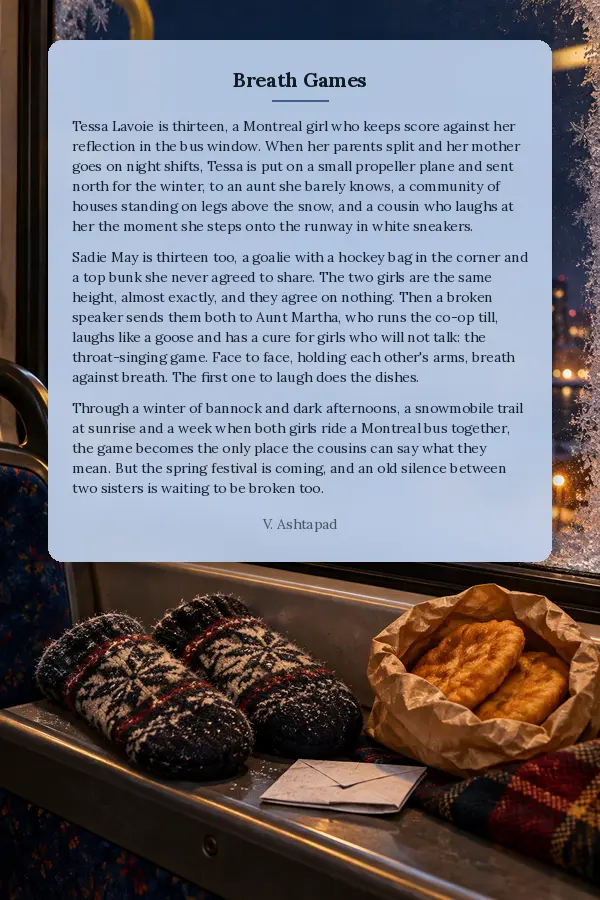
Tessa Lavoie is thirteen, a Montreal girl who keeps score against her reflection in the bus window. When her parents split and her mother goes on night shifts, Tessa is put on a small propeller plane and sent north for the winter, to an aunt she barely knows, a community of houses standing on legs above the snow, and a cousin who laughs at her the moment she steps onto the runway in white sneakers.
Sadie May is thirteen too, a goalie with a hockey bag in the corner and a top bunk she never agreed to share. The two girls are the same height, almost exactly, and they agree on nothing. Then a broken speaker sends them both to Aunt Martha, who runs the co-op till, laughs like a goose and has a cure for girls who will not talk: the throat-singing game. Face to face, holding each other's arms, breath against breath. The first one to laugh does the dishes.
Through a winter of bannock and dark afternoons, a snowmobile trail at sunrise and a week when both girls ride a Montreal bus together, the game becomes the only place the cousins can say what they mean. But the spring festival is coming, and an old silence between two sisters is waiting to be broken too.
Members can react to this book and talk about it in the members' Library.
Ownership
© 2026 CRUNOD LLC. All rights reserved.
This book is owned by CRUNOD LLC. It is free to read on EternalCurrent.Online. No part of it may be copied, reprinted, sold, recorded or adapted, including as audio, film or translation, without written permission from CRUNOD LLC.
© 2026 CRUNOD LLC. All rights reserved.