
Broken in the Right Place
Nine Appliqué Panels from Abomey
by V. Ashtapad
Foreword
This is a work of fiction. Fon appliqué from Abomey in Benin is real: bright cotton shapes sewn by hand onto a dark ground, a visual language older than the colonial era. The workshop, its family, the museum commission and every panel in this book are invented.
For every pair of scissors carried away in a suitcase.
The First Panel: The Courtyard
The workshop was a courtyard of red earth, and the first thing Inès Hounkpatin did when she walked into it was ruin her shoes.
They were good shoes. White leather sneakers from a designer friend's collection, the ones she wore to fittings in the Marais because they were comfortable and looked expensive and made the assistants at the fashion houses take her seriously. She had worn them on the plane from Charles de Gaulle to Cotonou, and in the taxi north for three hours on the long straight road through the palm plantations and the teak forests and the market towns, and she walked into her cousin's workshop in Abomey in them at four in the afternoon in March, into a courtyard of beaten earth the color of paprika, still wet from a rain an hour before, and sank to the ankle.
Nobody laughed. That was the strange thing. In Paris, everyone would have laughed. Here, eleven people sitting on low stools and woven mats around the edges of the courtyard, in the shade of a mango tree and a long tin-roofed veranda, with cloth across their knees and needles in their hands, looked up at her, looked at her shoes, and went back to sewing.
Except one. An old woman in the deepest shade of the veranda, very small and very straight, in a wrap of indigo and a head tie of the same cloth, with thick glasses on a cord, who did not look up at all. She was stitching a lion.
---
It was black cloth. That was what Inès saw first, from across the courtyard, before she had pulled her foot out of the mud: a long panel of black cotton cloth, two meters long, stretched across the old woman's knees and onto the mat beside her. And on the black, in bright pieces of cloth cut and sewn flat, a lion. Gold, with a red mane and a white eye, standing on its hind legs with its mouth open, so simple and so bold and so alive that it looked as if it might step off the cloth and walk across the red courtyard.
Around it, on the black, other shapes. A red knife. A green tree. A white bird with a fish in its beak. A man in blue holding something Inès could not make out. All of them flat, bright, outlined against the black, without shadow, without depth, like letters in an alphabet she had seen all her life, in her grandmother's apartment in Belleville, on the wall above the television, without ever learning to read.
Her cousin Romuald came across the courtyard from the gate, tall and thin and smiling, in a print shirt, carrying her suitcase, which he had insisted on carrying, though it was on wheels and the wheels were now caked in red mud.
"That is Tante Clémence," he said, following her eyes. "My grandmother. Your grandmother's sister." He put down the suitcase. "She has made appliqué in this courtyard for sixty-eight years. She was taught by her mother, who was taught by hers. Our family has sewn cloth in Abomey since the kings." He smiled. "She does not like Paris."
"She's never been to Paris."
"That is why she does not like it," said Romuald.
---
A boy of about eight took her shoes away.
He appeared at her elbow while she was still standing on one foot at the edge of the courtyard, a small solemn boy in a school shirt too big for him, and held out his hands, and Inès, not knowing what else to do, took off the ruined white sneakers and gave them to him. He carried them off to the back of the compound holding them at arm's length, one in each hand, the way you would carry two fish that had gone bad.
"Codjo," said Romuald. "Houéfa's son. She sews by the gate." He pointed to a young woman on a mat near the entrance, with a panel of black cloth across her knees, who was expecting her second child in the autumn and who lifted her needle in greeting without looking up. "He will clean them. They will not be white again. But they will be shoes."
Inès stood barefoot on the red earth. It was warm under the wet surface, and soft, and smelled of rain and iron.
Romuald took her around the courtyard, then. Slowly, with the suitcase left by the gate, introducing her to each of the eleven sewers on their mats, one by one, the way you would introduce a guest to a row of elders. Houéfa by the gate. Sènami and Afi, sisters, under the mango tree, who sewed side by side and finished each other's borders. Old Gnonnan, who did only the hems, and hummed. A tall serious woman called Dossi who had sewn in the workshop for thirty years and looked at Inès's bare feet and then at her face with an expression Inès could not read. Each of them said a word of greeting in Fon, and Romuald said a word back, and each of them looked at her a moment longer than politeness needed, and Inès understood that she was being compared to someone.
The only one he did not take her to was Tante Clémence.
"Tomorrow," he said, when Inès looked toward the deep shade of the veranda. "Not today."
---
They ate on the veranda at dusk, when the sewers had rolled up their mats and gone home through the gate in twos and threes with their cloth under their arms, and the courtyard had gone blue and quiet and full of the noise of insects.
Romuald's wife brought out a basin of water to wash their hands and then a pot of pâte, the stiff white corn paste of the south that you ate with your right hand, pulling off a piece and rolling it and dipping it, and a sauce of greens and smoked fish and so much pepper that Inès's lips went numb on the first mouthful. She ate it anyway. She ate all of it. She had not eaten with her fingers since she was a child, at her grandmother's table, and she found her hand knew how to do it before she did, the roll and the press of the thumb, and she sat with her numb mouth on the veranda in the warm dark and could not have said, if anyone had asked, what she was feeling.
Tante Clémence did not eat with them. She ate in her room. At eight o'clock she came out of the deep shade at the end of the veranda, very small and very straight, with her thick glasses on their cord around her neck and a lamp in her hand, and walked the length of the veranda past them toward the back of the compound, and stopped in front of Inès.
She looked at her. Not at her face. At her feet. Bare, on the cement, with the red earth of the courtyard still in the lines of her toes.
Then she went on, and a door closed somewhere, and that was all.
"That is good," said Romuald, when she had gone.
"That was good?"
"She looked at you," said her cousin, and went back to his cracked phone.
---
Her room was small and whitewashed, off the side of the courtyard, with a narrow bed under a mosquito net, a fan on a stand, a chair, a nail in the wall for clothes, and over the door, in a plain wooden frame, a small appliqué hanging, very old, faded almost to brown: a woman holding a jar, and a bird with a fish in its beak.
Inès stood under it for a long time.
It was the same. Not the same hanging. The same figures. Cut by a different hand, older, the edges softer. But the same woman with the same jar and the same bird, that had hung over the television on the rue de Belleville her whole life.
She lay under the mosquito net that night with the fan turning and the insects singing outside the shutters and looked at the dark shape of it over the door until she fell asleep.
---
The commission had come in January. An email, to the workshop's account, which Romuald managed on a phone with a cracked screen: from a museum in Lyon that was opening a new hall of West African textiles in October, and wanted, for the entrance, a set of nine appliqué hangings, made new, by a family workshop in Abomey, in the old way. Two meters by one meter each. Black ground. Telling, the curator wrote, *the story of the workshop itself, its family, its place, its craft, in the visual language of Fon appliqué, as a living tradition rather than a historical artifact*.
The fee was more money than the workshop had made in three years.
The deadline was the first of August. Shipping took six weeks.
The workshop had eleven sewers. Tante Clémence was eighty-four, and her eyes were going, and she was the only one who could draw the figures. Two of the best sewers had left for Cotonou in the autumn, for jobs in a factory that made school uniforms. One was pregnant. And Romuald, who had grown up in the courtyard and could sew as well as anyone, spent every day on his phone trying to sell the workshop's small hangings and cushion covers and bags to tourists and shops in Cotonou and Lomé and online, because if he did not, no one would, and the workshop would close.
"We need someone who can draw," Romuald had written to Inès in February, on a messaging app, from his cracked phone. "Someone who can design. Someone who can make nine panels look like one story. Tante Clémence can do the figures. But not nine panels. Not by August. Not with her eyes." A pause, three dots, then: "You're a designer. In Paris. You went to the school. Your grandmother told us."
Inès had been sitting in her studio in the 11th arrondissement at eleven at night, with a deadline for a mid-season collection for a label she freelanced for, surrounded by swatches of Italian wool and a mood board of Japanese workwear, when the message came in.
She had not been to Benin since she was nine.
That had been a wedding, in Cotonou, in the hot season: a cousin of her mother's, a white dress and a church and a party under a striped tent that went on for two days, with a band, and plastic chairs, and so much food that Inès had been sick behind the tent on the first night. She remembered the heat, and the noise of the motorbikes, and the sea, gray and enormous, with waves that knocked her flat. She remembered being passed from aunt to aunt, women she did not know who all held her face in their hands and said she had someone's chin.
They had not gone to Abomey. It was three hours north. Her mother had said there was no time. Inès had asked why Mamie had not come, and her mother had said Mamie did not like to travel, and that was all.
Pélagie had been at the airport when they came home, at Charles de Gaulle, at six in the morning, in her good coat. She had held Inès's face in her hands, like all the aunts, and looked at her for a long time, and said, *Well? Did you see it?* And Inès, who was nine and tired and had not understood the question, had said, *See what, Mamie?* And her grandmother had let go of her face and said, *Nothing, chérie. Nothing. Come, the car is waiting.*
She had not thought about that morning in twenty years. She thought about it now, at eleven at night, in the studio in the 11th, with the cracked-phone message from a cousin she had never met glowing on her screen.
She read the message four times. Then she looked at the mood board of Japanese workwear for a long time.
Then she wrote back: *What would I need to bring?*
Romuald's answer came in thirty seconds.
*Nothing. Old shoes.*
© 2026 CRUNOD LLC. All rights reserved.
The Second Panel: The Hand
Tante Clémence did not speak to her for three days.
She did not refuse to. That was not it. She simply sat in the deep shade of the veranda every morning from six until noon and every afternoon from three until the light went, stitching, with her thick glasses on their cord and her needle going in and out of the black cloth in tiny even stitches, and when Inès sat down on the mat beside her, the old woman did not look up, and when Inès said good morning in French, she said good morning in French, and that was all.
So Inès watched.
She watched for three days. She sat on the mat in the shade of the veranda with a sketchbook she did not open, and watched the old woman's hands.
---
Fon appliqué is simple, Romuald had told her, the way bread is simple. You take a ground of cloth, black, usually, or sometimes gold or red. You cut shapes from other cloth, bright solid colors, cotton, no patterns: red, gold, green, blue, white, sometimes pink, sometimes orange. You lay the shapes on the ground. You turn their edges under with the tip of your needle. And you stitch them down, by hand, with tiny stitches, so small and so close that they disappear into the fold.
That was all.
It was not all. Inès saw that on the first morning. It was not all at all.
The old woman did not draw the shapes before she cut them. She cut them freehand. She took a piece of gold cloth in her left hand and a pair of black-handled scissors in her right, old scissors, heavy, the blades worn thin, and she cut, without hesitating, without a line, without a pattern, and a lion came out of the cloth. Or a bird. Or a hand. In one long continuous cut, the scissors turning and turning, the cloth turning the other way, and when she was done, the shape fell into her lap complete, and it was exactly the right size for the place it was going on the black, and exactly the right shape, and it had the life in it.
Inès had studied pattern-making for four years at a school in Paris. She had cut a thousand garments from a thousand patterns drawn on paper with rulers and curves and tracing wheels. She had never once cut anything that had life in it.
She did not say so. She sat on the mat and watched.
---
She watched the courtyard, too. She could not help it.
She watched how the day was made. How the sewers came through the gate at six, in the gray light, with their mats rolled under their arms and their cloth in plastic bags and their babies on their backs, and unrolled the mats in the same places every day, as if the places had been assigned before any of them were born. How Gnonnan hummed. How Sènami and Afi passed a single pair of scissors back and forth between them without speaking, without looking, the way a married couple passes the salt. How at ten o'clock someone always turned on the radio on the veranda post, and at eleven someone always turned it off. How the goats came in at nine and at two, as if they had appointments. How the light moved across the courtyard from the mango tree to the veranda and back, and the sewers moved with it, inching their mats a little every hour to stay in the shade, so that by noon the whole workshop had migrated a few meters to the east, and by evening drifted back.
She watched Dossi, the tall serious woman, watching her.
And she watched what Tante Clémence did at the end of each day, when the light went and the sewers rolled up their mats.
The old woman did not get up at once. She sat on in the deep shade with the black-handled scissors in her lap, and took a rag from a fold of her wrap, and a small tin, and opened the tin, which held a little red palm oil gone thick and dark, and touched the rag to it. Then she cleaned the scissors. Slowly. The blades first, one side and the other, wiping each one from the pivot to the tip. Then the pivot itself, working the oil into it, opening and closing the blades a dozen times until they moved without a sound. Then the handles, the dark worn handles, rubbing them as you would rub the feet of someone tired.
It took ten minutes. She did it every evening. Inès never saw her miss it once in five months.
On the second evening, Inès asked Romuald why.
"Her mother did it," said Romuald. "And hers." He shrugged. "She says scissors that are not looked after will not look after you." He watched his grandmother put the rag and the tin back into the fold of her wrap. "When I was a boy I asked her once if I could do it for her. She looked at me as if I had asked to brush her teeth."
And she watched her phone, which lay face down on the mat beside the unopened sketchbook and buzzed.
It was Delphine, mostly. The creative director at the label in Paris, for whom Inès had been freelancing for four years, and who had been gracious about the trip, in January, in the way that people in Paris are gracious about things they do not believe will happen. *Of course, darling, go, go, find your roots, send me pictures, the files for the mid-season by the twentieth, yes?* Then, in March, when Inès was actually gone: *Darling, the toile for look fourteen is wrong, can you look?* And: *Can you jump on a call at four your time?* And: *Inès, I need to know if you are with us for the autumn or not.*
On the second afternoon, Inès went out through the gate to the edge of the road, where there was a little more signal, and called her.
Delphine was in the studio on the rue de Turenne. Inès could hear it behind her: the hiss of the steam iron, the radio, an assistant laughing. She could see it, too, without trying. The long white table, the swatches of Italian wool, the mood board of Japanese workwear.
"Darling," said Delphine. "Thank God. Look fourteen."
"I'll send you notes on fourteen tonight."
"And the autumn?"
Inès stood at the edge of the red dirt road outside the gate. A woman went by on a motorcycle taxi with a basin of tomatoes balanced on her knees. A man was selling cold water in little plastic sachets from a cooler. Behind her, through the gate, she could hear Gnonnan humming.
"I don't know yet," she said.
There was a silence on the line from Paris.
"Inès," said Delphine, kindly. "Darling. It's a craft project. It's lovely. But it's a craft project. In a village. You're a designer. You have a career." A pause. "I'm only saying it because I care about you. Don't stay too long."
"It's not a village," said Inès. "It's a city. It was the capital of a kingdom for three hundred years."
"Of course it was," said Delphine. "Send me fourteen."
Inès sent the notes on look fourteen that night, from the bed under the mosquito net, by the light of the phone. They were good notes. She was good at notes. Then she turned the phone face down on the chair and did not look at it again until the next evening, and in the morning, on the mat, she watched the old woman's hands.
---
On the third afternoon, at four o'clock, when the heat was going out of the day and the light was turning gold in the courtyard and the mango tree was full of small green birds arguing, the old woman stopped stitching.
She held out the scissors. Without looking up.
Inès looked at them.
"Cut a hand," said Tante Clémence, in French.
She did not give her a pattern. She gave her a scrap of white cloth, a square the size of a paperback book.
Inès took the scissors. They were heavier than any scissors she had ever held. The handles were worn smooth and dark from seventy years of the same fingers. She held the white cloth in her left hand and the scissors in her right and looked at the cloth and could not see a hand in it anywhere.
"I can't," she said. "Not without drawing it first."
"Then you will never cut a hand," said Tante Clémence.
Inès cut.
It came out like a glove someone had sat on. Five fingers, more or less, of different lengths, the thumb at the wrong angle, the wrist ragged where she had hesitated and the blades had chewed the cloth.
The old woman took it. She held it up to her thick glasses in the gold light for a long time.
Then she said the first sentence Inès had heard her say that was not good morning or cut a hand.
"You held your breath," said Tante Clémence. "When you cut. I watched. You held your breath the whole time." She put the ugly hand down on the mat. "The cloth knows. If you are afraid, it is afraid. Breathe out, and cut on the breath."
© 2026 CRUNOD LLC. All rights reserved.
The Third Panel: The Market
Inès cut hands for two weeks.
Every morning and every afternoon, on the mat in the shade of the veranda beside Tante Clémence, while the eleven sewers stitched around the courtyard and the radio on the veranda post played music from Cotonou and the goats from the house next door wandered in through the gate and were chased out again by the children. She cut a hand from white cloth, and Tante Clémence held it up to her glasses and looked at it and said one thing, and Inès cut another.
*You stopped at the thumb.*
*The fingers are too even. A hand is not a comb.*
*Better. But you are thinking about Paris.*
*How do you know I am thinking about Paris?*
*Because the fingers are too thin. Paris hands. Hands that have never pounded yam.*
That evening, out of pride, Inès went to the back of the compound where Romuald's wife, Bernadette, was pounding yam for dinner, and asked to try.
Bernadette looked at her. Then she handed over the pestle without a word.
It was a length of hard wood as tall as Inès and as thick as her wrist at the narrow middle, worn smooth by a hundred thousand dinners, and the mortar was a hollowed log knee-high, and in the bottom of it were pieces of boiled yam, white and steaming. You lifted the pestle high and brought it straight down, Bernadette showed her, and then lifted it again, and between the strokes, quick as a bird, she reached into the mortar with her free hand and turned the yam over, and pulled her hand out before the pestle came down. Lift, strike, turn. Lift, strike, turn. Until the yam became a smooth white elastic mass that clung to the wood.
Inès lifted the pestle. It was much heavier than it looked. She brought it down. It hit the edge of the mortar and bounced off and nearly took her toes.
Behind her, the whole back of the compound had gone quiet. Codjo had appeared from nowhere. Two of the sewers who had not yet gone home were standing in the passage with their mats under their arms.
She lifted it again. She brought it down in the middle. The yam squelched. She lifted it again. Her arms burned. On the fifth stroke she remembered to breathe, and on the sixth she breathed out on the stroke, without deciding to, and the pestle came down straight and heavy and right, and the yam gave under it with a sound like a footstep in wet sand.
Bernadette said something in Fon, and the two sewers in the passage laughed, not unkindly.
"What did she say?"
"She says you are still too slow to turn it," said Romuald, who had come to see. "So she will turn it and you will pound and nobody will lose a hand tonight."
They pounded the yam together for twenty minutes, Inès striking and Bernadette turning, her quick hand going in and out of the mortar between the strokes without fear, trusting Inès to bring the pestle down only when the hand was gone. When it was done, Inès's palms were raw and her shoulders were shaking and her shirt was soaked through.
The next morning, Tante Clémence held up hand number one hundred and forty, and looked at it for a long time.
"Better," she said. "Those are not Paris fingers."
She had heard, of course. Everyone in the compound had heard. The old woman did not mention the yam. But at the end of the day, when she cleaned her scissors, she held out the tin of palm oil to Inès without a word, for her raw palms, and Inès took it.
She cut two hundred and twelve hands. She kept them all, in a plastic bag from the supermarket in Cotonou, in her suitcase, at the foot of the narrow bed in the small room off the courtyard where she slept under a mosquito net with a fan that turned slowly all night and did nothing.
On the fifteenth day, Tante Clémence held up hand number two hundred and thirteen, and looked at it for a long time, and said nothing at all.
Then she handed Inès a piece of gold cloth.
"Now a lion," she said.
---
The lions were worse than the hands.
A hand, at least, she had. She had two of them. She could look at them. A lion she had seen only in zoos and in films and on the panels in the tourist shops, and the first one she cut looked like a cat that had been told bad news. The second looked like a dog. The third had five legs, because she had not been paying attention, and Tante Clémence held it up to her glasses for a long time and then handed it to Codjo, who had taken to sitting on the edge of the veranda after school to watch, and who took it away to show his mother, and Inès heard the whole courtyard laughing by the gate.
"They are laughing at me."
"They are laughing at the lion," said Tante Clémence. "Cut another."
There was not enough gold cloth to waste on lions that looked like cats. So Inès cut them from newspaper first, old newspapers that Romuald brought from Cotonou, and then from scraps, brown and gray, the ends of bolts, and only when the old woman said *better* did she let her touch the gold. She cut lions on the mat and lions on the veranda and lions on her bed at night under the mosquito net by the light of her phone. She dreamed of lions. She began, without meaning to, to see them everywhere: in the shape of a cloud over the mango tree, in a stain on the whitewash of her room, in the way Dossi sat on her mat with her shoulders up and her head low over her work.
"You are thinking about what a lion looks like," said Tante Clémence, on the fourth day of lions, holding up a gray one. "Stop it. Think about what a lion does."
"What does a lion do?"
"It is not afraid," said the old woman. "Of anything. It walks into the middle of things." She put the gray lion down. "You cut like someone standing at the edge of a courtyard in white shoes."
Inès looked at her.
Tante Clémence did not smile. But she picked up her needle again and went back to her own work, and something at the corner of her mouth, very slightly, moved.
---
On Saturdays Romuald took her to the market.
It was the big market in the center of Abomey, a vast sprawl of stalls under tin roofs and umbrellas and tarpaulins, so crowded and so loud and so bright that the first time, Inès stood at the edge of it and could not move. Women in wraps of every color there was, wax print and indigo and lace, with babies tied on their backs and enormous loads on their heads, basins of tomatoes and pyramids of onions and sacks of dried fish and bundles of firewood, moving through the narrow lanes between the stalls without ever once touching each other. Mountains of yams. Hills of red palm-nut. Pyramids of soap. Bolts of cloth stacked to the roof. Motorcycle taxis, the zémidjans, the drivers in their yellow shirts, honking their way through the crowd with a passenger on the back holding a goat. The smell of smoke and dried fish and frying dough and palm oil and diesel and something sweet, overripe, mangoes on the ground.
Romuald bought akassa from a woman at the edge of the market who had sold him akassa every Saturday since he was a boy: fermented corn paste, white and smooth and faintly sour, wrapped in a big green leaf and tied with a strip of palm, still warm. You ate it with sauce, Romuald said, a red sauce of tomato and pepper and onion and dried fish and a lot of palm oil, which the woman ladled into a plastic bag and knotted, and they ate it standing at the edge of the market with their fingers, the akassa cool and sour and the sauce so hot that Inès's eyes streamed.
"My grandmother," said Inès, between mouthfuls, "made this in Belleville. On Sundays. On a hot plate in the kitchen. She could never get the right leaves. She used aluminum foil."
Romuald laughed. "With foil it is not akassa. It is a sad dumpling."
"She said that too." Inès wiped her eyes. "Every Sunday."
---
After the akassa, on the second Saturday, Romuald took her to the palaces.
They were on the other side of town, behind long walls of red earth the color of the courtyard, the old royal palaces of the kings of Dahomey, who had ruled from Abomey for three hundred years, each new king building his palace beside his father's, so that by the end it was a city inside the city, with walls that ran for kilometers. Most of it was gone now, fallen and washed away by two centuries of rain. What was left was a museum, low buildings around sandy courtyards, with tin roofs and wide verandas very like the one at the workshop.
And on the walls, in panels of red earth, the kings' symbols.
Inès stood in front of them in the afternoon heat and could not move. They were the same figures as the cloth. The same flat bold shapes, the lion and the buffalo and the shark and the bird, but modeled in clay on the walls of the palace and painted in red and white and black and blue, each one in its own square frame in the wall, row on row, like a page of writing. A lion with its mouth open. A fish with legs. A man with a gun. A bird with a fish in its beak.
"Writing," said Romuald, beside her. "That is what it was. Before there was writing here, there was this. Each king chose his symbols when he took the throne, and every one of them meant a saying, a promise, a thing he would do. And the people who could read them, read them." He pointed. "That one. The bird. You know that one."
"It's on my grandmother's hanging."
"It's on every hanging," said Romuald. "Everybody's grandmother. It means the bird does not let go of what it has caught." He smiled. "Every family in Abomey thinks that one is about them."
The guide, a young man in a pressed shirt with a laminated badge, told them which king had chosen which symbol, and when, and why. He told it well, in French, with dates, for tourists, and Inès listened and nodded and forgot most of it at once. What she did not forget was the end, when he took them to the edge of the last courtyard and pointed to a row of panels on the far wall that had no paint left on them at all, only the bare red earth, the shapes worn so soft by rain that you could barely make them out.
"Those," the guide said, "nobody remembers. The families who could read them are gone. We know they meant something. We don't know what."
Inès looked at the worn shapes in the earth for a long time.
On the way back, on the back of Romuald's motorbike, holding her bag of cloth against her chest with one arm and his shirt with the other, through the red dusk with the smoke of cooking fires coming up from every yard, she thought about the families who could read them, and the families who were gone, and a woman holding a jar over a television on the rue de Belleville, whose meaning nobody in that apartment had ever asked.
---
She bought cloth at the market. That was why they came. Cotton, in solid colors, from a stall at the back run by a very old man in a white cap who had sold cloth to the workshop for forty years and who did not speak to Inès at all, only to Romuald, in Fon, at length, while looking at her.
The stall was a cave. A long narrow space under a tin roof, between a woman selling enamel basins and a man selling padlocks, stacked from the packed-earth floor to the rafters with bolts of cotton cloth in every solid color Inès had ever seen and some she had not: a red like the inside of a pomegranate, a green like the skin of a lime, a blue so dark it was nearly the indigo of Tante Clémence's wrap, a pink like a child's sweet, a yellow like the yolk of a market egg, a white as flat and clean as paper. They were not arranged by color. They were arranged by some system that existed only in the old man's head, so that a bolt of orange lay on a bolt of black lay on a bolt of pale green, and when Romuald asked for a particular red, the old man reached without looking into the middle of a stack as tall as himself and pulled it out, and the stack did not move.
Inès ran her fingers along the edges of the bolts while the two men talked. The cotton was heavier than any cotton she bought in Paris, and stiffer, with a slight shine to it, and it smelled of dust and starch and the dye. She could have stood there all day.
"He says," said Romuald, "that you are Pélagie's granddaughter."
Pélagie was her grandmother. Who had left Abomey in 1971 for Cotonou and then for Paris, to marry a man who worked for the post office, and had raised her children and then her grandchildren in a two-room apartment on the rue de Belleville, on the fifth floor, with no elevator, with an appliqué hanging on the wall above the television of a woman holding a jar and a bird with a fish in its beak, which she had brought from Abomey in her suitcase in 1971 and which was the only thing from home she ever had.
"How does he know?"
"He says you have her chin," said Romuald. "And her impatience." He listened to the old man. "He says she bought cloth from his father. Before she left. She was the best cutter in the workshop. Better than Tante Clémence. He says Tante Clémence has never forgiven her for leaving."
Inès looked at the old man in the white cap. He looked back at her, without expression.
Then he reached under his counter and took out a bolt of gold cotton, deep and rich, the color of a lion, and put it in her arms, and refused to let Romuald pay.
© 2026 CRUNOD LLC. All rights reserved.
The Fourth Panel: The Story
The nine panels had no story yet. That was the problem. That was why Romuald had sent for her.
"The museum wants the story of the workshop," he said, on the veranda, at night, with a kerosene lamp on the floor between them and the mosquitoes singing outside its circle and the courtyard dark and quiet, the sewers gone home. "Its family. Its place. Its craft." He spread his hands. "But that's not how appliqué works. Appliqué tells the stories of the kings. The old stories. The lion is King Glèlè. The buffalo is King Guézo. The shark is King Béhanzin. Everybody knows. Every tourist shop in Cotonou sells those panels. The kings and their symbols." He shook his head. "The museum doesn't want the kings. They have the kings. They have old panels of the kings in their storeroom from 1900. They want us."
"So tell your story."
"With what?" said Romuald. "We don't have symbols. We're not kings. We're a family that sews."
Inès looked at the black cloth stretched on the mat in the lamplight. The first panel. Tante Clémence's lion, half finished, gold on black.
"Then make new ones," she said.
Romuald looked at her across the lamp.
"New symbols," he said slowly.
"Like the kings. You said it yourself. Each king chose his own. When he came to the throne. They weren't handed down from the sky. Somebody sat somewhere and decided: that is mine. The lion is mine." She leaned forward. "So decide. What's yours? What's Tante Clémence's? What's the workshop's?"
"We're not kings."
"The museum doesn't want kings," said Inès. "You said that too."
Her cousin was quiet. Out in the courtyard a goat that had been missed at the evening chasing coughed, somewhere in the dark under the mango tree, like an old man.
"She won't like it," Romuald said finally. "Grand-mère. New symbols. She's cut the old ones for sixty-eight years."
"Then she'll tell me," said Inès. "She tells me everything else."
---
She did not sleep that night. She sat on the narrow bed under the mosquito net with the fan turning and the sketchbook open on her knees, the one she had brought from Paris and not opened in three weeks, and drew.
Not the panels. The family.
Her grandmother Pélagie, cutting cloth in this courtyard in 1970, with her impatient chin. Her grandmother on the fifth floor in Belleville, with akassa in aluminum foil. Tante Clémence, at eighty-four, in the shade, with her thick glasses and her heavy scissors. Romuald with his cracked phone. The eleven sewers. The old man in the white cap at the back of the market with his bolts of cloth. The woman who sold akassa wrapped in a leaf. The goats. The mango tree. The red earth that had eaten her shoes.
And for each one, she drew a shape. Not a person. A shape. The way the appliqué did it. Flat, bright, simple, without shadow, that you could cut from a single piece of cloth in one breath. A pair of scissors, open. A green leaf folded over something white. A phone with a crack across it, like a lightning bolt. A mango. A bolt of gold cloth. A hand.
By four in the morning she had nine pages.
She sat on the bed with the sketchbook on her knees and looked at them, and then she went out into the courtyard in her bare feet and sat on the step of the veranda in the dark and watched the sky over the mango tree go from black to gray to the color of a pigeon's wing. The first cock crowed somewhere over the wall, and then all the cocks in Abomey answered it at once. Somebody's radio came on, far off, the news in Fon. A woman began sweeping a yard on the other side of the wall, the long dry strokes of a palm broom, steady, unhurried, like breathing.
She had not felt like this in Paris for a long time. She tried to think when. At the school, perhaps. In the first year. At three in the morning in the cutting room, with a pattern that finally worked.
No. Before that. In the kitchen on the rue de Belleville, at seven years old, cutting a straight line with the old black scissors while her grandmother watched.
She took them out to the veranda at six, when Tante Clémence sat down in the shade with her glasses and her needle, and laid them on the mat in front of her, one after another, in a row.
The old woman looked at them for a long time.
She did not say anything. She looked at each one, holding it up to her thick glasses in the early light, turning it, putting it down, picking up the next. When she came to the one with the scissors, she stopped for a long time.
Then she said, in French, very quietly:
"Pélagie's scissors."
Inès looked at her.
"Your grandmother," said Tante Clémence. "Her scissors had a mark on the handle. Here." She touched the drawing, the left handle. "Where she dropped them on the stone step in 1966 and they chipped. She would not use another pair. She said they were broken in the right place."
She looked up at Inès for the first time. Her eyes behind the thick glasses were very dark and very wet.
"She took them," said Tante Clémence. "To Paris. In 1971. And I never saw them again."
© 2026 CRUNOD LLC. All rights reserved.
The Fifth Panel: The Scissors
Inès called her mother in Paris that night, from the top of the water tower at the edge of the compound, where Romuald said the signal was best.
"Maman. Mamie's scissors."
Her mother was quiet on the line, in the apartment in Belleville, the same apartment, on the fifth floor, with no elevator, where her mother had grown up and Inès had grown up and Pélagie had lived until she died in 2019.
"Her sewing scissors?" said her mother. "The old black ones? With the chip?"
"Yes."
"In the box," said her mother slowly. "In the closet. With her things. I never—" She stopped. "Inès. What's going on?"
Inès told her. Standing on the water tower in the dark in Abomey, with the town spread out below her in a scatter of lights and the drums starting somewhere to the east, as they did every night, for a wedding or a funeral or nothing at all, the sound coming across the dark rooftops low and quick and patient. She told her mother about the courtyard, and the red earth, and the two hundred and twelve hands, and Tante Clémence, and the nine pages in the sketchbook.
Her mother did not say anything for a long time.
"She never talked about it," she said finally. "The workshop. Abomey. Her sister. Never. In forty-eight years. She hung that panel over the television and she never said one word about it." Her voice changed. "I asked her once. When I was a girl. Why she left. She said: *I wanted to cut something nobody had cut before.*" A pause. "She was a seamstress for forty years, Inès. In a factory in the 10th. Sewing hems on raincoats. She never cut anything again."
---
The eight days were the longest of the spring.
Inès did not cut, in those days, not for the panels. Tante Clémence would not let her. *When the scissors come,* was all she said, and went on with the first panel, her lion, gold on black, in tiny stitches, while Inès sat beside her and drew.
She drew the nine panels full size, in the end, on brown paper from the market, two meters by one, spread on the red earth of the courtyard and weighted at the corners with stones, while the sewers stepped around them and Codjo and the goats were kept off them by threats. She drew in charcoal, freely, rubbing out with her palm, the way she had not drawn since school. She showed each one to Tante Clémence, who looked at it close up through her glasses, a piece at a time, as if reading a map in the dark.
On the fourth day, Romuald came back from Cotonou with a borrowed laptop and the signal from the water tower, and they called the museum.
The curator was called Hélène Marchal. She was a woman of sixty in a gray linen jacket, with short white hair and reading glasses pushed up on her head, sitting in an office in Lyon with a window behind her full of rain. She had studied West African textiles for thirty years and had written two books on the cloth of Abomey that Romuald had read, on his phone, twice, and she looked out of the screen at the three of them on the water tower, Romuald and Inès and the laptop and the evening sky, with an expression of patient worry.
Inès showed her the drawings. One at a time. Holding the phone over each brown sheet spread on the earth below the tower, in the last light, while Romuald held the laptop and explained in French what each shape meant.
The scissors with the chip. The folded leaf. The phone with the crack. The hands.
Hélène Marchal did not say anything for a long time.
"These aren't traditional figures," she said finally.
"No," said Inès.
"They're in the tradition. The forms are right. The scale. The flatness. The way each one sits on the ground." The curator took her glasses off her head and put them on and leaned toward her screen. "But these are new. Nobody's cut a phone before. Nobody's cut a pair of scissors with a chip in the handle."
"No."
"The board will ask," said Hélène Marchal. "They'll want to know if it's authentic."
Inès looked at Romuald. Romuald looked at the drawings on the earth.
"The kings chose their symbols," said Inès. "When they came to the throne. They weren't old then. They were new. Somebody cut the first lion." She held the phone over the scissors. "This is the first pair of scissors. That's all."
The curator looked at her through the screen for a long moment, in her office in Lyon with the rain on the window.
"Write that down," she said. "Exactly that. For the label on the wall." She took her glasses off again. "And send me the drawings. All nine. I want to show the board before they have time to think."
When the call ended, the sun had gone down behind the town and the drums had started in the east. Romuald closed the borrowed laptop and sat on the iron platform of the water tower with his legs hanging over the edge, and Inès sat beside him, and below them the lamps came on in the yards of Abomey one by one.
"My father left too," said Romuald, after a while. "Did you know that? For Lagos. When I was six. He sent money for two years. Then nothing." He looked down at the courtyard, at the brown sheets of paper on the dark earth. "Grand-mère raised me. In there. On the mat. I learned to sew before I learned to read." He laughed a little. "Everybody leaves. Pélagie. My father. The two best sewers, last autumn, for the uniform factory. Everybody leaves Abomey and Grand-mère stays and cuts lions."
"You stayed."
"Somebody has to sell the lions," said Romuald. And then, after a moment, more quietly: "And somebody had to stay with her."
---
The scissors came by courier eight days later, in a cardboard box from the post office on the rue de Belleville, wrapped in one of Pélagie's old head ties, indigo, the color of the wrap Tante Clémence wore every day.
They were black-handled, heavy, the blades worn thin. On the left handle, a small chip, where they had fallen on a stone step in 1966.
Romuald fetched the box from the post office in Bohicon on the eighth evening, on his motorbike, in the rain, and brought it into her room wrapped in a plastic bag against the wet, and put it on the chair by her bed, and stood in the doorway.
"Open it," he said.
"Not tonight."
He looked at her, and then he understood, and nodded, and went away.
She did not open it that night. She sat on the bed under the mosquito net with the fan turning and the rain on the tin roof and the box on the chair, and looked at her mother's handwriting on the label, the address in Abomey spelled carefully in capitals, and the stamps, and the post office sticker from the rue de Belleville, a street she had walked down every day of her life. At midnight she put her hand on the lid of the box. At one she took it away. At five, in the gray before dawn, when the cocks had started and the rain had stopped, she opened it.
Indigo cloth. She knew the smell before she unfolded it. Her grandmother's head tie, the one she wore on Sundays, that smelled of the hair oil she used and the kitchen on the rue de Belleville and something else, something that was only Pélagie. Inside it, wrapped twice around, heavy in her hand, the scissors.
She sat on the bed and held them, still in the indigo, for a long time, until the light came gray through the shutters and she heard the gate open and the first of the sewers come in.
Inès carried them across the courtyard at six in the morning, in the early light, past the eleven sewers arriving with their mats and their thread, past the mango tree full of arguing birds, to the shade of the veranda, and knelt on the mat, and held them out.
Tante Clémence looked at them.
She did not take them. She looked at them in Inès's hands for a long time, through her thick glasses, in the early light, with her own heavy scissors lying in her lap.
Then she said, very quietly, in Fon, something Inès did not understand.
Romuald, who had come up behind them, translated, with his voice gone strange.
"She says: *broken in the right place.*"
Then Tante Clémence picked up her own scissors from her lap and held them out to Inès.
"You keep hers," she said in French. "Pélagie's. You cut with them. That's what they're for." She put her own scissors in Inès's other hand. "And mine. You'll need both."
"Tante. These are yours. You need them."
The old woman took off her thick glasses and folded them on their cord and laid them in her lap.
"My eyes are finished," said Tante Clémence. "I have one more panel in them. Maybe two. Then I'm done." She looked at Inès without the glasses, her eyes very dark and soft and not quite focused. "So you cut. I'll tell you what. You cut."
© 2026 CRUNOD LLC. All rights reserved.
The Sixth Panel: The Phone
They made the panels from April to July, and it was the hardest work Inès had ever done in her life, and she had once made forty-two runway garments in nine days for a show in Milan.
They made them in the courtyard. All of them. Fourteen people by May, because Romuald found three more sewers: two young women from the market whose mothers had sewn for the workshop, and a man of seventy, a retired tailor from Bohicon, who had heard about the commission on the radio and walked eleven kilometers to the gate to ask if they needed someone who could stitch a straight seam. They sat on their mats around the red courtyard every day from six to noon and three to dark, with the panels stretched across their knees, and the radio on the veranda post playing music from Cotonou, and the goats coming in, and the children chasing them out.
Inès cut. With Pélagie's scissors. On the breath. Every shape for every panel. Hands and leaves and mangoes and bolts of cloth and goats and a woman with a basin on her head and a man in a white cap and a phone with a crack across it like lightning. She cut them freehand, without drawing, from cloth the old man in the white cap at the market gave her, and handed them to Tante Clémence, who could no longer see well enough to cut, but who could see a shape held close to her face, and who said one word about each one. *Yes.* Or *no.* Or *again.*
Most of the time she said *again*.
---
The first panel was finished on the last day of April.
The courtyard. Tante Clémence's gold lion, standing, with its red mane and its white eye, and around it the shapes Inès had cut on the breath in the weeks since the scissors came: the mango tree, green, with small birds in it like seeds; the tin roof of the veranda, a long gray band; a goat, white, with its head down; and the red earth itself, a broad curved shape along the bottom of the panel that Inès had cut from the reddest cotton the old man in the white cap could find, the color of paprika, the color of the mud that ate her shoes. And in one corner of it, very small, almost hidden, a pair of white shoes, side by side.
Dossi and Inès laid it flat on the red earth of the courtyard in the late afternoon, on a clean sheet, and the whole workshop got up from their mats and came and stood around it.
Nobody said anything. Then Gnonnan pointed at the white shoes in the corner and began to laugh, and then Sènami and Afi, and then all of them, the whole courtyard laughing at the shoes, and Codjo ran to fetch them, the real ones, still brownish red, which he had cleaned and kept on a shelf in his mother's room as a trophy, and held them up beside the panel, and the laughter went on until Houéfa had to sit down.
Tante Clémence sat on the step of the veranda through all of it, and did not laugh, and did not say anything, and looked at the panel through her thick glasses from where she sat.
When the laughter had stopped, she said one word.
"One."
Inès looked at her.
"One," said the old woman. "Eight more." She went back to her mat.
---
The retired tailor from Bohicon came on the first Monday in May, at seven in the morning, on foot.
His name was Monsieur Agossou. He was seventy, very thin and very upright, in a pressed white shirt and gray trousers with a crease in them you could have cut bread with, and black shoes polished so bright that they had somehow come eleven kilometers down a red dirt road without a mark. He carried a cloth bag over his shoulder. He stood at the gate and waited, without calling out, until Romuald noticed him.
He had heard about the commission on the radio, he said. On a program on Saturday mornings about local news. A family workshop in Abomey, a museum in France, nine panels by August. He had been a tailor for fifty years, in a shop on the main road in Bohicon, men's suits and school uniforms and wedding clothes, and he had closed the shop when his eyes went for the fine work, and since then he had sat at home, and his wife was tired of him. He could not cut figures. He had never sewn appliqué. But he could stitch a straight seam, and he could stitch a hem, and he could stitch for twelve hours without stopping, and his eyes were still good enough for that.
Tante Clémence, on her mat in the shade, looked at him for a long time over the tops of her thick glasses.
Then she held out a scrap of black cloth and a scrap of red and a needle already threaded.
Monsieur Agossou set down his cloth bag. He sat on the edge of the veranda, in his pressed trousers, and took the cloth, and laid the red on the black, and turned its edge under with the tip of the needle as if he had done it all his life, and stitched it down. Ten centimeters. Without looking up. Without hurrying. His stitches were tiny and even and so close that they disappeared into the fold.
He handed it back.
Tante Clémence held it up to her glasses. She ran her thumb along the seam.
"Fifty years," she said.
"Fifty-one," said Monsieur Agossou.
"Sit there," said Tante Clémence, and pointed to a place on the veranda beside Dossi, and the tailor from Bohicon sat there every day from then until August, in his pressed white shirt, and was never once late.
The two young women came the week after. Fifamè and Nadège, nineteen and twenty, cousins, who sold phone credit and plastic sandals from a stall at the market and whose mothers had sewn in the courtyard in the 1990s and had taught them nothing, they said, because they wanted something better for them. They were loud. They were funny. They sang along to the radio on the veranda post and knew all the words to every song. They had never sewn anything more complicated than a button. Dossi took them, the first morning, without being asked, to her own mat under the mango tree, and sat one on each side of her, and by the end of the month they were stitching borders, and by the end of June Fifamè, the younger, who never stopped talking, was turning edges under with the tip of the needle so cleanly that Tante Clémence held up her work and said *yes* without being asked twice.
Fourteen people. The courtyard was full. In the mornings, coming out of her room into the gray light with the scissors in her hand, Inès stood on the step and looked at it: fourteen mats on the red earth and the mango tree and the veranda, and the radio, and the goats, and fourteen people bent over black cloth, and the needles going in and out, flashing a little where the light caught them. She thought it was the most beautiful room she had ever been in. It had no walls.
"How old were you?" she asked Tante Clémence that evening, on the veranda, while the old woman cleaned her scissors with the rag and the tin of palm oil. "The first time. When you cut something that went on a panel."
Tante Clémence went on wiping the blades. One side, then the other, from the pivot to the tip.
"Sixteen," she said. "A fish. For a panel of King Béhanzin, for a man from the government who wanted to give it to a man from another government." She worked the oil into the pivot. "My mother let me cut the fish because it was small and in a corner. I cut it eleven times. She said *again* ten."
"And the eleventh?"
"The eleventh she said nothing." The old woman closed the blades and opened them, closed and opened, listening to them. "And put it on the panel. And that night, Pélagie, who was twelve, cut a better one from a scrap, by the lamp, without anyone asking, just to show me she could." She rubbed the handles. "She always could."
Inès did not say anything.
"I hit her," said Tante Clémence. "With my sandal. Our mother hit me. Then we all three sat on this veranda and laughed until we couldn't breathe." She put the rag and the tin away in the fold of her wrap. "Sixty-eight years. I still remember the fish."
The next morning, on the mat beside her, Inès found a small fish cut from blue cloth, no longer than her thumb, lying on top of her scissors. It was not perfect. One fin was a little longer than the other. Nobody in the courtyard would say who had cut it, and Tante Clémence, when Inès held it up, only looked at it through her thick glasses and said, "Keep that one too."
---
Romuald was not on the veranda on the first night of the sixth panel.
Inès found him at the gate after midnight, sitting on an upturned bucket in the road with the cracked phone lit in his hands and his face lit blue by it, answering a message from a hotel in Cotonou about cushion covers.
She sat down on the low wall beside him.
"You don't sleep," she said.
"I sleep." He typed with one thumb. "In August."
"Romuald." She waited until he looked up. "How long have you been doing this? Every night?"
He thought about it. "Since the two best sewers left. October. Before that, only some nights." He put the phone face down on his knee. "Before that, there were enough orders. Then the uniform factory opened and the tourists stopped coming after the bad year, and the shops in Cotonou wanted cheaper, and cheaper, and cheaper." He shrugged. "So I find new shops. Every night. A hotel in Lomé. A woman in Accra who sells to Americans. A shop in Brussels. A man in Montreal whose mother was from here." He looked at the gate, at the dark courtyard behind it. "Every night, one more. If I stop finding them, it closes. Not this year. Maybe not next year. But it closes."
"Does she know?"
"She knows everything," said Romuald. "She doesn't say."
Inès looked at the cracked phone on his knee. The crack ran from one corner to the other, across the whole screen, a jagged bright line under the glass.
"Why don't you fix it?"
Her cousin laughed. "With what money?" He turned it over and looked at the crack. "Anyway. It works. It still finds them." He put it back in his pocket. "Go to sleep, cousine. You have a panel tomorrow."
---
The sixth panel was the hardest. It was Romuald's.
His shape was the phone. A black rectangle with a white screen, and across the screen, a crack, jagged, like a bolt of lightning, in gold. Around it, Inès wanted to show what the phone did: how Romuald sat every night on the veranda with his cracked screen, sending pictures of the workshop's hangings to shops in Lomé and hotels in Cotonou and buyers in Accra and Lagos and Brussels and Montreal, answering messages at two in the morning, keeping the workshop alive one sale at a time. How he had set up a page for the family on a network the cousins used, scattered from Abomey to Cotonou to Paris to Montreal to Houston, with every sewer's name and every hanging the workshop had ever made, photographed, with the date and the story of what each figure meant, and a map with pins where every hanging had gone. A hundred and forty pins. In twenty-three countries.
How did you show that in appliqué?
She tried eleven versions. Lines coming out of the phone like rays of the sun. Little hangings floating around it. Birds carrying cloth. Tante Clémence said *again* to every one.
The whole courtyard tried to help. That was the worst of it. Word went around the mats that the phone panel was stuck, and every morning someone came to the veranda with an idea. Gnonnan thought there should be a bird carrying the phone, like the bird with the fish. Sènami and Afi, together, thought there should be a map, and drew one in the red earth with a stick, a lopsided Africa with an arrow to a France the size of a mango. Monsieur Agossou thought, very seriously, that a phone was not a fit subject for appliqué and that Inès should cut a sewing machine instead, which had at least done honest work. Fifamè thought the phone should have little curved bars coming off the top of it, for the signal, and Nadège said that if anybody cut signal bars on a panel for a museum in France she would leave the workshop forever, and the two cousins argued about it so loudly through one whole morning that Dossi finally separated them to opposite ends of the courtyard, like goats.
Inès cut the bird. And the map. And, late one night, alone, out of pure exhaustion, the signal bars, which were terrible, and which she hid under her mattress so that Nadège would never know.
On the twelfth night, at midnight, sitting on the veranda with the lamp and the sketchbook and Pélagie's scissors and a pile of failed shapes, she said, out loud, to no one, "I don't know how to show it."
Tante Clémence, who was sitting in the dark beside her, though Inès had thought she was asleep, said: "Then don't show it."
Inès looked at her.
"In appliqué," said the old woman, "you don't show everything. You show one thing. The lion. And everyone knows the rest." She was quiet. "Show the phone. With the crack. And one thread."
"One thread?"
"Coming out of it," said Tante Clémence. "Going to the edge of the cloth. And off." She moved her hand in the dark, slowly, as if pulling a thread from a spool. "Off the cloth. Out into the world. Where you can't see it go."
---
Inès cut it in the morning. The black phone, the white screen, the gold crack. And from the bottom of the phone, a single thin line of red cloth, a thread, as narrow as she could cut it, running across the black ground in a long loose curve, past the edge of the figure, past the border, to the very edge of the panel, where Tante Clémence stitched it down so that it ran off the cloth entirely, under the hem, and was gone.
Romuald saw it on the veranda that evening, when he came back from Cotonou with his cracked phone in his pocket.
He looked at it for a long time. Then he took out the phone and looked at the crack across its screen. Then he went out into the courtyard and stood under the mango tree in the dark with his back to everyone for a while, and nobody bothered him.
© 2026 CRUNOD LLC. All rights reserved.
The Seventh Panel: The Drums
In June, Tante Clémence fell ill.
It was not serious, the doctor said. Malaria, a mild case, at eighty-four. Rest, fluids, medicine. A week in bed. But the old woman lay in her room off the courtyard under the mosquito net with the fan turning and the shutters closed against the heat, and did not ask about the panels, and that frightened everyone more than the fever.
The workshop did not stop. That was the first thing Inès understood. On the first morning of the fever, at six o'clock, the gate opened and the fourteen came in with their mats as they always did, and unrolled them in their places, and looked at the empty place in the deep shade of the veranda, and then, one by one, they looked at Inès.
She did not know what they wanted.
Then Dossi got up from her mat under the mango tree and came across the courtyard with the panel she was working on, the market panel, with its woman carrying a basin of tomatoes on her head, and held it out to Inès, the way she would have held it out to Tante Clémence, and waited.
Inès looked at it. She looked at the border Dossi had stitched, and the woman's wrap, and the tomatoes, each one a small red circle turned under at the edges, and the basin.
"The basin," she said. "The edge is lifting. Here." She touched it. "Again."
Dossi looked at her for a long moment. Then she nodded once, and took the panel back to her mat, and unpicked the edge of the basin, and stitched it again.
All that week Inès did it. Sitting in the place beside the empty place on the veranda, with Pélagie's scissors in her lap. The sewers brought her their work and she looked at it and said *yes* or *no* or *again*. She said *again* more than she said *yes*. She heard herself say it, in the old woman's voice, and could not stop. She did not know if she was right. She had never in her life been less sure of anything. But the fourteen brought her their work, every morning, and waited, and she understood that it did not matter, that week, whether she was right. It mattered that someone sat there.
In the afternoons, she took the panels in to Tante Clémence.
Inès sat with her in the afternoons. She brought the panels in, one at a time, and held them up in the dim light from the shutters so that Tante Clémence could see them.
The old woman looked at them. She did not say *yes* or *no* or *again*. She only looked.
For three afternoons, that was all. Inès held up the panels, and the old woman looked, and then Inès sat on the chair by the bed in the dim striped light from the shutters and sewed, by hand, a border on the market panel, because she did not know what else to do with her hands, and Tante Clémence lay under the net with her eyes open and listened to the needle.
It was a sound Inès had never noticed until then. The tiny pull and catch of thread through cotton, over and over, almost nothing, a sound you could hear only once everything else had stopped. In the courtyard it was lost under the radio and the talk and the goats. Here, in the shuttered room, it was the only sound but the fan.
On the third afternoon, the old woman turned her head on the pillow.
"You pull too hard," she said. "On the thread. I can hear it."
Inès loosened her hand.
"Better," said Tante Clémence, and closed her eyes, and for the rest of the afternoon Inès sewed as softly as she could, and the old woman slept, or seemed to, and her breathing went slow and even under the net, in time, Inès thought, though she could not have proved it, with the needle.
On the fourth afternoon, she said, in a voice like paper: "Tell me about Pélagie."
Inès did not know what to say. She had been nine on her only visit to Benin, with her mother, and Pélagie had not come; but she had grown up in the same apartment as her grandmother in Belleville, and seen her every day of her life until she was twenty-three.
So she told her. About the apartment on the fifth floor with no elevator. About the hot plate and the akassa in aluminum foil and the sad dumplings. About the raincoat factory in the 10th, forty years of hems. About the panel over the television: the woman holding a jar and the bird with a fish in its beak. About how Pélagie had taught Inès to thread a needle at four years old, in the kitchen, with the radio on, and to sew a button at five, and to cut a straight line at seven, with the old black scissors, *on the breath, chérie, on the breath, the cloth knows if you are afraid*, and how she had never, ever, not once, told Inès where she had learned it.
Tante Clémence lay under the net and listened with her eyes closed.
"*On the breath*," she said, when Inès was done. "Our mother said that. To both of us. In this courtyard."
"I know," said Inès. "You said it to me. The first week."
The old woman opened her eyes.
"I was angry at her for fifty-five years," she said. "For leaving. For taking the scissors. For going to Paris to cut something nobody had cut before and leaving me here to cut lions." She was quiet for a long time. "And she sewed hems on raincoats."
"Yes."
"And taught you to cut on the breath."
"Yes."
Tante Clémence closed her eyes again. Outside, in the courtyard, the radio was playing, and the sewers were talking, and somewhere to the east the drums had started, early, in the heat of the afternoon, low and quick and patient, the way they had started every day of the old woman's life.
"The seventh panel," she said, without opening her eyes. "Put the drums in it. For her. She loved the drums. She used to dance in this courtyard at night when our mother was asleep. She was the best dancer in Abomey." A long pause. "Better than me."
---
That night, Inès could not sleep. The fan turned. The insects sang. Somewhere to the east the drums went on, past midnight, low and quick and patient, for a wedding or a funeral or nothing at all.
At one o'clock she got up and went out into the courtyard in her bare feet.
The moon was up over the mango tree, white and nearly full, and the courtyard was silver and black, every mat rolled and gone, the red earth gray in the moonlight, the long veranda a band of shadow. The drums were louder out here. They came over the wall and across the rooftops of the town and filled the empty courtyard the way water fills a bowl.
She stood in the middle of it and listened.
She did not know how to dance to drums like these. She had danced in clubs in Paris and at weddings in Belleville and once, at the school, in a show, badly. Not like this. But she stood in the middle of the moonlit courtyard where her grandmother had danced at night when her great-grandmother was asleep, and listened, and after a while her body began to move. Not much. A sway. Her arms, a little, lifting. Her bare feet on the cool earth, shifting, finding the beat the way she had found the breath with the scissors, not by deciding but by letting go of deciding.
She danced for one song. Maybe two. Alone, in the moonlight, in an old T-shirt, in an empty courtyard in Abomey, with her eyes shut.
When she opened them, the shutter of Tante Clémence's room, at the back of the veranda, was open a hand's width. It had been closed when she came out.
It was closed again in the morning. Neither of them ever mentioned it. But when Inès cut the seventh panel, and the small woman in the blue wrap dancing alone with her arms raised under a white moon, she cut her with her eyes shut.
---
The seventh panel was the drums. Three of them, tall and narrow, in red and gold and white, with their skins stretched tight and their pegs around the top, standing on the black ground in a row. And beside them, very small, a woman in a blue wrap with her arms raised, mid-turn, dancing, alone, at night, in a courtyard, with a white moon over her.
Inès cut the woman on the breath, in one long continuous cut, with Pélagie's scissors.
When she carried it in to Tante Clémence on the sixth day of the fever, the old woman sat up in bed for the first time and took the panel in her hands and held it close to her face, close, in the dim light from the shutters, for a long, long time, turning it, looking at the small blue dancer.
"Yes," she said.
The next morning she was back on her mat on the veranda at six o'clock, in her indigo wrap and her head tie, with her thick glasses on their cord, and nobody said a word.
© 2026 CRUNOD LLC. All rights reserved.
The Eighth Panel: The Hands
July was the rain. It came every afternoon at three, in the last weeks, out of a sky that had been white and burning all morning: first a wind that lifted the dust in the courtyard and sent the sewers running with their panels to the veranda, then a darkness, then a roar on the tin roof so loud that nobody could hear anybody, and the courtyard turned to red soup, and the goats stood under the mango tree looking betrayed. Then, an hour later, it stopped, and the sun came out, and steam rose off the red earth, and the fourteen carried their mats back out and went on.
Inès turned thirty in the middle of it, on a Tuesday, and told nobody.
Romuald knew anyway. Her mother had told him. At four o'clock, when the rain stopped, Bernadette came out of the back of the compound with a tray of beignets, small fried balls of dough rolled in sugar, still hot, and the whole workshop sang to her, on their mats, in French and then in Fon, loudly and very badly, with Fifamè and Nadège harmonizing and Monsieur Agossou standing up for it as if for an anthem.
Tante Clémence did not sing. When it was over, she reached into the fold of her wrap where she kept the rag and the tin of palm oil and took out something very small and held it out.
A thimble. Brass, old, dark, dented on one side, worn so thin at the top that the little pits in the metal had almost disappeared.
"Our mother's," said the old woman. "She had two. One for each of us. Pélagie took hers." She put it in Inès's palm. "I never used mine. I didn't want to wear it out."
Inès looked at the thimble in her hand.
"Wear it out," said Tante Clémence, and went back to her sewing.
By the last week of July they had eight panels, and the eighth was hands.
Fourteen of them. One for every person who had sewn in the courtyard since March. Cut by Inès, on the breath, with Pélagie's scissors, from cloth of fourteen different colors: red and gold and green and blue and white and pink and orange and purple and two browns and a yellow and a black, outlined in white on the black ground, and a dark blue, the color of indigo, for Tante Clémence. Each one a little different. Each one the hand of a particular person. The young woman from the market's long thin fingers. The retired tailor from Bohicon's square thumb. Romuald's hand, holding something that might have been a phone. The pregnant sewer's hand, curved, as if around something round.
They were arranged on the black in a circle. Fingertip to fingertip. Like children holding hands in a ring.
And in the middle of the circle, in white, small, one more hand. A clumsy one. With fingers of different lengths and a thumb at a slightly wrong angle and a wrist a little ragged where the scissors had hesitated. Hand number one. The first one Inès had cut on the mat in March, holding her breath. Tante Clémence had kept it.
"Why that one?" Inès had asked, when the old woman gave it back to her, from a fold in her wrap, where she had carried it for four months.
"Because," said Tante Clémence, "every hand in that circle was once that hand."
---
To cut the fourteen hands, Inès had to look at them.
She had never really looked at anyone's hands. Not like this. She spent the last two weeks of July going from mat to mat around the courtyard with the sketchbook and asking each person to stop sewing and hold out one hand, and drawing it, and then not drawing it, just looking, and then cutting it from memory on the mat beside them with Pélagie's scissors, on the breath, while they watched.
Fifamè's hand was long and thin and never still, even when she was holding it out; the fingers kept moving, a little, as if they were still sewing, or still talking. Gnonnan's was small and soft and spotted, and she held it out palm up, the way you would offer someone a sweet. Sènami and Afi held out their hands together, side by side, the left of one and the right of the other, and laughed when Inès said she could only cut one at a time, and would not separate them, and in the end she cut them together, two hands overlapping at the thumbs, in two colors, a single shape.
Monsieur Agossou's hand had a square thumb flattened at the tip by fifty-one years of pushing a needle through wool and canvas, and a scar across the back from a pair of shears in 1982, and he held it out very straight, palm down, the way a soldier holds out a hand to be inspected.
Houéfa held out her hand and then, without thinking, put it back where it always was now, curved over the great round of her belly, and Inès said *no, like that, keep it like that,* and drew it there.
Romuald held out his hand with the cracked phone in it and refused to put the phone down. "It's my hand," he said. "That's what it looks like."
Dossi held out her hand and said nothing for a long time while Inès drew it. Strong and broad, with a callus along the side of the first finger. Then, when Inès had finished, she said, in careful French, the first sentence she had spoken to her since March: "Your grandmother taught me to turn an edge. When I was six. On her last Saturday." She looked down at her own hand. "She was the best of all of them. She knew. That was the problem."
Inès did not know what to say.
"You cut like her now," said Dossi, and took her hand back, and returned to her sewing.
Tante Clémence's hand was last. Inès went to her on the veranda on the last afternoon, in the long gold light, and knelt on the mat, and did not ask. The old woman held out her hand without being asked.
It was very small and very thin, and the skin of it was soft and creased like old silk, and the knuckles were swollen, and the fingertips of the first two fingers of the right hand had been pierced so many times in sixty-eight years that they were hard and smooth as horn. It shook a little. It had not shaken in March.
Inès looked at it for a long time. She did not draw it.
She cut it from indigo, on the breath, in one long continuous cut, and when it fell into her lap, it was exactly the right size for its place in the circle, and it had the life in it.
---
The ninth panel was the last, and Tante Clémence made it herself.
She did not say so. She only said, on the first of August, when the eighth panel was done and stitched and pressed and laid out on the mat beside the others in the long gold light of the afternoon, eight black panels in a row on the red earth with the whole story of a family on them in bright flat shapes: "Give me the gold."
Inès gave her the bolt of gold cloth from the old man in the white cap. The color of a lion.
"And the scissors," said Tante Clémence. "Mine."
Inès gave her the heavy black-handled scissors with the blades worn thin. The old woman put on her thick glasses. She held the gold cloth very close to her face. She breathed out.
And she cut.
It took a long time. Her hands shook. She stopped twice, and breathed, and went on. The scissors turned and turned and the gold cloth turned the other way, and the whole courtyard stopped sewing, all fourteen of them, and watched, and the radio on the veranda post was turned off by somebody, and the goats were chased out of the gate, and even the birds in the mango tree, it seemed to Inès, were quiet.
When it fell into her lap, it was a lion.
Not standing. Lying down. On its side. With its great head resting on its front paws and its eyes half closed and its tail curled around its body, peaceful, the way a lion lies in the sun at the end of a long day when there is nothing more it needs to do.
Tante Clémence held it up to her thick glasses in the gold light. She looked at it for a long time.
"There," she said. "She can rest now."
She put down the scissors. She took off her glasses and folded them on their cord. And she never cut again.
© 2026 CRUNOD LLC. All rights reserved.
The Ninth Panel: The Names
The ninth panel was the lion lying down, gold on black, with a red sun setting behind it and a green mango tree over it and the red earth of a courtyard under it. And along the bottom, in the old way, in cut letters of white cloth, the names of the makers.
That was the custom, Romuald said. The great workshops of Abomey had always signed their panels. Not with a signature. With names. Cut from cloth and stitched along the bottom border, small and white, the name of the family and the name of the master.
Inès cut the letters. With Pélagie's scissors, on the breath. Each one separately, from white cotton. It took two days. Tante Clémence, who could not see the letters anymore, sat beside her on the mat and touched each one with her fingertips as Inès laid it down, feeling the shape, and said yes.
Letters were harder than lions. Inès had not expected that. A lion could be any lion, as long as it had the life in it. A letter had to be the letter and no other: an A that was too narrow became a pointed hat, an O that was not quite round became an egg, an E with arms of uneven length looked as if it were falling over. And they had to match. Every letter the same height, the same weight, the same thickness of stroke, so that they sat along the border of the black cloth in a row as even as teeth. She cut each one three times and kept the best. On the first day, by evening, there was a small white drift of rejected letters on the mat around her, and Codjo collected them all in a tin and took them away to spell rude words in Fon on the step of the veranda, until his mother caught him.
The family name first. The workshop's name, the one it had carried since before the kings. Then *CLÉMENCE*. Then, because Romuald said so, and because the old woman put her hand flat on Inès's wrist and held it there until she agreed, *PÉLAGIE*, whose scissors had cut every shape on all nine panels.
And then Tante Clémence said: "And yours."
Inès stopped.
"Tante, no. It's the family's. I'm just—"
"You're just what?" said the old woman. "Pélagie's granddaughter? A girl from Paris with thin fingers who held her breath?" She found the scissors with her hand and put them in Inès's palm and closed Inès's fingers around them. "You cut every shape on nine panels. You cut on the breath. You are the workshop now. Cut your name."
---
Inès cut it. The last five letters. With her grandmother's scissors, chipped on the left handle where they had fallen on a stone step in 1966. On the breath.
*INÈS*
Tante Clémence touched each letter with her fingertips, slowly, one after another, the way she had touched every letter before it. When she came to the accent on the E, she stopped.
"What is this?"
"The accent," said Inès. "In French. On my name."
The old woman felt it for a long time. A tiny slanting piece of white cloth, no bigger than a grain of rice.
Then she laughed. The first time Inès had heard her laugh in five months. A dry, cracked, delighted laugh, like a door opening in an old house.
"Paris," said Tante Clémence. "Pélagie's granddaughter puts an accent on an Abomey panel." She shook her head. "Our mother would die." She patted the letters. "Leave it. It's the only thing on nine panels nobody has ever cut before."
---
Monsieur Agossou built the crate in the courtyard on the fifth of August, from old shipping pallets that Romuald found behind a warehouse in Bohicon and brought back on a borrowed truck. He built it the way he had once built suits, slowly, measuring everything twice, with a saw and a hammer and a tin of nails and a pencil behind his ear, while the whole workshop sat on their mats around him and gave him advice he did not take.
The panels were rolled in muslin, one by one, by Dossi and Inès, kneeling on the red earth. Each one was laid flat face down on a clean sheet, and the muslin laid over the back, and the two rolled together around a length of plastic pipe, slowly, evenly, so that nothing creased. Tante Clémence sat on the step of the veranda and watched each one go into its roll, and touched it before it was wrapped, a hand flat on the black cloth, briefly, the way you touch the shoulder of someone going on a journey.
When the ninth panel was rolled, the courtyard was very quiet.
Then Fifamè turned the radio on, loud, and Nadège pulled Codjo up off the step and made him dance with her, and Gnonnan began to clap, and in a moment half the workshop was up, dancing on the red earth around the open crate in the late afternoon, and Monsieur Agossou, in his pressed white shirt, with his pencil behind his ear, put down his hammer and danced with Houéfa, very correctly, at arm's length, as if at a wedding in 1975.
Inès did not dance. She sat on the step beside Tante Clémence and watched.
"Your mother," said the old woman, beside her, under the music. "You told her? About the names?"
"No."
"Good." Tante Clémence folded her glasses on their cord. "Let her find it."
---
That night Inès climbed the water tower and called her mother.
It was ten o'clock in Abomey and eleven in Paris. Her mother was in the kitchen on the rue de Belleville; Inès could hear the radio and the clink of a cup.
"The crate is closed," Inès said. "It goes to the port tomorrow."
"I bought my ticket," said her mother. "For the opening. The train. The first of October." A pause. "Will you be there?"
Inès looked down at the courtyard. At the dark shape of the crate under the mango tree, and the light still on in Tante Clémence's room, and the light of Romuald's cracked phone at the gate.
"No," she said. "I don't think so."
Her mother was quiet.
"There's an order," said Inès. "From a hotel in Lomé. Forty cushion covers. And a woman in Accra who wants six small hangings by November. And Houéfa's baby is due, and Tante can't—" She stopped. "Somebody has to cut."
"And Paris?"
"I gave up the studio. I called Delphine last week. I told her no for the autumn." Inès heard herself say it, on top of a water tower in the dark, and found that it did not sound strange at all. "I'll come back. At Christmas. For a while. To see you. To pack."
"To pack," said her mother.
"Maman—"
"No," said her mother. "No. Listen." Her voice changed. "She went to Paris to cut something nobody had cut before. And she sewed hems on raincoats for forty years, and hung that panel over the television, and never said one word." A pause. "Somebody in this family should get to do it. Go on. Cut."
Inès stood on the iron platform of the water tower with the phone at her ear and the town below her and the drums starting, somewhere to the east, low and quick and patient.
She almost told her, then. About the ninth panel. About the white letters along the bottom border, and the name between *CLÉMENCE* and *INÈS*.
She did not. She said good night, and that she loved her, and climbed down the ladder in the dark to the red earth of the courtyard, where the crate stood under the mango tree, nailed shut, waiting for the morning.
---
The panels went to Lyon on the sixth of August, rolled in muslin and packed in a crate that the retired tailor from Bohicon built from old shipping pallets, on a truck to the port at Cotonou, on a ship to Marseille, on a train to Lyon.
The fee came in September, in two payments, from a bank in Lyon to a bank in Cotonou, and Romuald drove down to the coast to see it with his own eyes, and came back that night and sat on the veranda for a long time without saying anything.
It paid the two years of the workshop's debts, to the cloth man and the landlord and the electricity. It paid all fourteen of the sewers for five months, properly, for the first time in longer than anyone could remember. It bought new mats, and a year of batteries for the radio on the veranda post, which Fifamè and Nadège said was the best thing in the whole budget, and a tin roof for the back of the compound where the rain came in. It put money in the bank, in an account in the workshop's name, for the first time ever, enough for a year if nothing sold, which was a thing Romuald said out loud on the veranda three times in a row, as if to hear how it sounded.
"And a phone," said Inès. "A new phone. Without a crack."
Romuald took the cracked phone out of his pocket and looked at it. The jagged line of light from corner to corner.
"No," he said.
"Romuald."
"It's going in a museum," said her cousin. "In Lyon. On a wall. With a thread coming out of it." He put it back in his pocket. "You don't replace a thing that is going in a museum."
They hung in the entrance of the new hall of West African textiles at the museum from the first of October. Nine black panels, two meters by one, in a row along a white wall, under soft lights, telling the story of a family that sews, in the visual language of Fon appliqué, as a living tradition rather than a historical artifact. A courtyard of red earth. A hand. A market. A bolt of gold cloth. A pair of scissors with a chip on the handle. A phone with a crack like lightning and one red thread running off the edge of the cloth. Three drums and a woman dancing alone at night. Fourteen hands in a circle around one clumsy one. A lion, lying down, at the end of a long day.
And along the bottom of the ninth panel, in small white cloth letters, four names.
On the wall beside the first panel, Hélène Marchal put a label. White, small, in black type, in French and in English, as all the labels in the new hall were. It gave the name of the workshop and the town, and the dates, and the materials, cotton on cotton, hand stitched. And under that, one line, in quotation marks, that the curator had taken from a call on a laptop held up on top of a water tower at dusk:
*Somebody cut the first lion. This is the first pair of scissors.*
People stood in front of it. That was what the guards said, later, when the curator asked. Every day. More than in front of any other label in the hall. They stood and read the one line and then turned and looked at the nine black panels in their row along the white wall, and went down the row slowly, one by one, from the courtyard to the lion lying down, the way you walk down a street where someone you love once lived.
Inès's mother went to the opening, from Paris, on the train. She stood in front of the ninth panel for forty minutes. She did not say anything. She took a photograph of it on her phone and sent it to Abomey, to Romuald's cracked screen, and Romuald took the phone across the red courtyard to the shade of the veranda and held it close to his grandmother's face so she could see.
Tante Clémence looked at it for a long time.
Then she said something in Fon, and Romuald, standing beside her, typed it into the phone with his thumb and sent it back to Lyon, to the museum, to a woman standing in front of a panel with her mother's name on it, which she had not known was there.
*Broken in the right place. All of us.*
© 2026 CRUNOD LLC. All rights reserved.
About this book
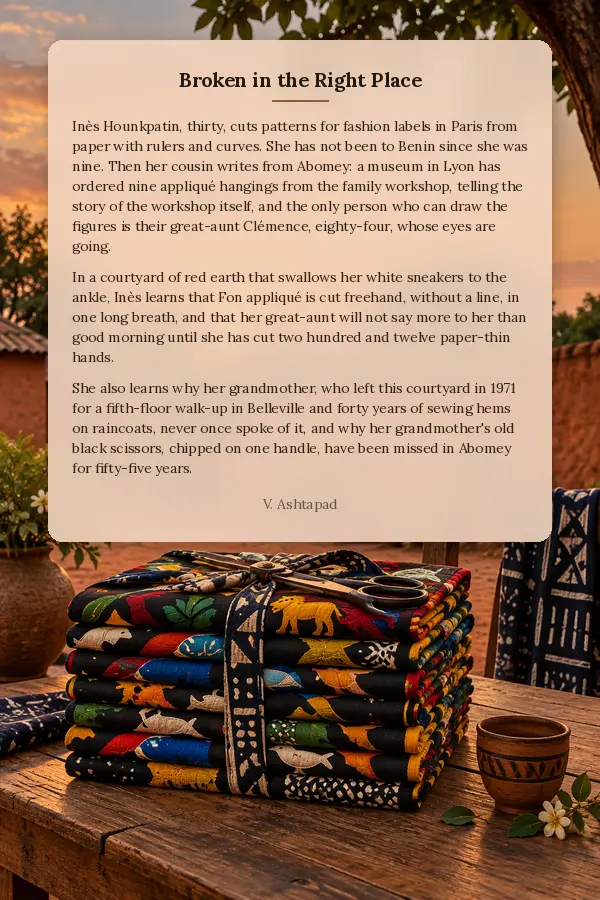
Inès Hounkpatin, thirty, cuts patterns for fashion labels in Paris from paper with rulers and curves. She has not been to Benin since she was nine. Then her cousin writes from Abomey: a museum in Lyon has ordered nine appliqué hangings from the family workshop, telling the story of the workshop itself, and the only person who can draw the figures is their great-aunt Clémence, eighty-four, whose eyes are going.
In a courtyard of red earth that swallows her white sneakers to the ankle, Inès learns that Fon appliqué is cut freehand, without a line, in one long breath, and that her great-aunt will not say more to her than good morning until she has cut two hundred and twelve paper-thin hands.
She also learns why her grandmother, who left this courtyard in 1971 for a fifth-floor walk-up in Belleville and forty years of sewing hems on raincoats, never once spoke of it, and why her grandmother's old black scissors, chipped on one handle, have been missed in Abomey for fifty-five years.
Members can react to this book and talk about it in the members' Library.
Ownership
© 2026 CRUNOD LLC. All rights reserved.
This book is owned by CRUNOD LLC. It is free to read on EternalCurrent.Online. No part of it may be copied, reprinted, sold, recorded or adapted, including as audio, film or translation, without written permission from CRUNOD LLC.
© 2026 CRUNOD LLC. All rights reserved.