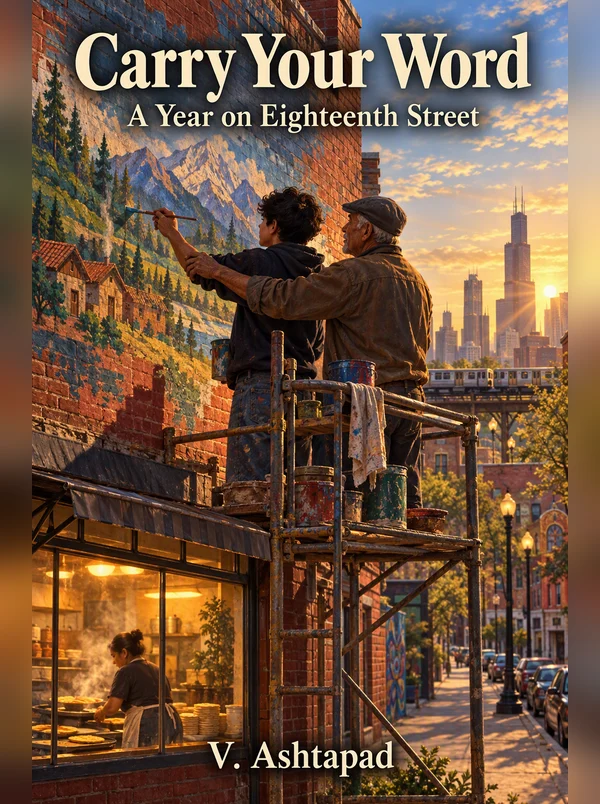
Carry Your Word
A Year on Eighteenth Street
by V. Ashtapad
Foreword
Every neighborhood has someone who remembers what used to be painted on the walls. In this story he is Melesio Zamudio, a sign painter from a village in Michoacán whose eyesight is failing, and the person who has to learn his trade in a single year is a grandson who barely speaks his language. Nothing in this book really happened, and all of it is the kind of thing that happens: a grandparent's words that come back slowly, a wall that is only borrowed, a whole block crowded into one small kitchen in December. It is about the work of keeping a language, a craft and a face from being lost, and about how much of that work is done by people who are not sure they are up to it. If you have an elder whose stories you have been meaning to write down, consider this a nudge.
For the sign painters, who put the Ñ back where it belonged, and for every grandchild who said a word back wrong until it came out right.
The Edges of Things
The first letter my grandfather ever got wrong was a lowercase *a*, and he got it wrong on the front window of a tortillería where he had worked for twenty-two years.
I was there. I was holding the paint.
It was the second Saturday of January, a white, scraped sort of morning on Eighteenth Street, the kind where the salt trucks have been through and every parked car wears a gray crust up to the door handles. Don Fidencio Hinojosa had called the night before to say the corner of his window had cracked in the cold and the glass man had replaced it, and the new pane was naked. It said TORTILLERÍA and then stopped, like a sentence somebody had walked away from. The rest of the name was on the old glass, which was in pieces in a dumpster in the alley.
"Your grandfather will fix it," Don Fidencio told my dad on the phone. Not *can your grandfather*. Will.
So at eight in the morning Tata Melesio and I walked the three blocks from our two-flat on Cullerton, him in the brown corduroy coat with the elbow patches my grandmother had sewn on in the nineties, me carrying a tackle box that had never held a fishing lure in its life. Inside it were his quills, rolled in a piece of chamois, and four small cans of lettering enamel with lids hammered shut so many times they looked like bottle caps. Under his arm he carried the mahl stick, a length of dowel with a ball of rag wrapped on one end, taped with electrical tape that had gone soft and gummy over the decades. He held it the way other old men hold canes. He didn't need a cane. That was the thing we all kept telling ourselves.
The tortillería smelled the way it always smells, of lime water and warm corn and the hot steel of the machine, and the heat came out the door at us in a single push. Don Fidencio had a paper cup of coffee waiting for Tata and a bottle of mandarin soda for me, which he remembered I liked when I was nine and assumed I still liked at seventeen. I did, actually.
Tata set up outside, on the sidewalk, because you letter a window from the side people will read it. He had told me that a hundred times. He chalked the guidelines on the glass with a stick of white grease pencil, and I noticed he held his face very close to the window, closer than I had ever seen, and then turned his head a little to the left, as if he were listening to the glass instead of looking at it.
"What does it need to say?" I asked.
"*Tortillería La Michoacana*. *Fundada en mil novecientos setenta y nueve*." He said it like a man reading from inside his own head. He had painted the original in 1979. He did not need to look at anything to know it.
He laid the first strokes down, and they were beautiful. That is the part I want to be clear about. The *L* was a single pull of the quill, top to bottom, the paint fat and glossy, and then the foot of it, a little flick like a heel. He did the *a* next, and the bowl of it came around and missed its own stem by a quarter of an inch. It floated there. A little red *c* standing next to a little red *l*.
He didn't see it.
He went on to the *M*, and I stood there holding the can of red with a feeling in my stomach like when an elevator drops one floor before catching. A woman with a stroller stopped to watch, the way people in Pilsen still stop to watch a man paint letters by hand, and she looked at the *a* and then at me, and her face did something kind and complicated, and she walked on.
"Tata," I said.
"*Mande*."
"The *a*. It's open."
He stopped. He leaned in until his nose was nearly on the glass. Then he did the head turn again, to the left, and then to the right, and he stayed like that a long time with the quill in the air, and a bead of red enamel gathered at the tip and fell onto the sidewalk salt.
"*Ah, caray*," he said quietly. Not angry. Interested, almost. Like a man who has found a crack in a wall he thought was sound.
He wiped the letter out with a rag and some thinner and did it again, slower, and this time it closed. But I watched how he did it. He didn't look at the middle of the letter. He looked off to the side of it, at the edge of the window frame, and painted the *a* in the corner of his eye.
---
It had a name, the thing in his eyes. The doctor at the clinic on Ashland had told us in November, and my dad had written it on the back of an envelope, and the envelope lived on the refrigerator, pinned under a pineapple-shaped magnet. *Macular degeneration*. I looked it up on my phone in the waiting room while Tata was in the back getting his pupils dilated, and the pictures were all of a world with a gray smudge in the middle, like someone had pressed a dirty thumb onto the center of every photograph. The edges stayed. The center went.
"So he sees around things," my sister Itzel said that night at dinner. She was ten. She said it as if it were a superpower.
"He sees the edges of things," my dad said. "For now."
Tata said nothing. He was eating his caldo by feel, which he had been doing for months, I realized, finding the edge of the bowl with the spoon and working inward, and none of us had noticed because he did it so well.
There were injections. Once a month, a needle in the eye, which is the sentence that made my mother leave the table the first time the doctor said it. Tata took them the way he took everything, with a little shrug, as if the universe had sent him a bill and he would pay it and that was the end of the conversation. The injections would slow it, the doctor said. They would not stop it.
---
We lived on Cullerton Street in a brick two-flat my grandparents bought in 1971 for a sum of money my father says, every time, "wouldn't buy you a parking space now." Tata lived on the first floor, alone since my grandmother Hortensia died six years ago. We lived on the second: my dad, Saúl, who drives the Number 9 Ashland bus; my mom, Oralia, who grew up in San Antonio and runs the front desk at a dental office in Little Village; Itzel; and me. Ulises. Uli at school. *Ulises* only from Tata, who pronounced every syllable as if each one had cost money.
I should say now, before you build a picture of me in your head that is too flattering, that I did not speak much Spanish. My mother's family has been in Texas since before Texas was Texas, and her Spanish had been sanded down by three generations of schoolteachers telling her grandparents to stop using it. My father spoke it fine but answered Tata in English most of the time, out of a kind of tiredness I didn't understand until later. I understood maybe half of what Tata said when he talked fast. When he talked slow, to me, he used a Spanish built out of short words and pointing, the way you'd talk to a smart dog. I resented that. I also needed it.
And I had never been to Mexico. Not once. Kids at school went every summer, or every December, and came back with stories about cousins and ranchos and getting sick from the water, and I nodded along as if these were things that happened to people in movies. Michoacán, to me, was a word on the tortillería window and on the side of the paletería on Eighteenth and in the way Tata said *allá*, over there, with his chin pointing southwest as if the place were just past Cermak Road.
---
Here is what you need to know about my grandfather, in the order I learned it.
He came to Chicago in 1964, at twenty-one, from a village in the hills of Michoacán called San Martín Tzurumbo, which is not on most maps and which I could not have found on any of them. He worked for twenty-three years at a steel mill in South Chicago, on the lake, feeding scrap into an electric furnace, and he used to say the mill was the only place he had ever been where it was hotter than Tzurumbo in May. When the mill closed, he went to work for Don Fidencio at the tortillería, running the machine from four in the morning till noon, and did it for twenty-two years.
And all that time, on weekends and after shifts, he painted.
He painted signs. He painted *CARNICERÍA* and *SE HABLA ESPAÑOL* and *REPARACIÓN DE CALZADO* and *NO ESTACIONARSE* and the menu boards of half the taquerías between Halsted and Western. He painted the big gold numbers on a hundred front doors. He painted the side of a moving truck once, for a man who paid him in a used refrigerator, which I believe is still in our basement. And in the seventies and eighties, when the walls of Pilsen started to fill up with murals, he climbed scaffolds alongside the artists and painted backgrounds and skies and lettering and whatever else they handed him. He was not famous for it. His name was not on the plaques. But when I walked down Eighteenth Street with him, he pointed at walls like a man pointing out relatives in a crowd. *That sky is mine. Those letters are mine. That corner, the corn, I did that with Héctor in seventy-eight, and it rained for four days and we had to do it twice.*
People in the neighborhood called him *el historiador*, the historian, half as a joke, because if you wanted to know who had owned a building in 1975, or what store used to be where the cell phone store was, or which family had the first television on the block, you asked Melesio Zamudio. He knew. He carried Pilsen around in his head like a map.
That winter, my mother decided the map should exist outside his head.
She started it the week after the diagnosis. She sat at the kitchen table at night with her laptop, after the dental office and after dinner and after Itzel's homework, and she asked Tata questions, and she put pins on a map. A pin for every sign he remembered painting. A pin for every wall. Each pin got a name and a year and, when he could remember it, a little note. *Carnicería Los Altos, 1972, gold leaf on glass, gone now.* *Mural with Héctor Bribiesca, south wall, 1978, sky and corn.* *House numbers, the Ostrowski family, 1974, still there.* There were forty pins by the end of January. There would be more than two hundred by the end of the year. When you zoomed out, they made a shape across the lower West Side like a constellation, thickest along Eighteenth and Blue Island, then scattered south and west, and a few lonely ones out in Cicero and Berwyn and one, mysteriously, in Kenosha.
"What's in Kenosha?" I asked.
"A bowling alley," Tata said. "Nineteen-eighty-one. They paid very well and the food was terrible."
---
The night after the *a*, Tata came upstairs for dinner, which he did on Saturdays, and sat in his usual chair at the far end, his back to the window, so the light came from behind him and he could see our faces at the edges. We were eating my mother's enchiladas, which are Tex-Mex enchiladas with yellow cheese and chili gravy, and which Tata ate every Saturday with an expression of tremendous diplomatic patience.
Halfway through, he put down his fork.
"I want to paint one more," he said. In English. He only used English for announcements.
"One more what, Apá?" my dad said.
"Mural."
My mother looked at my father. My father looked at his enchilada. Itzel looked at me, delighted, because she could tell something was happening and she liked it when things happened.
"Apá," my dad said carefully, "you just had a hard time with a window."
"The window is small. Small is harder." Tata picked his fork back up. "A wall is big. On a wall, I can see the edges."
"You can't go up a scaffold," my mom said.
"No," Tata agreed. "I can't."
And then he turned his head, slowly, the way he had turned it at the tortillería window, and he found me with the side of his eye. I was sitting to his right. I had cheese on my chin. I knew, the way you know a pop quiz is coming from how the teacher picks up the stack of paper, exactly what he was going to say.
"Ulises," he said, "is going to be my hands."
There was a silence. Itzel giggled, then stopped.
"I have school," I said, which was not a no. I noticed that it was not a no at the same time everyone else did.
"School ends at three," Tata said. "Walls are there all day."
---
Later, much later, after he had gone back downstairs, I lay on my bed and looked at the map on my phone, the forty pins my mother had placed. I clicked on them one by one. Most of the places were gone. A carnicería that was now a vintage clothing store. A shoe repair that was now a place that sold candles for twenty-eight dollars. A wall that had been painted over gray. A few were still there, faded, and one of them I walked past every single day on the way to the Pink Line and had never once looked at: a doorway on Loomis with *Bienvenidos* over it in red letters with black drop shadows, and on the map, in my mother's typing, Tata's note: *For Señora Maldonado, who had six children and wanted them all to know they could come home. 1976.*
I had walked under that word maybe a thousand times.
I did not decide anything that night. I want to be honest about that. I was seventeen and had a chemistry test on Tuesday and a friend who wanted to go see a movie on Sunday, and the idea of spending the year on a ladder in the cold, painting a mural I didn't understand, for a man whose Spanish I only half understood, did not fill me with anything you would call joy.
But I kept thinking about the *a*. About the way the red bowl of it had swung around and missed, and how he hadn't known, and how I had. How for one second, standing on Eighteenth Street with a can of paint in my hand, I had been able to see something my grandfather could not, and how heavy that had felt. Like being handed something you are not sure you are strong enough to carry, and realizing that the person handing it to you has been carrying it, alone, for longer than you've been alive.
The Stick and the Rag
The basement of our two-flat had two rooms. One held the furnace, the washer, the mystery refrigerator from the moving-truck job, and forty years of Christmas boxes. The other held my grandfather's shop, and nobody went in there without him, the way nobody walks into a kitchen where someone else is cooking.
He took me down on the last Sunday of January. He turned on the light, a long fluorescent tube that flickered three times and then committed, and the room came up around us. A workbench along one wall, its top so layered in dried drips of enamel that it had become a kind of geology, red over gold over black over white, a core sample of Pilsen's storefronts. Pegboard with brushes hung by their handles, sorted by size, the smallest no thicker than a toothpick. Cans on shelves with their colors painted on the lids in daubs. An old drafting table tilted toward the window well. And taped on the wall above it, curling at the corners, alphabets. Dozens of them. Block capitals and Spanish script and tall condensed letters and fat round ones, each painted on a strip of butcher paper, each letter A through Z and then *Ñ*, because Tata's alphabets always had an *Ñ*.
"Sit," he said.
I sat on a stool. He handed me the mahl stick.
I had seen him use it my whole life without ever asking what it was for. It turned out to be the whole secret. You hold it in your left hand, he explained, with the rag-wrapped end resting against the wall or the glass, out past where you're painting, so the stick makes a bridge across your work. Then you rest your right wrist on the bridge. Your hand doesn't touch the surface and smudge the wet paint. And more than that: your wrist has somewhere to stand. It doesn't float. A hand that floats shakes.
"Your hand is a bird," Tata said in Spanish, and then in English, to make sure. "The stick is the branch. The bird must sit before it sings."
I thought this was the corniest thing I had ever heard. I also never forgot it.
---
He did not let me paint anything for two weeks.
First, I learned to load the quill. A lettering quill is a long, soft brush with hairs maybe an inch and a half long, squirrel or ox, and you don't dip it so much as feed it. You pull it through the paint on a palette, which for Tata was a page torn out of an old phone book, back and forth, flipping it, working the paint into the belly of the brush and then flattening it to a chisel edge. He made me do this over and over. "Too much. Now too little. Now it's dry, you waited too long. *Otra vez*."
Then strokes. Not letters. Strokes. Straight downstrokes on butcher paper taped to the wall, a full page of them, then a full page of horizontals, then curves. He stood behind me and to the side, his face turned so I was in the corner of his eye, and he could tell from the sound if a stroke was bad. I didn't believe that at first. Then I made a stroke that was wobbly in the middle, and before I'd lifted the brush, he said, "*No. Te paraste*," you stopped, and he was right; I had hesitated halfway and the paint had pooled.
"How did you know?"
"The brush makes a little noise. Like a whisper. If the whisper stops, you stopped."
I listened after that. He was right about that too. A good stroke on paper sounds like someone saying *shhhhhh* to a baby, one breath, start to finish.
---
My mother came down on the second Sunday with her laptop and a microphone that she had bought from a music store on Halsted. It was round and silver and sat on a little tripod like a spider, and she set it on the drafting table in front of Tata and asked him to tell the story of the first mural he ever worked on.
He looked at it suspiciously. "Who's going to listen to this?"
"Us," my mom said. "Itzel. Uli's kids, someday."
"Uli doesn't have kids."
"Someday, Apá."
He grumbled. Then he settled into the chair, and his voice changed. I don't know how else to describe it. It got lower and slower, and he started in Spanish and then crossed over into English and back, the way he did when he was telling a story to the whole family at once, and my mother let the recording run and didn't interrupt him.
It was 1978. He was thirty-five. There was a young painter in the neighborhood named Héctor Bribiesca, who had studied art in a real school and came back with ideas that the older men thought were crazy: that the walls of the neighborhood should tell the neighborhood's story, that you didn't need permission from anyone downtown to say who you were. Héctor needed someone who could paint a straight line twenty feet long and who wasn't afraid of heights. Somebody told him about the sign painter from the tortillería — Tata wasn't at the tortillería yet, actually, he was still at the mill, but that's how the story was told and he didn't correct it — and Héctor knocked on our door on Cullerton one evening, and my grandmother answered, and she looked him up and down and said, "*Este muchacho tiene hambre*," this boy is hungry, and fed him before she let him talk.
The wall was on a building on Blue Island. The mural was corn, a field of it rising up the wall, and in the field were people: men from the mill, a woman making tortillas, a boy with a book, an old man with a hat, and above them all a sky that went from deep blue at the top to orange at the bottom, the color of the furnace light at the mill at night. Tata painted the sky. It took him three weekends.
"I mixed every color on a board," he said into the microphone. "Twenty-two blues. I numbered them. Héctor laughed at me. He said, Melesio, it's a sky, not an accounting. But it came out smooth, no lines, like a real sky at six o'clock. Then it rained four days and the wall wasn't sealed and half of it ran down onto the sidewalk. The whole sidewalk was blue. Children walked through it and went home with blue shoes. And we did it again."
"Is it still there?" I asked.
He turned his face toward me, partly.
"Part of it. The building got new windows in ninety-something and they cut through the corn. But the sky is still there. You've seen it."
I had. I had seen it my whole life without knowing it was his.
My mom stopped the recording and saved it, and then she went to her map, to the pin for *Mural with Héctor Bribiesca, Blue Island, 1978*, and attached the recording to it. Now when you clicked on that pin, you saw the wall, and his note, and a little arrow, and if you pressed the arrow, Tata's voice came out of your phone telling you about the twenty-two blues.
She did that, over that winter and spring, for every mural he could remember. Twelve of them. Then she started on the signs. It took her the whole year. I didn't understand how much it mattered until much later, when I needed to hear his voice and that was the only place left to hear it say certain things.
---
On the third Sunday, he let me paint a letter.
An *R*. Capital. He chose it, he said, because the *R* has every kind of stroke in it: the straight stem, the bowl, and the leg that kicks out at the bottom. "If you can make an *R*, you can make most of the alphabet. The *S* is something else. The *S* is the devil. We don't talk about the *S* yet."
I made an *R*. It looked like an *R* drawn by a person having a seizure.
Tata held it up very close to his face, then turned it so it was at the edge of his vision. He studied it from one side and then the other.
"*Bueno*," he said. "It's a letter."
Coming from him, this was enormous.
I made forty more. My wrist ached. The bowls kept coming out lopsided, too fat at the top, and the legs kicked out at different angles, like a chorus line where nobody's been to rehearsal. Every time I made one, he checked it with the side of his eye, and said *otra vez*, and I made another. By the end of the afternoon, I'd filled a whole strip of butcher paper, and the last few were not bad. Not good. But they had the same shape. They looked like they belonged to the same family.
I sat back on my stool, and my whole forearm was buzzing. Through the window well, I could see the feet of people passing on the sidewalk, boots and sneakers and a dog's paws.
"Why do you always paint an Ñ on the alphabets?" I asked.
He thought about it.
"Because a lot of the sign men here, the gringo sign men, the Polish ones, the Czech ones, they didn't have it. Somebody wanted *Peña* on their window and the man painted *Pena*. You know what *pena* means?"
I did, sort of. "Sorry? Like, embarrassment."
"Shame," he said. "Sorrow. The man wanted his name and they painted *shame* on his window." He shook his head. "So I always have the Ñ. It's one little line. You put it on top, like a hat. Without it, it's a different word."
He reached up, feeling with his fingers, and touched the strip of butcher paper on the wall above the drafting table, the oldest one, yellowed almost brown. He found the *Ñ* by touch, the little wave on top raised a fraction from the paper by the dried paint, and he tapped it twice.
"This one I painted in 1965," he said. "My first winter. I couldn't speak English. I couldn't buy a coat. I worked in the mill all day and at night I sat in a room on Halsted with four other men and I painted alphabets so I wouldn't forget how. My mother would have said—" and then he stopped, and said something in a language that was not Spanish, two or three soft words with sounds in them I'd never heard, a little catch in the throat in the middle of one of them.
"What was that?"
He frowned. He said it again, slower, and then stopped halfway through, like a man walking into a dark room and realizing he doesn't know where the furniture is.
"I don't remember," he said. "It was something she used to say. In her language."
"Her language?"
"My mother was P'urhépecha," he said. "You knew that."
I didn't. Or I had heard it once, and it had gone in the same box as everything else about *allá*, the box I never opened.
"She spoke it to me when I was small. Spanish to my father, P'urhépecha to me, when he wasn't listening. And then I came here." He tapped the *Ñ* again, more slowly. "I kept the Spanish. I kept the letters. That I didn't keep."
He took the mahl stick out of my hand, gently, and leaned it in the corner, and turned off the fluorescent light, and we stood for a second in the gray light of the window well before going up the stairs.
A Wall Is Borrowed
My grandfather knew which wall he wanted before he told anyone he wanted a wall.
It belonged to a laundromat on Eighteenth Street, a few doors west of Racine, called Lavandería La Estrella. The building was three stories of tired yellow brick, with the laundromat on the ground floor and two apartments above, and its east side faced an empty lot where a hardware store had burned down when my dad was in high school. Nobody had built on the lot since. It had a chain-link fence and some ailanthus trees that grew whether you wanted them or not, and in the summer, kids played soccer on the packed dirt with a goal made of two milk crates. Which meant the east wall of La Estrella, forty feet long and thirty feet high, stood in full view of anybody walking down Eighteenth from the Pink Line. It got the morning sun. It had nothing on it but a ghost of an old soda advertisement, so faded you could only see it when the light hit it sideways.
"Morning sun is good," Tata said. "Afternoon sun kills the reds. Morning sun is gentle."
"How do you know about the sun on that wall?" I asked.
"I painted the soda sign," he said. "Nineteen sixty-eight."
---
The man who owned La Estrella was named Celestino Pantoja, and he had owned it for thirty years, and his father had owned it for twenty before that, when it was still a dry cleaner. Celestino was a short, wide man with a mustache that looked borrowed from an older relative, and he wore a gold chain with a little medallion of the state of Jalisco, where his family was from, which was, Tata told me on the walk over, the only thing wrong with him.
We went on a Thursday afternoon in February, right after school. The laundromat was warm and loud, a dozen dryers turning at once with that steady, soft, thumping roar, and the windows were fogged so the street outside looked like a watercolor. A girl my age was behind the counter, folding somebody's drop-off laundry into perfect squares with a speed that seemed almost aggressive. I knew her slightly. Ximena Ocaranza. She was in my grade, though not in any of my classes; she was in the advanced Spanish track for native speakers, which was the class I had specifically been steered away from freshman year by a counselor who looked at my last name and then at my placement test and said, kindly, "Maybe start with Spanish One."
Ximena looked at me, then at Tata, then at the mahl stick under Tata's arm, which he had brought for no reason I could see except that he liked to have it with him.
"*Tío*," she called toward the back. "*Te buscan*."
Celestino came out wiping his hands on a towel and his face opened up when he saw my grandfather.
"*Don Melesio*. *¿Qué milagro?*"
They talked. I understood maybe sixty percent. They talked about Celestino's mother, who had a bad hip, and about Don Fidencio, and about a family named Zavala who had moved to Aurora, and about the price of something, I think gas, or maybe eggs. Ximena kept folding. After about ten minutes of this, when I had started to wonder whether we had come here for any reason at all, Tata turned his head and pointed his chin toward the east wall, which you couldn't see from inside, but everyone knew where it was.
"*Quiero pintar tu pared*," he said. I want to paint your wall.
Celestino's face did something. Not a no. A kind of wince, a pulling back at the corners, like a man who has just remembered a bill he forgot to pay.
They went on for a while longer, faster now, and I lost most of it. I heard *dinero* and *ofertas* and *el año que entra*. I heard Celestino say *no sé, Don Mele, no sé* several times. Then Celestino said something long, with his hands open, palms up, and Tata nodded slowly and said, "*Entiendo*."
Ximena had stopped folding. She was watching me, and I realized she knew I hadn't followed any of it.
"He's had offers," she said to me, in English, low. "For the building. Developers. Two of them this year. He doesn't want to sell, but my *abuela* needs a surgery, and—" She shrugged, a whole sentence in the shrug. "He's saying if he sells, the new people might paint over it the next day. He doesn't want your grandpa to do all that work for nothing."
"Oh," I said.
"Your grandpa's saying he understands."
"I got that part."
"Congratulations," Ximena said, and went back to folding.
---
But Tata wasn't done. He let the silence sit for a moment, the dryers roaring, a little girl in a puffy coat pressing her face to the round window of one of them to watch the socks go around. Then he said something I understood completely, because he said it slowly and he said it to both of them.
"*Una pared siempre es prestada*."
A wall is always borrowed.
He kept going. Celestino listened with his arms crossed and his chin down. Afterward, on the walk home, I made Tata tell me what he'd said, and he told me in English, and I've thought about it so many times since that I'm not sure anymore which words were his and which I've added. But it was something like this:
He had painted on more than two hundred walls and windows in this neighborhood. Most of them were gone. Buildings got sold, stores closed, new owners came and painted everything gray or white or that particular shade of greige that means someone wants to charge more rent. Héctor's corn was cut in half by windows. The soda sign on this very wall had faded until it was a ghost. None of that meant the painting was for nothing. A wall is not yours. A wall is never anybody's for very long. You borrow it, you say what you need to say, and the people who walk by carry it with them, and that is where it lives.
"And besides," he finished, "I'm eighty-two. I'm not going to outlast the wall either."
Celestino laughed, a sudden, unwilling bark. Then he looked at the floor for a while.
"*Va*," he said finally. "*Píntela*."
Then something else, with his finger up, a condition.
"He says you have to put his dad in it," Ximena translated before I could ask. "My great-grandpa. He started the business."
"*Claro*," Tata said, and put out his hand, and they shook, and that was the contract. There was no paper. There would be paper later, because Yesenia, the muralist who helped us, insisted on paper, but that day it was a handshake in a laundromat with a dozen dryers going and a little girl watching the socks.
---
On the way home, we stopped at a bench outside the Pink Line station on Eighteenth, which is covered inside and out with murals. Tata wanted to sit. He sat a lot that winter. He said it was his knees. I knew it was partly his knees and partly that walking on a city sidewalk when you can't see the center of anything means you are constantly watching the edges for curbs and dogs and children and patches of ice, and that is tiring in a way people with good eyes never think about.
An older white woman came out of the station, slowly, holding the railing, and when she saw Tata, she said, "Melesio Zamudio, you old goat," and sat down on his other side.
This was Mrs. Wanda Kowalczyk. She was eighty-eight. She lived alone on Carpenter Street in the house she was born in, and she was one of the last of the Polish families who had been in Pilsen before the Mexican families came, back when the neighborhood was Czech and Polish and Lithuanian and the bakeries sold kolaczki and rye and the signs were in alphabets with little hooks and accents over the letters that were not Spanish accents. Her husband, Stanisław, had run a bakery on Eighteenth until 1983, and Tata had painted its window. *KOWALCZYK PIEKARNIA*, in gold with red shadow.
"He did the *Ł* wrong the first time," Mrs. Kowalczyk told me, as if we had been in the middle of a conversation. "The *L* with the line through it. He didn't know what it was. He thought it was a mistake on the paper Stan gave him and he left the line off."
"I fixed it," Tata said.
"Stan made him fix it. Stan stood on the sidewalk with his arms crossed until he fixed it." She laughed, a dry, papery laugh. "Then Stan gave him a whole babka, and Melesio brought us tamales at Christmas for the next ten years, and Stan said they were the best things he ever ate, and he was a baker. He never said that about anything."
They talked to each other in English, which was not either of their first languages, and which had grown, over fifty years, into a kind of private dialect between them, full of Polish words and Spanish words and words I don't think belonged to any language at all.
"So, you're painting again," Mrs. Kowalczyk said.
"How do you know?"
"I can see it on your face. You look like a dog that found a bone." She turned to me. "And you're the boy who's going to do the climbing."
"I guess so," I said.
"Good. Do it right. Do the letters right." She patted Tata's knee with a gloved hand. "Mine's the last Polish sign left on Eighteenth. Did you know that? The bakery's a phone store now. But the new people kept the letters on the transom window, over the door. They thought it looked charming." She pronounced *charming* as though it were a slightly rude word. "Fifty years and somebody thinks it's charming. Well. It's still there. That's something."
She got up, slowly, refusing my hand.
"I want to see this wall," she said. "So paint fast. I'm eighty-eight."
And she went off down Eighteenth Street, small and straight-backed, past a coffee shop with a chalkboard sign out front that said *Oat milk now available*, past the paletería with Tata's lettering on the awning, past a new building with balconies like stacked glass boxes, past the old ones, toward Carpenter Street and her own front door.
"She'll see it," Tata said, more to himself than to me.
I didn't say anything. I was thinking about the *Ł*, the line through the *L*, the little stroke that made it a different letter in a different language, and about Tata at twenty-something, not knowing that it mattered, leaving it off, and Stan Kowalczyk on the sidewalk with his arms crossed, waiting. The *Ñ* and the *Ł*. One little line on top. One little line through the middle. Without them, a different word.
Red Tray, Black Ground
In March, my grandfather took Itzel and me to the National Museum of Mexican Art, which is in Harrison Park, about a fifteen-minute walk from our house, and which I had last been inside on a fourth-grade field trip, when the thing I remembered most clearly was that Toño Barragán threw up on the bus.
It was Tata's idea. He said he wanted to look at the paintings before he couldn't. Then he said that was a joke. It was not a joke. Itzel held his left hand and I walked on his right, and he pretended not to notice that we were steering him around the slush puddles at the curbs.
The museum is a big brick building that used to be a park field house, and the entrance has a heavy door and a wide lobby with tile floors, and it's free to get in, which Tata mentioned three times on the walk over, as if it were a personal favor someone had done him. Inside, it was warm and quiet. A guard in a navy sweater nodded at Tata like they knew each other, and maybe they did. Everybody in the neighborhood seemed to know him.
I had expected him to go straight to the big paintings, the ones with the bright colors that you could see across the room. He didn't. He walked, slowly, past all of that, through a gallery and into another, and stopped in front of a glass case against the wall.
Inside were trays and gourds and small chests, maybe a dozen pieces, and they were lacquered. I didn't know the word then. They had a deep, soft shine, not like plastic, more like the inside of a shell. Most of them were black, a black so deep it seemed to go backward, and on the black were painted flowers and birds and vines in red, gold, green and white, not painted on top, exactly, but somehow sunk into the surface, so the flowers looked like they were floating under clear water.
"*Michoacán*," Tata said, and leaned in until his breath fogged the glass.
He couldn't see them. I understood that after a minute. He was standing with his face nearly on the case, turning his head to catch the pieces at the side of his eye, and I could see from the way his jaw worked that he was getting colors and shapes but not the flowers, not the fine lines, not the little birds with their beaks open.
"Tell me," he said.
So I told him. I described every piece. I'd never done anything like it before, and I was bad at it at first. "There's a black tray with flowers on it." "What color flowers?" "Red. And some yellow." "What kind of red? Like a tomato? Like a brick?" "Like… like blood, I guess. Like dark blood." "*Bien*. What shape are the flowers?" "Round. With pointy petals. Like a star but round." "How many petals?" "I don't know, like eight?" "Count."
I counted. Eight. Then he asked about the leaves, and the border, and whether there was a bird, and what the bird was doing, and whether the black was really black or a little bit brown, and I got closer and closer to the glass and saw things I would never have noticed: that the border was a line of tiny repeating shapes like waves, that the bird had a single white dot for an eye, that one of the leaves had a little scratch in the lacquer, very old, where someone had set something down on the tray decades ago.
"There's a scratch," I said.
Tata smiled. "Of course there is. People used them. They weren't for glass boxes."
Itzel, bored, had wandered to the next case and was trying to read a card with her face pressed to the glass. "It says *maque*," she announced. "What's *maque*?"
"*Maque*," Tata said. "Lacquer. The old way. They make it with—" and he said a word I didn't know, and then, when I looked blank, "with the fat of a little insect. They boil the insects and get the fat. And oil from a seed, *chía*. And earth, ground very fine. Then they rub it into the wood with their hands. With the palm. Hours and hours. My mother had a tray like that. A *batea*. Red, not black. Red ground, with flowers."
"Do you still have it?" Itzel asked.
He didn't answer for a moment.
"Yes," he said. "It's in my closet."
---
He showed it to us that night.
It came out of the back of his closet wrapped in a wool blanket that smelled of mothballs and something older, a dusty, sweet smell like a drawer in a house nobody lives in. He unwrapped it on his kitchen table. It was a round wooden tray, a little bigger than a dinner plate, shallow, with a lip. The ground was red, a deep, warm, dark red like the inside of a pomegranate, faded nearly to brown at the center where something had sat on it over and over. Around the edge, flowers. White ones and yellow ones and a bright green leaf here and there, and between them small black birds with long tails.
"She kept tortillas in it," he said. "Every day. That's why the center is gone. Fifty years of tortillas."
He ran his fingers around the rim, finding the flowers by the slight change in texture.
"She told me the names," he said. "The names of the flowers. In P'urhépecha. She had a word for flower—" He stopped. His fingers stopped. I watched him go looking for it, the way you'd look for keys in a coat pocket, patting, patting.
"*Tsï*—" he said. "*Tsïtsï*— something. It's a word that sounds like a little bird. *Tsïtsïki*." He said it twice more, testing it. "*Tsïtsïki*. I think that's flower. I think."
"That's pretty," Itzel said.
"She would laugh at me," Tata said. "Eighty-two years old and I *think* that's the word for flower."
---
My mother had set up the family tree in the fall, around the same time the doctor wrote *macular degeneration* on the back of an envelope, which I don't think was a coincidence. It was the same as the map, on her laptop and on our phones: a page that grew downward and sideways, with faces in little circles and names under them and lines connecting everybody.
Our side of it was thick and busy. My mom had found her people back to the 1840s in Bexar County, Texas, with photographs of men in stiff collars standing in front of churches and adobe ranch houses, and great-great-aunts with names like Eufemia and Petra. My dad's side had my dad, his sister, my Tía Leticia in Cicero, her kids, my grandmother Hortensia's people from Guanajuato, and Tata.
And then above Tata, two circles. No photographs. Just names my mom had typed in from things he'd told her.
*Anselmo Zamudio Cruz*, his father. *Jacinta Tzintzun*, his mother. And beside her name, in the field where the place of birth goes: *San Martín Tzurumbo, Michoacán*.
And above them, nothing. White space. The lines went up into the white and stopped.
That night, after the tray, I sat on the floor of my room with my back against the bed and opened the tree on my phone and looked at Jacinta Tzintzun's empty circle for a long time. There was a little button that said *Add a memory*. I pressed it. A box opened. I didn't know what to type, so I typed what I knew. *She kept tortillas in a red lacquered tray with white and yellow flowers and black birds. She called flowers tsïtsïki (I think — check). Tata still has the tray.*
It looked small, sitting there in that box under her name. Three sentences about a woman who had been born, and had a whole life, and had a language, and had a son who walked away from her at twenty-one to go stand next to a furnace on the shore of a lake she would never see.
I added one more line. *Her son painted more than 200 signs and murals in Chicago. He always put the Ñ on his alphabets.*
Then I went downstairs. It was nearly eleven, but the light was on under Tata's door, because it was always on; he didn't sleep much anymore. I knocked.
"*Pásale*."
He was sitting at the kitchen table with the tray in front of him, his hands resting on either side of it, not touching it. The radio was on low, a Spanish station playing an old corrido, all accordion and a man's voice telling some long story about a horse and a betrayal in a voice that sounded like it had been sanded with gravel. I'd heard a hundred songs like it in the back of a hundred taco shops and never listened to one.
"What's he singing about?"
Tata tilted his head. "A man who trusted his friend. The friend sold him out for money. Now the man is dead and his horse is still waiting outside the cantina."
"That's dark."
"They're all dark. The happy ones are worse. The happy ones, somebody always dies in the last verse."
I sat down across from him. The tray was between us, red and black and faded.
"Tata, who were her parents? Jacinta's?"
He was quiet a long time. The corrido ended. A commercial came on for a furniture store in Berwyn, loud and fast.
"Her father was named Bartolo," he said finally. "Bartolo Tzintzun. He made—" a gesture with both hands, shaping something round. "*Cántaros*. Water jars. Clay. Her mother I don't remember. She died before I was born. There was a sister. My aunt Leocadia. She was the one who stayed. She had children. Many children." He shook his head slowly. "I haven't talked to anyone from there in, I don't know. Thirty years? Almost. My aunt wrote letters, but she died. Then nobody wrote."
"Are they still there?"
"Somebody's always still there," he said. "That's what a village is."
I went upstairs and typed *Bartolo Tzintzun, maker of clay water jars* into a new circle above Jacinta, and *Leocadia Tzintzun, sister, stayed in Tzurumbo* beside her, and the lines grew up into the white space by one more row.
Then I lay on my bed and listened to the radio come up faintly through the floor from Tata's kitchen, another corrido, more accordion, and I thought about a horse waiting outside a cantina for someone who was never coming back out, and about a red tray on a kitchen table, and about a word that sounded like a little bird.
Squares
Yesenia Ruvalcaba came to the house on the first warm Saturday of April with a roll of paper under one arm, a laptop bag over her shoulder, and paint on her eyebrow. I would learn that she always had paint somewhere on her face. It was a sort of signature.
She was thirty-four, and she had grown up on Twenty-First Place, and she'd painted murals all over the city and in three other countries, and she ran a youth art program out of a storefront on Blue Island where teenagers who were supposed to be at risk of something came in after school and painted instead. When she was fourteen, she'd been one of those teenagers, and the man who'd taught her to stretch a canvas had been Héctor Bribiesca, a couple of years before he died. Héctor had brought her to our house once to meet the man who'd painted the twenty-two blues.
"I was terrified of you," she told Tata, sitting down at his kitchen table. "You looked at my sketchbook and said nothing for, like, five minutes."
"I was thinking."
"You said, *the hands are good, the feet are terrible*, and gave it back."
"Were the feet terrible?"
"The feet were terrible." She grinned. "I practiced feet for a year. I still think about you every time I paint a foot."
She was there, she said, because Celestino had called her. Celestino had shaken Tata's hand in the laundromat, and then gone home and lain awake thinking about insurance and liability and what would happen if an old man fell off a scaffold onto his property, and he'd called the only muralist he knew. And Yesenia, when she heard whose mural it was, had cleared her calendar for the year.
"Here's what I can do," she said. "Permits. The city has a process. It's not bad, but it's paper, and you hate paper."
"I hate paper," Tata agreed.
"Insurance. My program has a policy that covers community murals. I can put this under it if the kids from my program help. Which they want to, by the way. They've been asking."
"Good."
"Scaffolding. I know a guy. Primer, sealer, the anti-graffiti coat. Lifts, if we need a lift. And people." She opened her laptop. "You're going to need a lot of people. A wall that size, with a lead painter who—" she paused, carefully.
"Who can't see," Tata said.
"Who can see the edges," Yesenia said. "And a second painter who's—"
"Seventeen and doesn't know anything," I said.
"Who's learning," Yesenia said. "So you need a crew. Prep, priming, color blocking. Food. Somebody to watch the paint at night. Somebody to talk to the neighbors who'll ask what's going on."
She turned her laptop around. It was a list, a page with dates down the side, Saturdays and Sundays from May through September, and blank slots next to each one, and a header at the top that said *La Estrella wall — crew*. There was a link at the bottom you could send to anyone, and when they clicked it, they could put their name in a slot. She'd already sent it to the kids in her program. Six names were filled in. By the end of that week, there were thirty. By the end of May, there were more than eighty, and some of the names I knew and most of them I didn't, and one of them, signed up for every single Saturday in June, was *Wanda K. (food only, I am not climbing anything)*.
---
The design took six weeks.
I don't think any of us expected that. I think I had imagined Tata would just know what to paint, the way he'd known the words for the tortillería window, and he'd tell me, and I'd draw it. Instead, he sat in his basement shop every evening at the drafting table with his coffee going cold beside him, and I sat on the stool next to him with a pencil and a pad of tracing paper, and he talked, and I drew, and he looked at what I'd drawn with the edge of his eye and said, *no*, and *no*, and *closer*, and *no*.
The problem was that he couldn't see my drawings. Not really. A sketch on an eleven-by-seventeen pad is all center. So in the second week, he went into the furnace room and came back with an overhead projector, the kind teachers used to use, gray and heavy with a big glass top and a mirror on a stalk, which he had bought at a school surplus sale in 1993 to enlarge lettering for big jobs. He plugged it in and the bulb still worked, and from then on, I drew on clear plastic sheets with a black marker and he threw the drawing up on the white-painted basement wall, six feet across, and stood back, and looked at it with his whole field of vision.
"Now I can see," he said the first time, and his voice cracked a little on *see*, and neither of us said anything about that.
---
It was going to be the neighborhood. That was the first thing he decided. Not *a* neighborhood, *this* one, on this street, and the people who'd walked down it. But every time I drew a version of that, he shook his head. Too crowded. Too many faces. A wall that tries to say everything says nothing.
So we started taking things away.
We took out the Pink Line train. We took out the soccer game in the empty lot, which I had liked. We took out the church on Eighteenth, which Tata said every mural in Pilsen already had, and besides, he'd never been inside it except for funerals. We took out a mariachi band and a lowrider and a quinceañera, which he said were what people from the North Side expected Mexicans to paint, and if they wanted that, they could drive to the North Side and paint it themselves.
What was left, by the middle of May, was this.
On the left side of the wall, the far side, the part you'd see first walking from the train: hills. Pine hills, green-black, with a strip of lake below them, blue-gray, flat as a plate. Smoke coming from wooden houses. And in front of the hills, a woman. Young, maybe thirty. A long dark braid over her shoulder, a striped *rebozo*, and in her hands, held out toward the viewer, a round red tray with flowers on the rim and a stack of tortillas on it.
In the middle: fire. The orange of a furnace, the color of Héctor's sky at the bottom. Men in hard hats and goggles, faceless almost, just shapes against the light, feeding the fire. And coming out of the fire, as if they were being poured from it, letters. Molten letters, glowing, falling in a stream like steel being poured into a mold. And as they fell to the right, they cooled. They went from orange to red to the deep, glossy colors of sign enamel.
And on the right side, the near side, the part you'd see if you came out of the laundromat: the street. This street. Storefronts with their names in his lettering. The tortillería, with Don Fidencio's window. A dry cleaner, the way La Estrella was when it was a dry cleaner, and in the door, a short man with a mustache: Celestino's father, Don Cirilo, copied from a photo Celestino brought over in a plastic sleeve. A woman at a bakery window, with a long braided loaf. And on the sidewalk, children. Walking away from us, toward the right edge of the wall, toward the edge of the building, toward whatever was past it.
"The kids are walking off the wall," I said.
"Yes."
"Where are they going?"
He shrugged. "Wherever they go."
---
Across the top, he wanted letters. A band of them, the whole length of the wall, like the name over a store. But he didn't know what they should say.
"Something," he said. "Not a slogan. I hate slogans. Something somebody would say."
"Like what?"
"I don't know yet." He tapped the drafting table. "The words come last. They always come last. You build the house, then you paint the name."
---
In the last week of May, we gridded the design. You put a grid on the small drawing, numbered squares, and you put the same grid, much bigger, on the wall, and then you copy square by square. Tata made me do the grid on the clear sheet with a ruler and a fine marker, every line exactly an inch apart, and then he threw it on the basement wall and checked every single line with the side of his eye, and found two that were off by a sixteenth of an inch, and made me do it over.
"A sixteenth of an inch on this," he said, "is an inch and a half on the wall. An inch and a half is the difference between a mouth that's smiling and a mouth that's not sure."
I did it over.
When I'd finished, he stood in the dark basement with the projector humming and the whole design laid out on the wall in black lines and numbered squares, the woman and the fire and the street and the children walking away, and he took it in slowly. I watched him look. He started at the left edge and moved his head, very slowly, until the right edge was in the corner of his vision, scanning it in pieces the way you'd read a long sentence one word at a time.
He stopped at the woman.
"Her face," he said.
"What about it?"
"I don't remember it." He said it flatly. "I've been drawing her for six weeks and I don't remember my mother's face."
"There's no photo?"
"There was one. My aunt Leocadia had it. In Tzurumbo." He shook his head. "When she died, I don't know where it went."
I looked at the woman in the drawing. Her face was blank, an oval with a line for the nose. I'd left it for last. I'd been waiting for him to tell me what she looked like.
"We could make her up," I said. "Just a face. A face that's, like, a mom."
He turned all the way around and looked at me, directly, which he almost never did anymore because it put me in the gray part of his vision. I don't know what he saw. A blur where my face should be, with ears.
"No," he said. "She's not a mom. She's my mom."
He turned the projector off. The design disappeared, and we were standing in the dark basement with the afterimage of the grid still floating on the wall, numbered squares, and in the middle of them, where the woman's face should be, nothing.
The Box Under the Stairs
The photographs were in a work-boot box with a split corner, and the boot box was inside a carton that had once held twelve jugs of bleach, and the carton was under the basement stairs behind a stack of paint-stirring sticks and a tricycle that had belonged to my father.
My mother found it because she was looking for photographs of signs. She'd been adding pins to the map all spring, and she kept hitting places Tata remembered but couldn't describe well enough. *A butcher shop on Laflin, with a pig. The pig was smiling. Or maybe not smiling.* She wanted pictures. She asked him if he had any, and he said no, and then he said maybe, and then he said under the stairs, and then he said don't bother, it's all junk.
It was not junk.
There were maybe four hundred photographs in the boot box, and another two hundred loose in the carton, and some slides in little cardboard frames, and a manila envelope of Polaroids so faded they were mostly orange. And on the back of almost every one, in pencil, in Tata's small, careful, all-capitals sign painter's hand, there was a note.
*CARNICERÍA LA PROVIDENCIA. LAFLIN. 1973. GOLD AND BLACK. THE PIG IS SMILING. MR. GRZYB WANTED HIM TO LOOK SERIOUS. I SAID PIGS DON'T KNOW WHAT'S COMING.*
My mother read that one out loud at the kitchen table and laughed until she had to rest her forehead on the table.
---
We spent most of May evenings on the photographs, the three of us: my mother and me and Tata, at his kitchen table, with the shoebox and a flatbed scanner my mom had borrowed from the dental office. I would pick up a photo and describe it, the way I'd described the lacquer at the museum, and Tata would tell us about it, and my mom would scan the front and the back, so his pencil notes came through, and then she'd type up whatever else he said, and each one went into a collection with the photo on top and his note under it and whatever extra story he told underneath that.
It was slow. It was so slow. Some nights we got through ten photos. Some nights, two. He'd pick one up, a picture of a corner store with *ABARROTES* on the window, and he'd turn it in his fingers for a minute, and then he'd start: who owned it, whose cousin worked there, what the owner's wife cooked for him when he painted the window, how the owner's son went to Vietnam and came back and didn't talk anymore and then later opened a body shop on Western. One photograph, half an hour.
But I started to understand that the photos weren't really about the signs. They were about the people standing next to the signs. In almost every picture, somebody was there, posing in a doorway or leaning on a window frame, proud, with their name painted over their head in letters a foot tall. Men in short-sleeved shirts with pens in the pocket. Women with their hair done. Kids squinting into the sun. And the street behind them: the cars, the trash cans, the other stores, the people walking past who didn't know they were in a picture.
"That's Mrs. Kowalczyk," my mother said one night, holding up a black-and-white print.
It was. A young woman with dark hair pinned up, in a white apron, standing in the doorway of a bakery, arms crossed, chin up, and over her head in gold, *KOWALCZYK PIEKARNIA*, with the line through the *Ł*. Next to her, a tall man with flour on his forearms and a face that plainly did not want its picture taken. Stan.
On the back: *KOWALCZYK BAKERY. 18TH ST. 1971. STAN MADE ME FIX THE Ł. WANDA SAID HE WAS RIGHT. THEY WERE BOTH RIGHT. BEST RYE BREAD IN CHICAGO.*
---
We invited her over the next Sunday. She came in a lavender cardigan with a coffee cake wrapped in a dish towel, and sat at Tata's kitchen table, and when my mother handed her the photograph, she held it at arm's length, then closer, then at arm's length again, and put her hand over her mouth.
"He hated having his picture taken," she said. "Look at his face. Look how much he hated it."
She told us about the bakery. How Stan's father had come from a town outside Kraków in 1912 and opened it, and Stan had grown up in the back, sleeping on flour sacks. How in the forties and fifties, Eighteenth Street had been Polish and Czech and Slovak and Lithuanian, and a walk from Halsted to Western meant hearing six languages. How the neighborhood had been named Pilsen by Czech people, after a city back home, Plzeň, and the old ones had laughed about it because in Czech the name was spelled differently and the Americans had gotten it wrong on all the street signs.
"Everybody gets the letters wrong," she said, looking at Tata. "Everybody."
"Not me," Tata said.
"You got my *Ł* wrong."
"Once."
Then she told us about the sixties and seventies, when the Mexican families came, and the Polish and Czech families moved out to Cicero and Berwyn and the suburbs, one by one, and the stores changed names, and the jukebox in the tavern on her corner started filling up with rancheras. She said it without anger. She said it the way you'd describe the weather in a year you remembered well.
"Stan and I didn't go," she said. "Everybody said, Wanda, it's changing, you should go. Where? This is our house. My mother was born in this house. So we stayed. And your grandfather"—she nodded at Tata—"painted the window. And the new people bought bread from us, Mexican people, and they asked for things we didn't make, and Stan was stubborn, but I wasn't, and I learned to make *conchas*." She laughed. "Polish *conchas*. They were terrible. They sold out every day."
---
My mother asked her if she still spoke Polish.
"To who?" Mrs. Kowalczyk said. "Stan's gone. My sisters are gone. My son speaks it like a child. A child who has been hit on the head." She sighed. "My granddaughter, though. She goes to Saturday school. In Niles. Polish school, every Saturday morning, since she was six. She's fifteen now. She reads better than me." She shook her head, amazed. "She sends me letters. Paper letters. In Polish. With mistakes. I correct them in red pen and send them back."
"She doesn't mind?"
"She *likes* it. She says it's the only time anybody corrects her about something that matters." She tapped the table with one finger. "I'm eighty-eight years old and my granddaughter is teaching me that I can still teach. Who knew."
I was quiet for a while after that. I was thinking about Saturday school, and a fifteen-year-old girl in Niles writing letters to her grandmother in a language with lines through its *L*s. I was thinking about my Spanish One placement and the counselor who'd looked at my last name and then at my test.
"Did you ever think about teaching the neighborhood kids?" I asked Mrs. Kowalczyk. "Polish, I mean."
"Who would come?" she said. "Polish, here?" She waved at the window, at Eighteenth Street, at the coffee shop with the oat milk and the paletería and the phone store with her husband's name still on the transom. "No. But you, *ty*. You should learn your grandfather's language. While he can still correct you."
"I'm trying. Spanish is—"
"Not the Spanish," she said, and looked at Tata. "The other one. His mother's. He told me once. Years ago. He used to know words."
Tata said nothing. He had picked up another photograph from the shoebox and was holding it against the edge of his vision, and I couldn't tell if he was looking at it or just holding it.
---
That one was the last photo we scanned that night, after Mrs. Kowalczyk had gone home with half the coffee cake still in its dish towel, insisting we keep it and then taking it anyway.
It wasn't a sign. It was a young man, very skinny, in a white shirt buttoned to the collar and pants that were too big for him, belted tight, standing in front of a bus. The bus said CHICAGO above its windshield. Behind the young man, a big brick station with arched windows. He was holding a cardboard suitcase tied shut with rope, and he was not smiling. He was looking straight at the camera with an expression of total, ferocious concentration, as if the camera were a problem he was going to solve.
"That's you," I said.
"That's me."
"Where?"
"Downtown. The station. The day I got here. A man from the mill took pictures of the new men. I don't know why. He gave me a copy." He turned it over. "What does it say on the back?"
I read it. Same pencil, same capitals, but shakier, younger. *ARRIVED CHICAGO. 14 MARCH 1964. 9 DEGREES.* And then underneath, smaller, three words that were neither English nor Spanish.
I tried to sound them out. I did it badly. I could see that from his face.
"Spell it," he said.
I spelled it, letter by letter. One of the letters had two dots over it, an *i* with an umlaut, which I'd never seen anywhere outside a heavy metal band's name.
He was quiet. Then he said the three words aloud, slowly, the way he'd said *tsïtsïki*. His voice sounded different, like it was coming out of a different part of his throat.
"What does it mean?"
"It means—" He stopped. He held the photo very close to his face, then away, then close again, as if the words might be clearer at a different distance. "I don't know. I wrote it. I was twenty-one and I wrote it and I knew what it meant and now I don't." He put the photo down on the table, face up, the skinny boy with the suitcase looking up at the ceiling. "Something my mother said when I left. I wrote it down so I wouldn't forget it."
My mother had stopped typing. She was watching him with a face I didn't have a name for.
"I forgot it anyway," Tata said.
She scanned the front, and she scanned the back, and the three words went into the collection under the picture of the boy at the bus station, in his handwriting, and my mother typed underneath: *Something his mother said when he left. He doesn't remember what it means. Yet.*
She showed it to me before she saved it. The *yet*. She raised her eyebrows, like a question.
I nodded. She saved it.
Gray First
Before a wall can be anything, it has to be gray.
That was the first thing Yesenia told the crew on the morning of the first Saturday in June, standing in the empty lot beside La Estrella with a clipboard and a travel mug the size of a fire extinguisher. Twenty-three people had shown up, more than the roster said, because some had brought cousins and one woman had brought her entire dance-fitness class. They stood around in old clothes and borrowed work gloves, squinting up at the wall, which in the full morning sun looked enormous and pitted and stained, with patches of old paint flaking off like dead skin and the ghost of the old soda sign floating in the middle.
"Today we clean it," Yesenia said. "Next weekend we patch it. The weekend after that, we prime it. Gray primer, the whole thing. Nobody touches a color until July. If anybody came here to paint flowers, I'm sorry, go home and come back in a month."
Nobody went home. One of the kids from her program, a tall, skinny boy named Darius with a fade and a T-shirt that said *ART IS NOT A CRIME*, raised his hand.
"Can I run the pressure washer?"
"You can run the pressure washer," Yesenia said, "after Don Melesio says you can."
Everybody turned around.
My grandfather was sitting in a folding lawn chair at the back of the lot, under a big striped beach umbrella that Celestino had dragged out of the laundromat's storeroom. He had a thermos of coffee, a bag of *pan dulce* from the bakery on Eighteenth, and the mahl stick across his knees like a scepter. He had positioned the chair carefully, I noticed, at an angle to the wall, so that the whole thing sat in the outer ring of his vision, where it was clearest.
"Who's asking?" he said.
Darius came over. Tata turned his head, found him at the edge of his eye, looked him up and down.
"You're tall," Tata said.
"Six-three."
"Good. You do the top. Start at the top and go down. Always top to bottom. Water runs down. If you start at the bottom, you clean it twice."
Darius grinned and ran off toward the pressure washer like he'd been given a medal.
---
It was not, it turned out, Darius who ran the pressure washer most of that day. It was the guy from next door.
He showed up around ten, with the machine already in the back of a station wagon: a big gas-powered pressure washer, much better than the rented electric one Yesenia had gotten, and two extension wands, and a box of surface-cleaning attachments. He was maybe thirty, with a neat beard and expensive-looking hiking boots and the slightly anxious face of a man who has been rehearsing what he's going to say. He'd moved in the year before, into the renovated two-flat next to ours on Cullerton, the one that had been the Zavala family's until they sold and moved to Aurora.
"Hi," he said to Yesenia. "Garrett. I live next to—" he pointed at me. "I saw the sign-up thing. Somebody posted it on the block group. I have a pressure washer. It's, uh. It's kind of a good one."
Yesenia looked at the pressure washer. Then at Garrett. Then at the pressure washer again.
"It is a good one," she said.
He was useful. I'll say that. He knew how to run the machine, and he showed Darius and two of the other kids how to keep the wand moving so you didn't etch the brick, and he worked all morning without stopping, getting soaked and filthy, his expensive boots turning gray with grit and old paint. By noon, the whole bottom third of the wall was clean, the bricks a raw, warm orange I'd never seen them be, the mortar lines crisp and white.
Ximena was there too, in rubber boots and a bandanna, scraping loose paint off the lower bricks with a putty knife. She'd signed up for the first four Saturdays. She hadn't told me she was going to, and when I'd asked her why, on Friday at school, she'd just said, "My *tío*'s wall," as if that ended the conversation.
At lunch, she sat next to me on an overturned bucket and watched Garrett carefully winding up the pressure washer hose.
"You know how much his place cost?" she said.
"No."
"Six hundred and forty thousand." She bit a torta. "The Zavalas sold it for three-fifty. He bought it from the guy who flipped it."
"How do you know that?"
"Everybody knows that. It's on the internet." She chewed. "My *tía* rents two blocks over. Her rent went up three hundred dollars this year. The landlord said *the market*."
"That's not Garrett's fault," I said, not sure why I was defending him.
"I didn't say it was his fault." She shrugged. "I'm just saying. He's here with his good pressure washer. Next year, who knows. Maybe he's one of the ones who calls the city about the soccer game in the lot."
I had nothing to say to that. Across the lot, Garrett had finished coiling the hose. He came over to Tata's chair and crouched down next to it, and said something, and Tata said something back, and Garrett laughed. Then Garrett said something else, and Tata pointed his chin at the wall and talked for a while. Garrett listened with his whole face. He nodded a lot.
"Probably asking him how old the building is," Ximena said. "They love that."
Later, I asked Tata what Garrett had wanted.
"He asked who painted the old soda sign."
"What did you say?"
"I said I did."
"What did he say?"
"He said he'd been looking at it from his kitchen window every morning for a year, and wondering." Tata unscrewed the top of his thermos. "He said he was sorry it would be painted over. He liked it."
---
We patched the next weekend. We primed the weekend after that. By the third Saturday, the whole wall was gray: a flat, even, warm gray from the ground to the roofline, forty feet by thirty, smooth as a sheet of paper. The ghost of the soda sign was gone. Tata had asked Yesenia to wait one extra week before priming over it, so he could come and sit in front of it one more time. I don't know what he did that week. I know he went every morning, early, alone, before I was up.
On the fourth Saturday, we snapped the grid.
This was my job. The grid on the drawing, the grid I'd drawn twice because of a sixteenth of an inch, had to go onto the wall at full size, every square exactly two feet on a side. You do it with a chalk line, a reel of string coated in blue chalk powder. Two people hold the ends, tight against the wall, and a third person reaches in and plucks the string like a guitar string, and it slaps against the wall and leaves a perfect, straight blue line.
I was on the scaffold. That was the first time I'd been up on it. Yesenia's guy had put it up the week before, three levels of steel frames and wooden planks along the wall, with railings and toeboards and a ladder at one end. From the top level, you could see down Eighteenth Street both ways, as far as the Pink Line tracks to the west and to the cluster of new apartment buildings on the east, glass and dark metal, with the sun coming off them in sheets. You could see into the second-floor windows across the street, people's kitchens and living rooms. You could see the tops of the trees in the lot, and a bird's nest in one of them, and the roofs of the laundromat's dryers, steaming from their vents.
And you could see the wall up close, which nobody else could. At that distance, it stopped being a wall. It was just a surface. Gray, slightly textured, a million tiny pits in the primer where it had soaked into the brick. You couldn't see the whole thing. You couldn't see anything but the two feet in front of your face.
That was when I understood, a little, what it was like for Tata. Up close, you lose the picture. You have to trust that it's there.
---
Down below, Tata had moved his chair to the center of the lot, directly in front of the wall but far back, maybe sixty feet, so that the whole thing was a gray rectangle hanging in the gray part of his vision. He couldn't see the chalk lines. He couldn't see us, really, except as shapes moving at the edges. But every time we snapped a line, he heard it, a sharp *thwack* against the brick, and he'd call out the number.
"*Catorce*." *Thwack*. "*Quince*." *Thwack*. "*Dieciséis*."
And every once in a while, he'd stop and say, "*No*. *Ese no*." That one's wrong. And Yesenia, standing next to him with the plan on her clipboard, would look up and squint and then hold up a level, and nine times out of ten, he was right. The line was off. A little. A half inch, an inch.
"How does he know?" Darius said, up on the scaffold with me. He was holding the other end of the chalk line. He looked a little scared.
"I don't know," I said. "He just does."
I thought about it for a long time afterward, and I think now that he knew from the sound. A line that's square and true hits the wall all at once, *thwack*. A line that's crooked hits one end a fraction of a second before the other. *Thw-ack*. He'd spent sixty years listening to brushes whisper. He could hear a line lie.
By five o'clock, the grid was done. Three hundred blue squares, twenty across and fifteen high, on a gray wall, each one numbered in chalk in the corner, in my handwriting, which Tata could not see and which I was secretly glad he couldn't see, because some of the numbers were not great.
The crew went home. Celestino brought out a cooler of glass-bottle sodas and sat on the edge of the lot with us, and for a while nobody said anything, just looked at the wall with its blue grid. It looked like graph paper. It looked like a problem in a math book. It looked like nothing yet, and also like everything was about to happen.
"*Ya*," Tata said finally. He stood up, folding his chair. "Now we start."
The Platform and the Song
Ximena and I made a deal in the second week of June, on the last day of school, in the hallway outside the chemistry lab.
She was failing chemistry. Not failing, she corrected me, *in danger of*, which was worse because it meant she could still save it and would have to. There was a summer makeup unit. I had gotten an A in chemistry, mostly because the teacher liked me and I was good at memorizing the parts that didn't make sense. She needed someone to explain stoichiometry. I needed someone who could explain the past subjunctive.
"You understand Spanish when people talk to you slowly," she said, as if diagnosing a rash. "But you can't talk back. You freeze. I've watched you with your grandpa. You open your mouth and nothing comes out, and then you say it in English."
"That's not—"
"It's exactly what happens."
It was exactly what happened.
So we met at the laundromat, twice a week, in the afternoons, at the folding counter, because she was working there for the summer and her *tío* didn't mind as long as she kept folding. She would fold and talk to me in Spanish, and I would answer in Spanish, badly, and she would correct me without stopping folding, and then I would explain moles and molar mass while she folded more slowly and looked pained. The dryers roared. People came in and out with their baskets. Old women listened to my Spanish and smiled at me in a way that was either encouraging or deeply amused.
"*Si yo tuviera*," Ximena would say, snapping a towel flat. "Not *si yo tenía*. *Tuviera*. If I *had*. It's a wish. You're wishing."
"Why does a wish need a different verb?"
"Because a wish is a different thing from a fact," she said, and slapped the towel onto the stack. "Obviously."
---
On a Friday near the end of June, she asked if I wanted to come to a fandango.
I didn't know what that was. I thought it was a dance, maybe, a fancy one, something from a movie. She explained, sort of. It was a son jarocho thing, from Veracruz, on the Gulf coast, music her mother's family played. There was a group in Pilsen that met in the back of a community arts space on Eighteenth one Friday a month, and anyone could come.
"I don't play anything," I said.
"Nobody cares," she said. "You stand there. If you're lucky, somebody gives you a *quijada*."
"What's a—"
"You'll see."
The arts space was a long, narrow room with a high tin ceiling and brick walls covered in posters. In the middle of the floor was a low wooden platform, maybe six feet by four, a few inches high, like a stage for very short people. Around it, in a loose circle, were maybe twenty people on folding chairs and standing, and most of them had instruments: small guitars with eight strings, and a long, narrow guitar with four strings that you played with a pick made of a cow horn, and a harp, and a big wooden box somebody sat on and slapped. And a donkey's jawbone, dried and white, with its teeth still in, which a little old man scraped with a stick so the loose teeth rattled. That was the *quijada*.
Ximena had brought a guitar from home, one of the small eight-string ones. A *jarana*, she said. Her grandmother's.
When they started, it was so loud and so fast that I took a step backward. Everyone was strumming at once, a driving, chopping rhythm that went in a pattern I couldn't count, and then somebody started singing, a high, nasal, almost shouting voice, a single verse, and then somebody across the circle answered with another verse, and it went back and forth, and in the middle of it, two women stepped up onto the wooden platform and started to dance.
It wasn't dancing like I'd ever seen. Their upper bodies were completely still, arms down at their sides, faces calm, and their feet were going like machine guns. Heels and toes, heels and toes, hammering the hollow wood, so the platform itself became a drum, the loudest instrument in the room. I could feel it in my chest. I could feel it in the floor through my sneakers.
Ximena was strumming with her eyes half closed. She looked like a different person.
I stood in the back for an hour. Nobody gave me a *quijada*. But I watched the women dance on the platform, and swap off with other women, and once with an old man in a straw hat who danced so softly and precisely that the whole room got quieter to hear his feet. And I thought about the chalk lines on the wall, the *thwack* of them, and Tata calling out the numbers. All of it was a way of talking with your body. All of it was something you had to learn by being there.
---
Afterward, walking home, I told Ximena about the photograph from the bus station. The three words on the back.
She was quiet for a block.
"P'urhépecha," she said. "Like, the language."
"I think so."
"My *abuela* says there's still a lot of people who speak it. Like, in Michoacán, in the villages. Not like it's dead." She shifted the *jarana* case to her other hand. "They have their own music too. Not like this. It's slow. Sad. Pretty. It's called *pirekua*."
"How do you know that?"
She gave me a look. "Because I'm not you. I listen when old people talk."
---
I found them that night. Recordings. There were hundreds, it turned out, if you knew the word to look for. Videos taken on phones at village festivals, and old scratchy radio recordings, and polished ones made by groups with matching shirts. I listened to maybe twenty of them, lying on my bed with my earbuds in, and Ximena was right: they weren't like the fandango at all.
They were slow. Most of them had two voices, a man and a woman or two men, singing in close harmony, one a few notes above the other, so the two lines seemed to lean on each other. Behind them, guitars, sometimes just one, picking out a rocking rhythm that felt like it was swaying between two different beats, a one-two-three and a one-two, back and forth, so the song never quite settled. And the words were in a language that sounded like nothing I'd ever heard: soft, full of sounds made in the back of the throat, little catches and pauses, syllables that seemed to fold into each other. The video descriptions were mostly in Spanish, and some had translations of the titles: a song about a flower. A song about a lake. A song about a girl named after a star. A song about leaving home.
The next evening, I took my laptop down to the basement and played one for Tata.
He was sitting at the drafting table doing nothing. He did that more and more often that summer, just sitting in his shop with the light on, the brushes on the pegboard and the alphabets on the walls, not working. I think he liked being in the room even when he couldn't see much of it.
I didn't tell him what it was. I just pressed play and set the laptop next to him.
The guitar started, that swaying, rocking pattern. Then the two voices came in together.
He didn't move. He didn't do anything for the whole first verse. Then, in the second verse, I saw his lips move. Not singing. Just moving, very slightly, the way your lips move when you're reading something hard. He was following the words. Not all of them. Some.
When the song ended, he sat with his hands on his knees.
"Again," he said.
I played it again. This time, at one point in the chorus, he hummed. Just two or three notes, under his breath, along with the voices, and then stopped, as if he'd caught himself doing something embarrassing.
"You know it?"
"Not this one. I know—" He searched for the word. "The shape. The way it moves. My mother sang like that. When she was working. She'd grind corn on the *metate* in the morning and sing like that, very low. Not to anybody. To the corn." He shook his head. "I can hear her. I can hear the shape. But not the words."
"Do you want me to find more?"
"Yes," he said. Then, after a moment, "No. Not tonight."
He reached over, feeling for the laptop, and closed it, gently, and we sat there in the basement, and for a second I thought he was going to cry, and then I saw that he wasn't, that what was on his face was something else, something harder. It was the face of a man trying very hard to hear a sound in another room.
---
My mother had recorded him the week before telling the story of Don Fidencio's window, the 1979 one, and attached it to its pin on the map, and that night, upstairs, I opened the map and listened to it. Not because of the window. Because I wanted to hear his voice doing something easy.
*Fidencio wanted the letters in red*, Tata's voice said, out of my phone, with the clatter of my mom's kitchen faint in the background. *Red with a gold line inside. I said Fidencio, red and gold is a Chinese restaurant. He said, I don't care, red is the color of the chile and gold is the color of the corn. So I did red and gold. And forty years later, everybody in Pilsen knows that window. They say, meet me at the red window. So Fidencio was right. Don't tell him I said that.*
I listened to it three times. Then I put my earbuds back in and went looking for more pirekuas, and lay awake until two in the morning listening to songs about lakes and flowers and leaving in a language I couldn't understand a single word of, trying to hear the shape.
Twelve Feet Up
Color went on the wall in the first week of July, and the whole street changed its mind about us.
Up until then, we'd been a curiosity. People walking past on Eighteenth slowed down to look at the gray wall with its blue grid, and some of them asked what it was going to be, and Yesenia or Ximena or I told them, and they nodded and went on. But the first Saturday we laid down color, everything shifted. We were blocking in the big shapes, just flat color, no detail: the green-black of the pine hills on the left, the orange of the furnace in the middle, the warm brick reds of the storefronts on the right, and a long band of sky blue across the top where the letters would go. By noon, the wall had stopped being a math problem and become a picture, a big blurry one, like something seen through a rainy window. And people stopped walking past. They stood on the sidewalk in clumps. They took pictures. An old man in a guayabera stood in front of the hills for twenty minutes, not moving, and then walked over to Tata's chair and talked to him in a low voice for a long time, and then walked away wiping his eyes.
"What did he say?" I asked.
"He's from Paracho," Tata said. "Near Uruapan. Guitar makers. He said the hills look like home."
"They're not done."
"They don't have to be done. They're the right color."
The roster filled up so fast that Yesenia had to start turning people away. On the Fourth of July weekend, there were forty volunteers on Saturday and thirty-five on Sunday. Mrs. Kowalczyk sat at a card table at the edge of the lot under her own umbrella, with a sign that said FOOD in her shaky capitals, dispensing sandwiches and lemonade and, once, an entire tray of pierogi she had made at six in the morning, which disappeared in about four minutes. Garrett came every weekend. He had turned out to be good at mixing paint, patient and exact, and Yesenia had given him the job of mixing colors to match the swatches Tata approved, which he did with a little notebook where he wrote down every ratio. Darius did the tall parts. The dance-fitness class did the sky.
And I did everything else. I was on the scaffold from eight in the morning until the light went, every Saturday and Sunday and most weekday evenings. I learned to paint with a roller and with a four-inch brush and then with smaller brushes, laying in shapes from the grid square by square. I learned that the paint dries darker than it looks wet. I learned that you never step backward on a scaffold. I learned that your neck hurts in a way you have never felt your neck hurt before. I learned that there's a specific kind of sunburn you get on the back of your right hand from holding a brush up all day and nowhere else.
And all day, from his chair under the striped umbrella, Tata talked to me.
I had a cheap pair of walkie-talkies from a sporting goods store, a two-pack, and I clipped one to my belt and he held the other one in his lap, and he talked me through every square. He couldn't see the detail, but he could see the big shapes and the colors, and he knew the design better than I did. He'd spent six weeks building it in the dark of his own head. So when I was working on square eighty-seven, he'd say, through the static, *The hill comes down on a diagonal, from the upper left down to the lower right, and then it flattens. Not curved. Flat. Like a table.* And I'd look at the drawing and look at the wall and lay it in, and he'd say, *More. More. Okay*. And somehow, with his eyes going and his voice coming out of a plastic box on my belt, he could tell.
---
The trouble started on the third Saturday in July, with the woman.
We'd been working around her for two weeks. Her figure was blocked in: the shape of her body, the striped *rebozo*, the long braid, the red tray with the tortillas. But her face was still an oval of flat brown, featureless, like a mannequin's. Everybody noticed. People on the sidewalk asked about it. "Why doesn't she have a face?" "Is that on purpose?" Darius asked me every single weekend if I was going to do it soon, and every weekend I said I didn't know.
I didn't. I hadn't asked Tata. I was afraid to ask Tata.
That Saturday morning, he showed up at the lot before anyone else, before me, before Yesenia, and when I got there at eight, he wasn't in his chair. He was standing at the foot of the scaffold ladder with the mahl stick under his arm and his tackle box in his hand, looking up.
"No," I said.
"Ulises."
"No, Tata. Absolutely not. If you fall—"
"It's the first level." He pointed up with his chin. "Six feet. Her face is on the second level. Twelve feet. I've been on scaffolds at forty feet in the wind."
"You could see at forty feet in the wind."
He turned toward me. It was his turning-toward-me face, the one that put me in the gray, and I hated it suddenly, I hated that I was a blur to him.
"I'm going to paint my mother's face," he said, in Spanish, very slowly, so I would understand every word. "Not you. Me. You can help me up the ladder or you can stand there. But I'm going."
I helped him up the ladder.
---
It took forever. I went up ahead of him, and Yesenia, who had arrived and seen what was happening and said a word in Spanish I won't repeat, went behind him, and between us we got him up, rung by rung, to the second level. He was breathing hard when he got there. He sat down on the planks with his back against the railing and his legs straight out and closed his eyes for a while.
Then he got up, and set up his mahl stick against the wall, and opened the tackle box, and took out a brush and some skin tones that he'd mixed himself in the basement over the past week, which I hadn't known. Little jars. Five of them. Browns and warm golds and a red for the cheeks.
He put the brush in the paint. He put the rag end of the mahl stick against the wall, out past the face, and rested his wrist on it. And he painted.
He held his head turned to the left almost the entire time, so the face was in the corner of his eye. He worked fast at first, the way he'd lettered the tortillería window, confident, the brush whispering. A shadow under the cheekbone. A line for the jaw. The dark of the eyes. Then slower. Then he stopped and leaned back and looked, and leaned in, and painted again. Twenty minutes. Forty. People had arrived down in the lot, the volunteers, and they'd gone quiet, all of them, standing around in a loose half-circle on the dirt, looking up at the old man on the scaffold painting the face. Nobody went to work. Mrs. Kowalczyk sat at her card table with both hands around a coffee cup, not drinking it.
After an hour, he put the brush down.
"*¿Cómo se ve?*" he said to me, quietly. How does it look?
I looked.
I want to describe it fairly. It was a face. It had all the parts. The strokes were beautiful, individually; you could see sixty years of skill in every one of them. But they didn't add up. The eyes were at slightly different heights. One was much bigger than the other. The nose drifted to the left, toward the side he'd been holding his head, as if the whole face were sliding off in that direction. The mouth was a line, a flat, uncertain line, neither smiling nor not. It looked like a face seen in a dream, or remembered by someone who'd never really seen it. It looked like what it was.
I didn't say anything for too long.
"Ulises."
"It's—" I said.
"Tell me."
"The eyes aren't even," I said. My voice came out wrong. "And the nose goes to the side. It's—it doesn't look like a person, Tata. I'm sorry. It doesn't look like anybody."
He stood there. Down in the lot, nobody made a sound. Even the dryers in La Estrella seemed to have gone quiet, though they couldn't have.
He turned his head slowly to the right, then to the left, catching the face at one edge of his vision and then the other. He kept doing it, back and forth.
"No," he said finally. "It doesn't look like anybody."
He picked up a rag. He wet it with thinner from the tackle box. And before I could say anything, before I could tell him that maybe we could fix it, that I could help, he reached up and wiped it out. All of it. An hour of work. He wiped it in long strokes until the face was a smear of brown and gold, and then he took the four-inch brush from my bucket and painted over the smear with the flat brown base color, until it was an oval again, featureless.
"I don't know her face," he said. "I can't paint what I don't know." He handed me the brush. "And neither can you."
---
He didn't come back to the lot the next day, or the day after that. He stayed in his apartment with the radio on. My mother brought him food, and he ate some of it. He didn't go down to the basement.
On Wednesday night, I went down and knocked.
"*Pásale*."
He was at the kitchen table with the red tray in front of him. The radio was playing a pirekua; he'd found a station somewhere, or maybe it was one of the recordings I'd found, on the old laptop my mother had set up for him. Two voices, leaning on each other.
I sat down.
"There's going to be a face, Tata," I said. "We'll figure it out. I'll find a picture. Somebody has to have one."
"Who?"
"Someone. In Tzurumbo. You said there's always somebody still there."
He was quiet. The two voices on the radio rose together and fell.
"I left," he said. "I left in 1964 and I never went back. Not once. Not when my father died. Not when my mother died. There was no money. Then there was money and no time. Then there was time and I was afraid." He touched the rim of the tray, the flowers. "I wrote letters. I sent money. My aunt Leocadia sent letters back. And then she died too, and I stopped writing, and nobody wrote to me. Sixty years. You think anybody there knows who I am? You think there's somebody in that village who's been waiting with a picture of my mother?"
"I don't know," I said. "Maybe."
He laughed, a little, not unkindly.
"Ay, Ulises. *Si yo tuviera tu edad*."
If I were your age.
I recognized the verb. *Tuviera*. A wish, not a fact. I almost told him that. I didn't. Instead, I went upstairs, and opened the family tree on my phone, and looked at the three generations above him: Jacinta, and Bartolo the jar maker, and Leocadia, the sister who stayed. And under Leocadia, the empty space where her children should be. *Many children*, Tata had said.
There was a button at the top of the tree that said *Invite someone to add to this tree*. I'd never pressed it. I didn't know who I would invite.
I sat looking at it until the screen dimmed. Then I opened a search window and typed *San Martín Tzurumbo Michoacán*, and waited to see what came up.
Four in the Morning
Don Fidencio Hinojosa opened the tortillería at four in the morning, and he had opened it at four in the morning six days a week since 1979, except for one week in 2003 when he had his gallbladder out, and he still talked about that week the way other men talk about a war.
I asked him if I could work there for a week. I don't fully know why. Tata wasn't coming to the wall, and the crew could do background without me, and I couldn't stand being on the scaffold next to that featureless brown oval. And I'd been thinking about the twenty-two years Tata had stood at that machine, and how I knew less about them than about anything else in his life. He didn't tell stories about the tortillería. He told stories about the signs and the murals and the mill and Héctor and Stan Kowalczyk's *Ł*. The tortillería was just where he went every morning, the way the sun was just where it came up.
Don Fidencio said yes before I'd finished asking.
"Four o'clock," he said. "Not four-oh-five. Four. Your grandfather was never late one time in twenty-two years. If you're late, I'll tell him."
---
At three-forty in the morning, Eighteenth Street is a different country.
It was the end of July, and still warm, the air thick and soft and smelling faintly of the river. The streetlights made yellow pools on the sidewalk. The bars had closed, and the coffee shops hadn't opened, and the only things moving were a garbage truck grinding along a block over, a cat on a fence, and a man in a reflective vest hosing down the sidewalk in front of a restaurant. The new apartment buildings were dark, every window. The old two-flats had lights on here and there: a kitchen, a bathroom, someone getting up for an early shift. I passed a bakery that already had its lights on in the back, and through the window I could see a man in a white T-shirt rolling out dough on a long table, alone, his radio playing loud enough that I could hear the trumpets from the street.
The tortillería's lights were on. Don Fidencio was inside in a white apron, and he handed me another one, and a hairnet, and pointed at a sink.
"Wash your hands. Then I'll show you the *nixtamal*."
The *nixtamal* was corn. Dried white field corn, soaked overnight in big plastic drums with water and lime, the white powdered kind, not the fruit. Calcium hydroxide, I found out later, which made me feel briefly like the chemistry A had been worth something. The lime loosens the skin of the kernels and does something to the corn itself that makes it more nutritious, and makes it hold together as dough. The drums smelled sharp and earthy and slightly sour. Fidencio showed me how to drain them, and rinse the corn, rubbing it between my palms under running water until the loose skins washed away, and then how to feed it, by the shovelful, into the mouth of the mill.
The mill ground the wet corn into *masa*. It came out the bottom in a thick, damp, pale yellow ribbon that smelled exactly like the inside of a tortilla. I had smelled that smell my entire life and never once thought about where it came from.
"Now the machine," Fidencio said.
The tortilla machine took up most of the back room. It was the size of a car, steel, painted a hospital green that had worn off to bare metal at every place a hand touched it. You loaded the *masa* into a hopper at one end, and rollers pressed it into a sheet, and a cutter stamped out circles, and the circles dropped onto a conveyor belt that carried them into an oven, a long, low tunnel of gas flames, and they went in raw and flat and came out the other end, a minute later, puffed and spotted brown and smelling like breakfast. Then down a chute into a stacker, and into the counting machine, and into paper.
When it was running, it was loud. A steady clatter of the cutters, and the roar of the gas, and the squeak of the belt, all of it in a rhythm that you stopped hearing after an hour and started feeling in your teeth. And it was hot. The heat came off the oven tunnel in waves. By five-thirty, I'd sweated through my T-shirt. By six, through the apron.
"Your grandfather said it was cooler than the mill," Fidencio said, shouting over the machine. He was watching me with his arms crossed and an expression of deep enjoyment. "He said, Fidencio, compared to the furnace, this is a vacation."
---
I worked six days. It nearly killed me.
It wasn't only the heat and the hours. It was the sameness. The machine didn't stop. The tortillas came out of the oven at a rate of something like sixty a minute, and somebody had to be at the end of the line making sure they stacked right and didn't jam and getting them into paper and onto the shelves and out the door to the restaurants and the grocery stores and the old ladies who came in at six-thirty with exact change in a coin purse and asked for *un kilo* and *saludos a tu abuelo* in the same breath. Somebody had to watch the *masa* in the hopper and keep it at the right moisture, adding water by feel. Somebody had to clean the cutters when they clogged. For six hours, nonstop.
Tata had done this for twenty-two years.
And it turned out, he'd done it well. Not just reliably. Fidencio told me, on the third morning, during a lull, while we were drinking coffee out of paper cups by the back door with the alley just starting to go gray: Tata had been the best *maquinista* he'd ever had. Not because he was fast. Because he listened.
"The machine talks," Fidencio said. "Like a car. When something's going wrong, the sound changes, a little. A bearing, a roller out of line, the gas a little low. Most guys, they don't hear it until it breaks. Your grandfather would be standing over there"—he pointed with his cup at the far end of the line—"wrapping tortillas, not even looking, and he'd say, Fidencio, the third roller. And I'd check the third roller, and it'd be a little off. Every time." He shook his head. "Twenty-two years. He saved me, I don't know, a hundred thousand dollars in repairs. More."
"He hears the brushes too," I said. "When he paints. He can tell if a stroke is bad from the sound."
"Of course he can." Fidencio finished his coffee. "When you can't trust your eyes, you trust the other things. That's not new for him. He's been doing it his whole life. He just used to have eyes too."
---
On the fifth morning, Fidencio asked me about the wall. I told him about the face.
He listened without saying anything. Then he went into the front of the shop and came back with a framed photograph from the wall behind the register. I'd seen it a hundred times without looking at it. It was the tortillería's grand opening, 1979, a crowd of people in front of the red window, and in the middle of them, Fidencio, young and skinny with a huge mustache, cutting a ribbon with a pair of scissors, and next to him, on a stepladder, still holding a brush, a man in his thirties with paint on his shirt. Tata. Laughing at something somebody had said outside the frame.
"You know why he never went back?" Fidencio said.
"He said there was no money. Then no time. Then he was afraid."
Fidencio nodded slowly.
"That's true," he said. "That's all true. But I'll tell you something else." He set the photograph on the counter between us. "When I came, in seventy-three, from Zacatecas, I used to go back every two years. Every Christmas I could. I'd go back to my town, and everybody would say, look at Fidencio, the rich man from Chicago. And I'd say, I'm not rich, I make tortillas. And they'd say, *ya no eres de aquí*. You're not from here anymore. Every time. Joking. But not joking." He tapped the frame. "And then I'd come back here, and the Americans would say, where are you from, and I'd say Zacatecas, and they'd say, no, where are you *really* from? It goes both ways. You're from two places and neither one believes you." He shrugged. "Your grandfather didn't want to hear the first one. That's all. He wanted to keep the village the way he left it. If he never goes back, nobody can tell him he's not from there."
I thought about that for a long time. I'm still thinking about it.
---
On my last morning, Saturday, Fidencio asked me, a little shyly, if it was true what people said, that my mother had a map with all of Tata's signs on it.
I showed him on my phone. He put on a pair of reading glasses and peered at it, scrolling around the neighborhood with one thick, flour-dusted finger, finding places, saying their names out loud. *La Providencia. Los Altos. Kowalczyk. El Jalisciense.* He found his own pin. He found the little arrow.
"What's this?"
"It's Tata. Telling the story. Press it."
He pressed it. Tata's voice came out of my phone, small and tinny in the back of the tortillería, with the machine clattering behind it.
*Fidencio wanted the letters in red*, it said. *Red with a gold line inside*.
Fidencio listened to the whole thing, the whole two minutes, with my phone held close to his ear and his eyes on the floor. When it got to the end—*So Fidencio was right. Don't tell him I said that*—he laughed out loud, a big surprised bark, and then put his hand over his eyes and stood there for a while not saying anything at all.
"*Ese cabrón*," he said finally, softly. That bastard. With so much love in it that I had to look away.
He gave me my pay in an envelope. It was more than we'd agreed. When I said so, he waved his hand.
"For the face," he said. "For when you go."
"Go where?"
He looked at me over his reading glasses as if I were very slow.
"*Allá*," he said, and pointed with his chin to the southwest, the way Tata did, toward Michoacán, toward a village I couldn't find on a map. "Where else? Somebody has to go and look."
Clay People
The internet knew almost nothing about San Martín Tzurumbo.
There was a dot on a satellite map, in the hills south of a lake, among a lot of other dots with Spanish and P'urhépecha names, connected by thin gray lines that might have been roads. When I zoomed in, it was a scatter of rooftops among dark green trees, some of them red tile and some of them gray, and a square in the middle with a big tree, and a few streets running off downhill toward a strip of farmland. There was a government population figure, 1,300 people. There was a two-sentence entry on a regional tourism site that said the village was known for pottery and for a festival in late September, and there were six photographs from that festival on a photo-sharing site, uploaded by someone with a username that was a string of numbers. The photographs showed a street hung with colored paper banners and a group of women in long pleated skirts and embroidered blouses, dancing in a line, and a brass band, and in the background of one of them, out of focus, a row of big clay water jars set out along a wall to dry.
*Cántaros*, I thought. Bartolo Tzintzun, maker of clay water jars.
I went looking for the pottery. It took three nights. I tried every combination of *Tzurumbo* and *alfarería* and *barro* and *cántaros* that Ximena could think of, and on the third night, at about one in the morning, I found it: a page on a site where artisan cooperatives across Mexico sold their work. *Alfareras Tzintzun de San Martín Tzurumbo*. A cooperative of women potters. There were photographs of pots: big round water jars, the color of dried earth, burnished to a soft shine and painted with white lines in patterns like wind or water. There was a photograph of the women who made them, nine of them, standing in a courtyard in front of a wood-fired kiln built of brick, squinting into the sun. And there was a name, as the contact for the cooperative, and an email address.
*Eréndira Tzintzun Morales*.
I stared at the name *Tzintzun* until it stopped looking like a word. Then I texted Ximena, even though it was one in the morning.
She texted back in four seconds. *u found them??*
---
We wrote the email together the next afternoon at the laundromat, at the folding counter, between loads. It took two hours. Ximena wanted it to be formal and polite, the way you'd write to someone older you didn't know in Mexico. I wanted it to be short. We compromised on formal and short, and it still took two hours, because every time I wrote a sentence, she'd read it and wince and say, "No. That's—no. You can't say *estoy buscando a mi familia*, it sounds like a missing person poster." In the end, it said, more or less:
*Dear Señora Tzintzun,*
*My name is Ulises Zamudio. I live in Chicago. My grandfather is Melesio Zamudio Tzintzun, born in San Martín Tzurumbo in 1943. His mother was Jacinta Tzintzun, his grandfather was Bartolo Tzintzun, who made clay water jars, and his aunt was Leocadia Tzintzun, who stayed in the village. My grandfather left in 1964. He is losing his eyesight, and he is painting a mural in Chicago of his mother, and he does not remember her face. If anyone in your family has a photograph of Jacinta Tzintzun, or remembers her, it would mean a great deal to us.*
*With respect,* *Ulises*
And underneath, at Ximena's insistence, in my own words, in Spanish that she didn't fix: *Disculpe mi español. Estoy aprendiendo*. Excuse my Spanish. I'm learning.
"That part's important," she said. "Trust me."
---
I didn't expect an answer. Not for weeks, anyway. So I'd stopped checking by the second day, and when my phone buzzed on the third morning, while I was eating cereal, I almost didn't look.
It was long. It was in Spanish. I couldn't read it fast enough, so I ran downstairs with my phone in one hand and my cereal spoon in the other, and banged on Tata's door, and when he said *pásale*, I said, "It's from Tzurumbo," and he stood up so fast the kitchen chair fell over behind him.
I read it to him. Slowly, stumbling, getting some words wrong. He corrected me without seeming to notice he was doing it, filling in words before I'd sounded them out.
*Dear Ulises,*
*You have no idea how your letter was received in this house. My grandmother was Leocadia Tzintzun. My mother was her youngest daughter, Herlinda. My grandmother spoke of her sister's son Melesio until the day she died, in 1998. She said he went to the north to the city of the big lake and the iron and that he painted letters better than anyone. She kept his letters in a tin box. I have the tin box. I have read them all, many times, when I was a girl. In them he talks about the cold and the furnace and the Polish bakery.*
Tata sat down. He found the chair by feel, set it back on its legs, and sat.
*My grandmother had one photograph of her sister Jacinta. Only one. It is in the tin box. Jacinta is standing in front of the house where your grandfather was born, which still stands; my cousin Abundio lives in it now. She is holding a tray. I will send you the photograph today, but I must say to you: it is better to see it here. Many people in this village are Tzintzun. Many are Zamudio. We are all one family if you go back far enough. Some of the old ones still remember Jacinta. One of them, Don Anacleto, who sings, is ninety-one, and he says she sang better than anyone in the village, in the old language. He remembers her songs.*
*Your grandfather should come home. You should bring him. There is a bed for everyone.*
*With affection, your cousin,* *Eréndira*
And at the bottom, in P'urhépecha, a line I couldn't read, with an *i* with two dots in it.
I read that line out loud to Tata as best I could.
He was sitting very still with his hands on his knees.
"What does it mean?" I asked.
He shook his head. "I don't know."
But his mouth was moving. Very slightly, the way it had moved when I played him the pirekua. Trying the words on.
---
The photograph came that afternoon. I had it on my phone. I didn't show it to Tata, not yet. He told me not to. He said he didn't want to see it on a phone, where all he'd see was a blur with a smudge in the middle.
"I want to see it there," he said. "Where she was."
I looked at it, though. I couldn't help it. I looked at it in my room, with the door closed, until my phone went dark in my hand.
It was a small black-and-white photograph, a little blurry, a little stained in one corner. A wooden house with a steep roof of long boards, and a covered porch with a carved beam above it. A dirt yard. And in the yard, a woman, maybe thirty-five or forty, in a long dark skirt and a striped *rebozo*, with a long braid over one shoulder, holding a round tray out in front of her with both hands, as if offering it to whoever was holding the camera. She was not smiling. Her face was serious, and calm, and very direct, and the bones of it were strong, and there was something about her eyes, and the set of her mouth, and the way she held her chin slightly up.
She looked like Itzel. That was the strange thing. She looked exactly like my sister would look in thirty years.
She also looked like him. Like the skinny boy at the bus station in 1964, looking at the camera as if it were a problem he was going to solve.
---
That night, Eréndira accepted the invitation I'd sent her to the family tree, and in the morning, when I opened it, it had grown.
Leocadia, who before had been a single circle with nothing under her, now had twelve children. Twelve. My mother counted them twice. Under them, grandchildren, dozens of them, and under them, great-grandchildren, and the tree had spread out so far sideways that I had to zoom out until the names were too small to read. There were photographs: a man in a straw hat in a cornfield, a woman at a kiln, a wedding in a courtyard hung with paper banners, a teenage boy with a guitar. There was Eréndira herself, a sturdy woman of about fifty with gray at her temples, laughing, holding up a big burnished clay jar. There was her son, Iván, nineteen, the one with the guitar. There was a note under Leocadia's name, typed by Eréndira, in Spanish: *She kept her sister's son's letters in a tin box for thirty-four years and read them to her grandchildren as if they were stories*. And under Jacinta's name, beside my note about the red tray and the word *tsïtsïki*, Eréndira had added: *Sí, tsïtsïki es flor. Your grandfather remembers well.*
And above Jacinta and Leocadia and Bartolo, where before there had been only white space, there were three more generations. A man named Bartolo's father, and his mother, and her parents. Names in Spanish, and some in P'urhépecha, and some with just a first name and a question mark. The lines went up into the white space and kept going.
My dad came into my room and sat at the foot of the bed and looked at it over my shoulder without a word. He didn't say anything. Then he went into the kitchen and called his job and asked how many vacation days he had.
---
It took a week to convince Tata. Not because he didn't want to go. Because he did, so badly that it frightened him.
"What if they're disappointed?" he said. "They'll be expecting the man who wrote the letters. Not this. An old man who can't see."
"Apá," my dad said. "They're expecting you."
In the end, it was Mrs. Kowalczyk who settled it. She came over on a Sunday with a coffee cake and sat at Tata's kitchen table and listened to the whole story, and listened to him explain why he couldn't go, and then she said, "Melesio. I'm eighty-eight. My sisters are in the ground. Nobody's waiting for me anywhere. You have a whole village with a bed for you, and you're sitting here with me eating coffee cake?" She stood up, and picked up the cake, and took it with her. "Go home. Come back and finish the wall. I want to see it before I die."
We booked the flights that night. Chicago to Morelia, the second week of August. Me and Tata and my dad.
Before we left, I went down to the lot and stood in front of the wall. The crew had kept going without us: the hills were nearly done now, deep and green and shadowed, and the furnace glowed, and the molten letters came pouring out of it into the street, still just shapes, not words yet, because Tata hadn't decided what they would say. The band across the top, where the words would go, was a long stripe of blank sky blue.
And on the left, in front of the hills, the woman in the *rebozo* stood holding out her red tray. She had a braid. She had hands. She had tortillas.
She didn't have a face. Not yet.
Pine Smoke
From the airplane window, Michoacán was green. That surprised me. I don't know what I'd expected. Desert, maybe, the brown Mexico of movies, cactus and dust. But as we came down toward Morelia, the land below was folded into hills and ridges, deep green and blue-green, with clouds sitting in the valleys like cotton somebody had pulled apart, and squares of farmland in every color of green and gold, and red dirt roads, and here and there the flash of water.
Tata had the window seat. He couldn't see much, but he wanted it anyway. He sat with his face turned so the window was at the side of his vision, and I watched the green light play on his cheek.
"*Ya*," he said quietly, when the wheels touched down. Just that.
---
My dad drove. We rented a small white car at the airport that smelled of air freshener and had a crack across the bottom of the windshield, and my dad drove it with both hands on the wheel and his jaw tight, because the last time he'd driven in Mexico was never, and the highway out of Morelia was full of trucks that passed each other on curves with a kind of serene confidence that made him suck air through his teeth every few minutes like a man stepping into cold water.
I sat in the back. Tata sat up front with the window down, though it was cool, and the wind blew his hair straight up.
We went west, and the land rose. Then, coming over a ridge, there was the lake. Lake Pátzcuaro. It was enormous and flat and silver-blue, with islands in it, one of them a steep hill covered in white houses climbing up to a giant statue I couldn't make out, and the hills all around it, ringed with pine. There were little boats on it, far out, like seeds on a plate. The light was very bright and very clear, and the air coming in the window smelled of something I couldn't name: pine, and smoke, and wet earth, and something sweet like cut grass.
Tata breathed in, slow and deep, with his eyes closed.
"*Ocote*," he said. "Pine. They burn it in the morning. For the fires." He breathed again. "It smells the same."
We didn't go into the town of Pátzcuaro. We skirted the lake and turned off onto a smaller road, then a smaller one, climbing into the hills on switchbacks so tight my dad had to slow almost to walking speed. Pine forest closed in on both sides. We passed a man walking with a burro loaded with firewood. We passed a pickup truck with a dozen people standing in the bed, holding on to a rack, laughing. We passed a sign, hand-painted, white letters on blue, with an arrow: *SAN MARTÍN TZURUMBO 4 KM*.
Tata couldn't see it. I told him what it said.
"Is it well painted?" he asked.
I looked back at it through the rear window as we passed. The letters were uneven, the *Z* a little too fat, the *4* drifting.
"It's okay," I said.
"*Bah*," he said. And then, after a minute, "Maybe I'll fix it."
---
The village came at us all at once, around a curve. Houses, suddenly, on both sides of the road, some of them adobe painted white and blue on the bottom half, and some of them brick, half finished, with rebar sticking up from the roofs like whiskers waiting for a second story. And some of them, the ones I'd remember, made entirely of wood. Dark, weathered pine boards, fitted together without nails, with steep roofs of long split shingles and deep porches, and carved beams over the doors. Eréndira had called them *trojes*. They looked like something out of a story about a forest. Smoke came up out of the roofs, not from chimneys, just seeping out through the gaps between the shingles, blue and slow, so the whole house seemed to be breathing.
Bougainvillea, purple and red, spilled over walls. Dogs lay in the middle of the street and didn't move for the car. A woman in a long pleated skirt and an embroidered blouse, with a striped *rebozo* over her shoulders, was walking uphill carrying a bucket, and when we passed, she turned and looked at the car, and I saw her say something to a girl beside her, and the girl ran off ahead of us, up the hill.
"She's going to tell them," Tata said. He couldn't have seen the girl. He must have heard her running.
The street came out into a square, a plaza of packed dirt and old stone, with a huge tree in the middle, an ash tree, Tata said, a *fresno*, so wide that its shade covered half the square. There was a little municipal building with a clock that said four-fifteen, though it was nearly six. There was a basketball court with rusted hoops. There was a store with *ABARROTES LA ESPERANZA* painted on the wall in letters so bad that Tata, when I described them to him, actually groaned.
And under the tree, there were people. Thirty of them. Forty. More coming. Men in straw hats and women in *rebozos* and teenagers in jeans and soccer jerseys and little kids running in circles around everyone's legs. And at the front, a sturdy woman with gray at her temples, in a long dark skirt, holding a clay water jar against her hip.
My dad stopped the car. Nobody moved.
Then Tata opened his door.
---
I don't fully know how to describe the next hour. I've tried to, a few times, to friends, and I always get it wrong.
Eréndira came forward first. She set the water jar down on the stones. She walked up to Tata, who was standing beside the car with one hand on the roof for balance, turning his head, trying to find faces at the edges of his vision and finding only crowd. She stopped in front of him and said something.
It wasn't in Spanish. It was in P'urhépecha. Three or four words, soft, with the catch in the throat that I'd heard in the recordings.
Tata stopped turning his head. He stood completely still.
Then he answered her. In P'urhépecha. Haltingly, two words, then a pause, then a third. The sounds came out of him rusty and slow, like a gate that hadn't been opened in years.
Eréndira laughed and put both her hands on his face, on his cheeks, the way you'd hold a child's face, and said something else, and the whole crowd under the tree laughed too, and then they came. All of them. They came around us and around Tata, and everybody was talking at once, Spanish and P'urhépecha mixed, and they were touching his shoulders and his arms, and shaking my dad's hand, and shaking mine, and an old man was crying, and a little girl was holding on to my leg for no reason I could figure out, and someone pressed a warm *corunda* into my hand, a little triangle of corn dough wrapped in a green leaf, and I stood there holding it with no idea what to do.
Later, I asked Tata what Eréndira had said to him, those first words.
He thought about it.
"She said, *you're here*," he said. "And something like, *you took a long time*."
"What did you say back?"
"I said, *I know*." He paused. "And then I said, *I'm sorry*. I think. I think I said *sorry*. Or maybe *tired*. They're close."
---
The house where Tata was born was at the top of the village, at the end of a steep dirt street lined with stone walls and nopal cactus. It was a *troje*. The wood had gone almost black with age and smoke, and the porch sagged a little in the middle, and there was a satellite dish bolted to one corner of the roof, which Tata found hilarious when I told him. Eréndira's cousin Abundio lived there with his wife and three kids and his mother, and they'd swept the yard and set out chairs, and Abundio's mother had a pot of something on a fire in the yard, and the whole place smelled of pine smoke and chile and wet corn.
Tata walked into the yard alone. He asked us not to help him. He walked slowly across the packed dirt, toward the porch, feeling the ground with his feet, and stopped about ten feet in front of it. He turned his head, left, then right, finding the edges of the house. The porch beam. The steep line of the roof against the sky.
"Here," he said. "She stood here."
Eréndira came up beside him. She had a tin box under her arm, a square cookie tin, faded blue, with a picture of a Danish windmill on the lid. She opened it and took out a small photograph and put it in his hand.
He held it up. Not close to his face, the way he'd held everything all year. Out at arm's length, in front of the house, so the photograph and the porch behind it were in the same place in his vision. So the woman in the photograph stood in front of the house where she'd stood.
"Ulises," he said. "Tell me."
So I told him. I stood next to him in the yard, in the late light coming low and gold through the pines, and I described his mother's face, the way I'd described the lacquer at the museum.
"She's not smiling. But she's not sad. She looks—she looks like she's about to say something. Like she's waiting for you to finish talking so she can answer. Her forehead is wide. Her eyes are dark and kind of far apart, and the left one is a tiny bit narrower than the right, like she's squinting a little into the sun. Her cheekbones are high. Really high. Like yours. Her nose is straight and kind of wide at the bottom. Her mouth—" I looked. "Her mouth is closed, but the corners go down. Not frowning. Just how her mouth is. And there's a line next to the left corner, a little line, like a parenthesis. Like she smiles a lot on that side."
"Yes," he said. "Yes. She did."
"Her chin is a little bit up. And she's holding out the tray. With both hands. She's holding it like—" I didn't know how to say it. "Like she's giving it to whoever took the picture."
"She was," Tata said. "She was giving it to my father. He took the picture. He borrowed a camera from the teacher. He wanted a picture of her with the tray, because he'd bought her the tray, in Uruapan, for their tenth year." He lowered the photograph. "I remember. I was there. I was standing next to my father. I was six. I remember the camera made a sound like a cricket."
He gave the photograph back to Eréndira very carefully, and she put it back in the tin, and he stood in front of the house and said nothing at all.
Then he said, in Spanish, loud enough that everyone in the yard could hear, "*Ya me acordé de su cara*."
I remember her face now.
And Abundio's mother, at the fire, who was ninety and had known Jacinta when she was a girl, said something in P'urhépecha that made everyone in the yard go quiet, and then made Eréndira wipe her eyes with the end of her *rebozo*, and when I asked later what she'd said, Eréndira told me.
"She said, *Jacinta always said the boy would come back when he could see her again*."
Two Voices Leaning
Don Anacleto lived at the bottom of the village, in a brick house with a corrugated metal roof and a courtyard full of potted geraniums in old paint cans, and he was ninety-one, and he was nearly blind.
Nobody had told us that part. When Eréndira brought us down the hill on our second morning, past the square and the ash tree and the badly lettered *ABARROTES*, and through the green gate into his courtyard, he was sitting in a wooden chair in the sun with a guitar across his knees, and when we came in he turned his head, left and then right, finding us at the edges of his vision. Exactly the way Tata did.
Tata stopped in the gateway.
"*Ah, caray*," he said softly.
The two old men looked at each other, or tried to, each catching the other in the corner of his eye. Then Don Anacleto laughed, a high, thin, delighted laugh, and said something in P'urhépecha, and Tata laughed too, and Eréndira, beside me, translated in a whisper.
"He says, *so you can't see either*. He says, *good, now neither of us has to pretend we look young*."
---
They talked all morning. Mostly in Spanish, because Tata's P'urhépecha came out of him in pieces, a word here and there, and then got stuck, and he'd switch back. But Don Anacleto kept going back to P'urhépecha, steadily, patiently, the way Ximena kept going back to Spanish with me at the folding counter, and every time he did, Tata followed a little farther before he stalled.
I sat on an overturned crate in the shade and listened. I understood almost nothing. Iván, Eréndira's son, sat on the courtyard wall next to me with his own guitar and translated for me in a low voice, in a mixture of Spanish and very good English that he said he'd learned from American video games.
Don Anacleto had known Jacinta from the time he was a little boy. She'd been fifteen years older than him. She'd lived up the hill. Every morning, she ground corn on her stone *metate* in the doorway of the *troje*, and she sang while she did it, and he and the other kids used to sit on the wall across the street to listen, because she had the best voice in Tzurumbo and she didn't sing for anybody, only for herself and the corn, so you had to be quiet or she'd notice and stop.
"She sang the old songs," Iván translated. "The ones from before. He says a lot of them nobody knows anymore. She knew dozens. He learned some from listening to her. He's been singing them his whole life. He says when he sings them, people say, Don Anacleto, that's a beautiful song, where's it from? And he says, it's Jacinta's."
Tata was sitting with his hands on his knees, very still.
"He says he'll sing one for us. The one she sang the most."
---
Don Anacleto settled the guitar on his lap. His hands were thin and spotted and they shook a little, at rest, but when they found the strings, they stopped shaking. He tuned for a while, by ear, his head tilted. Then he nodded at Iván, and Iván slid off the wall and sat down on a crate next to the old man, and put his own guitar on his knee.
They played together. The rocking rhythm I'd heard in the recordings, swinging between a three and a two, never quite landing. Iván played the steady part and Don Anacleto played little runs over the top, notes that climbed up and fell back like water over stones.
And then Don Anacleto sang.
I'd expected his voice to be weak. It wasn't. It was high and thin and cracked in places, the voice of a ninety-one-year-old man, but it was perfectly in tune and it went straight up into the air of the courtyard like smoke from a *troje* roof. The words were P'urhépecha. I didn't understand any of them. But the shape of them, the soft sounds and the catches, the way some syllables were held long and some were quick, I knew, because I'd been listening to recordings every night for six weeks.
At the second verse, Iván joined in. A second voice, a little lower, a few notes below the melody. Leaning on it. The two voices moving together.
And at the third verse, my grandfather started to sing.
He didn't sing the melody. He sang a third line. Under Iván's voice, lower still, a rough, cracked old baritone I'd never heard come out of him in my life. Not loud. Hesitant at first, then less hesitant. He didn't know all the words. On some lines, he just hummed, following the shape. But on some lines he sang the words. P'urhépecha words. They came out of him as if they'd been waiting just below the surface all these years, and the song had reached down and pulled them up.
Three voices. Leaning on each other.
Eréndira had both hands over her mouth. Abundio's mother had come down the hill and was standing in the gateway, holding on to it. My dad was standing in the corner of the courtyard, by the geraniums, and he wasn't hiding the fact that he was crying, which I'd never seen him do, not even at my grandmother's funeral.
I had my phone. I'd asked Don Anacleto that morning if I could record him, and he'd said yes, and I'd started recording when he started tuning. I held it in my lap and didn't move.
---
When the song was over, the courtyard stayed silent. A rooster crowed somewhere. A truck went by on the road above, playing a cumbia from a loudspeaker on the roof, advertising something.
"What's it about?" I asked finally, quietly, to Iván.
Iván asked Don Anacleto. The old man answered at some length.
"It's about a girl who goes to the lake to get water," Iván said. "And she sees her face in the water. And she says to the lake, keep my face for me, because I'm going far away. And the lake says, I'll keep it. And she goes away for a long time. And when she's old, she comes back, and she looks in the lake, and there's her face, young, the way it was. The lake kept it." He shrugged. "It's a pirekua. They're all kind of like that."
I looked at Tata. He had his head down.
"Ask him something else," I said to Iván. "Ask him—" I pulled out my phone, opened the photo collection, found the picture of the skinny boy at the bus station, and the back of it, the three words in pencil. I enlarged the words until they filled the screen. "Ask him if he can read this."
Iván took the phone. He frowned at the words. Then he held the phone out to Don Anacleto, very close to his face, at the edge of his vision. The old man tilted his head and squinted and moved the phone back and forth. Then he said the three words aloud.
He said them the way Tata had said them at the kitchen table, but smoothly, without stopping, and with a lilt at the end, a little rise, as if it were a line from a song.
Because it was.
He said something to Iván. Then he picked up his guitar and played a phrase, and sang the three words, and they were from the song. The last line. The thing the lake says.
"It's the end of the song," Iván said. He sounded almost surprised. "The lake says it. To the girl. It's like—*keep your word with you*. Or, *carry your word*. Or—the word is like, *language*, but also like, *your voice*. Your speaking. Like, *carry your own speech with you*. *Don't put it down*." He frowned, frustrated. "It's hard in English. In Spanish too. It's like, *lleva tu palabra*. But more."
My grandfather raised his head.
"She said it to me at the bus," he said. In English. Very quietly. "In Uruapan. At the bus station. I was getting on the bus to the north, and she was crying, and she held my face, and she said it. The last line of the song. And I wrote it down on the bus because I didn't want to forget it. And I wrote it on the photograph in Chicago, the first night, so I would see it every day." He laughed, a terrible small laugh. "And then I forgot it. Sixty years. I carried the photograph. I didn't carry the word."
Don Anacleto reached over, without looking, and found Tata's arm, and held on to it.
He said something in P'urhépecha, slowly. Iván didn't translate. He didn't need to. I knew from the way Tata's face changed that he had understood it himself.
Later, walking back up the hill, I asked Tata what Don Anacleto had said.
"He said, *you didn't forget it. You just put it down for a while. Now pick it up*."
---
We stayed in Tzurumbo eight days.
In the mornings, Tata went to Don Anacleto's courtyard and sat with him in the sun, and they talked in P'urhépecha, and every day Tata understood more and said more, the words coming back faster now, the rust coming off. Don Anacleto taught him the songs he'd learned from Jacinta. Tata asked me to record every one, so I did, and that's how I ended up with nineteen recordings of two blind old men singing in a courtyard full of geraniums in paint cans, which are, I'm pretty sure, the most valuable things I own.
In the afternoons, Iván taught me words.
Not many. I'm not good at it. P'urhépecha has sounds English doesn't have, sounds Spanish doesn't have either, little pops and breaths that I couldn't get my mouth around, and Iván laughed at me a lot, but he kept going. He taught me *tsïtsïki*, flower, which Tata had remembered right. He taught me *echeri*, which is the earth, the land, the ground under your feet. He taught me *juchari*, which means ours, and a phrase on a flag I saw painted on the wall of the municipal building, *juchari uinapikua*, which he said means *our strength*. He taught me the word for water, and the word for corn, and the word for grandfather, and I wrote them all down in a notebook with the spellings and how they sounded to me, and the little *i* with the two dots on top.
"You know a lot of kids here don't speak it either," he told me one afternoon. We were sitting on the stone wall across from the house where Tata was born, the wall where Don Anacleto had sat as a boy to listen to Jacinta sing. "My generation. A lot of us grew up with Spanish. Our parents spoke it to each other but Spanish to us, because, you know. School. Jobs. Everything's in Spanish." He kicked his heels against the wall. "Now some of us are learning it back. There's a teacher at the secondary school who does classes. And the pirekua, a lot of young guys are writing new ones now. In P'urhépecha. About, like, phones and girls and going to the north." He grinned. "I'm writing one."
"About what?"
"About a gringo cousin from Chicago who can't say *tsïtsïki*."
"I can say *tsïtsïki*."
"*Tsïtsïki*," he said, correctly.
"*Tsïtsïki*," I said, incorrectly, and he fell off the wall laughing.
---
On the seventh night, I sat with Tata on the porch of the house he was born in, while the cold came down out of the pines and the stars came out, more stars than I'd known existed. Abundio had built a fire in the yard. My dad was inside, playing cards with Abundio and his kids, losing loudly.
"Tata," I said. "The words at the top of the wall."
"Yes."
"You said the words come last. You said it should be something somebody would say."
He was quiet for a long time. The fire popped. Somewhere down the hill, a dog barked, and another one answered.
"Yes," he said. "I know what it says now."
The Copper Pot
On the fourth day in Tzurumbo, they killed a pig for us, and I want to say right away that I did not watch.
Iván did. Iván offered to take me. I said I would help with the part after. He thought this was very funny, and also, I think, a little bit respectable, the way you'd respect someone for admitting they can't swim instead of jumping into the deep end.
The part after was carnitas, and the part after took all day.
It happened in Abundio's yard, in front of the *troje*, over a fire of pine and oak that Abundio and two of his brothers-in-law built in a ring of stones before dawn. On the fire went a pot. Not a pot like any pot I'd ever seen. A *cazo*: a huge, wide, round-bottomed vessel of hammered copper, almost three feet across, the color of a new penny on the inside and black with soot on the outside, with two handles like ears. It had been Abundio's grandfather's. It came from Santa Clara del Cobre, a town on the other side of the lake, Abundio told me, where people had been hammering copper by hand for longer than anybody could remember. You could see the hammer marks all over it, thousands of tiny dents, each one catching the firelight.
"Copper heats even," Abundio said, rapping it with his knuckles so it rang like a bell. "No hot spots. That's the secret. That and patience."
Into the *cazo* went lard, a whole bucket of it, melting down to a clear gold lake. Then the pork, in big pieces, every part of the pig, all of it. Then salt, and a few oranges cut in half, and a splash of milk, and some cola from a glass bottle, which Abundio poured in with a wink at me, as if it were a family secret he was trusting me with. And then, for hours, the pork cooked in its own fat, slowly, bubbling gently, and Abundio stood over it with a long wooden paddle like an oar and stirred, and the smell came up out of the *cazo* and spread through the whole top of the village.
People came. They came all afternoon, drawn by the smell. Neighbors and cousins and cousins of cousins, with tortillas wrapped in cloth and bowls of salsa and jars of pickled onions and chiles, and somebody brought a cooler of beer and somebody brought a radio, and the radio played a station of old *banda* music, all tubas and clarinets, and the kids ran around the yard and the dogs ran around the kids.
Tata sat in a chair next to the *cazo*, close enough to feel the heat. He didn't need to see it. He knew exactly what was happening from the sound. When the bubbling changed pitch, he said, "*Ya mero*," almost ready, and Abundio laughed and said, "*Ya sé, Tío*," I know, uncle, but he checked anyway, and Tata was right.
When the meat came out, it was dark gold and crisp at the edges and so tender it fell apart when you looked at it. Abundio chopped it on a big wooden board with a cleaver, fast, *chop-chop-chop*, and people held out tortillas and he heaped meat into them, and you added salsa and onions and a squeeze of lime, and I ate one standing up in the yard of the house where my great-grandmother had ground corn and sung to it, and it was the best thing I've ever eaten.
I'm not going to describe it beyond that. You can't. I've tried, and it always sounds like a restaurant review. It tasted like the smell of the pine fire and the noise of the *banda* on the radio and the copper ringing under Abundio's knuckles. It tasted like all of that at once, and like being somewhere you are supposed to be.
---
On the fifth day, Eréndira drove us an hour west to Uruapan to see a lacquer workshop.
She knew a woman there, an old friend from a crafts fair, who made *maque* the old way, and Eréndira had told her about Tata and the red tray, and the woman had said, *bring him*.
The workshop was in the back of a house on a steep cobbled street, in a courtyard with a lemon tree and a dozen bird cages hanging from the beams, with finches in them that sang the whole time we were there. The woman was maybe sixty, small and quick, her gray hair scraped back, her hands stained to the wrist in a color between brick and blood.
She showed us everything. The raw pieces of wood, carved and sanded, waiting. The jars of earth, ground finer than flour, in colors that she'd collected herself from hillsides around the valley: white and ochre and a red that she said came from one specific bank of one specific stream that her grandmother had shown her. The *aje*, the insect fat Tata had told us about at the museum, a waxy yellow paste in a jar. The chia oil. And then she sat down at a low table with a bowl and a tray, and she worked.
She didn't use a brush. She used her hand. She dipped her fingers in the oil and the *aje*, and then in the powdered earth, and then she rubbed it into the wood. With her palm. In small circles. Hard. Over and over, her whole arm moving, her shoulder moving. Layer after layer. She said a single tray took weeks, layer on layer, drying in between, and the color sank deeper with every layer until it wasn't on the wood anymore, it was the wood.
Then she showed us the flowers. She had a tray that was nearly finished, with a deep red ground, and she took a little knife and cut the outline of a flower into the surface, through the red, down to the layer beneath. Then she scraped out the inside of the outline, very carefully, and filled the hollow with white, rubbing it in with her fingertip. Then a leaf, the same way, in green. The flower wasn't painted on top. It was set *into* the red, inlaid, the surfaces flush, smooth as glass when you ran your finger across.
"*Así hacían las de antes*," she said. That's how they made the old ones.
Tata had been sitting very close to her, at the edge of the table, his head tilted, listening to her hand moving on the wood. When she finished the flower, she took his hand, without asking, and put his fingers on it. He ran his fingertips across the tray, slowly. Across the red. Across the flower.
"I can't feel it," he said, wonderingly. "Where it starts. It's the same."
"*Exacto*," the woman said, pleased. "*Así debe ser*." That's how it should be. You shouldn't be able to feel where the flower stops and the tray begins.
Tata sat there with his fingers on the flower and did not move them. Then he told her about his mother's tray, the red one, with the tortillas worn into the middle. She listened, and nodded, and said that if he ever wanted, she could restore it. Bring back the middle. Make it look new.
Tata thought about it.
"No," he said. "*Gracias*. I like where the tortillas were."
---
On the last full day, we went to the cemetery.
It was on the hill above the village, a walled field with pine trees around it and the lake far below, a blue line under the hills. The graves were close together, some with big concrete tombs painted in bright blues and pinks and greens, some with little iron markers rusted brown, some with just a mound of earth and a stone. Wildflowers grew between them, yellow and purple. It was quiet except for the wind in the pines and, far off, a rooster.
Eréndira led us to a place near the back wall. Three graves together under one pine. Bartolo Tzintzun. Leocadia. And Jacinta.
Jacinta's was the simplest. A low mound edged with stones, and at its head, a clay slab with her name pressed into it by hand when the clay was wet, and her years, and fired in a kiln. Eréndira said Leocadia had made the slab herself. The letters were uneven. The *J* was backward.
Tata knelt down. It took him a long time to get there, one knee and then the other, my dad holding his elbow. He put his hand on the clay slab and found the letters with his fingers, one by one, the way he'd found the *Ñ* on the alphabet strip in the basement.
"*La jota está al revés*," he said, after a while. The J is backward.
"*Sí*," said Eréndira. "*Mi abuela no sabía escribir bien*." My grandmother didn't write well.
"*Está perfecta*," Tata said. It's perfect.
We didn't do anything. That's what I remember most. Nobody made a speech. Nobody performed anything. Eréndira had brought an armful of flowers from the field below the village, a great messy bundle of orange, and she gave some to each of us, and we laid them on the three graves. The flowers were *cempasúchil*, marigolds, though it was only August and they were early; she said there was a field of them below the village where people planted them in summer for the end of October, for the Night of the Dead, when the whole village would come up here with candles and flowers and food and sit with their families all night, the living and the remembered together. Tata had told me about it. He'd told me how the lake shone with candles on boats and the whole hillside glowed.
"You should come back for it," Eréndira said to me. "Next year. Or the year after."
"Okay," I said, and meant it.
Tata stayed on his knees, his hand on the slab with the backward *J*. My dad stood behind him with his hands in his pockets. Eréndira stood beside me. The wind moved in the pines.
Finally Tata said something to his mother. In P'urhépecha. Quietly, three words, the same three words. The ones from the song and from the back of the photograph. The ones the lake says to the girl.
Then he held up his hand for my dad, and my dad helped him up, and we walked back down the hill through the pine shade to the village, where the smoke was coming up through the roofs of the *trojes* and somebody's radio was playing and the women were grinding corn for the evening's tortillas, and nobody, as far as I could hear, was singing to it. But maybe they were. Maybe you'd have to sit quietly on the wall across the street to hear.
Her Face, His Letters
School had started without me. I missed the first four days of senior year, and when I walked into homeroom on the fifth, sunburned on the back of my right hand and carrying a notebook full of P'urhépecha words spelled however they had sounded to me, I felt like someone who had been away for a year instead of eight days.
Ximena found me at lunch. She sat down across from me and said, "Well?" and I talked for the whole period without stopping, and she didn't interrupt once, which I think was a first.
At the end, she said, "Say *tsïtsïki*."
I said it.
"Still bad," she said. "But better."
---
I painted Jacinta's face on the second Saturday of September.
I'd been afraid of it the whole flight home. Afraid in a specific, physical way, a tightness under my ribs whenever I thought about it. It was one thing to paint hills and storefronts and molten letters from a grid. It was another to paint the face of a woman who'd sung to the corn, from a small, stained photograph, in front of her son, who would know if I got it wrong even though he couldn't see it.
Yesenia offered to do it. I said no. Tata didn't say anything either way, but when I said no, he nodded, slowly, the way he'd nodded at the forty-first *R* in the basement.
We printed the photograph big. Yesenia had a friend with a print shop on Halsted, and he blew it up to the exact size of the face on the wall, so I could grid it, square by square, the same way we'd done everything else. I taped the print to the scaffold railing next to me. I mixed my colors from the five little jars of skin tones Tata had made in July, before everything, adjusting them with Garrett's careful notebook of ratios open on the planks beside me, because the photograph was black and white and I had to guess at color. Tata told me. Eréndira told me too, in a long message she'd sent the week we got home: Jacinta had been darker than Tata, the brown of the clay pots, with a reddish undertone in her cheeks from the cold mornings.
Tata climbed up to sit with me. He insisted, the same as in July, and this time I didn't argue. We got him up the ladder to the second level, and he sat on a folding stool behind me, against the railing, with the mahl stick across his knees, and he listened.
I worked for four hours. I don't remember much of it. I remember the brush whispering. I remember Tata saying, *Slow. Slow there*, when I was working on her eyes, though I hadn't said anything about her eyes. I remember describing every stroke to him as I made it. *I'm doing the shadow under her left cheekbone. Now I'm doing the line beside her mouth, the little parenthesis.* And him saying, *Yes. She smiled on that side. Make it so you can tell she smiled on that side, even when she's not smiling.*
I remember the crowd below. Saturday, mid-morning, the sidewalk full, people stopping, the whole crew down in the lot not working, just watching, like in July. Mrs. Kowalczyk at her card table with a coffee. Celestino in the doorway of La Estrella with his arms crossed. Garrett, sitting on an overturned bucket, his notebook on his knee, absolutely still. Itzel, who'd made my mother bring her, standing at the fence with her fingers hooked through the chain-link.
When I finished, I put the brush down and backed up to the railing, as far as I could on the narrow planks, and looked.
It was her. I don't know how to say it any less simply than that. It was the woman in the photograph in the yard of the *troje*, her chin a little bit up, the left eye a tiny bit narrower than the right, the line at the corner of her mouth. Looking out from the wall at Eighteenth Street as if she were about to answer somebody. As if somebody had just said something to her and she'd been listening patiently and now it was her turn.
"Tell me," Tata said.
I told him. I described every part. I described it the way I'd described the photograph in Tzurumbo, but this time, everything I said was something I'd made.
He listened all the way to the end. Then he stood up, slowly, using the mahl stick and the railing, and came over to stand next to me. He turned his head left, so her face was at the right edge of his vision. Then right, so it was at the left. He took a long time.
"I can see her chin," he said finally. "And the braid. And the tray. The middle I can't see." He was quiet. "But I can see the edges of her. And they're right."
Then he said, "*Gracias, mijo*," which he had never called me before. Never once. It was always *Ulises*, every syllable.
Down below, Itzel said, loud enough for the whole lot to hear, "She looks like *me*," and everybody laughed, and the spell broke, and people went back to work.
---
The words came last. The way he'd always said they would.
The band across the top of the wall, the long stripe of sky blue, was twenty-eight feet off the ground, above the top of the scaffold. Yesenia had arranged for a lift for the last two weekends, a boom lift, a big yellow machine on four fat tires with a long folding arm and a metal basket at the end, big enough for two people. She'd assumed I'd go up in it with Darius, and the two of us would paint the letters from Tata's drawings.
Tata had other ideas.
"I've lettered every wall I ever touched," he said. "Every one. Sixty years. I'm not stopping on the last one."
"You can't see the letters, Tata."
"Not small ones. These are big ones. Two feet tall. Two feet, I can see the edges."
There was a long argument. It involved Yesenia, my father, my mother on the phone from the dental office, Celestino, and, at one point, Mrs. Kowalczyk, who said, "Oh, let the old goat do it, he's going to do it anyway," and settled the question.
So on the last Saturday of September, my grandfather and I went up in the basket of the yellow lift. Both of us in harnesses, clipped to the rail. Yesenia ran the controls from the ground. Tata held on to the rail with one hand and the mahl stick with the other, and as the arm rose, slowly, groaning and humming, past the storefronts and the furnace and the hills, past Jacinta's face, he turned his head back and forth, catching the wall going by at the edges of his eye, and said nothing.
At the top, the sky-blue band filled the whole world. It was all I could see. The street was far below, small and loud. The roof of La Estrella was just above, with its vents breathing out warm air that smelled of fabric softener.
He had drawn the letters on paper weeks before, back in Tzurumbo, at the table in Abundio's house, on the back of a poster Iván had found. Big, simple, strong letters. Not his usual sign alphabet, with its flourishes and drop shadows. Plainer. He said they should look like they'd been carved in clay. He'd made me spell the words for him a hundred times, the P'urhépecha words, letter by letter, so he'd have them right, and I'd checked the spellings with Iván and Don Anacleto and the teacher at the secondary school, three times. I'd snapped chalk lines for the top and bottom of the letters, and pounced the outlines through a perforated paper pattern so there was a faint dotted guide on the wall in charcoal.
He couldn't see the dots. But he could see the edges of the letters, as I painted the first one in outline, and then he took the brush from me.
He set the rag end of the mahl stick against the wall, out past the letter. He rested his wrist on it.
"The bird sits," he said. "Then it sings."
And he lettered.
He did it with his head turned, the letter in the corner of his eye. He did it slowly. He did it with a four-inch brush, because a quill would have been invisible to him at that size, and he did it with long, even pulls, top to bottom, and the brush whispered on the brick. When he lost the edge, he stopped, and said, "Where am I?" and I told him, "An inch to your left. Now down. There." And he found it, and went on. Letter by letter. The *i* with the two dots on top, he did last in each word, two careful round dots, like setting stones.
It took the whole day. The lift came down at lunch and went back up. People gathered below and stayed. At one point, I looked down and saw that Wanda Kowalczyk had pulled her card table into the exact center of the lot, facing the wall, and was sitting at it with both hands around a coffee cup, watching the old man in the yellow basket, and not moving at all.
By five, the three words were done. Big and dark against the blue, two feet high, running nearly the whole length of the wall. P'urhépecha. Plain, strong letters that looked carved into clay. The last line of a song a girl sings to a lake. The thing a mother said to her son at a bus station in Uruapan.
Underneath, smaller, in his sign painter's alphabet, I lettered the Spanish and the English, and Ximena came up in the basket with me to check my Spanish. *Lleva tu palabra contigo*. *Carry your word with you*. Not exactly what it meant. Iván had said it couldn't be said exactly. But close. Close enough that someone walking down Eighteenth Street from the Pink Line would know roughly what the big words were trying to say, and might wonder about the rest.
When the lift came down for the last time, and Yesenia unclipped Tata's harness, he stood on the dirt of the empty lot and turned all the way around, slowly, to face the wall. He stood there with his head tilted, catching the edges.
"Read it to me," he said.
I read it to him. The big words first, in P'urhépecha, the way Don Anacleto had taught me, stumbling only once. Then the Spanish. Then the English.
He nodded.
"*Bien*," he said. "It's a letter."
Fifty Sheets and a Hammer
Ximena's grandmother's chisels lived in a canvas roll tied with a shoelace, and when Ximena unrolled them across her kitchen table, they looked like dental instruments from a century when dentistry was much worse.
There were maybe thirty of them. Steel, with wooden handles worn pale and smooth. Some had straight blades a quarter inch wide, some an inch. Some were curved, in every curve you could imagine, from a gentle arc to a nearly closed C. Some were tiny circles, hollow tubes with a sharpened rim, for punching holes. One was a star.
"*Fierritos*," Ximena said. "Little irons. My *abuela* brought them from Puebla. Her dad made papel picado for the whole town. Every fiesta, every wedding, every Day of the Dead."
It was the second week of October. The wall was finished, sealed with a clear anti-graffiti coat that made all the colors look wet and new, and the scaffold was gone, and the lift was gone, and the lot was just a lot again with a mural beside it. But nobody had seen it properly yet. Yesenia had hung a long tarp across the front of it, on a cable, so that from the street you could only see the top band with the words and the bottom two feet, the sidewalk and the walking children's feet. The rest was hidden until the unveiling, which was going to be on the first of November.
On the Day of the Dead. That had been Tata's idea.
"It's a picture of people who are gone," he'd said. "Most of them. My mother. Héctor. Stan. Celestino's father. Fidencio's whole street from 1979. When else would you show it?"
So the block was building an ofrenda. A big one, in the lot, in front of the wall. Everyone on the volunteer roster who wanted to could bring a photograph of somebody they'd lost, and something that person had loved, and put it on the ofrenda. And Ximena had volunteered to make the papel picado for the whole thing, all of it, hundreds of banners to string across the lot, and then she'd realized what she'd volunteered for and recruited me.
---
You start with tissue paper. Colored, the thin kind that comes in packs, pink and orange and purple and green and yellow and blue. You stack it, fifty sheets at a time, squared up perfectly, and you clamp the stack to a board. On top, you lay a pattern, a sheet of paper with the design drawn on it, and you tape it down.
Then you take a hammer and a chisel and you cut through all fifty sheets at once.
"Not hard," Ximena said, the first time I swung. "You're not killing it. Tap. Tap. Let the iron do it."
The sound was a soft, dull *tok*, the hammer on the chisel's wooden handle, and under it, the faint crunch of the blade going through fifty sheets of tissue and biting into the board below. *Tok*. Move the chisel along the line. *Tok*. Move. *Tok*. A curve, with the curved chisel, rocking it a little. *Tok*. The holes with the round punch, a single sharp tap each. *Tok*.
It was like lettering. That's what surprised me. It was all about the line, and about not stopping, and about trusting your hands to keep going where your eyes said to go. You couldn't erase a cut. A mistake went through all fifty sheets. And there was a rhythm to it, a steady pulse, like the tortilla machine, like the chalk line snapping, like the feet on the platform at the fandango.
We worked for three weeks of evenings at her kitchen table, with her grandmother sitting in an armchair in the corner, watching us and offering criticism in a rapid Spanish that I mostly understood now. *Too fast. The corner's not clean. That curve looks like a drunk drew it.* Ximena drew the patterns. Skeletons, a lot of them, dancing, playing guitars, riding bicycles, a skeleton in a hairnet running a tortilla machine for Don Fidencio. Marigolds. Birds. And the words *Lleva tu palabra* in a border of flowers, which Ximena had worked out in a way that made the letters part of the cut paper, holes and solid together.
When you finished a stack and peeled away the pattern and lifted the sheets apart, one by one, each one was a lace of colored light. You held it up to the window and the street showed through the holes. Fifty of them, exactly the same, in fifty colors.
By the end, we'd cut nearly three thousand sheets. My right hand had calluses in new places. Ximena's grandmother, on the last night, picked up one of my banners, a pink one with a skeleton holding a paintbrush and a mahl stick, and held it up to the light, and turned it over, and turned it back, and then handed it to Ximena and said something short.
"She says *it's not bad*," Ximena translated. "That's the nicest thing she's said to anyone since 2019."
---
On the last Sunday in October, Tata and I went back to the National Museum of Mexican Art, with Mrs. Kowalczyk, to see its Day of the Dead exhibition. They have one every fall. Tata had gone every year since it started, and Mrs. Kowalczyk had gone with him for the past ten, ever since Stan died.
It was crowded. School groups and families and couples on dates and old people. The galleries were filled with ofrendas built by artists and by families and by groups from all over the city, each one different. Some of them were enormous, whole rooms, layered tables stepping up to the ceiling, covered in marigolds and candles and photographs and food and papel picado and sugar skulls with names written on their foreheads in icing. Some of them were small and strange and sharp: one was made entirely of old cassette tapes, for someone who'd been a DJ; one was a kitchen chair with a pair of work boots in front of it and a hard hat on the seat.
Tata stopped at that one and stayed. He couldn't see it. I told him.
"A hard hat," he said. "What color?"
"Yellow. Kind of beat up. There's a name written on it in marker, but I can't read it."
"Steel?"
I read the card. "Yeah. He worked at the mills. In South Chicago. Thirty-one years."
Tata nodded slowly.
"I probably knew him," he said.
Mrs. Kowalczyk walked through every room with her hand tucked into Tata's elbow, steering him, and when we came to the end, to the gift shop where they sold sugar skulls and papel picado and calaveras of every kind, she bought a small sugar skull and had the woman at the counter write *STAN* across its forehead in blue icing.
"He'd hate this," she said. "He'd say it was morbid. He'd say, Wanda, I'm a baker, not a skeleton." She put it carefully in her purse. "He's going on the ofrenda anyway. He can complain about it from wherever he is."
---
The ofrenda went up in the lot on the thirty-first, in the afternoon, and by evening it was the size of a small house.
Yesenia's crew built the frame, three wide steps of plywood, covered in cloth. The roster people came all afternoon, carrying things. Photographs in frames, dozens of them. A guitar. A baseball glove. A bottle of tequila and a bottle of Polish vodka side by side, which made Celestino laugh until he had to sit down. A pack of cigarettes. A pair of glasses. Bowls of oranges and bananas and tamales. *Pan de muerto*, round sweet loaves with bones of dough crossed on top, dusted with sugar, from every bakery on Eighteenth. Candles. Hundreds of candles, in glass jars. And marigolds. *Cempasúchil*. Armfuls of them, buckets of them, so many that the whole lot smelled of their sharp, bitter, green, unmistakable smell, a smell like nothing else, a smell I'd smelled in the cemetery above Tzurumbo with my hands full of them.
Mrs. Kowalczyk brought Stan's sugar skull, and the photograph of the bakery from the shoebox, the one with the *Ł*, printed out large, and a loaf of rye bread she'd baked herself from his recipe. Don Fidencio brought a stack of tortillas wrapped in paper and a photograph of his wife. Celestino brought his father's photograph, the one we'd painted from. Yesenia brought Héctor Bribiesca: a photo of a young man with long hair on a scaffold, laughing, a brush in his hand. Garrett, a little uncertainly, asked me if it would be all right if he brought a photo of his grandmother, who'd died in Minnesota the year before, and I said of course, and he put it on the bottom step, a small square snapshot of a white-haired woman holding a pie, with a little marigold beside it, and stood there looking at it with his hands in his pockets for a long time.
My mother brought my grandmother Hortensia. My dad brought a dish of her mole, which he'd made himself from memory and which my mother said, privately, wasn't quite right, but which nobody else would ever know.
And I brought Jacinta.
Not the wall. A print of the photograph from the tin box, framed, which I'd had made at Yesenia's friend's shop. I set it at the top of the ofrenda, at the center, and next to it, the red tray. Tata had wrapped it in the blanket himself and given it to me that morning and told me where to put it. And on the tray, a stack of corn tortillas from Don Fidencio's, still warm in their paper. In the worn place in the middle. Where they belonged.
Then Ximena and I and half the crew climbed ladders and strung the papel picado. Three thousand sheets, in long lines, from the top of the chain-link fence to the light poles to the gutter of La Estrella and back. When we were done, the whole lot was roofed with it, colored lace, pink and orange and purple and green, moving and rustling in the wind off the lake. The low sun came through it and threw moving colored shadows all over the ofrenda and the people and the dirt and the covered wall.
My mother came and found me. She had her laptop under her arm.
"He recorded it last night," she said. "The story of this one. I put it on the map." She showed me. There was a new pin. The last one, she said. Two hundred and eleven. *La Estrella wall, 18th Street, the year his eyes went. With Ulises.*
"Have you listened to it?" I asked.
"Not yet," she said. "I thought tomorrow. With everyone."
The Tarp Comes Down
There were maybe four hundred people in the lot on the evening of the first of November, and on the sidewalk, and in the street, which the city had closed to cars for the night after Yesenia filled out a form she described afterward as "a war crime." There were people I knew and people I'd never seen. The whole crew. Kids from Yesenia's program, with their parents. Don Fidencio's regulars. Half of Ximena's family. The fandango people, who'd brought their *jaranas* and the little wooden platform. Old men in guayaberas and young women in marigold crowns and a man selling elote from a cart and a man selling churros from another cart, and they were having a turf disagreement on the corner that never quite became a fight. Garrett had brought his whole book club. Ms. Brezina, my chemistry teacher, was there, which was deeply strange.
The candles on the ofrenda were all lit. Hundreds of them, flickering in their glass jars on every step, so the photographs seemed to move. The papel picado was moving too, overhead, rustling in a cold wind off the lake, throwing its colored shadows down through the candlelight. The whole lot smelled of marigolds and candle wax and churros.
And the tarp was still up.
Tata sat in his folding chair at the front, near the center of the lot, in his brown corduroy coat with the elbow patches, with a blanket over his knees that Mrs. Kowalczyk had brought and insisted on. She sat next to him in her own chair, in a heavy wool coat and a hat with a feather in it. My mother and father and Itzel stood behind them. Celestino stood beside the wall with one hand on the rope that would drop the tarp. Yesenia stood beside him.
I stood beside Tata with my phone and a small speaker that Darius had lent me, a round black thing about the size of a grapefruit that was much louder than it looked.
When it was full dark, Yesenia looked at me and nodded.
I pressed play.
---
His voice came out of the speaker into the lot, and four hundred people went quiet at once. I'd never heard a crowd do that before. It was like a wave going out.
*My name is Melesio Zamudio Tzintzun*, his voice said. *I was born in San Martín Tzurumbo, Michoacán, in 1943. I came to Chicago in 1964. I painted signs on this street for sixty years. This is the last wall.*
Then it told the story. The story of the mural. My mother had recorded it at the kitchen table two nights before, and it was eleven minutes long, and I'm not going to tell you all of it here, because you can hear it yourself, if you ever stand in that lot on Eighteenth Street with the right map open on your phone and press the little arrow on the last pin. But some of it.
He told them about the wall. About the soda sign he painted on it in 1968, which nobody remembered, and which he'd sat in front of every morning for a week before it was primed over. He told them about the hills on the left, the pine hills above the lake, and the smoke coming through the roofs of the *trojes*. He told them about the furnace in the middle, the mill in South Chicago, twenty-three years, hotter than Tzurumbo in May. He told them about the letters pouring out of the fire and cooling into sign paint: every name he'd painted on every window on this street, *CARNICERÍA* and *PANADERÍA* and *KOWALCZYK* with the line through the *Ł*. He told them about Don Fidencio's red and gold, and that Fidencio had been right, and that he was saying so in public now, which was going to be unbearable. He told them about Celestino's father in the doorway of the dry cleaner, and the children walking off the right edge of the wall, toward wherever children go.
He told them about his mother. About the red tray. About the photograph in the tin box with the windmill on the lid.
*I didn't remember her face*, his voice said. *For sixty years, I didn't remember it. My grandson went and found it for me. He painted it. I can't see it. I can see the edges. He tells me it's right.*
*The words at the top are hers*, his voice said. *They're in her language, which was my first language, which I put down for a long time. A man named Anacleto, in Tzurumbo, who is ninety-one and can't see either, told me I should pick it back up. So I am picking it back up. I'm eighty-two. I'm slow. My grandson is faster. We're doing it together.*
And then his voice said, *Celestino, drop the cloth*.
And Celestino, who hadn't known that was coming, laughed out loud, startled, and pulled the rope.
---
The tarp came down in a long, slow, rustling slide, and the wall came out of it into the candlelight.
I'd seen it every day for five months. I'd seen it from two inches away, square by square, and from the top of the scaffold, and from the yellow basket of the lift, and from the far side of the lot at dawn. I'd never seen it like that. All at once, from below, in the dark, lit from beneath by hundreds of candles and from above by the streetlights, with the papel picado moving across the front of it and throwing its colored shadows over the hills and the fire and the street.
The hills were dark and deep. The furnace glowed, really glowed, the orange coming off the wall in the candlelight as if it were giving off heat. The letters poured out of it and cooled across the middle, red and gold and black. The street on the right was full of people, the storefronts with their names, the children walking off the edge. And on the left, in front of the hills, the woman with the braid and the *rebozo* held out her red tray, her chin a little up, looking out at the four hundred people in the lot as though she'd just been asked a question and was about to answer it. And above all of it, the three words, big and plain and dark against the blue, with the Spanish and the English small underneath.
Nobody said anything for a while.
Then, from the back of the lot, somebody started to clap, and then everybody was clapping, and it did not stop.
Tata sat in his chair with his head turned, catching the wall at the edge of his vision. Mrs. Kowalczyk had both of her gloved hands wrapped around one of his.
"Well?" he said to her. "You saw it."
"I saw it," she said. "It's good, Melesio. The letters are good." She paused. "The *Ł* is right."
---
Later, after the fandango people had set up their little platform in front of the ofrenda and played until midnight, and women had danced on it in the candlelight, their feet going like rain on a roof; after Don Fidencio had cried openly at the red and gold letters on the wall and then denied it; after Ximena had shown about thirty people which banner had the skeleton running the tortilla machine; after the elote cart and the churro cart had made peace and shared a cigarette on the curb; after everyone had gone home except the crew, who stayed to blow out the candles one by one, I found Tata alone in his chair in the middle of the lot.
He was listening. In my hand, on my phone, I had the recordings from Tzurumbo, and I'd been meaning to play one for him, but he wasn't waiting for anything. He was just sitting in the cold, with the blanket on his knees, listening to the papel picado rustle overhead.
"Tata. You okay?"
"Yes." He turned his head toward me. "It sounds like the pines."
I listened. It did. The wind in the tissue paper, overhead, a dry, soft, constant whisper. Exactly like the wind in the pines above the cemetery in Tzurumbo.
I sat down on the cold dirt next to his chair and played one of the songs, quietly. Don Anacleto's thin high voice and Iván's lower one and Tata's rough baritone under them both, leaning on each other. The girl and the lake.
He sang along under his breath. He knew all the words now.
---
Celestino told us three weeks later.
He came to the house on a Sunday, in a good shirt, with a box of *pan dulce* from the bakery, and sat at Tata's kitchen table, and couldn't look at anyone. His mother's surgery had gone well, he said. It had also cost what surgery costs. And the second developer had come back with a better offer, and his sister had a daughter starting college, and the laundromat was making less every year now that the new buildings all had washers in the units, and his back was bad, and he was sixty-four.
He'd signed. The building was sold. The new owners would take it in March.
Nobody said anything for a while. Itzel, who'd been listening from the doorway, came in and sat on the floor next to Tata's chair.
"What about the wall?" she asked.
Celestino turned his coffee cup around and around on the table.
"I asked them," he said in Spanish. "I asked them to keep it. They said they have no plans for the east side of the building at this time." He laughed, a sad, short sound. "*At this time*. That's how they say it. They said they think it's very beautiful and adds a lot of character."
"Character," my father said, flatly.
"I'm sorry, Don Mele," Celestino said. "*Perdóneme*. I'm so sorry."
Tata said nothing for a while. Then he reached across the table, feeling for Celestino's hand, and found it, and held it.
"Celestino," he said. "What did I say? In the laundromat. In February."
Celestino looked at him.
"A wall is always borrowed," Tata said.
"*Sí, pero*—"
"No *pero*. It's borrowed. We borrowed it. We said what we needed to say. Four hundred people heard it. They walked home with it. Your father is on that wall. My mother is on that wall. In March, in ten years, in fifty, maybe somebody paints it gray. Maybe not. Either way, it already happened." He let go of Celestino's hand and patted it twice. "Besides, it's on the map. My daughter-in-law put it on the map. With my voice. Nobody can paint over that."
Celestino wiped his eyes with the back of his wrist.
That night, Ximena called me. She'd heard. She was furious, the specific, total fury of seventeen. She talked for twenty minutes without stopping about developers and *character* and her *tía*'s rent and Garrett's six-hundred-and-forty-thousand-dollar two-flat, and then, abruptly, she stopped.
"Your grandpa's okay with it?"
"He says a wall is borrowed."
For a while all I heard was her breathing.
"That's a stupid thing to say," Ximena said finally. Her voice was thick. "That's a really stupid, beautiful thing to say. I hate him."
"I know," I said. "Me too."
Forty Pounds of Masa
The tamalada was supposed to be family. It was always family. Every year since before I was born, on the Saturday before Christmas, my grandmother Hortensia had made tamales with her daughters and daughters-in-law and whatever cousins could get to Cullerton Street, around the kitchen table on the first floor, and after she died, my mother and Tía Leticia had kept it going, smaller, quieter, a dozen dozen tamales and a lot of arguing about how thick to spread the masa.
This year, Itzel put it on the roster.
I don't know how. I think she got my mother's phone while my mother was in the shower. She found the list that Yesenia had made in April for the wall, the one with eighty-something names on it, and she added a new date at the bottom, *Saturday, December 20*, and a new header, *TAMALADA at Tata's house (bring an apron)*, and she sent it out to everyone, and by the time my mother found out, thirty-one people had signed up.
My mother stood in the kitchen holding her phone and reading the list twice.
"Thirty-one," she said.
"Thirty-two," said Itzel. "Mrs. Kowalczyk just did it."
My mother looked at my father. My father looked at the ceiling. Then my mother started laughing and didn't stop for a while, and then she went downstairs and asked Tata, and Tata said, "*Pues*, we'll need more masa," and that was that.
---
We needed forty pounds of masa. Don Fidencio brought it on a hand truck at seven in the morning, in plastic bags, still faintly warm from the mill, and refused to take money for it, and then refused to leave, and stayed all day.
By nine, the whole first floor of our two-flat was full of people. Tata's kitchen, the living room, the hallway, and down the stairs into the basement, where Garrett and Darius had set up two folding tables among the Christmas boxes and the moving-truck refrigerator. There were people at every surface. There were tubs of masa, beaten with lard and broth and salt until a little ball of it floated in a glass of water, which is how Tía Leticia said you knew it was ready, and which she tested every twenty minutes with the gravity of a scientist. There were pots of filling: red pork, green chicken, cheese with strips of roasted poblano, and a sweet one with raisins and pink-dyed masa that Itzel had insisted on. There were stacks of dried corn husks soaking in the bathtub, so the bathroom smelled like a cornfield after rain. There were two enormous steamer pots on the stove, the kind with a rack in the bottom, borrowed from Celestino's sister.
And there was an assembly line. Of course there was. Thirty-two people can't all do the same thing at once. Yesenia, who'd organized more volunteers than anyone else in Pilsen, took one look at the chaos and started directing traffic. Husks here, from the bathtub to a towel to dry a little. Then to the spreaders, who spread the masa. Then to the fillers. Then to the folders. Then to the steamer.
The spreading was the hard part. You take a husk, smooth side up, and a spoon of masa, and you spread it in a thin, even layer across the top two-thirds of the husk, with the back of the spoon, in one or two strokes. Not too thick, or it's a brick. Not too thin, or it falls apart. My grandmother had been able to do it in about three seconds a husk, without looking. Tía Leticia took five. I took about thirty.
Garrett took about a minute, and his were all different.
"These look like maps of Wisconsin," Tía Leticia told him, holding one up.
"I'm from Minnesota," Garrett said.
"I'm not surprised."
But he kept at it, all morning, at the folding table in the basement, with his tongue between his teeth, and by noon, his were okay. Not good. Okay. Tía Leticia let one of his go into the steamer without comment, which Ximena told me afterward was the equivalent of a medal.
---
Mrs. Kowalczyk did not spread masa. She sat at the head of Tata's kitchen table in the place of honor, with a cup of coffee and a plate of kolaczki she'd baked the night before, little folded squares of buttery pastry with apricot and poppy seed inside, and supervised. She tasted each filling and pronounced on it. She told Darius his folding was sloppy. She told Don Fidencio his masa was the best she'd had since 1983. She told me, privately, when I sat down beside her for a minute, that her granddaughter in Niles had written her a letter in Polish with only two mistakes in it.
"Two," she said. "Out of a whole page. I almost didn't find them."
"Did you correct them?"
"Of course I corrected them. In red." She took a kolaczki. "And how is your—what is it? The other language."
"P'urhépecha."
"That one."
"Slow," I said. "We do it in the mornings. Before school. Tata says a word and I say it back. Then he says a sentence. I write them all down. I have a whole notebook." I hesitated. "Iván sends me words too. And I've got Don Anacleto's songs, all nineteen. I listen to them on the train. I know three now. Like, all the words."
"Three songs?"
"Three songs."
"In a year?" She considered this. "That's not bad. Stan's father came from Poland and it took him twenty years to learn three songs in English, and they were all about beer."
---
Around two in the afternoon, Tata announced that it was time for the *corundas*.
These were not on the roster. Nobody had planned them. Tata had been sitting at the end of the kitchen table all morning, near the stove, in the warm, listening to the noise of thirty-two people in his house, and every so often he'd reach out and take a finished tamal from the tray on its way to the steamer and turn it over in his hands. He couldn't see them. He could feel them. He knew from the fold of the husk which filling was inside, because each one was folded differently, so you could tell them apart after they were steamed. A red pork had its tail folded under. A green chicken, folded over to the side. A cheese and rajas had a strip of husk tied around the middle like a belt. The sweet ones, Itzel's, she'd folded on both ends.
"*Este es de queso*," he'd say, holding one up. "*Este de puerco*. *Este*"—a pause, his fingers working along it—"*este es de Garrett*."
And everybody laughed, and he was right every time.
But at two, he stood up and said, "*Ahora, las corundas*," and went to the refrigerator and took out a bag that nobody had seen him put in there. Inside were long green leaves. Not dry husks. Fresh, flexible, bright green leaves, folded in a damp cloth.
"*Hojas de milpa*," he said. Leaves from the corn plant, the stalk, not the ear. "Eréndira sent them. Overnight. They cost more than the masa."
Eréndira had told me about them in Tzurumbo, the *corundas*, the little triangles that somebody had pressed into my hand under the ash tree that first evening. They were the tamales of Michoacán, she'd said, and the old way was to wrap them in the green leaf of the corn plant, folded around and around into a triangle, so that when you unwrapped them they had a shape like a little pyramid or a star, and their own flavor from the leaf, green and grassy. Nobody here knew how to fold them.
Tata did.
He took his seat again at the end of the table, a bowl of plain masa in front of him, and a stack of the green leaves, and he took one leaf in his hands. He couldn't see it. He didn't need to. His hands did it on their own: a spoonful of masa at one end, and then the leaf folded over, and over again, turning, and over, and around, a spiral, the leaf wrapping the masa into a tight green triangle in about ten seconds, and the tail of the leaf tucked in at the end so it held.
He held it up. A perfect green pyramid.
"*Así*," he said. "My mother did it like that."
The kitchen had gone quiet.
"Show us," Tía Leticia said.
So he showed us. Slowly. Over and over. He did each fold out loud, in Spanish and then in P'urhépecha and then in English, and his hands went slow enough to follow, and the people closest to him leaned in to watch, and then tried it, with their own leaves, and made a mess, and tried again. Itzel got it on the fourth try. Ximena got it on the sixth. Garrett never got it at all, and finally Tata took his hands, across the table, and moved them through the folds himself, the way you'd teach a child to tie a shoe, and Garrett laughed and said, "Okay. Okay, I think I see," and didn't, but made a recognizable triangle on his next try anyway.
I got it on the ninth try. Tata held mine up, turned it in his fingers, felt the folds.
"*Bueno*," he said. "It's a *corunda*."
---
We ate at seven, all of us, everywhere, sitting on the stairs and the floors and the arms of the couches, in the basement among the Christmas boxes and in the backyard in our coats in the cold. Four hundred and some tamales, and sixty *corundas*, and kolaczki and *pan dulce* and Celestino's sister's *champurrado*, thick and chocolate and hot. The radio was on. Somebody had found a station playing old pirekuas for the holidays, and Tata had turned it up, and when one came on that he knew, one of Don Anacleto's, he sang along with it, under his breath at first, and then not, his rough old baritone filling the kitchen, and the room went quiet again to let him.
When it ended, Mrs. Kowalczyk said, "Again," and somebody found it on a phone, and he sang it again.
---
It's been a year now, since then. I'm writing this the following December, in the basement, at the drafting table, under the long fluorescent tube that flickers three times before it commits.
The building on Eighteenth Street changed hands in March. The new owners turned the laundromat into a restaurant with long wooden tables and bare filament bulbs and a menu of things on toast. They have not painted the east wall. Not yet. *At this time*. The woman with the tray is still there, holding it out to everyone who comes up out of the Pink Line, with her chin a little bit up. People take pictures in front of her. Some of them know who she is. Most of them don't. Some of them stop and read the small words under the big ones, and I've seen a few of them take out their phones and try to look up the big ones. I don't know what they find.
Mrs. Kowalczyk died in June, in her own house on Carpenter Street, the house her mother was born in. Her granddaughter read a letter at the service, in Polish, with no mistakes in it at all.
Tata's sight is mostly gone now. He sees light and dark and some color at the very edges. He doesn't go out alone anymore. He doesn't paint. But every morning before school, he sits at his kitchen table with his coffee and the red tray in front of him, and I sit across from him with my notebook, and he says a word in P'urhépecha, and I say it back, and he corrects me. Then a sentence. Then a line from one of his mother's songs. My notebook is almost full. Iván says my accent is still terrible, but that it's terrible in a way he can understand now, which he calls progress. Eréndira says we should come back for the Night of the Dead, next year, all of us. My mother says yes. My father says we'll see, which means yes.
And on the weekends, I paint signs.
Not many. Not well, yet. Don Fidencio's window got hit by a bicycle in April and I relettered it, red with a gold line inside, and he stood on the sidewalk with his arms crossed the whole time, the way Stan Kowalczyk stood for the *Ł*, and made me do the *a* twice. A woman on Loomis wanted *Bienvenidos* over her door, and I told her about Señora Maldonado and the six children, and she cried, and I did it in red with a black drop shadow. A guy opening a barber shop on Ashland. A paletería. A food truck. A sign for Yesenia's program, which is the first big thing I've done that anybody will see from across the street.
My mother puts them on the map. She makes new pins in a different color, and types notes for each one, and she asks me to record the story of each one with the silver microphone, and I feel stupid doing it, but I do it. There are nine of them. Nine pins in a different color, scattered in among Tata's two hundred and eleven, like new seeds in an old field. Itzel says in a hundred years my grandkids will listen to me talk about the barber shop and think I was boring. She's probably right.
This morning, before I came down here to write this, Itzel came down to the basement and asked if I'd teach her.
She's eleven. She stood in the doorway in her pajamas with her hair sticking up, looking at the alphabets on the wall, all of them, the *Ñ* on every one.
I gave her the stool. I gave her the mahl stick. I showed her where the rag end goes, against the wall, out past where you're going to paint. I showed her how to rest her wrist on it.
"Your hand is a bird," I told her. And I felt like the corniest person in the world. And I said it anyway, because somebody said it to me. "The stick is the branch. The bird has to sit before it sings."
She rolled her eyes at me exactly the way I must have rolled mine.
Then she sat, and loaded the quill the way I showed her, and pulled her first stroke down the butcher paper, top to bottom, and I listened, and it whispered the whole way.
About this book
The year Ulises Zamudio turned seventeen, his grandfather painted an open letter a on a tortillería window and didn't see it. Melesio Zamudio came to Chicago from a hill village in Michoacán in 1964, fed scrap to a steel furnace for twenty-three years, ran a tortilla machine for twenty-two more, and lettered half the signs in Pilsen. Now his sight is narrowing to the edges, and he wants one last wall. Ulises speaks only scraps of Spanish and has never been to Mexico, so he becomes his grandfather's hands: on a scaffold above Eighteenth Street, at four in the morning beside the tortilla machine, and finally in a village of wooden houses and pine smoke where an old singer still remembers Melesio's mother. She left her son three words in P'urhépecha. He wrote them on the back of a photograph and forgot what they meant. This is the year he picks them back up.
Members can react to this book and talk about it in the members' Library.