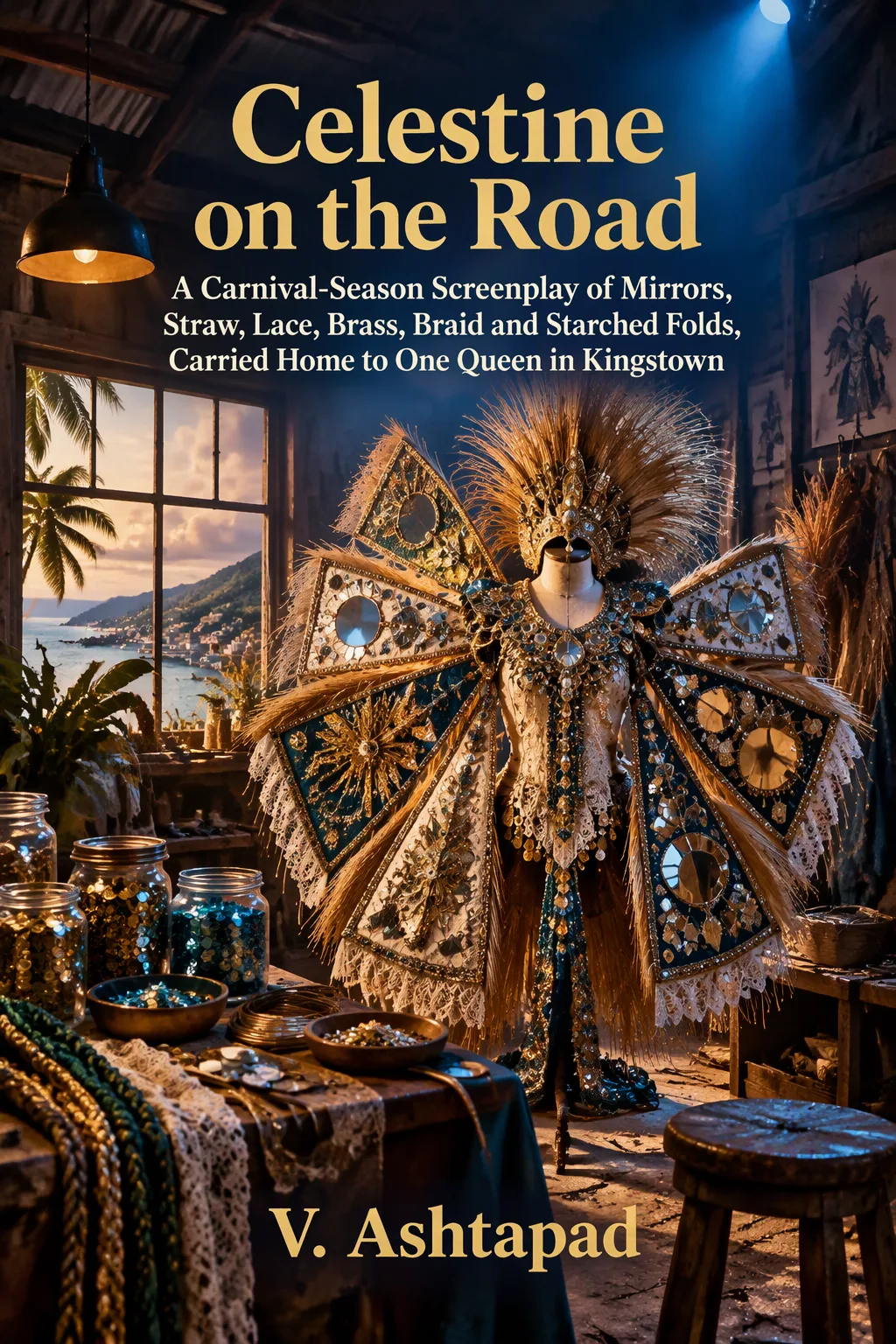
Celestine on the Road
A Carnival-Season Screenplay of Mirrors, Straw, Lace, Brass, Braid and Starched Folds, Carried Home to One Queen in Kingstown
by V. Ashtapad
Foreword
This is a work of fiction, written in the form of a screenplay. The carnivals and crafts it draws on are real: Nine Mornings and Vincy Mas in St Vincent, the Sugar Mas Masquerades of St Kitts, Junkanoo and straw plaiting in the Bahamas, madras national wear in St Lucia, the iron bands of Antigua, Crop Over and the Landship in Barbados, and Owru Yari, Keti Koti and the angisa headwrap in Suriname. The Ballantyne family, the mas camps, the shops and everyone in this book are invented.
For everyone who sewed the costume and never heard their name called.
Nine Mornings
FADE IN:
EXT. HILLSIDE ABOVE KINGSTOWN, ST VINCENT. BEFORE DAWN.
SUPER: Kingstown, St Vincent. The sixteenth of December.
Four in the morning, and the town below is already awake. Strings of colored bulbs loop over the streets like a child's drawing of a necklace. A steel band somewhere near the market is tuning, one pan at a time, a ping and a ping and then a run of notes that rolls down to the harbor and comes back off the water. People in flip-flops, bare-headed, walk toward the sea in twos and threes, carrying towels. This is the first of the Nine Mornings, when Vincentians get up in the dark before Christmas to walk, to play music, to bathe in the sea before the sun has a chance at it.
Halfway up the hill, a yard. A breadfruit tree spreads over it, leaves the size of serving platters. Under the tree, a shed of corrugated sheets painted the blue of a swimming pool a long time ago. A single bulb hangs inside. Its light comes through the gaps in the boards in stripes.
INT. THE SHED. CONTINUOUS.
Wire everywhere. Coils of galvanized wire hang from nails on the walls in descending thickness, the thick ones like garden hose, the thin ones like hair. A workbench runs the length of the shed, scarred and burned and glued with old sequins that nobody has bothered to pick off. Pliers in a coffee can. Tin snips. A soldering iron with a cord taped in four places.
AMBROSE BALLANTYNE (79) sits at the bench on a stool too low for him. Long arms, big knuckles, a fringe of white hair around a bald brown head. He wears a vest that was white in another decade and trousers held with a length of electrical cord. His glasses are on a string.
In his hands, a length of wire. He is trying to bend it into the curve of a feather. His hands shake. Not a lot. Enough. The wire wanders off the line he wants, and he straightens it, and it wanders again.
AMBROSE
(to the wire)
Don't argue with me. I bent you when you were still in the ground.
He tries again. The curve goes wrong at the tip. He sets the wire down on the bench very gently, the way a man sets down a glass he is afraid he will throw.
From outside, a whistle. Two notes, up and down.
AKEEM (O.S.)
Mr. Bal. You alive in there?
AMBROSE
Who asking?
AKEEM DAISLEY (28) leans into the doorway. Lean, quick, a towel around his neck and sea salt still on his arms. He wears a tank top printed with the name of his own mas band, DAISLEY DESIGNS, in letters that are a little too large for the shirt.
AKEEM
The boy who swept your yard for two dollars a week.
AMBROSE
Two dollars and all the mangoes you could thief. I counted the mangoes.
AKEEM
You never counted one mango in your life.
He comes in. Looks at the wire on the bench. Looks at Ambrose's hands, then away, politely, at the wall.
AKEEM (CONT'D)
They walking down to the bay. Steel band at the bottom of Bay Street. You coming?
AMBROSE
Seventy years of Nine Mornings I walk down that hill. The sea will manage without me.
AKEEM
Miss Celestine would have had you down there by now.
Ambrose doesn't answer that. He reaches under the bench and pulls out a long cardboard tube, the kind architects carry. He pops the cap. Inside, rolled, a sheet of heavy paper.
AMBROSE
Lock the door.
AKEEM
It have no lock.
AMBROSE
Then stand in front of it.
Akeem, amused, stands in the doorway with his back to the dark.
Ambrose unrolls the paper across the bench and weights the corners with a pair of pliers, a tin of solder, a jar of sequins and his own forearm.
INSERT: THE DRAWING.
Pencil and colored ink on paper gone soft at the folds. A costume, enormous, drawn from the front: a woman's figure at the center, but the figure is the smallest part of it. Behind her rises a backpiece shaped like a fan of seven great panels, each one a different pattern, each one labeled in a neat round hand that is not Ambrose's. At the top of the fan, in the center, a parrot with spread wings, its feathers sketched in a hundred tiny strokes.
The labels, one per panel: NASSAU. BASSETERRE. CASTRIES. ST JOHN'S. BRIDGETOWN. PARAMARIBO. And over the parrot: HOME.
Across the bottom, in the same round hand: Celestine. A Queen. For when you finally stop building Kings.
BACK TO SCENE.
Akeem forgets to guard the door. He steps closer.
AKEEM
Mr. Bal. That's a Queen.
AMBROSE
I can read.
AKEEM
You never built a Queen. Fifty years. Kings, Kings, Kings. You say Queens is for the sewing side.
AMBROSE
I said a lot of things.
AKEEM
Who drew this?
AMBROSE
She drew it. I drew the frame under it. We draw it the year before she pass. On that same bench. She sat where you standing and argued with me about the parrot's tail for two hours.
Akeem studies the panels. His designer's eye is moving fast, measuring, pricing.
AKEEM
This is seven different islands' worth of work.
AMBROSE
Six islands and Suriname.
AKEEM
Suriname is not an island.
AMBROSE
Tell that to my granddaughter. She think everything is an island except where she is.
Akeem looks up.
AKEEM
The one in Paramaribo? Royden's girl?
Ambrose rolls the drawing back up, carefully, from the bottom, the way you roll a map you plan to use again.
AMBROSE
Celestine wanted every panel made where the family is. Made by the family, with what the family knows. The straw from my sister in Nassau. The mirror work from Basseterre. The madras from her sister in Castries. Every piece from the place it come from, and then all of it come home here and stand up on one frame.
AKEEM
For Dimanche Gras?
AMBROSE
For Dimanche Gras. July. Queen of the Band.
AKEEM
(gently)
Mr. Bal. Who going to carry it round the islands for you?
Ambrose holds up his hands between them, open. In the hard light of the bulb, the tremor is plain. The fingers flutter like a shop sign in wind.
AMBROSE
Not these.
EXT. THE YARD. MOMENTS LATER.
Ambrose sits on an upturned paint bucket under the breadfruit tree. Below, the steel band has found its tune. The sky over the Grenadines is going from black to the dark blue of a mussel shell. Akeem has gone down the hill. Ambrose has a phone in his hand, an old one with a cracked corner. He holds it far from his face and squints. He presses a name.
INTERCUT: EXT. A GARDEN WEDDING, PARAMARIBO, SURINAME. SAME TIME.
SUPER: Paramaribo, Suriname.
It is an hour later here, and a different kind of dark: a garden strung with paper lanterns where a wedding party has refused to go home. White wooden houses with green shutters stand at the end of the garden. Mosquitoes. A brass band of six men in matching shirts plays something with a slow, rolling bounce, and the last guests dance with their shoes in their hands.
LISANNE BALLANTYNE (31) stands on a garden chair with a camera on her shoulder, getting the wide shot. Narrow, sharp face, hair pulled back hard, a dark shirt that will not show in anybody's photos. A gaffer-taped light on a pole leans against her hip. She has the look of a person who has been awake for twenty hours and has decided it is fine.
Her phone buzzes in her back pocket. She ignores it. It buzzes again. She climbs off the chair, still filming with one hand, and checks the screen. Her face changes.
LISANNE
(answering)
Pa? It's five in the morning.
AMBROSE
It's four here. You are an hour ahead of me and I'm the one who's late.
LISANNE
Is something wrong? Are you sick?
AMBROSE
I'm seventy-nine. Everything is wrong. I'm calling about a job.
Lisanne lowers the camera. A guest bumps into her and apologizes in Dutch. She steps behind a lantern tree.
LISANNE
A job.
AMBROSE
You have a camera.
LISANNE
I have three.
AMBROSE
Good. Bring the one that doesn't need a man to carry the battery.
LISANNE
Pa. What job?
A pause on the line. Down the hill in Kingstown, the pan player hits a high note and holds it.
AMBROSE
Your grandmother left a Queen. A costume. Seven pieces. She want it made around the islands, every piece in the place it belong, and brought home for July. I need somebody to go round with me and film it, and write down what everybody say, and carry the bag. I will pay you what you charge a wedding.
LISANNE
I charge a wedding a lot.
AMBROSE
I have a lot. I never spent anything in fifty years except wire.
LISANNE
(after a moment)
Why me?
AMBROSE
Because you have a camera.
LISANNE
Ione has a phone. Wendell has a phone. Everybody has a camera.
AMBROSE
Ione is a nurse and Wendell is a mechanic and they both have carnivals of their own to quarrel about. You don't have one.
That lands. Lisanne's jaw tightens. Behind her, the brass band starts another number.
LISANNE
That's a nice way to say I don't belong anywhere.
AMBROSE
That's not what I said.
LISANNE
It's what you meant.
AMBROSE
I meant you are free in the season. You can go everywhere because nowhere owns you.
LISANNE
I'm working, Pa. It's wedding season. There are four more before the new year. I'm sorry about the costume. I'm sorry about all of it. I can't.
Silence. Then:
AMBROSE
All right.
LISANNE
All right?
AMBROSE
You said you can't. I heard you. Go back to your wedding.
He hangs up before she can. In Paramaribo, Lisanne stares at the screen. The call log shows his name, and under it, a row of missed calls from a number labeled OMA CELESTINE, the last one fourteen months old. She has never cleared them.
LISANNE (V.O.)
My grandmother called me every Sunday for seventeen years. Every Sunday from the week my father died to the week she did. She called at five o'clock, her time, and she always began with the weather in Kingstown, as if I might need it.
She lifts the camera again and goes back to the dancers. Her shot is steady. Her face is not.
LISANNE (V.O.) (CONT'D)
My grandfather called me eleven times in my life. I could tell you the date of each one. That was the twelfth.
BACK TO KINGSTOWN.
Ambrose puts the phone face down on the bucket lid beside him. He picks up a length of wire and, very slowly, in the gray light, starts again on the feather. The tip goes wrong. He doesn't stop.
Down at the bay, the first swimmers go into the sea with a shout, and the cold of it carries all the way up the hill.
CUT TO:
© 2026 CRUNOD LLC. All rights reserved.
Old Year
EXT. A STREET IN PARAMARIBO. MORNING.
SUPER: Paramaribo. The thirty-first of December.
A long straight street of wooden houses on low stilts, white and cream and pale green, every one with shutters thrown open to let the heat in and out. Mango trees. A bicycle with a crate of coconuts tied behind the seat. The sky is high and hazed.
Down the center of the street, two boys and a grown man are unrolling a fat red ribbon of firecrackers from a cardboard drum. The string is as thick as a man's wrist and it keeps coming, past one house, past four, past ten, a red line laid down the road like a carpet for a very small king. This is pagara, and tonight the whole city will light it.
Neighbors lean on their gates and give advice. Nobody takes it.
INT. SONJA'S HOUSE. FRONT ROOM. CONTINUOUS.
A wooden front room with louvered windows and a ceiling fan that turns at its own pace. Shelves of schoolbooks with Dutch titles, a framed photograph of a sailor in a white shirt laughing on a deck, and, on a low table, a stiff cone of starched, folded cotton printed in purple and gold.
SONJA PINAS (58) sits on a cane chair with a second cloth across her knees. Round face, reading glasses pushed up into gray curls, the forearms of a woman who has lifted a lot of children over a lot of puddles. She teaches the fourth grade and she has a voice to prove it. She is folding a headwrap, an angisa, for a neighbor: the starched cloth pleated, creased with a thumbnail, pinned, turned, pleated again, until it stands up on its own like a small proud sail.
Lisanne enters from the back, still in yesterday's dark shirt, holding coffee.
SONJA
You slept in that.
LISANNE
I slept near it.
SONJA
Sit. Hold this corner. No, the other corner. You have your father's hands. Wrong way round for everything.
Lisanne sits on the floor and holds the corner of the cloth. Sonja folds. The pleat stands up crisp.
LISANNE
Which one is this?
SONJA
For Tante Irma. This fold says: let them talk.
LISANNE
That's every fold you make for Tante Irma.
SONJA
Tante Irma has a lot of neighbors.
A knock at the door. A COURIER (40s) in a cap, sweat-soaked, holds a parcel wrapped in brown paper and enough tape to survive a hurricane.
COURIER
Ballantyne?
LISANNE
That's me.
COURIER
From St Vincent. It came last night. On the thirtieth. Somebody paid a lot to make it come on the thirtieth.
She signs. He goes. She sets the parcel on the floor. Sonja raises her glasses and watches her daughter over them.
Lisanne cuts the tape with a key. Inside: a pair of long-nosed pliers, black with age, the handles wrapped in red tape gone brown. An airline ticket printed on paper, folded in half. And a card, the kind sold in a pharmacy, with a cartoon cat on the front saying HAPPY HOLIDAYS. Inside the card, block capitals pressed hard into the paper:
INSERT: THE CARD.
THE MASQUERADES WILL NOT WAIT. BASSETERRE, ST KITTS. THE SECOND OF JANUARY. LAST LAP. BERTIE HAZEL WILL BE ON THE BIG DRUM. THESE WERE YOUR FATHER'S. IF YOU DON'T COME I WILL GIVE THE TICKET TO A GOAT. A.B.
BACK TO SCENE.
LISANNE
He's sending me to St Kitts.
SONJA
He's sending you to a goat.
Lisanne picks up the pliers. They fit her hand oddly, worn to someone else's grip.
LISANNE
These were in Papa's sea bag.
SONJA
Nine years. From the day he left Kingstown to the day he came off the ships for good. Then they lived in the drawer by the stove. I gave them to your grandmother at the funeral. She asked for them.
LISANNE
She gave them to Pa.
SONJA
And now he gives them to you. Like a parcel nobody wants to sign for.
Lisanne turns the pliers in the light.
LISANNE
Why did Papa leave? Really. Oma always said "he wanted the sea," like that was a whole answer.
Sonja takes off her glasses. Folds them. That is how Lisanne knows it is going to be a real answer.
SONJA
Your father was supposed to carry a King. Nineteen ninety. Twenty years old, strong like a mule. Your grandfather built the biggest costume he ever built. Thunder over the volcano, smoke made of silver cloth, lightning made of wire. Royden was to wear it on the stage. The night before, he said no. He said, I am not going to spend my life inside your shapes.
LISANNE
And Pa said?
SONJA
Your father never told me what his father said. He only told me that by morning he was on a banana boat to Dominica with a bag and these pliers. He took them, he said, so the old man would have to buy new ones.
Lisanne laughs despite herself.
SONJA (CONT'D)
They wrote to each other through your grandmother for eighteen years. Every letter went through Celestine's hands. She read them all. She mended the bad parts, I think. Like a hem.
EXT. THE BACK STEPS. LATER.
Lisanne sits on the back steps with her phone. Banana plants, a water tank, a cat asleep in a basin. She opens a private family page on her phone, the one Celestine set up years ago and nagged everybody into joining. Photos of birthdays in four countries. A recipe for sorrel in Celestine's typing, all capital letters, because she never found the button.
She taps a calendar on the page. Months ahead, Celestine marked dates, a full year of them, each with a little note. Lisanne scrolls.
INSERT: THE CALENDAR.
Jan 2. Last Lap, Basseterre. Bertie's troupe. Wear shoes you can lose.
Feb. Ottilie's birthday. Nassau. Bring her the good thread.
Jul 1. Keti Koti, Paramaribo. Sonja folds.
Jul. Dimanche Gras, Kingstown. THE QUEEN.
BACK TO SCENE.
Lisanne stops on that last line. She scrolls back up to January. Under the note, a reminder Celestine set fifteen months ago is still waiting to fire. It pings now, as if it heard her: Last Lap in two days. Lisanne, are you going?
She looks at it for a long time.
LISANNE (V.O.)
She knew she was sick when she made that list. I didn't know she was sick until the week she died. She put my name in a reminder for a day she wasn't going to see. That's the kind of person she was. She left instructions in the furniture.
EXT. THE WATERFRONT, PARAMARIBO. NIGHT.
The Waterkant. Old wooden warehouses with peeling shutters, the brown Suriname River sliding past, wide as a lake, with lights from the far bank shaking on it. Thousands of people in the street. Music from four sound systems at once, and somehow it works. Smoke from grills: chicken on sticks, sweet corn, peanut soup ladled from a steel pot. A stall sells bara, fat brown rings of fried bean dough, in paper. People eat them standing, burning their fingers.
Sonja and Lisanne push through the crowd with a foil-covered dish of pom, the orange root baked with chicken and citrus until the top goes brown and crusty. They are taking it to Tante Irma, who is sitting in a plastic chair outside a closed bank with her purple angisa standing up like a crown.
TANTE IRMA (70s)
Let them talk!
SONJA
They're talking, Tante.
TANTE IRMA
(to Lisanne)
You. You're going somewhere. I can see it on you.
LISANNE
I'm not going anywhere.
TANTE IRMA
Ha. Your face is packed.
Somebody lights the first string of pagara at the end of the street. The noise starts as a crackle and becomes a roar, a running, rolling wall of bangs racing toward them down the red line on the asphalt. Smoke rises and rolls between the warehouses. Paper confetti from the burst shells blows in red drifts against the curbs. People cheer, cover their ears, dance through it.
Lisanne raises her camera without thinking and frames it: the red smoke, the faces, Tante Irma's angisa catching the sparks.
LISANNE (V.O.)
We burn the old year here. Literally. All of it goes up in red paper and noise, and in the morning the streets are ankle-deep in it, and you walk through the old year to get to the new one.
Midnight. The whole city goes up at once. Lisanne lowers the camera. Sonja is looking at her.
SONJA
(over the noise)
Go.
LISANNE
What?
SONJA
Go to St Kitts. Go to the goat.
LISANNE
Mama, I have the Kromodimedjo wedding on the fifth.
SONJA
I'll call Ravi. Ravi can hold a camera. Ravi held a camera at my sister's wedding and nobody died.
LISANNE
Half the photos were of his thumb.
SONJA
It was a good thumb.
(then, quieter, closer)
Your father never went back. Not once. He waited for his father to ask him, and his father waited for him to come, and they both waited until there was no more time. Don't you wait on that man too. He's eighty.
LISANNE
He's seventy-nine.
SONJA
Then you have a few months.
The last of the pagara burns out. In the sudden quiet, a single brass band starts a slow tune at the far end of the street. Red paper falls like the end of something.
Lisanne reaches into her bag. Her fingers find the pliers.
CUT TO:
© 2026 CRUNOD LLC. All rights reserved.
Last Lap
EXT. THE CIRCUS, BASSETERRE, ST KITTS. AFTERNOON.
SUPER: Basseterre, St Kitts. The second of January.
A small round plaza where four streets meet, and in its center a Victorian memorial clock on a tall iron column, painted green, with a fountain at its feet. Balconies of old stone and wooden houses look down on it, painted in coral and lemon and mint. Today every balcony is full. People sit on the curbs with coolers. Children are up on shoulders. Flags of red, green, black and gold hang from the railings. The air smells of barbecue smoke, spilled beer, and sun-hot cars.
Into this, from the bottom of Fort Street, comes the sound of a drum.
Not a steel drum. A big drum: a deep goatskin bass drum that thumps the stomach, a sharp kettle drum crackling over it, and above them a bamboo fife shrilling a tune that loops and loops like a bird that won't come down.
Then the Masquerades.
Twelve dancers, men and women, in costumes that look like nothing else on earth. Tall headdresses of peacock feathers and colored plumes fan up from their heads. Their faces are hidden behind fine painted mesh masks, pink cheeks and black brows, eerie and cheerful at once. Over loose bright trousers they wear aprons and capes covered in ribbons, cords, and small round mirrors that flash in the sun like a scatter of coins. Each dancer carries a short wooden ax, a tomahawk, painted and beribboned. They dance in figures, stepping and turning, the mirrors throwing light across the faces in the crowd.
LISANNE (V.O.)
My grandmother wrote "wear shoes you can lose." She meant it.
INT./EXT. A BALCONY ABOVE THE CIRCUS. CONTINUOUS.
Lisanne, with a backpack and a camera, pushes onto a crowded balcony, sweating, a borrowed straw hat on her head. She has the look of someone who came straight from an airport and got lost twice. She scans the street below.
A HAND waves from the far end of the balcony. An old man in a white guayabera shirt and a cap, sitting in the only chair, like a king at a football match. Ambrose.
He doesn't get up. She goes to him.
LISANNE
Pa.
AMBROSE
You came.
LISANNE
There was a goat involved.
AMBROSE
(almost a smile)
I gave the goat a different ticket.
They look at each other. She doesn't know whether to hug him. He doesn't offer. Finally he reaches into a cooler at his feet and holds out a plastic bottle of something deep red.
AMBROSE (CONT'D)
Sorrel. Bertie's wife make it with ginger. Drink before you faint. You look like you faint.
She takes it. As she does, she sees his hand shake around the bottle. He sees her see it. He puts the hand in his lap.
LISANNE
How long has that been?
AMBROSE
Long enough.
LISANNE
Have you seen a doctor?
AMBROSE
I've seen three. They all say the same thing in different handwriting.
(points down)
Watch. There. The big one on the drum. That's Bertie.
EXT. THE CIRCUS. CONTINUOUS.
At the center of the band, a big drum hangs on a strap across the chest of CUTHBERT "BERTIE" HAZEL (76). He is huge and soft and moving with surprising lightness, beating the drum with a padded stick in one hand and a thin switch in the other, his whole belly in the rhythm. His shirt is soaked. He looks happier than anyone in the plaza. He looks up at the balcony, sees Ambrose, and does a little extra roll on the drum just for him.
BERTIE
(shouting up)
Brose! That the girl?
AMBROSE
(shouting down, as much as he can)
That's the girl!
BERTIE
She look like Celestine!
AMBROSE
I know!
The crowd hears and laughs and somebody near Lisanne pats her shoulder like she has done something clever.
The Masquerades swing past below. One dancer peels off, bows toward the balcony with his tomahawk, and the mirrors on his apron flash straight into Lisanne's lens. Her viewfinder floods with white.
LISANNE
(lowering the camera, blinking)
They do that on purpose.
AMBROSE
Of course on purpose. The mirror is the oldest trick in mas. You look at a Masquerade, and what you see is yourself. Your own face looking back, small, a hundred times.
LISANNE
That's very deep, Pa.
AMBROSE
It's not deep. It's glass. You cut it with a wheel and you glue it with patience.
Behind the Masquerades come the clowns, a whole troupe in baggy suits of bright patchwork, every inch of them hung with small brass bells. When they jump, they ring. When a hundred of them jump at once, the Circus sounds like a sack of shaken coins. Children scream with joy.
EXT. FORT STREET. LATER.
The parade has become a crowd and the crowd has become a slow, happy river. Last Lap: the final jump of Sugar Mas, the long Christmas carnival, before everybody goes back to work. Ambrose walks, slowly, with a stick he refuses to lean on, and Lisanne keeps one hand near his elbow without touching it.
Bertie comes out of the river of people toward them, the big drum still on his chest, sweat flying from his chin. He embraces Ambrose drum and all, so that Ambrose disappears for a second into goatskin and belly.
BERTIE
Sixty years I know this man. He come here at nineteen to cut cane. He cut cane for one month and then he see my uncle's Masquerade apron and he never cut one more stalk.
AMBROSE
I cut plenty.
BERTIE
You cut your thumb. That was the only thing you cut.
(to Lisanne, grabbing her hand)
Child. You coming to the yard tomorrow?
LISANNE
For what?
BERTIE
For the mirrors. Celestine say the St Kitts piece must have mirrors from Masquerade, cut by Masquerade, and one row cut by family. That's you. You the family.
LISANNE
I've never cut glass.
BERTIE
Good. Nobody have to unteach you.
He lets go of her and is pulled back into the band, already drumming. The fife picks up. The river of people takes him.
Lisanne stands on the curb with her grandfather in the evening light, red and green flags overhead, the bells of the clowns fading down the street.
LISANNE
You told him I'd cut a row.
AMBROSE
Your grandmother told him. A year ago. I'm only the messenger.
LISANNE
Is that what you're going to be? The messenger?
He looks down at his hands.
AMBROSE
That's what I can be.
CUT TO:
© 2026 CRUNOD LLC. All rights reserved.
Bertie's Yard
EXT. BERTIE'S YARD, A VILLAGE ON THE LEEWARD COAST, ST KITTS. MORNING.
SUPER: Old Road, St Kitts. The third of January.
The road from Basseterre runs along the coast with the sea on one side, a gray-green mountain on the other, its peak in cloud. Old stone ruins of sugar works stand in the fields gone to grass and acacia, a chimney here, a round mill there, roofless, softened with vines. Monkeys cross the road in a line, unbothered.
Bertie's yard: a cement house painted pink with a gallery in front, a mango tree, a breadfruit tree, goats tied in the back, and a long table under a tarpaulin. On the table: sheets of mirror, a glass-cutting wheel, a steel ruler, a jar of kerosene, a rag, rolls of red ribbon, a tin of glue, and a sheet of thick red cloth stretched on a wooden frame.
Bertie, in a vest, sits at the table with his reading glasses on the end of his nose. A transistor radio on a nail plays calypso. His wife, MISS CYNTHIA HAZEL (70s), small and brisk, comes and goes from the kitchen carrying things that smell good.
Ambrose sits under the mango tree in a folding chair, like a judge.
Lisanne sets up a small camera on a tripod at the end of the table and pins a tiny microphone to Bertie's vest. He looks down at it with deep suspicion.
BERTIE
What this do?
LISANNE
It listens.
BERTIE
Everything?
LISANNE
Everything you say.
BERTIE
(to the microphone, loudly)
Cynthia, I love you, and the goat water last week was too salt.
MISS CYNTHIA (O.S.)
I heard that!
BERTIE
(to Lisanne)
The thing work.
He picks up the cutting wheel. Shows her: a small steel wheel on a handle.
BERTIE (CONT'D)
You don't cut glass. You tell the glass where to break. You run the wheel one time, one time only, with a steady hand, and you hear it sing, like a little zip. Then you tap underneath and the glass believe you. If you go twice, it stop believing.
He runs the wheel in a circle around a jam-jar lid. The glass sings. He taps under it with the end of the handle. A perfect round mirror the size of a coin falls into his palm. He holds it up. Lisanne's eye in it, small.
LISANNE
That's it?
BERTIE
That's it. Now do it two thousand times.
She tries. The wheel skips. The circle goes oval. She taps and the mirror cracks in half.
BERTIE (CONT'D)
Good. That one is for the practice pile. Again.
She does it again. Better. Again. The fourth one comes out whole. She holds it up with a pleasure she tries to hide.
From under the mango tree:
AMBROSE
Too much pressure on the start, not enough on the finish.
LISANNE
You can see that from there?
AMBROSE
I can hear it from there.
Bertie winks at her.
BERTIE
He was the same at nineteen. My uncle Arthur used to say, this Vincy boy have eyes in his ears.
LATER.
The table glitters. A row of finished round mirrors lies drying on newspaper. Bertie is gluing them onto the red cloth in a pattern: circles inside a diamond, ribbon tacked around each one so it looks like a flower. Lisanne is cutting. The rhythm of it has caught her: the sing of the wheel, the tap, the small click of the mirror into the dish. She has stopped looking at the camera.
BERTIE
(as he works, quiet, for the microphone)
My uncle Arthur Hazel was captain of a Masquerade troupe in this village since before I born. The aprons, the capes, the peacock hats. When he get too old, I take the troupe. When I get too old, my nephew taking it. Every Christmas, from the sixteenth to the second, we dance. Big drum, kettle drum, fife. The fife is the voice. The drum is the heart. The mirrors is for the people to see themself. My uncle say, a Masquerade don't show you a stranger. It show you the village.
LISANNE
And the masks?
BERTIE
So nobody know is you. So the shy man can dance. My uncle say a mask make a coward brave and a proud man humble, both at the same time.
He presses a mirror into the glue with his thumb.
BERTIE (CONT'D)
Brose come in sixty-six. He sleep in the cane-cutters' barracks. He walk in here one evening and see my uncle sewing an apron and he sit down on the step and don't get up for two years. My uncle teach him mirror and ribbon. Brose teach my uncle wire. That's how the peacock hats here got so tall, you know. Vincy wire. It's half his.
AMBROSE
(from the chair)
A quarter.
BERTIE
Half. Don't let him lie on my microphone.
EXT. THE GALLERY. AFTERNOON.
Miss Cynthia lays the table on the gallery: a platter of stewed saltfish in tomato and onion and thyme, sweet and sharp; long slices of plantain fried with hot pepper until the edges go black; round coconut dumplings, dense and white; seasoned breadfruit cut in wedges and glistening. A jug of ginger beer that makes Lisanne's eyes water.
MISS CYNTHIA
That's the national dish. Eat it like you mean it.
They eat. Bertie talks with his mouth full about the old days. Ambrose eats slowly, hiding his hands under the table between bites. Lisanne notices him cutting a dumpling with the side of his fork rather than a knife, and she quietly cuts the next one for him, without a word, and slides it back onto his plate. He looks at the plate. He doesn't say thank you. He eats it.
LATER. The light going gold. Lisanne on the gallery steps, laptop on her knees, connecting the camera. She loads the morning's recording to the family page, names it in plain words: Bertie Hazel, Old Road, on mirrors and his uncle Arthur. She tags it to St Kitts on the little map Celestine started, where pins already mark Kingstown and Castries and Nassau and St John's.
Within a minute, a reply pings in under the video.
INSERT: THE PHONE SCREEN.
OTTILIE ROLLE (Nassau): Who is that big handsome old man with the drum? Tell him Ottilie said hello and she remember the time he fell off the boat. Is Brose eating? Make him eat.
BACK TO SCENE.
LISANNE
(calling)
Pa. Your sister says you have to eat. And that Bertie fell off a boat.
BERTIE
(outraged)
I did not fall. I was pushed by the sea.
Ambrose laughs. A real one, short and surprised, like a cough. Lisanne turns and catches it on her phone before it's gone.
EXT. THE YARD. EVENING.
The panel is done. Bertie and Lisanne lift it off the frame together: red cloth, a diamond of mirrors, ribbon flowers, and in one corner a ragged row of slightly uneven mirrors that are obviously hers. Bertie wraps the whole thing in a clean bedsheet and ties it with ribbon.
BERTIE
That row there. That's the family row. When people see it, they going to say, look, somebody new.
LISANNE
They're going to say, look, somebody bad.
BERTIE
New and bad is the same thing in year one. Ask him.
He nods at Ambrose, who has risen from his chair and walks to the table with his stick. Ambrose bends over the uneven row. Touches one mirror with a finger that trembles.
AMBROSE
Your father cut a row like this. First mirror he ever cut. Bertie's uncle put it on a hat.
LISANNE
I didn't know Papa ever came here.
AMBROSE
He was nine. We came every Christmas when they were small. Ione, Royden, Wendell, all of them, in a boat, sick over the side.
(pause)
He was good at it. At everything with his hands. Better than me at his age.
LISANNE
Is that why you wanted him in the King?
He straightens. The light is almost gone. The radio on the nail plays a slow one.
AMBROSE
I wanted him in the King because I built it for him. Every piece. And the night before, he said he would not live in my shapes.
(quiet)
Not tonight, girl. That's a story for another island.
He turns and walks back to his chair under the mango tree. Bertie puts a heavy hand on Lisanne's shoulder and leaves it there, and the fife on the radio goes up and up.
CUT TO:
© 2026 CRUNOD LLC. All rights reserved.
The House on the Hill
EXT. THE WINDWARD ROAD, ST VINCENT. DAY.
SUPER: St Vincent. The seventh of January.
A taxi van with a name painted across the windshield, SWEET MERCY, takes the coast road from the airport at a speed the road does not support. Bass from the speakers rattles the windows. Out the window: the Atlantic side of the island, rough and blue-gray, surf exploding white against black rocks. Then the road turns inland and climbs, and the island shows what it is made of: green. Steep green valleys stacked one behind the other, breadfruit and banana and coconut on slopes so sharp a goat would think twice, and over everything, far back, the cloud-capped shoulder of the volcano.
Lisanne sits in the back with her bag on her knees and the wrapped Kittitian panel across her lap like a sleeping child. Ambrose sits up front beside the DRIVER (30s), who talks to him the whole way without needing answers.
DRIVER
Mr. Bal, you remember the King you build for my uncle? Nineteen eighty-nine? The one with the fish?
AMBROSE
Leviathan.
DRIVER
Leviathan! My uncle still talk about it. He say it was so heavy, when he take it off he float for a week.
The van crests a ridge. Below, all at once, Kingstown: a crescent of old stone and red roofs pressed between steep hills and the sea, a cruise ship white as a wedding cake at the jetty, the harbor glittering.
LISANNE (V.O.)
I had never seen it. Thirty-one years old, a Vincentian name on my passport, and I had never seen the town my father came from. My grandmother came to us. Always. She said Paramaribo had better bread.
EXT. KINGSTOWN STREETS. CONTINUOUS.
Narrow streets under stone arcades, the arches black with age and shade, shops tucked inside them selling everything: fabric, phone covers, hardware, school shoes. Vendors at the curb with trays of golden apples, avocados, nutmeg, pyramids of tomatoes. The market building, loud. A man pushing a cart of coconuts, chopping the tops off with a cutlass for people who drink them on the spot.
EXT. THE HOUSE ON THE HILL. LATE AFTERNOON.
The van groans up a road so steep it has steps cut beside it for walkers. At the top, Ambrose's house: wooden, two stories, painted pale yellow with white fretwork along the gallery, a corrugated roof, and the blue shed in the yard under the breadfruit tree. Hibiscus along the fence, red and blowsy.
Akeem is in the yard already, fanning a fire of coals in a cut-down oil drum. On the coals, three whole breadfruit, their green skins blackening and splitting.
AKEEM
Welcome to St Vincent. The breadfruit say hello.
LISANNE
You're the boy who stole the mangoes.
AKEEM
(delighted, to Ambrose)
You told her?
AMBROSE
She have a microphone. Everything get told now.
INT. THE HOUSE. CONTINUOUS.
Cool, dim, smelling of wood polish and old cloth. Lace curtains. A cabinet of glasses nobody uses. On the wall, framed photographs, dozens: Kings. Every one a giant costume on a stage, lit up, a tiny man buried in the middle of it. Dragons. Ships. A sunburst. A fish that must be Leviathan, all silver scales. Each photo has a small typed label: the name of the King, the year. Fifty of them.
Lisanne walks along the wall slowly. Ambrose watches her from the doorway.
LISANNE
Which one was Papa's?
He points with his stick. A gap on the wall between 1989 and 1991. A pale square on the paint where a frame used to hang.
LISANNE (CONT'D)
You took it down.
AMBROSE
Your grandmother took it down. She say, Ambrose, either put the boy in the picture or take the picture off the wall. I wouldn't do the one, so she did the other.
INT. CELESTINE'S SEWING ROOM. CONTINUOUS.
A small room at the back, full of light from two windows. A black sewing machine on an iron treadle stand, with a crocheted cover over it. A dressmaker's dummy with no head. A long table. And along the wall, on four shelves, jars: hundreds of glass jars, old jam jars and pickle jars and rum bottles with the necks cut off, each full of sequins, sorted by color, so the shelves go from white to cream to gold to orange to red to every green and blue and finally to black. In the late sun, the jars burn.
Lisanne stands in the doorway with her mouth open.
LISANNE
How many?
AMBROSE
Nobody counted. Celestine knew. She'd say, I'm low on the green with the hole off-center, and she'd be right.
LISANNE
Off-center?
AMBROSE
Sequins come with the hole in the middle or the hole near the edge. Middle one lie flat. Edge one hang and swing and catch the light when you move. She used the swinging ones for the Kings. Said a King should shiver.
Lisanne lifts the cover off the sewing machine. Under it, still threaded, needle down in a scrap of gold cloth. In the little drawer under the table, she finds a cassette tape in a cracked case. Handwritten label: SEWING SONGS. C.B.
LISANNE
What's this?
AMBROSE
(quietly)
She used to tape herself singing so she could hear if she was flat. Then she would play it back and sew to it. She said a woman sewing alone get lonely for herself.
LISANNE
Do you have a player?
AMBROSE
Somewhere. I don't play it.
She puts the cassette in her shirt pocket. He sees. He lets it be.
EXT. THE YARD. EVENING.
Supper on the gallery steps. Akeem has pulled the breadfruit out of the coals, black and smoking, and peeled them with a knife so the gold flesh comes out steaming. Beside it, a pan of jackfish fried crisp, small silver fish with tails you eat like chips. A bowl of callaloo soup, dark green, thick with dasheen and a dumpling. Hot pepper sauce in a rum bottle.
AKEEM
(serving)
Roasted breadfruit and fried jackfish. National dish. If anybody tell you the national dish is something else, they lying, or they from Bequia.
LISANNE
What do they eat in Bequia?
AKEEM
Whatever they catch, and then they tell you about it for a hour.
Lisanne eats. The breadfruit is smoky and dense, like a potato that went to the beach. She makes a small, involuntary sound.
AMBROSE
(to Akeem)
She like it.
AKEEM
Everybody like it. It's the fire.
LATER. Akeem, on the step below Lisanne, shows her his phone: drawings of his own Queen for July. Full color, digital, gorgeous: a woman in a gown that opens into a sunrise of orange and gold, a crown of feathers, a train that unrolls behind her across the stage.
AKEEM (CONT'D)
"Daughter of the Morning." My Queen this year. Sixty pounds of feather. Wheels under the train.
LISANNE
It's beautiful.
AKEEM
(glancing at Ambrose)
It's good. It's not a Ballantyne.
AMBROSE
It have wheels where it should have dancing.
AKEEM
It have wheels because I want my Queen to live through Tuesday.
They grin at each other like old rivals who enjoy it.
AKEEM (CONT'D)
(to Lisanne)
Every year I lose to him. Seven years I enter, seven years second or third. And this year he says he going to build a Queen.
LISANNE
You're scared of an old man.
AKEEM
I'm scared of an old man and a dead woman's sequins. That's a different thing.
INT. THE SHED. NIGHT.
The single bulb. Ambrose sits at the bench. On a sawhorse, the beginning of the frame: a skeleton of thick wire and fiberglass rods, roughly the shape of a great fan, nine feet across, half-joined, the joints bound in white tape. It looks like the ribs of some enormous creature.
Lisanne comes in with the camera. He holds up a hand.
AMBROSE
No.
LISANNE
I've filmed Bertie, I've filmed Sugar Mas, I've filmed your own sister's comments on my phone. You're the only one I haven't filmed.
AMBROSE
I'm not the story.
LISANNE
You're paying me to tell the story.
AMBROSE
Then tell it without me.
She sets the camera down on the bench, lens to the wall. Sits on the stool opposite him.
LISANNE
Then teach me something. Off camera.
He considers her for a long time. Then he takes a length of medium wire from a nail, a piece as long as his arm, and a short length of steel pipe clamped to the bench.
AMBROSE
This is fourteen gauge. Higher number, thinner wire. The frame is eight and ten. The feathers is sixteen and eighteen. The fine work on the face is twenty-two. You never use the wrong gauge for the job. A thin wire in a big place will fold in the first breeze, and a fat wire in a small place will look like a fence.
He holds the wire against the pipe. Bends it around, slowly. His hand shakes, but the pipe holds the curve for him.
AMBROSE (CONT'D)
You never bend in the air. Bend around something. The pipe know the shape better than your hand. That's the first thing my uncle taught me in this same yard: the hand is a liar. Find something that tells the truth and bend against it.
He passes her the wire and the pliers. Her father's pliers, from her pocket. She bends. Clumsy. The curve kinks.
AMBROSE (CONT'D)
Slow. Wire remembers every mistake. You kink it once, it will kink in the same place forever. Like a person.
LISANNE
Thanks.
AMBROSE
Not you. Me.
She looks up. He doesn't elaborate. She bends again. Better.
LISANNE
Can I work on the frame?
AMBROSE
No.
LISANNE
Why not?
AMBROSE
Because the frame is the King.
LISANNE
It's a Queen.
AMBROSE
(sharply)
The frame is the frame. Nobody touch the frame but me.
Silence. The bulb buzzes. She sets her wire down beside his.
LISANNE
Even with your hands like that.
AMBROSE
Especially with my hands like that. It's the last thing they going to build. I'll build it.
INT. ROYDEN'S OLD ROOM. LATER.
A narrow room under the eaves, a single bed with a candlewick spread, a window onto the dark harbor. On the wall, thumbtacked, curled at the edges and faded: a boy's drawings of boats. Schooners, fishing boats, a ferry, a cargo ship with every rivet drawn. Signed in a child's capitals: R.B. AGE 11. R.B. AGE 12. R.B. AGE 14.
Lisanne sits on the bed in the light from the window. She opens her laptop. She photographs Celestine's paper patterns, laid on the bed, one by one, and saves each image to the family page under a new folder: Celestine's patterns. Kingstown.
A message pops up almost at once.
INSERT: THE SCREEN.
IONE GRAZETTE (Bridgetown): Is that Mummy's room? Don't let him make you move anything. Don't touch the machine.
Then, a minute later:
IONE GRAZETTE: How is his hand?
BACK TO SCENE.
Lisanne types, considers, and writes: It shakes. He won't let me near the frame.
The reply comes fast: He never let anybody near the frame. Not even her.
Lisanne closes the laptop. She takes the cassette out of her pocket and turns it over in her fingers. Then she lies back on her father's boyhood bed, under his boats, and listens to the harbor.
LISANNE (V.O.)
I thought I was there to carry a bag and film an old man. I didn't know yet that I was there to argue with him. Celestine knew. That's why she put it in the calendar instead of telling me. You can't say no to a reminder.
CUT TO:
© 2026 CRUNOD LLC. All rights reserved.
Straw
EXT. BAY STREET, NASSAU, THE BAHAMAS. MORNING.
SUPER: Nassau, The Bahamas. The sixth of February.
Pink. Everything in old Nassau is pink, or wants to be: government buildings in flamingo pink with white trim, shops in salmon and coral, a wall of bougainvillea dripping magenta over a gate. The water in the harbor is a color Lisanne has never seen on a sea, a clear impossible turquoise over white sand, with a darker blue beyond. Mail boats with rust stains unload crates of onions and boxes of chickens at the dock. The air smells of salt and diesel and frying.
Ambrose and Lisanne, in sunglasses, walk the waterfront slowly. He has a new stick. She carries the wrapped Kittitian panel in a long bag over her shoulder; she has not let it out of her sight since St Kitts.
EXT. THE STRAW MARKET. CONTINUOUS.
A long, high, airy hall, open at the ends, and inside it stall after stall after stall of woven straw: hats wide as wagon wheels, bags, baskets, mats, dolls, fans, all the color of sun on sand, many trimmed with shells, raffia flowers in hot pink and lime and turquoise, embroidered names. Vendors call out from every stall.
VENDOR
Baby, you need a hat. You burning already.
At the back, at a stall hung with nothing but plain, perfect, undecorated straw, sits OTTILIE ROLLE (84, nearly 85). Ambrose's older sister. Tiny, straight-backed, in a plain dress of lavender cotton and a straw hat of her own making with a single band of black ribbon. Her fingers never stop: a long, flat braid of straw grows out of them, plait over plait over plait, and falls into a coil in her lap.
She doesn't look up as they approach.
OTTILIE
You took your time, Brose.
AMBROSE
I came by boat and plane and taxi. What you want, I should swim?
OTTILIE
You used to swim. You swam to Bequia once to impress a girl.
AMBROSE
That was you. You swam. I rowed after you.
Now she looks up. Fierce dark eyes behind thick glasses. She looks at Lisanne for a long moment, and her hands stop for the first time.
OTTILIE
Lord, child. You are her.
LISANNE
I'm Lisanne.
OTTILIE
I know who you are. I put you in the tree. Come. Sit. Brose, go buy me a conch salad, I'm not talking to you yet.
Ambrose, to Lisanne's astonishment, obeys.
LATER.
Lisanne sits on an upturned crate in the stall. Ottilie has put a bundle of dried palm into her lap: long pale strips, silver on one side, split fine.
OTTILIE
Silver top palm. My mother plaited it in St Vincent with a different palm. When I come here at twenty-one I had to learn it all again with a new leaf. That's what it is to move. Your hands know how, but the leaf don't know you.
She shows her. Four strands, then seven, over and under, the plait growing flat and even.
OTTILIE (CONT'D)
This one my mother call peas and rice. This one, with the little teeth on the edge, she call the shark's mouth. These are not the names in any book. These are our names. A plait don't mind what you call it.
Lisanne tries. Her plait is lumpy and loose.
OTTILIE (CONT'D)
Wet the straw. Wet your fingers. Pull every time. Straw is like a man, it only behave when it's a little damp and a little tight.
Lisanne laughs. Plaits. Better.
OTTILIE (CONT'D)
I came here in nineteen sixty-three to marry Leon Rolle, a sailor off the mail boat. Brose was sixteen. He stood on the jetty in Kingstown and cried like a goat. Ask him. He'll say he had sand in his eye.
LISANNE
I'm getting the sense the family runs on goats.
OTTILIE
The family runs on stubbornness. Goats is just the vocabulary.
EXT. A JUNKANOO SHACK, OVER-THE-HILL, NASSAU. AFTERNOON.
A big shed of plywood and corrugated metal behind a row of small painted houses. Inside, the wreckage of a Junkanoo season: the great costumes from Boxing Day and New Year's Day, dragons and goddesses and sea gods built on cardboard and wire and covered in fringe, now half stripped, piled up, leaning, their bright paper hanging in tatters. A man with a broom sweeps glitter into a pile the size of a dog.
At the back, by an open door, a small fire burns in a cut-down drum. TAVARES "TAZ" ROLLE (24), Ottilie's grandson, broad-shouldered and serious, in a welder's leather apron over a T-shirt, holds a goatskin drum near the heat, turning it slowly so the skin tightens. He taps it with a fingertip. Listens. Turns it again.
Lisanne films him from the doorway. Ambrose sits on a stack of pallets. Ottilie has come too, on Taz's arm, and is now inspecting a ruined costume as if she might buy it.
TAZ
(still turning the drum)
Fire pulls the skin tight. Cold makes it slack. You play Junkanoo in the cold of the year, two in the morning, so you got to keep the fire going all night or the drum go to sleep on you.
He hits it. A boom that shakes dust from the rafters. Then a fast pattern on the rim, and the boom again, and Lisanne feels it in her teeth.
TAZ (CONT'D)
That's the rush. When the group come down Bay Street, it's the drums first, then the cowbells, then the horns. The cowbells is the madness. The drums is the walking.
LISANNE
And the costumes?
TAZ
The costumes is the story. This year we did the Sea. Next year, nobody knows. It's secret till the night. People will fight you to see a shack before Boxing Day.
AMBROSE
(from the pallets)
In my day you could walk in any shack you want.
TAZ
In your day you build Kings out of what, Uncle? Bamboo and hope?
AMBROSE
Bamboo and wire. Same as you, with more skill and less glue.
Taz grins. He sets down the drum and goes to the ruined costumes. Lifts one: under the fringe, a frame of bent wire and cardboard, cleverly braced.
TAZ
I weld for a boatyard on the dock. In season I bend for the group. The frames. Nobody see the frames. Everybody want the paper.
AMBROSE
(quietly)
I know that feeling.
Taz looks at him, and something passes between them, an old bender and a young one. Taz hands him the wire frame. Ambrose's hand shakes taking it. Taz notices. Says nothing. Steadies the bottom of it with his own hand until the old man has it.
INT. OTTILIE'S HOUSE. NIGHT.
A small, spotless, crowded house in a pastel row: plastic covers on the good chairs, a picture of the sea on every wall, a television nobody is watching with the sound off. A long table. It is Ottilie's eighty-fifth birthday and there are thirty people in a room for twelve: grandchildren, great-grandchildren, neighbors, a retired bus driver from down the road, a woman from the straw market who keeps asking Lisanne if she's married.
On the table: stew fish in a thick brown gravy with lime and hot pepper; johnnycake, dense and golden and sweet, cut in squares; peas and rice; a tray of conch salad, raw conch diced with onion and tomato and sweet pepper, swimming in lime. And at the center, the guava duff: a steamed roll of dough with pink guava swirled through it, sliced in rounds, drowned in a warm butter sauce.
Ottilie, at the head, in a new lavender dress, cuts the duff herself.
OTTILIE
First slice to Brose, because he's the baby.
Laughter. Ambrose takes the plate.
LATER. The party roars on in the front. In the kitchen, Ottilie sits at a small table with a tablet propped against the sugar tin, peering at the screen through two pairs of glasses at once. On it: a family tree. Hundreds of names in boxes, branches going everywhere, St Vincent and Nassau and Barbados and Antigua and Paramaribo, photos in some boxes, blanks in others.
Lisanne sits beside her with a cup of tea.
OTTILIE
I keep it. Celestine started it and I keep it. Every baby, I put in. Every wedding. Every passing. You see this one? My great-grandson. Born Tuesday. I had him in the tree before they cut the cord.
She scrolls to a box: LISANNE BALLANTYNE, b. Paramaribo. A photo of Lisanne at about fifteen, scowling.
LISANNE
Where did you get that?
OTTILIE
Celestine. She sent everything. She sent me your report cards.
Ottilie taps the box. The middle name reads JOSEPHINE.
LISANNE
It's not Josephine. It's Joséphine-Celeste. After her.
OTTILIE
(typing, slowly, with one finger)
Then let me fix it. Spell it.
Lisanne spells it. Ottilie types it in, letter by letter, and saves.
OTTILIE (CONT'D)
There. You're right now.
(looks at her over both pairs of glasses)
You know why she wanted you for this?
LISANNE
Pa says because I have a camera.
OTTILIE
Brose talks like a man who never been listened to. No. Celestine called me in August, the year she pass. She said, Ottilie, when I go, he will try to build my Queen himself with those hands. He will end up under a ladder. Get Royden's girl. She has the hands and nobody ever told her.
Lisanne puts the cup down.
LISANNE
The hands for what?
OTTILIE
For him. For all of it. Royden was the best bender this family ever made, and he gave it up to get away from his father's shapes. Celestine thought it was still in the blood somewhere, waiting.
(drumming her fingers on the table)
Don't tell Brose I told you. He'll sulk until Easter.
EXT. OTTILIE'S YARD. LATER.
The party spills out under a string of bulbs. Taz has brought his drum, and two cousins with cowbells, and a nephew with a conch shell he blows like a horn. They play a short, wild rush in the little yard, the drum booming off the neighbors' walls, the cowbells clanging, children shrieking and dancing in a ring. Ottilie claps from a chair.
Lisanne, filming, swings the camera to find Ambrose. He is sitting on the back step, alone, with the strip of Ottilie's plait in his lap, running it slowly between his fingers.
She lowers the camera and goes and sits by him.
LISANNE
She's making the panel out of that?
AMBROSE
Seven plaits, seven ways. Sewn into a fan. Taz will make a little frame for the back so it stand up proud.
(after a moment)
She said that to you. About the hands.
LISANNE
She said not to tell you.
AMBROSE
I heard her through the window. She talk like a ship's horn. She always did.
The drum booms. The conch shell blows.
AMBROSE (CONT'D)
Celestine said it to me first. In the hospital. I told her she was talking out of the medicine.
LISANNE
Was she?
He doesn't answer. He hands her the plait.
AMBROSE
Wet it. Pull it tight. You're going to have to finish the last row.
CUT TO:
© 2026 CRUNOD LLC. All rights reserved.
Madras
EXT. CASTRIES HARBOR, ST LUCIA. MORNING.
SUPER: Castries, St Lucia. The twenty-second of February.
The ferry from Kingstown comes into a deep green harbor ringed with hills. Houses climb the slopes in every color, roofs red and silver. A cruise ship. A line of fishing boats painted with names in big careful letters. Up on the hill, the old fort, and further south, though you can't see them from here, the two green Pitons that every postcard promises.
It is Independence Day. Flags of blue and gold and black and white hang from the harbor railings. A school marching band in white shirts and blue skirts and trousers is practicing on the quay, trombones flashing, the drummer a girl of about twelve with a scowl of total concentration.
Ambrose and Lisanne come down the gangway. He has the stick and a straw hat from Ottilie. She has the camera, the long bag with two wrapped panels in it now, and a look on her face of somebody who has started to enjoy herself and doesn't want to admit it.
EXT. A SIDE STREET NEAR THE MARKET. CONTINUOUS.
The Castries market: a long red-roofed iron hall full of noise and color. Women behind mountains of mangoes, christophene, dasheen, green bananas, bunches of fresh thyme and chive tied with string; spice sellers with nutmeg and cinnamon bark and cocoa sticks in little bags; a man grilling corn. Outside, on the street, a woman in a madras dress, red and yellow plaid, sells cocoa tea from a big enamel pot.
Down a side street, a narrow shop with a hand-painted sign: MENA JOSEPH. DRESSMAKER. ALTERATIONS. NATIONAL WEAR. Bolts of madras plaid fill the window: yellow and red and green, orange and purple, in every check.
INT. MENA'S SHOP. CONTINUOUS.
Cramped, bright, humming with a fan. Three sewing machines, two of them running, worked by two YOUNG WOMEN (20s) in headphones. Dresses on hangers along every wall. Paper patterns pinned to the ceiling. A radio playing soca too loud.
PHILOMENA "MENA" JOSEPH (71), Celestine's younger sister, stands at the cutting table with a pair of shears. Thin, elegant, hair in a tight gray knot, a tape measure around her neck like a stole. She wears a madras head-tie knotted with stiff points standing up, and a lace-trimmed blouse. When she sees Ambrose, she puts the shears down with a click.
MENA
So.
AMBROSE
Mena.
MENA
You came.
AMBROSE
You asked me to come.
MENA
I asked the girl to come. You came with her. Like a bag.
She turns to Lisanne. And her face, which has been stone, goes soft and then crumples, and she comes around the table and takes Lisanne's face in both her hands.
MENA (CONT'D)
Doudou. You have her eyebrows. Look at this. The exact same. She used to pluck them into a quarrel.
LISANNE
(muffled by hands)
Hello, Tante Mena.
MENA
Bonjou. Sit. You eat? You eat nothing. Gloria! Go across and bring cocoa tea and accra. Three. No, four, I'm hungry.
One of the young women pulls off her headphones and goes.
LATER.
The cocoa tea arrives in mismatched mugs: thick, brown, fragrant with bay leaf and nutmeg and cinnamon, a slick of cocoa butter shining on top. Accra in a paper bag: golden fritters of saltfish and dough, crisp outside and soft inside, with hot pepper. Lisanne drinks and her eyes close for a second.
MENA
The cocoa is grated from the stick. You boil it with the bay leaf and the spice, then milk, then sugar. Not powder. Powder is for people in a hurry.
LISANNE
I'm always in a hurry.
MENA
Then you can't have the good things.
She lifts a bolt of cloth onto the table: madras in yellow and orange and red, the colors of fire. She shakes it out. It falls like light.
MENA (CONT'D)
This is the national cloth. Madras. The plaid came from far away a long time ago and now it's ours. You know the national dress? The wob dwiyet? The long skirt in madras, the lace petticoat under it showing at the hem, the white blouse with lace at the neck, the head-tie. When we were girls, Celestine and me, our mother made us one each for every big day. She sewed by lamp.
She lays a paper pattern on the cloth. The panel, in Celestine's round hand: CASTRIES. Madras ground. Lace edging. Gold pins.
MENA (CONT'D)
She drew this on the phone with me. Two hours. She said, Mena, I want the lace from Mummy's old petticoat. I have it here. I kept it in tissue for forty years.
She opens a box. In tissue paper, yellowed, a long strip of handmade lace, fine as frost.
MENA (CONT'D)
And you, Ambrose, you will hang this on a wire and put it on a stage and let a judge give it a number.
AMBROSE
That's what she wanted.
MENA
What she wanted.
(to Lisanne, in a hard bright voice)
Do you know what your grandmother did every season for fifty years? From March to July. Sewing. Every night, every night, two in the morning, three, sewing sequins on that man's Kings. Ten thousand sequins on one cape. By hand. Her eyes went from it. Her back went from it. And when the King went on the stage, whose name the announcer call?
Ambrose doesn't move.
MENA (CONT'D)
"Designed and built by Ambrose Ballantyne." Fifty years. Fifty Kings. Not one time her name.
AMBROSE
(low)
She didn't want her name.
MENA
How do you know what she wanted? Did you ask her? Did you ever once put down the pliers and ask her?
The machines have stopped. The two young women are very busy looking at their own feet. The radio plays on, absurdly cheerful.
Ambrose stands, slowly, leaning on the stick.
AMBROSE
I'll wait outside.
He goes. The bell on the door rings behind him. Mena turns back to the cutting table and picks up the shears and puts them down again. Her hands are shaking now too.
Lisanne puts her mug down. For a moment she doesn't say anything. Then:
LISANNE
Tante. Can I say back what I heard? So I know I got it right?
MENA
(startled)
What?
LISANNE
I heard that she sewed every night for fifty years. That it cost her her eyes and her back. That nobody ever said her name on the stage. And that you think he never asked her what she wanted. And that you miss her so much you could hit him.
Mena stares at her. Then she sits down, all at once, on the stool behind the table.
MENA
Yes.
(pause)
Where did you learn that?
LISANNE
Weddings. When the two families are fighting about the seating. You say back what they said until they stop shouting. Then they usually cry, and then they move the chairs.
Mena laughs, wet, and wipes her eyes with the end of the tape measure.
MENA
Well. I am not moving any chairs.
LISANNE
Would you tell me what she did want? On the camera? Not for him. For me.
Mena looks at the camera on the table. Then at the lace.
MENA
Turn it on.
INT. MENA'S SHOP. LATER.
The camera on a little tripod. Mena at the cutting table, cutting the madras into a long tapering panel with sure, unhurried strokes, talking as she cuts. Lisanne beside her, pinning.
MENA
(to the camera)
She wanted to be good at something nobody could take from her. That was Celestine. We grew up with nothing on the hill above the market. Eight children. Our father fished. Celestine sang with the Roses, you know, the flower society, all of us did, the Roses and the Marguerites with their songs and their banners and their old queens and kings, and Celestine was the best voice on the hill. She could have sung for a living. Then she met a Vincy boy with wire in his pocket on the ferry, and she went to Kingstown, and she sewed.
LISANNE
Did she regret it?
MENA
(after a long moment)
No. That's what makes me so vexed. She loved it. She loved him. She loved his Kings. She used to say, Mena, a King is a man who stands still in the middle and lets the whole costume move for him, and the costume is me.
(cutting)
She would ring me at two in the morning with a needle in her mouth and sing to me over the phone. Over the phone, to Castries, so we could both stay awake.
Lisanne's hand stops on the pins.
LISANNE
I found a tape. In her sewing drawer. Sewing songs.
MENA
(looks up sharply)
She kept that? Mercy. She taped them so she could hear if she was flat. She was never flat. Not one time in seventy-five years.
LISANNE
I haven't played it.
MENA
Why not?
LISANNE
I don't know. I think I'm afraid I won't recognize her. On the phone she sounded old. On the tape she'll be young.
Mena puts the shears down. She takes Lisanne's hand, the pinning hand, in hers.
MENA
Then you'll meet her twice. That's not a thing to be afraid of. That's a gift.
EXT. THE STREET OUTSIDE. LATE AFTERNOON.
Ambrose sits on a low wall across from the shop, his hat in his lap. The school band has come into the street now, marching, the trombones shining, and behind it a group of older women in full wob dwiyet, madras skirts swinging, lace at their hems, head-ties pointed up like the corners of a folded paper boat. They walk in a slow, proud line, smiling, waving small flags. People on the curb applaud.
Lisanne comes out and sits beside him. She has a needle and thread and a long strip of the old lace in her lap.
LISANNE
She says you can come back in.
AMBROSE
She said that?
LISANNE
She said, tell that man the tea is getting cold. Which I think is the same thing.
He doesn't move.
AMBROSE
She's right.
LISANNE
About what?
AMBROSE
I never asked. I thought I knew. Fifty years, you think you know. I thought the sewing was for me. Maybe it was for her. Maybe it was for the hill above the market where they had nothing.
(looks at his hands)
I never said her name on a stage. Never. I said "Designed and built by." Like a man is a factory.
The women in madras pass in front of them. One of them, very old, raises a hand to Ambrose and calls out something in Kwéyòl, and he raises his hat to her.
LISANNE
What did she say?
AMBROSE
She said, you're Celestine Joseph's Vincy. She remember me. Fifty-eight years and I'm still the Vincy.
He puts the hat back on.
AMBROSE (CONT'D)
What are you doing with that lace?
LISANNE
Tante Mena says I sew the last row. Family row. Like Bertie.
AMBROSE
Mena never let anybody sew on her table in her life.
LISANNE
I asked her what she wanted. Then I waited.
He looks at her for a long moment, sidelong, under the hat.
AMBROSE
That's a thing your grandmother used to do.
He stands, slowly, and crosses the street, and the shop bell rings as he goes in.
INT. MENA'S SHOP. NIGHT.
The machines quiet. The radio off. One bulb. On the table, the Castries panel: yellow-orange-red madras, edged with the old lace, studded with small gold pins in a pattern of stars.
Lisanne sews the last row of lace by hand, slowly, tongue between her teeth. Mena watches over her glasses and doesn't correct her once, which costs her visibly. Ambrose sits in the corner with a mug of cocoa tea, gone cold, and drinks it anyway.
Lisanne snaps the thread with her teeth. Done. Mena lifts the panel and holds it to the light.
MENA
Crooked.
LISANNE
I know.
MENA
Leave it. She would have left it.
She folds the panel into tissue, very gently, the way she folded the lace forty years ago.
LATER. Lisanne on the shop step with her phone, uploading the afternoon's recording: Philomena Joseph, Castries, on Celestine and the songs. She pins it on the family map in St Lucia. Three pins now glow in the chain of islands: St Kitts, Nassau, Castries, with Kingstown at the center.
A comment from Paramaribo appears.
INSERT: THE SCREEN.
SONJA PINAS: She looks like you when she's angry. Is Pa all right?
BACK TO SCENE.
Lisanne glances through the window: Ambrose and Mena at the table, heads close, Mena showing him something on the lace, Ambrose nodding. Not making up. Not quarreling. Something in between.
She writes back: Better than all right.
CUT TO:
© 2026 CRUNOD LLC. All rights reserved.
The Ladder
INT. THE SHED, KINGSTOWN. NIGHT.
SUPER: Kingstown. The ninth of March.
Rain. Hard island rain, drumming the corrugated roof so loud it drowns the radio. Water runs in through the gaps in the boards and pools on the floor around the legs of the bench.
The frame has grown. It stands now on a heavy wooden base on castors, braced to the rafters with cord: a great fan of wire and fiberglass, nine feet wide and eleven feet high, its seven arms reaching up and out, the parrot's skeleton at the top like a bird made of thin black lines. Ambrose has been working on it alone for six weeks.
The three wrapped panels lean against the wall in their sheets: St Kitts, Nassau, Castries.
Ambrose, alone, is on a stepladder. The top step, the one with the warning sticker. He is reaching up toward the parrot's left wing with a pair of pliers in one hand and a length of fine wire in his teeth. His hands shake. The ladder shakes with them. He reaches further.
AMBROSE
(around the wire)
Come here. Come here, you.
The wing joint won't close. He leans. One foot comes off the step to find the next rung up, which isn't there.
The ladder goes.
We don't see the fall. We see the bulb swing on its cord, and the shadow of the great fan swing with it across the wall, huge, and hear the clatter of the ladder and the pliers skittering on the wet concrete.
Then only the rain.
EXT. THE YARD. LATER.
The rain has thinned. A flashlight bobs up the steps from the road: Akeem, in a plastic poncho, with a bag of chicken and chips.
AKEEM
Mr. Bal! I bring food. You eat today or you going to tell me you eat a breadfruit leaf?
No answer. The shed light is on. The door stands open, banging gently in the wind.
AKEEM (CONT'D)
Mr. Bal?
He sets the bag on the step, fast, and runs.
INT. THE SHED. CONTINUOUS.
Ambrose on the floor by the base of the frame, on his side, in the puddle, his glasses gone, his eyes open. Conscious. Furious.
AMBROSE
Don't you lift me.
AKEEM
(kneeling, phone already out)
I'm not lifting you, I'm calling.
AMBROSE
Don't call anybody. Help me up.
AKEEM
You just said don't lift you.
AMBROSE
I said don't lift me like a sack. Help me up like a man.
AKEEM
(into the phone)
Yes. An old man fell. Eighty. He hit his head, I think. He's talking, he's talking too much...
AMBROSE
Seventy-nine.
AKEEM
(into the phone)
Seventy-nine. He says. Up the hill above...
INT. HOSPITAL WARD, KINGSTOWN. NIGHT.
A long ward with high ceilings, louvered windows, ceiling fans. Eight beds, curtains between some of them. Fluorescent light. An old woman in the next bed sleeps with her mouth open. A nurse writes at a desk at the far end.
Ambrose in a bed by the window, propped up, a bandage over one eyebrow, his left wrist in a fresh cast up to the elbow. A bruise on his cheek going purple. He looks very small against the pillows, and very angry.
Akeem in a plastic chair beside him, still in his poncho, dripping.
AKEEM
Doctor says the wrist is broken in two places. The hip is bruise, not break. The head is hard.
AMBROSE
I could have told him the head is hard.
AKEEM
He says no ladders.
AMBROSE
He's twelve years old.
AKEEM
He's forty. He says no ladders, no climbing, and no being alone in the shed.
AMBROSE
Then who's going to build it?
Akeem doesn't answer. Ambrose turns his face to the window, to the rain on the louvers.
AMBROSE (CONT'D)
You called them.
AKEEM
I called Ione. I had to call somebody, Mr. Bal. She's flying in the morning. And I sent a message to Lisanne in Paramaribo. She's on a job. She'll come when she can.
AMBROSE
She's working. Leave her.
AKEEM
She already booked.
INT. THE SAME WARD. MORNING.
Gray light. Rain over. Birds.
IONE GRAZETTE (53) stands at the foot of the bed in a crisp blouse, a carry-on bag at her feet, reading her father's chart off the clipboard as though she owns the hospital, which in some sense she does: she is a ward sister at a hospital in Bridgetown and she reads a chart the way other people read a menu. Short gray locks pinned up, reading glasses on a chain, her mother's eyebrows and her father's jaw.
She flips a page. Reads. Flips it back.
IONE
Two places.
AMBROSE
Good morning to you too.
IONE
Distal radius and the ulnar styloid. Six weeks in the cast. Physio after. Your hand was already shaking before this, Pa, now you'll have one that shakes and one that can't hold anything.
AMBROSE
I can hold things.
IONE
You can hold a grudge.
She hangs the clipboard back on the bed rail. Looks at him properly. For a moment her face does something private. Then it closes again.
IONE (CONT'D)
What were you doing on a ladder at ten at night in the rain?
AMBROSE
The wing.
IONE
The wing.
AMBROSE
The parrot's wing. The joint wouldn't close.
IONE
(very calm)
Pa. You're seventy-nine years old. You have a tremor that three doctors have written you a letter about. You live alone at the top of a hill. And you climbed a ladder in a thunderstorm to close a wire on a costume.
AMBROSE
Your mother's costume.
IONE
Don't.
(then, more quietly)
Don't put this on Mummy.
He opens his mouth. Closes it. The old woman in the next bed wakes and looks at them with interest.
IONE (CONT'D)
This is the end of it. I'm telling you as your daughter and I'm telling you as a nurse. No more. No more frame, no more wire, no more shed. You come to Bridgetown and stay with me and Everton until the cast comes off, and then we talk about whether you can live alone up there at all.
AMBROSE
I'm not leaving my house.
IONE
Then you'll have somebody living in it with you.
AMBROSE
Who?
IONE
Somebody. I'll find somebody.
He looks at the cast on his arm. At his other hand, lying on the sheet, trembling slightly even at rest.
AMBROSE
(finally, flat)
All right.
IONE
(thrown)
All right?
AMBROSE
All right. No more. Tell Akeem to come for the wire. He can have it. All of it. He can melt the frame and make a fence.
IONE
Pa, I didn't say...
AMBROSE
You said no more. I'm agreeing with you. Write it on the chart.
He turns his face back to the window. Ione stands at the foot of the bed with her mouth slightly open. The old woman in the next bed makes a small sympathetic noise and goes back to sleep.
EXT. HOSPITAL STEPS. LATER.
Ione comes out into the sun, sits down hard on the top step, takes her glasses off and presses the heels of her hands into her eyes.
Her phone buzzes. She looks. A message:
INSERT: THE SCREEN.
LISANNE: Landing 4:10. Coming straight there. How is he?
BACK TO SCENE.
Ione stares at it. She types: He just gave up. I told him to and he did. It's the worst thing I've ever seen.
She looks at it. Doesn't send it. Erases it and writes instead: Come to the house. Not here. I'll be there.
She sends that. Then she sits on the step in the sun with her face in her hands while the town goes about its business below.
CUT TO:
© 2026 CRUNOD LLC. All rights reserved.
Sewing Songs
INT. THE HOUSE ON THE HILL. CELESTINE'S SEWING ROOM. NIGHT.
SUPER: The same night.
The jars of sequins on their shelves, dark now, catching only the light from the hall. Ione stands in the doorway of the room and does not go in. She has changed into an old T-shirt. She holds a mug of tea with both hands.
Behind her, the front door opens. Lisanne, with her bag, her camera case, damp from the walk up the hill, out of breath.
LISANNE
Ione.
IONE
(not turning)
You found the room.
LISANNE
I slept next door to it in January.
IONE
I haven't been in since the funeral. I came for the funeral and I stood here and I couldn't. Everton went in and got her good scissors for me. That's all I took.
Lisanne puts her bags down.
LISANNE
How is he?
IONE
He said yes.
LISANNE
To what?
IONE
To stopping. I told him to stop and he said all right. Fifty years I've been telling that man to stop, and today he said all right, and I wanted to scream.
She finally turns. Her face is wet. She doesn't bother with it.
IONE (CONT'D)
Do you know what it was like? Growing up in this house? From March to July every year, he lived in the shed. We'd see him at supper if he remembered supper. Mummy lived in here, sewing his Kings. Royden and Wendell and me, we raised ourselves. We'd fall asleep to the sound of her machine. And then Dimanche Gras, and the King would go on the stage, and the whole island would scream, and he'd come home with the trophy and put it on the shelf and the next morning start on next year's. Every year. Like the carnival was a fifth child he loved best.
LISANNE
You never played mas?
IONE
I played once. I was fourteen. I got lost on Middle Street and a stranger walked me home. He didn't notice I was gone until the next day.
She laughs, unpleasantly, at herself.
IONE (CONT'D)
That's why I live in Barbados. I married a calypsonian. Everton sings in a tent every Crop Over, and I go and sit in the back and leave at the interval. Everybody thinks I hate carnival.
LISANNE
Do you?
IONE
(long pause)
I hate that it took them.
Lisanne crosses to the sewing table. She opens the little drawer. Takes out the cassette.
LISANNE
I found this in January. Tante Mena told me what it is. I haven't played it. I was waiting. I don't know what for.
Ione sees the label. SEWING SONGS. C.B. She puts the mug down on the hall table very carefully.
IONE
She made those every year. She'd tape herself and play it back.
LISANNE
Is there a player?
IONE
(without hesitation)
In the cupboard over the fridge. Behind the good tablecloth. Where she hid things from him.
INT. THE KITCHEN. MOMENTS LATER.
Ione, on a chair, reaching into the high cupboard. She comes down with a small black cassette player, the kind with a handle and a single speaker, dusty, and a pack of batteries still in plastic.
IONE
She bought those batteries the week before she went into the hospital. I watched her do it.
They look at each other across the kitchen table. Lisanne opens the batteries. Ione opens the back of the player. Their hands get in each other's way, and they both stop, and Ione laughs, really this time.
IONE (CONT'D)
You do it. My hands are shaking. Must be hereditary.
INT. CELESTINE'S SEWING ROOM. CONTINUOUS.
Ione comes into the room at last. She sits on her mother's chair at the machine, the one nobody has touched in seventeen months. Lisanne sits on the floor with her back to the shelf of jars. The player between them on the table.
Lisanne presses PLAY.
Hiss. A click. The rattle of a sewing machine running, fast and even. And then a voice. A woman's voice, low, warm, a little husky, very sure of itself, singing over the machine. Not a song anybody would know. A loose tune, the kind you make up while working, the words half-hummed, then clear:
CELESTINE (V.O.)
(singing, on tape)
Needle go in and the needle come out,
the gold go on and the King go about...
The machine stops. On the tape, a woman laughs at herself.
CELESTINE (V.O.) (CONT'D)
(speaking, on tape)
That's terrible, Celestine. Try again. Ambrose, if you're listening to this, you owe me a new thimble. The cat ate the old one.
Ione puts her hand over her mouth.
The machine on the tape starts up again. The singing comes back, stronger.
CELESTINE (V.O.) (CONT'D)
(singing)
Sew for the hill and sew for the sea,
sew for the children asleep on me...
Lisanne is crying without noise. She doesn't move to wipe it.
LISANNE (V.O.)
She sounded young. She sounded exactly like herself. Tante Mena was right. I met her twice.
The song ends. The tape hisses. Then, on the tape, the voice comes much closer to the microphone, as if Celestine has leaned in to speak into it privately.
CELESTINE (V.O.) (CONT'D)
(on tape, quiet)
Ione, if you find this one. You were the best stitch I ever made. Don't let him tell you otherwise. He doesn't know how to say it. He only knows how to bend it.
Click. Hiss.
Ione stops the tape. Her hand stays on the button. For a long time she sits at her mother's machine, with her back very straight, looking at the jars of sequins she sorted as a girl.
IONE
(finally)
She knew I'd be the one to find it. She knew I'd come in this room one day.
LISANNE
She left instructions in the furniture.
Ione looks at her.
IONE
That's exactly what she did.
EXT. THE YARD. LATER.
The two of them on the gallery steps in the dark. The shed across the yard, its door shut on a cage of wire. The town below. Moths around the porch bulb.
IONE
He gave Akeem the wire. He said melt the frame and make a fence.
LISANNE
Akeem won't.
IONE
No. Akeem would rather die.
A pause.
IONE (CONT'D)
What will you do?
LISANNE
That's what I wanted to ask you.
IONE
Me?
LISANNE
You're his daughter. You're the nurse. If you say he stops, he stops. He listens to you.
IONE
He listened to me today. I didn't like it.
LISANNE
Then let me ask it a different way. What do you want, Ione? Not for him. For you.
Ione takes a long time. She looks out over the dark harbor.
IONE
I want to stop hating the shed. I want Mummy's Queen on that stage with her name on it. And I want my father alive at the end of it.
LISANNE
All three?
IONE
All three. Is that too much?
LISANNE
I don't think so. I think there's a way.
IONE
What way?
Lisanne holds out her own hands, palms up, in the porch light. They are steady.
LISANNE
He doesn't climb. He doesn't bend. He sits in a chair in the middle of the shed and tells me. Every joint. Every wire. Every gauge. I'm his hands. Akeem helps on the heavy parts, and nobody is in that shed alone, ever.
Ione looks at Lisanne's hands for a long moment.
IONE
You've never built anything.
LISANNE
I've cut mirrors in St Kitts and plaited straw in Nassau and sewn lace in Castries. I'm not very good. I'm getting better.
IONE
He'll never agree. He doesn't let anybody touch the frame.
LISANNE
He didn't let anybody before. He's never been in this situation before.
Ione laughs, short.
IONE
You sound like Mummy.
LISANNE
People keep telling me that.
IONE
(standing, brushing off her trousers)
Then let's go tell him together. In the morning. Before he has time to get proud again.
INT. HOSPITAL WARD. MORNING.
Ambrose, propped up, the cast on his arm, eating hospital porridge with his shaking hand and spilling some. He looks up. Ione and Lisanne stand at the foot of his bed side by side, like a tribunal.
AMBROSE
What's this? Both of you?
IONE
Pa. Listen. Don't talk. Just listen until we finish.
AMBROSE
I'm in a bed. Where would I go?
Ione nods to Lisanne. Lisanne lays it out: the chair, the hands, Akeem on the heavy work, never alone, no ladders. Ambrose listens, and his face goes through refusal and outrage and calculation and, at the end, something like fear.
AMBROSE (CONT'D)
(to Ione)
And you agree to this?
IONE
I agree on one condition.
AMBROSE
What?
IONE
Her name goes on it. Mummy's. On the stage. When the announcer reads the card, it says Celestine Ballantyne before it says you.
He looks at his daughter for a very long moment. Then he puts the spoon down in the porridge.
AMBROSE
(very quietly)
It was always going to.
IONE
Then say it.
AMBROSE
Celestine Ballantyne. Designed by Celestine Ballantyne.
IONE
And?
AMBROSE
(to Lisanne)
And built by her granddaughter. With some old man shouting from a chair.
Lisanne grins, wide and helpless, the first time we've seen her do it. Ione picks up the clipboard from the bed rail and makes a small, satisfied note.
CUT TO:
© 2026 CRUNOD LLC. All rights reserved.
The Chair in the Shed
INT. THE SHED, KINGSTOWN. MORNING.
SUPER: Kingstown. April.
The shed has been rearranged. In the center of the floor, on a square of old carpet, stands Celestine's armchair from the gallery: high-backed, wicker, with a faded cushion printed with hibiscus. Beside it, a small table with a jug of water, his glasses, a radio, and a tin whistle. Ambrose sits in the chair, the cast on his left arm propped on a pillow, a blanket over his knees he keeps kicking off.
The frame towers in front of him. Lisanne stands at its base in work gloves and a cap turned backward, a tool belt slung around her hips that she bought at the hardware store under the arcades and still hasn't worked out how to wear.
AMBROSE
Third arm from the left.
LISANNE
This one?
AMBROSE
That's the fourth.
LISANNE
From whose left?
AMBROSE
From the left of a person who has a brain.
She moves to the third arm. He nods.
AMBROSE (CONT'D)
The brace at the elbow is loose. You see? Shake it.
She shakes it. It rattles.
AMBROSE (CONT'D)
Ten gauge. Two loops around, crossed under, pull it with the pliers until it sing, then twist the tail three times and tuck it down so it can't bite the dancer. Then tape. White tape first. Then cloth tape over that.
LISANNE
Why both?
AMBROSE
White tape is to hold. Cloth tape is to forgive. When the dancer is turning on the stage and the frame flex, the white tape will crack, and the cloth tape will keep everything together anyway.
She works. The wire squeaks in the pliers. She crosses it under, pulls, twists.
AMBROSE (CONT'D)
Three times.
LISANNE
That was three.
AMBROSE
That was two and a wish.
She twists once more. Tucks. Tapes.
AMBROSE (CONT'D)
Shake it.
She shakes the brace. Solid. She looks over at him with a small fierce face.
AMBROSE (CONT'D)
(grudging)
Good.
(then)
Now the other forty-one.
MONTAGE. THE SHED. DAYS.
A. Morning light through the board gaps in stripes. Lisanne bending a long curve of fourteen-gauge wire around a length of iron pipe clamped to the bench, pressing her whole weight into it. Ambrose in the chair, watching her hands, saying "slower" without opening his eyes.
B. Akeem, after dark, after a full day in his own camp, shirt black with sweat, hauling the heavy base of the frame onto blocks so they can work under it. Lisanne holding a flashlight in her teeth.
C. Rain on the roof. Lisanne at the bench bending tiny feathers out of twenty-two-gauge wire with a pair of jeweler's pliers: dozens of them, each the size of a fingernail, laid out on a towel in rows like a field of silver grass. Ambrose leaning over them, picking up one with his good hand, holding it to the light, putting it back. Picking up another. Setting it aside in a separate pile.
LISANNE
What's wrong with that one?
AMBROSE
Nothing. That's the one I'm keeping.
D. Lisanne asleep at the bench, head on her arm, the radio playing soft calypso. Ambrose in his chair across from her, awake, watching her sleep, his hand on the wire frame beside him as if checking its pulse.
E. Ione, before she flies back to Bridgetown, in the sewing room with the door open. She has taken the jars down from the shelves and set them on the floor in a great spectrum and is sorting sequins into trays: the gold with the hole off-center, the green, the violet-blue. She hums, and stops herself, and then lets herself hum.
F. Lisanne on the gallery steps at night with her laptop, uploading a video to the family page: Pa's instructions, the elbow brace. Under it, she types the gauges, the loops, the three twists, the two tapes, in plain words, the way you'd write down a recipe. Comments arrive from three countries before she can close the screen.
END MONTAGE.
INT. THE SHED. NIGHT.
SUPER: The fourteenth of April.
A cake on the bench: a heavy black cake, the dark rum-soaked fruit kind, on a cake board, with a single candle in it shaped like a number 8 and another like a 0. Akeem has brought it from a bakery in town. The candles are lit.
Ambrose in the chair, the cast still on. Lisanne and Akeem on either side. And propped against the jug on the table, Lisanne's phone, on a group call: a mosaic of small faces in little squares. Ottilie in Nassau, in her reading glasses. Bertie and Miss Cynthia in St Kitts, squeezed together. Mena in her shop in Castries. Sonja in Paramaribo, with Tante Irma photobombing behind her. Ione and Everton in Bridgetown. Wendell and Merline and their son in St John's, Antigua, in a yard with a car up on blocks behind them.
They all sing at once, out of sync, over each other, with the delays of seven different connections, so the song arrives in waves like the sea.
ALL
(on the phone)
...happy birthday, dear Brose... dear Pa... dear Ambrose... dear Uncle...
Bertie, unable to help himself, beats the rhythm on a pot. Ottilie sings the harmony an octave above everybody, loud enough to reach Paramaribo without the phone.
Ambrose looks at the little screen. He doesn't say anything. He blows out the candles, one hard breath, and the faces cheer.
OTTILIE
(on the phone)
Eighty! Mercy, Brose, I remember when you were born. You came out arguing.
AMBROSE
I came out late, and you never let me forget it.
WENDELL
(on the phone)
Pa. Pa, listen. Pa. Merline says...
MERLINE
(on the phone, leaning in)
I say you must come to Antigua for Carnival this year. August. Monday J'ouvert. You haven't come in eight years. You promised. Dashawn is in the iron band now. Your own grandson. You must come and hear him.
EVERTON
(on the phone, from Bridgetown)
Hold on. Hold on, hold on. Kadooment is the Monday. The first Monday in August. Pa is coming to Barbados for Kadooment. Shanice has a section. He promised her last year.
WENDELL
(on the phone)
Antigua J'ouvert is the first Monday in August.
EVERTON
(on the phone)
I know when it is!
IONE
(on the phone)
Everton.
MERLINE
(on the phone)
He can't be in both places, Everton.
EVERTON
(on the phone)
That's why he must come to Barbados.
The squares start talking over one another. Bertie keeps drumming. Ottilie says "children" three times at increasing volume. Sonja, in Paramaribo, is laughing so hard she has to put her hand over her face.
Ambrose reaches out with his good hand and turns the phone face down on the table. The noise goes on, muffled, from underneath it.
AMBROSE
(to Lisanne and Akeem)
Every year. Every year for thirty years. Like two dogs and one bone.
AKEEM
You're the bone, Mr. Bal.
AMBROSE
I'm the bone.
Lisanne turns the phone face up again, gently.
LISANNE
(to the phone)
Everybody. Everybody. Can I say something?
The squares slowly quiet. Even Bertie stops.
LISANNE (CONT'D)
I heard Merline say he promised Antigua, and that Dashawn is in the iron band for the first time. I heard Everton say Shanice has her first section in Kadooment and he promised her. Both are true. It's the same Monday. Nobody's wrong. Can we leave it until July? When everyone's here?
A pause around the islands.
OTTILIE
(on the phone)
The child is right. Leave it till July. We will all be in Kingstown. We'll fight in person like a family.
MERLINE
(on the phone, grudging)
In person.
EVERTON
(on the phone)
Fine. In person. But I'm bringing my guitar.
Laughter. The call breaks up into goodbyes, faces winking out one by one, until only Sonja is left, looking at her daughter from Paramaribo.
SONJA
(on the phone)
You sound different.
LISANNE
Different how?
SONJA
(on the phone)
Like you live there.
Lisanne doesn't answer. Sonja smiles and hangs up.
INT. THE SHED. LATER.
Akeem has gone. The cake is half eaten. Ambrose and Lisanne alone, the bulb on, the frame enormous above them with its bare arms and its skeleton parrot.
LISANNE
You said in St Kitts it was a story for another island.
AMBROSE
I did.
LISANNE
This is another island.
He looks at her, and then laughs, silently, his shoulders shaking.
AMBROSE
You're your grandmother. Exactly. She would trap me with my own words like a crab in a pot.
He shifts in the chair. Looks up at the parrot.
AMBROSE (CONT'D)
Nineteen ninety. The King was called Thunder over Soufrière. The volcano. I built it for him from the time he was eighteen. Two years. Silver cloth for smoke, wire for lightning, red sequins inside the crater that your grandmother sewed one by one so when he turned on the stage it look like the mountain breathing. It weighed a hundred and twenty pounds. He was the only one on this hill strong enough to carry it.
LISANNE
And the night before, he said no.
AMBROSE
The night before, he came in here and stood where you're sitting. He said, Pa, I'm not going to spend my life inside your shapes. I want my own. I'm going to sea.
LISANNE
What did you say?
Ambrose's hand on the arm of the chair trembles.
AMBROSE
I said, then don't live in my house either.
Silence. The bulb buzzes.
AMBROSE (CONT'D)
I was forty-three years old and I said that to my son. Because of a costume. Because I had built something so heavy and so big that I thought it was more important than whether he wanted to wear it. And he was gone by morning. He took my pliers so I'd have to buy new ones. That was his joke. That was the last thing he ever did in this house, a joke.
LISANNE
(quietly)
Who wore it?
AMBROSE
I did. Forty-three, with a back already going. I carried a hundred and twenty pounds across that stage with my own legs and I came second, and I never knew if it was because I was too old for it or because the judges could see I was carrying something else. Celestine took his picture off the wall that week. She said, either put the boy in the picture or take the picture off the wall.
LISANNE
You told me that part.
AMBROSE
I told you the part where she was right. I didn't tell you the part where I was wrong.
He looks at the pliers on the bench. Her father's pliers.
AMBROSE (CONT'D)
He wrote to his mother. She read me the letters. Every one. And I wrote back through her. Eighteen years. I never once wrote "come home." I thought he should be the one to ask. He thought I should. Then I got a phone call in two thousand and eight, and I flew to Paramaribo, and I stood at a grave.
LISANNE
I remember. You were there one day.
AMBROSE
I was there one day.
(he doesn't explain)
Your grandmother made this Queen so it would be made in all the places. Not just here. Not just in my shapes. Every panel is somebody else's hands, somebody else's way. You see? She was building the thing I wouldn't let him build. A costume that belong to everybody.
He reaches out with his good hand, the shaking one, and touches her wrist.
AMBROSE (CONT'D)
I'm not going to make the same mistake twice. You build it. Your way, if you have one. I'll shout from the chair.
Lisanne looks at his hand on her wrist.
LISANNE
I don't have a way yet.
AMBROSE
You will. Wire remembers. So do you.
CUT TO:
© 2026 CRUNOD LLC. All rights reserved.
Iron
EXT. ST JOHN'S, ANTIGUA. DAY.
SUPER: St John's, Antigua. The sixteenth of May.
Heat that comes up off the pavement in waves. A town of low wooden and stone buildings with deep galleries, painted in strong colors, cherry and teal and canary yellow, with gingerbread fretwork along the eaves. The harbor full of cruise ships so big they make the town look like a model. Vendors on the quay with straw hats and shell necklaces and coconut water. A man under an umbrella sells black pineapple: small, dark-skinned, impossibly sweet, sliced into wedges on the spot.
Lisanne, alone, with her camera and a backpack, eats a wedge of pineapple standing up, juice running down her wrist. She looks happy. She looks at her phone.
INSERT: THE SCREEN.
A video call, small in the corner: Ambrose in the chair in the shed, the cast gone, a wrist brace in its place.
AMBROSE
(on the phone)
Where are you?
LISANNE
Eating a pineapple.
AMBROSE
(on the phone)
Black pineapple? Good. Eat two. Then go to your uncle. He's waiting by the harbor at the engine place. Tell him I said his hands are slow.
LISANNE
I'm not telling him that.
AMBROSE
(on the phone)
Then tell him I said hello.
BACK TO SCENE.
EXT. BALLANTYNE MARINE ENGINES, NEAR THE HARBOR. CONTINUOUS.
A workshop of concrete block and corrugated roof by the water. Outboard motors hang from a steel beam like fish in a market. Engine parts on every surface, ordered with a mechanic's private logic. A radio. A coffee can full of bolts. Oil on the floor in a long dark map.
WENDELL BALLANTYNE (50) wipes his hands on a rag as Lisanne comes in. Tall like his father, but softer, rounder at the edges, with a gentle face and a slow smile and a back brace visible under his work shirt. He moves the way men move after twenty-five years of bending over engines: carefully, from the hips.
WENDELL
Royden's girl.
LISANNE
Uncle Wendell.
He hugs her. He smells of diesel and soap. He holds her at arm's length.
WENDELL
You look like Mummy. Everybody tell you that?
LISANNE
Everyone in six countries.
WENDELL
Well, they're right, so get used to it.
(gestures)
Come. I want to show you something before Merline gets here and starts feeding you.
INT. THE WORKSHOP. BACK BENCH. CONTINUOUS.
On a clean square of cardboard, laid out in rows: small brass disks. Hundreds of them. Each the size of a thumbnail, thin as paper, shaped like a fish scale, a tiny hole punched near the top. They glow in the light from the open door like a pile of coins from a sunken ship.
LISANNE
What are these?
WENDELL
Shims. Brass shims from old marine engines. You use them to set the gap in the valves. When an engine is done, they go in the scrap. I've been saving them twenty years, I don't know why. Then Mummy rang me, the year before she passed, and said, Wendell, you have something for my Queen. I said, Mummy, I fix engines. She said, I know. Find it.
He lets a scale fall onto the steel bench. It rings, a clean high note.
WENDELL (CONT'D)
You hear that? Iron band. That's what I found.
EXT. WENDELL'S YARD, A VILLAGE OUTSIDE ST JOHN'S. EVENING.
A yard with a breadfruit tree, a car up on blocks, a mango, a chicken coop. A concrete house with a gallery. Under the tree, about twenty people of all ages are tuning up an iron band. The instruments are things you'd find in a junkyard: brake drums from cars and trucks, struck with steel rods; old wheel rims hung from frames; lengths of iron pipe; a steel spoke shaken in a tin; a cowbell. A bass drum for the pulse.
They start. It is the loudest, brightest, most joyful noise Lisanne has ever heard: a clanging, ringing, interlocking rhythm, iron on iron, every person playing a different part, and it all fits together into a single wild machine of sound that makes the chickens run in circles and the neighbors come out onto their galleries.
At the front, hitting a brake drum with total concentration, sweat pouring off his forehead, DASHAWN BALLANTYNE (16), Wendell's son. Skinny, all elbows, eyes closed.
MERLINE BALLANTYNE (47), Wendell's wife, Antiguan, big-voiced, big-hearted, in a T-shirt with a band name across the chest, stands with her hands on her hips, bellowing encouragement and criticism in roughly equal measure.
MERLINE
Dashawn! You're rushing! Wait for Mr. Gerald!
(to Lisanne, without turning)
You're Royden's? Good. Sit. You eat? You don't eat. Nobody in that family eats. Sit there.
She points at a plastic chair. Lisanne sits. Merline vanishes into the house and returns with a plate.
MERLINE (CONT'D)
Ducana and saltfish. The ducana is sweet potato and coconut and spice, grated and boiled in a banana leaf. The saltfish is stewed with onion and tomato and pepper. Saturday I'll make you fungee and pepperpot, but today is not Saturday, so you get ducana and you get happy.
Lisanne unwraps the banana leaf. Inside, a dense orange dumpling, sweet and nutmeg-scented. She eats it with the salty, savory fish. She closes her eyes.
MERLINE (CONT'D)
That's the face. That's the face I want.
The band rolls on. Dashawn opens his eyes long enough to grin at his mother.
LATER. The band has stopped. Kids chase each other under the tree. Dashawn sits on an upturned bucket next to Lisanne, a plate of ducana on his knees, shy and eager.
DASHAWN
Grandpa's coming in August? For J'ouvert?
LISANNE
I don't know yet.
DASHAWN
He never heard me. He heard me on the phone. On the phone it sound like pots.
LISANNE
It doesn't sound like pots.
DASHAWN
On the phone it sound like pots.
INT. THE WORKSHOP. NIGHT.
Wendell and Lisanne at the back bench under a fluorescent tube. A small hand press is clamped to the bench. Wendell shows her how to feed a shim into it and pull the lever, punching the tiny hole cleanly near the top. Then a pair of fine pliers to open a jump ring, hook the scale on, close the ring.
WENDELL
They hang. Like Mummy's swinging sequins. Every one moves on its own. When the dancer turns, they all ring.
LISANNE
How many?
WENDELL
Eight hundred and forty. I counted. I'm a mechanic, we count.
Lisanne punches. Hooks. Closes. A rhythm builds. Wendell watches her hands, not her face.
WENDELL (CONT'D)
You hold the pliers like Royden.
LISANNE
Everyone says I look like Oma. You're the first to say I'm like Papa.
WENDELL
You look like Mummy. You work like Royden. Quick and stubborn and a little bit wrong at the start and then better than anybody.
He picks up a scale. Turns it.
WENDELL (CONT'D)
You know, none of us went into the shed. Not one. Royden went to sea. I went to engines. Ione went to nursing. Pa used to say we all ran from the wire. But look. Royden fixed ships. I fix engines. Ione stitches people. We all became builders. He just never noticed, because we didn't build Kings.
LISANNE
Did you ever tell him that?
WENDELL
(a slow smile)
Tell Pa something? I'm fifty years old and I have never finished a sentence in front of that man. He finishes them for me. Usually wrong.
Lisanne sets down the pliers.
LISANNE
Tell me, then. Tell me the whole sentence. I'll make sure he hears it.
She glances at the camera on the bench. Wendell looks at it, then at her. Nods. She turns it on.
WENDELL
(to the camera, haltingly, then steadier)
Pa. It's Wendell. I want to tell you I didn't run from you. I ran to engines, because engines is wire that moves. Every time I set a valve gap, I think of you saying, the hand is a liar, find something that tells the truth and bend against it. I use a feeler gauge. That's my pipe. You taught me that and you didn't know. That's all. That's the whole sentence.
He looks at Lisanne.
WENDELL (CONT'D)
Turn it off before I cry on my shims.
She turns it off.
EXT. WENDELL'S YARD. MORNING.
The Antigua panel, finished, laid on a bedsheet on the gallery floor. A long tapering shape of dark blue cloth, covered from top to bottom in hanging brass scales, overlapping like the side of a fish, shining gold. When a breeze comes off the sea, the whole panel shivers and chimes, a high sweet ringing like a thousand tiny bells. In the bottom row, a line of scales hung slightly crooked: Lisanne's.
Dashawn and three iron band kids crowd around it. One of them taps a scale and it rings.
DASHAWN
It sound like the band.
MERLINE
It sound like money.
WENDELL
It sound like Mummy.
Lisanne films it. On her phone, she uploads the clip with the sound of the chiming, tags it to Antigua on the map. Four pins now. Then she opens a message and sends the recording of Wendell, the whole sentence, to one person only.
INSERT: THE SCREEN.
To: PA. Message: From Wendell. Listen to the end.
BACK TO SCENE.
LISANNE (V.O.)
He didn't reply for two days. Then he sent one line. It said: Tell him the feeler gauge is a good pipe. Which, for my grandfather, is a love letter.
CUT TO:
© 2026 CRUNOD LLC. All rights reserved.
Landship
EXT. A CANE FIELD, ST JAMES, BARBADOS. MORNING.
SUPER: Barbados. The fifth of June.
Flat, after the mountains of St Vincent: a gently rolling island of green and gold, cane fields to the horizon, low stone walls, and here and there an old windmill tower with no sails. The cane is tall and green and rustles in the trade wind like the sea.
A dusty side road. A big long bus, the blue-and-yellow kind, idles on the verge with its doors open. Beside it, in the shade of the bus, a man in a crisp white short-sleeved shirt and a driver's cap is singing, loudly, to the cane.
EVERTON GRAZETTE (57), Ione's husband: broad, bald, a mustache like a broom, a laugh you can hear across a parish. He drives a route bus by day. By night, in season, he sings in a calypso tent under the name LORD GEARBOX.
EVERTON
(singing, improvising, to the field)
Oh the cane is high and the price is low,
and my wife say Everton, where you go...
Lisanne, filming from the bus step, laughs. Ione, beside her, in sunglasses and a sun hat, does not laugh, but the corner of her mouth is not entirely under control.
IONE
He does this every year. Every year, the first week of Crop Over, he drives out to a field and sings to it. He says the cane has to hear the season start.
EVERTON
(breaking off)
The cane is the whole reason, darling! Crop Over is the end of the harvest! In the old days, the last cart of cane came in, and the people danced. Everything since then, the tents, the bands, Kadooment, it all started in a field like this.
(to Lisanne, grandly)
Welcome to the sweetest festival in the world.
LISANNE
Isn't every island's the best?
EVERTON
Every island lies. Barbados only exaggerates.
EXT. A VILLAGE STREET, ST MICHAEL. SATURDAY MORNING.
A narrow street of small chattel houses: wooden, on blocks, painted turquoise and pink and white, with steep little roofs and jalousie windows. Neighbors on steps. A rum shop on the corner with three men already playing dominoes, slamming the tiles down on a board with a crack like splitting planks.
In front of one house, a line of people with plates and bowls waits at a table run by an old woman in a white apron. The sign on the gallery: PUDDING AND SOUSE. SATURDAY ONLY.
EVERTON
(leading Lisanne by the elbow)
Saturday is pudding and souse. Nobody in Barbados cook pudding and souse on a Wednesday. That's the law of the land. Not the written law. The real one.
They get two plates. The pudding: long coils of steamed grated sweet potato, peppery and spiced, in a casing. The souse: pickled pork, cold and sharp, in a clear brine of lime and cucumber and onion and hot pepper and parsley. And on the side, a slice of breadfruit. Lisanne takes a bite of each. The cold sour of the souse against the soft spiced heat of the pudding.
LISANNE
Oh.
EVERTON
"Oh." That's what everybody say. You know why? Because they expected to hate it. Everybody expect to hate souse. Then, oh.
Ione comes up behind them with a plastic bottle of mauby, the brown bitter-sweet bark drink, and hands it to Lisanne.
IONE
Don't let him tell you about the souse. He'll go till midnight.
EVERTON
I wrote a calypso about souse!
IONE
I know. I've heard it. Every year.
INT. A COMMUNITY HALL, BRIDGETOWN. NIGHT.
A big plain hall with folding chairs, ceiling fans, a stage at one end. On the stage, twenty men and women in naval uniforms: white tunics and trousers, navy blue collars edged in white braid, sailor caps with ribbons, admirals' coats with gold epaulettes on the older ones, and a few women in nurses' white. They stand in formation like a ship's crew on parade. A small band of drum and penny whistle starts a rhythm, and they begin to move: in lines, in figures, swaying and dipping and rolling, imitating a ship in a heavy sea, then a ship in a calm, then a ship putting about.
LISANNE (V.O.)
The Landship. Everton explained it to me three times and I still had it wrong. It's a society, very old, men and women who wear the uniforms of a navy and form a crew on land, with ranks and captains and a ship's name, and they dance the moves of a ship. It's not a joke and it's not a costume. It's a way of looking after each other that's older than anybody in the room.
At the side of the hall, Everton stands with his cap off, solemn for once, watching.
EVERTON
(low, to Lisanne)
My grandfather was a captain. The Brilliant Star. Sixty years in the Landship. When I was a boy he used to march me round the yard to the whistle and I hated it.
LISANNE
And now?
EVERTON
Now I know why he did it. You do the moves of a ship together, you learn to be a crew. You learn to roll when the man next to you rolls.
The crew on stage leans as one to port. Then to starboard. The whistle shrills.
INT. IONE AND EVERTON'S HOUSE, BRIDGETOWN. NIGHT.
A neat concrete house with a gallery. Inside, cool tiles, a crocheted runner on the table, a glass case of Everton's calypso trophies, small and dusty, beside a framed nursing certificate.
At the dining table, under a lamp, Ione sits with a long strip of navy cloth across her knees and a tin box open beside her. In the box, coiled in tissue: white braid, gold braid, a captain's epaulette, gone soft with age.
IONE
His grandfather's uniform. Everton's grandmother kept it in a box under the bed for forty years. She gave it to me when we married. She said, you're a nurse, you'll know how to look after old things.
She lifts a length of white braid.
IONE (CONT'D)
Mummy wanted the Barbados panel to be a ship. Everton's grandfather's ship. The Brilliant Star. In braid.
Lisanne sits across from her. Ione has a pencil sketch in her mother's round hand: a ship in full sail, the sails made of rows of white braid, the hull of navy, the waves in gold.
LISANNE
You're sewing it.
IONE
I'm sewing it.
LISANNE
I thought you said you'd never sew for a carnival.
IONE
I said a lot of things. I'm my father's daughter. I'm sewing it for Mummy, and for Everton's grandfather, and for myself. Not for the carnival.
She begins: a row of braid along the edge of a sail, tiny stitches, fast, a nurse's suturing hand. Lisanne watches.
LISANNE
You sew like a surgeon.
IONE
I sew like a ward sister at three in the morning when the surgeon has gone home.
They work. Lisanne pins, Ione stitches. On the counter, Lisanne's phone is propped against the fruit bowl on a call, and Ambrose, in Kingstown, sits in the chair in the shed, peering into his own small screen, watching.
AMBROSE
(on the phone)
Too tight on the foresail.
IONE
(without looking up)
Pa, I can hear you.
AMBROSE
(on the phone)
Good, because it's too tight.
IONE
I've been sewing for thirty years, Pa.
AMBROSE
(on the phone)
Not braid. Braid is different. Braid must breathe.
Ione stops. Holds the sail up to the lamp. Looks at it critically.
IONE
(grudging)
It's too tight.
She unpicks it. Starts again, looser. On the phone, Ambrose, very quietly, smiles.
LATER. The sail done. Ione, tired, rubs her eyes. Everton comes in from the tent in his stage clothes, a shiny gold shirt and a straw hat, still humming.
EVERTON
They loved the souse song.
IONE
They always love the souse song.
He kisses the top of her head. Looks at the ship.
EVERTON
The Brilliant Star.
(he touches the braid)
Grandad would weep.
Then, to the phone on the counter:
EVERTON (CONT'D)
Pa! You see this? The Landship going to sail across your stage in Kingstown!
AMBROSE
(on the phone)
I see it, Everton.
EVERTON
And then in August, you come to Kadooment! Shanice has her section! Forty people in gold and white, Pa, and she designed it herself. She want her grandfather to see.
On the phone, Ambrose is quiet.
IONE
Everton.
EVERTON
What? It's true.
IONE
Wendell's Merline said the same. Dashawn's first J'ouvert.
EVERTON
(throwing up his hands)
Then let Wendell come to Barbados! Bring the boy! He can play his brake drum on Spring Garden!
IONE
(quietly)
You know he won't do that. Antigua's carnival is Antigua's carnival.
Everton deflates a little.
EVERTON
I know. I know.
Lisanne has been watching them both.
LISANNE
Everton. What would it mean, if Pa came for Shanice?
EVERTON
(surprised by the question)
Mean?
LISANNE
For you. Not for her. You.
He sits down slowly at the table, still in the gold shirt.
EVERTON
(after a while)
It would mean my father-in-law came to my island for something that was mine. In thirty years he never came to Crop Over. He came to Barbados for weddings and birthdays and once for a hospital. Never for the season. Never for the thing I love. It would mean he thinks Crop Over is real mas. Not only Vincy Mas.
Ione puts a hand on his arm.
On the phone, propped against the fruit bowl, the old man in Kingstown is listening, very still. Nobody has noticed the call is still connected.
EXT. THE GALLERY. LATE.
Lisanne alone with her laptop. Crickets. A dog barking three houses down. She uploads the recording of the Landship to the family page, and the photos of the ship panel, and pins the fifth island on the map: Bridgetown.
Then she opens the calendar Celestine made. She scrolls to August. The first Monday has two entries, both in Celestine's capital letters:
INSERT: THE SCREEN.
AUG. KADOOMENT. BRIDGETOWN. SHANICE'S FIRST SECTION.
AUG. J'OUVERT. ST JOHN'S. DASHAWN'S FIRST J'OUVERT.
And under them, a third line, in the same hand:
AUG. AMBROSE CAN'T BE IN TWO PLACES. LISANNE WILL KNOW WHAT TO DO.
BACK TO SCENE.
Lisanne stares at it. She laughs out loud, alone, on the gallery, so that the dog three houses down stops barking.
LISANNE
(to the screen)
Oma. I don't know what to do.
The screen doesn't answer. She closes the laptop and sits there, smiling in the dark.
CUT TO:
© 2026 CRUNOD LLC. All rights reserved.
Keti Koti
EXT. SONJA'S STREET, PARAMARIBO. DAWN.
SUPER: Paramaribo. The first of July.
The street of white wooden houses again, but this morning every door is open, and out of every door come women in dresses of koto: the old full-skirted dress worn over layers of petticoats, wide at the hips, in bright printed cotton, checks and flowers and stripes in every color. And on every head, an angisa, starched stiff, folded into sails and points and fans. They come out with small girls holding their hands, girls in smaller versions of the same, and old women on canes, and grown sons in their best shirts carrying chairs.
Today Paramaribo remembers the day the chains were broken. Keti Koti. The city dresses up, and eats together, and goes to the square to dance.
INT. SONJA'S FRONT ROOM. CONTINUOUS.
Sonja, already in her koto, a print of purple and gold, sits on her cane chair at the low table. In front of her: a tall stack of starched cotton squares, each a different color, and a tin bowl of white starch paste. Lisanne kneels on the floor beside her, in a koto of green and white that Sonja has insisted on, her own hair wrapped and pinned, looking astonished at herself in the mirror on the wall.
SONJA
Stop looking at yourself.
LISANNE
I look like a lampshade.
SONJA
You look like your grandmother on my side. She was a lampshade too. A beautiful one.
She picks up a jar. Holds it up: a fine white powder.
SONJA (CONT'D)
Your grandfather sent this. Arrowroot. From St Vincent.
LISANNE
He sent you starch?
SONJA
He sent me starch, with a card. Look.
She hands Lisanne a card with a cartoon parrot on it, block capitals pressed hard into the paper:
INSERT: THE CARD.
ST VINCENT ARROWROOT. THE BEST STARCH IN THE WORLD. CELESTINE ALWAYS SAID SO. FOR SONJA'S FOLDS. A.B.
BACK TO SCENE.
SONJA (CONT'D)
Nineteen years he never wrote to me. Not one card. Now he sends me starch.
LISANNE
That's his way. He sends things. Pliers. Starch.
SONJA
(dry)
I noticed.
She mixes the arrowroot with water in the bowl, a smooth white paste. Dips a square of cotton. Wrings it. Lays it on the board to begin.
SONJA (CONT'D)
Your grandmother on my side folded for the whole street. Every Keti Koti. Forty angisa in one morning. I watched her hands from the age of four. Every fold has a name and a meaning. This one is "let them talk." This one, with the point at the back, means "I am not to be bothered today." This one is for a woman who has lost someone. This one says, "I am waiting for you." You don't say a word. The cloth says it.
LISANNE
And the panel?
SONJA
Seven angisa. Seven folds. Six sewn onto the koto cloth in a row, and one for the Queen's head. Celestine chose the folds with me on the phone. She said she wanted one for each person in the family who needed to say something they couldn't say.
LISANNE
Which ones?
Sonja folds. Her hands are fast and certain. Pleat. Crease with the nail. Pin. Turn.
SONJA
This one, for Ione: "I forgive you, but don't do it again."
Lisanne laughs.
SONJA (CONT'D)
This one, for Wendell: "I have been here all along." This one for Mena: "Let them talk." For Ottilie: "Pay attention to me." For Bertie, Celestine said, a happy one, so: "Today is a party."
LISANNE
And for Pa?
Sonja's hands slow.
SONJA
For Ambrose: "I am waiting for you."
She sets it aside. Picks up the last square of cloth. A deep, plain blue.
SONJA (CONT'D)
And this one is for you. You fold it.
LISANNE
I don't know how.
SONJA
I'll teach you. Sit closer.
They fold together. Sonja's hands over Lisanne's on the cloth, guiding. Pleat. Crease. Pin.
LISANNE
What does this one say?
SONJA
It says, "I know where I come from." It's a proud one. Girls wear it the first time they go out alone.
Lisanne's hands stop. Sonja waits. Then Lisanne goes on folding.
EXT. INDEPENDENCE SQUARE, PARAMARIBO. MIDDAY.
A wide grassy square with tall royal palms, white wooden buildings around it, the old fort low and brick beyond. Thousands of people. Women in koto and angisa everywhere, so that from above the crowd looks like a garden in full bloom. Brass bands playing. Drums. Stalls selling bara and pom and roti and saoto soup, fragrant with lemongrass and lime and fried potato, ladled into plastic bowls. Old men selling small paper flags.
In the shade of a palm, an elder woman tells a story to a ring of children sitting on the grass: an animal story, the clever spider, the children shrieking at the punchline.
Lisanne and Sonja walk slowly through it all, Lisanne filming, then forgetting to film. Tante Irma intercepts them, her angisa enormous today, purple and gold, standing up like the bow of a ship.
TANTE IRMA
(to Lisanne, inspecting her)
Ha. She dressed you. Good. You look like somebody now.
LISANNE
Thank you, Tante. I think.
TANTE IRMA
What does your fold say?
LISANNE
"I know where I come from."
TANTE IRMA
(pleased, slapping Sonja's arm)
Ha! And do you?
LISANNE
I'm finding out.
EXT. A BENCH UNDER THE PALMS. LATER.
Afternoon heat. The crowd thinning. Sonja and Lisanne sit on a bench with bowls of saoto, steam rising, their koto skirts spread out so far they take up the whole bench.
LISANNE
Mama. Pa said he came to the funeral for one day. He said it like it was a thing he was ashamed of. Why only one day?
Sonja puts her bowl down on the bench.
SONJA
You were twelve. You don't remember.
LISANNE
I remember he was tall and he didn't talk to me.
SONJA
He came the day before. Celestine came three days before, she was already with us. He came the evening before, from the airport, straight to the house. He didn't come in. He stood at the gate. I went out to him. He said, I can't come in, Sonja. Not yet. And he went to the cemetery.
LISANNE
At night?
SONJA
At night. The gates were shut. He climbed over. Your grandfather, at sixty-one, climbed over the cemetery wall. The caretaker found him in the morning sitting on the ground next to the new grave. He had sat there all night. Talking.
Lisanne is very still.
SONJA (CONT'D)
He came to the service. He stood at the back. Then afterward, at the house, he came in, finally, and he saw you. You were sitting on the stairs in your black dress. And he looked at you and his face, Lisanne. He looked at you like he'd been hit. You looked exactly like Celestine at twelve. Exactly. He told me later. He said, I came to say sorry to my son and the first thing I see is his daughter with my wife's face, and I can't do it. I can't stand in a room with her. Not yet. He left the next morning. Celestine stayed a month.
LISANNE
(barely)
He never said.
SONJA
He's never said anything. He sends things.
The brass band in the square starts up a slow tune. Sonja picks up the blue angisa from her bag, the one Lisanne folded, stiff with Vincentian arrowroot, and puts it into her daughter's hands.
SONJA (CONT'D)
Take this one to Kingstown yourself. Don't post it. Carry it.
LISANNE
I'll come back after July.
SONJA
(looking at her, a teacher's look, a mother's)
Will you?
Lisanne opens her mouth to say yes. And doesn't.
SONJA (CONT'D)
That's all right. That's what the fold says. You know where you come from. It doesn't say where you have to stay.
CUT TO:
© 2026 CRUNOD LLC. All rights reserved.
Everyone in the Yard
EXT. KINGSTOWN. DAY.
SUPER: Kingstown. The sixth of July.
Vincy Mas has taken the town. Every speaker in every shop and every passing car plays soca, a different song from each, so the streets are a churn of competing bass. Flags in every window. Posters for calypso tents, for steel band finals, for the Kings and Queens of the Bands, peeling on every wall. Under the arcades, vendors sell flags, whistles, plastic horns, bottles of water, glitter in jars. Down by the harbor, the carnival village has gone up in the big field: lights strung from poles, a stage with towers of speakers, food stalls already smoking.
EXT. THE HOUSE ON THE HILL. CONTINUOUS.
The yard is a camp. A blue tarpaulin stretched from the breadfruit tree to the gallery shades three folding tables. Mattresses airing over the fence. Somebody's laundry. A cooler the size of a coffin. Two new plastic chairs still in their wrapping.
And people. The family has come.
A taxi van pulls up at the foot of the steps and disgorges, in order: Ottilie, 85, in a lavender traveling suit and her own straw hat, refusing all help on the steps and accepting it on every third one; Taz, carrying her bag, a long flat box under his other arm, and a drum on his back like a turtle's shell.
OTTILIE
(arriving at the top, breathless, triumphant)
Brose! I plaited the whole way. Over the sea. The woman beside me bought two hats.
AMBROSE
(from his chair under the tree)
You sold hats on the plane?
OTTILIE
I took orders.
Another van: Bertie and Miss Cynthia, and a nephew, a thin young man with a fife in his shirt pocket. Bertie embraces Ambrose chair and all.
BERTIE
I bring the drum! Where the fire?
Then, up the steps on foot, sweating and furious about the hill: Mena, in a madras head-tie and dark glasses, with a bolt of fabric under one arm and a hatbox under the other.
MENA
Who built a house on a hill like this? Who? A goat?
AMBROSE
(dryly)
A Vincy.
MENA
Same thing.
Then Wendell, Merline and Dashawn, the boy carrying a brake drum in a canvas sack. Merline already giving instructions about the kitchen to people who haven't asked. Then Ione and Everton, and a young woman with a sharp haircut and a portfolio under her arm, SHANICE GRAZETTE (25), their daughter, who hugs her grandfather with real tenderness and then immediately starts sketching the yard.
Akeem stands at the gate in his DAISLEY DESIGNS shirt, watching it all, with an expression of a man who has walked into another family's wedding.
AKEEM
(to Lisanne, low)
Your family is very loud.
LISANNE
You should hear them on the phone.
AKEEM
I did. On his birthday. I heard Bertie's pot.
INT. THE KITCHEN. EVENING.
Chaos. Merline at the stove with fungee: cornmeal and okra stirred hard in a pot with a wooden stick, turning and folding it until it pulls away from the sides in a smooth round ball. Miss Cynthia beside her with a pot of saltfish. Ottilie at the table, presiding over a steamed guava duff she has brought frozen from Nassau in her hand luggage, wrapped in four towels. Mena insists on making cocoa tea and nobody can find the bay leaves. Ione has commandeered the oven for macaroni pie. Everton narrates.
EVERTON
And in this corner, the Antiguan heavyweight, the fungee! And in this corner, St Lucia, armed with a nutmeg!
MERLINE
(stirring)
Everton, move or I'll fungee you.
MENA
Where are the bay leaves? Who hid the bay leaves?
IONE
(without turning)
Cupboard over the fridge. Behind the good tablecloth.
Lisanne, at the door with the camera, catches Ione's eye. Ione almost smiles.
EXT. THE YARD. NIGHT.
The tables under the tarpaulin are full. Seven islands' worth of food on one cloth: fungee and pepperpot, stewed saltfish and coconut dumplings, guava duff, macaroni pie, roasted breadfruit and jackfish from Akeem's fire, a pot of cocoa tea. Sonja arrived at sunset from the airport with a dish of pom wrapped in foil in her lap the whole flight, and it sits now at the center of the table like a guest of honor. Bulbs strung in the breadfruit tree. Bertie's nephew playing the fife softly.
Thirty people eating, talking, arguing, laughing. Lisanne moves around the table with the camera. She stops behind Ambrose's chair. He's watching the table. He isn't eating.
LISANNE
Pa. Eat.
AMBROSE
In a minute.
LISANNE
What are you looking at?
AMBROSE
(very quietly)
I never had them all at one table. Not once. Not even at her funeral. Royden's side wasn't there. Bertie couldn't come. Ottilie was in the hospital with her knee.
(he looks at Sonja, at the end of the table, laughing at something Mena said)
Your grandmother wanted this. That's all this Queen is. It's a table with sequins.
INT. THE SHED. LATER.
The family has crowded into the shed and the yard outside it to see. The frame stands in the center under the bulb, enormous, complete in its bones: seven arms rising in a fan, the parrot at the top, its wire feathers now covered in Celestine's sequins, sewn on over two months by Ione: gold head, green body, violet-blue wingtips, the swinging off-center sequins Celestine loved, so the whole bird trembles and sparkles with every breath of air.
At the foot of the frame, the six wrapped panels leaning against the base.
AMBROSE
(from his chair, which Taz and Wendell have carried in)
One by one. Each panel goes on by the hands of the family that made it. Lisanne wires it. Akeem checks it. I watch.
He nods to Bertie.
Bertie, slowly, unwraps the bedsheet from the St Kitts panel: red cloth, mirrors in a diamond, ribbon flowers, and the uneven family row. The mirrors flash in the bulb's light and throw little moons across every face in the shed. He lifts it up. Lisanne, on a short stepladder with Akeem holding it, takes the top edge and wires it to the first arm. Ten gauge. Two loops. Crossed under. Pulled until it sings. Three twists. Tuck. Tape. Cloth tape.
AMBROSE (CONT'D)
Shake it.
She shakes it. Solid.
Then Ottilie, with Taz's help, the Nassau panel: a fan of pale golden straw plaited seven ways, peas and rice, shark's mouth and five others, with small raffia flowers sewn in pink and turquoise, and on the back a light frame of brazed wire Taz made in his boatyard. It goes on the second arm.
Mena, the Castries panel: madras of fire with the old lace and the gold pins in stars. The third arm.
Wendell, the Antigua panel: brass scales. As it lifts, it rings, and Dashawn, without thinking, answers it with a soft tap on his brake drum, and everybody laughs. The fourth arm.
Ione and Everton together, the Barbados panel: the Brilliant Star in full sail, braid and navy and gold waves. The fifth arm. Everton has to step out of the shed for a moment and comes back blowing his nose.
Sonja, the Paramaribo panel: a band of koto print standing up with six starched angisa in a crown, each fold different. The sixth arm.
Then the seventh, the center, below the parrot: HOME. Ambrose has kept it covered. Now he nods, and Akeem pulls the cloth.
It's the dress. The Queen's own gown, which will wrap around whoever wears the costume: a column of deep blue cloth, covered from the shoulders to the hem in sequins, every color, from every jar on Celestine's shelves, sewn in a pattern that from close up looks like confetti and from the door of the shed resolves into a map: the chain of islands, from the Bahamas in the north down through St Kitts and Antigua to St Lucia and St Vincent and Barbados and, at the bottom hem, the wide green coast of Suriname. Each island where it should be. Each one picked out in a different color.
The shed goes quiet.
MENA
(barely)
She sewed this.
AMBROSE
She sewed it the last year. In the hospital and before. She sewed it in her bed. I brought her the jars.
IONE
(staring)
I never knew.
AMBROSE
She told me not to tell anybody. She said, they'll make a fuss.
OTTILIE
(dabbing her eyes with a handkerchief)
Well, Celestine, we're making a fuss.
Lisanne steps down off the ladder. She has the blue angisa from Paramaribo in her hand, the one she folded, the one that says I know where I come from.
LISANNE
And this goes on the head. Mama says.
Sonja nods.
AMBROSE
Whose head?
There's a pause. Everybody looks at each other.
EVERTON
Well, Shanice, obviously. She's a professional. She leads a section.
SHANICE
(alarmed)
Daddy, I'm leading my own section in a month...
MERLINE
What about one of the Daisley girls? Akeem has dancers.
AKEEM
(holding up his hands)
I'm not lending my dancers to beat my own Queen.
WENDELL
I would carry it, but my back...
BERTIE
I'll carry it! I carried bigger.
MISS CYNTHIA
You'll carry nothing, Cuthbert Hazel, you're seventy-six.
The voices rise. Ambrose lifts his good hand. They fall quiet. He looks at Lisanne.
AMBROSE
Her.
LISANNE
(instantly)
No.
AMBROSE
Yes.
LISANNE
Pa. I'm the camera. I film. I'm not a dancer. I've never played mas in my life.
AMBROSE
Neither had Celestine, until she wore one of my Kings on the road one Tuesday because the man who was supposed to got drunk. She was nineteen. She danced him down Bay Street like she was born in it.
LISANNE
I'm not her.
AMBROSE
No. You're the one who went to every place and put your hands on every panel. Bertie's mirrors. Ottilie's straw. Mena's lace. Wendell's scales. Ione's sail. Sonja's fold. Every one of them has a row of yours.
(quieter)
You said I told you nowhere owned you. That's not what I meant then, but it's true now. Everywhere owns you. That's why it's you.
Lisanne looks around the shed. Thirty faces looking back. Ione nods once. Sonja doesn't nod; she just waits, the way she waited on the bench under the palms.
LISANNE
Who'll film it?
IONE
(holding out her hand for the camera)
Me.
Lisanne stares at her.
IONE (CONT'D)
I'm a ward sister. I can hold anything steady.
Lisanne hands her the camera. Ione takes it in both hands. Lisanne turns to her grandfather.
LISANNE
I'll fall.
AMBROSE
Then fall forward. The audience likes a Queen who falls forward.
CUT TO:
© 2026 CRUNOD LLC. All rights reserved.
Wheels
EXT. VICTORIA PARK, KINGSTOWN. NIGHT.
SUPER: The ninth of July. Two nights before Dimanche Gras.
The big park by the sea, its grandstand under floodlights, the stage built out on the grass with ramps up and down. Rehearsal night for the Kings and Queens. Mas camps from all over the island have brought their costumes on trucks, under tarpaulins, and are unloading them in the half-dark behind the stage, each surrounded by a crew guarding it fiercely from the eyes of the others.
Akeem's crew in their DAISLEY DESIGNS shirts surround their Queen, the Daughter of the Morning, still mostly covered. Glimpses of orange and gold feathers, a train coiled on its wheeled platform.
The Ballantyne family has come in force. Taz and Wendell and Dashawn and Bertie's nephew roll the base of the Celestine on its castors off a borrowed flatbed, slowly, carefully, while the rest of the family walk around it like a royal guard.
The costume, now fully assembled, is enormous. Eleven feet tall. Nine feet wide. Seven panels in a fan, each different: mirrors, straw, madras, brass, braid, starched folds. The trembling sequin parrot at the top. In the middle, the gown with its map of islands. The whole thing, when it moves, flashes and rings and rustles.
Even Akeem's crew stop to look.
EXT. BEHIND THE STAGE. CONTINUOUS.
Lisanne, in shorts and a vest and soft shoes, stands in front of the costume, looking up at it. Behind her, Mena with a mouthful of pins and Ione with the camera.
AMBROSE (O.S.)
It's not a coat. You don't put it on.
Ambrose, in his chair, carried here from the truck by Taz.
AMBROSE (CONT'D)
You go in. You step into the harness from the back. The harness carry the weight on your hips, not your shoulders. Your shoulders are for dancing. The base is on wheels. You don't pull it. It follow you. You only have to be the center and move like you mean it, and the rest will follow.
LISANNE
How much does it weigh?
AMBROSE
Ninety-one pounds without you.
LISANNE
(faintly)
Oh good.
She steps into the harness. Taz and Wendell lift the straps over her shoulders. Mena clips and pins the gown around her. Sonja reaches up and sets the blue angisa on her head and pins it into her hair. The costume rises around Lisanne like a great shell opening.
She takes a step. The base rolls with her. The panels sway. The parrot shivers. The brass rings.
Another step.
AMBROSE (CONT'D)
Good. Now turn. Slow. From the hips.
She turns. The fan of panels swings in a wide arc. The mirrors throw light across the dark grass. The angisa holds.
AMBROSE (CONT'D)
(to himself, almost)
There she is.
Then a sound: a sharp metallic crack, like a branch breaking in a dry wood.
The costume lurches to the left. Lisanne staggers. Taz and Wendell grab the frame. Mena's pins scatter on the grass. The base tilts, one castor at a strange angle.
AKEEM
(from his own crew, running over)
Don't move! Don't anybody move!
He goes down on his knees by the base. Lies flat. Looks under it with his phone light.
AKEEM (CONT'D)
The axle bracket on the left. Snapped clean. The weld gave.
AMBROSE
That's my weld. That's from nineteen ninety-six. It's the base from Sundancer.
AKEEM
It's more than thirty years old, Mr. Bal. It's tired.
Lisanne, still inside the costume, held upright by Taz and Wendell, very still.
LISANNE
Can I come out?
IONE
Don't move. Let them hold it. Pa, what do we do?
Ambrose stares at the broken bracket. For a moment he looks every one of his eighty years.
AMBROSE
We need a welder and a shop. Tonight. Mine's gone. I sold it in two thousand and nineteen.
There's a silence among the Ballantynes.
AKEEM
(standing, brushing off his knees)
My camp has a welder. Two streets from here. And a full shop.
AMBROSE
Akeem. You can't. It's your competition.
AKEEM
It's not a competition if your Queen can't stand up. Then it's just me winning, and I don't want that. I want to beat a Ballantyne. Not a broken bracket.
TAZ
(already moving)
I'll weld it. I weld every day.
Akeem looks at Taz. A long look. Taz holds it.
AKEEM
You're the Bahamian. The boatyard.
TAZ
I'm the Bahamian.
AKEEM
(nodding)
Come on, then.
INT. DAISLEY DESIGNS MAS CAMP. LATER.
A big warehouse full of feather and fiberglass and the smell of glue and hot wire. Racks of costumes in progress: Akeem's whole band, two hundred people's worth of sections, in orange and gold. In the middle of it, Taz in a welding mask, bent over the Celestine's base laid on its side on the concrete, the arc of the welder throwing hard blue-white light up into the rafters.
Akeem holds the bracket steady with long tongs. The rest of the family wait at the edges, among Akeem's crew, who are pretending to work and failing.
Lisanne, out of the costume now, in her vest, sits on a crate. Ambrose has been brought in his chair. He watches Taz's hands through the glare.
AMBROSE
(to nobody)
He has good hands.
LISANNE
He bends Junkanoo frames for his group. He says nobody ever sees the frames.
AMBROSE
I see them.
Taz lifts the mask. Inspects the bead. Wipes his forehead.
TAZ
That will hold a truck.
AKEEM
(inspecting it)
That's a clean weld.
TAZ
I know.
AKEEM
Where'd you learn?
TAZ
On the dock. And from my grandmother. She plaits. Same thing, really. You lay one strand over the other until it can't come apart.
Akeem laughs. He holds out his hand. Taz shakes it.
AKEEM
You want a job in Kingstown, you call me.
TAZ
I have a job.
AKEEM
You want a second job, you call me.
Ottilie, at the edge of the crowd, in her lavender suit at one in the morning, is beaming.
EXT. VICTORIA PARK. LATER.
Three in the morning. The park empty. Floodlights off except one. The repaired costume stands on the grass behind the stage, under a tarpaulin, guarded by Bertie, who has fallen asleep sitting up against the base with his drum in his lap.
Lisanne and Ambrose on the bottom row of the empty grandstand. The sea black beyond the fence. A fruit bat swoops under the one light.
LISANNE
I'm scared.
AMBROSE
Good.
LISANNE
That's your answer for everything. Good.
AMBROSE
Celestine was scared every time she sewed the first sequin. Every King, every year. She'd sit at the machine and say, Ambrose, I don't know how to do this. Then she did it.
LISANNE
What if I fall?
AMBROSE
I told you. Forward.
(after a while)
You walked into the costume tonight and it stood up around you like it knew you. I've watched a hundred people put on my Kings. I know what it look like when it fits. It fit.
LISANNE
It's ninety-one pounds.
AMBROSE
It's ninety-one pounds of family. That's heavy. That's supposed to be heavy.
He puts his shaking hand over hers on the bench. This time he doesn't take it away.
CUT TO:
© 2026 CRUNOD LLC. All rights reserved.
Dimanche Gras
EXT. VICTORIA PARK, KINGSTOWN. NIGHT.
SUPER: Dimanche Gras. The eleventh of July.
The grandstand is full to the top rail, and so is the grass in front of it, and so are the walls along the road, and so are the roofs of the cars in the lot beyond. Ten thousand people. Flags, whistles, horns, the smell of corn roasting and chicken on grills, the sweet sharp tang of rum punch, cigarette smoke drifting in the floodlights. The stage, built out over the grass, blazes white. Up on a scaffold, a bank of speakers the height of a house.
At a table below the stage, under a little canopy, five JUDGES with clipboards and bottles of water sit very upright, like a row of birds on a wire.
An MC (50s) in a sequined jacket of electric green holds a microphone and owns the night.
MC
Vincy! Are you ready for the Queens?
The crowd answers with a sound like surf.
BACKSTAGE. CONTINUOUS.
Organized chaos. Under work lights, a dozen Kings and Queens wait in a line on the grass, each a small mountain of color, each with its crew: dragons, birds, suns, a sea goddess with a tail of silver fiberglass, a castle. The masqueraders inside them, mostly hidden, are drinking water through straws held by their crews.
Third in line: the Daughter of the Morning, Akeem's Queen, unveiled at last: a tide of orange and gold feathers rising behind the dancer in a sunrise forty feet wide, a crown of plumes, a train on its wheeled platform unrolling behind her like a road of fire. Akeem beside her, in a black shirt for once, his face set.
Seventh in line: the Celestine.
Lisanne is already inside the harness. Mena works at her hem with a needle, sewing a last loose sequin. Sonja reaches up to straighten the angisa a half inch. Taz checks the weld with his fingers, again. Ione stands a little apart with the camera on her shoulder, very steady.
Ambrose has been brought to the side of the stage in his chair, by the steps, where he can see.
AMBROSE
Breathe.
LISANNE
I'm breathing.
AMBROSE
You're breathing like a fish on a dock. Breathe like a woman on a stage.
She breathes.
From the stage, the MC's voice booms out over the park.
MC (O.S.)
...and that was the Daughter of the Morning! Daisley Designs!
The roar from the crowd shakes the stage. Lisanne flinches.
LISANNE
That was big.
AMBROSE
That was Akeem's. Let him have it. Yours is yours.
The line moves. Fourth. Fifth. Sixth. A STAGE MANAGER (30s) with a headset and a clipboard comes down the line at a jog.
STAGE MANAGER
Ballantyne? You're next. Card?
Ione hands him a card. He glances at it. Then he looks again.
STAGE MANAGER (CONT'D)
Your music. It says "a tape." And live drum.
IONE
It's all arranged. We spoke to the sound man yesterday.
STAGE MANAGER
(shrugging)
Your three minutes.
He waves them forward. The base rolls up the ramp. Wendell and Taz at the back of the frame, guiding, then letting go at the top. Lisanne alone at the edge of the stage, in the dark behind the light.
AMBROSE (O.S.)
Forward.
ON STAGE. CONTINUOUS.
The MC reads from the card, his voice suddenly softer.
MC
Queen of the Band, for Hillside Mas Camp. Portrayal: "Celestine on the Road." Designed by the late Celestine Ballantyne. Built by her granddaughter, Lisanne Ballantyne, with Ambrose Ballantyne, and by the hands of her family in seven places: Nassau, Basseterre, Castries, St John's, Bridgetown, Paramaribo, and here at home.
A murmur in the grandstand. The name has gone through the crowd. Older people turn to each other. Somebody near the front calls out, Miss Celestine! and somebody else, Mr. Bal!
The lights dim to a single blue spot.
And through the speakers the size of a house, there is a hiss, and a click, and the rattle of a sewing machine running fast and even.
Ten thousand people go quiet to listen to a sewing machine.
Then a woman's voice over the machine, warm and low and young:
CELESTINE (V.O.)
(singing, on tape)
Sew for the hill and sew for the sea,
sew for the children asleep on me...
At the foot of the stage, in the dark, a drum: the big goatskin drum, Bertie's. A slow heartbeat under the song. Then a second drum, Taz's, warmed by a fire in a can behind the stage. Then a brake drum, high and bright: Dashawn. Then the fife, Bertie's nephew, finding the tune of Celestine's song and following it up and up.
The blue spot widens.
Lisanne steps into the light.
The costume opens around her like a hand. The seven panels fan out behind her, each catching the spotlight a different way: the mirrors of St Kitts flash white; the straw of Nassau glows gold; the madras of Castries burns orange; the brass of Antigua shivers and rings; the braid of Barbados stands crisp as a sail; the starched angisa of Paramaribo stand up stiff and proud in their row. At the top, the sequin parrot trembles. In the middle, the gown with its map of islands shimmers from blue to green to gold as she moves.
She walks. The base rolls with her. She is stiff, for the first four steps. Then something in the drums catches her, the iron of the brake drum, Wendell's iron, the music of her uncle's yard, and her hips find it, and the costume, which is ninety-one pounds of family, finds it too, and starts to sway.
She turns. Slowly. From the hips. The fan of panels sweeps across the stage in a great wheel of color. The crowd breathes out.
BY THE STEPS.
Ambrose in his chair, his hands gripping the arms. He's not watching the costume. He's watching her face.
AMBROSE
(whispering)
Yes. Yes. There.
IN THE GRANDSTAND.
The family, in two rows near the front, standing. Ottilie with both hands clasped at her chest. Mena with her hand over her mouth. Everton with tears running openly down his face into his mustache. Sonja not moving at all, not even blinking.
ON STAGE.
Lisanne at the front of the stage now. The second turn. Faster. The brass rings. The mirrors throw light over the judges' table so that all five of them blink.
And then the angisa shifts. The blue fold on her head, pinned that morning, slips a half inch to one side.
She feels it. She lifts a hand to fix it, and the movement throws her balance, and the costume tilts, and for one long second the whole fan of panels leans forward over the edge of the stage toward the crowd, and ten thousand people gasp at once.
She goes with it. She doesn't fight it. She lets the costume lean, and bends her knee, and goes down slowly into a deep curtsy, forward, the whole enormous fan of seven panels bowing with her over the front of the stage like a wave about to break.
And holds it.
On the tape, Celestine laughs at herself, the little laugh after the bad verse. Then:
CELESTINE (V.O.)
(on tape)
That's terrible, Celestine. Try again.
The crowd erupts. Laughter and a roar together, a sound Lisanne will remember for the rest of her life. She rises out of the curtsy, the angisa crooked, the costume swinging upright, and she's laughing too, and she does the last turn, the big one, laughing, the panels sweeping in a full circle, the parrot shivering at the top, the drums all going at once.
Blackout.
The crowd is on its feet.
BACKSTAGE. MOMENTS LATER.
Lisanne comes down the ramp shaking all over. Taz and Wendell catch the frame. Mena and Sonja are unpinning her before she reaches the bottom. Ione lowers the camera.
IONE
(very calm, very professional)
I got all of it.
Then she lets the professional face go and throws her arms around her niece, costume and all, and holds on.
At the foot of the steps, in his chair, Ambrose is laughing. Silently, shoulders shaking, tears on his face, laughing.
AMBROSE
Forward! I told you! Forward!
LATER.
The results. The whole field of Kings and Queens and crews and families crowds below the stage. The MC holds an envelope.
MC
In third place...
A sea goddess. Cheers from one part of the field.
MC (CONT'D)
In second place, by three points...
(a pause he enjoys)
"Celestine on the Road." Hillside Mas Camp. Ballantyne!
The family screams anyway. Bertie beats the drum. Ottilie says "three points" in a voice of deep personal offense.
MC (CONT'D)
And your Queen of the Bands...
"Daughter of the Morning!" Daisley Designs!
Akeem's crew explodes. They lift him off his feet. His Queen, the sunrise of feathers, turns slowly on the stage under a rain of gold confetti.
Ambrose, in his chair, laughing still.
AMBROSE
Three points! Three points. Celestine would say the left hip was crooked.
MENA
The left hip WAS crooked. The girl sewed it.
LISANNE
I did not sew the left hip.
MENA
Somebody sewed the left hip.
Through the crowd comes Akeem, in his black shirt, wet with champagne somebody has poured on him, the trophy in his hand. He stops in front of Ambrose's chair. The family goes quiet.
AKEEM
Mr. Bal.
AMBROSE
Akeem.
AKEEM
(hoarse)
I beat a Ballantyne.
AMBROSE
You beat two Ballantynes and their whole family and a woman who's been gone almost two years. Don't get proud.
AKEEM
I'll never beat that one again.
AMBROSE
No. Next year you'll have to beat her.
He nods at Lisanne. Akeem looks at her. She looks back, still in her shorts and vest, a crooked angisa in her hand.
AKEEM
Next year?
LISANNE
(surprising herself)
Next year.
Akeem grins. He holds out the trophy to Ambrose, the way you'd hand an old man a cup of tea. Ambrose takes it in his shaking hands, looks at it, and hands it back.
AMBROSE
Keep it. I have fifty. It's your turn to dust.
CUT TO:
© 2026 CRUNOD LLC. All rights reserved.
Mardi Gras
EXT. KINGSTOWN STREETS. BEFORE DAWN.
SUPER: J'ouvert. The twelfth of July.
Three in the morning and the town is a roaring dark. J'ouvert: the opening of the day. Thousands of people in old clothes, the worst they own, T-shirts cut into rags, shorts, rubber boots, covered from head to foot in mud and paint and oil and powder, blue and red and green and black, so that nobody can tell who is who. Trucks with sound systems crawl through the streets with crowds dancing behind them, slow and heavy and joyful. Steel bands on carts. The noise is total.
The Ballantynes are in it. Unrecognizable. Lisanne, coated in green paint from hair to sneakers, dances behind a truck with Taz, who is coated in blue. Shanice and Dashawn, black with oil, shrieking. Everton, somehow coated entirely in yellow, singing at the top of his voice with the truck. Wendell, gingerly, his back brace under his rags, keeping to the curb. Mena, in a borrowed old shirt, with a single careful stripe of red paint on each cheek, refusing all further paint with total dignity.
TAZ
(shouting over the noise)
This is like Junkanoo! But dirty!
LISANNE
(shouting back)
Junkanoo is clean?
TAZ
Junkanoo is beautiful! This is free!
A GIRL (10) in a mud mask runs up and slaps a handful of red powder on Lisanne's back, shrieks, and runs away. Lisanne laughs and throws her arms up.
LISANNE (V.O.)
At J'ouvert nobody is anybody. Everyone's the same color of mud. I thought that was the point. Later I understood the point was the next day: when you'd been nobody all night, and then you put on your costume, and everyone could see exactly who you were.
EXT. THE HOUSE ON THE HILL. DAWN.
The family coming back up the steps, filthy, exhausted, ecstatic. Ambrose sits on the gallery in his chair, in a clean shirt, with a pot of coffee, watching them come like a general reviewing a ragged army.
AMBROSE
Who is this? I don't know any of these people.
OTTILIE
(from a chair beside him, also clean)
Hose them, Brose, before they come in my kitchen.
He reaches down beside the chair. Picks up the garden hose. Turns it on. His hand shakes, so the spray goes everywhere, which is exactly the right result.
EXT. KINGSTOWN STREETS. MIDDAY.
SUPER: Mardi Gras. The thirteenth of July.
Sun like a hammer. And color: the bands on the road. Hundreds of masqueraders in each band, in sections, in feathers and beads and sequins and sweat, dancing behind their music trucks through the old streets, under the stone arcades, along the harbor. Water trucks spraying the crowds. Vendors with ice and coconut water and rum. Children on shoulders. Old men on galleries waving rags.
Hillside Mas Camp is a small band: sixty people in simple costumes Akeem's camp helped finish in two nights, in the colors of the seven panels, a section for each, mirrors and straw and madras and brass and braid and koto and sequins. And at the front of them, ahead of the music truck, on the road at last:
The Celestine.
Lisanne inside it, angisa pinned twice, sunglasses, sweat pouring, dancing. Not the careful stage-walk now. Road dancing. Wining down low, coming up, turning, the base rolling, the fan of panels swinging, the brass ringing, the parrot catching the noon sun.
Behind her, Bertie on the big drum, walking. Taz on the goatskin. Dashawn on the brake drum. The fife. And the music truck behind them, blaring the year's road march, a soca tune everybody on the island already knows by heart.
People along the road shout her name. Not Lisanne's. Celestine's.
VOICES
Celestine! Miss Celestine! Look Celestine on the road!
EXT. BAY STREET. CONTINUOUS.
On a gallery above the street, in the shade, on two kitchen chairs carried up the stairs by Taz and Wendell, Ambrose and Ottilie sit side by side and watch the costume come.
OTTILIE
Brose.
AMBROSE
I see it.
OTTILIE
She's dancing it down Bay Street. Like Celestine did your King.
AMBROSE
(very quietly)
Nineteen sixty-nine. The man was drunk. She wore it in her good shoes. She lost one by the market. She danced the rest of the way barefoot.
Below them, the Celestine passes. Lisanne looks up. Sees them. Raises one arm toward the gallery, and the whole fan of panels swings with the gesture, and the crowd on both sides of the street cheers the two old people on the gallery without knowing who they are.
EXT. THE HOUSE ON THE HILL. NEXT MORNING.
SUPER: The fourteenth of July.
Quiet. Sea breeze. The town below hungover, silent. In the yard, under the breadfruit tree, the costume stands one last time, a little battered: a few mirrors missing, a crack in one angisa, mud on the gown's hem from somewhere on Bay Street.
The family gathers around it with coffee.
AMBROSE
A King lives two nights. After that he's lumber. That's what my uncle said, and his uncle. You don't keep a King. You take him apart, and what's good goes into next year.
MENA
(alarmed)
You're not putting my lace into next year.
AMBROSE
No. This one's different. Celestine said. Each panel goes home.
He nods to Lisanne. She takes up the pliers, her father's pliers, and climbs the short stepladder, Akeem holding it, and begins to undo her own work. Cloth tape. White tape. Three twists, untwisted. The loops.
One by one, the panels come down into the hands of the people who made them.
Bertie takes the mirrors. Ottilie takes the straw, and Taz takes the little brazed frame. Mena takes the madras and lace, wraps it in its tissue. Wendell takes the brass scales, and they ring once as he lifts them. Ione and Everton take the Brilliant Star. Sonja takes the angisa crown.
Last, the parrot. Lisanne unwires it from the top of the frame, carefully, and brings it down. She holds it out to Ambrose.
He shakes his head.
AMBROSE
Not me. Ione sewed it.
Ione takes it. Holds it in both arms against her chest.
The gown with the map of islands remains, on the bare frame. Lisanne looks at it.
AMBROSE (CONT'D)
That's yours.
LISANNE
I can't take that. It's hers. It's the whole thing.
AMBROSE
That's why it's yours.
Nobody argues. Even Mena.
EXT. THE GALLERY. LATER.
The family on the gallery with plates of leftovers, the bare frame in the yard behind them like the bones of a whale. And now, as Ottilie promised, the fight in person.
EVERTON
So. August.
MERLINE
So. August.
OTTILIE
Lord, here we go.
Lisanne puts her plate down.
LISANNE
Can I try something?
They look at her.
LISANNE (CONT'D)
Merline. Tell me what Antigua needs.
MERLINE
(surprised, then direct)
Dashawn's first J'ouvert. He's sixteen. He has been practicing on that brake drum since he was eleven. He wants his grandfather to hear him in the road, not on the phone.
LISANNE
So, the J'ouvert. Monday morning. Early.
MERLINE
Four o'clock.
LISANNE
Everton. Tell me what Barbados needs.
EVERTON
Shanice's section. Kadooment. Monday. She designed forty costumes. And... what I said. That Pa would come to Crop Over for something that's mine.
LISANNE
Something that's yours. Is that Kadooment? Or is it the season?
EVERTON
(slowly)
The season. Foreday. Foreday Morning is mine. That's the night I love. The Friday. The paint and the dark and everybody on the road till the sun come up.
LISANNE
Friday night. Saturday morning.
EVERTON
Yes.
Lisanne turns to Ambrose.
LISANNE
Pa. Foreday in Bridgetown on the Friday night, with Everton. Saturday you rest. Sunday you fly to Antigua. Monday at four you stand on the corner and hear Dashawn's iron band. Monday afternoon, I play Kadooment in Shanice's section, and Ione films it, and you watch it on the phone from Wendell's gallery.
Silence.
EVERTON
But Pa misses Kadooment.
AMBROSE
(to Everton)
You told me in nineteen ninety-eight that Foreday was the real Crop Over and Kadooment was for the tourists.
EVERTON
I said that?
IONE
You said that. I was there. You'd had six rum punches.
EVERTON
(beginning to grin)
Well. I was right.
MERLINE
And he stays in Antigua for Last Lap. Tuesday.
AMBROSE
I'll stay for Last Lap.
MERLINE
(satisfied, sitting back)
Good.
OTTILIE
(to the gallery at large)
Thirty years of fighting, and the child fixes it with one plate of leftovers. Celestine would be insufferable.
Ambrose looks at his granddaughter for a long moment.
AMBROSE
She wrote it in the calendar. "Lisanne will know what to do."
LISANNE
(startled)
You saw that?
AMBROSE
I'm old. I'm not blind. I saw it the night she wrote it.
CUT TO:
© 2026 CRUNOD LLC. All rights reserved.
Mena's Window
EXT. CASTRIES. MORNING.
SUPER: Castries. The nineteenth of July.
A week later and a different carnival: St Lucia's. The same harbor ringed with green hills, but now the streets are packed with bands in feathers and beads, the music trucks inching along the waterfront, and the whole town smells of grilled fish and lime and sunscreen. On every corner, a vendor with a cooler shouting "Cold water! Cold water!" in a voice that has been shouting since dawn.
Lisanne comes down the gangway of the ferry with Mena, who is carrying the hatbox with the Castries panel in it against her chest like a cake.
INT. MENA'S SHOP. CONTINUOUS.
The machines are covered. The radio is off. Gloria and the other young seamstress are out on the road with a band. The shop is quiet for the first time Lisanne has seen it.
Mena goes to the front window. She takes down the bolts of madras from the window display, one by one, and stacks them on the cutting table. Then she opens the hatbox and lifts out the panel: the madras of fire, the old lace, the gold pins in stars. She hangs it in the window on two lengths of fishing line, so it faces the street.
She steps back. Looks at it.
MENA
There.
LISANNE
You're not going to sell madras out of that window?
MENA
I'm going to sell madras out of every other window in the building. That window is for my sister.
EXT. THE STREET OUTSIDE THE SHOP. LATER.
People stop. A woman with a child on her hip. Two teenage boys in feathers, between bands. An old man with a cane. They look at the panel in the window, at the lace, at the crooked last row. Some of them know what it is. Word has come across the water from Kingstown with the ferry. A woman calls into the shop door.
WOMAN ON THE STREET
Mena! Is that the one from the Queen? Celestine's Queen?
MENA
(from inside, not looking up)
It's the one.
WOMAN ON THE STREET
Lord. And she came second?
MENA
By three points. The left hip.
INT. MENA'S SHOP. AFTERNOON.
Mena at the cutting table with a pot of cocoa tea. Lisanne opposite her, with her laptop open, and the camera beside it. On the screen: a long timeline of clips. Bertie's mirrors. Ottilie's straw. Mena's own face, angry and then soft. Wendell's sentence. Ione at the sewing machine. The tape. The stage at Victoria Park.
MENA
What will you do with all that?
LISANNE
A station in Port of Spain wrote to me. They saw some of it. People have been sharing the stage clip from Dimanche Gras. They want an hour. For the end of the year.
MENA
On the television?
LISANNE
On the television.
MENA
(sniffing)
I'll have to get my hair done.
LISANNE
You're already in it, Tante. Your hair is as it is.
MENA
Then I'll sue.
Lisanne laughs. She closes the laptop. Turns her cup slowly.
LISANNE
Tante. Can I tell you something first? Before Mama? Before Pa?
Mena puts down her cup. Waits. The way Lisanne waited for her in February.
LISANNE (CONT'D)
I'm going to move to Kingstown. In September. Into Papa's old room. I'll still take wedding jobs. Anywhere. Planes are cheap enough. But I want to live in that house and work in that shed.
MENA
With him.
LISANNE
With him. While there's time. And after.
Mena looks at her for a long moment. Then she looks at the panel in the window, the light coming through the lace.
MENA
Your grandmother left St Lucia for Kingstown at nineteen with a Vincy boy and a suitcase. I told her she was a fool. I told her she'd be back in a year. I was wrong for fifty-six years.
(she reaches across and taps Lisanne's hand)
Go be a fool, doudou. It's a family tradition.
EXT. THE WATERFRONT. CARNIVAL TUESDAY. DAY.
The next day. The bands on the road along the harbor. And in a small section near the back of a small band, two women in madras: Mena, seventy-one, in a full wob dwiyet of yellow and orange and red, lace petticoat showing at her hem, head-tie pointed high; and Lisanne beside her, in a simpler madras dress Mena sewed for her overnight, the blue angisa from Paramaribo on her head instead of a head-tie, because Mena said, wear what you know.
They walk with the band, not dancing much, swaying. Mena with her chin high. Around them younger masqueraders in feathers dance wildly, and a few of them, seeing the old woman in national dress, fall back to walk beside her for a while out of respect.
MENA
(to Lisanne, over the music)
I haven't been on the road since nineteen sixty-nine. The year she left. I stopped. I said it's not the same without her.
LISANNE
Is it?
MENA
No.
(walks a few steps)
But it's something.
An old woman on a balcony, in the madras and lace of the flower societies, sees Mena and starts to sing. One of the old songs, the kind the Roses sing. Mena stops walking. She looks up at the balcony. And then, to Lisanne's astonishment, Mena sings back: a thin, true, old voice, rising over the noise of the band, answering.
LISANNE (V.O.)
I didn't understand the words. They were in Kwéyòl, and Mena wouldn't translate them afterward. She said they were about two sisters, one who stayed and one who crossed the water, and that's all she'd say. She said some songs you don't carry into another language. You carry them across the water whole, or you don't carry them at all.
The song ends. The woman on the balcony waves a handkerchief. Mena raises a hand to her. Then she takes Lisanne's arm and the two of them walk on with the band along the harbor, under the green hills, past a shop window where a madras panel with a crooked row of lace hangs facing the street.
CUT TO:
© 2026 CRUNOD LLC. All rights reserved.
First Monday
EXT. A ROADSIDE, BRIDGETOWN, BARBADOS. NIGHT.
SUPER: Bridgetown. Foreday Morning. The night of the thirtieth of July.
Darkness, and out of it, a moving crowd lit only by the headlights of music trucks and the glowing sticks around people's necks: thousands of revelers in old T-shirts and shorts, splashed with paint and dusted with colored powder, pink and yellow and green, dancing slowly behind the trucks through the streets. Foreday Morning Jam. It will go until the sun comes up.
On a low wall at a corner, under a street lamp, with a cooler of water and a folding cushion, sits Ambrose. Everton beside him, already speckled with yellow paint, in a T-shirt that says LORD GEARBOX across the back.
EVERTON
You see? You see it? This is Crop Over. This is the real one.
AMBROSE
I see it.
EVERTON
In the dark, everybody's the same. The bus driver, the nurse, the lawyer. Paint don't care.
A young woman in the passing crowd throws a handful of pink powder over both of them. Everton roars with pleasure. Ambrose sits there, pink, blinking.
AMBROSE
(dryly)
Paint don't care.
EVERTON
(delighted)
Now you're Bajan!
Ione arrives through the crowd with a paper bag of fish cakes, hot from a stall: small golden fried balls of saltfish and flour and herbs, with a squeeze bottle of pepper sauce. She sees her father covered in pink powder and stops.
IONE
Pa.
AMBROSE
Don't say it.
IONE
I wasn't going to say anything.
(she sits beside him and hands him a fish cake)
You look very well in pink.
They eat fish cakes on the wall in the dark while Crop Over passes in front of them. Everton jumps down into the crowd to dance with the truck, singing, and is swallowed by it.
AMBROSE
He's happy.
IONE
He's been happy since you said yes. He wrote a calypso about you.
AMBROSE
Mercy. What's it called?
IONE
"Pa in Pink." He finished it an hour ago.
Ambrose laughs. He puts his trembling hand over his daughter's on the wall. They sit there.
IONE (CONT'D)
Pa.
AMBROSE
Mm.
IONE
The tape. Mummy's tape. Did you listen to the end? After the songs?
AMBROSE
(slowly)
Lisanne played it for me. In June. In the shed.
IONE
Then you heard what she said. To me.
AMBROSE
I heard.
IONE
(not looking at him)
Is it true?
He's quiet a long time. Then:
AMBROSE
You were the best stitch she ever made. She was right. She was usually right. I didn't know how to say it.
(pause)
I'm saying it.
Ione doesn't answer. She leans her head, very briefly, against his shoulder, the way a girl does. Then she straightens and offers him another fish cake.
EXT. ST JOHN'S, ANTIGUA. BEFORE DAWN.
SUPER: St John's. J'ouvert. The second of August, four in the morning.
The streets of St John's in the last of the dark, and coming down one of them, under the street lamps, an iron band. Forty people, the instruments slung from their shoulders and necks: brake drums, wheel rims, pipes, spokes in tins, a cowbell. The sound arrives before they do, and when it arrives it fills the whole street, iron on iron, ringing and clanging in an unstoppable rolling engine of rhythm. Behind them, hundreds of people in old clothes, dancing, streaked with mud and paint.
On the corner, by a closed shop, stand Wendell and Merline. And between them, standing, without his stick, holding on to his son's arm, Ambrose.
At the front of the band, sweat flying, eyes wide open this time, hitting a brake drum with a steel rod: Dashawn. He sees the corner. He sees his grandfather standing. He hits the drum so hard the man next to him jumps.
MERLINE
(screaming with joy)
Dashawn! DASHAWN!
The band comes level with the corner, and the iron is so loud that Ambrose feels it in his chest, in his old ribs, in his hands. His hands are shaking, and for once nobody can tell, because everything on the corner is shaking.
Dashawn steps out of the line for a few seconds, still playing, and plays in front of his grandfather, right there on the corner, a fast hard pattern on the brake drum, for him alone.
Then the band carries him on.
Ambrose stands very still on the corner, holding Wendell's arm.
AMBROSE
(over the fading iron)
Wendell.
WENDELL
Pa.
AMBROSE
He's good.
WENDELL
He's very good.
AMBROSE
He's better than good. He's... he plays like...
He stops. And waits. Wendell looks at him, surprised. His father is waiting for him.
WENDELL
(slowly)
He plays like a man who knows the iron is telling the truth and bends against it.
Ambrose nods.
AMBROSE
Yes. That.
(then)
The feeler gauge is a good pipe.
WENDELL
You sent me that.
AMBROSE
I'm saying it.
INT. WENDELL'S GALLERY. LATER. MORNING.
SUPER: Kadooment Day. Same morning, a hundred miles south.
Wendell's gallery in the full sun. Ambrose in a chair with his feet up on a crate, a cup of coffee, Merline's fried bakes and saltfish on a plate beside him, the phone propped in front of him on the table against the sugar bowl. On the screen, a live call.
INTERCUT: EXT. SPRING GARDEN, BRIDGETOWN. DAY.
The great Kadooment parade on the highway by the sea: band after band, thousands of masqueraders in feathers and jewels and body paint and very little else, dancing under the noon sun behind music trucks the size of houses, the sea glittering beyond the road.
And here, in a band called Sweet Cane, a section of forty in gold and white, designed by Shanice Grazette: costumes like sheaves of ripe cane, gold-feathered headpieces like tassels, white beaded wraps. Shanice at the front, with a whistle, directing. And near the front, in a section costume of gold and white, with a blue angisa on her head instead of a feathered piece because Shanice said she could, dancing: Lisanne.
Ione walks beside the section with the camera, steady as a rock, and with her phone in her other hand, held up so the screen faces the road.
IONE
(into the phone)
Pa. You see her?
AMBROSE
(on the phone, from Antigua)
I see her. I see Shanice. Tell Shanice the gold is right.
IONE
(shouting forward)
Shanice! Grandpa says the gold is right!
SHANICE
(turning, mid-dance, beaming)
Tell him the left hip is straight!
On the gallery in Antigua, Ambrose laughs so hard he spills his coffee.
Lisanne dances back toward the camera. She leans into the phone, sweating, paint on her cheek, her angisa askew.
LISANNE
Pa. Did you hear him?
AMBROSE
(on the phone)
I heard him. I stood up for it.
LISANNE
Without the stick?
AMBROSE
(on the phone)
Without the stick. Wendell held me. Don't tell your aunt.
IONE
(not missing a step)
I'm right here, Pa.
LISANNE (V.O.)
My grandmother wrote in her calendar that he couldn't be in two places. She was right. He was in one place, and so was everybody else, and we held a telephone up so that the places could see each other. It turns out that's a thing a family can do. You hold the phone up. You make the room big enough.
The band rolls on along the sea. On the gallery in Antigua, the old man sits back in his chair with his coffee, watching the little screen, and Dashawn, still in his mud from J'ouvert, comes and sits on the floor by his feet to watch too.
CUT TO:
© 2026 CRUNOD LLC. All rights reserved.
The Ninth Morning
EXT. THE HOUSE ON THE HILL, KINGSTOWN. BEFORE DAWN.
SUPER: Kingstown. The twenty-fourth of December. The ninth morning.
The town below lit up, strings of colored bulbs looping over the streets. A steel band near the market tuning, a ping and a ping and a run of notes rolling down to the water. People walking down to the sea in the dark with towels. The same as a year ago, and not the same.
INT. THE SHED. CONTINUOUS.
The bulb. The wire on its nails. The bench, scarred, sequins glued to it.
And at the bench, on the stool, Lisanne. Hair tied back, work gloves, her father's pliers in her hand. On the bench in front of her, a drawing pinned flat: a boy's drawing of a schooner, curled at the edges, signed R.B. AGE 12. Beside it, on a new sheet of paper, her own drawing in pencil: a King. A great ship, sails rising behind a dancer in a fan of white and blue, its hull the costume's base, its rigging made of wire.
On a sawhorse beside her, the beginning of a frame: the first arms of the fan, joined, taped white and then taped with cloth.
Across from her, in Celestine's wicker armchair on its square of carpet, Ambrose. Eighty now, thinner, a blanket over his knees he doesn't kick off anymore. His hands in his lap, shaking gently. His eyes on her hands.
AMBROSE
Too much pressure on the start.
LISANNE
I know.
AMBROSE
Then why are you doing it?
LISANNE
Because the hand is a liar.
She stops. Clamps a length of pipe to the bench. Bends the wire against it, slow, the curve coming true.
AMBROSE
(satisfied)
Good.
LISANNE
That's your answer for everything.
AMBROSE
It's the right answer more often than people think.
She ties the joint. Two loops. Crossed under. Pulls until it sings. Three twists. Tucks it. Tapes it.
AMBROSE (CONT'D)
Shake it.
She shakes it. Solid.
From outside, a whistle. Two notes, up and down.
AKEEM (O.S.)
Mr. Bal. You alive in there? And you, Ballantyne?
Akeem leans into the doorway, towel on his neck, salt on his arms, and behind him, Taz, also wet from the sea, in a DAISLEY DESIGNS shirt over his welder's arms. He came for a second job in October and has not gone home. Ottilie, in Nassau, has added his new address to the family tree with an exclamation mark.
AKEEM (CONT'D)
(looking at the frame)
A King?
LISANNE
A King.
AKEEM
What's it called?
LISANNE
"Royden at Sea."
Akeem looks at the boy's drawing on the bench. Looks at Ambrose. Ambrose looks back, steady.
AKEEM
(softly)
I'll have to work hard this year.
AMBROSE
You'll have to work hard every year now. That's what you get for winning.
INT. THE HOUSE. SEWING ROOM. MOMENTS LATER.
The jars on their shelves, sorted. Sonja asleep on a mattress in the corner, in Paramaribo for Christmas, an angisa on the table beside her, half folded. The black sewing machine uncovered, threaded, a new scrap of blue cloth under the needle.
On the wall above the machine, a new photograph in a frame: a Queen on a stage, a fan of seven panels in a spotlight, a woman inside it laughing in a deep curtsy toward the crowd. A typed label: CELESTINE ON THE ROAD. DESIGNED BY CELESTINE BALLANTYNE. BUILT BY HER FAMILY.
Lisanne stands in the doorway with her phone. She opens the family page. The calendar. Celestine's entries end in August: there is nothing after Last Lap in St John's. Lisanne scrolls to the new year. Empty months.
She types, in ordinary letters, not capitals:
INSERT: THE SCREEN.
Jan 2. Last Lap, Basseterre. Bertie's troupe. Wear shoes you can lose.
Feb 6. Ottilie is 86. Nassau. Bring her the good thread.
Jul 1. Keti Koti. Mama folds.
Jul. Dimanche Gras. ROYDEN AT SEA.
Aug. Foreday with Everton. J'ouvert with Dashawn. Hold the phone up.
BACK TO SCENE.
She saves it. A reminder icon appears beside the first date. Within a minute, small replies arrive from four countries, one after another: Bertie, a drum emoji he doesn't know how to stop sending; Ottilie, Is that a threat; Ione, I'll book Pa's seat; Wendell, Dashawn says he's ready.
Lisanne smiles at the screen.
LISANNE (V.O.)
My grandmother left instructions in the furniture. Now some of the furniture is mine. I've started leaving a few of my own.
EXT. THE STEPS DOWN THE HILL. DAWN.
The sky over the Grenadines going from black to the dark blue of a mussel shell. The steel band below has found its tune.
Ambrose comes slowly down the steps from the house, his stick in one hand and Lisanne's arm in the other. Akeem and Taz walk behind them, not helping, ready to.
AMBROSE
How many years since I walked down for the Nine Mornings?
LISANNE
Akeem says that a year ago you told him the sea would manage without you.
AMBROSE
It managed. Let's see if it missed me.
EXT. THE BAY. DAWN.
The beach below the town, gray sand, the water flat and silver in the first light. People in the sea, shouting at the cold. A steel band on the sand under a sea grape tree, playing a slow sweet tune. Children running in and out of the shallows. An old woman selling hot cocoa tea from a pot on a coal fire.
Ambrose and Lisanne reach the edge of the water. He stops. He looks at the sea for a long moment. Then he hands Lisanne his stick, and she takes it, and he bends, slowly, and takes off his shoes, and rolls his trousers to the knee with his shaking hands, which takes a long time, and nobody hurries him.
He walks into the sea up to his shins. The cold of it. He gasps and laughs.
AMBROSE
(calling back to her)
It missed me!
Lisanne laughs, and kicks off her own shoes, and walks in beside him. They stand together in the shallows in the first light, the old man and the young woman, his hand on her shoulder, both looking out toward the islands strung down the horizon, gray-blue and then green as the sun finds them: Bequia, and beyond it the smaller ones, and beyond those, too far to see but there, all the rest.
The steel band on the sand plays on. The sun comes up over the water.
LISANNE (V.O.)
People ask me where I'm from. I used to say it's complicated. Now I say: everywhere my family has a panel. Then I tell them about the mirrors and the straw and the lace and the brass and the braid and the folds and the sequins, and by the time I'm done, they've stopped asking where I'm from and started asking when the next carnival is.
LISANNE (V.O.) (CONT'D)
There's always a next one. The season doesn't end. It just moves house.
The sun clears the horizon. Light runs across the water to their feet.
FADE OUT.
© 2026 CRUNOD LLC. All rights reserved.
About this book
In the dark before dawn on the first of the Nine Mornings, Ambrose Ballantyne, a seventy-nine-year-old wire-bender who has built fifty carnival Kings in Kingstown, unrolls the last design his late wife drew: a Queen. Seven great panels, each to be made in a place where the family has scattered, each by the hands that live there. His own hands shake too badly to bend the frame.
So he phones the granddaughter he hardly knows. Lisanne is thirty-one, a wedding camera operator in Paramaribo, the daughter of the son who walked out of Ambrose's shed the night before he was meant to carry a King and never came home. She owes the old man nothing. She goes anyway, because her grandmother left her name in a calendar.
From the Masquerades of Basseterre to the straw market in Nassau, a dressmaker's shop in Castries, an iron band in Antigua, a Landship crew in Barbados and the starched folds of Keti Koti, Lisanne cuts mirrors, plaits straw, sews lace and listens to a family that has never sat at one table. Dimanche Gras is in July, the frame is not finished, and the only person who knows how to build it is not allowed up the ladder.
Members can react to this book and talk about it in the members' Library.
Ownership
© 2026 CRUNOD LLC. All rights reserved.
This book is owned by CRUNOD LLC. It is free to read on EternalCurrent.Online. No part of it may be copied, reprinted, sold, recorded or adapted, including as audio, film or translation, without written permission from CRUNOD LLC.
© 2026 CRUNOD LLC. All rights reserved.