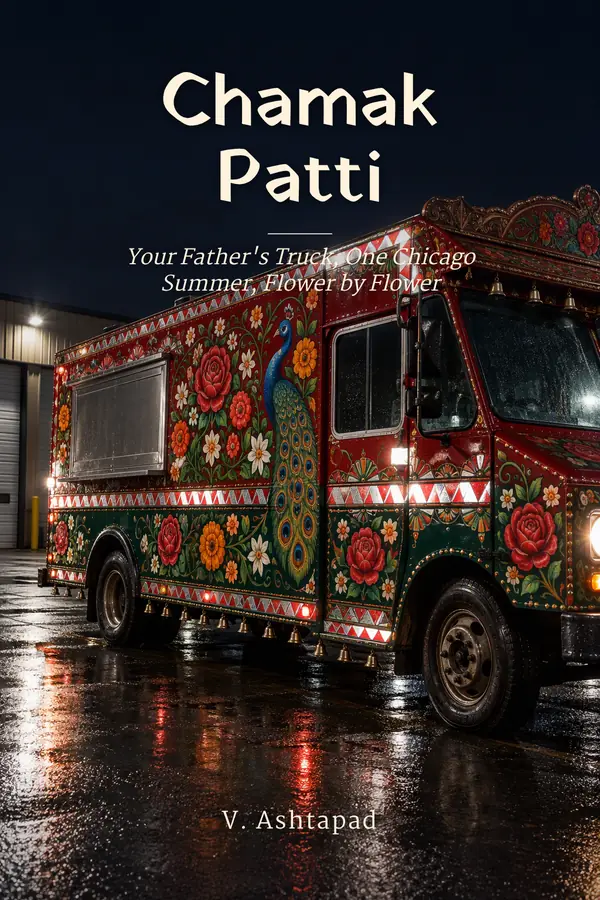
Chamak Patti
Your Father's Truck, One Chicago Summer, Flower by Flower
by V. Ashtapad
Foreword
This is a novel. Zoya, Tariq, the Mirza family, Ustad Barkat and his workshop, and everyone else in these pages are invented, and any resemblance to real people is coincidence. Devon Avenue, Rawalpindi, Lahore and the Red Line are real places, used here fictionally; the cab garage on Ridge, the wrap shop off Elston, the sweet shops and the street festival are made up.
Pakistani truck art is a living craft practiced by body makers, wood carvers, painters and reflective-tape cutters, and every workshop has its own ways. The methods described here, from truck art to bone inlay, are given in general terms and are not a manual. The couplets on the trucks in this book were written for it, in English, and are not translations of any poet's work.
For the truck painters, and for the slow sweepers who looked at everything.
Primer
The truck is the color of a refrigerator nobody wants. You stand in the yard behind the old cab garage on Ridge with your hands in the bib pockets of your overalls, the new ones you bought for this, so stiff from the store that they still hold the creases of the package, and you look at it the way you look at a van before you wrap it, reading every rivet and seam and rubber gasket the film will have to cross. An old step van, square as a bread box, white gone to the yellow of a smoker's ceiling. Somebody's bakery once. You can still read the ghost of their lettering under the chalky skin of the side panel, a script in a red that has faded to the pink of a gum eraser. Rounded corners. A dent above the rear wheel well shaped like a thumbprint pressed into dough.
Your father has already set up the lawn chair.
It is the folding kind with green and white webbing, and it sits in the exact center of the yard as if the yard were built around it. Tariq Mirza sits in it in a cream shalwar kameez and the brown waistcoat with the four horn buttons, the one he wore to your cousin's wedding and to your graduation from high school and, as far as you know, to nothing else in the last ten years. He has dressed for this. That is the first thing that frightens you.
"So," he says. "You see her."
"I see a van, Abbu."
"You see a van." He laughs, the short laugh he used to give passengers who told him the fastest way to O'Hare. "Twenty-six years I drove a yellow car that belonged to a company. Now I have one that belongs to me, and my daughter who sticks plastic on plumbers' vans for a living tells me it is a van."
You let that go. You have learned to let the first one go. Above you, beyond the chain-link and the stacked tires and the cinderblock wall of the garage, the Red Line embankment runs north toward Howard, and a train comes along it now with that long metal exhale, eight cars of silver catching a sky the color of dishwater. The sound fills the yard. Your father waits for it to pass the way he waited for every train at every crossing in this city, with his eyes half closed, counting.
When it is gone he lifts his cup. Your mother sent a thermos of doodh patti with him, the tea boiled in milk until it has a skin and a smell like caramel left too long on the stove, and he has poured it into the steel cup he keeps in the glove box of every vehicle he has ever owned. The cup chatters against his teeth. It is a small sound, a fingernail on a bottle. You watch the surface of the tea shiver in rings and then you look at the truck again, because he hates to be watched drinking now.
"Tell me what you want," you say.
"I want it done properly."
"That isn't a design."
"It is the only design." He puts the cup down on the asphalt beside the chair leg, carefully, both hands. "Phool patti from the roof to the bumper. Peacocks on the sides, one each, facing forward, never backward, a peacock facing backward is a bad joke. Chamak patti around the windows so that when a car comes up behind at night she lights up like a wedding. Chains on the front bumper. Bells. The eyes on the back. And on the tailboard, a verse."
"It's a food truck. There is no tailboard."
"Then we make one."
You walk around it once, slowly. The step at the side door is worn to bare metal in a crescent where a thousand bakery boots went in and out. The serving window has not been cut yet. The city will want stainless steel inside, a three-compartment sink, a hand sink, a fire suppression hood. Your brother Adeel has a folder for all of it, a green folder with tabs, and he carries it everywhere like a passport. Your mother has a notebook of a different kind, with the seekh kebab spices written in her round Urdu hand on one side and the cost of lamb per pound at three butchers on the other.
What you have is a pencil behind your ear and a sketchbook in the trunk of your own car, and the uneasy sense that you have already said yes.
You said yes in March, in your parents' kitchen, with the radiator banging and your mother frying parathas for no reason except that you had come over. Your father had said, without looking at you, "Who will paint her? I can't pay a shop." And you had heard yourself say, "I'll do it," the way you would say it to a friend who needed help moving a couch. You had pictured a clean logo. A good red. Perhaps a single flourish under the name, a nod to the trucks in the photographs on the wall of his old taxi garage, which you had looked at as a child the way you looked at fireworks, as something gorgeous and very far away.
You had not pictured the lawn chair.
"Start with the roses," he says.
"I'm going to start with primer."
"Primer is not a start. Primer is a broom."
You bring out the sander from the trunk of your car. The yard smells of old motor oil soaked into the asphalt and of the lilac someone planted against the far fence years ago, which is blooming now in heavy purple clusters that look ridiculous against the tires. You plug the sander into the orange extension cord that runs from the garage, where Sargon, who drove nights for the same company as your father for nineteen years and now manages the yard, has said you can use the outlet as long as nobody tells the owners. You pull your mask up. You put on your glasses. You set the pad against the side panel, over the ghost of the bakery's lettering, and you begin.
The noise is a relief. It takes the place of talk.
For twenty minutes the old paint comes away in a fine pale dust that settles on your forearms and on the bib of your overalls and in the creases of your knuckles, and underneath it the metal shows through gray and freckled. You work in long passes. You like this part. Prep is the part of a wrap nobody photographs, and you have always liked it best. You liked it when you were nineteen and dropped out of the design program downtown because you were tired of moving rectangles around on a screen for people who would never touch them, and you walked into Dolores Fahey's wrap shop off Elston and asked if she needed someone to clean vans before the vinyl went on. The rectangles still come off a screen there. But you lay them down with your own two hands, with a heat gun and a felt-edged squeegee, and a surface is either ready or it is not.
When you stop to change the disc, your father is standing.
He has come close. Closer than you thought he could move without you hearing. He is looking at the bare patch of metal with his head tilted, and his right hand, the bad one, is raised a little in front of him, the fingers loose, as if he is about to touch it and has thought better.
"Here," he says. "The first rose goes here."
"Abbu."
"Not a big one. A small one. Five petals, and a white line on each, so it looks wet even when it is dry. That is how the Ustad started every truck. One small rose by the door. He said a truck should be greeted before it is decorated."
"I don't paint roses, Abbu. I don't paint anything. I install."
"You put a rose on the van for the flower shop on Broadway. I saw it."
"That was a print. Somebody in an office in Schaumburg designed it and I laid it on."
"It was a rose."
You pull your mask down. The dust has a taste, chalk and something sweetish underneath, like an aspirin dissolved on the tongue. "I wrapped a rose the way the flower shop wanted it. Big. Flat. Readable from across the street at thirty miles an hour. I could print you that by Friday. If I do what you're describing, by hand, nobody will be able to read your menu, and it will take me all summer."
"They will read it."
"They'll read a hundred flowers."
"Then they will read a hundred flowers and be hungry." He sits down again, slowly, gripping the aluminum arms of the chair. The webbing creaks. "You think the trucks at home have menus? They have the name of the owner's son, and a verse about his mother, and a picture of a waterfall, and the phone number of the body shop. Everybody reads them. A whole country reads its trucks."
"This isn't a whole country. This is Devon Avenue on a Saturday."
"Devon Avenue on a Saturday," he says, "is a whole country."
You don't have an answer to that. It is the kind of thing he says that you will think about later, on the Red Line going home, with your forehead against the cool glass.
The sky lowers through the afternoon. Wind comes in off the lake in gusts that you feel on the back of your neck through the gap between your collar and your hair, a cold that has no business in May, and it carries with it the smell of wet sand and a faint industrial sweetness from somewhere south. The lilac tosses. Sargon comes out of the office at four with a paper bag of sunflower seeds and stands beside your father's chair, and the two of them talk about a dispatcher they both hated in 2004 while you finish the first side.
Before you leave, you photograph the truck from the four corners, the way Dolores taught you to document every van before a single panel of film goes on, every dent and every chip, so nobody can say later that you caused it. Bare metal on one side now, a long gray map of it, and the rest still that tired white. You upload the photographs into the family space your brother set up last winter, the private one, the one with the tree that your mother keeps adding cousins to from her phone at the kitchen table. There is a folder now called Shehzadi. Your father named it. Adeel had asked what to call the truck's folder and your father said Shehzadi, princess, as if there had never been any other possible name, and your brother typed it in.
At eleven that night, when you are lying on top of your sheets in your room in Uptown with the window open and the El going by two blocks away, you hear your phone chime with a voice note.
You know who it is before you look.
His voice, close to the microphone, the way he holds the phone right up against his mouth because he does not trust it to hear him. Behind him the sound of the television in your parents' living room, a cricket match from somewhere, the crowd a far-off sea.
"Zoya. Beta. About the first rose. I was not clear." A pause, and the small click of his tongue that he makes when he is choosing a word. "The petals must not be the same. The left one should be fatter. Like it is pushing. A rose is not polite. Okay. That's all. Sleep."
You play it twice. Then you turn the phone face down on the floor and look at the ceiling, where a car's headlights slide across the plaster and fold themselves into the corner and are gone.
You have never painted a rose in your life. You have laid ten thousand square feet of printed ones.
But you get up anyway, and you find the sketchbook, and in the dark, by the light of the streetlamp, you draw five petals with the left one fatter, pushing, and you look at it for a long time.
Sweeping
Your mother tests the kebabs on a Sunday, in the yard, on a borrowed grill.
She has brought everything from home in two laundry baskets: the lamb mince she ground herself at the butcher's on Devon, the onion grated and squeezed in a dish towel until the towel is green-brown and the onion is dry as sawdust, the green chilies, the coriander, the little steel tin of her own garam masala with the lid that sticks. Rukhsana Mirza works mornings behind the pharmacy counter at the drugstore on Western, counting pills into amber bottles, and she brings the same patience to a kebab. She wets her hands from a bowl. She takes a fistful of the meat, presses it around a flat steel skewer, and draws her closed fingers down its length so that the meat stretches into a long ridged cylinder with the marks of her knuckles in it like the rings of a branch.
"Watch," she tells Adeel, who is filming her for the family space.
"I'm watching, Ammi."
"You're filming. That's different."
The coals are white at the edges and orange underneath. When she lays the first skewer across them, the fat hits and flares and the smoke rises in a thick blue sheet that the lake wind catches and drags sideways over the chain-link, carrying the smell of charring lamb and cumin out across Ridge Avenue, where a man walking a beagle stops and looks around as if he has been called by name.
Your father sits in his lawn chair with his hands folded on his stomach and watches the smoke the way other men watch a game.
You are on a stepladder, masking the windows. You have primed the whole body now, three coats of gray, sanded between each, and the truck looks like a ship before it is launched, dull and enormous and full of possibility. Blue tape in long runs. Paper. The smell of the primer still faint in the seams, a sharp chemical sweetness that gets behind your eyes.
"When I was eleven," your father says, to nobody, "I had a broom like this one."
He is pointing at the push broom leaning against the garage wall. Sargon's broom, with half its bristles flattened sideways.
"Abbu, you told me," says Adeel.
"I told you. I did not tell her."
"You told me too," you say, from the ladder.
"Not properly."
So he tells it properly, while your mother turns the skewers with a cloth wrapped around her fingers and the fat hisses and the El goes past twice, once each way.
He was the fourth of six. The house was in Rawalpindi, in a lane behind a lane, where the walls were so close that two women could hand a pot of daal across from one roof to the other. His father sold cloth from a pushcart. In the hot months the family slept on the roof on charpais strung with jute, under a sky that was white at night from the dust. And at the end of the main road, where the lanes opened out, there was a yard full of trucks.
"Not parked," he says. "Being born."
The trucks came in as bare chassis, engines and wheels and a long iron spine, and men built bodies on them. Steel sheet hammered over wooden frames. Wooden doors carved by a man who did nothing else all day. A crown built up over the cab, out of wood and sheet metal, that rose like the front of a palace. And then, when the body was whole, the painters came, and the painters were the kings of the yard, and the greatest of them was a young man called Barkat, who was perhaps twenty-five then and who wore a white vest that was never white for long.
"I swept for him," your father says. "Every evening, after school. I swept the floor of the paint shed. Flakes of color. Gold paper. The cut ends of chamak patti, all the little triangles and stars that fell when the boys were cutting. I swept them into a pile and he would come and look at the pile."
"Why?" Adeel asks.
"To see what was wasted." Your father lifts his chin. "He said you can tell a lazy boy by what he throws away. If the pile was all big pieces, someone had been careless. He would find who and make him use the scraps tomorrow. I learned to sweep slowly so I could see which boy it was."
"So you were a snitch," says Adeel.
Your mother laughs, and the smoke goes into her eyes, and she wipes them with the back of her wrist.
"I was a sweeper," your father says, with dignity. "Four years. I was never once allowed to touch a brush. Not once. The Ustad said a boy who has never swept that floor will never know where the paint goes when it leaves the truck."
"Where does it go?" you ask, before you can stop yourself.
He looks up at you on the ladder. His face is in shadow under the brim of the cap he wears against the sun, the white cap with the name of the cab company that went out of business, and you can't read his expression. "On the floor," he says. "Where else."
Then he was fifteen and his uncle in Lahore found him a job in a shop that sold motor parts, and then he was twenty-three and a cousin in Chicago sent the papers, and then he was here, and then he was driving. It is told in a breath, all of that, the way a man jumps across a stream on three stones without stopping. He does not tell you about the shop in Lahore or the flight or the first winter. He tells you about the broom.
The first kebab comes off. Your mother slides it from the skewer onto a sheet of foil and cuts it into pieces with the edge of a steel spoon, and the inside is pink and juicy and flecked with green, and the outside has blackened in the ridges her knuckles made. She hands a piece to each of you. To your father last, on a paper napkin, so he does not have to hold a plate.
It burns your fingers. It tastes of smoke first, then the sharp fresh green of coriander, then the deep warmth of the masala coming up underneath, and the fat runs down your wrist and you lick it off without shame. Adeel stops filming. Even Sargon comes out of the office.
"Too much salt," your father says.
"There's no such thing," says your mother.
"There is such a thing. I have tasted it in Lahore."
"You were fifteen in Lahore. You were always hungry. Everything tasted of too much."
He chews and doesn't answer, and you see him close his eyes for a second, and then he reaches for a second piece with his left hand, the steady one.
Your mother grills the rest in batches until the lamb is gone, and she makes Adeel write down how long each one takes, and how many skewers fit across the grill at once, and how long the coals stay hot before they need feeding. It is not a recipe she is testing. It is a Saturday on Devon, three hundred kebabs at the window, and she is running it in her head the way she runs the pharmacy line before the holidays. She has the notebook open on the cooler. Her pencil moves while she talks. Adeel complains that his phone is greasy. She tells him phones were made to get greasy and people were made to eat, and that he should be grateful he is not the one with his hands in the onion.
You stay on the ladder through all of it. You run the blue tape along the edge of the windshield and press it down with your thumbnail so the paint won't creep under, the same thumbnail move you use to seat vinyl into a door gap, and you tear the paper to length against the edge of the tape instead of with scissors, so the tear is fast and nearly straight. When you glance down, your father is watching your hands and not the grill. He looks away when you catch him.
That night, Adeel sends you a message asking you to fix the tree.
The family tree has been growing all winter in the private space, a branching thing with photographs in small circles. Your mother's side fills the left half, a sprawl of names from Faisalabad and Toronto and one aunt in Dubai, all of them added by your mother herself on the long evenings after the pharmacy, typed in with her thumbs while the rice soaked. Your father's side is thinner. His parents. His five siblings, two of them gone now, with the dates. A row of nephews in Rawalpindi whose faces are blurred, taken from a wedding video. And beneath your father, a short line that runs off the edge of the country and lands in Chicago, where his name sits with yours and Adeel's under it, as if the whole family had to pass through one narrow door to get here.
"Abbu says there's someone missing," Adeel writes. "He wants the Ustad on it."
"He's not family."
"I told him. He said put him on anyway. Can you do it, I don't know how to make a person who isn't related."
You open the tree on your laptop at the table in your room, which is also your drafting table and the place you eat. There is a way to add someone outside the blood lines; your mother found it when she wanted the woman who raised her after her mother died. A dotted connector instead of a solid one. A note field. You make a new circle with no photograph and type BARKAT, USTAD and, under relation, nothing, and in the note field you write: Rawalpindi. Truck painter. Abbu swept his floor 4 years.
You connect the dotted line to your father.
On the screen it looks wrong and right at once, a small gray circle hanging off the Rawalpindi side like a lantern on a nail. You leave it there.
At eleven twenty, the voice note.
"Zoya. About the second flower." The cricket again, very faint, and the creak of his recliner. "Not a rose. A marigold. Orange, not yellow. Yellow is for cheap trucks. The orange one has many small petals all crowded, like a crowd at a bus stop. Paint the crowd, not the petals. Okay. And your mother says I should tell you the kebabs were good. I am telling you. They were too salty. Sleep."
You listen to it once and then you open the sketchbook again and you draw a marigold, which you have never drawn, which turns out to be impossible, which you draw seven times before you get one that looks like a crowd and not a pom-pom.
Somewhere near two you fall asleep with your cheek against the page. In the morning there is a ghost of orange pencil on your face, and when you look in the bathroom mirror you think, for one unguarded second, that you look like him.
Crown
"No," you say. "Absolutely not. There are train bridges."
Your father has drawn it on the back of an envelope from the electric company. His lines shake, so that every edge of the drawing has a fur of little tremors along it, but the shape is clear enough. Above the cab of the truck, rising from the roof at the front, a great wooden crest, a crown with a peaked center and stepped wings, like the façade of a building in an old film.
"Every truck has a taj," he says.
"Every truck in Rawalpindi."
"Every proper truck."
"Abbu. Half the viaducts under the tracks on this side of the city are posted lower than you'd believe. This thing barely fits under them now. You put a crown on it and the first time Adeel drives it to a farmer's market, he takes it off under a train bridge and it goes through Mrs. Hernandez's windshield behind him."
Adeel, sitting on an upturned crate with the green folder on his knees, says, "The low one by the yard leaves us a foot and a half. Maybe. I measured."
"Thank you, Adeel."
"I'm just saying. A foot and a half."
Your father folds the envelope in half, and in half again, and puts it into the inside pocket of his waistcoat, which means the conversation is not over but has been filed. It is June now. The heat has arrived all at once, the way it does here, as if someone opened an oven door; the asphalt in the yard is soft at noon and smells of tar, and the primer on the truck's flanks has gone from cool to warm under your palm. You have been cutting the serving window this week with Sargon's nephew, who does metal, and the opening sits in the side of the truck like a mouth without lips, raw-edged and glittering where the cutting wheel went through.
You have also, at last, finished the full side elevation of the design. Your design. Two weeks of evenings on your laptop, and one night after closing at the shop, when Dolores let you run it through the big printer at full scale.
You tape it to the side of the truck so he can see it at size. It is printed on cheap paper stock, four long panels joined edge to edge, crisp as a magazine, and it shows the truck in a deep red, the red of a pomegranate's inside, with the name in a cream script across the upper panel, outlined in gold. Below the window a single band of phool patti runs the length of the truck, a continuous vine of flowers about a foot high. Around the window, a frame of chamak patti in a simple diamond chain. At the rear corner, one peacock.
It is the most restrained thing you could stand to make. You could print it on cast vinyl, laminate it, and have it on the truck in two days, with somebody holding the far end of each panel. You thought it was a compromise.
Your father looks at it from his chair for a long time. The paper lifts and drops in the wind.
"Where is the rest?" he says.
"That's it."
"That is a belt. Where is the dress?"
"Abbu, there's a whole band of flowers. Forty feet of flowers, if you count both sides."
"A belt." He points with his chin. "And the peacock is alone. Why is he alone?"
"Because one is enough. One reads. Two compete."
"Two do not compete. Two face each other. It is a conversation." He sits forward. "And it is a sticker. A very good sticker. Nobody's hand is in it." He waves at the red. "The red is good. But the whole truck cannot be one color. It looks like a fire engine that went to college."
Sargon, at the office door, laughs so hard he has to put his hand on the frame.
You pull the print off the side of the truck with one long rip. You don't mean to. The tape takes a strip of primer with it, a long gray scar back down to bare metal, and you stand there with the crumpled paper in your arms and the dust in your mouth and you can feel the heat in your face, and you hate it, because you are twenty-three years old and this is a man in a lawn chair.
"I'm going to Dolores's," you say.
---
Dolores Fahey's shop is a cinderblock building off Elston, between a tile importer and a place that rebuilds transmissions, with two roll-up doors and a printed metal sign over the office door: FAHEY GRAPHICS · FLEETS · WRAPS. Inside there is room for two vans at once, under long banks of lights so bright and even that nothing in the bays casts a shadow. The wide printer sits along the back wall, as long as a sofa, humming to itself, laying down ink in passes you can hear, a soft back-and-forth like someone sanding a drawer. Rolls of film stand in racks by color and finish, gloss and matte and satin and the chrome ones nobody can afford. It smells of warm plastic and rubbing alcohol and the burnt-dust smell of heat guns.
She is sixty-eight and wears reading glasses on a beaded chain and smells of menthol cigarettes she gave up ten years ago and still smells of anyway. When you come in she is on one knee beside the rear wheel arch of a plumber's van, coaxing a printed water droplet the size of a pumpkin around the curve with a heat gun in one hand and a squeegee in the other, and she doesn't look up.
"You've got your father face on," she says.
"I don't have a father face."
"You've got your father face on, and you've got primer in your eyebrows. Hold this."
You hold the heat gun while she seats the edge. The van sits under the lights with its whole side gone glossy blue and white, a cartoon wrench winking at the corner, a phone number in letters two feet tall. You did the passenger side of a van exactly like it on Tuesday. You could do one in your sleep. Some weeks you think you do.
"Tell me," she says.
You tell her. The crown. The peacock. The belt and the dress. The word sticker.
She takes the gun back and runs it slowly over the edge she just laid, not looking at you, watching the film. "And you want what? You want me to say your design is good?"
"It is good."
"It's very good. It's clean. You'd get a lot of work off a truck like that." She clicks the gun off and sets it on its stand. "Did he ask you for clean?"
"He asked me for everything."
"So you gave him a little."
"I gave him what works."
"Works for who?" She takes her glasses off and lets them fall onto the chain. "Zoya. I have wrapped four hundred vans and trucks on this side of the city. You know how many people came in here and said, Make it look like the place my mother had in Galway, or in Puebla, or in Seoul? And I'd say, sure, and I'd print them something clean with a little shamrock out of a stock library in the corner. And they'd thank me. And they'd drive it every day for five years and something would be missing, and they'd never be able to tell me what." She gets up off her knee, slowly, one hand on the van. "Come here."
She takes an offcut from the scrap bin, a strip of printed film left over from a florist's job, a row of red roses on white, and she lays it cold over the rounded corner of the van's rear bumper. She stretches it with her thumbs until it sits down tight over the curve, every rose pulled a little wider than it was printed, and she presses the edges, and it looks perfect.
"Come back in a week," she says, "and that's lifting. It'll crawl back toward flat. Vinyl has a memory. It spent its whole life on a roll, and it remembers. That's why you post-heat. You take it past the place where it remembers, and then it forgets, and it stays where you put it." She peels the strip back off in one pull. "Paint doesn't remember anything. It goes where your hand puts it, and then it's your hand forever. That's why it scares you."
"It doesn't scare me."
"You've never painted anything bigger than a birthday card." She drops the strip back in the bin. "He wants it to look like a wedding, you said."
"Gold on the crown. Gold around the peacocks. Everything."
"Well," says Dolores, "you've never painted a wedding either." She pulls a square of gold chrome film off the end of a roll, the expensive stuff, and puts it in your hand. "Take that home. Look at it in the morning. Then look at it again in a year."
You take the square home on the Red Line. You hold it on your knee, gold side up, in the crowded car, and at Granville the evening sun comes in flat through the windows across the backs of the seats and hits it, and it flashes like a dropped mirror, and three people standing near you look down at once, and a little boy in a Cubs jersey says, "Is that real gold?"
"No," you say.
"Can I touch it?"
You let him. He presses one finger to it very carefully, and nothing comes off on his fingertip at all, and he looks at the clean finger as if he has been cheated of something.
---
On Saturday you go back to the yard with a new sheet of butcher paper.
You don't explain. Your father is in the chair already, in his waistcoat, with the thermos beside him. You tape the paper to the truck where the old one was, over the gray scar, and you step back.
It isn't the whole truck. It is one panel, the lower rear quarter, behind the rear wheel, where the thumbprint dent used to be before you filled it. On it, in pencil and gouache, by hand, with cheap brushes and four evenings of starting over, you have drawn what you would put there if no one ever had to read it. A ground of deep green. On it, crowded, overlapping, pushing at each other: roses with their left petals fat, marigolds like crowds at a bus stop, small white jasmine stars, a twisting leaf in two greens with a highlight running down its spine. A peacock in the center, not alone, its head turned toward a second peacock just beginning at the edge of the paper, half a beak and an eye. A frame around all of it of tiny triangles in gold and red, where the chamak patti would go.
Your father doesn't say anything for a while.
Then he gets up out of the chair. It takes him two tries. He walks to the truck and stops a foot away from the paper, and he lifts his right hand, the shaking one, and he holds it in front of the second peacock, the half one, the one that is only a beak and an eye. His hand trembles in the air in front of it and you can't tell if it's the tremor or something else.
"This one," he says. "Where does he go?"
"Around the corner," you say. "Onto the back."
He nods slowly.
"The crown is still not happening," you say.
Your father only says, "We will see," and goes back to his chair, and lowers himself into it with both hands on the aluminum arms, and pours himself the last of the doodh patti from the thermos as if the whole matter has been settled in his favor.
Eyes
The photographs come from a cousin you have never met, at three in the morning Chicago time, forty-one of them in a row.
Kashif is the son of your father's younger brother, the one who stayed. He is twenty-nine and drives a minibus between Rawalpindi and Murree, and his face in the family tree is the blurry one from the wedding video, mid-laugh, with a garland of rupee notes around his neck. Your father asked him a week ago, in a voice note you overheard from the kitchen, to go to the old workshop and see if Barkat was alive.
Barkat is alive.
The first photograph is of a hand, close up. An old man's hand, dark, the knuckles swollen, holding a thin brush loaded with white. The nails are rimmed with red paint. Behind the hand, out of focus, is a curve of blue metal painted with what looks like a whole meadow.
The second is of a yard. Dust the color of milky tea, and three trucks parked nose to nose, in various states of becoming. One of them is bare steel. One has its wooden doors on but unpainted, the carving pale and new. One is finished, or nearly, and even through the cheap lens and the glare of a white sky it is so bright that it looks like a mistake in the photograph, like someone has spilled color across it after the fact.
You are on the floor of your room in Uptown with your back against the bed, and you scroll through them one by one with the window open and the sound of a party on the roof across the alley, music with a heavy bass line that comes through the brick like a heartbeat.
The rest are of trucks. Some of them are new photographs of old trucks, still running, that Kashif must have found parked along the road outside the workshop. Some are photographs of photographs, prints pinned to a wall, curling at the corners, faded to orange and teal the way prints from the eighties fade. Trucks from forty years ago. Trucks with crowns so tall they look like they are wearing the façades of palaces and cinemas on their heads. Trucks with peacocks, with tigers, with snow mountains, with airliners, with the faces of film actresses rendered big as billboards, with a pair of enormous eyes on the back, almond-shaped, lashes like fern fronds, looking out at the road behind.
In one of the pinned prints, a skinny boy stands at the edge of the frame with a broom.
You zoom in until the image breaks into squares. It doesn't matter. You know the ears.
You don't sleep much. You make a new folder in the family space inside Shehzadi and call it Ustad's Trucks, and you put all forty-one photographs in it, and under each one you type what you can: the color of the ground, the motifs you can identify, the date if Kashif wrote it on. Under the photograph of the boy with the broom you type nothing at all, and then you go back and write Abbu, ~1976?, and leave the question mark.
---
"The eyes," your father says on Sunday, "go on the back. Low. Over the bumper. Looking at the car behind."
"Why?"
"So the car behind knows it is being looked at."
"That's it?"
He shrugs. "Some people say it is to keep away the bad look, the jealous look. Nazar. A beautiful truck gets a lot of jealous looks. My father said it was so the truck could see the road it had already driven. Barkat said it was so drivers behind would stop driving so close." He raises his eyebrows. "All three are true."
You are at the folding table under the awning Sargon put up, the blue tarp one, eating chana chaat out of a plastic tub. Your mother made it last night and left it in the cooler for you, and it is cold and sharp and perfect: chickpeas and diced potato and red onion and tomato, a dark sour tang of tamarind, a scatter of chaat masala that smells faintly of sulfur and makes the back of your tongue tingle, a squeeze of lime, coriander leaves going limp in the juices. You eat it standing. Your father has a tub too, on his lap, but he has not opened it. He does not like to eat with a spoon in public anymore. The spoon tells.
It got worse in the spring, the tremor. It has been there for years, a faint quiver when he was tired, when he was angry, when he was holding a cup of tea at a wedding. He drove through it for a long time. The steering wheel is a good thing for a shaking hand, he told you once; you hold it with both, and it holds you back. Then in February the doctor at the clinic on California told him not to drive for a living anymore, and he came home and sat in the dark living room for an hour and then came into the kitchen and told your mother he was buying a truck.
"What do the eyes look like?" you ask.
"You have the photographs."
"I want to hear it from you."
He thinks. A train passes on the embankment and the yard fills with its noise and then empties. "Long," he says. "Like a fish. The lashes go up and out, like a lot of little black flames. The white of the eye is very white. Pure white, many coats. And the center is dark, and in the center of the dark there is a dot of white, here." He touches the air with his left hand. "That is the life. Without the dot, they are dead eyes. A truck with dead eyes is a hearse."
You go into the truck to measure the rear doors. Inside it is hot and smells of the cutting wheel and the new aluminum of the hood duct Sargon's nephew has started fitting over where the grill will go. Through the window opening the yard is a bright rectangle with your father framed in the middle of it in his lawn chair, his tub of chaat unopened on his knee, looking up at the sky.
You measure the doors twice. Forty-one inches each, with a seam down the middle where they meet and a latch handle that will have to be worked around. In your design program, four years ago, there was an instructor who liked to say that a margin was a kindness to the eye, that white space let a thing breathe. You believed her. You built clean grids for brochures nobody printed and identities for imaginary coffee shops, and you got good grades, and one evening in your second year you sat in the lab at ten at night with forty screens glowing around you and realized that you had not touched anything all day except a mouse and a can of soda. You walked out to State Street and stood under the El at the Loop and listened to it scream around the curve, and the next week you were in Dolores's back bay with a heat gun, peeling a dead florist's graphics off a cargo van in long brittle strips, and your father did not speak to you for a month. He had paid for two years of tuition with nights on the airport run. He said nothing about it then and has said nothing since, and you understand, standing in the hot box of the truck with the tape measure across the doors, that the eyes are the first thing he has asked you for that has no margin at all.
---
At eleven, the voice note comes as usual. But it is not about a flower.
"Zoya. Kashif says the Ustad asked who wanted to know. Kashif told him: the sweeper boy, Tariq, the cloth seller's son, he is in Chicago now, he has a truck. And the Ustad said, I remember. He was slow with the broom. He looked at everything." The cricket match is not on. The room behind him is quiet, and you can hear his breathing, close. "He said, if the boy wants to see how a truck is made, he should come and see. He said he is seventy-four and it is not a long invitation."
Then nothing. You think the note has ended. Then: "I think I will go. Two weeks. Your mother cannot leave the pharmacy and Adeel has the permits." A long pause. "Would you like to see it?"
You play it again. You stand up. You walk to the window and look out at the alley, where a raccoon is working its way along the top of the fence with its back humped, unhurried, as if it owns everything it walks on.
In the morning you call Dolores and ask for two weeks off. She says, "About time," and hangs up before you can thank her.
You call your mother at the pharmacy, on her break. She is in the back room; you can hear the sound of the pill counter, a whirring tray. "He told me last night," she says. "I said yes before he finished asking."
"Can he travel?"
"He can travel. He can't drive. He can't hold a cup at a wedding." She is quiet for a moment. "Beta, he has been talking about that yard for thirty years. On every long fare to the airport. He would tell the passengers. Some of them would tip more just to make him stop." She laughs, but it doesn't last long. "Go. Watch how they make the flowers. Then come home and fight with him about it properly."
---
You book the tickets on your laptop that night, the two of you, Chicago to Doha to Islamabad. When you put in the return date you look at the calendar and count the weeks backward from September, from the street festival on Devon that Adeel has already applied for, the one weekend in September when a long stretch of the avenue closes to cars and vendors set up in rows under strings of lights.
Ten weeks, after you get back. Ten weeks to paint a whole truck.
You open the family map, the one your mother started for the wedding last year so the Canadian cousins could find the hall. There are only a few pins on it: your parents' two-flat on Washtenaw, the hall in Skokie, your aunt's house in Mississauga. You drag the map east, across the ocean, across a whole continent of beige and green, until you are hovering over a city at the foot of brown hills. You zoom. Roads like veins. Kashif sent the location of the workshop in a message, a long string of numbers, and you paste it in and a red pin drops onto a block of tiny rectangles near a wide road.
You type in the note field: Barkat's yard. Abbu swept here.
Then you drag the map back west, all the way, and drop a second pin onto the lot behind the old cab garage on Ridge, where the truck is standing right now in the dark under its tarp, gray and blind, with no eyes yet.
Shehzadi, you type, and look at the two pins, one in each window, eight thousand miles of beige and blue between them, and you think: two peacocks.
Yard
The heat in Rawalpindi is not the heat in Chicago. You understand this within a minute of stepping out of the airport doors, at four in the morning, into air so thick and warm that it feels like walking into someone else's breath.
It is July and the monsoon has started early. The sky over the parking lot is not black but a low lit brown, swollen, with the city's light pressed up against the underside of the clouds, and everything smells of wet dust and diesel and some flower you can't name, something heavy and sweet coming over a wall. Kashif is there with his minibus, long and white, with a painted strip of flowers across its rear window and a fringe of red tassels around the inside of the windshield that swing when he brakes. He is taller than his blurry photograph, thin as a rake, in a gray shalwar kameez with the sleeves pushed up, and he hugs your father so hard that your father's cap comes off.
"Chacha," he says. "Chacha, Chacha," and then, to you, shy suddenly, in English: "Welcome. You are very welcome. You are the painter."
"I put vinyl on vans," you say. "I don't really paint."
"Yes," he says, nodding, as if this is the same thing, and takes your bag.
---
Your father's family lives in a house on a lane so narrow that the minibus has to stop at its mouth. You walk the last part. Above you, between the walls, a seam of brown sky. Electrical wires in fat black bundles, sagging, looped between the houses like hammock rope. Doors painted green and blue with iron studs. Somewhere a rooster, confused by the early light. Your father walks slowly in front of you with Kashif's hand under his elbow, and you watch him put his palm flat against a wall as he passes it, once, the way you might touch the flank of a horse.
You sleep for three hours on a charpai in a room with a ceiling fan that turns so slowly you can count the blades. When you wake, a girl of about ten is standing in the doorway watching you with enormous seriousness. This is Kashif's niece, Mehwish. She has been sent to tell you that there is breakfast and that the painter must eat it.
Breakfast is parathas, layered and flaky and shining with ghee, torn and dipped into a bowl of yogurt and eaten with a fried egg and a pickle so sour and oily and full of mustard seed that it makes your eyes water. Then doodh patti in small glasses, boiled with cardamom and sugar until it is the color of a camel. Your father's younger brother sits across from you, a heavy man with your father's eyebrows, and asks you in careful English how many floors the buildings in Chicago have. You say some of them have a hundred. He says, "Bas?" Only? And then laughs, a deep laugh, your father's laugh but slower.
---
The workshop is twenty minutes away by minibus, along a wide road choked with every kind of vehicle you can imagine and several you could not. Motorbikes carrying families of four. Donkey carts. A bus with men riding on the roof among the luggage. And trucks, everywhere, trucks like the ones in the photographs, rolling past your window so close you could put your palm on them: blazing panels of flowers, chrome bumpers hung with chains that swing and chime, peacocks, cranes, a whole painted village on one tailgate with a lake and a boat and two mountains. Above each cab the crown, rearing up, carved and painted and studded with mirrors, so that each truck looks like a small palace of noise going by on six wheels.
You stop talking. You put your face against the window and watch.
"You see," says your father, beside you, without triumph.
"I see," you say.
The yard is behind a corrugated steel gate painted pale blue. Kashif honks twice and a boy drags it open, and the minibus noses in onto packed dirt, and there they are.
Four trucks this time, not three. Each one a different age of its life.
The first is barely a truck at all. It is a chassis, the bare steel spine of one, with the engine and the cab front and the wheels, and on it, men are building a body. You go and stand next to it. The air smells of hot metal and welding and sawn wood. Two men are fixing a frame of seasoned timber to the steel bed, long beams, bolted, the ends cut square. A third man is hammering sheet steel over a section of the frame that has already been built up, shaping it, and the sound of it is enormous and continuous, a deep bell-like bonging that rolls across the yard and comes back off the walls.
"Mistri Akram," says your father, nodding at the third man.
"You know him?"
"I knew his father." He watches the hammer. "The body is made here. The frame, the sides, the doors, the crown. Then the painters come. You cannot paint a body that is not finished. The Ustad says the bodywork is the bones, and paint is only the face."
Mistri Akram is perhaps fifty, broad, with a gray beard trimmed short and a scarf wound around his head against the heat. He stops hammering and comes over, wiping his hands on a rag, and he and your father greet each other the long way, hands, then shoulders, then hands again, with questions about fathers and brothers. He looks at you and says something to your father in Punjabi that makes your father laugh and shake his head.
"What did he say?"
"He said, Is this the one who puts stickers on trucks? He said tell her the bodywork in America must be very bad if they need a girl to hide it under plastic."
You look at Mistri Akram. He is grinning, waiting. You hold up your hands, which still have, in the creases of the knuckles, the gray of the primer from the yard on Ridge, and you say, "Tell him I fill the dents myself."
Your father tells him. Mistri Akram laughs, and slaps his own chest, and goes back to his hammer.
The second truck has its body built and its doors on. The doors are wood, heavy, the panels carved in deep relief, and they have not been painted yet: pale raw timber with the cuts fresh and clean, flowers and leaves in rows, a sunburst in the center of each. The wood smells sharp and dry, like a pencil sharpened in a hot room. You put your hand on the carving and feel the edges of the petals, crisp, each one separately cut. You will learn later whose hands made them.
The third truck is half painted. Its whole body is a field of color laid in flat, deep blue and red and green and yellow blocked into panels, and over that ground two young men on ladders are outlining, slowly, with brushes so thin they look like eyelashes. White lines. Black lines. Around every petal of every flower, around every leaf.
The fourth truck is finished. It is going out today.
It stands nearest the gate in the full white glare of the sky, and you cannot look at it straight on for long. Every surface of it is ornament. The crown over the cab is a stepped tower of color, edged with chamak patti in silver and red and green, with small round mirrors set into its center like the eyes of a dragonfly. The sides are panels of flowers within panels of flowers, borders within borders. There are peacocks on the doors, facing forward. Along the bottom of the body runs a long chain of tiny steel bells, hundreds of them, and when the boy who opened the gate brushes past, the chain shivers and the bells speak all at once, a sound like a handful of coins thrown into a fountain.
You walk all the way around it.
On the back, low, over the bumper, a pair of eyes. Long, like fish, with lashes like black flames. Very white. In the dark center of each, a single dot.
Above them, on the tailboard, a line of Urdu in a looping script, gold on red.
"What does it say?" you ask.
Your father reads it. His lips move first, silently, and then he translates. He does it slowly, choosing.
"It says, My mother's worry drives ahead of me. Your envy follows behind."
You laugh before you can stop yourself.
"It is a good one," your father says, very serious. "It is an old one, but a good one. It tells the man behind: I know you are jealous. Thank you."
---
The painters' shed is at the back of the yard, open on one side, with a roof of corrugated iron that ticks in the heat. Inside it is darker and cooler, and it smells. It smells of something you half know, the thinner and oily sweetness of enamel that drifts into Dolores's bays from the body shop next door, but under it something you don't, a dusty mineral smell of powdered pigment, and over it the smell of tea, always, from a kettle on a gas ring in the corner.
There is a floor. It is concrete, cracked, and covered in a fine drift of color, and there is a broom leaning in the corner.
Your father stops in the doorway and looks at the floor.
He stays like that for a long moment, the light behind him, his shadow lying across the drifted paint flakes and the scraps of gold paper and the bright snipped triangles of reflective tape. You stand next to him and don't say anything.
At the far end of the shed, an old man is sitting on a low wooden stool in front of a panel of steel propped against the wall. He is painting. He has not looked up. He wears a white vest, and it is not white.
"Ustad-ji," says your father, very quietly.
The old man finishes his stroke. He lifts the brush away with a small roll of the fingers, and the petal ends in a clean point. Then he puts the brush down across the top of a tin, and he turns on his stool, and he looks at your father in the doorway with eyes that are milky at the rims, and he looks for a long time.
"You," says Ustad Barkat, in Punjabi, which your father will translate for you that night on the roof under a sky full of the weight of rain. "You. The slow one. You came back to look at my floor."
Phool Patti
On the first morning, nobody tells you anything. The Ustad is on his stool with his back to the door. The boys are on their ladders. There is no place in the shed for a woman from Chicago who installs vinyl, and you stand at the edge of the drifted floor with your hands empty, feeling it.
You look at your father. Your father looks at the ceiling of the shed, where a sparrow is sitting on a rafter, and does not help you at all.
The broom is still in the corner. You pick it up because it is the one thing in the shed whose use you know, and because of a story told over a grill on Ridge, and you sweep. The broom is short-handled, a bundle of stiff dry grass bound with wire to a stick, and you have to bend almost double to use it. The floor of the shed gives up its drift of color in a soft rasping hiss: flakes of dried enamel like the shells of tiny beetles, red and blue and a green so bright it looks poisonous; curls of masking paper; the cut ends of chamak patti in silver and gold and ruby, triangles and slivers and five-pointed stars, every one of them catching the light from the open side of the shed as you sweep it, so that your pile, when you've finished, glitters like a dragon's bed.
The Ustad gets up off his stool and comes to look at it.
He is small. You didn't see it yesterday because he was sitting. He stands no higher than your shoulder, thin, brown, with a stubble of white beard and a pair of glasses with heavy black frames held together at one hinge with a twist of copper wire. He bends over your pile with his hands behind his back, and stirs it with one bare toe.
He says something. Shoaib, his grandson, who is twenty and speaks English learned from films and the men who come to buy spare parts, translates from the ladder where he is outlining a leaf on the half-painted truck.
"He says this boy over here," Shoaib points with his brush at a teenager across the shed, "is cutting his patti too big. He says thank you. He says now you can sit."
You sit. On a low stool beside his. In front of you, a steel panel the size of a cupboard door, primed in a matte reddish brown the color of a brick.
"Ground," the Ustad says, in English, touching it. It is the only English word you will hear him say for a week.
---
This is how a flower is made, in the Ustad's shed.
First there is the ground, the base color of the whole panel, and it is laid on thick and left to dry for a day. Then, onto the ground, the shapes are blocked in. Not drawn. Blocked. The Ustad takes a brush, a flat one, loaded with a deep red, and without any sketch, without a single pencil line, he puts down five round fat blots in a ring, and in the center a blot of yellow. A rose. Then a leaf, a long teardrop of green beside it, with a single stroke. Then another rose. Then a marigold, and this is a different movement altogether: a ring of short quick dabs with the tip of a round brush, dozens of them, orange, overlapping, the brush hardly lifting between them, so that the flower builds up like a crowd gathering at a bus stop.
You stare at it. Your father, on a plastic chair by the door, makes a small sound in his throat.
"He's never looked at my sketchbook," you say.
"He doesn't need to," says your father.
The Ustad blocks out a panel of flowers in twenty minutes. Thirty or forty of them, roses and marigolds and small round white jasmines and an iris you didn't expect, and leaves in two greens, and a vine that winds between them all and holds them together. Then he puts the brush down and drinks a glass of tea, and waits, and talks to your father about someone who died, and someone else who married a woman from Gujranwala, and the price of red enamel.
After the tea, the second color. Into each red rose, a smaller ring of a lighter red. Into each leaf, a lighter green along one side, so it seems to curl. This is quicker. The Ustad's hand goes from flower to flower without stopping, a small precise loop and lift, a small precise loop and lift.
Then the outlines.
This is what the boys on the ladders were doing. A brush so thin it is hardly a brush, a few long hairs in a quill. The Ustad loads it with black thinned to the consistency of ink, and he draws around every shape on the panel, every petal, every leaf, every turn of the vine, in a single steady line. The line swells and narrows. It does not wobble. It is so fine that it makes the colors underneath look as though they were always meant to be held in exactly that shape, as if the blots had been waiting for it.
His hand does not shake. Not once. You watch it with something like greed. You watch your father watching it.
Last, white. A tiny dot in the center of the jasmines. A white comma on the shoulder of each rose petal. A white streak down the spine of each leaf, so that the whole panel suddenly comes up off the steel and the flowers are wet, and lit, and alive, and seem to be lying under a skin of clear water.
The Ustad puts down the brush.
Then he hands you a fresh one, and points at a bare square of ground, and says something in Punjabi.
"He says, Now you," says your father.
---
It takes you the whole afternoon to make one rose that is not a disaster.
Your hands know other things. They can lay a five-foot panel of printed film across the ribs of a box truck without a single bubble. They can feel through a squeegee when air is about to get trapped, and they can tell by the smell when the heat gun has taken a sheet too far. They have never held a loaded brush for longer than a touch-up. A brush is nothing like a squeegee. It is soft where you want it hard, it drips, it runs out of paint in the middle of a petal, and every mistake stays exactly where you made it. And the deeper trouble is that you are trying to print. You keep wanting the whole shape at once, the way a file arrives on the screen, finished, before a drop of ink is down. Each time you begin a petal, you see it before you paint it, the exact rounded shape, and you try to fill that shape in, and the result is careful and dead, and the Ustad looks at it over his broken glasses and says nothing at all, which is worse than anything he could say.
Toward evening, with the sky going orange through the haze and the call of a man selling roasted corn coming over the wall, your father gets up off his plastic chair.
He comes and stands behind you. You feel him there. You can smell the cardamom on him, and the faint camphor of the oil your aunt rubbed into his scalp that morning.
"You are painting a picture of a rose," he says, in English. "Don't."
"Then what am I painting?"
"Paint the push." He makes a movement with his left hand in the air, a short shove, outward. "The fat petal. Remember. A rose is not polite. You are not drawing it. You are pushing it out of the ground."
You don't believe him. But you are tired, and hot, and there is a sheen of sweat on your upper lip, and you no longer care what it looks like. You load the brush. You set it down on the ground and you push, outward, and lift, and push again, five times around a center, without looking at the shape, only at the push. Each petal is a different size. The left one is fattest.
It is a rose.
The Ustad leans over, and grunts, and takes your brush from you. With one quick stroke he puts the lighter red into the heart of it. Then he hands the brush back.
"Again," says Shoaib, from the ladder, grinning. "He says, Again, until dark."
You paint until the light goes. Eleven roses in a crooked row across the bare square, each one a little less careful than the last, and the eleventh is the best because by then your wrist aches and you have stopped caring whether anyone is looking. The boys on the ladders come down one by one and wash their brushes in a tin of thinner by the door, and two of them stop behind your stool on the way out and say something to each other and laugh, not unkindly. Shoaib tells you later that one of them said the American paints like a woman signing a check, quick and proud. You decide to take it as a compliment.
Before you leave you ask the Ustad if you can take his photograph. Shoaib asks him for you. He shrugs, and does not stop wiping his brush, and so you take it like that: an old man on a low stool in a vest that is not white, a rag in one hand and a brush in the other, the panel of wet flowers behind him glowing in the last of the sun. In the minibus going home you open the family tree on your phone and find the small gray circle with no face, the one hanging off the Rawalpindi branch on its dotted line, and you put the photograph in it. The circle crops him to his head and shoulders. His glasses, with their twist of copper wire. His eyes, milky at the rims, looking at the rag and not at you.
Your mother, in Chicago, where it is morning, sees it within minutes. She sends back a single line: He looks like he would tell me my kebabs are too salty.
---
That night, on the roof of the house, your father talks.
The roof is flat and edged with a low wall, and there are charpais up here, and a water tank, and a clothesline strung with your aunt's washing, shalwars and dupattas hanging still in the heavy air. The whole neighborhood is on its roofs. You can hear radios from three directions. A woman laughing. Someone's television, a game show, the audience howling. The sky has gone a deep bruised purple and lightning flickers without sound somewhere over the hills to the north, lighting up the bellies of the clouds in quick white pulses.
Your father is lying on his back on a charpai with his hands folded on his chest.
"He let me mix today," he says.
"I saw."
"Forty years. He let me mix the green." His voice is strange. "He said, the sweeper can mix. I said, Ustad-ji, I can't hold a brush now. My hand. And he said, I know. I saw you hold the glass. He said mixing is not with the hand. It is with the eye. He said, Mix me a green the color of the leaf on the outside, when the sun is behind it."
You turn your head on the charpai and look at him in the dark.
"Did you?"
"I tried. He said it was too blue." A pause, and then, unbelievably, he laughs. "He said, Too blue, like an American."
The first drops come then, fat and warm and far apart, smacking onto the concrete of the roof and leaving dark stains the size of your palm, and then all at once the whole sky opens and the rain comes down in a roar, and all around you on all the roofs of the lane people are shrieking and grabbing their bedding and their washing and running for the stairs. Your father does not move.
"Abbu."
"One minute."
You stand in the rain beside his charpai, getting soaked, your kameez sticking to your back. The rain is warm as bathwater. It smells of hot concrete and dust and, under that, green. His face is turned up into it with his eyes shut. His hands are still folded on his chest, and the rain is beating on them, and you look, and they are still.
Taj
Lal Din carves in the corner of the yard under a tin awning, and he has been carving doors for the Ustad's trucks for thirty-one years, and he does not like to be watched.
You watch anyway. You can't help it. He sits on a sack on the ground with a door laid flat across two trestles in front of him, a heavy panel of seasoned wood the color of milky coffee, and around him in a half circle on a strip of canvas lie his tools: chisels with wooden handles worn dark and smooth, gouges in a dozen curves from a fingernail to a soup spoon, a wooden mallet with a head split and bound with wire, and a stone for sharpening, wet, gray, hollowed in the middle from years of strokes.
There is no drawing on the door except a few lines in pencil. A border. A center. A circle for the sunburst.
He sets a gouge against the wood and taps it with the mallet and a curl of pale wood lifts and falls away, fragrant and clean. Then another. He doesn't pause between them. His mallet goes tap, tap, tap in a rhythm like a clock that is in a slight hurry, and the gouge moves along a curve, and out of the flat panel a petal begins to rise. Then the next. The shavings collect in his lap and around his bare feet and in the hairs of his forearms, and the smell is dry and sweet, like the inside of a new cupboard, and the sound is the only thing in the yard quieter than the welding.
"How long for one door?" you ask Shoaib.
"Four days," says Shoaib. "Five, if the wood is stubborn."
"And then you paint over it?"
"Yes. Of course. Paint over everything."
"So all that cutting just gets covered."
Shoaib looks at you as if you have asked why bread needs flour. "No," he says. "Paint goes in the cuts. Light goes in the cuts. A flat door paints flat. A carved door paints deep." He makes a sweeping gesture at the half-painted truck. "When the sun moves, the flowers move. Because the shadow moves. Because of Lal Din."
---
The crown is being built that week, on the truck in the second bay. You go up the ladder to see it.
It is not one piece. It is dozens. A frame of timber rises above the front of the cab, a stepped and pointed shape like the front of a pavilion, and onto it, Mistri Akram's men are fixing panels: some of thin sheet steel, cut and bent into curves and peaks, some of carved wood from Lal Din's corner, a fan of petals, a pair of wings, a row of small arches. The pieces are fixed together with bolts and rivets and with a kind of patience you have never seen in any trade. A man spends an hour on one curve. He holds the steel against the frame, looks at it, takes it down, takes it to the anvil, gives it three blows, brings it back. Holds it up. Looks.
From the top of the ladder, with the crown beside your shoulder and the whole yard below you, you can see the shape of the thing your father was trying to draw on the back of the envelope. It is not decoration. It is architecture. It is a building on a truck.
"In Chicago," you tell your father that evening, "the bridges are too low."
"I know."
"I'm not saying it to fight."
"I know you're not." He is sitting on the plastic chair in the doorway of the shed, peeling an orange that Kashif brought, slowly, with his thumbnail. He has been mixing all afternoon. There is green on the side of his left hand. "We will think of something. A small taj. A shy one."
"A shy crown."
"A Chicago crown." He hands you a segment of orange. "Tomorrow we go to Lahore."
---
The motorway to Lahore runs flat and fast through a country that turns green and then greener as you drive south, rice fields in standing water reflecting a white sky, buffalo up to their shoulders in a canal, brick kilns with their tall square chimneys trailing smoke. Kashif drives. Your father sleeps in the front seat with his head against the window and his cap over his eyes. You sit in the back with Mehwish, who has come along because she has never been to Lahore and because she will not be left behind, and she teaches you to count in Punjabi on her fingers, and corrects you, and corrects you again.
Lahore is louder than Rawalpindi, and older, and it comes at you in layers. Wide shaded avenues with whitewashed tree trunks. Then, in the old part of the city, lanes so narrow and so full that you leave the minibus and walk, past shops selling nothing but brass, then nothing but wedding bangles, then nothing but kites, then nothing but spices piled in pyramids in open sacks, turmeric and red chili and whole black cardamom, so that each street has its own color and its own smell and you go through them like rooms.
Your father's sister lives here, your Phupho Nighat, in a tall thin house in a lane off a lane. She is older than your father and rounder and she weeps when she sees him, freely and without embarrassment, holding his face in both hands, and then she weeps again when she sees you, and then she feeds you.
Haleem, because it is what she made the morning she heard you were coming, and it has been on the stove since dawn. Wheat and barley and lentils and beef, cooked together for hours until the meat has fallen into threads and the grain into velvet, and stirred, and stirred, until the whole of it is a thick dark porridge with a gloss on top. She ladles it into bowls and covers it with fried onions, crisp and brown, and slivers of fresh ginger, and green chili, and coriander, and a wedge of lime to squeeze over. You eat it with naan from the tandoor at the end of the lane. It is the most serious food you have ever eaten. It tastes of time.
"Your mother cannot make this," says Phupho Nighat, in Urdu, and your father translates, and then adds, "Don't tell her I said yes."
---
In the afternoon, Kashif takes you to see the bone.
The workshop is in a lane so narrow that its sunlight comes down only at noon, a room open to the street, with three men and a boy working on the floor. It smells like nothing you know. Dust, and glue, and something faintly like a dentist's office, and underneath that, polish.
Kashif's friend owns it. He makes inlaid furniture, mostly, for shops that sell to wedding families: boxes and tables and mirror frames of dark wood covered all over in fine patterns of creamy white. But he also makes, for certain truck owners who want it and can pay, small inlaid panels: a nameplate for the cab, a frame for a mirror, a little box to sit on the dashboard and hold the driver's tea money.
The white is camel bone.
He shows you some of it, because you ask, and Kashif translates the rest in pieces. The bone is cleaned and whitened long before it reaches this room; he waves a hand toward somewhere else in the city when you ask how. Here it arrives as thin plates, and the plates are cut into slivers, and the slivers are filed by hand into shapes, petals and leaves and tiny diamonds and stars, each one no bigger than your smallest fingernail. The boy on the floor is doing this now, holding a sliver of bone in a little wooden clamp and filing its edge into a curve with tiny precise strokes, and the dust rises from it white and fine as flour.
One of the men is setting them. He works from a pattern drawn on the box, gluing each piece down in its place with the tip of a knife, a petal, a leaf, a petal, hundreds of them, so close together that the lid begins to look like a field of frost. Later the spaces between them are packed with a dark filler, and later still the lid is scraped and rubbed down. He says this part in one sentence and Kashif gives it to you in four words: then it gets smooth.
He puts a finished box into your hands. It is no bigger than a paperback. On its lid, a peacock, in bone, every feather of its tail a separate sliver, the eye of each feather a separate tiny ring.
"How long?" you ask.
He says something, and Kashif translates: "Twelve days."
You look at the box for a long time. Your father, behind you, says nothing. Then you hear him speak to the owner in Punjabi, quietly, and there is a short negotiation, and then your father puts out his left hand, the steady one, and they shake.
Before you leave Lahore, Kashif stops at a stall by a roundabout where a man in a sleeveless vest is working a flat iron griddle as wide as a door. He slaps down a round of dough, flips it, brushes it with ghee until it puffs and blisters, and lays across it a line of chicken tikka off a skewer, chopped onion, a stripe of green chutney and a stripe of white garlic sauce, and then rolls the whole thing tight in a twist of paper and hands it through the window of the minibus. Paratha rolls, four of them, hot enough to sting your palms through the paper. You eat yours in the back seat with the chutney running down your wrist. Mehwish eats hers in silence, with the total focus of a ten-year-old who has been told she can have a second one if she finishes the first. Your father holds his in his left hand and eats it slowly, looking out of the window at the lit stalls and the motorbikes and the trucks parked along the road for the night with their crowns dark.
"Your mother could sell these," he says.
"On Devon?"
"Under her flowers." He catches himself. "Under your flowers."
It is the first time he has said it that way, and you notice, and you do not say anything, because if you do, he will take it back.
"The bone box is not for the outside of the truck," your father says later, on the motorway going home in the dark, with Mehwish asleep against your arm and the headlights of the trucks coming the other way one after another, bright and slow, each one ringed in light. "It's for the window. Where people pay. A small one. With a little drawer."
"For the money."
"For the change. So they see where their change comes from." He is quiet. The trucks go by, each one throwing a blaze of reflected light through the minibus as it passes, red and silver and gold sliding over his face and away. "He will send it. Twelve days. It will come after us."
You watch a truck pass, and then another, and in the glare of the third one's chamak patti you see that he has his right hand pressed flat against his knee to hold it still. You look away, out at the road, so that he can keep doing it without being seen.
Chamak Patti
Shoaib does his best cutting after dark, when the yard has cooled and the welders have gone home and the only light is a single bulb hanging from a wire in the paint shed.
"In the day, the tape fights you," he says. "Too hot. It sticks to your fingers, to the scissors, to itself. At night it behaves."
He sits cross-legged on a mat with a roll of reflective tape in his lap. Chamak patti. It comes in rolls about the width of your hand, in silver and gold and red and green and a deep electric blue, and it has a paper backing that peels away from a sticky underside, and a top surface that is not quite shiny and not quite matte but something else, a dense sparkle under a thin skin of plastic, as if the tape were made of compressed frost. In the light of the bulb it looks almost dull. Shoaib says that is the point. It is waiting.
He cuts with a small pair of scissors with blades worn thin from sharpening, and for the fine work, a razor blade held in a split stick. He doesn't draw anything. He cuts a strip of red into a row of triangles with a single zigzag of the scissors, fast, without looking, talking to you the whole time about a film he saw. Then he cuts a strip of silver into narrower triangles. Then he peels the backing from the red ones and lays them in a row along a scrap of panel, points up, and lays the silver ones over them, points down, a little offset, so that each red point shows between two silver ones and the whole thing becomes a border of interlocking teeth.
Then he cuts stars. Then crescents, which he says are just for the edges, a shape like a fingernail clipping, and he lays them in fans. Then circles punched with the end of a brass tube. Then, with the razor blade, a long fine sliver of green, curved like the stem of a flower, so thin you are amazed it holds together.
The panel fills. It takes him two hours. When he is finished, it looks like a mosaic made by a very patient magpie.
"Now," says Shoaib. "Watch."
He switches off the bulb.
The shed goes black. You hear him get up and go out into the yard, and then you hear the minibus door, and the engine, and then the headlights come on.
They hit the panel and it erupts.
There is no other word for it. One moment there is darkness and a dim shape, and the next the panel is throwing light back at you, every triangle and star and crescent blazing at once, the silver gone white-hot, the red gone the red of a traffic light, the green a green that seems to hum. The light doesn't come off it the way light comes off a mirror, in one direction. It comes back at your eyes from everywhere at once, glittering, as if the panel were full of tiny lamps that had been switched on from inside. You move your head and the whole pattern shifts and sparkles, points flaring and dimming, a constellation that changes as you walk past it.
You laugh out loud in the dark. You can't help it.
From the yard, behind the headlights, you hear Shoaib laughing too.
"On the road," he says, coming back in, "at night, a truck coming at you, all this. You see it from one kilometer. You see her before you see the truck. Safety." He grins. "Also beautiful. Mostly beautiful."
"Chicago is dark," you say. "In winter it's dark at four o'clock."
"Then she will be very useful in Chicago."
---
In the morning you go with Kashif and your father to the bazaar to buy chains.
The lane of the chain sellers is roofed with tarps and the light comes through them blue and orange and green, and everything in it is metal and everything in it makes a sound. Chains hang from hooks in long glittering curtains, steel and brass and chrome, fine-linked and heavy-linked, and they sway when you brush them and chime against each other. There are bells in heaps. Bells in sacks. Bells strung on wire in their hundreds. Small round ones the size of a chickpea that tinkle, larger ones shaped like little cups that ring, and flat leaf-shaped pendants of thin pressed steel that don't ring at all but shiver against each other with a sound like dry leaves blowing across a street.
"These," says your father, and puts his hand into a bin of small chrome bells, and lifts it, and lets them run through his fingers. With his left hand. The sound they make is like rain on a tin roof in a dream.
"How many?"
"For the bumper. And the bottom of the body, all the way round. And some for the window."
"Abbu, it's going to be parked. It's a food truck. It sits still. Bells on a truck that sits still don't ring."
He looks at you as if you are slow.
"Wind," he says. "You have told me ten times about the wind off the lake. Every time the wind comes, she will ring. People will hear her before they see her. Like the patti."
You buy sixty feet of fine steel chain and a sack of bells and a fringe of the leaf-shaped steel pendants and a set of long chains for the front bumper, heavy ones, that hang in loops. The man who sells them packs everything in newspaper and then in a cardboard box and then in a second box and ties it with jute, and Kashif says he knows a man who ships to America through Dubai, and it will take four weeks, maybe five. You do the math in your head and wince.
---
That evening you ask if you may photograph the wall of old prints in the back of the shed, the curling ones Kashif sent in June, properly, one at a time, in good light. The Ustad shrugs the way he shrugs at everything that is not paint. It is Shoaib who stands beside you while you work, and Shoaib who keeps score. That one is still on the road, he says, he saw it last month at a fuel stop near Jhelum, repainted green. That one was in a ditch on the Kohat road in a flood year. That one is a water tanker now. That one is in a scrapyard and the doors were sold to a hotel. You type it under each photograph that night, still running, scrapped, repainted twice, and by midnight the folder is not a wall of pretty trucks but a roll call of vehicles, most of them, Shoaib says cheerfully, already gone. Under the print of the boy with the broom, the Ustad, passing behind you, stops. He says, "Slow," and taps the boy with one paint-rimmed fingernail, and goes back to his stool.
---
On your last afternoon, the Ustad paints the tailboard of the half-finished truck, and you sit beside him, and he talks about verses.
Shoaib translates. Your father corrects him sometimes, from the plastic chair, and they argue about words, and the Ustad waits for them to finish with the patience of a man who has been waiting for younger men to finish arguing for fifty years.
"Every truck must say something," the Ustad says. "The flowers are for the eyes. The verse is for the mind. A truck that says nothing is a truck with no tongue."
"Who writes them?" you ask.
"Poets. Drivers. Owners. Sometimes the painter." He loads his brush with gold. "Some verses are very old, from great poets, very famous, everyone knows them. Some are jokes. Some are about mothers. Many are about mothers. Some are about a girl the driver loved in a town on the Grand Trunk Road, and he paints it on so that every time he goes through her town, she will know." He shrugs. "A truck is a long letter."
"What did you write on yours?" you ask. "Your first one."
The Ustad is quiet for a moment. His brush is moving, laying down a curve of gold, the beginning of a letter.
Then he recites something. Two lines. Short, with a rhythm like footsteps.
Your father, in the doorway, goes very still. Then he translates, slowly. You will remember the English of it all your life, though you will never be sure it is exactly right.
"It says: I painted roses on the iron. / Now the iron goes, and the roses stay with me."
"Stay with you?"
"Because he has to stay. The truck goes. He stays in the yard." Your father clears his throat. "It is not a famous one. It is his."
The Ustad finishes his letter. He puts down the brush. Then he says something to your father, a long sentence, and your father's face changes, and he does not translate.
"What did he say?"
Your father looks at the floor of the shed, the drifted color, the glitter of patti scraps. Then he looks at you.
"He said, Your daughter must write her own. Not one from a book. Not one of mine. Not one of yours. He said, a truck must be in the hand of the one who paints it." He pauses. "He said, You only swept. She paints. Let her say."
You don't know what to answer. So you say nothing. The Ustad picks up his brush again and goes on painting, and the shed ticks in the heat.
---
The Ustad gives you nothing when you leave. No gift, no brush, no blessing. He shakes your father's hand, in both of his, for a long time. To you he says something short, and Shoaib laughs and won't translate it, and then, when you push him, he says, "He says, Push the rose."
In the minibus to the airport, at three in the morning, in the brown glowing dark, your father says, "He said one more thing to me."
"What?"
"He said, Next time, don't wait forty years to come and look at my floor." He looks out at the trucks going by, shining, ringing. "I said, Ustad-ji, next time, I will come in my own truck. He said, Good. Bring the painter. Mine are all lazy."
You put the new photographs into the family space on the plane, somewhere over a dark sea, with your father asleep against your shoulder and the cabin hushed and blue. The ones of Lal Din's doors, and the crown going up, and Shoaib's panel blazing in the headlights, and the Ustad's tailboard with the gold verse half finished. In the folder called Ustad's Trucks, under the newest photograph, you type: July. Rawalpindi. He let Abbu mix the green.
Then you open the map and look again at the two pins, and you draw nothing, you just look, and the plane hums on over the water toward the one on the left.
Ground
Chicago, when you land, is the color of a nickel.
It is late July and it should be hot, and it is, but the heat is the wrong kind, a gray wet lid over the city with no light in it. After Rawalpindi everything looks rinsed. The brick of the two-flats on Washtenaw. The sky. The faces on the Red Line, pale and closed and tired. You walk from the station to your room in Uptown under the steel of the El tracks with the trains going over in a wash of noise and grit, and you notice for the first time that nothing here is painted to be looked at. It is painted to be left alone.
You are back in the yard on Ridge the next morning at seven.
The truck stands under its tarp exactly where you left it, gray and blind. Sargon has been keeping an eye on it. He comes out of the office with a coffee and says, "So? Did you learn anything?" and you say, "I learned to sweep," and he laughs and says your father told him the same thing in 1997 and he didn't believe it then either.
You pull the tarp off. You stand back.
Then you go to your car, and get out a new sketchbook, the one you bought at the airport in Doha with the last of your riyals, and you open it to the first page, where there is nothing at all, and you leave it on the folding table under the blue awning and you don't draw in it.
You start with the ground.
---
The ground is everything. The Ustad said so with his hands, not his words, every morning, when he would walk up to a primed panel and run his palm across it to feel the tooth, and then nod, and then pick up the flat brush. You choose the colors in one long night at the folding table in your room, without your father, from what you remember of the light in the shed.
The upper body: a red, the deep red of the inside of a pomegranate, the red you had chosen back in June when you thought you were making a fire engine that went to college. You keep it. It was always right. It just needed company.
The lower body, below the window line: a green so dark it is almost black, the green of a leaf on the outside when the sun is in front of it, not behind. Your father would say too blue. You make it with a little more yellow than you want, for him.
The doors and the rear: a cream that is almost yellow, the color of the camel bone in the box in the Lahore shop, so that the eyes will have something warm to look out from.
You lay the ground on with a roller and then tip it off with a wide brush, long passes, the way the boys did it on the ladders in the Ustad's yard, so the stipple of the roller disappears and the surface goes smooth and deep. Three coats, a day apart. Enamel this time, not the latex you would use on a storefront, slow to dry, so the brush marks level out on their own and the surface comes up with a wet sheen that it keeps even when it is dry, like the skin of a plum.
Once, on the first evening, alone, you do the arithmetic you have been refusing to do. The shop printer could run the whole driver's side overnight, every flower, at a resolution no eye could fault. You could lay it in a day. It would last five years, and hail would bounce off it. You sit with that on the folding table for a long time. Then you wash out the roller.
Your father arrives on the second day, with the lawn chair.
He walks all the way around the truck before he sits. He stops at the green. He looks at it for a long time.
"Too yellow," he says.
"I put more yellow in for you."
"I know. It's too yellow now." He sits. "But it is a good green. Leave it."
---
The days go like this.
You arrive at seven. The wind off the lake is already moving, coming down Ridge from the east with a smell of wet sand and gasoline and the bakery on Clark, and it lifts the corners of the masking paper and drops them, so that the whole truck seems to breathe. The El passes on the embankment every few minutes, a long silver blur, and you stop painting each time it goes by, because the vibration comes up through the asphalt and the ladder and into your brush hand, and you have learned in the Ustad's shed that a line pulled through a tremor is not a line.
You block in flowers. You don't draw them first. You load the brush and push.
Your father arrives at ten. He brings the thermos of doodh patti that your mother has made, and he sets up the chair, and he directs. He does not stop directing. He directs every flower.
"Not there."
"Where, then?"
"Lower. A rose does not float. A rose sits on its leaves like a man on a charpai."
"Fine."
"And not so many marigolds next to each other. They argue."
"You said a marigold was a crowd."
"One marigold is a crowd. Three marigolds is a riot."
At noon he goes home to sleep. At four he comes back. He brings things your mother has sent: chana chaat in a tub, or a stack of parathas wrapped in foil and a jar of pickle, or a paper bag of samosas from the shop on Devon with the grease coming through the paper in translucent spots. Twice, on the hottest days, he brings falooda, from the sweet shop near Talman, in tall plastic cups sweating in the heat. It is the strangest, best thing to drink when you are on a ladder in the sun: cold milk perfumed with rose syrup, pink as a carnation, with a nest of thin vermicelli noodles at the bottom and a slick of soaked basil seeds swollen into little gray-black pearls, and on top a scoop of kulfi slowly melting. You drink it through a fat straw, and the seeds come up the straw and pop between your teeth, and the vermicelli slides, and the rose syrup is so sweet it makes your ears ring, and your father watches you drink it with deep satisfaction, as if he made it himself.
At eleven at night, the voice notes.
"Zoya. About the jasmine. You are making them too big. A jasmine is small. It is a star. It is a white spark. You are making them like daisies, which are American flowers for American lawns. Make them so small that a person has to come close. Okay."
"Zoya. The vine on the left side. It is going up. A vine should go forward. The truck goes forward. Everything on the truck must want to go forward. Even if she is parked. Sleep."
"Zoya. Your mother wants to know why there are no tulips. I said because there are no tulips on trucks. She said there are tulips on the cups at the sweet shop. I said the cups at the sweet shop are not trucks. She is not satisfied. I am telling you so you know. No tulips."
The worst fight is about the peacocks' feet. You have painted the first peacock on the driver's side, standing on a branch of the vine, and you have given it feet, because peacocks have feet, gray scaly ones with long toes, and you looked at photographs. Your father says no truck peacock in the history of the world has ever had feet. Its tail comes down over the branch like a curtain, and that is that. You say that is lazy. He says it is not lazy, it is modesty, a peacock does not show its feet in public any more than a bride does. You say a bride is not a bird. He says the truck is a bride and the peacock is her jewelry, and jewelry does not have toes. You paint the feet out at dusk with the tail feathers, furious, and they look better. You do not tell him. He knows anyway. The next morning he looks at the peacock for a long time and then says only, "Good. Modest," and drinks his tea.
You keep every one. Your brother has made a little shelf in the family space for them, inside Shehzadi, a list that grows by one every night, each note with the date and a short line Adeel types from it so your mother can find the one she wants without listening to all of them: Jasmine, too big. Vine must go forward. No tulips (Ammi disagrees).
There are forty-three of them by the middle of August.
---
The crown is settled on a Thursday.
It is settled by Ninos, Sargon's nephew, who has been coming to the yard on his days off from the sheet metal shop in Skokie to help with the hood and the window frame. He is twenty-six and quiet and has the ends of two fingers missing on his left hand, and he has listened to every argument about the crown without saying a word. Then one morning he shows up with a sheet of quarter-inch plywood in the back of his pickup, and a sheet of aluminum, and a long tape measure, and he says, "I measured the low viaduct again."
"A foot and a half," says Adeel, from his crate.
"A bit less, with the roof vent," says Ninos. "Not enough to go up."
You look at him.
"A crown doesn't have to go up," he says. "It can go out. Forward, over the windshield, like the brim of a hat. Low at the peak, curving down at the wings. Plywood core, aluminum skin, bolted to the roof rails. You'd still clear every bridge on the route with room to put your hand flat on top."
Your father stands up out of his chair. It takes him one try.
"A brim," he says.
"Like a hat," says Ninos. "Or the front of a little building."
"A shy crown," says your father. He looks at you. "A Chicago crown."
You and Ninos cut it the following week. You draw the profile on the plywood freehand, a stepped peak in the center with two scalloped wings, and Ninos cuts it with a jigsaw while you hold the sheet steady against the wind, the blade screaming and the sawdust blowing into your hair. Then you carve it. Not the way Lal Din carves, not in a yard in Rawalpindi with a mallet and a gouge, because you don't have four days for one door and you don't have his hands; you carve it with a rotary tool and a set of small burrs and a lot of swearing, shallow petals in a row along the brim, a sunburst in the center, cut just deep enough to hold a shadow. Just deep enough that when the paint goes into the cuts, the light will go into them too.
When it is bolted on, your father walks to the front of the truck and stands under it and looks up.
He doesn't say anything. He doesn't need to. He reaches up with his left hand and lays his palm flat against the underside of the crown, the way he touched the walls of the lane in Rawalpindi, and he holds it there.
That night, the forty-fourth voice note is only five words long, and Adeel, typing the line for the shelf, does not have to shorten anything. "The crown is good. Sleep."
Hail
The storm comes in off the prairie on a Tuesday afternoon in the third week of August, from the west, which is the wrong direction for everything you have learned to fear in this yard.
You have spent the summer watching the east. The lake is where the weather lives in your mind, the wind and the damp and the sudden drop of ten degrees when the breeze swings around; you've learned to read the color of the sky over the water from the top of the ladder. You are not watching the west. You are on the passenger side, high up, outlining the second peacock in black with a long-haired quill brush you ordered from a supplier in Ohio, the nearest thing you could find to the Ustad's, and you are breathing very slowly, and you are almost done.
The light changes first.
It goes green. Not the green of your lower body paint, not any green you could mix, but a sick, luminous yellow-green, as if the air itself had been tinted, and everything in the yard goes sharp and flat at once, the stacked tires, the chain-link, the lilac bush gone to leaves, your father in his lawn chair with his cap pushed back. The wind drops to nothing. The bells you haven't hung yet aren't there to warn you. A train goes by on the embankment and its noise sounds wrong, thin and far, like a train on a radio.
"Zoya," says your father.
You look up from the peacock. Above the roofs to the west, the sky is a wall. Not cloud. A wall, the color of a bruise, purple and charcoal, with a dirty white rim along its bottom edge and the underside of it hanging down in heavy swollen pouches, like udders, like sacks of wet sand.
"Tarp," you say.
Sargon is already coming out of the office. Adeel is not here; he is at the city office on LaSalle with the green folder. It is the three of you, and one of you cannot hold anything.
You and Sargon drag the big tarp out of the garage. It is blue, heavy, the kind roofers use, and it smells of old rain. You throw it over the roof of the truck from the driver's side and it catches on the new crown, on the edge of the brim, and Sargon swears in Assyrian and climbs the ladder to free it. The first gust hits then, out of nowhere, a punch of cold air full of grit, and the tarp fills like a sail and tries to take Sargon off the ladder, and you grab the rope at the corner and haul on it and the wet rope burns through your palms.
"The other side," your father is shouting. "The wet side!"
He means the peacock. The passenger side, where the enamel is fresh, where you have been working since eight in the morning. You run around the back of the truck with the rope. The tarp won't reach. It is too short by two feet on that side, or the crown is too wide, or the wind is too strong, and the corner snaps out of your hands and cracks like a whip.
Then the hail comes.
It doesn't start slowly. One moment there is wind and grit, and then there is a sound like someone emptying a truckload of gravel onto a tin roof from a great height, and the yard goes white. The hail is the size of chickpeas at first, then marbles, then something larger, bouncing off the asphalt knee-high, rattling off the stacked tires, smashing into the chain-link so that the whole fence sings. It hits your shoulders and your back through your overalls like thrown stones. It hits the roof of the garage with a roar so loud you can't hear yourself shouting.
You turn around. Your father is still in the chair.
He hasn't moved. He is sitting in the middle of the yard in his waistcoat with his hands on the aluminum arms of the lawn chair and the hail bouncing off his cap, off his shoulders, off his knees, and he is looking at the truck, and he is not getting up.
You run to him. You get your arm under his and you pull, and he comes up out of the chair stiffly, and you half carry him to the garage door, ducking, your other arm over his head, and Sargon is there and drags you both in. The door slams. The noise outside is a solid thing, a wall of white sound, and through the little window in the garage door you can see the yard leaping with ice, and the truck in the middle of it with the blue tarp flapping loose on one side like a broken wing.
Your father is shaking. All of him, not just the hand.
"Sit," says Sargon, and pushes a stool under him.
"The peacock," your father says.
"Abbu."
"The peacock was wet."
You don't say anything. You stand at the little window and watch the hail come down on the passenger side of the truck, on the green and the red and the rose and the marigold and the new black outlines you pulled with your breath held, and there is nothing you can do, nothing at all.
It lasts eleven minutes. Sargon times it. Afterward, he will tell everyone at the yard that it was the longest eleven minutes since the blizzard of 2011, when he was stuck in his cab on Lake Shore Drive for nine hours with a passenger who sold insurance.
---
When it stops, it stops completely. The sky to the east, over the lake, is suddenly clear and gold. The air is cold. It smells of crushed leaves and ozone and wet asphalt. The yard is covered in hailstones, white and glassy, melting already, ankle deep in the low corner where the drain is, and steam is rising off the black of the asphalt where the sun hits it.
You walk out to the truck. Your boots crunch.
The driver's side, under the tarp, is fine. Nearly fine. Two dents in the roof. A chip on the edge of the crown where the tarp whipped it.
The passenger side.
You walk along it slowly, the way your father walked around it on the first day, the way you walked around the finished truck in the Ustad's yard, and you look.
The hail has hit the wet enamel and left it pocked. Hundreds of tiny craters, some no bigger than a pinhead, some the size of a fingernail, each one with a little raised rim, as if the paint had been rained on by tiny meteorites. Where the hail was largest it has gone right through to the primer. The rose you pushed out of the ground above the rear wheel, the fattest one, is a ruin, a smeared red blot with gray showing through. The second peacock's outline has run. The black has bled downward in long thin streaks into the cream of its body, so it looks as if it has been weeping.
And there is mud. Grit and leaves and hail-water have blown into the soft paint and stuck there, and the whole lower panel is filmed with it, dull, sanded, ruined.
You stand there.
You can feel something rising in you that you have not felt since the night in the design lab with forty screens glowing around you, the feeling of having done something carefully for a long time for no reason at all. You think, I can't. You think, ten weeks was always stupid. You think, the festival is in twenty-six days.
Behind you, you hear the scrape of the lawn chair being dragged across the wet asphalt.
Your father sets it down beside you. He doesn't sit. He stands next to it with one hand on the back, and he looks at the passenger side for a long time, the same way you are looking.
Then he points with his chin at the one small thing on that whole side of the truck that is not ruined.
It is the test strip. The scrap of chamak patti you put on in July, just to see. A single border of interlocking triangles, red points between silver ones, the way Shoaib laid them, about eighteen inches long, stuck along the edge of the window frame. You had forgotten it was there. The hail has hit it too, you can see the dents, but the tape has held, and it has shed the water and the grit, and in the low gold light coming flat across the yard from the clearing east, it is blazing.
"The patti doesn't care," your father says.
You almost laugh. You don't, quite.
"In Pindi," he says, "the trucks come back every three years. Four years. For new paint. Hail, sun, dust, the road, accidents. The Ustad paints the same truck six times, eight times, in its life. He used to say: a truck is never finished. It is only between paintings."
"It's supposed to be finished in twenty-six days."
"Then it will be finished in twenty-six days. And in three years you will paint her again."
You turn and look at him.
He is wet through. His waistcoat is dark with water and his cap is crushed on one side and there is a red mark on his cheekbone where a hailstone hit him. His right hand, on the back of the chair, is trembling hard. He does not try to hide it.
"I'll sand it tomorrow," you say.
"Tomorrow," he agrees. Then: "Today we go home and your mother makes karahi."
---
She does. In the steel karahi with the two handles that came with her from Faisalabad in a suitcase thirty years ago, on the big burner, on high, so that the kitchen of the two-flat on Washtenaw fills with smoke and the smoke alarm goes off twice and Adeel has to stand on a chair fanning it with the green folder.
Chicken, cut small, on the bone, seared hard in oil until the edges brown. Then tomatoes, a lot of them, chopped and thrown in all at once with a great hiss, and garlic and ginger pounded into paste, and green chilies split down the middle, and she cooks it down over high heat, stirring with a flat steel spoon, scraping, until the tomatoes have collapsed and given up their water and the oil has risen and separated and is shining on top in a red-gold slick, and the whole thing is thick and glossy and clinging to the chicken. Then a handful of julienned ginger, and coriander, and black pepper cracked over the top.
She brings it to the table in the karahi itself, with a folded towel under it, still spitting. Naan, from the tandoor place on Devon. You tear it and scoop and burn your mouth and keep going.
Your father eats with his left hand. Your mother watches him and says nothing about his cheek, nothing about the hail, nothing about the truck. Then she says, to the table, "In Faisalabad, when I was a girl, there was a truck that came every week to my father's shop. It had a picture of a tiger on the back, and the tiger had a mustache. I used to think it was the driver."
Your father laughs so hard he has to put down his naan.
At eleven that night, there is no voice note about a flower. There is a photograph, from Kashif, of a truck in the Ustad's yard with its whole side panel sanded back to gray, and the Ustad sitting in front of it on his low stool with a brush in his hand. Under it, in the family space, your father has typed, with one finger, slowly, you can tell from the time it took: Between paintings.
Gold
"You're behind," she says, before hello.
"I know."
"Show me the damage."
You show her. You have sanded the passenger side back for three days, every evening after work, down through the pocked enamel to the primer, and in some places to bare metal, and laid the ground again, red and green and cream, and the ground is dry now and smooth and waiting. All the flowers on that side are gone. The second peacock is gone. It is the gray-to-color state again, a truck with one face painted and one face blank.
Dolores walks around it once, slowly, in her straw hat. She stops at the driver's side and looks for a long time at the panel behind the rear wheel, where the rose with the fat left petal sits on its leaves like a man on a charpai, and the marigolds don't riot, and a vine winds forward out of the corner and pulls the eye toward the window. She bends close. She looks at the edge of a leaf where your brush ran dry and you went back in, and at a petal where you didn't.
"Well," she says. "Look at you. I can see every mistake."
Then she turns around and holds out her hand to your father in his lawn chair, and says, "Dolores Fahey. I taught her to lay film without a bubble."
Your father stands up, which he does not do for many people, and shakes it. "Tariq Mirza," he says. "I taught her to argue."
---
The gold goes on the name.
You have saved it for last because it frightens you. The name of the truck runs along the upper panel on both sides, above the window, in a script you drew in June and threw out in July and drew again in August from what you remembered of the curves on the Ustad's tailboards: tall, looping, joined, with a long tail at the end that sweeps back under the whole word like the tail of a peacock. Shehzadi.
Dolores opens the tube on the folding table. Inside, rolled around a core, are both sides of the name, cut on the shop's plotter from the gold chrome film, weeded and masked and ready, every curve perfect, every tail exactly the same as the other.
"I cut it Thursday," she says. "Just in case. You could have it on in twenty minutes."
Your father looks at the gold on the table, shining in the gray morning. Then he looks at you. He doesn't say anything. It is the first time all summer he has not told you what to do.
You think about it honestly. It would be beautiful. It would not crack and it would not fade for years, and nobody walking down Devon would know.
"The menu line," you say. "Under the name. Plain letters, white. That can be vinyl. Prices change."
"And the name?"
"The name I paint."
Your father lets out a breath. "Prices change," he agrees. "Roses don't."
So Dolores drives back to the shop and cuts the menu line on the plotter, SEEKH · KARAHI · HALEEM · CHAI, and is back within the hour, and you lay it in ten minutes under the name with your own squeegee, and it is the only thing on the whole truck that went on the way you know how. Then you open the can of gold.
It is gold enamel, the thick metallic kind, the nearest you could find on Devon to the tin on the Ustad's shelf, and you stir it for a long time, because the gold sinks to the bottom and sulks there. It does not behave like color. It is thinner than you expect and heavier than you expect, and if you go back into a stroke while it is wet, the flakes of metal in it turn over and the gold goes muddy and dull, so every stroke has to be made once. You chalk the word lightly onto the red. You load the brush, and lift it, and lay the first curve of the S, and do not touch it again.
Dolores sits down next to your father on an upturned crate, and the two of them watch you.
It takes the whole afternoon. The wind is coming off the lake in long easy breaths, and you have to wait for the lulls, and twice a train goes by and you stop with the brush lifted and let it pass.
Your father leans over to Dolores and says, "Why is she so slow?"
"She can't go back over it," says Dolores. "Gold streaks if you touch it twice."
"In Pindi they didn't touch it twice."
"In Pindi," says Dolores, "they probably had more practice."
Your father laughs. You can't remember the last time you heard him laugh at something an American said.
When the first side is done, you step back off the ladder and wipe the brush on a rag, too hard, and a drop of gold flicks off the bristles and lands on your father's waistcoat, on the pocket, over his heart. He looks down at it. He doesn't wipe it off.
The sun has come out from behind a cloud. It is late afternoon, low and gold itself, coming from the west across the yard, and it hits the word on the side of the truck and the word takes fire. Shehzadi. Not the flat mirror flash of the chrome film. A deeper light, uneven, with a grain in it. The long peacock tail of the final letter ripples. You can see in it the slight hesitation where your breath caught, at the turn of the h, and you can see where your hand was sure.
"Twenty-eight years I've been cutting letters on a plotter," says Dolores softly. "Not once could I see where somebody breathed."
Your father doesn't say anything. You turn around. He is standing, holding the back of the lawn chair, and he is looking at the word, and his lips are moving. He is reading it. Over and over. As if he had never seen it before. As if it were his own name.
---
On the repainted passenger side, you put in one flower he did not ask for.
You saw it on the walk from the Red Line every morning all summer, growing out of the cracks along the base of the embankment wall and in the gravel by the fence and in the strip of weeds between the sidewalk and the curb on Ridge: a ragged blue flower on a stiff gray stalk, the blue of a gas flame, open in the morning and shut by afternoon. Chicory. Nobody planted it. Nobody waters it. The city mows it twice a year and it comes back. You paint it small, low, near the rear corner, tucked among the marigolds, five or six of them on one stalk with their square-ended petals, a blue that is in nothing else on the truck.
Your father sees it within a minute of arriving.
"What is that?"
"A weed."
"On my truck there is a weed."
"It grows by the train tracks. All along Ridge. It was there every morning when I walked here." You keep painting. "It's from here, Abbu. Something on her should be from here."
He looks at it for a long time. He doesn't say anything else, which is how you know you have won, or at least not lost.
That night the voice note is longer than usual. "Zoya. About the weed. Your mother says it is pretty. Adeel says it is a flower that is also coffee, which I don't believe. I went and looked by the tracks on the way home, Sargon drove me. It is there. Many of them. Blue like the pilot light on the stove." A pause, his tongue clicking. "Okay. It can stay. But only one stalk. One weed is a story. Two weeds is a garden that nobody looks after. Sleep."
Adeel types under it, on the shelf of notes: Chicory, one stalk only.
---
The boxes from Rawalpindi arrive on Monday, both on the same day.
The chains come first, in their cardboard and newspaper and jute, through Dubai, battered, with customs stickers all over them and one corner crushed. You open them in the yard. Sixty feet of fine steel chain, coiled, and the sack of bells, and the fringe of steel leaves, and the long heavy loops for the bumper. The bells, when you lift the sack, all speak at once, and it is the sound of the lane of the chain sellers, under the colored tarps, in the heat. Adeel, who did not come to Pakistan, takes the sack from you and shakes it gently, and grins like a kid.
The second box is small and arrives by a different courier and is wrapped in a cloth sewn shut with white thread.
Inside it is the box from Lahore. Dark wood, the size of a paperback, a little drawer in its front with a bone knob. On the lid, the peacock in camel bone, every feather a separate sliver. Under the peacock, set in bone in tiny letters, something you did not order.
Your father reads it. "It says Shehzadi," he says. "He added it. For nothing."
You put it on the shelf under the serving window, where the change will go, and it sits there in the gray light of the inside of the truck, white on dark, glowing faintly, and you think of the boy on the floor of the workshop filing a sliver of bone into a curve, the white dust drifting up into the narrow light of the lane.
---
The patti goes on at night.
You learned that from Shoaib: in the day, the tape fights you. Adeel holds the flashlight. You sit on an overturned bucket with the rolls in your lap, and the small sharp scissors you bought at a fabric store on Devon that are as close as you could find to his, and a razor blade in a split piece of dowel, and you cut. Red triangles. Silver triangles. Laid point to point, offset, so the red shows between. Then stars, around the window. Then fans of crescents on the edges of the crown. Then a long thin curving sliver of green along the vine on the driver's side, so fine that Adeel has to hold his breath along with you.
It takes four nights. Your fingertips get sticky and stay sticky. Your back aches from bending. The wind off the lake comes and goes and lifts the tape off your fingers and you swear at it in English and, once, to your own surprise, in Punjabi, a word you picked up from Kashif in the Rawalpindi traffic, and Adeel nearly drops the flashlight laughing.
On the fourth night, when it is done, Sargon gets into his old cab, the retired one he keeps in the back of the garage for sentiment, and turns it around in the yard, and switches on the headlights.
The truck erupts.
The whole of it. The window frame, the crown, the edges of the doors, the borders of every panel, the vine, all the triangles and stars and crescents throwing light back at you from everywhere at once, blazing silver and red and green and gold against the black of the yard. The painted gold of the name catches the beams too, a deeper, softer fire behind the glitter of the tape. The new bells, which you hung that afternoon all around the bottom edge of the body, stir in the night breeze and ring, quietly, a scatter of tiny sounds like someone dropping coins into a dish.
Above the yard, on the embankment, a Red Line train goes by, and you see faces in its lit windows turn, one after another after another, to look down. Sargon leans on his horn, twice, long, the way cab drivers on Ridge used to greet each other at four in the morning, and somewhere up in one of the cars, very faint, someone waves.
Tailboard
Ninos makes the tailboard out of a sheet of aluminum and two lengths of angle iron in an afternoon, and it is the simplest thing on the truck, and it is the thing you are most afraid of.
It is a panel about five feet wide and fourteen inches high, bolted across the rear of the truck below the doors and above the bumper, where on a Rawalpindi truck the tailgate would be. Ninos rounds its corners on the grinder so nobody will cut their shins. You prime it and lay a ground of red on it, the same pomegranate red as the upper body, and it sits there, empty, over the bumper chains, looking at you every time you walk around to the back of the truck.
The eyes go just above it, on the cream of the rear doors, one on each door, so that when the doors open for deliveries they will look out sideways like a startled horse, and when the doors are shut they will look straight back at whatever is behind.
You paint them on a Wednesday with ten days left.
Long, like fish. The white of the eye laid in first, pure white, four coats, until it is so dense it seems to glow from inside. The iris, a deep brown-black. The lashes, a fan of tapering black strokes, each one pushed out from the lid and lifted away, up and out, like a lot of small black flames. A line of gold along the lid. A border of chamak patti around each eye, silver triangles, so that at night the eyes will be ringed in light.
Your father is beside you, close, not in the lawn chair, standing with one hand flat on the bumper to keep his balance.
"Now the life," he says.
You load the finest brush with white.
"Where?"
"Not in the center. Never the center. A little up, and a little toward the outside. Toward the light." He lifts his left hand and points, and his finger is steady. "There. As if the sun is coming from over her left shoulder."
You set the tip of the brush against the dark of the iris and touch it once and lift it. A dot no bigger than a grain of rice. Then the other eye, the same, mirrored.
The eyes open.
You actually step back. It is so sudden. Thirty seconds ago they were two painted shapes on the back of a truck, and now they are looking at you, alert, a little amused, as if they have just woken and are not sure yet whether you are a friend.
"Okay," your father says quietly. "Now she can see where she's been."
---
The verse is the problem.
The voice notes have changed since the night the Ustad spoke. Every evening there is a flower note, still, about a leaf or a border or the color of the tape around the window, but now there is a second note, too. Your father offers you verses. He is not supposed to; the Ustad said, Let her say. So he doesn't say them as suggestions. He says them as things he happened to remember.
"Zoya. Only for information. On a truck in Jhelum, when I was a boy, there was: Drive slowly, the road is long, and somebody is waiting. It was a good one. I am not telling you to use it. Sleep."
"Zoya. Only for information. Sargon says on the cab he drove in 1999 somebody scratched into the dashboard: Don't tip, don't talk, don't die. He laughed. I did not. Sleep."
"Zoya. Your mother says she has one. She says I am not to tell you, she will tell you herself. I am telling you so you know that she has one."
Your mother's is about kebabs. It does not rhyme. It is very funny. You tell her it is very funny and that you are not using it, and she says, "Good, because I want it for the menu."
You sit at the folding table in your room every night that week with a pencil and the Doha sketchbook, and you write couplets, and you cross them out. You write ones about the lake. About the wind. About hail. About roses that push. You write one about the El that is almost good. You write one about the Ustad's floor that you can't finish because it makes your throat close. Everything you write sounds like a card from a drugstore or like the slogan on the side of a plumber's van, which, you realize at two in the morning on the fifth night, is a thing you have actually installed, in letters two feet tall, more than once.
On the sixth night you stop trying to write a verse and you write down what happened.
Just that. In two lines. With a rhythm, because you have heard the Ustad's lines with their beat like footsteps, and you have heard your father read the tailboards in the yard, and you have heard forty-nine voice notes about flowers, and the beat is in you now whether you want it or not.
You read it once. You don't change it.
---
You show it to your father in the yard the next morning, written on a sheet of tracing paper, taped to the empty tailboard.
He reads it standing. His lips move.
My father swept a painter's floor.
I painted. Now he minds the door.
He reads it again. Then he sits down in the lawn chair, rather suddenly, and doesn't say anything at all, and looks at it, and you can't tell what he thinks. A train goes by on the embankment. The bells all along the bottom of the truck stir in its wind and chime.
"The door," he says finally.
"The window. Where people pay. With the bone box." You are talking too fast. "You'll be at the window. Taking the orders. Ammi cooks. You talk. You're good at talking to people, you did it for twenty-six years. You mind the door."
He nods slowly. He takes off his cap, and turns it around in his hands, and puts it back on.
"It doesn't rhyme in Urdu," he says.
"It's in English."
"The truck is in Urdu also."
"I can't write Urdu, Abbu. Not well enough. Not for a tailboard."
He thinks. Then he takes out his phone, slowly, with his left hand, and holds it up to his mouth the way he always does, and records a voice note, not to you, to the family space, to everyone. He says your two lines in English. Then he says them again in Urdu, slowly, finding the words, turning them, changing one, and then again, so they come out with a beat of their own. You don't understand all of it. You understand floor. You understand door. You understand that he is making them rhyme.
The next morning, at six, there is a photograph in the family space from Rawalpindi. A sheet of lined school paper, held flat on a table under a lamp, with two lines written on it in a careful round Urdu hand, and a child's thumb in the corner of the frame holding it down. Mehwish, writing out what her great-uncle said, because her teacher says she has the best handwriting in her class. Under it Kashif has typed: Ustad-ji has seen. He says, Tell the painter the second line is better than the first.
You paint it that week, slowly, because there is no file to print it from. The Urdu along the top of the tailboard in gold, copied stroke by stroke from a ten-year-old's school paper, the loops and dots enlarged and steadied; and under it, in cream, in plain block capitals, the English. On either side, a small rose with a fat left petal. Around it, a border of red and silver patti.
---
The truck is finished on a Thursday at eleven at night, two days before the festival.
There is no ceremony. You put the last white highlight on the last jasmine on the crown, a spark no bigger than a pinhead, and you climb down the ladder, and you put the brush in the jar of thinner. That is all. Adeel is filming, but only out of habit. Sargon has gone home. Your mother has come from the pharmacy in her blue smock with a white paper box from the sweet shop on Devon, the one between the sari stores, and she opens it on the folding table under the awning.
Jalebi. Bright orange coils, still warm, glossy and sticky and translucent, piled on each other like a tangle of pretzels made of glass. You pick one up and it breaks with a crackle and the syrup runs out of it onto your fingers, hot and thin and smelling of saffron and a little of rose, and the inside is soft and chewy and the outside is crisp, and it is so sweet that it makes you dizzy. You eat four. Your father eats one, slowly, with his left hand, with syrup in his mustache.
Then Adeel says, "Can we take her out?"
The city inspection passed on Monday. The plates came on Tuesday. It is midnight.
Adeel drives, because Adeel has the license. Your mother sits up front. You and your father sit in the back, in the narrow space between the grill and the prep counter, on the two folding stools that will go behind the window, and you open the serving hatch so you can see.
Out of the yard. Down Ridge. West on Devon.
Devon at midnight on a Thursday in September is nearly empty and still lit: the sari shops dark behind their grilles with mannequins in gold and crimson standing in the windows like a wedding that stopped, the sweet shop's neon still on, a restaurant mopping its floor, a man smoking outside a phone store under a hand-painted sign. The traffic lights swing on their wires in the wind off the lake, red to green.
A car comes up behind you at Western, a taxi, its headlights flooding the back of the truck.
You lean out of the hatch to look back, and you see what the taxi driver sees. The eyes, ringed in silver fire, wide awake, looking straight at him. The gold of the tailboard, burning. The border of red and silver patti all around it, glittering. The bells along the bottom of the body, ringing with every bump in the road, a steady silver rain of sound that goes ahead of you down the street.
The taxi doesn't pass. It stays behind you all the way to California, at a respectful distance, its driver leaning forward over his wheel to read.
Your father, beside you, is laughing without making any sound, his shoulders shaking. You look at his hand on his knee. You can't tell, in the light coming and going through the hatch, which kind of shaking it is, and for once, you don't need to.
Window
The festival begins at noon, and you are on Devon at five in the morning, because Adeel's permit says vendors set up between five and nine, and because your mother does not believe in being anywhere at the last minute.
The avenue is closed to cars for blocks. City barricades, blue and white, at every cross street. Under the streetlights, which are still on, a crew in orange vests is stringing lights between the lampposts in long sagging loops, and a man on a cherry picker is fixing a banner over the intersection, and the asphalt is wet where a sweeper truck has just gone by, so that everything is doubled: the lights, the banner, the dark shopfronts, all of it lying upside down in the black shine of the road.
It is cold. It is the second week of September and the night has dropped down into the forties, and the wind is coming straight down Devon from the lake, a long steady push that smells of water and wet leaves and, already, faintly, of a hundred cooking fires not yet lit. You are wearing your overalls, the stiff ones, with a sweatshirt under the bib, and they hold the shape of you even in the wind. Every color of the summer is on them now. The pomegranate red. The green that is too yellow. A smear of the white of the eyes on one knee. A thumbprint of gold on the pocket, from the day you painted the name, that you have not been able to wash out and have stopped trying to.
Adeel noses the truck into its spot at a corner halfway down the closed stretch, between a stall selling phone cases and a Gujarati family's dhokla stand, with Sargon walking backward in front of the bumper waving him in, and Ninos walking beside the crown, watching the low branches of a honey locust tree with his hands up, ready.
The crown clears the branches by four inches.
The engine stops. In the silence, the bells go on ringing for a moment, settling, then the wind takes them again.
---
Then there is work, and it is your mother's work, and you understand for the first time that the whole summer was only the outside of something.
She has been up since three. The marinated chicken for the karahi is in a cooler in its tubs. The lamb for the seekh kebabs is in another, ground yesterday, mixed with onion squeezed in a dish towel until it was dry, and shaped last night into two hundred and forty kebabs on steel skewers, with the marks of her knuckles on every one, and laid in trays between sheets of wax paper. There is a cooler of haleem that she started on Thursday, her first, from Phupho Nighat's instructions in a voice note from Lahore, stirred for nine hours, and a cooler of chana chaat, and a crate of paratha dough in balls under damp cloth, and three big steel pots for the doodh patti, and your father's thermos, which is his own.
You and Adeel carry. Your mother arranges. She has a place for everything in the truck already, worked out over twenty Saturday mornings in the yard on Ridge, and she points without speaking, and you put things where she points.
The grill is lit at seven. The first smoke rises out of the hood duct on the roof, blue and fragrant, and the wind takes it and carries it west along Devon over the barricades and the empty stalls and the cherry picker, and you see the man on the cherry picker lift his head and sniff.
At eight, Dolores arrives with two coffees and a camera with an actual roll of film in it, and walks slowly all the way around the truck, and photographs every panel, and says nothing until she gets to the tailboard. She stands in front of it with the camera hanging. She reads the English. Then she looks at the Urdu above it for a long time.
"Which one is better?" she says.
"The second line," you say. "In both."
At nine, Kashif calls from Rawalpindi, where it is evening. The video is shaky and dark and full of the noise of the lane. He turns the phone and you see the Ustad, on a charpai on a roof, in a fresh white vest, with a glass of tea, under a sky that is beginning to go orange. You turn your phone and walk him all the way around the truck, slowly, the way you walked around his. You show him the crown with its shy brim. The peacocks facing forward, with no feet. The vine that goes forward. The chicory, one stalk only. The eyes. The tailboard.
The Ustad looks, through the cracked screen, eight thousand miles away. He says something. Kashif laughs.
"He says, Too much blue in the little flower," Kashif translates. "He says, Otherwise not bad. He says, Next time, more gold."
Then the Ustad says something else, and it is your father he says it to, and your father, who is standing beside you in his cream kameez and the brown waistcoat with the four horn buttons, nods and does not translate, and touches the screen with his left hand, and the call ends.
---
By eleven, Devon is full.
They come from both ends at once, in families, in pairs, in a crowd of teenagers in matching yellow shirts from a cricket club in Skokie. Women in shalwar kameez in every color there is: parrot green, saffron, a pink so hot it seems to vibrate. Grandfathers in waistcoats like your father's, walking slowly, with their hands clasped behind their backs. Little girls in sparkling dupattas too long for them, dragging on the ground. A Korean couple with a stroller. Three Polish ladies in raincoats who have obviously come for the samosas. A man selling helium balloons shaped like tigers. The smells of every kitchen on the street come up together in the cold air: charcoal and cumin, fried dough, cardamom, roasting corn, frying onions, sugar.
There is music from the stage at the far end, a band doing a sound check, a dhol beating out a rhythm so deep you feel it in your sternum, a long way off.
And people stop at the truck.
They don't stop to order. Not yet; the window isn't open. They stop to look. You watch it from the curb, where you are standing with your hands in the bib of your overalls. A family stops, and the father points at the peacocks, and the mother reads the tailboard and laughs. An old woman in a white dupatta stands in front of the rear corner for a long time, looking at the marigolds, and then reaches out and touches the bells along the bottom of the body with one finger, so they ring, and smiles to herself. A teenage boy with a phone takes a photograph of the eyes, then crouches and takes another, closer. A small girl asks her mother what the gold word says, and her mother tells her, Shehzadi, princess, and the girl looks up at the truck as if it might talk.
A cab goes by on the cross street, at the barricade, slowing down. The driver leans across his passenger seat to look.
Your father, in the doorway of the truck, sees him. He lifts his left hand. The cab driver, whom he has probably never met in his life, lifts his hand back.
---
At eleven fifty-eight, your mother says, "Okay."
She is at the grill, in a white apron over her kameez, with her sleeves pinned up and her hair under a net, and twenty seekh kebabs laid across the coals in a row, spitting, blackening in the ridges. Adeel is at the prep counter beside her with a stack of paratha and a tub of chutney and the green folder, which he has finally put down, on a shelf, where he can see it. The steel pots of doodh patti are steaming on the back burner. The haleem is in its warmer with a ladle in it. The bone box sits under the window with its little drawer, waiting for change.
Your father is on a stool by the window. He has taken off his cap. He has combed his hair. He has a pad and pen, which he will not use, because he will not need to, because he can hold the whole of a Saturday on Devon in his head the way he held every street in Chicago for twenty-six years.
You stand behind him, in the narrow space between the stool and the prep counter, in your overalls. There is nothing for you to do now. You have done it.
The window is a single panel of aluminum on a hinge at the top, painted on its outside in the deep red with a border of phool patti, roses and marigolds and small white jasmines, and a strip of chamak patti all around the edge, and on its inside, where only the four of you will see it, nothing at all. Plain gray primer. You meant to paint it. You never got around to it. Now you are glad.
Your father puts his left hand on the latch.
He pauses.
Through the gap at the top of the panel, the wind comes in, cold, off the lake, smelling of water and charcoal and a hundred kitchens, and it stirs the bells under the window, and they ring. Outside, the crowd has moved closer. You can hear it, a murmur, many voices, Urdu and Punjabi and English and Gujarati and Polish and Spanish, a whole country.
"Zoya," your father says, without turning around.
"Yes, Abbu."
"The rose by the door. The first one. You remember?"
You remember. You put it there in the last week, by the step at the side door where the bakery's boots had worn the metal to a crescent. A small one. Five petals, the left one fatter, pushing. A white comma on the shoulder of each, so it looks wet even when it is dry. The first thing a person sees when they come in, if anybody ever comes in.
"I remember."
"It is good," he says. "I forgot to tell you." Then: "That is all."
He lifts the latch, and pushes the window up with his good hand, and the light comes in.
It comes in gray, and white, and gold. Gray from the September sky over Devon, low and moving fast. White from the strings of bulbs coming on all at once along the lampposts as somebody at the stage throws a switch. Gold from somewhere you can't see, the sun breaking through for a moment between the clouds to the south, and hitting the name on the side of the truck above your heads, so that its reflection runs down the window frame and pools for a second on the steel counter in front of your father, a little warm shaking shape like a minnow in a basin.
There is a woman at the window. Fifty, maybe. Gray streak in her hair. A green dupatta. She has been waiting, you realize, since before eleven.
Your father greets her the way his mother greeted guests at the door in Rawalpindi, a short phrase in Urdu, warm and old, with a small nod. His voice is steady. It is the voice he used for twenty-six years for every fare who ever got into his cab, warm and slightly amused and absolutely sure of the way. "Welcome. What can I get you?"
The woman looks at him. She looks up at the crown, at the peacocks, at the window frame blazing with patti in the strange light. She looks back at your father.
"Two seekh," she says. "And a doodh patti. Is the chai good?"
"The chai," says your father, "is too salty."
Your mother, at the grill, without looking up, says, "It is not," and turns the first kebab.
About this book
Zoya Mirza is twenty-three, a design-school dropout who heat-guns printed vinyl onto delivery vans for a living and has never painted anything by hand. Her father, Tariq, drove a cab for twenty-six years until a tremor took the wheel from him. Now he has bought an old step van to sell his wife's seekh kebabs and karahi on Devon Avenue, and he wants it painted, not printed, the way the trucks of his Rawalpindi boyhood were painted, when he swept the floor of a workshop and was never once allowed to touch a brush. Phool patti from roof to bumper. Peacocks facing forward. Reflective tape that flares in headlights, chains and bells, eyes on the back and a couplet on the tailboard. He directs from a lawn chair, and they argue about every flower. Over one summer, a journey back to the old yard where an ustad in his seventies still paints, and one August hailstorm, a daughter whose craft is perfect plastic learns to push a rose out of the ground with a brush, and a father learns to let her say what the truck says.
Members can react to this book and talk about it in the members' Library.