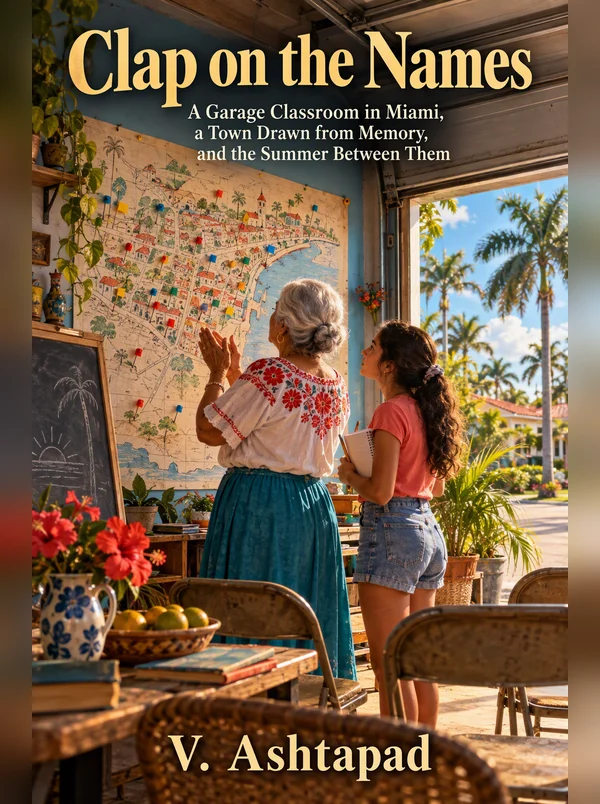
Clap on the Names
A Garage Classroom in Miami, a Town Drawn from Memory, and the Summer Between Them
by V. Ashtapad
Foreword
This is the third book of Caribbean Tides, and the first to cross the ninety miles between Miami and Cuba. It is told in three voices over one summer: Eloísa, who left her hometown in Matanzas province in 1967 with three changes of clothes and a pencil, and has taught a Saturday class in Spanish and Cuban history ever since; her son Julio, who repairs radios in Hialeah and plays dominoes on Thursdays; and his daughter Lía, fifteen, who understands every word of Spanish and has never been able to make her mouth say them. The family in this book does not agree about Cuba. Nobody in it is asked to. They sit at the same table anyway, and pass the yuca. The town of Bocaclara is invented, though every road that leads to it is real. The songs in it are described and never quoted, because a song taught by ear belongs to the people who carry it.
For every teacher who kept a class going in a garage, a kitchen or a borrowed room on a Saturday morning, and for the children who complained all the way there.
The Pastelito Line
*Lía*
The line at El Trigal starts at the glass door and bends left along the front window, past the poster of a quinceañera cake with a fountain in it, and at seven fifty on a Saturday morning in June it is already eleven people long and every one of them is older than my dad.
I know because I count. I count when I'm nervous. Eleven people, four of them in house slippers, two of them with tiny dogs, one man in a baseball jersey so old the fish on it has faded to a ghost, and a lady in front of me with her hair still in rollers under a silk scarf printed with seashells. She is holding a list written on the back of an electric bill. I can see the list over her shoulder. It says *2 doc. guayaba, 1 doc. carne, 12 croq. jamón, pan de agua x3, NO de queso porque Raúl.*
I have my own list. It's in my dad's handwriting, which looks like a seismograph.
*Mija. 3 docenas de guayaba. 1 de guayaba y queso. 1 colada. Dile que es para la Maestra Eloísa y te da la caja grande. Don't be late. She counts.*
He means my grandmother. She counts too. Everybody in my family counts something.
The door opens and the smell hits the sidewalk the way the air hits you when you get out of a cold car in August. Butter and burnt sugar and coffee so dark it seems to have weight. The lady in the rollers closes her eyes and says, to nobody, "Ay, qué rico," and the man with the ghost fish says, "Every Saturday you say that," and she says, "Every Saturday it's true."
They both look at me like I'm supposed to agree.
"It smells really good," I say.
The lady turns all the way around to see who said it in English. She looks at my face, my braid, my school's swim-team hoodie, and does a quick calculation I have watched a hundred grown-ups do my whole life. *Cuban. Born here. Doesn't speak it.* Her eyebrows go up and come down.
"¿Tú eres de quién?" she asks.
I know this one. It's not *who are you*. It's *who are you from*. Whose kid. It's the most Hialeah question there is.
"Ledesma," I say. "My dad is Julio. The radio guy?"
"¡Julito! El de los radios. Ay, sí, sí." She turns to the man. "La hija de Julito." Then back to me, slower, the way people talk to tourists. "Tu abuela es la maestra. La de los sábados."
"Sí," I say. "La de los sábados."
That is, as far as I can tell, my grandmother's full title. Not Eloísa Arencibia Ledesma, not Mrs. Ledesma, not my abuela. *La de los sábados.* The one with the Saturdays.
---
My grandmother has taught a Spanish and Cuban history class every Saturday morning since 1971, which is fifty-six years, which my phone calculator says is about two thousand nine hundred Saturdays, minus hurricanes. For the first seven years it was in her apartment in Little Havana with the furniture pushed against the walls. Since 1978 it has been in the garage of her house in Westchester, on Eighty-Second Avenue, two blocks south of Bird Road.
The garage has never had a car in it. My grandfather, before he died, used to park in the driveway under the mango tree and complain about the bird droppings on the windshield, and my grandmother used to say, "The car can be dirty. The children cannot be in the sun." So the car was dirty for thirty-three years.
I have been inside the class maybe ten times in my life, mostly as a little kid, mostly crying because I didn't want to be there. I remember a chalkboard and a big map of Cuba and the smell of the floor fan, which smelled hot. I remember being six and getting a word wrong in front of a boy named Ñico and deciding I was done with Spanish forever.
I was mostly done with it. I understand almost everything. That's the stupid part. When my grandmother talks I understand her. When my dad's friends talk at dominoes I understand them, especially the swearing. When my mom's family talks, which is Nicaraguan Spanish, faster and with different words, I understand maybe seventy percent. But when I open my mouth what comes out is English, every time, like my mouth is a door that only swings one way.
So this summer I am getting my volunteer hours for the scholarship by helping the one with the Saturdays write a book.
That was not my idea.
---
The girl behind the counter has a ponytail pulled so tight it looks painful and a gold name necklace that says *Yaritza* in script. When I say *Maestra Eloísa* she says "Ah!" and goes into the back and comes out with a white box the size of a carry-on suitcase, tied with string in both directions. She doesn't even ask what's in it. She already knows.
"Tres de guayaba, una de guayaba y queso," she says, tapping the lid. "Y la colada."
The colada comes in a foam cup with a plastic lid, and a sleeve of tiny paper cups rubber-banded to the side. The coffee in it is so sweet it makes my back teeth hurt just looking at it. My dad says a colada is not a drink. It is a social contract. You buy one, and you pour it out in the little cups, and you hand them around, and whoever you hand them to owes you a conversation.
I pay with my dad's twenty. I get almost nothing back.
"Dile a la Maestra," Yaritza says, "que mi hermano todavía se acuerda de los ríos."
I nod like I understood. On the way out I work it out on the sidewalk. *Tell the teacher my brother still remembers the rivers.* I don't know what that means. I write it in my notes app anyway, because I have a feeling that this whole summer is going to be people telling me things to tell her, and I am going to be the mail.
---
The garage door is up when I pull the car into the driveway. It's my mom's car and I have my learner's permit, and my dad is in the passenger seat pretending he isn't scared. He's been pretending since Hialeah. Twice on the Palmetto he said, "Mija," in a voice like a hand on the brake.
"I'm in the driveway," I tell him. "You can breathe."
"I'm breathing. Look at me. Breathing."
He gets out and takes the pastelito box from the back seat like it's a baby and walks straight into the garage, and I sit for a second with the engine off, looking.
It's exactly the same and it's completely different. The chalkboard is the same. It's a real one, green, with a wooden ledge, and on the ledge are about forty pieces of chalk in a flat tin that once held guava paste. The map of Cuba is the same, but it's been taped and retaped so many times that the island looks like it's been in a fight. There are eight folding tables in two rows and a big floor fan in each corner turning its head back and forth like it's watching a tennis match. On the side wall there's a framed print of José Martí, the one where he's looking a little to the left like he heard something, and next to it a calendar from a pharmacy on Flagler with June's picture of a beach.
What's different is the kids. The last time I was here I was one of them. Now they come up to my elbow.
There are eight of them this morning, between about seven and twelve, and they're all doing the thing kids do at the start of something where they pretend they're not excited. One boy with a fade haircut is spinning a pencil on the table. A girl with glasses is reading a graphic novel held very close to her face. Two little girls in matching bike shorts are whispering behind their hands. A tall boy is standing by the fan with his shirt held out in front of it so it balloons.
And at the front, at a small desk that used to be a sewing table, with her reading glasses on a beaded chain and her white hair set the way it is always set, in soft waves that look like they were carved, is my grandmother.
She's eighty-five. She's very small, and she sits very straight, and she is wearing a pale blue blouse with tiny pleats down the front, and when she looks up and sees my dad with the box she says, "Llegaron," and then she looks past him at me in the car, and she looks at her watch.
I check my phone. It's 8:04.
She counts.
---
"Lía, ven. Siéntate aquí."
She has a folding chair set up beside her desk. Not with the kids. Next to her, facing them. I sit down and every head in the room turns to look at me, and I feel my face get hot.
"Niños," she says, "esta es mi nieta. Lía. Ella va a estar con nosotros todo el verano. Ella va a escribir el libro de la clase."
A girl in the front row raises her hand. She has two puff ponytails and a T-shirt with a cartoon avocado on it.
"¿Dime, Kiara?"
"Is she the teacher now?" Kiara asks, in English.
"En español."
Kiara thinks about it. You can see the sentence being built in her head, brick by brick. "¿Ella es... la maestra... ahora?"
"No," my grandmother says. "Ella es estudiante. Como tú. Pero más grande."
Everybody looks at me again. I am a student. Like them. But bigger. Great.
My grandmother turns to the board and writes the date in the top corner in the most beautiful handwriting I have ever seen in real life, with loops like it was done with a ruler and a compass: *sábado, 5 de junio de 2027.* Underneath she writes: *¿De dónde vienes tú?*
Where do you come from.
She turns back and points at the boy with the fade. "Brayan. ¿De dónde vienes tú?"
"Hialeah," Brayan says, and everybody laughs, and my grandmother smiles a very small smile, and says, "¿Y antes de Hialeah?"
---
That's the class. I mean, that's the whole method, as far as I can tell. She asks one question and then she asks the question behind it, and then the one behind that. Brayan's family came from Camagüey. His grandmother's grandmother came from the Canary Islands. Kiara's dad is from Santiago and her mom is from Puerto Rico. Thiago, the tall boy at the fan, is half Cuban and half Colombian and says he's "from the fan," and my grandmother lets him get away with it once. The girl with the glasses is named Isabela and her family came four years ago. She speaks Spanish better than anyone in the room except my grandmother, and she's embarrassed about it, and I recognize the exact opposite of my own embarrassment wearing the same face.
When it's my turn, my grandmother doesn't ask me.
I'm almost insulted.
At ten the kids get pastelitos and the colada is poured out into the tiny cups, a thimbleful each for the kids, which is apparently allowed here, and my dad hands the last cup to me and raises his eyebrows. *Social contract.* I drink it. It's like drinking a candy bar that's on fire.
That's when my grandmother takes out the tablet.
It's in a pink case, with a sticker on the back of a hibiscus that one of her students gave her in like 2019. She turns it on with one finger and holds it out to me. "Mira."
It's a map. Not like a phone map. The streets aren't printed. They're drawn, thin lines, very neat, and along them are little red pins, dozens of them, crowding together in the middle and spreading out at the edges like somebody spilled a jar of red beads. At the top it says *Bocaclara, provincia de Matanzas.*
"That's your town," I say.
"Ciento cuarenta y siete," she says. "Every house I remember. Every shop. Every tree I could prove." She touches one pin and a little box opens. *Farmacia Ugarte. Un mostrador de mármol. El señor Ugarte daba caramelos de menta a los niños que no lloraban con la inyección.* She closes it and touches another. *Casa de la familia Díaz. Portal con columnas verdes.* And another. *La glorieta del parque. Aquí tocaba la banda los domingos.*
"Did you take pictures of all this before you left?"
She takes the tablet back. She does it gently, but she takes it.
"No," she says. "I have no pictures. That is why there are pins."
Then she stands up, and claps twice, and says, "¡Niños! Los ríos de Cuba. ¿Quién se acuerda?" and every kid in the room groans in exactly the same way, and I think about Yaritza at the counter, and her brother, who still remembers the rivers.
I get out my notes app.
*Chapter 1*, I type. Then I delete it, because I don't know what the book is yet, and I type instead: *Ask her about the pictures.*
Then I delete that too, because I have a feeling I'm not supposed to.
A Town Drawn in Pencil
*Eloísa*
I draw at night, after the eleven o'clock news, at the kitchen table, with the radio on low.
The radio is my husband's. It is a Dutch set from 1979 with a brown wooden face and a dial that glows orange, and my son has repaired it so many times that I think there is very little of the original left inside it, only the face, like a person who has had every tooth replaced and still smiles the same. At night it finds a station on the AM band that plays boleros until two in the morning, with a man who reads dedications in a voice like warm milk. *For Mercedita in Kendall, from her husband, fifty-one years.* *For my mother in Sweetwater, who is in the hospital.* *For the ones over there.* He always says that last one, at the end. He does not say where *over there* is. Nobody who listens to that station at one in the morning needs it explained.
I sing with the boleros sometimes. Not loudly. My voice was never good for loud. It was good for a classroom, for a voice that has to reach the back row without frightening the front. When I sing along at night it is mostly the melody with my mouth closed, the way my mother hummed at her machine, and sometimes a line opens in the middle and I let the words out, a line about a lamp left burning, a line about a letter that did not come. Then I close my mouth again and go back to the street I am drawing.
Tonight it is the Calle del Paradero.
---
You must understand how small Bocaclara was. You could walk from one end to the other in the time it takes to boil rice, and children did, every day, sent to the bodega with a peso and a list and a warning. The town lay along the railway like a cat along a warm wall. There was the station, the paradero, with its wooden roof painted green and its long bench where the old men sat waiting for trains they had no intention of boarding. From the station, the Calle del Paradero went up a small slope to the park. That was the first street I learned to walk alone, and so it is the first one I draw each time, before any other, the way you touch the doorframe when you come home.
I use a pencil first. Number two. I buy them by the box at the pharmacy. I draw the street as two lines, and then I walk up it in my head, slowly, and I draw what I pass.
On the left, after the station, the house of the Mesa family, with a yard full of chickens that escaped into the street every afternoon at four, as if they had an appointment. Then the carpenter's, open to the street, with the smell of cedar coming out of it so strong you could taste it, and curls of wood on the ground that the little girls used to hang from their ears. Then a vacant lot where the big boys played baseball with a stick and a ball made of a sock. I always draw the vacant lot. It is the most important building on the street.
On the right, the Ugarte pharmacy, with its marble counter and the jars of colored water in the window, red and green and blue, that caught the afternoon sun and threw it on the sidewalk like spilled syrup. The shoemaker, a tiny man who sang zarzuela at the top of his voice with nails in his mouth, which my mother said would kill him one day, and which never did. Then the bodega of Ceferino the Asturian, where my mother bought on credit and Ceferino wrote it in a book with a pencil he kept behind his ear, and once a year, in December, tore out the pages of the poorest families and threw them in the stove. He never said which pages. Nobody ever asked.
Then the park.
---
When the pencil is right, I go over it with ink. I use a fine black pen, the kind architects use. My granddaughter's friend at the art store on Bird Road sells them to me with a discount because she was in my class in 2006 and she still says *usted* to me, which is how you know a person had a good mother. The ink goes on slowly. My hand is not what it was. But it is still the hand that wrote on a blackboard every day for five years in Bocaclara and for fifty-six years of Saturdays in Miami, and it knows how to make a line go where it is told.
I have drawn Bocaclara perhaps two hundred times. I do not exaggerate. There are drawings in the hall closet in a tube of the kind they use for blueprints, and in a portfolio under my bed, and in the filing cabinet in the garage, and taped inside the doors of the kitchen cupboards where I can see them when I take down the coffee. Every one is a little different. That is the trouble with memory. You think it is a photograph and it is a river.
In one drawing the shoemaker is on the right side of the street. In the next he is on the left. In one the park has six royal palms and in another it has eight. I used to tear up the ones I decided were wrong. Now I keep them all. My son says this is because I am old and sentimental. That is not the reason. The reason is that I no longer know which ones are wrong.
---
There were photographs once.
I want to say this plainly, so that it is said, and then I will not say it again in this chapter.
There was a tin. It had held galletas from a factory in Matanzas, and it was red, with a picture on the lid of a girl in a white dress on a swing. In it were all the photographs of my life until I was twenty-five years old. My first communion, because in those days everybody's mother took them, believing or not. My father on his horse with the cane fields behind him, squinting, before he died. My mother at her sewing machine, with her mouth full of pins. Hilda and me at the beach at Varadero in 1955, two skinny girls in wool bathing suits that itched, holding hands in the water. The Liceo, on the night of the dance when I was sixteen. My graduation from the Escuela Normal in Matanzas, with my hair in a style I would be ashamed of now. My first class in Bocaclara, on the steps of the school. And the street. Somebody, a cousin with a camera, had once taken pictures of the whole Calle Real from the church steps on a Sunday, the way people did then, to send to relatives in Tampa, and he gave us copies.
When I left in 1967 I could take very little. I will tell about that when it is time. The tin stayed with my sister. *I'll send it,* Hilda said. *When things are calmer. With somebody who is going.* And for many years things were not calmer, and nobody was going, and then when people began to go back and forth, Hilda was afraid to give the tin to strangers. She kept it on top of her wardrobe, wrapped in a towel, in a plastic bag, to protect it from the damp.
In March of 1993, the big storm came. The one they still call the storm of the century over there. The arroyo behind her house came up in the night higher than anybody had ever seen. In the morning there was mud halfway up the walls. The wardrobe had fallen. The tin was full of water.
Hilda wrote to me about it. She wrote that she had laid the photographs out in the sun on the patio, every one, on sheets of newspaper, with stones on the corners so they would not blow away, and sat with them all day, and that by the evening they were only paper with stains on it. *Faces like ghosts in a cloud,* she wrote. *I kept them anyway. I could not throw away your face.* And then, at the bottom of the letter: *Forgive me. Forgive me. I should have sent it.*
I wrote back that there was nothing to forgive. I meant it. I still mean it.
But that is why I draw.
---
On Saturdays the children do not care about any of this, and that is correct. Children should not carry the tins of old people. On Saturdays I teach them the rivers.
I have taught the rivers of Cuba to children for sixty years. There is a little song for them that I made up in Bocaclara in 1962, for a boy who could not remember anything unless it rhymed. It begins in the west at Pinar del Río and goes east, river by river, to Guantánamo, and the children clap on the name of each river, and by the third Saturday they can sing it faster than I can. Children who learned it from me in 1980 have taught it to their own children in the car. I know this because the children of those children come to my garage already knowing half of it, and when I ask where they learned it they say, *My mom,* or *My dad sings it when he's driving,* and then I have to turn and write something on the board for a moment.
My granddaughter did not know it. Her father learned it in this garage and did not teach it to her. I do not blame him. When Lía was small, her father worked six days and her mother worked nights at the hospital, and there was no time to be a teacher too. That is what the Saturdays were for. But Lía did not want to come to the Saturdays, and I did not make her, and I have wondered since, at night, at this table, with the radio low, whether that was the kindest thing I ever did for her or the laziest.
Now she is here because of a scholarship. I am not too proud to take a child for any reason.
---
Every lesson is kept now. I did not want this at first. My son set it up, and he said, *Mima, the ones who are sick, the ones whose parents take them to Orlando for the weekend, they can hear it after.* So now, when I begin, I touch the little red circle on the tablet, and when I finish, I touch it again, and the lesson is saved with the date on it, in my own voice. The rivers on the fifth of June. The rivers on the twelfth. The rivers, I suppose, until they carry me out.
Last night I could not sleep and I listened to one from a year ago. It was strange. You think you know your own voice. But the voice in the tablet was older than the one in my head, and slower, and it said *Cauto* the way my mother said it, with a little lift at the end that I have never noticed I do. And underneath, the floor fan going around, and the children clapping on the names, and a dog barking two houses away that died in October.
I listened to the whole thing. Then I put down the tablet and took up the pencil and began the Calle del Paradero again, from the station.
Tonight the shoemaker is on the left.
I will see what he does tomorrow.
Double Nine at Máximo Gómez
*Julio*
Every radio is a liar until you open it up.
That is the first thing my father told me about the trade, when I was eleven and he let me hold the soldering iron in the garage the six days a week it was not a classroom. He was not a radio man. He was a bus mechanic for the county, and a good one, but he could fix anything that hummed, and on Sunday afternoons the neighbors on Eighty-Second Avenue brought him their dead transistors and their big console sets with the dial cords snapped, and he sat at the workbench under the mango tree with a cigar going out in the ashtray and opened them like a surgeon. *It says it's the speaker,* he would say, tapping the case. *It's never the speaker. Open it up. Ask it.*
I have been asking radios for forty years. I have a shop in Hialeah, on a side street off West Twenty-Ninth, between a nail salon and a man who sells pool chemicals, and the sign says LEDESMA RADIO / TWO-WAY / REPARACIONES in red letters that my daughter says look like a ransom note. I service the handheld radios for three trucking companies and a towing outfit and two of the private security firms that guard the warehouses out by the airport. I keep a fifty-thousand-watt AM transmitter breathing for a Spanish station whose tower stands out at the edge of the Everglades among the sawgrass, where the egrets sit on the guy wires in rows like notes on a staff. And on the shelf behind my bench there are always nine or ten old radios that have nothing to do with business: tube sets, an American shortwave from the fifties, a Soviet-made set from Minsk that a man carried out of Cuba in 1994 on a raft wrapped in three garbage bags and then could not bring himself to throw away when it died. They belong to old people. I fix them slowly, in the evenings, for nothing, and the old people bring me flan.
---
Before the shop, the window.
Every morning at six forty I stop at the ventanita at Cafetería Los Pinos on Palm Avenue. It is a hole in the side wall of the building with a shelf under it and a sliding glass pane that is never closed, and a rotating cast of women behind it who have known me since before my hair went gray. There is no line, exactly. There is a crowd that knows its own order. Construction guys in reflective vests. A nurse coming off nights. Two old men who come every day to argue about baseball and have not finished the argument since 1997. The air there smells of burnt sugar and diesel and the bougainvillea on the chain-link fence next door, and by seven the sun is already standing on the back of your neck.
"Julito. ¿Colada?"
"Colada y un cortadito, Mirta."
She does not write it. Nobody writes it. The colada comes out in its foam cup with the stack of little paper thimbles, and the cortadito comes for me, and I drink the cortadito at the window while the old men argue, and then I carry the colada to the shop, where my one employee, a kid named Jonathan who is studying electrical engineering at night, is waiting at the door with the keys. I pour him a thimble. I pour one for the nail salon girls next door, who come out for it in their masks with their gloves off, and one for the pool-chemicals man, who is Peruvian and pretends to find Cuban coffee too sweet and drinks it anyway. That is the first quarter hour of every working day of my life. If I skip it, the radios know. I swear to you. The whole day goes sideways.
---
Thursdays I close at four, and I drive to Little Havana to play dominoes.
Máximo Gómez Park is a corner of Calle Ocho that someone fenced in a long time ago and filled with concrete tables under a long roof, and on the tables are the tiles, and at the tables are the men. A few women too, now, which was a scandal fifteen years ago and is now only a rumor. Tourists stand at the fence with their phones and their sunburns, and somebody's grandson sells them a tour, and the men pretend not to see them. On the back wall there is a big painted mural of world leaders who met once at a summit decades ago, all of them in suits, all of them slightly wrong in the face. Nobody playing has looked at it since the day it was painted.
We play the Cuban way. Double nine, fifty-five tiles, partners across the table, ten tiles each. You shuffle face down with both hands in a long, loud wash that we call giving it water, and you do it with some style, because the shuffle is half the conversation. You do not speak to your partner about your hand. You speak to him with the tiles. How hard you slap one down. Whether you hesitate. Whether you play the fat double early or hold it to the end. Fifty years of marriage and my mother does not know my father the way Pipo Arango knows me after twenty years across a domino table.
Pipo is my partner. He is sixty-three and sells insurance, and he has the most expressive eyebrows in Miami-Dade County, which is not useful in insurance but is very useful in dominoes. Across from us, this Thursday, were Wilfredo, who fixes air conditioners and has opinions about everything, and old Reinaldo, who is eighty-nine and came over in 1960 and has outlived three domino partners and seems to be considering a fourth.
There was also Yorman, who is Venezuelan and arrived four years ago and is learning the Cuban game the way you learn a language, slowly and with a lot of public humiliation. He was not playing. He was watching from the bench, and learning, and every so often Reinaldo would explain something to him without turning his head.
"Mira, Venezuela. He played the five. Why did he play the five?"
"Because he has the fives?"
"Because he wants his partner to think he has the fives. Wilfredo has no fives. Wilfredo has never had a five in his life. Look at his face."
"There's nothing wrong with my face," Wilfredo said.
"There's a lot wrong with your face. Pasa."
Wilfredo passed. Pipo raised one eyebrow at me. I played the double four, hard. Pipo smiled.
---
They talk about Cuba at the table the way you talk about weather. Not if. Only how much.
That Thursday it was the blackouts. Wilfredo's sister in Holguín had been without light for nineteen hours the day before. Reinaldo said what Reinaldo always says, which is that nothing will change until a certain thing happens, and you know what thing, and he said it in the same tone he uses to ask for the salt. Wilfredo said that thing had been about to happen since 1962. Pipo said that his nephew had flown to Havana last month with four suitcases, and that the line at Miami International for the Havana flight was the most Cuban place on earth, more Cuban than Cuba, a hundred people wrapping their luggage in plastic at the machine and fighting about kilos. Reinaldo said a man should not go back while those people were in charge. Wilfredo said his sister did not care who was in charge, she cared about the insulin for her husband, and the insulin did not get on a plane by itself.
"Then send it with the mulas."
"The mulas are a plane, Reinaldo."
"A plane I'm not on."
Then Reinaldo slapped down the double nine, which nobody had known he had, and said, "Dominó," very quietly, and the argument was over, because you cannot argue with a man who has just gone out with the double nine. That is the oldest law of the park.
Yorman, on the bench, said, "In Venezuela we have the same argument. Only with less dominoes."
Everybody laughed. Even Reinaldo. It is the only good thing about the argument. It belongs to everybody who has ever left.
---
I got home to Hialeah at seven, and Chicho was sitting on my front step.
Chicho Ferrán is seventy-four and goes to Cuba every eight weeks. He is what people call a mula, a mule, though nobody calls him that to his face. He carries. Medicines, eyeglasses, phone chargers, money, coffee, children's shoes, a part for a washing machine, letters. He takes his fee by the pound and he is honest and he is slow, and everybody in our part of Hialeah who has family in Matanzas province uses him, because he is from Jovellanos and he knows the roads and the people.
He was holding an envelope.
"De Mayra," he said. "From Bocaclara. She gave it to me herself. She said, to Julio, not to Eloísa. So I brought it to you."
My cousin Mayra is the daughter of my mother's sister Hilda. She is sixty-two, a retired nurse, and I have met her exactly once in my life, in 2016, when she came for six weeks on a visitor's visa and slept on my mother's sofa and cried at the supermarket on Bird Road in front of the cereal aisle. We have written since. Not often. Two, three times a year, by hand, through Chicho, because the internet over there comes and goes like a radio station at the edge of its range.
I opened it at the kitchen table. Migdalia was at the hospital. Lía was in her room with the door shut and music coming through it.
Mayra writes like a nurse, in short lines, with all the important things at the bottom.
*Querido primo. Here we are surviving. Orestes is well, the knee is better. Yusimí's baby is walking, he has four teeth, he bites. We named him Adrián after nobody, because we liked it. The light goes away eight, ten hours. We cook with charcoal again like in the time of our grandmothers. The roof of the Liceo fell in during the rains in May. Nobody was inside, thank God. The old school is still standing but they say it will close, there are not enough children in the town anymore, everybody has gone. They will send the little ones to Jovellanos on the bus, when there is a bus.*
And then, at the bottom, smaller:
*Mamá always said that one day her sister's son would walk the Calle Real. That he would come and see. I do not ask for anything. I only say what she said. I have the things of Mamá's here in a box and I do not know what to do with them. Some of them are your mother's.*
---
After dinner I went into the spare room where I keep the computer and opened the family's page, the one Lía set up for my mother's eightieth birthday. There is a tree on it. On the left side, our side, it is very full. My mother and my father. Tere and Fico and their boy Danilo and his wife and the little one, Camilo, who is two. Me and Migdalia and Lía. Migdalia's people from León, going back to a great-grandfather who was a telegraph operator, which explains a lot about me, Migdalia says.
On the right side, the Cuba side, it gets thin. My grandmother and grandfather. My mother's sister Hilda, with the year she died. Mayra and Orestes. Their son Yoandry, who lives fifteen minutes from me now in Hialeah and installs air conditioners. Their daughter Yusimí. Then nothing.
I added the baby. *Adrián Cabrera.* Born last year. Named after nobody.
Then I sat there and looked at the gap between the two sides of the tree, where the line from my mother goes across to the line from her sister, and it is only a line, a thin gray line on a screen, and it has sixty years in it.
Lía came in behind me to get the charger she always loses.
"Who's that?" she said, pointing at the new box.
"Your cousin's baby. In Cuba."
"We have a baby in Cuba?"
"We have a whole town in Cuba, mija."
She looked at the screen. She looked at me. Then she took her charger and left, and I heard her door shut, and the music go back on, a little lower than before.
I read the letter again. *Some of them are your mother's.*
The radio on the shelf behind me, the old Minsk set with no owner, was dead, and had been for months. I took it down and opened it up. It said it was the speaker.
It is never the speaker.
El Refugio
*Lía*
My grandmother still has a driver's license, which is the scariest fact in my family. She renewed it at eighty-two and passed the eye test by, according to my aunt Tere, memorizing the chart while the lady in front of her read it. She doesn't drive anymore, though. She keeps the license in her wallet behind her library card, and on the second Wednesday in June she takes it out and shows it to me in the driveway like a badge.
"Legal," she says. "You may drive. I am the adult."
"You're the adult," I agree.
"Twenty-one or older. Licensed. In the passenger seat." She buckles herself in. She has her handbag on her lap, held with both hands, and she has dressed for this. A cream-colored skirt, the blue blouse with the tiny pleats, low heels, pearl earrings the size of chickpeas. "Biscayne Boulevard," she says. "Six hundred. Take Coral Way, not the highway. I want to see Coral Way."
So I take Coral Way.
I've driven down Coral Way a thousand times in the back seat and never looked at it. It's the street with the banyan trees, the huge ones whose branches meet over the road and drop roots down like curtains, so you drive through a green tunnel with spots of sun moving over the hood. My grandmother looks out her window the whole way. Every few blocks she says something. "That was a pharmacy." "That was a bank, now it's a bank again." "There was a Cuban restaurant there with a parrot that said bad words to the priests." At Twelfth Avenue she points at a building on the corner with big glass windows and a sign I can't read at that speed.
"The museum," she says. "The Cuban one. Your class will go in July. The children want to see the art."
"Did you go?"
"I have been," she says, which is not the same thing, and she doesn't say anything else until downtown.
---
I've seen the Freedom Tower my whole life. It's on every postcard of Miami that isn't a beach. It's the old cream-colored tower on Biscayne with the fancy top, like a wedding cake with a lighthouse on it, standing across from the bay with all the glass condos around it looking like they want its parking spot. I always thought it was a hotel.
My grandmother makes me park in a garage two blocks away that costs twenty-two dollars, and we walk the rest. She walks slowly, but she walks straight, and she doesn't take my arm until the curb.
At the front of the tower she stops.
There are people going in and out, tourists, a school group in matching yellow T-shirts, a man selling water from a cooler. Traffic on Biscayne, buses, a guy on a scooter with a speaker playing reggaeton. The bay behind us flashing in the sun like a sheet of foil. My grandmother doesn't look at any of it. She's looking at the doors.
"Here was the line," she says.
"For what?"
"For everything." She lifts her hand and draws it in the air, from the door down the sidewalk and around the corner. "From here to there. In the morning before the sun came up. Women with babies. Old men in their good suits, because they did not want to come to ask for help looking poor. Everyone in their good clothes. You could see who had arrived that week because they were wearing coats. In Miami. In October. Because the coat is what you carried, if you could carry one thing. They wore it so it would not be counted in the suitcase."
The school group goes past us in their yellow shirts. A teacher is counting heads.
"They called it El Refugio," she says. "The refuge. The government had the offices here. You came in the door and they gave you a number, and you sat, and you waited, and a woman at a desk took your name. And then the doctors, upstairs. And then the help. A check. Not a big check. And food." She makes a face I have never seen her make, like a little girl. "Ay, the food. A block of cheese. Yellow. As big as a brick. Powdered milk. Powdered eggs. Cans of meat. Every Cuban in Miami of my age, you say *el queso del refugio* and they laugh, and then they stop laughing. We were so grateful. And it was terrible cheese."
I laugh. She doesn't, but her eyes do.
"Can we go in?"
"Yes. It's a museum now. Of the college. They have the history upstairs." She doesn't move. "Let me look one more minute from outside."
---
I don't know how long a minute is in my grandmother's time. I take out my phone and open the voice recorder, because Mr. Echevarría, my history teacher, says the first rule of oral history is *always be recording, ask permission later*, which he says is a joke and isn't.
"Abuela. Can I record you?"
She looks at the phone. "For the book?"
"For the book."
"Then ask me properly. In Spanish."
I knew this was coming. I've been dreading it for a week. I can feel the sentence somewhere in the back of my head, all the words there, like furniture in a dark room. I just can't find the light switch.
"¿Puedo... grabarte?"
"Grabarla," she says. "To me you say *usted* when it is for a book. Grabarla."
"¿Puedo grabarla, Abuela?"
"Sí, mi niña. Puedes."
---
Inside, it's cool and quiet and the floors shine. Upstairs there are photos on the walls, huge black-and-white ones, blown up so big you can see the grain. Lines of people on this exact sidewalk. Kids in short pants holding paper tags. A woman at a typewriter. A mountain of cardboard boxes. A man in a hat holding up a document to a window. Glass cases with suitcases and passports and a little girl's shoe. There's a wall of names. There's a wall of quotes.
My grandmother walks along the photos slowly. She doesn't read the labels. She looks at the faces, one at a time, like she's checking attendance.
At one of them she stops. It's a big picture of the waiting room, rows of wooden chairs, people sitting with their papers on their knees, a ceiling fan, sunlight coming through tall windows in stripes.
"I sat there," she says.
"In this picture?"
"No. Not in the picture. In that room. On a chair like that. October 1967. The picture is from before, I think. But it was the same. The same fan." She touches the glass, very lightly, next to the frame, not on the photo. "The woman at the desk wrote my name with no accent. E-L-O-I-S-A. No accent on the *i*. I was going to say something. I was a teacher. I knew where the accent goes. But there was a line behind me. So I said nothing. And for sixty years every paper in this country, my Social Security, my license, my citizenship, my house, everything says Eloisa with no accent. Because I did not want to make the line wait."
She turns to me. "Put that in the book. That is a good lesson for the children. Always make the line wait for your accent."
I'm recording. I hold the phone a little higher.
"Abuela, what did you bring? When you came. If you could carry one thing."
She thinks about it. Somewhere a docent is explaining something to the yellow-shirt kids. *Cuban Refugee Center*, I hear. *Hundreds of thousands of people.*
"Three changes of clothes," she says. "That was the rule for me. My coat. My school diploma, folded in four, in my brassiere, where they did not look. A pencil." She shrugs. "A teacher brings a pencil."
"And the photos?"
The look she gives me is not angry. It's the look she gave Thiago when he said he was from the fan. One time. You get one time.
"Another day," she says. "Put down that machine now. Let's look."
I stop recording.
---
That night, in my room, I make a timeline.
It's on the family's page, where my dad keeps the tree. There's a section for each person, and in my grandmother's there's a blank line of her life, left to right, waiting. I've seen it before and never touched it. Now I sit cross-legged on my bed with the laptop on a pillow and the recording in my earbuds and I start putting things on it.
*1942. Born. Bocaclara, Matanzas.*
*1961. Graduates from the Escuela Normal de Matanzas.* I have to look up what an Escuela Normal is. It's a teachers' college. I add that.
*1961–1966. Teacher, Escuela Pública No. 4, Bocaclara.* I got that from my dad.
*October 1967. Arrives Miami. El Refugio.* I add her name with no accent, and then I go back and put the accent on.
*1969. Aunt Tere born.*
*1971. First Saturday class.*
*1974. Dad born.*
*1978. The class moves to the garage on Eighty-Second Avenue.*
*2011. Abuelo Armando dies.*
*2027.* I put *now*.
Then I lean back against the headboard and look at it. It looks like a ruler. It looks like a little row of dots with big empty stretches between them, and the biggest empty stretch is right in the middle, between 1961 and 1971. The five years she taught in Cuba, the year she didn't. The years before the class. The years I don't know anything about, which is basically every year where something must have happened.
In the earbuds she's saying, *a teacher brings a pencil.* I play it four times.
My mom knocks and comes in still in her scrubs, the purple ones, with her badge clipped upside down. She's just gotten home. She smells like hospital soap and the outside. She sits on the edge of my bed and looks at the laptop.
"Your abuela's life?"
"What I know of it."
She looks at the gap. My mom came from León when she was nine, on a bus and then another bus and then a plane, in 1989, and there's a gap in the middle of her life too, which I've never asked about either. I think about that while she looks.
"That's a lot of empty," she says.
"Yeah."
"You know what they say in my family?" She pushes my hair off my forehead. "The empty part is where you ask." She stands up and takes her badge off and turns it right way up, finally, and looks at it like she's surprised at herself. "Go to sleep, Lía. Mañana es otro día."
After she leaves I type one more line in the middle of the gap, between 1961 and 1967, where I don't know what goes.
*Ask her.*
This time I don't delete it.
Three Changes of Clothes
*Eloísa*
She asked me in Spanish. That is why I answered.
It was a Saturday, after class, the third one of the summer, and the children had gone home with their mothers and their pastelito crumbs, and my son had gone to buy a part for something, and the garage was quiet except for the fans. Lía was stacking the folding chairs, badly, the way all young people stack chairs, as if the chair will forgive you. She stopped with one in her hands and said, with her face turned toward the wall so she did not have to look at me:
"Abuela. ¿Qué pasó entre mil novecientos sesenta y uno y mil novecientos sesenta y siete?"
She said *sesenta* like an American, with the *s* soft and lazy at the end. She said it all in one breath, the way you jump into cold water. I knew she had practiced it in the car.
So I sat down at my desk and I told her. Not everything. Enough. And she held up her telephone, and I let her, because a girl who practices a sentence in the car has earned the right to keep the answer. Later she put it with my Saturday lessons, the ones saved in my own voice with their dates on them, as though it were one more lesson. Perhaps it was.
What follows is what I said, more or less, put into the English she will read it in. I have corrected only my grammar. Not the facts.
---
In 1961 I was nineteen and I had my diploma from the Escuela Normal, and I came home to Bocaclara to teach in the same school where I had learned to read. Escuela Pública Número Cuatro. Why four, when there was only one public school in the town, nobody ever knew. Maybe there had been plans. It was a yellow building, two stories, with a staircase at the front of five wide steps, and green shutters that nobody closed, and a courtyard in the middle with a tamarind tree that dropped its pods on the children's heads during recess. My classroom was on the second floor, at the corner, with two windows. From one you saw the park. From the other you saw the railway, and beyond the railway the cane, all the way to the hills, like a green sea that the wind combed in one direction.
I taught the third grade. Thirty-eight children. Some had shoes. Some did not. Some came to school after milking. One boy, Felipito, came every day with his little sister on his back because there was nobody at home, and she sat under his desk all day and never made a sound, and by the end of the year she could read better than he could.
Those were years of great noise in Cuba. Everyone was shouting, in one direction or the other. I will not tell you which direction was right. I am a teacher of children. I will tell you only what happened to me, and you are old enough to put it next to the other things you read.
What happened was that the books changed. And then what we said in the morning changed. And then what was written on the walls of the school changed. And I was a young woman who had always believed that a teacher's work is to give a child a pencil and the whole alphabet, and then step back, and let the child write what she likes. I found that I could not step back anymore. I found that I was being asked to hold the child's hand while she wrote.
Maybe I was wrong. My sister Hilda thought I was wrong, or at least that I was too proud. We argued about it in the kitchen of our mother's house in a way that we never argued again in our lives, because we found out at that table how much it could cost. Hilda had married by then. Her husband worked at the sugar mill. Our mother was not well. Hilda said, *Somebody has to stay with Mamá.* I said, *I know.* She said, *And you will not.* I said, *No.* And that was all. We did not discuss it again. We wrote to each other for fifty-two years after that and never once discussed it.
---
In the autumn of 1965 it was announced that people who wished to leave could leave. First by boat, from Camarioca, which is near Varadero, on the coast of our province. Then by airplane. Two flights a day, from Varadero to Miami. You applied. You waited.
I applied in November.
In January the director of the school called me into his office. He was a good man and he did not look at me. He said that persons who had applied to leave the country could not continue to teach the children of the country. He said it as though he were reading it from a paper, and I believe he was. I said I understood. I cleaned out my desk. I left my chalk in the box for whoever came after me. I took one thing, a pencil with my name scratched on it with a pin, that the children had given me for my birthday. I have it in the garage, in the guava tin with the chalk. It is only two inches long now.
Then they sent me to the fields.
That was how it was done, for many people who were waiting. You were sent to work in agriculture while your papers moved, or did not move. I was sent to a camp near Jagüey Grande with other women who were waiting. We slept in a long building with hammocks. We weeded. We planted. In the harvest, we cut cane, which I did very badly, and the other women laughed at me and then showed me how, and I still did it badly. My hands bled. I wrapped them in strips of an old slip. One of the women, a dressmaker from Cárdenas, sang every night in the dark, very softly, boleros, the same ones I sing now at my kitchen table. I learned them from her. I do not know her name. We did not use our real names much in that place. We called her *la Costurera*, the seamstress. If she is alive she is ninety-five. If she is alive, I hope somebody brings her coffee.
Fourteen months, I was in the fields.
---
The telegram came in September of 1967. It gave a date and a time, and an instruction to present myself.
Before you went, they came to the house and made an inventory. Everything you owned was written on a list, and when you left, it stayed. The bed. The chairs. The wardrobe. My mother's sewing machine, which was not mine, so they did not count it, and that was the only thing I won that year. I was allowed to take three changes of clothes. One pair of shoes on my feet. Nothing of value.
I put on my winter coat, a gray wool coat that my mother had made for me from a man's suit when I went to the Normal in Matanzas, because the Normal was cold in December and nobody in Bocaclara owned a coat. I put my diploma in my brassiere. I put the pencil in the pocket of the coat.
I put the tin of photographs in Hilda's hands.
*I'll send it,* she said.
We went to Varadero in a truck, very early. Hilda came with me as far as she was allowed. At the airport there was a fence. And then there was a room made of glass where you waited after they took your papers, and everybody called it *la pecera*, the fish tank, because the people outside could see you and you could see them and nobody could hear anything. Hilda stood at the fence for six hours in the sun. I could see her through the glass. Sometimes she lifted her hand. Sometimes I did. Mostly we only looked. I remember thinking that I should remember her face exactly as it was at that moment, in case I never saw it again, and I tried so hard to remember it that now I cannot remember it at all. Only the blue of her dress. Only the fence.
Then they called the numbers. And we walked out onto the hot concrete to the airplane, and I did not turn around, because I knew that if I turned around I would run back.
I sat by the window. I saw the beach at Varadero, the same beach where Hilda and I had held hands in the water in our itchy wool bathing suits, and it was white and very small, and then the beach was gone and the sea was all there was, which was a color I have never seen anywhere else, and then there was Florida, which was flat, and green, and full of water, and did not look like a country at all. It looked like a place that had not finished being made.
---
The rest you know. Freedom House, by the airport, the first night, on a cot with a blanket that smelled of disinfectant. El Refugio. The line. The cheese.
I could not teach. My diploma was folded in four and had been in my brassiere across the Straits of Florida, and it meant nothing to anybody. So I did what my mother did. I sewed. There was a factory in Hialeah that made men's shirts, and the woman who hired me asked if I could do alforzas, the little pleats down the front of a guayabera, and I said my mother had taught me to do them before I could write my name, which was not completely true, but it was almost. So for four years I sewed pleats. Piecework. So many cents a shirt. Eight hours, then ten. The room was hot and loud with machines and every woman in it was a teacher or a nurse or an accountant from Cuba, and all of us were sewing pleats.
Your grandfather fixed the bus I took to the factory. That is how we met. It broke down on Okeechobee Road, and he came in his county uniform with his toolbox and lay down under it in the rain, and when he came out from underneath he looked at all the women in the windows and said, *Which of you made it cry?* I laughed. I was the only one who laughed. He noticed.
And in 1971 my neighbor's little boy, who was five, answered his grandmother in English. She had asked him in Spanish if he was hungry, and he said, *No.* Just that. *No.* But in English. And she sat down on the step of the building on Seventh Street and cried as if somebody had died.
I watched her from my window. And I thought, I am a teacher. Whatever my diploma says in this country, I am a teacher. I went down the stairs and said to her, *Señora, bring him to me on Saturday. Bring any child you know.*
She brought four.
---
When I finished telling it, Lía turned off her telephone and did not say anything. She put down the chair she had been holding all that time. Then she went to the guava tin on the chalk ledge, and looked through it, and found the pencil, the little one, two inches long, with my name scratched on it, and held it up.
"This one?"
"That one."
She looked at it. She put it back exactly where it had been.
"Gracias, Abuela," she said.
That was all. It was in Spanish. It was enough.
The Pig in the Box
*Julio*
My brother-in-law Fico believes three things with his whole body: that Miami will win another World Series in his lifetime, that the government in Havana will fall by Christmas, and that a pig roasted in a caja china is superior to a pig roasted in a hole in the ground. He has been wrong about the first two every year since 1997. About the third, God help me, he is right.
The caja china is a wooden box on wheels, about the size of a coffin for a large man, lined inside with sheet metal. You put the pig in it flat, split down the backbone and opened like a book, between two racks. You put the lid on, which is a metal tray, and you pile the charcoal on top of the lid, not underneath, and the heat comes down from above and the box holds it in. That is the whole secret. Heat from above. Fico says the Chinese invented it, and Pipo says the Chinese have never heard of it and it was invented in Hialeah, and both of them are probably wrong, and nobody at a pig roast cares.
Fico started the coals at nine in the morning on the Fourth of July, in the backyard of his house in Westchester, four blocks from my mother's, in a shirt that said KISS THE COOK in English and, underneath, in marker, in his own hand, *Y NO TOQUES EL PUERCO.* The pig had been in the mojo since Friday in a cooler the size of a bathtub. The yard smelled of sour orange and garlic and charcoal smoke and the cut grass from the next house, and by ten, when I got there with Migdalia and Lía and four bags of ice, there were already eleven people standing around the box with drinks in their hands, looking at it as if it might say something.
---
My sister Tere's house has the best yard in the family. It's long and narrow, with a pool at one end that nobody swims in until the pig goes in, and a mango tree, and an avocado tree that drops fruit so heavy it dents car hoods, and a chain-link fence along the back covered in a jasmine that Tere's mother-in-law planted in 1988 and that has since eaten most of the fence. Under the mango there are two folding tables pushed together with a plastic tablecloth printed with lemons, and a speaker on a chair playing old son from Fico's phone, the kind of music where the tres guitar and the bongos argue politely and a man with a voice like a polished floor tells you about a woman he saw at a dance in Santiago in 1950. Fico's father played tres. Fico cannot play anything. But he knows every song, and he sings the endings of the lines a half second after the record, like an echo with a mustache.
By noon there were thirty of us. Tere and Fico. Their son Danilo, the firefighter, and his wife Yeni, and little Camilo, who is two and spent the entire day trying to get into the pool and being caught by somebody's uncle at the last second. Fico's cousins from Kendall. Tere's comadre from church and her husband, who says nothing at any party but smiles at everything like it's a good joke. Migdalia's sister Ninoska, who drove up from Doral with a tres leches cake in a foil pan the size of a car battery, because when the Ledesmas have a pig the Nicaraguans bring dessert, and nobody remembers when that was agreed.
My mother came at one, driven by Danilo in the fire department pickup, which delighted her more than it should have. She sat in the place of honor under the mango, in a white wicker chair that Tere keeps for her, with a fan going on an extension cord at her feet and a glass of orange soda that she would not drink and a plate that she would not finish. She wore a white guayabera-style blouse with the pleats down the front, the alforzas, which she had sewn herself, in the old way, perfectly straight. The cousins came up to her one by one and kissed her and called her Maestra.
At one thirty Yoandry arrived.
---
Yoandry is my cousin Mayra's son. He is thirty-three and has been in Miami four years. He came in 2022 the way a lot of them came then: a flight to Nicaragua, which did not need a visa, and then north through six countries by bus and on foot and in the back of trucks, and across the river into Texas, and a bus to Miami with a paper in his hand and a phone number written on his arm in pen. My phone number. I picked him up at the bus station at two in the morning and he was so thin I did not recognize him.
He works installing air conditioning now, for a company in Medley. He is strong and quiet and polite and he says *usted* to my mother and *tú* to everyone else, including the dog. He came to the pig with his girlfriend Leidy, who is Venezuelan and laughs very loudly and was immediately adopted by every aunt in the yard. He brought croquetas.
This matters, the croquetas.
He brought a tray of fifty from a window in Hialeah, wrapped in foil, still hot. Ham, and some chicken. And Tere, who had also bought croquetas, from a different window, in Westchester, a tray of ham and a tray of bacalao, looked at his tray and looked at hers and said, "Ay, mijo, you didn't have to," in the voice that means you didn't have to, and Yoandry, who did not grow up here, did not hear that voice yet, and said, "It's nothing, tía, the ones in Hialeah are better," and the whole table went quiet.
Then Fico laughed. "Of course the ones from Hialeah are better. Everything in Hialeah is better. That's why everybody leaves."
"Fico."
"I'm joking."
They ate both trays. Everyone voted by eating. Nobody would announce the winner. The bacalao went first, which settled nothing, because there were fewer of them.
---
The pig came out at a quarter to three.
You flip it halfway, at around three hours, with two men and a lot of shouting, and then you put the lid back and put on more coals, and then at the end you lift the lid and there it is, and every time, every single time, people make a sound. The skin was the color of a violin, deep and shining and crackled all over like old varnish, and when Fico tapped it with the back of the knife it rang. That is the test. It rang. Thirty people applauded a pig.
Fico cut the skin first. He always does. The skin is for the oldest and the youngest, the chicharrón, and he brought a piece on a napkin to my mother, and bent down with it, and she took it with her fingers and ate it slowly and said, "Está bien, Federico," which from her is a medal.
Then the meat, pulled with forks into a big aluminum pan, and the moros, the black beans and rice cooked together, and the yuca with the onions and garlic swimming in hot oil, and the tostones, and a salad of avocado and onion that nobody ate because the avocado tree had produced enough avocado for three salads and a protest. We sat under the mango at the two tables and ate. The music went on. A lizard watched us from the fence.
It was at the table that I said it. I should have waited. Migdalia told me afterward I should have waited.
"Lía and I are going to Bocaclara," I said. "In August. For ten days."
---
There is a sound a Cuban family makes when somebody says that at a table. It's not a word. It's a kind of shifting.
Fico put down his fork. "To give them money."
"To see Mayra. To see the town. Mima's town."
"You land at that airport, you pay them. You change your dollars, you pay them. You eat at a restaurant, you pay them. Every dollar you bring—"
"Every dollar I bring," said Yoandry, very politely, from the other end of the table, "goes to my mother. Who has no light. Who cooks on charcoal. Who is sixty-two and walks to Jovellanos for her pressure pills when there's no bus."
"I'm not talking about your mother, mijo."
"With respect, tío, you are. Because the money you're talking about is the money that goes to her."
"I'm talking about the regime."
"The regime doesn't need Julio's dollars. The regime has other dollars. Julio's dollars buy my mother rice."
Leidy put her hand on Yoandry's arm. Tere put her hand on Fico's arm. Danilo, who has learned from fire scenes when to go stand somewhere else, picked up Camilo and walked him toward the pool, where the child immediately tried to jump in.
Migdalia said quietly, in her León Spanish, "In Nicaragua it is the same argument. My father didn't speak to my uncle for eleven years. Then my uncle died. Then my father went to the funeral and didn't speak to anybody."
Nobody had an answer for that.
Fico said, "I'm not saying don't go. I'm saying, know what you're doing."
"I know what I'm doing."
"You've never been."
"That," I said, "is what I'm doing."
---
My mother had said nothing during any of this. She had eaten her chicharrón and pushed her moros around her plate and watched each of us speak, one after the other, the way she watches children read aloud. When the table finally went quiet she put down her fork and touched her napkin to her mouth.
"Yoandry," she said.
"Dígame, tía."
"The bodega. On the corner of the Calle Real and the Calle Martí. Across from the park. Who has it now?"
He blinked. Everybody blinked. "The state has it, tía. It's a shop for the libreta. The rations. A lady called Nidia runs it."
"Before that it was Ceferino the Asturian. He had a pencil behind his ear. Did your grandmother ever tell you about the book?"
"The book where he wrote the debts?"
"And in December?"
Yoandry smiled, for the first time all day. "He tore out the pages of the poor families. And burned them."
"Who told you that?"
"My grandmother. Your sister. She said everybody in Bocaclara knew it."
My mother nodded. "Fico. Did you know that?"
Fico, caught, shook his head.
"Now you do. Now it's something we both know, you and Yoandry. Pass the yuca." She turned her head to me, and her voice did not change at all. "Take the girl. Take my map. Bring me back what's there."
That was the end of it.
---
Later, after the cake, after the dominoes came out on the second table and Fico and Yoandry somehow ended up as partners against Danilo and me and beat us twice, the second time with a capicúa that Fico celebrated by standing up and turning around in a circle, I found Lía on the back step with Yoandry. She had her laptop on her knees. She had the family's page open, the tree.
"That's me," Yoandry was saying, pointing. "And that's my sister. And that's the baby, Adrián. You have him. Good. But this is wrong." He touched his grandmother's box, Hilda's. "She was born in 1946. Not 1945. 1946, in February. She always said she was a carnival baby."
Lía changed it. Then she sat with her finger on the line between the two sisters, the thin gray one that runs across the page from my mother to Hilda.
"It's so short," she said. "On the screen."
"Over there," said Yoandry, "it's ninety miles. And in the middle there's a lot of water." He stood up and stretched. "You'll like my mother. She'll make you eat until you die."
He went back to the dominoes. Fico was calling him. *¡Compañero! ¡Agua!* Time to shuffle.
Lía looked up at me.
"Dad. Are we really going?"
"We're really going."
She looked back at the screen, at the line. Then she shut the laptop, and went to get a piece of tres leches cake, and I heard her say to her Tía Ninoska, in Spanish, slowly, "Está muy rico," and I heard Ninoska shriek, and I sat on the step with the smell of charcoal in my clothes, and I thought, ninety miles, and a lot of water, and a pencil behind an Asturian's ear.
Last Friday on Calle Ocho
*Lía*
There are fifty-six years of Saturday kids out there, and it turns out you can find them by asking at a bakery.
That's my method now. I stole it from my grandmother. I go to El Trigal on Saturday mornings for the pastelito box, and while I wait in line I say to whoever is next to me, *Excuse me, did you ever go to the Saturday class? La de los sábados? In Westchester?* And about one time in four somebody says, *¡Claro!* and tells me what year, and then calls their cousin on speaker, and the cousin went too, and the cousin's ex-husband went, and by the time I get to the counter I have three names and a phone number written on my arm.
The lady in the rollers from the first Saturday is named Gladys and she didn't go, but her son did, 1983 to 1987, and he's a dentist now, and he made me an appointment to interview him, which was a mistake on his part, because it turned out I needed a cleaning.
Dr. Alexis Pedroso has an office in a strip mall on Bird Road between a tax preparer and a place that sells phone cases. He's fifty and bald and tan and has a fish tank in his waiting room with one enormous, angry-looking fish in it. While he was cleaning my teeth he sang the rivers song. All of it. From Pinar del Río to Guantánamo. With his hands in my mouth. The hygienist, who is from Venezuela, said he does it to every Cuban patient, and some of them sing along, which is very difficult with the suction.
"Your grandmother," he said afterward, with his mask down around his neck, "made me who I am. My father wanted me to forget Spanish. He said it would hold me back. She told him, in front of everybody, at the garage door, *Señor Pedroso, a boy with two languages has two keys. Why would you throw one in the canal?*" He laughed. "My father never forgave her. He also never took me out of the class."
I got all that on my phone. And a free toothbrush.
---
Odalys Navarro is a lieutenant with Hialeah Fire Rescue, which I didn't know was a real title for a woman until I met her. She went to the Saturday class from 1988 to 1992. She came to my house on a Tuesday evening in her uniform because she was on her way to a shift, and she sat at our kitchen table and drank a cortadito my dad made for her and talked for forty minutes without stopping.
"I hated it," she said. "Hated it. Every Saturday. My friends were at the beach. I was in a garage conjugating verbs with a seventy-year-old—"
"She was like fifty-five."
"To a ten-year-old that's seventy." She laughed. "And then. Okay. Then. My first year on the job, we get a call. A kitchen fire, Hialeah, an old man, burns on his hands and arms. His wife is screaming. She doesn't speak English. My partner doesn't speak Spanish. And I kneel down next to her on the kitchen floor and I tell her what we're doing, what's going to happen, where we're taking him, in Spanish, the good Spanish, the Spanish your grandmother made me learn. Calm. Clear. *Usted.* And she grabs my hands and she stops screaming." Odalys tapped the table. "That was the Saturdays. That moment on the floor. That's what she was building for fifteen years. She just didn't tell me."
My dad was standing in the kitchen doorway listening, holding the coffee pot. He didn't say anything. He went back to the stove.
---
The class took a field trip in July. To the museum on Coral Way. The one my grandmother pointed at from the car.
Eight kids, two moms, me, and my grandmother, who rode in the front seat of Brayan's mom's minivan and announced every street we crossed. The museum is a white building on a corner with big windows, not huge, the kind of place where you walk in and you can see most of it from the door. A woman in the lobby with a lanyard met us and knew my grandmother's name before we said it. Everybody does.
Inside there were paintings. Big ones, small ones, by Cuban artists who live here and in Spain and in other places, and some who used to live in Cuba and don't anymore, and some who still do. Some of it I liked and some of it I didn't understand, which the lady with the lanyard said was allowed. There was a painting of a kitchen table with all the chairs facing the window. There was a sculpture made of old suitcases stacked up like a tower. There were black-and-white photos of the Freedom Tower and of families on the sidewalk on Flagler in the sixties, men in hats, ladies in sunglasses as big as saucers.
The kids went straight for the strangest stuff, like kids do. Thiago stood in front of the suitcase tower for ten minutes and then asked if anybody had checked inside the suitcases. Kiara wanted to know why a painting of the sea was mostly purple. Brayan found a painting of four old men playing dominoes and stood in front of it doing a commentary, in Spanish, like a sports announcer: *Y el señor de la izquierda tiene el doble seis, pero no lo quiere jugar, porque es muy inteligente.* Isabela didn't say anything at all. She stood in front of a small painting of a street, a regular street, a sidewalk and houses with columns and a lamppost and a dog asleep in the middle of the road, and she looked at it until her mom came and got her. I asked her later what she liked about it. She said, in Spanish, very quietly, so the others wouldn't hear, "Se parece a mi calle." It looks like my street. Her street is in Cuba. She left it four years ago. She's nine.
My grandmother didn't stop in front of anything. She walked the whole museum slowly, once, with her handbag in both hands. At the end, in the gift shop, she bought eight pencils with the museum's name on them and gave one to each kid. She didn't buy one for me. In the van she handed me the receipt and said, "For the book. The date. The children's first time." Then she looked out the window the whole way back down Coral Way, under the banyans, and didn't announce a single street.
---
Viernes Culturales is the last Friday of every month on Calle Ocho, in Little Havana, and it's basically a party that the street throws for itself.
I went with Camryn from swim team, who is Jamaican and Haitian and has been to Little Havana exactly once, on a school trip in fourth grade, when somebody threw up on the bus. I told her it would be better this time. We took the bus from Hialeah, which took an hour, and got off at Eighth Street and Fourteenth Avenue at six thirty with the sun going down orange behind the Tower Theater and the whole street already full.
They close part of the street. There's a stage with a band, a real one, eight guys in white guayaberas and Panama hats with a trumpet, two guitars, a tres, bongos, congas, a bass as big as a refrigerator, and a singer with silver hair who doesn't move anything except his right hand, and the old couples dance in front of the stage on the asphalt like the asphalt is a ballroom. That's what I mean. The old couples. You'd think the young people would be the ones dancing, but the young people are filming and the old people are dancing, and they're so good it's almost rude. One man must have been ninety. He had a cane. He hung the cane on the barrier and danced with his wife for a whole song and then took the cane back and walked away like nothing happened.
Camryn said, "Your people are so extra," and I said, "I know," and I was proud, which surprised me.
There were art tables and cigar rollers in a window and a guy selling coconut water out of the coconut with a machete, and the domino park all lit up with its long roof and the old men still playing under the lights with tourists taking pictures through the fence. There was a bakery with a line out the door for pastelitos at eight o'clock at night, which Camryn said was insane, and which we got in. There was a little kid in a superhero costume dancing with his grandmother. There was a smell of cigars and fried dough and a lot of perfume. My dad texted me four times. I sent him a picture of the band. He sent back: *Esos son buenos. The trumpet player fixed his radio with me in 2019.* Of course he did.
---
The mural was on a side street, on the back of a building, around the corner from the stage, and that's where I found Daylín Quesada.
She was on a scaffold with a roller and a headlamp, painting the sky. The wall was huge, three stories, and it was mostly sketched in chalk lines, with only the top third done, a big rolling sky in blues and pinks with birds in it. A small crowd was watching. A sign zip-tied to the bottom of the scaffold said the mural was for the neighborhood and was called *Los Que Llegaron*. The Ones Who Arrived.
I'd found her name on my list from the bakery. Class of 2002 to 2008. Gladys's cousin's daughter. A muralist. I'd emailed her twice. She hadn't answered.
When she climbed down to get more paint, I said, "Are you Daylín? I'm Eloísa's granddaughter. From the Saturdays."
She put the roller down in the tray and looked at me. She has paint on her forearms and a nose ring and her hair is shaved on one side. She looked at me hard and then she started to laugh.
"*¿Tú eres la nieta?* The one who cried?"
"I was six."
"You cried every Saturday. Every single one. You cried during the rivers."
"I was six."
"I know. I was there. I was twelve. I used to give you a lollipop to stop." She wiped her hands on her jeans. "I got your emails. I didn't answer because I didn't believe it. The Maestra's granddaughter writing a book." She shook her head. "Okay. What do you need?"
I didn't know what I needed. I'd been going to ask for an interview. Instead I took out my phone and played the recording of last Saturday's lesson, the part with the rivers, the kids clapping on every name, my grandmother's voice going river by river across the island, west to east, slow and certain.
Daylín listened. About halfway through, with her eyes closed, she started singing along. Quietly. The whole crowd at the bottom of the scaffold was suddenly not watching the wall. They were watching her.
When it ended she opened her eyes.
"She still does it the same," she said.
"Exactly the same."
Daylín looked up at her wall, at the sky she'd been painting.
"She draws maps, right? Of her town. I remember. She had them taped all over the inside of the garage."
"She has a hundred and forty-seven pins of it now."
"I don't know what that means."
"It means she remembers every house."
Daylín looked at me for another second. Then she pulled a business card out of her back pocket, bent at the corner, with a paint thumbprint on it, and handed it to me.
"When you come back from Cuba," she said, "call me. I'm going to paint that garage."
One Hundred and Forty-Seven Pins
*Eloísa*
A pin is a promise that something was there.
That is what I told Lía on the first Sunday of August, at my kitchen table, with the tablet between us and the drawings in their tube on the chair beside me like a third person at the meal. I said, You must understand what you are looking at before you go. A pin is not a fact. A pin is an old woman saying, *I swear it.* Some of my pins are as true as the floor. Some are only as true as a dream you had twice. When you get there, you will find out which is which, and you will tell me, and I will not be angry.
"You'll be a little angry," she said.
"A little," I agreed.
---
We walked the town together that afternoon. From the station.
I showed her how to begin: you touch the pin at the paradero, and the little window opens, and there is what I wrote. *Estación de ferrocarril. Techo de madera, pintado de verde. Banco largo. Los viejos.* The station. Wooden roof painted green. The long bench. The old men. And under that, a recording, eleven seconds, my own voice saying the same thing, because my son said that some day the children would not be able to read my handwriting, and I said that some day the children would not be able to read anybody's handwriting, and he said, *Exactly, Mima,* and put a little microphone on every pin.
From the station, up the Calle del Paradero. The Mesa house with the chickens. The carpenter's. The vacant lot. Lía touched them one by one. I made her read the notes aloud in Spanish. She read slowly and well, better than she speaks, which is common in children like her, who have heard everything and said nothing. She stumbled on *ebanista*, the cabinetmaker, and on *zapatero*, and I corrected her, and she said it again, correctly, without being asked to. That is the moment a teacher waits for. The second time, without being asked.
At the pharmacy she laughed. "Peppermints for kids who didn't cry at the injection."
"Señor Ugarte," I said. "He gave me two once. I cried anyway. He said the second one was for the crying."
At the bodega she stopped. "This is the one Yoandry knew. Ceferino. With the book."
"Yes."
"And now it's a ration shop. With a lady called Nidia."
"Then you will go and buy something from Nidia," I said, "and you will tell me what the counter looks like. Whether it is still wood. Ceferino's counter was wood, very dark, with a groove worn in it in front of the scale where everybody's elbows went. Look for the groove."
She wrote that down. She writes everything down now. She has a notebook with a cover of a cartoon cat and it is almost full.
Then the park. The glorieta in the middle, the bandstand, octagonal, with a roof like a little hat. The royal palms around it. Six or eight. I told her I did not know. I told her to count. The benches, iron, with the names of the families who paid for them cast into the backs. The Calle Real along the north side, with the bigger houses, the ones with columns and portals where the families sat in rocking chairs in the evening and judged everybody who walked past. The Liceo on the corner, with its tall doors.
"The roof fell," Lía said. "Mayra's letter."
"I know."
"Do you want me to go inside? If I can?"
I thought about that. "Stand in the doorway," I said. "Only the doorway. Tell me where the light comes in."
---
Then the school.
I have more pins on the school than on any other place in Bocaclara. Twenty-three. The steps. The front doors. The courtyard, the tamarind tree, the well with its iron cover. The office of the director. The staircase, which had a loose seventh step that every teacher knew to skip. Each classroom. My classroom, on the corner, second floor, two windows, the park in one, the railway and the cane in the other.
When Lía touched my classroom the note opened and she read it aloud, and her voice changed partway through, and she stopped reading.
What it said was: *Mi aula. Treinta y ocho niños. Felipito y su hermanita debajo del pupitre. La ventana del tren. Aquí fui maestra por primera vez. Aquí fui feliz.*
My classroom. Thirty-eight children. Felipito and his little sister under the desk. The window with the train. Here I was a teacher for the first time. Here I was happy.
She did not look at me. She looked at the tablet. Then she said, very carefully, as if she were carrying something full to the brim across a room:
"Abuela. Why don't you come with us?"
---
I have been asked that question many times, by many people. My son has asked it. My daughter has asked it, angrily, once, years ago, when she was having troubles of her own and needed somebody to be angry at. My husband never asked it, because he knew. Mayra asked it in 2016, crying in the cereal aisle at the supermarket. Hilda never asked it. Not once in fifty-two years of letters. That is how I knew how much she wanted to.
I gave Lía the true answers. There are three. I will put them here in the order I gave them to her.
The first is that my heart is not good. That is a fact. I have a doctor on Bird Road, a young man whose grandmother I taught, and he has pictures of my heart that look like weather, and he says that a long trip in the heat, with the light going out, and no air conditioning, and the hospitals as they are now, is not a thing he would advise. He said it more kindly. He is a good boy.
The second is that Hilda is not there. For fifty-two years when I thought of Bocaclara I thought of Hilda in it. Every street I draw, I draw so that she can walk down it. And now she is in the cemetery on the road to Jovellanos and the town is a town without my sister in it, and I do not know that I could bear to walk in a place she was supposed to be and is not.
The third reason I said more slowly, because it is the one I have never said aloud.
I left through a fence. I stood in a fish tank of glass for six hours while my sister stood in the sun. I walked out to an airplane and did not turn around. I will not go back through a door that is opened for me by the same hands that kept me in that tank. It is not a matter of politics for me, though for others it is, and I do not quarrel with them. It is a matter of the fence. Maybe it is pride. Hilda would say it was pride. My son would say I could forgive. Yoandry would say the people who built that fence are dead or old and it is his mother who is cooking on charcoal now. They are all right. I am also right. That is the trouble with Cuba. Everybody is right, and they are all at the same table, and the pig is getting cold.
Lía thought about this. She is a girl who thinks before she answers, which she did not get from her father.
"So you're sending me instead," she said.
"I am sending you with a map," I said. "Which is not the same as instead. It is more like ahead."
---
Afterward, when she had gone home with her father, I took out the guayabera.
I had been making it for three weeks. It is for Julio, for the trip. White linen, which I bought on Eighth Street from a Lebanese man who has sold fabric to Cubans for forty years and says *gracias* with an accent from Beirut. Four rows of alforzas down the front, two on each side, each pleat as fine as a pencil line, which my eyes can barely see now and my fingers do from memory. The yoke across the back. Four pockets, each with its button and its own little pleats. Mother-of-pearl buttons, which are plastic, but you cannot tell.
My mother made guayaberas in Bocaclara for the men of the town. She made them on that machine they could not inventory because it was not mine. She made one for every man who got married, and for every man who was buried, and the town said you could tell a Bocaclara man anywhere in Cuba by the straightness of his pleats. That is an exaggeration. But not a large one.
I did one thing to this guayabera that my mother never did.
Inside the left breast pocket, where nobody will ever see it except the man who wears it, I embroidered a line. White thread on white linen, so it is almost invisible, a line you feel more than see. It goes from the bottom corner of the pocket up and a little to the right, and then turns, and then runs straight along the top, and halfway along the top there is one small knot.
It is the Calle del Paradero, from the station to the park. And then the Calle Real along the north side. And the knot is the school.
I did not tell Julio. I folded the guayabera in tissue paper and put it in a box from a department store at Westland Mall that closed years ago, so the box is older than my grandchild, and I wrote on top in pencil, *Para el viaje.* For the trip.
He will find it or he won't. Hands remember better than eyes, I have found. If he puts his hand in that pocket in Bocaclara, looking for his telephone or his glasses, he will feel the street. Perhaps he will not know what he is feeling. That is all right. Neither did I, at first, with most things.
---
Before I went to bed I sat with the tablet once more, and walked the town one more time from the station, alone, touching each pin, listening to each little piece of my own voice.
At the Liceo I stopped. There is a pin there, and a note: *Aquí bailé mi primer danzón. 1958. Dieciséis años.* Here I danced my first danzón. 1958. Sixteen years old.
The danzón was born in Matanzas, you know. Our province. In 1879, they say, on the first day of the year, at the Liceo in the city. A slow dance, very correct, where the couples walk and then stop and the women fan themselves while the music plays without them, and then they dance again. The stopping is the best part. The stopping is when you talk. I danced it at sixteen in a dress my mother made, with a boy whose name I will not write because he is the grandfather of someone in this city and that is a different book. The orchestra had a flute and two violins and a piano with one key that stuck, and in the stopping parts the boy told me that he was going to be a pilot. He became an accountant in Union City, New Jersey. We are still friends.
I added a sentence to the note, by hand, with my finger, which takes me a long time.
*Julio: if there is still dancing in Matanzas, dance one with the girl. Tell her when to stop.*
Then I turned off the tablet and the radio, and went to bed, and did not sleep, and that was all right too.
Forty-Four Pounds
*Julio*
Chicho came over on the Tuesday before we left and sat at my kitchen table with a yellow legal pad and a reading glass, singular, which he holds up to his right eye like a jeweler, and went through our list like a customs officer with a grudge.
"Medicines. Good. Put them in your carry-on, in the original boxes, with the names. If they open the bag, they want to see a name. Who are the pills for?"
"Orestes. The pressure. And Mayra's thyroid. And the baby's vitamins. And fever pills, and the cream for the rash, and antibiotics the doctor gave me for whoever needs them—"
"Write who on the box. In marker." He made a mark on the pad. "Batteries. How many?"
"Forty double-A. Twenty triple-A. Two of the big lanterns with the solar panel. One power bank, the big one."
"Bring two power banks. One for them, one for you. You give them yours on the last day. Everybody does." Mark. "Coffee?"
"Mima says no coffee. She says Cuba has coffee."
Chicho lowered the glass and looked at me with his naked eye.
"Your mother," he said, "has not been to Cuba since 1967. Bring coffee."
---
The rules for what you can take are complicated and change every year and nobody agrees about them, so every Cuban in Miami is an expert on them, and every expert has a cousin who got stopped. The airline has its weight limit. The Cuban side has its own limits, by weight and by value and by category, and things that count as one category on Monday count as another on Thursday. Chicho has a theory about all of it that he has never fully explained to anyone. It involves smiling, and small bills, and never being the first person off the plane.
Migdalia, who works in a hospital and has a nurse's faith in procedure, printed out the official pages from the websites and put them in a folder with colored tabs. Chicho looked at the folder and said, "Very nice," in the voice he uses for children's drawings.
We weighed everything on the bathroom scale. You stand on the scale, you write down the number, you pick up the suitcase, you stand on the scale again, you subtract. Lía did the arithmetic, because she is fifteen and thinks I can't. I said forty-one pounds. She said forty-four and a half. She was right. We took out a jar of peanut butter and the second box of rice. Then I put the peanut butter back and took out one of my shirts. A man can wear a shirt twice. A baby cannot eat a shirt.
There was a pile on the living room floor for three days that looked like a hurricane supply aisle had exploded. Powdered milk in cans. Rice. Black beans, which made Lía laugh, *you're bringing beans to Cuba*, and which Chicho said were the best idea on the list. Cooking oil in plastic bottles, double bagged. Soap. Toothpaste. Deodorant, which Chicho said was worth its weight in gold and which Yoandry, when he came by, said was worth more than gold, because you can't wear gold under your arms. Two pairs of shoes for Yusimí's baby, one size up, one size up again, because the baby will grow and nobody knows when somebody will go next. A dress for Yusimí. A watch for Orestes, a cheap one, with big numbers, because Mayra wrote that his eyes are going. Reading glasses in three strengths. Sewing needles and thread, which my mother added to the pile herself, a whole tin of them, because, she said, you can always tell a house where nobody sends needles.
And money. Cash. Small bills, as Chicho said. In three different places. I won't say where.
---
Wednesday I had a job I'd been putting off.
There is a freight company out west of the Palmetto, in the warehouse district near the airport, off Twenty-Fifth Street, where every building is a concrete box with a roll-up door and a sign in English and Spanish and sometimes Creole. NOEL ISLAND FREIGHT, blue and yellow, the yellow faded. They ship to the eastern Caribbean. Barrels, boxes, cars. I have done their handheld radios for six years. The warehouse is two hundred feet deep and the forklift drivers talk to the office on handhelds, and two of the handhelds had started picking up a taxi dispatcher from Doral and broadcasting him all over the building, which was amusing for a week and then was not.
The owner is a big quiet Grenadian man named Clive who wears reading glasses on a cord and has a wife from Belize who runs the office and runs him. I like them both. Clive had the radios laid out for me on a desk in the back with their batteries out, like patients on stretchers.
"Somebody's crystal is drifting," I said. "I'll reprogram them. Twenty minutes."
"Take your time. It's quiet." He looked around his warehouse. It was not quiet. A container was being loaded at the back bay, and a forklift was beeping, and somebody was playing soca on a radio in the dispatch office loud enough to rattle the barrels. But the barrels were fewer than usual. I'd seen it full before, rows of blue drums all the way to the back wall, with destinations chalked on the lids. Today there were gaps.
"Slow season?"
"My mother went home," he said. "In June. To Grenada. After sixty-two years." He said it flatly, the way you report a fact you've repeated enough times that it's stopped surprising you and hasn't stopped hurting. "She used to keep half this warehouse busy by herself. Barrels to her sister, barrels to everybody. Now she's there. Now she's the one receiving."
"Is she happy?"
"She's furious. She says nobody packs the barrels right since she left." He smiled. "So yes."
I told him where I was going. He listened. He has the kind of face that doesn't say anything while it's listening, like a good radio receiver, all intake.
"First time?"
"First time."
He nodded. He took his reading glasses off and polished them on his shirt, which did not make them cleaner.
"Two things," he said. "Put the heavy things at the bottom. And write down everything you send. Every item. Who it's for. My mother kept a book for every barrel since 1965. Before she went home she sent the books out to the family, one each. I have Book Four." He put his glasses back on. "You don't know what you're writing down, when you write it down. You find out later."
Then his wife called him from the office, and he went, and I reprogrammed the radios, and the taxi dispatcher from Doral disappeared from the building forever, mid-sentence, while asking somebody named Lázaro where he was.
When I got home I took Lía's cat notebook off the counter, where she'd left it, and on the last blank page I wrote the whole list. Every item. Who it was for. In marker.
---
Thursday night, the night before the flight, my mother called me over to her house.
The guayabera was on the kitchen table in a box from a department store at Westland Mall that closed when Lía was in diapers. On top, in pencil: *Para el viaje.*
I knew she'd been making it. You cannot hide a sewing machine running in Westchester at midnight from your son. But I hadn't seen it. I opened the box and took it out of the tissue paper and held it up, and it was so white in the kitchen light that it looked like it was lit from inside.
"Mima."
"Try it."
I put it on over my T-shirt. It fit the way nothing has fit me since my wedding. The pleats ran down the front perfectly straight, four columns of them, fine as pinstripes. The linen was cool. The buttons caught the light.
My mother looked at me from her chair. She looked at the shoulders, the hem, the cuffs. She reached up and pulled the yoke straight at the back of my neck, the way she did when I was eight and going to a birthday party.
"Your grandmother," she said, "made one for every man in Bocaclara who got married, and for every man who was buried. This is the first one in our family for a man who is going back."
I had nothing ready. I said, "It's beautiful."
"It's correct," she said. "Beautiful is for the bride."
---
Later, at home, after Lía was asleep and Migdalia had gone in for her night shift, I sat in the spare room with the computer and opened the family's page. Not the tree this time. My mother's line. The timeline Lía has been building all summer, a line across the screen from 1942 to now, with the dates she's found sitting along it like birds on a wire.
She's filled in a lot. The Normal. The school. 1965, applied. 1966, the fields at Jagüey Grande. October 1967, Varadero, El Refugio. The garment factory. The bus on Okeechobee Road. 1971, the first Saturday. Each one with a line or two in Lía's words. Some with a sound file in my mother's voice.
At the end of the line, past *now*, there's room.
I clicked there. A box came up for a new entry. I typed: *August 5, 2027. Julio and Lía go to Bocaclara.*
Then I sat with my finger above the button. It is strange to put something on a person's life that hasn't happened, and that she isn't doing. It's her line. We're only walking on it.
I changed it. *August 5, 2027. Her son and granddaughter carry the map to Bocaclara.*
I saved it.
Then I went to the kitchen and wrapped the coffee in two plastic bags and put it at the very bottom of the suitcase, under everything, the heaviest thing at the bottom, and I wrote it on the last line of the list, in marker: *Café. 2 lb. Para Mayra. Mima says no. Chicho says yes.*
Vía Blanca
*Lía*
At four forty-five in the morning the check-in line for the Havana flight at Miami International is already the length of a football field, and every single person in it is wrapping something in plastic.
There's a machine for it near the doors. You put your suitcase on a turntable and a man in a vest presses a pedal and the suitcase spins and a roll of clear green plastic wraps around and around it until it looks like a giant cough drop. It costs money. There is a line for the machine too. In front of us a woman is wrapping a flat-screen TV that's still in its box, and behind the TV, a ceiling fan, and behind the fan, a bicycle with the wheels taken off and tied to the frame with rope. A man has three duffel bags so full they're round, like sausages. A grandmother is sitting on top of her own suitcase to keep it closed while her son wraps it. Everybody's talking. Everybody's arguing about kilos. Everybody has a list.
My dad is wearing his new guayabera. He wore it to the airport. At four in the morning. He says it's so it doesn't get wrinkled in the suitcase, but I saw him check himself out in the glass door of the terminal, so.
"It's like the pastelito line," I say. "But for an entire country."
He laughs and then he doesn't. He's nervous. I can tell because he's counting the bags. He's counted them five times. There are four.
---
The flight is fifty minutes. That's shorter than driving to my mom's sister's house in Kendall in traffic.
I have the window. We go up over the Everglades with the sun coming up on the left, and everything below is flat and silver and green, water and grass, and the roads look like somebody drew them with a ruler. Then the Keys, little islands strung out in a curve with a bridge stitching them together. Then nothing. Just sea. That color. My grandmother was right about the color. I don't have a word for it in English or Spanish. It's like if you could make a color out of the word *deep*.
Then a line on the horizon. Green. Then hills. Then a coast with white edges where the waves hit. Then fields in squares, and red dirt, and palm trees standing up out of the fields one at a time like they're looking around for each other.
My dad is leaning over me to see. His face is very close to the window. He doesn't say anything. I move my head back so he can see better.
---
The airport in Havana is hot in a way Miami isn't, which I didn't think was possible. It's a wet heat that comes in through the jetway like it's been waiting for you. The baggage takes an hour and a half. The belt stops and starts. Everybody stands around it watching for their cough drops. There's a guy whose TV comes out first and he cheers and some people applaud, and then a lady's suitcase comes out with the plastic torn and a can of powdered milk rolling around loose, and somebody runs to catch the can before it falls off the belt, and gives it back to her, and she thanks him like he saved her child.
Customs is a table. An officer in a uniform looks at our bags and our papers and at my dad's guayabera and asks a lot of questions in fast Spanish, and my dad answers them all, calm, polite, *sí, señora, no, señora*, and the officer opens one suitcase and looks at the medicine boxes with the names on them in marker and closes the suitcase again. It's fine. It takes forty minutes. It's fine.
Then the doors, and outside, a wall of people waiting behind a rail, holding signs and flowers and babies, and calling names, and a skinny guy in a baseball cap holding a piece of cardboard that says LEDESMA in green marker.
That's Osmany. Yoandry's friend from school. He drives.
---
His car is Russian. From 1985, he says, though the engine is from a Korean truck, and the seats are from something else, and the radio is from a store in Hialeah, and the steering wheel has a cover made of fuzzy leopard print. It's blue, mostly. It has no air conditioning. It has windows that go down if you ask nicely.
We load the cough drops into the trunk and onto the back seat and onto my lap, and Osmany ties one of the suitcases to the roof with a rope, which my dad watches with the face of a man who has been told not to argue with the driver.
Then we drive.
We go through Havana for a while, but not the part from the postcards. Wide streets with big old trees and buildings with balconies, some painted, some not, some with laundry hanging, some with plants growing out of the walls. Buses packed so full people are standing on the steps. Horse carts. A guy on a bicycle with a giant bag of bread on his back. A truck full of people standing in the back like cattle, holding on. Old American cars, yes, the famous ones, in pink and turquoise and red, but also a lot of little gray European cars, and Chinese motorcycles, and a man walking a goat. There's a smell of diesel and the sea and something frying.
Then we're out of the city on a highway along the coast called the Vía Blanca. The White Way. My grandmother told me that name. She told me to look for it.
On the left, the sea. Right there. So close the spray hits the road in places. On the right, hills, and then oil wells, which I didn't know Cuba had, little metal pumps nodding up and down by the water like birds drinking. A refinery that smells like rotten eggs, and Osmany says, "Perdón, eso es el petróleo," like it's his fault. Then more hills. Then green.
My dad has his hand in the pocket of his guayabera. He's had it there for half an hour. I don't know why.
---
"Bacunayagua," says Osmany. "El puente. Look."
The bridge is huge. It goes across a valley so deep that when you're in the middle of it the bottom is just jungle, with palm trees down there tiny as toothpicks and a river somewhere you can't see. Osmany pulls over on the far side where there's a lookout, and a little café with a thatched roof that's closed, and a guy selling peanuts in paper cones.
We get out. My legs are shaking from the car.
From the lookout you can see the whole valley. It's so green it looks fake, a huge bowl of green with royal palms all over it, hundreds of them, standing up out of the green, and mist in the bottom, and the hills on the other side going blue. On the right you can see the sea through the end of the valley. On the left, the valley goes on and on.
"Yumurí," says Osmany. "El valle del Yumurí. This is Matanzas now."
My dad says, "This is Matanzas," like he's checking it.
"You're in your mother's province, primo," says Osmany.
My dad doesn't answer. He walks to the railing and stands there in his white guayabera with the wind pulling at it, looking out. I stay back. I think he needs a minute. I buy peanuts. I eat them all. They're the best peanuts I've ever had in my life, and I think it's maybe because I'm hungry, and maybe not.
---
After the bridge, the city of Matanzas, on hills around a big bay, with rivers and bridges in the middle of it, and Osmany says we'll come back another day, we'll see it right. Then we turn inland and the roads get small.
Cane. Fields and fields of cane, taller than the car, rattling in the wind. Then pasture with a kind of thorny bush that's taken over everything, Osmany calls it *marabú* and says a word about it I'm pretty sure was a swear. Cows. A man plowing with two oxen, an actual plow, an actual man, with a stick. Little towns, a church and a park and a shop with nothing in the window, and people sitting on porches in rocking chairs, and kids playing baseball in the road with a stick, and people standing at the side of the road holding up their hands for a ride, and Osmany picks up two of them, a woman with a bag of plantains and a teenage boy, and they sit squished in the back with the suitcases and talk to Osmany about somebody's cousin the whole way to the next town.
Big signs by the road, painted, with slogans. I read them. My dad doesn't say anything about them. I don't either.
The sun goes down. The sky goes orange and then purple and then very dark, very fast, and there are no streetlights. None. In the towns, some windows have a little light, candles or lanterns, but most of them are black. My dad says, "Apagón," and Osmany says, "Sí, desde las cuatro," since four o'clock, like a weather report.
I pull up the map. I downloaded it before we left so it would work without signal. My grandmother's map. The red pins. I turn the brightness down so it won't blind Osmany.
"How far?" I ask.
"Diez minutos."
I touch the first pin. The station. *Techo de madera, pintado de verde.* My grandmother's voice comes out of the phone, small, in the dark car, eleven seconds. *El banco largo. Los viejos.* Osmany looks at the phone. He doesn't ask.
---
We come into Bocaclara past a railway track. I see it in the headlights. There's a building beside it, low, with a long roof. I can't see what color. There's a bench. There's nobody on it.
Osmany turns up a little slope. Calle del Paradero. I know it before he says it. On the left, a house with a yard, and in the yard a white shape that I swear is a chicken, asleep on a fence. Then a dark open front. Then an empty lot full of weeds. Then the car turns, and turns again, and stops in front of a house with a porch, a portal, with columns, and on the porch a woman is standing with a flashlight pointed down at the steps so she won't blind us.
She's small and round with short gray hair and she's wearing a house dress with flowers on it. A man behind her, tall, with a cane. A young woman holding a baby. And behind them, already, coming out of the dark from the houses on both sides, people. Five, ten. Neighbors. With lanterns. With candles in jars.
My dad gets out of the car. He stands in the street. The woman with the flashlight comes down the steps.
"¿Julio?"
"Mayra."
And then she has her arms around him and she's saying something into his shoulder over and over that I can't hear and I don't need to.
I get out of the car on my side. I don't know what to do with my hands. The young woman with the baby is looking at me. The baby is looking at me. All the neighbors are looking at me in the light of their lanterns.
I can feel the sentence. All the words are there.
"Buenas noches," I say. "Mucho gusto. Soy Lía. La nieta de Eloísa."
It's all in Spanish. It comes out right. Nobody laughs.
Mayra lets go of my dad and turns around and looks at me, with the flashlight down at her side lighting up her ankles, and puts her hand over her mouth. Then she says, to the whole street, in a voice that cracks in half in the middle:
"¡La nieta de Eloísa!"
And the street says it back to her.
A Saturday Without Them
*Eloísa*
The first photograph came at three in the morning on Friday, which is when the light came back in Bocaclara.
I was awake. I am always awake at three now. The tablet made its little sound on the kitchen table, the sound like a spoon touching a glass, and I knew before I picked it up who it was, because nobody else sends me anything at three in the morning except the pharmacy, and the pharmacy does not use a spoon.
It was Mayra's portal. I knew it at once, though I had never seen it. The columns were Hilda's columns, the ones she described in her letters for fifty years, square, painted green once and now mostly the color of the plaster underneath. Three rocking chairs. A lantern on the floor. A string across one end with laundry on it. And in the middle, in one of the rocking chairs, my son, in the guayabera I made, with a baby asleep on his chest and his own mouth open, also asleep.
Under it Mayra had written: *Llegaron. Están bien. Tu hijo se durmió con el niño. Todo el pueblo vino. Te queremos.*
They arrived. They are well. Your son fell asleep with the baby. The whole town came. We love you.
I looked at it until the tablet went dark by itself. Then I touched it to make it light again, and looked some more.
---
On Saturday I had eight children and no assistant.
It is strange how quickly a person becomes furniture. For fifty-six years I taught that class alone, and then for eight Saturdays my granddaughter sat in a folding chair beside my desk, mostly silent, writing in her notebook with the cat on it, and now the chair was empty and the whole garage seemed to lean toward it.
The children noticed at once. Children always notice an empty chair.
"¿Dónde está Lía?" said Kiara, before she even sat down. In Spanish. Unprompted. I made a note of that in my head, to tell her mother.
"Lía está en Cuba," I said. "Con su papá. En mi pueblo."
That caused a sensation. Brayan wanted to know if she'd gone on a raft, because his uncle had gone on a raft, the other way. Thiago wanted to know if they had Wi-Fi. Isabela, who was born in Cuba and left four years ago, said nothing, but she sat up very straight, and I saw her look at the map on the wall, at the island taped and retaped, as if she could find Lía on it.
So I changed the lesson.
I had planned the provinces. Instead I took down the map, the big one, and laid it on two tables pushed together, and gave each child a sticker, a little gold star from the packet I keep for spelling, and said, *Find Matanzas.* They found it. *Find the bay.* They found it. *Now look between the bay and this town here, Jovellanos, and you will not find my town, because it is too small for this map. Put your star where you think it is.*
Eight gold stars, scattered across a hand's width of Matanzas province. None of them in quite the same place. I left them there. The map will have them for as long as it lasts, which is not long, judging by the tape.
"Is that where you're from?" asked Jonathan's little brother, Pedrito, who is seven and comes with Jonathan when Jonathan is not at the radio shop, and who has never asked me a question in his life.
"That is where I'm from."
"Is it nice?"
I thought about that. I am a teacher. You do not tell a seven-year-old a lie, and you do not tell him everything.
"It was nice when I lived there," I said. "Lía will tell us what it's like now."
---
Then we wrote letters.
To children. To the children in Bocaclara, in the school I taught in, Escuela Pública Número Cuatro, which Mayra says may close at the end of this year because there are not enough children left in the town. I did not tell my students that. I said, *Write to a child your age in a town in Cuba. Tell them who you are. Ask them one question. In Spanish. Your best Spanish.* I said that Chicho would carry the letters in September, in his suitcase, with the medicines and the coffee, and give them to the teacher there, and that perhaps, if we were lucky, by Christmas, letters would come back.
They worked for forty minutes without fighting, which has happened perhaps six times in fifty-six years.
I walked between the tables and read over their shoulders. Brayan wrote that he was ten and liked baseball and asked if they played baseball in the street, which they do, and I knew it, and did not tell him. Kiara drew a picture of her dog and wrote the dog's name in very large letters and asked what their dog's name was, assuming, correctly, that every child has a dog. Thiago wrote half of his letter in English and then crossed it out and wrote it again in Spanish, which took him the whole forty minutes and was the best thing he did all summer.
Isabela wrote two pages. She did not let me read it. She folded it into a tiny square and wrote on the outside, *Para una niña de nueve años*, for a girl of nine, and gave it to me with both hands.
I put the letters in a manila envelope and wrote on it in marker: *Para los niños de la Escuela No. 4, Bocaclara. De los niños de los sábados, Miami.* From the Saturday children.
---
At the end, Brayan asked me to sing.
He did it because Lía was not there. Lía has heard me sing at night. She told the children about it. She told them I sing boleros at the kitchen table at one in the morning, which is true, and which I would rather she had not announced.
"Maestra, canta algo. Lía dice que cantas."
"Lía exaggerates."
"¡Una! ¡Una!" They all took it up. Eight children chanting at me in a garage in Westchester. The fans turning their heads back and forth as if they too were waiting.
So I sang one.
It was a bolero my mother hummed at her sewing machine and the Costurera sang in the dark in the fields at Jagüey Grande. I will not write the words. They are not mine to write, and anyway the words are the smallest part of a bolero. It is a slow song in a minor key that rises in the middle as if it were climbing a staircase, and at the top of the staircase it waits, and then comes down again very slowly, one step at a time, holding the banister. It is a song about somebody who is far away. Most boleros are. I sang it quietly. My voice is not much now. It shook on the high part. The children did not laugh. Pedrito, who is seven, put his head down on the table on his arms, as if he were listening to the table.
When I finished there was a silence in the garage of the kind you cannot make children produce on purpose.
Then Thiago said, "That's so sad, Maestra," and everybody laughed, including me, and the class was over.
---
When they had gone I did not stack the chairs. I sat at my desk, in the garage, with the door up and the afternoon coming in hot and gold off the driveway, and I took out the tablet.
My son showed me in June how to make a message that does not open until a date that you choose. It goes into the family's page, and it waits. You can choose a year. You can choose who it is for. You record it, or you write it, and then it closes, like a letter in a drawer, and nobody can open it until the day comes. Not even you.
I have made two before. One for Lía, for her wedding, if she has one, and if she doesn't, for her fortieth birthday, which I think is when a woman decides whether she needed one. One for my son, for the day after I die. He does not know what is in it. I hope he laughs.
This one I made for my great-grandchildren. For Camilo, who is two and who tried to get into the pool forty times on the Fourth of July. And for the ones who are not yet born. I chose the year 2047. Camilo will be twenty-two. I will be one hundred and five, or I will be in the cemetery on Eighth Street with my husband, and I know which one is more likely, and I am not sad about it. The year is not for me.
I recorded it there in the garage, with the door open, with the sound of a lawnmower two houses down and a mockingbird in the mango doing all its voices.
I will not write here what I said. It is for them.
I will say only that I began with the rivers. From Pinar del Río, west to east, one by one, slowly, the way I teach it. And that at the end I said: *Your great-grandmother taught this song to children in a garage for fifty-six years. Now I have taught it to you. You are the last class. Clap on the names.*
Then I touched the red circle again, and it was done, and closed, and went away into its year.
---
At two in the morning the tablet made its spoon sound again.
It was Lía. A photograph, very dark, taken without a flash, of a long bench in front of a low building with a long roof, and the roof was not green. It was the color of nothing, of old wood. And on the bench, in the dark, three old men, sitting, with the red ends of their cigarettes like three small coals.
Under it she had written, in English, and then, below that, in Spanish, with one accent missing:
*Abuela, the station roof isn't green anymore. But the old men are still on the bench.*
*Abuela, el techo de la estacion ya no es verde. Pero los viejos todavía están en el banco.*
I wrote back one word. *Gracias.* Then I went to the map and found the pin at the station and touched it and opened the note, and after *Techo de madera, pintado de verde,* I added, very slowly, with my finger:
*(2027: ya no. Los viejos, sí.)*
No longer. The old men, yes.
The Radio on Mayra's Shelf
*Julio*
On the shelf in Mayra's front room, between a plaster dog and a photograph of Hilda in her nurse's cap, there was a radio exactly like the dead one on the shelf in my shop in Hialeah.
The Minsk set. Soviet. Brown plastic with a silver grille and a long telescoping antenna and a row of buttons for the shortwave bands, made in the nineteen-eighties and shipped to Cuba by the hundreds of thousands, back when the ships still came from the Soviet side. Half the houses in the country had one. Hilda had listened to it every night of her life, Mayra said. The news, the baseball, the radio novels. It had died in March, three days after the last time the light was gone for twenty hours, and nobody had been able to fix it, and nobody had had the heart to throw it away.
I saw it the first morning, at six, when I came out of Hilda's old room in my undershirt to find the coffee, which Mayra had already made, on a charcoal stove on the back patio, in a dented aluminum pot, from the coffee I brought. She had used my coffee. She had not said a word about it. She handed me a little cup and watched me drink it.
"Your mother said not to bring coffee," she said.
"How do you know that?"
"Because my mother would have said it too." She took my cup back. "It's very good coffee."
Then I pointed at the radio and asked if I could open it. She said, "Primo, you can open anything in this house."
---
You learn a lot about a country from the inside of its radios.
The Minsk set on Mayra's shelf had been repaired at least four times before me, by four different people, and every one of them had left a signature. Somebody in the eighties had replaced a capacitor with one scavenged from a Chinese television, the wrong value, close enough. Somebody had rewound a coil by hand with copper wire stripped out of a motor, beautifully, every turn tight and even. Somebody had replaced a broken tuning cord with a length of fishing line, tied off with a surgeon's knot. Somebody had soldered a joint with what I swear was the lead from a fishing weight. Every one of those fixes was wrong by the book and right by the radio. They had kept it alive for forty years with what they had.
That's the thing I keep coming back to, about over there. Not the slogans. The fishing line.
What had killed it this time was a surge when the light came back. It always is, over there. The light goes, the light comes, and when it comes it comes all at once, angry, and it cooks whatever's plugged in. A diode, a resistor, and the transformer winding was scorched. I had brought my small kit, solder and iron and a pocket of spare parts, because I am my father's son. The iron I could only run when there was light. So we waited for the light.
It came at two in the afternoon. The whole street cheered. I mean that: the whole street, from every house, a sound like a goal at a soccer game, and then every fan in Bocaclara started at once and every refrigerator shuddered on, and I had the iron hot in a minute and a half and the radio done in forty. When I turned it on, Hilda's station was there, Radio Reloj, the one with the clock ticking behind the news, minute after minute, the tick going on underneath the announcer's voice like a heart.
Mayra came in from the patio and stood in the doorway and heard it ticking and burst into tears.
"Perdón," she said. "It's only that it's her clock."
---
By evening there were nine radios on Mayra's dining table.
The word went out the way words go out in a town with no internet: faster than the internet. The cousin of the neighbor of Orestes had a Japanese portable that only got one station. A woman across the park had a little Chinese radio that hissed. An old man brought a Soviet set even older than the Minsk one, made in Riga, with a dial printed in two alphabets, and set it on the table as carefully as if it were a baby in a basket and said, "Ese era de mi padre," that was my father's, and nothing else, and went and sat on the portal and waited.
I fixed what I could while the light lasted and fixed by flashlight what I could after. Lía held the flashlight. She is good at it. She doesn't wave it around. She points it where your hands are going, not where they are, which is the whole art.
The old man's VEF needed a part I didn't have. I told him so. I told him I would send it with Chicho in September. He nodded. He picked up his radio. He said, "Then it will wait," and he carried it home.
---
In the mornings, before the heat, Lía and I walked the town with the map.
That was my mother's order and we obeyed it. We started every walk at the station. The roof was gray now, as Lía had already told her, and the bench was there, and every morning by seven there were old men on it, three or four, the same ones, and by the third day they said good morning to us by name.
Up the Calle del Paradero. The Mesa house was the Mesa house, still, with a grandson of the Mesas living in it, and still chickens, though surely not the same ones. The carpenter's was a closed door with a padlock. The vacant lot was still a vacant lot, full of weeds and broken bottles, with a baseball diamond worn into the dirt in the middle of it by a hundred years of feet. Two boys were playing there at seven in the morning with a stick and a ball made of tape. Lía took a picture. When she showed my mother the picture that night, my mother wrote back: *Gracias a Dios. Lo más importante del pueblo.* The most important thing in the town.
The pharmacy was still a pharmacy. The state's. The shelves behind the counter were almost empty, a few boxes, a jar of something. But the counter was there, the marble one, cracked across the middle and mended with cement, and the woman behind it let Lía put her hand on it. There were no jars of colored water in the window. There was no window. It had been boarded and painted over. The shoemaker was gone entirely, a house now, with a woman frying something inside.
At the bodega, Nidia was behind the counter with the libreta, the ration book, open in front of her. Rice, sugar, a little oil, on the days it came. The shelves had very little on them. Lía bought a box of matches, because my mother had told her to buy something, and paid in Cuban pesos that Yoandry had given us, and then asked Nidia, in her slow careful Spanish, if she could look at the counter.
It was wood. Very dark, nearly black, worn smooth as soap. And in front of the scale, which was gone, there was a groove. A long shallow dip in the wood where a hundred years of elbows had leaned while a hundred years of Ceferino the Asturian wrote in his book.
Lía put her elbow in the groove. It fit.
Nidia, who had been watching all this with her arms folded and her eyebrows up, said, "¿Y eso?"
Lía explained. About Ceferino. About the book. About December. Her Spanish broke in the middle and she switched to English and then switched back. Nidia listened to the whole thing. When it was done she unfolded her arms and leaned on the counter herself, in the groove, next to Lía.
"My grandmother told me about that book," she said. "I thought she made it up."
That night Lía updated the pin. She does it on her phone and saves it, and when the light comes back and there's signal for a minute, it goes. My mother got it at three in the morning, as she gets everything. Under *Bodega de Ceferino el asturiano. Mostrador de madera. La libreta de deudas,* Lía had added: *2027. Bodega de la libreta. Nidia. El surco está. The groove is still there. I put my elbow in it.*
---
At night we played dominoes on the portal.
Orestes and me against two neighbors, a retired schoolteacher named Wilberto and his son-in-law, on a card table under a lantern with a cloud of moths around it, and the street completely dark except for other lanterns on other portals, little yellow islands up and down the Calle Real, and on every one, people talking, rocking, playing. There was no television to watch. There was nothing to do in the dark but sit outside and talk to your neighbors. I don't say that to make it beautiful. The dark was hard. The heat was hard. Mayra's back hurt from bending over the charcoal. But that's how it was.
They play the same game. Double nine, partners, ten tiles. The same water on the shuffle, the same slap, the same silence between partners who know each other. Wilberto had the eyebrows of Pipo Arango, the same exactly, and I told him so, and he said, "Every domino table in the world has a man with those eyebrows," and I believe him now.
Orestes doesn't talk politics. He talked about his knee. He talked about his son in Hialeah. When Wilberto said something sharp about the blackouts, the government, the same things Wilfredo says in Máximo Gómez Park, Orestes played his tile and said, "I was born on this street, I married on this street, and they'll carry me out of this street. Whatever happens, I'll be on this portal. Pasa." And Wilberto passed.
It was later, very late, when I reached into the left pocket of my guayabera for my reading glasses.
The glasses weren't there. They were in the other pocket. But my fingers found something along the inside of the pocket, on the linen. A raised line. Thread. Fine as a hair. It went up from the bottom corner, and turned, and ran along the top, and in the middle of the top there was a knot.
I took the pocket between my fingers and felt along it in the dark. Up. Turn. Along. Knot.
I didn't understand it. I held the lantern closer and turned the pocket inside out, and it was white thread on white linen, nearly invisible, and still I didn't understand it, and Orestes said, "¿Qué tienes ahí?" what have you got there, and leaned over and looked.
He looked for a while. Orestes is a quiet man. Then he put his finger on the line at the bottom of the pocket.
"El paradero," he said. Then up. "Calle del Paradero." Then the turn, and along the top. "La Calle Real." And then the knot, halfway. He tapped it twice. "La escuela."
He sat back.
"Tu mamá," he said, "te cosió el pueblo en el bolsillo."
Your mother sewed the town into your pocket.
I sat there under the lantern with the moths in my hair and my pocket turned inside out like a fool, and Wilberto shuffled the tiles, giving them water, slow and loud, and nobody said anything until I could play again.
Escuela Número Cuatro
*Lía*
I skip the seventh step without thinking about it.
That's the first thing that happens at the school, and I don't even notice until the teacher who's showing us around stops on the landing and turns and looks at me.
"¿Cómo sabías?" she says. How did you know?
I look down. The staircase is concrete with a wooden handrail worn pale in the middle, and the seventh step from the bottom has a crack across it and a corner broken off, and it rocks a little when my dad steps on it behind me. I went over it. I went from six to eight without even deciding to.
"My grandmother," I say. In Spanish: "Mi abuela. Tiene un... un alfiler. En el mapa. 'El séptimo escalón está flojo.'"
The teacher puts her hand on the railing. She's maybe forty-five, with her hair in a short natural cut and silver hoop earrings and a T-shirt that says MATANZAS in faded letters. Her name is Yudelkis. She's been teaching here for nineteen years. She stares at the step.
"That step," she says slowly, "has been loose since before I was a student here. Since before my mother was a student here." She looks at me. "Your grandmother has a pin on it?"
"Twenty-three pins on the school."
She laughs, kind of helplessly. "Entonces tu abuela sabe más de esta escuela que el ministerio."
Then your grandmother knows more about this school than the ministry.
---
The school is yellow, the way my grandmother said. Or it was. Now it's yellow the way an old T-shirt is the color it used to be. Two stories, five wide steps at the front, the green shutters, which are mostly gray now, some hanging by one hinge. School's out for the summer, so it's empty, and Yudelkis came in on a Tuesday because Mayra asked her to, and she unlocked the big front doors with a key as long as my hand.
Inside is cooler. There's a courtyard in the middle, open to the sky, with a tiled floor broken in places and weeds coming through, and in the middle of it, the tamarind tree. It's enormous. It's way bigger than I pictured. It spreads over the whole courtyard like an umbrella and the light comes through it green and in pieces, and the brown pods are all over the ground, and I pick one up because she told me about the pods hitting kids on the head at recess, and it's light and dry, and I put it in my pocket. The well is there too, with an iron cover rusted shut.
Yudelkis shows us the classrooms on the ground floor. Wooden desks, the old kind with the seat attached, some of them with names carved into them. A blackboard so worn the black is gray. A poster of the human skeleton with a corner torn off. Another poster with a slogan on it, and a portrait, and I look at it and my dad looks at it and neither of us says anything. Small chairs. A shelf with about twenty books, all with the covers taped.
"How many students?" my dad asks.
"Eleven," Yudelkis says. "Primero a sexto. All grades. Eleven." She shrugs. "When I was a student we were three hundred."
"Mayra said it might close."
"In December, they say. Then the children will go to Jovellanos on the bus." She makes a face. "When there's a bus. When there's fuel for the bus." She straightens a chair that doesn't need straightening. "The families with children leave. That is all. Everybody leaves. I don't blame them."
Upstairs, the corner room. Second floor. Two windows.
I go in first. I don't mean to. I just do.
It's a regular classroom. Smaller than I thought. Maybe twenty desks, not thirty-eight. Peeling blue paint on the bottom half of the walls and white on top. The blackboard. A teacher's desk with one drawer missing. The floor is red tiles, cracked, swept. And the two windows, with the shutters open.
In one window, the park. The bandstand with its little hat roof, which is missing some tiles. The palm trees around it. I count them. Seven. My grandmother said six or eight. It's seven. Benches. A man asleep on one of them with a newspaper on his face. A horse cart going by.
In the other window, the railway, and past the railway, the cane. Exactly like she said. A green sea all the way to the hills, and the wind moving through it in one direction, like somebody combing it.
I stand there. I take out my phone to take a picture. Then I don't. I put the phone away and I just look.
My dad comes up behind me. He doesn't say anything either. He puts his hand in the pocket of his guayabera, the left one, the way he's been doing all week.
"Here she was happy," I say. That's what the pin says. *Aquí fui feliz.*
My dad clears his throat. "Yeah," he says. "Okay." And goes back out into the hall.
---
When we come down, there's a woman sitting on the front steps of the school.
She's old. Seventy, maybe. Very thin, with her gray hair pulled back tight and a flowered blouse and plastic sandals, and she's sitting on the third step from the top with a plastic bag on her knees, a jaba, holding it with both hands. Yudelkis knows her. Everyone in this town knows everyone.
"Barbarita. ¿Qué haces aquí?"
The woman stands up. She does it with effort, one hand on the step. She doesn't look at Yudelkis. She looks at me.
"¿Tú eres la nieta de la maestra Eloísa?"
"Sí."
She comes up the one step between us and takes my face in both of her hands. Her hands are dry and rough and smell like soap and onions. She looks at my face like she's reading it.
"Tienes la frente de ella," she says. You have her forehead.
Then she lets go and opens the jaba.
---
Her name is Bárbara Díaz. Everyone calls her Barbarita. She's sixty-nine. And her brother was Felipito.
*Felipito y su hermanita debajo del pupitre.* Felipito and his little sister under the desk. It's on my grandmother's pin. It's in my grandmother's story. The boy who came to school every day with his little sister on his back because there was nobody at home, and she sat under his desk all day and never made a sound, and by the end of the year she could read better than he could.
"Yo era la hermanita," Barbarita says. I was the little sister.
I have to sit down. I sit on the steps. She sits next to me. My dad stands at the bottom with his hand over his mouth. Yudelkis goes to get water.
Barbarita takes a plastic sleeve out of the jaba, the kind you put papers in for school, and inside it there's a photograph. It's black and white, small, with a white border with wavy edges, the kind they used to make. It's creased at one corner. It's this school. These steps. Kids sitting on the five steps in rows, maybe thirty of them, some in white shirts, some barefoot, squinting into the sun. On the side, standing, in a white blouse and a dark skirt, with her hair short and curled and her hands folded in front of her, a young woman. Very young. Younger than my cousin Yusimí. She isn't smiling. She's looking at the camera like she's daring it to be wrong.
And on the third step, at the end, way too small to be in the class, a little girl with her hair in two braids, holding the hand of the boy beside her.
"Mil novecientos sesenta y dos," Barbarita says. "My brother's class. I wasn't in the class. I was only four. But the Maestra said, *She's here every day, she goes in the picture.*" She touches the little girl with one fingernail. "That's me. Third step."
She hands it to me. I hold it by the edges.
"Felipito?" I ask.
"He died. In 2009. His heart." She says it simply. "He became a mechanic. He fixed tractors at the central until there were no more tractors. He never learned to read very well." She smiles. "I read him the newspaper every day for forty years. Because the Maestra taught me under his desk."
---
I don't know what to say. I'm crying a little, which is embarrassing, in front of a teacher I just met, on the front steps of a school in Cuba.
So I do the only thing I can think of. I take out my phone, and I find the lessons, the saved ones, my grandmother's Saturdays, and I play one. Not the newest one. One from last year, any one. I turn it up as loud as it goes.
My grandmother's voice comes out into the street. *Buenos días, niños.* The fan going round. Kids shuffling. And then she says, *Los ríos,* and starts. From the west. Pinar del Río. River by river. Slowly. The kids in the garage clapping on every name.
Barbarita's face changes.
She isn't looking at me. She isn't looking at anything. She's listening with her whole head. And after the third river, very quietly, she starts to sing along.
She knows it. Every word. The exact same tune. She learned it in 1962 in the corner room upstairs, sitting under her brother's desk. My grandmother made it up for a boy who couldn't remember anything unless it rhymed, and I'm sitting here thinking, *was that boy Felipito?* and I don't know, and Barbarita is singing it with the recording, with my grandmother at eighty-four in a garage in Westchester, sixty-five years and ninety miles apart, and they're in perfect time.
Yudelkis comes back with the water and stops in the doorway and just stands there.
On the last river, Barbarita claps. Once. On the name. The way the kids do.
Then the recording goes on to something else, the provinces, and I stop it.
Barbarita wipes her eyes with the back of her wrist. She points at the photograph in my hands.
"Llévasela," she says.
"No, I can't, I'll take a picture, I'll—"
"Llévasela." She puts her hand over mine on the photo. "I have had it sixty-five years. I know every face. I don't need it. She has nothing. Mayra told me. The storm took everything." She pats my hand twice. "Tell her Barbarita still reads the newspaper out loud. Every day. Now to my husband." She laughs. "He reads fine. He just likes it."
---
That night, when the light comes back at eleven, I scan the photo with my phone, very carefully, flat on Mayra's dining table under a lamp, and I put it in my grandmother's timeline. On 1962. *Escuela Pública No. 4. Her class on the steps. Felipito on the third step. Barbarita next to him, age four, not enrolled.*
Then I send it to her. And I sit on the portal with the photograph in its plastic sleeve on my knees, in the dark, with the moths, waiting for the spoon sound to go off in Miami, ninety miles away, at a kitchen table where it's also the middle of the night.
The Third Step
*Eloísa*
I knew the photograph before it finished arriving.
The tablet is slow at night, when everybody in Westchester is asleep and the whole neighborhood's signal should be mine. The picture comes down from the top in strips, like a blind being lowered. First the white border with its little waves. Then the yellow wall. Then the top step, and the second, and the heads of children, rows of them, black hair and white shirts. By the time it reached the third step I had my reading glasses on and the tablet in both hands, and by the time it reached the bottom I had stopped breathing in the ordinary way and was breathing the way you do on a staircase.
It was in the tin. That is what I want to say first. This photograph was in the red tin with the girl on the swing, between my graduation from the Normal and Hilda and me in the water at Varadero, and in March of 1993 it became a cloud on a sheet of newspaper on my sister's patio. I had not seen it for sixty years. I had not expected to see it again in this life, and I am not a woman who expects things in the other.
And here it was, at one forty in the morning, on my kitchen table, with the radio playing a bolero about a train.
---
A man came from Jovellanos to take it. Ruperto. He had a camera on three wooden legs and a black cloth that he put over his head, and the children were more interested in the cloth than in anything I had taught them that year. He came every spring to every school on the railway line, and he charged ten centavos a print, which was a great deal of money to some of my families. I had argued with him the week before. I said I wanted every child to have one. He said ten centavos. I said the families who could pay would pay fifteen and the families who could not would pay in whatever they had, and he would take it, and he would be glad. He said I was very young to be telling him his business. I said yes.
Felipito's mother paid in eggs. Nine eggs, in a paper cone, because the hens had been lazy. Ruperto took them. He was glad.
On the morning of the picture I arranged the children on the steps by height, the tallest at the back, and Felipito would not stand still, and his sister would not let go of his hand, and Ruperto came out from under his cloth and said the little one was not on his list and must step aside.
I said, *She is here every day. She goes in the picture.*
I had forgotten that. I had forgotten it entirely until I read it in Lía's message, under the photograph, in Barbarita's words, and then I remembered it exactly, the way you remember the step that is loose. The heat on the steps. Ruperto's face. The smell of the cloth. The little girl's two braids, which her brother had done himself, badly, so that one was higher than the other.
In the picture you can see that. One braid higher.
---
Lía had written a great deal underneath, the way young people write at night, all at once, without stopping to put in the capital letters. She wrote that Barbarita was sixty-nine and thin and had taken her face in both hands. She wrote that Barbarita still read the newspaper aloud every day, now to a husband who could read it himself. She wrote that Felipito had become a mechanic and fixed tractors at the sugar mill until there were no tractors, and that he had died in 2009, of his heart.
Then she wrote: *Abuela, she sang the rivers with your recording. The whole thing. She clapped on the last one. Was the song for Felipito? The boy who couldn't remember unless it rhymed?*
I put the tablet down.
Eighteen years he has been dead. Hilda never wrote it. I have gone through her letters in my head since, the ones from that year, and I find nothing. Perhaps she did not know he had been my student. Perhaps she thought I had enough to carry that year, which was the year my husband first went into the hospital. Or perhaps she wrote it and the letter was one of the ones that did not arrive. One in five did not, in those years. You learned not to ask which.
I sat at the table and thought about a boy who mixed up the Cauto and the Zaza every single time, who could take an engine apart before he could spell his own name, and who walked to school every morning with his sister on his back so that his mother could go to the fields. I thought about him under a tractor at the mill, at fifty, with his hands black, and his sister in the kitchen reading him the paper. He never learned to read very well. I did not teach him well enough. I taught him a song instead, because it was what I could do, and he carried it for forty-seven years and gave it to his sister, and his sister sang it on the steps to my granddaughter.
I picked up the tablet and wrote back with one finger, slowly.
*Sí. Era Felipito. Confundía el Cauto con el Zaza. Le hice una canción para que no se le olvidaran. Dile a Barbarita que nunca se le olvidaron.*
Yes. It was Felipito. He mixed up the Cauto and the Zaza. I made him a song so he wouldn't forget them. Tell Barbarita he never did.
Then I sat until the radio went to the news at two, and the man with the warm voice said his last dedication, *for the ones over there*, and for once I knew exactly which ones he meant.
---
In the morning I walked to the pharmacy on Bird Road. It is eleven minutes for a woman of my age, fourteen in August. There is a counter at the back where they print photographs from a telephone, and a young man behind it with a ring in his eyebrow who calls me *Doña* without having been told to. I gave him the tablet. I asked for the largest size he could make that would not look ugly. He said eight by ten. He said the picture was small and old and it would be a little soft.
"It was always a little soft," I said. "Ruperto was always in a hurry."
He did not know who Ruperto was. He printed it anyway. When it came out of the machine he held it by the edges, without being told, and looked at it for a moment before he put it in the envelope.
"Which one is you?" he asked.
I showed him. The young woman at the side, in the white blouse. He looked from the picture to me and back, and was too polite to say anything, and I liked him for it.
"And the little one with the braids?"
"That one was not on the list," I said.
---
Before the class on Saturday I taped it on the wall of the garage beside José Martí, at the height of a child's eyes, not mine. Martí can look at it from the side. He is used to looking a little to the left.
The children found it before they found their chairs.
There were seven that Saturday. Thiago's family had gone to the Keys. The others crowded under the picture in a knot and I let them, because there is no lesson I could have taught that was better than the one they were teaching themselves. Kiara counted the children on the steps, touching each head with her finger above the paper, not on it, which she has learned from watching me. She got twenty-nine. Brayan counted thirty and they fought about it. Isabela said nothing and counted with her eyes and then said, very quietly, "Veintinueve. Y la chiquita."
Twenty-nine. And the little one.
"Who is the lady?" Pedrito asked. "She looks mad."
"She is not mad. She is twenty years old and she has just finished an argument with a photographer."
"Did she win?"
"She won nine eggs."
They did not understand that, and I did not explain it. Some things a teacher keeps.
Brayan worked it out first, because he works everything out first and then says it too loudly. He looked at the lady at the side of the steps, and then at me, and then at the lady, and his whole face opened.
"¡Maestra! ¡Es usted!"
Then all of them were looking from the picture to me, the way the young man at the pharmacy had, but without his manners, which is the right of children. Isabela said nothing until the others had finished and then asked, in Spanish, whether the school in the picture was the school where Lía went on Tuesday.
"Yes."
"Is it still yellow?"
"Lía says it is yellow the way an old shirt is yellow."
She nodded as if that were the answer she expected. Children who have left a place know how colors go.
So that was the lesson. Not the provinces, again. We sat down and I told them the story of the little girl on the third step who was not on the list and came anyway, every day, and sat under her brother's desk, and learned to read better than he did, and then read him the newspaper for forty years. I told it in Spanish, slowly, and when I came to the newspaper Kiara put up her hand and said, "Like Lía does for you?" and I said no, Lía does not read to me, and Kiara said, "She reads you the pins," and I had to agree that this was true.
At the end I asked them to write the word for the little girl on the board. Not her name. The word for what she was.
They tried *estudiante*. They tried *hermana*. Brayan tried *colada*, which he thought was funny and was not wrong, exactly. Isabela came up last and took the chalk and wrote, in her neat, frightened, perfect hand, *oyente*. A listener. The word we used for a child who came to the class but was not on the roll.
I had not taught her that word. Her grandmother had.
---
That night I recorded a message for Barbarita and sent it to Lía to carry to her.
I did not know how to begin. Sixty-five years is a long time to have been silent with a person who was four. In the end I did what I do with the children. I began with the date, and then I read her the newspaper.
I read her the weather in Miami, which was hot, with storms after three. I read her the baseball, which was bad. I read her a short notice about a man in Hialeah who had found a parrot that spoke only Portuguese and was looking for its owner. I read slowly and clearly, the way you read to someone who knows how already and is only listening for the voice.
Then I said, *Barbarita. You read better than he did by the end of that year. I wrote it in my book. I said, the little one under the desk is going to be the reader of that family. Thank you for being right for me.*
Then I touched the red circle again, and it was done.
Before bed I opened the map and went to the school, to the pin on the front steps, and added a line under the old note.
*1962: la foto de Ruperto. Veintinueve niños y una oyente. Barbarita en el tercer escalón. Felipito a su lado.*
I did not add a pin for Felipito's house. I never knew where they lived. They came every morning from the direction of the cane, and that is all I know, and a pin is a promise.
Tell Her When to Stop
*Julio*
The box came out from under Hilda's bed on Wednesday, after the cemetery.
The cemetery is on the road to Jovellanos, as my mother always said, a mile out of town where the cane stops and a wall of whitewashed blocks starts. Inside the wall the graves are above the ground, white vaults in rows, some with names painted by hand and some with marble plaques and some with nothing at all, and between them grass that somebody cuts with a machete when somebody remembers. Mayra walked me to her mother's. It is a niche in a long wall of niches, the fourth one up, with a plaque that Yoandry paid for from Hialeah. *Hilda Arencibia. 1946–2019. Enfermera. Madre. Hermana.*
Nurse. Mother. Sister.
I did not know what to do there. My family does not have a way for it. My father is in the cemetery on Eighth Street and I go on his birthday and stand for ten minutes and tell him what the baseball team did and leave. So I stood in front of my aunt's name and told her, in my head, that her radio was working. That Radio Reloj was ticking again on her shelf.
Mayra cleaned the plaque with the hem of her dress. She did it quickly, the way you wipe a child's face.
"She would have told you that you were too fat," she said, "and fed you anyway."
---
It was a cardboard box that had once held a Chinese rice cooker, the picture of the rice cooker still on the side, smiling. Mayra put it on the dining table where the radios had been and sat down across from me and folded her arms, the way Nidia folds hers, the way every woman in this town seems to fold them when she is about to watch you find something out.
Lía sat beside me with her notebook shut.
On top was a thimble, brass, worn through at the top so that the finger would have shown. "Abuela's," Mayra said. My grandmother's, she meant. The seamstress. Then a paper pattern folded into a square, brown and soft as cloth, and when I opened it I saw it was cut from a newspaper, a Matanzas paper from 1957, with an advertisement for a dance at the Liceo printed across the back of the front panel of a guayabera. Pencil marks on it. Lines for the pleats, eight of them, numbered in a hand I did not know.
"Her pattern," Mayra said. "For the men. All of them. The weddings, the funerals." She touched the edge of it. "Your mother didn't need it. She has it in her fingers."
I put my hand in my left pocket without meaning to. I felt the street. I took my hand out.
Under the pattern, the letters.
I don't know what I expected. A bundle. A few. There were hundreds. They were tied in packets with seam binding, the kind my mother uses, each packet a different color, and on each envelope in the corner, in pencil, a number. Hilda had numbered them. The top one said *611*. I turned the packet over. The bottom one said *580*.
"Every one she got," Mayra said. "From 1967. Every letter your mother wrote to her. She read them to me when I was small. Then I read them to her, when her eyes went." She shrugged, not as if it did not matter but as if it mattered too much to say more. "Some I know by heart. The one about the bus that broke down. The one about the first Saturday. *Four children and a floor fan that sounds like a cow.*"
Lía made a sound. Not a word.
"There are numbers missing," Mayra said. "The ones that didn't come. She left the space for them. She said, if they come late, I want them to know where to sit."
And at the bottom of the box, wrapped in a towel, in a plastic bag, the way my mother described it, the tin.
---
It was smaller than I had pictured. Red, with rust coming through at the corners, and the girl on the swing on the lid had lost her face to a scratch, but you could still see the white dress and the ropes. Mayra lifted the lid for me. I think she wanted to be the one.
Inside were photographs that were no longer photographs.
I have opened a lot of things that water got into. Radios from flooded houses after Andrew, after Irma. Water doesn't destroy things evenly. It finds the weak places first and stays there. Each of these was a square of thick paper with a brown cloud in it, a tide line around the edge, and here and there, where the water had been gentler, something. A shoulder in a white sleeve. The corner of a building with a lamp on it. The ears of a horse. A row of feet, a dozen of them, children's feet, on what might have been a step. A hand holding a pair of scissors.
I went through them one at a time, slowly, the way my father taught me to go through a chassis. Lía held each one when I was done with it and put them face up on a clean dish towel Mayra had brought, in order, the way Hilda had laid them on newspaper in the sun with stones on the corners.
Near the bottom there was one Mayra stopped me on.
"That one," she said. "Mamá always showed me that one."
It was almost nothing. A gray sky. A darker gray that might have been the sea. And at the bottom, very small, near the edge where the water had not been able to get under, two hands. Thin girls' hands, holding each other, just above the line of a wave.
"Varadero," Mayra said. "1955."
I looked at it a long time. You could not have proved it. You could not have told anybody it was two sisters who would spend fifty-two years not discussing a kitchen table. It was two hands. It was all the sea had decided to leave.
"She'll want this," I said.
"Everything in the box is hers," Mayra said. "Except the pattern. The pattern is ours."
"Yusimí sews?"
"Yusimí wants to learn." Mayra took the pattern and folded it back into its square along the old folds, which knew where to go. "Somebody in this house should be able to make a man a shirt for his wedding. Or for the other thing."
---
Osmany came for us at three, and we went to Matanzas.
My mother had written it on the pin at the Liceo, and Lía had read it to me on the plane, and I had pretended not to have heard it, and Lía knew I had heard it. *If there is still dancing in Matanzas, dance one with the girl. Tell her when to stop.*
There is still dancing in Matanzas.
The city sits on its bay with two rivers running through it to the sea, the San Juan and the Yumurí, and bridges over both, iron ones, so many that Osmany called it the Venice of Cuba and then apologized. The buildings are old and tall and colored the way a box of chalk is colored after a year of use, faded blue and faded pink and a yellow like the school's. The square in the middle, the Plaza de la Libertad, with a statue and benches and big trees, and boys on bicycles going around it in circles because there is nowhere else they need to be.
Osmany had asked a cousin, who had asked a friend. The dancing was on Wednesdays at five, in a society hall on a side street off the plaza, a long room on the second floor up a marble staircase with a brass rail. Ceiling fans the size of airplane propellers turned so slowly you could count the blades. Tall windows open to the street. Chairs all around the walls, and on them, waiting, maybe forty people, and I would say the youngest was sixty. The men in guayaberas. The women in dresses, real dresses, with fans in their hands. At the end of the room, the orchestra: an old man with a wooden flute, two violins, a piano, a güiro, a pair of timbales, and a bass that was older than the building. The flute player's name was Evelio. He was eighty-one. Osmany introduced us.
Evelio looked at my guayabera. He looked at the pleats.
"Matanzas," he said. "Somebody from here made that."
"My mother. She's from Bocaclara."
"Then she knows the danzón."
"She danced her first one at the Liceo in Bocaclara," Lía said. In Spanish. "In 1958. She was sixteen. She told my father to dance one with me."
Evelio looked at her for a moment and then at me, with my sweat already coming through my mother's linen, and with great kindness he said, "And does your father know how?"
"No," I said.
"Then Nereida will teach you."
---
Nereida was his wife. She was small and very upright, like my mother, and she took my hands and put them where they went, one at Lía's back, high, the other holding hers, out to the side, and then she stood back and told us the thing about the danzón that my mother had told Lía and Lía had told me and I had not understood until I was standing there in the middle of the floor.
It begins with a walk. The paseo. The music plays its opening and the couples walk together around the room, slowly, arm in arm, not dancing yet, just walking, the way people used to walk around a park in the evening. Then they dance, close, small steps, very correct, nothing fancy, nothing showing. And then the music changes and everybody stops. In the middle of the floor. The man stands. The woman opens her fan. The orchestra plays on without them, a whole passage, while the couples stand still and talk. Then the music turns back, and they dance again.
"The man tells the woman when to stop," Nereida said. "That is all you have to know. You listen for it. When the flute goes up, there, like a question. You stop."
Evelio lifted the flute. The violins started.
We walked. We danced, badly. I stepped on Lía's foot twice and she stepped on mine once to make it even. Around us the couples moved like they were made of the same piece of cloth, the old men's hands resting light on the women's backs, the women's fans going, and the fans went *tac* when they closed and *tac* when they opened, all over the room, like rain starting.
The flute went up. Like a question.
"Now," I said. "Stop."
We stopped. All of us. Forty people standing still in the middle of a dance, in a hot room in Matanzas, with the orchestra playing to nobody.
Lía didn't have a fan. She fanned herself with her hand. She looked up at me.
"So now we talk?"
"Now we talk."
I had been carrying it since the airport. Longer. I said it.
"I should have taught you the rivers," I said. "In the car. Like everybody else's father. I knew it. I learned it in that garage. I used to sing it to myself in the shop. I don't know why I didn't."
She thought about it. She thinks before she answers. My mother is right, she did not get that from me.
"You were tired," she said. "And I didn't want to." She shrugged. "Anyway, I learned it. I can do it faster than you now."
"You can't."
"From Pinar del Río to Guantánamo in under a minute. I timed it."
The flute came down. The violins turned the corner. Around us the men lifted their hands.
"Dad," she said. "That's us. We go."
So we went.
Six Hundred and Eleven
*Lía*
I photograph my grandmother's letters on Mayra's portal in the mornings, between seven and ten, before the light gets too hard and while the old men are still on the bench at the station and the street is mostly roosters.
There are five hundred and ninety-three of them. The numbers go to six hundred and eleven, but eighteen are missing. Hilda left a space in the packets for each missing one, a folded square of brown paper with the number on it in pencil. Number 212. Number 340. Number 341, 342, 343, all in a row, from 1994, the summer of the rafts, when Mayra says nothing came through for five months, not even from the people who usually got things through. I photograph the brown squares too. It feels wrong to skip them.
My method: Yusimí holds the baby, Adrián, who wants to eat everything including the letters. I take each one out of its envelope and open it on a clean dish towel on the floor of the portal, where the light comes in sideways from the street and doesn't make a glare. I photograph the envelope, then each page. Then I fold it back exactly on its old lines, slide it into its envelope, and return it to its place in the packet. Mayra watches from the rocking chair with her coffee. She says nothing for the first two mornings. On the third morning she says, "You do it like a nurse," which I think is the best thing anybody has ever said to me.
I'm not supposed to read them. I mean, nobody told me not to. But they're my grandmother's, and she's not here to say. So I try to look only at the shape of the writing, like it's a drawing, and not at the words.
That lasts about forty letters.
---
Number 41 is from 1971. October. It's two pages on thin blue airmail paper, the kind that folds up and becomes its own envelope, and her handwriting was smaller then, and slanted harder to the right, like it was walking into wind.
*Querida Hilda. Today I had four children and a floor fan that sounds like a cow.*
Mayra said that line to my dad on Wednesday. She knows it by heart. Here it is, in ink, from before my dad was born.
I read the whole letter. I can't help it. It's about the boy who said *No* in English, and his grandmother on the step, and how my grandmother went downstairs. It's the same story she told me in the garage in June. Almost word for word. Except that at the end, there's a line she didn't tell me.
*I don't know if this is foolish. I have no books and no chalkboard and no permission from anybody. But I thought about you, at the fence. I thought, if I can't go back to the children there, I will make children here who can go back. Is that foolish? Tell me honestly.*
I want the other half. The ones Hilda wrote back, which are in Miami, in my grandmother's filing cabinet in the garage, under the drawings. I don't have those. That's the thing. Half the conversation is here and half is ninety miles away and nobody has ever read the two halves together.
I ask Mayra if she knows what her mother wrote back.
Mayra puts down her coffee. She thinks about it.
"She wrote, *It's not foolish. Teach them the rivers.*" She picks up her coffee again. "I know because she said it to me too. When I wanted to go to nursing school in Matanzas and Papá said it was too far. She said, *Go. Teach them the rivers.* It's what she said when she meant *yes*."
---
After that I read them. All of them. Not every word, there isn't time, but enough. I read them at night by the lantern after the light goes, and in the mornings while I photograph them, and once in the middle of the night when the light comes back at two and the fans all start at once and wake me up.
They fill in my timeline. Every gap. The years I had down as a straight empty line turn out to have been full of things nobody mentioned because they were too ordinary to mention. The year she learned to drive, 1975, from my grandfather, in the parking lot of the Orange Bowl, and hit a shopping cart. The year Tía Tere had pneumonia. The year my dad, at four, put a screwdriver into an outlet and lived. The years when the class had thirty kids and two shifts. The year it had five. The year a boy from the class went to prison and wrote to her. The year he got out. The year she voted for the first time, which she does not say who for, only *I stood in line for two hours and nobody wrote my name wrong.*
I put each one on the timeline in the family's page, on my phone, and when the light comes back and the signal comes back for a minute, they go. I picture them landing in Westchester at three in the morning one at a time, the spoon sound over and over, my grandmother at the kitchen table watching her life come back to her from her sister's house.
Number 589 is from 2012. March.
*My son's daughter was born this week. Lía. Seven pounds. She has the Arencibia forehead, Hilda, I swear it to you, it is the first thing I saw.*
I put my hand on my forehead. Barbarita said it on the steps. I didn't believe her.
Number 603 is from 2018, the last full year.
*Lía does not want to come to the Saturdays anymore. She cried again this week. Julio says I should insist. I will not insist. A child who is dragged to a language learns only that it is a place she is dragged to. I will leave the door up. She knows where the garage is.*
I read that one three times. Then I photograph it, and fold it on its lines, and put it back in its place in the packet, between 602 and 604, and go and sit on the steps of the portal for a while with nothing in my hands.
---
On Friday, the last full day, Yudelkis gets the children.
She sends word through Nidia, who sends word through the woman at the pharmacy, who sends a boy on a bicycle, which is how a message gets around Bocaclara in about twenty minutes. The school is closed for the summer, so she says the park, at the bandstand, at nine, before the heat.
Eleven kids. All of them. From a girl in first grade with a missing front tooth to a boy in sixth who is already taller than my dad and very worried about it. They sit on the steps of the bandstand with its little hat roof and missing tiles, in the shade of the seven palms, and look at me. They know who I am. The whole town knows who I am. *La nieta.*
I had a plan. I was going to play them one of my grandmother's lessons. Then Yudelkis looks at me and says, in Spanish, "Your grandmother's lessons are in her voice. I want them to hear yours."
So I don't have a plan.
I stand there. Eleven kids. The sun coming through the palms. A horse cart going by with a man asleep in the back of it and the horse finding the way home by itself. Barbarita on a bench with her jaba, already waiting. Two of the old men from the station, who have walked up the Calle del Paradero to see what's going on, because nothing is going on anywhere else.
I do the thing my grandmother does. I ask a question, and then the question behind it.
"¿De dónde vienen ustedes?"
They look at each other. A girl says, "De aquí." From here. Obviously.
"¿Y antes de aquí?"
That gets them. It takes a minute. Then the tall boy says his great-grandfather came from the Canary Islands to cut cane, and a girl says hers came from Haiti for the same reason, and another says her grandmother's people were from Jamaica, and a little boy says his father is in Hialeah, which isn't before, it's after, but nobody corrects him, least of all me. The girl with the missing tooth says her family has always been from here, always, since forever, and Yudelkis says, gently, that nobody is from anywhere since forever, and the girl thinks about that and says, "Then since my grandmother," which is a better answer anyway.
Then I teach them the rivers.
They don't know it. Barbarita told me nobody's sung it in the school in years. So I start. From the west. Pinar del Río. I clap on the name, the way the kids in the garage do. My Spanish is slow and my voice is shaking but the song doesn't care. It's built to carry people who can't remember anything unless it rhymes. It carried Felipito. It can carry me.
By the third river, Barbarita is singing with me from the bench. By the fifth, the old men are clapping on the names. By the second time through, the kids have it, most of it, and the tall boy is clapping hardest of anyone, and the girl with the missing tooth is shouting the names a beat early and doesn't care.
I don't record it. I want to. I keep my phone in my pocket.
When it's over, Yudelkis shakes my hand like I'm a colleague. Barbarita kisses me on both cheeks. One of the old men from the station says, "La misma canción," the same song, and taps his ear, and walks back down the Calle del Paradero to the bench.
---
Saturday we go.
The suitcases are almost empty. Forty-four pounds of things went into this town and what's coming out is the rice-cooker box with the tin and the letters in it, wrapped in two towels and a plastic bag, in my carry-on, under my feet, where I can touch it with my shoe. And a tamarind pod in my pocket. And a box of matches from Nidia's bodega that my grandmother told me to buy, which I never used.
My dad gives Mayra his power bank. Everybody does, Chicho said. Mayra pretends to argue. Orestes shakes my dad's hand and keeps shaking it without saying anything and then says, "On this portal. Whatever happens." Yusimí lets me hold Adrián one more time and he bites my shoulder with his four teeth. Osmany ties a suitcase to the roof with rope that doesn't need to be there anymore, out of habit.
Down the Calle del Paradero. The empty lot. The chicken on the fence. The station, with its gray roof and its bench and three old men, who lift their hands.
On the plane I have the window again. I watch the coast go white at the edges, and then the green, and then the sea, that color with no name.
My grandmother didn't turn around. She told me. She said if she turned around she would have run back.
I turn around. I twist in my seat with my cheek against the plastic and I watch until there's nothing to watch. Somebody in this family has to look back. I've decided it's me.
Both Halves
*Eloísa*
They came straight from the airport, the way my son came straight from school when he was nine and had something he was not allowed to tell me until he saw my face.
I heard the car at a quarter to eight on Saturday night. I had been sitting at the kitchen table since six with the radio off, which I never do, so that I would hear it. Lía came in first. She was brown from the sun and had a scratch on her arm and a tamarind pod in her hand, which she put in front of me on the table without a word, as if it were the receipt. Julio came behind her, carrying a cardboard box with a picture on the side of a smiling rice cooker. He was wearing the guayabera. It had been washed in a bucket and dried on a line, and the pleats were not what they had been, and I did not say anything about it, which is the hardest thing I have done this year.
He put the box down beside the tamarind pod.
"De Mayra," he said. "Everything in it is yours. Except a pattern. She kept the pattern."
"Good," I said. "Yusimí?"
He looked at me. "How did you know?"
"Because Mayra cannot sew a button. Hilda wrote me so in 1983. She said it was the one sorrow of her life."
---
I opened it myself. They let me. I took out the letters first, because they were on top, and I knew them before I had the seam binding off the first packet. My own hand. Smaller then. I did not read any. I put them on the table in their packets in a row, by color, and counted them, and the counting steadied me.
Then the towel, and the plastic bag, and the tin.
There is a thing about a lid you have not lifted for sixty years. Your hand knows how. The little catch at the front, the way you must press with your thumb at the same time as you lift. I did it without thinking. The girl on the swing had no face anymore. I did not mind. I had forgotten she had one.
I looked at every picture. Julio sat across from me and did not help, which was correct. Lía stood behind my chair. She said the names of what she could see, in Spanish, quietly, as I turned each one over, the way you read the stations to someone on a train who cannot see the signs. *Un hombro. Una lámpara. Un caballo, creo. Pies.* A shoulder. A lamp. A horse, I think. Feet.
The horse was my father's horse. I could tell by the left ear, which had a notch in it. The feet were my first class, the morning of Ruperto, twenty-nine pairs and a smaller pair at the end. The lamp was the one on the corner of the Calle Real by the Liceo. The shoulder was my mother's, at her machine, with her mouth full of pins, though you could not see her mouth or the pins or the machine. You could see the shoulder. I knew how it sloped.
Then the one at the bottom. The sky, and the darker gray, and the two hands above the wave.
I did not say anything for a while. Nobody did. Lía's hand was on the back of my chair.
Then I opened my handbag, which was on the chair beside me where it always is, and took out my wallet, and took out my driver's license, and put the photograph behind it, in the little plastic window, where the license had been, and put the license in front of it.
"Abuela," Lía said. "It'll get ruined in there."
"It is already ruined," I said. "Now it will be ruined with me."
---
When they had gone home I took Hilda's letters out of the filing cabinet in the garage.
They are in four shoeboxes on the bottom shelf, under the drawings. I never numbered them. I am not as orderly as my sister was, which nobody in this city would believe. I carried the boxes to the kitchen one at a time, which took four trips, and put them on the table beside the packets that had come home, and for the first time in sixty years both halves of it were in one room.
I did not sleep. I am not complaining. It was the best night I have not slept.
I found her answer to number 41. I knew I would. It was where I had left it, in the first shoebox, a single sheet. *It is not foolish. Teach them the rivers.* Below that, a postscript I had forgotten entirely: *And make them clap. Children who clap remember.*
That is where the clapping came from. I have been telling people for fifty-six years that I invented it.
On Sunday afternoon Lía came back with her laptop and sat with me at the table, and we began to put them in order. Hers and mine, by date, one after the other, so that each of my letters is followed by the one that answered it. Where there is a gap, a brown square of Hilda's with a number on it in pencil. Where my sister's answer did not arrive, I have left a space of my own. Lía photographs Hilda's side now, the way she photographed mine on the portal, and puts each pair on my line, so that on the screen, now, at each date, there are two voices. It is slow. We will not finish this summer. Perhaps not next summer. I do not mind. I have been writing this conversation for fifty-two years; it can take a little longer to read.
On Tuesday, in a letter of Hilda's from 1977, I found this:
*Tavito's Tampa cousins wrote to Mamá at Christmas. They still have the pictures he took of the Calle Real from the church steps, the whole street, on the Sunday. They have them framed in the hallway. They asked if we wanted copies. Mamá said, What for? We have the street.*
Lía read it out. Then she read it again, slower.
"Tavito," she said. "Who's Tavito?"
"My mother's cousin's boy. Octavio. He had the only camera in Bocaclara except Ruperto's. Half his family had gone to Tampa long before, to Ybor City, where the cigar people were, and he sent them everything he photographed. He stayed. He died in Matanzas when you were not yet born."
"Abuela. They might still have them. The street. The whole street."
"In 1977," I said. "That is fifty years. Pictures go into closets. People die. Hallways are painted."
But she was already opening the family's page, the tree, and finding the Arencibias on my side, which are thin, and adding a new box off my mother's line, with a question mark where a date should be. *Los Arencibia de Tampa. Ybor City.* And under it, nothing yet. A branch going toward a city I have never visited, across the state on the other coast.
I did not stop her. A pin is a promise. So, it seems, is a box with a question mark in it.
---
On Wednesday morning I asked Lía to drive me to the museum on Coral Way.
We went the same way, under the banyans. I did not announce the streets. I was thinking.
It was quiet. A Wednesday morning in August is not a time when people go to museums; they go to the beach or they stay inside with the air conditioning and complain. A guard at the door. A young woman at the desk with a lanyard who looked up and knew me and said nothing, only smiled, which was the right thing. The rooms cool and white and bright from the big windows.
In July, with the children, I walked through the whole museum and did not stop in front of anything. I told myself it was because I was watching the children. It was not. I was afraid that if I stopped in front of one picture I would not be able to start again.
This time I went straight to the small painting Isabela had stood in front of. A street. A sidewalk and houses with columns and a lamppost and a dog asleep in the middle of the road. It is not my street. The columns are wrong; ours were square. There is no railway. But the light on it is the light at four in the afternoon when the heat breaks, and the dog is the dog that was asleep in every street in every town on that island, and I stood in front of it, and I stayed.
Lía stood beside me. She did not take out her telephone. She has learned.
"Abuela," she said after a while. "Are you ever going to go? For real?"
I thought about how to answer her truly.
"No," I said. "I don't think so. The doctor. The fence. Hilda not being there. All of it is still true."
She nodded.
"But I went," I said. "Do you understand? I went in your father's pocket. I went in your notebook with the cat on it. I went in a recording to a woman on the school steps who sang the rivers with me in perfect time. I went to the bodega and put my elbow in Ceferino's groove. I went, mi niña. Not the way the people in the line at the airport go. Another way. It counts."
"It counts," she said.
We sat on the bench in that room until the guard changed. Then I let her take me to lunch at a place on Coral Way where the waitress called me *mi vida*, which in my day was reserved for husbands, and I let it pass.
---
Thursday I began the lessons for Escuela Número Cuatro.
My son found an old telephone in the shop, one of the many in a drawer that people leave and never collect, and he made it work, and put in it a card with a great deal of room, and found a small charger that drinks the sun, so that it will not need the light that comes and goes. Chicho will carry it in September with the children's letters and the part for the old man's radio. Yudelkis will have it for the eleven until December, and after December, wherever the eleven go.
Lía gave me their names. All eleven. I wrote them on the board in the garage, the way I write the date, so I would have them in front of me. And I recorded the rivers for them, and the provinces, and a lesson on the word *oyente*, and a lesson about a photographer named Ruperto who was paid in eggs. In each one, at the beginning, I say their names. Every child, by name, so that each one hears it in my voice from Miami. It took me four tries to say them all without my voice changing. I am an old woman and I will be allowed four tries.
Then, at night, at the kitchen table, with the radio low, I took out a sheet of the thin blue airmail paper. They still sell it, if you know which pharmacy. I wrote at the top, in the corner, in pencil, a number.
*612.*
And under it: *Querida Mayra.*
Capicúa
*Julio*
On the Friday before the last Saturday in August I went back out to Clive Noel's warehouse, because one of his forklift radios had started talking to the taxi dispatcher from Doral again, and because I wanted to tell him something.
The warehouse was fuller than in July. Barrels to the back wall, the Christmas ones starting already, blue drums with KINGSTOWN and ROSEAU and GEORGETOWN chalked on the lids. Clive was at his desk in the back with a letter in front of him, a real one, on paper, and his reading glasses on their cord.
"From my mother," he said, before I asked. "She says the barrels from Miami are packed wrong. She says she can tell which ones came through my place because the heavy things shift." He folded it. "She's never been happier in her life."
I fixed the radio. Then I told him. That I wrote it all down, every item, who it was for. That I was glad. That what came back the other way weighed less than one suitcase and I couldn't lift it.
He listened with his receiver face. Then he nodded once.
"Book One," he said. "You've started Book One."
---
Daylín Quesada had been painting my mother's garage since Monday.
Not the inside. The outside, the long side wall that faces the driveway, under the mango, where for thirty-three years my father's dirty car sat. She came with a ladder and a cooler and a speaker and her headlamp, though she didn't need the headlamp, and she primed the wall white on Monday and drew on it in chalk on Tuesday, and on Wednesday my mother came out in her pleated blouse with her tablet and stood at the bottom of the ladder for six hours.
It's the Calle del Paradero. From the station at the left end of the wall to the park at the right, with the Calle Real turning along the top edge where the roof meets the wall. Everything on the pins. The Mesa chickens. The carpenter's, open to the street, with curls of wood on the ground. The vacant lot with two boys and a stick. Ugarte's pharmacy with jars of colored water in the window, red and green and blue. The shoemaker, on the left. The bodega, with an Asturian behind the counter and a pencil behind his ear. And at the end, the park, the bandstand with its little hat, and the palms around it.
Seven. My mother counted them herself, on Thursday, with her finger in the air, and nodded.
There had been an argument about the station roof. Daylín had painted it green, from the pins. My mother said, *It's gray now. Lía saw it.* Daylín said, *So paint it gray?* My mother thought about it at the bottom of the ladder through most of a cortadito.
"Gray," she said. "All of it. And then one board at the end, green. Because I am not dead."
So the roof is gray, and the board at the end, by the bench, is green. On the bench Daylín painted three old men. You can see the red ends of their cigarettes.
---
By ten on Saturday the driveway was full.
The eight children, and their mothers, and two fathers, and Pedrito with Jonathan, and Isabela's grandmother, who had never come before and who sat on a folding chair in the shade with her purse on her knees exactly like my mother. Odalys Navarro, off shift, in a T-shirt that said HIALEAH FIRE RESCUE, carrying a tray of croquetas from a window in Hialeah that she said were better than any window in Westchester, and nobody argued, because she outranks all of us. Dr. Pedroso, who sang the rivers at the ladder until Daylín asked him to stop because she was laughing too hard to hold the brush. Gladys from El Trigal, in rollers, under a scarf printed with lemons. Yaritza from behind the counter, with her brother, a big quiet man named Reinier who drives a cement truck. He stood in front of the wall without moving. Then he went to my mother and bent down and said something in her ear, and she held on to his wrist with both hands, and I knew what he had told her. That he still remembers the rivers.
Pipo came with the dominoes. Reinaldo came with Pipo, eighty-nine, in his best hat, and sat beside Isabela's grandmother and within ten minutes was telling her that nothing would change until a certain thing happened, and she was telling him he was right, and also wrong, and he was enjoying himself more than I have ever seen.
Tere and Fico came at eleven.
Fico was carrying a box. He put it on the folding table by the pastelitos, the way Yoandry had put his tray down on the Fourth of July.
"For Chicho," he said. "September."
It was deodorant. Thirty sticks. Men's and women's. And four boxes of needles. And a tin of the good thread, white, the kind for pleats.
I looked at him.
"Don't," Fico said. "This is not for them. This is for armpits."
"I didn't say anything."
"You were going to." He took a pastelito. "And the thread is for the girl. Yusimí. Your mother told Tere. The girl is going to make guayaberas. A girl in Bocaclara making guayaberas with bad thread, it's an insult to the province." He chewed. "I'm still not giving those people a dollar."
"I know, tío," said Yoandry, who had come up behind him.
"Good."
"The deodorant is very nice, tío."
"It was on sale at the pharmacy on Bird Road. I bought them out." He looked at Yoandry sideways. "Partners? Pipo and your cousin need to be taught something."
They were partners. They beat Pipo and me twice. The second time Yoandry went out with a capicúa, a last tile that could be played at either end of the line. Fico stood up and turned around in a circle on the driveway. Reinaldo, from his chair, said, "Agua," and Fico sat back down and gave the tiles water.
---
At eleven-thirty Lía brought out the book.
She had printed it at a shop on Bird Road. Forty copies, spiral bound, with clear plastic covers. On the front, under the plastic, the photograph of my mother's first class on the school steps, twenty-nine children and a little girl on the third step with one braid higher than the other. And the title, in my daughter's printing.
*La de los sábados.* The one with the Saturdays. *A history of the Saturday class, 1971–2027. Written by the class. Edited by Lía Ledesma.*
Inside: the bakery line. The dentist and his father at the garage door, and two keys, and the canal. Odalys on the kitchen floor with the old woman's hands. Daylín's lollipops. Kiara's dog. Brayan's domino commentary at the museum. Thiago's letter crossed out in English and written again in Spanish. The fifty-six years, by date, from my mother's timeline, with the empty stretches filled in from her letters to her sister. The rivers, river by river, in order, west to east, with a note that the tune is not written down because it's taught by ear and always has been. And at the end, one page, from Bocaclara: eleven names, and a girl with a missing tooth, and a woman reading the newspaper aloud to a man who can read it himself.
She gave one to each child. She gave one to Odalys and Dr. Pedroso and Daylín. She gave one to Reinier, who held it like it was hot. She gave one to Fico, who turned straight to the back, to the thanks, and found his own name there with his lips moving, and said, "She spelled Federico right," which from him is a medal.
She gave the first one to my mother.
My mother opened it to the middle and turned it to the light and read three pages. Then she closed it.
"There are three mistakes on page twelve," she said.
"I know," said Lía. "I left them. They're yours. You said them like that."
My mother looked at her. Then she nodded, once, the nod she gives a child who has read aloud the second time without being asked.
---
Later, when the parents were packing up chairs, I heard Lía with Migdalia by the mango.
"Mami. You came in 1989. From León. On a bus and then another bus."
"And a plane."
"What happened before the bus?"
Migdalia looked at her a long time. My wife is not a woman who looks at things a long time. She is a night nurse; she looks fast.
"Next summer," she said. "My mother's still alive, in Doral. You'll ask her too. Bring the notebook." She tucked a piece of Lía's hair behind her ear. "Get a new one. That cat is finished."
---
Then my mother did a thing she has not done in fifty-six years. She held class on a Saturday at noon, with the garage door up, with the parents standing in the driveway and a man from a cement truck and a fire lieutenant and a dentist in the back row on folding chairs, and Reinaldo in his hat.
She wrote the date on the board in the top corner, with the loops. *sábado, 28 de agosto de 2027.* Under it she wrote: *¿De dónde vienes tú?*
Then she turned around and looked at Lía.
On the first Saturday in June, when it was Lía's turn, my mother didn't ask her. I was sitting in the back. I saw Lía's face. She was insulted. She was relieved.
"Lía," my mother said. "¿De dónde vienes tú?"
Lía stood up. She held the back of her chair.
"De Hialeah," she said.
Everybody laughed. Brayan loudest. My mother smiled the very small smile.
"¿Y antes de Hialeah?"
And my daughter answered her. In Spanish. Slowly, with her *r*'s still a little soft. From a garage on Eighty-Second Avenue. From a bakery line. From a bus on Okeechobee Road and a man who came out from underneath it. From a fish tank of glass at Varadero and a woman at a fence in a blue dress. From a school with a loose seventh step and a tamarind tree. From a room with two windows. From a street that goes up from a station to a park, and turns, and has a school on it like a knot.
I put my hand in my left pocket.
My mother let her finish. Then she turned to the board and, under the question, wrote the date of the next Saturday.
She counts. Everybody in my family counts something. I have started counting too.
About this book

Eloísa Arencibia Ledesma has taught Spanish and Cuban history in a Westchester garage every Saturday since 1971. She has no photographs of the town she left in 1967. She has a map she drew from memory, a hundred and forty-seven pins, and a song about the rivers of Cuba that two generations of Miami children have sung in the car. This summer her granddaughter Lía, who understands everything and says almost nothing in Spanish, is helping her write the history of the class. Then a letter comes from a cousin in Bocaclara, and Lía and her father carry the map to a town neither of them has seen, through blackouts and dominoes on the portal, to a schoolhouse with a loose seventh step. What they find there comes back to Miami in a rice-cooker box: a tin of ruined photographs, six hundred letters, and one picture nobody expected. Clap on the Names is about a family that disagrees, and listens anyway.
Members can react to this book and talk about it in the members' Library.