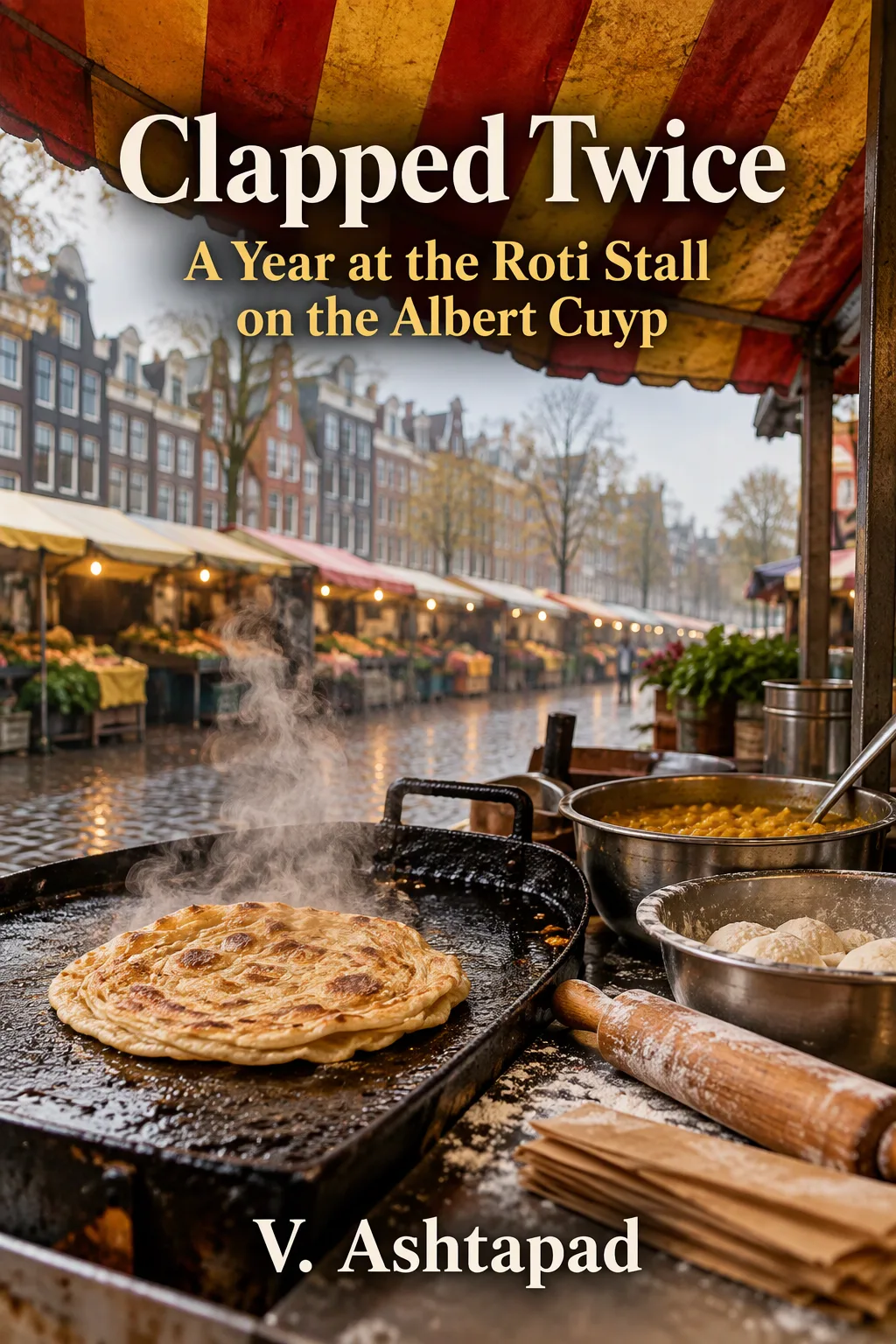
Clapped Twice
A Year at the Roti Stall on the Albert Cuyp
by V. Ashtapad
Foreword
This is a work of fiction. The Albert Cuyp market in Amsterdam is real, and so are Surinamese roti, pom, baithak gana and the ships that carried indentured families from India to Suriname from 1873. Stall 147, its regulars and its family are invented.
For everyone who learned to say please at somebody's counter.
January: The Letter in the Tin
The letter came on the coldest morning of the year, and Shanti Ramdin read it standing behind her griddle at a quarter past seven with her gloves still on, while the first tram of the day went past the end of the market ringing its bell like a bicycle.
It was from the city. It had a blue logo of three Xs on it, and her stall number, and her name spelled wrong, which was how she knew it was official. *Ramdien.* Every letter from the city for twenty-six years had spelled it *Ramdien*. She had stopped correcting them in 2003.
It said, in the polite, cold Dutch that letters from the city always said things in, that the market permits on the Albert Cuyp were being reviewed. That the city wished to bring *new energy and diversity of concept* to the market. That several long-term stalls would be offered for a competitive application process in the autumn. That stall 147, ROTI SHANTI, was among them. That the current holder was welcome to apply.
Under that, in a smaller paragraph, it said that a hospitality group operating eleven locations in the Netherlands and Belgium had expressed interest in a *market format* for the site.
Shanti read it twice. Then she folded it into quarters and put it in the biscuit tin under the counter where she kept the change, the spare gas canister key and a photograph of her mother, and turned on the griddle.
---
The Albert Cuyp market is a street. That is all it is, really: a long straight street in De Pijp, in the south of Amsterdam, between two rows of tall narrow brick houses with white-framed windows and steep steps up to their doors, where every morning except Sunday, since 1905, three hundred stalls go up down the middle of the road and stay until five.
They sell everything. Herring and stroopwafels and cheese in wheels the size of tractor tires. Phone cases and socks and bicycle locks and underwear at three for ten euros. Fabric by the meter from Ghana and from India and from Turkey. Fresh mint by the armful from a Moroccan man who shouts at everyone. Flowers. Olives. Batteries. Turkish bread. Vietnamese spring rolls. Surinamese everything.
And at stall 147, under a striped awning of red and yellow canvas, between a man who sold leather belts and a woman who sold Dutch licorice in forty kinds, there was, and had been since 1999, a roti stall.
It was not a big stall. A long steel counter with a glass front. Behind it, a flat iron griddle, a tawa, as wide as a car tire, over a gas ring. Three big steel pots on burners: chicken curry, potato and long beans, and a pot of split peas cooked down to a yellow paste with garlic. A plastic tub of dough under a damp cloth. A stack of paper plates and a roll of foil. A hand-painted sign along the top of the awning, red letters on yellow, faded now: ROTI SHANTI · SURINAAMSE ROTI · SINDS 1999.
And behind it all, at the griddle, in a wool hat and two cardigans and fingerless gloves, a small round woman of fifty-six with gray in her braid, rolling dough.
---
She had been there since five. She was always there at five.
At five the Albert Cuyp was a different street. It was dark and it was quiet, or as quiet as a street in Amsterdam ever got, and it belonged to the people who built the market every morning out of nothing: the men who unloaded the steel frames from the storage vans and bolted them together down the middle of the road with a clang that echoed off the brick houses, the fish man hosing down his counter, the cheese woman from Edam who drove in every morning in a white van with her wheels stacked in the back like coins, the boy who sold coffee from a cart to the other stallholders and nobody else. They said good morning to each other in Dutch and Turkish and Arabic and Papiamento and Polish, with their breath coming out white, and then they went back to work, and nobody ever said anything more than that before seven, because at five in the morning in January there was nothing more to say.
Shanti unlocked the storage locker behind the belt man's stall, where she kept her griddle and her pots overnight, and wheeled them out one at a time on a hand truck with one squeaking wheel. She lit the gas. She put the pots on to warm: the curry, the potato and long beans, the split peas, all of them made the night before in her own kitchen on the Govert Flinckstraat and carried down the stairs and two streets over in the dark in a shopping trolley with a tartan bag. She took the dough out of its tub and turned it on the floured counter and pressed it with the heel of her hand, and it pressed back, the way it always did, soft and alive and a little cold.
The belt man, whose name was Joop and who was sixty-three and had sold belts on the Albert Cuyp for longer than she had sold roti, put his head around the side of her awning.
"You read it?" he said.
"Read what?"
"The letter." He held up his own, in its envelope with the blue logo. "Mine says belts are not under review. Belts are apparently not a concept." He looked at her. "Yours says what?"
"Mine says roti is a concept," said Shanti, "and they would like a better one."
Joop said a word in Dutch that his mother would not have liked and went back to his belts.
She divided the dough into balls. Forty, to start. She did it without counting, the way she had done it every morning for twenty-six years, a pinch and a twist and a round ball in the palm, set in a row on an oiled tray under a cloth. Her hands knew the size. Her hands knew everything. She had come to Amsterdam at twenty-five with one suitcase and a cousin's address, and she had spent five years cleaning offices in the Zuidas at night before she had saved enough for the griddle, and in all that time, cleaning other people's desks in the dark, she had never once forgotten how a ball of dough should feel in her palm. It was the only thing she had brought with her that did not fit in the suitcase.
The first winter, it had not been enough.
She remembered it every January. December 1999, January 2000, the coldest winter in ten years, the canals frozen so hard that people skated to work, and every morning at five she had stood behind a griddle she had not finished paying for and watched her mother's dough, the dough her hands knew, crack and split and tear on the counter like old paper. She tried warmer water. She tried more oil. She tried wrapping the tub in a blanket and keeping it next to the gas ring, and it went sour. Customers came, and looked at the torn roti, and went away to the Turkish bread man instead. The licorice woman, who did not know her name yet, watched from the next stall and said nothing.
And behind the pots, under the counter, in a laundry basket lined with a blanket, in two sweaters and a knitted hat, a baby slept through all of it, and woke up at seven, every morning, and laughed at the noise of the trams.
That was the winter she learned that a pair of hands can know everything about a thing and still have to learn it again in a new place. She had not liked the lesson. She had liked it even less when she understood that it was not over, and that it would never be over, and that a stall was not a thing you built once but a thing you built again every morning in the dark.
At half past six Wilma came, from the licorice stall on the other side, with two coffees in paper cups, the way she had come every morning since 2004, and put one down on the glass without a word.
"Thank you," said Shanti.
"You look terrible," said Wilma.
"It's January."
"It was January last year," said Wilma, "and you looked fine." She drank her coffee and looked at Shanti over the cup. She was seventy and had sharp eyes and had seen everything on that street at least twice. Then she went back to her licorice and began to lay out the forty kinds in their glass jars, and did not ask again.
---
The first customer came at seven thirty. He always did.
He was a tram driver, a big Ghanaian man in his sixties named Kwame Asante, with gray at his temples and a uniform jacket from the transit company and a voice like a bass drum, and he had bought one roti with chicken and potato from stall 147 at seven thirty every weekday morning since 2006 on his way to the depot.
"Shanti," he said, at the counter, blowing on his hands. "It is cold enough to freeze a man's opinions."
"You have too many anyway," said Shanti, and slapped a round of dough onto the griddle.
It hissed. She turned it with her fingers. It puffed. She brushed it with oil and turned it again and pulled it off and clapped it between her palms, twice, hard, so that the layers inside broke apart and it went soft and flaky, and laid it on a sheet of foil, and spooned curry into the middle, chicken and potato and a long green bean and a spoon of the yellow split peas, and folded the roti over it like an envelope, and wrapped it in foil, and handed it across.
Kwame paid. He did not leave. He looked at her for a long moment over the counter, the way a man looks at someone he has bought breakfast from every weekday for twenty years.
"What is wrong?" he said.
"Nothing."
"You clapped it three times," said Kwame Asante. "You always clap it twice."
Shanti looked at her hands. Then she reached under the counter, into the biscuit tin, and took out the letter, and handed it to him.
© 2026 CRUNOD LLC. All rights reserved.
February: Regulars
Kwame Asante read the letter at the counter of stall 147 with his roti going cold in its foil, and then he read it again, and then he said something in Twi that Shanti did not understand and did not need to.
"*New energy*," he said in Dutch. "*Diversity of concept*." He put the letter down on the glass. "Shanti. You are the diversity of concept."
"Apparently not."
"A *hospitality group*." He said it as if it were a disease. "Eleven locations. They will put a box here. A box with a menu on a screen. They will sell *roti bowls*." He shook his head. "With quinoa."
Shanti did not laugh. She was rolling the next dough. Behind Kwame, three people were waiting, stamping their feet in the cold.
"Apply," said Kwame. "Competitive process. You apply. You win."
"With what? They have lawyers. Marketing. A man who makes videos." She slapped the dough onto the griddle. "I have a griddle and three pots and a sign my nephew painted in 1999."
"You have us," said Kwame Asante.
She looked up.
He picked up his roti and tucked it inside his jacket against his chest to keep it warm, the way he always did.
"Twenty years," he said. "Every morning. You think I come for the roti?" He shook his head. "The roti is very good. But there is a roti stall at the Dappermarkt. There is one in Zuidoost. There is one by Centraal. I could eat roti anywhere." He looked at her. "I come because you ask me how my wife is, and you remember her name, and when she was sick you sent soup. You know my children's names. You know when I am lying." He tapped the glass. "That is what this stall is. It is not a roti stall. It is the one place on my way to work where somebody knows my name."
He went off down the street toward the depot, with the roti inside his jacket and his shoulders up against the cold, and Shanti served the three people stamping their feet, and then the next three, and then the line was gone and she was alone at the griddle in the gray light with the letter lying on the glass where he had put it.
She put it back in the tin.
---
It was a Thursday. That was the strange thing, afterward, that she remembered. If he had said it on a Tuesday she might have forgotten it by the afternoon. But it was a Thursday, and at ten o'clock, the way she had every Thursday since 2001, Mevrouw de Boer came down the street from the house where she was born, slowly, with her shopping bag on wheels and her good wool coat and her hat with the little brooch shaped like a tulip, and stopped at the counter.
"Potato," said Mevrouw de Boer. "No chili."
"I know," said Shanti.
"I always say it," said Mevrouw de Boer, "in case one day you forget."
Shanti made it. Potato and long beans, a spoon of the yellow split peas, no chili, folded in its envelope, wrapped in foil. She watched her own hands do it. She watched Mevrouw de Boer count out the coins from a little purse with a clasp, the exact money, always the exact money, warm from her glove. She looked at the old woman's face under the hat, pale and soft and wrinkled like a winter apple, and she thought: *If they give my stall to a box with a screen, where will she go on Thursdays?*
"You are staring at me," said Mevrouw de Boer.
"I'm sorry."
"Don't be sorry. At my age it is nice to be stared at." She put the roti in her shopping bag, on top of a cauliflower. "Next Thursday."
"Next Thursday," said Shanti.
At noon Hamid came over from his mint stall for his two roti with beans and ate them standing at her counter, as he did every day, in silence, with his eyes closed, the way some men pray. At one Agnieszka came in her dusty boots and asked for extra pepper and said *alsjeblieft* without being reminded and then looked pleased with herself. At two a pair of students from the university came, a boy from Indonesia and a girl from Brazil, and argued over whether roti was bread or a pancake, and asked Shanti to decide, and she said it was neither, it was roti, and they wrote that down in a notebook as if it were important.
At four, when the light was going, the cheese woman from Edam came across with a paper bag of broken cheese ends, the way she did on Thursdays, and traded them for a potato roti, the way she did on Thursdays, and neither of them mentioned money, the way they had not mentioned it for eighteen years. Shanti watched her walk back to her van with the roti in its foil. She had never once asked the cheese woman her first name. It seemed to her suddenly a terrible thing, and she resolved to ask, and did not, because the line came back.
Every one of them she looked at as if she were trying to remember them. As if they were already a photograph in a biscuit tin.
---
That afternoon, when the market was closing, when the rain had come in sideways off the canal and the stallholders were packing up under their dripping awnings and the street was going dark and shiny under the lamps, she counted.
She did it on the back of a paper plate with a ballpoint, the way she did her accounts. Her regulars. The ones who came every week, or every day, or every Saturday since before they had children. She wrote down their names, and where they were from, because that was how she remembered people, by where they came from and what they ate.
Kwame Asante. Ghana. Chicken and potato. Every weekday.
Mevrouw de Boer. Amsterdam, born on this street. Potato only, no chili. Every Thursday since 2001.
Hamid. The mint seller. Morocco. Two roti with beans, for his lunch. Every day the market is open.
Agnieszka. Poland. Builder. Chicken, extra pepper. Since the apartment block went up on the Ferdinand Bolstraat.
Mr. Kartosemito. Suriname, but Javanese, from the other side of the family history. Comes on Saturdays with his grandson and argues with her in Sranan about whose grandmother made better bara.
The students. Too many to count. From everywhere.
The nurses from the hospital, Tuesday and Friday nights.
The Turkish tram conductor who doesn't speak Dutch well and points.
The old Chinese-Surinamese man who orders in Sarnami and laughs when she answers.
Wilma. Licorice. Never eats roti. Comes every morning with coffee anyway.
Joop. Belts. Chicken, no beans, because beans are for horses, he says, every time.
The woman from the cheese stall, Edam. Potato. Pays in cheese.
The cleaner from the Zuidas offices who comes on Fridays and eats standing up, very fast, before her bus.
She stopped at forty-one names. There were more. There were hundreds. But forty-one was what fit on a paper plate.
She looked at it under the light from the licorice stall next door, which stayed open later than everyone, and her eyes stung, and she told herself it was the onions.
© 2026 CRUNOD LLC. All rights reserved.
March: Paramaribo
In March she went home, because her mother was eighty and had said on the telephone that if Shanti did not come for the birthday she would not have another one, which was the kind of thing her mother had been saying since 1994.
Paramaribo in March is ninety degrees and wet, and the air is so thick and green and sweet with rain and rotting mango and diesel and the river that it hits you at the door of the airplane like a wall. Shanti stood at the top of the steps at Zanderij airport in her Amsterdam cardigan with the heat coming up off the tarmac in waves and laughed out loud.
Her nephew Rakesh picked her up in a white pickup with a dented door and drove her the hour into the city, down the long straight road through the forest and the savanna and then the outskirts, the wooden houses on stilts painted green and yellow and pink, the Hindu flags on bamboo poles in the yards, red and yellow and white, snapping in the wind, the Javanese warungs, the Chinese supermarkets, the mosques, the churches, the Creole women selling peanuts on the corners, the dogs, and then the old city on the river, the white wooden colonial houses with their black shutters and their balconies, leaning a little, all of them, as if listening to the water.
Her mother lived in the same house she had lived in since 1962, on a street off the Wanicastraat, a wooden house on short stilts with a veranda and a mango tree and a kitchen at the back that opened onto a yard, where in the yard, under a tin roof, there was a clay hearth.
Her mother was at the hearth when Shanti came in. Of course she was.
To reach the yard, Shanti had to go through the house. Through the front room with its good chairs under plastic covers and its glass cabinet of wedding china that nobody had eaten from since 1971. Past the wall of photographs: her father in his post office uniform, her grandparents at their wedding, stiff and frightened, the aunts as girls, Rakesh as a baby on a cushion, Kavita at her law school graduation in a black gown, which Shanti had sent and had not known her mother had framed. And beside it, in a cheap plastic frame gone yellow in the heat, a page cut from an Amsterdam newspaper in 2009, a small article about the food stalls of the Albert Cuyp, with a photograph of a red and yellow awning and a woman in two cardigans at a griddle, squinting.
Shanti stopped in front of it in the hot dim hallway with her suitcase in her hand.
Her mother had never once mentioned it. Not in sixteen years of telephone calls. Not once.
---
Her name was Sumintra Ramdin, and she was very small and very thin and very brown, in a cotton sari printed with tiny yellow flowers and a pair of men's plastic sandals, with her white hair in a long braid and her reading glasses on a chain, and she was rolling roti.
She did not look up.
"You're fat," she said in Sarnami.
"I'm fifty-six."
"I was not fat at fifty-six." She slapped the dough onto the tawa. "Dutch food. Cheese. Bread. You eat too much bread."
"I eat roti, Ma. Every day."
"Your roti," said her mother, "is not roti. Your roti is Dutch roti. I have heard about it. Your cousin Sunil went to Amsterdam and ate it and came back and said Shanti's roti is very nice, very nice, but the dough is too soft." She turned the roti on the tawa with her fingers. "Too soft. Because of the flour. Dutch flour. And the water. Dutch water. And the cold. You can't make roti in the cold. The dough doesn't know where it is."
Shanti stood in the kitchen doorway in the heat and did not say anything.
Her mother clapped the roti between her palms. Twice.
---
She stayed eleven days. She did not tell her mother about the letter. She did not tell anyone. She ate her mother's roti every morning on the veranda under the mango tree with the parrots screaming in it, and her mother's pom on the Sunday of the birthday, the great Surinamese party dish, a casserole of grated pomtajer root baked with chicken and citrus and onion and so much butter it glistened, a dish that had come from the old Jewish families of Suriname two hundred years ago and been taken up by everyone, Creole and Hindustani and Javanese and Chinese, until there was no Surinamese birthday without it. Forty relatives came. They sang the old songs on the veranda at night, baithak gana, the songs her great-grandparents had brought from Bihar and Uttar Pradesh on the ships in the 1870s and 1880s, with a dholak drum and a harmonium and the little brass cymbals, the songs that were not quite Indian anymore and not quite anything else, that had grown up in Suriname like the mango trees, from a seed carried in somebody's pocket.
---
On the ninth day Rakesh took her to the Centrale Markt.
It stood on the waterfront by the Suriname River, a huge old market hall with a tin roof and open sides, and inside it was everything the Albert Cuyp was and louder. Fish laid out on ice, river fish and sea fish, with their eyes still bright. Mountains of long beans, bitter gourds, okra, tayer leaves, peppers in every shade from green to a red so deep it was almost black. Heaps of cassava, of pomtajer root for the pom, of plantains and sweet potatoes and dasheen. Women selling cooked food from steel pots under the eaves, roti and bami and saoto soup and pom on paper plates, calling out to everyone who passed, in Sranan and Sarnami and Javanese and Dutch, sometimes all four in the same sentence.
Shanti stood in the middle of it and felt the noise go into her like heat.
"You miss it," said Rakesh. He was thirty-four, her eldest sister's son, a big soft-spoken man who drove a truck for a rice company and had never once in his life been to Europe.
"I miss the noise," said Shanti. "Amsterdam is loud, but it is a different loud. It's bicycles. Trams. It's people being polite very loudly." She watched an old woman at a roti pot under the eaves slap a dough onto her tawa and turn it with her fingers. "Here everyone is shouting because they're happy."
"Here everyone is shouting because the price of rice went up," said Rakesh.
They bought pomtajer for the birthday, a whole sack of it, and a bag of the small hot peppers that you could not get in Amsterdam no matter what anyone told you, and Rakesh carried it all on his shoulder through the crowd.
At the roti pot under the eaves, Shanti stopped. The old woman there was perhaps seventy, in a faded cotton dress, with a towel around her neck against the heat. She had a tawa, three pots and a stack of paper plates. Nothing else. No sign.
"How long have you had this place?" Shanti asked her, in Sarnami.
The woman looked at her. Looked at her Amsterdam cardigan, which she had tied around her waist, and her Amsterdam shoes.
"Forty-one years," she said. "Why?"
"No reason," said Shanti.
"Everyone has a reason," said the woman. "You want one?"
Shanti bought one. She ate it standing in the market hall with the river glittering through the open side of the building and the fish man shouting and the rain beginning, warm and sudden, on the tin roof above her like a drum. The dough was harder than hers. Thinner. It cracked a little at the edges when she folded it. It tasted of this place, of the heat and the river and the old woman's hands, and it was very good, and she stood there with the curry running down her wrist and thought that there were probably women like this one at every market in the world, at a tawa or a wok or a grill or a pot, who had stood in the same place for forty years, and that one day a young man with a tablet would come for every one of them.
"Ma's is better," said Rakesh, on the way out, under his breath.
"Don't tell her," said Shanti. "I'm sure she knows."
---
On the night of the birthday, when the pom was eaten and the cake was eaten and the children had been put to bed in heaps on the mattresses in the back rooms, the aunts sang.
There were five of them, her mother's sisters and cousins, all of them over seventy, in cotton saris and cardigans against what they called the cold, which was twenty-six degrees, and they sat in a row on the bench along the veranda wall with the harmonium on a stool in front of them and Rakesh's father on the dholak, and they sang the old songs from the ships. Shanti knew every one. She had not sung them in thirty years. She sat on the steps below the aunts with her back against the post and found that her mouth knew the words before she did, the way her hands knew the dough. Songs about leaving a village. Songs about a river that was not this river. A wedding song, a teasing one, in which the bride's family insults the groom's family in rhyme, and all the aunts laughed at the same line they had laughed at for sixty years.
At the end, her mother's youngest sister, Auntie Leela, who was seventy-two and had the loudest voice in the family, leaned down from the bench and tapped Shanti on the head with her fan.
"Your girl," she said, in Sarnami. "The lawyer. Does she sing these?"
"She doesn't speak Sarnami, Auntie."
"I didn't ask if she speaks it. I asked if she sings it." Auntie Leela fanned herself. "My grandson in Rotterdam doesn't speak one word. He sings every song. He learned them from a tape I sent him when he was four. He thinks they're about football." She laughed, enormously. "Songs don't need you to understand them. They just need you to open your mouth."
Shanti thought of Kavita at fourteen in the apartment on the Govert Flinckstraat, with her headphones on and her door shut, and said nothing.
"Bring her," said Auntie Leela. "Next birthday."
"Ma says there won't be a next birthday."
"Your mother," said Auntie Leela, "has been saying that since 1994. She will bury all of us. Bring the girl."
---
On the last night, when the relatives had gone, her mother sat beside her on the veranda in the dark with a glass of sweet tea.
"Something is wrong," said Sumintra Ramdin.
"Nothing is wrong."
"You clapped the roti three times this morning," said her mother. "You always clap it twice. I taught you."
Shanti put her face in her hands.
© 2026 CRUNOD LLC. All rights reserved.
April: The Dough
Her mother did not say anything for a long time after Shanti told her. She sat on the veranda in the dark with her sweet tea and listened to the frogs in the ditches and the radio from the house next door playing a Bollywood song from the seventies and, far off, the river.
Then she got up and went into the kitchen, and came back with a bowl.
"Show me," she said.
"Show you what?"
"Your dough. Amsterdam dough. The too-soft one. Make it."
So at eleven o'clock at night, in her mother's kitchen in Paramaribo, under a bare bulb with moths around it, Shanti made her dough. The way she made it every morning at five at the market in Amsterdam: flour, a little baking powder, salt, water, kneaded, rested, divided into balls, each ball rolled out and spread with a little oil and folded and coiled and rested again.
Her mother watched every move.
She watched the way she had watched when Shanti was six and seven and eight on the low stool by the hearth: without a word, with her arms folded, with her head a little on one side like a bird looking at something it has not decided whether to eat. Shanti felt it on the back of her neck. Fifty-six years old, with a stall in Amsterdam and twenty-six years of hygiene certificates in a drawer, and her hands were sweating on the dough because her mother was watching. She nearly laughed. She did not. Her mother would have asked what was funny, and there was no answer to that which her mother would have accepted.
When Shanti had made six balls, her mother picked one up and squeezed it between her fingers.
"Soft," she said.
"It has to be. Ma. The flour there is different. The water is different. The cold. If I make it like yours, it cracks. It tears. I tried for two years. In 1999. In 2000. Every morning it tore. The customers complained. I had to change it."
Her mother squeezed the dough again.
"So you changed it," she said.
"I had to."
Sumintra Ramdin put the dough down. She looked at her daughter for a long time under the bare bulb.
"My grandmother," she said, "came on a ship from Calcutta in 1882. To the plantations. Mariënburg. She brought her rolling pin. She brought a bag of flour from her village. The flour ran out in a month. She had to use plantation flour. It was terrible. Full of weevils. The water was bad. The heat was worse than India. Her roti tore every morning. For two years." Her mother picked up the dough again. "So she changed it. She added a little more water. A little baking powder, when she could get it. She rested it longer. And it became Surinamese roti. Not Indian. Not Bihari. Ours." She put the dough in Shanti's hands. "And then her daughter changed it a little. And her daughter. And me. And now you."
Shanti looked at the dough.
"Your roti is not too soft," said her mother. "Your roti is Amsterdam roti. It knows where it is." She sat down. "Cousin Sunil is an idiot. He was always an idiot. Make me one."
---
Shanti made her one, in her mother's kitchen, on her mother's tawa, at midnight. She clapped it twice.
Her mother ate it on the veranda in the dark, slowly, with nothing in it, just the roti, tearing off pieces with her thin brown fingers.
"Hm," she said, at the end.
"Hm what?"
"Hm, it's good," said Sumintra Ramdin. "Don't tell Sunil."
---
She did not sleep. She lay under the mosquito net in the small back room where she had slept as a girl, with the fan turning and the frogs going and the smell of the yard coming in through the shutters, and listened to her mother moving in the next room, and at five, when the first gray came up behind the mango tree, she heard her mother go out to the hearth.
Shanti went out after her, in her nightdress, barefoot on the cool concrete.
Her mother was lighting the fire. She did it the way she had always done it, with a twist of newspaper and three sticks of wood laid in a triangle and a single match, and she blew on it, softly, until it caught. She did not look up.
"Sit," she said.
Shanti sat on the low wooden stool by the hearth that had been hers when she was six, which was much too small for her now, so that her knees came up nearly to her chin.
Her mother took the bowl of dough from under its cloth, the dough she had made the night before, her own, the hard Paramaribo dough, and pinched off two balls, and gave one to Shanti, and kept one, and rolled hers out on the board with her old rolling pin, the ordinary one, the one from the shop in the Wanicastraat. And Shanti rolled hers out beside her on the other end of the board, and for a while the two of them did not talk at all. The fire crackled. A rooster somewhere in the next yard began, and stopped, and began again.
"When you were small," said her mother, "you rolled them like this." She made a lump with her hands. "Like a potato. Every one. For a whole year. I thought you would never learn."
"I learned."
"You learned when you stopped trying so hard." Her mother laid her dough on the tawa. "You were seven. One morning you were tired, and you were angry with me about something, I don't remember what, and you rolled one without looking, and it was perfect. Round like the moon." She turned the roti with her fingers. "Your hands knew before you did. That is how it always is."
She pulled the roti off and clapped it. Twice.
"I am eighty," said Sumintra Ramdin. "I can't come to Amsterdam and fight the city for you. I can barely go to the Centrale Markt." She put the roti on a plate. "But you are not alone at that stall. You know that. I am there. My mother is there. Her mother is there. Every time you clap it twice." She looked at her daughter across the hearth in the gray light. "We are very stubborn women. Use it."
Shanti laid her own roti on the tawa. She turned it. It puffed. She pulled it off and clapped it between her palms, twice, and the layers broke open inside, soft and flaky, and her mother took it from her hands and looked at it and tore a piece off and ate it.
"Too soft," said her mother, and smiled for the first time in eleven days.
---
On the morning she left, at the airport, her mother gave her a plastic bag. In it, wrapped in a cotton cloth, was a rolling pin. Old, dark, worn thin in the middle and smooth as glass, with a crack along one end that someone had once bound with wire.
"My grandmother's," said her mother. "From the ship."
"Ma. I can't."
"You can," said her mother. "And when you get back, you tell the city it came on a ship from Calcutta in 1882. You tell them that is the diversity of concept."
© 2026 CRUNOD LLC. All rights reserved.
May: The Hospitality Group
The hospitality group came to the market in May, on a Tuesday, in the form of a young man named Bas.
He was thirty, perhaps, tall and fair and very friendly, in a navy jacket and white sneakers so clean they looked like they had never touched a street, and he walked the length of the Albert Cuyp at eleven in the morning with a tablet and a young woman taking photographs, stopping at every food stall, smiling, taking notes.
He stopped at stall 147.
"Roti Shanti," he said, reading the faded sign. "Since 1999. That's amazing." He held out his hand. "Bas. From Groep Vijftien. We're doing some research on the market."
Shanti wiped her hands on her apron and did not take his.
"You want my stall," she said.
Bas's smile did not move. He had been trained, she could see, by someone very good. "We're interested in the site, yes. If it becomes available. Through the city's process." He looked at the griddle, the pots, the dough under its damp cloth. "Honestly, we love what you do. Surinamese food is so important to Amsterdam. That's actually why we're interested. We'd want to honor that. Bring it to a new audience."
"What new audience?"
"Younger. More international. Tourists." He gestured with the tablet. "We'd do a modern concept. Roti wraps, roti bowls. Plant-based options. A few fusion items. Clean, fast, consistent. QR ordering." He smiled. "And we'd want to work with traditional Surinamese cooks on the recipes. Maybe even you, if you're interested in a consulting role."
Shanti looked at him for a long time.
Behind him, at the counter, Hamid the mint seller had come over from his stall with an armful of mint and was standing very still, listening. So was the licorice woman. So was Agnieszka the builder, who had come for her lunch in her dusty boots and hard hat.
"Bowls," said Shanti.
"Bowls are very popular."
"With quinoa?"
Bas brightened. "We've actually tested a quinoa base. It does very well."
Hamid made a sound like a kettle.
Bas did not seem to hear it. He looked at the griddle, where the round of dough was puffing, and his face did something that was not in his training.
"Could I," he said, "actually try one?"
Shanti looked at him. Then she made him one. Chicken and potato and long beans and the yellow split peas, the way she made it for Kwame Asante at seven thirty every weekday morning, and folded it into its envelope, and wrapped it in foil, and held it out across the glass, and did not let go of it.
Bas waited. Then he understood. He was Dutch; he knew the word.
"Alsjeblieft," he said.
She let go.
He ate it standing at the counter, in his navy jacket, carefully, bending forward so the curry would not drip on his white sneakers, while the young woman with the camera took a photograph of him eating it and he waved at her to stop. He ate the whole thing. He did not say anything until the end. Then he wiped his fingers on a paper napkin and looked at the foil in his hand for a while.
"My grandmother had a neighbor in Rotterdam," he said. "Surinamese. Miss Doris. When I was small, she made these for us on Sundays." He folded the foil into a small square. "I'd forgotten that. I haven't thought about her in twenty years."
"What happened to her?"
"I don't know," said Bas. "She moved. We moved." He looked at the griddle. "Ours won't taste like this. I know that. I'm not stupid. But they'll taste like something, and they'll be in eleven cities, and a lot of people who never had a Miss Doris will eat one." He put a five-euro note on the counter, which was more than the roti cost, and when she pushed the change toward him he did not take it. "That's the honest version. I thought you should have the honest version."
"Thank you for the honest version," said Shanti.
He nodded, and walked away down the street with his photographer, and at the cheese stall he stopped and looked back, once, at the red and yellow awning, and then he went on.
---
When Bas had gone, with his tablet and his photographer and his clean sneakers, Hamid put down his armful of mint on the glass counter of stall 147 and leaned on it.
"Shanti," he said. "I have been selling mint on this street for thirty-four years. Next to you for twenty-six. I have never once said anything about your food."
"I know."
"Today I say something." He tapped the counter. "That boy wants to put a box here. A clean box. With a screen. And he wants you to *consult*." He spat the word out like a seed. "You know what consult means? It means they pay you one time to take your recipe, and then they make it with frozen chicken and a machine, and they put a picture of a grandmother on the wall, and you go home."
"I know what it means."
"So what will you do?"
Shanti did not answer. She rolled out a dough. She slapped it on the griddle. She looked at the line of people waiting, longer than usual, because the market was busy, because it was May and the sun was out and the tourists had come.
"I'm going to apply," she said.
"With what?"
Shanti reached under the counter and took out the paper plate with forty-one names on it, and put it on the glass beside the mint.
"With them," she said.
© 2026 CRUNOD LLC. All rights reserved.
June: Forty-One Plates
She did it with paper plates because that was what she had.
Every customer who came to stall 147 in June got their roti on a paper plate, the way they always had, and then, when they had paid, Shanti gave them a second plate. An empty one. And a pen. And she asked them to write on it.
Not much. Just one thing. *What is this stall to you?*
She did not explain why. Some of them asked. She told them the truth: that the city was reviewing the stall, that a company wanted it, that she was going to apply to keep it, and that she wanted the city to know who ate here. Some of them laughed. Some of them got angry. Most of them took the pen.
---
Some of them took it very seriously.
Kwame Asante took his plate and his pen on the first Monday in June and did not write anything. He put them inside his jacket next to the roti and went to work. On Tuesday he came back and asked for another plate, because, he said, he had made a mistake on the first one. On Wednesday he asked for a third. On Thursday he came at seven thirty with the plate already written, on both sides, folded in half, and held it out over the counter and said, "You do not read it in front of me," and walked off to the depot so fast he forgot to put his roti inside his jacket.
Mevrouw de Boer took her plate home in her shopping bag, beside the cauliflower, and brought it back the next Thursday in a plastic sleeve so it would not get wet.
Hamid would not write anything at all. "I sell mint," he said. "I do not write." Then, on the last Friday of the month, he came over at the end of the day and put a plate down on the glass with one line on it in Arabic and one in Dutch, and the Dutch said, *I have eaten here every day for twenty-six years and I am not dead yet, which is a good recommendation*, and he would not tell her what the Arabic said.
Agnieszka needed three plates and wrote in Polish, very fast, pressing so hard the pen went through.
The students wrote in English, in German, in Spanish, in Korean, in a language from Eritrea that Shanti had never seen written down, and drew pictures in the margins, and one of them wrote a poem that rhymed *roti* with *naughty*, which she decided not to think about.
On Fridays there were more people than usual. There were always more people on Fridays. She gave them all a plate. She did not look at who wrote what. There was a man, some Fridays, at the end of the line, in a clean gray jacket, who always paid with exact change and always said *thank you* in a soft voice, and there was a young woman with a baby, and an old man with a dog, and a woman in a cleaner's uniform from the offices in the Zuidas, and she gave every one of them a plate and a pen and did not watch them write.
Wilma kept the finished ones for her, under the licorice stall, in the cardboard boxes her licorice came in, because the biscuit tin was too small.
"Six boxes," said Wilma, on the last Saturday. "People have a lot to say about a roti."
"They're not saying it about the roti," said Shanti.
"I know," said Wilma. "I read some." She did not look sorry. "I'm seventy. I'm allowed."
---
In the third week of June she went to the city's market office to collect the application form.
It was on the second floor of a building on the Ferdinand Bolstraat, above a phone shop, and she went at half past five, after the market had closed, still in her two cardigans and her apron, because she did not think to take the apron off until she was on the stairs. There was a waiting room with eight plastic chairs and a ticket machine and a screen that showed numbers. She took a ticket. Number 41. She looked at it for a long time, and then she sat down and waited for the screen to show it.
The clerk was a young man with a beard and a lanyard. He typed her stall number into his computer and looked at the screen and said, "Mevrouw Ramdien."
"Ramdin," said Shanti.
"It says Ramdien here."
"It has said Ramdien there for twenty-six years," said Shanti. "It has always been wrong."
The young man looked at her. Then he looked at the screen. Then, to her great surprise, he clicked on something and took out the e, and turned the screen a little so that she could see it.
"Like that?" he said.
"Like that."
"I can change it here," he said, "but I don't think it changes it everywhere. The letters come from a different system." He looked embarrassed. "I'm sorry. It's a big city."
"It's all right," said Shanti, and found that she meant it. She had expected to be angry, the way she was always a little angry at the city, and instead she sat in the plastic chair across the desk from a young man who had fixed the one thing he could fix, and felt, for the first time since January, that the city was not a building or a logo with three Xs but a great many people at desks, some of whom would try.
He printed the form. It took a long time. It was forty pages. He put it in a cardboard folder and handed it across, and then he looked at her apron, which had curry on it, and said, "You're the roti stall. By the licorice."
"Yes."
"My girlfriend is a student. She says you made her decide whether roti is bread or a pancake."
"It's neither," said Shanti.
"That's what she said you said." He smiled. "Good luck, Mevrouw Ramdin."
She carried the folder home under her arm and put it on top of the refrigerator in the kitchen on the Govert Flinckstraat, and did not open it, and did not look at it again until her daughter took it down in July.
---
By the end of June she had six hundred and twelve plates.
---
She read them at night, in her apartment on the third floor of a narrow brick house on the Govert Flinckstraat, two streets from the market, at the kitchen table, with a cup of tea and her mother's grandmother's rolling pin lying on the table beside her like a cat.
Some of them were very short.
*Best roti in Amsterdam.*
*Lunch.*
*My Saturday.*
Some of them were long. Written small, crowded to the edges, on both sides of the plate.
Mevrouw de Boer, eighty-four, born on this street, who had bought one roti with potato and no chili every Thursday since 2001, wrote that her husband had died in 2009 on a Wednesday and that on the Thursday she had come to the market anyway, because she did not know what else to do, and stood at the counter of stall 147, and Shanti had looked at her face and not asked what was wrong, only given her the roti and refused to take money, and come around the counter and held her for a long time in the middle of the street, and that she had never forgotten it.
A student from Nigeria wrote that it tasted like his aunt's cooking in Lagos, which made no sense, and he didn't care.
Agnieszka the builder wrote, in Polish, which Shanti had to have her neighbor's son translate, that she had come to Amsterdam alone at forty to work on building sites and had not known one word of Dutch, and that the first Dutch word she learned was *roti*, and the second was *Shanti*, and the third was *alsjeblieft*, please, because Shanti made her say it every time before she handed over the food, until she could.
Mr. Kartosemito, the Javanese-Surinamese man who came on Saturdays with his grandson and argued with her about bara, wrote in Sranan Tongo that she was wrong about the bara and always would be, and that his grandson, who was born in Amsterdam and spoke only Dutch, had learned his first words of Sranan at this counter, arguing with her, and that he wanted the city to know that this was where his grandson learned to argue in his grandmother's language.
A nurse wrote that on the night shift she thought about the Tuesday roti.
A tram conductor drew a picture. A tram, and a stall, and a heart, and nothing else.
Kwame Asante's plate, the one he had written three times, the one she was not to read in front of him, said, in big careful capitals, as if he were writing on a blackboard:
*MY WIFE WAS IN THE HOSPITAL FOR SIX WEEKS IN 2014. EVERY DAY I DROVE THE TRAM AND EVERY DAY I THOUGHT SHE WOULD DIE. EVERY MORNING SHANTI GAVE ME A ROTI AND A SOUP FOR HER IN A JAR AND SAID, TELL ABENA IT IS FROM ME. ABENA DID NOT DIE. ABENA SAYS THE SOUP IS WHY. I DO NOT KNOW ABOUT THAT. I KNOW THAT FOR SIX WEEKS THIS WAS THE ONLY PLACE IN AMSTERDAM WHERE I DID NOT HAVE TO BE BRAVE.*
And under that, smaller, on the back:
*Also the roti is very good. Do not let it go to your head.*
Wilma's plate was in the fourth box, near the bottom, with no name on it, but Shanti knew the handwriting from twenty-six years of price labels on licorice jars. It said: *I have watched you every morning for twenty-six years and you have never once been late. Neither have I. Somebody has to keep the street honest.*
And one plate, without a name, in very neat handwriting, said only:
*I was homeless for two winters on this street. You fed me every Friday and never once asked me why. I have a job now. I have an apartment. I come every Friday and pay. You don't know which one I am. That's all right.*
Shanti put that one down on the table beside the rolling pin and sat in her kitchen and cried for a long time.
© 2026 CRUNOD LLC. All rights reserved.
July: The Daughter
Her daughter came on the first Sunday in July, which was unusual, because Kavita came on the last Sunday of every month, and never on the first.
Kavita was twenty-eight. She was a lawyer. She worked for a big firm in the Zuidas, the business district in the south of the city, in a glass tower where everyone wore dark suits and nobody ate lunch. She had grown up in the apartment on the Govert Flinckstraat and in the back of stall 147, doing her homework on an upturned crate behind the pots, and she had decided at the age of fourteen, Shanti knew, that she would never, ever, as long as she lived, make roti for a living.
She did not speak Sarnami. She understood it, a little. She answered in Dutch. She had stopped coming to the market when she was sixteen. She said the smell of curry got in her hair.
On the last Sunday of every month Kavita came for lunch, at one, and left at three, and in between they ate at the kitchen table on the Govert Flinckstraat and talked about safe things. Kavita's work, which Shanti did not understand. The weather. Kavita's apartment in Amstelveen with the balcony that got no sun. The cousins in Paramaribo, whom Kavita had met twice. Shanti made dal and rice and a chicken curry and roti, always roti, and Kavita ate everything on her plate and said it was good and checked her phone under the table when she thought her mother was not looking.
They loved each other. Shanti never doubted that. They loved each other the way two people love each other across a river, waving.
In June, on the last Sunday, Kavita had looked up from her phone in the middle of lunch and said, "Ma, why are there paper plates in the hallway?"
And Shanti had said, "For the stall," which was true, and Kavita had nodded and gone back to her phone, and that was all.
---
She came into the apartment on the first Sunday in July without knocking, the way she always did, in jeans and a white shirt, with her phone in her hand, and stopped in the kitchen doorway.
The kitchen table was covered in paper plates.
All six hundred and twelve of them. In stacks. Sorted. Some with tape on them. Some with notes stuck to them in Shanti's handwriting. And in the middle, the rolling pin.
"Ma," said Kavita. "What is this?"
---
Shanti told her. All of it. The letter in January. The hospitality group. Bas and his bowls. Paramaribo. Her grandmother's grandmother's rolling pin. The plates.
Kavita listened standing up. She did not sit down. She did not interrupt. Her face did the thing it did at work, Shanti imagined, when a client was telling her something they should have told her six months ago.
Once, while Shanti was talking about Bas and the quinoa, Kavita's eyes went past her mother's shoulder to the top of the refrigerator, where a cardboard folder from the city's market office lay under a bag of onions, unopened, with its corner curling in the heat. Shanti saw her see it. Kavita did not say anything. She only looked at it for a long moment, the way her mother had looked at the dough in Paramaribo, and then looked back, and went on listening.
When Shanti was finished, Kavita said, "The application deadline is the fifteenth of September."
"I know."
"Have you started it?"
"I have the plates."
Kavita closed her eyes.
"Ma," she said. "The plates are beautiful. The plates are—" She stopped. She picked one up. It was Mevrouw de Boer's. She read it. She put it down. She picked up another, and read it, and put it down, and another, and her face changed, slowly, the way dough changes on a hot griddle. "The plates are not an application. The city has a form. Forty pages. A business plan. Financial projections. Hygiene certificates. A *concept statement*." She said it the way Hamid had said *consult*. "And they score it. With points. Groep Vijftien will have a team of six people on that form. They'll have a designer. A *consultant*." She looked at her mother. "You can't win this with paper plates."
"Then what?"
Kavita looked at the plates for a long time.
Then she pulled out a chair and sat down at the kitchen table and took off her watch and put it on the table beside the rolling pin.
"With paper plates," she said, "and me."
© 2026 CRUNOD LLC. All rights reserved.
August: Concept Statement
They wrote it at the kitchen table on the Govert Flinckstraat every night in August, after Kavita came home from the glass tower at nine or ten or eleven, still in her dark suit, with her laptop and a bag of the takeaway sushi she ate because she never had time to eat anything else, which Shanti threw in the bin and replaced with a roti every time without saying a word.
The business plan was easy, Kavita said. Twenty-six years of accounts on paper plates in a biscuit tin was a business plan. She typed it up. The hygiene certificates were in a folder in the drawer, every one since 1999, never once a failed inspection.
"Never once?" said Kavita, turning the pages.
"Never once."
"Ma, everybody fails once. The fish man failed in 2011. It was in the newspaper."
"The fish man," said Shanti, "keeps his ice in a bucket he also uses to wash his van." She took the folder and turned to 2006. "This one. The inspector was a young man with a little thermometer on a string. He put it in every pot. He looked under the counter. He looked in the biscuit tin. Then he looked in the basket." She smiled. "You were eight. You were sitting in the basket, because you liked it even when you were too big for it, doing your homework. He asked you if your mother washed her hands. You said, *Every time, and she makes me do it too, and it's very annoying.* He wrote that down. On the form. Under comments." She found the line and turned the folder around. "There."
Kavita read it. *Child confirms handwashing protocol. Child finds it annoying.*
She put her hand over her mouth.
"I'm putting this in the application," she said. "Annex seven."
The financial projections Kavita did herself, at two in the morning, with a spreadsheet and a calculator and a great deal of swearing.
On one of those nights, at the end of the first week, they had a fight.
It began with a number. Kavita was going through the biscuit tin, the accounts, the paper plates with twenty-six years of sums on their backs in ballpoint, and she stopped at 2013 and turned the plate over twice and said, "Ma, what happened in 2013?"
"Nothing happened."
"Your income went down by a third. For two years."
"The gas went up," said Shanti. "The rent on the locker went up. The market was being dug up for the metro line. Nobody could get down the street." She was washing a pot at the sink. She did not turn around. "It was a bad two years. Then it was fine."
"You didn't tell me."
"You were fifteen."
"I was fifteen and I was eating your roti every night for dinner and you didn't tell me we couldn't pay the rent." Kavita put the plate down very carefully on the table. "And in January you got a letter that said they might take the stall away, and you didn't tell me for six months. You told Kwame. You told Grandma. You told the mint man. You didn't tell me."
"You have your own life."
"I'm a *lawyer*, Ma. This is literally the only thing in the whole world I know how to help with."
Shanti turned around from the sink with the pot in her hands and the water running.
"You said the curry got in your hair," she said.
It came out much harder than she had meant it to. It came out the way it had been sitting in her chest for twelve years. Kavita looked at her across the plates.
"I was sixteen," she said.
"I know how old you were."
"I was sixteen, and a boy in my class said I smelled like a takeaway, and I went home and stood in the shower for an hour." Kavita's voice was very steady, the lawyer's voice, which was how Shanti knew it was costing her something. "And I never came back to the market, because I was sixteen and stupid, and then I was twenty and busy, and then I was twenty-five and it had been so long that I didn't know how to come back without it being a whole thing." She looked down at the plates. "And then I read six hundred and twelve of these. And every one of them is about somebody who came to your counter and you knew their name. And I'm your daughter, and I didn't come."
Shanti turned off the tap.
She put the pot down on the draining board and dried her hands on the towel and came and sat down at the table across from her daughter, among the plates, with the rolling pin between them, and for a long time neither of them said anything at all. Outside, a tram went past on the Ferdinand Bolstraat.
"It's a whole thing," said Shanti finally. "Coming back. You're right. It's always a whole thing."
"I know."
"I came back to my mother in March for the first time in four years. She said I was fat."
Kavita laughed, wetly, and wiped her eyes with the heel of her hand.
"You're not fat," she said.
"I know I'm not fat," said Shanti. "Do the numbers. I'll make tea."
The concept statement took three weeks.
The first week they did not write it at all. They read.
Kavita read every plate. All six hundred and twelve. She read them the way she read contracts, Shanti thought, with a pencil, slowly, making small marks in the margins, and she sorted them into piles on the kitchen floor with sticky notes on top in her neat lawyer's capitals. *FAMILY. LANGUAGE. WORK. ILLNESS. FIRST YEAR IN NL. CHILDREN. KINDNESS.* The kindness pile was the tallest. It kept falling over. In the end she gave it its own chair.
Some of them she could not read. Those she took to work. A colleague from Seoul read the Korean ones in a meeting room at lunch and came back to Kavita's desk afterward, Kavita said, with her eyes red, and asked where this roti stall was. A cleaner in the glass tower read the Tigrinya one, and the Spanish ones went to a junior associate from Bogotá, and the Arabic line on Hamid's plate went to a security guard in the lobby, who read it twice and laughed and would not translate it either, and said only, "This man loves your mother very much and would die before he told her."
"Hamid," said Shanti.
"Hamid," said Kavita.
For the Sranan plates she called Mr. Kartosemito herself. On a Wednesday night, at ten, on speakerphone, at the kitchen table, with the plate in front of her. He was delighted. He read his own plate aloud to her in Sranan, slowly, and then explained every word in Dutch, and then told her that she was wrong about the bara as well, because she was her mother's daughter, and they argued about it for twenty minutes, Kavita in Dutch and Mr. Kartosemito in Sranan, until Kavita was laughing so hard she had to put her head on the table.
Shanti stood at the stove with her back to them and listened, and did not turn around, because she did not want her daughter to see her face.
After the call, Kavita sat for a long time with the plate in front of her.
"He said I used to sit on a crate behind the pots and tell him he was wrong about everything," she said. "When I was six. In Sranan. He said I was very rude."
"You were very rude."
"I don't remember speaking Sranan."
"You didn't speak it," said Shanti. "You argued in it. It's different." She put a roti on a plate in front of her daughter. "Eat."
---
"They want a *concept*," said Kavita, at midnight, on the second Thursday, with her head on the table. "What's the concept? *Roti.* That's the concept. A woman makes roti. People eat it."
"That's not a concept?"
"It's not a *concept* concept." Kavita lifted her head. "Groep Vijftien's concept is going to be like, *a contemporary reimagining of Surinamese street food culture for a new generation of urban diners*. With a mood board."
Shanti did not know what a mood board was. She did not ask.
She sat at the table across from her daughter, with the plates stacked around them and the rolling pin between them and the window open to the warm August night, the sound of bicycles going past in the street below, a couple laughing, a tram bell, far off, from the Ferdinand Bolstraat.
"Can I tell you something?" she said.
Kavita looked at her.
"In 1999," said Shanti, "when I started the stall, you were one. You were in a basket. Behind the pots. Under the counter. In the cold. I put you in two sweaters and a blanket and a hat and you slept in the basket and the customers leaned over the counter to look at you." She smiled. "Kwame Asante used to sing to you. In Twi. Every morning. He thought you couldn't hear him over the griddle. You laughed every time."
Kavita did not say anything.
"When you were three," said Shanti, "Mevrouw de Boer taught you to count in Dutch. With the change. In the biscuit tin. *Een, twee, drie.* When you were five, Hamid taught you to say *mint* in Arabic. When you were seven, Mr. Kartosemito taught you a song in Sranan, a rude one, and I was very angry, and you sang it at school." She laughed, a little. "You learned to talk at that stall. In four languages. Five. You learned to talk to everyone."
Kavita's eyes were very bright.
"That's the concept," said Shanti. "Not roti. A place where a little girl in a basket learned to talk to everyone. That's what the stall is. That's what the plates say." She touched the stack of plates. "Six hundred and twelve people, from everywhere, who learned to say *please* in Dutch at my counter. Or argue in their grandmother's language. Or got fed for two winters and never asked why." She looked at her daughter. "Write that."
Kavita looked at her mother for a long time across the kitchen table.
Then she opened her laptop, and typed, and did not stop until four.
© 2026 CRUNOD LLC. All rights reserved.
September: The Hearing
The city held the hearing for the Albert Cuyp market permits on the twenty-second of September in a meeting room on the fourth floor of the Stadhuis, the city hall on the Amstel, a big modern building of white stone and glass beside the old opera house, with a view of the river and the bridges and the houseboats, and a long table with six members of a committee behind it, and a screen.
---
Shanti had not closed the stall on a market day since Kavita was born.
She closed it that morning. She came at five anyway, out of habit, and stood in the dark in front of the locker behind Joop's belts with the key in her hand and did not open it. Then Wilma came, early, with two coffees, and took the key out of her hand.
"I'll put up your awning," said Wilma. "So nobody thinks you've gone. I'll tell everyone you're at the Stadhuis. I'll tell them which floor."
"Wilma."
"Go home and put on your good clothes," said Wilma. "Your good ones. Not the brown thing."
So Shanti went home and put on her good clothes, which were a dark green dress she had bought for a cousin's wedding in 2017 and a black coat and her mother's gold earrings, and stood in front of the mirror in the hallway of the apartment on the Govert Flinckstraat and looked at a small round woman of fifty-six who did not look like herself at all. Then she put her grandmother's grandmother's rolling pin in her handbag, wrapped in its cotton cloth, because she did not know what else to bring.
Kavita came at noon in a taxi with the four cardboard boxes of plates already in the back. She was in her darkest suit. She had taken the day off, she said, which she had never done in six years at the firm, and her phone had been ringing since eight, and she had turned it off, and she said this the way another person might have said she had set fire to her car.
They did not talk in the taxi. They sat in the back with the boxes between them and watched the city go past the window, the canals and the bridges and the bicycles and the tall brick houses with their hoisting beams under the gables, and when the taxi went over the bridge onto the Amstel and the white stone and glass of the Stadhuis came up on the right, Kavita reached over the boxes and took her mother's hand, which she had not done since she was eleven, and held it until they stopped.
The corridor on the fourth floor was long and gray and smelled of floor polish. There were plastic chairs along one wall. Groep Vijftien was already there, at the far end, six of them, with a large flat case for a screen and a man in a scarf talking quietly into his phone. Bas was with them. He saw Shanti and lifted one hand, a little, and she lifted hers back, a little, and then they both looked away.
"Ma," said Kavita, very quietly, "what's in your bag?"
"Nothing."
"Ma."
Shanti opened the bag and showed her. Kavita looked at the rolling pin in its cotton cloth for a long moment, in the gray corridor, under the strip lights.
"Okay," she said. "Okay. Good." She straightened her jacket. "Leave it in the bag. If they ask a question I can't answer, I'll look at you, and you take it out."
Nobody asked a question she could not answer. But Shanti held the bag in her lap the whole time, with both hands.
---
Groep Vijftien went first.
They had six people. They had a video. It was very beautiful. It showed a market stall in the morning light, clean and white and glowing, with a young chef in a black apron making a roti wrap with tender pulled chicken and pickled red onion and microgreens, and young people of every color laughing at bright tables, and a grandmother's face in soft focus at the end, and a voice saying, *A contemporary reimagining of Surinamese street food culture for a new generation*. Bas stood at the front in his navy jacket and talked about footfall and dwell time and digital engagement and *authenticity*, and the committee nodded, and wrote things down.
Shanti watched the video from her plastic chair against the wall with her handbag on her knees. She watched the young chef in the black apron fold the roti wrap, quick and neat and tidy, his hands perfect, his hands that did not know anything at all about the thing they were folding. And at the end she watched the grandmother's face come up on the screen, soft and kind and blurred at the edges, an old Surinamese woman in a headscarf, smiling, nobody's grandmother, everybody's, and she thought of Bas at her counter in May saying *Miss Doris*, and wondered if he had chosen the face, and whether he had thought of her when he did.
She hoped he had. It seemed to her that a person ought to think of someone when they put a grandmother on a screen.
Then it was Shanti's turn.
---
She did not have a video. She had Kavita, in her dark suit, who stood at the front and read the concept statement, all six pages of it, in her clear calm lawyer's Dutch, while the committee listened and did not write anything down.
*Stall 147 has stood on the Albert Cuyp since 1999,* Kavita read. *The applicant arrived in Amsterdam from Paramaribo in 1994. Her family arrived in Suriname from Calcutta in 1882, in the person of a young woman with a rolling pin and a bag of flour that ran out in a month. Each generation since has had to change the recipe to fit the place where it found itself. This stall is the latest such change. It is Amsterdam roti. It was made for this street, in this cold, for these people.*
She turned a page. Her voice did not shake once.
*The city asks for new energy and diversity of concept. We submit that diversity is not a concept. It is a Ghanaian tram driver, a Polish builder, a Moroccan mint seller, a Javanese-Surinamese grandfather and his Dutch-speaking grandson, and an eighty-four-year-old woman who was born on this street, standing at the same counter at the same hour, every week, for twenty years, and being known by name. It cannot be designed. It cannot be franchised. It can only be kept, or lost.*
*The applicant's daughter learned to speak at this counter, in five languages, from a basket under the griddle. She is the author of this statement. She would like the committee to know that she did not understand, until she read the six hundred and twelve plates submitted with it, what she had been given there.*
One of the committee members, the Surinamese Creole woman in her sixties, had taken off her glasses.
And then she had the plates.
She had brought them in four cardboard boxes from the market, the ones the licorice woman next door got her licorice delivered in. Six hundred and twelve paper plates. And as Kavita finished reading, the door at the back of the meeting room opened, and people came in.
Kwame Asante, in his transit company uniform, on his break, with his arms folded. Mevrouw de Boer, eighty-four, on a walker, with a home aide from the city's own care service. Hamid the mint seller, with an armful of mint, which he put on the committee table without a word, so that the whole room smelled of it. Agnieszka, in her hard hat, straight from the site. Mr. Kartosemito and his grandson, who was twelve now, and who stood at the back and said nothing in Dutch and then, when his grandfather nudged him, said a sentence in Sranan Tongo so loudly and so clearly that one of the committee members, a Surinamese Creole woman in her sixties, put her hand over her mouth and laughed. Two nurses from the hospital, in their scrubs. The Turkish tram conductor, who pointed at Shanti and put his hand on his heart. Students. Pensioners. The old Chinese-Surinamese man who ordered in Sarnami.
Forty-one people. In a meeting room on the fourth floor of the Stadhuis on a Tuesday afternoon in September. Not one of them said anything. They stood along the walls and looked at the committee.
And the committee chairman, a gray tired man in a gray suit, looked at them, one after another, for a long time.
Then he looked at Bas from Groep Vijftien.
Then he looked at the four cardboard boxes of paper plates.
"Mevrouw Ramdien," he said, finally.
"Ramdin," said Shanti.
The chairman looked at his paper. He looked at her. He took a pen out of his pocket and crossed something out and wrote something in its place.
"Mevrouw Ramdin," he said. "Thank you."
© 2026 CRUNOD LLC. All rights reserved.
October: The Licorice Woman
The decision came in October, in a letter with a blue logo of three Xs on it, and for the first time in twenty-six years, it spelled her name right.
Stall 147. Permit renewed. Ten years.
Shanti read it at a quarter past seven in the morning standing behind her griddle with her gloves still on, while the first tram of the day went past the end of the market ringing its bell. She read it twice. Then she folded it into quarters and put it in the biscuit tin under the counter, beside the change and the spare gas key and the photograph of her mother.
Then she turned on the griddle.
---
Kwame Asante came at seven thirty. He always did.
"Shanti," he said, blowing on his hands. "It is cold enough to freeze a man's opinions."
"You have too many anyway," said Shanti, and slapped a round of dough onto the griddle, and turned it, and pulled it off, and clapped it between her palms.
Twice.
Kwame Asante looked at her hands. Then he looked at her face. Then he put his own big hand over his mouth and turned around and walked a little way down the street and stood with his back to her for a while, in the cold, among the stalls going up, a big Ghanaian tram driver in a transit company jacket, and nobody bothered him.
---
By nine the whole street knew.
She did not tell anyone. She did not have to. Kwame Asante had told the man at the coffee cart, and the man at the coffee cart told everybody, and by nine o'clock Hamid had come over from his stall and put an entire armful of mint on her counter, which was worth, she estimated, about forty euros, and said nothing, and gone back. Joop put his head around the side of the awning and said, "So roti is a concept," and went away again whistling. The cheese woman from Edam sent over a wedge of old cheese with a crystal crunch to it, wrapped in paper, with *gefeliciteerd* written on it in marker, which Shanti had to sit down on the upturned crate behind the pots to read twice.
At ten, because it was Thursday, Mevrouw de Boer came down the street with her shopping bag on wheels and her tulip brooch.
"Potato," she said. "No chili."
"I know," said Shanti.
"I always say it," said Mevrouw de Boer, "in case one day you forget." She counted out the exact money. Then she leaned over the glass, which she had never done in twenty-four years, and patted Shanti's cheek with her gloved hand, twice, like a grandmother, and said, "Next Thursday. And the Thursday after that. And so on." And she went off down the street with the roti on top of a cabbage, very slowly, and did not look back.
At noon Shanti called Paramaribo from the phone on the wall of the coffee cart, because her own phone did not call abroad, and it rang eleven times, and then her mother answered, out of breath, from the yard.
"Ten years," said Shanti.
There was a silence on the line. Shanti could hear the parrots in the mango tree, nine thousand kilometers away, and the radio next door.
"Hm," said Sumintra Ramdin.
"Hm what, Ma?"
"Hm, good," said her mother. "Did you tell them about the ship?"
"Kavita told them. In the concept statement. Page four."
"Good," said her mother again. "Then they know." And then, because it was an international call and she had never in her life been able to waste money on one, she said, "Clap it twice," and hung up.
Shanti called Kavita next. It went to voicemail. She did not know what to say to a voicemail, so she said, "Ten years," and hung up, and stood at the coffee cart feeling foolish. Four minutes later her own phone buzzed in her apron pocket. A message. One word, in Sarnami, spelled wrong, the way you would spell it if you had only ever heard it said and never seen it written.
It was the word her mother used for *good*.
At one Agnieszka came in her hard hat and her dusty boots, and she did not order. She stood at the counter and looked at Shanti, and Shanti looked back, and then the big Polish builder reached across the glass with both arms and took the small round Surinamese woman by the shoulders and kissed her on both cheeks, hard, three times, the Dutch way, which Shanti had told her once was too many and which Agnieszka had done ever since out of pure stubbornness.
"Ten years," said Agnieszka, in Dutch, slowly, every word in its right place. "Then ten more. Alsjeblieft."
"Chicken," said Shanti. "Extra pepper."
"Extra pepper," said Agnieszka, and wiped her eyes on her dusty sleeve, and laughed at herself.
All afternoon people came who did not want roti. They came to the counter and stood there and said something, or said nothing, and went away. A student who had written a poem that rhymed *roti* with *naughty* came and read her a new one, which rhymed *permit* with *summit* and was worse. The two nurses came, though it was not one of their nights, and said they had swapped shifts to do it. A man in a clean gray jacket came, near the end of the afternoon, and bought one roti with chicken and potato, and paid the exact money, and said *thank you* in a soft voice, and Shanti said *you're welcome*, the way she always did, and did not look up from the griddle, the way she always did, and he went away into the crowd.
---
The licorice woman next door had not been at the hearing. She had stayed behind to watch both stalls. Her name was Wilma, and she was seventy, and she had sold licorice on the Albert Cuyp for forty-four years, forty kinds, sweet and salt and double salt and honey and laurel and one shaped like a little black cat that the children loved.
That afternoon, when the market was closing, she came over to stall 147 with a paper bag.
"For your daughter," she said. "The little black cats. She used to steal them. When she was three. From under my awning. She thought I didn't see." Wilma put the bag on the counter. "I saw. I let her."
Shanti looked at the bag for a long time.
"She doesn't come to the market anymore," she said. "Not since she was sixteen."
"She came in August," said Wilma. "Every Saturday. Didn't you see? She stood at the end of the street for an hour, every Saturday morning, watching you. In her running clothes. She never came close." Wilma shrugged. "I thought you knew."
© 2026 CRUNOD LLC. All rights reserved.
November: The Dough Under the Cloth
Kavita came to the market on the first Saturday in November at five o'clock in the morning, in the dark, in the cold, in old jeans and a sweatshirt and a wool hat, and stood in front of stall 147 while her mother was putting up the awning.
"Teach me," she said.
Shanti stopped with the canvas in her hands.
"I'm not quitting my job," said Kavita, very fast. "Don't get excited. I'm not going to do this. I'm a lawyer. I like being a lawyer." She stamped her feet in the cold. "But you won. Ten years. And then you'll be sixty-six, and then what? And then somebody else. And then nobody. And then Groep Vijftien." She put her hands in her sweatshirt pocket. "I wrote that concept statement. I said a lot of things to a committee about passing this on. About the next generation." She looked at the griddle. "I'd be a liar if I didn't know how."
Shanti did not say anything. She finished putting up the awning. She lit the gas under the griddle. She took the cloth off the tub of dough.
Then she took a cotton bundle out of her bag and unwrapped it and put it on the counter.
The rolling pin. Dark, worn thin in the middle, smooth as glass, with a crack along one end bound with wire.
"Your great-great-great-grandmother's," she said. "From the ship. 1882."
Kavita looked at it.
She did not pick it up at first. She looked at it lying on the steel counter in the light from the gas ring, dark and smooth, with its wire binding, the way she looked at contracts that had been signed by people who were now dead. Then she put one finger on it, in the worn place in the middle, where it was thinnest.
"It's warm," she said.
"It's been in my bag. Against me."
"No," said Kavita. "I mean it feels warm." She took her finger away and looked at it, as if something might have come off on it. "How many hands, do you think? Since 1882?"
"Not enough," said Shanti. "One more, now. If you wash yours."
"Wash your hands," said Shanti Ramdin.
---
There was a tap at the end of the street that the fish man used, cold as the North Sea, and Kavita washed her hands under it in the dark and came back shaking them and swearing quietly in Dutch.
"The dough is made already," said Kavita, looking at the tub. "You made it last night."
"I make it every night. Tomorrow you'll make it. Tonight you'll come to the apartment at nine and I'll show you. Today you learn the balls." Shanti took the cloth off. "Put your hand in."
Kavita put her hand into the dough.
"Not like that. Like you're touching a sleeping dog. You don't want to wake it up. You want it to know you're there."
Kavita pressed, gently. The dough pressed back.
"It's cold," she said.
"It's November. It's always cold. That's why it's soft. Your grandmother's was hard because it was hot. Mine is soft because it's cold. Yours will be something else." Shanti pinched off a piece of dough the size of an egg and rolled it in her palm, a twist and a turn, and set it on the oiled tray, round and smooth. "Like that. Forty of them. Not thirty-nine. Not forty-one."
"What happens if I make forty-one?"
"Then one person gets a small roti," said Shanti, "and they will notice, and they will tell everybody on the street, and Wilma will hear about it by noon."
Kavita made forty. It took her twenty-five minutes. Some of them were the size of an egg and some of them were the size of a plum and one, near the end, was the size of a tennis ball, and Shanti quietly divided it in two when she was not looking and made forty-one, and said nothing.
Then the coiling. Each ball rolled out flat, brushed with oil, folded, rolled into a rope, coiled like a snail shell, set to rest again. Kavita's ropes broke. Her snails unwound. She swore, again, in Dutch and then, to Shanti's astonishment, in Sranan, a word Mr. Kartosemito had taught her when she was seven, the rude one, and the cheese woman from Edam, unloading her van across the street in the dark, laughed out loud.
"Why do you clap it?" said Kavita, at half past six, with oil to her wrists. "At the end. I always wondered. When I was small I thought it was to say *done*."
Shanti thought about it. Nobody had ever asked her.
"It breaks the layers," she said. "Inside. You fold it so many times, it gets tight. If you don't clap it, it stays tight, and it's heavy. You clap it and the layers come apart, and the air gets in." She held up her hands. "Twice. Once is not enough. Three times is too much. Three times, it falls apart."
"Who decided twice?"
"The one from the ship," said Shanti. "On a plantation. In 1882. I imagine she tried it every way and twice was right." She looked at her daughter. "Nobody writes these things down. You just do them until your hands know."
---
The dough tore. Of course it tore. Kavita rolled too hard, the way everybody did at first, and the dough stuck and tore and folded over on itself and came out looking like a map of Suriname drawn by a child in the back of a car. Shanti took each one and put it on the griddle anyway.
"They're ugly," said Kavita.
"They're Saturday," said Shanti. "Saturday people are hungry. Saturday people don't look."
At half past six Wilma came from the licorice stall with coffee. Three coffees, in paper cups, not two. She put them down on the glass in a row without a word, and looked at Kavita at the griddle for a long moment, and Kavita looked back at her with flour on her face and a torn roti in her hand.
"In August," said Wilma, "you wore blue running shoes. With a pink stripe. You stood by the herring stall. Every Saturday. For an hour."
Kavita went very red.
"You saw me."
"I see everybody," said Wilma. "I'm seventy. I've been looking at this street for forty-four years. I saw you steal my licorice cats when you were three, and I saw you stop coming when you were sixteen, and I saw you in the running shoes." She picked up her own coffee. "I'm only telling you so you know. Somebody always sees. On this street. That's what it's for."
Then she reached into her apron pocket and put one small black licorice cat on the glass beside Kavita's coffee, and went back to her stall.
Kavita looked at the cat for a while. Then she ate it.
"Salt," she said, and made a face, and laughed. "I forgot. They're salt."
"You always made that face," said Shanti. "And then you stole another one."
At seven thirty, Kwame Asante came. He stopped at the counter. He looked at Kavita behind the griddle in her wool hat with flour on her face, rolling dough with a rolling pin from 1882. He looked at her for a long time. Then he began to sing, very quietly, in Twi, the song he had sung to a baby in a basket behind the pots twenty-seven years ago.
Kavita stopped rolling. She looked up at him. Her face did something.
"I remember that," she said.
"I know," said Kwame Asante. "You laughed every time."
© 2026 CRUNOD LLC. All rights reserved.
December: Clapped Twice
On the last market day of the year, the twenty-third of December, it rained.
Kavita was at the locker at a quarter to five, before her mother. She had a key now. Shanti had given it to her in the second week of November, on a red string, without ceremony, at the kitchen table, and Kavita had put it on her own key ring between the key to her apartment in Amstelveen and her pass for the glass tower in the Zuidas, and carried all three, she said, every day, to remind herself which of them she would not give up.
When Shanti came around the corner with the shopping trolley and its tartan bag, in the dark, in the first of the rain, the awning was already half up and the gas was lit and the griddle was warming, and her daughter was standing behind the counter in her wool hat with the tub of dough open in front of her and her hand flat on the top of it, not pressing, just resting there, the way you would rest your hand on a sleeping dog.
"It knows I'm here," said Kavita, without turning around.
Shanti stood in the rain with the trolley for a moment and did not say anything. Then she came around the counter and took off her gloves and began to make the balls, forty of them, beside her daughter, and Kavita made forty beside her, and they were nearly the same size, nearly, and neither of them said a word about it.
At six thirty Wilma came with three coffees.
At seven the first customers came, in the rain, for their Christmas roti.
---
It came in off the North Sea in the morning, gray and cold and sideways, and it rained on the Albert Cuyp all day, on the three hundred awnings and the cheese and the herring and the socks and the mint and the licorice, and the street went dark and shiny under the lamps at four in the afternoon, and the trams went past at the end of it ringing their bells, and the steam came up off the griddle at stall 147 into the wet air in a white cloud that you could see, Wilma said, from the Ferdinand Bolstraat.
There was a line. There was always a line on the last day. Regulars buying roti for Christmas, by the dozen, wrapped in foil, to take home to families who would reheat them on the twenty-fifth and argue about whether Shanti's were better than their own grandmother's.
Two women behind the counter.
One, small and round, fifty-six, gray in her braid, in a wool hat and two cardigans, at the pots, spooning chicken and potato and long beans and yellow split peas.
One, twenty-eight, in a wool hat and a sweatshirt and old jeans and flour to her elbows, at the griddle, with a rolling pin from 1882, rolling dough. Not perfectly. Not yet. But round. Round enough. Slapping it on the griddle and turning it with her fingers, the way she had been shown for seven weeks, every Saturday, at five in the morning, in the dark. Pulling it off. Clapping it between her palms.
Twice.
---
They came through the line all day, one after another, in the rain, under umbrellas, with their collars up.
Kwame Asante came at seven thirty, though it was his day off, in his own coat and not the transit company's, with his wife, Abena, whom Shanti had sent soup to in 2014 and had met only twice, a tall elegant woman in a purple headwrap who took both of Shanti's hands over the counter and held them and said, "So. You are the one who knows when he is lying." They ordered twelve roti for Christmas and took them away in a carrier bag, and Kwame sang under his breath to Kavita all the way to the end of the street.
Mevrouw de Boer did not come, because it was a Tuesday, and Mevrouw de Boer only came on Thursdays, and Christmas was no reason to change a habit of twenty-four years. But her home aide came, a young Eritrean woman with a scarf over her head and rain on her glasses, with a note in Mevrouw de Boer's careful handwriting that said *Two potato, no chili, one for the girl who brings this*, and the aide laughed when she read it and said she was the girl.
Hamid came at noon for his two roti with beans and ate them at the counter with his eyes closed, and opened them at the end and looked at Kavita at the griddle, and said to Shanti, "Hers are worse than yours," and then, after a long moment, "For now," and went back to his mint.
Agnieszka came in her boots. She ordered in Dutch, a whole sentence, without stopping, with *alsjeblieft* at the end, and then she stood at the counter and waited, grinning, until Kavita looked up from the griddle and said, "Very good," in Polish, which she had learned from a colleague for this moment, and Agnieszka laughed so loudly that a pigeon went up off the awning of the cheese stall.
At two Mr. Kartosemito came with his grandson, who was thirteen now and nearly as tall as his grandfather, and the grandson argued with Kavita in Sranan about the bara for ten minutes in the rain while the old man stood under his umbrella and said nothing at all and looked as proud as a man can look.
The nurses came at four, in their coats over their scrubs, on their way to the night shift, and bought six, and one of them looked at Kavita for a long time and said, "Are you the baby in the basket?" and Kavita said, "Apparently," and the nurse said, "I used to look at you over the counter. On Tuesdays. In 2000. You had a red hat," and Kavita turned around to the pots so nobody would see her face, and Shanti served the nurses herself.
At half past four, with the lamps coming on and the rain steady on the canvas, Joop came around from the belt stall with a paper bag and put it on the counter. In it was a belt. Brown leather, plain, good, with a brass buckle.
"For the girl," he said. "For her suit. Lawyers need a good belt." He looked at Kavita. "You're going back to the suit, yes? On Monday?"
"On Monday," said Kavita.
"Good," said Joop. "And on Saturday you come back here." He went away again before anyone could thank him.
And at a quarter to five Wilma closed the licorice stall early, which she had not done in forty-four years except for her husband's funeral, and came around to stall 147 with the last of the coffee from the coffee cart in a thermos, and stood at the end of the counter under the dripping awning, with her hands around her cup, and watched the two of them work, and did not say anything, and did not need to.
---
At the end of the day, when the line was gone and the rain had slowed to a drizzle and the stallholders were packing up under their dripping awnings, Kavita took off her wool hat and wiped her face with her floury sleeve and looked at her mother.
"Ma," she said. "Can I ask you something?"
"Always."
"The plates. The one without a name. *I was homeless for two winters on this street. You fed me every Friday and never asked me why.*" Kavita looked at the griddle. "Do you know who it is?"
Shanti wiped down the counter. She did not answer for a long time.
"No," she said finally. "I fed a lot of people on Fridays."
Kavita looked at her mother. Then she reached under the counter and took out the biscuit tin and opened it. Among the change and the gas key and the photograph of her grandmother and two letters from the city with blue logos on them, one spelled wrong and one spelled right, there was a small stack of paper plates. Fifty-two of them. She counted.
On each one, in the same very neat handwriting, a date. Every Friday since the hearing. And the same three words.
*Still paying. Thanks.*
Shanti closed the tin.
"Some people," she said, "you don't need to know which one they are."
She put the tin back under the counter, and turned off the griddle, and the two of them took down the red and yellow awning together in the rain, the way it had been taken down every evening on that street since 1999, and folded it, and carried it home through the wet dark streets of De Pijp to the narrow brick house on the Govert Flinckstraat, under the lamps, past the bicycles, while somewhere at the end of the market, a tram rang its bell like a bicycle, going home.
© 2026 CRUNOD LLC. All rights reserved.
About this book
For twenty-six years Shanti Ramdin has rolled Surinamese roti at stall 147 on the Albert Cuyp, the long street market in the south of Amsterdam, under a faded red and yellow awning, between a belt seller and a woman with forty kinds of licorice. She claps every roti twice between her palms to break the layers. Her regulars can tell her mood by the count.
Then a letter from the city spells her name wrong again and puts her stall up for competition, and a hospitality group with eleven locations wants the spot for a clean new concept: roti bowls, QR ordering, quinoa.
Shanti has a griddle, three pots and a sign her nephew painted in 1999. So she flies home to her eighty-year-old mother in Paramaribo, comes back with a rolling pin carried on a ship from Calcutta in 1882, and starts handing every customer a second, empty paper plate and a pen: a Ghanaian tram driver, a widow born on the street, a Moroccan mint seller, a Polish builder, a Javanese-Surinamese grandfather, and her own daughter, a lawyer who swore at fourteen she would never make roti for a living.
Members can react to this book and talk about it in the members' Library.
Ownership
© 2026 CRUNOD LLC. All rights reserved.
This book is owned by CRUNOD LLC. It is free to read on EternalCurrent.Online. No part of it may be copied, reprinted, sold, recorded or adapted, including as audio, film or translation, without written permission from CRUNOD LLC.
© 2026 CRUNOD LLC. All rights reserved.