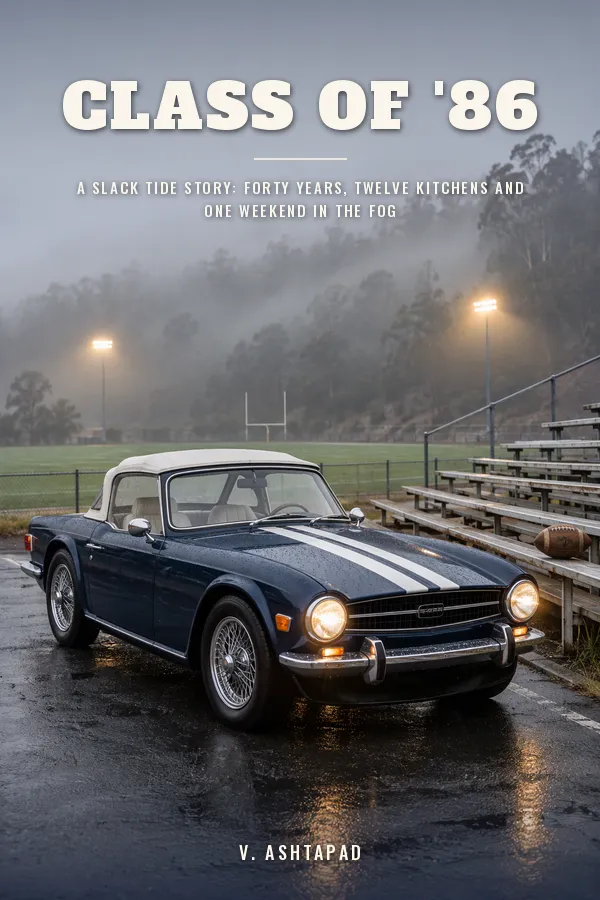
Class of '86
A Slack Tide Story: Forty Years, Twelve Kitchens and One Weekend in the Fog
by V. Ashtapad
Foreword
This is a work of fiction. The friends in these pages, their families, their teachers and Mrs. Reed are made up, and so is everything they say, cook, sing and argue about.
The fog belt is real. Daly City, Westlake and its rows of look-alike pastel houses, Skyline Boulevard, the Serramonte mall, John Daly Boulevard, the Cow Palace, Lake Merced, Ocean Beach and the Great Highway, Pacifica and Linda Mar, the cemetery town of Colma and Mission Street from the city down to the county line can all be found where this story puts them, under the same gray summer sky.
Invented outright are Skyline Ridge High School and its Thunderbirds, Taqueria La Palomita, Hilltop Liquor & Market, the hotel by the runways, Coach Walt Ferreira and the university up north, which is never named. The songs are real songs of the time, described and never quoted, and the reader is welcome to guess.
For the kids who put their lunch in the middle of the table, and for the mothers on the night shift who made it.
Skyline, Friday
The fog was waiting for him at the top of the grade, the way it had waited for him every June of his childhood.
Eight came up out of Pacifica on the old road with the top up and the heater on low, and at the place where the road bends and climbs toward Skyline Boulevard the sun simply quit. One moment the hillside was dry gold and coyote brush, a hawk on a fence post. The next the hawk and the post were gone, and the windshield was beaded with a fine wet gray that the wipers could only rearrange.
He turned the wipers to the slow setting and let the car find its own speed. It was the same car he had driven away from this school forty years ago: a 1970 Triumph TR6 he had bought in the summer of 1985 for four hundred dollars, every dollar of it earned in a concession apron, when it was a rust-freckled wreck with no top, a seized engine and a family of mice in the glove box. It ran now. Over the years he had taken it down to bare metal twice and built it back up, and it wore dark blue paint with two white racing stripes over the hood and the trunk, a white soft top and a white leather interior he had sewn up himself the first time, badly, and paid someone to do properly the second, and it ran the grade with a low steady burble that came up through the floor pan into his heels. He had owned faster cars since, and better ones. He had never owned one he would not sell first. On the driver's door, if the light was right, you could still see a faint clean rectangle in the blue where a big white 8 had been taped for a track day in the spring and peeled off again. His wife said it looked like a ghost had sat on the car. He liked it there.
Skyline in fog was its own country. The eucalyptus along the ridge came out of the gray one at a time, peeling bark hanging off them in long strips like old wallpaper, their tops lost entirely. Water dripped off the leaves in fat drops and hit the roof with a sound like somebody tapping a pencil. The vents smelled of wet eucalyptus, cold salt and somebody's fireplace in June, which was the most Daly City smell there was. People in the rest of the country built fires in winter. People in Westlake built them in summer, because summer was when the fog came in from the ocean and sat down on the hills and stayed for three months like a relative.
His phone buzzed in the cup holder. He read it at a turnout.
Remember, his wife had written, you are not obligated to tell anyone anything. You are also not obligated to be mysterious. Pick one.
He typed back that he would pick both.
Of course you will, she wrote. Send me a picture of Danny's hair.
He smiled at that and put the phone face down and pulled back out.
Below him, as the ridge began to drop, the fog thinned enough to show him Westlake. It came up out of the gray in rows: the houses his father had pointed at from the back seat of a borrowed sedan in the summer of 1975, when Eight was seven years old and had been in America for exactly four days. Pastel boxes, every one of them, stucco over wood, a garage on the ground floor and the living room upstairs, a picture window looking at the house across the street, which looked back with an identical picture window. Mint green, then salmon, then pale yellow, then mint green again. The same roofline, the same three steps up to the same front door, all of them marching down the slope toward the ocean in curving streets that seemed to have been laid out by somebody who liked spirals and hated maps.
"Which one is ours?" he had asked his father.
"That one," his father had said, pointing at a pink one.
"They are all that one."
His father had laughed so hard he had to pull over, and for the first year Eight had counted from the corner every afternoon, four houses on the left, to make sure he went into the right pink box. Once, in third grade, he had gone into the wrong one anyway. A woman named Mrs. Ruiz had given him a glass of milk and a cookie and then walked him four doors up, holding his hand, and told his mother in very slow English that it happened to her husband too.
He drove down through it now. The houses had been painted since, some of them in braver colors, a deep blue, a terra-cotta, one a startling lemon that he suspected the neighbors had opinions about. But the shape of the place had not changed at all. The streets still curved. The windows still faced each other. The fog still came down the middle of the street at four in the afternoon like a slow white river looking for the sea.
He did not stop at the old house. He knew what color it was now. He had driven past it once, five years ago, and a girl of about seven had been sitting on the front steps eating something out of a bowl, and he had decided that was the right ending and had not gone back.
The hotel was on the bay side, in the flat land by the runways, which was a different climate entirely. You came down off the hills and through the cut and suddenly it was nearly warm, and the sky had color in it, and the fog sat behind you on the ridge like a wave that had decided not to break. The lobby smelled of carpet shampoo and coffee. A plane went over as he crossed the parking lot, so low and loud that he felt it in his teeth, and nobody else in the lot looked up.
The sign in the lobby was printed on a white board on an easel: SKYLINE RIDGE HIGH SCHOOL, CLASS OF 1986, 40TH REUNION, LOUNGE. Under it someone had drawn a small thunderbird in blue marker, the school mascot, and under the thunderbird someone else had drawn, very small, a pair of reading glasses.
He knew who had drawn the glasses. He would have bet the car on it.
The check-in table stood just outside the lounge door. Behind it, in a blue polo shirt with the old school crest embroidered on the pocket, a pen behind each ear and a third pen in his hand, sat Brian Kowalski.
Bri had not changed so much as concentrated. He had always been the plainest of them, the boy you could describe to a police sketch artist only by saying "regular," brown hair, brown eyes, a face built for a driver's license. Forty years had turned the brown hair gray and thinned it, and added a pair of rimless glasses, and given him the look of a man who would sell you an excellent life insurance policy and then remember your birthday. His family's wood-paneled station wagon had been the only car in the whole group that could be counted on to start in the rain, which meant Bri had driven everyone everywhere from the day he got his license, and it had given him, at sixteen, the patient air of a man who has been waiting outside other people's houses with the engine running. He was alphabetizing name tags. He looked up and saw Eight and stopped alphabetizing.
"No," Bri said. "No way. You actually came."
"You sent me eleven reminders."
"I sent everybody eleven reminders. You're the first person who counted." Bri came around the table and hugged him, the quick, patting, side-on hug of a man from Concord, and then held him at arm's length. "You look exactly the same. That's annoying. Did you do something?"
"I moved away from the fog."
"Smart. I moved to Concord. It's a hundred and four degrees there today. I'm thinking of moving back just for the weather." Bri went back behind the table and began searching. "Here. I made these myself. Don't laugh."
The name tag was the size of an index card, laminated, on a blue lanyard. In the top corner was a square of yearbook photo, scanned and cleaned: a skinny boy of seventeen with a severe side part, enormous eyebrows, and the expression of someone who has just been told the photographer has no film in the camera. Under it Bri had printed EIGHT.
"You didn't put my name."
"I put your name." Bri tapped the card. "Nobody's called you anything else since tenth grade. Your mom called you something else. The attendance office called you something else, and they got it wrong. I'm not printing a name nobody's going to use."
Eight hung the lanyard around his neck. The seventeen-year-old on his chest looked back at the hotel lobby with great suspicion.
"There's a table," Bri said, more quietly, and nodded toward the lounge. "Our table. I mean, there's no seating, it's a mixer, but there's a table. I put something on it. You'll see."
The lounge had low leather chairs and a long bar backlit in blue, and big windows looking at the runways, where planes were lining up in the hazy late light to take off over the bay, one after another, with a patience that looked almost polite. There were already forty or fifty people in it. Everyone who came in got a glance, a squint at the chest, and then a shout or a polite smile. A bald man was telling a woman with silver hair that he had sat behind her in chemistry for a whole year, and she was saying, kindly, "Of course you did."
The music was coming from a speaker on the bar. It was something from 1985, a synthesizer playing a bright, falling line over a drum machine that sounded like someone slapping a wet phone book, and a man singing very earnestly about a girl he was going to lose. Eight had heard it ten thousand times through the tinny speaker of a car radio with one working channel. Hearing it now, in a hotel bar by the runway, with all of its bass intact, felt like seeing a childhood friend in a suit.
The table was in the corner by the window, a round one with a white cloth. Nobody was sitting at it. On the cloth, propped against a small vase of yellow carnations, was a name tag like his own, laminated, on a blue lanyard. The photo in the corner was of a boy with a wide open grin and a fade haircut and a gap between his front teeth that he had refused to let anyone fix. The boy was laughing at whoever held the camera, mid-laugh, the way he had laughed at everything.
TOMMY, it said.
Eight stood in front of it for a while. Behind him the room was loud with people being surprised by each other. A plane went over and the glass in the window hummed. The carnations smelled faintly of pepper.
Then somebody grabbed him from behind by both shoulders and said, directly into his left ear, "I knew it. I *knew* you'd come, and I knew you'd go straight to the corner and stand there like a coat rack."
Danny Rosen had been the loudest boy at Skyline Ridge High School for four consecutive years, and it was clear within a second that he had not let the title lapse. His hair, which in 1986 had been a dark curly cloud that teachers asked him to sit at the back of the room behind, was now a silver curly cloud. He wore a shirt printed with tiny cartoon teeth under a black blazer.
"You're an orthodontist," Eight said.
"I'm an orthodontist." Danny spread his arms to show the shirt. "In Burlingame. I'm also a stand-up comic, three open mics a month, I'm told I'm very good for a dentist. My mother is eighty-seven and thinks the comedy is a phase." He looked down at the name tag on Eight's chest and then up at Eight's actual face. "The eyebrows calmed down. Good for you. Took them a while."
"Your hair turned into a cumulus."
"It's a nimbus. It means rain. Listen. Before we do anything else." Danny reached into his blazer and took out a cocktail napkin and smoothed it flat on the white tablecloth next to Tommy's name tag. Then he took out a pen. "I have to ask you the question. Fourteen people have asked Bri and he doesn't know, and it's driving him insane. What do you do?"
"For a living?"
"No, for fun. Yes, for a living."
Eight considered the napkin, and the pen, and the fact that Danny had clearly planned this, possibly for weeks.
"Logistics," he said.
Danny wrote across the top of the napkin, in block capitals, WHAT DOES EIGHT DO, and drew a line under it, and under the line he drew two columns. At the head of the first he wrote GUESSES. At the head of the second he wrote EIGHT. In the second column he wrote: *Logistics. 1 pt.*
"What's the point for?"
"For dodging. You get a point every time you dodge. Everybody else gets points for guessing. Points for originality, points for nerve. Whoever's closest by Sunday wins."
"Wins what?"
"Respect," Danny said. "And possibly a free retainer." He folded the napkin in half, very carefully, and put it in his inside pocket like a passport. "Logistics. *Logistics.* That's what people say when they run guns, or when they run a warehouse in Hayward. I'm going to find out which."
"It could be both."
Danny looked at Tommy's name tag on the table, and the joke went out of his face for a moment, the way a light goes out in a window when someone walks out of the room. Then it came back. "He'd have figured you out in ten minutes," he said. "You know that. He'd have just *asked*, and you'd have told him, because it was Tommy."
"Probably," Eight said.
Danny clapped him on the shoulder. "Come on. Kevin's at the bar telling the bartender about every fire he ever put out, and Ian's at the other end of the bar telling the other bartender why Kevin is wrong. It's like 1984 never ended. You have to come see it."
Eight looked once more at the boy laughing at the camera. Outside the window a plane lifted off over the bay, banked south toward the hills, and went into the fog on the ridge and disappeared, its lights blinking twice inside the gray before they were gone.
Then he followed Danny toward the bar.
The Bank of Reed
October 1983
The cafeteria at Skyline Ridge smelled of floor wax, wet jackets and tater tots, in that order, and by the second week of freshman year Danny Rosen had worked out that the smell told you the time better than the clock did. At 11:40 it was floor wax. At 11:52, when the doors banged open and four hundred kids came in from the quad with the fog still on their shoulders, it was wet wool and nylon. By noon the fryers had won.
He sat at the long table under the third window because that was where Tommy Reed sat, and in October of 1983 Danny would have sat in the walk-in freezer if Tommy Reed sat there.
The window looked down the hill at the student parking lot, which was not a parking lot so much as a slope with lines on it, and past that at the rooftops of Westlake going down in their mint and salmon rows until the fog ate them. Most days at lunch you could see four streets. On a bad day you could see the flagpole, and then nothing, a white wall pressed against the glass so close you felt you could write your name in it.
"Order," Tommy said, and knocked twice on the table with a milk carton.
Nobody had elected Tommy. Nobody had to. He was already built like a short refrigerator that could run, and he had a way of looking at a table full of people as if he had been waiting for every one of them in particular. He laughed first at everything, including himself, so that by the time you had worked up the nerve to make the joke he had already made it and moved on.
"The Bank of Reed is open," Tommy said. "Exchange rates as follows."
The exchange rates were the whole point. Danny had figured that out by the end of September, too, though it took him another year to understand why Tommy had invented them.
Everybody put their lunch on the table. That was the rule. Not in front of you: in the middle. Then Tommy set the prices.
Eight's mother's samosas were the gold standard. That was not even a discussion. Eight brought them on Mondays, four or five in a square of waxed paper gone see-through with oil, still faintly warm if his mother had fried the last batch that morning before she caught the bus to her office downtown. They were triangles of pastry with blisters on the crust, packed with potatoes and peas and something green, and a spice that started out polite and then followed you down the hallway. One samosa was worth two of anything else. Half a samosa could buy you a whole sandwich.
"My house smells like this all weekend," Eight said, the first time Danny ate one and had to drink his milk in one go. "Our street gets fog every day. The fog goes around our house. It's scared."
Eight was small then, smaller than Danny even, with a side part his mother cut with the kitchen scissors and eyebrows that seemed to have been issued for a larger man. He talked so little that when he did, people stopped to listen in case they missed something. He watched everything. When he made a joke it was usually about himself and so dry you had to look at his face to find out it was one.
"My father says the spice is not hot," he said, in a voice that rose and fell like a hand waving in a crowd, "it is only *enthusiastic.*"
Everybody laughed. Eight's father had been at the career day in September in a pressed white shirt, telling the freshmen about loading air freight on the night shift at the airport as if it were a branch of medicine.
Then there was everything else.
Sam Park brought kimchi in a jar that had once held peanut butter. The jar had a lid that never sealed all the way, and on the bus in the morning Sam held it on his lap with both hands, upright, like a man carrying a bomb across a minefield. It was cabbage, red with pepper and very sour, and it fizzed slightly on the tongue. You could trade a forkful for a cookie, but only if you were brave.
"My parents sell the stuff that makes your parents fun," Sam said, about the store on Mission Street, which was as much as Sam said about anything. His parents were at the store seven days a week, eight in the morning to midnight, and Sam went there after school every day and did his homework on an upturned crate in the back room while his little sister colored on the cardboard flats beside him.
Lani Kahale brought musubi: a slab of fried canned ham on a block of white rice, wrapped with a black ribbon of seaweed, sticky and salty and sweet. She made them herself at six in the morning, because her mother got home at five-thirty from cleaning airplane cabins on the overnight shift at the airport and slept until two, and somebody had to feed Lani's little brothers before the bus. Lani made eight musubi every morning. Three for her, three for the boys, two for her mother when she woke. The two she brought to school were from her own three, and she traded them hard.
"Two musubi for one samosa," Lani said.
"One for one," said Tommy.
"I made these with my own hands."
"Eight's mom made those with *hers.*"
Lani considered this. She was the toughest person Danny had ever met, including adults. She had bleached streaks in her hair from surfing at Linda Mar and a scar on her chin from a reef in Oahu she said she would show them someday, and she once told Coach Ferreira that if he called her "sweetheart" again she would let the air out of his tires.
"Fine," she said. "One for one. But he throws in the green sauce."
Dez Campbell brought patties. Most days he brought six or seven in a white paper bag gone translucent at the bottom: half-moons of yellow pastry, flaky and shining, with spiced beef inside so hot it brought tears to your eyes and so good you kept going anyway. They were the bakery's day-olds. Dez's mother worked mornings behind the counter of a Caribbean bakery on Mission Street and nights cleaning office buildings in the Financial District, and what didn't sell by close she was allowed to take. Some nights she took home two dozen. The Campbells ate patties, the Reeds two streets over ate patties, and the Kahale boys ate patties, and the ones that were left came to school.
"My mother says we are the only family in Westlake that has eaten more patties than rice," Dez said, "and my grandmother in Kingston would die if she heard it."
Wendy Chan brought char siu bao from Chinatown in a pink box every Monday, because the Chans went into the city every Sunday morning for dim sum with her father's whole side of the family. Her grandmother lived with them and packed Wendy's lunch the rest of the week, little rice balls and pickled vegetables in neat compartments, a tangerine, a note in Chinese that Wendy never read aloud. Wendy's mother sewed piecework in a shop on Jackson Street and her father cooked in a restaurant kitchen until eleven, and it was her grandmother who checked Wendy's homework and then sent it back if the handwriting was poor.
Malia Faleolo brought coconut buns her auntie baked, soft and white and sticky with coconut cream on the bottom, and enough for the table. There was always enough with Malia's family. Her grandmother lived with them too, and three aunties lived on the same street, and the Faleolo kitchen seemed to cook for whoever was in the house, which on any given evening could be twenty people.
Kevin Doyle brought a corned beef sandwich on brown bread and complained about it. Ian MacLeod brought his gran's shortbread in a tin and refused to trade it, which was its own kind of trade. Kevin said shortbread was Irish. Ian said there was nothing Irish about shortbread except the people who stole it. Kevin said the bagpipes were Irish, too, and Ian threatened to leave the table and then stayed, because they had moved on to whose grandfather drank more, and he had a story.
Nina Oktollik brought dried fish. Her uncle sent it down from Kotzebue in a box wrapped in garbage bags and string, and it was strips of whitefish, hard and translucent and the color of amber, that you held in your fist and gnawed like a dog with a stick. Nobody else could finish a piece.
"My dad says you California people have soft jaws," she said. Her father was a welder who went where the pipeline work went. In 1983 that was a refinery in Richmond. He was gone four weeks at a time and came home smelling of metal.
Bri Kowalski brought a bologna sandwich on white bread with yellow mustard every single day, and an apple, and a little bag of corn chips. The bologna was so pink it looked like it was blushing.
"That's tragic," Danny told him, the first week.
"It's what we have," said Bri, comfortably.
Bri laughed. That was the thing about Bri. You could make him the joke every day and he would laugh, and then at the end of lunch you'd find he had traded his corn chips for a whole samosa, because Eight felt sorry for him, and the bologna for a musubi, because Lani did, and somehow the basic white kid ate better than anyone at the table.
Danny's own lunch was a bagel with a schmear and, on Fridays, leftover brisket from his mother, who had been forced to come to America from a town in Poland by her own mother at the age of two and who had never forgiven the boat. "My mother doesn't cook food," Danny told the table. "She cooks guilt. In a sauce. You eat it, you feel terrible, you have seconds." He had practiced it in the mirror. Even Sam laughed, which was rare.
What Danny did not tell them, and did not understand until he was nearly grown, was that some of the lunches in the middle of the table had been paid for and some had not.
Tommy and Lani had free-lunch tickets. Pale green cardboard, punched every day by the lady at the register. Tommy's mother drove the Mission line for the city, the bus up and down Mission Street from the Transbay to the county line, split shifts and every scrap of overtime they would give her, and she still qualified. Lani's mother qualified. And at a lot of tables at Skyline Ridge the kids with the green tickets ate the tray lunch, the square pizza and the canned corn, and the kids with paper bags ate out of the paper bags, and everybody could see who was who.
At Tommy's table, everything went in the middle. Tommy put his tray down with the others and set a price on his square pizza like it was worth something, and Lani traded her musubi and took a green-ticket corn dog in return like it was a prize, and when you looked at the table you couldn't tell who had paid for what. Nobody ever said so. Tommy just did it, the first day, and then it was the rule.
The new kid came to the table on the second Wednesday in October.
His name was Gary Tolentino. He had come from Manila in August, and he was thin and very neat, with a pressed collar and his hair combed wet, and he carried his lunch in a plastic container with a blue lid. He sat at the far end of their table, at the edge, two seats from Bri, and said hello in a soft careful voice, and opened the container. It was rice, and fried egg, and small red sweet sausages, glossy and fragrant, and the smell of garlic came down the table in a wave.
Danny had a line ready. He always had a line ready. He had done his mother; he had spent a week listening to Eight make fun of his own house and Sam make fun of the store and Dez make fun of the patties, and everybody had laughed, and so Danny looked down the table at the new kid's lunch and said, loudly, "Whoa. Somebody call the fire department, there's a garlic emergency at table nine," and fanned his face with both hands.
People laughed. Kevin laughed.
Gary Tolentino did not laugh. He looked at his lunch, and then he closed the blue lid very carefully and ate his apple instead, and the next day he sat two tables over, with the Filipino kids from Westmoor, and he never sat with them again.
Tommy looked at Danny for a moment, across the table, without saying anything. Then he moved on to something else, and so did Danny, and it did not come back to him for a long time.
On the last Friday in October Wendy Chan brought her little film camera to lunch, the cheap kind with a flash cube on top that popped and smoked. She said it was for the yearbook, which she was not on. She made everybody squeeze onto one side of the table, the food in the middle, Bri's bologna sad and pink in the center.
"Lean in," she said. "Kevin, take your hand off Ian's face. Danny, stop talking."
"I'm not talking."
"You're about to."
Tommy put one arm around Malia and the other around Eight, who looked as though he would rather be anywhere else, and Danny leaned over Sam's shoulder and made a face, and at the far right edge of the frame, at the next table, a thin neat boy with combed wet hair was turning his head to look.
The flash cube popped. The whole table blinked purple for a minute afterward, laughing, and the fog pressed white against the window behind them like a sheet hung out to dry.
Late Arrivals
Kevin Doyle had retired from the San Francisco Fire Department in 2023 after thirty-four years, and he stood at the bar in the posture of a man who had spent most of those years leaning on the front bumper of an engine, one elbow on the wood, one boot up on the brass rail, a glass of beer going warm in his fist because he kept forgetting it to talk. He had gone broad and red and white-haired, with a mustache that could have been issued by the department. When he saw Eight he put the beer down for the first time.
"Look who it is," Kevin said. "The number eight. The worst linebacker in the history of San Mateo County."
"I was a safety."
"You were a *hazard.*" Kevin hugged him hard enough to lift him slightly off the carpet. He smelled of beer and aftershave and, underneath, very faintly, of smoke, the way firefighters did forever after, as if it had gotten into the bone. "You know you played that whole season in my brother Pat's cleats? Mike's first, then Pat's, then mine, then yours. Four Doyles' worth of feet. They were held together with athletic tape by the time they got to you."
"They were a size too big."
"They were two sizes too big. You stuffed the toes with gym socks." Kevin turned to the bartender, a young woman with a nose ring who had the patient face of someone who had been listening to Kevin for an hour. "This guy," he said, "stuffed his cleats with socks, wore number eight because it was the only jersey small enough, and fell on a fumble against Westmoor with his eyes closed. That's the whole career."
"My eyes were open."
"They were closed. I was there. I was underneath you."
At the other end of the bar a voice said, in an accent that had been born in Daly City, gone to Edinburgh for twenty years and come back as something nobody could place, "He's lying, you know. He wasn't underneath anybody. He was standing on the sideline eating sunflower seeds."
Ian MacLeod had always been thin and he was still thin, long-faced, with a gray beard trimmed close and the careful hands of a man who restored old pianos for a living, which he did, in a workshop in San Rafael that smelled, he said, of felt and hide glue and other people's grandmothers. He shook Eight's hand formally and then pulled him into a hug and said into his shoulder, "Don't listen to him. Thirty-four years of smoke inhalation. The man's memory is a cinder."
"His memory's a cinder," Kevin said. "He went to Scotland for twenty years and came back sounding like a weather report."
"Edinburgh is a perfectly normal city."
"It's a castle with a parking problem."
They had been like this when they were fourteen. Eight had forgotten how restful it was. Kevin and Ian had argued about everything: whose grandfather had drunk more, whose grandmother had been tougher, whether the bagpipes were Scottish or Irish, which they were not really arguing about, since Kevin knew perfectly well, but Ian would rise to it every time like a trout. They had argued on the bus, in the locker room, on the bench during games, and once, memorably, in the back of Bri's family station wagon all the way up Skyline in a thick fog about whether you could technically drown in fog. Neither of them had ever stopped being the other's best friend. When Kevin's father had his heart attack in 1985 it was Ian who sat with Kevin in the hospital corridor until three in the morning, still arguing in a low voice, about nothing, because it was the only way Kevin could keep from crying.
"Danny says you're in logistics," Ian said.
"Word travels."
"Danny is the word. Danny is the travel. He's telling everyone. There's a napkin." Ian looked at him thoughtfully. "Logistics. Right. I'll guess. Carpets. You import carpets. You've got a warehouse full of them in Hayward and you know the name of every knot."
"Witness protection," said Kevin. "He's in witness protection. He's got a whole other name. He's been a dentist in Fresno this whole time."
"Danny's the dentist."
"That's what they *want* you to think."
Danny materialized at Kevin's elbow with the napkin already out. "Carpets," he said, writing. "Two points, specific, good. Witness protection, one point, it's a cliché, Kevin, have some respect for the craft." He looked at Eight. "Well?"
"I do a bit of consulting," Eight said.
Danny wrote it down in the second column. "Two dodges. He's leading."
---
The others came in over the next hour, in a slow tide, and each time the lounge door swung open the people at the corner table looked up all together, like birds.
Lani Kahale came in still wearing her work boots, gray dust on the toes, her hair gone salt-and-pepper and cut short and practical and her face browner and harder than any of them, as if she had spent forty years in the wind off the Pacific, which she had. She ran a contracting company in Pacifica, twelve employees and three trucks, and she still surfed Linda Mar four mornings a week. She looked at Eight and said, "You got old," and hugged him, and then said into his ear, "Good. I was worried it was just me."
Sam Park came in quietly, as he had done everything quietly, in a pressed gray shirt, with reading glasses parked in his hair. He still ran his parents' store on Mission Street, a few blocks down from where it had always been. He had put in a deli counter in 2009, and his kimbap had a following, and on Saturday mornings there was a line. He shook hands with everybody and then sat down in a corner of the low leather couch with a club soda, and Eight sat down beside him, and for ten minutes neither of them said much at all, which was how they had always been friends.
"Your parents?" Eight said eventually.
"My mother's ninety. She comes in every morning and tells me the kimchi's too sweet. My father passed in 2019." Sam turned his glass around on its coaster. "Yours?"
"My father's still going. My mother too."
"Good." Sam nodded slowly. "They still make the samosas?"
"My mother does. My father supervises."
"I used to dream about them," said Sam, with no change in expression at all, and Eight laughed out loud.
Wendy Chan came in at a quarter to eight with a coat over her arm and a pager on her belt, a pediatric oncologist at a children's hospital in the city, and the first thing she did when she reached the table was look at each of them in turn, quickly, completely, as she had looked at them in 1983 when she was checking whether everybody was in the frame. Her hair was still black, cut in a sharp line at the jaw. Her eyes rested on Eight a little longer than on the others, and he had the brief odd feeling, which he had not had in a long time, of being read.
"I heard you're in logistics," she said.
"And consulting," Danny put in. "He's diversified."
"Hm," said Wendy, and sat down, and asked Sam about his mother.
Dez Campbell came in at eight carrying a red plastic cooler the size of a suitcase, which he set on the corner table as though it were a trophy. He had flown in from Atlanta that afternoon. He had produced records for thirty years, some you'd heard and some he hoped nobody ever would. He wore a linen shirt and a straw hat and he smelled of airplane and cologne, and when he opened the cooler the smell of curry and pastry rose out of it so strongly that two people at the bar turned around.
"I stopped at a place in Oakland on the way from the airport," he said. "My mother would have died. My mother would have said these are not real patties. My mother would have eaten four." He handed them out on paper napkins, flaky and golden and burning hot inside. The bartender came over to say that outside food was not technically allowed in the lounge. Dez gave her a patty. She went back to the bar and did not mention it again.
"Your mother," Lani said. "Is she—"
"She's eighty-one and she lives with me and she still gets up at four. She doesn't work anymore. She just gets up at four in case." Dez bit into a patty and closed his eyes. "Thirty years of mornings at the bakery and nights at those offices. Her body doesn't believe she's retired. I have a house with five bedrooms and she still sleeps with her shoes by the bed."
"My mother too," said Lani. "Thirty-one years on the overnight at the airport. She lives with me now. She still can't sleep past five-thirty."
"Five-thirty," said Dez. "That's when she'd get home."
"That's when she'd get home." Lani looked at him. "You remember that?"
"I remember everything about that time. I remember you making musubi for your brothers at six in the morning because your mom was asleep."
"I remember your mom's day-olds," said Lani. "We ate them for dinner more than once."
Dez shrugged, as if it had been nothing, which to a fifteen-year-old it had been: just a bag of pastry going from one house to another down the hill.
Nina Oktollik came in from Anchorage at nine, tired from two flights, wearing a parka that was absurd for June in the Bay Area until you remembered that June in the Bay Area was in the fifties after dark. She was a school principal now. She had a principal's voice, warm and carrying and not to be argued with, and she used it on Danny before she had even put her bag down.
"Daniel Rosen. Are you making people guess what this man does?"
"Nina Oktollik. Hello. I've missed you. Yes."
"Put me down for bush pilot," she said. "He flies supplies into villages in a little plane with skis. He's never told anybody because he's afraid of how cool it sounds."
"Three points," said Danny, writing fast. "Romantic. Plausible. Skis."
She sat down next to Eight on the arm of the couch and put her cold hand on the back of his neck the way she used to when they were fourteen, to make him yelp, and he yelped, and she laughed.
"You never wrote," she said.
"You moved to the Arctic Circle."
"Kotzebue is thirty miles north of the Arctic Circle. They have mailboxes." She looked around the corner table, at all of them, and something in her face went soft. "I graduated up there. I wasn't even here. Bri sent me an invitation anyway. I told him, Bri, I left in tenth grade, and he said, Nina, you were at the table. That counts."
Bri, at the edge of the group with his lanyards, went red to the ears.
He had found nearly everybody. That was the part none of them could get over. For forty years he had kept a spiral notebook with every address, and every time anyone moved he crossed the old one out and wrote the new one in, and when a friend's parent died he sent a card, and when he heard of a wedding he sent a toaster. For the reunion, he had set up a private shared page that only the people he invited could open, and for six months classmates had been adding old photos to it and typing in the names of the people in them, one by one, filling in the faces nobody else could place.
"There are four hundred and three of us," Bri said. "Four hundred and three in the class. I've got three hundred and sixty-one. The rest are either very private or very dead. Sorry. Or both."
"How do you do it?" Wendy asked him.
"Tommy told me to," Bri said. "Senior year." And then he said nothing else, because just then the lounge door opened again.
Malia Faleolo came in last. She came in the way she had come into rooms at sixteen, as if the room had been waiting, her black hair down her back with gray in it now, a yellow flower behind her ear, her shoulders still the shoulders of a girl who had won the county in shot put three years running. She taught English at Skyline Ridge now, in the same building, on the same hill. Her husband, Ray Mendoza, coached the football team.
She went straight to the corner table. She didn't look at any of them first. She picked up Tommy's name tag from beside the carnations and held it in both hands and studied the boy laughing at the camera, and her mouth moved a little.
Then she put it back, very carefully, against the vase.
"I called his mom," she said to all of them. "Last week. I go see her sometimes. She's eighty-two, and she's sharper than any of us, and she's still in the same house. I told her we were all going to be at Lake Merced on Sunday for a picnic and she said, Malia, I would not miss it." Malia looked around at them. "So she's coming. Mrs. Reed's coming. So you'd better all bring something good."
Danny had the napkin out again, but he wasn't writing on it. He was folding it, slowly, in half, and in half again.
Much later, after midnight, Eight stood at the window of his room on the sixth floor. The runways below were lit with long blue lines in the dark. The last planes had gone. On the ridge to the west the fog had come all the way over Skyline and was spilling down the slope toward the bay in long slow fingers, white under the streetlights of Westlake, so that the houses he had grown up in were disappearing one row at a time. He watched until there was nothing on the hill but a glow.
Number Eight
September 1984
The JV equipment room at Skyline Ridge was a concrete closet under the bleachers that smelled of mildew, old sweat and the white foam of a fire extinguisher somebody had set off in 1979, and Coach Walt Ferreira stood in its doorway with a clipboard like a bouncer at a club nobody wanted to get into.
"Doyle," he said. "Forty-four. You're a tackle. Don't argue."
Kevin did not argue. He was fifteen, five foot ten and still growing in all directions, and he had known since the age of six that he would be a tackle, because his brothers Mike and Pat had been tackles and his father had been a tackle at Riordan in 1958, and Doyles did not get the ball. Doyles stood in front of the people who got the ball and fell on other people.
"MacLeod. Eighty-one. Tight end. Good luck to us all."
Ian took his jersey and held it up against himself and looked at Kevin. "It's enormous."
"You'll grow into it."
"I'm not going to grow into it. I'm going to grow out of the country."
Coach Ferreira looked at the next boy in the line and lowered his clipboard.
Eight was standing there in a gray sweatshirt and his PE shorts, holding his own helmet under one arm like a borrowed bowling ball. He had not been expected to try out. He had not been expected to do anything. In the two years Kevin had known him, Eight had mostly watched: from the edge of the lunch table, from the back of the bus, from the wall at dances, with a look on his face that suggested he was taking notes he would never show anybody. But that summer he had grown about an inch and found out he could run, and Tommy had told him to try out, and when Tommy told you to do something you found you'd already done it.
Coach Ferreira went into the closet and came out a minute later with the last jersey in the box. It was blue mesh with white numbers, a size small, and it had a long rip down one side that someone had sewn shut with fishing line.
"Eight," he said. "It's the only one'll fit you. Safety. We'll figure it out."
He did not say the boy's name. He had tried to, at tryouts, reading it off the sign-up sheet, and had gotten about halfway through it before abandoning the attempt and saying "Son" instead, and after that he did not try again.
---
The cleats came from the Doyle closet.
The Doyle house was a narrow gray two-story on a street off John Daly Boulevard, with five kids and one bathroom and a father who worked twenty-four-hour shifts at a firehouse in the Mission and then slept for twelve, so that the house ran on a strict code of silence between nine in the morning and two in the afternoon that Kevin's mother enforced with a wooden spoon. There was a hall closet by the front door where the outgrown things went. Raincoats. Boots. A bowling ball nobody owned. Four pairs of football cleats in descending order of age, Mike's on the bottom, black leather gone gray at the seams.
Eight had shown up at practice the first day in his own sneakers. White canvas, from a discount store on Mission Street. By the end of the first drill they were wet through with dew and he had fallen down four times on the hill behind the stadium.
"You need cleats," Kevin told him in the locker room.
"I know."
"So get some."
Eight looked at his sneakers and said nothing at all, and Kevin, who had grown up in a house where you could tell exactly how the month was going by what was for dinner, understood him completely. Eight's father loaded freight at the airport on the night shift, ten at night until dawn, and his mother caught the 6:50 bus to an office downtown, and Eight went home every day after school to watch his little sister and brother until his father woke up. The deposit for the uniform had been forty dollars. Kevin had seen Eight pay it in quarters.
The next morning Kevin brought Pat's old cleats in a grocery bag. Black, with a white stripe that had gone the color of a smoker's teeth. The left one had been resoled by Kevin's father on the kitchen table with a tube of glue and a lot of language.
"They're too big," Eight said, putting them on.
"Stuff the toes."
"With what?"
Kevin took off his own gym socks and handed them over. Eight looked at the socks for a long moment with an expression of real horror, and then stuffed them into the toes, and laced up, and stood. He looked like a boy wearing boats.
"Mike wore those," Kevin said. "Then Pat. Then me. They're lucky."
"Were Mike and Pat any good?"
"No," said Kevin. "But they're both alive."
---
The JV played on Thursday afternoons. The varsity played on Friday nights, under the lights, with the band and the crowd, and Tommy Reed, who had been called up to varsity as a sophomore after the second week of practice because nobody on the team could catch him, played on Friday nights. But on Thursdays he came to the JV games and sat in the stands with Malia and Lani and Danny and Bri, and yelled advice nobody could hear.
The Westmoor game was the fourth Thursday in September, at Westmoor's field, on the other side of the ridge. The team bus only had room for the starters, so Bri drove the rest of them in his family's station wagon, a wood-paneled thing with a rear window that went down with a crank and a radio that only got the AM stations unless you held the antenna. Kevin sat in front because he was the biggest. Ian sat in back with Eight and Danny, holding the antenna out the window with two fingers, and they argued the whole way over the hill about whether a fog could be thick enough to be technically rain.
It was. That afternoon it was.
Westmoor's field sat in a bowl in the hills, and the fog came over the rim of it at three o'clock and lay down on the grass like a wet sheet, so that from the sideline you could see the near hash marks and the shapes of the players and, beyond that, nothing. The ball disappeared when it went up. The stands across the field were a gray smear with voices in it. Kevin's helmet filled with water from the inside out. His hands went numb in the first quarter.
Eight played safety, which as far as Kevin could tell meant he stood very far back in the fog, alone, like a lighthouse keeper, and waited for something to emerge.
Westmoor had a PA system in a little wooden box on top of the home stands, run by a man with a voice like a car dealership commercial, and he took his job seriously. He announced every tackle. He announced every player by full name. In the second quarter Eight came up out of the fog and made a tackle, more or less, by grabbing a Westmoor running back around one ankle and being dragged five yards, and the PA man looked down at his roster and drew breath.
What came out of the speaker was something nobody in the stadium had ever heard before. It started out as Eight's name and then took a wrong turn, and then another, and then the PA man seemed to lose heart in the middle and try a different route, so that the name came out in pieces, with a long pause, like a man reading an eye chart in a language he didn't know.
The Skyline Ridge side of the stands laughed.
Eight stood up in the fog, wet through, holding his elbow, and did not look up.
And from somewhere in the visitors' stands a voice that every person at Skyline Ridge would have known anywhere came booming across the field, loud enough to cut through the fog and the PA and the laughter all at once.
"*Just call him Eight!*"
There was a moment of silence. Then the whole visiting side took it up. Danny started it, probably, but it was Tommy's voice that carried it, and in a moment the whole Skyline Ridge crowd, the thirty or forty parents and girlfriends and bored little brothers huddled in the gray, was chanting it. *Eight. Eight. Eight.* The PA man said, with relief, "Number eight on the tackle," and moved on.
Eight looked up into the fog toward the stands for a moment, and Kevin, who was standing nearby holding his own helmet and dripping, saw something cross his face that he could not name then and would only work out years later. It was the look of a kid who has been handed something he did not know he was allowed to have.
The fumble happened in the fourth quarter.
Westmoor was ahead by ten. Their quarterback dropped back, and the ball came loose, and then for a long, strange stretch of seconds nobody on the field knew where it was. Somewhere in the fog. It was bouncing. Kevin heard it thump on the wet grass somewhere to his left and dove, and missed, and heard players pile up somewhere in front of him, and then the referee was digging through a heap of bodies in blue and white.
At the bottom of the heap, curled around the ball with both arms and both knees like a boy protecting a puppy, was Eight.
"I had my eyes open," Eight said in the station wagon afterward.
"You had them shut," said Kevin. "I was right next to you."
"You were underneath me."
"I was *beside* you."
"He fell on it," said Ian, from the back. "He was running the other way, and it hit him in the legs, and he fell down on it. I saw the whole thing. It was beautiful. It was like watching a deer get hit by a bus."
Skyline Ridge lost, twenty-four to seventeen. Nobody in the car cared. Tommy and Malia had gotten a ride with Lani's cousin, and the rest of them squeezed into the station wagon with the windows fogged solid from the inside, and Bri drove them back over the hill at twenty miles an hour with the headlights making two white cones in front of them, while Danny did the PA man's voice from the back seat again and again, longer every time, until even Eight was laughing.
"From now on that's it," Danny said. "That's your name. I'm never calling you anything else."
"Nobody can say my real name anyway."
"I can say it."
"Say it."
Danny started to and gave up. "Eight," he said. "Eight's good."
---
It was Kevin's brother Pat who owned the car with the tape deck. It was a dented green two-door with a crack across the windshield and a heater that worked only on the passenger side, and that Saturday Pat drove Kevin and Eight to the Serramonte mall to buy a mouthguard, because the one Eight had been using was Ian's old one and Ian had confessed he'd once dropped it in a toilet.
The tape deck had eaten Pat's favorite cassette that morning. It was a band from Australia, all jangling guitar and a singer who sounded as if he were shouting across a beach, and the tape had come out of the slot in long brown loops, crinkled like Christmas ribbon. Pat had been in a black mood about it ever since.
Eight asked if he could see it.
They parked in the lower lot at Serramonte, in the shadow of the big department store at the end, in a gray fog that smelled of the gas station on the corner. Eight sat in the front seat with the tape on his knee, and Kevin watched him take a paperclip out of his pocket and unbend it, and use it to ease the loops out of the deck without tearing them, and then take a pencil from Pat's glovebox, put it into one of the cassette's little toothed wheels, and turn it, slowly, patiently, winding the brown ribbon back in a quarter turn at a time. It took twenty minutes. He didn't speak once. When he put the tape back in the deck and pushed play, the Australian band came out loud and clear and only slightly warbled, and Pat looked at him as though he had performed surgery on a patient everyone else had given up on.
"Where'd you learn that?"
Eight shrugged. "My dad's radio does it too."
Pat drove them home the long way, up Skyline, with the windows down even though it was freezing, and the Australian band shouting across their beach, and the fog flowing over the road ahead of them in the headlights, thick and wet and moving fast, like a river crossing a bridge. At a light on John Daly Boulevard he reached over and flipped the cassette to the other side without being asked, and handed Eight, without a word, a five-dollar bill.
Eight looked at it.
"For the mouthguard," Pat said. "Don't argue with me. Doyles don't argue with the guy who fixed the tape deck."
The Hill Above Westlake
On Saturday morning the fog was so thick on the hill that the school appeared one building at a time, the way a print surfaces in a darkroom tray.
First the gym, its long flat roof dripping at the corners. Then the low stucco wing of classrooms, painted the same pale institutional blue it had been in 1983, with the same rust stains under the same window frames. Then, as the yellow school bus that Bri had hired climbed the last curve of the access road and wheezed into the parking lot, the old sign on the lawn: SKYLINE RIDGE HIGH SCHOOL, HOME OF THE THUNDERBIRDS, the letters cast in concrete and painted white, with a thunderbird whose wings had been repainted so many times they had lost their feathers and become two blue paddles.
"Oh, no," said Danny, in the seat behind Eight. "Oh, no, it's exactly the same. I'm going to have to go to fifth period."
There were sixty of them on the bus, and another forty had driven up separately and were standing in the parking lot in fleeces and windbreakers with their hands in their pockets, looking around at the slope of lined asphalt and the fog and each other. The air was cold and wet and smelled of cut grass and eucalyptus and, faintly, from the cafeteria vents, of something being fried. It was a Saturday. Nobody was frying anything. The building had simply soaked up forty years of tater tots and was breathing them out.
Malia met them at the front doors. She was in a school sweatshirt, blue with the white paddle-winged bird, a lanyard with her teacher's badge around her neck and a coffee in her hand, and she looked so completely at home that for a moment Eight saw her as the students must: Ms. Faleolo, English, second floor, who would know if you hadn't done the reading.
"Welcome back to the hill," she said. "No running in the halls. No gum. Anybody caught smoking in the bathroom gets detention, and I don't care if you're fifty-eight."
---
The halls had shrunk. That was the first thing. Eight remembered them as long and loud and dangerous, full of shoving and slamming lockers and the heavy body-heat smell of four hundred teenagers in wet wool, and now they were narrow and quiet and lined with green lockers so small he could not imagine how anyone had ever fit a jacket in one. The floor was the same speckled linoleum. The water fountain by the stairs still had the dent where Kevin had once headbutted it, on a dare, in 1985.
"Still there," said Kevin, and patted it fondly. "I had a concussion for a week. Best week of my life."
The classrooms had projectors on the ceiling and bright posters about kindness and the periodic table, and the old chalkboards had been replaced with whiteboards, and in Mr. Okada's old chemistry room someone had left a model of a molecule on the teacher's desk made of gumdrops and toothpicks. Ian picked it up and examined it like a man appraising a violin. Danny stood at the front of the room and gave, in the voice of Mr. Okada, a brief lecture on the dangers of the Bunsen burner that brought a woman at the back of the group nearly to tears with laughter.
In the hallway by the gym was the trophy case.
It was a long glass cabinet with brass corners, lit from inside by a fluorescent tube that buzzed, and it held fifty years of the school's small glories: a tarnished cup from the 1971 county debate championship, a softball signed by a team from 1996, a framed photo of the 2014 girls' volleyball team, all of them grinning, with their arms around each other's necks. And in the center, behind the glass, hung on a wooden hanger, a blue mesh football jersey with white numbers. Twenty-two.
Under it, on a little brass plate: TOMMY REED, CLASS OF 1986. And under that, in smaller letters, the years.
Eight had not known it was there. Malia had. She stood beside him in front of the glass and didn't say anything, and after a while Lani came and stood on the other side of him, and then Sam, and then Danny, who also didn't say anything, which in Danny was its own event.
"Ray found it," Malia said eventually. "In the equipment room. In a box with a bunch of old stuff. It still had his name tape inside the collar, in his mom's handwriting. So we had it framed. Every year the varsity kids touch the glass before the first game. Nobody told them to. They just started doing it." She looked at the jersey. "Half of them don't know who he was. They just know it's lucky."
"He'd love that," said Lani.
"He'd hate it," said Danny. "He'd say, why's my shirt in a box? Somebody wear it. It's a good shirt."
Malia laughed, and pressed her wrist to one eye, and that was all.
---
The cafeteria had been remodeled in 2011. The long tables were gone, replaced with round ones on wheels, and there were salad bars now, and a mural on one wall of the thunderbird flying over the Pacific in a sunrise that the Pacific, at least on this side of the hill, almost never had. But the windows were the same. The third window from the end looked down the hill at the parking lot and the Westlake rooftops, exactly as it always had, and this morning there was nothing beyond it at all, only white, pressed close against the glass.
Eight stood there. Behind him the others drifted through the room, pointing at things: where the vending machine had been, where Danny had once been made to stand on a chair, where Dez's boombox had been confiscated.
"Everybody eats free now," Malia was saying to Bri. "The whole state. Couple of years now. No tickets. Kids just walk in and take a tray."
"No green tickets?" said Lani.
"No tickets. Nobody knows who's who."
Lani looked at the floor for a while.
"Tommy would have liked that, too," she said.
Eight was looking at the end of the table that was not there anymore. The far end, by the wall, two seats down from where Bri had always sat with his bologna. He found that he could place the boy exactly, as if he were still sitting there: the neat pressed collar, the hair combed wet, the plastic container with the blue lid. The smell of garlic coming down the table. And Danny's voice, loud and happy, saying the thing about the fire department, and the laugh going around the table.
He had laughed too. That was the part he had always remembered. He had not said the joke, but he had laughed at it, at the same pitch as everyone else, and then gone back to his samosa, which his own mother had fried that morning and which he had made a joke about ten minutes earlier, the joke about the fog being scared of his house. It had not seemed like the same kind of thing. His joke was about himself and he had earned it. Danny's joke was about a boy who had not been at the table long enough to earn anything, who had not been given a chance to make the joke himself first.
From inside the circle, all of it had been one thing: you put your lunch in the middle, you let them laugh at it, you laughed back, you were in. He had not understood until much later that from outside the circle it had looked like a wall.
The boy had moved two tables over the next day. Eight had seen him around for four years after that, in the halls, at assemblies, at graduation in a gown with a gold cord on it. They had never spoken.
"You okay?" said Wendy. She was standing next to him. He had not heard her come up.
"Remember the new kid," he said. "Freshman year. Gary something. He sat at the end once."
Wendy thought about it. She had always had that knack, go back into her memory like a woman going into a filing cabinet. "Tolentino," she said. "Gary Tolentino. He came from Manila. He was in my AP bio senior year. He was very good." She looked at Eight. "Why?"
"Just thinking about him."
Wendy looked at him for a moment longer, the way she had looked at him the night before, and then turned to Bri, who was hovering nearby with his phone.
"Is Gary Tolentino coming?"
Bri scrolled. He had all of them in there: the private page with the photos and the names, and, attached to it, a map he had made over the winter, a dot for every classmate in the town where they lived now, so that if you zoomed out you could see the Class of 1986 scattered across the world like seeds blown off a dandelion. Most of the dots were still clustered in the Bay Area, thick around Daly City and the Peninsula. There was a cluster in Sacramento, a scattering across the West, a few back East, one in Anchorage, one in Atlanta, one in Edinburgh that had been Ian's until he moved home and hadn't been moved. Three in Manila. One in Seoul.
"Vallejo," Bri said. "He's a nurse. Thirty years at a hospital up there. He RSVP'd no. Very nice note. Said he had a shift." He looked up. "Want me to send you his address?"
Eight thought about it.
"Maybe," he said.
---
The stadium was on the hill above the school, up a long flight of concrete steps that had been designed, as far as any of them could tell, by someone who hated football players. At the top there was a bowl cut into the hillside, a field of artificial turf now, bright green and lined in white, with aluminum bleachers on one side and the slope of the hill on the other, and beyond the far end zone the ridge of Skyline and the eucalyptus going up into the gray.
The fog was moving. Up here you could watch it come. It came over the ridge in a long, slow, rolling bank, white and dense and silent, poured down the face of the hill through the eucalyptus, and spilled onto the far end of the field and kept coming, swallowing the goalposts, then the end zone, then the forty-yard line, and then the whole far half of the field was gone and they were standing in a cloud.
"I used to love this," said Kevin, softly. "Friday nights. The lights would come on and you'd see it come in through the lights. You'd be standing on the sideline and you couldn't see the other end. Tommy would break a run and he'd just disappear. Forty yards, gone. And then you'd hear the crowd at the other end before you saw him come out."
"Cold, though," said Ian.
"Freezing."
"Wet."
"Like playing football inside a cloud." Kevin shook his head. "Nobody from anywhere else ever understood that. My kid played in Arizona. In the sun. He called me after his first game and said, Dad, I could see the whole field. Like he'd discovered fire."
Lani had come to stand beside Eight on the bottom step of the bleachers. She had her hands in the pockets of a canvas work coat with her company's name sewn on the chest.
"I'm going to guess," she said.
"Danny's not here."
"Danny's always here." She jerked her chin, and Eight turned and saw that Danny was standing three bleachers up with a reunion program open on his knee, folded back to the blank page at the end where he had transferred the contents of the napkin in tidy columns, pen ready. "I think you flip houses," Lani said. "You buy them cheap and fix them up and sell them for too much to people from the city. You've got that look. Like you know which walls are load-bearing."
"Three points," called Danny. "Lani knows walls."
Eight watched the fog swallow the fifty-yard line.
"I fix things for people," he said.
Lani looked at him sideways for a long moment.
"Huh," she said.
Up on the bleachers Danny wrote it down, and said, to no one in particular, "Three dodges. He's running away with it," and the fog came over the last of the field and closed around them all, cold and soft and complete, and somewhere below, in the parking lot, Bri's bus driver honked twice to say it was time to go.
Winter Formal
December 1984
The week of the Winter Formal, Lani slept on the Faleolos' couch, and nobody in the house said why.
Malia knew why. The power company had shut off the Kahales' electricity on the Monday, a week after the second pink notice, and Lani's mother, who worked the overnight shift cleaning airplane cabins at the airport and slept in the day, could not sleep in a house with no heat in December in Westlake, where the fog came under the doors and lay on the kitchen floor like a cat. So Lani's mother slept at her sister's in South San Francisco on a cot, and the little brothers went with her, and Lani came up the hill to the Faleolos' with her school bag and her wetsuit in a garbage bag and her toothbrush in her jacket pocket, and Malia's grandmother opened the door and looked at her and said, "Come in, you're letting the cold in," as if Lani had been expected, which in a way she had.
There were always people sleeping at the Faleolos'. It was a two-story house on a street that went straight up the side of the hill toward Skyline, with Malia's parents, her grandmother, her four brothers, a cousin from Carson who had come for a summer two years ago and never left, and an uncle who came and went depending on how things were going with his wife. Malia's father worked for the city water department, fixing mains in the rain, and her mother worked in the cafeteria at a hospital in the city, and between them, and the aunties on the street, there was always a pot of something on the stove. On the evening Lani arrived it was chop suey, the Samoan kind, glass noodles and soy and chicken in a pot so big Malia's grandmother had to stir it with both hands, and Lani ate three plates and slept for eleven hours.
Nobody asked Lani about the power. On Wednesday Malia's father went down the hill to the Kahales' after work in his water-department jacket and talked for a while with somebody on the phone in the kitchen, using a voice Malia had never heard him use, very calm and very official, and on Thursday the lights were back on. Nobody ever mentioned that either.
On Friday Lani stayed one more night, because it was the formal, and the Faleolos' was where the girls were getting ready.
---
The dresses were the aunties' work. Malia's was dark blue taffeta with puffed shoulders, made by Auntie Fetu from a pattern in a magazine and a remnant from a fabric store on Mission Street, with the hem let down twice since September because Malia kept growing. Lani had refused to wear a dress until Auntie Fetu had looked at her for one silent minute and then gone into her own closet and come back with a black one, plain, with a neckline like a boat, that she had worn to a cousin's wedding in 1969. It fit Lani as if it had been made for her. Lani looked at herself in the long mirror hung on the bathroom door and said nothing at all, and then said, "Don't tell anybody," and Auntie Fetu laughed until she had to lower herself onto the edge of the tub.
Wendy came over at six, with her own dress on a hanger in a dry-cleaner's bag, red, with a high collar her grandmother had sewn on herself, and a camera. Nina came at six-thirty, in a green dress and a pair of black boots she refused to take off, because she said she had been cold every single day since her family moved to California and she was not going to be cold at a dance.
They did their hair in the upstairs bathroom with the window pushed up for the steam, and the fog came in through the window and curled over the sink, cold, smelling of the ocean and of the eucalyptus up the hill, and mixed with the hairspray until the whole room smelled like a forest that had been set on fire very gently. Malia's grandmother supervised from a kitchen chair parked in the doorway. She did not speak much English. She did not need to. Every time a curling iron got too close to an ear she said one word, sharply, and everyone stopped.
"Nina's moving," Wendy said, at the mirror, pinning up her hair.
Malia turned around with the curling iron.
"Next summer," said Nina. She was sitting on the edge of the tub, putting on mascara with her mouth open. "My dad's job at the refinery is ending. He says there's work at home, back in Kotzebue. My grandma's there, my aunties, everybody. He says he's tired of California." She closed her mouth. "He says he's tired of being the only one."
"The only what?"
Nina looked at her in the mirror.
"The only one of *us,*" she said. "Here. He says when he goes to work, nobody knows what he's talking about. When he says the name of a fish, nobody's ever eaten it. When he talks about his uncle, nobody knows his uncle." She shrugged. "Up there everybody knows his uncle. Everybody knows everybody's uncle."
"We know you," said Malia.
"I know." Nina put the mascara down. "It's different."
Malia didn't understand then. She understood it later.
---
The formal was in the gym. The decorating committee had hung white paper snowflakes from the basketball hoops and run strings of white Christmas lights along the bleachers, and somebody had borrowed a fog machine from the drama department, which was the funniest thing any of them had ever heard of, a fog machine in Westlake, in December. It made a thin low white mist that rolled along the floor and smelled like a hot plastic toy. The real fog was outside, pressed against the high windows of the gym like a crowd that hadn't been let in.
The choir sang first. That was the tradition. Twenty kids in white shirts and black skirts and pants on the risers under the far hoop, and Mr. Sato conducting with a pencil, and then Malia stepped forward for the solo.
It was a slow song, an old one, about winter and a road home, and the melody climbed in a long stair of notes toward the middle and then held there, at the top, for as long as you had breath. Malia had practiced it every night for a month in the shower, until her brothers banged on the door and her grandmother told them to leave her alone. She sang it now with her eyes on the back wall of the gym, on the exit sign, because if she looked at anybody she knew she would laugh, and she held the top note as long as she could, and when it ended there was a moment when the gym was so quiet she could hear the heaters ticking.
Then the whole gym cheered, and in the middle of the noise, from the back by the doors, a voice yelled, "That's my *girl!*" and she knew without looking who it was, and she laughed after all.
---
Tommy had come in a borrowed suit. It was gray, and a size too long in the arms, and belonged to Malia's cousin from Carson, and Tommy had pushed the sleeves up to his elbows like a man on a game show, and it looked, Malia had to admit, completely right. He had paid for his ticket with money from bagging groceries on Saturdays at the supermarket by the Serramonte mall, twelve dollars, in ones. He had paid for Eight's ticket too, because Eight's father had had to take a cut in his hours in November, and Tommy had told Eight it was a loan, and Eight had pretended to believe him.
When Tommy came in the door, the parent at the ticket table looked at him. She was somebody's mother, in a red sweater with a reindeer on it, with a cash box and a list. She looked at Tommy, and then at his ticket, and then at the list, and then she asked to see the ticket again.
He handed it to her. She tilted it toward the lamp on the table.
"It's a real ticket," Tommy said pleasantly. "I made it myself."
Danny, behind him, laughed. The woman did not. She looked at the list a third time, found his name, and handed the ticket back to him without saying anything, and Tommy took it and bowed to her, a big, deep, ridiculous bow, his borrowed sleeves sliding down over his hands, and said, "Thank you, ma'am, I'll be your entertainment for the evening," and went in.
Everybody laughed. Malia laughed. She was at the punch bowl with Lani and she saw the whole thing, and she laughed, because Tommy had made it funny, because Tommy made everything funny. Then she watched the woman in the red sweater take the next ticket, from a white boy in a blue blazer, without looking at it at all.
Malia remembered that, later. She didn't think about it much at the time.
---
Eight could not dance.
This was established within five minutes. He stood at the wall by the bleachers in a brown corduroy jacket that his father had worn to his own wedding in Delhi, with his hands in his pockets, watching the floor with the expression of a scientist observing an experiment that was going badly. When Wendy dragged him out he moved like a coat rack in an earthquake. When Malia tried he stepped on her foot twice and apologized so seriously that she laughed until she had to hold on to him to stay upright.
So Dez took over.
Dez had the boombox at home and the records and the dance moves from the cousins in Brooklyn and Kingston, and he had brought, in the inside pocket of his own borrowed jacket, a paper bag of patties from the bakery, which he was selling for a quarter each by the bleachers until a teacher confiscated them and ate one. He took Eight by both shoulders in the middle of the floor and said, "Listen. You're thinking. Don't think. You don't think when you walk. This is walking. This is walking with your hips."
"My hips don't walk."
"Your hips have never been given the opportunity."
The DJ was playing something fast, all bright synthesizers and a drum machine like a heartbeat in a hurry and a man singing about running. Dez showed him: step, step, shoulder, step. Eight did it. He did it like a man assembling furniture from the instructions. Dez looked at him with a kind of despair.
"Okay," Dez said. "Okay. New plan. Lani."
Lani came over in the black boat-necked dress, took Eight by the hand and the waist like she was taking hold of the tiller of a boat, and said, "I'm driving. You're cargo. Don't help." And she steered him around the floor, through the fog-machine mist, between the couples, around the snowflakes, with a strong, steady, impatient push, the way she paddled a board out through a set at Linda Mar. And Eight, for the first time all night, stopped thinking, and let her, and by the end of the song he was almost dancing.
"There," Lani said. "See? You just need somebody to tell you where the rocks are."
---
The last song was a slow one. Tommy came and found Malia at the punch bowl without saying anything and held out his hand, sleeves pushed up, and she took it.
They had been friends since second grade. They had walked to school together down the same hill for eight years, past the same pink and green houses, through the same fog. He knew everything about her, and she knew everything about him, or she thought she did. She knew his mother worked split shifts on the bus and came home at eight and left again at five, and that Tommy made his own dinner most nights, and that he could cook three things: rice, eggs, and a pot of red beans that his grandmother in Louisiana had taught him over the phone. She knew he was going to play college football, because everybody already knew that. She knew he was scared of the dark. She knew he was the best person she had ever met.
They danced in the white plastic fog under the paper snowflakes. Over Tommy's shoulder she could see Eight against the wall again, watching, and Dez and Wendy arguing about something, and Danny trying to dance with Nina, who had her boots on, and Lani standing by the doors in the black dress with her arms crossed, watching the real fog outside.
"You were good," Tommy said. "The song."
"I held the top note too long."
"No such thing." He spun her once, badly, and caught her. "That lady at the door," he said, lightly. "You see her?"
"Yeah."
"Funny, right?"
Malia looked up at him. He was smiling the big gap-toothed smile, the one everybody knew.
"Yeah," she said. "Funny."
The song ended. The lights came up, too bright, white on the snowflakes and the cups on the floor. Outside, Malia's father was waiting in the family van at the curb, the engine running, the windshield wipers going in the fog, with three of her brothers asleep in the back, and he drove all of them home, Tommy and Lani and Nina and Eight and Malia, one at a time, up and down the hills of Westlake, house by house, until there was nobody left in the van but the two of them and the sleeping boys, and the radio playing low, and the fog.
The Gym
The reunion committee had hung white paper snowflakes from the basketball hoops.
It was June. Nobody on the committee could explain it. Someone said it had been on the planning sheet as "same as Winter Formal '84," and someone else had taken that literally, and so there they were, two hundred white paper snowflakes turning slowly on fishing line above the round tables and the white cloths and the centerpieces of blue and white carnations, while the DJ, a young man in a baseball cap who could not have been born before 2000, played a song from 1984 with a drum machine like a dropped tray of silverware and a woman singing, very high, about a heart that kept running away.
"I'm going to cry," said Wendy, at the door. "Not because of the memories. Because they put snowflakes up in June."
The gym smelled the way it had always smelled under the catering: floor varnish and rubber and the faint ghost of a thousand basketball practices. Over it now, from the long tables along the far wall, came the smell of the dinner, which Bri had chosen after six months of committee meetings by asking each table to vote, and which had therefore ended up being everything at once: trays of pancit and lumpia from a Filipino caterer on Mission Street, a vat of chicken adobo, two kinds of rice, a tray of Korean short ribs, a salad nobody touched, and, at the end, because Bri had insisted, a giant pan of lasagna. "For the basic whites," Bri had said, sliding a slab onto his own plate. "We have needs too."
They sat at a round table near the bleachers. There were ten chairs and eleven of them, so Lani pulled one over from the next table, and Danny sat on the edge of it with his plate on his knee, and the table filled with elbows and plates and the sound of people talking over each other. Eight sat between Sam and Nina. He ate pancit and listened.
Kevin was telling a story about a fire in a restaurant on Clement Street in 1997. Ian was explaining why Kevin was wrong about the restaurant. Dez was telling Wendy about a singer he had worked with who refused to record unless the studio was exactly sixty-eight degrees, and Wendy was telling Dez that she had a patient's mother who refused to let her daughter's chemo start until the nurse had told her a joke, and that the nurses now kept a list. Malia's husband, Ray, a broad, cheerful man with a whistle still around his neck because he had come straight from a summer practice, was telling Bri about the new turf. Lani and Sam were talking about deli permits.
"Your father," Bri said suddenly to Danny, across the table.
Danny looked up from his lasagna. "What about him?"
"I never told you this." Bri put his fork down. "Senior trip. The theme park down south, three days, four hundred bucks. My dad got laid off at the maintenance base that spring, remember? And I told everybody I didn't want to go, because it was stupid, and then two weeks before, the office called me in and said my deposit had been paid in full by an anonymous donor."
"Huh," said Danny.
"I found out in 2003. Your mom told me at the house after your dad's funeral. She said, Brian, he paid for three of you. You and Lani and Tommy. He didn't want you to know." Bri picked up his fork again. "So I'm telling you. I've been carrying that around for twenty-three years."
There was a pause at the table.
"Lani, too?" said Danny.
"Lani too," said Lani quietly. "I found out in 1994. I always thought it was my aunties."
Danny put his plate down on the table and sat for a moment looking at it. Then he said, in his normal voice, "He also bought the Rosens a very bad station wagon in 1981, which nobody will ever forgive him for," and everybody laughed, and the conversation went on, but Eight saw Danny reach up and press the corner of one eye very hard with his knuckle, and then pick up his fork.
---
Walt Ferreira was eighty-one. He came over to their table halfway through dinner, leaning on a cane with a rubber foot and a thunderbird sticker on the handle, still with the same flat-top haircut, now pure white, and the same voice, which had been designed for shouting across a field in the fog and had never been adjusted for indoor use.
"Doyle!" he said. "Forty-four! MacLeod! Eighty-one! You were a terrible tight end."
"I know, Coach."
"Terrible. Couldn't catch a cold." He looked around the table and his eyes landed on Eight, and he squinted, and then his face lit up like a pair of headlights coming on. "*Eight!*"
"Coach."
"The fumble!" Coach Ferreira pointed his cane at him, nearly taking out Sam's glass. "Westmoor! Fourth quarter! You fell on it with your eyes shut!"
"They were open."
"They were *shut.* I was on the sideline. I saw your face." The old coach leaned on his cane and looked at him with great affection. "What are you doing these days, son?"
The whole table went silent and looked at Eight. Danny already had the program out on his knee and the pen uncapped.
"Cars," Eight said. "Sort of."
Coach Ferreira nodded slowly, as if this was exactly what he had expected. "Good," he said. "Good. You were always good with machines." He patted Eight on the shoulder and moved on to the next table, where he could be heard telling somebody they had been a terrible linebacker.
"Cars, sort of," Danny said, writing. "Four dodges. Unbelievable. He's lying to an eighty-one-year-old man."
"He's not lying," said Dez. "He's being specific about being vague. That's an art form. I know because I work with singers." He leaned across the table. "I'm going to guess. Getaway driver. He drives the car. That's why he's good with machines. That's why the blue car. Somebody pulls a job, Eight's waiting at the curb with the engine running."
"That's not a getaway car," said Kevin. "That's the four-hundred-dollar car. That's the same car. He's been driving that thing since we were seventeen."
"Since we were eighteen," said Eight. "It didn't run when I was seventeen."
"Four points," said Danny. "Dramatic. Wrong, probably. But I want to believe."
"I think it's insurance fraud," said Sam.
Everybody turned and looked at Sam, who had said almost nothing since Friday.
"Hey," said Bri. "*Hey.* Some of us are in insurance."
"I know," said Sam calmly. "That's why I said it."
Danny laughed so hard he slid off the edge of his borrowed chair.
---
The slideshow started at nine.
Danny had built it over three months from the private class page, the one Bri had started with his forty years of addresses. For the last six months, classmates had been scanning their old photos at kitchen tables all over the country and adding them, and then going back through everybody else's and typing in the names of the people in them, one face at a time, filling in the blanks. A woman in Spokane had added the names of an entire chemistry class. A man in Manila had found a photo of the 1985 Filipino club picnic at Lake Merced and named every single person in it, all forty-one. There were photos nobody remembered taking. There were people in the photos nobody else could place, until somebody, months later, from three thousand miles away, typed in the name.
Danny had picked two hundred. They went up on a big screen hung from the far hoop, in the dark, with the snowflakes turning in the light of the projector, and every photo had its names in small white letters underneath, and the gym, which had been loud all evening, went louder.
There was the 1984 homecoming float, a papier-mâché thunderbird that had lost a wing on Skyline Boulevard. There was Mr. Okada in safety goggles. There were girls with hair so tall and so hard it looked carved, and boys in jackets with the sleeves pushed up and the little strap at the collar, and a boombox the size of a suitcase on somebody's shoulder, and a whole page of photos of somebody's brown four-door with all its doors open at Ocean Beach. Every time a face came up the person in it either yelled or put their head down on the table, and their table yelled for them.
Then there was a map.
It was the one Bri had made, a dot for every classmate in the town where they lived now, and Danny put it up on the screen and zoomed out slowly, from the thick cluster of dots in Daly City and the Peninsula, out across California, out across the country, until the whole world was on the screen with its scatter of small white points. Atlanta. Anchorage. Seoul. Manila. Three in Hawaii, one in Australia, one in Nairobi, one in a town in Ireland that Kevin pronounced loudly and wrongly. The gym went quiet as it zoomed, and then, when the last dot appeared, somewhere in Norway, someone at the back said, "Hey, that's Mark!" and everybody cheered.
And then the lunch table.
It came up full-screen, a little faded, the colors gone warm and orange the way film went. Wendy's photo, from October 1983. Eleven kids squeezed onto one side of a cafeteria table with the food in the middle: the paper bag of patties, the square of waxed paper gone see-through with oil, the peanut butter jar of kimchi, Bri's bologna sandwich lying pink in the center like a patient on a table. Danny making a face. Kevin with his hand on Ian's face. Lani glaring. Wendy herself not in it, because she had been holding the camera. Malia leaning into Tommy's shoulder. Tommy in the middle, one arm around Malia and the other around a small, suspicious boy with a side part and enormous eyebrows, laughing.
Under it, in white, the names. Every one of them filled in.
Their table made no noise at all. Around them the rest of the gym was cheering for other photos that weren't on the screen yet, because nobody else knew whose this was. But at their table Malia had both hands flat on the white cloth. Lani was looking at the ceiling. Kevin had his arm around Ian's shoulders, which in forty years Eight had never seen.
Danny stood by the projector and let it stay up longer than all the others.
Eight was looking at the edge of the frame. At the far right, past Bri, half cut off by the border of the photo, there was a shoulder in a pressed white collar at the next table and the back of a head of neat combed hair, turning, as if its owner had just heard his name. There was no name under it. There was a small gray question mark, where the page asked whoever knew to fill it in.
Danny clicked. The photo went away. The next one was the 1986 senior prom, and the gym roared.
---
At the end of the slideshow there was a page with eleven names on it. White letters on black. The classmates who were gone. Danny did not say anything about it; he just let it sit there for a minute, with the snowflakes turning, and then the screen went dark, and the DJ, who had been given careful instructions, played a song from 1986 that every one of them knew, slow, with a piano and a man's voice going up and up, about a town he had left and kept driving back to. People stood up at their tables. Nobody had told them to.
Kevin stood up at their table and raised his glass.
"Tommy," he said.
That was all. They drank. Malia sat back down first, and Ray put his big arm around her, and she put her head on his shoulder. Then the DJ, who was clearly very good at his job, went straight into something fast with a slap bass and a horn section, and Dez said, "Oh, no," and stood up, and pulled Wendy up, and then Lani, and then everybody, and the floor filled with fifty-eight-year-olds dancing under paper snowflakes as if their knees were their own.
Eight stayed at the table for a while. He took out his phone and found the private page, and the photo, and the gray question mark at the edge of it.
He studied it until the screen dimmed. Then he put the phone away and went to find Lani, who was standing at the edge of the floor with her arms crossed, and held out his hand.
"You're driving," he said.
"You remember," said Lani, and took it.
Concessions
Summer 1985
The Cow Palace smelled of animals that were not there.
That was the first thing Sam Park noticed, the first morning of the summer, when the four of them came in through the loading dock at seven o'clock with their new red concession aprons folded under their arms. The rodeo had been gone since November. There had been basketball and wrestling and a boat show and a hundred other things on the dirt floor since then. But the building was a great dim barn of a place, enormous, its curved roof lost in shadow and pigeons far overhead, and every time the big doors rolled open and the damp morning air came in off the hill, the floor breathed out a ghost of horse and hay and manure, faint and sweet and permanent, under the smell of popcorn oil.
"It smells like my uncle's farm," said Tommy, delighted.
"Your uncle doesn't have a farm," said Kevin.
"My uncle in Louisiana has a farm. He has a cow named Debra." Tommy breathed in deeply. "This is Debra's cousin."
The job came through Kevin's uncle Frank, who knew somebody in the union that ran the food stands. Four dollars an hour, five on concert nights, cash on Fridays in a brown envelope. They worked whatever the building had: a lowrider car show the first weekend of July, where men from the Mission and from San Jose brought cars painted the color of hard candy, so shiny you could see your face in the fenders, and made them bounce on their hydraulics until the whole floor cheered. A dog show where four hundred dogs barked at once under the arching roof like a choir of maniacs. A gem and mineral show where a woman bought nine hot dogs, one at a time, over six hours, and never said a word. And, three Saturday nights in August, concerts: bands with long teased hair and leather and guitars so loud the floor of the concession stand shook under Sam's feet and the soda in the cups trembled in rings.
Sam worked register. He had worked register since he was nine. His parents' store was on Mission Street at the top of the hill in Daly City, a narrow shop with a green awning and a hand-painted sign, HILLTOP LIQUOR & MARKET, where his mother and father kept it open from eight until midnight every day of the year, and had done so since 1977. Sam went there every day after school. He did his homework on a milk crate in the back room, between the cases of beer and the boxes of potato chips, and watched his little sister Grace, who was six and colored on the cardboard flats and talked to the beer as if the beer were listening. When it got busy he went out front and worked the register. He could make change faster than anyone he knew. He could tell, from the way a man came through the door, whether he was going to try to buy beer with a fake ID or pay for a lottery ticket with a wet ten-dollar bill.
He was sixteen. He thought of himself as a person who had been working for a very long time.
---
That summer Tommy slept at Eight's house.
Tommy's mother drove the Mission line, and in June three drivers on her route had quit and two more had been out hurt, and the city was paying double time, and Mrs. Reed was taking it, all of it. She went out at four-thirty in the morning and came back at eleven at night. She had said Tommy could stay home alone. Tommy would be eighteen in November. But Eight's mother had heard about it somehow, the way mothers in Westlake heard everything, and had come down the hill one evening in the fog with a covered dish and a firm face, and after that Tommy had a folded blanket on the end of the couch in Eight's family's living room, under the picture window, and a toothbrush in the cup in the bathroom next to everybody else's.
He ate there. That was the thing Tommy talked about all summer. Eight's mother cooked as if a small army were expected: rice and dal and two vegetables and a stack of roti made one at a time on a flat iron pan and puffed up over the open flame of the gas burner until they swelled like little balloons, which Tommy had never seen before and which he watched, every night, with the reverence of a man at a fireworks display.
"She makes them blow up," he told Sam. "On the *fire.* With her hands. And then she hits them with a towel and they go down."
"That's how bread works," said Eight.
"That's not how bread works. Bread comes in a bag." Tommy shook his head. "I'm going to marry your mother."
"My father would be upset."
"Your father would *understand.*"
Eight's father came home from the night shift at the airport at six-thirty in the morning, ate breakfast with all of them in a white undershirt and his reading glasses, and then drove the four of them to the Cow Palace in the family's brown sedan, which smoked a little and had a cassette player that only played the left channel, so that every song came out of the driver's door. It was his father's own tape, old film songs from India, a woman's voice high and bright and swooping over a band of violins and drums, and he played it every morning, loud, out of the one speaker, and sang along to the parts he knew, which were all of them. Kevin had complained about it the first day. By the second week Kevin was humming it in the concession stand.
Then Eight's father went home to sleep, and Eight's mother caught the 7:15 bus downtown, and Eight's little sister and brother went to a lady down the street who watched four kids from four families for ten dollars a week each.
In the afternoons, before the concerts, Sam's mother came by the Cow Palace loading dock in her own car with a cooler. She never stayed. She handed the cooler to Sam and said a few words in Korean, and looked at the other boys with a short, appraising, approving nod, and drove back to the store. Inside the cooler there was kimbap, rolled rice and seaweed cut into neat rounds with egg and pickled radish and spinach in the middle, enough for all four of them and the two girls who worked the pretzel stand. And sometimes, on concert nights, a container of fried chicken, crisp and red and sticky.
"Your mom feeds everybody," said Tommy, his mouth full.
"She thinks you're too skinny," said Sam.
"I'm a running back."
"She thinks running backs should be fatter."
---
On their lunch breaks Sam and Eight ate burritos on the loading dock.
There was a taqueria on Mission Street in the city that Eight's father swore by, on the way up from the airport, a small loud bright place with a hand-painted menu on the wall and a grill as long as a car, and on Saturdays Eight's father stopped there at six in the morning on his way home and bought burritos for the whole crew. They were wrapped in foil and the size of a newborn baby, rice and beans and grilled meat and salsa and sour cream and guacamole, and by lunch they were cold, and it did not matter. Sam and Eight sat on the edge of the concrete loading dock with their legs hanging over, and ate them with both hands, and watched the fog come over the hill behind the Cow Palace, and did not say much.
That was what Sam liked about Eight. You didn't have to say anything.
Once, in the middle of July, Eight said, "What's your real name?"
Sam looked at him. Nobody at school had asked him that in ten years.
"Sung-min," he said.
Eight said it back. He said it carefully, and got it nearly right, the way nobody else ever had.
"My first-grade teacher couldn't say it," said Sam. "First day. She studied the list and said, How about Sam? And I said okay because I didn't know any English. My mom found out a week later. She cried. Then she said, okay, Sam is easier. Then she started calling me Sam too."
"At least it's your initial," said Eight.
"What about you? You got 'Eight' from a PA guy."
Eight thought about it.
"I like Eight," he said. "Eight's mine. Nobody gave it to me except Tommy." He took a bite of his burrito. "The other one's my father's. I'll get it back when I need it."
Sam had not understood what he meant by that. He understood it about thirty years later.
---
The thing at the window happened at the second concert.
It was a band from Los Angeles with hair down to their waists and a lead singer who wore a leopard-print scarf, and the arena was packed, nine thousand kids in black T-shirts and denim jackets with the sleeves cut off, and the concession lines went back to the walls. Sam was on register and Eight was beside him on the next window, and a man in his thirties, with a mustache and a jean jacket, bought a soda and a pretzel and paid with a twenty, and Sam gave him change, and then the man started talking very fast.
He wanted change for a ten. Then he wanted it back as a twenty. Then he handed Sam back the ten and some ones and said, actually, he'd take the twenty, and somewhere in the middle of it Sam's hands, which had never once been wrong, did not know what they had.
"He gave you a ten," said Eight. He had not looked up from his own register. "Not a twenty. He's got your twenty in his left hand."
The man looked at Eight. Eight looked back at him. He added nothing. He did not raise his voice. He simply looked, the way he looked at fog coming over a hill, with complete and unhurried attention, as if he had all night.
The man put the twenty down on the counter and walked away.
Sam stood there. His hands were shaking a little. He was furious with himself. He had been doing this since he was nine.
"How'd you see that?" he said.
Eight shrugged. "I was watching his hands, not his mouth," he said, and went back to his customer.
---
The college letters had started coming that summer. Tommy had run for fourteen hundred yards as a junior, and the letters came to the Reeds' house in envelopes with the logos of schools in Oregon and Washington and Arizona and Los Angeles printed in the corner, and Tommy brought them to the Cow Palace in his back pocket and read them aloud in the break room in the voices of football coaches.
"*Dear Thomas,*" he read, in a deep Southern drawl. "*We have been watching your progress with great interest.*" He looked up. "They've been watching me. That's creepy. Who's watching me?"
"Scouts," said Kevin.
"Where?"
"In the stands. They come to the games. They sit at the top with clipboards."
"I thought that was the vice principal."
They all laughed. But Sam noticed that Tommy folded every letter very carefully along its original creases before he put it back in his pocket, as if it were something that could tear.
---
Nina's family left on the last Sunday in August.
Eight spent nothing. All summer his brown envelopes went into a coffee can on the shelf above his bed, and on the last Friday in August he took the can, and Tommy, and Kevin's brother Pat with a borrowed trailer, to a driveway in Brisbane where an old man was selling a dead sports car for whatever anyone would give him. It was a 1970 Triumph, pale yellow once, mostly rust now, sitting on four flat tires under a tarp, with no top and an engine that would not turn over. The old man wanted six hundred. Eight counted out four hundred dollars in fives and ones on the hood, slowly, and did not say anything else, and the old man looked at the pile, and at the boy, and at Tommy standing behind him with his arms folded like a bodyguard, and took it. They pushed it up onto the trailer by hand. Pat said it was the worst four hundred dollars anyone had ever spent. Tommy said, "He'll make it run," as if it were a fact about the weather, and rode home in the driver's seat of it, on the trailer, steering nothing, honking a horn that did not work.
They had the going-away at Lake Merced, at the picnic tables under the eucalyptus near the boathouse, where the fog came off the lake in the afternoon in long gray ribbons and the air smelled of wet bark and duck and somebody's barbecue. Malia's family brought a pot of chop suey. Dez brought patties. Wendy's grandmother sent a box of sesame balls. Sam brought a paper grocery bag from the store full of candy: every kind they sold, red licorice and peanut butter cups and those sour gummy worms that turned your tongue blue, enough to last, he told Nina, until Kotzebue.
"There are stores in Kotzebue," said Nina.
"Not like ours."
"No," said Nina, looking into the bag. "Not like yours."
Her father stood by the edge of the lake in a heavy jacket even though it was August, with a paper plate of Malia's grandmother's chop suey in his hand, and talked to Sam's father, who had closed the store for two hours, which he had never done for anything, about fishing. Neither of them knew very much English about fish. They were drawing on the plates with their fingers. Sam watched them for a long time.
When the Oktolliks' car pulled out of the lot it was packed so full of boxes that you couldn't see out the back window, and Nina's arm was out of the passenger window, waving, and kept waving all the way up the road until the fog came over the hill and took the car and the arm and the whole of the summer of 1985 with it.
Mission Street, Midnight
The taqueria was still there.
None of them had believed it. Kevin had sworn it had closed in the nineties. Dez said he'd read it had become a phone store. But at a quarter to midnight on Saturday, when Ray's big minivan and a rideshare came down off the freeway and along Mission Street through the wet orange light of the streetlamps, past the shuttered shoe stores and the bakeries with their grates down and the bright late windows of the bars, there on the corner, under a new awning, with a new paint job of hot pink and lime green, was La Palomita, with its door propped open and the steam coming out of it into the cold, and a line out to the curb.
"Oh, no way," said Danny. "It's open. It's open at midnight. Some things are eternal."
"Some things," said Kevin, "are taquerias."
The fog had come in over the city while they were in the gym, and the Mission was wet with it, though it was warmer down here than on the hill, the fog thinner and higher, sitting over the rooftops in a low ceiling that held the light of the city and turned it the color of a peach. The air smelled of grilled meat and onions and wet pavement and, from the bakery two doors down, of sugar. A bus went by with a long electric whine on its overhead wires, its windows lit and empty, and Eight saw the route number on its forehead and thought of Mrs. Reed, who had driven this street for thirty years, from the Transbay all the way to the county line and back, splitting her shifts and taking every hour of overtime they offered, and had come home every night, as Tommy said, smelling of brake dust and diesel and other people's perfume.
Inside, the taqueria was exactly the size it had been in 1985, which was too small. The grill ran the length of the room behind a glass counter, and three men worked it in white T-shirts and paper hats, flipping meat and tortillas with their bare fingers and shouting at each other in Spanish over the hiss. The menu was still hand-painted on the wall, though someone had added a few things: a vegetarian burrito, a burrito bowl, which Danny pointed at in horror. There were six small tables with red plastic tops and a jukebox in the corner, a real one, lit up and bubbling, that played the same three songs it had played in 1985 and three hundred others it had learned since.
The man at the register was about thirty and had his grandfather's face. Eight recognized it before he recognized why. His grandfather had stood in that same spot, at that same register, on Saturday mornings at six, when Eight's father pulled in on his way home from the night shift and bought burritos for a crew of boys at the Cow Palace.
"Your grandfather," Eight said. "Short. Mustache. He used to wear a red cap."
The young man looked at him in surprise, and then smiled. "That's my grandpa," he said. "He's ninety. He still comes in on Sundays to yell at the tortilla guy."
"Tell him the airport man's son says hello."
"I'll tell him." The young man wrote nothing down. He would not remember. It did not matter.
---
They took over three tables and pushed them together, which the young man allowed with an air of having seen worse. The burritos came in foil, the size of newborns, as they always had. Kevin unwrapped his and looked at it with tears in his eyes and said, "I'm home." Ian, beside him, said that in Edinburgh he had once tried to explain a burrito to a Scotsman and had given up after twenty minutes and drawn a picture. Lani ate with her elbows on the table and her head down, like a woman on a construction site. Sam ate slowly and methodically, from one end, as he did everything. Dez had brought a cooler bag of patties from Oakland and was quietly offering them under the table to the next booth, a group of college kids who looked at him as if he were a magician.
Danny had a taqueria receipt flattened on the table next to his burrito, the score transcribed onto the back of it from the program in small cramped columns. He looked up at Malia.
"You haven't guessed," he said.
Malia was sitting across from Eight with her burrito barely touched and her chin in her hand. She looked at Eight for a long time, with her teacher's eyes.
"Hit man," she said. "For the PTA. Somebody brings store-bought cookies to the bake sale, Eight shows up at their house at two in the morning."
"Five points," said Danny instantly. "The best one yet. Eight?"
Eight considered.
"I buy old things," he said, "and make them run."
"Five dodges. He has five points for not answering anything and Nina has three for skis." Danny wrote it down. "This is the most corrupt contest I've ever run."
---
The jukebox was playing something from 1986. A man and a woman singing back and forth over a slow beat, the kind of song that had been played at the end of every dance that year, the lights going up at the end of it. Malia was listening. She had stopped eating altogether.
"You know what I keep thinking about," she said.
She said it to the table, but quietly, so that the conversation at the far end, where Kevin and Ian were arguing about whether you could get a decent burrito in Scotland, went on without them. The rest of them leaned in.
"The ticket lady," Malia said. "At the Winter Formal. Sophomore year. Remember? She checked Tommy's ticket twice. Held it up to the light. And he did that bow. I'll be your entertainment. And we all laughed."
"I remember," said Danny.
"And the guard at Serramonte. The department store. Junior year. Followed him around for twenty minutes while he was trying to buy a tie for his mom's birthday, and Tommy turned around and asked him if he wanted to help pick one out. And we all laughed about that for a week." She turned her soda cup around on the red tabletop. "And the cop. Who stopped him on his own street. Walking home from practice with his bag. Asked him where he lived, and Tommy pointed at his own house, three doors up, and said, *That pink one. No, the other pink one,*" and she smiled, very slightly, "and we laughed about that for a year."
Nobody laughed now.
"I teach at that school," Malia said. "I've been teaching there twenty-six years. I've got kids now, seniors, Black kids and Samoan kids and Filipino kids and Tongan kids, and they make jokes like that. About themselves. About each other. About the stuff that happens to them. They're funny. They're so funny. And I laugh. And sometimes I watch their faces after, when they think nobody's looking." She stopped. "He made it funny so we could laugh. And we did. I don't think it was always funny to him."
Lani put her hand on Malia's arm.
"I made a lot of those jokes," said Danny. He said it quietly, without any performance, which in Danny was a rarer sound than silence. "About everybody. About myself, about my mom. About him. He always laughed first. I thought that meant it was fine." He looked down at his receipt. "I think sometimes it was. I don't think it always was."
"We were fifteen," said Dez.
"I know."
"I'm just saying. We were fifteen. We had each other. Half of what we had was the jokes. I'm not going to sit here and say the jokes were bad, because the jokes were how we knew we were okay with each other. You made a joke about my patties and I made one about your mother and that was the deal." He shrugged. "But Malia's right. Some of it wasn't jokes. Some of it was stuff that happened to him that we turned into jokes because that was what he did with it. And we let him do it alone."
Eight said nothing. He was thinking about a boy at the end of a lunch table, closing a blue lid.
Malia picked up her burrito at last.
"Anyway," she said, "he'd be furious at us right now. Sitting around a taqueria at midnight being sad. He'd say, eat your food. It's getting cold. That man made it with his hands."
"He'd say that about the burrito guy," said Lani.
"He'd say that about anybody." Malia bit into it. "He'd be right. It's really good."
---
When Kevin finally asked for the check, the young man at the register shook his head and pointed with his chin at Sam, who was putting his wallet back in his pocket and looking at the jukebox as if he had never seen one before.
"Sam," said Lani. "No."
"It's done," said Sam.
"You can't just—"
"My mother fed you for a whole summer," said Sam. "Out of a cooler. She'd want to know I fed you once." He stood up and put on his jacket. "Besides. I own a store. This is a business expense. I'm writing off all of you."
Bri opened his mouth, as a man in insurance, and then closed it again.
It was nearly two when they came out. The fog had come lower, down off the rooftops into the street, and the streetlights had halos and the wet pavement shone pink and green under the taqueria's sign. The college kids had gone. The buses had stopped. Mission Street at two in the morning in fog was a long, empty, glistening road that ran away to the south toward the hills and the county line and Westlake, all of it hidden, the traffic lights changing for nobody.
The others were piling into Ray's minivan and arguing about who got the middle row. Eight stood on the curb by the BART plaza a little way down, waiting for his rideshare to the hotel. He had his hands in his pockets.
Wendy came and stood beside him. She had her coat on and her pager on her belt and her bag on her shoulder, and she was not getting in the van.
"I'm going to the hospital," she said. "I've got a patient I want to check on. Six years old. It's been a bad week."
"I'm sorry."
"It's my job." She looked down the empty street toward the south. "Can I tell you something?"
"Sure."
"Every few years," Wendy said, "at the hospital, there's a family. A family who's run out of everything. The kid's sick, the mother's lost her job because she can't leave the hospital, the father's driving back and forth from Stockton every night, they're sleeping in the car. You know. You see it. And every few years one of those families gets a hotel near the hospital for three months. Paid. Or a car for the father. Or the rent on the apartment in Stockton gets paid through the end of the year." She was still looking down the street. "Nobody signs anything. The social worker says it's a foundation. I've asked. I've never been able to find the foundation."
Eight looked at the halos on the streetlights.
"That's good of somebody," he said.
"It is," said Wendy.
She didn't look at him. He didn't look at her. A car came down Mission Street very slowly in the fog, its headlights making two long white cones, and passed them, and went on.
"Danny wants me to guess," Wendy said. "I'm not going to."
"He'll give you a point for abstaining."
"He'd better." She turned and looked at him then, briefly, with her filing-cabinet eyes, and he saw that she was smiling. "Your eyebrows still do the thing," she said. "When you're not saying something. They did it in 1983." She hitched her bag up on her shoulder. "Good night, Eight."
"Good night, Wendy."
She walked off down Mission Street toward the hospital, a small straight figure in a dark coat, under the halos, until the fog had her.
Behind him Danny leaned out of the minivan window with the receipt in his hand.
"Did she guess? Did she guess? What'd she say?"
"She abstained."
"One point," said Danny, writing. "For dignity."
The Home Visit
January 1986
The coach from up north was coming to the Reeds' house on a Tuesday at seven, and by six-fifteen Bri Kowalski's family station wagon was parked across the street with its engine off and seven people inside it, breathing.
"We're going to fog the windows," said Wendy.
"We're in Westlake," said Ian. "The windows were fogged when we got here."
"From the *inside.* People will see."
"What people? It's January. It's dark. It's Westlake. The only people out are us."
The wagon was a long brown thing with fake wood paneling down the sides and a rear seat that faced backward, toward the street behind, so that whoever sat in it spent every ride looking at the cars they had just passed. Tonight that was Danny and Eight, kneeling backward on the rear seat with their chins on the seatback like dogs in a pickup. Bri was in the driver's seat, because it was his car, or his father's, and it was the only car any of them had access to that could be relied upon to start in the damp. Kevin was beside him. Wendy, Lani and Ian were crammed into the middle. Malia had refused to come. She said it was creepy. She was inside the Reeds' house instead, helping Mrs. Reed with the plates, which Danny said was much creepier.
The gas had cost two dollars and forty cents. Everybody had put in something. Bri had a coffee can on the floor of the passenger side, an old one with a plastic lid, where people dropped their quarters when they rode with him, and he kept a tally on an old envelope in the glove box of who had put in what. He did not need the list. Nobody had ever cheated. He just liked having it.
His father had built the habit into him. His father was a mechanic at the airline maintenance base by the airport, and he wrote down everything: every oil change on the wagon in a little notebook in the glove box, every mile, every repair, the date and the price. That January the maintenance base had cut his father's overtime, and there was talk that there would be layoffs in the spring, and Bri's mother had started clipping coupons at the kitchen table in the evenings and his father had started saying, very cheerfully, at dinner, that they were all going to be fine. Bri had noticed that his father only said that when he did not know.
He had not told anyone. He did not intend to.
---
The Reed house was pink. It was the pink that came after the green and before the yellow, three steps up to the door, garage on the ground floor, living room upstairs with a picture window that looked straight across the street at the station wagon. Behind the window the curtains were half open, and they could see the living room lit up warm and gold, the brown couch, the lamp with the fringed shade, the framed school photos of Tommy on the wall going up in a stair from kindergarten to junior year, and the dining table with a white cloth on it that Tommy said his mother had not used since his grandmother visited from Louisiana in 1979.
Mrs. Reed had taken the night off. She had told Malia, and Malia had told them, that she had traded a whole Saturday double to do it, which meant she would be working sixteen hours that weekend, from four-thirty in the morning until nearly nine at night. She had cleaned the house for three days. She had made a pot roast, which had been going since three, and a peach cobbler, which they could smell from the car through the closed windows, sweet and brown and buttery, like a held breath.
"I'm so hungry," said Kevin.
"You ate."
"I ate at five. That was a lifetime ago."
At five minutes to seven a dark sedan came slowly up the street in the fog, its headlights making two white cones, and stopped in front of the pink house. A man got out. He was big, in a dark coat and a hat, and he stood for a moment on the sidewalk looking at the row of houses, the pink and the green and the yellow all exactly the same, and they watched him check a piece of paper in his hand and look again.
"He doesn't know which one," whispered Danny.
"Nobody knows which one," whispered Eight.
The man went up the three steps. The door opened before he could knock. Tommy stood there in a white shirt and a tie, a real tie, maroon, the one he had bought at Serramonte for his mother's birthday the year before and then borrowed back. Behind him, at the head of the stairs, in a navy blue dress and her good shoes, was Mrs. Reed.
The door closed.
"Oh, he looks good," said Lani softly.
"He looks terrified," said Wendy.
"Both," said Ian.
---
It went on for two hours.
They watched it through the picture window like a silent movie. The coach on the brown couch with a plate on his knee. Mrs. Reed in the armchair with her hands folded. Tommy at the end of the couch, sitting up very straight, his knee going up and down. Malia coming in and out of the kitchen with dishes. At one point the coach stood up and walked over to the wall of school photos and looked at each one, slowly, from kindergarten up, and said something to Mrs. Reed, and she laughed, a real laugh, her head going back.
"What'd he say?" said Kevin.
"Something nice," said Wendy. "Look at her."
The radio was on low, the station out of the city that played everything, and the windows had gone completely white from the inside. Every few minutes Bri wiped a hole in the windshield with his sleeve so they could see. The car smelled of seven people and wet jackets and somebody's spearmint gum and, faintly, through the vents, from the house, the cobbler. Danny was doing the coach's voice from the backward-facing seat. Kevin and Ian were arguing in whispers about whether the coach's hat made him look like a detective or a gangster. Lani had her boots up on the back of the front seat and was eating sunflower seeds out of a bag and spitting the shells into her own hand.
Eight was watching the window. He had said nothing for an hour. He had his chin on the seatback and his eyes on the picture window, and every time Bri turned around to look at him he was in exactly the same position, like a cat at a mousehole.
"What are you looking at?" Bri asked him.
"Her," said Eight.
Bri looked. Mrs. Reed was sitting in the armchair with her hands folded on her knees, listening to the coach. She had not moved. But her fingers were pressed together very hard, and Bri saw, now that Eight had pointed it out, that she was holding on to her own hands as if they were the only thing in the room that wouldn't leave.
"Oh," said Bri.
"He's going to go," said Eight. "She knows."
---
At a quarter past nine the front door opened and Mrs. Reed came down the three steps in her good shoes and her navy dress with a coat thrown over her shoulders and a tray in her hands, and crossed the street in the fog, straight toward the station wagon.
Everybody inside it dropped down at once. Kevin hit his head on the dashboard. Danny fell off the rear seat. Ian and Wendy and Lani piled on top of each other in the middle like a collapsing tent.
Mrs. Reed knocked on the driver's window with one knuckle.
Bri rolled it down. A great cloud of warm air and spearmint and seven people's breath poured out into the cold. Mrs. Reed looked in at all of them, at Kevin holding his forehead and Danny on the floor and the heap of bodies in the middle, and her face did not change at all.
"You all have been sitting out here two hours," she said, "in the cold, in my street, steaming up my neighbor's view, and you think I don't know my own son's friends' car?"
"No, ma'am," said Bri.
"Take this." She handed the tray in through the window. Seven paper plates of peach cobbler, still hot, with plastic forks stuck in them upright like flags. "Bring me back my tray. Don't you dare drop crumbs in your daddy's car."
"No, ma'am."
She looked into the back seat at Eight, who was the only one who had not ducked. He had stayed exactly where he was, with his chin on the seatback, watching her.
"Thank you," Eight said.
Mrs. Reed looked at him for a long moment.
"He's going up north," she said. To him, not to the rest of them. "The man came all this way. He asked me about my route. Asked me what time I get up. Asked me what Tommy eats. Nobody from the other schools asked me one thing. They just talked to Tommy about stadiums." She pulled the coat tighter around her shoulders. "He said they've got a bus that goes to the airport there. He said I can come up for every home game, and he'll put me in the seat by the tunnel." She stopped. "Eat your cobbler."
She turned and went back across the street, up the three steps, and in.
The cobbler was the best thing any of them had ever eaten. Nobody dropped a crumb.
---
Tommy came out at half past nine, after the coach's sedan had gone down the hill in the fog. He crossed the street in his white shirt and maroon tie, no jacket, his breath coming out in clouds, and opened the passenger door, and Kevin got out without being asked and Tommy got in and sat beside Bri, and Kevin squeezed into the middle on top of Ian.
He sat with his hands on his knees and was quiet. The radio was playing something soft, a woman's voice and a piano.
"I'm going," he said finally. "Up north. Full ride."
The whole car erupted. Danny was yelling. Lani was pounding the roof. Wendy was hugging him from behind around the neck so hard he choked. Kevin was saying, "Yes, yes, yes," over and over, like an engine. Tommy laughed, the big gap-toothed laugh, and the windows shook.
But Bri was right next to him, and Bri saw his face before the laugh, and after.
When it had quieted down, when they were eating the last of the cobbler and Danny was doing the coach's voice again and Wendy was saying Oregon or Washington had the better rain, Tommy leaned over toward Bri and said, in a low voice, under the radio, "You're going to stay, right? Around here?"
"Probably," said Bri. "Somebody's got to."
"Everybody else is going to go." Tommy looked at the white windshield. "Wendy's going to some big school. Dez is going to go back East, to his cousins. Ian's going to go to Scotland, he won't shut up about it. Lani's going to go surf someplace. Eight's going to go do whatever Eight does." He picked at the edge of the paper plate. "Everybody's going to scatter. Like when you drop a bag of marbles."
"Yeah," said Bri.
"So you keep everybody's address." Tommy looked at him. "All of us. Write them down. Every time somebody moves, you write it down. You're the only one who'll actually do it. You keep a list of who put quarters in your gas can."
Bri felt his face go hot.
"You saw that?"
"Everybody's seen that, man. It's the most Bri thing in the world." Tommy grinned. "So do it. Then when we're old, you can call everybody, and we'll all come back. And we'll sit in a car outside somebody's house and steam up the windows."
"Okay," said Bri.
"Promise."
"I promise."
Tommy held out his fist. Bri bumped it. Then Tommy got out of the car, and took the tray from Danny, and crossed the street in the fog in his white shirt, and went up the three steps of the pink house and turned at the door and waved, and went in, and the porch light went off.
The next day after school Bri drove to the drugstore at the Serramonte mall and bought a spiral notebook with a blue cover and a pack of pens. That night at the kitchen table, while his mother clipped coupons across from him and his father wrote the day's mileage in his own little book, Bri wrote down, on the first page, in his best handwriting, every address he knew. He started with the pink house.
Linda Mar
At a quarter to six on Sunday morning the coast road was empty and gray and wet, and the ocean, when it came into view below the cliffs at Pacifica, was the color of a nickel.
Lani had told them six o'clock. She had said it on Friday night, at the hotel bar, in a voice that suggested six o'clock was a generous concession. "I'm out there at six," she'd said. "Four mornings a week. Anybody who wants to come, come. Anybody who's late, I'll see you at the picnic."
So Eight drove down out of the hills from the hotel in the dark, over the ridge and down the long curving grade into Pacifica, with the top up and the heater on and the radio off, and came around the last bend above the beach just as the sky over the ocean went from black to iron.
Linda Mar was a long shallow crescent of sand with a hill at each end, green and steep and wrapped in mist, the southern one dropping straight into the sea. The fog here was not the thick white wall of Westlake. It was higher and thinner, a gray lid over the whole bay, and the light came up under it from the east, from behind the hills, flat and pearly and shadowless, so that the beach and the water and the sky were all the same soft metal and the only color anywhere was the orange of a lifeguard tower shut up for the night and the bright wetsuit stripes on the surfers already in the water.
There were already thirty of them out. They sat on their boards in a loose line beyond the break, black shapes rising and falling on the swell like seals waiting for something. The waves came in long and gray and slow, peeling off the southern point in a steady line and breaking with a low sound like a door being shut very far away, over and over.
The parking lot smelled of salt and wet asphalt and wax, the sweet coconut smell of surf wax being rubbed onto boards on the tailgates of trucks. A man in his seventies with a long white ponytail was pulling on a wetsuit next to a van with a mattress in the back. A woman was pouring coffee from a steel thermos for three teenagers in hooded towels. Somewhere a dog was barking at a gull, and the gull was ignoring it.
Lani's truck was in the corner of the lot, a white pickup with her company's name on the door, ladder racks on top, a long board strapped to them. She was already in the water. Eight could pick her out from the parking lot without trying: the only surfer who was not sitting still, paddling hard across the face of the swell to the spot she wanted with that strong, impatient stroke, the same stroke she had used to steer him around a gym floor in 1984.
Kevin was in the water too. Kevin could be picked out from the parking lot for a different reason.
"He's going to drown," said Ian, beside him. Ian had come down in Kevin's car and was standing at the edge of the lot in a long black coat and a scarf, holding a paper cup of coffee in both hands, looking out at the water with deep suspicion. "He's going to drown, and I'll have to tell his wife, and she'll say, I told him, Ian, and she'll be right."
Kevin was on a rented board, enormous and blue and foam, the kind they gave to children and tourists. He was lying on it about fifty yards out, paddling furiously in the wrong direction. As they watched, a wave lifted the back of the board, and Kevin tried to stand, and for a glorious second he was almost upright, arms out like a man on a tightrope, and then the board went one way and Kevin went the other, and there was a large white splash.
"Thirty-four years in the fire department," said Ian. "Ran into burning buildings. Can't stand up on a piece of foam."
"He's having a good time," said Eight.
"He's having the time of his life," said Ian. "That's the worst part."
---
Nina came down from the hotel at half past six in a rideshare, in her parka, carrying three paper bags. She sat down beside them on a low concrete wall at the edge of the sand and opened the bags. Inside were warm sugared doughnuts from a Portuguese bakery she had found on the way, fried rings of soft dough rolled in white sugar, that left a crust on your fingers and lips.
"I asked the driver where to get breakfast," she said. "He said, you're going to Linda Mar? Get these. So I got these."
They ate doughnuts and watched Kevin fall off his board. The sugar was hot and grainy. The coffee from Ian's cup was bitter and good. A line of pelicans came in low over the water from the south, five of them, gliding a foot above the face of a wave without moving their wings, and turned along the beach and went away north in the gray.
"We don't have those," said Nina, watching them.
"Pelicans?"
"Pelicans. Doughnuts like this. Waves like this." She brushed sugar off her parka. "We have the sound. Kotzebue Sound. It's flat. In winter it's ice, you can drive on it. In summer the boats go out for sheefish. My dad goes every summer, still, he's eighty-five. He says California is the only place he ever lived where the water was always trying to get somewhere."
"Do you miss it?" Ian asked. "Here?"
Nina thought about it for a long time.
"I missed it when I was sixteen," she said. "So much. I cried for a year. Everybody up there knew my uncle, and nobody knew me. Then I got used to it. Then I loved it. Then I went to college in Fairbanks and I missed Kotzebue, and then I got a job in Anchorage and I missed Fairbanks." She shrugged. "I'm a principal. I've got four hundred kids. Half of them are from villages. Half of them miss somewhere. I tell them, I know. I know exactly."
"What do you tell them to do about it?"
"Nothing. You don't do anything about it. You carry it." She took another doughnut. "We've got a program now. The kids sit down with their grandparents, or the elders from their village, and they ask them things. Stories. Words. How you cut a fish, how you read the ice. With the elders' say-so, always. Then they record it, and we keep it in the school, with the elder's name on it, so it's theirs. So nobody can say later, oh, that's the school's." She smiled. "The kids hate it at first. Then they love it. Then they won't stop. One of my boys recorded his grandmother for nine hours."
"What did she talk about?" said Eight.
"Mostly about how he doesn't call her enough." Nina laughed. "He calls her now."
---
Ian had gone back to Edinburgh in 1995, to the city his grandfather had come from, because he'd had a girlfriend there and because, he said, he'd wanted to see if he was Scottish. He stayed nineteen years. He married the girlfriend and they had two daughters and then they divorced, quite kindly, and the daughters stayed in Scotland, and in 2014 Ian came home.
"Was it what you thought?" asked Nina.
"No," said Ian. "I thought I'd go there and finally be the right thing. Instead I was the American. Everybody in Edinburgh thought I was the most American man they'd ever met. They'd hear me talk and say, where in America? And I'd say, Daly City, and they'd look at me like I'd said the moon." He turned his coffee cup in his hands. "The only person there who ever understood me was my gran's sister. Ninety-one. Lived in a flat in Leith. I'd go over on Sundays and she'd make the shortbread, the same shortbread, exactly the same, the one my gran made in Daly City every Christmas in a kitchen the size of a phone booth, while my dad was out on the bakery route at four in the morning and my mother was on nights at the hospital. And I'd sit there eating it, and it tasted like Westlake." He shook his head. "I went all the way to Scotland to find out that my gran's shortbread tasted like a pink house in the fog."
"You brought some?" said Nina.
"For the picnic. I made it last night in the hotel. They've got a little oven in the suites." He looked hurt. "I'm not a monster."
---
Lani came out of the water at seven. She walked up the beach with her board under her arm and her wetsuit streaming, her short gray hair slicked back, and her face red and sharp with cold, and she looked about twenty-five. Kevin came out ten minutes later, dragging the rented foam board by its leash behind him like a dog that had refused to walk, with a great scrape across one shin and a smile so wide it hurt to look at.
"I stood up," he said. "Did you see? I stood up."
"For one second," said Ian.
"It was a long second. It was a very long second." Kevin dropped onto the wall beside them and took a doughnut and put the whole thing in his mouth. Through it he said, "I'm going to do this every week."
"You live in the Sunset," said Lani. "There's a beach at the end of your street."
"I'm going to start there."
Lani peeled the top half of her wetsuit down to her waist and sat on the tailgate of her truck in a wet rash guard, steaming slightly in the cold, drinking from a thermos. Eight came and sat on the tailgate beside her. She offered him the thermos. It was tea, black and very sweet, with condensed milk in it.
"My mom's," said Lani. "She makes it every morning. Five-thirty. Still. She hands it to me at the door. Thirty-one years of nights at that airport and she still can't sleep past five-thirty."
"Dez's mom too."
"Dez's mom too." She drank. "Everybody's mom too."
The waves came in long and gray. Out beyond the break the surfers sat and waited.
"I drove by the Reed house last week," Lani said. "On the way back from a job."
Eight waited.
"There's a tarp on the roof. Blue. Over the back. Over Tommy's old room." She was looking at the water. "She called me in January, in that big storm. Water coming through the ceiling in his room. I went over and patched it. It's not a patch job. It's the whole back half. The sheathing's gone soft. It's thirty years past due. I told her that. I told her, Mrs. Reed, I'll do it at cost, I'll do it for nothing, I'll put my guys on it on a Saturday." Lani shook her head. "She wouldn't have it. She said, Leilani Kahale, I did not drive a bus for thirty years so that the children I fed could fix my roof for free. She said her nephew's going to do it. Her nephew's sixty-four and lives in Sacramento and has a bad back."
"She's proud," said Eight.
"She's *Mrs. Reed.*" Lani laughed, short. "She paid for her own house on a bus driver's pension and she raised him by herself and she never took a thing from anybody. She's not going to start at eighty-two because a girl she used to feed cobbler to has a truck."
Down the beach Kevin was trying to explain to Nina how to stand up on a surfboard, demonstrating on the concrete wall. Ian was filming him with his phone, for evidence, he said.
Lani looked sideways at Eight.
"Danny's going to ask you again at the picnic," she said. "You know that. He's going to make an announcement."
"I know."
"So what are you going to say?"
Eight watched the waves come in off the point, one after another, long and gray and patient, peeling along the line of the beach, and break, and run up the sand in a sheet of white foam, and slide back.
"Mostly I wait," he said.
Lani was quiet for a moment. Then she laughed, a real laugh, her head going back.
"Danny's going to give you six points for that," she said. "That's the worst answer yet."
"I know."
"It's probably the truest one, too." She screwed the lid back on the thermos and hopped off the tailgate. "Come on. I've got to shower and get the potato salad. If I'm late Malia will kill me, and if Malia doesn't, Mrs. Reed will."
Ocean Beach
June 1986
Lani's mother came to graduation in her work uniform.
It was navy polyester, a tunic and pants, with the airline's cleaning contractor's patch on the shoulder, and she had put a white plumeria lei over it, from a florist in South San Francisco who flew them in from Honolulu, and she sat in the aluminum bleachers of the stadium on the hill with Lani's two little brothers on either side of her in clip-on ties, and she cheered so loud when Lani's name was called that the boys put their hands over their ears.
Then she left, at six-fifteen, before the ceremony was over, because her shift started at eight and the bus to the airport took an hour and ten minutes. Lani saw her go. She was standing in a line of blue gowns at the side of the field in the fog, holding her diploma folder, and she saw her mother get up at the top of the bleachers and wave to her once, with the whole arm, and take the boys by the hands and go down the concrete steps and away.
Lani waved back. She did not cry. She had decided in seventh grade that she was not a person who cried, and she had mostly stuck to it.
The fog came in over the stadium while Wendy was giving the valedictory speech, a long white bank of it pouring down off Skyline through the eucalyptus and spilling onto the field, so that by the time Wendy got to the part about the future the back half of the class had disappeared into it, and you could hear the speech coming out of the loudspeakers but not see who was giving it. Wendy kept going. She had written it for three weeks and she would have kept going in a hurricane. When she finished, the applause came out of the fog from four hundred people nobody could see, and Wendy, on the stage, looked out into the white with an expression of total satisfaction, as if she had arranged it.
---
They went to Ocean Beach after.
Everybody went to Ocean Beach after. It was the end of the city, the long straight four miles of sand at the bottom of the Sunset where San Francisco ran out of land, and on graduation night every class from every school between the Presidio and Pacifica came down to the concrete fire rings along the Great Highway and built bonfires and stayed until dawn. The police knew. The police had been doing this for thirty years and mostly drove by slowly and shone a light.
They came in three cars. Eight's was not one of them; it was in his father's garage, as it had been all year, with its engine in pieces on an old bedsheet, labeled with masking tape. It would run on its own for the first time that August, a week before Tommy left for college, and Tommy would be its first passenger. Bri's family wagon, with the coffee can on the floor. Kevin's brother Pat's green two-door, with the crack in the windshield and the heater that only worked on the passenger side and the tape deck that Eight had fixed with a paperclip two years before, and which had worked perfectly ever since. And Malia's father's van, which Malia had been allowed to drive on the condition that she was home by seven a.m. and that all her brothers were alive.
They parked on the Great Highway with the cars nose to the seawall, and carried everything down over the dune in the dark: firewood Kevin had stolen from his uncle's backyard, two coolers, blankets, Dez's boombox, a paper grocery bag of patties, a pink box of sesame balls from Wendy's grandmother, a bag of Sam's family store's candy, and a foil tray of Eight's mother's samosas so heavy it took two people to carry it.
"My mother said there are thirty," said Eight. "For eleven people. She said she wanted to be sure."
"Your mother," said Tommy, "is the greatest woman in America."
"She knows."
The beach was black and cold and enormous. The fog had come down all the way to the water, so that the waves came in out of nothing, gray, booming, in long lines of white that seemed to appear in the air a few yards offshore and then fall on the sand. To the north, along the cliff, the lights of the old restaurant at the point glowed orange in the fog like a ship that had run aground. To the south there was nothing at all. Up and down the beach, every few hundred yards, other fires flickered, and other music, and the sound of other kids laughing, carried on the wind and lost.
Kevin got the fire going. He was very proud of this. "Fireman's son," he said, crouching in the concrete ring with a newspaper and his lighter, blowing on it. "Fireman's grandson. It's in the blood." The fire caught, and went up, and the wood popped and spat and threw sparks into the fog, which swallowed them, and the heat came out in a wave against their faces while their backs stayed freezing, which was how it always was at Ocean Beach: one half of you cooked, one half of you blue.
---
Dez had made a tape. He had been making it for a month. He had stayed up at night in his mother's apartment after she went out to clean offices, with his ear against a little speaker and his finger on the pause button, recording songs off the radio and off his cousins' records and off other tapes, getting the gaps right, fading the ends.
"Ninety minutes," he said, holding it up in the firelight like a passport. "Both sides. Every song of high school in order. Freshman year to tonight. You're going to cry."
"I'm not going to cry," said Lani.
"You're going to cry."
They played it on the boombox at first, and then, when the boombox batteries started dying and the songs began to slow down and drag, on the tape deck in Pat's green car, with both doors open and the volume all the way up so it carried down the beach. And it was everything. A synthesizer line, bright and falling, from the first week of freshman year. A band from Australia shouting across a beach. A woman singing very high about a heart running away. A slow song with a man and a woman going back and forth that had been the last song at every dance. The song from the Winter Formal, with the drum machine like a heartbeat in a hurry, that Dez had tried to teach Eight to walk to with his hips. Every one of them came out of the car's open doors into the fog, and with every one somebody yelled, "Oh, no," and somebody else said, "Ninth grade," or "That's the bus," or "That's Kevin's brother's car," and they sang along, all of them, badly, in the cold.
Lani did not cry. She came very close during the slow one.
---
Kevin and Ian had their last argument of high school at about one in the morning, over whether fog was part of the ocean or part of the sky.
"It comes off the ocean," said Kevin. "It's the ocean. It's ocean that got up and walked."
"It's a cloud," said Ian. "It's literally a cloud. It's in the sky. It's a cloud that's tired."
"It's wet. Clouds aren't wet."
"Clouds are entirely wet. That's what a cloud is. A cloud is wet that floats."
They went on for forty minutes. Nobody tried to stop them. At the end Kevin said, "You're going to Scotland and you're going to stand in the fog there and think of me being right," and Ian said, "I'm going to stand in the fog there and think of you being wrong in a cold climate," and they shook hands, solemnly, in the firelight, and then Kevin put Ian in a headlock.
Danny did twenty minutes of everyone's parents. He did Eight's father explaining the box that said this side up. He did Malia's grandmother with the curling iron, one word, sharp. He did Wendy's grandmother checking homework. He did his own mother, at length, until he was flat on the sand with his arms out, wailing about the boat. Wendy laughed so hard she had to lie down next to him. Even Sam laughed, lying on a blanket near the fire with his hands behind his head.
Nina was not there. She had graduated a week earlier, in Kotzebue, in a gym three thousand miles away. Bri had a letter from her in the glove box of the wagon with a photo inside of her in a cap and gown, standing on a gravel road with a flat gray sea behind her and the light coming sideways at ten o'clock at night, and he passed it around the fire, and each of them held it carefully by the edges near the flames and passed it on.
"She looks happy," said Malia.
"She looks cold," said Kevin.
"Both," said Ian.
---
At about three Lani walked down to the water. She wanted to look at it. She always wanted to look at it. She had grown up in Waianae until she was eight, before her mother brought them north, and wherever she had lived since she had always needed to know where the ocean was the way other people needed to know where the door was.
Tommy came after her. She heard him on the sand behind her, and then he was standing beside her at the edge of the wet, in his letterman jacket, the blue one with the white leather sleeves and the big white S on the chest and the gold bars down one arm for the varsity years, his hands in his pockets, looking out at the gray waves coming in out of the fog.
"Cold," he said.
"It's Ocean Beach."
"I know. I'm just saying." He was quiet. A wave came in and ran up over the toes of his sneakers and he didn't move. "It rains up there," he said. "All the time. Not fog. Rain. The coach said from October to June. He said you get used to it."
"You'll get used to it."
"I know." He kicked at the wet sand. "My mom's going to be by herself."
Lani looked at him. In the dark she could only see the shape of his face and the whites of his eyes and the gap in his teeth when he spoke.
"She works till nine," Tommy said. "Then she comes home, and there's nobody there. I've been there every night since I was ten. Making the rice. She comes in the door and I'm there." He stopped. "Who's going to be there?"
Lani thought about it.
"I'll go by," she said.
"You're going to Santa Cruz."
"It's an hour. I'll come home weekends. My mom's here, my brothers are here. I'll go by. I'll check the gutters. I'll eat her cobbler. I'll tell her you called." She looked at him. "You'll call?"
"Every Sunday."
"Then I'll tell her you called every Sunday. Which will be true." She bumped him with her shoulder, hard, the way she would have bumped a boy on a surfboard who'd dropped in on her wave. "And if her roof leaks, I'll fix it."
"You don't know how to fix roofs."
"I'll learn."
He laughed. It came out over the water, the big laugh, and a wave came in and took it.
"Okay," he said. "Okay, Kahale. Deal."
---
The sky started going gray at about five. Not light: gray. The fog over the water went black, then charcoal, then a shade like wet ash, and the waves came out of it a little farther offshore, and the other fires up and down the beach had burned down to embers and the other music had stopped. Somewhere a gull was crying. The fire in their ring was coals.
Dez's tape had come to the end of side two an hour ago and nobody had turned it over.
They stood up, the eleven of them who were there, stiff and cold and sandy, and looked at each other in the gray light. Bri had his hands in his pockets. Sam was folding a blanket very neatly. Eight was standing a little back, as always, watching the rest of them, the way he had watched them from the edge of the lunch table three years before.
Then Tommy took off his letterman jacket and dropped it on the sand and ran into the ocean.
He ran straight into it, in his jeans and his T-shirt, yelling, and a wave hit him in the chest and knocked him flat, and he came up roaring with cold. And Malia went after him. And Kevin, and Ian still arguing. And Danny, wailing. And Lani, who had been in colder water than this a thousand times, laughing as she ran. And Dez and Wendy holding hands, and Sam, quietly, and Bri. And the last one, after a moment, standing alone on the sand by the jacket in the gray light, was Eight.
Tommy turned around in the surf, up to his waist, soaking, his teeth chattering, and yelled at him.
"*Eight! Come on!*"
Eight took off his shoes and came.
Lake Merced
The picnic tables were the same ones.
That was not possible. Nobody built a wooden picnic table to last forty-one years in the salt fog at the bottom of San Francisco. But the tables under the eucalyptus by the boathouse on the north shore of Lake Merced were long and gray and weathered to the texture of driftwood, their tops carved with initials that went back decades, and when Eight sat down on the bench of the one nearest the water he found, by his right hand, a heart with two sets of initials and a date, 1979, and he decided they were the same ones after all.
The lake was green-gray and still. The fog sat over it at the height of the treetops, a soft low ceiling, and the light came down through it white and even, without shadows, so that the far shore with its reeds and its golf course and the line of cypress beyond looked like a pencil drawing someone had started to erase. A rowing shell came across the water slowly, eight women pulling in time, the oars dipping and lifting, a coxswain's voice small and sharp across the water. Ducks moved in the reeds.
The eucalyptus over the tables dripped. It always dripped. The fog caught in the long sickle leaves and gathered and fell in fat cold drops on the tablecloths and on the backs of necks, and the whole grove smelled of it, sharp and medicinal and clean, like a cough drop the size of a forest.
They had all brought the lunch.
Nobody had planned it. Nobody had said anything on Friday or Saturday. But one by one, as they came up from the parking lot under the trees with their bags and their coolers, they set it out on the long gray table in the middle, and it was the trade.
Eight put down a foil tray of samosas, forty of them, golden and blistered, with a container of green chutney. His mother had made them the day before. She was eighty-one, and his father had supervised and eaten the broken ones. "Tell them," his mother had said on the phone that morning, "these are for the Bank."
Sam put down a peanut butter jar of kimchi. A real one. He had found an empty jar of the same brand at his store and washed it out and filled it, and when he set it on the table he looked at all of them, deadpan, and said, "The lid doesn't seal."
Lani put down a tray of musubi, twelve of them, wrapped in their black ribbons of seaweed. Dez put down his red cooler and opened it, and the patties came out, still warm from the Oakland bakery, in a white paper bag gone see-through at the bottom. Wendy put down a pink box from a bakery on Stockton Street. Malia had made coconut buns from her auntie's recipe; Auntie Fetu was ninety-four and had checked them that morning by eye. Kevin put down a stack of corned beef sandwiches on brown bread and complained about them. Ian put down a tin of shortbread and announced that nobody was allowed to touch it until he said, which was a kind of trade. Danny put down a dozen bagels and a pound of schmear and a foil packet that turned out to be brisket from his mother in Burlingame, who was eighty-seven and had sent a note with it that he refused to read aloud. Nina had carried a package wrapped in two layers of plastic all the way from Anchorage in her suitcase, and when she unwrapped it it was dried fish, hard amber strips, from her uncle's cousin in Kotzebue. Nobody but Nina could finish a piece.
And last of all Bri put down, on a paper plate, in the very center of the table, one bologna sandwich on white bread with yellow mustard.
The whole table cheered. Bri bowed.
---
Malia brought Mrs. Reed up from the parking lot at noon. Ray had one arm, and Malia had the other, and Mrs. Reed was telling both of them that she did not need either of them, and walking at exactly the speed she chose.
She was small. Eight had remembered her as larger: a woman in a navy blue uniform who came down the three steps of the pink house at four-thirty in the morning in the dark and walked to the bus with a lunch bag and her shoulders back. She was smaller now and her hair was white and short and her glasses were large. But the shoulders were the same, and the voice was the same, low and dry and pitched to carry to the back of a bus, and when she reached the table and looked at the eleven of them standing there, she took her time. She looked at each one of them in turn. She didn't hurry.
"Look at you," she said. "Look at you all. You got *old.*"
"Yes, ma'am," said Kevin.
"Kevin Doyle. You put out fires for thirty years."
"Thirty-four, ma'am."
"I know. I read about you in the paper. That warehouse." She looked at Ian. "You went to Scotland and came back."
"I did."
"Good. They didn't deserve you." She looked at Bri. "You still got that coffee can?"
Bri went red to the ears. "It's in my garage."
"Course it is." She looked at Sam, and Sam bowed, very slightly, the way his father had bowed to customers, and she nodded back. She looked at Wendy and said, "Doctor," and Wendy, who had been a doctor for thirty years, looked as though she had just been given her diploma. She looked at Lani, and something in her face softened and sharpened at the same time.
"Leilani," she said. "Came by my house every Saturday from Santa Cruz for four years. Ate my cobbler. Told me he'd called."
"He had called," said Lani.
"I know he had. He'd called me too. He told me he told you to come." Mrs. Reed sniffed. "I let you come anyway."
Then she looked at Eight, last.
"You," she said. "You cleaned my gutters in your good clothes. In the rain."
Eight said nothing. The others looked at him, and at her.
"February. Eighty-nine." Mrs. Reed lowered herself onto the bench at the head of the table, with Malia's hand on her elbow, and set a covered dish down in front of her. "Everybody was in my house. Every room. I looked out the back window and there was this boy on a ladder in the rain in a black suit, pulling leaves out of my gutter with his bare hands, over my son's room. Where it was overflowing. Nobody asked him." She took the lid off the dish. Peach cobbler. The smell came up out of it into the cold, brown and sweet and buttery, and every one of them, Eight saw, was fifteen again for a second. "I never thanked you."
"You did," said Eight. "You gave me a plate."
"That's not thanking. That's feeding." She picked up a plastic serving spoon. "Sit down. All of you. I didn't come all the way to the lake to have you stand around me like a bus stop."
---
They ate. It took an hour. The eucalyptus dripped on them and the fog moved over the lake and the rowing shell went back and forth, and every so often someone held up something from the table and said, "Remember?" and someone else said, "Oh, no." Mrs. Reed ate a samosa and said it was very nearly as good as she remembered. She ate a musubi and a coconut bun and a piece of shortbread, which Ian allowed, and she looked at Nina's dried fish and said, "I'm eighty-two, baby, not brave."
She ate a bite of Bri's bologna sandwich and said it was the saddest thing she'd ever eaten, and Bri said it was an honor.
When the plates were mostly empty, Nina leaned across the table.
"Mrs. Reed," she said. "Can I ask you something?"
"You can ask."
"I'm a principal. Up in Anchorage. At my school we record the elders telling their stories. Only if they want to. And we put their name on it. So it's theirs." Nina took her phone out of her parka and set it on the table, face up, not on. "I'd like to record you telling us about him. If you want. Only if you want. It'd be yours. I'd send it to you, and to whoever you say."
Mrs. Reed looked at the phone for a long time.
"My name on it," she said. "Loretta Reed. His mother. And his name. Thomas James Reed. All of it."
"Yes, ma'am."
"And you don't cut the part where I complain about the city."
"I won't cut anything."
Mrs. Reed folded her hands on the table, as she had folded them in the armchair in the pink house in January of 1986, pressed together hard.
"All right," she said. "Turn on your thing."
Nina touched the phone.
---
She told it for forty minutes.
She told about the night he was born, at the county hospital in the city, in a rainstorm, eight pounds and furious. She told about the bus: the Mission line, thirty years, from the Transbay to the county line, split shifts, four-thirty in the morning, the drivers' room at the end of the line where she ate her lunch out of a bag while he was in school, the overtime she took every time they offered, how many times she missed his games because she was on the route, how she listened to them on a little radio she kept by the fare box until a supervisor caught her. She complained about the city for nine minutes without stopping, and nobody cut it.
She told about his first carry, at eight, in the street in front of the pink house, with a football he'd bought at a garage sale, and how he ran right through the Ruizes' hedge.
She told about the Bank of Reed.
"He told me about that," she said. "Freshman year. He came home and said, Mama, I've got a ticket for lunch, like Lani does, and some of the kids at the other tables, everybody can see who's got a ticket. So at my table we put everything in the middle. And I make the prices. And nobody knows who paid for what." She looked down the table at the eleven of them. "He was so proud of that. More proud than of the football. He said, Mama, I invented a bank."
She told about the coach, and the seat by the tunnel, and the bus to the airport up there, and the Sunday phone calls, every single Sunday, at five o'clock, for two and a half years.
Then she told about February.
She told it briefly. She had told it, Eight could see, enough times to know how short it had to be.
"The highway patrolman came to my door at six in the morning," she said. "It was raining up there. A car came across the line. It was fast, he said. That's all I needed to know, and that's all I'm going to say." She stopped. Her hands were very still on the table. "And then you all came. Every one of you. From wherever you were. Dez came from New York on a bus. Wendy came from her school. Lani came from Santa Cruz in the rain. You all came into my house and you didn't leave for a week. You slept on my floor. Malia's mother cooked for me for a month. Sam's mother sent food every day. Danny's father paid for the—" she stopped. "Well. Danny knows."
Danny, down at the far end, studied his hands.
"I never thanked any of you," Mrs. Reed said. "So that's on there now. That's for the record."
She nodded at Nina, and Nina reached out and touched the phone again.
---
Afterward there was coffee from Ray's big thermos and the last of the cobbler, and the fog came lower over the lake, and the rowing shell came in to the boathouse dock and the women lifted it out of the water over their heads and carried it up the ramp like a long bright insect.
"My nephew's coming in August to fix my roof," Mrs. Reed announced to the table, in a tone of great satisfaction. "From Sacramento. Sixty-four years old. Somebody get that man a back brace."
"Mrs. Reed," said Lani.
"No."
"I've got three trucks. I've got twelve guys."
"Leilani Kahale. I said no in January and I'm saying no in June." Mrs. Reed waved her spoon. "I drove a bus thirty years so I'd never have to take a thing from anybody. I'm not starting with the children I fed."
Lani sat back with her arms crossed and her jaw set, exactly as she had sat at a lunch table in 1983.
Eight's phone hummed against his leg.
He glanced at the screen. Then he stood up and said, "Excuse me," quietly, and walked down from the tables under the dripping eucalyptus, along the path to the edge of the lake, where the reeds grew tall and brown and the water lapped at the mud, and stood with his back to the picnic and the phone to his ear. The fog was very low now, on the water itself, and he was a dark shape at the edge of it, talking, and then listening for a long time, and then talking again, briefly.
At the table nobody watched him except Wendy, and Mrs. Reed.
He came back after a few minutes, and sat down, and took the last piece of shortbread, which Ian allowed.
"Business?" said Danny, pen ready over the receipt.
"Logistics," said Eight.
Danny looked at him with real anguish. "You've already used that one. That's a repeat. I can't give you a point for a repeat."
"Then don't."
Mrs. Reed was looking at Eight over the top of her large glasses. She didn't say anything. She picked up her plastic spoon and finished her cobbler.
Colma
February 1989
It rained.
It almost never rained in Westlake, not really. It fogged. It misted. It drizzled in a fine cold dust that soaked you through without ever seeming to fall. But that week in February a storm came in off the Pacific from the southwest, big and dark and serious, and the rain came down on the hills south of the city in long gray slanting sheets, and the gutters of every pastel house ran over, and the storm drains on John Daly Boulevard backed up into lakes, and Wendy Chan, driving up from school in her roommate's borrowed car with the wipers on high and her hands at ten and two, thought that the weather had never before in her life matched anything.
Malia had called the hall phone at seven in the morning, two days before. Somebody had banged on Wendy's door and said, phone, it's for you, it sounds bad. Wendy had stood in the hallway in her socks with the receiver pressed to her ear and the long coiled cord stretched across the carpet, and Malia had told her, in a voice Wendy had never heard her use, very flat and careful, like someone carrying a full glass across a room.
Wendy had said, "Okay." She had said, "Okay. Okay." She had said, "I'm coming." Then she had hung up and gone back into her room and sat on her bed and opened her organic chemistry textbook to the chapter they were on and read the same page eleven times, because her hands needed a job.
---
Colma was the town of the dead. Everybody who grew up on the Peninsula knew that. It was a long strip of green hills along El Camino Real and Mission Street just south of Daly City where, a hundred years ago, San Francisco had sent all its cemeteries when it ran out of room, and now there were more people buried in Colma than there were alive in it, by a thousand to one, and the hills were covered in rows of headstones and cypress trees and the little roads that wound between them. Along the main road were the flower stands, a dozen of them, under awnings, with buckets of carnations and gladiolus and white chrysanthemums out on the sidewalk, and the monument shops with their sample stones out front in the rain.
Wendy stopped at one of the flower stands. She did not know what to buy. The woman behind the counter, a small woman in her sixties in a green apron, looked at Wendy's face and didn't ask anything and sold her a bunch of yellow carnations for four dollars, wrapped in paper, and gave her back her change and then pressed one extra flower into the bunch without saying why.
The burial was on a hillside in the rain. Wendy would remember it later in pieces, the way you remembered the worst things: not as a story, but as a handful of images that stayed sharp when everything around them had blurred.
The umbrellas. Black, mostly, and some of them borrowed and too bright, a red one, a striped one, a big green golf umbrella that Kevin held over Mrs. Reed and her sister and himself so that water poured from its rim in a ring.
The coach from up north, the big man with the hat, standing at the back with four of Tommy's teammates in their team jackets, enormous young men with their hands folded in front of them and the rain running down their faces, not wiping it off.
Malia's voice. When it came time, she stepped forward to the edge, in her black coat, with her hair soaked flat, and she sang. Not anything from the service. She sang the slow song from the Winter Formal, the old one about winter and a road home, with its long stair of notes, and when she got to the top of the stair, where the note was supposed to hold, her voice broke. She stopped. She stood there in the rain with her mouth open. And from beside her, in a low rough cracked voice that had no business singing anything, Lani picked it up and held it, badly, for her, until Malia could go on.
Mrs. Reed's hands. She stood at the very front, very straight, in her good navy coat, with her sister holding her arm on one side and Kevin's umbrella over her, and her hands were folded in front of her, pressed together so hard that the knuckles were pale. Wendy watched them for the whole time. They never came apart.
And the hills. All around them in the rain, green and gray and endless, row after row, under the low dark sky. And somewhere beyond them, over the ridge, the ocean.
---
Afterward everybody went to the house.
Every room in the pink house was full. Wendy had never seen so many people in a Westlake house. They were on the stairs, in the kitchen, in the hallway, on the brown couch and the arms of the couch and the floor in front of the couch. Tommy's teammates stood together in a corner of the living room with paper plates, too big for the room, ducking under the fringed lampshade. The neighbors had come, the Ruizes from next door and the family from the green house, and people from Mrs. Reed's bus yard in their uniforms, who had come straight from the end of their shifts, and old teachers, and Coach Ferreira, and kids from their class Wendy had not seen since graduation, and kids she had never seen at all.
The food was everywhere. Every surface. Every family that had ever sat at the lunch table had cooked. Malia's mother had come at six that morning with two of the aunties and three enormous pots, and the kitchen smelled of chop suey and taro and coconut cream. Sam's mother had closed the store, for the second time Wendy ever knew of, and come with a car full of trays of kimbap and a pot of beef soup. Wendy's grandmother had sent a pot of her own soup, chicken and ginger and dried dates, simmered all night, which Wendy had carried in on her lap from the car with both arms around it like a baby. Eight's mother had made samosas and a great pot of chickpeas in a dark gravy and two hundred roti, and had come herself, and was in the kitchen in her best sari, beside Malia's mother, ladling and disagreeing gently about salt. Dez's mother had sent three dozen patties from the bakery, not day-olds, fresh, and Dez had carried them on a bus from New York in a cardboard box on his knees for three days, and they were cold and a little squashed and everyone ate them anyway. Danny's mother had brought a noodle casserole and a coffee cake and the full force of her opinions about the funeral home. Danny's father had gone into the back bedroom with Mrs. Reed's sister and a checkbook, and closed the door, and come out ten minutes later and never mentioned it again.
Wendy did not eat. She stood in the hallway with a paper plate in her hand and watched.
That was what she did, she was beginning to understand. She would understand it better later, standing in other people's hallways, in the worst weeks of their lives, in a white coat. She watched. She noticed who was eating and who wasn't, who had sat down and who couldn't, who was talking too much and who had stopped. She noticed that Bri was going quietly from person to person with his blue spiral notebook and a pen, writing down the names and addresses of Tommy's teammates and of the people from the bus yard, very neatly, and saying, "So we can send you a card." She noticed that Kevin had not taken off his wet coat. She noticed that Ian was standing beside Kevin, not arguing, which was how she knew how bad it was. She noticed that Danny had not made a single joke since the hillside and that every so often he opened his mouth as if to make one and then closed it again.
And she noticed Eight.
He had driven up through the night from his school. Somebody said he had left at two in the morning and driven straight through in the rain. He had come into the house in his father's black suit, loose in the shoulders, and he had not stopped moving since.
She watched him for an hour. He did not talk much. He never had. But he went from room to room the way the rain went through a gutter, without fuss, finding the low places. He brought folding chairs up from the garage when the old people at the back of the living room were left standing. He found a box of tissues and put it next to Mrs. Reed's sister without saying anything. He noticed that one of the bus drivers, a big gray-haired man in his uniform, had been standing by the front door holding his hat for twenty minutes without coming in, and he went and got him a plate and a chair and sat him down in the kitchen next to the soup. He drove Tommy's aunt from Louisiana to the airport for her flight at five and was back by six-thirty. Nobody had asked him to do any of it. Wendy did not think anybody but her had seen him do it.
At seven, when it was dark and the rain had gotten worse, she looked out the window at the end of the upstairs hallway, the one that looked down into the Reeds' little backyard, and saw him on a ladder.
He was at the back of the house, in the rain, in his father's black suit, on an aluminum ladder he must have found in the garage, at the edge of the roof over the back bedroom. Tommy's room. The gutter there was overflowing. The water was coming over the edge in a sheet, onto the wall, onto the window. And Eight was reaching into the gutter with his bare hands and pulling out the wet black leaves, handful after handful, and dropping them on the ground below, with the rain running down his face and into his collar.
Wendy went downstairs and out the back door and across the wet little yard in her good shoes and held the bottom of the ladder.
He looked down at her, and back up at the gutter. She stood there in the rain holding the ladder steady while he cleared the gutter, the whole length of it, and the water that had been coming over the edge began, slowly, to run where it was supposed to, along the gutter and down the spout into the drain.
When he came down his hands were black to the wrists and his suit was soaked through.
"It was coming in on his wall," he said. "In his room. I could see it from the hall. There's a stain."
"I know," said Wendy.
They stood in the yard. The rain came down. Through the kitchen window they could see Malia's mother passing a stack of bowls to an auntie, and Mrs. Reed at the kitchen table with her sister, with a cup of something in front of her that she was not drinking.
The back door opened and Mrs. Reed's sister came out on the step with a plate.
"Lori says," she said, "come in out of the rain and eat this. She says she saw you."
Eight looked at the plate. Then he went up the steps and took it, and said thank you, and went in, his black hands holding the plate carefully by its edges, leaving gray prints on the paper.
---
That night none of them went home.
They had meant to. But at eleven, when most of the people had gone, they were still there, the ten of them who were left, and Mrs. Reed came down the stairs in her robe and looked at them all in her living room on the brown couch and the floor and the stairs, and said, "There are blankets in the hall closet. I'm not driving anybody anywhere and none of you are fit to." And she went back up.
So they stayed. Nina had not been able to come; she had called from Fairbanks, crying, and Bri had held the phone out so everybody could talk to her. The rest of them slept on the floor of the Reeds' living room, on the couch and the carpet and the stairs, under the blankets from the hall closet that smelled of cedar and mothballs and, very faintly, of Tommy. Wendy lay on the carpet between Lani and Malia with her head on a couch cushion. She could hear the rain on the roof, and on the window, and the gutter in the back running clear.
She could hear somebody crying, very quietly, in the dark. She thought it might be Danny. She thought it might be herself.
At some point in the night, she didn't know when, she woke and looked across the dark living room at the picture window. Eight was sitting on the floor under it, with his knees drawn up against the wall, awake, in his wet shirt, watching the rest of them sleep, the way he had always watched them, from the edge.
She closed her eyes again. When she opened them it was morning, and gray, and the rain had stopped, and the fog had come back in over the hills, soft and white and ordinary, as if nothing had happened at all.
Fog Over Skyline
At five o'clock the fog came down off the hills onto the lake, and the picnic was over.
It came the way it always came at that hour in June, without hurry and without exception. First the far shore went, the cypress and the reeds and the golf course, as if someone had wiped them off a window. Then the middle of the lake, the gray-green water turning to gray, then to white. Then it was in the eucalyptus over their heads, moving through the long leaves like smoke through a screen, and the drip from the branches doubled, and the air went cold and wet all at once, and every one of them, without discussing it, reached for a jacket.
Mrs. Reed was the first to go. Malia and Ray brought the car up as close as the path allowed and Mrs. Reed stood by the head of the table in her coat and looked at them all one more time.
"Same time next year," she said.
"Mrs. Reed, it's a forty-year reunion," said Danny. "The next one's at forty-five."
"Then you'd better have a picnic in between," she said, "because I'm not waiting five years to see whether Kevin Doyle has learned to surf." She held out her hand, and one by one they came and took it. She held each of them a moment. She said something to each of them that the others didn't hear. When it came to Eight she held his hand a little longer, and peered at him over her big glasses.
"You're still doing it," she said.
"Doing what?"
"Watching everybody." She let go of his hand and patted it. "Somebody should. He used to say that about you. He said, Mama, Eight sees everything and doesn't say anything, it drives me crazy." She turned toward the car. "Drove him crazy, too."
Then Ray had her arm and Malia had her bag, and she was walking down the path between the trees in the fog at exactly the speed she chose, and then the car door shut, and she was gone.
---
Danny stood up on the bench of the picnic table.
"Ladies and gentlemen," he said. "Thunderbirds. Former Thunderbirds. People who were once in the same room as a thunderbird. The results."
He had the receipt from La Palomita in one hand, the paper soft and gray with damp, and the reunion program in the other, and the napkin from the hotel bar folded in his breast pocket, where it had been since Friday. He held the receipt up to his reading glasses.
"Guesses," he said. "Kevin Doyle: witness protection. One point. A cliché. Ian MacLeod: carpets. Two points. Specific. Nina Oktollik: bush pilot with skis. Three points. Romantic. Lani Kahale: flips houses. Three points. Knows walls. Dez Campbell: getaway driver. Four points. I wanted to believe. Sam Park: insurance fraud. Four points, plus a bonus point for making Bri cry."
"I didn't cry," said Bri.
"You welled. Malia Faleolo, in absentia: hit man for the PTA. Five points. Best of show." Danny turned the receipt over. "Wendy Chan: abstained. One point. For dignity."
"Thank you," said Wendy.
"And my own guess, which I didn't announce, which I wrote down on Friday night before any of you got here." Danny cleared his throat. "He runs the fog. He's the guy. Every morning he gets up at four and turns it on. Zero points. I'm the judge, it would be unethical."
Kevin booed. Ian booed Kevin for booing.
"And in the other column," Danny said, "the man himself. Logistics. A bit of consulting. I fix things for people. Cars, sort of. I buy old things and make them run. Mostly I wait. And one repeat of logistics, which I'm not counting." He looked down at Eight from the bench. "Six dodges. Six points. In a contest where the highest guess got five. Which means, technically, by the rules I invented on a napkin at a hotel bar on Friday, the winner of 'What Does Eight Do' is Eight."
"That's terrible," said Lani.
"It's a disgrace. It's a miscarriage of justice. So I'm overruling myself." Danny folded the receipt in half. "The house can't win. That's a rule. I just made it up. No winner. The contest is suspended until the forty-fifth, at which time all guesses carry over and Kevin is not allowed to say witness protection again."
"What if I find out in between?" said Kevin.
"Then you tell me first and I put it in my act." Danny climbed down off the bench, carefully, holding Ian's shoulder. Then he took the napkin out of his breast pocket, the first one, from Friday, with WHAT DOES EIGHT DO across the top in block capitals and two columns underneath, and handed it to Eight.
"Here," he said. "You keep this one. You earned it."
Eight looked at it. Then he folded it once and put it in his own pocket.
---
They said goodbye in the parking lot, in the fog, with the car doors open and the dome lights on, the way they had always said goodbye.
It took forty minutes. It always took forty minutes. Somebody would say, "Okay, I'm really going," and then somebody else would remember something, and it would start again. Dez had a flight at eight and was going to miss it. Nina had a flight in the morning and was going to stay at the hotel and sleep for eleven hours. Sam had to open the store at seven and stood by his car with his keys in his hand for the whole forty minutes without getting in. Kevin was going to drive Ian back to the city and they were already arguing about the route.
On the way to his own car Kevin stopped at Eight's and walked all the way around it once, slowly, the way he used to walk around an engine after a call, and laid his hand flat on the white stripe on the hood. "Four hundred dollars," he said. "Pat said it was the worst money anybody ever spent."
"Pat helped me push it."
"Tommy steered." Kevin took his hand off the hood. "Off a trailer. With no engine. Honking a horn that didn't work." He looked at the car a while longer. "You kept it."
"I keep things," said Eight.
Bri went from car to car with his phone, making sure. Making sure everybody had the page. Making sure everybody would add their photos from the weekend and type in who was in them. Making sure Nina had the right address for the photos he was going to print and mail to her mother in Kotzebue, because Nina's mother did not believe in pages, only in envelopes.
When he got to Eight he held out his phone.
"Gary Tolentino," he said. "Vallejo. I sent it to you. Address and phone. In case."
"Thanks, Bri."
Bri glanced at him, then at the fog, and at the cars, and at all of them in the dome lights.
"He told me to keep everybody," Bri said. "I kept everybody. I didn't know what I was keeping it for." He put his phone in his pocket. "I guess this."
"I guess this," said Eight.
Bri hugged him, the quick patting side-on Concord hug, and went to make sure of Dez.
Wendy left without saying goodbye to anyone in particular, because she had a patient, and that was how they knew she was coming back. Malia came back from dropping off Mrs. Reed just to hug everybody again, and cried, and laughed at herself for crying, and told Danny she was going to give him detention. Dez gave the last patty in the cooler to the parking lot attendant. Kevin and Ian drove away in Kevin's car with the windows down, so that the last thing anybody heard of them was Ian's voice, carrying back through the fog, saying, "No, the *other* way."
Lani was last. She stood by her white truck with her arms crossed and looked at Eight.
"You're going to drive up Skyline," she said.
"I am."
"In the fog. In that old car. At night."
"It's not night yet."
"It will be." She uncrossed her arms and hugged him, hard, the way she bumped people on surfboards. "Drive slow," she said into his shoulder. "Know where the rocks are."
---
Skyline in fog at dusk was nothing at all.
He came up out of the city on the road along the lake and turned south, and the fog closed over the car on the first rise like water closing over a swimmer. The headlights made two short white cones and stopped. The eucalyptus came out of the gray one at a time on either side, tall and pale and dripping, and went back into it. The wipers rearranged the wet. Somewhere off to the left, below, behind the gray, Westlake was going down the hill toward the ocean in its rows of pastel houses with their picture windows lit, the pink and the green and the yellow, all of them exactly the same, one of them with a blue tarp on the back of its roof, over the room of a boy who had invented a bank.
His phone rang on the seat beside him. He put it on the speaker.
"You're driving," said Lani.
"I'm driving."
"Slow?"
"Very."
"Good. Listen." He could hear the hiss of a shower somewhere in her house, and a television, and her own voice very carefully flat. "Funny thing. I just got an email. Sunday night. From a roofing outfit in the city I've never heard of. Good outfit, I looked them up. They say they've got a job in Westlake starting in two weeks. Full tear-off on the back half of a house, new sheathing, new gutters, the works. Paid in full. And the client asked that I be the one to inspect the work, because, quote, she'd know."
Eight drove. The eucalyptus came and went.
"I asked them who the client was," said Lani. "They said a class fund. The Class of '86." She paused. "Eight. We don't have a class fund. I called Bri. Bri says we have never had a class fund. Bri would know. Bri has a coffee can."
"Maybe somebody started one."
There was a long silence on the line, full of the shower hiss and the television.
"You going to tell me?" said Lani.
"Check their flashing," said Eight. "Around the vent pipe. People always rush the vent pipe."
He heard her laugh. It came out of the speaker, short and surprised and real.
"Danny's going to give you zero for that," she said.
"He should."
"She's going to find out. Mrs. Reed. She's going to figure it out and she's going to kill somebody."
"She'll find out it was the Class of '86," said Eight. "She fed the Class of '86. She can take it up with them."
Lani was quiet for a moment.
"Okay," she said finally. "Okay. Drive slow." And she hung up.
---
At the top of the ridge, where the road leveled out and the trees fell back, there was a dirt turnout on the ocean side, and he pulled into it and turned off the engine.
The fog was all around the car. It was moving. Even here, at the top, you could see it moving, pouring over the ridge from the west in a slow white river, through the headlights, past the windshield, down the other side toward the bay and the runways and the city. The car ticked as it cooled. Water dripped from a eucalyptus onto the roof, a fat slow drop at a time, like somebody tapping a pencil. The air coming in at the edge of the window smelled of wet leaves and salt and, very faintly, from somewhere below, of somebody's fireplace in June.
He took out his phone and opened the page Bri had built and found the photo.
There they were. October 1983. The colors gone warm and orange. Eleven kids squeezed onto one side of a cafeteria table with the food in the middle. Danny making a face. Kevin's hand on Ian's face. Lani glaring. Malia leaning into Tommy's shoulder. Bri's bologna, sad and pink. And Tommy in the middle, with his arms around Malia and around a small suspicious boy with enormous eyebrows, laughing at whoever held the camera.
Every name filled in, under every face.
And at the far right edge, half out of the frame, a pressed white collar and a head of neat combed hair, turning. And under it a small gray question mark.
He touched it. A little box opened, asking who this was.
He typed: *Gary Tolentino.*
He let it sit there on the screen. Then he saved it. The question mark went away, and there was the name, in small white letters, with the rest of them.
He sat with the phone in his hand for a long time. Then he opened Bri's message with the address in Vallejo and the phone number, and studied that too, and did not do anything about it yet. There was time. He had always been good at waiting.
His phone buzzed. A message from his wife.
*Well? Danny's hair?*
He scrolled back through the weekend's photos and found one Nina had taken at the picnic: Danny standing on the bench of the picnic table under the dripping eucalyptus, receipt in hand, his silver cloud of hair lit up white against the fog, mouth open, mid-verdict. He sent it.
*Oh my goodness,* she wrote back. *It's a weather system.*
*It's a nimbus,* he typed. *It means rain.*
*Come home,* she wrote. *Drive slow.*
He laid the phone on the seat beside him, screen down. He sat a little longer, with the engine off, and the fog moving past the windows, and the drip on the roof. Then he started the car, and the low steady hum came up through the floor, and he turned on the radio. It was the station out of the city that played everything. It was playing a band from Australia, all jangling guitars and a singer shouting across a beach, slightly warbled, as if the tape had once been wound back by hand with a pencil.
He turned it up. He pulled out of the turnout onto Skyline, and went south, slowly, with his headlights making two short white cones in the fog, and the faint clean ghost of a number eight on the door.
About this book
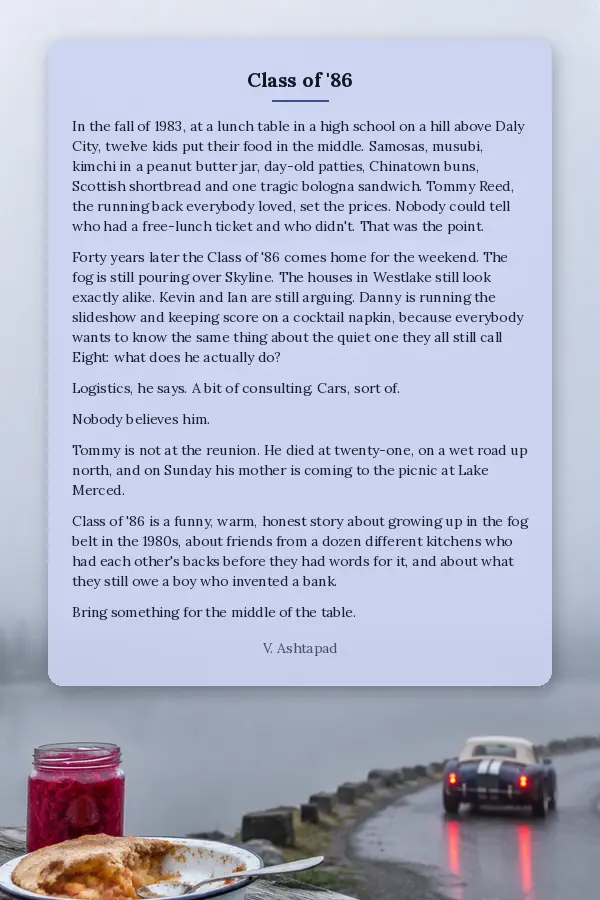
In the fall of 1983, at a lunch table in a high school on a hill above Daly City, twelve kids put their food in the middle. Samosas, musubi, kimchi in a peanut butter jar, day-old patties, Chinatown buns, Scottish shortbread and one tragic bologna sandwich. Tommy Reed, the running back everybody loved, set the prices. Nobody could tell who had a free-lunch ticket and who didn't. That was the point.
Forty years later the Class of '86 comes home for the weekend. The fog is still pouring over Skyline. The houses in Westlake still look exactly alike. Kevin and Ian are still arguing. Danny is running the slideshow and keeping score on a cocktail napkin, because everybody wants to know the same thing about the quiet one they all still call Eight: what does he actually do?
Logistics, he says. A bit of consulting. Cars, sort of.
Nobody believes him.
Tommy is not at the reunion. He died at twenty-one, on a wet road up north, and on Sunday his mother is coming to the picnic at Lake Merced.
Class of '86 is a funny, warm, honest story about growing up in the fog belt in the 1980s, about friends from a dozen different kitchens who had each other's backs before they had words for it, and about what they still owe a boy who invented a bank.
Bring something for the middle of the table.
Members can react to this book and talk about it in the members' Library.