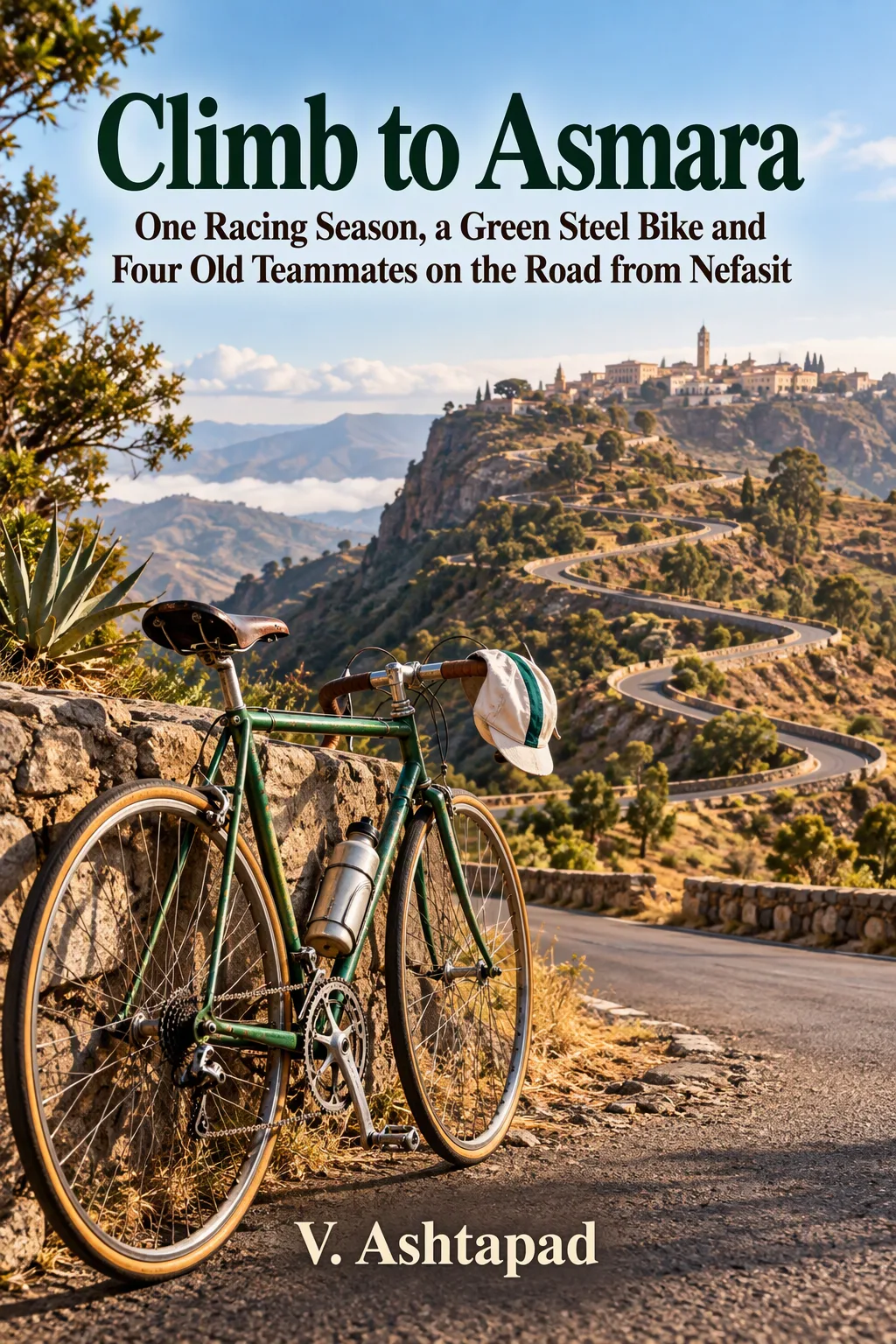
Climb to Asmara
One Racing Season, a Green Steel Bike and Four Old Teammates on the Road from Nefasit
by V. Ashtapad
Foreword
This is a work of fiction. Oakland, California, is home to a long-standing Eritrean community, and the bicycle racing of Asmara, the coffee ceremony and the injera of Eritrean homes are real. The Kokob cycling club, the shops and everyone in this book are invented.
For everyone who ever slowed down to ride beside someone.
The Bike in the Garage
The hooks are still in the garage ceiling, two of them, screwed into the beam above the washing machine, and the bike still hangs from them by its wheels, upside down, like a green bat that has been asleep for two years.
Selam Tesfay stands under it in her socks with a flashlight in her teeth.
It is the first Sunday in February, a little after six in the morning, and the garage smells the way it always smells: detergent, motor oil, the cardboard boxes of her mother's winter coats, and underneath all of that, faintly, chain lube, which is a smell that belongs to one person. She has not let herself stand here long enough to notice it since the November her father died. She notices it now. She takes the flashlight out of her mouth and breathes through her nose and waits for the feeling to pass, and it does not pass, so she climbs onto the step stool anyway.
The bike is lighter than she expects. Steel, but thin steel, the tubes no wider than two of her fingers. The frame is painted a green that is almost the green of a lime and almost the green of a bottle, and on the down tube, under a film of dust, there is a decal: a gold star with five points, and under the star, in small letters, a word she has seen her whole life without thinking about it. Kokob. Her grandmother says it means star. Her father used to say it meant the club, and the club meant everything.
She lifts the bike off the hooks and sets it on its wheels on the concrete. Both tires are flat. The saddle is cracked down the middle and somebody, her father, has wrapped it in black electrical tape. The handlebar tape is the old cloth kind, and it has gone the color of weak tea. The gears are friction shifters on the down tube, little levers you have to feel your way into, nothing that clicks.
Her own bike, the aluminum one with the carbon fork that she raced on all last summer with the junior club, leans against the wall beside the recycling bins. It is gray and black and has a number sticker from the Livermore criterium still stuck to the seat post. It looks, next to this one, like a machine. This one looks like a person.
Behind the bike, on the shelf where her father kept his tools, the red toolbox sits where it has always sat. She opens it, because she has decided this morning to open things. Tire levers. A chain tool. A pump with a wooden handle. Three spokes held together with a rubber band. Under the tray, a plastic sandwich bag, and inside the bag a photograph, the old kind printed on paper, soft at the corners.
Five young men on a road. Green jerseys with the gold star. They are stopped, one foot down each, at the outside of a hairpin bend, and behind them the mountain falls away into blue air, and below them she can see the road again, and below that the road again, folded back on itself four, five, six times, a ribbon somebody laid there on purpose. The road looks like it was folded onto that mountain by somebody very patient.
The one in the middle is grinning with his whole face. He is thin as the bike. He has her chin.
On the back, in blue ballpoint, in her father's capital letters that never once in his life leaned the same direction twice: NEFASIT. THE YEAR I WON. Y, M, T, A, ME.
She sits down on the step stool with the photo in her lap and the green bike leaning against her knee, and she stays there until the light in the little window over the door goes from gray to white, and then she gets up and goes inside.
---
Her mother is at the stove with the big round griddle plugged in, the electric one that takes up two burners' worth of counter. On the counter beside it is the white bucket with a plate on top, and Selam can smell it from the doorway, the sour, alive smell of teff batter that has been sitting for three days doing what it does. Her mother lifts the plate and stirs with a ladle and the batter gives off a little sigh of bubbles.
"You were in the garage," her mother says, without turning around.
"How do you know?"
"You're letting in the cold." Hiwet pours the batter onto the griddle in a spiral, starting at the outside and going in, fast, the way she has done it ten thousand times, and puts the lid on. "And you smell like your father's toolbox."
Selam sets the photograph on the counter beside the bucket.
Her mother looks at it for a long time. The lid of the griddle ticks as it heats. When she lifts it, the injera has gone from wet to spongy, its whole surface open with tiny holes, the edges curling up from the metal. She slides it off onto a cloth with a flat basket, quick, and pours the next one.
"He showed you this," Hiwet says.
"No."
"He showed everybody this. He showed the man who came to fix the dishwasher." Her mother almost smiles. "You were small. Maybe you don't remember."
"I want to race it," Selam says.
"Race what?"
"That hill. Nefasit. The one he won."
Her mother puts the lid back on the griddle and turns around. She is a small woman, smaller than Selam now, which still surprises both of them. She has flour on her hip and her reading glasses on a cord around her neck and the face she makes when a patient at the dental office tells her they floss every day.
"Selam."
"I know it's far."
"It's not far. It's the other side of the world. It's not the same thing." Hiwet takes off her glasses, though she was not wearing them. "And who would you race with? Who would take you? You don't know anybody there. You have never been there. You were going to go, the summer he—" She stops. "You were going to go."
"I know."
"So who?"
From the table by the window, where she has been sitting since five with her shawl around her shoulders and her small cup of tea going cold, her grandmother says, "Yonas."
They both turn.
Abeba is seventy-six. She came from Asmara to live with them eight years ago, after Selam's grandfather died, and she has a chair by the window that nobody else sits in, and a radio she listens to with one earbud, and a way of entering a conversation late and taking it over. She lifts a finger for each name.
"Yonas. Mekonnen. Tekle." She looks at the photograph on the counter, though she cannot possibly see it from there. "Y, M, T. They are here. In Oakland. They were at the funeral. They brought the chairs."
"Amaye," Hiwet says. "They haven't been to this house in two years."
"So," Abeba says, "it's time they came."
© 2026 CRUNOD LLC. All rights reserved.
Three Men at the Door
They come the next Sunday at four in the afternoon, all three together, which means they arranged it, which means they talked about it in a parking lot somewhere first.
Selam watches from the front window. A white delivery van with a ladder rack. A small silver sedan that is very clean. A pickup truck with gray primer on one fender. They park one behind the other, and the three men get out and stand together on the sidewalk for a minute in the February wind, and none of them comes up the walk.
"They're scared of her," her little brother Robel says beside her. He is eleven and has his face against the glass. "They're scared of Grandma."
"They're not scared of Grandma."
"Everybody's scared of Grandma."
The tall one in the denim jacket, the van one, laughs at something the small neat one says, and claps him on the shoulder, and then the big heavy one in the work coat just walks up the steps and rings the bell, and the other two have to hurry to catch up.
Her grandmother has been ready since noon. Ready means the green coffee beans washed and drying on a cloth. Ready means the long-necked clay pot, the jebena, with its round belly and its little woven ring to stand on, set on the low table in the living room on a bed of fresh grass Robel was sent to pull from the edge of the yard. Ready means the small cups with no handles lined up on a tray, and the frankincense on its little coal in the clay dish, and the bowl of popcorn her mother made, and Abeba herself on the low stool by the charcoal burner Selam's father rigged up years ago out of a camping stove, in her white dress with the colored border, with her hair wrapped, sitting very straight.
Robel opens the door. The three men come in one at a time, ducking a little, though only one of them is tall enough to need to.
"Abeba," says the big one, and bends and kisses her grandmother three times on the cheeks, right, left, right, and then holds both her hands and does not let go for a while.
"Mekonnen," Abeba says. "You got fat."
"I did," he agrees.
---
They sit on the couch in a row like boys outside a principal's office.
Yonas Haile is the tall one. Fifty, maybe. He drives the van for a restaurant supply company and talks the whole time, about traffic on the bridge, about the price of avocados, about basketball, about Robel's sneakers. He has a laugh like somebody shaking a box of nails, and he laughs at his own jokes before he finishes them.
Tekle Berhe is the small one. Younger, maybe forty-eight, in a pressed shirt and a fleece vest. He is a pharmacist in San Leandro. He has brought a box of pastries from a bakery and set it on the table squared to the edge, and he keeps glancing at the green bike, which Selam has wheeled in from the garage and leaned against the bookshelf where nobody can miss it.
Mekonnen Gebremedhin, the big one, says almost nothing. Fifty-two. He has a body shop on International Boulevard. His hands are enormous and have black in the creases that soap will never reach. He sits with his elbows on his knees and watches her grandmother roast the beans.
Selam has seen this a thousand times and she watches it anyway. The beans in the long-handled flat pan over the flame. Abeba shaking the pan, a small steady rattle, not stopping. The green going tan, then brown, then nearly black and shining with their own oil, and the smoke rising, and the smell, which is the smell of every Sunday of her life. Her grandmother stands, slowly, with one hand on Selam's arm, and carries the hot pan around the room, and each guest leans into the smoke and waves it toward his face with his hand and says thank you. Then she sits again, and grinds the beans with the heavy little pestle in the wooden mortar, and pours the grounds into the jebena with the water, and sets it on the coals.
Nobody talks about anything that matters until the first round is poured.
That is the rule. Selam's father explained it to her once, when she was seven and wanted to know why grown-ups sat so long being polite. The first cup, he said, is so the guest knows he is welcome. The second cup is so he can say what he came to say. The third cup is so he can go home without anyone being angry.
Abeba pours the first round from a height, the stream of coffee black and thin as a pencil line, into each little cup without spilling any, and Robel carries the tray, very carefully, with his tongue out.
"Awel," Abeba says. First.
"Awel," the men say, and drink, and Yonas says it is the best coffee in California, and Abeba says he has always been a liar, and everybody laughs, and it is a little easier.
---
At the second round, Selam says it.
She has practiced in the bathroom mirror. It still comes out wrong, too fast and too high.
"I want to ride Nefasit," she says. "The hill race. The one my dad won. I want to do it this year, in October, after the rains. I've been racing juniors since last spring. I have results. I can show you. I want you to coach me."
Yonas stops talking, which Selam suspects is unusual.
Tekle looks at his coffee.
Mekonnen looks at the bike.
"Twenty-four kilometers," he says. It is the first full sentence he has spoken. His voice is very deep and very quiet, and it comes out of his chest like something being pulled up from a well. "Seven hundred meters up. More, maybe. At the top you are at two thousand three hundred meters and there is no air."
"I know."
"You don't know." He does not say it unkindly. "Nobody knows until they are on it."
"So teach me."
"Selam," her mother says, from the kitchen doorway, where she has been standing with a dish towel she is not using.
"On that?" Mekonnen nods at the green bike. "You want to ride Nefasit on that?"
"Yes."
"The tires are older than you."
"So we get new tires."
Yonas laughs, the box of nails, and then catches Hiwet's face and stops. Tekle takes a small notebook out of his vest pocket and a pen out of the spiral and opens to a clean page and writes something, and Selam cannot see what, and it makes her furious and hopeful at the same time.
"We haven't raced in twenty-five years," Tekle says, to the notebook. "Any of us. I ride on Saturdays to the reservoir and back. Yonas rides when his doctor yells at him. Mekonnen—"
"I ride," Mekonnen says.
"Mekonnen rides," Tekle agrees, "but he rides alone, in the dark, at five in the morning, like a man running from the police." He looks up. "We are not coaches."
"You were his team."
Nobody answers that. Her grandmother, on her low stool, puts more beans in the pan and starts to shake it again, the steady rattle, as if she has heard none of this and it is her business only to keep the coffee going. But she says, without looking up, "Amanuel still has the shop."
"Amanuel," Yonas says. "Of course Amanuel still has the shop. Amanuel will die in the shop."
"Amanuel is the A," Selam says. "On the photo. Y, M, T, A."
"Amanuel is the A," Tekle says. "He stayed. He fixes bicycles near the market. He still rides with the club."
"Does the club still do the hill race?"
The three men look at each other.
"Every year," Mekonnen says. "October. After the rains."
---
At the third round, her mother comes in and sits on the arm of the chair, which she never does.
"She is sixteen," Hiwet says. She says it to Mekonnen, as if he were the one who had asked. "She has school. She has finals in June. She has a brother. She has a grandmother who cannot get up the stairs by herself on a bad day."
"Mom—"
"I'm talking." Her mother is very calm. "And she had a father who went out to ride with you every Saturday for twenty years and came home and sat in that chair and laughed at the television. I want her to have that. Not a mountain. That." She looks at the three of them in a row on her couch. "Where have you been?"
Yonas opens his mouth and shuts it.
"We didn't know what to say," Tekle says finally. "After."
"You could have said hello."
"Yes," Mekonnen says. "We could have."
The jebena hisses on the coals. Abeba pours the third round, the weakest, the one called bereka, and the cups go around on the tray, and everyone drinks, because you drink the third round. That is also the rule.
Mekonnen sets down his cup. He gets up off the couch with a grunt and crosses the room and crouches beside the green bike. He spins the front wheel with one finger. It wobbles, a little, a half centimeter left and right, and he watches the wobble the way a doctor watches a cough. He puts a thumb on the rim. He squeezes two spokes together and listens.
"Saturday," he says. "Seven o'clock. My shop. Bring this. Bring your own one also."
"Mekonnen," Hiwet says.
"We coach her through the season," he says, standing up. "Spring, summer. Her races here. Tekle writes everything down, because Tekle writes everything down. Yonas drives, because Yonas has the van. If in September she is ready, I call Amanuel. If she is not ready, we go to the reservoir on Saturdays, and she has three old uncles who ride too slow, and that is also good." He looks at her mother. "And we come to this house. Every Sunday. Whether she rides or not."
Her mother looks at him for a long time.
"Every Sunday," she says.
"Every Sunday."
"Then you can bring the chairs back," Hiwet says. "You still have my folding chairs from the funeral. All twelve."
Yonas begins to laugh, the real one this time, helpless, and then Tekle is laughing too, and Mekonnen just puts one huge hand over his face and shakes his head. And her grandmother, on her stool, puts down the pan and looks at Selam over the smoke, and does not smile, exactly, but closes her eyes once, slowly, the way a cat does when it is pleased with you.
© 2026 CRUNOD LLC. All rights reserved.
Base Miles
Mekonnen's body shop smells of paint thinner and burnt coffee and has a calendar from a tire distributor on the wall that is three years out of date. At seven on Saturday morning the roll-up door is open and he is standing inside it in a stained apron with the green bike already up on a stand, stripped to the frame.
"You took it apart," Selam says.
"Yes."
"All of it."
"You can't see a frame with things on it." He turns it in the stand, slowly, and holds a work light up to the joints where the tubes meet. "Look. Here. Here." He shows her a hairline in the paint at the head tube, rust blooming under it like a bruise. "Nothing. Paint only. The steel is good. Your father kept it dry. He oiled the inside of the tubes. Who does this? Nobody does this."
"Can you fix it?"
"I fix cars that drove into a pole," Mekonnen says. "I can fix a little rust."
He does not let her ride it yet. He says the green bike is for October. For now she trains on her own bike, the gray one, and he takes that off her too, and puts it on the stand, and in twenty minutes has raised her saddle by a centimeter and moved it back by half of one and told her that whoever set her up last year should be ashamed.
"That was the junior club coach."
"Then he should be ashamed," Mekonnen says, "and also his mother."
---
Tekle's notebook is the size of a deck of cards and has a rubber band around it.
On the first page, in tiny upright handwriting, is her name and her weight and her height and her resting heart rate, which he made her count with two fingers on her wrist while he watched the second hand of his own watch, an old metal one. On the second page is a calendar, February to October, with every Saturday and every Tuesday and Thursday marked with a letter. Most of the letters, for the first six weeks, are B.
"Base," Tekle says. "Long. Slow. Boring."
"I already have a base. I raced all last summer."
"You raced," Tekle says. "That is not the same. You rode very hard for one hour and then you lay on the grass and ate oranges. I saw the results. You were fourth in Livermore, you were sixth in Patterson, you were nowhere in the hill race at Mount Hamilton. The hill race at Mount Hamilton is the only one that matters for what you want." He taps the notebook with his pen. "So. B. Long, slow, boring, until your body forgets how to be in a hurry."
"How long is long?"
"Three hours," Tekle says. "Then four."
"And how slow is slow?"
"Slow enough that you can talk." He nods across the shop. "Talk to Yonas. Yonas will talk back. That is how you know."
---
Yonas talks back.
They ride on Saturday mornings, the four of them, up out of the flats and into the Oakland hills. Up Joaquin Miller past the redwoods, up Skyline with the whole bay laid out on the left in the morning haze, the bridges like stitches pulling the cities together, along Grizzly Peak where the eucalyptus drip and the road is wet even when it has not rained. They are slow. Selam has never ridden this slow in her life. It makes her legs itch.
Mekonnen rides in front, a wall of a man on a black steel bike with no decals on it at all, and he does not look back, but if she lets the gap open past two bike lengths he slows down without seeming to, and if she closes it to less than one, he speeds up. Tekle rides at the back with a small computer on his handlebars, the only modern thing about him, and every twenty minutes calls out, "Eat," or "Drink," and she does, because it is easier than arguing with Tekle.
Yonas rides beside her and never stops talking.
"Your father," he says, on the second Saturday, on the long false flat past the stables, "was the worst sprinter I ever saw. You know that? Terrible. A grandmother on a donkey could beat him to a sign. But uphill." He takes one hand off his bars and makes a gesture, a hand going up a staircase. "Uphill, it was like somebody turned off his gravity. He didn't look strong. You looked at him, you thought, this boy, he weighs nothing, he will blow away. And then the road goes up and he is just—" He whistles. "Gone. Away. Like a goat."
"Like a goat," Selam says.
"A beautiful goat," Yonas says. "Very elegant goat. Don't tell your mother I said goat."
She learns things on those rides. She learns that her father, at nineteen, rode to the club meetings every Thursday night on a bike with no brakes and stopped by putting his foot on the front tire. That he ate an entire tray of his mother's injera with lentils before every race and threw up once at the start line in Keren and still finished third. That he was so shy he could not talk to girls and Yonas had to talk to her mother for him, at a wedding in Oakland, the first year, and that her mother had told Yonas to go away and send the shy one back.
"She said that?"
"She said, 'You talk too much. Tell your friend if he wants to dance he can ask me himself.'" Yonas laughs. "That was twenty-four years ago. She was right. I talk too much."
She learns things he does not tell her, too. That Yonas rides with his left knee turned slightly out, because he broke it once, though he never says how. That Tekle rides behind her not to supervise but because he cannot ride beside anyone; he goes quiet and stiff, a little lost, and is only easy at the back with his numbers. That Mekonnen, who never looks back, knows exactly where she is every second, the way a mother cat knows where her kittens are without turning her head.
---
On the fourth Saturday, on the climb up from the bottom of Redwood Road, her legs finally stop itching.
It happens without her noticing. One minute she is fighting the pace, wanting to stand on the pedals and go, and the next she is just turning them, round and round, and the road is going up under her and the redwoods are going past and she can hear the creek down in the canyon and Yonas is telling her about the time the team bus broke down outside Dekemhare and they had to push it, and she is laughing, and they are at the top. She looks down at her own computer. Forty minutes. She has never climbed for forty minutes in her life without wanting to die.
Mekonnen is waiting at the top, straddling his bike, eating a banana.
"So," he says.
"So," she says. She is barely breathing hard.
He finishes the banana. He folds the peel, carefully, into a small square, and puts it in the back pocket of his jersey. "Again," he says.
"What?"
"Down and again." He points his chin down the road they have just climbed. "This time, no talking. This time, you go in front. You choose the speed. Not too fast. If you go too fast, I will know, and I will be very disappointed in you, and you will feel it all the way down your back."
So she goes down, and turns, and goes up again in front, and for the first time in her life there is nobody ahead of her to chase. Just the road. Just the gray line in the middle of it going up and around and up, and three old men behind her who are not saying a word, whose breathing she can hear, steady, slow, like the breathing of people asleep in the next room. She does not go too fast. She can feel Mekonnen watching her back. She feels it the whole way, the way you feel sun.
At the top, Tekle writes in his notebook for a long time. When she tries to see, he closes it and puts the rubber band back on.
"What did you write?"
"Numbers," Tekle says.
"What numbers?"
"Good ones," he says, and gets on his bike.
© 2026 CRUNOD LLC. All rights reserved.
The Coffee Rounds
On Sundays now, the men come.
They come at four. They bring things: Tekle a box of pastries, always the same bakery, always squared to the table's edge; Yonas a bag of oranges from the restaurant supply warehouse, or a crate of tomatoes, or once a ten-pound sack of onions that nobody asked for and her mother used for a month. Mekonnen brings nothing, and then, the third Sunday, comes up the walk carrying four folding chairs, and the fourth Sunday four more, and the fifth Sunday the last four, and stacks them in the garage by the washing machine without saying anything about it.
And Abeba makes coffee. Every Sunday. Three rounds. She has not done the full ceremony every week since Selam's father died. She did it for holidays, for guests, the way you take out the good dishes. Now there are guests every week, and she sits on her low stool at four o'clock with her back straight and her hair wrapped and roasts the beans, and the smoke goes around the room, and the men lean into it.
But she is slower than she was. Selam sees it now that she is looking.
Her grandmother's hands shake a little when she lifts the pan. She stands up from the stool in two motions instead of one, the first to get her weight forward and the second to get it up, and the second one takes a breath she tries to hide. On the fifth Sunday, carrying the smoking pan around the room, she stops at the arm of the couch and puts one hand on it, and stands there, and pretends she is waiting for Yonas to finish a story.
"Amaye," Selam says, after, in the kitchen. "Let me do it next time. The beans."
"You don't know how."
"So teach me."
Abeba looks at her for a long moment. It is the same look Mekonnen gave the wobbling wheel.
"Everyone in this house," her grandmother says, "wants me to teach them something. Your father wanted me to teach him to make shiro. Forty years old, he wants to make shiro. Your mother wants me to teach her my injera, which she makes better than me, she just won't admit it. Now you want to roast." She sighs, a long, theatrical sigh. "Wednesday. After school. Bring your hands clean."
---
On Wednesday, after school, Selam comes into the living room with her hands clean and her grandmother is already on the stool and there is a second stool beside it, lower, a child's stool from somewhere in the garage, and Selam sits on it with her knees by her ears.
"First," Abeba says, "the beans are not ready because you bought them. They are ready because you washed them. Wash."
Selam washes the green beans in a bowl, rubbing them between her palms, and the water goes cloudy and then clear. She dries them on a cloth.
"Now the pan. Not too hot. You are not making a steak."
Selam shakes the pan over the flame. Her grandmother watches.
"Faster. No. Steady. Steady is not fast. Steady is steady." Abeba puts her hand over Selam's hand on the handle. Her grandmother's hand is dry and very light and very warm. Together they shake the pan, the small rattle, round and round. "You hear that? That is the sound. If the sound stops, the beans burn. Don't stop the sound."
The beans go tan. They begin to crackle, a tiny popping, like rain starting on a car roof. The first smoke comes up, thin and sweet.
"You know what this is like?" Abeba says.
"What?"
"Your bicycle. Your father used to tell me. On the mountain, he said, you cannot stop. If you stop, you never start again. So you go slow, but you don't stop." She takes her hand away. Selam keeps shaking. "Same thing. Slow. But don't stop the sound."
The beans go brown. They go dark and begin to shine.
"Now," says Abeba. "Stand. Carry it."
Selam stands, with the smoking pan, and there is nobody in the room but her grandmother and Robel, who has come in from the kitchen eating cereal from the box. She carries it to him anyway, and he leans into the smoke, and waves it toward his face with his hand, and says, very seriously, "Thank you," and then ruins it by laughing so hard cereal comes out of his nose.
---
That night her grandmother cannot sleep, and neither can Selam.
She hears the radio through the wall, very faint, and goes to her grandmother's room off the kitchen, the one that used to be the den. Abeba is sitting up in bed in her shawl with the earbud in, and when she sees Selam in the doorway she takes it out.
"You have school."
"I know."
"So go to sleep."
"You go to sleep."
Abeba pats the bed. Selam sits.
"When he was ten," her grandmother says, without being asked, "your father had a job. Every morning at five, before school, he took his uncle's bicycle and rode to the bakery near the market for bread. You know how far? Four kilometers. Uphill coming back. Every morning, with the bread in a sack on his back, hot, the whole street smelling it. He would come in the door with his face like this—" She puffs her cheeks out. "And put the bread on the table, and fall on the floor, like he was dead. Every morning. Very dramatic boy. I would step over him to make the tea."
Selam laughs.
"One morning," Abeba says, "he came in and put down the bread and did not fall on the floor. He just stood there. I said, what's wrong? He said, Amaye, I didn't stop. All the way. I went up the whole hill and I didn't stop." She is quiet a moment. "After that, I never got the bread on time again. He was always riding somewhere else first. Up some other hill. To see if he could not stop on that one, too."
The radio murmurs on the pillow. Selam can hear a man's voice in Tigrinya reading what sounds like the weather.
"I want to see it," her grandmother says.
"See what?"
"The top. Of Nefasit. Where they finish. At the edge of the plateau, where the road comes up and you can see everything." She looks at the window, where there is nothing but the dark yard and the light from the neighbor's porch. "I haven't been home in eight years. I said, I'm too old, it's too far, the flight is too long. My sister is there. My sister is eighty. Every Sunday on the phone she says, when, when. I always say next year." She takes Selam's hand, the same way she did on the pan. "If you go up that mountain, I want to be at the top. I want to make the coffee for them when they come. Do you understand?"
"Amaye. Mom will never—"
"Your mother," Abeba says, "is my problem."
© 2026 CRUNOD LLC. All rights reserved.
The Port Criterium
The first race of the season is in the second week of March, on a loop of flat streets by the port, between warehouses and a row of new apartment buildings, with the cranes standing over everything like enormous orange horses.
A criterium is the opposite of a mountain. Selam knows this. Tekle has explained it twice, with diagrams in the notebook. A criterium is a short loop, a kilometer and a half, four corners, and you ride around it for forty minutes as fast as you can, and the race is all elbows and braking and sprinting out of the turns. It is not what she is training for. It is, Tekle says, a test. To see whether the base has gone into her legs or only into her head.
"Don't win it," Mekonnen tells her at the start, which is the strangest thing anyone has ever said to her before a race.
"What?"
"You don't need to win it. You need to finish it in the front group without ever going to the front. Can you do that?"
"Why can't I go to the front?"
"Because going to the front is easy," he says. "Staying behind when you want to go to the front is hard. Today, you do the hard thing."
The junior girls' field is eleven riders. Selam knows most of them from last summer. Maya Lindqvist from the Berkeley team is there, tall and pale and terrifying, who won the state criterium last year as a fifteen-year-old and has a mother who stands at the barrier and screams her name through cupped hands. Maya nods to her on the line. Selam nods back.
Yonas has parked the van at the second corner, the sharp one by the loading dock, and has somehow acquired a cowbell.
---
For the first twenty minutes, she does the hard thing.
She sits fourth wheel, fifth wheel, sixth. She takes the corners where Mekonnen told her, wide in, tight at the apex, wide out, not touching the brakes more than she has to. Every time the group slows on the backstretch she feels the urge rise in her chest like a hiccup, the need to go, go now, attack, and she holds it, the way you hold a sneeze in a library. Yonas rings the cowbell every lap. On the eighth lap Tekle, standing at the finish line with his watch, holds up a piece of cardboard on which he has written, in marker, PATIENCE.
On the fourteenth lap, Maya attacks.
She goes on the backstretch, out of the saddle, a clean hard acceleration, and the group hesitates for a second the way groups do, and Maya is five meters clear, ten, fifteen. And Selam, who has been holding the sneeze for twenty-one minutes, lets it go.
She is out of the saddle before she has decided anything. She is past the girl in front of her, past the next, and then there is nobody between her and Maya's back wheel but empty asphalt. Her legs feel wonderful. They feel like they could do this forever. She catches Maya in a lap and a half and sits on her wheel, breathing like a train, and Maya looks back at her once under her arm with an expression that is not angry, exactly. Interested.
Then Maya swings over and flicks her elbow, the signal: your turn.
Selam goes to the front.
She pulls for half a lap. Then another. The cowbell is going berserk. She can see Tekle at the line with his cardboard sign, and he is not holding it up, he is just holding it at his side, and his face is unreadable, and she is going so fast, and then on the fifth corner, the one by the loading dock, coming out of the turn, she stands up to accelerate and her legs are not there.
There is no other way to describe it. They are just not there. She pushes and nothing pushes back.
Maya goes past her like she is parked.
Then the group comes past, all of them, one by one, and she tries to get on the back of them and cannot, and they pull away up the straight, and she rides the last four laps alone, in the wind, with a kind of roaring in her ears, and finishes ninth of eleven, and gets off her bike on the sidewalk and sits down on the curb with her helmet still on.
---
For a few minutes, no one talks. Not because they are angry. Because Yonas is buying her a lemonade from the food truck, and Tekle is writing in his notebook, and Mekonnen is putting her bike in the van.
When Yonas comes back with the lemonade, he sits beside her on the curb, all six-foot-three of him, his knees up by his ears like hers were on the coffee stool.
"So," he says.
"I know."
"So, tell me what you know."
"I went too early. I went to the front. You told me not to."
"Mekonnen told you not to. I just rang the bell." He takes a sip of her lemonade without asking and hands it back. "You know what your father did, the first time he raced in Asmara? The first time with the club? A circuit race, around the stadium, very flat, very fast, like this. He went in the first lap. First lap! Alone. He was in front for nine laps. Everybody in the crowd was screaming. His mother was screaming. And on the tenth lap he blew up so big we heard it. Like a tire. Pah." Yonas makes the sound. "And he finished last. Not ninth. Last. And Mekonnen, who was the captain, came over and sat with him on the ground, like I am sitting here, and you know what he said?"
"What?"
"Nothing," Yonas says. "Mekonnen never says anything. He just sat there. Then he gave your father half of an orange." He nudges her. "Then he said, next time, wait."
Mekonnen comes over from the van. He crouches in front of her, which takes him some time, and looks at her face, not unkindly, the way he looked at the head tube of the green bike under the work light.
"How did it feel?" he says. "When you went."
She thinks about lying.
"It felt amazing," she says. "For about three minutes."
He nods.
"On Nefasit," he says, "there are many places where it feels amazing for three minutes." He holds out his hand. In it is half of an orange, already peeled. "Next time, wait."
© 2026 CRUNOD LLC. All rights reserved.
Mount Diablo
In April they ride Mount Diablo, which is not a race, which is the longest climb near Oakland, and which Tekle has circled in the notebook in red.
They start from the bottom on the south side before seven on a Saturday, in a gray chill that smells of sage and cow pasture, with the wildflowers out in the grass along the road, orange poppies and purple lupine and some small yellow ones Tekle says are called goldfields, which is the kind of thing Tekle knows. Eleven miles to the summit. Three thousand feet of climbing, or a little more. The last bit, the final two hundred meters to the top, Tekle says, is steeper than anything in her life so far.
"Nefasit is longer," Mekonnen says, clipping in. "But it is not steeper. This is to learn what steep feels like, so that on Nefasit when it is not steep, you are happy."
"Is that a real training method?"
"It is my training method."
---
They go up in their usual order, and at first it is like the Saturdays in the hills, slow, steady. But after the ranger station, on the long switchbacks above the valley, where the road starts folding back and forth across the face of the mountain, Mekonnen does something he has never done. He lets Yonas and Tekle fall back. He doesn't wait for them. He just keeps going, at a pace a little above the one they have been riding all spring, and he looks back at her once, for the first time ever, and lifts his chin.
So she goes with him.
The road switches back. It switches back again. Below them the valley opens out farther every time, the towns, the reservoirs, the long brown hills, and then the bay beyond, shining. They do not talk. She can hear his breathing and her own, and the tick of his freewheel when he coasts for one second at the top of each switchback before the road turns and goes up again, and the far small sound of somebody's dog in the campground. The sun comes out over the shoulder of the mountain and lands on her back.
Above the junction where the north road comes in, he slows, finally, and sits up, and rides beside her for the first time all spring.
"Your father," he says. Then nothing, for a long time. Two switchbacks. "The year he won Nefasit. It was supposed to be me."
She waits. She has learned this from her grandmother. You don't stop the sound, but you don't hurry it either.
"I was the captain. I was the strongest that year. Everybody said. Twenty-five. I trained all summer. Your father was twenty-two, he was my domestique, you know domestique? The helper. He was supposed to carry my water and ride in front of me in the wind and then at the end, when it went steep, get out of the way." He shakes his head. "At Arbaroba, the village, halfway, about there, I started to cramp. Both legs. Here." He touches the back of his thigh. "I was in front. Me and him and one man from another club. And I am cramping and I am going slower and slower and the other man can see. He is waiting. Like a hawk."
"What did my dad do?"
"He rode beside me." Mekonnen is quiet a moment. "That's all. He didn't go. He could have gone. He could see I was finished. The other man went, and your father let him go, and stayed next to me, beside me, at my speed, which was nothing. Talking. Saying stupid things. Saying, look at that donkey. Saying, Meki, your mother called, she says you are slow. For five kilometers, beside me, like this." He holds his hand flat, level with his own shoulder. "Until the cramp let go a little. Then he said, can you go? And I said, a little. And he said, then I'm going."
"And he caught the other man?"
"He caught the other man with one kilometer left and beat him by the length of a bus." Mekonnen almost smiles. "I was sixth. I didn't care. I was there at the top when he came in, and he fell on the ground, like he was dead—"
"He always did that."
"He always did that. And then he got up and came to me and said, sorry, Meki, I took your race. And I said, you didn't take it. I couldn't carry it. You carried it." He looks at her sideways. "Your father could have won that race by himself, two kilometers sooner, easy. He waited for me. That is who he was. Not the winning. The waiting."
The road kicks up. They ride without talking for a while.
"Is that why you stopped coming?" Selam says. "After."
He takes so long to answer that she thinks he will not.
"After he died," Mekonnen says, "I didn't know how to sit in that house without him beside me." He breathes, in, out. "I was ashamed. A big man. Fifty years old. I rode in the dark every morning so I would not have to see anybody, so nobody would see me. Tekle and Yonas, same, a little, each in his own way. We were all hiding." He looks at the road ahead, the last switchbacks, the radio towers on the summit. "Then your grandmother called. She said, my granddaughter needs a team. And I thought, oh, so that's the job now."
---
The last two hundred meters to the summit are worse than Tekle promised.
The road tilts up like a ramp into a parking lot, and it is so steep that she has to stand, and even standing her front wheel wants to come off the ground, and her lungs are full of hot wire. Mekonnen is beside her. He is not going any faster than she is. He could. She knows he could; she has seen him on Redwood Road, at five in the morning, alone, flying. He stays beside her, at her speed. He says, "Look at that ground squirrel." He says, "Your grandmother called, she says you are slow." And she laughs, which costs her a breath she does not have, and she gets to the top.
They sit on the stone wall at the summit with the whole of northern California around them, the Sierra out east white with snow, faint, like a rumor, and wait for Yonas and Tekle.
When Tekle comes in, he looks at his watch, and at his little handlebar computer, and then at her, and then he opens the notebook and writes a number and draws a circle around it. He shows it to her, this time, without being asked.
"What does that mean?"
"It means," Tekle says, "that I am going to call Amanuel."
© 2026 CRUNOD LLC. All rights reserved.
Injera for the Team
Her mother says no.
She says it on a Sunday in May, at the dinner table, with all three men there, after Tekle has explained, with great care and three different charts on his phone, what he has been writing in the notebook. He explains watts per kilogram and climbing speed and the expected time up Nefasit for a girl of Selam's size, and the expected time of the women and junior girls who rode it last year according to Amanuel, who sent the results by text in a photograph of a handwritten sheet, and Tekle has made a line on a graph that goes up, and her mother looks at the graph and puts down her fork.
"No," Hiwet says.
The table goes quiet. Even Robel, who has been building a small structure out of injera rolls, stops.
"I'm not saying she's not good," her mother says. "I can see she's good. I'm not stupid. I see her come home on Saturdays. I see her eat like a horse. She's good." She folds her hands. "But you are talking about two thousand three hundred meters. You are talking about an hour, more, as hard as she can go, with no air. And she is Daniel's daughter."
"Hiwet," Tekle says.
"You know what I mean."
He does. Selam can see that he does. They all do.
Her father's heart had a flaw in it that no one ever found until it stopped. That is how her mother explained it, at the time, to a nine-year-old Robel and a fourteen-year-old Selam, sitting on the edge of the bathtub because it was the only room in the house nobody else was in. A small thing in the muscle, thicker than it should be, the kind of thing that can be there your whole life and do nothing. And then one night in November, asleep, beside her, it did something. The doctors said there was nothing anyone could have seen. The doctors said it was nobody's fault. The doctors said, and this was the part her mother told them very slowly, holding both their hands, that it can run in families, and so Selam and Robel would both see a heart doctor, and they would both be checked, and they were.
"I was checked," Selam says now. "Two years ago. They said I was fine. You were there."
"You were fourteen. You were not riding up mountains." Her mother's voice is very steady. "I want you checked again. Properly. With the treadmill, with the ultrasound, everything. The doctor at Highland, the one who saw you before. I want him to look at you and tell me, in words, that you can do this. And if he says no—"
"Then she doesn't do it," Mekonnen says.
Everyone looks at him.
"If the doctor says no," he says, "then we go to the reservoir on Saturdays. I told you this the first day." He puts his big hand flat on the table. "Hiwet. I'm not going to put his daughter on a mountain he didn't see coming. None of us is. You think we didn't think of this?" He looks at Tekle. "Tell her."
Tekle reaches into his fleece vest and takes out the notebook. He opens it to the very back page, where Selam has never been allowed to look, and turns it around and slides it across the table to her mother.
On it, in his small upright handwriting, is a list. The name of a cardiologist at Highland. The name of a sports cardiologist in San Francisco. Phone numbers. Questions. A note that says: ASK ABOUT ALTITUDE, 2300 M. A note that says: ECHO + STRESS TEST, BOTH. A note that says: IF NO, NO.
Her mother reads it for a long time.
"When did you write this?"
"February," Tekle says. "The first Saturday."
---
The cardiologist at Highland is a short woman with silver hair and red sneakers named Dr. Okafor, and she does everything on Tekle's list and two things that are not.
Selam lies on a paper-covered table in a dark room while a technician moves a cold wand slick with gel over her chest and the screen beside her shows her own heart, gray and shifting, opening and closing like a hand. She runs on a treadmill with wires stuck all over her while the treadmill tilts up and up and up, like Diablo, like the last two hundred meters, until she is gasping. She wears a monitor for two days under her shirt, including one Saturday ride up Redwood Road with Mekonnen beside her, who keeps glancing at the wire coming out of her collar like it is a snake.
Ten days later, Dr. Okafor sits across from Selam and her mother in a small office with a box of tissues on the desk, and says, in words, "Her heart is normal. Structurally normal. Electrically normal. It's a strong, healthy athlete's heart." And then, to Hiwet, more gently: "I've read her father's records. I understand why you asked. You were right to ask. And the answer is that what he had, she doesn't have."
Her mother does not cry. She takes one tissue from the box and folds it into a very small square and holds it in her fist on her knee.
"And the altitude?"
"Give her a week up there before she races. Let her get used to it. Water, sleep, go easy. If she gets a headache that won't stop, or dizzy, she comes down." Dr. Okafor smiles. "My brother-in-law climbs in Colorado. He's sixty-four. She'll be fine."
In the parking lot, her mother stands by the car with the keys in her hand and does not open it.
"Mom?"
"Give me a minute."
Selam gives her a minute. The wind comes off the hills and moves the eucalyptus over the hospital. A bus goes by. Her mother is looking at nothing, at the sky over the parking structure.
"He would have loved this," Hiwet says finally. "You know that? He would have been unbearable. He would have told every patient at my office, every person in the grocery store. My daughter is riding Nefasit." She unlocks the car. "Okay."
"Okay?"
"Okay," her mother says. "But I'm coming too."
---
That Sunday, her mother makes injera for the team.
She makes it the way she makes it for holidays, which means she starts on Wednesday. Teff flour and water mixed in the white bucket and covered with a plate and left on the counter by the warm refrigerator to sour, and on Friday the yellow water poured off the top and the starter added, and on Saturday a little of the batter cooked thin with water into a paste and stirred back in, to make it rise. On Sunday afternoon she stands at the griddle for two hours pouring spirals and lifting lids, and the stack on the basket grows and grows, round and gray-brown and full of holes, each one soft as a towel.
She makes lentils with berbere, red and deep. She makes the yellow split peas with turmeric and onion. She makes greens. She makes zigni, the beef stew, because Mekonnen once, twenty years ago, at a wedding, said it was the best he ever ate, and he has not forgotten, and she has not forgotten that he has not forgotten.
They eat from one big round tray in the middle of the table, all of them, tearing off pieces of injera with their right hands and pinching up the stews. Her grandmother does the thing she has done Selam's whole life, at every big dinner, where she tears off a piece, wraps it around a bite of zigni, and puts it directly into someone else's mouth. A gursha. She does it to Selam first. Then to Robel. Then she reaches across the table and does it to Mekonnen, fifty-two years old, enormous, and he opens his mouth like a baby bird and takes it, and his eyes go wet, and he chews for a long time and doesn't say anything.
"So," says Yonas, who has been unusually quiet, "the team eats."
"The team eats," Hiwet says. She looks around the table at them. Three men who were boys in green jerseys. Her mother-in-law. Her son. Her daughter. "Next Sunday, somebody else cooks. I'm not doing this every week."
"Tekle cooks," says Yonas.
"Tekle can't cook," says Mekonnen.
"I can cook," Tekle says, offended. "I can make pasta."
"Pasta," says Abeba, with infinite contempt, and the whole table falls apart laughing, and Selam laughs so hard she has to put her head down on the table next to the tray.
© 2026 CRUNOD LLC. All rights reserved.
Del Puerto Canyon
The June road race goes out through the Central Valley to a canyon east of the coast range, where a narrow road climbs for miles between dry hills the color of a lion.
It is the hottest day of the year so far. At nine in the morning the thermometer on Yonas's van says ninety-one. By eleven it says a hundred and four, and Yonas stops reading it out loud because Tekle asks him to.
The course is a long loop, two times around, sixty-four kilometers for the junior girls, with the climb up the canyon the second time being the race. Fourteen girls on the line. Maya Lindqvist, who has been winning everything all spring and who now nods at Selam at the start of every race in a way that means something, and two strong girls from a team in Sacramento, and a girl from Fresno nobody knows who has calves like loaves of bread.
"Wait," Mekonnen says at the start.
"I know."
"Say it."
"Wait."
He puts half a peeled orange into her jersey pocket, which is now a thing he does.
---
On the first lap, she waits.
On the long flat out toward the canyon she sits in the group and lets the Sacramento girls do the work. On the first time up the climb she rides at Maya's shoulder and lets the Fresno girl attack and get caught and attack again and get caught again. Tekle and Yonas are at the feed zone at the top with bottles, and she takes one from Tekle without looking, the way they practiced, and pours half of it over her head. The water is warm already. On the descent she stays on the wheels and doesn't take any chances, and when they come around for the second lap there are nine of them left, and she has not done anything yet, and it is the hardest thing she has ever not done.
Eleven kilometers from the finish, on the flat before the canyon road starts to climb for the last time, her back tire goes soft.
She feels it before she hears it, a squirm in the rear of the bike on a corner, the back end sliding like it is on ice, and then the rim thumping on the road. A thorn, a goathead, the little spiked seeds that grow along every road in the valley. She puts her hand up, the signal, and swings to the side, and the group goes past her in a hot gust and is gone around the bend.
She is standing on the shoulder of the road in a hundred and four degrees with a flat tire and her heart going and the dry hills ringing with insects, and she thinks: that's it. That's the race. Then she hears a horn.
It is the van. Yonas, who is allowed behind the junior race because he signed up as a team car on a form Tekle filled out in triplicate, is coming up the road with the hazards on and the spare wheels on the roof rack and his arm out the window. He stops beside her in a slither of gravel and is out the door before the van has stopped rocking. He has the back wheel out of her bike and the spare in, all in one motion, the way he must have done it a thousand times, in another country, in another century, and he holds the bike while she gets on and shoves her down the road with one huge hand flat on her back.
"Go," Yonas shouts. "Go, go, go! Don't wait, now it's time not to wait!"
---
She catches the group at the foot of the canyon climb.
It takes her four kilometers alone in the hot wind, head down, and she does it without going into the red, because she has learned that much: she can see the group ahead on the long straights, a little knot of jerseys shimmering in the heat, and she does not sprint for it. She rides up to it, steady, steady, the way her grandmother shakes the pan. When she gets on the back, the Fresno girl looks around in surprise.
The canyon climb is eight kilometers. Not steep. Long. It goes up beside a dry creek in the bottom with willows and cottonwoods, and then up out of the creek onto the open hillside, switchback after switchback, and there is no shade at all.
Halfway up, Maya attacks.
She goes the way she always goes, clean and hard, out of the saddle, and two girls go with her, and the group comes apart. Selam feels the hiccup in her chest, the go now, go now, and she says to herself, out loud, under her breath, "Wait," and she stays in the saddle and keeps turning the pedals at her own speed. Maya gets ten meters. Twenty. Thirty. One of the Sacramento girls comes off Maya's wheel and slides backward toward Selam like a leaf on a current. Selam rides past her.
Two kilometers from the top, she can see Maya's back.
One kilometer, she can see Maya's number.
At five hundred meters, there is just one girl between them, the Fresno one, and Selam is at her shoulder and then past her, and Maya is right there, right there, ten meters, and Selam is going faster than she is, she can feel it, she can see it closing, and the finish banner is across the road at the top, flapping in the hot wind, and she comes up to Maya's back wheel with a hundred meters left and Maya looks under her arm and sees her and finds something somewhere, some last thing, and Selam does not have the last thing, not today, and Maya wins by a wheel.
---
Second.
She sits on the ground at the top of the canyon under the van's open back door, which is the only shade for a mile, with a wet towel on her neck. Tekle is writing in the notebook. Yonas is telling the story of the wheel change to anyone who will listen, including a man from the race organization who did not ask, and he has made himself in the story at least two seconds faster than he was.
Maya Lindqvist comes over, with a bottle and a bag of ice, and sits down beside her on the gravel.
"You flatted," Maya says. "I saw. Eleven K out."
"Yeah."
"And you came back." Maya shakes her head. "Nobody comes back." She holds out the ice. Selam takes some and puts it down her jersey. They sit there for a while in the van's thin shade, with the hills buzzing around them. "Your coach," Maya says. "The big one. My mom asked about him. She says nobody knows who he is."
"He's not a coach," Selam says. "He's my dad's friend. They all are."
Maya looks across at Mekonnen, who is standing at the edge of the road by himself looking out over the canyon, and then at Tekle with the notebook and Yonas with his arms going like a windmill, and then back at Selam.
"That's so weird," Maya says, but not meanly. "My dad's friends just play golf."
Mekonnen comes over a little later and crouches in front of her, the way he did at the port, which takes him some time.
"How did it feel," he says. "When you waited."
"Terrible," Selam says. "It felt terrible the whole time."
"Good," he says. "Now you know."
He gives her the other half of the orange.
© 2026 CRUNOD LLC. All rights reserved.
A Night at Highland
In July, a week before the state championship, her grandmother gets sick.
It starts as a cough on a Tuesday that Abeba says is nothing, the fog, the cold house, Oakland summers that are not summers. By Thursday the cough is wet and deep and she is too tired to get up from the chair by the window, and her tea goes cold on the sill without being touched, and on Friday night, when Selam brings her soup, she is hot to the touch and talking in Tigrinya to someone who is not in the room.
Her mother drives them to the emergency department at Highland at eleven at night with Abeba wrapped in two blankets in the back seat and Selam beside her holding her hand. Robel stays home with the neighbor. In the waiting room under the hard lights, her grandmother leans on Selam's shoulder and is very light, lighter than the green bike, and Selam can feel her breathing, quick and shallow, like a small bird's.
Pneumonia, the young doctor says at two in the morning. In the lower part of the right lung. Not the worst kind. But she is seventy-six, and her oxygen is low, and they will keep her. Antibiotics, oxygen, fluids. A few days. Maybe a week.
"A week," Selam says.
The state road race is a week from Sunday.
---
She does not go to training on Saturday. She sits in a vinyl chair beside her grandmother's bed on the fourth floor, in a room she shares with a woman named Gloria who watches cooking shows with the sound very low, and she holds the cup of ice chips, and when Abeba wakes up she spoons a few into her mouth.
Her mother has to work. Somebody has to work. Robel comes in the afternoon with the neighbor and sits on the end of the bed and tells Abeba about a video he saw of a cat that can open doors, and Abeba, with the oxygen tube under her nose, listens with her eyes closed and once, at the good part, smiles.
At four o'clock, there is a knock on the door frame.
The three of them are there. Yonas, Tekle, Mekonnen, in a row, in the doorway, like they were on the couch the first Sunday. Yonas is holding a thermos. Tekle is holding a paper bag with the bakery's name on it. Mekonnen is holding nothing, and then she sees that he is holding the small clay dish with the coal in it and a pinch of frankincense, which you are definitely not allowed to light in a hospital.
"Don't," Selam says.
"I wasn't going to," Mekonnen says. "Only to show her."
He comes around the bed and holds the little dish where Abeba can see it, and she opens her eyes and looks at it, and then at him, and says something that Selam doesn't catch, and he laughs his short deep laugh.
"What did she say?"
"She said I should put more in," Mekonnen says. "She said I always use too little."
Yonas pours from the thermos. It is coffee, made at Tekle's house, by Tekle, who has been practicing, it turns out, for weeks. Not the full ceremony. No roasting, no smoke, no jebena. Just strong coffee in a thermos, with a little sugar. He pours it into the small cups with no handles from Abeba's own tray, which they took from the house, with Hiwet's permission, this morning. He pours one, and holds it, and Selam helps her grandmother sit up a little, and Abeba takes a sip.
She makes a face.
"Tekle," she says, in English. "This is terrible."
"I know," Tekle says, and puts his hand over his heart. "I'm sorry. I'm still learning."
"Pasta," says Abeba, with her eyes closed, and the whole room laughs, even Gloria in the next bed, who has no idea what is going on.
---
That night they take turns. Nobody decides it. It just happens. Yonas stays until eight. Tekle comes from eight to ten, after his shift at the pharmacy, and reads the chart at the foot of the bed with an expression of extreme concentration until the night nurse takes it away from him. Mekonnen comes at ten and sits in the vinyl chair by the window with his arms folded, enormous, and does not leave.
"You should go home," he tells Selam at midnight. "You have the race."
"I'm not going to the race."
He looks at her.
"I'm not," she says. "She's here. I'm not going to ride around Sacramento in circles while she's here."
"The doctor says she's better."
"The doctor says she's a little better."
He doesn't argue. He unfolds his arms and sets his hands on his knees and looks at her grandmother asleep, the thin white blanket, the green light of the monitor on the wall making small mountains across the screen. Up, down. Up, down.
"Your father," Mekonnen says quietly, "missed the national championship once, in Asmara. The year after Nefasit. He was the favorite. Everybody said. And two days before, his mother got sick, she had a fever, very bad, like this. His father was away working. So he stayed home with her. He sat with her three days and three nights. He didn't ride. We were so angry with him. I was so angry." He shakes his head. "I told him, you are throwing away your career for a fever. He said, Meki, there will be another race. There will not be another mother."
Selam looks at her grandmother's face. Abeba is breathing more slowly now, longer, easier than this morning, the oxygen hissing faintly.
"She never told me that."
"She doesn't know," Mekonnen says. "She was very sick. She doesn't remember. He never told her he was supposed to race." He looks at Selam. "So now you know something she doesn't know. Keep it."
---
Her grandmother comes home on Thursday, slower and thinner, with a bag of pills and an instruction sheet that Tekle laminates.
Selam does not ride the state championship on Sunday. She stays home and makes the soup her grandmother likes, lentils and a little garlic, very thin, and brings it to her chair by the window, and sits on the floor beside the chair and does her summer reading for English while Abeba sleeps and wakes and sleeps.
On Sunday afternoon at four o'clock, Abeba opens her eyes and says, "Who is making coffee?"
"Nobody, Amaye. You're sick."
"I'm not sick, I'm resting." She sits up in the chair. She is gray in the face, and her hands are shaking worse than in the spring, and her voice is a thread, but she sits up. "It is Sunday. It is four o'clock. They are coming."
"They don't have to come today."
"They said every Sunday," her grandmother says. "Whether you ride or not. So. Get the beans."
Selam gets the beans. She washes them and dries them on the cloth. She sets up the low stool and the small one. She lights the coal for the frankincense. And when the doorbell rings, she sits on the low stool, her grandmother's stool, and her grandmother sits in her chair beside it with a blanket on her knees, and the three men come in one by one, ducking, and stop in the doorway when they see who is holding the pan.
Selam shakes the pan over the flame. The small rattle. Round and round. She doesn't stop the sound.
"Steady," Abeba says, from the chair. "Steady is not fast."
The beans go tan, then brown, then dark and shining. The smoke rises. She stands up in one motion and carries it around the room, and each of the three men leans into the smoke and waves it toward his face with his hand, and Mekonnen, when she comes to him, holds her wrist for a moment, very lightly, and says, "Thank you," in a voice she has not heard him use.
© 2026 CRUNOD LLC. All rights reserved.
The Chairs and the Tickets
Without the state championship, there is no result to show Amanuel and the club. Without a result, Tekle says, it is harder. Not impossible. Harder.
"Amanuel says the club will give her a start," he reports, the next Sunday, reading from his phone. "He says she's Daniel's daughter, they'll give her a start if she shows up on a tricycle. But the race committee, they want something. A letter from a club here. A time from a hill climb. Something on paper."
"So we get something on paper," Yonas says.
There is a hill climb in late August, on Mount Hamilton, the one where she was nowhere last summer. Nineteen miles from the bottom of the valley in San Jose to the white domes of the observatory on top. It is not a championship. It is a small race run by a club of mostly older men who all seem to know each other, with a folding table at the start and a cooler of water at the finish and a hand-lettered sign. There are four junior girls entered.
She wins it by six minutes.
She does it the way they taught her. Slow at the bottom, so slow it makes her itch, on the long switchbacks through the oak woods, past the creek and the cattle guards. Steady through the middle, the sound of the pan in her head. At the last third, where the road comes out of the trees and you can see the domes up on the ridge, close-looking and impossibly far, she still waits, and waits, and with four miles left she stops waiting.
Mekonnen is not beside her. It is a race. He is at the top with Tekle and Yonas and a sign Robel made from a pizza box that says GO SELAM GO in red and green and gold, the club colors, and the star. When she comes around the last bend and sees them, she does not fall on the ground like she is dead. She thinks about it. Then she thinks it would be her father's thing, not hers, and she stops the bike and gets off and stands up straight and walks over to Mekonnen and holds out her hand.
He looks at it.
"Half an orange," she says.
He has it already. He has had it in his pocket all morning.
---
Then there is the money.
It is a lot of money. Four plane tickets to Asmara, through Istanbul or Cairo or Dubai, the cheapest routes thirty hours long with long stops in airports. Her mother. Her grandmother, who will need help in every airport, a wheelchair, someone with her at all times. Selam. Robel, because you cannot leave an eleven-year-old for two weeks and Robel has said he will lie down on the floor of the garage and not get up. Plus the green bike in a box. Plus whatever it costs to stay, which is not much, with Abeba's sister, but is not nothing.
Her mother sits at the kitchen table with a calculator and a printout and her reading glasses actually on and says, "No," again, in a different voice from the one in May. Not afraid this time. Just tired.
"We'll figure it out," Selam says.
"How?"
Abeba, in her chair, says, "The chairs."
Everyone looks at her. She is better now, mostly, though she still sleeps in the afternoons and does not roast the beans herself anymore, only sits beside Selam on the low stool and says steady.
"The chairs," Abeba says again, pointing at the garage. "Twelve chairs. Hiwet. You have twelve folding chairs and a big room in the back of the community center on Telegraph, where they had his memorial. You have the best injera in the East Bay. Everybody knows. So." She lifts her hands. "Twelve chairs is twelve people. Then twelve more. Then twelve more."
---
They hold the dinner on a Saturday in September in the back room of the community center, the one with the linoleum floor and the low tile ceiling and the long fluorescent lights and the little stage where somebody's band plays at weddings.
Her mother cooks for three days. The white bucket, and then two more white buckets borrowed from a neighbor, lined up on the kitchen counter fermenting like a small brewery. Lentils, split peas, greens, cabbage and potatoes with turmeric, zigni in the biggest pot anyone owns. Tekle makes a sign-up sheet. Yonas brings the van full of supplies from the warehouse at cost and somehow also a sound system. Mekonnen sets up the folding chairs, all twelve, and then the hundred and forty more the center has in its storage closet, alone, in an hour and a half, and nobody can stop him.
They sell tickets at twenty dollars. Then people just give money.
It is the old people who come first, the aunties and uncles, the people her father knew from the bus yard and the wedding circuit and twenty-five years of Sunday afternoons. Then their children. Then their children's friends. A man Selam has never met comes up to her with a hundred-dollar bill folded in quarters and says, "I raced against your father in Keren. He beat me by a mile. I hated him. Take this." A woman from the dental office where her mother works comes with her entire family and eats four plates. Maya Lindqvist comes with her mother, who stands in the doorway looking amazed and then is pulled into the line by an auntie who calls her sweetheart and gives her a gursha before she knows what is happening.
And at the end of the night, when the tables have been wiped and the injera is gone, her grandmother sits on a folding chair at the front of the room by the little stage with a jebena on a tiny coal burner Mekonnen has set up outside on the sidewalk, where it is allowed, and the coffee comes in through the open door on a tray, round after round. And Abeba sits there in her white dress with the colored border, upright, and receives the whole room, person after person, the way she used to receive the whole street in Asmara, Hiwet says, when Selam's grandfather was alive and the house was always open.
Tekle counts the money at the kitchen table at two in the morning, twice, and writes the number in the notebook, and draws a circle around it, and then, unprecedented, a star.
© 2026 CRUNOD LLC. All rights reserved.
The City on the Hill
Asmara is cold at night. That is the first thing.
She has known this, the way you know a fact from a book. Two thousand three hundred and twenty-five meters. Tekle has told her the number a hundred times. But she did not know what it meant until they came out of the airport into the night, after thirty-one hours and two planes and four hundred dollars of overweight fees for the bike box, and the air hit her in the face, thin and sharp and smelling of dust and eucalyptus and charcoal smoke, and she breathed in and somehow did not get to the bottom of the breath.
Her grandmother, in the airport wheelchair, with a blanket on her knees, breathes in too. Then she starts crying. Not loudly. Just steadily, without making any sound, the tears going down her face in the yellow light from the terminal, and she doesn't wipe them.
"Amaye," Hiwet says, crouching by the wheelchair.
"It's nothing," Abeba says. "It's the air."
---
Abeba's sister, Letehawariat, is eighty, and smaller than Abeba, and louder than Yonas, and lives in a stone house with a green metal gate at the end of a lane in a neighborhood where the walls are covered with bougainvillea, pink and orange and a red so deep it is almost purple. She has a courtyard with a lemon tree. She has a television the size of a door. She has three grandsons who come over every day to eat and argue, and a rooster who lives on top of the wall, and from the first minute she has her arms around Abeba and will not let go, and the two old women stand in the courtyard holding each other and rocking, back and forth, for so long that Robel sits down on the step and falls asleep.
Selam is supposed to rest. Dr. Okafor said a week. Tekle wrote it on a card and laminated it.
On the second morning she cannot stand it and goes out walking.
---
The city is not what she imagined. She imagined—she isn't sure what. Something old. Something brown and dusty and crumbling.
Instead, the streets are wide and clean and lined with palms, and the buildings are like the drawings in an old magazine about the future. Pale yellow and pink and pistachio green, with round corners and long horizontal bands of windows and little balconies that curve like the prows of ships. There is a building shaped like a radio. There is a building that looks like the front of a train. There is an old service station on a corner with two enormous concrete wings sticking straight out from either side of the roof, thirty meters long, with nothing holding them up, so that it looks like an airplane that has landed in the middle of the city and decided to stay. There is a cinema on the main avenue with a facade like a stack of piano keys, and cafes everywhere, with tall glass doors and chrome counters and old men in jackets drinking very small coffees with milk.
And everywhere, there are bicycles.
Old bicycles. Black steel ones with rod brakes and baskets. Old racing bikes with friction shifters like her father's, ridden by men in suits with their trousers tucked into their socks. A boy her age on a bike so rusted it is the color of the earth, carrying a stack of bread on his head. A woman in a white dress riding very upright and slowly with a bag of oranges on her handlebars. They go up and down the wide streets in the morning sun, nobody in a hurry, ringing their bells at each other like they are saying hello.
She stands on a corner of the main avenue under a palm and watches them for an hour, and she thinks: he rode here. Down this street. To that bakery maybe, for bread. On a bike with no brakes. Up some hill to see if he could not stop on that one too.
---
Amanuel Kidane's shop is two blocks from the market, down a side street, behind a blue door, and she knows it before she reads the sign because there are bicycles hanging from every square foot of the ceiling, upside down by their wheels, like a cave full of bats.
He is under one of them when she comes in, with a spoke wrench in his mouth, and he takes it out and looks at her, and then he puts it down on the bench, very slowly.
He is small and narrow and gray at the temples, and he has his reading glasses pushed up on his forehead and grease on his chin. He is forty-nine. He looks older than the others, and also younger, somehow, quicker, like someone who has never stopped riding.
"Daniel," he says. Then he shakes his head. "No. Sorry. Selam."
"Hi."
"You have his chin," Amanuel says. "Exactly. Here." He touches his own. "The others told me. I didn't believe."
He comes around the bench and hugs her, which none of the others have done, not once, not even Yonas, and he smells like grease and coffee and tire rubber, and she has to stand there for a minute with her face in his shoulder because she was not prepared.
"Mekonnen calls me every week since February," Amanuel says into her hair. "Every week. A man who used to call me once a year to say happy new year. Every week, how is the road, is it fixed after the rains, how is the junior category, who is racing. Every week." He lets her go and holds her at arm's length. "I said, Meki, she is a girl from Oakland, she will come, she will see the hill, she will say, oh, no, thank you, and go to a cafe." He squints at her. "You are not that girl."
"No."
"No," he agrees. "Where's the bike?"
© 2026 CRUNOD LLC. All rights reserved.
Arbaroba
The green bike comes out of its box in Amanuel's shop on the fifth morning, with all of them there. Yonas, Tekle and Mekonnen landed the night before, on the long route through Cairo, and are sitting on upturned crates drinking coffee and arguing about whether the city has changed, which it has and has not. Mekonnen puts the bike together himself on Amanuel's stand. He doesn't let anyone else touch it.
He refinished it in his shop in August. He stripped the paint to bare steel and treated the rust at the head tube and sprayed it, in his own paint booth, the same green, that bottle-lime green, matched by eye from a strip of the old paint he cut off and kept in an envelope. He found a decal maker in Hayward who copied the gold star and the word from a photo. New tires, the right width for the mountain. A new saddle; the cracked one with the electrical tape is in a plastic bag in Selam's suitcase, because she could not throw it away. Lower gears than her father ever had, because he would have been a fool not to. The same cloth tape on the bars, new, the color of weak tea.
When it is done, it stands on the floor of Amanuel's shop under the ceiling full of hanging bicycles, and the four men look at it, and nobody talks.
"He would say it is too nice," Amanuel says finally.
"He would say the gears are for grandmothers," Yonas says.
"He would ride it anyway," Tekle says.
Mekonnen doesn't say anything. He just squeezes two spokes together, and listens, and nods.
---
On the sixth day, they drive down the mountain to look at the road.
Amanuel has a small truck with a bench in the back, and they put the bikes in, and Robel, who is not allowed to miss anything, and they drive east out of the city past the last houses, and then the plateau ends.
It ends all at once. One minute there are fields, flat, with a few eucalyptus and some cows. The next, the land just falls away. The road goes over the edge and down, and the whole world opens out below them, mountains beyond mountains, blue and then bluer, folded and creased and going down and down, and far away, at the very bottom, in the haze, almost invisible, a flat bright line that Amanuel says is the coast, the sea, sixty kilometers away and two thousand meters below.
The road down to Nefasit goes back and forth across the face of the mountain like a thread somebody sewed. Hairpin after hairpin. Low stone walls on the outside of the bends, painted white, some of them broken. On one wall a troop of baboons is sitting in the sun, a dozen of them, grooming each other, and they watch the truck go by with no interest at all.
Selam sits in the back of the truck with her hands on the green bike to keep it from sliding and looks down and down and down, and her stomach goes cold.
"Twenty-four kilometers," Mekonnen says beside her.
"I know."
"Now you know," he says.
---
They don't ride the whole climb. Dr. Okafor said a week. Tekle says he will personally carry her to the truck if she tries. They ride only the middle part, from the village of Arbaroba, halfway up, to a bend above it where there is a view, eight kilometers, slow, easy. Just to see.
Arbaroba is a few houses and a tea shop along the road and some terraced fields going down the slope like steps. Children run out to watch them unload the bikes. An old man sitting outside the tea shop on a bench in a jacket and a wool cap looks at the green bike for a long time, and then at Amanuel, and says something.
"He asks if it is Daniel Tesfay's bike," Amanuel translates. "The Kokob boy. The one who won."
Selam stares at the old man.
"He was here," Amanuel says. "The day of the race. He sells tea here, his whole life, he sees every race. He says your father stopped here for one second. Right here. To drink. And then he looked at Mekonnen, who was cramping, and he didn't go."
The old man says something else, and laughs, and slaps his knee.
"He says, the stupidest thing he ever saw," Amanuel says. "The best rider in the race, and he waits."
---
They ride the eight kilometers.
The road switches back. The air is thin and cool and smells of dust and woodsmoke. The green bike goes up under her like it knows the way, the gears clicking into place under her fingers on the down tube with that little friction feel she had to learn all over again in August. The four men ride around her, loosely, not in any formation, Tekle at the back, Yonas beside her talking, Amanuel just ahead pointing out the bad patches of road, Mekonnen in front, not looking back.
At the bend at the top of the eight kilometers there is a low wall, and they stop and stand with their feet down and look out over everything, the mountains going down and down to the sea.
It is the bend in the photograph. She knows it before anybody says so. The angle of the wall. The road below folding back on itself, four, five, six times.
"Five," Amanuel says. "There were five of us here."
"Four now," Yonas says.
"Five," Mekonnen says. He doesn't look at anyone. He looks at Selam. "Five."
© 2026 CRUNOD LLC. All rights reserved.
Nefasit
On the morning of the race, her grandmother is up before anyone.
Selam hears her in the courtyard at four-thirty, in the dark, the clink of the small cups, the scrape of the stool, Letehawariat's voice saying something sharp and Abeba's voice saying something sharper. When she comes out in her race clothes and a jacket, the two old women are sitting under the lemon tree by the light of a single bulb, and her grandmother has the beans washed and dried on a cloth, and the jebena packed in a basket with a dish towel around it, and the cups wrapped one by one in paper, and the little clay dish, and a bag of charcoal, and a bag of popcorn.
"Amaye. It's four-thirty."
"So? The race is at seven. The top is far. Letehawariat's grandson is driving us. He drives like a goat." She looks Selam up and down. "Did you eat?"
"I can't eat."
"You can eat." Abeba holds out a piece of bread with honey on it. Selam eats it standing up in the dark courtyard, and it is sweet and soft and the honey runs down her wrist, and her grandmother watches every bite.
"Steady," Abeba says, when she has finished.
"Steady is not fast."
"Steady is not fast," her grandmother agrees. "And don't stop the sound."
---
The start in Nefasit is a wide place on the road below the town, a few hundred meters from the tea shops, with a banner strung between a light pole and a tree and a man with a megaphone and a clipboard and about a hundred and twenty riders in every kind of jersey. Men's elite, men's juniors, masters, a women's field of fifteen, and the junior girls, five of them including Selam, who line up together at the very back. The other four are local, from clubs in Asmara and Mendefera and Keren, and they are smaller than she is and look at her green bike and her Oakland jersey and then at each other.
The four men are riding too. That was Amanuel's doing. Masters category, fifty and over, except Amanuel, who is forty-nine, and Tekle, who is forty-eight, and whom Amanuel signed up anyway by writing fifty on both forms, which Tekle has not stopped complaining about. They start two minutes after the junior girls.
"Two minutes," Tekle says to her, at the line. He puts his hand on her handlebar. "On this hill, two minutes is nothing. We will see you."
"You're not supposed to ride with me. You're in a different race."
"We are in the same race," Mekonnen says. "Up."
The megaphone crackles. The junior girls and the women go off together in a little bunch, and the sun is just coming over the mountains to the east, and the whole valley below Nefasit goes gold.
---
For the first ten kilometers she rides alone.
Not because she is ahead. Because the local girls go off like rockets, all four of them, and two of the women, and she lets them go. She lets them go and she says, out loud, "Wait," and she rides her own speed, the speed of the pan, steady, round and round, up the first long switchbacks out of Nefasit with the morning sun on her left shoulder and then her right and then her left as the road turns back and forth.
It is harder than Diablo. Not steeper. Just longer, and the air is thinner, and there is no bottom to her breath. She can feel it in her arms, a strange heaviness, like she is wearing a wet coat. Tekle has said this will happen. Tekle has said: you will want to go faster to get it over with. Don't.
She doesn't.
At kilometer six, she passes the first local girl, who is sitting up with her hands on the top of her bars, white in the face. At kilometer nine she passes the second. She does not look at them as she goes by. She keeps the sound.
At kilometer eleven, coming into Arbaroba, she hears someone breathing behind her that is not her.
---
It is Yonas. Of course it is Yonas. He comes up on her left shoulder with his knee out, the one he broke, and he is red in the face and grinning and breathing like a bellows.
"Look at that donkey," he says.
There is no donkey. There is a tea shop, and an old man on a bench outside it in a wool cap, standing up, waving both arms.
Then Tekle is on her right. Silent. Neat. His computer on his handlebars. He doesn't look at her, he looks straight ahead, and he says, "Eat," and she eats the gel in her pocket without thinking, and he says, "Good."
Then Amanuel comes past all three of them and settles in just ahead of her, half a wheel, pointing with one finger at a pothole, a patch of gravel, a crack.
And then, last, Mekonnen.
He doesn't come past. He comes up beside her. Right beside her, on the inside of the bend, his shoulder level with hers, at her speed. Not a meter ahead. Not half a wheel. Exactly beside her.
"You're supposed to be racing," she says, with what breath she has. "Masters."
"We are racing," he says.
"You're not."
"Your father," Mekonnen says, "is laughing at me right now."
---
They go up through Arbaroba together, the five of them. The children run out by the road and shout. The old man outside the tea shop shouts something, and Amanuel shouts something back, and both of them laugh.
Above Arbaroba the road gets steeper, and the switchbacks come tighter, and this is the place, Amanuel says, where the race always breaks. A man from the masters field comes past them, and then another, and Yonas says, "Let them go," and they let them go. One of the women comes back to them, cracked, and drifts away behind. The sun is up now, full, and hot even in the thin air, and below them, when Selam looks, the road they have climbed is folded back on itself, four, five, six times, all the way down to the valley.
At kilometer eighteen, her legs go strange.
Not gone. Not like the port. Heavy, and far away, like they belong to someone else. Her breath is a whistle. Black spots come in at the edges of things. She feels the hiccup in her chest, not go, go, but the other one, the one that says stop, just for a second, put a foot down, just breathe—
"Don't stop the sound," Mekonnen says, beside her.
She doesn't stop the sound.
"Look at that ground squirrel," he says.
There is no ground squirrel. There are no ground squirrels in this country. There is a baboon on the wall, sitting with its arms around its knees, looking at them with an expression of great sadness.
"Your grandmother called," Mekonnen says. "She says you are slow."
And she laughs, out loud, which costs her a breath she does not have, and the black spots go away, and she keeps turning the pedals.
---
The last three kilometers she will not remember well, after.
She will remember pieces. The road straightening out as it comes up toward the edge of the plateau, and the switchbacks giving way to long bends, and the eucalyptus starting again at the side of the road. Yonas, who stopped talking at kilometer twenty for the first time in his life. Tekle's watch, glinting. Amanuel's finger, pointing. Mekonnen's shoulder, right beside hers, never more than an arm's length, never ahead.
She will remember that with one kilometer left, he said, very quietly, "Can you go?"
And that she said, "A little."
And that he said, "Then go."
And that she went, out of the saddle, on the green bike, up the last bend toward the banner. And that they let her go, all four of them, just a little, a few bike lengths, so that she would cross the line in front. And that she heard them behind her, close, closing, all four of them out of the saddle too, four men past their racing years, two of whom had lied about their ages, breathing like a broken engine, so that when she crossed the line they were right there, beside her, just behind her shoulder on both sides, like the last hairpins folding up beneath her.
---
She does not fall on the ground like she is dead.
She stops, and puts her foot down, and stands with the green bike between her legs on the edge of the plateau, with the whole country going down and away below her to a line of light that is the sea. She is third of the five junior girls. She will find this out later. She is thirty-first of a hundred and twenty. She will find that out later too, from Tekle, who will write it in the notebook and circle it and draw a star.
Right now she is looking for something else. And there it is. By a low white wall at the edge of the road, past the banner, under a eucalyptus, in the shade. A little coal burner. A jebena on it, steaming. A bed of fresh grass. A tray of small cups with no handles. A bowl of popcorn. A thin line of frankincense smoke going straight up in the still air.
And on a low stool, very straight, in her white dress with the colored border, her hair wrapped, her sister beside her and Hiwet and Robel standing behind, her grandmother, roasting the beans. Shaking the pan, a small steady rattle, round and round.
Abeba looks up. Her face does not change, exactly. She closes her eyes once, slowly.
Then she stands up, in two motions, with one hand on her sister's arm, and carries the smoking pan across the gravel, through the crowd of riders and families, to the five of them. To Selam, and to the four men standing beside her, still breathing hard, with their bikes. And she holds out the pan.
Mekonnen leans into the smoke first. He waves it toward his face with one huge hand, and his eyes are wet, and he says, "Thank you."
Then Yonas. Then Tekle. Then Amanuel.
Then Selam leans in, last, and breathes it, the smell of every Sunday of her life, here at the top of the mountain her father rode, with the air so thin she still cannot find the bottom of it.
"Awel," her grandmother says. First.
They sit down on the low white wall in a row, all five of them, and wait for the coffee.
© 2026 CRUNOD LLC. All rights reserved.
About this book
Selam Tesfay is sixteen, a junior road racer in Oakland, and two years past the November night her father's heart stopped in his sleep. In the garage his old green steel bike still hangs from the ceiling hooks, and in his toolbox she finds a photograph: five young men in green jerseys on a mountain hairpin above Asmara, and on the back, in his handwriting, the year he won the hill race from Nefasit.
She wants to ride that hill. Her mother wants her nowhere near a mountain at two thousand three hundred meters. Her grandmother Abeba, who roasts coffee every Sunday by the window, wants something else: to call the three men from the photograph who live in the East Bay and have not set foot in the house since the funeral.
Yonas talks too much, Tekle writes everything down, and Mekonnen, the old captain, barely speaks at all. Through one racing season of criteriums, canyon road races and long Saturday climbs, they teach Selam to wait, to eat, and never to stop the sound. And as Abeba grows frailer, and Sunday coffee passes into Selam's hands, the question is no longer only whether Selam can climb the mountain, but who will be waiting at the top.
Members can react to this book and talk about it in the members' Library.
Ownership
© 2026 CRUNOD LLC. All rights reserved.
This book is owned by CRUNOD LLC. It is free to read on EternalCurrent.Online. No part of it may be copied, reprinted, sold, recorded or adapted, including as audio, film or translation, without written permission from CRUNOD LLC.
© 2026 CRUNOD LLC. All rights reserved.