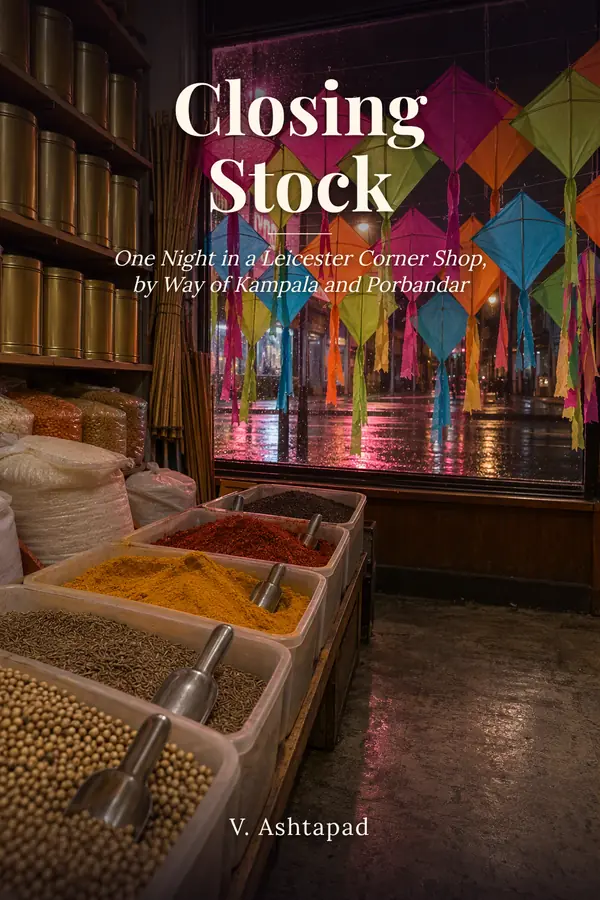
Closing Stock
One Night in a Leicester Corner Shop, by Way of Kampala and Porbandar
by V. Ashtapad
Foreword
This is a novel. Vasanti, Navin, Ronak, Farzana, Wasswa, Nalubega, Mrs. Hebditch and every other person in it are invented, and so are Kampala Stores, its customers and its stock. Porbandar, Kampala, Mombasa, Entebbe, Leicester and Belgrave Road are real places, used here fictionally; the duka street, the camp and the shop are composites and stand for no particular address.
In August 1972 Uganda's Asian residents were ordered to leave the country within ninety days, and many of them were resettled in Britain, a number of them in Leicester. The book touches that history only through one family's hands and shelves. Gujarati words are kept few: ba is grandmother, dikra is a fond word for a child, and kai po che is the shout that goes up when one kite cuts another's string on Uttarayan, the January kite festival.
For everyone who opened a shop with more boxes than stock, and kept going until the boxes were real.
The Shop Sign
*Item 1. Illuminated fascia sign, red letters on cream, KAMPALA STORES, with GROCERIES · SWEETS · SARI FALLS underneath in smaller blue. One tube flickers in the second A. Included in sale. Switch is behind the flour sacks, left side.*
At twenty to ten on a Tuesday in January, Vasanti Thakrar turned the cardboard sign on the door from OPEN to CLOSED for the last time but one, and then stood in the doorway with her hand still on it, because she had decided that tonight she would notice everything.
The sign above her head hummed. It had hummed since 1975, through three changes of tube and one bad winter when the second A went out altogether and the shop was KAMP LA STORES for six weeks and the children from the flats called it Camp Law. In the wet black of Belgrave Road the letters made a pink smear on the pavement, and the smear moved when buses went past, folding and unfolding across the curb like a sari being shaken out. Across the road the jewelers had already pulled down their steel shutters. The sweet center on the far corner still had its lights on, and the man there was mopping, his mop going in figure eights she could see from here.
She was seventy-one. She wore a cotton sari the color of turmeric paste, the pallu brought over her right shoulder and spread across the front the way her mother had taught her in Porbandar, tucked firm at the waist so it would not drag in the spilled lentils. Over the sari she wore a gray cardigan of her husband's, the sleeves turned back twice, the pockets heavy with a pen, a roll of price stickers and a tin of throat sweets she sold at four for a pound and ate for free.
Ronak's train was due into Leicester at nine fifty-two. He had texted from somewhere past Kettering: *Ba, don't close up, I want to talk before you do anything.* She had read it and put the phone face down beside the till. There was nothing to do anymore that had not already been done. The papers were signed. The solicitor on London Road had put the last copy in an envelope with a window and the window had shown her own name, typed, which had seemed to her an odd thing to receive in the post about one's own life.
She went back inside. The bell over the door said what it always said, two notes, the second lower, a little cracked.
The shop was eleven paces long and six wide, and she could walk it blind, and sometimes at night after Navin died she had done exactly that, eyes shut, hand trailing along the shelves, naming. Rice on the left in the sacks with their printed tigers and elephants and women carrying sheaves. Flour below in ten-kilo bags. Then the long wall of tins: ghee, oil, condensed milk, mango pulp the color of a sunset at the end of a hot day. Then the jars. Then the spice wall, which was not a wall but a run of open plastic bins under the window, each with its own steel scoop. Coriander seed, pale as sand. Cumin, a dusty brown. Turmeric, so yellow it seemed to give off a light of its own. Red chili powder, which made new customers sneeze and old customers lean in. Ajwain. Fenugreek seed, the small square bitter ones that smelled of something burned and sweet. Black mustard seed that rolled like tiny shot when you dropped the scoop.
Behind the counter: the till, the cigarettes she had stopped selling in 2009 but whose locked cabinet remained, the lottery terminal she had refused to have, the calendar from the cash-and-carry with a photograph of a waterfall, and the shelf of sari falls, the stiff cotton strips women bought to stitch along the hem, wound on cards, in forty colors.
She had a clipboard. On the clipboard were the stock-take sheets the solicitor's clerk had sent, with columns for ITEM, QTY, UNIT PRICE, CONDITION, and a wide blank one at the end headed NOTES. The clerk had meant notes like *dented* or *past date*. Vasanti had looked at the wide blank column for a whole evening and then decided what to do with it.
She was going to write it for Ronak. Not as *I*. She had tried *I* and it had sounded like a woman giving evidence. She wrote in the way the Gujarati women of her mother's street had told stories about each other on the stone steps at dusk, as if the person were sitting slightly to one side of themselves: *Vasanti did this. Vasanti was told that.* It was easier to be honest about someone sitting slightly to one side.
At nine fifty-eight the bell rang its two notes and her grandson came in out of the wet with his hood up and his laptop bag across his chest like a soldier's satchel.
"You closed," he said.
"Kem cho, dikra."
"I said not to close."
"Majama. I am fine. Thank you for asking." She held up her cheek and he bent, because he was very tall now, taller than his father, and kissed it, and his face was cold and smelled of the train, of hot brakes and someone else's coffee.
Ronak was twenty-six. He worked in London, for a firm that did something with figures for supermarkets, which Vasanti found funny and he did not. He had his grandfather's long upper lip and his mother's way of standing with his weight on one leg as if ready to leave a conversation. He took his hood down. His hair was cut short at the sides and long on top, and he had a small silver ring in one ear she had decided, after some months, to like.
"Ba," he said. "I ran the numbers."
"Of course you did."
"Your turnover's up eleven percent on last year. Your margins on the snack counter are better than half the places on this road. You don't owe anything on the building. You could keep this going till you're ninety. I'm not saying you have to stand here every day. Pay someone. Get Farzana in full time. I can help with ordering from London, I can set up the online thing, I can—"
"Sit down."
"I've been sitting for an hour."
"Then stand and hold this." She gave him the clipboard. "We are doing the stock-take. The buyer comes at eight. Everything must be counted."
He looked at the clipboard and then at her, and she saw him decide not to have the whole argument at once. That was his grandfather in him also. Navin had argued in installments, like a man paying off a refrigerator.
"Fine," Ronak said. "But I'm going to keep asking."
"Ask. I may even answer."
He looked down at the first sheet. She had already written the first entry in her careful capitals, the sign, because it was the first thing anyone saw, and because it was the thing she had looked at every night for fifty years while locking the door. Under NOTES, in her smaller handwriting, she had begun:
*Navin wanted the sign to say THAKRAR & SONS like his father's in Kampala, though in 1975 he had one son and that son was not yet two. Vasanti said, put Kampala. Navin said, nobody here knows what Kampala is. Vasanti said, then they will ask, and when they ask, we will have to tell them, and that is good for business. He agreed because he liked the part about business. The real reason she did not say. The real reason was that she wanted the word up in lights somewhere in the world, since the place itself was no longer theirs.*
Ronak read it. He read it twice; she watched his eyes go back to the start.
"You never told me that," he said.
"You never asked about the sign. You asked about the margins."
"Ba."
"It's a list," she said. "Every item, something. You will see. Take a photo of each page as we finish, and put it in that family thing your mother made, the private one, so it doesn't get lost in my handbag with the electric bills."
He already had his phone out. She had watched him over the last two years build the family space one branch at a time, adding his mother's people in Nairobi and Navin's cousins in Wembley and Manjula's grandchildren in Toronto, each one invited by name, nobody let in who had not been asked. He had given Vasanti an account where she could look at everything and change nothing, because the first week she had deleted an aunt by pressing the wrong place, and the aunt, in Toronto, had taken it personally.
He photographed the page. The flash bounced off the glass of the cigarette cabinet.
"There," he said. "Item one. Uploaded."
"Good. Now come. Item two is heavy."
Outside, the sign hummed and the second A flickered, on and off, the way it did on cold nights, as if somebody far away were trying to send a message in a code nobody had taught them. A man went by on a bicycle with his collar up and his breath streaming, and looked in, and saw an old woman in a sari and a cardigan and a tall young man with a phone, standing among the rice sacks in the pink light, and probably thought the shop was still open, and pedaled on.
Vasanti went to the long wall of tins. She put her hand on the top shelf, where the ghee was. She could feel, through the cold metal, nothing in particular, just tin, and also the whole of her mother's kitchen, which was a thing tin could hold if you let it.
"How long is this going to take?" Ronak said.
"All night," she said. "That is the point."
He laughed, once, not happily, and took off his coat. Under it he wore a sweater with a pattern of small reindeer, which she had sent him at Christmas from the market stall two doors down, and which she had not expected him to wear, ever. She did not say anything about it. She took the first tin down and handed it to him, and the weight of it made his arm drop, and he said "Whoa," the way he had said it at six when she let him lift a full sack of chapati flour, and for a moment, under the humming sign, they were both exactly where they had been.
A Tin of Ghee
*Item 2. Pure cow ghee, 2 kg tins, gold label with a painted cow and a green field, £21.49. Qty 14. Two dented at the shoulder, still sealed, sell at £18. The good brand. Do not let the rep talk you into the cheaper one with the blue label; the old ladies can taste it.*
The tins were cold from the window side of the shop and they sweated a little when Ronak carried them to the counter, so that each one left a damp ring on the wood. He set them in rows of four. He was quick at it and did not count aloud, and she understood that he was counting anyway, in the part of his head that never stopped, the part that had once, at nine, totted up the whole Saturday sweet counter faster than the till.
"Fourteen," he said. "You wrote fourteen already."
"I wrote what the book says. Now we know it is true."
He turned one of the dented ones in his hands, the gold label catching the strip light. The painted cow on it was a cheerful brown with a white blaze and stood in a field of a green no field in England had ever been. Above the cow, in a curly red script, the name of a dairy in Gujarat she had never visited, though she had sold its ghee for thirty years and felt she knew its cows personally.
"Why ghee?" he said. "Of everything. Item two."
"Because it was the first thing she ever lifted."
She wrote it while he watched.
*In Porbandar, in the house on the lane behind the vegetable market, Vasanti's mother kept ghee in a brass pot with a lid that did not quite fit. The pot sat on a shelf above the cooking fire and the warmth kept the ghee soft as a cream, never fully liquid, never hard. Every morning before school Vasanti was sent up the stool to fetch it down. She was five, then six, then seven. The pot was heavy and the brass was always slightly greasy and she learned to hold it the way you hold a baby, against the hip, never by the rim. Her mother would put one spoon of it on each rotli as it came off the iron and the rotli would go glossy and bend, and the smell of browned milk would go through the house and out into the lane, where it met the smell of the sea and the smell of the fish drying on the racks by the harbor, and became the smell of being a child.*
Ronak read it upside down, which he could do; he had learned in this shop, reading the labels on her side of the counter.
"Porbandar," he said. "I've got that on the tree. Your dad, your mum. Manjula's there. That's it. Just names and a town."
"Just names and a town is how everyone starts."
"Was it nice?"
She thought about it properly, because he deserved that.
Porbandar in her memory was white. The houses were built from a soft pale stone that came out of the ground nearby and that turned, over years, from cream to the gray of an old dog's muzzle. In the afternoons the light came off the stone so hard you went about with your eyes half shut. The lanes were narrow and swept every morning by women with short brooms bent double, and by ten o'clock they were full of cows and bicycles and men pushing carts of onions, and the dust that rose was white too, and settled on everything, on your feet, on the edge of your skirt, on the glass bangles of the woman who sold them from a cloth on the ground outside the market. The sea was at the end of every lane. You could not always see it but you could hear it if the wind was right, and smell it always, that salt-and-rot smell of a working shore, of boats being caulked and nets being mended and a hundred kilos of small silver fish laid out to dry in the sun until they curled.
Her father sold cloth. Not saris, he would say, if anyone asked, as if saris were beneath him: cloth. Bolts of cotton and mill-made poplin, stacked on wooden shelves in a shop the width of a door, with a white mattress on the floor where he sat cross-legged to measure, a brass yardstick laid across his knees. The cloth shop smelled of sizing and starch and the dye that came off the cheap blues and turned your fingertips the color of a bruise. Vasanti was allowed to sit at the back and fold the offcuts into squares, and to fetch water for customers, and on good days to hold the end of the bolt while her father measured, walking backward toward the street with the cotton in her fists, the fabric unrolling between them with a sound like a long breath.
"It was nice," she said. "It was hot and it was white and it smelled of fish. Your great-grandfather sold cloth and he could tell you the weight of a bolt by lifting one corner."
"So you were already shop people."
"Everyone on that lane was shop people. The man next door sold brass. The man across sold grain. The lady at the corner sold hair oil and nothing else, nothing, just hair oil, forty kinds."
"How do you do forty kinds of hair oil?"
"Coconut. Almond. Coconut with jasmine. Coconut with something green she would not tell anyone. Every kind smelled different and every customer had a reason. I will tell you something. She was richer than my father."
He laughed, and this time it was a real one, and he picked up another tin of ghee as if to test its weight against the old brass pot.
Vasanti went on writing.
*When Vasanti was nine, her sister Manjula was fifteen and was married to a man named Kantilal who had come back from Uganda to find a wife. He had a duka in Kampala, a shop with a tin roof, and his photograph showed him standing in front of it in a white shirt with the sleeves rolled, a pencil behind his ear and his hand on a sack of something. He was twenty-six. Manjula had cried for a week and then stopped and started asking questions about Africa, which nobody on the lane could answer except the brass man's cousin, who had been to Mombasa once and said it was hot and the bananas were green and they cooked them like potatoes.*
*It was decided that Vasanti would go too. Manjula should not be alone in a strange country with a strange man. Vasanti was told this on a Thursday, at the evening meal, between the dal and the rice. Nobody asked her. She was not unhappy about it; she was nine and it sounded like a story. But it was the first time she noticed that her life was a thing other people moved about, the way her father moved bolts from one shelf to another to make room.*
Ronak stopped reading.
"Nine," he said.
"Nine."
"They sent you to Africa at nine to babysit your sister's marriage."
"That is a London way of saying it. In Porbandar we said: so she would have company."
"It's the same thing."
"Yes," Vasanti said. "Mostly." She tapped the pen against the tin. "Write the next number. I am getting cold."
He went to the window shelf for the condensed milk. She watched him go, and thought about her mother on the night before the boat, sitting on the floor of the house on the lane with a tin trunk open in front of her, packing.
Her mother had not cried. She had been busy. Into the trunk went two cotton saris for Manjula, folded with sheets of newspaper between them so the colors would not bleed. Two frocks for Vasanti. A steel tiffin. A packet of turmeric twisted into a paper cone. A rolling pin. A small brass pot, new, polished, with a lid that fit.
At the very last, her mother had gone to the shelf above the fire and lifted down the old greasy pot and spooned some of the ghee into the new one, enough to fill it halfway, and pressed the lid down hard, and wrapped the whole thing in a scrap of red cloth from her father's offcuts, and put it in Vasanti's hands, not Manjula's.
"For the first rotli," her mother had said. "In the new kitchen. So it smells right."
Vasanti had held it against her hip, the way you hold a baby.
"Did it?" Ronak said. He had come back with the condensed milk and was reading the paragraph she had just added. "Smell right?"
"It went rancid on the boat," she said. "By the time we reached Mombasa you could smell it through the cloth. Manjula wanted to throw it in the sea. I would not let her. I kept it all the way to Kampala and when we got there I made Kantilal's cook use it on the first rotli anyway, and Kantilal ate one bite and made a face like this." She made the face. Ronak laughed so hard he had to put the tins down. "And then he ate the whole thing. Because he was polite. That was the first thing I knew about him."
"That he was polite."
"That he would eat a bad rotli to keep a child happy," she said. "It is not the same as polite. It is better."
She wrote: *Two dented. Still sealed.*
Ronak had his laptop open on the counter by then, wedged between the till and the jar of loose mints. On the screen was the family tree, the version he had been building for two years, and she leaned in to look, because she liked it in the way she liked a well-stocked shelf. It spread sideways more than up. At the top, small, were her parents, two boxes with no photographs, just the names and the word Porbandar under each. Then the branch went down and split, Manjula one way and Vasanti the other, and from Manjula a long fork ran off to the right, toward Toronto, where her children had gone in the eighties, and from Vasanti a short fat one ran straight down to Haresh, and then to Ronak, the last box, with a photograph of him at his graduation in a black gown, frowning against the sun. Under each box was a small gray word for where that person had been born. Porbandar. Porbandar. Kampala, for three of Manjula's. Leicester, for Haresh. Leicester, for Ronak. Toronto, for the little ones at the very bottom. Three continents in a column of gray type, as plain as a delivery note.
"You should put a picture in for your great-grandmother," Vasanti said.
"I don't have one."
"No," she said. "There isn't one. Put the pot, then. When you find it."
He typed something into a box under the name, and she did not ask what.
Then, after a moment, in the wide column: *The new pot is in the cupboard above the sink in your father's house. Your mother uses it for sugar. Nobody has told her. You can tell her or not.*
Ronak photographed the page. The flash went off, and in the cigarette cabinet glass she saw them both for an instant, washed white, the two of them and fourteen tins of ghee lined up like small gold soldiers, and behind them the dark street, and the pink sign humming, and the second A trying again.
A Bag of Jaggery
*Item 3. Jaggery, Kolhapur-style, 1 kg blocks in clear bags with a yellow sticker, £2.79. Qty 31. Also 500 g cubes in the blue tub, £1.89, qty 12. Keep away from the radiator or it sweats through the bag and glues itself to the shelf. Mrs. Desai buys four blocks every December for chikki; set them aside for her by the second week.*
The jaggery lived on the lowest shelf of the third bay, in a plastic crate the cash-and-carry had once used for bananas, and when Ronak dragged the crate out into the aisle it made the noise it always made, a long complaining scrape over the lino that had worn a pale stripe into the floor in fifty years of being dragged.
"Thirty-one," he said, crouched on his heels, counting. "And it's sticky. All of it. Ba, everything in here is sticky."
"It is sugar that has not been told it is sugar yet."
He held one block up to the strip light. Through the clear bag it glowed a deep amber at the edges and almost black at the heart, like the inside of a log fire, and the surface was rough and crumbled, with a sheen where the warmth of the shop had softened it. The smell came through the plastic anyway, molasses and smoke and something like dates.
"You used to give me a piece of this when I was crying," he said.
"I used to give you a piece when you were quiet. To keep you quiet. Crying was your mother's department."
He grinned and put the block back and wrote *31* in the QTY column himself, in his neat square figures. Then he sat down on an upturned crate, his long knees almost at his ears, and opened the laptop on them.
"Okay," he said. "Can I show you something before we do the next one?"
"You will show me anyway."
He turned the screen. It was a chart, colored bars going up from left to right in a way that seemed pleased with itself.
"That's your weekly takings, last three years," he said. "That dip is the week you had flu. That spike is Diwali. That spike is Uttarayan, kites and string, which is basically free money. This line is your costs. See how far apart they are? That gap is you, Ba. That gap is what you've built. People would kill for that gap. I sit in meetings every week where people would actually kill for that gap."
She looked at it for a long moment, at the clean bars and the two lines running apart like railway tracks seen from the wrong end.
"It is very beautiful," she said. "You should print it. I will put it next to the waterfall."
"I'm serious."
"So am I." She took the pen. "Item three. Hold still."
*Vasanti and Manjula went from Porbandar to Bombay on a bus that smelled of diesel and oranges, and from Bombay to Mombasa on a ship with a black hull and a white band, in the lowest class, where families laid out bedding on the deck in rows and cooked on small kerosene stoves when the crew was not looking. The crossing took eleven days. Manjula was sick for the first four. Vasanti was not sick at all, which nobody forgave her for. She spent the days at the rail, watching the color of the water change from brown to green to a blue so deep it looked solid enough to walk on, and watching the flying fish, which she had not believed in until she saw them, skittering away from the bow in silver handfuls.*
*In her pocket she had a lump of jaggery. Her mother had given it to her on the platform in Porbandar, wrapped in newspaper, with the words: When you are homesick, a little. Not all at once. Vasanti made it last nine days, breaking off a crumb each night after the stoves were out, sitting with her back against a coil of rope that smelled of tar, letting the crumb dissolve slowly on her tongue in the dark while the ship rolled. On the tenth night there was nothing left but the paper, gone brown and soft and sweet itself, and she licked that too and then threw it over the side and watched it float away on the black water, and the next morning there was land.*
Ronak read it and did not say anything for a while.
"You made it last nine days," he said finally.
"I was a very disciplined child."
"I'd have eaten it on the bus."
"You would have eaten it on the platform," she said, "before your grandmother had finished saying not all at once."
He laughed. He scrolled the chart away and opened something else, and she saw it was a map, the kind he had made for the family space, with small colored pins dropped on it like spice seeds on a cloth. One in Porbandar on the edge of the Arabian Sea, one in Leicester in the cramped green middle of England. Between them a great empty space of blue and brown.
"Where'd the ship land?" he said. "Mombasa?"
"Mombasa."
He dropped a pin. It landed on the coast of Kenya with a small satisfying bounce.
"And then?"
"And then the train," Vasanti said. "Put that I liked the train best of all."
*From Mombasa the railway went inland and upward for two days and a night. The carriages were wood inside, polished by thousands of shoulders, and the windows had shutters you could pull down against the dust, and Vasanti never pulled hers down once. She saw the coast go, with its palms and its white sand and its women carrying baskets on their heads in cloths so bright they hurt. She saw the land rise and dry and turn to bush, gray-green, thorny, with flat-topped trees standing far apart from each other as if they had quarreled. She saw, once, at dusk, a line of giraffes walking along the horizon with their necks swaying, and she shouted, and the whole carriage came to look, and a man from Surat in the next compartment said it was nothing, he saw them every time, and then stood at the window for half an hour anyway.*
*On the second day the earth changed color. It went from gray to brown to a red she did not have a name for, a red like brick dust after a hose has gone over it, like the inside of a new clay pot. The cuttings where the line went through the hills were red. The roads alongside were red. The children who ran beside the train waving had red dust to their knees. Vasanti put her hand out the window and when she drew it back her palm was coated, fine as face powder, and she did not wash it until Kampala.*
"Red earth," Ronak said. "I've seen photos. It's actually that red?"
"It is redder. The photos are polite."
"And Kampala?"
She did not write for a moment. The shop was quiet except for the sign humming outside and the small tick of the radiator under the window, which was trying very hard and had been trying since 1983.
"Kampala was green," she said. "After the red, everything was green. Hills, many hills, with houses going up them in steps, and every hill had something different on top. A tower. A big white building. A dome. Trees with flowers on them like flames, orange, all over the ground underneath like someone had spilled them. And the air was soft. In Porbandar the air was hard, it pushed at you. In Kampala it touched you like a cloth."
*Kantilal met them at the station in a borrowed car with a cracked windshield. He had put on a tie. Manjula, who had been sick on the ship and dusty on the train and frightened for eleven days at sea and two more on the train, took one look at him standing there in his tie on the platform with his hair oiled flat and a bunch of flowers already wilting in his fist, and laughed out loud, and Vasanti saw him go red to the ears, and then laugh too, and that was the beginning of their marriage, which lasted fifty-one years.*
*The duka was on a street of dukas, all in a row, all with wooden shutters painted green or blue or a brown like strong tea, all with tin roofs that ticked in the afternoon heat and roared when it rained. Kantilal's sold everything. Sugar from sacks. Kerosene by the bottle. Cotton prints with patterns of birds and keys and bicycles. Matches. Soap in long yellow bars you cut with a wire. Exercise books. Enamel plates, white with a blue rim. Hurricane lamps hanging from hooks in the ceiling like a row of sleeping bats. Vasanti stood in the doorway on the first afternoon and breathed in, and the duka smelled of sacking and paraffin and the sweetness of raw sugar, and under it all, from the kitchen at the back, the burned-milk smell of ghee warming, and she thought: oh. This is a shop. I know what this is.*
Ronak photographed the page. Then he didn't move to the next shelf. He sat on the crate with the laptop closed on his knees and looked at her.
"You were nine," he said again. "On your own, basically."
"I was with Manjula."
"Manjula was fifteen."
"Manjula was a married woman," Vasanti said, "and she had a kitchen, and the kitchen needed someone to sort the rice, and the duka needed someone to count the matches. I was not on my own. I was busy. It is very hard to be lonely and busy at once. You should remember that, in your office."
He looked at her with an expression she knew, his grandfather's, the one that meant he had heard something underneath what she said and was going to leave it there for now and come back for it later, like a parcel left with a neighbor.
He lifted the crate of jaggery back onto its shelf. The plastic scraped. A smell of molasses rose and hung.
"Item four," he said. "What's next?"
"Matoke," she said. "Green bananas. They came in this morning, the last delivery. Put your coat on. They're in the back where it's cold."
A Hand of Matoke
*Item 4. Matoke, green cooking bananas, sold by the hand, £3.50 a hand or £1.20 a kilo loose. Qty 9 hands, delivered Tuesday. Firm, good color. These are for the Ugandan and Kenyan families from the flats and for the three old Gujarati men who still want them on Sundays. Do not put them in the fridge; they go black.*
The back room was the coldest place in Leicester. It had been a scullery when the building was a house, before the war, before anyone on Belgrave Road had heard of Porbandar or Kampala or ghee, and it still had the old stone sink and a window of bubbled glass that let in a streetlamp's orange glow as if through honey. The boiler lived there and did not heat it. Cardboard boxes were stacked to the ceiling on one wall, flattened, waiting for the recycling on Thursday. On a pallet by the back door, under a sheet of brown paper, were the bananas.
Ronak pulled the paper off. The matoke lay in their hands, curved and heavy, the green skins so dark and so hard they looked lacquered, each hand still joined at the crown in a stub of pale fibrous stem. When he lifted one the fruit knocked together with a dull wooden sound.
"Nine," he said. "These aren't bananas. These are weapons."
"They are dinner. Count them twice; the driver always says ten."
He counted twice. There were nine. He wrote it, and then he stood holding one hand of matoke in the orange light with his coat buttoned to the chin and his breath showing, and he said, "Did you eat these? There?"
"Every day."
She sat on the one chair in the back room, a kitchen chair with a split cane seat that had come with the shop, and pulled the cardigan closer over the sari, and wrote.
*In Kampala the matoke came to the duka on bicycles. A man would come up the street at seven in the morning with a bicycle so loaded you could not see the bicycle, only a moving hill of green, the hands of bananas tied on with strips of their own leaves, stacked higher than his head, and he would wheel the hill up to the shutters and call out, and Kantilal's helper Wasswa would go out to argue with him about the price while Vasanti watched from the step.*
*Wasswa was perhaps twenty. He was tall and thin with very long fingers and he could add a column of figures in his head faster than anyone in the street, including Kantilal, which Kantilal pretended not to mind. He spoke Luganda and Swahili and English and, by the end of the first year, enough Gujarati to tease Manjula about her cooking. He taught Vasanti to count to ten in Luganda on the step of the duka. She taught him to count to ten in Gujarati. They practiced on the matoke, on the soap bars, on the bottles of kerosene, until the whole duka could be counted in three languages, and Kantilal said it was very good for business, a shop where everyone could argue the price in their own tongue.*
"Wasswa," Ronak said. He was reading over her shoulder, and he had gone very still. "That's the one. That's Edgar's grandfather."
"Yes."
"Edgar's on the family space. I invited him last spring, from Manjula's lot. He posts photos of the street." He was already getting his phone out with his cold fingers. "Hang on. Hang on, I'll show you."
She had seen them. She did not say so. She let him find them and hold the phone out, because she could see he needed to be the one to show her.
The photographs were from a street in Kampala in the present day. She knew it by the slope, and by the shape of the hill behind, and by nothing else at all. The dukas had become something else. There were painted signs in yellow and green advertising airtime and mobile money. A woman sat under a big umbrella selling something from a tray. There were motorcycle taxis parked in a fan at the curb, their riders leaning on them in bright vests, and wires strung across the street in loops, and one tree she thought might have been the same tree, a big spreading one with a trunk like several trunks twisted together, and under the tree the road was still red. Edgar had written a note under one picture, in careful English: *This is where my grandfather worked for Mr. Kantilal. The shop is now a pharmacy. The owner says the shutters are the old ones, she has only painted them.*
Vasanti put her finger on the screen, on the shutters. They were a fresh bright blue. Under the blue, if you looked very closely, along the bottom edge where the paint had chipped, there was a strip of a brown like strong tea.
"That's it," she said. "That is the one."
"How do you know?"
"Because Wasswa painted it that brown, and he did not have enough paint, and he ran out at the bottom, and so he mixed what was left with something else he found, varnish I think, and the bottom strip was always darker. Look. Look there."
Ronak enlarged it. It was there. The darker strip at the bottom of the tea-brown, under the new blue, a hand's width high.
He didn't say anything. He put the phone down on top of the matoke.
*The duka had wooden shutters in six folding panels that ran on an iron rail. Every morning at six-thirty Wasswa took them down one by one and stacked them inside against the wall, and the light came into the duka in six steps, one panel at a time, like someone opening a book. Every evening at seven he put them back. The last panel had a hasp and a padlock the size of Vasanti's fist. When the shutters were up the duka was a dark box that smelled of everything it held, and when they were down it was half street, and dogs and children and chickens wandered in, and the red dust came in on everyone's feet and lay in a fine film on the floor, so that Vasanti swept twice a day and still went to bed with red between her toes.*
*Behind the duka there was a yard, and in the yard there was a kitchen with a roof of corrugated tin and a wood fire under it, and on the fire, most days, a pot of matoke. Manjula's cook, a woman from the hills named Nalubega, whom the whole household called Maama, as you would any older woman you respected, and who had worked for the family before Manjula came, peeled the green bananas with a short knife, the skins coming off in long dark strips that stained her hands black, and wrapped the pale fruit in banana leaves, and steamed it in the pot for hours until it was soft and yellow and could be mashed. It tasted of nothing at first, and then of everything; it took on whatever you put next to it. With Manjula's dal it tasted Gujarati. With Nalubega's groundnut sauce, which was the color of milky tea and smelled of roasting, it tasted of the hills. Vasanti ate it both ways and refused to say which was better, which Nalubega said was diplomacy and Manjula said was cheek.*
*And there was chapati. Not rotli, not the thin soft ones her mother made in Porbandar, but the East African kind, thicker, layered, flaky, rolled out with oil and coiled and rolled again, fried on a flat iron until they blistered gold. Nalubega made them in the afternoons and sold them from a basket at the front of the duka to the men coming back from work, and the smell of frying dough went down the whole street and brought them in, and that was how, Kantilal said, the duka made more money from Nalubega's chapati than from the cotton prints, which was true and which nobody ever told Nalubega.*
Ronak had picked up the phone again. He was scrolling slowly through Edgar's photographs, and she watched him, the bluish light from the screen on his face in the orange gloom of the back room.
"There's a chapati stall," he said. "Look. Right on the corner."
There was. A boy with a flat iron on a charcoal brazier and a stack of chapati on a tray beside him, and behind him, the blue shutters of the pharmacy.
"Of course there is," Vasanti said. "Everything changes and nothing does. That corner was always the best corner on that street for chapati. The wind goes down the hill and takes the smell with it."
"Should I pin it? On the map?"
"Pin it," she said. "Write: the duka, Kantilal and Manjula's, and then Wasswa's name, and then Nalubega's. Don't let the chapati go to the pharmacy."
He typed. She could see the effort it cost him with his cold thumbs. On the small map on his screen a new pin appeared on the green hills of Kampala, and she thought of the six panels of the shutter coming down one at a time in the morning light, and the light coming into the duka step by step, like a book.
*Vasanti was in Kampala eight years before anyone asked her opinion about anything. She went to a school run by Gujarati families where she learned English from a woman from Kerala who smelled of coconut oil and wore her hair in a long plait to her waist. She learned to cook from Manjula and from Nalubega both, so that her dal had a little groundnut in it forever after and no one in Leicester could ever work out why. She learned to keep the duka's book, in pencil, columns of figures in a hardback ledger with a red spine. She learned to watch the street.*
*Across the street, at the duka with the green shutters, there was a young man who also kept a book. He was the son of the owner, a widower named Jayantilal Thakrar who had a cough and a temper and a beautiful set of brass scales. The son was called Navin. He wore his shirt buttoned to the neck even in the heat. He had a long upper lip and a slow smile and he argued with his father in installments, a little every evening, about everything, while he put the green shutters up.*
*Vasanti was fourteen when she first noticed him putting up the shutters. She was sixteen when she first noticed him noticing her. There was a whole street between them. The street was red.*
Ronak finished reading and laughed out loud, a sharp surprised sound in the cold room.
"Ba!"
"What?"
"*The street was red.* That's you flirting. In 1971. That's literally you flirting."
"I was writing about the dust."
"You were not writing about the dust."
She stood up, a little stiffly, because the cane chair was not a chair for seventy-one, and took the phone off the matoke and handed it back to him and put the brown paper back over the bananas, tucking it in at the corners the way you tuck a blanket on a sleeping child, because if the draft from under the back door got at them they went black at the tips by morning.
"Take your photo," she said. "And then come. Item five. You will need to be careful with item five."
"Why?"
"Glass," she said, and went back through into the light.
A Box of Bangles
*Item 5. Glass bangles, boxed by the dozen, sizes 2.4 to 2.10, assorted colors, £3.99 a box. Qty 46 boxes on the shelf, 2 boxes broken (sweep, do not sell). Also metal bangles in gold color, 6 to a card, £5. The green and red glass go fastest in the wedding season. The children from the primary school buy the single ones from the jar at 20p and take them home in their pockets and break them by teatime.*
The bangles were on the high shelf behind the counter, between the sari falls and the boxes of hair pins, and the boxes were long and shallow and made of thin card printed with a picture of a smiling bride whose face had faded, on the oldest ones, to a pale ghost of a smile. When Ronak lifted the first stack down the bangles inside shifted and chimed against each other, a sound like ice in a glass, like a small rain on a tin roof, and Vasanti put her hand flat on the top box without meaning to, the way you would put your hand on someone's arm to say, hush.
"Careful."
"I am being careful."
"Be more."
He set them down on the counter one stack at a time. He opened the first box. Inside, on a card with slots, the dozen bangles stood in their row, thin as pencil lines, a red so deep it was nearly black where the glass was thickest and almost pink at the thin edge, and along each one ran a line of tiny gold dots that caught the strip light and threw it back.
"Forty-six," Ronak said, after a while. "Plus two broken. You were right."
"Of course I was right. I broke them."
"When?"
"Last week. I knocked them with the broom. Sweep, don't sell. I wrote it."
He took the two broken boxes to the bin behind the counter and tipped them out carefully, and the glass went in with a bright small crash, and the red and green pieces lay on top of the old receipts and the tea bags, glittering.
He came back and leaned on the counter on his elbows.
"Ba," he said. "Can I ask you something now?"
"You asked me four things already."
"Who's buying it?"
She had known he would ask. She had thought about how to tell him on the bus home three nights running and had decided each time that there was no clever way, and that she was too old to be clever with her grandson, and that he was too old to be lied to.
"Farzana," she said.
He stared at her.
"Farzana," he said. "Our Farzana? Saturday Farzana?"
"She is nobody's. She is Farzana."
"Ba." He stood up straight. "Ba. I looked up what places on this road go for. I looked last week. I looked at four of them. You've sold it to Farzana for—what, what did you sell it to her for?"
She told him.
He put both hands over his face.
"That's sixty under. At least. That's sixty thousand pounds under. Maybe more. Ba, that's—you could have—Dad knows about this?"
"Your father knows. Your father argued for one week and then he stopped arguing because he is my son and he knows when to stop arguing." She picked up a box of the green bangles and turned it over and checked the bottom for cracks. "You are my grandson, so you have not learned yet. That is fine. You have until eight o'clock."
"It's not about the money."
"You just said sixty thousand pounds three times."
"It's not *only* about the money." He sat down hard on the stool behind the counter, the stool that had been hers for half a century, and she let him have it. "It's—fine. Fine. Item five. Bangles. Tell me about the bangles."
She looked at him a moment longer, at his head bent, at the silver ring in his ear, at the reindeer on his chest, and then she wrote.
*Vasanti married Navin Thakrar in Kampala in March 1972, when she was seventeen and he was twenty-three. Nobody arranged it. That is, everyone arranged it, Kantilal and Manjula and old Jayantilal across the street with his cough and his scales, and two aunts nobody had met who wrote letters from Porbandar, and a man from the community hall who knew which Sundays the hall was free, but they all arranged it after Navin had walked across the red street one evening in October with the green shutters half up behind him and asked Vasanti, on the step of Kantilal's duka, in front of Wasswa and a woman buying soap, whether she would mind very much if he spoke to her brother-in-law. And Vasanti had said, Which brother-in-law, I only have one. And the woman buying soap had laughed so hard she dropped the soap.*
*The wedding was in the hall. Manjula did her hair. Nalubega made the chapati for the second day and refused all help. There was khandvi on the first day, made by Manjula and three women from the street over two nights, rolled so thin you could see the light through each spiral, yellow with gram flour and turmeric, scattered on top with mustard seed and grated coconut and green chili and chopped coriander. Navin ate eleven pieces. Vasanti counted. She did not eat any herself until the end of the night, sitting on the step of the hall with her feet bare, when Manjula brought her a plate and stood guard so nobody would see the bride eating khandvi with her fingers in the dark.*
*Her bangles came from Porbandar. Her mother had sent them in a parcel tied with string with the customs forms stuck to the outside, two dozen glass bangles, red and green, packed in rice so they would not break. Not one broke. When Vasanti opened the parcel the rice spilled out over the floor of Manjula's back room and she stood there in a little drift of it holding the bangles up to the window one by one, and every one was whole, and she put them on and they went up her forearms almost to the elbow and when she moved they rang like the bell of a bicycle a long way off.*
She stopped writing and looked up. Ronak was reading, his chin on his fists.
"Packed in rice," he said.
"So they would not break."
"Did you keep them? The bangles?"
"No," Vasanti said. "You don't keep glass bangles. You wear them, and they break, and when they break it means they have done their work, and you get more. That is what glass is for. Gold you keep. Glass you use."
"Did they break? On the wedding day?"
"Four of them, in the first year. Doing the dishes. One on the shutter, putting it up. Navin used to say he could tell what kind of day I was having by how many bangles I had left by the evening."
Ronak almost smiled. He picked up a single loose bangle from the jar on the counter, the jar for schoolchildren at twenty pence, a cheap thin green one, and turned it in his long fingers.
"Farzana's worked here how long?"
"Since she was fifteen. Saturdays. Then Saturdays and Wednesdays. Then, after your grandfather, whenever I asked. Twenty-three years."
"I know. I know that. I grew up with her stacking the rice." He rolled the bangle along the counter, and it went in a wobbling circle and came back to his hand. "She came from Malawi, didn't she? Her and her mum."
"Blantyre. When she was ten. Her father had died. Her mother had a sister in Leicester."
"So she's—"
"Yes."
"Twice. Like you."
"Not like me. Like her. But twice, yes."
He was quiet. The bangle went around again on the wood and came back.
"She knows where everything is," Vasanti said. "She knows that the drain in the back sink sticks in winter and you pour hot salt water down it. She knows that the man from the flats with the bad leg cannot reach the third shelf and pretends he does not want anything there. She knows Mrs. Desai's jaggery. She knows that the old Sindhi lady pays at the end of the month and has paid at the end of every month for thirty years and has never once been late and must never be asked. She knows the sign flickers in the cold. She knows what goes in the snack counter on Saturdays and what goes in on Sundays. I have been teaching her for two years, every afternoon, and she knows more than I knew when we opened, and she has two children and a husband who drives the number fifty-four bus and a mother with sugar in her blood, and she has saved, and saved, and saved, and she could never afford what those four places on the road go for. Never. So."
She put the pen down.
"So I made it a price she could afford," she said. "And she can. And she will pay it to me every month for twelve years, like the old Sindhi lady, never late. And the shop will be open. That is what the sixty thousand pounds bought. A shop that is open, with the right person behind the counter. You can put that in your spreadsheet."
He did not say anything. He held the green bangle up to the light and looked through it at her, a little green circle framing her face.
"You could have told me," he said. "Before."
"I am telling you now. I am telling you the whole thing. That is what tonight is."
He photographed the page. Then he took the green bangle and, after a moment's thought, put it in the pocket of his jeans, and took out his wallet and put twenty pence on the counter beside the till, and Vasanti did not stop him, because it was a sale, and every sale goes through the till, and she rang it up, and the drawer came out with its old familiar clatter and bang, and she put the coin in its slot, and pushed the drawer shut.
"Item six," she said. "This one you will not like."
"Why not?"
"Because I did not like it either," she said, "and I was there."
The Price Gun
*Item 6. Price labeler, gray, two-line, with three rolls of white labels and one roll of orange (for reduced). Ink roller needs changing; spare is in the till drawer under the tray. Included in sale. Navin's. He called it his pistol. It jams if you go too fast. Squeeze, wait, squeeze.*
The price gun lived in the drawer under the counter with the rubber bands and the string and the spare keys to nothing, and when she took it out Ronak said, "Oh no. That thing," in the voice of a man recognizing a schoolteacher in the street.
It was gray plastic gone a little yellow at the handle where fifty years of hands had held it. It had a trigger and a small window where you rolled the numbers round with a thumbwheel, and a sticky roll of labels that fed through the front and came out, one at a time, with a sound Vasanti could have picked out of any noise on earth. *Ka-chunk.* A soft mechanical bite, and a white rectangle with a price on it stuck to the end of your finger.
"He let me use it when I was seven," Ronak said. "Once. I priced a whole shelf of lentils at one penny."
"I remember. We sold four bags before anyone noticed."
"He wasn't even angry."
"He was very angry. He was angry in his own way, which was to go quiet and then laugh in the back room where he thought nobody could hear." She set the wheel to eighteen pounds, zero pence. "The dented ghee. Two tins. Do it slowly."
Ronak went and got the two dented tins and put them on the counter and took the gun from her and held it over the first lid. He squeezed. *Ka-chunk.* An orange sticker, because she had changed the roll to orange, sat on the gold lid above the painted cow: *£18.00*.
"Reduced," he said.
"Reduced."
He did the second one. Then he held the gun a moment longer in his hand, weighing it.
"Why's this the one I won't like?"
She took the clipboard back. She found, for a moment, that she did not know where to begin, and so she began with the board, because the board was a thing, and things were easier.
*In Kantilal's duka, and in Jayantilal's across the street, prices were not stuck on anything. They were written in chalk on a black board that hung by the door, in English and Gujarati, and when they changed you wiped them with a damp rag and wrote them again. Sugar per pound. Kerosene per bottle. Soap per bar. Everyone in the street knew the prices on every board in the street. Bargaining was not about the board. The board was where you began.*
*In August 1972 the government of Uganda ordered the country's Asians to leave within ninety days.*
*That is the only time this list will say it. There is no more to say about it on a stock sheet.*
*What happened in the duka was that Navin's father, Jayantilal, who had a cough and a temper and was sixty-one, sat down on the floor behind his brass scales and did not get up for most of a day. And Navin went to the board by the door with the damp rag and wiped every price off it, and then stood there with the chalk in his hand for a long time, and then wrote them all back up exactly as they had been. And the next morning he wiped them again and wrote them lower. And the next morning lower. Every morning for nine weeks, lower, and lower, in his careful hand, in both languages, until the board said things like ONE SHILLING, ALL CLOTH, and then nothing at all, because there was nothing left on the shelves to price.*
Ronak had stopped looking at the gun. He had both hands on the counter.
"He sold it all off," he said.
"Some he sold. Most he gave. To the people in the street. To the boy who brought the matoke. To Nalubega for her sister's children. The brass scales he gave to Wasswa, who did not know what to do with them and who kept them anyway, in his house, for thirty years. Edgar has them now. Edgar sent a photo once. They are on a shelf in his living room with a plant in one pan."
"A plant."
"A small one. Green. It is a good use for them. Better than weighing sugar."
*Vasanti and Navin had been married five months. They had a room above Jayantilal's duka with a window onto the red street, and a bed and a cupboard and a chair, and the brass pot from Porbandar on a shelf with ghee in it, and two dozen glass bangles minus four, and a photograph of Vasanti's parents in a frame. They could take out of the country only what fit in a case apiece, and a small sum of money, the same for every family, that would not have bought the chair.*
*They packed on the floor, the way her mother had packed in Porbandar nine years before. Vasanti put in her saris, folded with newspaper between them. Navin put in his shirts, all buttoned to the neck, and his school certificates in a cardboard folder, and his father's account book, though it would no longer mean anything, because it was in his father's hand. Vasanti put in the brass pot. Navin said it was too heavy. Vasanti took out two of her saris to make room and put in the pot again and Navin did not say anything else.*
*The last night, they put the shutters up together. Wasswa had already gone home; it was Navin and Vasanti alone in the street in the dusk with the red dust going purple in the last light and the tin roofs creaking as they cooled, and they did Kantilal's duka first, because Kantilal and Manjula had already flown with their three little ones the week before, and then Jayantilal's. Six panels. One by one. The light going out of each duka step by step, like a book being shut. Navin put the padlock on Jayantilal's and held the key in his hand. Then he walked down the street in the dusk to Wasswa's house, which was near the bottom of the hill, by the big tree with the twisted trunk, and knocked, and gave him both keys, and Wasswa took them without a word. He did not know what to do with them either. He did not ask. Neither of them said anything at all.*
*They left the next morning for Entebbe in Kantilal's borrowed car, the one with the cracked windshield, driven by a man from the hall. On the road the suitcases were opened twice and closed again. The lake was very blue beside the airport. Vasanti looked at it out of the window of the airplane until the clouds came over it, a long sheet of light the color of the glaze on a pot, and then the clouds were white and there was nothing below, and she put her hand flat on the window and left it there until the steward asked her to put up the blind.*
She stopped. Ronak had not moved. The radiator ticked under the window and outside on Belgrave Road a car went past slowly with its music turned up, a beat she could feel in the soles of her feet, and then it faded.
"You gave the keys away," he said.
"There was nothing else to do with them."
"And you never knew what happened? To the shop? Until Edgar?"
"Kantilal went back. Long after. In nineteen ninety-four. Some people went back then, and some got their buildings back, and some sold them, and some did not want them. Kantilal went to look, and he found Wasswa, an old man by then, by the tree, and Wasswa gave him back the two keys. He had kept them in a tin with his own papers for twenty-two years. They did not fit anything anymore. The locks had been changed a long time ago. Kantilal brought them home to Leicester and gave Navin the one for his father's duka, and Navin put it on his key ring next to the key for this door, and that is where it stayed."
"Where is it now?"
She looked at the price gun in Ronak's hand, and not at Ronak.
"On the key ring," she said. "Hanging on the hook behind you. With the key for this door. Both of them go to Farzana in the morning."
He turned. The key ring hung on the hook by the cigarette cabinet, as it had hung there every night of his life. He had never looked at it. It held the key to the front door, which was long and steel, and the key to the back, which was brass and bent, and the key to the cash-and-carry van they had sold in 2010, and a small iron key, black, square-headed, old-fashioned, that opened nothing in England at all.
"That one," Ronak said.
"That one."
"You're giving that to Farzana."
"It is the key to the shop," Vasanti said. "It goes with the shop."
"It's the key to a shop in Kampala that isn't ours anymore."
"It is the key to the shop," she said again, and wrote under NOTES, in her small hand: *Keys, 4, on the ring. All go.*
Ronak put the price gun down on the counter very gently, as if it might go off. He looked at the black key on the hook for a long time. Then he came round the end of the counter and, without saying anything, without asking, put his arms around her, cardigan and sari and clipboard and all, the pen still in her hand, and held on. She let him. He smelled of the cold and of the reindeer sweater, which smelled of the market stall, of mothballs and sandalwood soap and new wool. She could feel his heart going in his chest, fast, as it had gone when he was small and had run all the way from the bus stop to show her a drawing.
After a while she said, "I cannot breathe, dikra."
He let go.
"Sorry."
"Don't be sorry. Be useful. Squeeze, wait, squeeze. The tea is next, and half the caddies need new stickers."
"You said this was the one I wouldn't like."
"Did you like it?"
He wiped his eyes with the back of his wrist, quickly, as if she would not notice.
"No," he said.
"Good," said Vasanti. "Neither did I."
A Caddy of Loose Tea
*Item 7. Loose black tea, strong Assam, in square tin caddies with a red elephant on the side, 500 g, £6.49. Qty 22. Also the loose chai masala in the small paper packets, 100 g, £1.99, qty 40, mixed in the back by hand: cardamom, ginger, cinnamon, clove, black pepper, a little nutmeg. The recipe is on the inside of the back-room door in pencil. Farzana has copied it. Do not let anyone paint that door.*
At a quarter to midnight Vasanti decided they needed tea, and so they went into the back room and she lit the single gas ring on the old stove by the sink with a match from the box she kept on the windowsill, and the blue flame came up with a soft cough and a smell of gas and struck match that was, for her, the smell of every late night in fifty years.
Ronak sat on the cane chair this time and watched her. She put the dented steel pan on the flame with water in it, and a fat knob of ginger she bashed with the end of the rolling pin against the stone sink until it split and the sharp smell came out. Into the water went the ginger and four cardamom pods cracked between her thumb and finger and a pinch of the masala from an open packet. When it boiled she shook in the tea, black leaves rolled into hard little grains, and the water went from gold to red to the brown of the old duka shutter almost at once. Then milk, from the carton in the little fridge, a lot of it, until it was the color of the groundnut sauce in Kampala. Then sugar, from a jar, two big spoons, without measuring. Then she let it rise, and when it rose to the lip of the pan with a thick skin on it she lifted it off the flame and let it fall, and put it back, and let it rise again, three times, the way her mother had and Manjula had and Nalubega had learned to.
"Three times," Ronak said.
"Three times. Once for the tea. Once for the milk. Once so it knows you are serious."
She strained it into two mugs through the little steel tea strainer with the bent handle, and the tea leaves and the split ginger made a wet brown heap in the mesh, and the smell filled the back room until even the cold seemed to step back from it.
He wrapped his hands around the mug. She sat on an upturned crate across from him with hers. Through the bubbled glass of the back window the streetlamp glowed orange and the shadows of the stacked cardboard boxes made a city of dark towers on the wall.
"Okay," he said. "Tell me about the tea. Item seven."
*The airplane came down into England at the end of October in a gray light that seemed to have no source. Vasanti had never seen a sky like it. In Porbandar the sky was white with heat and in Kampala it was blue with rain coming, but in England the sky was a lid, low and flat and the color of the inside of a saucepan, and it pressed down on the airport and the wet black tarmac and the line of buses waiting, and when she came down the steps of the airplane the cold went through her cotton sari as if she were wearing nothing at all.*
*They were taken by bus to a camp. It had been an air force base and was now a place for people like them: long low buildings in rows, painted a green that had faded in stripes, with numbers on the doors and concrete paths between and a high wire fence along the far side that was, everyone said, just the old fence from before, nothing to worry about. Inside, the buildings were long rooms divided by partitions into spaces for families, each space with metal beds and gray blankets and a small cupboard. The floors were linoleum. The heating came from pipes that clanked at night like someone walking about in boots. There was a dining hall with long tables, where they ate fish in yellow batter and potatoes boiled until they were soft as clouds and a pink pudding in a tray that Navin called, in Gujarati, the sad cake.*
*The camp was run by kind people who did not know what to do with them. There were women volunteers in green uniforms with felt hats who brought clothes in cardboard boxes, coats and scarves and shoes in every size but the right one, and who smiled at the children and spoke very slowly and loudly. One of them, a broad tall woman with red cheeks and very short gray hair named Mrs. Hebditch, came to Vasanti on the third day with a coat. It was a man's tweed overcoat, brown and green, heavy as a blanket, with leather buttons and a lining torn at one pocket, and it came down to Vasanti's ankles and smelled of pipe tobacco and wet dog and another family's cupboard. Mrs. Hebditch held it out and said, very slowly and loudly: For. You. Cold. And Vasanti, who had learned English from a woman from Kerala for eight years and kept a duka's book in it, said, Thank you, that is very kind, I do find it quite cold, and Mrs. Hebditch went redder than her cheeks and then laughed, and after that they were friends.*
Ronak laughed into his mug.
"*I do find it quite cold*," he said. "Ba. That's devastating."
"She deserved it a little. Not much. She was a good woman."
"What happened with the tea?"
*The tea in the camp came from a great steel urn in the dining hall. It was strong and orange and already had milk in it, and sugar if you asked, and it tasted of the urn. Jayantilal, who was coughing worse in the cold, refused to drink it after the second day. He sat on his metal bed in the gray blankets with his hands between his knees and coughed and said he would rather drink the water from the fire buckets.*
*So Vasanti went to Mrs. Hebditch and asked whether there was, anywhere in the camp, a hot plate. There was, in the office. Mrs. Hebditch looked left and right along the concrete path and brought it to the family's partition that night under her coat. It was a single round electric ring on a stand, and it took twenty minutes to get hot, and it made a smell of burning dust for the first week. Vasanti borrowed a pan from the kitchen. From her suitcase, from inside the brass pot, from among the folds of the newspaper, she took a twist of paper in which she had packed, at the last moment in the room above the duka, a handful of cardamom pods and a broken stick of cinnamon and a few cloves. Ginger she got from a man who came on Thursdays with a van of vegetables for the Asian families. Tea leaves she took from the urn tea, by asking the kitchen for the dry tea before it went in, which they gave her, puzzled. Milk, from the jug.*
*She made masala chai on a hot plate in a partition in a long green building in the rain, and let it rise three times, and the smell went out over the top of the partition and along the room and down to the end, and people came. First the family next door, from Jinja. Then three men who had owned a hardware shop in Mbale. Then a woman and her two daughters from Masaka who were all crying, and who stopped. Then more. By the end of the first week Vasanti was making tea three times a day in a pan that held eight cups, and everyone brought their own cup, enamel and china and plastic and one man's shaving mug, and Jayantilal sat on his bed and drank his tea in sips with his eyes closed and said nothing about the fire buckets ever again.*
*Mrs. Hebditch drank it too. The first time she drank it she put her hand on her chest and said Oh good heavens. After that she came every evening at six, and sat on the end of Jayantilal's bed in her green uniform, and the two of them talked about their gardens, his in Kampala which had had a mango tree and hers in a village nearby which had roses and a greenhouse, though they shared perhaps eighty words of each other's language, and they seemed to understand one another perfectly.*
Ronak had finished his tea. He was holding the empty mug against his chest.
"Where was it?" he said. "The camp?"
She told him the county. She told him the name of the nearest town, which she had never been to; she had only seen its name on the side of the bus.
He got his phone out and searched, and after a while he turned the screen to her. It was a photograph from the air of a field. Just a field, green, with the faint pale lines of old concrete paths running through the grass in a grid like the creases in a folded letter, and a few low sheds at one end, and a road.
"That's it now," he said. "Farmland. Some of it's an industrial estate."
She looked at the paths in the grass. She thought she could see, at the edge of one, the place where the dining hall had been, but she could not. It was a field.
"Put the pin," she said.
He dropped a pin on the field. On the map in the family space it joined the others: Porbandar on its coast, Mombasa on its coast, Kampala on its green hills, and now this one in the flat middle of England, among fields, close to Leicester. He typed under it. She watched him type: *Camp. Oct 1972 to Apr 1973. Ba made chai for everyone on a hot plate.*
"Put Mrs. Hebditch," Vasanti said.
He typed *Mrs. Hebditch.*
"Put: the coat."
He typed *the coat.* Then he looked up.
"What happened to the coat?"
"I wore it every winter until your father was two. Then I cut it down and made him a little coat out of it, with the leather buttons. He wore it until he was three. Then it went to Manjula's youngest. Then I don't know. Somewhere in Toronto, maybe. Maybe someone in Toronto still has a little brown tweed coat with leather buttons that smells, very faintly, of pipe tobacco."
"And wet dog."
"And wet dog."
He put the mug down on the stone edge of the sink and took her empty one from her and put it beside his.
"You should have a recipe page," he said. "For the chai. On the family thing. There's a recipe shelf; Mum put her handvo up. With a photo of the door."
"There is a photo of the door?"
"I'll take one. Now. Before Farzana's kids draw on it."
He went to the back-room door and photographed the inside of it, where, in pencil, in her handwriting from thirty years ago, at the height of her eye, a list went down the paint: *cardamom 4 parts / ginger dried 3 / cinnamon 2 / clove 1 / black pepper 1 / nutmeg a little, not too much, NAVIN*. The NAVIN was underlined twice, because he had always put in too much nutmeg.
The flash went off in the cold back room, and for an instant the stacked boxes and the stone sink and the orange window and the pencil on the paint were all lit bright and flat as a photograph, and then the dark came back, and the gas ring ticked as it cooled.
"Midnight," Ronak said, looking at the phone.
"Then we are halfway."
"Halfway through what?"
"The shop," she said, and stood, and took the mugs to rinse them, because you do not leave mugs in a sink you are handing to someone in the morning.
Cardboard Boxes
*Item 8. Cardboard, flattened, stacked against the back-room wall, approx. 60 boxes. No value. Collected Thursdays by the council. Keep a dozen good ones, the strong double-wall ones from the rice, for people who ask for a box to carry their shopping home. Somebody always asks.*
"No value," Ronak read aloud. "You've written *no value*. Why are you counting them?"
"Because they are in the shop," Vasanti said, "and everything in the shop is counted."
She had the last of the evening's delivery boxes on the floor of the back room, four of them, still taped, emptied of their tins and jars but not yet flattened. She knelt on the cold linoleum with her sari tucked up around her knees and her cardigan sleeves pushed to the elbow and a short knife from the kitchen drawer, and slit the tape on the first one down the middle seam with a long ripping sound, and opened the flaps, and pressed the whole thing flat with the heels of her hands so the corners gave with a crack.
Ronak got down beside her and did the next one. He was clumsy at first and then quick. The boxes had printing on them, in the blunt blue and black ink of cash-and-carry boxes everywhere: *THIS WAY UP* with two arrows, *FRAGILE* with a broken wineglass, the name of a mango pulp company in Gujarat with a cartoon mango wearing sunglasses, a long number, a bar code, the words *PRODUCT OF INDIA*, *PACKED IN U.K.*, *BEST BEFORE SEE BASE*. They smelled of damp card and glue and very faintly of what they had held, the mango one sweet, the lentil one dusty.
"You and Grandad," Ronak said. "When you opened. Was it like this?"
"It was not like anything," she said. "Let me write it, and you will see."
*Navin and Vasanti came to Leicester from the camp in April 1973 because Kantilal and Manjula were already there, in a terraced house in the streets behind Belgrave Road with a front door that opened straight onto the pavement and a back yard the size of a tablecloth. Eleven people lived in the house that first summer, in five rooms. Vasanti and Navin and Jayantilal had the front room downstairs, with a curtain across the bay window and a mattress on the floor and Jayantilal's metal bed from the camp, which he had been allowed to keep, and which he said was the only bed in England that understood his back.*
*Navin found work in a hosiery factory on the night shift, minding knitting frames that made stockings and socks by the thousand, long rows of clattering steel that never stopped, so loud that he came home in the mornings and could not hear for an hour. Vasanti found work she could do at home, sewing linings into ladies' handbags for a man who came round on Mondays with a van and a sack of pieces and on Fridays to collect them and pay by the bag. She sat at the bay window with the curtain pinned back, at a borrowed treadle sewing table, and sewed linings of shiny brown and shiny black and once, for a month, a purple so bright that the street children came to the window to look. She was good at it. She was fast. The man with the van said she was the fastest in Leicester. She did not believe him but she let him raise the rate.*
*Every penny not eaten went into a biscuit tin under Jayantilal's bed. Jayantilal guarded it with his cough. He never touched it. Every Friday night Navin counted it with him, sitting on the floor beside the metal bed, in the light from the street, in a low voice, in installments.*
*Haresh was born in the February of 1974, in the Leicester Royal Infirmary, in the snow. He was small and loud and had his grandfather's cough for his first two weeks, which made Jayantilal laugh until he coughed too. Jayantilal held him every evening on the metal bed and told him, in Gujarati, very seriously, about scales. Jayantilal died that summer, in his sleep, in August, two years to the week from the day the order came, and they found him in the morning with his hands folded on the blanket as if he had been told something and had agreed to it.*
*He had said one thing about the shop, before. He had said: Open where the bus stops. People get off the bus tired and they want something. Be the something.*
Ronak sat back on his heels. He had a flattened box across his knees. He did not say anything for a while, and she did not make him.
"I've got him on the tree," he said at last. "Jayantilal. I've got the date. I didn't know about the bed."
"Now you know about the bed."
"What happened to it?"
"Your grandfather sold it to the scrap man in 1976 for two pounds and was ashamed of it for the rest of his life." She slit the tape on the last box. "Some things you cannot keep. You learn that. And then you learn it again. And then again. It does not get easier, it only gets quicker."
*In the summer of 1975 the tin under the bed had enough, with a loan from Kantilal, for the lease of a shop at the corner of Belgrave Road where the number fifty-four stopped. It had been a haberdasher's. The old woman who had run it had sold buttons and ribbons and knitting wool for forty years and had retired to Skegness, and she had left behind the wooden shelves on every wall, the long counter with a brass rule set into the top for measuring, and a bell over the door on a curl of iron, and a smell of wool and mothballs and dust that took two years to go.*
*They opened on a Saturday in October. Navin had borrowed a van and driven to the cash-and-carry with all the money in an envelope in his shirt and come back with what the money bought, which was not very much. Ten sacks of rice. Twenty bags of flour. Lentils, five kinds. A crate of ghee. Spices in big plastic sacks that Vasanti poured into the bins under the window, which Navin had built from old drawers. Soap. Matches. Tea. When it was all on the shelves it filled perhaps a quarter of them.*
*So Navin went to the back of the cash-and-carry the next day and asked for the empty boxes. He brought back sixty. And that Friday night before they opened, Navin and Vasanti taped every empty box shut again and stood them on the shelves with their printed faces outward, side by side, rows and rows, mango pulp and condensed milk and basmati and tinned chickpeas and coconut milk, until every shelf in the shop was full, from the floor to the ceiling, of nothing.*
*From the street, with the new sign lit, it looked like the best-stocked shop in Leicester.*
Ronak burst out laughing. He laughed so hard that he had to put the box down, and lean back against the stacked cardboard on the wall, and the whole stack shifted behind him and he had to grab it.
"Empty," he said. "The whole shop. You opened with empty boxes."
"Three-quarters empty. The rice was real."
"What did people do when they asked for something on the shelf?"
"Navin would look at the box very seriously," she said, "and say, Ah, that one is for a special customer, I have more coming Tuesday. And then on Tuesday he went to the cash-and-carry and he bought it. And on Wednesday it was real. Every week, a few more boxes were real. By Christmas they were all real. By Diwali the next year we needed more shelves."
"That's the most Grandad thing I've ever heard."
"It is also the most Vasanti thing," she said. "It was my idea."
He looked at her.
"It was," she said. "In the camp, the volunteers had a store room. Clothes in boxes, on shelves. You could never tell from the outside which boxes were empty. People came in to the store room cold and frightened, and they saw all those boxes on all those shelves, and they felt better, because it looked like plenty. Even when it wasn't. I remembered that. A full shelf makes people feel safe. They want to buy where it is safe."
"That's actually good retail psychology."
"It is actually being cold in a camp," she said, "and remembering."
He picked up a flattened box. Then, instead of stacking it, he turned it over in his hands, looking at the printing, the cartoon mango in its sunglasses, the arrows, *THIS WAY UP*.
"Was there a photo?" he said. "Of the opening?"
"Kantilal took one. On a little camera with a flash cube that turned round."
"I've seen it," he said suddenly. "On the family space. Mum scanned it. The one where Grandad's in the doorway in a suit and you're holding Dad, and the windows behind you are all—" He stopped. "The windows behind you are full of boxes."
"Yes."
"I always thought it looked amazing. I thought you'd had the shop for years."
"That is the point of a photograph," Vasanti said. "And of a box."
He found the picture on his phone. She looked at it over his shoulder. The color had gone strange in the scan, orange and green, the way colors from those years went. Navin stood in the doorway in a brown suit too big at the shoulders, bought from the man with the van, his hair oiled flat, his smile slow. Beside him, Vasanti in a sari she could not now remember, with the man's tweed coat from the camp over it, and in her arms a baby in a white knitted hat, scowling. Behind them, in both windows, from top to bottom, boxes. *THIS WAY UP. THIS WAY UP. THIS WAY UP.* And over the door, already lit in daylight, because Navin wanted it on, the sign: KAMPALA STORES.
Ronak put a note under the photograph, typing slowly with his thumb. She read it upside down: *The boxes are empty. It was Ba's idea.*
They stacked the four new flat boxes onto the pile against the wall. Then Ronak went through the stack and pulled out the strong ones, the double-wall rice boxes, twelve of them, and stood them in the corner by the back door, for anyone who asked.
"Somebody always asks," he said.
"Somebody always asks," she agreed, and wrote, under NOTES: *12 kept. The rest go Thursday. Farzana will see to it.*
A Bottle of Tamarind Sauce
*Item 9. Tamarind sauce, sweet and sour, in 300 ml glass bottles with a brown label showing a tamarind pod split open, £2.25. Qty 27. Also tamarind block, seedless, 400 g, £1.49, qty 18. Before 1989 Vasanti made the sauce herself in the back and sold it in washed jam jars with a handwritten label at 40p. People still ask for the jam jars. Tell them the truth: the bottled one is nearly as good, and nobody has the time anymore.*
They were sitting on the floor of the shop by one o'clock. Not because there was nowhere to sit, but because the bottles were on the bottom shelf and it was easier, and because once Vasanti was down there in her cardigan with her back against the sacks of chapati flour and her feet stretched out, she found she did not wish to get up again for a while.
Ronak had brought her bag from behind the counter, the big cloth one with the broken zip, and out of it she had taken a steel tiffin, three tiers, and opened it on the floor between them. In the top tier there were thepla, six of them, folded in quarters, soft, green-flecked with fenugreek leaves, rubbed with a little oil so they shone. In the middle there was a dry potato curry with mustard seed and curry leaves. In the bottom, a little pot of yogurt and a wedge of mango pickle, oily and red, in a twist of foil.
"You packed a midnight feast," he said.
"I packed a night's work. A night's work needs thepla. It is not a feast. A feast has more than one person cooking."
He took a thepla and tore it in half and folded the potato into it and ate it in two bites, sitting on the lino with his long legs crossed and the reindeer sweater dusted with flour where he had leaned on the sacks. She watched him eat. It was one of the things that had never once in twenty-six years stopped being a pleasure, watching him eat.
He reached past her and took a bottle of tamarind sauce off the bottom shelf and opened it and poured some straight onto the second half of his thepla.
"Ronak. That is stock."
"Ring it up. I'll pay." He ate. "Man, I missed this. Nobody in London puts this on anything."
"Nobody in London is as uncivilized as you."
"You raised me on it."
"Your mother raised you on it. I only sold it to her."
That was not true, and they both knew it, and she wrote.
*The snack counter began in 1979 because Vasanti had a pan of dhokla left over from a Saturday lunch and put it on a plate on the counter cut into diamonds, with a sign that said 5p, and it was gone by two o'clock. The next Saturday she made two pans. By the end of that year there was a glass case on the end of the counter, bought secondhand from a closed-down café on London Road, with a light inside, and on Saturdays and Sundays it was full.*
*Dhokla, steamed in round steel trays, yellow and spongy and sour with yogurt, tempered on top with hot oil, mustard seed, sesame and green chili, cut into diamonds and stacked so the light from the case went through the little holes in the sponge. Khandvi, rolled thin, sprinkled with coconut, the most difficult thing in the case and the first thing to go. Handvo, baked in a deep tin from rice and lentils ground and left overnight to sour, with bottle gourd grated in and sesame seed on top that went brown and crisp, cut in squares like a cake, heavy in the hand. Samosas on the days she had the patience. Thepla in stacks, wrapped in foil, for the men from the factories to take on the night shift.*
*And next to the case, on the counter, the jam jars. Vasanti made the tamarind sauce on Thursday nights in the back on the single gas ring, soaking the sticky brown block of tamarind in hot water in a steel bowl until it softened, then working it with her fingers until the pulp came away from the fiber and the seeds, which she picked out one by one and dropped into a saucer where they lay shining like small brown beetles. Then she pushed the pulp through a sieve, and cooked it down with jaggery and dates and roasted cumin and red chili and black salt until it was dark and thick and glossy and smelled of fruit and smoke. It went into the washed jam jars still warm. The lids she saved from everyone she knew. The labels she wrote by hand: TAMARIND / AAMLI, and a date, and a price. Forty pence.*
*Haresh did his homework on the end of the counter beside the jam jars, from when he was six to when he was sixteen. He did his spelling there and his times tables and his chemistry, all through the Saturday rush, with customers leaning over him to reach the dhokla and asking him what he was learning and whether he was being a good boy for his mother. He learned to do sums in his head from the till. He learned to ignore everything. He became a chemistry teacher, at a school three streets away, and is still there, and his students say he can mark a test while someone talks to him about something else entirely, and he says he learned that at a snack counter, from being asked about his times tables by a hundred aunties with their mouths full.*
Ronak had stopped eating. He was holding the bottle of tamarind sauce in both hands, looking at the label, the painted pod split open to show the brown pulp inside and the shiny seeds.
"Dad did his homework here," he said. "I didn't know that."
"Where did you think he did it?"
"I don't know. A desk." He laughed a little. "I did mine here too. Sometimes. Saturdays. I thought I was the first."
"You were the third. Manjula's youngest did hers here for a year when her mother was sick. On the stool. You were the third."
He put the bottle down on the lino between them, next to the tiffin. The tamarind made a dark ring where it had dripped on the side.
"When did you stop making it?" he said. "The jam jar stuff."
"Nineteen eighty-nine."
"Why?"
She thought about it. The sign hummed. A delivery lorry went past outside, the first of the night ones, rattling the window in its frame.
"Because your grandfather got the van," she said. "The big van. The blue one. And he could go to the big cash-and-carry in Birmingham, and they had the bottled one there, made by a family in Gujarat, and it was nearly as good, and it cost twelve pence a bottle, and I could sell it for forty pence and not stand over a pan on Thursday nights. And I was tired. I was very tired that year. And your grandfather said, Vasanti, you have made tamarind sauce every Thursday for ten years, I think you are allowed to stop."
"Did you want to stop?"
"I was glad to stop. And I was sad. Both. You will find that most things are both, dikra. You will find that especially at four o'clock in the morning." She tapped the clipboard. "And I did not stop. I still make it. For your father, at Diwali, and for you, when you come home, in a jar, and you take it back to London on the train and you eat it on toast, I know you do, your mother told me."
He went pink.
"It's good on toast."
"It is a crime on toast."
"Can I put it up?" he said. "The recipe? On the shelf. Mum's handvo's on there, with a picture of her old school notebook where she wrote it down. Manjula's undhiyu's on there from the Toronto cousins. There's no aamli."
"There is no recipe. I never wrote it."
"Then tell me. I'll write it. Now."
He got his phone out. She told him, and he typed, with his thumbs, sitting on the floor of the shop at one in the morning with flour on his sweater and tamarind on his fingers: the block, the hot water, the fingers, the seeds into the saucer, the sieve, the jaggery from item three, the dates, the cumin roasted in a dry pan until it smoked a little and not more, the black salt that smelled of eggs and that he had to promise to buy from Farzana. He typed *until it's glossy*. He typed *until it smells of fruit and smoke*. He typed *Ba says not on toast*, and she saw it, and let it stay.
"I need a picture," he said. "For the card. There should be a picture of the original."
"There is no original. I told you. It was all in my head."
He looked around the shop. Then he reached up over her head to the shelf where she kept a few old things she would not sell, behind the jars of mango pickle, and took down a jam jar. Old, the glass a little green, a lid painted gold over rust. Empty. On the side, a strip of masking tape gone brown and soft, and on the tape, in her handwriting from 1988, faded to the color of weak tea: TAMARIND / AAMLI. 40p.
"You kept one," he said.
"I kept one."
"You said you can't keep things."
"I said some things you cannot keep," Vasanti said. "This is not one of them. This one is going home with you. Not with Farzana. You."
He photographed the jar on the floor of the shop, in front of the bottles with their printed pods, the old masking-tape label turned to the light. Then he put it carefully into his laptop bag, between the laptop and the charger, wrapped in his scarf.
She wrote under NOTES: *27 bottles, minus 1 opened by grandson, paid for. 1 jam jar, not stock, removed.*
"You haven't rung up the bottle," he said.
"Get up and ring it up yourself," she said. "You know how. You did your homework there."
A Stack of Sweet Boxes
*Item 10. Sweet boxes, flat-packed card, printed pink and gold with a peacock and a border of marigolds, 500 g and 1 kg sizes, with matching gold elastic. Qty approx. 400 of each, in the loft hatch above the back room. These are for October and November. Order the sweets from the Lakhani brothers on Melton Road by the first of October or they will not fit you in. Last year the shop sold 1,140 boxes in the three weeks before Diwali. That is the busiest the shop gets in the year. Bring a second person. Bring a third.*
The sweet boxes were in the loft, and so at a quarter to two in the morning Ronak stood on the back-room chair with the split cane seat, which creaked in a way Vasanti did not care for, and pushed up the hatch, and a little cloud of dust and old cold air came down on his head, and he sneezed four times.
"Bless you. Bless you. Bless you. Enough now."
"It's filthy up here."
"It is a loft. Lofts are filthy. That is what makes them lofts. Pass them down."
He passed them down in bundles tied with string, flat, the pink and gold shining even in the dim back-room bulb, and she stacked them on the floor against the boiler. The peacock on each one stood in profile with its tail sweeping down behind it in a long fan of gold foil and green ink, and around the edge ran a border of orange marigolds, printed so close together that they looked like a garland, and in the middle, in curly gold, a single word in Gujarati script that just meant *sweets*.
"How many?"
"Count them," she said. "I am too old to count peacocks."
He counted from the chair, bundle by bundle. She sat on the crate and listened to him count, and closed her eyes, and while he counted she was not in January at all. She was in the last week of October, in any year, every year, in the noise.
*In the three weeks before Diwali the shop was full from the moment Navin turned the cardboard sign until long after the bus stopped running. The queue went out the door and along the pavement past the window and round the corner, and people stood in it in their good coats in the drizzle, laughing, holding lists, holding children by the hand or on their shoulders, and the children pressed their faces to the glass of the window where Vasanti had built a mountain of sweet boxes, pink and gold, lit from inside by a string of small colored lights that blinked red and green and blue, and the children's breath made clouds on the glass at exactly their own height, so that by the end of the day there was a line of small fogged ovals all along the window, a foot from the bottom, like a tide mark.*
*The sweets came from the Lakhani brothers on Melton Road in trays, wrapped in paper, every morning at six. Ladoo, round, bright yellow, made of gram flour pearls fried and bound with syrup, so the outside was rough like a sponge and the inside soft. Barfi in squares, milk and almond and pistachio, white and pale green, each one with a scrap of silver leaf on top that came off on your fingertips and on your lips and on the children's chins. Jalebi in tangled orange spirals that dripped. Kaju katli in diamonds. Penda, small and flat and beige and pressed with a thumb in the middle. Ghughra, the little half-moon pastries with a crimped edge, filled with semolina and coconut and cardamom and fried. Navin and Vasanti packed them into the pink and gold boxes behind the counter all day long, so fast their hands blurred, a sheet of white tissue in the bottom first, then the sweets in rows, then another sheet of tissue, then the lid, then the gold elastic snapped round in a cross, ten seconds, eight seconds, six, while the customers called out what they wanted, half a kilo mixed, one kilo just barfi, two boxes of ladoo, one for my neighbor, she likes the yellow ones.*
*The till rang all day like a bicycle bell in a hurry. Navin did not sit down from six until ten. Vasanti sat down once, at three, for a cup of chai, and stood up again before it was finished. Haresh, when he was small, packed boxes too, and got so much syrup on his hands that he stuck to the counter and had to be peeled off. When he was older, Bhavna came too, after they were married, and packed faster than any of them, which Navin said was because she had grown up in Nairobi above a sweet shop and was cheating.*
*At ten each night Navin turned the cardboard sign and locked the door and they sat on the floor of the shop among the empty sweet trays and the torn tissue and the spilled silver leaf, all of them, and ate the broken ones. There were always broken ones. Ladoo that had cracked. Jalebi that had lost its shape. They ate them with their fingers, sticky, exhausted, laughing at nothing, and the colored lights in the window blinked over their heads, red and green and blue, and the pink and gold boxes were stacked in the window from the floor to the top of the glass, ready for the morning.*
"Four hundred and twelve," Ronak said from the chair. "Small. And three hundred and ninety. Big. Approximately."
"Write approximately."
He climbed down, the chair complaining. He brushed the loft dust off his hair and his shoulders, and it fell to the floor gray and soft. He sat down on the floor with his back to the boiler, beside the stack of pink and gold, and read what she had written.
"I remember the window," he said. "With the lights. I remember the fogged bits. I used to try to make mine higher than everyone's."
"You stood on a crate."
"I stood on a crate." He laughed. "And I remember eating the broken ones. On the floor. I remember Grandad giving me the jalebi because it was too sticky for anyone else." He was quiet. "That was the last one, wasn't it. When I was eleven. The last one he did."
"Twenty eleven."
"He died in the February."
"In the February."
She wrote it, because it was on the list, and the list was everything.
*Navin died in February 2012, on a Tuesday, in the car park of the cash-and-carry in Birmingham, with the back doors of the blue van open and the van half loaded with rice. A young man who worked there found him sitting on the bumper with a sack across his knees, as if he were resting. The young man sat with him until the ambulance came, and held his hand, though Navin did not know it. Afterward the young man came all the way to Leicester on the bus to tell Vasanti, and sat in the back room on the cane chair and cried, and she made him chai, three times risen, and he said he did not know why he was crying, he had only met Mr. Thakrar perhaps forty times, buying rice. And Vasanti said, That is a great many times. That is more than most people meet anyone.*
*She opened the shop again on the Saturday. Everyone said not to. She opened it anyway. The bell rang its two notes. The man from the flats with the bad leg came in first and stood in front of the counter with his cap in his hands and could not speak at all and she sold him a pint of milk.*
*That October she did Diwali without him. Everyone said she could not. Bhavna took two weeks off from the bank. Haresh came every evening straight from school with his marking in a carrier bag and packed boxes with the marking open beside him on the counter, as he had at nine. And Farzana, who was twenty-four then and had worked at the shop for nine years, Saturdays and Wednesdays only, came on the first Monday without being asked, at six in the morning, in the dark, and stood at the shop door until Vasanti came down the road with the keys, and said, I thought you might want a second person. And then, on the Wednesday, she brought her mother, who could not stand for long because of her sugar but who sat on a chair by the window and tied the gold elastic round the boxes, eleven hundred times, crosswise, and never once let one slip. They sold more boxes that year than the year before. Nobody could explain it. Vasanti could. People came who had never come before, because they had heard, and they stood in the queue in the drizzle in their good coats and did not say anything about it, and bought a kilo of mixed, and went out with the bell ringing behind them, and that was what they had come to say.*
Ronak was looking at the floor.
"I made the page," he said. "For his birthday. Remember? I was sixteen. On the family space. Everyone leaves something on it every August."
"I remember."
"Customers leave things on it. Did you know that? Farzana gave some of the regulars the link. The man with the bad leg left a thing last year. Mrs. Desai. That boy from the cash-and-carry—he's not a boy now, he's like forty, he's got kids—he leaves something every year. Every single year. Just a line. *Thinking of Mr. Thakrar today. Still buying rice.*"
She had not known that. She sat very still on the crate in the back room with the pink and gold peacocks stacked against the boiler and she let it go into her, slowly, like ghee going into a hot rotli.
"Still buying rice," she said.
"Every year."
She wrote it at the bottom of the page in small letters, the young man's line, word for word.
Then Ronak said, carefully, the way you walk across a floor you do not trust: "Ba. That was fourteen years ago. You kept it going fourteen years without him. Every Diwali. All of this." He gestured at the boxes. "Eleven hundred boxes last year. Eleven hundred and forty. You did that. You were seventy. So why now? What's different now?"
She did not answer for a long time. The boiler made its noise behind his back, the ticking and the small rushing sigh it made when it decided to try.
"Item eleven," she said.
"Ba—"
"Item eleven first. Then item twelve. Item twelve is the till." She stood up and put her hand out to him to help him off the floor, which was ridiculous, and they both knew it, and he took it anyway and let her pretend to pull. "At the till, I will tell you. I promise. The till is where we tell the truth in this shop. That is what it is for."
A Reel of Kite String
*Item 11. Kites, paper, diamond shape, assorted colors, £1.50 each, qty 64 (in the window for tomorrow). Kite string on wooden reels, cotton, 500 m, £4.99, qty 38. Large reels, 1,000 m, £8.99, qty 11. Uttarayan is the 14th of January. Every year the shop sells out of string by noon on the 13th and Vasanti keeps a reserve under the counter for the people who forget. This year the reserve is 6 reels. Tell Farzana: the reserve is not optional.*
The kites were in the front window, hung on lines of fishing wire strung from one side of the frame to the other, and in the dark of the shop with only the strip light at the back on, they glowed. The pink sign outside came through them from behind. They were thin colored paper on a cross of split bamboo, magenta and lime and orange and a blue like a swimming pool, with long paper tails, and they hung in overlapping rows like a flock of something that had flown in from somewhere warmer and was waiting for the weather to change.
Ronak stood in the window and counted them, ducking between the lines, and the kites turned slowly on their wires as he brushed them, and their shadows went round the shop walls.
"Sixty-four," he said. "And I'm getting a reel. For the morning. Don't argue."
"I was not going to argue. I was going to charge you."
"Ring it up."
She did. Then she sat down on the stool behind the counter, because it was past three o'clock, and the stool was hers for another five hours, and she meant to use it.
She had six reels of string under the counter in a cardboard box. The reels were wood, turned on a lathe somewhere in Gujarat, two disks joined by a spindle with a handle at each end, and the string was wound on them so tight and so smooth that it shone, red on some and white on others and one a mixed pink and gold. She took a red one out and held it, and turned it in her hands, and the handles knocked gently against her bangles, the plain gold ones she had worn every day since Navin's mother's were cut down for her in 1975.
"Did you do kites?" Ronak said. "As a kid?"
"Everyone did kites."
*In Porbandar on the fourteenth of January the whole town went up onto the roofs. The roofs were flat and white and joined to each other, house to house, so that you could have walked from one end of the lane to the other without coming down, and on Uttarayan morning every roof had a family on it, and every family had kites, and the sky over the town was so full of kites by ten o'clock that it looked like confetti thrown over a wedding and stopped in midair. The wind came off the sea, steady and cool. Vasanti's father held the reel and she held the kite. That was the arrangement. He would say Now, and she would let go, and the kite would go up from her fingers with a snap of paper, and climb, and climb, and he would let out the string with the reel spinning between his hands so fast the handles were a blur.*
*The point was to cut. You flew your kite against the kites on the next roof, crossing your string with theirs, and pulled, and if your string was sharper, theirs parted, and their kite went sailing free away over the town, and everyone on your roof shouted at once: Kai po che! And the children on every roof below ran to catch the falling kite, wherever it came down, over the rooftops and down the steps and into the lanes, and whoever caught it kept it. Vasanti caught eleven one year. Her father said she was not a child, she was a hawk.*
*And afterward there was undhiyu. Her mother started it the night before. Winter vegetables, only at this time of year: small round purple eggplants slit in a cross and stuffed with peanut and coconut and coriander; flat green surti papdi beans; little potatoes; purple yam; sweet potato; and muthiya, the small dumplings of fenugreek leaf and gram flour, fried. All of it went into a big clay pot in layers with oil and green garlic and spices, and the pot was sealed, and in the villages they buried it upside down in the ground under a fire, though in Porbandar her mother just cooked it slowly on the stove for hours with a heavy lid. When the lid came off the whole house smelled green and smoky and sweet. You ate it on the roof, with puri, and jalebi bought from the market, and you got oil on the kite string and nobody minded.*
"Kai po che," Ronak said, reading. "I know that one. You taught me that. That's on the word list."
"I recorded it for you."
"I know. I play it." He had his phone out again, and he found it and turned the volume up, and there in the shop at three in the morning was her own voice, a year younger, a little too loud because she had not understood how close to hold the phone: *Kai po che!* And then, in the recording, her own laugh. And then Ronak's voice in the recording, a year younger, laughing too: *Again, Ba, say it again but like you've just cut someone,* and then her voice again, fiercer: *Kai po che!*
Under the button, the screen showed the words typed out: *kai po che — "I've cut it!" — shouted on Uttarayan when you cut another kite's string. Ba says to shout it so the next street hears.* And under that, the other words they had done that afternoon: *patang, kite. Firki, the reel. Dori, the string.* Each with a little round button beside it.
"You play it?" she said.
"On the fourteenth. Every year. In the office. Quietly."
She looked at him for a long moment.
*In Kampala there was no Uttarayan on the roofs, at first, because the roofs of the dukas were tin and sloped and you could not stand on them. So on her first fourteenth of January there, when she was ten, Vasanti cried. Wasswa asked what was wrong and she told him, in her bad English and his worse Gujarati, and he laughed, and went away, and came back at four o'clock with a kite he had made himself from newspaper and two sticks of split reed and a tail of torn cloth and flour paste. It was the ugliest kite she had ever seen. It flew beautifully. They flew it from the open ground at the bottom of the hill by the big tree, with a ball of the duka's own string, the kind Kantilal sold for tying parcels, and it went up over the red street and the tin roofs and the dukas with their shutters down, and every child in the street came running, and by the next year there were nine kites on that open ground on the fourteenth, and by the year after there were thirty, and Wasswa's newspaper kite was the one everyone tried to cut, and nobody ever did.*
*And Manjula made undhiyu as best she could, with what grew there. No surti papdi. Green beans instead. No purple yam; cassava instead, and matoke, green, sliced in rounds, which soaked up the oil and the spice and went soft and golden. Nalubega said it was a waste of good matoke. Then she ate two plates.*
"Matoke in undhiyu," Ronak said.
"It is very good. You would not know until you were told."
"Is that what Manjula's recipe on the shelf is? The Toronto one?"
"With the matoke? Yes. Her granddaughter put it up. She makes it with plantain from a Jamaican shop on a street in Toronto. So now it is a Porbandar dish made the Kampala way with Jamaican plantain in Canada." She laughed. "It is a list in itself."
*In Leicester, the first year, there were no kites at all, because nobody had any, and it was snowing. The second year Navin bought two from a shop in Wembley and they flew them in Abbey Park in the sleet, Navin and Vasanti and Kantilal and Haresh in a pram, and they were the only people there, and a man walking his dog stopped and watched them for a long time and then said, very politely, Lovely day for it, and walked on. By 1980 Kampala Stores was selling kites in January. By 1990 there were enough people flying them in the parks on the fourteenth that the evening news came out to film it. Every year the shop sold out of string by noon on the thirteenth. Every year Vasanti kept a box under the counter, because every year somebody came in on the morning of the fourteenth, in a panic, having forgotten, with a child behind them in a hat with a bobble on it holding a kite with no string. And she sold them a reel at the old price and said nothing, and they went out with the bell ringing behind them and the child running ahead.*
She put the red reel down on the counter.
"Farzana's boys fly kites," she said. "Every year. On the roof of their building on Loughborough Road. It is flat. They fly against the building across. Her younger one is like I was. A hawk."
"How do you know that?"
"Because they come in every year on the morning of the fourteenth in a panic," Vasanti said, "having forgotten. And Farzana pretends she has not forgotten. And I give them the reel from under the counter."
Ronak looked at the box of six reels.
"That's who the reserve's for."
"The reserve is for whoever forgets. This year it is Farzana's turn to keep it. Next year, her turn to give it." She folded her hands on the clipboard. "In the morning, after she has the keys, after the papers, I am going up on the roof of your father's house. It is flat at the back over the kitchen. You know it is. I am going to fly a kite. With you holding the reel. And if your string is not sharp enough, I will cut you, and I will shout so the next street hears."
He started to laugh. He laughed and then stopped and looked at her.
"You haven't flown one since Grandad."
"No."
"Why tomorrow?"
"Because tomorrow is the fourteenth," she said. "And because tomorrow, for the first time in fifty years, I do not have to be behind this counter at eight o'clock in the morning selling string to people who forgot."
He was quiet. The kites in the window turned slowly on their wires, magenta and lime and orange and blue, and their shadows went round the walls, round and round, over the rice sacks and the tins and the bins of spice and the glass case with its light off and the two of them.
"Item twelve," Ronak said. "The till."
"Yes," said Vasanti. "Now the till."
The Shop Till
*Item 12. Cash register, mechanical, black and chrome, bought secondhand in 1975 from a closing ironmonger's in Loughborough for £30, rebuilt twice. Number keys, a crank on the side for when the power fails, a NO SALE key, a drawer with eight coin cups and four note clips. The bell inside rings when the drawer opens. A card reader sits next to it since 2015, which is fine, but people still like to hear the bell. Float: £100 exactly, left in the drawer for Farzana. Included in sale.*
The till sat at the center of the counter where it had sat for fifty years, and it was the heaviest thing in the shop that was not a sack of rice. It was black enamel worn through to gray metal at the corners, with chrome trim along the top that had lost its shine and gone soft and milky, like the surface of a spoon that has been in a drawer for a long time. The number keys were round, in three rows, with white numerals on black that had worn away on the ones and the fives and the zeros, because those were the keys you pressed most, so that the most important numbers in the shop were the ones you could no longer read. At the top, behind a little glass window, was the price display: a row of metal tabs that sprang up when you pressed the keys, white, with black figures. They still said £4.99 from the reel.
Vasanti stood behind it. Ronak stood in front of it, on the customer's side, with his hands in his pockets, the way he had stood at six and at sixteen.
"The till is where we tell the truth," he said.
"Yes."
"Okay." He took a breath. "Okay. Go."
She did not start writing. She put her hand on the NO SALE key, which was larger than the others and red, and pressed it down, and the drawer came out with a crash that made him jump though he had heard it ten thousand times, and inside, at the very top of the register, the little bell rang, one note, bright and flat. The coins in their cups shivered. The notes in their clips stirred.
"Your grandfather did that every night," she said. "Last thing. After the count. He would press NO SALE and open the drawer and look in, and then close it again. I asked him once why. He said: to make sure it's still there."
"To make sure what's still there?"
"He never said. I think the shop. I think he thought one night he would press it and nothing would come out."
She pushed the drawer shut. It went in with a clack and a long click as the latch caught.
"I am going to say this once," she said. "And then I am going to write it, so you have it. All right?"
"All right."
She looked at him across the counter, across the till, across fifty years of other people standing where he was standing, holding out money.
"I was nine," she said, "when my father decided I was going to Africa. He decided between the dal and the rice. I was seventeen when a government decided I was going to leave Africa. Ninety days. I was eighteen when a man at a desk in the camp decided which town we would be sent to, and we were lucky that he listened when Navin said Leicester, because Kantilal was here. Lucky. I was fifty-seven when your grandfather's heart decided, in a car park in Birmingham, with the van half full, that I was going to run this shop by myself. I did not decide any of those. Not one. Every time I left a place, someone else turned the sign. Do you understand?"
He didn't say anything. He was watching her mouth, the way you watch someone speak in a language you only half know.
"In Kampala," she said, "we put up the shutters in the dark, and Navin walked down the hill and gave the keys to Wasswa, and Wasswa did not know what they were for, and nobody said anything. Not one word. That is how I left the place where I grew up. In the dark, with nobody saying anything, giving the key to a good man who could not use it."
"Ba."
"I am seventy-one. My knees are seventy-one. Last winter I had the flu and I could not open for nine days and Farzana opened, and everything was fine, everything, the till balanced to the penny. And I lay in bed at your father's house and I thought: one day, it will not be the flu. One day it will be something else, and I will not get up, and your father will have to sell this shop in a hurry to a stranger, because he is a chemistry teacher and he does not want a shop and he should not have to want one. And the stranger will paint the back-room door. And nobody will tell him about the drain, or the reserve, or the old Sindhi lady who pays at the end of the month. And the sign will go out. And it will be the shutters in the dark again. Someone else will decide. Again."
She put both hands flat on top of the till.
"Not this time," she said. "This time I decide. This time I turn the sign. I choose the day. I choose the person. I choose a person who knows what the keys are for. I stand behind this counter in the light, in the morning, with a list, and I tell her everything, the drain and the reserve and the nutmeg and the bangles for the schoolchildren, everything, every item, and I put the keys in her hand myself, and I say the words out loud. This is the key to the front. This is the key to the back. This is the key to a duka in Kampala that does not open anything anymore. All of it is yours. And then I walk out the door, and the bell rings, and I am the one who walked."
Her voice had not risen. It had gone lower, if anything, and very clear, the way the bell inside the till was clear. Outside on Belgrave Road there was no traffic at all. The sign hummed and the second A had stopped flickering and was simply lit.
Ronak stood quite still on the customer's side of the counter. She watched it go into him, all of it, the way the tamarind had gone into the thepla, the way the matoke took on the taste of what was next to it. She saw his face change. Not all at once. In installments.
"That's why Farzana," he said finally. "Not the four places on the road. Not the most money."
"The four places on the road would paint the door."
"And that's why the list."
"The list is for her. And it is for you. It is the same list. The items are for her and the notes are for you."
He took his hands out of his pockets and put them on the counter, on the customer's side, flat, the way hers were flat on the till, and for a moment the counter was a table between two people who were exactly the same height.
"Why didn't you just tell me this? On the phone? Last month?"
"Because on the phone you would have sent me a spreadsheet," Vasanti said, "and I would have shouted at you, and you would have sent me a better spreadsheet. You needed to lift the ghee. You needed to count the bananas and stand in the cold. You needed to see the bed and the coat and the boxes and the key. A person does not understand a shop by its takings. You told me so yourself: there is a gap between the two lines. The gap is me. Well. Now you have seen the gap."
He laughed, a short helpless sound, and wiped his eyes with the heel of his hand again, and this time did not bother to hide it.
"There's one more thing," she said.
"Of course there is."
"In March," she said, "Edgar has asked me to come. To Kampala. To see the shutters with the brown strip at the bottom. To see the scales with the plant in. To see the tree. He has a spare room. His wife has written to me herself, in the family space, she has asked me what I eat. She says there is still a woman on the corner who makes chapati, and that she will take me there on the first morning." Vasanti picked up the pen. "I have never been back. Kantilal went. Navin would not. He said he did not want to see it changed. I want to see it changed. I want to see it a pharmacy with blue shutters and a chapati stall. I want to see that it went on without us and was all right. Farzana's payments will pay the airfare. That was the other thing the sixty thousand pounds bought."
"You're going to Uganda."
"I am going to Kampala. In March. Edgar's wife is going to cook me matoke with groundnut sauce, and I will tell her the correct way, and she will ignore me, as Nalubega did."
"On your own?"
She looked at him over the till. She did not say anything. She did not need to.
He held her gaze for a long time. Then he took his phone out of his pocket and, without a word, opened the calendar, and she watched him scroll forward, January, February, March, and press on a week, and type something, and she could not read it upside down from where she was, and she did not need to.
"I have leave," he said. "I have loads of leave. I never take it."
"I know you don't. Your mother told me."
"Does she tell you everything?"
"Everything," Vasanti said. "That is what mothers-in-law are for."
She wrote, then, on the stock sheet, under NOTES, everything she had said, in third person, in her small careful hand, as plainly as she could, all of it, from the dal and the rice to the chapati on the corner, and it took her a long time, and it took two whole sheets, and Ronak did not say anything while she wrote, only stood there on the customer's side and waited, the way customers had waited at that counter for fifty years, patient, while she wrapped what they had asked for.
At the end, she wrote: *Float, £100, left in drawer. Counted twice. Correct.*
She pressed NO SALE. The drawer came out. The bell rang. She looked in. It was still there.
She pushed it shut.
"Photograph it," she said. "Both sheets. And then put the kettle on, because it is half past four and in three and a half hours I am giving away my shop, and I would like to do it after a cup of chai, not before."
The Shop Bell
*Item 13. Shop bell, brass, on a curl of iron over the front door, two notes, the second lower and slightly cracked. Came with the building from the haberdasher's in 1975; older than that, nobody knows how much. Included in sale. Not to be taken down, polished too hard, or replaced with an electric one. It is how you know someone has come in while your back is turned. It is how they know you are open.*
She slept for an hour after all, sitting on the stool with her back against the cigarette cabinet and her chin on her chest and the cardigan pulled round her, and Ronak let her, and when she woke at a quarter to six the shop had changed color.
The strip light was off. He had turned it off. Through the front window, between the hanging kites, the street had gone from black to a deep dark blue, the blue of the ink on the cardboard boxes, and the pink of the sign lay over it on the wet pavement in a long soft stain. The kites were dark shapes against the glass now, not glowing, just there, paper and bamboo and the shadows of their tails. The radiator was ticking. She could smell chai.
Ronak was sitting on a rice sack by the spice bins with two mugs at his feet and his phone in his hand. His face in the light from the screen was very tired and very young.
"You're awake," he said.
"I was resting my eyes."
"You were snoring."
"I was resting them loudly."
He brought her a mug. It was too sweet, and he had not let it rise three times, she could tell, only twice, and she drank it all and said it was perfect.
"I read it," he said. "All of it. In order. On the family space. While you were asleep. All thirteen." He sat down on the floor at her feet with his back against the counter, the way he had sat at four years old when she was serving customers and he was in the way. "Well, twelve. You haven't written thirteen."
"I am about to."
"I uploaded them in order and I put them in a folder and I called it *Kampala Stores, stock-take*. And then I read them in order. On my phone. Here." He laughed a little. "Sitting on a sack of rice."
"That is the correct place to read a stock-take."
"Dad's read them. He's been up since five. He sent me a message. Do you want to see?"
"Tell me."
"He said: *Your Ba never told me about the boxes either. Tell her I want the jam jar.*"
"He cannot have the jam jar. The jam jar is yours. Tell him he can have the brass pot. It is already in his kitchen. Tell your mother to take the sugar out of it."
Ronak typed. Then he put the phone face down on the floor.
"Manjula's granddaughter's commented on the undhiyu," he said. "From Toronto. It's the middle of the night there. And Edgar."
"What did Edgar say?"
"He put a photo." Ronak turned the phone over again and held it up. It was the open ground at the bottom of the hill in Kampala, by the big tree with the twisted trunk, in the afternoon light, red and green, and above it, very small against a white sky, a kite. Just one. A paper one, by its shape, with a long tail.
"He wrote: *My son, for the fourteenth. We will keep one up until you come.*"
Vasanti looked at it for a long time. Then she gave him back the phone and took the clipboard and the pen and wrote item thirteen. Ronak did not read over her shoulder this time. He waited.
At ten past seven the sky behind the sign went gray and then white, and the pink of the letters faded against it until KAMPALA STORES was only a shape, no light at all, the way stars go in the morning without anyone seeing them go. Vasanti got up off the stool and went to the switch behind the flour sacks on the left side and turned it off. The hum stopped. She had not known how much she heard the hum until it stopped. The shop was very quiet.
She went into the back room and washed her face at the stone sink in cold water, and redid her hair, and put the sari right, the pallu over the right shoulder and spread across the front and tucked firm, and took the cardigan off and folded it and put it in her bag, and then took it out again and put it back on, because it was January in Leicester and she was seventy-one and there was nobody left to impress except Farzana, who had seen her in worse.
At seven forty-five the bell rang its two notes.
Farzana came in out of the cold in a long navy coat and a scarf the color of mustard seed and a pair of boots that had been resoled at the shop on the corner at least twice. She was thirty-eight and small and had her hair tied back in a knot and her mother's sharp clever face, and her eyes were red, and she was holding an envelope with a window in it, and behind her came her two boys in school uniform and puffed coats with bobble hats, one eleven and one eight, both carrying kites.
"We forgot the string," said the eight-year-old.
"We did not forget," said Farzana. "Auntie, we did not forget, I had it on the list, it's that the shop on—"
"Under the counter," Vasanti said. "The reserve."
The boys ran to the counter. Ronak got there first and lifted up the box of six reels and held it out, and the eight-year-old took a red one and the eleven-year-old took the pink and gold one, and Ronak went to the till and rang them up, and pressed the key, and the drawer came out with its crash, and the bell inside rang its one bright note.
"Four ninety-nine each," he said. "Ba's price."
Farzana paid. She paid in coins, out of a purse, counted, the right money, and Ronak put them in the cups and shut the drawer, and then for a moment the four of them, Vasanti and Farzana and Ronak and the eleven-year-old, stood around the till and nobody said anything, and the eight-year-old was already trying to unwind his reel.
Vasanti gave Farzana the clipboard.
"The list," she said. "Every item. Prices, quantities, notes. The notes you can skip. They are for him."
"I won't skip them," Farzana said.
"You will read them and you will cry and you will have no time to do the ordering. Skip them. Read them on Sunday."
Then Vasanti went to the hook by the cigarette cabinet and took down the key ring. It was heavy in her hand, four keys, warm from the shop. She stood behind the counter, in the light from the window, in the full gray Leicester morning, and held the ring out over the till, and Farzana held out her hand, palm up, and Vasanti said it. Out loud. In the plain voice she used for prices.
"This is the key to the front. It sticks in the wet. Lift and turn. This is the key to the back. The brass one. Don't let it touch the iron or it bends worse. This one is the van we sold, I don't know why it's here, throw it away if you like. And this one." She held up the small black key, square-headed, old. "This one is the key to a duka in Kampala, on a red street, near a big tree. It does not open anything. It came out of a tin in a good man's house after twenty-two years. It goes with the shop. All of it goes. All of it is yours."
She put the ring in Farzana's palm and closed Farzana's fingers over it with her own.
Farzana did not cry. She held the keys very tight and said, "I'm keeping the name."
Vasanti had not known that. Ronak, behind the till, made a small sound.
"The sign," Farzana said. "Kampala Stores. I'm keeping it. My boys asked me what Kampala was, and I told them. And they said that's a good name for a shop." She looked at the floor and then up. "Because people will ask. And when they ask, you have to tell them. Isn't that good for business?"
Vasanti looked at her for a long time.
"Very good," she said. "That is very good for business."
At eight o'clock, Farzana went to the switch behind the flour sacks and turned the sign on again, in daylight, the way Navin had liked it, and outside on Belgrave Road the letters came up pink and humming against the white sky, and the second A flickered twice and held. Then she turned the cardboard on the door from CLOSED to OPEN.
Ronak picked up his laptop bag, with the jam jar wrapped in his scarf inside, and his coat, and his reel of string, and Vasanti's bag with the tiffin in it. Vasanti put on her coat over the cardigan over the sari. It was the gray wool one, the good one, and it was almost warm enough.
At the door she stopped.
"Ba," Ronak said. "Don't you want to—"
"I want to," she said. "Wait."
She turned around in the doorway and looked back at the shop. On purpose. With the door open and the cold coming in. Rice on the left in the sacks with their tigers and elephants. Flour below. The long wall of tins, the ghee at the top, gold. The jars. The bins under the window, coriander and cumin and turmeric and chili and the black mustard seed. The bangles behind the counter. The till. The kites in the window, turning. Farzana behind the counter in her navy coat with the keys in her fist, and her two boys at the end of the counter by the glass case, sitting on the stool, both on it at once, untangling string. It was a well-stocked shop. Every box on every shelf was real.
She looked as long as she liked. Nobody hurried her. Nobody turned the sign.
Then she stepped out onto the pavement and let the door swing shut behind her, and the bell over it rang its two notes, the second lower, a little cracked, for the first customer of the day, who was Ronak, going out, and for the second, who was her.
They walked up Belgrave Road toward the bus stop in the cold. It was getting light properly now. The jewelers were raising their shutters with a long rattle of steel. The sweet center on the corner was steaming up its windows. A woman went past them with a child on her shoulders and the child was holding a kite, magenta, and the kite's tail was flapping in the wind against the woman's hair, and the woman was laughing.
At the stop, Ronak looked up. Vasanti looked where he was looking. Over the roofs of the terraced streets behind Belgrave Road, over the chimney pots and the satellite dishes and the slate gone dark with wet, against the white January sky, very small, there was a kite. Then another. Then, while they watched, a third, going up from a roof somewhere on Loughborough Road in short fierce tugs, a small orange one, climbing straight at the second kite, crossing its string.
The second kite broke free and went sailing away over the town.
Somewhere on a roof two streets off, a very small voice shouted something, high and fierce and thin in the cold air, and Vasanti could not hear the words from this distance, but she knew what they were, and so did Ronak, because she had taught it to him on a winter afternoon a year ago and made him shout it back until the next street could hear.
"Somebody's a hawk," Ronak said.
"Yes," she said. "Get the reel out. We will miss the bus. We will walk."
About this book
On the night before she hands over her corner shop on Belgrave Road, Vasanti Thakrar, seventy-one, does the stock-take herself. Her grandson Ronak comes up from London on the last train with a laptop full of figures that prove she should keep it. She gives him a clipboard instead.
Item by item, the ghee and the jaggery, the green matoke in the cold back room, the glass bangles, the price gun, the tea, the flattened boxes, the kite string and the old mechanical till, Vasanti writes him the list, and in the wide column marked NOTES she writes the rest: a girl of nine sent from Porbandar to Kampala to keep her sister company, a duka with wooden shutters on a red street, ninety days to leave, a camp in the English cold, and a shop opened in 1975 with shelves full of empty boxes.
By morning Ronak has counted everything. What he understands is the one thing that was never on his spreadsheet.
Members can react to this book and talk about it in the members' Library.