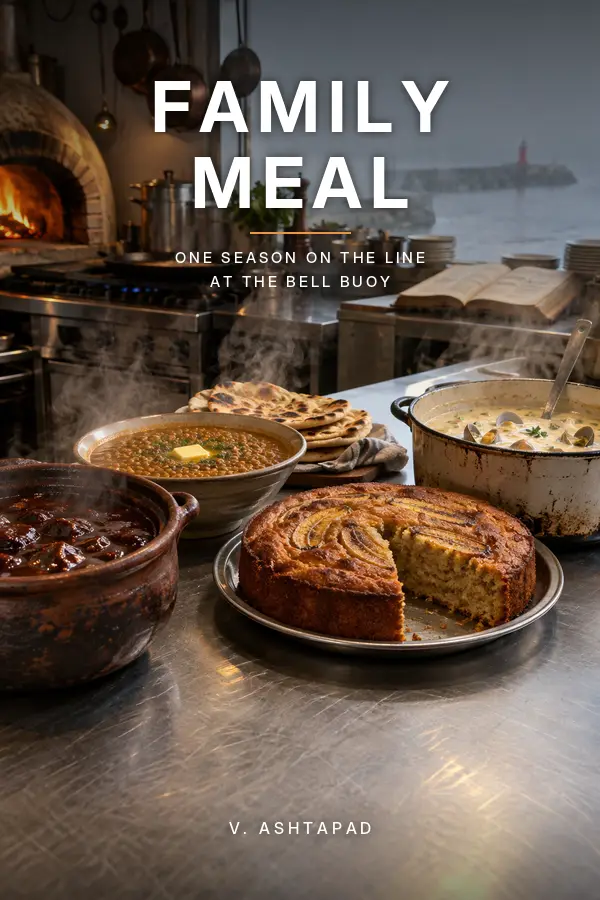
Family Meal
One Season on the Line at The Bell Buoy
by V. Ashtapad
Foreword
This is a novel. The Bell Buoy, its cooks, its regulars and every business in these pages are invented, and any likeness to real people or real restaurants is a coincidence. The roads, highways and cities are real, and they are used here fictionally. Ceniza Cove, the harbor town on the San Mateo coast, and Guelaxé, the village in the hills above the Tlacolula valley, are both invented.
The cooks in this kitchen carry their languages with them, so words in Spanish, Punjabi, Vietnamese, Irish and Genoese turn up the way they do on a real line: lightly, under pressure, and usually with food in hand. Their meaning should be clear from the scene around them. Where an elder speaks in a language of her own, the book gives her words only as her grandson passes them on.
For every cook who ate standing up at half past three, and the people who taught them.
Chilaquiles Verdes
The chilaquiles are on the pass at three-thirty, and the heat lamp is already working on the back of Brigid's neck like a hand that doesn't know when to quit.
Teo has done them in the big hotel pan, yesterday's tortillas fried until they shatter and then drowned in tomatillo salsa he charred on the comal at noon, so the green has a black freckle to it and a smell like a fire somebody put out with limes. On top, eggs fried in the fish-and-chips oil, edges lacy and brown, yolks trembling. Crema in a squeeze bottle. A fistful of cilantro thrown from a height, which is Teo's idea of plating for staff.
"Soup that went to college is ready at five," he announces, to nobody, to everybody. "This one is for people who work."
"Eat first, argue after," says Preet, and takes the egg Devon was reaching for.
At the far end of the pass, on a sheet tray lined with parchment, sits Thu's offering: candied ginger in pale, sugar-frosted coins, and ribbons of candied coconut, some white, some tinted pink, laid out in rows so even they look surveyed. Nobody has touched it. Devon looked at it the way you look at a stranger's baby, with admiration and from a distance.
"What's the occasion, Pastry?" Teo says, cheeks full.
Thu doesn't look up from her bowl. "It's New Year. Mine."
"It's February."
"Yes."
There is a pause while Teo works out whether that was a joke. Thu has already moved on to her egg. Brigid knows from experience that it was, and that it will land on Teo somewhere around the second ticket of service.
She eats standing up, as Mick did, as her father did, with her reading glasses pushed into her hair and the fork held like a pencil. The tortillas still have a little fight in them. That's the trick, Teo told her once: you sauce them late, so they arrive soft on the outside and loud in the middle. She has never told him it's the best thing anyone cooks in this kitchen. She doesn't intend to start on a Tuesday.
Behind her, in the corner by the back window where Teo's comal used to live for twelve years, the tandoor sits like a squat clay barrel with a grudge. It's cold now. By five-thirty Preet will have it roaring, a sound like a jet engine heard through a wall, and the corner will be a place no one stands without a reason. Last October Brigid bought it for one night, Curry and Chowder Night, which she does not discuss, and then she couldn't get anyone to take it back, and then she couldn't get Preet to leave. The comal got moved to a back burner of the six-top, where it sits now, too wide for the grate, wobbling slightly whenever Teo leans on the range.
At the counter, in seat three, Sal Lucchesi eats his plate of family meal the way he has eaten every plate in this building since 1986: slowly, without comment, his wool watch cap on, his hands around the bowl like rope coiled on a dock. He gets a plate every day. Nobody remembers deciding that. He sets his fork down.
"Salt," he says.
"It's perfect," says Teo.
"Salt."
Teo salts it.
Above the pass, on a shelf of its own, wedged between the ticket rail and the fire suppression switch, is the binder. It's a three-ring binder with a blue cover gone gray at the corners, and every page is in a plastic sleeve, and every sleeve has a water stain somewhere, like a map of the weather in this kitchen for forty years. Mick's handwriting is in it, slanted and patient, in fountain pen gone brown. Brigid can recite most of it. She has never changed a word.
*Heard.*
At three-forty-five someone knocks on the green door.
The front is locked until five, and the knock is not a delivery knock, which is a fist, and not a regular's knock, which is a palm flat on the glass and a face pressed against it. It's three neat raps with a knuckle. Devon goes. Brigid hears him say "We're actually not open," in the voice he uses to recite specials, and then a woman's voice, low and level, and then Devon comes back with his eyebrows doing something complicated.
"There's a lady," he says. "She says she's the building."
Rosalind Tavares is wearing a rain jacket so well cut it looks like it was poured onto her, charcoal, the hood down, and running shoes in a gray that matches the sand outside. She has the fog on her. Brigid can feel it come in with her, that fifty-four-degree damp that hangs off the awning and gets into your knuckles; it travels in on the shoulders of people who've walked the breakwater. Somewhere past the jetty the bell buoy rocks and sounds its two notes, low, then lower, as if it's agreeing with something unpleasant.
Rosalind sits at the counter. Not in seat three. She leaves one empty stool between herself and Sal, which Brigid notes, because people who don't know this room sit right next to him and get a look.
"Can I get you anything?" Brigid says. "Coffee? We've got chilaquiles, if you're brave."
"No, thank you." Rosalind folds her hands on the counter. Her nails are short and unpainted. "I won't keep you. I know you have service. I wanted to tell you in person, rather than through the lawyers. The building closed escrow this morning. It's mine now."
Brigid hears it the way you hear a pan hit the floor in another room. A clang, and then that half second where you wait to find out whose fault it is.
"Congratulations," she says. "That's lovely. That's grand."
"Your lease, as I understand it, is a handshake arrangement your grandfather made with the estate. It's been honored in writing, more or less, through the end of September." Rosalind's voice is the temperature of the walk-in. It isn't unfriendly. It's simply not going to warm up for anybody. "It runs to September thirtieth. I'm not going to do anything before then."
"Well, that's very kind of you."
"It isn't kindness. It's the lease." Rosalind looks past Brigid, at the kitchen, at Teo pretending to wipe the flat-top, at Preet openly listening with her arms folded like a gate, at Thu, who has gone still at the slab. "I'll decide about renewal at the end of the season. I'll be honest with you. I can't carry this building at what you pay now. So it has to make sense. Show me by the end of the season that this place still earns its spot on this harbor."
"Absolutely," says Brigid. "Of course. No problem at all."
Sal, without looking at either of them, picks up his coffee cup and puts it down again with a click.
"Thank you for your time," Rosalind says. She stands. She nods to Sal, who doesn't nod back, and to the kitchen. She doesn't look at the binder, and Brigid finds she's grateful for that, for some reason she can't name. Then the green door opens and shuts and the fog goes out with her.
There is a silence in which the walk-in's compressor kicks on with its low thirty-six-degree hum.
"So," says Teo. "Jefa. We're fired?"
"Nobody's fired."
"You said 'absolutely.' You said 'no problem at all.' I've known you twelve years, I never heard you say 'no problem at all.' You say 'that's a no with a smile on it.'"
"It's a different situation."
"She took your soup," Preet says. "She sat there and took your soup and you said thank you."
"She didn't take anything. It's a lease. Leases end. That's what they're for." Brigid picks up her fork, finds her bowl empty, and puts it down. "We've got service in an hour. Devon, the special."
"Rock cod," Devon says, brightening. "Which is a cod. But rock."
"It isn't a cod."
"I'll say that, then."
*Behind.*
Service starts at five and goes wrong at five-oh-six.
Brigid runs the pass. That's the job. Tickets come off the printer with their small mechanical chatter, she reads them aloud, the line answers, plates come up, she wipes the rims, the servers take them out. She can do it with a fever. She did it the night Mick died, and nobody in the dining room knew.
Tonight she calls two chowders for table nine, which ordered fish and chips. She calls the fish and chips for table eleven, which ordered chowder. Teo fires both and says nothing, and when the plates come up he slides them toward the right servers with the tips of his fingers, eyes on her.
"Fry," he says, to the fryer, which is him tonight, too, because the fry cook called out sick. "Fry, you're fine, nobody's drowning, it's only the boss."
"I heard that."
"You were supposed to."
The fryer has its hard-boil rattle going, oil at three-fifty and furious about it. Preet has the tandoor up to temperature now, and the corner pours heat into the kitchen like a door left open on August. She slaps rounds of dough onto the inner wall, the bread for the chowder bowls, and they cling and blister and she hooks them out with a long iron rod and the whole time she's singing something under her breath, low and fast, a couplet and an answer to it, the kind of tune you could work to for hours.
From the pastry corner, where the back window lets in a breath of fog and the marble slab stays cool however hot the line gets, Thu says, without looking up from piping: "Teo. It's New Year in February because the moon decides. Not the month."
Teo stares at her. "That's what you were thinking about? For an hour and a half?"
"I was piping."
"She was piping," Preet says, delighted, and hits Teo on the shoulder with a bread hook, and Teo says "Ay," and Devon comes back into the kitchen to report that table four would like to know whether the rock cod is a cod.
"Tell them it's from the rock," Brigid says. "The big one. Go."
At seven-fifteen she drops a plate. It's a chowder, and it goes face down on the mats, and the smell comes up, cream and clam and thyme and the smoked bacon her grandfather wrote into the binder in 1986, and she stands looking at it as if it might apologize.
Teo is there before she moves. He has the rag and the bucket and a fresh bowl going and he says, quietly, the way you'd talk to a horse, "You're running about a two-hundred tonight, jefa. Warm. Not cooking." Then he says, much louder, so the line can hear, "Ándale, güera. Call me something real."
She calls him something real. It's a two-top, two chowders, and she calls it right, and he fires it, and that's that.
Sal leaves at nine. He always leaves at nine. On his way past the pass he puts his rope hand flat on the steel for a second, as he has done for forty years at the end of a meal, a kind of goodnight to the building.
"Mick's," he says, meaning the chowder. Then, after a moment, meaning something else, he says it again, softer. "Mick's."
*Eighty-six.*
By eleven the dining room is dark and the kitchen is mopped and the tandoor has gone from roar to tick, the clay shedding its heat in small private sounds like a car engine cooling in a driveway. Teo leaves with his cap backwards and his watch on and a nod that means he'll be back at two tomorrow and wants her to know it. Preet leaves singing. Devon leaves with a container of chilaquiles he thinks no one saw.
Brigid stays. She tells herself it's the inventory sheet. She stands at the pass with the inventory sheet in her hand and doesn't fill it in.
The building ticks around her. Upstairs, the lease sits in a drawer in a folder her father labeled in block capitals. She doesn't go up. She takes the binder down off its shelf instead and opens it at random, which is never random. It falls open at the chowder, which is page one. It always falls open at page one.
*Render the bacon slow,* Mick's hand says. *Smoked bacon, quarter-inch dice, low heat, and don't rush it, it knows.* She runs her finger down the sleeve. Water stain, upper left, shaped like a gull. She has known that stain since she was eight.
Outside, the bell buoy goes, low, then lower.
She closes the binder and puts it back and turns off the heat lamps, and the pass goes from orange to the blue of the exit sign, and that's when she sees Thu's tray, still at the end of the steel, untouched, the ginger coins still in their rows, the coconut ribbons pink and white under a sheet of plastic wrap that Thu has labeled in black marker with the date and a word Brigid can't read.
Nobody had any. Not one piece. Thu set it out for her New Year, and they ate Teo's chilaquiles and argued about cod and Brigid said "no problem at all" to a woman in a raincoat, and the tray sat there all night like a guest nobody introduced.
She peels back a corner of the wrap. She takes a coin of ginger. It's a pale thing, frosted, almost translucent at the edge, and she thinks: one, to be decent, and then I'll say something tomorrow. She puts it in her mouth.
For a second it is sugar, plain and kind. Then the ginger arrives. It arrives the way the tandoor arrives when you open its lid, all at once and personally, a heat that goes up the back of her nose and into her eyes and down her throat, and she makes a sound she did not know she owned and bends over the pass coughing, one hand flat on the steel where Sal's was.
From the dark of the pastry corner, where Brigid had been sure nobody was, Thu's voice says, perfectly level: "That's the strong one."
Aloo Paratha for Dinner
The parathas come off the tandoor wall at three-thirty and land on the pass in a stack that steams, and Teo, who has decided in advance not to like them, picks up the top one with two fingers and burns himself anyway.
"Ay."
"It's hot," Preet says. "It came out of fire."
"I know where it came out of."
He knows exactly. It came out of his corner. It came out of the corner by the back window where for twelve years his comal sat on its own two-ring burner, black and flat and patient, the first thing he lit every afternoon and the last thing he scraped every night. Now the corner holds a clay barrel that roars like a truck on a grade, and his comal lives on the back of the six-top, too wide for the grate, rocking like a boat at anchor whenever anybody leans on the range.
He tears the paratha. Inside, the potato is soft and peppery with something green in it, cilantro and a sharp little chile, and the outside is blistered in brown bubbles where the clay grabbed it, and the butter Preet brushed on after has gone into every bubble like rain into a road. There's yogurt in a steel bowl, cold enough to make his teeth feel it. There's lime pickle in a jar, oily and sour and so salty it makes the back of his jaw clench.
It's very good. This is a problem.
"Well?" Preet says. She has her arms crossed and her patka knotted tight, and her kara slides down her wrist when she points at him. "Say it."
"It's fine."
"Fine." She tells the room. "He eats three and it's fine."
"I had one."
"You're holding two."
He looks down. He's holding two.
Thu, at the end of the pass, eats hers in small exact tears and dips each piece in the yogurt the same depth. Brigid eats standing, as always, glasses up in her hair, and says, "Grand," which from her is a parade. Devon has put lime pickle on everything, including, somehow, his coffee. At the counter Sal works through his plate without hurry and then says the only thing anybody has been waiting for.
"Better."
Better than what, nobody asks. Preet takes it like a trophy.
*Heard.*
"It's a pan," Preet says at four-ten, wiping down the tandoor's rim. "Your comal. Don't make that face. It's a flat pan. In my house we have a tawa. Flat pan. We don't light candles to it."
"It's not a pan."
"What is it, then?"
Teo puts his towel over his shoulder. He's prepping garnish for tonight's fish taco special, and the radishes are going paper-thin under his knife without his looking.
"In my grandmother's kitchen," he says, "the comal sits on three stones."
"Here we go," says Devon, who's folding napkins at the counter.
"Three stones. Over the fire on the floor. Adobe walls, so in the morning it's cold, really cold, you see your breath inside the house. And she gets up before anyone and lights the wood under the comal, and you're a little kid on a little chair by the wall, wrapped up in her shawl because she already put it on you. And the comal starts to talk."
"Pans don't talk."
"It ticks. While it heats. Tick. Tick. Like it's thinking." He lays the radish slices in ice water, where they curl. "And she doesn't use a thermometer, she doesn't use nothing, she wets her fingers in the water jar and she flicks. Like this." He shows them, a flick off his wet fingertips onto the flat-top, which is on but low; the drops lie there and sulk. "If it's not ready, the water just sits. Lazy. When it's ready, the drops jump. They run all over like they're scared. Then she puts the tortillas down with her fingers. Bare fingers. She flips them with her fingers. Eighty years old and her hands are like, you know." He holds up his own hands, then makes them older, stiffer, cracked in the knuckles. "Like leather that went in the oven."
Preet has stopped wiping. "And that's how you know? The water runs away?"
"That's how you know."
"My father does it with his arm," she says. "He puts his arm in the tandoor, here," she holds her forearm flat, palm down, "and if the hair goes, it's ready."
"That's crazy."
"That's how you know."
They look at each other across the kitchen. There's a moment that could be friendship. Then Preet says, "Still a pan," and the moment goes out the back door like a cat.
*Behind.*
Teo makes his case to Brigid at four-forty, in the walk-in, because the walk-in is where Brigid goes to not have conversations.
The door sticks, as it always sticks when the fog is in, and he has to put his shoulder to it, and inside it's thirty-six degrees and humming, a low electric note that's been the background music of his whole adult life. Brigid is doing the dairy order on a clipboard. Her breath comes out in a little cloud.
"The tandoor," he says.
"No."
"I didn't say anything yet."
"You said 'the tandoor' in the voice. The voice is the whole argument." She makes a mark. "It's not moving, Teo."
"Jefa. It's in my corner. It's the only corner with the window. The comal needs a window. The comal needs its own fire. On the six-top it's like putting a horse in a closet."
"It cost more than my car."
"Your car has a door you open with a screwdriver."
"Which is why it cost more than my car." She looks up at last, and her face in the walk-in light is pale and tired and stubborn as a post. "I put that oven there. On purpose. For a night that didn't work. And if I move it now, it's like I'm saying the night didn't work."
"The night didn't work."
"Yes, well." She hands him a case of butter. "It's in the binder."
"The tandoor is not in the binder."
"It is now. Page forty-one. I wrote it in the back. Go."
He knows she's lying, because she doesn't write in the binder. Nobody writes in the binder. But he goes, because the case of butter is cold through his apron and because it's four-forty-five and because twelve years teaches you which doors only open from one side.
*Corner.*
Service is a war conducted with hips.
The trouble is the landing tray. Preet's parathas, when she runs them for the chowder bowls and the specials, come off the wall and need somewhere to land, and the somewhere has always been the steel shelf by the range, which is also the shelf where Teo's comal tortillas land when he's running fish tacos. Tonight he's running fish tacos. Tonight, for reasons that are about the walk-in and not the menu, he's running a lot of fish tacos.
"Corner," he calls, coming around with a tray of warm tortillas.
"Corner," Preet calls at the same moment, coming around with a rod of bread.
They meet at the shelf. Neither of them gives. Preet's bread goes on the left half and Teo's tortillas go on the right half and then each of them, with a little side-step, nudges the other's tray an inch.
"Fry," Teo says to the fry cook, "keep your eyes on your oil, this is grown-up business."
"Teo, you're on my shelf."
"This is the shelf of the people."
"I'm people!"
"You're the oven."
He regrets it as it leaves his mouth, but only a little, and only because she laughs, a huge laugh from the belly that makes Thu look up from the slab.
"I'm the oven," Preet says, and she hip-checks him so hard he skids a half step on the mats. "And you're a man with a pan."
He hip-checks her back. She doesn't move. She's built like a doorframe. His comal, on its back burner, rocks with the impact and he has to steady it with his towel, and the tortillas on it slide toward the edge and he catches them with his fingers, bare fingers, flip, flip, and slaps them on his half of the shelf.
"You see that?" he says. "You see the hands?"
"I see you burned your hands."
"These hands don't burn. These hands are leather that went in the oven."
"Pick up, eleven," Brigid calls from the pass. "Two chowders, two tacos, and whatever this is. Is this a sumo match? Are we serving it?"
"She started it, jefa."
"He's on my shelf."
"Both of you, hands. Now."
They carry the plates to the pass together, shoulder against shoulder, neither one willing to be a step behind, and Brigid looks at the two of them over her glasses the way a ferry captain looks at a swell.
"You two are running about four hundred," she says. "Cool it to three-fifty or I'll put you both on dish."
From the slab, Thu says, two beats late and to no one in particular, "He does have a pan."
Preet hoots. Teo points a pair of tongs at Thu. "Pastry. You're supposed to be Switzerland."
"I'm from San Jose."
*Hands.*
The photo comes at nine-twenty, when the dining room has thinned to a few two-tops and Sal, and Teo has a minute with his back against the cool tile by the dish pit.
It's from Rocío. It's the kitchen in Guelaxé. He knows it before it opens all the way: the adobe wall going up out of frame, the smoke stain on it in the shape of every morning of his childhood, the three stones on the dirt floor, and on them the comal. Clean. Cold. Nothing on it. Morning light comes in from the door and lies across it in a gray stripe, and there's no fire under it, and there's no one sitting on the little chair by the wall.
Under it Rocío has written: *She said in her language that it misses your noise. I'm giving it to you in Spanish so you understand: she means come home sometime, idiot.* Then three hearts and a picture of a dog that isn't theirs.
The date is right there on it. March third. Today. The comal sat in that light this morning while he was in his car on Highway 1, coming down the curves to the water with the heater broken and the fog on the windshield.
He stands there for a while.
Then he goes out front. The dining room is at that late-night temperature, sixty-something, warm from bodies and cooling from the door, and the harbor photos hang over the counter in their black frames, one for every year, Mick's idea. The 1994 one is the kitchen, the only one that shows the inside: a younger Mick at the range, in a paper hat, and a girl of twelve or so behind him with a bus tub, all elbows and red hair, glaring at the camera. And in the corner, by the back window, a two-ring burner with a stockpot on it, the same corner, the window propped open a crack with a wooden spoon. He's looked at it a hundred times and never noticed the spoon.
He takes a picture of the photo. On his phone he puts the two side by side, the cold comal on its stones in Guelaxé, dated today, and the Bell Buoy kitchen in 1994 with its corner and its window and its spoon, and he looks at them next to each other until Sal, three stools down, clears his throat.
"Brigid," Sal says, nodding at the photo on the wall. He means the girl. "Mean as a gull."
"Still is."
"Better now," Sal says, and goes back to his coffee.
*Last call.*
At ten-forty Teo turns off his station, scrapes the flat-top, and does not go home.
Instead he lifts his comal off the back burner of the six-top. It's heavy, the heavy of real iron, and still warm from service, and he carries it out through the back door onto the step, where the fog is down on the fish dock so thick that the ice-house light is just a smear of yellow and the crab-pot stacks are shapes, green and orange gone gray. The cold hits his forearms first. Fifty-four degrees and dripping off the awning in fat slow drops. A gull complains from the roof of the ice house, a sound like a hinge.
Under the step, where Brigid keeps the propane ring for the summer crab boil, there's a tank with something left in it. He drags it out. He sets the ring on the concrete and the comal on the ring, and he crouches and lights it, and the blue flame comes up with a soft cough.
He waits.
Tick. Tick.
He wets his fingers from the bus tub and flicks. The drops sit. Lazy. He waits some more, crouched on the step with the fog on the back of his neck, and the comal starts to talk properly, and he flicks again and the drops jump and skitter across the iron like they're scared of it.
He's got a stack of corn tortillas from the walk-in, yesterday's, the ones that would have been tomorrow's chilaquiles. He lays one down with his fingers. Flips it with his fingers. The smell comes up right away, toasted corn and the faint char of the iron, a smell that in Guelaxé meant morning and in this town means nothing to anybody, and it rises off the comal and goes into the fog and spreads.
He does another. And another.
Behind him, the screen door creaks and slaps.
Preet comes out onto the step in her chef's coat with her patka still on and her kara catching the ice-house light, and she's holding a plate. On the plate there are two parathas, saved, still soft, a spoon of lime pickle on the side. She doesn't say anything. She crouches next to him on the cold concrete, holds the plate out, and with her other hand reaches past him and takes a tortilla off the comal, bare fingers, flip, and drops it, and swears, and picks it up again.
Corned Beef Hash, Eggs on Top
Brigid makes the hash at ten past three in a fury, because on Paddy's Day the doors open at four and the line is already down the steps and along the front of the building, and somebody out there has brought a fiddle, and it's tuning.
By three-thirty the hash is on the pass in two black skillets the size of manhole covers. Potatoes cubed and fried until their corners went glassy and brown. Yesterday's corned beef, pulled off the brisket in rags and crisped in its own fat. Onions gone sweet. On top, eggs, a dozen of them, fried hard at the edges and soft in the middle, cracked straight into the skillets so the whites ran down into the potato and set there. Brown sauce in a squeeze bottle. Pepper ground over everything like gravel.
Preet eats hers with a spoon, standing at the tandoor, which is still cold, which is the only cold thing in the kitchen. The rest of the room is already at a simmer. The fryer is up and rattling its hard boil. The flat-top is shimmering. The walk-in door has been open and shut so many times today that its hum has a hiccup in it.
"Needs green chile," she says.
"It's in the binder," says Brigid, without turning.
"The chile?"
"The hash. The hash is in the binder, without chile. Page eleven."
"Mick never had chile in his life, that's why it's not in the binder. It's not a law. It's a gap."
Teo, eating out of the skillet with a fork, laughs through his nose. Thu takes one egg, exactly one, and a square of potato with the corner on it, and goes back to the cold side to finish a tray of something green that is apparently mandatory today. Devon is wearing a hat shaped like a pint glass. Nobody has asked him about it, and nobody will.
"Eat," Preet tells him. "You're going out there in a hat like that, you need a base."
"I ate."
"You ate air. Eat first, argue after." She puts a second egg on his plate with her fingers.
Sal, in seat three, holds up his empty plate to the kitchen without a word, and Brigid takes it and fills it and hands it back, and he looks at it, and at her, and says, "Mick's," and she nods as if he's handed her a receipt.
Then the fiddle outside finds its note and the crowd on the steps cheers, and Brigid wipes her hands on her chore coat and says, "Right. Nobody dies tonight. Grand."
*Heard.*
Preet doesn't like to think about October. So naturally, on the busiest night of the year, with the tandoor coming up to heat at her back like a second sun, she thinks about October.
She'd come out from Fresno with her oven tools rolled in a canvas sleeve and her father's iron rods in a hockey bag. Two years after the dhaba closed, she was sick of the packing plant in Fowler, sick of the hairnet and the cold-room floor, and when a spice wholesaler she'd known since she was nine passed along a phone number and said a lady on the coast needed somebody who could run a tandoor for one night, she said yes before he'd finished the sentence. One night. A big night, the lady said. Curry and Chowder Night. A celebration of flavors.
Preet had looked at the menu Brigid printed and thought: this isn't a celebration, it's a divorce. Chowder on the left. Curry on the right. A fold down the middle like a wall.
So she'd tried. She'd made a tadka in the afternoon, cumin seeds and curry leaves and a little dried red chile spitting in ghee, and she'd brought it over to the big chowder pot in a ladle, and she'd said, "Just a spoon. On top. When it goes out. You'll see. It wakes it up."
Brigid had looked at the ladle the way a person looks at a dog that has brought something dead into the house.
"It's in the binder," she said.
"What is?"
"The chowder. As it is. Page one."
"So write in the binder."
"Nobody writes in the binder."
And that was it. The binder sat up on its shelf like a judge. The chowder went out as it was. The curry went out as it was. The dining room was half full, and the half that came wanted chowder and looked at the butter chicken like it was a dare somebody had made them take. The tandoor, its first night, had been fired too hot, and at seven-twenty the smoke rolled out of the corner and into the dining room, and the alarm went off, and stayed on for no good reason except that nobody knew where the switch was, and Sal sat through the whole thing in seat three with his watch cap on, eating chowder, and when it was finally quiet he said, "Mick's," and that was the review.
She should have gone home. Nobody told her to stay. But nobody told her to leave, either, and on Tuesday she drove back over the hills because the oven was still sitting there and it seemed rude to leave it alone, and Brigid looked at her coming in the back door and said nothing at all, and at the end of the night paid her.
That was five months ago. She's still not on the menu. She runs the bread for the chowder bowls and the black cod skewers and the house rolls when Thu's busy, and she is, as Teo so kindly put it, the oven.
*Behind.*
At four-fifteen there's already a knock at the back door.
It's the linen driver, a heavy, soft-voiced man in a gray work jacket who brings the clean aprons and takes the dirty ones, and who always looks, to Preet, like he hasn't sat down since Tuesday. He's got the cart. He's got the clipboard. She takes the clipboard out of his hands and puts a plate in them instead, hash from the skillet, an egg on top, and a roll from the tandoor that's just come off the wall and is too hot to hold.
"I can't," he says. "I'm behind."
"Two minutes. You're behind anyway."
He eats on the back step. The fog's out over the water but not in yet, and the air on the dock has that wet chill that gets inside your sleeves. Gulls stand on the crab pots like they're waiting for a bus.
Then Junie comes over from the ice house, nineteen and all neck, in rubber boots and a sweatshirt with a hole at the cuff, to ask if they need more ice. They always need more ice. Preet gives him a plate too. Then a deckhand off one of Holly Brandt's crab boats wanders up the dock with his hands in his pockets, sniffing like a dog, and she doesn't even ask, she just loads the plate.
This is the rule. Her father's rule, her mother's rule, the rule on the hand-painted sign that hung over the dhaba counter on Highway 99 for twenty-two years until the land was sold and the sign came down with it: *Roti kha ke jaana.* Eat before you go. You don't let somebody walk through your door and walk out empty. It doesn't matter if they're paying. It doesn't matter if they're the linen man. A truck driver at three in the morning with eight hours of the valley behind him and four more ahead, a family whose car broke down by the canal, the man who came to fix the walk-in. Nobody leaves hungry. Nobody is a customer. If you don't understand that, you shouldn't own a stove.
She turns around with the empty skillet and Brigid is standing in the kitchen doorway, watching.
Preet waits. She's ready for it: food costs, liability, it's in the binder.
Brigid looks at the three men eating on her back step, at the plates, at the hash that was supposed to be staff only. She takes her glasses out of her hair, cleans them on the hem of her chore coat, puts them back. Then she goes back to the pass and calls a ticket, and never says anything about it, then or later.
*Corner.*
At six-forty the dining room is a party and the kitchen is a forge.
Tickets come off the printer in a ribbon. Brigid tears them and calls them and the line answers in a single voice, *heard, heard, heard,* and the plates go out under the heat lamps in a constant stream: fish and chips in paper cones, chowder in Preet's bread bowls, corned beef and cabbage for anybody who wants to be festive, Thu's green somethings on a plate with a shamrock dusted next to them in powdered sugar through a stencil Thu cut herself and clearly resents.
Out in the dining room the fiddle is going. Somebody has brought a goatskin hand drum, and somebody else, unforgivably, a set of spoons.
In a lull of maybe forty seconds, Brigid leans back against the pass and nods up at the wall above the dish pit, at the thing that has always hung there on a nail, a tin whistle gone dull with grease.
"That was my gran's," she says to Preet, who didn't ask. "Every Paddy's Day she made soda bread in this kitchen. Here. On that oven, before it was that oven. Forty loaves, crosses cut in the top. And at the end of the night, when the last table was finishing up, she'd take that down and play two tunes on it, always the same two, and then she'd hang it back up and that was Paddy's Day finished. You could set a clock by her."
"Who plays it now?"
"Nobody." Brigid shrugs, which on Brigid is a whole speech. "Nobody plays it. It's on the wall."
"Like the binder," says Preet.
Brigid looks at her for a long second. Then the printer starts chattering and she turns back to it.
At the fryer, Teo is in trouble.
Preet can hear it before she sees it. The oil's gone tired. It doesn't rattle right anymore; it has a heavy, sullen sound, and the cod is coming out darker than it should and soaking a little at the seams. There's no time to change it. There's never time to change it on Paddy's Day.
She sets down her rod, wipes her hands, and goes over. "Your oil's dead."
"My oil is resting."
"Your oil is dead, it's black, it smells like Tuesday. Listen. I've got a full jug of fresh in the dry store, I bought it for my pakoras." She does fry pakoras for the back door, at three, before he comes on, and she's never asked. "Here's the deal. I swap your oil out right now, I hold your basket while you plate. And from tomorrow, I get the fryer at three, for the back step, while it's clean. You get it after. And at the end of the night, I filter."
Teo looks at her. Then at the black oil. Then at the ticket rail, which is groaning.
"You filter?"
"I filter."
"Every night?"
"Every night I'm here, which is every night, which you know."
"Órale," he says, and holds out his hand, and she shakes it, and his hand is slick with batter and hers is dusty with flour, and they both wipe them on their aprons at the same time. Then she drains his fryer into the bucket in about a minute and a half, ducking his elbows, and hauls the fresh jug up on her hip and pours, and the clean oil goes in gold and climbs back up to temperature, and in four minutes the rattle comes back hard and bright, like gravel shaken in a can.
"Fry," Teo says, to the fryer, with feeling. "Welcome back."
"You're welcome," says Preet.
"I was talking to the fryer."
"I know who you were talking to."
*Hands.*
At eight-ten the fog comes in all at once, the way it does, and in the dining room the door opens and a whole new crowd comes through it out of the gray, and the fiddle stops, and somebody shouts something about the bar.
The printer starts to talk.
It doesn't stop. It goes on and on, ticket after ticket, a long white tongue of paper unspooling over the rail and onto the steel, and Brigid catches the end of it and reads it, and reads it again, and Preet sees her face do a thing Preet has never seen it do, which is open all the way.
"That's a forty-cover," Teo says. "That's the softball team. That's the whole softball team and their mothers."
"Thu," says Brigid. "I need you on the line."
"I'm pastry."
"You're line now. Teo, two baskets. Preet, every bread you've got and then every bread you haven't."
The tandoor is roaring. The fryer is rattling. The bell buoy is going out past the jetty, low, lower, and nobody hears it. Brigid tears the ticket off the rail, slaps it down on the steel in front of her, takes a breath that Preet can see go all the way down into the chore coat, and calls it.
"Hands!"
And all four of them hit the pass at once, Teo from the fryer and Preet from the tandoor and Thu from the cold side with her sleeves pushed up, and Brigid in the middle with the ticket under her palm and her mouth already open on the first call.
The Apple Cake from Page Forty
The cake is on the pass at three-thirty in a ten-inch springform, out of the ring now, sugar crust crackled on top like ice on a puddle somebody stepped on, and Thu stands beside it with her arms folded and her face arranged.
It is Mick Doyle's grandmother's apple cake. Page forty of the binder. The recipe is written in ounces and in teacups and in one place in "a good lump," and in the margin someone, Mick or someone before Mick, has written *Bramleys if you can get them, God help you if you can't.* There are no Bramleys in Ceniza Cove. Thu used Pippins, which are firm and sharp and hold their shape in the oven, and she converted the ounces to grams to the second decimal and then rounded, and for "a good lump" of butter she watched Brigid's hand make the gesture three times and weighed the air between Brigid's fingers in her head and came up with one hundred and fifteen grams, and it was right. She knows it was right. She can tell by the crumb.
She did all of this because at two o'clock Brigid said, "Could you do something Irish for family meal? We've got a party of sixteen from the golf course and they'll want something Irish," and then went upstairs before Thu could answer.
"Oh," says Devon, with his mouth full. "Oh, that's — oh."
Teo eats a slice with his hands. "Pastry. This is better than the jefa's."
"Don't say that," says Thu.
"It is, though," says Preet. "Hers is dry. I never said. It's dry. This one's wet in the middle. Wet in a good way. With the apples."
"Don't say that, either."
Brigid comes down the stairs, takes a slice, eats it standing, and stops chewing. Her eyes go to the ceiling and then to the binder on its shelf and then, a little helplessly, to Thu.
"It's the same recipe," Brigid says. "It's page forty. I've made it a thousand times."
"You make it from memory," says Thu. "Page forty says a quarter teaspoon of mace. You use nutmeg. Page forty says rest the batter ten minutes. You don't. Page forty says the apples go in thin, then the sugar, then the rest. You mix it all together."
"I do not."
"I've watched you."
Sal holds up his plate for a second slice. He eats it. He sets the fork down.
"His grandmother's," he says, which from Sal is a sentence of extraordinary length.
Everyone looks at Thu as if she's won something. She has the feeling, familiar since pastry school, of being complimented on a dress somebody else picked. She goes back to the cold side and lays her wrist on the marble slab, which is always cool, cooler than the room by fifteen degrees, quiet as a held breath. Under her wrist it stays the same no matter what anybody says.
*Heard.*
Cormac arrives at four-ten with a duffel bag and a cracked phone already raised.
His mother drops him at the back step without getting out of the car. Through the window Thu sees a woman in scrubs with a dental-office lanyard and Brigid's same jaw, waving one hand and reversing with the other. Then she's gone up the road toward Highway 1, and Cormac is standing on the step in a gray hoodie with noise-canceling headphones around his neck that are visibly not on, holding the phone up in front of him like a lantern.
"The line cook," he says, in a low, hushed voice, panning to Teo at the flat-top, "in his natural habitat. Observe the backwards cap. Some scientists believe it is for aerodynamics. Others believe it has simply never been turned around."
"Hey," Teo says, pleased, and flexes.
"And here," Cormac whispers, turning, "the rare and fearsome tandoor cook, who can lift an entire —"
"Put that down and eat something," says Preet, and puts a slice of cake in his free hand.
Brigid comes out from the office with her glasses on her nose. "That's my nephew," she says to the kitchen, unnecessarily. "He's here for spring break. He's on dish. Cormac, if you're going to film, I've put a folder up for the restaurant, private, I'll send you the thing. Put it all in there."
"Why?"
"For insurance."
"Insurance against what?"
"Against everything," says Brigid. "Go wash something."
He doesn't go wash something. He comes over to the cold side with the phone up, and Thu watches the cracked lens find her the way a gull finds a bag of bread.
"And here," Cormac breathes, "in the cool corner of the kitchen, we find the pastry chef. Quiet. Watchful. She weighs everything. Scientists have observed her weighing a single strawberry —"
Thu sets down her bench scraper, picks up her tray of tart shells, and walks out of the frame.
She walks all the way into the walk-in, which sticks, and she has to set the tray on her hip and shoulder the door, and then she's inside, in the hum, in the thirty-six degrees, with her breath going out white, and she stands there with the tart shells until she hears him go away.
*Corner.*
The golf course party wants something Irish.
They want it at seven-fifteen, sixteen of them in sweaters the colors of sherbet, at the long table under the 1991 harbor photo, and Devon comes back through the swing door with his order pad held out in front of him like a sick bird.
"They're asking if pastry does anything Irish for dessert."
"There's the apple cake," says Brigid.
"They asked for something Irish that's not the apple cake. They had the apple cake at lunch somewhere. One of them says she's a quarter Irish and she wants, I'm quoting, 'something with a little whiskey that's also kind of a surprise.'"
Teo, at the flat-top, says: "Tell her she's a quarter Irish and three quarters surprise."
"I'm not telling her that."
"Pastry," Brigid says, with a hand already up, an apology in advance. "Is there anything? A bread pudding? A cream thing?"
Thu looks at her station. She has a tray of tart shells, a lemon curd, a dark chocolate pot de crème that she makes because it's correct, and her own sesame brittle, which nobody orders because nobody knows what to do with it. She has nothing Irish, because nobody has ever asked her what she would like to make, only whether she can make something Irish, and the honest answer is yes, she can make anything. That's what school is for. You learn everybody's cakes so that you can make them without wanting to.
"Whiskey," she says. "Cream. Sugar. Twenty minutes."
"You're a saint."
"I'm a pastry chef."
She makes a whiskey custard. She sets it in sixteen ramekins in an ice bath and brûlées the tops with the torch until the sugar cracks like a frozen pond, and she puts a thin piece of her own sesame brittle on each one, standing up in the custard like a sail, because if she is going to make something Irish she is going to put herself on it somewhere.
Devon takes them out. Five minutes later he comes back.
"They loved it. The quarter-Irish one wants to know what the brittle is."
"Sesame," says Thu.
"Is it Irish?"
"No."
"She says it's very Irish."
From the flat-top, Teo laughs so hard he has to put down his spatula. Preet, at the tandoor, starts singing something low and gleeful in Punjabi with a beat in it, a couplet tossed out and caught again, and Thu, despite herself, despite everything, feels her mouth do a small thing at one corner. Cormac, at the dish pit, has his phone propped on the rinse sprayer. It's pointed at her. She turns her back to it.
*Walking in.*
Wednesday is her day off. She drives to San Jose.
Highway 1 south along the cliffs in fog, then the turn at Santa Cruz and up over the hill on 17, the road twisting through the redwoods with its own cold weather, and then down the far side into the valley, where the sun is out and the air is dry and the whole world is twenty degrees warmer in twenty minutes, as if somebody opened an oven. She drives with the window cracked to feel it change.
The bakery is in a strip on Story Road between a jeweler and a place that does nails, a narrow storefront with the name hand-painted on the glass in red and gold, the paint chipped at the corners where Má touches it up every Tết with a brush too small for the job. Inside it smells the way it has always smelled: pandan, green and sweet as cut grass in syrup, and under it burnt sugar, the dark edge of caramel left a few seconds too long on purpose. The radio on the shelf above the register is playing one of Má's old songs, a woman's voice with too much reverb singing slowly about a river and a boat that waited all night, the kind of song Má hums while she shapes dough and pretends she isn't humming.
The cases are half empty.
Not sold out. Half empty. There's a row of pandan sponge in plastic clamshells, green as a lawn. There are sesame balls in a paper-lined tray. There's a stack of coconut cookies. And then glass, clean glass, rows of it, with nothing behind it but the white shelf paper Má cuts to size.
"Con," says Má, coming out from the back, wiping her hands. She's small and quick and wearing the same purple cardigan she's worn every spring of Thu's life, the elbows thin. "You're early."
Before Thu can answer, Má puts a sesame ball in her hand without looking.
"Where's everything?" Thu says, in Vietnamese.
"The five-o'clock people came," says Má. "Mr. Huỳnh, the nurses from the hospital, the one with the dog. They took everything. I didn't make much."
"Why not?"
Má shrugs. It's the shrug she's had since Tết, every time Thu has said the word *summer.* A shrug that says *maybe* in a way that means *yes.*
Thu goes into the back to wash her hands, because that's what you do when you come into this kitchen, you wash your hands before you touch anything, it's the first rule she ever learned. She dries them on the towel by the sink. She turns around.
The deck oven is gone.
There's a rectangle on the floor where it stood for twenty-six years, a rectangle of tile cleaner and paler than the tile around it, with four darker squares at the corners where its feet were. The gas line comes out of the wall and stops, capped with a brass fitting that's still shiny. On the wall above, the long black smudge of its exhaust goes up to the ceiling and stops at nothing.
The kitchen is cold. That's what she noticed first and didn't understand. In her whole life she has never been cold in this kitchen. The deck oven ran at four hundred and fifty from four in the morning to three in the afternoon, and the back room was always ninety, and she did her homework at the steel table in a T-shirt in January with her hair stuck to her neck. Now it's just a room. Sixty-eight degrees. A small convection oven on a stand in the corner is doing its best, ticking.
Má comes in behind her with the empty tray.
Thu waits for her to say something. Má puts the tray in the sink and runs the water.
"The bananas are too ripe for the case," Má says. "Take them. You'll find something."
That's all. There's a bag of them on the steel table, freckled black, soft, their sweetness already in the air. Thu takes the bag. She stays four hours. She cleans the cases. She does not say *oven*. Má does not say *oven*. When she leaves, the radio is playing a different song about a different river, and Má is humming it, and pretending not to.
*Eighty-six.*
On Thursday she's back at the slab by two.
The kitchen is coming up to heat around her. Preet is building the fire in the tandoor and swearing at it affectionately. Teo is toasting chiles on his comal on the back burner and the smoke is making Devon cough in the dining room. Brigid is in the office on the phone with her father in Arizona, saying "Grand, Dad, grand," in the voice that means she's going to hang up in about ninety seconds.
Nobody asks how San Jose was. She doesn't tell them. There's nothing to tell, because nothing was said, and she doesn't know how to report a thing that didn't happen out loud.
She puts the bananas in a deli container. They're past ripe now, almost liquid inside their skins, which have gone the color of strong tea, and the smell comes up out of the container and fills the cold corner in a way that nothing else in this building smells. It smells like the back room on Story Road. Like a Saturday when she was seven, standing on a milk crate at the steel table while Má folded bananas into soaked bread with her bare hands and said *taste, taste, no, more* and didn't measure anything at all.
She puts the lid on. She takes the black marker out of her apron pocket, the one she keeps next to the scale, and pulls a strip of tape off the roll and writes the date, as she writes the date on everything.
Then, under the date, in the block capitals she uses for allergens:
BANANA – DON'T.
She presses the tape onto the lid, smooths it flat with her thumb, and puts the container on the top shelf of the reach-in at the back, behind the lemon curd, where nobody goes.
Behind her, at the dish pit, Cormac lowers his phone. He looks at the screen, at the shot he just took, at the label in close-up, and frowns. "Don't what?" he says, to nobody, and nobody answers him.
Egg Bhurji and Soft Rolls
The wide steel pan Preet uses for everything lands on the pass at three-thirty full of eggs, scrambled soft and yellow-gold with turmeric, shot through with red onion and tomato and slivers of green chile, cilantro torn over the top, a slab of butter melting into one side of it like an iceberg calving. Next to the pan, on a sheet tray, sit rolls: a dozen soft milk rolls baked together so they rise into each other and have to be torn apart, egg-washed until they shine like varnish.
Brigid tears one. It comes apart in a long, slow, feathery pull, the inside white and damp and faintly sweet. She drags it through the eggs. The chile gets her a second later, at the back of the tongue, a small polite fire.
Thu made the rolls. Preet made the eggs. At some point this afternoon, while Brigid was upstairs arguing with the linen company about a charge for aprons they didn't send, the two of them stood next to each other and decided this, and nobody says a word about it, and Brigid doesn't either, because saying something would be like pointing at a deer.
"These are good," Teo says, meaning the rolls, with his mouth full.
"They're for the eggs," says Thu.
"They're good for the eggs."
"That's what they're for," says Thu, and goes back to her slab.
Cormac films the pan from above, slowly, a drone shot. "The midday feeding," he murmurs. "Note how the pack gathers. The dominant male," he swings to Teo, "takes the largest portion —"
"I'm hungry, man."
"— while the matriarch," Brigid, "pretends she isn't eating at all."
"Go wash something," says Brigid, eating.
Spring break ended last Friday and Cormac didn't. Nora rang on Sunday and said something about him finishing the term on independent study, packets from the school, a change of air, and her voice had the tone it gets when there's a longer conversation she'd rather have in person. Brigid didn't ask. She knows that tone. It runs in the family. He does his packets at the counter in the mornings, two stools down from Sal, and in the afternoons he's on dish, and in between he films.
Sal has his plate. He takes a long time with the eggs. He tears a roll and looks at it the way he looks at weather.
"Better," he says, and it isn't clear which of them he means, and both of them look up.
*Heard.*
Rosalind comes at six-fifteen, on a Tuesday, for dinner, and doesn't say she's coming.
Devon spots her first, through the round window in the swing door. He comes back into the kitchen at a walk that is very nearly a run and says, "The building's here."
"Don't call her that."
"She's at table six. By herself. With a little notebook."
Everybody on the line, with great casualness, finds a reason to look through the round window. Rosalind is sitting very straight at the two-top under the 1997 harbor photo, a rain jacket folded over the back of the other chair. She has, in fact, a small notebook, black, closed, a pen lying across it at a right angle.
"What's she having?" says Brigid.
"She asked what we're known for."
"And what did you say?"
"I panicked," says Devon. "I said the chowder. And then I said the rock cod. And then I said the rock cod isn't a cod. And then she said she'd have the chowder."
"Good. Fine. Grand. The chowder."
Brigid makes it herself. She doesn't let Teo near it. She ladles it from the pot that's been at a slow simmer since two, cream and clams and the smoked bacon and the potatoes cut to the size Mick specified on page one, *the size of a die, not the size of a fist, we're not feeding horses.* She lays Preet's bread bowl beside it, not under it, because Rosalind doesn't seem like a woman who eats out of bread. A wedge of lemon. A sprig of thyme, set on the rim where it can be removed with dignity. She wipes the bowl twice.
She takes it out herself.
"Thank you," Rosalind says.
"Enjoy," Brigid says, and then stands there, which is not how you let someone enjoy something.
Rosalind eats a spoonful. Then another. She does not open the notebook. She takes a piece of bread, tears it, dips it, eats it. Her face does nothing at all. It's like watching a tide table.
"It's very consistent," she says at last.
"Thank you."
"I had it when I was a girl. I think it's exactly the same." She looks up. "Is it?"
"Exactly," says Brigid. "Exactly the same. Since 1986."
Rosalind nods, slowly, as if that's an answer to a question she hasn't asked yet. "Thank you," she says again, and goes back to her soup, and Brigid goes back to the kitchen with no idea whether she's just won or lost.
"Well?" says Preet.
"Consistent."
"Is that good?"
"It's a word," says Brigid.
At seven-ten Rosalind pays in cash, leaves a tip that Devon reports is exactly twenty percent "to the penny, like she did it with a ruler," and walks out into the fog with the notebook still closed, the pen still lying across it. Through the round window Brigid watches her stop on the front step to zip her jacket, look left along the breakwater and right toward the ice house, and stand there a moment longer than the zipper needs, the way people stand at the edge of cold water.
*Corner.*
Teo is waiting for her at the pass. He has a look on him she knows: the look of a man who's had a speech ready for a long time and has just been handed a reason.
"Consistent," he says.
"She said it was consistent. It's a compliment."
"It's what you say about a bus." He puts down his tongs. "Jefa. I love you. I'm going to say this with love. It's a museum."
"Here we go," says Preet, delighted, at the tandoor.
"It's a museum," Teo says again, louder, with his hands. "Everything in here is the same since 1986. The chowder, the same. The hash, the same. The cake, the same, except when Pastry makes it right and you get upset. The menu card is the same, it's got a picture of a crab on it that looks like a spider with a lawyer. People come in and they look at the walls and they eat the same soup their grandmother ate and they say 'consistent' and they go home. You know what you call a place like that? You call it a museum."
"It's in the binder," says Brigid.
"The binder is the museum!" He points at it on its shelf, up between the ticket rail and the fire switch, its gray-blue cover and its water-stained sleeves. "It's the main exhibit! It's the dinosaur! We all walk around it and we don't touch it!"
"Nobody touches it because it's his."
"He's dead, jefa."
The kitchen goes quiet. Even the fryer seems to drop its rattle half a step. Teo hears it, too. He puts his hand flat against his chest, an apology, but he doesn't take it back.
Brigid's temperature, if anybody's taking it, has dropped to somewhere around fridge.
"Fourteen," she says, reading a ticket. "Two chowders. One fish and chips. One salad, no onion."
"Heard," says Teo, quietly.
From the dish pit, where he's been holding his phone but, for once, not filming, Cormac says: "If it's a museum, shouldn't somebody at least scan it?"
Everybody turns.
"So it doesn't burn down," he says. "Like, if there was a fire. The whole thing's in plastic sleeves over a fryer. That's literally the worst place to keep paper in the entire world. I could scan it tonight. With my phone. Every page. Then it's the first thing in the folder, before all my stuff."
"No," says Brigid.
"For insurance," says Cormac.
There's a pause. Thu, at the cold side, says, without looking up, "That's what you said."
*Behind.*
They do it after close, in the office upstairs.
The office is the warmest room in the building. All the kitchen's heat climbs the back stairs and pools up here under the eaves, so it's always eighty degrees whatever the fog is doing, and it smells of old paper, receipts and invoices and forty years of menus in boxes, a dry brown smell like the inside of a library book. Down through the floorboards she can hear Preet closing the tandoor and the soft clank of the lid going on, and Teo singing something under his breath in Spanish while he scrapes the flat-top, the way he does when he's made up with you but isn't going to say so.
Brigid sits at her father's desk with the binder in front of her and doesn't open it. Cormac sits on a box of 2009 menus with his phone.
"I'm just going to take it out of the rings," he says. "Then I put each page flat, I take a picture, I put it back. It doesn't hurt it."
"You don't know that."
"It's a picture. Pictures don't hurt anything. That's literally the whole point of pictures."
She opens the rings. They snap like a small trap. The first page is the chowder. Of course it is. Page one in Mick's patient slanted hand, fountain pen gone brown, the water stain in the upper left corner in the shape of a gull.
"Start at the back," she says. "I'll do the front."
He starts at the back. She watches him. He lays each sleeve on the blotter, under the desk lamp, smooths it with his palm, stands up over it, holds the phone very still, takes the shot. He doesn't narrate. She notices that. For the first time since he got out of Nora's car he isn't doing the voice. He's just doing the work, and he's careful with it, more careful than she expected, holding each sleeve by its edges like a plate that's just come out of the oven.
Page fifty-two: tartar sauce, *more pickle than you think.* Page forty: the apple cake, *Bramleys if you can get them.* Page thirty-one: something called Mother's Fish Pie, which Brigid has never once made, because it calls for an ingredient she can't read. Page eleven: hash.
The sleeves are old. That's the trouble. They're the heavy kind they don't make anymore, gone yellow and brittle along the seams, and on page twenty-six, when Cormac slides the paper out, the sleeve doesn't so much tear as give up. It splits open along the bottom with a dry little sound, and out of the back of it, behind the recipe, a piece of stiff gray card slides out and lands face down on the blotter.
"Sorry," says Cormac. "Sorry, sorry, I've got it."
"It's the backing," Brigid says. "He put card in the sleeves to keep them stiff. So they'd stand up on the shelf."
"Okay. Okay." He tucks it back in behind the recipe, very gently, and takes the picture.
It happens again on page nineteen. And on page fourteen. Each time it's the same, the seam going with that dry sigh and a piece of the gray card dropping onto the desk. By page eight she's got a little stack of them beside the lamp, face down, waiting to go back in. They're heavier than they look. They don't feel like cardboard exactly. They feel like something folded many times and pressed flat.
She doesn't turn them over. She's tired, and it's almost midnight, and she has a feeling, the kind you get in a kitchen just before something on a back burner catches, and she ignores it, which is what she always does with that feeling and which is why she has a scar on her left wrist from 2011.
"Do you want to do page one?" Cormac says. "Since it's, like, the main one."
"You do it."
He looks at her. Then he takes the chowder page out of its sleeve, slowly, so slowly. And the sleeve, being forty years old, and the first one, the one that's been opened and closed and wiped and splashed more than any of the others, comes apart in his hand like wet paper, and the backing card behind the chowder slides out over the edge of the desk and falls onto the floor.
"I've got it," he says, and bends.
Down below, the walk-in door thuds shut. Outside, through the office window, the fog is so thick that the bell buoy is only a sound, one low note and a lower one answering it.
Cormac picks the card up off the floor. He's turning it over to slide it back into the sleeve, and he stops. He brings it under the lamp. He holds it there, and his face, which has been arranged since March into the expression of a person who is not impressed by anything, comes undone.
"Aunt Brigid," he says. "There's writing on the back of the chowder."
Tlayudas off the Back Step
Family meal is outside today. The tlayudas come off the comal on the back step at three-thirty, one after another, and Teo is crouched over the propane ring in the fog like a man fixing a car, with the tortillas wider than his two hands spread and the iron ticking underneath them.
He brought the masa up from a woman in Watsonville who makes it the right way, and he pressed the tortillas himself this morning, big and thin, so thin you can almost read through them. On the comal they dry and crisp and blister and go stiff as a plate. Then the asiento: the dark unrefined lard, the bottom-of-the-pot lard, brown and smoky and full of little crisp bits, which he paints across the tortilla with the back of a spoon so it melts into the hot surface and smells like a whole Sunday. Then black beans, cooked down with avocado leaf and mashed loose, spread over the asiento. Then quesillo, which he pulls apart in long white strings, unwinding it off the ball like he's undoing a sweater, and lays across the beans in a nest. Then shredded cabbage, a few slices of tomato, a slice of avocado, and he folds the whole thing in half on the comal and presses it down until the cheese gives up and runs out the sides and sizzles on the iron.
He cuts each one into wedges with the big knife on a sheet pan on his knees. Steam comes off into the fog and disappears.
"Pass," he calls, and Cormac comes and takes the sheet pan inside.
On the side, in a small clay bowl he keeps for nothing else, there are chapulines. Toasted grasshoppers, little and red-brown, tossed with lime and garlic and chile and salt. They smell like the market in Tlacolula on a Sunday. They look like grasshoppers.
Inside at the pass, everybody eats the tlayudas. Nobody touches the bowl.
"Those are bugs," says Devon.
"Grasshoppers," says Teo, coming in, wiping his hands.
"So, bugs."
"Grasshoppers are like shrimp that live in a field."
"I'm going to need you to not say that sentence again," Devon says, and takes another wedge of tlayuda and leans as far away from the bowl as a person can lean while eating.
Brigid looks at the bowl over her glasses and says, "That's a no with a smile on it." Thu looks at it for a long moment, the way she looks at a cake that hasn't risen, and says nothing at all. Cormac films it from six inches away and narrates, in a whisper, "The grasshopper. Once a proud creature of the field."
Preet comes over from the tandoor, picks up a pinch of them in her fingers, looks at Teo, and puts them in her mouth.
She chews. Everybody watches her chew. It is very quiet, except for the crunch.
"Lime," she says, finally. "And crunchy. Like eating a chip that knows something." She takes another pinch. "My Bebe would eat these. My Bebe would put these in a paratha."
"You hear that?" Teo says to the room. "Tandoor. Tandoor is a woman of the world."
"I'm from Selma," says Preet, and takes the whole bowl back to her station.
*Heard.*
Sal has his tlayuda at the counter in seat three, and Cormac has a question for him.
He's been working up to it for two weeks. Teo knows because the kid keeps sitting two stools down from the old man in the mornings with his school packets and not doing them, and looking sideways at Sal's watch cap and Sal's coffee and Sal's rope hands, and then not saying anything, and then going back to the packets. Today he's got his phone propped against the napkin dispenser, and he's turned it so it points at Sal, and he's taken the headphones off his neck and put them on the counter, which Teo has never seen him do.
"Mr. Lucchesi," Cormac says.
Sal looks at him. It is a long look. Sal has looked at the sea for seventy years, and it shows.
"Could I record you? Just your voice? About, like, the opening day. In 1986. Aunt Brigid says you were here."
Sal finishes chewing. He wipes his mouth. He looks at the phone, which is lying there with its cracked screen, a red dot glowing on it.
"Everybody's doing this now," he says. "There's a carpenter up in Half Moon Bay having his life typed up by some kid."
"So is that a yes?"
Sal says nothing for so long that Teo, at the pass, stops pretending to wipe it.
"I was here," Sal says. The voice comes out of him slow and full of gravel, like a chain going down off a bow. "Opening day. It rained. Mick had the door painted green the day before, and the paint wasn't dry, and everybody who came in that day went home with a green shoulder. Me too. I had a green shoulder on my good coat for ten years. My wife said, throw it out, Sal. I said, no. That's opening day."
"What was the food like?"
"Bad," says Sal.
Cormac blinks. "Bad?"
"The chowder was wrong. The bacon was wrong. Smoked. Smoked like a ham. Why do you put a ham in a fish soup? The fish is already talking. You don't need somebody shouting over it." He taps the counter, once, with one finger. "First winter, I tell him. Mick, the bacon is wrong. He says, what do you know, you're a fisherman. I say, I'm a fisherman, I know what a fish wants. He's mad. He doesn't talk to me for a week."
"And then what?"
Sal shrugs, a slow shrug that moves his whole coat. He looks past Cormac, past the counter, past Teo, at the kitchen.
"Mick couldn't cook," he says. "He could listen."
That's all. He picks up his coffee. Cormac waits, and Sal drinks his coffee, and the interview, it's clear to everybody in the room, is over.
"Thank you," Cormac says, and stops the recording. He doesn't do the voice. He doesn't say anything funny at all.
Then he gets up and goes along the wall under the harbor photos to the very first one, the 1986, black-and-white, and lifts it off its nail. Teo watches him do it. It's the crew out front on opening day, under the awning, in front of the green door: a younger Mick in a white apron with his arms folded, a woman beside him with a dish towel over her shoulder, a skinny long-haired young man who has to be Dennis, a little girl of maybe four on Dennis's hip in a raincoat with a hood, and at the end, half out of the frame like he wandered in, a man in a wool watch cap with one shoulder of his coat a shade darker than the other. The date is penciled on the mat in the corner. Cormac lays it on the counter and photographs it, very carefully, holding the phone still, and taps something, and puts the voice and the picture side by side.
Sal looks down at the photo. He touches the edge of the frame with one finger.
"Green," he says.
*Corner.*
At six-thirty the dish pit is drowning and Brigid pulls Cormac off it.
"You're on garnish," she tells him. "Teo, he's yours. Don't break him."
The kid comes over to the line drying his hands on his apron with a look on his face of a person who has been called up from the minor leagues for the first time and doesn't know where the bathroom is.
"I don't know how to garnish."
"Nobody knows how to garnish," says Teo. "Come here. Stand here. No, here. Here is where the plates come. You see them come, you look at them. What do they need?"
Cormac looks at a plate of fish and chips. "Ketchup?"
"Ay. No. Look. It's all brown. Brown, brown, brown. Fish brown, chips brown, the paper's brown. What does it need?"
"Something not brown?"
"Something not brown." Teo hands him a lemon wedge and a sprig of parsley. "Lemon, here, cut side out, so the light hits. Parsley, here, standing up a little, like it's proud. Not lying down. Lying down parsley is dead parsley. Okay? Go."
Cormac does it. He does it wrong. Teo fixes it with two fingers without saying anything, and the kid sees him fix it, and does the next one right.
"You know I started on dish," Teo says, sliding a chowder bowl down the line.
Cormac looks up. "Here?"
"Here. Twelve years ago. I was twenty-four. I washed dishes for a year in that pit." He nods at it. "Your grandpa, Dennis, he ran the place then. He didn't talk to me for like three months. Then one Friday somebody quit in the middle of service and he looks over at me with my arms in the water up to here and he says, you. Garnish. Right now. And I come over, like you, with wet hands, and I don't know nothing."
"What did you do?"
"I did it wrong. Then I did it right." Teo puts a radish curl on a crab salad. "Then I did it for a year. Then I did fry. Then I did grill. Then I did every station in this kitchen, two, three times. Then I'm thirty-six."
He doesn't say the next part. The next part goes: and now I've done every station in this kitchen and my name isn't on anything. He's been saying the next part to himself in the car on Highway 1 for about a year now and he doesn't say it to a sixteen-year-old with a lemon wedge in his hand.
"In the market in Tlacolula," he says instead, "on a Sunday, my grandmother takes me, I'm like six. And there's a lady with a basket of chapulines, big basket, a whole mountain of them, red. And she gives me one to try for free, because I'm little, and I cry. My grandmother laughs at me. She says it in her language, and then she gives it to me in Spanish so I understand: a boy who's scared of a grasshopper is going to have a hard life." He laughs. "She was right."
"Pick up nine," Brigid calls.
Cormac garnishes nine. It's right. Teo doesn't touch it.
"Órale," he says, and the kid, for a second, looks like somebody plugged him in.
*Walking in.*
At eight-fifty Teo goes out the back for a minute, because the kitchen is at four hundred and the step is at fifty-four and he needs the difference.
The fog is low and wet. It drips off the awning in fat slow drops that hit the concrete one after another, and the ice-house light is a yellow smear, and down on the dock somebody's radio is playing a ball game, faint. His comal is still on the ring where he left it after family meal, cold now, a little beaded with damp. He puts his hand flat on it. Iron in fog. It feels like a stone in a river.
His phone buzzes. It's Rocío.
There's no photo this time. Just words, and he reads them standing on the step with one hand still on the comal.
*Teo. Abuela says she won't cook the mole this year. For the fiesta. She tried the paddle on Sunday, in the big cazuela, and her hands won't do it anymore. She stirred a little and then she had to sit down. She said it in her language and I'll give it to you in Spanish: tell Teodoro the paddle is too heavy now. That's all she said. She's okay. She's not sick. Her hands are just done. I'm sorry. I didn't know how to tell you except to tell you.*
Forty years. Forty Augusts in Guelaxé, with the band coming up the hill and the marigolds and the women in a ring around the fire, and in the middle of them his grandmother with the paddle, stirring the black mole in the big cazuela, her hands holding the long wood like it weighed nothing. She fed the whole village. She fed him. He learned what heat was by watching her face over that pot.
He reads it again.
Then he puts the phone in his pocket and goes back inside.
The kitchen hits him like a wall. Preet is singing at the tandoor. Thu is plating something at the cold side with tweezers. Brigid is calling a four-top. Cormac is standing at garnish with a lemon wedge in each hand, waiting for him, grinning, and says, "Teo, look, I did the radishes," and Teo looks at the radishes, and nods, and takes his spot at the flat-top.
He fires the four-top. He fires the six-top after it. He works the fryer and the flat-top and the back burner and doesn't call anybody by their station. When Preet says, "You okay, Comal?" he holds up one hand without turning around. When Brigid says, "Teo, eleven's waiting on the cod," he slides it to her and doesn't say heard. Cormac asks him something about parsley and he fixes the parsley with two fingers and goes back to the fish.
He works until close without a word. Through the back window, through the fog, the bell buoy sounds out past the jetty, low, and then lower, and he doesn't look up.
Maa di Dal, Overnight
Nobody has said anything stupid yet. Preet stands behind the degchi on the pass at three-thirty, lid off, arms folded, waiting.
The pot came down from Selma in the back of her father's truck the week the dhaba closed. It is brass gone brown, wide in the belly and narrow at the lip, and it holds enough to feed a road. This morning it came out of the tandoor's mouth wrapped in two side towels, and it is still too hot to touch bare: the handles hold the coals the way a stone holds the sun. The dal inside is black and slow and shining. Whole lentils, kidney beans, a night of heat that never once rose to a boil. Preet came in on Monday, the closed day, lit the tandoor at nine for nothing but this pot, let the fire roar up past eight hundred and then die back to a red bed, and lowered the degchi in on a wire at midnight. She drove home, slept four hours, and came back at six to stir it with the long spoon while the fog was still dripping off the awning. That is the whole recipe, really. Time, and a fire that is almost out, and someone who comes back.
Now the butter is in. Now the cream is a white thread she drew across the top. Now there is only the tadka.
"Is it done?" Devon asks. He has a bowl already.
"It is done when my mother says. Hold this." She gives him her phone, which is ringing Fresno on speaker, and she sets the little iron pan on the front burner and turns the flame up until the air above it wobbles.
Bebe Kuldeep answers on the second ring the way she answers everything, already mid-sentence. She is frying onions in Fresno, where it is ninety-four degrees in the middle of May; Preet can hear them hissing.
"Is the boy there?" Bebe says in Punjabi.
"The boy is here. He is always here."
"Is he filming?"
On a milk crate by the dish sink, Cormac has his cracked phone up, his school packets abandoned on the counter, headphones around his neck, switched off as always. He has filmed every family meal since spring break, which nobody asked him to do and nobody has asked him to stop.
"I'm filming," Cormac says, loud, toward Devon's hand. "Hi, Mrs. Gill. I'm recording this, is that okay?"
"Record," Bebe says in English. "Then she can't say I said something else."
Preet drops the butter into the iron pan, a whole slab of it, and it goes from yellow to foam to clear in a breath. In go the cumin seeds. They crackle like a fire catching dry grass.
"Cumin," she says.
"I hear it," Bebe says. "Too early. Now the garlic."
"It's not too early."
"Garlic."
Garlic, sliced thin, and the ginger in matchsticks. The smell hits the low ceiling and rolls back down over all of them, and Teo, at the end of the counter with his cap on backwards, closes his eyes like a man at a concert.
"When it goes the color of a lion," Bebe says, "not a dog, a lion, then the chili. Not before. If you put the chili before, you cry, she cries, everyone cries, and the dal is angry all night."
"Bebe, I have done this a thousand times."
"Then a thousand and one."
It is almost lion. She waits. The pan spits at her wrist and she does not move her wrist; the old burns on her forearms are a map of every time she did not move. "Lion," she says.
"Chili."
She tips in the crushed red chili and the pan screams, and a red cloud lifts off it and drifts left, directly into the pastry corner, where Thu is sitting very straight on an upturned milk crate with a spoon in her hand.
Thu sneezes. It is an enormous sneeze, a sneeze much bigger than Thu.
"Bless," says Teo.
Thu sneezes again.
"Bebe," Preet says, "you made the pastry chef sneeze."
"Good," Bebe says. "Now she is awake. Pour it."
Preet pours. The tadka hits the dal with a sound like a wave slapping a hull, and the butter spreads out across the black in red-gold rings, and from his crate Cormac says, quietly, in his nature-documentary voice, "The tandoor cook completes the ritual," and Bebe laughs from Fresno, and Preet turns off the burner and holds her hands over the pot a moment to feel what it is giving off. It gives off a heat like a person standing too close.
"Eat first," she says. "Argue after."
*Heard.*
They eat it with rice and with the rotis she slapped on the tandoor wall at three, and with raw onion and lime. Nobody talks for the first part, which is the only review that counts. Junie from the ice house eats standing in the back doorway, because Preet saw him through the screen and waved him in, the cold of the ice house still coming off his sweatshirt. Seat number three is empty for once; Sal is up at the boatyard putting a new tarp on the Rosina and has sent word by Junie that he'll be in at six.
Brigid eats at the pass, standing, her reading glasses up in her hair. She eats three spoons and stops, and Preet watches her not say anything and decides to take that as a review. Brigid is running about a two-twenty today: warm enough to hold food, not hot enough to cook it.
"So your dad's place," Devon says, with his mouth full. "Did it have this?"
"Every night," Preet says. "In this pot."
"Was it, like, a restaurant restaurant?"
"It was a dhaba." She points her spoon at him. "You know what that is? No. A truck stop with a mother. Highway 99, south of Fresno, near Selma. Gravel lot, a tin awning, charpais under it, those rope cots, so the drivers could eat lying down if their backs were bad, and most of their backs were bad. Tandoor dug into the ground at the edge, under its own little roof. My father stood in a hole to cook. You could see the fire from the highway at two in the morning. The trucks would come off 99 like moths.
"My father had one rule. One. The trucker pays for the first roti. He never pays for the second. Never. You could eat six. You paid for one."
"That's terrible business," says Brigid, from the pass.
"It was terrible business for twenty-two years," Preet says. "Roti kha ke jaana. You eat before you go. Nobody goes back out on that road hungry, not from his lot."
She tells them about the night of the bus, because Cormac asks, and because the dal is in the pot that was there.
It was December, the year she was fourteen. Tule fog, the kind that lies on the valley floor like milk in a bowl, so thick you could not see the tandoor from the cots. There was a pileup near Kingsburg and the highway closed both ways, and at ten at night a charter bus out of Bakersfield came crawling off the exit and stopped in their lot because it was the only light. Forty-some people on their way to a wedding in Yuba City. Half of them were the bride's side, Punjabi aunties in shawls with their good clothes in garment bags, and the other half were the groom's people from a town in Michoacán, uncles with a guitar case and a cooler of tamales they had been told not to open until the wedding.
"My father looked at that bus," Preet says, "and he looked at my mother, and my mother went and got this pot."
They ate until four in the morning. Bebe made dal in the degchi and Jaswant made rotis until his arms shook, and the uncles opened the cooler after all and put the tamales on the edge of the tandoor to warm, and the aunties said they were too spicy and ate nine each. Somebody's grandmother taught Preet one of the boliyan, a couplet about a bride who refuses to leave her mother's house until the groom brings a better buffalo. An uncle answered on the guitar with a song about a man who loses his hat at a wedding. Nobody paid. Jaswant would not let them pay. The bus driver tried to leave a hundred dollars under the sugar jar and Bebe found it and chased him across the gravel in her house sandals, in the fog, shouting, and put it back in his shirt pocket with her own hand.
"They sent us a photo from the wedding," Preet says. "The whole bus. It hung by the register until the end."
"What's there now?" Cormac asks, from his crate.
"Almonds." She scrapes the bottom of her bowl. "They closed it in 2023. My father's back, and the trucks don't stop like they used to. They sold the land to a man who grows almonds. It's a gravel lot with little trees behind it. The tandoor is still in the ground, I think. Nobody digs up a tandoor. You'd have to want to."
The kitchen goes quiet. The walk-in hums at thirty-six degrees behind its sticky door. Out past the breakwater the bell buoy sounds its two notes and lets them hang. Junie stops chewing in the doorway. Even Thu sets down her napkin.
"We should sell this," Devon says. "Like, tonight. People would lose their minds."
"Yes," says Teo. "Put it up. Dal of the night. I'll tell them the story myself."
Everybody looks at Brigid.
Brigid takes her glasses out of her hair and folds them and puts them in the pocket of her chore coat.
"It's not on the menu," she says.
*Behind.*
Preet stokes the tandoor for service and does not sing, which Teo notices. "Tandoor's not singing," he says, passing behind her with a hotel pan of corn, and she says, "Behind you," which she isn't, and shoves him with her hip anyway.
She is not angry. Angry is hot and fast. This is the slow thing that sits under the coals all night. She is the oven. She was hired for the night the binder won, and she stayed, and she bakes the bread now, naan in a basket beside the soda bread, and works whatever station Teo shoves her onto, and she feeds the drivers out the back door, and Brigid sees and says nothing, which is kindness and is also a door that does not open.
The fire comes up. She leans in to feel it on her cheekbones, that dry hard blast that makes your eyelashes curl. Eight hundred degrees. You can hear it, a roar like wind in a tunnel.
Cormac said the recording was saved, that it was going in with the rest of the restaurant's things, the binder pages and the videos and Sal telling stories about 1986, under the dal, so anybody who made it after could hear Bebe say lion, not a dog, a lion. Aunt Brigid's folder, the private one. "It is for insurance," Brigid said from across the kitchen, in a voice that meant it was not.
So Bebe is in there now, in Brigid's folder, next to a dish that is not on the menu.
*Walking in.*
The first tickets come up at 5:10, two-tops and a four. Chowder, chowder, fish and chips, the cod. Teo sings out the board like an auctioneer.
"Two chowder, one fish and chips, one cod for table nine, and Pastry, nine wants to know is the apple cake Irish."
"It's from page forty," Thu says.
"Órale. I'll tell them yes."
Devon comes through the swinging door to announce the specials to the kitchen, as he does every night, as if they had not cooked them. "Tonight we have a seared black cod with, um. Green. With a green thing. And a, the soup is the chowder."
"The soup is always the chowder," Teo says. "The chowder is a soup that went to college."
The fryer has its hard-boil rattle going. The flat-top hisses under Teo's cod. Preet slaps naan on the tandoor wall and peels them off with the hook. Her degchi sits on the back of the flat-top, at the edge, where it is just warm enough to keep. It is full almost to the top still. She made it for forty, out of habit.
At six, as promised, the door opens and the fog comes in around Sal like he has brought it with him. Wool watch cap, rope hands, the same canvas coat since the eighties. He climbs onto seat number three and sits the way a boat sits on blocks. Brigid sets down his water without asking.
"Sal."
"Brigid."
"Chowder?"
Sal does not look at her. He looks past her, past the pass, at the back of the flat-top, where the degchi is giving off its dark warm smell of butter and lentil and smoked chili into the whole front of the house. His nose moves. In forty years, Teo says, he has ordered the chowder, complained about it, and finished it.
"Dal," Sal says.
Brigid smiles the smile that has a no in it. "We don't—"
"Dal."
There is a silence on the line. Teo's spatula stops over the cod. Thu looks up from her slab. Devon freezes in the doorway with a tray of empties.
Brigid looks at Sal for a long moment. Then she turns around and takes a chowder bowl off the stack, and walks to the back of the flat-top, and lifts the lid off Preet's degchi, and ladles. She sets one of Preet's rotis on the rim, and then, after a second, a second roti, and she carries it out to seat number three herself and puts it down in front of him with a spoon, and says, to no one, "It's not on the menu," and comes back to the pass and calls the next ticket like nothing happened, while Preet stands at the tandoor with her hook in her hand and her mouth open, and Sal, at the counter, eats.
Bánh Chuối Nướng
Thu did not make the cake that sits on the pass at three-thirty, cut into squares in its own pan.
She can tell by the edges. Her edges are straight. These edges have gone dark and glassy where the sugar ran into the corners of the pan and caramelized against the metal, and they curl up at the seam like the brim of a hat. The top is lined with banana halves laid lengthwise, gone the brown of an old saddle. In the middle, the squares give under a fork, soft as bread pudding, because that is what is in them: white bread soaked through in coconut milk until it forgot it was bread.
Thu knows this cake the way she knows her own handwriting. She has never once made it right.
Her mother arrived at 1:40, through the back step, without calling. The kitchen was empty except for Thu at the slab, Teo breaking down a case of cod, and Cormac at the dish sink with his school packets drying on the shelf above it, where he had splashed them. The screen door opened. There stood Má in a quilted vest and a sun visor, though there has been no sun in Ceniza Cove since April, holding a sheet pan wrapped in a dish towel and a small radio by its handle.
"You didn't call," Thu said.
"Tuesday I am closed now," Má said. "So I drive."
"It's two hours."
"Two hours and twenty. The road is too curly." She set the pan on the slab and looked at the slab, and touched it with the back of her wrist the way Thu does, and nodded. Then she looked at Teo. "You are the one who makes the soup."
"I am the one who makes everything, Doña," Teo said. "She lets me."
"Good," said Má, and took off her visor.
Now everyone has a square of her cake and nobody is speaking, and Thu is watching them eat it, which is worse than watching them eat her own food. When it is her own food she knows what she did. Here she only knows what her mother did, and she cannot see inside it.
Preet eats hers in two bites and closes her eyes and says, "Oh," like someone has told her a secret. Then she goes straight to the tandoor and comes back with a roti, still blistered from the wall, and holds it out to Má.
"Eat," Preet says.
"I ate in the car," says Má.
"You ate in the car. That is not eating." Preet tears the roti in half. "Eat first."
Má looks at the roti. Then she takes a square of her own cake and holds it out to Preet.
"You eat," Má says.
"I ate."
"One piece. You are a big girl, one piece is a nothing."
They stand there with their arms out, each holding food toward the other, like a standoff of plates, and Teo starts laughing so hard he has to put his fork down. Preet takes the cake. Má takes the roti. They eat at the same time, watching each other, and Má says, chewing, "This is good bread," and Preet says, chewing, "This is good bread," and they look at each other with something like recognition, and Thu understands that her mother has made a friend in four minutes, which is a great deal faster than Thu ever managed.
*Heard.*
It is a slow Tuesday, the slowest since February. The fog is down to the water, and the bell buoy is hard to hear through it, the two notes muffled as if under a blanket. Devon has six covers on the book. Brigid has gone upstairs to the office to do something to an invoice.
Má opens the back reach-in herself. Nobody tells her to. She moves the lemon curd aside like she has been doing it for years, and reaches behind it, to the top shelf, and comes out with the container Thu put there in April.
The label is in Thu's black marker. BANANA – DON'T.
"Don't what?" Má asks.
"Don't anybody," Thu says.
Inside, the bananas have gone past black into something softer. They are perfect. Thu has been ripening them on purpose since April and replacing them when they turn, and she has not told herself why.
"These are good," her mother says, pressing one through the plastic. "Why you don't use them?"
Thu does not answer. Cormac, at the dish sink, has turned his phone sideways. Má sees him and points. "You. Dishwasher. You film the hands, not the face. My face is not the recipe."
"Yes, ma'am," says Cormac.
So they bake.
The pastry corner is the coldest place in the kitchen, by the back window, and the slab is always cool under the wrist, under sixty degrees no matter what the line is doing. It is the only place in the building that is quiet. The range is a hiss from here, the fryer a far rattle. Thu sets out what she needs: her scale, her bowls, her spatula, her bread, her coconut milk, her sugar, her pan, buttered to the corners. She takes the scale out of her apron pocket and sets it level.
Má takes a rice bowl out of her own bag. It is pale blue at the rim, chipped at one spot, and Thu knows that chip; she was there in 2006 when it happened, against the faucet of the Story Road sink. Má sets the bowl on the slab next to the scale.
"Bread," says Má.
Thu weighs four hundred grams of white bread, crusts off, and tears it.
Má fills her rice bowl with torn bread, presses it down, looks at it, adds a little more, and dumps it into her own bowl. "Bread."
"That's not the same amount."
"It's the same amount of bread. Your bread is dry today. Look." She pinches a piece of Thu's. It is dry. The fog, the walk-in, the open bag. "Dry bread drinks more. So you give it more milk, or you give it less bread. I give it less bread."
"How much less?"
"This much." She shows a space between her thumb and finger that could be anything.
Coconut milk, warmed on the back burner, poured over until the bread slumps. Sugar. A pinch of salt that Má throws from three fingers without looking, and that Thu, out of respect, measures afterward from the same pinch in her own fingers and weighs: two grams. Exactly two. Her mother has thrown two grams of salt for forty years.
"You see?" Má says, watching her weigh it. "You don't trust me."
"I trust you."
"You trust the scale. The scale doesn't know me. The scale knows grams. I am not grams." Má mashes bananas with a fork, five of the black ones, into a paste with lumps left in it. "You weigh because you are afraid it will come out different. It will come out different. The banana is different every time. The bread is different. The weather. Me. You. You must look at it."
"If I look at it, I'll make it my way. Then it isn't yours."
Má stops mashing. She looks at her daughter over the bowl. Something passes over her face too fast to name, and then she goes back to the bananas.
"Hmm," she says, which in Má is a whole paragraph.
*Behind.*
Cormac films the hands. He is good at it. He stands on a milk crate and holds the phone over the slab and does not narrate for once. Má's hands are small and brown and loose at the knuckles, with a burn scar on the right thumb that Thu knows from childhood as a little pale moon. They fold the bananas into the soaked bread with a spatula, slowly, lifting from the bottom and turning, lifting and turning, until there are streaks and then no streaks and then streaks again, because she stops before it is smooth.
"Stop there," she says to Thu. "Never smooth. Smooth is a cake from a box."
"I know."
"You know, but you go to smooth. Every time, since you were small. You love smooth."
While she folds, she talks. She is not telling a story; she would say she is just talking. But Thu has heard most of it before only in pieces, through doors, and she has never heard it in front of other people, in English, with Preet leaning in at the end of the slab and Teo pretending to clean the flat-top so he can listen.
When Má was twenty-two she had a bakery off a lane in District 3, in Saigon. It was not a bakery like this. It was the front room of a house with a tin roof, and the oven was charcoal, a box built of bricks in the back, and you knew it was hot enough when you held your hand in the door the way her mother taught her and could not keep it there. In the rainy season the rain on the tin roof was so loud nobody in the shop could hear anyone else, so all the customers pointed. Her mother had banana trees in the yard behind, four of them, short and ragged, and when the bananas came they came all at once, the whole bunch going ripe in the same two days, and there was nothing to do but make cake. This cake. The neighbors would smell it and come with their own plates.
"With their own plates," Preet says. "Yes. That is the right way."
"You bring a plate, you take cake," Má agrees. "You don't bring a plate, you take cake anyway, but next time you bring a plate."
"My mother is the same about bowls."
"Of course. She is right."
"And then?" says Cormac from his crate.
"And then we came," says Má. She pours the batter into the buttered pan and lays the banana halves on top, cut side up, in a row like little boats. "And I made the cake on Story Road for twenty-six years. And in July I close."
The kitchen hears it. Thu watches it land. Teo stops wiping. Preet looks at Thu, a quick hard look, and Thu looks back at her and at no one.
"Close?" says Teo. "Close for vacation, Doña?"
"Close close," says Má. "I am sixty-four. My knees are sixty-four. I sold the big oven in March to a man in Milpitas. He makes pizza in it. I hope it is good pizza." She slides the pan into the range oven, and shuts the door with her hip, and says to the oven door, quieter, "Of course it is not good pizza."
*Walking in.*
At seven there are four covers in the dining room and Sal at the counter, and nothing on the board. Thu goes into the walk-in to get cream she does not need and lets the door stick shut behind her.
It is thirty-six degrees. The fans hum. Her breath shows. She sits down on an upturned case of lemons between the dairy shelf and the fish ice and takes out her phone, because Cormac sent it to her at six, from the dish sink, without a word. He said he'd put it in the folder too, with the rest, but this copy was hers.
On the little cracked-glass rectangle, her mother's hands fold the bananas. Lifting and turning. You can hear the radio in it, Má's radio, which she set on the windowsill when they started and turned low: an old love song, the kind with a singer whose voice breaks on purpose on the long notes and a guitar behind her like rain. Thu used to fall asleep to that station on the flour sacks in the back of the Story Road shop. You can hear Teo, off camera, asking something. You can hear Preet laugh. You can hear Thu herself say "I know," and it sounds younger than she meant it to.
She watches it three times. On the third time she watches only the scar on the thumb.
Then she wipes her face on her sleeve, which is cold, and goes out with the cream.
*Last call.*
The cake comes out at eight, edges dark, the bananas sunk and glazed. Má cuts it while it is too hot, which Thu has told her for twenty years not to do, and gives the first square to Sal, who did not order it and who looks at it on his plate for a long time.
"Better," says Sal, after one bite.
"Better than what?" Má demands.
Sal considers. "Than what I was eating."
Má decides this is a compliment.
At closing Brigid comes down from the office with her glasses in her hair and a basket of the morning's soda bread for Má to take home, because Brigid sends bread home with everyone; it is the most generous thing she knows how to do without saying anything. Má thanks her and, because she is Má, breaks off a corner right there by the pass and eats it.
She chews. She looks at the loaf, at its cracked cross, at the flour on its crust. She looks at Brigid, who is already turning away to close out the drawer. And then Má turns to the whole kitchen, to Teo and Preet and Devon and Thu, and says, gently, with great kindness, as if explaining the weather: "Too dry. She is sad when she bakes."
Mick's Chowder, Read Properly
Brigid made the chowder. That is the news at three-thirty, and the kitchen looks at the big pot on the pass as though it has walked in off the dock on its own.
She has made this chowder more times than anyone alive. Every morning for years, before the binder was hers, and every morning since. She can make it with her eyes shut and very nearly has, the winter after her father left for Arizona, when she was running the place on four hours a night. But she has never once made it for family meal. Family meal was for whatever Teo pulled out of the walk-in, for Preet's rotis, for the end of the bread. The chowder was for them, out there, the twenty-two tables and the eight seats at the counter. You did not feed the staff the thing you sold. That wasn't a rule in the binder. It was a rule in her.
Today she followed page one to the letter. Smoked bacon in a quarter-inch dice, rendered slow in the heavy pot until the fat runs clear and the bits go the color of a varnished deck. Onions in the fat, and celery, and a bay leaf. Then the potatoes, cut the size of a die, then the clam liquor and the fish stock, then the rockfish and the clams, then the milk and cream at the end, never boiled. White pepper. A spoon of butter on top of each bowl, which Mick wrote in as "a knob, not a lump."
"Jefa," Teo says, holding his bowl in both hands. "You cooked for us."
"Don't make it strange."
"It's already strange. Pastry, she cooked for us."
"I noticed," Thu says, and eats, and after a moment, adds, "It's good," and leaves it there.
Preet has seconds. Cormac, who came for spring break and never left, and whose school year has now officially ended without him, eats his standing up at the dish sink with his phone propped on the soap. He films the chowder without narrating, and then narrates anyway, low: "The owner, having emerged from her den, feeds the pack."
"I can hear you," Brigid says.
"You were meant to."
Teo puts his bowl down and looks at her with his head tilted. "You're running about a one-eighty today, jefa," he says. "Holding temperature. What happened?"
"Nothing happened."
"Something happened."
What happened is the letters.
*Heard.*
She has been reading them at night since April, since the binder came apart in Cormac's hands, and she has been reading them slowly, one or two at a time, because there is a finite number and she found she could not stand to get to the end.
Her apartment is above the hardware store, three rooms with a slanted ceiling and a radiator under the window that clanks like someone is down in the pipes with a wrench. Even in June the fog comes up off the harbor at night and sits at fifty-four degrees against the glass, and the radiator wakes and bangs twice and starts to tick, and the room smells of hot dust and the cold coming in under the sill. She sits on the bed with her reading glasses on and the stack of cards in her lap, the ones Mick slid into the binder's sleeves to keep the pages stiff. Letters home to his sister Maura, in Clare. After Maura died a cousin posted the whole bundle back, and Mick, being Mick, found a use for them.
They are written on thin airmail paper folded over cardboard, in a hand that leans hard to the right, as if into a wind.
The first is from the spring of 1986. *Maura a stór, I have signed for a building at the end of a breakwater in a town you will not find on any map, and I have no idea what I am doing, which is the most craic I have had in years.* He tells her about the harbor, the gray sand, the fog that he says is like the fog at home except that it has better manners and leaves by noon. He tells her he is going to make Mam's soup. *The fish and the milk, no flour, the way she did it on a Friday. The Americans will not know what to make of it.*
Brigid did not know there was a time before flour. The binder has flour in it. She has never questioned the flour.
By that autumn, the Americans have made of it a complaint. *They want it thick enough to stand a spoon up in. So I have put flour in, God forgive me, and Mam would take the spoon to me.* He sounds delighted.
The letter that undid her came at the turn of the year. It is dated the first of January, 1987, and written, he says, at four in the morning with a glass of something at his elbow. *There is an old fisherman sits at the counter, Sal, not old at all, younger than me, but he has a face on him like a pier. Last night as the year went over, with the whole room shouting, he puts down his spoon and says to me, The bacon is wrong. Just that. I says, What's wrong with it? He says, The smoke fights the fish. And Maura, he's right. He's right and I've been serving it wrong since March. So it's salt pork from now. Don't tell Mam's ghost I took orders from a Genoese.*
In the binder, on page one, in Mick's patient brown ink, it says *smoked bacon.* It has said smoked bacon since 1986. He changed the pot and never changed the page, and after him her father cooked from the page, and after her father she did, word for word, with her hand on the sleeve. Sal has been eating the mistake for nearly thirty years.
*Behind.*
The letters go on. 1988, a winter of storms; 1989, the roof. And in January 1990: *Our Fátima, who has carried my coffee since '87, a woman from the bluff whose people came from the Azores, has me ruined. She brought in her mother's sausage, the red one, the linguiça, and said fry this first and put the onions in the fat, and I said no, and she said try, and I tried. It's the winter special now. The fishermen come in out of the wet and they're like children at it. I'll not put it in the book, it's hers, but it's in the pot all the same.*
It is not in the book. Brigid has never made it. Brigid did not know it existed.
There are more. A tomato he tried and took back out. Thyme, which stayed. A year he tried Atlantic cod because it reminded him of home, and it was wrong here, too soft, and he went back to the rockfish off the local boats. *You have to keep at it,* he writes, in 1994. *I keep changing it until it tastes like here. Not like home. Home is home and it's yours and Mam's. This is a different water.*
And there is the last one in the stack. It is not dated, but the hand is shakier, the lean less sure. Maura has written to tell him the family wants to keep Mam's kitchen in Clare exactly as it was, the dresser and the pot and the spoon, untouched, now that the house is to be let.
*Don't,* he writes. *She never cooked the same thing twice in her life, and she'd haunt the lot of you for keeping her pot under a cloth. Use the pot. Burn the bottom of it. Don't let them keep it in a glass case, Maura.*
Under that, in the same unsteady hand, he has written out the two lines of the song he used to hum at the stove, the one Brigid heard all through her childhood over the sound of the dishwasher and never once heard with words. *You'll know it,* he tells his sister. *Mam sang it gutting the mackerel.*
*Salt on the wind from the Aran side,*
*and a kettle on for whoever's come.*
That was where she had to put the stack down.
She is forty-four years old. She bussed tables at eight in a clip-on bow tie. She worked the line the night of Mick's funeral, and her father said it was what he would have wanted, and she believed him because it was easier than the other thing. She has kept the binder like a relic. She has said, to Teo, to Preet, to Thu, to her own father on the phone from a golf cart in Scottsdale, *It's in the binder,* and meant: he is in there, and if I change a word he will not be.
And he was never in there. He was in the changing.
The radiator clanked. She cried until two in the morning with her glasses still on, which made a terrible mess of them, and the bell buoy went on sounding in the fog like a man clearing his throat to say something and thinking better of it.
*Hands.*
"Seriously," Teo says now, at the pass, with his empty bowl. "What happened?"
"I read the binder," Brigid says.
"You've read the binder ten thousand times."
"Properly."
Cormac looks up from the sink. He knows; he scanned the letters, he has seen her face at the pass all week. He has the decency, at sixteen, not to say so.
After family meal she goes up to the office, where the old paper smell lives, and Cormac follows her because she asks him to, which she has never done. She sits in Mick's chair, which was her father's chair, which is hers. On the little laptop Cormac set up for her, the binder is there in its scanned pages, page one through the end, and the chowder is page one.
"I want the letters with it," she says.
"With the chowder?"
"With page one. Behind it. All of them that are about the chowder. Fátima's too."
"You can do it," Cormac says. "You just drag them. Here."
She does it herself. Her hands are not good at it; she is a woman who can break down a halibut in four minutes and cannot make a small arrow land where she wants. But she does it. The letters go in behind page one, the New Year's one and the linguiça one and the glass case, in Mick's leaning hand, and the page has them now. It is the first change she has ever made to the binder. It does not feel like a change. It feels like a correction.
Her phone buzzes on the desk. It is her father, from Arizona, where it is a hundred and six degrees and he is calling from the clubhouse air conditioning to ask if she remembered to order the bacon, because the supplier on 1 has been short.
"Dad," she says. "Did you know about the salt pork? Or the linguiça?"
A long pause. Ice in a glass, two states away.
"Your grandfather," Dennis says finally, "made a lot of soup."
*Last call.*
Service is busy for a Tuesday, the first warm-ish week of June, though warm in Ceniza Cove means the fog leaves at noon instead of at two. The board fills. The fryer rattles. Teo runs the flat-top like a man conducting traffic, and Preet's tandoor throws its dry heat across the line so the whole kitchen leans away from it, and Thu works her cold corner with her back to everyone. Devon announces the special to table four as "the rockfish with the, it has a sauce," and Teo shouts from the line, "It's a butter sauce, Devon, it's French, say it with your nose," and Devon says it with his nose, and table four applauds.
Sal had his family-meal bowl at seat three and stayed on into service, as he does, and at six, when Preet already has the dal ladled for him as she has every Tuesday since May, he points past it at the chowder pot and asks for a second bowl. Brigid watches him eat it. She watches him put the spoon down halfway.
"Salt," says Sal.
"More or less?"
He looks at her as though she has spoken to him in a new language. In forty years of Sal saying *salt* she has never once asked him which way.
"Not salt. Smoke," Sal says, slowly. "The bacon. Same as I told him."
"When did you tell him?"
He shrugs his rope shoulders. "When the year went over. He fixed it. Then you all went back."
After close, when the floor is mopped and the chairs are up and Cormac has gone off into the fog with his headphones on and off, Brigid takes the real binder down from its shelf above the pass. It is heavier than it looks. The plastic sleeves are still split from April, and the pages lie loose inside them now with no letters to hold them stiff. She opens it to page one. The gull-shaped water stain. *Smoked bacon,* in brown ink, *don't rush it, it knows.* She takes a pen out of the pocket of her chore coat, and looks at the margin, cream-colored and clean, where in forty years of grease and water nobody has ever written a word, and she uncaps the pen with her teeth, and she writes, small and clear, in her own hand, under her grandfather's: *Ask Sal.*
Mole Negro, Two Days
Nobody touches the spoon but Teo. At three-thirty the cazuela sits on the pass, and he stands over it like a man guarding a gate.
It is the big clay pot, the one that lives on top of the walk-in wrapped in a feed sack, the one Brigid once called a planter. It is unglazed on the outside and dark as a river stone, and it holds the heat so long that you could set it on the counter at three and still feel it on your face at four. Inside, the mole is black. Not brown, not dark: black, the black of a wet road at night, with a shine on it like oil on that road, and when Teo draws the wooden spoon through it, it closes behind the spoon slowly, like it is thinking. The turkey legs are under it. The rice is beside it in a hotel pan, white and plain, because his grandmother says the rice is there to rest your mouth between bites, the way a song rests between verses.
The smell is in everything. It is in the walls.
"Plates," Teo says. "Line up. Tandoor, you first, you suffered."
Preet comes forward with her plate and her eyes still red from yesterday. "I didn't suffer. I fanned."
"You fanned like a hero. Pastry. Jefa. Dish."
"Why am I last?" says Cormac.
"Because the dishwasher eats last. That's the law. I ate last for a year." Teo spoons mole over a turkey leg for him, a lot of it, more than the law allows. "Now you know what I knew."
He serves them all and then stands at the end of the pass with his own plate and does not eat. He watches. His wristwatch says 3:34, and in Guelaxé it is 4:34, and the light there is hard and white over the hills, and nobody in his grandmother's kitchen is stirring anything.
*Heard.*
It started Monday, the closed day, at seven in the morning, in fog so thick the boats were just their lights.
He had told no one he was coming in. He let himself in the back with his key and turned on the hood fans and set the comal on the back burner, and lit the flame under it, and stood with his hands over the iron and waited for the sound. A comal tells you when it's ready. It ticks as it heats, small dry ticks like a clock with a cold, and then the ticking slows, and then it stops, and that silence is the heat. His grandmother would flick water at it with her fingers and watch the drops skate. He flicked water. The drops skated and vanished.
The chilhuacles came out of their bag stiff and dark and wrinkled, with that smell of dried fruit and leather. He had paid for them more than he would admit to anyone in this building. He laid four on the comal and turned them with his fingers. You toast a chilhuacle for a few breaths only; too long and it goes bitter in a way nothing can undo. His abuela used to say a chile is like a person: warm it, don't burn it, and it will tell you everything.
At seven-twenty the back door opened, and it was Thu, in a gray sweatshirt, with her scale.
"What are you doing here?"
"You said you were making it Monday. Last week. You said it to Sal." She set the scale down on the steel next to him. "I want to see the chocolate."
At seven-forty it was Preet, with a bag of rotis from home and a thermos of tea, saying she was just passing, which nobody passes, Ceniza Cove is the end of a road. At eight-fifteen Cormac came in the back with his hair flat on one side and his phone already up. And at eight-thirty Brigid came in the front, with her reading glasses in her hair and a coffee, and stood in the door of her own kitchen on her own day off, and looked at all of them, and looked at Teo, and said, "Well. What do you need?"
Twelve years. Twelve years he has worked in this kitchen, and she has never once asked him that.
"Onions," he said, before he could lose his nerve. "Jefa. Two onions, cut in half, skin on. Put them face down on the flat-top and leave them until they're black. Don't touch them. Black."
And Brigid Doyle, who has run that pass for as long as he has known her, put down her coffee, and said, "Black. Heard," and went and got the onions.
*Behind.*
Rocío sent the voice message at nine. He had asked her for it the week before, and she had gone to their grandmother's house with her phone and sat beside her in the kitchen, and their grandmother had talked into it for six minutes and forty seconds without stopping, the way she talks to the fire.
He played it on the steel table with the volume all the way up. The whole kitchen went still to listen.
It was her voice. Older than the last time; he heard that right away, a thinness at the top of it like a rope worn shiny. But it was her. She was speaking her language, the language she speaks to the fire and the hens and the weather, the one she spoke to him first, before any other, when he was small enough to sit on the edge of the comal's three stones. Behind her you could hear a rooster and a radio.
Teo listened to the first part and then stopped it. He said it again in Spanish, under his breath, for himself, to be sure he had it right. Then he said it in English, for the room.
"She says, burn the seeds until they're black, but not until they're angry. Black is a color. Angry is a smell. If it smells angry, throw it out and start again, and don't cry about it, the chickens will eat it."
He played the next part.
"She says, the tortillas too. Burn them on the comal until they're charcoal. All the way. They're not food anymore, they're the color. The color is the whole point. Without the burnt tortilla it's just a brown sauce, and anybody can make a brown sauce."
Preet laughed. "She sounds like my mother."
"Everybody's grandmother is the same woman," said Thu, without looking up from her notepad. "She just moves around."
He played the next part, and this one he had to stop twice before he could say it.
"She says, when you fry the paste, it will spit at you. It will spit for a long time. Don't be afraid of it. When it stops spitting and goes quiet, that is when you have fried the fear out of it. Then you add the broth. And she says, stir from the bottom, always the same direction. And don't let anyone who is angry stir. The mole knows."
"The mole knows," said Cormac, softly, filming.
"She says that's all. She says the rest I know, because I watched, and if I didn't watch, it's too late now, and that's my problem." He turned the phone off. He found he had to look at the hood for a second. "She says that in a nice way."
Cormac kept the voice message. That afternoon Teo watched him put it with the pictures he'd taken of the comal and the chiles and the burnt tortillas, with the dish, with its name, in the folder Brigid keeps for the restaurant. Her voice is in there now. Six minutes and forty seconds. When he can't call her anymore, he thinks, and then does not let himself finish the thought, and goes back to the comal.
*Corner.*
The smoke was the worst of it. Burning chile seeds is a smoke that goes straight into your eyes and your throat and the back of your skull, and by ten the kitchen was coughing like a fishing boat with a bad engine. The hood fans were not enough. Preet propped the back door open with a crate and stood in it with a sheet pan and fanned, great slow flaps like a woman signaling a ship, pushing the black smoke out past the ice house into the fog, where the gulls on the crab-pot stacks rose up screaming.
"I've worked a tandoor since I was twelve," Preet shouted, "and this is the most smoke I have ever eaten."
"It's good for you!"
"It is not good for me, Comal!"
Thu worked at his elbow at the steel table with the little metate he keeps in the dry store, grinding the cacao nibs he had toasted with sugar and a stick of cinnamon. She was terrible at it at first. You grind on a metate with your whole back, not your arms, rocking, and she was doing it with her wrists, precise and small, and getting nowhere. He showed her once, his hands over hers on the stone. Then she had it. She leaned into it and rocked, and the nibs went to grit and the grit went to a paste and the paste went soft and glossy and smelled like a candy store on fire.
He threw in a handful of sugar. She stopped, took it back out with her fingers, weighed it, wrote the number down, and put it back in.
"Abuela never weighed," he said.
"Neither does mine." She kept grinding. "I'm finding out what they meant."
And while they worked, he talked. He did not mean to. It came out of the smoke.
He told them about the fiesta. How in August the whole of Guelaxé smells like this, every kitchen, and the calenda goes through the streets, the brass band out of tune and loud as a landslide, tubas and trumpets and a drum you feel in your teeth, and the girls in their embroidered skirts with baskets on their heads, and the giant puppets bobbing above the crowd. How the village women set up their cazuelas in the courtyard behind the school, a row of them on fires, and stir with wooden paddles taller than the children who run between them. How the marigolds are strung from roof to roof so the whole sky is orange. How for forty years his grandmother's cazuela was the first in the row, and she stood at it from before dawn, and nobody touched her paddle. How when he was six he fell asleep on marigold sacks by her fire and woke at midnight with the band still playing and her still stirring, from the bottom.
"And this August," he said, and stopped, and ground the metate.
"This August somebody else," Preet said.
"This August somebody else."
Nobody said anything. The comal ticked. Out past the breakwater, the bell buoy gave its two notes and went quiet.
Then Brigid, at the flat-top, said: "Chef. The onions are black."
*Last call.*
Tuesday was the paste. The grinding of everything together, the chiles and the seeds and the burnt tortillas and the black onions and the tomatoes and the garlic, the almonds, the sesame, the plantain, the raisins, the dried avocado leaves toasted until they smelled like anise, the cloves and the pepper and the thyme, the chocolate Thu ground. The frying of it in lard in the cazuela over the biggest burner, the spitting, the long spitting, the quiet. The broth from the turkey. The stirring. Three hours of stirring. Everyone took a turn, and he watched every one of them, and nobody was angry, so he let them.
Now they are eating it. Now he watches them eat it, from the end of the pass, and remembers what each one says.
Service is service; the mole is not on the board. Devon tells table six there's "a chocolate situation in the kitchen," and table six wants to know if they can order the chocolate situation, and Brigid says, "That's a no with a smile on it," but she sends Sal a second plate at the counter anyway.
At eleven, when the floor is mopped and the others have gone, Teo stands on the back step in the cold. Fifty-four degrees, and the fog dripping off the awning in long slow drops. The ice house hums across the dock. In Guelaxé it is midnight. Rocío told him their grandmother would not go to sleep until he called, and Rocío is never wrong about her.
She answers herself. She doesn't say hello. She says it in her language, and he hears it in Spanish: who ate it?
So he tells her. He tells her everybody. Brigid, the boss, who had three plates and didn't say a word until the third, and then said, *I see.* Preet, from the tandoor, who said it was a dal that went to college, which is a joke, abuela, it's my joke, she stole it. Thu, the pastry one, who said it was bitter in the right place, like a good aunt. Cormac, the dishwasher, sixteen, who said it tasted like a campfire somebody told a secret to. Devon, the waiter, who said is it chocolate, and when Teo told him it was a little bit chocolate, said, I'm going to tell everyone it's chocolate. Junie from the ice house, who said nothing and held out his plate again. And Sal, the old fisherman at the counter, eighty-one, the oldest man in the building, who never says more than one word about anything, and who ate two plates and wiped the second with a tortilla and said, *Good,* which nobody had ever heard him say, not once, in forty years.
He has gone through all of them. The line is quiet. He can hear the rooster, which has the hour wrong. He can hear her breathing, and he thinks of her hands, which cannot hold the paddle anymore, folded on the oilcloth of the kitchen table.
She says something in her language, and he gives it to himself in Spanish, and then out loud to the fog and the dock and the bell buoy, in English, so he will remember it in all three: "Then it is cooked."
Brigid Cooks the Dal
"It's not bad," Preet says at three-thirty, with the degchi on the pass and Brigid Doyle behind it. She has been trying very hard not to say anything, and failing.
"Grand."
"I mean it. It's not bad. It's not good. But it's not bad."
"You said that." Brigid has a side towel over her shoulder and a smear of butter on the lens of her reading glasses, and she is holding the ladle the way you would hold a fish you were not sure was dead. "Is that a compliment, or is that the thing you say?"
"In my family that's a compliment. 'Not bad' is a medal. 'Good' is for guests."
The dal is black, more or less. It has the shine, more or less. It sat in the tandoor's mouth all Monday night on a bed of coals Brigid built herself, with Preet standing behind her saying no, no, more to the left, you're making a bonfire, it's a dal not a Viking funeral, and it did not boil, mostly. There is one place at the bottom where it caught. Preet could smell it the minute she walked in this morning, a little bitter corner in all that warmth, like someone humming slightly flat at a wedding. She has decided not to mention it. She has mentioned it twice.
"It's a little Irish," Teo says, eating.
"What does that mean?" says Brigid.
"It means it's polite. It says sorry before it comes in the room."
"It went to college in Clare," says Cormac, at the sink, and Teo points at him with his spoon, delighted, and Brigid tells them both to eat their dinner or get out of her kitchen, and they eat their dinner.
It happened because of Sal. Since the night in May, Sal orders the dal every Tuesday. He eats his family meal at seat number three like always, and stays on into service like always, and at six he says "Dal," and Brigid says "Dal," and Preet ladles it. Last week, after Sal had gone, Brigid stood at the pass with the empty degchi and said, without looking at Preet, "If you were out sick."
"I'm never out sick."
"If you were. Who'd make it."
Preet looked at her for a long time. Then she said, "Monday. Nine o'clock. Wear something you don't love."
*Heard.*
The tadka was this afternoon, and it was a war.
Preet ran it from the tandoor, across the whole kitchen, because she had sixty rotis to slap and she would not leave the fire, and also because she wanted to see if Brigid could take an order shouted at her the way Brigid shouts them at everyone else. So Brigid stood at the front burner with the little iron pan and Preet stood at the tandoor in her bandana with the heat roaring up into her face, and between them was the whole line, Teo at the flat-top breaking down onions, Thu in her cold corner, and Cormac on a milk crate filming like he was at a boxing match.
"Butter," Preet shouted. "More. More. No, more. You're Irish, act like it."
"That's half a pound."
"Then it's half a pound! Cumin. Now. NOW. Listen to it. Is it crackling?"
"It's crackling."
"Crackling like rain or crackling like a fire?"
"How would I know the difference?"
"You live on the sea! You know what rain sounds like!"
"It's crackling like a fire."
"Too hot. Pull it off. Garlic. Ginger. Go."
Brigid went. Preet watched her, and slapped a roti on the clay wall without looking, and peeled the last one off with the hook. The tandoor was at its full roar, eight hundred degrees of dry heat that tightens the skin on your face like a drum. She started singing without meaning to, the way she does at the fire; it comes up out of her when her hands are busy. One of the boliyan her mother sang on the dhaba's cooking line, a couplet about a woman who tells her new mother-in-law she will make the dal when the mother-in-law learns to make the tea, sung fast, with a clap on the turn. She sang it under her breath and then not under her breath. And at the flat-top, without looking up from his onions, Teo answered.
He sang a son from his valley. She has heard him hum it before, in the walk-in, but never all the way. It goes up and down like a road in the hills, and there is a falsetto break in the middle of each line, a crack in the voice put there on purpose, and the words were Spanish, so she did not know them, but she knew what it was. It was an answer. It was a man telling a woman her song was good but his was also good. She sang another. He sang the second verse. Thu, in the corner, did not sing, but she stopped zesting the lemons, and Cormac was laughing on his crate and holding the phone very steady.
"When is the chili?" Brigid shouted over both of them.
Preet broke off. "What color is the garlic?"
Brigid looked down into the pan. She looked at it hard, like a woman reading a bill. Then she took her phone out of her chore coat, and pressed something, and held it up to her ear, and Preet heard, faintly, across the whole hot line, her own mother's voice from Fresno, from May, from the folder: *the color of a lion, not a dog, a lion.*
Brigid put the phone away. "Lion," she said.
"Chili!"
The pan screamed. The red cloud lifted, and drifted left, and Thu, who had been ready for it all afternoon, put her face in the crook of her elbow before it reached her. She sneezed anyway. Muffled. Into the elbow.
"Bless," said Teo.
"I hate everyone," said Thu, into her sleeve.
*Hands.*
So now they are eating Brigid's dal, which is not bad, with Preet's rotis, which are perfect, and the kitchen is loud and warm and smells of butter and burnt cumin, and for one second Preet thinks: this is it. This is what the dhaba was at two in the morning with the trucks coming off 99. Everybody eating the same pot. Everybody's mouth full. Nobody a customer.
And then Devon comes through the swinging door with his notepad and says, "So table twelve tonight is that lady again. The building lady."
The room drops about a hundred degrees.
"Rosalind," says Brigid.
"She booked a two-top. For one. Is that weird? That seems weird."
It's July. There are twelve weeks left on the lease. Rosalind has eaten here a few times since February, and each time she ordered the chowder and ate half and said thank you and left, polite as a closed door. Nobody knows what she wants. Teo says she wants to see if they cry. Preet says she wants to see what they are.
"I'll do the cod," Brigid says. "We'll run the cod and the chowder and keep it tight. Thu, the apple cake. Page forty. Same as always."
"That's the problem," Preet says.
She did not plan to say it. It comes out like the singing did, because her hands are full of roti and her mouth is full of dal.
"What's the problem?"
"Same as always." Preet puts her plate down. "We have this fight every week. Whose food. Teo's mole or your chowder. My dal, not on the menu, on the menu, Sal orders it, it's not on the menu. Her cake." She points at Thu, who looks up. "It's a stupid fight. We fight about whose food goes on the menu like the menu is a little boat and only four people fit."
"Five," says Cormac.
"Shut up, Dish. Listen." Preet turns to Brigid. "Stop fighting about whose food goes on the menu. Put us on the menu. Every dish says where it came from. The chowder says Clare, and the man who said the bacon was wrong. The dal says Selma, and a bus in the fog. The mole says Guelaxé and an old woman who can't hold the paddle. She wants to know if we earn our spot on this harbor? Show her the harbor. Show her who's standing in it."
Nobody speaks. The fryer rattles in the quiet. Through the open back door come the bell buoy's two notes, out of the fog.
"Yes," says Teo. He puts his bowl down so hard the spoon jumps. "Jefa. Yes. Twelve years I'm saying this. It's a museum. Make it a kitchen. Put the names on."
Brigid takes off her glasses. She looks at the binder on its shelf above the pass. Everyone waits for her to say *It's in the binder.* Preet can see Teo bracing for it. Preet is bracing for it.
"All right," Brigid says.
Teo's mouth opens. Nothing comes out.
"All right," says Brigid again. She puts her glasses in her pocket. "One card per dish. Where it came from and who made it first. Just the truth. Short. No adjectives, I hate adjectives on a menu."
"Who are you?" says Teo.
"I read some letters," says Brigid. "Don't make it strange."
"Can I," Cormac says, already off his crate, "okay, wait, can I, what if each card had a little printed code on it, in the corner. Like a tiny square. And you hold your phone up to it and it plays the thing. The story. Like you could be eating chowder and hear Sal yell about the bacon. Or hear Teo's grandmother. Or Mrs. Gill doing the lion."
"Sal doesn't yell," says Brigid.
"Sal yells on the inside," says Teo.
"I've got it all already. It's all in the folder. I'd just have to make the codes, it's easy, it's like a sticker." Cormac is talking fast now, the way he does when he forgets to be sixteen. "And Thu could letter the cards. She's got the nicest handwriting in the building. Then we print them."
Everyone turns to the cold corner.
*Behind.*
Thu has not moved. She is sitting on her milk crate with her plate on her knees, and she has eaten all of Brigid's dal, every grain, and her spoon is in the empty bowl, and her face has gone the way the slab feels under your wrist at six in the morning.
"No," says Thu.
"No to the handwriting?" says Cormac.
"No to the cake." She sets the plate down on the floor. "You can put the apple cake on. It's Mick's grandmother's. It's on page forty. Put a card on it. Put a song on it. I'll weigh it to the gram. But my mother's cake is not a story."
"Thu," Preet says. "That's not what I meant."
"It's what it is." Thu stands. She is small, and she is very straight. "You put it on a card. Somebody at table twelve reads it between bites, and says oh, that's nice, a bakery in Saigon, and she holds up her phone and she hears my mother saying film the hands, and she says oh, that's nice, and she pays thirty-one dollars and goes home. And then it's yours. Then it's the restaurant's. Then it's a thing you sell with a sticker on it. And my mother's in San Jose taking the glass out of her cases."
"Nobody's selling your mother," says Teo.
"You are. That's what a menu is."
"Thu," says Brigid.
"You didn't want the dal on the menu," Thu says to her. "In May. You said it's not on the menu. You were right."
"I was wrong."
"You were right for you. I'm right for me."
"It's not about selling," Preet says, and her voice is louder than she means, which is how her voice is, and she hates it right now. "It's about feeding. At the dhaba—"
"I know about the dhaba." Thu is untying her apron. Her fingers, which can pipe a line as thin as a hair, are having trouble with the knot at the back. "Everyone knows about the dhaba. Everyone knows about the village and the bus and Clare. Everyone's family is a beautiful story. My mother is not a story. She's a woman who has to get up at four tomorrow and sell the last of her molds to a stranger."
The knot gives. She folds the apron in half, and in half again, and sets it on the slab exactly square, and takes the little scale out of the pocket first and puts it in her own jeans.
"Thu, it's three-fifty," says Brigid. "Rosalind's at six."
"Then you'd better make the apple cake," says Thu. "Page forty."
And she walks out the back. Past the tandoor, past Preet, past the dish sink and Cormac standing with his phone down at his side for once. Through the screen door, which slaps behind her, and then slaps again on the rebound because nobody ever fixed the spring. Preet watches her through the screen, a small dark shape in a white bandana crossing the fish dock in the fog, past the crab-pot stacks in green and orange, past the ice house, where Junie is hosing down the floor and looks up and lifts a hand and gets nothing back. Then the fog closes over her, and the kitchen stands there with a pot of not-bad dal going cold on the pass, Rosalind due at six, and page forty open on the shelf, and nobody saying who is going to make the cake.
Chè Đậu Xanh at the Closed Shop
At three-thirty, in a bakery on Story Road that closed for good at noon, Thu's body still knows it is time for family meal.
It is a thing that happens in the hands first. They want a plate. Two weeks away and they still go looking for one at half past three, the way a tongue goes to a missing tooth.
Her phone buzzes on the counter by the register. It is a photo from Preet, no words. On the pass at the Bell Buoy, in the cold coast light, sits a sheet pan of something that was meant to be her mother's banana cake. It has risen on one side and collapsed on the other, like a tent in a storm. The edges are not caramel. The edges are charcoal. The bananas on top have slid off into one corner, together, as if they were trying to leave.
A second buzz. *I watched the hands,* Preet has written. *The hands lied.*
A third. *Teo ate two pieces. He says it's a cake that dropped out of college.*
Thu laughs out loud. It surprises her. It surprises her mother, who is at the stove in the back with the last pot, and who turns around with the ladle to see what is wrong.
"Preet made your cake," Thu says, and holds up the phone.
Má comes and looks. She looks for a long time, holding the ladle away from the screen so it won't drip.
"The oven is too hot," she says. "And she is too fast. Tell her too fast." Then: "Tell her it is a good try. Tell her next time I come and show her."
"You can tell her."
"You tell her. You are the one who works there."
Thu puts the phone face down.
*Heard.*
The chè is the last thing cooked in this shop. Má decided that this morning. Everything else is sold or packed or given away, and the glass cases are empty, and the long refrigerated one by the door, which has hummed every hour of Thu's life since she was three, was unplugged at noon. The silence where it was is the loudest thing in the room. Without it the shop is warm, eighty-something with the afternoon sun on Story Road coming in through the front glass, and the warmth sits on the skin like a hand, and the whole place smells of pandan and burnt sugar, which is the smell of the walls now. It will never come out. Whoever rents the shop next will be smelling her mother for years.
Má brings two small bowls to the counter. Mung beans cooked soft and split, gone gold and creamy, sweet but not too, with coconut cream poured over so it sits on top in a white pool and slowly sinks. A few pearls of tapioca. A knot of pandan leaf in the pot gave the whole thing that green smell Thu could pick out of any room with her eyes shut. They eat standing at the counter by the register, under the calendar from 2019 that nobody ever took down.
"Good," says Thu.
"Too sweet," says Má. "The beans this time were old. Old beans want less sugar." She eats anyway. "You see? You have to look."
Thu does not argue. Two weeks ago she would have asked how much less. She would have taken out the scale.
The scale is in her jeans pocket. She has carried it every day.
*Behind.*
At five this morning, the regulars came.
Thu had not expected them. Má had not told anyone the date, because Má thinks announcing things is a kind of boasting. But they knew. Of course they knew; they have been coming at five since before Thu could see over the counter, and they can read a half-empty case the way fishermen read the sky.
First the two brothers from the tire shop down the block, in their coveralls, who have bought two bánh da lợn and two coffees every weekday for nineteen years and who stood at the counter this morning with their hats in their hands and did not know what to say. Then the woman with the dog, who ties him to the parking meter as always and cannot look at Má. Then the women from the nail place next door, three of them, laughing too loud, bringing Má a potted orchid she has nowhere to put. Then old Mr. Huỳnh with his cane, who buys one small banana cake every morning and eats it in the shop at the little table by the window with the radio on, and who this morning sat at the little table and found the radio still there, on the sill, playing Má's station very low: an old song from before Thu was born, a woman singing about waiting by a river for someone who is not coming, with a guitar under her like water. He sat there and listened to the whole thing. He did not eat. There was nothing to eat.
And then a woman Thu did not know. Fifty, maybe, in a nurse's scrubs, on her way to a shift. She came in and looked at the empty cases and put her hand flat on the glass and said, "Is this it? Is it really the last day?"
Má said yes.
The woman turned to Thu, because Thu was the one at the register. "Your mother made my wedding cake," she said. "In 2004. Right there." She pointed at the back wall, where there is a patch of tile cleaner than the rest, a rectangle the size of a deck oven. "That oven. Three tiers, pandan sponge, coconut cream between. My husband's family had never had anything like it. His mother asked for the recipe and your mother said no, and she was so offended, she talked about it for ten years." The woman laughed, and then her face did something, and she stopped laughing. "We're still married. I always told him it was the cake."
Thu said thank you. She did not know what else you say.
"Were you here?" the woman asked. "In 2004? You'd have been little."
"I was seven," Thu said. "I was on the flour sacks. In the back. I remember a green cake."
"That was mine," the woman said. "That was my cake."
*Hands.*
The afternoon is the emptying.
The glass comes out of the cases first. Má has sold the cases to the man in Milpitas who bought the deck oven, the pizza man, who is apparently building a life entirely out of her mother's furniture. He will come at six with a truck. The glass shelves must be out and wrapped before then. Thu wraps them in newspaper and stacks them against the wall, and they ring very faintly when they touch, like a small bell in another room.
Then the molds. The wooden ones, for the New Year cakes, carved with flowers and fish and the character for long life, dark and smooth with forty years of hands and rice flour. Most of them are going to a young woman who is starting a bakery out of her apartment in Santa Clara; she came yesterday and turned each one over in her hands like it was a baby bird, and Má decided on the spot that she could have them for almost nothing. Two molds are not going. Má puts them in Thu's bag without a word, a fish and a flower.
Then the steamer.
It is the bánh da lợn steamer, aluminum, three tiers, the lid with a knob that came off in 2001 and was replaced with a wine cork that Má boils once a year. Its bottom is black. Its lid never sat flat, so it has always hissed, a high thin hiss from one side, like a kettle with a secret. Thu learned to hear that hiss before she learned to read. When it changes pitch, the layer is set. When it goes quiet, you have let the water run out and you are in trouble.
"You take it," says Má.
"Má, you'll want it. At home."
"At home I make rice. I don't make bánh da lợn for two people. Who eats it?" Má sets the steamer on the counter. "You take it. Make it at the soup place. Make the Irish lady eat it. She needs something soft."
And then, last, the notebook.
It has lived in the drawer under the register since the shop opened. It is a school composition book with a cracked black-and-white cover, and inside it is everything. Every cake, every sweet soup, every filling, in her mother's handwriting, in pencil, then pen, then pencil again. Thu has seen it a thousand times and never once read it. She opens it now, at the counter, next to the empty bowls of chè, and turns the pages slowly.
It is not a recipe book. It is a book of reminders for someone who already knows. *Bánh chuối*: bananas, *very black*. Bread, *one bowl, the blue one, pressed*. Coconut milk, *until it sleeps*. Sugar, *less if the bananas are sweet, more if the day is gray*. Salt, *three fingers*. Bake *until the corners sing*. Under the bánh da lợn, in the margin, one word underlined twice, which Thu has to read again before she understands it is not an ingredient: *patience*.
"Má," Thu says. "This isn't a recipe."
"Of course it is."
"Until the corners sing?"
"You know when the corners sing. You heard it your whole life." Má takes the notebook out of her hands, and closes it, and then holds it out to her again. "Take it."
Thu takes it. It is heavier than a composition book should be.
"You want to put it on your menu," Má says. "The boy told me. On the phone. He calls me now, the boy. He asks me things." She shakes her head, amazed, a little pleased. "He told me you walked out."
"I didn't want it to stop being yours."
Má considers this, with her head on one side, the way she considers bananas.
"It stopped being mine when I taught you," she says. "That's the point of teaching, con. Otherwise I would keep it in my mouth and die with it, like a fool." She taps the notebook in Thu's hands. "Write it. But your way. My hands are my way. You have your scale. You have your grams. Okay. Write grams. Write them for the next one, who doesn't have me." A shrug. "She will have you."
*Last call.*
At five-fifty, before the man with the truck comes, Thu takes pictures.
She takes them of the empty cases, from the door, the way the regulars saw them this morning, with the afternoon light lying in them where the cakes were. She takes the long cold case, unplugged, its glass clouded. The clean rectangle on the back wall where the oven stood. The radio on the windowsill. The calendar from 2019. Her phone puts the date on each one, and she lets it: July 21. Then she lays the notebook open on the counter and photographs the pages, one by one, the bánh chuối, the bánh da lợn, the chè, *until the corners sing*, *patience* underlined twice, and that night she will send them to Cormac, and he will put them in the folder with the restaurant's things, the photographs of the cases right beside the pages of the book, so that whoever reads one sees the other: what the words were for, and where.
Then the truck comes, and the cases go, and Má locks the door of the shop on Story Road for the last time, and does not cry, and does not look back, and says she is hungry, and they go to the noodle place on the corner where the owner refuses to let Má pay.
At ten that night, in her mother's driveway, before she starts the car, Thu takes out her own notebook. It is a plain one, gridded, the kind she labels everything in. She uncaps a black marker. She has been thinking about this sentence for two hours, through the noodles, through her mother's goodnight, through the whole slow loop of putting the steamer in the car, and it is the first sentence she has ever written that is not a label or a weight. She writes it on the first page, in block capitals, then crosses out the capitals and writes it again in her own small hand, because a label is not what it is: *My mother did not measure, so I will.*
Then she closes the notebook, and puts it in her bag with the two wooden molds and her mother's book, and takes 17 over the hill through the redwoods in the dark, down to Santa Cruz and the fog and the cold, north on 1 toward the bell buoy, with the bánh da lợn steamer riding beside her on the passenger seat, its corked lid on tight, the seat belt pulled snug across its belly.
Family Meal for the Families
On a Monday the Bell Buoy is supposed to be cold. That is the point of Mondays. The range sits dead under its hood, the walk-in hums to nobody, and Brigid comes down from the apartment in a sweatshirt to do invoices at the counter with the chairs upside down on the tables like a crowd that gave up.
This Monday, at half past three, all six burners are lit, the tandoor is roaring in its corner, the comal is ticking on the back of the flat-top, and the kitchen is running a good four hundred degrees with not one ticket on the rail. Somebody has pushed eight tables together down the middle of the dining room into a single long raft and covered it in white butcher paper, and on the pass the first platters already wait under foil: Teo's black beans with a skin of asiento on top, a tower of Preet's rotis wrapped in a dish towel, and a sheet of Thu's banana cake with the caramel gone dark at the corners, cut into squares as exact as floor tile.
"Who's cooking for me?" Brigid says.
"Nobody," says Teo, without looking up. "You are a guest, jefa. Sit down."
"It's my kitchen."
"Tonight it's a restaurant," says Preet, slapping a round of dough onto the pillow and leaning into the tandoor's mouth. "You're the customer. Customers sit."
"I've never sat in this room in my life."
"Then this will be very educational," says Thu, piping something onto something at the cool slab.
Cormac goes past with a bus tub of clean glasses, filming one-handed. "The owner," he murmurs to the phone, "displaced from her territory, circles the watering hole."
"I'll displace you."
"She is aggressive when cornered."
*Walking in.*
The families arrive in order of distance, which means the farthest come first, because the farthest are the most afraid of being late.
Jaswant and Bebe Kuldeep pull into the gravel lot at twenty to four with Fresno dust still on the rocker panels. Jaswant is a broad man in a pale blue turban and a cardigan buttoned wrong, and he stands a moment in the fog with his face turned up into it. It was a hundred and four when they left. Brigid watches from the green door and sees the exact second the fifty-four degrees gets into his collar; he laughs out loud, alone in the parking lot.
Bebe does not stand in the fog. Bebe comes straight up the step with a steel tiffin carrier in each hand and walks into the kitchen as if she has worked the line for twenty years. She takes her daughter's face between her palms and examines it like produce, then lifts the foil off Teo's beans with one finger, smells, and says something short.
"She says the beans are correct," Preet translates. "That's the best thing she's ever said about anything."
Má drives herself up from San Jose in a car older than Cormac, with a box of oranges on the passenger seat and her radio playing as she parks, a woman singing an old slow song that rises and falls like a boat on a mooring. She shuts it off before she opens the door. She shakes Brigid's hand and then keeps it and turns it over, reading the burns.
"You cook tonight?"
"Apparently not."
"Good. Tonight you sit."
Nora comes from Sacramento still wearing her office lanyard, smelling of mint, and hugs her sister hard, the way she has since they were girls bussing these tables. Then she sees her son in his dish apron with a towel over his shoulder and stops.
"Look at you. You look like a person with a job."
"Don't," says Cormac, and lets her hug him, and the phone, held out over her shoulder, records the ceiling.
Dennis calls from Arizona at five to four. Brigid sets him on speaker in front of an empty chair, where he stays all night as a small glowing rectangle with wind on it.
"Is that the chowder?"
"It's not the chowder, Dad."
"Your grandfather would have served the chowder."
"It's in the binder," says Brigid, out of pure habit, and hears herself, and in the kitchen Teo has to put the spoon down.
Then Rocío comes, on Teo's laptop propped against the sugar caddy, with her two children crowding the frame: Itzel, nine and missing a front tooth, and Bruno, six, who believes the correct way to meet Californians is to press his whole face against the camera. Behind them is the adobe kitchen in Guelaxé, a slice of blue wall, a string of dried chiles, late light slanting through a doorway an hour ahead of this one. The children wave at everybody, at Bebe, at the tandoor.
*Behind.*
Sal is in seat number three. Nobody told him the counter isn't part of tonight, and nobody would dare. He has a coffee Brigid didn't pour, which means Preet poured it, and he watches the long table fill like a man watching a tide come over a flat.
At ten past four the green door opens on Rosalind Tavares in a tailored rain shell, running shoes dark with wet, holding a bottle wrapped in paper.
The room doesn't go quiet. It gets careful.
"I was invited," Rosalind says, with perfect politeness.
"By who?"
At the end of the table Cormac raises one hand about as high as his shoulder.
"You invited my landlord to family dinner."
"You said it was for families."
"She's not family."
"She's," Cormac says, and then, with the timing of a boy who has stood beside Thu all summer, "the family of someone."
Rosalind waits, in the way she has that makes the air feel billed by the minute. Brigid thinks of six polite answers and says, "Grand. Sit anywhere," which is a no with a smile on it, and Rosalind, who has known this room since she was a girl doing homework at the end of its counter, hears both halves and sits anyway, beside Nora, who asks about her teeth.
Nothing gets plated. That is Teo's rule tonight: food goes on the table, and everybody reaches. The beans, the rotis, a pot of Preet's maa di dal that has sat all day on the tandoor's coals, a bowl of Teo's comal salsa, quesillo pulled into a white nest, grilled rockfish that Holly Brandt left on the back step at noon without a word, and Bebe's tiffins, one of yellow rice and one of pickled carrots that make Dennis ask what that crunching is.
Brigid tears a roti and eats it. Bebe watches her finish, then reaches across and puts a second one on the butcher paper in front of her.
"I'm grand, thanks."
Bebe pushes it an inch closer and says something to Preet without taking her eyes off Brigid.
"She says the first roti is for the hunger and the second is for the house. If you don't eat it, she'll think you don't like us."
"That's blackmail."
"That's hospitality. Eat first, argue after."
Brigid eats the second roti. Bebe nods once and turns her attention to Cormac's plate, which is empty, which is a problem she can solve.
*Heard.*
The argument comes from a direction nobody was guarding. Jaswant, wiping dal from his mustache, asks what a bowl of the chowder costs.
"Eleven. Fourteen in a bread bowl."
"Eleven dollars." He says it the way another man would say *eleven children*. "For soup."
"For chowder. It's labor. It's salt pork and cream."
"At my dhaba a man pays for the first roti. The second, never. You charge for the second, you are telling him, 'You are a customer.' Customers go away."
"Customers," says Brigid, "pay the gas bill."
"The gas bill comes anyway."
"That is exactly why it has to be paid."
"Forty years I am feeding people," Jaswant tells the table, delighted, "and nobody tells me charging them is a good idea."
Bebe, not looking up from her rice, says something in Punjabi.
"She says that's why we closed," says Preet, and the whole table goes up, Jaswant loudest, and Brigid finds she is laughing too, at a man who lost his place on Highway 99 because he could not make himself charge for bread, and who plainly does not regret it, and she would like very much to be a person who could not regret it.
"My grandfather didn't charge Sal for coffee for twenty-six years," she says.
"Twenty-five," says Sal, from the counter.
"He's keeping score," says Teo.
"He's correcting," says Thu.
Cormac has been waiting for this lull. He goes around the table in his dish apron like a waiter taking orders, and to each family he gives the same small instruction: the invitation-only space the staff opened that afternoon, for the cooks and the people they belong to and nobody else, and where to put their pictures. Bebe hands over her phone and lets him find the one she wants: the dhaba at night, charpai cots under the tin awning, truck headlights strung along Highway 99. Má sends a girl of twenty-two in a Saigon doorway, laughing, holding a tray. Nora sends two red-haired girls in aprons too long for them, 1991. Rocío sends one from right where she sits: her children, her kitchen, the comal on its three stones, and at the very edge of the frame an old woman's hand resting flat on the table.
*Corner.*
After dinner Rosalind gets up to stretch her legs and walks the length of the counter, reading the harbor photos.
Brigid knows every one, each with its year in grease pencil on the mat. Rosalind moves slowly and stops at 1988: a summer opener, the harbor jammed, Mick in the green door with his arms crossed and his belly out. At the edge of the frame, by the corner of the building, a waitress in the old brown uniform is carrying a tray of coffee down the step toward the boats.
Rosalind touches the glass at the corner, not on the woman's face.
"That's her."
Brigid has looked at that photo ten thousand times and seen a waitress. She looks now and sees a dark-haired woman holding her chin at Rosalind's exact angle, half a step from the bottom of the stair.
"Fátima," Brigid says. "I never knew."
"Nobody would. She's out of focus. She'd be pleased. She hated pictures." Rosalind lets her hand fall. "She told me Mick changed his chowder for her one winter. I thought she was making it up. She made things up sometimes, to be kind."
"She wasn't. It's in his letters."
"I know. Your nephew sent me the page."
Behind them the table is loud: Jaswant explaining something with both hands to Má, who is explaining something back with an orange, neither understanding a word, both nodding.
"I'll tell you why," Rosalind says, low, "since you're too polite to ask. A hotel group wanted this corner. The whole root of the breakwater. They had drawings, Brigid. A lobby where your walk-in is. I bought the building to stop them, and I bought it with everything I had. The divorce settlement. My mother's house money. All of it." Her sentences stay clean, but her hands have gone into the pockets of her shell. "And I can't carry it at your grandfather's rent. That rent was a handshake in 1986. I'm not Mick's friend. I'm a woman with a mortgage on a fish house."
"So raise it."
"I will. And if I raise it to what I need and you can't make it, then I've put you out with my own hands and done the hotel's work for them." She looks back at the photo. "My mother waited tables here eight years and never took a dollar she hadn't earned. She'd walk out of any room that pitied her. I won't save this place as charity. She'd never forgive me, you'd never forgive me, and in a year you'd close anyway. People don't come back to a charity."
"Then what?"
"Then the town." Rosalind lifts her chin, Fátima's chin. "If this town wants you, I can't be the one who decides that. It has to decide. All I can do is leave it room to."
Brigid reaches for something deflecting, something grand, and finds nothing there at all.
*Last call.*
Thu brings the banana cake to the middle of the long table and sets it down without a word. Má takes one square, chews, says "Good," and Thu stands in her white bandana in the middle of the dining room as if she has misplaced her own face. The laptop shows only the dark kitchen in Guelaxé now, the three stones, the children gone to bed. Dennis has said goodbye three times and is still on the line, listening to the dishes.
On the end of the counter sits a short stack of the first proof menu cards, lettered by hand in Thu's black ink and run off that morning on the hardware store's copier, a code no bigger than a postage stamp printed in each corner. Rosalind picks up the top one. It is the chowder: who made it first, where, and why, and underneath, in smaller letters, a line about the winter of 1990 and a waitress named Fátima who said put the sausage in.
She doesn't ask. She folds the card once along its length, very neatly, slips it inside her rain shell against her chest, and zips the shell up over it. She says good night to Nora, and to Bebe, who presses a roti in foil into her hand for the road, and to Brigid, who walks her as far as the green door, where the fog has come down so low the gravel lot is a gray room with one lamp in it.
When Brigid turns back, the counter is empty except for Sal, and beside his elbow, at seat number four, Rosalind's coffee cup sits on its saucer half full, a crescent of lipstick on the rim, a thread of heat still rising off it into the cooling room.
Makki di Roti on Teo's Comal
The yellow rounds come off the comal at three-thirty with brown freckles on both faces, and Preet stacks them on the pass beside a pot of sarson da saag so green it looks electric, a slab of white butter melting into a crater on top. Teo stands over his own comal with his arms crossed and watches a woman from Punjab cook corn on it.
"You're doing it wrong," he says.
"I'm doing it Punjabi."
"You're pressing it."
"You press it, it puffs."
"You press it, it cries." He reaches past her and lays two fingers on the next round, light as checking a sleeping baby's back, and the cake lifts at the center and sighs steam. "Like that. You don't argue with corn. You ask."
"My father argued with corn for sixty years and won." But she watches his hand, and on the next one she uses two fingers, and the round lifts, and she says nothing at all, which Teo decides to take as surrender.
This was her idea, and she announced it in July like a ruling from the bench. Makki di roti is cornmeal bread, and the tandoor is wrong for it, the dough has no gluten and slides off the wall like a drunk off a barstool. "Corn wants your pan," she said, and pointed at his comal with a spatula, and he could not think of a single thing to say back. Twelve years he has defended that piece of iron against everybody in this building, and the first person to ask to borrow it is the one who stole its corner.
He tears a roti and drags it through the saag. Mustard greens, bitter and deep, cooked down for hours with a little spinach and a fistful of the cornmeal to thicken it, a lot of ginger, a lot of garlic, a tadka of onion and chile poured over at the end. The butter runs down his wrist. It isn't masa. The corn is ground drier and coarser and it tastes of a different field. But there is a moment, when the roti cracks, when it smells exactly like the first tortilla off his grandmother's comal at dawn, before the coffee, the smoke from the three stones still blue, and his throat closes on him for a second like a fist.
"Well?" says Preet.
"It's good, Tandoor."
"Good?"
"It's very good. Don't make me say it in Spanish, you'll get a big head."
"Say it in Spanish."
He says it in Spanish. She has no idea what it means, and her head gets big anyway.
*Heard.*
Today is the eleventh of August. In Guelaxé they have been up since four, and Rocío has been sending pictures all morning between chores: the marigolds strung in ropes across the lane, the band's tuba lying on its side in somebody's patio getting polished, a pile of firewood as tall as a man, and the big cazuelas set out in a row on their stones behind the school, clean and empty and waiting. Teo has looked at every one at the pass with a ticket in his other hand.
This is the first fiesta in forty years that his grandmother will not stir. He knew it in April. He has known it since. Knowing doesn't help the way it should.
At four, while the rest of them do side work, Cormac unrolls a length of butcher paper the full width of the dining room's longest table, pins the corners with four salt shakers, and kneels on a chair over it with a fat black marker.
"What's this?" says Brigid.
"A family tree."
"Whose family?"
"The kitchen's." He uncaps the marker with his teeth. "But not who was born to who. Who taught who."
He starts at the top left with a name in block capitals, EUFEMIA, and draws an arrow down from it, and writes TEO, and then another arrow, and writes, smaller, CORMAC (GARNISH).
"Garnish," says Teo. "That's all I taught you?"
"You taught me to put cilantro on things like I mean it. It's on the tree. That makes it official."
Then JASWANT, arrow, PREET. Then LAN, which takes Thu a moment to recognize as her mother's name, arrow, THU, and Thu leans over and with her own pen adds a small neat note under the arrow, *with a scale*, and Cormac lets her. Then MICK, arrow, DENNIS, arrow, BRIGID.
"Dennis taught you nothing," says Teo.
"Dennis taught me how to say no to Dennis," says Brigid. "It's a skill."
And then the tree goes sideways, which is the good part. Cormac draws SAL in the middle, and from SAL a long arrow that curves up to MICK, and on the arrow he writes *bacon*. From the far edge he brings in FÁTIMA, accent and all, he had to look it up, and arrows her to MICK, *linguiça*. He puts BEBE beside JASWANT and arrows them both to Preet, *dal*, *roti*, and then, after a look at Brigid, an arrow from PREET to BRIGID, *dal (not bad)*. He draws one from TEO to BRIGID and writes *mole*, and Teo stands there with a tray of lemons and reads his own name with an arrow coming out of it, pointing at the owner of the building he has worked in for twelve years.
He has cooked a hundred thousand plates of chowder and his name was never on any of them. Here it is, on butcher paper, in a sixteen-year-old's marker, with two arrows going out.
"You spelled Eufemia right," he says.
"I asked Rocío."
"When?"
"Last week. She sent me a voice memo spelling it. Very slowly. Like I was dumb."
"You are dumb."
"I spelled it right, though."
Cormac stands on the chair and photographs the tree from above, holding the phone straight down over it like a hawk, and then he photographs it again, closer, every arrow, and sends it into the restaurant's record with a date. Then he rolls the paper up loose and tapes it over the dish pit, where the steam will curl it, and where every person who comes through the back door will have to look at it.
*Hands.*
Service starts clean and gets loud. It's a warm night inland, so the valley people come over the hill to the fog in their shorts and regret it, and by six the dining room is full of people in borrowed fleece sitting close to the bread.
At six-oh-five Rocío goes live.
Teo has the laptop on the shelf above the cold side, angled toward the line, volume up as far as Brigid will allow, which turns out to be all the way. On the screen is the lane in Guelaxé at dusk, an hour ahead, the sky going violet over the hills, and the sound comes first, before the picture makes sense: the brass band rounding the corner, a tuba farting the bass line, trumpets bright and a little sharp, a snare drum hit so hard you can hear the head buzz. Then the puppets, two giant figures twice the height of a man in skirts and painted faces, spinning, and under them the boys who carry them, red-faced and grinning. Then the women in embroidered blouses with baskets on their heads, the marigolds in the baskets, the dust.
"Órale," says Teo, under his breath, and his feet are moving before he tells them to.
"Fry, you're drowning," he says to the fryer, because the fryer has three baskets of calamari in it and nobody watching, and then he's watching the fryer with his body and the screen with the rest of him, and his hips are on the snare drum.
"Is that a parade?" says Devon, at the pass, waiting on his tables.
"It's a calenda."
"What's a calenda?"
"That," says Teo, pointing with tongs. "Take your plates."
Devon takes his plates and goes out and announces to table nine, loudly, that tonight there's a parade in Mexico, and then, to table ten, that the special is rockfish "with a, sort of, brassy note," and Brigid at the pass puts her face in both hands.
Preet is the first to break. She has a skewer in one hand and a round of dough on the pillow in the other and when the trumpets go up a step she drops one shoulder and then the other, and the bandana bobs, and she shouts something across the line that is pure joy and makes no sense in any language, and slaps the naan onto the tandoor wall on the downbeat. Thu at the slab doesn't dance. Thu sways, very slightly, about two beats behind the band, so that she's always just finishing the last bar when the next one comes, and when Teo catches her at it she says, without looking up, "I'm on a delay. It's international."
"Ándale, güera," Teo calls to Brigid, "show me Ireland."
"Ireland's at the pass, keeping you employed. Hands! Two chowder, one bread bowl, the rockfish."
"Heard, heard."
But she's tapping a clog. He sees it. The heel worn sideways, tapping on the tile, on the band's beat, not on hers.
At six-forty the procession turns into the yard behind the school, and Rocío walks the phone in a shaky circle to show it, and there are the cazuelas, all of them, the fires going under, and steam rising in sheets, and women in aprons with wooden paddles taller than the children stirring. Rocío walks the phone to the biggest pot. A young woman is at it, twenty-two maybe, braid down her back, sleeves pushed up past the elbow, both hands on a paddle as long as she is, leaning her whole weight into the stir.
"Who's that?" says Preet, behind him.
"Yesenia. Our neighbor's granddaughter." His voice comes out rough. "She's been going over to my grandmother's every afternoon since May. Learning."
Rocío turns the phone a little more, and there, on a plastic chair at the edge of the fire, in a black shawl with her two hands folded in her lap, is Doña Eufemia. She's watching the paddle. She isn't stirring. Her mouth is moving, and Rocío brings the phone close enough to catch it, and his grandmother is telling the girl something in her language, slowly, every few strokes, and the girl nods and changes the angle of the paddle, and keeps going.
The kitchen gets quiet around him. Not stopped; nobody stops; there are tickets. Just quieter. The band plays on out of the little speaker, tinny and enormous.
"What's she saying?" asks Cormac, beside him, with a rack of glasses he has forgotten to put down.
Teo listens. He gives it to them in Spanish first, the way it comes to him, and then in English, because they are waiting. "She's saying: from the bottom. Always from the bottom. If you scrape the bottom, nothing burns. If nothing burns, you can stir all night."
Cormac doesn't film it. The phone is in his pocket. He just stands there with the glasses.
"Behind," says Thu, very gently, going past both of them with a tray.
*Behind.*
By ten the dining room is empty and the laptop is dark and the fog has come all the way in, so that the back step is a cold wet box of gray with the ice-house light floating in it like something in a jar. Fifty-four out there, maybe less. In here the flat-top is still ticking down from its last ticket.
Teo puts the comal back on the burner and turns it up.
"We're closed," says Cormac, coming out of the dish pit, peeling his gloves.
"Come here."
There's masa left in the walk-in, a ball wrapped in film, and Teo presses it out in the tortilla press, thin as a postcard, and lays it on the comal with the flat of his hand. It goes pale, then dull. The edges lift a hair.
"Watch the edge. When the edge comes up, it's telling you."
"Telling me what?"
"That it's ready to be picked up. Now. With your fingers."
"With my fingers? It's on a stove."
"It's on a comal. That's different." Teo pinches the edge, quick, two fingers and a thumb, and turns it in one motion, and the tortilla lands face down and puffs in the middle like a lung. "My grandmother has done that every morning for seventy years. Her fingers are like the bottom of a pot."
"Your grandmother isn't sixteen."
"She was."
Cormac looks at him. Then he looks at the tortilla. Then he pushes up the sleeves of his hoodie, very seriously, as if he's about to go into surgery, and Teo lays a fresh round down and they wait together while the edge comes up, a thin brown lip, and Teo says "Now," and Cormac reaches in and pinches.
He gets it halfway. The tortilla folds on itself and slaps back down and his fingertip touches the iron for a quarter of a second, and he yanks his hand back and shakes it and says a word his mother did not teach him, loud enough that Brigid, upstairs in the office, shouts down "I heard that."
"Good," says Teo. "Now you know where hot is. Again."
Cormac sucks his finger. He glares at the comal like it owes him money. Teo lays down another round. The edge lifts. Cormac doesn't wait for the word this time; he reaches in fast and light, two fingers and a thumb, and the tortilla comes up off the iron and over in one turn and lands flat and puffs, and he stares at it, and then at his own hand, and then at Teo, with his mouth open and his burned fingertip held up in the air between them like a lit match.
Sal's Fish Stew
The pot on the pass is red and wide and still trembling at the edges when Preet comes out of the walk-in at half past three, and the smell hits her before the steam does: tomato, white wine cooked down until it's sweet, garlic, fennel, and under all of it the sea, as if somebody had opened a window onto the dock inside the soup. Sal Lucchesi stands behind it with a wooden spoon in his rope hand and his watch cap on, wearing a dish apron that Cormac tied for him, double knotted, because his fingers don't do knots anymore.
"Sit," he says.
"I'm on in an hour and a half."
"Sit. Eat. Then bread."
"You want bread after?"
"I want bread before. You're late." He points the spoon at the tandoor as if it's a dog that has been bad. "Flat. No butter. No garlic. Nothing on it. Bread."
"Sal, I have been making bread since I was six years old."
"Not this bread."
Preet laughs from the belly, the laugh that makes Junie at the ice house look up through two doors, and goes to her oven. Eighty-one years old, and the man has come into her corner and given her orders, and she is taking them. Bebe would die. Bebe would love him.
She makes him a plain dough, flour and water and salt and a little yeast she started at noon when he called down the stairs to ask, and stretches it long, and slaps it on the wall of the tandoor. The roar comes up around her arm, eight hundred degrees of it, a sound like a truck downshifting on a grade, and the bread blisters in forty seconds and she hooks it out and brings it to him on a skewer like a flag.
He tears it. He looks at the inside. He smells it.
"Better," he says.
"Better than what?"
"Than nothing."
It's the best review she has had all summer.
*Heard.*
Sal calls it ciuppin. His mother made it in Monterey on Fridays and in Ceniza on whatever day the boats came in heavy, and it is not a recipe so much as a policy: you cook down your onions and your fennel and your garlic in a great deal of olive oil until the kitchen smells like you mean it, you add tomato and white wine and a little water, and then you put in whatever came off the boats and was too ugly to sell. Today that's rockfish heads Holly brought, and a few sand dabs, and a quarter of a ling cod, and a bag of mussels from the rocks below the breakwater that Junie picked at low tide this morning in his rubber boots, swearing. You cook the heads until they fall apart and you push all of it through a sieve, and then you cook the good pieces in what's left. It goes over Preet's bread in a shallow bowl. The bread drinks it.
Teo, eating standing up, says, "This is a soup that went to work."
"It is a soup that went to *sea*," says Sal.
"That's what I said."
Thu eats with her eyes half closed and says nothing for a long time. Then she sets down her spoon and says, "My mother would ask how much fennel."
"Enough," says Sal.
"She would hate that answer."
"Then she would understand it." He looks over at Thu, a long gray look from under the cap. "Your mother does not measure either. I saw her. I saw her hands."
Thu opens her mouth, closes it, and eats another spoonful, and Preet sees her ears go pink under the bandana.
"Rosina made it better," Sal says, to the pot. "My wife. More wine. My mother said too much wine. Rosina said my mother cooked like a schoolteacher." He shrugs, and it's a shrug sixty years long. "They were both right."
Rosina is the boat's name. Everybody here knows that. The Rosina is up on blocks in the boatyard a quarter mile down, a thirty-eight-foot troller with her paint gone chalky, and most mornings Sal sits in her wheelhouse with a thermos for an hour before he walks up to seat number three. Preet went down once, in July, with a foil packet of parathas, and found him there in the cold, the wheelhouse windows gray with salt, the old radio off, the only sound the halyards of the sailboats in the next row ticking against their masts. He took the parathas. He said "Sit." She sat. He didn't say anything else for twenty minutes, and it was one of the best conversations of her life.
"How long were you married?" asks Cormac now, who has no manners and is sixteen, which is the same thing.
"Fifty-one years."
"That's a long time."
"Not long enough," says Sal. "Eat."
*Walking in.*
The boxes come at four-fifteen, on a hand truck, from a print shop in Watsonville, four of them sealed in brown tape, and Brigid cuts the first open at the counter with a paring knife and stops.
They're the menu cards. The real ones. Thick cream stock, heavy as a coaster, each dish lettered by Thu in black ink and then printed so you can see the slight wobble of the pen where her hand slowed. On the front of each: the name of the dish, who made it first, where, and why. On the back, the price, small, the way Mick liked it. In the corner, the little printed code, a square of black and white no bigger than a stamp.
Preet picks up the dal.
**Maa di Dal.** *First made by Bebe Kuldeep Gill, for truckers on Highway 99 near Selma, because a man driving all night needs something that has been cooking all night too.*
She reads it twice. Then she has to go stand by the tandoor for a minute, where the roar covers everything, and pretend to check the coals.
When she comes back, Brigid is holding another card, a new one nobody showed the cooks. It isn't a dish. It's just a line of Thu's lettering on a card cut in half, with a hole punched at the top and a loop of butcher's twine through it.
**Back Step Pot.** *Fishermen, ice house, delivery, anybody who works this dock. Eat first. — Preet.*
"What's this?" says Preet.
"It's going on the back door," says Brigid, with her reading glasses on and no expression at all. "Every night, one pot, on the step, with bowls. You decide what goes in it. It's in the budget."
"Since when is it in the budget?"
"Since I put it in the budget."
"You've been watching me feed people out the back since October."
"I have."
"You never said anything."
"I was deciding if it was a problem." Brigid hangs the twine over a nail by the screen door and straightens it. "It's not a problem. It's a line item. Don't let it go to your head."
Preet stares at the card on the door. All summer, every night, through that screen, the kid from the ice house and the fuel dock guy and the woman who drives the linen truck, Holly's deckhands with their bibs still dripping. She thought she was getting away with it. She was not getting away with anything. She was being *budgeted*.
"Brigid," she says.
"What."
"I'm going to hug you."
"That's a no with a smile on it."
Preet hugs her anyway, from behind, both arms, and Brigid stands very stiff in her chore coat and says "Grand. Grand. All right," and does not get away, and Teo whistles, and Thu, at the slab, without looking up, says "Line item," in a voice so dry it cracks the whole kitchen open.
*Corner.*
Sunday service is long and strange today, because it's a hundred and nine in Fresno and a hundred and twelve somewhere past Bakersfield, Bebe says on the phone, and when the Valley bakes like that it pulls the ocean in after it like a blanket off a bed. By five the fog is so thick on the harbor you can't see the end of the breakwater. The bell buoy sounds out of nothing, like somebody humming in the next room. The dining room fills with people from inland who drove two hours to be cold, and they sit in their tank tops with their arms around themselves, delighted, ordering chowder.
The cards go out on the tables tonight for the first time, propped against the sugar caddies. Preet watches through the pass as people pick them up. A man reads the chowder card and turns it over and reads the back and turns it again. A woman holds the mole card up to her face like a hand mirror, and her phone over the corner, and then puts the phone to her ear, and goes very still, and Preet knows she is listening to Doña Eufemia saying stir from the bottom, always the same direction, in a language the woman has never heard, and Teo's voice coming in after with the Spanish and the English.
At the counter, a quiet older Indian man and his wife eat their chowder slowly, as they do on Sundays, and then drive back up the coast.
At eight the back step pot goes out with the last of Sal's stew loosened with more tomato and a tray of the plain bread, and by eight-twenty it's gone. Junie comes back for thirds. Holly comes in from the fog with her hood up and stands on the step and eats a bowl without sitting down, looking at the card on the door, and says, "This is official now?"
"Line item," says Preet.
"Huh." Holly scrapes the bowl. "My dad would've liked that. He always said you could tell a good harbor by whether the back doors were open." She hands the bowl back. "I'll tell the boats."
Preet stands in the screen door after she's gone, with the hot oven at her back and the wet cold on her face, the two of them meeting somewhere around her collarbone. Last October they hired her to be an oven. A barrel of clay and a woman to feed it, for one night, for a gimmick. She has spent ten months half waiting to be returned like a rented thing. Now there is a card with her mother's name on the dal and a card with her own name on the door, and the door is the one she would have chosen. Her father always said the oven is not the dhaba. The dhaba is whoever you let sit down.
*Last call.*
At close Sal is still at the counter in his apron and cap, the apron Cormac double-knotted, which nobody has untied. He's had a small glass of the white wine left from the stew. Cormac comes and sits at seat number two, beside him, with one of the chowder cards and his cracked phone.
"Sal. You want to hear something?"
"No."
"You'll like it."
"I will not."
Cormac holds the phone over the little code in the corner of the card, and taps, and turns the volume up, and sets it on the counter in front of Sal between the coffee cup and the wine.
The kitchen is wiping down. Preet is scraping the tandoor ash. She stops scraping.
Out of the phone comes a voice, slow, gravel, a little hoarse from the microphone being too close. *The chowder was wrong. The bacon was wrong. Smoked. Smoked like a ham. Why do you put a ham in a fish soup? The fish is already talking.* A pause, a sound like a cup set down. *Mick couldn't cook. He could listen.*
Sal sits with his two hands flat on the counter, listening to himself, the watch cap low on his forehead. His face doesn't move. The recording ends. The kitchen waits. Thu has her hand on the walk-in door and hasn't opened it.
Sal frowns at the phone for a long moment, deep lines all down his face, as if there's a bone in his soup.
"Who's that old man?" he says.
Then he laughs. It starts low in him, somewhere under the apron, and comes up rough and enormous, a laugh Preet has never heard from him in ten months of counter mornings, and it goes on and on, his shoulders shaking under the cap, until it turns into a cough that bends him over the counter, and Cormac pounds his back with the flat of his hand, and Preet comes running with a glass of water, and Sal waves both of them off, still coughing, still laughing, wiping his eyes with the corner of his double-knotted apron.
Bánh Da Lợn in the Old Steamer
The steamer has been hissing on the back burner since one o'clock, and at three-thirty Thu lifts the lid and a cloud the size of a pillow rolls up into the hood, sweet with pandan and coconut, and Teo, at the flat-top, says, "Finally," in the voice of a man released from prison.
"It's not finally," says Thu. "It's cooling."
"It hissed at me for two and a half hours."
"It was talking."
"It was *insulting*. It said something about my mother."
She sets the cake on the slab. The marble is cool under her wrist, as it always is, fifty-eight degrees on a hot day, the one fixed temperature in a room that changes every minute. The cake comes out of the tin whole, round and glossy and bouncing very slightly, as if it is breathing, in rings of green and gold: pandan, mung bean, pandan, mung bean, and the green so bright it looks like something that shouldn't be eaten. She oils the blade of a long knife and cuts it in wedges, wiping between each cut, and the inside shines.
Preet takes one and bites and her eyes go round. "It's *rubber*."
"It's supposed to be."
"It's good rubber. It's the best rubber." She takes another bite, chewing hard. "What is this, tapioca? Coconut? It's like a gummy bear went to finishing school."
"You and Teo should start a business," Thu says, "describing food as education."
It takes them a second, which it always does, and then Teo laughs so hard he has to put his hands on his knees.
Brigid eats hers standing at the pass, slowly, peeling the rings apart one at a time the way children do, which Thu has never told her is how children do it. "This is Tết, isn't it," Brigid says. "This is a New Year one."
"Yes."
"It's September."
"Má says the year is long," says Thu.
She doesn't explain more than that. Her mother said it on the phone last night, when Thu asked if it was wrong to make a New Year cake in September for a room full of fishermen. *The year is long, con. You can be happy whenever you want.* Thu wrote it on a piece of tape and stuck it to the steamer, and nobody has asked about it yet.
*Heard.*
Today is a rehearsal. Saturday is Harbor Night, Labor Day weekend, the whole town invited, and Brigid has been running about a three-fifty for a week, a steady oven that doesn't burn anything but doesn't cool down either. Tonight they'll serve the full story menu for the first time, every card on every table, at real Tuesday speed, and see what breaks.
What breaks first is the dessert card.
They're arguing over it at four, standing around the slab with the proof sheet. Thu's mother's banana cake is on there. Bánh chuối nướng: the overripe bananas, the bread soaked soft in coconut milk and sugar, the caramel gone dark at the edges.
"For Saturday, though," says Teo. "Make it big. Put a little whiskey in the caramel. For the Irish."
"No."
"A scoop of something," says Preet. "Cardamom ice cream. I'll make it."
"No."
"Gold leaf," says Devon, from the doorway, who has wandered in for a reason he has forgotten.
Everyone turns and looks at him. He leaves.
"It's my mother's cake," Thu says. Her voice isn't loud. It's never loud. It's the voice she uses for weighing, flat and exact. "It goes on the card the way she makes it. Bananas that are almost black. Bread from yesterday. Her caramel. If I put whiskey on it, it's a nice dessert at a restaurant. It's not hers anymore." She looks at the proof sheet and not at any of them. "I already gave you her name. I'm not giving you her cake to decorate."
Nobody says anything. The steamer, off now, ticks as it cools.
And then Brigid, of all people, says: "She's right."
Teo turns around. "Jefa."
"She's right. It goes on as is." Brigid takes her reading glasses down off her head, puts them on, picks up a pen and the proof sheet. "And under it," she says, writing, "the apple cake. Page forty. Mick's grandmother's. Also as is."
"You said the binder was a museum," Thu says to Teo, quietly.
"I did say that."
"It's not a museum," says Brigid. "A museum is when you won't change anything because you're afraid. This is when you don't change it because it's done." She finishes writing and turns the sheet around so they can read it. Under the apple cake, she has copied a line in her own hand from one of the letters Mick sent home, the ones that held the binder pages stiff for forty years: *Gran's cake I've not touched, Maura. The soup was mine to change. The cake came finished.*
Thu reads it twice.
"That's what you'll want on the card," Brigid says. "The note. In his words."
"Yes," says Thu.
"Grand." Brigid caps the pen. "Then we're done fighting about dessert. Which is a first for this building."
*Hands.*
The flyers go up that afternoon. Thu letters the master by hand, HARBOR NIGHT, SATURDAY, SEPTEMBER 5, COME TASTE WHERE IT CAME FROM, in black ink with a small drawing of the bell buoy in the corner, and Cormac takes it to the copier at the hardware store and comes back with a stack still warm. Then he and Thu go out to put them up, because Brigid says Cormac will tape them crooked and Thu will not.
Out on Main Street the fog is high and thin today, and the air is about sixty, the kind of temperature that makes no sound at all. They tape one to the hardware store window next to the ship's bell, and the owner rings the bell for them, once, a bright brass note that hangs over the street. They tape one inside the door of the K-8 school, where Marisela Okafor-Reyes, still in her hairnet from lunch, reads it with her arms folded and says, "Saturday? I'm bringing the whole staff. Tell Teo I want the mole." They tape one to the ice house wall, between a tide table and a sign about forklift safety, and Junie comes out wiping his hands and reads the whole thing with his lips moving.
At the fuel dock Holly Brandt is hosing down her deck, and she shuts off the water to read the flyer Cormac holds up.
"Saturday."
"Saturday," says Cormac.
"I'll bring the fleet."
"The whole fleet?"
"Whoever's in. That's most of them, Labor Day." She looks at Thu. "You're the cake one."
"I'm the cake one."
"My kid liked the banana thing. The one with the bread in it." Holly turns the hose back on. "Save me a piece of that or I'll sink your boat."
"I don't have a boat," says Thu, two beats later, when Holly is already at the far end of her deck, and Cormac laughs so hard the flyers slide out of his hands and he has to chase three of them down the dock.
*Corner.*
The rehearsal goes the way rehearsals go: half of it perfect and the other half on fire. Devon announces the mole as "a chocolate sauce made by a grandmother, who is not here," which is technically true. The fryer drowns twice. A man at table fourteen holds the dal card to his ear for so long his chowder gets cold, and when Brigid goes over to see if something is wrong he says, "No, no. She's telling me when to put the cumin," and doesn't put the card down. At nine the walk-in door sticks, and Teo and Preet have to pull it together, one on the handle and one on the other's apron strings, while Thu holds the flashlight and says "Pull" and "Pull" and "That's not pulling."
At ten, when the last plate is out, Thu takes Cormac to the slab.
She has been meaning to do this for weeks. He goes back to Sacramento the week after Harbor Night; school has already started without him. He's been here since spring break with his phone in his hand, filming everybody's hands, and nobody has handed him anything to do with his own except garnish and a tortilla he was very proud of.
"Wash," she says. He washes. She gives him the scale out of her own apron pocket, the little one, warm from her hip.
"Banana cake," she says. "My mother's."
"She doesn't measure."
"She doesn't. I do." Thu sets a bowl on the scale and presses zero, and the screen blinks to nothing. "This is the first thing. She measures with a rice bowl and her eye. Her rice bowl is two hundred and forty grams of bread, torn. I measured it in May when she wasn't looking."
"That's sneaky."
"That's science." She hands him the bread. "Tear it small. No, smaller. Like you're angry at it."
He tears. She tells him the bananas, how ripe, how black. The coconut milk, how much, by weight, never by cup. The sugar for the caramel and how dark to let it go, the color of a violin, and he says he doesn't know what color a violin is, and she says, "Then the color of Teo's cap," and it is exactly right. She doesn't touch his hands. She watches the numbers and says "Good" and "More" and "Stop," and when he folds the bananas into the soaked bread she says nothing at all, because he's doing it the way her mother does, the way he filmed her mother doing it in May, a slow turn from the bottom, and she doesn't want to tell him so in case he stops.
While it bakes she goes upstairs to the office with its old-paper smell and writes her page.
It goes into the restaurant's record beside the binder's scans and Teo's mole and Preet's dal, and it takes her an hour, and it's short. Her mother's cakes, three of them, in her own words. The weights, because she is who she is. And under the weights, the things that don't weigh anything: the rain on the tin roof in the Saigon lane, the radio, the five a.m. regulars on Story Road, the steamer belted into her passenger seat on the drive back to the coast. *My mother did not measure, so I will. This is what I measured.* She doesn't read it back. She saves it and goes downstairs, where the kitchen smells of caramel, and Cormac is standing at the oven door with the scale still in his hand, like a man holding a bird.
*Last call.*
Friday night, the night before, they don't close so much as stop. The prep is done. The walk-in is full to the door, labeled in black marker with the date, every container in Thu's hand. The tables are set for tomorrow. The tandoor coals are banked and ticking. Brigid has gone upstairs to not sleep. Teo is cleaning the comal for the third time.
Thu stands on the back step in the fog with her apron balled in her fist. Fifty-four degrees, the drip off the awning, the bell buoy out past the jetty sounding its two notes. Tomorrow the whole town comes and holds her mother's name up to its face. She doesn't know if she's ready. She doesn't know if her mother will mind.
Headlights come down the hill and swing into the gravel lot. An old car, older than Cormac, with a radio playing inside it, a woman's voice singing a slow song that rises and falls. The radio cuts off. The door opens.
Má gets out in the fog in her good cardigan, opens the back door of the car, and lifts out one tray, and then another, and then a third, stacked and wrapped in clean towels, and comes across the gravel and up the back step with all three balanced on her forearms the way she carried them through the Story Road shop for twenty-six years, and stops in front of her daughter, and Thu sees, folded over the top tray, her mother's own old apron, the faded blue one with the burn on the pocket, and Má looks at her face and says, "What? You think I let you do it alone?"
Bread, Butter and Coffee
Family meal on the biggest night of the season is a loaf of Thu's bread torn by hand on the pass, a brick of butter softening on a plate, and the big coffee urn from the dining room dragged back into the kitchen on its cord, and at three-thirty they eat it standing up, all of them, in a ring around the pass with their aprons already on, nobody sitting, nobody talking much, butter on their thumbs.
"This is the worst family meal we've ever had," says Teo, with his mouth full.
"It's the best," says Preet.
"It's both," says Thu.
Má, in her faded blue apron with the burn on the pocket, takes a heel of bread, butters it to the edges with the flat of a paring knife as carefully as if she were icing a wedding cake, and eats it in four small bites, and says, "Good bread. Who made?"
"I did," says Thu.
"Too much salt," says Má, and takes another piece.
Brigid drinks her coffee black out of a chowder mug and looks at them over the rim. Nobody had time today. Nobody has had time since Thursday. The walk-in is full to the door, the steamer is already hissing on the back burner, the tandoor has been climbing toward its eight hundred since noon with its long low roar, and the comal is ticking on the end of the flat-top, and there is not one burner in this kitchen that isn't spoken for until midnight. It's bread and butter and coffee because it's the only thing they could make without taking a pan away from the service.
It is, she thinks, eating it, the best thing she's put in her mouth all year. She doesn't say so. Grand is enough.
"Ninety minutes," she says instead. "Somebody tell Devon not to describe anything."
"Too late," says Cormac, at the dish pit. "He's been practicing on the ice-house kid."
*Walking in.*
At four-thirty she goes out the green door to look at the lot, and the lot is full.
At four-forty there's a line on the step. At four-fifty it goes past the corner of the building, out along the root of the breakwater, onto the gray riprap where the path runs along the top, and keeps going. People in fleece and people in rain shells and people in shorts who came from inland. The K-8 teachers in a knot, Marisela at the front with her arms folded like a bouncer. Families from the trailer park off Calle Ceniza with kids on their shoulders. Holly's fleet, as promised, in their deck boots, smelling of diesel, the crews standing together like a team waiting to be called. Old men Brigid hasn't seen since Mick's funeral. The surf shop kids. The hardware store owner, who has brought his ship's bell from the counter for reasons nobody will ever know, and rings it once, at five o'clock exactly, so that the whole line cheers.
Brigid stands in the doorway with the cold coming off the harbor into her face, about fifty-eight out there and falling, the gulls arguing on the ice-house roof, and feels the warm kitchen behind her back like a hand.
"Jefa," says Teo, behind her. "You're blocking the door."
"I'm looking."
"Look later. Open now."
She opens.
*Hands.*
It goes the way the big nights go, which is to say she doesn't remember most of it. She remembers the rail full of tickets end to end, curling. She remembers calling "Hands!" so many times that by eight it stops being a word and becomes just a sound she makes, like a gull. She remembers Teo at the comal with his cap backward and sweat in his eyebrows, singing under his breath, shouting "Fry, you're drowning" every few minutes. She remembers Preet's boliyan from the tandoor corner, the call and answer of them, when Bebe isn't there to answer so Preet does both sides herself in two voices, high and low, and Cormac at the dish pit answering the low part in a nonsense Punjabi so bad it makes Preet laugh in the middle of a slap and drop a naan in the coals. She remembers Thu and Má at the cold-side slab, two white bandanas side by side, not talking, passing the knife back and forth without looking, the steamer hissing at Teo and Teo hissing back.
She remembers the dining room.
Through the pass she can see the tables, and at every table somebody is holding a card up to their face. Not reading it. Listening. They hold the cards the way you hold a shell to hear the sea, and their faces change. At table six, a man she knows from the fuel dock, a hard old man, is listening to Sal: *Mick, the bacon is wrong.* And he looks over at the counter, at seat number three, where Sal is sitting in his watch cap with his chowder, and he lifts the card to him like a toast, and Sal nods once. At table eleven, a girl about Cormac's age has the mole card pressed against her cheek with her eyes shut, and Brigid knows she's hearing an old woman's voice from a village in Oaxaca she'll never visit, saying stir from the bottom, always the same direction, and Teo's voice after it, giving it in Spanish and then in English. At the long table by the window a whole crab crew sits in silence, six big men in hooded sweatshirts with the dal card passed from hand to hand, each of them listening in turn to Bebe Kuldeep on speakerphone in Fresno telling her daughter *the color of a lion, not a dog, a lion*, and Preet's laugh coming in over it.
And the people come to the pass. That's the thing she won't forget. They come up out of the dining room, between courses, between bites, and stand at the end of the counter with their cards in their hands and want to tell the cooks something.
Marisela comes first, and leans over the pass with the mole card in her fist, and tells Teo across the heat lamps that her grandmother in Watsonville made tamales every December in a washtub, two hundred at a time, and the whole family stood in her kitchen spreading masa on husks in a line, like this, like a kitchen line, and the grandmother walked up and down behind them and slapped the hands of anybody who used too much filling. "She'd have slapped yours," says Marisela. "You'd have deserved it." And Teo laughs and says she'd have been right.
Holly comes to the back step at eight-thirty with her hood down and tells Preet, while Preet ladles the back step pot for her deckhands, about her father's boat, the Margaret B., a forty-two-foot crabber he ran out of this harbor for thirty years, and how he used to come to the back of this kitchen at two in the morning in December and Mick would hand him a mug of chowder out the screen door without a word. "Nobody paid," Holly says. "Nobody ever paid at the back door. I thought you invented it. You didn't. You just started it again."
And at nine, a woman Brigid has never met, eighty if she's a day, in a raincoat over her good navy dress, comes to the counter with a manila envelope and opens it with shaking fingers and takes out a photograph and lays it on the pass under the lamps.
It's 1986. It's this building, new paint on the green door, the shingles still bright. And there, in the kitchen window, the one over the range, is Mick, young, laughing, with his sleeves rolled and a pot lid in one hand, caught looking out at whoever held the camera.
"My husband took it," the woman says. "Opening week. He sold Mick the stove." She pushes it an inch toward Brigid. "I thought it should come home."
Brigid can't say anything. Not grand, not anything. She picks up the photo and holds it in both hands with her reading glasses slipping down her nose under the heat lamp, and Sal, from seat number three, without turning around, begins to hum.
It's the tune from the letters. The one Mick hummed. Brigid knows it now because he wrote it out for Maura in his last letter, two lines of a Clare song he never stopped carrying, and she has hummed it herself over the radiator above the hardware store at one in the morning, and she has never once heard anyone else do it. Sal's voice is low and cracked and a little flat, and he keeps it going under the noise of the dining room like a man rowing, two lines, then the same two lines again, and the woman with the envelope stands and listens with her hand over her mouth.
Cormac takes the photo gently from Brigid, holds it under the lamp, and photographs it with the date. Then he takes a guest check pad and a pen out of his apron pocket and writes, at the top of a fresh page, *Mrs. Ochoa — the stove — 1986*, and below it, *Marisela — tamales — washtub*, and below that, *Holly — Margaret B. — back door*, and a man at the counter sees what he's doing and leans over and says, "Hey, kid. Can I put one in?" and the list begins.
*Eighty-six.*
At twenty to ten Brigid looks into the chowder pot and sees the bottom.
There's a rule. There's always been a rule. You don't eighty-six the chowder at the Bell Buoy. Mick never did. Dennis never did. In forty years there has never been a night when somebody ordered the chowder and somebody at this pass had to say no.
"Jefa," says Teo, very quietly, beside her. He's seen it too.
She looks at the pot. She looks at the rail. She looks at the dining room, where nobody is leaving. The fog came in at nine like a wall falling over, so thick now that the windows are white, the harbor lights gone, the bell buoy somewhere out in it, invisible, keeping on. And nobody went home. They just pulled their chairs closer and ordered dessert and held their cards up to their faces and kept listening.
"Eighty-six chowder," Brigid says, out loud, for the first time in the history of the building.
"Heard," says the whole line, at once.
At the counter, Sal puts down his spoon. Brigid braces for it, for his verdict, for the one word.
"Good," says Sal. "Means they ate it."
*Last call.*
At close the dining room empties slowly, the way a tide goes out over a flat, leaving cups and cards behind. Cormac has gone up the riprap in the fog with his cracked phone to photograph the harbor and the full lot, every boat in, every window lit, and he comes back with his hair wet and the pictures dated and says the breakwater top felt like standing inside a cloud with a bell in it.
Rosalind is still at the counter, at seat number four, where she has sat alone all night. She ordered the chowder at six and the banana cake at eight and the apple cake at nine, and she ate every bite, and she watched. Brigid saw her watching. She watched Mrs. Ochoa's envelope and Holly at the back door and the crab crew passing the dal card, and she wrote nothing down and said nothing to anyone and left her tip in cash, folded small under the saucer.
Brigid comes around the counter, untying her apron. Her whole body is ringing like a pan lid.
"Well?" she says.
Rosalind sets her cup down on its saucer, carefully.
"It was a beautiful night," she says. "It was the most beautiful night this building has had in years. You should be proud. I mean that." She turns the cup a quarter turn by the handle. "And it doesn't tell me anything."
"It doesn't—"
"Any place on this coast can fill a dining room on Labor Day weekend. Half of them were from Fresno. I can't keep this building on summer nights, Brigid. Summer nights are free. This place lives or dies on a Tuesday in February, when it's fifty degrees and raining sideways and nobody from inland has any reason on earth to drive over the hill. That's the rent. That's the only rent there is." She stands up, buttons her rain shell, and looks at the list in Cormac's hand on the counter, and at the photo of Mick in the window. "I'll know by the end of the month. So will you."
"That's not an answer," says Brigid.
Rosalind is already at the green door. She stops there with her hand on the latch, the fog sliding in around her running shoes, and looks back once, at the list, at the photo, at Sal's empty seat, at Brigid. "It's the only honest one I have."
Four Plates
At half past three on the last Tuesday of September there are four plates on the pass and nobody is in a hurry to eat them.
Teo's tlayuda, crackling at the rim, black beans and asiento and quesillo pulled in strings. Preet's dal, a dark bowl with a gold slick of butter on top, the tadka still faintly hissing. Thu's banana cake, one square, caramel at the corners. And Brigid's chowder in a white mug, with salt pork, not bacon, and a little linguiça for the winter that's coming, the version Mick kept writing toward for years: the one that tastes like here.
Outside it's fifty-four degrees and the fog is down on the water like a lid. The drip off the awning keeps time. Out past the jetty the bell buoy sounds, low, then lower.
They eat at the pass with four spoons and no plates, reaching across each other.
"Soup that went to college," says Teo, tasting the chowder.
"It graduated," says Brigid.
"With honors?"
"With debt."
Then she goes to the host stand and opens the reservation book to tonight, and the page is white from top to bottom. Not one name. Not a two-top at six. A Tuesday at the end of September, the summer people gone over the hill, the school back in, the boats coming in early ahead of weather. A February Tuesday, four months early. The kind Rosalind said the building lives or dies on.
Brigid looks at the white page for a long time, and catches herself humming Mick's two lines from the letters under her breath, and stops.
At three-forty-five the green door opens and Rosalind Tavares comes in out of the fog in her rain shell with a manila folder under her arm. She doesn't sit. She walks to the end of the counter, where Brigid set the binder this afternoon beside Mrs. Ochoa's photo of Mick in the window, and she sets the folder on top of the binder, square, and opens it so the first page shows. Typed. A lease. Five years. Two lines at the bottom with no names on them yet.
"Unsigned," she says.
"I can see that."
"Let's see who comes," says Rosalind, and sits down at seat number four and asks for coffee.
Brigid pours it herself. Her hand is steady, which surprises her. She goes back to the pass and stands among the four plates, with Sal at number three and the landlord at number four and the lease lying on her grandfather's handwriting like a coat thrown over a chair, and she thinks about February. The real one, back at the start of all this, when Rosalind sat in that same seat and ordered nothing and Brigid answered her in a fog of politeness and then sent out the wrong plate to half the room. She would have closed the binder over a lease like this one in February. She would have put it in the office upstairs and locked the door on it and served the chowder the way it was written, every word, and called that loyalty.
Mick changed the soup until it tasted like here. Here is a white page in a reservation book. Fine. Then that's what it tastes like.
"Hour and change," she says to the kitchen. "Nobody sit down."
"Who's sitting?" says Preet. "There's nothing to sit for."
"There will be," says Teo, and nobody argues with him, which is how she knows they're all as frightened as she is.
*Walking in.*
At four-fifty Teo is at the comal with his cap backward, warming tortillas he may have to eat himself, and the dining room is twenty-two empty tables and eight empty stools and Sal. Sal came at three for his plate, the way he always does. That isn't a customer; that's furniture.
Above the dish pit, wedged between two sauté pans, is Cormac's old cracked phone, the one he left behind when he went back to Sacramento the week after Harbor Night, propped on its side and taped to the shelf with blue painter's tape. "For insurance," he said, and showed Teo how to start it. Teo starts it now. The little red light comes on. Everybody pretends not to see it.
"Órale," says Teo to nobody. "Here we go."
At five o'clock nothing happens.
At five-oh-one the green door opens.
It's Marisela Okafor-Reyes in her school windbreaker with her hair still in a net, and behind her the whole K-8 staff: the principal, the bus driver, two teachers he knows by sight and four he doesn't, the janitor in his work shirt, the office lady who once called the Bell Buoy to ask if they could make a cake shaped like a whale. They come in shaking off the fog and laughing and pull three tables together without asking anybody.
"We had a staff meeting," says Marisela, to the pass. "This is the staff meeting."
Before Devon has finished handing out water, the door opens again. Two crab crews, Holly's and the Pereira boat's, still in their bibs, wet to the knee, smelling of bait and diesel, ten big men and Holly, all talking at once. They take the long table by the window. Holly sits at the head like a skipper.
And then, at five-twenty, the Thursday taco-truck family comes in through the green door on their night off: the father, the mother, the grandmother on a cane, three kids in matching soccer jerseys. Teo knows them. Every Thursday for six years he has eaten their al pastor off the hood of the truck in the fog. They have never once come in here. The father finds him through the pass and nods, the nod one cook gives another, and says in Spanish, "We heard you make the tlayuda."
"I make the tlayuda," says Teo.
"The real one?"
"The real one. On the comal. My grandmother's beans."
"Then that," says the father. "Six of that."
Teo turns back to the comal. He sees the card on the end of the pass, the one for the tlayuda, in Thu's black lettering: *First made for this kitchen by Teodoro Bautista, of Guelaxé, on the back step, in the fog, because he missed the market.* His name. On a card. In a building at the root of a breakwater, two thousand miles from the three stones.
"Six tlayudas," he calls. "Heard, heard, heard."
He's thirty-six. He beat forty by a mile.
*Hands.*
By six there are no empty tables, and at six-thirty Preet looks out through the screen door and sees people standing on the back step, which is not a place people stand.
They aren't bringing food. That's the strange thing. On this coast people bring a casserole to anything that might turn out to be a wake. Tonight they come empty-handed and they bring stories instead. A woman from the laundromat, waiting for a table, leans in the screen door to tell Preet that her mother ran a truck stop outside Barstow, and the truckers there called her the Sergeant, and she fed them on credit for thirty years. The fuel-dock man from table six tells Teo across the pass about his first salmon, at nine, in his uncle's skiff, and how he cried. A teenager from the surf shop tells Thu she has her grandmother's mooncake mold at home and doesn't know how to use it, and Thu says, "Come on a Monday."
And they order the dishes by people. That's what Preet will remember. Nobody says "the dal." They say "Bebe's dal." They say "the grandmother's mole, if there's any," and Teo shouts back "Two days, come Friday." A man in a ball cap at the counter asks for "Mick's chowder, the Fátima way," and Rosalind, two seats down, turns and looks at him.
At seven the dining room is full and the step is full and the gravel lot is full of people waiting in the fog with their hoods up and their hands in their pockets, and Brigid comes to the back door with her reading glasses on her head and says, "We're out of seats."
"Then we're not out of food," says Preet.
She goes to the tandoor and pulls the degchi of dal off the coals, the overnight one, the big one, the one that was supposed to last till Thursday, and carries it out to the back step and sets it on the plank under the card on the door. *Back Step Pot. Eat first.* She stacks bowls beside it, and a tower of rotis in a towel, and a ladle.
"Back step is open," she calls into the fog. "Anybody waiting. Eat first."
They come around the side of the building out of the gray, one by one, then in a line: the people from the lot, Junie from the ice house in his rubber boots, a man from the crab crew who had already eaten and comes back for the dal anyway because his mother used to make it and he hasn't had black dal since she stopped. They eat standing up on the fish dock in the fog under the ice-house light, steam coming off the bowls, the bell buoy sounding behind them, and the dal goes in twenty minutes, and nobody leaves hungry, and nobody is a customer.
Preet stands in the screen door with her empty ladle and her kara shining and the heat of the tandoor at her back. Her father would have wept. Her mother would have told her to make more.
*Last call.*
All night Thu has watched the dessert cards go out and come back. People order the cakes by name, the way they order everything tonight. "Lan's banana cake." "The apple one, his grandmother's." The school principal asks for "both, the mother and the grandmother," and Thu plates them without a word on one long white plate, a square of each, the caramel and the crackled sugar, and Devon carries it out like it's a baby. She has seen the code in the corner of her mother's card held up to a dozen ears tonight. Every time, she waited to feel her mother taken. Every time, what she felt instead was her mother in the room, loud, correcting, saying too much salt to strangers.
At ten-forty the last table is paying and Thu is wiping down the slab, cool under her wrist as always, when Rosalind gets up from seat number four for the first time in seven hours and walks down to the end of the counter where the folder lies open on the binder.
Thu stops wiping.
Rosalind takes a pen out of her rain shell. She reads the page once more, standing, though she wrote it. Then she bends and signs the first line, her name in small, upright, unhurried letters, and turns the folder around on the binder to face the kitchen.
"It's the rent I need," she says. "It isn't Mick's handshake. I can't give you that. It's a number you can make only if Tuesdays look like this." She looks out at the dining room, the school staff singing something at their pushed-together tables, the crab crews arguing, the taco-truck grandmother asleep upright with a spoon in her hand. "I didn't decide tonight. They did. And they'll have to keep deciding. Every Tuesday. For five years."
Brigid comes around the pass, wiping her hands on her chore coat. She reads it. She doesn't say grand. She takes the pen and signs the second line, and the pen scratches, and that's all it sounds like.
Then the four of them eat the cold leftovers of their four plates at the pass, because nobody ate at three-thirty, not really: Teo's tlayuda gone soft, Preet's last scrapings of dal from the pot she saved, Thu's banana cake, stale-edged, perfect, and the bottom of Brigid's chowder, cold and set, which turns out to be the best of it. They pass the spoons around. Nobody says anything clever. Thu's phone buzzes in her apron and she looks: Cormac, on the late bus home from a soccer game in Sacramento, watching the night his old phone sent into the restaurant's record, the newest page there is, a clip of the green door opening at five-oh-one. *who are all these people,* he writes. *save me cake.*
"He wants cake," Thu says.
"He can come get it," says Brigid.
Sal is the last one out. He gets down from seat number three slowly, a rope hand on the counter, and takes his watch cap from his pocket and pulls it on, down to the eyebrows, against the fog. At the green door he turns.
"Same seat Tuesday," he says.
"It's in the binder," says Brigid, and she lifts Rosalind's folder off it, opens the binder to the chowder page, the one that still says smoked bacon, where "Ask Sal" already stands in the margin in her own hand, uncaps the pen, and just beneath it, in ink, writes it in.
About this book
On the first day of Tết, a woman in a perfect raincoat sits down at the counter of The Bell Buoy, orders nothing, and tells Brigid Doyle the building is hers now. The lease runs to the end of September. After that, the chowder house her grandfather opened at the root of the breakwater in 1986 will have to show it still earns its spot on this harbor.
Brigid's answer is to change nothing. Mick's recipe binder stays on its shelf, every word as he wrote it. But her kitchen will not sit still. Teo, twelve years on the line, wants his grandmother's mole on a menu before he turns forty. Preet, hired for one disastrous fusion night, never left, and feeds every driver who knocks at the back door. Thu weighs everything to the gram, and is tired of being asked for something Irish while her mother's San Jose bakery quietly empties its cases.
Then Brigid's teenage nephew splits a few old plastic sleeves while copying the binder, and letters fall out that Mick wrote home to Clare. They tell her the chowder was never finished. He kept changing it until it tasted like here.
Told over one season of 3:30 family meals, from a Paddy's Day rush to a foggy Tuesday in September, Family Meal is a loud, funny, warm novel about a workplace that becomes a family without anyone giving up who they are.
Members can react to this book and talk about it in the members' Library.