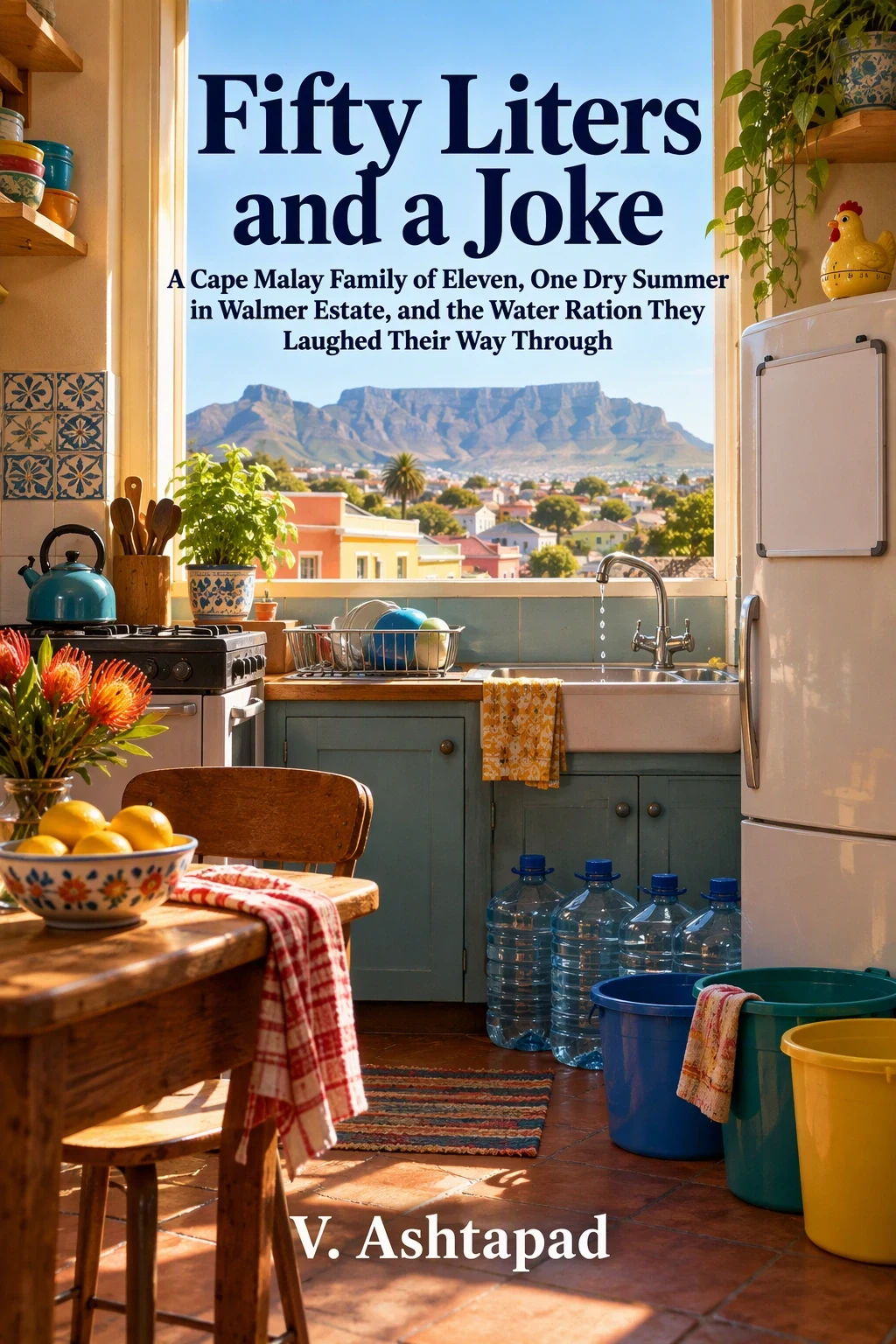
Fifty Liters and a Joke
A Cape Malay Family of Eleven, One Dry Summer in Walmer Estate, and the Water Ration They Laughed Their Way Through
by V. Ashtapad
Foreword
This is a work of fiction. Cape Town, Walmer Estate, the spring at Newlands, the Theewaterskloof dam, daily water limits in drought years, the Second New Year minstrel carnival, the Malay choir competitions with their comic moppies, and koesisters are real. The drought in this story, the Davids family, their street and every named person in it are invented.
For the grandfather who laughed so hard the windows rattled, and the doctor who said keep doing that.
Day 1. Fifty Liters Each. Opening Set.
Good evening, Walmer Estate. My name is Tashreeq Davids, I'm fifteen years old, and I live in a three-bedroom house with ten other people and, as of today, five hundred and fifty liters of water.
That's not a joke. That's the setup. The joke is coming. You have to wait for it, like the water.
So the City of Cape Town, in its wisdom, has announced that the dams are at twenty-two percent, and it hasn't rained properly since last winter, and the winter before that wasn't much either, and if everybody doesn't cut down, the taps will run dry by May. So from today, the first of December, every person in the city gets fifty liters a day. Fifty. For everything. Drinking, cooking, washing, flushing, the lot.
You know how much fifty liters is? My sister Zaida looked it up. A normal shower is ten liters a minute. A toilet flush is nine. So if you have a five-minute shower and you flush the toilet once, congratulations, you have used your whole day. You can't drink. You can't cook. You can't brush your teeth. You can stand there clean and thirsty, smelling nice, and die.
My grandmother says when she was a girl in District Six, before they had to move, there was one tap in the yard for four families, and they managed fine. My grandmother says a lot of things like that. My grandmother has never managed fine in her life. My grandmother uses one liter of water just to rinse a teacup, and then she rinses it again because she doesn't trust the first rinse.
That's the joke. That's my grandmother. Thank you, I'm here all week. I'm here all summer, actually. There's nowhere else to go. Nobody's got water.
---
Okay. Let me introduce you to the family, because you need to know who's using the five hundred and fifty liters, so you can judge.
Pa. My grandfather, Toyer Davids. Seventy-nine. Retired from the docks, where he drove a forklift for thirty-eight years and once, he says, dropped a whole container of frozen chickens into the harbor, which he says was not his fault, and which he has been laughing about since 1983. Pa has sugar diabetes. Three years ago they had to take his left leg off below the knee. Now he's in a wheelchair, which he calls the Mercedes, and which he drives around the house like he's still on the forklift, and you have to jump out of the way. He has the best laugh in the Cape. When Pa laughs, the windows rattle.
Ma. My grandmother, Mymona Davids. Seventy-six. Five foot nothing. Runs the house, the street, the family, and in her mind the entire Western Cape. Makes koesisters every Saturday night for Sunday morning, the proper Cape Malay ones, not the twisted Afrikaans koeksisters, ours are spiced and soft and rolled in coconut, and if you say koeksister to her instead of koesister she will hit you with the spoon. Has not laughed at one of my jokes since I was nine.
Daddy. Moegamat Davids. Fifty. Panel beater, has his own shop in Salt River with my uncle. Quiet. Very quiet. Laughs on the inside. You can only tell he's laughing because his ears move.
Mummy. Faldela Davids. Forty-seven. Secretary at the primary school in Woodstock. Strict. Kind. The only person in the house who can make Ma back down, and only on Tuesdays.
Zaida. My sister. Seventeen. Matric year. Wants to be a doctor. Very serious. Has a plan for everything, and a spreadsheet for the plan.
Ruschda and Riyaad. The twins. Nine. A boy and a girl. Feral. If you leave food out, they will find it. If you leave water out, they will drink it, and then they will lie about it.
Aunty Gadija. Mummy's younger sister. Thirty-nine. Moved in with us in September with her two kids after "a situation" in Mitchells Plain that nobody will explain to me. Does nails from home. Talks on the phone very loud. Laughs at all my jokes, which is why she's my favorite.
Ilham. Her daughter. Six. Thinks I'm the funniest person in the world. Correct.
Nur. Her son. Eleven months. Uses, according to Zaida's spreadsheet, more water than anyone else in the house, because of the nappies. We have switched to the cloth ones. I'm not going to talk about the cloth ones. Some things are too terrible for comedy.
And me. Tashreeq. Fifteen. Grade ten. I want to be a stand-up comedian. Nobody in my family thinks this is a real job except Pa, and Aunty Gadija, and Ilham, who is six and also wants to be a unicorn.
Eleven people. Fifty liters each. Five hundred and fifty liters a day.
Let's see who dies first.
© 2026 CRUNOD LLC. All rights reserved.
Day 3. Five Hundred and Ninety Liters. Over Budget.
So it turns out the water meter is out the front of the house in a little box in the pavement under a metal lid, and you can open it and read it, and it shows you exactly how much you've used, like a taxi meter but for shame.
Pa reads it. Every night at seven o'clock, after supper, before the news. Daddy pushes the Mercedes out the front door and down the ramp he built and onto the pavement, and Pa leans over the side of the chair with a torch, and opens the lid, and reads the numbers out loud, and Zaida writes them on her phone, and then Pa announces the result to the whole street like a referee at a boxing match.
Day 1: "Six hundred and twelve liters! Over by sixty-two!"
Day 2: "Six hundred and four! Over by fifty-four!"
Day 3: "Five hundred and ninety! Over by forty! Improving! Still a disgrace!"
The neighbors come out to listen now. Uncle Waleed from next door stands at his gate in his vest with his tea. Mrs. Abrahams across the road leans out of her window. They all have their own meters, but they don't read them, because they're scared. They just listen to Pa read ours, and then they go inside and feel guilty.
On day three Mrs. Abrahams shouted across, "Toyer! Who's the worst?"
And Pa, straight off, shouted back, "My wife! She rinses the cups!"
And Ma, from inside the house, through the window, shouted, "I heard that!"
And Pa laughed so loud that Uncle Waleed spilled his tea.
That's a laugh you can't buy, people. That's a seventy-nine-year-old man with one leg and sugar diabetes, sitting in a wheelchair on the pavement in Walmer Estate at seven o'clock on a summer evening, with the mountain behind him going pink in the sunset and the wind starting up off the sea, laughing so hard he's crying, about water.
I wrote it down. I'm writing everything down this summer. Zaida says it's for my "material." She says it like it's a disease.
© 2026 CRUNOD LLC. All rights reserved.
Day 6. Five Hundred and Forty-One Liters. Under Budget. The Bucket Era Begins.
We are under budget. I would like to thank the bucket.
Here is how it works now. Zaida made a system. Zaida always makes a system. There are four buckets in the shower. When you shower you stand in a big plastic basin, the one Ma used to bath the twins in when they were babies, and the water that runs off you goes into the basin, and when you're done you pour it from the basin into the buckets, and the buckets go to the toilet. That's gray water. You flush the toilet with gray water. Zaida says it like a scientist. Gray water. Like it's a whole category.
Except you don't flush the toilet. Not every time. There's a new rule, which is written on a piece of paper and stuck to the wall above the toilet in Zaida's handwriting, and which I'm not allowed to read out loud at supper because Ma says it's vulgar, so I'll read it to you instead:
IF IT'S YELLOW, LET IT MELLOW.
Underneath it, in Aunty Gadija's handwriting: IF IT'S BROWN, FLUSH IT DOWN.
Underneath that, in Riyaad's handwriting: IF IT'S GREEN, CALL A DOCTOR.
Underneath that, in Pa's shaky handwriting, because he made Daddy wheel him in specially: THIS IS A FAMILY HOUSE.
The shower rule is: two minutes. Not five. Two. Zaida bought an egg timer from the Chinese shop on Victoria Road. It's shaped like a chicken. It sits on the windowsill in the bathroom and you turn it over when you get in, and when the sand runs out you get out. Wet, dry, soap in your hair, doesn't matter. The chicken has spoken.
On day five Daddy came out of the shower with shampoo still in his hair, all white and foamy like a cappuccino, because the chicken ran out, and he walked through the kitchen in his towel with his shampoo hair and his straight face and sat down at the table and started eating his breakfast like nothing was wrong.
No one spoke.
Then his ears moved.
And the whole table lost it. The twins fell off their chairs. Aunty Gadija choked on her tea. Ilham laughed so hard she got the hiccups. Even Ma laughed. I saw it. One corner of her mouth went up and she turned around to the stove very fast so nobody would see.
I saw.
© 2026 CRUNOD LLC. All rights reserved.
Day 8. Five Hundred and Twenty-Eight Liters. The Joke Board.
Today Pa had a doctor's appointment at the clinic in Woodstock, and I went with him because it was a Saturday and somebody had to push the Mercedes up the hill.
The doctor is a young woman called Dr. Pillay, who is very nice and very tired and talks very fast. She checked Pa's sugar and his blood pressure and his foot, his good foot, the one he's got left, and she wrote things on her computer and frowned at the screen.
"Mr. Davids," she said. "Your blood pressure is up."
"It's the water," said Pa. "I'm worried about the water."
"Are you sleeping?"
"Like a baby. I wake up every two hours and cry."
She laughed. She didn't mean to. She tried to stop and then she laughed some more, and Pa looked very pleased with himself.
Then she stopped laughing and said, seriously, "Mr. Davids, stress is bad for your blood pressure and bad for your sugar. I can give you medicine. But you need to do things that lower your stress too. Walk, if you can. Well, not walk. Move. Sleep. And," she looked at him, "laughing actually helps. Real laughing. Lowers your blood pressure, helps your heart, helps your immune system. There's studies. It's not a joke."
"Doctor," said Pa, "everything's a joke. That's the whole secret."
On the way home, pushing him up Chapel Street with the wind in our faces, I thought about it. Laughing lowers your blood pressure. There's studies. I thought: I'm a comedian. That's medicine. I'm basically a doctor.
When we got home I took a piece of cardboard from a box of long-life milk and wrote on it in black marker: JOKE OF THE DAY. And under it, the names of everyone in the house, in a column. And next to each name, space for points.
I stuck it on the fridge with magnets.
Rules. Every night at supper, after the meter reading, anybody who wants to can tell a joke. Pa is the judge, because he's the oldest and the doctor said he needs it most. Pa gives points. One point for a smile. Two points for a laugh. Three points if he laughs so hard he has to hold his stomach. Five points, the maximum, if he laughs so hard the windows rattle.
At the end of the summer, whoever has the most points wins.
"Wins what?" said Zaida.
I hadn't thought about that.
"Wins a bath," said Pa. "A full bath. When the rain comes. Right up to the top."
Everybody went silent. A full bath. Nobody in the Western Cape had had a full bath since August.
"I'm in," said Aunty Gadija.
"Me too," said Ilham.
"This is ridiculous," said Ma.
"Ma's in," said Pa. "Write her down."
© 2026 CRUNOD LLC. All rights reserved.
Day 12. Five Hundred and Nineteen Liters. The Spring.
There is a spring in Newlands, on the other side of the mountain, where the water comes straight out of the rock into a pipe by the side of the road, and it's free, and anybody can take it. Since the fifty liters started, the whole of Cape Town goes there.
Daddy and I went at four-thirty this morning in the bakkie with fourteen empty five-liter bottles. Fourteen bottles is seventy liters, which is the drinking water for the whole house for three days, which means the tap water can be for cooking and washing only, which means, Zaida says, we can get under five hundred. Zaida stayed in bed. Zaida makes the systems. Daddy and I carry them out.
Four-thirty in the morning, the sky still black, the mountain a big dark shape against it with one or two lights on it from the cable station, and the roads empty, and Daddy driving with the window down and one elbow out, not saying anything, which is his favorite activity. I fell asleep against the window and woke up when he parked.
There was already a queue.
I'm not joking. Four-fifty in the morning, and there were eighty people in a line along the pavement in the dark, with bottles and buckets and jerry cans and those big blue water drums on wheels, and one man with a wheelbarrow full of milk bottles. Every kind of person. Old aunties in gowns and slippers with their hair in scarves. Students. A man in a suit with his tie over his shoulder. A family from Khayelitsha, the mother and three kids, with a whole row of two-liter cooldrink bottles washed out. An uncle in a kufi with a big beard. A white lady in yoga clothes with a very small dog. A guy with long dreadlocks and a drum, which he wasn't playing, which was a relief, because it was five o'clock in the morning.
And everybody was talking.
That was the thing. In Cape Town, normally, nobody talks to nobody in a queue. Especially not across, you know. Different areas. People keep to themselves. But at five in the morning at the spring, with everybody holding their empty bottles, everybody had the same problem, and everybody was talking about it.
"How many people in your house?"
"Seven."
"Seven! You're lucky, we're nine."
"We're eleven," I said.
The whole queue turned and looked at me.
"Eleven?" said the lady with the small dog. "In one house?"
"Three bedrooms," I said. "And a garage. My aunty sleeps in the garage with the baby. The twins sleep in the bath. We don't use the bath anymore, so it's fine."
The queue laughed. I mean, the whole queue. The aunties, the students, the man in the suit. The Khayelitsha kids. The guy with the drum. It went down the line, the laugh, like a wave going along the beach, and I stood there in the dark with my fourteen empty bottles and I thought: that's my first audience. Eighty people. Five in the morning. In a queue for free water.
The twins don't actually sleep in the bath. But it's funnier.
---
It took two hours and ten minutes to get to the front. By then the sun had come up behind the mountain and the sky was pale gold and the birds were going, and the queue behind us was two hundred people, all the way down the road and round the corner. At the front there were four pipes sticking out of a low stone wall, with the water coming out clear and cold in a thick steady rope, and a volunteer in an orange bib saying "Four bottles at a time, four bottles at a time, then go to the back," and people filling up and carrying their bottles off to their cars with their arms shaking.
The water was so cold my hands went numb. It smelled of nothing. That's the best smell water can have, Daddy says. Nothing.
When we got back in the bakkie with the seventy liters strapped in the back, Daddy started the engine and then turned it off again and sat for a minute looking at the mountain. Then he said, which is the longest thing he said all month:
"Your grandfather used to make us do this. When I was small. Not for this. Just for fun. Bring us here on a Sunday and fill bottles and drive us up to the top of Kloof Nek and we'd sit and drink spring water and eat koesisters and look at the sea. He said it was the best water in the world. He said you could taste the mountain." He started the engine again. "I forgot that."
His ears weren't moving. He wasn't laughing on the inside. He was something else on the inside.
I didn't make a joke. Sometimes you don't.
© 2026 CRUNOD LLC. All rights reserved.
Day 19. Four Hundred and Ninety-Six Liters. The Standings.
Under five hundred for the first time. Pa read it out on the pavement like he'd won the lottery. "Four hundred and ninety-six! Under by fifty-four! Mymona, we are a family of saints!"
Uncle Waleed applauded from his gate. Mrs. Abrahams banged a pot.
Here are the standings on the Joke Board after eleven nights.
Pa: 0 (judge, can't compete)
Aunty Gadija: 23
Tashreeq: 21
Ilham: 17
Riyaad: 14
Ruschda: 12
Daddy: 9
Mummy: 6
Zaida: 3
Ma: 0
Nur: 5
Nur is eleven months old. Nur has five points. Nur has five points because on night six, while Riyaad was telling a joke about a goat, Nur sneezed so hard that a piece of mashed pumpkin came out of his nose and landed in Pa's tea, and Pa laughed so loud the windows rattled. Five points. Maximum. For a sneeze.
I'm fifteen. I've been studying comedy since I was twelve. I've watched every stand-up special I can find. I practice in the mirror. I've got a notebook of three hundred and forty jokes. And I'm in second place, behind my aunty, two points ahead of a six-year-old, and sixteen points ahead of a baby who sneezes pumpkin.
Aunty Gadija's secret is she doesn't tell jokes. She tells stories. About her clients. The ladies who come for nails in the garage. She does their voices. There's one lady, an Indian auntie from Rylands, who comes every two weeks and talks the whole time about her son who is a dentist in Canada, and Aunty Gadija does her voice so perfectly, "my son, the dentist, in Toronto, you know, he says the teeth there are very different," that Pa goes three points every time, holding his stomach, even though it's the same story every time.
I said to her, "Aunty, that's not a joke. That's just a lady."
She said, "Everything's funny if you tell it right, my boy. That's the whole secret."
That's what Pa said. Everything's a joke, that's the whole secret. I'm starting to think everybody in this family knows a secret about comedy that I don't.
Ma: 0. Ma doesn't tell jokes. Every night when it comes round to her, she says, "I'm not participating in this nonsense," and goes on eating, and Pa says, "Mymona passes," and we move on.
Zaida: 3. Zaida tells science jokes. "What did the thermometer say to the graduated cylinder? You may have graduated, but I've got more degrees." Nobody laughs except Pa, who laughs to be kind, which is one point, and which she knows, and which makes her furious.
© 2026 CRUNOD LLC. All rights reserved.
Day 25. Four Hundred and Eighty-Two Liters. Second New Year.
Second New Year is the day after New Year, the second of January, and in Cape Town it's the day of the Klopse, the minstrels, the carnival, which is the biggest thing in the year in our community, bigger than anything, and if you're not from here I can't explain it to you properly, but I'll try.
Imagine thousands of people. Men, mostly, and boys, and now some women too, in troupes, each troupe with its own colors, satin suits in bright pink and green, or gold and purple, or red and silver, with matching hats and umbrellas and glitter on their cheeks, marching through the middle of town with a band. Banjos. Drums, the ghoema drum, the small one you hold under your arm and hit with your hand, and big bass drums, and trumpets, and everybody singing. The troupes march from the Bo-Kaap down through the city and dance in the streets, and all along the road the families stand on the pavement and on the walls and on top of cars and cheer for their troupe, and eat, and the whole of town smells of hot chips and samoosas and sweat and the sea.
Pa marched in the Klopse for forty years. With the same troupe. The Young Gentlemen of Walmer. Pink and silver satin. He has a photograph from 1971 on the wall of the lounge where he's in the front row in his pink suit with a straw boater and a cane, twenty-four years old, laughing, with his leg in the air.
Since the leg came off he can't march. Last year he didn't go. He sat in the lounge and watched it on TV with the volume up very loud, and Ma brought him tea, and he didn't drink it.
This year I told him we were going.
"How?" he said.
"In the Mercedes."
"The streets are full. Thousands of people. Nobody will see me."
"They'll see you."
He studied me, sideways, the way he studies a forklift load. Then he said, "Find my hat."
---
We went. Daddy and me and Pa and the twins and Ilham. Ma stayed home and said she was too old for nonsense, and then at the last minute came anyway, in her good scarf, walking behind the chair and complaining.
We got there at nine in the morning, to a place on Wale Street where the road goes downhill and the troupes come past. We parked the Mercedes on the corner, right at the front, on the edge of the pavement. Pa was wearing his straw boater, the one from the photograph, which Ma found in a box on top of the wardrobe wrapped in a plastic bag, and a pink shirt. It was thirty-four degrees. Ma had made him a big flask of spring water from the Newlands bottles, and she held it on her lap like it was gold.
The first troupe that came past was blue and white. The second was gold and black. They didn't notice us.
The fourth was pink and silver.
The Young Gentlemen of Walmer. Two hundred of them, in pink satin suits, with silver umbrellas, dancing down Wale Street with the band in front, the banjos going and the ghoema going and the trumpets screaming, singing a song I knew because Pa sang it in the bath when there was still water in the bath. And at the front, the troupe captain, an old man with a white beard and a silver cane, dancing backward, looking at the crowd.
And he saw Pa.
He stopped dancing. He stopped the troupe. He held up his cane, and the band stopped, all of it, two hundred men and boys in pink satin stopping dead in the middle of Wale Street, and the crowd on both sides went quiet, wondering what was wrong.
"TOYER DAVIDS!" shouted the captain.
Pa raised his hat.
And the troupe went mad. The Young Gentlemen of Walmer broke formation and came running across the road to the corner, dozens of them, the old ones first, men in their sixties and seventies in pink suits, and they surrounded the Mercedes and shook Pa's hand and kissed him on the head and slapped him on the back, and then four of them, four old men, picked up the wheelchair. With Pa in it. Off the ground. And carried him out into the middle of the road, into the troupe, and set him down at the front, next to the captain, and the captain shouted something, and the band started again, and the Young Gentlemen of Walmer marched on down Wale Street toward the city with my grandfather at the front in his wheelchair in his pink shirt and his straw boater, being pushed by an old man in a pink satin suit, with his hand in the air, laughing.
Laughing so hard I could hear it over the band.
Ma stood on the pavement beside me holding the flask of spring water with both hands. She said nothing. She watched him go down the hill in the middle of all that pink until he was too far to see. Then she said, very quietly, not to me, to nobody, "That's the man I married."
And then she said, "Come. Hurry. He's got no water."
And she went down the hill after him, very fast, an old lady in a good scarf, pushing through the crowd with the flask, and I had to run to keep up.
© 2026 CRUNOD LLC. All rights reserved.
Day 33. Four Hundred and Seventy Liters. Moppies.
After the Klopse, Pa couldn't stop talking about the choir.
Not the Klopse. The choir. The Malay choirs. I have to explain this too, sorry, there's a lot of culture in my family, it's like living in a museum with a kettle.
So after New Year, from January to March, there's the choir competitions. The Malay choirs. Not the minstrels, different, though a lot of the same people are in both. The choirs are men, about forty or fifty of them in a choir, in matching blazers and fezzes, and they sing in competitions at a stadium on Saturday nights, and judges give points, and there are trophies, and people take it extremely seriously, more seriously than rugby. There are different kinds of songs. The nederlandsliedjies, the old Dutch songs, very slow and sad and beautiful, with one man singing the high part in a voice like a crying bird, which is the hardest thing there is to sing. And the moppies.
Moppies are comic songs.
That's it. That's the whole thing. That's a whole category of competition. Comic songs. Fast, funny songs about everyday life, with the whole choir singing and doing actions, and one man in the front, the voorsanger, the lead singer, who acts it out, pulling faces, doing voices, and the crowd laughs and the judges give points for how funny it is.
Pa sang moppies. For thirty-one years. In a choir called the Young Stars of the Cape. He was the voorsanger.
I didn't know this.
I'm fifteen years old. I want to be a comedian. I have been studying comedy since I was twelve. And nobody in my entire family ever told me that my grandfather was a professional comic singer for thirty-one years.
"Why didn't you tell me?" I said.
We were in the lounge after the meter reading. Day thirty-three. Four hundred and seventy liters. Pa was in the Mercedes with his hat on. He'd been wearing the hat every day since the Klopse.
"Nobody asked," he said.
"Pa! I've been doing jokes at supper for a month!"
"I know," he said. "You're getting better." Then he said, "You want to hear one?"
---
He sang it.
In the lounge. In the wheelchair. In his hat. With the window open and the wind coming in off the sea and the light going orange on the wall where the 1971 photograph is.
It was about a man who goes to the shop to buy one tomato and comes home with everything except the tomato. That's all. That's the song. But he did every part of it. The man. The shopkeeper. The man's wife at home waiting for the tomato. The neighbor who sees him going past with a whole cart of shopping and asks, where's the tomato? The wife when he gets home. Every voice. Every face. In a mix of Afrikaans and English and words that are in neither, which is how we talk, and a tune that went up and down like a taxi going over speed bumps, and a chorus that went *Waar's die tamatie, waar's die tamatie, waar's die tamatie, Toyer?* and he put his own name in it, and on the last chorus he pulled a face so terrible, the face of a man who has realized he forgot the tomato, that Ilham screamed and hid behind the couch.
I couldn't breathe. I was on the floor. Aunty Gadija was holding the wall. Mummy came in from the kitchen to see what was going on and ended up sitting on the arm of the couch wiping her eyes with a dishcloth. Riyaad and Ruschda were rolling around on the carpet.
And Ma.
Ma was in the doorway with her arms folded.
And she was singing along. Under her breath. *Waar's die tamatie.* She knew all the words. And her mouth was going up at the corners, both corners, and she wasn't turning around.
When he finished, the whole room clapped. Mrs. Abrahams, across the road, who had heard through the window, clapped too.
Pa took off his hat and bowed. As much as you can bow in a wheelchair.
"Nineteen seventy-eight," he said. "First prize. Moppie section. The Tomato Song." He put his hat back on. "Your grandmother wrote it."
Everybody turned around and looked at Ma.
"Mymona," said Pa. "Tell them."
Ma looked at all of us. Her arms were still folded.
"I wrote it," she said, "because he went to the shop for one tomato and came back with a fishing rod. In 1977. And I was so angry I wrote a song about it so I wouldn't kill him." She unfolded her arms. "And he sang it in front of four thousand people and won a trophy. And I've never forgiven him."
Then she marched back to her pots.
And from the kitchen, after a while, we heard her laughing.
© 2026 CRUNOD LLC. All rights reserved.
Day 41. Five Hundred and Sixty-Three Liters. Over. The Hospital.
I wasn't going to write this one. I'm going to write it anyway. Pa says you have to tell the bad nights too or the good ones don't mean anything.
On day thirty-nine Pa's sugar went very low in the night. Ma woke up and he wasn't making sense, and his skin was cold and wet, and she screamed for Daddy, and Daddy and Zaida did what the clinic taught us, the sugar water and the glucose tablets, and it helped a bit but not enough, and Daddy called the ambulance, and it took forty minutes, and they took him to Groote Schuur.
Groote Schuur is the big hospital, on the slope of the mountain, where they did the first heart transplant in the world, which everyone in Cape Town tells you about as if they did it personally.
He was there two nights. They said his sugar went low because he wasn't eating enough with the new medicine, and because it was so hot, and because he was dehydrated.
Dehydrated. Because he was saving water. Because every night he'd been drinking half his glass and pouring the rest into the plant on the stoep, because he said the plant needed it more than him, and nobody noticed. He'd been giving his water to a geranium.
Zaida cried. Zaida never cries. She sat on the floor of the kitchen with her spreadsheet on her phone and cried and said it was her fault, her system, she had been so busy counting liters she hadn't counted Pa.
Ma didn't cry. Ma packed a bag and went to the hospital and sat beside his bed for two days in the plastic chair and didn't come home.
---
I went on the second night. Daddy drove me.
The ward was long and very bright, with eight beds and curtains and a smell of disinfectant and hospital food, and old men in every bed, and machines going beep. Pa was in the bed by the window with a drip in his arm and no hat. He looked small. I had never seen him look small. Ma was in the chair beside him with her handbag on her lap, asleep sitting up.
Pa opened his eyes when I came in.
"Ah," he said. "The comedian."
I kept quiet. I couldn't think of anything. I had three hundred and forty jokes in my notebook and I couldn't think of one.
"Come on," said Pa. "I'm in a bad way. Doctor's orders. Make me laugh."
"Pa."
"Lowers the blood pressure. There's studies."
I tried. I couldn't. I stood there by his bed with my hands in my pockets and my face doing something I didn't want it to do.
Then the old man in the next bed said, in a voice like a door, "Ag, boy. If you can't, I will."
We both turned and looked at him. He was about ninety, very thin, with a white mustache and no teeth.
"I know you," said the old man to Pa. "You're the tomato man."
Pa stared at him.
"Nineteen seventy-eight," said the old man. "I was in the Morning Stars. We came second. Behind your tomato." He grinned his toothless grin. "Forty-seven years I've been waiting to tell you that you cheated."
"I didn't cheat," said Pa.
"You pulled a face at the judges."
"That's not cheating! That's the art form!"
"It's cheating," said the old man, "when the face is that good."
And Pa laughed. Lying in his hospital bed with a drip in his arm, he laughed, a small laugh first, then a bigger one, and the old man laughed, and then the man in the bed on the other side, who had been pretending to be asleep, started laughing too, and a nurse came over to tell them all to be quiet and ended up laughing, and Ma woke up in her chair and said, "What? What's going on?" and Pa said, "Mymona, the Morning Stars say I cheated in 1978," and Ma said, without even thinking, "You did cheat, you pulled a face," and the whole ward lost it.
The machine on Pa's arm, the one that measures his blood pressure every hour, went off at that exact moment, and the nurse looked at it, and then looked at Pa, and said, "Well. That's better than this morning."
I wrote it down later in the bakkie, on the way home, in the dark. Old men in a hospital laughing about a song from 1978. Blood pressure better than the morning.
Daddy had nothing to say all the way home. But his ears moved, the whole way, from Groote Schuur to Walmer Estate.
© 2026 CRUNOD LLC. All rights reserved.
Day 44. Four Hundred and Fifty-One Liters. New Rules.
Pa came home on day forty-two. Zaida changed the system.
There is now a new column on the spreadsheet, and a new sign on the fridge next to the Joke Board, and the sign says, in big red letters:
PA DRINKS FIRST.
Under it, smaller: Two liters a day. Minimum. Not negotiable. Water for the geranium comes out of the bath bucket, NOT out of Pa.
Under that, in Pa's handwriting: THE GERANIUM AND I ARE BOTH VERY UPSET.
Zaida also did something else. She took the jug that Pa drinks from, the big glass one with the lemons painted on it, and stuck a strip of tape down the side, and marked it in liters with a marker, and every time he drinks she writes it down. And every night at the meter reading, after Pa reads the meter, Zaida reads the jug.
"House: four hundred and fifty-one. Under by ninety-nine. Pa: two point two liters. Over by point two."
"Over!" Pa shouted to the street. "I'm over! Disgraceful!"
Mrs. Abrahams banged her pot.
It became part of it. The jug reading. Uncle Waleed started reading his own mother's jug. Mrs. Abrahams, who lives alone, started reading her own, and shouting it across the road. "Abrahams! One point eight!" And Pa would shout back, "Not enough, Gloria! Drink!" And she'd drink, standing in her window, holding up her glass like a toast.
I put it in the act. The jug bit. It gets a laugh every time.
But I don't do it for the laugh.
© 2026 CRUNOD LLC. All rights reserved.
Day 48. Five Hundred and Eight Liters. Over. The Case of the Missing Water.
Somebody is stealing water.
Zaida noticed. Of course Zaida noticed. For five days in a row, the meter has been between twenty and thirty liters higher than her spreadsheet says it should be. She has the shower minutes, the toilet buckets, the cooking, the dishes, the washing, Pa's jug. Everything adds up except twenty to thirty liters a day, which is nowhere.
"Is there a leak?" said Mummy.
Daddy checked. Daddy lay on his back under the kitchen sink and the bathroom sink and went round the outside of the house with a torch looking at every pipe. No leak.
"Then somebody," said Zaida, looking round the supper table with her eyes very narrow, like a detective in a film, "is using water that isn't on the system."
Everybody looked at everybody.
"Not me," said Aunty Gadija. "I use wet wipes for the nails now. I'm practically a desert."
"Not me," said Mummy.
"I can't reach the tap," said Pa, "I'm in a wheelchair, I'm innocent."
Ma just looked at Zaida until Zaida looked away.
The twins said nothing. The twins were eating their bredie very fast with their heads down.
---
So I investigated. I'm a comedian. Comedians are basically detectives. We notice things.
Here's what I noticed. One: the twins have been going to bed early. Ruschda and Riyaad never go to bed early. They have to be dragged. For the past week they've been going at eight o'clock without being told and closing their door.
Two: the garden tap. There's a tap outside on the side of the house by the dustbins, which we're not allowed to use at all now. Zaida put tape over it in an X. The tape was still there. But the tap was wet underneath. In the morning. When it hadn't rained since September.
Three: Ilham, who is six and cannot keep a secret, said to me on Tuesday, "When's it going to be my turn for the swimming?"
I waited up. Day forty-seven. Eleven o'clock at night. I sat in the dark on the back step behind the kitchen with a torch and a packet of chips and waited.
At eleven-twenty the twins' window opened. Two small shapes climbed out. They had a bucket. They went very quietly round the side of the house to the garden tap, and Riyaad peeled back one corner of Zaida's tape, very carefully, just enough to turn the tap, and Ruschda held the bucket under it, and they filled it, and Riyaad put the tape back. Then they carried the bucket together, one handle each, staggering, round the back of the garage, to Aunty Gadija's side.
I followed them.
Behind the garage there's a little bit of yard between the wall and the neighbor's fence where nothing is, just sand and some old bricks and Daddy's broken lawnmower. And in the middle of it, the twins had dug a hole. A big hole. Lined with a black plastic bag. And in the hole, about a third full, was water. Twenty, thirty liters. Gleaming in the torchlight.
They poured the bucket in. They stood looking at it.
"What," I said, "is that?"
They both screamed and fell over.
---
It was a swimming pool.
That's what they told me, sitting in the sand behind the garage with their pajamas covered in dirt, in very quiet voices, so Zaida wouldn't hear. It was a swimming pool for Ilham. Because Ilham had cried. Because all her friends at school in Mitchells Plain used to go to the public pool in summer, and the public pools were closed now because of the water, and Ilham hadn't been in water since September, not even a bath, and she'd been crying at night in the garage where she sleeps with her mother and Nur, and the twins heard her through the wall. So they decided to make her a pool. One bucket a night. They'd been doing it for twelve days. They worked out that in thirty days it would be deep enough for her to sit in.
"It's only for one time," said Ruschda. "Just one swim. Then we'll give the water to the geranium."
I sat there in the dark looking at my little brother and sister and their stolen swimming pool and I didn't know what to do. If I told Zaida, there would be a war. If I didn't tell Zaida, the meter would keep going over and Pa would keep shouting "Disgraceful!" to the whole street.
So I did what you do. I went and told Pa.
Pa listened. In the Mercedes, in the lounge, at midnight, with his hat on his knee. When I was finished, he was quiet for a long time.
Then he said, "How deep is it?"
"About this," I said, holding my hand at my shin.
"And they need it this?" Hand at the waist.
"For Ilham, yes."
He thought about it. "Bring me Zaida's spreadsheet," he said.
---
The next night at supper, after the meter reading, which was five hundred and eight, over by eight, Pa called a family meeting. He made the twins stand up. He told everyone. The swimming pool. The bucket every night. The twelve days. Ilham crying in the garage.
Everyone was quiet. Aunty Gadija had her fingers to her lips. Ilham was looking at her plate.
Zaida's face was going red. I could see her about to explode.
Then Pa said, "So. This is a disgrace. Twenty-five liters a night. Stolen. On top of the system." He looked at the twins. "And it's the best idea anybody in this house has had all summer."
Silence.
"Zaida," said Pa, "how much under are we, on a good week?"
Zaida looked at her phone. "About forty a day. On a good week."
"Then here's the new rule," said Pa. "Every day we're under by twenty, the twenty goes in the pool. Not out of the tap. Out of what we saved. Officially. On the system. And when it's full," he looked at Ilham, "the swimmer goes in."
Ilham looked up.
"And the twins," said Pa, "are on dishes for a month. For stealing." He picked up his fork. "Now. Whose turn is it for a joke?"
Nobody had a joke. Everybody was too busy crying, a bit, and pretending not to, which in my family is a sport.
Ilham swam on day sixty-four. Behind the garage. In a hole lined with a black plastic bag, in thirty centimeters of water, in her school swimming costume, in the evening, with the whole family standing around the edge, and Uncle Waleed looking over the fence, and Mrs. Abrahams looking out of her window, and everybody cheering, and Ilham screaming and splashing and laughing like it was the sea.
Afterward the twins carried the water to the geranium, one bucket at a time.
© 2026 CRUNOD LLC. All rights reserved.
Day 60. Four Hundred and Forty-Four Liters. The Choir Comes.
On day sixty, three old men in blazers and fezzes came to the front door.
It was a Wednesday evening, six o'clock, before the meter reading. Ma answered. I heard her say, "Ag, no," in the voice she uses for the man who sells insurance, and then I heard her say, "Toyer! It's your nonsense!" and go back to the kitchen.
It was the Young Stars of the Cape. Pa's old choir. Three of them. The captain, a man called Uncle Shuaib, who was seventy-three and very tall and very dignified, and two others. They'd heard about the Klopse. They'd heard about the hospital. They'd heard, they said, from someone whose cousin was in Groote Schuur, that the tomato man was laughing again.
They sat in the lounge. Mummy brought tea, from the spring water. Uncle Shuaib held his cup like it was very expensive.
"Toyer," he said. "We have a problem."
"You've got a lot of problems, Shuaib. Your tenor can't sing."
"That's true. That's one." Uncle Shuaib put down his tea. "The other is the moppie. The competition is in five weeks. We have no moppie. Our moppie man moved to Johannesburg. And the one we've got now is about a bus." He shook his head sadly. "It's not funny. It's a bus. It goes along and it stops. That's all."
"So?"
"So," said Uncle Shuaib, "come back. Coach the moppie. Sit at the front. In the chair. Do the voorsanger part sitting down." He looked at the wheelchair. "Nobody says the voorsanger must stand."
Pa was quiet.
"I don't have a song," he said.
"Write one."
"I'm seventy-nine."
"You're the tomato man."
Pa looked at Uncle Shuaib for ages. Then he looked at me.
"I have a writer," he said.
Everyone in the room turned and looked at me.
"Him?" said Uncle Shuaib. "He's a child."
"He's a comedian," said Pa. "He's been doing material all summer. About the water." He leaned forward in the Mercedes. "Shuaib. What's every single person in Cape Town thinking about this year? Every person in the stadium. Every judge."
Uncle Shuaib thought.
"The water," he said slowly.
"Fifty liters," said Pa.
And Uncle Shuaib started to smile.
© 2026 CRUNOD LLC. All rights reserved.
Day 63. Four Hundred and Thirty-Nine Liters. Writer's Block.
Writing a moppie is harder than writing stand-up. I found this out the hard way, which is the only way I find anything out.
With stand-up, it's you. You and a microphone. You can pause. You can look at the audience. You can see if it's working and change it. A moppie is forty-five men in fezzes singing in a stadium in front of four thousand people and three judges with clipboards, and it has to rhyme, and it has to fit a tune, and every line has to be funny, and there's actions, and the voorsanger has to have a part where he does the voices, and you can't change anything once it starts, because forty-five men are already singing it.
I wrote eleven versions in three days. I read every one to Pa.
Version one was about the meter reading. "Every night at seven, out goes the chair, Pa reads the numbers, and the whole street stares." Pa listened and said, "That's a rhyme. Where's the joke?"
Version four was about the egg timer chicken. Pa said, "Better. But nobody in the stadium has your chicken."
Version seven was about the queue at the spring. Pa said, "Now you're getting warmer. Everybody's been in that queue. But it needs a person."
"What person?"
"A person," he said. "A moppie isn't about a thing. The tomato song isn't about a tomato. It's about a man who can't buy a tomato and the wife who's waiting for it. It's about a marriage. That's why it's funny. Everybody in that stadium has a husband who went for one thing and came back with a fishing rod." He tapped his head. "Find the person."
I couldn't find the person. I sat on the back step for two nights with my notebook and the wind coming over the wall off the mountain and the moon over the harbor and I couldn't find the person.
On the third night Ma came out and sat down next to me.
She doesn't sit on the back step. She's seventy-six. She has bad knees. She lowered herself down onto the step one bit at a time, holding the door frame, complaining under her breath the whole way, and then she sat there and didn't say anything for a while. She had her tea. She'd brought me one too.
"Your grandfather says you're stuck," she said.
"I can't find the person."
She drank her tea. Then she said, "When I was a girl. In District Six. There was one tap in the yard. Four families. You know this story."
"You tell it every day, Ma."
"I tell it every day," she said, "because I'm the person."
I looked at her.
"There was an old woman," she said. "Auntie Rukea. In the house at the back. She was the boss of the tap. Nobody could use it without her. She sat by it all day on a paraffin tin, with her pipe, and she counted. Every bucket. Every kettle. If you took too much, she knew. If you took it at the wrong time, she knew. If you washed your hair on a Tuesday, she shouted it to the whole yard. Mymona's washing her hair on a Tuesday, who does she think she is, the Queen?" Ma's voice changed. It got rough and old and suspicious. It was a voice I'd never heard her use. It was a perfect voice. "We hated her. We were all scared of her. And when the water ran out in the summer, and the whole street was dry, Auntie Rukea's yard still had water, because she counted." Ma put her cup down. "So now I'm old. And I count the cups. And I rinse them twice. And I know exactly who I am, my boy. I'm Auntie Rukea." She stood up, one bit at a time, holding the door frame. "That's your person."
She went inside.
I sat there with my mouth open.
Then I wrote the whole moppie in forty-five minutes.
---
I'm not going to write it all here. It's for the stadium. But I'll tell you the shape of it.
It's about an old woman who's the boss of the water. In a house in Cape Town. In the drought. She sits by the meter on a paraffin tin with a torch. She counts everything. Every flush. Every shower. Every cup of tea. She shouts it to the whole street. Her husband is scared of her. Her grandchildren are scared of her. The municipality is scared of her. The mayor comes to her house to ask her advice. At the end the dams are full again and everybody is having baths and the whole city is celebrating, and she's still sitting on her paraffin tin by the meter, counting, and her husband says, it's finished, Mymona, the rain came, come inside, and she says, *I'll come inside when the dams are at a hundred and ten.*
The chorus goes: *Vyftig liters, vyftig liters, Ma tel elke druppel, Ma tel elke druppel.* Fifty liters, fifty liters, Ma counts every little bit. Druppel is the Afrikaans word, for the smallest bit of water there is. The English word doesn't rhyme with anything.
I called her Mymona in the song. I didn't ask her. I just did it.
When I read it to Pa he didn't laugh. He sat in the Mercedes very still, listening, and when I got to the end, the hundred and ten, he put his hand over his eyes.
Then he said, "Read it to her."
"Ma? She'll kill me."
"Read it to her," said Pa. "She's the person."
© 2026 CRUNOD LLC. All rights reserved.
Day 70. Four Hundred and Forty-Seven Liters. Aunty Gadija.
I've been putting off writing this one, because it's not my story, it's Aunty Gadija's. But she said I could. She said, "Write it, my boy. Maybe someone reads it who's where I was."
Here's what happened in Mitchells Plain, that nobody would explain.
Aunty Gadija was married to a man called Faizel for nine years. He had a job and then he didn't. Then he had another one and then he didn't. Then he started drinking. Then he started not coming home. Then he started taking money from her purse, the nail money, the money for Ilham's school shoes. Then in August he took the money she'd saved for the rent, all of it, and didn't come back for a week, and the landlord put them out.
That's it. She didn't tell me everything. I could see there was more. She just said that, sitting in the garage doing her own nails, with Nur asleep in his cot and Ilham at school, and the sun coming in through the little window and making a square on the floor.
"So I came to my sister," she said. "With two children and two bags. And your mother said come. And your grandmother said, where will they sleep, there's eleven people already. And your grandfather said, in the garage, and he made your father clear it out that same night, and we've been here since." She blew on her nails. "Six months. Living in a garage. With a baby. In a drought."
"Aunty," I said. "You're the funniest person in the house. You've got the most points."
"I know," she said. "Do you know why?"
I didn't.
"Because if I don't laugh," she said, "I'll cry. And if I cry, Ilham sees. And then Ilham cries. And then Nur cries. And then the whole garage is crying." She looked at her nails. "So I laugh. I do the Indian auntie from Rylands and her dentist son in Toronto. I laugh so hard your grandfather has to hold his stomach. And then I go to bed and I lie there and I think about the rent money." She shrugged. "That's comedy, my boy. You're the comedian. You should know."
I didn't know. I thought comedy was jokes. I'm starting to think comedy is what you build on top of the thing you can't say.
---
The next part is good, though. She said to put the good part in.
On day sixty-eight, one of her clients, the Indian auntie from Rylands, the one with the dentist son, came for her nails and said she'd heard Aunty Gadija's voice of her, at a wedding. Somebody's cousin had been at our supper and done the impression at a wedding, and it went around, and the Indian auntie heard it.
Aunty Gadija was terrified. She thought she'd lose a client.
The Indian auntie sat down in the chair in the garage, put her hands out for her nails, and said, "Do it."
"Do what, Auntie?"
"The voice. Of me. Do it. I want to hear."
So Aunty Gadija did it. "My son, the dentist, in Toronto, you know, he says the teeth there are very different."
And the Indian auntie laughed so hard she had to take her hands back. Then she said, in her own voice, exactly the same, "But they are different! He says it's the water!" And then they were both laughing, in the garage, the two of them, and Nur woke up and laughed too.
Then the Indian auntie said that her niece had a salon in Rylands, a big one, and was looking for someone good for nails, full-time, with a salary, not just cash in a garage. And would Aunty Gadija like her to put in a word.
Aunty Gadija starts on the first of next month. It's a real job. With a salary. She says in three months she'll have enough for a deposit on a flat. A small one. Near the salon. Near a school for Ilham.
She's moving out. I'm happy for her. I'm also not.
Who's going to have the most points?
© 2026 CRUNOD LLC. All rights reserved.
Day 75. Four Hundred and Twenty-Nine Liters. The Dam.
Every two weeks since December, Zaida has been going to the dam.
Not to do anything. To look. Theewaterskloof, the biggest dam, about an hour and a half from town, over the mountains past Franschhoek, where most of Cape Town's water comes from. She goes with her friend Nasreen, whose father drives, on a Saturday, and they stand on the same rock on the edge, a big flat gray rock they found the first time, and take a picture in the same direction. North, toward the mountains. And she puts the picture on the page she made for our family, the private one with the photographs of Pa in the Klopse in 1971 and the Tomato Song trophy and Ma and Pa's wedding, next to the last picture, so you can see.
Today she took me.
I wasn't ready for it. I'd seen the pictures. But pictures aren't the same.
The dam is gone.
I mean, it's not gone. There's water. Far out, in the middle, a long gray sheet of it, shining in the sun. But between the rock and the water there's a kilometer of nothing. Cracked brown mud, in big plates, like a broken plate. Dead tree stumps sticking up out of it, gray and white, from before they built the dam, a whole drowned forest that nobody has seen for fifty years, standing there in the heat. An old road going down into the mud and disappearing. The concrete foundations of a farmhouse. A rusted car. Fish bones. And the wind blowing dust off it in little brown spirals.
"That was water," said Zaida, pointing at the mud right in front of the rock. "In December. You could see it lapping. In the first picture."
She showed me the first picture on her phone. December. The water right up to the bottom of the rock. Gray and choppy, with a little white edge.
Then she showed me all of them in a row. December, January, February, March. Every two weeks. Same rock. Same direction. The water going away from the rock, further and further, like a tide that doesn't come back.
"Why do you do this?" I said. "It's depressing."
She thought about it.
"Because one day it'll come back," she said. "And I want to have the picture of when it did."
We stood on the rock in the wind. There was a family a little way along the edge, with a picnic, the kids running out onto the cracked mud and jumping from plate to plate, and the parents shouting at them to come back. A man with a camera on a tripod, taking pictures of the dead trees. A couple of old men sitting on a log, not saying anything, looking.
I tried to think of a joke. For the act. For the moppie. Something about the dam.
I couldn't. Some things you just look at.
But on the drive home, in the back of Nasreen's father's car, with the mountains going purple and the vineyards going past green and gold and somehow still alive, Nasreen said, "Zaida says your grandfather's choir is singing your song," and I said yes, and she said, "Sing it," and I said no, and Zaida said, "Sing it, it's good," and that was the first time Zaida ever said anything I did was good.
So I sang it. In the back of the car. Badly.
Nasreen's father laughed so hard he had to pull over.
© 2026 CRUNOD LLC. All rights reserved.
Day 77. Four Hundred and Thirty-Three Liters. Reading It to Ma.
I read it to her on the stoep at seven, after the meter reading, after Pa shouted the number to the street and Mrs. Abrahams banged her pot and shouted her jug, one point nine, and Pa shouted, "Better, Gloria!" and everybody went inside.
Ma stayed out. She was sitting on her chair by the door with her hands in her lap, looking at the mountain, which was going orange and then pink and then gray, the way it does, with the tablecloth of cloud coming over the top and pouring down the side like milk out of a jug, the way it does when the southeaster blows. The wind was up. The washing on Mrs. Abrahams's line was going sideways.
I sat on the step below her with my notebook.
"Pa says I must read you the moppie," I said.
"I know," she said. "He told me. He said you put me in it."
"I did."
"Without asking."
"Yes, Ma."
She looked at me for a bit. Then she said, "Read it."
I read it. All of it. The old woman on the paraffin tin by the meter. The torch. The counting. The shouting to the street. The husband who's scared of her. The grandchildren. The mayor coming to ask her advice. The chorus. *Vyftig liters, vyftig liters.* The end. *I'll come inside when the dams are at a hundred and ten.* I read it in the voice. Her voice. The Auntie Rukea voice. I'd practiced it all week in the bathroom, with the chicken timer going, so nobody would hear.
When I finished she let it go.
The wind was going. A car went past. Somewhere down the road a dog was barking. I sat there waiting to be hit with the spoon.
Then Ma said, "The mayor."
"Yes?"
"The mayor wouldn't come to my house. The mayor's too scared." She looked at me. "Make it the mayor's wife. The mayor's wife comes to ask my advice. Because the mayor's wife has to run his house with fifty liters too, and the mayor doesn't know how, because the mayor has never rinsed a cup in his life."
I stared at her.
"And the husband," said Ma. "In the song. You've got him scared of her. He's not scared of her. He pretends. Because he likes it when she shouts. Because it means she's still there." She stood up, slowly, holding the door frame. "Put that in. That's the real joke."
She went inside. At the door she turned around.
"And you do my voice very badly," she said. "Your grandfather does it better. Make him do it."
© 2026 CRUNOD LLC. All rights reserved.
Day 85. Four Hundred and Forty Liters. Competition Night.
The stadium in Athlone. Saturday night. Four thousand people. Twelve choirs in the moppie section. We were ninth.
I'd never been backstage at anything in my life. Backstage at the choir competition is a big concrete room under the stands with fluorescent lights and benches and a smell of sweat and aftershave and samoosas, and four hundred men in blazers and fezzes walking up and down, warming up their voices, going *mi mi mi mi* and *la la la* and drinking water out of bottles, which in a drought year is like drinking champagne, and arguing, and adjusting each other's ties. Each choir has its own color. The Young Stars of the Cape are maroon blazers with gold piping and black fezzes with gold tassels. Uncle Shuaib got me one. A blazer. Too big. I had to roll up the sleeves. He said I was the writer and the writer has to be in the blazer, it's tradition, the writer stands at the side of the stage and if the song dies the writer dies with it.
Pa was in his wheelchair at the front. In a maroon blazer and a black fez with a gold tassel, over his pink Klopse shirt. Uncle Shuaib had decided Pa would sing the voorsanger part sitting in the Mercedes in the middle of the stage, and the choir would stand around him in a horseshoe, and when it came to the part with the old woman on the paraffin tin by the meter, Pa would put on a headscarf.
Ma's headscarf. The blue one with the flowers. She gave it to him in the car on the way. She said nothing. She just took it off her own head and folded it and put it in his lap.
Ma came. The whole family came. Mummy and Daddy and Zaida and the twins and Aunty Gadija and Ilham and Nur, and Uncle Waleed, and Mrs. Abrahams, who had never been to the choir competition in her life and said she'd only come to see if Pa drank his water. They were up in the stands with the other families. I couldn't see them. I could hear them, though. When the Young Stars of the Cape were announced, I heard Riyaad scream.
---
We came out. The lights were so bright I couldn't see anything past the edge of the stage. Just white light and the sound of four thousand people, which is a sound like the sea.
Pa rolled himself to the middle. The choir came out around him in their horseshoe. Forty-five men in maroon and gold. Uncle Shuaib at the end with his hand up. The band started, the banjos and the guitar and the ghoema drum, a quick rocking beat, and the choir came in on the first line, all of them, loud, so loud I felt it in my chest:
*In 'n huis in Walmer Estate, daar's 'n vrou wat almal ken...*
In a house in Walmer Estate, there's a woman everybody knows.
And Pa sang the verse. In his voice. The old man's voice, rough and high and full of laugh. About the house. About the eleven people. About the meter in the box in the pavement under the metal lid. And then he did the thing. He took the blue headscarf out of his lap and tied it on his head, under his chin, the way Ma ties it, and pulled a face, a face like a sour lemon, like a woman who has just seen someone use too much water, and he picked up a torch from beside his wheel and shone it down at an imaginary meter on the stage floor, and said, in the Auntie Rukea voice, in Ma's voice, *"Ses honderd en twaalf! Who's been washing their hair on a Tuesday?"*
The stadium exploded.
I mean it. Four thousand people. It was like being hit by a wave. The laugh came out of the dark past the lights and hit the stage and hit me in the chest and I nearly fell over. And it didn't stop. Pa went through the song, verse after verse, the counting and the shouting and the husband pretending to be scared, and the mayor's wife coming to ask advice, and every verse the laugh came bigger. When he did the part where the old woman reads the grandmother's jug, two point two liters, over, disgraceful, and shouts across the road to her neighbor Gloria to drink more, I heard, from up in the stands, Mrs. Abrahams shout *"I'M DRINKING!"* and the people around her turned and stared, and the people around them laughed.
And then the end. The rain comes. The dams are full. The whole city celebrating. The choir singing the chorus faster and faster, *vyftig liters, vyftig liters*, and dancing, the old men in their fezzes doing the little step, and in the middle of it the old woman still sitting on her paraffin tin with her torch, counting. And the husband comes to her. And Pa took off the headscarf and was himself again, the husband, and said, in his own voice, very soft, so the whole stadium went quiet to hear it, *"Mymona. It's finished. The rain came. Come inside."*
And then he put the headscarf back on, and was her, and looked out at four thousand people with the sour-lemon face, and said:
*"I'll come inside when the dams are at a hundred and ten."*
---
I don't remember the next part. Zaida says I was standing at the side of the stage crying in my rolled-up blazer. Uncle Shuaib says I was jumping. Pa says I was doing both.
We came second.
The Morning Stars won. With a song about a taxi. Pa said it was a very good song about a taxi and they deserved it. Then he said the old man from the hospital, the one with no teeth, who was in the Morning Stars, would be insufferable now for another forty-seven years. Then he laughed so hard the people in the corridor turned around.
Second prize, moppie section. *Vyftig Liters.* Words: Tashreeq Davids and Mymona Davids. Voorsanger: Toyer Davids.
That's what it says on the certificate. Uncle Shuaib had them put her name on it. She didn't ask. He just did it.
When we got home at one in the morning, Ma took the certificate out of Pa's lap and looked at it without blinking under the light by the front door, with her blue headscarf back on her head. Then she went into the lounge and took down the 1971 photograph of Pa in his pink Klopse suit, and took down the Tomato Song certificate from 1978 next to it, and moved them both over, and hammered a new nail into the wall herself, at one in the morning, with Daddy saying Ma, Ma, let me, and her saying no. And she hung the new one next to the old ones.
Then she went to bed without saying anything.
Pa sat in the Mercedes in the lounge looking at the wall.
"She's happy," he said.
"How can you tell?"
"She hammered the nail," said Pa. "When she's angry she makes your father do it."
© 2026 CRUNOD LLC. All rights reserved.
Day 94. Four Hundred and Thirty-Eight Liters. Washing Day.
After the competition, the street changed. That's the only way I can put it. Before, there were eleven of us in our house and some neighbors who came out to their gates at seven to listen to Pa shout the meter. After, it was more like the whole street was one house with a lot of rooms.
It started with the washing.
A washing machine uses between fifty and a hundred liters for one load, depending on the machine. That's one person's whole day, in one load. So nobody on our street was using their machine more than once a week, and everybody was washing in basins in the bath, and everybody was walking around in clothes that had been worn four days, and you could tell. The whole of Cape Town smelled like a rugby change room. Uncle Waleed said if the drought went on another month the City would have to declare a smell emergency.
So Zaida did a calculation. Obviously. Zaida worked out that if everybody on our side of the road, six houses, put their washing together, and did full loads instead of half loads, and only on one day, in one machine, the biggest one, which was Mrs. Abrahams's, because her son in Dubai sent her a new one last year that's very efficient and very big and that she's never really used because she lives alone, then the whole six houses would use less water for washing than any two houses used before.
Mrs. Abrahams said yes before Zaida finished explaining.
So now every Saturday is washing day at Mrs. Abrahams. Six houses bring their laundry in black bags and baskets and leave them on her stoep from seven in the morning, labeled, and the machine runs all day, load after load, the big drum going round and round in her kitchen, and she sits beside it in her chair with a flask of tea and supervises, very proud, like a captain on a ship. The gray water from the machine goes out through a pipe Daddy rigged up into a row of buckets in her yard, and the buckets go to everybody's toilets. And because the washing has to be hung out, and Mrs. Abrahams's line is only so big, the washing goes out on everybody's lines, mixed up, so on Saturday afternoon you look down the street and Uncle Waleed's vests are on our line and Daddy's overalls are on Mrs. Abrahams's line and our twins' school shirts are on the line at number forty, flapping in the southeaster, all the colors of everybody's family hanging out together in a row.
And people come to collect their washing. And they stay. And they have tea. And Mrs. Abrahams brings out a plate of something, koesisters or melktert or the biscuits with the jam in the middle, and by four o'clock on a Saturday there are fifteen people in her yard, sitting on buckets and the wall and the step, eating, and talking, and somebody always says, "Tashreeq, tell the one about the chicken," and I tell the one about the chicken.
---
Mrs. Abrahams is seventy. I didn't know that until washing day. I thought she was older. She has lived alone in that house since her husband died eleven years ago, and her son is in Dubai and her daughter is in Johannesburg, and she told me on the third washing day, sitting by her machine, that before the drought she sometimes went four or five days without talking to anyone except the lady at the till at the shop.
"Four or five days?"
"You get used to it," she said. "You think you get used to it." She watched the drum go round. "Then your neighbor starts shouting his water meter every night at seven, and you start shouting back, and you think, oh. Oh, I was lonely."
I didn't know what to say. She said, "Don't put that in your act." Then she said, "Actually, put it in. It's true."
So I'm putting it here.
On washing day number five, Pa added her to the Joke Board. A new line, at the bottom, under Nur. GLORIA (ACROSS THE ROAD). She came over specially that night at seven to tell her joke, which was about her late husband, who once tried to fix the roof himself and fell through the ceiling into the bath, which was full, and came up spluttering and said, "Gloria, I found the leak."
Three points. Pa held his stomach.
She came every night after that. She sits on the stoep after the meter reading and tells a joke and drinks her jug, and Zaida writes her jug on the spreadsheet, under ours, as if she lives here.
© 2026 CRUNOD LLC. All rights reserved.
Day 101. Four Hundred and Forty-Two Liters. The Recording.
Zaida made me record Pa.
Not the moppie. The other ones. All the old ones. She said, Tashreeq, you write everything down, but writing isn't enough, you can't write a voice. She said one day Pa won't be here and you'll have a notebook full of his jokes and no idea how he said them.
I didn't want to think about that. I said so. She said, that's exactly why you have to.
So on day one hundred and one, a Sunday, after koesisters, we did it in the lounge. Zaida held her phone on a stack of books on the coffee table. Pa sat in the Mercedes in his hat. I sat on the floor with a list. Ma sat in the doorway, as always, with her arms folded, pretending she wasn't listening.
I said, "Pa. Tell the one about the chickens in the harbor."
He told it. 1983. The forklift. The container of frozen chickens, three thousand of them, going off the edge of the quay at Duncan Dock into the water, one after the other, like penguins, and the foreman running down the quay with his hat in his hand, and the chickens floating in the harbor in their plastic bags, bobbing, and the seagulls, and the man on the harbor ferry who came past and shouted, "Toyer! Are you fishing?" And Pa shouting back, "No! I'm farming!"
Then the one about his wedding day, when the car broke down on the way and he had to push it up Roeland Street in his suit while the driver steered, and arrived at Ma's mother's house forty minutes late, soaked in sweat, with grease on his trousers, and Ma's mother looked at him in the doorway and said, "Is this the one?" and Ma, behind her, said, "Unfortunately."
Ma, in the doorway, said, "I did say that."
Then the one about his father, my great-grandfather, who sold fish from a cart in District Six, with a horn, the fish horn, a long tin trumpet that the fish sellers blew in the street so everyone would know the fish had come, and how his father played the fish horn so beautifully that people used to come out of their houses to listen even when they didn't want fish, and one day a man from the radio came and asked him to play on the radio, and he said, "Only if you buy my fish," and the man bought a whole snoek, and his father played on the radio, and the whole of District Six heard it.
I didn't know that one. I'd never heard it.
"Why didn't you tell me that?" I said.
"Nobody asked," said Pa. Then he looked at me. "That's the thing, my boy. You think the old people don't want to tell. They're waiting. Nobody asks."
We recorded for three hours. Twenty-six stories. Zaida put them on the family page, the private one with the Klopse photograph and the Tomato Song and the wedding, each one with its own name, so you can find them. *Chickens in the harbor, 1983. Wedding car, Roeland Street. The fish horn.* She put a photograph next to the fish horn one, which Ma found in a shoebox at the back of the wardrobe. My great-grandfather with his cart and his horn, in a hat, on a street that isn't there anymore.
Ma looked at it for a whole minute.
Then she said, "Record me too."
Everybody turned around.
"Not today," said Ma. "I'm busy. Next Sunday. After koesisters." She unfolded her arms. "There's a lot your grandfather gets wrong."
© 2026 CRUNOD LLC. All rights reserved.
Day 112. Four Hundred and Seventy-One Liters. Ten.
Aunty Gadija moved out on day one hundred and ten.
A one-bedroom flat in Rylands, on the second floor, above a shop that sells fabric, two streets from the salon and three from a primary school with a good principal, Mummy says, who she knows from a course. Daddy and I moved her in the bakkie. Two bags and a cot and Ilham's school things and a box of nail polish in four hundred colors, and the cushions from the garage, which Ma said she could have. And a jug with lemons painted on it, which Pa gave her, the same as his, which he made Zaida go to the shop and buy, with tape down the side and liters marked on it in marker.
"Two liters," he told her. "Every day. Not for you. For the children to see."
On the last night at supper, before she left, she told the last joke. She did the Indian auntie from Rylands one more time, but this time the auntie was talking about Aunty Gadija, about her niece's new nail girl, who used to live in a garage with eleven people in a drought and now has a salary and a flat, can you believe it, in this economy, my son the dentist says it's a miracle. And Pa laughed so hard the windows rattled. Five points. And she had a hundred and twelve, and she was so far ahead nobody could catch her, and she said she didn't care about the bath, she'd have a bath in her own flat, give it to somebody else.
So now we're ten. Five hundred liters. And for the first week after she left, nobody could get under four hundred and seventy, and Zaida couldn't work out why, because the system said we should be using less, not more.
Then I worked it out. Nobody was laughing at supper. Not properly. Without Aunty Gadija, it was quieter, and when it was quieter, everybody stayed longer in the shower, and let the tap run while they brushed their teeth, and stood in front of the open fridge, and didn't watch the chicken. Nobody noticed. It wasn't on purpose. It was just that the house was sad, and sad people use more water.
I told Pa. He said that was the smartest thing I'd said all summer.
Then he said, "So? You're the comedian. Fix it."
© 2026 CRUNOD LLC. All rights reserved.
Day 121. Four Hundred and Thirty-Two Liters. Ma's Joke.
On day one hundred and twenty-one, at supper, after the meter reading and the jug reading, when it came round the table to Ma for the joke, and Pa said, the way he'd said it a hundred and twenty times, "Mymona passes," Ma said:
"No."
Everybody stopped eating.
Ma put down her fork. She laced her fingers on the oilcloth. She looked around at all of us, one by one, with her face completely blank, like a judge.
"A man goes to the shop," she said, "to buy one tomato."
Pa put down his fork.
"He comes back," said Ma, "with a fishing rod."
Silence.
"His wife says, where's the tomato?" said Ma. "He says, the shop had no tomatoes. So I got the fishing rod. So I can catch a fish. And then we won't need a tomato." She picked up her fork again. "That was forty-nine years ago. He has never caught a fish."
Silence.
Then Pa laughed.
It started small. It started in his chest, like a cough, and his shoulders went up, and he put both hands on the table, and his face went red, and then it came out, the real one, the whole laugh, the one that rattles the windows, and the windows rattled, and the twins fell off their chairs, and Zaida spat out her water, which, in a drought, is a crime, and Daddy's ears moved so much I thought they would come off, and Mummy put her face in the dishcloth. And Pa laughed so hard he had to hold his stomach with both arms, and then he couldn't breathe, and then he was crying, laughing and crying at the same time, and he reached across the table and took Ma's hand and held it and couldn't stop.
Ma sat there with her blank judge face and let him hold her hand and ate her supper.
"Five points," said Riyaad, from the floor. "That's five points. That's five."
"That's ten," said Pa, when he could talk. "That's ten points. That's never been done. That's a record."
Ma looked at him. "Ten points," she said. "Write it down."
I wrote it down. Ma: 10. On the board on the fridge. In a box by itself.
---
Two days later Pa went to the clinic for his check-up with Dr. Pillay. I pushed. She checked his sugar and his foot and his blood pressure and his heart, and she looked at the screen for ages, scrolling up and down.
"Mr. Davids," she said. "What have you been doing?"
"Drinking water," said Pa. "Two liters. My granddaughter reads my jug."
"Your blood pressure is the best it's been in two years."
"I'm laughing," said Pa. "Doctor's orders. Every night. We have a board."
She looked at him. Then she looked at me. "A board?"
So I told her. The Joke Board. The points. The meter reading on the pavement. The jug. The choir. Aunty Gadija and the Indian auntie. Ma's ten points. I told it the way Pa taught me, with the person in it, and the people waiting in the corridor outside could hear, and they started laughing, and a nurse put her head round the door to see what was happening.
Dr. Pillay sat back in her chair.
"I'm going to tell my other patients about this," she said. "The board."
"Tell them it was Ma's idea," said Pa. "She'll be furious."
She was furious. When I told her that night, at supper, after the meter reading, she put down her fork and said that she had never had an idea in her life and certainly not that one, and that the board on the fridge was the most undignified object in the history of the Davids family, including the Tomato Song trophy. Then she asked how many patients. I said Dr. Pillay said she would tell all of them. Ma picked up her fork again.
"Then tell her," she said, "that the rule is the oldest one judges. Not the doctor. The oldest one in the house." She ate. "And no jokes about the toilet at the table. That's my rule."
I told Dr. Pillay at the next appointment. She wrote it down.
© 2026 CRUNOD LLC. All rights reserved.
Day 140. Four Hundred and Fifty Liters. Visiting Rylands.
On day one hundred and forty we went to Aunty Gadija's flat for supper. The first time. All of us. Ten people in a one-bedroom flat above a fabric shop. Plus Aunty Gadija and Ilham and Nur. Thirteen.
"This is worse than the garage," said Riyaad, looking around.
Aunty Gadija hit him on the head with a wooden spoon, gently, the way Ma does. She has a wooden spoon now. She bought it specially.
The flat was small and very clean and smelled of new paint and cooking, a pot of breyani on the stove, the rice and the lentils and the chicken in layers with the fried onions and the saffron, in the same big pot Ma gave her when she left, and the windows were open, and the noise came up from the road, the taxis hooting and the men calling outside the fabric shop. On the wall in the lounge she'd put one picture. Ilham's school photo. And next to it, a piece of cardboard from a box of long-life milk, with JOKE OF THE DAY at the top in black marker, and three names underneath. GADIJA. ILHAM. NUR.
"You made your own," I said.
"Of course I made my own," said Aunty Gadija. "You think I'm going to live without a board? I'm not a savage."
Nur has eleven points. All sneezes.
After supper Pa sat in the Mercedes by the window, which took Daddy and me and a man from the fabric shop to get up the stairs, and Ilham sat on the arm of the chair and told him her joke. It was about a dog that went to the shop for one tomato and came back with a fishing rod. She'd heard it from Ma.
"Who told you that?" said Pa.
"Ma," said Ilham. "On the phone. She tells me one every Sunday."
Pa looked across the little lounge at Ma, who was sitting very straight on Aunty Gadija's new couch with her handbag on her knees and her face completely blank.
"Every Sunday?" said Pa.
"Somebody has to," said Ma. "The child is growing up in Rylands."
And Pa laughed so hard that the man in the fabric shop downstairs came out onto the pavement to look up at the window.
© 2026 CRUNOD LLC. All rights reserved.
Day 168. First Rain.
The rain came.
On day one hundred and sixty-eight. A Thursday in the middle of May. In the afternoon. It came in from the northwest off the sea, the way the winter rain always used to come, a long dark gray wall of it with the wind in front, and the temperature dropped ten degrees in twenty minutes, and the sky over the harbor went black, and then the first big heavy spots hit the stoep, one, two, ten, and the smell came up off the ground, that smell, the dust and the hot pavement and the fynbos on the mountain, all at once, so strong you could taste it.
And then the sky opened.
Everybody on our street came outside. Everybody. Uncle Waleed in his vest. Mrs. Abrahams with no umbrella. The family on the corner with the new baby, holding the baby up in the rain in a towel. The old man from number forty who never comes out. Kids from up the road, running up and down screaming with their arms out. People stood in the street in the rain getting soaked, with their faces turned up and their mouths open, laughing. Nobody went inside. Nobody wanted to.
Daddy pushed Pa out onto the pavement in the Mercedes, in his hat, and Pa sat in the middle of the pavement in the rain with the water running off his hat brim and his pink shirt going dark and his hands open on his knees, laughing. Ma came out behind him in her blue headscarf and stood beside him with one hand on his shoulder and got wet.
The twins put out every bucket in the house. Every basin. Every pot. Zaida came out with her phone and stood under the eaves taking a video of the gutter, which was overflowing, which nobody had seen since last June. "It's for the page," she said. "For the record." Then she put her phone in her pocket and walked out into the rain and stood in it with her eyes closed.
I stood on the stoep and looked at all of them. Wet. Laughing. Standing in the street in Walmer Estate in the rain, eleven of them, ten of them, my family, and the whole street, with the mountain behind them disappearing into the cloud.
I didn't write a joke. I just stood there.
© 2026 CRUNOD LLC. All rights reserved.
Day 171. The Bath.
The dams don't fill up in one day. Zaida explained. It takes weeks of rain for the water to run off the mountains and fill the dams, months, and the restrictions stay for months too. Fifty liters will be seventy soon, maybe, and then eighty-seven, and then one day normal. Maybe by next summer. Maybe. You can't trust it, she said. That's the lesson. You can't ever trust it again.
But on day one hundred and seventy-one, it rained so much that the twins' buckets filled up three times, and the rain tank Uncle Waleed put on his roof in February overflowed into our yard, and Zaida said, carefully, looking at her spreadsheet, that if we used rainwater, from the buckets, warmed on the stove, and not one liter out of the tap, it would be allowed.
The bath.
The final standings on the Joke Board were:
Aunty Gadija: 112 (moved out, forfeit, said give it to someone else)
Tashreeq: 98
Ilham: 71 (moved out, forfeit, said give it to Pa)
Riyaad: 66
Ruschda: 61
Daddy: 43
Mummy: 38
Nur: 31 (all sneezes)
Zaida: 19
Ma: 10
Which meant I won. The bath was mine.
I'd been thinking about it since day eight. A full bath. Right up to the top. Hot. With bubbles, maybe. Lying in it for an hour. Two hours. No chicken. No bucket. Just water.
I stood in the bathroom on day one hundred and seventy-one with the twins carrying in pots of hot rainwater from the stove, one at a time, and pouring them in, and the steam coming up, and the bath slowly filling, the first water in it since August, and I looked at it.
Then I went into the lounge and said to Pa, "Your bath's ready."
He looked at me from the Mercedes.
"It's yours," he said. "You won."
"Pa," I said. "You were the judge. The judge can't win. So the judge needs a prize too." I thought about it. "Also you smell."
He laughed. Not the big one. A smaller one, a soft one, with his eyes shut.
It took Daddy and me together to lift him out of the chair and into the bath. He sat in it, an old man with one leg, in hot rainwater up to his chest, in a bathroom in Walmer Estate with the window open and the rain still coming down outside on the yard and the mountain gone in the cloud. He leaned his head back against the end of the bath. He closed his eyes.
He kept quiet for a while.
Then he started singing. Quietly. The Tomato Song. *Waar's die tamatie, waar's die tamatie.* With all the voices. In the bath.
And from the kitchen, after a while, Ma started singing it too.
That's the end of the set. Thank you, Walmer Estate. You've been a wonderful audience. Drink your water. Two liters. Somebody's reading your jug.
© 2026 CRUNOD LLC. All rights reserved.
If this book stayed with you
Bunny Chow and the Passenger List
A Durban Man, a Tamil Village and the Song Between Them
Another South African family, up the coast in Durban, with a very different list.
About this book
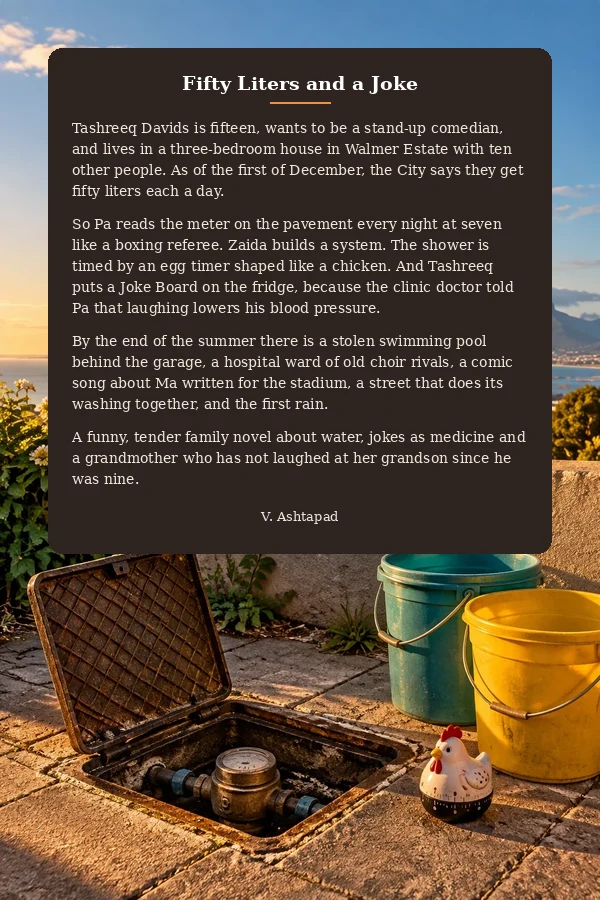
Tashreeq Davids is fifteen, wants to be a stand-up comedian, and lives in a three-bedroom house in Walmer Estate with ten other people. As of the first of December, the City says they get fifty liters each a day.
So Pa reads the meter on the pavement every night at seven like a boxing referee. Zaida builds a system. The shower is timed by an egg timer shaped like a chicken. And Tashreeq puts a Joke Board on the fridge, because the clinic doctor told Pa that laughing lowers his blood pressure.
By the end of the summer there is a stolen swimming pool behind the garage, a hospital ward of old choir rivals, a comic song about Ma written for the stadium, a street that does its washing together, and the first rain.
A funny, tender family novel about water, jokes as medicine and a grandmother who has not laughed at her grandson since he was nine.
Members can react to this book and talk about it in the members' Library.
Ownership
© 2026 CRUNOD LLC. All rights reserved.
This book is owned by CRUNOD LLC. It is free to read on EternalCurrent.Online. No part of it may be copied, reprinted, sold, recorded or adapted, including as audio, film or translation, without written permission from CRUNOD LLC.
© 2026 CRUNOD LLC. All rights reserved.