First Serve
Eleven Girls, a Schoolyard Net and the Season Nobody Played Indoors
by V. Ashtapad
Foreword
This is a work of fiction. The club, the schools, the teams and every player and family in it are invented, though anyone who has spent a winter Saturday in a convention hall full of volleyball courts will recognize the sound.
It is part of a set of family stories in this Library about one family across three generations. It can be read on its own.
For every grandparent in a folding chair by the fence.
Saturday, January 10: The Sign on the Door
The sign was taped to the inside of the glass, so that you had to cup your hands against the door to read it, and Inika read it twice before she let herself believe it.
GYMNASIUM CLOSED FOR SEISMIC RETROFIT, it said, in the kind of letters a copy machine makes when it has been asked to be important. ALL RENTALS CANCELED EFFECTIVE IMMEDIATELY. WE APOLOGIZE FOR THE INCONVENIENCE. Under that, in blue ballpoint, someone had added a phone number and then, as if in afterthought, a sad face.
It was seven twenty in the morning. Behind her, in the parking lot of St. Brendan's Academy, eleven girls between the ages of twelve and fourteen were climbing out of seven cars with their knee pads around their ankles and their hair in the high, hard ponytails that took their mothers twenty minutes and a fistful of elastic, and the first of them, Asha Pillai, was already jogging across the asphalt with her ball bag bouncing on her hip.
"Coach Inika! Did you see the group chat? Bella says—"
"I saw it," said Inika.
She had seen it at six fifteen, standing at her parents' kitchen counter in her socks, eating peanut butter off a spoon because there had not been time for toast, and she had read the forwarded email from the club office three times and decided there must be a mistake. Two weeks before the season opener, nobody canceled a gym. You might as well cancel the weather.
But the sign on the door was not a mistake. It had a sad face on it.
Asha reached her and stopped and cupped her own hands against the glass. She was the tallest girl on the team, five foot seven at thirteen, all elbows and collarbones, and she read slowly, moving her lips.
"Retrofit," she said. "What's a retrofit?"
"It means they're going to make the building strong enough not to fall down in an earthquake."
Asha considered this. "Was it going to fall down?"
"Apparently it was thinking about it."
The rest of them were arriving now, in a loose cluster of hoodies and slides and water bottles the size of fire extinguishers, and behind them the parents, holding coffee cups and car keys, wearing the expression of people who have paid a club fee in installments and are about to find out what it bought.
Inika turned around. She was twenty-five years old for seventeen more days. She was tall, taller than most of the fathers, in the navy club jacket she had been given three seasons ago when she agreed to coach the fourteens "just for one year," and she had a whistle on a black shoelace around her neck that she had never once blown, because she could whistle louder through two fingers than any whistle ever made.
She put two fingers in her mouth now and did it, once, short and sharp, and eleven heads came up.
"Okay," she said. "Circle."
They circled. They were good at circling. It was the first thing she had taught them in November, when tryouts ended and the roster came out and she stood in this same gym with eleven strangers and told them that the circle was where a team began and ended every day, no matter what happened in between. They had rolled their eyes. They did it now without thinking.
"We don't have a gym," she told them. "The club is looking for another one. There aren't any. Every gym from here to San Jose is booked through April. The club office says we can maybe have an hour on Tuesday nights at a middle school in Fremont, which is fifty minutes away, if the boys' basketball team doesn't make the playoffs."
"The boys' basketball team never makes the playoffs," said Juliet Reyes.
"That's the good news," said Inika.
Somebody laughed. Somebody else, Hana Sato, the smallest girl, the setter, who did not talk much, looked down at her new court shoes, which still had the tag looped through the laces because she was saving them for the first day, and did not laugh.
Inika saw it. She saw it the way she had always seen these things, the small faces that dropped while the loud ones joked, and she felt the familiar pull in her chest that her grandmother called *the first-born ache*: the wish to stand between everyone and everything.
She had been the first grandchild. For five years she had been the only one. She had grown up on the shoulders of a grandfather who carried her everywhere and a grandmother who knew where she was every minute of the day, and an uncle who let her ride his German Shepherd around the yard like a pony, and a mother who checked her seat belt twice. She had been carried, and fed, and watched, and protected from every bad thing that could be seen coming. It had been lovely. She did not regret one minute of it. But she had learned, slowly, in college and after, on courts and in offices and in her own head at two in the morning, that the people who had protected her had not been able to teach her what to do when the bad thing came anyway.
She had had to figure that out herself. Mostly on volleyball courts.
"So," she said. "Here's the question. We can sit in the parking lot and be sad, which is allowed. Or we can go find somewhere to play."
"Where?" said Asha.
Inika looked past the parking lot. Across the street, behind a chain-link fence with a banner for a Lunar New Year festival zip-tied to it, was the playground of Alder Creek Elementary: a big flat field of blacktop, faded hopscotch squares, a basketball hoop with no net, two steel poles set in concrete that had once, a long time ago, held up a volleyball net, and a single row of wet green benches.
The fog was still lying on it like a blanket someone had forgotten to fold.
"There," she said.
---
The parents did not love it.
They stood in a ring around her in the St. Brendan's parking lot, and she listened, because her grandmother had taught her that the first thing you do with an angry person is let them finish. Mr. Castellano said the blacktop would destroy the girls' knees. Mrs. Kim said it was January. Mr. Lindqvist, who coached his own son's soccer team and therefore believed he knew about sports, said that no serious club team trained outdoors. Mrs. Okafor, Amara's mother, who was an emergency room nurse and had come straight from a night shift in her scrubs, said nothing at all, only drank her coffee and watched Inika over the lid.
When they were finished, Inika said, "You're all right."
That stopped them.
"The blacktop is bad for knees," she said. "It's January. Serious clubs train inside. All true. Here's the other true thing. If we don't touch a ball for two weeks, we will go into the first tournament and lose every set, and the girls will decide this season is over before it starts. I've seen it. I've been on that team." She held up her hands. "So I'm going to ask for something. Not money. Time. Give me Saturday mornings and one evening a week. I'll bring the net. We'll get knee pads that are actually knee pads. We'll do footwork on the grass and hitting on the blacktop. And if it's a disaster, I'll say so, and we'll drive to Fremont."
There was a pause. In it, a gull went over, crying like a hinge.
Then Mrs. Okafor finished her coffee, crumpled the cup, and said, "I'll do first aid. I have a whole bag."
"I have a truck," said Mr. Duarte, Sofía's father, who had not spoken yet. He was a contractor; his work truck was parked at the end of the row with ladders on top. "If you have a net, I can make it stand up."
And that was how it began: in a parking lot, with a sad face on a sign, and a nurse's bag, and a truck with ladders.
---
That night Inika sat at her parents' kitchen table with her laptop open and a plate of her mother's leftover rajma going cold beside it, and made a page.
It was a page on the private family network her uncle had set up years ago, the one the whole family used for everything from birthday photos to Nana's medication schedule. She had added a group there in November for the team, mostly so the parents could see the tournament schedule without forty emails, and so far it held a roster, a calendar and one photograph of the girls in a circle, blurred because Mr. Lindqvist had taken it while walking.
Now she added a new event. *Saturday Practice. Alder Creek Elementary, back blacktop. 8:00 a.m. Bring: knee pads, layers, water, patience.*
Then, under it, because she was her grandmother's granddaughter and could not help herself, she added: *Snacks: provided.*
Her mother came in, in her reading glasses, with her hospital badge still clipped to her sweater from the late clinic she had covered, and read it over her shoulder.
"Provided by whom?" said Sunita.
"By Nani," said Inika. "I'm going to call her in the morning."
Her mother laughed, the short tired laugh of a doctor at the end of a long day. "You're going to ask your eighty-year-old grandmother to feed eleven teenagers at eight in the morning in January."
"I'm going to ask her if she wants to," said Inika. "That's different."
Her mother kissed the top of her head and went upstairs, and Inika sat alone in the kitchen with the cold rajma and the page, and after a while she opened a new playlist and named it *Blacktop*, and put on it the first song she could think of, which was the song her grandmother used to sing to her in the car, a Hindi film song from long before Inika was born, about the wind and a road and somebody waiting.
It was a strange first song for a warm-up playlist. She left it there.
© 2026 CRUNOD LLC. All rights reserved.
Saturday, January 17: Fog on the Blacktop
There were banana slugs on the court.
Inika saw them before she was out of the car, because she was always looking for them, the way some people are always looking for spiders. There were three, yellow and thick as a thumb and longer than her hand, laid across the old painted four-square lines in the gray light like dropped bananas, gleaming with fog. One had gotten as far as the base of the east net pole and was halfway up it, at the speed of a slow thought.
She sat in the driver's seat with the engine off and the heater ticking and said, out loud, to nobody, "No."
She was not afraid of much. She had been hit in the face by a ball traveling sixty miles an hour. She had dived on hardwood, on sand, once on a tile floor in a hotel lobby at a tournament in Reno for reasons no one would ever explain to her mother. She had given a presentation on statistical modeling to a room of men who did not think she could. She had moved through the world, since she was a girl, with a calm her friends envied.
But she was afraid of banana slugs. Purely, deeply, in her stomach, with no explanation. She had been afraid of them since she was four years old and her grandfather walked her down to the creek behind the family house and one had been sitting on a fern exactly at the height of her face.
Mr. Duarte's truck pulled in beside her. He got out, in a canvas jacket with his name stitched on the chest, carrying a coffee in one hand and, in the other, a long steel pipe. He looked at the court. He looked at her, still sitting in the car with her hands on the wheel.
"Ah," he said. "Babosas."
"Is that what they're called in Spanish?"
"That's what my mother called them. She put salt on them." He set the pipe down. "I'm not going to put salt on them. My daughter would never speak to me again. She's going to be a marine biologist."
He walked out onto the blacktop, unhurried, picked up each slug gently on the flat of a paint stirrer from his back pocket, and carried them, one at a time, to the wet grass beyond the fence, the way you would carry somebody's baby back to them. Then he came back and looked at Inika, still in the car.
"Coach," he said. "It's clear."
She got out.
---
The net went up at seven forty.
It was her own net, her college net, the one her teammates had given her when she graduated because she was the only one with a garage, and it had lived in her parents' garage for four years beside her father's golf clubs and her sister's old saddle. It was a good net, heavy, with a steel cable along the top. The old poles on the Alder Creek playground had been set for elementary school volleyball, years ago, and they were too short by a foot. Mr. Duarte had brought two steel sleeves that he had cut and drilled in his shop on Thursday night. He slid them over the old poles and pinned them, and they ran the cable through the eye bolts, and he cranked it tight with a ratchet strap from his truck until the net stood up straight and hummed when you plucked it.
He measured the height with a tape. Seven feet, four and one-eighth inches. Regulation for the fourteens.
"One-eighth too high," he said, disgusted with himself.
"That's fine," said Inika.
"It's not fine. I'll fix it next week."
The girls arrived in the fog. They came in sweatpants over their spandex and sweatshirts over their sweatshirts, and they stood at the edge of the blacktop staring at the net as if it had grown there.
Then they saw the folding table.
It had been set up by the fence by a small woman in a long padded coat and a knitted cap, with a cane hooked over the back of a chair, and on it were three thermoses, a tray of orange slices dusted red-brown with something, two metal tins with their lids off, and a stack of paper cups. Beside the woman, in a second chair, sat an old man in a wool cap and a rain jacket that had seen several decades, reading the newspaper as if he had come to the playground to do exactly that.
"Who's that?" said Juliet.
"That," said Inika, "is my grandmother. And my grandfather."
"Why are they here?"
"Snacks are provided," said Inika, and some of them laughed, and some of them were already walking toward the table, because they were thirteen, and it was cold, and there were thermoses.
Nani had made masala chai, two thermoses, very sweet, and one thermos of hot water with ginger and honey for the girls who did not drink tea. The orange slices were dusted with chaat masala, which none of the girls had ever tasted. In one tin there were namak pare, the little fried diamonds of dough with ajwain and black pepper that Nani had made for every gathering of Inika's life; in the other were peanut chikki, broken into squares.
"Eat," Nani told them. She said it to each girl individually, looking up into each face, because she was five feet tall and they were not. "You are growing. Eat."
Asha bit into an orange slice and her eyes went wide. "What is this?"
"Chaat masala," said Nani. "Black salt, cumin, mango powder, a little chili. For oranges, for guava, for fruit. In Delhi in winter the boys sell it on the street with a little paper cone."
"It tastes like—" Asha searched. "Like a chip. But an orange."
"Exactly," said Nani, satisfied, and gave her another.
Inika's grandfather looked up from his newspaper. He was eighty-eight years old, not tall, with a straight back and a face that had been out in a lot of weather. He looked at the net, and at the steel sleeves, and at Mr. Duarte, who was still frowning at his tape measure.
"Good work," Nana said to Mr. Duarte. "Very solid."
"One-eighth too high," said Mr. Duarte.
Nana considered this. "In the army," he said, "we would say: one-eighth too high is an advantage for the people who practice on it."
Mr. Duarte looked at him, and then, slowly, smiled.
---
They practiced for two hours in the fog. Inika ran them through footwork on the grass first, shuffles and crossovers and the approach steps for hitting, left-right-left for the right-handers, over and over until the wet grass was flattened in long green lanes. Then passing on the blacktop, which was slick for the first half hour and then dried as the fog thinned, and the sound of the balls on their forearms changed from a wet slap to a clean, hollow thump.
At nine thirty the sun came through. It came all at once, the way it does on that coast: the fog went gold and then white and then was simply gone, and the blacktop steamed, and the girls stripped off their sweatshirts and threw them on the benches and played in the sudden bright cold with their breath showing.
Hana Sato set the ball. She had taken the tag off her shoes. She set it high and soft to Asha on the outside, the ball turning slow and perfect in the new light, and Asha took her three steps and jumped and hit it straight down into the blacktop on the other side so hard it bounced over the fence.
Everyone stopped.
Then Juliet Reyes said, very quietly, "Okay. That was sick."
And from the folding chair by the fence, without looking up from his newspaper, Inika's grandfather clapped twice.
© 2026 CRUNOD LLC. All rights reserved.
Saturday, January 24: Zero and Six
They lost every set.
The first tournament of the season was at the convention center downtown, under a ceiling so high and so full of lights that it felt like being inside a stadium turned upside down. There were forty courts laid out on the concrete floor in rows, divided by black curtains, and on every court a match was going on, so that the sound in the hall was one long roar made of whistles and ball strikes and shoes and four hundred parents yelling different names. The air smelled like rubber and floor wax and the burnt-sugar smell from a kettle-corn stand at the end of row G.
Fogline Fourteen Navy played their first match at eight in the morning on court thirty-one against a team from Sacramento who were all, as far as Inika could tell, six feet tall.
They lost it twenty-five to eleven, twenty-five to fourteen.
They lost the second to a team from Pleasanton who did not look like much until they served, and then served nineteen points in a row, floaters that dipped and dove at the last second, and Fogline passed every one of them into the bleachers.
They lost the third, at three in the afternoon, to a team from Santa Rosa whose coach was a woman Inika had played against in college. The coach waved at her across the net before the first serve, cheerfully, and then her girls beat Inika's girls twenty-five to eighteen, twenty-five to sixteen, and afterward the coach came over and hugged her and said, "Your setter's good. Who is she?"
"Hana," said Inika. "Thirteen."
"She's good," the woman said again, and then, kindly, "Rough day."
Zero and six. Zero matches won, six sets lost. Inika wrote it on the score sheet in the box marked *Pool Results* and underlined it, because if you were going to write a thing like that you might as well be honest about it.
---
The girls were silent in the hallway outside the hall.
They sat on the carpet against the wall with their bags, the way teams do between matches, in a long row, untaping their ankles. Amara Okafor had her head on her knees. Juliet was looking at her phone and not really looking at it. Bella Castellano was crying, very quietly, the way she did everything, and Ruby Lindqvist had her arm around her and was looking at the ceiling as if the ceiling had done it.
Inika stood in front of them with her clipboard and could not think of one thing to say.
She knew what her college coach would have said. She knew what her own father would have said, at a moment like this: *It's one day. You'll learn from it.* Both were true. Neither was any use.
What she wanted to do, the thing in her chest that rose up like water, was to tell them it was not their fault. That the gym had been taken, that they had had one week on a playground in the fog, that the other teams had been practicing indoors since November. That it was unfair. That she would fix it.
She did not say any of that. She had learned that much. If you told someone it was not their fault, you also told them it was not in their hands.
So she sat down on the carpet with them instead, at the end of the row, next to Hana, and began unwinding the tape from her own wrist, which she still taped out of habit even though she was only coaching, and did not say anything at all.
After a while Hana said, without looking up, "My serve went in the net eleven times."
"I counted ten," said Inika.
"It was eleven. One was in warm-ups."
"Okay. Eleven."
Hana pulled at a thread on her knee pad. "My grandma came," she said. "She never comes. She came on the train."
Inika looked down the hall. At the far end, by the doors, a tiny elderly woman in a tan coat was sitting very upright on a bench, with a cloth bag in her lap and her hands folded on top of it, watching them.
"Did you talk to her?"
"No." Hana's voice went very small. "I don't want her to see me like this."
Inika thought about that. She thought about her own grandmother, at her own first college match, in a folding chair by the court in Santa Barbara, after Inika had passed three serves straight into the net in the first set. Her grandmother had not said anything about the passes. At the end, she had only taken Inika's face in both her small hands and said, *You looked very tall out there.* And it had been the most useless, the most perfect thing that anyone could have said.
"Go talk to her," Inika said.
"I lost."
"She didn't come to see you win," said Inika. "She came on the train."
Hana sat for a long moment. Then she got up and walked down the hall in her socks, carrying her shoes, and the tiny woman stood up off the bench and opened her arms, and Hana walked straight into them.
---
That night the girls posted their first stories.
It had been Nani's idea, though Nani would not have called it that. At Saturday practice she had asked each girl, as they ate her namak pare, why she played. Not the serious way, not like a coach. The way she asked everyone everything: *Why this game? Who taught you? What does your mother think?* And the girls, who were never asked these things by adults, at least not adults who seemed to want to know, had told her. Asha's father had played in college in Chennai. Juliet had wanted to do gymnastics and was too tall. Ruby had followed her best friend to tryouts and the best friend had quit and Ruby had not. Amara's mother had been a setter in Lagos, in a church league, before she came to Houston, and then California, and never touched a ball again.
"Write it down," Nani had said. "One day you will forget why. Then you can read it."
So Inika had made a place on the team's page for them, under the roster, where each girl could put a few lines, or a recording, or a photo. She had expected one or two. That night, after zero and six, after the long silent drive home, ten of the eleven posted something.
Bella wrote three lines about her older sister, who had played, and who had died of leukemia when Bella was eight, and whose knee pads Bella still wore. Inika read it at her parents' kitchen table and had to put the laptop down and go stand in the backyard in the dark for a few minutes with her arms around herself.
After a while the kitchen door opened behind her and her mother came out in her slippers, with two mugs, and stood beside her on the wet grass without saying anything, and gave her one. It was hot milk with turmeric and a little honey, the thing her mother had made her every night of every exam week since the sixth grade, and Inika had not asked for it, and her mother had not asked if she wanted it.
"Bella's sister," said Inika.
"I read it." Her mother had the team page on her phone; she had joined it in November, to see the tournament schedule, and read every word on it since, the way she read everything, as if there might be a test. "I'm sorry, beta."
They stood in the dark. Somewhere down the street a dog barked twice and thought better of it.
"Zero and six," said Inika.
"I know. Your Mama called."
Inika looked at her. "Mama called you? About the tournament?"
"From the airport. He's flying to Singapore tonight." Her mother drank her milk. "He wanted to know how the girls did. And whether you had eaten. And whether the little setter's grandmother got home all right on the train." She paused. "I don't know how he knew about the grandmother."
"I told him," said Inika. "On Thursday. He asked me about every girl on the team. He made me go through the roster."
"Of course he did." Her mother almost smiled. "He used to do that with my patients. When I first opened the practice. Every Sunday, at your Nani's table: how is the man with the bad lungs, how is the lady who brings you the lemons. He remembered all of them. I never told him their names. He just remembered the stories."
Her mother was quiet for a moment, looking at the dark garden.
"You're both like that," she said. "You and him. You carry everybody around inside you." She put her arm around Inika's waist, which was as high as she could comfortably reach. "Drink your milk. Then go to bed. Zero and six is a number. It isn't a team."
Hana posted last, after eleven. It was a recording, eight seconds long, of her grandmother on the train home, speaking in Japanese, and under it Hana had typed the translation.
*She says: In my village we played with a ball made of rags in a field after the rice was cut. The boys did not let us. We played anyway. Tell your coach the net in the playground is a good net.*
© 2026 CRUNOD LLC. All rights reserved.
Saturday, January 31: Rain Delay
It rained.
It rained the way it rains in the Bay Area perhaps three times each winter, as if the whole Pacific had decided at once to come ashore. It drummed on the roof of Inika's car in the Alder Creek parking lot and ran in sheets down the windshield and filled the low corner of the blacktop with a brown lake that had a crushed juice box floating in it like a small sad boat. The net hung soaked and heavy between its poles, dripping from every square.
Inika had canceled practice at six in the morning, in the group chat, with an umbrella emoji and an apology. Then she had gone out anyway, because she had told Mr. Duarte she would help him check the poles after the storm, and because she was twenty-six years old as of Tuesday and wanted, for one morning, to sit in a car in the rain and do nothing.
She had not done nothing on her birthday. On her birthday she had worked nine hours writing code to forecast hospital bed demand for a health system in the East Bay, attended a two-hour lecture on Bayesian methods for her statistics degree, walked a neighbor's elderly beagle named Professor at lunch and again after dark, eaten a slice of the chocolate cake her mother brought to the office at four with a single candle that set off nobody's smoke alarm, and run an evening practice on the blacktop under the two portable floodlights Mr. Duarte had brought from a job site, which made the court look like the scene of a very well-organized crime.
At ten that night, finally home, she had found a box on her bed from her grandparents. Inside was a pair of hand-knitted wristbands in navy and gold, the team's colors, and a note in her grandmother's small careful English: *For wiping sweat. Not for crying. Love, Nani.* And, from Nana, wrapped in newspaper, a whistle on a black shoelace.
It was his old army whistle. She knew it the moment she saw it. A heavy brass whistle, dented on one side, worn smooth at the mouthpiece. She had seen it all her life in a dish on his dresser with his cufflinks and his reading glasses. As a child she had been allowed to hold it but not to blow it, because Nani said it was too loud for indoors and Nana said it was too loud for anywhere.
Under the whistle was a slip of paper in Nana's square handwriting. *A coach should not whistle with her fingers. It is for calling dogs. Use this. — N.*
She had laughed out loud, alone in her room.
Now she took the whistle out of her jacket and turned it over in her hand while the rain hammered on the roof, and she did not blow it. She did not know yet when she would.
---
Mr. Duarte's truck pulled in at eight. He did not get out at once. Then the passenger door opened, and Sofía got out, in a yellow raincoat, and ran across the parking lot and knocked on Inika's window.
Inika rolled it down two inches. Rain blew in.
"My dad says come sit in the truck," said Sofía. "He has the heater on. And donuts."
The truck smelled of sawdust and coffee and the glazed donuts from the shop by the freeway exit, and Mr. Duarte had the radio on a Spanish station turned low, an old song with a lot of trumpets. Inika climbed into the back seat beside Sofía and a toolbox and a rolled-up tarp.
"The poles are fine," Mr. Duarte said, before she could ask. "I checked them already. Concrete's good. Sleeves are good. The net's going to be wet till Tuesday." He passed back the donut box. "Sofía wants to ask you something."
Sofía was thirteen and played middle, the position for tall girls who could jump and block and did not mind being hit in the face, and she was the quietest girl on the team after Hana. She held a donut in both hands and looked at it.
"My grandpa," she said. "He lives with us. He used to play. In Michoacán. Not volleyball. Not like us. Like—" She looked at her father.
"Fronton," said Mr. Duarte. "With the hand. Against a wall. Like handball, almost. Every village had a wall."
"He was really good," said Sofía. "He was, like, the best in the town. He has a photo. But he doesn't go out anymore. Since my grandma died. He just watches TV. He doesn't talk."
Inika waited.
"I thought," said Sofía, very fast, "maybe he could come to practice? Like your grandparents? Just to sit? He doesn't have to do anything. I just thought if he saw it—" She stopped.
The rain drummed on the cab.
"Yes," said Inika. "Of course he can come."
"He might say no."
"Then we'll ask again."
Sofía looked up. "Your grandma said that," she said. "Last week. When Asha said her dad never comes. Your grandma said, 'Then you ask again. Old people say no first. It is how we find out if you mean it.'"
Inika laughed, and Mr. Duarte laughed in the front seat, a big laugh that shook the steering wheel, and outside the rain went on coming down over the empty playground and the drowned net and the brown lake with the juice box in it, and for the first time since the sign on the door, she felt that something had started that was not hers to carry.
---
At noon she drove to the family house through the rain, and found her uncle in the garage.
He was sitting in the blue car with the door open and the radio off, not doing anything, which was not like him. The garage smelled of oil and old cardboard and the cold coming in under the door, and the rain was loud on the roof, and Sheru, her uncle's old Australian Shepherd, was asleep across the doorway like a draft stopper and did not get up for her, only thumped his tail twice on the concrete.
"Mama," said Inika.
"Birthday girl." He did not get out. He patted the passenger seat. "Sit."
She sat. She had sat in this seat her whole life. She had been allowed, at four, to sit in it in the garage and pretend to drive while he sat behind the wheel and pretended to be the passenger, giving her directions to places that did not exist; she had been allowed, at eight, to ride in it to school with her backpack on her knees; she had been allowed, at sixteen, after her driving test, to sit in it while he explained, very seriously, that she was the best driver in the family and that she was still not going to drive it. Nobody drove it. That was the rule. It was the oldest rule she knew.
"Your Nana gave you his whistle," said her uncle.
"How do you know?"
"Because he asked me if it was all right." He looked at the dashboard. "Fifty years he's had that whistle in a dish, and he came out here the night before I flew to Singapore and stood where you're sitting and asked me whether I minded if he gave it to you. As if it were mine to mind." He shook his head. "I said, Papa, if you don't give it to her, I will steal it and give it to her myself."
Inika laughed. Then she did not.
"I'm scared, Mama," she said. "Of the team. Of doing it wrong. They lost every match. I stood there and watched them lose every match and there was nothing I could do."
"I know," said her uncle. He was not a man who said much. He had never been. But he had been at every one of her games since she was nine, in the top row of every bleacher in Northern California, alone, with his reading glasses pushed up on his forehead, and he had never once told her what she should have done. "My first company, we lost our office in the first month. The landlord sold the building. Six of us, and two desks, and nowhere to put them. We worked in your Nani's dining room for a whole summer. She fed us every day. She fed engineers lunch for three months." He smiled a little, at the windshield. "Best summer of my life. Every good idea we ever had, we had at that table."
The rain went on. Sheru sighed in the doorway.
"How's your mom?" he said, after a while.
"Tired," said Inika. "She's always tired. She does everything for everybody."
"I know," said her uncle. He was quiet for a long time. "I'm working on it."
She did not know what that meant. She did not ask. He reached across her and opened the glovebox and took out a thermos, old and dented, and gave it to her.
"From your Mami," he said. "Chicken soup. She came off nights this morning and made it before she went to sleep. She said you won't eat lunch, and she's right, so eat it here, where I can see you."
She ate it in the passenger seat of the blue car in the garage in the rain, out of the thermos lid, and her uncle sat beside her behind the wheel and did not say anything else, and it was the best birthday lunch she had ever had.
---
That afternoon, at the family house, she sat on the floor of the living room with her back against her grandfather's chair while he did the crossword and her grandmother napped, and she typed up the week on the team's page, because Nani had told her to.
*January 31. Rain. Practice canceled. Net soaked. Poles fine. Sofía's grandfather, Señor Duarte, was a fronton champion in his village in Michoacán. She has a photo. She is going to ask him to come.*
Then, because no one would read it but her, she added: *Turned 26. Nana gave me his whistle. I don't know when to use it yet.*
Behind her, without looking up from the crossword, Nana said, "Seven letters. 'To bring back what was lost.'"
She thought about it. "Restore," she said.
He wrote it in. "Good," he said. "That is a good word."
© 2026 CRUNOD LLC. All rights reserved.
Saturday, February 7: Señor Duarte
He came in a gray suit.
That was the first thing Inika noticed, and she would remember it for a long time after: that Sofía's grandfather, who had not left the house in seven months, came to a Saturday morning volleyball practice on an elementary school playground in a pressed gray suit and a white shirt buttoned to the neck and a straw hat with a black band, as if he had been invited to a wedding.
He came walking slowly from the truck on Mr. Duarte's arm. He was very thin, with a long brown face and white hair combed straight back under the hat and hands like old roots. He stopped at the edge of the blacktop and looked at it, the faded hopscotch squares and the net hung between the poles in the cold sunshine, the girls in their knee pads doing their passing lines, and Inika saw his face do something, a small movement in the jaw, as if he had bitten down on something.
Then Nani was there. She had come across the blacktop with her cane, faster than Inika had seen her move in a year, and she stopped in front of the old man and put her palms together and bowed her head a little, the way she did for people she respected, and then, without asking, she put her hand through his other arm.
"Come," she said. "Sit with my husband. He talks too much about the army. You can talk about your wall."
Señor Duarte looked down at her, this tiny woman in a padded coat, and some word passed between them that Inika could not hear. Then he let her walk him to the folding chairs by the fence, where Nana stood up, slowly, and shook his hand, and the two old men sat down side by side, the one in his rain jacket and the other in his gray suit, and looked at the court.
Neither of them said anything for twenty minutes. Inika checked.
---
The girls were better.
Not good, not yet. But better. Two weeks of footwork on wet grass had done something to their legs. Their approaches were longer, their jumps came off the ground with a snap. And the blacktop, which Inika had worried about every day, had turned out to have one great advantage: on a hard surface, under the open sky, with no walls, a ball that got away went *away*. It rolled across the playground and into the grass and under the fence and once, memorably, into the open back of a passing pickup. If you shanked a pass, somebody had to chase it. After two weeks of chasing, nobody wanted to shank a pass.
"Keep it on the court," Inika had told them on the first day. "There's no wall to save you."
Juliet had written it on the back of her hand in marker. Now three of them had.
They were doing serve-receive when it happened. Inika was serving to them from the far side, floaters, one after another, and the girls were passing to Hana at the net, and Hana was setting the outside hitters, and Amara mishit a pass and it shot off her forearms sideways and went bouncing toward the fence, straight at the two old men.
Señor Duarte stood up. He did not stand up like a man of eighty-four. He came out of the chair in one motion, and his right hand came around, open, flat, and hit the ball out of the air in front of his chest with a sound like a door slamming, and it went back across the blacktop in a low hard line and smacked into the base of the net pole and bounced straight up into Hana's hands.
There was a silence on the playground so complete that Inika could hear a crow on the roof of the school.
Señor Duarte looked at his hand. Then he looked at the girls, all of them staring at him. Then he sat back down, and smoothed his suit jacket over his knees, and folded his hands.
Beside him, Inika's grandfather said, without turning his head, "So. You were the best in the town."
"In the province," said Señor Duarte. It was the first thing he had said all morning. His voice was dry and soft, with a little rasp in it. "For three years. Before I came north."
---
After practice the girls crowded around the folding chairs, all eleven of them, with their snacks, and Sofía stood at her grandfather's elbow and translated, and he told them about the wall.
It was in a village outside Uruapan, the wall, behind the church, tall as three men and painted white every spring, and on Sundays after the market the whole village came to watch the young men play against it, two against two, slapping a small hard ball with their bare hands so that it rang off the plaster. Their palms would bleed. You wrapped them in cloth. Old men sat on a long bench under a jacaranda tree and judged, and women sold atole from clay pots, and the boys who could not play yet sat on the top of the wall and kept score by scratching marks in the paint with nails.
"Everybody had a name," said Señor Duarte, through Sofía. "A name for how they played. Mine was *El Relámpago*." He looked at Sofía.
"The Lightning," said Sofía, and then, in a different voice, "Abuelo, you never told me that."
He shrugged, the shrug of a man who had not been asked.
"What would mine be?" said Asha.
The old man looked at her, the tall bony girl with her braid coming loose. He thought about it seriously, for a long time. Then he said something in Spanish, and Sofía laughed.
"He says you are *La Escalera*," she said. "The Ladder. Because you are tall and you go up."
Asha thought about this, and decided she liked it.
He named them all, one by one, slowly, while Nani refilled the paper cups and Nana listened with his eyes half closed. Amara was *La Pared*, the Wall, because she did not move when the ball hit her. Juliet was *La Lengua*, the Tongue, because she talked so much, and everyone screamed. Bella was *La Sombra*, the Shadow, because she was always where the ball would be before it got there. Hana he looked at for a long time, and then said only one word: *Maestra*. Teacher.
Hana went pink to her ears.
When he came to Sofía, he reached up and took his granddaughter's hand and held it for a moment, and said something very quietly that she did not translate.
---
That night, on the team's page, Sofía posted the photograph: a small square black-and-white print, scanned on her phone, of a white wall behind a church and a crowd on benches, and in front of it a young man in a white shirt, very thin, with his right arm raised and his hand open, frozen in the moment of striking. The ball was a gray blur by his palm.
Under it she wrote: *My abuelo, 1961. El Relámpago. He came to practice today. He says the net is one-eighth too high and he likes it.*
And under that, the next morning, in a reply, the first thing he had ever posted anywhere, typed by his granddaughter in his words:
*Thank you to the coach and to the señora with the tea. I will come again. — Ignacio Duarte.*
© 2026 CRUNOD LLC. All rights reserved.
Saturday, February 21: The Hindi Song
It was Juliet's idea to make the playlist a democracy.
Until then the warm-up playlist had belonged to Inika, which meant it was a carefully tuned sequence of thirty-two songs she had been building since college: fast, loud, with a heavy beat for the dynamic stretches and a slow build into the hitting lines. It had been working fine. The girls had complained about it constantly.
"It's all, like, from 2018," said Juliet, on the drive to the second tournament. She was in the front seat of Inika's car because she got carsick in the back, and she had Inika's phone in her hand and was scrolling the list with an expression of deep pity. "Coach. These are songs my *cousin* likes. My cousin is *twenty-four*."
"I'm twenty-six," said Inika.
"I know," said Juliet, kindly. "That's why I'm telling you."
So they voted. Each girl got to add two songs. The rule was: no explicit lyrics, nothing slower than a heartbeat, and you had to be able to tell the team why you picked it. Inika added the rule because it was the kind of rule her grandmother would have made, and she was learning that most good rules were.
The playlist grew to fifty-four songs by Friday night. There was Afrobeats from Amara, two K-pop songs from Hana that were so fast they made Mr. Lindqvist laugh out loud in the parking lot, cumbia from Sofía, a Tamil film song from Asha that her father had danced to at his own wedding, a pop song from Ruby that the whole team pretended to hate and all knew every word of, and a Samoan song from Kalani Akana, the backup setter, that her uncles sang at family barbecues in Hayward, with a beat you could not stand still for.
And there, at number one, still, the song Inika had put on first, on the night of the sign on the door: her grandmother's song from 1965, an old woman's voice from an old film, about wind on a road and somebody waiting at the end of it.
"What is this one?" said Juliet, in the car, when it came on.
Inika started to skip it.
"No, wait," said Juliet. "I want to hear it."
So they listened, in the car, in the rain-washed light coming over the hills on the freeway, to a song from a black-and-white film that neither of them had seen, sung in a language Juliet did not speak, by a voice that had been recorded before either of their parents were born. It had violins in it, and a flute, and a beat like footsteps.
"It's sad," said Juliet, at the end.
"It's not sad," said Inika. "It's about waiting for someone you know is coming."
"How do you know they're coming?"
"Because she keeps singing," said Inika. "If she thought they weren't coming, she'd stop."
Juliet thought about this for a long time, which was unusual for her. Then she said, "Okay. It stays. But not first."
"Who taught it to you?" said Juliet. "The song."
"My Nani. She used to sing it in her old minivan. Driving me to preschool, driving me to the dentist, driving me to swim lessons. Every song she knows is about a road." Inika changed lanes. "And my uncle plays it in his car. And my mom hums it when she's cooking and doesn't know she's doing it. And my cousin Gabriel says it's the only song in the family that everybody knows all the words to, even the people who say they don't."
"That's a lot of people for one song," said Juliet.
"It's a lot of people," Inika agreed. She thought about it, the green hills going by outside the window, washed bright by the rain. "When I was little I thought they were all my parents. All of them. My mom and dad, and my Nani and Nana, and my uncle and my aunt. I didn't know there was a difference. Whoever was closest when I fell down, that was who picked me up."
Juliet considered this with the seriousness of a thirteen-year-old who has been given a fact she intends to keep.
"That sounds nice," she said. "My family's just my mom and my brother. And my grandma, on the phone, in Manila." She scrolled the playlist. "Maybe that's why I like the team. It's like having a lot of people."
"Yes," said Inika. "That's exactly why."
---
They won a set.
It was the second match of the day at the convention center, at eleven fifteen, against a team from Walnut Creek, and they lost the first set badly and were down nineteen to twelve in the second, and Inika took a time-out because she did not know what else to do.
She crouched in front of them in the huddle with her clipboard, and they looked at her, eleven sweaty frightened faces, and she opened her mouth to tell them about the Walnut Creek outside hitter's tendencies, and instead she heard herself say:
"What are your names?"
They stared at her.
"Your names," she said. "Señor Duarte's names. Say them."
There was a pause. Then Asha said, "La Escalera," and somebody snorted, and Amara said, "La Pared," in a deep voice, and then they were all saying them, laughing, *La Sombra, La Lengua, Maestra, El Pez, La Chispa*, the names he had given each of them, and the referee blew the whistle for the end of the time-out and they ran back on the court still laughing.
Hana served. She had not missed a serve in warm-ups. She missed none now. She served nine in a row, a low hard float that dipped over the net and dropped like a stone, and on the seventh the Walnut Creek girls passed it straight into the ceiling lights, and on the ninth, at twenty-one to nineteen, the Walnut Creek coach called a time-out of her own.
They won the set twenty-five to twenty-two. They lost the third set and the match. It did not matter. They came off the court screaming as if they had won the national championship.
---
At the fence after the match, Mr. Lindqvist found her.
He was a tall heavy man with a red face and a loud voice who had, Inika thought, been against everything since the first day: against the blacktop, against the old people at practice, against the snacks, which he said were full of sugar, and against what he called "the storytelling stuff" on the team page, which he said had nothing to do with volleyball. He had not posted anything. Ruby had, about her best friend who quit. Inika had seen him read it, in the parking lot, standing by his car.
Now he stood in front of her with his hands in the pockets of his parka and his face redder than usual.
"That old guy," he said. "Duarte's dad. With the names."
"Señor Duarte."
"Yeah." Mr. Lindqvist looked at the floor. "Ruby says he called her *El Pez*."
"The Fish," said Inika. "Because she can slide under anything."
"She's been saying it all week. At dinner." He shook his head. "She hasn't talked at dinner since her friend quit. Since September. Her mom and I were—" He stopped. "Anyway. She talks now. About the old guy. About your grandma's oranges."
Inika waited.
"I was wrong about the blacktop," said Mr. Lindqvist, very fast, the way men like him say it, as if they are pulling off a bandage. "And the rest of it. That's all." And he turned around and walked away into the crowd before she could say anything at all.
© 2026 CRUNOD LLC. All rights reserved.
Saturday, March 7: Lines on the Asphalt
Nana drew the lines.
It began because the old court lines on the Alder Creek blacktop, which had been painted for elementary school volleyball some decades ago, were the wrong size. The court was too short by almost three feet on each side and too narrow by two, and the ten-foot attack line, which matters a great deal in real volleyball, did not exist at all. For six weeks the girls had been practicing on a court that lied to them. On every tournament floor they had been hitting long.
Inika had mentioned it, once, in passing, at Sunday dinner at the family house, between the dal and the rice. "I need to get the lines right," she said. "I keep meaning to buy chalk."
Her grandfather put down his spoon.
"Chalk is no good," he said. "Chalk is gone in the first rain. You need a line that stays."
"Nana, it's a public school. I can't paint their playground."
"Who said paint?" said her grandfather. And he got up from the table, in the middle of dinner, which nobody in the family could remember him ever doing, and went out to the garage.
---
He came to the playground the next Saturday at seven in the morning, an hour before practice, in his rain jacket, with a canvas bag over his shoulder, a tape measure, a ball of builder's string, a box of steel nails, and a roll of white vinyl tape three inches wide that he had bought at the hardware store on Main Street on Friday afternoon, driving himself, which he had been told by four separate family members he was not supposed to do anymore.
"Nana," said Inika, when she saw the car.
"Don't," said her grandfather. "Your grandmother has already said everything. Come. Hold this."
He laid out the court as he had once laid out the corners of field camps and gun positions and, later, the beds of the farm in Haryana: with a tape measure and string, nailing the string into the cracks of the asphalt with the steel nails, measuring each diagonal twice to make sure the corners were square. Thirty feet by sixty. The center line. The two attack lines, ten feet from the net on each side. He did it slowly, kneeling on a folded towel on the cold asphalt, because his knees did not bend the way they had, and Inika knelt beside him and held the end of the tape and did not tell him to stop.
"In the army," he said, while he measured, "the first thing you do in a new place is put down the lines. Where the tents go. Where the latrine goes. Where the guns go. Where you do not go. A soldier can bear anything if he knows where the lines are."
"Is that a real army saying?"
"No," said her grandfather. "I made it up just now. But it is true."
He measured the second diagonal. It was off by a quarter inch. He pulled the nail and moved it. He measured again.
"Your Nani," he said, not looking at her, "worries that you carry too much."
Inika stopped.
"She says you have a job, two degrees, eleven girls, three dogs that are not yours, and her, and me." He tapped the nail in with the side of a stone. "She says you were like this as a little girl. When the cousins came. You would stand at the door and count them as they came in, and count them again when they went out, and if one was missing you would not go to sleep."
"I don't remember that."
"I remember it," said her grandfather. "I used to count with you."
She did not say anything.
"We kept you very safe," he said. "Your Nani and I. Your mother. Your Mama. We kept you so safe. It was a good thing, I think. It was also maybe a mistake." He sat back on his heels on the folded towel and looked at her, and his eyes in the gray morning light were very clear. "You are not responsible for everyone coming home, beti. You are responsible for putting down good lines. Then they find their own way."
---
They taped the lines. It took two hours. Nani arrived at eight with the thermoses and stood at the fence, watching her husband on his knees on the asphalt, and said nothing, and Inika knew from her face that later she would say a great deal.
The vinyl tape was white and clean on the gray asphalt, and when it was done the court looked suddenly real, suddenly official, like a court anywhere. The girls arrived and stopped at the fence and stared at it.
"Whoa," said Juliet. "It's legit."
"Mr. Mohan did it," said Inika.
"By himself?"
"With string," said her grandfather, who was now sitting in his folding chair with a cup of chai, as if he had been sitting there all morning. "And nails. And a granddaughter."
They played on the new lines. On the second hitting rotation, Asha took a ball from Hana and went up and hit it hard crosscourt, and it landed, for the first time all season, on the line. Not long. On it. A white burst of tape-dust.
Señor Duarte, in his gray suit beside Nana, raised one hand in the air, flat, like a judge at the wall.
"Buena," he said.
---
That night on the team page, Inika posted a photograph Ruby had taken: her grandfather on his knees on the folded towel on the asphalt, pressing a nail into a crack with his thumb, with the white string running away from him in a perfect straight line into the fog. She captioned it only: *Mr. Mohan. Lines that stay.*
By morning it had forty-one replies. Most of them were from parents. One was from a man named Ray Whitfield, who said he was the head custodian at Alder Creek Elementary and had been for twenty-two years, and that he had noticed the tape on Monday, and that in the ordinary way of things he would have had to remove it, and that he had decided, after looking at it for some time, that it was the best-measured line on any playground in the district and he would be leaving it right where it was.
© 2026 CRUNOD LLC. All rights reserved.
Saturday, March 14: Visiting Hours
There was no practice that Saturday, because Hana's grandmother was in the hospital.
She had fallen on the stairs at the train station on Wednesday, coming to watch the evening practice under Mr. Duarte's floodlights. She had broken her hip. She was eighty-three. Hana's mother had called Inika on Wednesday night from the hospital, her voice very calm the way people's voices are calm when they are frightened, to say that Hana would not be at practice for a while and that she was sorry.
"Don't be sorry," Inika had said. "What can we do?"
"Nothing," Mrs. Sato had said. "Thank you. There's nothing."
But there was. Inika had learned that from her grandmother, too. There was always something. You did not always know what it was until you got there.
On Thursday night she called her aunt, who was on a break at the hospital in Hayward, eating yogurt standing up at the nurses' station, the way she had eaten every meal on every night shift Inika could remember.
"Hip," said her aunt, when Inika had told her. "Eighty-three. Day two after the surgery, or day three?"
"Day two, I think."
"Then she's sore and she's angry and she's bored, and everybody who comes into the room is either poking her or crying." Her aunt's voice was calm and quick and kind, the voice Inika had heard through every fever and every stitched knee of her childhood, often at three in the morning, because her aunt was the one who was awake. "Don't bring flowers. Everybody brings flowers. She can't do anything with flowers but look at them."
"What, then?"
"Something for her hands," said her aunt. "Something to hold. And something that's hers. Not something from the gift shop. Something that tells her she's still the person she was last week." There was a pause, and the sound of a call light chiming somewhere behind her. "When your Nana was in the hospital two winters ago, do you remember what got him out of bed?"
Inika remembered. "Gabriel brought him the army photographs."
"Gabriel brought him the photographs, and sat on the end of the bed, and asked him who everybody was. For two hours. And the next morning he walked to the end of the hall." Her aunt's voice went softer. "Old people don't need to be cheered up, Inika. They need to be asked. Go and ask her something. I have to go, my eleven is ringing. Eat something. I love you."
So on Thursday night, after the call, Inika had gone to the sporting goods store before it closed and bought a white ball, and on Friday evening she had driven it to eleven houses and two grandfathers.
---
The hospital was in the hills above the bay, a big new building of glass and white stone, with a garden in the middle of it full of grasses that moved in the wind. Hana's grandmother was on the fourth floor in a room that looked out at the water. Her name was Mrs. Kazuko Sato, and she was so small in the hospital bed that the blanket hardly had a shape, and she was awake, and not happy about any of it.
Hana was sitting in a chair by the window doing homework. She looked up when Inika knocked and her face did something complicated.
"Coach," she said. "You came."
"I came to see your grandmother," said Inika. "Not you. You're fine."
Hana almost smiled.
Mrs. Sato looked at Inika from the bed with sharp black eyes. She said something in Japanese.
"She says you're the tall one," said Hana.
"I am the tall one," Inika agreed. She came to the side of the bed and did what her grandmother would have done, which was to put her palms together and bow a little. Mrs. Sato looked at her for a long moment and then inclined her own head, a fraction, on the pillow.
Inika had brought three things in a canvas bag. The first was a thermos of her grandmother's ginger tea, with honey, and four of the paper cups. The second was a ball, a new white volleyball, on which every girl on the team had written her name and her wall-name in black marker, and under them, in Señor Duarte's unsteady capitals, EL RELÁMPAGO, and in Nana's square hand, *Mohan*. The third was her laptop.
She put the ball in Mrs. Sato's hands, and the old woman turned it slowly, reading the names, her lips moving. When she came to *Maestra*, under Hana's name, she stopped and looked at her granddaughter, and said something, and Hana went pink again.
"What did she say?"
"She says the old man is right," said Hana, very low.
---
Then Inika opened the laptop on the tray table and turned it around.
She had spent Thursday night and most of Friday night on it, after work and after her statistics problem set and after walking Professor the beagle twice. It was not complicated. It was the team's page, the private one, but she had opened a new part of it, a part for Mrs. Sato: a page with her name at the top, and under it, the eight-second recording from the train in January. *In my village we played with a ball made of rags.*
"Hana told me you had more stories," said Inika. "About the village. The rice fields. The rag ball. I thought, if you're going to be lying here for two weeks being bored—" She stopped. "If you wanted, Hana could record them. And put them here. For the team. For her. So they don't get lost."
Mrs. Sato looked at the screen. She looked at it for a long time. Hana translated, quietly, but Inika had the feeling the old woman had understood before she began.
Then Mrs. Sato said something, and Hana laughed out loud, a real laugh, in the hospital room.
"She says it's the first sensible thing anyone has said to her since Wednesday," said Hana.
---
They recorded for an hour. Mrs. Sato talked and Hana held the laptop and translated, sometimes, and sometimes just listened, and Inika sat in the chair by the window with the ginger tea and watched the wind move in the grass in the garden below.
The village had been in Niigata, in the north, by the Sea of Japan. In winter the snow came up to the second floor of the houses and you went in and out through the upstairs windows. In autumn, after the rice harvest, the fields were bare and hard and the girls played on them with a ball made of old kimonos wrapped tight with string, which did not bounce, so that you had to keep it in the air, always, with your forearms or your fists or your head, because the moment it touched the ground it was dead. The boys said girls could not play. The girls played anyway, after school, until it was too dark to see the ball against the sky.
"She says," said Hana, "it was the same as what you tell us. Keep it off the ground. There's no wall to save you."
Inika looked up.
"I didn't tell her that," said Hana. "She just knew."
---
In the hall, after, waiting for the elevator, Hana said, "Can I tell you something?"
"Sure."
"I wasn't going to play this year. In November. I was going to quit. My mom said I was too small and I'd never be good and I should do piano." She pulled at the strap of her backpack. "And then the gym closed and I thought, okay, this is the sign, I'll quit. And then you put the net up on the playground. And then my grandma came on the train."
The elevator doors opened. Neither of them got in. They closed again.
"I'm not going to quit," said Hana.
"Okay," said Inika.
"That's all," said Hana. And then, as the doors opened a second time, she leaned in and hugged Inika very quickly around the middle, which was as high as she could reach, and stepped into the elevator alone and pushed the button and was gone.
© 2026 CRUNOD LLC. All rights reserved.
Saturday, March 21: The Run
Something happened to them in March. Inika could never explain it afterward, not to the club director, not to the other coaches, not to her own mother, who asked. It was not one thing.
It was the lines, maybe, the white tape on the asphalt that did not lie. It was six weeks of chasing balls across a playground and into the grass and under parked cars, until nobody wanted to let a ball get away. It was the floodlights on Wednesday nights, Mr. Duarte's job-site lights, which threw hard white shadows and made the ball look like a small moon coming at you out of the dark, so that on the bright convention center floor it suddenly seemed huge and slow. It was the cold, maybe, which had made them tough, or the fog, which had made them patient. It was the old people at the fence. It was Hana's grandmother on the team page, telling them about the rag ball, and the girls in the comments typing *KEEP IT OFF THE GROUND* in capitals.
Whatever it was, at the third tournament of the season, at the fairgrounds in Pleasanton, in a long tin-roofed exhibit hall where the rain drummed so loud you could not hear the whistles, Fogline Fourteen Navy won.
They won their first match in two sets against a team from Concord. They won their second in three against a team from San Ramon who had beaten them in January. They won their third, the crossover, against a team from Stockton who were bigger and stronger and had a hitter named Destiny who hit so hard she knocked Amara flat on her back on the concrete twice. The second time Amara lay there, staring up at the tin roof, and then got up, and said to nobody, "*La Pared*," and blocked Destiny's next three swings straight down.
Then the semifinal. And they won that too.
---
In the final they played Santa Rosa. The same team, the same coach, the woman Inika had played against in college, who had hugged her in January and said, kindly, *Rough day*.
Santa Rosa was very good. They had been very good in January and they were better now. They won the first set twenty-five to twenty. Fogline won the second twenty-five to twenty-three, on a block by Sofía that nobody, least of all Sofía, saw coming. The third set, the deciding set, went to fifteen.
At fourteen to thirteen, Santa Rosa, Asha went up for a ball on the outside and came down on the Santa Rosa middle's foot under the net, and her ankle went over, and she went down.
The hall went quiet, the way halls do.
Inika was on the floor beside her before she knew she had moved. Asha was sitting up, holding her ankle in both hands, white-faced, not crying. Mrs. Okafor was running across from the bleachers with her nurse's bag.
"I'm okay," Asha said. "I'm okay. I'm okay."
Mrs. Okafor knelt and took the ankle in her hands and moved it, gently, this way and that, watching Asha's face. "Sprain," she said, after a while. "Not broken. Not today. But you're done."
"I'm not done," said Asha.
"You're done," said Mrs. Okafor, in the voice Inika imagined she used in the emergency room at four in the morning, the voice that is not angry and will not be talked out of anything.
They got her up and helped her to the bench. Kalani Akana went in for her, the backup, who had barely played all season and whose hands were shaking so hard she could barely tie her shoe.
And Inika stood at the edge of the court and felt the old thing rise in her chest, the first-born thing: the wish to go in herself. To stand between them and it. To take the ball and win the point for them.
She did not. She put her hand on the brass whistle on the black shoelace around her neck, Nana's whistle, and held it, and did not blow it, and did not call a time-out, and stood with her feet behind the white line of the coaching box that the referees had taped on the concrete, and let them play.
Santa Rosa served. Ruby passed it, sliding, low, *El Pez*, to Hana. Hana jumped and set it, a long high ball to the right side, to Kalani, who had never hit a ball in a final in her life. Kalani took her three steps, left-right-left, the way she had practiced on the wet grass in January a thousand times, and jumped, and hit it, not hard, not well, but over, into the seam between two Santa Rosa girls who each thought the other one had it.
Fourteen all.
Hana served. Ace.
Fifteen to fourteen.
Hana served again. The Santa Rosa passer got it up. Their setter set their hitter. Their hitter swung hard, crosscourt, at the corner of the court, and Bella was there, *La Sombra*, already there before it came, and dug it up off her forearms into the air, high and soft, and Hana ran under it and set it, and Sofía, in the middle, who had never had a ball set to her in a big moment all season, jumped and swung and hit it straight down into the middle of the Santa Rosa court so hard it bounced up into the tin roof.
Sixteen to fourteen.
---
Afterward, in the parking lot, in the rain, with a small gold-colored plastic trophy that Juliet would not let anyone else hold, the Santa Rosa coach found Inika again.
"Who coached you?" she said. "In college? Was that Marsh?"
"Yes."
"She never let anybody play outdoors." The woman shook her head, rain running off her hood. "What happened to you guys? In January you were a mess."
Inika looked across the lot to where her team was piled into the back of Mr. Duarte's truck under a tarp with Asha's ankle propped up on a cooler, screaming the wall-names at the rain.
"We lost our gym," she said.
© 2026 CRUNOD LLC. All rights reserved.
Saturday, April 4: The Sheltered One
Her grandmother had a cold.
It was not much of a cold, as colds go: a cough, a little fever, a voice like gravel. But Nani was eighty-one, and three people in the family had already called Inika about it before seven in the morning, and when she drove to the family house with a bag of oranges and a bottle of the cough syrup her mother had prescribed over the phone, she found Nani in the kitchen, in her robe, with the burners on, frying namak pare.
"Nani."
"It's Saturday," said her grandmother. Her voice was a croak. "They need snacks."
"They don't need snacks. They can survive one Saturday."
"Can they?" Nani turned a batch of the little dough diamonds in the oil with a slotted spoon. "Eleven girls, two hours in the cold, nothing to eat. And Señor Duarte, nothing to drink. And your Nana, sitting there with nothing in his hands, talking about the army to anybody who will listen. No. Somebody must bring something."
"I'll bring something."
"You bring the net." Nani lifted the namak pare out onto a paper towel and salted them. "You always bring everything. That is your trouble."
Inika stood in the doorway of the kitchen of the house where she had spent half her childhood, with its yellow curtains and its calendar from the Indian grocery and the old blue enamel bread box where everyone's phone went at dinner, and watched her grandmother cough into her elbow and fry dough at seven in the morning for eleven teenagers who were not her grandchildren, and something in her chest broke open a little.
"Nani," she said. "Please. Go back to bed. Let somebody else do it this once."
Her grandmother turned off the burner. She looked at Inika for a long moment, with her small brown face and her bright fevered eyes.
"Who?" she said.
---
It turned out to be everyone.
Inika had not planned it. She had only posted on the team's page, at seven forty, from the family house kitchen, a short note: *Nani is sick. No snacks today. Please bring your own water.* She had added a photo of the namak pare cooling on the paper towel, because it seemed a shame to waste them, and said she would bring those.
By eight there were nineteen replies.
Mrs. Okafor would bring puff-puff, the Nigerian fried dough balls, which she said her mother had made every Saturday of her childhood in Lagos and which she had not made in fifteen years. Mrs. Kim would bring hotteok, the Korean pancakes with brown sugar inside, from the bakery near her house. Mr. Duarte said his father wanted to bring something and he did not know what yet, but it would be there. Mrs. Pillai would bring hot sweet milky coffee in a big steel flask, South Indian filter coffee, she said, "the way Asha's grandmother makes it in Madurai, so strong it can walk." Mr. Lindqvist, who had been against the snacks since January, said he would bring cinnamon buns, the Swedish kind with cardamom, his grandmother's recipe, and that he had been up since five making them and they were not that good and nobody should expect much.
Kalani's mother said her uncles were coming, and they would bring the music.
Inika sat at her grandmother's kitchen table and read the replies, one after another, and put her face in her hands.
---
It was the best practice of the season, and no one practiced very much.
The fog burned off early. By nine thirty the blacktop was bright and warm and the folding table by the fence had become four folding tables pushed together, covered with every kind of fried dough a dozen families from four continents could think of, and thermoses of chai and filter coffee and hot chocolate, and a tray of Mr. Lindqvist's cinnamon buns, which were in fact very good and which he stood guarding with his arms folded and his face redder than ever.
Señor Duarte came in his gray suit, carrying a clay pot with a cloth over it. In it was atole, hot and thick and pale, made of masa and milk and cinnamon and brown sugar from a cone, the drink the women had sold at the wall behind the church in his village. He had made it himself, Sofía said, at five in the morning, for the first time since her grandmother died. He ladled it into paper cups for the girls with a hand that hardly shook at all.
Kalani's uncles came at ten, three enormous men in floral shirts with a ukulele and a guitar and a box drum, and sat on the green benches and played the Samoan songs from the playlist, and the girls stopped hitting and danced on the white lines, badly, laughing.
And in the middle of it, at a folding chair by the fence, wrapped in two blankets and a hat, with a thermos of her own ginger tea in her lap, sat Nani.
She had come anyway. Of course she had. Nana had driven her, illegally, with Inika following behind in her own car shouting at the windshield the whole way. Nani had refused to stay in the house while her snacks went to a playground without her. She sat now in the April sun with her cough and her blankets, and the girls came to her one at a time, the way they did every Saturday, and she looked up into each face and told each one to eat.
Inika stood at the net with Nana's whistle around her neck and watched her grandmother being brought food by eleven girls she had fed all winter, and Mrs. Okafor kneeling to feel her forehead, and Señor Duarte bending to put a cup of atole in her hands, and she understood something she had been trying to understand all season.
She had thought, since January, that she was the one carrying them. She had been wrong. She had only put down the lines.
---
That evening she wrote on the team's page:
*April 4. Nani sick. Nobody listened to anybody. 4 tables of food. Puff-puff, hotteok, filter coffee, cinnamon buns, atole, namak pare. 3 uncles, 1 ukulele. 0 practice. Best day.*
And under that, at the bottom, where only she would see it:
*I have been the first one my whole life. The one they all watched. I think maybe the whole point of being watched that carefully is that someday you're supposed to learn how to watch.*
© 2026 CRUNOD LLC. All rights reserved.
Saturday, April 11: Invitations
The idea for the finale came from Juliet, which surprised no one, and the plan for it came from Mrs. Okafor, which surprised everyone, and the permission came from a custodian named Ray Whitfield, who had been at Alder Creek Elementary for twenty-two years and knew exactly whom to ask.
The club season ended with a regional tournament in late April, indoors, at the convention center, where Fogline Fourteen Navy would play four matches in a giant hall full of noise, against teams they had already played, for a plastic medal. It was fine. They would go. But on the drive back from the fairgrounds in March, with the gold-colored trophy on her lap, Juliet had said, "We should have our own tournament. At the playground. On our court. With our lines."
"We don't have teams to play," said Inika.
"We could invite teams."
"Nobody is going to drive an hour to an elementary school playground," said Inika.
"Why not?" said Juliet.
Inika had not had an answer.
---
Mrs. Okafor ran it like an emergency room.
She made a spreadsheet. She made a schedule, in fifteen-minute increments. She called the Santa Rosa coach, and the Walnut Creek coach, and the Stockton coach whose hitter had knocked her daughter flat twice, and a coach in Daly City who had a team of girls who had also lost their gym that winter and had been practicing in a church parking lot, and a coach in Watsonville whose team practiced in a barn. She asked each of them if they would bring their fourteens to a schoolyard on a Saturday morning in April for an outdoor round robin, with no medals, no fees, no referees except parents, and food.
Five said yes. The Santa Rosa coach said she would not miss it.
Mr. Duarte borrowed a second net from a beach volleyball club in Santa Cruz and built two more sleeves in his shop, and with Nana and the string and the tape measure and the box of steel nails and Ray Whitfield the custodian holding a flashlight, they laid out a second court on the other half of the blacktop, on Wednesday night, under the job-site floodlights, until eleven o'clock. Nana knelt on his folded towel and measured every diagonal twice. Nani, who had recovered from her cold, sat in the car with the heater on and the window rolled down and supervised.
"It's off by a quarter inch," Nana said at ten fifty-five, about the second diagonal.
"Nana," said Inika. "It's fine."
"It is not fine," said Mr. Duarte and Nana at the same time, and looked at each other, and laughed.
At nine her family arrived, all of it, in three cars, the way her family arrived anywhere.
Her uncle came first, in his work clothes, with four boxes of pizza and a camping lantern, and set the pizza on the hood of Mr. Duarte's truck and the lantern on the net post and took off his jacket and asked where he should kneel. Her aunt came behind him, in scrubs, on her way to a night shift in Hayward, with a bag of hand warmers for Nana's knees and a look for Nana that said she had already seen the folded towel and did not think it was enough. Then Ishita, in her muddy truck, with two horse blankets from the barn, one for Nani's lap in the car and one for the asphalt under Nana, and the smell of hay coming off her in the cold. And at ten, straight from a late clinic, her mother, with Nani's good wool sweater over her arm, because Nani had left the house without it, as she always did, and her mother had known she would, as she always did.
Ray Whitfield, the custodian, looked at all of them standing in the floodlights, and then at Inika.
"How many of you are there?"
"This is most of us," said Inika.
Her mother and her uncle ended up holding the flashlights together, on either side of the second diagonal, while Nana measured it for the third time. They stood shoulder to shoulder in the cold, the two of them, not much taller than each other, and every time Nana moved the tape her mother said "Left," and her uncle had already moved his light left, before she finished the word. Inika watched them. She had watched them do this her whole life, at every birthday and every hospital bed and every Diwali, the two of them moving around their parents like two halves of the same pair of hands, without ever seeming to talk about it. She had thought, when she was little, that all brothers and sisters were like that. She knew now that they were not.
"Quarter inch," said Nana, at last, sitting back on the horse blanket. "Fixed."
"Fixed," said her mother.
"Fixed," said her uncle, and turned off his flashlight, and put his arm around his sister's shoulders for a second, quickly, the way he did everything that mattered, and went to get Nana a slice of pizza before anyone could see.
---
On the team's page, Inika made the event. She thought for a long time about what to call it, and in the end she called it what Juliet had called it, in the car: *Our Court*.
Under it she wrote the plan. Six teams. Two courts. Round robin, two sets to twenty-one, Saturday April 18, eight in the morning until whenever. Bring your own water, a folding chair and one dish from your family's kitchen. And then, after she had sat with it a while, one more line:
*Bring your grandparents.*
She hesitated before she posted it. It sounded strange. It sounded, she thought, like something nobody would understand. Then she thought of Hana's grandmother on the train in January, sitting very upright on the bench at the end of the hallway with her bag in her lap. She thought of Señor Duarte, standing up out of his chair in his gray suit and slapping a ball out of the air like lightning. She thought of Nana on his knees on the asphalt with the string. She posted it.
The replies came in for three days. Not only from the team. From the other teams, too, whose coaches had forwarded the event to their families. A grandfather in Stockton who had played volleyball in the Philippine army in the 1960s and wanted to know if there would be a net he could touch. A grandmother in Watsonville who would bring tamales, two hundred of them, and asked if that would be enough. Two grandparents in Daly City who had played in a Chinese-American league in San Francisco in the 1950s, in the days before the girls in their family were allowed to play anything, and who asked if they could bring a photograph.
And Mrs. Kazuko Sato, eighty-three, out of the hospital for nine days, walking with a frame, who sent a message through Hana that said only: *I will be there. I will need a chair with arms.*
---
At the end of Saturday practice, Inika called the circle.
They circled. They were good at it. They did it now without anyone asking, the eleven of them with their arms around each other's shoulders, in the white lines on the blacktop, in the April sun.
"Next Saturday," she said. "Our Court. I want to say something before it happens, because I'm going to be too busy that day to say anything."
They waited.
"In January," said Inika, "I stood in that parking lot and I didn't know what I was doing. I was really scared. I thought I had to fix everything." She looked around the circle at their faces. "I didn't fix anything. You did. And Mr. Duarte, and his dad, and Mrs. Okafor, and Hana's grandma, and Mr. Lindqvist's cinnamon buns. And my Nana's lines. And my Nani's oranges. Everyone just brought something. That's all a team is. Everybody bringing one thing."
There was a pause.
"Coach," said Juliet. "Are you crying?"
"No," said Inika, who was.
"Okay," said Juliet. "Just checking." And she put her head on Inika's shoulder in the circle, which she had never done before, and kept it there.
© 2026 CRUNOD LLC. All rights reserved.
Saturday, April 18: Our Court
The fog came in at dawn and lay on the playground like a promise.
Inika got there at six. She did not mean to; she had set her alarm for six thirty. But she woke at five and lay in her childhood bed listening to the foghorn out on the point, low and patient, like someone humming one note, and after a while she gave up and got dressed in the dark and drove down.
The two nets were already up. Mr. Duarte had come at five thirty. He was sitting on the tailgate of his truck with a thermos, looking at them, as if they were his.
"One-eighth too high," he said, when she sat down beside him. "Both of them."
"Good," said Inika.
He passed her the thermos. It was coffee with cinnamon, the way his father made it. They sat on the tailgate and drank it and watched the fog, and after a while the first banana slug came across the blacktop, yellow and gleaming, very slowly, crossing the white baseline of the north court at the speed of a thought.
Inika watched it. Mr. Duarte watched her watch it.
"You want me to—" he began.
"No," said Inika. She stood up. She took the paint stirrer out of the back pocket of his jacket, where she knew he kept it, and walked out onto the blacktop in the fog. She stood over the slug for a long moment, her heart going hard. Then she knelt down on the cold asphalt and slid the flat stick under it, very carefully, the way she had seen him do it in January, and it was heavy, heavier than she expected, and wet, and alive, and she carried it across the court in both hands and over the white line and through the gate and laid it in the wet grass under the fence where the fronds of a fern hung down.
She stood there for a while. Then she came back and gave Mr. Duarte his stick.
"Huh," he said.
"Don't tell anyone," said Inika.
"I'm telling everyone," said Mr. Duarte.
---
By eight the playground was full.
Six teams in six colors, seventy girls between the ages of twelve and fourteen in knee pads, warming up in long lanes on the wet grass. Three hundred people at least, maybe more; nobody counted. Parents and brothers and sisters and babies in strollers and dogs on leashes. Folding tables along the whole length of the fence, end to end, covered in food from more kitchens than Inika could name: tamales and lumpia and puff-puff and hotteok and atole and cinnamon buns and samosas and pão de queijo and a chocolate cake shaped like a volleyball that had been made by Ruby and her father at two in the morning and was, structurally, a disaster. Kalani's uncles on the green benches with the ukulele. Ray Whitfield the custodian in a lawn chair by the school door with a radio, guarding it.
And along the fence, in a long row of folding chairs, the grandparents.
There were twenty-six of them. Inika counted. Of course she counted. A grandfather from Stockton in a pressed barong shirt, with a cane, standing at the net post with his hand flat on the cable, the way you would touch an old friend. The two grandparents from Daly City with their photograph in a frame on their laps, of a women's team in 1956, in wool skirts, in a gym on Stockton Street. The grandmother from Watsonville and her two hundred tamales. Mrs. Pillai's mother-in-law, in from Madurai for a visit, in a green silk sari and a down jacket, with a steel tumbler of filter coffee. Mrs. Kazuko Sato in a chair with arms, with her walker beside her and a blanket on her knees, with the ball on which every girl had written her name sitting in her lap like a cat.
Señor Ignacio Duarte, El Relámpago, in his gray suit and his straw hat.
And at the end of the row, in the two best chairs, which Mr. Duarte had brought from his own house, Nana and Nani.
---
They played all morning. Inika would remember it, afterward, not as a series of matches but as a series of moments, the way you remember a dream.
The Daly City girls, who had been practicing in a church parking lot, beating the Santa Rosa girls in the first set and screaming so loud the dogs barked. The grandfather from Stockton, who had played in the army in the Philippines, being given a ball by a Watsonville girl and serving it, underhand, very slowly, over the net, while two courts stopped to watch, and the whole playground cheering. Mrs. Okafor and the Santa Rosa coach running the scoreboards, which were two whiteboards on easels, and debating a call for nine minutes. The fog lifting at ten, all at once, and the two courts in the sudden bright sun, and the white tape lines blazing.
Hana, playing against Walnut Creek, looking up between points to the chair with arms at the fence, and her grandmother raising one hand from the blanket, flat.
Fogline Fourteen Navy did not win the round robin. Nobody won it. Mrs. Okafor's spreadsheet broke at eleven when the Watsonville team's van got a flat and they played a bonus set against a team of parents instead. The parents lost. Mr. Lindqvist dove for a ball and came up with blacktop on both knees and a look of pure joy on his red face.
---
At noon, before the food, Juliet came to find Inika at the net.
"We want to do something," she said. "The team. We need you to sit down."
"I don't need to sit."
"Coach," said Juliet. "Sit."
So she sat, in a folding chair by the fence between Nana and Nani, and the eleven girls of Fogline Fourteen Navy walked out onto the north court and stood in a line on the white baseline that Nana had measured, and Asha, her ankle still taped, stepped forward with a ball.
"In January," said Asha, loudly, to the whole playground, "our gym closed. And our coach put up a net on a playground in the fog. She didn't have to. She has, like, four jobs."
Laughter along the fence.
"And she said that a team is everybody bringing one thing." Asha looked down the line of girls. "So we each brought one thing."
And one at a time, they walked up to Inika's chair.
Asha gave her a white volleyball on which she had written *La Escalera*. Amara gave her a puff-puff, still warm, wrapped in a napkin. Juliet gave her a printout of the playlist, all fifty-four songs, with number one circled in red. Bella gave her a knee pad, her sister's, old and gray and patched, and Inika had to look at the sky for a while. Ruby gave her a cinnamon bun. Sofía gave her a photograph, a new one, of her grandfather in his gray suit, standing up out of his chair in March to hit the ball, his hand flat, his face fierce and young. Kalani gave her a shell necklace from her uncles. One after another, until the last.
Hana came last. She stood in front of Inika's chair and held out her hands, and in them was nothing at all.
"I didn't bring anything," she said. "I'm sorry. I thought about it all week. I didn't know what."
Inika looked at her.
"So I thought," said Hana, "I'd just say it. I'm not going to quit. Ever. Not volleyball. I mean anything. Because of you." And her face went pink to her ears, and she turned around and walked back to the line very fast.
---
Inika did not know what to say. So she did not say anything. She stood up, and she lifted the brass whistle on the black shoelace from around her neck, her grandfather's army whistle, dented on one side, worn smooth at the mouthpiece, which she had worn every day since January and never once blown.
She looked at Nana. He looked back at her, with his clear old eyes, and nodded once.
She put the whistle in her mouth and blew it.
It was very loud. It was much louder than she expected, louder than anything; it went across the playground and the two courts and the long row of tables and out over the fence and down the street and probably, Nani said later, all the way to the ocean. Every head came up. Every dog barked. Señor Duarte took off his straw hat.
"Okay," said Inika, into the silence. "Everybody. Circle."
And they did. All of them. Not only the eleven girls but the seventy, and their coaches, and their parents and brothers and sisters, and Ray Whitfield the custodian and Kalani's three uncles with their ukulele, and Mr. Duarte and Mrs. Okafor and Mr. Lindqvist with blacktop on his knees. They made one enormous ragged circle around the two courts, arms over shoulders, three hundred people on an elementary school playground in the April sun.
And in the middle of it, in their folding chairs by the net post, the grandparents. Twenty-six of them. Inside the circle. Where they had been all along.
---
That night Inika posted the photograph. Ruby's father had taken it from the roof of his car, standing on it in his socks: the whole circle from above, the two white-lined courts, the nets, the tables, the tiny figures with their arms around each other, and in the center, a row of folding chairs.
She did not write a caption. She did not need to.
Under it, in the morning, there were a hundred and twelve replies. The last one was from Mrs. Kazuko Sato, typed by her granddaughter, in English, and it said:
*Kept it off the ground. All season. Good net.*
© 2026 CRUNOD LLC. All rights reserved.
About this book
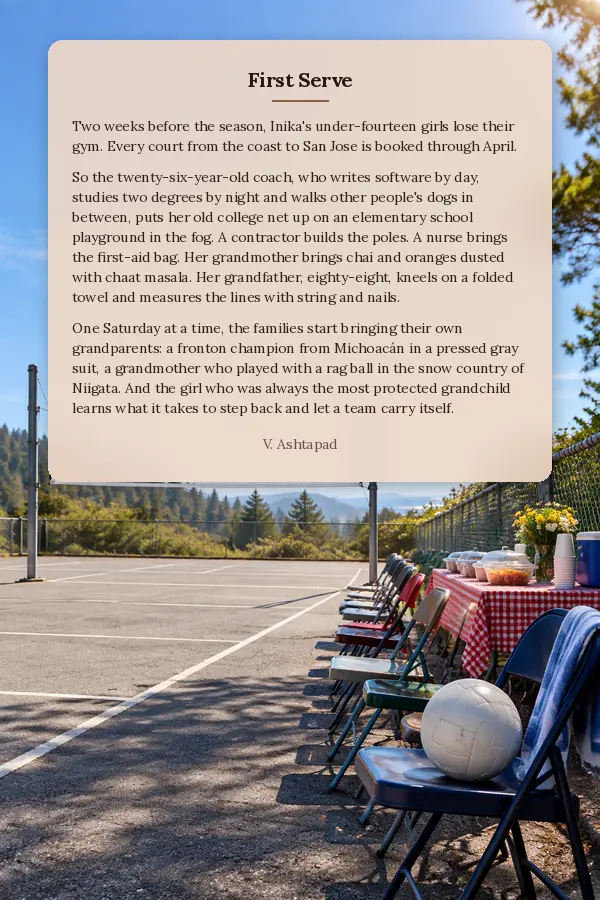
Two weeks before the season, Inika's under-fourteen girls lose their gym. Every court from the coast to San Jose is booked through April.
So the twenty-six-year-old coach, who writes software by day, studies two degrees by night and walks other people's dogs in between, puts her old college net up on an elementary school playground in the fog. A contractor builds the poles. A nurse brings the first-aid bag. Her grandmother brings chai and oranges dusted with chaat masala. Her grandfather, eighty-eight, kneels on a folded towel and measures the lines with string and nails.
One Saturday at a time, the families start bringing their own grandparents: a fronton champion from Michoacán in a pressed gray suit, a grandmother who played with a rag ball in the snow country of Niigata. And the girl who was always the most protected grandchild learns what it takes to step back and let a team carry itself.
Members can react to this book and talk about it in the members' Library.
Ownership
© 2026 CRUNOD LLC. All rights reserved.
This book is owned by CRUNOD LLC. It is free to read on EternalCurrent.Online. No part of it may be copied, reprinted, sold, recorded or adapted, including as audio, film or translation, without written permission from CRUNOD LLC.
© 2026 CRUNOD LLC. All rights reserved.