
Five Stops Before Midnight and Other Stories
Ten neon-lit stories of the 1990s, told after dark by the people who were there
by V. Ashtapad
Thirty-One Roofs
*This is Dex Moreau, and you're on the low end of the dial, where the signal used to come from a van parked behind a laundromat and now comes from a tower with a license and a lawyer. Same records. Same hour. Two in the morning, the city's sleeping with one eye open. Tonight's track is Miami, late summer 1992. A storm has come through the bottom of the county like a fist through a screen door. The power's out. The plywood's gone up to forty dollars a sheet. And somewhere in the dark, a man who already lost one home as a kid is about to go hunting for the person who stole his sister's roof. Lights low. Bass up. Here we go.*
* * *
*[SYNTH: A low pad, warm, like heat coming off asphalt. A single bell note, far back.]*
*[SOUND: Clack of dominoes being shuffled on a wooden table. Wind in a ficus. A bus hissing at a stop. Somebody's radio playing a bolero.]*
"Your turn, viejo."
"I know it's my turn. I'm thinking."
"You've been thinking for four minutes."
"At my age, four minutes is a short think."
Domino Park. Calle Ocho and Fifteenth, across from the old Tower Theater with its marquee. November 2026. I'm eighty. My partner is Daniel, twenty-eight, Venezuelan, an insurance claims adjuster with good shoes and bad luck at dominoes. He lives across the hall from me on Seventh Street. He brings me the newspaper because nobody else my age gets a newspaper anymore. I let him win sometimes. Today he's not winning.
"Double six," I say. Clack.
"You held that the whole game."
"I'm a patient man."
He looks at the board. Then at me.
"You know what I did today, Teo? Three roof claims in Cutler Bay. Old houses. Same contractor on all three. Took deposits, never showed. I hate those guys."
"Everybody hates those guys."
"You ever get hit by one?"
I put my tiles face down.
"Pass me that colada," I say. "And move your chair. This takes a while."
* * *
*[SYNTH: The pad drops a half step. A drum machine, soft, a heartbeat at eighty-five.]*
*[SOUND: Wind. Then more wind. Then something that isn't wind. A freight train with no track.]*
August 24, 1992. Five in the morning.
I was in my café. La Ceiba. A ventanita on Calle Ocho, a window to the sidewalk, six stools inside, a neon sign of a green palm tree and the name in pink script. I'd taped the glass in an X. Everybody taped the glass in an X. It doesn't do anything. You do it anyway.
The storm missed us. Mostly. Little Havana lost power, lost trees, lost a few roofs. We got the edge of the skirt.
Down south, it hit like a hammer. Homestead. Florida City. Cutler Ridge. Whole neighborhoods flattened like somebody sat on them.
My sister lived in Florida City.
*[SOUND: A phone. Dead. The click of a receiver jiggled. Nothing.]*
ME: Marisol. Marisol, answer.
No dial tone. No nothing.
I drove down in my Ford pickup at noon. The Turnpike was closed. I went down US 1. It took six hours to go thirty miles. Past Kendall. Past the turnoff for the Metrozoo, where the big aviary had come down and people said there were flamingos walking in the road.
*[SYNTH: Long, open chords. Cold. Then a thin arpeggio, climbing.]*
What did I see? I'll tell you what I saw, quick, because it doesn't need to be long.
Trees with no leaves. Not one leaf. Like winter in a country that doesn't have winter. Power poles snapped at the knees. Boats on the median. A billboard face down in a parking lot. Houses with no tops, open like boxes, and you could see inside, the beds, the pictures still on the walls. People standing in their front yards, just standing. Holding things. A lamp. A cat. A frying pan.
On the walls, spray paint. Their names. Their insurance companies. Their phone numbers. WE ARE OK. NEED WATER. DON'T TOUCH.
And the smell. Wet plaster. Pine sap from a million broken trees. Diesel. And in the heat, by the second day, the refrigerators.
* * *
Daniel is quiet. He's twenty-eight. He's seen the photographs. You don't see that smell in a photograph.
"Your sister," he says.
"She was alive. She was sitting on her front step in a nightgown and one shoe. Her son was next to her. Nico. Sixteen. Deaf since he was born. He'd slept through the whole thing."
"No."
"I swear. Slept through a Category Five. Woke up because the rain was on his face. The roof was gone. Over his bed, sky."
* * *
*[SOUND: Heat. Insects. A chainsaw far off. Helicopters. A generator somewhere, a tired rattle.]*
MARISOL: Teo.
ME: Mari.
MARISOL: You came.
ME: Of course I came.
MARISOL: It's the camp, Teo. You know that? Two miles that way. Where they put us.
I knew.
Let me back up. Ten seconds.
1962. Marisol was nine, I was sixteen. Our parents put us on a plane in Havana with one suitcase each. Thousands of kids, that year. Parents thought it would be a few months. The flights stopped. Our parents never got out. We grew up in a camp for kids like us, run by people who were kind, mostly, in Florida City. Wooden barracks under the pines. Tomato fields out past the fence. Mosquitoes the size of dimes. Rice and beans that tasted like a cafeteria. We learned English off a radio.
When Marisol got married, she bought a house two miles from that camp. Her husband said, why there. She said, because that's where we were kids together. He left in 1980. She kept the house.
Now the house had no lid.
MARISOL: Twice, Teo.
ME: What twice?
MARISOL: Twice I lost a house. Once when I was nine. Once today.
ME: You didn't lose it. It's standing.
MARISOL: It's standing like a man with no hat.
*[SOUND: Nico, signing. The small sound of hands moving fast — fabric, palms meeting. Then Marisol translating.]*
MARISOL: He says, Tío, can you fix it.
ME: (to Nico, slow so he can read my lips) I make coffee, mijo. I don't make roofs.
NICO (signing; Marisol): He says then we find somebody who does.
* * *
*[SYNTH: The heartbeat drum comes back. A bass line enters, walking.]*
The insurance came through fast for once. Mid-September. Nine thousand two hundred dollars for the roof. A check. Marisol cried over it in the cab of my truck.
And the next day there was a flyer on her mailbox.
*[SOUND: Paper. Taped to metal. Peeled.]*
SUNCOAST ROOFING & RESTORATION
LICENSED — BONDED — INSURED
ROOFS IN 10 DAYS
CALL DEE
And a pager number.
MARISOL: Ten days, Teo.
ME: Everybody's saying ten days.
MARISOL: Everybody's saying ten months. This one says ten days.
You have to understand. Every roofer in Florida was in Dade County that fall. And half of them weren't roofers. Guys from Georgia, Alabama, Ohio, with a truck and a ladder and a magnetic sign they bought at a gas station. Some were good. Some were thieves. You couldn't tell which until the money was gone.
Marisol paged the number. A woman called back in an hour. Voice like gravel in honey. Southern. Fast.
DEE (on phone): Ma'am, I can get you dried in with felt and plywood inside a week, shingles by the end of the month. Half up front for materials. Cash is better. Lumber yards won't take checks no more.
MARISOL: Half is four thousand six hundred.
DEE: Yes ma'am. I'll write you a receipt.
She did write a receipt. She came in a white Ford with Georgia plates and a ladder rack and a little girl asleep in the passenger seat. She was tall, sunburned, in a man's work shirt with the sleeves cut off, a carpenter's pencil behind her ear. She measured the roof. She shook Marisol's hand. She took the cash in an envelope.
That was September 18th.
She never came back.
* * *
*[SYNTH: Everything drops out but a single, sustained note. Then a sting — two notes, minor, a door shutting.]*
Daniel's put his tiles down too.
"Classic," he says. "Textbook. I see five of these a month."
"In 1992 you saw five a day."
"So what did you do? Police?"
"The police were busy. The police had a county with no roofs. A woman who lost forty-six hundred to a pager number was not a priority."
"So?"
"So I called Ernesto."
* * *
*[SOUND: A café at dawn. A coffee machine hissing. Sugar being whipped into espresso with a spoon, the fast tink-tink-tink of making espumita. A bell over a screen door.]*
Ernesto Lugo. Eighty-one years old in 1992. My best customer. Every morning at six-fifteen, at my window: one cortadito, one pastelito de guayaba, the Diario de las Américas folded under his arm. White guayabera, four pockets, pressed. Straw hat. A walking stick he didn't need.
Before 1959, Ernesto was a police detective in Havana. Homicide, then fraud. He came over in 1960. He'd been retired thirty years. He still looked at everybody like he was taking their fingerprints.
ERNESTO: Teodoro. You look like a man who has been robbed.
ME: My sister.
ERNESTO: How much?
ME: Forty-six hundred.
ERNESTO: Name?
ME: Dee.
ERNESTO: Dee. (sips) Dee is not a name. Dee is a letter.
ME: She left a receipt.
ERNESTO: Give it to me.
*[SOUND: Paper. A pair of reading glasses unfolding.]*
ERNESTO: Carpenter's pencil. Good hand. Not a thief's hand.
ME: How can you tell a thief's hand?
ERNESTO: A thief writes fast and pretty. This woman writes slow and ugly. She was doing arithmetic in her head while she wrote. Look. She crossed out the price for the felt and wrote it higher. She was checking what lumber cost that week. A thief doesn't care what lumber costs.
ME: So she's not a thief.
ERNESTO: I didn't say that. I said she's not a professional thief. Those are harder to find. They make more mistakes and they don't know where to hide.
* * *
*Dex here. Little station note. That week after the storm, a lot of the big stations were off the air down south. Towers down, power out. This station was still the van back then, a generator and a transmitter in the back and the laundromat's extension cord coiled on the floor, and for nine nights we sat in a parking lot in Kendall reading out names. Who's looking for who. Who's okay. Where the water trucks are. Ice at the high school. Somebody's grandmother's at the shelter on 152nd. No music. Just names. I've been doing this forty years and those were the best nine nights I ever worked. Okay. Back to the detectives.*
* * *
*[SYNTH: The bass line returns, a little faster. A hi-hat, closed, ticking like a cooling engine.]*
So we had a team. A coffee man. A retired Havana detective with a cane he didn't need. And a deaf sixteen-year-old.
ERNESTO: The boy comes.
ME: Nico? Why?
ERNESTO: Because he saw her. And because he sees things we don't. Ask him.
*[SOUND: Signing. Marisol isn't there. I'm slow. I'd learned some, not enough. Nico writes on a notepad instead. Pencil scratching.]*
NICO (writing; I read it aloud): Georgia plates. Number started KTR. Ladder rack welded, not bolted. A sticker on the back window: a peach and a fish. Little girl had a stuffed rabbit with one ear. Woman had a scar on her left thumb. She chewed the pencil when she thought.
ERNESTO: (long pause) Hire this boy.
* * *
*[SOUND: Truck engine. Window down. Heat. A radio — Dex's van, reading names. Static. A name. Another.]*
We drove. Five days. Every day after I closed the window at two. My truck, the three of us, a cooler of water and a bag of croquetas from my case.
We went to lumber yards. That was Ernesto's idea.
ERNESTO: She is not a professional. So she didn't take the money and run. She took it and tried to buy wood. Where do you buy wood in Miami this month?
ME: Everywhere.
ERNESTO: Where do you buy wood if you have Georgia plates and no account?
That narrowed it to the yards that took cash. Four of them. Hialeah. Medley. Two on Okeechobee Road.
*[SOUND: A lumber yard. Forklift beeping. A saw. A man with a cigar voice.]*
YARD MAN: White Ford? Georgia? Tall lady? Yeah. She was here. Three weeks ago. Bought sixty sheets of half-inch ply, cash, and twenty rolls of felt. Came back a week later to buy more and I told her it was up twelve bucks a sheet. She looked at me like I shot her dog.
ERNESTO: You raised it twelve dollars in a week.
YARD MAN: Everybody did. Supply and demand, pops.
ERNESTO: (quiet) I have a different word for it in Spanish.
YARD MAN: She paid, though. Half of what she wanted. Then she came back the third time and I told her it was up again and she just walked out. Didn't say nothing.
ME: You know where she went?
YARD MAN: She asked me where the shelters were. Said she was staying in her truck.
*[SYNTH: A minor chord, held. A single high note bends down.]*
* * *
"Staying in her truck," says Daniel.
"Her truck."
"With the kid."
"With two kids. We found that out later."
* * *
*[SOUND: Night. A huge parking lot. Crickets. A sodium-vapor light, buzzing. Somewhere a generator. A child coughing.]*
Day five. Ernesto had a feeling about the Kmart in Cutler Ridge. Half the store was gone. The parking lot was a town. Trucks, tents, cars with towels in the windows. Red Cross table. National Guard Humvee at the corner. People cooking on grills on the asphalt.
We drove slow, rows and rows.
Nico grabbed my arm.
NICO (signing; one sign; I knew it): Peach.
The sticker. A peach and a fish. White Ford, ladder rack welded, not bolted. Georgia. KTR.
A blue tarp tied off the ladder rack to a shopping cart, making a little roof. Under it a camp stove. A little girl, maybe six, with a stuffed rabbit with one ear. A boy, maybe ten, reading a comic book by a flashlight. And a tall woman sitting on an upturned bucket, sunburned, in a man's work shirt, chewing a carpenter's pencil, doing arithmetic on the back of a flyer.
*[SYNTH: Everything drops out. Just the buzz of the light. Let it run.]*
* * *
ME: Dee.
*[SOUND: The bucket scrapes. She's standing.]*
DEE: Who's asking?
ME: Teodoro Valdés. Florida City. My sister. Forty-six hundred dollars.
DEE: (a long breath out) Kids. In the truck.
BOY: Mama—
DEE: In the truck, Wade. Take your sister. Lock it.
*[SOUND: Truck doors. Locks.]*
ERNESTO: Señora. We are not police.
DEE: Then what are you?
ERNESTO: A coffee man, a retired policeman and a boy who notices peaches.
DEE: You came to get your money.
ME: Yes.
DEE: I don't have it.
ME: Then where is it?
DEE: (she points; up; we look) On the truck.
*[SOUND: A tarp flapping. Under it, the creak of a load.]*
On the ladder rack. Under the blue tarp. Forty sheets of half-inch plywood, strapped down. Twelve rolls of felt. A box of nails. A nail gun with no compressor.
DEE: That's yours. That's your sister's roof. And Mrs. Pérez on Sixth, and the Thompsons, and the old man with the parrot on Krome. Six houses. Six deposits. I bought the wood with every dollar. Then the price doubled. Then the compressor got stolen out of the bed the second night. Then my nephew who was gonna help me went back to Valdosta. And I'm one woman with two kids and a roof's a two-man job at the least, and I couldn't face y'all.
ME: So you hid.
DEE: I hid in a Kmart parking lot. Real smart.
ME: You could have called.
DEE: And said what? Ma'am, I got your wood but I can't lift it? You think I don't know what people say about out-of-state roofers this month? You think I didn't see the spray paint? (quiet) My trailer was in Homestead. Leisure City. There's nothing there. There's a slab. I came down from Georgia eight years ago after my husband died. I got roofing from my daddy. I'm good at it. I just — ran out.
*[SOUND: Nobody speaks. The light buzzes. A dog barks a few rows over.]*
* * *
Here's the thing, Daniel. I had my speech ready. All the way down US 1 for five days, I had my speech. Thief. Shame. My sister. The camp. Twice she lost a house.
And Ernesto put his hand on my arm. Old hand. Dry. Like paper.
ERNESTO: (low, Spanish) Teodoro. Let her finish. Every word. Then you talk.
So I did. I sat down on her bucket. She sat on the tailgate. And I asked her one thing.
ME: What would you need? To do the six roofs.
DEE: (she laughs; not a good laugh) A compressor. Two men who aren't afraid of heights. Food for the kids. And about nine more days than God gave me.
ME: I don't have God's number.
DEE: Nobody does this month.
ME: But I have a truck. And a café. And a nephew who sees everything. And a man who knows everybody in Little Havana over seventy, which is everybody in Little Havana.
ERNESTO: (dry) Ochenta y uno. I am the youngest of my friends.
* * *
*[SYNTH: The drum comes back, full. Bass, chords, a bright lead line — a sunrise in eight bars.]*
*[SOUND: Hammers. Many hammers. A nail gun, thump-hiss, thump-hiss. Men shouting in Spanish. A woman shouting in Georgia English. A transistor radio. Dex, reading names.]*
October 1992.
Ernesto made eleven phone calls from my café's pay phone. Eleven old men in guayaberas who had been carpenters in Matanzas, Cienfuegos, Camagüey. A retired sugar mill mechanic who found a compressor. A cousin of a cousin who had a cousin with a flatbed. My café became headquarters. Every morning at six I made ninety cafecitos in little paper cups, a cooler of croquetas, pan cubano with butter, café con leche for the kids. We drove south in a convoy at seven.
Dee ran the roof. She ran it like a general. Seventy-year-old Cuban men who had never taken an order from a woman in their lives took orders from a sunburned widow from Valdosta, Georgia.
DEE: Señor Álvarez, that felt overlap is four inches, not two.
ÁLVAREZ: (Spanish) In Matanzas we did two.
DEE: In Matanzas you didn't have a Category Five.
ÁLVAREZ: (long pause) Cuatro.
Nico was on the roof too, with a harness made of a moving strap. He couldn't hear the hammers. He could feel them through the plywood. He'd put his palm flat on the deck and tell Dee where a sheet was loose before anybody else could see it.
DEE: How'd he know that?
ME: He listens with his hands.
Marisol's roof was first. Nine days. When the last sheet of plywood went on over Nico's bed, he lay down on it, flat, on his back, in the sun, and didn't move for ten minutes. Nobody bothered him.
Then Mrs. Pérez. Then the Thompsons. Then the old man on Krome with the parrot, who swore at us in two languages the whole time, the parrot I mean. The man just cried.
Six roofs. Then somebody's cousin. Then somebody's cousin's neighbor. Dee didn't take a deposit for any of them. People paid when it was done. Some paid in cash. Some in food. One family paid in a goat, which Ernesto took, because he said his grandmother had always wanted one.
By Christmas: thirty-one roofs.
* * *
*[SYNTH: The lead line fades. Just the pad again, warm. A clock ticking somewhere in the mix.]*
*[SOUND: Domino Park again. The ficus. A bus. Dominoes, unattended.]*
Daniel hasn't touched his colada. It's gone cold. In this city that's a crime.
"Teo," he says. "That's a hell of a story. But what happened to her? Dee?"
"Ah."
"She go back to Georgia?"
"No."
"She keep roofing?"
"For twenty-two years. She had a license by 1994. Real one. Bonded. She did half the roofs on this block after Wilma."
"You stay in touch?"
I don't answer. I'm looking past him. Down Calle Ocho, toward the gate of the park.
*[SOUND: Footsteps. A woman's, slow, with a cane that she does need. A plastic bag swinging. A voice, gravel in honey, gone a little thin.]*
DEE: Teodoro Valdés. You took your pills?
ME: Not yet.
DEE: It's four o'clock.
ME: I was telling a story.
DEE: (sitting down, heavily, on the bench next to Daniel) Which one?
ME: The roof one.
DEE: (to Daniel) Did he tell you I was a thief?
DANIEL: (careful) He said you were... not a professional thief.
DEE: (she laughs; a big laugh, a roofer's laugh) That's Ernesto's line. God rest him. He stole that from a movie.
*[SYNTH: A single bell note. Bright. Like a neon sign coming on.]*
* * *
"Daniel," I say. "Meet Delia Pruitt Valdés. My wife. Thirty-two years this June."
Daniel looks at her. Looks at me. Looks at the dominoes.
"You married the suspect," he says.
"I married the suspect," I say. "She refused the first three times. Said it was a conflict of interest."
DEE: It was. You were my biggest creditor.
ME: I forgave the debt.
DEE: You forgave it in installments. One cafecito at a time. Every morning for a year, at six, I came to that window to drive the crew south, and every morning there was a cafecito on the counter and the receipt for your sister's deposit underneath it with one more line crossed out.
ME: Forty-six hundred dollars. Eighteen cents a cafecito, cost. It would have taken seventy years.
DEE: So I married him to save time.
*[SOUND: Daniel laughing. Dee laughing. A man at the next table yelling at his partner about a double five.]*
* * *
She learned Spanish. Badly, then well. Marisol says she still cooks black beans like a woman from Georgia, with too much onion and a ham hock, and Marisol eats two plates every Sunday. Wade's a firefighter in Broward. Lily, the girl with the rabbit, teaches third grade in Hialeah and still has the rabbit. One ear.
And Nico.
*[SOUND: A phone, buzzing on the domino table. A video call chime.]*
DEE: That's him. He wants to know if you've told it yet.
She turns the phone so I can see. Nico. Fifty years old. Gray in his beard. Signing, fast, grinning. I know enough now. I've had thirty years.
NICO (signing; I read it out for Daniel): Did you tell him about the map?
ME: Not yet.
NICO (signing): Tell him.
* * *
So here it is, Daniel. Nico made a map. Years ago. Just for the family. Every roof. Thirty-one pins, Florida City to Cutler Ridge to Krome Avenue. Each one with a photograph of the house before, the house after, the people standing in front of it. Dee's voice on some of them, explaining what went wrong with each roof and how they fixed it, the way her father explained it to her. Ernesto's voice on one, reading the receipt out loud and saying, slow and ugly, not a thief's hand. The camp is on the map too, the old barracks site, the place two miles from Marisol's where two kids from Havana learned English off a radio. Nobody outside the family can see it. Nico decides who. He put the old man with the parrot's grandson on the list last year. The parrot is dead. The grandson cried.
DANIEL: Can I see it?
ME: (to the phone) Can he see it?
*[SOUND: Signing. A pause. Then the phone buzzes. A message coming through.]*
DEE: He says you can see one pin.
DANIEL: Which one?
DEE: (looking at the phone; slowly, reading) The Kmart parking lot. Cutler Ridge. Row J. He says that's where the family started.
*[SYNTH: The full track comes back, the whole thing, bass and drums and chords and that bright lead, for eight bars. Then it pulls back to the pad. Then just the bell.]*
*[SOUND: Dominoes. Clack. Shuffle.]*
DEE: Your turn, viejo.
ME: I know it's my turn.
DEE: Take your pills first.
ME: I'm thinking.
DEE: You've been thinking for thirty-two years.
* * *
*Dex Moreau, still here, still low on the dial. Storms come every year down there. The part I keep turning over is smaller: an old detective putting his hand on a man's arm and saying let her finish. Most of the stories I've played on this station in forty years would've gone differently if somebody had said that. And I'll tell you, somewhere along that same Gulf, a year before Andrew, somebody came home from a desert war to a town that hadn't moved an inch and had to learn to stand in it again. No hurricane. Just the quiet after. They'd have known that parking lot on sight. Keep your radio on when the lights go out.*
© 2026 CRUNOD LLC. All rights reserved.
Five Stops Before Midnight
*This is Dex Moreau, and you're riding the late frequency, the one that used to live in a van behind a laundromat with an antenna lashed to the drainpipe and now pays its taxes like a good citizen. It's the hour when the city sheds its daytime skin. The traffic lights keep blinking for nobody. Somewhere a kettle is going in a kitchen that never closes. Tonight we're heading to Hong Kong, June the thirtieth, 1997, the last night of one era and the first minutes of another, with rain coming down like somebody upstairs kicked over a bucket of nails. There's a red taxi, a woman behind the wheel, an old man in a linen suit, a box tied with red string, and a black car that won't stop following. Lock your doors. Let's roll.*
* * *
Three a.m. in Jordan, Kiki, and this place is still open. Fifty years it's been open. Same green tiles. Same booths with the red seats split and taped. Same ceiling fan that goes whup, whup, whup, like a helicopter that gave up. Same old waiter, look at him, he was a young waiter when I started coming here, now he's older than the menu. He doesn't ask anymore. He sees me, he brings it. Milk tea, silk-stocking, strong enough to stand a spoon in. Pineapple bun with the butter slab in it, cold butter, hot bun. You want one? Have one. You're working all night. You drive more than I ever did, with your phone telling you where to go. I had to know. I had to have the whole city inside my head like a map tattooed on the back of my eyes.
Turn the thing on. The recorder. Your phone. Yes. Your father said you're keeping it, for the family. Fine. I said yes, didn't I? Then it's yes. Put it on the table between the teacups so it can hear.
You asked about the bangle. The one on your wrist. You asked where it came from and your father didn't know the whole thing, because I never told him the whole thing. I never told anybody. I was waiting for the right night. Look out there. Nathan Road in the rain. That's the right night. It always looks like the last night of something.
* * *
June thirtieth, 1997. I was fifty-three years old and I'd been driving a taxi for twenty-two years. Red one. Kowloon red. Toyota Crown, roof light, the meter clicking on the dash with its little green numbers, the seats covered in that clear plastic that sticks to the back of your legs in summer. I drove nights. Eight to six. Always nights. Nights were cleaner. Daytime it's all banks and businessmen and housewives with shopping, all horns and hurry. Night it's the real people. Nurses. Dancers. Cooks going home with their hands smelling of ginger. Sailors. Gamblers. Lovers who don't want to be seen. Drunks who cry. You learn the whole song of a city at night, and the thing about the song is it keeps going after you get out of the car.
I was one of only a handful of women driving taxi in Kowloon in those days. Men said things. Let them. I knew the streets better than they did. I knew the back way from Mong Kok to Hung Hom when the Chatham Road was jammed. I knew which noodle stall in Sham Shui Po would give you a bowl at four in the morning for a ride home. I knew the alley behind the Ladies' Market where you could park for ten minutes and nobody would ticket you. I knew Nathan Road like a lover's back. Every bump. Every scar. Every neon sign hanging out over the road, all the way up, a mile and more of them, pawnshops and jewelers and dance halls and herbal tea, red and gold and blue and green, stacked up into the sky on iron arms so thick and so low that the double-decker buses had to duck their heads to get through.
Oh, the neon, Kiki. You don't know. You've got the screens now, the LED, all bright and dead and white. Back then the neon hummed. You could hear it. Stand under a sign on Shanghai Street at two in the morning when the traffic stopped and you could hear it humming over your head, a hundred signs humming, a low note like a whole orchestra holding its breath, and the color fell down on the wet road in long stripes that broke up every time a car went through.
That night the rain was so hard the stripes didn't hold still at all. Just color. Running. Like a painting somebody left out.
* * *
Eight forty p.m. Tsim Sha Tsui. The rank by the Star Ferry, under the old clock tower, all that was left of the railway station. The harbor on my right was black and full of lights, ships everywhere, police launches, a big warship sitting in the middle with all its lamps on. On the other side the island, Central, Wan Chai, the towers all lit up and the giant lights they'd hung on the buildings for the night, the dragons and the flowers in bulbs, all of it smeared by the rain into one big glowing bruise. And the people. Everybody in the city was out. Umbrellas so close together they made a roof. Kids in plastic ponchos. Old men with transistors held to their ears. Couples. Tourists from everywhere taking flash pictures of the rain.
I was fourth in the line. I watched the three cabs ahead of me load up and go. Then it was my turn, and an old man stepped up to my door.
Not my back door. My window. He knocked on my window with one knuckle, very polite, tap tap, and I wound it down and the rain came in.
He was seventy-five, maybe. Small. Upright. White linen suit, wet through on the shoulders, and a panama hat with the brim dripping, and a face like a walnut, and very clean round glasses. And under his arm a box. Cardboard. About the size of a shoebox for boots. Tied up with red string, the thin red string they use in the market to tie up cakes, wound round and round and knotted on top in a bow.
He said, "Are you Chan Siu-wan?"
You don't get asked your name at a taxi rank. Not ever.
I said, "Who's asking?"
He said, "A man who needs five stops before midnight. I'll pay you for the whole night. Whatever the meter says, three times."
And he got in the back.
* * *
*Synth comes in low here, a long minor chord with a little filter sweep on it, the sound of a city with its collar turned up. Because, listeners, I've been in this business forty years, and when somebody knows your name before you've said it, the song has already started. You just haven't heard the first verse.*
* * *
"Where to?" I said.
"Wan Chai," he said. "Lockhart Road. Near the corner of Luard."
So I went. Through the tunnel. Cross Harbour, under the water, the orange lights going by overhead whap whap whap like a drum count-in, and the radio on, the radio station playing Canto-pop, some boy singer with his heart broken in a key change, and the DJ breaking in every five minutes to talk about the ceremony, the guests, the flags, the countdown, the rain. Always the rain. Everybody talking about the rain like it meant something.
And in my mirror, two cars back: a black Mercedes. S-class. Tinted windows.
I didn't think anything. Lot of black Mercedes in Hong Kong. Like rice.
Came out of the tunnel. Up Canal Road. Into Wan Chai.
Wan Chai at night, Kiki. That was the dirty-beautiful part of the city. Lockhart Road, Jaffe Road, Luard, Fenwick, all the little streets running down to where the harbor used to be before they filled it in. Bars. Clubs. Topless-this and Happy-that, the signs in English for the sailors, pink and purple and acid green, CLUB MANHATTAN, BAR SUZIE, a cowboy with a lasso that went round and round in red tubes, a cocktail glass with bubbles going up it in blue and down again. The smell of beer and frying squid and rain on hot pavement. And that night it was packed, every bar door open and spilling music, sailors from the warships, journalists from all over the world in their sweaty shirts with their press cards around their necks, English boys in suits singing.
He said, "Stop."
I stopped. In front of a building site. Hoarding all round it. Blue boards. A crane over it.
He said, "There used to be a ballroom here. The Golden Crane. 1952 to 1979. Upstairs. A band in white jackets. Twelve-piece. They played the cha-cha and the tango and the slow foxtrot. The floor was wood from Borneo."
I said nothing. The meter went click.
He got out. In the rain. With his hat. Without the box, he left the box on the seat. And he stood in front of the blue boards for about two minutes, looking up at nothing. At the crane. At the dark. At where a window used to be.
Then he took something out of his inside pocket and pushed it through a crack in the hoarding. Small. Paper. And got back in.
"Kowloon City," he said.
I looked at the box on the seat beside him. I looked in the mirror. The black Mercedes was parked fifty feet back, lights off, engine on, you could see the exhaust going up white in the red light of the cowboy sign.
* * *
Now I'm going to tell you what I was thinking, because you should know your grandmother wasn't a saint.
I was thinking: this old man is carrying something. Money, maybe. Drugs, maybe. Something he shouldn't. Tonight of all nights, when everything is about to change hands and every old man with a past in this city is either burning papers or moving them. And the Mercedes is the people he owes it to. And he's dropping little bits of paper in holes in walls. Signals. And somewhere along the line, I'm going to be the one in the middle when they stop the car.
And I was thinking: but he knows my name.
So I did what any taxi driver in Hong Kong did when she didn't like a fare. I picked up the radio handset. The company radio. And I said our code. Seven-seven-four. Which meant, I'm fine for now but if I don't call back in an hour come looking. The dispatcher, a fat man called Lo who ate dried squid all night, said "Seven-seven-four, heard, Ah Wan," with his mouth full.
The old man in the back said, "That's very sensible."
I nearly drove into a bus.
* * *
Kowloon City. Back through the tunnel. Up through Hung Hom, past the station, past the stadium. Up Prince Edward Road with the rain hammering the roof like a snare drum played by somebody angry. And the planes. You remember Kai Tak? No. You were born after. The old airport, right in the city, the runway stuck out into the harbor like a tongue, and the planes came in over Kowloon City so low, Kiki. So low. Over the rooftops. Over the washing hanging on the poles out the windows. You could read the writing on their bellies. Jumbo jets. Coming in at night with their lights on and their wheels down, roaring, the whole street shaking, the glass in the shop windows humming, people on the roofs not even looking up anymore. That night, with the rain, they came in out of the clouds like ghosts of whales.
He said, "Stop here."
Tung Tau Tsuen Road. The edge of the park.
You know the park. The Walled City Park. It's all gardens now, pavilions, ponds with fat goldfish, a little stone path. Before that, until a few years before that night, it was the Walled City. Thirty thousand people. One block. Buildings stuck together so tight and so tall the sun never touched the alleys. Water pipes dripping everywhere. Dentists without licenses. Fishball factories. Noodle makers. Children going to school down alleys so dark they carried torches at noon. A city inside a city that nobody governed. They knocked it down in '93. Made it a garden. Opened the garden in '95.
The old man got out. Box under his arm this time. He walked into the park through the gate, in the rain, past the sign, and he went about twenty steps in and stopped by a stone. Just a stone. In a flower bed. And he stood there with a plane going over, so low, so loud, the red light on its tail blinking off and on over his white hat.
The Mercedes pulled in behind me. Lights off. Engine on.
I got out.
I don't know why. I got out of the cab in the rain and I walked back to the Mercedes, and I knocked on the driver's window, tap tap, like he'd done to me. And the window came down a crack.
A man. Late twenties. Glasses. Suit. A face like the old man's face with the years pressed out of it.
I said, "What do you want?"
He said, "Please, auntie. Don't lose him. He doesn't know I'm here."
And the window went back up.
* * *
*Hear that? That's the bass line dropping in, a fretless bass, walking down, walking down. Because now we've got two people in two cars who both know more than she does. In my experience, folks, the person who knows the least in a story is the one the story's actually about.*
* * *
The old man came back. Wet to the bone. He got in. He took off his glasses and wiped them on a handkerchief that was already wet and put them back on, which did nothing.
"Yau Ma Tei," he said. "Temple Street. Then Sham Shui Po. Then we're finished."
I didn't move the car.
I said, "Who are you?"
He said, "My name is Ho Kam-cheung."
I said, "That doesn't mean anything to me."
He said, "No. It wouldn't. I worked for your father for eleven years. I was the tailor's assistant. I cut the cloth. Your father did the fitting. When you were small you came into the shop after school in your blue uniform and did your homework under the cutting table. You had a pencil case with a cat on it. You called me Uncle Cheung."
And something went cold in me. Colder than the rain.
Because I knew that name. Ho Kam-cheung. Uncle Cheung. I'd heard it all my life. Every New Year, every family dinner, every time my father had too much to drink, which was every time, my father said it like spitting out a fishbone.
Ho Kam-cheung. The thief.
* * *
I'll tell you what I knew, Kiki. What I'd always known.
My father had a tailor shop on Ki Lung Street. Sham Shui Po. You know Ki Lung Street. All fabric. Buttons. Lace. Zips. Ribbon on big wooden spools. Rolls of cloth stacked up in the shopfronts to the ceiling, silks and wools and polyester, that smell of sizing and dust and the dye in new cotton. My father, Chan Wing, made suits. Good suits. For businessmen, and then for the businessmen's sons, and he had one assistant, a quiet young man from the Walled City who could cut a jacket pattern with his eyes closed. Ho Kam-cheung.
And in 1967, the summer of the riots, when there was trouble in the streets and the city was frightened and nobody went out after dark, one night the shop's cash box went missing. Everything the shop had. Three years of savings, in the cash box, because my father didn't trust banks. And my mother's jade bangle, her wedding bangle, from her mother, green as the inside of a lime, that she'd put in the box for safekeeping because of the trouble.
And Ho Kam-cheung was gone the same night. Gone to Macau, people said. Never came back.
My father lost the shop by Christmas. He couldn't pay the rent. He went to work for another tailor, in Mong Kok, as a fitter, at somebody else's mirror, for the rest of his life. He drank. My mother never forgave him for keeping the money in a box. He never forgave Ho Kam-cheung. And I grew up in a flat in Shek Kip Mei hearing that name like a curse word.
That's who was sitting in the back of my taxi with a box tied in red string.
* * *
I said, "Get out of my cab."
He said, "Please, Ah Wan. Two more stops."
I said, "You're a thief."
He said, "Yes. That's what he told you."
And then he said, "I'll pay you three times the meter, and you can throw me out at Ki Lung Street, and you'll never see me again. But I'd like to go to Temple Street first. I'd like to eat. I haven't eaten all day. And it's the last night."
And I don't know why. Maybe because he said the last night. Maybe because it was raining so hard. Maybe because his son was sitting fifty feet back in a Mercedes with the engine running, looking at his father the way you look at a candle in a draft. Maybe because I was fifty-three and tired and I'd been carrying my father's fishbone in my own throat for thirty years.
I put the cab in gear.
* * *
Temple Street. Yau Ma Tei. Nine fifty p.m.
The night market, Kiki. You've been. It's for tourists now, but then it was still ours, mostly. The stalls with their green and red canvas roofs all down the middle of the street, so tight together the rain ran off one onto the next, a river of rain going down the gutter between the canvas. Bare bulbs on wires. Fake watches, real knives, cassette tapes, T-shirts with the date printed on them, cheap ones, HONG KONG 1.7.97, all the same, with a flag on them, they'd been selling them for a month. The fortune tellers with their little birds in cages. The Cantonese opera singers at the top end under a tarp with a two-string fiddle sawing away, an old woman singing in that high voice like a needle going through silk. And the food. The clay pot rice on the charcoal, the rice crackling at the bottom of the pot, the lap cheong sausage fat dripping through. Fried oysters in egg. Crabs in a mountain of fried garlic. Fish balls on sticks. The smoke. The smoke from the woks going up into the rain and the neon on the buildings above, the pawnshop signs, the big bat with the coin in its mouth, glowing red, so that the smoke went red and pink and gold as it rose.
We sat at a plastic table under a canvas with the rain coming through in drips. Clay pot rice for two. He ate very slowly. He scraped the burnt bit from the bottom of the pot with his spoon the way old people do, because that's the best part, the crunch.
The son was at the next stall. Pretending to look at watches. He'd bought one. He was holding it in his hand, not looking at it.
And Mr. Ho told me.
* * *
He said, "July 1967. The night of the twelfth. There had been bombs that week, and nobody was out after dark, and your father came back to the shop after dark, which he shouldn't have done. He was very frightened. He said, Cheung, the landlord's men came today. They know about the cash box. They'll come back. With the trouble in the streets nobody will stop them, nobody will even notice. Take it. Take the box. Take it to Macau. My cousin is there. Keep it with him until things are quiet. I can't go, I have the shop, I have my wife and my daughter. But nobody will look for you. You're nobody."
He said, "I was nobody. That was true. So I went. That night. On a fishing boat out of Aberdeen with a man who didn't ask questions. And I gave the box to your father's cousin in Macau. And the cousin. The cousin."
He stopped.
"The cousin gambled it," he said. "On the floating casino. Fan-tan. Over three weeks. Everything. Except the bangle. I took the bangle back from him with my own hands before he could pawn it."
I didn't say anything. The opera singer at the top of the street went up and up and up into a note so high it broke.
"I wrote to your father. He wrote back once. He said: never come back. If you come back I'll tell the police you stole it. Because that's what I'm going to tell my wife. That you stole it. Because I can't tell her I gave our whole life to a gambler. Better a thief than a fool. Do you understand? Better that she hates you than hates me."
He put his spoon down.
"I understood. I was nobody. I stayed in Macau. I married there. I had a son. Then later, in '78, I came back, quietly, and worked for a tailor in North Point." He nodded very slightly at the man at the watch stall. "I paid back the cousin's debt for him, so the moneylenders would leave your father alone. It took me twelve years. Your father never knew it was me. And I kept the bangle. And I kept saving. Every month. In a box. Because I don't trust banks."
He almost smiled.
"And then your father died. In 1989. And I thought, now. Now I'll go to the daughter. And I couldn't. Because I was still the thief. Every year I said, next year. And then they told us the date. The thirtieth of June. The last night. And I thought, Cheung, you're seventy-two years old. Everything in this city is about to change its name and its flag and its coins and its stamps. If you don't put this back where it belongs tonight, you'll be a thief in the new city too."
* * *
*Here's where the synth line opens up, the arpeggio rising, notes chasing each other up a ladder in the rain. Because listen. Somebody has carried a lie for thirty years so a dead man could keep his pride. That's not a crime story anymore. That's something else. I just don't have a word for it on a weeknight.*
* * *
Ten past eleven. Sham Shui Po.
The rain had got worse, if you can believe it. The gutters were overflowing onto the road. The wipers couldn't keep up, they went whum-whum, whum-whum, like a heartbeat in a hurry, and the street lights came through the windscreen in long smears. Lai Chi Kok Road. Cheung Sha Wan Road. Apliu Street with the electronics stalls shut, metal shutters down, the old men sitting on stools under the awnings with their radios. Every radio in the city tuned to the same countdown. You could drive down any street and hear the same voice through every open window, the same commentator, so it felt like the city was one big room.
Ki Lung Street. I hadn't been there in years. I avoided it. It looked the same. Of course it looked the same. The shutters down on the fabric shops, but the signs still up, the old signs, painted wood and faded neon, BUTTONS, LACE, WOOL, in Chinese and English. The smell of wet cloth even through the closed doors. Bolts of it inside behind the shutters like sleeping animals.
Number forty-one. My father's shop.
It was a zip shop now. A zip and button wholesaler. Metal shutter down, with a padlock, and above it, the iron bracket where my father's sign used to hang. Chan Wing Tailor. The sign was long gone. The bracket was still there. Rusted. Sticking out into the rain.
I stopped the cab. Eleven twenty-one.
He got out. With the box. He went and stood under the awning of number forty-one, out of the rain. I got out too. I stood beside him. The son's Mercedes pulled up across the street and stopped, and this time the son got out too, and he stood there in the rain without an umbrella, the water running off his glasses, not coming any closer.
Mr. Ho untied the red string. It took him a long time. His fingers were wet and old. Then he opened the box and held it out to me.
Money. Rolls of it. Hong Kong dollars in rubber bands, the old notes, the ones with the lion and the bank on them, thick rolls, and some new notes. And on the top, in a fold of yellow silk, my mother's bangle.
Green as the inside of a lime. I'd last seen it on my mother's wrist when I was twenty-three, at the dinner table, the night before the box was gone.
And under the bangle, a piece of paper. Folded in four. Old. Soft as cloth. I opened it with the rain running down my arms. And it was my father's handwriting. My father's square, careful tailor's hand, that wrote measurements in a little book. A receipt.
Received from Chan Wing, for safekeeping, one cash box, contents HK$11,400 and one jade bangle. To be returned on demand. Ho Kam-cheung. 12 July 1967.
And on the bottom, in my father's hand:
Thank you, Cheung. You're a better man than me.
* * *
Kiki. Look at me. I'm an old woman crying in a cha chaan teng at three in the morning and the waiter's pretending not to see. He's very kind. He's always been kind.
I stood there. Under the awning of a zip shop on Ki Lung Street. With thirty years of my father's lie in one hand and my mother's bangle in the other. And the radio in somebody's flat up above, through an open window, started counting down.
Ten. Nine. Eight.
The rain didn't stop. That's what I remember. In the films, it would have stopped. It didn't stop. It came down harder.
Three. Two. One.
And far away, over the harbor, behind all the buildings, a sound came up. Ships' horns, I think. Voices. Car horns. A roar like a stadium on the far side of a hill. We couldn't see anything, there were too many buildings, only the low clouds lit orange from underneath. And the sound came up the streets rolling, rolling, off all the walls, and every dog in Sham Shui Po started barking, and somebody upstairs was cheering and somebody upstairs was crying, and I couldn't tell you who was doing which.
It was a new day. New flag on the buildings. New name on the stamps. Same rain.
Mr. Ho took off his panama hat. He held it over his chest.
He said, "Now it's returned."
* * *
I put the bangle on. Right there. My hand was wet and it slid over the knuckles like it had been waiting.
The money I didn't want. I tried to give it back. He wouldn't take it. His son came across the street then, finally, and put his arm around his father, and said to me, "Please, auntie. He's been saving it since before I was born. If you give it back he'll just start saving it again." And then he said, "Thank you for not losing him."
They went home in the Mercedes. I never saw Mr. Ho again. He died in 2001. The son wrote to me. He said his father had told the whole story only once, to him, that night, in the car going home, and then never again.
I put the money in the bank. Yes. I trusted banks. I'm not my father. It paid for your father's school, Kiki. Your father, my Ming, who I took into my house when he was four after my sister passed, and who never once in his life called me anything but Ma. And it paid for a little of yours.
* * *
And the bangle's on your wrist now.
I gave it to you at your graduation and you said, "Ma-ma, it's beautiful, where's it from?" and I said, "Ki Lung Street," and you laughed because you thought I was making a joke about the markets.
So. Now it's on your recorder. The whole thing. And the receipt, I'll give it to you tonight. I keep it in my purse. I've moved it from purse to purse for twenty-nine years, and every purse I've thrown away smelled a little of that wet cardboard box.
And you know that thing you do on the computer, with the pins? The map? Put five pins on it for me. Lockhart Road where the ballroom was. The stone in the Walled City park. The clay pot table on Temple Street. Forty-one Ki Lung Street. And the taxi rank under the clock tower, where an old man knocked on my window and knew my name.
* * *
Drink your tea. It's gone cold. He'll bring another.
No, wait. Turn the recorder off a second.
Look out the window. Nathan Road.
There. Above the pawnshop. The last of the old signs on this stretch. The bat with the coin. Red tubes. It's been switched off for years. They're taking it down next month, did you know? For the museum.
Listen anyway.
No, you won't hear it. You never heard it hum, so you can't. I can. Every time it rains, I stand under a dead sign and I hear the whole of Nathan Road holding its note. That's what being old is, Kiki. You hear the wires that aren't on.
Okay. You can turn the recorder back on now. Tell it the time. Tell it the rain. And tell it your grandmother said it's returned.
* * *
*So that's the hour, night owls. That's the rain. I keep a short list of nights like that one. On it there's another city, colder, a few years earlier, where the old order had just packed its bags, and somebody sat up till dawn behind a little lit window minding a suitcase for a stranger, not knowing yet whose life was inside it. Every city gets its last night. Somebody always spends it settling up. Keep it on this frequency. Keep your wipers going. This is Dex Moreau, and the city's all yours.*
© 2026 CRUNOD LLC. All rights reserved.
Leave the Lamp Burning
*This is Dex Moreau, and it's that hour. You know the one. The streetlights have that orange buzz, the last bus has gone, and the only people still up are the ones with something on their minds and the ones getting paid to keep them company. I've been the second kind for a long time. Tonight's track comes out of Johannesburg in April of 1994, the week a whole country stood in line to do something it had never been allowed to do. There's a brother with too much money. There's a sister who thinks she knows where it came from. And there's a song. There's always a song. Lights low. Here we go.*
* * *
*Leave the lamp burning, Mama, leave it low,*
*I'm coming the long way, the way the rivers go.*
"You hear that?" says Nomvula Khumalo. "That little catch, right before 'low'? That's his breath. That's my father breathing in 1959."
The studio is on the fourth floor of an old office block in Braamfontein, the kind of building that was a bank once and an insurance company after that and is now twelve floors of young people with headphones around their necks. Through the window, the night city spreads out in strings of sodium light. The Hillbrow tower stands up over it all like a finger raised for silence. Down on Jorissen Street a minibus taxi is idling with its door open and the bass from its speakers coming up four floors through the glass, a slow log-drum thud that her grandson says is the whole point of everything now.
Lwazi is twenty-four. He has the console lit up blue and green in front of him, the screens full of waveforms like mountain ranges. He's looped four seconds of the old record: the breath, the word "low," the little piano run after it. Under it he's laid that log-drum thud. He looks at his grandmother over the top of his glasses, a look she recognizes, because her father had it, and her brother.
"Gogo, I want to use it. The whole hook. I want to build the track on it."
"I know you do."
"So can I?"
Nomvula is seventy-eight. She has her coat on still, a camel wool one she's had since the year she's about to tell him about, and a head wrap the color of a ripe plum. She has her handbag on her knees. She puts both her hands on it.
"First," she says, "you have to know what it cost. Then you can ask me again."
* * *
*Cue it up: a low synth pad, minor key, the hiss of an old tape under it. Cut to April 1994.*
* * *
April. The highveld turning. Summer over, the afternoon storms gone with it, the big piled clouds that used to come up purple over the mine dumps at four o'clock every day finished for the year. Now the sky was a hard clean blue in the daytime and the nights came down cold and smelled of coal smoke, everybody in the townships lighting their braziers early, the smoke lying low and brown in the streets at dusk.
I was forty-six. I had a salon in Orlando West, in Soweto. Two chairs and a dryer hood that sounded like a jet plane and a radio on a shelf that never went off. I did relaxers and braids and sets for church ladies, I did the wedding hair for half the brides on our side of the township. A salon is the best place in the world to know things. Women sit under that hood for forty minutes with nothing to do but talk, and they think the noise covers them. It does not cover them.
That's where I first heard about the car.
"Your brother," said Mrs. Mabaso, under the dryer, very loud, because she couldn't hear herself. "Your brother has a white Mercedes."
"My brother has a Toyota Cressida with no reverse," I said.
"He has a Mercedes now. A 190E. White. My son saw it on Vilakazi Street. With the radio playing, and the windows down, and your brother driving it with one arm out like a man in an advertisement."
*Leave the lamp burning, Mama.*
* * *
Sipho was six years younger than me. He'd sold used cars out of a lot on Commissioner Street in town since 1986, a lot with bunting strung across the front in faded colors and a caravan for an office and a man with a shotgun who slept in it at night. He'd done all right. Not rich. A Cressida with no reverse kind of all right. He parked it on hills so he could roll it backward.
And now a white Mercedes.
You have to understand that spring. It was a strange time to see a man's fortune change. The election was coming on the twenty-seventh. The whole country was holding its breath. There'd been bad weeks, in March especially, things on the news I won't tell you about in this nice studio of yours, things I'd made my children turn away from. People were stockpiling tinned food and candles in case it all went wrong. And under that, under all the fear, there was money moving. You could smell it. New money, from places nobody would say. Men who'd been nobody in January had car phones with curly cords in April. Men who'd sold guns for one side now sold guns for the other. Men who'd been police were suddenly in "security." Cars changed hands at night.
So when my brother appeared on Vilakazi Street with one arm out the window of a white Mercedes, I didn't think, Good for Sipho.
I thought, Who does he owe?
* * *
*Leave it low.*
* * *
Our mother lived in the four-roomed house where we grew up, in Orlando East, near the railway line. A matchbox house, they called them, all the same, rows and rows of them, red brick with a tin roof that rang like a drum in the hail. She'd planted a peach tree in the yard the year I was born. It was still there. In April it had dropped all its leaves on the swept dirt, and she swept them every morning anyway, with a short grass broom, bent over, singing under her breath.
She was seventy. A widow sixteen years. My father, Ezekiel, Bra Zeke to everybody, had played saxophone and pennywhistle in the township bands in the fifties, kwela and jive, all that bouncing bass and the guitars like water over stones. He'd written songs. Lots of songs. Most of them nobody remembers. One of them everybody does.
He'd recorded it in 1959 in a studio in town owned by a white man named Lionel Strauss. Strauss ran a little label, a few singles a month for the township market, and he paid the musicians the way they all paid the musicians then. A flat fee. My father got ten pounds for that session. Ten pounds and a lift back to the location in the back of Strauss's van. He signed a paper he couldn't read, because it was in very small English and he'd left school at twelve, and the paper said the song belonged to Strauss Recording Company forever and ever, and the name on the label said "Traditional, arranged L. Strauss."
Traditional. My father wrote it at our kitchen table in one evening. I was eleven. I sat under the table and listened to him work it out on the pennywhistle, the same four notes over and over until they turned into something.
*Leave the lamp burning, Mama, leave it low,*
*I'm coming the long way, the way the rivers go.*
It was a song about a man coming home late from the mines. Or from jail. Or from the city, from anywhere they'd sent him with a pass in his pocket. It was about any man the country kept from his own door. And by 1960 they were playing it at every wedding in Soweto, and in the shebeens, and on the trains, and on the Bantu radio service, which paid Strauss for every play and paid my father nothing. And then in the seventies a band in London put it on an album, a white band, with a big sound, and it went up the charts over there, and Strauss got money from that, too, and my father sat in his kitchen in Orlando East and heard his song on the BBC through somebody's shortwave and laughed until he cried.
He died in 1978. Ten pounds. That's what he got.
So when I tell you our mother had values, I mean she had one value, and it was this: what is ours is not for sale, and what is not ours we don't touch. She wouldn't take a gift unless she knew where it came from. She wouldn't take a lift from a man she didn't know. She wouldn't take a cent from Strauss when he sent a lawyer around in 1980, after my father died, with an envelope and a paper to sign, a "settlement," a hundred rand in exchange for any claim, and she tore the paper in half in front of the lawyer and gave him back his envelope and said, "My husband's song is not a hundred rand. It is not any rand. Go home."
That was our mother. And her son had a white Mercedes.
* * *
*Cut to: night. Hillbrow. Neon. Bass from a car stereo. A woman in a camel coat standing in a doorway where she has no business standing.*
* * *
I followed him. That's what I'm telling you. Your grandmother, forty-six years old, a respectable woman with a salon and three children and a husband who worked nights on the railways, put on her good coat and borrowed her neighbor's son's Golf and followed her brother into Hillbrow on a Tuesday night in April of 1994.
Hillbrow, then. You've only seen it now, you don't know. Hillbrow at night in '94 was the brightest place in Africa. The flats stacked up on the ridge, forty floors of them, every window lit. Ponte up above it all like a great hollow drum, with that enormous sign on its crown burning red into the dark. Clubs on every corner. Music coming out of every door, kwaito just starting, that slow heavy house beat with the young boys chanting over it, and jazz upstairs, and Congolese guitar out of a basement, and somebody's car stereo with the bass up so high it rattled the window glass. Neon everywhere. Pink and green and the cold blue of a liquor store sign. Smoke from the street vendors grilling boerewors and corn over half oil drums, fat dripping and flaring. Men in leather jackets on the corners watching who went by. Women in very high heels walking very fast.
I parked on Pretoria Street. I watched the white Mercedes pull up in front of a hotel I won't name, a tall one with a revolving door and a bar on the ground floor with tinted windows. Sipho got out. He had on a suit I'd never seen, gray, double-breasted. He had a briefcase.
My brother had never owned a briefcase in his life. He kept his papers in a Checkers bag.
*Leave the lamp burning, the road is dark and wide.*
I went in after him.
* * *
The bar was all dark wood and brass and mirrors, and a piano in the corner that nobody was playing, and a television over the bar with the sound off showing election posters, ballot boxes, long white lines of men in suits shaking hands. Smoke. That old hotel-carpet smell, beer and polish and a hundred thousand cigarettes. I sat at the far end with my back to the mirrored wall so I could see the room twice.
Sipho was in a booth at the back. Across from him was a white man. Very old. Thin, with a long face gone the color of candle wax, and a tweed jacket too big for him now, and a walking stick hooked over the edge of the table. He had a glass of something brown he didn't drink. A younger white man in a pale suit sat beside him with a briefcase of his own and a pen, and kept writing.
Sipho opened his briefcase. Inside, I could see from where I sat, there were envelopes. Thick ones. Brown.
I knew then. I want to tell you I didn't, I want to say I gave my brother the benefit, but I didn't. I sat in that bar with a glass of lemonade I'd paid too much for and I thought, they've got him. Somebody's got him. He's running money for somebody, and this old white man is the somebody, or the somebody's banker, and the man in the pale suit is the one who'll come to our mother's house when it goes wrong.
The old man pushed a paper across the table. Sipho read it. For a long time. Running his finger along under the lines like our father used to do, like he'd been taught to do by somebody who knew what small English could do to a man.
Then he signed.
And then the old man did something I didn't understand. He reached under the table and brought up a flat square box, cardboard, gone soft at the corners, the kind of box a tape comes in. A big reel. He held it a moment in both his thin waxy hands. Then he put it on the table and slid it across to my brother.
Sipho didn't touch it at first. He just looked at it.
Then he put both his hands flat on top of it, the way you'd put your hands on a child's head.
*Somebody's walking home on the other side.*
* * *
*This is Dex. I'm cutting in because I know what you're doing at home right now. You're putting it together. You think you know what's in the box. Hold that thought. Hold it like a note you don't want to let go of. Back to the bar.*
* * *
I didn't stay. I'll tell you the truth, I panicked. I thought he'd see me. I thought the man in the pale suit would see me. I got up and walked out the revolving door into the neon and the bass and the smell of the grilling corn, and I drove the borrowed Golf back to Soweto on the motorway with my hands shaking on the wheel, past the mine dumps lying pale under the moon, past the cooling towers at Orlando with their big gray bellies, and I didn't sleep.
I didn't know what the box was. That's the honest thing. I'd been so busy looking at the envelopes I hadn't looked at the box.
In the morning I went to our mother's house. She was sweeping peach leaves. The radio on the windowsill was playing election announcements between songs, where to vote, what to bring, bring your ID book, bring your patience, bring a chair if you're old. I told her what I'd seen. All of it. The car. The suit. The hotel. The envelopes. The old man.
She stopped sweeping.
"Describe the old man," she said.
I described him. Long face. Candle wax. Too-big tweed. Walking stick.
She stood there with the grass broom in her hands for a long time. Then she said a name I hadn't heard her say since 1980.
"Strauss."
* * *
*Cut to: Wednesday, 27 April 1994. Dawn. Cold. A line of people going out of sight.*
* * *
You've seen the photographs. Everybody's seen them. But a photograph doesn't tell you the cold.
We got up at four. Our mother had decided she'd vote at the school in Orlando East, where she had never once been allowed to vote for anything, where she'd gone to parent meetings and sports days and my father's memorial concert in 1978. We walked there in the dark. Me, our mother, my husband off his night shift with his eyes red, my three kids, who weren't old enough to vote but wouldn't be left home. It was so cold our breath came out white. The streets were full. Everybody walking the same way in the dark, quietly, in coats and blankets and their good shoes. Grannies in wheelchairs being pushed over the gravel. Young men carrying old men on their backs. A woman with a baby tied on with a towel. Nobody talking much. Just the sound of all those feet.
When we got to the school the line already went around the block. Around two blocks. It went down the street and around the corner past the bottle store and the butcher and the taxi rank and out of sight.
We stood in it. Hours. The sun came up red through the coal smoke and then white and then warm. People brought out chairs. Somebody's uncle walked down the line selling vetkoek out of a cooler box, hot and greasy, wrapped in newspaper, with apricot jam if you wanted. Somebody had a radio. Somebody always has a radio.
And our mother wouldn't speak to Sipho.
He'd come. Of course he'd come. He'd parked the white Mercedes four streets away so nobody would see it, which our mother noticed, which made it worse. He'd walked up the line in his ordinary clothes, his jeans and his old leather jacket, and stood beside her, and said, "Ma." And she'd looked straight ahead at the back of the man in front of her and said nothing. Nothing for an hour. For two hours.
"Ma, I need to tell you something."
Nothing.
"Ma, it's about Baba."
Our mother turned her head very slowly, the way a buck does when it hears something in the grass. She looked at her son. And she said, very quietly, "I know who you've been sitting with. Your sister told me. Whatever he gave you, whatever you gave him, give it back. Whatever you've bought with it, sell it. I don't care if it's a palace. Ten pounds, Sipho. Ten pounds and a ride in the back of his van. That's what that man thought your father was worth."
And Sipho opened his mouth to answer her.
And from the radio three people down the line, a little transistor in a pink plastic case on some auntie's lap, came a sound I'd known my whole life.
Four notes on a pennywhistle. Then a breath, a catch of breath. Then my father's voice.
*Leave the lamp burning, Mama, leave it low,*
*I'm coming the long way, the way the rivers go.*
* * *
*Dex. Don't touch the dial. Let it play.*
* * *
The whole line went quiet. All the way down the block, people stopped talking. The auntie with the pink radio turned it up. Then somebody else up ahead turned theirs up. Then somebody else. All down the line, little radios turning up, so the song was coming from everywhere at once, a bit out of time with itself, like an echo in a valley.
And the old people in that line started to sing it. They knew it. Everybody old knew it. They'd sung it at weddings in 1960. They'd sung it on the trains. They'd sung it waiting at the pass office in the cold. They sang it in that queue in their coats and blankets with the sun on their faces, low, under their breath, out of tune, all of them, the whole line, singing my father's song about a man coming home.
Our mother didn't sing. She stood there with her hand pressed flat to her mouth.
When it finished, the DJ came on. A young voice, very excited, the way they all were that day. He said, "That one's a request, folks, phoned in this morning. Old classic. The caller said play it for everybody standing in line. Gave his name as Zeke. Zeke, wherever you are, my brother, enjoy your vote."
My brother went gray. I've never seen a man go that color. He looked at me and I looked at him and I swear to you, my child, I swear on that peach tree, neither one of us had made that call.
"Ma," Sipho said, and his voice broke right in half. "Ma. I bought it back."
* * *
He'd bought it back.
All of it. That's what the envelopes were. Sipho had sold his car lot. The whole thing, the bunting, the caravan, the stock, to a man from Durban who wanted a foothold in town before the election. He'd sold his house in Pimville and moved his family into two rooms behind our mother's. He'd cashed out every cent he'd ever saved. And he'd gone to Lionel Strauss.
Strauss was eighty-one. Dying, slowly, of something in his lungs. His label had been dead for a decade. His son had no interest in old township records and wanted to sell the catalog, all of it, to a company in London. And Strauss, it turned out, had kept my father's master tape in its cardboard box in his flat in Killarney for thirty-five years, and had never let it go.
Why? I asked Sipho that. Why that one?
Sipho said Strauss had told him. In the bar. Before the papers. Strauss said that in 1959, when my father came into the studio to record it, he'd played it through once for the engineer, and when he finished, the engineer, a young Afrikaans boy, had been crying at the board. And Strauss had stood behind the glass and known two things. He'd known it was the best thing that would ever come through his studio. And he'd known that he was going to pay ten pounds for it anyway.
"He said he'd been ashamed of it for thirty-five years," Sipho said. "He said he couldn't die with it. He said he wanted to sell it back to the family before the election, before the day, so it would be done before the country changed. He wanted to be on the right side of the line on the twenty-seventh. Even if it was just a line in his own head."
"And the Mercedes?" I said.
Sipho laughed. A terrible laugh.
"It's the Durban man's," he said. "Part of the deal. He's letting me drive it till June. To keep up appearances. Strauss's son wouldn't take a meeting with a man in a Cressida with no reverse."
* * *
Our mother voted at two in the afternoon. She went into the classroom where she'd sat on a little chair at parents' meetings, and they sprayed her hands with the invisible ink and showed her the glow under the little purple lamp so she'd know it was there, and she came out ten minutes later and walked into the sunlight past the whole long queue and stopped in front of her son.
She took his face in both her hands. She didn't say she was sorry. She was not a woman who said sorry; it wasn't the way she'd been made. She just held his face like a bowl you've been given at a stranger's house and don't want to spill. Then she pressed her thumb to his forehead, right in the middle, and held it there.
"Now you've voted too," she said.
He voted later, in Pimville, at five o'clock, with his wife's family. He told me afterward that when the official put Sipho's hands under the lamp to check he hadn't voted already, Sipho asked him to hold it up to his face. The man did. There in the middle of my brother's forehead, glowing, was our mother's thumb. The official looked at it a long time. Then he said, "Your mother?" and waved him through.
*Leave the lamp burning.*
* * *
"That's the tape," Nomvula says. "The one you're playing."
The studio is very quiet. The minibus on Jorissen Street has driven off. The waveforms glow on the screens, the four-second loop of a breath and a word stopped mid-air.
"Not the tape, exactly," Lwazi says. "This is a digital—"
"I know what it is. Your cousin Thandi put it in the family's keeping. You know that, you've got the login, that's how you got it." Nomvula pats her handbag. "Everything's in there. The tape transferred, and photographs of the box it came in, and the paper Strauss signed in '94, and the old paper from 1959, the one in small English, with your great-grandfather's signature at the bottom, the letters pressed so hard they went through. And the receipt from the studio, ten pounds. Thandi wrote down all of it, where the tape lived for thirty-five years, who carried it, which bar, which day. She recorded me telling it. And your uncle Sipho, before he passed, telling his half. They don't match. That's all right. Sipho remembered a different suit."
"So who decides?"
"The family decides. We sat down, all of us who are left, in my kitchen, when Thandi set it up. We said: the song, anyone may hear. It was always everybody's. But the tape, the master, the breath before 'low,' that stays with family until family says. That's why you came to ask me. Isn't it? Not because you needed the file. You've got the file. Because you knew you needed the yes."
Lwazi looks at the screen for a long moment.
"Yes, Gogo," he says.
"Good." She stands up. Her knees crack. She buttons her camel coat to the throat. "Then you have my yes. On one condition."
"Anything."
"Put the breath in. The catch before 'low.' Don't cut it out to make it clean. Your great-grandfather breathed in, in 1959, in a white man's studio in town, and he was paid ten pounds for that breath, and your uncle sold everything he had to buy it back. It goes in the song."
Lwazi nods. He reaches out and drags the start of the loop back a fraction, so the breath is whole.
Then, without being asked, he presses play.
Four notes on the pennywhistle. The catch of breath. The log drum coming in under it, slow and heavy, like feet on the road in the dark.
*Leave the lamp burning, Mama, leave it low.*
And on Lwazi's desk, beside the console, his phone lights up. One ring. A number he doesn't know, a Johannesburg landline, the old 011 code. He picks it up. He says, "Hello?" He listens.
Nomvula watches his face.
"Nobody there," he says, after a moment. "Just sort of... a hiss. Like an old tape. Then it cut."
He turns the phone over in his hand to look at the number.
"Gogo, who calls from a landline anymore?"
Nomvula Khumalo stands in her grandson's studio with her plum-colored head wrap and her handbag on her arm and the whole lit city in the window behind her, and she doesn't answer him. She just hums the next line, very low, under the beat.
*I'm coming the long way, the way the rivers go.*
* * *
*That's the track, night people. A brother who spent everything to buy back what was taken. A mother who wouldn't touch a cent until she knew whose cent it was. New money's loud. Old values don't raise their voice. Funny thing, though. I've been doing this a long time, and every so often a song comes in on the board from somewhere else on the map that sounds like it was cut in the same room. Out where the plains run flat, that same decade, somebody was putting up a building full of lights on old ground, and a family there had to decide what the new money was for and what it would never be allowed to buy. I'd play the two of them back to back and not change the tempo. This is Dex Moreau. Leave a light on. Somebody's on the way.*
© 2026 CRUNOD LLC. All rights reserved.
The Siren at Lalbaug
*This is Dex Moreau, and you are listening past midnight, which means you are one of mine. We started this station in a van behind a laundromat with a borrowed transmitter and a license we did not have, and now we have a license and a parking space and I miss the van every night. Here is what the van taught me. A signal does not care how far it goes. It goes until it hits something, or someone. Tonight's story is set in Bombay, 1995, the year the city's money learned to move faster than its people, the year the first mobile phones turned up on Marine Drive in the hands of men who wanted to be seen using them, and the first strange machines in the business parks started sending words across the sea through a telephone line. A woman detective. A man who could not write. A nephew with a good handwriting. Put the low synth under it. Let the sea come in.*
* * *
The flat is on the fourth floor of an old building in Dadar, and from the balcony, if you lean out past the drying rack and the chilli plant in its paint tin and the neighbour's air conditioner, you can see a corner of Shivaji Park going brown in the November haze, and beyond it, a band of grey that is the sea.
Kamini Rege is seventy-eight. She sits in a cane chair on the balcony at dusk with a shawl around her shoulders, although it is not cold, because at her age, she says, the evening is always a little cold no matter what the thermometer thinks. The crows are going home in long ragged lines over the park. The traffic on the road below has turned into a single sound, a pressure, like the sea. Somewhere a pressure cooker whistles three times and stops.
Her grand-niece, Mrunal, who is twenty-seven and was born in New Jersey and has lived in this flat for two years, comes out with two cups of cutting chai on a steel tray and her laptop under her arm.
"You said you'd tell me about the pages," Mrunal says. "In the steel trunk. The three sheets with the staple rusted through, inside the plastic folder."
Kamini looks at the sea for a while. The light is going copper over the water, the colour of an old coin, and the first lamps are coming on along the curve of the shore toward Worli, and beyond them the cables of the sea bridge are lit up white, a harp somebody left out in the haze.
"Not pages," she says. "Messages. Sit. Put that machine down. You will want it later, but not yet."
* * *
In 1995 I was forty-seven years old, a widow seven years, and I had a brass plate on a door above a sweet shop in Girgaon that said REGE INVESTIGATIONS — MATRIMONIAL, EMPLOYMENT, MISSING PERSONS. The brass plate was my husband's idea. He had been a sub-inspector in the police for twenty-two years and he had retired early with bad lungs, and he wanted to do private work, and he had the plate made at a shop in Bhuleshwar, and he died eleven months after it went up. So the plate was there, and the rent was paid to the end of the year, and the files were in the steel almirah, and I thought, I will just finish his cases. That was 1988. In 1995 I was still finishing his cases.
Most of the work was matrimonial. That was the business, in those years. A family in Pune or Nagpur would answer a newspaper advertisement for a boy in Bombay, an engineer, a good family, a flat in Andheri. And before they gave their daughter, they wanted to know: is there really a flat? Is he really an engineer? Does he drink? Is there a girl already? And I would go and find out. I would sit at the tea stall across from his office in a cheap cotton sari with a bag of vegetables, and nobody looks twice at a middle-aged woman with a bag of vegetables. I was invisible. In the city of a crore of people, a woman of forty-seven was the most invisible thing there was. That was my whole talent.
Bombay in 1995. Let me give you the city, because it is gone.
There was money everywhere that year, new money, and it smelled of fresh cement. Four years since the economy opened. Every month a new building went up where an old one had been. The mill lands in Parel and Lalbaug and Worli, sixty, seventy acres of old textile mills, closed since the long strike, standing empty with their chimneys like dead trees, and every week a rumour that this one or that one had been sold to a builder. At night you could stand on the Parel bridge and see them in the dark, the great black sheds, the chimneys against the orange of the sodium lamps, and between them the chawls, the old workers' tenements, four storeys of one-room homes along long open corridors, every window lit yellow, every corridor strung with washing.
And the new things. Pagers clipped to the belts of young men in Nariman Point, going beep-beep in the lifts. And that year, the first mobile telephones, carried like a wristwatch you wanted strangers to notice, that cost more for one minute than my rent for a day. And on every street corner, the booths. Yellow signs, black letters. STD ISD PCO. A little glass box with a telephone and a meter that clicked the rupees up in red numbers, and a boy outside on a stool, and a queue of people waiting to call Dubai, Muscat, Kuwait, London, New Jersey. At night the yellow signs glowed all down Lamington Road, one after the other, like a string of lanterns for a festival nobody had announced. Click, click, the red numbers. Everyone in Bombay that year was calling someone far away.
Except the ones who couldn't.
* * *
*Hold it there. You hear that? That's the click of a meter on a long-distance call. In my booth days, before the station, I knew a man who would call his mother in Lisbon every Sunday and talk for exactly three minutes and then hang up mid-word because the money ran out. Every Sunday, mid-word. He said she always knew how the sentence ended. Kamini, go on.*
* * *
Dattaram Sawant came to my office on the fourteenth of August, 1995, in the thick of the monsoon. I remember the date because the next day was Independence Day and the whole city had flags in its windows, and it rained on the flags.
He came up the narrow stairs from the sweet shop slowly, one hand on the wall. I heard him for a long time before I saw him. When he came in he was wet to the knees. A thin man, seventy-one, in a white shirt gone yellow at the collar and grey trousers held with a belt that had been made for a bigger man, and on his head a white Gandhi cap, the kind the old millworkers wore. He had big hands with the knuckles swollen and two fingers on the left that did not straighten. I knew those hands. My father's brother had hands like that. Forty years at a loom does that to you.
He sat in the chair across from the desk and put his umbrella between his knees, a black umbrella with a bamboo handle, and the water ran off it and made a little pool on my floor, and he looked at the pool, not at me.
"Madam," he said, in Marathi, "my son has stopped."
* * *
His son was Vinayak. Thirty-one. An electrician. In 1988, the year my husband died, Vinayak had gone to Dubai on a contract with a construction company to wire the towers they were building there, the hotels, the shopping centres, out of the sand. Every month for seven years, he had written. Every month he had sent money, a bank draft, for his father's rent and food and medicine. And six months ago, the letters had changed. Shorter. Colder. Then the money had stopped. Then, in June, a letter saying Vinayak had married in Dubai, a girl from somewhere else, and would not be coming home, and Baba should do as he thought best about the room.
"The room?" I said.
The room was the Sawants' room in the chawl in Lalbaug. One room, ten feet by twelve, on the third floor of Building Number Four of what had once been the workers' housing for the Amrut Spinning and Weaving Mill, where Dattaram had worked from 1941, when he was seventeen, until the mill closed in 1982. He had lived in that room for fifty-four years. His wife had died in it. His son had been born in it.
And now the mill land had a buyer. A builder. The chawls were going to come down and towers were going to go up, and the builder's men had been going corridor to corridor with papers. Sign here, and you give up your tenancy, and you get a flat in a new building in Kalyan, two hours away on the train, or you get money. Don't sign, and you wait, and maybe the building falls down on you in the next monsoon.
"My nephew says I should sign," said Dattaram. "He says Vinayak is not coming back. He says take the money before the builder changes his mind."
"Your nephew."
"Ramesh. My brother's son. My brother died in '62, when the boy was four. I raised him. He lives two doors down from me. He is a good boy. A clerk at the municipal office. He has a beautiful handwriting." He said it with pride. "He reads me Vinayak's letters. He writes my answers."
I looked at him. I looked at his hands.
"You don't read, Kaka?"
He shook his head. Not ashamed. Just a fact, like the rain.
"I went to school two years. Then the mill. I can sign my name. That is all. My wife read. After she died, Ramesh." He looked at the pool of water on my floor. "Madam, I want you to find my son. I want to know if he is really married. I want to know if it is really him who wrote that letter. I can pay." He took out a handkerchief, knotted at one corner, and untied it on the desk. Inside were notes. Small notes, old, soft as cloth. Three hundred and forty rupees.
* * *
I took the case. I took sixty rupees, to be fair to him and fair to the plate on the door, and I gave him the rest back, and he argued, and I won, because I was younger and he was tired.
And I want to tell you, Mrunal, that I was a great detective and I saw at once what it was. I didn't. I saw what any woman with a bag of vegetables would see. A nephew with a beautiful handwriting who reads all the letters. A builder who wants a room. An old man who cannot check. You don't need to be a detective. You need to be a widow who has had to read her husband's pension papers by herself.
What I didn't see was the other thing. That he had already seen it too. That he had come to me not to find out, but because he could not bear to be the one to find out.
* * *
The Lalbaug chawl. Let me give it to you.
I went the next week, on a Tuesday, in my vegetable sari. The monsoon was in one of its moods. The sky over Parel was the colour of wet slate, low and moving fast, and every hour or so it opened and let down a curtain of rain so heavy you couldn't see across the road, and then it closed again and the sun came out white and the whole street steamed. The mill was across the road, behind a long wall with old posters peeling off it in layers, film posters, election posters, posters for a strike meeting fourteen years old. Through the gate you could see the sheds, long and black with rusted roofs, and grass growing out of the gutters, and the chimney standing over everything, tall and narrow, brick, with a little iron balcony near the top that nobody had climbed in fourteen years. And on the side of the main shed, a great iron siren on a bracket, rust-red, like the horn of an old gramophone.
The chawl was four storeys around a courtyard. The corridors ran all the way around each floor, open on one side, with iron railings, and the doors of the rooms opened off them, every door the same, every door painted a different colour by whoever lived behind it. Blue, green, a pink one. Washing hung everywhere, on lines across the courtyard, on the railings, saris and shirts and children's school uniforms, dripping into the courtyard below. On the ground floor a common tap with women around it in a queue with brass pots and plastic buckets, and the smell of kerosene stoves, and frying onions, and wet stone, and the drains. A radio was playing somewhere, an old film song. Children were running along the third-floor corridor with a bicycle wheel and a stick. And an old man sat outside every second door on a low stool, in a vest, watching nothing.
They were all mill people. Every one of those old men had been at the looms. You could see it in the hands.
I asked the women at the tap. Women at a tap will tell you everything if you ask about the water pressure first. In twenty minutes I knew that Ramesh Sawant had a wife and two daughters and a new scooter, a Bajaj, bought in March, in cash. That he had paid off a moneylender in Byculla in April. That he was very close with the builder's man who came on Thursdays with the papers. That he was, in the words of a woman with a green plastic bucket, "too good with his pen."
And in thirty minutes I knew something else. That every month, the postman brought a blue airmail envelope for Dattaram Sawant, and Ramesh was always there to collect it, waiting at the bottom of the stairs.
* * *
Cut to: the bank.
There was a cooperative bank on the main road, one room, with a ceiling fan and a counter with brass bars and a calendar from a cement company. I had a friend there, a clerk called Shobha whose daughter I had once saved from marrying a boy in Thane who already had a wife in Ratnagiri. Shobha owed me. She didn't like it, but she owed me.
She looked. It took her two days and a lot of sighing.
There was a joint account. Dattaram Sawant and Ramesh Sawant. Opened in 1991, "for Kaka's safety," Ramesh had told the manager. Every month since 1988, then since 1991 into this account, a bank draft from Dubai. Every month, without a gap. Not stopped. Never stopped. Still coming in July. Still coming in August. And every month, a few days later, a withdrawal, signed by Ramesh.
"He never stopped," Shobha said. "The son. Look. He sends more now than before. Look at this one. Look at January. Double."
I looked at January. Double. And I thought of the old man with three hundred and forty rupees in a knotted handkerchief.
* * *
Here is where, in your films, Mrunal, the detective would go to the nephew's door with a policeman and kick it in and there would be a fight on the corridor railing four floors up with the washing flapping. That is not what I did. That is not what I ever did. I was a widow with a bag of vegetables. I went home and I thought.
Because the question was not Ramesh. Ramesh was simple. A man with a debt and a pen. The question was the son. Was there really a wife in Dubai? Had he really said don't come back? Or were those letters Ramesh's too? And how do you ask a man in a labour camp in the desert twelve hundred miles away a question, and get an answer before the builder comes back on Thursday with his papers?
A letter took three weeks. Each way. If it arrived at all.
A telephone call — I tried. I sat in the STD booth on Lamington Road for an hour while the boy dialled the number on the company's letterhead in Dubai, and the meter clicked, and somebody in an office answered in English and then in Arabic and then put me on hold and the line hissed like the sea in a shell, and the red numbers climbed, and then the line went dead. Eighty-six rupees. For a hiss.
So I went to see Farhan.
* * *
Farhan Kazi was the son of my landlord, a boy of twenty-four, very thin, with spectacles and a moustache he was trying to grow and couldn't. He worked at a software company in the export zone at Andheri, out by the airport, writing programs for a bank in America at night, because America was awake at night. He took the train out every evening at five and came back every morning at six, the opposite of everyone, and slept all day with a towel over his eyes.
He told me, in the stairwell, very excited, that his office had a new thing. Since the fifteenth of August — Independence Day, the day after Dattaram came to me — the government telephone company had opened a service. You could connect a computer to the telephone line and send a message to another computer anywhere in the world. Not a fax. A message. Typed. It went in seconds. Electronic mail. His company had had it for a while through a special line, for their American clients, but now anyone could get it, if they paid.
"Anywhere?" I said.
"Anywhere there's another computer, Aunty."
"Dubai?"
He thought about it. "A big construction company in Dubai? Maybe. Probably. Bring me the letterhead."
I brought him the letterhead. And there, at the bottom, under the telephone and the telex and the fax, in small letters I had looked at fifty times and never read, there was a line that began with the word "e-mail" and had a strange little symbol in the middle of it, like a snail.
* * *
*Okay. This is where I bring up the synth. Low. A pad, slow attack. Because I want you to see it the way she saw it. An office park at the edge of an airport at ten at night, with the planes coming in low over the slums with their landing lights on, and inside, a cold room, air-conditioned like a refrigerator, rows of beige boxes with green letters glowing on black glass. Every box with a cursor blinking in the corner. A whole room of machines, all of them waiting for somebody to say something.*
* * *
I brought Dattaram to Andheri.
That was the hard part. He had not left Lalbaug in four years. He did not trust trains past Dadar. He came in his white shirt and his Gandhi cap with his black umbrella, and we took the local from Dadar, the ladies' compartment for me and the general for him, and I watched him through the grille between the compartments the whole way, standing very straight, holding the strap, looking out at the city sliding past. The slums along the tracks, blue tarpaulins weighted with tyres, children waving. The new towers rising behind them, half built, the bamboo scaffolding still on them like bandages. The airport, the planes. He watched it all. He did not say a word.
Farhan met us at the gate of the export zone and signed us in with a guard who looked at Dattaram's cap for a long time. And then we were in the cold room.
I will never forget his face in that room. Rows of machines humming. Young men in jeans with their feet up. The air so cold it made his breath show, almost, after the heat outside. The fluorescent tubes. The glowing green letters. He stood in the doorway and took off his cap without thinking, the way you would in an important office, and held it against his chest.
Farhan sat him down in front of a screen. Black, with a little green square blinking at the top.
"Kaka," Farhan said, in his careful Marathi, "you speak. I type. In English, because the machine there reads English. I'll type your words exactly. Exactly. Then I press this button, and it goes. Tonight. To your son's company. They'll print it and give it to him."
Dattaram looked at the blinking square for a long time.
"My words?" he said.
"Your words."
"Not Ramesh's?"
And I saw it, then. On his face. In the cold light. I saw that he knew. That he had known for months. I saw that he had come to my office in the rain not to find his son, but because there was nobody in the world he could ask to write a letter that was really his, except the one person he could no longer trust to do it.
"Your words, Kaka," I said.
* * *
He spoke for a long time. Farhan typed. I am not going to tell you all of it. Some of it is not mine.
He told his son that he was well, which was not true. He told him that the rain had come late but heavy, and the roof of Building Number Four was leaking again over the stairs, and the Joshis in Room 31 had a new granddaughter. He told him that the mill was sold and the builder was coming with papers. He told him that he would not sign anything until he heard from Vinayak in Vinayak's own words. He asked him if he was married. He said, if you are married, good, bring her, I want to see her. If you are not married, then someone has been lying to me in your name, and I need to know.
And then he stopped. And Farhan waited with his fingers on the keys. And Dattaram looked out of the cold window, at the dark, at the planes coming in low over the city with their lights on.
"Write this," he said. "Write — every morning I still wake up at a quarter to six. For the siren."
Farhan looked at me. I said, "The mill siren. It used to go at a quarter to six for the first shift. Every morning for forty years. The whole of Lalbaug woke up to it."
"It hasn't gone in fourteen years," said Dattaram. "But I still wake up. Write that. He'll know."
Farhan typed it. Then he showed Dattaram the screen, the green letters, his words, in English he could not read. Dattaram looked at them anyway, a long time, the way you look at a photograph of somebody you love who is very far away.
Then Farhan pressed the button.
* * *
The modem shrieked. A long rising whistle, and then a crackle, and then a sound like gravel being poured into a tin. Dattaram jumped. He gripped the arms of the chair. Then it went quiet, and at the bottom of the screen, in green, a single line in square brackets: Message sent, and a copy kept.
"That's it?" said Dattaram.
"That's it, Kaka. It's there already. In Dubai."
He looked at the screen. Then at Farhan. Then at me.
"Seventy-one years," he said. "This is the first time my own words went somewhere without someone else's hand in between."
* * *
Cut to: two in the morning. The same cold room.
Farhan said it might take a day. Two. The office in Dubai had to be open, someone had to read it, someone had to find Vinayak at whatever building he was wiring. Dattaram refused to go home. He sat in the chair by the window with his umbrella between his knees and his cap on his lap. I sat on the floor with my back against the wall, because there was no other chair, in my vegetable sari, in an air-conditioned room in a software company, at two in the morning, and I thought, Prakash, if you could see me now. Farhan worked on his American bank. Outside, the planes kept coming. One every few minutes, lights through the window, a long roar, and the glass shivering.
At ten past three, Farhan's computer made a sound. Not the shriek. A small sound. Like a bird clearing its throat.
"Kaka," he said. "Kaka. It's him."
* * *
He had been at the site office. That was the thing. That was the luck of it, or whatever you want to call it. It was not yet two in the morning there, Dubai runs an hour and a half behind us, but the company had a hotel to hand over by the end of the month and kept the site office in Deira open all night for the night crews, and Vinayak had come in off the scaffolding for his tea, and the night clerk who printed the messages had said, Vinayak, there's something here for you, from Bombay, from a computer. And he had sat down at the clerk's desk and dictated a reply in Marathi, and the clerk, a Keralite who did not know any Marathi, had typed it in English letters exactly as it sounded, so it came through on Farhan's screen as Marathi spelled out in the English alphabet, a whole page of it, strange and broken and completely clear.
Farhan read it aloud. Slowly. Sounding it out.
Baba. I am not married. I never wrote that letter. I have written every month. I have sent money every month, more in January because Dr. Kelkar said your knee needs the injections. In every letter since February I have said: Baba, do not sign anything. I am coming home in December. I have saved enough. I am coming home for good to the room. Do not let anyone take the room. Why have you not answered?
And then, at the end, a line by itself.
I also wake at a quarter to six. Every morning, here, in the camp, in the desert. There is no siren here. I wake anyway. I hear it in my sleep.
* * *
Mrunal has stopped typing on her laptop. Kamini has stopped speaking. On the balcony it is fully dark now and the haze has come down and the lights along the shore are blurred, soft, a long smear of gold and white curving into the dark toward Worli. A train goes by on the line behind the building, the long electric hum of it, and the windows shake very slightly.
"And Dattaram?" Mrunal says. "What did he do?"
"He sat in the chair and put his cap over his face," Kamini says. "For a long time. Farhan went out to get chai from the machine. I sat on the floor. Nobody said anything. The planes went over. And then — this is the part I have never told anybody, because nobody would believe it, and I was a police officer's wife and I don't believe things — at a quarter to six that morning, as we came out of the gate of the export zone to get a taxi, with the sky going grey over the airport, we heard it."
"Heard what?"
"The siren. From the south. Far away. Very faint, across the whole city, the way sound carries over water at dawn when the traffic hasn't started. A long rising wail and then falling. Like the modem, but slower. A quarter to six. The Amrut mill siren. Fourteen years silent."
Mrunal looks at her.
"I found out later," Kamini says, "that the builder's men had been testing the old electrics that week before the demolition. Some boy threw a switch he shouldn't have. That is the explanation. I have the explanation. I have kept it for thirty years." She pulls the shawl closer. "Dattaram stood at the taxi stand in his Gandhi cap with his umbrella and listened to it until it stopped. Then he put the cap on his head and said, 'First shift.' And got in the taxi."
* * *
*That's the cue. You hear it? Under everything. A long note, rising. You can't tell anymore if it's a machine or a man. Back to her.*
* * *
There was no police. Dattaram did not want police.
He did something else. He did it the next evening, in the corridor of the third floor of Building Number Four, with the washing dripping and the radios playing and all the old men on their stools and all the women at the railings, because in a chawl there is no such thing as a private conversation, there is only a conversation that everybody pretends not to hear.
He went to Ramesh's door, the blue one, two doors down, and knocked. And when Ramesh came out in his vest with his beautiful pen in his shirt pocket, Dattaram held out a bundle. All the blue airmail envelopes that Ramesh had ever handed him, already opened, already read aloud, seven years of them, tied with a string. I had found them in a cardboard suitcase under Dattaram's bed — he had kept every one, letters he couldn't read, because they were from his son.
"Read them to me again," Dattaram said. "Every one. From the beginning. Exactly what is written. Here. Now. In front of everyone."
Ramesh stood there for a long time. He looked at the bundle. He looked down the corridor at the old men and the women at the railings and the children with the bicycle wheel, who had stopped. He looked at me, at the top of the stairs with my bag of vegetables. And then he sat down on the corridor floor, on the wet stone, with his back against the wall, and untied the string, and began to read.
It took four hours. Seven years of letters. Exactly what was written. Do not sign anything, Baba. I am coming home. Every one. His voice broke many times. Nobody on that corridor moved. At some point a woman brought him a glass of water. At some point the old man from the next door got up from his stool and gave it to Dattaram to sit on. At some point it got dark and somebody turned on the corridor bulb. Dattaram sat on the stool with his eyes closed and listened to his son's words in his nephew's voice, the true ones this time, and when it was over, at eleven at night, he reached out and put his twisted hand on top of Ramesh's head for a moment, the way you do with a child.
"Good handwriting," he said. "Now pay it back."
Ramesh paid it back. It took him six years. Vinayak came home in December. He did not sign. The building stood until 2009, and by then the law had changed, and the old tenants got flats in the new tower built on the same ground, and Dattaram did not live to see that, but Vinayak did, on the fourteenth floor, facing west, toward the sea.
* * *
Kamini stops. The tea is cold in the cups. Mrunal closes the laptop halfway and then opens it again.
"That's why you kept the pages," she says. "The stapled ones. It's the reply."
"It's both. Farhan printed both, the message and the reply, on the office laser printer, three white sheets still warm, and stapled them at the corner, and gave them to Dattaram, and Dattaram gave it to me. He said, 'You keep it, Madam. My son is coming home. I don't need paper.'" Kamini looks at the dark sea. "But that's not why."
"Then why?"
"Because there's a third message on them."
Mrunal waits.
"At four in the morning," Kamini says, "while Dattaram sat with his cap over his face and Farhan went for chai, I sat on the floor of that cold room and I thought about my sister. Sushma. In New Jersey. We had not spoken in nineteen years. Over our father's flat, and things that were said at his funeral that should not be said at a funeral. Nineteen years. She had a son at a university there. Farhan had told me the universities all had these addresses. And I thought: an old man who cannot write has just written to his son across a desert. And I, who can write in three languages and read a husband's pension file and a builder's contract, I have not written two lines to my own sister in nineteen years."
"Aaji."
"So when Farhan came back with the chai I asked him to send one more. Two lines. To my sister's son's university. I paid him twenty rupees. He wouldn't take it. I made him." She closes her eyes. "Two lines. It is printed on the third sheet, under Vinayak's reply. 'Sushma. Do you still wake up for the milkman at five? Kamini.' That's all. That's all I could manage."
"Did she answer?"
Kamini opens her eyes and looks at her grand-niece, who was born in Edison, New Jersey, in 1999, to Sushma's son, and who came to Mumbai two years ago for a job, and who could have lived anywhere in the city, and chose a fourth-floor flat in Dadar with an old woman she had only met twice.
"She answered in a week," Kamini says. "By letter. Real paper. Eleven pages. She said she still woke up for the milkman. She said she had been waiting nineteen years for somebody to send two lines." Kamini reaches out and puts her hand flat on the lid of the laptop. "You are sitting on my balcony, Mrunal, because of a third message on a sheet of office paper. That's why I kept it."
* * *
Later, much later, when the traffic has thinned and the sea has gone black and only the white harp of the bridge still burns in the haze, Mrunal brings the steel trunk out to the balcony and lifts out the plastic folder and slides the three sheets free, soft as cloth now, the toner gone brown, a ring of rust where the staple was. She photographs them under the balcony bulb, one at a time, the message and the reply and the two lines at the bottom. She photographs the brass plate from the door above the sweet shop, REGE INVESTIGATIONS, which has lived wrapped in newspaper in the trunk since 2004. And she puts them where the family keeps things now, the archive her grandfather started for Sushma's side and that Kamini's side has slowly joined — beside a photograph of two sisters in 1958 in matching frocks on the steps of their father's building, and the eleven-page letter from New Jersey, scanned last spring, and the recording of Kamini telling the story of her husband's brass plate, which she allowed only her niece and Mrunal to hear.
"Who can see this one?" Mrunal asks.
Kamini considers.
"The family. Sushma's side and mine." She pauses. "And Vinayak's daughter. She's a schoolteacher in Thane. She came to see me once, in 2015, after he died. She has a cassette of her grandfather singing, an old mill song, the ones they sang on the corridor on holidays. She said she would share it with me if I ever shared the pages with her." Kamini looks at the three sheets. "Tell her yes. A copy each way. It's a fair trade. It's both of ours."
Mrunal types. Then she stops.
"Aaji. Do you still wake up? At a quarter to six?"
The old woman laughs, quietly, into her shawl.
"Every morning," she says. "There's no siren. I wake anyway."
* * *
*Dex Moreau. Still here, still past midnight. I keep thinking about that line on the screen. Message sent, and a copy kept. Green on black, in square brackets, and an old man in a cold room who had never once in his life sent anything without someone else's hand in between. I've been sending signals into the dark for forty years and I have never been sure who was on the other end. A few years later, on a beach a long way from that grey sea, a woman who smoked fish for a living rode a minibus two hours each way, four mornings running, to sit in front of a humming box and wait for an answer. Nobody told her it would come. She went anyway. I think about the two of them, the old man and the fish smoker, every time the request line lights up at four in the morning. Leave the radio on. Someone may be trying to reach you.*
© 2026 CRUNOD LLC. All rights reserved.
Floor Thirty
*This is Dex Moreau, and it's 2:14 in the morning, which is the hour the city stops pretending. You're listening on a frequency that used to be illegal, so you know I respect a thing that refuses to die. Tonight I've got a story out of Bangkok, July 1997. The money went soft overnight. The towers stopped growing. A whole skyline froze halfway up, like a sentence somebody quit in the middle. And down at the bottom of one of those towers, in the rain, a woman with no papers was cooking rice for men who weren't getting paid. Somebody turned on a light on the thirtieth floor. She went up to see. Let the bass come in low. Here she is.*
* * *
The machine takes four hours. Monday, Wednesday, Friday. It pulls the blood out of my arm, washes it, and puts it back, and in between I sit in a brown chair at a clinic on Coliseum Boulevard in Fort Wayne, Indiana, and watch snow fall on a parking lot. My grandson Htet drives me. He's seventeen and has had his license since April. I have told him this makes him the most dangerous man in my life, and I have known some men.
"Grandma, you have to tell it for the project."
"I'm telling it."
"You're telling the nurse about your kidneys."
"The nurse likes to hear about my kidneys. She's the only one who's interested. Everybody else wants Bangkok."
The nurse is Tamika. She checks the line in my arm and tells me I'm her favorite and I tell her that's because the others are dead. She laughs. Tamika understands that the dialysis ward is like a bus station for people with nowhere else to go. You make friends quickly or not at all.
Htet has his phone on the armrest, recording. He asked first. He is a good boy. He asks first. He says his teacher wants a story of migration with "a turning point," and I said, child, my whole life is a turning point, I've been dizzy since 1988.
"Start with the tower," he says.
"No. Start with the rice. You can't understand the tower without the rice."
* * *
In 1997 I was forty-four years old and I had been illegal in Thailand for eight years.
Illegal is a word that makes you sound exciting. I was not exciting. I was a schoolteacher from Rangoon. Geography and English, Basic Education High School Number Eleven, in Kamaryut, where the trees along Pyay Road dropped yellow flowers on the bicycles in the hot season. Then 1988 came. The students went out into the streets and the teachers went out after them, to bring them home, and some of us didn't come home either. I won't tell you that part. Htet knows it. He doesn't need it in the project. There's no turning point in it, just a lot of running.
After the running I was at the border for a while. After the border I came to Bangkok, because Bangkok was where the money was, and when you have no country, you go where the money is and hope it doesn't ask for your name.
In Bangkok in the nineties the money was in concrete.
You have to understand what that city was. Every month a new tower. Glass on the outside, rebar on the inside, cranes on top like birds standing on one leg. Thirty floors, forty, fifty. Banks lending in American dollars because dollars were cheaper, and everyone building, apartments for people who would buy them only to sell them to other people who would buy them only to sell. The whole city was a pyramid of somebody's cousin. And who poured the concrete? Men from Isan, from the poor northeast, with their sticky rice in bamboo baskets. And men from Burma like me, and Cambodians, and Lao, carrying cement on their shoulders up the scaffolding in rubber flip-flops.
And somebody had to feed them. That was me.
* * *
The tower was on Sathorn Road, near the river. It was called Sathorn Crown Residence. Forty-seven floors planned. Pool on the roof. Marble lobby. The sign out front had a painting of a family on a balcony with a sunset behind them. The family were Thai Chinese, in white, and the father had a golf club. I looked at that sign every morning for two years. I thought, there's a family that has never once been illegal.
At the base of the tower, behind a corrugated fence painted green, was the camp. Sheets of tin and plywood. Sixty men and some wives and children living in rows of rooms the size of a cupboard, with one shared tap and four toilets and a dog nobody owned named Elvis because he had a lip that curled. I had a stall at the end of the row. Two charcoal burners. One wok, one big aluminum pot. A plank on bricks for a counter and plastic stools in four colors.
I cooked rice, and three or four things to go over it. Pork with holy basil. Fish curry the Burmese way, oil on top, tomato, too much garlic. A sour leaf soup. And on Sundays, mohinga, the fish noodle soup with banana stem and lemongrass, because it was the only thing that made the Burmese men on the site cry, and I believe once a week a man should cry about breakfast.
Ten baht a plate. The company paid me a little on top to feed the workers who had no wives. I made enough to send some to my sister in Mandalay and to pay the man who was paid to not see me. Everybody had a man who was paid to not see them. In Bangkok there were whole professions of not seeing.
* * *
*Dex here. Little note for the listeners. On the second of July, 1997, the Thai government stopped holding the baht steady against the dollar. Let it float, they said. Overnight it sank like a stone with a mortgage. Every company that had borrowed in dollars suddenly owed twice as much. You can hear it, can't you? That's not a synth. That's the sound of forty-seven floors realizing they were only ever going to be twenty-nine. Back to you, Daw Khin Mya.*
* * *
My name, by the way. Htet always forgets to put it in his projects. Khin Mya. Daw is like Missus. In Bangkok they called me Pa Mya, Auntie Mya. The men from Isan called me Mae Krua, Kitchen Mother. The dog called me nothing, he just sat by the wok.
* * *
On the third of July the cranes stopped.
You don't notice a sound until it stops. For two years there had been the cranes, the grind and clank, the generator, the cement mixers turning like a fat man in a revolving door. The radios on the scaffolding. Shouting in four languages. And then, on the third of July, at about ten in the morning, it stopped. All of it. You could hear the river. You could hear Elvis scratching. You could hear the traffic on Sathorn, which nobody had heard in two years.
The foreman, a Chinese Thai man named Khun Somchai who wore a hardhat even to eat, came out of the site office and stood on a pile of rebar and told the men there was a temporary pause. Temporary. Everybody understood. In Thai, in Burmese, in Lao, in Khmer, temporary means you're finished but nobody wants to say it while you're still holding a shovel.
They were owed two months. All sixty. I was owed six weeks.
By the end of July the site office was locked. Khun Somchai was gone. The security company took its guards away because nobody paid the security company either. The Isan men started going home on the buses from Mo Chit, with their bamboo baskets empty. The Cambodians went one night without saying anything, which is how Cambodians leave. Some of the Burmese went to other sites. There were no other sites. All over Bangkok the cranes stood still. Somebody counted, later. Hundreds of them. A whole city of steel birds that had stopped singing.
By August there were eleven of us left in the camp. Me. Elvis. A Karen man named Saw Eh who'd hurt his back carrying cement and couldn't travel. A Lao woman with two children who had nowhere to go. A Thai boy of sixteen from Surin who'd run away from home and said he'd rather starve here than be beaten there, and I said, well, you're in the right place for the first part.
And the tower. Twenty-nine floors of gray concrete, with its eyeholes where the windows were meant to go, standing over us in the rain.
* * *
"Grandma," says Htet. "You're making it sound like a horror movie."
"It wasn't a horror movie. Horror movies have money. This was a crime movie. Crime movies are about money that left."
"Okay, then make it sound like a crime movie."
"In your shows," I say, "what happens now?"
He thinks. "The music changes. Something with a beat. Then the camera goes up the building. Very slow. And there's one light on."
"Good," I say. "That's what happened."
Tamika laughs from the next chair, where she's checking old Mr. Thein's line. "Miss Khin, you should have your own show."
"I'm on a machine three days a week. That's my own show. The ratings are terrible."
* * *
It was the end of August. The rainy season, the kind of rain that comes down on Bangkok like the sky has been holding it in out of politeness and finally can't. The tin roofs of the camp roaring. The drain along Sathorn Road full to the lip and the water coming up through the manhole covers with the rats riding on it like little gray tourists. No electricity in the camp since the company stopped paying it. I had a kerosene lamp and a flashlight from the Chinese shop with three batteries in it.
At night I'd sit at my stall with the lamp and look at the tower, because there was nothing else to look at. Twenty-nine floors. Black against the clouds. The city lights bounce off the clouds in Bangkok so the night is never all the way dark, it's the color of a mango going bad.
And one night, the thirtieth floor had a light in it.
* * *
Now. There wasn't a thirtieth floor. Not really. The structure went up twenty-nine floors and on top of that was the beginning of the thirtieth, columns, a slab, the rebar sticking up out of it like hair after a fright. No walls. Nothing. And in the middle of all that rebar, a light. Yellow. Moving a little. Like someone walking with a candle.
I watched it for an hour. It went out at midnight.
The next night it came back.
"Ghost," said the Thai boy from Surin. His name was Noi. Little. He was not little. He was taller than me by a head and ate like a family. "Phi. A ghost of a worker who fell. They always fall from the high ones."
"Nobody fell from this one," said Saw Eh, lying on his mat with his back. "I would know. I carried for two years. Nobody fell."
"Then it's a ghost of somebody who's going to fall."
"Ghosts don't do that, Noi," I said. "Ghosts are lazy. They wait till after."
* * *
The third night I went up.
I should explain to you what I was thinking, because Htet will ask, and his teacher will ask, and the nurse is already looking at me like I'm crazy. I was thinking: I have lived eight years in this country with no name. Every police car that went past, I thought, this is the one. Every knock. I have been more afraid than any person should be in one lifetime. And I was so tired of being afraid. I was so tired. And here was a light, and maybe it was a ghost and maybe it was a thief, and a thief would want to steal the copper wire out of the walls, and the copper wire was the only thing left on the site that anybody might pay for, and if anybody was going to steal it and sell it to pay the eleven people left in the camp, I thought, it should be me.
So I took the flashlight from the Chinese shop with three batteries, and my cleaver. My big one. The one I used for chicken.
"Pa Mya," said Noi, "what are you going to do with a cleaver to a ghost?"
"Make him into soup," I said. "You'll eat anything."
* * *
*Dex. Okay. I want you to picture it. No elevator. A stairwell of raw concrete, no rail, rebar poking out of the walls at knee height like the building's trying to trip you. Rain coming in sideways through the window holes. Twenty-nine flights. A woman of forty-four in rubber flip-flops with a flashlight and a chicken cleaver. Each landing, the city opens up outside, all that orange, all those cranes standing still. Bring the synth up now. One note, held. Every landing a little higher. That's it. Hold it there.*
* * *
It took me forty minutes. I stopped at every floor. On the fifteenth I sat down and thought very seriously about dying, not from fear, from the stairs. On the twenty-second I met Elvis, who had followed me, and who looked at me like I was the stupidest woman in Thailand, which on that night I was. On the twenty-eighth I could hear a radio.
A transistor radio. A Thai pop song, a woman singing about a man who had left on a bus. Every Thai pop song in 1997 was about a man who had left on a bus. Half the country had left on a bus.
On the twenty-ninth floor I turned off my flashlight. And I went up the last half-flight in the dark. And I came out onto the thirtieth slab.
There was a man there.
He was sitting on a folding chair in the middle of the rebar, under a blue tarpaulin he'd tied between four columns. He had a kerosene lantern, a little transistor radio, a cardboard box of instant noodles, a gas burner, and a pile of papers held down by a brick. He was about fifty-five. He wore a white shirt that had cost more than my stall and now had noodle broth down the front, gold-rimmed glasses, and leather shoes with no socks. He was smoking. He was looking at the city.
He heard me. He turned around. He looked at me. Then at the cleaver. Then at Elvis.
"If you're from the bank," he said in Thai, polite and tired, "I'm afraid I've already given at the office."
* * *
I knew who he was. Everybody in the camp knew who he was. His face was on the sign out front, in the corner, the size of a stamp. Khun Prasert Wongthanakul. The developer. The man whose tower it was. The man who owed sixty workers two months and me six weeks and the security company and the electric company and the cement company and some Japanese bank, it turned out, about forty million American dollars.
The newspapers said he had fled the country. To Singapore. To Vancouver. To Australia. The Thai papers had his picture on the front with a headline about bad debt. The men in the camp had cursed his name in four languages.
And he was living on the thirtieth floor of his own building, eating instant noodles.
"I'm not from the bank," I said. "I'm the cook."
"Ah," he said. He took off his glasses. He rubbed his eyes. "Then I owe you money too."
"Six weeks."
"Six weeks." He nodded, like I'd told him the weather. "Please sit down. I'd offer you a chair but I only have one. I had nineteen chairs at my house in Thong Lo. The bank has them now. They're probably very comfortable."
* * *
"Grandma, you sat down with him?"
"Where else would I sit? It was the thirtieth floor. There was nowhere to go but down, and I'd just come from there."
* * *
I didn't sit down. I stood with my cleaver. Elvis sat down. Elvis had no principles.
"Why are you here?" I said.
"Because it's the only place in Bangkok they won't look for me," he said. "The men from the bank have been to my house. My office. My wife's mother's house in Nonthaburi. The men from the other people I owe, who are not banks, have been to those places also, and they are less polite. Nobody thinks a man would hide in his own failure. It's too embarrassing." He lit a new cigarette from the old one. "Also, the view."
"What are you going to do?"
"I don't know," he said. "I've never not known before. I was born knowing what to do. My father knew, my grandfather knew. We came from Shantou with nothing and made bricks and then we made buildings. I have always known what the next floor was." He looked at the rebar sticking up around us, at the floor that was never going to be. "I have been up here three weeks and I still don't know how to be a man without a next floor."
And I laughed.
I couldn't help it. I'm sorry. It was the cleaver. I was holding a chicken cleaver on top of a dead building at midnight in the rain in front of the richest poor man in Bangkok and he was telling me he didn't know how to live with nothing.
"What's funny?" he said.
"Khun Prasert," I said. "I have been a woman without a next floor for nine years. I could teach a class."
* * *
So I did.
I'll tell you how it went, because the nurse is listening and she'll want to know.
I came up every night. I brought him rice, because a man cannot live on instant noodles, it's against nature. I'd carry it up in a tiffin carrier, the stacked metal kind, three layers, rice on the bottom, curry in the middle, a little fried egg on top. Thirty floors. I got very strong. My legs in 1997 were the best legs in Bangkok. I'd have won a race against the cranes, if they'd been running.
And I taught him the rules. The rules of being someone who isn't supposed to be anywhere.
Rule one. Don't run. Running is how they notice you. Walk like a person going to buy fish.
Rule two. Always know two ways out. He knew the building, he'd built it, so he knew the stairwells, but he'd only ever thought about how to go up. I made him walk the second stairwell, the one on the river side that wasn't finished, with no light. Down to the fifteenth floor and back. Every night. He complained. I said, Khun Prasert, a man with no plan B is just a plan.
Rule three. Pay the people who carried you, first, before anyone. Because they're the ones who'll hide you when it matters. The bank won't hide you. The bank will sell your chairs.
He went quiet when I said that one.
Rule four. Find a small thing to make with your hands that people will pay for. Not a tower. Something you can sell on a corner and carry away if you have to run. A soup. A shoe repair. A haircut. A man who can make one small thing well will never starve, even in a country that doesn't want him.
"I don't know how to make anything small," he said.
"Then learn," I said. "You're not dead yet. I've checked."
* * *
He taught me things too. He taught me what a balance sheet was. I'd taught geography for twelve years and never understood money; now I understood why I never had any. He'd draw it on the back of his papers. On this side, what you own. On this side, what you owe. When the baht fell, what he owed in dollars doubled, but what he owned in baht stayed the same. So the line between the two sides got wider, and wider, and he fell into the middle of it.
"Like a crack in a road," I said.
"Like a crack in a road," he said. "Everyone in Bangkok fell into the same crack on the same day. The bankers, the builders, the stockbrokers. You know what's funny, Pa Mya? In June, I was a man people bowed to. In July I'm a man people are hunting. And the only person in the whole city who still brings me rice is an illegal schoolteacher from Burma who was hunted before it was fashionable."
"I was a trendsetter," I said.
He laughed so hard he coughed, and Elvis barked, and down on Sathorn Road a taxi honked, and for a second it was almost a party up there, on the thirtieth floor, with the rain coming in.
* * *
*Dex Moreau. Listen. You hear that? That's a laugh at the top of a dead building in the middle of a dead boom. Most of the best laughs I ever heard came out of rooms just like that. I spun records for twelve years out of a van parked behind a laundromat, with a padlock on the back doors. Nobody laughs like people who've already lost the deed. Keep going.*
* * *
Six weeks we did that. Into October. The rain began to ease. Down below, the camp got smaller. The Lao woman found work in a market in Klong Toey and took her children. Saw Eh's back got better and he went to a site in Chonburi where they were still building, a little. That left me and Noi and Elvis.
And then one night the men came.
Not the bank. The other ones. Three men in a black Mercedes, washed, parked on Sathorn Road with the engine running. Two of them came through the gap in the green fence with flashlights. Big men. They asked me, politely, at my stall, if I had seen Khun Prasert.
I was frying an egg. I kept frying it.
"Who?" I said.
"The owner. Of the building."
"Oh," I said. "Him. I heard he's in Vancouver."
"We heard he's here."
"Then you heard wrong." I flipped the egg. "If he was here I would have killed him with this spatula. He owes me six weeks."
The man looked at my spatula. He looked at Noi, who was very big. He looked at Elvis, who curled his lip, which is what made him Elvis.
He looked up at the tower. It was a cloudy night. And on the thirtieth floor there was no light. Because rule five, which I'd taught him that week: when you hear a car door on Sathorn Road with the engine still running, put out your lamp and go down the river-side stairs to the fifteenth floor and sit in the dark and count to a thousand.
"If you see him," the man said.
"I'll call you," I said. "Leave me your number. I'll use my telephone."
I had no telephone. He knew I had no telephone. He looked at me a long time. Then he laughed once, through his nose. And they went.
* * *
"Grandma." Htet has stopped looking at his phone. "That's insane. They could have—"
"They could have. They didn't. That's the whole story of my life, Htet. They could have, and they didn't. Write that down for your teacher. Turning point."
* * *
Prasert went away three nights later.
I came up with the tiffin carrier and the tarpaulin was gone. The folding chair was gone. The radio, the noodles, the burner. All gone. Swept. The slab was clean, cleaner than when he came. There was only the brick, in the middle of the floor, where his papers had been.
I stood there. I'll tell you honestly. I cried. Not because I thought he was dead. Because I thought, he's run. He's just like all of them. He's learned my lessons and he's used them to run and he didn't even say goodbye to the cook. Six weeks, I fed him. Thirty floors, every night, with my legs. And I'm still owed six weeks.
Elvis ate the fried egg out of the top of the tiffin. I let him. Somebody should get something.
* * *
*Dex. Okay. You know this beat. Every one of these shows, there's a moment where the lead's alone in the dark and it all looks lost and you've got your hand on the dial. Don't touch the dial. Strip the music out to nothing. Just the rain. Just a tin roof and a dog. Now wait for it.*
* * *
The next morning at six a motorcycle taxi came through the gap in the green fence. A boy in an orange vest with a number on the back, the kind who carry anything anywhere in Bangkok for forty baht, and on his handlebars a sports bag, and in his hand a list on a page of ledger paper, and he stood in the mud by my stall with his engine running and started reading names off it. Badly. He was from Isan and the Burmese names defeated him. Noi had to help.
"Pa Mya. Mae Krua."
Brown paper. Thick. A rubber band around it. My name on it in Thai, both names. And Noi's. And Saw Eh's. And the Lao woman's, which Noi said he would take to Klong Toey himself. And then the boy said he had more stops, the site in Chonburi, the bus office at Mo Chit, an address in Surin, a noodle shop in Khon Kaen where somebody's mother would hold one for her son, fifty-eight more envelopes in the sports bag, every one with a name, every worker who'd ever worked on Sathorn Crown, and the amount written on the outside in red pen. Two months. Exactly. To the baht.
"Who paid you?" I said.
"A man with no car," said the boy, and turned his motorcycle around in the mud, and went.
We found out after, from Khun Somchai the foreman, who came back to the site in November to look for his hardhat, which he'd left. Prasert had sold the Mercedes. And his watches, eleven of them, some from his father. And his golf clubs, which Khun Somchai said were Japanese, and you could buy a house in Isan for one driver. He'd sold them through a cousin in Chinatown, in Yaowarat, in the night, for cash in baht, at maybe a quarter of what they were worth. And with that money he'd paid the men who poured the concrete. First. Before the bank, before the Japanese, before the black Mercedes. Rule three.
"Where is he now?" I asked Somchai.
"Nobody knows," said Somchai. "Some say Vancouver. Some say he's in jail. Some say he's dead."
"He's not dead," I said. "I checked."
* * *
In my envelope there was more than six weeks.
There was six weeks. And there was a key, small, on a ring with a plastic tag. And a piece of paper from the pile under the brick. His handwriting, in Thai, the letters square, like a builder's.
*Pa Mya.*
*Your six weeks. Also the key to a food cart, stainless steel, two burners, with a glass case and an umbrella. It's in a garage behind a shophouse on Soi Convent, off Silom. The man is my cousin's wife's brother and he will not ask you for papers. He owes me a favor from 1981 which he does not remember and I will not remind him.*
*Rule four. A small thing, made well, that you can sell on a corner and carry if you have to run.*
*I couldn't learn it. You already know it. So I'm giving you the corner.*
*I have kept your rules. Thank you for teaching me how to have nothing. Nobody else in Bangkok knew how.*
*P.*
*P.S. I'm told the bankers on Silom are now very poor and very hungry. Charge them twenty baht.*
* * *
"Did you?" says Tamika. She's stopped pretending to check Mr. Thein. Mr. Thein is asleep anyway. "Charge them twenty?"
"Twenty-five," I say. "They were bankers. They could take it."
* * *
I had that cart on the corner of Soi Convent and Silom Road from November 1997 until 2006. Nine years. Under the trees outside the old bank building where the bankers came out every noon with their ties loosened, because the crash had loosened everybody's tie. Rice with basil pork. Fish curry, my way, oily. And mohinga, every day, not just Sundays, because I discovered that Thai bankers who'd lost everything would also cry about breakfast, if it was good enough. I had a regular, a man who'd been a currency trader on the twelfth floor of the bank across the road and now grilled pork skewers over a biscuit tin on the next corner. We used to trade. Three skewers for a bowl. He said my mohinga was better than his whole portfolio. I said that wasn't saying very much.
The crash made Bangkok equal for about eighteen months. Equally broke. For a woman with no papers it was the best time I ever had. For the first time in nine years, I wasn't the poorest person on the street. I was just a person on the street. Selling soup. To other people on the street.
Noi worked the cart with me. He grew up. He married a girl from Lampang and has a noodle shop now in Chiang Mai with his name on it and four tables. Elvis lived to be old and fat and died under my cart in 2003, on a Sunday, after mohinga, which is how I'd like to go too, if anyone's asking. The nurse is not asking. She's laughing.
And in 2008, because of some people who knew some people and a long story Htet will put in some other project, I came here. To Indiana. Where it snows. I'd taught geography for twelve years and I had never once seen snow. The first morning in Fort Wayne, I went outside in my flip-flops and stood in it and laughed so loud the neighbor called someone.
* * *
"Did you ever see him again?" Htet says. "Prasert?"
"No."
"Never?"
"Never." I watch the blood go out through the tube and come back clean. Out and back. That's what the machine does. Takes it all away from you and gives it back better. I've always thought there should be a machine like that for countries. "But you can look at something for me. On your phone."
He looks. He finds it in a minute. Young people can find anything except their shoes. The tower on Sathorn Road. Sathorn Crown Residence. Still there. Twenty-nine floors and the beginning of the thirtieth. Still gray, still empty, still with its eyeholes, twenty-nine years later. People climb it now, he says, young people, illegally, to take photographs of the sunset. There are pictures. Hundreds.
"Grandma," he says. He turns the phone around. "Look."
A photograph. Taken at night. Posted three weeks ago by somebody with a username that's just numbers. The tower, black against the mango-colored sky. Twenty-nine floors dark.
And at the top, on the thirtieth slab, among the rebar, one small yellow light.
"It's probably just one of the climbers," Htet says.
"Probably," I say.
* * *
He's putting it all together for me now. For the project, and for after. He asked me if he could keep the recording, and I said yes, and he asked who I wanted to be able to hear it, and I said, the family, and then I thought and I said, and Noi, in Chiang Mai, and his children. Htet's making a map, too, a private one, for the family and whoever we let in. Kamaryut with the yellow flowers on Pyay Road. The place on the border I won't name. The camp behind the green fence on Sathorn. The thirtieth floor, he pinned it exactly, he says you can do that. The corner of Soi Convent. This clinic on Coliseum Boulevard. He's put a photograph on each one. On the thirtieth floor he put the picture with the light.
He asked if there was anything else I wanted kept with it.
So I gave him the key. I've had it on my ring for twenty-nine years, the little key to the cart, with the plastic tag gone soft. And the letter, the square handwriting. And the list.
The list was the other thing on the slab, under the brick, that last night. I didn't tell you. Prasert's ledger page. Sixty names of the men who poured the concrete for his tower, with what each one was owed, in red. Every name with a tick beside it. He'd paid all of them. And at the bottom of the page, in the same red pen, one more line.
*Pa Mya, Mae Krua. Six weeks. And everything else. Not payable.*
Htet scanned it in last night with his phone. He says he's going to put each of the sixty names on the map as well, so that if anyone from those families ever asks Noi or asks us where their grandfather worked in 1997, we can open it and show them the tower and the camp and the stall with the four colors of stools, and they'll know somebody wrote them down.
"Grandma," he says. "Is that the turning point? For my teacher?"
"Which part?"
"I don't know. The envelopes? The cart? Coming here?"
The machine beeps. Tamika comes to unhook me. Four hours. Clean blood. One more week alive, more or less, which at my age is a kind of profit.
"The turning point," I tell him, "was when a man with forty million dollars of debt asked me how to live with nothing, and I realized I knew."
He writes it down.
"Also put in about the dog," I say. "Teachers like a dog."
* * *
*Dex Moreau, still here, still legal, against all odds. You know what I love about that one? The richest man in the story ends up on a slab in the rain, and the woman with nothing ends up giving the lessons. That's not a crime show. That's a weather report.*
*Funny. Same decade, other side of the world, I'm told there was another family carrying two suitcases up some stone steps in a city that had never heard their language, and the block watched them like that tower watched the camp. Somebody always does the watching. Sometimes it's the one who pays you back.*
*It's 2:51. The light on the thirtieth floor stays on as long as you do. Good night.*
© 2026 CRUNOD LLC. All rights reserved.
The Pit at Wamala Motors
*This is Dex Moreau, and it is two minutes past two in the morning, which is the hour when even the liars get tired. Back when this station was a transmitter in a van behind a laundromat and a wire strung off the laundromat roof, I used to say the night belongs to three kinds of people: the ones who work it, the ones who hide in it, and the ones driving through it trying to get home. Tonight's story has all three in one car. Kampala, 1993. The kingdoms are coming back after twenty-six years in a drawer. A man flies in from London with his whole life in one suitcase. A driver picks him up at the airport with no idea what he's carrying. And somewhere under the city there's a trunk that a lot of people would like to find before he does. Let the bass come up slow. Lock your doors.*
*(A synth pad rises, low, like heat coming off a road at night.)*
* * *
"You're recording? That thing is recording? Eh. Okay. Then let me sit up properly. Bring the other cushion, Joel, this chair was made by a man who hated old people."
Augustine Wamala is seventy-six. Everybody in Katwe has called him Gusto since 1962, when he was twelve and put an engine back into a Morris Minor by himself on a Sunday afternoon and drove it round the block with no brakes, laughing. He sits outside what used to be Wamala Motors and is now Wamala Tyres, his son's business, on a white plastic chair under a bare bulb that is running off a generator, because the power has gone again, as the power does. Behind him the iron shutters are half down. In front of him, Katwe at night: the metalworkers' sheds still banging away by lamplight, sparks jumping off a grinder somewhere up the lane, a boda boda engine coughing, a woman roasting maize on a charcoal stove at the corner with her face lit orange from underneath, and that smell, Kampala's night smell, charcoal and diesel and wet red earth and somebody frying cassava.
Joel is twenty-two and rides a boda for a living and lives two doors down. He has a phone on a little clamp on his knee.
"My jjajja said you have the best story in Katwe," Joel says. "About the king's box."
"Your jjajja says many things. She also says I owe her eight thousand shillings from 1997. Okay, I'll tell you. But you sit still. You young people, you can't sit still for anything. Back in my time, we sat. We sat for hours. We sat in queues for sugar. Sit."
* * *
So, 1993. You have to picture it, because you were not even an idea.
Kampala was standing up again. You understand? For a long time it was lying down. The bad years, the soldiers, the roadblocks, people disappearing, that's before. I'm not going to tell you about that, it's not this story. By '93, the city was standing up and shaking the dust off. New paint on the shops on Kampala Road. Hawkers everywhere. The taxis, those white Toyota Hiace vans, packed fifteen, eighteen people, the conductor hanging out the door shouting "Ntinda! Ntinda! Wandegeya!" Music from every doorway, Congolese music, the guitars going round and round like water down a drain. And at night, my friend, at night, Kabalagala. The bars with the coloured bulbs, red and green and blue, strung on wires. The discos with names like Half London and Club Silk, I won't say which were real. Women in shiny dresses. Men in shiny shoes. Roasted meat on sticks at every corner. Waragi in small flat bottles. Everybody dancing like they were trying to make up for twenty years.
And that year, '93, the kingdoms came back. You know this from school, eh? In 1967 the government abolished the kings. All of them. The palaces taken, the regalia taken or hidden, the royal families running. Twenty-six years, no kings. And then in '93, they said, okay, the traditional rulers can come back. Cultural only, no politics, but come back. Everybody was excited. Even people who didn't care about kings were excited, because it felt like something was being returned to us. Like when you lend a man your jack and he finally brings it back after six years. You're happy even though you bought another jack.
I'm not going to tell you which kingdom. You hear me, Joel? On the recording I'm calling it Busaala. Three hours west, past the papyrus swamps, in the hills. If somebody asks you which one it really was, you tell them Gusto is an old man and he forgets.
*(Dex here. Some secrets you keep for the people. Some you keep for the story. This one's both. Go on, Gusto.)*
* * *
So me, in 1993, I was forty-three. I had this garage, Wamala Motors, which was my father's garage. My father, Mzee Yokana Wamala, may he rest well, he had died in 1990, and the garage came to me. Two mechanics and a boy to sweep. And at night, to make some extra, I drove special hire. You know special hire? Before Uber, before all that. You had a car, you parked at the hotels or the airport, people came to you, you agreed a price. I had a Peugeot 504. Station wagon. White. Very strong car, that one, they made them for Africa, you could drive a 504 through a river and it would only complain a little. On both front doors I had painted, in red letters, WAMALA MOTORS, KATWE. Advertising, you see. Business mind.
That Thursday in March, I was at Entebbe. Midnight flight from London. You remember the old Entebbe terminal? Low. Yellow lights. Moths as big as your hand banging on them. Hot, wet air coming in off the lake that smelled of fish and rain. And all of us special hire drivers standing at the barrier, smoking, shouting "Taxi! Taxi! Good price!" when the passengers came out, like a market.
And this man comes out.
Fifties. Tall. Thin, too thin. A grey suit that was good once, a long time ago, and now it was shining at the elbows. One suitcase, brown, with a strap around it because the zip had given up. And a small bag on his shoulder that he held against his side with his elbow the whole time, the way you hold something that is more important than the suitcase.
He didn't look at the other drivers. He looked at the cars. He walked along the line of cars outside. He stopped at mine. He looked at the door, at the red letters. And then he came back inside and found me and said, very quiet, very English, "You are Wamala Motors?"
I said, "Ssebo, I am Wamala Motors, Wamala Tyres, Wamala Spares, Wamala anything you want. Where are you going?"
He said, "Katwe."
Nobody from London goes to Katwe at one in the morning. Katwe is mechanics and metalworkers and smoke. I said, "Ssebo, you mean Kampala, the Sheraton?"
He said, "No. Katwe. Then we'll see."
* * *
*(The bass drops out. Just a hi-hat now, ticking like a car indicator.)*
* * *
We drove. Entebbe Road at night in '93. No lights. Just your headlamps and the shapes. Bicycles with no lamps coming at you out of nothing, a man on a bicycle with three goats tied on the back, a lorry with one headlamp, so you don't know if it's a lorry or a motorcycle until it's on top of you. The smell of the swamps through the window, green and rotten and sweet. Then the city starting, little shops with paraffin lamps, people sitting outside on benches, a radio somewhere playing that song everybody was playing, I forget the name, the one with the accordion.
He didn't talk. He sat in the back seat, very straight, with the small bag on his lap and both hands flat on top of it.
So I talked. That's me. I can't drive silent. I told him about the potholes. I told him about the price of petrol. I told him about my wife, Nalongo, she's called Nalongo because she's the mother of twins, our two girls, who were sixteen that year and eating me out of the house. I told him about my father's garage. About how my father, before he was a mechanic, when he was young, he used to work at one of the palaces, out west, as a boy, carrying things. I said, "You know, ssebo, my father used to say he was a drummer for a king." I laughed. "He was a mechanic for forty years. He couldn't even drum on the table without losing the rhythm."
In the mirror, I saw the man in the back seat close his eyes.
* * *
We get to Katwe. One-thirty in the morning. I say, "Ssebo, where?"
He says, "Is there a hotel near here? Something small."
I took him to the Lion Guest House on Kibuye. Ten rooms. A mosquito net with holes and a lady at the desk who never slept. He paid me in pounds sterling, a twenty-pound note, which was crazy money, I'm telling you, that was more than a week. And when I gave him the change he didn't take it. He said, "Can you come back tomorrow. Eight o'clock. Evening. I'll need a driver for a few nights. I'll pay."
I said, "Ssebo, for twenty pounds a night, I'll drive you to Kinshasa."
He almost smiled. Then he said, "My name is Edwin." Just Edwin. And he went inside.
As I'm pulling away from the guest house, I see a car parked across the road with the engine off. A Land Cruiser, silver, the windows tinted black, which in Kampala in 1993 meant one of two things: big man or big trouble. And as I go past, the lights come on. And it pulls out. And it follows me all the way to the corner. And then it goes back.
* * *
Okay, Joel, I'm going to tell you who Edwin was, because you're too young to have guessed.
The next night, eight o'clock, I pick him up. He's wearing the same suit. He gets in the front seat this time. And he says, "Mr. Wamala, I'm going to tell you something, and then you can decide if you want to keep driving me."
He said he was a prince of Busaala. The son of the last king, the Isebusaala, the father of Busaala. In 1967, when the soldiers came to the palace, he was twenty-five. His father got out to Kenya and then to London, and Edwin went with him. Two rooms in a council flat in Bethnal Green, trains going past the window. The old king died in 1980 in a hospital bed in Whitechapel. The same hospital where Edwin worked nights as a porter. Pushing beds. Taking the sick down to X-ray and the dead down to the mortuary and the new mothers up to the ward. Ten at night to eight in the morning, twenty-two years.
I did not know what to say. A king's son pushing trolleys in London in the dark.
He opened the small bag on his lap. Took out a plastic card on a clip. A hospital badge, with his photo, younger, the hair still black. PORTER. E. KAAWA. NIGHT SERVICES.
"I kept it," he said. "I don't know why. It was the only job I ever had that was mine."
* * *
*(Synth comes back in. Minor key. Something with strings under it.)*
* * *
Then he told me about the trunk.
When the soldiers came in '67, the regalia were in the palace. The things that make a king a king. The drum. The stool. The spears. The crown with the beads. I'm not going to tell you more than that about them, Joel, they are not mine to tell, and some things are not for a boda boy's phone. But the old king did not want them taken. And there was a man in Kampala, a mechanic, who had been one of the palace drum boys long before, when the king himself was young. The king sent for him in the night. He gave the man the trunk. Wooden, iron corners, a padlock. He said, take it, hide it, and don't tell me where, because if they catch me, I can't tell them what I don't know. Hide it so well that you forget. And one day, when there is a king again, bring it back.
And the man went. With the trunk, at night, out the back of the palace, in a lorry full of bananas going to Kampala. And the king never heard from him again. That was the order, you see. Forget.
"So it's lost," I said.
He said, "My father got one letter. In 1971. In London. No name on it. Posted in Kampala. One line."
He took it out of the small bag. A piece of paper, folded so many times it was soft like cloth. He held it up to the light from the dashboard. I read it. It said, in Luganda, in a careful schoolboy handwriting:
*The drum is sleeping where the iron horses are healed. It is dry. It is safe. It is waiting.*
"Iron horses," I said.
"Cars," Edwin said. "Motorcars. It means a garage. Somewhere in Kampala, there is a garage, and under it or behind it or inside it, there is my father's trunk." He folded the letter. "That's all I have. Twenty-two years I've been carrying a line about iron horses."
And I said, very slow, because I'm a slow man sometimes, Joel, like a 504 in first gear, I said, "Ssebo. Why did you get in my car?"
And he looked at the red letters on my door, through the window, upside down from inside. And he didn't answer.
* * *
*(Cut. The beat goes double-time. Somewhere a cassette is being fast-forwarded.)*
* * *
Three nights we drove every old garage in Kampala. Nakivubo. Kisenyi. Wandegeya. Industrial Area, with the oil drums and the dogs. He'd walk the floors in his grey suit and ask the mzees on their upturned crates, "Who was here in 1967? A young man from the west, a drummer?" And they'd look at his London voice and his shiny elbows and say, eh, ssebo, who remembers 1967.
And every night, the Land Cruiser. Once, at the lights by the post office, it pulled up beside us and the window came down two inches. Fat man. Gold watch. Sunglasses at night, which tells you everything. He looked at Edwin, not at me, and smiled. The window went up.
"Who is that?" I said.
Edwin said, "Felix Mutyaba. He sells old things to collectors in Brussels and New York. Masks. Drums. Stools. He has written to me in London for two years, very polite. He wants to buy the trunk. Or find it first and not buy it."
"How does he know about it?"
"My cousin. My father's brother's son." Somebody was roasting gonja by the roadside, the smell coming in sweet and burnt. "He stayed here in the bad years while I was in London pushing beds. He thinks the kingdom is a story for old men, and forty thousand dollars is not a story. He thinks I don't get to come back and be a prince just because the government changed its mind."
I said, "Is he right?"
And Edwin said, "Partly. That's what makes it hard."
* * *
"Where was my jjajja in all this?" Joel says.
"Your jjajja was selling chapati at the corner and telling everybody I had a mzungu prince in my car. Which was wrong two ways, because he wasn't a mzungu, he just talked like one. Sit still. We're getting to it."
The fourth night, it rained. Kampala rain. One minute stars, next minute the sky opens its whole mouth and the roads turn to red rivers carrying plastic bags and maize cobs and once, I saw it, a live chicken on a plank going down Entebbe Road like a captain. You can't see your own bonnet.
So I said, "Ssebo, we can't go anywhere. Come to my garage. We'll wait it out. Nalongo will bring food."
So we went to Wamala Motors. Here, right behind me. In '93 it had a big tin roof, loud in the rain like a hundred men drumming. My father's workbench along the back wall, every tool on a nail with its outline painted round it in white. A Land Rover on blocks with no engine. And in the middle, the inspection pit. Two metres deep, steps at one end, so you can stand under a car and work. Concrete walls. Always smells of old oil and damp.
Nalongo came with matooke wrapped in banana leaves, still steaming, and groundnut sauce, and a flask of tea with ginger. She looked at Edwin. Up and down. The way only a mother of twins can look at a man. Then she gave him the biggest piece of matooke and sat down on a crate.
We're eating. The power goes, of course, so it's the paraffin lamp, yellow, hissing. And the Land Cruiser is out there on the corner in the rain. I saw its shape when we came in.
And Edwin, eating, is looking at the pit.
* * *
I need to tell you something now, Joel. Something I never told anybody before 1993.
When I was a young man, seventeen, eighteen, just after '67, I used to sleep in the garage sometimes, on a sack, when my father worked late. And some nights, in the dark, I would hear a sound. From the pit. A small sound. Like, dum. Dum. Very soft, like a heartbeat through a wall. And I'd say, "Taata, what is that?" And my father would say, "It's the pipes. Go to sleep."
There were no pipes in the pit, Joel. It's a hole in concrete. I knew that even then. I was a mechanic's son.
So that night, with Edwin looking at the pit, I told him. The sound. My father saying it's the pipes.
And Edwin put down his matooke. And he said, very quiet, "Mr. Wamala. What was your father's name?"
"Yokana," I said. "Yokana Wamala."
He reached into the small bag. Took out another paper. Not the letter. A photograph. Black and white. Very small, with the edges cut wavy, the old way. A group of boys standing in a line in front of a building with a grass roof, each boy with a drum hanging from his shoulder on a strap. Very serious faces. Twelve, fourteen years old. And on the back, in faded ink, the names. Edwin turned it over and put his finger on one.
Yokana W.
"My father had this on the wall in Bethnal Green," Edwin said. "Above his bed. Every night for thirteen years. The palace drum boys, 1934. He would point to that one and say: that boy, when he was a grown man, took the trunk. That one. And he would say: Wamala. I remember the name Wamala. If you ever go back, look for Wamala."
And Nalongo said, "Eh," very loud, and dropped her tea.
* * *
*(Everything cuts out. Silence. Then one note. Just one, held.)*
* * *
"So you knew," I said to him. "At the airport. You saw my door. You knew."
"I saw the name," he said. "There are many Wamalas. I didn't know. I hoped. I wanted to see what kind of man you were before I asked you to let me dig up your floor."
"And what kind of man am I?"
He looked at me in the lamplight for a long time.
"The kind who talks too much in the car," he said. "And told me about his father before I asked."
* * *
We dug that night. Me and Edwin and Nalongo and my two mechanics, Kizza and Ojok, who I called at one in the morning and who came in the rain with their trousers rolled up because they thought somebody had died. We went down in the pit with the paraffin lamp and hammers and a cold chisel and a crowbar. And at the far end, under the steps, there was a place where the concrete was a different colour. Just a little. Darker. You'd never see it with oil on it. A square, maybe a metre by a metre, under the bottom step. I had stood on that step ten thousand times.
We broke it. Two hours. The rain stopped halfway through and suddenly it was so quiet, just our hammers going chunk, chunk, chunk in the pit, and the frogs starting outside, and water dripping off the roof.
And under the concrete, bricks. And under the bricks, a hole, lined with tin sheets, very neat, mechanic neat. And in the hole, wrapped in old tarpaulin and then in barkcloth gone stiff and brown, and then in more tarpaulin, tied with brake cable, a trunk.
Dry. Like the letter said. Dry and safe.
Edwin went down on his knees in the oil and mud in that good grey suit. He didn't open it. He put both hands flat on the lid. The way he held the small bag. And he stayed like that.
And I swear to you, Joel, on my twins, the moment his hands touched that lid, something hit the tin roof over our heads. One drop. Just one, big as a coin, *dum*, loud as a drum skin, when the rain had stopped an hour before. We all looked up. Nothing came after it. Not one more drop all night.
* * *
*(Synth pad returns. Wide now. Big sky.)*
* * *
"What about Felix?" Joel says. "The Land Cruiser?"
"Ah. Felix."
Felix came at four in the morning. He saw the light in the garage, and Kizza and Ojok coming in the rain, and he wasn't stupid. The Land Cruiser pulled up outside on the wet road with its engine running and its headlights on full, pointing into the garage, so we were all lit up white like a photograph. And two men got out of the back. Big. Not the kind of men who carry trunks for you. The other kind.
And Felix got out of the front, in his sunglasses, at four in the morning, and stood in the headlights, and said, very friendly, "Prince Edwin! Good morning! You found something, I see. Let's talk business."
And I don't know what would have happened. I really don't. Because Edwin was standing in the pit in his muddy suit and I was holding a crowbar I didn't know how to use for anything except crowbars.
But this is Katwe, Joel. You know Katwe.
From up the lane, I heard it first. A hiss. Then another. Then a light, a blue-white light, very bright, coming out from the metalworkers' sheds. Then another one. Then another. Ten. Fifteen. Every welder in Katwe had heard Kizza and Ojok running in the rain and come out to see what was happening at Wamala's at four in the morning, and every one of them had brought his welding torch, lit, hissing, blue flame a foot long, and their masks pushed up on their heads, and they were standing in a half circle around that Mercedes in the wet street. Not saying anything. Just standing. Holding the flames.
And the old mzee from the sheet metal shop, Mzee Lubega, who had known my father forty years, walked right up to Felix with his torch and said, very polite, in Luganda, "Good morning, sir. We are working late tonight. Do you need your car repaired? We can repair it. We can repair it very much."
Felix looked around. At the blue flames. At the faces. At the two big men who were suddenly looking at their own shoes.
And he got back in the Land Cruiser. And they left. Slowly, because the road was wet. And nobody ever saw him in Katwe again.
* * *
Gusto laughs, a big wheezing laugh, and has to stop and cough and take a drink of water from the bottle Joel passes him.
"Mzee Lubega," he says. "He died in 2008. At his funeral, all the welders lit their torches. Ah, it was beautiful."
The trunk went back to Busaala in July 1993. For the coronation. I drove it. In the 504, with WAMALA MOTORS on the door, three hours west, past the papyrus, with Edwin in the front and Nalongo and the twins in the back and the trunk tied in the luggage space under a blanket. And at the palace, the new palace, which was only half-built, they had a procession, and drums, and old women ululating, and I'm not going to tell you more than that because it's not mine. But I'll tell you one thing. When they carried the trunk out of my car, Edwin's cousin was there. The one who talked to Felix. Standing at the side, ashamed, in a borrowed suit. And Edwin went over to him in front of everybody and took both his hands and held them. Didn't say anything. Just held them. And the cousin cried like a baby.
Later I asked Edwin why. And he said, "He stayed. I left. We both carried something. He just put his down in the wrong place for a while."
Edwin was never king, by the way. You thought he would be? No. The elders chose his nephew, a young man, thirty, a schoolteacher. Edwin was happy. He said he'd spent twenty-two years on night shift and he'd had enough of being responsible for people in the dark. He stayed in Busaala. Became the keeper of the regalia, actually. The one who looks after the trunk. He did it until he died, 2011. He wore his porter's badge on a string around his neck under his kanzu at every ceremony. Nobody knew except me.
* * *
"That's it?" Joel says.
"No, that's not it. Patience. You're like a taxi in the old park, always trying to leave before it's full."
Gusto reaches down beside his chair and picks up a plastic folder. Inside is a sheet of paper, printed, with a photograph on it.
Last year, the kingdom's office sent people. A young woman with a laptop and a camera and very good shoes. They are putting together, how do you say, a record. Every item of the regalia, photographed, with where it has been. Who kept it. When. What happened to it. Like a passport for each thing. And she came all the way to Katwe, to this garage, because she said the record of the trunk had a gap. 1967 to 1993. Twenty-six years with no name.
And she sat right where you're sitting, Joel, and she recorded me, like you, telling it. And she asked me, is it all right if we keep this, and who should be allowed to hear it, and I said my twins, and my son, and Edwin's family, and Mzee Lubega's grandson, and she wrote it all down. And then she showed me this.
He holds it up under the bulb. It is a printout of the record for one item: a photograph of a wooden trunk with iron corners, dented, and underneath it, lines of text. Joel leans in and reads aloud.
"Kept 1967 to 1993: Yokana Wamala, former palace drum boy, mechanic, Katwe, Kampala, beneath the inspection pit of Wamala Motors. Recovered March 1993 by Prince Edwin Kaawa with Augustine Wamala, Nalongo Wamala, Kizza, Ojok. Returned to the palace July 1993, transported by Augustine Wamala."
He looks up. "Your name's on the king's box."
"My name's on the king's box," Gusto says. "My father's too. Twenty-six years. And you know the last thing? The thing I didn't find out until she showed me this?"
"What?"
"She'd found the date of the letter. The one-line letter to the old king in London, about the iron horses. The kingdom office still had the envelope, with the postmark. Kampala, the eleventh of June, 1971." He taps the paper. "You know what happened in Katwe on the eleventh of June, 1971?"
Joel shakes his head.
"Me," Gusto says. "I married Nalongo. That morning. In this garage. My father pushed all the cars outside and swept the floor and put chairs around the pit and borrowed a gramophone. And that afternoon, while we were all dancing, he must have walked to the post office with that letter in his pocket. On his son's wedding day. To tell a king in a council flat in London that his drum was sleeping safe, under the floor where his son had just got married."
He folds the paper back into the folder.
"He was a terrible drummer," he says. "But he kept good time."
* * *
*(The pad fades. A single drum. Dum. Then the station hiss.)*
*Dex again. You ever notice how many people carry their real lives in one small bag against their ribs? A badge. A letter. A photo of boys with drums. Twenty-two years on the night shift in a city that never once asked his name, and he kept the badge.*
*Way out past the edge of this story, a few years down the road, there's another man a long way from home, setting stone on the night shift in a desert city with a whole skyline climbing over his head, guarding something that wasn't his to guard. I like to think if he and Gusto had ever shared a cab, neither one of them would have shut up the whole ride.*
*This is Dex Moreau. It's twenty to three. Stay where somebody can find you.*
© 2026 CRUNOD LLC. All rights reserved.
Disco Hits, Volume Four
*This is Dex Moreau. Two-fourteen in the morning, the hour when the city turns its lights down to the color of a cigarette end and the only people still awake are cab drivers, nurses, bakers, and you. Back when this station was a transmitter in a van behind a laundromat, we used to say the street was the real radio. Whatever we played, the street played it first, louder, with worse sound and better reasons. Tonight's story comes from a cobblestone town on the Baltic in August 1991. A man with a folding table and a box of blank cassettes. A cop who keeps confiscating the same tape. And three nights when a whole country held its breath and then, instead of screaming, sang. Lights low. Volume up. Let's go.*
* * *
Your grandfather was not a hero, Liis. Write that down first. Before anything.
You want the story for your radio show. Fine. I'll tell it how I want. And the kettle can whistle, leave it, it's earned it. But I warn you now: not a hero. I was a businessman. I want that on the record before any of the heroic parts show up, because people your age hear *1991* and *Tallinn* and *singing* and they picture some beautiful young man with a flag. That man existed. He was standing about four meters to my left. I was selling him batteries.
And open the window. I like a story with trams in it.
* * *
*Synth comes in low. One long chord, the kind you feel in your molars.*
August. Nineteen ninety-one. Monday, the nineteenth. Six-forty in the morning.
Picture the Old Town. You know it now, with the coffee bars and the Finns in shorts and the girls selling marzipan in costumes. In 1991 it was the same stones, the same towers, the same red roofs, but grayer. The walls hadn't been painted since before the war. Gutters hung off the houses like broken arms. The cobbles were wet from the night and steamed a little when the sun came over the wall, and the whole place smelled of black bread from the bakery on Vene Street, coal smoke, and the sea.
I had a table. A folding table, green baize top, stolen from a card club in 1984, just inside the Viru Gate, under the arch, where the tourists came through from the hotel. On the table: cassettes. Two hundred cassettes, give or take, in rows, spines out, every one with a label I had written myself, in capital letters, with a felt pen I guarded like a kidney.
SWEDISH POP GREATEST. MODERN ROMANCE VOL 2. ITALO DISCO HITS 89. BEST OF THE WEST. HARD ROCK MEGAMIX. You understand. Western music. Copied. Dubbed, from originals the Finns brought on the ferry from Helsinki, onto blank tapes the Finns also brought on the ferry from Helsinki, in a back room in Kalamaja, on two Soviet tape decks wired together with my own hands, a pair of Elektronika machines the color of old teeth. I called it my studio. My wife called it the cupboard.
Fifteen rubles a tape. Twelve if you were pretty. Twenty if you were Finnish. Thirty if you were Finnish and drunk, which, at that hour, coming back from the hotel bar, they always were.
That was me. Toomas Kask, forty-four, *Kassetimees*, the cassette man of Viru Gate. Moustache like a shoe brush. Leather jacket from Riga, real, I swear. Accordion under the table in case business was slow, because a man with an accordion and a box of tapes can always eat.
And that morning, the radio on my table, a little Finnish transistor, said that in Moscow, overnight, there had been a coup.
* * *
You know about this. They teach it now. Some generals and party men tried to take the whole Union back. Tanks in Moscow. The president under arrest in his summer house. Everything that had been opening for three years, the songs, the flags, the elections, the human chain across three countries, all of it, they wanted to close like a fist.
The Finnish radio said tanks. The Estonian radio said stay calm. The Russian radio played ballet. Swan Lake. All day. You'd think a coup would come with marching music. No. Swans.
I'll be honest with you, Liis. My first thought was not for the nation.
My first thought was: tourists will stop coming.
My second thought was: the militia are going to clean the streets.
My third thought, which arrived on its own feet, wearing a gray uniform with blue piping and a cap pulled low, was: here comes Orlov.
* * *
*Cut to: a man in uniform, walking through the arch. Slow motion. Bass line.*
Lieutenant Sergei Orlov. Militia. Thirty-five, maybe. Tall, polite, with a face like a closed door painted a pleasant color, and the cleanest boots in the Estonian Soviet Socialist Republic. His beat was the Old Town. His job, among other jobs, was to stop people like me from doing things like this.
He'd been confiscating my tapes for two years.
Not all of them. That was the strange thing. Once a month, regular as a pension, he'd come through the gate, stop at my table, read every spine with his hands behind his back, and then pick out, very carefully, twenty or thirty cassettes, and put them in a canvas bag, and say, in Russian, "Citizen Kask, these are illegal copies, I am confiscating them," and go.
Every month I'd make more. Every month he'd take more. It was like a marriage.
But here's the joke, Liis, and keep this on your tape, because I didn't see it for two years. He never took the Swedish pop. Never the Italo disco. Never the Modern Romance. He took only one kind of tape. The Estonian ones. The tapes I dubbed off the radio and off friends' reels: our own bands, the rock groups that played the Song Festival Grounds in '88, the singer who sang the songs that started the whole singing business. Those he took every time. Every single one I had.
I thought he was confiscating them because they were political.
That morning, the nineteenth, he walked through the arch and stopped at my table and looked at me, and for the first time in two years he didn't look at the tapes at all.
"Citizen Kask. Go home today."
"Is that an order?"
"It's weather." And he went on up Viru Street, past the flower sellers, past the old woman with the dried fish, and turned the corner.
I didn't go home. You know me. I sold six Swedish pops and a Hard Rock Megamix to a Swedish couple who thought the coup was a festival, and then I went home.
* * *
Your grandmother, Maret, was in the kitchen in Kalamaja when I came in. Our wooden house, this one, the same one, the green paint that was already peeling then and has been repainted four times and is peeling again now. She was making potato pancakes on the gas ring, with the window open, and the smell of onion and fat went all down the street, and the neighbor's dog, a fat black thing named Muki that everybody fed, was sitting under the window with his eyes closed in ecstasy.
She didn't look at me. "You heard?"
"I heard."
"There's going to be a meeting. On Toompea. At the Supreme Council building. Tonight, tomorrow, whenever. People are going up."
"People are going up. And the army is coming down."
She turned around with the spatula in her hand. Your grandmother was a choir singer, Liis. Alto. Thirty years in the women's choir at the teachers' house. She had sung at the Song Festival in '88, on that long summer night when three hundred thousand people stood on the grass and sang the songs we weren't allowed to sing, and she came home with her voice gone and her eyes like someone who had seen the sea for the first time. She had been waiting for something like this since she was born, and I'd been selling Swedish pop.
"You are going up there with me."
"To sing?"
"To carry the thermos."
* * *
*Here's the thing about a con, folks. And I'm saying this as somebody who used to run a radio station out of a vehicle the authorities believed was full of dirty towels. The best con is the one where the con man doesn't know what he's really stealing. Stay with Toomas. He doesn't know yet.*
* * *
We went up on the night of the twentieth.
The Toompea hill. The old castle at the top, the parliament building, pink, the color of a sugared almond, and the tall tower beside it with our flag on top. Blue, black and white. It had gone up there in '89, the first time in fifty years, and every morning since, I'd catch myself looking up at it when I set up my table, like a man checks his watch.
The square in front of the castle was full. Thousands of people. Not a riot. Nothing like a riot. People sitting on the cobbles with blankets, people with thermoses, students with guitars, old women in raincoats with headscarves knotted under the chin, men who'd come straight from the port in overalls smelling of diesel. They'd dragged trucks across the roads up the hill, dump trucks, concrete blocks, a bus with its tyres let down, to stop anything with tracks from coming up. Inside the building, they said, the deputies were talking. They talked all evening. The rumor went around the crowd every twenty minutes: they've voted, they haven't voted, they're voting now.
It got dark late, in August. That blue Baltic dark that never really goes black, just goes the color of a bruise and stays there. The street lamps came on, those old orange lamps, and made everybody's face look like an old photograph. It was cold. I'd forgotten my jacket. My leather jacket from Riga. Real. I'd left it on a chair in Kalamaja because Maret rushed me, and I stood there in the cold in a shirt holding a thermos of tea with a splash of something in it, and I was miserable.
And then somebody started singing.
* * *
*Synth drops out. Nothing but room tone. Let it breathe.*
I don't know who. Nobody knows who. A woman near the front, maybe, or a man by the trucks. One voice. Then ten. Then everybody.
I won't say what song. You'll know it. Every Estonian knows it. It's the one we sang on the Song Festival Grounds, the one every grandmother in this country can sing in her sleep, and if you'd been there you'd understand why I won't sing it into your little microphone now, because I'm seventy-nine and I would make a mess of it and it doesn't deserve that.
But I'll tell you how it sounded. It sounded like the stones were singing. That's all I can say. It came up off the cobbles and bounced off the pink walls of the castle and went up the tower past the flag and out over the red roofs of the Old Town and down to the harbor, where the ships were, and probably out to sea, to Finland, for all I know. Thousands of people. Old and young. Some in tune. Mostly not. Maret beside me in her raincoat, singing alto with her eyes shut, and I was holding the thermos and not singing, because I don't sing, I sell.
And standing there, Liis, cold, in my shirt, with my mouth shut, I had the best business idea of my life.
I thought: nobody is recording this.
* * *
I ran.
Down the hill, down the long slope, past the trucks and the concrete blocks, the cobbles slippery, all the way down Pikk Jalg and through the Old Town and out the Great Coast Gate to Kalamaja. Twenty minutes, running, at forty-four, in a shirt. I nearly died on Lai Street. I got to the house and I took the better of my two tape decks, the Elektronika, the heavier one, and a microphone from an old reel recorder, and a car battery to run it, because there'd be no plug up there, and twenty blank cassettes, Finnish, ninety minutes, the good ones. And my jacket.
I came back up the hill with forty kilos on my back. Maret looked at me like I'd come up with a cow.
"What are you doing?"
"Business." And I set the deck on top of a concrete block by the barricade, wired it to the battery, held the microphone up over my head like I was holding a torch, and pushed record.
* * *
*Cue the bass. Heartbeat tempo. You can see it, can't you. A man on a concrete block with a microphone over his head, thousands of people singing, and he's the only one in the whole square thinking about unit price.*
I recorded all night. Every song. Every speech from the steps. When they came out at eleven, a little before midnight, the twentieth of August, and said it on the steps, that the council had voted, that we were restoring our independence, that we were a country again, I had it. The words, and then the noise. That noise, Liis. A noise like a wave coming in and not going back out.
I had people crying. I had a man near me say, very quietly, *ema*, mother, *ema*, over and over, I don't know to whom. I had a dog barking. I had Maret, right by the microphone, singing alto, perfectly, the only person on the tape who's in tune the whole time.
Nineteen tapes. I flipped them in the dark by feel.
And I thought: by Friday, I'll have five hundred copies of this on my table at Viru Gate. Every Estonian in Tallinn will want one. Every Finn on the ferry. Every cousin in Toronto and Stockholm and Sydney. Thirty rubles. Fifty. I was rich. I was standing in the middle of history doing arithmetic.
* * *
The next day, the twenty-first, the paratroopers came.
You know this part too. Tanks and trucks came up from the south, from the bases. A column went for the television tower, out at Pirita, in the forest, the tall white one. People went out there too. Hundreds. They stood around the tower. The men who ran the transmitters locked themselves in on the upper floors. There was shouting and some pushing, and soldiers with guns, and I'm not going to say more about that, because nobody died and I wasn't there, I was in my cupboard in Kalamaja with the curtains closed and two Elektronika decks wired together, dubbing.
Because here's the con, Liis. The real one. If the army took the city, if the coup held, a tape of that night on Toompea was not a souvenir. It was evidence. A list of voices. Somebody could play it and say, *that's her, that's him, that's the alto by the barricade.* And it would be on my table, under the arch, in a box marked with my name, in my handwriting.
So I did what a cassette man does.
I lied about what was on them.
I dubbed the whole night onto every tape I had. One hundred and eighty tapes. Then on the first three minutes of every side, I recorded, right over the top, Italian disco. Some Milan studio band nobody remembers. Bouncy, stupid, the kind of thing you hear in a hairdresser's in Rimini. *Ba-ba-ba-ba-ba, love me tonight*. Three minutes of that. Then a click. Then the castle. Then Maret singing.
And on every label, in capital letters, with my felt pen: DISCO HITS 91, VOL 4.
There was no Volume One. There was no Two or Three. If anybody asked, I'd say they sold out.
* * *
*I'm going to stop right here for a second. Two-forty a.m. You just heard a man smuggle the birth of his country inside a song about a girl from Rimini. I have done some things with a cassette label in my life, and I tip my headphones to him. Okay. Back in.*
* * *
The coup fell apart the next day, the twenty-second. In Moscow, the generals went home. The paratroopers went back to their bases. The tower stood. The flag stayed on its tower. And all over the city, people came out blinking like they'd been in a cinema for three days and were surprised to find it was still afternoon.
On the twenty-third I set up my table under the Viru Gate as usual. The sun was out. The Finns were back. There were flowers on the cobbles where somebody had dropped a bucket. I laid out the Swedish pop, the Italo Disco, the Hard Rock Megamix. And in the middle, in a stack, one hundred and eighty copies of DISCO HITS 91, VOL 4.
At nine-fifteen, Lieutenant Orlov came through the arch.
* * *
He stopped at my table with his hands behind his back. He read the spines. All of them, slowly, as always. Boots shining. Cap low.
Then he picked up DISCO HITS 91, VOL 4 and turned it over in his fingers.
"Citizen Kask. I don't know this one."
"New. Very popular. Italy."
"Volume four."
"One, two and three sold out."
He looked at me. The closed door of his face. And then he took a little cassette player out of his tunic pocket, Japanese, a real one, not a Soviet brick, and he took out the tape that was in it, and he put my tape in, and he put the orange foam headphones over his cap, and he pressed play. Right there, in front of my table, in front of the Finns and the flower sellers and the old woman with the dried fish.
I watched his face.
Three minutes. *Ba-ba-ba-ba-ba, love me tonight.* His face did nothing. Not a twitch. A man in uniform listening to Italian disco under a medieval arch in the morning sun.
Then the click.
And I watched the singing hit him.
* * *
Liis. I have seen many things in my life. I saw the human chain in '89, people holding hands from here to Vilnius. I saw a Finnish man drink a whole bottle of Vana Tallinn and then try to buy the Viru Gate. I saw your mother born, and you, and I saw your grandmother sing in front of three hundred thousand people. But I have never seen anything like a militia lieutenant in a cap and headphones standing in the street with his eyes shut and tears running down into his clean collar.
He listened for a long time. Ten minutes. More. People walked around him like water around a stone.
When he took off the headphones, he said, in Estonian, perfect Estonian, with a Tallinn accent, better than mine:
"My mother is from Pärnu. Her choir sings in the second song. I heard her. Third row, I think. She is a soprano. She's very loud."
I stood there with my mouth open.
He put the tape in his pocket. Then he took out his wallet, and he took out money, and he bought ten. At thirty rubles each. The Finnish price.
"For my aunts."
And then, because the morning was already strange, and because when the world turns upside down everything that was in your pockets falls out, he leaned down over my green baize table and said, very quietly:
"Toomas. The Estonian tapes. The ones I confiscated. All this time. You know where they went?"
"Evidence room."
"Leningrad. A cousin of mine has a stall on the Nevsky Prospekt. Estonian rock sells for three times the price there. Students go crazy for it. They think it's Western." He straightened up. Put on his cap properly. "I've been your best distributor for two years, citizen. You owe me commission."
* * *
*Synth comes back. Major key this time. Somebody's just figured out the twist.*
You see it now, Liis? You see who was the con man?
Two years, I thought I was the clever one. Two years I thought the militia was stealing my patriotism. He was stealing my *market*. The man was a pirate. He was a better pirate than me. He had headphones.
He took off the uniform in October. Most of them did, that autumn. Gave the cap back and walked out. And on the first of November 1991, he showed up at the Viru Gate in a sweater his mother had knitted, gray with a pattern of little reindeer on it, and asked if I needed a partner.
We ran the table together for six years. Then a shop. Then two shops. In 1997 we were the biggest music shop on Viru Street, with a neon sign, a real one, red and blue, that flickered on the K and that nobody ever fixed because Sergei said it gave the place character. We sold real records by then, legal ones, CDs, with paperwork. Sergei did the paperwork. He was very good at paperwork. He'd had a lot of practice with confiscation forms.
He's gone now. Four years. His mother lived to a hundred and one and sang soprano at the Song Festival in 2009, the last one she could stand up for, loud, third row.
* * *
Now. You want the uncanny bit. I can see it on your face. Every story you put on that show of yours has to have a little ghost in it.
Fine. I'll give you one.
Last winter, when you started the radio project, you took the box of DISCO HITS 91, VOL 4 down from the attic. I'd kept twenty. You played them on the machine at your studio in Telliskivi, the one with all the knobs, and you made the sound clean, and you took the Italian disco off the top, finally, after thirty-four years. And you came here, to this kitchen, with your laptop, and you played me the night on Toompea, clean, like I'd never heard it. Every voice. The man saying *ema*. Muki barking, I'm sure it's Muki, I'd know that bark anywhere, he'd followed us up the hill for the potato pancakes.
And your grandmother. Maret. Right by the microphone, singing alto, in tune the whole night.
But you stopped it. You remember. At forty-one minutes. You stopped it and you laughed and you said, "Vanaisa. Who is that, going flat on the high bit? Every single time?"
Because somebody does. Right by the microphone, closer than Maret, closer than anybody, near enough that the needle jumps. A baritone, not good, missing the same note on every verse like a man tripping on the same stair. Singing every word.
I told you that night it was somebody in the crowd. Some drunk from the port.
It wasn't, Liis. I've listened to it two hundred times since you left. It's me.
I never sang. I swore to everybody for thirty-four years I never sang a note up there. I was selling. I was holding the microphone. I was doing arithmetic.
I don't remember singing. I would swear on anything I didn't open my mouth. But who else was close enough to the microphone, Liis? I was holding it. And ask your mother how I sing at birthdays. Flat on the high bit. Every time. That's me. Standing on a concrete block with forty kilos on my back, in my real leather jacket, singing my country back without knowing I was doing it.
That's the ghost, sweetheart. It's not a dead one. It's the version of me who was braver than I remember being.
* * *
So. Here's the deal. You want to play it on your show. All of it.
And I've said no. I'm sorry. I know. I've said no, not all of it.
Because those voices aren't mine to sell. That's the lesson. Took me seventy-nine years and a lieutenant in a reindeer sweater to learn it. Thirty-four years ago a tape of those voices could have been a list for somebody bad. Now it's something else, but it's still their voices. The man saying *ema*. The woman at the front who started it. Sergei's mother, third row, very loud.
So we're doing what you showed me. The whole night goes into the family's place, clean, and stays shut. Our voices, Maret's and mine, we open to ours. The rest belongs to whoever is on it. You and I go looking for them, one at a time, and we play them only their own minute, and we ask. We've found eleven already. Eleven people who heard their minute and said: that's Grandmother, that's my uncle, that's me when I was twenty. Some said yes, keep it for us. Two said no, wipe it, and we did. I don't ask why. It's theirs. Nobody gets more than their own.
Sergei's nephew said yes last week. He's coming Saturday to hear her. Third row.
The man who says *ema*, we haven't found yet. I'd like to, before I go.
Your show can have the Italian disco, though. All three minutes. Every week, if you want. That I own outright.
*Ba-ba-ba-ba-ba*. Don't laugh. It's a very good song. It saved a country.
Turn the kettle off now, Liis. It's been screaming for five minutes, and nobody needs that.
* * *
*Synth fades. Tram goes by. One bell.*
*And that's the hour, night people. A smuggler who sang without noticing, and a cop who turned out to be a better pirate than the pirate. You know what gets me? Some other summer, some hotter city, somebody's going to lose the only copy of the thing they made and find out the street already learned it by heart. Every decade's got one. The street's always the real radio. This has been Dex Moreau. Keep your volume where you can still hear the neighbors. Goodnight.*
© 2026 CRUNOD LLC. All rights reserved.
Ask Me
*This is Dex Moreau, and you're on the late side of the dial. Back when this station was a transmitter in a van behind a laundromat and a hope that the FCC had better things to do, I used to sit right here till four in the morning, playing records for cab drivers and night nurses and the guy who mopped the floors at the airport. They called in. They told me things. You learn, doing this, that the city at night is one long confession with a drum machine under it. Tonight we're in Los Angeles. Spring of 1992. Jacarandas dropping purple on the sidewalks, the freeway humming like a held chord, and on a corner in South LA, a little market with a steel gate and a sign over the register that doesn't say what it means. There's a widow. There's a notebook. There's money showing up at night that nobody will claim. Lights down. Bass up. Let's go.*
* * *
A synth holds one low note, somewhere under everything.
"You put the oxygen thing on my nose again, I'm going to bite you," says Han Sun-ok.
"You won't bite me, Mrs. Han."
"I bit a doctor in 1998."
"You did not."
"Ask the doctor. He's dead now. Not from the bite."
Renée Odom, forty, home health aide, sets the cannula on the arm of the recliner and sits back on the ottoman with her hands up, surrendering. It's a Tuesday afternoon in a senior apartment on Sixth Street in Koreatown, eleventh floor, and the window looks south over a city the color of weak tea: rooftops, palms, the long gray thread of the 10 freeway, a billboard for a phone. On the television a Korean drama plays with the sound off: a woman in a beautiful coat crying in the rain.
Mrs. Han is eighty-two. She is small, smaller every month, with her white hair cut very short and a cardigan buttoned wrong. Her lungs are bad. Her memory is not. On the side table: a cup of barley tea, gone cold. A pair of reading glasses. And a notebook.
It's a cheap thing. Spiral, green cover, the kind you'd buy for school. The cover is warped as if it once got wet and dried in the sun. Written across the front in black marker, in Korean and then underneath in careful capitals: 외상. CREDIT.
"You want to know what that is," Mrs. Han says.
"You've had it on that table for two weeks. I've been dusting around it."
"Good. Don't dust it." She puts on her glasses. "Turn off the television. That woman is crying about a man. He's not worth it. I watched episode nine already."
* * *
CUT TO: 1992. Spring. The corner of Vermont and an avenue I won't name, because the people who live there now don't need an old woman's ghosts.
SUNRISE MARKET, the sign says. Red letters on yellow, one of the S's buzzing on and off at night like it's trying to remember something. Liquor, beer, cigarettes, lottery, milk, bread, diapers, motor oil, a rack of sunglasses nobody ever bought, a refrigerator case that hums in B-flat. My son said that. B-flat. He was the musician.
Steel roll-down gate at night. A mail slot cut in the gate at the bottom, for the newspaper.
Behind the counter, a sign. My husband made it himself, in 1984, with a black marker on a piece of shirt cardboard. Big letters:
NO CREDIT.
And underneath, small, so small you had to lean in:
*ask me.*
* * *
My husband's name was Han Myung-soo. He died on the fourteenth of January, 1992, behind that counter, at two in the afternoon. A stroke. He was ringing up a carton of eggs and a Lotto ticket for a man named Mr. Pettaway, and he said, "Two dollars and—" and then he sat down on the floor.
That's all. That's the whole thing.
Mr. Pettaway held his head while I called the ambulance. Mr. Pettaway was a big man, a retired bus mechanic, who had complained about the price of eggs every morning for eight years. He sat on the floor of our store and held my husband's head in his lap and said, "Come on, Mr. Han, come on, now, come on," over and over, very softly, the way you would talk to a car that won't start.
Afterward he paid for the eggs. I didn't want him to. He put the money on the counter and walked out. Two dollars and thirty-nine cents.
So now you know how the sentence ended.
* * *
*Dex here. Let that sit. I'm gonna play something low and slow, no words, just keys and a little rain on the snare. Some stories, you don't rush the second verse.*
* * *
After the funeral, I opened the store again on the third day. What else? Rent is not interested in your feelings. The wholesaler is not interested. The man from the beer distributor was very sorry, he said, he brought flowers, carnations from a gas station, and then he gave me the invoice.
I was forty-eight years old. I'd come from Seoul in 1975 with my husband and my son, who was five, and two suitcases and a rice cooker. I'd worked in the store since 1981 but always in the back, stocking, counting, doing the books. My English was okay for counting. Not okay for talking. My husband did the talking. He talked to everybody. He was famous on that corner for talking. He talked to the drunks, he talked to the church ladies, he talked to the little boys who came in for sunflower seeds and stole the gum, he talked to the police. He had maybe four hundred words of English and he used every one of them every day, like a man spending his last money at a fair.
I didn't talk. I watched.
And what I saw, when I came out from the back and stood at that register, was that people looked at me a certain way. And I looked at them a certain way. And we were both wrong, but I didn't know that yet. You have to understand what that time was. The year before, there had been a terrible thing at another store, across town. Everyone knew. Everybody on both sides of every counter was holding their breath. The air in that neighborhood was like the air before a summer storm, heavy and electric and waiting.
My son came to help. Eugene. Twenty-two. He'd quit UCLA after two years to be a DJ, which his father had taken, I would say, like a man watching his car roll slowly into the ocean. Eugene worked the register. Eugene was terrible at the register. He gave change like it was a hobby. He gave a man a twenty for a ten and then argued with the man about it, and the man was trying to give it back.
"You don't have to stay," I told him.
"I'm staying, Umma."
"You're bad at this."
"I know. I'm staying."
He played tapes on a boom box behind the counter, his own tapes, mixes he made at night in his apartment in Koreatown. Strange music, all drums and humming and little pieces of other songs chopped up and stuck together. The old men who came in for their beer said, "What is this?" and Eugene said, "It's the future," and the old men said, "Turn the future down."
* * *
The first envelope came on the eleventh of February.
I opened the gate at seven in the morning, and there on the floor, under the mail slot, with the newspaper, was an envelope. White. Plain. The kind we sold on the stationery rack, twenty-nine cents for two. Inside, eight dollars. Two fives? No. A five and three ones. And on the outside, in blue pen, in letters like a child's:
*J.W. — $8.00*
I didn't know what it was. I thought it was a mistake. I put it in the drawer.
The second came three days later. *L.M. — $12.50.* Then *D.C. — $4.* Then *R.T. — $14.50.* Every few days. Every few days a new one on the floor in the morning, like something a cat leaves you.
We had a cat, by the way. A gray one with one eye, who lived in the stockroom. My husband named him Manager. Manager was the only employee who never stole. He also never worked. He slept on the cigarette cartons and judged everybody.
"Who's doing this?" I asked Eugene.
He looked at the envelopes on the counter. Shrugged. "Somebody who owes you money?"
"Nobody owes us money. We don't give credit." I pointed at the sign. "It says."
Eugene looked at the sign for a long time. Then he leaned in. Then he looked at me.
"Umma," he said. "Did you ever read the small part?"
* * *
CUT TO: the stockroom, that night. One bulb. Manager the cat on a case of Olde English, watching with his one eye. A woman on her knees behind the cigarette rack, pulling out cartons, because her son said: if he gave credit, he kept a book. Appa kept a book for everything.
And there it was. Wedged behind the Marlboro Reds, where no one would reach unless they were looking. Green cover. 외상. CREDIT.
I sat on the floor of the stockroom and read it.
Eight years. Two hundred and some names.
Not names, mostly. Initials, and a little description in Korean so he'd remember. *J.W. — tall, construction, two kids, the girl has asthma.* *L.M. — church lady, hat with fruit on it, her husband drinks.* *D.C. — the boy with the bicycle, school shoes for the boy's sister.* Dates. Amounts. Milk, bread, diapers, formula, eggs. Bus fare. A lot of bus fare. Medicine for a baby. Once, a whole Thanksgiving: a turkey, a bag of potatoes, a can of cranberry, for somebody named *A.R. — just out of the hospital, nobody to cook*.
And crossed out, crossed out, crossed out. Lines through things paid. And next to some of the lines that weren't paid, a little word in Korean, in his small fast hand. 탕감. *Forgiven.*
I counted. That's what I do. Three thousand four hundred and some dollars, in eight years, written off in a notebook behind the Marlboros, while I sat ten feet away in the back room doing the books and wondering, every single month, why the numbers were always a little bit wrong.
Now I knew.
I sat there with Manager the cat on the floor of that stockroom until two in the morning. I cried. Then I laughed, because there was an entry from 1987 that said, *E.H. — owes $40 — my son, for a "speaker." Not forgiven.*
* * *
*Dex. You hear that? That's the sound of a woman meeting her husband for the second time. Doesn't happen often. Usually happens too late. Stay with me.*
* * *
The envelopes were the people in the book. Paying back. After he died. In the night, so nobody would see.
And that kept me open. I want to tell you that plainly. In February and March of 1992, Sunrise Market was losing money every week, and I was two months behind with the wholesaler and the landlord wanted to raise the rent in May, and every morning when I opened the gate I thought, this is the week. I'll sell. I'll close. I'll go to my sister's in Garden Grove and fold laundry in her husband's dry cleaner until I die.
And every morning there would be an envelope. *T.B. — $9.* *M.J. — $22.* I'd find the initials in the book. Cross out the line. And I would think, okay. They loved him. They loved him, so I stay one more week.
I started to talk to people. Not a lot. My four hundred words of English were worse than his four hundred. But I tried. When the church lady in the hat with the fruit came in, I said, "L.M.?" and she looked at me like I was crazy and I said, "Thank you," and she said, "For what, baby?" and I said, "Twelve fifty," and she said, "Lord, I don't know what you're talking about," and bought her Pepsi and left, and I thought: she's modest. That's nice.
There was a lady named Mrs. Odom who came in every day at four with a walker with tennis balls on the feet. She bought one can of Ensure, one Lotto ticket, one pack of Doublemint. Every day. Exactly. She was maybe seventy. Very small, very straight, with reading glasses on a beaded chain that she put on only for the Lotto numbers. She never said anything to me except "Afternoon." Not good afternoon. Just afternoon. As if good was a separate charge.
In the book she was *B.O. — the walker. Grandbaby lives with her. Gum for the baby.* Six dollars. Not crossed out. Not forgiven. Just sitting there, since 1990.
Her envelope never came.
* * *
The twenty-ninth of April, 1992.
I'm not going to tell you about the three days. You've seen the pictures. Everybody in the world has seen the pictures. I won't put them in your head again.
I'll tell you this. It was a Wednesday. The verdict came on the little television on the counter at about three in the afternoon, and Eugene turned the sound up, and we both stood there, and the store was very quiet except for the refrigerator in B-flat. And then Eugene went to the door and looked out at the street and came back and said, "Umma, we have to go."
"I have to close out the register."
"Umma. Now."
He took me by the arm. My son, who couldn't make change. He pulled down the gate himself. Locked it. Put me in his car, a little white Hyundai with a tape deck that only played one side. We drove up Vermont toward Koreatown, and the sky was getting dark early, though it wasn't evening yet. I had the cash drawer in my arms. I didn't think. I just carried it, the whole drawer, hugged to my chest like a sack of rice off a boat, and Eugene drove very fast and very carefully at the same time, and on the radio a man was talking much too fast, and the one side of the tape that worked was one of Eugene's mixes, drums and humming, the future, playing under everything as if nothing outside the windows was its business.
We stayed at my cousin's apartment on Normandie for four days. I didn't sleep. I sat by the window. That's all I'll say about it. There was a smell. Helicopters. The radio, and my cousin's husband sat in the kitchen with the lights off playing Go against himself.
On the fifth day we went back.
* * *
CUT TO: Vermont Avenue. Morning. Gray light, gray air, a fine gray dust on everything, on the cars, on the palm trees, on the bus benches. A street that looks like a mouth with teeth missing. Synth pad, minor, held. No drums. Not yet.
Sunrise Market was still standing.
The gate was pried up at one corner, bent like a piece of paper somebody folded. The front window was gone. Inside, the shelves were empty. Not some shelves. All of them. The refrigerator case open and dark and silent. No B-flat. The cigarette rack pulled off the wall. Glass on the floor like sugar. The sunglasses, though: the rack of sunglasses nobody ever bought? Still there. Every pair. Even then, nobody wanted them.
I laughed. I stood in the middle of my husband's store with nothing on the shelves and I laughed at the sunglasses until Eugene was frightened and held my shoulders.
Then I went to the back. Behind where the cigarette rack had been.
The book was gone.
* * *
*Dex Moreau. Okay. I'm bringing the drums in now. Soft. Kick on the one, nothing on the two. Because now it's a case.*
* * *
I didn't care about the shelves. You understand? I've told this to people and they look at me like I'm a crazy old woman. The shelves, the stock, the cigarettes, the beer, the refrigerator, insurance would pay some of it, maybe, eventually, after a year of paperwork in a language I couldn't read. I didn't care. I cared about the book. It was the last thing in his handwriting. It was the only place he'd told the truth about who he was.
Eugene said, "Umma, it's a notebook. Somebody grabbed it with the cigarettes. It's gone."
"Nobody takes a notebook."
"Somebody took the refrigerator."
"The refrigerator is still here."
"Somebody took what was in the refrigerator."
I put up plywood over the window. Eugene and his friend, a skinny boy with a ponytail who played the keyboard, nailed it up. I stood outside on the sidewalk in the gray dust and I asked people. Everybody who walked by. My four hundred words. "Notebook? Green? You see?" They looked at me. Some were kind. Some were not. One man said something I won't repeat. One little boy said, "Is it a diary?" and I said, "Yes," and he said, "Ooh," and ran away, and I thought, oh no, now the whole neighborhood will read my husband's diary, about the church lady's husband drinking.
For a week I went every day to the empty store. Swept. Counted the glass. Sat on a milk crate behind the counter where the register had been, under the NO CREDIT sign, which was still taped to the wall, a little burned at one corner from something, I don't know what. *ask me.*
On the eighth day, I opened the plywood door in the morning, and there was an envelope on the floor.
Not a white one. Brown. A big brown envelope, the kind for documents. Thick. I knew before I picked it up.
Inside was the book. Green cover. 외상. Not a page missing. And a note, on lined paper, in a very straight old-fashioned hand, in pencil.
*Mrs. Han,*
*I took this the first night before anybody else could, I didn't want nobody reading our business. My grandbaby carried it home for me in her book bag. I'm sorry it took so long. I had to be sure it was safe to come down the street.*
*Your husband was a good man. He talked too much but he was a good man.*
*B.O. — $6.00. Paid.*
And in the envelope, six dollars. A five and a one. And one stick of Doublemint gum.
* * *
The music cuts out.
"Wait," Renée says.
She's been sitting very still on the ottoman, her hands folded between her knees. The woman on the television has stopped crying and is now standing on a bridge. Outside, a bus sighs at the corner of Sixth and Kingsley.
"Wait," Renée says again. "Odom."
"Mm."
"B.O. Bernice Odom."
"Mm-hm."
"Mrs. Han, my grandmother's name was Bernice Odom. She had a walker with tennis balls. She lived on—" Renée stops. "I lived with her. When I was little. My mom was—my mom wasn't around much. I lived with my grandmother."
Mrs. Han takes off her glasses and wipes them, very slowly, with the hem of her wrong-buttoned cardigan.
"Two weeks," she says.
"Two weeks what?"
"Two weeks it took you to ask about the book. I thought one. Why do you think I asked the agency for you? Three aides they sent me. One was a Filipino boy who sang. Very nice. One was a lovely woman from Glendale who stole my yogurt. I said to the agency, I want Odom. They said, ma'am, we can't just. I said, Odom, or I bite somebody."
Renée laughs. It comes out of her before she can stop it, a startled honk, and then she puts her hand over her mouth and her eyes fill.
"I was the grandbaby," she says through her fingers. "With the book bag. I was six. I remember it. She told me not to open it. I opened it. It was all in Chinese, I thought, I couldn't read it, I was so disappointed, I thought it was going to be a treasure map."
"Korean."
"I know that now."
"It was a treasure map," Mrs. Han says. "Just not the kind you wanted."
* * *
*Dex. Okay. I'm letting the bass come back, because I know something you don't yet. There's one more envelope in this story. And it's not from the neighborhood.*
* * *
I'll tell you the last part, and then you'll put that thing on my nose and I'll let you.
After Mrs. Odom brought the book back, I sat in the empty store and went through it again. Every line. Every envelope that had come since February, I'd crossed out the initials in the book. *J.W.* *L.M.* *D.C.* *R.T.* *T.B.* *M.J.* Thirty-one envelopes. Six hundred and twelve dollars and fifty cents.
And I was looking at *R.T.*, who had paid fourteen fifty in February, and next to *R.T.* in my husband's handwriting, a little note I hadn't seen before, because I hadn't been looking. A date. *1990.11.* And a word. 돌아가심. *Passed away.*
R.T. had died in November 1990. And then he'd paid me fourteen dollars and fifty cents in February 1992.
I looked at *L.M.*, the church lady with the fruit hat. *"For what, baby?"* I looked at *J.W.*, the construction man; my husband had written *moved to Fresno, 1989.* I looked at *D.C.*, the boy with the bicycle, who was in the Army, in Germany, my husband had written that down too, so proud, like it was his own son.
I counted. That's what I do.
Of thirty-one envelopes, one was real. The six dollars and the stick of gum.
* * *
CUT TO: that night. Eugene's apartment in Koreatown. A mattress on the floor, two turntables on a door laid across milk crates, a hundred records in boxes, a keyboard, cables like spaghetti. Eugene, twenty-two, in a Raiders jacket, opening the door, and his mother standing in the hallway holding a green notebook.
He saw it. He saw my face.
"Umma," he said.
"Thirty envelopes," I said.
He sat down on the mattress. He put his face in his hands.
"Where did you get six hundred dollars?"
"Parties," he said through his hands. "Clubs. Backyard parties. I DJ'd a quinceañera in Huntington Park for two hundred. I played a party for some guys from Cal State. I sold some records." He looked up. "I sold the Technics, Umma. The good turntable. I've been using the bad one."
"How did you know the initials?"
"I found the book before you did. In January. After the funeral. I was looking for Appa's spare key." He wiped his face with his Raiders sleeve. "I read it. I didn't know what to do. And then you said you were going to close the store, you said it at the funeral lunch to Auntie, you said 'I'll sell in March,' and I thought... I thought if you knew. If you knew people loved him. You'd stay."
"So you lied."
"I picked initials from the book. I tried to write different every time. Different pens." He almost laughed. "I bought the envelopes from you. From the rack. I had to wait till you were in the back. Twenty-nine cents for two. I bought, like, sixteen packs. You never noticed."
"I noticed," I said. "I thought business was picking up in stationery."
He laughed then. A real one, terrible and wet. And I sat down on the mattress next to my son, among the records, and I laughed too, and Manager the cat, who had come to live with Eugene after the store closed, because where else, came out from under a pile of laundry and looked at us both with his one eye like we were the two stupidest employees he had ever supervised.
* * *
The store opened again in August. Plywood on one window still. Not all the shelves. Mrs. Odom was the first customer. One Ensure, one Lotto ticket, one Doublemint. She said, "Afternoon."
I said, "Good afternoon."
She looked at me a long time. Then she said, "Good afternoon," like it cost her something, and like it was worth it.
Eugene worked the register till 1995. He never got better at it. Then he went back to UCLA, and then he made music for television commercials, which pays, it turns out, better than the future. I ran Sunrise Market until 2004. I sold it to a family from El Salvador, the Menjívars, who still have it. I went by last year. Eugene drove me. The sign behind the register is still there. Not my husband's cardboard; that one I kept. Mr. Menjívar made a new one, a proper one, laminated.
NO CREDIT.
And underneath, small:
*pregúntame.*
* * *
Mrs. Han holds out the green notebook.
"Open it," she says. "Page forty-one."
Renée opens it. The paper is soft as cloth. The handwriting is small and fast, in Korean, but beside one entry, someone has added, much later, in a different pen, a translation in careful English capitals, an old woman's capitals:
*B.O. — The walker. Grandbaby lives with her. Gum for the baby. $6.00. PAID. She brought him home.*
"My granddaughter keeps all of it in the family archive now," Mrs. Han says. "The store pictures. The cardboard sign. Eugene's old tapes, the future, very scratchy. This book is in there too, but locked, all but one page. Two hundred people's milk and diapers. That is the neighborhood's business, not the internet's." She taps the page with one finger. "This page she opened for you. Only you. Your grandmother would want that."
Renée looks at the page for a long time.
"She never told me what it was," she says. "What was in the book. I asked her. When I was older. She said, 'That's between me and Mr. Han.'"
"Correct," says Mrs. Han. "Now put the oxygen on my nose. I'm tired."
Renée puts the cannula on, gently, looping it over the small ears. Mrs. Han closes her eyes.
"Mrs. Han?"
"Mm."
"Did you ever pay Eugene back? The six hundred dollars?"
One eye opens.
"He owed his father forty for a speaker," she says. "From 1987. Not forgiven." The eye closes. "We're still negotiating."
* * *
*Dex Moreau, late side of the dial. That's the track. Four in the morning teaches you one thing: the people who keep a place alive mostly do it where nobody's looking. Under a gate. Behind a counter. In an envelope with the wrong initials. And somewhere far from Vermont Avenue, with a different ocean around it, I'd bet another family stood behind their own counter once, doing the arithmetic on how long they could hold on, and somebody they never counted on stepped up. Good night, LA. Lock the gate. Leave the small print up.*
© 2026 CRUNOD LLC. All rights reserved.
The Bell at Caju
*This is Dex Moreau, and it is the hour the harbor lights belong to nobody. Once upon a time this frequency was a crime, and I moved the van every other Sunday, laundromat to laundromat, so the inspectors would have to earn their pay. Now the inspectors send us a card at Christmas, and I still check the mirror on the way in. Tonight's story has a harbor in it, and a currency that died on a Thursday, and a boat that changed owners in a city that was changing everything at once. There's a man in it who thought he was following a criminal. Let the pad come up. Low. Sodium orange. Bridge lights on black water. Here we go.*
* * *
The television on the bar is showing a match from the other side of the world. Green pitch, yellow shirts, a stadium in daylight while here it is already dark. Nobody is watching it closely. It is the group stage. There are weeks yet.
Waldir Coutinho is eighty-four. He sits on a plastic chair on the stone quay of the fishing colony at Jurujuba, on the Niterói side of Guanabara Bay, with his back to the bar and his face to the water. The boats are in. Twenty of them, wooden, painted blue and red and white, moored bow-in along the wall with their names in careful letters on the transoms. The air smells of diesel and fried sardines and the black mud that the tide uncovers under the quay twice a day. Across the bay, six kilometers of dark water off, Rio lies along the horizon in a long smear of light, the Sugarloaf a black thumb against it, the bridge a necklace of orange beads strung from shore to shore.
His great-granddaughter, Bia, fourteen, is filming him on her phone for a school project on the history of the colony. She has asked him three questions. He has answered none of them.
"Vô. The project's about how the colony changed."
"I know what it's about. I'm finding the channel. You don't run straight at a harbor in the dark, menina. You find the leading lights first. Then you line them up. Then you go in."
He points across the water with a hand like a tarred block.
"There. Left of the bridge. Where it comes down into the city. You see where there's no light? That's Caju. That's where the dead boats go."
* * *
*Pad drops out. One kick drum, distant. A single bell sample, struck once, decaying.*
* * *
July 1994. Winter in Rio, while the north of the world sweated through its summer. Clear nights. Cold front every ten days coming up the coast, the southwester piling the bay into short brown chop and then blowing itself out. Twenty-four degrees by day. The whole city painted green and yellow. Bunting strung across every street in the zona norte, little flags cut from plastic, the asphalt painted with the colors and the names of players and the shape of a cup that had not come home for twenty-four years.
And on the first of July, a Friday, the money died.
You have to understand the money. For years it had been rotting in your pocket. You were paid on a Friday and by Wednesday it was worth half. Prices in the supermarket changed while you stood in the aisle. A man with a price gun walked ahead of you along the shelves re-labeling the rice. Four currencies in eight years. Cruzado, cruzado novo, cruzeiro, cruzeiro real. Zeros added and zeros taken away like ballast from a sinking hull. And then the government said: on the first of July, a new one. The real. Two thousand seven hundred and fifty cruzeiros reais to one real. A clean deck. New flag on the stern.
People queued at the banks from five in the morning to change what they had. Old men with plastic bags. Women with shoeboxes. Everybody holding the old notes like fish that had been dead too long.
That was the city that summer. It changed hands. The money changed hands. The boats changed hands. And the old men who had run the bay for forty years started dying or selling up, one after another, like a line of moorings parting in a gale.
* * *
I was fifty-two. Skipper of the *Maré Mansa*, Calm Tide. Fourteen meters, wooden, built in 1959 in a yard in Itaipu, carvel planked, diesel, a small wheelhouse aft and a hold forward that had carried sardines and sand and bricks and, once, a piano to Paquetá. I had skippered her for twenty-six years. I did not own her. Nobody in the colony owned anything. She belonged to Seu Abílio Tavares, who had owned boats on this bay since before the bridge, since before the barges had motors, since before I could walk.
Abílio was eighty-two that winter. Widower. Heart like a bilge pump with a cracked impeller, running and failing, running and failing. He sat every afternoon at the end of the quay in a canvas chair in a white undershirt and a felt hat, watching the boats come in, smoking cigarettes the doctor had forbidden, with a dog called Zagueiro lying across his feet. Zagueiro was Neide's dog, really. Neide owned the bar. The dog belonged to whoever was sitting still.
On the twenty-ninth of June, Abílio called me over to his chair.
"I'm selling the *Maré*," he said.
I felt it in my knees. Like a deck dropping into a trough.
"To who?"
"A young man from São Paulo. He's coming on the first."
"From São Paulo." As if he had said from the moon. "What does a paulista want with a sardine boat?"
"Mind your helm, Waldir. He wants a boat. I'm selling a boat. You'll stay on for a month and teach him the bay."
"And after the month?"
Abílio looked at the water.
"After the month," he said, "the bay will teach him."
* * *
*Synth bass under it now. Slow. Patient. A tail on a car.*
* * *
He came on the first of July. The day the money died. I'll tell it to you the way I logged it in my head.
Ten in the morning. A taxi from Niterói center, a yellow Fusca with one green door. Out of it: a man of about thirty. Tall, lean, pale for a carioca, which he wasn't. Hair cut short like a bank clerk's. Jeans pressed with a crease. New white tennis shoes that had never touched a wet deck in their lives. A gold watch on his left wrist, thin, flat, the kind that costs more than a boat engine. A leather bag over one shoulder.
He walked down the quay past the colony men mending nets, and every one of them looked up, and every one of them looked down again, the way you look at weather you don't like.
Neide came out of the bar and stood in the door wiping her hands on her apron.
He went straight to Abílio's chair. Bent down. Spoke low. Abílio nodded. The man opened the leather bag and took out an envelope, thick, and gave it to the old man, and Abílio put it inside his undershirt against his skin and did not count it.
Then the man turned and looked at me.
"Seu Waldir," he said. "Sebastião Rocha. Tião. Seu Abílio says you're the best skipper on the bay."
"Seu Abílio says a lot of things since his heart went."
He smiled. He had a good smile. I didn't trust it.
* * *
That night in the bar, under the television, with the sardines spitting in Neide's pan and the dog under the table and the colony men drinking chopp from little glasses that sweated rings on the zinc, Neide put a plate in front of me and sat down across.
"He paid in reais," she said.
"How do you know?"
"Abílio showed me. New notes. Still stiff. The macaw on the back of the ten, the big fish on the hundred. Thick envelope." She lit a cigarette. "First day of the new money, Waldir. Who has reais on the first day? The banks barely have them."
"Bankers," I said. "And bandits."
"And he doesn't look like a banker."
"No," I said. "He doesn't."
The thing about a harbor is that everybody knows what comes in and what goes out. And in those years, the early nineties, there were boats on the bay doing things at night that had nothing to do with sardines. Everybody knew it. Nobody said it. You didn't ask a man where his diesel money came from if his boat came in light and left heavy. And a stranger who buys a sardine boat for cash on the first day of a new currency, from a dying old man, and wants to keep the old skipper on for a month to learn the channels. Well.
"You'll watch him," Neide said.
"I'll teach him the bay," I said. "Like I was told."
"You'll watch him," she said again, and put her late husband's navy binoculars on the zinc between us, in their cracked leather case, and went back to her pan.
* * *
*Dex here. Let's hold on that frame. A widow's binoculars on a bar top, a fried sardine going cold, a television showing a city painting itself the color of hope. Every good stakeout starts in a bar. Every one. Turn the lights down another notch. We're going out on the water.*
* * *
He was a quick study, I'll give him that. Too quick. In the first week I taught him the bay by daylight. The channel past Boa Viagem. The shoals off Gragoatá where the old fort is. The way the ebb sets you toward the bridge pilings if you're careless. The barges coming out of the naval yard that will run you down and never feel it. How to come alongside at the colony wall in a southwesterly without staving in your planks. He listened. He wrote things in a small notebook with a pencil. He asked good questions. He didn't pretend to know things he didn't.
And then, in the second week, he asked for the night runs.
"I want to see the bay at night," he said. "With the lights."
"There's nothing at night but the barges and the bridge."
"Then I want to see the barges and the bridge."
So we went out. Ten at night. Lights on. North up the bay past the Ilha Fiscal, that little green customs palace on its rock, lit up like a cake, the last place the old Empire had its last ball. Past the naval yard. Under the bridge, with the traffic rumbling over us seventy meters up and the orange light coming down through the girders onto the water in long trembling bars. And Tião stood beside me in the wheelhouse with a chart, an old one, a paper chart from who knew where, folded soft as cloth, with pencil marks on it in a hand that wasn't his.
"Here," he said, and put his finger on it. "What's here?"
I didn't need to look. "Caju."
"What's at Caju?"
"Dead boats," I said.
* * *
Caju. On the Rio side, at the foot of the bridge, past the cemetery for people and the docks for containers, there's a shallow bight of black mud where for fifty years every boat on the bay that couldn't float any more was towed to die. Hundreds of them. Fishing boats, ferries, tugs, old barges, a navy launch or two, rotting into the silt side by side and on top of each other, ribs showing like the ribs of drowned cattle, wheelhouses tilted, masts gone, names half-legible on bows that had been painted proud once by men now in the other cemetery up the hill. The tide went in and out through them. At low water you could walk on some. At high water the worst of them were only shapes.
The scrap men worked there by day, cutting the steel hulls with torches. The wooden ones they mostly left to the mud.
That summer the port authority had put up signs. The bight would be cleared. Dredged. Something new would be built. A new city on top of the old one, the way it always is.
"I want to go in," Tião said.
"Not at night."
"At night."
I looked at him in the green light from the compass. He looked back. Flat. Calm. A man who has made up his mind about something a long time ago and is only waiting for the tide.
"You're the owner," I said.
* * *
*Pad swells. Then a single detuned lead, sliding up a half-step. Something wrong in the key.*
* * *
The ninth of July. Brazil against Holland in the quarterfinal. Three-two, a free kick at the end that people still cry about. The whole colony was in Neide's bar. The whole city was in bars. You could have stolen the cable cars off the Sugarloaf that afternoon and nobody would have looked up.
At half time I went out to the quay to piss off the end of the wall, and the *Maré Mansa* was gone.
Not adrift. Gone. Mooring lines coiled neat on the wall the way I had taught him to coil them. Running lights, far out, heading north for the bridge.
I went back in. Neide looked at my face and handed me the binoculars without a word.
* * *
The thirteenth. The semifinal. Sweden. One-nil, a header late on, the whole bay going up in rockets when it went in so the sky over Rio flashed green and red and white and the bang came across the water three seconds later like a broadside.
That night we were ready.
Neide's nephew had a canoe, a long wooden fishing canoe with a fifteen-horse outboard that spat blue smoke. At half time, when the *Maré* slipped her lines and headed out, Neide and I were already in it, lying off under the stern of the colony's ice barge with the engine ticking. She wore her husband's old navy pea coat and a wool hat with a pompom in the national colors. The dog would not be left. The dog sat in the bow like a figurehead.
We followed at a half-mile, no lights. Across the bay. Under the bridge. Into the dark at Caju.
I cut the engine. We drifted in on the flood. The smell came out to meet us: rot and rust and the sulphur of the mud and the oily rainbow sheen of fifty years of spilled diesel. The dead boats rose up on either side, black shapes against the orange sky, their broken masts leaning, their windows empty. Water slapping in their hulls. Somewhere a halyard, still rigged on something, knocking against a mast. Tock. Tock.
The *Maré* was anchored at the back of the bight, near the old wall. Riding light only. Nobody in the wheelhouse.
Then a light in the water.
An underwater lamp. A diver's lamp. Moving, ten meters off the *Maré*'s bow, under the surface, between the shapes of two dead hulls. Green and murky, swinging, pausing, swinging. A man diving at night in the Caju mud. Nobody does that. Nobody in their right mind.
"What's down there?" Neide whispered.
I had the binoculars up. I was counting hulls. Counting from the wall, the way I'd counted them when they were towed in, when I was young and towed half of them myself.
Seventh from the wall. Wooden. A small wheelhouse aft, half-sunk, tilted to starboard, the name on the bow long gone under the mud.
The lamp went into the wheelhouse.
I put the binoculars down.
"I know that boat," I said.
* * *
*Dex. The kick drops out. Just the pad and the water. You can hear the halyard knocking. This is where the detective realizes the case isn't the case. Lean in.*
* * *
"What boat, Vô?"
On the quay at Jurujuba, in 2026, the television in the bar behind them roars at something, a near miss, and then settles. Bia has lowered her phone. Waldir has not looked away from the water.
"The *Albatroz*," he says. "Abílio's first boat. Before the *Maré*. He had her built in 1946. She sank at her moorings here in a storm in the winter of 1965, rotten, and that same year we raised her and towed her to Caju. I towed her. Me. I was twenty-three. Abílio's deckhand."
"And the man was diving in her."
"The man was diving in her. And I knew then that I was not following a smuggler. I'd been following the wrong boat all summer, menina. The wrong boat and the wrong man."
* * *
He surfaced while we watched. Hauled himself onto the *Maré*'s rail by a line he had rigged, in a wetsuit, with a mask pushed up on his forehead and the lamp in one hand. In the other hand, something heavy, wrapped in a fertilizer sack. He laid it on the deck very carefully, like a man laying down a child. Then he sat on the hatch cover with his head down in the orange light and stayed like that a long time.
Neide said, "Waldir."
"I know."
"Who is he?"
"I don't know yet," I said. But I was lying. I was beginning to know. I had begun to know in the wheelhouse a week before, in the compass light, when he looked at me with his mind made up. I had seen that look before. Once. Thirty years before. In a girl's eyes. On a bus platform.
The canoe drifted back out on the turn of the tide. We didn't start the engine until we were past the bridge.
* * *
I went to Abílio's house in the morning. A small pink house up the hill behind the colony, with a mango tree and a parrot in a cage that said nothing but *ô de casa*. He was in bed. His feet were swollen. The envelope of new reais was on the bedside table, unopened.
"The *Albatroz*," I said.
He looked at me a long time.
"You never could mind your helm," he said.
"Who is he, Abílio?"
He told me.
* * *
*Pad swells into a chord. Major now. Still low. The bridge lights steady.*
* * *
In 1964 Abílio's daughter Lúcia was seventeen. She was the prettiest girl in Jurujuba and the cleverest, and she was going to be a schoolteacher, and by the end of that year she was going to have a baby, and the boy who was the father had gone to sea on a merchant ship and was not coming back. Those were hard years. A girl alone with a baby. A widower father with a temper. A colony that talked. Abílio did what men did then, shame on the lot of us. He sent her to his sister in Minas, inland, where nobody knew her. The baby was born in Belo Horizonte in December. A boy. He was given to a couple from São Paulo who could not have children, a bank clerk and his wife, good people, who named him Sebastião and loved him like their own blood. Lúcia came home the following winter. She never spoke of it. She went to the teachers' college. She died in 1970, of a fever in her kidneys that would have been nothing ten years later.
"And he found you," I said.
"Last year. His parents told him when he was twenty-five. He searched for three years. Records. Letters. An old midwife in Minas who remembered. He came to my door in March of 1993 and stood in the yard under the mango and said my daughter's name. My daughter's name, Waldir. And he had her eyes."
"So you sold him the boat."
"I *gave* him the boat. You think I'd take money from my own grandson? I gave him the money in March. He gave it back to me in reais on the first of July in front of the whole colony so my nephews would see an envelope and a sale and keep their mouths shut. If I leave the *Maré* to him in a will, they'll fight him for her in the courts until the planks rot. If I sell her, she's sold."
"And Caju?"
Abílio turned his face toward the window.
"The bell," he said. "The *Albatroz*'s bell. Bronze. I had it cast in 1946 with her name on it. Lúcia was born aboard her, did you know that? Her mother went into labor on a run to Paquetá. Lúcia used to ring that bell every time we came into the colony, every single time, from when she was four. I left it on her when we towed her to Caju. I couldn't look at it. And now they're dredging the bight. In August. The *Albatroz* will go into a scrap barge and the bell into a furnace. I told the boy. I said, I'm too old, and I can't dive, and I can't ask anybody. He said, I'll get it." Abílio closed his eyes. "He's been loosening it from the mount, three nights, in the mud, in the dark. He'll bring it up on the seventeenth. While the city's watching the final. While nobody's looking at the water."
* * *
*Dex Moreau. You thought this was a heist. It is a heist. The oldest one. A man stealing his own history back out of the mud before the city pours concrete on it. Every neon city is built on one of these. Keep the pad up. We're going into the final.*
* * *
The seventeenth of July, 1994. Brazil and Italy. Pasadena, California, in the full sun of noon. Half past four in the afternoon here. The bay as flat as a plate. Not a breath of wind. The whole city silent. I mean silent. The barges stopped. The ferries stopped. The taxis stopped. Every television and every radio from Santa Cruz to Niterói tuned to one thing, so that when you walked down a street you heard the same commentator's voice come out of every window, following you, a hundred windows, a thousand, all a fraction of a second apart, like an echo in a long hull.
I didn't watch it.
At three o'clock, before anybody was on the quay, I went aboard the *Maré Mansa* and went forward and down into the forepeak, where the old nets were stowed, and lay down on them in the dark with the smell of tar and fish scale and bilge, and pulled a tarpaulin over myself, and waited.
I want to be clear about why. It wasn't to catch him. It was a thing I had to do, and I didn't know yet that I had to do it. I'll tell you at the end. I'm finding the channel.
* * *
He came aboard at half past four. I heard him cast off, neat. Heard the diesel turn over. Felt the hull come alive and lean and go out. He had a little transistor radio on the chart table, and through the bulkhead I could hear the match, the commentator, the crowd like surf. Nil-nil. The engine steady. The water hissing past the planks beside my ear. Under the bridge. I felt the shadow of it go over. Then the engine went to idle. Then the anchor chain ran out, rattling over the bow roller a meter above my face.
Caju.
I heard him go over the side. I gave it a minute. Then I came up out of the forepeak into the orange evening.
* * *
*Kick returns. Faster. A hi-hat ticking like a winch pawl.*
* * *
The sun was going down behind the Serra. The dead boats stood all around in the gold light, black and broken, their shadows long across the mud. The radio on the chart table said extra time. Still nothing. Nil-nil.
The diver's lamp was in the *Albatroz*'s wheelhouse. Seventh from the wall.
I knew that wheelhouse the way you know the inside of your own coat. Every plank. Every nail. Which ones had always been loose.
His head came up. He saw me on the deck of the *Maré*. He froze in the water with the mask on his forehead.
"Seu Waldir."
"The bell's on a bronze pin through the mount," I said. "You'll never shift the pin by hand. It's seized thirty years. Come up. Take the hacksaw from the locker under the wheel. Cut the mount, not the pin. I'll rig a line to the davit and we'll swing her up on the winch."
He stared at me.
"Abílio told me," I said. "Get the saw."
* * *
It took the whole of extra time. He dove, cut, surfaced, breathed, dove. I rigged the davit, the little crane the *Maré* used for lifting nets, and ran the line down to him, and he made it fast. The radio said penalties. The radio said the whole country was holding its breath. I put my hand on the winch.
"Wait," he said. He was holding onto the line in the water, breathing hard. "There's something else."
"Where?"
"I don't know. Abílio told me only the bell. But there's a—it doesn't matter."
"Look under the chart shelf," I said. "Port side. Behind the third plank from the deck."
He looked up at me with Lúcia's eyes. Then he went down again.
* * *
The radio said the first kick missed. The radio said ours was saved too. The light was going purple. The bridge had come on, orange. The dead boats were black now against the water. The diver's lamp in the wheelhouse of the *Albatroz*, green, steady, not moving.
He came up with a tin box. A biscuit tin. Square. Rusted almost through. Sealed with tar around the lid. He held it against his chest with both arms.
I winched the bell up.
It came out of the black water dripping mud, swinging slow on the line, bronze gone green and brown, the size of a man's head, and on the shoulder of it, under the crust, when I rubbed it with my thumb, letters: *ALBATROZ 1946*. No clapper. The clapper had rusted away to nothing. I swung it in over the rail and set it on the hatch cover and Tião hauled himself up the line and sat down beside it, in his wetsuit, with the tin box in his lap.
The radio said the last Italian was walking up.
He didn't open the box. He looked at me. I looked at the bell.
The radio said he'd shot.
The radio said: over the bar.
And the whole of Rio de Janeiro went up.
* * *
*Everything at once. Full synth stack. The kick and the pad and the lead all the way up. Fireworks.*
* * *
You never saw anything like it. Every rocket in the city went up in the same second. From Copacabana, from the Penha, from the hills, from every favela and every rooftop and every street in the zona norte, from the ferries and the barges and the naval yard, from Niterói behind us, from the colony, green and yellow and white and red, the whole sky over the bay, from horizon to horizon, burst into light and noise, a broadside that rolled across the water and back and kept rolling. Car horns. Ships' horns. Sirens. A million people screaming one word. The dead boats at Caju lit up in flashing color, every rib, every broken mast, every empty window, as though for one minute they were all afloat again and all dressed overall for a regatta.
And the bell rang.
I'll swear to it. I swore it then and I swear it to you on this quay. Neither of us touched it. It had no clapper. It was sitting on the hatch cover. And in the first second of the fireworks, before the sound of them reached us across the water, it rang. Once. Clear. A small bright bell's note, the note a girl rings coming into harbor.
Tião looked at me.
"The concussion," I said. "The rockets. The air."
"The rockets hadn't got here yet," he said.
"No," I said. "They hadn't."
Then he picked up a shackle off the deck and struck the bell with it himself, again and again and again, as hard as he could, out across the black water of Caju and the whole lit bay, and wept, and I took the wheel and brought us home.
* * *
*Dex. Hold that. Fade the stack. Just the pad again. Long tail.*
* * *
Abílio was on the quay at two in the morning, in his canvas chair. Neide had wheeled him down. She was standing behind him in her pea coat with the pompom hat on crooked and her face wet with crying, from the match, she said. The dog was on his feet. The whole colony was still drunk in the bar, singing.
Tião carried the bell up the stone steps of the quay in his arms and set it on the old man's knees. Abílio put both his hands on it. He didn't say anything. He rubbed the green off the letters with his thumb, the way I had.
Then Tião opened the tin box.
Inside, wrapped in an oilcloth gone stiff: a photograph of a girl of seventeen on the deck of a wooden boat, laughing, with one hand on a bronze bell. A pair of baby's socks, knitted, white, never worn. And an envelope, sealed, with a name written on it in a schoolgirl's careful hand. Not his name. The name she would have given him. *Para o meu filho.* For my son.
He did not open the envelope there. He put it inside his shirt, against his skin, the way his grandfather had put the money.
Abílio died on the ninth of September. The *Maré Mansa* was Tião's. He kept me on, not for a month, for nine years, until my back went. He learned the bay. The bay taught him the rest.
* * *
On the quay in 2026 the match on the television ends. A draw. Nobody cares. It is the group stage. There are weeks yet.
Bia has stopped filming. She is looking at her great-grandfather.
"Vô. How did you know where the tin was?"
He is quiet a long time. Out in the bay a ferry crosses, lit like a cake, toward Praça XV.
"Because I put it there," he says.
"You—"
"November 1964. Lúcia was seventeen. I was twenty-two. Her father's deckhand. Her father sent her away to Minas on a Tuesday. On the Monday night she came down to the *Albatroz* at her mooring with a biscuit tin sealed in tar and said, Waldir, you're the only one who goes aboard her now but my father. Hide this where he won't find it. If the baby ever comes looking, give it to him. I said I would. I carried her suitcase to the bus in the morning, and I put the tin behind the third plank under the chart shelf. And then the *Albatroz* sank at her moorings that winter, and that year Abílio had me tow her to Caju, and I towed her with the tin inside, and I told nobody. Not Abílio. Not Neide. Not your great-grandmother. Thirty years."
"Why didn't you tell him? When he came? Why all the—the spying, the binoculars?"
"Because I didn't know who he was. A man in a gold watch with new money. I thought, smuggler. And then I saw him go into the *Albatroz*, and I saw his eyes in the compass light, and I thought, no. And I was frightened. Because I'd made a promise to a girl and kept it for thirty years in the mud, and I didn't know if I'd kept it right. If the tin was still sound. If I'd waited too long. If they'd cut her up before I could—" He stops. "I didn't stow away in that forepeak to catch a smuggler, menina. I stowed away to keep a promise. The detective was the one hiding the evidence. All along."
* * *
That night, Bia sits at the kitchen table in the small house behind the colony with the bell.
It hangs now on a bracket in the wheelhouse of the *Maré Mansa*, which Tião's daughter skippers, but tonight Tião has carried it up the hill himself, sixty-one and grey, for the school project. It sits on a folded towel on the oilcloth, green and brown, *ALBATROZ 1946*. Beside it, in a frame, the photograph of a laughing girl with her hand on it.
Tião's daughter keeps the family's archive, and with her blessing Bia adds what she filmed. She writes under the bell where it has been and who has carried it: cast in 1946 for Abílio Tavares; rung by Lúcia Tavares, 1951 to 1964; left aboard at Caju, 1965; raised by Sebastião Rocha and Waldir Coutinho, 17 July 1994, during the penalties. Under the tin, a second line, which only she and her great-grandfather know is the truth: *hidden by Waldir Coutinho, November 1964, at Lúcia's request*. She draws the line from Lúcia to Tião, and from Tião to his daughter, and leaves the father's box empty, the way it always was. She adds the recording of her great-grandfather on the quay, with his consent spoken at the start, *you don't run straight at a harbor in the dark*, and sets it so only the family on that line can open it. And the envelope that says *Para o meu filho* she does not photograph at all. It is not hers.
At midnight a ferry sounds its horn out on the bay. On the towel, the bell, which has no clapper, does nothing at all. She watches it a long time to be sure.
* * *
*Dex Moreau, and the sky's getting grey over the bridge. You know what I think about, nights like this? How a city changes hands and everybody watches the flag on the pole, the money in the bank, the name on the sign. Nobody watches the mud. The mud keeps everything. And a few years on, up north on a wet coast, somebody else sat up all night in a parked van with a thermos, sure she'd caught a vandal, and found out the kid was only trying to keep a dead old place from being painted over. Colder rain up there. A flag that had just come down on the other side of the Pacific. And the same lesson the mud teaches: you can be wrong about almost everything and still be right to stay up. That's the show. Goodnight, night people. Keep it low.*
© 2026 CRUNOD LLC. All rights reserved.
Green Ink, Third Mainland
*Dex Moreau. Ninety-four point seven. Two in the morning, the city's last honest hour. I've worked the graveyard shift on this frequency since it was a crime to be on it, and the night only ever taught me one rule: everybody's running from something or carrying something to someone. Tonight: Lagos. The last night of the old thousand years. One woman, one blue envelope, and five hours on the clock. Bring the bass up slow.*
* * *
NEPA has taken the light again, Kolade. Don't look at me like that, I know it isn't NEPA anymore, they changed the name before you were born and sold the pieces off after, but the light goes the same way it always went, so I call it what I like. Put your phone torch on the ceiling. There. Now the room looks like the inside of a lantern.
No, leave the generator. Fuel is too dear and the noise gives your grandfather a headache, and he's asleep. Sit. You're nineteen and home from Ibadan for three weeks and all you've done is charge things. Charge your ears.
You asked me, at dinner, why I keep that old blue envelope in the frame by the door, next to my retirement certificate and the photograph of your mother in her school uniform with no front teeth. I said I'd tell you when the light went. Well. The light has gone.
Listen.
* * *
December the thirty-first, nineteen ninety-nine. I was forty-six years old, and I had worked at the General Post Office on Marina for twenty years, and in all that time, Kolade, I never once stopped being amazed by letters.
You laugh. You've never been amazed by a letter in your life. You've never had one. But imagine. A man in a cold room in another country takes a sheet of paper, thin as onion skin, and writes on it with his own hand, and folds it, and licks it, and gives it to another man, who puts it in a sack, and the sack goes on a lorry and an aeroplane and another lorry, and across the sea and over the Sahara, think of it, over the whole Sahara, and then into my hands in Lagos, and then to a postman on a bicycle, and then into a house, and into another hand, and the second hand opens it and there's the first man's handwriting, the shape of his letters, the way he crosses his sevens. His hand has come all that way. That was a miracle to me every single day. I never got used to it. I never wanted to.
And by 1999 everyone was saying it was finished.
Email. The internet. Business centres were opening on every street in Ikeja and Yaba, little shops with four computers and a generator and a boy at the door selling scratch cards, and young people were going in there and typing messages to their cousins in Houston and Manchester and the messages arrived in the time it takes to sneeze. Our supervisor, Mr. Ogundipe, stood in the sorting hall that December and said, "In ten years this building will be a museum." He said it the way you'd announce somebody's funeral.
And there was the Y2K. You don't know about the Y2K. The computers were supposed to fail at midnight, all over the world, because some clever person years before had written the years with only two numbers, and at the stroke of midnight ninety-nine would become zero-zero and the computers would think it was nineteen hundred and forget everything. Aeroplanes would stop. Banks would empty. People in Lagos were buying rice and kerosene and candles as if a war were coming. My neighbour bought forty tins of sardines. Forty! She was still eating them in 2003.
I didn't believe in the Y2K. I worked with paper. Paper doesn't know what year it is. Paper just waits.
* * *
*Cue it. Low synth, one long note, the hum of a sodium lamp over a wet road.*
* * *
That last day the GPO was emptying out the Returned Letter Office.
The Returned Letter Office was a room on the second floor at the back, behind the parcels counter, with a ceiling fan that had died in 1987 and never been resurrected and windows that looked out over the lagoon toward the Apapa cranes. In it were wooden pigeonholes from the floor to the ceiling, and in the pigeonholes were letters nobody could deliver and nobody could send back. Addressee unknown. Addressee moved. Return address washed off in the rain. Some of them had been in there twenty years. The room smelled of dust and mildew and old glue and, very faintly, of the perfume ladies used to put on their love letters, so that walking in there was like walking into a wardrobe full of other people's secrets.
Mr. Ogundipe said everything older than ten years was to be bagged for pulping before the new year. "We are entering the new millennium with a clean desk," he said. He had read that phrase in a newspaper. He was very proud of it.
So I was up there all afternoon with two other clerks and a roll of white sacks, pulling bundles out of the pigeonholes and dropping them in. I tried not to read them. You're not supposed to read them. But Kolade, I'm a curious woman, you know that, and a letter that has waited twenty years deserves at least to be looked at before it's turned into toilet paper.
At about half past five, when the light through the windows had gone orange and the lagoon looked like it had been painted with palm oil, I pulled out a bundle from the bottom row, and the rubber band snapped, and they fell all over the floor, and one of them landed face up by my foot.
A blue aerogramme. The kind that's both the letter and the envelope, you fold it on itself, with the red and blue edges like a flag. The printed stamp had the Queen's head in profile and the words AIR MAIL. The postmark said LONDON SE15, 14 NOV 1979.
Addressed in very neat capitals, like a man who'd practised:
*MASTER KAYODE BELLO*
*14 ADENIRAN OGUNSANYA STREET*
*SURULERE, LAGOS*
*NIGERIA*
Master. That means he was a boy then. You only put Master on a letter to a child.
And across the front, at an angle, written by hand in green ink:
*Addressee moved. Return to sender.*
The return address on the back had been smudged by water to a blur. A word that might have been *Peckham*. Nothing else. So it couldn't go back. So it came to the Returned Letter Office. So it sat in the bottom row for twenty years.
And it had never been opened.
I stood there holding it. Outside, a ferry hooted on the lagoon. Somebody's radio on Marina was playing highlife. And I thought, a man in London wrote to his little boy and the boy never got it. Twenty years. That boy is a man now. Somewhere in this city tonight, he's going to stand outside and watch the fireworks over Bar Beach and the new thousand years will start, and he won't know his father ever wrote to him.
I looked at the white sack.
I looked at the letter.
I put it inside my buba, against my chest, and I went back to work.
* * *
"You stole it," Kolade says.
I didn't steal it. I delivered it. Late. There's a difference. A postwoman delivering a letter is doing her job. She is just doing it slowly.
* * *
I left the GPO at seven. Marina was already wild. Do you know what Lagos was like on that night, Kolade? You can't. You were not born. Imagine every person in the city deciding at the same moment to go out into the street. The Christmas lights were still up on the Marina buildings, the old colonial ones and the new glass ones, coloured bulbs strung across the fronts of the banks, red and green and gold, blinking out of time with each other. Traffic was not moving. It was not traffic, it was a car park with ambitions. Danfo buses, those yellow ones with the black stripes, packed so full that men were hanging off the doors, and the conductors shouting the routes, "Obalende! Obalende! CMS! Oshodi!" and the horns, and the hawkers walking between the cars with trays on their heads, selling Gala sausage rolls and plantain chips and bottles of Fanta and little Nigerian flags and, I promise you, battery-powered fans shaped like Christmas trees.
And the smoke from the suya sellers. Every corner, a man with a grill made from half an oil drum, beef on sticks rubbed with groundnut and pepper, and the smoke rising orange through the coloured lights. And fuel scarcity, too, that December, so half the cars had run dry and been abandoned on the shoulder and people were sitting on their bonnets eating suya as if they had planned it.
I was in my work clothes. A green-and-white ankara buba and iro, my gele folded small and plain for the office, and Bata sandals that were not made for what I was about to do. I had sixty naira in my purse and a blue letter in my blouse.
Surulere first. Fourteen Adeniran Ogunsanya.
* * *
*Dex. Cut to: a woman on the back of an okada, a motorcycle taxi, sidesaddle in an office wrap, both arms around a stranger in a leather jacket, weaving between bumpers on Eko Bridge with the whole lit city behind her. No helmet. Ninety-nine was not a helmet year. Hold that shot.*
* * *
The okada man took me for twenty naira, which was robbery, but it was a holiday. He dropped me at the corner by a shop that sold fabric and video cassettes, and I walked.
Fourteen was a two-storey house with a balcony and a gate painted blue a long time ago and a frangipani tree in the compound dropping white flowers on the concrete. A light was on upstairs. A generator purred somewhere behind the house, like a big cat asleep under the stairs. The gate wasn't locked.
A woman answered the door. Fifties, maybe. Handsome. Thin face. A wrapper in purple adire and a headscarf tied quick, the way you tie it at home, and stuck into the fold of the headscarf above her ear was a pen. A green ballpoint pen. I noticed it the way you notice everything when you're nervous. In her hand was an account book, open, and the figures in it were in green ink too. She had been doing her sums on New Year's Eve. I liked her for that.
"Good evening, Ma," I said. "I'm from the Post Office. I'm looking for the Bello family. Kayode Bello."
She looked at me for a long time. Behind her, in the parlour, a television was showing the countdown from somewhere already past midnight, New Zealand maybe, people in short sleeves cheering on a beach.
"The Bellos moved," she said. "Long ago."
"Do you know where?"
"Yaba. I think. Somewhere near the market. There was a mechanic, his uncle." She was already closing the door. "It was a long time ago."
"Thank you, Ma. Happy New Year."
"Happy New Year," she said, and the door closed, and I heard her lock it, which I remember thinking was strange, because the gate had been open.
* * *
So. Yaba.
By now it was half past eight. I took a danfo up Ikorodu Road, squeezed into the back row between a man holding a live chicken in a raffia bag and two girls in matching gold dresses going to a party, who sang the whole way, every song on the conductor's radio, and the chicken joined in when the bus hit a pothole. The bus smelled of sweat and perfume and diesel and fried yam. The windows were open and the hot night air came in heavy and wet, smelling of the lagoon and burning rubbish and, every time we passed a restaurant, jollof, that smoky party jollof from the bottom of the pot. My stomach was talking to me in proverbs.
Near Yaba market, every second shop was a mechanic. Workshops with no walls, just a roof of corrugated iron and a hand-painted sign. *God's Time Auto Repairs. No Condition Is Permanent Motors. Arsenal Fan Spare Parts.* And under each roof, by a hurricane lamp or a bare bulb on a generator, men in oily singlets with their arms inside the engines of old Peugeot 504s and Volkswagen Beetles, even on New Year's Eve, because a car that breaks down on the thirty-first breaks down for everybody.
I asked at four of them. "Bello? Mechanic? Uncle to a Kayode?"
The fifth one was a man so old his eyebrows were white, sitting on an upturned paint tin with a bottle of Star beer, watching three younger men put a gearbox into a 504 by hand.
"Bello," he said. "Lamidi Bello. Dead, seven years." He drank his beer. "His nephew. Kayode. Clever boy. Very clever. He fixes computers now. Has his own business. In Ikeja. Opebi. Business centre. Near the roundabout. Light blue paint." Then he looked at me. "Why?"
"I have a letter for him."
"From who?"
"I think from his father."
The old man put down his bottle. "Ade Bello," he said. "Went to London in seventy-eight. Never came back. Never sent one kobo. Never wrote." He shook his head. "Lamidi used to say his brother forgot he had a son."
I put my hand on my chest where the letter was.
"Maybe he didn't forget," I said.
* * *
*Dex Moreau. Two clues on the table and the clock running down like a cheap watch. A door that locked when the gate was open. A man who never wrote, in a letter that never arrived. Keep the synth low and the eyes open. Nine-forty, Lagos time. Two hours and twenty to go.*
* * *
Ikeja is far from Yaba, Kolade. On a normal night it's forty minutes. On that night it was the far side of the moon.
I took a molue first. You don't know the molue. The big yellow buses, the old Mercedes ones, with no glass in half the windows, built for sixty people and carrying a hundred and forty, with preachers and medicine sellers and a man who would sell you a comb, a padlock and a cure for headache in the same breath. I stood the whole way squeezed against the door with somebody's elbow in my ear, and at Maryland the bus stopped because the go-slow had turned into a no-go, cars locked bumper to bumper as far as you could see, a long red river of tail lights under the flyover with steam rising off it.
So I got down and I walked.
Kolade. I walked. In Bata sandals. Up Ikorodu Road and over to Mobolaji Bank Anthony Way, and then up into Ikeja, past the airport road with the aeroplanes coming in low over the houses with their lights blinking, and I thought, every one of those aeroplanes has mail in it, and I laughed out loud on the street like a madwoman.
Everyone was out. Families on the pavement in front of their compounds on plastic chairs. Children with sparklers, writing their names in the air in fire. Men gathered around radios turned up loud. Women frying puff-puff in big black pots on the roadside, and the smell of hot oil and sugar and nutmeg, and I bought six for five naira and ate them walking and got sugar all down my front. Somewhere a church was having its all-night service and the drums came through the walls. Somewhere else, at a hotel, a live band played juju, the talking drums and the steel guitar, and the bass came up through the soles of my sandals into my sore feet.
And over everything, the generators. Every house, every shop, every hotel, its own generator, thousands of them, all humming at slightly different pitches, so the whole city sounded like one enormous engine thinking.
I found Opebi Road at a quarter past eleven.
* * *
You could see the business centre from the roundabout. It was the only building on the street that glowed blue.
A little shop, painted light blue just as the old man said, with a hand-painted sign: *BELLO NET. Internet. Email. Fax. Photocopy. Typing. Lamination.* And through the glass front, four computers on four desks, big cream-coloured boxes with grey screens, and every screen lit the same cold blue-white, and the light poured out the window onto the pavement like milk.
Kolade, I had never been inside one. Can you imagine? I had sorted letters for twenty years and I had never once seen an email.
There were people inside. Young men and one young woman, sitting at the screens, typing with two fingers, their faces lit up blue, and each one of them had a look on their face I knew. I had seen it a thousand times across the counter at the GPO. The look of a person writing to someone far away.
At the back, under a poster of a football team, at a desk covered with wires and screwdrivers and the insides of a computer laid out like a surgery, a man was bent over a circuit board with a little torch in his mouth.
"Kayode Bello?" I said.
He took the torch out of his mouth. Twenty-seven, maybe twenty-eight. A thin face. A good shirt, short sleeves, blue. He had the look of a man who had worked through a great many nights.
"Yes, Ma? We close at half eleven. If you want to send something before midnight you must hurry, the lines are very slow tonight, everybody in Lagos wants to say happy new year to London."
"I'm not sending. I'm delivering."
And I took the blue aerogramme out of my blouse, warm from my body, a little damp from the walk, with a sugar stain from the puff-puff on one corner, and I put it on his desk on top of the circuit board.
* * *
He read the front.
*MASTER KAYODE BELLO.*
He touched the word *Master*. Then the stamp. Then the green ink across it. *Addressee moved.*
"I never moved," he said. "We never moved. My mother still lives in that house. I grew up in that house. I left it in ninety-four when I opened this place."
I felt the floor tilt. You know that feeling, like a danfo going round a corner too fast.
"Fourteen Adeniran Ogunsanya. A woman, fifties. A green pen in her headscarf."
He looked up at me.
"My mother," he said, "does her accounts in green ink. Every night. Since I was a child. She says black is for debts."
* * *
*Dex. Freeze the frame. Pull focus. The green pen in the headscarf. The account book. The lock turning when the gate stood open. The detective was a postal clerk the whole time and she'd had it since eight-fifteen. She just didn't want to believe it. Nobody does. Play it on.*
* * *
He opened it then. Very carefully, along the folds, the way you open an aerogramme so you don't tear the writing. His hands were shaking. I stood there in my sugar-stained buba and I tried not to read over his shoulder, but I'm a curious woman, Kolade, I've told you.
I won't tell you all of it. It isn't mine. But I'll tell you the shape.
It was a father's letter. It said he was sorry. It said London was cold, colder than anyone had told him, and that he worked nights in a print shop in Peckham setting type for other people's newspapers, and that he had a room above a launderette and the steam came up through the floor and kept him warm. It said he had sent money three times and three times the money had come back. It said he did not know why. It said he understood if Kayode's mother was angry, she had every right to be angry, he had left her with a small boy and a promise. It said, in capitals, *THIS IS MY ADDRESS. I WILL KEEP IT. I WILL NOT MOVE FROM THIS ROOM UNTIL YOU WRITE.* And then the address, clear, not smudged, because it was inside the fold where the rain hadn't got it.
And at the end. *Every time they play "Morning Train to Kano" on the radio, remember I danced with you standing on my shoes, in the parlour, the night before I left. You were six. You were heavy. Your Papa.*
Kayode sat down.
"I remember the shoes."
* * *
The door opened behind me.
The woman from Surulere. Purple adire. Headscarf. Green pen. She was out of breath. She had followed me, Kolade. She'd watched me from the window go down the street toward the okada and she'd sat with her account book for an hour and then she'd got into a taxi and told him Opebi, and paid him double for the holiday, and sat in the go-slow with her heart in her mouth.
She looked at her son. She looked at the letter in his hands.
"I wrote that," she said, pointing at the green ink. "On the front. I wrote it."
The whole shop had gone quiet. The young people at the screens had turned around in their chairs. The only sounds were the generator outside and the computers humming and, very faint, someone's radio down the road.
"He left," she said. "He left me with you and a rented room and a promise. And then the letters came, and the money came, and I thought, if I open one I'll forgive him. And I didn't want to forgive him. I wanted to be angry. Anger was the only thing that was mine. So I sent them back. Every one. I wrote *moved* on them with my own pen. And then they stopped coming." She was crying now. "And I told you he never wrote. Twenty years, Kayode. I told you he forgot you."
Kayode didn't say anything for a long time. I've never stood in a quieter room in Lagos. Not before or since.
Then he stood up and he went to her, and he took the green pen out of her headscarf, very gently, and put it in his shirt pocket.
"Later."
* * *
It was eleven fifty-one.
He sat down at the free computer by the window. "Ma. Sit. You should see this."
I'd never seen it done, Kolade. I sat beside him on a plastic stool. His mother stood behind him with her hand on his shoulder.
He had a cousin in London. Bola. A nurse in Lewisham. He said Lewisham was close to Peckham. He typed with two fingers like everyone else, very fast, and he read it out to us as he went, in a low voice.
*Bola. Happy New Year. I need you to do something for me tomorrow. Go to this address. Ask for Ade Bello. If he's not there ask the people at the launderette. Tell him Kayode got his letter. Tell him it came late. Tell him I remember the shoes.*
Then he stopped. His mother leaned down. She took the pen back out of his pocket. She didn't write anything with it. She just held it.
"Tell him," she said, "his letters came back because of me. Tell him I'm sorry too."
Kayode typed that.
Then the screen did something, Kolade. It thought. A little picture of an hourglass turning over and over. The modem, that box beside it, moaned like a ship's horn on the lagoon and then sang, a strange high whistling song, and all the young people in the shop smiled because they knew the song and I didn't. I thought something was broken. I thought the Y2K had come early.
And then, on the screen, three little words in a grey box.
*1 item sent.*
That's all. *1 item.* As if it were a parcel. No sack. No lorry. No aeroplane. No Sahara. The letter went to London in the time it takes you to blink. I sat there on that stool with my mouth open like a child seeing the sea.
It was eleven fifty-eight.
* * *
*Dex. Bring it all up now. The bass, the pads, the clock. Two minutes. Every generator in Lagos humming in the dark, every screen in that blue room glowing. Outside, the first rockets going up early from Victoria Island, because somebody always jumps the count.*
* * *
And then midnight.
The whole city went up. The fireworks over Bar Beach and Victoria Island and every rooftop with a man and a match. Car horns. Church bells. Pots banged with spoons. Every generator in the city roaring as people turned up their stereos. The young people in the shop ran out onto Opebi Road and danced on the pavement.
The computers didn't break. Not one. The Y2K never came. The screens stayed blue and steady as a lake.
And down the road, from somebody's radio, I swear to you, Kolade, I swear it on your grandfather's sleeping head, the first song I heard in the new thousand years was "Morning Train to Kano."
Kayode heard it. His mother heard it. She put her hands over her face.
And Kayode stood up and kicked off his shoes, there on the floor of his business centre, and then he held out his hands to his mother, and she looked at him, and she took off her slippers too, and she stood on his bare feet the way he'd once stood on his father's shoes, and he danced her around the room between the four glowing screens, slow, very slow, a fifty-something woman in purple adire standing on her son's feet, both of them crying and laughing, while the city exploded outside.
I let myself out. I had delivered the letter. My job was done.
I walked home. It took till four in the morning. I've never been so happy in my life.
* * *
Ade Bello was still living above the launderette in Peckham. He had never moved. Bola found him on New Year's Day. He came home to Lagos in March 2000, and his son met him at the airport, and his wife didn't, and then, a year later, she did. That's another story. It isn't mine.
He died in 2012. Kayode came to my house for my retirement in 2018 and he brought me that aerogramme in a frame. He said, "You should have it. You carried it farther than the post did."
* * *
Now look, Kolade. Hand me your phone. No, I won't break it. Open that thing your sister made. The one with the map.
You know what she did? Last Christmas I told her this story, and she sat up all night and made a map. Only for the family. Only for the people we let see it. You can't find it on the internet, she says, it's private, like a drawer. And she put little pins on it. See there? The GPO on Marina, pin. Adeniran Ogunsanya, pin. Yaba market, pin, where the old mechanic sat on his paint tin. Maryland, where I got off the molue. Opebi Road, where the blue light was. And a little line drawn between them all, the road I walked that night, all the way through Lagos, from the old thousand years to the new one.
And Kayode, she says, is allowed to see it too. She asked him. He said yes. He has a grandson now, and she put a pin for his house as well.
Wait.
There's a pin there I didn't tell her about. In London. In Peckham. Above a launderette, it says.
Who put that there?
Ah. Look at the little name beside it. It says the pin was added by *K. Bello.* Today.
With a note.
*Addressee found.*
Ehn. You see? Paper waits, Kolade. And so, it turns out, do people.
The light's back. NEPA has remembered us. Turn off your torch.
* * *
*Dex Moreau, ninety-four point seven, on the long side of midnight. When the clock rolls over I always think about the people who aren't watching it. Somewhere across an ocean that same last night, I'd put money on a crowd counting down to the machines failing, and one soul in it who needed the night to run long, just long enough to reach one other person. They usually get there. Not always on time. Lights back on. Spin the next one.*
© 2026 CRUNOD LLC. All rights reserved.
About this book
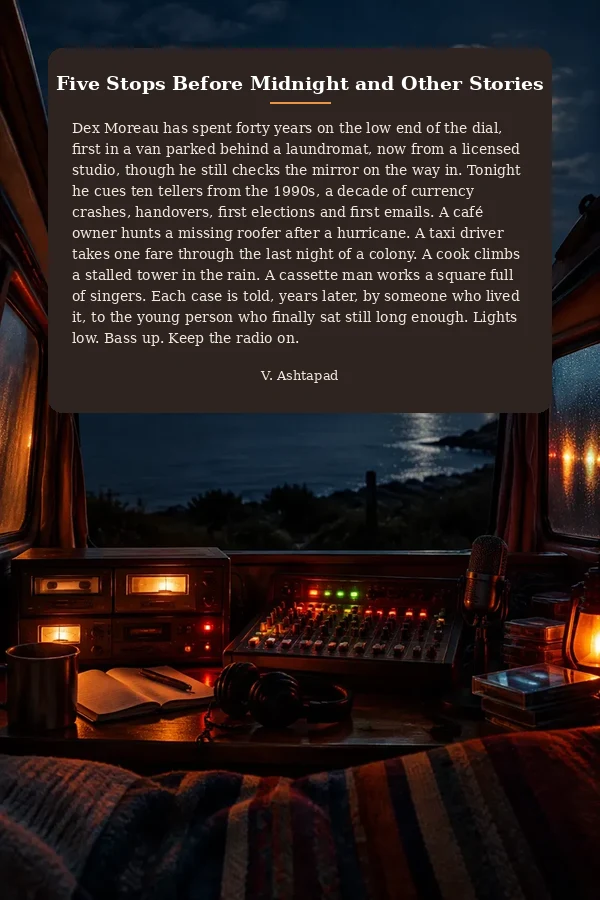
Dex Moreau has spent forty years on the low end of the dial, first in a van parked behind a laundromat, now from a licensed studio, though he still checks the mirror on the way in. Tonight he cues ten tellers from the 1990s, a decade of currency crashes, handovers, first elections and first emails. A café owner hunts a missing roofer after a hurricane. A taxi driver takes one fare through the last night of a colony. A cook climbs a stalled tower in the rain. A cassette man works a square full of singers. Each case is told, years later, by someone who lived it, to the young person who finally sat still long enough. Lights low. Bass up. Keep the radio on.
Members can react to this book and talk about it in the members' Library.
Ownership
© 2026 CRUNOD LLC. All rights reserved.
This book is owned by CRUNOD LLC. It is free to read on EternalCurrent.Online. No part of it may be copied, reprinted, sold, recorded or adapted, including as audio, film or translation, without written permission from CRUNOD LLC.
© 2026 CRUNOD LLC. All rights reserved.