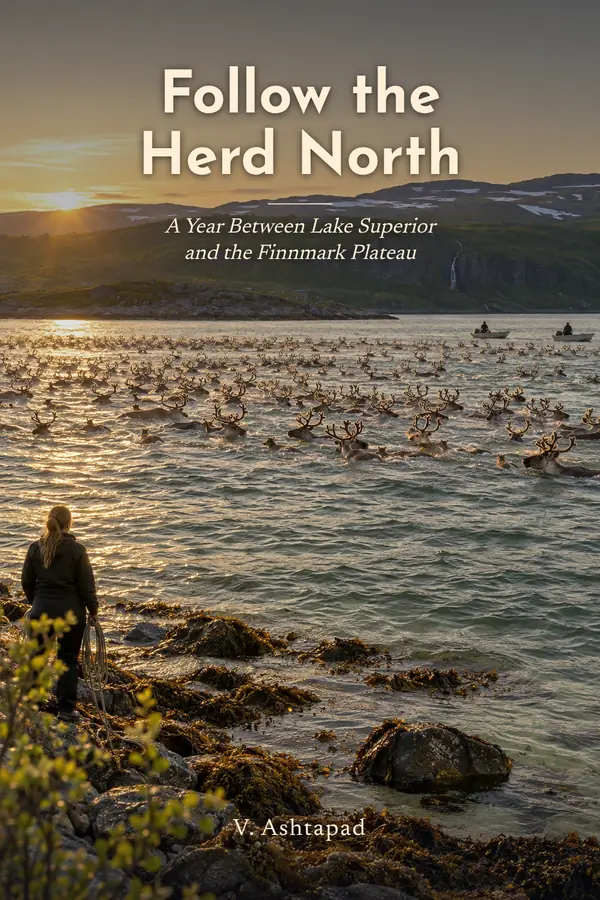
Follow the Herd North
A Year Between Lake Superior and the Finnmark Plateau
by V. Ashtapad
Foreword
This is a novel. Kaija, Ovllá, Biret and every other person in it are invented, as are their family, their siida, their herd and their letters. Real places such as Duluth, Kautokeino, Alta, Hammerfest, Knife River and the Cloquet River are used fictionally. The reindeer project that carried Sámi, Norwegian and Finnish herders and several hundred reindeer from Finnmark to Alaska in 1898 is real history, described here only in general terms; the station, the photograph and the people in it are imagined.
The book follows the eight seasons of the Sámi herding year, named here in English, and the herder's notebook is given in English translation. Sámi words are kept few. No real ear marks, family gákti patterns or joik are described or invented: ear marks, the details of a gákti and a person's joik belong to the families who carry them, and the story leaves them with those families. This book is held for review by Sámi community readers before any wider sharing.
For the ones who went a long way and kept something small and empty by the door.
The Sheath
*Late winter. In the herders' year this is the deep cold on either side of the sun's return. The herd stays on the inland winter pastures and digs through the snow for lichen, and everything depends on what lies under that snow.*
---
At ten to seven in the morning the hillside above the harbor is still lit by streetlights, orange cones of them stepping down toward the water, and below them the lake has no color at all yet. It is only a darkness with a different texture from the sky. I park behind the wildlife office at the top of the hill with the engine ticking and sit for a minute with the heater on my knees, watching the first gray come into the east over Wisconsin. When it comes, Lake Superior turns the color it keeps all winter: a gray with green underneath it, like the glass of an old insulator held up to a lamp.
My father used to say you could tell the lake's mood by how much green it let you see.
Inside, Dena Kovar has already started the coffee and turned on every light we own. The back room smells of wet boots and two-stroke oil and, faintly, of the moose hide drying on a rack by the door. Dena is fifty-one and has been a wildlife technician with the department longer than I have had a badge, and she has a way of reading the day's list aloud that tells me which items she has opinions about.
"Collar flight at eight if the ceiling lifts," she says. "Eino Saari at ten about the cow in his dog yard. He says she's lame. He says it like he's already treated her."
"Has he?"
"He's been putting hay out for her and talking to her through the kitchen window."
"Then he's treated her."
The ceiling lifts at a quarter past. I sit behind the pilot in the department's little high-wing plane over the Cloquet Valley with the receiver on my knees and the antennas whistling on the struts, and one by one the collared cows answer from under the snow-loaded spruce, a slow steady pulse for alive. Dena reads the frequencies back to me over the radio from the office in a low steady voice I depend on more than I have ever told her. Twenty-two cows, twenty-two slow pulses. When we bank for home the shadow of the plane runs over the bogs like a dog let off its chain.
Eino is waiting in his yard at Brimson at ten past ten, with a thermos and eleven sled dogs howling on their chains, and at the edge of the spruce beyond them a cow moose standing as still as a piece of furniture someone left out. She is a lean gray-brown cow of two or three, uncollared, and when she shifts she holds her right fore off the snow. Eino watches her with one hand on the porch rail, as if she might take it personally if he let go.
"Snow's no good this year," Eino says. "Rain at Christmas. Then the freeze. It's all glass under there." He shakes his head. "My grandfather would've called it a bad year."
Through the binoculars I can see the cut on her leg above the hoof, clean, not deep, the kind she would get breaking through crust ice that has refrozen sharp. I tell him she will heal by herself if the dogs stay chained, and that the hay will do her more harm than the leg. He nods in a way that means he will stop on Thursday.
---
At four-thirty the light is already leaving, the sky over the ore docks going violet and then a deep ink-blue, and by the time I drive up the hill to my mother's house the porch lights are on all along Fourth Street and the snowbanks have a blue glow of their own, as if they kept some light back from the day.
My mother, Verla, is sixty-eight and lives alone in the house I grew up in, a tall narrow house with a steep roof and a front porch that tilts toward the lake. Since my father died two winters ago she has rearranged almost nothing. His reading chair is still angled toward the window. His coat still hangs on the third hook. And by the kitchen window, on a brass cup hook he screwed into the trim in 1994, hangs the sheath.
It hung at my grandfather's cabin on the Cloquet River before that, by the door, and before that I am told it hung somewhere else, and the somewhere else is the reason I am standing in my mother's kitchen tonight with my coat still on.
"You didn't eat," she says.
"I ate."
"You ate a granola bar in the truck." She is already putting a pot on. Split pea soup, with the ham bone from Sunday and a bay leaf she will forget to take out. The kitchen fills with the smell of it, thick and smoky. She does not ask why I've come. She knows. I told her on the phone last night about the message, and she said "Huh" in the tone she uses for things she does not want to think about before morning.
I take the sheath down from its hook.
It is about the length of my hand from heel of palm to fingertip, made of two pieces of pale antler fitted together and bound at the mouth with something dark, sinew or leather, I have never been sure. The surface is worn to a waxy shine in places, especially near the top where generations of thumbs have pressed it. But along the face there are lines. Thin engraved lines, filled long ago with something brown that might have been bark dye, making a pattern of small crossing diagonals and a row of tiny repeated shapes like teeth or like trees. On the back, scratched in a different hand, cruder, are two letters: A and P.
There has never been a knife in it. Not in my lifetime, not in my father's. My grandfather Orrin said his father, Arvid, told him the knife was lost in a logging camp, or traded, or broke. The story had three endings, which in my family means nobody knew.
"Your grandpa called it the Lapp knife," my mother says, stirring. "You know that word isn't, people don't—"
"I know."
"I'm just saying that's what he called it. I'm not calling it that."
I hold it under the light over the sink. The lamp is an old glass dome with a sixty-watt bulb, and under it the antler goes the color of milky tea, and the engraved lines darken. I photograph it front and back, and down into the open mouth where the blade should be. The inside is dark and smells, very faintly, of nothing I can name: old fat, dust, something like cedar.
---
The message came three days ago, through the DNA site I paid for in a fit of grief eighteen months ago and then forgot. A woman named Ristin Persen, in Tromsø, Norway. Predicted relationship: third to fourth cousin. Shared DNA: point nine percent.
*Hello. I think we are related through a man who went to America in 1898 with the reindeer. His name was Aslak Persen. My great-grandfather Johan was his younger brother. Our family has two letters from Aslak, from Alaska. After that, nothing. If your family has any memory of him, I would be glad to know. Ristin.*
I read it standing in my kitchen and then sat down on the floor with my back against the dishwasher, which is not something I do.
I knew there was something. I knew it the way you know there is a room in your house you do not go into. My grandfather said "Lapp" and laughed, and my father said "Norwegian, mostly," and made a face that closed the subject, and there was the sheath on its nail, and once, when I was nine, my grandfather took me out on the frozen river and showed me how to sit on my heels on the ice without getting cold, and said, "My grandpa sat like this. He said a chair was for people who had somewhere to be." That was all. It was not a story, only some pieces.
The rest I learned in three nights of reading, which is how I learn everything. In the winter of 1898 a steamship sailed from the coast of Finnmark, in the far north of Norway, carrying over a hundred people, Sámi herders and Norwegians and Finns, and several hundred reindeer. The United States government wanted reindeer and herders in Alaska, partly for the gold rush, partly as a living for Alaska Native communities, who would be taught the herding. The animals crossed the Atlantic, then the whole continent by train, then went north by steamer, and a great many died on the way for lack of lichen. The herders who arrived were sent to stations. Some taught Iñupiaq apprentices and stayed for years. Some went to the gold fields. Some went home. A few drifted south and east, as my great-great-grandfather apparently did, to the logging camps and dairy farms of northern Minnesota, where nobody asked what language you swore in so long as you could work.
I have the census page from 1910. *Aslak Oslund, laborer, born Norway, immigrated 1898.* Somebody misheard Persen, or Aslak chose a name that sounded like his new country. His wife was Hilma, born in Finland. Their son was Arvid. Arvid's son was Orrin. Orrin's son was Gunnar, my father, who said "Norwegian, mostly."
---
My mother sets a bowl in front of me and I eat it, because she is watching.
"So what does she want, this woman?"
"Nothing. She wants to know if we remember him."
"Do we?"
I look at the sheath on the table between us, lying on a dish towel like a specimen on the lab bench. "We remember that."
After supper I open my laptop at her kitchen table. The spring after the funeral, I started a family space online, private, just for us, so my cousins in Superior and Grand Rapids and the one in Arizona would have somewhere to put the photographs of my father that kept turning up. There are maybe forty of us in it. It has a family tree that I built out in one evening with a glass of wine, back as far as I could reach, which was Orrin and his wife, and Arvid and his, and then a name, Aslak Oslund, where the line simply stops.
Tonight I click above his name. I type, carefully, *Persen*, and beside it, *Finnmark, Norway*, and then because I am a scientist, I add a question mark.
My mother watches me over her glasses.
"Your dad wouldn't have liked this," she says.
"I know."
"He'd have said what's done is done."
"He said that about everything." I attach the photographs of the sheath to Aslak's name. "He said it when the furnace went out."
She almost laughs. Then she reaches over, slowly, and touches the antler with one finger, right on the A, and takes her hand back as if it were warm.
---
I write to Ristin that night from my own apartment, a second-floor place in an old brick building above a bakery, where the radiators clank all night and the floor near the kitchen is warm from the ovens below by four in the morning. I tell her what I know. I tell her about the census and Hilma and the river and my grandfather sitting on his heels on the ice. I attach the photographs. I write and delete the word *Lapp*, then write *I'm sorry, the old word was used in my family*, and then delete that too, because it sounds like an apology for something I have not yet earned the right to apologize for.
Her reply comes before I am awake, sent at what was midmorning in Tromsø.
*Thank you. I showed my mother and my brother. My brother Ovllá has a sheath like this from our grandfather. Not the same, but the same kind of work. He is with the herd on the winter pasture now, out from Kautokeino, so he answers slowly, there is not always a signal and it is very cold this year. He asked me to tell you: the A and P on the back are not the maker's marks. He thinks Aslak scratched them himself, on the ship maybe, so nobody would take it. He says this is what a young man does who is going somewhere he does not know.*
*He also asked: is there a knife?*
I stand at my window in my socks and look past the rooftops at the lake, invisible in the dark and present anyway.
*No knife,* I write. *Just the sheath.*
---
**From the notebook of Ovllá Persen, winter pasture**
**16 January.** Minus 34 at the fence this morning. The sun came over the ridge to the south at noon. Maybe twenty minutes. Svarten sat down in the snow to look at it, which he does every year, and I let him.
The ice from the Christmas rain is still under everything. Dug in four places by the long lake. In three the lichen is there but sealed, like something under a pane. The animals paw and paw and get nothing and walk on. Forty sacks of feed on the sled today. Máhtte says sixty tomorrow.
**18 January.** Ristin phoned about an American. A woman in Minnesota who counts moose for the government. Aslak's people. Eadni listened to the whole thing on speaker and then went and sat in the other room.
**19 January.** Photographs of the sheath came through when I got to the road. Old work, careful. The scratched letters are his own, I am almost sure. Somebody's hand who was not used to writing.
Showed Eadni. She held the phone a long time and gave it back without a word and went to see to the stove, and later, when I was going out to the sled, she said from the kitchen that he got there, then. Minus 31 tonight, clear, the ice holding under everything. Late winter.
Blue Hour
The plane comes down into Alta at one in the afternoon, and it is already evening, or something that is neither evening nor day. Out the oval window the fjord lies flat and pewter between dark ridges, and the snow on the mountains has a color I have no word for. It is not white. It is the blue at the bottom of a gas flame, the blue of a vein under the skin of a wrist, and it is coming up out of the snow itself, as if the snow were the light source and the sky only a lid.
I have read about this. The sun is back above the horizon here since the middle of January, but it rides so low and so briefly that most of the day is this blue, a long held breath between one dark and the next. Reading about it did nothing. I stand at the top of the airstairs with my carry-on bumping my knee and the cold goes straight through my parka into my lungs, a dry clean cold with no lake damp in it at all, and I forget for a moment that there are people behind me waiting to get off.
He is easy to find in the little arrivals hall. He is the only man there wearing a snowmobile suit unzipped to the waist with the arms tied around his hips, and a gray wool sweater with holes at both elbows, and he is holding a sheet of printer paper with my name on it, spelled correctly, in blue marker. He is shorter than I expected and broader, with a weathered face that is mostly cheekbone and a short dark beard going gray at the chin. He looks at me the way I look at a dog someone has brought in without saying what is wrong with it.
"Kaija," he says. He says it better than anyone in Minnesota has ever said it, the first syllable longer.
"Ovllá."
I have practiced it. It still comes out wrong, too much like Ola. He does not correct me. He takes my bag, looks at my boots, and says, "Those will be cold," and that is the end of the greeting.
---
The road to Kautokeino follows the river south and up. For the first half hour we are in a canyon of birch and pine, the trees black against the blue snow, the river frozen in places and in other places running open and steaming, dark water sliding under shelves of ice. Then the land climbs and the trees thin and shrink and at last fall away, and we come out onto the open plateau, and I understand for the first time what the word *vidda* on the maps has been trying to tell me.
It is enormous and nearly flat, rolling very gently away in every direction, white and blue and a little gray, with small dark knots of dwarf birch in the hollows and nothing else at all. No fences. No houses. The sky comes down to meet it on every side. At two-fifteen the sun appears on the southern rim, a squashed orange coin that does not rise so much as roll, and for six or seven minutes the snow lights up pink and gold in long shallow waves, and every birch twig throws a shadow a hundred feet long. Then it is gone, and the blue comes back, deeper.
"You can stop if you want," Ovllá says. "People from the south want to stop."
"I'm not from the south."
He glances at me. "Minnesota is the south."
I laugh, and he almost does. Something in the truck relaxes.
The truck smells of two-stroke oil and wet wool and coffee, and under that of something animal and sweetish that I will learn is reindeer: hide, hair, the fat of them. A thermos rolls on the floor at my feet. On the dashboard there is a small brown wooden cup with a handle carved from the same piece, dark with use. I pick it up. It is surprisingly light, and the inside is stained the color of strong coffee.
"Birch burl," he says. "My grandfather's. You can use it."
---
Biret's house is at the edge of town on a slope above the river, a square yellow house with a steep roof and a woodpile along one whole wall under a tarp. Inside it is very warm and very clean and smells of coffee and woodsmoke and something frying. There are reindeer skins on the floor by the stove, soft gray-brown, the hair so dense my hand sinks into it to the wrist when I crouch to touch one. There is a lamp in the window, an old one with a fringed shade, and the light it throws on the snow outside is yellow and soft and small against all that blue.
Ovllá's mother is seventy-one. She is small and straight-backed and wears a cardigan over a flowered dress and heavy wool socks, and her gray hair is pinned up tight. She shakes my hand once, firmly, and then holds onto it a moment longer and looks at my face, not in a friendly way and not in an unfriendly way, but the way you would look at a word in a language you used to know, to see if it comes back.
"Bures," she says. *Hello*. I say it back. She nods as if I have passed something small.
She speaks Sámi to Ovllá and Norwegian to the radio, which is on low in the kitchen, and to me she speaks English that is slow and exact and seems to cost her something. Ovllá translates the parts she does not bother with.
The coffee is boiled in a blackened kettle on the stove and poured into cups with grounds still turning in the bottom. Into mine, before I can stop her, Biret drops several cubes of a pale cheese, the size of dice. They sink, and then they soften and swell, and when I fish one out with my spoon it squeaks between my teeth, warm and rubbery and mild, soaked through with coffee. It is the strangest and best thing I have eaten in months. I say so. Biret watches me eat a second cube and says something to Ovllá.
"She says your great-great-grandfather would have eaten it like this," he says. "She says she doesn't know that. She's guessing."
---
After coffee Ovllá goes out to his truck and comes back with something wrapped in a cloth.
It is a knife in a sheath. The sheath is antler, two pieces, bound at the top in dark leather, the face covered in fine engraved lines, crossing diagonals and a row of small shapes. It is not the same pattern as ours. But it is the same idea, the same hand-speech, the way two people from the same town can have different voices and the same accent. He draws the knife. The blade is short and broad and slightly curved, and the handle is birch burl, the same dark gold as the cup.
I set our empty sheath beside it on the oilcloth under the lamp. Nobody says anything for a while. The stove ticks. Out the window the light has gone from blue to a blue so dark it is nearly black, though it is barely three-thirty.
Biret picks up our sheath and turns it over and runs her thumbnail over the scratched A and P.
"He did it with the point of the knife," she says, in English. "You see how it skips here. He was on something moving."
---
**From the notebook of Ovllá Persen**
**3 February.** Picked up K. at Alta. She asked what every bump in the road was. Most were frost heaves. One was a fox.
She is a good height for the work, and strong in the arms. Hands too soft. She looks at everything twice, like Máhtte's boy when he takes an engine apart.
**4 February.** Took her out to the herd. Minus 29, clear, no wind. Fed at the long lake. She stood very still while they came for the pellets, which is right, and she did not try to touch any of them, which is also right. Then she asked about the thin female with the torn ear, the one I have been watching, and how old she is and what she weighs. I don't weigh her. I look at her. K. wrote something in a small book.
Showed her the ice where I dug. She got down on her knees and put her face close to it. The lichen under there, gray-green and branched, locked in clear ice the thickness of a finger. She said in her work they would call it a specimen. She said it looked like something under glass in a museum.
Yes. Like that.
---
On the sixth of February the whole town seems to turn out in color.
I knew there would be a celebration. Sámi National Day, Ristin wrote, in honor of the first meeting of Sámi from across the borders, long ago in Trondheim. I did not understand what it would look like until I walked down the hill behind Elle and the children in the late-morning blue and came around the corner of the school.
They are everywhere, the gákti. Men and women and children, babies in carriers, old men leaning on sticks. The dress is a long tunic for the men, longer still for the women, the base cloth mostly a deep strong blue, and over the blue there are bands of red and yellow and green at the hem and the cuffs and the shoulders, bright as the inside of a struck match against the snow. High collars, some of them, standing stiff and bright at the throat. Wide belts. Silver at the chest on some of the women, round brooches that catch the low light. Fur boots with turned-up toes, packed, Sunná tells me, with dried grass to keep the feet warm, and bound at the ankle with long woven bands wrapped round and round.
Sunná is sixteen and has her father's cheekbones and her mother's habit of looking directly at a person while deciding something about them. She wears her gákti over thermal leggings and a hooded sweatshirt she has not quite managed to hide. Her little brother Heaika, eleven, wears his with snow pants underneath and keeps running off to hit his friends with snowballs, so that the bands at his hem are dark and wet.
"Everyone is wearing a slightly different one," I say to Elle.
"Of course." Elle is a teacher at the school and has a teacher's patience, the kind that is not quite infinite. "The colors, the cut, the collar, the bands. It says where your family is from. Which side of the mountain, which river. Sometimes more. People who know can read it."
"Can you read it?"
"Some." She looks at me sideways. "Don't ask me to read for you what a pattern means. It's not mine to tell. And don't ask Biret yet."
I am the only adult in sight in a plain parka. I am not cold, exactly. I am conspicuous, in a way I have not felt since I was the new girl in third grade in a school in Proctor. A child stares at me, and his mother says something to him, gently, and he stops. There is music from the school gym, a recorded track and then a live one, a man's voice rising over the hum of the crowd in a sound that does not sound like singing as I know it, a sound that circles and returns and has no edge where it begins, and I stand outside the door in the snow listening to it and do not go in.
---
That night Ristin calls from Tromsø on her mother's tablet. She is a nurse in an oncology ward and has the night-shift face, puffy and cheerful. She asks me how the coffee cheese is, and if Ovllá has said more than fifty words, and then she asks if she can show Biret something.
On the screen she opens the family space I started, the private one, which I added her to a week ago at her request. Aslak's line does not stop anymore. Above him are two names Ristin typed in, Per and Ánne, his parents. Beside him, his brother Johan. Below Johan a line goes down, generation by generation, to Biret's husband Isak, who died nine years ago, and from him to Ristin and to Ovllá, and from Ovllá to Sunná and Heaika. And on the other side, Aslak to Arvid to Orrin to Gunnar to me.
It is just boxes and lines. Biret leans in very close to the screen with her glasses pushed up on her forehead and studies the place where the two lines leave each other.
"I can add you," Ristin says to her mother, in English, for my benefit. "So you can look whenever you want. You don't have to touch anything. You can't break it."
"I won't touch it," Biret says.
"That's what I said. You'll only be able to look."
Biret considers this as if it were a treaty. Then she nods.
Afterward she sits by the stove with the lamp beside her, its yellow light on one side of her face and the window's blue-black on the other, and she does not say anything to anyone until the stove needs wood.
Strips in the Wind
*Spring-winter. Roughly March and April, when the light comes back hard and fast, the sun glares on a crust of snow that holds a person's weight in the mornings, and the nights stay sharp with frost. It is the season of travel on the snow and of meat drying in the wind.*
---
I come back at the end of March and the blue has gone. In seven weeks the light has done what light does in a time-lapse film: it has grown. Now the sun is up before six and does not set until well into the evening, and it has stopped rolling along the rim and climbs instead, high and white, and the snow throws it back so fiercely that on the first morning I walk out of Biret's door without sunglasses and have to go back in, blind, my eyes streaming, Heaika laughing at me from the woodpile.
"Everyone does that," Sunná says, without sympathy, and hands me a pair of her own, with mirrored lenses and a cracked arm held together with tape.
The snow is different too. In February it was a dry powder that hissed away from my boots. Now the top has melted in the afternoon sun and refrozen at night into a crust so hard that in the early morning I can walk across the open snow behind the house in my boots without sinking, and it rings faintly under my heels, a hollow sound, like walking on the lid of something. By two in the afternoon the same crust has gone soft and grainy and I break through to my knees. Ovllá plans every day around that hinge. Travel early. Work the herd early. In the afternoon, mend things.
I have taken a little over a week. Dena has the schedule, and a young biologist on loan from the Grand Rapids office is covering my collars, a man with a beard who I suspect will steal my favorite landowners. I don't care as much as I thought I would.
---
The meat is Biret's project and she has been waiting for me to start it.
On my second morning there is a basin on her kitchen table, a big enamel one, white with a blue rim chipped down to black iron in three places, and in it are long dark-red strips of reindeer meat cut along the grain from the haunch, each one about as long as my forearm and as thick as two fingers. They are very lean. Reindeer has almost no marbling; what fat there is lies in a pale layer outside the muscle, and Biret has trimmed most of it away and saved it in a bowl.
"Salt," she says, and hands me a coarse gray sack of it.
She does not measure. She takes a handful and rubs it into a strip with a short circular movement of her thumb, turning the strip as she goes, and lays it in a second basin. She does another. Then she watches me do one, and takes it from me and does it again.
"Too much," she says. "You are making fish."
The salted strips sit overnight under a cloth in the cold porch, where the temperature is about the same as my refrigerator in Duluth. In the morning we thread them through one end on lengths of cord, Biret making a small hole with the point of her knife, and Ovllá and Heaika hang them from a rack he has built on the south side of the shed, out of the reach of dogs and in the full path of the wind that comes off the plateau.
They hang there in two rows, like dark flags. The sun hits them. The wind hits them. By afternoon the surface has gone tacky and darker. By the third day they are stiffening, shrinking, the red going to a deep brown-black, the color of old leather, of good dark chocolate.
"In the old days, everyone," Biret says, watching them from the porch with her arms crossed against the wind. "Every house. You came into a village in spring and everywhere the meat was hanging. Now," and she shrugs, "some. Some buy it." She does not say which kind of person she thinks this makes them.
---
**From the notebook of Ovllá Persen**
**27 March.** Minus 14 at six, plus 3 at two in the afternoon. Good crust in the morning, bad by noon. Hung the meat with Eadni and K. and the boy.
K. asks why the wind and not smoke. I said both are good but this is ours. She says in Minnesota they smoke fish. She says the lake fish there are trout and herring and they hang in a little house full of smoke on the shore. I would like to see that.
**28 March.** Went out east with Máhtte, K. behind me on the snowmobile. The ice layer is still there in the low ground by the long lake but in the higher places the wind has scoured enough that they can dig. The herd is spread wider than I like. They are going looking. You can't blame them.
The thin female with the torn ear is alive. Thinner.
---
Ovllá takes me out on the fourth morning, when the crust is at its hardest.
I ride behind him on the snowmobile with my arms around his waist and my face pressed into the back of his suit, which smells of exhaust and pine tar, while the snowmobile screams and bucks over the frozen ridges of snow. Behind us we tow a sled loaded with sacks of feed pellets. We go for forty minutes into country I could never find again, all of it white and rolling and glittering under the low morning sun, and then we come over a rise, and the herd is spread out below us along the shore of a long frozen lake.
They are smaller than I pictured. In my head reindeer have always been large, mythic, Christmas-card animals. These are compact, deep-chested, thick-necked, their legs short for their bodies, their coats gray and brown and some nearly white, a few piebald. The bulls have dropped their antlers by now; the females still carry theirs, narrow branching crowns, and some of them have calves inside them that will be born in six weeks. When they move, all together, there is a sound under the scream of the engine as it cools, a soft clicking, steady and multiplied, like a thousand people snapping their fingers very quietly.
"Their feet," Ovllá says. "The tendons. You always know where they are, even when it's dark."
I want to examine every one of them. I want to put my hands on their ribs and score their body condition one to five, the way I score a darted cow on the snow before her collar goes on. Instead I stand still by the sled and look. And slowly, I begin to see what he sees. Not individual animals so much as the shape the herd makes, which ones are at the edges, which hang back. Which are digging hard and getting nothing. Which have their heads down in the craters and are chewing.
He walks me to one of the craters a female has abandoned. She has dug down through nearly a meter of snow to the ground, a neat funnel the shape of a bowl. At the bottom there is lichen, pale gray-green, branched like coral, like tiny antlers, a whole small forest of it. And over it a layer of ice, clear as the glass on a microscope slide and about as thick as my thumb, laid down when the Christmas rain fell on the snow and froze. She has scratched at it until there are white scars on it from her hooves. She has not broken through.
I kneel down. I put my bare hand on it. It is so cold that it burns. Under my palm, very close, perfectly preserved, is the food she could not get.
"You could break it with a shovel," I say, stupidly.
"Yes," he says. "One crater. And then?"
He does not say anything else. He lifts the sacks off the sled and slits them, and pours the pellets out in long lines on the crust, and the herd comes, not fast, but steadily, clicking, and lowers their heads to eat. They look like any livestock eating feed from a sack. I have seen cattle do exactly this in a hundred winter feedlots. It should not move me, and it does, and I am not sure why.
---
Biret teaches me bidos on the last Saturday.
"For when people are coming," she says. "Not for every day."
"Who's coming?"
"You are leaving." She hands me an apron, a faded flowered one with a burn mark on the pocket. "That's a kind of coming."
It is a simple stew and she makes it look difficult on purpose, I think, to see whether I will be patient. Meat from the shoulder with the bone in, cut in pieces, put in cold water in a heavy pot and brought slowly up to a simmer while she skims the gray foam off the top with a slotted spoon and flicks it into the sink. Salt. Nothing else for most of an hour. The kitchen fills with the smell of it, a deep, clean, slightly wild smell, like venison but sweeter, with something mineral underneath it, like the way the air smells after a snowstorm. Then potatoes, peeled and quartered. Then carrots cut thick on the diagonal. At the end, she lifts out the bones and takes a little flour in a cup of cold water and stirs it in, and the broth thickens just slightly and goes glossy.
"That's it?" I say.
"That's it."
"No herbs? No onion?"
She looks at me with mild pity. "You want to taste the onion, or you want to taste the animal?"
Ovllá comes in from the shed with the cold on his clothes and eats two bowls standing at the counter without taking off his jacket. Elle comes with the children. Máhtte comes with his son Ánte, who is twenty-three and very tall and has motor oil under his fingernails that will never come out. The kitchen is too small for all of us and nobody minds. Biret serves my bowl last and stands watching me eat it. The meat falls apart on the spoon, dense and fine-grained and very tender. The potatoes have taken the broth into themselves and gone soft at the edges.
"Next time you make it," she says.
"In Duluth?"
"Wherever."
---
On Sunday evening, two days before my flight, Sunná sits beside her grandmother at the kitchen table with her phone propped against the sugar bowl.
She is building something for the family space, she tells me: a list of words. Simple ones. The words in the house. Under each word there will be a button, and when you press it, you will hear Biret say it.
"For Heaika," Sunná says. "He's lazy with it. He speaks Norwegian with his friends. And for," she tilts her head at me, "people who are starting."
Biret refuses for twenty minutes and then does it as if she had been planning to all along. Sunná says a word in English, then in Norwegian. Biret says it in Sámi, once, clearly, looking not at the phone but at the wall, the way you would speak toward someone in the next room. *Coffee. Snow. Meat. Mother. Grandmother.* For *grandmother*, she says the word, áhkku, and then stops, and says something else, softly, that Sunná does not translate.
At the end Sunná plays the first one back. Biret's voice comes out of the phone small and tinny and exactly like her, and Biret makes a face of complete disgust.
"I sound like an old woman," she says.
"You are an old woman," says Sunná.
Outside the window the meat hangs on its rack in the long gold evening, twisting slightly on its cords in the wind, almost done.
Two-Stroke
Ánte drives a snowmobile the way some people play the piano, with his whole body and without looking at his hands. On Monday morning he comes by Biret's at a quarter to six with the sky already white in the east and asks if I want to see the eastern edge.
"Some of ours went over toward the next siida's ground," he says. "Fifty, sixty animals. I need to see where. You can come. You'll see a lot of nothing."
Ovllá is out at the long lake with the feed. Biret, at the stove, says something short to Ánte in Sámi, and he answers with a long, patient, slightly offended sentence that I take to mean *yes, I'll bring her back*.
We go fast. The crust is at its best, hard and smooth, and his snowmobile is newer than Ovllá's and louder, and for the first hour I am mostly concentrating on not being thrown off. Then I stop being afraid and start looking. The plateau in early morning is pink and gold on the eastern faces of every drift and blue in every shadow, and the shadows are long, and in the hollows the dwarf birch stand up out of the snow in dark red tangles, their buds already swelling. We cross frozen lakes so big that for minutes at a time there is nothing on any side but white. Twice we pass a line of tracks, the neat cloven hearts of reindeer crossing in single file. Once, far off, a fox stops and watches us go by with one forefoot lifted.
We find the strays a little after nine, scattered over a south-facing slope where the wind has stripped the snow thin enough to dig. Ánte cuts the engine and stands up on the running boards with binoculars and counts. His lips move. He counts the way Dena counts moose from the plane on a survey morning, twice, without trusting either total.
"Fifty-two," he says. "Some of Máhtte's, some of Ovllá's, three of my own." He grins. "I can tell by the ears. From here, no. But I can tell by how they stand."
"How do they stand?"
"Like they belong to me." He laughs at himself. "No. I'm joking. I know them. You know your moose."
"I know their collar numbers."
"Same thing."
He pulls out a phone, holds it up, frowns, and puts it away. No signal. He takes out a small yellow radio and talks into it and gets static and puts it away too.
"We'll come back with Máhtte tomorrow and push them," he says. "Now home."
The engine catches on the third pull. We go perhaps two kilometers. Then there is a sound underneath us like a fist hitting a tin roof, and a smell of hot metal, and we coast to a stop in the middle of a frozen lake with a long, dying whine, and the engine does not start again.
---
Ánte takes off his gloves and puts his bare hands into the engine.
I have never seen anyone so calm and so furious at the same time. He opens the cowling, and peers, and pokes, and swears very quietly in two languages, and after twenty minutes he sits back on his heels on the snow and wipes his hands on his pants and says, "Piston."
"Is that bad?"
"It's not good."
"Can you fix it?"
He looks at me with real tenderness, as if I had asked whether he could build a house out of the contents of his pockets. "No."
It is eleven in the morning. The temperature, by the little thermometer zip-tied to his handlebar, is minus nine. The sky is cloudless and the sun is high and bright and the cold, out of the wind, does not feel dangerous at all. It feels like a good ski day in Lutsen. That is the trap, I know. I have helped carry a grouse hunter out of the Boundary Waters who thought it was a nice day.
"So we walk?"
"Forty kilometers," he says, "in this crust, which will be soup in three hours." He stands up and turns slowly in a circle, looking at the land, as if consulting it. "No. We stay. Ovllá knows where we went. When we don't come back, he'll come."
"When?"
"Tonight. Maybe late."
---
We make camp the way he has clearly done a hundred times. He drags the snowmobile and the empty sled into a low hollow on the lee side of a ridge, where a stand of dwarf birch grows waist-high out of the snow. He breaks dead branches off the birch with his hands, quickly and neatly, the way I would break kindling, and stamps a pit in the snow with his boots, and builds a small fire in it on a platform of green branches so it won't sink. He lights it with a lighter he keeps inside his shirt. The birch bark catches with a snap and a smell like hot tar and spice, black smoke curling off it, and then the twigs, and then the fire is going, small and bright and smokeless, almost invisible in the sunlight.
From the sled he takes a blackened kettle, a cloth bag of coffee, a plastic bag of the dark dried meat from last spring, and a bag of the coffee cheese. He packs the kettle with snow, sets it at the edge of the fire, and adds more snow as it melts down. It takes a long time. Snow is mostly air.
"You didn't expect this," he says.
"I didn't expect any of it."
He hands me a strip of meat. It is as hard as a stick. I hold it awkwardly. He shows me: you don't bite it, you shave it, with a knife, in thin curls, or you hold it in your mouth and let it soften and work at it with your back teeth. I do. At first it tastes of nothing but salt. Then the meat underneath comes up into the salt, rich and dark and concentrated, like the inside of a roast where the juices have caramelized, and a faint taste of the wind it dried in, if wind has a taste. I chew it for a quarter of an hour. It is the most satisfying thing I have ever eaten that I could not finish.
---
The afternoon goes slowly. The sun slides west and the crust softens and goes gray and grainy. Ánte checks the herd through the binoculars every half hour. He takes the engine apart again, more slowly, out of something like grief, and lays the pieces out on a sack on the snow in order. I have done the same thing with a dead cow's collar data, gone over the points after, looking for the place where I could have seen it coming.
We talk. He tells me he went to school in Alta for engines, small ones, boats and snowmobiles, and that he worked two winters at a garage there and hated it, and came back. He tells me that his grandfather could name every female in the herd by her face, that he himself can name maybe half, and that his father's old females still go every spring to the same hollow by a stream to calve, the daughters following the mothers, because that is where they go. He says it the way you would say the river is high this year.
"Do you want to keep doing this?" I ask. "Herding?"
He looks at me as if I had asked whether he wants to keep his arms. Then he shrugs. "I want to keep the animals. The rest I'll see."
As the sun goes down, the cold comes up out of the snow. It is not gradual. One moment I am warm enough, my back against the sled, the fire on my face. Then the light goes orange and then red and then a violet that turns the whole plateau into a lake of shadow, and the cold arrives the way water arrives in a basement, and I begin to shiver.
The field biologist in me takes over. I make Ánte show me his fingers; the tips are white and waxy and he has been working bare-handed on frozen metal for an hour. I make him put them in his armpits. I check my own face with my glove and there is a patch on one cheek that I cannot feel. I make us both stand up and stamp and swing our arms every twenty minutes, and he goes along with it with the air of a man humoring a city cousin, but he does it.
---
At about ten the sky over the northern ridge begins to do something.
It starts as a faint smear, a pale greenish cloud that I take at first for a cloud, until it moves. It brightens. It stretches into a long arc from one side of the sky to the other, and then the arc ripples, slowly, like a curtain someone is walking behind, and folds of it go bright at the bottom, almost white, and a faint thin pink comes and goes along the lower edge. The snow takes a faint wash of it, so faint I only see it when I look away, and a thin bright line runs along the chrome of the handlebar and slides off the end. It lasts perhaps four minutes. Then it thins, and fades, and there are only stars, so many and so sharp that the sky looks crowded.
Ánte has watched it the whole time without comment. He is eating cheese.
"You've seen it a thousand times," I say.
"More." He brushes crumbs off his chest. "Still good."
Later, when the fire has sunk to embers and we are sitting very close together under a reindeer skin from the sled, he begins, very quietly, to joik.
I don't know what I expected. Something like a song. It is not like a song. It is lower, and closer, and it does not go anywhere, it circles, a few phrases of sound that are not quite words, rising and falling and returning to where they began, with a kind of pulse in them like a heartbeat or a walk. His voice is rough and not especially musical and it doesn't matter at all. He is not performing. He is barely singing. He sounds like someone talking to a person who is sitting next to him.
When he stops, the silence is enormous.
"Who was that?" I ask, and then, too late, I understand that I've asked the right question by accident.
"My grandfather," he says. "My father's father. He's dead." He pokes at the embers with a stick. "People from outside always ask, *what is the song about*. It's not about him. It's him. When I joik him, he's here." He is quiet. "Not like a ghost. Like when you say someone's name and they turn around."
"Can anyone joik him?"
"Anyone who knew him." He looks at me sideways, a little amused, a little sad. "Not you."
---
**From the notebook of Ovllá Persen**
**1 April.** Ánte and K. not back by six. Máhtte said wait. I didn't. Took the old snowmobile with the tow line and Svarten in the sled box. Followed their track east by headlamp.
Lights on the sky most of the way. Svarten kept looking up.
Found them at a quarter past two in the hollow below the ridge where Ánte's grandfather used to stop. Fire still going. Ánte asleep. K. sitting up awake with his bare hands inside her coat against her stomach, watching him like a nurse. A white patch on her own cheek. She said she knew. She had been too busy with his hands to do anything about it.
Towed Ánte's snowmobile back. Home at six. Sun already up. Eadni was at the window. She had not gone to bed. She said nothing to me. To K. she said, in our language, *You came back*, and K. said *yes* in our language, which Sunná has taught her.
**2 April.** K. missed her plane. Rebooked for Thursday. She seems glad.
Ánte put a pin on the family's map in the place where the snowmobile died. He wrote under it, *Piston*. Then under that, *Grandfather's stopping place.*
The Females Go First
*Spring. Roughly May, when the snow goes rotten and gray, the rivers open, and the pregnant females lead the herd away from the winter pastures toward the coast, giving birth to their calves along the way.*
---
In Duluth, spring is not a season. It is an argument between the lake and the land that the lake wins until June.
The harbor ice breaks up in the middle of April in a single loud week, great gray plates of it grinding and tilting against the piers of the bridge, and then the first freighters come in from the Soo, long and rust-red and impossibly slow, their horns answering the bridge horn in that long-short-long-short call that every child in this city can imitate. The hillside goes brown and wet and smells of thawed dog and old leaves. Crocuses come up through the gravel at the bottom of my mother's driveway. And every few days the wind swings round from the northeast and comes in off the lake, and the temperature drops fifteen degrees in an hour, and fog pours up the streets from the water like milk poured into a bowl, and you can stand at the top of Lake Avenue in the sunshine and look down into a white sea with the tips of the grain elevators sticking out of it.
At the office it is calving season and tick season and the season of cow moose standing in the middle of Highway 1 with calves a week old. In one week I fit expandable collars on three newborn calves in a bog near Isabella, pull a yearling out of a flooded culvert with two county workers and a rope, and count, off the neck and shoulders of a single winter-killed bull, a little under eleven thousand winter ticks. Dena keeps a spoonful of them in alcohol in a jar on the front desk with a label that says *DON'T*.
I am tired in a way I can't account for. I have been home for a month. The skin on my cheek where the frost touched it has peeled and healed pink. At night, in my apartment over the bakery, I dream of a clicking sound and wake up with my hands cold.
---
**From the notebook of Ovllá Persen, spring move**
**2 May.** We are moving. Plus 4 at noon, snow wet and heavy, rivers opening at the edges. The females with calves in them went first this morning without being asked, the way they do every year. They know. We only follow and keep the edges.
Máhtte on the left. Ánte and I behind. Elle with the trailer and the tent and the food on the road, meeting us at night where the road comes near.
**4 May.** First calf. I saw her go off to the side into a hollow by the river at about four in the morning. By six he was standing. Brown, wet, legs like sticks. The mother licked him and licked him and then got up and walked on with the others and he followed. They don't wait long.
The light now does not go away. At midnight it is like evening. At two it is like morning. I sleep in pieces.
**6 May.** Eleven calves. One dead, born dead, a female. Left it for the birds. The ravens were there before I had turned my back.
**7 May.** Crossed the big river where the ice was still holding at the shallow place. The animals went over in a long line with the calves pressed against the mothers' flanks. One calf went through to its belly and the mother turned and stood over it, lowing, until it scrambled out. I counted the whole time without knowing what I was counting. Then she was out.
---
On a Saturday in May my mother asks me to help her clean out the porch.
This is not what she means. What she means is that she wants to talk and does not want to look at me while she does it, so we stand side by side sorting through forty years of folding chairs and bird feeders and coffee cans of nails, and the lake below us is a hard bright blue for once, glittering, with the white tower of the lighthouse at the end of the pier standing out sharp as a tooth.
"Your grandpa Orrin's mother told me once that the old man used to talk in his sleep," she says, holding up a broken rake. "In some language. Not Norwegian. Not Finnish, because Hilma would have known." She drops the rake on the throw-away pile. "She said Hilma used to put her hand over his mouth in the night so the children wouldn't hear."
I stop sorting.
"Why?"
"Why do you think? It wasn't a nice word in those days. What he was." She is very busy with a box of rags. "Your grandpa Orrin made jokes about it. Your dad never wanted to hear about it. He said it was all just old men's talk. He said we're Americans." She looks up, finally. "I'm not saying he was right."
"What are you saying?"
"I'm saying he was scared of something, and I never knew what." She wipes her hands on her jeans. "And now you're running back and forth across the world, and I think maybe it's the same thing he was scared of, and maybe it's not so scary." She picks up another box. "I don't know. I'm sixty-eight. I'm allowed to not know."
---
Ristin sends photographs of the letters in the middle of May.
There are two of them, written on thin lined paper gone the color of dry oak leaves, in a cramped, careful, slanting hand. The first is dated from Alaska in the autumn of 1898. The second is from the spring of 1900. They are in Norwegian, with a few words here and there that Ristin says are Sámi spelled the way a man would spell them who had never been taught to write his own language. She has typed out a translation, with notes in square brackets where she is guessing.
In the first letter Aslak writes that they arrived. That the crossing was terrible and the train was worse, days and days of it with the animals in cars and nothing for them to eat but the moss they had brought, which ran out. That many of the animals died. *More than you would believe, brother. I carried them off the cars myself.* That the country in Alaska is wide and cold and has mountains and is not like home but has good moss in places. That the men are sent different ways and he has been put with three others at a station on the coast to teach boys of the people there to keep the animals.
In the second letter he writes about the boys. *They learn the rope faster than I did. One of them can already catch a running bull by the antlers and he is only fourteen. I tell them the words for things in our language and they tell me theirs, and so we have three languages at the station and none of them is English, which pleases me.* He writes that he does not know if he will stay. That there is gold talk everywhere and men going mad with it. That he thinks of the spring move. *When the light comes back I think of the females going first, and I want to walk behind them.*
There is no third letter.
I read it at my kitchen table at two in the morning and then I read it again. *I want to walk behind them.* My grandfather sitting on his heels on the frozen river, saying a chair is for people who have somewhere to be.
---
On the family map there are now two lines.
I drew the first one myself, over a series of nights, from what I could find. It starts at the coast of Finnmark near Alta, where the ship sailed in February of 1898, and runs across the Atlantic to New York, and then by rail all the way across the continent to Seattle, and then north by steamer up the Inside Passage into Alaska, to the coast, to a station whose exact location I am not sure of. I put a question mark there. From there it is dotted, because I am guessing: south again, sometime after 1900, by ship and rail, to a logging camp somewhere in St. Louis County, Minnesota, and then a short solid stretch to a farm on the Cloquet River where Aslak and Hilma had their children. Beside each point I have pinned what I have. The census page. A photograph of the ship from a museum. A photograph of the river at the place where the farm was, taken by me, last October, in the rain.
The second line is Ovllá's. Ánte pinned it, from the coordinates Ovllá sends when he gets a signal. It starts on the winter pasture east of Kautokeino, near the long lake and the place where the snowmobile died, and it moves north every few days in a ragged path, along rivers, over ridges, toward the sea. Each pin has a date. Some have a photograph. A brown calf on wobbling legs. The river at the shallow crossing, gray ice and black water. Elle's tent at the roadside in the bright midnight, a wisp of smoke from the stovepipe.
The two lines do not touch anywhere. One runs across half the world and the other runs maybe two hundred kilometers. But on the screen, at a certain zoom, they are both just thin red threads, and they both start in the same small corner of the map, and I have caught myself more than once sitting at my laptop at midnight moving between them, zooming in on one and out again to see the other, the way you look from one collar's track to another when the movements don't add up.
---
**From the notebook of Ovllá Persen**
**15 May.** Sixty-four calves. Two dead. One lost to an eagle, I think, I saw it lift something from the ridge.
The land is going brown in patches. The birch along the rivers are red at the tips, ready. Snow buntings everywhere, and the first plovers, crying. At night the sun just touches the ridge in the north and comes back up.
Elle brought fresh bread in the trailer and we ate it with butter in the tent at one in the morning in full daylight. Heaika asleep on the skins with his mouth open.
**17 May.** K. says she will come at the end of the month to the crossing. I told her to bring rain clothes and a hat for the mosquitoes, which she will not believe until they come. She says there are mosquitoes in Minnesota. I said, *Not like these.* She said, *We'll see.* Sunná laughed when I told her.
---
I tell Dena I need most of June.
She is at the front desk, labeling sample jars. She doesn't look up. "The guy with the beard is going to want a permanent job."
"Then give him one."
That makes her look up. She studies me over the top of her glasses for a long moment, the way she studies a cow through the spotting scope when it doesn't seem quite right and the landowner says it's fine.
"You're not going to go live in a tent," she says.
"No."
"You're not going to come back with one of those knives and start talking about how much more authentic it all is up there."
"Absolutely not."
"Good." She goes back to the labels. "Bring me back some of that cheese. The squeaky one." She smooths another label onto another jar and does not look up again, and that is all the blessing I get, and it is enough to fly north on, into the last week of what the herders call spring.
The Sound
*Spring-summer. Roughly June, when the herd reaches the summer pastures by the sea, the birch leaf out in a single week, and the sun no longer sets at all.*
---
The coast surprises me by being green.
I have been imagining the far north as white and blue, and in February and March it was. But the road from Alta in June runs along fjords the color of jade, and the hillsides above them are covered in a green so new and so bright it hurts, birch leaves the size of a mouse's ear trembling on every branch, and moss on the rocks, and grass in the ditches already knee-high and full of small yellow flowers. Snow still lies on the mountaintops in long white seams. Waterfalls come down out of it everywhere, thin silver ropes hanging off cliffs, and when I roll down the window I can hear them over the engine, a sound like a crowd a long way off.
And the light. It is nine at night and the sun is high in the west, and it is eleven and the sun is lower in the north and the whole fjord has turned gold, and it is one in the morning and the sun is sitting on the northern horizon, just sitting there, enormous and soft and orange, not setting, and the sea under it is a sheet of hammered copper, and the shadows of the boats in the harbor at Hammerfest are forty feet long and point straight south. I have no idea what time it is. My body has no idea. I eat when someone hands me food and sleep when I am sitting down.
---
Ovllá's family has a summer place on the mainland shore of a narrow sound, across the water from the island where the herd will spend the summer. It is two small wooden houses painted a dark rust-red, a turf-roofed storehouse with grass growing on top of it, a boat pulled up on the stones, and a fire pit ringed with rocks. Below it the shore is all rocks and kelp, brown and olive-green and slick, and the air smells of salt and seaweed rotting gently in the sun and birch smoke and, very faintly, diesel from a fishing boat working the far side of the sound.
The sound is perhaps a kilometer and a half across. The water is cold and clear and in the shallows over the pale sand it is the green of bottle glass, and farther out it goes gray and then a deep gray-green. I stand on the rocks the first evening until my feet go numb. It is Lake Superior's color. Exactly that gray-green, the color of the lake in October under a high overcast, when it looks like it is made of something heavier than water.
"You like it," Elle says, coming down beside me with a bucket for washing.
"It's the color of home."
She looks at the water and then at me. "That's a strange thing to say about the sea."
"It's a strange lake."
---
The herd comes over the last ridge the next afternoon, four or five hundred animals with the calves among them, spilling down the slope toward the shore in a brown-gray river. I hear them before I see them: the clicking, and the grunting of the females calling the calves, a low snoring sound, and the high thin bleating of the calves answering. Then the dust they kick up from the dry slope. Then the animals themselves, coming down through the birch with Máhtte on his four-wheeler at one edge and Ánte on foot at the other with a dog, and Ovllá behind.
They gather on the shore. They don't want to go in. Nobody would. They mill and turn, and the calves press against their mothers, and the old females at the front stand with their front hooves at the edge of the water and their heads up, looking at the island.
"They know where they're going," Ovllá says, beside me. He is sunburned on the nose and has not shaved in a week, and he smells strongly of reindeer and woodsmoke and insect repellent. "They've done it every year of their lives. The first ones just have to decide."
There are two boats waiting, small open aluminum boats with outboards, Máhtte's and a neighbor's. The men in them sit very still.
It takes nearly an hour. Then one old female, gray with a pale face and one antler broken, wades in to her chest. She stands there. Then she pushes off and swims.
And then they all go.
They go in a rush, the whole herd, crowding into the water behind her with a noise like a waterfall, splashing and plunging, and then, abruptly, they are swimming, and it is quiet. They swim high in the water, much higher than I expected; their hollow hair holds air and buoys them up, so that only their backs are below the surface and their heads and the antlers are above it, hundreds of heads, a moving forest of antlers in velvet, furred and brown and soft-looking, spread out across the gray-green water. The calves swim too, right against their mothers' flanks, their small heads straining up, their noses just above the water. The boats move along the downstream edge, slowly, the engines barely ticking over, keeping them together.
I find I am holding the end of a rope for no reason. Somebody handed it to me when the herd went in. It isn't tied to anything.
The sun is low in the west and behind them, and the light comes across the water and goes through the velvet on their antlers so that each one is outlined with a thin halo of gold, like the fuzz on a peach held up to a window. Their breath steams very slightly in the cool air off the water. It takes them twenty minutes to cross. On the far shore they come out streaming and shake themselves like dogs, showers of drops flashing in the sun, and stand there looking back at us, and then turn and go up into the green.
Two calves don't make it. I see one go under near the middle and not come up. The mother circles once, and swims on. Ovllá sees it too. He doesn't say anything. Later, in the notebook, he writes it down.
---
**From the notebook of Ovllá Persen, summer place**
**4 June.** Crossed. Good water, low wind. Lost two calves. One of mine, one of Máhtte's.
K. stood on the rocks holding the spare rope the whole time. Heaika gave it to her because she looked like she wanted something to do. She held it like it was attached to the herd.
**5 June.** Rain all day. Mosquitoes came out at four. K. said nothing about Minnesota.
---
It rains for two days, soft gray rain that blurs the island into a smudge, and then the mosquitoes come, and Ovllá was right.
They come out of the wet grass and the birch scrub in clouds, in hazes, in a whine so continuous and loud it becomes a kind of weather. In Minnesota there are mosquitoes in June on the North Shore, and they are bad, and I had thought I knew what bad was. These settle on every inch of exposed skin at once. They go into my ears and up my nose and into my mouth when I speak. I put on the hat with the net that Elle gave me and the long sleeves and gloves and they bite through the cloth at my knees and my elbows. Heaika, who is wearing a T-shirt, swats them off his arms absently and laughs at me.
"You'll get used to it," he says.
"Do you?"
He considers. "No."
The only relief is smoke. Elle keeps a smudge going in the fire pit, damp birch and green moss on the coals, and we sit in the thick gray smoke of it with our eyes running, coughing, and eat smoked fish she bought from a boat in the harbor, oily and salty and golden-brown, with flatbread and butter, and drink coffee that tastes of smoke too. My clothes smell of it. My hair smells of it. Weeks later, in Duluth, I will open my suitcase and the smell will come out of it, and I will stand in my apartment with my eyes closed.
---
On the third evening my mother sends a photograph to the family space.
She does not do this. She looks; she does not post. But on Sunday, she tells me later, she drove out to the little cemetery north of Cloquet where Aslak and Hilma are buried. She had not been there since my father's funeral, when we drove past it on the way to the other cemetery, the one in Duluth. She had to ask a man mowing the grass where the old section was. The stones there are small and gray and some of them have sunk at an angle into the ground. She found them, two plain flat markers side by side in the grass under a big white pine. *Aslak Oslund 1874–1939. Hilma Oslund 1881–1952.* She pulled the grass away from the edges with her fingers so the names could be read. She took the picture from straight above, and then another from the side, with the pine in it, and a little of the field beyond.
Under it she wrote: *For Biret. The tree is a white pine. They grow here. It's very quiet.*
I show it to Biret on my phone, in the kitchen of the red house, with the rain stopped and the light through the window gold and level at eleven at night. She takes the phone in both hands. She enlarges the picture with two fingers, carefully, the way Sunná has shown her, until the names fill the screen. She looks at them without blinking.
"Nineteen thirty-nine," she says. "So he was sixty-five."
"Yes."
"Long time to be away." She moves the picture so she can see the pine. "That's a big tree."
"Yes."
She hands the phone back to me. Then she says, in English, slowly, "Tell your mother thank you. Tell her she pulled the grass away nicely."
I didn't tell Biret about the grass. I look at the picture again. You can see it, if you look closely: the cut edges of the turf, the dark soil, the place where my mother's fingers have been.
The Mark
The marking happens at night, because at night it is cooler and the calves will run less and the insects are a little less savage, and because at night, in late June, there is no night.
We go across to the island in Máhtte's boat at ten in the evening, the sound flat as oil, the sun standing in the northwest over the open sea and laying a sheet of brass across the water that breaks apart under the bow. On the island the corral is up a long slope from the landing, past a stream and a stand of birch, and the herd has already been gathered into it by the men who went over in the afternoon. I hear them before I see them again. The clicking, louder now, many hundreds of feet shuffling and turning. The grunting of the mothers. The calves bleating, high and constant.
The corral is a big round enclosure of wire mesh and wooden posts, perhaps fifty meters across, set in a hollow where the slope flattens. Inside, the herd circles. They walk around and around along the fence in a slow tide, all in the same direction, mothers and calves together, and the ground inside is churned to dust and the dust hangs in the air and catches the low sun so that the whole corral is full of gold smoke. It is like looking into a furnace. Through it the animals move as shapes, their antlers dark against the light.
There are maybe twenty people. Men and women, old and young, some from Ovllá's siida and some from the neighbors who share the island. Everyone wears work clothes, rain pants, hooded jackets, headnets pushed up on their foreheads. Everyone has a knife on their belt. Several have lassos coiled over one shoulder, long thin ropes with a ring at one end.
Sunná has one. She sees me looking and grins.
"I've been practicing since I was four," she says. "On Heaika."
---
I am not allowed in the corral. Ovllá told me this on the boat, not unkindly. "You'll be in the way. And you'll want to help. Stand on the fence."
So I stand on the bottom rail with my arms over the top and watch.
It is fast. A herder walks into the circling stream of animals, watching, watching, and then the lasso goes out, the coil opening in the air into a wide loop that falls over a calf's head and neck, and the herder sets their feet and leans back, and the calf hits the end of the rope and spins, bucking and bleating, and the mother turns in distress and is swept away by the others. The herder works up the rope hand over hand and gets an arm around the calf's neck and a hand under its jaw and holds it, and the knife comes out.
The cut takes a few seconds. A notch here, a slit there, a small piece taken from the edge of the ear. The calf jerks. A little blood. Then the calf is let go and it bolts back into the stream, shaking its head, looking for its mother, and the herder is already looking for the next one.
My hands are gripping the fence rail. Every instinct in my body is shouting the handling rules I have followed for fifteen years: least time in hand, least stress, watch the breathing. I know, intellectually, that a calf's ear has few nerves at the edge, that the cut is clean and shallow and will heal fast in the cold clean air, that this has been done this way for longer than there has been a word for wildlife handling. I know that every spring in Minnesota we clip tags into the ears of newborn moose calves with a punch while the cow circles in the alders, and that I have done it myself and called it science. I keep my mouth shut. It costs me something.
After an hour I stop flinching and start seeing.
An older woman in a green rain jacket, perhaps seventy, works the near side of the corral without a lasso at all. She waits until a calf comes close along the fence, then simply steps out and takes it by one hind leg, low, and lifts, and the calf is off balance and sitting down before it knows what has happened. She marks it in four seconds. She does not look at the knife. She looks at the ear, the way I look at an incision site, as if the ear were telling her where to cut. Then she lets go and wipes the blade on her pant leg and says something to the girl beside her, who laughs.
The light keeps changing. At eleven it is gold. At midnight it goes orange and the shadows of the fence posts lie across the dust like the bars of a long gate. Toward one o'clock a thin cloud slides over the sun and the color drains out of everything at once, and the corral is suddenly gray, and cold, and I can see the breath of the calves. Then the cloud passes and the gold comes back so fast that people stop and look up, as though somebody had switched on a lamp in a room where they were already working.
In Minnesota, on hog farms, piglets are ear-notched at a day old with a tool like a paper punch, a code of notches that gives the litter number and the pig number. I saw it done a hundred times on the Carlton County hog farm where I spent my college summers. It is a filing system. This is not. I don't yet know what it is instead.
---
Afterward, at two in the morning, sitting on a rock by the stream with the sun just rising again in the northeast, Ovllá explains it to me.
"Each owner has a mark. Each person. It's registered. When you're born, your parents give you one, made from theirs. A cut more, a cut different. So you can read who someone is by their ear. Who their mother is. Who their father is." He draws in the air with his finger, a shape like a leaf with notches in it, and then stops. "I won't show you mine. Not because it's secret, everybody knows it. But you'd remember it, and then you'd write it down, and then it's somewhere it shouldn't be."
"I wouldn't—"
"You would. You write everything down." He smiles a little. "So do I."
He shows me a small cloth pouch hanging from his belt. In it are the pieces of ear he cut tonight, small curved bits of brown fur and skin, dozens of them.
"My father kept them. I keep them. Some people still do. Tomorrow I'll count them. That's how many calves I have this year."
"That's your tally?"
"That's my tally."
I look at the pouch. It is, I realize, a kind of ledger. A count you can hold in your hand. Each piece is an animal, and each animal now carries on its ear a sentence in a language I can't read, a sentence that says *I belong to this person, who is the child of these people, who are the children of these.*
"Did Aslak have a mark?"
"He must have." Ovllá looks at the stream. "He was a herder. His father gave him one. Then he went away. Nobody kept animals under it." He pauses. "When a mark is not used for a long time, it goes back. Someone else can have it. It's probably someone else's now. I don't know whose."
I want to ask. I want to ask so badly it feels like hunger. Could I have one? Could his mark be found, could it be made again, could there be some animal on this island tonight with a notch in its ear that meant *Aslak*, that meant *me*?
I don't ask. I don't have to. He can see it.
"A mark is for someone who keeps animals," he says, gently. "It's not a souvenir. It's a job."
"I know."
"I know you know." He bumps my shoulder with his. "You keep animals too. Just bigger ones. With ticks in them."
---
**From the notebook of Ovllá Persen, summer island**
**27 June.** Marked last night. Corral full, good weather, no wind. Counted this morning. One hundred and twelve of mine. Sunná caught nineteen herself, her own and mine. She caught the big brown bull calf on the first throw, in front of everyone, and pretended not to notice that everyone noticed.
K. stood on the fence the whole time and didn't say a word. Her knuckles were white. At the end she asked one question: how long the ears take to heal. I said a week, two. She nodded like a doctor.
**28 June.** Eadni phoned. She is not coming to the island this year, her knees. She wants to know how many. I told her. She said that was good, considering the winter. Then she asked if K. cried. I said no. She said, *Good. Then she understands something.*
---
That last night on the island, Sunná sits with me in the doorway of the little hut by the corral, both of us with our headnets down, eating dried meat and chocolate, the sun on its long slow arc behind us.
She has her phone out. She is going through photographs from the night, the gold dust, the lassos in the air, a calf's surprised face. She picks the best ones and puts them in the family space, in a folder she has made called *Summer*, which now has photos in it from three generations: an old black-and-white one of Biret as a young woman at a corral on an island farther west, where her own family summered, laughing, a lasso over her shoulder; one of Ovllá at about Heaika's age, sunburned, holding a calf; and now these.
"Áhkku told about her first marking," Sunná says. "I recorded it in the winter. I typed what she said, and then I made it English for you. It's in there." She scrolls, and shows me. There is a sound file with a little play arrow, and below it, two columns of text, Sámi on the left and English on the right.
I read the English. It is short. Biret, at ten, on that western island, in a summer of rain, with her father. She caught her first calf by accident; the lasso went over the wrong one. Her father laughed so hard he had to sit down. She was so angry she wouldn't speak to him all the next day. *It was not the calf I wanted,* the transcript says. *But it was mine, after that. That is how it goes with the ones you catch by accident.*
"She meant you," Sunná says.
"She didn't."
"She did." Sunná puts her phone away. "She says things like that sideways. She thinks it's more polite."
I look out over the corral, empty now, the gate open, the herd scattered up over the green slopes of the island in the sunlight, the calves with their fresh-cut ears running in loose bands together the way calves do, and beyond them the sea, wide and gray-green and shining, going all the way north to the ice.
Heat Lightning
*Summer. Roughly July and into August, the warmest stretch, when heat and insects drive the herd up onto windy ridges and the last snow patches, and the herders watch over them from a distance in the long light.*
---
Sunná has never seen a real dark night in July.
She tells me this on the first evening, standing on my mother's back steps at a quarter to ten, holding a can of root beer she has decided she hates and will not stop drinking. The sky over the lake is going from apricot to a deep clear blue, and the first stars are coming out above the hill, and down in the harbor the lights of the ore docks and the grain elevators are coming on one by one, white and orange, doubled in the still water.
"At home it doesn't get dark until August," she says. "You forget it can."
And then, far out over the lake, a whole bank of cloud lights up from inside, pink and violet, and goes dark. No sound follows. A minute later it happens again, farther east, over Wisconsin, a long silent flicker that runs along the inside of the clouds like someone carrying a lantern down a hallway.
Sunná stops with the can halfway to her mouth.
"What is that?"
"Heat lightning," I say. "A storm too far away to hear. Sixty, seventy miles out."
"There's no thunder."
"Not from here."
She walks out into the yard in her socks. She stands in the middle of the grass with her face turned to the lake, very still, and the clouds over the water go on lighting and fading, rose and then white and then nothing, and she counts under her breath between the flashes the way her father counts animals, and my mother, who has come to the screen door behind me with a dish towel, watches her and stays silent through three or four of them, and then says, very quietly, "Well, look at that."
---
They have come for twelve days, Sunná and Ristin. Sunná because she asked, all spring, in a steady and well-organized campaign, until her parents gave in. Ristin because someone had to come with her and because, she says, she wanted to see where the first line on the map ends.
Ristin is forty-seven, tall like Ánte, with Biret's straight back and none of Biret's reserve. She talks to everyone. She talks to the man at the gas station, the woman at the farmers' market, the teenagers selling sweet corn out of a pickup on Highway 2. She tells them all that she is a nurse from Norway visiting her cousin. Then she tells them about the reindeer. Within three days half of West Duluth knows about the reindeer.
I take them everywhere. Enger Tower, the old stone lookout on the hill, where you climb the spiral stairs into the wind and the whole harbor lies under you, ore docks and grain elevators and the long sand spit, and a freighter the length of three city blocks inching toward the canal, and Sunná films the whole thing with her mouth open. The Lakewalk, the rose garden, the long sandy finger of Park Point, where the beach goes on for miles and the water is so clear you can see the ripples in the sand six feet down. Sunná wades in to her knees and comes out yelping.
"It's colder than the sea!"
"It's always cold. It's the biggest freshwater lake in the world, by area. It never really warms up."
She goes back in. She goes in to her waist, and then, with a shriek, all the way, and comes up gasping and laughing with her hair plastered to her face, and floats on her back in the gray-green water under the hot July sky, her arms out, and the fog bank that has been sitting offshore all afternoon begins very slowly to move in toward her, white and soft, swallowing the horizon.
---
**From the notebook of Ovllá Persen, summer island**
**21 July.** Plus 24. Too hot. The animals are up on the high ridge where the wind is, or standing on the old snow patches in the gullies with their heads down, getting away from the flies. When you look from below, it's like a field of gray stones on the white. They hardly eat in this. It worries me but there's nothing to do. You can't make wind.
Alone. Máhtte home. Elle and Heaika in town. I sit on the ridge with the binoculars and coffee and count them, and then I count them again.
**22 July.** Sunná sent a video of a lake that looks like the sea and her swimming in it. She says it's colder than ours. I don't believe her.
She sent another, at night, of clouds over the lake lighting up with no sound. She says it is a storm too far away to hear. I watched it seven times.
---
The farm on the Cloquet River is gone. I knew that. I take them anyway.
It is an hour's drive northwest, past Esko and through the second-growth forest, and then down a gravel road that runs along the river, and at a place where the road bends and the river widens into a slow brown pool, I pull over. There is nothing here. There is a field gone back to aspen and alder and tall grass full of goldenrod and fireweed, purple and gold in the sun. There is a stone foundation, half buried in raspberry canes. There is the river, wide and slow and the color of root beer from the tannin in the bogs upstream, sliding past with a sound like breathing.
My grandfather's cabin was a mile downstream. It burned in the eighties. This was Aslak's.
Sunná walks around the foundation, stepping carefully through the raspberry canes, eating raspberries. Ristin stands at the river's edge with her arms folded.
"Not so different," Ristin says, after a while. "The trees. The river. Not so different from Karasjok."
"No reindeer."
"No. Cows." She points across the river to a farm on the far bank, black-and-white Holsteins standing in the shallows up to their knees. "He kept cows. He had to."
We pick wild blueberries on the way back to the car, in a clearing on a dry rocky slope where the jack pines grow. They are small and dusty blue and intensely sweet, and they grow low among the rocks on tiny bushes, and we crouch over them in the heat, filling our hands and then a plastic bag and then our mouths. Sunná sits back on her heels to eat hers. Not cross-legged, not on her knees. On her heels, flat-footed, balanced, her forearms resting on her thighs.
I stare at her.
"What?"
"Nothing. My grandfather used to sit like that."
She looks down at herself. "Everybody sits like this."
"Not here," I say. "Not here, they don't."
---
On the drive home we stop at the cemetery north of Cloquet. My mother meets us there in her own car, because she wants to show them herself.
The white pine is bigger than it looked in her photograph. Its shade is cool and smells of resin, and the needles on the ground under it are soft and rust-colored and deep enough to muffle our steps. The two flat stones are where she said. The grass she pulled away in June has crept back over the edges, and before anyone can say anything Ristin is down on her knees, pulling it away again with quick neat movements, the way she must tidy a dressing on her ward.
Sunná photographs everything for her grandmother. The stones from straight above. The tree. The field beyond, gone to clover and bees. The gravel road. My mother standing a little apart with her purse held in both hands in front of her, as if she were waiting at a bus stop.
Nobody makes a speech. Ristin, when she gets up, says something short in Sámi toward the stones, in an ordinary voice, the voice you would use to tell someone at the door that you were leaving now and would be back. Then she brushes off her knees and asks my mother where we should eat.
On the last night my mother makes wild rice hotdish for supper. It is the Minnesota dish of my childhood, the dish of every potluck and every funeral and every new baby on our street: wild rice and ground beef and mushrooms and celery and cream of mushroom soup, baked in a casserole with crushed crackers on top until it goes brown and bubbling at the edges. She makes it from a recipe card in her own mother's handwriting, stained and soft as cloth. Before she starts, she takes a picture of the card and puts it in the family's recipe collection, and beside it she puts the picture I took in March of the page where I wrote down Biret's bidos, in Biret's kitchen, with Biret correcting every line over my shoulder.
"Now they're next to each other," my mother says.
The hotdish is good. Ristin has three helpings. Sunná, who is suspicious of anything with soup from a can in it, eats around the mushrooms and then goes back for more.
Afterward, sitting on the back steps with the heat lightning flickering again over the lake, my mother asks Sunná something I would not have dared to ask.
"Kaija says you sing. That special singing. Would you do one?"
Sunná looks at me. I look at my shoes.
"It's not singing, exactly," Sunná says. "And I can't do one for him." She nods out at the dark, toward the river, toward the cemetery north of Cloquet, toward the whole far edge of everything. "For Aslak. I didn't know him. Nobody alive knew him. If there was a joik of him it went with the people who knew it." She is quiet for a moment. "You can't make one up for somebody you never met. That would be lying."
"Oh," says my mother. "I'm sorry, I didn't—"
"I can do Heaika," says Sunná. "My brother. If you want. Then you'll have met him."
And she does. She sits on my mother's back step with her bare feet on the warm concrete and joiks her little brother, quietly, looking out at the far clouds lighting over the water, and it is not a song and not quite speech; it is fast and jumpy and keeps stopping short and starting again, it laughs in the middle, it circles back on itself like a kid who runs ahead and then comes back to see if you're coming, and it is so completely and precisely Heaika that I can see him, on the rocks, in his T-shirt, swatting mosquitoes, telling me no, you never get used to it.
When she stops, my mother is crying, very quietly, the way she cried at my father's funeral, without making any fuss about it.
"Well," she says, and wipes her face with the dish towel, "now I've met him," and the three of us sit on the warm step a while longer without saying anything, while the lightning goes on over Wisconsin without a sound, in the middle of what Ovllá's notebook calls summer.
The Station
*Autumn-summer. Roughly late August into September, when darkness comes back to the nights, the first frost silvers the bogs, berries and mushrooms ripen, the bulls are at their fattest, and the herd begins to drift back from the coast.*
---
**From the notebook of Ovllá Persen, summer island**
**19 August.** First night dark enough to need the headlamp going down to the boat. A small thing. Every year it surprises me. Saw two stars over the island at midnight, just two, very faint, like somebody had pricked the sky with a pin.
Frost on the boat seat in the morning. The birch at the top of the slope gone yellow in one night. The bulls are big now, necks thick, velvet hanging off their antlers in strips, rubbing it off on the birch so the bark is bloody. They look like they've been in a fight with the trees. Soon they will be in a fight with each other.
**21 August.** Elle and Eadni went for lingonberries on the heath behind the summer place. Eadni with her bad knees on a stool Heaika carried for her. They came back with two buckets. Red, hard, sour enough to make Heaika shudder. They will keep all winter. Eadni says not as many as last year. She says that every year.
---
The photograph comes to me by accident, the way the important things this year have.
I have been writing to archives since spring, in the evenings, in the long quiet after the office closes. University libraries. State museums. A historical society on the Seward Peninsula. Most of them answer politely that they hold materials related to the reindeer project of the 1890s and early 1900s and that I am welcome to visit. A few send links to collections that have been scanned and put online.
I go through hundreds of images. The ship at the dock. Reindeer on the deck, packed in pens, their heads up and their eyes white-rimmed. A train of boxcars on a siding somewhere in the west, with men standing on the roofs. Herders in Seattle, in the snow, in the street, with crowds of curious people in bowler hats gathered around them. Men in gákti and fur boots standing in front of log buildings in Alaska, with reindeer harnessed to sleds and young Iñupiaq men in fur parkas standing among them, looking at the camera with the same flat, wary patience as the herders.
I look at all their faces. I don't know what I'm looking for. I have never seen a photograph of Aslak. There are none in our family. If there ever were, they burned with the cabin, or were thrown out by somebody who didn't know what they were.
On a Thursday night in the third week of August, in a collection from a university in Alaska, I find a photograph of five men standing in front of a low log cabin with a sod roof. Behind them is a corral made of poles. Beyond the corral the land is flat and treeless and there is a line of low hills. The men stand in a row. Three wear gákti, faded to gray in the old print, with dark bands at the hems and cuffs. Two wear fur parkas. One of the men in gákti is leaning on a long stick and has his hat pushed back on his head.
The caption is typed on a card below it, scanned with the print. It lists the station and the year, 1900. It lists the names, left to right. Two are Iñupiaq names, spelled in the English way. Then: *A. Persen*. Then two others.
*A. Persen* is the man with the stick.
I sit back in my chair. It is very quiet in my apartment. Downstairs the bakery is dark. Outside, the streetlight on the corner hums and a moth beats against it.
I enlarge the image as far as it will go. The face blurs into grain at that size. But you can see things. He is young. He is not tall. He has a broad face with high, wide cheekbones, and a short beard, and his hat is pushed back so the light falls on his forehead. He is not smiling exactly, but there is something about his mouth, as if somebody behind the camera has just said something stupid and he is too polite to laugh.
I know that face. I have seen it on Ovllá, in the truck, in February, when I said I wasn't from the south.
---
I put it in the family space. I make a new folder for it, called *Alaska*, and I put in it every image I have found of the herders and the stations, with the archive's notes beside each one, and a note of my own on the photograph of the five men. I write the names as they appear on the card. I write *possibly our Aslak* and then, after a minute, I take out *possibly* and put in *very likely*, and then I put *possibly* back. I am a scientist. I have a photograph of a face and a typed card from more than a century ago. I have nothing else.
Then I send it to Ovllá and Ristin and Sunná and wait.
It is three in the morning in Finnmark. Nobody answers. I go to bed and lie awake and listen to the radiators, which are silent in August, and to the trucks down on the freeway, and to the bridge horn far off in the harbor, the long-short-long-short call, letting a boat out into the dark.
---
**From the notebook of Ovllá Persen**
**22 August.** K. sent the photograph. Woke at five and saw it.
Showed Eadni at breakfast. She put on her glasses. She took them off. She put them on again.
She looked at his clothes first. The cut of it, the bands, the collar. I could see she was reading it. Then she said, "It could be from our side. It could be from Karasjok. It could be from somewhere else. It's gray. Everything is gray." She tapped the screen with her nail. "A photograph is not a person. It's what was in front of the camera."
Then she looked at his face. She didn't say anything until the coffee boiled over.
Then she said, "He looks like your father when he was being polite."
She wouldn't say anything else about it. She went and did the dishes. Later she asked me to show her again.
---
The answer from Ovllá comes in the afternoon, Duluth time, while I am kneeling in a bog near Isabella changing the battery pack on a darted cow who is snoring in the sedges.
I read it at four-thirty, standing at the back door of the office with my field vest still on, looking out over the parking lot at the lake. It is a heavy, still, hot August afternoon, the kind we only get a few of, and the lake is flat and silver-gray and hazy, and a freighter is sitting at anchor offshore waiting for its turn at the docks, tiny and dark and perfectly motionless, as if it were painted on the haze.
*Eadni says it could be anyone's clothes,* Ovllá writes. *She says it is his face.*
I read it four times. Then I go back inside and finish my afternoon. I download two collars' worth of location points, call a township clerk about a bull who keeps eating the apple trees behind the town hall, and look again at the track of a cow north of Brimson I have been following for three years. I don't think about it once.
---
Two days later there is one more message, from the historical society on the Seward Peninsula. I had written to them in June and given up.
The woman who answers works there part time. She writes that she has looked at the photograph and the card. She writes that one of the two young men in parkas, the one on the far left, has the same name as her own great-grandfather, who learned herding at a station on that coast as a boy and kept reindeer most of his life, and that her family has kept animals on and off ever since, though fewer now. She cannot be sure it is him. *A name on a card is a name on a card,* she writes, which is almost exactly what Biret said, in a different language, on the other side of the world.
She does not ask me for anything. She does not offer anything either, except this: that if the herder beside her great-grandfather is my great-great-grandfather, then the two of them stood in the cold together long enough for somebody to set up a camera and count to ten.
I write back and thank her. I tell her about the knife sheath, and the boys who learned the rope faster than Aslak did. I don't know whether she will answer again. That is all right. Some doors you are only meant to knock on once, and say who you are, and go.
That evening I lock up early and drive to Knife River with the windows down, twenty minutes up the shore, to the smokehouse.
It is a small wooden building by the highway, with a smokestack and a hand-lettered sign, and it has been there since before I was born. Inside it smells of alder smoke and fish and brine so strongly that the smell is almost solid. Along one wall is a cooler full of smoked lake trout and whitefish and herring, golden and oily and wrapped in white paper, and behind the counter a woman in rubber boots is cutting a trout into portions with a long thin knife.
In March, at the drying rack, I told Ovllá that we smoke fish here, in a little house full of smoke on the shore. He said he would like to see that. I have been meaning to send him pictures for months.
I take them now. The smokehouse from the outside, with the stack. The racks of fish through the open door at the back, hanging in rows in the brown smoke, the skins gone gold and bronze. The woman's hands cutting. The cooler with the fish laid out in paper.
I buy a smoked herring and eat it sitting on the rocks across the highway, at the edge of the lake. The fish is soft and oily and salty and tastes of the smoke and of the cold water it came from. The lake here is clear as air over the stones near shore and then goes green and then gray-green and then, farther out, a deep slate blue. The sun is going down behind me, behind the hills, and the light on the water is long and gold and the shadow of the shore is creeping out over it, very slowly, and the first star is coming out low in the east, over Wisconsin.
I post the pictures for Ovllá with the date and the place. I write: *The little house. You said you'd like to see it.*
Then I sit on the rocks and finish the herring and watch the light go out of the lake, a little at a time, the gold going first and then the green, until it is only gray, and then dark gray, and then just a darkness with stars in it and the faint white line of the surf.
Rut
*Autumn. Roughly September and October, when the bulls fight for the females, herds from different families mix on the move inland, the birch drop their leaves, and the first snow comes to stay.*
---
**From the notebook of Ovllá Persen, autumn pasture**
**18 September.** The rut has started. Last night I heard the first bull, down by the river, that sound they make, a grunting like a man lifting something too heavy, over and over. This morning two of them by the ford with their antlers locked, pushing, their back legs dug in, the moss torn up all around them. Neither one would give. I watched for twenty minutes. Then one slipped on a wet stone and the other drove him back into the water and he gave up and walked away, shaking his head, dripping.
The big ones don't eat now. They only fight and chase. By the end they'll be thin as rakes. All that summer fat, gone in a month, for this.
**24 September.** Snow on the high ground. Down here the birch are bare already, the leaves black on the ground and slippery. Everything smells of rot and cold. Good smell.
The animals are restless. Ours are mixing with Ánte's cousin's herd on the east side and some of the neighbors'. In a month we'll sort them at the big corral.
**29 September.** Took a sample from the snow at the ridge. Dry, cold, good. Not like last year. But last year was good in September too. You never know until January.
---
In Duluth the hillside goes up in flames in the last week of September. Every maple on every slope from the ore docks to the top of Skyline turns at once, red and orange and a gold so clear it's almost green, and the oaks go rust-brown, and the birch go yellow, and the tamarack in the bogs north of town turn a soft smoky gold and drop their needles. On the days when the wind comes off the lake it is cold and wet and smells of iron, and the color is so bright against the gray sky that it looks lit from inside. On the days when the wind comes from the land, it is warm and dry and smells of dead leaves and woodsmoke, and the lake is blue.
The first gale comes in the second week of October. I lie awake listening to it. The wind roars down the length of the lake from the northeast, three hundred miles of open water behind it, and drives the waves up against the piers and over them. In the morning the Lakewalk is closed and the rocks along the shore are black and streaming with spray, and people in parkas are standing along the railings in Canal Park watching the waves come over the lighthouse, gray-green and white and tall as houses.
---
I am tired.
It is not the work. The work is the work, the usual autumn: the rut, bulls standing in the road at dusk, hunting permits, a collared bull who walks into a deer camp near Finland and stays for coffee, and a yearling cow with a mouthful of porcupine quills that a landowner calls about, which I spend an hour pulling one by one with a hemostat while she lies darted in the leaves, Dena counting the quills into a steel bowl. Ninety-four. The landowner, a hunter in blaze orange, crouches by her head the whole time and keeps saying "Dummy, you dummy," in the tenderest voice I have ever heard.
It is not the work. It is that I keep looking at the map. I keep scrolling through the photographs. I wake up at three in the morning and check the notebook entries, which Ovllá has started sending every few days when he has a signal. I read about bulls fighting in a river four thousand miles away, and then I get up and make coffee and stand at my window watching the bakery truck back into the alley, and I wonder what exactly I am doing.
"You look like hell," Dena says, on a Thursday.
"Thank you."
"I mean it." She is cleaning the dart rifle. "You're doing two lives. Nobody can do two lives. Not even you."
"I'm not doing two lives. I'm doing one life and visiting."
"Then visit less."
I don't answer. She sprays the table and wipes it down in long even strokes.
"My grandmother came from Slovakia," she says, not looking at me. "She used to talk about the village all the time. The mountains, the river, the sheep on the hill, the people. She went back once, when she was seventy. She came home after three days. She said it was all wrong. The people were wrong. The village was wrong. She said she'd been carrying the wrong village around for fifty years." Dena rinses the cloth. "She was happier after that. I never figured out why."
---
In September I started taking a language class.
It is online, two evenings a week, taught by a woman from the Sámi university in Kautokeino to a group of eleven people scattered across the world: two in Oslo, a man in Finland, a woman in Seattle whose great-grandmother was from Finnmark, three in Sweden, a retired schoolteacher in Wisconsin, and me. Northern Sámi, beginners. We meet on our screens in little squares, each of us in our own kitchen or study, with our different lights behind us: the Oslo people in their bright white apartments, the woman in Seattle with a wet green garden behind her, the teacher with a lamp and a bookcase and sometimes a cat walking across the keyboard.
It is very hard. The sounds are hard. There are consonants that I cannot get my mouth around, a sort of breathed *h* before certain stops, and long and short versions of the same sound that change the meaning of a word entirely. There is a system of how the middle of a word shifts and softens when it changes form that I have read about four times and still don't understand. I practice in my truck on the way to the office. I practice brushing my teeth. I play Biret's words from the list Sunná made, over and over, *coffee, snow, meat, mother, grandmother*, and I say them after her, and I sound like an American with a mouthful of marbles.
The teacher is patient and very precise. She corrects us gently and does not let anything go. When the man in Finland complains that it's too hard, that his grandparents never spoke it to his parents, that it was punished out of them at school, she says, "Yes. And now you are here. So." And goes on with the lesson.
In the third week she has each of us say who we are. Not only our names. Where our people are from, as far as we know it, and who they were. It is the way introductions are done, she says. You don't only say your name. You say whose you are.
I go seventh. I say my name, *Mu namma lea Kaija*, and then I sit in my kitchen with my notes trembling slightly in my hand and say, in words I have looked up one at a time, that my great-great-grandfather was a herder from Finnmark who went to Alaska with the reindeer in 1898, and then to Minnesota, and that his brother's family still keeps reindeer near Kautokeino, and that I am a doctor for animals.
The teacher nods. She asks me, in Sámi, very slowly, which family. I tell her. She asks me which of them I know. I tell her Ovllá, and Biret, and Sunná. Something changes in her face, a small shift, the look of a person placing someone on a map.
"Then you know where you're from," she says in English, and then makes me say *Ovllá's mother* correctly three times, because I have put the ending on the wrong word.
Afterward I sit at the table in the dark for a while with my laptop closed. Upstairs, my neighbor is practicing the cello, the same four slow bars over and over, stopping each time at the same place.
---
In early October it is Biret's seventy-second birthday.
Sunná makes a page for it in the family space. There is a photograph of Biret at the top, one I took in March: Biret in the doorway of the yellow house, squinting into the low sun, her arms crossed, unimpressed. Below it people leave messages. Ristin writes a long one in Sámi with lots of exclamation points. Elle writes something short. Ánte posts a picture of a snowmobile piston on a kitchen table with the caption *Still not fixed*. The cousins in Superior and Grand Rapids, who have never met her and never will, write *Happy birthday from Minnesota!* with balloons. My mother writes, *Happy birthday, Biret. Thank you for taking care of my daughter. Verla.*
I write mine in Sámi.
It takes me three hours. I have a dictionary open and my class notes and the grammar book, and I write and erase and rewrite, and when I am done it is four short sentences. *Happy birthday. Thank you for the coffee and the meat. I am learning to speak. I will speak better next year.*
I don't know if it's right. I read it over until the words stop looking like words. Then I post it before I can change my mind.
---
**From the notebook of Ovllá Persen**
**6 October.** Eadni's birthday. Coffee and cake at the yellow house. Everybody came.
She read the page Sunná made on the tablet at the kitchen table. She read every message. When she got to K.'s she stopped. She read it again. She said, "Who wrote this for her?" Sunná said nobody, she wrote it herself, she's taking lessons. Eadni didn't say anything.
Then she said, "There are two mistakes."
Then she said, "Next year there will be one."
Then she asked Sunná to make the page so it would stay. So nobody could take it down.
**12 October.** Bulls are finished. Thin, scarred, limping, quiet. The females are bred. Snow on the ground to stay now, a little. The herd is moving inland on its own, faster every day. In two weeks, the corral.
The Corral
I come back at the end of October into a country I don't recognize.
The green is gone. The gold is gone. The plateau around Kautokeino is white again, but not the deep glowing white of February. It is a thin, early, uncertain white, a skin of snow over brown heather and gray rock, with the tops of the dwarf birch sticking up through it, bare and purplish-black, and the rivers still running open and dark. The sky is low and gray most days and the light is flat and pale and comes from nowhere in particular. The sun rises at eight and sets before three, and between those times it never gets far off the ground, and you can feel the dark coming, every day a little more, the way you feel the floor tilt on a ship.
Biret has the lamp on in the window all day now.
"In four weeks," she says, "no sun at all."
"Does it bother you?"
She looks at me as though I've asked whether the snow bothers her. "It's the time for being inside," she says. "For sewing. For talking. For telling things." She pours me coffee. "In summer nobody sits still long enough."
---
The separation corral is an hour's drive and then twenty minutes by snowmobile from the road, in a broad, shallow valley where several families' herds come together every autumn. It is much bigger than the marking corral on the island. There is a great round central pen of wire and poles a hundred meters across, and off it, like spokes from a wheel, a ring of smaller pens, one for each family, each with its own gate. Floodlights on poles. A generator chugging. Trucks and trailers parked in a rough line on the hard snow at the valley's edge, and a small crowd of people: herders, their families, a few old men in fur hats sitting on snowmobiles drinking coffee from thermoses and watching with the air of judges at a contest.
We get there at one in the afternoon. By two-thirty the sun is down behind the western ridge, and the floodlights come on with a hum, and the whole valley turns into a stage.
The herd comes in from the north, thousands of animals, driven by herders on snowmobiles and four-wheelers and one or two on foot, with dogs. They come down the valley in a gray flood, their breath smoking in the cold, and the clicking of their feet rises until it fills the valley the way a river in spring flood fills a gorge, and they pour through the wide funnel of fencing at the top of the valley into the big pen, and the gate swings shut behind them.
And they begin to circle.
They go around and around inside the fence in a great slow wheel, all in the same direction, thousands of bodies pressed close, their antlers a moving thicket, the snow churned under their feet and flung up into the floodlights in a glittering haze. The steam from their bodies rises into the cold air and hangs over the pen in a low cloud, lit from below, so that the whole enormous wheel of animals seems to be turning inside a cloud of light. The smell is overwhelming. Hot animal, wet hair, dung, crushed snow, the diesel from the generator.
I stand by the fence with my mouth open. Ovllá, beside me, is already pulling on his gloves.
"Now we work," he says.
---
It is a sort of controlled madness. Herders walk into the wheel, a few at a time, and stand still while it streams past them, watching. Watching ears. When they see an animal of their own, they reach out and catch it, by an antler or around the neck, or they throw a lasso if it is too far, and then they hold on while it bucks and plunges, and drag it, leaning back with their heels dug in, toward their family's gate. Someone opens the gate. The animal goes through. The gate closes. They go back for another.
Everyone is reading ears at once, in the bad light, through the snow-haze, with the animals moving fast. I can't see the marks at all. To me every ear looks the same. But they can see them, all of them, the old men too, calling out from their snowmobiles, *That one's yours, Máhtte! No, the gray one!* and pointing. They have been reading this language their whole lives. It is as natural to them as reading a name.
Ánte is in the middle of the wheel with his lasso, his headlamp bobbing. Sunná is at the gate of the Persen pen, opening and closing it, her face red with cold and concentration. Heaika is on the fence beside me, shouting advice nobody hears.
Ovllá catches a big female by her antlers and she drags him three meters across the snow on his back before he gets his feet under him. He gets up. He gets her into the pen. He comes back to the fence breathing hard, snow down his neck, his beard white with frost.
"You're bleeding," I say.
He looks at the back of his hand. A long scratch from an antler tine, beading up dark. He wipes it on his pants. "Yes."
---
At about seven, a man from one of the other families, a heavy man in his sixties named Johan Mathis, gets his hand caught between an antler and a fence post, and when he pulls it out, his middle finger is pointing in a direction a finger should not point.
He swears and holds it up and looks at it in disgust and goes on swearing.
I'm over the fence before I have decided to go.
It's dislocated, not broken, as far as I can tell by feel. I have done it twice before on field crews, with a wilderness first-aid card in my wallet and nobody else for forty miles, and I am fairly sure I am not legally allowed to touch it here. I tell him so. He says something in Sámi that Ánte, who has come over to watch, declines to translate. I take the finger in my hand and pull steadily along its length and guide it, and it slides back into place with a soft deep click that I feel in my own teeth. Johan Mathis yells. Then he stops yelling and looks at it and bends it, carefully.
"You need to get an X-ray," I say. "Tomorrow. At the clinic in town. And splint it." I tape it to his ring finger with a roll of white tape from the first-aid kit in Ovllá's sled.
He looks at me. He looks at the tape. He says something to Ánte.
"He says, are you the American who counts moose," Ánte says. "He says he heard about you."
"Tell him yes."
Johan Mathis nods slowly. He holds up his taped hand to the floodlights to examine it. Then he says something else and goes back into the wheel and catches an animal one-handed.
"What did he say?" I ask.
Ánte grins. "He said you have good hands for someone who puts necklaces on moose."
---
It goes on until two in the morning. By then the wheel in the big pen is much smaller, a few hundred animals still circling slowly, tired, and the family pens all around it are full. Some of the animals in each pen will go back out to the winter pasture with their family's herd. Some will go to the slaughterhouse.
This is the decision. Ovllá stands at the fence of his pen at midnight with the floodlights on his face and Máhtte beside him and looks at his animals, and goes on looking, and I stand a little way off and watch him look.
He is choosing. Calves, mostly, this year's calves, the ones with fresh-healed ears, and some old females past their best, and the bulls that are too thin after the rut to make it through a bad winter. More than last year, Máhtte told me in the truck. A lot more. Because last winter the ice came, and the lichen was locked, and they spent most of the money they had on feed. And nobody knows what this winter will be. The snow is good now. It was good last October too.
"If it comes again," Ovllá says to me later, very tired, sitting on the sled with coffee, "it's better to have fewer animals and more of them alive. If it doesn't, I sold too many and next year is thin." He shrugs. "You don't know until January. You decide in October."
"That's a terrible way to make a decision."
"Yes." He drinks his coffee. "Every herder makes it every year. Now it's harder. The winters are different. Not every year. But more often than when I was a boy. Rain when there should be snow. My father never saw ice like that more than a few times in his life." He looks out at the pens. "So you decide, and then you wait."
---
**From the notebook of Ovllá Persen**
**30 October.** Separation done. Two days. Sold one hundred and forty. More than I wanted. Fewer than Máhtte wanted. The rest go home to the winter ground in the morning.
K. put Johan Mathis's finger back. Everybody is talking about it. He says he will go to the clinic in town for the picture, and he is telling everybody the American did it with one pull.
She worked the gate with Sunná from eleven to two. She didn't ask to go in the wheel. Didn't ask to catch anything. She did what she was given and did it well. Then she slept in the truck with her mouth open, like Heaika.
---
The trucks come at dawn, at nine in the morning, in a gray half-light. The animals for slaughter are loaded up a ramp into the trailers, pushed and coaxed, hooves skidding and clattering on the metal, and the doors are shut and bolted. Ovllá watches each truck go. He doesn't say anything. Sunná stands beside him with her hands in her pockets.
Then the gates of the family pens are opened, one by one, and each family's herd goes out of the valley in its own direction, toward its own winter ground, with the snowmobiles herding them along, and the noise of the clicking fades, and the valley is suddenly very quiet and very big and full of trampled snow.
On the way back to the road, behind Ovllá on the snowmobile, I watch the sky go from black to a deep cold blue, and the blue lighten very slowly to a pale gray-pink in the south where the sun is trying to come up and not quite managing it. The snow goes blue and pink with it. My whole body aches. My hands are blistered from a rope I don't remember holding. My face is stiff with cold.
At the truck Ovllá takes off his gloves and blows on his fingers and looks at me.
He doesn't say anything. He gets in and starts the engine and lets it warm a long time, and we sit with the heater roaring and watch the gray-pink in the south that will not quite become a sunrise, the last of the season the herders call autumn.
Lamp
*Autumn-winter. Roughly November and into December, when the day shrinks to a few blue hours around noon and then, at the end of November, the sun stops rising at all. The herd settles onto the winter pastures and the herders begin watching the snow.*
---
I stay two more weeks. I have never taken this much time from the office in my life, and the young man with the beard is now, officially, Bramwell, assistant area wildlife manager, with his name on the door under mine. Dena sends me a photograph of the sign with no comment.
Every day the light is less. It is not like a sunset. It is like a slow tide going out. On the first of November the sun comes up after half past eight and is down by half past two, and for most of that time it is behind clouds, and the light it gives through them is a thin milky gray, like light through wax paper. By the eighth the sun barely clears the ridge to the south, and on the clear days it is a flattened orange smear for an hour, and the sky above it goes a pale clear green and then, very quickly, the deep cold blue that I remember from February, the blue that seems to rise from the snow.
In that blue the town looks like a picture of itself. The houses on the slopes are yellow and red and white and their windows are all lit, every one, from morning until night. There are lamps in all of them. Candles in some. Strings of small white lights along the eaves of a few, and on the dark wooden balcony of a house across the river, a single star made of paper, lit from within, glowing orange.
Biret's lamp is lit when I wake up and lit when I go to bed. The yellow house smells all day of coffee and birch fire and the sharp clean smell of new wool cloth.
---
She is sewing a gákti for Heaika.
He has grown out of his. He grew four inches this year, Elle says, mostly in his legs, and the hem of his old one stops above his knees now and the sleeves above his wrists. So the old one will go to a cousin's boy and Biret is making him a new one, and it will take her most of the winter.
She sews at the kitchen table under the lamp with her glasses on the end of her nose and the radio murmuring. The cloth is a heavy wool, a deep strong blue, folded in a stack beside her. There are rolls of narrow ribbon and woven bands in red and yellow and green, and a tin of pins, and a tin of needles, and a pair of heavy steel scissors that were her mother's, worn bright at the finger holes.
She does not use a pattern on paper. She has the old gákti spread out on the table and she measures from it with a cloth tape and adds what Heaika has grown and marks the cloth with a sliver of soap. Then she cuts, slowly and very surely, in long steady strokes, the scissors crunching through the wool.
I sit across the table and watch. For the length of one band she doesn't talk. I don't either.
The bands go on last, she tells me, the colored bands at the shoulders and the collar and the hem. She lays a length of red against the blue to see it, and a length of yellow beside it, and then takes the yellow away and tries a different yellow, and looks at it with her head on one side, and puts the first one back.
"How do you know which?" I ask.
"I know." She smooths the band flat with the side of her hand. "My mother knew. Her mother. You see it your whole life, you know what's right for your family. You know when something is wrong. Like a word said wrong."
"Could you tell me what it means? The colors, the way they're arranged?"
She takes her glasses off and looks at me across the table, under the lamp, for a long moment.
"Some of it, I could," she says. "Some of it everybody knows. Some of it is only ours. But I won't tell you in English." She puts the glasses back on. "When you can ask me in our language, I'll tell you in our language."
I sit with that.
"And then," she says, and stops, and goes back to sewing for a while, the needle going in and out of the blue wool with a tiny dry sound like a mouse in the wall. "Then maybe we'll talk about a gákti for you."
"For me?"
"Maybe." She doesn't look up. "You're from here. Half. A quarter. Some. Who knows how much. But you're not from here the way Heaika is from here. You would have to think about what you're wearing and why. It's not a costume. It's not for photographs. It says, *I belong to these people. I am from this place. Ask me, and I'll tell you who my family is.*" She bites off a thread. "Can you say that?"
"Not yet."
"No. Not yet." She threads the needle again, holding it up to the lamp, squinting. "Learn the language. Then we'll see."
I think about this afterward. I think about it on the plane, and in the office, and in my truck on the way up the hill. I keep expecting to feel rejected. I don't. I feel the way I felt as a student when a professor I admired handed back an exam with a C on it and a note at the bottom that said, *You can do better than this, and you know it.* I felt a little hurt, and very awake.
---
**From the notebook of Ovllá Persen, winter pasture**
**6 November.** Herd on the winter ground. Settled. Good snow so far, dry, not too deep. I went out to the long lake with a probe and pushed it down in six places and felt for ice layers. Nothing hard. Good.
But last year it was good on the sixth of November too.
**9 November.** K. came out with me to the herd. Minus 22. Clear, very still. At noon the sun was a red coin sitting on the ridge to the south, low enough to look at straight. She didn't say anything about it, which is good. People who say things about it every time get tiring.
She asked how much feed we have saved. I told her. She did the arithmetic in her head and was quiet.
She asked how the thin female with the torn ear did. She remembered her from February. She's alive. She calved in May. Her calf went to the truck in October. She is thin again now and I think she won't have another. K. looked at her a long time through the binoculars. Then she said, "She did well." I said yes.
---
On my last night I make bidos for everybody, by myself.
Biret does not help. She sits at the end of the kitchen table with her sewing and watches, and the first time I reach for an onion she clears her throat and I put it back. I start the meat in cold water. I skim the foam. I am patient. I am more patient than I have ever been with anything that wasn't bleeding. The kitchen fills with the steam and the deep clean wild smell of it, and the windows fog over and the lamp makes a soft yellow globe of light in the fog on the glass, and outside the snow is blue-black and there are stars. Potatoes. Carrots, thick on the diagonal. Salt. The bones lifted out at the end, and a little flour in cold water, stirred in.
They all come. Ovllá and Elle and Sunná and Heaika. Máhtte and Ánte, smelling of two-stroke oil. Ristin on the tablet from Tromsø, propped against the bread box, eating her own supper on the screen. We are too many for the kitchen again, and again nobody minds.
Before we eat I give Biret the calendar.
I had it printed in Duluth before I came, at a shop by the university that does it for students. It is a wall calendar for next year, big and heavy, with a photograph for every month, and I have arranged the photographs by the seasons of her year, not by mine. The blue hour in February at the airport at Alta. The meat on the rack in March. The snowmobile piston on Ánte's kitchen table. The first calf. The herd swimming the sound with the gold light coming through the velvet. Sunná with her lasso at the marking. The white pine over the graves north of Cloquet, with my mother's fingerprints in the turf. The heat lightning over the lake from my mother's yard, which came out as nothing but a black picture with one pink smear in it, which I put in anyway. The photograph of the five men at the station in Alaska in 1900. The smokehouse at Knife River. The fog pouring up Lake Avenue in May, with the tops of the grain elevators sticking out of it. And for December, Biret herself, in the doorway of this house in March, arms crossed, squinting into the low sun.
She turns the pages slowly. She looks at each one. When she gets to the station she stops turning.
Then she gets up, with some difficulty because of her knees, and takes down the calendar from the local shop that has been hanging on a nail beside the stove, and hangs mine there instead.
"Next year it hangs here," she says. "This one I'll put away."
Then we eat.
The bidos is good. I know it is good. It is not as good as hers, but it is good. Ovllá eats three bowls standing at the counter in his jacket. Heaika eats two and asks for bread. Ánte says it needs more salt and Máhtte tells him to be quiet. Sunná says nothing and eats every bite and then scrapes the bowl with her spoon.
Biret eats slowly, in silence, the way she does everything. Everyone is waiting for her. She knows it. She takes her time.
When she has finished she sets down her spoon and wipes her mouth with her napkin and looks at me down the table.
She says nothing about it at all. She holds her bowl out to Ovllá for a second ladle, which Ánte tells me afterward is more than she has said about anybody's cooking in his lifetime, and when she has finished that too she picks up her sewing again. Outside it has been dark since two. The lamp in the window is the only light on the street, and the snow under it is blue, and it is autumn-winter.
What the Lake Keeps
In December the lake does not freeze. People who are not from here expect it to. It is too big and too deep and holds too much of the summer's heat in its cold body, and so while the harbor and the bays skin over with gray ice and the rivers go white and silent, the open lake beyond the piers stays liquid all through the first hard cold, heaving and dark, the color of slate in the morning and pewter at noon and, in the twenty minutes after the sun goes down at half past four, a gray-green so deep it is nearly black, with a seam of light still lying along the horizon over Wisconsin like a knife edge.
The last of the ocean freighters have gone, out through the locks before the ice closes them. The lakers are laying up for the winter at the docks, huge and rust-streaked, their decks white with snow, and on a still night you can hear them creak against their moorings from halfway up the hill. The bridge horn sounds less often now. Then it stops.
I am home. I have been home for three weeks. My face has healed. My hands have mostly healed. I have flown four survey mornings, collared two cows north of Isabella, spent one very bad night on Highway 61 with a calf hit by a logging truck and one good morning when a cow we had given up for dead came up on the receiver, alive, twenty miles from where she should have been. Dena has the squeaky cheese I brought her in the office fridge and eats a cube of it every afternoon at three with her coffee, with an expression of deep suspicion, as if she expects it one day to start speaking.
Dr. Bramwell, with his name on the door, is very good. I have told him so. I have not told him that there are mornings when I come in at seven in the dark and find him already there with the coffee on and the lights up, and that I am so grateful I could cry.
---
**From the notebook of Ovllá Persen, winter pasture**
**27 November.** The sun didn't come up today. Won't now until the middle of January. At noon a pink glow on the southern ridge, and the snow blue all around it, and then dark again by two.
Svarten lay down and looked at the ridge where it should have been. Then he got up and went back to work.
**3 December.** Minus 31. Snow still dry. Probed by the long lake. Nothing hard. Herd digging well. The feed in the shed not touched. Good.
---
Eino Saari brings me a deer at the beginning of December.
Not a whole one. He takes a buck every November in the woods north of Brimson, and every year he gives away half of it, and this year, he says, standing at the office's back door in his blaze-orange cap with a cardboard box in his arms, he heard I'd learned to cook something.
"Heard from who?"
"Everybody." He puts the box on the counter. Inside, wrapped in white butcher paper and labeled in marker, are two shoulder roasts with the bone in. "My wife says it's stew. She says you'll know what kind."
I take it home. I make bidos.
I make it the way Biret taught me. Cold water, the bone in, the slow simmer, the skimming of the gray foam. Salt. Nothing else, and no hurry. The kitchen of my apartment over the bakery fills with the steam of it and the radiator clanks, and outside it is snowing in big soft slow flakes, straight down, through the orange light of the streetlamp on the corner. Potatoes. Carrots, thick on the diagonal. The bones lifted out. A little flour in cold water, stirred in.
It smells right. It almost smells right.
I taste it standing at the stove, with the wooden spoon. It is good. It is a good stew, honest and plain, the potatoes soft, the meat falling off the bone. But it is not bidos. Venison is wilder than reindeer and leaner and darker, with a taste of acorns and cedar in it, the taste of these woods. It is the right shape in my mouth and the wrong animal. It is like a word said with my American accent: you know what I mean, but it's not quite the word.
I don't mind. I am surprised how little I mind.
I put it in a pot with a lid and wrap the pot in a towel and drive it up the hill to my mother's house through the falling snow.
---
My mother eats two bowls at her kitchen table, under the old glass light over the sink, and doesn't say anything until the second one is finished.
"That's good," she says. "What is it?"
"Bidos. Sort of. With Eino's deer."
"Sort of," she repeats. She looks at the empty bowl. "Your great-great-grandpa would have known the difference."
"Yes."
"Does that bother you?"
I think about it.
"No," I say. "He would have known the difference. And then he would have eaten it anyway, because it was what there was."
She laughs. It's the first time in two years I have heard her really laugh, a short surprised bark that makes her put her hand over her mouth.
Behind her, on its hook by the window, the sheath hangs where it has always hung. The light from the lamp over the sink falls on it and makes the old antler glow, faintly, the color of weak milk, and the scratched A and P on the back face the wall. In November Ovllá asked me if I wanted a knife for it. He said an old man in town makes them, good ones, with birch burl handles. He said it would fit.
I said no. I said I'd thought about it, and I wanted to keep it the way it came. Empty. The way it came down to Aslak's grandson's granddaughter. The way it actually was, in my family, for a hundred years: a thing that had once held something, that nobody could explain, that hung by the door.
Ovllá was quiet a moment on the phone, and then he said, "Yes. That's right. That's yours."
---
On Thursday evenings at seven, which is two in the morning in Kautokeino and which Biret, who doesn't sleep much in the dark months, says is a perfectly good time, I call her.
We talk in Sámi.
That is, I talk in Sámi, slowly and badly, with my class notes spread out on the kitchen table in front of me and a dictionary open, and she answers in Sámi, slowly and clearly, the way you'd talk to a child or a foreigner or a very old dog, and when I don't understand she says it again, a different way, and when I still don't understand she says it in English and then makes me say it back to her in Sámi. Correctly. Twice.
We talk about the weather. About the snow on the long lake. About the herd. About Heaika's gákti, which has its bands on now, and its collar, and needs only the hem. About what I ate. About my mother. About my moose, which is hard, because I don't know the Sámi word for a radio collar, and she doesn't know it either, and we spend ten minutes on it, and in the end she makes up a phrase for it that means, roughly, *the bell that rings to the sky*, and laughs at herself, a dry rustling laugh like a page turned.
She is a good teacher. Better than the one online, who is very good. She does not let anything go. When I get a word wrong, she makes a small sound in her throat, *hmm*, and waits, and I try again.
She lives in the dark now, as she has every winter of her life, with the lamp on in the window. When we talk on the screen I see her in its light: one side of her face yellow and warm, the other side lit blue by the screen, and behind her the black window and, sometimes, if I look closely, a reflection in it, of the lamp, and of her, and of my own small square face from four thousand miles away, all floating together in the glass on top of the dark.
---
On the night of the solstice, the longest night of the year here and the deepest of the polar night there, I sit down at my kitchen table and write to Sunná in Sámi.
It is the first thing I have written to her in her language. It takes me most of the evening. It's short. I tell her the lake has not frozen yet. I tell her the snow is falling straight down. I tell her that if she still wants to come in July, she can work with us for two weeks, carrying antennas through the bogs and holding the receiver on survey flights and getting eaten by blackflies, and that Dena will teach her everything and terrify her, and that she can stay with my mother, who has asked. I tell her I miss them. I tell her the stew is not the same here and that I don't mind.
At the end I write a sentence I've been practicing for a month.
It means, roughly, *I am Aslak's family. I am learning to speak.*
I post it to the family space, where everyone can read it. And then, because there is still a question mark beside *Persen* on the family tree, the one I put there in January, I look at it for a while, and I take it away.
---
**From the notebook of Ovllá Persen, winter pasture**
**22 December.** Minus 28. No wind. Dark all day but for an hour of blue at noon. Herd quiet. Svarten asleep by the stove in the hut.
Sunná phoned at seven, when I had signal at the road. K. wrote to her in our language. Three mistakes. Sunná read it to me over the phone, and then she took it to the yellow house and read it to Eadni.
Elle says Eadni read it herself twice with her glasses on. Then she asked for the phone, and wrote an answer, slowly, with one finger, the way she does. She wouldn't let anyone see it.
Elle says she said only, when she gave the phone back: "Next year, one."
The snow is still good. It's still dry. We'll see. You don't know until January.
In three weeks the sun comes back over the ridge.
About this book
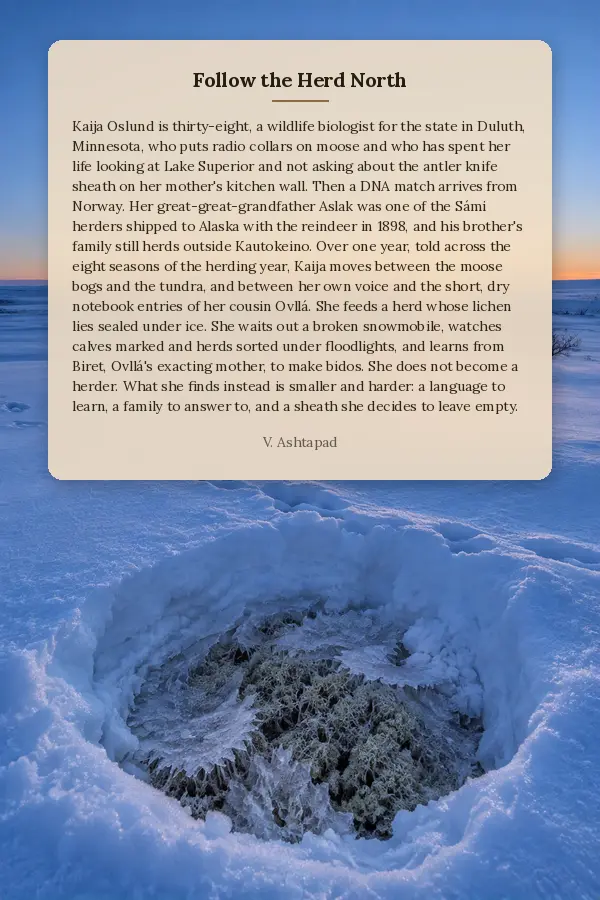
Kaija Oslund is thirty-eight, a wildlife biologist for the state in Duluth, Minnesota, who puts radio collars on moose and who has spent her life looking at Lake Superior and not asking about the antler knife sheath on her mother's kitchen wall. Then a DNA match arrives from Norway. Her great-great-grandfather Aslak was one of the Sámi herders shipped to Alaska with the reindeer in 1898, and his brother's family still herds outside Kautokeino. Over one year, told across the eight seasons of the herding year, Kaija moves between the moose bogs and the tundra, and between her own voice and the short, dry notebook entries of her cousin Ovllá. She feeds a herd whose lichen lies sealed under ice. She waits out a broken snowmobile, watches calves marked and herds sorted under floodlights, and learns from Biret, Ovllá's exacting mother, to make bidos. She does not become a herder. What she finds instead is smaller and harder: a language to learn, a family to answer to, and a sheath she decides to leave empty.
Members can react to this book and talk about it in the members' Library.