
Four Tiers Is Enough
One Wedding Weekend on Lake Malawi, Four Families, Four Grandparents and a Schedule of Forty-Seven Items
by V. Ashtapad
Foreword
This is a work of fiction. The chilanga mulilo and kitchen parties of Zambian weddings, the perekani money dance of Malawi, the timbila xylophones of southern Mozambique, the semba of Luanda and the mwera wind that blows up Lake Malawi in the cool season are all real. The Nkhwazi Point Lodge, the Phiri, Macuácua, Chanda and dos Anjos families and everyone in this book are invented.
For the old ones at the end of the table, who were never luggage.
Item 1: Arrivals, Thursday, 2:00 p.m.
The schedule ran to forty-seven items and four pages, and it was laminated.
Tadala Phiri held her copy against her chest in the lobby of the Nkhwazi Point Lodge and watched the gravel drive for the first car. Lamination had been her mother's idea. "The lake is wet," Graça Phiri had said back in May, at the kitchen table in Lilongwe, sliding the pages one by one into the machine she had borrowed from the school office. "People are wet. Children are wet. I am not having item nineteen become a soup."
Item nineteen was the Elders' Table Seating Plan. Tadala knew it by heart, because her name was printed beside it in bold, the way her name was printed beside items seven, nineteen, twenty, twenty-four, thirty-three and forty-four. Beside each one, in her mother's careful school capitals, were the words TADALA (NURSE). As if the family might otherwise mix her up with some other Tadala, one who was not a nurse and could not be trusted with four people whose ages added up to three hundred and fifty-one.
She had done the sum on the bus. Agogo Eliza, ninety-one. Avó Rosalina, eighty-four. Mama Bupe from Lusaka, eighty-seven. The Angolan grandfather, Avô Domingos, eighty-nine. Three hundred and fifty-one years of opinions, and one weekend, and one lake.
Beyond the lobby's open wall the lake lay pale blue and very flat, so wide that the far shore was only a rumor. A fish eagle was calling from the dead tree at the end of the beach, that high laughing cry that the lodge's whole name was built on. Two boys walked the sand with a net slung between them. It was the last week of August, the end of the cool season, and the light already had the hard, clean shine it would carry into October.
"They are late," said Yohane Nkhoma, the lodge manager, coming up beside her with a tray of cold towels rolled like cigars.
"It is two o'clock."
"Exactly. Nobody arrives at two o'clock. Not to a wedding. Never." Mr. Nkhoma was fifty-four and round and had run the lodge for nineteen years, and in that time, he had told Tadala on her first visit in June, he had hosted three hundred and eleven weddings, one funeral lunch, two fishing competitions and a government workshop on solar pumps that had ended in a fistfight over the buffet. "Nothing is a problem," he had said. "Everything is just a thing that has not yet been solved."
On that June visit he had said "not a problem" eleven times. Tadala had counted.
---
The first car was not a car. It was her grandmother.
Agogo Eliza came along the beach from the village on foot, as she had told everybody she would, with a walking stick in one hand and a basin balanced on her head. She wore a chitenje wrapper the color of ripe mango, a secondhand cardigan buttoned to the neck in spite of the heat, and the canvas shoes Tadala had bought her for her ninetieth birthday, which she called her running shoes and had never once run in. Behind her, at a respectful distance, came a girl of about twelve carrying a folding chair and a plastic bag of oranges.
Tadala took the steps down to the sand at a speed that was not quite a run.
"Agogo. We said the car would come for you."
"The car." Her grandmother's voice was dry and carrying, the voice of a woman who had sold dried fish at Salima market for fifty-two years over the voices of three hundred other women selling dried fish. "Why do I need a car to walk past my own house? I have walked this beach since before your father had teeth."
"It is a kilometer."
"It is the beach. The beach is not a kilometer. The beach is the beach." She lowered the basin from her head with a long practiced dip of the knees, and Tadala took it before it could reach the sand. It was heavy, and full of usipa, the little silver lake fish, dried to a crisp and packed in layers between sheets of newspaper.
"You brought fish."
"For the Zambians. Zambians like fish. Everybody knows it." Agogo Eliza looked up at the lodge, with its thatched roofs and its blue pool and its painted sign, and her mouth turned down at one corner. "This is where the Greek man had his tobacco shed. Now look. A swimming pool next to the biggest lake in the world. What is the matter with people."
"It is the third biggest in Africa, Agogo."
"In the world," said her grandmother, who had never left the Central Region except once, in 1974, to visit a cousin in Blantyre, and who had not liked Blantyre. She took Tadala's arm, not because she needed it, she made quite clear, but because it was there. The girl with the folding chair stood waiting.
"This is Memory," said Agogo Eliza. "She is Lameck's granddaughter. Give her some money for the chair."
"Whose chair is it?"
"Mine. She carried it."
Tadala gave Memory a note and two oranges back. Memory gave her a grave look, as if she had been overpaid and knew it, and set the folding chair in the shade of the lobby and ran back along the beach toward the village.
"I have a wheelchair for you," Tadala said. "From the hospital. It is very comfortable. It has a cushion."
"Give it to the Angolan," said her grandmother. "He is old."
"He is two years younger than you."
"He is a man. Men are always older."
---
By the desk, on a stand, Mr. Nkhoma kept a guest register, a big cloth-bound book with a ribbon in it, and he believed in it the way some men believe in football clubs. Every guest signed. No exceptions. Not for ministers, not for the solar pump men, not for brides.
The bride arrived at twenty past two in her own small gray car with the groom in the passenger seat, both of them looking exactly as they had looked for the last seven months, which was like two people who had agreed to a wedding of sixty guests in April and were now hosting two hundred and twelve.
Chimwemwe got out first. She was thirty-one, a pharmacist, the calm one, the sister who had never once in her life lost her keys, and she was wearing a T-shirt that said LILONGWE HALF MARATHON 2019 and had her reading glasses pushed up into her hair. After her, Mulenga unfolded himself. He was thirty-three, very tall, a civil engineer who built bridges for a living and walked around rooms as if he were checking them for load. He bent to kiss Agogo Eliza on the top of her head. She slapped his arm and looked pleased.
"The Zambian," she said. "Still tall."
"Still tall, Agogo."
"Good. We need somebody to reach things."
Chimwemwe gave Tadala a hard, brief hug and said into her ear, "Is Mum here yet?"
"Not yet. She was stopping at Salima for the cake."
"Then I have twenty minutes to live." At the register Chimwemwe uncapped the pen on its chain and signed with the speed of a woman who put her name on prescription forms nine hours a day. Tadala, leaning to look over her shoulder for no reason except that she was a younger sister, saw the signature go down. *C. Chanda.*
She looked at it.
Chimwemwe saw her looking, and closed the register with a soft thump, and smiled the smile she had been using since she was nine years old and had eaten the last of the groundnut biscuits.
"Practice," she said.
"You are not married until Saturday."
"I am practicing for Saturday. I am a professional. Professionals practice." She tapped the laminated schedule against Tadala's chest. "What is item two?"
"Collect Avó Rosalina and the Tete party at the border. Tio Armando. Six o'clock."
"And three?"
"The Lusaka bus. Seven o'clock."
"So nobody is coming at two," said Mulenga, from the doorway.
"Mr. Nkhoma said that," Tadala said.
"Then Mr. Nkhoma is a wise man." Mulenga had a gift, her sister said, for agreeing with people so warmly that they did not notice he had not actually agreed to anything. He looked out at the lake, at the long beach, at Agogo Eliza in her folding chair with her stick across her knees, already telling a lodge waiter how the usipa should have been dried, and Tadala saw his face do something soft and private.
"She walked?" he said.
"She walked."
"With the basin?"
"With the basin."
He laughed under his breath and shook his head. For the first time that weekend, and not the last, Tadala thought her sister had chosen well.
---
Her mother arrived at two forty-one with the cake.
The cake came in four white boxes in the back of the borrowed school minibus, each box seat-belted into its own seat, and Graça Phiri came out of the front of the minibus already talking, in English to Mr. Nkhoma, in Chichewa to the driver and in Portuguese to the sky, which was being asked very firmly why the road from Salima had so many bumps when a person had paid for a five-tier cake to arrive as five tiers and not as a pudding.
She was fifty-nine, deputy head of a primary school in Area 18 in Lilongwe for fourteen years, and she had brought all fourteen years with her. She wore a capulana in a print of blue fish on a yellow ground, tied in the Mozambican way at the hip, and a pair of sunglasses on a cord, and she had the second laminated copy of the schedule rolled in one fist like a baton.
"Tadala. Item one."
"Arrivals. Agogo is here. Chimwe and Mulenga are here. You are here."
"And the cake is here." Her mother looked at the boxes. "Four tiers of cake are here. Where is the fifth tier, Mr. Nkhoma?"
Mr. Nkhoma looked in the minibus. He looked under the seats. Then he looked at the driver, and the driver looked at the sky.
"It is not a problem," he said.
Tadala, who had been keeping count, made it one.
For a long moment her mother closed her eyes. Then she opened them, unrolled the schedule, took a pen from behind her ear and drew a small neat star beside item one. Tadala knew the star system. A tick meant a thing was done. A cross meant a thing had failed. A star meant a thing had become what her mother called *an interesting situation*, and would be returned to.
"The fifth tier," her mother said, "is a situation."
"I will call the bakery," said Mr. Nkhoma.
"Please."
"Ma," Chimwemwe said, "nobody will count the tiers."
"Your grandmother will count the tiers. Both your grandmothers will count the tiers. The Zambian grandmother is a retired headmistress, Chimwemwe. Retired headmistresses count everything. They count the tiers and the teeth." Graça turned, and saw her mother-in-law in the folding chair under the thatch with the basin of fish at her feet, and her face went through three expressions very quickly, like a woman changing buses.
"Ma," she said, in Chichewa, warmly, going to kneel by the chair. "You walked. In this heat. With the fish."
"I walked," said Agogo Eliza, "on the beach."
From the dead tree at the end of the sand, the fish eagle laughed again, and kept on laughing.
© 2026 CRUNOD LLC. All rights reserved.
Item 2: Collect Avó Rosalina and the Tete Party at the Border, Thursday, 6:00 p.m.
Armando Macuácua had built the timbila to fit the pickup, and he had built the pickup's rack to fit the timbila, and somewhere on the road between Tete and the border he had discovered that neither of these facts mattered, because the timbila now had opinions about the road.
It sang at every pothole. A low wooden knock from the bass keys, a buzz from the gourds, then the long falling hum of nineteen slabs of mwenje wood settling back onto their cords. In the passenger seat, the cooler of cassava leaves between her feet, Fátima had given up turning round to look at it after the first hundred kilometers.
"It is fine," she said. "It is singing because it is happy."
"It is singing because it is loose."
"Then it is loose and happy. Like your uncle Tomás at Christmas."
In the back seat, wrapped in two capulanas and a blanket, his mother turned her head toward the sound.
"Américo," she said. "Is that the orchestra?"
Armando found her in the mirror. She was eighty-four and small as a bird, with white hair cut close to the skull and the long fine hands of a woman who had shelled groundnuts and plaited mats for seventy years. Her eyes were bright and interested. Since Tete she had asked him four times whether they were going to Zavala, and twice whether her mother had remembered the chickens.
"It is my timbila, Mamã," he said. "The one I made. We are going to Malawi. To Graça's daughter's wedding."
"Graça is a child."
"Graça is fifty-nine."
His mother considered this, and laughed, delighted, as if he had told her a good joke at a party. "Fifty-nine," she said. "Imagine." And she turned back to the window and the long dry country going by, the baobabs standing in the fields like old men who had been left behind by a bus, and began to hum.
He knew the song. Everybody in Zavala did. It was the one his father's orchestra had played for her on the day of her wedding, in July of 1961, under the cashew trees, and his father had told it to him so many times that Armando could see it as if he had been there: thirty players, a line of dancers, his mother nineteen years old in a new capulana with the fishing boats printed on it, and the composer of the village, an old man with one eye, standing on a crate to conduct. Armando had learned to make timbilas from his father in the yard at Zavala when he was nine. He had learned that song when he was six. He could play it with his eyes closed and he sometimes did, in the evenings, in the workshop in Tete, for nobody.
More and more, lately, his mother lived inside that song. Some days she came out of it to scold him about his shirt. Some days she did not.
---
The border at Dedza was a long low building with a tin roof and a queue of trucks that stretched back past a shop selling airtime and fried cassava. Gift Phiri was waiting on the Malawi side, as item two promised, leaning against his car with a newspaper folded under his arm. Armando saw him through the fence before the first barrier and raised a hand, and Gift raised his newspaper.
They had met perhaps eleven times in thirty-two years. Gift was a retired geography teacher, a big soft-spoken man with reading glasses and a habit of explaining rivers, and Armando liked him in the careful, slightly formal way you like a man who took your sister away to another country and then sent a Christmas card every single year without fail, with a school photograph of each child inside.
The Mozambican side was the one that took the time.
"What is this?" said the young officer in the customs shed, a woman of perhaps twenty-five with very straight braids and a pen she was not using.
"A timbila."
"A what?"
"A xylophone. From Zavala. From Inhambane." He looked at her face. "From the south," he said.
"I know where Inhambane is, Tio." She walked around the instrument where it stood on the concrete, all nineteen keys on their frame, the gourds hanging beneath in a row like a family waiting for a photograph, each gourd with its small round window covered in membrane. "And this is for sale?"
"No."
"For a festival?"
"For a wedding. My sister's daughter. In Malawi."
"You are taking a xylophone to a wedding."
"I am taking a timbila to a wedding," Armando said, with what he felt was great patience. "And my mother. And my wife. And some cassava leaves."
The officer looked at the cooler. Then at the old woman in the pickup, who had wound down the window and was watching the whole scene with the frank pleasure of a child at a market. She looked back at the instrument.
"Play it," she said.
"Here?"
"How do I know it is a timbila? It could be a table."
Behind him, he heard Fátima laugh out loud.
So Armando Macuácua, sixty-four years old, timbila maker, father of three and grandfather of five, knelt on the concrete floor of the customs shed at the Dedza border with his two beaters in his hands, their heads of natural rubber worn smooth from forty years of use, and played the first phrase of the song from his mother's wedding.
It was a strange room for music. The tin roof caught the sound and threw it straight back down. But mwenje wood, dried right, does not care where it is. The first keys rang out bright and sweet, the gourds caught them and buzzed, and the bass under it came in the way his father had taught him, like a man coming late to a party and walking straight onto the dance floor. The officer did not move. A second officer came in from the back room with a mug of tea. An old truck driver from the queue put his head round the door.
In the pickup, his mother sang.
She sang the first verse in her own clear old voice, every word in its place, and Armando, kneeling on the concrete, played under her and did not look up, because if he looked up he would lose it. He played until the end of the phrase, and then he stopped, and the gourds buzzed on for a moment by themselves.
The officer cleared her throat.
"That is a timbila," she said.
"Yes."
She stamped the form. She did not ask about the cassava leaves.
---
On the Malawi side Gift drove ahead of them, down off the escarpment toward the lake. The road went down and down through hills of brown grass and rock, and the air changed as they went, grew softer and warmer and wetter, until at the last bend the whole lake opened in front of them, pale gold in the late light, with the sun going down behind them and the far shore already blue.
Fátima put her hand on his arm.
"Look," she said.
He looked. He had seen the sea at Inhambane every day of his childhood, the long green Indian Ocean, and he had seen the Zambezi at Tete every day of his working life, brown and wide and powerful under its bridge. He had never seen anything like this one. It was too big to be a lake and too quiet to be a sea.
"Graça lives near this?" he said.
"An hour and a half," said Fátima. "She told you. Every Christmas she tells you."
He did not answer. Thirty-three years ago his little sister had come to a teachers' workshop in Blantyre and met a geography teacher with reading glasses, and a year later she had married him and gone to live in Lilongwe, and Armando had stayed in Mozambique and been the son. He had been the son when their father died in 2004. He had been the son who moved their mother up to Tete into the room at the back of the workshop. He had been the son for the last two years, since the bright days and the far-away days had started, the son who knew which pills and which songs and which side of the bed. He had never said one word of this to Graça. He was not going to start now, at her daughter's wedding.
His mother had fallen asleep in the back seat, mouth a little open, one hand on the blanket.
"Avó," said Fátima softly, turning in her seat. "We are nearly there."
His mother opened her eyes and looked out at the lake.
"Is this Zavala?" she said.
"No, Mamã," Armando said. "This is the lake. Graça's lake."
"Graça has a lake," his mother said, and smiled, and closed her eyes again. "Clever girl."
Behind him, at the bottom of the hill, the timbila hit a pothole and sang one long, loose, happy chord.
© 2026 CRUNOD LLC. All rights reserved.
Item 3: The Groom's Party Arrives from Lusaka, Thursday, 7:00 p.m.
At seven o'clock on Thursday evening the Chanda bus was not arriving anywhere. It was parked on the shoulder of the Great East Road twenty kilometers short of the Mwami border, with its bonnet up and its hazard lights going, and Agnes Mwape was standing in the dark with a torch in her teeth, holding a bale of chitenge cloth over her head like a roof while her brother tried to look at the fan belt.
It was not raining; it was the dry season. The bale was over her head because the roof rack had come loose at the last speed bump and the bale had been the first thing to come down, and Agnes had caught it, and now that she had caught it she was not going to put sixty meters of brand-new, hand-chosen, fully paid-for wedding cloth onto the red dust of the shoulder. Not for her brother. Not for anybody.
"Bwalya," she said around the torch.
"I can see it."
"Can you fix it?"
"I can see it," her brother said again, which in thirty-two years as a mine accountant in Kitwe had been his way of saying no.
In the warm dark inside the minibus, eighteen members of the groom's family sat eating chikanda out of a plastic tub and listening to the argument about music that had been going since Lusaka.
The argument was between Mama Bupe in the front seat and the Angolan boy at the back. The Angolan boy was Kiluanji, the groom's cousin on his mother's side, who was thirty years old and a sound engineer in Luanda and had brought with him, as luggage, a suitcase that contained nothing but cables and two speakers the size of small goats. Since Lusaka he had been trying to play kizomba. Since Lusaka Mama Bupe had been asking for kalindula. Every hour or so they declared a truce and played one song of each, and then somebody played a second song and the war started over.
"This music," Mama Bupe was saying now, in English, with the full, terrible courtesy of a woman who had been headmistress of a girls' secondary school in Kitwe for twenty-one years, "is very slow, young man."
"It is supposed to be slow, Mama."
"Why?"
"So people can dance close."
"Close to what?"
There was a short silence in the back of the bus. Somebody's child giggled.
"To each other, Mama," said Kiluanji.
"Hm," said Mama Bupe. "In my day we danced so you could see daylight."
---
In the end the fan belt was a stocking. Agnes's. She took it off in the bus behind a capulana held up by her sister-in-law Luzia, and Bwalya tied it on round the pulleys in the light of three phones while a truck driver who had pulled over to help gave advice in Nyanja and laughed at all of them. It would get them to Lilongwe, he said. Probably. If they did not use the air conditioning. If they were lucky.
"There is no air conditioning," said Bwalya.
"Then you only need luck."
They drove on into the dark with the stocking holding and the bale of cloth on Agnes's lap and her mother's head nodding in the front seat. The lights at the border were bright and white and a little cold. Agnes did the papers for all eighteen of them, because she always did the papers; she had done the papers at the Chirundu border twice a month for thirty years, bringing cloth up from the south and down from the east, and she knew how to stand at a counter so that an officer thought it was his own idea to hurry.
"Your mother is eighty-seven?" said the officer on the Malawi side, looking at Mama Bupe's passport.
"She is."
"And she is traveling for a wedding?"
"Her grandson's."
The officer looked through the window at the front seat. Mama Bupe was awake now, sitting very upright, with her handbag on her knees and her hat on, looking straight back at him.
"She is looking at my buttons," he said.
"She looks at everyone's buttons," said Agnes. "She was a headmistress."
The officer looked down at his shirt. A button was missing. He covered the gap with one hand and stamped the passport with the other.
---
Agnes had been buying and selling chitenge cloth since she was twenty-six. It had begun as a hobby the year after her son was born, three bolts bought at a wholesaler in Lusaka and sold to her neighbors in Chelston, and it had become a stall, and then a bigger stall, and then a name. People came to her from all over Lusaka. They came for funerals and weddings and kitchen parties, for school prize-givings and club outings and the launches of small businesses, for every occasion on which a group of people wanted to stand together in a photograph in the same print and say, without saying it, *we belong to each other.*
That was the whole of it, Agnes thought. That was what cloth was for. You could wear the same blood as somebody and never stand next to them. But if you wore the same cloth, you had at least turned up.
For her nephew's wedding she had chosen the print herself, in May, sitting in the stall for two whole afternoons with a sample book of nine hundred patterns on her knees while her assistant served customers around her. The order slip was still in her handbag, the carbon copy, pink, a little soft at the folds:
> **MWAPE CHITENGE, STALL 14, NEW SOWETO MARKET, LUSAKA**
> **Order no. 2231** Date: 14 May
> Customer: Self (A. Mwape)
> Pattern: Book 3, page 611. Fish eagles, orange/black/white on deep blue, wings open, repeating rows
> Quantity: 60 meters
> Paid: in full
> Purpose: Nephew Mulenga's wedding, Nkhwazi Point, last weekend of August. Own side and bride's whole side. GIFT. Tell no one on bride's side.
> Note (in her hand, under the line): *nkhwazi = fish eagle, says the father-in-law. Right print. Lake, family, long way to fly.*
Sixty meters was what a paternal aunt did. It was what her own aunt had done for Bwalya's wedding in 1990, and what Agnes would have done for her own son if he had ever, she sometimes said loudly in his hearing, found a girl with the patience. A gift was a gift. It would be a surprise.
---
They stopped at Lilongwe for fuel and buns. At Salima the stocking finally gave out, and they came the last fifteen kilometers at the speed of a woman walking, with Bwalya hunched over the wheel and Luzia beside him reading the road signs out loud in Portuguese for no reason except that she was tired and it calmed her.
It was nine forty when they turned into the gravel drive of the Nkhwazi Point Lodge. The lake could not be seen. The night was very dark and very warm and full of insects, and out where the lake must be there were lights, hundreds of them, scattered across the black water like the windows of a city that was not there.
"What is that?" said Kiluanji from the back.
Nobody knew. Then Mama Bupe, who had been silent since Salima, said, "Fishing boats. The small fish come to the light. My husband told me. He came here for work once, in 1971." And everybody in the bus went quiet for a moment, because she had not said *my husband* out loud in Agnes's hearing for at least ten years.
The headlights swung and found the front of the lodge. Under the thatch, in a pool of yellow electric light, stood a woman in a blue-and-yellow capulana with a laminated sheet of paper in her hand. Next to her stood a younger woman in a nurse's watch and sandals, and next to her a round man in a lodge shirt holding a tray of cold towels, and behind all three of them, in a folding chair, sat a very old woman with a walking stick across her knees, wide awake.
Agnes knew the woman with the paper must be the bride's mother. She knew because the woman looked at her watch, then at the bus, then at the paper, and took a pen from behind her ear and drew something small and neat beside a line.
Agnes picked up her bale of fish eagles and got out to say hello.
The bride's mother came forward smiling, both hands out. She was beautiful and tired and smelled of cake, and as she took Agnes's hands Agnes saw, folded over the back of the folding chair behind her, a stack of bright new cloth in a print of red drums on gold. Twenty pieces at least. Folded, pressed and tied with ribbon.
Agnes looked at the drums.
The bride's mother looked at the fish eagles.
"Welcome," said Graça Phiri warmly. "You must be the aunt."
"I must be," said Agnes.
© 2026 CRUNOD LLC. All rights reserved.
Item 4: Welcome Dinner on the Terrace, Thursday, 8:00 p.m.
Domingos dos Anjos could no longer see the middle of things, so he had learned to love the edges.
Four years ago it had started with the newspaper, a gray smudge where the headline should be, and then the faces of customers in the shop, and then the eye of the needle, which was the cruelest, because he had threaded needles since he was eleven years old and had believed in his heart that the hand would remember even if the eye forgot. The hand did not. The doctor in Luanda had given the thing a long name and a short future. *The center goes,* she said. *The sides stay. You will learn to look past things, Kota.* She had called him Kota, the Luanda word for an elder, the respectful one, and he had liked her for it even as she told him he would never again see his own face clearly in a mirror.
So now, on the terrace of a lodge on the shore of a lake he had never seen, at ten minutes past ten on a Thursday night, he looked past things. He looked past the long table and saw, at its edges, the lamps, the moving white shirts of the waiters, the dark shine of the water beyond the wall. He looked past faces and saw hands, and hands told him most of what he needed to know.
The hands on his left belonged to the Zambian grandmother, Mama Bupe. They were folded on her handbag, which was on her lap, which was where it would stay, he suspected, through dinner and dessert and possibly the next rainy season. They were the hands of a woman who had spent many years correcting other people's handwriting.
The hands across from him belonged to the bride's father's mother, the one they called Agogo. They were enormous for such a small woman, broad and hard and quick, and they were at that moment pulling a grilled fish apart along its spine with a speed and accuracy that he, a tailor, could only admire. She lifted the whole skeleton out in one piece, head to tail, laid it on the side of the plate like a comb and pushed the plate across the table at him.
"Chambo," she said.
"Chambo," he agreed.
She added a long sentence in Chichewa, pointing at the fish, then the lake, then herself.
"She says she knows the man who caught it," said a voice behind his shoulder, a young woman's voice with English in it and something softer underneath. The nurse. The bride's sister. "She says he is a fool, but his fish are good."
"Tell her," said Domingos in Portuguese, "that in Luanda we say the same about our fishermen. And our sons-in-law."
The nurse laughed and translated. The old woman across the table looked at him with sudden interest, and then said one word, and slapped the table, and laughed a big rough laugh with her mouth open, and Domingos found himself laughing too, without knowing at what.
"What did she say?"
"She said you have good shoes," said the nurse, a little helplessly.
He looked down. He had on his best shoes, black, laced, polished that morning in the lodge room by Kiluanji, who had done it without being asked. They were the shoes he had been married in, in 1962, resoled four times.
"So does she," he said. "Tell her. Very good. Very fast."
The nurse told her. Agogo Eliza lifted one foot out from under the table, in its canvas shoe, and turned it this way and that in the lamplight like a girl showing off a new bracelet.
---
He had flown from Luanda to Lusaka ten days before, with his grandson, his first flight in nineteen years, and had spent the ten days in his daughter's house in Lusaka being looked after with a ferocity that had nearly finished him. Luzia brought him tea before he woke. Luzia moved the furniture so he would not walk into it. Luzia read him the newspaper, both pages, at a volume intended for the whole street. On the third day he had gone out alone to the end of the road and stood under a jacaranda tree for twenty minutes, simply to be somewhere nobody was holding his elbow, and had come back to find her on the step in tears with the neighbor's phone in her hand, about to call the police.
"Papá," she had said. "You cannot see."
"I can see the tree."
"You cannot see the cars."
"I can hear the cars. They are very loud in Zambia."
She meant it with love; he knew that. Luzia had come to Lusaka in 1987 to study and married a Zambian accountant and stayed, and every year since her mother died she had asked him to come and live with them, and every year he had said the same thing. *My house is in Luanda. My street is in Luanda. Your mother is in Luanda.* By which he meant the small stone in the cemetery, and the shop with its shutters down, and the chair by the window where Esperança had sat in the evenings shelling beans and telling him which of the neighbors was a thief.
Luzia sat at the far end of the table now, beside the bride's mother, and he could hear the two of them from here. Two Portuguese voices, one from the Atlantic and one from the Indian Ocean, getting on very well indeed in that particular tone two women use when each has privately decided she is running the wedding.
---
The fourth elder arrived late, on her son's arm.
He heard her first. She was singing under her breath, a little tune that went up and came back, and she was singing it in Portuguese. Not his Portuguese. Hers was the soft Portuguese of the south of Mozambique, all the ends of the words rounded off like river stones. He turned his head to put her at the edge of his eye, where he could see, and found a tiny woman wrapped in a capulana, with close white hair and a face that was all bright attention.
Her son sat her down beside Domingos. He was a broad, quiet man with careful hands; Domingos saw them on the back of her chair. A craftsman's hands, scarred across the knuckles. Wood, perhaps.
"Mamã," said the son. "This is the Angolan grandfather. Avô Domingos."
The tiny woman looked at Domingos. Her face lit up.
"Senhor," she said. "You have come for the wedding."
"I have, senhora."
"Are you from Zavala?"
He did not know where Zavala was. He saw the son's hands tighten on the chair back, and something in the set of them told him the rest. He knew those hands. He had seen them on his own daughter in Lusaka a hundred times in ten days, holding on to something that was going.
"I am from a little further away," he said to her gently. "But I have heard of Zavala. They say the music is very good."
"Oh, it is the best," she said. "The best in the world. My husband plays. You will hear him on Saturday." She patted his hand where it lay on the table. "I am getting married on Saturday," she confided, "but do not tell my mother I said so. She thinks I am too young."
"I will not say a word," said Domingos.
Her son made a small sound above them. When Domingos looked up, past the man's face, he saw his shoulders go down, slowly, an inch, the way a man's shoulders go when somebody else has carried the end of a heavy table for him for just a moment.
---
They ate, and the food kept coming. Grilled chambo and fried chambo and a stew of chambo in tomato and onion. Tiny dried fish, crisped, which the Agogo had brought herself and which she made the waiters serve in a bowl of their own, and which she watched every person at the table taste. Greens. Rice. And the white porridge, the stiff maize porridge that is in every country of the south and has a different name in every one of them, set down in a great steaming mound in the middle of the table.
"Nsima," said Agogo Eliza, pointing with her chin.
"Nshima," said Mama Bupe, very quietly, beside him, in the voice of a headmistress correcting a spelling.
"Xima," said the tiny Mozambican woman, delighted, and clapped her hands.
Domingos looked at the white mound. In Luanda, at his own table, at his own wife's table, it would have been made from cassava and not maize, and it would have been grayer and stretchier and better, and it would have been called by its proper name, which was funge. He thought about saying so. He thought about it for a long and pleasant moment. Then he looked at the three old women around him, each one looking at the porridge as if it belonged to her and to her alone, and he took a piece in his fingers, rolled it, pressed a hollow in it with his thumb, and dipped it in the fish stew.
"It is very good," he said, in Portuguese. "Whatever it is called."
The nurse, behind him, translated it into English for Mama Bupe and into Chichewa for Agogo Eliza. The tiny Mozambican woman did not need it translated. She leaned over and patted his hand again.
On the chair beside his own lay a black garment bag with a zip, which he had not let go of since Luanda, carrying it onto the plane and onto the bus and into the dining room. Inside it was a jacket. It was the groom's wedding jacket. Domingos had made it himself, over four months, in the shop with the shutters half down, by the edges of his eyes and the memory of his hands. And on the bus, in the dark near Chipata, he had opened the zip a little and slipped two fingers in, and felt the lapels, left and right, the way he had felt ten thousand lapels in his life.
The left lapel was wider than the right. By the width of his smallest finger. He was sure.
He had told no one, and did not know how he would. He sat now at the welcome dinner with his hand resting on the bag, and ate the porridge with four names, and smiled at the three women, and listened to the fishing lights hum out on the dark water like a city he could not see.
© 2026 CRUNOD LLC. All rights reserved.
Item 7: Elders' Medicines and Breakfast, Friday, 7:00 a.m.
Tadala had made the chart on the ward computer on her last night shift, between the two o'clock rounds and the four o'clock rounds, with Mrs. Mbewe in bed six snoring like a hand saw. She had printed it twice and her mother had laminated both. The top of it read:
> **ELDERS' MEDICINES, NKHWAZI POINT, THURS-SUN** (T. Phiri, RN)
> | | 7:00 a.m. | 1:00 p.m. | 9:00 p.m. | ✓ | Init. |
> |---|---|---|---|---|---|
> | Agogo Eliza (91) | BP tablet x1 | | | ☐ | ☐ |
> | Avó Rosalina (84) | Memory tablet x1, BP x1 | | Memory x1 | ☐ | ☐ |
> | Mama Bupe (87) | Sugar tablets x2 | Sugar x1 | | ☐ | ☐ |
> | Avô Domingos (89) | Ophthalmic drops, both eyes | Drops | Drops | ☐ | ☐ |
> *Key: tick = taken. Circle = offered, not yet taken. Each row color-coded. Spare copy with Mum.*
At seven on Friday morning she sat on the breakfast terrace with the chart, four pill boxes, a jug of water and a growing understanding that she had made the chart for four imaginary people.
"No," said Agogo Eliza, about her blood pressure tablet.
"Agogo, the doctor in Salima said—"
"The doctor in Salima is twelve years old."
"He is forty."
"He is twelve. His mother sold tomatoes next to me. I remember when he could not find his own feet. Twelve." Agogo Eliza had walked over from the village at six, alone, in the dark, and was now eating her third boiled egg. She looked at the small white tablet in Tadala's palm with the kind of contempt usually reserved for a badly dried fish. "I have been alive for ninety-one years without a pill, child. Why should I start at a wedding?"
"You have been taking it for two years."
"Then I have been very patient."
Tadala put the tablet down beside the egg cup and drew a small neat circle in Agogo Eliza's box, which meant *offered, not yet taken*, and which she suspected would be the only mark in that column all weekend.
Avó Rosalina, by contrast, took her tablets beautifully, one after the other, with little sips of water and a gracious nod for each, like a queen accepting flowers. She was bright this morning; Tadala saw it the moment she sat down. Her eyes followed things and came back, and when Tadala said good morning in her careful Portuguese, Avó Rosalina said good morning back and then, in the same breath, told her that her verbs were a disgrace.
"You speak like a Malawian," said her grandmother.
"I am a Malawian, Avó."
"You are half a Malawian. The other half of you is mine." Avó Rosalina tapped her on the wrist, quite hard, with one finger. "Your mother is lazy. She should have spoken Portuguese to you in the house."
"She did."
"Then you were lazy."
This was so exactly the conversation Tadala had been having with her grandmother since she was six years old, on every visit to Tete, in every phone call at Christmas, that she felt her eyes go hot and had to look at the chart very hard for a moment. Two years ago these conversations had started to go missing. On some visits her grandmother did not know who she was. Some visits she thought Tadala was Graça, at nine years old, and asked her if she had done her sums. To be scolded properly, by the right name, in the right language, at a breakfast table in the sun, felt like being handed something she had dropped.
No, not dropped. She corrected the thought. Something she had lost. Something she had put down and forgotten.
"I will practice," she said in Portuguese.
"Practice with the Angolan," said her grandmother, nodding down the table. "He speaks very well. For an Angolan."
---
Mama Bupe took her sugar tablets in a single motion, without water, as if they were an item on an agenda, and then turned her attention to the chart itself.
"May I?" she said.
Tadala handed it over. Mama Bupe held it at arm's length and studied it for nearly a full minute, the way, Tadala imagined, she had once studied the end-of-year reports of nine hundred girls.
"This is very good work," she said at last.
"Thank you, Mama."
"You have spelled *ophthalmic* correctly. Nobody spells *ophthalmic* correctly. I have seen doctors who could not spell it." She handed the chart back. "But you have made a mistake."
"Where?"
"You have made a chart for four patients," said Mama Bupe. "And we are not patients, my dear. We are guests."
She said it kindly, and without raising her voice. Tadala, who had worked on the older people's ward of a district hospital in Lilongwe for five years and had been spoken to by every kind of patient and every kind of family, found that she had nothing at all to say.
At the end of the table, Avô Domingos was trying to put in his own eye drops. He had his head tipped back and the little bottle held over his face, and he kept missing. The first drop landed on his cheek, the second on his collar. Tadala half rose from her chair, and Mama Bupe, without looking round, put a hand on her arm.
"Wait," said Mama Bupe.
The third went in. Avô Domingos blinked, wiped his cheek with a folded handkerchief and put the cap back on the bottle with great dignity. He looked down the table toward them, past them, at the edge of them, and lifted the bottle an inch, the way a man lifts a glass.
"You see," said Mama Bupe.
---
The speakers arrived on the beach at seven fifteen.
They came down the sand from the chalets on a wheelbarrow borrowed from the lodge garden, pushed by Avô Domingos's grandson, the Angolan cousin with the cables, who was barefoot, in shorts and a T-shirt that said nothing at all, and who was singing to himself. He set them on two folding tables twenty meters from the terrace, facing the lake, connected them to a small black box and a long orange cable that ran away up the lawn to some secret plug, and pressed a button.
A sound came out of them so low and so large that the cups on the breakfast table rattled in their saucers.
Before she knew she had decided anything, Tadala was on her feet and halfway down the steps.
"Excuse me."
He looked up. He had a pleasant, open, unhurried face and a small scar through one eyebrow, and he was holding a cable in his teeth. He took it out.
"Bom dia."
"It is seven o'clock in the morning."
"Seven fifteen," he said, in English. "I am doing a sound check."
"There are four people at that table with an average age of eighty-seven point seven five."
He looked past her up the steps at the terrace, and she turned and looked too. Agogo Eliza was nodding her head to the bass line. Avó Rosalina was moving her shoulders in her chair. Mama Bupe was sitting perfectly still, with her handbag on her knees, but one foot under the table was going. And Avô Domingos had his eyes shut and his face turned to the speakers and was smiling like a man in a warm bath.
"They seem fine," said the cousin.
"They are elderly. They are my responsibility. It says so on page two."
"Page two?"
She showed him the schedule. Item seven: Elders' Medicines and Breakfast. TADALA (NURSE). He read it carefully, then turned the laminated page over and read the back. Then he found his own name, halfway down page three, beside item forty: Music by the Families. KILUANJI (SOUND).
"Kiluanji," he said, tapping it. "Kilú. That is me."
"Tadala."
"Nurse," he said, and smiled, not unkindly. "I know. It says so." He turned the volume down, a little, a very little. "I look after him too, you know. My grandfather. In Luanda. Every Sunday I go to his house and I fix the radio, and I clean the shoes, and I check the gas, and he tells me I am doing it all wrong." He shrugged. "Nobody gave me a chart."
"Do you want one?"
"No," said Kilú. "I want to play him one song before breakfast is finished. His song. From his band. From 1963. He has not heard it on a big speaker since my grandmother died. Five minutes." He held up his hand, fingers spread. "Then I will turn it off and you can put me in your chart."
She glanced up at the terrace. Avô Domingos still had his eyes shut.
"Five minutes," she said.
He played it: a semba, an old one, scratchy with age, a guitar running quick and bright over a scraping rhythm, and a man's voice, young, singing high. On the terrace, Avô Domingos opened his eyes, and Avó Rosalina began to clap on the off beat, and Agogo Eliza said something loud in Chichewa that made the waiters laugh.
Beside the steps, as the song ended, Tadala heard her grandmother speak again, more quietly, to Mama Bupe, in the Chichewa that Mama Bupe followed well enough with her Lusaka Nyanja.
"Tomorrow," Agogo Eliza said, "I am going out on the lake."
Mama Bupe turned her head.
"In a canoe," said Agogo Eliza. "Like before."
Tadala went up the steps with the laminated chart in her hand, and sat down in her chair, and drew a large, neat, firm cross beside nothing at all, because there was no box on the chart for that, and there was never going to be.
© 2026 CRUNOD LLC. All rights reserved.
Item 9: Family Cloth, Friday, 9:00 a.m.
On the schedule, item nine said only *Family Cloth (Graça)*, and Agnes had read it on Thursday night in her chalet by the light of her phone and understood at once that there was going to be a war.
She did not want a war. What she had was sixty meters of fish eagles and a great deal of goodwill, and she had slept for four hours in a bed that was too soft beside her mother, who talked in her sleep about the timetable of the 1974 netball championships. She wanted coffee, and she wanted to be kind. She put on a fish-eagle wrapper and a fish-eagle headscarf, the full uniform, so that there could be no misunderstanding, and she carried the bale under her arm down to the lodge's conference room, which Mr. Nkhoma had cleared for the occasion.
Graça Phiri was already there, in red drums on gold from head to foot.
Across the long table they looked at each other. On Graça's side of the table were the red drums, twenty-four pieces, folded and tied with gold ribbon. On Agnes's side, after a moment, were the fish eagles, the bale untied and spread open in its glory.
"Good morning," said Graça.
"Good morning," said Agnes.
"Did you sleep?"
"A little. Did you?"
"Not at all. The cake." Graça waved a hand at her schedule as if the cake were written there in letters of fire. "You have heard about the fifth tier."
"I have heard."
"It is a situation."
"Yes." Agnes looked at the drums. They were very good drums; she had to admit it. She knew that print; it was from a mill on the coast of Mozambique, a good mill, the cloth tight and soft and the dye deep, and whoever had chosen this particular pattern had a good eye. The drums were tall and slender and red as a fire at night, and between them ran small gold figures, dancing. It was a wedding print. It said music and noise and joy.
It was not, in any possible universe, a print you could wear in the same photograph as fish eagles on blue.
"These are for the groom's family," Graça said. "As a gift. Each piece is two meters. I have counted your people from the list. Twenty-four."
"These," said Agnes, lifting a length of blue, "are for the bride's family. As a gift. Each piece is two and a half meters. I counted your people from the list too."
"We are thirty-one."
"I brought extra."
Graça looked at the bale for a long moment. Then she took her pen from behind her ear and drew a star on her schedule beside item nine, very small, and Agnes, who had heard about the star system from the nurse at breakfast, felt something inside her draw itself up to its full height.
"Please," Agnes said. "Do not star me."
---
For perhaps four minutes the two of them were alone in the conference room. In that time, both of them told Agnes later, a great deal was said that did not need to be repeated at a wedding.
Graça said that in Mozambique the bride's mother chose the cloth, and had always chosen the cloth, and that her own mother had chosen the cloth for her in 1994, and her grandmother for her mother in 1961.
Agnes said that in Zambia the groom's paternal aunt had certain responsibilities, and that she was the groom's paternal aunt, and that she had been the groom's paternal aunt since the day he was born, thirty-three years ago in the hospital in Kitwe, when she held him first, before his own mother, because his mother was asleep.
Graça said this was a wedding in Malawi.
Agnes said that was exactly the problem, because nobody at this wedding came from only one place, and if you counted the grandparents it came to four countries, and was the bride's mother proposing that everybody wear four prints?
Graça said yes, if necessary.
They stopped and looked at each other, both breathing a little hard.
And then, because they were two tired women in their fifties at nine in the morning at a wedding that had gotten much bigger than anybody had meant it to, they both began to laugh.
Graça went first. She pressed her hand to her mouth and her shoulders began to shake, and then Agnes went too, and then both of them were sitting down on the conference room chairs with their schedules and their bales and their gold ribbons, laughing until Agnes's headscarf slipped over one eye.
"Four prints," said Agnes.
"Like a market," said Graça. "Like a market stall."
"I have a market stall."
"I know. I have seen your number. Everybody in Lusaka has your number. My cousin's daughter bought her school uniforms from you."
"Which cousin?"
"Celeste. In Chelston."
"Celeste Banda?" said Agnes. "With the twins?"
"With the twins."
It was a small world in the way that only the south of the continent can be small, where two women from two countries can discover in a hotel conference room by a lake that they have been, without knowing it, buying and selling the same school uniforms across a border for fifteen years.
---
When the solution came, it came from the door.
Mama Bupe was standing in it, and Agnes had no idea for how long. She was in her own clothes, a navy two-piece and a hat, and she had her handbag on her arm, and the old Angolan gentleman on her other arm, and behind them, at a little distance, the nurse with her chart.
"I have been looking at the cloth," said Mama Bupe.
Nobody said anything.
"I can see it from here," Mama Bupe went on, "and so can Mr. dos Anjos, a little, from the side, and we are agreed." She looked at Agnes. "Agnes. Who is the bride?"
"Chimwemwe."
"And whose family should she be wearing on her wedding day, if she is marrying into ours?"
Agnes saw where this was going, and saw it quite clearly. She had been taught by this woman, at the kitchen table in Kitwe, every night for twelve years, and she knew the shape of a lesson when it came at her.
"Ours," she said.
"And the groom?"
"Hers," said Graça, slowly, from the other side of the table.
"Then it is very simple," said Mama Bupe. "The bride's people wear the eagles. The groom's people wear the drums. Each family wears the other family. Nobody chooses for themselves." She turned to the old man on her arm. "Is that right, Mr. dos Anjos?"
The Angolan gentleman had not understood all of it, Agnes could see, but he had understood enough. He had been a tailor, the nurse had said at breakfast, for sixty years, and there was nothing a tailor understood better than the moment somebody puts on a cloth that was cut for someone else and finds it fits. He reached out a hand, not quite toward the table, a little to the side of it, and Agnes, without thinking, put the edge of a fish-eagle wrapper into his fingers. He rubbed it once between his finger and thumb.
"Bom," he said. "Very good cotton."
"Thank you," said Agnes.
He turned his head the other way, and Graça put a red drum into his other hand. He rubbed that too. He held them both for a moment, one in each hand, the eagles and the drums, the lake and the coast, like a man weighing two fish.
"Também," he said. "This one too."
---
By ten the conference room was full of family. The Phiris came and the Macuácuas came and the Chandas came and the two dos Anjos came, and every one of them went away wearing the wrong family. Gift Phiri tied a fish-eagle wrapper round his waist over his trousers and stood in front of the conference room mirror turning from side to side and said it made him look like a Zambian football fan, and Bwalya Chanda, in a red-drum shirt that Agnes had cut and tacked for him on the spot out of one of Graça's pieces, said that nothing on earth could make a Malawian look like a Zambian football fan, and that was the end of peace between the fathers until lunch.
Avó Rosalina put on fish eagles and said they looked like the gulls at Inhambane. Agogo Eliza put on fish eagles too, because, she pointed out, they were her eagles, from her tree, and she had been looking at them every morning for ninety years, and it was about time somebody made a cloth of them.
Mama Bupe put on red drums and stood in front of the mirror in them for some time. Agnes, behind her with a mouthful of pins, watched her mother's face in the glass.
"Too bright?" said Agnes.
"No," said Mama Bupe. She touched one of the little gold dancers on her shoulder. "Your father liked red."
Agnes said nothing. Very carefully she put a pin in the shoulder, where it would not show.
At the end of the table, Graça Phiri took her pen from behind her ear, looked at item nine for a long moment, and turned the small star beside it into a tick.
© 2026 CRUNOD LLC. All rights reserved.
Item 12: Chilanga Mulilo, Friday, 11:00 a.m.
Until Thursday night, nobody on the bride's side had heard of it.
Armando learned about it at a quarter to midnight, in the corridor outside the chalets, from his sister, who had learned about it at a quarter past eleven from the groom's aunt, who had assumed everybody knew. In Zambia, the aunt had explained, before a wedding the bride's family cooks. They cook their best. They carry it to the groom's family, all of it, dish after dish, covered, on their heads, singing, and the groom's family eats it, and from then on the groom may eat in the bride's family's house. It was called chilanga mulilo. Showing the fire. It was very old and very important and very public, the aunt had said, and it was item twelve.
"It is not item twelve," Graça had said. "Item twelve is Rest."
"Then it is now item twelve," Fátima had said, from the doorway of the chalet in her nightdress, with great satisfaction. She had been looking for an excuse to get into the lodge kitchen since the moment she arrived.
So at six on Friday morning the bride's side went into the kitchen. By eleven it was theirs.
---
It was a good kitchen; Armando had cooked in worse. It had two long steel counters and a six-ring gas stove and a back door that opened onto a yard of sand where a charcoal grill stood under a fig tree, and it had three lodge cooks in white aprons who had come in at six expecting to make breakfast for a wedding party and had found instead a Mozambican woman of sixty with a mortar and pestle the size of a small child, who had taken one look at their cassava leaves and thrown them into the bin.
"Those are for goats," Fátima said, in Portuguese and then in a Chichewa so bad that the cooks laughed out loud. She unpacked the cooler and held up her own leaves, from her own garden in Tete, picked on Wednesday and wrapped in damp cloth. "These are for people."
Matapa was her dish. She had sold it from her stall at the Tete market for twenty-six years, at lunchtime, in tin bowls, to drivers and traders and teachers and the men who worked on the bridge, and there were men in Tete who said they had married their wives because their wives had learned to make it almost as well as Fátima. Almost. She pounded the leaves in the mortar to a green paste. She grated coconut by hand on the steel spike she had brought from home, and squeezed the milk from it through a cloth, twice, the first milk thick and the second thin. She ground the groundnuts fine. She cooked it all together slowly, in the biggest pot the lodge had, stirring with a paddle, for nearly three hours, with garlic and a little onion, until the kitchen smelled the way the house in Zavala had smelled every Saturday of Armando's childhood.
Beside her, at the six-ring stove, his sister made chicken with piri-piri. Graça had not cooked a Mozambican dish in front of their mother in years, Armando realized. Perhaps ever. She cooked with her shoulders up near her ears and her lips moving.
"You are using too much lemon," said their mother from a chair in the corner.
Graça stopped stirring.
"Mamã," she said.
"Too much lemon. Always too much lemon. Since you were a little girl." Avó Rosalina was bright again. She had been bright all morning, sitting in a kitchen chair with her feet on a crate, wearing her fish-eagle wrapper and watching every pot in the room. "Your father liked it with less."
Graça looked at the lemons, then at Armando.
He shrugged. He did not know; he had never noticed the lemons. He had only noticed, over thirty years of Christmas visits, that his sister always came with gifts and left before the dishes were done.
Graça put one lemon back.
---
Agogo Eliza was out in the yard, at the charcoal grill under the fig tree, with the chambo.
She did not cook in the kitchen, because she did not trust gas. She had commandeered the grill and two lodge boys and a basin of fish caught that morning by somebody whose name she would not tell Armando, though she told him at length that he was a fool and a thief and the best fisherman on this end of the lake. She was grilling them whole, split and opened, on a rack of wire over the coals, basting them with a mixture of oil and tomato and onion she kept in a tin. Beside the grill, in a pot of their own, simmered her little dried fish, the usipa, with tomatoes.
And between the grill and the kitchen door, in three of the biggest pots in the building, the lodge cooks were making the porridge. Nsima. White, stiff, steaming. They made it the old way, with a flat wooden paddle, two men at a time to turn it.
Armando watched it for a while. He had been watching the women since six, and everyone had told him, kindly, that he was not needed. In Zambia, said the groom's aunt, who came by twice to look into the pots, the chilanga mulilo was the women's work. In Mozambique, said his wife, the kitchen was the women's work. In Malawi, said Agogo Eliza, through a cloud of fish smoke, the men were for carrying.
So he waited to carry.
---
At eleven the procession formed in the yard.
Armando counted nineteen dishes. The matapa in its huge pot, the piri-piri chicken in two trays, the chambo on a long board, the usipa, three great bowls of nsima, a dish of pumpkin leaves in groundnut sauce, rice, beans, sweet potatoes, a basket of mandasi doughnuts that one of the Phiri cousins had made at five in the morning, fruit, a cake (not the cake, a different cake), and a tin of something Agogo Eliza had made at her own house in the night and would not name. Every dish was covered with a cloth, and most of the cloths were fish eagles.
Twenty-three women and girls of the bride's family stood in a line in the yard in their borrowed eagles with the dishes on their heads. Fátima had the matapa, because it was hers, though it was so heavy that two of the girls stood beside her with their hands up ready to catch it. Graça had the chicken. Tadala had the nsima, and was swaying slightly. At the front of the line, with nothing on her head because she had carried enough on her head for one lifetime, stood Agogo Eliza with her walking stick and a whistle.
"Where is the timbila man?" she said.
"Here," said Armando.
She looked him up and down and pointed at the last and biggest dish on the ground, the third pot of nsima, which nobody had been able to lift.
"Carry," she said.
So he carried. He put a coiled cloth on his own head, the way his mother had taught him to do it at five years old in Zavala for water, and two cousins lifted the pot onto it, and he stood up straight under it with the heat of the porridge coming down through the cloth and into his skull. It was heavy. Very heavy. The heaviest thing he had carried on his head in fifty-nine years.
Agogo Eliza blew her whistle.
They went singing, and the women knew the songs. The Malawian women knew the Malawian songs and the Mozambican women did not, and then Fátima began a song from Tete and the Malawian women did not know that either, but by the second time through the chorus they did, and by the third time the girls were ululating at the end of every line and the whole procession was dancing up the lawn between the chalets, with the fish smoke and the coconut and the piri-piri going up into the blue morning over their heads like a flag.
The groom's family sat waiting on the veranda of the largest chalet, all of them in their red drums. Bwalya and Luzia in the middle. Mama Bupe in the best chair. The Angolan grandfather beside her, sitting very straight, with his face turned toward the singing. Mulenga, standing behind them, trying very hard not to laugh.
The women knelt one by one and set the dishes down.
Armando came last. He knelt, slowly, with the pot on his head and his knees cracking like dry sticks, and two of the Chanda cousins lifted it off him, and he stayed on one knee on the veranda boards for a moment longer than he needed to, getting his breath back, looking at the floor. When he looked up, he saw his mother.
She had come up the lawn on Tadala's arm at the back of the line. She was standing at the foot of the veranda steps in her eagles, singing the Tete song with all the others, and she was looking straight at him, and she was smiling.
"Armando," she called out, clearly, over the singing. "Look at you. A man carrying the food. What would your father say."
She knew his name. His name, and his father, and the food.
He could not answer her. He bent and lifted the cloth off the pot of nsima so the groom's family could see it, and kept his face down over the steam until it had done what steam does.
Behind him, Mama Bupe leaned forward in the best chair, looked into the matapa, and said, in English, in a voice that carried to the end of the lawn, "And what, please, is this?"
Fátima rose from her knees and handed her a spoon.
Mama Bupe had three helpings.
© 2026 CRUNOD LLC. All rights reserved.
Item 15: Kitchen Party and the Fathers' Match, Friday, 3:00 p.m.
The kitchen party was for women, so the men were sent to the beach, and the men, being men, made it into a football match within eleven minutes.
They gave Domingos a plastic chair under a big shade tree at the top of the sand, a bottle of cold water and the job of referee. He took the chair and the water and declined the job.
"I cannot see the ball," he told his grandson.
"Nobody will know, Avô."
"I will know." He settled into the chair. "I will be the commentator. A commentator does not need to see. He only needs to talk."
So Kilú went off to play in goal for the groom's side, and Domingos sat in the shade and listened.
Behind him, up at the lodge, in the big room with the doors shut, he could hear the women. Laughter in great waves. Ululating. Someone banging a pot lid. Then a long hush, and one voice talking, and then laughter again, louder. It was Agnes's party; he could hear her voice running through all of it like the bass line in a song. He did not know what went on inside. It was not for him to know. Esperança had once been to a kitchen party in Lusaka, years ago, visiting Luzia, and had come back to Luanda and refused to tell him a single word of it, and then laughed to herself at odd moments for about a month.
In front of him, on the hard wet sand by the water, the fathers were picking teams.
---
There was no system to speak of. It was the bride's side against the groom's side, roughly, with fishermen's sons from the village to make up the numbers. Gift Phiri and Armando and a dozen Phiri cousins in fish eagles on one side. Bwalya and Mulenga and a dozen Chandas in red drums on the other, with Kilú in goal between two flip-flops. The village boys went to whichever side had the better shoes.
Domingos heard Gift Phiri shout, "Malawi!" and Bwalya Chanda shout, "Zambia!" and both of them begin to explain, at the same time, to anyone who would listen, the result of a match between the two national teams in some year he had never heard of, a match that, it emerged, both of them believed their side had won.
"It was a penalty," Gift was saying.
"It was a dive."
"The referee gave it."
"The referee was from Lilongwe."
"The referee was from Kenya!"
"Exactly," said Bwalya, as if this settled it.
Somebody kicked off. Domingos heard it all, the flat thump of the ball, a shout, the slap of feet on wet sand. He began.
"And they are away," he said, in Portuguese, to the shade tree. "The Malawian schoolteacher has the ball. A big man. A slow man. A man who explains rivers. He passes to the Mozambican, the timbila man, who has never played football in his life and does not know which way to run. The Zambian accountant is coming. He is counting the cost of the tackle. He tackles. It costs him."
Beside him, somebody laughed.
He turned his head. At the edge of his eye there was a man sitting on an upturned crate in the shade, old, thin, in a faded shirt and shorts, with a fishing net across his knees that he was mending with a wooden needle. Domingos had not heard him arrive.
"You speak Portuguese," said Domingos.
"A little," said the man. His Portuguese had a strange broken roundness, like a pot that had been mended. "From the other side." He pointed with the wooden needle across the water at the far blue shore. "Mozambique. I sold fish at Metangula when I was young. Twenty years. Every week. Across in the boat."
"You are a fisherman."
"I am Lameck," said the man, as if that answered it, and it seemed that in this village perhaps it did. "Lameck Banda. I am seventy. My granddaughter carried the old woman's chair."
---
They watched the match together, Lameck with his eyes and Domingos with his ears. Lameck told him what he could not see. Domingos told Lameck what it sounded like. Between them they were the best commentators the beach had ever had.
Lameck told him the schoolteacher had fallen over. Domingos told him he had heard it.
Lameck told him the Zambian accountant had scored and was running along the water's edge with his shirt over his head. Domingos told him that in Luanda, in 1958, he had once scored a goal from forty meters with a ball made of rags and string, and that every person who had seen it was now dead, so no one could say it had not happened.
Lameck laughed until he had to stop mending.
"You knew the old woman's husband," said Domingos, after a while. "Dyson."
"Everybody knew Dyson."
"Tell me."
So Lameck told him. For sixty years Dyson Phiri had been a fisherman on this beach, a big quiet man with a big quiet canoe, a dugout he had carved himself out of one trunk. Eliza had been the loudest fish trader in Salima. Everyone said so. She would buy his catch on the beach in the morning, and dry it on the racks, and carry it to market on her head, and sell it at the highest price on the whole lakeshore, and come home at night and tell him how badly he had caught it. They had done that for fifty-six years.
"And they went out together," said Lameck. "On the water. Every Sunday, in the afternoon, when the wind was down. In the canoe. Just the two of them. Just to go. Not for fish. For nothing. Every Sunday for fifty-six years."
"Every Sunday."
"Every one. I saw them. Everybody saw them. The children used to sit on the sand and watch them go." Lameck's needle went in and out. "Then he died. In 2009. In the cold season. And she sold the canoe the next week, to a man from Senga, and she has never been back on the water since. Seventeen years. Not once. She walks the beach every morning. She does not go in the lake. Not even her feet."
Domingos thought of the chair by the window in Luanda, and the beans in the bowl. He had not sold the chair. He had not sold anything; he had not been able to.
"This morning," he said slowly, "she told the Zambian grandmother she will go out on the lake tomorrow."
Lameck's needle stopped.
"She said that?"
"In a canoe. Like before."
The old fisherman looked out at the water for a long time. Out on the sand, someone had scored again, and the fathers were shouting at each other about the score in four languages, and nobody was counting.
"Then she will go," said Lameck.
---
At four the ball went into the lake and none of the fathers would go in after it, so the match ended. A village boy swam out and fetched it and was paid, by both sides, twice. Kilú came up the sand with wet knees and sand in his hair and sat down at his grandfather's feet on the ground with his back against the trunk of the shade tree, breathing hard and happy.
"Three each," he said.
"I heard."
"Tio Bwalya says four-three."
"Tio Bwalya is an accountant," said Domingos. "He adds things that are not there."
Kilú laughed, picked up a stick and drew in the sand. Domingos could not see the drawing, but he could hear the stick, and something in the boy's silence told him a question was on its way.
"Avô," said Kilú. "When we go home."
"Yes."
"The back room. The one with the sewing machines." He drew another line. "You are not using it. The machines are only sitting there. I was thinking I could move in. To the back room. My lease is finished in November. It would be easier for the drive to work. It is closer to the studio."
Domingos said nothing.
"I would pay rent," said Kilú.
"You would watch me."
"No."
"You would move my furniture. You would read me the newspaper. You would stand on the step with the telephone."
"Avô," said Kilú, quite gently, "that is Tia Luzia. That is not me."
"You would become her."
"I would become your neighbor," said Kilú. "In the back room. With a door. A neighbor who is there on Tuesday and not only on Sunday. That is all."
Domingos looked out at the lake, past the middle of it, at the edges, where the water went white against the shore. He thought of his garment bag in the chalet, and the lapel he could not fix, and the needle he could not thread. He thought of his wife's chair. He did not want a nurse. He did not want a jailer. He did not know, any longer, how to tell the difference.
"I will think about it," he said.
"That is what you said about the airplane."
"And I came on the airplane."
Kilú laughed again, and leaned his head back against the tree, and Domingos let his hand rest for a moment on the boy's sandy hair, the way he had when Kilú was four years old and fell asleep under the cutting table among the scraps.
Behind them, up at the lodge, the doors of the kitchen party opened, and the women came out onto the lawn in a single great roar of laughter and cloth, and Lameck Banda, on his crate, picked up his net and his needle and began again where he had left off.
© 2026 CRUNOD LLC. All rights reserved.
Item 18: Rehearsal on the Lawn, Friday, 6:00 p.m.
The arch was at the bottom of the lawn, where the grass gave way to sand. Mr. Nkhoma's men had built it that afternoon out of bamboo and palm fronds and white cloth and two hundred paper flowers made by the Phiri cousins, and it stood against the evening lake with the low sun coming straight through it, gold, so that anyone who stood under it looked as if they were on fire.
"Beautiful," said Agnes, who had come down early with her mother on her arm to find the best chair.
"It is crooked," said Mama Bupe.
It was a little crooked, leaning left toward the village by perhaps the width of a hand. Agnes had noticed it too and decided not to.
"It is bamboo, Mama."
"Bamboo can be straight. I have seen straight bamboo." Her mother sat down in the front row in the chair Agnes had chosen, laid her handbag on her knees, and looked at the arch as she had once looked at girls who had come to assembly with their collars up. "Tell the round man."
"Mr. Nkhoma."
"Tell him."
Agnes did not tell him. Instead she stood at the side of the lawn with her schedule, which she now carried as everyone did, rolled in one hand, and watched the families come down in the long light for item eighteen.
---
The rehearsal was meant to take forty minutes; Graça had timed it. It took an hour and fifty, and that was before the speeches.
There was the question of the walk. Chimwemwe was to come down the lawn from the terrace on her father's arm, which was simple, and then it emerged that in Mozambique the bride's mother might reasonably also walk, and that in Zambia the aunties went ahead, singing, and that Agogo Eliza had no intention of sitting in a chair while the eldest granddaughter of her eldest son went past, and wished to walk as well, on her own feet, with her stick. By the fourth attempt the bride's procession had nineteen people in it and had to start from the car park.
There was the question of the marriage officer, who was not present at the rehearsal, because she was coming from the district office in Salima at two o'clock tomorrow.
"You have done the forms?" Graça said to her daughter, for the third time, as they stood together under the arch.
"The forms are done, Ma."
"All of them?"
"All of them."
"And the officer has them?"
"She has what she needs."
Standing near enough to hear, Agnes saw the bride glance at the groom. A very small glance. It went across the space under the arch and came back again so fast that if Agnes had not spent thirty years watching women decide whether or not to buy a cloth, she would have missed it. Mulenga, for his part, became extremely interested in the paper flowers.
Agnes filed it away, she did not know where. Somewhere in the back, with the crooked arch.
---
Then there was the question of Gift's speech.
Gift Phiri stood in front of the arch in his fish-eagle wrapper with a sheaf of paper in his hand and cleared his throat, and Agnes saw the bride close her eyes.
"I will just read the beginning," said Gift.
"Ba," said Chimwemwe, "you said it would be four minutes."
"It is four minutes."
"It is nineteen pages."
"Large type," said her father. "Large type is very fast."
He read the beginning, which was about the geography of the lake. It explained, with considerable feeling, that the lake lay in a great crack in the earth called the Rift, that it was more than five hundred kilometers long and seven hundred meters deep at its deepest point, that it touched three countries, that it held more kinds of fish than any lake in the world, many of them small and blue and found nowhere else, and that a marriage, in the speaker's view, was much the same.
"In what way?" said Bwalya Chanda, from the second row.
"I am coming to that," said Gift. "Page eleven."
Bwalya took a small black notebook out of his shirt pocket. Agnes knew that notebook. Her brother had carried one exactly like it since 1984, every expense of his life in tiny upright figures, from his first bicycle to his son's university fees. This wedding had a notebook of its own. She had seen the page that morning, open on the breakfast table:
> **WEDDING, M. & C. (Nkhwazi Pt.)** Kwacha / Kwacha (Mal.)
> Fuel, Lusaka–Chipata ........ K 1,840
> Fan belt (stocking, Agnes) ........ nil (gift)
> Fuel + buns, Lilongwe ........ MK 62,000
> Tow, last 15 km ........ nil (walked pace)
> Village boy, ball from lake (paid by both sides, x2) ........ MK 4,000
> *Note: income column empty so far. To be discussed at speech.*
"I am also making a speech," he announced.
"What is it about?" said Graça.
"The budget."
There was a short silence on the lawn.
"For the wedding?" said Graça.
"For the marriage," said Bwalya, and opened his notebook to a page with a ruled line down the middle. "A marriage is a budget, Mrs. Phiri. Income on the left. Expenditure on the right. I have made notes."
"How many pages?"
"Two," said her brother with great dignity. "Small type."
---
Gift was on page four when the sun went down. It went into the hills behind the lodge with a great show of red and orange, and the lake went from gold to silver to gray, and the fishing boats began to put out from the beach, one by one, with their lamps not yet lit. Mr. Nkhoma came down the lawn in the dusk with his phone in one hand and an expression of terrible calm.
"The fifth tier," he said to Graça.
"Yes."
"The bakery's oven has broken."
"Yes."
"They are borrowing an oven."
"From whom?"
"From the bakery's brother-in-law," said Mr. Nkhoma. "It will come tomorrow. It is not a problem."
The nurse had told Agnes about the count at lunch. Now Agnes caught her eye across the lawn, and the nurse held up eight fingers, and Agnes nodded gravely.
Then she went to fetch her mother.
---
Mama Bupe was not in the front row. Agnes found her down at the bottom of the lawn, on the bench under the frangipani by the sand, sitting beside Agogo Eliza in the dusk. The two old women sat with their backs to the wedding, looking at the lake, and neither had heard her come. Agnes stopped a few steps behind the bench, in the shadow of the tree, meaning to wait politely for a pause.
They were speaking Nyanja and Chichewa, the two languages close enough together to lean on each other, like two sisters who have lived in different towns for a long time and still share a way of laughing.
"In my daughter's house," her mother was saying, "I am like a suitcase."
Agogo Eliza made a sound in her throat.
"She carries me everywhere," said Mama Bupe. "To funerals, to the market, to the doctor, to her friends. She carries me very carefully. She puts me down very carefully, in the corner. In a good chair. And nobody opens me."
Agnes stood very still under the frangipani.
"She is a good daughter," said her mother. "She works too hard. Since her husband went. She carries the stall, she carries her son, she carries me. I do not want to be one more thing she carries. But I am eighty-seven years old, Eliza. What else can a suitcase do?"
For a moment Agogo Eliza did not answer. Out on the water, the first lamp was lit on the first boat, then a second, then a dozen at once, a scatter of small white fires across the dark.
"Tomorrow there will be a wind," said Agogo Eliza. "In the morning. A big one. From the south. I can smell it."
"I cannot smell anything."
"You are from the Copperbelt. You can only smell copper." Agogo Eliza thumped her stick once on the ground. "It will blow in the morning. It will stop at three. Then I am going out on the lake."
"At ninety-one."
"At ninety-one. In a canoe." Agogo Eliza turned her head toward the frangipani and Agnes, for one dreadful moment, thought she had been seen. But the old woman was only looking along the beach toward the village. "A suitcase can be opened, Bupe. Somebody only has to ask what is inside."
Unseen, Agnes went back up the lawn in the dark. She stood beside the arch, which was still crooked, and listened to Gift Phiri reach the end of page nine, and did not hear a single word of it.
© 2026 CRUNOD LLC. All rights reserved.
Item 20: Elders to Bed by Nine, Friday, 9:00 p.m.
On the ward they called it wandering. Tadala had never liked the word. It made it sound aimless, like a goat, when in five years she had never once known a patient to wander. They went somewhere. They went to the bus stop to catch a bus that had stopped running in 1980. They went to the kitchen to make porridge for children who were now grandparents. They went to the door because someone was waiting there, and the someone was always real, even when the someone was not.
It was there on the chart, under the medicines, in her own ward hand, and her mother had laminated it with the rest:
> *Avó R.: risk of night walking. Door latched (outside). Check at 10, 12, 2. Do not wake unless needed. Likes the light left on in the bathroom.*
At nine she had sat on the edge of her grandmother's bed in the small back room of Tio Armando's chalet and watched her fall asleep. It had been easy. Avó Rosalina was tired from the kitchen and the singing and the long bright day, and she had let Tadala take out the hairpins she did not need and fold the fish-eagle wrapper over the chair and pull the sheet up to her chin, and she had said, in Portuguese, quite clearly, "Good night, Tadala. Practice your verbs." Then she had closed her eyes.
Tadala had latched the door from the outside, as the chart said, and gone up to the terrace, where the families were drinking beer and orange soda and arguing about the bride's entrance music, and had sat down for the first time since six in the morning.
At nine forty, Tia Fátima came up the lawn in her nightdress with no shoes on.
---
The room was empty. The bed had been slept in, and it was cold. The back window, the one that opened onto the garden, which was not on the chart because Tadala had not known there was a back window, stood wide, with the mosquito screen unhooked and leaned neatly against the wall, the way a careful woman would lean it.
Tio Armando stood in the middle of the little room with a torch in his hand and said nothing at all. Behind him, Tadala's mother came in at a run, and stopped, and put both hands over her mouth.
"Her shoes are gone," said Fátima.
"And the wrapper," said Tadala. She heard her own voice from a long way off, steady, the ward voice, the voice that told families everything would be fine before anyone knew anything. "The fish-eagle wrapper. She was wearing it, or she took it."
"She was cold," said Graça. "She is always cold at night."
"Then she is wearing it. Then she will be easy to see." Tadala turned to Mr. Nkhoma, who had appeared at the door with two night guards and a dog. "The beach. And the road. And the pool. Please. The pool first."
Mr. Nkhoma did not say anything was not a problem. He turned and spoke rapidly to the guards in Chichewa, and they ran, the dog with them, and Tadala heard him on the phone a moment later, calling the gate, calling the village, calling somebody he called Uncle.
---
The pool was empty, lit and blue. The road was dark. The lawn was dark, and the beach below it was darker, a great black emptiness with the fishing lights scattered out across it like the stars had fallen into the water and kept burning.
Tadala went down to the sand with her phone torch held out in front of her. Somewhere behind her she could hear the family spreading out across the lodge grounds, calling. *Mamã. Avó. Rosalina.* In Portuguese and Chichewa and English, and once, high and cracking, in a language she did not know, which she realized after a moment was Bemba, and was Mama Bupe, standing at the top of the steps in her nightgown and her hat, calling a name she had heard only once.
Kilú caught up with her halfway to the water's edge.
He had a real torch, a big one, from the bag of cables, and he said nothing. He fell into step beside her and swept the beam slowly from side to side across the sand in front of them, and she was so grateful for the silence that she could have wept.
They found the first footprint at the tideline. Lake Malawi has no tide, but it has a line all the same, where the small waves give out and the sand turns from dark to pale. A small print, bare, a narrow foot. Then another, and another, going north along the hard sand, steady and evenly spaced. Not stumbling. Not circling.
"She took her shoes off," said Kilú.
"She took her shoes off to walk on wet sand," said Tadala. "Like a girl."
He swung the beam ahead. The prints went on into the dark toward the village.
"She was going somewhere," he said.
"I know."
"No, I mean," he said, and stopped, and looked at her in the edge of the torchlight. "On your ward. You have a word for it, yes? In English. Wandering."
"I hate that word."
"So do I," said Kilú. "My grandfather, last year. One night he went out of the house at two in the morning in his pajamas and walked down to the old shop and tried to open the shutters with his key. He was going to work. He had a suit to finish for a man who had been dead since 1990. When I found him, he was not lost. He knew exactly where he was. He was at work." He started walking again, following the prints. "He was going toward something. Not away."
For a while Tadala walked beside him and did not trust her voice.
"It was the window," she said at last. "I did not know about the window. I latched the door and I did not check the window. I check every window on the ward. Every night. I have checked windows on the ward for five years, and I did not check one window in my own family's room."
"Your family is not your ward."
"That is exactly the problem," said Tadala.
---
The beach curved, and the lodge lights fell away behind them. Ahead there was only the dark shape of the village under its trees, and the shapes of the canoes pulled up above the waterline like a row of sleeping animals, and beyond the canoes, on their long legs, the drying racks.
Tadala had seen them all her life; every lakeshore village had them: low tables of reed and wood on stilts, waist-high, as long as a bus, where the women laid out the usipa in silver carpets to dry in the sun. At night they stood empty, and in the dark they looked like the skeletons of long, low houses.
Kilú lifted the torch. The prints went straight to them.
And from somewhere among them, out of the dark, Tadala heard singing.
There were two voices. One was high and thin and clear, an old woman's voice, singing a tune that went up and came back, in the soft round Portuguese of the south. Tadala knew it. She had heard it all her life, at Christmas, on the phone, in the back seat of her mother's car. The other voice was low and rough and enormous, a market voice, a voice that could sell fish over three hundred other women, and it did not know the words, and it did not know the tune, and it did not care. It was singing along anyway, half a bar behind, in Chichewa, making the words up as it went.
Tadala stopped.
Kilú reached out and switched off the torch, so that the singing would not stop for the light.
They stood together in the dark on the sand, two grandchildren with the lake behind them and the lights of the boats on the water, and listened to their elders sing.
Behind them, coming fast along the beach with a second torch swinging, she heard Tio Armando's footsteps, and then his breath, and then nothing, as he heard it too.
© 2026 CRUNOD LLC. All rights reserved.
Item 20, Continued: The Drying Racks, Friday, 10:15 p.m.
They were sitting on an upturned canoe at the end of the racks, side by side, like two girls waiting for a bus.
At first Armando saw them only as shapes against the paler dark of the water. Then Kilú switched the torch back on, pointed it at the sand at their feet so as not to blind them, and in the soft backwash of the light he saw his mother in her fish-eagle wrapper with her bare feet in the cold sand and her shoes set neatly side by side beside her. And beside her, in a nightdress and a blanket and a knitted hat, with her walking stick across her knees, the old Malawian grandmother.
They had stopped singing, and they were both looking at him.
"Armando," said his mother. She sounded pleased and a little surprised, the way she sounded when he came into the workshop at lunchtime. "You came."
He could not speak. He knelt in the sand in front of her. He took both her feet in his hands, one after the other, and they were as cold as river stones.
"Mamã," he said. "You went out of the window."
"The door was shut," said his mother reasonably.
Behind him, Tadala made a sound that might have been a laugh or might have been the other thing.
---
It came out in pieces, on the canoe, with Tadala translating Chichewa into Portuguese and back again, and the torch lying on the sand pointing at nobody.
Agogo Eliza's was the last house before the beach, nearest the racks. She had been sitting at her door in the dark, as she sat every night, she said, to watch the boats, because she could not sleep after nine any more than she could sleep before five, and she had seen a small figure come along the beach from the lodge end, walking on the wet sand, alone, with its shoes in its hand.
"I knew who it was," said Agogo Eliza. "Who else would walk on my beach in eagles at night?"
So she had got up, taken her stick and her blanket, and gone down to meet her.
"Where was she going?" said Armando.
Tadala asked. Agogo Eliza looked at the small woman beside her on the canoe, and then out at the lake, and answered, and Tadala's face changed as she listened.
"She says Avó was going to her wedding," Tadala said. "She says Avó told her. She could not understand the words, but she could understand that. A woman going along the beach at night, in her best cloth, carrying her shoes so as not to spoil them. Looking ahead. Smiling. Agogo says she has seen that walk before. She walked it herself, on this beach, the night before her own wedding, in 1953. To the place where Dyson was mending his nets, to tell him she had changed her mind about the date. Not to marry him. To make it sooner."
Agogo Eliza said something more, sharply, and thumped the stick in the sand.
"She says," said Tadala, "you do not stop a woman who is walking to her wedding. You go with her. So she went with her. As far as the racks. Then Avó was tired, and they sat down." Tadala swallowed. "And Avó started to sing, so Agogo sang too."
"She does not know the song," said Armando.
"She says she knows what kind of song it is," said Tadala. "That is enough."
Armando looked at his mother, who was watching the fishing lights. She had her hands folded in her lap over the cloth, and her face in the edge of the torchlight was soft and young and very far away. He knew where she was. He knew the cashew trees and the crate the one-eyed composer had stood on, and the thirty players, and the new cloth with the fishing boats printed on it that was now folded in tissue paper at the bottom of his own suitcase in the chalet, because Graça had asked him on the phone in June to bring it, and he had not asked her why.
"Mamã," he said gently. "Who are you marrying?"
His mother turned and looked at him with great fondness and some impatience.
"Américo, of course," she said. "Who else? He is playing the timbila tomorrow. The big one. You will see." She patted his cheek. "You look like him, you know. When you are worried."
---
They walked back slowly, Kilú ahead with the torch. Tadala walked with Agogo Eliza, who refused to go home to her own bed, since, she said, she was up now and had never in her life left a job half done. Armando walked behind with his mother on his arm and her shoes in his other hand. Halfway back to the lodge, they met the rest of them coming along the beach with every torch and phone and lantern the lodge possessed: Mr. Nkhoma and the guards and the dog and Fátima in the nightdress and Gift and the Chandas and Mama Bupe in her hat, on Agnes's arm, and at the front of all of them, running on the soft sand in a way that made Armando's heart turn over, because he had not seen her run since she was twelve, his sister.
Graça stopped in front of their mother and said nothing. She took the fish-eagle wrapper by its two corners and pulled it closer round the small shoulders, and tucked it, and tucked it again, and her hands were shaking so badly she could not make it stay.
"Graça," said their mother. "You are fifty-nine."
Graça laughed. It came out of her like a cough.
"Yes, Mamã."
"Imagine," said their mother, and took her daughter's arm on the other side.
---
Much later, after midnight, after their mother had been put to bed for the second time with the back window shut and a chair against it and Fátima asleep on a mattress on the floor across the door, Armando went down to the beach again. He could not sleep. He did not know why he expected to find his sister there, but he did, and there she was. She was sitting on the bottom step of the lawn, where it met the sand, with a cardigan over her capulana, looking at the lights.
He sat down beside her. They had not sat side by side on a step like this since Zavala.
"I did not know," she said, after a long time.
"Know what?"
"About the window. About the nights. About any of it. Tadala told me. On the beach. She said, Ma, he has been doing this alone. Every night for two years. She knew it in one evening. She is a nurse, she said, she can see it in your shoulders." Graça pulled the cardigan tighter. "I talk to you every Sunday on the phone, Armando. Every Sunday for thirty-two years. And every Sunday I ask how is Mamã, and every Sunday you say, she is fine, she sends her love."
"She does send her love."
"You never told me."
"You never asked how I was," said Armando, and was surprised at himself, because he had not meant to say it out loud. He had carried that sentence for twenty-two years, since their father died. He had never once taken it out and looked at it. It came out now, on the step, quite quietly, and lay in the sand between them.
Graça did not argue; she sat with it. Out on the lake, one of the boats was coming in, its lamp swinging low over the water.
"How are you?" she said.
He thought about it. It had been a long time since anyone had asked him that, not in that way, not as a real question that was waiting for a real answer.
"Tired," he said.
"I know." She leaned against his shoulder, very slightly, the way she had on the back of their father's bicycle on the way to school. "The rains start in November," she said. "In Lilongwe. Until March. It is cool in the house, with the rain. There is a room at the back, Tadala's old room, with a window onto the mango tree. The window has a latch. Gift will put another latch on it. She could come for the rains. And you could rest. And Fátima. And then, in April, she could come back to you, to the dry, to Tete, to the workshop, where she knows the doors. If she wants. If you want."
"She will think the mango tree is in Zavala."
"Then it will be in Zavala," said Graça. "For the rains."
For a while he did not answer. He sat on the step and looked at the boat coming in, and listened to the small waves give out on the sand, and felt something he had been holding for two years ease, one inch, the way a cord eases on a timbila key when you finally tune it right.
"Ask her," he said. "In the morning. If she is bright. Ask her yourself."
"I will," said his sister. "In Portuguese. With not too much lemon."
© 2026 CRUNOD LLC. All rights reserved.
An Item Not on the Schedule, After Midnight
The needle had an eye, and the eye was somewhere, and Domingos could not find it.
He sat on the veranda of the chalet in a cane chair with a lamp on the table beside him and the jacket across his knees, and he held the needle up against the light, off to one side, where his sight still worked, and brought the thread toward it, and missed. He tried again and missed. He licked the end of the thread and twisted it to a point between his finger and thumb the way he had done ten thousand times since 1948, and held his breath, and missed.
It was a quarter to one in the morning, and the lodge was quiet at last. The old Mozambican lady had been found and brought home and put to bed. His grandson was asleep inside on the second bed with one arm over his face, still in his clothes, sand on his feet. Out on the lake the fishing lights burned, and the frogs in the garden were making a sound like a hundred people shaking dried beans in tins.
He tried again. He missed.
"Mr. dos Anjos," said a voice from the path.
It was the aunt. The Zambian aunt, the cloth woman, Agnes. He knew her voice already; it was a voice with a stall in it, a voice that could tell you the price of something and make you feel you had been given a gift. She was standing on the path below the veranda with a cardigan over her drums. She had been walking, he thought. She had the stillness of someone who has been walking for a long time without going anywhere.
"I could not sleep," she said in Portuguese. Her Portuguese was careful and Zambian and a little shy. Thirty-six years of a sister-in-law from Luanda would do that. "I saw your light."
"I am sewing," he said.
She came up the three steps and stood looking at him, at the jacket, the needle, the thread, and for a moment said nothing. Then she sat down in the other cane chair.
"May I see?" she said.
---
He had made it of a fine dark blue wool, light enough for the heat, which he had bought in Luanda from a cloth merchant whose father had sold cloth to Domingos's master in 1954. He had cut it in March, from the measurements Luzia had sent from Lusaka on a sheet of paper, and from a photograph of Mulenga standing against a wall that Kilú had printed for him as large as a newspaper so that he could hold it close to the side of his eye. He had sewn it in the back room of the shop over four months, at night mostly, when it was cool, by the edges of his sight and the memory of his fingers. Every seam. Every buttonhole. The canvas, the padding, the long patient stitches inside the lapels that nobody would ever see and that made a lapel roll like a wave instead of lying flat like a plate.
And inside, along the back of the lining, from shoulder to shoulder, where it would lie against the groom's spine, he had set a strip of cloth from his wife's old wrapper. The red and black samakaka she had worn every Sunday for twenty years. He had cut it the week after her funeral and kept it in a drawer and not known what for. In March he had known.
Agnes turned the jacket over on her knees. He saw her find the strip and stop, and run a thumb along it.
"Your wife's," she said.
"Yes."
She turned the jacket back and laid it flat on the table under the lamp and looked at the lapels for a long time. He waited for her to say it. He had been waiting for somebody to say it since the bus at Chipata.
"The left is wider," said Agnes.
"By how much?"
"A little more than the width of a matchstick. At the top, by the notch. Less at the roll."
"I thought it was a finger."
"It is not a finger. You were very hard on yourself." She looked up at him, and he could not see her face, only the shape of it against the lamp, but he heard her smile. "A finger, I would have noticed at the rehearsal. Nobody else will notice a matchstick. Except perhaps my mother."
"Your mother will notice."
"My mother notices everything," said Agnes. "Shall I fix it for you?"
And there it was. The question. The kind one. The one Luzia asked a hundred times a day: *Shall I do it for you, Papá?* He felt his hands close on the arms of the cane chair.
"No," he said.
She did not argue, only sat back.
"It is my jacket," he said, more quietly. "I made it. Every stitch. For my grandson's wedding. If someone else puts the last stitch in, then it is a jacket somebody else finished. I am eighty-nine, senhora. I would rather he wore it crooked."
Agnes was quiet. Then she leaned across the table and took the needle out of his fingers, and the thread out of his other hand, and he heard, rather than saw, the small exact sound of thread going through an eye on the first try.
She put the needle back into his fingers, threaded.
"Then I will not sew it," she said. "I will only see it."
---
They worked for an hour and a half by the lamp.
She was his eyes and he was the hands. She told him where, and he did the rest. She put her finger on the cloth at the place where his old stitches should come out, and he unpicked them by feel, with the point of a small pair of scissors he had carried in his waistcoat pocket for forty years. She told him the line, and he laid his own thumb along it. She said *there*, and *a little more*, and *stop*, and he pressed the cloth and pinned it and began.
At half past one there were footsteps on the path, slow and heavy, and the Mozambican son came up out of the dark and stopped at the foot of the steps, looking at them. He had been on the beach. Domingos could smell the lake on him.
"Tio Armando," said Agnes. "Come up. Hold the lamp."
Armando came up and held the lamp. He held it, Domingos noticed, exactly where it needed to be, low and to the left, without being asked twice, and he held it without moving for forty minutes, the way only a man who has worked by lamplight with fine tools for most of his life can hold a thing.
"You are a carpenter," said Domingos, without looking up.
"Instrument maker. Timbila."
"The thing at the border. The one that sings."
"Yes." Armando shifted the lamp half a centimeter, toward the needle. "And chairs. And doors. And coffins sometimes, in a bad year. But timbila first."
"How do you tune it?" said Domingos.
"By ear. You shave the key from underneath. A little at a time. Too much, and the note goes up and you cannot bring it back. You must take away only what is not the note."
Domingos laughed softly.
"That is tailoring," he said. "You have just described tailoring."
---
It was nearly two when it was done. He tied off the thread and Agnes cut it for him, and Armando put the lamp down at last and flexed his fingers. Domingos laid both his hands flat on the lapels, left and right, and closed his eyes. He felt them, top to bottom, notch to roll, the way he had felt them on the bus. He felt them again.
They were the same.
He opened his eyes. On either side of him in the dark, Agnes and Armando were very still.
"Well?" said Agnes.
"Three countries," said Domingos. He found his voice was not quite steady, and did not mind. "Angolan hands. A Zambian eye. A Mozambican lamp. My master in 1954 would have said that is too many cooks for one jacket."
"And now?" said Armando.
Domingos smoothed the left lapel one more time, slowly, the way he used to smooth his wife's hair.
"Now," he said, "I think it fits."
© 2026 CRUNOD LLC. All rights reserved.
Item 23: Sunrise Photographs on the Beach, Saturday, 6:00 a.m.
The wind came in the night, exactly as the old woman had said it would, and by six o'clock on Saturday morning the lake was not a lake anymore. It was a sea.
The sound of it woke Agnes at half past four. A long roaring hiss, then a bang, then the roaring again. The chalet's thatch was moving over her head like the coat of an animal. Her mother was sitting up in the next bed in the gray dark with her hat already on.
"Agnes," said Mama Bupe. "The tent."
Agnes went to the window. Below on the lawn, the great white marquee where two hundred and twelve people were supposed to eat lunch at four o'clock was standing on one leg. Three of its side panels had torn free and were cracking out sideways like flags. The fourth was doing its best to follow. Between the tent and the water, in the half light, she could see men running.
She had no memory of dressing. She was on the lawn in her nightdress and her drums and a pair of the lodge's rubber sandals, holding a rope.
---
It was called the mwera, said Mr. Nkhoma, shouting over the noise. The south wind. It came up the lake in the cool months, out of nowhere, out of a clear sky, and blew for a day or two days or a week, and turned the water white, and nobody went out in a boat.
"Did you know?" Agnes shouted at him.
"I knew it was possible!"
"Why did nobody say?"
"Everything is possible!" shouted Mr. Nkhoma. He had a tent pole in his arms. "It is not a—"
"Do not," said Agnes, "say it."
He did not say it; he did not need to. Graça, beside her on the rope in her own nightdress with her laminated schedule tucked down the front of it for safety, held up nine fingers. Agnes, who had known Graça Phiri for less than two days, found she knew exactly what it meant.
They held the rope. In the gray light behind them, the bride's family and the groom's family came pouring out of the chalets in every state of dress and undress and took hold of whatever was nearest: ropes, poles, chairs, tables, children. Worst were the chairs. There were two hundred and twelve of them, white plastic, stacked on the lawn in twelve towers since Friday afternoon, and the wind had gotten under the towers and was lifting the top ones off one by one and bowling them end over end down the grass and into the lake.
Kilú went in after them, up to his waist, then up to his chest, in his shorts, laughing and swearing in Portuguese, and caught the chairs as they came off the waves and threw them back up the sand one by one to his cousins. Mulenga went in after him. Then Armando. Then two of the Phiri cousins and a lodge cook in his apron and, after some discussion, Bwalya, who took his notebook out of his shirt pocket first and gave it to Agnes to hold.
And the arch, the crooked arch with its two hundred paper flowers, went into the lake all at once with a long sad tearing sound, and floated away on its back toward the village like a raft.
---
For a long moment Agnes held the rope and looked at the chaos and could not think what to do.
It was not like her. She was always the one who knew what to do. She had known what to do at the border and in the conference room and with the stocking on the Great East Road. She had known what to do for thirty years at the stall, and since the divorce, and since her mother came to live with her. She knew how to carry; that was her gift. Hand her anything and she would carry it.
But you could not carry a wind.
Then, behind her, she heard her mother's voice.
Mama Bupe had come down from the chalet. She was standing at the top of the lawn by the terrace steps, in her navy two-piece and her hat, with her handbag on her arm, perfectly upright in a wind that was moving grown men sideways. She was looking at the lawn. She was looking at it the way she had once, for twenty-one years, looked at a playing field full of nine hundred girls on the first morning of term.
And Agnes, holding the rope, did a thing she had not done in five years.
"Mama," she shouted. "What should we do?"
---
Across the lawn her mother looked at her for a moment, and then lifted her chin.
She did not shout. She had never in her life needed to shout. She had a way of pitching her voice that went under noise instead of over it, like water under a door, and it went under the wind now and reached every person on the lawn.
"Stop," said Mama Bupe.
They stopped. Even the lodge cook, up to his knees in the lake with a chair over his head, stopped.
"The chairs that are in the water," said Mama Bupe, "will stay in the water. They are wet already. They will come up on the sand when the wind gives them back. Leave them. Get out of the lake, all of you, before somebody's husband drowns." She turned her head. "The tent. Mr. Nkhoma. Is it possible to take the tent down?"
"Mama, the lunch—"
"Is it possible?"
"It is possible."
"Then take it down. Before it takes itself down. We will put it up again at three." She turned. "The young men. Take the remaining chairs into the dining room. In rows of ten. Not twelve. Ten. Mr. Nkhoma's dining room is eleven meters wide." Nobody asked how she knew. "The women. The cloth. Everything that is cloth and is outside, inside, now. Agnes. You are in charge of the cloth."
"Yes, Mama."
"Graça. The cake."
"The cake is in the cold room, Mama."
"Is the fifth tier in the cold room?"
Graça drew a small star in the air with one finger, rather helplessly, toward the sky.
"Then the cake is in hand," said Mama Bupe. "Mr. dos Anjos." She turned to the old Angolan gentleman, who had come down the terrace steps behind her on his grandson's dripping arm and was standing with his face turned into the wind as if he were listening to it. "You will stay with me. We will supervise."
"Senhora," said the Angolan, "I would be honored."
---
It took them two hours. By eight the tent was down and folded on the terrace, the chairs were in rows of ten in the dining room, every piece of cloth on the property was safe in the conference room, and the lake was still a white sea throwing itself on the beach in long thundering lines. Kilú, wrapped in two lodge towels, had found the arch on the village sand with every one of its paper flowers gone, and he and Mulenga and Armando had carried it back between them like the frame of a door.
They set it down at the bottom of the lawn in front of Mama Bupe, and she looked at it.
"It was crooked," she said.
"Yes, Mama," said Mulenga.
"Make it straight."
They made it straight. It took the three of them twenty minutes to do it, with Armando sighting along it with one eye shut and Mama Bupe saying *left* and *right* and *more* from her chair. When it stood up at last against the white water, it was perfectly straight, with no flowers on it at all, only the bare green bamboo and the white cloth torn into ribbons by the wind and snapping out sideways.
At half past eight, Agogo Eliza came along the beach from the village.
She came against the wind, bent nearly double, stick in one hand and blanket over her head, and would not be helped. She climbed the steps of the lawn alone. She sat down in the chair beside Mama Bupe, looked out at the white water, then at the straight bare arch, then at the two hundred and twelve chairs in their rows through the dining room window.
"I told you," she said. "Three o'clock."
"I heard you," said Mama Bupe. "I have made arrangements."
Agogo Eliza turned her head and looked at the Zambian grandmother for a long moment. Then she laughed her big rough laugh, the one with her mouth open, and reached over, and opened the clasp of Mama Bupe's handbag, and closed it again.
At the conference room door, her arms full of fish eagles, Agnes did not understand the joke.
Her mother did; Agnes saw it on her face. Mama Bupe looked at the handbag on her knees for a moment, and then she began to laugh too, quietly at first and then not quietly at all, holding on to her hat, in the wind, in her navy two-piece, beside the woman who had told her a suitcase could be opened.
© 2026 CRUNOD LLC. All rights reserved.
Item 26: Hair and Makeup, Saturday, 10:00 a.m.
The bride's chalet smelled of hair oil, hot irons, coffee, nail varnish and the mandasi doughnuts that one of the cousins kept bringing in on a tray and that nobody was allowed to eat because of the dress.
Chimwemwe sat in the middle of it on a kitchen stool in a toweling robe with her eyes closed while a hairdresser from Salima named Mrs. Gondwe built something on her head that had taken, so far, an hour and forty minutes and a great many pins. The room around her was full of women. Cousins on the beds. Aunts in the doorway. Tia Fátima in the corner, sewing a button back onto the bride's mother's blouse. A girl of nine, a Chanda, lying on her stomach on the floor painting her toenails a shade called, according to the bottle, Sunset Over Somewhere.
Outside the window the wind was still roaring, but inside nobody could hear it over the radio.
Tadala sat on the end of the bed nearest the stool with the chart on her knees and filled in the ten o'clock column:
> **Sat 10:00**
> Avó R.: drops + memory tab. ✓ Cheerful. Asked x2 if it is Saturday, x1 if Américo has eaten. TP
> Mama B.: sugar tab. ✓ (no water). Tea, 2 sugars, not seen. TP
> Avô D.: drops ✓ In. Only one on collar. TP
> Agogo E.: ◯
Still a circle. It was always going to be a circle.
"You are writing very hard," said her sister, without opening her eyes.
"I am writing normally."
"You are writing like a teacher marking an exam you set yourself and everybody failed." Chimwemwe opened one eye and looked at her sideways under the hairdresser's arm. "Mama Bupe told me about the chart."
"What about it?"
"She says it is very good work, and you have spelled *ophthalmic* correctly, and you are a very kind girl, and you are going to wear yourself out by Christmas." Her sister closed the eye again. "She told me some other things too. A lot of things."
Tadala knew. At nine the three grandmothers had come up the path together to the bride's chalet, Mama Bupe in front with her handbag, Avó Rosalina on Agogo Eliza's arm, and they had sent everybody out, every cousin and aunt and the girl with the toenails, and shut the door. They had been in there with the bride for nearly forty minutes. Tadala had sat on the step outside and heard nothing but low voices, and once, three times in fact, the bride laughing so hard she coughed.
What was said in that room belonged to the bride. It was the oldest kind of talk there was, between the old women of a family and a young one on the morning of her wedding, and it had been going on, in one language or another, beside this lake and every lake, for longer than anyone had been keeping charts. Tadala did not ask, and her sister did not tell.
"Hold still," said Mrs. Gondwe through a mouthful of pins.
---
At half past ten, Mrs. Gondwe went out to the veranda for a cup of tea, and the cousins went with her to look at the wind, and for five minutes the two sisters were alone in the chalet for the first time since Thursday.
Chimwemwe opened her eyes all the way. Her hair was enormous and beautiful and finished on one side only.
"Now tell me," she said.
"Tell you what?"
"Why you look like that. You have looked like that since last night. Since the racks."
Tadala laid the chart on the bed.
"I did not check the window," she said.
"Avó is fine."
"Avó is fine because Agogo was sitting at her door. Because Agogo cannot sleep after nine. Because of luck, Chimwe. Not because of me." She heard her voice go up and brought it back down. "And now Agogo wants to go out on the lake. At sunset. In a canoe. At ninety-one. In this." She pointed at the window, where the frangipani was being bent nearly flat. "And I said no. On Friday morning, at breakfast, I said no. I did not even say it to her. I said it to myself, with a pen."
Her sister said nothing. She looked at Tadala for a long moment with an expression Tadala had seen once before, when they were small, and Chimwemwe had broken their mother's best water jug and decided to let the dog take the blame, and then had not been able to go through with it.
"Chimwe."
"She asked me in June," said Chimwemwe.
Tadala stared.
"At the lodge. The day we came to see it. You were inside with Mr. Nkhoma, counting how many times he said it was not a problem. Agogo took me down the beach to Lameck's house. She said, I want to go out on the lake at your wedding. Once. At the end of the day, when the water is quiet. With you and the Zambian. In a real canoe. And Lameck said he would take her in his. And I said yes." Her sister held her eyes. "I said yes, Tadala. It is item thirty-three. Sunset Photographs on the Beach. Ask Ma. She knows."
"Ma knows?"
"Ma made it an item."
"And nobody told me."
"Nobody told you," said her sister, quite gently, "because you would have made a chart."
---
On the end of the bed, Tadala sat very still.
She thought of the ward. Of Mr. Lungu in bed four, eighty-three, who had wanted only to go out into the hospital garden and sit under the jacaranda, and how she had said not today, it is too hot, not today, your pressure is up, not today, the porter is busy, and how on the eighth day Mr. Lungu had stopped asking. She thought of Avô Domingos at breakfast with the eye drops on his cheek, and Mama Bupe's hand on her arm. *Wait.* She thought of her grandmother walking along the wet sand in the dark in her best cloth with her shoes in her hand, going to her wedding, and the old Malawian woman who had not stopped her.
"She could fall in," she said.
"She could."
"She could get cold. She could get frightened. She has not been on the water in seventeen years."
"Yes."
"And you said yes."
"I said yes," said her sister, "because she asked."
Out on the veranda Mrs. Gondwe was laughing at something one of the cousins had said. Inside, the radio was playing a song from the year Tadala was born.
"I have been offered a post," Tadala said suddenly. She had not known she was going to say it. "At the district hospital in Salima. The women's ward, and the outreach clinics up and down the lake. Six weeks ago. I have not answered them."
Her sister was very quiet.
"Forty minutes from Agogo," said Chimwemwe.
"Forty minutes from Agogo."
"Why have you not answered?"
"Because if I go," said Tadala, "I will be the one who went to live by the lake to look after Agogo. Everybody will say it. The good granddaughter. The nurse. Ma will put it on a schedule. And I will never be anything else. I do not even know if I want to go for her, or for me. I do not know where I belong, Chimwe. I have never known. Half of me is Ma's and half of me is Ba's, and Avó says my verbs are a disgrace, and Agogo says I walk like a Lilongwe girl, and on the ward I am the one who fixes everything, and I do not know what is left of me when I am not fixing something."
She stopped, out of breath.
For a while her sister looked at her. Then she reached out from under the robe and took Tadala's hand, the one with the pen still in it, and turned it over and took the pen away.
"Do you want to go?" said Chimwemwe.
"Yes," said Tadala, and was astonished by how quickly it came.
"Then that is the answer to the second question too," said her sister. "Now go and ask Agogo what she wants. Not what she needs. What she wants. And then come back and do my other side, because Mrs. Gondwe is going to drink a second cup of tea, and I am getting married at half past three and I look like half a pineapple."
Tadala laughed, which surprised her, and stood up.
At the door she stopped and looked back. Her sister was sitting on the stool in the robe with one side of her hair done, looking at herself in the mirror, very calm, the calm one, the one who never lost her keys.
"Chimwe," she said. "On Thursday. In the register. You signed *C. Chanda.*"
Her sister met her eyes in the mirror and smiled the groundnut-biscuit smile.
"Ask me at two o'clock," she said.
There was a knock on the frame of the open door behind Tadala. She turned. It was Kilú, dry now, in a clean shirt, holding two cups of coffee and looking past her shoulder with great politeness at nothing at all, so as not to see the bride in her robe.
"Your chart," he said, "does not have a box for coffee. I checked."
She took the cup.
© 2026 CRUNOD LLC. All rights reserved.
Item 30: The Marriage Officer Arrives, Saturday, 2:00 p.m.
At twenty to two the marriage officer telephoned to say she would not be coming.
Armando was in the lobby when the call came, kneeling on the tiles with his beaters in his teeth, retying the cord on the fourteenth key of the timbila, which the wind had loosened in the night. He heard his sister's phone ring. He heard her say, "Mrs. Kachingwe, good afternoon," in her deputy-head voice, warm and brisk. And then he heard nothing at all for nearly a minute, and he took the beaters out of his mouth and looked up.
Graça stood by Mr. Nkhoma's desk, the phone against her ear and her other hand flat on the closed register, saying nothing, listening.
"I understand," she said at last. "No. No, of course. Of course you must not. Yes. Thank you. Yes. Monday." She put the phone face down on the register and looked at it.
"Graça," said Armando.
"A tree," said his sister. "On the Salima road. The wind brought it down at noon, across both sides, just past the turning. Her car is on the other side of it. Nobody can pass until the council brings a saw, and the council has eleven trees to saw this afternoon and only one saw." She said it all very evenly, every word in its place. "She is very sorry. She can come on Monday."
"Monday," said Armando.
"Monday," said Graça, and unrolled her schedule. It was crumpled now from the night and the rope and the morning, and the lamination had come away at one corner. She looked at item thirty for a long time, then took the pen from behind her ear.
She did not draw a star. She did not draw a tick or a cross. She stood in the lobby with the pen held above the paper, not moving, and Armando, still on his knees beside the timbila, saw his little sister's face do a thing he had not seen it do since she was eight years old and a goat ate her exercise book on the way to school.
---
The news went round the lodge in four minutes, faster than Armando had seen anything travel, even in Tete market. By two o'clock everybody knew. By five past, everybody was in the lobby.
The Phiris came and the Chandas came and the dos Anjos came. Gift came with his nineteen pages. Bwalya came with his notebook. Luzia came with her hands already up. Fátima came out of the kitchen with flour to her elbows, and Agnes came out of the conference room with an armful of fish eagles, and the three grandmothers came, Mama Bupe in front and Agogo Eliza behind and between them his mother, bright and curious, in eagles, looking round at the crowd as if she had been invited to a very good party and was waiting to be told who everybody was. Last came the Angolan grandfather on Kilú's arm, in his good shoes.
Everyone talked at once.
A cousin said they could drive round by the lake road. A cousin said the lake road was flooded. A cousin said it was the dry season and nothing was flooded, and a cousin said tell that to the lake. An aunt said the chief from the village could do it, and another aunt said a chief was not a marriage officer, and a third aunt said that in her day you did not need either, you needed two families and a goat. Bwalya opened his notebook and began, under his breath, to work out the cost of two hundred and twelve lunches on Monday. Gift said, to nobody in particular, that the speech could perhaps be given anyway, as a kind of lecture.
Through it all his sister stood at the desk, her pen above her schedule.
And through all of it, Armando saw, the bride and groom stood together by the door to the terrace, side by side, and said nothing at all, and looked at each other.
---
In the end it was the girl who spoke. The nurse. His niece.
"Chimwe," said Tadala, quite loudly, over the noise. "It is two o'clock."
The lobby went quiet in stages, like a market at closing time, from the front to the back. Chimwemwe was in her wedding dress. She had come out of the chalet in it to hear the news, with her hair finished on both sides now and a cousin holding up the train, and she stood in the doorway with the gray white lake behind her and the wind pulling at her veil, and she looked at her sister.
Then she turned to her mother.
"Ma," she said. "Mulenga and I are already married."
Nobody moved.
"On the fifteenth of May," said Chimwemwe. "A Friday. At the district office in Lilongwe. At eleven in the morning. With the Bandas from next door as witnesses, and a box of samosas afterward, in the car." She swallowed. "It was the paperwork, Ma. A Zambian marrying in Malawi. It was months. Forms and more forms and a letter from Lusaka, and his work permit was coming up for renewal, and the flat, and we kept thinking, if one form is wrong the whole wedding is wrong. So we did the forms. Just the two of us. In May. So that it would be finished. So that this," she lifted her hands, a little, at the lobby, at the lake, at the two hundred and twelve chairs in their rows of ten, at all of them, "could just be for you."
"For the families," said Mulenga.
"For the families," said Chimwemwe. "The paper part was ours. This part is yours."
Graça said nothing.
Armando watched his sister's face. He watched her look at her daughter and at her daughter's husband, who had been her daughter's husband since the middle of May without her knowing, and at the crowd, and at the schedule in her hand with its forty-seven items, the lamination peeling at the corner.
He thought she would cry, or shout. He had seen her do both, more than once.
Instead Graça looked down at item thirty, and put the point of her pen on the paper, and drew, very slowly and carefully, the biggest star he had ever seen her draw. It went over the edge of the line and into item thirty-one. Then she started to laugh.
It was the laugh from the conference room on Friday, the one Agnes had told him about at two in the morning on the veranda. It came up out of her from somewhere very deep, and her shoulders went, and she put her hand over her mouth and it came out round her fingers, and then Gift was laughing too, the big soft man with his nineteen pages, and then Bwalya, and then the whole lobby, cousins and aunts and Fátima with her floury arms, and the girl with the Sunset Over Somewhere toenails, and Mr. Nkhoma in his lodge shirt with his phone still in his hand.
"Samosas," said Graça, when she could speak. "In the car."
"They were very good samosas, Ma."
"Chicken?"
"Beef."
"In the car," said his sister, and wiped her eyes with the back of her wrist, and laughed again.
---
"Then," said Mama Bupe, when it was quiet, "who is going to marry them this afternoon?"
She did not say it loudly, only in the under-the-door voice from the morning, and everybody turned.
The paper was done, she said. Good. Sensible children. She approved. But two hundred and twelve people had come a long way, from four countries, in a minibus held together with a stocking, to see a marriage made in front of them. They had not come to see a marriage that had already been made in a car park in Lilongwe with samosas.
"So somebody," said Mama Bupe, "will have to make it."
Behind her came a thump on the tiles. Agogo Eliza had struck her stick on the floor.
She said something in Chichewa, short, three words.
Tadala translated. She did not have to. Armando heard it in the old woman's voice, and saw it in his own mother's face, beside her, lighting up, though his mother had not understood a word.
"She says," said Tadala, "*we will.*"
"Who is we?" said Gift.
Agogo Eliza lifted her stick and pointed it, one after another, at Mama Bupe, at his mother, at the old Angolan tailor on his grandson's arm, and lastly, with a little flourish, at herself.
Then the four of them went out together to the bench under the frangipani at the bottom of the lawn, slowly, in the wind, the Angolan on Mama Bupe's arm and his mother on Agogo Eliza's, and made it clear without a word in any language that they were not to be followed. Kilú followed anyway, at a distance, with a chair. Tadala followed him with the chart. Nobody stopped either of them.
The families waited an hour. Armando went back down on his knees to the fourteenth key. He tightened the cord and tested it and loosened it and tightened it again, and listened to the lobby fill up with the sound of two hundred people deciding what to wear for a wedding that nobody could now explain.
At ten past three, outside, on the terrace, a cup that had been rattling against its saucer on the breakfast table since four in the morning went suddenly still.
Armando turned his head, and so did everyone. Through the open doors, the frangipani had stood up straight. The white cloth on the bare arch at the bottom of the lawn had stopped snapping and was hanging down in soft ribbons. And out on the lake the long white lines of the waves were breaking, one by one, and not being followed by others.
Mr. Nkhoma looked at the clock above his desk.
"Ten past three," he said, very softly, in the tone of a man who has worked beside a lake for nineteen years and still cannot quite believe it.
At the bottom of the lawn, under the frangipani, Agogo Eliza turned on the bench, looked up the grass at the crowd in the lobby doors and called something in a voice that carried all the way to the terrace.
"She says ten past three," Tadala called back up, from beside the bench. "She says she told you three, and it is a wedding, and everything at a wedding is late."
© 2026 CRUNOD LLC. All rights reserved.
Item 31: The Ceremony, Saturday, 3:30 p.m.
It began at four, which everybody agreed afterward was very nearly on time.
Domingos stood under the arch at the bottom of the lawn with the lake at his back. He could not see the lake but he could feel it, the way you feel someone standing behind you in a queue: a great calm presence, breathing. The wind had gone as if it had never been. The water, Kilú told him in a whisper, had turned in half an hour from white to gray to a pale green-blue so clear you could see the stones on the bottom from the lawn, and the sun had come out on it, and the fish eagle was back in its tree.
Mama Bupe stood on his left, in red drums, her handbag on her arm. On his right stood Agogo Eliza, in fish eagles, with her stick and, at her feet, the basin she had carried along the beach on Thursday, now empty, scrubbed and covered with a cloth. Between Agogo Eliza and the bamboo upright of the arch, on a chair Kilú had carried down for her, sat the tiny Mozambican grandmother in her eagles, wide awake and holding something folded in tissue paper on her knees.
Four of them, then. Three hundred and fifty-one years, the nurse had said on the bench, laughing a little, doing the sum on the back of her chart. Domingos had told her that it was not a sum. It was a ladder.
Behind them, twenty meters back, the nurse and his grandson stood ready to translate. In front of them, on two hundred and twelve plastic chairs that had been dried with lodge towels in forty minutes by every child at the wedding, sat the families. He could not see their faces. He could see the edges of them. He could see the color. A long field of blue and orange fish eagles on one side of the aisle and a long field of red and gold drums on the other, and every person in them wearing someone else's cloth.
---
The bride came down from the car park with nineteen people, and he heard them before anything else. Kilú had let Mama Bupe choose the music on the bench, and she had chosen, without hesitation, a kalindula song from 1972, all bright guitar and bass, which she said her husband had played every Saturday morning in Kitwe until the record wore through. It came out of the two speakers like sunlight. And over it, before it, all around it, came the Zambian aunts in red drums, singing and ululating and dancing backward down the aisle ahead of the bride, and the Mozambican aunts in eagles behind them, and the Phiri cousins, and Graça, and at the very end, on her father's arm, the bride.
At the edge of his sight he saw her, a pale moving shape. The nurse had told him the dress was ivory, and the hair was enormous, and on both sides now. He heard Gift Phiri, beside her, breathing like a man carrying a pot of nsima on his head.
Under the arch, the groom was waiting. Domingos could feel him there, just in front, a tall warm shape in a dark blue jacket. His jacket. He reached out his hand without looking, and found the boy's sleeve, and the boy put his own hand over it.
"Avô," said Mulenga, very quietly.
"Fits," said Domingos.
---
Mama Bupe spoke first. That had been decided on the bench, and nobody had argued. She had spoken at forty-one years of school prize-givings, she said; she knew how a ceremony was run, and it was run by somebody who began.
She had no need of the nurse. She spoke in English, in the under-the-door voice, and every word reached the back row.
"These two children," she said, "are already married. They have the paper. Good. A paper is very important. I have signed many papers in my life, and some of them I was proud of. But a paper is between two people and a government. A marriage is between two people and everybody." She looked out at the chairs. "So I am going to ask you, Chimwemwe, and you, Mulenga, in front of everybody, the only question that matters. Do you choose each other? Not once. Not on a Friday in May. Every day. Including the bad ones. Including the Tuesdays."
"I do," said Chimwemwe.
"I do," said Mulenga.
"Good," said Mama Bupe, as if they had both passed an examination she had set. She opened her handbag. It made a sound like a small door. From inside it she took something long and thin and yellow, and held it up.
It was a pencil.
"When you correct each other," said Mama Bupe, "and you will, every day, use this. Never a pen. A pen is for ever. A pencil can be rubbed out. Forty-one years in schools, and that is the only thing I know." She put it into Chimwemwe's hand, and then, after a moment, opened her bag again, and took out a second pencil, and gave it to Mulenga. "Two," she said. "So nobody can say they had to borrow."
The rows of chairs laughed. Domingos heard Agnes laugh, somewhere in the drums, a sound with tears in it.
---
The Mozambican grandmother spoke next, or rather, she stood up.
Her son came forward from the front row to help her, and she waved him away, and stood up by herself, slowly, holding the arch, and unfolded the tissue paper on her knees. Inside it was a cloth. Domingos could see the color only at the edges: a blue, faded soft, with a darker pattern running through it, shapes like long thin leaves, and Kilú whispered behind him, *boats, Avô, little fishing boats*, and Domingos understood.
Holding the cloth up, the old woman looked at the bride.
He had expected her to be lost, and prepared for it. He had his hand ready to put on her arm and say, as he had at the dinner, *I will not say a word.* But she was not lost. Or if she was, she had found the right place to be lost in.
"My mother gave me this," she said, in her soft river-stone Portuguese, "in July. Under the cashew trees. When I married Américo." She shook it out. It was long, and the boats went sailing down it. "Now I give it to you."
She put it round the bride's shoulders over the ivory dress, and her hands knew how. They tucked it, and tucked it again, and this time it stayed.
"There," she said, and looked at the bride's face with enormous satisfaction, and then past her, at nobody, at the lake. "Américo will be so pleased," she said. "He always liked a wedding."
The nurse translated it into English, very steadily, and then into Chichewa. Domingos did not need to see the front row to know where her son was sitting. He could hear him.
---
When it was his turn, Domingos found he had forgotten everything he meant to say.
He had worked it out on the bench. Something about the jacket, and Esperança, and sixty years of lapels. Instead he stood under the arch with his hand on his grandson's sleeve and said, in Portuguese, the first thing that came.
"Last night," he said, "I found that something I had made was crooked."
Behind him, his grandson translated into English. The nurse into Chichewa.
"I made it alone, very carefully, for four months, and it was still crooked. That will happen to you. You will make something together, a house, a child, a Tuesday, and you will make it as carefully as you know how, and one night you will find it is crooked." He felt for the left lapel, and laid his hand flat on it. "When that happens, do not be ashamed. Ask for help. Two people came and helped me last night. A woman from Zambia lent me her eyes and a man from Mozambique held the lamp. But the stitches," said Domingos, "the stitches, you do yourselves."
He turned the groom gently by the sleeve until the boy's back was toward him, and lifted the hem of the jacket at the back, an inch, to show the lining, though nobody but the bride was close enough to see.
"And inside," he said, "against your back, all your life, you have my wife."
He let the hem fall and did not try to say anything else. He found the back of the groom's neck with his hand and held it for a moment, the way he had held his own son's, a long time ago, and then let go.
---
Agogo Eliza came last. She bent, without help, with a long dip of the knees, and lifted the basin by its rim and stood up straight with it in both hands.
She spoke in Chichewa. The nurse translated into English. Kilú, a sentence behind, into Portuguese, for Domingos and the tiny grandmother.
"I carried fish in this basin," said Agogo Eliza, "for fifty-two years. On my head. From the beach to the racks, from the racks to the bus, from the bus to the market, from the market home. My husband filled it in the morning. I emptied it in the afternoon. Every day. I am giving it to you, because it is the only thing I have that knows how to carry."
She held it out. The bride and the groom took it between them, one on each side.
"It is too heavy for one head," said Agogo Eliza. "It always was. I only never told him."
She looked at the two of them, holding her basin, and at the cloth with the boats round the bride's shoulders, and the pencils, and the jacket. Then she struck her stick once on the sand, as she had on the tiles of the lobby, and said something short.
"She says," said the nurse, and stopped, and began again, because she was laughing now, and crying, and so was everybody. "She says, *now you are married. Again.*"
Under the arch, at the edge of everything, Domingos heard two hundred and twelve people and four countries begin, all at once, to cheer.
© 2026 CRUNOD LLC. All rights reserved.
Item 33: Sunset Photographs on the Beach, Saturday, 5:00 p.m.
The canoe was already on the sand when Tadala came down from the ceremony. Lameck Banda had brought it along the beach from the village himself, pushing it through the shallows with his grandson, and it lay now at the water's edge below the lawn, long and dark and narrow, with a paddle laid across it, as if it had swum there on its own and was waiting to be thanked.
It was a dugout, cut from a single trunk. Tadala had seen a thousand of them and never looked at one properly before. It was perhaps five meters long and so narrow that she could have spanned it with her two arms, and its sides had been worn by water and hands until they shone like a polished table. There was a second one beside it, a little bigger, with a carved seat, for the bride and groom and the photographer's camera.
Agogo Eliza stood above the canoe on the dry sand, leaning on her stick, looking at it.
She had been looking at it for some time; Tadala could tell. Everybody else on the beach was busy: the photographer from Lilongwe, a thin anxious young man named Mr. Chikondi, setting up his tripod; Chimwemwe lifting her dress out of the wet with the boat cloth over her shoulders; Mulenga taking off his grandfather's jacket and folding it with enormous care over the back of Avô Domingos's chair. The three other elders had been brought down and set in a row of chairs on the sand above the tideline, Mama Bupe with her handbag, Avó Rosalina in her eagles, Avô Domingos with his face turned to the water.
Agogo Eliza alone was still.
Tadala went and stood beside her. Out of habit she had the chart in her hand. She looked at it, then folded it in half and put it in the pocket of her wrapper.
"Agogo," she said in Chichewa. "What do you want?"
Her grandmother kept her eyes on the canoe.
"You know what I want. Your sister told you. She tells everybody everything. She is a very bad keeper of secrets except her own."
"I know you want to go out on the lake," said Tadala. "I do not know what you want when you are out there."
Agogo Eliza turned her head then, slowly, and looked at her granddaughter for a long moment, with the low sun on one side of her face. For a while she said nothing. Out on the water, the fish eagle came down off its tree in a long falling glide and hit the surface with its feet and came up again with something silver, and flew away along the shore toward the village.
"There is a place," said her grandmother, "out past the point. Where you cannot hear the village anymore. Not the dogs, not the radios, not the children. Only the water on the side of the canoe. Every Sunday, Dyson paddled us out to it. Then he stopped paddling, and we sat. Sometimes for an hour. We did not talk. Fifty-six years, and we never once talked out there. Then I put my hand in the water, and he turned the canoe round, and we came home." She looked back at the canoe. "That is what I want. To go to the place. To put my hand in the water. To come back."
"With Lameck."
"Lameck paddles like an old woman, but he knows the place."
"And the lifejacket," said Tadala.
Agogo Eliza made a sound through her nose.
"For me," said Tadala. "Not for you. For me, Agogo. So I can stand here and not be a nurse."
Her grandmother studied her for another long moment. Then she held out one arm, the left, stiffly, sideways, like a woman waiting for a sleeve.
Tadala put the lifejacket on her. It was orange and too big, and it made her look like a very small, very old, very offended fishing buoy. Tadala did up the straps in silence, and her grandmother said nothing either.
---
"And you," said Agogo Eliza, when the last strap was done. "You will wait on the beach."
"I was going to come in the boat with Chimwe."
"No. Somebody waits on the beach. Somebody always waits on the beach. That was my job, for fifty-six years. When he went out for fish, I waited. When we went out together, the children waited. Somebody must be standing on the sand when the canoe comes back, or what is the point of coming back?" She lifted her chin at the dry sand above the waterline. "There. Stand there. Where I can see you."
So that was where Tadala stood.
Her grandmother walked down to the water alone with her stick, in her canvas shoes, and stopped at the edge. The small waves came up over the toes of her shoes and went back. Tadala heard Lameck, who had been standing silent beside the canoe all this while, say something low, in the voice men use with horses. Agogo Eliza did not answer him. She took one step forward into the lake, up to her ankles, then another, up to her shins.
Seventeen years, Tadala thought. Not even her feet.
Kilú was there, though Tadala had not seen him come. He was in the water up to his knees on the far side of the canoe, in his clean shirt, holding the gunwale steady with both hands, his face perfectly serious. Lameck held the other side. Agogo Eliza put her stick into the canoe first, and then her hand on the gunwale, and then, with the same long dip of the knees she used to lower a basin, a movement her body had known for eighty years and set aside for seventeen, she stepped in over the side and sat down on the bottom of the canoe, in the middle, in her orange lifejacket, exactly where a fish trader's wife would sit.
Lameck climbed in behind her, and Kilú pushed them off.
---
"Tell me," said a voice beside her.
Avô Domingos was leaning forward in his chair on the sand with his hands on his knees and his face turned toward the water, a little to the side, the way he turned it for everything now. Tadala knelt beside his chair.
"Tell me what it looks like," he said in Portuguese. "I can see that something is moving. That is all."
So she told him, in her disgraceful Portuguese, kneeling on the sand. The lake was flat and pale green near the shore and darker further out, and the sun was going down behind them over the hills, so that the water in front of them was turning gold from the far side in. The canoe was small and dark on the gold. Agogo was sitting in the middle of it, very straight, with her head up. Lameck was paddling slowly, not splashing, the paddle going in and out of the water on one side and then the other. The second canoe was alongside them, with Chimwe and Mulenga in it and Mr. Chikondi at the back with his camera, and Lameck's grandson paddling, and the boat cloth round Chimwe's shoulders was the only blue thing on the whole lake.
"Go on," said Avô Domingos.
They were going out past the point, she told him. Past the rocks where the boys fished. Getting smaller. Now the second canoe was stopping, letting the first one go on alone. Now the first one was very small. Now it was a line on the gold. Now it had stopped.
"Stopped?"
"Stopped."
Beside her, Avó Rosalina began, very quietly, to hum. Mama Bupe put out her hand and took the old Mozambican woman's hand in hers, and held it on the arm of the chair.
They waited, and nobody on the beach spoke. The fish eagle was calling again, a long way off. Mr. Nkhoma had come down the lawn and was standing behind the chairs with his hands behind his back, and two of the lodge cooks, and Graça, and Tio Armando, and Agnes, and for once there was no music anywhere.
Out at the place past the point, the line on the gold stayed still for a long time.
Then, very small, at the edge of what Tadala could see, a dark shape leaned out over the side of it. Leaned out, and stayed, and came back.
"She has put her hand in the water," said Tadala.
She heard her own voice go and did not try to stop it.
Avô Domingos put his hand on her head, lightly, the way you would on a child's.
"Now they turn round," he said. "Now they come back to you."
---
They came back with the sun gone and the whole sky behind the lodge gone red, and the water so still that the canoe made a long silver line through it that closed up slowly behind them. Lameck brought it in to the shallows below the lawn, and Kilú went into the water to his knees again and held it, and Tadala went down from the dry sand to the edge.
Agogo Eliza sat in the bottom of the canoe in her orange lifejacket with her right sleeve wet to the elbow.
She looked up at Tadala standing on the beach.
"You were there," she said. "I saw you. The whole time."
"I was there, Agogo."
"Good." Her grandmother held out her wet hand, and Tadala took it, and helped her up, and over the side, and into the lake, and onto the sand. It took a long time, and nobody hurried them. When she was standing on the beach again, with her stick, Agogo Eliza let Tadala undo the straps of the lifejacket, and then she looked at her granddaughter very hard in the last of the light.
"Salima is a good hospital," she said. "The doctor is twelve. But it is a good hospital."
Tadala stared at her.
"Your sister," said Agogo Eliza, "is a very bad keeper of secrets."
"I have not decided."
"Yes you have," said her grandmother, and handed her the lifejacket, and walked up the beach on her own toward the lights.
© 2026 CRUNOD LLC. All rights reserved.
Item 34: Dinner and Speeches, Saturday, 7:00 p.m.
By the time the wedding lunch was served, it was a dinner. They ate it in the dining room in rows of ten, because Mama Bupe had looked at the folded tent on the terrace after the ceremony and said that a tent which had tried to go to Mozambique by itself at five in the morning did not deserve a second chance.
So two hundred and twelve people sat in rows of ten in a room eleven meters wide, with the doors open onto the dark lake and its scatter of fishing lights, and ate. Agnes had been to perhaps four hundred weddings in her life, as guest and cloth seller and aunt, and she could not remember a lunch like it. Everything from the chilanga mulilo had been eaten on Friday, so the lodge kitchen and Fátima and the aunts had started again from dawn, in the wind, and what came out now on the long trays was everything again and more. Chambo from the grill. Fátima's matapa, a second great pot of it. Piri-piri chicken. A goat stew that one of the Phiri uncles had been guarding since Thursday. Nsima, nshima, xima, funge, whatever anybody wished to call it, in steaming white hills. And at the end of the Chanda table, a dish that Luzia had made in the lodge kitchen at six in the morning with the wind howling at the windows, which she set down in front of her father with both hands.
"Muamba," she said. "Like Mamã's."
Agnes watched the old tailor bend his face to it. Chicken in palm oil, deep orange-red, with okra and garlic and a little chili, and beside it a bowl of the gray stretchy cassava porridge that the Angolans called funge, which Luzia had found the cassava flour for in Salima market, she told Agnes, after visiting four stalls and arguing at all of them.
Mr. dos Anjos tasted it and was quiet for a moment.
"Less salt than your mother," he said.
"Papá."
"Better," said the old man, and reached out to the side and found his daughter's hand on the table, and held it.
---
At eight the speeches began.
Gift Phiri went first. He stood up at the top table with his nineteen pages and his reading glasses and put the pages down in front of him and looked at them. The room went quiet, and Agnes saw the bride shut her eyes again.
"This lake," began Gift, "lies in a great crack in the earth called the Rift."
Somebody at the back groaned; it might have been his brother.
"It is more than five hundred kilometers long," said Gift, steadily, "and seven hundred meters deep. It touches three countries. It has more kinds of fish than any lake in the world. And I have written nineteen pages about why a marriage is like it." He looked at the pages. "Many of these pages are very good. Page eleven is especially good. But this morning, at five o'clock, I stood on the lawn holding a rope in my pajamas while a Zambian headmistress told me where to put my feet, and I have decided to read only one sentence."
He turned to page eleven and took a breath.
"A lake is not one water," he read. "It is all the rivers that ever came to it, and none of them asked permission, and none of them is lost."
He folded the pages in half and looked at his daughter.
"That is all," said Gift Phiri, and sat down, and the whole room stood up.
---
Bwalya went second, with his notebook. He did not stand; he was an accountant, he said, and accountants sit.
"Income," he read, from the left-hand column of the ruled page. "Two families. Then four. Then, as of this morning, approximately two hundred and twelve." He turned his finger down the line. "One timbila. One basin. Two pencils, one each. A jacket, made in Luanda, altered at the lake. Patience, from the bride's side, considerable. Patience, from the groom's side," he looked at his son, "under review."
He waited for the room to finish laughing.
"Expenditure," he read, from the right. "Fuel, Lusaka to the lake, some thousands of kwacha, I will not say how many. One fan belt. One stocking, my sister's. Buns, Lilongwe. Two hundred and twelve plastic chairs, temporarily lent to the lake. One arch, crooked, now straight. One fifth tier of cake," he paused, "outstanding."
Graça put her face in her hands.
"And one village boy," said Bwalya, "paid twice to swim for a ball."
He closed the notebook, removed his reading glasses and folded them, and sat for a moment with them in his hand, and Agnes, who had known her brother for fifty-six years and had never once seen him speak without a figure in front of him, saw him decide to do it now.
"There is one line I cannot balance," he said. "I have tried since Lusaka. It is the line of what we owe to the old ones. To my mother. To Mr. dos Anjos. To Agogo Eliza and to Avó Rosalina. To the ones who are not here, my father, and Mr. dos Anjos's wife, and Mr. Macuácua the timbila player, and Agogo Eliza's Dyson, whose canoe I am told went out every Sunday for fifty-six years, and whose wife went out again this evening and came back with her sleeve wet." He put the glasses back in his pocket. "I cannot balance it. It is not that kind of line. You only pay a little of it each day. And the payment," said Bwalya Chanda, retired mine accountant, "is mostly listening."
He sat back and said nothing more. In the second row, Agnes saw her mother take her handkerchief out of her handbag.
---
Then it was Agnes's turn. She was the paternal aunt, and she had a speech. She had written it on the back of an invoice in Lusaka in July, and it was about cloth, and it was funny, and she had practiced it in front of the stall mirror eleven times.
She stood up and looked at the invoice. Then she looked at her mother in the second row.
And she found she could not give it. Not the cloth speech. Not the funny one. She stood in the dining room of the Nkhwazi Point Lodge with the fishing lights shining through the doors and the invoice in her hand, and what came out instead was this.
"Last night," she said, "I heard my mother say something I did not know she thought. I was not meant to hear it. I am sorry, Mama." She did not look away from the second row. "She said that in my house she is like a suitcase. That I carry her everywhere and put her down very carefully in the best chair, and nobody opens her."
The room was very quiet. When somebody's child dropped a spoon, the sound was enormous.
"She is right," said Agnes. "I have been very careful. I have been so careful for five years that I forgot she was the one who taught me to carry anything at all." She looked down at the invoice, and then folded it, and put it in her wrapper. "This morning, at five o'clock, I did not know what to do. So I asked her. And she told all of us. And the tent came down and the chairs came in and the arch is straight." She took a breath. "So I am not going to give my speech about cloth. I am going to ask a question, in front of everybody, the way Mama Bupe asked the children under the arch. Mama. What is inside?"
Her mother sat very straight in the second row with the handkerchief in her hand. For a long moment Agnes thought she would not answer at all, not here, not in front of two hundred people and four countries, not a retired headmistress of a girls' school in Kitwe.
Then Mama Bupe rose.
"A reading club," she said, in the under-the-door voice. "At the community hall in Chelston. On Saturday mornings. For children who cannot yet read. They have been asking for a volunteer since March, Agnes. I saw the notice on the board when you took me to the clinic. I would like to go. By myself. On the minibus." She paused. "And I would like you to stop closing your stall at three o'clock on Saturdays to come home and sit with me, because I do not need sitting with, and you lose the best customers of the week."
Somebody laughed, softly, near the back. Agnes thought it might have been Graça.
"Yes, Mama," she said.
"And I would like," said Mama Bupe, "to dance tonight. Once."
She sat down. Beside her, the old Malawian grandmother put out one large hand and patted her on the knee, twice, the way you pat a fish that has been well dried.
---
At nine they cut the cake. Four tiers, white, standing on the table by the open doors with the night behind it. Mama Bupe was brought up to look at it, because everybody knew by now that she would count.
She counted, out loud.
"Four," she said.
Graça stood beside her with her schedule, no longer trying to keep it flat. It was rolled tight in her fist, the lamination in pieces.
"There should be five," said Graça. "There is a fifth tier. It is coming. From the brother-in-law's oven."
Mama Bupe looked at the cake, and then around the room, at the fish eagles and the drums, at the Phiris and the Macuácuas and the Chandas and the dos Anjos at their rows of ten.
"Four is right," she said. "Four families. Four countries. Four old people." She tapped the table with one finger, once, like a pointer on a blackboard. "Let the fifth tier come when it likes."
© 2026 CRUNOD LLC. All rights reserved.
Item 40: Music by the Families, Saturday, 9:30 p.m.
Kilú turned off the speakers, every one of them. He came across the terrace to where Armando was kneeling on the boards beside the timbila, and crouched, and said in Portuguese, "Tio. Whenever you are ready. Nothing else until you say."
Armando had set the instrument up at the top of the lawn, between the terrace and the arch, under a string of electric bulbs Mr. Nkhoma's men had hung from the frangipani after the wind. The nineteen keys lay in their row on the frame with the gourds hanging under them, and he had spent the last hour of the dinner with his back to the speeches, going over every key one more time with his ear an inch above the wood. The fourteenth was right now. They were all right. Mwenje wood does not mind a wind once it is over.
His mother sat in a chair beside him, as he had asked. Graça sat on the grass at her feet in her eagles, with her shoes off and the remains of the schedule rolled up beside her like a stick of chalk. Beyond them, on the terrace and the lawn and the steps, in the light of the bulbs and the lamps from the dining room, sat the families. Two hundred and twelve people, give or take a child asleep under a table.
He picked up his beaters.
He did not announce it; his father never had. In Zavala you did not say *this is the song from my mother's wedding.* You played it, and the people who knew it knew it, and the people who did not would know it by the end.
---
The first phrase came out bright and sweet into the night, and the gourds caught it and buzzed, and the bass under it came in late, like a man walking onto a dance floor, exactly as his father had taught him in the yard when he was six.
His mother lifted her head.
He did not look at her but kept his eyes on the keys. He played the first phrase twice, as you are meant to, so that the dancers can find their feet, and on the second time through he heard her begin to sing.
She sang it the way she had sung it in the pickup on the road from Tete, and at the border, and on the upturned canoe at the drying racks: every word in its place, the old Portuguese of the south rounded off like river stones. But it was not the same. In the pickup she had sung it to the window. At the racks she had sung it to the lake. Now, Armando realized, without lifting his eyes, she was singing it to him. He could hear the difference. Every singer can, and every player. A voice sung toward you lands on you, like warmth from a fire.
At the start of the second verse, another voice came in under hers.
Graça, on the grass. She had not sung it in thirty years. Armando had never heard her sing it at all, not properly, not since they were children. She was flat on the high note and she did not care. She sang with her face turned up to their mother and her hands round her knees, and their mother reached down without stopping and put her hand on Graça's head.
And then, from the terrace, a third voice. Rough and enormous and half a bar behind, in Chichewa, making it up.
On the lawn somebody laughed, warmly. Armando played on, and did not lose it, and did not look up. He played the song from his mother's wedding to the end, through all four verses, for his mother and his sister and an old Malawian fish trader who did not know a single word, and when he came to the last phrase he played it slow, the way his father always had, so that the last note could go out over the dark water and not come back.
The gourds buzzed on for a moment by themselves.
Then his mother leaned forward in her chair and took his face in both her hands.
"Armando," she said.
"Mamã."
"You played it like your father." She looked at him very clearly, in the light of the electric bulbs, and he saw that she knew exactly where she was, and who he was, and how old, and everything. "Better. Do not tell him."
"I will not tell him."
"He was always a little fast in the third verse," said his mother, and let go of his face, and sat back, satisfied, and began to tell Graça that her hair needed doing.
---
After the timbila came the guitar.
It was a lodge guitar, Mr. Nkhoma's own, with a crack in the face and a string that would not stay in tune, and Kilú brought it across the terrace and put it into his grandfather's hands without a word. The old tailor sat with it on his knee for a long minute, feeling along the neck, turning one peg and then another. Armando watched his fingers, which did not need to see.
Avô Domingos played a semba. A fast one, from Luanda, from his old band, the one Kilú had played on the speakers at breakfast on Friday. His voice was not what it had been in 1963; it was thin and cracked at the top. His fingers were what they had always been. The rhythm came off the strings as quick and bright as fish in shallow water, and by the second chorus the Angolans in the drums were up on their feet on the lawn, Luzia first, then Kilú, then all of the dos Anjos cousins, and then, because nobody can sit still for long when a semba is going, half the Phiris.
And at the end of it, without pausing, the old man's fingers changed. The rhythm changed under them. It slowed, and swung, and turned into something else, and Armando heard Agnes, on the steps, make a small sound and put her hand to her mouth.
It was the kalindula song. The one from the ceremony. The one from 1972, played every Saturday in Kitwe until the record wore through. The Angolan had heard it once, that afternoon, under the arch, and he had it already, the whole of it, in his fingers.
Mama Bupe sat in her chair at the edge of the terrace with her handbag on her knees.
Avô Domingos stopped. He held the guitar out to the side, and Kilú took it from him and kept the song going, roughly, on the cracked lodge guitar, while his grandfather stood up and turned and held out his hand, a little to the left of where she was, the way he did everything now.
"Senhora," he said. "You promised. Once."
For a long time Mama Bupe looked at the hand.
Then she set her handbag down on the boards beside her chair. Not on her knees. Down. And she stood up, and moved herself the little distance to the left so that his hand was in front of her, and took it.
At the edge of the terrace, under the bulbs, they danced to a kalindula song on a cracked guitar. They danced the old way, as she had said on the bus. So you could see daylight between them. A full arm's length apart, holding hands, stepping and turning, her hat perfectly straight, his good shoes going on the boards. They danced for one whole song, exactly as she had said she would. Thirty-six years since the last time, Agnes told Armando afterward. Not since the funeral.
When it was over, Mama Bupe sat down and picked her handbag up again and put it back on her knees, and the whole wedding applauded until the frogs stopped.
---
At ten the master of ceremonies, a Phiri cousin with a voice like a loudspeaker, called the perekani.
Armando had never seen it, and for some minutes he did not understand. The music came back on, loud, Malawian, all guitars and drums. The bride and groom stood up in the middle of the lawn. And then the master of ceremonies began to call out families, one after another, and each family came up dancing, the whole family at once, and as they danced past the couple they gave them money. They threw it, some of them. They laid it on the bride's shoulders. They tucked it into the groom's collar. They held a note high over their heads and danced with it, teasing, before they let it go.
And somebody, Armando never found out who, had brought the basin.
Agogo Eliza's basin. Her fifty-two years of fish. It stood on the grass between the bride and the groom, scrubbed and empty, and the notes went into it, Malawian kwacha and meticais and kwanza and Zambian kwacha, four countries of money, coming down into it like leaves, until the master of ceremonies was hoarse and the basin was full and two Phiri cousins were sent to bring a second one from the kitchen.
"The Macuácuas!" shouted the master of ceremonies.
Fátima pulled Armando to his feet. He danced up the lawn in his eagles, a sixty-four-year-old instrument maker with sand still in his shoes from the morning, with his wife on one side and his sister on the other, and he took the last note out of his shirt pocket and laid it in the basin, and at the bottom of the lawn by the straight bare arch his mother clapped her hands in her chair, on the off beat, the way they did it in Zavala.
---
Much later, after Kilú had at last been permitted to play kizomba and had danced three songs of it, Armando noticed, with his niece, rather close, with no daylight at all, and after the music had finally been turned down for the sake of the village, he went looking for his mother to take her to bed.
He found her at a table at the far end of the terrace, under the last of the bulbs, and not alone. The four of them were there. Agogo Eliza and Mama Bupe and the Angolan and his mother, in a row, with a pot of tea between them. And across the table from them, pushed back from the dancing, sat Tadala with a pen, and in front of her, face down on the table, was her mother's schedule.
She was writing on its back.
Agogo Eliza was saying something. Mama Bupe was correcting it. The Angolan was nodding. His mother was laughing.
Armando stood at the edge of the light and did not go any closer.
© 2026 CRUNOD LLC. All rights reserved.
Item 47: Departures, Sunday, 11:00 a.m.
The fifth tier arrived at a quarter past ten on Sunday morning, on the back of a bicycle.
From the brunch table on the terrace, Agnes saw it first. A young man in a bakery apron came pedaling slowly up the gravel drive from the Salima road with a white box roped to the rack behind him and his whole body held as stiff as a post, as if the box were full of eggs and he were a hen. He stopped at the foot of the terrace steps and untied the box. He carried it up the steps in both arms and set it down on the table in front of Graça Phiri, and wiped his forehead, and said in Chichewa that his uncle sent his apologies, and the borrowed oven also sent its apologies, and here was the fifth tier.
Graça looked at the box, then at Mr. Nkhoma, who was standing by the coffee urn with an expression of perfect innocence.
"Not a problem," said Mr. Nkhoma.
At the next table, the nurse held up eleven fingers without looking round.
They had it for breakfast. All of it, the whole tier, with coffee and tea and the last of the mandasi, cut into small squares by Agnes with a bread knife and passed down the long table hand to hand, Phiri to Chanda to Macuácua to dos Anjos, until there was nothing left on the board but crumbs. Mama Bupe had two pieces. Agnes watched her eat the second one and said nothing about sugar, and her mother, catching her eye, said nothing about saying nothing.
Then the nurse stood up with the schedule in her hand.
It had been laminated a second time. Mr. Nkhoma had done it at seven that morning on the office machine, at the nurse's request, the back of item forty-seven and all. It was the same four pages, with Graça's stars and ticks and crosses all over them and one corner gone. But the nurse turned it over, so that the side everybody saw was the back, and on the back, in the nurse's handwriting, in blue ink, was a list.
"This is from the elders," said Tadala Phiri. "They asked me to write it down. Mama Bupe corrected the spelling. They asked me to read it to you before anybody goes home." She looked at the four of them at the end of the table, in their row. "It is called *The Elders' Schedule.*"
She read it in English first, then in Chichewa, with Kilú beside her in Portuguese.
*One. Every year at the end of August, the four of us meet, at one house in turn. Next year Lusaka. Then Tete. Then Luanda. Then the lake again. The children pay for the bus. Bwalya keeps the budget.*
*Two. Nobody moves anybody into a house without asking first, in their own language, and waiting for the answer.*
*Three. Avó Rosalina goes to Lilongwe for the rains, to the room with the mango tree. Armando and Fátima rest. In April she goes home to Tete.*
*Four. Mama Bupe goes to the reading club in Chelston on Saturdays, on the minibus, by herself. Agnes keeps the stall open until five.*
*Five. Avô Domingos stays in his own house in Luanda. Kiluanji moves into the back room, with a door. At Christmas they both go to Lusaka.*
*Six. Agogo Eliza stays at the lake. A granddaughter who works forty minutes away comes on Sundays, as a granddaughter, not as a nurse.*
*Seven. Every grandchild learns one song from each of the four countries, and sings it to us, badly, at least once.*
*Eight. Four tiers is enough.*
The nurse looked up.
"They added the eighth one at midnight," she said. "Before the fifth tier came. They would like it noted that it still stands."
Agnes, at the end of the table, began to laugh, and found that her mother was holding her hand.
---
Domingos waited for Kilú by the minibus with his garment bag, empty now, over his arm. The jacket had gone home with the groom.
The bus was being loaded around him in a storm of bags and cloth and children and arguments about whose turn it was in the front seat. He stood in the middle of it, at the edge of everything, and listened to it, and was content. He had said goodbye to the Mozambican grandmother, who had patted his hand and told him the music in Zavala was the best in the world and he must come to hear it. He had said goodbye to the fisherman Lameck, in his strange mended Portuguese, and been given a small dried fish wrapped in newspaper to take back to Luanda. He had said goodbye to the bride, who had kissed him on both cheeks and told him the jacket was in a cupboard in Lilongwe, on its own hanger, and nobody was allowed to touch it.
Last of all, he had said goodbye to the Agogo.
She had walked over from the village at six, as she did, and sat with him on the bench under the frangipani while the lake turned from gray to blue. They had no language between them. They had not had one all weekend. They had sat there for most of an hour, the two oldest people at the wedding, and she had told him something long in Chichewa with her hands, and he had told her something long in Portuguese with his, and neither of them had understood a word, and both of them had understood perfectly. At the end she had reached down and tapped his good shoes with her stick, once each, the way you would tap a pair of sleeping dogs to say goodbye.
"Avô," said his grandson, beside him now. "We are going."
"The back room," said Domingos.
Kilú paused.
"It is on the list," said Kilú carefully. "Number five. But you can still say no. Number two."
"I have been thinking about it," said Domingos. "Since the airplane."
"And?"
"And the door," said Domingos, "must have a lock. On your side. So that you can keep me out."
Kilú laughed, and took his arm, and helped him up the step into the bus, not holding his elbow, only being there.
---
Armando roped the timbila onto the rack of the pickup with the knots his father had taught him, and stood back and looked at it, and then went round and tightened the cord on the fourteenth key, which did not need it.
His mother had already settled in the back seat, in two capulanas and the blanket. Fátima was in the front with the empty cooler between her feet and a plastic box of Agogo Eliza's usipa on her lap for the road. Graça stood beside the pickup with her schedule rolled in her fist. She was going back to Lilongwe in the school minibus at noon. In November, before the rains, she would drive to Tete and fetch their mother herself. It was on the list.
"Mamã," said Graça, leaning in at the back window.
Their mother looked at her with bright eyes.
"Are we going to Zavala?" she said.
"Not today," said Graça. "Today you are going to Tete, with Armando. And in November you are coming to me, to Lilongwe, for the rains. There is a room with a mango tree."
Their mother thought about it.
"Graça has a mango tree," she said. "And a lake."
"Yes."
"Clever girl," said their mother, and closed her eyes.
Armando got into the driver's seat. At the end of the gravel drive, as they turned onto the road, the timbila hit the first pothole and sang one long, loose, happy chord, and in the back seat his mother began, very quietly, to hum.
---
Tadala sent the email from the bench under the frangipani at eleven forty, with the lake in front of her and her grandmother beside her, eating an orange.
*Dear Sir or Madam. Thank you for your offer of a post at the district hospital. I am pleased to accept. I can begin on the first of November.* She read it twice and pressed send, and it went.
"Done?" said Agogo Eliza in Chichewa.
"Done."
"Good." Her grandmother handed her half the orange. "On Sundays you will come at four. Not before. Before four I am busy."
"With what?"
"With waiting for four," said Agogo Eliza.
Up at the lodge the last of the families were leaving. The school minibus was being loaded with the remains of the cake boxes and the eagles and the drums. The Chanda bus had gone at eleven, with a new fan belt that Bwalya had paid for out of the left-hand column, and Kilú had leaned out of its back window as it went down the drive and held up his phone at her, and she had held up hers, and both of them had known that the numbers had been traded already, at a table on the terrace, sometime after midnight. Christmas in Lusaka, he had said. Next August in Lusaka. And every Sunday in between, she had said, she would be here, on this bench, at four.
At the top of the lawn her mother was standing on the terrace with a pen in her hand and the schedule laid out flat on the breakfast table in front of her, the old side up, the four pages of forty-seven items in their lamination, with their stars and their ticks and their crosses. Tadala watched her read down it one last time, slowly, with her finger. Then Graça Phiri put the point of her pen on the bottom of the last page, under item forty-seven, and wrote something.
Tadala walked up the lawn to see.
Under *Item 47: Departures*, in her mother's careful school capitals, it said:
*ITEM 48: NEXT YEAR, LUSAKA. (ELDERS.)*
There was no star beside it. No tick. Her mother had left the box empty, to be filled in later, by somebody else.
Down on the dead tree at the end of the beach, the fish eagle threw back its head and laughed, and kept on laughing, out over the water, the whole way to the far shore.
© 2026 CRUNOD LLC. All rights reserved.
If this book stayed with you
The Ledger of Doors
Dung-and-Ash Panels in Kirehe, Carved Doors in Stone Town, Lake Ledgers at Chilala and a Miner's Card on the Copperbelt
Another ECO Library story with Malawian roots.
About this book
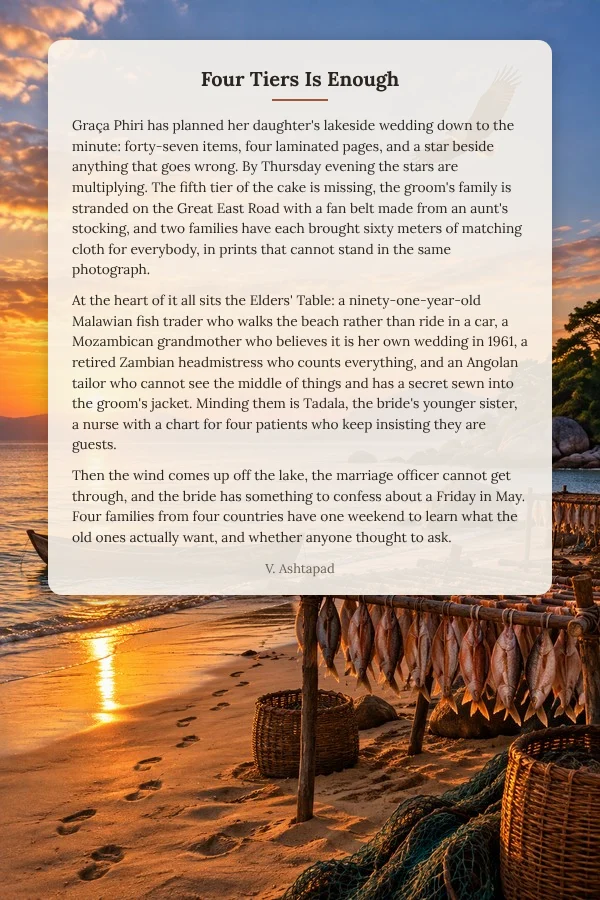
Graça Phiri has planned her daughter's lakeside wedding down to the minute: forty-seven items, four laminated pages, and a star beside anything that goes wrong. By Thursday evening the stars are multiplying. The fifth tier of the cake is missing, the groom's family is stranded on the Great East Road with a fan belt made from an aunt's stocking, and two families have each brought sixty meters of matching cloth for everybody, in prints that cannot stand in the same photograph.
At the heart of it all sits the Elders' Table: a ninety-one-year-old Malawian fish trader who walks the beach rather than ride in a car, a Mozambican grandmother who believes it is her own wedding in 1961, a retired Zambian headmistress who counts everything, and an Angolan tailor who cannot see the middle of things and has a secret sewn into the groom's jacket. Minding them is Tadala, the bride's younger sister, a nurse with a chart for four patients who keep insisting they are guests.
Then the wind comes up off the lake, the marriage officer cannot get through, and the bride has something to confess about a Friday in May. Four families from four countries have one weekend to learn what the old ones actually want, and whether anyone thought to ask.
Members can react to this book and talk about it in the members' Library.
Ownership
© 2026 CRUNOD LLC. All rights reserved.
This book is owned by CRUNOD LLC. It is free to read on EternalCurrent.Online. No part of it may be copied, reprinted, sold, recorded or adapted, including as audio, film or translation, without written permission from CRUNOD LLC.
© 2026 CRUNOD LLC. All rights reserved.