
Good Evening, Home
A Grandfather's Kreyòl Radio Hour, a Grandson Who Answered in English, and One Season from Little Haiti to Flatbush
by V. Ashtapad
Foreword
For twenty-seven years, in neighborhoods from Miami to Brooklyn to Montreal, Haitian families gathered around radios on weeknights to hear hosts who spoke to them in Kreyòl: the language of home, of the kitchen and the market and the yard, which for most of Haiti's history was spoken by nearly everyone and written down by almost no one. This is a story about one of those hosts, and about the grandson he would not do one more season without.
Much of what is in these pages is real. Haiti declared its independence on the first of January, 1804, and families still mark the day with soup joumou and share it with their neighbors. The flag was sewn at Arcahaie in May of 1803. Kreyòl became an official language of Haiti in the constitution of 1987. The masks of Jacmel's carnival are made of paper and paste in ordinary yards. Little Haiti in Miami and the Haitian streets of Flatbush are real places, and the proverbs that title each chapter are said in Haitian homes every day. The earthquake of January 12, 2010 is real too, and it is touched here only as the families in this book would touch it: carefully, and briefly, with the names kept by the people who said them.
The Bazile family, their friends and callers, Radyo Kenèp, Golden Scissors and every painting in Ghislaine's back room are invented. So is the guitar with the crack in its face. Anyone who has ever called a radio station to say good evening to someone they could not see will recognize them anyway.
For everyone who ever called a radio station just to say good evening, and for whoever was listening on the other side.
Little by Little the Bird Builds Its Nest
The first time I was on the radio I was eleven hours old.
I didn't know this until the last Thursday of October, when I was sixteen and sitting on the radiator in our front room on East Twenty-First Street with my bass across my knees and my phone buzzing against the strings. It was my cousin Nadège in Miami. She doesn't text like a normal person. She sends one word, then a file, then another word, so your phone goes off three times like somebody knocking.
Listen.
Then a sound file, four minutes and twelve seconds.
Then: Headphones.
Outside it was already dark at six. Flatbush in late October smells like wet leaves on the sidewalk and the oil from the jerk drum on the corner of Church Avenue, and the dollar vans go by with their windows fogged and their music thumping through the glass. My father was on the late shift driving the B41 down Flatbush Avenue. My mother was at Kings County until eleven. My little sister Mimi was at the kitchen table doing homework in two languages and singing to herself in a third, which is to say in the language of a ten-year-old who has had too much juice.
I put the headphones on.
First there was hiss, the soft kind, like rain on a car roof. Then a guitar, one guitar, picking out a little tune that went up three steps and came down two, and I knew that tune before I knew I knew it. It was in me somewhere under the floor. Then a voice came in over the guitar, deep and slow, a voice that sounded like it was smiling with its mouth closed.
"Bonswa, lakay. Bonswa tout moun."
Good evening, home. Good evening, everybody.
My grandfather. Edner Bazile. Papi, to me. I hadn't heard him sound like that in my whole life. On the phone he sounded like an old man who couldn't find his glasses. Here he sounded like a man standing at the top of a staircase looking down at a party he had thrown.
I understood every word he said after that. I want to put that down first, because people get it wrong about kids like me. I understand Kreyòl. I grew up inside it. My mother scolds in it, my father laughs in it, my grandmother used to sing in it while she painted, and Mimi now does her spelling tests in it. I understand it the way you understand the weather. It's just that when it's my turn to answer, English comes out. It's like my mouth has a door, and the door only opens one way.
On the recording, Papi said it was the twentieth of February, 2010. He said it was a Saturday night, and he wasn't supposed to be on the air on a Saturday, his hour was Tuesday at nine, but the station had given him ten minutes because he had begged. He said he had been on the air every night for five weeks, since the twelfth of January, and that every night people had called to read names. He didn't say what kind of names. Everybody listening knew. He said that tonight he had one name to read that was a different kind of name.
"This morning at a quarter to nine, in Brooklyn, New York, my daughter Carline had a son. Seven pounds and two ounces. He has a head like a coconut and a voice like a trumpet. His name is Kervens Lamarre. His grandmother has already painted him, and the paint is not even dry."
Then he stopped. You could hear him breathing near the microphone. You could hear the guitar still going behind him, somebody else playing it now.
"I know," he said. "I know what these weeks have been. I'm not asking anybody to stop crying. I'm only saying that a baby came, and he is loud, and he is ours. All of ours. If you need some good news tonight, take him. He has enough."
And then the phones started. I could hear them, a whole switchboard of little rings, and a woman got on the line from somewhere with a lot of traffic behind her and said she was driving and she had pulled over to the side of the road to say welcome to the baby. And then a man from Fort Lauderdale. And then a woman who said she was calling from Montreal and it was snowing. And then a man who couldn't talk at first, who just said "Mèsi, Edner," and hung up.
Eleven people called in four minutes to welcome me to the world. I counted them twice.
I sat there on the radiator with the heat coming up through my jeans. Mimi said, "Why are you making a face?"
"I'm not making a face."
"You're making a face like when the Knicks lose."
"Go do your homework."
"I'm doing it," she said, in Kreyòl, which is what she does when she wants to win.
Nadège called before I could text back. She does this too. Video, of course, and she was outside somewhere, I could see palm fronds and a streetlight and a white wall with a mural of a woman holding a basket on her head.
"Did you listen?"
"I listened."
"Okay. So." She pushed her braids back. She is nineteen and studies communications at FIU and she has had the same face since she was six, the face of somebody who is about to tell you the plan. "Listen to me. You know Radyo Kenèp?"
I did, sort of. It was a little station in Little Haiti that ran out of an old laundromat on Northeast Second Avenue. Nadège volunteered there three nights a week, running the board for other people's shows.
"Madan Narcisse wants Lè Lakay back," she said. "For one season. Tuesdays at nine, like before. November to the end of June. On the air and streaming. She asked Papi last week."
Lè Lakay was the name of his show. Home Hour, more or less, or The Time of Home. He ran it for twenty-seven years, from 1989 to 2016, on an AM station where he bought the hour himself out of what he made fixing televisions. I knew all that the way you know your grandfather fought in some war, as a fact that sits in a drawer. I had never actually listened to it. When it stopped I was six.
"What did he say?"
"He said no."
"Okay."
"Then he said yes."
"Okay."
"Then he said yes on one condition." She looked right at me through the phone. Behind her a car went by playing konpa with the windows down, and the bass line swung across her face like a door. "He said, 'Mwen p ap fè l san ti gason an.'"
I won't do it without the boy.
"Which boy," I said, even though there is only one boy he calls the boy. My cousin Jojo is the little one, and Papi calls him Jojo.
"You, Kè."
Papi has called me Kè since I was born. It's short for Kervens, but kè also means heart, and he has never once let anybody forget that he thinks this is very clever.
"I'm in Brooklyn," I said. "I have school. I have a chem test on Tuesday."
"Nobody's asking you to move to Miami. He wants you to produce. You do the archive, the old tapes. I'll digitize, you cut. You're good at that, you do all that stuff with your music." She waved her hand at my laptop like she could see it. "And on the air, on the phone line, sometimes. He wants you on the phone line."
"Speaking what?"
She just looked at me.
"Nadège. My Kreyòl is—"
"Your Kreyòl is fine. Your Kreyòl is shy." She said it in Kreyòl, timid, and it sounded worse in Kreyòl, like a cat under a bed. "He's eighty years old, Kè. He hasn't done anything since Grann died except sit on the gallery and fix the neighbors' microwaves for free. Madan Narcisse asked and he got up and went into the garage and started pulling out milk crates. Do you know how many crates of tapes are in that garage?"
"No."
"Forty-one. I counted. He was out there till midnight. Tati Fabienne had to go get him."
On Saturday we called him all together, the four of us in the front room with my mother's tablet propped against the fruit bowl. My father was home by then, still in his MTA sweater, with the Flatbush Avenue route printed on his tired face. Mimi was on the arm of the couch. My mother had her reading glasses pushed up into her hair.
Papi came on with the camera too close, the way he always does, so we got mostly nose and one eye. Behind him I could see the gallery of the yellow house on Fifty-Sixth Street, the green iron gate, the edge of the mango tree, and on the wall, the corner of one of my grandmother's paintings, a market woman in a blue dress with a tray of oranges.
"Sak pase," my father said.
"N ap boule," said Papi. We're burning along. The usual.
My mother asked about his blood pressure and his feet and whether he was eating the food Tati Fabienne left. He answered her questions the way you answer a customs officer. Then he leaned back from the camera, and we got his whole face, his white mustache and his little round glasses, and he looked at me.
"Kè," he said. "Nadège told you?"
"Yeah. Yes. She told me."
He waited. I knew what he was waiting for. Everyone in the room knew. Mimi actually made a small noise like a kettle.
"Wi," I said. "She told me. Wi."
He laughed, one big laugh that made the tablet buzz.
"Good," he said in Kreyòl. "That's one word. We'll start with one word. I didn't build the station in a day either."
Then he said the proverb. He always says a proverb; Grann used to say he couldn't pass the salt without one. He said, "Piti piti zwazo fè nich li."
Little by little, the bird builds its nest.
"I know that one," Mimi said.
"I know you know that one," he said to her. "I'm saying it to your brother."
After we hung up, Nadège posted the clip to the family's private page, the one my mother set up when Grann got sick so that everybody in Miami and Brooklyn and Montreal and Jacmel could see the same photos without them ending up all over the internet. She put it on the family tree too, on my name, under the date. February 20, 2010. Eleven hours old. My aunt in Montreal hearted it in the first minute. My great-aunt Lucienne in Jacmel, Papi's sister, who is seventy-six and types with one finger, wrote: Mwen te tande l nan radyo a lè sa a. I heard it on the radio back then.
I lay in bed that night with my headphones on and played it three more times. The eleven callers. The guitar under the voice. The man who couldn't talk.
I tried saying it into the dark, the way Papi had said it, smiling with my mouth closed.
"Bonswa, lakay."
It came out sounding like a kid ordering at a counter. The radiator knocked twice, as if to agree with me.
Little by little, I thought. Fine. But I had a feeling the bird had been building that nest a lot longer than I had.
Beyond the Mountains, More Mountains
The tapes came to me in pieces, the way a city comes to you through a bus window.
Nadège did the digitizing in Miami. She set up in Papi's garage on a card table between the washing machine and the deep freezer, with a cassette deck from the station and a reel-to-reel machine that had been sitting under a tarp since 2016. The reel machine wouldn't turn at first. It hummed and smelled hot. She took it to a radio man in Hialeah whose shop had a sign in red letters, and he kept it a week and gave it back with new belts and a cleaned head and charged her forty dollars, which Papi said was robbery in the wrong direction. He said in Kreyòl that the man must have a grandfather somewhere.
Every night she uploaded files to a shared folder with names like 1991-03-12_A and 1997-08-05_B_lastpart, and every night I sat at my desk in Brooklyn with my headphones on and walked through them.
It's hard to explain what twenty-seven years of somebody's voice does to your bedroom. My room is small. It has a window that looks at the brick side of the next house and a poster of a bass player my father says he never heard of. But when I put the headphones on, the room filled up with Little Haiti. Car horns on Second Avenue in 1993. Somebody's rooster in 2001, crowing in the background of a phone call at nine thirty at night because the rooster didn't know any better. Rain on a tin roof in Jacmel when a cousin called long-distance in 1995 and you could hear the line crackle like frying. Konpa records with a skip in them. Papi laughing. Papi coughing. Papi, younger, sharper, arguing with a caller about whether you should put cloves in pikliz.
And Grann. My grandmother came on the show sometimes, in the early years, to talk about painting, and the first time I heard her voice come out of 1990 I had to take the headphones off and sit on the bed for a minute. She had a voice like a spoon in a pot, a little scrape and a ring. She said, "Edner, you're talking too much, let the people talk," and he said, "This is my show," and she said, "This is their show," and the people on the phone line laughed, all of them, at once.
My job was to cut. Madan Narcisse, who runs Radyo Kenèp, wanted a segment every week from the old shows, five or six minutes, something that would make people who had listened back then lean toward their radios. Papi named the segment himself. He called it Nan Tiwa a. In the Drawer.
Before any of it went on the air, Madan Narcisse sent a form. She is sixty-four and used to be a school principal in Port-de-Paix and she runs the station the way you'd expect. The form had Papi's name on top and three boxes. His voice could be kept for the family only. His voice could be kept by the station too. His voice could be played on the air. He checked all three with a blue pen and initialed every page, and then on the last page in the margin he wrote, in Kreyòl, The callers didn't sign anything. Ask them.
So that became the rule. Anything from the old shows where you could hear a caller, we only used it if we could find the caller, or their family, and ask. If we couldn't, we cut around them, or Papi told on the air what they had said in his own words. Nadège made a spreadsheet. It got long.
"This is going to take forever," I said on the phone.
"Yes," said Nadège. "That's what forever is for."
The first show of the new season was Tuesday, the tenth of November. I had a chem test that morning on gas laws and I think I got a B. At school I told nobody. I didn't know how you would even say it. My grandfather has a radio show. In Kreyòl. I'm the producer. My friend Quincy, who plays drums next to me in jazz band and whose family is from Savannah, would have said that's cool and then asked me if I could get him on the radio, and I didn't want to explain that nobody on that station would understand a word he said.
At eight forty-five I was in my room with the door shut, the laptop open to the station stream, my phone face up next to it. Nadège had given me the call-in number. She said Papi wanted me on at nine forty, after the music, for one minute.
"Just say good evening," she said. "That's all. He'll do the rest."
"What if I can't?"
"Then you'll say it in English and he'll pretend it's Kreyòl. He's done it with drunk people."
At eight fifty-nine the stream went quiet. Then there was a small cough, and the sound of a chair, and then the guitar. It was the same tune from the tape of the night I was born, three steps up and two down, and I found out later it was Papi playing it himself, in the studio, on the same guitar he had used in 1989, a cheap Spanish one with a crack in the face that he had glued and clamped in 1994 and never fixed properly because, he said, it played better with a scar.
"Bonswa, lakay," he said. "Bonswa tout moun. Mwen la."
Good evening, home. Good evening, everyone. I'm here.
His voice was older than on the tapes. It had grit in it now, like a road. But it was the same staircase, the same party.
He didn't make a speech about coming back. He said the date and the weather, which was eighty-one degrees in Little Haiti and fifty-two in Brooklyn, and he said he knew that because his grandson had told him at dinner time and had complained. Then he said, "Let's start where we always started," and opened the lines.
The first caller was a woman named Madan Rosemond. She said she was eighty-eight years old and lived in North Miami and had listened every Tuesday from 1989 to 2016 and had been waiting ten years for this phone call. She said, "Edner, my tomatoes died the year you stopped. I'm not saying it's your fault." He said, "I accept the blame. Plant again." She said she would.
Then a man in Little River whose father had been a caller. Then a woman from Flatbush, which made me sit up, who said she was on Nostrand Avenue and it was cold and she was listening in her car outside a laundromat because her husband snored. Then a boy, younger than me, who said his grandmother had told him to call and say hello and then he didn't know what to say next, and Papi laughed and said, "That's enough, that's the whole show, mèsi, pitit."
Then the proverb. Papi always had a proverb of the week, and listeners called in to say what it meant to them, and he never said if they were right. That week it was "Dèyè mòn gen mòn." Beyond the mountains, more mountains.
A taxi driver called and said it meant when you finish one problem, there's another one waiting for you. A woman called and said it meant there are more people in the world than the ones you can see. A teenage girl said it was just about geography. Haiti has a lot of mountains. Everybody laughed.
Then Papi told his own. He told it the way he told everything on the air, slow, with room around the words. He said that when he was twenty-five he climbed the hill road out of Jacmel in the back of a tap-tap painted red and yellow with the words of a song on the tailgate, and he looked back down at the bay, at the iron balconies on the Rue du Commerce and the coffee warehouses by the water, and he thought, there, I've crossed the mountain. Then Port-au-Prince. Then an airplane. Then Brooklyn, in February, in a cotton jacket. "And I stood on the corner of Church and Flatbush," he said, "at six o'clock in the evening, with snow going sideways, and I thought: so this is the next mountain. Nobody told me it would be made of ice."
Then he played a record, an old one. Nadège texted me the name. Nemours Jean-Baptiste, 1950s. Compas direct, she wrote, the beginning of all of it. The saxophones came in rolling and easy, like someone walking downhill on a hot afternoon, and under it there was a bass line that went boom, ba-boom, boom, and sat there, steady, holding up the whole house. I picked up my bass without thinking and found it. It's not hard. It's two notes, mostly. But the space between them is everything.
At nine thirty-eight my phone was in my hand. At nine thirty-nine I dialed. Nadège picked up on the studio side and said, "Hold," and then I was on hold listening to the stream through the phone, and through my laptop half a second behind, so Papi's voice came out of two places, chasing itself.
"We have someone on the line from Brooklyn," he said. "From a cold place. Bonswa, Brooklyn."
I opened my mouth.
I've thought a lot about what happened next. I knew the word. I had practiced the word in the shower. But when you know eleven people on a tape once welcomed you into the world and now there might be three hundred people listening in cars and kitchens, a word can get very heavy.
"Hi," I said. "Uh. Hi. Bon— hi."
There was a silence on the air. A real one. In radio a silence of two seconds is a canyon.
Then Papi said, in Kreyòl, as easily as passing a plate, "Ah, you hear that? That's the sound of a boy in Brooklyn whose teeth are frozen. It's fifty-two degrees up there, my friends. His mouth won't open. Kè, put your hand over your mouth and blow, like this." And he blew into the microphone, a big hoo, and on the phone lines people laughed. "Better? Try again."
"Bonswa," I said. It came out small. It came out.
"Bonswa!" Papi said. "There it is. You see? The mountain behind the mountain. Thank you, Brooklyn. Go put on a sweater."
He hung up on me. I sat there with the phone hot against my ear.
At ten o'clock he closed with the guitar again and said, "Bòn nuit, lakay. Pa bliye." Good night, home. Don't forget. Then dead air, then the station ID, a woman's voice with a kenèp fruit cracking open, the little pop and slurp they used for a jingle.
My mother knocked on my door at eleven fifteen, still in her scrubs, smelling of hospital soap and the cold. "I listened on the train," she said. She sat on the end of the bed. "You said it."
"I said hi first."
"Everybody says hi first," she said. "I said hi first for about fifteen years."
Before I went to sleep, I opened the family page and found the words list my aunt in Montreal had started for Mimi, the one where you type a word and record yourself saying it and anyone in the family can record it too. I typed bonswa, lakay. I found Papi's voice in the night's recording and clipped the two words and put them under it. Then I recorded mine underneath, quietly, so Mimi wouldn't hear through the wall.
His was a staircase. Mine was a step.
But it was on the list.
Many Hands Make the Load Light
Golden Scissors is on Nostrand Avenue between a phone store and a place that sells hats and wigs on foam heads, and if you have grown up in Flatbush you have walked past it a thousand times without going in, unless you're Haitian and your father has been getting his hair cut there since 1994, in which case you have been going in since before you could walk.
The barber is Pierre-Richard Célestin, but nobody has called him that since the Clinton administration. He's Ti Pyè. He's fifty-eight, with a gray goatee he trims every morning before he opens, and forearms like cable, and a radio on the shelf above the mirrors that has played the same Haitian station out of Brooklyn every day of my life. The shop smells like talc and the blue disinfectant in the jar where the combs stand up like fish, and in winter like the space heater, a dry orange smell. On the wall there's a flag, a calendar from a travel agency, a framed dollar bill, and a hand-painted sign that says, in Kreyòl, NO CREDIT, NOT EVEN FOR YOUR MOTHER.
I went in on the Saturday after the first show and sat in the third chair while he finished a man's fade, and when it was my turn he swung the chair around so I faced the mirror and said, "So. You're the boy on the radio."
I looked at him in the mirror.
"My wife listens to everything," he said. "Bon. You said hi."
"I said bonswa."
"You said hi, then bonswa." He picked up the clippers. "It's okay. Your grandfather was in this chair in 1996 when he came up for your mother's graduation, and he told me a story so long I gave him a haircut he didn't need. You know he's a famous man up here too? Not famous like on the television. Famous like everybody's uncle."
I told him about the archive. I told him about the form, the rule, that we couldn't play the old callers unless we found them or their families. I told him about the spreadsheet, which by then had two hundred and six rows, and how most of them were names like Madan Jacques from Little River or The Man With the Broken Truck.
Ti Pyè turned the clippers off.
"Let me see the list," he said.
I showed him on my phone. He read it with his glasses on the end of his nose, scrolling with one thick finger. Then he called over his shoulder, "Jean-Claude. Come see this."
Jean-Claude was a man in his seventies in a leather cap who was waiting in the first chair even though he had no hair left to cut. He came over and read over Ti Pyè's shoulder. Then another man, younger, with a toddler on his hip. Then the woman from the hat-and-wig shop next door, who had come in to borrow change.
"The Man With the Broken Truck," said Jean-Claude. "That's Fritz. Fritz Dorval. He lives in Canarsie now with his daughter. The truck is still broken."
"Madan Toussaint who sang," said the woman from next door. "I know her granddaughter. She does nails on Church."
"1993, the Man Who Called About the Mangoes," said Ti Pyè, and he started laughing so hard he had to hold the back of my chair. "That's me! That's me! I was living in Miami then, I was twenty-five, I called because my landlord's mango tree was dropping on my car. Edner told me to make jam."
"Did you make jam?" I said.
"I made jam," he said. "It was terrible."
By the time I left with my haircut, which was good, the spreadsheet had fourteen names filled in, and Ti Pyè had a plan. The plan was that on Tuesday nights Golden Scissors would stay open late. He would put a speaker on the counter, plug it into his phone, put the stream on, and anybody who wanted to listen together could come, and if anybody wanted to call in, I would be there with my phone and the call-in number.
"Bring the list," he said. "Every Tuesday. We'll find your people."
On Tuesday it was raining, a cold rain that came off the ocean and flattened the leaves into the sidewalk on Rugby Road. I cut through there on my way from school because it's quieter than the avenue. The Victorian houses on Rugby Road have porches and turrets and big windows, and in one front window, in a house with a deep porch, I could see a blue steel drum standing in the front room with the lid off and something written down its side in black marker. I had seen it there for weeks. A Grenadian lady lived there, my mother said, and was packing to go home. I don't know why it stayed with me. Maybe because everyone on that street was packing something.
At eight forty-five Golden Scissors was full. There were eleven people, which I counted, and a pot of pate in foil on the counter that Ti Pyè's wife had sent, the flaky kind with ground beef and a little heat, and a bottle of hot pikliz going around to put on them. Jean-Claude had brought a folding chair from home because he said the barber chairs gave him a backache. A woman named Madan Edouard had brought her granddaughter, who was about Mimi's age, and the granddaughter sat on the shoeshine stand and did homework.
When the guitar started on the speaker, the whole shop went quiet. I'm not exaggerating. Even the toddler.
"Bonswa, lakay."
And somebody in the shop, Jean-Claude, said back, out loud, to the speaker, "Bonswa, Edner." Like he was in the room.
That night the proverb was Men anpil chay pa lou. Many hands, the load is not heavy. Papi had chosen it because he had heard from Nadège about the barbershop.
"I am told," he said on the air, "that there is a barbershop in Brooklyn tonight full of people listening. I am told that Ti Pyè is giving free haircuts." In the shop everybody turned and looked at Ti Pyè, who held up both hands. "I'm told wrong, he's saying. Okay. But I'm told that they are helping my grandson find the people who called this show years ago. Because the old voices belong to the people who said them. You can't just take them out of the drawer like a spoon. You have to knock."
Then he did Nan Tiwa a, my segment, the first one I had cut myself. I had used the opening of the very first show, from the fourth of April, 1989. Papi at forty-three, with a voice like a new tire. It's all him, no callers, so there was nobody to ask. He's nervous. You can hear it. He says good evening three times because he's not sure the microphone is on. Then he explains why the show is in Kreyòl.
"Some people told me, Edner, do it in French, it will sound more serious. But I'm not serious. And my mother didn't speak French. My father spoke French to the customs man and the notary and the bank, and then he came home and spoke to us like a person. So. This hour is for when you come home. Kreyòl pale, kreyòl konprann. We speak plain, we understand each other."
And then, in the background of 1989, a woman's voice, very close to the microphone, says, "You're talking too much, Edner. Let the people call."
In the barbershop, Madan Edouard put her hand on her chest. "Ghislaine," she said. "That's Ghislaine."
I hadn't known anyone in that room would know my grandmother.
"She painted the sign," Ti Pyè said. He pointed with his chin at the hand-painted sign on the wall, NO CREDIT, NOT EVEN FOR YOUR MOTHER. "1997. When she came up for Thanksgiving. I asked her for a sign that said no credit and she said that's not enough, people will think it doesn't apply to them."
I looked at the sign. I had looked at it my whole life. The letters were blue with a thin yellow shadow, and in the bottom corner there was a tiny green hummingbird I had never noticed, no bigger than a thumbnail. That was her mark. She put a hummingbird on everything.
At nine forty-one, Jean-Claude called in on my phone. He told Papi that he used to call in from Miami in the nineties to argue about soccer, and that he lived in Flatbush now, and his knees were bad, and he was sitting in a barbershop listening to a man he had argued with for twenty years. Papi said, "Jean-Claude! You still think Brazil is better than us?" and Jean-Claude said "Everybody is better than us, that's not the point," and the shop roared.
Then Ti Pyè called, and told the mango story on the air, and Papi told him the jam had been terrible, and he had said so at the time.
Then it was ten and the guitar and Bòn nuit, lakay, pa bliye, and everybody started putting on their coats.
Walking home on Nostrand with the rain stopped and the street shining and the steam coming up from the grates, I took out my phone and opened the family map, which my mother had started on the family page when Grann got sick, so we'd have all the places in one spot. It had pins in Jacmel, in Port-au-Prince where Grann grew up, in Little Haiti, in Montreal. I added Golden Scissors. I put the date and a photo of the sign with the hummingbird. In the note I wrote: Painted by Grann, 1997. Ti Pyè says she said "no credit" wasn't enough.
Then I added a second pin, farther down on Linden Boulevard, where Papi had rented his first room in Brooklyn in 1972, because Jean-Claude had told me the address. He'd known the landlady. The building was a dentist's office now.
By the time I got home the list had twenty-three names on it, and I had a lot of homework I hadn't done.
Many hands. The load was not heavy. It was just long.
The Rock in the Water
When you walk out of the airport in Miami at the end of November, the air puts its whole hand on your face.
We had left Brooklyn at six in the morning in coats, my father carrying Mimi's backpack and his own and a cooler of frozen griot my mother would not trust to anybody's freezer but her father's. At JFK it was thirty-eight degrees and the sky was the color of a sidewalk. Three hours later we came out through the sliding doors at MIA into heat that smelled of jet fuel and wet concrete and something flowering, and Mimi took off her coat in one move and threw it at me like a cape.
Uncle Patrick picked us up in his minivan, which has a sticker on the back window from the middle school where he teaches music and a dent in the passenger door that he says is from a parking lot and Tati Fabienne says is from a parking lot he was driving through too fast. He hugged my mother for a long time. They're three years apart and they fight like it's still 1988, but at the airport they always hug like somebody has been away at sea.
We drove east on the Dolphin and north on I-95 with the windows down, because the air conditioning in the minivan had opinions. Miami from the highway is all sky. It's flat and white and blue and the clouds are piled up high like laundry, and down below there are palms with their heads blown sideways and billboards for lawyers and the bright water of canals flashing between the warehouses. Then we came off at Sixty-Second Street and everything got closer.
I hadn't been to Little Haiti in three years, since Grann's funeral. I had forgotten how much color there is. Along Northeast Second Avenue the walls are painted, every one: a market woman with a basket of mangos, a rooster the size of a car, the flag, a man playing a drum, a long mural of the sea at Jacmel with fishing boats pulled up on the sand. The storefronts have signs in Kreyòl and English and sometimes French, hand-lettered, for money transfers and phone cards and tax preparation and groceries and bakeries. There was a man on a corner selling coconuts out of a truck with a machete. There were schoolgirls in plaid jumpers eating something out of foil. There were chickens, actually, under a car, which Mimi pointed out four times.
And there was the Caribbean Marketplace, the building with the bright roof that looks like a cross between a market hall and a cake, painted in reds and greens and yellows, with the iron fretwork along the top that Papi says was copied from the Iron Market in Port-au-Prince. "Not copied," he corrected himself later, when I said that. "Remembered."
Papi's house is on Fifty-Sixth Street, two blocks off the avenue. It's small and yellow, with a flat roof and a gallery across the front where two rocking chairs face the street, and a green iron gate with a curl at the top that Grann designed and a welder in Little River made in 1991. There's a mango tree in the front yard that drops fruit in June onto the neighbor's car, and an avocado tree in the back, and a clothesline, and a garage that used to hold a car and now holds forty-one milk crates of tapes, a washing machine, a deep freezer and Nadège's card table.
He was waiting on the gallery when we pulled up. He didn't get up right away. He just lifted his hand, and then Mimi was out of the van and through the gate and up the steps, and he caught her and said, "Ti chat mwen," my little cat, and she answered him in a long rush of Kreyòl about the airplane and the clouds and the chickens, without stopping once to look for a word.
I watched them from the gate. I don't know how she does it. She's ten. She learned at school, in the dual-language class, the one with the posters on the wall in two languages, and she just opens her mouth and it comes out, like water out of a pipe.
Then Papi looked at me over her head.
"Kè," he said. "Ou rive." You made it.
"Wi," I said. "Mwen rive." Then, before I could stop it, "Yeah. It's hot."
He laughed. "Half," he said in Kreyòl. "Half is better than none."
Thanksgiving at Papi's is not a Haitian Thanksgiving or an American Thanksgiving. It's both, all the way. There was a turkey, but it had been sitting since Tuesday in epis, the green paste of parsley and garlic and peppers and scallions and thyme that Tati Fabienne makes in a blender and keeps in a jar in every refrigerator she has access to. There was diri djon djon, black rice made dark with the little dried mushrooms Papi's sister sends from Jacmel when anybody can carry them. There was macaroni au gratin, which in our family is a holy object. There was my mother's griot, the fried pork, crisp outside and soft in the middle, with a bowl of pikliz beside it so sharp with vinegar and scotch bonnet it made your eyes run before you even ate any. There was bannann peze, fried plantain smashed flat, and cranberry sauce from a can, still in the shape of the can, because Jojo likes it like that.
We ate on the gallery and in the front room and in the kitchen, because the table only fits six. Uncle Patrick put on a konpa playlist, then my father changed it to an old twoubadou record, guitars and a little maracas and a man singing about a girl from a town by the sea, and Papi sang along to the chorus with his eyes closed and his fork in the air.
After dinner, when everybody else was in the front room with the football on and the volume off, I went looking for a bathroom and opened the wrong door.
It was Grann's room. Not the bedroom. The other one, the little room off the kitchen where she painted. It had a window onto the avocado tree, so the light was green. There was her easel, folded. There was a tin can full of brushes, standing up, the bristles stiff. There was a stool with a cushion. On the walls, everywhere, frame to frame, there were paintings: the bright, flat, careful kind, with every leaf on a tree painted one at a time, every person in a market crowd with their own face and their own basket. A tap-tap crossing a bridge. A Sunday afternoon in a town square. A boat full of oranges.
And on the floor, leaning against the wall in a long low row, there was a different kind of painting. Small ones, each about the size of a notebook, on board. Each one was a single person.
A woman in a garden with her hands full of tomatoes. A man in a cab, leaning on the steering wheel, laughing. A young man standing under a mango tree with a car behind him, the car dented, mangos falling. A woman with a phone cord wrapped around her fingers, singing, with a little row of musical notes coming out of her mouth like birds. An old man with a cane in front of a broken truck. Each one had a hummingbird somewhere, in a corner, on a branch, perched on a hat.
I turned the one with the mango tree over. On the back, in pencil, in Grann's small slanting hand, it said: 9 Mas 1993. Ti Pyè. Mango sou machin. Konfiti.
March 9th, 1993. Ti Pyè. Mango on the car. Jam.
I sat down on the floor.
I turned them all over, one at a time, in the green light. Forty. Every one had a date, every date was a Tuesday, I checked. Every one had a name, or the kind of name a caller gives, The Man With the Broken Truck, Madan Toussaint who sang, and a few words. The first one, the woman with the tomatoes, said: 14 Nov 1989. Madan Rosemond. Tomat.
Papi found me there. He stood in the doorway with his hand on the frame. I don't know how long he'd been watching.
"She listened at home," he said, in Kreyòl, quietly. "Every Tuesday. She didn't come to the station. She said she couldn't paint and talk at the same time. So she sat here with the radio, and when somebody called who she liked, she painted them."
"But she never saw them."
"No."
"She just painted what they sounded like."
"Yes." He came in and lowered himself onto her stool, carefully, one hand on the windowsill. "She said a voice has a face in it, if you listen. Sometimes she was right. Ti Pyè has a mango-tree face. Sometimes she was very wrong." He pointed at the man in the cab. "That one, Wilner, she made him fat and jolly. He was thin like a pencil and he never laughed in his life. But on the phone he sounded fat and jolly. So."
"Why did she stop?"
"Who said she stopped?" He reached past me and pulled out one I had missed, behind the others, unframed, the paint still a little rough. It was a man in a studio with a microphone, an old man with a white mustache and round glasses, and a guitar across his knees with a crack in its face. The hummingbird was on the microphone. On the back it said: 28 Jen 2016. Edner. Dènye a.
June 28th, 2016. Edner. The last one.
"The last show," Papi said. "She painted the host."
We sat there for a while. Out in the front room somebody scored and Jojo yelled.
Then I asked him what I'd been wanting to ask since the airport, since the gate. I asked it in English, because I couldn't find the door in the other language. I asked him what it was like when he got to Brooklyn. Really. Not the radio version.
He thought about it.
"Wòch nan dlo pa konnen doulè wòch nan solèy," he said.
The rock in the water doesn't know the pain of the rock in the sun.
"Is that the proverb for next week?"
"It is now." He smiled, but not all the way. "I'll tell you some. You're the rock in the water, Kè. That's not an insult. That's what I worked for. You don't have to know the sun. You only have to know that it was there." Then he told me about the factory in Bushwick in 1972, the zippers, the foreman who called every Haitian Pierre. About night school for electronics, two years, on the subway with a soldering iron in his coat pocket. About the first television he fixed for money, in 1974, for a woman on Lenox Road, who paid him in cash and a plate of rice.
I took out my phone and asked if I could record. He nodded. I put it on the windowsill between us. Later, I put the recording on the family page, family only, the way he said.
That night I photographed every one of the forty-one paintings, front and back, and started a list on the family page where each one could have its own entry: the picture, the date, the pencil words, and a space underneath for the story. Most of the spaces were empty.
"You'll find them," Papi said from the hallway, in the dark, on his way to bed. "Some of them. The others, we'll tell what she heard."
Speaking French Doesn't Make You Clever
After Thanksgiving, Papi started calling me in the mornings.
Seven ten, every school day, the phone would buzz in my coat pocket while I was walking down Twenty-First Street toward the avenue. He's up at five. He has his coffee on the gallery, black, in a glass, with the radio going, and by seven he's watered the avocado tree and read the paper twice and is looking for somebody to talk to.
"Bonjou, Kè."
"Bonjou, Papi."
"Five words today," he said, the first morning. "Give me five words. Not English with Kreyòl on top. Five Kreyòl words."
"About what?"
"About what you see."
It was the first of December and the wind was coming down Flatbush Avenue so hard the Christmas lights strung over the street at the Junction were swinging. The air smelled of exhaust and the bakery on the corner, where they had started putting out pen patat in the window, the sweet potato pudding, dark and heavy with ginger and nutmeg and a top that cracks like a sidewalk.
"Li fè frèt," I said. It's cold. That's three words. "Anpil." A lot. Four. "Mwen grangou." I'm hungry. That's six, if you count the frèt twice, which I did.
"Bon," said Papi. "Now buy something from the bakery and tell me in Kreyòl what you bought."
So I did that every morning. I told him what I saw. Li fè frèt. Bis la an reta. The bus is late. Gen yon nonm k ap chante sou platfòm nan. There's a man singing on the platform. He corrected me sometimes, never in the middle, always after, like a coach who waits until you're off the field. He said my r's were too American, I was growling them, and in Kreyòl they're soft, almost a w. He said I put the little words in the wrong place, the la and the yo, because in Kreyòl they come after the thing, and in English they come before, and my brain kept trying to put them in front like a doorman.
"Liv la," he said. "The book. The book is first, then the la. The book walks in, then you close the door behind it."
I wrote that in my notebook. The book walks in, then you close the door.
At home that week my mother was on days for once, so she was there for dinner. On Wednesday she was frying akra, the little malanga fritters, grated root and scallions and pepper, dropped by the spoonful into hot oil. They go fast in our house. You eat them standing by the stove, burning your fingers.
I asked her, because I'd been thinking about it since the barbershop, since she'd sat on the end of my bed and said she'd said hi first for fifteen years.
"Why did you stop speaking Kreyòl?"
She turned off the burner. She doesn't usually tell stories. She works twelve-hour shifts in the emergency department at Kings County and comes home with nothing left over for stories. But she leaned against the counter and wiped her hands on the dish towel and looked at the window, which was black and had our kitchen reflected in it.
"I didn't stop at home," she said. "I stopped outside. In Miami. 1990, I was twelve. Seventh grade, the middle school a bus ride up from Sixty-Second Street." She folded the towel. "Those years, the things people said about Haitians, on the news, in the paper. You don't need all of it. The kids at school heard it from their parents and brought it in their mouths. If you spoke Kreyòl in the hallway, everybody knew. So I stopped. I put on my best English. I told people I was from the Bahamas for a whole year."
"The Bahamas?"
"It was the closest island I could think of." She almost laughed. "Your Papi found out. One of the teachers was a listener. She told him on the phone, on the air, that his daughter said she was Bahamian. On the air! He came home that Tuesday night and sat at the table and didn't say anything for a long time. Then he said, 'I'm not angry. I'm only going to tell you one thing.'"
"What?"
She said it in Kreyòl, in his voice. "Pale franse pa di lespri pou sa. Pale angle pa di lespri pou sa nonplis."
Speaking French doesn't make you clever. Speaking English doesn't either.
"And then," she said, "the next Tuesday he did a whole show about it. For an hour, people called to say what language they were ashamed of when they were twelve. I wanted to die. I stayed in my room. But I listened through the door." She turned the burner back on. "I didn't start speaking Kreyòl outside again for years. It wasn't like a movie. But I stopped telling people I was from the Bahamas."
Mimi had come in during this and was sitting at the table with her chin on her fists.
"I would never say I'm from the Bahamas," she said.
"I know you wouldn't, chérie," my mother said. "That's because of him."
On Tuesday, the eighth, that was the proverb. Pale franse pa di lespri pou sa. Papi told the story of his own schooling, in Jacmel, in the 1950s, at the little school two streets up from the market where the teacher was a tall man from Port-au-Prince with a ruler he called Mademoiselle. Everything in the classroom was in French. The books were from France and had pictures of apples and snow. If you spoke Kreyòl in class, you got Mademoiselle across the palm, or you wrote a hundred lines after school, Je dois parler français, I must speak French. "I wrote that sentence so many times," Papi said, "that my French handwriting is better than my Kreyòl handwriting to this day. But I couldn't have told you what an apple tasted like."
He told the history plainly, the way he tells everything. That for most of Haiti's life after 1804, almost everyone in the country spoke Kreyòl, and the law and the schools and the newspapers spoke French. That in the late seventies, people agreed at last on how Kreyòl should be spelled, so you could write it the way it sounds, and that it went into the schools. That in 1987 the constitution named Kreyòl an official language of the country, beside French, and he remembered where he was standing when he heard. "In the shop. Under a television. I had a screwdriver in my hand and I put it down."
That was when the phone lines lit, and the first one that came through, Nadège told me later, was a voice she didn't know.
He spoke French. Beautiful French, slow, with every ending in place. He said his name was Clément Sauveur, that he was eighty-five years old, that he lived in Miami Shores, and that he had had his own hour on the same AM station in the nineties, Sundays, in French, with classical music and poetry. He said he had heard Edner was back. He said, in French, that Edner had always confused plainness with virtue, and that a people who throw away French throw away Hugo and Césaire and their own grandfathers' diplomas.
In the barbershop, Jean-Claude said a word I won't write.
Papi was quiet for a second. Then he answered in Kreyòl, and his voice was warm, which made it worse, or better.
"Clément. Bonswa, frè m. I haven't heard you in twenty years. You sound good. Nobody is throwing away anything. Read Césaire, I'll read him with you. But my mother couldn't read him, and she was not less of a person than your grandfather with his diploma. This hour is for her. You're welcome in it. You can even speak French in it. I'll answer you in Kreyòl, and we'll understand each other fine. We always did."
Monsieur Sauveur said, in French, that this was exactly the problem, and hung up.
"He'll call back," Papi said on the air. "He called back for eleven years. Next caller."
The next Tuesday, the fifteenth, Papi gave me the Nan Tiwa a introduction to read. Myself. On the air. In Kreyòl. He had sent me the text on Sunday, four sentences. I practiced them in the shower, on the B41, at the bakery window while the lady behind the counter watched me move my lips at the pen patat. I recorded myself on the family words list, every sentence, and played it back next to Papi's recording of the same words, and mine sounded like somebody reading the instructions on a medicine bottle.
At nine thirty-six I was on the line from my bedroom, with the door shut and a towel rolled against the bottom of it so Mimi wouldn't hear.
"From Brooklyn," Papi said, "the producer."
I read it. I'm going to write it down here, with my mistakes, because I've listened to it maybe forty times since.
"Bonswa, lakay. Se Kervens, pitit pitit Edner. Nan tiwa a aswè a, nou gen yon vwa ki soti nan ane mil nèf san katreven sèz. Se le vwa yon fanm ki rele Madan Toussaint, e li chante."
Good evening, home. It's Kervens, Edner's grandson. In the drawer tonight, we have a voice from the year nineteen ninety-six. It's the voice of a woman named Madan Toussaint, and she sings.
Except I said se le vwa, with a French le, which doesn't belong there at all, which is a thing you hear from people who learned French in school before they learned to write Kreyòl. I don't know where it came from. Maybe from all that Monsieur Sauveur.
And then I hit play, and Madan Toussaint sang, in 1996, on the phone, a song about a river in the south, two verses, in a high clear voice with a little shake at the bottom of the long notes, and in the background you could hear a dog barking in her yard. Her granddaughter had said yes on the phone the week before; the woman from the wig shop had connected us. Her granddaughter was listening, in Flatbush, in her car. She called in when it was over and couldn't talk, and then she could.
After, the phone lines were full, but not about Madan Toussaint. About me. Three different women called to correct my le, very kindly, the way you'd fix a boy's collar on his way out the door. One said, "Pitit, there is no le in Kreyòl, you're thinking of your grandmother's French." Another said, "It's not a mistake, it's a fossil." A man from Little River said I should not listen to these women, I should talk however I want, his own grandson only says yes and no and he would give his car to hear him say le anything.
Papi let them all talk. When it was ten, before the guitar, he said:
"My grandson said four sentences tonight. Four. One mistake. That's three sentences more than he said in November." Pause. "I've made a lot more mistakes than that on this show. I once said the wrong man was dead. He called in."
Bòn nuit, lakay. Pa bliye.
My mother had been listening in the hall. I could tell because when I opened the door the towel moved and she was there, with her coffee, pretending to look at the thermostat.
"Se le vwa," she said, and shook her head, and kissed me on the forehead, hard.
An Empty Sack Can't Stand Up
On the morning after Christmas I flew to Miami by myself with my bass in a soft case on my back and a bag of my mother's frozen griot in my carry-on, double wrapped, which the man at security unwrapped, looked at, smelled, and wrapped back up again, saying only, "Nice."
My parents and Mimi would come on the thirtieth, when my mother's days off started. Until then it was me and Papi in the yellow house, with Uncle Patrick and Tati Fabienne and Nadège and Jojo ten minutes away in North Miami, coming by whenever they wanted, which was constantly.
The first morning, I came into the kitchen at eight and he had already made breakfast. It was spaghetti. With sliced hot dogs and onions and peppers and tomato paste and a lot of black pepper, the way it's eaten in Haiti in the morning, which my friends in Brooklyn never believe when I tell them. There was a glass of akasan beside it, the warm thick cornmeal drink with evaporated milk and cinnamon and star anise, and a piece of bread with spicy peanut butter, the Haitian kind, manba, with hot pepper ground right in.
"I'm not that hungry," I said.
He pointed at the chair with his chin.
"Sak vid pa kanpe," he said. An empty sack can't stand up.
"Is that the proverb for Tuesday?"
"Everything is the proverb for Tuesday," he said. "Eat."
I ate. All of it. He watched me with satisfaction, like a man watching a truck being loaded.
Then he said, "Today we're going to see Madan Rosemond."
She lives in North Miami, off a street near the canal, in a pink house with a chain-link fence and a ramp to the front door that her son built. We took the painting wrapped in a pillowcase. Papi drove, slowly, with both hands on the wheel of his old Buick, in the right lane, while everyone passed us. Biscayne Boulevard in the morning was bright and loud, sun on the windshields, palms and pawnshops and motels with names like The Sea Breeze and The Sunshine Inn, and to the east, in flashes between the buildings, the water of the bay, so blue it looked like it had been painted by somebody who didn't believe in other colors.
Madan Rosemond was in the yard when we came. She was in a wheelchair under a big straw hat, with a hose in her lap, and around her in five-gallon buckets there were tomato plants, little ones, maybe a foot high, with stakes and string.
"Edner," she said. "You told me plant. I planted."
"I see."
"They're too young to argue with yet."
She is eighty-eight. She has the face of a very serious child. She looked at me for a long time. "This is the boy who said le?"
"Wi, Madan," I said. "Se mwen."
That's me. Three words. She nodded like she was grading them.
We sat on her porch, which smelled of the hose water drying on concrete and of coffee and of the pink powder roses she had growing up the post. Her son brought out three glasses of sweet coffee with milk. Then Papi took the pillowcase off the painting and gave it to her.
She held it on her lap. She looked at it for a long time. It was the first one, from the fourteenth of November, 1989. A woman in a garden with her arms full of tomatoes, more tomatoes than any person could hold, round and red and shining, and a hummingbird drinking from a flower on a stake beside her. The woman in the painting was younger, standing, in a yellow headscarf. She didn't look like Madan Rosemond. And then, the longer you looked, she did.
"I called that night to complain," Madan Rosemond said finally, in Kreyòl. "Worms in my tomatoes. I was so angry. I called a radio station to be angry at a worm."
"I remember," Papi said.
"Ghislaine painted me happy."
"She said you sounded happy."
"I was angry!"
"She said under the angry."
Madan Rosemond put her hand flat on the painting, the way you'd put your hand on a child's head. Then she looked at me. "Write this down, boy," she said. "Write down that I said she was right."
I did. That night, on the family page, in the entry for painting number one, under the photograph of front and back, in the space for the story, I wrote: Madan Rosemond, 88, North Miami, December 27, 2026. She called about worms. Grann painted her happy. Madan Rosemond says Grann was right. Then I added, because it was true: She is growing tomatoes again in buckets.
On Tuesday, the twenty-ninth, I went to the station for the first time.
Radyo Kenèp is on Second Avenue near Fifty-Ninth Street, a block from the Cultural Complex, in a long narrow building that was a laundromat for thirty years. You can still tell. The front window still has the ghost of a painted sign, a cartoon washing machine with a smile. Inside, the floor is the same speckled tile. Along one wall, Madan Narcisse had kept six of the big steel dryer drums, the front panels with the round glass doors, bolted to the wall, and inside each round door there is a speaker now, so the station's playback comes out of the dryers. "We dried people's clothes for thirty years," she told me. "Now we dry their ears." She did not laugh when she said it. I think she had said it before.
Out back there's a kenèp tree, the genip, which is where the station got its name, with little green fruit in bunches that you crack with your teeth to get at the sweet sour pulp around the pit. In the summer, she said, the children of the neighborhood climb the fence to steal them and she lets them, because a station with no children climbing its fence is a dead station.
The studio is the old back room, the one where the laundromat owner used to keep soap. It has egg-crate foam on the walls, gray carpet, a long desk with the board and two microphones on arms, and a window into the room where Nadège sits. It smells like the foam and like coffee and very slightly, still, after all these years, of dryer sheets.
Papi sat at his microphone the way some men sit at a dinner table, as if it had been set for him. He put his guitar across his knees. He adjusted his glasses. Then he looked at me, standing in the corner with my bass in its case, and pointed at the second microphone.
"I'm the producer," I said. "I'm supposed to be out there."
"Tonight you're in here," he said. "Plug in."
Uncle Patrick had come over on Sunday afternoon and given me what he called a konpa lesson and what was really him playing the same four bars on the electric piano for an hour while I tried to find the bass under it. Papi had sat in the doorway with his coffee and his records, a whole crate of them, old LPs with soft cardboard sleeves gone fuzzy at the corners, and he'd put on one after another. Nemours Jean-Baptiste. Webert Sicot. Coupé Cloué singing about something funny, with a voice like a man telling a joke at a bus stop. "Listen to the bass," Papi kept saying. "Not the saxophone. The saxophone is showing off. The bass is the one paying the rent."
Uncle Patrick showed me where the beat sits. In konpa, the bass doesn't run. It sways. It takes a step and leans on it. "Like dancing gouyad," he said, and stood up from the piano and did it, his hips moving in a slow small circle, his feet barely moving, and Papi laughed so hard he spilled his coffee. "You see?" Patrick said, sitting down. "You don't go anywhere. You just go around."
So at nine thirty-two on the twenty-ninth of December, after the proverb, Sak vid pa kanpe, after the callers had told what they ate when they were poor and what their mothers made with nothing, after one woman cried a little about a soup made of bones, Papi picked up his guitar and started the old twoubadou tune he closes with, but slower, and nodded at me.
I came in under him. Two notes. Lean. Around.
I don't know how long we played. Nadège said four minutes. It felt like a long time and no time. The guitar with the scar in its face went up three steps and down two, and I sat under it, steady, paying the rent, and Papi sang a verse I had never heard on any tape, low, almost talking:
Lè w lwen lakay, lakay pa lwen ou. Li nan bouch ou. Li nan vant ou.
When you're far from home, home isn't far from you. It's in your mouth. It's in your belly.
When it ended, the phones lit up all across the board. Nadège held up both hands through the glass with all ten fingers spread.
"That was my grandson," Papi said. "On the bass. He doesn't talk much. He talks with that."
At ten thirty that night, back at the house, my phone rang with a video call from a number with a plus-five-oh-nine in front of it. Haiti. It was my great-aunt Lucienne, in Jacmel, holding the phone too close, the way Papi does, the way I'm beginning to think all Bazile people do. Behind her I could see a gallery, the balcony of her house, with an iron railing in curls, and beyond it the dark, and the sound of the sea, hushing, close.
"Edner," she said. "I heard. I heard the boy play. The signal was bad but I heard."
She turned the phone around so we could see. A few lights down the hill along the bay. The black water. A boat lantern. The air, she said, smelled of salt and charcoal, and of somebody's frying fish, and it was twenty-four degrees, which made Papi snort, because she still uses Celsius like a schoolteacher, which she was for forty years.
"Pin it," she said to me. "On the map. Put tonight."
So I did. On the family map I put a pin on her house above the bay in Jacmel, with a screenshot of the dark and the lantern, and the date. December 29, 2026. In the note, I wrote: Tant Lucienne heard us play.
Papi was already asleep in his chair on the gallery when I came out to tell him. The mango tree was black against the orange city sky. A car went by slow with konpa playing, the bass swaying, going nowhere, just going around.
I sat down in the other rocking chair. I didn't wake him. I was full, all the way. I could have stood up for a week.
Salt Doesn't Brag That It's Salty
On the first of January, the soup starts the night before.
That's the first thing I learned. I had eaten soup joumou every New Year's Day of my life, in Brooklyn, out of my mother's big red pot, but I had always come into the kitchen when it was done. I had never seen the beginning. In Papi's house the beginning was the thirty-first of December at four in the afternoon, when Tati Fabienne came through the green gate with two grocery bags in each hand and a look on her face like a general arriving at a front.
The beef went first. She cut it into pieces on Papi's board, the stew beef and a few bones, and washed it in sour orange and lime, squeezing the halves over the bowl with her whole fist, and then rubbed it all through with epis from her jar, green and garlicky, and a little salt, and cloves, and a scotch bonnet pepper she pierced with a knife but left whole, "so it can visit but not move in." Then she covered the bowl and put it in the refrigerator and pointed at it and said, to the room, "Nobody touch."
My mother, who had arrived the day before with my father and Mimi, sat at the table cutting carrots into coins. My father peeled potatoes. Mimi was given the job of pulling the leaves off the thyme, one sprig at a time, which kept her busy for an hour and quiet for about four minutes of it. Uncle Patrick was in charge of the music. Jojo was in charge of the noise.
The joumou sat on the counter, a big green-and-orange squash with a hard skin, the kind you have to chop with the heavy knife and your weight behind it. Papi did that. He insisted. He stood at the counter in his undershirt with his reading glasses on and the cleaver in both hands and brought it down, thunk, and the squash fell open orange, and the whole kitchen smelled of it, sweet and a little like a pumpkin and a little like the ground.
"Every year," he said in Kreyòl, to nobody in particular, "I think I'm going to lose a finger."
"Every year you don't," said Tati Fabienne.
"Not yet," he said. "That's different."
That night we didn't sleep much. Everybody in Little Haiti was up. At midnight the sky over the neighborhood cracked open with fireworks, from every yard, it seemed, little ones and big ones and some that sounded like they should have been illegal, and the dogs went crazy, and the mango tree in the front yard lit up green and red in flashes, and on Second Avenue cars were honking long and steady like a wedding. Papi stood on the gallery with a glass of kremas, the thick sweet coconut drink with rum and condensed milk and nutmeg that only comes out between Christmas and New Year's, and he raised it to the street.
"Bòn ane," he said. "Bòn ane, lakay."
At five in the morning the kitchen light was on and Tati Fabienne was browning the beef. By six the big pot had everything in it, the beef and the squash, cooked soft and then pureed and poured back in so the broth went thick and gold, and the carrots and the potatoes and the cabbage and a little celery and the malanga and the turnip, and a chunk of the spaghetti broken in at the end, and leeks, and a pat of butter, and the thyme Mimi had picked, still smelling of her fingers, probably.
Nobody wrote anything down. I want to say that. I've read the kind of story where the grandmother finally writes the recipe on a card and everybody cries. That's not what our family does with soup joumou. In our family everybody knows the soup, and everybody makes it a little wrong, and on the first of January they all stand in the same kitchen and argue about it. My mother puts in too much cabbage. Tati Fabienne says the carrots go in later. Uncle Patrick says the spaghetti is a crime. Papi says the soup is not a recipe, it's a day.
At seven, my job started.
Papi filled containers. Old yogurt tubs, takeout boxes with the lids washed and saved, two of Grann's good bowls with plates on top for lids. He lined them up on the counter in a row and wrote names on masking tape on each one in marker. Then he handed me the first two and said, "Go."
The first went next door, to the Garcías, who are from Honduras and have lived beside Papi since 1998 and who sent back a plate of tamales wrapped in banana leaf in exchange, still warm. The second went across the street, to a young couple who had moved in last year, who were white and worked from home and had a dog named Noodle, and who opened the door in their pajamas and looked at the tub of soup like it was an animal that might bite.
"It's soup joumou," I said. "For Independence Day. From my grandfather." I pointed at him, across the street on the gallery, in his undershirt, raising his hand. "You're supposed to eat it today. Everybody. It's... it's what you do."
The woman said, "Oh my god. Thank you. Is it, like, a holiday thing? What's it for?"
I stood there on their doorstep with my hands empty, and I realized I'd been eating it my whole life and I couldn't tell her in one sentence.
So I didn't do it in one sentence. I said that on the first of January in 1804, Haiti declared its independence, the first free Black republic in the world, after slaves rose up and beat the French army, the most powerful army there was. That, the way the story is told in my family, before that, in the colony, the people who were enslaved cooked this soup for the people who owned them and weren't allowed to eat it. So on the first day of freedom, everybody ate it. And they kept eating it every New Year's Day after, for two hundred and twenty-three years. And they give it to the neighbors, because that's part of it. Everyone eats.
She said, "Wow." The man said, "Wow." The dog said nothing, but he looked very interested in the tub.
"Wow is right," Papi said, when I got back across the street and told him. "You just did a whole radio show on a doorstep."
At ten, there was a real one. Madan Narcisse had given him two hours on the morning of New Year's Day, a special broadcast. We all went. My father and Uncle Patrick carried the pot between them down Fifty-Sixth Street to Second Avenue, with towels around the handles and lids taped down, and everybody along the way said Bòn ane and asked if it was for them. At the station, Madan Narcisse had set up a folding table in front of the dryer drums, with bowls and spoons and a stack of napkins, and anybody who walked in off the avenue got a bowl.
On the air, Papi asked one question, over and over, for two hours.
"Who is at your table?"
They called from everywhere. A woman in Montreal said it was minus fifteen outside and she had eleven people in a two-bedroom apartment and her nephew from Port-au-Prince who had arrived in October was eating his first soup away from home and wouldn't stop talking. A man in Boston said he was alone this year and he had made the soup anyway, for one, and Papi told him that a soup made for one is still a soup, and then four different callers gave him their addresses in Dorchester and Mattapan and told him to come over for the second bowl. A woman in Orlando said her table had a Haitian grandmother, a Puerto Rican husband, a Vietnamese daughter-in-law and a baby who was all of it, and the baby was eating squash with his hands. Golden Scissors called. Ti Pyè had opened the shop on New Year's Day, only for soup, and Jean-Claude got on and said, "Bòn ane, Edner, the soup is better up here," and Papi said, "You're a liar, Jean-Claude, bòn ane."
Tant Lucienne called from Jacmel. The line was bad, it kept cutting in and out, but you could hear what she said. She said she'd made the soup with her neighbor's family and with Fanfan, the neighbor's grandson, who makes the carnival masks out of paper and paste, and that there was not as much beef in Jacmel this year as there should be, but there was squash, and there was everybody. She said the sea was flat and silver this morning, the way it is in January, and the fishermen had gone out anyway because it was a holiday and the fish don't know.
Near the end, a man called who said he'd listened to the show in 1992 when he was a teenager. He said, "Edner, you're a hero, you know that? You kept us together all those years. You're a national treasure."
There was a pause.
"Sèl pa vante tèt li di li sale," Papi said. Salt doesn't brag that it's salty.
"What does that mean?" the man said, laughing.
"It means if the soup is good, you'll know. I don't have to tell you. And it means it wasn't me. It was you. All of you, calling. And Ghislaine, who told me to stop talking. And this boy, who carried the soup to the neighbors this morning and taught a dog about the Haitian Revolution." He didn't look at me when he said it. He didn't have to. "Bòn ane, everybody. Go eat. Go give some away."
That afternoon, my mother opened the family calendar on the page, the one where all the family days are, and under January 1 she changed the entry, which had said Soup at Papi's, to: Soup at Papi's. Everyone. Then she posted a photograph from the kitchen at six that morning: steam, the pot, Tati Fabienne's elbow, Papi's hand holding the ladle, and Mimi's head, with thyme in her hair.
The replies came in all day, from Brooklyn and Montreal and Boston and Jacmel. Tant Lucienne's said only: Nou la. We're here.
The couple across the street brought the tub back at dusk, washed. Inside was a note in pen on a napkin. It said: Best soup of our lives. Happy Independence Day. Can we learn to make it next year?
"Tell them yes," Papi said. "Tell them they'll make it wrong. That's how you know you're making it."
Hope Makes Us Live
In the first week of January, back in Brooklyn, I listened to the tapes from 2010.
Nobody told me to. They were in the shared folder with everything else, in their own subfolder that Nadège had named only 2010-01. Thirty-six files. Every night from the twelfth of January to the sixteenth of February. I had skipped over it in November. I had skipped over it in December. I knew what it was. Everybody in my family knows the date the way you know where the stove is in the dark.
I was eleven hours old on the twentieth of February. Those thirty-six nights were the five weeks right before. I had heard Papi say it on the tape: I know what these weeks have been. I had never heard the weeks.
It snowed on the fifth, the first real snow of the winter, and the city went quiet the way it only does under snow, the cars moving slow on Flatbush Avenue with their wipers going, the bodega cat asleep in the window on a bag of rice, and the steam from the laundromat vents on Church Avenue rising white into white. I came home from school with my shoes soaked through and put them on the radiator and sat at my desk with my headphones and opened the first file.
I'm not going to write down what was on them. Most of it isn't mine to write.
I'll say what it was like. It was like a switchboard. Papi, at sixty-three, on the air every night, sometimes until two or three in the morning because the station let him stay, taking calls one after another. People calling with names. Not to tell a story. Just to say a name, and a neighborhood, and a street, and the words Si w konnen kote l ye, If you know where he is. If you know where she is. And Papi repeating each name back slowly, carefully, so anybody listening anywhere, in Miami, in Brooklyn, in Montreal, in Port-au-Prince on a car radio, could hear it clearly.
And then sometimes, not often, but sometimes, someone would call and say a name and then say, Li vivan. He's alive. Or, Nou jwenn li. We found her. And Papi would say it back, louder, Li vivan, and you could hear the people in the studio behind him, whoever was there, clap.
I listened for three nights. On the third night I got to the eighteenth of January, where there's a call from Jacmel, on a phone that cuts out every few seconds. It was Tant Lucienne. Younger. She said she was all right. She said she had been in the schoolyard with the children when it happened, and they had all been in the yard, all of them, every one, and she counted them twice. She said the gallery of the house had come down, the upper one, with the iron railing, and the street was full of stones from the old buildings, and people were sleeping outside. She said, "Tell Ghislaine I'm all right. Tell her I counted the children twice."
And Papi, on the air, not saying anything for a long moment. Then: "Mèsi, sè m. Mèsi." Thank you, my sister.
I took the headphones off.
My mother found me there at eleven, with the snow still coming down past the window in the light from the streetlamp. She looked at the screen and at me.
"I wasn't sure if you should hear those," she said.
"Why didn't anybody tell me about Tant Lucienne?"
"Because she's fine," she said. "Because she rebuilt the gallery. Because by the time you could understand, it was a story about a gallery." She sat down on the bed. "Your Grann's cousin Yvette, in Port-au-Prince. You know about her."
I knew. A name on the family tree with two dates, close together at the end. I had never asked.
"Grann didn't paint people for a month after," my mother said. "Did you know that? She painted only hummingbirds. Thirty of them. On anything. On cardboard. On the backs of envelopes. She said she couldn't do faces. Then you were born, and she painted you that same day, in the hospital, in pencil, on the back of a menu. That's the paint that wasn't dry yet."
"Where is it?"
"In your closet," she said. "In the box with your baby shoes. Go to sleep."
I didn't, for a while.
On Tuesday the twelfth, the anniversary, it was cold and clear in Brooklyn, eighteen degrees, with the snow gone gray at the curbs and frozen in ruts. Golden Scissors opened late as usual, but it was different. Quieter. Ti Pyè had put a small candle in a glass on the counter by the speaker, the kind you buy at the corner store, and nobody mentioned it. Fourteen people came. Nobody brought pate.
I had sent Papi a message on Sunday. I had written it in English and then, slowly, in Kreyòl, and sent the Kreyòl. It said: I listened to the January tapes. I don't want to put any of them in the drawer. Is that okay?
He had called me back in five minutes.
"That's the right answer," he said. "Those aren't for the drawer. Those belong to the people who called. Some of them, I think, would want them never played again. Some would want them played every year. We can't ask most of them. So we keep them. We don't play them."
"Then what do we do Tuesday?"
He was quiet. I could hear the gallery, the sound of a car going by, a radio somewhere down the street.
"Lespwa fè viv," he said. Hope makes us live. "That's the proverb. We do that."
At nine o'clock the guitar came up on the speaker, the same tune, but slower. In the barbershop, Jean-Claude took off his leather cap and held it in both hands.
"Bonswa, lakay," Papi said. "Seventeen years."
He didn't make a speech. He said there would be no Nan Tiwa a tonight, because the drawer was closed for the evening, and that he wanted to explain why, so nobody would think we had forgotten. He said that in January of 2010 this show became a place where people came to say names, and that he had kept every one of those nights on tape, and that they belonged to the people who said them, and that his grandson had listened to them and had told him they shouldn't be played, and that his grandson was right.
In the barbershop, people turned and looked at me. I looked at the floor, at the little curls of black hair under the chair that Ti Pyè hadn't swept yet.
"So tonight," Papi said, "I'm going to ask you only one thing. Tell me something that is alive. Something good, that is alive, now. That's all. Not something you lost. Something you have."
For an hour, they called.
A woman said her daughter was born in March of 2010 in a tent hospital and was now a junior in high school in Cap-Haïtien who wanted to be a civil engineer, and who built model schools out of cardboard on the kitchen table, with walls that would stand.
A man said he had a mango tree in his yard in Miramar that grew from a seed he'd carried in his pocket from his mother's yard in Léogâne, and it gave fruit for the first time last summer.
Tant Lucienne called from Jacmel. She said the gallery was rebuilt, all of it, with the iron railing, and that Fanfan's father had done the ironwork, and that this morning she had stood on it and counted the boats in the bay, and there were fourteen, and she had counted them twice.
Jean-Claude called from the barbershop, holding my phone with both hands. He said, "Edner. I'm alive. That's my something. I didn't think I would be, after that year, I didn't think I would want to be. But I'm in Ti Pyè's shop with a lot of people I like and a boy who works your board. So." He gave me back the phone. His hand was shaking a little.
Madan Rosemond called from North Miami. She said her tomatoes had their first flowers. Yellow. Small. "Ghislaine would paint them too big," she said, and Papi laughed out loud, the first time that night.
Near the end, he did something he hadn't done on any of the shows so far. He played a clip himself, from the drawer, without telling me first. It was the one from the twentieth of February, 2010. The eleven callers. The man who couldn't talk.
"This is the last thing that was on this show from those weeks," he said, after. "Five weeks of names, and then a baby. I didn't plan it. Babies don't ask about plans. Lespwa fè viv. Bòn nuit, lakay. Pa bliye."
The barbershop was quiet. Then Ti Pyè blew out the candle, and swept the floor, and everybody went home.
When I got in, I went to my closet and found the box with my baby shoes, which are very small and very ugly, white leather with a strap. Underneath them, folded in half, there was a paper menu from the hospital cafeteria, February 2010, with the prices for coffee and the soup of the day. On the back, in pencil, there was a baby. Just the head and one fist. The head was very big and round, like a coconut. The mouth was open. In the corner, tiny, drawn in four quick lines, a hummingbird.
I photographed it front and back and put it in the collection on the family page with the forty-one others. Number forty-two. In the story space I wrote: Drawn by Grann the day I was born. She hadn't drawn a person in five weeks.
Then I opened the family calendar to check the date for my birthday, and saw something under February 20th I had never noticed before. It was a little lock symbol, and a line in my mother's words: From Grann. To open at 17.
The Tongue Has No Bone
In February, Tant Lucienne started sending us carnival.
It came in short videos, a minute or two each, shaky, filmed on her phone, with her voice behind the camera telling you what you were looking at whether you wanted her to or not. The first one came on a Sunday morning. It was a yard in Jacmel, a dirt yard with a breadfruit tree and a clothesline and a wall painted turquoise and peeling, and in the middle of it, at a long table made from a door on two sawhorses, a young man with his hair tied up in a cloth was tearing newspaper into strips.
"Fanfan," said Tant Lucienne's voice. "Say hello to my brother's grandson in New York."
Fanfan looked up. He's twenty-four, thin, with paint on his forearms and a pencil behind his ear, and he lifted one hand covered in paste and said, "Bonjou, New York," and went back to work.
Over the next three weeks we watched him make a mask. Tant Lucienne sent a video every few days, and Nadège posted each one on the family page, and Mimi watched every one of them twice before school. First, the form, molded from clay, the shape of a face, but bigger than a face, with a long beak. Then the strips of newspaper dipped in a paste of flour and water and laid over the clay, layer after layer, smoothed with his thumbs, until the clay disappeared under gray paper. Then the drying in the sun, on the wall, beside a row of other masks drying, a bull, a devil with horns, a pig, a woman with a crown, a bird with a long neck, their empty eyes looking out over the yard. Then the paper shell lifted off the clay, light as an eggshell, and trimmed with scissors, and sanded, and then the paint.
Jacmel carnival is famous for the masks. Papi told it on the air on the ninth, which was Mardi Gras and a Tuesday. He said that in Jacmel, people make them by hand, out of paper, the way Fanfan does, in yards all over town, starting weeks before, and on carnival days the streets go up the hill and down to the sea full of animals and kings and characters out of old stories and old politics, some funny and some sharp, with bands of rara and konpa coming behind them on trucks. He said when he was a boy he marched one year as a cow, in a mask his uncle made, and the mask was too big and he couldn't see out of it and walked into the side of the cathedral and got a bump on his head he could still find with his finger.
He didn't say anything about this year in Jacmel. Things in the country were hard, and the big carnival was not what it had been, and everybody listening knew that without being told. But in Tant Lucienne's videos, in her street, the children were marching anyway, in masks they had made at the school, with a boy banging a pot, and a girl with a whistle, and the turquoise wall going by behind them.
The last video came on the eighteenth, two days before my birthday. The mask was done. Fanfan held it up in front of his face in the sunlight.
It was a hummingbird.
Green, shining green, with a throat of red and a long thin black beak, and the eyes painted gold around the holes, and small feathers painted one at a time across the forehead, each one with its own line of light. He turned his head slowly from side to side so we could see it catch the sun.
"For Ghislaine," said Tant Lucienne's voice, behind the camera. "He asked me what she used to paint. I told him."
Mimi cried. I didn't. It was close.
My birthday was Saturday, the twentieth. Seventeen.
My mother made a page for it, the way she had for Papi's eightieth last March, a private page just for the day, with a photo of me at the top. She chose a terrible photo, me at four in a bow tie, eating cake with both hands. Under it, all day, people left wishes. Little videos, voice messages, words.
Uncle Patrick played happy birthday on the electric piano as a konpa, with the bass line on his left hand, and then pointed at the camera and said, "You hear that, the bass? Practice." Tati Fabienne said, "Bon fèt, pitit," and then, in English, "Eat something." Nadège posted a clip of my voice from the December fifteenth show, se le vwa and all, and wrote under it: One year from now you'll be embarrassed by this. I already am. Jojo sent a video of himself doing gouyad in the kitchen, badly, with the dog next door barking at him through the window. Madan Rosemond's son sent a photo of her in the yard holding up one small green tomato, the first one, and the words, She says happy birthday to the boy who said le. Ti Pyè recorded a message from the barbershop with seven men behind him singing happy birthday in three different keys. Tant Lucienne sent a voice message from Jacmel, two minutes long, the sea behind her, saying things in Kreyòl so fast I had to play it four times.
Quincy, from jazz band, sent a text: happy bday bro, what's this page, is that your grandpa, he looks cool.
Papi didn't leave a message on the page. He called at seven in the morning, as usual. "Bonjou, Kè. Seventeen. Give me seventeen words."
I gave him seventeen. I counted on my fingers, walking around the kitchen in my socks. They weren't great words. One of them was Doritos.
After breakfast, my mother sat me down at the kitchen table with her tablet and opened the calendar to the twentieth, and there was the little lock, and the line: From Grann. To open at 17.
"She wrote it on paper," my mother said. "In 2022, after the first hospital. She gave it to me in an envelope, and I scanned it in and put it here so it would wait. She said seventeen because that's how old she was when she sold her first painting, at the Iron Market in Port-au-Prince, to a woman from Canada, for six dollars. She said seventeen is the age you can do something on your own."
She pressed the lock, and it opened.
It was a photo of a letter, one page, both sides, in my grandmother's small slanting handwriting, in blue ink. In Kreyòl. Of course in Kreyòl. In the bottom corner, a hummingbird.
I read it out loud. My mother didn't help me. Mimi came in and sat beside me and helped me with two words and I let her. I'm going to put it here in English, the way I understood it, which took me about twenty minutes.
Kervens. Kè. My heart.
If you're reading this, you are seventeen and I am not there. Don't be sad. I've had a long time with a brush in my hand. That's more than most people get.
I want to tell you something about your mouth.
The day you were born I drew you with your mouth wide open, yelling. You were the loudest baby in the hospital. A nurse from Trinidad said you sounded like a steel band. Then you grew up, and somewhere in there you closed it. You understand every word I say to you. I can see it on your face. You understand like a sponge. But when it's your turn, you answer me in English, and then you look at your shoes.
I'm not angry. Your mother did it too. I did it with French when I was small, in a house where French was for company. I would sit and listen to the grown people and not say one word, because I thought my French was ugly. Then I found out it wasn't the French that was ugly, it was the being afraid.
Lang pa gen zo. The tongue has no bone. People say that to mean that people will say anything. But I always heard it another way. The tongue has no bone, so it can bend. It can bend to English, it can bend to French, it can bend to whatever you need in that country where you are. Let it bend back to ours sometimes, too. It won't break. It doesn't have a bone to break.
Your grandfather talks too much. Don't tell him I said so. Listen to him anyway.
I painted you happy. You'll see.
Grann
At the bottom, smaller, squeezed in along the edge of the page: P.S. When you're on the radio, sit up straight. People can hear it.
I didn't say anything for a while. Mimi didn't either, which may have been a first.
"How did she know I'd be on the radio?" I said finally.
My mother laughed, a little wet. "She didn't. She meant it the way she meant everything. You're always on the radio, in this family. Somebody's always listening."
That afternoon, Nadège called. It wasn't a birthday call.
"Papi has the flu," she said. "A real one. He started coughing last night and this morning he has a fever of a hundred and two. Tati Fabienne is there. He's fine, he's grumpy, he's in bed with the radio and a bowl of soup he won't eat. But his voice is gone. Like, gone. He sounds like a door."
"Okay."
"Tuesday," she said.
"He can't do Tuesday."
"No."
I waited. I knew. She knew I knew. She let it sit there anyway, the way Papi does, the canyon of silence.
"Madan Narcisse says we can run a rerun," Nadège said. "An old show from the archive. That's fine. People would like that."
"Or," I said.
"Or," she said.
I looked at the letter, still open on my mother's tablet on the table. P.S. When you're on the radio, sit up straight.
"What would I even say for an hour?"
"Kè," said Nadège, in exactly his voice, exactly his rhythm, so it made the back of my neck prickle. "You have a hundred and forty-one clips cut and a list of forty-two paintings and a barbershop full of old men. You have more to say than anybody I know. You just say it in your head."
That night, on the page for my birthday, I wrote at the bottom, under all the wishes, the first thing I had ever written on the family page in Kreyòl without looking anything up.
Mèsi tout moun. Mwen chita dwat.
Thank you, everybody. I'm sitting up straight.
The Brave Little Dog
Ti Pyè gave me the back room.
It's a narrow room behind a shower curtain printed with seashells, and it holds a sink, a mop bucket, eleven cartons of the blue disinfectant, a calendar from 2019, and a desk with a small television on it that Ti Pyè watches soccer on between customers. On Monday night he moved the television to the floor and cleared the desk with one sweep of his forearm, and said, "Studio."
I brought my own gear from home. I have a microphone and a little audio box I use to record my bass, and my laptop, and headphones. Nadège set it up over the phone from Miami so that my microphone came into her board at Radyo Kenèp like a phone line but clearer. She tested it four times. "You sound like you're in a closet," she said.
"I'm in a closet."
"Put a towel behind you." Ti Pyè had towels. Ti Pyè had nothing but towels. He hung two over a broom handle wedged across the shelves behind my chair, and Nadège said I sounded like I was in a nicer closet.
On Tuesday afternoon I couldn't eat. I went to school and sat through chemistry and English and history and jazz band and didn't hear any of them. In jazz band Quincy looked at me sideways all period and finally said, "You good?" and I said I had to host a radio show tonight, in Haitian Creole, for an hour, alone, and he stopped drumming and said, "Wait. For real?" and I said yeah, and he said, "Can I come?"
I said it would be all old men and the language would be Kreyòl. He said his grandmother in Savannah listened to an old soul and blues radio hour every Sunday that was all old women calling in and he went with her sometimes and didn't know any of the songs and it was fine. So he came.
By eight thirty Golden Scissors was full. More people than ever. Somebody had told somebody. There were people I didn't know standing along the window with their coats on, and three women from the wig shop, and Madan Edouard and her granddaughter, and Jean-Claude in his folding chair right in front of the curtain like a bouncer. Quincy stood next to the space heater with his hands in his pockets and nodded at everybody. People nodded back. Ti Pyè's wife had sent two trays of pate, and Quincy ate four, and Jean-Claude watched him do it with great approval and said to him in English, slowly, "Good. You eat like Haitian."
At eight fifty-five I sat down behind the curtain. I could hear them all on the other side, the low talk, the space heater ticking, the street through the door. I put my headphones on. Nadège's voice came in, close, from Miami: "Two minutes. You okay?"
"No."
"Good. Okay is boring. Papi's listening. He's in bed with the radio on his chest. Tati Fabienne says he made her turn the volume up to eleven."
I sat up straight.
I want to explain the proverb I chose, because I chose it myself, the night before, from a list Papi had given me in December of proverbs he had never used on the air. Ti chen gen fòs devan kay mèt li. The little dog is brave in front of his master's house. You say it about somebody who acts big when he's protected. It's usually an insult. I picked it because it was true. Every time I'd said anything on the air, Papi had been right there, on the other microphone or on the other end of the line, ready to catch it. Tonight the master's house was empty.
At nine o'clock Nadège played the guitar. It was the recording from the twenty-ninth of December, Papi's guitar with my bass under it, that tune, three up and two down. It came into my headphones, and through the curtain I heard the speaker on the counter in the barbershop play it half a second later, and then I heard the whole shop go quiet.
"Bonswa, lakay," I said.
My voice did a thing in the middle of lakay, a little wobble, like a bike going over a crack.
"Bonswa tout moun. Se Kervens. Edner pa la aswè a. Li malad. Li gen grip. Li nan kabann li ak radyo a sou lestomak li, e li ap koute m."
Good evening, everybody. It's Kervens. Edner's not here tonight. He's sick. He has the flu. He's in his bed with the radio on his chest, and he's listening to me.
On the other side of the curtain, somebody said, "Woy," softly. Somebody else shushed them.
"Kidonk," I said. So. "M ap fè sa m kapab."
I'll do what I can.
And then I did the thing Papi always does first. I gave the date, and the weather. Seventy-nine in Little Haiti. Thirty-four in Brooklyn. "I know that," I said, in Kreyòl, "because Papi made Tati Fabienne text me this morning, and he complained."
The barbershop laughed. I heard it through the curtain. It went into me like a warm drink.
Then I opened the lines.
The first part of any radio show is the callers deciding whether they trust you. I know that now. That night, the first few were careful. A man from Fort Lauderdale who asked if I was the boy on the bass, and I said yes, and he said, The bass was good, but you rushed in the second verse, and I said, in English, before I could catch it, "I know, I know," and he laughed and said, "You see, he knows."
Then I froze.
A woman called from Flatbush, an older woman with a very fast voice, and asked me something about Papi and the station in the nineties and a man named Raoul and a fight about a microphone, and I lost the thread somewhere in the middle, and I didn't know if she was asking or telling, and I opened my mouth, and nothing came out. Not English. Not Kreyòl. Nothing. Two seconds. Three.
Then the curtain moved.
It was Ti Pyè. He was holding a piece of cardboard, the back of a box of disinfectant, and he'd written on it in marker, in big letters: MANDE L REPETE. Ask her to repeat.
"Eskize m, Madan," I said. "Mwen pa konprann tout. Ou ka repete pi dousman?" Excuse me, ma'am. I didn't understand everything. Can you repeat it more slowly?
She did. She was laughing. She said she was sorry, her daughter always said she talked like a motorcycle. She said it again, slowly. She was telling a story, not asking. In 1994, Raoul from the station had tried to take Edner's microphone for his own show, and Edner had glued it to the desk. Glued it.
"Li te kole l?" I said. He glued it?
"Li te kole l!"
From then on, Ti Pyè sat in a chair just inside the curtain with a marker and a stack of cardboard. He didn't use it much. Once to write MÈSI with an arrow at the phone when I forgot to thank a caller. Once to write a word I couldn't find. The word was grip, flu, which I had said already and then forgot.
At nine thirty-one, Madan Rosemond called. She said, "I'll help you," and stayed on for ten minutes, which you are not supposed to do, and nobody told her not to. She asked me questions like she was the host. What did I eat today. What was Brooklyn like. Was it true there was a barbershop full of people listening. I told her yes. I told her about the cardboard. She laughed so hard she had to put the phone down.
Then I played Nan Tiwa a. That night I had cut a piece from 1990 that I'd been saving. It's Grann on the air, talking about how she paints. She said she always starts with the sky, because the sky is the biggest thing, and then the ground, and then the people last, because people move. She said she does every leaf on a tree by itself, one at a time, because a tree is not one green thing, it's a thousand small green things, and if you paint a tree as one green thing you have told a lie about the tree. Papi says, on the tape, "That's why it takes her a month to paint a mango tree," and she says, "That's why my mango tree is true."
When it was done, the barbershop was very quiet.
At nine forty-six a teenage boy called from Orlando. He said his name was Stevenson. He was fifteen. His grandmother was making him call, he said, in English. She was standing right there. He understood Kreyòl but he couldn't really speak it, and he was sorry, and he didn't know what to say.
Through the curtain, I could hear Jean-Claude make a sound like a laugh with no air in it.
"Stevenson," I said. Then I said it in Kreyòl, slowly, all of it, every word, the door in my mouth opening the other way: "Mwen te konsa tou. Jis an novanm. Ou konprann tout, men lè se tou pa w, se angle k soti. Se pa grav. Di grann ou bonswa pou mwen. An Kreyòl. Yon sèl mo. Kòmanse la."
I was like that too. Just in November. You understand everything, but when it's your turn, English comes out. It's not serious. Say good evening to your grandma for me. In Kreyòl. One word. Start there.
There was a silence on the line. Then a muffled sound, the phone being held against a shoulder, and a boy's voice, far off, saying, "Bonswa, Grann." And an old woman's voice, closer, saying something I couldn't make out, high, and then the line went dead because he'd hung up on me. Just like Papi had hung up on me in November.
At nine fifty-two, a voice came on in French. Slow, with every ending in place.
"Bonsoir, jeune homme." Good evening, young man.
Monsieur Sauveur.
He asked, in French, how Edner was. I told him, in Kreyòl, that he had the flu, that he was in bed, that he was listening. Monsieur Sauveur was quiet for a moment. Then he said, in Kreyòl, a careful, slightly stiff Kreyòl, like a good suit taken out of a closet: "Di l pou m, li dwe pran swen tèt li. Nou pa gen anpil moun ki rete pou nou diskite."
Tell him for me, he should take care of himself. There aren't many of us left to argue with.
And then, still in Kreyòl: "And young man. It's not se le vwa. Just se vwa. Your grandmother would have told you."
"She did," I said. "In a letter."
He made a small sound, and hung up.
At nine fifty-eight, my phone, on the desk, lit up. A Miami number. Papi's.
Nadège put him through. His voice was gone, the way she said. It was a whisper with sand in it.
"Bonswa," he said. "Bonswa, host."
In the barbershop on the other side of the curtain, people clapped. I heard it. Jean-Claude said, "Edner!"
"I don't have a voice tonight," Papi whispered, "so I'll only say one thing. The little dog was brave tonight. And the master's house wasn't empty. It was full. You filled it." Then he coughed for a long time, and Tati Fabienne's voice, in the background, said, "Edner, enough," and he said, "Bòn nuit, lakay," and I said it with him, at the same time, "Pa bliye."
Nadège played the guitar. I took the headphones off.
When I came out through the shower curtain, everybody in Golden Scissors stood up. Even Jean-Claude, with his knees. Quincy was clapping with the rest of them, with no idea what anybody had said all night, smiling like he'd known me his whole life. Ti Pyè put his hand on the back of my neck and shook it a little, the way you shake a puppy, and said, in Kreyòl, "Ti chen. Ti chen vanyan."
Little dog. Brave little dog.
At home, before bed, I added two words to the family words list, with Ti Pyè's cardboard photographed above them and my own voice recorded underneath: mande repete. Ask again.
The One Who Goes Looking
Papi's voice came back on the second of March, a little rougher than before, as if the flu had taken sandpaper to it and left the job half done. He said he liked it better. He said he sounded like a man who had seen things.
"You sound like a man who had the flu," said Tati Fabienne.
The first thing he did with it, on the air, was start the hunt.
It had been my idea, but he made it his, the way he does. Every Tuesday from then until the end of March, before Nan Tiwa a, he described one of Grann's forty-one listener paintings on the air. He didn't say who it was. He only said what she painted, and the date on the back, and the words in pencil. Then he asked: Who is this? If it's you, call. If it's your mother, call. If it's the man who lived upstairs from you in 1998 and borrowed your ladder and never gave it back, call.
He called the segment Mache Chèche, from the proverb. Mache chèche pa janm dòmi san soupe. The one who goes out looking never goes to bed without supper.
"It means if you sit at home you'll stay hungry," he said on the air the first night. "And it means my grandson has been going around Brooklyn with photographs on his phone for four months bothering old people in barbershops. So he's eaten a lot of pate."
By then, from the spreadsheet and the barbershop and the women at the wig shop, we had found nine. Madan Rosemond and her tomatoes. Ti Pyè and his mango. Madan Toussaint who sang, through her granddaughter. Jean-Claude, who turned out to be a painting from 1996 that said only Foutbòl. Fanatik. Soccer. Fanatic. Five others.
In March we found eighteen more.
The calls came in faster than we could keep up. Nadège had to start a second spreadsheet. People called from Miami and Fort Lauderdale and Orlando and Brooklyn and Boston and once from Atlanta, and some were wrong, and some were sure they were the woman in the red dress on the bicycle and were not the woman in the red dress on the bicycle, and once two different men called on the same night both claiming to be the man in the cab, Wilner, the one Grann painted fat and jolly when he was thin as a pencil and never laughed. Neither of them was Wilner. Wilner's daughter called the next week, from Pembroke Pines, very quiet. She said her father died in 2019. She said he never laughed, that was true, but that he listened to the show every Tuesday in the cab with the windows up so he could hear it, and when Edner told a joke, he would make a face like he was trying not to. "She painted him laughing," his daughter said. "That's what he looked like on the inside, I think. That's what he looked like in the cab."
She asked if she could have a photograph of the painting. I sent it that night. In the entry on the family page, under painting number nine, I wrote: Wilner Bastien, 1931–2019. Taxi. Daughter: Marlène, Pembroke Pines. Grann painted him laughing. His daughter says that was the inside.
Some of them we went to see.
On a Saturday in the middle of March I took the B6 out to Canarsie with my father, who said he wanted to come because he had nothing to do, which is not a thing my father has ever had. Canarsie in March was bare trees and low brick houses with awnings and chain-link and the wind coming off Jamaica Bay smelling of salt and mud, and gulls everywhere, standing on the roofs of cars like they owned them. Fritz Dorval, The Man With the Broken Truck, lived with his daughter in a two-family house with a driveway. In the driveway, up on blocks, there was a truck. A green pickup from the 1980s with no tires and a tarp over the hood and a cat asleep on the tarp.
"Is that—" I said.
"It's not the same truck," said Fritz Dorval, coming down the steps in slippers. He's seventy-nine, with a big belly and a bigger laugh. "The same truck is in Miami at a junkyard. This is a different truck. This one is also broken."
He looked at Grann's painting on my phone for a long time. The old man with the cane in front of the truck, the hood up, smoke coming out in a curl, and a hummingbird sitting on the side mirror. "She made me old," he said. "In 1995 I was forty-seven." Then: "She was right. I felt old. That truck made me old." He laughed so hard the cat woke up and left.
My father stood in the driveway with his hands in his jacket pockets, looking at the truck. He drives a bus for a living, a city bus, the B41, every day up and down Flatbush Avenue, and I've never heard him say a single thing about engines. But he walked over and lifted the tarp and looked under the hood, and Fritz Dorval walked over and stood beside him, and for forty-five minutes they talked about the truck in Kreyòl, my father's Cap-Haïtien Kreyòl, which is a little different from Papi's, faster and with different words for some things, and I stood there with my hands getting cold and understood about half of it, because it was mostly about carburetors.
On the bus home, my father said, "I liked that." It was the most I had heard him say about anything in a while.
The biggest one came on the twenty-third of March.
Papi described painting number four. It was a woman in a classroom, in front of a blackboard, with a stick of chalk in her hand, and on the board, in tiny careful letters, the alphabet, A B CH D E È, the Kreyòl alphabet, and outside the classroom window a little island in a blue sea, with a palm tree on it, and on the palm tree a hummingbird. On the back, in pencil: 13 Fev 1990. Pwofesè a. Bahamas.
The teacher. Bahamas.
I hadn't understood it when I first turned it over at Thanksgiving. I'd written it down with everything else. It was my mother who saw it, on the family page, in January, at two in the morning after a shift. She called me into the kitchen in her scrubs and held the tablet out at me without a word and pointed at the word Bahamas. Then she sat down at the table and put her face in her hands, and then she laughed, a long time, until she had to get up for a glass of water.
"She painted the teacher," my mother said. "She painted the woman who told on me."
So on the twenty-third Papi described it on the air, and asked who it was. And at nine thirty-four a woman called. Her voice was old and clear and had the kind of English underneath its Kreyòl that you get from forty years of teaching American children.
"Edner," she said. "It's Odile. Odile Ménard. I taught seventh grade English at the middle school. I'm the one who called you about Carline."
On the other side of the country, or anyway on the other side of the East Coast, my mother, who was listening on her phone in the break room at Kings County, put her coffee down so hard it spilled, she told me later, and a resident from Ohio asked her if she was all right.
Madan Ménard is eighty-one. She lives in Miami Gardens with her sister. She said she remembered the call. She said she remembered being afraid she had done the wrong thing, telling on a child like that, on the radio. "But she was hiding," she said. "She was the best reader in the class and she was hiding. And I had been hiding too, when I was her age. In Brooklyn, in 1958. I thought somebody should know."
Papi didn't say anything for a second. Then he said, "She knows. She's listening, I think. She's a nurse now. In Brooklyn. She speaks Kreyòl to her patients who need it, in the emergency room, every night."
"I'm glad," said Madan Ménard. "Tell her I said she can be from the Bahamas if she wants. She doesn't need to."
My mother called in. I didn't know she was going to. It was nine forty-one; I saw the Brooklyn number come up on Nadège's screen share and I knew it.
"Madan Ménard," my mother said. "Se Carline."
And then my mother, who doesn't tell stories, who comes home with nothing left over, talked on the radio in Kreyòl for four minutes, in front of everybody, to the teacher who had told on her in 1990, and thanked her. In Kreyòl. I didn't know my mother's Kreyòl was that good. I didn't know my mother's Kreyòl was that anything. It was fast and warm and sure and a little bit Miami and a little bit Brooklyn, and she didn't stop once to look for a word.
By the end of March, we had twenty-seven of forty-one.
Papi's eighty-first birthday was Sunday, the fourteenth. My mother made him a page, the way she had for me, with a photo of him at the top, a good one this time, from 1989, at the microphone on the first night, young and nervous, with a full head of black hair and the guitar before it had a scar. Everyone left wishes. Fanfan sent a video from Jacmel of the hummingbird mask on a wall in the sun. Fritz Dorval sent a photograph of his broken truck with a bow on it. Madan Rosemond sent one tomato, red now, on a saucer. Stevenson, the boy from Orlando, sent a voice message, eleven seconds long, which he must have practiced, in careful Kreyòl: "Bon fèt, Mesye Edner. Mwen pale ak grann mwen chak jou kounye a. Yon ti kras." Happy birthday, Mr. Edner. I speak with my grandmother every day now. A little bit.
My mother also added Tant Lucienne's grandchildren to the family tree that week. Three of them, in Jacmel and in Les Cayes, with their birthdays. Tant Lucienne had dictated them over the phone, spelling every name twice. Mimi, who had been asking for months why that side of the tree had so much empty space on it, went through and added a photo to each one.
That night Papi called me after the cake, which I watched him eat on video in Miami, a big white cake with coconut, cut by Jojo, unevenly.
"Do you know what I wished for?" he said.
"You're not supposed to tell."
"I'm eighty-one. I can tell whatever I want." He was quiet for a second. "Two things. One, I want to go to Jacmel for carnival. Next year, or the year after, when it's possible. I want to stand on Lucienne's gallery and watch the masks go by and see if I can find myself in a cow."
"And two?"
"Two, I want to be a guest on my own show. You host. I sit in the other chair, and you ask me the questions, and I have to answer them. In the same room. June."
"I'll be there in June."
"I know," he said. "That's why I wished it. I like to wish for things I'm going to get."
A Leaky House Fools the Sun
In April, Miami gets its afternoons back.
I came down on the Saturday that spring recess started, by myself again, with the bass. The trees along Second Avenue had gone yellow, not the leaves, the flowers, the golden trumpet trees that bloom all at once in spring before their leaves come in, so the branches are bare and covered with yellow, and the sidewalk underneath them is yellow too, a carpet of fallen trumpets that crush under your sneakers and smell faintly of honey. The mangos on Papi's tree were the size of eggs, green and hard, hanging on long stems like ornaments nobody had finished hanging. Every afternoon around three, the sky over the Everglades to the west stacked itself up into enormous white towers, and by four they had turned gray-purple underneath, and by four thirty the whole sky came down at once.
I'd never seen rain like that in Brooklyn. In Brooklyn rain is something that happens to you on the way to somewhere. In Miami in April it's an event. The street turns into a river in five minutes. The gutters roar. The palm fronds thrash and the mango tree bends and the noise on Papi's flat roof is so loud you can't hear the radio, and then, after forty minutes, it stops, like someone turning off a faucet, and the sun comes out and the street steams and the birds start again as if nothing had happened.
On the Monday, the nineteenth, it rained like that, and the roof leaked into Grann's studio.
I was the one who heard it. Papi was in the front room with the radio. I was in the kitchen looking for something to eat, which I'm always doing in that house, because it is impossible to be hungry there for more than eleven minutes before someone feeds you or you find something. And over the drumming of the rain on the roof I heard a different sound, a smaller one, a steady tap, tap, tap, like a clock.
I opened the studio door. There was water coming through the ceiling in the corner by the window, a thin stream, running down the wall. Right down the wall where the long row of small paintings was leaning. The listeners.
I've never moved so fast. I got them out, all of them, every one still leaning on the floor and the one on the easel, into the hall, onto the kitchen table, onto the couch, while the water ran. Three of them had wet corners. One, number twenty-two, a man selling ice cream from a cart, had a dark stain spreading up from the bottom edge into the cart's wheels. I held it in a dish towel and didn't know what to do and called Nadège, who told me not to rub it, to blot it, to put it flat with the paint facing up and let it dry on its own, away from the sun.
Then I yelled for Papi.
He came. He came slow, down the hall, one hand on the wall, the way he'd been walking all weekend, which I'd thought was his knees. He stood in the studio doorway and looked up at the corner where the water was coming in.
He didn't look at the corner. He looked at a place about two feet to the left of it.
"Papi," I said. "It's there. By the window."
"I know where it is," he said.
"You're not looking at it."
He was quiet. Out in the hall, the rain was so loud on the roof it sounded like the house was being applauded.
"Kay koule twonpe solèy," he said finally, "men li pa twonpe lapli."
A leaky house fools the sun, but not the rain.
Then he told me, standing in the studio doorway, with water running down Grann's wall.
He had been losing the middle of his sight for two years. Macular degeneration, the doctor called it, wet in the right eye, dry in the left, which is a sentence I have since looked up enough times to understand. It meant he could see the edges of things but not the middle. When he looked at your face he saw your ears and your hair and the shape of you, but where your eyes and your nose and your mouth should be there was a blur, like a thumbprint on a camera lens. He couldn't read anymore. Not the newspaper, not his phone, not the run sheet for the show. He had stopped driving at night last year and hadn't told anyone. Tati Fabienne knew some of it. Nadège knew more. Nadège had been reading him his texts. Nadège had been reading him the run sheet at the station every Tuesday at eight thirty and he had been memorizing it.
"The newspaper," I said. "You said you read it twice every morning."
"I listen to it twice. There's a man on the radio who reads it."
"The five words. Every morning."
"That I wanted anyway," he said. "But yes. I can't read your messages. I can hear you."
I sat down on Grann's stool. I didn't know what to do with my hands.
"Is that why?" I said. "Is that why you wanted me? In November? Is that the condition?"
He came into the room, slowly, and found the windowsill with his hand and leaned on it, beside the water running down the wall, and turned his face toward me. Toward the edges of me.
"Some," he said. "I'm not going to lie to you. I knew I would need someone to be my eyes on the show. I could have had Nadège. She does everything already. She would do it better than you." He let that sit. "But I didn't want a pair of eyes. I wanted you to hear it. All of it. The tapes. Your grandmother. The people. I wanted you to have it in your ears before I can't give it to you anymore. Eyes I can get anywhere. The doctor has a machine that reads out loud. Ears in my family, that's harder."
The rain stopped. It just stopped, the way it does, and the light came in yellow through the avocado tree, and the drip by the window slowed to a tap, then a pause, then a tap.
"Who else have you told?" I said.
"Told?" he said. "You. And the rain."
Uncle Patrick came at six with a ladder and a bag of roofing cement and Mr. García from next door, who used to be a roofer in San Pedro Sula and still had the knees for it, and the two of them went up onto the flat roof and found the place where the old patch had lifted, and fixed it, talking in English and Spanish and Kreyòl and none of them entirely, while I held the ladder. And then Uncle Patrick came down, and he and my mother had a fight on the phone that went on for an hour.
I heard most of it. You can't not hear things in that house. My mother on speaker from Brooklyn saying he can't live alone, he can't see, he can't read his pill bottles, he has to come to Brooklyn, we have the room. Uncle Patrick saying Brooklyn is cold and he'll die of misery in a month, he's lived on this street for forty years, Fabienne and I are ten minutes away. My mother saying ten minutes is not here. Uncle Patrick saying neither is Brooklyn. Both of them talking at the same time, in the fast family Kreyòl that comes out of them when they're angry, with English thrown in like rocks.
Papi sat on the gallery through all of it in his rocking chair with his eyes closed and the radio off. When they'd both run out of breath, he called in on the speaker.
"Carline. Patrick. Listen to me now."
They listened.
"I'm not going to Brooklyn. I'm also not going to pretend anymore. The house leaked. Okay. So I'll let the doctor give me the machine. I'll let Fabienne set out the pills in the box with the days on it. I'll let Mr. García check the roof. I'll stop driving. All the way. I'll take the bus, I'll take Patrick, I'll take my grandson when he's here. I'll let people help me. That's what I'll do." Pause. "But on Tuesday at nine o'clock I'm going to be at the station on Second Avenue in front of my microphone. That's the house. That house doesn't leak."
Nobody said anything for a while. Then my mother, quietly, from Brooklyn: "Okay, Papa."
On Tuesday, the twentieth, I read him the run sheet.
We sat in the studio at eight thirty, in the old soap room with the egg-crate foam and the smell of dryer sheets still in the carpet, and I read it to him out loud. In Kreyòl. All of it. The proverb, the callers we knew were coming, the clip for Nan Tiwa a, the record he wanted after, the announcements from the community board, a lost dog on Sixty-First Street, a citizenship class at the library, a konpa dance at a hall in North Miami on Saturday. I stumbled on some of the words, on the street names, on a long one I didn't know, which was the name of a cough syrup in an advertisement. He corrected me without looking. He was looking at the edges of the microphone.
When I was done, he nodded.
"Again," he said.
I read it again. The second time I didn't stumble.
At nine o'clock, he picked up the guitar with the scar in it and played three up and two down, and said, "Bonswa, lakay," and did the whole show from memory, every caller and every clip and every announcement in the right order, and the lost dog on Sixty-First Street and the citizenship class and the konpa dance, and nobody listening would have known a thing. When he got to the proverb, he told it on the air.
"Kay koule twonpe solèy, men li pa twonpe lapli. A leaky house fools the sun, but not the rain. I'll tell you what it means to me this week. It means you can hide a thing for a long time when the weather is good. Then one afternoon it rains." He paused. "My eyes are not good anymore. I can't read. My grandson read me tonight's show. That's all. I'm telling you because I'm tired of fooling the sun. Next caller."
The board lit up, every line. He took them one at a time. People told him about their own eyes, their mothers' eyes, the machines, the large-print books, the radio men who read newspapers aloud, and at least six women told him to eat more carrots. Nobody made a speech. Nobody cried. It was a lot of practical advice and some jokes. It was, he said afterward, the best show of the season, because for once he didn't have to remember anything. He just had to listen.
That night, at home, he let me record him telling the whole of it, the two years, the blur in the middle, the newspaper man, and I put it on the family page with the setting for family only. It's the only one of his recordings he asked me to keep there and nowhere else.
The next morning, number twenty-two was dry. The stain on the bottom of the ice cream cart had faded to a shadow, pale brown, like the cart had been rolled through a puddle. I photographed it again and added the new photo to its entry, next to the old one, with a note: Rain, April 19, 2027. Saved, mostly. Papi says leave it. He says it's part of the history now.
Hate the Dog, Admit Its Teeth Are White
There was a hole in the archive, and it was the shape of 1994.
I had known about it since November. In the spreadsheet of tapes, the years went down the left side in order, 1989, 1990, 1991, all the way to 2016, each one with forty or fifty shows, sometimes more, and then between 1993 and 1995 there was just a line in Nadège's handwriting: 1994: crates 17 and 18, water, Wilma, 2005. Nothing playable.
Hurricane Wilma came through Miami on a morning in October of 2005, and the wind took part of the garage roof, and the rain came in on the two crates that happened to be under that corner. Papi tried to save them. He laid the cassettes out on the kitchen table on newspaper for a month. They grew a gray fur. He threw them away in a black bag in December, and Grann said he didn't speak for a whole evening, which for Papi is a medical event.
"Fifty-two shows," he said, when I asked him about it in April. "The whole year. Gone." Then he shrugged, the way you shrug about something you've already been sad about for twenty years. "It was a strange year anyway. Maybe the wind did me a favor."
On the last Tuesday of April, the twenty-seventh, I was back in Brooklyn, in my room, on the line from my laptop, and the show had just ended. Nadège called me after, the way she always did, to go over what went right and what went wrong. But this time she didn't start with that.
"Monsieur Sauveur called the station," she said. "Not on the air. After. On the office line. He asked for me by name. He wanted to talk to the girl on the board."
"What did he want?"
"He has 1994."
I didn't understand her.
"He has 1994," she said again. "The whole year, he thinks. On cassette. He recorded Papi's show every Tuesday in 1994. Off the radio. He says he has them in a closet."
"Why would he—"
"I asked him that." I could hear her smiling. "He said, in French, 'To study the enemy.'"
On Saturday, Nadège drove to Miami Shores. I went with her, on video, propped on the dashboard, looking out at Biscayne Boulevard going by and then at the quieter streets north of it, where the houses are bigger and set back on wide lawns with royal palms in rows, smooth gray trunks like concrete pillars, and hedges cut square, and banyan trees with roots coming down from the branches like ropes. It's twenty minutes from Little Haiti. It feels farther.
Monsieur Sauveur's house was white, with a red tile roof and a front door painted dark blue and an iron grille over the door, and a mailbox shaped like a little house. He came to the door himself. He's eighty-five, tall, very thin, in a pressed short-sleeved shirt buttoned to the collar and gray trousers with a crease, and on his feet, which surprised me, red house slippers. He looked at Nadège and then at the phone in her hand, at me.
"Ah," he said in French. "The grandson. Le producteur."
"Bonjou, Monsieur Sauveur," I said in Kreyòl.
He looked at me through the phone for a long moment. Then he said in Kreyòl, stiff and correct, "Bonjou, jenn gason. Antre." Good morning, young man. Come in.
The inside of the house was cool and dim and smelled of old paper and floor wax and coffee. There were books everywhere. Not just on shelves. On tables, on chairs, in stacks on the floor along the walls, French books mostly, with cream-colored covers and red titles, and books of poems, and old records in their sleeves, classical, the names of composers in gold letters on the spines. A grandfather clock ticked in the hall. On a piano that I could tell nobody played anymore, there were framed photographs, and one of them was of a younger Monsieur Sauveur in a suit at a microphone, and a woman beside him in pearls.
"My wife," he said, seeing me look. "Mathilde. She listened to Edner. She liked him better than me. She told me so every Tuesday."
He took us down the hall to a closet and opened it. There, on the floor, under a row of winter coats that nobody in Miami has ever needed, were two shoeboxes and a hatbox, and inside them, in neat rows, were cassettes. Each one was labeled in tidy blue capitals, in French. BAZILE. 4 JANVIER 1994. BAZILE. 11 JANVIER 1994. All the way through.
"Fifty-two," said Monsieur Sauveur. "One of them, in September, is two hours long. He stayed on late. The station let him."
Nadège knelt down on the floor and didn't say anything. She just put her hand on the hatbox.
"Why?" I said. In Kreyòl. "Why did you keep them?"
Monsieur Sauveur sat down on a chair in the hall, slowly, with his hands on his knees.
"At first, to find his mistakes," he said. In Kreyòl now, all the way, as if the French had run out. "I would sit with my notebook and write down everything he said wrong. Grammar. Facts. The day he said the wrong man was dead. I had a list. I was going to read it on my own show. I never did." He looked at the shoeboxes. "Then I kept recording because Mathilde wanted them. She couldn't stay up late, she worked mornings, so she listened to them on Wednesday while she cooked. And then she died, in 2003. And I didn't want to throw them away. They were her Wednesdays."
He was quiet. The grandfather clock in the hall ticked.
"And I kept them," he said, "because I was wrong."
"About what?"
"About the language." He said it to the floor. "I believed, for fifty years, that Kreyòl was a kitchen language. That it was for the house and the market and the yard, and that to be a serious person you had to speak French. My father believed it. He beat it into me, almost. I went to the lycée in Port-au-Prince and I learned to recite Lamartine and Hugo with my hand on my heart, and I despised the boys from the provinces who couldn't. And I despised your grandfather for doing his show in Kreyòl, because I thought he was making us smaller." He looked up at me, through the phone. "I listened to fifty-two Tuesdays of him, young man. I was not listening to a smaller thing."
Then he said the proverb himself, before anyone else could. He smiled for the first time, a very thin smile.
"Rayi chen, di dan l blan. Hate the dog, but say its teeth are white." He raised one finger. "Tell Edner I never hated him. But his teeth are white. I admit it. Tell him I said so."
On Tuesday, the fourth of May, Monsieur Sauveur was on the show.
Not on the phone. In the studio. Papi invited him, through me, through Nadège, and he accepted in a letter, in French, hand-delivered to the station, which Madan Narcisse framed. He arrived at eight thirty in a jacket and tie, in eighty-four-degree heat, with a book under his arm, and Papi met him in the old laundromat in front of the dryer drums. I watched on the station's camera from my desk in Brooklyn. They shook hands for a long time. Papi, who can't see the middle of faces anymore, put his other hand on Monsieur Sauveur's shoulder to find him. Monsieur Sauveur said something I couldn't hear and Papi laughed out loud.
At nine, after the guitar, Papi said, "Tonight I have a guest. A man I argued with on the air for eleven years. A man who did a show in French on Sunday mornings with Mozart and poetry while I did a show in Kreyòl on Tuesday nights with konpa and complaints about mangos. A man with better grammar than me. Clément. Bonswa."
"Bonswa, Edner," said Monsieur Sauveur. In Kreyòl. On the air. Ti Pyè texted me afterward that in the barbershop, Jean-Claude, who had heard the French call in December, stood up out of his folding chair at that moment and then sat back down without saying anything.
They talked for half an hour. About the nineties, and the station, and Raoul who tried to steal the microphone, which Monsieur Sauveur said he had seen glued to the desk with his own eyes and had considered calling the police. About Mathilde, who liked Edner better. About Grann, who painted Monsieur Sauveur, it turned out. He was painting number thirty-three. I had never figured him out. A tall thin man reading a book under a lamp with his tie on, and next to him, on the table, a cup of coffee, and a radio, and a hummingbird sitting on top of the radio. On the back it said only: 2002. Mesye Fransè a. The French gentleman.
"She made me look kind," said Monsieur Sauveur, on the air, when Papi described it.
"She said you sounded kind," Papi said. "Under the grammar."
Then Monsieur Sauveur opened his book. It was poems, in Kreyòl, by Félix Morisseau-Leroy, who wrote in Kreyòl when almost nobody did, who wrote a play in it in the 1950s and was told by serious people that it couldn't be done, and who lived the last part of his life here, in Miami, in Little Haiti, a few blocks from the station, and died in 1998. Monsieur Sauveur said that he had argued with Morisseau-Leroy once too, at a dinner in 1985, and lost.
"I lose every argument about Kreyòl," he said. "It's a habit now."
Then he read. I'm not going to put the poem here. It isn't mine and it isn't his. But I'll say how he read it. He read it slowly, in his correct, stiff, beautiful Kreyòl, the way you'd carry something full to the brim across a room. Every word set down carefully. His voice shook once, in the middle, and he stopped and drank some water and went on. Ti Pyè said nobody in the barbershop moved. In the studio, on the camera, Papi had his eyes closed and his hand flat on the desk beside the microphone.
When it was over, there was a long silence, a radio canyon, and Papi let it sit.
Then he said, "Mèsi, Clément."
And Monsieur Sauveur said, "Mèsi, Edner. I still think your show needed more Mozart."
That night Nadège brought the fifty-two cassettes home to the garage, and over the next three weeks, she digitized all of them. The hole in the archive closed. We put them in the collection with their own history: Recorded off the air by Clément Sauveur, Miami Shores, every Tuesday in 1994, for his wife Mathilde, who listened on Wednesdays while she cooked. Labels in his hand, in French. Given back May 1, 2027.
On the map, I put a pin on the white house with the blue door in Miami Shores, and the note said: The French gentleman. Painting 33. He kept 1994.
And in the spreadsheet, the line between 1993 and 1995 that had said Nothing playable, I deleted, and typed: 1994. 52 shows. The long one is in September. He stayed on for two hours.
Everyone Is a Person
Madan Narcisse said that if we were going to hang my grandmother's paintings in a laundromat, we would do it properly.
So for two weeks in May, Radyo Kenèp became a gallery. Nadège and Uncle Patrick and two volunteers from the station painted the long wall opposite the dryer drums white, and Mr. García built a rail along it out of a length of pine and some brackets, and Tati Fabienne sewed small cloth bags full of rice to sit on the rail and keep the paintings from slipping, because there was no money for proper hooks and she said rice had held up worse things. The speckled tile floor was mopped until it shone. The ghost of the smiling washing machine on the front window was left alone; Madan Narcisse said she would not erase one history to make room for another.
The paintings went up in the order of their dates, from the fourteenth of November, 1989, to the twenty-eighth of June, 2016. Forty of them, plus the one Madan Rosemond lent back for the weekend, which she sent in its pillowcase with her son and a note that said: Only for two days. I want her back. Beside each one, on a white card, there was the date and the words from the back in Grann's pencil, and then underneath, if we had found the person, a few lines from the story they'd told us, with their permission, in Kreyòl and in English.
By the fifteenth, we had found thirty-three of forty-one. Eight cards had nothing under the date and the words but one line, in both languages: If this is you, or someone you love, tell us.
My mother and Mimi and I flew down on Friday night after my mother's shift. My father stayed; he had the weekend route. On the plane my mother slept with her head against the window and her mouth open, still in her hospital clogs, and Mimi read the cards for the exhibit on my phone, all forty-one, out loud, under her breath, practicing her Kreyòl, until the woman across the aisle leaned over and asked her what she was reading and Mimi told her, in English, the whole story, from November, while I pretended to be asleep.
Saturday the fifteenth was hot, ninety-one, with the sky a white glare and no clouds until late afternoon. Second Avenue shimmered. The kenèp tree out back of the station was loaded with green fruit in bunches, and at noon two little boys were already sitting on top of the fence in the shade of it, cracking kenèp with their teeth and spitting the pits into the parking lot, and Madan Narcisse went out and looked at them and said, "Good," and came back in.
People started coming at two.
I'm going to try to write down who, because I wanted to remember every one, and because that was the whole point.
Madan Rosemond came first, in her wheelchair, pushed by her son, in a hat with a brim wide enough to shade a car, with a five-gallon bucket on her lap. In the bucket was a tomato plant, three feet tall, staked and strung, with eleven red tomatoes on it. She had her son set it on the floor under her painting. Then she sat beside it like a guard, and every person who walked by, she told, "Ghislaine painted them too big. Look. Mine are real size."
Ti Pyè came. He had flown down that morning from LaGuardia, on his own money, closing Golden Scissors on a Saturday for the first time in thirty-three years. He stood in front of the man under the mango tree with the dented car for a long time with his hands behind his back, and then he turned around to me and said, "The jam was terrible," and went to find a cold drink.
Wilner's daughter Marlène came from Pembroke Pines with her two teenage sons, who stood in front of their grandfather laughing in his cab and didn't say anything, and then one of them took out his phone and took a picture and sent it to someone, and then they both sat down on the floor under it like they were waiting for a bus.
Madan Ménard came, with her sister, both of them in wide straw hats and good shoes, and stood in front of painting number four, the teacher at the blackboard with the little island out the window. My mother was across the room. I watched her see Madan Ménard. I watched her walk across the speckled tile. They had only ever spoken on the radio. Madan Ménard held out both hands, and my mother took them, and they stood there, a nurse from Brooklyn and a retired teacher from Miami Gardens, in a laundromat, holding hands, and talking very fast in Kreyòl, and then my mother laughed, and said, loud enough that I heard it across the room, "Non, non, mwen pa Bahamyen!"
Monsieur Sauveur came in a jacket and tie, in ninety-one degrees, and stood in front of the French gentleman reading under his lamp, and stayed there almost an hour, and didn't speak to anyone, and nobody bothered him.
Stevenson came. The boy from Orlando. Fifteen, very tall, in a basketball jersey, with his grandmother on his arm, a tiny woman in a lavender dress with her hair in a white wrap. They had driven four hours. He found me by the dryer drums and stuck his hand out and said, in Kreyòl, careful, every word set down: "Bonjou. Mwen se Stevenson. Mwen te rele nan radyo a."
Good afternoon. I'm Stevenson. I called the radio.
"Mwen konnen," I said. I know. "Ou te rakwoche sou mwen."
You hung up on me.
He grinned. His grandmother hit him on the arm with her purse.
The couple from across the street came, with Noodle the dog on a leash, and Mr. García and his wife, with a tray of baleadas. Fritz Dorval did not come; he sent a photograph of his truck with a sign on it, in marker, on cardboard: MWEN PA KA VINI. MACHIN MWEN AN PANN. I can't come. My car is broken. Madan Narcisse printed it out and put it on the rail beside his painting.
And people we hadn't found came.
That was the part I hadn't expected. Word had gone out on the show for two weeks, and people came off Second Avenue who had never called, who had only listened. They walked down the white wall slowly, the way you walk through a museum, reading the cards. Some of them laughed. Some of them stood still. And three of them stopped at cards that said If this is you.
A man in his sixties stopped at painting number nineteen, a young woman in a nurse's uniform at a bus stop at night, under a streetlight, with a radio held up to her ear, dated 1999, with the words Enfimyè. Lannwit. Nurse. At night. He looked at it for a long time. Then he came and found Nadège. He said it was his wife, Gisèle, who called the show once from a bus stop at midnight on her way home from Jackson Memorial, to ask Edner to play a song for the night shift. He said she died in 2021. He said he had never known that someone had painted her. He said, "She was so tired that year." In the painting she wasn't tired. She was standing straight up under the light, smiling, with the radio to her ear, and in the streetlight, small, there was a hummingbird.
By evening we were at thirty-six.
At six, the twoubadou players came. Three old men, from a band that plays on Sunday afternoons at a restaurant on Fifty-Fourth Street, with a guitar and a pair of maracas and a manniba, which I had never seen in my life. It's a wooden box you sit on, with a round hole in the front and metal tongues bolted over the hole, and you pluck the tongues with your thumbs, and it makes a deep, round, buzzing note, like a bass that lives inside a drum. It's the bass of twoubadou. The man who played it was eighty-four and named Ti Rosen and he looked at my hands, which were already moving, and stood up off the box and pointed at it.
So I sat on the manniba and played. Badly, at first. The tongues are tuned to only a few notes and you have to choose fast. But it's the same idea. Lean. Go around. Pay the rent. Papi sat in a folding chair by the dryer drums with his guitar with the scar in it and played along with them, three up and two down, and sang, and around him, on the tile floor of a laundromat, under forty-one paintings of people my grandmother had only ever heard, people danced. Madan Ménard danced with Ti Pyè. Mimi danced with Noodle. Stevenson's grandmother danced with Monsieur Sauveur, who turned out to be an excellent dancer, very upright, like a man in an old film.
Late, when it was dark outside and the kenèp tree was full of bats and the boys had gone home from the fence, Papi stood up. Nadège turned down the music. He couldn't read the cards. He couldn't see the paintings, not the middles of them. But he walked down the white wall from one end to the other, slowly, with one hand trailing along the pine rail Mr. García built, past every painting, and at each one he stopped and said the name, from memory. Madan Rosemond. Ti Pyè. Wilner. Madan Toussaint. Pwofesè a. Foutbòl, Fanatik. Mesye Fransè a. Gisèle. All the way down. At the ones we hadn't found, he said what Grann had written. The woman with the red bicycle. The man with the umbrella in the sun. The girl who sang the national anthem wrong. He didn't miss one.
At the end of the wall, he stopped in front of the last one, himself at the microphone, and he didn't say his own name. He turned around to the room.
"Tout moun se moun," he said.
Everyone is a person.
"She painted the taxi driver the same size as the French gentleman," he said. "She painted the nurse at the bus stop the same size as the teacher. She painted me the same size as the man whose truck is broken. That was Ghislaine. That was her whole idea. Everybody who called got a painting the same size. She didn't have a lot of ideas. She had one, and she did it forty-one times."
My mother was crying. So was Madan Rosemond's son. Mimi was holding the tablet up to record him, which she had asked him first if she could do, at the beginning of the night, and he had said yes, record everything, I can't see it anyway.
Later, on the family page, she put it on the words list, under the entry she'd started that afternoon, where she had asked every listener who came to say one Kreyòl word they loved and recorded each one. There were twenty-two words by the end of the night. Madan Rosemond said tomat. Ti Pyè said konfiti. Monsieur Sauveur thought about it for five full minutes and said lakay. Stevenson's grandmother said pitit pitit, grandchild, and pointed at him. Gisèle's husband said lannwit. Night.
The last one on the list is Papi. Mimi asked him at midnight, when we were stacking the folding chairs.
He said, "Tout moun."
Everyone.
Unity Makes Strength
On the eighteenth of May, Flatbush turns blue and red.
You notice it the day before. Flags on the antennas of cars, little ones, clipped on, snapping in the wind on Flatbush Avenue. Flags in the windows of the bakeries and the money-transfer places and the barbershops. A big one hanging off a fire escape on Nostrand. A man selling flag bandanas and flag wristbands and flag hats off a folding table outside the subway at Church Avenue, shouting the prices in Kreyòl and then in English for anyone who looked confused. Old women with flag pins on their spring coats, wearing them on a Tuesday. Kids with flag face paint. My father took his bus out of the depot that morning with a flag the size of a paperback taped to the dashboard, which is against some rule, he said, and he had never once been written up for it in twenty-two years.
Haitian Flag Day. I knew the story the way I knew the soup. Papi told it on the air every year, Nadège said, and that night he would tell it again. On the eighteenth of May, 1803, in a town called Arcahaie, on the coast north of Port-au-Prince, the leaders of the revolution met. Jean-Jacques Dessalines took the French flag, the blue and white and red, and tore the white out of the middle of it. A woman named Catherine Flon sewed the blue and the red together. That was the flag. Seven months later, the country was free. Under the coat of arms there's a motto, and on the flag at school it's in French, L'Union fait la force, but Papi always said it on the air in Kreyòl.
Inyon fè lafòs. Unity makes strength.
That year in Flatbush, there was a concert in the evening, in the parking lot behind a community center on Flatbush Avenue near Avenue D, with a stage made of risers and a sound system borrowed from a high school and a long row of food tables run by every Haitian restaurant within a mile. And one of the bands on the bill was a group of high school kids called Flatbush Nouvo, who played konpa, and whose bass player, on the fourteenth of May, broke his wrist skateboarding off the steps of the Brooklyn Public Library.
The keyboard player was Ti Pyè's nephew. His name is Rodrigue. He's eighteen, and he came into Golden Scissors on the Friday before the exhibit, Ti Pyè told me, and said, Uncle, we need a bass player by Tuesday, and Ti Pyè said, I know one, he's flying to Miami tonight to look at paintings. When I got back on Sunday night there were three voice messages from Rodrigue on my phone and a link to a set list.
Eleven songs. Konpa, mostly, some old and some new, one twoubadou number at the end, slow, for the elders. And the last line of the message: Your grandpa's show is gonna patch us in live at 9:30, my uncle set it up. No pressure lol.
"No pressure," said Quincy, reading it over my shoulder in the band room on Monday.
"Lol," I said.
Their drummer had quit in April to work weekends at his uncle's restaurant. They'd been using a drum machine. Quincy looked at the set list for a long time, and then he looked at me.
"Konpa," he said. "That's the one with the sway, right? The one your uncle showed you?"
"You can't learn konpa in a day."
"I learned second line in a day," he said. "In New Orleans. When I was nine. My cousin made me march in a second line parade." He shrugged. "It's all just knowing where the one is and then not standing on it."
So we rehearsed in Rodrigue's basement on East Thirty-First Street on Monday night until eleven, five of us, Rodrigue on keys, a girl named Fabiola on guitar, a tall boy named Woodley singing, Quincy on the kit, me on bass, with Rodrigue's grandmother upstairs banging on the floor with a broom handle every half hour, not to make us stop, Rodrigue said, but to tell us we were rushing. She was right every time. Quincy learned the konpa beat in about forty minutes, the cymbal going chick-a-chick on top and the floor tom and the kick dropping in, the way the drums leave a little space for the bass to lean into, like holding a door. By the end of the night he was doing it with his eyes shut and grinning. "Oh," he kept saying. "Oh, I get it. It's a walk. It's a walk where you never get there."
On Tuesday evening the parking lot behind the community center was packed. Families on lawn chairs, kids running between them, flags everywhere, on poles and draped over shoulders like capes and tied around heads. The air smelled of griot and fried plantain and diri ak pwa from the food tables, and of charcoal from a man grilling corn on a drum, and somewhere a little sweet, like the kremas and pen patat at the end of the row. The sun went down orange behind the apartment buildings on the west side of Flatbush Avenue, and the stage lights came up, red and blue, of course, and the sky went purple over the brick and the water towers.
Jean-Claude was there, in his folding chair, set up right at the front. Ti Pyè. Madan Edouard and her granddaughter. The women from the wig shop, all in matching flag scarves. My mother, off for once, in a blue dress. Mimi on my father's shoulders, though she's much too big for that, with a flag in each fist. And to my surprise, Fritz Dorval, from Canarsie, who had taken two buses, because, he said, "I missed the paintings, I'm not missing this."
We went on at nine fifteen. Six songs. I won't pretend we were great. Woodley forgot a verse and sang the first one again and nobody cared. Fabiola broke a string. The sound man made my bass too loud and then too quiet. But Quincy was steady as a train on the kit, and I sat down under him, two notes, lean, around, and somewhere in the middle of the third song I looked up from my hands and saw that the whole parking lot was dancing. Old men and little kids and teenagers and grandmothers in flag scarves, all of them doing the slow small circle with their hips, going nowhere, going around. Jean-Claude danced sitting down.
At nine thirty, Ti Pyè came up to the edge of the stage with his phone in his hand and the call to the station open. He held it up to one of the vocal mics. In Miami, Nadège put us on the air.
"Brooklyn," said Papi's voice, coming out of the speakers in the parking lot, enormous, over the whole crowd. "Bonswa, Brooklyn!"
And four hundred people shouted back. "Bonswa, Edner!"
I didn't expect that. I don't think anybody did. Even Ti Pyè jumped.
"I'm told there's a band," said Papi. "I'm told my grandson is in it. Kè. Are you there?"
Rodrigue pointed at the mic in front of me. Everybody turned and looked. My mother put her hand over her mouth.
Here is the thing. I had a speech. Not a long one. Papi had asked me on Sunday to say something on the air about Flag Day, and I had written it out, in Kreyòl, and practiced it on the bus, and read it to him on the phone on Monday morning at seven ten, and he'd corrected two words. It was in my pocket on an index card.
I didn't take it out.
"Wi, Papi, mwen la," I said, into the mic, to the whole parking lot, to Little Haiti through Nadège's board. Yes, I'm here.
Then I said it without the card. Not the speech. Something else. I said that it was the eighteenth of May, and that two hundred and twenty-four years ago a woman named Catherine Flon sewed two pieces of cloth together, and that tonight in a parking lot in Brooklyn there was a band with a Haitian on keys and a Haitian on guitar and a Haitian singing and a Haitian on the bass who had only started talking in November, and a drummer from Savannah, Georgia, who learned konpa yesterday in a basement. I said, Inyon fè lafòs. I said it didn't say Haitians only. It said inyon. It said everybody who comes and stands in the same place.
I made two mistakes. I said lafòs with the stress in the wrong place, and I said yè, yesterday, so fast it came out like a hiccup. I heard both of them as they left my mouth. I didn't stop.
The parking lot was quiet. Then Jean-Claude stood up out of his folding chair, with his knees, and started clapping, slowly, over his head, and then everybody was clapping, and Quincy hit the cymbal, and Rodrigue started the twoubadou number, the slow one, for the elders, and from the speakers, from Miami, I heard a guitar come in, three up and two down, half a second behind us, a little out of time, the scar in its face, Papi playing along from the studio over a phone line to a parking lot twelve hundred miles away.
It shouldn't have worked. The timing was all wrong. But I leaned into the space where his guitar landed, and waited for it, and Quincy heard me waiting and dropped his kick back half a beat to wait too, and for one whole verse, Brooklyn and Little Haiti were playing the same song a half second apart, and the half second was where everybody danced.
Afterward, my father came up to the stage. He had Mimi by the hand. He's not a talker. He looked at me for a long time, and then he took the flag off his bus dashboard out of his jacket pocket, the small one, the paperback-sized one, a little creased, and he put it in my hand.
"Mwen fyè de ou," he said. In his Cap-Haïtien Kreyòl. I'm proud of you.
I've heard my father say a lot of things in Kreyòl. I'd never heard him say that.
That night, my mother posted a video from her phone on the family page. Shaky, too loud, from the middle of the crowd: the band, the lights, Papi's voice coming out of the speakers, the whole parking lot shouting Bonswa, Edner. By morning there were replies from Miami and Montreal and Boston and Jacmel. Tant Lucienne wrote: I heard Edner's guitar under you. It was late. It was right.
Madan Rosemond's son wrote: She says the bass was good and you didn't rush.
On the family map, I put a pin on the parking lot on Flatbush Avenue. In the note I wrote: May 18, 2027. Flag Day. Played with Flatbush Nouvo. Papi played along from Miami a half second late. Then I added my father's words to the family words list. I asked him to record them himself, at breakfast. He did it without complaining, which is a thing he never does, and then went to work with no flag on his dashboard for the first time in twenty-two years.
Good Morning Is Your Passport
I came down for the summer on the last Saturday of June, the day after school let out, with the bass, a duffel bag, my father's flag in the front pocket, and a list from my mother of everything I was to make sure Papi did, which included eating breakfast, taking the pills in the box with the days on it, and not climbing on the roof.
The mangos were ripe. That's how you know it's summer on Fifty-Sixth Street. They fall in the night, thump, thump, onto the roof of the Garcías' car and onto the walk and into the grass, and in the morning the whole yard smells like them, sweet and a little like turpentine, and there are ants, and the neighborhood kids come by with plastic bags and Papi lets them fill the bags because, he says, a mango tree that doesn't feed the street is just a big plant. The royal poincianas along Second Avenue were in flower, the flame trees, wide flat canopies of red-orange, so bright against the sky that you see them with your eyes shut afterward. Every afternoon the clouds stacked up over the Everglades and fell on us at four, and every evening the street steamed.
Tuesday, the twenty-ninth of June, was the last show of the season.
Madan Narcisse had put it on the calendar in November, and my mother had put it on the family calendar the same week, with a little star, and on the family page that morning she had written under it, in Kreyòl, Pa bliye. In case anybody might.
Papi was the guest. That was his birthday wish, and in our family wishes on birthdays are a kind of contract. I was the host. Nadège was on the board. It was the first time all season the three of us were in the same building on a Tuesday with no phone line in between.
At eight thirty I read him the run sheet in the old soap room. He listened with his eyes closed and his hands folded over the guitar. When I finished, he said, "Again," and I read it again, and when I finished the second time he said, "Bon. You don't need it. Put it away." I put it in my pocket with the flag.
At eight fifty-nine I sat in his chair. His chair, the one by the board, with the microphone on its arm, where he had sat all season, the way he had sat at another board for twenty-seven years. He sat in the other one, the guest chair, across the desk, with the guitar across his knees and his hands on it, waiting, the way you wait for a bus you know is coming.
Nadège counted us in through the glass with her fingers. Three. Two. One.
He played the tune. Three up, two down. I came in under him on the bass. The dryer drums in the front room played it out to the avenue, and the street door was open, and I could hear it go out into the evening, over the traffic and the music from the cars and somebody's radio across the street playing it too, a half second behind.
"Bonswa, lakay," I said.
It didn't wobble. I didn't plan that. It just came out the way the staircase comes out, from the top, looking down at the party.
"Bonswa tout moun. Mwen la. Se Kervens, pitit pitit Edner, e aswè a, se mwen ki la pou nou. Edner chita bò kote m. Li se envite m."
Good evening, everybody. I'm here. It's Kervens, Edner's grandson, and tonight I'm the one here for you. Edner's sitting next to me. He's my guest.
I gave the date and the weather. Eighty-eight degrees in Little Haiti. Eighty-one in Brooklyn. "I know because my mother texted me," I said, "and she complained."
Then I did what I had been planning since March. I interviewed him.
I asked him the questions I had been collecting in a note on my phone all season, every one that had come to me on the B41 or in the shower or at the bakery window or in the back room of Golden Scissors. Some were his own questions, from the tapes, the ones he'd asked other people for twenty-seven years, turned around and pointed at him. What did your mother cook when there was nothing? Where were you standing in 1987 when you heard about the constitution? What's the first song you ever learned on the guitar? What's the worst thing you ever said on the air? Who was the caller you never forgot?
He answered all of them. He didn't hurry. He gave each one room, the way he gives everything room. His mother made a soup out of breadfruit and a single smoked herring for seven people. He was standing under a television in the shop with a screwdriver. The first song was a twoubadou song about a girl from Jacmel who wouldn't marry a fisherman, and his uncle taught it to him on a guitar with four strings because the other two had broken. The worst thing was the man he said was dead. The caller he never forgot was a woman who called once, in 1992, from a pay phone in Orlando, to say that she had just arrived from Haiti that week and didn't know anybody and had found the station on the radio in a motel by accident, and wanted to know if this was what America sounded like.
"What did you tell her?"
"I told her no," Papi said. "I told her this is what home sounds like when it's far away. America sounds like something else. She'd find out. I told her to call back next week and tell me what it sounded like. She did. For nine years."
Then the proverb. I'd chosen it myself, out of the list he gave me in December. I'd saved it for last.
"Bonjou se paspò ou," I said. Good morning is your passport.
The phones lit up all across the board. Nadège held up her hands, ten fingers, then ten again. People called to say what it meant. A woman said it meant you greet everybody, the old man on the bench, the lady at the counter, the driver, because a greeting opens doors that money can't. A man said that when he arrived in Brooklyn in 1980 the only English he had was good morning and it got him a job, a room, and a wife, in that order. Madan Rosemond called and said it meant you say good morning to your tomatoes, which nobody had ever said before, and Papi laughed so hard he had to put the guitar down.
Then I told mine. I said that in November, I couldn't say bonswa. I said hi. I said the door in my mouth only opened one way. I said that every single thing that happened to me this year happened because somebody said bonswa to me first, and waited, the radio canyon, the long silence, until I could say it back. I said a greeting is a door you hold open for as long as it takes.
That night I didn't make any mistakes I know of. Madan Ménard called afterward to tell me I had made one. She wouldn't say which. She said I should find it myself, it would be good for me.
At nine forty, before Nan Tiwa a, a woman called from Montreal.
She said her name was Nathalie. She said she was forty-one years old and taught music in a school in Montréal-Nord. She said she had heard about the paintings from her mother in Miami, who had been to the exhibit in May and come home and called her at once. She said, "I think I'm the girl who sang the national anthem wrong."
Painting number seventeen. 1996. Ti fi ki chante im nasyonal la mal. A little girl in a school uniform, standing on a chair in a kitchen with her arms out wide and her mouth open in a perfect O, and every note coming out of her mouth was a hummingbird.
"I was ten," Nathalie said. "It was the week of Flag Day. My mother made me call. I sang the whole thing, and I mixed up two verses, and you didn't stop me. You let me finish. And then you said, Pitit, you sang the wrong words in the right way, and that's better than the other way around."
"I said that?" said Papi.
"You said that. I've said it to every student I ever had."
Thirty-nine of forty-one. Two left. A man with an umbrella in the sun. A woman with a red bicycle. I put them on the list for next season.
Because there would be a next season. Madan Narcisse had told us on Sunday, on the gallery, over coffee, with the mangos falling. Lè Lakay would come back in November. Nadège and me, as hosts. Me from Brooklyn on Tuesdays during the school year, from Ti Pyè's back room behind the shower curtain, and from the old soap room in Miami when I was down. Papi, she said, would be the guest who never leaves. He said that was the only job title he had ever wanted.
At nine fifty-five, before the guitar, I asked him one last question.
"Papi. If you could leave one word on this show, for whoever's listening in ten years. One word. What would it be?"
He thought about it for a long time. Long enough that it was a canyon. Long enough that in Brooklyn, in Golden Scissors, Ti Pyè told me later, Jean-Claude said out loud to the speaker, "Edner, say something, we're old."
Earlier that week, the two of us had sat on the gallery with my phone between us and each recorded a message for the family page, locked, to open in 2037, when I'll be twenty-seven and he says he will be ninety-one and still eating mangos. I don't know what he said in his. He doesn't know what I said in mine. Tant Lucienne recorded one too, from her gallery in Jacmel, with the sea behind her, and Mimi recorded one and wouldn't let anybody hear it, and my mother set the date and the little lock. Under it, on the calendar, ten years from now, there's a line in my handwriting: Open at Papi's. Everyone.
He leaned toward his microphone.
"Bonswa," he said.
That was the word. Not goodbye. Good evening. The one you say when you walk in.
Then he picked up the guitar with the scar in its face and played three up and two down, and I came in under him, two notes, lean, go around, pay the rent, and Nadège brought the dryer drums up in the front room so the tune went out the open door into Second Avenue, into the steam coming off the street after the rain, past the flame trees and the murals and the kenèp tree with the kids on the fence, and down the street to the yellow house with the green gate where the mangos were falling in the dark.
"Bòn nuit, lakay," I said. "Pa bliye."
The first time I was on the radio, I was eleven hours old, and eleven people called to welcome me. I counted them twice.
The last night of the season, I didn't count. There were too many. And anyway, I knew by then. You don't count the people who answer. You just keep saying good evening, until they do.
About this book
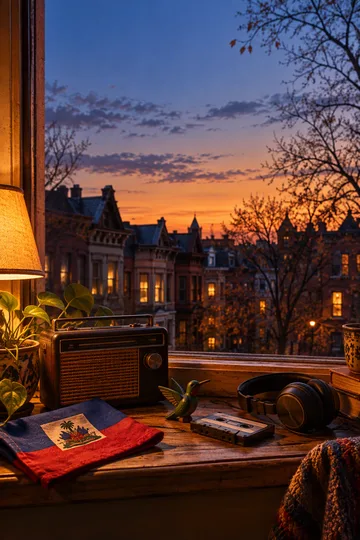
The first time Kervens Lamarre was on the radio, he was eleven hours old, and his grandfather announced him to Little Haiti. Now Kervens is sixteen, lives in Flatbush, understands every word of Kreyòl and answers in English. His first time on the air as a teenager, he says hi.
His grandfather Edner hosted a Kreyòl radio hour in Miami for twenty-seven years. At eighty, asked to bring it back for one season from a small station in an old laundromat, he agrees on one condition: the boy does it with him.
From November to June, Kervens cuts decades of tapes into a segment called In the Drawer, gets a Brooklyn barbershop full of old men calling in, and hosts alone the night his grandfather loses his voice. In his late grandmother's studio he finds forty-one small paintings of voices she only ever heard, each with a hummingbird hidden in it.
Soup carried to the neighbors on Independence Day, a bass line that sways and goes nowhere, a rival who kept the missing year in his closet: one season, told by a grandson learning to open the door in his mouth the other way.
Members can react to this book and talk about it in the members' Library.