
Held, For This One
A Brooklyn ICU nurse goes home to a salt-edged island at the Sundarbans and learns how her family decides
by V. Ashtapad
Foreword
This is a work of fiction. The Sundarbans, Munshiganj, Shyamnagar, Satkhira, Khulna and its Sonadanga neighborhood, Paikgachha, the Padma bridge and Kensington, Brooklyn are real places, and Cyclones Sidr and Aila are real storms that struck the southwest coast of Bangladesh in 2007 and 2009. Shrimp farming in saline ponds, embankment breaches, rainwater tanks, pond-sand filters, cyclone shelters, wild honey collecting, date palm sap tapping and pitha making are real parts of life in the region, and Bonbibi and Dukhe come from a folk story long told there. The island village, the hospital staff, the family and every other character are invented, as is any organization mentioned. Any resemblance to real people is coincidental.
For the families on the rim of the bowl, who write down the tide and then decide again.
Intake
The call came at 6:52 in the morning, eight minutes before handoff, while I was charting the overnight output of a man in bed fourteen who had not yet decided whether to live.
I let it go to voicemail. I finished the note. Urine output thirty milliliters an hour, improving. Pressure holding on a low dose of norepinephrine. Family updated at 0300 by phone, son in Ohio, asked good questions. I signed it, gave report to Danielle, who was coming on with her braid still wet from the shower, and walked down the long hall past the vending machines to the locker room. Only then did I listen.
It was my mother. She does not leave messages. She calls and calls again, and if you do not pick up she assumes you are dead or busy and either way there is nothing to say into a machine. This time she had spoken for forty seconds. The embankment had broken on the south side during the storm. The water had come into the courtyard and up the plinth of the house to the second step. The hens were fine. The cow was fine. My father's foot was not fine. "It is the same foot," she said, "the one you told him to keep dry." Then a long pause in which I could hear wind on her end, or a fan, and then: "Rafiq says we should come to Khulna. Your father says nothing. Call when you can."
I sat on the bench in front of my locker, in the smell of hand sanitizer and wet towels and somebody's coconut oil, and did what I do with any new patient. I made a list.
One. Father, seventy-two, diabetic for nineteen years, poorly controlled, with a chronic ulcer on the plantar surface of the left foot, now presumably soaked in salt water for an unknown number of hours. Risk of cellulitis, osteomyelitis, amputation. Two. Mother, sixty-four, hypertensive, the only reliable caregiver in the house, now also responsible for a flooded courtyard and a ninety-year-old mother-in-law. Three. Grandmother, ninety or ninety-one, nobody is sure, mobile with a stick, mentally sharp, hard of hearing in one ear. Four. A house on a raised plinth on an island inside an embankment on the edge of the Sundarbans, where the embankment was now open to the river on the south side.
I could manage one, two and three from a distance with phone calls and money. Four was not a nursing problem.
I called back from the platform of the F train at Jay Street. She picked up on the first ring.
"How long was the foot in the water?"
"Shirin. Good morning to you also."
"Amma. How long?"
"From the evening until the next noon. He was carrying the hens up. Then he was carrying the rice sacks up. I told him."
"Is it red? Is it hot? Is there a smell?"
She went quiet. In the background I heard my grandmother singing, very low, the way she does when she is shelling something or folding something, and my mother said, "Yes," and I said, "I'm coming."
My husband said what I would have said in his place: that the hospital would not give me two months on short notice, that we had a mortgage on a two-family house on Albemarle Road with a tenant who paid late, that our daughter was sixteen and in the middle of a semester that mattered, and that my brother lived three hours from our parents and was a grown man. He said it while making eggs, in the calm voice he uses on the phone with insurance companies. Faisal is a pharmacist. He thinks in doses and interactions. I love him for that most days.
"Rafiq repairs phones," I said. "Rafiq can't debride a foot."
"There are doctors in Khulna."
"There are. My father won't go to them."
"Then he won't listen to you either."
That was the part he had right. I had no answer, so I ate the eggs.
Tania came down at eight in a hoodie that said the name of a college she had visited once and liked for its dining hall. She looked at the two of us and said, "Who died," and Faisal said, "Nobody, Nana's foot," and she said, "Oh," and then, in a different voice, "Is he going to lose it?"
"Not if I can help it."
She has my father's eyebrows, straight and heavy, which on her look like an opinion. She was born in a hospital on Seventh Avenue in Park Slope, raised on Church Avenue and McDonald, on the smell of fried onions from the sweet shop on the corner and the call of the man who sells guavas with chili salt out of a shopping cart. She has been to Bangladesh twice, at three and at eleven. At eleven she got a fever on the second day, and the rest of that trip was a mosquito net and a ceiling fan and my grandmother's hand on her forehead. She remembers the hand, not the island.
"Two months," she said. "You'll miss Thanksgiving."
"I'll miss Thanksgiving."
"You'll miss my birthday."
"Your birthday is in December. You could come for it."
She looked at her father. He looked at the stove. I had not discussed this with him and he knew it, and he knew that I knew it, and he said, carefully, "We can talk about winter break."
My nurse manager is a woman named Carol Ostrowski who has been in critical care for thirty-one years and has the forearms of somebody who has turned a great many patients. I went into her office with a printout of my accrued leave and the family medical leave forms already filled in, and she read them, and read me, and said, "How bad?"
"I don't know yet. That's the problem."
"You've got eleven weeks of everything if you stack it. You'll lose your spot on the charge nurse rotation. I can't hold that."
"I know."
"You were next."
"I know, Carol."
She signed. She said, "Bring me back some of that tea," meaning the Sylhet tea I had once brought her in a tin, which she had kept in her desk for two years and rationed like morphine.
I packed what I would pack for a patient I was going to see at home with no pharmacy nearby. Saline in sealed bottles for irrigation. Gauze, non-adherent pads, silver dressings, tape that does not give up in humidity, gloves, blunt scissors, a glucometer and three hundred test strips, a blood pressure cuff, a pulse oximeter, a thermometer, and a bottle of povidone-iodine I knew I would not use and could not leave behind. Two courses of an oral antibiotic Faisal brought home from the pharmacy and handed me in a paper bag without a word, which was his way of saying yes to all of it. On top went the gifts my mother would expect: the skin cream she likes, a wool shawl for my grandmother, chocolates for my sister's children, and a cheap battery radio for my father, who listens to the cricket and the river forecasts and argues with both.
The night before I flew, Tania sat on the end of the bed while I folded salwar kameez into the suitcase. They smelled of the cedar block in the closet.
"Can you record Boro Nani," she said, which is what she has always called my grandmother, big grandmother, because the proper word was too long for her at three. "Like singing. You said she sings."
"She sings all day."
"So record it. Put it in the family folder." She meant the shared folder online where my cousins in Queens and Toronto and Sydney post photographs of weddings and graduations and plates of food, the one my brother's wife keeps tidy, sorting each photo into a year and a person. "There's nothing of her in there that talks."
I said I would. She sat a little longer. Then she said, "You always do this," and I asked what, and she said, "Go to the worst thing first," and went to bed.
© 2026 CRUNOD LLC. All rights reserved.
The Long Way In
From Dhaka the road south used to mean a ferry across the Padma and half a day waiting at the ghat with the buses nosed in line and boys selling cucumbers and boiled eggs through the windows. Now there is the bridge. The bus went over it at night and I woke for it, because everyone woke for it, a long string of lights over black water that kept going after you thought it should stop. A woman across the aisle held up her phone and filmed the whole crossing, her own face reflected in the window over the river. When we came down on the other side the man next to me, who had been asleep against my shoulder for an hour, sat up and said, to no one, "Twenty years they said they would build it," and went back to sleep.
Rafiq met me at the bus counter in Khulna at five in the morning. My brother is forty-two and has gone soft in the middle and gray at the temples in the four years since I saw him last. He wore a checked shirt tucked into pressed trousers, and plastic sandals, and he had brought a thermos of tea with too much sugar, and he took the duffel of medical supplies before I could stop him and staggered a little under it.
"What is in this, bricks?"
"Saline."
"There is saline in Bangladesh, Apa."
"Not this saline."
He laughed, which was a relief. In a car borrowed from his wife's cousin he told me what he knew, which was that the breach on the south side was about forty meters wide when it opened, that the water had taken the low ponds first and then come up the lane, that the men had been closing it with sandbags and mud and bamboo since the morning after, and that the government contractor had arrived on the fourth day with a boat full of geobags and a man in a white shirt who took photographs.
"And Abba?"
"Abba walks on it. He walks to the breach every morning to watch them. Amma follows him with a stick and shouts." He glanced over at me. "You have to make them come to Khulna. I have the room. Lipi has said yes. The children will move in together."
"Has anybody asked Abba?"
"Abba says the house is the house." He turned the wheel hard around a rickshaw van loaded with sacks of cement. "The house is mud and tin on a plinth, Apa. It will go in the next one or the one after. You know that."
I did know that. In my hospital locker there was a folder of printouts about salt and shrimp and the coast, highlighted in yellow on my breaks as if highlighting were a kind of action. None of it told me what to say to my father.
The road south from Khulna through Satkhira toward Shyamnagar runs along the tops of things. That is the first thing you notice, if you have been away. The road is raised, the houses are raised, the schools are raised, and between them is water. Not river water, not yet. Pond water, square and flat and divided by narrow earthen dikes, and on the dikes a line of small huts on stilts with a man or a boy sitting in each one, watching. The water was the color of milky tea. Once, my father told me later, almost all of this had been rice. Now the ponds held bagda, tiger shrimp, for export, and the land around them had gone pale with salt, the earth crusted white at the edges like the rim of a glass of lime juice.
There were fewer trees than I remembered. Coconut palms with their crowns thinned, some headless. Date palms along the road with slanting cuts in their trunks where in a few weeks the sap collectors would hang their pots. Rafiq said the mango trees on the lower ground had been dying for years, from the roots up.
At Munshiganj there is a market, a stretch of tea stalls and hardware shops and pharmacies with glass cases of syrup and saline sachets, and then the river, wide and brown and moving fast, and on the far side the dark green line of the forest. I had forgotten how close the forest is. It sits across the water like a wall. You can see the individual trees, the tall pale sundari trunks and the low mangrove under them, and at low tide the gray mud below that, studded with the spiky breathing roots that stick up out of the mud like a field of pencils. The air coming off it was different, cooler, and it carried a smell of rot and leaves and something sweet.
Rafiq paid a boatman and we crossed in a narrow wooden boat with an engine that sounded like a sewing machine. I sat in the middle on a plank with the duffel between my knees. The boatman's son, perhaps twelve, sat in the bow in a faded blue school shirt and a lungi, and when we came near the island he stood up and pointed with his chin at the long low wall of earth that ran along the shore, and said, "That is where it broke," and I saw it: a scar in the embankment, a raw brown patch of new mud with white plastic bags of sand stacked in it like loaves, and on top of it, thin as a heron, my father.
He was standing very still with his hands behind his back. He wore a white undershirt and a checked lungi tied high and a pair of rubber boots that I had sent him three years ago and that he had told me on the phone he never used. His left boot was cut open at the front. My mother was ten feet behind him, in a green cotton sari with the end over her head, holding a bamboo stick, not using it to walk.
I climbed out of the boat into mud to my shins. You do not arrive on the island. You arrive in the island, up to the knee. The boatman's son jumped down and took my suitcase on his head, and I walked up the slope of the embankment on the path the feet had made, and my father turned and looked at me and said, "You came the long way."
"There isn't a short way, Abba."
"There used to be," he said. "There used to be a road."
My mother reached me and took my face in her hands, which smelled of mustard oil and wood smoke, and looked at me for a long time without speaking, and then she said, "You are too thin," which in my family is the beginning of every sentence of love.
The house is where it has always been, on the western side of the village on a plinth of packed earth about a meter high, with a tin roof and walls of mud and split bamboo plastered smooth and painted pale blue at the bottom. Around the swept courtyard stand the kitchen with its clay stove and smoke-black wall, the cow shed, the hen house on legs, and the pond, and beyond the pond the small field that used to be my father's seedbed, now a square of brackish water fenced with reeds where my sister's husband keeps crabs.
On the front of the house, at the height of my shin, was a line. A brown line, perfectly level, across the blue paint and the door and the wooden post and the bamboo. The tidemark. Above it the wall was clean. Below it the paint had gone soft and blotchy and a white crust of salt was coming out of the mud like frost.
My grandmother was sitting on her cot on the verandah with her legs folded under her and her stick across her knees and a small brown dog asleep under the cot. She had her eyes closed and she was singing. When I came up the steps she opened her eyes and stopped singing and said, in her clear high voice, "Who is this big woman?"
"It's Shirin, Dadi."
"Shirin was small." She held out her hand. I knelt and she put it on my head, then my cheek, then my shoulder, as if she were checking that I was all there. "You came for his foot."
"Yes."
"Good," she said. "He won't let me look at it." And she closed her eyes and went back to singing, a slow song with long held notes about a boatman who cannot find the landing, and the dog under the cot sighed and stretched and did not wake.
© 2026 CRUNOD LLC. All rights reserved.
Assessment
I looked at the foot that evening by the light of a rechargeable lamp and the flashlight on my phone, with my father sitting on a low stool on the verandah and his heel on a folded towel on my knee.
Left foot. Ulcer over the first metatarsal head, approximately three centimeters by two and a half, depth unclear without a probe. Surrounding erythema extending onto the dorsum about four centimeters, warm to touch, edges not well defined. Serous drainage with some cloudiness. Odor present, not foul. Pedal pulses faint but present. Sensation absent to light touch on the sole. Capillary refill sluggish. Temperature 37.9 by the thermometer under his tongue, which he held there like a cigarette and tried to talk around. Blood sugar 312 two hours after a dinner of rice and lentils and fried tengra fish, which I had also eaten, and which had been the best thing I had tasted in four years.
"Well?" he said.
"It's infected."
"I know it's infected. My wife has told me it is infected every hour since the storm. Tell me something I don't know."
"If it gets into the bone you could lose the toe. Maybe more."
He looked at the foot as if it were a goat that had wandered into the kitchen. "Then I will walk on the other one."
My mother, behind me in the doorway, made a sound in her throat.
I cleaned it. That took a long time. I had boiled water in the big aluminum pot on the clay stove and let it cool, and I used my saline too, and my father did not flinch because he could not feel most of it. When I trimmed the dead skin at the edges he watched with interest and asked what the white part was and what the pink part was, and I told him, and he nodded the way he used to nod when one of his students at the primary school read a sentence correctly. He taught there for thirty-four years before he retired. Before that, and during, and after, he farmed.
I dressed it with silver and gauze and wrapped it, and showed him how to pull a plastic bag over the whole thing whenever it went near the ground, tied at the ankle with a strip of cloth my mother tore from an old sari. I gave him the first dose of the antibiotic. I wrote on a piece of paper: Keep it dry. Keep it up when sitting. Bag on before the steps. No walking on the embankment. Check sugar morning and night. He read the paper and folded it into the pocket of his undershirt and said, "No walking on the embankment," in the tone of a man repeating a foreign phrase he does not intend to use.
In the night I lay under the mosquito net in the room I had slept in as a girl and listened. Frogs, a great many. A night bird with a two-note call. The fan was off because the power was off; the solar panel on the roof charged two lamps and a phone and nothing else. The tide. You can hear the tide here, if you lie still. It does not crash. It fills. A slow pressing whisper against the earth of the embankment and the hulls of the boats tied to it, and then later a long sucking quiet as it goes out and the mud sighs and pops.
My grandmother sleeps in the front room on her cot because she likes to be near the door. Through the wall I heard her wake twice and say something to the dog, whose name is Kalu, which means dark, though he is the color of a wet brick. Both times she sang a few lines and stopped.
In the morning I made rounds.
I could not stop myself. Blood pressure on my mother before she had even lit the stove: 168 over 96. She takes her pills when she remembers, which is most days, she says. She salts everything twice. Everybody here salts everything twice, said my sister, Mitu, who came over from her house across the lane at seven with her four-year-old on her hip and a tiffin carrier of hot rice, because the water is already salt so you can't taste it. Blood pressure on Mitu: 132 over 88. On Mitu's husband, Kamal, who came behind her in a lungi and a gamchha around his neck and allowed me to take it only because his wife told him to: 150 over 94, at thirty-six. On my grandmother, who held out her thin arm without being asked and watched the dial: 128 over 70. "Better than all of you," she said, pleased.
Then the water.
The tube well in the courtyard, the one my father put in when I was nine, still pumps. I worked the handle and the water came up clear and cold and I tasted it and spat. Mitu laughed at my face. "Since before Aila," she said. "We wash with it. Not the rice."
The pond, which used to be our drinking pond and was fenced against cattle and had a cement step where my mother and grandmother took water every morning in brass pitchers, had taken the river water when the embankment broke. Kamal had already pumped some out and was waiting for rain to fill it back. There would be no rain now until the monsoon. It was November.
Behind the kitchen, on a brick base, sat the rainwater tank, a black plastic drum taller than me that held two thousand liters. It was fed by a tin gutter from the roof. In the cyclone a branch of the jackfruit tree had come down on the gutter and on the tank and split the tank down one side, a crack as long as my arm. My mother had patched it with a sheet of plastic and a bicycle inner tube cut open and tied around it. It held perhaps a third of what it should. She showed it to me with the face of someone showing a wound.
"We were going to make it last to April," she said. "Now we buy."
They buy drinking water in twenty-liter jars from a man who brings them by boat from a filtration plant near Munshiganj, sixty taka a jar, one jar every two days. Or they walk to the pond-sand filter by the school, a concrete box where pond water trickles down through sand and comes out of a tap, cleaner, mostly, and the line there in the morning is long.
I wrote it in the small notebook I carry in my scrub pocket for things to tell the next shift. Water: tank damaged, 1/3 capacity. Pond salted. Purchase approx. 900 taka/month. I did the math in dollars without meaning to and felt ashamed of how small the number was and how large it was here, and then I felt ashamed of the shame, and closed the notebook.
When I went back to the verandah my father had taken the bag off to let the foot breathe, he said, and had then gone down to see to the cow, and was sitting with the foot on the ground, the clean white dressing already brown at the heel.
I did not shout. I have learned not to shout at patients; it does not work, and they remember it and not what you said. I knelt and lifted the foot onto the towel again and started over. My grandmother watched from her cot.
"You are like your grandfather," she said to me. "He did it the same way. Again and again, no words."
"What did he do again and again?"
"Patched the boat. Every year it leaked in the same place. Every year he patched the same place. He never said, this boat is no good, let us buy a new one." She considered. "We could not buy a new one. But he never said it."
Then she sang, in her thin bright voice, a song about a boat with a hole in it, which I am fairly sure she made up on the spot, and Mitu's little girl, Ruma, sat on the floor at the foot of the cot and clapped on every second beat, which is the wrong beat, and my grandmother did not correct her.
I took out my phone and recorded it. Two minutes and forty seconds. In the recording you can hear the tide, and a rooster, and my father saying, "Too tight, Shirin, too tight," and my grandmother laughing in the middle of a line and starting it again. That night, when there was signal enough at the top of the embankment, I put it in the family folder, under her name, with the date. In the morning there were nine comments from three countries, and one from Tania, who wrote only: "More."
© 2026 CRUNOD LLC. All rights reserved.
What the Fields Were
My father agreed to stay off the embankment on the condition that I walk it with him once, at dusk, so he could show me. I said that was the opposite of staying off it. He said I could carry his stool and he would sit wherever I told him to. My mother said we were both mad. We went.
He walked with a bamboo stick, his left foot in a plastic bag inside the cut boot and his weight on my shoulder. I could feel his collarbone through the undershirt. He smelled of mustard oil and the menthol balm he rubs on his temples. The path along the top of the embankment is wide enough for two, packed hard, soft where the new mud has been laid. On the river side, the slope goes down through scrub and the tangled roots of a few planted mangroves to the mud and the water. On the land side it goes down to the ponds.
The light here at that hour is something I have never seen in New York. The sky goes the color of the inside of a ripe guava and the water in the ponds takes it and holds it, so you are walking between two skies, and the dikes between the ponds are black lines drawn on it with a ruler. Herons stand in the shallows. The watchmen in the stilt huts light kerosene lamps and the lamps hang in the pink water upside down. Across the river the forest goes from green to black all at once, as if someone has pulled a curtain, and the first jackals start up, far off.
We walked perhaps three hundred meters before he wanted to sit. I set the stool down on a firm patch and he lowered himself onto it with a grunt, and I stood next to him, and he raised his stick and pointed.
"That was ours," he said. "From that palm to the second watch hut. Two bighas. Your grandfather's and then mine."
It was a pond. A large one, square, edged with dikes, the water flat and pink and empty except for the bamboo frame of a sluice gate at one corner where it let in the river.
"Aman in the rains," he said. "Then in the winter, when the water was sweet enough, we grew a second crop on the higher part. Not much. Enough. The paddy came up to here." He held his hand at the level of his chest, sitting. "In Kartik, before harvest, you could walk from here to the school and see nothing but the tops of the rice and the heads of the people walking in it. When the wind came off the river it went over the field like a hand over a dog's back."
I tried to see it. I could not.
"There was a red rice," he said. "Your grandfather's. It had a red husk and it was a little salty itself, if you can believe that. It did not mind if the tide came in a little, at the edges. It made a thick rice, sticky, good for panta. He kept the seed in a clay pot in the rafters with a lid sealed with cow dung. I kept it after him. Then in the nineties the shrimp people came."
"Who were the shrimp people?"
He waved his stick at the whole horizon. "Everyone. People from Khulna with money. People from here with ideas. They said, why grow rice when you can grow bagda for ten times the money. They let the river in through pipes in the embankment, because the bagda like salt. Some of us said no. Then the land around ours went salt, and the salt came through the earth into ours, the way water comes through a cloth. So I said yes. What else could I say? I leased it. Then after Aila, I sold the lease on, to Kamal's uncle, and now Kamal works it." He was quiet. "The red rice seed. I kept it in the pot for ten years after. Then one year I opened the pot and it had gone to dust. Weevils."
"I'm sorry, Abba."
"Why? You did not bring the weevils." He shifted on the stool and winced. "I am not telling you so you will be sorry. I am telling you so you know what it was. You are a nurse. You look at a foot and you know what it was before. You know what is a healthy foot. I am showing you a healthy foot." He pointed again. "That was a healthy foot."
We sat until the pink went out of the water and the ponds turned the color of slate. Kamal's watch hut was the second one. His older boy, Sabbir, who is ten, was sitting in it doing his homework by the light of a kerosene lamp, with his books on a plank across his knees, and when he saw us he waved with his pencil.
"He is good at mathematics," my father said. "He will not be a farmer. He will be an engineer and go to Dhaka and build bridges and never come back." He said it with pride and something under the pride, the way you might say of a good knife that it is sharp.
On the way back he leaned on me more. At the steps of the house he said, without looking at me, "You have a phone that makes maps?"
"Yes."
"Can you put a mark there? On the pond. Two bighas. Write that it was a paddy field. Write the red rice."
That night I opened the map we share in the family, the one where my cousins have marked the hospital in Toronto where the babies were born, the mosque in Queens where somebody was married, my aunt's house in Sydney with the lemon tree, and I put a pin in a pond on an island at the edge of the Sundarbans and wrote under it: Paddy field of Motaleb Hossain and his father. Two bighas. Red rice, salt-tolerant, seed lost to weevils around 2019. Then I sat looking at it for longer than made sense.
In the morning my mother made panta.
She had soaked the leftover rice from the night before in water in a clay pot and left it covered on the kitchen shelf, and by morning it had soured a little and gone soft and cool, and the water had turned cloudy and faintly fizzy. She spooned it into tin plates with its water, and on the edge of each plate she put a pinch of coarse salt, a green chili, a few rings of raw onion, and a piece of fried fish from the night before, cold now, crisp at the edges. My father sat on the floor of the verandah with his bad foot stuck out in front of him on a cushion and ate it with his fingers, crushing the chili into the rice and mixing it with the onion and squeezing the whole thing in his fist, and drinking the sour water from the plate at the end with a long slurp that I remember from when I was five.
"This is what you eat before a day in the field," he said. "It keeps you cool until noon. Your grandfather ate this every morning of his life."
"It's not the red rice."
"No." He looked at the plate. "This is rice from a sack. From the north. It is fine. It does not hold the water the same way." He ate another mouthful. "You do not like it."
"I like it."
"You are lying. You are making the face you made when you were five."
I was. I ate it anyway, and then a second plate. At the clinic at the end of my street in Kensington there is a receptionist from Noakhali who brings panta for lunch on Fridays, and the young doctors complain about the smell. I always defended her and never once asked for a taste. I thought about that, eating, with my father watching me with his heavy eyebrows up.
"Again tomorrow," he said, "and you will start to like it."
© 2026 CRUNOD LLC. All rights reserved.
Full Moon Water
The tide here is not one tide. It is a calendar.
Twice a day the river comes in and goes out, and twice a month, at the new moon and the full moon, it comes in higher, and everyone on the island knows the dates the way Brooklyn knows alternate-side parking. My mother keeps them in her head. My father keeps them in a school exercise book with a blue cover in which he has written, for twenty years, the date of every high water that came over the top of the steps of the ghat at the south end of the village, with a note: "two fingers over," "to the ankle," "to the second step of the house." The book stops for five months in 2009. He would not say why, though I knew why.
The first full moon after I arrived fell on the eleventh day. The patch at the breach had been finished, more or less, the white sandbags stacked and covered with mud and the mud tamped down with feet and the flat of spades, and the contractor's man had come by boat and taken more photographs and gone away again. But the patch was new and wet, and everyone knew that new earth is weak earth, and on the afternoon of the full moon the men of the village went to the breach and sat.
I went too, because my father was going whether I went or not, and I preferred to be there with my bag. I made him sit well back from the edge. The women came later, with tea in aluminum kettles and puffed rice in tin bowls, and stood on the land side in a bright row of cotton saris, the ends pulled over their heads against the wind. The children ran up and down the dikes. Kalu the dog came and sat on my father's foot, the good one.
The light was very clear. You could see a long way down the river, past the bend where the channel splits around a mudbank and the forest closes in on both sides. Fishing boats were coming home, low and dark with curved prows, some with patched cloth sails, most with engines. A boy stood in the bow of one of them throwing a cast net in a slow perfect circle that opened in the air and fell on the water like a skirt.
The water rose. You could watch it come up the slope a hand's width at a time, pushing a line of foam and sticks and plastic ahead of it, filling the crab holes, covering the breathing roots one by one. The men talked in low voices about other tides. One old man, a neighbor of my father's who had a white beard dyed orange with henna and wore a knitted cap though it was not cold, told about the time the water came over this same stretch in the year of Sidr and took his cow, which swam for an hour in the dark and then came back on its own to the house at dawn and stood in the courtyard as if nothing had happened.
"A clever cow," someone said.
"A lucky cow," said the old man. "Clever cows also drown."
By seven the river was a hand below the top of the patch. The men stood up. They had spades and woven bamboo baskets and a pile of old rice sacks filled with mud. Kamal had a big flashlight, and my sister's neighbor had another, and the light went back and forth over the slope where it was weeping, water coming through the new earth in small threads and running down the land side into the ponds.
"Here," said Kamal. "And here." And the men went with baskets of mud and slapped them on and pressed them with their palms and feet.
I had not meant to help. I had meant to sit next to my father with my cuff and watch for chest pain. But when one of the weeping places became a hole the size of a fist, and the man with the basket was on the far side, I found I had picked up a sack of mud from the pile and carried it to the hole and was pushing it in with my shoulder while a boy of fifteen pressed from the other side. It was heavier than any patient. The mud was cold and smelled of fish and iron. It went down the front of my salwar kameez and into my sleeves.
"Apa!" my sister said from the land side, laughing and horrified. "You'll ruin it!"
"It's a hundred-dollar kameez from Jackson Heights," I said. "It's already ruined."
The tide peaked at a little after eight. Nobody announced it. The water simply stopped coming and stood there, very still, with the moon on it, almost level with the top of the embankment, and on the other side of the embankment the ponds lay a full meter and a half lower, and I understood all at once that the whole island is a bowl and the river is the lip of something larger, and we were standing on the rim.
Then it turned. You could hear it turn. The long sigh. The slope began to show again.
The men sat down. Somebody passed cigarettes. The women came forward with the kettles. My father, on his stool, opened the blue exercise book on his knee, and wrote by the light of Kamal's flashlight: Full moon. One hand below the top at the patch. Held. He showed it to me.
"Held," I said.
"For this one."
On the way home my sister walked beside me and wiped mud off my cheek with the end of her sari. Mitu is five years younger than me. She was twelve when I left for nursing college in Dhaka and fifteen when I married and went to New York. At twenty she married Kamal, whose family has always been here, and she has never lived anywhere else. She has strong arms, a loud laugh, and a way of taking over a kitchen that my mother pretends to resent.
"You can't do this every month," she said.
"I won't be here every month."
"No," she said. "But we will." And she said it without bitterness, as a fact, the way my father had said "for this one," and walked ahead of me down the lane with her little girl asleep on her shoulder, the moon making a white line along the parting of her hair.
© 2026 CRUNOD LLC. All rights reserved.
Honey and the Forest
My father's younger brother, Nurul, came to see the foot on the fourteenth day, rowing over from the next village in his own boat, which he has had since before I was born.
My uncle is sixty-six and small and very dark, with a face folded into deep creases around the eyes from squinting at water. He is missing two fingers on his left hand, the ring finger and the little one, from a winch accident on a trawler when he was a young man, not from a tiger, though children on the island have been told otherwise and he has never corrected them. He has been a fisherman all his life and, every April and May, for as long as the permits have allowed, a honey collector, one of the men who go into the forest in small boats in teams of six or seven for two or three weeks to find the wild hives and smoke the bees off and cut the comb.
He sat on the verandah with my father. They do not talk alike: my father in the careful full sentences of a schoolteacher, my uncle in short bursts like a man paying out rope. He looked at the foot, which I had unwrapped, and then at me, and said, "Will he keep it?"
"If he does what I tell him."
"Then he won't keep it," said my uncle, and both of them laughed, and my father slapped his brother on the knee.
My uncle had brought a gift: a recycled glass bottle that had once held soft drink, with a cork pushed into it, full of honey from the spring. It was very dark, almost the color of molasses, and thin, and when I tasted it from a spoon it was not sweet at first, then very sweet, then bitter, like a flower and a medicine at once.
"From the deep part," he said. "Late flowers. The early ones give a pale honey, sweeter, the one the city people like. This one is for coughs and for the old." He nodded at my grandmother on her cot, who held out her hand for the spoon and licked it like a child.
"Tell her about the forest," my father said. "She has been to America and back and she has never been in the forest."
"She doesn't want to go in the forest."
"I do," I said.
"No, you don't." My uncle shook his head. "The forest is not for wanting. You go in because there is work. You come out because the work is finished. In between you keep your mouth shut and your eyes open." He took a cigarette from behind his ear, looked at it, put it back. "And you do not say his name."
"Whose name?"
"His," said my grandmother from the cot, in a high, pleased voice, as if it were a game. "The big one. The uncle. You don't say his name in the forest or he hears you."
They meant the tiger. In the forest the men call him mama, uncle, or the big one, or simply him. They do not use the word. Over three cups of tea my uncle told me how a honey team works. How they set off with their permits and their boat and their rice and pots. How they walk in a line through the mangrove, close together, each man watching a different direction and one always facing behind, because the big one comes from behind. How they light a torch of green leaves and hold it under the hive until the bees boil out, and cut the comb into a basket, leaving a part so the bees will come back. How the price has gone up and the hives have gone down.
"Why down?"
He shrugged. "The flowers are fewer. The salt is more. The trees at the top are dying. The bees go deeper." He looked out at the river. "Everything goes deeper."
"Have you seen him?"
He was quiet so long that I thought he was not going to answer.
"Four times," he said. "Three times on the bank, from the boat. Once on land. In 1998. He was in the grass. Ten meters. I saw his face and then I didn't. We went back to the boat walking backward, singing, all of us, very loud. Singing whatever we knew. Film songs. I sang a film song." He laughed, without much in it. "In 2004 he took a man from the next team. A man I knew. His name was Jalil. He had three daughters. We found his shoe."
My grandmother began to sing. It was not a film song. It was a long chanting story-song with a refrain, and I knew it vaguely from childhood, about Bonbibi, the lady of the forest, and the boy Dukhe, whose name means sorrow. In the story a greedy man takes the poor boy Dukhe into the forest to collect honey and wax and leaves him on the shore as an offering to Dokkhin Rai, the tiger-king, in exchange for a rich harvest. Dukhe calls out to Bonbibi, and she comes and saves him and drives the tiger-king away and sends Dukhe home with treasure, and from then on the forest is divided: the tiger keeps to his part, people keep to theirs, and those who go in must go in with clean hands and take only what they need.
My grandmother sang the whole thing. It took twenty minutes. She did the voices: the greedy man wheedling, the tiger-king roaring, which made Ruma shriek and hide behind me, Bonbibi stern and calm, Dukhe crying for his mother. Her voice cracked on the high notes and she went over them anyway. Mitu came out of the kitchen with dough on her hands and stood in the doorway. Even Kalu sat up.
I recorded it. I almost did not, because it seemed wrong, like filming someone asleep. But Dadi saw me holding the phone and nodded at it and sang more slowly, more clearly, the way she must have sung to her own children, enunciating, and I understood that she wanted it kept.
When it was finished my uncle said, "My mother sang that to us before every season. Every one."
"Do you believe it?" I asked, and then wished I had not, because it was a New York question.
He took his time. "I believe that he is there," he said. "And I believe that you take only what you need, and you leave some comb, and you do not go in angry or greedy. Whether the lady comes when you call," he lifted his hand with its three fingers, "I have never called. I have always been lucky. My friend Jalil called, I think."
He went home at dusk, rowing standing up, facing forward, pushing the oars, the way they do here. We watched him go from the embankment until he was a shape against the water and then not even that. My father said, "He will go in again in April. He is sixty-six and his knees are finished and he will go in again." He shook his head. "He says the forest is the only place left where the work is the same as it was."
That night I sent the song to the family folder. It was too long for most of them. Tania listened to all of it, she told me later, on the subway, twice, and looked up the story of Dukhe and read it in English and sent me a message at three in the morning my time that said: "So the moral is take only what you need and also don't trust your boss." I laughed out loud in the dark, and Dadi through the wall said, "Who is laughing?" and I said, "Tania," and she said, "Good," and went back to sleep.
© 2026 CRUNOD LLC. All rights reserved.
Triage at the Dinner Mat
Rafiq came on the eighteenth day, a Friday, with his wife, Lipi, and their two boys, and a folder.
The folder was green plastic with a snap closure. In it were photographs of a flat on the third floor of a building in Sonadanga: two rooms and a kitchen, a bathroom with a Western toilet, a balcony with a grille, a view of another building. There was a page of numbers in my brother's neat hand. Rent. Electricity. Eight minutes by auto-rickshaw to the medical college hospital. A hired woman to help my mother three days a week. The amount he could pay and the amount he was asking me to pay, converted into dollars in a smaller hand, with a question mark.
He had planned to bring it out after the meal, I think. But at the meal, which was laid out on a mat on the verandah floor because the table inside is too small for all of us, my mother asked Lipi how the boys were doing at school, and Lipi said very well, the older one was first in his class in English, and the school was very good, there was a school just like it near the flat. My mother said, "What flat?" and Rafiq put his hand flat on the folder next to his plate, and everyone looked at it.
The food was very good. That is what I remember first, and it is shameful, but it is true. There was rice, white and hot, and a dal of red lentils with fried garlic, and a curry of parshe, the small silver river mullet, with green chilies and onion, and fried slices of bhetki dusted with turmeric, and a dark sweet-and-sour chutney of the little sour fruits Mitu calls amra, and crab, my brother-in-law's crab, cooked in a red gravy so thick and hot that the children were not allowed it. There was a plate of sliced cucumber with salt and lime. There was a bowl of the honey my uncle had brought, for my grandmother.
My brother opened the folder. He had practiced. He said that the embankment had broken three times in fifteen years and would break again. That the house had been underwater after Aila for three months, and had been repaired, and the walls were still shedding salt. That our father's foot needed a doctor and a doctor was eight minutes away in Khulna and three hours away from here. That our mother was tired. That our grandmother was ninety and could not climb to the cyclone shelter if another storm came at night, and someone would have to carry her, and who would that be? That he had a room for them. That he was asking.
Kamal said nothing. He ate. My father said nothing. He picked at his fish. My mother said nothing. She refilled people's rice.
So I spoke. This is the mistake I want to describe exactly, because I made it carefully, the way I make most of my mistakes.
I said that I agreed with Rafiq. I said it was clear from a medical standpoint that our father's foot could not be properly managed here, that his sugar was in the three hundreds, that our mother's pressure was dangerous, that the water situation was not sustainable. I said I could contribute what Rafiq was asking and more. I said that these things were not a question of feelings but of risk, and that in my work, when the risk was high and time was short, you did not wait for consensus, you acted on the most critical problem first and sorted out the rest afterward. I think I used the word triage. I know I used the word sustainable.
When I finished there was a silence. It was not a good silence.
Then my father wiped his fingers on the rag by his plate, carefully, finger by finger, and said, "Thank you, Doctor."
"I'm not a doctor, Abba."
"No," he said. "But you have explained to us like one."
He got up, which took a long time, and nobody helped him because nobody dared, and went inside. My mother looked at her plate. Kamal stood up too, and said to Mitu, "I have to check the sluice," and went down the steps into the dark. Lipi began, very busily, to gather the children's plates.
My sister looked at me across the mat with an expression I had not seen on her before. Not anger. It was closer to pity. Then she went to the kitchen.
Only my grandmother had not moved. She had been eating honey off a spoon the whole time, very slowly, and now she licked the spoon and put it down and said to me, in her high clear voice, "Are you finished?"
"Finished with what, Dadi?"
"Talking."
"Yes."
"Good," she said. "Now you know what everyone thinks of what you think." She pulled her shawl around her, the wool one I had brought from Brooklyn, and lay down on her side on her cot with her back to us.
Rafiq and I sat on the steps afterward. The boys were asleep inside. The tide was out and the mud was popping and steaming a little in the cool air. He smoked, which he does not do in front of our parents.
"You did it wrong," he said.
"I agreed with you."
"Yes. That was what was wrong." He tapped ash into a crab hole. "Now it is the two of us, the ones who left, telling the ones who stayed. The one in Khulna and the one in America." He shook his head. "I should have waited. I should have talked to Kamal first. And Amma alone, in the kitchen. Not like a meeting."
"You brought a folder."
"I know I brought a folder." He laughed, unhappily. "You think I don't know I brought a folder?"
We sat. In the unit, when a family has to decide whether to withdraw care, we hold a meeting in a room with a box of tissues on the table, and the attending explains in plain language, and then, too often, the family looks at us and asks what we would do. And we tell them, gently, and they do it. I had believed that was a kindness. I still do, in that room. But this was not that room. Nobody here had asked me what I would do.
"What does Amma want?" I said.
"I don't know," said my brother. "Nobody asked her."
© 2026 CRUNOD LLC. All rights reserved.
Salt Clinic
After the dinner I did what I do when I have made an error at work. I went looking for a different job to do until I could think.
The community clinic is a one-story concrete building near the school, painted cream and green, with a verandah where women wait on a wooden bench with their children on their laps and their slippers in a row on the step. It is open in the mornings. A community health care provider sits there, a young man from Satkhira town with a stethoscope he is very proud of, and twice a week a health worker comes around the village on foot. Her name is Bina Mondal. She is fifty, a widow, with a thin glass bangle on one wrist and a plastic watch on the other, and she walks the dikes in a faded cotton sari with a cloth bag over her shoulder that holds a blood pressure cuff, a register, iron tablets, oral rehydration sachets and a bottle of hand sanitizer that she had refilled so many times the label had worn away.
My mother introduced us on the lane, and Bina looked me up and down and said, "The nurse from America. I heard about the mud." Everyone, it turned out, had heard about the mud.
I asked if I could walk with her. She considered it. "You will see things you can't fix," she said.
"I see those every day."
"Not these," she said, and then, relenting, "Wear shoes you can lose."
We walked for five mornings. I carried the register and took pressures, and she took them again herself to check, which I would have done too. I learned more in those five mornings than from the folder in my locker.
I learned about the skin. Women who stand in the shrimp ponds to work, netting fry, get rashes on their feet and legs that itch and break and do not heal. Bina's bag held a tube of antifungal cream that she rationed by the fingertip. I learned about the pressure: young women here had readings I would expect in a sixty-year-old man in Brooklyn. Bina kept a column in her register for the women who lost pregnancies and the babies born early, in her own handwriting, with dates. She showed it to me without comment.
I learned about the cyclone shelter. It is the school, a two-story building on concrete pillars, painted with a red flag with a number on it, the warning signal. When the signals go up on the radio and the volunteers come around with megaphones, everyone is supposed to go there. Many do not. They do not want to leave the animals. They do not want to leave the house to thieves. The women do not want to sleep in a room with three hundred strangers. The old cannot get there. "Your grandmother," Bina said, "went to the shelter in Aila, and in Sidr. In this last one she said no. Your father carried the hens up to the shelf and stayed with her. That is how he got the foot."
"Nobody told me that."
"Nobody tells anybody anything," said Bina. "Everybody knows."
On the fourth morning we went to a house on the far side of the island, past the shrimp ponds, almost on the river. A woman there named Asma, perhaps forty, had a boy of eight who had been born with one leg shorter than the other and walked with a crutch his father had made out of a branch of goran wood, smooth and dark. The boy, whose name was Hridoy, had a cough. Bina listened to his chest and frowned and listened again and then handed me her stethoscope, which was an honor, and I listened, and heard crackles low on the right.
"He needs to go to the upazila hospital," I said. "Today. He needs an X-ray. He might need antibiotics."
Asma looked at Bina. Bina looked at me. Then Bina knelt down on the swept earth in front of the mother and took both of her hands and said nothing for a while.
"Who will take him?" she said finally.
"His father is on the boat," said Asma. "Until Sunday."
"Your mother-in-law?"
"Her knees."
"Your sister?"
"In Dhaka. At the garment factory."
"If you take him," said Bina, "who will feed the ducks?"
"The neighbor."
"The neighbor will want something."
"The neighbor always wants something."
They went on like this. I wanted to say, he could have pneumonia, never mind the ducks. But I had made one speech already that month. And I saw that Bina was not delaying. She was walking the whole thing through with the mother, piece by piece, out loud, the ducks and the neighbor and the boat fare and the mother-in-law, until there was nothing left in front of the decision that Asma had not looked at, and when it was done Asma stood up and said, "I'll go now," and went to get her good sari.
Bina and I went to the ghat with them and found a boatman going to Munshiganj and Bina bargained the fare down by twenty taka.
On the way back along the dike I said, "I would have just told her to go."
"I know you would," said Bina. "And maybe she would have gone. And maybe at the ghat she would have thought of the ducks and turned back. When people decide for themselves they don't turn back so often." She swung her bag to the other shoulder. "You think we are slow."
"I think you're thorough."
"That is a polite word for slow." She laughed. "It is slow. It is slow because there is no ambulance. If there was an ambulance I would also say, go, go. Here, what she decides she has to carry herself. So she must be the one to pick it up."
That afternoon I went home and sat with my mother in the kitchen while she ground spices on the flat stone with the stone roller, cumin and turmeric and dried chili, rocking it back and forth with both hands, her bangles clicking, the yellow dust rising in the light from the doorway. I did not say anything. After a while she said, "Bina is a good woman," and I said, "Yes," and she said, "She told me you listened." And then she went on grinding.
© 2026 CRUNOD LLC. All rights reserved.
Winter Sap
At the end of November the cold came down from the north, not cold as Brooklyn knows it but a wet low chill, with fog lying on the ponds so thick you could not see the watch huts and the herons stood in it like ghosts of herons. My grandmother wore two cardigans over her sari and the wool shawl over both and still complained. My father wore a monkey cap, a knitted balaclava rolled up over his forehead, and looked like a bandit. The children went to school in sweaters over their uniforms, and their breath showed.
And the date palm men came.
There are two on our side of the island, a father and son, who rent the trees along the road and the embankment from the owners for the season and take half the sap. Every afternoon they climb. They go up the trunks barefoot with a rope looped around the tree and their waist, leaning back into it, a curved knife at the hip and a clay pot slung from the shoulder. Under the crown they shave a thin fresh layer off the V-shaped cut, set a bamboo spout into it, hang the pot, and come down. All night the sap runs into the pot, clear and sweet. At dawn, before the sun can warm it and sour it, they climb again and bring the pots down.
My father wanted me to taste the raw sap, the khejur rosh, as he had every winter of his childhood. My mother said absolutely not; she had heard on the radio that you could get a fever from it, from the bats that drink from the pots at night. I said, as a nurse, that my mother was right. My father said, as a father, that the nurse could boil it. So at dawn on the first of December, in the fog, the son of the sap man brought two full pots to our courtyard, and my mother boiled half of one on the clay stove in a wide shallow iron pan, and I stood there while it steamed and the smell came up: sweet, smoky, a little like caramel and a little like grass.
The rest went for jaggery. The sap men boil it in a big flat pan over a pit fire by the road, stirring with a long paddle until it goes from clear to gold to dark brown, and pour it into clay molds. The new jaggery of the season is soft and smells of smoke, and it is the reason for pitha.
My mother started making pitha the week of the new jaggery and did not stop until I left. There is a pitha for every hour. For breakfast she made bhapa pitha. She had soaked rice and pounded it into flour in the wooden pounder in the shed, the long beam you step on, my sister and I taking turns, the head thudding down into the hole in the ground. She dampened the flour with a pinch of salt, packed it into a small bowl with a layer of crumbled jaggery and grated coconut in the middle, turned it out onto a square of muslin, and set it over the steam of a clay pot with a hole in the lid. A few minutes. It came out white and soft and steaming, the jaggery melted into a brown seam through the middle, and you had to eat it at once, burning your fingers, while it was hot.
In the afternoon there was chitoi pitha, little rice cakes cooked in a clay mold with cups in it, eaten with a hot syrup of jaggery or with a salty mash of dried fish and chilies, which was my father's preference. In the evening there was patishapta, thin crepes of rice and wheat flour rolled around a filling of coconut and jaggery cooked down together until sticky. And there were the deep-fried ones, the puli shaped like little half-moons with their edges pinched in a braid, that my grandmother made sitting on her cot with a tray in her lap, her fingers very fast, pinching and turning, pinching and turning, without looking.
She taught Ruma the braid. Ruma's came out like caterpillars. My grandmother praised them all and ate the ugliest ones herself.
My father's foot improved, a little. The redness pulled back by two centimeters. The fever went. The drainage cleared. His sugar, with no rice at night and the antibiotic and a walk around the courtyard morning and evening on my arm, came down to the two hundreds, which was still bad, but less bad. And then the pitha started, and it went back up to 280, and I took the jaggery away from him and he looked at me like I had taken away his name.
"Half of one," I said. "In the morning."
"Half," he said. "In the morning. And at night?"
"At night you can watch everyone else."
"This," he said to my grandmother, "is what we sent to America."
My grandmother laughed so hard she had to put the pitha tray down.
That evening, while my mother fried patishapta and the kitchen filled with smoke and the smell of coconut, I sat on the floor and recorded her talking. She was explaining to Mitu, who knew it already, how her own mother had made them, in Paikgachha, where my mother is from, a bigger place up the river, with fresher water then. How they had used the old red rice of that place. How the winter her father died she had made patishapta for the forty-day gathering for three hundred people with four other women in a kitchen this size. How you know the pan is the right heat by flicking a few beads of water on it. She stopped and looked at me. "Why are you recording?"
"For Tania."
"Tania doesn't speak Bangla."
"She understands more than she speaks."
My mother turned the crepe with her fingers. "Then I'll speak slowly," she said. And she did.
© 2026 CRUNOD LLC. All rights reserved.
Tania
My daughter arrived on the eleventh of December, in the fog, with a backpack and a rolling suitcase whose wheels were useless in the mud and a sweatshirt with the hood up and her earbuds in.
Faisal had flown with her as far as Dhaka, stayed two nights with his cousins in Mirpur, and put her on the bus with Rafiq, who had come up to fetch her, and flown back to work. He sent me a long message from the airport at Dhaka that was mostly about pharmacy coverage and ended, "She is nervous. Don't fix her." I read it three times.
Rafiq brought her across in the same boat with the same boatman's son, who took the suitcase on his head again. She stood up in the boat as it came near the bank, which you are not supposed to do, and looked at the embankment, the patch, the line of people waiting for her on top of it, my father on his stool, my mother with her sari pulled tight against the cold, my sister holding Ruma up to see, my grandmother, who had insisted on coming, sitting on a mat someone had spread for her with Kalu beside her. And Tania took her earbuds out.
Then she stepped off into the mud, as I had, and sank to her knees, and shrieked, and everyone on the embankment laughed and called out, and the boatman's son pulled her up by the elbow, and she came up the slope covered to the thighs, laughing too, almost crying. My mother reached her before I did, and took her face, and said in Bangla, slowly and clearly, "You are too thin," and Tania, who had heard me tell this story her whole life, said, "I know, Nani," in a terrible accent, and my mother burst into tears.
The first three days were hard. Tania slept until noon and was awake at three in the morning, and there was signal only at the top of the embankment, so at three she would take a flashlight and go up there to message her friends, and I would go after her in my shawl, and we would sit in the dark with the tide moving below us and the jackals across the water while she told me what her friends were doing. She did not like the toilet, which is a latrine at the end of the courtyard. She did not like the cold water from the tube well for washing. She did not like the panta. She did not like being looked at, and everyone looked at her: the children, who followed her down the lane in a crowd; the women at the pond; the men on the dikes, who stopped to ask who she was, and when they heard, said, "Ah, the American one," and looked at her again.
On the fourth day my grandmother took over.
I do not know how she arranged it. I came back from walking with Bina and found Tania sitting on the floor of the verandah at the foot of Dadi's cot with her legs crossed, wearing one of my mother's old cotton saris, a pale yellow one with a green border, wrapped on her badly and pinned in three places with safety pins, and Dadi was teaching her a song.
It was a short one, about a fish. A boal fish, a big river catfish with whiskers, who is too clever for the fisherman and swims under his net every day, and the fisherman's wife laughs at him. My grandmother sang one line and Tania sang it back. Dadi corrected her, not the words, but the turn in the melody at the end of the line, a small fall and lift of the voice that I could hear and Tania could not, and they did it again, and again, maybe twenty times, and Tania did not lose patience, which I have never once seen her do with me.
"She has a good ear," said my grandmother to me, without looking away from Tania. "Better than you."
"Everyone has a better ear than me."
"That is true," said Dadi.
After that it was easier. Not easy. Sabbir showed her how to check the sluice and tell a bagda shrimp by its stripes, and in return she helped with his English homework and taught him to say "that's sick" about things that were good. She went out with Kamal in the small boat at dawn to check the crab traps in the channels and came back with mud on her face and a crab in each hand held the right way, behind the claws, and Kamal said she had a fisherman's hands, which made her glow for a day. She helped Mitu make pitha and was terrible at it and kept trying. She photographed everything: the fog, the herons, the jaggery boiling, the patch on the embankment, the tidemark on the wall of the house, my father's blue exercise book open on his knee.
On the ninth day she asked my grandmother if she could record her telling a story, and my grandmother said yes, as long as Tania told one back. So Tania told her, in English with my translation, the story of how she broke her wrist at nine falling off a scooter on Ocean Parkway, and Dadi listened very seriously and asked many questions, about the scooter and the hospital and whether the bone had been set straight, and at the end said that it was a good story but it needed a song in it, and made one up on the spot, about a girl who flies down a long road on a little cart with wheels and lands on her hand, and Tania recorded that too.
Her birthday was on the nineteenth. She turned seventeen. Faisal had made a page for her online, where people could leave short videos, and on the evening of her birthday we climbed up to the embankment where there was signal and sat on a mat with my father and mother and Mitu and Kamal and the children and my grandmother, who had been carried up on a chair by Kamal and a neighbor, and we watched them on the phone one by one. Faisal in his white pharmacy coat in front of the shelves. Her friends from school in a pizza place on Cortelyou Road, shouting. My cousin in Toronto with her twins. My nurse manager Carol, who had heard from Faisal, holding up the empty tea tin from two years ago and saying, "Happy birthday, kid, tell your mother I'm out." Then my grandmother asked if she could make one, and Tania held up the phone, and Dadi sang the song about the boal fish to the camera, the whole thing, in the cold with the tide coming in and the mosquitoes starting, and at the end she said, in Bangla, "Seventeen. When I was seventeen I had two children and one more coming. Don't do that." And everyone laughed, and Tania, who understood all of it, laughed hardest.
© 2026 CRUNOD LLC. All rights reserved.
The Year of Aila
It was Tania, in the end, who asked about the gap in the blue exercise book.
She had been photographing its pages one afternoon on the verandah with my father's permission, turning them carefully, the old ballpoint gone purple, and she came to the place where the dates stop in May of 2009 and start again in October, and she held the book up and said in English, "Nana, why is there nothing here?"
My father understood the question. He looked at the book and then at the river. He did not answer.
My grandmother answered. She was sitting with her legs folded on her cot, eating a piece of chitoi pitha softened in warm milk, which is the only way she can eat it now. She put the bowl down.
"Because he was not writing," she said. "He was carrying."
She told it to Tania, and I translated, though by then Tania needed me less than she pretended. I am putting it down as near as I can to the way my grandmother said it.
Aila came in May, she said, at the end of the hot season, when nobody expected anything. Not a big storm, by the radio. A number three, then a number seven. The wind was not the worst they had had. But it came at the high tide at the new moon, and the water came behind the wind, and the river stood up. It stood up like a wall, my grandmother said, brown, as high as the roof of the cow shed, and it came over the embankment in eleven places along this island at once, and in a few places it did not come over, it simply broke the embankment and walked through.
They had gone to the shelter that time, the old school, smaller. She had gone with my mother and Mitu, who was sixteen, and Rafiq, who was twenty-five and had come from Khulna that week for a wedding. My father stayed at the house with the cow and the goats until the water reached the second step and then he cut them loose and swam to the shelter, holding a tin trunk over his head with the land papers and the school certificates and my grandfather's watch in it. In the shelter there were six hundred people on two floors and a stairwell. Three babies were born there in the four days they stayed.
When they came back, the island was a lake, with only the tops of the trees and the roofs that had not fallen. The embankment had eleven holes in it and the river came in and went out of the holes twice a day, every day, for months. Some were closed and the river opened them again. So people lived on the embankment itself, on the narrow top of it, in shelters made of bamboo and plastic sheets, in a line, a whole village living in a line along the top of a wall, with the river on one side and the salt lake on the other. They drank water that came on boats from far away. People got sick. Children got sick. The skin of everyone's feet came off.
"Where did you live?" Tania asked.
"There." My grandmother pointed with her chin at the stretch of embankment in front of the house. "Your great-grandfather was gone already. Your Nana built a house of bamboo up there, a little one, for me and your Nani and your aunt. Every day he went down into the water with the other men and carried mud. With his hands. With baskets. They closed the holes themselves, the men, one by one. Some days they closed one and the tide opened it again in the night. They closed it again. That is why he did not write in his book. He did not need to write when the water was high. It was always high."
"How long?"
"Until the rains finished," said my grandmother. "Five months. Then the holes were closed and the water stayed out and we pumped the house and the mud fell off the walls and we put it back. And the rice field was salt. And it never came back." She picked up her bowl again. "That is when your Nana gave the field to the shrimp."
Tania looked at my father. He was looking at his foot.
"And people left," said my grandmother. "Many. To Khulna. To Dhaka. To India, over the border, some. To the brick fields, the men, for the dry months. Some families went and did not come back. Some came back. Your Nana's cousin went to Dhaka with his whole family and his wife works in a garment factory there now and his son drives a rickshaw, and they live in one room by the railway, and he telephones every Eid and cries."
"Why did you stay?" Tania asked.
Then my grandmother did something I did not expect. She said, "I will tell you how we decided. You are a girl. You should know it." And she turned to me. "And you. You should know it more."
After Aila, she said, when they were living on the embankment and the men were carrying mud, the family sat down to decide whether to stay or go. It was not one meeting. It was many. Every evening in the bamboo house, on the mat, with the lamp. And there was a rule that her own mother-in-law had used, and her mother-in-law's mother-in-law, when there was a big thing to decide, a marriage, a sale of land, a quarrel between brothers.
Everyone speaks. Everyone. The children too, if they are old enough to sit still. Each person speaks once, as long as they want, and while they speak no one else says anything. No one. Not to agree, not to argue, not to say, yes, but. When they are finished, the next person who speaks must first say back what the one before said. Not their own opinion. What the other one said, in their own words, until the one before says, yes, that is what I meant. Only then can they say their own thing. And it goes around like that, each one saying back the one before, until everyone has spoken. The oldest speaks last.
"Why the oldest last?" I asked.
"Because if the oldest speaks first," said my grandmother, "no one else says what they think. They say what the oldest thinks."
"And then what? The oldest decides?"
"No," she said, scornfully. "Then you sleep. And tomorrow you do it again, if it is not finished. You do it until everyone has heard everything. Usually by then it is decided. Nobody has to decide it. It is just there, like the tide line on the wall."
"And after Aila, what was there?"
"That we would stay," she said. "That time." She ate her pitha. "Your father wanted to go to Khulna. Your mother wanted to stay, because of her mother in Paikgachha, still alive then. Rafiq wanted us to go. Mitu wanted to stay because of Kamal, though nobody knew about Kamal yet except me. I wanted to stay because I was old already and I did not want to die in a room by a railway." She looked at me with her bright black eyes. "This time it will be different. You will see."
"How do you know?"
"Because everyone in this house is tired," she said, "except me and the dog."
© 2026 CRUNOD LLC. All rights reserved.
Night Boat
The big tide at the full moon of the next month came on the twenty-fourth of December, and my father went to the breach.
He went in the late afternoon while I was across the island with Bina at a house where a baby had a fever, and my mother was at the pond, and Tania was with Sabbir. He told my grandmother he was going to the latrine. He went with his stick and his cut boot and walked the three hundred meters to the patch and sat on the slope with the men for four hours, with his foot on the wet earth, and when the water came up the slope and started weeping through the new mud, he got up and carried a basket.
They brought him home at ten, Kamal and the old man with the orange beard, with an arm each. He was shaking. His temperature was 39.4. His foot, when I cut the bag and the dressing off it, was swollen to the ankle and red to the middle of the shin, with a hard tender streak running up the inside of the leg, and when I pressed above the ulcer the skin crackled under my thumb like rice paper, and the smell was different.
I knew what it was. I have seen it many times, in Brooklyn, in men like him who come in through the emergency department on a Saturday night with a foot they had been ignoring for a month. In my hospital I would page the surgeon and start two lines and have him in the operating room in three hours. Here there was a boat, and a river at night, and Khulna three hours on the other side of it.
I did what I know how to do. I checked his pressure: 96 over 58. Pulse 118. Sugar 410. I gave him a dose from the second course of the antibiotic, which was a cup of water thrown at a house fire, and made him drink salt-and-sugar water from Bina's sachets, a sip at a time. I put him flat with the leg up on a pillow and covered him with my grandmother's wool shawl. I told Kamal we needed a boat now, and a car on the other side, and to call Rafiq and tell him to meet us at the medical college hospital in Khulna.
And then I stopped, and I knelt down by my father's head, where he could see me without moving, and I said, "Abba. Listen to me. This is bad. If you stay, I think you could lose the leg. I think you could die. If we go now, tonight, I think they will take the toe, maybe more of the foot, and you will live. I want to take you. But it is your foot. Will you go?"
He looked at me. His eyes were very bright with the fever. He said, "You are asking?"
"I'm asking."
He was quiet for a long time. My mother was standing in the doorway with her hand on the frame. My grandmother was sitting up on her cot. Tania was behind her, with Kalu in her arms, very white.
"Who will write the tide?" he said.
"Sabbir," I said. "Sabbir can write the tide."
"Sabbir writes too small."
"Then Tania. Tania can write it big."
He closed his eyes. Then he said, "Go then. Before I change my mind." And my mother made a sound I have never heard her make, and came and knelt down next to me.
The boatman was Asma's husband, back from his trawler, who came without being asked when he heard, because of his boy. We carried my father down to the ghat on a cot, four men, in the moonlight, with half the village walking behind with flashlights. The tide was going out and we had to wade the last part. They laid him in the bottom of the boat on a quilt with his head in my mother's lap and his foot on my knee, and I held the flashlight on the dressing and my fingers on his wrist the whole way across.
It is a strange thing, to cross that river at night. The moon was very high and small and the river was silver and black in long sliding sheets, and the forest on the right side was a black mass that went on forever, with no lights in it at all. The engine was very loud. And then at one point the boatman throttled down to go around a sandbar, and in the quiet I could hear the forest: insects, a great roaring shimmer of them, and something heavy moving in the water at the edge, and a deer barking, a short sharp cough, again and again, which my uncle told me later is what deer do when they have seen him.
My father was awake. He was looking up at the sky. He said, so quietly that I had to bend down, "In the paddy at night in Kartik, when the rice is high, you can hear it grow."
"You can't hear rice grow, Abba."
"You can," he said. "It creaks. Like a house. Your grandfather took me out at night to hear it, when I was smaller than Sabbir. We lay down in the dike and listened." He was quiet. "I took you once. You were four. You fell asleep."
"I don't remember."
"No," he said. "That is why I am telling you."
At Munshiganj, Rafiq's friend was waiting with a microbus. At the medical college hospital in Khulna, at three in the morning, Rafiq was waiting at the gate in his pressed trousers and his sandals with his hair standing up, and he took one look at our father and ran inside shouting for a trolley, and I forgave him the folder.
They took the big toe and the one next to it at eight in the morning, and part of the bone behind them. The surgeon, a tired young woman with a pen behind her ear, came out afterward and told us that if we had waited until the morning she would have had to take the foot.
I was sitting on a bench in the corridor with my mother when she said it, and my mother, who had not slept, put her head down on my shoulder and wept, and I put my arm around her and found that I could not say anything at all, not one clinical word, and so I said nothing, and held her, and that was the right thing.
© 2026 CRUNOD LLC. All rights reserved.
Everyone Speaks, the Eldest Last
My father came home on the second of January, by boat, sitting up, in a clean white panjabi Rafiq had bought him, with his foot in a thick bandage and a pair of aluminum crutches across his knees that he looked at as if they had been sent by an enemy.
He had been in the hospital nine days. I slept on a mat on the ward floor beside his bed in a row of other daughters and wives and sons on other mats, the way it is done here, bringing his food from Lipi's kitchen in a tiffin carrier, washing him, changing the dressings when the nurses were too busy, which was often. The nurses there were very young and very fast and saw sixty patients a shift between four of them. On the third night one of them asked me where I had trained, and I said Dhaka, a long time ago, and she asked me to look at a man's IV that would not run, and I fixed it, and after that they let me do what I liked.
Tania had stayed on the island with Mitu. She wrote the tide for her grandfather in the blue exercise book every day at the high water in large, careful, slanting letters, half in English, half in a Bangla she copied letter by letter off a page Sabbir wrote out for her. Two fingers under the top. Held.
Her flight home was on the sixth, mine on the seventh. On the evening of the fourth, my grandmother called the family together.
She sent Sabbir to tell everyone, which in a family is the same as an invitation printed on card. Rafiq came from Khulna with Lipi. My uncle Nurul rowed over. Mitu and Kamal came with the children. They spread the big mat on the verandah and put the lamps around it and my mother made tea, and puffed rice with mustard oil and onion and chili in a big bowl, and the last of the winter's patishapta. My father sat propped against the wall with his foot on a cushion. My grandmother sat on her cot above us all, with Kalu underneath.
"The rule," she said, and explained it again, for Lipi and the children, and for Rafiq, who claimed not to remember. Everyone speaks once. No one interrupts. You say back the one before you until they say yes. The oldest speaks last. "We start with the youngest who can sit still," she said, and looked at Sabbir.
Sabbir is ten. He went red to the ears. He said that he wanted to stay because his school was here and his friends were here and he was going to win the mathematics competition at the upazila level in February. He said that he was scared of the water at night. He said that when he was an engineer he would build an embankment that would not break, out of concrete, as high as the school. Then he stopped and looked at the floor.
Rafiq's older boy, who is twelve, had to go next and say it back. He said, "Sabbir wants to stay for school and the competition, and he is scared at night, and he wants to build a concrete wall." Sabbir said, "Yes, and as high as the school," and the older boy said, "As high as the school," and then said that he wanted his grandparents to come to Khulna because then they could watch cricket together, and because there was no water in his flat at night either, but at least there was no tiger. Everyone laughed. It was allowed. Laughing was not interrupting, my grandmother ruled.
Then Tania.
She had to say back what her cousin said, in Bangla, and she did it slowly, getting the words wrong, and her cousin corrected her twice and then said yes. Then she spoke in English, and I translated sentence by sentence, and I am going to set down what she said because it surprised me.
She said, "I don't live here, so I don't think I get a real vote. But I've been here three weeks, and what I noticed is that everyone keeps saying what's best for Nana or best for Boro Nani or best for the kids. Nobody says what they want for themselves. Except Sabbir. So I want to say what I want for myself, which is that I want there to be a here. I want to be able to come back. Even if nobody lives in this house. I want there to be a place where the song about the fish comes from." And then she stopped and said, "That's it," and sat back, and looked at me, and I translated the last part, and my grandmother on her cot nodded several times, slowly.
Then Ruma, who is four, said she wanted to stay with Kalu, and everyone agreed that was clear, and Mitu said it back to her, and then Mitu spoke.
My sister said that she would stay. That Kamal's family land was here and his work was here, the gher and the crabs, and that they could live on it, barely, in a bad year, better in a good one, and that in Khulna Kamal would be a day laborer on a building site or a rickshaw puller and she would be a woman in a room. She said she was afraid every month at the big tide. She said she was tired of buying water. She said that if our parents went to Khulna, she would be alone with all of it, and she did not know if she could do it alone. She said, "I am not asking anyone to stay for me. I am only saying what it will be like." And she stopped.
Then it was me.
I had to say her back. I want to say I did it well. I did it the way I have watched the good palliative doctors do it, in the little room with the tissues: slowly, in her words, not mine. "You are staying," I said. "Because the land and the work are here, and in Khulna you would lose what you have and become smaller. You are afraid at every tide and tired of the water. And if Amma and Abba go, you would be carrying everything here alone, and you don't know if you can. You are not asking anyone to stay. You want us to see it."
Mitu looked at me for a long time. Then she said, "Yes," and I saw her eyes fill, and she put the end of her sari over her mouth.
What I said for myself was short. I said I had come to fix a foot and could not fix it, and had nearly lost it, and that I had come thinking I knew what this family should do and found out that I did not know what this family was. I said I could pay for things. I said that paying for things was not the same as carrying them, and I knew that. I said I would pay for whatever they decided, and I would come back every year, for as long as I could, and I would not tell anyone what to do again. Then I said, "That last part is probably a lie," and everyone laughed, and that was allowed.
Rafiq said me back, and he did it very well, better than I had said it, and then he spoke, and he did not open the folder. He said he was afraid our parents would die here in a storm and he would be three hours away in a city where he repaired other people's phones. He said he was also afraid they would come to Khulna and be miserable in a room on the third floor and die there of being miserable, slower. He said he did not know which was worse. He said he had a room. He said he was still asking.
Then Kamal, who had said almost nothing to me in two months, said Rafiq back word for word, and spoke for a long time, about shrimp prices and the virus that had killed half the shrimp on the north side last year, and the crabs, which were doing better, and a man from Khulna who had come talking about a salt-tolerant rice for the ponds in the rainy season, and how the other leaseholders had laughed at him. He said he would stay whatever anyone decided. He said that our grandmother would always have a place in his house. He looked at my mother when he said it.
Then my uncle Nurul, who said Kamal back in three sentences, and then said only that he was going into the forest in April, as always, and that he had nothing else to say, because his brother would decide for himself and always had, and then he looked at my father with an expression I could not read, and lit his cigarette, and my grandmother let him.
Then my mother.
She had to say back Nurul, which took her one sentence. Then she put down the tea kettle she had been holding the entire evening, and folded her hands in her lap, and looked at the lamp.
"I want to go," she said.
Nobody moved.
"I have carried water in this house for forty-four years," my mother said. "Pots on my hip from the pond. Then jars from the boat. I have carried rice up to the shelf and hens up to the shelf. I have carried your father up from the embankment. I have carried my mother-in-law to the shelter. I have pumped out this house twice. I have scraped the salt off the walls every winter and put new mud on and watched the salt come back through the mud like sweat. I love this house. I was brought here as a bride on a boat with my face covered and I cried for a week and then I loved it. I want to go to Khulna and turn a tap and have water come out. I want to sleep through the full moon. I want to be near a hospital when my husband's other foot goes. I want to sit on a balcony and look at a building." She stopped. "That is all. I am sorry."
The silence went on a long time. It was my father's turn. He had to say her back.
He looked at his wife. He said, slowly, "You want to go. You have carried water for forty-four years. You love the house. You want a tap and a night's sleep and a hospital. You are sorry." He paused. "Is that what you said?"
"Yes."
"No," said my father. "One part is wrong. You are not sorry. You said you were sorry, but you are not. You are only afraid I will be angry."
My mother looked at him. "Yes," she said. "That is what I meant."
He nodded. Then he said that he did not want to go. That he had been born on this island and his father and his father's father, and he had watched the paddy die and the trees die and the water come up the steps, and he could not imagine waking anywhere else. That he did not know how to be an old man in a city. That he had no foot to walk on the embankment anymore anyway, and so perhaps it did not matter where he sat. That his wife wanted to go, and in forty-four years she had never once asked him for anything for herself. He said, "I will go to Khulna," and his voice did not shake, but his hands did, and he put them flat on his knees.
Then my grandmother, last.
She said him back first, all of it, perfectly, in his own schoolteacher's phrases, which made him smile in spite of himself. Then she said, "I am not going."
My mother started to speak. My grandmother lifted her hand.
"I am ninety. Or ninety-one, nobody wrote it down. I am not going to learn a staircase. I will stay with Mitu, if Kamal means what he said."
"I mean it," said Kamal.
"Then that is decided," said my grandmother. "Not by me. It was already there." She looked around the mat at all of us, one by one, in the lamplight, and at the end she looked at Tania. "And the house stays. Nobody sells it. Nobody leases the land under it. It stands here. Someone puts new mud on the walls in the winter. If it falls down in the next storm, it falls down, and then you decide again." She lay down on her side on her cot. "Now sleep."
© 2026 CRUNOD LLC. All rights reserved.
What We Chose
I am writing the costs down, because I am a nurse and that is what we do. At the end of a shift you give report. You say what was done and what it cost and what is still unresolved, and you hand it on.
My parents will move to Khulna at the end of February, after the last of the jaggery, to the flat in Sonadanga on the third floor with the balcony and the grille, and Rafiq will move his boys into one room, and Lipi will have her mother-in-law in her kitchen every day for the rest of her life. That is a cost, and it is Lipi's, and she has not complained in my hearing. I will pay half the rent, and the woman who comes three days a week to help, and the medicines. My father will go to the diabetic clinic at the medical college hospital once a month. He will have, the surgeon says, a good chance of keeping the rest of the foot if he does what he is told. He will not do what he is told. Rafiq has promised to check his sugar at night. My father has promised to let him. Both of them were lying, and both of them knew it, and they shook hands on it anyway.
My father will not walk the embankment again. He will not write the tide. He will listen to the river forecasts on the battery radio on a balcony that looks at another building, and he will call Mitu every day at the high water to ask how far up the slope it came, and she will tell him, and he will write it down. He asked me to buy him a new blue exercise book in Khulna, the same kind. I did. He has already written the date on the first page.
My mother will turn a tap. She will sleep. I believe she will also stand on the balcony at the full moon at the hour of the high water and not know what to do with her hands.
My grandmother will stay. She will move across the lane into Mitu's house, into the front room near the door, with her cot and Kalu. Mitu will carry her. Mitu will carry her to the latrine and to the shelter and to the pond, and someday, maybe this year, maybe in five, Mitu will carry her the last time, and it will be Mitu alone who does it and not my mother and not me. That is the largest cost, and it is my sister's. When I said this to her the night after the meeting, sitting on her step, she said, "I know." Then she said, "Send me money for a better tank," and laughed, and then she did not laugh.
I sent the money for the tank. Kamal bought it in Shyamnagar, three thousand liters, blue, on a cement base he built himself higher than the tidemark of Aila, with a padlock on the tap so the children cannot leave it running. He also bought new tin for the roof of my parents' house, and Rafiq paid half. It is the house that nobody will live in, on the plinth, with the blue paint and the brown line across it at the height of my shin. Every winter someone will put new mud on the walls, and every winter the salt will come through again.
I lost the charge nurse rotation. Carol held it as long as she could and then gave it to Danielle, who deserved it. That is a small cost and mine.
The embankment patch held through the January new moon. My father's tide book says so, in Mitu's handwriting now. The man from the contractor came again and said that the whole section would be rebuilt higher in two years, with concrete blocks, when the funds came through. Kamal says he has heard that before. The salt in the pond in front of the house, which I measured with a cheap meter Faisal sent me, was higher on the day I left than on the day I arrived, as it is every dry season, and will be higher next year than this one. None of this is fixed. That is the report. None of it is fixed.
What I have in place of fixing it is this.
On the morning of the fifth of January, two days before we flew, she and Sabbir and I went out with my father's permission to the pond that was his paddy field, and stood on the dike in the fog, and Sabbir held the measuring tape while Tania photographed and I wrote down the corners, from the palm tree to the second watch hut, in paces and in meters, so that the pin on the family map would be in the right place. Then Tania asked me to translate while she recorded my father telling her how the red rice looked in Kartik, the height of it, the color of the husk, the sound it made in the wind. He told it sitting on his stool in the courtyard with his crutches against the wall, and he told it better than he had told me, because I think he knew this time where it was going. At the end she asked him, through me, if he had ever heard the rice grow, and he looked at me and then at her and said yes, at night, it creaks like a house, and you have to lie very still in the dike to hear it, and you will never hear it, because it is gone, and I am sorry.
And Kamal, when he heard about the recording, came over that afternoon and said, a little embarrassed, that the man from Khulna had given him a small sack of the new salt-tolerant seed, for the rainy season, and he was going to try it on a corner of the gher in July when the water was sweet, if the leaseholder next to him did not flood him with salt first. A trial. Twenty square meters. It is not the red rice. It is not two bighas. It might not come up.
"If it comes up," said my father, "I want to hear it."
"You'll be in Khulna," said Kamal.
"I will come for one night," said my father. "Carry me."
© 2026 CRUNOD LLC. All rights reserved.
Discharge
We left on the seventh, Tania and I. She had moved her flight a day to go with me, without asking, and paid the fee with her birthday money, and when Faisal called to protest, she told him it was her decision and her money, and he said, "Your mother's daughter," in a tone I chose to take as praise.
It was cold that morning, the fog down on the ponds, the river only a sound. My mother made bhapa pitha in the dark before dawn, the last of the season's new jaggery, and wrapped six of them in a banana leaf and a cloth for us to eat on the bus. My father sat on the verandah in his monkey cap and his shawl with his foot up, and checked his own sugar while I watched, and wrote it in the notebook, 188, and showed it to me without a word, the way he had shown me the tide.
My grandmother was already at Mitu's. She had moved her cot across the lane the day before, carried by Kamal and Rafiq, with Kalu walking under it the whole way. When we went over to say goodbye she was awake, sitting up, with her stick across her knees, and she took Tania's face in both hands and looked at it for a long time, and then she sang the song about the boal fish one more time, quietly, and Tania sang it with her, and on the turn at the end of the line, the fall and the lift, Tania got it right.
"There," said my grandmother. "Now it is yours. Now you can lose it."
"I won't lose it."
"Everyone loses everything," said my grandmother. "You sing it to someone before you do. That is all."
Mitu walked us to the embankment. Kamal carried the suitcase on his head and refused the boatman's son, who came running to take it. My father could not come down to the ghat, and so we said goodbye at the steps, and I knelt to check the dressing one more time, and he let me, and then he put his hand on my head the way my grandmother had on the first day, and said, "Go the long way."
"There isn't a short way, Abba."
"No," he said. "There never was. I was lying."
In the boat, Tania sat in the bow in her hoodie with her earbuds out and the hood down, watching the island go into the fog, the embankment, the patch, the line of Mitu and the children on top, the roof of our house above them with its new tin, and then the trees and then nothing. Across the river the forest came out of the fog, green and dark and very close. The engine was loud. I held the duffel between my knees. It was much lighter than when I came. I had used nearly all of it.
At Munshiganj, while we waited for the microbus, Tania took out her phone at the top of the bank where there was signal and opened the family folder and scrolled through everything we had put in it in two months, the songs and the pitha and the tide pages and the paddy recording and the birthday wishes, and she was quiet for a long while. Then she said, without looking up, "It's not enough."
"No."
"I mean, it's good. It's just not the same as there."
"No," I said. "It isn't. It's what you sing to someone before you lose it."
She looked at me. She has my father's eyebrows. "You've been listening to Boro Nani too much."
"Not enough," I said. "I came too late for enough."
I went back to work on the twentieth of January, on nights. Carol took the tin of tea without a word and put it in her drawer. Danielle was charge. The unit was the same: the beeping, the cold, the squeak of shoes, the gray light at four in the morning over the parking structure.
In the second week back, a family came in for a man in bed nine, eighty-three, born in Haiti, with a failing heart and kidneys that had stopped. Wife, three daughters, a son, two grandsons, a pastor who stayed out in the hall. The attending called a meeting in the small room with the tissues and asked me to sit in, and laid it out, plain and kind, and then, as always, the oldest daughter looked at him and said, "What would you do?"
And the attending began to answer, and I put my hand on the table, which I have never done in that room, and said, "Before that. Could we hear from everybody? One at a time. And then the person after says back what they heard. And his wife last."
The attending looked at me. He is a good doctor. He sat back.
It took an hour and ten minutes. The younger grandson went first, a boy of fifteen in a basketball jersey, and he said he wanted his grandfather to stop hurting and he also wanted him to see him graduate, and he knew he could not have both, and he cried, and his cousin said it back to him and he said yes. Everyone in the room spoke. The wife spoke last. She said back what her son had said, every word, in Haitian Creole and then in English for us, and then she said what she wanted, which was to take him home. And the room was quiet. And then it was decided. Nobody had to decide it. It was there.
When I got off at seven that morning I took the F train home to Church Avenue and walked up McDonald, past the sweet shop with its trays of chomchom and roshogolla in the window, past the man with the guava cart setting up for the day, and the air was cold and smelled of exhaust and frying onions and the river that you can never see from there. At home I sat at the kitchen table with my coat still on and called my father in Khulna, who was not yet in Khulna, who was still on the island for another month, and it was evening there, and he picked up on the first ring.
"Mitu says three fingers under the top," he said, before I could say anything. "Held."
"Held," I said.
"For this one," said my father. Then he asked me how my day was, which he had never asked me before, and I told him, all of it, and he listened without saying a word until I was finished, and then he said it back to me.
© 2026 CRUNOD LLC. All rights reserved.
About this book
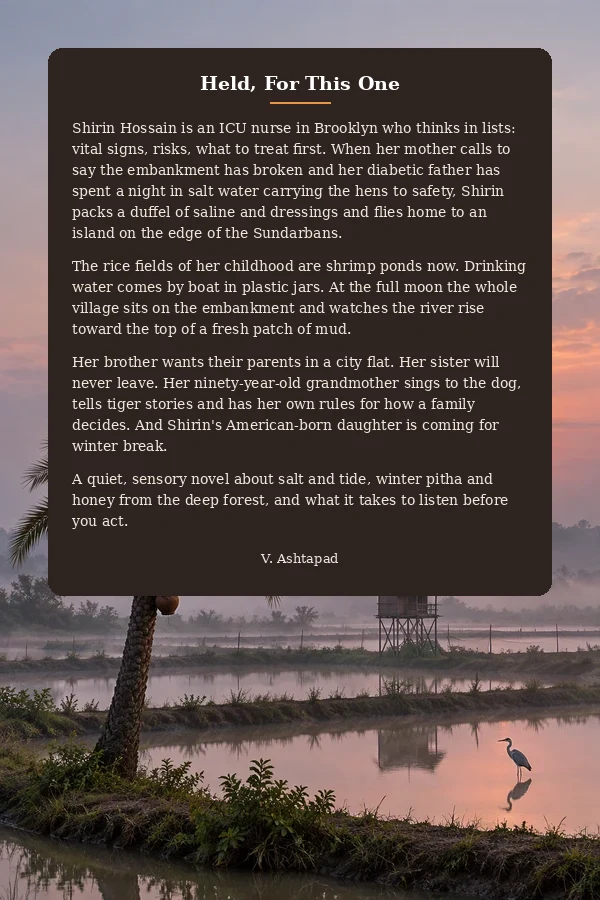
Shirin Hossain is an ICU nurse in Brooklyn who thinks in lists: vital signs, risks, what to treat first. When her mother calls to say the embankment has broken and her diabetic father has spent a night in salt water carrying the hens to safety, Shirin packs a duffel of saline and dressings and flies home to an island on the edge of the Sundarbans.
The rice fields of her childhood are shrimp ponds now. Drinking water comes by boat in plastic jars. At the full moon the whole village sits on the embankment and watches the river rise toward the top of a fresh patch of mud.
Her brother wants their parents in a city flat. Her sister will never leave. Her ninety-year-old grandmother sings to the dog, tells tiger stories and has her own rules for how a family decides. And Shirin's American-born daughter is coming for winter break.
A quiet, sensory novel about salt and tide, winter pitha and honey from the deep forest, and what it takes to listen before you act.
Members can react to this book and talk about it in the members' Library.
Ownership
© 2026 CRUNOD LLC. All rights reserved.
This book is owned by CRUNOD LLC. It is free to read on EternalCurrent.Online. No part of it may be copied, reprinted, sold, recorded or adapted, including as audio, film or translation, without written permission from CRUNOD LLC.
© 2026 CRUNOD LLC. All rights reserved.