
High Summer on the Alp
A Cheesemaker from New Glarus and the Step Nobody Wrote Down
by V. Ashtapad
Foreword
This is a work of fiction. New Glarus, Wisconsin, was founded in 1845 by emigrants sent from the canton of Glarus in Switzerland, and summer cheesemaking on the high alps of Glarus is real. Alp Rietli, the Hösli and Zwicky families and everyone in this book are invented.
For the people who do the chores nobody writes down.
The Wheel That Was Wrong
The cheese was wrong, and Karin Hösli was the only person in Green County, Wisconsin, who could taste it.
She stood in the aging cellar under the cheese plant on the county road outside New Glarus at six in the morning in February, with the furnace roaring overhead and the frost on the little high windows and her breath showing in the cold, damp, ammonia-and-mushroom air of the cellar, among four hundred wheels of cheese on wooden boards on steel racks to the ceiling, and cut a sliver from wheel number 2611 with a cheese iron, and put it on her tongue, and closed her eyes.
It was good cheese. Firm and smooth, a pale gold paste with a few small round eyes, nutty and sweet and faintly sharp at the back, like toasted hazelnuts and hay. It was the cheese her family had made on this land since 1871. It won ribbons. It sold out every Christmas at the plant store and the farmers' markets in Madison and Milwaukee and Chicago. A food writer in New York had called it *the closest thing to a true alpine cheese being made in America*.
It was wrong.
It had been wrong for twenty-eight years. Since 1998. Since her grandfather died. Nobody else noticed. Her father had not noticed, before he died. Her brother, who ran the business side and did not make cheese, did not notice. The customers did not notice. The judges did not notice. The food writer in New York had certainly not noticed.
Karin noticed. Every morning. In the cellar. On her tongue.
It was missing something. A note. A depth. Something at the very end of the taste, after the hazelnut and the hay, that she could remember from her childhood, standing in this cellar at seven years old on a wooden crate beside her grandfather while he cut a sliver for her and said, in the Swiss German of the valley he had left in 1949, *Do. Schmöck. Das isch d Alp.* There. Taste. That is the alp.
She had never been to the alp. She had never been to Switzerland. Nobody in her family had been back since 1949.
She tasted wheel 2611 again. Hazelnut. Hay. And then nothing. The place where the alp should be was empty, like a room in a house where somebody has taken down a picture and left the nail.
---
Her family's recipe was written down. That was the thing that drove her mad. It was written down, all of it, in her great-great-grandfather's hand, in old German script, in a ledger bound in black leather that had come from the canton of Glarus in Switzerland in 1845 with the first families who settled this valley, and had been translated into English by her great-aunt Martha in 1952, and typed up by her father in 1979, and entered into a spreadsheet by Karin herself in 2004. Every step. Milk temperature. Rennet. Cutting the curd. Cooking. Stirring. Pressing. Brining. Aging. Turning. Every number, every time, every degree.
She had followed it to the letter for twenty-eight years.
And the cheese was wrong.
"So something's missing," said her daughter Lena, at breakfast, at the kitchen table in the farmhouse up the hill from the plant, eating cereal and looking at her phone. Lena was nineteen and home from the university in Madison for the weekend and studied food science and was, Karin knew, the only other person in the family who might one day taste it. "Something that's not written down."
"Everything's written down."
"Then it's something nobody thought to write down." Lena did not look up from her phone. "Because it was too obvious. Because everybody knew it. Because it wasn't a step." She ate a spoonful of cereal. "That's what my professor says. The most important parts of a process are the ones nobody writes down. Because the people who did them didn't think of them as part of the process."
Karin looked at her daughter.
"Like what?"
Lena shrugged.
"I don't know, Mom," she said. "Go to the alp and find out."
---
The plant was not big. People who drove past it on the county road and saw the sign, HÖSLI CHEESE SINCE 1871, painted white on red on the side of the barn-colored building, sometimes stopped expecting a factory and found a cheese shop the size of a two-car garage, with a bell on the door and a glass counter and a woman behind it in a hairnet who would let you taste anything. Behind the shop was the make room, with two stainless steel vats and a press and a brine tank, and under the make room, down a flight of concrete stairs, was the cellar, which was the oldest part of the building by ninety years. The cellar had been dug by hand in 1871. Its walls were limestone, quarried from the hill behind the farmhouse, and its ceiling was the original oak beams, and in the winter, when the furnace ran, the beams sweated and dripped, and the whole room smelled the way Karin imagined the inside of the earth would smell, if you could open it like a wheel.
Her brother, Thomas, came down the stairs at seven with two coffees and found her still standing in front of wheel 2611 with the cheese iron in her hand.
"Again?" he said.
"Again."
"Karin." He handed her a coffee. He was two years older than she was, fifty-three, and had their father's square face and their father's way of rubbing the back of his neck when he was about to say something reasonable. "We had the best December in the history of the company. We shipped to eleven states. The guy from the restaurant in Chicago called personally to say his customers are asking for it by name. By name, Karin."
"I know."
"So what are you tasting?"
She didn't know how to answer him. She never had. She had tried for twenty-eight years to describe it, to their father, to Thomas, to the young cheesemaker they had hired in 2010 who lasted three years and went to work for a big plant in Monroe, to the consultant from the university who came in 2016 with a case of instruments and took samples and sent a report forty pages long that said, in summary, that the cheese was excellent.
"Grandpa," she said finally.
Thomas rubbed the back of his neck.
"Grandpa's been gone twenty-eight years," he said. Not unkindly. "Maybe what you're tasting is that."
She thought about that for a long time after he went back upstairs. It was the most reasonable thing anybody had said to her about it. Maybe it was grief. Maybe she was a fifty-one-year-old woman standing in a cellar every morning trying to taste a man who was dead.
But she had been seven years old on that wooden crate. She had not been grieving then. And she had tasted it then.
© 2026 CRUNOD LLC. All rights reserved.
The Ledger
That night, after Lena had gone back to Madison, Karin took the ledger out of the safe in the plant office.
She did not do this often. It was the only object in the building that was insured separately, for an amount that made her brother nervous, and it lived in a gray steel safe behind the desk in a box lined with acid-free tissue that Lena had insisted on buying after a class on archival preservation. Karin carried the box up the hill to the farmhouse kitchen and put it on the table under the lamp and opened it.
The leather had gone soft and brown at the corners. The pages were thick, rag paper, foxed with small brown spots, and the ink had faded from black to the color of strong tea. The handwriting was beautiful and almost impossible to read: tall, sharp, pointed letters leaning forward like a line of people walking into a wind. Fridolin Hösli. 1845. *Käsbuch*. Cheese book.
She did not try to read it. She couldn't. She turned the pages slowly, the way you turn the pages of a photograph album of people you never met, and looked at the shapes of the words.
Then she opened Great-aunt Martha's translation.
Martha had typed it on a manual typewriter in 1952, on onionskin paper, with carbon copies, and her typing had been fierce; you could feel the keys punching through the paper with your fingertip. She had translated every word. Where she could not read the old script, she had typed a row of question marks in brackets. There were not many. Martha had been a schoolteacher in Monroe for forty years and had not believed in leaving things undone.
Karin had read the translation perhaps a hundred times. She read it again now, slowly, from beginning to end, the way Lena had told her to. *Look for what isn't there.*
Milk. Morning and evening, mixed. Warmed in the kettle to blood heat. Rennet from the calf's stomach, prepared in whey, a measure. Set. Cut with the harp to the size of wheat. Cooked, stirred, an hour, until the curd squeaks between the teeth. Gathered in the cloth. Pressed. Salted. Laid in the cellar.
And then, on the last page, in Martha's typing, one line that Karin had read a hundred times and never really seen:
*Then care for them as is done.*
That was all. Care for them as is done. Martha had underlined it in pencil and written in the margin, in her small neat hand: *Literal. Meaning unclear. Possibly "as usual."*
Karin sat at the kitchen table for a long time with her finger on the line.
---
In the morning she went up into the attic of the farmhouse, which she had not done in years, and found the box of her grandfather's things.
It was a shoebox. A man's whole life, she had thought when they packed it in 1998, in a shoebox: his reading glasses, his pocketknife, his Swiss army discharge papers, his citizenship certificate, a photograph of her grandmother on their wedding day in 1952, and a bundle of letters tied with butcher's string.
She had never read the letters. They were in German.
But on the back of the photograph of her grandmother, in her grandmother's English, was a line she had read many times as a girl: *Hans home from the alp, 1949. Married me anyway.*
Her grandfather had been born in New Glarus in 1926. He was American. He had grown up in this farmhouse and made cheese in this cellar with his father. And after the war, which he spent in the Army in Belgium and Germany, he had not come straight home. He had gone south, to Switzerland, to the valley his family had left a hundred years before, and he had worked for three summers, 1947, 1948 and 1949, as a hand on an alp above Linthal. Karin had always known this, the way you know a fact about your family that nobody explains. Grandpa went to Switzerland after the war. Grandpa learned his Swiss German there. Grandpa came home in 1949 and married Grandma and never went back.
She had never asked why he went. By the time she was old enough to wonder, he was gone.
She took the letters to Lena in Madison that weekend. Lena had taken two years of German. She sat on the floor of her dorm room with the letters spread out around her and a dictionary on her phone and translated for four hours while Karin sat on the bed and watched her.
Most of it was ordinary. The weather. The cows. A dance in the village. A cousin of a cousin who wanted to marry him to his sister. And over and over, in all three summers, the same complaint, in a young man's voice, tired and cheerful at once:
*The old man has me on my knees again every morning before dawn. My hands are so cold I cannot feel the milk pail. He says I will thank him one day.*
Lena read it out loud three times. Then she looked up at her mother.
"On his knees," she said. "Before dawn. Every morning. What was he doing?"
Karin didn't know.
"It's not milking," Lena said. "He says the milk pail separately." She looked down at the letter again. "Mom. Whatever it was, he did it for three summers. And then he came home. And he kept doing it. Didn't he? Here. In our cellar. Every morning. And nobody ever asked him what it was."
Karin thought of her grandfather. Of the cellar at five in the morning when she was seven years old, and the light on, and the old man already down there when she came down the stairs in her pajamas to see him, already wearing an apron, his hands red.
She had thought he was just early.
"He died in March 1998," Karin said slowly. "And Tom bought the machine in 1999."
"What machine?"
"The rind washer."
Lena put down the letter.
© 2026 CRUNOD LLC. All rights reserved.
Glarus
She went in June.
She told her brother she was going for three months and he said she was out of her mind, it was the busiest season, the plant would collapse, and she said that the plant had collapsed in 1998 and nobody had noticed, and he looked at her as if she had grown another head, and then, slowly, because he was her brother and had grown up in that cellar too, he said, "Okay."
She flew to Zurich. She took a train south, an hour, along the Lake of Zurich, blue and enormous, with white sailboats on it and villas on the shore, and then through a valley that narrowed and narrowed until the mountains were standing straight up on both sides of the train, gray rock and green pasture and dark forest and, at the top, in June, still, snow.
The canton of Glarus is a valley. That is all it is. One long deep valley, narrow, cut by a river called the Linth, with mountains so high and so steep on both sides that in the winter, in some villages, the sun does not reach the ground for weeks. Thirty-nine thousand people. Two languages, German and the valley's own Swiss German, which even other Swiss people make fun of. A capital called Glarus, a small town of stone houses and steep roofs and a big square where, every May, the whole canton gathers in the open air in a ring, men and women, and votes on its laws by raising their hands.
Karin's family had come from a village at the head of the valley called Linthal. In 1845. A hundred and ninety-three people from the canton of Glarus, poor, hungry, with the potato crop failing and the cotton mills cutting wages, had left together, sent by the canton itself, with a little money and a promise of land, across the ocean and up the Mississippi and overland to a valley in the hills of southern Wisconsin that looked, they said in their letters home, a little like Glarus, if you squinted. They called it New Glarus. They made cheese.
She stood at the station in Linthal at three in the afternoon in June with her suitcase and looked up.
The mountains went up out of the valley floor on every side, so high and so close she had to tip her head back to see the tops, gray cliffs streaked with waterfalls, hundreds of them, white threads falling down the rock from the snow, and green pastures stuck on the steep slopes at impossible angles, and dark fir forests, and here and there, very high up, impossibly high, tiny wooden huts, brown, with stone roofs, sitting on the green like birds on a wire.
The alps. Not the mountains. The pastures. In Switzerland, Lena had explained, reading it off her phone, *alp* does not mean the mountain. It means the high summer pasture where the cows go in June and come down in September, and the hut on it, and the people who make cheese there, all summer, alone, with the cows and the sky.
Somewhere up there, on one of those green slopes stuck to the rock, in one of those tiny brown huts, was the alp her great-great-grandfather had made cheese on before 1845.
She did not know which one. Nobody did. The ledger did not say.
---
She took a room in Linthal at a guesthouse above a bakery, three rooms with flowered wallpaper and a shared bathroom down the hall, run by a widow named Frau Kubli who spoke some English and fed her bread rolls and butter and apricot jam in the morning and asked every day, with great seriousness, whether she had found her alp yet.
She had not. She walked for four days. She walked up every path out of the village she could find, with a map from the tourist office and a pair of hiking boots she bought in Glarus on the first afternoon, after the city boots gave her blisters on both heels. She found huts. Dozens of huts. Some empty, with their shutters closed. Some with families in them, who gave her water and cheese and looked at her with polite confusion when she tried to explain in her bad German that her family had once made cheese on one of these alps, she didn't know which, in 1845.
On the fourth evening, sitting on the bed in Frau Kubli's flowered room with her feet in a basin of cold water and her map spread across her knees, she counted. The tourist office said there were more than a hundred alps in the canton. She had visited eleven. At this rate she would need most of the summer just to look, and even then, she realized, she would not know which one it was. A hut was a hut. The cows did not wear name tags. Nobody on any of the eleven alps had ever heard of a Hösli.
She called Lena that night from the window of the room, where there was one bar of signal if she held the phone against the glass.
"Archives," said Lena immediately. "Mom. It's Switzerland. They write everything down. Somebody somewhere has a list."
"Of what?"
"Of who had which alp. Who had the right to send cows where. That's property. People always write down property." Lena laughed. "You're the one who keeps telling me everything's written down."
In the morning Frau Kubli wrote the address of the cantonal archive on the back of a bakery receipt and pressed it into Karin's hand and told her, very seriously, not to let them close for lunch before she got in the door.
© 2026 CRUNOD LLC. All rights reserved.
Alp Rietli
She found it through the archive in Glarus, in the end, which took a week, and a woman named Frau Tschudi who had worked in the cantonal archive for thirty-one years and who, when Karin explained who she was and what she was looking for, went very still behind her desk and then said, in careful English, "One moment," and disappeared into the stacks for three hours.
She came back with a book. A register of alp rights from 1838. The names of every family in the canton who had the right to send cows to every alp, and how many cows, and which family made the cheese. And on page 211, in faded brown ink, *Alp Rietli, ob Linthal. Senn: Hösli, Fridolin.*
"Your great-great-grandfather," said Frau Tschudi. She had tears in her eyes. Karin did not know why. "He made the cheese at Alp Rietli. Before he left." She touched the page. "Alp Rietli still exists. It is still worked. Every summer. The same hut. By the same—" She stopped. She looked at Karin. "You should go up."
"Who makes the cheese there now?"
Frau Tschudi smiled.
"A Zwicky," she said. "Fridolin Zwicky. He is seventy-two. His family took over the alp from your family in 1845, when your family left. He has made cheese there every summer for fifty-four years." She closed the book. "He has been waiting a long time to meet a Hösli."
---
You cannot drive to Alp Rietli. You take a cable car, a small one, four people in a box, from the valley floor above Linthal up a cliff so sheer that Karin closed her eyes for most of it, and then you walk.
Two hours. Up a path of loose stone and roots and cow dung through a fir forest that smelled of resin and wet earth and something sweet, wild strawberries, which were everywhere, tiny and red under the trees. Then out of the forest onto open pasture, steep, so steep the cows stood on it sideways, with flowers in the grass in every color there was, blue gentians and yellow arnica and white edelweiss and purple orchids and red clover and a hundred others she had no names for, so thick that the whole slope looked embroidered. Then up the pasture, past cows, big brown cows with white faces and huge curved horns and enormous bells around their necks on wide leather straps, bells the size of buckets, that rang every time the cows moved, so that the whole mountainside was ringing, deep and low and slow, a sound like nothing she had ever heard, like a church with a thousand bells and no church.
And at the top of the pasture, against the gray cliff, under a waterfall, a hut.
Brown wood gone almost black with age, with a stone roof held down by stones, and a stone chimney with smoke coming out of it, and a wooden bench in front of it, and on the bench, in the sun, a man.
He was small and thin and very brown, with white hair cut very short and a white beard and a face like a walnut, in a short-sleeved embroidered shirt, blue, with white edelweiss on the collar, and a red cap, and leather braces, and he was smoking a pipe with a curved stem and watching her come up the pasture the way you watch weather.
She stopped in front of the bench, out of breath, with her backpack and her city boots and her face red from the climb.
He took the pipe out of his mouth.
"Hösli," he said.
It was not a question.
---
She slept that first night in the hut, under the stone roof, in the smoke.
Fridolin Zwicky had not invited her. He had not said anything at all after her name, except a few words to Ruedi, who had appeared from the cowshed in his headphones and stared at her with his mouth open. Ruedi had then explained, in his perfect English, that his grandfather said she should stay, and that the last cable car down had gone at five, and that it was now six-thirty, and that it would be dark in two hours, and that if she tried to walk down to the valley in the dark on that path in those boots she would be found in the spring.
So she stayed. Ruedi gave her his bed, the one under the eaves on the left, and went down to sleep in the cowshed in the hay, which he said he preferred anyway because his grandfather snored like a cow with a cold. The bed was a wooden box with a straw mattress and two wool blankets that smelled of smoke and sheep. Above her, close enough to touch, were the beams of the roof, black with a century of smoke from the hearth below.
She lay awake for hours. Below her, Fridolin banked the fire and moved around in the dark, and the hut ticked and creaked as it cooled, and outside, all over the mountain, in the dark, the bells rang. Softer now. The cows were lying down. Every time one of them shifted in its sleep, or turned its head, a bell spoke, deep and slow, somewhere in the night, and then another answered it farther away, and then silence, and then another.
She thought: my great-great-grandfather lay up here and listened to this.
She thought: he heard this every night of every summer of his life, and then he got on a ship, and went to Wisconsin, and never heard it again.
She thought about her grandfather in 1949, twenty-three years old, on some other alp in this same valley, lying awake under some other roof. Listening.
She did not know when she fell asleep. When she woke, it was still dark, and the bells were still ringing, and down below her in the hut, by the light of a lantern, Fridolin Zwicky was already at the hearth, building up the fire.
© 2026 CRUNOD LLC. All rights reserved.
The Kettle
He did not speak English. She did not speak Swiss German. It did not matter, for the first week, because he did not talk.
He made cheese.
He made it twice a day, every day, morning and evening, from the milk of forty-one cows that his grandson Ruedi, who was nineteen and had headphones on at all times and spoke perfect English, milked by machine in a wooden shed down the slope at five in the morning and five in the evening and carried up to the hut in steel cans on a little motorized cart along a track in the grass. Two thousand liters a day.
The milk went into the kettle.
The kettle was copper. It hung from a wooden crane over an open wood fire in a stone hearth in the middle of the hut, an enormous round-bottomed copper cauldron, as wide as a car tire and as deep as a bathtub, black on the outside from a hundred years of smoke and shining gold on the inside, polished every day, Ruedi said, with salt and vinegar, by hand. You swung it over the fire on the crane to heat it, and swung it off the fire to cool it, and the whole hut was built around it: the hearth and the crane and the kettle in the middle, and around the walls, wooden shelves, and wooden tubs, and wooden tools hanging on pegs, and a narrow wooden stair going down to the cellar, and up under the stone roof, in the smoke, two narrow beds.
Fridolin Zwicky made cheese the way Karin had never seen anyone make cheese. Not in Wisconsin. Not in any of the plants she had visited in Vermont and California and Oregon. Not in any of the videos. He did not use a thermometer. He did not use a timer. He did not use a pH meter. He did not look at a clock.
He put his arm in the milk.
His bare arm, to the elbow, in the warm milk in the copper kettle, and held it there, and closed his eyes. And when the milk was right, he knew. And he swung the kettle off the fire. And he put in the rennet, from a little glass bottle, a splash, no measuring. And he waited, sitting on a wooden stool by the hearth, smoking his pipe, looking at nothing. And when the milk had set, he put his hand on it, flat, and pressed, and felt it, and knew. And he cut the curd with a harp, a wooden frame strung with wires, drawing it through the kettle back and forth until the curd was the size of rice. And he stirred.
He stirred for an hour with a wooden paddle, slowly, round and round, in the kettle over the fire, with his eyes half closed, while the curd cooked and shrank and firmed and the whey went from white to green-yellow and clear. And every few minutes he put his hand in, and took out a fistful of curd, and squeezed it, and opened his hand, and looked at it, and broke it with his thumb, and put it back.
Karin watched him for a week. She stood beside the kettle with her notebook and wrote everything down. Times. Temperatures, which she measured herself with a thermometer she had brought from Wisconsin, secretly, when he was not looking. The rennet, which she weighed when he went outside. Everything.
It was the same. Every number. Within a degree, a minute, a gram, it was her great-great-grandfather's recipe. The one in the ledger. The one she had followed for twenty-eight years.
On the eighth day, she tasted his cheese.
He took her down the narrow stair to the cellar. A small stone room built into the mountain, cold and damp and dark, lit by one bulb, with wooden boards on wooden racks along the walls, and on the boards, wheels. A hundred and twenty. From this summer and the last two. Brown and orange-gold, their rinds sticky and smooth.
He cut a sliver from a wheel from the summer before with a cheese iron and put it on her palm.
She put it on her tongue. She closed her eyes.
Hazelnut. Hay.
And then the alp.
---
On the ninth morning, after she had tasted his cheese and cried in the cellar, Fridolin pointed at the kettle and then at her arm.
She rolled up her sleeve. She put her arm into the milk.
It was warm, warmer than she expected, and thick, and her arm disappeared into it to the elbow, white, and the copper was hot against the back of her wrist. She held it there. She closed her eyes the way he did. She tried to feel what he felt.
She felt warm milk.
She opened her eyes. Fridolin was watching her with his pipe in his mouth. He raised his eyebrows, very slightly. A question.
"I don't know," she said, in English. "It's warm. It's—" She tried the German. "Warm."
He nodded, as if this were a reasonable first answer. He put his own arm in beside hers, so that their elbows touched under the milk. Then he swung the kettle six inches farther over the fire with his other hand and they stood like that, side by side, arms in the kettle, while the milk warmed around them.
At first she felt nothing different. Then, after a long time, a change. Not heat, exactly. A thinning. As if the milk had relaxed. As if it had stopped pushing back against her skin and started, very slightly, to let her in.
Fridolin took his arm out. He swung the kettle off the fire.
She checked her thermometer that night, secretly, in her bed under the eaves, by flashlight, against her notes. He had swung the kettle off at exactly the temperature in her great-great-grandfather's ledger. To the degree.
She lay under the smoky beams with the thermometer on her chest and thought: the number was never the point. The number was what you wrote down so that somebody, someday, who had lost the feeling, could find their way back to it.
© 2026 CRUNOD LLC. All rights reserved.
Ruedi
Ruedi was the only person on Alp Rietli who talked, so in the second week Karin found herself talking to him.
He was tall and thin and had a mop of brown hair that stuck out over the headband of his headphones and a habit of eating standing up, as if sitting down to a meal would commit him to staying somewhere. He listened to music she didn't recognize and one afternoon, when she asked, he let her listen, and it was a man shouting over drums in French. He had just finished the gymnasium in Glarus, the academic high school, with very good marks. He had been accepted to the federal technical university in Zurich to study mechanical engineering, starting in September.
He had not told his grandfather.
"Why not?" Karin said.
They were sitting on the bench in front of the hut in the evening after the second cheese of the day, with the whey being carried down to the pigs in a steel can by Ruedi's uncle Kaspar, who came up from the valley three times a week to help and never said a word. Fridolin was down in the cellar.
"Because I'm the last one," Ruedi said. He said it flatly, the way you would say a fact about the weather. "My father doesn't make cheese. He's an electrician in Glarus. Uncle Kaspar has bad knees and runs the farm in the valley. My cousins are all girls and they live in Zurich and Basel and they come up for one weekend in August to take photographs." He pulled up a stalk of grass and put it between his teeth. "If I go to Zurich, there is nobody to make the cheese on Rietli when Grossvater stops. The alp goes to the cooperative. They'll bring the milk down to the valley by pipe and make cheese in a factory. Good cheese. But not here."
"And if you don't go?"
"Then I'm a Senn," he said. "Like him. Fifty years on this bench." He looked out over the valley, where the light was going gold on the far mountains and the shadows were climbing up out of the gorge like water filling a bath. "I love it. I'm not stupid. I know what this is." He was quiet. "I also want to build things. Engines. Turbines. I want to see what I'm good at."
Karin looked at him.
She thought about Thomas, at nineteen. Thomas, who had wanted to be an architect. Who had gotten into the school in Minneapolis. Who had gone for one semester and then came home in December because their father had had his first heart attack, and stayed, and kept the books, and ran the business, and never made a single wheel of cheese because he had never wanted to make cheese, and never complained about it, ever, not once in thirty-four years.
She had never asked Thomas what he gave up. She had always assumed he didn't mind.
"Does your grandfather know you got in?" she asked.
"He knows everything," Ruedi said. "He hasn't said anything. That's how I know he knows."
---
Later, after Ruedi had gone down to the cowshed, Karin sat on the bench alone, and Fridolin came up out of the cellar and sat beside her. He lit his pipe. They did not have a language between them, and so for a while they just sat, and watched the light go off the mountains one by one, the far ones first, the near ones last.
Then Fridolin said one word, in German, slowly, so she would understand it.
"Zürich."
She looked at him.
He nodded toward the cowshed, where the light was on and the faint sound of French drums came out through the boards.
Then he made a gesture with his pipe, a little circle in the air, and pointed down, toward the valley, toward the cable car, toward the world. And then he put the pipe back in his mouth and looked out at the mountains and his face was perfectly still, and she understood that he had just said, as clearly as if Ruedi had translated it: *I know. He should go. I will not be the one to stop him.*
She wanted to ask him: but who will make the cheese?
She didn't. She knew what he would say, if he could. He would put his hand flat on a wheel, and rub it, and hold up his palm.
© 2026 CRUNOD LLC. All rights reserved.
Nobody Writes Down Chores
She cried in the cellar. She did not mean to. She stood in the cold stone room under the mountain with a sliver of cheese melting on her tongue and the bulb swinging a little in the draft from the stair and tears running down her face, because it was there. The thing at the very end. The note. The depth. The picture on the nail.
It tasted like flowers. Not like flowers smell. Like flowers taste. Like the whole embroidered mountainside, gentian and arnica and clover and a hundred things with no names. And under that, something darker, earthier, a little wild, like the inside of a stone wall in the rain. And under that, smoke.
Her grandfather. *Do. Schmöck. Das isch d Alp.*
Fridolin Zwicky stood beside her and watched her cry and did not say anything.
Then he said something in Swiss German. Slowly. Pointing at the wheel.
Ruedi, who had come down the stair behind them with his headphones around his neck, translated.
"He says it's the same as yours."
"It's not the same."
"He says the milk is the same. The rennet. The cooking. The stirring. All the same. He watched you write it down." Ruedi grinned. "He saw you with the thermometer. He knew."
Karin wiped her face.
"Then what's different?"
Ruedi asked his grandfather. His grandfather answered. Then he did something Karin did not expect. He reached past her to the wheel, and put his hand on its rind, flat, his palm on the brown-orange skin of the cheese, and rubbed it, slowly, in a circle.
Then he held up his hand to her.
It was sticky. Orange-brown. And it smelled, very faintly, of the cellar, and the mountain, and the end of the taste.
"He says," said Ruedi, "every morning. Every wheel. For three months. By hand."
---
The smear.
That was what they called it, Ruedi explained, when Karin had stopped crying and they had climbed back up to the bench in front of the hut in the evening sun with the cowbells ringing all over the mountain and the waterfall coming down the cliff behind them in a white thread. The rind. The skin of the cheese. In the cellar, every morning, you washed every wheel by hand with salt water. Brine. And the brine was not just salt water. It was old. It lived. It had in it the bacteria and the yeasts from the cellar, from the stone walls, from the wood of the boards, from the air of the mountain, from the hands of the man who washed the cheese. Every morning you dipped your hand in the brine and rubbed the rind of every wheel, and turned it, and rubbed the other side, and put it back on the board, and the brine left a little of itself on the cheese, and the cheese left a little of itself in the brine, and over weeks and months a skin grew on the cheese, orange and sticky and alive, and it worked its way inside, slowly, into the paste, and made the end of the taste.
"How long has he been using the same brine?" said Karin.
Ruedi asked.
Fridolin Zwicky took his pipe out of his mouth. He thought about it. He answered.
Ruedi's eyes went wide.
"He says it's not the same brine," Ruedi said. "Not exactly. You add new salt water every day. But some of the old is always there. In the tub. In the wood of the boards. In the stone walls." He looked at his grandfather. "He says the cellar has been washed every morning, every summer, since before the Höslis left. He says the brine in that tub has your great-great-grandfather's hands in it."
Karin sat on the bench in the evening sun and could not say anything.
"It's not in your recipe," said Ruedi, gently. "Because it's not a step. It's a chore. Every morning, before you make the cheese. Like milking. Like feeding the pigs." He shrugged. "Nobody writes down chores."
---
There was one place on Alp Rietli where a phone would work. Ruedi showed her: a rock on the shoulder of the ridge, forty minutes above the hut, where if you stood on top of it and faced northeast toward Zurich and held the phone above your head, you could get a signal for about as long as it took to say hello.
She climbed up to it the next evening, after the second cheese, and stood on the rock with her arm in the air, and called Lena.
It took four tries. On the fifth, Lena answered. She was in the lab at the university; Karin could hear something humming behind her and someone laughing.
"Mom? Mom, you're breaking up—"
"You were right," Karin shouted at the phone above her head. The wind took her voice away down the mountain. "It's a chore. It's not in the book. It's a chore."
"What is?"
"Washing the cheese. By hand. Every morning. That's what Grandpa was doing. In the letters. On his knees." She was crying again. She didn't care. There was nobody on the ridge but a few cows and a bird of prey turning slowly overhead. "The rind. It's the rind. It's the brine and the hands and the cellar. It's alive, Lena. It's alive and we killed it."
There was a long silence on the line. Karin thought she had lost the signal.
Then Lena said, very clearly, "Smear-ripened. Mom. It's a smear-ripened cheese. Bacteria on the surface. It's in my textbook. Chapter nine." Her voice cracked. "We did it in class. I didn't think—I never thought it would be ours."
"Can you come?"
"Come where?"
"Here. The alp. In August. When your summer course ends." Karin held the phone higher. "There's an old man up here who says you should."
"How does an old man in Switzerland know about me?"
"I told him," said Karin. "I told him you could taste it."
The signal went. She stood on the rock with her arm in the air for a long time anyway, in the wind, until the cows below her started to come in, one after another, ringing, toward the hut and the shed and the evening milking.
© 2026 CRUNOD LLC. All rights reserved.
Turning
She asked him to teach her the smear. He said no.
Ruedi translated it, embarrassed. His grandfather said a Hösli could not learn the smear in a summer. His grandfather said the smear took years. His grandfather said the smear was not something you learned; it was something your hands became.
"Then let my hands become it," said Karin.
Fridolin Zwicky looked at her for a long time on the bench in front of the hut, in the evening sun, with the cowbells ringing.
Then he got up and went into the hut and came back with an apron. Leather. Old. Very old. Dark brown, cracked at the folds, with a pocket on the front and a strap at the neck worn thin.
He held it out.
Ruedi said something to his grandfather, fast, in Swiss German. His grandfather answered. Ruedi went quiet.
"What did he say?"
Ruedi looked at the apron.
"It was in the hut," he said. "When his family took over the alp. In 1845. Hanging on the peg by the cellar stair. They kept it." He looked at Karin. "He says it's Hösli's."
---
So she washed the cheese.
Every morning at five, in the dark, before the milk came up from the shed, she went down the narrow stair to the cellar in the leather apron that had been hanging on a peg for a hundred and eighty years, and turned on the bulb, and knelt on the stone floor by the wooden tub of brine, and dipped her hand in it.
It was cold. So cold it hurt. It smelled of salt and ammonia and old stone and something sour and alive, like bread dough left too long.
And she washed. A hundred and twenty wheels. One at a time. She lifted each one off the board, eight kilos, ten, and laid it on the wooden table by the tub, and dipped her hand, and rubbed the rind, in a circle, slowly, the way Fridolin did, firm, not too hard, not too soft, every inch of the top, and the edge all the way around, and then turned it over and did the other side, and put it back on the board, and lifted the next.
It took two hours. Her hands went numb. Her back screamed. Her knees, on the stone floor, went from pain to something past pain.
Fridolin watched her the first week from the bottom of the stair, smoking his pipe, without a word. When she did it wrong, he did not tell her. He came down, took her hand in his, his old hard brown hand around hers, and put it on the rind, and moved it. The right pressure. The right speed. The right circle. Then he let go and went back to the bottom of the stair.
The second week he stopped watching.
But on the Thursday of the second week, at breakfast, he saw her hands.
They had split. Both of them. Across the knuckles and in the creases of the fingers and at the edges of the nails, where the cold brine and the salt and the rough rinds had worked at the skin every morning for ten days, until it opened in thin red lines that stung like fire when she put them back in the tub. She had been hiding them. She had been holding her coffee cup with her sleeves pulled down over her fingers. She had not wanted him to think she couldn't do it.
He put down his bread. He reached across the table and took her wrist and turned her hand over, palm up, and looked at it, the way he looked at a fistful of curd from the kettle.
Then he got up and went to the shelf by the door and came back with a flat round tin. Old, dented, the paint worn off the lid. He opened it. Inside was a green salve that smelled of pine and tallow and something medicinal and sharp.
"For the cows," said Ruedi, from the stove, without turning around. "For their udders. When they crack. It's very good."
Karin started to laugh. Then she stopped, because Fridolin had dipped two fingers in the tin and taken her hand in his and begun, very slowly, to work the salve into the cracks. Into each knuckle. Along each finger. In a circle. Firm, not too hard, not too soft. The way he rubbed a rind.
It stung. Then it stopped stinging. Then her hands were warm for the first time in ten days.
He did the other hand. He closed the tin and put it down beside her plate and went back to his bread.
That night, under the eaves, in the dark, she held her hands up in front of her face, though she couldn't see them, and smelled the pine and tallow on them, and thought about her grandfather in 1947, twenty-one years old, on some other alp in this valley, on his knees every morning before dawn, his hands so cold he couldn't feel the milk pail. She wondered if some old man had given him a tin of salve too. She thought probably somebody had.
She used the tin every night after that. When she left in October, it went in her suitcase beside the apron. It was nearly empty. She did not throw it away.
The third week, on a Tuesday, she came down the stair at five and found a second apron hanging on the peg beside the cellar door. New leather. Unmarked.
"For your daughter," said Ruedi, at breakfast, when she asked. "He says you said she can taste it too. He says she should come."
© 2026 CRUNOD LLC. All rights reserved.
Hay
In the middle of July the whole Zwicky family came up the mountain to cut hay.
Not on the alp pasture; that was for the cows. Above it. On the slopes too steep for any cow, under the cliffs, on ledges and gullies where the grass grew long and thick and full of flowers because nothing ever ate it. They called it wild hay. Ruedi said his family had cut it by hand every summer since before anyone could remember, and carried it down on their backs in nets, and stored it in a little stone barn below the hut, so that in a bad year, in a cold wet spring when the cows came up early and the grass was thin, there would be something to feed them.
"Nobody needs it anymore," Ruedi said. "There's hay in the valley. You can buy it. Trucks bring it." He shrugged. "Grossvater says we cut it anyway. He says the mountain expects it."
They came up on a Saturday morning on the first cable car. Uncle Kaspar and his wife Margrit. Ruedi's father, the electrician, Peter, who looked exactly like Ruedi would look in thirty years and laughed at everything. Ruedi's mother, Anna. Two of the cousins from Zurich after all, in brand-new hiking clothes, who complained cheerfully about everything and worked harder than anyone. A neighbor from the next alp, very old, with a scythe over his shoulder that he refused to let anybody else carry.
Twelve people. Eight scythes. Four wooden rakes. A pile of rope nets. Bread and cheese and dried meat and apples and two bottles of apple cider in a basket.
Karin had never held a scythe. Peter showed her, laughing, on the slope above the hut: the long curved blade, the wooden handle with its two grips, the swing that came from the hips and not the arms, the blade kept low and flat to the ground so it slid through the grass instead of chopping it. The grass fell in long even swaths, green and silver, full of flowers, and the smell that came up from it was so strong and sweet she had to stop and stand still.
It was the smell of the cheese. The end of the taste. Not exactly. But almost.
"Ja," said Fridolin, behind her. He had stopped his own scythe. He was watching her face. He tapped his nose with one finger, then pointed at the cut grass, then made a little circle in the air toward the hut and the cellar under it.
The flowers. The cows ate the flowers, all summer, on the steep pasture, gentian and arnica and clover and a hundred others. The milk was full of them. The cheese was full of them. And the hay they cut here would go to the cows in the bad years, and the flowers would still be in the milk, even in a cold spring, even when the pasture was thin.
She understood something then, standing on the steep slope with the scythe in her blistered hands. It was not one thing. It was never going to be one thing. It was the flowers in the grass and the grass in the cows and the milk in the copper kettle over the fire and the brine in the tub and the hands on the rind and the stone in the cellar walls. It was everything. The recipe in the ledger was the part you could write down. *Care for them as is done* was the rest. The whole mountain was the rest.
She could not bring the mountain to Wisconsin.
But she could bring her hands.
---
They worked until four. Karin cut three swaths and raked for the rest of the day, because the scythe was harder than it looked, and Ruedi's cousins cut better than she did, which they enjoyed very much. At noon they ate on the slope, sitting in the cut grass, with the cider going around in the bottles and the whole valley spread out below them, green and blue and gold, the river a silver thread at the bottom, the village of Linthal a scatter of white and brown, and the mountains standing around everything with snow still on their shoulders in July.
Peter asked her, in English, about Wisconsin. She told him about the plant and the cellar and the cheese. She told him about the cows in Green County, Holsteins mostly now, black and white, in long barns, milked by machines that the cows walked into themselves when they felt like it.
"Not like here," said Peter.
"Not like here."
"Do the cows wear bells?"
She laughed. "No."
"Then how do you know where they are?"
She didn't have an answer to that. Peter translated it for the others and everyone laughed, and the old neighbor with the scythe said something that made them laugh harder, and Ruedi, red in the face, told her it was not translatable.
Fridolin did not laugh. He was sitting a little apart, on a rock, with his pipe, looking down the valley.
Margrit, Kaspar's wife, saw Karin looking at him. She leaned over and said, quietly, in careful English, "His wife. Vreni. She died four years ago. She came up every summer. Fifty years. She cut hay better than any man." Margrit looked at Fridolin. "This is the first year he has let anybody else carry her rake."
Karin looked down. The rake in her own hands was old, the wood of the handle worn pale and smooth, the wooden teeth replaced many times, each one a slightly different color.
She held it differently after that. More carefully. And when the day was over and they carried the hay down in nets on their backs to the little stone barn, she did not let anybody take it from her, though it was heavy and the path was steep and her shoulders burned.
At the barn door, Fridolin took the rake from her. He looked at it. He hung it on its peg inside the door.
Then he touched her shoulder, once, briefly, the way he touched the flank of a cow when he passed her in the shed, and went down to the cellar to wash the evening cheese.
© 2026 CRUNOD LLC. All rights reserved.
The Queen
The lead cow of Alp Rietli was called Blüemli, which meant Little Flower, which was a joke, because she weighed seven hundred kilos and had horns like the handlebars of a bicycle and had once, Ruedi said, put Uncle Kaspar through the side of the cowshed.
She was eleven years old. She had been queen of the alp for six summers. She gave more milk than any cow on the mountain and walked first up the path in June and first down the path in September and stood, all summer, a little apart from the herd, on the highest part of the pasture, with her bell going slowly, deep and dark, like a heavy door closing somewhere far inside a house.
She did not like Karin.
She made this clear on the first morning, when Karin walked past her on the way to the shed, by swinging her head round, very slowly, and looking at her with one enormous brown eye, and blowing out through her nose in a way that made Karin stop dead on the path. After that, every morning for six weeks, Blüemli watched her. When Karin came down to the shed with the milk cans, Blüemli was there. When Karin sat on the bench, Blüemli grazed a little closer. When Karin tried, once, in July, to scratch her between the horns the way Ruedi did, Blüemli stepped sideways, delicately, onto Karin's foot, and stood there, and looked at the mountains, until Ruedi came and pushed her off.
"She's jealous," Ruedi said, while Karin hopped and swore.
"Of what?"
"You sit with Grossvater. On the bench. That's her place." Ruedi grinned. "She comes up to the hut every evening at seven and stands next to him and he scratches her ears. She's done it for six years. Since my grandmother died."
Karin looked at the cow. The cow looked at the mountains.
After that, she gave up the bench at seven o'clock. She went inside, or down to the cellar, or out along the pasture to the edge of the forest to practice the call where nobody could hear her. And when she came back, at dusk, she would see them from the slope: the old man on the bench and the huge brown cow standing beside him with her head lowered, his hand moving slowly between her horns, the pipe smoke going up straight in the still air, and neither of them, as far as she could tell, saying anything at all.
---
At the end of July, Blüemli went missing.
Not in the fog. On a clear evening, at milking. Every other cow came to the shed when Ruedi called them, as they always did, ringing down the slope one after another. Blüemli did not. Her bell was silent. Ruedi went up to the high pasture to look and came back without her.
Fridolin went himself. Karin went with him; he didn't tell her not to. They went up past the high pasture to the shoulder of the ridge where the phone worked, and along it, calling, and found nothing, and then, as the light was going, Fridolin stopped on the path and held up his hand and listened.
Karin heard nothing. Then she heard it. Not a bell. A sound below them, in a gully under the ridge where a stream came down through rocks and stunted pines. A low, labored sound. Breathing.
Blüemli was lying on her side in the gully on a ledge of wet rock beside the stream with her legs folded under her. Beside her, wet and dark and blinking, very small, was a calf.
"Too early," Fridolin said, in German, very quietly. It was one of the few sentences Karin understood. "Much too early."
---
They stayed with her all night.
Ruedi came up with a lantern and blankets and a thermos of coffee and went back down for the vet, who could not come until the first cable car. Fridolin knelt in the stream beside the cow with his hand on her neck and talked to her the whole night, very low, in Swiss German, a long, slow murmur that never stopped, the way you would talk to someone in a hospital bed. Karin held the lantern. When the calf tried to stand and fell, she caught it. When it shivered, she wrapped it in her own jacket and held it against her chest.
At three in the morning Blüemli tried to get up. She couldn't. She tried again. Fridolin put his shoulder against her side and pushed, and Karin, without thinking, put the calf down and got on the other side and pushed too, the two of them, an old man of seventy-two and a woman of fifty-one, knee-deep in a mountain stream in the dark, shoving seven hundred kilos of cow, and the cow groaned and heaved and got her front legs under her, and then her back legs, and stood.
She swayed. She stood.
She swung her head round, slowly, the way she had on the first morning, and looked at Karin with one enormous brown eye.
Then she lowered her head and pushed her nose, very gently, against Karin's chest, where the calf had been. And blew out, softly, warm, through her nose.
---
The vet came up at nine with Ruedi. The calf was weak but would live. Blüemli would be fine. She came down off the ridge that afternoon, very slowly, with the calf tottering beside her, and spent a week in the shed eating hay from the little stone barn, the wild hay, the hay they had cut in July.
"Nobody needs it anymore," Ruedi said, forking it into her manger, and laughed.
On the first evening that Blüemli was back on the pasture, at seven o'clock, Karin came up from the cellar and saw the cow standing beside the bench, and Fridolin's hand between her horns, and went to turn away.
Fridolin said her name. Not Hösli. Karin.
She stopped.
He moved over on the bench. He patted the wood beside him.
She sat down. Blüemli looked at her for a long moment with that brown eye. Then she lowered her head, and after a while Karin put her hand up, slowly, between the great horns, beside the old man's, and scratched.
The cow allowed it.
© 2026 CRUNOD LLC. All rights reserved.
The Fog
In August, the fog came.
It came up out of the valley on a Wednesday afternoon, white and thick and silent, filling the valley from the bottom like milk filling a bowl, rising up the fir forests and up the pastures, until it swallowed the cable car station and the path and the cowshed and, at four in the afternoon, the hut. Karin stood on the bench in front of the hut and watched it come, a white wall moving slowly up the mountain toward her, until it reached her and went around her and there was nothing. No mountains. No cliff. No waterfall. No sky. Only white, cold and wet on her face, and the sound of cowbells somewhere in it, all around, near and far, deep and slow, ringing in the white like ships' bells in the sea.
The cows were lost in it. Some of them. Six. They had wandered up the slope in the afternoon toward the ridge, where the grass was sweetest, and the fog had come, and now they were up there somewhere in the white, on a mountain with cliffs, and could not find their way down.
Ruedi went to look. He came back in an hour, soaked, with two.
"Four more," he said. "Up by the ridge. I can hear them. I can't see them." He shook the water out of his hair. "If they go over the edge on the north side—"
Fridolin Zwicky stood up off the bench.
He went into the hut. He came back with something in his hands. A wooden thing, long and narrow, like a funnel. Ruedi saw it and said, "Grossvater, no," and his grandfather ignored him and walked out into the fog with it, up the slope, slowly, at seventy-two, until he was a gray shape in the white, and then almost nothing.
Then he called.
---
It was not a word. It was not a song. It was something in between.
A sound that started low in his chest and went up, suddenly, into his head, into a high clear note, and then down again, and up, and down, breaking back and forth between the chest and the head so fast that it sounded like two voices at once, like a bird and a man calling to each other across a valley. It went out into the fog through the wooden funnel and the fog took it and carried it, so that it seemed to come from everywhere at once, from the whole mountain.
A yodel. Not the kind on the postcards. Not the kind for tourists. The old kind. A Lockruf, Ruedi whispered beside her. A calling. For the cows. His grandfather's grandfather had called the cows of this alp down out of the fog with the same call, and his grandfather before him, and before them, the Höslis.
Fridolin called. And waited. And called again.
And from up the slope, out of the white, somewhere near the ridge, a bell.
Then another. Then two more. Coming down. Slowly. Toward the call.
Four brown cows with white faces and great curved horns came down out of the fog one after another, their bells ringing, deep and slow, and walked past Fridolin Zwicky standing on the slope with his wooden funnel, and past Ruedi, and past Karin, and down to the shed, as if they had only gone for a walk, as if nothing had happened.
Karin stood in the fog on the slope above the hut and found that she was shaking.
Fridolin came back down. He put the funnel on the bench. He sat down. He took out his pipe and filled it, slowly, and lit it, in the white.
Then he said something. In Swiss German. To Karin.
Ruedi translated, with his voice gone strange.
"He says your great-great-grandfather wrote that call. He says it's in a book in the archive in Glarus. With your family's name on it." Ruedi looked at his grandfather. "He says the Zwickys have been calling the cows home with the Hösli call for a hundred and eighty years. He says it's time somebody in your family learned it."
---
He began to teach her the call that night.
He did it the way he did everything, without explaining. After the evening cheese, with the fog still thick around the hut and the lantern lit and the four cows safe in the shed, he stood up from his stool by the hearth and put his hand flat on his own chest, and made a low note. Then he put his hand on his forehead and made a high one. Then he went between them, chest, head, chest, head, slowly, so she could see where each note lived. Then he pointed at her.
She tried. What came out of her was a croak and then a squeak, like a door with a bad hinge. Ruedi, on the stair, put his face in his hands.
Fridolin did not laugh. He did it again. Slower.
She tried again. Worse.
They did this for an hour. By the end her throat hurt and her face was hot and she had produced, once, briefly, by accident, something that was almost a break between the two notes, a little hiccup in the middle of the sound where the chest gave way to the head. Fridolin heard it. He held up one finger. *That. Again.*
She couldn't find it again.
"It took me three summers," Ruedi said from the stair. "And I was ten. Your throat is old." He winced. "Sorry. I mean, it's set. It knows how it wants to sing."
"Then I'll have to teach it something new," Karin said.
Fridolin, who did not speak English, nodded as if he had understood, and made the low note again, and pointed.
© 2026 CRUNOD LLC. All rights reserved.
Lena
Lena came up the mountain on the twenty-third of August, on the noon cable car, alone.
Karin went down to meet her at the top station and saw her before Lena saw her, coming out of the little box with her backpack and her city boots, exactly as Karin had come in June, and stopping dead on the platform with her head tipped back, looking up at the cliffs and the waterfalls and the green slopes stuck to the rock and the tiny brown huts, very high up, like birds on a wire.
She had her phone in her hand. She did not raise it. She just looked.
Then she saw her mother and ran.
---
They walked up together. Two hours. Lena stopped every few minutes, at the strawberries under the firs, at the first gentian, at the first cow, which looked at her with mild interest and rang its bell. She asked the names of everything. Karin knew most of them now. When she didn't, she said so, and Lena looked them up, and then remembered there was no signal, and laughed, and said she would ask Fridolin.
"He doesn't speak English."
"You said."
"He doesn't really speak at all."
"You said that too." Lena stopped on the path, out of breath, and looked at her mother. "Mom. You look different."
"I'm sunburned."
"Not that." Lena looked at her for a long moment. "Your hands," she said.
Karin looked down at them. She had not looked at them, really, in weeks. They were red and rough and cracked across the knuckles, and the nails were short, and there was a faint orange-brown stain in the creases of her palms that would not wash out no matter how hard she scrubbed, the color of the rind, the color of the brine. They looked like her grandfather's hands.
---
Fridolin was on the bench when they came up the pasture. He watched Lena come the way he had watched Karin, the way you watch weather, and when they stopped in front of him he took his pipe out of his mouth and looked at Lena for a long time.
Then he said something to Ruedi, who was lounging against the doorframe of the hut, trying very hard to look as if he had not been waiting.
"He says you look like a Hösli," Ruedi said. "He says it's the jaw."
"How does he know what a Hösli looks like?" said Lena.
Ruedi translated. Fridolin answered. Ruedi's face did something complicated.
"He says there's a photograph," Ruedi said. "In the archive. Of your great-great-grandfather. From before they left. Frau Tschudi showed it to him in May, before your mother came, when she called to say a Hösli had written from America." He looked at Karin. "He's known since May. He's been waiting."
Karin had not known that. She stared at Fridolin. He looked back at her, perfectly calm, and put his pipe back in his mouth.
---
Lena was not like Karin in the cellar.
Karin had come to the brine as a cheesemaker, with twenty-eight years of making wheels and a nose that could tell a good cellar from a bad one at the top of the stairs. Lena came to it as a scientist. On the first morning, kneeling beside her mother on the stone floor, she dipped her hand in the tub and held it up to the bulb and looked at it, and smelled it, and said, "There's yeast. Definitely. And the orange is probably a coryneform bacterium. They're salt tolerant. They love it down here." She dipped her hand again. "There'll be hundreds of strains. Maybe more. Nobody's ever sampled a cellar like this. Not one this old."
"Will you?" said Karin.
Lena thought about it, with her hand dripping over the tub.
"No," she said finally. "I don't think so." She put her hand on the rind of the first wheel and began, slowly, to rub it in a circle the way her mother showed her. "I think if I put it in a list it would stop being this."
Karin looked at her daughter.
"Your professor would be horrified," she said.
"My professor," said Lena, "has never been up here."
---
In the evenings, while Karin practiced the call on the bench with Fridolin and croaked and squeaked and once, twice, almost found the break, Lena sat on the grass a little way off with Ruedi.
They were the same age. They talked in English about everything: his music and her classes, Zurich and Madison, his engineering and her microbiology. They argued about whether cows were smart. Lena thought they were. Ruedi had known cows his whole life and said they were very stupid and very wise, both, at the same time, like old men. Karin heard Lena laugh, the real laugh, the one Karin hadn't heard since she was about twelve.
On the fourth evening, Karin heard Ruedi say, quietly, "I'm going in September. To Zurich. I haven't told him."
And Lena said, "He knows."
"How do you know he knows?"
"Because my mom told me," said Lena. "He told her. Without saying anything. She says that's how he says things."
Ruedi was quiet for a long time.
"Who'll make the cheese?" he said.
Lena didn't answer that. Karin, on the bench, with her throat raw from practicing, didn't either. Fridolin, beside her, smoked his pipe and watched the valley fill with dusk, as if nobody had asked anything at all.
---
On the last evening of August, Lena stood up off the grass and walked over to the bench, and asked Fridolin, through Ruedi, if she could try the call.
He looked at her. He nodded.
She stood in front of the hut in the dusk with her hands at her sides and closed her eyes. She took a breath. And the sound that came out of her went low in her chest and then up, suddenly, into her head, into a high clear note, and broke back down again, and up, clean, the way water breaks over a stone, and it went out over the pasture in the evening air and down the slope toward the shed, and the cows in the shed, all forty-one of them, lifted their heads, and their bells rang.
Lena opened her eyes. She looked shocked.
Ruedi said a word in Swiss German that his grandfather pretended not to hear.
Karin sat on the bench and did not know whether to laugh or cry. She did both.
Fridolin Zwicky took his pipe out of his mouth and looked at Lena for a long time. Then he looked at Karin. Then, for the first time since she had come up the mountain in June, he laughed. Out loud. A short, dry, surprised bark, like a fox.
"Nineteen," he said, in English, pointing at Lena. They were the only English words Karin ever heard him say. He pointed at Karin. "Fifty-one." Then he shrugged, an enormous, eloquent, mountainous shrug, as if to say: *What did you expect?*
© 2026 CRUNOD LLC. All rights reserved.
Alpabzug
They came down off the alp on the twenty-sixth of September.
It is called the Alpabzug, the coming down, and in Glarus it is a festival. Every alp in the canton brings its cows down from the high pastures to the valley in the last week of September, before the snow, and the whole valley comes out to watch. The cows wear crowns.
Karin had not believed this. Ruedi showed her. Crowns of fir branches and flowers and colored paper ribbons, red and white and yellow and green, enormous, tied between their horns, with little mirrors in them that caught the light, and on the lead cow, the queen, the one who had given the most milk all summer, the biggest crown of all, with a small wooden stool tied into it, upside down, which was the milking stool, Ruedi said, so everyone would know whose cow it was.
And the bells. Not the everyday bells. The festival bells. Enormous, hammered from bronze and brass, some of them a hundred years old, on wide embroidered leather straps, so heavy the cows could only wear them for the walk down, so loud that when forty-one cows came down the path from Alp Rietli through the fir forest on the morning of the twenty-sixth, ringing, the whole forest rang with them, and birds went up out of the trees in clouds.
Fridolin walked in front. In his blue embroidered shirt with the edelweiss on the collar and his red cap and his leather braces and a black felt hat with a flower in it, with his pipe, slowly, leading the queen by a rope. Ruedi walked behind the herd with a stick. And at the back, carrying the milking stool's twin, a second wooden stool, new, that Fridolin had made from fir in August and given her without a word, walked Karin Hösli, in a leather apron that had hung on a peg for a hundred and eighty years.
And beside her, in the new apron, Lena.
---
Lena had come in August. On the train from Zurich, the cable car, the two-hour walk, with her backpack and her city boots and her phone, which got no signal on the alp, which she complained about for one day and then stopped. She had washed the cheese every morning for five weeks beside her mother in the cellar, kneeling on the stone floor, in the cold, with her hands in the brine.
On the second week, Fridolin had cut a sliver from a wheel and put it on Lena's palm, and Lena had put it on her tongue and closed her eyes, and opened them, and said, in English, "Oh."
And Fridolin, who did not speak English, had nodded, slowly, as if she had said exactly the right thing.
Now she walked beside her mother at the back of the herd down out of the fir forest into the valley, with the bells ringing and the crowns swaying and the whole village of Linthal lining the road at the bottom, cheering, children on their fathers' shoulders, old women with flowers, a brass band playing, and someone in the crowd, an old man in a black felt hat, yodeling, the old way, his voice going up and down between the chest and the head like a bird and a man calling to each other across a valley.
At the bottom of the road, at the edge of the village, a woman was standing by herself with her hands pressed together. Frau Tschudi, from the archive, in a red cardigan. When the last cow passed her and she saw Karin and Lena walking behind it in their leather aprons, she put both hands over her mouth.
---
They made the crowns the night before, in the hut, by lantern light, all of them together.
Margrit came up with the cousins and a bag of colored paper and a ball of string and three pairs of scissors. Ruedi cut fir branches from the edge of the forest and carried them up in armfuls. Fridolin sat on his stool by the hearth and bent the branches into hoops, his big brown hands moving without hurry, tying each one off with wire and testing it on his own knee for size, while the women and the girls cut paper into long ribbons and twisted paper flowers and tied them on, red and white and yellow and green, until the hut was full of color and the floor was knee-deep in scraps and fir needles.
Lena was terrible at paper flowers. Karin was worse. The cousins took pity on them and gave them the ribbons to curl instead, with the edge of a knife, which they could just about manage.
At midnight, Fridolin made the last crown. The queen's crown. It was twice the size of the others, a great dome of fir and flowers and ribbons, with the little mirrors set into it that he took one by one from a tin box on the shelf, very old mirrors, their silver going brown at the edges.
Then he took the milking stool, his own, the one he had sat on every morning for fifty-four years, and turned it upside down, and tied it into the top of the crown.
He looked at it for a while. Then he reached up to the shelf again and took down the second stool, the new one, the fir one he had made in August, and handed it to Karin.
Ruedi didn't translate. He didn't need to.
© 2026 CRUNOD LLC. All rights reserved.
The Archive
Three days after the Alpabzug, Karin went back to the archive in Glarus to thank Frau Tschudi.
She had brought a wheel. A small one, from the summer, from the Rietli cellar, one she had washed herself every morning for six weeks. Fridolin had chosen it and wrapped it in a cloth and put it in her arms on the morning they came down, without a word.
Frau Tschudi met her at the front desk and looked at the wheel in Karin's arms and then at Karin, and then said, in her careful English, "Come," and took her through a door marked for staff and down a corridor and into a small room with a window onto the old town and a table and two chairs and nothing else.
On the table was a folder.
"I have been waiting," Frau Tschudi said, "for you to come down."
---
In the folder were two things.
The first was a sheet of music. Not printed. Handwritten, in brown ink, on paper as old as the ledger, five lines and a scatter of notes, rising and falling, rising and falling, and under the notes, in the same tall pointed hand that Karin knew now from her own family's cheese book, a few words, and a name.
*Lockruf. Alp Rietli. F. Hösli. 1841.*
"He wrote it down," said Frau Tschudi. "Your great-great-grandfather. The call. He gave it to the alp cooperative when he left, with the alp rights, so that whoever came after him would have it. It was in the cooperative's papers. They gave everything to the archive in 1962." She touched the edge of the sheet. "Herr Zwicky came and looked at it once, many years ago. He said he did not need it. He said he had it already, from his grandfather, in his chest."
Karin looked at the notes. She could not read music. It did not matter. She could hear it. She had been hearing it every evening for a month, from Fridolin, from Lena, from her own broken throat.
"And the second thing?" she said.
Frau Tschudi was quiet for a moment. Then she took out a photograph and laid it on the table.
It was very old. Brown and cream. A group of people standing in front of a stone church, in dark clothes, men with beards and hats, women in long skirts with shawls over their heads, children. Fifty or sixty of them. Behind them, the mountains.
"The emigrants," said Frau Tschudi. "Of 1845. Before they left. This is a copy of a painting, really, a drawing; there were no photographs of them. An artist from Glarus drew them at the church in Schwanden, the morning they set out." She put her finger on a figure in the second row. A tall man with a square jaw, a beard, a hat in his hands. "Fridolin Hösli. And his wife. And their children."
Karin looked at the square jaw. It was Lena's jaw. It was Thomas's. It was her grandfather's.
"And here," said Frau Tschudi. Her finger moved, a little, to the end of the same row. To a girl of perhaps sixteen, thin, with a shawl. "Here is Anna Tschudi. My great-great-grandmother's sister." She took her finger away. "She went with them. To New Glarus. She wrote home for six years. Every letter is in this archive. I have read them all, many times." Frau Tschudi folded her hands. "And then in 1851 the letters stop. And nobody here ever knew what happened to her."
Now Karin understood why she had cried. In June, at the desk, when an American woman came in and said *my family went to New Glarus in 1845*.
"I'll find her," Karin said.
Frau Tschudi looked up.
"There's a cemetery," Karin said. "At the church in New Glarus. The old one. The first families are all there. I've walked past it every week of my life." She put her hand on the photograph, very gently, next to the girl with the shawl. "If she's there, I'll find her. I'll send you a photograph."
Frau Tschudi did not say anything for a long time. Then she picked up the wheel of cheese from the table, where Karin had set it down, and held it in both arms against her red cardigan, the way you hold something you have been given that you did not expect.
"Herr Zwicky chose this," she said. "Yes?"
"Yes."
"Then it is very good cheese," said Frau Tschudi, and smiled, for the first time, with tears in her eyes.
© 2026 CRUNOD LLC. All rights reserved.
Ruedi Goes
Ruedi left for Zurich on the twenty-ninth of September, three days after the Alpabzug, on the 7:12 train from Linthal.
The cows were in the valley now, in the Zwicky barn on the outskirts of the village, and the hut on Alp Rietli was shut up for the winter, the shutters closed, the kettle scoured and hung, the cellar empty except for the brine tub, which Fridolin covered with a board and left. The wheels from the summer had gone down to the cooperative's cellar in Glarus to finish aging. Karin and Lena had moved into Frau Kubli's flowered rooms above the bakery for their last week.
Karin did not expect to be at the station. But Lena was going, of course, and at six-thirty Karin found herself walking down the main street of Linthal beside her daughter in the cold, with the mountains black against a sky going pale and the smell of bread coming out of the bakery behind them.
The whole family was on the platform. Peter and Anna. Kaspar and Margrit. The two cousins, up early for once, yawning. Frau Kubli, who had no connection to the Zwickys at all and had simply come, she said, because everybody in Linthal came when a boy went to Zurich.
Fridolin was standing at the far end of the platform by himself.
He was not in his embroidered shirt. He was in a dark jacket and a white shirt buttoned to the neck and his black felt hat, the way old men dress for the train, and he was holding something in both hands.
---
Ruedi said goodbye to everybody else first. His mother cried and his father made jokes and the cousins took photographs. He hugged Lena, a long hug, and said something into her hair that made her laugh and push him away. He shook Karin's hand, and then changed his mind and hugged her too, awkwardly, his headphones knocking against her ear.
"Wash the cheese," he said.
"Every morning."
"He'll write to you," Ruedi said. "Through me. He doesn't write letters. But he'll make me." He looked down the platform. "If I'm still alive."
Then he walked to the end of the platform, to his grandfather.
Karin did not mean to watch. Everyone else had politely turned away, toward the bakery, the mountains, the arrivals board. But she couldn't help it.
Fridolin held out the thing in his hands. It was a small wooden box, the size of a book. Ruedi opened it. Inside, on a fold of blue cloth, was something Karin couldn't see from where she stood. Ruedi looked at it for a long time. Then he closed the box and held it against his chest.
Fridolin said something. Short. Two or three words.
Ruedi nodded. He didn't say anything back. He couldn't, Karin thought; his face was doing something that made it impossible.
Then the old man took his grandson's head in his two big brown hands, the way you would hold a wheel to check the rind, and pressed his forehead against the boy's forehead, hard, for a moment. And let go. And turned and walked away down the platform, past all of them, past the bakery, and up the street toward the barn and the cows without looking back.
The train came. Ruedi got on. He waved through the window, the box under his arm. Then he was gone, around the bend, down the valley, toward the lake and the city and the turbines and whatever he was going to be good at.
---
"What was in the box?" Lena asked him, a month later, from Madison, on the phone. He told her. She told Karin.
It was a harp. A cheese harp, a miniature one, no bigger than a hand, a little wooden frame strung with fine wires. Fridolin had made it in the winter, in the barn, out of a piece of the old crane from the hut that had been replaced in the spring.
The two or three words, Ruedi said, were: *For when you come back.*
Not if. When.
"Is he going to?" Karin asked. "Come back? To make the cheese?"
"He doesn't know," said Lena. "He says maybe. He says he'll be an engineer in the winter and a Senn in the summer, like the old men who used to work in the mills in the valley in winter and go up to the alp in June." She was quiet. "He says that's what his grandfather meant. That you don't have to choose. You just have to come back."
Karin thought of Thomas, in Minneapolis, in 1991. Who had never been told that.
She thought she might tell him.
© 2026 CRUNOD LLC. All rights reserved.
The First Wheel
Karin went home to Wisconsin on the second of October with one suitcase, a wooden milking stool, a leather apron that had been hanging on a peg since 1845, a dented tin of green salve, and nothing else.
She did not bring the brine. She could not. You cannot carry a living cheese culture across an ocean in a suitcase, and Fridolin said she should not try. *Your brine is in your cellar*, he said, through Ruedi, on the bench in front of the hut on the last night, with the stars out over the mountains so thick and bright they looked close enough to touch. *Your great-great-grandfather's hands are in your cellar too. He carried them across the ocean in 1845. They are in the walls. In the boards. In the stone. You have just not been washing them.*
---
So she washed them.
Every morning at five, in the cellar under the cheese plant on the county road outside New Glarus, in the cold, among four hundred wheels on wooden boards on steel racks to the ceiling, in a leather apron that had hung on a peg in a hut on Alp Rietli for a hundred and eighty years, Karin Hösli knelt on the concrete floor beside a wooden tub of brine and dipped her hand in it and washed the cheese.
By hand. Every wheel. Every morning. A hundred and twenty a day at first, then two hundred, then all four hundred, with Lena on the weekends home from Madison in the second apron, kneeling on the other side of the rack.
Her brother said she was out of her mind. He said they had a machine for that. A rind-washing machine, stainless steel, with brushes, that had cost forty thousand dollars in 1999. He said she would destroy her back. He said there was a perfectly good recipe.
She said nobody writes down chores.
He looked at her as if she had grown another head. And then, slowly, because he was her brother and had grown up in that cellar too, he came down the stairs one morning in November at five o'clock in an old work apron and knelt on the other side of the rack and dipped his hand in the brine.
He did it badly. She didn't tell him. She took his hand in hers, the way Fridolin had taken hers, and put it on the rind, and moved it. The right pressure. The right speed. The right circle. Then she let go.
They washed the cheese together in silence for an hour, the two of them, fifty-three and fifty-one, on their knees on the concrete floor, the way they had played on this floor as children while their grandfather worked above them.
Then Thomas said, without looking up from the wheel in front of him, "I got into the architecture school. In Minneapolis. In 1991."
"I know."
"I came home that Christmas because of Dad's heart. And I stayed."
"I know, Tom."
"Do you know why I bought the machine?" He turned the wheel over. He began on the other side. "After Grandpa died. Why I spent forty thousand dollars we didn't have on a rind washer."
She stopped. She looked at him across the rack.
"Because I couldn't stand coming down here at five in the morning and finding him not here," Thomas said. "Six years he was down here every morning when I came in, and every morning of my life before that. On his knees. Washing. I'd bring him coffee. He'd tell me I was holding the mug wrong. Every morning." He wiped his eyes with the back of his wrist, the wet one, and left a little orange smear on his cheekbone that he didn't know about. "And then he wasn't. And I couldn't look at that tub anymore. So I bought a machine to do it, so nobody would have to kneel there. So I wouldn't have to see the place where he wasn't." He laughed, not very well. "I thought I was being efficient."
Karin knelt on the concrete floor with her hands in the cold brine and looked at her brother.
"You never told me that."
"You never asked," said Thomas. "You were busy tasting him."
---
The machine went to a plant in Monroe in January. Thomas sold it himself, for eleven thousand dollars, and bought, with part of the money, a second wooden tub, and a new set of oak boards for the oldest rack in the cellar, and, after some thought, a radio, an old-fashioned one with a dial, which he set on the shelf by the stairs and tuned every morning to the farm report.
By March the rinds had started to change. Not much. A deepening of the color, from pale tan toward the orange-brown Karin remembered from Rietli. A stickiness under the palm. A smell at the top of the stairs in the morning that made her stop with her hand on the rail.
By May she could taste it. Not all of it. The beginning of it. A shadow at the very end of the taste, after the hazelnut and the hay. Like a picture coming back onto the nail, very faint, the way a photograph comes up in a tray in a darkroom.
In April, on a gray Sunday, she walked through the old cemetery behind the church in New Glarus with a notebook and a pencil, reading every stone. There were a great many Höslis. There were Streiffs and Dürsts and Kundigs and Babler. There was no Anna Tschudi.
But in the far corner, under a cedar, there was a small stone, worn almost smooth, with a name she had to trace with her fingers to read. *Anna Elmer, born Tschudi, 1829 to 1903. Mother of nine.*
She had married. That was all. In 1851 she had married a man named Elmer, and had nine children, and lived to seventy-four, in New Glarus, Wisconsin, and simply been too busy, after that, to write home.
Karin photographed the stone. She sent the photograph to Glarus that night, to the archive, with one line: *She stayed.*
Frau Tschudi wrote back in the morning. Her answer was even shorter.
*Thank you. Now I know where the letters went.*
---
The first wheel of the new batch was cut on the Saturday of the Wilhelm Tell Festival in New Glarus, the following September, on Labor Day weekend, eleven months after she came down off the alp.
They cut it in the square in front of the Swiss Historical Village museum, on a wooden table under a red flag with a white cross, in front of the whole town. The Swiss men's chorus in their embroidered shirts. The folk dancers in their costumes, the women in black bodices and white aprons and the men in red vests. A man playing the alphorn, the long wooden horn as tall as three men that lies on the ground and makes a sound like the mountain clearing its throat. Tourists from Chicago and Milwaukee. Old farmers from the valley in their seed caps. Two hundred people. Three.
Karin cut it with her grandfather's cheese knife. A long double-handled blade. It went in slowly through the orange-brown rind and the pale gold paste and the wheel opened in two halves on the wooden table, and the smell came up out of it into the September air in the square.
She cut a sliver. She did not taste it herself. She held it out.
To Lena, beside her, in the new leather apron.
Lena put it on her tongue. She closed her eyes.
Then she opened them and looked at her mother and did not say anything at all. She did not need to. Karin saw her face.
---
That night, on the family's page, the one Lena had set up in August on the alp so the Hösli cousins in Madison and Milwaukee and Denver and Zurich could see the photographs, Karin posted a photograph. The first wheel, cut open on the wooden table in the square, gold inside, orange-brown outside, with a leather apron folded beside it on the table.
She did not write very much. She wrote: *September. New Glarus. The first wheel since 1998 with the alp in it. Washed by hand. Every morning. By three of us.*
The next morning there was a reply. From an account that had been made the night before. In Swiss German, translated underneath into English by someone who was obviously nineteen and had headphones on.
*Grossvater says: Do. Schmöck. Das isch d Alp.*
*Translation: There. Taste. That is the alp.*
*Also he says the cows are fine and you should come back in June. Both of you. Bring the stool.*
© 2026 CRUNOD LLC. All rights reserved.
About this book
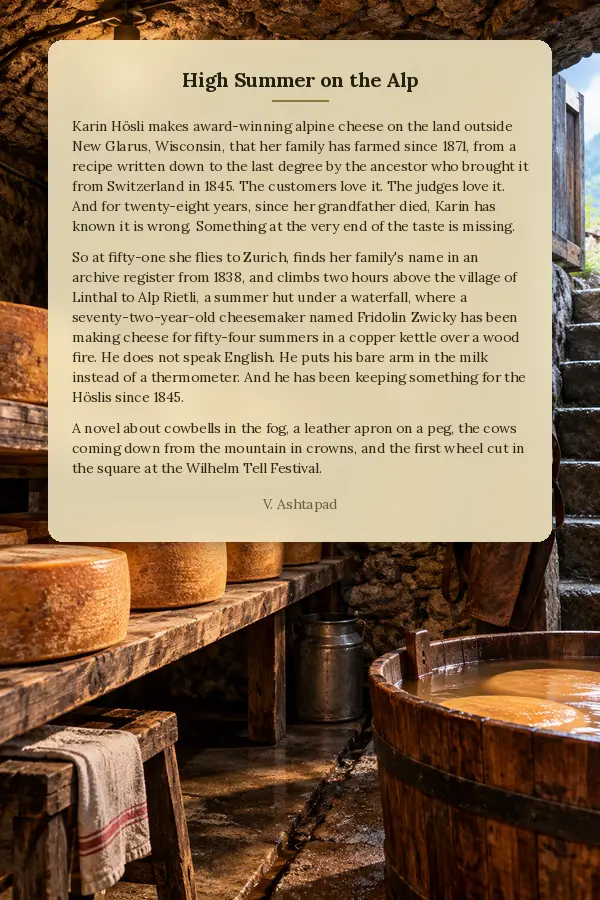
Karin Hösli makes award-winning alpine cheese on the land outside New Glarus, Wisconsin, that her family has farmed since 1871, from a recipe written down to the last degree by the ancestor who brought it from Switzerland in 1845. The customers love it. The judges love it. And for twenty-eight years, since her grandfather died, Karin has known it is wrong. Something at the very end of the taste is missing.
So at fifty-one she flies to Zurich, finds her family's name in an archive register from 1838, and climbs two hours above the village of Linthal to Alp Rietli, a summer hut under a waterfall, where a seventy-two-year-old cheesemaker named Fridolin Zwicky has been making cheese for fifty-four summers in a copper kettle over a wood fire. He does not speak English. He puts his bare arm in the milk instead of a thermometer. And he has been keeping something for the Höslis since 1845.
A novel about cowbells in the fog, a leather apron on a peg, the cows coming down from the mountain in crowns, and the first wheel cut in the square at the Wilhelm Tell Festival.
Members can react to this book and talk about it in the members' Library.
Ownership
© 2026 CRUNOD LLC. All rights reserved.
This book is owned by CRUNOD LLC. It is free to read on EternalCurrent.Online. No part of it may be copied, reprinted, sold, recorded or adapted, including as audio, film or translation, without written permission from CRUNOD LLC.
© 2026 CRUNOD LLC. All rights reserved.