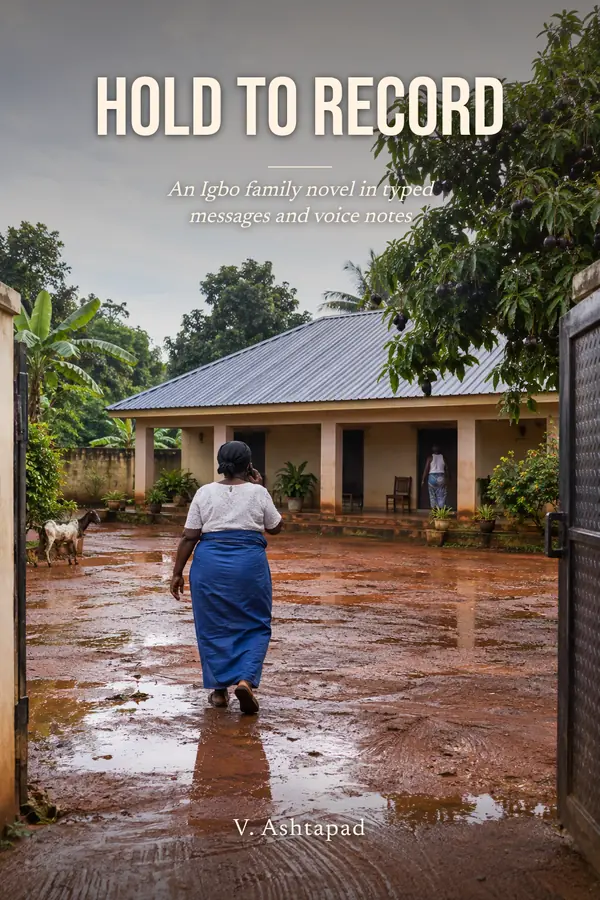
Hold to Record
An Igbo family novel in typed messages and voice notes
by V. Ashtapad
Foreword
This is a novel. The Ezeugwu family, their compound, the village of Amaube and everyone who speaks in these pages are invented. Real places such as Alief, Enugu, Nsukka, Ogige market, Levenshulme, North York and Yaba are used fictionally, and nothing here describes real people, businesses or events in them.
The whole book is a family group chat, so it is told only in typed messages, transcribed voice notes and descriptions of the photos people share. Igbo words are kept to common ones, and the family itself argues about how to say them; towns and quarters say things differently, and no single spelling or tone in these pages should be taken as the only right one.
For every grandmother who learned to hold the button down.
Eighty
*The family group, first week of October to the middle of November*
*Ikemefuna changed the group name from "EZEUGWU FAMILY (OFFICIAL)" to "Ụmụ Nne"*
**Ikemefuna:** GOOD MORNING FAMILY. I HAVE CHANGED THE NAME OF THIS GROUP BECAUSE THE OLD NAME SOUNDED LIKE A GOVERNMENT PARASTATAL. ỤMỤ NNE MEANS CHILDREN OF NNE. THAT IS WHAT WE ARE. PLEASE TAKE NOTE.
**Ikemefuna:** SECOND MATTER. NNE WILL BE EIGHTY YEARS OLD ON THE FOURTEENTH OF AUGUST NEXT YEAR. I HAVE DISCUSSED WITH CHINELO AND WE AGREE THAT THE BIRTHDAY MUST HOLD IN AMAEZE, NOT IN ENUGU. THE NEW YAM FESTIVAL FALLS THAT SAME WEEK. EVERYBODY SHOULD COME HOME. I SAY EVERYBODY. REGARDS.
**Ify:** Good morning Uncle. Before anyone panics, "everybody" means how many people? I need a number.
**Ikemefuna:** EVERYBODY MEANS EVERYBODY.
**Ify:** That is not a number.
**Nkiru:** Good morning my people!! God is good. Uncle Ike this is a wonderful idea, Nne will be so happy. Festus and I were just saying it has been nine years since we went home.
**Nkiru:** *Forwarded many times*
CHEAP FLIGHTS TO NIGERIA THIS FESTIVE SEASON!! Do not pay full price. Book with a travel agent you TRUST. Share with ten people to help someone today.
**Ify:** Aunty Nkiru, the birthday is in August.
**Nkiru:** I know my dear. It is just for information.
**Tobe:** [voice note, 0:52] [background: a horn held down for a long time, a hawker calling "pure water, pure water," the engine of a bus ticking over]
Uncle good morning o. Everybody good morning. I'm in traffic at Ojuelegba so I can't type, the conductor is leaning on my window. I just want to say I'm in. Lagos to Amaube is nothing, I can do it in my sleep. Whoever is coming from abroad, I'll handle pickup. Tell me the dates and I will arrange everything. Ah, this man, sorry, sorry, I'm talking to my family. Okay, bye.
**Kelechi:** who is this
**Nkiru:** Kelechi that is your cousin Tobenna, Aunty Ebele's son. You met him when you were seven.
**Kelechi:** the one who only talks in voice notes
**Nkiru:** Yes.
**Kelechi:** ok noted
**Okwudili:** Dear Family,
I hope this message finds you all well. I read with joy Ikemefuna's proposal concerning Nne's eightieth birthday. Please count Somadina and myself as attending. I would only gently raise, at this early stage, the question of how the costs will be shared, so that nobody is surprised later in the year. As our father used to say, it is better to argue at the beginning of the road than at the end of it.
Warm regards,
Okwudili
**Ify:** Thank you Okwy. That was going to be my next message.
**Ikemefuna:** THE COSTS WILL BE SHARED FAIRLY. WE ARE ONE FAMILY.
**Ify:** Uncle, "fairly" is also not a number.
**Chinelo:** Ify my sister, I can see where this is going. Let me tell you what we are dealing with first. The roof of Papa's house in Amaube. In the last rains it leaked into the parlor and the room where Nne used to sleep. Mazi Ogbonna sent his grandson to tell us. If people are going to stay in that compound in August, the roof cannot wait.
**Chinelo:** [photo: a ceiling of yellowed asbestos board with a brown water stain shaped like a fat continent spreading from the corner, a plastic basin on the floor below with a ring of rust inside it]
**Nkiru:** Ewo. That stain looks like Africa.
**Kelechi:** it looks like a guy holding a fish
**Ikemefuna:** THE ROOF IS A SEPARATE ITEM. WE WILL DISCUSS IT SEPARATELY.
**Ify:** It can be separate in the discussion, Uncle, but it is not separate in my bank account.
**Soma:** Hi everyone!! Sorry I'm late to this, I was doing a home visit in Longsight and my phone was in my bag. This is so exciting. I've never been to Amaube. I've never been to Nigeria actually, which I know is embarrassing. Dad's always said "next year." I would love to come. Count me in properly, not just as Dad's plus one.
**Okwudili:** You were never a plus one, Somadina.
**Soma:** Love you Dad. Also, slightly separate thing. I want to try to learn some Igbo before August. Like actual words, not just "biko" and "ndo." Would anyone mind if I posted a word a day in here and you lot told me if I'm saying it right?
**Ikemefuna:** THIS IS AN EXCELLENT IDEA. I WILL CORRECT YOU PERSONALLY.
**Ify:** Uncle will correct you even when you are right. Be warned.
**Ikemefuna:** I WILL CORRECT WHERE CORRECTION IS DUE.
**Tobe:** [voice note, 0:21] [background: a generator coughing twice, then catching, then a steady drone]
Soma, I'm proud of you. My own Igbo is, I won't lie, it is Lagos Igbo. Half of it is English. But I'll support you. Light just went off, I'm going.
**Soma:** Thank you Tobe!! What's Lagos Igbo?
**Tobe:** [voice note, 0:09] [background: the generator]
You'll see.
*Second week*
**Ify:** Good evening. I have made a sheet for the costs. Please don't run. It is simple. There are four columns: item, estimated cost, who has pledged, what has actually been paid. I have shared it with everybody who is in this group. Flights are personal, each household pays its own. The shared items are the roof, the party, the cooking, transport in Nigeria, the cows if we are doing cows, and the clothes if we are doing matching clothes.
**Ify:** And before anybody says it, "we will see" is not a pledge.
**Nkiru:** Ify you are just like your father. He used to write the price of every orange in the margin of his newspaper.
**Ify:** And none of us ever went hungry. Thank you Aunty.
**Okwudili:** Dear Family,
I have opened Ify's sheet. It is very clear. I note that the column for the roof currently says "TBC" under estimated cost. Is there any way of getting a quotation?
Kind regards,
Okwudili
**Ikemefuna:** I HAVE ASKED ANAYO. ANAYO ROOFING AND GENERAL CONTRACTOR, NSUKKA ROAD. HE DID THE ROOF FOR THE HEADMASTER'S HOUSE. HE WILL GO AND LOOK.
**Chinelo:** Ike, tell them the other thing about Anayo.
**Ikemefuna:** THERE IS NO OTHER THING.
**Chinelo:** He is Mazi Ogbonna's nephew. So whatever he says the roof costs, Mazi Ogbonna will say it is a fair price.
**Ify:** Good to know.
**Kelechi:** so basically nepotism
**Nkiru:** Kelechi!
**Kelechi:** im just asking
**Festus:** [voice note, 0:38] [background: rain loud and steady on a car roof, wipers squeaking on the turn, a low radio playing a highlife guitar line]
Good evening everyone. It's Festus. I'm in the car outside the pharmacy waiting for Nkiru, this rain in Alief is something else, the whole of Bellaire is a river. I just want to say we're coming, the three of us. And Kelechi will be helping to pay for his own ticket from his summer job, so he can stop asking questions about nepotism. Okay. Greet Nne for us, Ike.
**Kelechi:** WOW
**Ikemefuna:** WHY ARE YOU SHOUTING KELECHI
**Kelechi:** lmao
*Third week*
**Soma:** Okay quick question before I start the word thread. Is there an official way to spell things? I've been looking at a few websites and some of them use dots under the letters and some don't and one of them had little marks on top like accents. I don't want to start off wrong.
**Ikemefuna:** THE DOTS ARE CORRECT. THE DOTS SHOW THE VOWEL. AN O WITH A DOT IS NOT THE SAME AS AN O WITHOUT A DOT. THE MARKS ON TOP ARE TONE MARKS. PEOPLE DO NOT USE THEM IN DAILY LIFE BUT THEY ARE ALSO CORRECT.
**Ify:** I have never once in my life typed a tone mark.
**Ikemefuna:** THAT IS WHY YOUR CHILDREN CANNOT READ IGBO.
**Ify:** My children are in Grade 9 and Grade 11 in North York, Uncle, they can barely read their own timetables.
**Chinelo:** Soma darling, don't let them frighten you. Use the dots where you can. If you can't find them on your phone, just type it plain and we will understand.
**Soma:** Found them!! You hold the letter down and a little menu pops up. Ọ. Ị. Ụ. Look at me.
**Tobe:** [voice note, 0:14] [background: a fan clicking as it turns, someone frying something, the hiss of oil]
Look at this oyinbo girl with dots. Okay o. I respect.
**Okwudili:** Tobenna, she is not oyinbo.
**Tobe:** [voice note, 0:06]
Uncle I'm joking, I'm joking.
**Soma:** It's fine, I've been called worse at Piccadilly station.
*Fourth week*
**Nkiru:** *Forwarded many times*
WARNING!! Do NOT eat ugba that has been kept outside the fridge for more than one day. A woman in Onitsha ate old ugba and her stomach
**Ify:** Aunty please.
**Nkiru:** I am just saying when we go home people should be careful with ugba. Kelechi has an American stomach.
**Kelechi:** what is ugba
**Chinelo:** Oil bean. It is sliced thin and fermented and we eat it with abacha, the dried cassava. Your mother used to fight me for the last piece when we were girls in Enugu.
**Nkiru:** I never fought you. I asked politely.
**Chinelo:** You pinched my arm.
**Nkiru:** Politely.
**Soma:** What does it taste like? I'm trying to imagine it.
**Ikemefuna:** IT TASTES LIKE HOME.
**Ify:** It tastes like something that has been somewhere warm for a few days and come back with opinions. In a good way.
**Soma:** I love that.
*Fifth week*
**Ikemefuna:** FAMILY. I WANT TO SAY SOMETHING AND THEN I WILL NOT SAY IT AGAIN.
**Ikemefuna:** THIS MORNING I WENT INTO NNE'S ROOM WITH HER TEA AND SHE WAS SITTING ON THE BED WITH HER RADIO ON. SHE ASKED ME WHAT EVERYBODY IS DISCUSSING ON MY PHONE ALL DAY. I TOLD HER WE ARE PLANNING HER BIRTHDAY. SHE SAID "WHICH BIRTHDAY." I SAID EIGHTY. SHE SAID "IN AMAEZE?" I SAID YES. SHE DID NOT SAY ANYTHING FOR A WHILE.
**Ikemefuna:** THEN SHE SAID "YOUR FATHER'S ROOF WILL FALL ON ALL OF YOU." THEN SHE LAUGHED AND TURNED THE RADIO UP.
**Chinelo:** It is true, she laughed. She was laughing in the kitchen afterwards too, by herself.
**Nkiru:** Ah, Nne. I'm crying in the break room.
**Soma:** Does she know I'm coming?
**Ikemefuna:** I TOLD HER. SHE SAID "OKWUDILI'S DAUGHTER, THE ONE WITH THE BIG EYES WHO WOULD NOT EAT FISH."
**Soma:** I was FOUR. She was visiting us in London for one winter and I've apparently been the fish girl ever since.
**Okwudili:** Dear Family,
For the record, Somadina still does not eat fish. However, she now eats stockfish, which I consider a different category. I am very glad Nne remembers. I am also, I confess, a little nervous about how much the roof will be, but I am more glad than nervous.
With love,
Okwudili
**Ify:** That is the first time I have seen you sign off with love, Okwy.
**Okwudili:** It is a special occasion.
**Tobe:** [voice note, 1:04] [background: quiet for once, a television low in another room, a single cockerel somewhere far off even though it is night]
Okay, this is me being serious for one minute. I'm in my house in Yaba, light is on, everything is quiet, so let me say it properly. When I was small, every December, Nne used to take me to the stream behind the compound in Amaube with a little bucket, and she would make me carry water even though I was carrying like one cup. She used to say I was the strongest man in Nsukka. I never told her I knew she was lying. So. Whatever this roof costs, I'm putting something. I don't know how much yet. But I'm putting something. Ify, write my name in the column.
**Ify:** Written. In pencil, until it becomes ink.
**Tobe:** [voice note, 0:04]
That's fair.
**Kelechi:** ok that was actually kind of nice
**Nkiru:** You see? You see your cousin?
**Kelechi:** i see him. i hear him mostly
Word of the Day
*The family group, the middle of November to the second week of December*
**Soma:** IGBO WORD OF THE DAY, number 1 🌱
**nne** = mother
Example: Nne m = my mother.
Also what we call Grandma, which I've always found a bit confusing, because isn't she everyone's nne then?
**Ikemefuna:** CORRECT. FOR GRANDMOTHER YOU CAN ALSO SAY NNE NNE, MOTHER'S MOTHER, OR NNE OCHIE. BUT IN THIS FAMILY SHE IS NNE. EVERYBODY'S NNE.
**Nkiru:** Well done Soma!! 👏🏾👏🏾
**Ify:** Good start. Gentle start.
**Soma:** I'm building up.
**Soma:** IGBO WORD OF THE DAY, number 2
**mmiri** = water. Also rain?? The website said both.
**Ikemefuna:** CORRECT. MMIRI IS WATER AND MMIRI IS RAIN. MMIRI NA-EZO MEANS IT IS RAINING. LITERALLY, WATER IS FALLING.
**Festus:** [voice note, 0:11] [background: rain on the car roof again, harder, a truck passing through a puddle]
Mmiri na-ezo in Houston every day this week. Soma, welcome to Alief.
**Soma:** Haha it's been doing that in Manchester since 1874.
**Soma:** IGBO WORD OF THE DAY, number 3
**akwa** = cloth? Or egg? I'm getting very mixed results here.
**Ikemefuna:** AH. NOW WE ARE SERIOUS.
**Ikemefuna:** AKWA CAN BE CLOTH. AKWA CAN BE EGG. AKWA CAN BE BED. AKWA CAN BE CRYING. IT DEPENDS ON THE TONE. THE SPELLING IS THE SAME WITHOUT TONE MARKS. THIS IS WHY TONE MARKS EXIST.
**Ify:** Uncle, you said nobody uses them in daily life.
**Ikemefuna:** NOBODY USES THEM. EVERYBODY SHOULD.
**Soma:** Okay so how do I know which one someone means?
**Chinelo:** From the sentence, my dear. If I say I am buying akwa for the party, nobody thinks I'm buying a bed. Unless it is Ike's party.
**Nkiru:** 😂😂😂
**Soma:** Can someone send me a voice note of all four? Like slowly? I genuinely can't hear the difference in my head.
**Tobe:** [voice note, 0:19] [background: clattering plates, a woman laughing loudly, the low thump of a speaker from the shop next door]
Okay. Cloth. Egg. Bed. Cry. Akwa, akwa, akwa, akwa. Hold on, let me do it again, a bus was passing. Akwa. Akwa. Akwa. Akwa. You hear it?
**Soma:** Tobe they all sound the same.
**Tobe:** [voice note, 0:07]
Ehen, now you know my problem.
**Ikemefuna:** TOBENNA YOU SAID THE SECOND AND THIRD ONES THE SAME.
**Tobe:** [voice note, 0:05]
Uncle, I said them how my mouth says them.
**Soma:** Okay, I've put all of these into the word list in the family space, with Tobe's voice notes attached under each one, so I can press the little play button on the bus and hear him say them. Even if he says two of them the same.
**Okwudili:** Dear Family,
Somadina, for what it is worth, I find I can hear the difference when somebody says the word to me in a sentence, but not when the word is alone. A word alone is like a fish out of the water. It lies there and does not tell you what it is.
Regards,
Okwudili
**Soma:** Dad that's beautiful and also you know I don't eat fish.
**Okwudili:** I am aware.
*Second week*
**Soma:** IGBO WORD OF THE DAY, number 7
**ụlọ** = house
Ụlọ Papa = Papa's house? Grandad's house?
**Ikemefuna:** ỤLỌ NNA ANYỊ. OUR FATHER'S HOUSE. BUT YOU CAN SAY ỤLỌ PAPA, EVERYBODY WILL UNDERSTAND. CORRECT.
**Kelechi:** is the roof part of the ulo or is it a separate word
**Ikemefuna:** ELU ỤLỌ. THE TOP OF THE HOUSE.
**Kelechi:** so the roof is literally the house's top
**Ikemefuna:** YES.
**Kelechi:** thats so efficient i love it
**Soma:** Kelechi are you learning too?? Join me!!
**Kelechi:** im observing
**Nkiru:** He is learning. He was asking me in the car what "biko" means even though he has heard me say it to him eight thousand times.
**Kelechi:** i knew it meant please i just didnt know it was igbo i thought it was a mom word
**Ify:** It is a mom word. It is also Igbo. Both can be true.
*Third week*
**Nkiru:** *Forwarded many times*
50 IGBO PROVERBS AND THEIR MEANINGS! 🔥 Number 1: "The hen that sings at night is asking for a visitor." Number 2: "When the river is quiet, the fish are counting money." Number 3:
**Ikemefuna:** NKIRUKA. THESE WERE INVENTED BY A BOY IN A CYBER CAFE. NUMBER 2 IS NOT A PROVERB, IT IS A RUMOR ABOUT FISH.
**Nkiru:** They are educational.
**Ikemefuna:** NUMBER 31 SAYS "THE GOAT THAT EATS RICE WILL BECOME A GENERAL." THAT IS NOT A PROVERB. THAT IS A SENTENCE.
**Ify:** I'm screenshotting that.
**Soma:** I'm going to stick to single words for now, I think, before I graduate to goats and generals.
*Fourth week*
**Soma:** IGBO WORD OF THE DAY, number 12
**ego** = money
**Ify:** Ah. Now you're speaking my language.
**Soma:** I thought you'd like this one.
**Ify:** I would like it more if it came with pledges. Friendly reminder, the sheet is still open. Flights: three households booked, two "looking." Roof: still TBC. Party: Uncle Ike says "Enugu side will handle," which I have written down as "Enugu side will handle (amount unknown)."
**Ikemefuna:** THE AMOUNT WILL BE KNOWN WHEN IT IS KNOWN.
**Ify:** Uncle, you ran the billing office at the electricity company for twenty-nine years. You sent estimated bills to half of Enugu. You know what an estimate is.
**Ikemefuna:** AN ELECTRICITY BILL DOES NOT INVITE THE WHOLE VILLAGE.
**Chinelo:** He has a point. In Amaube the party will be as big as the people who hear about it. And everybody hears about it.
**Okwudili:** Dear Family,
Ego is perhaps not the most romantic word, Somadina, but it is a very useful one. My father, your grandfather, used to say that a family that does not talk about money will talk about nothing else. I think he meant that if you hide it, it will shout. I propose we keep it in the open.
Respectfully,
Okwudili
**Ify:** Seconded.
**Ikemefuna:** IT IS IN THE OPEN. IT IS IN CAPITAL LETTERS. WHAT MORE DO YOU WANT.
*Fifth week*
**Soma:** Okay I did a thing and I need help.
**Soma:** [photo: a small Manchester kitchen with a single steamed-up window, a dented aluminum pot on a two-ring electric hob, inside it a dark, oily, green-brown soup with lumps of beef and something that looks like shredded leaves; beside the hob, a packet of dried bitterleaf from the African shop on Stockport Road and a jar of ground crayfish with the lid off]
**Soma:** Ofe onugbu. Bitterleaf soup. I followed a recipe. I'm going to be honest, it's very, very bitter. Like it's personally upset with me. My tongue is still recovering.
**Chinelo:** Ah, my daughter. Did you wash the leaves?
**Soma:** I rinsed them?
**Chinelo:** Rinsing is not washing. You squeeze. You rub the leaves between your palms in water until the water goes green, then you throw that water away and do it again. And again. Until your hands are tired and the leaf is just a little bit bitter. Not a lot. Bitterleaf should remind you it is bitter. It should not fight you.
**Nkiru:** Also, did you use cocoyam to thicken? That one is important.
**Soma:** I used... potato flakes. The recipe said you could substitute.
**Ikemefuna:** WHICH RECIPE.
**Soma:** I'm not telling you.
**Tobe:** [voice note, 0:28] [background: a cockerel crowing very close, a woman shouting a name across a compound, a bucket being set down on concrete]
Soma, I'm at my friend's place in Ikorodu, his mother is here, I showed her your picture. Mama, she says, hold on, she's laughing. She says, she says you should come to Lagos and she'll teach you. She says potato flakes is a crime. Okay, she's saying something else but I won't translate it.
**Soma:** Tell her I accept the charges.
**Kelechi:** soma the soup looks kinda good tho
**Soma:** Kelechi you're very kind and also wrong.
**Okwudili:** Dear Family,
I tasted it. I ate the whole bowl. I would like everyone to know that.
Okwudili
**Soma:** He did. He went very quiet and then said "it reminds me of a December." I don't know if that was a compliment.
**Ify:** With Okwy, it's always a compliment. He just delivers it like a court ruling.
*Sixth week*
**Soma:** Question that isn't a word of the day.
**Soma:** All of you keep correcting me, which I love, please keep doing it. But you also keep correcting each other, which I also love, but it's confusing. Uncle Ike says one thing, Tobe says another, Aunty Chinelo says Enugu people say it one way and Nsukka people say it another way. Who is actually right?
**Ikemefuna:** I AM.
**Ify:** 🙄
**Chinelo:** Nobody, my dear. Every town says things a bit differently. Even inside Amaube, the people near the stream and the people near the market don't agree on how to say some things.
**Soma:** Okay. So who's the person in this family who would know how they say it in Amaube, specifically? Like, if I want to learn the words the way they'd actually be said there?
**Chinelo:** That would be Nne.
**Ikemefuna:** THAT WOULD BE NNE.
**Soma:** Right. So. Could someone add her to the group?
**Ify:** ...
**Nkiru:** Ah.
**Okwudili:** Dear Family,
I think the long pause in the group is everybody imagining it.
Okwudili
**Ikemefuna:** NNE DOES NOT READ ON THE PHONE. HER EYES DO NOT LIKE THE SMALL LETTERS.
**Soma:** She doesn't have to read anything. She can just send voice notes. Like Tobe does. Tobe, back me up.
**Tobe:** [voice note, 0:16] [background: a fan, an argument in the next room about football, laughing]
I back you up. Voice note is the future. Everybody should do voice note. Uncle Ike would stop shouting, because you can't shout in a voice note. Well, you can. But he wouldn't.
**Ikemefuna:** I HAVE NEVER SHOUTED IN MY LIFE.
**Chinelo:** Let me ask her. I'll ask her tonight when she's eaten. She is always kinder when she has eaten.
**Soma:** Thank you Aunty. Tell her I've been practicing. Tell her I can say ụlọ now, with the dots. And that I tried to cook ofe onugbu and the soup won.
Top of the House
*The family group, the middle of December to the middle of January*
**Chinelo:** Update from Enugu. I asked Nne about joining the group. She said she will think about it. Then she asked if Ify will be able to hear her when she talks. I said yes. She said "then I will think about it more carefully."
**Ify:** 😂 She knows me.
**Ikemefuna:** SHE HAS NOT SAID NO. THAT IS PROGRESS.
**Tobe:** [voice note, 0:45] [background: wind across the phone, an engine idling high, a man calling "Nsukka! Nsukka! One chance!" over and over]
Good morning family. I'm at Ninth Mile. I've come out of Lagos for Christmas like everybody else in Nigeria, the road was terrible, I won't even talk about it. Uncle Ike, I'm going to Amaube today before I come to Enugu. Anayo said he'll meet me at the compound by twelve. I'll send pictures of everything. Everybody be on standby.
**Ify:** Standing by with a calculator.
**Nkiru:** Safe journey my dear. Please don't sit in the front of the bus.
**Tobe:** [voice note, 0:04]
Aunty, I'm already in the front.
*Later that day*
**Tobe:** [photo: a red-earth compound under a white, hazy sky; a long low bungalow painted cream long ago, now the color of milky tea, with a verandah running its length and four square pillars; the roof is corrugated zinc gone brown with rust in wide streaks, two sheets lifted at the edge like the corner of a page]
**Tobe:** [photo: the same roof from the side, closer; a branch from a large ube tree reaching over it, purple-black fruits hanging among the leaves, and one fallen fruit split open on the zinc]
**Tobe:** [voice note, 1:20] [background: roosters, at least two, competing; a goat somewhere; dry leaves blowing across concrete; a man's voice in the distance saying "Ehen, ehen"]
Okay so this is the house. You can see it. It's standing, it's not falling down, Nne was exaggerating. But the zinc is finished. Anayo says it has seen more than twenty-five rainy seasons. He climbed up, the ladder was shaking, I was holding it with my whole body. He says the problem is not just the zinc, it's the wood. The termites have been eating the rafters. He showed me, you press it with your thumb and it just goes in like bread. He says if we only change the zinc, the new zinc will be sitting on bread. Mazi Ogbonna is here, he says greet everybody. He is sitting on the verandah in his chair like he owns the place.
**Ikemefuna:** HE HAS BEEN SITTING IN THAT CHAIR SINCE 1991. GREET HIM WELL.
**Tobe:** [photo: a close shot of a gray wooden beam with a thumb pressed into it; the wood around the thumb is crumbling into fine pale dust, and a line of tiny earth tunnels runs along its underside like a raised vein]
**Kelechi:** bro thats disgusting
**Kelechi:** respectfully
**Soma:** Oh no. That poor house.
**Okwudili:** Dear Family,
I recognize that beam. I used to hang a mosquito net from a nail in it when I slept in the parlor. I would like to ask Tobenna whether the nail is still there.
Regards,
Okwudili
**Tobe:** [voice note, 0:14] [background: a ladder scraping against the edge of the verandah]
Uncle, hold on. Anayo, is there a nail. There is a nail! Rusty, but it's there.
**Okwudili:** Thank you.
**Ify:** Lovely. Now. Anayo's estimate?
**Tobe:** [voice note, 0:26] [background: the man's voice, closer now, reading out numbers in a mixture of Igbo and English, the word "longspan" coming up many times]
He's writing it now. He wants to know if we want zinc again or aluminum longspan. Longspan is more, but it lasts longer, and it doesn't rust, and when rain falls it's not as loud. He says if we want, he can do the color, red or green or blue.
**Ikemefuna:** NOT BLUE. PAPA HATED BLUE ROOFS. HE SAID THEY LOOKED LIKE A BANK.
**Nkiru:** Red is nice! Red is traditional.
**Chinelo:** Red will fade to pink in two years under that sun.
**Ify:** Can we decide the color after we decide whether we can afford it?
**Tobe:** [photo: a sheet torn from a school exercise book, blue lines, covered in careful handwriting in ballpoint; "ESTIMATE FOR REROOFING OF PA DAMIAN EZEUGWU COMPOUND, AMAEZE" across the top; a list underneath, roofing sheets, rafters and purlins treated against termite, nails, ridge cap, fascia board, workmanship, transport of materials; at the bottom, a total circled twice, and below that, in smaller writing, "NEGOTIABLE BUT NOT TOO MUCH"]
**Ify:** I'm going to sit down.
**Ify:** Okay. I've converted it. I'm not going to put the number here because Aunty Nkiru will scream.
**Nkiru:** I won't scream.
**Ify:** I'll put it in the sheet.
**Nkiru:** AH.
**Ify:** You see.
*Second week*
**Soma:** Hiya. While everyone is recovering from the roof number, I did something I hope is okay. Tobe's photos were so good. I made a map of the compound in the family space, just a drawing from his pictures, and I put pins on things. The main house. The ube tree. The verandah where Mazi Ogbonna sits. And I put a pin on the beam with Dad's nail.
**Soma:** But I don't know what the other buildings are. There's a small one at the back with no door and a smaller one by the fence with a tin roof. Can someone tell me so I can label them?
**Ikemefuna:** THE ONE AT THE BACK IS THE OLD KITCHEN. NNE COOKED THERE ON FIREWOOD UNTIL 1998. THE WALLS ARE BLACK INSIDE FROM THE SMOKE. THE SMALL ONE BY THE FENCE IS WHERE PAPA KEPT HIS BICYCLE AND HIS TOOLS. NOBODY HAS OPENED IT SINCE HE DIED.
**Tobe:** [voice note, 0:09]
I'm not opening it. Don't ask me.
**Soma:** Okay. Labeled. Old kitchen, Papa's bicycle shed (closed, please do not ask Tobe).
**Chinelo:** Soma, add the stream. Behind the compound, down the path, five minutes. That's where the children fetched water. And the market, the small one on the main road. Nne's people are from the quarter across the stream.
**Soma:** Added! I'm also going to ask everyone to send any old photos they have of the house so I can pin them where they were taken. Then we'll be able to see what it used to look like, next to what it looks like now.
**Nkiru:** I have one! I have one from Okwy's wedding. Let me find it. It's in an album in the garage.
**Festus:** [voice note, 0:22] [background: a garage door rumbling up, a box being dragged, a muttered "Nkiru, which box"]
It's not in this box. Nkiru, it's not in this box. Okay, she says another box. Merry Christmas, everybody.
*Christmas week*
**Nkiru:** *Forwarded many times*
🎄 A Christmas message for the WHOLE FAMILY 🎄 Send this to everyone you love, and something nice will happen to you before New Year!!
**Ify:** Merry Christmas Aunty. Nothing nice will happen. I've seen the roof number.
**Nkiru:** Merry Christmas my dear.
**Nkiru:** [photo: an old print with rounded corners, the colors drifted toward orange; the same bungalow, its cream paint bright, a new silver roof shining hard in the sun; on the verandah a crowd of people in white and gold lace, and in the center a slim young man in a high-collared suit holding the arm of a woman in a cloud of white; a younger Nne stands to the right in a head tie piled high, one hand on her hip]
**Okwudili:** Oh.
**Okwudili:** Dear Family,
I had not seen that photograph in twenty-six years. Thank you, Nkiru. The roof was new then. Papa paid for it the year before the wedding so that the pictures would not have rust in them.
Okwudili
**Soma:** DAD you never told me that!
**Soma:** Pinned it on the verandah. Wedding, roof brand new.
**Ikemefuna:** THAT IS NNE'S HAND ON HER HIP. THAT IS HOW SHE STOOD WHEN SHE WAS ABOUT TO TELL SOMEBODY THE PRICE OF SOMETHING.
**Tobe:** [voice note, 0:31] [background: Enugu now, a small generator, someone pounding something in a mortar with a heavy, regular thump, a radio playing an old highlife record]
Merry Christmas everyone. I'm in Enugu with Nne and Uncle and Aunty. I showed Nne the wedding picture on my phone. She looked at it a long time. Then she said, "Who is that fat woman." I said Nne, it's you. She said, "I know." And then she laughed so much she had to sit down. Aunty Chinelo is pounding yam, I'm supposed to be helping, I'm not helping.
**Chinelo:** He is not helping.
*New Year*
**Ikemefuna:** HAPPY NEW YEAR FAMILY. THIS IS THE YEAR. AUGUST FOURTEENTH. AMAEZE.
**Ikemefuna:** I HAVE A PROPOSAL FOR THE ROOF. WE SPLIT IT INTO FIVE. ONE PART FOR EACH OF PAPA'S CHILDREN. MYSELF, NKIRUKA, IFEOMA, OKWUDILI, AND EBELE'S PART, WHICH TOBENNA CARRIES FOR HIS MOTHER. THE OTHER GRANDCHILDREN HELP WHERE THEY CAN.
**Ify:** That's four of us and Aunty Ebele's part, Uncle, which is five parts. I'm checking your arithmetic because I don't trust anything in capitals.
**Ikemefuna:** THE ARITHMETIC IS CORRECT.
**Ify:** It is correct. Wonders.
**Kelechi:** wait so tobe has to pay a whole fifth of a roof
**Soma:** I think it's a lovely idea. I'm in.
**Tobe:** [voice note, 0:07]
I'm in. I said I'm putting something.
**Kelechi:** how many grandkids are there
**Ify:** Eleven. But some of them are nine years old.
**Kelechi:** so its like me soma tobe and some literal children
**Nkiru:** Kelechi you will pay what you can. Nobody is asking you for a whole fifth.
**Kelechi:** ok ok. ill put in my first paycheck from the summer. the whole thing. dont make it weird.
**Nkiru:** 😭😭😭
**Kelechi:** i said dont make it weird
**Okwudili:** Dear Family,
I accept Ikemefuna's proposal. However, I think it is right to say here, in the open, that my share may come in two parts rather than one. The firm has slowed down since the autumn and I would rather say so now than surprise anybody. I hope that is acceptable.
Regards,
Okwudili
**Ify:** Of course it is. Two parts, written down. Thank you for saying it, Okwy.
**Ikemefuna:** IT IS ACCEPTABLE. EVERYBODY PAYS IN THE SHAPE THEY CAN.
**Chinelo:** Ike, that's the nicest thing you have ever typed.
**Ikemefuna:** I HAVE TYPED MANY NICE THINGS.
**Ify:** Then I'll tell Anayo we want longspan, the termite-treated rafters, and no blue. He can start in March after the harmattan, when the dust is down and before the rains come. Tobe, can you be the person who goes to check on it for us? I don't trust a photo that comes from the man who is being paid.
**Tobe:** [voice note, 0:18] [background: harmattan wind rattling a loose window, the generator again]
I'll go once a month. I'll send pictures from every angle. Even the angles that don't exist. Ify, you'll see that roof more than you see your own house.
Is It Recording
*The family group, the third week of January to the end of February*
*Chinelo added Nne*
**Chinelo:** Everyone. Nne is here. Be on your best behavior. Ike, I mean you. Small letters.
**Ikemefuna:** I CANNOT CHANGE IT. THE PHONE IS STUCK.
**Chinelo:** The phone is not stuck.
**Nne:** [voice note, 0:41] [background: a radio on low playing a news jingle, a ceiling fan with a click in it, Chinelo's voice very close saying "press, press it and hold, hold it, don't let go"]
Is it recording? Ikemefuna, is it recording? It's not doing anything. Chinelo, it's not, ah, it's moving. The line is moving. Okay. Okay. Good afternoon. This is Nne. Is that how to start? Good afternoon to all of you. I don't know who is here. Chinelo says everybody is here. Everybody, good afternoon. I am going to let go now.
**Soma:** NNE!!! 😭😭 Good afternoon!! It's Soma! Okwudili's daughter!
**Nkiru:** Nne!!! Welcome welcome welcome!! Nne it is Nkiru in Houston!!
**Ify:** Good afternoon Nne. Ify in Toronto. You sound well.
**Tobe:** [voice note, 0:10] [background: a busy street, someone selling roasted corn, the crackle of the corn on a grill]
Nne! Nne nnọọ! Welcome! It's Tobenna! You see, I told you voice note is easy.
**Kelechi:** hi grandma its kelechi
**Okwudili:** Dear Nne,
Welcome to the group. It is a great joy to have you here. I hope that you are keeping well in this harmattan.
Your son,
Okwudili
**Nne:** [voice note, 1:12] [background: the fan, a cup set down on a glass table, Chinelo reading aloud slowly, the words "Dear Nne" and "your son"]
Chinelo is reading them to me. Somadina. Nkiruka. Ifeoma. Tobenna. Who is the other one? Kelechi. Nkiruka's boy. The one who was crying at the airport. Okwudili. Okwudili, you are writing to me like a letter. I have known you since before you had teeth. You don't have to write "dear." Chinelo, what is Ikemefuna saying? Why is it all big letters? Is he angry? He is sitting right here in the parlor and he is not angry. Ikemefuna, are you angry?
**Ikemefuna:** I AM NOT ANGRY NNE.
**Nne:** [voice note, 0:09] [background: Chinelo laughing so much she is wheezing]
She says you are typing big again.
**Ikemefuna:** i am not angry nne
**Ify:** I have been in this group for six years and that is the first lowercase message he has ever sent.
**Soma:** History has been made.
**Kelechi:** i saw it. im a witness
*Some minutes later*
**Nne:** [voice note, 0:22] [background: a sharp ping, then another, then a scuffle of fingers on the screen]
Chinelo, something happened. I pressed something. There was a picture of all the children at the wedding and I touched it and now it says something. What does it say? It says it is deleted. Ah. I have killed it.
*This message was deleted*
**Chinelo:** Nobody panic, Nne deleted the wedding photo by accident. Nkiru, please send it again.
**Nkiru:** Sending again!! Don't worry Nne!
**Nkiru:** [photo: the wedding verandah again, the silver roof, the cloud of white lace, the young Nne with her hand on her hip]
**Nne:** [voice note, 0:07]
It has come back. Thank God. I won't touch anything again.
**Soma:** Nne, you didn't kill it, I promise. I also saved it in the family space. And I can set it up so you can look at everything in there and listen to everything but you can't delete anything, even if you press. Is that okay? So you can't break anything, ever.
**Nne:** [voice note, 0:16] [background: the radio has been switched off; it is quieter; a lizard's feet tapping on a windowpane]
Chinelo says you want to make it so I can look but not touch. Like a museum. Okay. My daughter, that is good. Let me be looking. At my age, it is better to look.
*Second week*
**Soma:** IGBO WORD OF THE DAY, number 31. A special one, since Nne is here.
**nnọọ** = welcome
I've been saying it as "no." Tobe said it at Nne, which is how I noticed.
**Nne:** [voice note, 0:38] [background: a pestle against a mortar, slow, Chinelo humming]
Somadina. Somadina. Nnọọ. You are saying it like it is one little thing. It is long. It is two times. Nnọọ. Nnọ-ọ. Like you are calling somebody from far, and you are glad they came. Say it to me. Say it in your phone. Let me hear.
**Soma:** [voice note, 0:05] [background: a bus in rain, the beep of a ticket reader, a man's voice saying "next stop, Levenshulme library"]
Nnọọ. Nnọ-ọ. Nne, nnọọ.
**Nne:** [voice note, 0:21]
Ehe! Ehe! That's it. You are on a bus? You are saying it on a bus in front of the white people. Okay, they will learn too. Ikemefuna, did you hear her? She says it better than your children.
**Ikemefuna:** I HEARD.
**Ikemefuna:** i heard
**Soma:** Nne, can I keep that voice note? So I can play it on the bus when I forget how it goes.
**Nne:** [voice note, 0:12]
Chinelo says you want to keep my voice in your pocket. Okay. Somebody should keep my face also. The young face. Not this one.
**Kelechi:** grandma is funny?? nobody told me grandma was funny
**Nkiru:** She was always funny! She was the funniest person in Enugu!
**Nne:** [voice note, 0:10]
Not Enugu. Nsukka. Enugu people are not funny. They are too busy.
**Chinelo:** I'm from Enugu.
**Nne:** [voice note, 0:04]
I know, my daughter. You are busy.
*Third week*
**Ify:** Nne, can I ask you something about the roof?
**Nne:** [voice note, 0:30] [background: early morning; roosters, two or three, far apart; a broom of dry palm ribs sweeping concrete, a long whisk and a scrape]
Ifeoma, I'm up. I'm outside, Chinelo has brought me to sit while she sweeps. Ask. You know you will ask anyway.
**Ify:** They want to know what color to make the roof. Uncle Ike says no blue. Aunty Nkiru wants red. Aunty Chinelo says red will fade. Tobe says green. Anayo says the gray is cheapest.
**Nne:** [voice note, 0:58] [background: the sweeping stops; a bird with a three-note call; a motorbike far off going through its gears]
Your father, when he made that roof the first time, before the silver one, it was thatch. You don't know that. None of you know that. It was thatch from the swamp grass, and every two years the men would come to tie it again, and I would cook for all of them, and it was a whole day of work for everybody. Then he got the zinc. Silver zinc. When the sun hit it you couldn't look at the house. People came from the market to look. They said, "Teacher has put a mirror on his head." I don't care about the color. Make it any color. I care that when it rains I can lie down and hear it and not get up to put a basin.
**Ify:** Okay Nne. Thank you. That's very clear.
**Ify:** Gray then. Cheapest, and Nne doesn't care, and Uncle can't say it looks like a bank.
**Ikemefuna:** A GRAY ROOF LOOKS LIKE A PRISON.
**Ify:** Uncle, it's going to look like a roof.
**Soma:** Nne, I didn't know Papa was a teacher! I didn't know the roof was thatch first. Can I write down what you just said? So it's not only in the voice note but written too, in case it's hard to hear later with the roosters?
**Nne:** [voice note, 0:09]
Write it. Write everything. Somebody should be writing all of this. I've been talking for eighty years and nobody wrote anything down.
*Fourth week*
**Soma:** Okay, I've started something. Every voice note Nne sends that has a story in it, I'm saving in the family space with a typed transcript underneath, with the date, and the background noises written in brackets, because honestly the background noises are half the story. The roosters. The sweeping. Uncle Ike's radio. I'm calling the folder "Nne Says." Everybody's in it already because you're all in the family space, so you can listen whenever you want. Nobody can delete anything except me. I'm not trusting anyone after the wedding photo.
**Nkiru:** Soma you are a blessing to this family.
**Okwudili:** Dear Family,
I have listened to the thatch story four times. On the fourth time I heard something I had not noticed. When Nne says "a mirror on his head," the motorbike in the background changes gear exactly at the same moment. I don't know why it makes me so happy.
Okwudili
**Nne:** [voice note, 0:14]
Okwudili. You are still writing "dear." I'm going to tell you a story later that will make you stop.
**Okwudili:** Which story, Nne?
**Nne:** [voice note, 0:26] [background: evening now; a generator starting up next door with a cough and a roar; Ikemefuna's voice in the next room saying "Chinelo, where is the remote"; the fan]
How I met your father. Since you are all so interested in this roof. But not today. Today my mouth is tired. And there is ugba in the kitchen that Chinelo bought this afternoon and nobody will eat it if I don't go and supervise. Goodnight to all of you, wherever you are. Ifeoma, it is still afternoon in your place. Okay, good afternoon.
**Ify:** Goodnight Nne. Enjoy the ugba. Don't let Uncle finish it.
**Ikemefuna:** I HAVE NOT TOUCHED THE UGBA.
**Chinelo:** He is holding the plate as he types this.
**Nne:** [voice note, 0:13] [background: a plate scraped with a spoon, slowly, all the way round; a television switched on; Ikemefuna coughing]
Ikemefuna has finished the ugba. All of it. I am supervising an empty plate. Goodnight again, everybody, for the second time.
One Tin a Day
*The family group, the first week of March to the first week of April*
**Tobe:** [voice note, 0:33] [background: hammering, uneven, two hammers out of time with each other; a man singing a few words and stopping; a radio commentator excited about something]
Monthly roof report. I'm in Amaube. They've taken the old zinc off. The house has no hat. Everything is open to the sky. Anayo's boys are putting the new wood. It's yellow, it still smells like the sawmill. He's painted the ends with the termite medicine, it smells like kerosene and something else. Pictures coming.
**Tobe:** [photo: the bungalow seen from the yard, its roof stripped to a skeleton of fresh pale timber against a blue sky with high thin cloud; two young men in singlets crouched on the ridge, one with a hammer raised; a stack of rusted old zinc sheets leaning against the ube tree]
**Tobe:** [photo: the parlor from inside, looking straight up through the open rafters at the sky; on the old ceiling boards, now pulled down and stacked against the wall, the brown water stain]
**Kelechi:** the africa fish is gone
**Ify:** Good. What happens to the old zinc?
**Tobe:** [voice note, 0:15]
Mazi Ogbonna has claimed it. He says he's using it for his goat house. He says Papa would want the goats to be dry.
**Ikemefuna:** PAPA DID NOT LIKE GOATS.
**Nne:** [voice note, 0:06] [background: a pot lid, steam]
He did not like goats. Give them the zinc.
*Second week*
**Okwudili:** Dear Family,
Nne promised last month to tell us how she met Papa. I know she is busy. I only mention it because I have been waiting, and I am not a patient man.
Respectfully,
Okwudili
**Nne:** [voice note, 0:09]
"Respectfully." Okwudili, I said I will tell you and you will stop writing "dear."
**Okwudili:** I will stop writing "dear" if the story is good.
**Nne:** [voice note, 2:45] [background: evening in Enugu, the generator next door humming steady, crickets loud through an open window, a spoon scraping the bottom of a pot, the soft slap of slippers on tiles]
Chinelo, put the spoon down, let me talk. Okay. Listen.
I was nineteen years old. My father's sister, Nwanyị Ọma, we called her Aunty Ọma, she had a stall in Ogige market in Nsukka. You know Ogige? Big market, it's still there, it's bigger now. She sold crayfish and stockfish. She was getting old and her knees were bad, so she brought me from the village to sit in the stall with her. That was my job. Sit, sell, count. My hands smelled of crayfish every day for five years. When I washed my hair it smelled of crayfish.
There was a new teacher in the town. He was from Amaube like me, from the quarter on the other side of the stream from my father's people, but he had been away at the training college and I did not know his face. He was staying with his cousin near the market until the school gave him a house. Very thin. Very, very thin. He had one white shirt. He would iron it every night with a coal iron, I know because his cousin's wife told me.
One morning he came to the stall and bought one tin of crayfish. A small tin, a tomato paste tin, that is how we measured it for people buying small. He paid. He went. The next morning he came. One tin. He paid. He went. The next morning. One tin.
**Nne:** [voice note, 2:12] [background: the same; Chinelo's voice whispering "ehee," Ikemefuna's chair creaking]
After one week, Aunty Ọma said, "This teacher, is he making soup for the whole school?" I said I don't know. After two weeks I said to myself, let me see. So when he came I told him the price was double. I just doubled it. For no reason. He paid. He did not even argue. And a man who does not argue about the price of crayfish in Ogige market, that man is not there for crayfish.
**Nkiru:** NNE 😂😂😂😂
**Soma:** NO.
**Kelechi:** grandma ran a SCAM on grandpa
**Nne:** [voice note, 0:14]
It was not a scam. It was a test. Let me finish.
**Nkiru:** *Forwarded many times*
Ladies, did you know that drinking warm water with lemon first thing in the morning can
**Ify:** AUNTY.
**Ikemefuna:** NKIRUKA. NOT NOW.
**Nkiru:** Sorry sorry sorry it was an accident!! My thumb!! Nne continue please!!
**Nne:** [voice note, 1:58] [background: Chinelo reading aloud the forwarded message, Nne laughing, a sharp clap of her hands]
Nkiruka is sending lemon in the middle of my love story. Okay.
So. Three months. Three months, every day, one tin. Some days double price, some days normal price, I was playing with him. And then I said to myself, this man's cousin's house must be smelling like a river by now. Where is all this crayfish going?
You know where it was going? His cousin's wife. She was taking the crayfish he brought home every day, and she was carrying it to the other side of the market, and she was selling it to a woman there. And that woman. That woman was buying for my Aunty Ọma. Because when we ran short, Aunty Ọma would send me across to buy from her. I was buying back my own crayfish. Every week. At a higher price.
**Ify:** I'm screaming.
**Okwudili:** I'm not going to write "dear" again. Ever.
**Tobe:** [voice note, 0:12] [background: Lagos traffic, a horn, a laugh that goes on too long]
Nne, I'm in a bus and I'm laughing like a mad person. The woman next to me is looking at me. Nne, so you were buying your own crayfish.
**Nne:** [voice note, 1:40] [background: quieter now; the generator next door has stopped and the crickets are louder in the space it left; a cup being refilled]
My own crayfish. Going in a circle round the market like a goat on a rope. When I found out I went straight to the school. I walked into his classroom. He was teaching the children something about rivers. I put a tin of crayfish on his table in front of all the children and I said, "Teacher, this one is free. Please stop." And the children were laughing. And he was standing there in his one white shirt, and he didn't know where to put his face. And I went back to the market.
Two weeks later his uncle came to my father's house with palm wine. Not a big pot. A small one. To knock on the door, you understand. To say, we have seen something in your compound that we like. My father asked me, "Do you know this teacher." I said, "He buys crayfish." My father said, "Does he buy it well." I said, "He buys it very badly." My father laughed for one whole day.
**Soma:** Nne, I'm in the big discount shop on Stockport Road and I'm crying by the bananas.
**Nne:** [voice note, 0:11]
A discount shop. Is it a market?
**Soma:** Kind of! It's a market where nobody doubles the price on you.
**Nne:** [voice note, 0:06]
Then how do they know who loves them?
*Third week*
**Soma:** I've typed it up. The whole crayfish story. It's in "Nne Says," with all of it written out and the background noises in brackets. I've put "[Nkiruka's lemon message arrives]" in the middle, because it's part of the history now.
**Nkiru:** Soma please remove that.
**Soma:** Absolutely not.
**Ify:** It stays. It's an archive.
**Kelechi:** i listened to it on the bus to school. the part where she puts the tin on his desk. i had to put my hood up.
**Okwudili:** Nne,
I listened again this morning before work. I have one question. What happened to the one white shirt?
Okwudili
**Nne:** [voice note, 0:52] [background: morning; birds, many; a woman outside selling something, calling "akara, akara," which is bean cake; the hiss of oil from a pan nearby]
You see, now he's not writing "dear." Good. The shirt. When we married I bought him a second shirt with my crayfish money. Blue. He said it was too bright, he looked like a bank. He wore it anyway. Every Friday. For thirty years he had a Friday shirt, and then he had another Friday shirt, and then another. Each one I bought.
**Ikemefuna:** THAT IS WHY HE HATED BLUE ROOFS.
**Nne:** [voice note, 0:07]
No. He hated blue roofs because they are ugly.
*Fourth week*
**Soma:** IGBO WORD OF THE DAY, number 47
**crayfish** = ? I looked it up and got three different words from three websites, and Aunty Chinelo says she has never heard anybody in Amaube use any of them.
**Chinelo:** It's true. Ask Nne. She sold them for five years.
**Nne:** [voice note, 0:30] [background: the scrape of a stool; somebody chewing; a radio playing a slow guitar]
In the market we said crayfish. Everybody said crayfish, even people who did not speak one word of English. It was a market word. Somadina, some words, the English came into the market and sat down and never went home. You can't chase them. Put crayfish in your list. Put it with a dot if you like.
**Soma:** Crayfish has been added to the list, without a dot, as an honorary Igbo word, with Nne's voice saying it.
**Tobe:** [voice note, 0:44] [background: Amaube again; the hammering is steady now, both hammers in time; the scrape of a sheet of metal being dragged; a boy on the ground shouting directions up at the ridge]
End of month roof report. The longspan has arrived. They're putting it on now. It's gray like Ify said. When the sun hits it, it doesn't shine like a mirror, it just sort of glows. Nne, you can look at this one. Anayo says two more weeks for the ridge and the fascia. Mazi Ogbonna says it's the best roof in the village after the headmaster's. I said, what's wrong with ours. He said, nothing, the headmaster is his in-law.
**Tobe:** [photo: the bungalow from the yard, half of it now under a smooth pewter-gray roof, its ribs running straight down to the gutter line; the other half still bare rafters; the ube tree throwing a ragged shadow across the new metal]
**Nne:** [voice note, 0:24] [background: Enugu, the fan, a long pause before she speaks]
Tobenna, send it bigger. Chinelo, make it big for me. Okay. I see. Half a hat. Your father would be up there with them, telling them they are doing it wrong. Tell Anayo, when he finishes, before he goes, he should knock on it once for me. Just once. With his hand. I want to hear it.
Chalk on the Shutter
*The family group, the second week of April to the second week of May*
**Tobe:** [voice note, 0:19] [background: complete quiet except for a breeze in leaves and, very far away, a single cockerel; then footsteps on gravel]
Nne. This one is for you. Anayo finished this morning. He's standing here. Okay, Anayo, now.
[A knock, flat palm on metal, once. A low, round sound that hums for a second after.]
That's it. That's the roof.
**Nne:** [voice note, 0:12] [background: Enugu; the fan; nothing else]
Play it again for me. Chinelo, play it again.
**Nne:** [voice note, 0:09]
Okay. That is a good sound. That is a dry sound. Tell him daalụ.
**Ify:** Final payment to Anayo sent this morning. Roof row in the sheet now says PAID in green. I want everyone to look at it. Go and look at it. That green cell is the most beautiful thing I've seen this year.
**Nkiru:** Ify thank you for everything you are doing!! You are the backbone!!
**Ify:** I'm the spreadsheet. The backbone is whoever actually sent the money. Okwy, your first half arrived, thank you.
**Okwudili:** Thank you, Ify. The second half will follow in June.
**Kelechi:** can i see the sheet
**Ify:** You've always been able to see the sheet, Kelechi. You're in the family space.
**Kelechi:** oh. ok i see it. why does it say "kelechi: one summer paycheck (pledged, emotional)"
**Ify:** Because that's what it is.
*Second week*
**Soma:** Nne, can I ask a question? After the crayfish story, I keep thinking about the stall. Aunty Ọma's knees were bad and you sat in for her. But you ran your own stall after, didn't you? Dad says for a long time.
**Nne:** [voice note, 0:47] [background: a mortar and pestle, slow, the soft crunch of something dry being broken; a cock crows twice right outside the window and she stops to wait for it]
This fowl. Every time I want to talk. Okay. Yes. Thirty-one years. Ogige market, the same line, three stalls in from where the lorries stop. When Aunty Ọma died, it became mine. Crayfish, stockfish, and later I added dry fish and egusi and ogbono. Your father used to say he married a bank. Teachers had no money. The stall had money. Small money, every day.
**Soma:** How did you keep track of it all? Did you have a book?
**Nne:** [voice note, 1:34] [background: the pestle stops; the sound of hands being dusted off against a wrapper; the scrape of a stool pulled nearer the phone]
Book. Ah. In the beginning, no book. I could not read well then. My reading came later, when your father taught me in the evenings, with a lamp. In the beginning, I used chalk.
The stall had a wooden shutter, a big flat board that you put down over the front at night and lift up in the morning and prop with a stick. On the inside of that shutter, the side that faced me all day, I wrote with chalk. Not words. Marks. Every woman who bought on credit, I had a mark for her. Mama Chukwuma was a circle with a line. The woman who sold pepper at the end, she was two little houses. When you bought, I put a stroke. When you paid, I wiped one stroke with my thumb. At the end of the month, whoever had too many strokes, I would go and stand in front of her stall and not say anything. Just stand. She would pay.
**Ify:** Nne I'm a chartered accountant and this is the best ledger system I've ever heard of.
**Nne:** [voice note, 0:23]
Ifeoma, do you know how you learned to count? I put you on a bag of crayfish when you were three and I said, give me ten. You gave me nine and ate one. I said that's nine. You cried. Then you gave me ten. From that day you have been counting.
**Ify:** I genuinely don't know what to say to that.
**Nkiru:** It's true!! I remember!! She did it to me too, with egusi seeds, and I ate three!!
**Nne:** [voice note, 0:05]
Nkiruka was never good at counting. She was good at eating.
**Nkiru:** NNE.
*Third week*
**Okwudili:** Nne,
I remember the shutter. I remember the chalk marks very clearly, because when I was perhaps eight I tried to wipe some of them with my thumb to help you, and you were not pleased. Could you tell us about the woman who was two little houses? I have always wondered why.
Okwudili
**Nne:** [voice note, 1:52] [background: evening; rain beginning, the first fat drops loud on a zinc roof next door, then a long hiss as it settles in]
You hear this rain? First proper rain in Enugu. Okay.
Two little houses. Her name was Madam Ekwueme. She sold pepper at the end of our line. Dry pepper, fresh pepper, and that small yellow pepper that makes you cry. She was the loudest woman in Ogige. She sang all day. Songs she made up about whoever was walking past. If you were fat she sang about it. If you were thin. If your husband was a drunk, she sang that. The whole line would laugh.
Two little houses because she had two husbands' compounds. She married one, he died, she married his brother. So she was always going between two houses with her basket, this one in the morning, that one at night. That's why. Not to be rude. Just so I would know who she was on the shutter.
She owed me money for eleven years. Never all of it. Never none of it. Always something.
**Soma:** Eleven years?!
**Nne:** [voice note, 1:15] [background: the rain heavy now; somewhere a gutter overflowing in a thick stream onto concrete; a child laughing in the next compound]
Eleven years. And every time I went to stand in front of her stall, she would sing about me. She would sing, "Here comes the crayfish woman, she is counting my teeth, she is counting my children, she has a chalk in her heart." Everybody would laugh. And she would give me a little money and some pepper on top for free. The pepper was worth more than the money. So who was owing who? I don't know.
When she died, her son came to my stall and paid all of it. Everything that was on the shutter. I didn't want to take it. He said, "My mother told me that if I don't pay you, you will come and stand in front of her grave." So I took it. And I wiped her two little houses off the shutter with a wet cloth, not my thumb. That's the only one I wiped with a cloth.
**Kelechi:** ok im not crying youre crying
**Soma:** Writing this one down took me an hour because I kept stopping.
*Fourth week*
**Soma:** Nne, can you tell me exactly where the stall was? I'm going to put Ogige market on the map in the family space, with a pin on your stall. I know it's probably not there anymore.
**Nne:** [voice note, 0:31] [background: a car horn outside, a gate opening on squeaky hinges, Ikemefuna saying something about petrol]
It is not there. They rebuilt that whole section. But put it near the gate on the road that goes to the university. Three stalls in from where the lorries stop. The lorries still stop there. Ikemefuna can find it. He used to sleep under my table when he was a baby, on top of a sack of stockfish.
**Ikemefuna:** THAT IS WHY I HAVE A STRONG BACK.
**Ify:** That is why you smell like that.
**Ikemefuna:** IFEOMA.
**Soma:** Pinned! "Nne's stall, Ogige, three stalls in from the lorries. Ikemefuna slept on the stockfish."
*Fifth week*
**Ify:** Okay. Big admin message, sorry, I'll be quick. I've made a shared calendar for August. Everyone should be able to see it. Arrivals are on it, so far. I need everyone else's flight numbers by the end of the month. Tobe is on it as "ground transport," whatever that means.
**Tobe:** [voice note, 0:13] [background: a bus park; a man calling destinations; the hiss of air brakes]
It means I'll be there. That's what it means.
**Ify:** I'm also putting the birthday itself on the fourteenth and the New Yam festival on the fifteenth, which Chinelo says is the date the town has given. Nne, is that right?
**Nne:** [voice note, 0:41] [background: morning, sweeping again, palm-rib broom, a radio on low]
The new yam in Amaube, every year it's the same week, the eldest men decide the day, and they always argue. Two days before, they will still be arguing. Put it, but don't believe it. When I was a girl we would wait until the old man of our quarter had eaten the first yam before anybody could eat. You would see children standing outside his house waiting, waiting, with their mouths open like birds.
**Soma:** IGBO WORD OF THE DAY, number 58
**ji** = yam
Iri ji = the New Yam festival, "eating yam"? I think?
**Ikemefuna:** CORRECT. IRI JI. THE EATING OF YAM. SOME PLACES CALL IT DIFFERENT NAMES. IN AMAEZE WE SAY IRI JI.
**Nne:** [voice note, 0:18]
Somadina, this one you are saying well. You are saying ji like it is a short thing. Ji is a short thing. But it is a heavy short thing. Say it heavy.
**Soma:** [voice note, 0:04] [background: an office kettle clicking off, someone saying "anyone want one?"]
Ji. Ji.
**Nne:** [voice note, 0:22] [background: the broom stopping]
Ehe. That one has weight.
You know, Somadina, after the war, when the bank gave each of us twenty pounds for whatever we had saved before, I sold yam from a tray on my head for one year before I had a table again. That is all I will say about that. Now go and do your work. You people abroad, you are always at work when I am free, and free when I am sleeping.
Which Wife
*The family group, the third week of May to the middle of June*
**Okwudili:** Family,
As some of you know, I have been adding our people to the family tree in the family space, one branch at a time, in the evenings. I have finished Papa and Nne and all five of us, Ebele too, and our children. I have now reached Papa's brothers. I would be grateful if somebody would check my work before I go further, because I am working partly from memory and partly from a list Papa wrote in the back of an old school register that has water damage.
Here is what I have so far:
Pa Damian Ezeugwu (our father), married Obiageli (Nne).
Pa Nnamdi Ezeugwu (eldest brother), married Mgbeke and Adaugo.
Pa Obiora Ezeugwu (youngest brother), married Ekwutosi.
Okwudili
**Ikemefuna:** THIS IS WRONG.
**Okwudili:** Which part?
**Ikemefuna:** EKWUTOSI WAS NNAMDI'S WIFE. NOT OBIORA'S. I REMEMBER HER. SHE HAD A GAP IN HER TEETH AND SHE USED TO GIVE ME GROUNDNUTS FROM HER APRON. SHE WAS IN NNAMDI'S COMPOUND.
**Okwudili:** I also remember her. She was in Obiora's compound, behind the orange trees.
**Ikemefuna:** THE ORANGE TREES WERE IN NNAMDI'S COMPOUND.
**Okwudili:** The orange trees were between the two compounds.
**Ikemefuna:** THEN THEY BELONG TO NNAMDI BECAUSE HE WAS THE ELDEST.
**Ify:** I don't think that's how orange trees work, Uncle.
**Nkiru:** Hold on hold on. I am sure Adaugo was Obiora's second wife. Because she had the twins! The ones who went to Port Harcourt!
**Okwudili:** The twins were Mgbeke's.
**Nkiru:** No they were not!!
**Kelechi:** i have no idea who any of these people are but im invested
**Soma:** Same. I'm getting popcorn.
*Second day*
**Nkiru:** *Forwarded many times*
IGBO NAMES AND THEIR MEANINGS ✨ Adaugo: "daughter of the eagle," a name for a girl who is precious and admired. Ekwutosi: "do not speak of others," a name given to
**Ikemefuna:** NKIRUKA, THIS IS NOT HELPFUL.
**Nkiru:** It is a little bit helpful.
**Ify:** It's actually quite helpful for Soma.
**Soma:** It is! I'm putting "do not speak of others" on Ekwutosi's box on the tree. Even though no one can agree which husband to attach it to.
**Ikemefuna:** ATTACH IT TO NNAMDI.
**Okwudili:** I have attached it to nobody for the time being. She is floating.
**Kelechi:** she's free
*Fourth day*
**Tobe:** [voice note, 1:26] [background: a wedding; a brass band playing badly and loudly; drums under it; women ululating; somebody very near the phone chewing; Tobe has to shout]
Okay family, I'm at a wedding in Amaube, my friend's sister, and Mazi Ogbonna is here, he's sitting near me eating nkwobi out of a wooden bowl, the cow foot one with the palm oil and the utazi leaves on top. I asked him. I said Mazi, my uncles are fighting about Nnamdi's wives. He laughed so much, small nkwobi came out of his mouth. Sorry. He said Nnamdi had three wives. Three! Mgbeke, Ekwutosi, and another one who left after one year and went back to her father because she said Nnamdi snored like a corn mill. He says nobody remembers her name because it was not polite to say it after she left.
**Ikemefuna:** THREE?
**Okwudili:** Three?
**Ify:** So Uncle was right about Ekwutosi?
**Tobe:** [voice note, 0:38] [background: the band has switched to something slower; the drums are softer; Mazi Ogbonna's voice in the background, old and rough, saying a long sentence]
Wait, wait, he's still talking. He says Ekwutosi was Nnamdi's. Then when Nnamdi died, she went to live in Obiora's compound because her children were small and Obiora's wife was her friend. So both of you are right. She was Nnamdi's wife and she lived in Obiora's house.
**Ikemefuna:** I WAS RIGHT.
**Okwudili:** I was also right.
**Ify:** So who's Adaugo?
**Tobe:** [voice note, 0:22] [background: the band stopping; applause; someone announcing the cutting of the cake]
That's the thing. When I said Adaugo, he stopped laughing. He put the bowl down. He said, "Ask your grandmother." Then he went to dance. Okay, cake is coming, I'm going.
**Soma:** Oh. That's mysterious.
**Kelechi:** plot twist
*Sixth day*
**Nne:** [voice note, 0:16] [background: a television showing a cooking program, the presenter's voice enthusiastic, then muted]
Chinelo has been reading me everything. I have been listening to my sons fighting about women who were old when they were children. Now Ogbonna says ask me. Okay. Let me drink water first.
**Nne:** [voice note, 2:31] [background: the fan; a glass set down on the table; quiet]
Nnamdi married Mgbeke. That was first. The twins who went to Port Harcourt, they are Mgbeke's. Nkiruka, you are wrong.
Nnamdi married Ekwutosi, second. Ogbonna is right, she moved to Obiora's after Nnamdi died. She was my friend. She had a gap in her teeth and she always had groundnuts in her apron. Ikemefuna, you remember well.
The one who left after one year, her name was Ụzọamaka. She was not wrong. He did snore.
Obiora married one wife only. Chinyere. She was a quiet woman. Nobody remembers her because she never fought with anybody. Put her. Okwudili, put her in your tree, you forgot her completely.
**Okwudili:** I am so sorry. I have put her in. Chinyere, wife of Obiora.
**Nne:** [voice note, 2:48] [background: a long pause; then a breath; the generator next door starting]
Now. Adaugo.
Adaugo was not anybody's wife. Adaugo was a girl from my side of the stream. Her mother died when she was very small and her father went to the north for work and did not come back. Nnamdi's compound took her. Mgbeke raised her. When she got bigger she cooked for both compounds, Nnamdi's and Obiora's. She went between them with pots on her head every day. Everybody in the town thought she was a wife because she was always in the kitchen. She was not. She was the daughter of both houses and of neither.
She married a man from Obunokwa. A trader. And she had one son.
That son is Ogbonna.
**Ify:** WHAT.
**Nkiru:** NNE!!!
**Tobe:** [voice note, 0:09] [background: Lagos, a fan, no traffic for once]
Ah. Ahhh. That is why he never answered me.
**Nne:** [voice note, 1:20] [background: the generator; a door closing]
That is why he has that chair. That is why he has the key to your father's compound. When Adaugo was old, she came back to Amaube, and she lived in the small house behind Nnamdi's old place until she died. Ogbonna came back to look after her. And then he just stayed. He looks after our compound because his mother was raised in it. He is not Ezeugwu by blood. But he is Ezeugwu by pots. You understand? By all the pots she carried.
So put her in your tree, Okwudili. I don't know where. You will find a place.
**Okwudili:** Nne,
There is no box for "raised by." I have been looking for twenty minutes. There is "spouse," "child," "parent." I don't know where to put her.
Okwudili
**Soma:** Dad, I think there is a way. You can add her as a child of Nnamdi and Mgbeke and put a note on the line saying "taken in." Then Mazi Ogbonna goes under her. And under her box we can write what Nne said. "Daughter of both houses and of neither." And put Nne's voice note there.
**Okwudili:** I have done that. It is a little bit crooked. The line goes across to her from the side, not from the top.
**Ikemefuna:** IT IS CORRECT THAT IT IS CROOKED. THAT IS HOW IT HAPPENED.
**Ify:** Uncle, I think that's the wisest thing you've ever said in capitals.
*Eighth day*
**Kelechi:** ok i made a thing
**Kelechi:** [photo: a hand-drawn family tree on lined paper from a school notebook, done in two colors of gel pen; boxes and lines; one small square for each person; next to Nnamdi a cartoon of a man sleeping with a speech bubble that says "ZZZZRRRRR"; a dotted line from Ekwutosi's box looping across to Obiora's compound with the words "moved, but still his"; Adaugo's box drawn with a little pot on top of it; and an arrow down from her to a stick figure in a chair labeled "MAZI OGBONNA (the chair guy)"]
**Nkiru:** KELECHI 😭
**Soma:** This is perfect. Can I pin this in the family space next to the real one?
**Kelechi:** sure. dont show mazi ogbonna the chair guy part
**Nne:** [voice note, 0:24] [background: Chinelo laughing and saying "look, look at this one"]
Chinelo has shown me. The snoring man, that's Nnamdi, that is exactly what he looked like. Kelechi, my son. Keep drawing. When you come in August bring the paper. I want to show it to Ogbonna myself and watch his face.
*Twelfth day*
**Soma:** IGBO WORD OF THE DAY, number 70
**nwanne** = sibling? Brother or sister. I keep seeing it with "m" after it.
**Ikemefuna:** NWANNE M. MY SIBLING. IT COMES FROM NWA AND NNE. CHILD OF MOTHER. ONE WHO CAME FROM THE SAME MOTHER.
**Soma:** Oh that's lovely. So it's literally "mother's child."
**Nne:** [voice note, 0:44] [background: early morning; roosters; a pot on a fire, the rattle of its lid in the steam]
Literally, yes. But Somadina, listen. Adaugo was nwanne to Nnamdi's children and they did not have the same mother. You see? The word is bigger than the meaning. The meaning is small and correct. The word is big. When you say nwanne m to somebody, you are telling them they came out of the same place you came out of. Sometimes the place is a mother. Sometimes it is a kitchen. Put that in your list.
**Soma:** Putting it in exactly like that.
**Okwudili:** Nne,
Thank you. I have also noticed, and I want to say it here because I would not say it otherwise, that Ikemefuna and I have been fighting about this for nine days and we were both right, which has never once happened before in our lives.
Okwudili
**Ikemefuna:** I WAS MORE RIGHT.
**Okwudili:** Of course, Ike. You were more right by exactly one orange tree. I am happy to let you have it, since nobody has asked Nne about the orange trees yet.
The Color of Ube
*The family group, the third week of June to the second week of July*
**Chinelo:** Ladies and gentlemen. The matter of aso-ebi. I have been to Ogbete market with Madam Ogechi, the tailor, and we have three options for the women's george and the men's material. Please vote. I'm sending pictures. Do not argue, just vote.
**Chinelo:** [photo, option A: a length of heavy george wrapper laid over the back of a plastic chair in a crowded market stall, deep wine red with a woven gold pattern of small circles and leaves, the gold catching the camera flash in sharp points; behind it, bolts of fabric stacked to the ceiling and a fan blurring on a hook]
**Chinelo:** [photo, option B: emerald green george with cream embroidery around large cut-out eyelets, draped over a woman's forearm; her bangles visible at the wrist; a hand-lettered sign behind her reading "QUALITY GEORGE, NO FADING, NO STORY"]
**Chinelo:** [photo, option C: coral-pink george with silver threads, unfolded on a glass counter, a little crumpled where it has been handled; next to it a pair of scissors and a fat roll of white tape]
**Nkiru:** A!!! Wine and gold!! It's so classy!!
**Ify:** B. Green suits everyone.
**Kelechi:** c. pink is funny
**Nkiru:** Kelechi this is not a joke!!
**Kelechi:** i know i just think grandpa's brothers would want pink
**Soma:** Ooh, I genuinely love B but I'm worried I'll look like a bottle.
**Okwudili:** Family,
I abstain. I do not have a strong opinion on george. I will wear what I am given.
Okwudili
**Ify:** That's a vote for whatever wins, then.
**Tobe:** [voice note, 0:18] [background: a club, very muffled through a wall; bass; someone shouting "Tobe, come!"]
A. Wine. Wine is good for photos. Under the light at night it'll look expensive. I'm at my friend's birthday, I'll talk later.
**Festus:** [voice note, 0:14] [background: Houston rain on the car roof, wipers, the indicator clicking]
B. Nkiru, I'm sorry, but B.
**Nkiru:** Festus!!!
**Ikemefuna:** A. FOR TRADITION.
**Ify:** What tradition says wine and gold, Uncle?
**Ikemefuna:** MY TRADITION.
**Ify:** Okay, count. A: Nkiru, Tobe, Uncle Ike. B: me, Festus, Soma. C: Kelechi. Okwy abstains. Chinelo?
**Chinelo:** I'm the one who went to the market. I don't vote. I suffer.
**Ify:** Three, three, one. It's a tie.
**Kelechi:** if two more people vote pink we have a three way tie
**Ify:** Nobody else is going to vote pink, Kelechi.
*Second day*
**Nne:** [voice note, 0:33] [background: a mortar, then stopping; Chinelo explaining in a low voice; the scrape of fabric being lifted]
Chinelo has shown me the three. Chinelo has also told me there is a tie. You people, you are in four countries and you still manage to tie. Okay. I'm not choosing any of these.
**Ify:** Nne!
**Nne:** [voice note, 1:12] [background: a sliding door; footsteps; outside sounds now, birds, a neighbor's radio, a woman calling her child in for food]
Let me tell you what I want. You know the ube tree in your father's compound? The one with its branch over the roof. When the fruit is ripe, the skin is not black. People say black but it is not black. It is a color between dark blue and purple, like a bruise in the evening. And when you roast it, or you put it in hot water, it goes soft and the inside is green-yellow and sweet like butter. I want that color. The outside of the ube. With gold. Ogechi will know what I mean. She knows that color. Every woman in Nsukka knows that color.
**Chinelo:** Ogechi says she knows it exactly and there is a woman in Ogbete who has it.
**Nne:** [voice note, 0:06]
Of course there is.
**Nkiru:** Ube color!! Nne that's so beautiful!! Okay I change my vote!!
**Ify:** We don't need a vote anymore, Aunty. The birthday girl has decided.
**Kelechi:** respect
**Chinelo:** [photo: a bolt of george unrolled across a market counter, deep blue-purple with a dusky bloom to it like the skin of a ripe fruit, threaded with fine gold that runs in waves along the weave; a woman's hand pressing the fabric flat; beside it, for comparison, two actual ube fruits, the exact same color, one cut open to show its pale green flesh]
**Ikemefuna:** EVEN I CANNOT ARGUE WITH THIS.
**Soma:** I've never seen an ube in my life and I already love this color more than anything.
*Fifth day*
**Chinelo:** Measurements! Madam Ogechi needs everybody's. If you are abroad, please take a measuring tape and send her the numbers. I'm forwarding her list. Women: bust, waist, hip, length from shoulder to ankle for the wrapper and from shoulder to waist for the blouse. Men: chest, waist, sleeve, length of trouser.
**Ify:** Mine are sent.
**Soma:** [photo: a cloth measuring tape looped around a waist over a gray work fleece, a thumb pinning the numbers; the background a small bedroom with a radiator under a window and a poster of a river taped above the bed]
**Soma:** Sent! I hope it's right, I had to do it in the mirror.
**Kelechi:** [photo: a measuring tape held up against a closed bedroom door, completely unrolled, measuring nothing]
**Kelechi:** how do i do this
**Nkiru:** I'll do it for you tonight.
**Kelechi:** no
**Festus:** [voice note, 0:21] [background: an air conditioner; a television showing a baseball game]
Chinelo, my sister. I am sending my chest and my sleeve. My waist, I am sending to Madam Ogechi privately. That information is between me and my tailor.
**Nkiru:** Festus, she is going to make it anyway, she has to know.
**Festus:** [voice note, 0:04]
Privately.
**Ikemefuna:** MEN. A SEPARATE MATTER. WE WILL NOT WEAR THE GEORGE. WE WILL WEAR ISIAGU. THE BLACK ONE WITH THE GOLD LION HEADS. AND THE WRAPPER WILL BE THE SAME UBE GEORGE TIED OVER THE TROUSER. I HAVE SPOKEN WITH OGECHI.
**Ikemefuna:** AND I WILL WEAR A RED CAP.
**Chinelo:** No.
**Ikemefuna:** IT IS MY MOTHER'S EIGHTIETH.
**Chinelo:** You don't have a title, Ike. The red cap is for men who have a title. The old men in Amaube will take it off your head with their own hands.
**Ify:** 😂😂😂
**Tobe:** [voice note, 0:09] [background: a fan, a pot boiling, someone calling "Tobe, the rice"]
Uncle, if you wear red cap, I'm also wearing red cap. Then we will both be arrested by the elders.
**Ikemefuna:** A BLACK CAP THEN.
**Chinelo:** A black cap is fine.
*Eighth day*
**Nkiru:** Now. Nne's coral. Nne, I want to buy you new coral beads for the birthday. There's a shop on Bellaire Boulevard, the Nigerian lady there has beautiful ones, big ones, a whole set, necklace and bracelet and the beads for the hair.
**Nne:** [voice note, 0:10]
Nkiruka, I have coral.
**Nkiru:** I know Nne but they are old!! These are new!!
**Nne:** [voice note, 1:48] [background: a wardrobe door creaking open; a drawer pulled out on runners that stick; the soft clack of many small hard things knocking together in a cloth bag]
Listen. Let me hold them. Chinelo, give me. Okay.
You hear that sound? That is my mother's coral. My mother got it from her mother when she married. There are twenty-seven big beads on the long one. I know because I counted every night for a month when she gave it to me, in case one disappeared. It never disappeared. The color is not bright red like the ones in your shop. It is the color of the inside of a watermelon when it is getting too ripe. And some of them have little white lines in them, like veins, because they are real. Real coral has lines.
The new ones in your shop are beautiful, I'm sure. But they are plastic, my daughter. Or glass. They will shine and they will be very loud and very round. Mine are not round. Mine have flat sides where they have been knocking against each other for a hundred years.
I will wear my own. You can buy new ones for yourself. You can wear yours and I will wear mine and people will know which one is the grandmother.
**Nkiru:** Okay Nne 😭 I'm crying in the car park.
**Festus:** [voice note, 0:05] [background: the car, the rain]
She is crying in the car park.
**Soma:** Nne, is there a picture of your mother wearing them? I'd love to put it in the family space, on the map, wherever she was from.
**Nne:** [voice note, 0:34] [background: the cloth bag being tied again, a knot pulled tight]
There is one picture. Ikemefuna has it in the black album. It is very small. She is standing in front of a mud wall with her hand like this. You can't see it, I'm doing it with my hand. Like she's holding the beads so they won't move. She was from across the stream. Put her across the stream.
**Ikemefuna:** [photo: a tiny black-and-white print with a deckled edge, held between two fingers to show the scale; a tall unsmiling woman in a wrapper tied high under her arms, a long strand of dark beads around her neck that reaches nearly to her waist; one hand flat against the beads; behind her, a mud wall with the marks of hands that smoothed it]
**Soma:** Pinned. "Nne's mother, across the stream, holding the coral still." I can see the lines in the wall where somebody smoothed it with their palms.
**Nne:** [voice note, 0:12]
That was her. She plastered the wall herself. Look at the hand marks. Those are her hands. Okay. Now I am tired, and you people are making me look at too many old things. Somebody send me a joke.
**Kelechi:** what do you call a roof that doesnt leak
**Nne:** [voice note, 0:04]
What?
**Kelechi:** expensive
**Nne:** [voice note, 0:14] [background: Nne laughing, Chinelo laughing, Ikemefuna in the next room saying "what? what did he say?"]
Ehe! This boy! This boy is my child. Kelechi, you are Ifeoma's spreadsheet with a mouth.
Who Pays
*The family group, the second week of July to the first week of August*
**Ify:** Good morning. Four weeks to go. I'm going to be honest with you all because I love you. The party column is a problem.
**Ify:** Here's where we are. Roof: paid, green, beautiful. Flights: everyone booked, thank you. Clothes: each household paying Madam Ogechi directly. Party: Uncle Ike finally sent me numbers last night. Canopies and chairs, the caterer, the drinks, the ogene and ekwe group, the dancers, and one cow. The total is more than the roof.
**Nkiru:** More than the roof??
**Ify:** More than the roof.
**Ikemefuna:** IT IS AN EIGHTIETH BIRTHDAY. IN AMAEZE. NNE IS THE OLDEST WOMAN IN HER QUARTER. THE WHOLE QUARTER WILL COME. THE QUARTER ACROSS THE STREAM WILL COME BECAUSE SHE IS FROM THERE. THE MARKET WOMEN FROM NSUKKA WILL COME. YOU CANNOT FEED THAT MANY PEOPLE WITH A SMALL POT.
**Ify:** Uncle, I'm not asking for a small pot. I'm asking why the number for chairs went up by two hundred chairs between Monday and Wednesday.
**Ikemefuna:** BECAUSE ON TUESDAY I SPOKE TO THE WOMEN'S MEETING.
**Ify:** You invited the women's meeting?
**Ikemefuna:** THE WOMEN'S MEETING INVITED ITSELF. I MERELY DID NOT DISINVITE IT.
**Chinelo:** That part is true. They came to the house. Twelve of them. With a list.
**Kelechi:** the women's meeting sounds terrifying
**Chinelo:** It is.
*Same day, evening*
*This message was deleted*
**Ify:** Sorry. That came out wrong. Deleted it.
**Ikemefuna:** I SAW IT BEFORE YOU DELETED IT.
**Ify:** I know you did. I'm sorry, Uncle. I'm tired. It's been a long week at work and I've been looking at this sheet every night like it's going to change by itself. It's not about you. It's that every time a number moves, I'm the one who has to tell everyone, and then everyone is cross with me instead of with the number.
**Ikemefuna:** I AM NOT CROSS WITH YOU IFEOMA.
**Ikemefuna:** i am not cross with you. you have done more than anybody. i know that. papa would know that.
**Nkiru:** Small letters again!! It's serious!!
**Okwudili:** Family,
I want to say something difficult while we are being honest. My second half for the roof should have arrived in June. It has not arrived. The firm has let two people go and I am working three days a week until September. I have the flight. I have the clothes. I am not sure, right now, that I can put anything towards the party. I am very sorry. I have been writing this message for three days.
Okwudili
**Soma:** Dad. 💛
**Ify:** Okwy, thank you for saying it. You don't owe anyone an apology. We'll sort it.
**Festus:** [voice note, 0:41] [background: a kitchen; a microwave counting down and beeping; a dog barking two houses away; Nkiru's voice faintly saying "what are you doing?"]
Ify. Okwudili. Everybody. It's Festus. Okwy, my brother, don't worry about the roof. I'll cover your second half. I've already told Nkiru, she agrees. Well, she's agreeing now, she's nodding. We've been putting something aside since October for this trip, and the airfare came in lower than we thought because Kelechi found some deal on the computer at two in the morning. So that money is there. Don't argue. I'm also not telling anybody how much. Like my waist size. Privately.
**Okwudili:** Festus,
I don't know what to say.
Okwudili
**Festus:** [voice note, 0:06]
Say "thank you" and stop writing like a letter.
**Okwudili:** Thank you.
**Kelechi:** dad thats lowkey goated
**Nkiru:** Kelechi what does that mean
**Kelechi:** its good mom. its a good thing
*Third day*
**Tobe:** [voice note, 1:03] [background: an office, air conditioning loud, a printer churning, someone talking on a landline in the next cubicle]
Okay, I have something for the column. My company, we do logistics, we have buses. I spoke to my oga. He'll give me one of the eighteen-seaters with a driver for the whole week, Enugu to Amaube and back and anywhere in between. I'm paying for the fuel and the driver's chop, and he's giving me the bus at, how do I say, a family price. So transport in Nigeria, you can take it off the sheet. That one is me. Also I'm bringing a cooler box and I'm going to fill it with drinks myself. Not palm wine. Palm wine we get from the tapper in the village, fresh every morning, it doesn't travel.
**Ify:** Tobe, you're a hero. Transport: removed. I'm writing your name in ink now.
**Tobe:** [voice note, 0:04]
In ink. Finally.
**Soma:** IGBO WORD OF THE DAY, number 96, since we're on the subject
**ụgwọ** = debt
**Nne:** [voice note, 0:26] [background: rain on a zinc roof next door, a pot lid lifting and dropping as something boils]
Ụgwọ. Correct. In Ogige we used to say a debt is a visitor. If you feed it, it stays. If you ignore it, it brings its brothers. Somadina, put that one in your list. Ifeoma will like it.
**Ify:** Ifeoma likes it very much.
*Fifth day*
**Soma:** Hi everyone. Small thing. I've made a page in the family space for Nne's birthday. It's just a page with a photo of her at the top, the one from the wedding with her hand on her hip, and underneath it there's a space where people can leave wishes. Writing, or a voice note, or a photo. I've shared the link with everyone in here so you can send it to whoever you want, people who knew Nne and can't come. I thought Nne might like to hear them on the day, or after.
**Nkiru:** Soma that's beautiful!! I'm sending it to the whole Houston women's group!!
**Ify:** Aunty, only people who actually know Nne.
**Nkiru:** Half of them have met her!!
**Ify:** Half.
**Soma:** It's fine, I'll keep an eye on it. Anyone who knows Nne is welcome.
*Seventh day*
**Soma:** Okay, the birthday page has had fifty-three wishes in two days. I wasn't expecting that. Some of them are from people I've never heard of. There's one from a man in Abuja who says Nne gave his mother credit for a whole year when his father was sick and never once stood in front of their stall. There's one in Igbo that I can't read yet. Aunty Chinelo, can you help me with it?
**Chinelo:** Read it to me.
**Soma:** It's from someone called Madam Ekwueme's granddaughter. She's in Port Harcourt. She typed a few lines and then wrote "my grandmother used to sing about the crayfish woman, she said you were the only one who never shouted at her."
**Nne:** [voice note, 0:24] [background: very quiet; just the fan, and her breathing, and a long pause before she speaks]
Ekwueme's granddaughter. Ah. Let me hear the rest of it. Chinelo will read it to me slowly. Somadina, keep everything on that page. Don't let anybody take it away.
**Soma:** Nobody can, Nne. I promise.
*Ninth day*
**Ify:** Revised sheet, everyone. Transport: Tobe. Roof: done, with Festus covering Okwy's second half. Party: still about a third short. I've cut the dancers from twelve to eight and the chairs back by a hundred, Uncle, I'm sorry, the women's meeting will have to stand.
**Ikemefuna:** THE WOMEN'S MEETING WILL NOT STAND. THEY WILL BRING THEIR OWN CHAIRS. I KNOW THEM.
**Ify:** Okay. That's actually a great solution.
**Nne:** [voice note, 1:44] [background: a door opening and closing; a metal box being set down on a wooden table, a key turning in a small lock, the creak of a lid; paper rustling]
Ifeoma. Ikemefuna. All of you. You have been talking about money for one year and nobody asked me.
Did you think I don't have money? I had a stall in Ogige for thirty-one years. I was not giving crayfish away. Except to your father, that one time.
Chinelo has helped me count it. It's in a box under my bed. I don't trust the bank, the bank was not there when we needed it. It's not a lot. But it's a cow. One cow. I am buying the cow for my own birthday. And I am buying the palm wine for the whole week. Tell the tapper. Don't argue. Ifeoma, write me in your book.
**Ify:** Nne, I...
**Ify:** I don't want you spending your money on this.
**Nne:** [voice note, 0:51] [background: the lid closing; the lock turning]
Ifeoma, my daughter. Listen. When I was selling, every December I would take some money from the stall and put it aside, and when the people came home from Lagos and Kano and everywhere, I would cook for them. The whole compound. Every year. Your father used to complain that I was feeding people who didn't feed us. I told him, a woman who feeds people when she has money will be fed by people when she doesn't. Now I have money. Let me feed them. Let me do it one more time while I can still stand up and see their faces. Write me in your book. In ink.
**Ify:** In ink, Nne.
**Ify:** [photo: a screenshot of a sheet, rows in neat type, most of the cells in the far right column filled green; in the row for the party, a new line added, "Nne: one cow, palm wine for the week," and the cell beside it green]
**Ikemefuna:** THE COLUMN IS GREEN.
**Okwudili:** I have looked at that screenshot several times. I don't think I have ever been so moved by a spreadsheet.
**Kelechi:** grandma paid for her own cow. iconic
**Tobe:** [voice note, 0:22] [background: Lagos at night; a generator; a song from a car stereo passing slowly in traffic]
Nne, you know what's funny. We are all running around for a whole year, Toronto, Houston, Manchester, Lagos, everybody, and at the end the one person who has the box under the bed is you. It's always you. Okay. Three weeks. I'm getting the bus washed.
Boarding
*The family group, the seventh of August to the eleventh of August*
**Ify:** Pearson. Gate E73. Boarded. The boys are with their father, they've promised to water my plants and I've accepted that the plants are going to die. See you all on the other side.
**Okwudili:** Family,
Somadina and I are at Manchester airport. The coffee is terrible. She is practicing her greetings on me in the queue for security. The man behind us has started to join in.
Okwudili
**Soma:** [voice note, 0:12] [background: a departure board announcement with a soft chime, a toddler wailing, a suitcase wheel with a broken bearing squeaking past]
Kedu? Ọ dị mma. Nnọọ. Daalụ. That man behind us is from Aba and he says my "daalụ" is "small but correct." I'm taking it.
**Nkiru:** Houston!! We are at the airport!! Festus forgot the passports in the car and had to go back to the parking!! We are fine now!!
**Festus:** [voice note, 0:09] [background: an airport train, the doors closing with a two-tone beep, a recorded voice saying "please hold on"]
I did not forget them. I put them somewhere safe. I just forgot where safe was.
**Kelechi:** [photo: a window seat view over a wing, Houston below in a gray haze, freeways like pale ribbons and a reservoir like a dropped coin]
**Kelechi:** bye america
*The next day*
**Kelechi:** [photo: an arrivals hall in Lagos, a crush of people under strip lights, a man holding a handwritten sign for someone called EMEKA OKORO above the crowd, trolleys stacked with sacks and Ghana Must Go bags in red, white and blue check]
**Kelechi:** IT IS SO HOT
**Kelechi:** sorry caps. its the heat
**Ikemefuna:** WELCOME TO NIGERIA KELECHI.
**Kelechi:** why does it smell like bread and diesel
**Tobe:** [voice note, 0:37] [background: a car park; horns; a man shouting "Aunty, taxi? Aunty?"; somebody's radio playing an Afrobeats song with the bass up]
Kelechi, that's Lagos. Bread and diesel. That's the smell of my life. Okay, listen, I'm not in Lagos, I left yesterday with the bus, I'm in Enugu. Ejike the driver and I drove overnight. You people will take the small flight to Enugu tomorrow morning. Somebody from my office will be in arrivals with a sign that says EZEUGWU. Follow him. Do not follow anybody else. If somebody says "Ezeugwu family?" and he doesn't have a sign, he's not my person.
**Ify:** Landed. Following the sign. There's a sign! It says EZEUGWU in red marker and underneath it says "TOBE'S PEOPLE."
**Nkiru:** We see it!! We see Ify!! Ify is waving!!
**Soma:** We're through! Dad and I are with Ify and Aunty Nkiru and Uncle Festus and Kelechi! Kelechi is very sweaty. It's honestly beautiful. I've never seen so many people who look like my dad in one room.
**Okwudili:** I have been told I look like half of the room.
*The morning after*
**Soma:** [photo: a small plane's window over green, dense green, hills of it furred with trees and broken by ribbons of red earth road; a river doubling back on itself, brown and bright]
**Soma:** Is that Enugu?? It's SO GREEN. Nobody told me it was this green.
**Chinelo:** That's the rains, darling. Come in December and it will be dust.
**Ikemefuna:** I AM AT AKANU IBIAM AIRPORT. I AM STANDING BY THE BLUE PILLAR. I AM WEARING A BROWN SHIRT. NNE IS IN THE CAR WITH CHINELO. SHE HAS BEEN UP SINCE FOUR.
**Nne:** [voice note, 0:21] [background: a car engine idling, the air conditioning roaring, Chinelo's voice saying "they're coming out, they're coming out"]
I am in the car. My knees don't like airports. Ikemefuna is inside. Tell him to bring them quickly. I want to see Somadina's eyes.
**Soma:** [voice note, 0:42] [background: chaos; a door closing; laughter; a sharp intake of breath; then Nne's voice very close, saying "come, come, come here, let me see you"; somebody crying; Soma's own voice cracking]
Nne. Nne, nnọọ. It's me. It's Soma. Sorry, I'm, sorry. Nne says. She says my eyes are still big. She says I'm too thin, Dad, she says you're not feeding me. I've been here four minutes.
**Okwudili:** Family,
I was standing behind Somadina when she reached the car. I am not able to describe it.
Okwudili
**Ify:** You don't have to, Okwy. We all have it on Kelechi's phone. He filmed it.
**Kelechi:** i filmed it. its in the family space. i cried also. dont tell anyone
**Nkiru:** Everybody knows now, my love.
*That evening, Enugu*
**Ikemefuna:** I HAVE TAKEN THE MEN TO EAT NKWOBI. CHINELO HAS TAKEN THE WOMEN TO EAT ABACHA. THIS IS THE CORRECT DIVISION.
**Soma:** Excuse me, I'm a woman and I'm at the nkwobi.
**Ikemefuna:** YOU ARE AN HONORARY MAN FOR TONIGHT.
**Soma:** [photo: a wooden bowl, dark and oiled from years of use, heaped with chunks of cow foot glossy in a thick orange palm-oil sauce, scattered with sliced red onion rings and torn dark green leaves; behind it, a plastic table under a string of colored bulbs, two green bottles sweating in the heat, and the arm of a man in a brown shirt reaching in]
**Soma:** Okay, so, nkwobi. It's soft and gelatinous and peppery and the leaves on top are bitter but in a good way, not in my-soup way. Uncle Ike says the leaf is utazi. I'm sitting on a plastic chair on the side of a road in Independence Layout and a man is grilling corn about two feet behind me, and a generator is going so loud we have to lean in to talk, and I think this might be the best night of my life.
**Tobe:** [voice note, 0:26] [background: the generator Soma mentioned; plates clinking; a man laughing; the scrape of a chair]
I'm next to her. She's eating with her hands like a local. She's licking the oil off her fingers. Uncle Okwy, she's licking her fingers. You raised her well.
**Okwudili:** I am right here, Tobenna. I can see her.
**Chinelo:** [photo: a long table on a verandah in Enugu lit by one bright bulb, a dozen moths swirling round it; plates of pale shredded cassava tossed with slices of ugba and garden egg leaves and fried fish, the orange of the palm oil dressing pooling at the bottom of each plate; Nkiru, Ify and Nne at one end of the table, Nne with her hand out mid-sentence]
**Nkiru:** ABACHA AND UGBA!! I haven't had this in nine years!! Kelechi, you are missing it!!
**Kelechi:** im at the nkwobi with the men. i am an honorary man also
**Nkiru:** Is it fresh ugba??
**Chinelo:** Nkiru, I bought it this afternoon, from the woman I always buy from. It has not been sitting anywhere.
**Nkiru:** Okay, I believe you. But I'm still only having one plate.
**Ify:** She's on her second.
*The next morning*
**Ify:** [photo: the eighteen-seater bus in the yard of the Enugu house, white, freshly washed, still wet in patches, the logo on the side covered with a long strip of ube george tied in a bow; luggage stacked on the roof under a tarpaulin and roped down]
**Ify:** We are leaving for Amaube. Tobe tied the fabric on the bus. Nobody asked him to.
**Tobe:** [voice note, 0:09] [background: the bus engine; a boot slamming]
It's for Nne. So everyone on the road will know.
**Nne:** [voice note, 0:31] [background: the bus moving; air rushing at a half-open window; the indicator ticking; a hawker running beside the window shouting "sausage roll, ice-cold drink"]
I'm sitting in the front. Ikemefuna wanted the front, I said this is my birthday week. Ejike is driving like a man who wants to see his grandchildren. Not too fast. Good. I'm talking into the phone so Somadina can write it later. We are passing Ninth Mile. We are going to Nsukka road. This is the road your father used to cycle on when he went to see his people. Sixty kilometers on a bicycle. He was mad.
**Soma:** [photo: a roadside stall under a faded umbrella on the red shoulder of a two-lane road, a pyramid of roasted corn on a blackened grill, a basin of boiled ube glistening purple-black, a young woman in a yellow T-shirt fanning the coals with a flattened carton; the bus mirror visible at the edge of the frame]
**Soma:** We stopped at Opi junction. Uncle Ike bought roasted corn and boiled ube and showed me how to eat them together. The ube is soft and oily and kind of sour and buttery at the same time, and the corn is hard and smoky and burns your fingers. You take a bite of one and then the other. I've got purple on my teeth.
**Nne:** [voice note, 0:18] [background: rain arriving suddenly on the bus roof, hard and loud, a drumming that drowns out the engine; everyone in the bus shouting at once; laughter]
You hear that? Mmiri na-ezo. Somadina. Mmiri na-ezo. The rain is greeting you. It is saying you took too long to come.
**Kelechi:** the rain on this bus roof is louder than houston and houston rain is loud
**Festus:** [voice note, 0:05] [background: the same rain, very loud]
It's louder than Houston.
**Nne:** [voice note, 0:27] [background: the rain easing to a patter; tires hissing on wet laterite; a child somewhere outside shouting "they've come, they've come!"]
The rain has stopped. Ejike has turned off the tarred road onto the red road. I can see the top of the ube tree over the other compounds. Somadina, put your phone down now and look with your own eyes. You will have time to write it later. Look.
Amaube
*The family group, the eleventh of August to the thirteenth of August*
**Tobe:** [photo: the compound gate, two concrete posts painted cream with a sheet-metal gate swung wide; through it the red yard swept in long arcs by a broom, the bungalow behind with its new gray roof clean and matte under a clearing sky, the ube tree's branch hanging over it heavy with dark fruit; on the verandah, a small old man in a white singlet and a wrapper, sitting very straight in a wooden chair]
**Tobe:** We're here. Mazi Ogbonna is in the chair.
**Ify:** Of course he is.
**Nne:** [voice note, 0:46] [background: car doors; feet on gravel; a goat complaining; a man's old, rough voice saying "Nne Obiageli, nnọọ, nnọọ"; then Nne laughing and saying something fast in Igbo; a creak as somebody stands]
I am home. Ogbonna has stood up from his chair. He never stands up. He stood up for me. I'm going to sit on my verandah under my roof now. Leave me. Everybody leave me for one minute.
**Soma:** [photo: Nne from behind, sitting on a low stool on the verandah in a plain blue wrapper and a white blouse, her gray hair under a soft black scarf, her face turned up toward the underside of the new roof where the fascia boards are still bright, unpainted wood]
**Soma:** We all left her for a minute. She's looking up at it.
*An hour later*
**Okwudili:** Family,
Mazi Ogbonna has welcomed us with kola nut. For those who are not here, I will describe it, because Somadina has asked me to so she can put it in the archive and because I think we all should know how it is done.
He brought out a carved wooden bowl that he says was Papa's. In it, four kola nuts, pinkish and lobed, and beside them, garden eggs and a little dish of ground pepper paste with peanut in it. He showed the bowl first to Ikemefuna as the eldest son of the house, and Ikemefuna showed it back to him as the eldest man present, and each told the other to break it, out of respect. Finally Mazi Ogbonna said, "It is your father's bowl and your father's house. Break it." And Ike took one nut and broke it.
It came apart in five lobes. Mazi Ogbonna said five is a good number for a house that has come back together.
Then we all ate a piece. It is very bitter and then, after a while, slightly sweet. Somadina made a face. I made the same face at her age.
Okwudili
**Soma:** I didn't make a face. I made a face of respect.
**Kelechi:** she made a face
**Soma:** Also, I said "daalụ" to Mazi Ogbonna when he gave me my piece and he looked at me for a long time and then said something to Uncle Ike and they both laughed. Uncle Ike won't tell me what he said.
**Ikemefuna:** HE SAID YOU SPEAK IGBO LIKE A BRITISH POLICEMAN ASKING FOR DIRECTIONS. POLITE AND LOST.
**Soma:** I'll take it.
*That evening*
**Kelechi:** ok so i showed him the drawing
**Kelechi:** [photo: Mazi Ogbonna in his chair holding up Kelechi's hand-drawn family tree at arm's length, squinting at it under the verandah bulb; his finger on the stick figure in the chair labeled "the chair guy"; his mouth open in a laugh that shows three teeth on the bottom and none on top]
**Kelechi:** he laughed for like five whole minutes and then he took it and folded it and put it in his singlet. like inside his singlet. against his chest
**Kelechi:** so i guess its his now
**Nne:** [voice note, 0:29] [background: night insects so loud they are almost a single note, a frog, a radio somewhere playing a slow highlife song, the clink of a glass bottle on a concrete step]
Ogbonna kept it. He said nobody ever drew his mother before. Adaugo was never in a picture. Kelechi, that pot you drew on top of her box, he touched it with his finger. He said, "That is her."
**Nkiru:** 😭😭😭 I can't with this family.
*Second day*
**Tobe:** [voice note, 0:38] [background: dawn; roosters everywhere, a dozen of them, near and far, overlapping; the slap of bare feet on a path; a man whistling; a liquid sound, something poured from a height into a container]
It's five in the morning. Soma wanted to see the palm wine. This is Nwabueze, the tapper. He climbed the tree before it was light, with the rope around him and the tree, he walks up it like stairs. He has a gourd at the top tied under the cut, and now he's coming down with it and he's pouring it into the jerrycan. It's white and it's fizzing. You can hear it. Soma is tasting it.
**Soma:** [voice note, 0:16] [background: the same roosters; a fly; Tobe laughing]
It's sweet! It's actually sweet! It's fizzy and it's a bit sour and it smells like fruit left in the sun and it's still warm from the tree. Nwabueze says by the afternoon it'll be stronger, and by tomorrow it'll be strong enough to make Uncle Ike sing.
**Ikemefuna:** I DO NOT SING.
**Chinelo:** He sings.
**Soma:** [photo: a translucent plastic jerrycan half full of cloudy white liquid, foam at the top; a wiry man barefoot beside it, a loop of rope over his shoulder and a machete in a sheath at his waist; behind him, the tall gray trunk of a palm disappearing up out of the frame into early pink light]
*Second day, later*
**Soma:** Okay. I've been walking around the compound with the map from the family space open on my phone, checking the pins against the real places. The ube tree is where I put it. The verandah is where I put it. Dad's nail is in the beam, which is now inside the ceiling, but Anayo left a little gap in the boards around it, because Tobe asked him to. Tobe never told anybody he asked.
**Tobe:** [voice note, 0:05]
Now you've told them.
**Soma:** The old kitchen is exactly how Uncle described it. The walls inside are black, completely black and shiny, like the inside of a pot. It smells of smoke even now. Three hearthstones in the corner.
**Soma:** [photo: the inside of a small mud-brick kitchen, walls glossed black with decades of smoke, three blackened stones arranged in a triangle on the earth floor, a shaft of sunlight from the doorway lying across them; on a ledge, an old enamel bowl with a blue rim and a chip in it]
**Soma:** The stream is about five minutes down the path, like Aunty Chinelo said. The water is brown and fast because of the rains. There were two girls there filling yellow jerrycans. One of them asked if I was the oyinbo Ezeugwu. Tobe told her I'm Okwudili's daughter. She said "oh" and then she said, "you are not so oyinbo."
**Tobe:** [voice note, 0:11] [background: the stream, a steady rushing, a girl's voice laughing]
I didn't carry any water this time. I'm not the strongest man in Nsukka anymore. Soma carried one bucket. Half a bucket.
*Third day*
**Nne:** [voice note, 0:51] [background: a metal bar scraping against a padlock; the screech of a rusted hasp; a door dragging over concrete; then a cough and a sneeze from somebody standing in dust]
Tobenna was afraid of this door. I told Ikemefuna to bring the key. Ogbonna has the key, of course. Okay, I'm opening it. Your father's shed. Nobody has been in here since.
Ah.
His bicycle. Black, with the big carrier on the back. The tires are flat. The bell is still there. Kelechi, ring it.
[A bell. Small and clear, twice.]
And what is that against the wall. What is that big board. Ikemefuna, pull it. Pull it out. Into the light.
**Ikemefuna:** [photo: a large flat wooden shutter, gray and cracked with age, propped against the cream wall of the shed in the sun; on its inner face, ghostly and faint but unmistakable, a field of old chalk marks, small circles with lines through them, a little house shape, a crescent, rows of short strokes in clusters, some smeared where a thumb went across them]
**Ify:** Oh my God.
**Ify:** Is that the shutter? Nne's shutter? From the stall?
**Nne:** [voice note, 1:34] [background: very quiet; just the insects, and Nne's breathing, and far off the sound of someone pounding yam in another compound]
It is my shutter. When they rebuilt that part of Ogige, they broke all the old stalls. I came home and I told your father it was finished, I didn't want to talk about it. I didn't know he went. He must have taken his bicycle and gone to the market and asked them for it. And carried it back. All the way from Nsukka, up the hills. On that carrier. Look at the size of it. He never said anything. Not one word. For all those years.
Look, look. There. Mama Chukwuma, the circle with the line. I never wiped all of hers off. And that one, that is the woman from Obukpa who sold me baskets. And there, where it's empty, that's where the two little houses were. I wiped her with a cloth. You can still see, it's cleaner there than everywhere else.
**Okwudili:** Nne,
I am standing behind you, looking at it. I know you can hear me. I'm writing anyway because it is how I say things.
I don't think Papa needed to say anything about it. He put it next to his bicycle.
Okwudili
**Soma:** I've photographed every inch of it. I'm going to pin it on the map twice. Once in the shed, where it's been. And once at the stall in Ogige, where it was.
**Nne:** [voice note, 0:19]
Put it on the verandah for the birthday. Lean it against the wall where everybody can see it. Let the market women come and find their own marks. Some of them will owe me money still.
Iri Ji
*The family group, the fourteenth of August to the fifteenth of August*
**Ify:** It's 6:10am. Nne has been up since five. Madam Ogechi came last night on a motorbike with the clothes in a bag on her lap, and everything fits. Except Festus's trousers, which fit perfectly, which proves she always knew his waist.
**Festus:** [voice note, 0:06]
Privately.
**Chinelo:** [photo: Nne seated on the edge of a bed in a room with pale green walls and a window open onto bright morning, wearing the ube george tied in two layers at the waist, the blue-purple deep and soft with gold running through it in waves; her blouse is lace the color of cream; the long strand of coral hangs to her waist, dull pinkish-red and uneven, its beads flat-sided where they have rubbed; a second shorter strand at her throat; her head tie is the same george, wound high; she is looking at the camera with one eyebrow up]
**Kelechi:** GRANDMA
**Kelechi:** caps again. its justified
**Nkiru:** Nne you look like a QUEEN!!
**Nne:** [voice note, 0:14] [background: a lot of women's voices in the next room, all talking at once; a comb dropped on a tiled floor]
Not a queen. A crayfish woman in good clothes. Tell the people outside to wait. I'm not coming out until the drummers come. A woman of eighty does not walk out into silence.
*8:30am*
**Tobe:** [photo: the compound yard transformed under a sky that has not decided whether to rain; three big white canopies lashed to poles, rows of plastic chairs under them in red and white, and at the edge of the yard a growing cluster of mismatched wooden and plastic chairs that people have carried in themselves; a group of older women in identical wax-print wrappers of orange and black arranging them in a tight square]
**Tobe:** The women's meeting has arrived with their own chairs. As promised. They have taken the front.
**Ikemefuna:** I TOLD YOU.
*9:15am*
**Soma:** [voice note, 0:58] [background: an ogene, the double iron gong, struck in a fast clanging pattern that rings off everything; under it, the deep hollow knock of an ekwe slit drum; a crowd's voices rising; someone ululating; then a cheer]
The drummers are here. They walked in through the gate playing. There's a man with the ogene, it's like two bells welded together and he hits them with a stick and it's so loud my teeth are buzzing. And another man has the ekwe, it's a hollow log with a slit in it, and he plays it with two sticks and it sounds like a giant knocking on a door. And Nne has come out. She's come out onto the verandah. Everyone is standing. I can't, sorry, I can't describe this right now.
**Okwudili:** Family,
For the archive: Nne came out onto the verandah at 9:14 in the morning, under the new roof, in the ube george and her mother's coral. Her shutter was leaning against the wall beside her. She stood with one hand on her hip.
Okwudili
*10:40am*
**Nkiru:** [photo: a long table under the canopy covered with pots and coolers and trays; one huge pot of something red and glossy steaming in the front]
**Nkiru:** Ike why is there jollof at a new yam festival
**Ikemefuna:** THE CATERER SAYS THE WOMEN'S MEETING REQUESTED IT. THE CATERER SAYS NOBODY SAYS NO TO THE WOMEN'S MEETING.
**Ify:** Then it's correct. There's no arguing with the women's meeting. Even about rice.
**Festus:** [voice note, 0:24] [background: the ogene starting up again; a whoop; feet stamping on packed earth; Nkiru's voice shouting "Kelechi! Kelechi, bend your knees!"]
The dancers have pulled Kelechi into the circle. He is dancing. He is dancing like a boy from Alief, but he is dancing. One of the old women has tied a strip of ube george around his waist so he looks like he belongs. Nkiru is coaching. Nobody can hear her.
*11:00am*
**Soma:** [photo: a pot on a firewood hearth in the yard, a stout blackened aluminum pot with a dent in its side; in it a dark green-brown soup, thick and glossy with palm oil, chunks of beef and stockfish and pieces of cocoyam just visible at the surface; beside the hearth a plastic basin of water gone bright green, and Soma's hands, very wet, holding a wrung-out fistful of shredded leaves]
**Soma:** OFE ONUGBU. Round two. Aunty Chinelo stood over me. I washed the bitterleaf five times. Five. My palms are green. I can't feel my fingers. I used cocoyam to thicken, not potato flakes. Nne tasted it.
**Nne:** [voice note, 0:22] [background: the drummers further away now, a crowd laughing, a child crying and being shushed, the crackle of firewood very close]
I tasted it. Somadina, it is bitter. A little bit. It reminds me it is bitter. It doesn't fight me. Chinelo, give her the spoon, she should serve the elders herself. That is how you say you made it.
**Kelechi:** soma won against the soup
**Soma:** I won against the soup.
*1:30pm*
**Ify:** [photo: the yard from the verandah steps; the elders of the quarter seated in a row of carved stools in front of the canopies in white and dark wrappers, some with red caps, one leaning on a staff; before them on a woven mat a pile of new yams, long and thick and hairy with roots, brown-skinned, still dusted with red earth; a little boy in a too-big shirt staring at the yams with his mouth open]
**Ify:** The elders are having their final argument about the yam. Chinelo says this is normal. The little boy in the picture has been standing like that for twenty minutes.
**Nne:** [voice note, 0:12] [background: a man's voice at a distance making a long formal speech, several others calling out short replies]
You see that boy? That was Tobenna once. And Ikemefuna. With their mouths open like birds. I told you.
**Tobe:** [voice note, 0:09]
Nne, I'm here. My mouth is still open.
*2:20pm*
**Okwudili:** Family,
For the archive: the eldest man of the quarter has eaten the first new yam. It was roasted in the coals until black, scraped with a knife to gold, and eaten with palm oil and a little salt and pepper. Then everyone could eat. There was a sound in the crowd like a long exhale.
Ike was offered the second piece. He gave it to Nne.
Okwudili
*4:00pm*
**Soma:** [voice note, 1:22] [background: the drummers again, slower now; a group of older women's voices singing together in Igbo, a call and response, rough and loud and laughing; clapping; Nne's voice near the phone saying "listen, listen, listen"]
Okay, so. The market women came from Nsukka. Six of them, in a minibus. They found the shutter. Two of them found their own marks on it and screamed. And now they're singing. Nne says it's Madam Ekwueme's song about her, the crayfish song. They've all known it for forty years. Aunty Chinelo is translating it for me in my ear. I'm going to write down what she says it means.
**Soma:** Here's what Aunty Chinelo says the women are singing, roughly, in English. It's Madam Ekwueme's words, not mine:
*Here comes the crayfish woman,*
*she is counting my teeth,*
*she is counting my children,*
*she has a chalk in her heart.*
*Give her a coin and she wipes you,*
*give her pepper, she smiles,*
*but the teacher who bought one tin a day,*
*him she never wiped, him she kept.*
**Soma:** Nne says the last two lines weren't there before. Madam Ekwueme added them the year Nne got married. She says she never knew until today that the market women still sing it with those lines.
**Nne:** [voice note, 0:17] [background: the singing finishing, a burst of laughter, a woman shouting "Obiageli! Obiageli!"]
Ekwueme, ah. Eleven years she owed me. And then she gave me this. Okay. We are even.
*6:30pm*
**Soma:** Nne asked for the birthday page. I read it to her, all of the wishes, on the verandah while the light went orange. There are 211 now. People from Abuja, from Houston, Port Harcourt, London, Owerri, one from somewhere in Germany. Madam Ekwueme's granddaughter. The son of the man who sold her the stall's padlock. A woman whose mother got credit on the shutter for a whole year. Nne listened to every single one. Sometimes she said "ehe." Sometimes she said "I don't know this person" and then halfway through she'd say "oh, yes, yes."
**Nkiru:** I'm crying under the canopy.
*7:45pm*
**Nne:** [voice note, 1:48] [background: dusk insects starting; the generator kicking on with a roar and settling; the canopies flapping in a little evening wind; plates being stacked]
I'm going to say something now and then I'm going to bed. Somadina, are you writing?
**Soma:** I'm writing, Nne.
**Nne:** [voice note, continued]
I have three tins. From my stall. Tomato paste tins, the ones I measured crayfish with. I kept them in my box with the money. They are rusty. One is dented where Ikemefuna bit it when he was a baby. I am giving them to the three grandchildren who came here and did work. Tobenna, who watched the roof. Somadina, who wrote everything down. Kelechi, who drew Adaugo. You don't have to use them. Put them on a shelf. When you are old and somebody asks what it is, tell them. It's a tin. You measure with it. You can measure crayfish. You can measure other things.
**Kelechi:** [photo: three small rusted tins on a wooden table under a bare bulb, one dented on its rim, each with a faint ghost of a red-and-green label; three hands, three different skins in the lamplight, each reaching for one]
**Kelechi:** i got the dented one
**Ikemefuna:** THAT IS MY TOOTH MARK. TAKE CARE OF IT.
Ka Ọ Dị
*The family group, the twentieth of August to the end of September*
**Ify:** Home. Toronto is cold already, which is rude in August. The plants are alive. My sons watered them. I've never been so proud.
**Nkiru:** Home!! Alief!! It's 98 degrees and it feels like a fridge after Amaube!! Kelechi slept for sixteen hours!!
**Kelechi:** seventeen
**Okwudili:** Family,
Somadina and I landed in Manchester at six this morning. It was raining, naturally. On the train from the airport she said the stations out loud in Igbo, which is to say she said them in English with an Igbo accent, and a woman opposite laughed into her scarf.
Okwudili
**Ify:** Okwy. You didn't write "dear" or "regards" or "respectfully."
**Okwudili:** I noticed. I decided not to correct it.
**Tobe:** [voice note, 0:31] [background: Lagos; a generator; a television showing football; someone frying plantain, the hiss and pop of it]
I'm back in Yaba. The bus has been returned. My oga says there is purple fabric stuck in the side mirror and he wants to know why. I told him it's a family matter. Lagos is the same. Lagos is always the same. But I keep hearing those roosters at five in the morning. There is one rooster in my street and he is lazy. My ears are still in Amaube.
*Late August*
**Chinelo:** A small update from Amaube. Nne has decided she is not coming back to Enugu yet. She wants to stay in the compound until the end of September. Ike has gone back to Enugu for his checkup. I'm staying with her. Mazi Ogbonna comes every morning and sits in his chair, and she sits on her stool, and they argue about who owned which orange tree.
**Ikemefuna:** THE ORANGE TREES WERE NNAMDI'S.
**Chinelo:** Nne says they were Mgbeke's. She planted them.
**Ikemefuna:** ...
**Ikemefuna:** that is possible
**Soma:** IGBO WORD OF THE DAY, number 112
**? ? ?** = I'm stuck. Mazi Ogbonna said this word to me when we were leaving and he pointed at the shutter and I wrote it down on my hand phonetically and by the time I got on the bus it had washed off. Anybody?
**Ikemefuna:** I DON'T KNOW WHAT HE SAID. OGBONNA HAS HIS OWN WORDS.
**Chinelo:** Let me ask Nne.
**Nne:** [voice note, 0:38] [background: morning; birds; the scrape of a stool on the verandah; a goat bleating somewhere behind the house; Mazi Ogbonna's voice nearby, laughing]
Ogbonna is here, I asked him. He says he didn't say any word like that. He says he said "come back." He says maybe your hand heard it wrong. Somadina. Put that in your list. Put it as "come back." Whatever word your hand heard.
**Soma:** I've put it in. Word 112: "come back," as heard by my hand.
*First week of September*
**Tobe:** [photo: the verandah of the bungalow, the old shutter now fixed upright to the cream wall between two of the square pillars with four new bolts, a strip of clear varnish brushed over its face so the chalk marks show through under a faint shine; under it, a low bench; on the bench, Nne's stool and a folded ube wrapper]
**Tobe:** I came on Saturday to check on everything like I promised. Anayo put the shutter on the wall. He varnished it so the marks won't rub off. Nne supervised. Anayo says he has never been supervised so much in his life.
**Ify:** It's beautiful. Tobe, will you keep going once a month? Even now the roof is done?
**Tobe:** [voice note, 0:12] [background: a breeze; the ube tree's leaves rubbing; the knock of a fallen fruit on the roof]
Of course. You hear that? That was ube falling on the new roof. It knocks like somebody asking to come in. I'll send pictures every month. I'll send the rain also.
**Soma:** Also, for the record, I made ofe onugbu again last night for Dad in Manchester. Five washes. Cocoyam. He ate two bowls and didn't say it reminded him of a December. He said it reminded him of last month. I think that's a promotion.
**Okwudili:** It is a promotion. Tobenna, please do send the pictures. I have started to listen to the voice notes in the evening, after work, the way some people listen to the radio.
*Later that week*
**Nkiru:** *Forwarded many times*
[photo: Nne on the verandah in the ube george and the coral, one hand on her hip, the shutter behind her] Look at this beautiful Nigerian grandmother celebrating 80 years!! Long life to her!! Share to wish her long life!! 🎉
**Nkiru:** Everybody. EVERYBODY. This came to me this morning from a woman in my Houston women's group. Who got it from her cousin in Atlanta. Who got it from somebody in Owerri. It's NNE. Nne has been forwarded many times!!
**Ify:** Aunty, I'm sorry, I have to say it. You finally forwarded something true.
**Chinelo:** I played it to her. She said, "Tell them the hand on the hip is for the price."
**Kelechi:** [photo: a bedroom bookshelf in Alief, a row of school textbooks and a game controller, and at the end of the shelf, alone on a square of folded ube george, a small rusted tin with a dent in its rim]
**Kelechi:** shelf
*Second week of September*
**Soma:** Something small I've been doing, so nobody's surprised. I've been going through everything in "Nne Says." Every story since January. The thatch. The crayfish. The chalk. Madam Ekwueme. Adaugo. The coral. The cow. The tins. All the transcripts, with the background noises, and the photos people sent. I want to make it into a small printed book, for Christmas. One copy for every household. Nne's words on one side and the photos on the other. Kelechi said he'd do the drawings for the chapter pages.
**Kelechi:** i said i would do one drawing. now its eleven
**Nkiru:** Kelechi is drawing every day!! In his room!! With the door closed!!
**Kelechi:** mom
**Ify:** I'll pay for the printing. Don't argue. Put me in the sheet.
**Soma:** There isn't a sheet for this one, Aunty Ify.
**Ify:** There is now. I just made it.
**Nne:** [voice note, 0:44] [background: evening; frogs; the generator at Mazi Ogbonna's next door; a pot being stirred, wooden spoon on aluminum]
Somadina, Chinelo has told me about the book. Make it. Put my mistakes in also. I said some things wrong. I said Ekwueme owed me eleven years, it was twelve. I said twenty-seven beads, it's twenty-eight, I counted again last night. Don't fix it. Put a small note at the bottom. "She counted again." That's all. People should know that I counted again.
**Soma:** I'll put the note, Nne. Exactly like that.
*Third week of September*
**Ikemefuna:** FAMILY. I AM WRITING THIS ONE IN SMALL LETTERS BECAUSE CHINELO SAYS IF I DON'T SHE WILL TAKE MY PHONE.
**Ikemefuna:** i have been back in enugu for three weeks and the house is too quiet. nne's radio is in her room but nobody is turning it on. i went in this morning with tea out of habit. i put it on her table and then i drank it myself. i want to say thank you to all of you. ifeoma for the sheet. okwudili for the tree. nkiruka for the old pictures, even the lemon. festus for the second half that nobody is supposed to know about. tobenna for the roof. kelechi for adaugo. somadina for everything. papa's house has a roof and his bicycle has a bell and nne's shutter is on the wall. i think he would say it is correct.
**Ify:** Uncle. I'm at my desk and I need to go to the bathroom for a minute.
**Okwudili:** Ike. Thank you.
**Nkiru:** 😭😭😭😭😭
**Kelechi:** he did a whole paragraph in lowercase. someone screenshot it
**Soma:** Already saved. It's going in the book. Last page.
*End of September*
**Soma:** IGBO WORD OF THE DAY, number 120. Last one for this year, I think. I'll start again in January when I've slept.
**ka ọ dị** = goodbye, see you, "let it be how it is." Aunty Chinelo says people say it when they leave, and it means something like, things will stay as they are until we meet again.
**Chinelo:** That's right, darling. Well done.
**Ikemefuna:** CORRECT.
**Tobe:** [voice note, 0:07] [background: Lagos traffic, gentle for once, a bus conductor humming]
Ka ọ dị, Soma. Ka ọ dị everybody.
**Festus:** [voice note, 0:09] [background: Houston, the car, rain on the roof soft and steady]
Ka ọ dị. It's raining here. Of course it is.
**Nne:** [voice note, 1:36] [background: night in Amaube; rain on the new roof, heavy but even, a deep steady hush with a ring in it, not the clatter of loose zinc; under it, frogs; no generator tonight; somewhere a dog, once]
You hear it? Listen. Don't talk. Just listen.
That is the rain on your father's roof. It doesn't sound like his old one. His old one was loud and it rattled and it leaked and I would get up three times in a night with a basin. This one is quiet. It sounds like somebody saying "shh" to a baby. I don't know it yet. I will get to know it. Every time it rains I will lie here and get to know it, the way I got to know your father, one tin at a time.
Somadina, you said goodbye. I am not saying goodbye. I am saying I'm in the bed, the roof is dry, Chinelo is snoring, and I will talk to you all again tomorrow, and the day after, as long as this phone keeps the little line moving when I press. Ka ọ dị. Let it be how it is. And then come back.
About this book
Obiageli Ezeugwu will be eighty in August, and her children have decided the party must happen in Amaube, the village near Nsukka where she was born and married, in the week of the New Yam festival. The planning happens where this family does everything: in the family group. An uncle in Enugu types only in capitals. An aunt in Houston forwards every warning ever written about ugba. A cousin in Lagos will not type at all. In Toronto, Ify keeps the costs sheet and the patience. In Manchester, London-born Soma starts posting one Igbo word a day, and the elders cannot agree on a single one of them. Then the roof of the old compound turns out to be sitting on termites, and Nne herself joins the chat, voice notes only, and begins telling the stories nobody wrote down: a teacher who bought one tin of crayfish a day, a market stall run on chalk marks, and a girl who was the daughter of two houses and of neither.
Members can react to this book and talk about it in the members' Library.