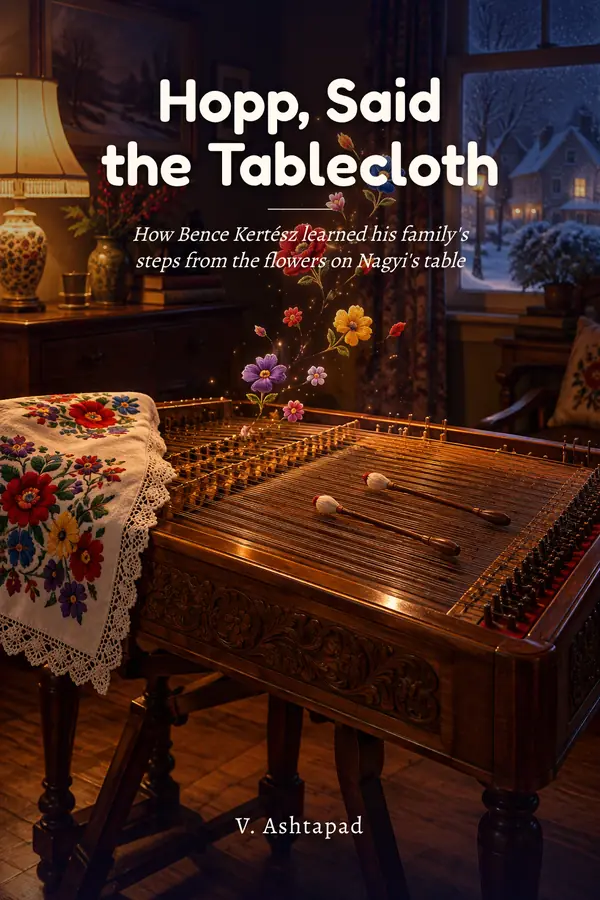
Hopp, Said the Tablecloth
How Bence Kertész learned his family's steps from the flowers on Nagyi's table
by V. Ashtapad
Foreword
This is a novel for young readers, and everything magic in it is made up. Bence, his family, his friends and the neighbors on East 121st Street are invented, and so are the barbershop, the dance club, the small museum and its exhibit, and every tune and verse in these pages. Buckeye Road, Shaker Square, Lake Erie and Kalocsa are real places, used here fictionally.
For much of the twentieth century, the Buckeye Road neighborhood on Cleveland's east side was home to one of the largest Hungarian communities outside Hungary, and many of its families later moved out to the suburbs while new neighbors made the street their own. Kalocsa, on the Great Hungarian Plain, is known for its paprika and for bright flower embroidery and painted walls. The paprika pods stitched among the flowers on this story's tablecloth are the family's own addition, not part of the traditional patterns. The táncház, or dance house, is a gathering where a live band plays village tunes and anyone, of any age, can learn the steps.
For everyone who learned a step in a kitchen, in socks.
Lake-Effect
The first thing you should know about my grandmother's kitchen is that it smells red.
I don't mean red like a fire truck. I mean red like the inside of a tin that says PAPRIKA on the side in curly letters, the kind with a picture of a woman in a flowered skirt holding a basket of peppers. When you pry the lid off with a butter knife, a little puff comes up that tickles the back of your nose and makes you sneeze twice, always twice, never once. Nagyi keeps four of those tins on the shelf above her stove. Two are sweet paprika. One is hot. One is full of buttons, which I found out the hard way.
The second thing you should know is that I did not want to live there.
We moved in the second week of January, when Cleveland was having what the weather lady on TV kept calling a lake-effect event. That means the wind comes across Lake Erie, scoops up the water, freezes it into snow, and dumps all of it on the east side of the city like somebody emptying a bag of flour onto a table. It snowed the whole drive up from Columbus. The windshield wipers went thump-thump, thump-thump, and my little sister Panni, who was four, sang "thump-thump" back to them for a hundred and forty miles. I counted the exits. It was something to count.
Dad had a new job driving a city bus. Mom had a new job doing the books for a printing company down by the river. And we had a new house, except it wasn't new, and it wasn't ours. It was Nagyi's: a brick house with a porch that sagged in the middle like a hammock, on a street out past Shaker Square where every house was brick and every porch had a shovel leaning on it.
"Only until spring," Mom said. "Until we find our own place."
"Spring is in March," I said. "That's nine weeks."
"Ten," said Panni, who couldn't count past twenty but liked to argue.
Nagyi met us on the porch in a quilted coat over her nightgown and a pair of my grandfather's old work boots, unlaced, flopping. She is small and fast and she smells like onions and hand cream. She grabbed my face with both hands, the way she does, and squeezed until my lips went fishy.
"Bence," she said. She says my name properly, BEN-tseh, with a little hiss in the middle like a match being struck. At school in Columbus everyone said Benz, like the car. "You got so tall. Why did you get so tall? Who said you could?"
"Nobody," I said through my fish lips.
"Good. Then stop."
---
My room was the little one at the top of the stairs. It had a slanted ceiling that I hit my head on four times the first night, a window that looked out at the neighbor's garage, and wallpaper with tiny blue windmills on it. Mom said it had been her room when she was my age. There was still a sticker on the closet door of a cartoon horse, half scraped off, so the horse had only its back end.
I lay on the bed and listened to the house. Old houses talk. Nagyi's house clanked and ticked and sighed. The furnace in the basement started up with a whump that I felt in my teeth. The wind found a gap somewhere and whistled one note, then another note, as if it was trying to remember a tune and kept getting it wrong.
I missed my friend Quentin-from-across-the-street, who wasn't across the street anymore. I missed our old kitchen, which smelled like toast and nothing else. I missed knowing where the light switches were.
At about eleven o'clock I got thirsty. That's the true reason for everything that happened. If I hadn't been thirsty, none of this would have started.
---
I went downstairs in my socks, keeping close to the wall where the steps didn't creak. The kitchen was dark except for the little light over the stove that Nagyi leaves on all night, "so the kitchen doesn't get lonely." The table was in the middle of the room, under the hanging lamp, and on the table was the cloth.
I had seen it at dinner, under the serving bowls, but I hadn't really looked. Now there was nothing on it but a salt shaker shaped like a goose, and I looked.
It was white linen, heavy, the kind that crinkles when you touch it. All over it were flowers. Not printed flowers. Sewn ones, made of thousands of tiny stitches so close together they were smooth and shiny like the skin on a pepper. There were big red roses in the middle, round and fat, with petals in three different reds, one inside another. There were yellow tulips that stood in pairs. There were purple flowers shaped like little bells hanging down, and a whole crowd of tiny white-and-yellow daisies around the edges, and leaves in two greens curling between them all, and here and there a long red shape that looked exactly like a paprika pepper, stem and all.
And in one corner, by itself, there was a rose that was blue.
Everything else on the cloth went together like a band. The blue rose looked like it had shown up at the wrong party.
I poured my water. I drank it standing up. And because the wind was still whistling its broken tune, and because I was a little lonely, and because humming is what I do when I'm nervous, I started to hum.
I didn't hum anything special. It was a tune I had heard that afternoon, when Nagyi's brother, Laci bácsi, came over to help carry boxes. He doesn't carry much. He's eighty-two and has a bad knee. Mostly he sat at the kitchen table and drummed on it with two fingers, and while he drummed he hummed, a quick tune that went up and around and up again and landed with a little bump at the end, like a kid jumping off the last step.
I hummed it into my water glass. I hummed it twice.
On the second time, I smelled paprika.
Not the tin kind. Fresher than that, and warmer, like a whole field of peppers on a hot afternoon, which is not a smell you are supposed to be able to smell in a kitchen in Ohio in January at eleven o'clock at night with snow piled up on the windowsill.
Then the biggest red rose in the middle of the cloth lifted its edge.
I want to describe this right. It didn't pop up. It peeled up, slowly, the way a sticker comes off when you get your fingernail under the corner. The stitches came loose from the linen underneath without a single thread breaking. Its outer petals curled up off the table, then its middle petals, and then it was standing. Standing on its stem, which had split at the bottom into two little green stitched feet.
It turned to face me. It didn't have a face. It had petals, round and round, and somehow that was worse, and also better.
I stopped humming.
The rose stopped moving. It stood there, perfectly still, like a kid in freeze tag. It waited.
I was so scared my ears were ringing. But I was also, and I have thought about this a lot since, a little bit offended. It was clearly waiting for me. Like I was the one who was late.
So I hummed again. Very quietly, very badly, with my voice wobbling all over the place.
The rose bowed. It bent its whole head of petals down toward the linen, deep and slow, and then it came back up and stamped one green foot on the table. The stamp made a sound. A real sound, tiny and sharp, like somebody snapping a dry bean.
Then it began to dance.
---
It danced the way Laci bácsi's fingers had drummed. Two quick steps to the right, a little bounce, two quick steps back. A turn. A stamp. Its petals swung out when it turned and settled back when it stopped, like a skirt. Every time my tune got to the bump at the end, the rose jumped and landed on both feet at once, and the bean-snap sound rang out over the kitchen.
I kept humming. I didn't dare stop. My mouth was dry again even though I'd just had a whole glass of water. Somewhere behind me, the furnace whumped off, and the house went quiet except for me and the stamp of two stitched green feet on white linen.
I don't know how many times I hummed the tune. Twenty, maybe. When I finally ran out of breath and stopped in the middle, the rose stopped too. It looked at me (I'm telling you, it looked) and then it walked, with tiny dignified steps, back to the middle of the cloth. It lay down on its own empty shape, the one it had left behind, which I could see now was a pale rose-shaped patch where the linen was whiter than everywhere else. It pressed itself flat. The edge of it sank last.
And it was a sewn rose again. Flat and shiny and still.
I stood in the kitchen for a long time. Then I put my glass in the sink, very carefully, without clinking it, and I went upstairs and got into bed with my socks still on.
On the way up I passed the hall table, where Nagyi had left her tablet propped against a lamp. The screen was still glowing. She'd been working on the family tree, the one she keeps in a private corner online where only family can see it, adding all of us one at a time. There was a new branch at the bottom that hadn't been there at dinner. It had a little photo of Panni from last summer, in her strawberry sunglasses. Next to it was a photo of me, with my eyes half shut, which was typical.
Under my picture, Nagyi had typed my name, and then, in brackets, how to say it, in case anybody in the family ever forgot: Bence (BEN-tseh, not like the car).
The wind was still whistling its wrong tune. But I could hear, very faintly, that it had almost got it now.
Piros
In the morning the cloth was just a cloth.
I checked. I came down before anybody else and walked all the way around the table twice, bending close. The big red rose lay in the middle exactly where it belonged, flat and shiny, every stitch tucked in. No pale patch. No loose threads. I poked it with one finger. It felt like linen and a little like the scab on my elbow, raised and bumpy.
"You lose something?" said Nagyi from the doorway.
I jumped about a foot. She was already dressed, in a brown cardigan with the sleeves pushed up, and she was carrying a loaf of rye bread under one arm like a football.
"No," I said. "I was looking at the flowers."
"Ah." She put the bread on the counter and pulled the cutting board out from its slot by the stove. "My grandmother made that. Her mother drew it. You know where my grandmother's mother came from?"
I didn't.
"Kalocsa," Nagyi said, and the word came out of her like a little song, KA-lo-cha. "In Hungary, in the flat country by the river. Very famous for two things. Paprika, and flowers like this. The women there painted flowers on everything. Walls, ovens, the doors of cupboards. And what they didn't paint, they sewed." She sawed off a slice of bread, thick as a book. "This one is red." She pointed at the big rose with the bread knife. "In Hungarian, red is piros."
"Piros," I said.
"Not bad. A little flat. Say it like you mean it. PI-rosh. The front of the word is the loud part. In Hungarian, the front is always the loud part."
"PI-rosh."
"Better." She spread lard on the bread from a crock with a wooden lid, then shook paprika over it from the sweet tin, and laid thin rings of white onion on top, and handed it to me. "Breakfast."
I looked at it. It was the reddest breakfast I had ever seen.
"Eat," said Nagyi. "Your great-grandfather ate this every morning of his life on Buckeye Road, and he lived to ninety-four and could still crack walnuts in his fist."
So I ate it. It was salty and soft and the onion bit me back, and the paprika had a taste I can only describe as warm dirt in a good way, like a garden in August. I ate the whole slice, and then a second one, and Nagyi watched me with her arms folded and didn't say anything, which from her is the same as a medal.
---
Panni came down in her pajamas with feet in them and climbed onto a chair to see what I was eating, and then she stood up on the seat and jumped off.
"Hopp!" said Nagyi as Panni landed.
"Hopp!" Panni shouted back, and climbed up to do it again.
"What does that mean?" I asked.
Nagyi shrugged. "It means hopp. It means you jumped. When you dance, the boys shout it. When the baby jumps off the chair, you shout it." Panni jumped. "Hopp!" said Nagyi. "You see? Easy language."
Mom came down with her work badge clipped to her sweater, kissed the top of my head and Panni's head and the air somewhere near Nagyi, and grabbed a slice of bread without lard.
"Mom," I said, "do you know any Hungarian?"
"Oh, honey, not really. A few words. I forgot most of it." She was zipping her bag. "Your nagyi made us a list, though. Did she show you? It's in the family space. You tap a word and it plays her saying it." She held her phone out and scrolled. There was a whole page of words, each with a speaker button. She tapped one and Nagyi's voice came out of the phone, small and tinny: "Piros."
The real Nagyi, at the counter, said, "That's me."
"I know it's you, Anyu," said Mom. Anyu means mom, but only when Mom says it to Nagyi. "That's the point."
---
I went to my new school that morning and I won't tell you much about it, because it wasn't the important part. It was big and it smelled like floor wax. My teacher was named Ms. Abernathy and she wore earrings shaped like lemons. Nobody said my name right. I said "Benz is fine," because it was easier, and I spent the whole day feeling like I'd told a small lie.
The important part was that night.
I waited until the house was all the way quiet. Dad had worked a late shift and come home at ten and gone straight to bed, and his snoring came through the wall like a truck going slowly uphill. Nagyi's door was shut. Panni was asleep sideways across her bed with one foot on the wall.
I went down in my socks. The stove light was on. The cloth lay on the table under the hanging lamp, and the goose salt shaker stood guard in the middle.
I moved the goose to the counter. I don't know why. It felt polite.
Then I hummed Laci bácsi's tune, the one that goes up and around and lands with a bump.
The paprika smell came first. The red rose came second, peeling itself up off the linen exactly the way it had the night before. It stood, it bowed, it stamped. But this time, when I started the tune over, it didn't just dance by itself. It came to the edge of the table, right by my belly, and it stamped at me.
I didn't understand.
It stamped again. Then it did the step, very slowly, the way you'd show a baby how to clap. Right foot out. Left foot next to it. Right foot out again. Then a little tap with the left, and back the other way. Slow, slow. It was teaching me.
"Oh," I said. "Okay."
So I did it. In the middle of the kitchen floor, in my socks, on the cold squares of linoleum, humming a tune I didn't know the name of, I did the step. Right, together, right, tap. Left, together, left, tap. The rose did it with me on the table, so we were like mirror twins, one big, one small. My socks slid. The rose did not slide. Every time I got to the bump at the end of the tune, it jumped and landed with its bean-snap stamp, and I jumped too and landed with a thud that made the plates in the cupboard rattle.
And on the fourth time, without deciding to, I shouted it. Quietly, because of Dad.
"Hopp!"
The rose spun all the way around, twice, its petals flaring out, and landed on one foot, and if a stitched flower can grin, it grinned.
---
That night I figured out the rules. I'm going to put them here, because I wrote them down later on the back of a spelling worksheet, and I still have it.
One. They only dance while someone is humming. When I stopped, the rose froze. When I started again, it went on from right where it left off.
Two. The big red rose only woke up for Laci bácsi's tune. I tried others to see. "Happy Birthday" did nothing. The theme from a cartoon did nothing. The tune the wind had been whistling did nothing, maybe because I couldn't get it right either. Only the one tune, the one that bumped at the end. It was the rose's tune. It knew it the way you know your own phone number.
Three. None of the other flowers woke. I hummed Laci bácsi's tune for the yellow tulips, for the purple bells, for the little daisies at the edge. They stayed flat. The long red paprika peppers scattered between the leaves didn't so much as twitch. The blue rose in the corner stayed flattest of all. When I bent close, I thought I saw one of the tulip twins shiver, just a little, the way your leg shivers when you're almost asleep, but that was all.
Four. When the rose was tired, it went back to its own shape on the cloth and lay down. You could not hurry it and you could not stop it.
Five. I was going to need more tunes.
I named the rose Piros. It seemed like the right name, since that's what it was. When I said it, PI-rosh, like I meant it, it bowed to me one more time before it lay down.
Then I put the goose back in the middle of the table, and went up to bed, and lay under the slanted ceiling with my feet still tapping under the blanket, right, together, right, tap, until the furnace whumped on and I fell asleep in the middle of a step.
Lángos Weather
There was a boy in my class named Tavion Greer who could fold a paper football so tight it flew like a bullet, and on Thursday he sat next to me at lunch because the only other empty seat was next to the trash can.
"You're the new kid," he said.
"Yeah."
"Benz."
"It's actually Bence," I said, and I don't know why I said it right then, after four days of not saying it. Maybe because he didn't look like he'd laugh.
"Ben-tseh," Tavion said, slowly, like he was tasting it. "That's cool. That's like a sneeze." He flicked his paper football at my milk carton and knocked it over. "Where's it from?"
"Hungarian."
"For real?" He sat up. "My granddad's shop is on Buckeye. He says it used to be all Hungarian people down there. He says the building he's in used to be a meat store and it still says meat on the floor in some other language."
"Hús," I said. I didn't even know I knew that. It must have been on Nagyi's list. "H-U-S. With a little line over the U."
Tavion looked at me like I'd done a magic trick. "That's exactly what it says."
So that was the first time I felt like I was from somewhere, a little bit, in that school. It was a weird feeling. Like when your foot's been asleep and it starts to come back.
---
Saturday it was snowing sideways again, and Nagyi said it was lángos weather.
"What's lángos weather?" I asked.
"Weather when you need lángos," she said, as if I was being slow on purpose.
Lángos, it turns out, is fried bread. But that's like saying a snowstorm is some water. Nagyi boiled two potatoes and mashed them with a fork until they were smooth as paste, and mixed them into flour and warm milk and yeast in her big yellow bowl, the one with a chip on the rim shaped like Florida. Then she turned it all out onto the counter and began to knead.
She kneaded with the heels of both hands, push and fold, push and fold, and the whole counter shook a little with each push, and the paprika tins on the shelf above went tink, tink against each other. Panni sat on the counter by the sink in her sock feet, eating raisins one by one out of a box. I stood by the stove because it was warm.
"Nagyi," I said, "do you know any songs?"
"I know a thousand songs."
"Will you sing one?"
"I don't sing. I cook." Push and fold. "Your Laci bácsi sings. Ask him. He never shuts up."
She kept kneading. I kept watching. And after a minute, maybe two, while she was looking out the window at the snow and not at me, she started to hum. Then the hum turned into words, very low, under her breath, the way you talk to yourself when you're looking for your keys. It was Hungarian. It had a pushing rhythm, like the kneading. One-two, push. One-two, fold.
I didn't move. Panni stopped chewing.
When it was over, Nagyi floured her hands and said, "What are you staring at? Get the big pan."
"What was that song?"
"What song?"
"You were singing."
"I was not singing. I was breathing." But she was pink across the cheeks, and she turned around to grease the bowl. "It's an old thing. My mother sang it when she made bread on Buckeye Road. It's about a girl who sends her bread to the river so it will float to her sweetheart in the next village, and he eats it and knows it's from her because it's the best bread. It's a silly song."
"Can you sing it again? So I can learn it?"
She sighed the biggest sigh in Cleveland. But she sang it again, all the way through, slower, and then once more with me humming along, and then she told me what the words meant, more or less. I wrote it on my hand in pen. Later I copied it onto the back of my spelling sheet, under the rules. Here is what I wrote, which is Nagyi's English and then my own fixing to make it fit the tune:
*Rise, little loaf, in the warm of the day,*
*Float down the river and don't lose your way,*
*Go to the bridge where the willow trees lean,*
*Tell him the girl with the yellow-green ribbon has kneaded you clean.*
It didn't rhyme in Hungarian, Nagyi said, it did something better than rhyming, but she couldn't explain what.
---
The dough rose in the yellow bowl under a dish towel, next to the radiator, for an hour. Then Nagyi tore off pieces the size of a fist and pulled them flat with her fingers, round and thin in the middle and puffy at the edges, and laid them one by one into a deep cast-iron pan full of hot oil. They hissed and bubbled and puffed up gold, with big blisters, and she flipped them with a fork, and the whole kitchen filled up with a smell like the county fair.
While they drained on brown paper, she crushed four cloves of garlic with the side of a knife and stirred them into a cup of water with salt, and painted each lángos with a pastry brush. Then a spoonful of sour cream, spread out to the edges. Then a snowfall of grated cheese.
"You eat it with your hands," she said. "You get it on your chin. That's correct. If you don't get it on your chin, you're doing it wrong."
I got it on my chin. I got it on my shirt, and a little on my ear somehow. It was hot and crisp outside and soft inside and the garlic was so strong it made my eyes water, and the sour cream was cold, and the cheese was salty, and I ate two and a half before Mom came home and took the half away from me.
---
That night I went down and moved the goose, and I didn't hum Laci bácsi's tune first. I hummed the bread song. *Rise, little loaf.* Push and fold.
Piros didn't wake.
Instead, two yellow tulips on the left side of the cloth, the pair that stand stem to stem, peeled themselves up together. Exactly together. When one lifted a leaf, the other lifted the same leaf on the other side. They stood up in one motion, like they'd practiced it all their lives, which I guess they had. They were the yellow of the yolk when you crack an egg into a bowl. Up close they smelled like warm bread and, faintly, garlic.
"Sárga," I whispered, because that was on the list too. Yellow.
They didn't bow, like Piros. They put their leaves on their hips, both of them, and looked at me as if to say, *Well? Are you coming or not?*
The bread song is slower than Laci bácsi's tune. The tulips' step was a sway, side to side, with a dip in the middle where they bent their stems, like pushing dough, and a rise at the end. Push and fold. Side and dip and rise. They did it mirror-image, one going left while the other went right, and they kept getting annoyed with me, I could tell, because I only had one of me and couldn't be both sides at once.
So I sang louder, and halfway through the third verse, a floorboard creaked in the hall.
I froze. The tulips froze. My heart was going so hard I thought it might knock over the goose.
"Bence?" It was Nagyi, in the doorway, in her nightgown, her hair in a net. "What are you doing up?"
The tulips were flat. Just like that. Flat on the cloth, stem to stem, tucked in, two sewn yellow flowers.
"I was thirsty," I said, which was at least partly true.
She looked at me. She looked at the table. She looked at the goose, which was on the counter instead of in the middle of the cloth. Then she looked back at me.
"You were singing my mother's song," she said.
"I was practicing."
For a second I thought she was going to be angry. Then she did something I didn't expect. She came over and moved the goose back to the middle of the table, and smoothed the cloth with the flat of her hand, slowly, the way you'd smooth a little kid's hair.
"Not bad," she said. "Your vowels are flat. Go to bed."
At the bottom of the stairs, I looked back. She was still standing by the table in the light from the stove, one hand on the cloth, humming the bread song to herself.
The tulips didn't move. I watched as long as I could. They didn't move at all. I think they only dance for somebody who's learning.
Laci Bácsi's Hammers
Laci bácsi lived in a tall building by the lake where everybody was old and the elevator talked. It said "Doors closing" in a woman's voice that sounded bored, and then it said "Floor nine" in the same voice, and Laci bácsi said back to it, every time, "Thank you, darling," which made Panni laugh so hard she got the hiccups.
Bácsi isn't his name. It's what you call an older man in Hungarian when you're being respectful and friendly at the same time, like uncle, but you can say it to a man who isn't really your uncle. Laci bácsi was really our uncle, though, or really Mom's uncle, which makes him my great-uncle, which he said made him great.
"I'm great," he said, opening the door. "Everybody knows it. Come in. Take off your boots. Don't touch the cimbalom."
So of course the first thing I did was look at the cimbalom.
It stood in the corner by the big window, where you could see the lake out behind it, gray and flat and steaming in the cold like a bowl of soup. At first I thought it was a piano somebody had flattened. It was a wooden box, wide as a kitchen table and shaped like a slice of pie with the point cut off, standing on four thin legs. The top was open, and inside, running across it from side to side, were strings. More than a hundred of them. Silver and bronze, stretched tight in groups, passing over little wooden bridges like a train track seen from very high up.
"Can I—"
"No," said Laci bácsi. He lowered himself into an armchair with a crocheted blanket over the back, his bad knee straight out in front of him. "Sit. Eat something. Your nagyi sent kolbász, I can smell it from here."
Nagyi had. She had sent a whole paprika sausage wrapped in wax paper, and a jar of pickled peppers, and half a loaf of rye, and a note that said, in Hungarian and then English, EAT A VEGETABLE. Laci bácsi read it and laughed and put the note on his refrigerator with a magnet shaped like Ohio.
---
He told us stories while we ate. He'd been telling them for a while, it turned out. Mom had been coming every other Sunday with her phone on a little stand, and he would talk, and she would save it in the family space with the date, and later somebody typed out every word underneath so you could read along. He showed me on his tablet. There were dozens. "The Night the Bakery Caught Fire." "Uncle Feri and the Goat." "How I Learned the Cimbalom Instead of Going to Summer Camp."
"Your mother set it so I can only look," he said. "I can't change anything. Because once, by accident, I pushed a button and your great-aunt's wedding disappeared. Gone. Two hundred photographs." He waved his hand. "It came back, they fixed it, but now I'm only allowed to look. Like a museum. Like a child at a museum." He didn't sound mad about it. He sounded proud, actually, as if being dangerous was an accomplishment.
"Laci bácsi," I said, "what's the tune you hum? The quick one. It goes up and around and then it jumps at the end."
He stopped chewing.
"You heard that?"
I hummed a little of it. Piros's tune.
He put his sandwich down. He looked at me for a long moment, and his eyes, which are pale blue and wet at the edges, got wetter.
"That's my father's," he said. "That's Apa's tune. He whistled it in the shop on Buckeye every morning when he made the sausage. Grinding the meat. Chop, chop. His own father brought it over from the village near Kalocsa. In the village it had a name, but somewhere on the boat the name got lost. So in our family it was only Apa's tune." He picked up the sandwich again. "You have a good ear. Your nagyi doesn't. Don't tell her I said that."
"Where on Buckeye was the shop?"
"East 121st. Corner building. Red brick. My father had his name over the door in gold letters." He drew it in the air: a long word. "Tiles on the floor. White tiles with red flowers, and in the doorway in little black tiles, HÚS. Meat. So people knew."
I almost dropped my pickle. "There's a barbershop there now," I said. "My friend's grandfather. It still says hús on the floor."
Laci bácsi didn't say anything for a while. He looked out the window at the lake.
"Well," he said at last. "Good. A barbershop. Good. A floor should be used."
---
After lunch, he let me touch the cimbalom.
Not right away. First he made me wash my hands. Then he took two little sticks out of a velvet bag. They were the hammers. Each one was a thin wooden stick about as long as a pencil, bent up at the very end in a little hook, and the hook was wrapped tight in cotton thread, so it was soft on one side and hard on the other.
"You hold it here," he said, and put one in my hand, between my thumb and first finger, loose. "Not tight. Like a baby bird. If you squeeze, it can't fly."
He reached over my shoulders with the other hammer and touched a string. Just touched it, a little drop of the wrist. The note came out round and shimmering and kept going and going, hanging in the air of the apartment after he'd taken the hammer away. Then he touched three more, quick, and they rang over each other, and it was like standing inside a wind chime, or a glass of water somebody's running their finger around, but warmer.
"Now you."
I dropped my wrist the way he did. The note was thin and buzzy, but it was a note. I did it again. Better.
"Ügyes," Laci bácsi said, and I knew that one too. It means clever, or good at something, and it's what you say to a kid who just did something right. Panni already knew it from the list. She said it to me, "Ügyes, Bence," and patted my arm like a tiny grandmother.
Then Laci bácsi played. He leaned forward out of his chair, the blanket falling off his knee, and he played a slow tune, the slowest thing I had ever heard. It walked. That's the only way I can say it. It walked like a man in good boots across a big room, stopping now and then to look around, proud, taking its time. Each note rang and faded and the next one came before the last was gone, so the whole thing shimmered underneath like the lake outside.
"That's a lassú," he said when he finished. "Slow one. In the csárdás you dance slow first, then fast. The slow part is for showing everyone how good you are without trying. Like you don't care. Like you have all night." He set the hammers down crossed on top of the strings. "The fast part is for showing off."
I made him play it again. And again. By the third time, I could hum the shape of it, and by the fourth, I had it.
---
That night, I hummed the lassú to the cloth.
Piros didn't wake, and the tulips didn't wake. But along the right side of the cloth, where a long green stem curled up between the leaves, three purple bellflowers hanging in a row lifted themselves off the linen, one, two, three, slow as a sunrise. They were a purple so dark it was almost black where the stitches were thickest, and pale lilac where the light caught them. They didn't bounce. They stood very straight, all three on the same stem, which had split into feet at the bottom like Piros's, and they swayed their bell-heads, and they smelled, I swear, like the inside of Laci bácsi's velvet hammer bag. Like dust and wood and something sweet.
"Lila," I said. Purple.
They walked. Slow and proud, down the length of the table, step and pause, step and pause. And every few steps they did a thing I hadn't seen before: they lifted their feet and clicked them together in the air, heel to heel, click, and landed, and walked on as if nothing had happened. Like they didn't care. Like they had all night.
I tried the heel click on the linoleum and fell into a chair. I tried it again and kicked the table leg. The bellflowers waited, very patiently, all three of them, without the slightest sign of laughing. That was worse than if they had laughed.
On the sixth try, my heels touched in the air. Click. Barely. I landed with my arms out like an airplane.
The bellflowers bowed, all three heads together, so low their bells touched the cloth.
I went to bed with a bruise on my shin the shape of Lake Erie, and I didn't care, because I had three flowers now, and three tunes, and I had a feeling, lying in the dark listening to the furnace, that there were a lot more tunes in the family than anybody had told me.
Buckeye
Dad drove the Buckeye bus on Saturdays, and the second Saturday we lived there, Nagyi decided we would ride it.
"All the way," she said, buttoning Panni into her snowsuit like she was sealing a letter. "Down the whole street. I want to see what they did to it."
"Who's they?" I asked.
"Time," said Nagyi. "Time is they."
We waited at the stop in front of the dry cleaner with our breath coming out in clouds. The snow had stopped for once, and the sky was that hard bright blue that makes everything look cut out with scissors: the telephone wires, the bare trees, a crow on a mailbox puffed up like a dust mop. When the bus came around the corner, enormous and white and rumbling, with BUCKEYE glowing in orange letters across the front, I saw Dad at the wheel in his blue uniform jacket and I waved like a little kid before I could stop myself.
He opened the doors with a whoosh. "Morning, folks. Exact change only."
"Shane," said Nagyi, "don't be fresh," and swiped her card, and so did I, and Panni didn't have to because she was four. We sat in the seats right behind him, the sideways ones, where you can see out the big front window like you're driving.
Dad is not Hungarian. Dad is from the west side of Cleveland, from a family that has been in Cleveland so long nobody remembers being from anywhere else. He has red hair that's going gray at the sides and big freckled hands, and he calls Nagyi "Ma," which she pretends to hate. When we turned onto Buckeye, he said, over his shoulder, "Okay, Ma, you're the tour guide. Narrate."
So she did.
---
The road went down a long hill and then flattened out, and on both sides were old brick buildings, two and three stories tall, with stores on the bottom and windows on top. Some of the stores were open: a beauty supply with wigs in the window on white foam heads, a corner market with a hand-painted sign for fried fish, a tire shop with towers of tires stacked outside like giant licorice. Some were boarded up, with plywood painted bright colors, sunflowers and faces and a big blue whale. There was a new library branch with a glass front, all lit up, and a community garden behind a chain-link fence with snow on the empty beds and a scarecrow wearing a Browns hat.
"There," said Nagyi, pointing. "That was the bakery. Lakatos. You could smell it from three blocks. Kifli on Sunday, pogácsa on Tuesday." It was a cell-phone store now, with a cardboard man in the window holding up a phone. "There. The movie theater. Ten cents. I saw *Cinderella* there four times." That one sold used furniture now, with a row of armchairs out front under a tarp, and she didn't say anything else about it. "There. Upstairs, see the big windows? The dance hall. Every Saturday night, a band. My mother met my father up there. She stepped on his foot on purpose so he would notice her."
"Ma," said Dad. "Scandal."
"It's true. She told me herself."
I pressed my forehead to the window. The big windows upstairs had no glass in them anymore, only boards. But the stone over the doorway still had words carved into it, high up, where nobody had bothered to take them off. They were in Hungarian. I couldn't read them. I could see that there were a lot of accent marks, little dashes and double dots, all along the top like birds on a wire.
"What does it say?"
Nagyi squinted. "It says HOME. More or less. Hungarian Home. The name of the club." She sat back. "Well. Still standing."
---
Dad let us off at East 121st with a wink and a whoosh, and drove away with the rest of his passengers, and there it was, on the corner. Red brick. Two stories. And a sign in the front window, in neat white paint: GREER'S CUTS. WALK-INS WELCOME. SINCE 1987.
Tavion opened the door before we even got there. He'd been watching for us.
"Granddad," he yelled back inside. "They're here! The Hungarian people!"
Inside it was warm and smelled like hair tonic and coffee and something spicy, like cinnamon gum. There were three big red barber chairs that could go up and down, and a long mirror, and a TV in the corner with the sound off showing a basketball game. A radio on a shelf was playing an old song with horns in it. All along one wall were photographs, so many they overlapped: kids in graduation gowns, men in hats, a wedding, a baby in a laundry basket, a softball team, a man on a horse.
And the floor.
It was white tile, small hexagons, hundreds of them, and every few feet there was a flower set into the white, made of tiny red tiles, with green leaves. They were worn soft on top from about a hundred years of boots. You could see paths in them, where the red had gone pinkish and the white had gone gray, between the door and the chairs, between the chairs and the back room. Right inside the door, in black tile, it said HÚS.
Nagyi stopped dead on the threshold.
"Come in, come in, ma'am, you're letting the heat out," said Mr. Greer, and then he saw her face, and he didn't say anything else for a minute. He just came over, a tall man, older than Dad but younger than Nagyi, with a gray beard trimmed perfectly and glasses on a chain. He was holding a broom. He waited.
"My grandfather put this floor in," Nagyi said finally. "Nineteen twenty-two. I used to sit right there, on a crate, and pull the paper off the sausage." She pointed at a spot where the first barber chair stood now.
"Well, I'll be," said Mr. Greer softly. "Sit there now, if you like. It goes up and down."
She did. She sat in the barber chair right where the crate had been, in her good wool coat, with her purse on her lap, and Mr. Greer pumped the pedal with his foot and the chair went up, slowly, and she laughed. I have heard Nagyi laugh plenty of times. I'd never heard her laugh like that, high and surprised, like a girl.
---
They talked for an hour. Mr. Greer's grandmother had moved to the street in 1958, when he was a baby, onto a block where she was the only Black family at first, and then there were more, and the Hungarian families were moving out to the suburbs one by one, and for a while everybody was mixed together. He remembered the lángos stand at the summer street festival. He remembered an old lady named Mrs. Toth who gave him a piece of walnut cake every time he carried her groceries. He remembered the dance hall band, playing so loud on Saturday nights you could hear it with the windows shut.
"My grandmother loved that band," he said. "Used to dance in the kitchen when it came through the walls."
While they talked, Nagyi got out her phone and asked if she could take a picture of the floor. Mr. Greer said of course. She took six. Then she showed me what she was doing. It was a map, a map just for the family, with little colored pins stuck in it. One pin on Kalocsa, far away across the ocean. A cluster of pins here on Buckeye. She tapped one on the corner where we were standing and typed: *Apa's shop. Floor still here. Mr. Greer's now. A good man.* She added the photo of the HÚS tiles. Then she dropped another pin, three blocks down, and typed: *Our house. Green porch now.*
Tavion and I went to the back room, where there was a box of combs to be sorted and a jar of lollipops, and we sorted combs and ate lollipops, and he showed me how to fold a paper football so tight you could take somebody's eye out with it. "Don't actually do that," he said.
When we came back out, Mr. Greer was sweeping. Long slow strokes across the flowered tile, swish, swish, and while he swept he was humming. It was a bouncy little tune, nothing like the old song on the radio, with a hop in it. I only caught a piece before Nagyi stood up and said we had to catch the bus back, Dad's loop came around at two-fifteen and he wouldn't wait, he was a professional.
---
That night I tried everything on the blue rose.
Piros's tune. The bread song. Laci bácsi's lassú. Each time, the right flowers woke, Piros and the tulip twins and the three bellflowers, and they danced, and they waited politely while I tried the next one. But the blue rose in the corner lay flat.
I bent down close. It wasn't really blue like the sky. It was a deep soft blue, the blue of jeans that have been washed a hundred times, and the stitches were a little bigger and looser than the rest, as if they'd been sewn by somebody in a hurry. It didn't match. Every other flower on the cloth was red or yellow or purple or green, the colors in Nagyi's tins and jars. This one was from somewhere else.
At the very end, just to try, I hummed the little piece of Mr. Greer's sweeping tune. The piece with the hop in it.
The blue rose shivered.
Just the edges. Just once. Like somebody who hears their name across a crowded room and isn't sure.
Then it lay still, and I couldn't remember the rest of the tune, no matter how hard I tried. All I had was the hop.
Crescents
Mom had Wednesday off, and she said she was going to make kifli with Nagyi, and Nagyi said "We'll see," which in our family means a fight is coming but a nice one.
It started with the recipe. Mom had it up on her phone, propped against the flour canister. It was on the family recipe shelf, the one in the private family space where everybody puts the dishes they make, each one with a photo of the original. The original for this one was a card in Nagyi's handwriting, slanted and spiky, with a grease spot in the corner shaped like a thumb. Somebody had typed it out underneath.
"Five hundred grams flour," Mom read. "Two hundred fifty grams butter. One packet yeast."
"Wrong," said Nagyi.
"It's your card, Anyu."
"I wrote that card for people who don't know how to make kifli. I know how to make kifli. I don't measure." She dumped flour into the yellow bowl straight from the bag, a big white avalanche, and a cloud went up and settled on all of us. Panni sneezed. Mom sighed. I sat at the end of the table with my elbows on the cloth, very carefully not touching any of the flowers, and watched.
Kifli are crescents. Like the moon when it's thin, Nagyi said, or a croissant, but better, because croissants are French and these are ours. The dough was butter and flour and a little sugar and egg yolks and yeast in warm milk, pinched together with the fingers until it looked like wet sand, then pressed into a ball and wrapped and put in the refrigerator to rest, "because dough gets tired, just like you."
While it rested, they made the filling. Walnuts, ground fine in a little hand grinder with a crank that Nagyi clamped to the edge of the counter. I got to turn the crank. It was harder than it looked and it made a crunching sound, like walking on gravel, and the ground walnuts came out the bottom in a soft brown pile that smelled sweet and oily and a little bit like the woods. Nagyi stirred them into a pan with sugar and milk and a big pinch of grated lemon peel and cooked it until it was thick, like brown sand.
Then the rolling. Nagyi rolled the dough out into a big flat circle, thin as a placemat, and cut it like a pizza into long skinny triangles. On the wide end of each triangle, a spoonful of walnut. Then you rolled it up, wide end to point, and bent it into a curve. A crescent. A little moon.
Mom's first one fell apart. Her second one looked like a worm. Nagyi didn't say anything. She just reached over and fixed it, with three quick twists of her fingers, and put it on the tray.
"I used to be good at this," Mom said.
"You used to be nine."
"I used to be nine and good at this."
Nagyi laughed, a short one, like a cough. "You were terrible. You ate the filling."
---
It was on the fifth or sixth tray that it happened. They had found a rhythm, Mom and Nagyi, side by side at the counter, Mom rolling and Nagyi bending, roll and bend, roll and bend. The radiator ticked. Pogácsa, Nagyi's gray cat, who had been hiding under the basement stairs ever since we moved in because she didn't approve of children, came up and sat on the windowsill and looked at the snow with her tail wrapped around her feet.
And Mom started to hum.
It was very quiet. She didn't notice she was doing it. It was a slow tune, slower even than Laci bácsi's lassú, and it rocked, back and forth, like a boat. Nagyi's hands stopped.
"Where did you get that?" she said.
Mom looked up. "What?"
"That song. You were singing it."
"Was I?" Mom stopped rolling. She looked surprised, then puzzled, and then her face did a thing I'd never seen it do, a sort of crumpling and uncrumpling, very fast. "Oh. Oh, that's— Anyu, you used to sing that. When I couldn't sleep. When I had the ear infections."
"I know I used to sing it. I didn't know you knew it."
"I didn't know I knew it either."
They looked at each other. Panni looked at me. I looked at the ceiling, because I didn't know what else to do with my face.
Then Nagyi wiped her hands on her apron and sang it, properly, out loud, all the way through. It was in Hungarian, soft and round, and the words had a lot of sh and ch sounds in them, like somebody saying hush. When she finished, Mom sang it back to her, and got some of the words wrong, and Nagyi corrected her, and Mom sang it again.
Later, I asked what it meant, and Mom wrote it down for me, Nagyi's English with Mom's help. I copied it onto my spelling sheet under the bread song. It goes something like this:
*Little daisy, close your eye,*
*The moon is a kifli in the sky,*
*Somebody's nibbled off one end,*
*Sleep, and tomorrow it'll grow again.*
"That's not what it says," Nagyi said when she read my copy. "It doesn't say kifli."
"It sort of says kifli," said Mom.
"It says the moon."
"Kifli is shaped like the moon. That's the point. That's why you sang it while you made them."
Nagyi opened her mouth, and closed it, and then she said, in Hungarian, something I didn't understand, and Mom laughed, and Nagyi turned around and put the next tray in the oven. The kitchen smelled like butter and walnuts and hot sugar. When the kifli came out, gold and shiny on top where they'd been brushed with egg, Nagyi dusted them with powdered sugar from a little sieve, so they looked snowed on, and we ate them warm. They were flaky and the walnut inside was soft and sweet and a tiny bit bitter, in a good way. Mom ate four. Nobody took anything away from her.
Before bed, Mom said "Jó éjszakát" to me at my door. Good night. It's on the list, but it was the first time she'd ever said it to me. She looked a little embarrassed. I said it back.
---
That night, I hummed the lullaby to the cloth.
And all around the edge of it, the daisies woke up.
There were twelve of them. I hadn't counted before, because they were so small, no bigger than a quarter, with white petals and a fat yellow middle. They peeled up off the linen one after the other, all the way around the border, like a wave going around a stadium. But they weren't like Piros or the tulips or the bellflowers. They wobbled. They tipped over and got up again. They bumped into each other. Two of them sat down hard on the cloth and just sat there, looking around, like babies who've just figured out they have feet.
They were the babies. I don't know how I knew that, but I knew it.
I hummed the lullaby, slow, rocking. The daisies swayed. They held each other's leaves. They made a little ring and went around and around, very slowly, tripping. One by one, their heads drooped. One lay down. Then another. Then they were all piling up in the middle of the cloth, right on top of Piros's sewn shape, in a heap, fast asleep.
It was the cutest thing I've ever seen in my life. I'm not embarrassed to say that.
And that was when Pogácsa jumped on the table.
I didn't hear her coming. Cats don't make noise. One second the windowsill was empty, and the next second there was a gray cat in the middle of the cloth, with her ears forward and her eyes enormous and black, and she put out one paw, fast as anything, and swatted.
A daisy went flying. It flew right off the edge of the table, spinning, and landed on the linoleum, and skittered, and disappeared under the stove.
I stopped humming. I couldn't help it.
Every flower on the cloth went flat in the same instant. The heap of sleeping daisies in the middle dropped back to their places along the border, eleven of them, and lay still. Where the twelfth should have been, at the corner closest to the stove, there was a pale, empty, daisy-shaped patch.
Pogácsa looked at the empty patch. She looked at me. She jumped down and walked out of the kitchen with her tail up, like she'd done something useful.
I got down on the floor. Under the stove it was dark and smelled like old grease and dust. I couldn't see anything. I didn't know what would happen if the daisy stayed there until morning. Would it just be a bit of thread, lost under the stove forever, with an empty space on the cloth that nobody could explain? Would Nagyi notice? Would the others ever wake up again, with one of them missing?
I got the long metal spatula from the drawer. I lay flat on my stomach on the cold floor with my cheek almost touching the linoleum. And I started humming the lullaby again, as quietly as I could, right into the dark under the stove.
*Little daisy, close your eye.*
Nothing.
*Somebody's nibbled off one end.*
Then something moved. A tiny wobble of white, way in the back by the wall. It came toward me, slowly, tipping over, getting up, tipping over. It was covered in dust. It had a walnut crumb stuck to its petals. When it got close enough, it climbed right up onto the spatula, as if that's what spatulas were for, and sat down on it.
I pulled it out like the slowest fishing in history.
I blew the dust off it, very gently. I picked off the crumb. Then I carried it on the spatula back to the table and set it down at the edge of the cloth, next to its empty patch, still humming. It looked at its eleven sisters asleep in their places. It wobbled over to its patch and lay down in it and went flat.
I sat on the kitchen floor for a long time with the spatula across my knees.
After that, I shut Pogácsa in the basement every night before I went down, and she sat behind the door and complained about it in a low, steady voice like a kettle that won't quite boil, and every morning when I let her out she walked past me without looking, which I deserved.
Paprikash
On Sundays, Nagyi made chicken paprikash, and on Sundays, Laci bácsi came to dinner, and on Sundays, everybody was in the kitchen at once whether there was room or not.
There wasn't room. Nagyi's kitchen is the size of a large closet with a table in it. Dad had to stand in the doorway. Laci bácsi took the good chair, the one with arms, and put his bad leg up on the step stool, and every time anybody needed the step stool he said "Ow" before they even touched it.
I was in charge of onions.
"Small," Nagyi said, standing over me. "Smaller. Like rice. If I can see the onion in the sauce, you did it wrong."
I cried the whole time. Everybody cries with onions, she said, it's good for you, it washes your eyes out. She put a big spoonful of lard in the heavy pot, the dented one with the black handle, and when it melted and shimmered she dumped in my onions, and they hissed and went soft and then slowly, slowly, gold. The whole house smelled like them. Panni came in from the living room to ask what smelled so good, and then went back out, and then came back to ask again.
Then the part I liked best. Nagyi took the pot off the heat. Completely off, onto a cold burner.
"Why?"
"Watch." She opened the sweet paprika tin, and a red puff came up, and I sneezed, twice. Then she shook in paprika, not a little sprinkle, a whole big heap, like red sand. She stirred it into the onions fast with a wooden spoon. The onions turned red, deep red, the red of Piros's middle petals.
"Paprika burns," she said. "If it burns, it goes bitter, like a bad word. So you never put it on the fire. You put it in when the pot is hot but resting. Your great-grandmother would hit your hand with the spoon if you put the paprika in on the fire." She showed me the spoon. It had a burn mark on the end. "This spoon."
Then the chicken, in pieces, on the bone, rolled around in the red onions until every piece was red. A chopped tomato. A yellow pepper, the long pale kind, in strips. A cup of water. The lid. Back on the heat, low, for an hour. The pot made a sound like someone muttering in the next room.
While it cooked, Nagyi made nokedli, which are little dumplings. Flour and eggs and water beaten into a sticky batter that she said should "fall off the spoon like a lazy dog." Then she put a big pot of water on to boil and set a gadget on top of it, a flat metal grater with big holes and a little box that slid back and forth across it. She poured the batter in the box and slid it, back, forth, back, forth, and little blobs of dough dropped through the holes into the boiling water. Plip, plip, plip. They sank, then floated up, wobbly and pale, like tiny clouds.
"Laci," she said. "Your turn to tell him."
"Tell him what?"
"About the cloth. He keeps staring at it. He thinks I don't notice."
---
I did keep staring at it. I couldn't help it. In the daytime, with the light coming in sideways from the window over the sink, and the steam from the pot, and everybody's elbows on it, it was hard to believe what happened on it at night. Piros lay in the middle, perfectly flat, with a saucer of pickles on top of one petal.
Laci bácsi moved the pickles.
"Our grandmother made it," he said. "Erzsi. Erzsébet. She came over on the boat in 1912, seventeen years old, by herself, with one suitcase and a piece of tissue paper folded up in her coat lining. On the paper was the drawing. Her mother drew it. Her mother was a painting woman in Kalocsa. The women who painted the flowers on the walls of the houses, you understand. They didn't sew it. They drew it first. Every flower. With a brush, or a pencil, or a burnt stick."
"Then Erzsi sewed it," Nagyi said, sliding the nokedli box. "Every night, after work. She worked in a cigar factory, rolling cigars, and then she came home to Buckeye Road and sewed flowers. One at a time. It took her six years. When she married our grandfather, it was on the table."
"Except the peppers," said Laci bácsi. "Those weren't in the drawing."
"No," said Nagyi. "In the old Kalocsa patterns it's flowers. Roses, tulips, little bells. The paprika was out in the fields, not on the linen. But Erzsi missed those fields. So here and there, between the leaves, she tucked in a pepper of her own." She shrugged. "Her mother never drew a single one. Erzsi said that part was hers."
There's a photo of that, actually. It's on Nagyi's refrigerator, on the calendar Mom had printed last Christmas, a calendar of old family photographs, one for each month. January is Erzsi. She's sitting at a table in a dark dress with her hair piled up, not smiling, the way people didn't smile in old photographs, and in front of her is the cloth, bright and new, every flower sharp.
I got up and looked at it, close. Then I looked at the cloth on the table. Then back at the photo.
"There's no blue rose," I said.
The kitchen got quiet. The pot muttered.
"No," said Laci bácsi. "There isn't."
"Why not?"
"Because it wasn't there yet." Nagyi turned off the burner under the nokedli. "The blue one came later. Much later. Look at the corner. Look under it."
I bent down over the corner. I hadn't noticed before, at night, by the light from the stove. But in the daytime you could see it: the linen under the blue rose was a slightly different white. A little grayer. And around the edge of it, almost invisible, there was a seam. A square of new linen had been sewn into the old.
"It wore through," Nagyi said. "Fifty years of elbows and soup. One of the red roses in the corner wore right through, and the linen tore. So my grandmother cut out the hole and sewed in a patch and sewed a new rose on top. That was 1964? '65? I was a teenager. She was an old woman by then, seventy, and her eyes weren't so good. That's why the stitches are bigger."
"But why blue?"
Nagyi and Laci bácsi looked at each other.
"She never said," said Nagyi.
"She said one thing," said Laci bácsi. "She said, *That one belongs to the street.*" He shrugged, a big slow shrug. "That's all. She was a stubborn woman. When she didn't want to tell you something, you could put her in a barrel and roll her down Buckeye Road and she still wouldn't tell you."
---
Then it was dinner, and nobody could talk about anything else because we were eating. Nagyi stirred sour cream with a spoonful of flour into the pot right at the end, first mixing some of the hot sauce into the cream in a cup, a little at a time, "so it doesn't get scared and curdle." The sauce went from deep red to a soft orange, like a sunset. She ladled it over the nokedli, a whole mountain of them, with a chicken leg on top of each plate, and a dollop of extra sour cream, and a sprinkle of paprika on the very top, "for beauty."
Everybody stopped talking. Even Panni. It was the best thing I had ever eaten, and I'm including the lángos, which I didn't think was possible. The chicken fell off the bone if you looked at it. The sauce was rich and sweet and smoky and a little tangy from the cream, and the nokedli soaked it up so every bite was full of it. Dad had thirds. Laci bácsi sopped up his plate with rye bread, and then reached over and sopped up Panni's.
"Jó étvágyat," said Nagyi, which means enjoy your meal, which she said after everybody had already finished, which is apparently allowed.
---
That night, I tried something new. I woke them all up.
First Piros, with Apa's tune. Then the tulip twins, with the bread song. Then the three bellflowers, with the lassú. Then the twelve baby daisies, with the lullaby, which put them right to sleep again in a heap in the corner, but that was all right. I hummed until I was dizzy. The whole cloth was full of moving flowers, red and yellow and purple and white, and the kitchen smelled like a garden and a bakery and Laci bácsi's hammer bag, all at once.
I thought maybe, with all of them awake, the blue rose would wake too, if it wanted company.
It didn't. It lay in its patch of grayer linen like somebody sitting at the edge of a party.
So I tried to cheer it up. I tried to do the fast part of the csárdás, the friss, the part Laci bácsi said was for showing off. I hummed Apa's tune twice as fast and Piros went wild, spinning and stamping, petals flying out, and I tried to keep up. I did the step and the jump and the heel click all at once, and my socks went out from under me, and I sat down hard on the linoleum, and my elbow hit the chair, and the chair fell over with a bang like a door slamming.
I lay there on the floor, waiting for the whole house to wake up.
Nobody came. Dad's snoring went on, slow and uphill. The furnace didn't even whump.
Then I started laughing. I couldn't stop. I lay on my back on Nagyi's cold kitchen floor at midnight, laughing at the ceiling, with the hanging lamp swaying a little over me. And up on the table, every flower on the cloth started shaking. Their petals trembled, all of them at once, Piros and the tulips and the bells and even the sleeping daisies, little shivers of red and yellow and purple, which was, I'm pretty sure, how flowers laugh.
In the corner, the blue rose's edges lifted. Just barely. Just for a second. Like it wanted to see what was so funny.
Dance House
"Táncház," said Laci bácsi on the phone. "Friday. I'm playing. You're coming."
"What's a táncház?"
"Dance house. Tánc is dance. Ház is house. A house for dancing. Everybody comes, babies and grandmothers, there's a band, somebody teaches the steps, then you dance until your feet fall off. Bring your sister. Bring your friend with the paper footballs."
"How do you know about the paper footballs?"
"Your nagyi tells me everything. Bring him."
So I asked Tavion, and Tavion asked his grandfather, and on Friday night Mr. Greer drove us all in his big tan car with a seat so wide in front that Panni could sit in the middle between him and Nagyi like she was on a couch. Mom and Dad came in our car behind with Laci bácsi, because the cimbalom had to go flat in the back of our hatchback, wrapped in two moving blankets, with Laci bácsi in the passenger seat turned all the way around watching it the whole time and telling Dad to slow down at every bump.
---
The hall was out in the suburbs, a low brick building next to a bowling alley, with a sign over the door in Hungarian and English and a big painted flower on the glass. Inside, it was one long room with a wooden floor, shiny and pale gold, and windows all down one side with frost on them, and a little stage at the far end. It smelled like floor wax and wool coats and something baking. On a long table by the door there were trays of pogácsa, which are small round cheese biscuits with a crisscross cut into the top, still warm, and a big pot of something red that turned out to be hot fruit tea, and jars of pickles, because Nagyi says a table without pickles is only half set.
There were already maybe sixty people there. Old people on folding chairs along the walls. Little kids running in circles. Teenagers in jeans and hoodies, and some teenagers in boots and black vests with rows of shiny buttons. A few women had on skirts so full they stuck out like bells, with layer after layer of white petticoats underneath. One older lady had on a blouse embroidered all over with flowers in bright red and yellow and blue and green, so thick with stitching you could barely see the white underneath.
"That's Kalocsa," Nagyi said in my ear. "Like the cloth. Look at the sleeves."
The sleeves were puffed at the top and covered in flowers. I swear one of the tulips on her shoulder looked exactly like one of my tulip twins.
---
The band set up on the stage. There was Laci bácsi, of course, with his cimbalom on its four legs, the hammers out of the velvet bag. There was a tall young man with a beard named Gergő who played the fiddle, the lead fiddle, which Laci bácsi said was called the prímás, the one everybody else follows. There was a woman named Dóri with a viola who played chords, *chunk-a chunk-a*, and a big quiet man named Zoli with a bass fiddle as tall as he was, who plucked it with his whole arm so the low notes went right up through the floor into your knees.
And there was Réka. She was the teacher. She was maybe twenty-four, with a black braid down her back and red boots and a voice like a coach. She stood in the middle of the floor and clapped her hands twice.
"Kids! All kids! Big circle! Parents, you too, if you dare."
I did not want to go. I want to be honest about that. My stomach went cold. In the kitchen at midnight, with nobody watching but flowers, I could do the step. Here, with sixty people and a bass fiddle you could feel in your teeth, I was pretty sure my feet would forget everything and I'd fall over like I did on Sunday, but this time in front of people.
Tavion grabbed my arm. "Come on."
"I can't."
"Neither can I. Come on."
Panni was already out there, holding hands with a little girl in a pink snowsuit she'd never met before.
So we went.
---
Réka taught us the step. She showed it slow, and she counted it out loud, *egy, kettő, három, négy*, one, two, three, four, and she said, "Right foot out. Left foot to it. Right foot out again. Tap. Now back."
I stopped dead.
It was Piros's step. Exactly. The very first thing the red rose had taught me on the kitchen table, with its little stitched feet, the second night. Right, together, right, tap. Left, together, left, tap.
My feet already knew it. They didn't even ask me. While all the other kids were looking down and counting and bumping into each other, my feet just went, right, together, right, tap, like they'd been doing it for years.
Réka saw. She stopped in front of me with her hands on her hips. "Who taught you that?"
My mouth opened and nothing came out.
"His great-uncle," Tavion said. "The guy on the piano thing."
"Cimbalom," I said.
"The guy on the cimbalom."
Réka looked up at the stage, where Laci bácsi was tuning a string with a little metal key, and laughed. "Ah. Laci bácsi. Of course." She tapped my shoulder with one finger. "You. Show him." She pointed at Tavion. "He's your partner. Hands like this." She put my right hand on Tavion's shoulder blade and his on mine.
"This is weird," said Tavion.
"Yeah," I said.
"Okay," said Tavion. "Let's go."
---
Then the band started to play, and everything changed.
I'd only ever heard these tunes alone. Hummed by me in a dark kitchen. Hummed by Laci bácsi drumming on a table. Sung by Nagyi with her hands in dough. One person, one tune, quiet. But this was four instruments at once, and it was huge. The fiddle went zigzagging up high and bright like a bird. The viola went *chunk-a chunk-a* under it, steady as a heartbeat. The bass went *boom* on every first beat, so deep that the floorboards bounced. And the cimbalom, Laci bácsi's cimbalom, shimmered over everything, a spray of quick notes like sparks coming off a fire.
The whole room moved. Sixty people, right, together, right, tap. Old ladies along the wall tapping their feet. Teenagers in black vests slapping their boots with their hands, fast as drum rolls, and jumping and clicking their heels in the air the way the bellflowers did. The full skirts swung out like opening umbrellas. Somebody shouted "Hopp!" and then everybody did, all over the room, *hopp, hopp*, like popcorn.
Tavion was good. Like, actually good, right away, the way some people are just good at things. He started adding little bounces nobody taught him. "This is like the electric slide," he said, out of breath, "but angrier."
And then, in the middle of a tune, the band stopped, and Laci bácsi leaned over and said something to Gergő, and Gergő shook his head, and Laci bácsi said it again, and played a few notes on the cimbalom by himself.
I knew it on the first note. Up and around and up again and then the bump.
Apa's tune.
Gergő listened with his head tilted, and then he put the fiddle under his chin and played it back. He got it wrong the first time and laughed. The second time, he got it right. And then Dóri found the chords, and Zoli found the bass, and the whole band was playing Laci bácsi's father's tune from the sausage shop on Buckeye Road, the tune that lost its name on a boat, and the whole room was dancing to it, people who'd never heard it in their lives.
When we got to the bump at the end, I jumped and shouted "Hopp!" so loud that Nagyi, by the pickles, turned around.
---
Afterward, Réka came over to Nagyi with a folder.
"We're putting together our club's old photographs," she said. "From the Buckeye days. The dance hall. We're keeping them in our archive, not public, just for members and the families. But we ask each family first before anyone else can see their pictures. Is it all right if we include yours?" She opened the folder. There was a black-and-white photo of a crowded dance floor under a pressed-tin ceiling, with a band on a stage, and a girl in the front with dark braids, laughing.
"That's me," said Nagyi. "That's me at fourteen." She looked at it a long time. "Yes. Include it."
On the bench by the door, while everybody was putting on their coats, Mr. Greer was humming. Just under his breath, buttoning his overcoat. The bouncy one with the hop in it. The broom tune.
"Mr. Greer," I said. "What's that song?"
He looked surprised. "This?" He hummed a little more. "Oh, that's nothing. That's an old jump-rope thing. From my grandmother's block." He wound his scarf around his neck. "Funny. I haven't thought about it in years. That band put it in my head."
"Can you teach it to me?"
He looked at me over his glasses for a long moment. Then he smiled.
"Come by the shop," he said. "Saturday. Bring your broom."
The Broom Song
I really did bring a broom. Nagyi's old one, from the back porch, with half the bristles bent sideways like a bad haircut. I carried it on the bus, and Dad, who wasn't driving that day but rode along with me anyway, said I looked like I was going to sweep the whole east side.
Mr. Greer looked at the broom, and looked at me, and laughed so hard he had to take off his glasses.
"All right," he said. "All right. That's commitment. Tavion, get him an apron."
So I spent the first hour of Saturday morning sweeping hair off the flowered tile floor of Greer's Cuts. There was a lot of hair. Short black curls and long gray strands and a little blond baby fuzz from a toddler who cried through his whole first haircut while his mother held him and said, "You're doing so good, you're doing so good." You sweep from the chairs toward the back, Mr. Greer said, never toward the door, because you don't sweep the customers' luck out into the street. I didn't know if he was joking. He didn't look like he was joking.
Tavion swept the other side. We met in the middle, at the worn pink rose in the tile, and pushed our two piles into one, and Mr. Greer came over with a dustpan.
"Now," he said. "You want the song."
---
He leaned his broom against the barber chair and stood there in his white shirt with the sleeves rolled, and he didn't hum it this time. He sang it, out loud, in a deep, rough, cheerful voice, tapping the beat on the floor with the toe of his shoe, the way you'd turn a jump rope.
*Kifli, kifli, out the door,*
*Paprika on the kitchen floor,*
*Hopp the rope and hopp it twice,*
*Lángos Saturday is nice,*
*Szia, szia, say goodbye,*
*Blue as the Buckeye summer sky!*
On "sky," he did a little double hop, both feet, and landed and spread his arms out.
Tavion clapped. A man in the waiting chairs with a newspaper said, "Lord, I haven't heard that in fifty years."
I just stood there with my mouth open. Because it had kifli in it. And paprika. And lángos. And hopp, and szia, which means hi and also bye, which is on Nagyi's list. It was half Hungarian. Or a quarter Hungarian. It was a Hungarian American Buckeye Road jump-rope song, sung by a barber, in a sausage shop that was now a barbershop, on a floor with Hungarian flowers in it.
"Where did it come from?" I said.
"Kids made it up," said Mr. Greer. "On my grandmother's block, East 121st, early sixties. My big cousins and the Hungarian kids that were still around. Everybody jumped rope out in the street in summer. The Hungarian kids taught everybody their words, and my cousins put them in a rope song. My grandmother used to sing it when she was sewing. She said it was the sound of the summer the street got mixed up together, and she meant that kindly." He picked up his broom again. "She did needlework. Pillowcases, mostly. Flowers on the edges. Always blue thread. Her mother taught her back in Alabama. She said blue was the color you could see from across a field."
Something went *click* in my head, like the bellflowers' heels.
"Mr. Greer," I said. "Was your grandmother's name Verdell?"
He stopped sweeping.
"How in the world," he said, "do you know that?"
I didn't, exactly. But it was on the wall. I'd seen it the first time we came, without knowing I'd seen it. I went over to the wall of photographs, and I looked, and I found it, way down low by the coat rack, in a little black frame with a crack in the glass. Two women on a front porch. One was tall and brown-skinned, maybe forty, in a striped dress with her hair pinned up, holding an embroidery hoop on her lap. The other was tiny and old and white-haired and wrinkled as a walnut, in a dark dress and an apron, sitting very straight. Between them, on a little table, was a pile of folded white cloth with something blue on top. On the white border of the picture somebody had written in pen: *Verdell & Mrs. K. 1964.*
"That's my grandmother," Mr. Greer said, behind me. He'd come over and was looking over my shoulder. "And that's the old lady next door. She didn't speak much English. They used to sit out together and sew, and not talk, for hours. My grandmother said they understood each other fine." He tapped the glass. "I never knew her name. Just Mrs. K."
"Kertész," I said. "It's Kertész. Same as me. She's my great-great-grandmother. Erzsi."
Tavion said, "No way."
It really is the same as me. Nagyi kept her name when she got married, and so did Mom, and Panni and I got both, Kertész and Moran, which Dad says makes us very long on forms.
Mr. Greer didn't say anything for a while. He took the picture off its nail and turned it over and looked at the back, as though there might be more written there. There wasn't. He turned it face up again.
"Well," he said, "I'll be."
---
He let me take a photo of the photo, for Nagyi. When I sent it to her from Dad's phone, she called back in less than a minute.
"That's my grandmother," she said, very loud, so Dad had to hold the phone away from his ear. "That's my grandmother on our porch! That's the lady next door! The lady with the blue pillowcases! Bence, where did you find this?"
"On the wall," I said. "At the barbershop."
There was a long silence on the phone. Then she said, quieter, "Of course it was."
That evening, Nagyi pinned the photo onto her family map, right on the green-porch house, next to the pin for Apa's shop. She typed under it: *Erzsi and Verdell. Neighbors.* Then she sat looking at it for a long time with her reading glasses pushed up on her forehead, and didn't say anything, and didn't make dinner, so Dad made grilled cheese, which we never told her was actually pretty good.
---
That night I didn't even move the goose. I just stood at the edge of the table, in my socks, and I didn't hum. I sang. Quietly, but in words, all the words, the way Mr. Greer did, tapping my toe on the linoleum to turn the rope.
*Kifli, kifli, out the door.*
The smell came first, but it wasn't paprika. It was something else. Something like sun-warm sidewalks, the smell when somebody's just turned a hose on hot concrete, and laundry starch, and cut grass.
*Paprika on the kitchen floor.*
In the corner, on its square of grayer linen, the blue rose lifted its edge.
*Hopp the rope and hopp it twice.*
It peeled up off the patch, all at once, not slow like Piros or careful like the bellflowers, but quick, like somebody jumping into a turning rope at exactly the right moment. It was a little lopsided, because of the big stitches, and its petals didn't quite match each other. It was the most beautiful thing on the table.
"Kék," I whispered. Blue.
*Lángos Saturday is nice.*
The blue rose danced. Not the csárdás. Something else. A quick double hop in place, both feet. A crossing step, one foot over the other, back and forth, like skipping. Another double hop. A spin on one foot with its arms out. It was jump rope. It was the dance kids do in the street when the rope comes around. I'd seen girls do it on the playground in Columbus, and I'd never once thought of it as a dance, but it was. Of course it was.
*Szia, szia, say goodbye.*
All the other flowers woke up.
Nobody had hummed their tunes. Nobody had sung the bread song or Apa's tune or the lassú or the lullaby. They woke up anyway, every one of them, peeling up off the cloth, Piros and the tulips and the bellflowers and all twelve baby daisies. They stood in a big half-circle around the blue rose, the way people stand around somebody doing something amazing on the dance floor, and they watched.
*Blue as the Buckeye summer sky!*
On "sky," the blue rose did the double hop and spread its leaves out wide.
And then Piros stepped forward, into the middle, next to it. Piros tried the double hop. It got it wrong. It tried again. The blue rose did it again, slower, the way Piros had taught me my very first step. Piros got it the third time and jumped and landed with its bean-snap stamp, and then it did something I'd never seen. It mixed them. A csárdás step, right, together, right, tap, and then a jump-rope double hop, and then a heel click, and then the crossing skip.
The tulips tried it. The bellflowers tried it, very slowly and with great dignity. The daisies just fell down, which was what the daisies did best.
I sang the song again. And again. Six times, eight times, until my voice cracked. The whole cloth was dancing a dance that didn't exist anywhere else in the world. Half Kalocsa, half Buckeye Road. Half 1912, half 1964. I danced it too, on the linoleum, in my socks, and I got the double hop on the first try, because I'd been jumping rope since I was four.
When I finally stopped, the blue rose was the last one to lie down. Before it did, it walked all the way over to the middle of the cloth, to Piros, and the two of them stood there, red and blue, side by side, for a second. Then they went back to their own places. The blue rose went last and slowest, and when it settled into its patch of grayer linen, it didn't look like it had come to the wrong party anymore.
The Glass Case
Nagyi's seventy-fifth birthday was on the twentieth of February, and starting around the first of February she told everybody she didn't want a party, which is how we knew she wanted a party.
Mom made a page for it in the family space. You could leave wishes there, with a photo or a little video, and everybody in the family could see them, and nobody else could. By the end of the first week there were twenty-two. Cousins in Toledo, in matching sweatshirts, holding up a sign that said BOLDOG SZÜLETÉSNAPOT, NAGYI JOLÁN, which is happy birthday, spelled right, which Mom said must have taken them an hour. A cousin in Kalocsa, a real one, who lived three streets from where Erzsi's mother painted flowers on walls, standing in front of a white house with red and blue flowers painted around the door. An old lady in Florida who had been Nagyi's best friend in fourth grade on Buckeye, who just said, very slowly into her phone, "Jolán. You still owe me a quarter."
Nagyi pretended not to look at the page. But I caught her three times, at the kitchen table, scrolling, with her reading glasses on and her mouth doing a thing at the corners.
---
Then, on a Thursday, at dinner, she made her announcement.
We were having stuffed peppers, which aren't important to the story except that they were very good. Nagyi waited until everybody's mouth was full, which is a trick she uses so nobody can argue right away.
"I've decided something," she said. "About the cloth."
I stopped chewing.
"There's a little history museum across town. Not one of the big famous ones. Some neighborhood people started it in an old bank building, and they're making an exhibit for the spring. About Buckeye Road. The old neighborhood and the new one. A woman called me, Ms. Hollander, very nice. Réka from the dance club told her about my photograph, and she asked if we had anything else. Things people used. Things people made." Nagyi put her fork down. "I told her about the cloth. She wants it. In a glass case. Six months, maybe longer. Maybe for good."
"Anyu," said Mom. "That's wonderful."
"It's safer there," Nagyi said. "Look at it. Look at the corner, how it wore through. Look at this." She pointed at a small orange spot near one of the tulips. "Paprikash, 1998. It doesn't come out. I'm almost seventy-five years old. Who's going to take care of it when I'm gone? In the museum, they have special lights, special air. Nobody spills paprikash on anything in a museum. And people will see it. People will see what the women on Buckeye made with their hands at night after work. That's important."
Everybody nodded. Dad nodded. Mom nodded. Even Panni nodded, though she didn't know what a museum was, except a place where you weren't allowed to touch.
I didn't nod.
"In a glass case," I said.
"Yes. A beautiful one. With a little sign."
"Where nobody can touch it."
"That's the point, bogárkám." That means my little bug. She only says it when she thinks I'm being sweet, or when she thinks I'm about to be difficult. "Nobody touches it, so it lasts."
"But nobody will hum to it," I said, before I could stop myself.
Everybody looked at me.
"Hum to it?" said Dad.
My face went hot all the way up to my hair. "I mean— nobody will use it. Nobody will eat on it. It's a tablecloth. It's supposed to be on a table. It's supposed to have elbows on it."
"It had elbows on it for a hundred and eight years," said Nagyi. "It's tired. It deserves a rest."
"It's not tired!"
It came out much louder than I meant. Panni's eyes went big. Pogácsa, who had been sitting on the windowsill, jumped down and left the room.
Nagyi looked at me across the table for a long time. She didn't look angry. She looked like she was trying to see something very small, very far away.
"Finish your pepper," she said at last. "We'll talk about it another time."
---
I couldn't finish my pepper.
I went up to my room and lay on the bed under the slanted ceiling and stared at the blue windmills on the wallpaper. I tried to think about it the way a grownup would. A museum was good. People would see it. People who never heard of Kalocsa or Buckeye Road would stand in front of the glass and read the little sign and learn something. Erzsi had sewn it every night for six years after rolling cigars all day, and people should know that. I understood all that. I did.
But I also knew what nobody else knew. The flowers only woke when someone hummed their tune. And not just anyone. Somebody who was learning. Nagyi, standing at the cloth that night with her hand on it, humming the bread song, couldn't wake the tulips. They didn't need to teach her. She already knew. In a museum, behind glass, the only people standing in front of it would be strangers who didn't know any of the tunes and weren't learning any of them, and they'd read the sign and go look at the next thing.
Piros would never stamp again. The tulip twins would never sway. The bellflowers would never click their heels. The babies would never fall down in a heap. The blue rose had only just woken up, after sixty years, and now it would go right back to sleep, maybe forever.
And there were still the peppers. The long red paprika pods, curled between the leaves. I'd tried every tune I knew on them, and they'd never moved, not even a twitch. Sometimes, at night, when everybody else was dancing, I'd look at them and feel like they were waiting for something. Like kids in the back of a classroom who know the answer but nobody's called on them yet.
If the cloth went into a glass case, I'd never find out what they were waiting for.
---
At school the next day, I told Tavion.
I told him everything, at lunch, in a whisper, with my head down over my tray. Piros and the stamping. The tulips. The bellflowers and their heel clicks. The daisies and the cat and the spatula. The blue rose and his grandfather's song, and how the whole cloth learned to dance it.
When I finished, Tavion didn't say anything for a long time. He folded a paper football very slowly, tighter and tighter.
"You're messing with me," he said.
"I'm not."
"Bence. Flowers. On a tablecloth. Doing jump rope."
"I know."
He flicked the football. It hit my milk and knocked it over, like the first day. Neither of us picked it up.
"Okay," he said. "Say it's true. Say I believe you. Which I don't." He looked at me. "If the flowers learned my granddad's song, and it woke them all up, every one, even the ones whose songs nobody sang. That means they like new songs. Right? Songs from here."
"I guess."
"So maybe," said Tavion, "it's not about which tune. Maybe it's about who's there. Maybe it's about there being somebody there at all." He shrugged. "My granddad says a floor should get walked on. That's why he never put a rug over the flowers. Even though people told him to. Even though it's wearing out. He says if you cover it up to save it, you didn't save it, you just put it away."
I stared at him.
"What?" said Tavion. "He says it like every week. It's a whole speech. He does it for customers."
---
That night, I went down to the kitchen. I shut Pogácsa in the basement. I moved the goose. And I woke all of them, one after the other: Apa's tune and the bread song and the lassú and the lullaby, and then the broom song, which woke everybody at once anyway.
I didn't dance. I sat at the table with my chin on my arms, level with the cloth, and I told them. Out loud, in a whisper. About the museum and the glass case and the special lights. I don't know if they understood English. Erzsi didn't, much. But I think they understood the way she and Verdell understood each other on the porch, sewing for hours without talking.
When I finished, they were all very still.
Then Piros came over to the edge of the cloth, right in front of my face, and stamped once. Not angry. Just: *Well?*
And it started the step. The very first step. Right, together, right, tap. Slow, the way it had shown me on the second night.
"I already know that one," I said.
Piros did it again. Right, together, right, tap.
"I know it, Piros."
It stamped, and pointed one green leaf at me, and then pointed at the doorway. The dark doorway to the hall, where the stairs went up to Nagyi's room.
I understood. I didn't want to. But I understood.
You don't keep a step by knowing it. You keep it by showing it to somebody.
Keep It Where We Eat
I called Laci bácsi first. I'm not proud of it. It was the chicken way.
"She wants to put it in a museum," I said.
"I know. She told me." I could hear the lake wind whistling around his building through the phone, and the bored elevator lady somewhere in the background saying *Doors closing.* "What do you want me to do, wrestle her? I'm eighty-two. She bites."
"You could tell her not to."
"I could. She wouldn't listen. She never listened to me once in seventy-five years, why would she start now, on her birthday?" He was quiet a moment. "You tell her."
"She won't listen to me either."
"Then don't tell her," said Laci bácsi. "Show her."
"Show her what?"
"Whatever it is," he said, "that you do in the kitchen at midnight that makes you limp in the morning."
I almost dropped the phone.
"Your nagyi tells me everything," he said, and hung up.
---
So on Saturday afternoon, when Mom had taken Panni to get new boots and Dad was driving the Buckeye loop, and the house was quiet except for the furnace and Pogácsa snoring on the radiator cover, I went into the kitchen where Nagyi was writing a grocery list at the table, on the cloth, with the goose holding down one corner.
"Nagyi," I said. "Can I show you something?"
She looked at me over her reading glasses. "Is it a frog? I'm not touching a frog."
"It's not a frog."
"Then show me."
I stood in the middle of the linoleum in my socks. My stomach was doing what it had done at the dance house, going cold and tight. I took a breath.
And I danced.
I hummed Apa's tune first, out loud, and did Piros's step, right, together, right, tap, and back, and the jump at the bump, with a "Hopp." Then I went into the bread song, and did the tulips' sway, side and dip and rise, the way they'd taught me, both sides, left and right, because I'd figured out how to be both twins if I did it fast. Then the lassú, slow and proud, walking across the kitchen like I had all night, and every few steps I clicked my heels in the air, the bellflower click, and I didn't fall, not once. Then the lullaby, very quiet, rocking, the daisies' little wobbling circle, and I tipped over on purpose at the end and sat down on the floor, because that's what the daisies do, and Nagyi made a sound, a sort of snort.
Then I got up and sang the broom song.
*Kifli, kifli, out the door.*
And I did the Buckeye step. The one that didn't exist anywhere until the blue rose woke up. Right, together, right, tap, then the jump-rope double hop, then a heel click, then the crossing skip, then back into the csárdás. Half Kalocsa, half East 121st. I sang the whole song, all six lines, and on "sky" I did the double hop and threw my arms out wide.
Then I stood there, breathing hard, in the middle of Nagyi's kitchen, waiting.
---
Nagyi had taken off her reading glasses. She was holding them in one hand, very still. Her pencil had rolled off the grocery list and onto the floor and she hadn't noticed.
"Who taught you that," she said. It wasn't really a question.
I thought about telling her. Really telling her, about Piros and the spatula and all of it. But I remembered what I'd figured out. They only dance for someone who's learning. She'd stood at the cloth with her hand on it and hummed the bread song, and the tulips hadn't moved for her, because she didn't need them to. She already had it. It was already hers. Telling her would be like telling someone where they left their own nose.
"The cloth did," I said. Which was true.
She looked at me for a long time.
"The jump rope," she said. "At the end. That's from the street. The kids on our block used to do that. In the summer. I was too old. I was too busy being fourteen and important." She shook her head slowly. "I haven't seen anybody do that since 1965. How do you know that?"
"Mr. Greer's grandmother," I said. "Verdell. And your grandmother. Sort of. Both of them."
And Nagyi put her face in her hands.
I didn't know what to do. I'd never seen her cry. I stood there with my socks slipping on the linoleum. But then her shoulders started shaking in a way that wasn't crying, or wasn't only crying, and when she took her hands away she was laughing too, both at once, with her nose red and her eyes wet.
"Come here," she said, and grabbed my face with both hands and squeezed until my lips went fishy, and said, "You terrible boy. You terrible, terrible boy. You did that on purpose."
"I did," I said, through the fish lips.
---
Afterward she made us both a cup of hot cocoa with a pinch of cinnamon in it, and we sat at the table on the cloth, and she told me the truth.
"I'm afraid of it wearing out," she said. "That's the real reason. Not the special lights. I look at that corner where it tore, and I think, the next one will tear, and I'll be gone, and nobody will know how to fix it, and it will go in a box in somebody's basement, and that will be the end." She traced Piros's outer petal with her finger. "In the museum, at least, it's safe."
"I'll learn," I said. "To take care of it. You can show me."
"It's a lot of work."
"I know."
"You wash it in cold water. Never hot. You never wring it. You roll it in a towel. You never fold it in the same place twice or the folds wear through. You take the paprikash spots out with a little salt and lemon right away, not the next day, the next day is too late. When a stitch comes loose, you don't pull it, you catch it with a needle and tuck it back. Do you know how to thread a needle?"
"No."
"Mm." She sipped her cocoa. "Well. You know how to do a heel click. A needle is easier."
Then she said, "And the museum? Ms. Hollander? She's expecting a cloth."
I had been thinking about this, actually. For two nights. Tavion had helped.
"What if," I said, "she takes pictures of it? Really good ones. Close up, every flower. And she puts those in the exhibit, big, on the wall, as big as a door, so people can see every stitch. Bigger than they'd see it in a case. And next to it she puts the picture of Erzsi and Verdell on the porch, and Mr. Greer's floor, and the story. And then the cloth stays here. Where we eat. Where it gets elbows."
Nagyi put her cup down.
"Who thought of that?"
"Me and Tavion. Mostly Tavion. His granddad says if you cover a floor up to save it, you didn't save it, you just put it away."
"Lamont Greer said that?"
"Every week. Tavion says it's a whole speech."
Nagyi was quiet for a moment. Then she picked up her pencil from the floor and turned over the grocery list and started writing on the back. I looked. At the top it said *Ms. Hollander* and a phone number, and underneath, in a list: *photographs, every flower. Big. Verdell photo, ask Lamont. Floor photo. Story.* Then, at the bottom, underlined twice: *Cloth stays.*
---
Ms. Hollander came the next Wednesday. She was tall and quiet, with gray hair cut very short and a camera bag the size of a suitcase, and she wore white cotton gloves to touch the cloth, which made Nagyi roll her eyes. She spent three hours in the kitchen. She photographed every flower, one at a time, with a big lamp on a stand and a camera that made a sound like a tiny door closing. Piros. The tulips. The bellflowers. All twelve daisies. The blue rose on its patch, with the seam showing. The paprika peppers, every one.
"These will go in the museum's archive too," she said, packing up. "For keeping. But we'll ask the family before anyone outside can see the close-ups. It's your family's cloth. You decide who looks."
"The family decides," said Nagyi, and looked at me, and I nodded, and that was decided.
That night, after Ms. Hollander's lamp was gone and the kitchen was dark again except for the light over the stove, I came down and woke them all, every one. I told them, in a whisper, that they were staying. They didn't do anything special. They just danced, the way they always did, the Buckeye step and all the others, until I ran out of breath. Maybe they already knew.
But when they lay down, I noticed one thing. Along the leaves, curled between the flowers, the long red paprika peppers were just a little bit raised at the stems. The way your shoulders go up when you think the teacher might call on you next.
Seven Layers
You can't make a dobos torte by yourself. Nagyi says you can, but she's lying. It takes two people, minimum, and one of them has to be fast and not afraid of hot sugar.
"That's you," she said to me, on the morning of the nineteenth, the day before her birthday. "I'm slow now. I'm old. I'm almost seventy-five."
"You said you didn't want a party."
"I don't want a party. I want a dobos. Those are different things."
So we made it together, the two of us, all day, in the kitchen, with the cloth rolled up and put safely on top of the refrigerator in a clean pillowcase, because the first rule of dobos, Nagyi said, is that it gets everywhere.
---
First the layers. In our family there are seven of them, thin as pancakes. Some people make six, or five, and Nagyi says those people are in a hurry. You bake them one at a time. Nagyi traced around the bottom of a cake pan with a pencil onto seven squares of baking paper, so there were seven circles, and turned the paper over so the pencil wouldn't get in the cake. Then we made the batter. Eggs separated, the yolks beaten with sugar until they went pale and thick and fell off the whisk in ribbons. The whites beaten in a separate bowl until they stood up in stiff white peaks, like the snowbanks outside. That part took forever. My arm almost fell off. Nagyi wouldn't let me use the electric mixer because, she said, "you can't feel it with a mixer." Then flour sifted in, a little at a time, and the whites folded in very gently, so the batter stayed full of air, like a cloud you could pour.
You spread it on the paper circles with a spatula, thin, all the way to the pencil line. Into the oven, five minutes, six at most. They came out gold at the edges and pale in the middle and smelled like the inside of a vanilla cookie. You peeled the paper off while they were still warm. Then the next one.
Seven layers. Seven times. We stacked them on a plate with paper between, like a little tower.
Then the cream. Butter, a lot of it, beaten until it was white and fluffy, and then melted dark chocolate poured in, and beaten more, until it was the color of a brown paper bag and so smooth you could see yourself in it. Nagyi let me lick the beaters. That's tradition, she said. I think she made that up.
You spread the cream over six of the layers and stack them. Layer, cream, layer, cream, layer, cream. You smooth it all around the sides with a long knife, around and around, until the whole cake was a perfect tall brown drum.
In our family we call it the drum cake. That's a family joke, not a fact. Dob means drum in Hungarian, and dobos sounds almost the same, but Nagyi says Dobos was really the last name of the baker who invented the cake, a long time ago in Budapest. "But it looks like a drum," she said, "so we say drum. Don't tell anybody in Budapest."
---
Then the seventh layer. The scary one.
The seventh sponge layer doesn't get cream. It goes on a buttered board all by itself. And then Nagyi made caramel in her little copper pot, just sugar and a few drops of lemon, melting over the flame until it went from white to gold to the color of a penny, and the kitchen filled up with a smell like burnt candy and toffee and the bottom of a popcorn pot all at once.
"Now," said Nagyi. "Fast. Don't think. Thinking is too slow."
She poured the caramel over the seventh layer, all of it, in one shining puddle. I spread it to the edges with a buttered spatula. It was so hot I could feel it through the handle. And then, before it could set, Nagyi gave me a long knife, buttered all over, and said, "Twelve pieces. Like a clock. Go."
I cut. Down through the caramel, down through the sponge, twelve, fast, like cutting a pizza in a race. Every time I lifted the knife, the caramel tried to grab it, and Nagyi buttered it again between cuts. By the eleventh cut, it was getting hard. By the twelfth, I had to push. But I did it. Twelve shining wedges, like slices of amber.
When they cooled, Nagyi set them on top of the cream drum at an angle, all leaning the same way, like the blades of a fan, or the petals of a flower turning in the wind.
"There," she said. "Now it's a dobos."
I looked at it on the counter, tall and brown and perfect, with its twelve gold petals on top. I thought it looked like Piros, if Piros were a cake.
---
The party that wasn't a party was the next night, in the kitchen and the living room both, because there wasn't room in either one alone. Mom put the birthday page up on the TV, so all the wishes went around and around on the big screen: the Toledo cousins in their sweatshirts, the cousin in Kalocsa in front of her painted door, the fourth-grade best friend in Florida saying "You still owe me a quarter." Every time that one came around, Nagyi said, "I paid her back in 1961," to nobody.
Laci bácsi came, with his cane and a box of chocolates and his best tie. Mr. Greer came, in a gray suit and a hat, with Tavion, who was wearing a tie too, a clip-on one, which he took off almost immediately. Mr. Greer brought Nagyi a present wrapped in brown paper. It was a framed print of the photo from his wall. Verdell and Mrs. K, on the porch, 1964. He'd had it made big and put in a new frame without a crack.
Nagyi held it for a long time without saying anything. Then she put it on the hall table, right next to the lamp, where her tablet with the family tree usually sat.
"Thank you, Lamont," she said.
And the cloth was back on the kitchen table, unrolled out of its pillowcase. The dobos sat right in the middle, on its plate, on top of Piros.
---
After the cake, which everybody said was the best dobos they'd ever had, which made me so proud I couldn't sit still, Laci bácsi said, "So. Bence. Show them."
My stomach did its cold thing.
"Show them what?" said Mom.
Laci bácsi didn't answer. He picked up two wooden spoons from the drying rack by the sink and started drumming them on the edge of the table, quick, and humming, and it was Apa's tune.
Tavion looked at me. I looked at Tavion. Panni was already standing up on her chair.
So we danced. Me and Tavion and Panni, in the space between the table and the stove, which isn't much space. Laci bácsi drummed Apa's tune with the spoons and we did the csárdás, right, together, right, tap, and the jump at the bump, and all three of us shouted "Hopp!" and Panni jumped off her chair right on the beat. Then Laci bácsi went slow, and I did the lassú, heels clicking, and Tavion tried it and almost knocked over the trash can. Then Mom, of all people, started singing the bread song, quietly, because she'd learned it from me, and I did the tulip sway, and Nagyi stared at Mom like she'd grown a second head.
And then Mr. Greer stood up from his chair, and straightened his suit jacket, and tapped his toe on the linoleum, slow, the way you turn a rope.
*Kifli, kifli, out the door.*
The whole kitchen went quiet except for him.
*Paprika on the kitchen floor.*
Tavion and I did the Buckeye step. Right, together, right, tap, the double hop, the heel click, the skip. Panni did the double hop, sort of, mostly by falling.
*Hopp the rope and hopp it twice.*
Nagyi got up.
I didn't see her coming. She just put her napkin down and got up from the table, seventy-five years old, in her good blue birthday dress and her flat shoes, and stepped right in between Tavion and me, and did the double hop. Then the crossing skip. Then she clicked her heels, a little one, barely off the ground, and landed, and laughed out loud.
*Lángos Saturday is nice.*
"I was too old," she said, out of breath, to Mr. Greer. "In 1965. I was too old to jump rope with your cousins."
"Well," said Mr. Greer, still tapping, still turning the rope. "You're not now."
*Szia, szia, say goodbye,*
*Blue as the Buckeye summer sky.*
On "sky," all four of us did the double hop at once, and Nagyi threw her arms out wide, and everybody in the kitchen clapped, and the cousins on the TV went around again on the screen behind us, waving.
---
I looked at the cloth, at the end. I couldn't help it. With the cake plate on top of Piros, and crumbs everywhere, and somebody's coffee cup on one of the tulips, and Laci bácsi's elbow on the bellflowers.
The flowers lay perfectly still. Flat and shiny and sewn. Not one of them moved.
But I think, and I'll always think, that right when Nagyi threw her arms out on "sky," the blue rose in the corner pressed itself just a little bit flatter, the way you'd settle down into your seat at the end of a good movie. As if to say, *All right. That one's been taught.*
Dad was the only one who didn't dance. He stood in the doorway the whole time, where he always stood, holding his plate, smiling, with his free hand in his pocket.
"Shane," said Laci bácsi, pointing a spoon at him. "You don't dance?"
"I don't dance," said Dad. "I drive."
A Tune Nobody Knows
The peppers had been waiting for two weeks, and I'd tried everything.
Every tune I knew. Every tune I could find. I made Laci bácsi play me four more on the phone, slow ones and fast ones and one that he said was for weddings and one he said was for chasing geese. The tulips liked the wedding one. The bellflowers ignored the goose one entirely. The peppers didn't move. They lay curled between the leaves, red and shiny, with their little stems raised, the way they'd been ever since Ms. Hollander's lamp, like kids with their hands half up.
"What do you want?" I asked them, at one o'clock in the morning, on a Tuesday at the very end of February. "Just tell me."
They didn't tell me. Peppers aren't big talkers.
I was sitting at the table in the dark with my chin on my arms, looking at them, when the back door opened and the cold came in, and Dad came in after it.
---
He was still in his blue uniform jacket, with snow on the shoulders and his work bag over one arm, and his face was red from the wind. He'd been on the late shift. He stopped when he saw me.
"Hey, bud," he said quietly. "What are you doing up?"
"Couldn't sleep."
"Yeah." He set the bag down by the door and toed off his boots and came over in his socks. "Me neither, usually. After a late one. Takes an hour to stop hearing the bus." He opened the refrigerator, and the light fell across the floor in a long yellow rectangle, and he took out the plate with the last two wedges of dobos on it, and two forks, and sat down across from me. He pushed a fork over. "Don't tell your nagyi."
We ate the dobos in the dark. The caramel on top had gone a little soft in the refrigerator and stuck to my teeth.
"That was something," Dad said after a while. "At the party. You and Tavion. And your sister. And your grandmother." He shook his head. "I've known that woman for fifteen years. I've never once seen her dance."
"You didn't dance."
"No." He turned his fork over on the plate. "I don't really know how. Any of it. The words, the songs. I watch your mom and Ma with the list, saying the words to each other, and I'm just standing in the doorway. I'm always just standing in the doorway." He laughed a little, but not like it was funny. "My family doesn't have stuff like that. We're just Cleveland. We've been here forever. Nobody remembers coming from anywhere. We don't have a tune."
I thought about that. I thought about it really hard, because it seemed important, and because he looked tired in a way that wasn't just from the bus.
"Cleveland's a place," I said finally. "It's somewhere."
Dad looked at me.
"And you have the bus," I said.
"The bus isn't a song, bud."
"It sort of is." I sat up. "When it pulls up to the stop, it goes down on one side. With a hiss. Like it's kneeling."
"That's the kneeler. For wheelchairs and strollers. So people don't have to climb."
"Right. And then the doors. Whoosh. And the bell when somebody pulls the cord. Ding. And the turn signal. Tick, tick, tick." I did it with my tongue against my teeth. "And the lady's voice that says to stand behind the yellow line."
Dad was smiling now, a real one. "*Please stand behind the yellow line,*" he said, in the bored lady voice, exactly like the elevator lady in Laci bácsi's building. He must have heard it ten thousand times.
"That's a song," I said. "That's totally a song."
---
So we made one.
I don't know how else to say it. It took about half an hour. Dad tapped a fork on the edge of the plate for the turn signal, tick, tick, tick, steady, and that was the beat. I did the kneel with my voice, a long low sound that went down, *hsssss*, and the doors, *whoosh*, going up. Dad did the ding, on the side of a water glass with his fork, which was perfect, like a bell. Then I started humming something over the top of it all. I didn't plan it. It just came, the way Nagyi's bread song came out of her when she wasn't paying attention. It went along steady like a bus on a flat road, and then it went up a hill, and stopped at the top, ding, and came down the other side fast.
Then I put words to it. Dad helped. He knew all the stops.
*Kneel down, bus, at the corner stop,*
*Ding for the bakery, ding for the shop,*
*Tick goes the left and tick goes the right,*
*Whoosh go the doors in the Buckeye night.*
We sang it through twice, very quietly, so nobody would wake up. Dad's voice is low and a little rough and he sings flat, which Nagyi would have told him, but I didn't.
On the third time through, I smelled paprika.
Not the tin. Not the warm field. Something new: like paprika and snow at the same time. Like the inside of the bus on a winter morning, when the heater's blowing and somebody in the back is eating something spicy out of a paper bag.
On the cloth, between the leaves, the long red paprika peppers peeled themselves up.
All of them at once. There were nine. I'd never counted them before. They stood up on their stems, and then, without any fuss at all, they lay down sideways and lined up. Nose to tail. One long red line, like a train, or like—
Like a bus.
---
I kept singing. I didn't dare stop. I didn't look at Dad. I didn't know if he could see them. I didn't know if he couldn't. I thought about what I'd figured out: they only dance for somebody who's learning. And Dad was learning. Dad was learning the most of anybody in the house.
"Dad," I said, between verses, "stand up."
"What?"
"Stand up. I'm going to show you the step."
"Bud, it's one in the morning."
"That's the best time. Come on. In your socks."
He stood up. He's very tall, and Nagyi's kitchen is very small, and he banged his head on the hanging lamp, and it swung, and the light went swooping back and forth across the cloth. I stood next to him.
"Right foot out," I said. "Left foot to it. Right foot out again. Tap."
He did it. Badly. His socks slid. He's not graceful, my dad. He drives a forty-foot bus through snowstorms without hitting anything, but on a linoleum floor in socks, he's like a giraffe on ice.
"Now back the other way."
He did it again. Better. I hummed the bus song, and he did the step, right, together, right, tap, and I did it next to him, and we went back and forth in front of the stove.
And on the table, the pepper bus drove.
It went all the way around the edge of the cloth, slowly, nine red peppers nose to tail. And every so often, it stopped. Right in front of a flower. And it waited. And the flower woke up, without anybody humming its own tune, and climbed on. First the twelve baby daisies, one at a time, tumbling up onto the peppers' backs and holding on. Then the bellflowers, with great dignity, all three together. Then the tulip twins, at the same moment, exactly. Then the bus drove into the middle and stopped in front of Piros, and Piros stamped once, bean-snap, and hopped on at the front, like the driver.
Then, last of all, it went to the corner and stopped by the patch of grayer linen.
The blue rose got on.
---
"How's that?" said Dad, panting. "Am I doing it?"
"You're doing it," I said. "You're totally doing it. Now jump at the top of the hill. When it dings. And yell hopp."
"I'm not yelling hopp."
"You have to yell hopp. It's the rule."
So at the top of the hill, at the ding, my dad, Shane Moran, from the west side of Cleveland, with no tune, jumped in the air in his socks in his mother-in-law's kitchen at one in the morning and landed with a crash that rattled every plate in the cupboard, and yelled, not very quietly at all:
"*Hopp!*"
And I don't know if he saw it. I've never asked him. But for just a second, when he landed, he was looking right at the table, where the pepper bus, loaded with every single flower on the cloth, had gone up on its back tires like a horse rearing up and spun all the way around, once, red and yellow and purple and white and blue, and landed with every passenger still on board.
Then it drove back to its places, and every flower got off at its stop, and lay down, and was flat.
Dad stood very still in the middle of the floor.
"Huh," he said. Then he rubbed the back of his head where the lamp had hit it, and picked up the plates, and put them in the sink, and kissed the top of my head, and went up to bed without saying anything else at all.
---
In the morning, Panni came down in her footie pajamas and climbed onto her chair to eat her cereal, and she was humming.
It was the bus song. All of it, the steady part and the hill and the ding. She must have heard it through the floor in her sleep. She had the tune exactly right and the words completely wrong.
Nagyi was at the stove, frying eggs in a pan with a big pinch of paprika in the butter, the way she does. She stopped, with the spatula in her hand, and turned around.
"What's that one?" she said. "I don't know that one."
Dad, at the table, didn't look up from his coffee. But I saw his ears go pink.
"Nobody does," I said. "Yet."
Nagyi looked at Panni. She looked at me. She looked at Dad's pink ears. Then she looked at the cloth, where all the flowers lay in their places, and the nine peppers curled between the leaves, every one of them flat, every one of them, as far as I could tell, sound asleep.
"Well," she said, and turned back to her eggs. "Then somebody had better teach me."
Later that morning, before he left for his shift, Dad sat on the stairs with Nagyi's tablet and the family tree open, and he added his own grandmother to his branch, the first person from his side to go in that far back. Her name was Winifred. Underneath it he typed: *West side. Drove a streetcar during the war. Sang all the time. Nobody remembers what.*
Then he sat there a minute longer, and he added: *We'll make some new ones.*
About this book
Eleven-year-old Bence did not want to move into his grandmother's brick house in Cleveland, where the kitchen smells of paprika and everybody says his name wrong except Nagyi. Then, one snowy night, he hums his great-uncle's tune beside the old embroidered tablecloth, and the big red rose in the middle peels itself off the linen and stamps its stitched green feet. It wants to dance. Every flower on the cloth has its own tune, and each one will only wake for someone who is learning. So Bence goes looking for songs: in his grandmother's bread dough, in his mother's half-forgotten lullaby, in the shimmer of a cimbalom by the lake, and in a barbershop on Buckeye Road with Hungarian flowers set into its floor. But one blue rose in the corner will not wake for any of them. Its tune belongs to the street.
Members can react to this book and talk about it in the members' Library.