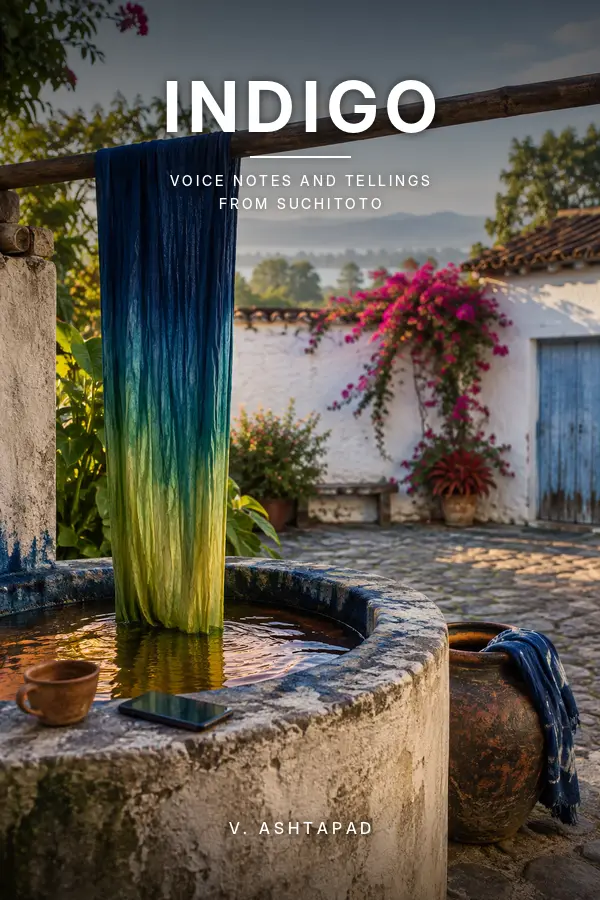
Indigo
Voice Notes and Tellings from Suchitoto
by V. Ashtapad
Foreword
This is a work of fiction. The family behind the green door, their neighbors, the shop by the square and the boat that coughs are all invented. Suchitoto, Lake Suchitlán, the stone columns at Los Tercios and the blue hill of Guazapa can be found on any map; the village under the water cannot, because I made it up.
The story comes in two voices. A fifteen-year-old talks into her phone for friends two thousand miles away, and her grandmother, an indigo dyer, talks while her hands are in the vat. The girl recorded those tellings and put them into English herself, a little clumsily at first, then less so. Her bracketed notes are left in, because watching her stop needing them is part of the story.
The Salvadoran Spanish is kept as these two would say it, and the meaning usually arrives a line or two later. The dye method is one invented family's way of working. Every dyer who keeps a living vat will tell you hers is different, and she will be right.
For every grandmother who taught with her hands, and for whoever comes after.
La Remesa Has Landed
**Day 1 · 365 to go · 1:58**
Okay. Okay okay okay. I'm in the bathroom of the airport because it's the only place nobody is looking at me like I'm a suitcase that showed up without a tag. K, D, if you can hear a hand dryer, that's not a jet engine, that's just how they make them here, like they want your hands gone.
So the plane came down over the ocean and then over these fields that are cut into strips, green and then brown and then green, and the ground is so close to the water I thought the pilot was going to land us on a beach. There were palm trees in rows like somebody planted them for a screensaver. And then the door opened and the air came in, and I swear to you, it's not hot like the Valley. The Valley is a hair dryer. This is like somebody breathing on you. Somebody who just ate a mango.
My mom's cousin was supposed to pick me up but it's my Tío Chepe instead, who I have seen on a screen like four times and he looked bigger on the screen. He's holding a piece of cardboard that says YAMILETH in marker with the H backward. The H. How do you get an H backward. It's the same both ways.
Anyway I have to go out there. Wish me luck. Bye.
**Day 1 · 365 to go · 3:41**
I'm in a truck. It's a white pickup that is not Tío Chepe's, he says it's his compadre's, and the windshield has a crack across it from one corner to the other like a lightning bolt somebody drew on purpose. Every time we hit a bump, which is every second, I watch the crack to see if it grows. So far it's holding. So far I'm holding. Same energy.
Okay so what you need to know is: the highway from the airport is like the 5 if the 5 had cows. Not on it. Next to it. Standing in the ditch with their faces in the grass like they're on their phones. And people sell stuff right where the cars slow down, these ladies with plastic tubs on their heads, and the tubs are full of, I don't know, little bags of something orange cut into sticks, and a guy with a pole across his shoulders and bags of water hanging off it. Bags. Of water. Tied at the top. Tío Chepe bought me one and showed me you bite the corner and suck. I did it and it squirted on my hoodie. So now my hoodie has a wet spot right on the V of VALLEY. Very symbolic. Thank you, El Salvador.
Tío Chepe drives a bus for his real job, a big one that goes to the capital every day, and he drives this pickup like it's that bus. He keeps one hand on top of the wheel and the other arm out the window, and he honks to say hi to people, and he honks to say move, and he honks to say I see you, and they're all the same honk. He asked me, in Spanish, if I eat everything. I said yes. I meant like, I'm not allergic. He took it to mean like, I'm going to eat everything. Which, okay, we'll see.
There are mountains. I forgot there would be mountains. My mom only ever talked about the lake. These ones are dark green on the bottom and blue at the top, like the color drains up out of them, and there's one bigger one sitting by itself that's the bluest, kind of hunched over, and Tío Chepe pointed at it and said "Guazapa," and then didn't say anything else for like a full minute, which for him is a record.
I'll send more when I'm not getting thrown at the ceiling.
**Day 1 · 365 to go · 2:20**
Daisy, I heard you. No, I didn't cry at the airport. I cried at LAX in the security line because my dad did that thing where he doesn't hug you, he just puts his hand flat on top of your head like he's checking if you're done baking, and then he turned around and walked away fast. That's different. That one doesn't count. That one was his fault.
Kenia, stop asking if there are cute boys. I've been here three hours and I've seen cows.
**Day 1 · 365 to go · 4:12**
Okay so we're here. Suchitoto. I'm going to describe it to you because I'm not posting anything, I already told you, I'm not doing a whole "my journey" thing, because it's not a journey, it's a sentence.
So imagine a town that's all on the top of a hill and the hill is falling down to a lake on one side. The streets are made out of rocks. Not bricks. Not like cute cobblestone from a movie where they're all the same shape. Rocks. Round ones, like somebody took a whole river and turned it on its side and stuck it in the dirt. When the truck goes over them everything inside you rattles, your teeth, your earrings, your opinions. And the houses are all touching each other in a line, all one floor mostly, with red roofs made of those curved tiles that look like somebody cut a pipe in half, and the walls are painted these colors that should not be next to each other. A yellow like the inside of a lemon next to a pink like gum next to a turquoise next to a red like a fire truck. And the windows don't have glass, or they do but you can't see it because there's these wooden bars over them, fat ones, turned on a lathe or whatever, like the legs on Mrs. Sandoval's dining chairs, all in a row.
Tío Chepe stopped by this big square with trees, and at one end there's a church that's totally white with two little towers, and I mean white white, like correction fluid, and the sun was right on it so it hurt. I had to look at it through my fingers. There are men sitting on benches under the trees doing nothing, professionally. A kid on a bike went by with a speaker in his basket playing cumbia so loud it was coming out crunchy. A dog was sleeping in the exact middle of the street and the truck went around it. Around it. Like the dog had the right of way. I think the dog did have the right of way.
And then we went down. Down from the square. The street just tips, and the rocks get bigger and farther apart, like the street is giving up. And the houses get plainer, the paint older, some of them just the color of mud, which I guess they're made of. And down at the bottom of every gap between houses there's the lake, this flat gray-blue plate with a haze over it and hills on the other side, and birds, white ones, in a line, flying so low over the water it looks like they're ironing it.
Four blocks down there's a door that's green. Like, green green. Parrot. My grandmother's door. Tío Chepe honked at it. The door honked back. Just kidding. The door opened.
**Day 1 · 365 to go · 5:08**
I'm lying in a hammock writing this, I mean saying this, it's dark, and there's a lizard on the wall above me making a noise like somebody clicking their tongue at me for being disrespectful, which is crazy because I haven't even done anything yet.
So. My grandmother.
Okay you know how my mom has those photos on the fridge, the one where my grandma is standing in a yard with her arms out of the water? Like up to the elbows in this big clay pot, and her arms are dark blue to the elbow, and she's looking at the camera like the camera owes her money? That's her. She's just older. She's so small. She's shorter than me and I'm five one. Her hair is gray and in a braid that goes around the back of her head and it's held with a wooden clip like a clothespin. And her hands. I wasn't ready for her hands. They're wide, like a man's, and the lines in them are blue. Like ink. Like somebody traced over every line in her palm with a ballpoint. Under the nails too. It doesn't wash off. I asked. Well, I didn't ask her, I asked Tío Chepe, in the truck, in English, which he doesn't speak, so I asked with my hands, scrubbing, and he laughed and said "Nunca," which even I know.
She didn't hug me either. I'm noticing a theme with my family. She took my face. Like with both hands, she held my whole face, and she looked at it close, close, like she was reading something small on it, like an ingredient list. And she smelled me. I'm not making this up. She leaned in at my neck and smelled me. And then she said, "Sos Mirna," which means you're Mirna, which, no, I'm not, I'm me, and then she said, "pero con zapatos," but with shoes, and she looked down at my sneakers, which by the way are still white, I wiped them on the plane with a wet napkin, and she laughed. Not a big laugh. Like one puff out of her nose. Like the laugh was a little animal and she let it out for a second and then put it back.
And then my cousin.
Noé. Seventeen. He's skinny like a bike and he has a sunburn just on his nose and a baseball cap with a fishing hook stuck in the brim, like on purpose, like an accessory. He was leaning in the doorway that goes to the back with his arms crossed and he looked at me and looked at the suitcase and then said to Tío Chepe, not to me, "¿Esta es la remesa?"
I know remesa. Remesa is the money. Remesa is what my mom sends on the first of every month from the place on Van Nuys with the yellow sign. So I'm the money. Like I got mailed.
Tío Chepe told him to shut up, but laughing, so it doesn't count.
**Day 1 · 365 to go · 2:47**
I need to tell you about the smell.
There's a yard in the back of the house, a courtyard, open to the sky, dirt floor, a big tree with little brown pods hanging off it that Noé says is tamarind, and another tree I don't know, and a cement sink thing with three tubs in a row like a giant ice cube tray, and then on one side there's a roof on posts, no walls, just tiles on top, and under it there are these three huge clay pots buried in the ground up to their shoulders. They have wooden lids and the lids have old feed sacks on top. That's where the blue comes from. That's the dye.
And the smell. Okay. Imagine if a bag of bananas went bad in a car in August, but also somebody's been watering a garden with old soup, but also a little bit like a new pair of jeans when you first open the bag, that like, chemical blue smell? But it's not chemical. It's alive. It's coming out from under the sacks like breath. It's everywhere in the house. It's in the hammock. It's in my hair already. It's in the tortillas, I'm pretty sure. Nobody else even notices it. When I made a face, my grandmother saw the face and said something to Noé and Noé said, in English, his English is actually okay which is annoying, "She says it's the smell of the house paying for itself."
Which, rude, but also kind of a good line? I'm stealing it. Not for anything. Just in general.
**Day 2 · 364 to go · 3:30**
It's five in the morning. I know because there are roosters. Plural. I'm going to describe the roosters' schedule for you. The first one starts at like four, and he's far away, maybe across the lake, and he's polite about it. Then one closer goes off like he's mad the first one went first. Then one on literally this roof, I heard his feet on the tiles, goes off like a car alarm. Then they all do it together like a group chat at two a.m. when somebody sends something wild. Then a dog. Then somebody's radio with a man talking very fast and very happy about something. Then somebody sweeping. Then church bells, way up the hill, like somebody dropping pans in the next building. Then a truck with a speaker going by slow, a recording of a man saying something over and over about gas, cilindros de gas, cilindros de gas, cilindros de gas, like a song that only has one line.
And I'm lying here in the hammock and I'm thinking, at home right now it's three in the morning and my mom is just getting off, she's in the car in the parking structure in Burbank with the seat back for five minutes before she drives home because she says if she doesn't sit with her eyes closed first she'll drive into the wash. And she does that every single night. And I think about that a lot. I didn't use to.
Anyway. Roosters.
**Day 2 · 364 to go · 4:55**
Breakfast was beans, the kind that are all mashed up and fried till they're almost like a paste, and a piece of white cheese that squeaked on my teeth, and a fried egg, and tortillas that are thick, way thicker than at home, and cream that's sour and runny that you pour on everything, and a fried banana, not a banana, a plantain, that tasted like it had brown sugar in it but it didn't, it was just itself. And coffee. My grandmother gave me coffee like it was nothing. In a cup with a chip in it. No questions. At home if I had coffee my dad would act like I bought a motorcycle.
She didn't eat with me. She was already in the back. I went out there with my cup and she was taking the sacks off one of the clay pots, slow, folding each one in half and in half again, and putting them on a bench, and then she took off the wooden lid. And she put her face over it. Like close. Like how you smell a candle at Target. And she stayed there for a long time. Breathing.
I was going to take a picture and she said, without looking up, "No."
Just no. Not even no gracias. How did she know? Her back was to me.
Then she put her hand in. Her bare hand, flat, on the top of the water, like she was feeling for a fever. The water is like a dark green? Like a pond. And it has a skin on it, a shiny skin, like a coppery purple shine, like oil in a parking lot after it rains, and when she touched it the shine broke up into pieces and then went back together.
She said something to me. A long thing. I got maybe a third. Something about the pot being hungry. Or tired. Hambre or hombre, I couldn't tell, and there's a big difference.
**Day 3 · 363 to go · 2:15**
My mom made this family page thing. I'm sure you've seen her talk about it, she's obsessed. It's private, only family can get in, all the aunts and the cousins in Houston and here, and they post pictures and birthdays and stuff, and she made a section that's like a line of years, with old photos stuck on it in order. She sent me a voice note this morning, here's what she said, I'm going to play it, hold on.
[Mom's voice, tired:] "Mija, I put the picture of your Mamá Mela from eighty-nine on the family page, the one with the tinaja, go look at it, and put a picture of you with her, okay? So your Tío Ever can see you arrived. Okay? Love you. Eat."
I'm not posting anything. I'm not taking a picture with her like it's a meet-and-greet. "So Tío Ever can see I arrived." Like I'm a package. Signature required.
I looked at the old photo though. Fine. She's thirty-four in it. She's standing in this same yard. The tamarind tree is little, like skinny. She has her arms in the pot up to the elbow. She's not smiling. Same exact face she gave me. It's genetic. I have that face. People at school call it my "I'll wait" face.
I'm not posting.
**Day 4 · 362 to go · 3:52**
Okay so, I've been avoiding saying it because I know you're both going to ask and you already know anyway because everybody at school knows. But my grandmother asked last night. Not like that. She didn't say "So, you split a girl's lip and broke her phone in the hallway in front of a vice principal." She said, in Spanish, "Your mother says you have a temper." And I said, "Mi mamá también." My mom too. Which is true. And she looked at me with that close-up face again, like she was trying to read the small print, and she said, "Sí. Igualitas." Same. Exactly the same.
And then she said this other thing, which Noé had to translate because he was there, smirking. He said she said, "Here the temper has a job. You'll see." And then he said in English, just to me, "She means you're going to work, gringa."
They call me gringa. Everybody. The lady at the corner store with a parrot. The kid on the bike with the speaker. I have been called gringa four times in three days. At home I'm the Salvadoran girl. I got called "pupusa" in sixth grade like it was a burn. Here I'm the gringa. So I guess I'm nothing, actually. I'm the space between two words.
I don't want to talk about the Jazlyn thing. Not yet. Ask me in a month.
**Day 4 · 362 to go · 1:30**
Last one tonight. I'm in the hammock. The lizard's back. It's dark, really dark, darker than I've ever seen, like the town just turned off. I can hear the lake. I didn't know you could hear a lake. It doesn't crash like the beach. It's more like somebody in the next room turning pages, slow. Little slaps. And there's frogs, so many, and something that buzzes in a tree like a wire.
And I can smell the pots from here. That bad-banana, new-jeans, old-soup smell. It's weird. Tonight it kind of smells like somebody's home.
Don't let anybody take my seat in second period.
What the Pot Ate for Breakfast
*Recorded by accident, Monday, February 3, on the bench beside the tinajas. I had opened the recorder to send a note, she handed me a knife, and I put the phone down. It ran thirty-one minutes. I found it in March. Translated by me, Yamileth, with Noé for the hard parts. Where she talks to me, she is talking to me. —Y.*
No, not like that. You hold it like it's going to bite you. Give it here. Look. Hold the panela like this, on the board, flat, and the knife you pull toward you, a little, a little, like you're peeling the skin off a cold morning. You don't chop. Chop and it jumps and you lose half on the floor and the hens have a party. Shave. You hear that? Shhh, shhh. That's the sound. That's a good sound. If it goes tock, tock, you're chopping.
[Panela is the brown sugar that comes in a hard block shaped like a little drum. It smells like burned caramel and dust. —Y.]
Enough. That's enough. A handful. Like what you'd give a horse if you liked the horse but not too much.
Now the guineos. Those ones there, the ugly ones, black. Don't make that face. The black ones are the sweet ones. The yellow ones are for people. The black ones are for her. Peel them, put them in the bowl, mash them with your hand. With your hand, Yamileth. It's a banana, it's not going to kill you. There. Squeeze through the fingers. Feel how it goes warm? A black banana is always a little warm, it's already cooking itself inside. That's what she wants. Something already on its way.
[I remember this. I remember thinking it felt like putting my hand in a bowl of somebody's brain. I am leaving that in so you know I was not into it. —Y.]
Bring the bowl. Bring the panela. Come.
Now the lid. You take the sacks first. Fold them. Every time, fold them, don't throw them on the ground, the ground has ants and the ants will ride into her and then you have ants in the blue and you'll be picking them out of a shirt for a week. Fold in half, in half again. Put them on the bench. Now the lid. Both hands. It's heavy because it's wet. Mino made these lids out of a door. An old door from the house in Los Jícaros, the house before. You can still see where the hinge was, there, the three holes. Feel them. Put your finger. Yes. Those holes went into the lake with nothing in them.
Now, before anything, before you give her anything, you smell.
Put your face down. Not like that, you're not drinking it. Put your face over her the way you'd put your face over a baby to see if it's asleep. Close. Closer. And now breathe through your nose, slow, and don't think anything. Don't think "this is ugly." Don't think "this is like a dead dog." You think that later. First just smell.
What does it smell like?
No, tell me. In words. Any words. Here nobody is going to give you a grade.
Like the bottom of a refrigerator? [laughs] All right. All right. That's not bad. That's not bad at all. What else?
Like jeans. Yes. That's her, that's the blue. The blue has a smell that is like new cloth, sharp at the front of the nose, like when you cut a lemon but without the lemon. And under it?
Sweet. Yes. Sweet and sour together, like a fruit that was forgotten on the table. Good. And under that, way under, the last thing, at the back of the throat?
You don't know. You don't have the word. That's all right, I'll give you mine. It's rained-on rock. Like when it rains on the street for the first time after the dry months and the rocks give back the smell they were keeping. That's the bottom of it. When she smells like rained-on rock at the bottom, she's alive and she's well. When there's no rained-on rock, she's sleeping, or she's sick.
My mother taught me this way. Every morning, before school, before I ate, before I even had my shoes on, she sent me out to the pot. We had one pot. Just one, not three like this, we were poor people, we dyed our own clothes and the neighbors', the shirts of the men for the fields, the skirts. She sent me out barefoot and she said, "Go tell me what she says." And I went out in the cold, because in the morning by the water it was cold, the mist came up off the river like steam off a pot of corn, and I lifted the sack and I put my face down and I came back and I told her.
And I had to use words. She didn't let me say "good" or "bad." She said good and bad are words for lazy people. I had to say what it was like. I said like the river after the cows walked in it. I said like a sweet that went to sleep. I said like the inside of my grandfather's hat. She laughed at that one. She laughed so hard she had to hold the door. But she said, "Yes, that's right, that's the salt," because my grandfather sweated like a mule and his hat was full of salt, and when a pot has too much of the cal it smells a little like that, like salt and old sweat and something that bites.
So from the words I said she knew. She knew if she was hungry. She knew if she was sick. She knew if she was angry. She knew if she was content. Four things. A pot is four things, like a person in the morning.
[I asked Noé if "she" was right, because she always says ella for the pot. He said yes, she means the tinaja and also the dye, both, like they're one person. He said, "Don't ask her why, she'll tell you for an hour." —Y.]
You want to know how to tell. Of course you do, you're my granddaughter, you want everything right now, all at once, so you can be finished with it. All right. Listen.
Hungry. When she's hungry the smell is thin. Like water that sat in a jar. There's blue at the front but nothing under. The sweet is gone, she ate it, she's waiting. And the skin on top is pale, or there's no skin.
Sick. You'll know sick. Sick smells like eggs that went bad, like the drain in the market in April. And the water goes brown, not green. A brown like coffee with too much milk. When she's sick you have to be patient and give her very little and wait. Sometimes you lose her. I lost one in 1998. Three years old, that pot. I cried more than for some people. Don't tell anybody that. [She laughs here, small. —Y.]
Angry. Angry is when somebody gave her too much cal. Too much cal and she gets sharp. She smells like the inside of the bag of cal, that dusty biting smell, and her skin on top goes thick and shiny, like a man's forehead in the sun. And she won't give you blue. You put a shirt in and you take it out and it's gray. Gray like a pigeon. She's punishing you. You have to feed her sweet and wait, and talk to her nicely.
And content. Content is what she is now. Smell again.
There. You see? Front, middle, bottom. Sharp, sweet, stone. And look at the top. Look. Bring your face down at the side, low, like you're looking along a table for crumbs. You see the skin? That copper? Like the inside of a lake clam, like the neck of a pigeon in the sun, purple and gold and green all moving? That's the flor. The flower. When she makes a flower, she's ready to work. She's saying, I have blue for you. Bring me something.
Today we're not bringing her anything. Today we feed her. She worked hard on Saturday. She gave me twelve scarves for Delmy and two tablecloths for the lady from the capital with the little dog. She's tired. So.
Give me the guineo. All of it. With your hand, put it in, go on. Lower, by the edge, don't drop it from up there like a bomb. Let it slide in at the edge. That's right. Now the panela, sprinkle, sprinkle, all over, like sugar on a child's sweet bread. Now, the stick.
The stick is that one. No, the one with the blue all up it, the one that looks like a bone. That's eleven years old, that stick. It's guayabo, guava wood, it doesn't rot. You stir always in the same direction, toward the hand that holds the spoon at the table. Like this. Slow. Slow. You're not beating eggs. You're turning her over in bed. You go around once, twice, ten times, and you watch the flor break and go to the sides and climb up the clay. That's good, let it climb.
And now the cal. Just a little. Look how little. A spoon, from the can, and not a full spoon. Level it with your finger. Off. Off. Now half of what's left. Throw that back in the can. There. That. Into her, and stir again, the same way, ten more.
How do I know how much? Cipota, I've been doing this since I was smaller than that bucket. My mother's hand is in my hand. You don't know yet. You'll do it wrong. You'll make her angry. Everybody makes her angry the first year. Mino made her angry for three years. He put cal in her like he was salting a soup for soldiers. [laughs] Every time he did it I said, "Herminio, she's not your enemy." And he'd say, "Mela, she's not my friend either."
He died in the rains, four years ago, in 2021. Not from rain. From his heart. In the hammock you sleep in, in the afternoon, after lunch. He was asleep and then he was more asleep. That's how I'd want it. Don't get sad, I'm only telling you because you're lying in his hammock every night and it's yours now, so you should know whose it was.
Now cover her. The lid. Both hands. No, the other way, the holes go toward the tree. There. And the sacks. Unfold, unfold, one on top of the other, crossed, so the light doesn't get in at the edges. She likes the dark when she's eating. Like a dog. Like you, also, I noticed. You eat like somebody's going to take the plate.
Now, tomorrow, early, before your school, you come out here. Barefoot or with your shoes, I don't care, your shoes are going to be blue by the rains anyway, I can tell you that right now, you can scrub them with your little napkins every night, they're going blue. You come out and you lift the sack and you smell her, and you come in and tell me what she says. In words. Your words, any words, refrigerator, jeans, I don't care. Every morning.
Why? Because you've got that little window in your hand all day and you look into it, and look into it, and look into it, and you talk to it. I see you. You talk to it in English, very fast, with your hand flapping like a hen trying to fly. That's fine. Talk to your friends. But the little window only goes in one direction. It doesn't come in through your nose. Nothing comes in through the window to here.
[She puts her finger on my chest. I remember that. —Y.]
What you learn with your eyes, you know. What you learn with your nose, you keep. That's not from my mother, that's from me. I made that up. I think it's true. You'll tell me in fifty years.
My mother had good eyes, until the end. Eyes like a hawk. She could see a thread loose across the whole yard. I have a good nose. Everybody has something. Mirna had good ears. She could hear me thinking. She'd say, "Mamá, don't think that so loud." [laughs] What do you have? I don't know yet. You don't know yet either. You only know temper. Temper isn't a gift, temper's just heat. Heat can cook something or it can burn the bottom of the pan. Your mother burned a lot of pans. Then she learned. She left here and she learned. She's a good cook now, she tells me, in the North. Pupusas on Sundays for the whole building.
El añil no tiene prisa. The blue is in no hurry. Remember that one. That's my mother's. I don't know where she got it. Probably she made it up too. Everybody in my family makes things up and says it's old.
Are you crying? No. It's the cal. The cal gets in your eyes. Go wash at the pila, there, the clean side, the left one, not the right one, the right one is for the cloth. Splash, splash. With your hands, don't rub. Good.
Look how your hand is. You see? Blue in the lines. Just a little, you only touched her edge. That's from her skin, the flor. Tomorrow it'll be lighter. In a week it'll be gone. If you keep coming, it won't be gone. That's how you know who works here. Look at mine. Every line gone blue. Bita says I have all the rivers of the country drawn on my palms, and she's going to follow them to the sea.
All right. Enough. Pick up your little window there, it's been sitting on the bench this whole time watching us like a frog. Is it on? What do I know if it's on. Turn it off, it's eating the light.
She ate. Now we eat. Your Tía Dinora sent pupusas de ayote. They're cold by now. That's your fault, you talk too much.
Pupusa Probation
**Day 18 · 348 to go · 2:44**
Morning report. Every morning I have to go out barefoot, take the sacks off one of the pots, put my face in it and come back and tell my grandmother what it smells like. In words. "Good" is not allowed. She says good is for lazy people. So I'm going to start sending you the reports because if I have to suffer, you have to suffer.
Today the middle pot smells like a gym bag that went to college. Like it's smart now but it's still a gym bag. I said that to her in Spanish, which was hard, I said "como una bolsa de gimnasio que fue a la universidad," and she looked at me for like five seconds and then she said "Hambre," hungry, and went and got the black bananas.
So apparently gym bag that went to college means hungry. I'm learning a whole language here and it's not Spanish.
**Day 18 · 348 to go · 4:10**
School. Okay. I'm in noveno. That's ninth. My mom set it up from LA with a lady at the school she knew from when she was little, and the deal is I do this school here and online credit recovery stuff for LA at night, and if I pass both I don't have to repeat. So I'm doing two schools. So I'm doing double school for one crime. That's not even legal.
The school is a yellow building with a blue stripe around the bottom like it's wearing socks, and a big yard of dirt with a basketball hoop with no net, and a tree in the middle with a bench around it, and everybody in a uniform. The uniform is a white shirt and a navy skirt. Navy. Blue. I live in a house of blue and now I'm wearing blue to school. I can't escape it. I put it on this morning and my grandmother touched the skirt between her fingers, rubbed it, like she was checking the price, and said "Química," chemical, and made a little noise like tsk. My skirt is a chemical. Okay. Thanks.
There's forty-one kids in my class. Forty-one! In one room! With fans on the ceiling going so slow you can count them, wop, wop, wop, and the windows are just open, just holes with bars, so a bird came in during math and sat on the board and the teacher kept going. The teacher, Profe Ulloa, he's like sixty, he has a mustache that's gray on one side and black on the other, I don't know how, and he wears the same sweater vest every day, brown, with a hole by the pocket, and he talks so dry. He was like, "Señorita Portillo comes to us from Los Ángeles," and he said Ángeles like it was a sandwich he didn't order. And then he said, "She will tell us later how the Lakers are doing." And everybody laughed. And I laughed! Because it was actually funny. He's funny. He's my favorite person here and I hate it.
**Day 18 · 348 to go · 3:36**
There's a girl. There's always a girl.
Her name is Grisel and she sits in front of me and she has a braid so tight it pulls her eyebrows up, like she's always surprised by how bad you are, and at break she turned around and looked at my shoes. My white shoes. I wiped them last night. They are perfect. And she said to the girl next to her, loud enough, "Ay, la gringa trae zapatos de astronauta." Astronaut shoes. And they laughed.
And then she asked me how do you say "whatever" in Spanish. Like that. Like she was asking for directions. And I said "No sé," because I panicked, and she said, "Ah, then it's English," and everybody laughed again.
And here's the thing, K, D, you would have been proud of me, I didn't do anything. I sat there. My face was so hot I thought my eyebrows would come off. And I thought about Jazlyn, and the vice principal's office with the carpet that smells like Cheetos, and I counted the fan going around. Wop. Wop. Wop. Eleven wops. And then the bell rang, which is not a bell, it's a guy with a piece of metal and a hammer.
So I didn't do anything. That's something. Right? That's a thing I didn't do.
**Day 19 · 347 to go · 1:15**
Morning report. Left pot. It smells like when you open a jar of pickles and somebody had their fingers in it. My grandmother said "Bien." Which she's not allowed to say! She told me good was a lazy word! I said that. She said "Yo puedo. Vos no." I can. You can't.
I'm going to lose my mind in this house.
**Day 20 · 346 to go · 5:30**
Okay so my Tía Dinora. She's my mom's older sister and she has a pupusería in the front room of her house on the corner, which is like, two minutes up the hill. It's called Pupusería Bita, after my little cousin Bita, who is eight and has no front teeth and whistles through the hole, on purpose, all the time, like air coming out of a bike tire. Noé painted the sign when he was twelve, it's red and yellow and there's a pupusa on it with a face and the face has eyelashes. That's it. That's the logo. I love it.
So my grandmother sent me there after school to "help," and helping turned out to be learning to make pupusas. Which, I've had pupusas a thousand times. My mom makes them Sundays for the whole building. Mrs. Sandoval's husband eats like nine. But I never made them because my mom never let me touch the masa because she said I'd play with it.
Okay so picture the room. It's the front room of a house, you can see the bedroom through a curtain. There's two plastic tables, red, and plastic chairs that are white but kind of gray on the seats. There's a TV on a shelf way up near the ceiling playing a soccer game with no sound. And by the door, so people on the street can see, there's the comal, which is a big round flat piece of iron like a giant pan with no sides, on top of a stove that's half bricks, half gas. And the comal is black. Like black black. Like it's never been not black. And there's smoke, a little, coming off the edges, and the smell is corn and burned cheese and wood. Like a campfire that's also a restaurant.
And my tía, she stands there and her arms are going like this, I can't show you, like a machine, and on her forearms there's burns, little old ones, white lines and shiny spots, and she doesn't even notice when she touches the edge of the comal. Her laugh. Oh my gosh, her laugh. It's like a stack of pots falling down a staircase. BANG, bang-bang-bang-bang. You can hear it from the street.
Next to her there's a red plastic bowl with water in it and a shine of oil on top, and before you touch the masa you put your hands in the bowl. That's so the masa doesn't stick. And then you take a ball of masa, like the size of a tangerine, and you make a hole in it with your thumb, and you make it into a little cup in your palm, and you put the filling in, today it was ayote, which is like a squash, cooked soft with cheese, and then you close the cup, pinch it shut at the top like a little bag, and then — this is the part — you pat it. Between your hands. Back and forth, back and forth, turning it a little every time, clap clap clap clap, and it gets flat and round and thin, and you put it on the comal.
That clapping. I didn't know until today. When I walked up the hill at six there was clapping coming out of like every third door. It's the whole town. Everybody making dinner at the same time, clap clap clap. It's like the town is applauding something and nobody will tell me what.
**Day 20 · 346 to go · 3:48**
Mine broke.
Every single one. Six. The first one the hole I made with my thumb went through the bottom. The second one I put too much filling and when I patted it the squash came out the side like toothpaste. The third one was okay until it hit the comal and then it split open like a mouth and the cheese came out and hit the iron and screamed. Like literally made a screaming noise. Sssssss. And smoked. And my tía laughed so hard, the pots-down-the-stairs laugh, BANG, bang-bang-bang, that she had to put her hand on the wall.
Bita ate all of them. All the broken ones. She sat on a crate next to me and every time one broke she held out her hand and said "Esa es mía," that one's mine, and I gave it to her and she ate it with her fingers, blowing on it, whistling through her teeth at it like she was calling a dog.
Then Noé came in. He'd been on the lake all day, he works on a boat that takes tourists out, he smelled like gasoline and fish and sun, which, I didn't know sun had a smell but it does, it's like hot plastic. And he looked at my pupusas and he said, in English, so his mom wouldn't get it, "In LA they buy them frozen, huh."
And I said they do NOT. My mom makes them every Sunday. And he said, "With what? With the remesa she doesn't send?"
Which, I don't even know what that means. She sends it every month. She sends it the first. So I said that. And he said, "I know when she sends it. Everybody knows when she sends it." And walked into the back.
My tía threw a towel at him. It missed.
**Day 21 · 345 to go · 2:22**
Daisy, I heard your voice note, you asked what's the big deal with the money, and I don't know. I've been thinking about it. Here's what I know. My mom sends money to my grandma. She's sent it since before I was born. That's how my grandma got the new roof, my mom told me that once. And the medicine for her blood pressure. And I think Noé's school, the part you pay for. And my tía's comal, the new gas part. My mom tells everybody on the family page when she sends something big, like "Your new comal is on its way, Dinora!" with like six hearts.
So I think maybe that's it. Maybe it's not the money. Maybe it's the hearts.
I don't know. I'm fifteen. Don't ask me about economics.
**Day 22 · 344 to go · 4:44**
Market. Saturday. My grandmother took me, which took forty minutes for four blocks because she stops and talks to every single person. Every single one. Each conversation is the same: How's your knee. Ay, the knee. And your daughter? In the North. Ah, this is the granddaughter? Yes, from the North. Ah, the gringa. And they look at me like I'm a coat they're thinking of buying.
The market is behind the square, under these tin roofs that are all at different heights, so where they meet there's slices of sun coming down in lines, and the light's full of dust and smoke so the lines are solid, like you could hang a towel on them. It's narrow, the aisles, and there's stuff hanging from everything. Bunches of bananas hanging from hooks. Plastic bags hanging, filled with beans, filled with rice, filled with something red. Pig legs hanging. A whole wall of hammocks, every color, folded up like flags. Strings of chiles. Big bags of these dried yellow flowers. And the floor is wet in some places and sticky in others and once it crunched.
And the noise. Everybody's yelling. Not mad. Just prices. A guy at the meat with a little radio on top of his scale, and the scale is the kind with a needle that swings, and a lady screaming "¡Aguacates, aguacates, aguacates!" like she's warning everybody that the avocados are coming. A man whistling at a kid. A rooster in a box. And under all of it, this sound of knives, chopping on wood, from the chicken place, tock tock tock, like a clock that's running too fast.
And the smell is like every smell at once. Raw chicken and cilantro and woodsmoke and rotting fruit and a perfume lady and fried pork and bleach. You walk ten feet and it's a different smell. Like changing the station.
My grandmother walks through all of it slow with her hand out, kind of touching things. Touching the bag of beans as she goes by. Running her fingers along a stack of cloth. Pressing an avocado without even looking at it. It's like she's reading the market with her hand. I noticed that. I don't know why I'm telling you. I just noticed it.
**Day 22 · 344 to go · 3:20**
There's a lady at the end of the market called Niña Tencha. Niña is not because she's a little girl, she's like sixty-five. It's just what you call a lady here, Niña, like Miss. She has a stall under a sheet of blue plastic so everything at her table is blue, the light is blue, her face is blue, it's like being underwater. And she sells atol shuco.
Okay so atol is like a hot drink made of corn, thick, and shuco means dirty, but it's not dirty, it's just dark. It's purple-black, like the color of a plum skin, and she ladles it out of a giant aluminum pot into a bowl that's made of a gourd, like a dried hard fruit cut in half and polished. A huacal. And then she puts in a spoon of black beans that sink, and then she sprinkles this green-brown powder on top that's ground-up pumpkin seeds, and a little chile. And you drink it. Out of the gourd. Hot. With the beans in it.
It tasted like sourdough and smoke and corn and somebody's kitchen in the morning. It tasted kind of sour, like it was fermented, which, my grandmother said it is, it sits overnight. And the beans at the bottom are a surprise you eat with your fingers.
I liked it. I hate that I liked it. Niña Tencha watched me drink the whole thing and then she said, "La chelita sí come." The little blondie does eat. I'm not blond! My hair is literally black! But chela means like light-skinned, Noé said, or foreign, or both. So here I'm a gringa and I'm a chela and I'm a remesa. I'm collecting names like Pokémon. Noé says people from here call themselves guanacos, Salvadorans, guanaco, like a nickname the whole country agreed on. I asked if I'm a guanaca. He said, "Sí. De importación." Imported. Then he said it again to Bita so she'd laugh.
**Day 25 · 341 to go · 2:58**
Tía Dinora took a picture of me at the comal and put it on the family page. Without asking. Me with masa on my hands up to the wrists and my mouth open because a pupusa had just exploded. My uncle in Houston, Tío Ever, commented right away, at like six in the morning his time. He wrote, "La cipota ya tiene las manos." The girl already has the hands. Which, no, I don't, they broke, all of them.
But then I scrolled. Because I was mad. And there's that line of old pictures my mom made, in order by year, and in 2009 there's a picture of the pupusería the day it opened. Same comal, but newer, not black yet, gray. Same red table. My tía with long hair and no burns on her arms. And on the table, in a diaper, sitting right in the middle like a centerpiece, there's a baby with his fist in his mouth. And the caption says "Noé, primer cliente." First customer.
He's been sitting at that table his whole life. I've been here twenty-five days.
**Day 28 · 338 to go · 3:05**
Last one. Okay so I made one today. One pupusa. It didn't break. It was flat and round and the filling stayed in and it went on the comal and it didn't scream, it just sizzled a little, like normal, like it was breathing. And it got those brown spots on it like a leopard. And my tía flipped it with her bare fingers, which, how, and slid it onto a plate, and she put curtido on it, the cabbage that's sour and has oregano and carrot and is kept in a big jar on the table with a fork stuck in it, and red sauce, thin, the tomato kind, and she gave it to — guess who.
Noé.
He was sitting at the red table with his cap with the hook in it, scrolling on his phone. She put it in front of him and said, "La hizo la gringa." The gringa made it.
He looked at it. He looked at me. He ate it. All of it. In four bites. Didn't say anything. Wiped his fingers on his jeans. Got up. And at the door, on his way out, without turning around, he said, "Le faltó sal."
Needed salt.
That's the nicest thing he's ever said to me, I think? I'm not sure. I'll ask my grandmother tomorrow. She'll make me describe how he said it. In words.
The Village with Water for a Roof
*Recorded on the end of the dock at Puerto San Juan, Sunday, March 2, while we waited for Noé's boat to come in. She asked me to record this one. She said, "Put it where Mirna can hear it." I put it on the family page that night without listening. I listened in March. Translated by me. —Y.*
Is it on? The little red? Good. Then hold it still, don't wave it around, I want her to hear me, not the wind.
Mirna. This is your mother. Your daughter is here with me on the dock. She's sitting with her feet hanging over the water in those white shoes and she won't take them off because she thinks there are fish that bite. There are no fish that bite. There are fish that look at you. She's fine. She eats. Dinora is teaching her pupusas and she's terrible, like you were. Don't worry.
Now I'm going to talk to her. You can listen too.
Yamileth. Look out there. Straight out, past the boats. Past where the green plants float. You see where the water is a different color? Lighter, like milk in coffee? A long shape, going that way toward the hill?
That's the road.
[I asked her what road. She said, wait. —Y.]
Wait. Let me tell it in order, or I'll tell it wrong.
When I was a girl, this wasn't a lake. This was a river, and fields, and a little town with a plaza and a ceiba in the middle of the plaza, a huge one, with roots that came up out of the ground like the backs of cows lying down. The town was called Los Jícaros, because of the jícaro trees, the ones with the round green fruits that hang right on the trunk like somebody stuck them there with glue. Those are the ones you make the huacales from. The bowls. Niña Tencha's bowls, that she serves the atol in? Some of those trees were in Los Jícaros. Not the same trees. Their grandchildren.
We lived in a house of bajareque. You don't know bajareque. It's a wall made of sticks, woven, like a basket, and then mud pressed in, and lime on top so it's white. In the rain the walls smelled like a clay pot. In the dry months they cracked in little lines like an old woman's cheek and you could look through the lines and see the chickens.
Our house was four houses from the plaza, toward the river. The river was a big brown one, slow, the Lempa, and a little one came into it, a clear one, cold, with stones, where we washed. We washed everything in the little one. Clothes, dishes, children. And my mother washed her cloth there, for the blue. That's what I want to tell you about. But first the water.
In the 1970s the government made the dam. Down there, way down, past where you can see. To make lights. For the capital, for the whole country. Lights are good. I like lights. I'm not angry about the lights. And everybody knew for years it was coming, men came with papers, men came with poles and painted numbers on the trees, the ceiba had a number on it, a white seven, I remember. And they said, the water will come up to here. And here. And they paid people something for the houses, not much, and some people went, and some people didn't believe it.
My mother didn't believe it. She said water doesn't climb hills. She said that every day. Water doesn't climb hills, water goes down. She was a smart woman about everything except that.
And then in 1976 they closed it. And the water didn't come like a wave. Everybody thinks it came like a wave. It came like a pot filling. Slow. Every morning you went out and it was a little closer. First the fields by the river went shiny, like somebody spilled something. Then the little river stopped being a river, it just stood. It stopped making its noise. That was the worst, for me. I was twenty-one, I was a grown woman, and that was what made me cry, that the little river went quiet. It used to talk all night over the stones and then one night I woke up and it wasn't talking.
Then it came into the plaza. It came around the roots of the ceiba like a cat around your legs. Then it came up the street, one house a week. And people carried everything up the hill. Doors. They took the doors off, the windows, the tiles off the roofs, you can use tiles again. Beds. Pots. Chickens in sacks screaming. The bell from the little chapel, four men carried it on a pole. Everything you could pick up. A whole town walking up a hill with its things on its back, like ants when you kick the nest.
My mother stayed until it was at the step. The step of our door. She was sitting inside on a stool with her one pot, her tinaja, and it was full of blue, and she wouldn't leave without it, and you can't carry a full tinaja, it weighs more than a cow. So she sat and she dipped. She took every piece of cloth we owned, every one, shirts and skirts and sheets and the curtain from the door, and she put them all in the blue one by one and hung them on the fence, and the fence was standing in water up to the second wire. And then she poured out the pot. Into the lake. That's where it went, the last of it. A cloud of blue in the brown water, going around the fence posts. I saw it. Like smoke going the wrong way.
Then she let my father and my brothers carry the empty pot up the hill. It's the one on the left. In the yard. The one with the crack mended with wire, that's the oldest. That came out of Los Jícaros.
And Mino, my husband, your grandfather, he was not my husband yet, he was a boy with a boat who was trying to get me to look at him, he took the door off our house with his uncle and he put it on his boat and he rowed it up to the new place. That door is the lids. On the pots. You put your finger in the hinge holes. That was our front door.
[I remember the holes. I didn't know. —Y.]
So. Look out there now. You see the light shape in the water? In the dry months the lake goes down. Every year, in March, April, it goes down, down, and the old road shows under it, because the road was made of stones and stones are lighter than the mud. And if you go out in Remigio's boat, past the island with the birds, in the dry month, out where the water is shallow, you'll see a tree. Just the top. A gray top, no leaves, like fingers spread up out of the water, as if somebody down there were asking for something to be handed to them.
That's the ceiba. That was the plaza. Under it the water goes down to the roots, and at the roots there's the stones of the plaza, and four houses toward the river there's the step of our house. Under all that. That's where I was a girl. People ask me where I'm from and I say, "From under the lake." They laugh. I'm not joking.
We came up here, to Suchitoto, with what we could carry. My father rented two rooms from a man who sold salt, down the street where your Tía Dinora is now, and the rooms smelled of salt, everything we owned tasted a little of salt for a year, the tortillas, the coffee, my hair. My mother didn't dye for three months. She sat in the doorway with her hands in her lap and looked at them, turning them over, like they were somebody else's hands somebody had left with her to keep. The blue went out of the lines. I'd never seen her hands without blue. They were brown and pale in the creases like anybody's. That frightened me more than the water.
Then one morning she sent my brother to the market for black bananas and panela. She didn't say anything. She just sent him. And she went to the woman across the street, Niña Cleotilde Lemus, and she asked for a cup of her pot. A cup of blue from somebody else's tinaja, to start ours again. That's how you start a pot that's empty, you borrow from a living one, like you borrow fire. And Niña Cleotilde gave it to her in a coffee can, and my mother carried the coffee can across the street with both hands like it was a bird with a broken wing. And she put it in the old tinaja with the wire on it, and she fed it, and she covered it, and she slept next to it on a mat that night. In the street. Outside the salt man's door. People walked around her.
In a week it had a flower on it. In a month her hands were blue again. That was when I knew we lived here now. Not when we carried the beds. When her hands were blue.
Noé has been out there. He'll take you if you ask him nicely. Don't ask him like a gringa. Ask him like a cousin.
Now. Your hands. Give me your hands.
I want to tell you about the washing. Because my mother washed the cloth in the little river, before the blue, and I can still feel how it was, so I'll tell you while I remember, and you can do it at the pila this week.
New cloth doesn't want the blue. You think, white cotton, it's empty, it'll drink anything. No. New cloth has a skin on it. From the factory. Starch, oil, the hands of all the people who touched it, the dust of the store. It's like a person who just came from a long trip. They're not ready to listen. They're tired, they're dirty, they have their own ideas. First you have to wash all that off and let them rest.
So. You take the ash. From Dinora's stove, from under the comal, the gray soft ash, not the black bits, the gray. A good handful, two. In a bucket with water, and you let it sit all night. In the morning the ash is at the bottom and the water on top is a little yellow and it feels slippery between your fingers, like soap. Like you touched a fish. That's the lye. It bites a little if you have a cut. Use it anyway.
Then you put the cloth in a big pot with that water and a piece of the bar soap, the blue bar from the store, grated, and you boil it. An hour. Outside, on the fire, not in the kitchen, it smells like a burned blanket somebody left out in the rain. Stir it with the stick so the cloth doesn't float up like a drowned thing.
Then you take it out, careful, it's heavy, it's hot, and you take it to the pila. And you beat it. On the stone. You see the stone of the pila, the side with the ridges? That's what the ridges are for. You fold the cloth and you lift it and you bring it down. Slap. Slap. Like you're angry at it. Here's a place for your temper, cipota. Bring it all. Slap it on the stone. Rinse. Slap. Rinse. My mother did it on a flat rock in the little river, and the sound went up and down the river, all the women at their rocks, slap, slap, from far away, and the birds didn't even fly up anymore, they were used to it.
And you rinse, and rinse, and rinse, until the water runs off clear and it doesn't feel slippery anymore. Then how do you know it's ready? Not with your eyes. Everybody looks at it and says, it's white, it's clean. No. You take a drop of water. You put it on the cloth. Watch the drop. If it sits there on top, round, like a little glass bead, the cloth is still wearing its skin. It's not listening. Wash it again. If the drop goes in, right away, like the cloth was thirsty, gone, a dark spot spreading out, then it's ready. Then it's open. Then it'll take the blue.
That's how you know a person too. Put a drop on them.
[I think she meant that as a joke. I don't think it was a joke. —Y.]
Mirna, are you listening? You did this with me. You did it at the pila in the old house when you were nine. You hated it. You said the ash water made your hands like a frog's. You said that. Remember?
Look, Yamileth, there's the boat. That's Noé's. No, the other one, with the yellow stripe. I can't see the name from here. My eyes don't go that far anymore over water, the light jumps around, it's like trying to read a newspaper somebody's shaking. But that's his motor. Listen to it. It coughs at the end, like an old man getting up. That's Remigio's boat, *La Chiltota*. Only one in the lake that coughs like that.
Wave. Go on. He won't wave back, he's seventeen, but wave.
Did he wave? Ha. See. He waved.
Turn it off now. No, wait. Mirna. Your daughter put her feet in the water. Shoes and all. She didn't mean to. She was waving. Now she's going to have wet astronaut shoes all the way up the hill.
Now turn it off.
Black Snow and a Tree in the Water
**Day 50 · 316 to go · 3:12**
K, D, it's snowing. Black snow. I'm not making this up, I'm standing in the yard with my hand out and there's flakes landing on it, black, light as nothing, and when I close my hand they turn into a smear. Like pencil. They're on the clothesline. They're on the lid sacks. They're on the tamarind leaves. There's one in my coffee.
It's the sugarcane. It's harvest, down in the flat land, and they burn the fields first to get rid of the leaves, and the ash goes up and the wind brings it here. My grandmother says it happens every year, from like December to April. The whole sky in the afternoon is the color of the water you rinse a coffee pot with and the sun goes orange at like four, a big flat orange coin you can look right at, and the air smells like burned sugar, like when the caramel goes too far at the bottom of the flan pan. Like everything is a dessert that's been ruined a little.
She says, "Es la zafra." That's what they call it. Harvest. I asked if it's bad to breathe, and she said, "Sí," and kept hanging cloth. So. Okay.
**Day 50 · 316 to go · 2:40**
Also it's hot now. Not the breathing-mango hot from January. Real hot. Like the air is a blanket somebody's sitting on. At school the fans don't even try anymore. Profe Ulloa sweats right through his sweater vest and won't take it off. Grisel fans herself with her notebook and the pages flap like a bird trying to get out. At night I sleep in the hammock in just a T-shirt and I still wake up stuck to the strings in a grid pattern. I look like a waffle.
**Day 53 · 313 to go · 4:20**
Okay, food update, because I know that's all you care about, Kenia.
It's marañón season. You know cashews? Like the nut? Okay so the nut grows on the BOTTOM of a fruit. Outside. Like it's hanging off it like an earring. And the fruit's this shiny thing, red or yellow, shaped like a bell pepper that's been squished, and it's so juicy you have to eat it bent over or it runs down to your elbow. And it tastes like if a mango and a pepper had a baby that was kind of mean. It makes your mouth go dry right after, like it sucks your tongue. And the smell! Bita brought a bag and the whole house smelled like it for two days. Sweet and sharp and kind of like wine. It covered up the pot smell. Almost.
And there's these other ones, jocotes, little plums but not plums, green with red, and you eat them green with salt, or ripe and they're sweet. And Niña Tencha has mango verde, green mango, cut in strips in a bag with lime and salt and that pumpkin-seed powder and chile. Alguashte. That's the powder. Al-gua-shte. I say it like six times a day. It's my favorite word. It sounds like a sneeze in a fancy restaurant.
**Day 56 · 310 to go · 3:55**
Field trip. Profe Ulloa took us to the waterfall, Los Tercios, which is like a twenty-minute walk out of town down this dirt path, and everybody said, "Oh, the waterfall, it's so beautiful," and we get there and there's no water.
There's no waterfall. It's the dry season. So it's just the rock.
But the rock. Okay. You have to imagine it. It's this cliff, and the cliff is made of — it's like somebody took a million giant pencils, gray ones, with six sides, and stuck them together standing up, and then broke them off at different heights. Every column has six sides. Like a honeycomb. Like a box of crayons seen from above. Profe Ulloa said it's lava that cooled slow and cracked like mud cracks when it dries, but in columns. And at the bottom there's a pool, low, green, still, with dead leaves floating, and a trickle coming down the middle of the pencils, like one thread, making a tiny pat pat pat sound on a rock, like a faucet you didn't turn off all the way.
Grisel stood next to me and said, "In September you can't hear yourself here." And I said, "Like at your house," and she laughed. She laughed! At something I said! On purpose!
I'm not saying we're friends. I'm saying she laughed.
**Day 58 · 308 to go · 2:15**
Daisy, I heard you. Yes, my shoes are getting blue. Okay? I know. I see it. There's this blue at the toe, like a shadow that won't go away, and on the side where I kneel at the pot. I scrub them every night with the soap from the pila and an old toothbrush. It gets lighter but it doesn't go. My grandmother watched me scrubbing last night and didn't say anything. Just the nose laugh. Puff.
**Day 61 · 305 to go · 6:40**
Okay, this one's long. Get a snack.
So my grandmother told me, a couple weeks ago, there's a tree out in the lake. The top of a tree. From her old town. The town that's under the water. I told you about that? There's a whole town down there. With a plaza. She grew up there. She said in the dry season the water goes down and you can see the top of a tree that used to be in the middle of the plaza, a big tree, a ceiba, and she said Noé could take me if I asked him nicely. "Not like a gringa. Like a cousin."
So I asked him. I don't know how a cousin asks. I just said it at dinner, "¿Me llevás al árbol?" Will you take me to the tree? And I used vos. On purpose. Like they do here. And everybody at the table looked up. My tía, Tío Chepe, Bita with beans on her chin. Noé looked at me for a long time with his face doing nothing. And then he said, "Sábado. A las seis. Si llegás tarde, me voy." Saturday at six, if you're late I leave.
I was there at five fifty.
The boat's called *La Chiltota*, which is a bird, an orange-and-black one, and the boat's painted like the bird, sort of, orange with a yellow stripe, but the orange went pink in the sun, so it's more like a sherbet. It's long and skinny with a little roof made of a blue tarp on poles and wooden benches across, and the motor on the back coughs. My grandmother said it coughs. It does. It goes like an old man, hup, hup-hup, HAK. Every time it starts.
The owner is Don Remigio, who's seventy-four and has no top teeth and whistles like birds. Like real birds. He'll whistle and a bird will answer him, I'm not even kidding. He didn't come. He let Noé take it. He just stood on the dock with his hands behind his back and whistled something at me as we left and Noé said that's the sound a bird makes at a cat.
So okay, the lake at six in the morning.
It's flat. Like glass. Like the screen of a phone that's off. And there's mist lying on it in a sheet about a foot high, so the boat goes through the mist and it curls up off the sides. And the light is gold coming from behind the hills and everything has a long shadow on the water. And it's quiet. Except the motor. Hup hup hup.
And there's plants floating. Big mats of them. Round shiny leaves, bright green, puffy at the bottom like little balloons, and some have flowers, purple, like a pale purple with a yellow spot in the middle like an eye. Water hyacinth. Noé had to steer around them because they get in the motor. In some places it's like a whole floating field, like you could walk on it, but you can't, he said, people have tried.
And trees. Dead trees, standing in the water, gray and smooth like bones, no leaves. And on the trees there's these black birds, sitting with their wings held out wide, totally still, like little black capes hung out to dry. Like a whole tree full of capes. They're drying their wings, Noé said. Cormorants. He called them patos chanchos, pig ducks, which is so rude.
And egrets. White, tall, standing in the shallow parts on one leg like they're waiting for a bus. When the boat came they lifted up all together and the sound was like somebody shaking out a sheet.
There's an island that's just birds. You smell it before you see it. It smells like the bathroom at a gas station. And the trees on it are white because of, you know. Bird stuff. And the noise. A million birds yelling at the same time. Noé went close so I could see and a bird flew over and I ducked and he laughed. He actually laughed. With his mouth open.
And then past the island, out where it's shallow, he slowed down. And slowed down. And cut the motor. And it was so quiet. Just water tapping on the boat. Tap. Tap. And he pointed.
And there it was. Just sticking up out of the water. A gray tree top, like five or six feet of it. All branches, no leaves, spread open. My grandmother said it looks like somebody down there asking for something to be handed to them. It does. It does exactly. Fingers spread, reaching. The wood's all silver and soft looking, and there were little snails stuck to it at the waterline, and a bird sitting on the very top, a little one, brown, and it didn't fly away.
And I looked down. Into the water. And it's brown-green, you can't see far, but right there by the trunk, I could see down maybe three feet, and the trunk keeps going. Wide. Wider than a car. Going down into the dark.
Noé said, "La plaza está ahí abajo." The plaza's down there. And then he said, in English, "Her house was four houses that way. Toward the river." And he pointed. At water. Just water.
And we sat there.
I didn't take a picture. I want you to know that. I had my phone. I didn't.
**Day 61 · 305 to go · 5:15**
And then on the way back we had a fight. Of course. Because that's my life.
It started because I said something about my mom, like, "My mom's never seen this, I bet," and he said, "Your mom has seen everything. Your mom sees everything from Los Ángeles. Your mom is a satellite."
And I said what's that supposed to mean.
And he said — okay, I'm going to try to do it right — he said, "Your mom decided my grandmother needed a phone. Your mom decided the roof. Your mom decided I should go to the private school in town and not the public one, and she pays. So every time I get a bad grade my mom says, 'What's Mirna going to say?' Not 'what's your father going to say.' Mirna. Every time Mamá Mela goes to the doctor, Mirna calls the doctor. Every time Tía Dinora buys anything for the pupusería there's a picture of it on the family page with hearts from Mirna. I'm seventeen and I've been working on this boat since I was twelve, and I give my mom half, and nobody puts hearts on it." And then he said, "I'm the remesa's investment. And you're the remesa's kid. So you're here to check on the investment."
And I wanted to throw his phone in the lake. I'm being honest. I felt it come up. The Jazlyn feeling. Hot in my chest and my hands getting ready to do something before my head finishes.
And instead I said, "I'm here because I broke a girl's phone." And it just came out. In English. Like that.
And he looked at me. And then he laughed so hard he had to let go of the motor handle and the boat turned in a circle. A full circle, slow, in the middle of the lake, with the cape birds watching. And I started laughing too. I don't even know why. Because it's stupid. Because it's true.
When he stopped he said, "Ask your mom what she wants to do with the tinajas." And then he started the motor. Hup hup HAK.
I don't know what that means. I'm going to ask. Not today.
**Day 64 · 302 to go · 3:30**
I found something on my phone.
I was clearing space because my phone's full, it's always full, and there's this recording from February third, thirty-one minutes long. I didn't remember it. I played it and it's just — my grandmother. Talking. In the yard. Teaching me to feed the pot. With the panela and the black bananas. I'd put the phone down on the bench and forgot. And you can hear everything. The knife on the panela, shhh shhh. Hens. Bita yelling somewhere. And her voice, close, slow, like she has all the time in the world. And mine, saying refrigerator. I said the pot smelled like the bottom of a refrigerator. I forgot that.
And there's this other one, the one she asked me to record on the dock, about the town under the lake. I put it on the family page for my mom and I never listened to it.
So I listened to both. Like an hour. In the hammock. With the black snow coming down outside.
She talks about my grandpa. He died in this hammock. She says that on the recording. She says it's mine now so I should know whose it was.
Okay so here's what I did, and I don't want either of you to make it a thing. I named them. The recordings. I put the date on each one and what it's about. "Feb 3 — feeding the vat." "Mar 2 — Los Jícaros, washing the cloth." And I made a folder. I didn't put it anywhere. It's just a folder. On my phone. So I don't delete them by accident when I'm clearing space.
That's it. That's all I did. Don't make it a thing.
**Day 69 · 297 to go · 2:05**
Morning report. The middle pot smells like the black snow. Like burned sugar on the top and stone underneath. I told her that, "Huele a la zafra," and she put her face down next to mine, close, our heads almost touching over the pot, and smelled for a long time. And then she said, "Sí. Tenés razón. Se le metió la ceniza." You're right. The ash got in.
You're right. She said I was right. About a pot. Somebody write that down.
Mino's Net and the Heron's Eye
*Recorded on purpose, Sunday, April 20, in the long room, because the yard was too hot to sit in. She said, "This time put it down step by step, and under every step, what I say." So the knots are written out one by one with her words under each, and this is the telling that goes with them. Translated by me. —Y.*
Sit there, on the floor, where the tile is cool. Put your back on the wall. The wall is cold, it's adobe, it keeps the night inside it all day like a jar keeps water. Feel it. Better. Now the cloth on your knees, and the bag of things between us.
Open the bag. Go on. Tell me what's in it, I know what's in it, I want to hear you say it.
Yes. String. Two kinds, the white cotton and the brown pita, the one from the maguey that scratches. Marbles, the glass ones. Pebbles from the lake, the round flat ones. Beans, red ones, dry. A needle, the big one. Thread. Rubber bands, from the bread bags, I save them. And strips of plastic bag, the black ones, cut long. Don't laugh. The plastic is the best. My mother had to use leaves and maguey. If she'd had plastic bags she'd have been a queen.
Today we tie. Tying is how you tell the blue where not to go.
Because the blue goes everywhere. That's its nature. It's like water, like rumor, like your Tía Dinora's laugh. You put cloth in the pot and the blue goes into every thread, every corner, like a child going into every room of a house. If you want some white left, you have to close some doors. You tie them shut so tight that the blue knocks and nobody answers. And when you untie, there's the white, in the shape of the door you closed.
That's all it is. All the patterns in the world, all the scarves Delmy sells to the people from the capital with the little dogs, all that is doors closed in different shapes.
The first one. The easy one. El ojo de garza. The heron's eye.
Take a pebble. Put it under the cloth, here, in the middle. Pull the cloth up around it, so the pebble's inside like a baby in a blanket, see, it makes a little hill. Now take the string, the white, and wrap it around the neck of the hill, under the pebble. Tight. Tighter. Wrap, wrap, five times, six. Now tie it. Two knots. Pull. Harder than that, Yamileth, you're not tying a bow on a present. You want it to hurt the cloth a little.
When it comes out of the blue, there'll be a ring, white, and inside the ring a little blue spot where the top of the pebble was, and around it lines going out like a star, from the folds. Like the eye of a heron looking at you. A white eye with a dark center. That's why. Mino named that one. He said it looked like the egrets looking at him when he was pulling up the net, with that look like, that's all you caught?
Do another. And another. In a line. Good. That's a row of herons all looking at you. That's how they look at you in the morning on the lake, all of them in a row.
Now. The ladder. La escalera.
Take the cloth, a new piece, and fold it. Like a fan. Like the paper fans the children make. Back, forward, back, forward, the width of two fingers. All along. Now it's a long skinny stick of cloth. Good. Now take the plastic strip and wrap it around the stick, here, a band as wide as your thumb, tight, and tie. Then leave a space as wide as your hand. Then another band. Then a space. All the way down.
Where the bands are, white stripes. Where the spaces are, blue. And because of the fan folds, the stripes come out with teeth on the edges, little points, like the stripes are biting. That one is my mother's. She called it the ladder because she said if you hung it on the wall you could climb up out of the lake on it. She said that after we left Los Jícaros. Before that it had no name. Before that it was just stripes.
Now. Give me the needle. No. You thread it. My eyes don't like needles anymore. The hole is too small, it moves when I look at it, it jumps away like a flea. You thread it. There. Good eyes. Your mother's eyes, no, your father's maybe, I don't know your father's eyes, I've only seen them in the little window.
The old road. El camino viejo.
With the needle you sew a line. Big stitches, in and out, in and out, like a dashed line on a map. Along the cloth, in a curve, any curve you like. Make it wander. Then another line next to it, the same curve. Then another. Then you take the ends of the threads and you pull. All together. Pull, and the cloth bunches up on the threads like a curtain on a rod, tight, tight, all crowded together, and you tie the ends so it can't let go.
When it comes out, you'll see lines of little white dots and dashes, wandering, together, like a road made of stones seen from very high. Like the old road under the lake when the water's low. That's mine. I made that one up. 1991. I was angry that day, I don't remember why, probably Mino, and I sewed and sewed and pulled so hard the thread broke twice.
Rest your hands. Shake them. Listen a minute.
You hear the street? That's the hottest hour. Nobody's out there but the dogs, and the dogs are lying in the doorways with their bellies on the stone. The man with the ice cream cart goes by at this hour, you hear his little bells, ting-ting, ting-ting, and he doesn't even call out anymore, he's too hot to call. The hens are under the pila with their beaks open. The tile on the roof ticks. Hear it? Tick. Tick. That's the clay getting bigger in the sun. At night it gets smaller again and it ticks the other way. A house is always talking about the weather.
The aguacero. The downpour. That one is for April, for right now, when everybody's waiting for the rain and it won't come.
Take the cloth and lay it flat. Pinch the middle, here, with three fingers, and twist. Twist, twist, and the whole cloth goes around after your fingers like water going down the drain of the pila, round and round into a flat snail. Hold it flat with your other hand. Now the rubber bands, across, one way and the other way, and the other, like you're cutting a pie into pieces. Six pieces. Eight. Tight.
When it comes out it's lines going out from the middle, curved, blue and white, turning. Like when the rain comes all at once on the lake and it's all lines, lines, coming down slanted, and the water in the middle of the lake turns white. Like the whole sky came down and turned in a circle. That's the aguacero. I make that one when I want rain. It doesn't work. I make it anyway.
And now. The one you want to know. La red de Mino. Mino's net.
Your grandfather was a fisherman before he had the boat for the tourists. He fished with a net he threw. A round net, an atarraya, with little lead weights on the edge. You throw it so it opens in the air like a skirt when a girl spins, and it falls flat on the water in a perfect circle and sinks, and you pull it shut. He made his own nets. All the men did. Sitting on the step in the evening with a wooden needle, flat, and a stick for measuring, tying knot, knot, knot, each one a diamond. He could do it in the dark. He could do it talking. He could do it asleep, I think. His hands went on their own, like a cat cleaning itself.
And I was always in the yard with my pot, and he was always on the step with his net, and one day — we'd been married eight years, Dinora was little — he looked at my cloth and said, "Mela, what if you tied it like a net?"
And I said, "Herminio, cloth isn't string."
And he said, "Everything is string if you fold it enough."
So he sat down. He took a cloth. He folded it in half and in half and corner to corner and made a triangle, and folded the triangle, and folded again, small, a fat little packet. And then he took the brown pita and he tied it, around and across and around and across, with his net knot, the one that doesn't slip, diamonds over the packet, close together, like he was catching it.
And when it came out of the pot and he opened it, it was a net. Blue lines of net all over the white, diamonds inside diamonds, going out from the center, the way the net looks when it's falling, when it's open in the air, just before it hits the water. I cried. I don't cry. I cried. I said, "Mino, you put the lake on the cloth." He said, "I put the net on the cloth. The lake is your fault."
Here. Give me your hands. I'll show you the net knot. I can't see it but my hands can. Feel. The string goes over. Around the back. Through. And you pull so it bites itself. Feel it bite? That's the knot. It holds itself. It doesn't need you. That's a good knot. A bad knot needs you to hold it.
[I tried it eleven times. Eleven. She held my hands and moved my fingers like they were hers. Her hands are rough on the palms like a cat's tongue and warm and dry, and they smell like the pot, always, even after soap. —Y.]
Mino sang when he tied. Always the same one. He made it up himself, after the water came, when we were living up here and the lake was new and full and you couldn't see anything of the old town, not even the ceiba, those first years. He sang it like a frog, poor man, he had no voice, it came out of his nose. But the words were good.
Blue water, sleeping water,
don't hide my house from me.
I'll leave the door open for you;
you leave me the shore.
That's all. Four lines. He sang them over and over, a hundred times, while his hands went knot, knot, knot.
The door open. He meant our door, the one he brought up on his boat. He made the lids out of it and left it open, he said, for the lake. Who knows what that man meant. He said a lot of things like that and then went to sleep.
Now you. Make one. Any way you want. Not mine. Not my mother's. Not Mino's. Yours.
No, I'm not going to tell you how. Use whatever's in the bag. Make something. Close some doors.
[I made a mess. I folded a cloth into a ball, not neat, just crushed, and wrapped a black plastic strip around it every which way, crossing, spiraling, and stuck two marbles in somewhere, and tied it off with a rubber band and a bean in the knot for no reason. She felt it all over with her fingers for a long time, like it was a fruit she was deciding about. —Y.]
What is this?
No, it's good. I didn't say it was bad. I said what is it. I don't know what's going to come out of this. Neither do you. Look at you, you don't know.
You know what we'll call it? La remesa.
Because it came from far away all crushed up, and nobody knows what's inside it until it's open.
Don't make that face. That's a good name. Names are for keeping. Write it down in your little window under the others. La remesa, by Yamileth Portillo Ábrego, April. The year. Put it next to Mino's net and my road and my mother's ladder. That's where it goes now. With the others.
We'll see on Saturday what it is. I'll dip it. You'll see. Maybe it's nothing. Maybe it's ugly. Ugly is fine. My first ones were ugly. My mother kept them. She kept them in the bottom of the trunk, all my ugly ones, and when I got married she gave them back to me, in a bundle, with the ladder one wrapped around the outside. I still have them. In the trunk under the hammock. One day I'll show you. Not today.
Now get up. Your legs are asleep, I can tell, you're sitting like a chair somebody folded wrong. Get up and go to Dinora's, she needs hands at six. And put the bag back on the hook, and wind the strings, don't leave them knotted in a pile, a pile of knotted strings is how fights start in a house.
And cipota. Sing it. Mino's song. I want to hear somebody else sing it.
No? All right. You'll sing it when you sing it. Everybody does.
Zompopos and the Wrong Blue
**Day 103 · 263 to go · 4:30**
It rained. It finally rained. Listen. Hold on, I'm putting the phone out the door.
Okay you probably just heard noise, like static, but I need you to understand. It's coming down on the roof tiles and every tile is a different note. Like a xylophone being played by a thousand kids who are mad. And it's coming off the edge of the roof in lines, not drops, lines, like strings, like a bead curtain, so the yard is behind a curtain of water strings. And the yard is just mud now, red mud, with the water standing in it and jumping. The tamarind tree is bending over like it's getting yelled at.
And the smell. Oh my gosh, the smell. You know when you hose down the driveway in August and it does that hot cement thing? It's that times a million. My grandmother said that, back in February, that the bottom of the pot smells like rained-on rock. And I didn't know what she meant. Now I know. It's this smell like the whole town is breathing out after holding its breath for five months. Dirt and stone and something green and something like metal. Like pennies.
My grandmother's standing next to me in the doorway with her eyes closed. Just breathing it.
**Day 103 · 263 to go · 2:50**
The streets are rivers. I'm not exaggerating. The street out front tips down to the lake, and the water's running down it between the rocks so fast it's white, and it's making this sound, this rushing, and there's a flip-flop going by. Somebody's sandal. Just floating down to the lake. Bye.
Thunder. Did you hear that? It bounces off the hills. It goes BOOM and then it comes back from the other side of the lake, boom, and then from somewhere else, bm, like the sky's passing it around.
Also the power's out. So I'm on nineteen percent. Saving it. Bye.
**Day 104 · 262 to go · 5:45**
Okay this is the weirdest thing that has happened to me in my life. And I'm including the Jazlyn thing.
So after the first big rain, the next morning, there's ants. Flying ants. Big ones, like as long as my fingernail, with wings, coming out of the ground. Out of holes in the yard and the street. Hundreds. They're called zompopos. Zompopos de mayo, because they come in May, after the first rain, every year. And everybody goes crazy. Like a holiday. Kids running in the street with jars and bags, adults too, grown men, Don Remigio was out there in his undershirt with a plastic bucket, whistling.
Because you eat them.
Bita grabbed my hand and dragged me out and gave me a jar and we were chasing flying ants up the street with like twenty kids. And you catch them and pull the wings off — they're the big ones, the queens, with fat round butts — and put them in the jar. And they're crawling over each other in there. And Bita's eight and she's catching like ten for every one of mine, and whistling through her teeth at them, and she ate one raw. Alive. She just popped it. I screamed. She laughed so hard she sat down in the mud.
Then we brought them to my tía and she put them on the comal. Dry, no oil. With salt. And they pop. Little pops, like popcorn but tiny. And then lime on them. And she gave me a plate. And everybody was watching me. The gringa. The chela. Gonna eat the zompopo or what.
I ate it.
K. D. It tasted like peanuts. Like peanuts and bacon. Like the end of the popcorn bag where the salty bits are. Crunchy outside and then kind of buttery inside. I ate like fifteen. Noé was at the table and he watched me eat them and he didn't say anything mean, he just pushed the salt toward me. With one finger. Slid it across the table.
That's like, a whole sentence, for him.
**Day 106 · 260 to go · 3:10**
My knot came out.
Remember I told you I tied a cloth, a scarf, all crushed up with plastic and marbles and a bean, and my grandmother named it la remesa because it came from far away and nobody knows what's inside until it's open? She dipped it last week but she didn't let me open it till it was dry. She hung it, still tied, under the roof, like a weird fruit, for six days. And today she gave it to me and said, "Abrila." Open it.
So I cut the strings. The plastic was so tight it left lines on my fingers. And I unfolded it. And.
Okay you know those pictures of space, like the ones from the big telescope, with the clouds of gas and the stars? It's like that. It's dark blue, like a deep dark blue, almost black in some places, and then there's white, but not shapes, like white that spills, white that's broken up, crackles of it, like lightning in a cloud, or like when you look at your hand up to a flashlight and you see the veins. And two white circles from the marbles, sort of off to one side, like two moons. And in one spot a little pale shape like a kidney bean. From the bean. It's so ugly. It's so ugly and it's the best thing I've ever made in my whole life. Bita was hanging off the clothesline post and she said, "¡Puchica!" Which is the word everybody here says when something's too much. Good too much or bad too much. Puchica. It's like if "oh snap" and "oh no" had a baby. My grandmother doesn't say it. She says it's for people who can't find the real word. Then she said it, under her breath, when she touched the two moons.
My grandmother held it up close to her face. Close. Like an inch. And moved her head along it slow. And she said, "¿Qué color le salió?" What color did it come out?
And I said, blue. Like, obviously.
And she said, "No. ¿Qué azul?" Which blue.
And I didn't know what she meant. I said dark. And she said, "¿Como qué?" Like what.
And I said like the sky right before it's totally night, when there's still one strip of light down by the hills. Over the lake. And she nodded. She put it down on her lap. And she said, "Así lo veía." That's how I saw it.
Is that weird? That's weird, right? She was holding it right in front of her face.
**Day 108 · 258 to go · 4:00**
Something happened and I don't know what to do.
So Delmy, the lady who has the shop by the square and sells my grandmother's stuff, she ordered twenty scarves, pale ones. Light blue. Like baby blue, sky. For the tourists. Light blue means one dip, maybe two, quick. The pale is the hardest, my grandmother told me, because you have to stop, and stopping is harder than going.
And today I came home from school and she was at the pot dipping them. And they were dark. Like navy. Like my school skirt. Every one. Twenty scarves in a row on the line, all dark. And she was still dipping. And she pulled one out and let it go green and then blue in the air and hung it next to the others and looked at the line and she said, to me, happy, "Mirá qué lindo el cielo." Look how pretty the sky is.
And I said, "Mamá Mela, están oscuros." They're dark.
And she turned around. Fast. And looked at the line. Close. She walked right up to it and put her face up to them, one by one. And she touched them. And she didn't say anything. For a long time. And then she went inside.
She dipped them seven times. She thought it was once. Or she thought they were pale. I don't know. She didn't eat dinner.
And last week she tripped on the step to the yard. The one step. At dusk. I thought she just tripped.
I'm not dumb. I know what this is. Remember on the dock she said she couldn't read the name on the boat? And she can't thread a needle. She has me do it. And she holds things an inch from her face. And she reads the market with her hand.
I don't know what to do.
**Day 109 · 257 to go · 3:45 · to Mom**
Mom. It's me. Okay so I need to ask you something and Noé told me to ask you, back in March, and I didn't. What do you want to do with the tinajas?
Because something's wrong with Mamá Mela's eyes. She dipped Delmy's scarves too dark and she didn't know. She trips. I think she can't see. Like really can't. And I don't know if you know. And I feel like you know.
Call me. Or send a note. Okay. Love you.
**Day 110 · 256 to go · 3:20**
My mom answered. I'm going to play you part of it because I've listened to it like nine times.
[Mom's voice, in the car, there's a turn signal going:] "Mija, yes. I know. Dinora told me in March. It's cataracts, both eyes, she saw a doctor in the capital in March, your Tío Chepe took her on the bus. They want to operate. She won't. She says after the season. After the season, after the season, every year it's after the season. And I'm going to tell you what I want. I want her to stop. I want Delmy to buy the tinajas, she's offered, she's offered for two years, and I want your Mamá Mela to come here. To us. With you, when you come back in January. She can have your room and you can have the couch, I'm sorry, mija, it's one year on the couch. There's doctors here. There's me. She's seventy years old and she's standing with her arms in a pot of fermented bananas in the sun going blind. I'm not going to let her. Okay? And you can help me. You're there. She listens to you. Dinora says she listens to you. I don't know how you did that in four months, she never listened to me in nineteen years. Okay. I have to go in. I love you. Eat."
So. That's it. Sell the pots. Bring her to LA.
And you know what? I think that's right. Right? Like that's the smart thing. She can't see. She's old. There's doctors. And then she's with us, and I'm back in LA in January, and everybody's together, in one place, and I don't have to be here and she doesn't have to be alone, and nobody has to send anybody money in an envelope.
I said that to my mom. I sent her a note back. I said, "Okay. I'll help."
I said it out loud. In the yard. In English.
**Day 110 · 256 to go · 4:15**
Noé heard.
I didn't know he was there. He was in the doorway to the back with a sack of black bananas for the pots. He brings them every week from somebody's farm. I didn't even know that. I thought they just appeared.
He doesn't speak English that good. But he speaks it good enough.
He put the sack down. Slow. On the bench. Where the lid sacks go. And he said, in Spanish, really quiet, which is so much worse than loud, "So the satellite's kid came to close the house."
And I said it's not like that.
And he said, "It's always like that. Somebody leaves. Then they send money. Then they send opinions. Then they send somebody to carry the opinions." And he looked at the pots. All three. And he said, "I fed them for four years. After my grandfather died. Every week. Before school. You know who asked me? Nobody. You know who put hearts on it? Nobody." And he walked out the front door, and the rain was starting, and he didn't take his cap.
And then, this is the worst part, I opened the family page. And there's the picture my mom put up in January, the old one, my grandma in eighty-nine with her arms in the pot. And under it, today, my cousins in Houston have been commenting. Because my mom must have said something to Tío Ever. And they wrote, "Keep the tinajas, Mamá." And "Don't sell them!!" And my Tío Ever just wrote, "Mamá, ¿qué querés vos?"
Mamá, what do you want?
Nobody asked her that. I didn't ask her that. My mom didn't. I was going to sell her pots and put her in my room and sleep on the couch and call it helping.
**Day 110 · 256 to go · 2:30**
It's raining again. Hard. The power's out again. I'm in the hammock in the dark.
I can hear her. My grandmother. She's in the yard. In the rain. I can hear the sacks coming off a lid, the folding, and the lid sliding. She's smelling the pots. In the dark, in the rain.
I want to go out there. I don't know what I'd say. "Sorry I tried to sell your house"?
The water's coming off the roof in strings. The lake's talking down at the bottom of the street, louder than usual, like pages turning fast now. And the pot smell's coming in through the door, rained-on rock, rained-on rock, rained-on rock.
I'm going out there.
Seven Blues and Two Waterfalls
*Recorded under the vat shed, Wednesday, May 14, the morning after the night I went out in the rain. She asked me to keep this one under her own name. "Not under yours. Not under Mirna's. Under Hermelinda." So it's filed under Hermelinda Ayala de Ábrego, which is her whole name, which I didn't know until that morning. Translated by me. —Y.*
Is the little window under my name? Show me. Bring it close. Closer. I can't read it. Read it to me.
Hermelinda Ayala de Ábrego. Good. That's me. That's the whole of me, Ayala from my father, Ábrego from Mino. Under that, then. Not under Mirna, Mirna has enough things under her name. This is mine.
Sit. On the overturned bucket. Good.
You came out last night. In the rain. Barefoot. You know that's the first time you came out here without those shoes? Almost four months I've been watching you put on those shoes to walk eight steps to the pot. Last night you came out with your feet bare in the mud and you stood next to me and you didn't say anything. That was good. That was the best thing you've said since you got here.
Now I'm going to say some things, and you're going to listen, and this time you're going to put it in the little window on purpose, because I want to say it once and not again.
My eyes. Yes. You know. Everybody knows. Dinora knows, Chepe took me to the capital in March on his bus, sitting up front like a queen, and the doctor put lights in my eyes, bright, like looking at the sun through a bottle, and he said cataratas. Both. The right one worse.
And I laughed. In his office. He didn't know why I was laughing. Cataratas. Waterfalls. Like Los Tercios. I have two waterfalls in my eyes. And in March they're dry, like Los Tercios in March, just a little trickle coming down the rocks, and you can still see a little through them. But you watch. In September they'll roar.
[Catarata means cataract and also waterfall. She thinks this is the funniest thing in the world. She laughed so hard telling it she had to wipe her eyes, and then she laughed at that too. —Y.]
What's it like? You want to know what it's like? Everybody asks how you see and nobody asks what it's like.
It's like the steam off a pot of corn. Like I'm always looking through the steam. In the morning it's thinner, at noon in the sun it's thick, everything's white at the edges and it shines, the light jumps off everything like off water. At night it's better and worse. Better because there's no shine. Worse because there's no light. Faces are the hardest. I see a face like you see a face through a window with rain on it. I know it's a face. I know it's your face from how you stand, from how you breathe, you breathe through your mouth when you're thinking, like a dog in the heat. But your eyes, your mouth, if you're smiling, I don't see that anymore since about Christmas. I see it in your voice.
And the colors. That's the thing. That's what I want to tell you.
There are seven blues. In my house there are seven. Other dyers have other numbers, Delmy says there are twelve, Delmy says there are names in English for all of them, Delmy reads too much. In my house there are seven, from my mother, and some I named, and I'll tell you all of them, and you're going to learn them, because I can't see the middle ones anymore.
Give me your hands. Here, the scarf. Undyed. Wet. Wrung. It's open, I washed it, you did the drop of water on it yesterday, it went right in. Good.
Take the sacks off the middle one. Fold them. The lid. Now look at her. Low, from the side. Tell me.
She has a flower? A good one? What color is the flower today?
Copper and purple. Like a lake clam. Good. She's ready. Push the flower to the side with the back of your hand. Gently, like moving a curtain. Now the scarf. You hold it at the two corners, and you lower it in. Slow. Slow. Don't let it splash, don't let it make bubbles, bubbles are air, air is the enemy in the pot, air is only for after. Down. Under. Let your hands go in up to the wrists. Is it warm?
It's always a little warm. She's alive, she makes her own heat, like a compost pile, like an animal sleeping.
Now under the water, open the scarf. Move it a little, slow, so every part touches her. Like you're washing a baby's back. Count to twenty. Not out loud. In your head. Good. Now bring it up. Slow. Hold it over her so it drips back. Don't wring it, never wring it in the pot. Let it drip.
Now tell me. What color.
Green? Yes. What green?
Like a lime. A lime that's yellow on one side. Good. That's right. It comes up green like that, yellow-green, like a frog, like the young leaves of the jocote. Everybody who sees it for the first time thinks they did it wrong. Everybody. You did nothing wrong. Now take it out. Out from under the roof, into the yard, into the air. Hold it up. Open it. Let the air on it.
And watch.
Tell me what's happening. Tell me everything. Don't stop talking.
[I'm writing what I said because she made me say all of it, and I want to remember: It's green. It's still green. Now it's — at the edges, it's going darker, like a blush coming up, but blue. It's moving. It's actually moving, Mamá Mela, the color is moving on it, like a shadow going across when a cloud goes over. From the edges in. It's going teal, now it's like the lake when it's cloudy, now it's — now it's blue. Now it's blue. In like a minute. It went from lime to blue in my hands. Like magic. —Y.]
It's not magic. It's air. The blue is in the pot hiding, and it doesn't come out until it touches the air. In the pot it's asleep and green. In the air it wakes up and it's blue. That's all. That's the whole secret of my family. The blue needs the air to be blue.
Now. Which blue? This is one dip. One dip, twenty counts, this is the first blue. The palest. This is agua de pila.
[Water of the wash basin. She means the color of water in the cement pila when you look down into it. It's a pale blue with a little green in it, like the sky's reflection on something clean. It's the color of her apron, which she's worn so long it faded to the first blue. —Y.]
Now again. Back under the roof, back into her, twenty counts, up, drip, out, air. Go. I'll wait.
What blue now?
Darker. Yes. But like what?
Like the sky in March when the cane's burning. Yes. That's right. That's the second. Cielo de marzo. A blue with something in it, a little gray, a little haze. Good. You see it. You're good.
Again.
[Third dip. I said it was like the lake at noon, from up on the street, when you look down between the houses and it's bright. She said that's its name. Lago al mediodía. Lake at noon. She said she didn't know if I'd guessed it or if she'd told me before. I swear she hadn't. —Y.]
Again. That's four. What is it?
Like what? Come on. Don't say "medium." Medium is a word for a man ordering meat.
Like a work shirt. That's right. That's it. Camisa de Mino. The blue of your grandfather's work shirt. He had one shirt for the boat, I dyed it when we were married and it got washed and washed and worn in the sun until it went soft as paper, and it was this. Exactly this. When he died I buried him in the good one but I kept that one. It's in the trunk. With my ugly ones.
Again. Five. You're getting tired, I can hear it, your arms. Keep going.
Five is aguacero que viene. The rain coming. That gray-blue, dark at the bottom, the color of the sky over the hills at three in the afternoon in June when you know in an hour it's going to fall on you.
Six. Noche con luna. Night with a moon. Dark, but with light still in it somewhere.
And seven, you don't need to dip seven, seven takes ten dips, fifteen, all day, seven is fondo de tinaja. The bottom of the pot. Almost black. Black with blue in it, like a clarinero's back when he turns in the sun.
Agua de pila. Cielo de marzo. Lago al mediodía. Camisa de Mino. Aguacero que viene. Noche con luna. Fondo de tinaja. Say them back to me.
Again.
Good. Now listen. I'll tell you the truth. The first one I can still see. Agua de pila, I know it, it's almost white to me now, a white with a cool in it. And the seventh, the bottom of the pot, I know it, it's the dark. All the middle ones, the third and the fourth and the fifth, they look the same to me now. Like the same thing behind steam. When I dipped Delmy's scarves I thought I was at two. I was at six. You saw. I didn't.
My mother's eyes went at the end too. Not like this. She just got old. And she dyed by her hands at the end, by counting, by how heavy the cloth was coming up, by how long it took to drip, and her colors were never wrong. Never. But she only dyed for us. For shirts. Nobody cares if a shirt for the field is a three or a four. Delmy's ladies from the capital care. They hold them up to the window.
So. What do I want. That's what Ever asked. On your mother's page. Dinora read it to me. "Mamá, ¿qué querés vos?" Ever always asks the right question and then goes back to Houston.
I want one more season.
One. I want August, the leaf. I want to go cut the jiquilite before the sun with Noé, like every year. I want the obraje at the end of August, I want the water steeping in the pilas under the mango tree at Remigio's sister's, and the night of beating it, I want to stand there in the dark and smell it turn. I want to make the blue cakes and dry them on the sacks on the roof. I want to fill these three pots for the year. One more time.
And then they can cut my eyes. Then the doctor can do his little knife. And we'll see. Maybe I see again. The doctor says maybe. Maybe not the same. Maybe the colors come back too bright, he says, like new paint. We'll see.
And the North. No. Tell your mother no. I'm from under the lake. I don't go farther from it than the capital. I went to the capital four times in my life and every time I came back I put my feet in the lake to make sure it was still mine. I'm not going to sleep in your room in Los Ángeles and look out the window at a wall. Tell her. In those words. She'll laugh. Then she'll cry. That's Mirna.
But I need eyes. For the season. One season. I can't do it with steam.
So here's what I'm asking. You be my eyes. And I'll be your nose. That's a fair trade, no? You tell me what color. Every time. In words. Like you just did, lime and work shirt and the sky in March. And I'll tell you what she smells like, what she needs, when to stop, how much cal, the things you can't see because they're not things you see. Your eyes and my nose. Two people make one dyer. My mother would laugh at me. She'd say, Hermelinda, it took two of you?
Yes, Mamá. It takes two of us now.
You don't have to answer now. Hang the scarf. In the shade, not the sun, the sun eats the blue. There, on the line under the tamarind. Pin it at the corners.
And cipota. The one you made. La remesa. You told me it was like the sky right before night, with a strip of light by the hills. You know what I did? I dipped that one five times. I thought it was three. And it came out right anyway. It came out just how you said. So maybe you were my eyes before you knew it.
Now wash your hands. The left side of the pila. Look at them. Look how blue. You won't get that off by Saturday. Good. Let the girl in front of you at school see it. Grisel? Let Grisel see it. Grisel's grandmother bought her wedding skirt from my mother. Tell her that.
Turn it off now. Under my name. Hermelinda. Make sure.
Who's in Yellow
**Day 121 · 245 to go · 2:55 · to Mom**
Mom. It's me. I talked to Mamá Mela. I mean she talked to me, for like forty minutes, I recorded it, it's in the folder, it's under her name, I'll send it.
She said no. To LA. She said, and I'm supposed to say it exactly, "Soy de debajo del lago. No me voy más lejos que la capital." I'm from under the lake. I don't go farther than the capital. She said you'd laugh and then cry.
She wants one more season. Then the surgery. And she wants me to be her eyes for it. And I said yes.
I'm sorry I said I'd help you sell the pots. I didn't ask her first. Nobody asked her. Tío Ever did. On the page. You should read it.
Okay. Love you. I ate.
**Day 122 · 244 to go · 3:30**
My mom answered. She laughed. Then she cried. Like in the same note. My grandmother called it. She knows us like a recipe.
She said, "Fine. One season. And then the doctor, and I'm coming down for the surgery, I already asked for the days." She's coming! In November! My mom hasn't been back since before I was born. Eighteen years. She said she'll be here for the eye, and then she'll take me home in January, and she'll stay a few days.
And then she said, "Mija, are you okay? You sound different." And I said what do you mean. And she said, "You sound slower."
Slower. Like a bad thing? I don't know.
**Day 125 · 241 to go · 4:05**
Grisel saw my hands. At school. They're blue in the lines, and under the nails, from the seven blues. And she looked at them, and I put them under the desk, and then I thought, no, my grandmother said let her see. So I put them back on the desk. Flat. Like this.
And I said, "Your grandmother bought her wedding skirt from my great-grandmother." Exactly like that. In Spanish. I practiced it in the hammock.
And she looked at me with her eyebrows up and said, "¿Cuál?" Which one. Which grandmother. And I didn't know! I didn't know which one! And she started laughing, and I started laughing, and Profe Ulloa said, "Señoritas, the Peloponnesian War is not a comedy," which made it so much worse, and we both got sent outside to stand by the tree.
So we stood by the tree. For like twenty minutes. And she asked me about LA. Like real questions. Is it true there's no stars. Is it true everybody has a car. Is it true there's a street with the names of famous people on the ground. And I told her about the Valley, like how the sky's brown in the summer and there's mountains you can see only after it rains, and the 405 where everybody's just sitting in their cars in rows like they're waiting for something to start, and the taco trucks, and how my building has a pool that's been empty for three years with a shopping cart in it.
And she said, "¿Y lo extrañás?" Do you miss it.
And I said yes.
And I meant it. But it came out slower than I thought it would.
**Day 129 · 237 to go · 5:20**
Okay so Grisel's having her quinceañera. June twenty-eighth. In her family's house, which is one of the big old ones by the square, the kind with a courtyard in the middle and arches all the way around and a fountain that doesn't work with a plant in it. And she asked me — this is crazy — she asked me to do the surprise dance with them.
You know the surprise dance, like after the waltz, when the court changes clothes and does a dance to a mix? She wants an LA part. She wants something "from the North." And she thinks I know dances. And I DO know dances, Daisy, you know I do, we did that whole thing in your garage in eighth grade.
So for two weeks I'm teaching eight girls and eight boys in Grisel's courtyard a dance from the Valley. After school. On the tiles. With Grisel's cousin Amílcar running the music off a speaker the size of a refrigerator that his uncle uses for parties. Amílcar is sixteen and dances like his bones are made of different animals. Every part of him is doing a different thing. He's so bad and so confident that everybody loves him. I love him. Not like that.
The courtyard at four in the afternoon, when the rain's coming: the sky over the roof turns this purple-gray, like the fifth blue, aguacero que viene, and the swallows come down really low and fast and scream around the arches, like they're warning us, and the air goes thick and the tiles get cold, and then the first drops hit, big, fat ones, the size of coins, and they make dark spots on the tiles that spread. And we all run under the arches and keep dancing there, in a line, in the shade, with the rain coming down in the middle like a wall. The fountain fills up. The plant in it is so happy.
**Day 156 · 210 to go · 3:40**
It's the day. I'm at Grisel's helping with the chairs. I'm going to describe it so I remember. Also because I'm not posting. Okay, I'm posting some. For the family page. Because Mamá Mela asked me to. I'll explain later.
They rented a hundred white plastic chairs and every chair has a white cloth cover on it like a little dress, and a lilac ribbon tied around the back in a bow. Lilac is Grisel's color. Everything is lilac. The tablecloths, the napkins folded into fans, the balloons in big arches over the entrance, lilac and white and silver, and the cake. The cake is three floors and lilac with silver beads on it like tiny ball bearings and a doll on top in a lilac dress who looks a lot like Grisel if Grisel was terrified.
And strings of lights, the little white ones, crossing back and forth over the whole courtyard from arch to arch like a net. Like Mino's net. I thought that. When it gets dark they'll be like a net full of stars.
And the food's in the kitchen in the back and I already know what it is because I've been smelling it since noon. Panes con pollo. Okay so it's a bread roll, long, soft, and inside there's chicken that's been cooking in a red sauce all day, with tomatoes and spices and like a hundred things, and then they put watercress in it, and radish slices, and cucumber, and they pour more of the sauce on so the bread gets soaked. And there's a drink, fresco de ensalada, which is fruit juice with a fruit salad chopped up tiny in it, like apple and pineapple and marañón, and you drink it with a spoon in the glass to get the pieces. And there's quesadilla, which here isn't a tortilla thing, it's a cake, a sweet yellow cake made with cheese and it's kind of salty and sweet and has sesame seeds on top. I've had like three slices already. I'm working.
**Day 156 · 210 to go · 6:10**
Okay. It's late. I'm in the hammock. My feet are destroyed. I have to tell you everything.
Mamá Mela came. In her good dress, which is navy with little white flowers, and a shawl, one of hers, the ladder pattern, white stripes with teeth on a blue that's camisa de Mino. And she sat at a table under the arches near the door so she could hear people arriving. And Tía Dinora brought her a plate and she ate a pan con pollo with both hands and got sauce on her chin and didn't care.
And she couldn't see. Not really. The lights make it worse, she said, they make the steam shine.
So I sat with her. Between things. And she'd say, "¿Quién es la de amarillo?" Who's the one in yellow. And I'd tell her. That's Niña Tencha. She's wearing a yellow blouse with ruffles on the shoulders like wings and gold earrings shaped like fish. And Mamá Mela would laugh, the puff, and say, "Siempre los pescados." Always the fish.
And she'd say, "Is Grisel smiling?" And I'd look at Grisel, who's in this lilac dress that's so big it's like she's standing in the middle of a cupcake, with a little crown, a tiara with stones, and her braid is gone, her hair's all down in curls, and she's dancing the waltz with her dad, who's crying, openly, like snot, and Grisel's trying not to laugh at him. And I told all that. And Mamá Mela said, "Then she's smiling. I can hear him crying from here."
She knew everybody by voice. Before I could say anything. Someone would come up to the table and lean down and say "Niña Mela," and she'd say their name. Every time. Don Remigio. Delmy. Profe Ulloa! He came! In the sweater vest! At a party! She knew him by how he cleared his throat.
And I took pictures. For her. For the family page. And I wrote under every one who it was and what they were wearing, so my mom could see, and Tío Ever, and so later when Mamá Mela's eyes are fixed I can show her and she can see what I told her. And Tío Ever commented on one, the one of her at the table with sauce on her chin, he said, "¡Mamá se ve feliz!" Mom looks happy. And I read it to her. And she said, "Tell him I am."
**Day 156 · 210 to go · 5:30**
The surprise dance. Okay. We killed it. I'm not even being modest. Grisel grabbed me after with both hands and said, "¡Qué chivo, bayunca!" Chivo means cool, like really cool, which, a goat, I don't know why. Bayunca means silly, like goofy. So she called me a cool goof. In front of everybody. I'll take it. When the Valley part came on, the court came out in jeans and white T-shirts and caps backwards and we did the whole thing, and the old people didn't know what was happening, and the kids went crazy, and Amílcar did the part where you drop to the floor and he dropped to the floor and forgot to get up and just lay there and everybody screamed. Grisel was laughing so hard her tiara went sideways.
And then. The cumbia.
So after the dances it's just party, and the DJ, which is Amílcar's uncle, plays cumbia, and everybody dances. Everybody. Grandmas. Kids. A guy holding a baby. And you need to understand that cumbia here isn't like the cumbia at the parties in Panorama City where it's mostly the tías doing it. Here it's EVERYBODY. And they're good. There's this sound, the accordion going like a happy goat, and the drums underneath it like somebody running down stairs, and the guacharaca, the scrapey thing, scritch scritch scritch, like somebody brushing the floor in rhythm.
And Don Remigio asked me to dance.
Seventy-four. No top teeth. A white guayabera, the shirt with the pleats and pockets, ironed so stiff it could stand up by itself, and a straw hat. And he's the best dancer I've ever seen in my life. He held his hand out to me, very serious, like a gentleman, and I took it, and he said, "La cumbia está en las rodillas." Cumbia's in the knees. And he bent his knees a little and started stepping, back, side, together, and his shoulders didn't move at all, like his top half was floating on a boat and his bottom half was the water. And he turned me. And turned me. And I'm laughing so hard, and he's whistling along with the accordion. Like a bird. And people are clapping. For him, not me, but still.
Then Niña Tencha took him away from me. In the yellow. With the fish earrings swinging.
And then I was standing there and Noé was next to me. He'd been dancing with Bita, who was in a lilac dress too because Grisel let all the little girls wear lilac, and she'd fallen asleep on a pile of chair covers. And he said, "¿Bailamos?" Like a joke. And I said okay, like a joke. And we did one cumbia. Badly. Cousins dancing, so it's all elbows and looking at the floor.
And in the middle he said, "You told your mom no."
And I said, "Yeah."
And he said, "¿Por qué?" Why.
And I said, "Because nobody asked her."
And he didn't say anything. He just nodded. Kept dancing. Bad. And at the end he said, "Next month is the leaf. I go at four in the morning. If you're late I leave."
Which, I think that's an invitation. I'm pretty sure that's an invitation.
**Day 157 · 209 to go · 2:10**
Kenia, I heard your note. No, I didn't forget. Yes, I know your thing is on the fifth. I'll call.
You're right that I don't send as many. I know. It's just. There's a lot. I'm busy. I'm doing double school and the pupusería on Thursdays and the pots every morning and now my grandmother needs me for the colors. I'm not ignoring you. I'm just here.
I miss you. That part's still true.
**Day 157 · 209 to go · 3:00**
Last thing. When we were walking home last night, me and Mamá Mela, at like one in the morning, down the hill on the rocks, slow, she had her hand on my arm because it was dark, and the town was so quiet, just frogs and the lake and somebody's dog, and the stars were out. So many. Like the sky got scratched with sandpaper and the light's coming through the scratches. And she stopped. In the middle of the street. And looked up. And said, "¿Se ven las estrellas?" Can you see the stars?
And I said yes. So many.
And she said, "Contámelas." Tell me them.
And I tried. I told her there's a band of them across the middle, like milky, like smoke, like somebody wiped a cloth with flour across the sky. And there's a bright one over the hill by itself. And there's a red one. And there's so many tiny ones that if you look at one, three more come out around it, like they're shy.
And she listened to the whole thing with her face turned up. And then she said, "Así eran." That's how they were.
And we kept walking.
The Morning of the Early Bus
*Recorded at the pila, Saturday, July 19, while we rinsed Delmy's second order, twenty scarves, cielo de marzo, which I dipped and she counted. Halfway through she said, "Put the day on your mother's page. The day she left. Nobody ever put it." So I asked my mom for the date and put it in the line of years: March 11, 2007. Translated by me. —Y.*
Rinse. Rinse. Again. Lift it and let it fall in the water, like you're shaking out a sheet over a bed. See how the water goes? Blue, a cloud of blue coming out of the cloth? That's the loose blue. The blue that didn't take. Every scarf has some that's only visiting. You rinse until the visitors leave.
Change the water. Pull the plug. Listen to it go, glug glug, down to the street, the street drinks it, look, there's a blue line going down between the stones all the way to the corner. Everybody on this street knows when Mela's rinsing. The gutter tells them. Fill it again. Cold. From the tap.
Again. Lift, drop. Lift, drop.
Is it still blue, the water?
Less. Good. Three more times. You'll know when it's done. The water comes off almost clean, just a little sky in it. Then it's done rinsing. Then the vinegar.
Your mother hated this part. She said it was the most boring part. She was right. It's the most boring part. Everything that matters has a boring part. That's how you know it matters, because somebody had to stand there.
March eleventh. Two thousand seven. Write that down. Yes. That was a Sunday. The bus left the square at four thirty in the morning, the first one, the one that goes to the capital and gets there at six, before the heat. Your Tío Chepe wasn't driving yet then, it was old Don Neto, with the cigarette. And at the capital she took another bus, and another, I don't know how many, she didn't tell me then, she told me later, she said, "Mamá, don't make me count them." So I don't.
The night before, she couldn't sleep. Neither could I. She lay in the hammock, the one you sleep in, Mino was already sick then, his heart, and he was asleep in the bed, snoring like the boat. And she swung, and swung. I could hear the hooks in the wall going creak, creak. All night. And at three she got up and came out here.
I was here already. Here at the pila. I was rinsing. In the dark. I had a lamp. I'd dyed two pieces for her in the afternoon and I was rinsing them in the middle of the night so they'd be dry by four. Stupid. Nothing dries in an hour. But I had to do something with my hands or I was going to tie her to the tamarind tree.
And she came and stood where you're standing. In her travel clothes. Jeans, which she bought with her own money from the store at the market, and a white blouse, and her hair in a ponytail so tight it pulled her eyes, like Grisel's. And she watched me rinse. And she said, "Mamá, why are you doing that now?"
And I said, "Because it's the boring part."
And she laughed. And she cried. And she put her hands in the water next to mine and rinsed with me. And her hands, your mother had beautiful hands, long, she had her nails painted, red, she'd done them for the trip. And she put them in the blue water anyway. And when we were done, there was blue under the red nails, at the edges, in the cuticles. And she looked at them and said, "Now they'll know where I'm from."
That's what she said. That's what I remember most. Now they'll know where I'm from. She was nineteen.
Change the water. Is it clean? Almost? Then the vinegar. The bottle, there, on the edge. A cup. Not a cup like a coffee cup, a cup like the plastic cup there, the blue one. In the water. Swish it with your hand.
Why vinegar? Because the pot is bitter. The pot has cal in it, the cal is like the opposite of a lemon. The cloth comes out with the cal still in it, and the cal stays and it eats the cloth slowly, over years, it makes it go weak, like a bone that's been in the sun. The vinegar is sour. The sour and the bitter meet in the water and they make peace. And then the cloth can rest. Put them in, all of them, and leave them twenty minutes, and turn them once in the middle.
Smell it. Smell the water now. You see? It smells like a salad. Like your Tía Dinora's curtido. That's how you know it's working. When it smells like curtido, it's working.
Sit. Sit down on the edge. We have twenty minutes.
Your mother hated the smell. The pot smell. All her life. When she was little she used to sleep with a lime under her nose, cut in half. I'd find it in the morning on her pillow, all dry. She said the house smelled like a sick animal. She said at school the other girls held their noses when she walked by. Maybe that was true. Maybe she made it up. She made up a lot of things to be angry about, like you. You come from a long line of women who make things up.
She hated the blue hands. She said she wanted white hands, hands like the girls in the magazines, hands that had never done anything. She said it at the table. Mino laughed. He said, "Mirna, then marry a rich man and sit." She said, "No. I'll go north and work and have money and my hands will be white."
So she went. And the first envelope came in July. Four months after. I remember because it was the rains. A man brought it from the agency up by the square, it had sixty dollars in it, three twenties, and a photograph of a building with palm trees in front, a tall pink building, and on the back she wrote, "Mamá, this is where I live. There's a pool." That's all. Sixty dollars and a pool.
I didn't spend it. I put it in the trunk. Under my ugly ones. It's still there, the three twenties. I've never told her that. Don't tell her that.
After that it came every month. Sometimes more, sometimes less. Then she married Fidel, he wrote me a letter, very polite, very formal, like a man asking to buy a cow, I liked him right away. Then you were born and she sent the picture of you in the hospital with a little hat, and more money, and then more. And I put the roof on with it, finally, the new tiles, after thirty years of buckets in the rain. And Mino's medicine. And Noé's school. And Dinora's comal. Your mother has carried this family on her back from three thousand kilometers away. That's true. Don't let anybody tell you different.
And Noé is right too.
Don't look at me like that. He's right. Money comes with a voice. It's not her fault. Money just has a voice, like a dog has a bark. When you send money every month, you start to think you're in the house. You're not in the house. You're in Los Ángeles. And the people in the house start to feel like guests in it. That's what Noé feels. He fed my pots for four years after Mino, every week, before school, and he never asked for anything, and he never got a picture on the page with hearts. So be good to him. He's not angry at you. He's angry at the distance. You just look like it.
Turn the scarves. Gently. Good.
Now I'll tell you something else, and this you can tell her or not, I leave it to you. Your hands decide.
I know what she does.
In the North. She told me when she got there she worked in a restaurant. Then she told me a store. Then she told me an office, she works in an office now, she says, very busy, very important, nights because it's an office that's busy at night. And I said, how nice, mija.
I've known for ten years. Your Tía Dinora told me, she found out from a cousin of Fidel's. And also I knew before Dinora told me. Because when she calls me at night, at three, four in the morning her time, I can hear it. Behind her voice. A vacuum. That roar, far away, in another room. And sometimes a cart, a cart with a wheel that squeaks, I hear the squeak. And once she said, "Wait, Mamá," and put the phone down, and I heard her knock on a door and say, "Cleaning," in English. I know that word. Cleaning.
She cleans the offices of people who sit in chairs all day and decide things. At night, when they're gone. She empties their baskets. She wipes their desks. She scrubs the bathrooms where they wash their white hands.
And I know her hands. I know how they are now. I can see them without seeing them. They're white. She got her white hands. White from the bleach. Dry, cracked at the knuckles, white at the edges like a fish's belly. She wanted white hands and she got them, and they're my mother's hands, in the end. Working hands. Just a different color.
I've never told her I know. She's never told me. And that's how love goes in this family, Yamileth. Everybody carries the other one's secret so the other one doesn't have to put it down.
[I stopped the recording here for a while. I don't know how long. When it starts again she's already talking. —Y.]
— no, cry, go ahead. It's the vinegar. The vinegar gets in your eyes. That's what we say.
The girl at your school. The one with the phone. Dinora told me. Not your mother, Dinora. She said the girl took a video of your mother working. In the night. At your school. And put it up for everybody to see.
And you hit her.
I'm not going to tell you that was good. It wasn't good. You broke her phone and her lip and you broke your mother's heart a little, because then everybody knew, and then your mother knew that you knew, and you'd never told her you knew either. You're like us. You see?
But I'll tell you this. I understand the heat. The heat is love with nowhere to go. You have to give it a place. You have to give it a job. That's what I told you the first week. Here the temper has a job.
Take them out now. One by one. Squeeze them, gently, like you'd squeeze water out of a cat. Don't twist. Now shake them out. Snap. Hear that? Snap. Like a flag. Good.
Now in the shade. Under the tamarind, on the line. Never the sun. The sun eats the blue, the sun is jealous of it, the sun wants to be the only blue thing. Shade. Pin them at the corners. Leave space between them so the air goes through. Like people at a party, not too close.
Feel one now, wet. Heavy, cold, it hangs straight down like a sleeping bat. Tonight feel it again and it'll be light, it'll lift when the wind comes up from the lake at dusk, it'll move like it's breathing. Tomorrow morning feel it again. It'll be dry and stiff and a little rough, and it'll smell, put it to your nose, like rain that dried on a warm doorstep, and under that just a little of her, of the pot, faint, like the smell of a person who left a room a minute ago. That never goes. Wash it a hundred times. Somebody in the capital will put it on in ten years and smell my yard and not know what it is.
That's what Mirna took with her. The two pieces I rinsed in the dark. She put them in her bag wet. Wrapped in a plastic bag from the bread. She said they'd dry on the way. She told me later they dried on a bus seat somewhere in the north of Mexico, spread out on her knees, and the woman next to her asked what that smell was, and Mirna said, "My house."
When they're dry, you'll iron them, and fold them, and wrap them in the paper, and walk them to Delmy. And you'll tell Delmy, these are cielo de marzo, Delmy. Not my eyes. Yours.
And then tonight, cipota, I want you to call your mother. Not a little note. Call her. With your voice live. And you don't have to say anything about the vacuum. Just ask her about her hands. Ask her if they hurt.
I put a cream in the trunk for her. A cream I make with the aloe from the yard and a little cocoa butter. It's for when she comes in November. For her hands. I make a new jar every year, in case.
Look at the gutter. Look. Still blue, going down to the lake. All the way down. Like a little river finding its mother.
Hands for Hire
**Day 193 · 173 to go · 3:25**
K, D. Everything here is green now. I need you to understand the green. In January it was brown and gold and dusty, like a cracker. Now it's like somebody turned up the saturation all the way and broke the knob. The hills across the lake are so green they look fake, like felt, like the stuff on a pool table. Moss on the roof tiles. Moss on the rocks in the street, between them, so the street's like a checkerboard of gray and green. Little ferns growing out of the walls. Out of the WALLS. There's a plant growing out of the side of the church, way up, by the bell.
And it's wet all the time. Not raining all the time. Wet. Clothes don't dry. You hang a shirt in the morning and at night it's still damp and it smells like a basement. My hammock smells like a basement. My notebook pages are wavy. My hair is just. Don't ask about my hair.
And the noise at noon. There's bugs, chicharras, in the trees, and when it gets hot they all start at the same time, and it's like a scream. Like an electric saw that never stops. Like somebody holding down a car horn made of bugs. You can't think. You can't talk. Everybody just waits until it stops. It's like the town goes on pause.
**Day 194 · 172 to go · 2:40**
I stopped cleaning my shoes.
They're blue. Like half blue. The toes are camisa de Mino and the sides are cielo de marzo and there's a drip of noche con luna on the left heel. I sat on the step last night with the toothbrush and the soap and I looked at them and I just. Put the toothbrush down.
My grandmother heard me not scrubbing. She can hear that. She said from the hammock, "¿Ya?" Already? And I said, "Ya." And she did the puff laugh. Twice. That's like a big laugh for her.
Grisel says they look like they've been to war. Amílcar wants to buy them. Bita wants them for free, which is a stronger offer, honestly, because she brings me mangoes every afternoon like she's paying rent on them already. She sits on the step next to me and puts her bare foot next to the shoe to measure, every single day, like it's going to grow four sizes overnight.
**Day 196 · 170 to go · 5:00**
Okay so here's how it works now. I'm the hands.
Delmy got an order. A big one. A hotel in the capital, a fancy one, wants forty scarves for their shop by the end of October, and they want them in three blues, and they want — okay this is the crazy part — they want fifteen of them in mine. My knot. La remesa. Delmy put the first one I made in her window in June, the ugly space one, and a lady from the hotel saw it and asked who made it and Delmy said, "La nieta de Niña Mela," Niña Mela's granddaughter. And now there's an order. With my knot on it. On paper. Delmy showed me the paper. It says "15 — tipo 'remesa.'"
So now every afternoon after school, and Saturdays, and Sundays, I'm at the pots. And my grandmother sits on the overturned bucket next to me. And she runs everything. And I do it.
Here's what it sounds like. I'm going to try to do it for you.
Her: "Take the sacks." Me: folding, folding. Her: "How's the flower?" Me: "Copper, a lot of purple, it's thick at the edge." Her: "Thick how?" Me: "Like a skin on hot milk." Her: "Good. Push it." Me: pushing. Her: "Now in. Slow. Twenty." And I count in my head, and she counts out loud, really quiet, under her breath, like a song, and we finish at the same time. Every time. At exactly the same time. Twenty. Her: "Up. Let it drip." Me: dripping. Her: "Out. Air." And I take it out in the yard and hold it up, and it goes green to blue, and she says: "Tell me."
And I tell her. And I have to tell her right. Not "blue." I have to tell her which blue and if it's even and where it's darker. Like, "It's lago al mediodía but the corner's still cielo de marzo, and there's a streak by the knot that's lighter, like a scratch." And she'll say, "The corner floated. Hold the corners down next time." And I'll say okay.
And we do it again. And again. Forty times a day. And I'm sweating and the chicharras are screaming and my arms hurt from holding up wet cloth and she's on the bucket like a queen.
It's the best part of my day. I hate that it's the best part of my day.
**Day 198 · 168 to go · 3:10**
My mom's going to do something with this, I know it, so I'm going to tell you first.
I recorded my hands. Not like for posting. My grandmother asked me to. She said, "Put the little window there, on the post, looking at your hands. And I'll talk. And then later you write what I said under it." So the camera's looking at my hands going in the pot, and coming out, and her voice is there saying what to do, and every time I do something wrong she says it, like "Your wrist, your wrist, you're bending it, the cloth folds," and I fix it. And then I wrote all of it under the video, every word, in Spanish and English. Like subtitles. So somebody who doesn't know either language could at least follow the hands.
She said it's for whoever comes after. I said who comes after? And she said, "Somebody. Always somebody." And she pointed her chin at Bita, who was sitting in the tamarind tree, in it, up in the branches, eating a mango and dripping on the hens.
I put it on the family page. In the part with the old photos. Next to the one of her in eighty-nine. So now there's her arms in the pot in 1989 and my hands in the pot in 2025. Same pot. The one on the left. The one with the wire.
My mom commented. She just wrote the little crying face. Like twelve of them in a row. That's all she said.
**Day 201 · I forgot to count · 3:45**
Oh no. Oh no oh no.
Kenia, I'm so sorry. I'm so sorry. Your thing was on the fifth. And I didn't call. I didn't forget forget, I swear, I was going to call after the pots and then the power went out and then my phone died and then it was the next day and I just. I'm the worst.
And also I just realized I don't know what day it is. I mean I know what day it is. I don't know what number. I forgot to count. I haven't counted since, I don't know, the quince? I used to put the number at the top of every single one. I'd wake up and say it before the roosters. And I opened my phone right now to say sorry to you and I went to put the number and I didn't know it.
Hold on. I'm doing the math.
It's a hundred and sixty-five. A hundred and sixty-five to go.
That's less than half. When did it get less than half?
I'm sorry, Kenia. I'll call tonight. For real. With my voice.
**Day 201 · 165 to go · 2:20**
I called Kenia. She was nice about it. She was kind of distant. She talked about Dereck a lot. Dereck this, Dereck that, Dereck has a car, Dereck's cousin has a pool. Which, okay. She's allowed. She said, "You sound different." Everybody says that. My mom said it. Now Kenia. She said, "You sound like you're from there."
I don't know what to say to that. I sound like I'm from here because I'm here.
Daisy, you're the only one who hasn't said I sound different. Thank you. Or maybe you're just too polite.
**Day 204 · 162 to go · 4:30**
Okay so a thing happened today with the colors and I need to tell somebody.
We were doing the cielo de marzo ones for the hotel, the second blue. Two dips. And on the third scarf, I brought it up out of the air and looked at it and I said, "It's cielo de marzo," and my grandmother said, "No." From the bucket. Without looking. She can't look. And I said, "Yes, it is, I'm looking at it." And she said, "Smell it."
So I smelled it. Up close. Put it right on my face, wet.
And it smelled sharp. That sharp, biting, dusty thing. Like the inside of the cal bag. Like she said in February. Angry.
And she said, "She's angry. Somebody fed her too much cal. That's going to go gray when it dries. Look at it again tomorrow." And I said nobody fed her too much cal, I fed her, and I did it exactly. And she said, "Did you level the spoon with your finger? And then half of what's left?" And I. Didn't do the half. I forgot the half.
So I made her angry. Like Mino. Like she said everybody does the first year.
And today, it's dry now, I looked at it. It's gray. Like a pigeon. Exactly like she said in February, gray like a pigeon.
She couldn't see it. She smelled it. Wet. From two feet away. Before it went gray. And I was looking right at it and I couldn't tell.
So now I get it. I'm her eyes. She's my nose. That's what she said. Two people make one dyer. I thought that was just like, a cute thing to say. It's not. It's like a fact. It's like how you need two hands to clap.
We fed the pot sweet. We're waiting for her to calm down. You have to talk to her nicely. My grandmother made me say sorry. To the pot. Out loud.
I said it.
**Day 207 · 159 to go · 2:15**
My dad sent a voice note. He never sends voice notes. He sends like a thumbs up. Here it is, it's six seconds.
[Dad's voice, there's a drill going in the background, the tire shop:] "Mija. Your mom showed me the video with your hands. Proud. Eat."
Six seconds. I've listened to it like forty times. He said proud. He's never said proud. He says "good job" like it's a receipt.
Also I passed the summer module for LA school. The online one. I got a B. In history. Which is crazy because I've been doing the Peloponnesian War in Spanish with Profe Ulloa, so I basically did it twice. My mom sent eleven hearts. My dad sent the thumbs up. Back to normal.
**Day 209 · 157 to go · 3:50**
Noé came by tonight. With the black bananas. Like every week. He put the sack on the bench and he stood there and watched me at the pot. I was doing the last remesa of the day. And he watched me take the sacks off and fold them and check the flower and push it and put the scarf in slow and count. And he didn't say anything the whole time.
When I took it out to the air, he came too. And he watched it go green to blue. And my grandmother said, from the bucket, "¿Qué color?" And before I could say it, Noé said, "Camisa de Mino."
And she said, "No, cipote, that's her job." But she was smiling. I could see it. I can see her smile. She can't see mine.
And I said, "He's right. It's camisa de Mino."
And Noé looked at me like I'd given him something. I don't know what. I just said he was right.
And then he said, "The leaf is ready. Friday. Four in the morning. I'll come by the door. If you're not —"
And I said, "I know. You leave."
And he laughed. Just once. Like her. Through the nose. It's a family thing. It's genetic. We all laugh like little animals getting out of a bag.
**Day 210 · 156 to go · 1:40**
It's late. I can't sleep. I'm in Mino's hammock. Yeah. I call it that now.
I'm nervous about Friday. I don't know why. It's leaves. We're going to cut leaves. My grandmother says she's coming too, and she can barely walk on the rocks at night, so I don't know how she's getting there. She says Tío Chepe is driving us in the bus. The big bus. The whole bus. For five people and some knives. At four in the morning.
My grandmother's in the bed in the other room. I can hear her breathing. And I can hear the pots breathing, out in the yard, that little sound they make, like bubbles coming up slow in honey. Plip. Plip. The one I made angry is calming down. I can smell it. It's sweeter. There's rained-on rock under it again.
I know that from here. From the hammock. I smelled it from the hammock.
I'm not going to tell her that. She'll make me say it in words.
Cutting Leaf Before the Sun
*Recorded in the jiquilite field on Niña Nicha's land off the Cinquera road, Friday, August 22, from about ten to five in the morning until the sun came over the hill. Tío Chepe drove us in his bus. Noé was there. On the ride I invited him into the family page, and he said "Finally," and then pretended he hadn't said anything. Translated by me. I hardly need notes now. —Y.*
Turn off the lights, Chepe. The big ones. Leave the little ones on top so we don't fall in a ditch getting back. There. Thank you.
Now wait. Everybody wait. Don't go in yet. Let your eyes get used to it. Mine don't need to, mine are already used to everything being dark. Yours do.
Listen first.
You hear that? That's the field. It's still asleep. The frogs in the ditch, those are the last ones, the night ones, they're going to stop soon. The crickets. Something in the grass going tik, tik, tik, a beetle maybe, I never knew what that is, sixty years of mornings and I never found out. And the bus. The bus engine cooling, ticking. Chepe's bus talks after you turn it off, like an old man after a meal.
And the smell. Breathe in. Through the nose. What is it?
Wet. Yes. Everything is wet. That's the dew. Go on, put your hand down. Down, at your knee, there, the plants. Feel them.
Wet like they've been crying. Ha. Good. That's right. That's the dew on the jiquilite. That's why we come now, in the dark, and not at seven like reasonable people. Because the dew is still on the leaf, and the leaf is full, and fat, and asleep, and the blue is down in it, low, resting. When the sun comes, the leaf wakes up, and it drinks the sun, and it gets thin and tight and hot, and the blue goes up into the sky. My mother said that. The sun takes the blue back up. That's why the sky is blue, she said, the sun has been stealing it from the jiquilite for a thousand years.
I don't know if that's true. It's true enough to get you out of bed at four.
Now. Feel the plant. Go on. All of it, top to bottom. With your hand open. How tall?
To your waist. Yes. In a good year to your waist. This is a good year, it rained right. Now the leaves. Small, no? Tiny. In rows on each little stem, two by two, like people walking to a wedding. Soft. And the flowers, feel at the top, those little ones, very small, they're pink, a pink-orange, like the inside of a mouth. And under them, the pods. Those little curved ones. Like eyelashes. Like little moons. Those are the seeds. We leave some, always, for next year. Never cut everything. Never take every pod. A field you take everything from doesn't come back.
Pull one leaf. One. Crush it in your fingers. Rub it.
What color?
Green. Of course green. You thought it would be blue? Everybody thinks it'll be blue. It's not blue. It's never blue in the leaf. You can crush the whole field and you'll have green hands and smell like grass. The blue is hiding. You have to soak it, you have to wait, you have to beat it, you have to wake it up with air. It hides in there like a girl from Los Ángeles hides in her hood.
Don't be offended. Noé laughed. I heard him.
Now, the knives. Chepe, give them the knives. Not you, Bita, go sit on the bus step and watch the light come. You're the one who tells us when the sun's coming. That's an important job. Watch the top of the hill, Guazapa, the big one, and when the edge gets gold, you yell.
Yamileth. The knife, take it by the handle, like this, the blade away from you, the curve down. It's a little curved knife, like a hook, like a moon. You hold the plant with your left hand, a bunch, like a bunch of hair you're going to put in a ponytail. Low. Not at the ground. Here. A hand above the ground. Feel where my hand is. There. You cut there, so the stalk stays, so it grows back. You leave its feet. And you pull the knife toward you, one stroke, shk. Not a saw. Not back and forth. One pull. Shk.
Like that. Yes. Again.
Feel how it's heavy? The bunch. Heavy with water. Lay it down on the row, all pointing the same way, heads to the road. Then another. Shk. Shk. Down the row.
Noé, you go ahead of her and show her. Not too fast. You're not racing anybody. You're not on Remigio's boat racing the Cuéllar boys to the island.
[Laughter, from Noé, far away in the dark. —Y.]
When Noé was six, Mino brought him here the first time. Six. In the dark like this. He was so small that the jiquilite was over his head. He disappeared into the row. Mino could only find him by the singing. Because Noé sang, all the time, as a little boy, he sang everything, he sang to the hens, he sang in the bathroom, and Mino said, "Sing, cipote, so I know where you are," and so he went down the row singing, and Mino came behind and cut, and every once in a while the singing would stop, and Mino would say, "Noé!" And from somewhere in the leaves this little voice would say, "I'm here, I found a frog."
He doesn't sing now. Do you, Noé? No. He stopped when Mino died. He stopped singing and he started feeding my pots. Every week. Before school. Without anybody asking. A boy of thirteen, with black bananas.
I never told him I knew it was him. Now I'm telling him. Into the little window, so it's written. Noé, I knew. I always knew. You think the bananas walked themselves to the bench?
[He didn't say anything. He just kept cutting. But he slowed down. I'm writing it so I remember: he slowed down so I could catch up. —Y.]
Cut. Keep cutting. Don't stop because an old woman is talking, you'll be here till noon.
Listen. There. You hear that one? The deep one. Hoo. Hoo-oo. Like somebody blowing across the top of a bottle. That's the torogoz. He's in the edge of the trees there, by the ditch. Look for him. He has a long tail, two feathers longer than the others, and at the end of those two feathers there's a little paddle, like a spoon, like a little racket for hitting a ball, and he swings it. Back and forth. Like the pendulum of a clock. Tock. Tock. And he's green and blue and a color like rust on his chest, and a blue line over his eye like he painted it himself.
Do you see him? Tell me.
[I saw him. On a low branch. Swinging his tail exactly like she said. Tick, tock. And there was a blue stripe over his eye, a bright one, a shocking blue, like a highlighter. And when the light got a little more, his back was green like the inside of a lime, and his chest was cinnamon. I told her all of it. She said, "Ah. Así es." —Y.]
He nests in holes in the ground. In the banks of the road. Like he's too proud for a tree. That's our bird. The bird of this whole country. My mother said he's the one who taught us to work with the blue, because he wears it and doesn't brag. I don't believe that one at all.
Keep cutting.
[A long time of just cutting. You can hear the knives, shk, shk, and breathing, and the frogs stopped, and other birds started, a lot of birds, a sound like a hundred rusty doors opening, which Noé says is the clarineros, the black ones with the yellow eyes, and something that laughs, and something that goes chk-chk-chk like a typewriter. And Tío Chepe's radio on the bus, very low, with a man talking about soccer. —Y.]
Now, the bundles. Take a vine from the pile, the long ones, the bejuco, they bend without breaking. And you tie the bunches together, ten bunches, around the middle. Like a big green sheaf, like a fat child. And you put it on your shoulder. It'll be wet on your neck, it'll run down your back, cold. You'll shout. Everybody shouts the first time. Go on.
Ha! There. See.
Carry it to the pilas. You know where. Under the mango. Follow Noé.
Now listen, this is the part, so pay attention, I'm only going to say it once. This is what my mother did, and her mother, and what I did, and what you'll do, and what somebody after you will do, if they're not all in the North with white hands by then.
The pilas. Three of them, see, steps down the hill, brick, old, older than Remigio. The top one is for steeping. The middle one is for beating. The bottom one is for the blue to sleep in. Water goes from the top to the middle to the bottom through those holes with the wooden plugs, like a staircase for water.
In the top one you lay the bundles. Cut the vines. Lay the plants flat, all the same way, in layers, like you're making a bed with them. Pack them. Press them down with your hands, with your knees, get in there, climb in, it's dry now, it's clean, I scrubbed it last week. Press, press. And then the boards on top, across. And then the stones on the boards. Big ones, river stones, the ones in the corner, all of them. The weight keeps the leaves down. If they float, they rot instead of giving. They have to be held under.
Then the water. Noé, the hose. From the spring up the hill. Cold. Fill it until the water's over the boards. A hand over the boards.
And then we leave it.
Twelve hours. Fourteen. Sixteen. It depends. It depends on the heat and the leaf and the water and if it rains. Nobody can tell you how many hours. I can tell you. Not with a clock. With this.
[She touches her nose. —Y.]
In the night the water will start to change. It'll go yellow. Then a yellow-green, like a pale lime, like the water at the bottom of a flower vase. It'll start to bubble, little bubbles coming up from the leaves, like the leaves are breathing out. And a foam on top, a little. And the smell. The smell will come up out of the pila and go across the whole field. It's not a good smell. It's worse than the pots. It's the leaves letting go. It smells like a swamp, like a pig, like something sweet that died. And somewhere in the bad smell, at the end, there's a moment when something else comes, a little sharp, a little bit like the pots, like the blue. A thread of it. Very thin. And that's when. That's the moment. You open the plug and let the water down to the middle pila, and you take the leaves out, they're done, they're nothing now, they gave everything, they go on the compost. And then we beat the water. All night. And that's another telling.
If you open too early, there's no blue in it yet. If you open too late, the blue goes bad, it turns brown, it's lost, the whole year's lost. Sixteen hours, and the right moment is maybe a half hour wide. Maybe less.
That's why I wanted one more season. Because I know that half hour. I know it in my nose like I know my own name. And after this year, somebody else has to know it.
And they'll know it. Because they'll have stood here with me. That's the only way. You can't write it. You can write everything else in your little window. You can't write a smell.
[Bita, far off: "¡Mamá Mela! ¡Ya viene! ¡Ya viene el sol!" —Y.]
There. Look. Tell me. Tell me how it is.
[I told her. I said: the top of Guazapa is gold, just the edge, like a line of gold paint on a plate. And the sky above it went from gray to pink to a yellow like a mango inside. And the whole field is silver, every plant, every leaf, the dew is catching the light, and there's mist lying in the low parts, white, flat, like milk spilled on the floor. And the mango tree is black against the sky. And Noé is standing in the pila up to his knees in leaves with the hose, and the water is coming out of the hose in a silver line with the sun in it. And Bita is jumping on the bus step. And Tío Chepe is drinking coffee from a thermos lid. And the jiquilite we didn't cut is moving in the wind like a green sea. And the torogoz flew. I said that last. He flew across the field low, and his tail did a thing in the air, like he was writing something. She listened with her face to the hill the whole time. —Y.]
Así es. That's how it is. That's how it always was.
Now it's light. Now the sun's on the leaf. We're done cutting. Whatever's still standing, we leave for next year.
Chepe. The coffee. And give the girl some, she cut like a woman today.
The Night We Beat the Water
**Day 211 · 155 to go · 2:30**
It's seven in the morning and I've been awake for four hours and I've cut more plants than I've touched in my whole life. My back is soaked. My neck is soaked. There's a leaf in my bra. I'm sitting on the step of Tío Chepe's bus, which is parked in a field, a whole city bus, with LA REINA DEL LAGO painted across the front in red letters with gold edges and a picture of a lady with a crown rising out of a lake like a mermaid, and he's got a little string of lights inside around the windshield, and a sticker that says "Respete mi distancia," respect my distance, which, nobody does, and a sticker of a soccer team and a sticker of a cartoon duck. It's like a living room that drives.
The leaves are in the pila. Under boards. Under rocks. Under water. Steeping. Now we wait. Sixteen hours, maybe. My grandmother says she'll know.
She's asleep. On the back bench of the bus, with her shawl over her face. Noé's asleep across two seats with his cap over his eyes. Bita's asleep on Noé. I'm the only one awake. Me and Tío Chepe, who's listening to soccer on his radio and peeling an orange with his thumb in one long curl.
I'm sending this so somebody knows where I am. I'm in a bus in a field in El Salvador waiting for leaves to rot. That's my Friday.
**Day 211 · 155 to go · 3:15**
It's two in the afternoon. The water's turning. I keep going to look. Every half hour I climb up the side of the top pila and look in, and every half hour it's different.
This morning it was clear, you could see the boards. At ten it was like apple juice somebody watered down. At noon it was yellow, a pale yellow, like pee, sorry, but it was. And now it's going greener. Yellow-green. Like the color of the fresco de ensalada at Grisel's quince. There's little bubbles coming up from under the boards, one, then another, slow, plip, and when they hit the top they leave a tiny ring. And there's a skin of foam starting along the edges, a little, yellowish.
And the smell. It's starting. It's like if somebody left a salad in a hot car for a week. And it's getting stronger. The mango tree's dropping little mangoes and they hit the pila wall and roll in. Noé fishes them out with a stick.
My grandmother came at noon and stood next to the pila and smelled for a long time, with her eyes closed. And said, "Todavía no." Not yet. And went back to the bus.
**Day 211 · 155 to go · 2:10**
It's six and there's a storm coming.
I can see it from here. Over the lake, past the hills. The sky over there is this purple-black, like noche con luna but angry, and the bottom of it's a straight line, flat, and underneath it there's gray curtains hanging down to the water. And lightning in it. Inside it. Not bolts, just flashes, like somebody in the cloud is taking pictures with flash on. And it's coming this way. You can see it eating the hills one by one.
Tío Chepe said we should go back to town. My grandmother said no. She said, "The leaf doesn't care about the rain." Tío Chepe said, "The leaf doesn't, Niña Mela, but I care about you." And she said, "Then bring the tarp."
So Noé and Tío Chepe are tying a blue tarp over the pilas, from the mango tree to two poles, and it's flapping already, the wind came first, cold, smelling like metal and wet dirt. Grass bending all one direction. The jiquilite we didn't cut is lying down flat like a dog getting scolded.
I'm putting my phone in a bread bag. I'll keep recording if I can.
**Day 211 · 155 to go · 9:47**
[This one's long. I left it running in the bread bag in my shirt pocket from about nine at night until almost three in the morning. It's mostly noise. Rain on a tarp, which sounds like gravel being poured on a drum, forever. Thunder. Voices. I'm writing what I could hear and what I remember. I'm not going to make it pretty. —Y.]
The rain's on the tarp so loud we have to yell. The bus is parked with the headlights pointing at the pilas, so everything's lit up white from one side, like a stage, and the rain is coming down through the headlights in silver lines, slanted, millions, and past the lights it's black. Total black. The lightning comes and for one second you can see the whole field, every plant, the mango tree, the hills, all blue-white, flat, like a photo, and then it's black again and you can't see your hand.
My grandmother's standing at the top pila. Under the tarp. Leaning over it. With her face down close to the water, like the first day with the pot. Like somebody checking whether a baby's asleep. She's been there for twenty minutes. She hasn't moved.
And the smell. You can't believe the smell. It's coming up from the pila thick, like a wall, like you're walking into it. Swamp and pig and old flowers and something sweet that died. Noé put his shirt over his nose. Tío Chepe's smoking a cigarette to cover it, which he's not supposed to do.
And then she says something. I can't hear. I go close.
She says: "Ahí está."
There it is.
I put my face down next to hers. And under the swamp, under the dead sweet, there's a thread. She was right. A thin, sharp thread. Like a needle. Like the new-jeans smell from the first day, the front of the nose, the blue.
"¿Lo olés?" she says. Do you smell it.
And I do. I actually do.
"Ahora," she says. Now. "Noé. El tapón." The plug.
And Noé goes down the side of the pila in the rain to the wooden plug at the bottom, and he works it out with both hands, and he's yelling because it's stuck, and then it comes, and the water comes out of the hole into the middle pila in a fat rope, yellow-green in the headlights, and splashes, and the smell doubles. And we stand there and watch the top pila drain and the middle one fill. It takes forever. The rain keeps coming. When it's down, Noé and Tío Chepe take the rocks off, and the boards, and pitchfork the leaves out, and the leaves are black now, slimy, nothing, like seaweed, they gave everything, and they throw them on the pile.
And now the middle pila's full of this green water. Lit up in the headlights. With foam on it. And my grandmother says, "Ahora sí. Ahora a batir."
Now we beat.
**[still the same recording]**
Okay so how you beat. There's two ways and we did both.
One is with paddles. Long wooden paddles. Noé has one and it's — it's my grandpa's oar. From his boat. Mino's oar. It's been in the corner of the shed at Niña Nicha's for four years. Noé's been beating with a board. It's gray and soft on the handle, worn in two places, like two hands were there. Noé held it for a second before he started. Didn't say anything. Then he put the flat end in the water and pulled it toward him, hard, so the water folds over itself, and pushed it back, and pulled, and pushed, and pulled.
The other way is lifting. With buckets. Or huacales. You scoop the water up and lift it high, over your head, and pour it back in, from up high, so it splashes, so it falls through the air in a sheet. I'm doing that one. With a bucket. Because I don't have arms like Noé. Scoop, lift, pour. Scoop, lift, pour.
Because the point is air. My grandmother said it in May. The blue needs the air to be blue. In the pila it's hiding. You have to beat the air into it. Every splash, every fold, the water touches the air and a little bit of the blue wakes up.
And you have to do it for hours. Hours. Without stopping. Because if you stop, she said, it goes back to sleep.
Four hours. That's how long. In the rain. With the headlights. And my arms are dead after twenty minutes. After forty minutes I'm crying, not sad crying, my body's just crying. And the rain's coming in sideways under the tarp, and I'm soaked, and the green water's splashing up on me, and I can taste it, it's bitter, and Noé's going pull, push, pull, push, with the oar, like a machine, his face totally blank. And Tío Chepe's helping with a bucket too, and Bita's in the bus with the door shut asleep with her face on the window.
And my grandmother stands at the end of the pila the whole time. Not beating. She can't anymore. Just standing. And every few minutes she says, "Yamileth. ¿Qué color tiene la espuma?"
What color is the foam.
And I have to stop and look. Close. With the phone light, because the headlights are behind me and my own shadow's on the water. I have to lean all the way over the pila wall with my face a foot from the water and shine the light right on it.
And I tell her.
First it's yellow-white. Like the foam on a beer. Like the foam at the beach.
Then green. Pale green. Like when you blow bubbles with dish soap and they're a little green.
Then — this is at like one in the morning — it starts going blue. At the edges of the bubbles first. Like the scarf in the air the first day. The bubbles get a blue skin. Agua de pila. Then more. The whole foam going blue. Blue foam. Can you imagine? Like the foam at the laundromat if somebody put in way too much blue detergent. It's piling up at the corners of the pila, blue foam, and it's in my hair, it's on my arms.
And every time I tell her, she says: "No todavía. Seguí." Not yet. Keep going.
**[still the same recording]**
I need to tell you what happened at like one-thirty. Because it's on the recording and I don't want to pretend it isn't.
We stopped for two minutes. To drink water. My grandmother let us. "Two minutes," she said. "Count." And Noé and I sat on the pila wall next to each other, soaked, and he gave me his water bottle, and I drank half, and gave it back.
And he said — over the rain, kind of yelling — "Why'd you break her phone. Really."
And I told him. Everything. I don't know why. Because it was dark and you couldn't see faces. Because my arms were dead and I didn't have anything left to hold it with.
I told him that my mom cleans offices at night. In Burbank. And sometimes her company sends her crew to clean schools, after events, at night. And in December, after the winter concert, they sent her crew to my school. And Jazlyn's mom was on the PTA so Jazlyn was still there late, and she saw my mom in the hallway in the uniform with the cart. The cart with the squeaky wheel. And she filmed her. Mopping the floor outside the band room. And she put it up with my name and a caption like, "@yami's mom finally found her career," and everybody saw it before first period. Everybody. Two hundred views by first period.
And I didn't know. I mean, I knew my mom cleaned. I knew. I didn't know she cleaned schools. My school. I never asked. She always said "the office." Like it was one office. Like it was a nice place.
And I saw it on my phone in the hallway and Jazlyn was right there by the lockers laughing with her friends, and I didn't think. I just went. And I took her phone out of her hand and threw it at the floor so hard the screen came out, and she grabbed my hair, and I pushed her into the lockers and her lip hit the edge of the door. And there was blood. And the vice principal. And then my mom had to come in. In the day. In her regular clothes. And sit in the office with the Cheetos carpet. And she knew I'd seen it. And I knew she knew. And neither of us said anything. The whole way home. We didn't say anything about the video. We still haven't. Not once.
And then I told Noé: "That's what the remesa is. It's not money. It's nights. It's my mom with a mop at three in the morning in a school where her daughter goes in the daytime. Every twenty-dollar bill is like, a hallway."
And he didn't say anything for a long time. The rain was so loud.
And then he said, "Ya lo sabía, chera." I already knew. Chera is like friend. Homie. He has never once called me anything but gringa.
He knew. Tía Dinora knew. Everybody here knew. My grandmother knew. Everybody knew what my mom did except me, and I lived with her.
And then he said, "I said remesa anyway. Because I was jealous. Not of the money. Of her. That she left. That she could. I'm seventeen and I want to go so bad and I can't, because then who." And he looked at the pilas. And the shed. And my grandmother at the end with her face turned toward us.
And I said, "Go where?"
And he said, "To study. Water. How the lake works. The dam. How much a lake can hold before it can't." And then he laughed, the nose laugh. "There's a scholarship in the capital. I applied. I didn't tell anybody."
And my grandmother yelled, from the end of the pila, "¡Dos minutos!"
And we got up.
**[still the same recording]**
And then the singing.
I don't know who started it. I think it was me. I think I was just doing it to keep the rhythm, because scoop, lift, pour needs a rhythm or your arms forget. And the only song in my head was Mino's. Blue water, sleeping water. Which I've never sung. My grandmother asked me in April and I wouldn't.
And I sang it. In Spanish, the way he made it. Scoop on blue water. Lift on sleeping water. Pour on don't hide my house. Over and over. Under the rain.
Blue water, sleeping water,
don't hide my house from me.
I'll leave the door open for you;
you leave me the shore.
And then — this is on the recording, you can hear it under the rain if you turn it all the way up — Noé started singing too. With the oar. He has a voice. He has a real voice. Low and kind of rough at the bottom and it goes up clean at "shore." And he knew all the words. Of course he knew all the words. He'd been in the jiquilite singing as a little kid with Mino behind him cutting.
And my grandmother at the end of the pila. She didn't sing. She just stood there with her shawl pulled over her head in the headlights and her hand over her mouth.
We sang it maybe a hundred times. I don't know. It became just sound. Like the rain.
**[still the same recording]**
Around two-thirty I leaned over with the phone light and the foam was different.
It was dark. Dark blue, not bright blue anymore. Like noche con luna, like she said in May. Like night with a light in it somewhere. And the bubbles were small. Before, they were big, piling up, slow. Now they were tiny, and they broke as soon as they came up. Pop pop pop. Fast. Like they had nothing left in them. And the water underneath, the actual water, it wasn't green anymore. It was blue. Dark blue. And it looked, I don't know how to say it, it looked heavy. Thick. Like it was full.
And I said: "Mamá Mela. Noche con luna. Las burbujas son chiquitas y se revientan rápido. Y el agua está pesada."
Night with a moon. The bubbles are tiny and they pop fast. And the water's heavy.
And she was quiet. And then she came. Slow, with her hand on the pila wall, along the edge. And she put her face down to the water. Into the blue foam, almost. And smelled. For a long time.
And she said: "Pará."
Stop.
"Paren. Ya está."
Stop, everyone. It's done.
And Noé stopped the oar. And I put down the bucket. And the water in the pila kept moving for a minute on its own, sloshing, slower and slower, and then it was still. And the foam sat on top, dark blue, in the headlights. And it was so quiet. Because the rain had stopped. I didn't even notice when. The rain was done. Just drips coming off the tarp. Drip. Drip. And frogs starting up again in the ditch.
And she said, "Ahora la cal." Now the lime. And Noé brought a bucket of lime water, white like milk, that she'd mixed in the afternoon, and she told him how much, and he poured it in slow, at the edge, and she said, "Ahora se va a dormir." Now she's going to sleep. And she said the blue will sink to the bottom by morning.
And then she turned around. Toward me. And she put her hands up and found my face in the dark. Both hands. Like the first day. And held it.
And she said, "Lo viste vos." You saw it.
That's all. You saw it.
**Day 212 · 154 to go · 1:20**
It's four in the morning. We're all sitting on the wall of the pila. Wet. Freezing, actually. The sky's clear now, totally, like the storm washed it, and the stars are out, more than at the quince, so many it looks like the sky is breathing. Fireflies in the jiquilite, blinking green. Tío Chepe made coffee on a little gas burner from the bus. Noé's next to me. My grandmother's on my other side with her head on my shoulder. I think she's asleep.
My hands are blue to the elbows. So are Noé's. In the phone light they look like we're wearing gloves.
I can't feel my arms. I'm so happy I'm going to throw up.
What Sleeps at the Bottom
*Recorded at the pilas under the mango, Saturday, August 23, midmorning, after we'd slept four hours in the bus. She said, "Keep this one for whoever comes after. Not for Mirna. Not for you. For the one who comes." I didn't ask who. Translated by me. —Y.*
Is it on? Then sit. Everybody sit. Noé, you too, put down that bucket, you've carried enough this year.
Look in the pila. The middle one. Look and tell me, Yamileth. One more time and then I'll stop asking you for a while, I promise.
Clear. Yes. On top it's clear. Like tea. Like the color of cane honey held up to the window, a gold, a brown-gold, and you can see down into it, all the way to — what? Tell me what's at the bottom.
Blue. A layer of blue. Like mud. Thick. Lying on the bottom of the pila like it's sleeping, like a cat on a cold floor.
That's it. That's the year. Everything we cut, all the leaf, all the steeping, all the beating, all the singing, all that is lying there at the bottom of the water, a hand thick. The rest of the water is just water now. It has nothing. It gave everything to the bottom. The lime made the blue heavy, it made it let go of the water and sink. Like a stone. Like the old town.
You see? It's the same story. Something heavy goes to the bottom of the water and waits there and somebody comes back for it.
Now listen, for whoever comes after.
You let the clear water out first. Not from the bottom plug, are you crazy, from the top ones. See the holes in the wall, the three, one above the other, each with its little wooden plug? You pull the top one first. The water comes out from the top, clean, and goes down to the ditch. Then when it's down to the second hole, pull the second. Slow. Then the third. You stop when the water is just a finger over the blue. You never let it go all the way. If you're greedy and you open the bottom, the blue goes out with the water into the ditch and the frogs get the year.
Then the bottom pila. That's the bed. Its floor is lower. You open the bottom plug of the middle one, just a little, and the blue comes out, slow, thick, like mole, like the mole Mirna said they make at Christmas in the building where she lives, the Mexican ladies, she sent me a picture. Like that. Dark, slow, folding over itself. Into the bed.
Then you get down in it. Noé, that's you. With the bucket. You scoop the blue up, and you carry it to the cloths.
The cloths. The manta, the thin cotton, the cheapest. Washed, open, thirsty. You hang them from the mango like bags. Four corners tied to the branch, so each one hangs down in the middle like a hammock for a cat. And you pour the blue mud in. And it drips. All day. The water drips out through the cloth, blue at first, then clearer, drip, drip, and what stays in the bag is the blue. Paste. Like the paste children make for school with flour and water, but blue. So blue. Darker than anything. Darker than the bottom of the pot. When you touch it, it's cold, and smooth, and your finger comes out blue to the knuckle.
Let them drip until tomorrow. Then you take the paste out with your hands and you spread it on boards, on sacks, in the shade, a finger thick. And you leave it to dry. Five days. Seven. In the rains it takes longer. You cover it at night so the dew doesn't wet it.
And it cracks. As it dries. Like the ground in March. Like the face of Los Tercios, those columns, Profe Ulloa told you, six sides. It's the same thing. The blue dries into little cracked pieces, all the same, all with their edges. And you break them where they cracked, and those are the cakes, the piedras, the stones of blue. You keep them in a clay jar with a lid in a dry place. And all year when a pot is hungry for blue, you take a stone and grind it to powder on the grinding stone, and you feed it to her. With the panela, with the guineo. That's how a pot gets blue in it in the first place. From here. From this night. From the leaf.
That's the end of the obraje. That's the whole of it. Every year since I was a girl. Every year Mino beat the water. Every year, until he couldn't, and then Noé.
[She stopped for a long time here. There's birds, and a dog somewhere, and the drip from the bags. —Y.]
I'm going to tell you something about beating.
When I was a girl, girls didn't beat. That was for men. Women steeped and women dyed and women dipped and women did the boring parts, the rinsing, the washing, the standing. Men beat. Because it needs arms, they said. Because it's all night, they said. Because a woman at night in a field with men, they said. They said a lot.
My mother didn't argue. My mother didn't argue with anybody about anything, except the water climbing hills. But one year — I was twelve — my brother Toribio was sick, he had fevers, and my father had only one other man, and it was a big year. And my mother came to me at night in the house and she gave me my brother's pants. And a hat. And she pinned my braid up under the hat. And she said, "Go beat."
And I went. In my brother's pants. In the dark. And I beat the water with an oar until morning. And nobody said anything. Maybe they knew. Maybe in the dark I was just one more pair of arms. In the morning my father looked at me with the hat and the pants and the blue up to my shoulders, and he said, "Toribio, you're getting better," and walked away. That's all he ever said about it.
And Mino. You want to know about Mino and the beating. Everybody always wants the love story. All right.
The first year after the water, 1977, there were no pilas left that we knew. Ours were under the lake with the plaza. So Mino's uncle borrowed the old ones here, these, from Remigio's father, and the families from Los Jícaros who still had leaf in the hills came here in August with their bundles, and we did one obraje for everybody, all together, like one family. And Mino beat. All night, with that oar, that one, the one you held last night, Noé. He was twenty-four and he was showing off. He beat like he was trying to put the whole sky into the water. And I stood at the end of the pila where I stood last night and I told him when to stop, because my mother had told me, because my mother's nose was in my nose already.
And in the morning, when the blue was sleeping at the bottom like it is now, he came over to me, blue to the shoulders, his shirt blue, his hair blue, a blue line across his forehead where he wiped the sweat, looking like a man who'd climbed out of the bottom of the lake. And he said, "Mela, if you marry me I'll beat it every year." Like that. No ring. No flowers. A wet blue man smelling like a pig, by a ditch.
I said, "Every year, Herminio?" He said, "Until my arms fall off."
And he did. Forty-four years. The last year, 2020, his heart was already bad, and he beat it sitting down. Sitting on an overturned bucket, at the edge, slower, slower, with the oar across his knees, and Noé next to him, twelve years old, with a little bucket, scooping and pouring, scooping and pouring, copying him. I was at the end with my nose. Nobody said anything about it being the last year. Everybody knew.
That's why the oar stayed in the corner of the shed after he died. Noé beat with a board for four years, a plank from a fence, because nobody wanted to be the next one to pick it up. And then last night somebody did.
So, Noé. I heard you on the way here, in the bus, you were talking to her when you thought I was asleep. You said, "The dye is for the women in our family. I just carry things." That's what you said.
No, it's not.
Listen to me, both of you. Nobody divided the work by the blue. The blue doesn't care. The blue doesn't know the difference between your arms and her arms. It only knows air and time and if you listened to it. People divided the work. People always divide the work. And then they say it's old. And then everybody believes it's old because nobody can remember who said it first. You come from a family that makes things up and says they're old, remember? I told her that the first week. I'm telling you now. You have dyer's hands, Noé. Look at them. Look. Up to the elbows. Those aren't carrying hands.
And the other thing you said. In the bus. About the scholarship.
Yes. I know. I know everything. I'm blind, not deaf.
Go.
Don't look at the ground. Look at me. I can't see you but I know where you are, you're breathing like your grandfather. Go to the capital. Study your water. Learn how much a lake can hold. Somebody should know. Nobody asked us how much it could hold when they made it. Learn it. Come back and tell us. Come back in August for the leaf, and in the night for the beating, every year, the bus goes both ways, your father drives it. You're not leaving the pots. The pots aren't leaving. The lake isn't going anywhere. It's been trying to leave for fifty years down that dam and it's still here.
And you won't be the one who left. You'll be the one who went. There's a difference. Mirna went. She didn't leave. Ask Yamileth what her hands looked like when she got here and what they look like now. Mirna's in those hands. She went, and she sent back a girl who can see the foam.
[I'm leaving the next part out. It's just crying. Everybody. Even Tío Chepe, who was standing by the bus pretending to check the tires. —Y.]
Enough. Enough. Now I'll say the rest and then we'll go home, I smell like a pig that fell in a pot.
For whoever comes after. Here's what I know about the year.
There's always a moment when you think it's lost. Every year. In the steeping, when the smell is so bad and the thread hasn't come yet and you think, it's gone, I left it too long, or it's not ready, I cut too early. And in the beating, when the foam won't change, three hours and it's still green and your arms are dead and you think, there's nothing in it. Every year that moment comes. Every year I've been wrong about it. It's not lost. It's just slow. El añil no tiene prisa. It's not in a hurry, and you are. That's the whole trouble between people and the blue.
So when that moment comes, and you think it's lost, here's what you do. You keep going a little longer than you want to. Not forever. A little. And you smell. And you ask somebody else what they see.
That's all. That's what my mother knew and what I know. You keep going a little longer, and you ask somebody what they see.
Yamileth. Last night. When the foam went dark and the bubbles went small and broke fast. You said the water looked heavy.
Do you know I've never heard anybody say that? Sixty years at the pilas. Mino never said it. My mother never said it. Everybody said the color, the foam, the bubbles. Nobody ever said the water looks heavy. And that's exactly what it is. That's the moment. When the blue's all awake and it's ready to sink, the water looks heavy. I knew it from the smell. You saw it with your eyes. And now it's in words, and the words are yours.
So put that in the little window. For whoever comes after. At the end of the beating, the water looks heavy. Yamileth Portillo Ábrego, August. Put it under the others, under my mother's and mine and Mino's.
That's how a family gets a dyer. Not all at once. One thing at a time. One thing my mother saw, one thing I smelled, one thing Mino said, one thing you saw. Somebody adds one. It's like a pot. You feed it a little at a time and it stays alive.
Now help me up. My knees are older than the pilas.
Bita, come. Come here. Put your hand in the paste. In the bag, from the bottom, where it's dripping. Go on, it's cold, it won't bite. There. Now look at your hand. What color?
[Bita said, "¡Fondo de tinaja!" The bottom of the pot. She knows the names. She's been listening the whole time from the tree. —Y.]
Ha! You see? Somebody always comes after.
Turn it off. We're going home. Chepe, start your queen.
A Remesa Going North
**Day 258 · 108 to go · 3:35**
The stones are dry. The blue stones, from the obraje. They dried for nine days on sacks on the roof of Niña Nicha's shed and now they're in a big clay jar in the corner of our vat shed, with a lid tied on with string. I opened it today, just to look. They're like pieces of the night. Dark, dark blue, almost black, but when you turn one in the sun there's this shine on the edges, coppery, like the flor on the pots. They're light. Lighter than you'd think. Like chalk. And they've got cracks all over, little six-sided cracks, like the waterfall cliff. My grandmother said they would.
That's a whole year of blue in a jar the size of a trash can. It's so little. It's so much.
**Day 258 · 108 to go · 4:50**
We delivered Delmy's order. Forty scarves. Ten agua de pila, fifteen cielo de marzo, fifteen remesa. Ironed and folded and wrapped in brown paper and tied with string, in two plastic baskets, and Noé and I carried them up the hill to the square.
Delmy's shop is this tiny room with white walls and wooden shelves and everything's blue in it, scarves and tablecloths and shirts and little bags, all the blues, so when you walk in it's like walking into the lake. Like being a fish. And it smells like our yard, faint, like a person who just left the room. My grandmother said that about dry cloth. She was right.
And the lady from the hotel was there. In a white linen dress with sunglasses on her head. And she unwrapped one of the remesa ones and held it up to the window, the big window onto the square, with the white church behind it. And the light came through it. And you could see the white crackles in the blue, like lightning, like veins, and the two moons. And she said, "¿Y quién hizo este?" And who made this one.
And Delmy pointed at me.
And I said, "Yo." Me. And then I said, "Y mi abuela. Ella me dijo los colores. No. Yo le dije los colores a ella." And my grandmother. She told me the colors. No. I told her the colors.
The lady laughed. She didn't get it. That's fine. I get it.
**Day 259 · 107 to go · 3:00**
Okay so I got paid. Delmy paid my grandmother and my grandmother counted it with her fingers, by feel, she can tell bills apart by the size and how worn they are, and then she took some out and gave it to me. She said, "Por las remesas." For the remesas. The scarves. My scarves. Ninety dollars.
Ninety dollars. My own money. From my hands.
And I didn't know what to do with it. And then I did.
I went up to the square to the agency with the yellow sign, the one where the money comes, where people stand in line on the first of the month and come out with envelopes. And I stood in line. With old ladies and a guy with a baby. And when it was my turn the lady behind the glass said, "¿Para retirar?" To pick up? Like everybody. And I said, "No. Para mandar." To send.
To send. North. She looked at me like I was crazy.
I sent forty dollars to my mom. In Panorama City. And in the little box for a message I wrote, "Para los cinco minutos en el carro." For the five minutes in the car.
She'll know what that means. The five minutes in the parking structure in Burbank with the seat back before she drives home. I want her to buy a pillow for the car. Or a coffee. Or just to have it. I don't know. I just want one remesa to go the other way.
**Day 260 · 106 to go · 2:15 · to Mom**
Mom. Did you get it? The agency said it would be there today. Don't be mad. It's mine, I made it. It's from the scarves.
Also I'm sending you something else. A folder. It's all the recordings of Mamá Mela. All of them. From February. Feeding the pot, the town under the lake, the knots, the seven blues, the day you left, the leaf, the beating. The day after. They're all translated and there's dates and everything. I've been keeping them. They're under her name.
The one from July is about you. The day you left. She tells about you putting your hands in the blue water with your red nails. You should listen to that one by yourself. Like, not driving.
Okay. Love you.
**Day 262 · 104 to go · 6:20**
My mom listened. All of them. She sent back a voice note that's six minutes long. She's never sent one that long. I'm going to play part of it. I asked her if I could. She said yes.
[Mom's voice. Not in the car. Quiet, like inside, like the bathroom, there's a fan:] "Mija. I got the forty dollars. I'm sitting here holding the receipt. I don't know what to say. Nobody ever sent me money. In my whole life. I'm going to keep the receipt. I'm going to put it in my wallet.
"And I listened. To all of them. I listened last night after work in the car and then I couldn't drive so I sat there for an hour, not five minutes. An hour. With your Mamá Mela talking. Her voice in the car. In Burbank. With the lights from the parking structure. Her voice telling about Los Jícaros and my grandmother pouring the pot into the lake. I didn't know that. I never knew that. Nobody ever told me that. Or they told me and I wasn't listening, because I was a kid and I hated the smell.
"And the one about me.
"She knows. Doesn't she? About my job. She knows. Yami. She knows about the vacuum."
[A long time with just the fan.]
"I'm not ashamed of it, mija. I want you to know that. I've never been ashamed. I clean. I clean good. My supervisor says I'm the best on the crew. I was never ashamed of my job. I was ashamed that you'd be ashamed. That's why I never said. And then that girl. And then you. And I thought, that's it, she's ashamed, she hit that girl because she's ashamed of me.
"And now I hear your grandmother saying I have her mother's hands. White from the bleach. And I'm sitting here looking at my hands.
"Okay. Okay. Keep the tinajas. Okay? Tell her. Tell her I said keep them. I'm sorry I said sell them. I was scared about her eyes. I'm still scared. But keep them. They're hers. They were always hers."
That's the part. The rest is about my flight. She's coming November fifth.
She said keep them.
**Day 262 · 104 to go · 1:50**
I told my grandmother. She was at the pila. She didn't turn around. She just kept washing. And then she said, "Ya lo sabía." I already knew.
And I said, how did you know? I just found out.
And she said, "Because she sent you."
**Day 270 · 96 to go · 3:40**
Noé got the scholarship!!! He got it! The institute in the capital! Water management or hydrology or something, it's like a two-year program and then he can go to university! He starts in January! He found out today and he didn't tell anybody, he just came to our door at like seven with the black bananas, like a normal week, and put them on the bench, and said, "Me aceptaron," they accepted me, like he was saying it's going to rain.
And my grandmother got up from the hammock and walked straight to him across the yard without her hand on the wall. Straight. And she grabbed him around the neck, she has to reach up, he's so tall, and she pulled his head down and she smelled him. On the neck. Like she did to me the first day. And she said, "Sos Mino." You're Mino.
Then Tía Dinora came running down the hill with her apron on, laughing the pots-down-the-stairs laugh, BANG, bang-bang-bang, and Bita was whistling through her teeth like a bike tire with a nail in it.
He posted it himself. On the family page. A picture of the letter. With nothing. No caption. Just the letter.
And my mom was the first to comment. A whole row of hearts. Like forty. And under that she wrote, "Estoy tan orgullosa de vos, Noé. Perdoname por lo de las opiniones." I'm so proud of you, Noé. Forgive me for the opinions.
I don't know who told her about the opinions. Probably me. Probably in a voice note at two in the morning when I was mad.
He wrote back, "Gracias, Tía." That's it. He's seventeen.
But he showed me on his phone. Like three times.
**Day 272 · 94 to go · 4:05**
I need to tell you about something I did and I need you to not say anything until I'm done.
I sent Jazlyn a voice note.
I had her number from that group project in seventh grade. I didn't know if she'd changed it. I didn't know if she'd block me. I recorded it like nine times. Here's the one I sent.
"Jazlyn. It's Yamileth. Portillo. Okay, um. I'm in El Salvador. I've been here since January. I don't know if you know that. I just — I want to say sorry. For your lip. And your phone. I shouldn't have done that. Nobody should do that. That's not an excuse thing, I'm not going to say but. I'm just sorry. That's all.
"And I want to say one other thing. That's not a but. It's just another thing. The lady in the video was my mom. She's the best on her crew. She's worked nights for eighteen years so I could go to that school in the day. I didn't know that, really, until you put it up. So. I don't know. I guess you told me something I should've already known. I'm still sorry. Okay. Bye."
She hasn't answered. She might never answer. That's okay.
Daisy. I know you're going to say something. Go ahead.
**Day 273 · 93 to go · 1:15**
[Daisy, replying, the only one I'm putting in here:] "Yami. That was the most grown-up thing I've ever heard anybody our age do and I'm kind of mad at you for it. Come home already. Also don't. I don't know. I'm proud of you. Eat."
She said eat. She's been listening to my mom on my notes too long.
**Day 286 · 80 to go · 5:30**
She's here. My mom's here.
Tío Chepe picked her up at the airport in the borrowed white pickup with the lightning crack in the windshield, which still hasn't grown, by the way, ten months. And I was standing at the green door when they came down the street over the rocks. And the truck stopped. And she got out.
And she looked so small. She's not small. She's taller than me. But she looked small, standing in the street, with her rolling suitcase on the rocks, the wheels stuck between the stones, and her hair in a ponytail, tight, like the photo, like Grisel. And she looked up the street, to the square, the white church. And down the street, to the lake, between the houses, the gray-blue plate with the birds. And she put her hand over her mouth.
And then she smelled it. The pots. I saw it happen. I saw her face. Her nose went first, like a dog, and then her whole face crumpled, all at once. The smell. That smell she hated her whole life. The sick-animal smell she slept with a lime under her nose to get away from. She stood in the street and she cried like a kid.
And my grandmother came out behind me. Slow. With her hand on the door frame. And she couldn't see her, not really, not the face, just the shape, my mom standing in the bright street, a shape in the steam. But she knew. She knew by the crying, I think. And she said, "Mirna."
And my mom came up the step. And my grandmother put both hands up and found her face. And held it. Close. Reading it. And smelled her. On the neck.
And she said, "Ya volviste." You came back.
And then she took my mom's hands. And turned them over. And felt them. The palms, the knuckles. Rough, dry, cracked white at the edges. Like a fish belly. Like she said in July without ever seeing them.
And she said, "Vení. Tengo una crema para estas." Come. I have a cream for these.
**Day 286 · 80 to go · 2:40**
I can't talk. I'll talk tomorrow.
**Day 299 · 67 to go · 4:15**
Okay. The eye.
We went to the capital on the first bus. Four-thirty in the morning. Tío Chepe driving. LA REINA DEL LAGO. My grandmother up front in the seat behind him, like a queen, in her navy dress with the white flowers, and my mom next to her, and me behind. And the bus was dark and cold and full of people going to work in the capital, men with backpacks and ladies with baskets and a guy with a guitar case, all half asleep, and the little string of lights around the windshield blinking pink and green. And going up out of town on the rocks, I looked at my mom, and she was looking out the window at the square going by in the dark, and I knew what she was thinking. Same bus. Same hour. Eighteen years.
The clinic was white and cold and smelled like hand sanitizer. I'm not going to tell all of it. A doctor with very clean shoes. Drops. A paper hat. They did the right eye, the worse one. My mom held one of her hands and I held the other and my grandmother told the nurse the whole time about the waterfalls. Cataratas. The nurse laughed. Everybody laughs at that one.
Then a patch. Then home. Then a night. She slept in Mino's hammock. She said she wanted to.
And in the morning, Tía Dinora took the patch off, in the yard, by the pots, because my grandmother said that's where she wanted to see first.
And she opened her eye.
And she blinked a lot. And her eye was watering. And she looked at the tamarind tree. And the pots. And the clothesline. There were six scarves on it, the last remesa ones, drying in the shade.
And she said, "Ay, no. Qué azules." Oh no. How blue.
She said they're too blue. Like new paint, like the doctor said. She said everything's too bright, the leaves are too green, the sky's like somebody turned on a light in it. She said, "Did it always look like this? And nobody told me?"
And then she turned around. To me. And looked at me. At my face. With her one new eye, close, like she used to, like reading small print, but this time actually reading it.
And she said, "Ah. Así sos." Ah. So that's what you look like.
And I said, "¿Cómo?" Like what.
And she said, "Como que vas a discutir algo." Like you're about to argue about something.
And my mom laughed so hard she had to sit down on the overturned bucket.
**Day 305 · 61 to go · 3:30**
Last one for now. My mom dipped a cloth today.
First time in eighteen years. My grandmother sat on the bucket, with her new eye and her old eye, and said the steps, and my mom did them. And I watched. And when my mom brought it up into the air, green, and it started going blue in her hands, I saw her face. She's got the "I'll wait" face. Same as me. Same as the photo from eighty-nine.
And my grandmother said, "¿Qué color, Mirna?"
And my mom said, "No sé, Mamá. Azul."
And my grandmother looked at me. With the new eye. And I said it. "Camisa de Mino."
And my mom looked at me like she didn't know who I was. In a good way, I think.
My grandmother put a new photo in the line of years. On the family page. She asked me to help but she picked it. It's the three of us at the pot, today, my mom's arms in it to the elbow. And she asked me to write under it the years. Her first dip, with her own mother, she said she was seven. And today. "1962 — 2025." Like a line between them. Like a road under water.
All of It, from the Leaf to the Shade
*Recorded in the yard, Sunday, December 14, in the morning, with the wind up from the lake. My mom had flown back to LA after three weeks, so Noé held the phone. My grandmother said, "Now all of it. From the beginning. In one piece, so nobody has to go looking in a hundred little pieces." I translated it the same week. There are no notes in this one. She didn't need any. —Y.*
Are we ready? Noé, hold it still. Like your cousin does. She holds it like a cup of coffee she doesn't want to spill.
Good morning, whoever you are.
My name is Hermelinda Ayala de Ábrego. I was born in Los Jícaros, which is under the lake. I've lived in Suchitoto since I was twenty-one, four blocks below the park, behind a green door. I'm seventy. One of my eyes is new and one is old. Through the new one, today, the lake is so bright I have to squint. I can see it from the door, at the bottom of the street, between Niña Zoila's wall and the corner. I hadn't seen it from the door in two years. It's very blue. I don't trust it. It's too blue. My granddaughter says it's always been like that and I just forgot.
I'm going to tell you how my family makes blue. All of it. Whoever you are. Maybe you're Bita's daughter. Maybe you're somebody in Houston, one of Ever's grandchildren, who's never smelled a pot and thinks blue comes from a store. Maybe you're a girl in Los Ángeles who got in trouble at school. It doesn't matter. Here it is.
First, the leaf. The jiquilite. You plant it with the first rains, May, June, from the seeds you saved, the little curved pods. Never cut everything; always save the pods. It grows to your waist by August if it rains right. You cut it in the dark, before the sun, when the dew is on it and the leaf is fat with sleep. A curved knife, one pull, a hand above the ground, leave its feet so it comes back. Tie it in bundles with vine. Carry it on your shoulder. You'll get wet down your back. You'll yell. That's part of it.
Second, the steeping. Lay the leaf in the top pila like a bed. Press it with your knees. Boards across, stones on the boards, so nothing floats. Cold water over everything by a hand. And wait. Twelve hours, sixteen. The water will go yellow, then green like the water at the bottom of a flower vase, and it'll breathe up little bubbles, and it'll smell terrible, worse than anything. Somewhere inside the terrible, near the end, a thin sharp thread will come, like new cloth. That's when you open the plug. Not before. Not much after. That half hour is the hardest thing in this whole telling, and I can't give it to you in words. You have to stand next to somebody who knows it, at least one year. Find that person. Stand next to them.
Third, the beating. The green water goes down into the middle pila and you beat it. With an oar, with buckets, lifting and pouring, all night if you have to. You're putting the air into it. Sing, if you can; your arms need a rhythm or they quit. And keep asking somebody to look at the foam. First it's white, then green, then a blue skin on the bubbles, then all blue. Keep going. When the foam goes dark, like night with a moon, and the bubbles are small and break as soon as they're born, and — this is my granddaughter's, Yamileth, she saw it — the water looks heavy, then stop. Everybody stop.
Fourth, the sleeping. Lime water, white like milk, poured slow at the edge. Then leave it until morning. The blue lets go of the water and lies down on the bottom. In the morning let the clear water off from the top holes, one by one, never the bottom one, don't be greedy. Leave a finger of water over the blue. Then let the blue down into the low pila, slow, thick. Then scoop it into cloth bags hung from the mango and let it drip a day. Then spread the paste on sacks in the shade. It'll dry and crack in six-sided pieces like the rocks at Los Tercios. Those are your stones. Keep them in a clay jar with a lid. That's your year.
Fifth, waking a pot. If you have an empty tinaja, you need a cup from a living pot. Like borrowing fire. Go to the neighbor. Ask. Carry it home in both hands. If there's no neighbor with a pot, then you start the long way: you grind your stones to dust, you warm the water, you give it panela and ripe guineo and a little cal and you stir it every day and wait. Two weeks, three. One morning it'll have a copper skin on it. That's the flower. Then you have a pot. Then you have a person in the yard who needs you every day.
Sixth, the listening. Every morning, lift the sacks, fold them, put your face down, and smell. Front of the nose, sharp, like new cloth. Middle, sweet and sour, like fruit left out. Bottom, rained-on rock, like the street the day the rains come back. If the bottom's there, she's well. Thin and watery, she's hungry; feed her guineo and panela. Bad eggs and brown water, she's sick; give her very little and be patient, sometimes you lose one. Sharp and dusty, shiny thick skin, gray cloth, she's angry; somebody gave her too much cal; feed her sweet and talk nicely, and say sorry. Out loud. I made my granddaughter say sorry to a pot in August. It worked. Don't laugh.
Seventh, the cloth. New cloth isn't ready. Boil it in ash water and soap, beat it on the stone of the pila, rinse it until nothing slips. Then the drop: put one drop of water on it. If it sits up round like a bead, wash again. If it sinks right in, the cloth is open. Then it'll listen.
Eighth, the tying. This is how you keep some white. Close doors so the blue can't go in. A pebble wrapped tight, that's a heron's eye. Fan folds banded with plastic, that's my mother's ladder. Sewn lines pulled tight, that's my old road. A triangle tied with the fisherman's knot, that's Mino's net. A twist like water going down a drain, banded like a pie, that's the downpour. And crushed any way you want and wrapped every which way with marbles and a bean, that's la remesa, my granddaughter's, and the hotel in the capital buys more of hers now than of mine. Make your own. Give it a name. Put it with the others.
Ninth, the dipping. Push the flower aside with the back of your hand. Lower the cloth in slow, no splashing, air is the enemy in the pot. Open it under, move it like you're washing a baby's back, count twenty. Lift, drip, never wring it over the pot. Take it into the air. It comes up green like a lime. Don't be scared. Hold it open and watch it go blue in your hands. One dip, agua de pila. Two, cielo de marzo. Three, lago al mediodía. Four, camisa de Mino. Five, aguacero que viene. Six, noche con luna. And all day, ten, fifteen dips, fondo de tinaja. Have someone with good eyes tell you which one you're at. If you have good eyes, tell someone else. Two people make one dyer.
Tenth, the boring part. Rinse it and rinse it until the water runs nearly clean, and the gutter runs blue down to the corner. Then a cup of vinegar in the water, twenty minutes, turn it once, till it smells like curtido. The sour makes peace with the bitter. Squeeze, don't twist. Snap it out like a flag. Hang it in the shade, never the sun, with space between, like people at a party. Tomorrow it'll smell like a warm doorstep and a little like my yard. Forever.
And the last thing. Eleventh. In December, when the leaf is done and the orders are done and the winds come up from the lake and the nights get cold, you let the pots rest. Feed them less. A little sweet once a week. Cover them well, two sacks crossed. Don't dip much. Let them sleep. They worked all year. Everybody needs a season of nothing. Even blue. Even you. In January, when the wind stops, you wake them up again, slowly, with a black banana and a good word.
That's all of it.
That's everything my mother knew, and everything I learned after, and the one thing Mino said about the net, and the one thing my granddaughter saw in the foam, and the name Bita gave the bottom of her own hand. Somebody always adds one. When you know it, add yours. Put it with the others.
Noé, is it still on? Don't turn it off. I'm not finished.
Let me tell whoever's listening what I see this morning. With the new eye. Because for two years I told everything by my hands and my nose, and now the world came back in one side of my face like somebody opened a shutter, and I want to put it down before I get used to it.
The yard. The tamarind has pods hanging all over it like little brown fingers, and the leaves are small, so small, I'd forgotten, like a fern, and the light comes down through them in a hundred pieces and moves on the ground when the wind goes. The pila is gray and the left side has a green line of moss where the water sits. The lids on the pots are blue at the edges, all the way through the wood, from forty years of hands. The hens are not brown, the way I've been thinking of them. One is red, one is black with a green shine like a beetle, and one is white with spots and she looks surprised all the time.
My granddaughter's shoes. Ay. I thought they were white. Everybody said they were white, she kept saying white, white, she scrubbed them. They're blue. They're every blue. They have all seven on them. There's a drop of the sixth one on the heel like a little moon.
And my granddaughter. She's taller than I thought. She has a little scar in her eyebrow, the left one. She has her mother's mouth and Fidel's ears, I suppose, they stick out a little, like a cup's handles. She has blue in the lines of her hands so deep it'll be there in March. She's standing by the jocote tree right now with her arms crossed, looking at me like I said something wrong. I didn't. I'm only telling the truth. She's beautiful. Write it down, Noé. She'll hate that.
And the street, when I went out at seven. The doors. I forgot the doors. Yellow, and the pink one, and the turquoise of the Rodas house, and Niña Zoila's red one, and the white of the church at the top of the hill so bright I had to turn my face away. And at the bottom, the lake. Very flat this morning. The hills behind it in rows, green, then a softer green, then blue, then a blue so pale it's almost the sky. Guazapa by itself, the bluest. All those blues lying one behind the other like scarves on a line.
I'll get used to it. That's the sad thing. In a month I'll look at all of it and not see it. So I'm saying it now.
Yamileth. This part is for you, not for whoever.
In the trunk under the hammock there's a bundle. My ugly ones, from when I was a girl, my mother kept them. And Mino's work shirt, the real camisa de Mino, soft as paper. And three twenty-dollar bills, very old, from July of 2007. Take the bundle with you to the North. Give the shirt to your father; he's the right size, Mino was a small man and so is Fidel. And the three twenties, give them to your mother on the airplane. Not before. On the airplane, in the air, when she can't give them back.
Noé, don't make that noise. You're holding the phone. And don't tell your aunt, let it be a surprise.
And one of the stones. From this year's jar. The best one, I picked it, it's in a paper by the door. Take it. Put it in your suitcase in a sock. If anybody at the airport asks, tell them it's paint. It is, more or less. And when you're in the North and you want to, you get a bucket, a big one, plastic, with a lid, and you put it on that balcony your mother says has a dead plant on it, and you start a pot. The long way. You know the long way now. Two weeks, three. And one morning, it'll have a flower. And your building will smell like a sick animal and the neighbors will complain. Tell them, it's the smell of a house paying for itself. Tell them your grandmother said.
And in August, come back for the leaf. Your Tío Chepe will pick you up. Noé will be back from the capital for the beating. I'll have my other eye by then. I'll see the foam myself. And I'll still ask you what color it is. Because I like how you say it.
Now, Noé. Turn it off.
No, wait. One more.
El añil no tiene prisa. My mother said that. Or she made it up. It doesn't matter.
The blue isn't in a hurry. But you are, all of you, always, the ones who go north and the ones who stay. So here's mine, the one I made up, for whoever's at the end of this. Put it with the others.
Go slow enough to smell it.
There. Now turn it off.
Zero, and Then
**Day 356 · 10 to go · 3:10**
K, D. It's January again. The wind's back. Remember the first week, when I said the air was like somebody breathing on you after eating a mango? It's not like that now. Now there's a wind that comes up from the lake every afternoon, dry, steady, pushing, and it smells like dust and dry grass and the lake. It slams the wooden shutters. It rolls tamarind pods down the yard like dice. Everybody's laundry is standing straight out sideways on the lines like flags. The sky's so clean it looks scrubbed, this hard blue all the way down to the hills, no haze, and at night it's cold. Cold! I sleep in my hoodie in Mino's hammock with a blanket of my grandmother's, a ladder one, wrapped around me twice.
And the lake's going down. Noé took me out yesterday in *La Chiltota*, and past the bird island, the tree's showing again. The ceiba. The reaching fingers. A little more of it every week. And this time there was a white egret standing on the very top, on one leg, perfectly still, like a candle on a cake.
Ten days.
**Day 357 · 9 to go · 2:45**
Morning report. Last week of morning reports. Left pot: rained-on rock at the bottom, so deep it's like a cave. Sweet in the middle like a mango somebody forgot in a backpack. Sharp at the front. Copper flower so thick and purple it looks like the neck of the pigeons that sit on the church.
My grandmother said, "Contenta." Content.
Then she said, "Vos también." You too.
**Day 359 · 7 to go · 4:20**
Goodbyes. I'm doing them in order because if I do them all at once I'll be a puddle.
Profe Ulloa. Last day of school before the new year starts. He gave me back my last history test, a nine, which is like an A. And he said, in front of everybody, very dry, "Señorita Portillo returns to Los Ángeles. She will tell them how the Peloponnesian War is doing." And everybody laughed. And then he shook my hand. Like a grownup. And he said, quieter, "Vuelva." Come back. Formal. With usted. And I'm not crying about a man in a sweater vest. I'm not.
Grisel. We sat by the tree in the yard where we got sent outside in May. She gave me a bracelet she made, lilac and blue thread knotted in a pattern, with a little silver charm shaped like a pupusa. I'm not kidding. She found a pupusa charm. And she said, "Para que no se te olvide de dónde sos." So you don't forget where you're from. And I said, "¿De dónde soy?" Where am I from? And she laughed and said, "Ay, gringa. De aquí." Oh, gringa. From here.
She still calls me gringa. It's different now. It's like a nickname you'd give a dog you like.
**Day 360 · 6 to go · 3:55**
Niña Tencha. Last atol shuco under the blue plastic, in the gourd bowl, with the beans at the bottom like little surprises. She didn't let me pay. She said, "La chelita ya no es chelita. Ya es de la casa." The little blondie isn't a little blondie anymore. She's of the house now. And she gave me a little bag of alguashte to take north, tied with a knot at the top. My favorite word. In a bag.
Then Tía Dinora. She made me make the last pupusas of the night at the comal. Revueltas. Mixed, beans and cheese and pork. Six. None of them broke. I patted them out, clap clap clap, with everybody on the street clapping too, at six, the whole town applauding, and I still don't know what for. Maybe for nothing. Maybe that's the point.
I put one on a plate with curtido and red sauce. And I put it in front of guess who.
He's leaving for the capital in a week. Same week as me. He has a backpack already packed in the corner of his room, he showed me, with a notebook in it that says AGUA on the cover in marker.
He ate it in four bites. Same as last February. Wiped his fingers on his jeans. Got up. And at the door, without turning around, he said, "No le faltó nada."
Nothing missing.
My tía laughed so hard, the pots-down-the-stairs laugh, BANG, bang-bang-bang, that a lady walking by on the street stopped to look in.
**Day 361 · 5 to go · 2:30**
I did a thing on the family page. I made Noé one of the people who runs it. The ones who can add the old pictures to the line of years and put things in folders and invite people. My mom said yes. She said, "There should be somebody on that end." There should've always been somebody on this end.
So now when he's in the capital and he comes back in August for the leaf, he can put the pictures up himself. He can put the beating up. With his name on it.
His first thing, he added a picture. From 2020. Mino at the pila on the overturned bucket with the oar across his knees, and a skinny kid next to him with a little bucket. And under it he wrote, "El último año del abuelo. El primero mío." Grandpa's last year. My first.
**Day 362 · 4 to go · 3:40**
Bita. Okay. I gave Bita my shoes.
The astronaut shoes. The ones I wiped on the airplane a year ago with a wet napkin. They're blue. Every blue. My grandmother says they have all seven on them now. They're way too big for Bita, she's nine now, she's like a size two, and they're a six, and she put them on and walked across the yard like a duck in flippers and laughed through the hole in her teeth, which, a tooth is finally coming in, so the whistle sounds different now. Lower. Like a tire that's mostly fixed.
She said she's going to wear them every day till they fit.
I'm going home in my grandmother's sandals from the market. Plastic. Navy. Chemical blue. She rubbed the strap between her fingers and said, "Química," and made the tsk noise, and then laughed.
**Day 362 · 4 to go · 1:50 · to Mom**
Mom, you land tomorrow at two. Tío Chepe's getting you in the white pickup. The crack in the windshield's still the same. It never grew. A whole year. I check every time.
Bring a big suitcase. I have stuff. A bundle from the trunk. A stone in a sock. Don't ask.
**Day 363 · 3 to go · 3:20**
My mom's here. Second time in three months, after eighteen years of zero. She came down the street over the rocks dragging the same rolling suitcase with the same stuck wheels, and this time she didn't cry in the street. She stopped at the green door and breathed in through her nose, long, like my grandmother does over the pots, and then she laughed. The nose laugh. The puff. She has it too. I never heard her do it in LA.
This morning the three of us woke up the pots. That's a thing, in January. After December, when they rest. My grandmother fed each one a black banana and a little panela and said something to it, very quiet, with her face down by the lid, and when I asked what she said, she said, "Eso es entre ella y yo." That's between her and me.
Then she made my mom do the third one. My mom put her face down over it and stayed there a long time. When she came up her eyes were wet and she said, "Huele a cuando yo tenía nueve." It smells like when I was nine.
My grandmother said, "That's not a smell, Mirna. Use words."
**Day 365 · 1 to go · 4:30**
Last night here. I'm in the yard. It's late. Everyone's asleep. My mom's in the bed with my grandmother, the two of them, like when she was little, my mom said. I can hear them both breathing. I can hear the pots breathing. Plip. Plip.
The stars are out. I'm not going to describe them. I already did, at the quince, to her, walking down the hill. She can see them herself now. Out of one eye. In March she gets the other one.
I put my hand flat on the top of the middle pot, under the lid, on the skin, like she did the first morning. Like checking for a fever. It's warm. It's always a little warm. She's alive.
I said sorry to her again, for August. And thank you. In Spanish. Out loud. To a pot. At one in the morning.
Nobody heard. That's fine. That's what the pots are for.
**Day 366 · 0 to go · 2:20**
It's four-fifteen in the morning and we're at the square, waiting for the first bus. LA REINA DEL LAGO. Tío Chepe driving. The church is a gray shape, not white yet. There's one light on, in the bakery. It smells like sweet bread and woodsmoke and the cold.
My mom's next to me with her ponytail tight. She's looking at the bus. Same bus. Same hour. Same square. I'm not going to say anything about it. She knows I know.
At the green door, before we left, my grandmother took my face in her hands. Both hands. Close, close, reading it, with the new eye this time. And she smelled me, on the neck. And she said, "Sos Yamileth."
You're Yamileth.
Not Mirna. Not with shoes. Just me.
And then she turned my hands over, both of them, and ran her thumbs down the lines, which are still blue, which will be blue till March at least, and said, "Con las manos." With the hands.
That's what she said. I'm writing it down so it's under my name.
**Day 366 · 0 to go · 1:40**
On the plane. We're over the ocean. My mom has the window. I gave her the three twenties.
In the air. Like Mamá Mela said. So she couldn't give them back.
I said, "These are from July 2007. The first envelope. She never spent them. They were in the trunk under the ugly ones."
My mom looked at them for a long time. They're so old. Soft. One has a corner missing. And then she put her face against the window and cried with no sound, and the flight attendant came by with the cart and looked at her and looked at me and gave us both extra cookies without saying anything. Which, in my opinion, is the correct response.
**Day 366 · 0 to go · 3:05**
LAX. I'm in the car. My dad's driving.
At the curb, he got out of the car. He walked around to us. And I was waiting for the hand on the head, the checking-if-you're-done-baking hand. And he hugged me. He just hugged me. A real one. He smells like tires and that orange hand soap from the shop. And over my shoulder he said, "Proud." Just that. And then, "Eat."
So we're on the 405 now, in the rows, everybody sitting in their cars waiting for something to start, like I told Grisel. The sky is this flat tan color, like a paper bag, with the sun behind it white and small. And there's the mountains, way off, hazy, brown-purple, flat like cardboard cutouts. It looks like a picture of a place. It's so big. It's so wide. Everything is so far away from everything else. Nobody's walking. There's no rocks in the street. There's no lake at the bottom of anything.
I'll get used to it. That's what she said about her new eye. In a month I'll look at it and not see it. So I'm saying it now.
I gave my dad Mino's shirt at a red light. He held it in his lap the rest of the way. He hasn't said anything. He's driving with one hand on it.
**Day 1 · 195 to go · 2:15 · to Mamá Mela**
Mamá Mela. Es Yamileth.
It's Sunday. I'm on the balcony. The plant's dead, like my mom said. I put it in the corner. And I got a bucket, a big one, white, with a lid, from the hardware store on Roscoe, and I filled it with warm water. And I took the stone out of the sock. It smells like the yard. The sock smells like the yard. My suitcase smells like the yard. My mom says the whole apartment smells like the yard and the lady next door already asked if something died.
I told her it's the smell of a house paying for itself.
I'm grinding the stone with the bottom of a coffee mug on a cutting board, because I don't have a grinding stone. It's going slow. The powder's so dark it's like I'm grinding a piece of the night. Then the black bananas, I got them at the Salvadoran market on Van Nuys, the lady there gave them to me for free when I said what they were for, she said her grandmother in Usulután did the same. Then the panela. Then the cal, from the Mexican store, level the spoon, then half of what's left. I did the half. I promise I did the half.
The long way. Two weeks, three.
I'm counting again. Not to here. To there. A hundred ninety-five days until the leaf. Noé says if I'm late, he leaves.
I'll tell you every morning what she smells like. In words. Not good, not bad.
Today she smells like nothing yet. Like warm water in a white bucket on a balcony in Panorama City, with a little bit of you in it.
That's hungry. I know. I'm feeding her.
About this book
Yamileth Portillo is fifteen, grew up in Panorama City, and has just been sent "home" to a country she has never lived in, for one year, after a fight at school she will not talk about. She counts the days at the top of every voice note to her friends: three hundred sixty-five to go.
Suchitoto has cobbled streets made of river stones, a white church that hurts to look at, a lake with a drowned village under it, and roosters on her grandmother's roof. The whole town calls her la gringa. Her cousin Noé, seventeen, calls her la remesa, the money that gets mailed. And her grandmother, Mamá Mela, keeps three clay vats of living indigo in the yard that smell like bad bananas, new jeans and old soup.
Mela reads the world with her nose and her blue-lined hands, because her eyes are failing just as dye season comes. Somebody has to tell her which blue is in the air. Somebody has to beat the water on the night the leaf turns.
Told in Yami's sharp, funny voice notes and Mela's slow, rich tellings, Indigo is a novel about anger with nowhere to go, a family split between two countries, the money that crosses between them, and the knowledge that passes only from hand to hand.
Members can react to this book and talk about it in the members' Library.