
Inside the Rope
A Youth Cricket Season on a Dallas Baseball Field, Three Parents Who Agree on Nothing and a Tent Full of Samosas, Pholourie, Bolani and Chai
by V. Ashtapad
Foreword
This is a work of fiction. Youth cricket in North Texas, mat pitches laid on public fields, the tape-ball cricket of Afghan childhoods, the club cricket of Berbice in Guyana, and the foods and teas of Afghan, Indo-Guyanese and Gujarati kitchens are real traditions. The league, the parks, the teams, the businesses and every person in this story are invented.
For every parent who stayed to pick up the last ball.
The Man Who Rolled the Mat
The mat lived in the trunk of Lalith Fernando's station wagon, rolled tight around a length of PVC pipe, and for three seasons I had watched him lift it out every Saturday at seven in the morning as if it were a sleeping child.
It was green, the green of a pool table, and when he unrolled it down the concrete strip in deep center field of Pecan Hollow Park, Field Three, it made a long soft sound like a sigh. Twenty-two yards, give or take. Then he would kneel at one end and I would kneel at the other, and we would drive the steel pins through the grommets with a rubber mallet while the sun came up over the outfield fence and the baseball diamond sat empty behind us, its red clay raked smooth, its bases still in a shed somewhere.
That first Saturday in March he told me I was hitting it at an angle. Straight down, he said; let the mallet do the work, because if you fight it, the pin bends.
I straightened my wrist. The pin went in clean, with a dull knock that came back to us off the outfield fence.
"There," he said. "You have been watching me for three years. You already know how."
I did not know how. I knew how to watch. That is a different skill, and I am very good at it. I am a tax accountant. I spend February through April looking at other people's numbers and telling them, gently, where they have gone wrong. I can watch anything. But my hands are not trained for much except a pencil and the ten-key pad, and I remember thinking, as the pin slid into the dirt beneath the turf, that Lalith was being kind to me in a way I did not yet understand.
The kids started arriving at seven-thirty. The Pecan Hollow Strikers, under-thirteen division of the North Texas Youth Cricket Association, fourteen children on the roster and usually eleven or twelve present, depending on birthday parties and grandmothers visiting from abroad. My son Kunal came with me, always, because I am a man who arrives early. He sat on the cooler while we pinned the mat, eating the second half of a toasted sandwich his grandmother had wrapped in foil, his helmet already on his head though nobody would bowl at him for an hour.
I told him to take it off before he cooked. He said he was getting used to it. I said he was getting used to sweating.
He took it off. His hair was flattened in a ring around his skull, and the foil from the sandwich crackled in his lap as he folded it into a small square to keep. He looked, I thought, exactly like me at eleven, which is to say he looked like a boy who would rather be reading.
By eight the parents had set up the tent. It was a blue pop-up canopy with one bent leg that leaned a little to the west, and underneath it we arranged the folding chairs in a crooked semicircle, the striped ones and the camouflage ones and the one with a cup holder that everybody wanted. That was where the coolers went, and the bags of oranges, and the foil trays. You could tell the week by the trays. If the Karimi family had brought food, there was bolani, flat and blistered, folded over potato and green onion, still warm from the car. If Roz Persaud had come off a night shift with energy left, there was a paper sack of pholourie, little fried balls of split-pea dough, and a jar of tamarind sauce so sour it made the younger kids squint and ask for more. If my mother had been awake at five, there were samosas, the Gujarati kind she makes, with peas and potato and a little sugar that people from other parts of India pretend to object to and then eat four of.
Lalith called the children in at nine. He was a slim, calm man from Kandy who worked as a structural engineer, and he had the voice of someone who has never needed to raise it. He stood at the edge of the mat with the kids in a ring around him, the boys and the three girls in their mismatched white trousers and the team's navy shirts, and he said, "Before we warm up there is news, and I want you to hear all of it before anybody reacts. Okay?"
Fourteen heads nodded. Twelve, I mean; two kids were missing that morning. Out past the fence a mower had started up on the next field, and a grackle was walking along the top of the backstop, clicking.
"My company is moving me to Seattle," he said. "We leave on the twentieth. This is my last practice with you."
There was a silence on the mat that I can still hear. Then Nadia Persaud, who was twelve and the team's wicketkeeper and loud in the way some children are loud because the world has not yet told them to stop, said, "You can't."
Lalith told her he could not stop it, which was different.
Somebody asked who was going to coach them.
He looked past the children then, toward the tent, toward us. I felt his glance land on me like cool air from a door left open somewhere down a hall. "That," he said, "is what I need to talk to your parents about."
The meeting happened after practice, under the bent canopy, with the kids sent off to bowl at a single stump in the outfield. Lalith had brought Gloria Fennimore from the league office. Gloria was a retired schoolteacher from Lubbock who had married a Trinidadian forty years ago and had been doing the paperwork for Dallas youth cricket ever since out of what she called "plain stubbornness." She carried a clipboard and a large plastic cup of iced tea, and she sat in the chair with the cup holder as if it were reserved for her, which, in a sense, it was.
"Here's where we are," she said. "League rules say every team needs a registered head coach with a background check and a concussion certificate on file by the first match. That's April fourth. If the Strikers don't have one, I fold the roster into Elm Fork and your kids drive to Carrollton every Saturday and play for a coach who already has sixteen."
"I'll do it," I said.
"I will do it," said Wahid Karimi, at the same time, and from the far end of the semicircle, a half second after both of us, Roz Persaud said she could do it too, without opening her eyes. She was sitting in her scrubs, and the cuffs of them were still creased from the hospital laundry.
Gloria looked at the three of us over her clipboard while the ice settled in her cup. I knew the other two the way you know people you have stood next to for three seasons of Saturday mornings, which is to say I knew their cars and their children and their food, and very little else.
Wahid owned a tire shop on Garland Road. He was broad through the shoulders and had a beard trimmed so precisely I suspected he did it with a ruler, and on match days he stood at the boundary with his arms crossed and shouted at his son Omid in a mix of Dari and English. Omid was the fastest bowler in the division. Wahid shouted at him anyway. He shouted at all of them, in fact, if they dropped a catch, and once in my hearing he had told a nine-year-old substitute that he ran "like a man carrying furniture." The boy had cried. Lalith had spoken to Wahid quietly behind the shed, and Wahid had come back and brought the boy a bolani, which I suppose was an apology, but he had not said sorry.
Roz was a nurse in the intensive care unit at a hospital downtown. She was from Guyana, by way of Queens, and she talked faster than anyone I had ever met. She brought a speaker to matches and played music from it, songs with harmonium and drums and a man singing in a mix of English and Hindi about rum and love and a woman named Sumintra, and she would dance in the tent between overs, and the kids loved her, and I found it, I am sorry to say, distracting. Twice that season she had arrived after the toss because her shift ran late. Once she had fallen asleep in her chair during a run chase and woken only when everybody stood up to cheer.
Gloria said that was a nice problem to have.
I told her I had the background check already, from volunteering at Kunal's school, and that I would do the concussion course that night.
Wahid said he had played cricket since he was six years old, real cricket, hard ball, and that he knew bowling, and these kids needed somebody who knew bowling.
Roz opened her eyes. She had nights Tuesday through Thursday, she said, but Saturdays were hers, and she was a nurse, and did we want somebody who knew what a concussion actually looked like?
Lalith had been standing behind Gloria with his hands in his pockets. He asked her whether there could be more than one.
Gloria took a long sip of her iced tea, the straw rattling at the bottom. The rules said a registered head coach, she said. The rules did not say how many.
I understood, a second before she said it, what was going to happen, and I felt my stomach sink the way it does when a client tells me they have found another box of receipts.
"Three of you, then," Gloria said. "Co-coaches. All three names on the form. You all do the course, you all do the background check, and you all show up. And you sort out between yourselves who's in charge of what. I am not refereeing." She clicked her pen. "Can you do that?"
Wahid looked at me. I looked at Roz. Roz looked at Wahid. It was not a look of hope. Somewhere behind us one of the kids hit the single stump, and the clatter carried across the dry grass.
"Yes," we said, more or less together.
Lalith smiled the smile of a man who is about to drive two thousand miles away.
I stayed after everyone else had gone to help him roll the mat. The parking lot was emptying, car doors and the beep of locks, and the canopy had come down with its bent leg folded last. You roll it from the far end, keeping it square, so the edges don't fray. He showed me how to wrap it around the pipe and tie it with two lengths of nylon strap. Then he handed it to me.
It belonged to the team, he said. He had bought it with the first season's fees, and there was a receipt somewhere that I would want.
I said I would find it.
He said he knew I would, and wiped his hands on his trousers. The sun was high now and the outfield grass had gone from wet to brittle in a few hours, the smell of it cut and drying. "Hemant. Can I tell you something about the other two?"
I said please.
"Wahid comes to every practice. Every single one. Three seasons, he has missed none. He drives straight from the shop and he still has grease on his hands. You have noticed he shouts. Have you noticed he stays to pick up every ball?" He paused. "And Roz. She works nights. She has been awake for twenty hours when she sits in that tent. She comes anyway."
I said I had noticed she was late.
"Yes," he said. "That is the thing you would notice." He did not say it unkindly. He said it the way he had told me I was hitting the pin at an angle. "Straight down. Let the mallet do the work."
That night I sat at the kitchen table in Richardson with the rolled mat leaning against the refrigerator like a guest who had not been offered a chair. My wife Darshana was grading papers in the next room; I could hear the uncapping of her red pen and the small sigh she gives at a wrong answer. My mother, whom everyone including the mailman calls Ba, made chai in the small steel pan she brought from Ahmedabad, crushing the cardamom in her palm with the flat of a spoon and adding the ginger at the last minute, because she says if you add it too early it gets bitter and loses its courage. The kitchen filled with the smell of it, milk and pepper and the sweet edge of the boil.
She set the cup in front of me and said that so, I was a coach. I said I was one of three. Three cooks, she said, and I told her I knew the saying.
She sat across from me and sipped her own chai from the saucer, the way her mother did, the way nobody my age does anymore. Then she asked me to open the family pages on the tablet so she could see the new photograph my cousin Paresh had added from Surat. It was a picture of my father's shop, the old textile shop near the river, taken in 1979, with my father standing in front of bolts of printed cotton in a white shirt, a stub of pencil tucked over one ear. Paresh had labeled it with the date and the street and my father's name and, under that, a line my mother had dictated to him on the phone: "He opened at eight and closed at eight and he knew where every thread was."
She said to look at him, so serious. I said he had been serious.
"He was organized," she corrected. "It is not the same. He laughed. You forget he laughed." She laid one fingertip on the glass, lightly, the way you would touch a sleeping person to see if they were warm. "You are like him. You make lists. That is good. But remember what the lists were for."
I asked what they were for.
Her face said I might as well have asked her why we drink water.
"For the people," she said. "So he would not forget anybody."
I did the concussion course at eleven at night with the cup of chai going cold beside me. Then I opened a blank page and began writing a practice plan for the following Saturday. I divided it into fifteen-minute blocks. Warm-up. Catching. Batting in pairs. Bowling at a target. I color-coded it. I printed it out on the printer in the hall closet, and then I printed two more, one for each of the other coaches, and then, because it was nearly one in the morning and I am a person who cannot leave a thing half done, I went to the garage and laminated all three.
© 2026 CRUNOD LLC. All rights reserved.
Bolani for Twelve
My wife makes bolani the way her mother made it in Jalalabad, rolling the dough so thin you can see the grain of the cutting board through it, laying the potato and the green onion on one half, folding it over and pressing the edge shut with her thumb in a row of little crescents, like footprints of a bird. Then into the pan with oil. The smell gets into the curtains. On Saturday mornings in our house in Garland the smell wakes my son before his alarm does.
That Friday night Shabnam asked me how many. She had the dough resting under a towel on the counter, and the potatoes were steaming in the colander by the sink.
For the team, I said, twelve. Fifteen.
She said she meant for the coaches. We were coaches now; we ate too.
I told her to make twenty.
She made twenty-four. Shabnam does not make what you tell her. She makes what is needed and a little more, because in her family the worst shame was a guest leaving hungry.
I got to Field Three at seven-ten. I am not usually early, but I wanted to be there before the accountant. I wanted to unroll the mat myself. I had watched Lalith do it fifty times and I knew how, and I thought, if I am there first, if the mat is down and the pins are in when he arrives, then it is clear who is running this.
Hemant Shah was already there.
He had the mat down. He had the pins in. He was kneeling at the bowler's end with a tape measure, checking the length, and beside him on the cooler was a stack of plastic sheets that caught the sun.
"Good morning, Wahid," he said. "Twenty-two yards exactly. I checked twice."
I told him it was always twenty-two yards. The mat did not get longer during the week.
"It can creep, if the pins aren't straight." He stood and brushed off his knees. He is a narrow man, Hemant, with round glasses and a short-sleeved shirt that he tucks into his trousers even on a Saturday. He handed me one of the plastic sheets. "I made a plan. For practice. I thought we could all work from the same page."
I looked at it. It was a grid of boxes, each box a different color, each with a time. Warm-up, 9:00 to 9:15. Catching, 9:15 to 9:30. Batting pairs, 9:30 to 10:00. At the bottom, in small letters: "Water break every 20 minutes (mandatory)."
Every twenty minutes, I said.
He said it would be ninety-one degrees by eleven. I asked if he meant in March, and he said late March, Texas, and shrugged, as if Texas were a client who was always making the same mistake.
I gave the sheet back to him and told him it was good for a school. It was not how you make bowlers.
He asked how you make bowlers.
I could have told him. I could have told him that you make a bowler on a dirt ground in Peshawar behind a row of mud-brick houses, with a tennis ball wrapped in electrical tape so it is heavy and skids off the ground, bowling for three hours in the afternoon until your shoulder burns and your older brother says, again, again, faster. You make a bowler by running in until your legs forget they are tired. But he was holding the plastic sheet against his chest like a shield, and I did not want to tell him anything.
I said fitness, first. They were soft. Omid was the only one who could bowl a full spell without his arm dying, so we would run first, laps, and then we would bowl.
He said we could include running in the warm-up block.
Not in the block, I said. Before the block. Instead of the block.
We were still saying this, louder each time, when the kids arrived, car doors slamming in the lot and their bags thumping down on the grass by the tent.
Roz Persaud arrived at 9:20, during what Hemant's plastic sheet called catching and what was in fact two coaches arguing at the edge of the mat while twelve children threw a tennis ball at each other's heads. She came across the outfield in her green scrubs with a sack of something in one hand and her speaker in the other, a big black thing with a handle, already playing. A man singing over a fast drum about a bottle and a broken heart. The kids turned toward it like plants toward a window.
She said sorry, sorry, a patient had coded at six and she couldn't leave. She asked what we were doing. Hemant said catching. I said running.
She looked at us. She looked at the kids. Then she set the speaker down on the cooler, turned it up, and said, "Everybody in a circle. We're playing keep-up. If you miss it, you dance."
Hemant said her name, once, the way you say the name of a dog that is about to get into the trash.
She said they would catch better if they were not scared. Look at Bilal, she said; he was flinching, and you can't catch with your eyes closed.
And that was how the first practice went. Not one block of Hemant's sheet happened when it was supposed to. Not one of my laps got run. The children played keep-up with a tennis ball, and when Bilal Haidari dropped it he did a dance that was mostly his elbows, and everybody laughed, including him, and I stood with my arms crossed and thought, this is how teams lose.
Then there was the new boy.
His name was Caleb Whitfield, and he was not South Asian or Caribbean or anything else that usually comes to cricket in Dallas. He was a white boy, red-faced, tall for eleven, with a crew cut and a baseball cap he refused to take off under his helmet. His father had signed him up because his baseball team had folded when their coach got transferred to Midland, and the cricket ground was right there on the same field, and a neighbor's kid played, and "a bat's a bat," the father said.
A bat is not a bat. I watched Caleb take his stance at the batting end of the mat and lift the bat up over his shoulder like a baseball player, his elbows high, his back foot pivoting, and when Omid ran in and bowled him a ball at three-quarter pace, a full ball on the stumps, Caleb swung flat across it, all shoulders, the way you swing at something coming in at the height of your belt. The ball went under the bat and took out the middle stump with a sound like a door knocking.
I told him again. Omid bowled. Same swing. Same stump, and the bails went spinning off into the grass behind.
I told him again.
The third time Caleb connected. He connected so hard the ball went over the head of the kid at square leg, over the boundary rope, past the tent, and bounced twice on the red clay of the baseball infield. The kids shouted. Caleb looked surprised and then pleased with himself, and his father, who was standing at the fence in a sweat-dark cap from a feed store, whooped.
I told Hemant that was not cricket, it was luck, and the boy would get out first ball every match.
Hemant said he was eleven and had been playing for one day. Then he could play when he learned, I said. Hemant said league rules said every registered player played in every match; we could not just bench him.
Then he bats last, I said.
"Eleven, then," said Hemant, as if he had already decided it, and I did not like that either, that he had already decided it.
Roz had been watching. She said the boy had just hit a six on his third ball and the two of us were arguing about where to hide him.
At half past eleven the heat sat on my shoulders like a sack of cement and the mat had gone soft and warm under the soles of my shoes. Hemant blew a whistle he had brought from somewhere, and the children came in for water, and that was when Shabnam's bolani came out of the cooler bag. I had wrapped them in two layers of foil and a dish towel and they were still warm. I unwrapped them in the tent and the smell went out over the field like a call: fried dough, scallion, the black pepper she grinds coarse.
The kids ate them standing up. Hemant ate one sitting down, carefully, with a paper napkin under it. Roz ate two and asked what was in the green sauce, and when I told her it was cilantro and green chili and garlic and lemon, my wife's chutney, she said to tell my wife she was dangerous. Caleb Whitfield's father came over and took one and ate it in four bites and called it a hot pocket, and I did not know what that was, and I decided not to ask.
After practice I stayed to pick up the balls. They were everywhere, in the outfield, under the bleachers by the baseball dugout, one in the drain by the parking lot. I found eleven. We had twelve. Omid helped me look until his mother called him from the car.
Hemant stayed too. He was rolling the mat. He did it the way Lalith did it, from the far end, keeping it square, and when he was done he tied the straps and stood it up on its end.
He said he thought we should have a meeting, the three of us, to divide responsibilities.
I said we had had a meeting. He said a real one.
I told him I had a shop. On Saturdays I closed at noon so I could be here, on Sunday I was with my family, and on weekdays I worked. When was there time for meetings?
He looked at me for a moment. Then he said, "All right." Just that. He put the mat in his car and drove away, and I found the twelfth ball under the tent in the grass where somebody had kicked it, and I put it in the bag and went home.
That night my brother called from Jalalabad. Jawed is six years older than me. It was Sunday morning there, and he was on the roof of his house where the signal is better, and I could hear a rooster and a motorbike and somebody selling something in the street below.
"So," he said, in Dari. "You are the coach."
I said one of three.
He laughed for a long time. Three, he said. Me? I could not share a plate of rice.
I told him it was not funny. He said it was very funny, and asked who the other two were.
I told him. An accountant from Gujarat who laminates things. A nurse from Guyana who plays music during fielding drills. He laughed again.
He asked what they thought of me.
I had not thought about that. I told him I didn't know.
"You should find out," he said. "When we played in the camp, do you remember Ustad Rahim? The one with the one shoe?"
I remembered. Ustad Rahim was an old man who lived two rows over in the camp and who had played some cricket in Lahore long before any of us were born. He had only one good leg and wore a shoe on that foot only. He used to sit on an overturned bucket at the edge of the dirt pitch and watch us play tape-ball for hours, and he hardly said anything, and when he did say something it was the right thing.
"He watched for two weeks before he told anybody what to do," Jawed said. "Two weeks. Remember? And by the time he talked, he knew all of us. He knew who was afraid and who was lazy and who was hungry. That is why we listened to him."
"He didn't have a shop."
"He didn't have a lot of things," said Jawed. "Go to sleep, brother. Tell Shabnam her bolani is famous in two countries."
After he hung up I sat on the couch in the dark for a while. Then I opened the map Omid had made for the family two summers ago, the one where we mark the places that matter. My daughter Laila had put a star on our house. Shabnam had put one on her mother's house in Jalalabad and one on the hospital in Peshawar where Omid was born. I had put one, a long time ago, on a patch of empty ground behind the third row of the camp, where there is nothing now, I think, except more houses. I had written beside it: "Where I learned to bowl."
I added a new pin. Pecan Hollow Park, Field Three. I did not write anything beside it yet. I did not know what to write.
© 2026 CRUNOD LLC. All rights reserved.
Night Shift, Day Game
There's a special kind of tired you get coming off three twelve-hour nights in the ICU. It's not sleepy, exactly. It's more like your body is a house where somebody left all the lights on. You can hear the refrigerator hum in your ears, colors are too bright, and everything tastes like the inside of a vending machine.
That was the state I was in at seven-forty on the morning of April fourth, the first match of the season, when I pulled into the gravel lot at Pecan Hollow with a paper sack of pholourie sweating grease onto the passenger seat. I'd made them the afternoon before, before my shift, split-pea flour and turmeric and a little cumin and a lot of garlic and hot pepper, the batter thick enough to hold a spoon upright, and I'd fried them in little dropped spoonfuls until they puffed and went gold, and I'd left them on paper towels under a dish cloth with a note on the counter for my husband that said DO NOT TOUCH, TEAM FOOD. Terrence had touched them. There were maybe forty left. He'd left a note under mine that just said, "Worth it."
I'd also made the tamarind sour. My mother's recipe, which is really her mother's recipe, which my mother gave me over the phone from Queens about nine times before I got it right. Tamarind pulp soaked in hot water and pushed through a strainer with the back of a spoon, then garlic and hot pepper and a little brown sugar and salt and a squeeze of lime. She's put it in the family recipe collection now, finally, after I begged her, with a little recorded note in her own voice at the top: "Don't be afraid of the pepper, and don't be stingy with the garlic, and taste it, Rosalind, taste it, don't just follow the paper." I listen to that note more than I need to. It makes me laugh, the way she says my whole name like I'm in trouble.
Nadia was asleep in the back seat. She'd been up since five, so nervous she ate two bowls of cereal and then threw up a little in the bathroom sink and then said she was fine and put on her keeping gloves in the house, at five-thirty in the morning, and wore them to the car. She'd slept the last ten minutes of the drive with her gloved hands folded on her stomach like a little knight on a tomb.
I told her, baby, we're here.
She sat straight up and asked if we won. I said we hadn't played yet.
"Oh." She looked out the window at the field. The mat was already down. Of course the mat was already down. Hemant Shah was standing at one end of it with a clipboard, and Wahid Karimi was at the other end with his arms crossed, and they weren't looking at each other, and the tent was up with its one sad bent leg, and the Elm Fork Falcons, who we were playing, were warming up in matching white trousers that actually fit them.
Nadia said their uniforms matched. I said so? She said ours didn't.
"Ours have character," I said, and got out of the car.
Let me tell you about the batting order fight, because it's the first real fight we had, and because I said some things in it I'm not proud of, and also some things I'm very proud of.
Hemant had the order written on the clipboard. Typed and printed, actually, and clipped on. He showed it to me and Wahid in the tent while the kids warmed up. It went by what he called averages from last season. His son Kunal opened, with a boy named Arjun Reddy. Omid Karimi at three. Then a few others. Nadia at nine. Caleb Whitfield at eleven.
I said Nadia was at nine. Hemant said her average last season was four point two.
"She's twelve. She had three innings. Two of them she was run out because somebody didn't call."
He said he was only going by the numbers. I said she'd opened for the under-elevens two years ago.
"Last season," Hemant said, very patiently, the way I talk to families when I'm explaining what a ventilator does, "she batted nine. And she kept wicket for twenty overs. Keeping is exhausting. Lalith thought it was better to rest her."
I asked if Lalith had asked her. He hesitated and said he didn't know.
"I know," I said. "He didn't."
Wahid, who'd been looking out at the field, said, "Omid should open. He hits the ball. Kunal blocks the ball. You do not win matches blocking the ball."
Hemant pushed his glasses up his nose with one knuckle and said Kunal had the best defensive technique on the team. Wahid said defense does not win. Hemant said it did in a twenty-over match if the other team got bowled out first.
"The other team has never been bowled out first in the history of the world," Wahid said, which was not true and he knew it, and I laughed, and both of them looked at me like I was a wasp in the car.
"I'm sorry," I said. "But listen. You both want your son at the top. Fine. That's human. I want my daughter higher than nine. Also human. Let's just say it out loud."
Hemant said he didn't want Kunal at the top because he was his son, and his ears went red. I asked him why, then. Because he was the best at not getting out, he said.
"I'll tell you something about not getting out," I said, and I could feel my voice going up, the way it does when I'm tired, the way my mother's does. "When I was a girl in New Amsterdam, my father was the umpire for every club match in the district. Every Sunday. White coat, white hat, the whole thing. I went to every match from when I was five. I bowled in the yard with my brothers every day until dark. And you know what my uncle said when I asked to bat in the family match at Christmas? He said, girls don't bat, girls bring the tea. And I brought the tea. I was eleven. I brought the tea for nine years."
Nobody said anything. The music from my speaker was still going out on the cooler, a fast chutney song about a wedding, and across the field the Falcons' coach was blowing a whistle in short bursts, and a plane went over low on its way into Love Field.
"I'm not saying anybody here thinks girls don't bat," I said, quieter. "I'm saying I know what it looks like when a kid gets put at the bottom and kept there. It looks like nine years of bringing the tea."
Hemant studied his clipboard until I thought he had forgotten us. At last he uncapped the pen and crossed out Nadia's name at nine and wrote it at seven. "Seven," he said. "For today. We'll see."
It wasn't what I wanted. It was something.
Wahid didn't say anything at all. He went out to the boundary and called Omid over and started talking to him in Dari, fast, pointing at the mat. Later I learned he was telling Omid how to bowl to the Falcons' opener, who he'd watched in the warm-up and decided couldn't play the short ball. He was right about that, it turned out. He was right about a lot of cricket things.
We lost.
We lost by thirty-one runs, which is a lot in a twenty-over game. The Falcons batted first and made 128, and Omid took three wickets, two of them that opener, bounced out both times, and Wahid punched the air so hard on the second one that his sunglasses flew off. But we dropped four catches. Four. One went straight through Bilal's hands and hit him in the chest, and he sat down on the grass and just sat there, and Wahid yelled something at him from the boundary that I didn't need to understand Dari to understand, and I walked out between overs, which you're not supposed to do, and squatted down and asked Bilal if he was hurt.
He said no. He was trying very hard not to cry. He said he just sucked.
I told him he didn't suck. He was scared of the ball, which was a different thing, a fixable thing. He asked how.
"I'll show you Saturday," I said, though I didn't know yet how I was going to show him anything.
When we batted, Kunal and Arjun blocked. They blocked and blocked. After six overs we had nineteen runs and the Falcons parents were starting to chat among themselves about where to get lunch. Kunal got out in the eighth, caught at cover trying the first big shot he'd played all morning, and walked off with his face shut like a cupboard. Omid came in and hit two fours and then got bowled swinging at the third. Nadia came in at seven with the team at 54 for 5, and she was so excited she nearly forgot her helmet, and she hit the first ball she faced through the off side for four, a real shot, a proper cover drive with her front foot out and her head over the ball the way my father taught me in the yard before anybody told me I wasn't allowed. I was on my feet. I was screaming. She made eleven before she was stumped, and when she came off she was grinning so big her mouthguard fell out.
Caleb Whitfield came in at eleven with the team at 92 for 9 and four balls left. He swung at the first one like he was trying to hit it to Oklahoma. He missed. He swung at the second and connected and it went straight up, so high everybody stopped and looked, and it came down into the gloves of the Falcons' wicketkeeper, and that was the match.
His father clapped anyway. Bless that man. He clapped like Caleb had hit a home run.
Afterward, under the tent, the kids ate the rest of the pholourie and drowned them in tamarind sour, and Arjun's little sister put so much on hers she had to drink half a bottle of water, and for ten minutes it was almost like we hadn't lost. The Karimis' bolani was gone already. Somebody's mom had brought orange slices, and the peels piled up sticky on the cooler lid. The wind picked up and shook the canopy, and the bent leg gave a little squeak, and the dust off the baseball infield came over us in a thin red haze.
Hemant was at the scorer's table with the Falcons' scorer, going over the book. He keeps the book. He keeps it in pencil in a hardbound scorebook, every ball a little dot or a number or a W, and he and the other scorer go through it line by line after every match to make sure the totals agree. I'd never watched him do it before. He was very careful. He held the pencil like it might break.
Wahid was out on the field picking up balls.
I sat in the chair with the cup holder, because Gloria wasn't there, and I closed my eyes, and the lights in my body hummed. I thought about my father. He died four years ago, in New York, in a hospital not so different from mine. Before he died, my nephew sat with him and recorded him telling stories, on the phone, an hour every Sunday for six weeks. Most of them were about cricket. The match in 1976 when the Berbice team beat Demerara and the whole town came out with pots and spoons. The time a fielder fell into a trench by the boundary and came out holding the ball. Me as a little girl in a pink dress carrying the drinks tray onto the field during the break, very serious, not spilling any. My nephew put them all on the family's private pages, with photos of my father in his white coat. I've listened to every one. I couldn't, for the first year. Then I could.
There's one where he talks about umpiring. He says, "The umpire has to be the calmest man on the field. Everybody else can be vex. Not you. You have to see the ball, only the ball, and not the man who bowled it and not the man who hit it and not who his father is or how much money he has. Just the ball."
I was thinking about that, and I must have dozed, because the next thing I knew Nadia was shaking my arm.
Nadia was saying Mom, Mom, Mr. Shah wanted to talk to me.
Hemant was standing there with the clipboard against his chest.
He said he wanted to tell me she had played a very good shot, the cover drive, her first ball.
"I know," I said. "I saw it."
"I wrote it in the book." He showed me. In the little square for Nadia's first ball faced, in his tiny careful pencil, there was a 4, and next to it, so small I almost missed it, a little circle with a line through it, like a tick.
I asked what that was.
It was his own mark, he said. His father had a mark like that in his ledgers, for a good customer, somebody to remember. He looked embarrassed and said it wasn't standard.
I told him it was nice, and meant it, and was surprised that I meant it.
He nodded, and went away to help Wahid with the mat, and I watched the two of them roll it up from opposite ends, which is the wrong way to do it, and meet in the middle with a big lumpy roll that wouldn't go round the pipe, and stand there arguing about it in the heat.
© 2026 CRUNOD LLC. All rights reserved.
Karimi Tire and Brake
Wahid's cooler stayed in my trunk for four days.
It was a large red one with a white lid and a cracked handle that he had mended with wire, and he had left it under the tent after the Falcons match when he drove off. I found it when I was folding the chairs. Inside were two bags of melted ice, an empty foil tray and one bolani, wrapped in a paper towel, that someone had missed. I ate the bolani in the car. It was cold and still very good. Then I put the cooler in my trunk, meaning to bring it to practice, and then on Tuesday a client came in with eleven years of unfiled returns in a laundry basket, and I forgot.
On Wednesday at lunch I drove it to Garland Road.
Karimi Tire and Brake was a cinder-block building painted a cheerful blue, between a taqueria and a place that sold used appliances. There were stacks of tires along the side wall in towers taller than me, and two service bays with the doors rolled up, and a hand-painted sign in English and Dari that said FAIR PRICE HONEST WORK, and a radio playing a call-in show in Spanish, and over it all the smell of rubber and hot metal and, faintly, cardamom. A truck was up on the lift in the first bay. Under it, in coveralls, was Wahid.
I held up the cooler and told him it was his.
He came out from under the truck and wiped his hands on a rag that made them dirtier. He looked at the cooler and then at me, and I could not tell what he thought. He asked if I had driven it here.
I said it was on my way. It was not on my way. My office is in Plano.
He told me to come and sit, and asked if I wanted tea.
I had forty minutes. I said yes.
The office of the shop was a small room with a desk and two chairs and a calendar from a parts supplier and a glass case of air fresheners shaped like trees. There was a hot plate on a filing cabinet with a dented aluminum kettle on it. Wahid made green tea, not chai, in a little pot, and poured it into two glasses, and pushed three little dishes across the desk at me, sugared almonds, dried mulberries, raisins, and I understood that I was not going to get back to Plano in forty minutes.
He said he had watched me keep the book, the scorebook, and asked why I kept it in pencil.
I told him it was so you could erase. Sometimes the two scorers disagree, and you have to go back.
He asked who was right, then, and I said whoever could show where the difference started.
He nodded slowly, as if this were a principle he respected. Then he said, "Kunal doesn't like to hit the ball."
I set down my glass. "He likes to hit it. He doesn't like to get out."
He said it was the same thing.
"It's not the same thing." I could hear my voice tighten. I have a voice I use on clients who argue about deductions, a very level voice, and I could hear it coming. "Kunal is careful. He thinks about every ball. He reads about technique. He watches videos of old Test openers. He is not afraid of the ball, he is afraid of letting the team down. If he plays a big shot and gets out, he thinks he has wasted everyone's morning."
He said so he wasted everyone's morning blocking. Out in the bay somebody dropped a wrench on the concrete, and it rang for a long time.
I stood up. I am not proud of this. I stood up in the small office with the tree-shaped air fresheners and thanked him for the tea, and Wahid said sit down, he was sorry, sit, and put out his hand, and I saw that his hand had grease in every line of the palm, so deep it would not come out with any amount of soap, the hand of a man who had worked with it every day for twenty years, and something in me, I don't know what, made me sit back down.
"I am not good with words in English," he said. "In Dari also, not so good. My wife says I talk like a hammer."
I told him he did.
He laughed, which surprised me. Then he poured me more tea, and he told me about Peshawar.
I am going to try to tell it the way he told it to me, because I think it matters how he told it. He did not tell it like a sad story. He told it like a story about a sport.
His family left Afghanistan before he turned five. The leaving itself was gone from him. He remembered the camp: rows of mud-brick houses, a water tap at the end of every row with a line of kids and plastic jugs, dust that got into everything, into the bread, into your ears, into your sleep. He remembered that there was nothing to do. There was school in the mornings, in a tent, and then there was the long afternoon, and the long afternoon was where cricket came in.
"Nobody had a real ball," he said. "Real ball, leather, too expensive. So we take a tennis ball and wrap it in electric tape. Black tape, around and around, very tight. Now it's heavy. Now it skids. Now when you bowl fast it hurts. You understand? It becomes something."
His older brother Jawed was the best bowler in their row. He was the one who taught Wahid. They bowled every afternoon on a strip of hard dirt behind the third row, with two bricks for the stumps at one end and a chalk line at the other, and they bowled until it was dark, and when it was dark they talked about bowling.
"In that place," Wahid said, "you are nothing. You are a number on a card. You wait in a line for flour. You wait in a line for water. You wait. But when you run in to bowl, you are not waiting. You are the one who is going fast. The batter waits for you." He tapped the desk. "That is why I tell Omid, run harder, bowl faster. Not because I am crazy. Because when I was his age that was the only place I was strong."
I sat there with the glass of tea warm in my hands. Out in the bay the radio was playing a song now, an accordion and a man's high voice. A customer came in about a slow leak and Wahid held up one finger, and the customer nodded and went to look at the air fresheners.
"There was an old man," Wahid said. "Ustad Rahim. He watched us for two weeks before he said anything. My brother reminded me of this on the phone. I am telling you because I think I didn't watch. I came in shouting."
"I came in with laminated sheets," I said.
He said yes, that was very strange.
"My father was a shopkeeper," I said. "Textiles. In Surat. He kept ledgers, big cloth-bound ledgers, every sale written down by hand. He used to say a ledger is a promise. If you write it down, you can't pretend you forgot." I don't know why I was telling him this. "My cousin has been scanning the old ledgers. He puts them on the family pages, a few at a time. Last month he found a page from 1984 where my father gave a whole bolt of cotton to a family whose daughter was getting married and wrote, under the price, 'pay when you can.' No date. They never paid. He never crossed it out."
Wahid listened to this with his head a little bent. When I finished, he said, "So the lists are not for being strict."
I said no, and that I thought I had forgotten that, and that my mother had reminded me.
"Mothers," said Wahid, with feeling. Out in the bay an impact wrench went off in three short bursts, and the radio caller laughed at something the host had said.
When I left he walked me to the car. He looked at it, a gray sedan with a hubcap missing on the rear passenger side, and he said, "You need a new tire. Front left. Look at the tread."
I looked. He was right. I had not noticed.
He told me to bring it Saturday after practice; he would do it at cost.
I said he didn't have to. He said he knew. Bring it.
That Saturday was the second match. We played the Las Colinas Kingfishers at Field Three, and before the match the three of us stood under the tent and I said, "Let me propose an experiment. Each of us should to say one thing we need from the others. Just one thing. And the others just listen. Nobody argues."
Roz raised her eyebrows. Wahid crossed his arms. But they did not say no.
"I'll go first," I said. "I need the practice to start on time. Not because of the plan. Because the kids get restless and then they get silly and then someone gets hit. Start on time and I will let the plan go wherever it needs to."
Roz nodded. She did not argue. That was the agreement.
"I need you to stop yelling at Bilal," Roz said to Wahid. Then to me: "And I need the batting order to be a conversation, not a printout."
Wahid's jaw moved. He did not argue. That was the agreement. Then he said, "I need running. Ten minutes. Before warm-up. Every practice. Not laps for punishment. For fitness. For the bowlers' legs."
I said ten minutes, with water before and after, and he agreed to the water before and after.
We beat the Kingfishers by four wickets. Kunal made twenty-two, slowly. Omid took two for eleven. Nadia batted at six, and made fourteen, and kept wicket for twenty overs without giving away a single bye, and in the book, beside each of her catches, I made my little mark.
On the way home I stopped at Karimi Tire and Brake. Wahid had the new tire ready. It took him eleven minutes. He charged me forty dollars and wouldn't take more, and when I said the receipt said sixty-five, he took the receipt out of my hand and wrote on the bottom of it, in pencil, "pay when you can," and handed it back.
© 2026 CRUNOD LLC. All rights reserved.
Sprinklers
The city of Garland waters Pecan Hollow Park on a schedule. Nobody told us the schedule.
I found out the schedule on the third Saturday in April, at eleven minutes past ten in the morning, in the twelfth over of our match against the Coppell Thunder, when Omid was at the top of his run-up with the ball in his hand and the whole of deep center field began, very quietly, to hiss.
Then it rose up. Twenty sprinkler heads at once, all across the outfield, popping out of the grass like gophers and spinning. Ch-ch-ch-ch-ch. Water in arcs, glittering, in the sun. The mat was in the middle of it. One sprinkler head was not three feet from the bowler's crease, and it caught Omid on the backswing, full in the face, and he dropped the ball and stood there dripping with his mouth open.
For one second, nobody moved. Then twenty-two children started screaming.
Not frightened screaming. The other kind. The Coppell kids and our kids together, running through the arcs of water with their arms out, sliding on the wet grass in their white trousers, the fielders and the batters and the substitute fielders, Caleb Whitfield in his baseball cap doing a full belly slide that carried him nearly ten feet. The umpires stood at either end with their hands on their hips. The Coppell coach, a Bangladeshi man named Mr. Rahman who I had played against in a men's league ten years ago, put his face in his hands and laughed.
I did not laugh. I ran. I ran out to the mat because the mat was getting soaked and the concrete underneath it would get slippery and somebody would break an ankle, and I was shouting at the kids to get off, get off, and nobody heard me over the sprinklers and the screaming, and then a sprinkler caught me across the chest and I was wet to the skin, my shirt, my trousers, the phone in my pocket, everything.
I was shouting, asking where the valve was, who knew where the valve was. The water was coming at me sideways, cold, smelling of pipes and cut grass.
A man was walking toward me across the outfield from the direction of the maintenance shed. He was in his sixties, I think, white, heavy, in a city uniform shirt and a wide straw hat, and he was walking slowly through the sprinklers the way a man walks through rain he is used to. He had a long metal key in one hand, like a T.
When he reached me he said I was on his field.
I said we had a permit, Saturdays, seven to two.
"Your permit don't say nothing about irrigation." He bent down, pulled up a little round plastic lid in the grass I had never noticed in three seasons, fitted the key into something underneath and turned it. The sprinklers near the mat coughed and sank back into the ground. The ones out by the fence kept going. "Zone four's the outfield. Zone five's the infield. You want 'em all off, it's a call to the central office on a weekday."
I thanked him. I was dripping. Water was running out of my beard and down the back of my shirt.
He looked at the mat, at the stumps, at the kids still running through the far sprinklers in their soaked white clothes. "So this is cricket," he said.
I told him this was cricket.
"Huh." He looked for a long time. "Delbert Haney. I keep these fields. Been doing it twenty-six years. Used to be all kids' baseball out here. Now Saturdays it's you all and Sundays it's the soccer. The baseball kids only use Field One now, and only in the spring." He said it without bitterness, like a man reading a weather report. "That's your bowler? The kid who got hit in the face?"
I said my son.
He said he threw hard. I told him he bowled; in cricket you bowl, and the arm must be straight.
Delbert Haney said huh again, and that it looked like throwing to him. He put the key over his shoulder. He would call the office Monday about the timer, he said, but he couldn't promise nothing.
We waited for the far sprinklers to finish. It took eighteen minutes. The umpires and the two coaches agreed to resume. While we waited, Roz turned on her speaker and the kids danced in the wet grass, and some of the Coppell parents danced too, a woman in a sari with her shoes off, and Bilal did his elbow dance, and Delbert Haney stood by the maintenance shed with his arms folded watching us, and once, I am almost sure, he moved his head to the music.
I was angry. I will not pretend otherwise. I was angry because we had been ahead. Coppell were sixty-one for five after twelve overs, and Omid was bowling well, and I had a feeling, the feeling you get, that we would bowl them out. And now everybody was dancing and soaked and nobody was thinking about cricket. Omid was sitting on the cooler with a towel over his head, and when I went to him he said, "Baba, I can't feel the seam, the ball's all wet."
I told him to dry it on his trousers. He said his trousers were wet.
I stood there. I did not have an answer. Then Roz came over with a dry towel out of her car, a big striped beach towel, and handed it to him, and said, "Dry your hands. Dry the ball. Then put the towel in your pocket and dry them again after every delivery. Wet ball swings, did you know that? My father used to say the best bowlers he ever saw were in the rain."
Omid looked at me. I didn't know if it was true. I didn't know if her father knew anything. But I said, "Try it."
He tried it. The first ball after the restart swung in so late the Coppell batter played all around it and lost his off stump. The second ball did the same. Our kids shouted so loud a man walking his dog on the trail stopped to look. Omid took four wickets in his last two overs, and Coppell were all out for eighty-four, and we chased it in sixteen overs with Kunal batting through, not out thirty-one, and on the very last ball he stepped out and hit a straight drive, high, over the bowler's head, and it landed beyond the rope, and Hemant in the tent stood up and dropped his pencil.
It was Kunal's first six. I know because Hemant told every person under the tent, one by one, including people who had been standing right next to him when it happened.
After the match, Caleb's father found me. Gary Whitfield. He was soaked too, from standing at the fence. He had a cooler of his own, a small one, and he opened it and took out two cold cans of soda and gave me one.
He said that boy of mine had an arm.
I told him his boy had very good hands.
He seemed surprised to hear it, and said Caleb had dropped two in the field.
"Yes. But he hit a ball very hard in the first practice. Over the rope. His hands are quick. He doesn't know where to put them yet. That is all." I opened the soda. "In baseball the ball comes in the air. In cricket it bounces first. He is swinging where the ball would be if it didn't bounce."
Gary stared at me like a man handed a winning ticket. "Well, I'll be." He drank some soda. "Could you show him? I mean, I can't. I don't know the first thing. I been watching it on the TV at night trying to figure out what's going on, and I swear, I think I understand it less."
"I'll show him," I said, and then I heard myself, and was surprised. I had decided Caleb would bat at eleven forever. I had decided he was luck.
That night my phone would not turn on. The water had gone into it. Shabnam put it in a bowl of rice on the counter, which her cousin said works, and I stayed at the table in the kitchen, my hair still damp, and Laila asleep on the couch and Omid in the shower singing.
Shabnam said I had been happy today. I said we won.
She said no, before. When everybody was dancing in the water. She had seen my face from the car.
I said I was angry.
"First you were angry," she said. "Then I saw your face." She poured tea. "When Omid was small, in Peshawar, in the summer the boys would run through the water from the tanker truck when it came. You used to do it with him. Do you remember? You'd pick him up and run through it."
I remembered. The tanker truck, the hose, the mud. Omid on my shoulders, two years old, shrieking.
She turned her phone toward me. She had already put a photograph on our family's pages, one she took from the car: the outfield silver with water, the kids running through it with their arms out, and in the corner, very small, a man with a wet beard standing still. Under it she had written, "Field Three, April. Like the tanker truck." Jawed had already left a note under it. Only one word: "Brother."
Shabnam said that nurse, Roz, made the kids happy. I said she made them silly.
"Wahid."
I drank the tea. "She makes them happy," I said.
On Monday Delbert Haney called the central office about the timer. I know because on Wednesday there was a sheet of paper taped to the door of the maintenance shed, handwritten in big block capitals: ZONES 4 & 5 OFF SAT 7AM-2PM PER D.H. — CRICKET. He'd taped it in four places. When I saw it on Saturday I stood in front of it longer than I needed to.
© 2026 CRUNOD LLC. All rights reserved.
Keep-Up
Here's what I didn't tell Bilal when I promised to fix his catching, because I didn't know it yet: I've never coached anything in my life. I've precepted new nurses. I've trained families to suction a trach at home. I've talked a terrified twenty-two-year-old through her first code. But I'd never stood in front of twelve kids with a ball and said, do this.
So I did what my father did. I watched.
I watched Bilal for two practices without saying anything about catching. I watched him in keep-up, in drills, in the field. And what I saw was that he wasn't afraid of the ball. Not exactly. He was afraid of the ball and Wahid at the same time. When Wahid was on the other side of the field, Bilal caught fine. When Wahid was close, when Bilal could hear him, his whole body went tight like a fist and his eyes closed a half second before the ball arrived.
I didn't tell Wahid that. Not yet. I didn't know how. Instead, on the last Saturday in April, the week after the sprinklers, I took Bilal and two other kids who flinched, a girl named Zoya and a quiet boy named Theo Mensah, over to the far side of the outfield by the fence, by the baseball dugout, away from everybody, and I gave them a tennis ball and a bucket.
"Okay," I said. "We're going to play a game my brothers and I played in the yard. It's called bucket. I throw. You catch. If you catch it, you put it in the bucket. If you miss it, nothing happens. Nothing. You just pick it up and throw it back. We play till we get twenty in the bucket."
Zoya asked if that was it. I said that was it.
Somebody asked what if they missed it. Then you miss it, I said.
They looked at me like I was trying to trick them. We started. I threw underarm, soft. Bilal dropped the first three. Nothing happened. He picked it up. He threw it back. On the fourth one he caught it, and he looked at it in his hands like it had landed there by accident, and then he put it in the bucket. I didn't say anything. I didn't cheer. I just threw the next one.
By the time we got to twenty, I was throwing overarm. By the time we did it a second time, I was throwing hard, and Bilal was catching with his eyes open, and he'd started grinning every time he dropped the ball in the bucket. Theo had stopped flinching altogether. Zoya, who is a fierce little thing, was calling for it.
When I walked them back to the mat, Hemant was standing there with his clipboard, and he did not look happy.
He asked me where I had been.
I said catching, with the flinchers.
He said they had been doing batting pairs, and they had missed batting pairs. I said they didn't need batting pairs. They needed to stop being scared.
"Then you should have said. We agreed. Start on time, and the plan goes where it needs to, but we all know where it's going." He was holding the clipboard so hard his knuckles were pale. "I looked up and three kids were gone. I didn't know where. Do you understand? I counted heads and there were three missing."
I said they'd been right there by the fence.
"I didn't know that!"
He said it loud. Hemant never says anything loud. A couple of the kids turned around. And I was tired, because I'd been up all night with a man in bed nine whose kidneys were failing and whose wife sat by his bed and sang to him in Spanish at four in the morning, and I'd come straight here, and I'd just spent an hour doing something that had actually worked, and here was this man with a laminated sheet telling me I'd done it wrong.
"You know what, Hemant," I said, "not everything goes in a box."
"I'm not asking for a box. I'm asking to know where the children are."
"You're asking for control."
"Yes," he said. "Yes. I am asking for control. Of where twelve children are, on a public field, next to a parking lot, next to a trail where strangers walk dogs. That's exactly what I'm asking for. Do you want to know why?"
I opened my mouth to say no, and then I closed it, because I heard my father in my head. Not the ball, Rosalind. Not the man who bowled it. Just the ball. Just what he's actually saying.
I said okay. Why?
He looked surprised that I'd asked. He put the clipboard down on the cooler. He took his glasses off. Without them he looked younger, and tired too, and I realized he'd probably been up late with the laundry-basket man or whoever it was this week.
"When I was nine," he said, "in Ahmedabad, my cousin and I went to a cricket match at the stadium. A big one. My uncle took us. And at the end, when everyone was leaving, there were so many people, thousands, and I let go of my uncle's hand. Just for a second. To look at something. And when I turned around he was gone. I was in the crowd for three hours. Nobody knew where I was. My mother came from home and found me sitting on a step by the gate with a police officer, eating a peanut chikki that someone gave me. She didn't yell. She just held on to me so hard I couldn't breathe. And all the way home in the rickshaw she didn't let go of my wrist."
He put his glasses back on.
"I count heads," he said. "I count heads all the time. At the grocery store. At Kunal's school. Here. It's not about the plan. I just need to know where they are."
There was a song playing on my speaker, something slow, a woman singing over a harmonium, one of my mother's favorites. The cut grass was drying in the sun and the smell of it came up off the field, green and a little sour.
"Okay," I said. "That's fair. That's completely fair." I meant it. "Next time I take kids somewhere, I'll tell you first. I'll tell you where and who and how long. I promise."
He thanked me.
I told him it had worked, the catching. Watch Bilal.
He watched. That afternoon in our match against the Rowlett Rangers, Bilal took a catch at mid-on, a high one, steepling, the kind that goes up so far you have time to think about it. And Bilal had time to think about it, and you could see him thinking, and his hands came up, and his eyes stayed open, and the ball dropped into his palms like it was coming home.
The whole tent stood up. Wahid stood up on the boundary. And then Wahid did something I didn't expect. He didn't shout. He didn't clap even. He walked out from the boundary, which you're not supposed to do in the middle of an over, and the umpire looked at him, and Wahid held up one hand to say, one second, and he walked up to Bilal and rested a palm briefly on the top of his helmet. Then he walked back.
We lost that match, by the way. By nine runs. The Rangers had a girl named Priscilla who bowled leg spin, and nobody on our team had ever seen leg spin, and she took five wickets and our kids came off the mat looking like they'd been to a magic show. But nobody cried. Bilal ate four of my pholourie and told everybody about his catch three times, and the third time he made it higher than the first.
Afterward I took a photograph of him holding up the ball. He's grinning with his mouthguard half out. I sent it to his mother, and she sent it to his grandmother in Mazar, and later Bilal's mother showed me where she'd put it, on their family's pages, under a heading that just said "Bilal, cricket," with three other photos of him in the team shirt and one, older, of a man in a white kameez who she said was Bilal's grandfather in Kabul in 1971, holding a bat.
I asked if her father played.
She said everybody played. Then there was a long time nobody played, and now everybody played again.
That night, on my break at three in the morning in the staff room with the vending machine humming, I opened my own family's pages and found the photograph of my father in his white umpire's coat. My nephew took it in 2014, the last time Daddy umpired, at a club match in Queens on a field in a park by the highway. He's standing at square leg with his arms behind his back. He's very straight. He's smiling at something off the edge of the picture.
Under it, my cousin Shalini had written a label. "Baldeo Persaud, umpire, forty-one years." And then someone had added, I don't know who, maybe my mother, typing very slowly: "He never gave a man out that wasn't out. He never once raised his voice."
I sat there with it for a while. Then I wrote under it: "His granddaughter keeps wicket for the Pecan Hollow Strikers. She has never let a bye through."
That wasn't true, technically. She'd let through two in the Rangers match. But Hemant had circled them in pencil and written, beside them, "spinning ball, very hard to stop," and I figured that counted.
© 2026 CRUNOD LLC. All rights reserved.
Heat Advisory
By the middle of May, Texas had stopped pretending it was spring.
I keep the weather now the way I keep the score. I can tell you that on Saturday the sixteenth of May, at seven in the morning, when I laid the mat at Field Three, it was already eighty-one degrees, and the humidity was seventy-four percent, and the grass of the outfield had gone the pale brown of a cardboard box. The sprinklers no longer came on during our matches, thanks to Delbert Haney's handwritten sign, but on Friday nights they ran for an hour, and so the field steamed in the early morning like a pot just lifted off the stove. By nine the steam was gone. By ten the air above the concrete strip under the mat wavered, as if the far stumps were standing at the bottom of a pool.
There was a heat advisory. I had checked. I had texted the other two coaches and the parent group the night before: Heat advisory tomorrow. Please send two full water bottles per child. We will take breaks every fifteen minutes instead of every twenty. Hats under helmets are fine.
Roz had replied with a thumbs-up and a note that she was bringing frozen towels. Wahid had not replied.
We lost the match that morning to the Prairie Creek Cobras. The Cobras were the best team in the division. They had won it two seasons running, and they had a coach, a stern South African man named Mr. Van Wyk, whose players warmed up in rows and stretched in unison and called each other by their surnames. They beat us by sixty-seven runs. It was not close. Omid bowled well, but nobody else did, and our batting fell apart against a tall boy who bowled at a pace I had not seen in under-thirteens, and Kunal was out for two, caught behind off a ball that leapt off the mat at his chin.
He came off with his helmet still on. He did not take it off under the tent. He sat in the far chair with his pads still strapped and his helmet on and the grille in front of his face, and I knew, because I know him, that he was crying in there, and that he would rather die than have anyone see.
I did not go to him. I know that if I go to him at a moment like that, he will be angry for a week. So I did the scorebook with the Cobras' scorer, slowly, and every few balls I looked up to make sure he was there.
After the match, Wahid called practice.
That was not in anybody's plan. The match finished at eleven-forty. We had the field until two. Normally after a match the kids eat and play keep-up and go home. But Wahid stood at the edge of the mat and clapped his hands and said, "Everyone. Shoes on. We run."
I said his name.
"We lost by sixty-seven," he said to the kids, not to me. "Sixty-seven. That is not cricket, that is a holiday. They were fitter. They were faster between the wickets. Every single run, they were one step faster. So now we run. Ten laps of the field."
Roz had come over from the tent. She said it was a hundred degrees, it was noon.
I said ninety-six. I couldn't help it. I'd checked.
Wahid said they were kids, and in Peshawar they had run in forty-five Celsius. Roz said he also hadn't had a choice.
The kids stood there looking from one of us to the other. Some of the parents had stopped packing up, a folding chair half collapsed in one father's hands. Heat was coming up off the parking lot in a shimmer, and the cicadas in the pecan trees along the trail had started their long electric whine.
And then, I am sorry to say, I gave in. I didn't want to fight in front of the kids. I thought, he'll make them run two laps and get tired of it. I said, "Two laps. Then water. Then we go home."
Wahid said five. I said three. He said five.
I said nothing. That is what I did wrong. I said nothing.
They ran. All twelve of them. Around the outfield fence, past the baseball dugouts, past the maintenance shed, past the tent. The first lap they ran in a pack. The second lap they spread out. Omid in front, of course, and Arjun, and Nadia, who runs like she's angry at the ground. Caleb in the middle, plodding, red as a stop sign. At the back, Kunal.
I watched him. I counted. I always count. On the third lap he slowed down to a walk by the far fence, and then he ran again, and then on the fourth lap, as he came past the tent, I saw him put his hand out to touch the canopy pole, as though he wanted to steady himself, and miss it.
He sat down on the grass.
I was there before he finished sitting. I don't remember crossing the twenty yards. I was on my knees beside him and his face was gray under the red, a strange color, like wet ash, and his skin was cold to the touch, which frightened me more than anything, because it was ninety-six degrees and he was cold. He wasn't sweating anymore. That frightened me too.
"Kunal. Beta. Kunal."
He said he was okay. His voice was very small. He said he just felt funny.
Then Roz was there.
I have seen Roz Persaud do a lot of things. I have seen her dance under the tent and fall asleep in a camping chair and laugh so hard at something Bilal said that she spilled tamarind sauce down her scrubs. I had never seen her work. She was on her knees on the other side of Kunal, and her voice had changed completely. It was calm and quiet and very fast, and it did not leave any room for anybody else.
"Kunal, honey, look at me. Look at my eyes. Good. Can you tell me where you are? Good. What's today? Good boy. Hemant, get his pads off. Wahid, the frozen towels, the blue cooler, all of them. Somebody get the tent over here. Pick it up, four people, just pick it up and walk it over. Go."
We went. Wahid ran for the cooler. Gary Whitfield and Arjun's father and Bilal's mother and I picked up the tent, bent leg and all, and walked it over the grass so its shade fell on Kunal, and the folding chairs fell over behind us and nobody cared. Roz had Kunal's shirt off and was wrapping frozen towels around his neck and under his arms. She had him sipping water, very slowly, a little at a time.
"Not too fast. Little sips. Good. Hemant, hold this one on his wrists." She looked up at me. I must have looked terrible, because she said, in that same calm voice, "He's okay. This is heat exhaustion. Not heat stroke. He's talking, he knows where he is, he's not confused. We're cooling him down and we're going to watch him. If anything changes, we call. But he's okay."
I held the cold towel on his wrists. My hands were shaking. Kunal looked at me through half-open eyes.
"Sorry, Papa," he said.
"Don't be sorry. Don't you dare be sorry."
I had the team's records open on my phone before Roz finished speaking, the page Gloria's office keeps for every child, emergency numbers and allergies and the name of each family doctor, and my thumb was over Darshana's number.
It took forty minutes before his color came back. Roz checked his pulse every five minutes with two fingers on his wrist and her eyes on her watch. Darshana came from home, driving too fast, and knelt in the grass with us. The other kids sat under the scattered chairs and were very quiet. Somebody's little sister started crying, and Bilal's mother picked her up and walked with her along the fence.
Wahid stood at the edge of the shade. He did not come in and he did not go away. When Kunal finally sat up on his own and asked for a samosa, and everyone laughed the shaky laugh of people who have been frightened, Wahid turned and walked out to the mat and started pulling up the pins.
I followed him. I should not have. I should have stayed with my son. But I had been afraid for forty minutes and I had nowhere to put it, and I followed him out to the mat in the sun.
"He could have died," I said.
Wahid didn't look up. He pulled a pin.
"Do you hear me? You made them run in ninety-six degrees after a match. He could have died."
"Roz said heat exhaustion."
"Roz was here. That's the only reason it was exhaustion. If she was on a night shift, what? What would you have done? Told him to run faster?"
He stood up. He was holding the mallet. Not threatening, I want to be clear, he would never, but holding it, and I saw that his face was wet, and I did not know if it was sweat.
"You agreed," he said. "Three laps. You said three. Then you said nothing."
It was true. That was what hurt. It was true, and I knew it was true, and I was too angry to hold it.
"I'm done," I said. "I'll talk to Gloria. You can coach the bowlers. Roz can coach whatever she coaches. I'll keep the book. But I'm not doing this with you."
I walked back to the tent. Behind me I heard the mallet hit the ground, not hard, just dropped. I didn't turn around.
That night Kunal slept twelve hours. Darshana checked him every two. I opened the scorebook at the kitchen table and the page stayed blank. My mother made chai. She did not ask me anything. She set my cup down and took the chair across from me and sipped from her saucer, and after a long time she said, "The Afghan man. He came to the door."
I asked when.
"An hour ago. You were in the shower. He brought this." She pointed. On the counter there was a foil tray, and beside it a plastic bag of mangoes, the small yellow kind, very ripe, I could smell them from the table. "He didn't come in. He asked how Kunal was. I told him sleeping. He stayed on the step a good while. Then he asked me to tell you he is sorry, and he will come back when you are ready to listen."
I told her I wasn't ready.
She said no, she could see that.
She got up and opened the foil. Bolani, still warm. She put one on a plate and cut it in half with the side of her fork and slid the plate across to me, and I didn't eat it, and she didn't make me, and after a while I went up to check on Kunal, and when I came back down the plate was gone and she had wrapped the half in a paper towel and put it in the refrigerator with a note on it in her square handwriting: "For when you are ready."
© 2026 CRUNOD LLC. All rights reserved.
The Step
I did not go back that week. I want to say I gave him time. That is what I told Shabnam. The truth is I was ashamed, and when I am ashamed I work, and that week I did nineteen brake jobs and a transmission flush and replaced every tire on a school van, and I came home at nine every night with my hands black to the wrist and ate standing up at the counter and went to bed.
On Tuesday Roz sent a message to the parent group. It was a sign-up sheet for the rest of the season, with every Saturday on it and spaces for names. Tent and chairs. Water and ice. Frozen towels. Shade check every fifteen minutes. At the bottom she had added a new line: "Heat lead: one adult per match whose only job is to watch the kids, not the cricket." She had put her own name in the first three spaces. By Wednesday night every space was full. Gary Whitfield had taken four. Bilal's mother had taken three. I looked at it on my phone, the new phone, the old one never came back from the rice, and I did not put my name anywhere, because I did not think I had the right.
On Thursday Jawed called.
He said Shabnam had told him. No hello.
I said of course she had told him.
He said she was right to tell him, and asked if the boy was okay. I said he was okay. He asked if I had gone to the father. I said I had gone, and he wasn't ready.
"That was Saturday," said Jawed. "This is Thursday. You think a man stays not ready forever?" I heard him moving, the scrape of a plastic chair on the roof. "Listen. Do you remember when Hamid broke his arm?"
I remembered. Hamid was a boy in the camp who fell off the wall behind the fourth row going for a catch that I had told him to go for. I was twelve. I had been captain that day. I had shouted at him, go, go, jump, and he jumped, and the wall was crumbling, and he fell.
"You hid for three days," Jawed said. "You wouldn't go near his house. And then Ustad Rahim came and found you behind the water tank, and what did he say?"
"He said, you are not sorry until you say it to his face."
Jawed asked, and then?
"And then he walked me there. With his one shoe. All the way. He didn't say anything else. He just walked next to me."
"I can't walk next to you," said my brother. "I am eight thousand miles away on a roof. So you have to walk by yourself. Go tonight."
I went that night.
The Shahs live in a brick house in Richardson with a tidy square of lawn and a pomegranate bush by the door that someone has clearly worked very hard to keep alive in this climate. I stood on the step with nothing in my hands. Shabnam had wanted to send food and I had said no. I did not want the food to do the talking this time.
Hemant opened the door. He looked at me, and then he stepped outside and pulled the door almost closed behind him, and sat down on the step, and after a moment I sat down next to him.
The evening was hot. Cicadas in the trees across the street made a sound like a saw that never finishes, and somebody two houses down was grilling, onions and lighter fluid, and a boy went by on a bicycle with a dog running beside him.
I asked if Kunal was okay.
He said Kunal was okay. He had gone back to school Tuesday and was playing video games right now when he was supposed to be doing math. I said good. He said yes.
I looked at my hands. "I am sorry," I said. "Not sorry that you were angry. Sorry that I did it. I made them run because I was angry we lost. Not for fitness. For anger. And Kunal paid for my anger. If Roz was not there—" I stopped. I could not finish it. "I am sorry," I said again. "I said this to your mother. Now I say it to you. I will also say it to Kunal, if you allow."
Hemant was quiet for a long time. The boy on the bicycle came back the other way.
"I was also wrong," he said finally. "You were right. On the mat. You said I agreed to three laps and then said nothing. That's true. I didn't want to argue in front of the kids, so I let it go, and I was the one who had checked the temperature, and I knew. I knew, and I let it go." He lifted his glasses and pressed his thumb and finger to the bridge of his nose. "I was angry at you because I was angry at me. That's not fair either."
I said so we were both idiots, and he said yes, he thought so.
We sat. Then Hemant said, "Can I tell you what scared me most? Not that day. In general."
I told him to tell me.
"That Kunal would quit. Cricket, I mean. He loves it. But he loves it in a careful way, you know? Like a person holding a cup that's too full. And every time he gets out he thinks he's spilled it. And then you called him the wall, in March, and he heard you. He didn't tell me. He told his grandmother. She told me last night."
I closed my eyes. I had said it. Laughing, by the boundary, to Gary Whitfield. Here comes the wall.
I said I had meant it like a joke.
"I know. He didn't hear it like a joke." Hemant put his glasses back on. "I'm not telling you to make you feel worse. I'm telling you because I think he'd listen to you. About batting. More than to me. I've shown him every video in the world. He knows the technique better than I do. What he doesn't have is the thing you have. The not being afraid."
"I was always afraid," I said. "I was afraid every day in the camp. I just learned to run in anyway."
He said then I should teach him that.
The door opened behind us. Kunal stood there in a T-shirt with a cartoon fish on it, holding a game controller. He looked at me and then at his father.
He said Ba said to come in, the chai was getting cold.
I stood up. I said, "Kunal. Before I come in, I want to tell you two things. First, I am sorry I made you run. It was wrong. Your father knows. Your grandmother knows. Now you know." His eyes went very wide. "Second, I am sorry I called you the wall. That was also wrong. I was stupid. You are not a wall."
He thought about this. He is a boy who thinks about everything. Then he said, "I kind of am a wall, though."
"You are a wall," I agreed. "But a wall is not a bad thing. In the place I grew up, a wall is the most important thing. A wall keeps out the dust and the wind. A wall is where you lean when you are tired. Okay? So be a wall. But a wall with a door. Sometimes you open the door and you hit the ball very hard. That is all."
Kunal looked at his father. Hemant, I think, was trying not to smile.
"Can you teach me to hit the short ball?" Kunal said. "The one that jumps? Like the Cobras kid?"
I said yes. He asked if I meant actually, not just saying it.
"Saturday," I said. "After practice. You and me. Bring your helmet."
Inside, the Shahs' kitchen smelled of cardamom and ginger and something frying. Hemant's mother was at the stove. She is a small woman with very straight posture and a white sari with a thin blue border, and she turned her head from the pan and said, in English, "You came back."
I told her I had come back.
She told me to sit, and asked if I was ready to listen. I said yes, Auntie.
"Good." She gave me a cup of chai and a plate of something I had never seen, small crispy rounds with a hole in the middle. "Gujarati. You will like it. Not as good as your wife's food, I am sure, but you will like it."
I liked it. Through the window over the sink I could see the Shahs' backyard, a clothesline and a basil plant in a bucket and the last light going orange on the fence.
On Saturday I put my name on Roz's sheet for the rest of the season, under "Heat lead," every match from then until the end. Roz saw it and texted me one word: "Good." Then, a minute later: "Ten minutes running before warm-up. With water. You still get your ten minutes."
I stayed after practice with Kunal for an hour. I did not bowl at him with a real ball. I used a tennis ball wrapped in electrical tape, black tape, around and around, very tight, the way Jawed taught me. It was heavy and it skidded and it jumped off the mat at his helmet, and he flinched the first ten times, and I didn't say anything, and on the eleventh he swiveled on his back foot and swung the bat across his body and the taped ball flew off it square of the wicket and went bounding across the outfield all the way to the baseball dugout, where it hit the chain-link fence with a crash like a pot lid falling.
He turned and looked at me. He was breathing hard.
"That," I said, "was a door."
© 2026 CRUNOD LLC. All rights reserved.
Called
The umpire's name was Clive Bascombe, and he was from Barbados, and the moment I saw him walk out to the mat in his white coat and his wide white hat, my heart did a funny thing, because he stood the way my father stood. Hands behind his back. Weight even on both feet. Head very still.
It was the last match of the regular season, the first Saturday in June, against the Elm Fork Falcons again. We had won four and lost four. If we won this, we were in the playoffs. If we lost, we went home. Elm Fork had beaten us by thirty-one in April, but we were different now, all of us. Bilal was catching. Kunal had started hitting the short ball, which made Hemant so happy he'd started making his little marks in the margins beside his own son's name, too. Caleb could get his bat down in time for at least one ball in three. And Omid was bowling like a storm.
Mr. Bascombe was a neutral umpire, sent by the league for end-of-season matches. Gloria Fennimore had come to watch, too, with her iced tea and her clipboard, in the chair with the cup holder, which Hemant had brought specially from the car.
We bowled first. Omid opened from the shed end. His first over was good. Fast, straight, one beaten outside off. His second over was faster. His third over, the first ball, he ran in hard, faster than I'd ever seen him run, I could see Wahid on the boundary leaning forward with his whole body, and Omid's arm came over, and Mr. Bascombe at the bowler's end stuck out his right arm, straight out, and called, "No ball."
Everybody looked at the crease. Omid's foot was well behind the line.
Mr. Bascombe didn't look at the crease. He looked at Omid. And then he said, clear enough for the tent to hear, "I'm calling that for the action, son. Your elbow straightened."
There was a silence like when a monitor alarm stops and you're not sure yet if that's good or bad.
Then Wahid was moving. He came off the boundary in long strides, toward the mat, and I saw his face, and I knew that face, because I'd seen it on family members in the hallway outside the unit when a doctor says a word they're not ready for. I got up out of my chair so fast it fell over.
I got to him about fifteen yards from the mat. I didn't touch him. I just stepped in front of him.
I said his name.
He said Omid was not throwing. He had never thrown. Ten years he bowled, and nobody ever said throwing.
I told him to stop and look at me.
He looked at me. He was breathing very hard.
"If you go out there right now," I said, "you're going to say something to that man, and then Omid's going to have to bowl the rest of the season knowing his father got thrown off the field because of his arm. Is that what you want?"
He didn't answer. Out on the mat Omid was standing very still with the ball in his hand, and the Cobras' fielders had sat down on the grass to wait.
"Listen to me. My daddy was an umpire for forty-one years. You know what he said? He said the call is about the ball. Not the boy. Not the boy's daddy. Mr. Bascombe didn't call Omid a cheat. He called one ball. One. That's all he did. You can't fight it out here. Out here you lose. You want to fight it, you fight it on paper, with the league, after. Hemant knows the rules. Hemant will know exactly what the process is. Let Hemant fight it."
Behind me I heard Hemant's voice, close. He'd come up too. "There's a process," he said quietly. "There's a review. If he's reported, the league has a panel. It's in the bylaws. I read them last night." He paused. "Not because of this. I just read them."
Wahid looked from me to Hemant and back. Then he looked past us to the mat, where Omid was standing at the top of his mark with the ball in his hand and his face doing that thing kids' faces do when they're trying very hard to look like nothing's wrong.
"Go back to the boundary," I said. "And when this over's done, you go to him. Not to argue. To hold him."
He went back, walking stiff-legged across the outfield, and stood at the rope with his arms crossed.
Omid finished the over. He bowled the next five balls so slowly they barely reached the other end, and the Falcons' opener hit two of them for four. At the end of the over Mr. Bascombe walked over to Hemant, as one of the registered coaches, and spoke to him quietly, and Hemant came over to the tent and said what we knew he'd say. The umpire was reporting the action to the league. Omid could finish the match, but he couldn't bowl in the playoffs until the review panel had seen him and cleared him. The panel met once every two weeks. The next meeting was in nine days. The semifinal was in seven.
Omid did not bowl again that match. Wahid took him off himself. He walked out to the field at the change of ends, and I watched him lay a hand at the nape of his son's neck, and they walked together to the boundary, and stood there, and Wahid talked to him for a long time, quietly, and Omid nodded and nodded and then put his face against his father's shirt.
We still won. I don't know how. Without Omid we had to bowl everybody, Bilal, Zoya, Theo, even Caleb, who bowled one over of what Hemant later recorded in the book as "unusual" deliveries that went very high in the air and came down nearly on top of the stumps, and got a wicket when the Falcons' number eight tried to hit one of them out of Texas and was caught by Nadia, who ran fifteen yards from behind the stumps to take it. Falcons made 109. Kunal made forty, his best score ever, with two pulls off short balls that went racing to the rope and made Wahid, on the boundary, put his hands on top of his head. Nadia hit the winning run with a push into the leg side and ran so fast she nearly overtook the ball.
We were in the playoffs. Fourth seed. Semifinal against the Las Colinas Kingfishers in a week.
And Omid sat under the tent and didn't eat anything, not my pholourie, not his mother's bolani, not one of Ba Shah's samosas, which she'd started sending every week now in a steel tin with a lid, even when Hemant told her not to.
When everyone else had gone to celebrate, I sat down next to him. Wahid was out on the field, of course, picking up balls. Hemant was with Mr. Bascombe and Gloria at the scorer's table, going over something on paper.
I said hey. He said hey.
I asked if I could tell him something about my daddy.
He shrugged.
I took out my phone and found the recording. My nephew had called it "Daddy on umpiring, Sunday 4." I'd listened to it so many times I could say along with it. I gave Omid one of my earbuds and kept one, and I pressed play.
My father's voice came into our ears, old and a little hoarse and full of Berbice, the vowels long and the consonants soft. He was talking about a match in 1981, a fast bowler from the Corentyne, a big tall boy named Lennox, who everybody called Thunder. "Best I ever saw," my father said. "Fast fast fast. And one day in a match against Albion I call him for throwing. I call him four times in one over. Because when he get tired, when he try too hard, the elbow go. You understand? It go. Not when he bowl easy. Only when he bowl angry. And after, he come to me, and I think he going to hit me, he was a big fella. And he say, Mr. Persaud, show me. And I show him. And for three months he come to my yard every evening, and we work. And the next season he bowl two hundred overs and I never call him once. Not once. That boy play for the county after. He send me a Christmas card every year till he die."
The recording went quiet. There was a little laugh at the end, my father's laugh, and my nephew asking, "Is that true, Grandpa?" and my father saying, "Every word, boy, every single word."
Omid took the earbud out. He held it in his hand.
"When I get tired," he said slowly. "When I try too hard."
I told him that was what my daddy said.
"My dad tells me to bowl faster," he said. "Like, every ball. Faster, faster. He doesn't mean anything bad. It's just, in the camp, that's what his brother told him."
I said I knew.
"So when I try to go faster—" He stopped.
"I don't know," I said. "I'm not an umpire. I'm a nurse. But I know when somebody's tired and pushing past it, the body cheats. It finds a shortcut. That's not a bad thing. It's what bodies do. It just means you have to find another way."
He sat there with the earbud in his fist. Out on the field his father had found the last ball under the baseball bleachers and was walking back with the bag over his shoulder.
He asked if I could send him the recording.
I told him it was family, private, but that I'd ask my mom, and I thought she'd say yes.
She said yes. She called me that night, at eleven, when I was driving to the hospital, and said, "Of course, Rosalind, of course, send it to the boy. Your father would want it. He used to say a recording is only useful if somebody listens." Then she said, "Wait, which boy? The Afghan boy? The fast one?" And I said yes, and she said, "Tell him your father called the great Lennox Thunder four times in one over and Lennox came good. Tell him that."
I told her it was in the recording.
She said to tell him anyway.
© 2026 CRUNOD LLC. All rights reserved.
Fifteen Degrees
The laws of cricket allow a bowler's elbow to straighten by up to fifteen degrees during delivery. Not more. The rule exists because almost no human arm is perfectly straight through the whole motion; the joint flexes, the bones shift, the arm is not a rod but a living thing. Fifteen degrees is the line the game has drawn between a bend and a throw.
I read this on Saturday night at the kitchen table, in the official playing conditions and in the league's bylaws and in a long, dry report by a biomechanics group that I found and printed out, all thirty-one pages, and read twice, with a pencil.
I learned that the review panel for the North Texas Youth Cricket Association consisted of three people: a retired umpire, a coach from a different division, and Gloria Fennimore, who did not know anything about elbows but knew everything about procedure. I learned that the panel watched the bowler bowl six overs in front of them, live, on a regular pitch, with a camera at square leg. I learned that a reported bowler could ask for an early review if he could show that "corrective work has been undertaken." I wrote that phrase on a sticky note and put it on the refrigerator.
On Monday I called Gloria at the league office.
She guessed it before I said it: I wanted an early review for the Karimi boy.
I said for the semifinal. It was Saturday, and the panel met the Monday after.
She said she was aware of when the panel met.
"The bylaws say," I began, and she said, "I know what the bylaws say, I typed them," and I stopped. Then she sighed. "If you can show me corrective work, I can get Clive and Hector together Friday evening. Not a promise. Show me something."
I asked what counted as something.
Something, she said, that would convince Clive.
So that week we went to Field Three every evening.
I have never in my life done anything like that week. Monday through Friday I left the office at five, which in early June is not something a tax accountant does, because in early June we are working on all the extensions. I told my partner it was a family emergency. That was true in a sense I did not try to explain. I drove to Pecan Hollow and Wahid was already there with Omid, still in his coveralls, and Roz came straight from sleeping, with her hair wrapped up and a thermos of coffee, before her Tuesday and Wednesday and Thursday shifts. Delbert Haney, who by then had stopped pretending he did not watch us, came out of the maintenance shed on the Monday evening and looked at us standing in the long shadows and said, "You need lights?"
"Can you do that?"
"Field Three's got lights. Nobody uses 'em since the baseball kids moved." He went to a gray box on a pole and opened it with a key and threw two switches, and the lights on their tall towers buzzed and flickered and came on, one by one, washing the brown grass and the green mat and the red baseball clay with a flat white glow, and moths came from everywhere at once.
Delbert said till nine. Then he was going home.
We worked until nine every night, with the moths throwing themselves at the lights and the smell of hot bulbs and cut grass, and the far end of the field going dark first.
I filmed. That was my job. I stood at square leg with my phone on a small tripod that I'd bought at a camera store on Sunday, and I filmed every ball Omid bowled, and after every over we stood around the phone under the lights and watched it slowed down, frame by frame, and I paused it at the moment his arm was horizontal and again at the moment he released the ball, and I held a clear plastic protractor up to the screen and measured.
It is not a precise method. The review panel would use a proper camera, a proper angle. But my numbers were consistent with each other, and that is what I am good at. Consistency. When Omid bowled easily, at what Wahid called "three-quarter," his elbow straightened perhaps six or eight degrees. Legal. Normal. But when he tried to bowl his fastest ball, when he ran in hard and strained, his arm came through bent and then snapped straight, and the number on my protractor jumped to twenty, twenty-two, once twenty-five.
"So he is throwing," said Wahid, staring at the screen. He said it very quietly.
I said only on the fastest ones. Only when he strained.
"Only when he bowls angry," Roz said. "That's what my daddy said about Lennox." She had shown us, the night before, the photograph her mother had found and added under the recording: a tall young man in white on a dusty ground, labeled in her mother's slow typing, "Lennox, 1982, after Baldeo fixed his arm."
Wahid looked at her. Then at the screen. Then at Omid, who was standing a little apart with his hands on his knees, breathing.
"Every ball," Wahid said, "I tell him faster. Every single ball. For six years."
None of us said anything. A moth was beating against the lens of my phone, and somewhere on the trail a dog barked twice and stopped.
"When I was his age," Wahid said, "my brother said faster. And I was fast. But I was also small. My arm was straight because I didn't have the muscle to cheat." He laughed, not happily. "Omid is big. He is stronger than I ever was. And I kept telling him, faster, faster, until his body found a way."
Roz put her hand on his arm. Just for a second.
She said okay, so what was the other way.
The other way, it turned out, was Wahid's.
It took him a day to see it. On Tuesday he watched every film twice, standing behind me with his chin almost on my shoulder, and he was silent through all of it, and I could see him doing what he must do with an engine that is making a sound he can't name, listening, listening, before he touches anything. Then on Wednesday he walked out to the mat and took off his shoes and socks and stood barefoot at the top of Omid's run-up.
"Watch," he said to Omid. "Not my arm. My feet."
He ran in. He's forty-six, and he hasn't bowled properly in years, and he ran in barefoot on the dry Texas grass, and I saw for the first time how he must have bowled as a boy. It was not about the arm at all. It was about the run. He came in smooth and gathering, low, his weight rolling forward, and at the crease he leapt, and his front foot came down and braced, and his whole body pivoted over that braced leg like a door swinging on a hinge, and the arm simply came over on top, straight, carried by everything underneath it. The ball came out fast. Not as fast as Omid's. But fast, and clean.
"The speed comes from the ground," he said to Omid, panting a little. "Not from the shoulder. I forgot. Jawed taught me this and I forgot. Your arm is only the end of the whip. You don't make the whip go faster by pulling the end."
So for three evenings Omid did not bowl at the stumps. He ran. He ran in and bowled at nothing, at a towel laid on the mat, again and again, while his father walked beside the run-up saying "smooth, smooth," which is a word I had never heard Wahid say, and Roz stood at the crease and watched his front knee and told him when it collapsed instead of bracing, and I filmed, and measured, and wrote the numbers in a small notebook I had bought for the purpose. Eight degrees. Seven. Eleven. Nine. Six.
On Thursday night, the last night before Gloria's deadline, Omid bowled four overs at full effort, and his fastest ball measured twelve.
Twelve. I wrote it down. I underlined it. I made my little mark beside it, the circle with the line through it, my father's mark from the ledger, the mark for someone to remember.
While Omid rested, Wahid bowled at Kunal. The taped ball, short, at the helmet, again and again, under the white lights with the moths swarming. And Kunal pulled. Not every ball. But many. He'd stopped flinching. He'd started grinning inside his grille. Once he hit one so hard it flew past Delbert, who was standing by the light pole with a thermos, and Delbert said, "Whoa," and then, after a moment, "Shot."
He'd learned that word from us.
On Friday at six o'clock Clive Bascombe and a man named Hector Iglesias, a coach from the under-fifteens, sat in two folding chairs at square leg at Field Three with Gloria between them. A proper camera on a tripod. Omid bowled six overs. Wahid stood at the boundary with his arms crossed and did not shout once. I think it was the hardest thing he'd done all season.
Afterward Mr. Bascombe walked over to the three of us, the coaches, under the tent.
He asked who did the work.
Roz said all of us. Wahid said mostly the boy. I said I filmed.
Mr. Bascombe nodded slowly. He looked very tired and very kind. "His action's clean," he said. "I'll sign it. He can bowl tomorrow." Then he looked at Wahid. "And I'll tell you what I told the last father I had to call. The best fast bowlers I ever saw ran in like they were rolling down a hill. Not pushing. Rolling. That's your boy now. Let him roll."
Wahid's jaw moved. He nodded. He did not say anything. Then he turned away and walked out onto the field, quickly, and stood in the outfield with his back to us for a while.
Roz and I folded the chairs.
Roz said I hadn't told him about the protractor numbers from Monday, the twenty-fives.
I said he saw them.
She said she knew, but I hadn't put them in front of the panel. I could have. Shown the before and the after.
"It wasn't necessary," I said. "And they were his son's worst moments. You don't need to show people someone's worst moments to prove he got better."
She stopped folding. She looked at me.
"Hemant Shah," she said. "You're a good man. Did you know that?"
I had no answer for that. So I picked up the chair with the cup holder and carried it to Gloria's car, where it belonged.
© 2026 CRUNOD LLC. All rights reserved.
Hands, Not Arms
Gary Whitfield had been watching. I didn't know it, but he had. He came to the field every evening that week to sit in his truck with the windows down and his son in the passenger seat, and they ate fried chicken out of a bucket, the two of them, and watched three grown adults under the floodlights fussing over a boy's elbow. And on Thursday, the night Omid bowled twelve degrees, Gary got out of his truck and walked over to me while Kunal was taking off his pads.
He asked if he could ask me something. Not about cricket. About his boy.
I told him to ask.
"He's quit three things this year. Baseball, when the team folded. Trumpet, because the band teacher yelled. Scouts, I don't know why, he won't say." Gary put his hands in his pockets. "He hasn't quit this. I want to know why. Because if I know, I can help him not quit the next thing."
I thought about it. I had been unkind to Caleb. In March I had decided he was luck. I had put him at eleven and stopped looking at him, and I had not learned his name for two practices, I had called him "the baseball one." And he had not quit.
"I think," I said slowly, "because nobody here is a baseball person. So nobody tells him he is bad at baseball. He is just new. Everybody is new to something here. Hemant is new to coaching. Roz is new to coaching. I am new to coaching. Half the parents are new to America. Delbert is new to cricket. Your son is not the only one who does not know."
Gary looked at the field. Under the lights, Caleb was out on the mat now, throwing a ball up and catching it, alone.
"Will you teach him? Like you did the Shah kid. The short ball. Something. Anything. I want him to have one thing he's good at here."
I told him Caleb had fast hands; I had told him that. I just didn't know how to teach him to use them.
Gary scratched his jaw and asked if he could show me something, a baseball thing. It might be dumb.
He fetched a batting tee from the bed of his truck. A rubber stand, adjustable, with a little cup on top for a ball. He set it up at the batting end of the mat, about where a good-length ball would bounce up to a batter's knee. He put a tennis ball on it.
"In baseball," he said, "when a kid can't hit, you put him on the tee. No pitcher. Ball's not moving. So he can stop worrying about the ball and just think about his swing. Where his hands go. Where his feet go." He looked at me. "Your game, the ball's always moving, right? Bouncing. Coming in all angles. Kid can't even think. So what if you take the ball out of it?"
I stood there and looked at the batting tee on the mat. My first thought, I'm sorry to say, was that this was not cricket. That in Peshawar nobody had batting tees. That Jawed would laugh.
And then I thought of Ustad Rahim on his bucket, watching for two weeks. I thought of Roz with the flinchers by the fence. I thought of Hemant with his protractor. I thought, he is telling me something I don't know.
I told him to show me.
So that night, and on Saturday morning before the semifinal, Caleb Whitfield practiced cricket shots off a baseball tee. Gary moved the tee lower, to where a full ball would be. He moved it outside off stump. He moved it to leg. And I stood behind Caleb and moved his hands. Not his arms. His hands. Lower on the handle. Bat coming down straight, from high to low, not across. Front foot to the ball. Head over it. Again. Again. The ball came off the tee and off the bat and skimmed across the brown grass along the ground, and every time it went straight, Gary said "Yes sir," quietly, and every time it went in the air, I said "Again," and Caleb didn't quit.
By Saturday morning he could hit a straight drive off the tee ten times out of ten. Off a moving ball, maybe four out of ten. But four out of ten was more than none.
The semifinal against the Kingfishers was at Field Three. Home ground, as the higher seed would have been, but the Kingfishers' field in Las Colinas was flooded from a storm on Thursday, and so Gloria moved it to ours. When the Kingfishers arrived they looked at the mat and the baseball clay and the bent tent leg and laughed, and I heard one of their fathers say "Is this a real pitch?" and Delbert, who was standing nearby with his thermos, said, "Real as any," and walked off.
I was the heat lead. My only job was to watch the kids. Not the cricket. I had signed my name to that for every match and I did it. Every fifteen minutes I counted twelve heads, and I looked at twelve faces, and I checked that twelve water bottles were not empty. It is very hard to watch only the kids during a semifinal. I recommend it to every father who shouts.
Here is what I saw, watching only the kids.
I saw Omid run in and roll, roll down the hill like Mr. Bascombe said, smooth, and his first ball pitched on a length and moved away and the Kingfishers' opener edged it, and Nadia dove to her right and caught it one-handed, and Omid did not celebrate. He just turned around and walked back to his mark, rolling his shoulders, and he looked at me on the boundary, and I held up one hand, flat, which meant smooth, and he nodded.
I saw Bilal take another catch. Then spill one. And not close his eyes, either time.
I saw Zoya bowl four overs for twenty runs and come off and drink an entire bottle of water and pour a second one over her own head without anybody telling her to.
I saw Kunal open the batting and pull the first short ball he was bowled for four. I saw him look at the tent, where his father was keeping the book, and I saw Hemant, without looking up from the book, raise one fist in the air.
The Kingfishers made 118. We were 87 for 6 with four overs to go. We were 104 for 8 with one over to go. Fifteen to win. Caleb Whitfield walked out to bat at number ten, past me on the boundary, in his helmet with the baseball cap under it that he would never take off, and I said only, "Hands, not arms," and he nodded.
The first ball was a full one, outside off stump, about where Gary's tee had been on Thursday night. Caleb's front foot went to it. His hands came down. The bat came straight. And the ball went along the ground through the covers, between two fielders, to the rope, so fast that the fielder chasing it gave up halfway.
Gary Whitfield was on his feet at the fence screaming "YES SIR" at a volume I've only heard at a tire auction.
The second ball, Caleb tried it again and missed. The third ball he blocked. The fourth ball he hit for two. Nine to win off two. The fifth ball was short. A bouncer, at his helmet, and I saw him start to swing flat, the old baseball swing, across his body, and I thought, no, and then I thought, wait, that is a pull, that is the pull shot, that is the same shape. Kunal had been pulling all week. Caleb had been watching Kunal. And the old flat baseball swing at a ball at the height of his chest was exactly the right shot, and he hit it, with the full meat of the bat, and it went over square leg and over the rope and over Delbert's maintenance shed, and landed, I promise you, in the baseball dugout.
Three to win off one ball. The last ball, the Kingfishers' bowler was so rattled he bowled a wide down the leg side, and the batters ran two while their keeper chased it to the rope, and that was the match. Kunal, at the non-striker's end, ran so hard to Caleb that he knocked him over, and they lay there in the grass with their helmets clacking together.
Under the tent Roz was dancing. Hemant had dropped his pencil again. And the Kingfishers' father who had laughed at the pitch came over to shake my hand, and said, "Who coached that kid?" and I said, "His father," and pointed at Gary, who was still standing at the fence with both arms in the air, not able to put them down.
That night Gary sent me a message. He had filmed the six from the fence, shaking, and his mother in Abilene had already put it on the family's pages next to an old photograph of Gary at eleven in a youth baseball uniform, swinging the same flat swing. Under the two of them she had written: "Same hands."
© 2026 CRUNOD LLC. All rights reserved.
Who Bats Where
After the semifinal, after the parents had gone, after Gary Whitfield had finally put his arms down and driven Caleb home to, he said, "the biggest steak in Garland," the three of us sat under the tent. It was nearly two. Delbert was waiting by his shed to lock the gate, and he'd told us to take our time, which from Delbert was a kind of speech.
The heat came off the field in waves. Somewhere a mockingbird was running through its whole borrowed songbook. My speaker was out of battery. The cooler was full of melted ice and three cans of somebody's soda and one of Ba Shah's samosas in a napkin, which Wahid found, and broke in three, and handed around.
Hemant said the final was next Saturday, against the Cobras, at Bluebonnet.
Bluebonnet is the real ground. In Grand Prairie. Grass pitch, white sightscreens, a little pavilion with a scoreboard where somebody actually turns the numbers by hand. Our kids had never played on grass. They'd never played anywhere but on Lalith's green mat over a strip of concrete in the outfield of a baseball field.
"We should talk about the order," Hemant said. He had the clipboard on his knees, but there was no printout on it. Just the blank back of a sheet. "A conversation. Not a printout. That's what you asked for in April."
I said I did.
Wahid said, "Nadia bats four."
I turned and looked at him. Across the field Delbert's truck was backing up to the shed, beeping.
"Four," he said again. "She is better than Omid with the bat. Omid is a bowler. He gets out trying to hit sixes. Nadia makes runs. She runs between the wickets faster than anyone. She has the best cover drive on the team. I watched."
Hemant was nodding. "Her average since April is nineteen point six. Second on the team after Kunal."
I didn't say anything. I'd been waiting since April for one of them to say exactly that. I'd been rehearsing what I'd say back. Something about my uncle. Something about the tea. And now somebody had said it, and I found I didn't want to say any of the things I'd rehearsed.
"Can I tell you both something?" I said. "The whole thing. Not the short version I told in April."
Wahid told me to tell.
So I told them. I told them I brought the tea in the family match every Christmas from age eleven to age twenty. I told them the year I was twenty I left for New York to study nursing and I never played again. Not once. Not in New York, not in Dallas. I told them my father, who taught me the cover drive in our yard in New Amsterdam with a coconut-branch bat when I was six, who called every ball he ever umpired with perfect fairness for forty-one years, never once said anything to my uncle at Christmas. Not once. He just watched me bring the tea.
"And I was so angry at him," I said. "My whole life. Not my uncle. I knew what my uncle was. My father. Because he was the fairest man I ever knew, on the field. And off the field, at home, he let it go."
The mockingbird had stopped. Delbert, way off by the shed, was watering something in a pot.
"Then he got sick," I said. "Five years ago, in Queens. And one Sunday, when he could still walk, he asked my nephew to drive us to the park by the highway, where the club plays. And it was empty, it was a Tuesday, and he got a bat out of the trunk. An old one. And he said, Rosalind, take guard. And he bowled to me. Underarm, slow, he couldn't do more. Six balls. I hit every one. And after the sixth one he sat down on the grass, he was tired, and he said, 'I should have said something at Christmas. I'm sorry. I thought it was not my place. It was my place.'"
Neither of them said anything. Hemant had put his pencil down. Wahid was looking at the mat.
"My nephew filmed it on his phone. It's on our family's pages, with the date and the name of the park. I've never been able to watch it."
I stopped, and started again. "That's the only time I ever batted in a match," I said. "If you can call it a match. Six balls, my daddy, a park by the highway."
Wahid said it was a match.
"So here's the thing," I said. "I don't need Nadia to bat four. I thought I did. I've been mad about seven, and six, all season. But it was never about the number. It was about somebody asking. Asking her. Like Daddy asked me, too late. Nobody ever asks the kids where they want to bat."
Hemant held my eyes without speaking. Then he turned the clipboard around so it faced away from him, toward the field, as if he were showing it to the team. "Then let's ask them," he said. "All of them. Monday. Before practice."
Wahid said they would all say open. Then we would listen to why, Hemant said, and decide from there.
We asked them on Monday under the lights, with the moths. We went around the circle. Kunal wanted to open. Arjun wanted to open. Omid said he didn't care, he wanted to bowl. Bilal said, "Somewhere I won't have to face the tall kid," and everybody laughed, and Hemant wrote it down with a straight face. Caleb said, "Wherever Mr. Karimi says," and Wahid said, "No. You say," and Caleb thought about it and said, "Ten. Ten was good."
Then Nadia. She stood up, which nobody else had done.
"Six," she said.
I asked her six? I'd been sure she'd say four. I'd been sure she'd say open.
"Six," she said. "Because if the top order gets out, six is the one who has to finish it. I want to be the one who finishes it."
She sat back down.
Wahid looked at me. Hemant looked at me. I looked at my daughter, who is twelve and loud and wears her keeping gloves to the car at five-thirty in the morning, and who had just told three adults exactly where she belonged.
"Six," I said. "Write it down, Hemant."
He wrote it down. And beside it, in the margin, very small, he made his mark.
© 2026 CRUNOD LLC. All rights reserved.
Four Kitchens in One
The Friday before the final, my mother announced that everybody was coming to our house to cook.
I asked her if she meant everybody.
She meant the coaches, she said, and the families. We would all cook together. Tomorrow was a big day, and you cannot eat cereal before a big day.
I reminded her the final was at nine, and we had to be at Bluebonnet at seven-thirty.
So we would cook tonight, she said. Food from tonight is better tomorrow. Everybody knows this.
I did not argue with her. I have never once won an argument with my mother. I texted Wahid and Roz. Wahid replied in under a minute: "Shabnam is already making dough." Roz replied: "Off tonight. Bringing the split peas. And Terrence. He wants to see the famous Ba."
They came at six. Wahid and Shabnam with Omid and little Laila and two large covered bowls and a rolling pin wrapped in a dish towel like something precious. Roz and Terrence and Nadia with a sack of split-pea flour, a jar of tamarind pulp, a bag of hot peppers, and a speaker, which my mother looked at with suspicion until Roz turned it on and a song came out, a chutney song with a harmonium, and my mother said, "Oh, this is like a garba rhythm," and began tapping her foot, and that was the end of her suspicion.
I do not know how to describe what our kitchen became that night. It is not a large kitchen. Darshana and I bought this house because the kitchen was the right size for one cook, my mother, and her steel pan, and her spice box with its seven little round tins. That night there were five cooks and four children and one large Guyanese man named Terrence who had been told to stay out of the way and instead stood in the exact center of the room tasting everything.
At the counter by the window Shabnam rolled bolani dough so thin you could have read a newspaper through it. Laila, beside her on a stool, pressed the edges shut with her thumb in little crescents. At the stove Roz dropped spoonfuls of yellow batter into hot oil, and the pholourie rose and puffed and went gold, and the whole house smelled of garlic and cumin and frying, and the smoke alarm went off twice and Wahid stood under it waving a cookie sheet. At the table my mother taught Wahid how to fold a samosa.
This was the part I watched most.
"No, no," she said. "Not like that. Look. You make a cone. Like this. Your fingers here. Then a little water on the edge. Then the filling. Not too much! You Afghans, you put too much in everything."
Wahid told her it was called generosity, Auntie.
"It is called it falls apart in the oil." She took his cone and pressed it shut with three quick pinches of her small fingers, a perfect triangle. "There. Again."
Wahid's hands, with the grease that never comes out of the creases, tried again. The cone collapsed. He tried again. On the fourth try he made one that held. My mother turned it over in her fingers, inspecting every seam, and finally said, "Okay. That one you can eat yourself."
Roz laughed so hard she had to turn off the burner.
Then there was the argument about tea, which I should have seen coming.
My mother made chai, of course, her chai, the steel pan, the cardamom crushed in her palm, the ginger added late so it would not lose its courage. Shabnam said that was very nice, and then she made her own tea in our kettle, green tea with cardamom pods, very fragrant, and served it in small glasses with a dish of sugared almonds beside it. And Roz said, "Okay, wait, wait, you're all forgetting the tea I grew up on," and boiled black tea very strong with a can of sweetened condensed milk, so thick and sweet it was nearly caramel, and Terrence said "Now we're talking," and drank two cups.
My mother tasted all three. Everyone watched her. The kids stopped running in and out. Even the speaker seemed to go quieter.
"The green one," she said finally, "is very good for after food. The condensed milk one is very good for when you are sad. And mine is good always." She set down her cup. "So we drink all three. Different times."
I told her that was not a ruling. That was a compromise.
In this house, she said, it was the same thing.
At eight-thirty my phone buzzed. A video call. Lalith Fernando, from Seattle, sitting on a porch with a gray sky behind him and a mug in his hand.
He said he had heard. Gloria had told him: the final, against the Cobras.
I turned the phone around so he could see the kitchen. Everyone shouted at once. The kids pushed their faces into the screen. Nadia held up a pholourie. Omid held up a samosa that was not quite a triangle. Lalith laughed so hard he spilled his mug.
He asked if that was Wahid making samosas.
I told him my mother was teaching him.
"Hemant," he said, when the kids had run off again, and it was just me in the hallway with the phone. "How is it? Really?"
I thought about how to answer. I thought about the laminated sheets. About the sprinklers. About my son sitting down in the grass on a ninety-six-degree day, gray in the face, and Roz kneeling over him with her calm voice, and Wahid on my front step saying I am sorry. About the protractor. About the twelve degrees.
"Straight down," I said. "Let the mallet do the work."
He smiled. "I knew you would know how."
Before everybody left, my mother did something I had been asking her to do for two years. She let Nadia hold my phone and record her making samosas. Not the folding. The whole thing, from the start, the potatoes, the peas, the ginger, the green chili, the little bit of sugar that other Gujaratis pretend to object to, the lemon. She talked the whole time, in English and Gujarati mixed, the way she talks, and at the end she looked into the phone and said, "This is for Kunal, and for his children, and for anybody. If you make it and it falls apart, it is because you put too much filling. Just like the Afghans."
Wahid, in the background, shouted, "Generosity!"
I put it in our family's recipe collection that night, after everyone had gone, next to the photograph of my father in front of his shop with the pencil tucked over his ear. My cousin Paresh in Surat saw it in the morning his time, which was the middle of our night, and left a note under it: "Tell Ba I made them already. They fell apart. Too much filling."
Before I went to bed, I counted. It is a habit. Kunal asleep. Darshana asleep. My mother in her room with the light still on, reading. On the counter, three trays of food under foil for the morning. Bolani. Pholourie with a jar of tamarind sour. Samosas. Three thermoses: chai, green tea, condensed milk. I counted them twice. Everyone was where they belonged.
© 2026 CRUNOD LLC. All rights reserved.
The Last Over
Bluebonnet Cricket Ground has a grass pitch that the groundskeepers roll and cut and water by hand, and when our kids walked out onto it at seven-forty on the morning of the final they stopped at the edge of the square as if it were a carpet in someone else's house.
Omid said it was soft.
I told him it was grass. It was real.
Kunal, who had read about grass pitches, said it was going to be slow; the ball wouldn't come on to the bat.
I told him then he would wait for it. He was good at waiting.
There were white sightscreens at each end, big wooden boards on wheels. There was a pavilion with a tin roof and a scoreboard where a teenage volunteer stood on a ladder to hang the numbers. There were real bleachers, two sets, and by eight they were filling. Cobras families on one side, in matching green caps. Our families on the other. And then more people than I expected. Bilal's mother had brought her own mother, in a long blue dress, who sat very straight in the front row with a thermos. Delbert Haney came, in a clean shirt, and sat at the end of a bench with his straw hat on his knee. Gloria Fennimore came with her clipboard and her iced tea. Mr. Rahman from Coppell came, and the Kingfishers' father who had laughed at our pitch. And Gary Whitfield had made a sign. Poster board, black marker: STRIKERS — ROLL DON'T PUSH. I do not know where he heard it. Probably from Caleb.
We put up our tent anyway. On the grass by the bleachers, with its bent leg, and the folding chairs under it. Roz's speaker. The three trays from Ba's kitchen. The three thermoses. A Cobras mother walked past and looked at the tent and the speaker and the trays, and I heard her say to her friend, "It's like a wedding over there," and I thought, yes. Good.
My brother was on the phone. Jawed. It was evening in Jalalabad, and he had climbed up on the roof again, and Shabnam had propped her phone in the cup holder of her chair so he could see. I could hear him from the boundary sometimes, shouting at the screen.
The Cobras won the toss and batted.
I will not tell you every ball. I am not Hemant. Hemant was in the pavilion at the official scorer's table, with the Cobras' scorer, and his own book open beside the official one, and he was writing everything. I was heat lead. Roz was in the tent with the substitutes and the frozen towels. And our team was on the field in their mismatched white trousers and their navy shirts with the sweat already coming through by the second over.
What I will tell you is what I saw.
I saw Omid bowl the first over of the final from the pavilion end. I saw him walk back to his mark and stand there and look at me on the boundary, and I held up my hand flat. Smooth. And he ran in, and he rolled down the hill, and the ball came out of his hand clean and fast, and on the slow grass it didn't bounce as high as on the mat, it skidded, the way my taped tennis balls used to skid on the dirt behind the third row of the camp, and it hit the Cobras opener's pad in front of middle stump, and the umpire raised his finger.
I heard Jawed on the phone, eight thousand miles away, scream.
I saw Bilal take a catch at square leg in the sixth over, and spill one in the eleventh, and keep his eyes open both times.
I saw Caleb Whitfield, in the field at long-on, chase a ball to the rope and dive, and stop it, and throw it in, and the throw went over the keeper's head, and Nadia shouted "Caleb!" and he shouted "Sorry!" and the whole bleachers laughed, both sides, and that was all right.
I saw the Cobras' big boy, the tall one who bowled so fast in May, come in at number four and hit three sixes in one over off Zoya, and I saw Zoya come off at the end of it and not cry, and drink a whole bottle of water, and go back out.
I saw Omid come back for his last over, the eighteenth, with the Cobras at 118 for 6, and bowl the tall boy with a ball that moved late, and I saw him not celebrate, and I saw him look at me, and I saw that he was smiling, very small, the way his mother smiles when she knows she is right about something.
The Cobras made 131 for 8.
Under the tent between innings, our kids ate everything. Bolani and samosas and pholourie with the sour. Ba's chai and Shabnam's green tea and Roz's condensed-milk tea in paper cups. The heat was very bad. Roz had the frozen towels on every neck. I counted heads and faces and bottles. Hemant came down from the pavilion with the book and sat in a chair and looked at the kids eating and did not say anything about the runs. Mr. Van Wyk, the Cobras' coach, walked past our tent and stopped, and looked at the trays, and Hemant's mother, who had come to watch and was sitting in the chair with the cup holder because Gloria had given it to her, held up a samosa to him, and Mr. Van Wyk, after a moment, took it.
He wished us good luck, after he had eaten it. He said it like he meant it.
We needed 132 to win.
Kunal opened with Arjun, and on the slow grass Kunal waited, as I had told him, he was very good at waiting, and when the Cobras' tall boy bowled short at him in the third over he waited, waited, and then swiveled and pulled, and the ball went off his bat to the square-leg boundary so fast the fielder didn't move. Four. In the pavilion Hemant stood up. He pulled again in the fifth over. Four. Arjun got out. Omid came in and hit one six, a beautiful one, and then got out trying to hit another, and walked off grinning, and I didn't shout at him, because he is a bowler, and that was a bowler's innings. Kunal made thirty-eight. He was out in the fourteenth over, caught at deep midwicket trying to pull a ball that wasn't short enough, and he walked off and took off his helmet halfway to the boundary and didn't hide his face, and his eyes were dry, and when he passed me I said, "That was a door," and he laughed.
Nadia came in at six, where she had chosen to come in. We were 79 for 5.
I cannot tell you what it was like to watch Nadia Persaud bat in the final. I have watched cricket my whole life. I have watched it on a dirt strip in a camp on the edge of Peshawar and on a television in a tire shop on Garland Road. I have never watched anything like a twelve-year-old girl who has decided where she belongs.
She did not try to hit sixes. She ran. She pushed the ball into gaps and ran, and the Cobras fielders, who were bigger and fitter and stretched in rows, could not keep up. One, two, one, two. She hit the cover drive, the one Roz's father had taught Roz in a yard in Guyana with a bat made from a coconut branch, three times, and each time it went to the rope, and each time Roz in the tent screamed something I could not understand, and once I think it was her father's name.
Bilal came and went. Theo came and went. At the start of the twentieth and last over, we were 123 for 8. Nine to win from six balls. Nadia on strike with twenty-seven. Caleb Whitfield at the other end.
The Cobras bowler was their captain. A small, neat boy with a spin bowler's fingers who had been saving himself. Mr. Van Wyk had moved all his fielders back to the rope.
First ball, Nadia pushed into the leg side and ran. One. Caleb on strike.
I watched him take guard. Hands, not arms. I wanted to shout it and I did not. I was heat lead. I counted. Eleven heads in the tent. Two on the field. One on the pavilion steps with a pencil. All of them where they belonged.
Second ball, Caleb blocked. Third ball, Caleb blocked again, and the Cobras fielders clapped, and a Cobras father called out something, and Gary Whitfield shouted back, "He's PATIENT," and the bleachers laughed again.
Eight to win off three.
Fourth ball was full, outside off stump, where Gary's tee had stood under the lights at Field Three. Caleb's front foot went to it and his hands came down and the bat came straight and the ball went through the covers along the grass, between the fielders on the rope, and over it. Four.
Four to win off two. The bleachers on our side were on their feet. Jawed was shouting on the phone in Dari and Shabnam was shouting back at him to be quiet. Ba Shah was gripping the arms of her chair.
Fifth ball, Caleb swung for the pull, the old flat baseball swing, and the ball was not short enough, it was a slower one, spinning, and he was through the shot too early, and it hit the bottom of his bat and squirted to square leg, and they ran. One. Nadia scrambled through. Caleb shouted "Yes, yes, no, NO," and they stayed.
Three to win from one ball. Two to tie. Nadia on strike.
I could not breathe. I watched her. Not the cricket. Her. She took her guard. She looked around the field, slowly, at each fielder on the rope, the way Lalith used to teach them, the way I am sure Hemant had drawn for her in a diagram. Then she looked at the tent. At her mother. And Roz, who had been screaming for twenty overs, did not scream. She just nodded.
The captain ran in. The ball was full and quick and on her pads, and Nadia turned it off her legs, wristy, into the gap at deep backward square, and she was running before it left the bat.
One. She turned. The fielder was coming in fast, a big boy, sliding to pick it up. Two, she was going for two, two to tie, and three was impossible, but two, two would tie and in the final there would be a super over. Caleb was running too, his baseball cap under his helmet, and I saw him look at the fielder and look at Nadia and shout "GO," and Nadia went, back toward the keeper's end, flat out, the fastest runner on the team. The throw came in from the deep. Not to the keeper. Flat and hard, one bounce, to the bowler's end, at Caleb, and Caleb was in. And the bowler collected it and turned and threw underarm at the keeper's end, at the stumps, from fifteen yards, as Nadia dove.
The bails came off. Nadia was on her stomach on the grass with her bat stretched out in front of her. The umpire at square leg stared at the line, and kept staring, while the whole ground waited. Then he raised his finger.
Out. By the width of a bat edge.
The Cobras had won by one run.
I want to tell you what happened next, but I am not the one who should tell it. Roz should tell it. I will only say this. I was the heat lead, and so I was the first one on the field. Not to argue. I did not argue. I went straight to Nadia, who was still lying on her stomach with her face in the grass, and I knelt beside her, and I did not say anything. I just stayed. I think that is what Ustad Rahim would have done. I think that is what my brother did for me behind the water tank when I was twelve, before the old man came. He just stayed.
© 2026 CRUNOD LLC. All rights reserved.
Inside the Rope
She didn't get up for a long time.
Wahid was there first, kneeling, not touching her, and then I was there, and then Hemant came running from the pavilion with the book still in his hand, open, his pencil in his teeth, which I have never seen him do before or since. And the three of us knelt there on the grass at Bluebonnet in the heat, around my daughter, and the Cobras were shouting and jumping somewhere behind us, and none of us said a word.
Finally she rolled over and looked up at the sky. Her face was wet and there was grass stuck to her cheek and her helmet was crooked.
"I should've stayed," she said. "One would've been a tie. No. Two would've been a tie. I should've—" She stopped. "I don't even know what I should've."
"You did exactly right," said Hemant.
She looked at him. The grass was still wet from the morning, and it had soaked through the knees of her trousers, and the Cobras' parents across the field were already folding their chairs.
"I'm the scorer," he said. "I'll show you in the book. You had to go for two. One wasn't enough. If you'd stayed, we'd have lost by one anyway. Going for two was the only thing that could have tied it. You made the only right decision. And you lost by this much." He held up his thumb and finger, a sliver of light between them. "This much. That's not a mistake. That's cricket."
"He's right," said Wahid. "Do you know how many times I was run out in the camp? A hundred. More. My brother used to say, if you never get run out, you never ran."
She started laughing then, and crying at the same time, and I pulled her up and took off her crooked helmet and held her so tight against my shirt she said, "Mom, you're squishing me," and I didn't let go, and Hemant, I swear, stood there and counted. I saw his lips move. Then the rest of our team got there, all of them, Kunal and Omid and Caleb in his cap and Bilal and Zoya and Theo and Arjun and the rest, and they were all over her, a pile of navy shirts in the grass, and I had to step back or be flattened.
Then the Cobras came over too. Their captain, the one who'd thrown the stumps down, came straight to Nadia and stuck out his hand, and said, "Nobody played a better innings against us all year," and she shook it, and said, "Your throw was really good," and he said, "I got lucky," and she said, "No, you didn't," and that was fair.
At the ceremony afterward, with the trophies on a folding table in front of the pavilion, Gloria Fennimore read out the season awards. Most wickets in the division: Omid Karimi. When he went up to get his certificate, the umpire Clive Bascombe, who had come to watch, stood up in the bleachers and clapped, alone, until other people joined in. And Wahid stood at the bottom of the pavilion steps and put his hand on top of his own head and kept it there, like a man who doesn't know what else to do with a hand.
Best wicketkeeper: Nadia Persaud. Two byes all season. Both of them on spinning balls, very hard to stop.
We didn't win the trophy. The Cobras did. Mr. Van Wyk came over and shook all three of our hands and said, to Hemant, "Your team doesn't play like a mat team," and Hemant said, "It's a very good mat," and Mr. Van Wyk looked confused.
Two weeks later we had the end-of-season party at Field Three.
That was Wahid's idea. Not a restaurant. Not a pizza place. Field Three. "It's our ground," he said. "Bluebonnet is a nice place to visit. But we live at Field Three."
So on the last Saturday in June, at five in the evening, with the heat just starting to tilt toward something less murderous, we laid Lalith's mat one last time for the season. Hemant and Wahid did it together, from the same end, pins straight down, letting the mallet do the work. We put up the tent with its bent leg. The folding chairs in a crooked semicircle. Everybody brought food. I mean everybody. Bilal's grandmother brought a tray of rice with carrots and raisins that Wahid said was the best he'd had since Jalalabad, and Bilal's grandmother said something to him in Dari that made him go red and look at his shoes. Gary Whitfield brought a smoker, an actual metal smoker on a trailer, and brisket that had been in it since four in the morning. Delbert Haney brought a store-bought cake, a big flat one, with STRIKERS piped across it in blue and, below that, in smaller letters, the icing a little shaky, "Field 3."
Gloria came. She brought the chair with the cup holder herself, out of her own trunk, and set it down, and then pointed at Hemant's mother and said, "That's yours tonight, Mrs. Shah," and Ba sat in it like a queen.
Lalith called in on a video call from Seattle, and Hemant walked him around the whole party on his phone so he could say hello to everybody.
At sunset, Delbert went to the gray box on the pole with his key. But he didn't turn on the lights. He walked out into deep center field, to the little round plastic lid in the grass that only he knew about, and fitted the T-shaped key into it, and turned.
Zone four came on.
Twenty sprinklers, all across the outfield, rising up out of the grass, spinning, hissing, throwing arcs of water that caught the last orange light. And every child at that party, every single one, Strikers and little brothers and sisters and cousins and Cobras, because Nadia had invited the Cobras' captain and he'd brought half his team, every child ran shrieking into the water. Caleb did his belly slide. Bilal did his elbow dance. Omid ran with Laila on his shoulders, round and round, while she screamed with joy. Wahid stood at the edge of the tent, watching his son carry his daughter through the sprinklers, and Shabnam stood next to him with her hand on his arm, and he wasn't crossing his arms, for once. He was just standing there.
"Like the tanker truck," Shabnam said to him. I didn't know what it meant. He did.
Then my father's voice came through my speaker. I'd asked my mother on the phone if I could play one of the recordings, a good one, for everybody, and she'd said, "Play the one about the pots and spoons." So I did. I turned the music off and turned my father on, and his old hoarse Berbice voice came out over Field Three, over the sprinklers and the kids and the brisket smoke, telling about the day in 1976 when Berbice beat Demerara, and how the whole town of New Amsterdam came out into the road banging pots and spoons, and how he, a young umpire then, had to walk home through it all in his white coat, and how people kept stopping him to shake his hand as if he'd won the match himself, and he kept saying, "I only called it, I only called it," and nobody listened.
People got quiet to hear it. Even some of the kids came out of the water and stood dripping by the tent. When it finished there was that little laugh at the end, his laugh, and my nephew saying, "Is that true, Grandpa?" and my father saying, "Every word, boy."
Hemant was standing next to me. He said, "Can I put that in the team book? Not the recording. Just a line. That it was played. Today."
I asked him if he kept a team book.
"I started one. For the league office. Gloria wants every team to keep their seasons in one place, the scores, the photos, the stories. So the next coaches know who came before." He looked embarrassed. "I put in the sprinklers. And the protractor. And Caleb's tee. And your father's Lennox story, I hope that's all right, I only wrote that it was told."
I told him it was all right. Put this one in too.
Then Wahid said, "Now. Parents' match."
Nobody had planned a parents' match. Wahid had. He had a bat and a ball and pads in a bag, and he'd told Gary, who'd told everybody. Six overs. Parents against the kids. The kids were thrilled. The parents were mostly terrified.
"Roz," said Wahid. "You open."
"I don't bat," I said, and it was out of my mouth before I knew it. Twenty-seven years of habit.
"You bat," said Wahid. "Your father said it was your place."
And then Hemant reached into his car and brought out a white coat. Not my father's. That was still in my mother's closet in Queens, with mothballs. It was a lab coat, a plain white doctor's coat, from somewhere, I don't know where, and a white bucket hat from the bottom of the lost-and-found bag. He put them on. He stood at the bowler's end, at the stumps, his arms folded behind him, weight even on both feet.
"I'm umpiring," he said. "I've read the laws. Twice."
Wahid bowled the first ball to me. He came in off three paces, slow, smooth, rolling, underarm, the way my father bowled to me in the park by the highway, because he knew, because I'd told them. And the ball came at me slow on Lalith's green mat in the last light, and I put my front foot out and my head over it, the way my father taught me in the yard in New Amsterdam with a coconut-branch bat, and I hit it.
Through the covers. Along the grass. Past three twelve-year-olds who dove for it and missed. Into the sprinklers, which were still going, and it rolled through the arcs of water all the way to the rope, which Hemant had laid out that afternoon in a perfect circle, and touched it, and stopped.
Hemant, in his white coat, raised one arm and waved it, side to side, across his body. Four.
My daughter was screaming. Wahid was laughing. Ba Shah was clapping from the chair with the cup holder. And I stood at the crease on the mat at Field Three, Pecan Hollow Park, Garland, Texas, with the bat in my hands and the water hissing and the brisket smoke and the bent tent leg squeaking in the evening wind, and I thought of my father sitting on the grass by the highway saying it was my place.
It was. It was my place. It was all of ours.
Later, after everyone had gone, after the kids had been dried off and carried to cars and the sprinklers had gone back into the ground, the three of us rolled the mat. From the far end, keeping it square, around the pipe, two nylon straps. Hemant carried it to his car. Wahid found the last ball, the twelfth, under the tent. I folded the chairs.
Hemant said next season, fall. Gloria needed the form by August.
Wahid said all three names, and I said all three names.
Wahid took out his phone and showed us the map his family keeps, the one with all the places on it. There was a pin on a house in Jalalabad and a hospital in Peshawar and a patch of empty ground behind a row of houses that said "Where I learned to bowl." And there was a pin on Field Three, Pecan Hollow Park. He'd written something beside it now. He held it out so we could read it.
"Where I learned to listen."
Hemant read it twice. Then he took out his pencil, which he always has, and, I don't know why, maybe out of habit, he held it over the screen for a second as if he wanted to make his little mark there too, the circle with the line through it, his father's mark from the ledger, for someone to remember.
He didn't. He just put the pencil back in his pocket. But Wahid saw, and I saw, and the three of us stood there in the dark by the parking lot at Field Three, under the moths and the one buzzing light Delbert had left on for us, laughing at nothing, at everything, like old friends.
© 2026 CRUNOD LLC. All rights reserved.
If this book stayed with you
Two Names on the Pay List
A Berbice Sugar Estate in 1838, a Ship Called the Tamar Bell, a Milk Cow in a Flood Trench and Two Guyanese Families from Emancipation to Richmond Hill
Another ECO Library story with Guyanese roots.
About this book
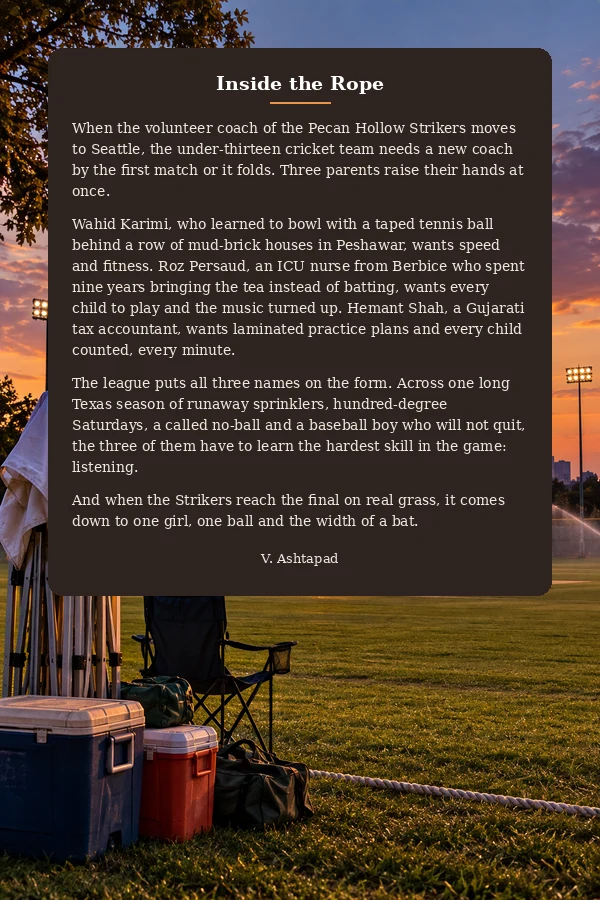
When the volunteer coach of the Pecan Hollow Strikers moves to Seattle, the under-thirteen cricket team needs a new coach by the first match or it folds. Three parents raise their hands at once.
Wahid Karimi, who learned to bowl with a taped tennis ball behind a row of mud-brick houses in Peshawar, wants speed and fitness. Roz Persaud, an ICU nurse from Berbice who spent nine years bringing the tea instead of batting, wants every child to play and the music turned up. Hemant Shah, a Gujarati tax accountant, wants laminated practice plans and every child counted, every minute.
The league puts all three names on the form. Across one long Texas season of runaway sprinklers, hundred-degree Saturdays, a called no-ball and a baseball boy who will not quit, the three of them have to learn the hardest skill in the game: listening.
And when the Strikers reach the final on real grass, it comes down to one girl, one ball and the width of a bat.
Members can react to this book and talk about it in the members' Library.
Ownership
© 2026 CRUNOD LLC. All rights reserved.
This book is owned by CRUNOD LLC. It is free to read on EternalCurrent.Online. No part of it may be copied, reprinted, sold, recorded or adapted, including as audio, film or translation, without written permission from CRUNOD LLC.
© 2026 CRUNOD LLC. All rights reserved.