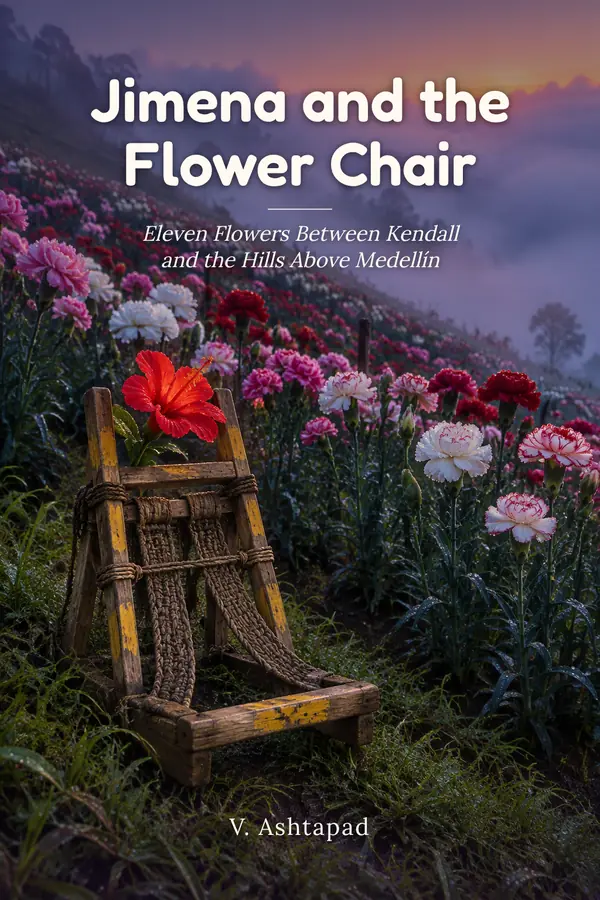
Jimena and the Flower Chair
Eleven Flowers Between Kendall and the Hills Above Medellín
by V. Ashtapad
Foreword
This is a novel for young readers. Jimena, her family, her neighbors, her teacher, the bakery in Doral and the flower farm in Santa Elena are all invented, and so are the talking flowers and the rules of the little silleta. Kendall, Doral, the Redland, Medellín and Santa Elena are real places, and the Desfile de Silleteros during the Feria de las Flores is a real parade, used here fictionally; details have been simplified for the story.
The silleteros of Santa Elena are real families who have carried flowers down the mountain for generations, and the word silleta really does come from silla, chair. Spanish words are used the way a family in Kendall uses them, a few at a time, with the meaning close by.
For every child who has carried something heavy from far away and called it home.
The Box with Holes
The box comes on a Tuesday in August, when the sky over Kendall is the color of a bruised plum and nobody can decide if it is going to storm.
I know it is from Abuelo before I even read the stamps. Nobody else wraps a package in brown paper and then ties it with green string, like a present from a hundred years ago. There are little holes punched in the sides of the box, as if something inside might need to breathe.
"Don't shake it," Mamá says from the kitchen. She has her phone between her ear and her shoulder and both hands in a bowl of masa. "Jime. Jimena. I can hear you shaking it."
"I'm not shaking it. I'm listening to it."
My little brother Simón, who is six and believes everything except what I tell him, puts his ear on the other side. "It's ticking," he whispers. It isn't. It's the air conditioner rattling in the window. But I hold the box very still anyway and carry it to the kitchen table like it is a cake.
Inside, under a nest of crumpled newspaper from Medellín, is a chair.
That's what it looks like, at first. A tiny wooden chair with no front legs, about as tall as my arm from elbow to fingertips. The back is a frame of thin sticks tied together with a rough brown cord, crossing and crossing, like a ladder that got confused. There are two little straps made of woven cord on the back, the size of my wrist. The wood smells like a closet in a cold place. It smells like nothing in Florida.
"Ay," says Mamá, and she puts the phone down. She wipes her hands on a dish towel and comes over, and she doesn't touch the chair. She just looks at it. "Ay, papi," she says, very quietly, but Abuelo is not here, so she is saying it to the chair.
"What is it?"
"It's a silleta." She says it slowly so I can hear all of it: see-YEH-tah. "A little one. For a little silletera."
I know about silletas the way you know about the moon. I have seen them in pictures. In the hills above Medellín there is a place called Santa Elena, where Abuelo Libardo and Abuela Rubiela have a finca with rows and rows of flowers, and every August there is the Feria de las Flores, and the silleteros carry huge round displays of flowers on their backs down through the city. Some silletas are as big as a car tire. Some are as big as a door. Abuelo has carried one every August since he was a boy, and Mamá says before that his father did it, and before that his father's father, back and back until there are no more photographs.
Taped to the inside of the box lid is a card. Abuelo's handwriting leans forward, like it is walking uphill.
*Para Jime. Una flor cada noche. Que sea tuya.*
"One flower every night," I read out loud. "That it be yours." I frown. "What does that mean, that it be mine?"
"It means your own," Mamá says. "Not borrowed. Not taken from somebody's yard." She looks right at me when she says that, because of the time with the neighbor's gardenias.
That night we call Santa Elena. Mamá props her phone against the sugar jar, and there they are: Abuelo in his gray wool ruana with the stripe at the hem, and Abuela behind him in a puffy vest, because up there in August it is cold in the mornings. Behind them is the kitchen window, and behind the window is white. Just white, soft and thick, like someone filled the whole world with milk.
"¿Te llegó?" Abuelo asks. *Did it arrive?* His voice is scratchy and warm, like a wool blanket.
"It came!" I hold the silleta up to the camera. "Abuelo, it's so small."
"Small for now," he says.
I want to ask him what that means, but the call freezes, and when it comes back, Mamá asks the question I have been afraid to ask.
"Papá, are you sure you can't come in October?"
October is Heritage Day at my school. Every family brings something. Last year Paola's grandmother came from Valencia and made arepas for the whole class, the flat Venezuelan kind, and everybody said they were the best thing they ever ate. I asked Abuelo in June if he could come this year. He said he would think.
On the screen, he rubs the back of his neck. "Mija, the flowers don't stop for me. October is when we plant for December. And your Abuela doesn't like when I'm on airplanes. And my knees don't like airplanes either." He smiles, but it's the smile grown-ups use when they're also saying sorry. "But I sent you something better than me."
"Nothing is better than you," I say, and Abuela laughs.
After the call, I sit on my bed with the silleta on my knees. My room is the small one at the back, with one window that looks out at the cement wall and Mrs. Albury's mango tree leaning over it. Outside the window, our hibiscus bush is blooming, the way it blooms almost all year in Kendall, because Kendall doesn't believe in winter. The flowers are red as a fire truck, with a long yellow tongue sticking out of the middle, dusted with pollen.
That bush is mine. Papá planted it the day I was born. There's a picture of it in our family tree online, the one Mamá keeps, where every person has a little circle with their photo. My circle is a baby in a yellow hat, and next to it, Mamá added a picture of the hibiscus when it was a stick in a pot. *Jime's bush,* the caption says. So it counts. It is not borrowed.
I open my window. The air outside is so thick and wet it feels like breathing soup. The neon sign on the laundromat at the corner buzzes pink, *OPEN 24 HRS*, as if anybody does laundry at midnight. I reach out and snap off one hibiscus flower, just one, with a tiny bit of stem.
The silleta's back has little loops of cord, all down the frame, too small for anything but a single stem. I slide the hibiscus into the top loop. It looks like a hat on a chair.
"Okay," I tell the silleta. "One flower. It's mine. Now what?"
The silleta does not answer, because it is made of wood.
I put it on the floor at the foot of my bed, where I can see it in the light from the hallway. I lie down. I tell myself I will stay awake to see if anything happens. I listen to the far-off thunder, rolling over the Everglades like furniture being moved upstairs.
I don't know when I fall asleep. I only know that at some point I hear a creak, a long, slow, wooden creak, the sound a rocking chair makes on a porch. And then a smell fills the room. It is not the hibiscus, which hardly smells of anything. It is cold and green and wet, like the inside of a cloud.
I open my eyes. The silleta is not small anymore.
It stands at the foot of my bed, big enough for me, its frame of crossed sticks reaching almost to the ceiling. The straps hang down like two arms holding themselves out. The hibiscus is still in the top loop, but it is glowing now, red as a stoplight.
I should be scared. But the silleta creaks again, patiently, the way Abuelo clears his throat before he tells a joke, and I climb out of bed in my pajamas and sit down in it. I sit backward, the only way it fits, my legs dangling and my back against the sticks, facing my own bedroom.
The straps fold around my shoulders, soft as a hug. And the silleta rises.
The Carnations Explain
We go out through the window with a soft pop, like a cork, and then the night air of Kendall is all around me, warm and buzzing with frogs.
Because I'm sitting backward, I see everything we leave behind. That is the first thing I learn about riding a silleta: you never see where you're going, only where you've been. Our roof with the blue tarp still on one corner from last year's storm. Mrs. Albury's mango tree. The hibiscus bush with one flower missing. Then all of Kendall, stretched out flat in squares of light, and the dark smudge of the Everglades to the west, flickering with heat lightning.
Then the sea. Then nothing but black, and the hum of wind in the sticks behind my back.
I fall asleep inside my sleep, I think, because the next thing I know the air has changed.
It's cold, freezer-aisle cold. My breath comes out in little ghosts. The silleta is going down, gently, gently, and all around me there is white. Not snow. Mist. It is so thick I can't see my own feet, and it beads on my eyelashes and my pajama sleeves like tiny pearls.
The silleta settles onto grass with a long wooden sigh, and the straps loosen.
"Well," says a voice near my left foot. "She came in pajamas."
"With dinosaurs on them," says another voice. "Look. Purple dinosaurs."
The mist thins a little, and I see that I'm sitting at the edge of a field on a hillside so steep it looks tipped up toward the sky. The field is planted in rows. And the rows are full of carnations.
Thousands of them. Pink as bubble gum, white as milk, red as the inside of a watermelon, and some that are white with red edges, as if someone painted each petal with a tiny brush. Every one of them is turned toward me.
"Buenas," I say, because Mamá says you always greet people first, and these seem like people.
"Buenas, buenas," the carnations answer, all at once, like a crowd at a ball game doing the wave.
A big red carnation at the end of the nearest row bends toward me. It seems to be in charge. "You're Libardo's granddaughter," it says. "The Miami one."
"Kendall," I say. "It's part of Miami. Sort of."
"And who," says the red carnation, "is this?"
It means the hibiscus, which is still tucked in the top loop of my silleta. The hibiscus has stopped glowing. It hangs its red head and its long yellow tongue, and it looks very hot and very lost in all this cold white air.
"That's my flower. From my bush. It's mine," I add, because of the rule.
"Hm," says the red carnation. All the carnations murmur. "Hm, hm. Not from around here."
"Neither am I," I say. "I'm from around there."
The hibiscus trembles. And the red carnation, after a long moment, makes a sound like a laugh. "Well. That's fair. Come down, little cousin. Nobody bites up here."
The hibiscus slips out of its loop and drops into the grass at the end of the row, and right away, I swear it, its stem pushes down into the black earth. It's planting itself.
"That's how it works," says the red carnation. "The mountain keeps your flower. The flower you bring leads you to its own kind. Your hibiscus has no kind up here, so tonight you get us. Lucky you."
"How what works?" I ask. "Abuelo only wrote one sentence."
"Libardo," says a white carnation, "never uses ten words when he can use one."
So the carnations explain, all of them talking at once, until the red one shushes them and says it slowly.
One flower each night. It has to be yours. You set it on the silleta and you sleep, and the silleta carries you up the mountain, here, to Santa Elena, while the mist is down. The flowers can only talk while the mist is down. When the sun climbs and the mist lifts, the silleta takes you home.
"And listen, this is the important part," says the red carnation. "Nothing leaves the mountain. Not a leaf, not a pebble, not a crumb. But whatever you touch last, before the mist lifts, you carry its color home on your hands."
All the carnations go still.
"The color is lent," the red carnation says. "It isn't yours to keep. Before dark, you have to put it into something with your own two hands. Whatever you put it into keeps it. If it's still on your hands when night comes, it turns back into mist and comes home to us. Do you understand?"
"Lent," I say. "Put it into something. Before dark."
"Good girl. Libardo's girl."
"Is Abuelo here?"
"Asleep," the carnations say. "This is the flowers' hour. People sleep through it."
Then the red carnation tells me my one thing. That's what they call it: *your one thing,* the thing a flower teaches you each night.
"When Libardo was ten," it says, "the same age as you, his papá built him a little silleta. Just like yours. Small. And that August, Libardo's papá carried a big one down to the city, and Libardo walked behind him carrying the little one, full of us. Carnations. All the way down the mountain and through the streets, with people clapping and shouting his name. His shoulders were sore for a week. He was so proud he slept with the straps on."
I laugh, imagining Abuelo as a boy sleeping in a chair. "He never told me that."
"He tells things to flowers," says the white carnation. "That's why we know everything."
Far below, I hear a happy three-note horn, like a song. Through a thin place in the mist I see a road curling down the mountain, and on it a wooden bus painted every color at once, red and yellow and blue stripes, orange flowers on the doors, the roof piled with sacks tied down with rope.
"A chiva," says the red carnation. "Going down to market. Early, like always. Look, the mist is thinning. Quick. Touch something."
"What should I touch?"
The carnations all point their heads toward the fence at the edge of the field, where a scrubby bush is hung with tiny paper lanterns, beige and crinkly. One lantern has split open, and inside is a small, round, orange fruit, shiny as a marble.
"Uchuva," the carnations say. "Libardo's favorite."
I want to pick it. I don't. I roll it under my fingertips until the mist goes pink and gold at the top and the silleta creaks and the straps fold around me.
"Before dark!" the red carnation calls as I rise. "Remember, little Kendall! Before dark!"
I wake up in my own bed, sweating, because the air conditioner has stopped again. The silleta is small, standing at the foot of my bed where I left it. Its top loop is empty.
And the tips of my fingers are orange. The glassy, lit-up orange of an uchuva, as if the light inside the fruit had come home on my skin.
At breakfast, I hold them out next to Simón's cereal bowl.
"Uchuva," I tell him. "From Santa Elena. I went there last night in the silleta, and the carnations let me touch one."
Simón licks his thumb and rubs my pinkie, hard. Nothing comes off.
"You got into my markers," he says.
"You just told me a story," he says, and goes back to his cereal.
But all through breakfast his eyes keep sliding over to my fingers, and he doesn't say anything else about it, and that is how I know he is thinking.
The Cold Room in Doral
That evening, while Mamá is frying plantains, Simón climbs onto the kitchen counter and grabs my wrist.
"Look," he says. "It's going."
Outside, the sun has just dropped behind the roofs across the street, and the sky is doing its hurricane-season trick, orange at the bottom and green-gray at the top. All day I carried my orange fingers around like ten little lamps and never figured out what to put them into. Now the color is lifting off my skin in a thin orange haze, like breath on a cold window. It drifts across the counter and slips out through the torn corner of the window screen, and my fingertips are just fingertips.
Simón's face is not teasing. It's worried. "Where did it go?"
"Home," I tell him quietly. "I didn't use it in time."
At bedtime he comes and stands in my doorway in his rocket pajamas and watches me look at the empty silleta. "Are you going tonight?"
"Not tonight. I want a flower that has a family on the mountain," I say. "Papá's taking me to work tomorrow."
My papá works in a cold room.
That's what he calls it, even though it's really a giant warehouse near the airport in Doral. Inside, everything is flowers, cut in Colombia and Ecuador yesterday and flown over the ocean all night. Papá says most of the flowers the United States buys from other countries come in through Miami, passing through Doral like people through a train station.
Papá's job is to check them. He opens the boxes, looks for bugs or broken stems, and sends them on. He wears a thick gray hoodie even in August, because inside the cold room it's always a mountain morning.
We drive there Saturday at six, when the streets of Doral are still blue with dawn and the flags over the shopping plazas, Venezuelan and Colombian and American, hang limp. We stop at Panadería Doña Nubia, which is in a strip mall between a nail salon and a tax office, with a hand-painted sign of a green mountain with a little white house on top.
Inside, it smells like warm cheese and sugar. The glass cases are full of golden things: pandebonos, round and puffed and shiny on top, buñuelos like little suns. Behind the counter is Doña Nubia, a tiny woman with a gray bun and enormous earrings shaped like parrots, who has known Papá since before I was born.
"¡Gonzalo! ¿Y esta princesa?" she says, and she pinches my cheek.
The pandebono is still hot, crackly outside and so stretchy inside that the cheese pulls away in a string I have to wind around my finger. Papá drinks a tinto, a tiny black coffee, in two sips.
When the big door rolls up, the air hits my face like a wave of cold water, and I zip up the hoodie Papá brought me. Men and women in hoodies move between towers of white boxes stacked almost to the ceiling.
"Look," Papá says, and he lifts the lid off a box, and I gasp.
It's packed full of hydrangeas. Hortensias, Papá calls them. Each one is a ball of tiny flowers as big as my head. Some are white, some pink, and some the bluest blue I have ever seen, blue like the deep end of a swimming pool, blue like a crayon called *ocean*.
"Mamá's mother grew these," Papá says. "Your Abuela Rubiela. Blue ones, by the kitchen door."
He goes through the box and near the bottom he finds one with a broken stem, bent in half like a straw. "This one can't go," he says. He looks at me. "You want it?"
"Is it mine, then? If you give it to me?"
"Who else's would it be?"
That night, I tuck the broken hydrangea into the middle of the frame, where the sticks cross, a giant blue cloud.
Simón, in the doorway, says, "Bring me a color. If it's real." Then the creak, the green smell, Kendall sliding away behind me, the cold, the white, the soft landing.
This time we don't land in the carnation field. The hydrangea glows blue in the frame like a lamp, and when I climb down, it rolls ahead of me through the grass. I follow it along a path of flat stones, past tall dark trees dripping mist, to a little white house with a red-tiled roof and green shutters.
Abuela's house. I know it from video calls, but never like this, in the dark-blue hour before morning, with everyone asleep inside.
Beside the kitchen door, there are hydrangeas. Huge bushes, taller than me, all of them the same blue as mine.
"There you are," the bushes say, all together, in deep, round, comfortable voices, like aunts. "Come here, come here. Let us look at you."
My broken hydrangea rolls right up to them and nestles into the roots, home.
"Do you know," says the biggest bush, "that we're not always blue?"
"It's the soil," the bush explains. "Up here the dirt is dark and sour from old leaves and rain, and it makes us blue. Put us in different dirt and we turn pink, or purple, or something in between."
"So you change," I say. "But you're the same plant?"
"The same root," say the hydrangeas. "Always the same root."
Then they tell me my one thing, about a girl who used to sit on this very doorstep, in a school uniform with a blue sweater, and pull petals off the hydrangeas to see which ones were blue all the way through. A girl who left this house at nineteen with one suitcase, for a hot, flat city by the sea, and who still, every year, buys a hydrangea at the grocery store in Kendall and puts it on her kitchen table, even though it turns brown in three days in the heat.
"Mamá," I say.
"Yolima," say the hydrangeas. "Rubiela's girl. She was blue. Now she's something else. Same root."
The mist is going gold at the top. The silleta creaks behind me. "Your color," say the hydrangeas, and they lean down, heavy and wet, and I push both hands deep into the nearest blossom. It's as cold as a swimming pool at night.
In the morning my hands are blue to the wrists, the same blue as the box in the cold room.
On the kitchen table, in a jar, is this year's grocery-store hydrangea. It was white. Now it's going brown at the edges.
Mamá is at the stove in her robe, waiting for the water to boil for coffee, with her back to me. I cup my hands around the hydrangea, the way you'd hold a baby bird. The blue slides off my fingers like water off a spoon and soaks into the petals, up from the stem, flower by tiny flower, until the whole ball is blue and my hands are only hands.
Mamá turns around. She sees the jar. She stops moving.
"¿De dónde salió eso?" she whispers. *Where did that come from?*
"From beside Abuela's kitchen door," I say. "The hortensias said you used to sit there."
Mamá doesn't ask how. She touches one tiny blue flower with one finger. Then she gets out a brick of panela, the brown sugar that comes in a hard block, breaks off a piece, and drops it into the boiling water with a squeeze of lime. Aguapanela. She makes it the way Abuela makes it, she tells me, hot and sweet and a little sour, and she pours us each a mug, even though it's ninety degrees outside. And then she calls Santa Elena, at seven in the morning, just to say hello.
Birds of Paradise
On the morning of the Desfile de Silleteros, Mamá wakes us up at five.
The parade is in Medellín, but we watch it in our living room in Kendall, on a live stream from a Colombian channel. Papá makes coffee. Mamá makes arepas, the white round Colombian kind, with a slice of salty white cheese melting on top and a little butter sliding off the edge. We eat them on the couch in our pajamas with our feet tucked up, which is never allowed, except today.
On the screen, it is a gray, bright morning in Medellín, and the streets are packed with people under umbrellas and wide straw hats, waving little paper flags. And then the silleteros come.
I've seen pictures. Pictures are nothing.
They walk slowly, steady and bent forward, with the silletas strapped on their backs. And the silletas are enormous. One is a giant sunburst of yellow and orange, wider than the man carrying it is tall. One is a picture made entirely of flowers, a mountain with a little white house and a cow. One is so tall it sways, and two little kids walk on either side of the woman carrying it, holding sticks up to steady it when the wind comes. People on the sidewalks are clapping and calling out, and the silleteros nod and smile, and sweat runs down their faces.
"There," says Mamá, and she grabs my arm so hard it hurts. "There, Jime. Look. Look!"
It's Abuelo.
He's wearing a white shirt and a red scarf around his neck and a straw hat, and on his back is a silleta shaped like a giant round fan, all carnations: red and white and pink in rings, like a target, with a blue hydrangea in the very center. When the camera passes him, he looks straight into it, just for a second, and he winks.
Simón screams. Mamá cries. Papá pretends he's not crying and gets up for more coffee.
I don't cry, because I'm busy looking at the way he walks, with his knees soft and his steps short, and how he doesn't wobble at all, even with all those flowers on his back.
That night, I need a flower, and I don't have one.
Our hibiscus has a new flower, but I already used that bush. Papá's cold room is closed on Sundays. And then I remember Mrs. Albury.
Mrs. Albury lives next door, on the other side of the cement wall, in a pink house with white shutters. Her family came to Miami from the Bahamas when her grandmother was a girl, and her yard is famous on our street: the mango tree, a lime tree, orchids tied onto the trunks with old pantyhose, and along the front walk, a whole row of birds of paradise.
I knock on her door. She answers in a flowered housedress.
"Mrs. Albury, could I please have one of your birds of paradise? I can pay you. I have three dollars."
"Child, what do you want it for?"
I think about lying. Then I think about the rule. "For my silleta," I say. "It's from my abuelo in Colombia. You put one flower on it every night, and it has to be yours, and if you give me one, it's mine."
Mrs. Albury looks at me over the tops of her glasses. Then she goes inside for her garden scissors. "Keep your three dollars," she says. "Every flower is a gift to somebody. Might as well be you."
The bird of paradise is the strangest flower I have ever held. It really does look like a bird. Its head is a long, pointed, gray-green beak, and out of the top bursts a crest of orange and bright blue petals, sharp as feathers, like a bird with its hair on fire. I tie it to the frame with a hair elastic so its head sticks out the top, like a lookout on a ship.
The bird of paradise does not wait for me to climb down when we land on the mountain. It shakes itself out of the hair elastic and stalks off through the mist on its stem, like a heron walking through a pond, and I have to run to keep up.
"This way, this way," it calls in a high, bossy voice.
It leads me down a long slope past a pasture where three cows lie in the grass like wet stones. At the bottom of the slope is a big open shed with a tin roof, and inside, I see silletas. Dozens of them. Empty frames, waiting for next year.
And all along the sides of the shed, growing out of the mud, there are birds of paradise, a whole flock of them, orange and blue against the white.
"Our cousins," says my bird of paradise, a little smugly. "We came from very far away a long time ago. Now we live here too."
"Like Mrs. Albury," I say. "And like Mamá."
"Like a lot of people," says the flock.
Then they teach me my one thing. They teach me the kinds of silletas.
The tradicional, they tell me, is the old kind, round and full, with flowers placed any way that's beautiful. That's the kind Abuelo carries.
The emblemática makes a picture or a message out of flowers, like the one I saw this morning with the house and the cow.
The monumental is enormous. "Higher than a door," says the flock happily. "The biggest ones weigh more than you do. More than two of you."
"How do people carry them?"
"Slowly," say the birds of paradise. "And with their knees soft. And with help."
There are newer kinds too, and the flock starts arguing about how many, until my bird of paradise says, "Never mind. Libardo always says the tradicional is the hardest. There's no picture to follow. You have to know what's beautiful all by yourself."
The mist is starting to glow. Right then a real bird swoops in under the tin roof, with a turquoise head and a green back and a long tail with two round tips like paddles. It lands on a beam just above me and looks at me sideways.
"Barranquero," say the birds of paradise. "The real kind of bird. Not like us. Go on. Gently."
I reach up. It lets me touch its back, once, with two fingers, smooth as the inside of a shell. Then it's gone.
The next morning is the first day of fifth grade, and two of my fingers are turquoise.
Paola Briceño is waiting at the bike rack with her backpack covered in key chains. Her family is from Venezuela, and she makes bracelets out of everything: embroidery thread, beads, telephone wire, the tiny rubber bands for braces.
"Whoa." She grabs my hand and turns it in the sunlight, and my fingers flash green, then blue, then green. "Is that nail polish?"
"It's from a bird in Colombia called a barranquero."
"Did your abuelo send it?"
"Sort of," I say, which is the truth. "Can I help with your next bracelet?"
At lunch, Paola hands me a hank of plain white thread and shows me the knot, over and under and pull. I tie it with my two turquoise fingers, knot after knot, and the color runs down into the thread the way water runs down a string, until the whole bracelet is the green-blue of a barranquero's back and my fingers are plain. Paola stares at it, then at me. Then she ties it on her wrist and doesn't ask anything, which is why she's my best friend.
Before dark, I remind myself. It's in the bracelet now. It can't go back to the mist.
But walking home in the heavy afternoon heat, I keep thinking about the way my fingers flashed in the sun. And I start wondering what it would feel like to keep a color. Just one. Just for me.
The Stone That Wanted to Go Home
Our school has a garden behind the cafeteria, inside a chain-link fence, with raised beds made out of old boards. Ms. Fairweather, my new teacher, is in charge of it. She has short silver hair and wears sneakers with every outfit, even dresses, and she lets the fifth graders water the garden at recess if we're careful with the hose.
In the corner bed, there are daisies. Margaritas. White petals, yellow middles, the plainest flower in the world.
"Ms. Fairweather, can I have one?"
"For what, Jimena?"
"For my abuelo's silleta. It has to be my own flower."
She doesn't ask what a silleta is. She just nods and snips one for me with the little scissors she keeps in her lanyard pouch, and hands it over. "You helped water these," she says. "You've earned one."
That night the daisy goes into the silleta's top loop, and it looks tiny there, a little white eye winking at me. When we land in Santa Elena, it doesn't lead me anywhere. It just hops down into the grass, and I wait, shivering in the cold white air, and I start to think maybe daisies don't have a kind on the mountain.
Then I see them. Not in rows, like the carnations. They're everywhere. Along the edges of the path, between the stones, in the ditches, up the banks of the road. Thousands of little daisies, growing wild, like stars somebody spilled.
"Nobody plants us," they say, in voices like crickets. "We just come. We've always just come."
The daisies are the oldest flowers on the mountain, they tell me. Older than the farms. Older than the roads. And they want to show me something.
They lead me to the old path. Not the road where the chiva went by, but a narrow, steep trail of worn stones going straight down the mountain into the mist. It's so steep in places that the stones are cut into steps. Moss grows on them. The daisies line both sides like little lights.
"Long ago, before there were roads," the daisies say, "this path was one of the ways down to the city. It was steep and muddy, and people who couldn't walk it, or didn't want to, paid men from the mountain to carry them."
"Carry them? Like a piggyback?"
"In chairs," say the daisies. "Strapped onto the men's backs. Sillas. The person sat facing backward, and the man from the mountain carried them step by step, in the mud. That's what people up here say, and their grandparents said it too."
I think about the way I sit in my silleta, backward, watching where I've been. I always thought that was just a strange magic thing. "That's why it's called a silleta? Because it means *little chair*?"
"That's why," the daisies agree. "They carried loads to market on their backs, too. Then the roads came, and nobody needed to be carried. But the families kept carrying flowers down to sell. And one August, a long time later, the city asked them to carry their flowers down the street all together, so everyone could see. That's how the parade began."
"So the silleteros carried people first. Then flowers."
"First people," say the daisies. "Then flowers. Then pride."
I sit on a cold step for a while, thinking about all the backs that have gone up and down this path. Then the mist starts to go gold, and I see that the gold isn't only above me. It's sliding down the mountain, slow as honey, into the mist on the steps, and I put both palms flat on the stone just as it reaches me.
I wake up with gold hands. Not yellow. Gold, the exact color of the mist when the sun first touches it, a color I have never seen anywhere in Kendall. When I turn my hands, it shimmers.
And I decide. I'm going to keep this one. Just this one. I'll put the next color into something, I promise myself, and the one after that. But this one is mine.
I keep my hands in my pockets all morning. I hold my pencil with two fingers. At recess I don't water the garden. At lunch I eat my sandwich without taking it out of the plastic, and Paola asks me what's wrong, and I say nothing, and she gives me a look over her turquoise bracelet and lets it go.
When I get home, I take my hands out and look. Still gold.
The afternoon gets darker. The sky over Kendall turns the color of a dirty nickel and the air gets so heavy that the palm fronds stop moving. Thunder starts up out over the Everglades. I sit on my bed with my hands in my lap, palms up, and I don't touch anything, as if that will help.
At dark, the streetlights blink on. The laundromat sign buzzes pink.
The gold lifts off my palms like steam off a cup. It smells of moss and wet stone steps. It drifts across my room to the window, slips out through the crack where the old air conditioner doesn't quite fit, and is gone, up into the sticky dark toward the clouds. My hands are brown and ordinary and empty.
I cry then. Not a lot, but enough. Not because I lost it. Because I knew. They told me, and I knew, and I did it anyway.
Mamá finds me like that. She doesn't ask. She just sits next to me on the bed, and she takes out her phone and opens the family space, the private one where only our people can go, where the family tree is with all its little circles, and the photos, and the messages.
"Abuelo sent you something today," she says. "I saved it for you. I was going to wait for dinner."
It's a voice message. She presses play.
*"Jime. Jimena. Mi florecita."* His voice, scratchy and warm, a rooster crowing behind him and the sound of rain on a tin roof. *"Your Mamá says you watched the parade. I hope you saw me. My shoulders are still sore. I'm an old man. Eh, but I'll do it again next year, and the one after, if my knees say yes."* He laughs, coughs, laughs again. *"Listen. Something I should have said in the box. When I was small, my papá told me, the mountain lends us everything. The flowers, the water, the good dirt. Lends. We don't own any of it. We only carry it a little while, and then we hand it on. Okay? That's all. Kisses to your brother. Tell your papá that Nacional is going to win on Sunday, and he owes me a coffee."*
The message ends. Mamá saves it again, in the folder under my name in the family space, next to the photo of me as a baby in a yellow hat.
"What did you think of it?" she asks.
"He already knew," I say. "He knew I'd try to keep something."
Mamá kisses the top of my head. "Your abuelo," she says, "tried to keep everything, when he was your age. He told me. That's how he knows."
That night, I don't set a flower on the silleta. I'm too tired. I just lie in bed and listen to the thunder roll away to the east, out over the ocean, toward the Bahamas, toward wherever thunder goes.
But before I fall asleep, I say it out loud, to the empty frame at the foot of my bed. "Lends," I say. "I understand. I'm sorry." The silleta creaks once in the dark, softly, like it is saying, *I know.*
Chiva Yellow
On Saturday, Doña Nubia has a jar of astromelias by the register at the panadería. They're orange with brown freckles inside, like somebody flicked a paintbrush at them.
"From the cold room," she tells me, nodding at Papá, who is buying two dozen pandebonos for Mamá's work. "Your papá brings me the ones the stores don't want. Too short. Too crooked. They're still flowers. Take one, mi amor."
"To keep?"
"To keep, to give, to put in your hair. It's yours."
That night the astromelia goes on the silleta, and on the mountain it doesn't lead me to a field. It leads me down. Down the slope, through a gap in a hedge, along a muddy ditch, until I'm standing at the edge of the road where I saw the chiva go by on my first night.
There are astromelias growing along the ditch, orange and pink and yellow, all freckled. "Wait," they whisper. "Wait. Here it comes."
I hear it before I see it: that happy three-note horn, *paa-pa-PAAA,* and the growl of an old engine climbing. Then headlights swim out of the mist, and the chiva comes around the bend.
Up close, it's even more colorful than I remember. The body is wood, painted bright yellow. Around the windows there are red and blue stripes, and green leaves painted along the sides, and orange flowers, and a little painted parrot near the door. The windows have no glass, just open frames with benches inside. The roof is piled high with sacks of potatoes and crates of flowers, tied down with yellow rope. Nobody is driving. It's the flowers' hour, and the chiva comes to a stop beside me with its engine humming, patient as a horse.
"Go look at the back," the astromelias say.
I walk around behind it. On the back of the chiva, painted in curly letters, there is a name: *La Rubiela.*
"That's my abuela," I say.
"Your abuela's brother painted it," say the astromelias. "Abelardo. He painted chivas all his life, in a garage down in the town, and every one he named after somebody in the family. This was the last one. Look underneath."
Under the name, in smaller letters, painted in a line like a train, there are more names. *Libardo. Rubiela. Yolima. Gonzalo.* And then, very small and very new, as if somebody added them with a thinner brush: *Jimena. Simón.*
My name, on the back of a bus, on a mountain where I've never been in the daytime.
"He never met me," I say.
"Doesn't matter," say the astromelias. "He heard about you. Abelardo always said a chiva without the family on the back is just a truck."
I think of the family tree Mamá keeps in our family space, with all its little circles. This is like that, only louder, and with a parrot.
Then the astromelias teach me my one thing, which is about color.
"Why do you think chivas are painted like this?" they ask.
"Because it's pretty?"
"Because the mountain is green," they say. "Green and white and gray, all day, every day, in the mist. You could get lost in it. So people paint everything bright. The doors of the houses. The chivas. The silletas. So that from far away you can see: there's somebody here. There's life here. Come this way."
I think about Miami. Miami is already bright. The sky is so blue it hurts, or else it's purple with storms. The hibiscus is red, Mrs. Albury's house is pink, the Doral plazas fly flags in every color, and at night the strip-mall signs glow neon green and pink and blue: *NAILS, CELL REPAIR, OPEN, PIZZA.* Nobody needs to paint anything brighter in Kendall. It's already shouting.
"Miami colors are different," I say. "They're like they want you to buy something."
The astromelias laugh, a crackly freckled laugh. "And ours want you to come home. Both are colors. Pick the ones you need."
The mist is going gold. Before the chiva can leave, I run my hand along its back bumper, where the yellow is so thick and bright it feels like butter. The horn gives a soft *paa,* as if to say goodbye, and the chiva rolls off down the road into the white.
In the morning, my right hand is chiva yellow from the fingertips to the wrist. I remember the rule. Put it into something, before dark.
I know exactly what.
I take the silleta out to the back patio and set it on some newspaper. The frame is plain brown wood, with the cord tied around it. I run one yellow finger along the top crossbar, and a stripe follows it, bright and buttery, as if my finger were a brush. I do the next crossbar. The tips of the side sticks. A line all the way down the middle.
Simón comes out and watches. After a while, he says, "Can I help?"
"It's chiva yellow. From the bus with our names on it."
He doesn't say *that's just a story* this time. He says, "Which bus?"
So I tell him about *La Rubiela,* and the tío abuelo who painted it, and the line of names on the back, and his name at the end, very small and very new. He listens with his mouth open. Then I put my yellow hand over his hand, and together we stroke the little feet of the silleta, and the yellow comes down through both of us onto the wood. He's so careful he sticks his tongue out of the side of his mouth.
By the time the afternoon thunder starts, my hand is plain brown again and the silleta is striped yellow, looking ready for a parade.
At dark, I check. My fingers stay ordinary. The stripes stay bright. A color you put into something you make becomes part of it.
Before bed, Mamá takes a photo of the silleta with its new stripes and puts it in the family space, next to my circle on the family tree. *Painted by Jime and Simón with real chiva yellow,* she types. She doesn't know how real.
Ten minutes later, there's a message underneath it from Abuela Rubiela, all in capitals, the way she always writes: *ESE AMARILLO LO CONOZCO.* That yellow, I know it.
A Plate for Whoever Arrives
In the second week of September, Ms. Fairweather writes on the whiteboard in purple marker: *HERITAGE DAY. FRIDAY, OCTOBER 9.*
"Every one of you comes from somewhere," she says, "even if that somewhere is right here in Kendall. On Heritage Day, I want you to bring one thing that tells us where your family comes from. A food. A song. A dance. An object. A story. And I want you to tell us why it matters."
Around the room, hands go up. Kemar's family is from Jamaica and he's going to bring his uncle's steel pan. Mía's family is Cuban and her grandmother makes croquetas so crunchy you can hear them across the room. Paola says she'll bring her grandmother's arepas again, and everyone cheers.
I don't put my hand up. I already know what I want to bring, and it's too big to say out loud yet.
That night I ask Papá for a rose.
He brings one home from the cold room, short-stemmed and a little bruised on one petal, the deep red of a pomegranate. "Last one in the box," he says. "Nobody wanted the bruise."
On the mountain, the rose leads me up the stone path to the front of Abuela's little white house, the side I haven't seen. There's a rosebush beside the front door, old and twisted, with a trunk as thick as my wrist, climbing up a wooden trellis and over the top of the door like an arch. Its roses are the same deep red as mine.
"Libardo planted me the week he married Rubiela," the old rosebush says in a slow, creaky voice, like a grandmother getting out of a chair. "Fifty-one years ago. Sit, child. You want to hear how they met?"
I sit on the step.
"It was the parade," says the rosebush. "Libardo was nineteen. Strong. Proud. A little bit of a show-off. He was carrying a big silleta, too big for him really, because he wanted the girls on the sidewalk to see him. And halfway down the street, one of his straps snapped."
"Oh no."
"The whole silleta tipped. Flowers everywhere. He was holding it up with one arm, red as a tomato. And out of the crowd came a girl in a blue sweater with a sewing kit in her purse, because her mother always made her carry one. She sat right down on the curb, and with a big needle and the cord off her own bag, she sewed his strap back together while he stood there holding up the whole thing. Then she said, 'Go on, then,' and walked away."
"Abuela," I say.
"Rubiela. It took him three weeks to find out her name. Then he walked to her house every Sunday for a year with a flower. She sent him away eleven times."
"And then?"
"And then she said yes," says the rosebush, "and he planted me. And every year since, before the parade, she checks his straps."
That's my one thing. I tuck it away in my head next to the uchuva and the blue hydrangeas and the chairs on the old path and the name on the back of the chiva.
Then the rosebush says, "Go look in the kitchen window. Rubiela always leaves something out."
The kitchen window is around the side of the house, low and wide, with a sill of painted blue wood. And on the sill, on a little clay plate, wrapped in a white cloth, there's a buñuelo. Round and golden, the size of a tennis ball. When I touch the cloth, it's still warm.
"She makes one extra every time she cooks," the rosebush says. "Has done for fifty years. For whoever arrives. A neighbor, a cousin, a lost dog. A granddaughter in purple dinosaur pajamas."
"Can I eat it?"
"Not this one. Nothing leaves the mountain, remember." The rosebush rustles. "But you may touch it. Go on, before the mist lifts."
I lay both hands on the warm cloth, and under it the buñuelo, crackly and round.
In the morning, my fingers are the golden brown of a buñuelo crust, and they're still warm.
Papá has already left for the cold room. He leaves at five-thirty, before anybody else is awake, and he never eats breakfast, just a tinto on the way and a granola bar out of the glove compartment. So I take my warm gold-brown hands to the kitchen, where Mamá is packing lunches, and I hold them out.
She looks at them for a long time. Then she raises one eyebrow, the way she does when she knows something and wants me to know she knows.
"I'm not going to ask how," she says. "But I'm going to ask what."
"Buñuelo," I say. "Abuela's. The extra one, for whoever arrives."
After school, she's waiting for me at the kitchen table with her phone. She has opened the recipe shelf in our family space, where she's been saving Abuela's recipes one by one, each with a photo of the handwritten card. This card is yellowed and spotted with grease, and Abuela's handwriting leans the other way from Abuelo's, backward, like it's leaning against a wall.
*Natilla y buñuelos. Para diciembre. Para todos.*
"Natilla and buñuelos are for December," I say. "That's what the card says."
"So we'll have a little December in October," Mamá says. "For Heritage Day. Who's going to stop us? Wash your hands. No, wait. Don't."
She grates the white cheese and mixes it with starch and an egg and a little sugar, and I roll the dough into balls between my palms, one after another. Every ball comes out a shade warmer than plain dough, and my hands come out a shade paler, until the last ball takes the last of the gold and my palms are just mine. Mamá drops them into the hot oil, and the kitchen fills with the smell of frying cheese.
Then she looks at me closely. "But that's not all you want to bring, is it? I can see it in your face."
"No," I say. And then I say it out loud for the first time. "I want to make my own silleta. A real one, with real flowers. And I want to carry it."
Mamá doesn't laugh. She doesn't say *it's too heavy* or *it's too hard* or *you're too little.* She just looks out the window at our hibiscus bush, red against the cement wall, for a long time.
"Then you'll need to learn how," she finally says. "And you'll need a lot of flowers."
Papá comes home at dark, still in his cold-room hoodie, and takes a buñuelo from the plate on his way past. He bites it, and it crackles, and the inside is soft and cheesy and full of air. He stops in the middle of the kitchen and closes his eyes.
"This is Rubiela's," he says, with his mouth full. "Nobody makes them this light. Doña Nubia doesn't even make them this light. How did you..."
"Don't ask," Mamá says. "Look at her hands. They were gold this morning."
Papá turns my hands over, palms up. They're plain, with a little flour under the nails. He looks at me, and then at Mamá.
"Well," he says. "I've always said your family was different."
Storm Shutters
In the third week of September, the TV weather lady starts pointing at a red swirl out in the ocean, and everyone in Kendall starts buying water.
It's not a hurricane, the weather lady says, just a tropical storm, a smaller cousin with lots of wind and rain. But in Miami everybody gets ready anyway.
Papá and Mrs. Albury's grown son, Cedric, put up the metal shutters on the windows, clanking and screeching. Mamá fills the bathtub with water in case the pipes stop working. The grocery store runs out of bread and batteries and those big jugs of water, and the line for gas wraps around the strip mall. The sky turns a strange flat yellow-gray, the color of weak tea, and the air is so still that the palm trees look painted.
With the shutters down, my room is dark as a cave, even in the afternoon. The silleta stands at the foot of my bed with its yellow stripes, and I don't have a flower. Papá's cold room is closed for the storm. The panadería is closed. Mrs. Albury has cut all her birds of paradise and brought them inside so the wind won't snap them. My hibiscus bush is bending already in the first gusts, its red flowers flapping like flags.
At dinner, Simón slides something across the table to me. It's a little cluster of tiny flowers, orange and pink and yellow all in one bunch, like a scoop of rainbow sherbet.
"Lantana," he says. "From the bush by the school fence. I picked it for you at pickup. Before the wind."
"Simón." I don't know what to say. "That's... thank you."
"It's yours now," he says. "Because I gave it. So it counts. Right?"
"It counts," I say.
The storm gets loud after dark. The wind howls around the house, a high whistle through the cracks of the shutters, and the rain comes in sideways, hammering the metal so hard it sounds like a thousand drums. The lights flicker once, twice.
I put the lantana on the silleta and climb into bed, and I'm not sure the silleta will go in weather like this. But at the edge of sleep comes the creak, and the cold green smell, and then I'm sitting backward in the frame, and somehow we're out. I see Kendall from above for just a moment, dark and roaring, all the palm trees bent the same way like people running from something. Then clouds, thick and gray and churning, and then above the clouds, stars, so many and so still. And then the mountain.
On the mountain, it's quiet. The mist is soft and calm. There's no wind at all. It's like walking from a loud party into a library.
The lantana hops off the silleta and tumbles around the side of the house to the back wall, where a whole hedge of lantana grows wild under the kitchen window, orange and pink and buzzing with sleepy bees, even in the dark.
"Lantana here too?" I ask.
"Lantana everywhere," say the lantanas proudly, in a busy, buzzing chorus. "Hot places, cold places, roadsides, gardens. We're not fussy. You came in a storm. We can smell it on you."
"It's loud," I say. "Simón doesn't like it."
The lantanas whisper among themselves. Then they say, "Do you want to know a secret about Libardo?"
"Yes."
"He's afraid of thunder."
"Abuelo?" I can't believe it. Abuelo, who carries silletas as big as a door down the mountain? "He's not afraid of anything."
"Thunder," say the lantanas. "Ever since he was small. When the big storms come over the mountain, the kind that shake the windows, he gets under the kitchen table. Right in there." They nod their little heads toward the window above them. "Fifty-one years married, and every time, Rubiela makes him a mug of hot aguapanela and passes it down to him under the table, and then she sits on the floor next to him and tells him stories until it's over."
"What stories?"
"The same ones. The one about the strap. The one about the eleven Sundays. The one about Yolima's first tooth. He knows them all. He says that's why they work."
I laugh, imagining Abuelo under the table in his gray ruana, holding a mug in both hands.
"Being strong," the lantanas say, "isn't not being scared. It's being scared and still carrying the thing."
That's my one thing tonight.
When the mist starts to go gold, the lantanas show me where to look: on the kitchen windowsill, in a little tin holder, there's a fat candle made of beeswax, honey-colored, smelling sweet even through the glass. "Rubiela makes them from the bees," the lantanas say. "For when the lights go out." The window is open a crack. I reach in and wrap both hands around the candle.
I wake up to the storm, still raging, and my hands glowing the soft brown-gold of beeswax. My room is completely dark. The air conditioner is silent. The power is out.
I can hear Simón crying in his room across the hall.
I go in. He's sitting up in bed, holding his stuffed sloth, his face wet. Mamá and Papá are out in the living room, checking the shutters with a flashlight. The wind screams. Something bangs against the roof, and Simón jumps and grabs my arm.
"Wait," I tell him. "Wait right here."
In the kitchen drawer with the storm things there's a plain white candle, the skinny kind from the hardware store. I hold it between my palms and squeeze, and the honey color runs off my hands into the wax until it's gold all the way through and smells like a beehive. Mamá lights it for us with the long lighter, sets it on a saucer on Simón's nightstand, and goes back to the shutters. The flame catches, small and gold, and somehow his room smells like a kitchen on a mountain.
"Do you know," I say, "that Abuelo is scared of thunder?"
Simón sniffs. "No he's not."
"He is. He hides under the kitchen table. Abuela gives him aguapanela, and then she sits on the floor and tells him stories until the storm is over."
"What stories?"
So I sit on the floor next to his bed, the way Abuela does, and I tell him. The strap that snapped in the parade. The girl with the sewing kit. The eleven Sundays. The rosebush over the door. I tell them slowly, the way the flowers told me. The storm roars outside, and the candle flickers, and somewhere in the middle of the eleven Sundays, Simón falls asleep with his sloth under his chin.
I stay up and watch the candle. It burns down, and down, all through the storm, until gray morning light leaks in around the shutters and there is only a little puddle of gold wax in the saucer and the smell of honey. My hands, when I look at them, are just my hands.
The storm moves on in the morning, out over the Gulf. Our hibiscus bush is flat on its side, but Papá props it back up with a broom handle, and in two days it's blooming again, like nothing happened, which is what hibiscus does.
On our next video call, I look at Abuelo for a long time.
"¿Qué?" he says, suspicious. *What?*
"Nothing," I say. "Abuelo, were you okay in your last big storm?"
On the screen, he and Abuela look at each other. Abuela starts to laugh. Abuelo goes red as a tomato and says, "Who told you? Yolima, did you tell her?"
"Nobody told me," I say. "The flowers know everything."
Two Pins on a Map
There's a fruit stand down in the Redland, south of Kendall, where the farms start and the strip malls stop. It's a wooden shack with a tin roof under a giant avocado tree, and they sell mangoes and lychees and starfruit, and milkshakes made of mamey that are the color of a sunset. Out front, in plastic buckets, they sell flowers from the farm next door.
I have eleven dollars saved. I spend four of them on one sunflower.
It's huge. The head is wider than my face, the petals like a lion's mane, the middle a brown spiral of seeds that goes around and around, if you stare, until it makes you dizzy. I carry it home in my lap in the back seat while Simón slurps a mamey shake and Mamá drives with all the windows down.
"Four dollars," Mamá says, looking at me in the mirror. "For one flower. You really mean this."
"It has to be mine," I say. "Really mine. And I need to learn how to build a silleta, and I think it's a sunflower that's going to teach me."
"Why a sunflower?"
"Because they're organized," I say. "Look at the middle."
That night, the sunflower barely fits. Its heavy head droops over the top of the silleta like a sleepy giant. On the mountain, it leads me past the carnation field, past the hydrangeas by the kitchen door, past the rosebush over the front door, up a steep path to the very top of Abuelo's finca, where a long row of sunflowers stands along the edge of a cliff, taller than me, their faces all turned the same way, waiting for a sun that hasn't come up yet.
"Ah," they say. Their voices are deep and slow and very precise, like teachers. "The builder."
"I'm not a builder. Not yet."
"Everybody's a builder," say the sunflowers, "before they build anything."
Then they teach me. They are the most organized teachers I've ever had, even more than Ms. Fairweather. They go step by step.
First, the frame. "Strong wood. Light wood. Tied tight. If the frame is weak, nothing else matters."
Second, the back. "Ferns," say the sunflowers. "Helechos. Big green ones. You lay them across the frame first, like a bed, so the flowers have something soft to sit in and something green to show between them."
Third, the flowers. "Tie them in little bunches, tight, with twine. Then set the bunches in rows, close together, so close you can't see the fern behind them. Faces out. Always faces out. A flower that looks at the wall is a flower wasted."
Fourth, the weight. "The heavy flowers go at the bottom. The light ones go on top. If you put a sunflower at the top, you'll fall on your face."
"That's why you're at the bottom of the hill?" I ask, and they laugh, a slow, grand laugh like a tuba.
Fifth, the walking. "Lean forward. Knees soft. Short steps. Don't look down. Look at the people. They came to see the flowers, but they stay to see you carry them."
That's my one thing. Five things, really, but the sunflowers say it's one thing with five parts, and I'm not going to argue with a sunflower.
When the mist turns gold, they point me to a bank of ferns along a little stream at the edge of the cliff, giant ones with fronds as long as my arm, curled at the tips like the end of a violin. "Put your hands in," the sunflowers say. "That's your color."
I wake up with hands the dark wet green of a mountain fern. It's Saturday. I have until dark.
So that's the day we build.
Papá goes to the cold room and comes back with a broken wooden pallet, the kind the flower boxes come stacked on, and he pries off the slats with a hammer. In the backyard, under the mango tree, he and I measure and saw and tie. We make a frame as tall as me from my knees to my head, flat on the back and curved a little at the front, with crossbars and two strong straps made from an old canvas belt. It's ugly. It's crooked in one corner. Papá says that's how you know a person made it.
Then I take Abuelo's little silleta, with its yellow chiva stripes, and we tie it right in the middle of the big frame, like a heart in a chest.
"Are you sure?" Papá asks. "It might get damaged."
"It's supposed to be there," I say. "Abuelo said it was small for now."
Then we need ferns. Mrs. Albury has a wild patch of sword fern along her side of the cement wall, pale and scraggly from the summer, and she lets me cut an armful. I lay them across the frame, the way the sunflowers said, like a bed, and Mamá helps me tie them on with Paola's leftover bracelet thread, because I've run out of twine. Every frond I touch goes dark under my fingers, the deep wet green of the stream on the mountain. By dark my hands are plain and every frond is tied on, green as Santa Elena, on the frame under the mango tree.
After dinner, Mamá opens her laptop at the kitchen table and calls me over.
"Look," she says. "I made something."
It's a map, in our family space. Just for our family. And on it, there are pins.
The first pin is on Kendall, on our street, on our house. When you click it, it shows a photo of our hibiscus bush, and Mamá's note: *Where Jime and Simón grew up.*
The second pin is in Doral, near the airport. *Papá's cold room. Where the flowers land.* And next to it, another one: *Panadería Doña Nubia. Best pandebono in Miami.*
And then you zoom out, and out, over the blue of the Caribbean, over the bumpy green of Colombia, all the way down to the mountains, and you zoom in again above Medellín, up into the hills, into the green, and there's a pin on Santa Elena. When you click it, there's an old photo, black and white, of a young man with a silleta on his back, so big it hides everything but his legs and one grinning face peeking around the side.
*Libardo, age 19,* the note says. *The year the strap broke.*
"Abuela sent me that this week," says Mamá. "She said you'd know what it meant."
I look at the two pins, one in Kendall and one in Santa Elena, with all that water and land between them. On the map, they look so far apart. In the silleta, they're only one night.
"Can I add one?" I ask.
Mamá gives me the laptop. I zoom back in on Santa Elena, and I find the place where the old stone path goes down the mountain, and I drop a pin there. I don't have a photo. So I just type a note.
*Where people were carried in chairs. First people. Then flowers.*
Mamá reads it over my shoulder. She doesn't ask how I know. She just squeezes my hand, and then she gets up and starts looking for her biggest pot, the one she uses for natilla. "Two weeks," she says, to herself, to the pot. "We have two weeks."
Accordion Night
Don Alirio works in the cold room with Papá. He's from Valledupar, way up on the Caribbean coast of Colombia, where it's hot like Miami and nobody has ever needed a ruana. He has a big laugh and a gold tooth and a belly that shakes when he talks, and on the first Saturday of October, he turns sixty, and he throws a party at his townhouse in Doral.
The townhouse is small and the party is huge. People spill out onto the little patio and the parking lot, where somebody has strung up colored lights between two palm trees. There's a cake shaped like an accordion. And there's a real accordion.
Don Alirio plays it himself.
I've heard vallenato before, on Papá's speaker in the car. When Don Alirio straps on his accordion and opens it, the sound comes out like a whole crowd of people breathing in at once. Then he squeezes, and his fingers dance on the little buttons, and the sound jumps and rolls and runs, bright and silvery and a little bit sad all at the same time, like someone laughing while they tell you about something they miss. Behind him, a young man pounds a little drum between his knees, a fast steady *tak-tak-ta-tak*. And another man scrapes a long ridged stick with a metal comb, *chika-chika-chika*, so fast the sound is like rain on a hot sidewalk.
The accordion goes up, up, wheezing and singing, then drops down low and growls. Everyone on the patio is dancing. Old ladies in sparkly tops. Papá, who never dances. Mamá, laughing, spinning under his arm. Simón, jumping in place with a plate of empanadas.
I don't dance. I stand by the drum and watch Don Alirio's face. His eyes are closed. He's smiling. He looks like he's somewhere else, somewhere far away and very loved.
"Where do you go," I ask him when he stops to drink some water, "when you play?"
"Home, mija," he says. "Where else? Every song is a little bus ride home." He winks his gold-tooth wink. "Your abuelo, the silletero. He likes vallenato. Did you know? Your papá says he plays it in his flower shed. A mountain man, listening to music from the coast." He laughs his shaking laugh. "Colombia is like that. Everybody borrows from everybody."
On the way home, I ask Papá if it's true.
"Ask the flowers," Papá says, and he's only half joking.
So that night, I do.
The orchid comes from Mrs. Albury's mango tree. She has dozens of them tied onto the trunk and the branches with old stockings, and in October one of them is blooming: a big, frilly, ruffled flower, pale lavender, with a deep purple lip like a velvet tongue and a little splash of yellow in its throat.
"That one's a Cattleya," Mrs. Albury says, cutting it for me with her garden scissors. "My mother got it from a Colombian lady at the Saturday market, seventy years ago. You take it home, child. It's going back where it came from, in a way."
On the mountain, the orchid doesn't walk or roll or hop like the other flowers. It floats, slowly, in the mist, like a jellyfish, and I follow it. It leads me to the big tin-roofed shed at the bottom of the slope, the one where the birds of paradise showed me the empty silleta frames. And the shed is full of them, orchids, hanging from the beams in old coconut shells and bits of bark, purple and white and pink and yellow.
"Cattleya," the orchids say, in soft, fancy voices, like ladies at a concert. "One of us, the Cattleya trianae, is the national flower of Colombia. Did you know that? Not the carnation, not the rose. Us."
"I didn't know that."
"Most people don't," the orchids sigh. "We're slow. We bloom once a year, if we feel like it. We're very patient. That's what we're here to teach you."
"Patience?"
"Not exactly," say the orchids. "Watch."
The mist inside the shed shimmers. And for a moment, I see it, like a movie made of fog: the shed at night, the night before the parade, full of light and people. Abuelo is there, younger, and Abuela, and a teenage girl with a ponytail who I know right away is Mamá. There's a radio on a shelf, and from it comes the sound of an accordion, silvery and wheezing and running, just like Don Alirio's, filling the whole shed. And everyone is working.
Abuela is tying little bunches of carnations with twine, fast as anything. Mamá is sorting stems into buckets by color. Neighbors I don't know are bringing in armfuls of hydrangeas from the fields. A little boy is sweeping up leaves. And Abuelo is in the middle of it all, setting the bunches one by one into the frame of his silleta, slowly, patiently, stepping back to look, then setting another.
They work all night. The radio plays. Somebody makes aguapanela and passes it around. Mamá falls asleep on a pile of empty flower sacks, and somebody puts a ruana over her. At dawn, the silleta is finished, and Abuelo puts it on, and everybody in the shed holds their breath while he stands up under it.
Then the picture fades.
"Libardo carries it alone," say the orchids. "But nobody builds it alone. Not even the patient ones."
"That's the thing?"
"That's the thing. A silleta is a family's whole night, worn on one person's back."
I think about my silleta under the mango tree, with its crooked pallet frame and its ferns tied with Paola's bracelet thread, and Papá's sawing and Simón's yellow feet, and Abuelo's little frame tied into the middle like a heart. And I understand that I've been thinking of it as mine. Only mine.
The mist begins to glow. "Your color," the orchids say, and they point with their purple lips toward a nail on the shed wall, where a long wooden spoon hangs, worn smooth and dark from years and years of stirring, with a little burned spot near the end.
"Rubiela's natilla spoon," they say. "She keeps it here for the parade-night natilla. Hold it a moment. Then hang it back where it lives."
I hold it. It's as smooth as a river stone and smells of cinnamon.
The next day is Sunday. My hands are the brown of cinnamon sticks, and Mamá is testing her natilla.
She has the big pot on the stove, with milk and cinnamon sticks and panela, and she's whisking in cornstarch with a metal spoon. It's thin and pale and won't thicken. She frowns at it.
"Can I stir?"
She hands me the spoon. I stir slowly, the way the orchids showed me Abuela working, around and around and across, and the brown runs off my fingers, down the metal handle, into the pot. The natilla goes thick and glossy and caramel brown, and the kitchen fills with a smell like burnt sugar and cold mornings.
Mamá tastes it from the tip of the spoon. She closes her eyes.
"This is hers," she whispers. "I used to lick her spoon every December. This is exactly hers."
She pours it into a glass dish to set and lets me scrape the pot. At dark, nothing lifts off my hands, because nothing is left on them. It's all in the natilla.
Then Mamá takes a photo of the glass dish and sends it to Santa Elena, and a minute later Abuela answers with a voice message that is mostly laughing.
Too Heavy
The first time I try to carry the silleta, I fall on my face.
It's a Monday afternoon, four days before Heritage Day. Papá has brought home a whole box of rejects from the cold room, carnations with snapped heads and roses with brown edges, so I can practice with real weight. I tie them on in bunches, the way the sunflowers said, heavy at the bottom, light at the top, faces out. It's lumpy and messy and the colors don't match. But it's full.
Then I back up against the frame, the way Abuelo did in the shed, and I pull the canvas straps over my shoulders, and I stand up.
For one second, I'm standing. Then the whole thing tips backward, and I lean forward to stop it, too far, and my knees fold, and I go down on the grass under the mango tree with the silleta on top of me like a turtle shell, and a carnation in my mouth.
Simón laughs so hard he falls over too.
"It's not funny!" I spit out the carnation. "It's not funny, Simón! Go away!"
"You looked like a turtle," he gasps. "A flower turtle..."
"I said go away! You don't even believe in any of it! You think it's all just a story!"
He stops laughing. His face crumples up. He turns and runs inside and slams the sliding door so hard the glass rattles.
I lie there under the silleta for a long time, looking up at the mango leaves and the hot white sky, smelling crushed carnation. I think about Abuelo walking down the whole city with a silleta bigger than a door. I think about how I can't even stand up in my own backyard.
That night, nobody says much at dinner, because there is no dinner. Papá says we're going out.
He drives us to Doral, to a Colombian restaurant with wagon wheels on the walls and cowbells hanging from the ceiling. He orders me a bandeja paisa without even asking.
It comes on a plate as big as a hubcap. There's everything: a pile of white rice, red beans in a thick sauce, ground beef, a crispy curl of chicharrón, a fried egg on top with a runny yellow middle, a slice of avocado, a sweet fried plantain, a little arepa, and a chorizo. It's the biggest meal I've ever seen.
"This," Papá says, "is what silleteros eat. It's mountain food. Food for people who carry things up and down hills all day. Your abuelo ate this before every parade."
"I can't eat all that."
"Nobody can," Papá says. "That's not the point. The point is, you start."
So I start. I eat the egg first, and some rice and beans, and the plantain, and half the chicharrón, which crunches like a potato chip and then melts. I can't finish. Nobody at the table finishes. Simón doesn't look at me once.
When we get home, Papá goes out to the backyard with a flashlight and comes back with one red carnation from the practice pile, one that isn't broken.
"For tonight," he says. "If you want it."
I put it on the little frame in the middle of the big silleta, still under the mango tree, and I go to bed. I wonder if the silleta will even come for me, with Abuelo's frame tied into the big one now. But at the edge of sleep I hear the creak, a deeper creak than before, and I go out to the yard in my pajamas, and the big frame is standing up on its own, waiting. I sit backward in it, and the straps come around me, and we rise.
The red carnation leads me straight to the field. To the big red carnation at the end of the row, the one who talked to me the very first night.
"Little Kendall," it says. "You fell on your face."
"How do you know?"
"You have grass in your hair."
I touch my hair. There's grass in it.
"Sit," says the red carnation. "Let me tell you about Libardo's first August."
"You already told me. He walked behind his papá. Everybody clapped. He slept with the straps on."
"I didn't tell you about July," says the red carnation.
So it tells me about July. How, before the parade, Libardo's papá put the little silleta on him with nothing in it, and Libardo walked around the yard and was very proud. And then his papá put one stone in it. A small one. And the next day, two stones. And the next day, three. One stone more, every day, all July. And on the first day, with only one stone, Libardo fell over. In front of his cousins. In the mud.
"He cried," says the red carnation. "He said he would never carry a silleta, not ever, it was stupid, he hated flowers."
"What happened?"
"His little sister laughed at him," the carnation says. "She was five. She laughed so hard she fell over too. And then Libardo stopped crying and laughed too, because what else can you do. And the next day he tried again, with one stone."
I think about Simón, falling over laughing. I feel terrible.
"Little Kendall," says the red carnation, more gently. "There's one more rule. We didn't tell you on the first night, because you didn't need it then. You need it now."
"The silleta carries you," it says, "until you can carry it."
"When I carry it at school," I say slowly. "When I really carry it. Then it won't bring me here anymore."
"Then you won't need it to," say all the carnations, gently, all together.
I want to argue. I want to say I'll fall on purpose, I'll never carry it, I'll stay small. But I think about Abuelo, and his stones, and the way he winked at the camera in the parade. And I don't say anything.
The mist turns gold. The red carnation points to the edge of the field, where there's a little bench, and on the bench, there's something folded. Two small pads, sewn out of gray wool, thick and soft, with ties at the ends.
"Rubiela made those for Libardo's straps," the carnation says. "Fifty years ago. So the straps wouldn't cut his shoulders. She makes new ones every year. Pick them up. Feel how she did it."
I hold them against my cheek. They're scratchy and warm.
In the morning, my hands are the soft gray of Abuelo's ruana. I knock on Simón's door. He doesn't answer. I go in anyway. He's lying on his bed, looking at the ceiling.
"I'm sorry," I say. "I was mad at me, not you."
He doesn't say anything.
"Abuelo fell over too. When he was little. His sister laughed at him. He laughed too, after." I sit on the end of his bed. "Simón. In the parade, there were kids walking next to the silletas with sticks. To hold them steady if they tip. Remember?"
He looks at me.
"I need somebody to walk next to me," I say. "With a stick. Will you?"
After a long time, he says, "Do I get to wear a hat?"
That afternoon, Mamá cuts two pads out of Papá's old cold-room hoodie, folded thick, and sews them onto my canvas straps with a big needle and thick thread, just the way the girl on the curb fixed Abuelo's strap, long ago. I hold each pad flat while she sews. The gray goes out of my hands and into the cloth, and the faded cotton turns the exact gray of Abuelo's ruana.
Then I put it on again, with Papá's box of broken flowers. Simón stands next to me with a broom handle, wearing Papá's straw hat that comes down over his eyes.
I fall again, but only to my knees. And Simón doesn't laugh. He just holds up the broom handle, steady, and says, "Otra vez."
The Last Flower
The night before Heritage Day, our kitchen turns into the shed.
Papá brings home three boxes from the cold room, and these are not rejects. These are good flowers that he paid for with his own money: white carnations and red ones, pink spray roses, sunny yellow astromelias, two blue hydrangeas as big as basketballs. He also brings a bundle of leatherleaf fern, dark green and shiny, grown on a farm in the middle of Florida, because the ferns on my frame, the ones that went mountain green under my hands, have dried brown and crackly after two weeks under the mango tree.
"Don't take the old ones off," I tell him. "Put the new ones on top."
He doesn't ask why.
Then people start arriving.
Doña Nubia comes first, with a bag of pandebonos still warm and a bunch of freckled astromelias from the jar by her register. Mrs. Albury comes through the gate in the cement wall with her garden scissors and a lavender Cattleya from her mango tree, and a bird of paradise, its orange crest sticking up out of her tote bag. Paola comes with her whole box of bracelet threads, every color, so we never run out of things to tie with. Don Alirio comes because Papá told him, and he brings his accordion, and he doesn't play it yet, but he sets it down by the door like a sleeping dog.
Mamá is at the stove. She has the natilla setting in two glass dishes on the counter, dusted with cinnamon. And she's frying buñuelos in a deep pot of oil, dropping in balls of dough that sink and then float and then roll over by themselves, puffing up golden. The whole house smells like hot oil and cheese and cinnamon.
We push the kitchen table against the wall and lay the silleta down flat on a sheet on the floor. And everybody works.
Mrs. Albury and Doña Nubia sort flowers into buckets by color, arguing happily about whether a coral rose counts as pink or orange. Paola ties little bunches with her threads, tight and neat, faster than anybody. Papá lays the shiny Florida ferns over the dry brown ones. Simón, in Papá's straw hat, is in charge of sweeping up leaves, which he takes very seriously.
And I set the bunches into the frame. One at a time. Stepping back to look. Setting another.
It's a tradicional. The hardest kind, Abuelo says, because there's no picture to follow. I have to know what's beautiful all by myself. So I do it the way it feels right. White carnations around the outside edge, like the mist around the mountain. Then a ring of blue hydrangea, like Abuela's kitchen door. Then red roses and pink spray roses. Then a ring of yellow and orange, the astromelias, the bird of paradise crest poking out like a little flame. Chiva colors. And in the very middle, there's Abuelo's little frame, the yellow-striped one, with its little loops still empty, waiting.
Around ten o'clock, Don Alirio picks up his accordion.
He plays soft, almost to himself, a slow song that wheezes in and sighs out, the low notes humming like a big friendly animal. Doña Nubia starts to hum along. Mrs. Albury doesn't know the song, but she taps her foot. Mamá stands at the stove with her eyes closed and the slotted spoon in her hand, swaying.
I think about the shed on the mountain, and the radio on the shelf, and everyone working all night. A family's whole night, worn on one person's back. It's not my family's shed. It's my family's kitchen in Kendall, with a Bahamian neighbor and a Venezuelan best friend and a bakery lady from Doral and an accordion from the coast. But the orchids were right. Nobody builds it alone.
By midnight, it's finished. All except the middle.
When everyone has gone home and the kitchen is quiet, I go out to the yard in my pajamas. The hibiscus bush is blooming, the one Papá planted the day I was born, red against the cement wall in the orange glow of the streetlight. The laundromat sign buzzes pink at the corner. The air smells like cut grass and somebody's barbecue.
I pick one hibiscus. My own flower. The same as the very first night.
I set it in the top loop of Abuelo's little frame, in the middle of my silleta, on the kitchen floor. And I lie down right there next to it on the sheet, because the silleta's too big and too full to go to my room.
The creak comes, deep and slow. The cold green smell. The straps. And the silleta lifts me, with all its flowers, out through the kitchen window and up over Kendall, backward, so I can see it all one more time. The flat, bright, shouting city, and the dark Everglades, and the sea.
On the mountain, the mist is thinner than I've ever seen it. I can almost see the stars.
The hibiscus doesn't lead me anywhere. It doesn't need to. I already know where to go. I walk down the stone path, past the house, and into the carnation field, and there at the end of the first row, where I left my first hibiscus that very first night, there's a little bush. A real one, knee-high, with glossy dark leaves. And on it, blooming bright red in the cold white mist, with a long yellow tongue, there's one flower.
"Little cousin," says the red carnation at the end of the row. "Look. It took."
My hibiscus from tonight hops down and plants itself right beside it.
"I didn't think it could grow up here," I say. "It's so cold."
"It's a stubborn plant," the carnations say. "Like you. It decided it was from here, too. Now it's from both places."
That's my last one thing. I don't need anybody to explain it.
"This is the last time, isn't it," I say. "Tomorrow I carry it."
"Tomorrow you carry it," say the carnations. And all down the hill, from the hydrangeas and the old rosebush and the lantanas and the orchids, from the daisies along the old path and the sunflowers on the cliff, I hear it, a soft sound, like the whole mountain breathing out. "Que te vaya bien, Jimena. Go well."
The mist turns gold.
"Your color," says the red carnation, and it nods toward its neighbor in the row, the white kind with red edges, as if somebody had painted every petal with a tiny brush. "Libardo's kind. Touch it. Then find a white one at home, for the middle."
I touch the painted edges with every fingertip. The silleta creaks, and the straps fold around me, and I rise, backward, watching the mountain the whole way. The field. The little red hibiscus. The white house with the red roof. The thread of smoke, just starting, from Abuela's chimney, which means she is waking up, which means she is about to make an extra buñuelo for whoever arrives.
I watch until the mist closes over all of it, and there's nothing but white, and then the sea, and then home.
When I wake up on the kitchen floor, the sun is coming up pink through the window, my hibiscus is gone from the little frame, and every fingertip is edged in a thin line of red. I take a plain white carnation from Papá's bucket and hold it, and the red slips off my fingers onto the rim of every petal. I set it in the top loop, in the very middle of my silleta. It fits exactly.
Heritage Day
We have to take the silleta to school in Papá's car with the back seats folded down and the hatch tied half-open with a bungee cord, because it doesn't fit. I ride in the very back with it, holding it steady, sitting backward, watching Kendall slide away behind us. Our street. The strip mall, the laundromat sign switched off in the morning light. The palm trees. It feels almost like flying, except for the speed bumps.
Simón rides in front with Mamá's dishes of natilla on his lap and Papá's straw hat on his head and a broom handle across his knees. He has painted the end of the broom handle yellow. He did it last night with poster paint. Nobody told him to.
The school courtyard is already full. There are tables set up around the edges under the covered walkway, with tablecloths and flags. Kemar's uncle is warming up on the steel pan, *ping-pong-plink*, bright and ringing. Mía's grandmother has a tray of croquetas. Paola's grandmother has her arepas, and Paola is wearing her turquoise bracelet. The sky is clear and blue for once, hot already, with a breeze that smells like the cut grass on the soccer field.
Mamá sets out the natilla and the buñuelos on our table. Doña Nubia sent a bag of pandebonos too, in a paper bag with the little green mountain printed on it. People start coming over right away, because people always come over to buñuelos.
But I'm not looking at the table. I'm looking at Papá's phone.
He's propped it up on top of the pandebono bag, and on the screen, there's Santa Elena. It's an hour earlier there, eight in the morning, and Abuelo and Abuela are standing outside in the carnation field. The mist is just lifting off the hills, shredding into long white scarves and pulling away up the slopes. Abuelo is in his gray ruana. Abuela has her puffy vest and a cup of coffee.
"¿Ya?" Abuelo says. *Now?*
"Almost," I say.
I want to ask him, *Is there a little hibiscus bush at the end of the first row?* But I don't. I can see it from here. A spot of Kendall red in all that mountain.
Ms. Fairweather calls the classes into a big circle in the middle of the courtyard. One by one, kids go up and tell about their thing. Kemar's uncle plays the steel pan. Mía shows her great-grandfather's guayabera, with all its tiny pleats. Paola talks about her grandmother's arepas, and how they're different from Colombian ones, and how both kinds are the best.
Then Ms. Fairweather says, "Jimena?"
My heart is pounding.
Papá and I stand the silleta up against the bench, and I back up against it, and I pull the straps over my shoulders. The gray pads settle onto my shoulders, soft and thick. Simón stands next to me, very serious, with his yellow-tipped broom handle and his hat over his eyes. Papá holds the phone up high so Abuelo can see.
"Lean forward," I whisper to myself. "Knees soft. Short steps. Don't look down. Look at the people."
I stand up.
It's heavy. It's so heavy. It pulls back on my shoulders and I lean into it, forward, knees bent, and for one terrible second it wobbles, and Simón puts the broom handle against the side of the frame, steady, steady, and it stops.
And I'm standing.
I take one step. Then another. Short steps. Across the courtyard, slowly, around the inside of the circle, past all the kids and parents and grandparents. I can feel every flower on my back, the whole weight of it, the yard ferns that went mountain green and the shiny ones from the middle of Florida, Mrs. Albury's orchid and Doña Nubia's astromelias and Papá's hydrangeas, tied with Paola's thread, set in a frame from a broken pallet from a cold room in Doral, with Abuelo's little yellow-striped frame in the very middle, and in the middle of that, one white carnation with red edges.
I don't look down. I look at the people.
They've gone quiet. And then somebody starts clapping. Mrs. Albury, I think, who came even though she doesn't have a kid at this school. And then Doña Nubia, who closed the panadería for the morning, which she never does. And then everyone. And Kemar's uncle plays a big ringing chord on the steel pan, and Paola yells, "¡Eso, Jime!" and Simón walks next to me, solemn as a guard, holding his stick.
When I get back around the circle to Papá, he lowers the phone so I can see the screen.
Abuelo has taken off his hat. He's holding it against his chest. And he's crying, I can tell, even on the small screen. Abuela has her arm through his. She's laughing and crying at the same time, which only Abuela can do.
"Así," Abuelo says. His voice breaks. "Así, mija. Así se carga." *Like that. That's how you carry it.*
I can't say anything back. I just nod, with all the flowers on my back.
Then Ms. Fairweather asks me to tell everybody why it matters, and Papá helps me ease the silleta down onto the bench, and I stand in front of it, my shoulders sore, and I tell them. Not everything. Not about the mist and the talking flowers. But the true parts. That a silleta means *little chair*. That long ago, people say, on the steep paths above Medellín, travelers were carried in chairs. First people. Then flowers. Then pride. That my abuelo has carried one every August since he was ten, and his papá before him. That a silleta is a family's whole night, worn on one person's back.
"And this one," I say, "isn't only from Colombia. It's from here too. Kendall. And Doral. And the Bahamas, and Venezuela, and the coast where the accordions come from. Everyone helped." I look at Simón. "And my brother kept it from falling."
Simón turns bright red under his hat.
That night, I put the silleta in the garage, where it's cooler. Then I take Abuelo's little frame out of the middle of it, very carefully, untying the cords one by one, and I carry it to my room and set it at the foot of my bed, where it started.
I don't set a flower on it. I know it won't carry me anymore. I can carry it now. But I sit on my bed and look at it for a long time, its yellow chiva stripes, its empty loops.
Mamá comes and sits next to me. She opens the family space on her phone. There's a new voice message from Abuelo, saved under my name, next to the first one, the one about lending.
*"Jime,"* he says. There's a rooster again, and the clink of a coffee cup. *"Next August, come up. Come carry with me. Not a little one. A real one. Your Abuela will check your straps."*
Mamá saves it. "Next August," she says. "We'll see."
"We'll see," I say. Which, in our family, means yes.
After she goes, I open my window. The air is warm and thick, and the laundromat sign buzzes pink at the corner, and the hibiscus bush stands there in the streetlight, red against the cement wall, blooming the way it always does, as if it has never been anywhere else. But I know better. Some of it is on a mountain now, in the cold, at the end of a row of carnations, red in all that white. Both places at once.
I leave the window open. The frame at the foot of my bed is quiet, and that's all right. Next time, I'll be the one doing the carrying.
About this book
Ten-year-old Jimena lives in Kendall, where the hibiscus blooms all year and the laundromat sign buzzes pink all night. Her abuelo lives on a flower farm in Santa Elena, high above Medellín, where the mist comes down every morning and the silleteros carry giant displays of flowers on their backs in the August parade. Abuelo can't come to Miami. Instead, he mails Jime a tiny wooden silleta and one sentence: one flower every night, and it must be your own. When Jime sets a flower on the frame and falls asleep, the silleta carries her up the mountain while the mist is down, and the flowers talk. Each one teaches her something about her family. Nothing may come back down the mountain except a color on her hands, and the color is only lent: she must put it into something before dark, or it drifts home as mist. With Heritage Day coming, Jime decides to build a silleta of her own and carry it, even though the frame will only carry her until she can carry it.
Members can react to this book and talk about it in the members' Library.