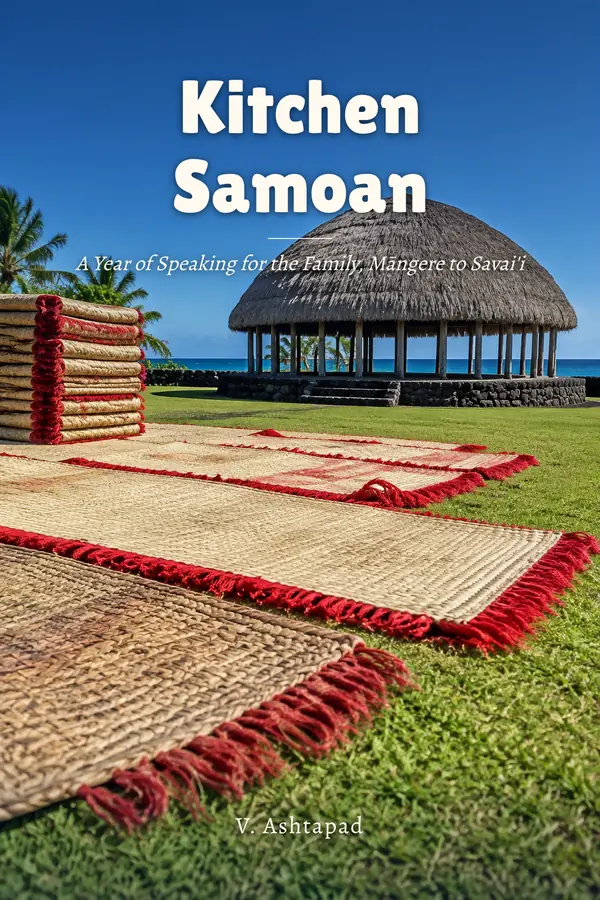
Kitchen Samoan
A Year of Speaking for the Family, Māngere to Savai'i
by V. Ashtapad
Foreword
This is a novel. Ioane Leiataua, his family, the Faleafa family and every other person in these pages are invented, as is the village of Satauli on the north coast of Savai'i and the matai title Lefano. Real places in Auckland and Samoa, from the halls of Māngere and Ōtāhuhu to the wharf at Salelologa, are named only to set the scene and are used fictionally.
Samoan oratory, the lauga, is a deep and living art held by families and villages, and much of it is not for outsiders to write down. The speeches here are described in general terms only: their shape, their greetings and honors, their mornings and metaphors. No real family's genealogy or village honors are recited. Samoan words are kept few and simple, and any errors in them are the author's, not the culture's.
For the ones who carry the chairs, and the ones who carry the voice.
Twenty-One
The key was made of plywood and painted gold, and it was taller than my sister. Dad had cut it out on the driveway with a jigsaw on Thursday night, and Mum had sprayed it on Friday morning before work, so on Saturday the whole hall smelled faintly of hot gold paint under the smell of everything else. Everything else was a lot. Fried chicken in a cardboard bucket the size of a rubbish bin. Sapasui in foil trays, the noodles gone glossy with soy and fat. Two chilly bins of oka, raw fish cured in lemon and drowned in coconut cream, with cucumber and chopped tomato floating in it like confetti. Palusami wrapped in foil and banana leaf, still warm from the oven at Aunty Lino's. Taro cut into thick gray wedges that would sit in your stomach until Tuesday.
The hall was the one off Bader Drive with the stage that sagged in the middle and the curtains the color of old beetroot. Every family in Māngere has been to that hall. You know where the good power points are. You know the men's toilet door has to be lifted to close. Outside, the motorway ran along the back fence, a steady hiss of trucks heading for the airport, and on the far side of it the rugby fields lay green and empty under the floodlights nobody had paid to switch on.
Lagi was turning twenty-one. She wore a puletasi the color of a ripe pawpaw, the top fitted to her waist and the skirt down to her ankles, and she had done her hair in a high bun with a frangipani stuck in it that kept tipping over. She looked like Mum in the wedding photo. Nobody said that to her, because she would have rolled her eyes for an hour.
I was in charge of the speaker. That is what I am usually in charge of. I am the cousin who knows how to make the microphone stop howling, which in our family counts as a technical role. I am also a sports physio, and a twenty-six-year-old man who was born at Middlemore Hospital, and my Samoan is what my cousin Mose calls kitchen Samoan. I can tell you to sit down, eat, wash the dishes, and stop being cheeky. I can ask where the car keys are. I can follow about half of an argument between aunties if they speak slowly, which they never do. I cannot make a speech.
My uncle can make a speech.
Lefano Pese Leiataua is my father's older brother. Lefano is his title, the name he was given in the village in Savai'i when the family made him a matai, an orator chief, a tulafale. We call him Uncle Pese, which is his own name, and which also means song, and which is funny if you have ever heard him, because his voice is not a song. It is a truck engine. It is the sound of a diesel turning over on a cold morning in Ōtāhuhu, low and rough and heavy enough to rattle a window. He spent eighteen years at the freezing works in Westfield, until it closed at the end of the eighties, and then the best part of thirty years running a lawn round with a trailer and two mowers, and he says the voice came from shouting over the chain and then over the engines. Aunty Lino says it came from being born loud.
At ten past eight, after the cake had been cut and before the dancing, Uncle stood up.
He was wearing his ie faitaga, the formal wrap that men of his standing wear, dark navy with a sharp crease down the front and pockets set into it like a pair of good trousers, a white shirt buttoned to the throat, and a black jacket that had been to more twenty-firsts than I had. He had a folded ie lavalava over his shoulder, and in his hand he held the fue, the orator's fly whisk, with its long tail of coconut fiber that he rested on his shoulder when he talked. He did not use the microphone. He never uses the microphone. I had set it up anyway, on its stand, and he walked past it like it was a bus stop.
Then he began.
I want to say how it works, because I did not understand it properly until that year, and because people who have never heard it think it is a kind of toast. It is not a toast. A lauga, a formal Samoan speech, has a shape like a house. You do not walk straight into the kitchen. You come up the path, you greet everyone sitting on every side, you acknowledge the dignity of the place and the people in it by their proper honors, and only then do you get to the matter. The greetings take most of the time. They are not small talk. They are the point. A good orator knows the fa'alupega, the formal set of honors for a village or a family, the way some people know their phone number. He knows which names to say first. He knows what not to say. He speaks of mornings, the taeao, great days in the past that everybody remembers, and he lays them next to this ordinary Saturday so the ordinary Saturday is lifted up. He uses the language of fishing and sailing and birds and weather, so that a girl turning twenty-one is not a girl, she is a canoe that has come through the reef. It is high language. Even fluent Samoan speakers sometimes lean over to an aunty and ask what that bit meant.
Uncle's voice came up from somewhere under the floorboards. It went out over the trestle tables, over the chilly bins and the bucket and the grandkids asleep on a pile of ie lavalava against the wall, and it hit the back of the hall and came back, and for those minutes I could not hear the motorway at all.
I caught pieces. I caught my parents' names, said with honors attached that made them sound like people in a history book. I caught Lagi's name and the word for journey. I caught the name of the village, and the way the whole room changed when he said it, as if a door had opened somewhere and a breeze had come through from the other side of the world. He spoke of Brisbane, where Mose lives with his family, and of the ones who could not fly over. He made a joke, I think about Dad, because the aunties shrieked and Dad put his face in his hands. I laughed too. I did not know what I was laughing at. That is a particular feeling, laughing a second after everyone else, and I have been doing it my whole life.
When he finished he said, "Soifua," which is how you close, and sat down, and the hall went loud again in the normal way.
Then Mum looked at me.
The plan, which I had agreed to in a moment of weakness on Wednesday, was that I would say a few words for the family after Uncle. In English. Nothing formal. Just the brother, saying something nice about his sister. I had notes in my phone. I picked up the microphone, and it gave a small electric cough, and seventy people turned their heads.
"Hi," I said. "Talofa lava."
Then I did the thing I always do, which is talk too fast. I said Lagi was the smart one. I said she used to charge me two dollars to help with my maths homework when she was nine and I was fourteen, which was true and got a laugh. I said I was proud of her. All of it was true. All of it was in English, and all of it was fine, and halfway through I could feel the difference between what I was doing and what Uncle had done, the way you can feel the difference between a training jog and a real sprint in your hamstrings the next day. My words were standing on the floor. His had been hung up in the rafters.
I finished with "Happy birthday, sis," and people clapped, and Lagi came over and pinched my arm hard enough to leave a mark, which is how she says thank you.
Later, after the dancing, after the aunties had done the slow siva and the young ones had done whatever the young ones do, after the bucket was down to wings and the oka was mostly coconut cream, I carried the speaker out to Uncle's van. His van is a white Hiace with a roof rack and a sticker for a lawn round that has not existed for six years. The car park smelled of the smoke from the grill some boys had going by the fence, burnt sausage fat and onions, and that smell got into my hoodie and stayed there until Monday.
Uncle was sitting in the passenger seat with the door open and his feet on the ground, which is how he rests. He had taken the jacket off. The fue lay across his knees.
"You talk like a radio," he said.
"Thanks."
"Too fast. Like the ads on the radio. Buy now, buy now." He put his hand flat in the air and moved it down slowly. "Lagi was laughing, though."
"She was laughing at me."
"Same thing, in this family."
I slid the speaker into the back between a jerry can and a sack of something that might have been fertilizer, and when I came round he was looking at the motorway, at the lights going past, red one way and white the other.
"Ioane," he said. He only uses my real name for serious things. Bank forms, funerals, telling me off. "Sit."
I sat on the edge of the van floor. The concrete was cold through my trousers.
"I am seventy-one," he said. "My voice is getting tired. In the morning it takes a long time to start." He coughed, and it was true, it sounded like a starter motor. "Mose is in Brisbane. Your father won't do it. He never wanted it, since he was a boy. That's fine. Every family has people who carry the chairs." He looked at me. "You carry the speaker."
"Uncle."
"I am asking you to learn to speak for the family." He said it in English, carefully, so I could not pretend I had missed it. Then he said something in Samoan, a short phrase, and when he saw my face, he laughed and said it again, slower. I got the word for service in it, tautua. Later I asked Mum, and she wrote it down for me on the back of an envelope: O le ala i le pule o le tautua. The road to authority is service. It is an old saying. Everybody knows it. I had heard it a hundred times and never once thought it had anything to do with me.
"My Samoan's bad," I said. "You know it's bad."
"I know." He seemed pleased about this, the way a coach is pleased when a new player is very slow, because it means everything after will be improvement. "You have a year. There's a lot coming. Your Aunty Lino's sixty. Silia's getting married. Your father's thing with the house. The title in the village in August." He counted on his fingers and ran out of fingers. "Funerals, always. You sit with me. You listen. You don't speak until I say."
"And then what?"
"Then you speak badly," he said. "Then less badly. That's all it is."
On the drive home I sat in the back of Mum and Dad's car with the gold key across my knees, because it would not fit anywhere else, and Lagi asleep against the window with the frangipani crushed against the glass. I opened the family tree on my phone. Mum had started it two years ago, adding people one branch at a time, and it had spread like a vine. There was the Auckland branch, thick with cousins, every name with a little photo. There was Brisbane, Mose and Mareta and their three kids, the youngest entered as Jeremiah, because Mareta had typed him in on her phone at the hospital, one-handed. And there was Satauli, the village on the north coast of Savai'i, where the names got older and the photos got fewer and some of the boxes held a name and nothing else.
Uncle's box had a photo of him at a wedding, mid-speech, fue on his shoulder, mouth open. Under his name Mum had typed his title. Under the title somebody, probably Lagi, had typed: LOUD.
I scrolled up through the branches until the screen ran out of people, and I tried to say their names under my breath, and the car went over the bridge at Māngere and the harbor below was black and flat and smelled of mud and salt even with the windows up.
The Mats
Uncle Iosefa died on a Tuesday in March, in his recliner, with the television on and a plate of crackers balanced on the arm of the chair. He was Uncle Pese's first cousin, which in our family means brother, and he had driven a forklift at the airport for thirty years, and he had a laugh like somebody dropping a box of cutlery. Nobody had expected it. He was seventy-four and still mowed his own lawn.
By Wednesday afternoon the house in Ōtāhuhu had changed shape. The garage door was up and the garage was swept and laid with mats, and a blue tarpaulin had been strung from the gutter to the fence to make a second room in the drive. Plastic chairs stood along the walls. In the backyard two of the cousins had a halved forty-four gallon drum going over a fire of pallet wood, and the smoke rolled low over the fence and into the neighbors' washing. By evening every one of us smelled of it. It is a smell that says somebody has died, in our family. Burnt pine and wet ash and something sweet underneath from the pork.
Uncle rang me at the clinic.
"Wear black," he said. "Come at six. Sit with me."
"I've got a patient at six."
"Then come at six-thirty. Sit with me." He hung up. Uncle does not say goodbye on the phone. He says what he needs and then the line goes dead, like a man stepping off a bus without looking back.
My patient was Tyrone Vai, nineteen, a winger from the club, with a hamstring that he kept re-straining because he would not do his exercises. I told him to do his exercises. He said yes, Jono, in the voice of a man who would not do his exercises. I drove to Ōtāhuhu down Great South Road in my work polo with a black shirt balled up on the passenger seat and changed in the car outside the dairy, which is not dignified but is very Auckland.
When I got there the groups had started arriving.
This is what happens at a Samoan funeral, at least the part before the funeral, the part that is the family's to run. People come in groups, a malaga, a traveling party: a family from Manurewa, a family from Grey Lynn, the people from Uncle Iosefa's work, the families who are connected by marriage three generations back. Each group comes with gifts. Envelopes of money. Food, sometimes a whole carton of tinned fish or a sack of rice or a box of frozen chicken. And ie toga, the fine mats, folded and carried in front of them like something sleeping.
Each group has its own speaker. The speaker stands at the edge of the garage and speaks to the family, and the family's orator answers. That night the family's orator was Uncle Pese.
He sat cross-legged on a mat at the front of the garage, in black, his ie faitaga, a black shirt, his to'oto'o, the tall orator's staff, laid along the mat beside him. He did not lean on it. He never leaned on anything. I sat beside him and slightly behind, which is where he put me, and I felt the cold of the concrete come up through two mats and my trousers and settle in my lower back, which as a physio I can tell you is exactly where it will stay for three days if you sit cross-legged for four hours at twenty-six with no warm-up.
The first group was from Manurewa. Their speaker was a woman, a matai herself, in a black puletasi with her gray hair pulled back so tight it looked painted on. She spoke for maybe eight minutes. Her voice was thin and clear, the opposite of Uncle's, and it went up at the end of each phrase like a question. I got the words for love and for sorrow and something about a tree falling. Then Uncle answered.
He spoke for longer than she did. That is correct, I learned later. The host thanks the guest properly and at length, and he gives back the honors she gave, adds to them, sets her group in its proper place. He spoke about the journey from Manurewa as if it were across an ocean and not along the Southern Motorway. People laughed at that, gently. Then the mats were brought forward.
Two young men carried them, one at each end of the stack, and set them in front of Uncle, and then one by one the mats were opened. You do not throw open an ie toga. You unfold it the way you would unroll a map you were not sure you were allowed to see. The fine ones are woven from strips of pandanus so narrow they look like thread, and when they are finished they are soft enough to wrap a baby in and they drape like heavy cloth. The very old ones turn the color of strong tea. They have a fringe along one edge, red feathers on the oldest and red wool on the newer ones, and the best of them take a woman a year or more to weave. Each one was held up and its quality called out, loud, so everyone could hear what had been given. Then it was folded and added to the pile behind us.
By the end of that night the pile was taller than me sitting down. I know because I had to move it. Uncle told me to take the ones from the second group into the lounge, and I picked up a stack of five, and I nearly went over. They are heavy. Not like a pile of towels. Like a person. I carried them into the lounge where Uncle Iosefa lay in his casket in a white shirt, with his hair combed the way he never combed it, and I put the mats down on the couch and stood there for a minute with my arms aching and the smell of pandanus on my hands, dry and grassy and very faint.
I came back out and Uncle looked at me, and I nodded, and he nodded.
At about nine he leaned over.
"The next group," he said quietly, "you welcome them. Two words. Then I talk."
"What two words?"
"Afio mai." He said it slowly. "Like that. Afio mai. It means come in, please, with respect. There are other words for other kinds of guests. Those are for later. You say it, you sit down, I take over."
I said it under my breath maybe forty times while a group from Grey Lynn came up the drive. Afio mai. Afio mai. It was not hard. A child could say it. Children did say it; I had heard Tasi, my cousin's boy, say it to the old ladies at a cousin's wedding when he was five.
The group stopped at the edge of the tarpaulin. Their speaker was an old man with a walking stick and a fue over his shoulder, and he looked at Uncle, and Uncle looked at me.
I stood up. My knees cracked like a twig.
"Sau," I said.
There was a pause. Then somebody at the back of the garage snorted. Then one of my aunties said "Aue," in the voice you use for a dropped casserole.
Sau means come. It is what you say to a kid when you want him to come and carry the shopping. It is what you say to the dog. I had heard it ten thousand times in my life, mostly aimed at me, and under pressure it was the word that came out.
The old man from Grey Lynn looked at me for a long moment. Then he laughed. It was a good laugh, a real one, his shoulders going up and down under his black jacket, and he said something to Uncle in fast Samoan that made the whole garage laugh, and Uncle laughed too, in his engine voice, and put a hand on the mat beside him and said something back. Then he said, very formally, the proper words, the welcome I was supposed to have given, and much more than that, and the old man came forward and sat, and the night went on.
I sat down. My face was so hot I could feel my pulse in my ears.
Later Mum told me what the old man had said. He had said: The boy is calling us like his mother calls him for dinner. Good. That means we are family.
And Uncle had answered: He is learning. Last week he could not even say that.
At eleven the groups stopped coming. In the kitchen Mum was sitting at the table with her reading glasses on and a laptop open, typing. Aunty Lino stood behind her calling out names and numbers. On the screen was a list. Name of the family. Where they came from. What they gave: so many hundred dollars, so many mats, a carton of fish, a sack of rice. A column for what had been given to them, at their own funerals and weddings, over the years. A column, mostly empty, for what our family would give back.
"Our family office," Mum said, without looking up, when she saw me reading over her shoulder. "Somebody has to keep it straight."
It was a shared ledger in the family's private space, the one only family can get into. Each household could see its own line. The older aunties could see all of it. Mum had set it up after Grandpa's funeral, eight years ago, when it had all been on pieces of paper in a biscuit tin and half the pieces had gone missing and two families had nearly stopped speaking over a misremembered two hundred dollars. Now it was all there. Every gift since then, with the date and the occasion.
I looked at our own household's line. Next to Iosefa it said: Fili and Siniva, $500, two mats. Under that it said: Ioane, $200.
"I didn't say two hundred," I said.
"You did," said Mum. "Just now. With your face."
I thought about my rent, which was due Friday, and my car registration, which was due last month, and the new tires I did not have. Two hundred dollars was real money. It was two physio sessions I would not be spending on anything else. It was also the price of sitting with Uncle on a cold floor while a whole community of people walked up a driveway with their arms full.
"Fine," I said. "Two hundred."
"Good boy," said Aunty Lino, and gave me a plate of pani popo, the sweet coconut buns she bakes in a tray so they pull apart, soaked underneath in thick coconut sauce that goes sticky as it cools. I ate three standing at the bench. Outside, the cousins had let the drum fire burn down, and the coals glowed orange under the gray ash, and the smoke drifted sideways now, thin, toward the motorway.
Before I left, Mum tapped another part of the screen. "Look," she said. "For you."
It was a folder in the family's private space, under Uncle's name. Recordings. Dozens of them. Some of them were twenty years old, transferred off cassette by somebody's son: Uncle at a wedding in Mt Roskill in 2004. Uncle at Grandpa's funeral. Uncle at a twenty-first in 2011. Uncle in the village in Satauli, the sound full of wind and roosters. Each one had a date, the occasion, a line or two of what it was about, typed by Mum or Lagi.
"Listen to them in the car," Mum said. "Instead of that rubbish music."
I drove home with Uncle at the twenty-first in 2011 playing through the speakers, his voice fifteen years younger, still an engine but a newer one, and I understood perhaps one word in five, and I did not turn it off. At the lights on Massey Road I said "Afio mai" out loud, to nobody, and the man in the car next to me looked over, and I gave him a small nod as if I meant to, and the lights changed.
Arrivals
Uncle Pese's house is under the flight path. Every four minutes or so, on a westerly, a plane comes down over Māngere with its wheels out and its belly lit, low enough that you can read the airline on the tail, and for about fifteen seconds nobody in the house can hear anything at all. The windows hum. The mandarin tree in the front yard shivers. The dog next door, who has lived there nine years, still barks at every single one.
Our family has learned to talk around it. Aunty Lino will stop in the middle of a sentence, wait with her mouth half open, and carry on exactly where she left off when the noise passes. Uncle does not stop. Uncle talks straight through, and I swear on a good day the plane loses.
"Mose lands at two," Uncle told me on the Thursday before Easter. "They come here. You welcome them."
"Me."
"You."
"The whole thing?"
"Small one," he said. "It's family. It's my son. It's a good place to fall over. Nobody will tell anyone." He considered this. "Everybody will tell everyone. But kindly."
Mose is Uncle's only son. He is forty, fourteen years older than me, and when I was small he was the cousin who could do everything: drive, swim out past the buoys at Mission Bay, eat a whole tray of sapasui by himself. He taught me to ride a bike on the footpath along the old Māngere Bridge, running behind me holding the seat, and he let go without telling me, and I rode thirty meters on my own and then straight into a rubbish bin. He moved to Brisbane when I was twelve, for scaffolding work, and stayed. He lives in Ipswich now, west of the city, with Mareta and their three kids, in a house with a pool he complains about cleaning.
He was coming home for two weeks. Mareta was coming. Talia, twelve, and Kaleb, nine, and the baby, Ieremia, who none of us had met yet except as a photo.
I had six days.
That night I went round to Teuila's flat in Ōtara with a notebook. Teuila and I had been going out since November. She teaches Year Eight at an intermediate in Māngere East, and she came from Upolu when she was eight, and her Samoan is the real thing, the kind that runs along by itself. She also thinks my Samoan is the funniest thing that has ever happened to her.
"Read me what you've got," she said. She was on the couch marking a stack of science projects with a green pen, her feet in a pair of fluffy socks.
I read it. It took about forty seconds. It was mostly hello, welcome, we are happy, the baby is beautiful, the end.
She put the pen down. "That's a text message."
"It's a start."
"It's a text message to your mum." She pulled the notebook over. "Okay. You need the bit at the beginning where you acknowledge everyone. That's most of it. Who's going to be there?"
I told her. Uncle and Aunty Lino. Mum and Dad. Lagi. Mose and Mareta and the kids. Probably Aunty Iulia from next door, who is not related but has been in every family photo since 1993.
"So you greet Uncle first," said Teuila. "As the matai. As the head of the house. You use his title. Then you greet the family who has come. You thank them for the journey. Then you say what the day is. Then you wish them well." She wrote quickly in her neat teacher's print. "Not long. It's family. But in the right order. The order is how they know you mean it."
We worked until midnight. She wrote it out in Samoan, and under each line she wrote what it meant, and under that she wrote how to say it, in my own spelling, which made her laugh so hard she had to lie down on the floor. She made me read it back to her. She corrected my vowels. She told me Samoan vowels are long or short and that it matters, that if I said one of them short I would be talking about something else entirely, and she would not tell me what.
"Is it rude?"
"It's not rude," she said, wiping her eyes. "It's just about fish."
I practiced all week. I practiced in the car on the Southwestern Motorway at seven in the morning with the window down and the sun coming up orange over the Manukau Harbour. I practiced in the clinic kitchen while the kettle boiled. Keith Whitcombe, who owns the clinic and has been a physio since before I was born and who is very kind and very Pākehā, came in and listened for a while and said, "Is that Māori?" and I said, "No," and he said, "It's lovely," and went back out with his tea.
On Saturday I wrote the first word of every line on the inside of my left wrist in ballpoint, small, under my watch.
Mose's rental car pulled into Uncle's drive at ten to three. A plane came over at the exact moment the doors opened, so that the first thing the Brisbane cousins did on arriving home was stand in the drive with their hands over their ears. Talia had grown about a foot. Kaleb was carrying a football. Mareta had the baby on her hip, and the baby looked around at all of us with total suspicion, which I thought was fair.
Aunty Lino had put mats down in the lounge, and the couches had been pushed back against the walls. We sat. Uncle sat at the head of the room in his ie faitaga and a short-sleeved shirt, without his jacket, because it was family and because it was twenty-four degrees. Mose and his family sat opposite. Mum and Dad and Lagi sat to one side. Aunty Iulia sat on the arm of the couch even though there was a mat for her, because she always does.
Uncle looked at me and inclined his head about one centimeter.
I stood up.
I have stood up in front of rooms before. I have done case presentations at university in front of fifty people and a professor who ate a muesli bar loudly the whole time. I have explained to a two-meter lock that his season is over. It was not the same. When I opened my mouth I felt the words Teuila had written sitting in my chest like stones in a bag, and I had to lift each one up and out separately.
I got the greeting to Uncle out. I said his title, Lefano, and the honor that goes with it, and I saw him not react, which was correct, and also I saw his eyes move very slightly, which I chose to take as approval. I greeted Mose and Mareta. I said the line about the journey. I said it slowly, the vowels long where they were supposed to be long.
Then a plane came over.
The windows hummed, and the mandarin tree shook, and the dog next door started, and I stopped, the way Aunty Lino stops, and waited with my mouth half open. And while I was waiting I looked down at my wrist and the ballpoint had smeared. It was hot in the lounge and my wrist was sweating under the watch strap and the first words of the next four lines were a blue cloud.
The plane passed.
I stood there. I could hear the baby breathing through his nose. I could hear the kitchen clock. Somewhere under everything I could hear the motorway, as you always can in Māngere if you listen.
So I said, in English, "Sorry. My notes melted."
Mose laughed first, a big shout of a laugh, and then everybody.
And then, because I did not know what else to do, I just kept going in English. I said I remembered him running behind me on the bridge. I said he let go without telling me, and that I was still a bit angry about the rubbish bin. I said the house had felt like it was missing a wall since he went to Brisbane, and that it was good to have the wall back, even with the pool complaints. I said the baby looked exactly like Uncle, which was true and slightly alarming. Then I remembered the end, the last line Teuila had written, the wish for them, and it came back to me whole without the wrist, and I said it in Samoan, and I said, "Soifua," and sat down so fast my knee hit the floor.
Then Mose answered.
He spoke in Samoan, standing, the way Uncle does, with his hands loose at his sides. He is not a matai. He does not have the training Uncle has, the high words, the honors of the village stacked up and ready. But his Samoan is fluent, because he was fourteen when he left Auckland and he grew up half his childhood around Uncle's voice, and his answer was good. He thanked Uncle. He thanked Mum and Dad. He thanked me, and he said something that made Aunty Lino put her hand over her mouth, and something else that made Lagi shriek, and he ended with a phrase I knew, the one about service, the road to authority, and he looked at me while he said it.
Afterward, in the kitchen, I asked Lagi what he had said about me.
"He said," said Lagi, cutting keke pua'a in half with a bread knife, the steamed buns splitting open to show the red pork inside and letting out a gust of sweet, fatty steam, "that you speak Samoan like a Brisbane boy. And that's the worst insult he could think of, because he is a Brisbane boy."
"That's not bad."
"Then he said you speak English like Uncle. Which is a compliment. I think."
The next morning Aunty Lino made koko Samoa for everyone. Uncle's younger brother, Uncle Falani, sends it over from the village, the cacao beans roasted and ground by hand into a dark paste and pressed into lumps the size of a fist and wrapped in plastic. She broke a lump into a pot of boiling water, and it melted slowly, and she stirred in sugar, a lot of sugar, and poured it into mugs. It is not like hot chocolate from a packet. It is thinner and darker, and bitter under the sweetness, and there is a fine grit at the bottom of the cup that you either drink or don't, depending on your family. Ours drinks it. It tastes of smoke from wherever it was roasted, and of the trees.
Talia sat next to me at the table with her phone. She had found the family tree.
"Who's Jeremiah?" she said, pointing to the newest box on the Brisbane branch.
"That's your brother."
"His name's not Jeremiah."
"Your mum typed it at the hospital. One-handed."
She fixed it right there across the table, I-e-r-e-m-i-a, saying each letter out loud as if the box might argue, and then took a photo of him, a slightly blurry one with koko on his chin, and put it beside the name. Then she went up the tree to Satauli, and the old boxes with nothing in them but names, and she said, "Who are all these?"
I did not know. I knew some. Uncle Falani. Aunty Sau, who is eighty-eight and who I met once when I was six. I knew the name of the village. That was where my knowledge stopped, like a road at a fence.
"Ask Uncle," I said.
She did. Uncle was sitting in his chair by the window with his koko. He put the mug down. He started, without a word of warning, to talk. Names, and who married who, and which side of the village they lived on, and who had a fight with who about a pig in 1971. I sat across the room and listened, and the planes came over every four minutes, and he did not stop for any of them.
Two Sides
Silia married Brendan Kerr on the first Saturday in May, in a function center in Manukau with a car park so big you could land a plane on it, and a view from the side doors across the motorway to the roller coaster at the theme park. All afternoon, while the photographer arranged the bridal party on the lawn, you could hear the screams from the roller coaster coming over the traffic in little bursts, like a crowd at a try.
Silia is Dad's cousin's daughter, which makes her my cousin, in the way that everybody is. She is twenty-nine. She works for the council planning bus routes, and she is the only person in our family who understands why the 33 bus does what it does. Brendan is from Timaru. He is a quantity surveyor, six foot four, with red hair and a sunburned neck, and he had learned to say Talofa and Fa'afetai and nothing else, and he said them to everyone, constantly, with enormous sincerity, like a man holding up two lit candles in a wind.
His mother had passed away when he was a teenager. His father, Graeme, had remarried, and his stepmother was Samoan, from Christchurch, named Fiaola. This was the important part. It meant that Brendan's side had a Samoan side, and the Samoan side had a speaker, and the speaker was Fiaola's uncle, an old man named Malu who had flown up from Christchurch with a fue in a cardboard tube.
"Malu is good," Uncle said in the car on the way. He said it the way you say a fast bowler is good. Respectfully, and with some regret.
"Are you worried?"
"No." He looked out of the window at the motorway. "Yes. A little."
That was the first time I noticed his voice that year. Not much. Just a thread of something at the end of the word, like a frayed edge, a little rasp. He cleared his throat and it went away.
The way it works at a wedding, at least in our family's version, is that after the ceremony and before the meal the two families meet formally. One side presents to the other. Mats are given and returned, money is given, food. The speakers stand for their families and exchange speeches. It is warm. It is also, very slightly, a contest. Not to win. Nobody wins. But to honor the other side so well and so completely that your own family is honored by it. A good orator lays down a compliment, and the other picks it up and adds to it and hands it back, and if it goes well it builds between them like a stack of mats, higher and higher, until one of them gives way gracefully and the families sit down to eat.
The function room had round tables with white cloths and chair covers tied with gold ribbon, and a long head table under an arch of white and gold balloons. The two families were arranged on either side of the dance floor. Brendan's Timaru relatives sat together near the bar in good suits and floral dresses, looking like the opening of a documentary. Fiaola's Christchurch family sat in front of them in black and white, the women in puletasi, the men in ie faitaga. On our side, Uncle sat at the front on a chair because his knees would not do the floor in a function center, with his to'oto'o propped beside him and his fue on his shoulder. Mum sat behind him with a stack of envelopes in a folder. I sat beside Mum with a pile of ie toga on my knees and my legs going to sleep.
Malu went first.
He was thin as a fence post, maybe eighty, with a white mustache and enormous hands. His voice was nothing like Uncle's. It was light and dry and it seemed to go round corners. He spoke for a long time. Fluent speakers in the room were leaning in, and once or twice somebody on our side made a soft sound, a breath out, when he said something especially fine. I followed a little more than at Lagi's twenty-first. I heard him speak of two canoes. I heard him speak of a long journey, from the south, and of a family that had been waiting on a shore. I heard Silia's name, honored in a way that made Silia, at the head table, put her hand on Brendan's arm.
Graeme Kerr leaned across from the next table.
"Jono, is it?" he said quietly. "What's he saying?"
I have thought since about what I should have said. What I did was try. I listened to the next sentence and translated it, and the sentence was about the sea, and I said, "He's saying something about the sea." Graeme nodded seriously. The next sentence had Brendan's name in it and a word I knew meant strong, and I said, "He's saying Brendan is strong." Graeme looked at his son, who was six foot four and visibly sweating, and nodded again. The next sentence I did not understand a single word of, and I said, "He's honoring the family," which was true in general and would have been true of almost any sentence in the speech.
"Right," said Graeme. "Right." He sat back. Then he leaned in again. "You don't know, do you."
"Not really," I said. "Sorry. I know how it's built. I don't know all the words."
He smiled. It was a good smile, a tired father's smile. "That's more than me, mate," he said.
So I told him how it was built. In a whisper, under Malu's speech. I told him this part was the greetings, and that the greetings were the important bit. I told him the speaker was going through the honors of our family, all of them, and that he would get to Brendan and Silia eventually but that the long way round was the respectful way. I told him that when Uncle stood up he would do the same thing back, but longer, because we were the hosts, and that it would be like two men passing a ball back and forth and each time the ball got a bit heavier. Graeme listened and nodded and once said, "Like a test match," and I said yes, exactly, and he looked happier than he had all day.
Then Uncle stood up.
He stood slowly, using the to'oto'o, which he never used for standing. He waited until the room was quiet. Then he spoke, and the engine was back, low and strong, and Graeme Kerr actually sat back in his chair a little.
I could hear what he was doing even when I could not follow the words. He took everything Malu had given and gave it back. He took the canoes. He spoke of them coming through the reef, of the ropes between them. He took the southern journey and made it longer and harder and more honorable. He honored Fiaola. He honored Graeme, by name, which nobody had expected, and Graeme went red to his ears. He honored Brendan's mother, who was not there, and the room went very still.
Malu answered him. Shorter. Then Uncle answered Malu. Shorter again. They were coming in toward each other. And then Malu, with his big hands open, said something short and smiling, and Uncle laughed, and Malu laughed, and Malu sat down. That was the moment. Malu gave way, gracefully, with a joke. Later Mum told me what the joke had been. He had said: The voice of Māngere is too loud for an old man from Christchurch. I will sit before my ears fall off.
Then the mats.
Our side carried ours across the dance floor. I carried the top three, walking behind Mum, with my arms out and the fringe of red wool brushing my wrists. We laid them down in front of Fiaola's family and unfolded them one by one, and their speaker's nephew called out each one, its quality and size. Then their side carried theirs across to us. Envelopes went both ways. Mum made a small note in her folder for each. The Timaru side watched it all with their mouths slightly open, and one of the aunties from Timaru started to cry, and Brendan's little cousin asked very loudly if they were getting carpets.
Afterward there was food, and it was what there always is. The bucket of fried chicken, which somebody always brings even when the wedding is catered, like an uncle who turns up to every party with the same guitar. Trays of sapasui. Taro and green banana. Whole roast pork with skin like glass. Oka in a big plastic bowl, and a pavlova from the Timaru side that was eaten in four minutes. The cake was four tiers, white and gold, and when they cut it the aunties all went up at once with paper plates.
Uncle sat at our table drinking water. His voice had gone rough again, a little, at the edges.
"You were talking," he said to me. "During Malu."
"Graeme asked me what he was saying."
"And you told him."
"I told him I didn't know. Then I told him how it works."
Uncle looked over at Graeme Kerr, who was at the bar teaching his Timaru brothers to say Fa'afetai, getting it slightly wrong.
"Good," said Uncle. "That's a job too. Telling the other side how it works." He drank his water. "Malu is very good."
"You were better."
"No." He put the glass down. "He gave way first because he is old and polite. I am old and not polite." He grinned. Then he said, more quietly, "You see what he did? He gave me everything. Every honor I needed to give back. He made my job easy. That's what a good speaker does. He makes room for the other one."
On Sunday, Mum pinned the function center on the family map, the one in our private space where she has been marking every hall and school hall and rugby clubroom the family has used since she came to Auckland in 1989. There must be fifty of them. Each pin has a note. Some of the notes are about the occasion. Most of them are practical, written in Mum's voice: Oven doesn't work, bring the urn. Good parking at the back. Stage too small for siva. Toilet door must be lifted.
For Manukau she wrote: Silia and Brendan. Big car park. You can hear the roller coaster. Malu from Christchurch spoke for the groom's side, very good, gave way with a joke.
Then, under it, she wrote: Jono explained the speeches to the groom's father. Graeme. Nice man.
I didn't know she had seen.
Ledger Night
The title bestowal in Satauli was set for the third week of August. Uncle Falani, the youngest of the three brothers, the one who stayed on the land, was to receive a matai title of his own. The village council had agreed. The family in the village had agreed. The family in Auckland and Brisbane had agreed, which in practice meant Uncle Pese had agreed, and everybody else had nodded.
A title bestowal, a saofa'i, is a great honor and costs a great deal of money. I had not known how much until the Sunday in late May when Mum opened her laptop at Uncle's kitchen table and turned the screen around.
The family ledger had a new page. At the top it said SATAULI, AUGUST. Under that was a list, and it was long. Flights for Uncle and Aunty Lino and Dad and me. Pigs, a number of them, raised in the village but paid for. Cartons of tinned fish and corned beef. Sacks of rice and flour and sugar. Ie toga, many, some of which the family already had folded in a cupboard in Uncle's spare room and some of which would need to be bought. Cash to present to the village chiefs and orators who would sit in the fale that day. Cash for the feast. Cash for the village school, for the roof of the classroom the cyclone took. And under all of it, in Mum's tidy way, a total.
Lagi read it out loud and then said, "That's a car."
"That's a good car," said Dad.
Mum did not say anything. She scrolled down to the second half of the page, where she had made a column for each household in the family: ours, Uncle's, Mose's in Brisbane, Silia's parents, a dozen more. She had not put in what each household should give. She had put in what each household had given at the last three big fa'alavelave, and next to it, in a lighter color, a number she called comfortable.
"Comfortable?" said Lagi.
"What they can give without missing a power bill," said Mum. "I worked it out. Roughly. From what they've told me. Nobody else sees this column except me and Lino."
"And if the comfortable doesn't add up?"
"Then we have a fundraising night," said Mum. "Which we're having anyway. Second of June. Station Road hall. I've booked it."
The old scout hall behind the shops on Station Road in Ōtāhuhu has a corrugated iron roof that is very loud in rain and a kitchen with two industrial ovens and one working one. Mum's pin for it on the family map said: Good kitchen if you bring your own oven trays. Rain is very loud. On the night of the second of June it rained, and it was very loud.
It was still a good night. These nights usually are. Aunty Lino and four of the cousins cooked from two in the afternoon, and by six the hall smelled of fried dough and coconut and the steam of the big pots. They sold plates at the door: sapasui with rice, a chunk of povi masima, salted brisket gone soft and pink from hours of boiling, a slab of taro, a scoop of oka. Ten dollars a plate. There were trays of panikeke, round puffs of fried dough the size of a child's fist, golden outside and soft inside, sold in brown paper bags for five dollars. There were pani popo by the dozen. And yes, on the trestle table by the stage, somebody's bucket of fried chicken, which was not for sale because nobody had asked who brought it.
The children did a siva on the stage, the girls in matching puletasi in blue, the boys in ie lavalava with leaves tied around their ankles, and the parents stood at the front filming on their phones and shouting their children's names. Tasi danced in the second row and forgot the whole middle section and just stood there smiling with his arms out until it came back to him, and the aunties cheered louder for him than for anybody, which I understood perfectly.
Mum had borrowed a projector from Teuila's school. On the wall behind the stage she put up the village map from our family's private space. Uncle Falani had been adding to it all year from his phone, walking around Satauli with a terrible connection and uploading one photo every two days. The pins were there. The family's land on the slope above the road. The guest fale Falani was rebuilding for the day, the posts already up, the new thatch piled beside it. The malae, the village green, where the ceremony would be, with the ocean beyond it, very blue. The plantation, taro and banana and the cacao trees for the koko. The sea wall. The grave of my grandparents, white-painted concrete under a frangipani, with a note from Falani: I cleaned it on Sunday, the flowers are new.
The children from Auckland sat on the floor under the projector looking up at it. Talia had told everyone in the Brisbane branch about the map, and some of them were watching it on a video call on Mareta's phone propped against a speaker.
"Is that where the pigs are?" Tasi asked.
"Yes," said Uncle. "That's where the money goes. Look."
At eight o'clock the giving began.
This is the part I had been dreading, and it is the part some people outside the culture find hard to watch, so I will try to say it plainly. At a fundraising night like this, families come up one at a time and give, and the gift is announced. Not always. Not everywhere. But in our family, at that time, it was. The speaker for each family says a few words, and then hands an envelope to the family's orator, and somebody reads out the amount, and everybody claps. It is not showing off. Or not only. It is accounting, done in public, so that the giving is witnessed and remembered and can one day be returned. It holds the community together like the lashing in a fale. It also means that if you can only give fifty dollars this year, everybody hears that you gave fifty dollars.
Mum had argued about it with Uncle for a week.
"Times are hard," she had said. "Rent's gone up. The petrol."
"It's always been like this," Uncle had said. "That's how people know."
"People know anyway. It's in the ledger."
"The ledger's in your computer. The hall is in front of everybody."
In the end they settled on this. The giving would be announced, as always. But each household's speaker could choose to say simply that their gift was given, without a number. Uncle would accept it with the same words either way. Mum would put the number in the ledger, where only she and Aunty Lino and the household itself could see it.
The first three families announced their amounts. The fourth said only, "Our gift is given." Uncle accepted it in exactly the same voice, with exactly the same honors. The room clapped exactly as loudly. After that, about half the families announced and half did not, and by the end of the night nobody seemed to be keeping track of which, and I thought: Mum is a very clever woman.
Around nine I went into the kitchen for more cups and found Lagi at the bench with her face in her hands.
"What's wrong?"
"Nothing." She wiped her eyes on a tea towel that said Rotorua. "I put two hundred in. For the trip. I didn't even get asked."
"Nobody got asked."
"I know. That's the problem. You don't have to get asked. You just have to." She threw the tea towel at the bench. "I'm twenty-one. I've got a student loan. I'm working at the supermarket on Thursdays. I want to go to Melbourne with my friends in September and I can't now. And I feel like a terrible person for being angry about it, because it's for Uncle Falani, and it's beautiful, and I love him, and I'm still angry."
I did not say anything clever, because there was nothing clever to say. I said I had put in four hundred and that I was angry too. I said I had been eating noodles for a week. She laughed, wetly, and said that was my own fault for buying the car.
Dad came in. He had been carrying chairs all night, which is his job, and he was sweating through his shirt.
"I heard," he said to Lagi.
"Sorry."
"Don't be sorry." He leaned against the bench beside her. Dad does not make speeches. He has a voice like gravel being poured very slowly, and he uses it about forty words a day. "Your mum and I, we didn't go to anything for ten years when you two were small. No holidays. Every spare dollar went to this. Funerals in Samoa. Weddings. The water tank in the village. Your grandpa's stone." He shrugged. "Some years I hated it. Then Grandpa died and four hundred people came and gave and I didn't have to worry about a single thing for that whole week. Not one. Somebody brought the food. Somebody paid the hall. Somebody flew him home." He looked at Lagi. "It goes round. You put in. Later it comes back. Sometimes when you're the one on the floor."
"I know, Dad."
"Being angry's allowed. Just give what you can and say what you can't." He picked up the tray of cups. "And go to Melbourne next year. I'll help."
At the end of the night, after the last family had given, after the children had been put to sleep on the stacked mats by the wall and the rain had eased to a patter on the iron, Uncle turned to me.
"You thank them," he said. "For the family. Short."
I had not prepared. I stood up anyway. It was the strangest thing. I opened my mouth and Samoan came out, not much of it, not high, not fine, but the right shape. I greeted Uncle by his title. I greeted the families who had come. I thanked them for the rain, which was a joke, and some people laughed. I said what the money was for: for Uncle Falani, for the village, for the day. I tried to say a phrase I had heard Uncle use, about a house being held up by many posts, and got one word wrong, and one of the aunties from Manurewa called out the right word, kindly, and I said it again, properly, and everybody clapped as if I had scored. Then I said, "Soifua," and sat down.
Afterward, while the cousins stacked the trestle tables and the boys fought over the last panikeke, Mum showed me the ledger. The total at the top of the SATAULI, AUGUST page had a green bar under it that had gone almost all the way across.
"Almost," she said.
"Almost is good."
"Almost is very good." She closed the laptop. "You said 'posts' wrong."
"I know."
"Aunty Selesa fixed it for you. You know why?"
"Because I said it wrong."
"Because she wanted you to say it right," said Mum. "That's different."
Sixty
In July Uncle gave me half a speech.
"The front half," he said. "The greetings. The morning. Then you hand it to me and I do the rest."
We were in his garage in Māngere on a Tuesday night. The garage has not held a car in twenty years. It holds two lawnmowers he cannot bring himself to sell, a chest freezer full of fish and mutton flaps, a set of shelves of paint tins, a sofa from 1998, and a whiteboard on an easel that he bought at a school fair for no reason anybody can explain. It had a list on it from his lawn round. Mrs. Patel Tues. The Chens fortnightly. Corner of Idlewild DO NOT DO HEDGE.
Aunty Lino's sixtieth was on the nineteenth, at the rugby club.
"Which morning?" I said.
He looked at me as if I were a slow child. "Her morning. You find it."
I knew what he meant by then, or half knew. In a lauga the speaker speaks of mornings, taeao, the great days. In the village speeches they are mostly from history: the morning a famous chief arrived, the morning peace was made, mornings that everybody in the fale knows by name the way you know the year of a big earthquake. You put the occasion beside them. You say: this day is like that day. It raises the room.
"I don't know any of the old mornings," I said.
"So use a family one. That's allowed, for family." He sat down on the sofa, which exhaled dust. "Every family has mornings. You know hers?"
I did not. I went home and opened the recordings in the family space and found Aunty Lino's fiftieth, 2016, a speech by Uncle in a hall in Favona. Lagi had typed it out two years ago when she was bored over the summer, Samoan in one column and her best guess at English in the other, with question marks where she had given up. I listened to it four times in the car with the transcript open on my phone at the lights. And on the fourth time I found it. Two minutes in, Uncle spoke of a morning in 1976 at the airport in Māngere. A girl getting off a plane from Apia in July in a wool coat borrowed from her cousin, three sizes too big, the sleeves rolled four times. Lagi's English said: The coat was bigger than the girl. The girl was bigger than the coat.
I didn't understand the second sentence. I rang Mum.
"It means she was small, but she was more than the cold," Mum said. "That's Pese. He said that at her fiftieth and she cried. She's never let him forget it."
"Can I use it?"
"It's family," said Mum. "Ask him."
I asked him in the garage the next night.
"You can use the morning," he said. "Don't use my words. Find yours."
We worked every night that week and the next. He was a terrible teacher in some ways. He would not write anything down. He would say a line once, at speed, and then look at me expectantly, and when I asked him to say it again he would say it differently. But in other ways he was the best teacher I have ever had, including at university.
"You're breathing from up here," he said on the second night, and poked me in the collarbone.
"I know how breathing works, Uncle. I'm a physio. It's the diaphragm. It's a muscle under the lungs, it pulls down, the lungs fill from the bottom."
"Good." He poked me lower, under the ribs. "So use it."
"That's what I'm saying."
"You're saying. You're not doing." He stood up. He put his hand flat on his own stomach, over the ie lavalava. "Seventy years," he said, "I've known it's there. Long before your university." Then he spoke one line, quietly, not loud at all, and it filled the garage. It went up into the roof and rang the paint tins.
"Now you."
I tried. It came out of my throat, thin, like Malu's but without the skill.
"Again. Speak to the back wall. Not to me. The back wall is the oldest man in the room. He's deaf. He's important. If he can't hear you, you've insulted him."
I spoke to the back wall. The whiteboard. Corner of Idlewild DO NOT DO HEDGE.
"Better. Slower. The words are heavy, so let them be heavy. You're carrying mats, not throwing a ball."
"Like a physio," I said. "Load before speed."
He did not know what that meant, but he liked the sound of it and said it to Aunty Lino later as if he had thought of it.
His voice was not good that fortnight. I noticed it more now that I was listening for it. When he spoke quietly it was fine. When he lifted it, it would start out as the engine and then catch, partway through, a rasp like a shovel on gravel. Twice he stopped mid-line to cough. Once he went into the kitchen for water and stayed there longer than water takes.
The rugby club in Māngere has clubrooms up a flight of concrete stairs above the changing rooms. On the walls are team photos going back to the 1960s, rows of big men with their arms folded, and a glass cabinet of trophies, some of them very tarnished. In the 1977 photo, second row from the back, third from the left, is Uncle at twenty-two, a prop, with a mustache and a neck like a tree stump. Aunty Lino had asked for the party there because that was where she first saw him, years after that photo, at an after-match in 1985, when she was nineteen and he was thirty and still turning out for the reserves, and she had thought he was the loudest man she had ever met, and she had been correct.
On the nineteenth the clubrooms smelled of three things: the deep fryer from the bar kitchen, wintergreen liniment rising up the stairs from the changing rooms below, and the cooked food coming in under foil from people's cars. Through the big windows the floodlights were on over the main field and the junior grades were training in the cold, little kids in oversized jerseys chasing a ball in a cloud of their own breath, and every so often a whistle came up thin through the glass.
Aunty Lino wore a white puletasi with a pattern of red hibiscus, and a garland of fresh flowers her sisters had made, and she looked about fifty, and she said so. Uncle wore his navy ie faitaga and the black jacket and a tie I had never seen before, a dark red one. There were about a hundred people.
After the cake, Uncle stood and looked at me.
So I stood.
I did not use my wrist this time. I did not use notes at all. I had the shape in my head, the house. The path up to the door. Greet everybody on every side.
I greeted Uncle first by his title, from the stomach, to the back wall, and the back wall was the old team photo from 1977, and I said it slowly. I greeted Aunty Lino with the honors due to the wife of a matai, which Teuila had taught me, and which Aunty Lino heard with her chin up, very proud and very amused at once. I greeted her sisters and her brothers. I greeted the families who had come from Brisbane on a video call, and the families from Christchurch, and Malu, who had flown up again because Fiaola insisted, and who sat at a table by the window with his fue in its tube on his lap, listening like a judge at a show.
Then the morning.
I said: On a morning in July 1976, at the airport in Māngere, a girl came down the steps of a plane from Apia into the cold. I said it in Samoan, mostly, with two English words I did not have the Samoan for, which were wool and sleeves. I said that the coat was borrowed from her cousin and was three sizes too big and the sleeves were rolled four times. I did not use Uncle's line. I said instead that she had been looking for a warm place ever since and had made one, and that this room, this cold rugby club in Māngere in July, full of the people who had come out tonight, was the warm place she made. Then I said that the morning in 1976 and this night were one thing. That is the job of the morning: you lay the old one beside the new one.
I do not know if I said it well. I know it came out in the right order. I know that I was speaking to the back wall and it sounded, briefly, almost like a voice. I know Aunty Lino put her hand over her mouth, and that her sisters were all looking at her rather than at me, which I took as a good sign.
Then I said, as Uncle had told me, the short formal phrase that hands the speech on to the senior speaker. And I sat.
Uncle spoke for twelve minutes. For the first eight he was magnificent. He took my morning and laid five more beside it, real ones, from the village, the old ones that make the elders in the room nod slowly, and he joked about the coat, and Aunty Lino threw a napkin at him. Then he lifted his voice to say something about the years of their marriage, and it caught. He stopped. Coughed. Started again, quieter. Got through it. Lifted again at the end, for the blessing, the fa'amatafi lagi, the clearing of the skies, and it caught again, harder, and for two or three seconds there was no voice at all, just breath. The room waited. Nobody moved.
He finished it in a near whisper. "Soifua." Then he sat down and drank a whole glass of water.
Later Aunty Lino danced the taualuga, the last dance of the night, the one the honored person dances alone at the center while everyone else crowds round. She danced it slow and small, with her hands turning, the way the older women do. People came forward and pressed money to her arms and let it fall, and Lagi and the girl cousins danced wild around the edges, slapping the floor, making her laugh, and the notes drifted down around her feet like leaves.
Uncle watched her from his chair with his fue across his knees.
I sat beside him. He didn't say anything about the speech, mine or his, for a long time.
Then he said, very quietly, so it wouldn't catch: "The coat was bigger than the girl."
"I didn't use it."
"I know." He watched Aunty Lino turn on the spot with the bills falling. "That's why it was good."
On the way out, at the top of the concrete stairs, Aunty Lino stopped me. She had her garland in her hand, the petals already browning at the edges. She said Uncle had been to the doctor twice. She said the doctor wanted him to see a throat specialist and that he had not booked it. She said it all in a rush, in Samoan and then in English in case I had missed it, and then she put a lump of koko wrapped in plastic into my jacket pocket, as if she were paying me for something, and went down the stairs ahead of me into the cold.
Salelologa
We flew out of Auckland at seven in the morning on the fourteenth of August, four of us in a row: Uncle Pese by the window, Aunty Lino beside him with a chilly bin of frozen keke pua'a under the seat in front, then Dad, then me on the aisle with my knees against the tray table. In the hold were two suitcases of clothes and four suitcases of everything else. Ie toga folded flat in rubbish bags. Cartons of corned beef. A box of school exercise books for the village children. A carton of fried chicken from the airport, which Aunty Lino said was for Uncle Falani, who loves it, and which had gone cold before we crossed the Kermadecs.
I was twenty-six and I had been to Samoa once, when I was six. I remembered heat, and a pig that chased me, and an old woman who laughed at me. Everything else was photographs.
The plane came down over Upolu in the early afternoon, low over a reef the color of a swimming pool, and when they opened the doors at Faleolo the air came in like a wet towel. It smelled of jet fuel and cut grass and something sweet and rotten underneath, fallen fruit maybe, and of salt. Uncle stood at the top of the steps and breathed it in for so long that the people behind him started to shuffle.
"Okay," he said, to nobody. Then he went down.
We did not stay on Upolu. A cousin I had never met, a big quiet man named Tavana, met us with a van and drove us west along the coast road to the wharf at Mulifanua. Everything was green in a way Auckland is not, a dense, wet, shouting green, breadfruit trees and banana and coconut palms leaning out over the road, and between them the open fale of the villages, round roofs on posts with no walls, families sitting on mats inside in the shade, and the brightly painted houses beside them, pink and turquoise and yellow, with laundry on lines and pigs asleep underneath. Kids waved at the van. Dogs lay in the middle of the road and did not move for us, and Tavana drove round them without slowing down or comment.
The ferry to Savai'i took somewhere between an hour and an hour and a half, depending on the boat and the sea. It was a big flat boat with a car deck that smelled of diesel and fish, and a passenger deck above with plastic chairs and a television showing a rugby match from 2019. Uncle sat by the rail. The wind was strong on the strait and his ie lavalava flapped round his legs, and he looked across at the shape of Savai'i getting bigger, a long dark island with its top hidden in cloud, and his face did something I had not seen it do. It went young.
"Your grandfather," he said, "took me across on a boat a quarter of this size. With the pigs. In the rain." He coughed, and it caught, and he waited. "I was sick over the side. Your grandfather held my ie lavalava so I wouldn't go in."
"How old were you?"
"Ten. Eleven." He looked at me. "Don't tell your Aunty Sau I told you. She'll tell it differently and make me sound worse."
We came into Salelologa in the late afternoon, the wharf crowded with buses, the old wooden kind, painted in bright colors with names along the top, and taxis, and a man selling green coconuts from a wheelbarrow. Uncle Falani was there. He is the youngest of the three brothers, sixty-two, lean and dark from the sun, with Uncle's jaw and Dad's quiet. He embraced Uncle for a long time on the wharf, the two of them not saying anything, and then he embraced Dad, and then he looked at me and laughed, the same laugh Uncle has, the engine, but a smaller engine.
"Ioane," he said. "You got big."
"Last time I was six."
"Last time you cried because the pig chased you," he said. "The pig's still here."
"It can't be the same pig."
"It's the same family of pig."
His son Lemi was driving the truck, a white double-cab pickup with a dented tray, and we put the suitcases in the back and Dad and I climbed in with them, and Lemi drove us north and west along the coast with the sun going down. Satauli is on the north coast. I won't tell you exactly where. It is a village of maybe four hundred people, strung along the road between the sea and the slope of the mountain, with the malae, the big open village green, in the middle of it, mown short, and the great fale of the village at one end of it, and the sea beyond behind a low wall of black rocks. The air smelled of woodsmoke and salt and frangipani. The light was going orange and then pink. Children were playing touch on the malae. I saw them stop and stare at the truck.
Our family's land is on the slope above the road. There is Uncle Falani's house, painted pale green, with a wide concrete veranda. There is the guest fale beside it, new posts and new thatch, which Falani had been building all year. There is a cookhouse at the back, open-sided, with a roof blackened by decades of smoke. And below the house, under a frangipani, there are two white-painted concrete graves, my grandparents', with their names and dates painted in black and the flowers fresh.
I had seen it all already. That was the strange part. I had seen every bit of it on the family map, in Uncle Falani's photos, pinned and labeled. I had stood in the scout hall in Ōtāhuhu with the rain coming down on the iron roof and looked at a picture of this frangipani projected on a wall. And now here it was, with the actual petals on the actual grave, and a smell, and a sound, which was the sea going over the rocks below the road, again and again, a long rush and drag.
Aunty Sau was on the veranda.
She is eighty-eight. She is the eldest sister of my grandfather, which makes her something like a great-aunt, though in Samoa you just say aunty and everybody understands. She is very small. She wore a black puletasi and sat on a mat with her legs folded to one side, and her hair was white and cut short, and her eyes were the sharpest eyes I have ever had pointed at me.
I went to her and knelt and said, carefully, the respectful greeting Teuila had made me practice forty times on the plane.
She listened. Then she laughed.
It was exactly the laugh I remembered from when I was six. High and delighted, like a bird that has found something shiny. She said something to Uncle Falani, fast, and Uncle Falani laughed, and Uncle Pese laughed, and Dad looked at his feet.
"What did she say?" I asked Lemi later.
"She said you speak Samoan like a palagi schoolteacher," said Lemi. "Very correct and very slow and you look like you're scared you'll be tested."
"Is that bad?"
"From her? That's a compliment."
That night we ate in the cookhouse, on mats, by the light of one bulb. Taro and breadfruit, boiled. Fish cooked in coconut cream with onion. Palusami. Cocoa that Falani had roasted himself in a pan over the fire the day before, ground on a stone, and boiled with sugar until it was thick enough to coat a spoon. The roof above us was black and shining with old smoke, and the smell of it got into my hair and stayed there for the rest of the trip.
I woke at four in the morning to the sound of somebody breaking sticks.
The ceremony was in five days. But there was a welcome for us that morning, a small one, and food had to be ready for it, and food in Satauli on a day that matters means an umu. I went out in my shorts and a hoodie. It was still dark. The roosters had started already. Behind the cookhouse, Lemi and two of the young men had a fire going in a shallow pit. On the fire they had laid stones.
They are river stones, Lemi told me, black, basalt, smooth and fist-sized and bigger, collected years ago and used over and over. Each family has its own. The fire was coconut husks and dry wood, and it roared, and the stones sat in the heart of it and slowly, slowly took the heat. You could not see them change at first. Then, as the sky began to gray, they began to glow. Not red like coals. A deep dull color, like the inside of a hot iron. The air above the pit shook.
"They're ready when they're white on the outside," said Lemi. "Then you spread them and put the food on and cover it fast."
I helped. Badly. I burned two fingers on the edge of a stone pushing it level with a stick, and I swore in English, and the young men laughed at me in Samoan. Then we laid the food on the hot stones: taro, breadfruit, palusami wrapped in leaves, a pig split and stuffed with hot stones of its own. Over it all we laid banana leaves, then breadfruit leaves, layer on layer, green and broad and shining with dew, and over the leaves old sacks, and the steam came up through the edges and smelled of leaf and smoke and fat. Then we left it.
I sat on the edge of the cookhouse floor with my burned fingers in a bowl of water, and watched the sun come up over the mountain and light the sea, and the smoke from the umu went up thin and straight into the still air, and from the far end of the village, from other families' cookhouses, other columns of smoke rose up to join it, five or six of them, all along the coast. Somewhere down the road an old man started to call out in a voice that carried the whole length of the malae.
It was not Uncle's voice. But it was the same kind. That was what I had not understood in Auckland, in the halls with the motorways outside. Here the voice was the right size. There were no walls for it to hit. It went out over the green and the sea and up the mountain and nothing stopped it.
Lemi brought me a coconut with the top cut off.
"Your uncle's voice is bad," he said, sitting down.
"Yeah."
"He can't do the whole saofa'i. Not like this."
"He'll do it."
"He'll do it," Lemi agreed. "But afterward." He drank from his own coconut. "My dad says you're learning."
"Slowly."
"Slow is good. The fast ones never finish." He looked at my hand. "Is that bad? You're a physio."
"It's fine. It's just a burn."
"My shoulder's bad," said Lemi, rolling it. "From the plantation. You look at it later? I teach you the words, you fix my shoulder."
I said yes. We shook on it, with our left hands, because of my fingers.
Saofa'i
On the morning of the title bestowal, Uncle Pese could barely talk.
He had been talking for five days. That was the problem. In Satauli everybody wanted to talk to him, and every conversation was a small formal exchange: the old men of the village coming up the slope to greet him, the families he had not seen in eleven years, the matai who had to be visited in their own houses, in the proper order, with the proper words. Every evening the voice was rougher. On the fourth night, at dinner, he said three sentences to Uncle Falani and then simply stopped and pointed at the fish.
Aunty Lino made him drink hot water with lemon and honey. Aunty Sau made him drink something green and bitter from a tin cup, boiled from leaves she would not name. Uncle drank both and said, in a whisper, that if he survived the medicine he would definitely survive the speech.
"You don't have to do it all," Dad said. It was more than Dad usually says in a morning.
Uncle looked at him. He did not need a voice for the look.
The saofa'i was set for ten. By eight the whole village was moving. Families came up and down the road carrying food. Children in white shirts were sent running with messages. On the malae, in front of the great fale of the village, the young men were laying out what our family would present: a row of pigs, cooked in the umu that morning and laid on woven palm-leaf trays, gleaming and brown. Cartons of tinned fish and corned beef stacked like bricks. Sacks of rice and flour. And the ie toga, the fine mats, folded in their dozens on a long mat spread on the grass.
I had carried a lot of those mats that year. In Ōtāhuhu at Uncle Iosefa's funeral, at Silia's wedding in Manukau, from the plane to the truck to the guest fale. But I had never seen this many in one place. The stack went up past my waist. Some of them were new, pale gold, with bright red wool along the edge. Some had been in the family for longer than anyone remembered and had gone the color of strong tea, soft and heavy. Each one had been woven by somebody's hands, a strip at a time, over many months. Each one had passed from family to family at funerals and weddings and title days, given and given back, so that a single mat might have been in ten families' homes before it came to ours. Standing beside the pile I felt like I was standing beside a library.
Uncle Falani wore a new ie lavalava, white, and a white shirt, and nothing on his feet. He looked nervous and very proud. Lemi had oiled his own hair and wore his best shirt and kept fixing it.
Uncle Pese wore his navy ie faitaga, his white shirt buttoned to the throat, the black jacket, and over his shoulder the fue with its long tail. He had the to'oto'o in his right hand. He walked down the slope beside me very slowly.
"You present the Auckland mats," he whispered. "And the Brisbane ones. Just those. Short. Like we practiced."
"I know."
"When I look at you."
"I know, Uncle."
He put his hand on my arm for a second, which he does not do, and then he took it away.
The great fale of the village is round, with a high domed roof of thatch on a frame of timber, lashed, Lemi told me, entirely with sennit, cord made from coconut fiber, without a single nail. It has no walls. It stands on a raised stone platform with steps, and around the edge are the posts that hold up the roof, and every post has a meaning. Each matai of the village sits with his back to a particular post, the post that belongs to his title. Where you sit tells everyone who you are. The highest titles sit at the ends. The orators sit along the front. I will not tell you who sits where in Satauli, because it is theirs, not mine. I will say that when all the matai of the village had come in and taken their places, cross-legged, each with his back against his post, it looked like the whole history of the village had been arranged in a ring.
Our family sat outside on mats on the grass at one side. The village women sat in the shade of a breadfruit tree at the other. The children stood at the edge of the malae and were told to be quiet and were mostly quiet.
I won't describe all of it. Some of it is not mine to describe and some I did not understand. There was the 'ava ceremony first, which every important gathering begins with: the root pounded and mixed with water in a wooden bowl on short legs, strained through a bundle of fiber by a young woman of the village, the cups called out by name in a high singing voice and carried round to the chiefs one by one, each in his proper order. When Uncle Falani's name was called, his new name, the title, it was the first time I had heard it said aloud in that voice, and I felt it in my stomach. He drank. The ring of matai murmured. That was the moment, really. The rest was the honoring of it.
Then the speeches.
The village orators spoke first, welcoming the new title, laying out the honors of Satauli. It went on a long time. The sun climbed. The heat came up off the grass. A dog wandered across the malae and was ignored. I sat on my mat and listened and understood maybe a third, which was more than I would have understood in February, and I could hear the shape of it now even when I lost the words: the opening, the mornings, the honors, the thanks, the matter, the clearing of the skies. Each speaker built the same house and each built it differently.
Then it was our family's turn.
Uncle Pese stood up from our mat with the to'oto'o. He walked forward onto the grass in front of the great fale. He waited until it was quiet. Then he spoke.
I do not know where it came from. Five days of whispering and green medicine. And then the engine. Not the full engine, not the engine from Lagi's twenty-first, but a strong low voice that carried across the malae and into the fale and made the old men lift their heads. He greeted the village by its honors. He did not hesitate once. He spoke of the family's mornings in Satauli, and of the mornings in Auckland and Brisbane, and of the long road between. He spoke of his brother. He spoke of our grandfather. I saw Uncle Falani's face working. I saw Aunty Sau, under the breadfruit tree, sitting very upright with her eyes shut, listening the way you listen to music you know.
And then he turned his head and looked at me.
I stood. I walked out onto the grass in my black ie lavalava and white shirt with my bare feet on the hot ground, and I stood beside the pile of mats from Auckland and Brisbane, and I said what I had practiced.
It was short. I had cut it down in the guest fale the night before with Lemi, crossing out everything I could not say cleanly, until what was left was small and strong. I greeted the village, very simply, without trying for the high honors I did not have. I greeted the new matai, my uncle. I said that these mats came from the family in Auckland and the family in Brisbane, who could not all be here, and who had sent them across the sea with their love. I said the names of the households. I said that we, the young ones who had been born far away, were still from here.
I said it slowly, from the stomach, to the back of the great fale. To the oldest post.
I didn't make a mistake. That was the miracle. I didn't make one single mistake. I think because there was so little of it.
Then Lemi and two of the young men stepped forward and lifted the mats one by one and unfolded them on the grass, and a village orator called each one out, its quality, its size. The red fringes lay on the green. When the oldest one was unfolded, the tea-colored one that had been in Uncle's spare room in Māngere for thirty years, there was a sound from the women under the breadfruit tree, a long soft breath out.
I went back to our mat and sat down and found that my hands were shaking so much I had to put them under my thighs.
Uncle Pese finished the family's speech. He got to the end. He got to the blessing, the clearing of the skies, and he lifted his voice for it, and it held. Just. He said, "Soifua," and walked back to our mat, and sat down beside me. Then, in a voice so cracked it was hardly a voice at all, he said, "Good."
That was the last word he said for two days.
That night the village ate together on the malae. There were the pigs and the taro and the breadfruit and the palusami, and fish, and oka made with lime from Falani's trees and coconut cream squeezed that afternoon, and pani popo that Aunty Lino had baked in the village women's big oven, and koko. There was singing. The young men of the village did a sasa, the seated dance, sitting in rows and slapping their thighs and the mats in perfect time, fast, faster, until they ended all at once with a shout. Uncle Falani sat at the center with his new title, looking dazed. Uncle Pese sat beside him and drank hot water and communicated with his eyebrows.
Late, by the light of the cookhouse bulb, Lagi called from Auckland. The connection was terrible. Her face kept freezing in strange positions. She had the family tree open on her end and was adding Uncle Falani's new title to his box while we watched, typing it in, spelling it back to us letter by letter.
"Aunty Sau's account," she said, freezing with one eye shut. "I set it up. She can see everything. She can't change anything."
"Why can't she change anything?"
"Because last time she tried, she deleted Brisbane."
I told Aunty Sau this, in my slow correct Samoan. She laughed her bird laugh. Then she reached over and took my burned hand, the two fingers still pink, and turned it over and looked at the palm as if reading something on it, and said one word, which I did know.
Malo. Well done.
Rest
The throat specialist was a small brisk woman with a light on her forehead, and she put a camera down Uncle Pese's nose while he gripped the arms of the chair and stared at the ceiling with the expression of a man being robbed. On the screen beside her we watched his vocal cords open and close. They looked like two pale pink curtains. On one of them, near the front, was a small swelling, like a blister.
"Polyp," she said. "Benign, almost certainly. Very common in people who use their voices hard for a long time. Teachers. Singers." She looked at Uncle. "Shouters."
Uncle, with the camera still up his nose, made a noise of protest.
"Six weeks of voice rest," she said. "Real rest. No talking. If it doesn't shrink, a small operation. Day surgery." She took the camera out. Uncle sneezed. "And after that you'll need to learn to use it more gently, or it'll come back."
"Gently," said Aunty Lino, in the car, in the voice of somebody repeating a word in a foreign language.
Uncle said nothing. He was not allowed to.
For the first three days he did not seem to understand that this applied to him. He would open his mouth to speak and Aunty Lino would say "Pese!" and he would close it again with a look of great injury. On the fourth day he went into the garage and came back out with the whiteboard on its easel and set it up in the lounge, and from then on he spoke in marker pen.
The whiteboard was a disaster. It was also the funniest thing that happened in our family that year, and I am including the time I said sau to the old man at Uncle Iosefa's funeral. Uncle's handwriting is enormous and slanted, and he wrote in a mixture of Samoan and English without punctuation, and he did not like to wait for you to read it before he wiped it off and wrote the next thing. He wrote: TEA. He wrote: WHO MOVED THE REMOTE. He wrote, to Lagi, who had come round with her washing: YOUR HAIR IS DIFFERENT. Lagi wrote back underneath: YES THANKS. He wrote: I DIDN'T SAY GOOD.
I came round every evening after the clinic. He had decided that the voice rest was a good time to teach me, since he could not be interrupted, and that since he could not speak, I would.
He would write a phrase from a lauga on the board. Short. Six or seven words. I would read it aloud. He would listen with his eyes closed, the way Aunty Sau had listened in Satauli. Then he would open his eyes and either nod, or point at a single word and shake his head. Then I would try the word again. Sometimes ten times. Sometimes he would mime, with one hand, the shape of the vowel: a long flat line in the air for a long one, a quick jab for a short one. It was better than the way he had taught me before, with his voice. Without the engine to copy I had to find my own.
And at night I listened to the recordings.
All of them now. I went through the folder in the family space from the oldest to the newest. Mt Roskill in 2004. Grandpa's funeral. Every twenty-first and wedding. Satauli in 2015, full of wind and roosters. There were thirty-one. Lagi had typed out maybe a third of them, the Samoan and her guesses at the English, with her question marks where she had given up. I started filling in the question marks. Not all of them. I couldn't. But some. When I was sure, I typed in the meaning. When I was not sure, I typed what I thought and added Ask Uncle in brackets. On Saturday mornings I took the laptop round and he sat beside me and read the brackets and wrote the answers on the whiteboard, and I typed them in, and slowly the question marks went down.
In the third week of the voice rest, the Tavaleas went home.
They were an old couple from Favona, Sio and Eseta, both past eighty, who had come to Auckland in the sixties and raised seven children and worked in the freezing works and the hospital laundry and a biscuit factory in Penrose, and who had decided, now that they were old, that they wanted to die in Samoa. Not soon. They were both quite well. They just wanted to be there when it happened. They had built a small house on Eseta's family land on Upolu. Their children had argued with them about it for five years and lost.
There was a farewell for them at a hall in Favona, and our family was invited, because Sio had worked beside Uncle at the works in Westfield for eighteen years and Uncle had spoken at three of their children's weddings. And they asked, of course, if Uncle would speak.
Uncle wrote on the board: NO.
Then underneath, smaller: ASK ROPATI.
Ropati Faleono is thirty. He grew up in Ōtara. He works for an insurance company in the city, in an office on the twentieth floor with a view of the Harbour Bridge. He was born in Auckland like me, and like me he grew up speaking English at school and kitchen Samoan at home. Then at nineteen his grandfather, who was a tulafale, a famous one in South Auckland, took him aside and said what Uncle had said to me. Ropati is now one of the young orators that families call when their own matai is sick or away or gone. He is very good.
I watched him at the farewell. He stood at the front of the hall in a dark ie faitaga and a white shirt, with his grandfather's fue on his shoulder, and he spoke for fifteen minutes without hesitating once. He knew all the honors. He knew the mornings, the old ones and the family ones. His voice was not an engine. It was something smoother and lighter, like a well-tuned car on a motorway at night. It carried. He made Eseta laugh so hard she had to be patted on the back. He made Sio cry. He spoke of the Tavaleas going home as birds that had flown over a great sea to feed and were flying back now to the tree they came from, which I understood, all of it, word for word, and which I had never heard before.
I sat beside Uncle with my arms folded and a feeling in my chest I did not like. Not envy, exactly. Something next to it.
Afterward, while the families ate, Ropati came and sat with us. He greeted Uncle with great respect. Uncle wrote him a message on his phone, since the whiteboard had not come, and Ropati read it and laughed, and showed me. It said: THIS IS JOHNNY. HE IS SLOW. HE IS GOOD.
"I was slow," said Ropati.
"You weren't."
"I was terrible. First time my grandfather made me speak, I forgot my own grandmother's name. In front of her." He grinned. "She never let me forget it. She brought it up at my twenty-first."
"How long did it take?"
"To be okay? Five years. To be good?" He shrugged. "I'll tell you when I get there."
He pulled out a notebook from the inside pocket of his jacket. It was small and black, an ordinary notebook, soft from use. He flipped it open. The pages were covered in tiny handwriting, Samoan and English mixed together, crossed out and rewritten. Lists of honors. Mornings. Images. Birds over the sea. The net and the fish. The canoe through the reef. Next to some of them were initials and dates.
"My grandfather's," he said. "Some of them. And mine. Every time I hear somebody use something good, I write it down. With who said it, so I can give them credit if I use it." He closed the book. "You'll need one. Everybody needs one."
On the way home I stopped at the Māngere Bridge, the new one, built for walkers and cyclists and people fishing, beside where the old one used to stand.
It was a Sunday evening in late September, still light, the wind coming in cold off the harbor. People fish off the edge with their buckets and lines, families with deck chairs, kids with fish-and-chip papers. The tide was out. The mudflats spread away toward the west, gray and gleaming, with channels of water threading through them catching the light, and oystercatchers picking along the edges in their black and white with their orange beaks. The planes were coming in to land beyond them, low and steady over the water, one every few minutes. You could smell the mud, the sulfur in it, and the salt, and somebody's cigarette, and from a car parked behind me fried chicken in a cardboard box.
I walked out to the middle of the bridge and stood at the rail and spoke.
Out loud. Not the whole thing. Just the opening, the greetings, the part of the house that is the path to the door. I spoke it to the harbor. To the far shore. To the oldest man in the room, who was deaf and very important and somewhere over toward Onehunga. A man fishing a few meters along looked at me and then looked back at his line. A girl on a scooter went past and turned her head.
The wind took most of it. That was fine. That was what I wanted. In Satauli the voice had been the right size because there were no walls. Here there were no walls either. There was mud and water and a long way to the other side.
When I got home I bought a notebook at the dairy on the corner, small and black and soft, and on the first page I wrote: Birds over the sea, flying back to the tree. Ropati Faleono, Favona, the Tavaleas' farewell.
Then I wrote, below it, something of my own. I don't know if it is any good. A harbor at low tide shows you where all the water went. It hasn't gone. It's coming back.
I texted a photo of it to Uncle. He didn't reply for half an hour. Then he sent back a single word, in capitals, as if he were writing on the board: AGAIN.
House Opening
My parents rented for thirty-seven years. Four houses, all in Ōtāhuhu, all within a kilometer of each other, all with the same kind of carpet. Lagi and I were raised in the second and third. Mum kept every lease in a ring binder in the hall cupboard, and every lease had a clause about no nails in the walls, and so for thirty-seven years every family photo in our house stood on top of something.
In October they bought a house in Papatoetoe.
It is a weatherboard bungalow from the 1950s, painted cream, on a quarter-acre section with a lemon tree and a concrete path and a garage with a lean. The roof needs doing. The kitchen is the color of a mustard sachet. Dad, who has been a roofer for thirty years, walked round it on the day they got the keys with his hands in his pockets and said, "It's a good roof," which was the most emotional thing I have ever heard him say.
Mum put a nail in the lounge wall that first night and hung Grandpa's photo on it, and then sat down on the floor and cried.
A house opening, in our family, is done the old village way, which is simply this: the family comes, and is welcomed into the house, and eats together in it, and the speeches are made, and after that the house is a house that people have come to. That's all. It is a kind of introduction. The house is introduced to the family and the family to the house.
The opening was set for the last Saturday in October.
Uncle's voice rest had finished on the Tuesday before. The polyp had shrunk, the specialist said, not gone but shrunk, and she would see him again in three months, and in the meantime he could speak, quietly, for short times, with water. No shouting. No long speeches. Gently.
"Short," Aunty Lino said to him. "Gentle. You heard her."
Uncle nodded. He nodded the way a dog nods when you tell it not to eat the sausages on the bench.
On the Wednesday he came round to the clinic at lunchtime. He had never been to the clinic. He sat in the waiting room in his work shorts and a polo shirt, enormous in a plastic chair, between a teenage netballer with an ice pack and an old man with a walking frame, and when I came out he stood up and said, in his new quiet voice, which sounded strange, like the engine idling: "You do it. Saturday. All of it."
"Uncle."
"I do the blessing at the end. Short. You do the rest."
Keith Whitcombe came out of his room and looked at him and then at me.
"This is my uncle," I said.
"I guessed," said Keith. He held out his hand. Uncle shook it. Keith's hand disappeared.
"He's a good boy," Uncle said to Keith, quietly. "Slow."
"He's the best physio I've got," said Keith, who is very kind and has only four physios.
On Friday night, Uncle and Dad and I dug the umu in the backyard of the new house.
Uncle's stones came in the back of the Hiace, in two fish bins. They are black basalt, rough and pitted and heavy, and he has had them since 1984. He got them from a stone wall that was being knocked down in Onehunga, an old wall from the days of the farms, built from rocks cleared out of the volcanic paddocks. Half of Auckland is built on old volcanoes, and the stones are everywhere if you know to look. Uncle has carried these from house to house for forty years. They have cooked at every big family occasion since. He knows them individually. He picked one up with both hands and showed it to me. It had a crack across one face, filled with something white.
"That one," he said, "your grandfather's funeral. It got too hot and cracked. I kept it." He put it back. "Don't put it in the middle."
At five in the morning the backyard was black and cold and smelled of wet grass and the lemon tree. We lit the fire. Pallets and offcuts of timber from Dad's work and bags of coconut husks from the Pacific shop on Great South Road. The fire went up orange against the dark and lit the side of the house and the neighbors' fence and the washing line. The stones sat in the fire. Uncle and I sat on two upturned buckets and watched them.
The sky went from black to navy to gray. A tūī started up in the neighbor's tree, clicking and chiming. The stones began to change. They did not glow as brightly as in Satauli. It was colder here, and the wood was different. But they changed the same way, going dull and dark and then pale at the edges, the air above them shaking. You could feel the heat from three meters away on your face.
"You're ready," said Uncle, quietly, watching them.
"I'm not."
"I'm talking about the stones." He laughed, carefully, so it didn't catch. "Also you."
We laid out the stones with a spade and a long stick, and Dad and the cousins carried out the food. Palusami in foil and taro leaves. Taro. A pork shoulder wrapped in banana leaves bought from the Pacific shop. Whole chickens. We laid them on the stones, quick, and covered it all with banana leaves and then with wet sacks and then with soil, and the steam came hissing out round the edges and the smell came up, leaf and smoke and fat and earth, and it got into my hair and my hoodie and, Mum told me later, into the new curtains in the lounge, where it stayed until Christmas.
By eleven the family had come.
There were about sixty of us. The lounge was too small, so Mum had laid mats in the lounge and down the hall and in the front bedroom, and opened every door, and people sat wherever there was floor. Aunty Lino and Uncle sat in the lounge under Grandpa's photo on its nail. Mose had flown over from Brisbane for the weekend, alone this time. Teuila sat at the back by the door to the kitchen with her knees up, watching me with an expression of great professional interest, like a teacher at an assembly. Lagi sat beside her.
I stood up in the doorway of the lounge, where I could be heard down the hall and in the bedroom and the kitchen.
I had my black notebook in my pocket. I didn't take it out.
I began with the greetings. To Uncle first, by his title. To Aunty Lino. To Mose, who had come over the sea. To all the families, by household, sitting on every side. Then I spoke of the house. I said that a house is built on posts, and that this house had been built on thirty-seven years of other people's houses, and that every one of those houses had held us up. I said that my father had spent his life on other people's roofs and that now he had one of his own, and that it was a good roof. People laughed at that. Dad laughed too, and put his hand over his face.
Then a morning. I gave them the morning my parents came to Auckland, which Mum had told me about the week before, sitting at her new mustard-colored kitchen bench. Mum and Dad, twenty-four and twenty-eight, landing at the airport in Māngere in 1989, with one suitcase between them and a frozen fish wrapped in newspaper for Uncle Pese. I said that on that morning they had nothing and that on this morning they had this. I laid one morning beside the other. That is the job.
I made mistakes. Of course. One word I said twice when it should have been said once. One honor I gave to the wrong side of the family, and had to go back and give it to the right side, and somebody laughed, kindly. In one place I could not find the Samoan word for mortgage, and said mortgage, in English, and the room broke up completely, and it took a full minute to get them back.
But I didn't stop. I didn't go to English, except for mortgage. I spoke from the stomach to the back of the house, to the far bedroom where the oldest aunties sat on the floor against the wall, and I could see them hearing me.
At the end I handed it to Uncle with the proper phrase. He stood. He spoke quietly. He spoke for less than two minutes. It was the clearing of the skies, the blessing, and it was all he could do. His voice was not the engine. It was something lower and softer and it held all the way through, and I realized, listening, that I could hear what he was saying better than I ever had. Every word. Because he was not shouting. Because he had to choose them.
Then Dad stood up.
Dad doesn't make speeches. Dad never wanted to. He carries the chairs. He stood in the hall of his own house in his good shirt and said, in Samoan, one sentence. Just one. I had never heard him say a formal sentence in Samoan in my life. He said: Thank you for coming into our house. Then he sat down again, fast, like a man who had touched something hot.
The aunties went wild.
We opened the umu at one o'clock. Uncle Falani, in Satauli, had posted a photo that morning in the family's private space: the whole family in the village standing in front of the green house on the slope, Aunty Sau in the middle on a plastic chair, holding up a piece of cardboard on which somebody had written, in marker, in English, FOR THE NEW HOUSE. Mum put the new house on the family map that afternoon. A pin in Papatoetoe. She wrote: Our house. Good roof. Umu in the back by the lemon tree. Jono spoke. Fili spoke. Then, after a minute, she added in brackets: (One sentence.)
Prizegiving
My cousin's boy Tasi is eleven and in Year Seven at the intermediate in Māngere East where Teuila teaches. He is not in her class. He has made it very clear to everybody that this is a relief to him and also to her.
In the second week of November he won the Samoan speech competition for the whole school.
I found out from the family's private space, where his mother posted a video with eleven exclamation marks. He stood on the stage of the school hall in a white shirt and a little ie lavalava and spoke for three minutes, in Samoan, without notes, about his great-grandmother's village. He had the greetings in the right order. He had a morning. He did a gesture with his hand that I recognized, a slow flat movement downward, and it took me a moment to understand where I had seen it before. Then I realized. It was Uncle's. Uncle does it when he wants you to slow down.
I watched it four times in the clinic kitchen. Keith Whitcombe came in and watched it over my shoulder and said, "Is that the same thing you do?"
"Yeah."
"He's good."
"He's better than me."
"Well," said Keith, kindly, pouring his tea, "he's had a head start. He's eleven. They soak it up at that age."
I asked Tasi's mother how he had got so good so fast. She said: The words. And sent me a link.
It was a page in the family space I had not looked at properly. A word list. Lagi had set it up the year before, and Uncle had sat with her one Saturday afternoon in the garage and recorded himself saying four hundred words, one after another, while she typed them in. Each word had the Samoan, the English, and a small button. You pressed the button and Uncle said the word. Common words, and then the respectful ones, the ones you use for chiefs, and then a section Lagi had labeled SPEECH WORDS, the high language, with notes in her own spelling about how to say them and where they go. Tasi had been pressing the button every night for a month. His mother said he did it in bed. He knew Uncle's voice saying welcome, and journey, and morning, and blessing, better than he knew most songs.
I pressed it myself. Afio mai. Uncle's voice, a few years younger, before the polyp. Low and rough and patient. Afio mai.
I had been learning from the long recordings, the whole speeches, for eight months. I had never just listened to the words one at a time. I went back to the start of the list and pressed every button, all four hundred, sitting in my car outside the clinic until it got dark.
The prizegiving was on the last Thursday of November, in the school hall. The school has a tradition that at the end-of-year prizegiving a parent or family member from each of the main communities gives a short thank you to the teachers. The Samoan families take turns. This year, Tasi's mother told me, it was our family's turn.
"Uncle can't," I said. "His voice."
"I know," she said. "Teuila suggested you."
"Teuila did?"
"Teuila said, and I'm quoting, 'He needs the practice and he can't do much damage in four minutes.'"
The school hall smelled the way all school halls smell: floor polish and old sports shoes and the faint sharp smell of the oranges cut up for the junior classes, and on top of that, that night, the flowers. Every child getting a prize had a family, and every family had brought an ula, a garland, made of lollies wrapped in cellophane or of folded banknotes or of real flowers, frangipani and hibiscus and gardenia, and by the end of the night some of the prize-winners were so heavily garlanded they could barely see over them. The plastic chairs were in rows. The parents sat in the rows. The grandparents sat in the front, and the aunties stood at the back, where they could see and comment.
It is a very mixed school. There are Samoan and Tongan and Māori and Cook Island families, and Indian families and Filipino families, and a few Pākehā families and some families from places I didn't know. When the principal said good evening she said it in seven languages, and the hall answered her in maybe twelve.
The prizes went on for an hour and a half. The cups for sports. The certificates for every subject. Tasi went up for his Samoan speech prize and his mother shrieked so loudly from the back of the hall that the principal stopped and laughed into the microphone. He got his certificate and a book token and came back to his seat buried in lollies.
Then the community thank yous.
A Tongan grandmother went first, very formal, in a ta'ovala, the woven mat tied round her waist over her black dress. Then a Māori father who did a short mihi and then a joke about the school's car park that got the biggest laugh of the night. Then a Fijian aunty in a sulu jaba, the long matching skirt and top, who spoke so softly that half the hall leaned forward. Then a young Indian dad, nervous, who thanked the teachers in Hindi and then in English and said his daughter had learned to read here, and sat down to applause.
Then me.
I stood up from the back row. I walked down the aisle between the plastic chairs. I had decided, in the car, that I would not use the stage. Uncle never uses the stage. I stood at the front, at the foot of the steps, on the same floor as everybody else, the way you stand in front of the fale on the malae.
I did not use the microphone.
The house again. The path. The greetings. I greeted the principal, and the teachers, by the honors you give to teachers, which Teuila had taught me that week while pretending not to be helping. I greeted the families of every community by name, which I did in English, because the Samoan for each would have taken an hour and I would have got most of them wrong. I greeted the grandparents in the front row.
I gave them a morning. I gave them Tasi, at the start of the year, standing on the stage at the fundraising night in Ōtāhuhu in June with his arms out, having forgotten the whole middle of the dance, and smiling anyway. And I said that the boy who had forgotten the dance in June had stood on this stage in November and spoken for three minutes without forgetting a single word. And I said that this school was where that happened. That a child can forget the middle and still come back.
It was short. Four minutes, like Teuila said. I said it in Samoan and then, at the end, quickly, for the families who didn't have it, the same thing in English, in two sentences. I said, "Soifua," and "Thank you," and walked back up the aisle to my seat.
There was a moment of quiet. Then clapping. Normal clapping, the same as for everyone else. It was perfect. It was exactly the clapping I wanted.
Tasi turned around in his seat and stared at me across six rows of chairs with his eyes huge, and then, slowly, with his free hand, did Uncle's gesture. The flat hand, moving down.
Slow down.
I had been too fast. Of course I had. He was right. I laughed out loud in the middle of the school song.
Afterward, in the car park, Teuila caught up with me. She was carrying a stack of certificate folders and a bunch of flowers somebody had given her and she had lollies in her hair.
"You were too fast," she said.
"Tasi told me."
"You said 'teachers' like 'tea leaves.'"
"I did not."
"You did, a little bit." She put the folders on the roof of my car. "It was good, though."
"Was it?"
"It was good." She looked at me. She had a strange expression. "Papa's in Middlemore," she said. "Since Tuesday. I didn't want to tell you before."
Papa is her grandfather, Ioelu Faleafa. He is ninety-one. He came from Upolu in 1971 and worked on the wharves for thirty-three years and lives in Ōtara with Teuila's mother, in a room at the back of the house full of model ships he builds out of matchsticks. I had met him six times. Each time he had spoken to me only in Samoan, very fast, with great politeness, and each time Teuila had refused to translate. I think he found me tremendously funny.
"How bad?"
"Bad," she said. "His heart. They're saying weeks. Maybe less." She was holding the flowers very tight. "He's okay. He's happy. He's telling the nurses how to do their jobs."
I drove her to Middlemore. It was nine at night. The hospital car park was full and we parked on the grass. Papa Ioelu was in a ward on the fourth floor, sitting up, in a hospital gown with an ie lavalava over his knees, with tubes in his nose and a model of a three-masted ship on the table beside him, half finished, and a tube of glue.
He looked at me. He said something in Samoan.
Teuila said, "He says the nurse told him he's not allowed glue."
He said something else.
"He says you spoke at Tasi's school tonight," said Teuila. "Somebody already rang him."
He looked at me with his old bright eyes, and said something else, and this time I understood it myself, all of it, without Teuila. He said: Was it good?
I said, in Samoan: Not bad. Too fast.
He laughed. It went into a cough. The monitor beside the bed beeped, and a nurse put her head round the curtain and looked at all of us, and went away again.
"Good," said Papa Ioelu, in English. He picked up the glue, defiantly, and held it out to me. "Hold this." So I sat on the edge of his bed in the ward at nine at night with a tube of glue in my hand, and held it while he fitted a mast.
Faleafa
Papa Ioelu died on the sixth of December, at four in the morning, in the ward on the fourth floor at Middlemore, with Teuila's mother asleep in the chair beside him and the matchstick ship finished on the table. He had finished it on the Tuesday. He had made a nurse hold the glue.
Teuila rang me at six. She did not cry on the phone. She said what had happened, and when, and that the family would be receiving at her mother's house in Ōtara from Friday. Then she said, "Can your family come?"
"Of course."
"I mean properly," she said. "Formally. As a family. With your uncle."
I understood. We had been together a year. Our families knew each other, the way families in South Auckland know each other, through cousins of cousins and the same halls and the same funerals. But we had never come to each other formally, as two families. This would be the first time. It would say something, in front of everyone, about her and me.
"I'll ask him," I said.
I asked him that afternoon in the garage. He was sitting on the old sofa with a cup of hot water and lemon. The specialist had booked him for the small operation in January. Until then he was allowed to speak, gently, for short times.
"Of course," he said. Quietly, carefully. "We go Saturday."
"Uncle, your voice."
"I know about my voice."
"I can do it. I've been practicing. You could just sit."
He looked at me for a long moment. "Ioane," he said. The bank-forms voice. "This is the first time our family goes to her family. You know what that is." He put the cup down. "That's mine to do. I'm the head of this family. If I sit, it says something. I'm not sitting." He picked the cup up again. "I'll do it short."
Ōtara in December is red. The pōhutukawa trees along the streets and in the yards come into flower all at once, the whole canopy turning crimson, and the flowers drop their stamens on the footpaths so that you walk on red threads everywhere and they stick to your shoes. Houses had Christmas lights up, strung along gutters and wrapped round palm trunks, blinking in the daytime because nobody had turned them off. It was hot, twenty-six degrees, the first real heat of summer, and the air over the motorway shimmered.
Teuila's mother's house is on a street near the town center. On Saturday the garage door was up and the garage laid with mats, the same as at Uncle Iosefa's in March. A blue tarpaulin from the gutter to the fence, the same. Plastic chairs along the walls. Somebody's cousins in the backyard with a drum fire going. Everything was the same, and everything was the other way round, because this time we were the group walking up the drive.
We were twenty-two of us. Uncle and Aunty Lino. Mum and Dad. Lagi. Mose, who had flown over again. Silia and Brendan, Brendan in a black ie lavalava for the first time in his life, holding it up at the waist with one fist because he did not trust the knot. Tasi and his mother. Aunty Iulia, who is not related. Cousins. We carried our gifts: an envelope from the family; cartons of fish and corned beef, carried by the young men; and the ie toga, eight of them, chosen by Mum and Aunty Lino from Uncle's spare room the night before, the top one an old one, soft and dark, that had come to us from Satauli. I carried the mats.
We came up the drive under the pōhutukawa in front of the house, and the red threads fell on the mats in my arms.
The family sat across the front of the garage on mats. Teuila was there with her mother and her aunties, all in black, Teuila's face very still. In front of them sat their speaker: her mother's elder brother, Afele, a matai, a tulafale, maybe sixty-five, a heavy, gentle man with thick glasses and a fue on his shoulder.
We stopped at the edge of the tarpaulin. Afele welcomed us. He spoke well, slowly, with great dignity. He welcomed our family by its honors. He welcomed Uncle by his title. He said, I think, something about the road from Māngere to Ōtara being long in grief and short in love. Then he finished, and it was our turn.
Uncle stood. He did not use the to'oto'o. He stood straight in his black ie faitaga and white shirt with the fue on his shoulder. He began.
The voice came. Not the engine. The quieter voice from the house opening, the careful one. He greeted Afele, and the family, and Papa Ioelu by his name and his honors. He spoke of the old man coming from Upolu in 1971, and the thirty-three years on the wharves. He went slowly. It was good. It was holding.
Then he lifted his voice, a little, to speak of the ships.
It went.
Not a crack. Not a rasp. It simply went. His mouth was open and the words were there in his face and nothing came out but breath. He tried again. Breath. He swallowed and tried a third time, and the garage was so quiet I could hear the drum fire spitting in the backyard and a car going by slowly on the street with its stereo low and the red threads falling on the tarpaulin over our heads.
He turned and looked at me.
It was the look from the saofa'i. The look that says: now.
I put the mats down. I stood up beside him.
I would like to say I was ready. I had been practicing for ten months. I had a black notebook full of other people's birds. But I had not prepared this speech, not this one, because it was his, and he had said it was his, and so I had come with my arms full of mats and nothing else.
I opened my mouth, and said the first thing.
I greeted Afele again. That was wrong. Uncle had already greeted him. But I didn't know where Uncle had got to, exactly, in the house, and so I went back to the door and started again, and I could feel the room notice, and I kept going. I greeted the family. I gave the honors. I gave one of them to the wrong person, to Teuila's aunty instead of her mother, and I heard myself do it, and I stopped, and went back, and gave it to her mother, and said, in English, quietly, "Sorry," and then went on in Samoan.
I could not do the ships. I didn't know what Uncle had been going to say about them. So I gave them Papa Ioelu's ship instead, the matchstick one. I said that on the Tuesday before he died he had finished building a ship with three masts out of matches and glue, and that the nurse had told him he was not allowed glue, and that he had made her hold it. I said it in Samoan, mostly. I didn't know the Samoan for glue. I said glue.
Somebody laughed. One of the aunties at the back of the garage, a short laugh, and then a sob after it, and then a few more people, laughing and crying at once in the way that happens at funerals.
I said that a man who spends thirty-three years loading the ships of other people should end his life finishing one of his own. I don't know where that came from. It came. I said that our family had come to sit with theirs, for the first time, and that it would not be the last time. I looked at Teuila when I said it. I hadn't planned to. I couldn't help it.
I didn't do the clearing of the skies properly. I tried. I got halfway. Then I couldn't remember the rest, and I stood there, and the garage waited, and I could hear the drum fire, and then I just said what I wanted, in plain words, the simplest Samoan I had: that we wished them peace, and rest, and that we loved them. Then I said, "Soifua," and sat down on the mat so hard my teeth clicked.
Afele was looking at me through his thick glasses.
There is a moment, after a speech, before the answer, when you don't know. I had never felt it before. In every speech that year someone had been there to catch it. Uncle. Mose. The aunty who called out the right word for posts. Now there was nobody. There was Afele, and his long silence, and the whole garage full of black clothes waiting to see what he would do.
He answered.
He spoke for a long time. He spoke more slowly than before, and I understood most of it, maybe because he was speaking to me. He thanked Uncle, with great honor. He spoke of the voice. He said that the voice of Māngere, which everyone in South Auckland knew, had gone quiet today, and that the family of Faleafa had heard it go quiet, and that they had also heard what came after. He said what came after was young. He said it had come back to the door when it was lost, and that this was correct, that when you are lost in the house you go back to the door. He said it had given an honor to the wrong aunty, and then he paused, and the whole garage held still, and he said that this was all right, because that aunty deserved it too. The garage broke into laughter, the real kind, and the aunty in question put both hands over her face.
And he said that it had brought them Papa Ioelu's ship. He said that nobody else had brought that. He said they would keep it.
Then he said the line about service. The road to authority. And he looked at Uncle, not at me.
Uncle nodded. Slowly. He could not speak. He didn't need to.
Then the mats. The young men from Teuila's side came forward and lifted ours one by one and unfolded them on the floor of the garage, and called out each one. When the old one from Satauli was opened, soft and dark, with its fringe of faded red, Teuila's mother leaned forward and touched it with two fingers.
In the kitchen, while Teuila's aunties plated the food, Mum sat at the end of the table with her reading glasses on and typed our family's gift into the ledger on her phone. Faleafa, Ōtara. Eight mats, one envelope, the cartons. In the column for notes, where she usually writes the occasion, she wrote two words: First visit.
Later, much later, after the food, after the other groups, after night had come down and the Christmas lights along the gutters were the only light in the street, I found Uncle sitting in the passenger seat of the Hiace with the door open and his feet on the ground. The way he rests.
He took out his phone and typed with one thick finger and held it up.
It said: TOO FAST.
"I know."
He typed again. WRONG AUNTY.
"I know."
He typed for a long time. Then he held the phone out to me and I read it.
It said: I WAS AFRAID IT WOULD GO. IT WENT. YOU WERE THERE.
I didn't say anything. I sat on the edge of the van floor, the concrete warm this time through my trousers, and looked at the pōhutukawa over the drive, black now against the sky, still dropping red threads on everything, on the roof of the van and on Uncle's shoes and on my knees.
Fono
Uncle had his operation on the ninth of January. It took forty minutes. He was home by three in the afternoon, furious, forbidden to speak for a week, with the whiteboard back in the lounge and a new pack of markers that Aunty Lino had bought at the two-dollar shop and immediately regretted.
The first thing he wrote was: WHO TOOK MY GOOD MARKER.
The second thing he wrote was: FONO SATURDAY 18TH. GARAGE. EVERYBODY.
A fono is a meeting. In the village it means the council of matai, sitting in the great fale with their backs to their posts, deciding things. In our family in Auckland it means something smaller and also exactly the same: once a year, in January, the households of the family come together in Uncle's garage and talk about the year. What happened. What is coming. Who owes what, and to whom, and how we will manage it. When I was a child I thought it was a party with very boring speeches at the start. When I was a teenager I stopped going. That year, for the first time, I understood that it was the center of the whole thing. The mats, the money, the halls, the speeches, the twenty-firsts and the funerals, all of it went through this garage, once a year, and was set in order.
Uncle wrote on the board, the Wednesday before: YOU OPEN IT.
I wrote underneath: OK.
He wiped my OK off and wrote: SAY IT.
"Okay," I said.
He nodded and went to make himself a cup of hot water, which he was allowed.
The garage was cleaned for the fono on Friday night. Mose and I did it. The lawnmowers were wheeled out onto the drive. The chest freezer stayed, because it would not move, and Aunty Lino put a tablecloth over it and a vase of plastic hibiscus on top. The sofa from 1998 was dragged to the back wall for the eldest. Mats went down on the concrete. The fish bins with Uncle's umu stones, the black basalt from the Onehunga wall, were stacked in the corner where they always are, and when we moved them the smell came up from them, old smoke, decades of it, soaked into the stone, and I stood for a minute holding one of them. It was the one with the crack, the one from Grandpa's funeral, filled with white. I put it back where it had been.
The whiteboard was moved from the lounge to the garage and set up at the front on its easel. It still had the old list on it in one corner, from the lawn round, faded almost to nothing. Mrs. Patel Tues. The Chens fortnightly. Corner of Idlewild DO NOT DO HEDGE. Nobody had ever rubbed it out.
On Saturday there were about forty people in the garage, and Brisbane on a laptop on the chest freezer, Mose's family and Mareta's sisters in a grid of small faces, and Satauli on a phone propped beside it, Uncle Falani and Lemi and Aunty Sau, the connection freezing her mid-laugh every few minutes so that she seemed to be laughing permanently. It was hot. The garage door was up, and outside the sun was on the drive and a plane came over every four minutes and everybody stopped talking for it, except me, because I was talking.
I opened the fono.
It was not long. It was not a great speech. It was not a high speech; it was family, and I had decided, after Ōtara, that I would try to speak the way I could speak and not the way I could not. So I greeted Uncle by his title. I greeted Aunty Lino. I greeted every household, in the garage and on the laptop and the phone, Brisbane and Satauli, by name. I greeted Aunty Sau by her honors, slowly, and the connection held long enough for her to hear it, and she shut her eyes, and then froze like that, with her eyes shut, for about a minute, which nobody remarked on.
I gave them a morning, though it was really a night. The night in February, at Lagi's twenty-first, in the hall off Bader Drive, when Uncle sat in the van in the car park with his feet on the concrete and asked me. I said that on that night I could say sit down, eat, wash the dishes and stop being cheeky. I said that this morning I could say all of those things and also some others. That got a laugh. Then I laid the two side by side, and I said that the year between them had been heavy. It had been. Iosefa's funeral, Silia's wedding, the fundraising night, the trip to Satauli, the title, the house, Papa Ioelu. I said that it had been heavy and that we had carried it, and I said it the way Uncle had taught me in this same garage, from the stomach, to the back wall, which was the sofa from 1998, where Aunty Iulia sat with her arms folded, not related, nodding.
Then I said the short phrase that hands the speech on, and handed it to Mum.
Because the fono is not about speeches. That is the other thing I learned. The speech opens the door. Then you go into the house and do the work.
Mum stood up with her laptop and put it on the chest freezer next to Brisbane and turned it around so the garage could see. She had put the year's ledger on the screen. Not all of it. Just the totals. What the family had given, together, across every household, in the last twelve months, and to whom. What had been given to us. It was a lot of money. There was a silence in the garage when people read the number at the bottom. It was more than most of the households earned in a year.
"That's us," said Mum. "All of us. That's what we did."
Then she did something she had never done before. She showed the comfortable column.
Not by household. She was careful. Just the total. What the family could give, she had worked out, across all the households, in a year, without anybody missing a power bill. And the difference between that and what we had actually given.
The difference was big.
"We gave more than we had," Mum said. "Every household. I know because I'm the one who saw it." She looked round the garage. "Some of you went without things. Lagi didn't go to Melbourne. Jono ate noodles for a week." Laughter. "Some of you put things on credit cards. Don't tell me who. I know who." More laughter, but quieter. "I'm not saying it was wrong. It was the year. It was Falani's title. It was two funerals. We would do it again." She paused. "But I don't want us to do it again like that. Not every year."
Then they talked.
It took three hours. I won't tell you all of it. It was the kind of talk that goes in circles and doubles back and has to be stopped while a plane goes over and has to be stopped again while someone's toddler is removed from the freezer. People disagreed. One of my uncles said that the old ways were the old ways and that if you started measuring what you gave you would start giving less. One of my aunties said that the old ways had been made in a village where nobody paid rent. Mose, on the laptop, said that in Brisbane they had started doing something where each household put a small amount in every week, into a shared pot, so that when the fa'alavelave came the money was already there and nobody had to find it all at once. Everybody turned to look at the laptop. Mose's face froze, pleased with itself.
Uncle listened. He could not talk. Every so often he got up and wrote something on the whiteboard in large slanted letters and sat down again. He wrote: MOSE IS RIGHT. Later he wrote: BUT ALSO GIVE WHEN IT COMES. Later still, after an argument about whether the family should help pay for a cousin's wedding in Sydney, he wrote: NO and then underlined it twice and then, after Aunty Lino looked at him, added a small question mark.
By four o'clock they had agreed.
There would be a family pot, like Brisbane's. Each household would put in a small amount every fortnight, an amount they chose themselves. Mum would keep it in the ledger, in its own page, so every household could see the total and their own line and nobody else's. When a fa'alavelave came, the pot would give first. Then households would give as well, as always, publicly if they wanted, with a number or without. Nobody would be asked. Nobody had ever been asked. But everybody would know there was a floor under them.
Lagi would go to Melbourne in April. Dad said so in front of everyone. It was his second formal sentence in Samoan in three months, and the aunties went wild again.
And at the end, Uncle stood up and went to the whiteboard.
He looked at it for a while. Then he took the cloth and wiped it. All of it. The old lawn-round list in the corner, Mrs. Patel and the Chens and the hedge on Idlewild Road that he was never, ever to do, gone after six years in two strokes. The board was white and empty.
He uncapped his good marker, which had turned up in Aunty Lino's handbag, and wrote the year.
Then down the side he wrote the things that were coming. Not all of them; the funerals no one knew yet. The ones we knew. A cousin's twenty-first in March. Silia's baby, due in May. Tasi's speech competition again, which he intended to win. Lemi's wedding in Satauli in September. The anniversary of Papa Ioelu, in December, for which Teuila's family had already asked us to come.
Beside each one he wrote a name. His own beside some of them. Mose's beside one. Ropati's, with a question mark, beside the wedding in Satauli, which was too far for him to travel twice in a year and which he might ask Ropati to help with.
Mine beside four.
He capped the marker and looked at me, across the garage, over all the heads.
He couldn't say anything. He wasn't allowed. He did the gesture instead. The flat hand, moving slowly down through the air.
Slow down. You have time.
When everybody had gone, I helped Mose put the lawnmowers back. The sun was going down over Māngere, orange through the smoke from somebody's grill a few houses along. A plane came in over the roof so low I could see the rivets. I sat on the edge of the drive with my black notebook. The first pages were full. Ropati's birds. The harbor at low tide. The coat bigger than the girl, which I had not used, crossed out and written again in Uncle's handwriting beside it, because he had borrowed the notebook in the van in Ōtara and added it himself.
Mum had put the recording from Ōtara into the folder in the family space, the one somebody's cousin had taken on a phone without asking anyone. It sat at the bottom of the list, after Uncle's thirty-one. It was a bad recording. You could hear the drum fire in the backyard and a car going by and me saying glue. Under it Mum had typed the date and the occasion and one line: Jono, for Pese, when the voice went.
I didn't play it. I didn't need to. I wrote the date at the top of a fresh page in the notebook and, under it, the first of the four names on the board, and started.
About this book
Jono Leiataua is twenty-six, an Auckland-born sports physio who can fix a hamstring but can only speak kitchen Samoan: sit down, eat, wash the dishes, stop being cheeky. His uncle Pese, an orator chief with a voice like a diesel engine on a cold morning, is getting old. In the car park after his sister's twenty-first, he asks Jono to learn to speak for the family.
What follows is one year of occasions, each with its speech: a funeral in an Ōtāhuhu garage, a wedding where two orators trade honors like a test match, a fundraising night that tests every household's budget, a title bestowal in a village on Savai'i where the umu stones glow at dawn. Jono says the wrong word, loses his notes to sweat, forgets the end. He keeps standing up. And when his uncle's voice finally fails in front of another family, it is Jono's turn, ready or not.
Members can react to this book and talk about it in the members' Library.