
Koswatta Alias
A Toronto engineer returns to Sri Lanka's south coast to learn why her grandmother's village answers to six different names
by V. Ashtapad
Foreword
This is a work of fiction. Galle, its fort and ramparts, the southern coast railway, the stilt fishermen of the south coast, cinnamon peeling, low-grown tea smallholdings in the hills behind Galle, coir making, hoppers, kiribath, the old practice of naming garden plots in land deeds, and the 2004 Indian Ocean tsunami are real. The village of Wellaboda, the land called Koswatta, and every person, family, school, office and record in this story are invented, and any resemblance to real people is coincidental.
For everyone who has been called by the wrong name at a desk far from home, and kept the right one anyway.
The Signboard
The rain met her at the airport the way an old relative meets you, without asking whether you want to be embraced. By the time Dilini Perera had wheeled her single suitcase out into the warm wet air of Katunayake, it had found the gap between her collar and her neck. It ran down her spine in a thin line that would not stop, she later thought, for the whole of the eleven days she spent in the south.
She had been in the air for twenty hours, Toronto to Doha to Colombo, with a window seat over the Gulf that showed her nothing but cloud lit orange from underneath by refineries she could not see. She had slept in short shallow pieces with her forehead against the plastic and her grandmother's voice in her ear, saying the sentence that began every story worth hearing: when I was a girl in Koswatta.
The driver her aunt had arranged was a young man named Chamath with a cricket match murmuring on the dashboard radio and a small plastic elephant swinging from the mirror, and he took her bag with a courtesy so complete that she felt briefly like a parcel of some value. Then they were on the expressway, a long gray ribbon laid across the paddy fields and marshes south of the city, the wipers at their highest speed and still losing to the rain.
She watched the country go by through water. Coconut palms leaning in rows over flooded fields, their trunks dark with rain. Egrets standing in the green with the patience of things that have never been in a hurry. A woman in a yellow raincoat on a motorbike under an overpass, waiting, her helmet visor fogged, a child pressed against her back in a school uniform the white of new paper. Billboards for mobile phone plans and wedding halls, their faces streaked. The air through the vent smelled of wet earth and diesel and, once, unmistakably, of something frying in coconut oil, though there was nothing beside the road but more road.
Dilini was forty-two and she built drainage for a living. She designed the culverts and storm sewers and retention ponds that kept the suburbs north of Toronto from flooding when the spring melt came down all at once, and so she could not help reading rain as volume and velocity, so many millimeters per hour across so many hectares of hard surface. As Chamath drove she found herself reading the paddy fields as a system: the bunds and channels and sluices, the water moved by hand and by gravity from one terrace to the next. Her grandmother, she thought, with the strange clarity of the very tired, had grown up inside a machine for moving water and had never once called it that.
Achchi had died twenty-three days before, in the front room of the house on the coast, in the old cane chair with the cushion she had embroidered with a peacock in 1971, while the radio played and Dilini's aunt Kusum was in the kitchen grinding coconut. That was how Kusum had told it on the phone, in that flat practical voice she used for news of every size. She was sitting. She was listening to the radio. I came out to ask if she wanted tea and she had already gone. Dilini had been at a site meeting in Vaughan, in a hard hat and a high-visibility vest. She had walked a little way off from the contractors and stood looking at a pile of precast concrete pipe while her aunt talked. She remembered that the pipe was eighteen hundred millimeters in diameter, and that she had thought, absurdly, that a person could stand up inside it.
There had been no question of reaching the funeral in time. In the heat of the south coast these things happen quickly, and her father, whose knees had stopped bending properly the winter before, could not have made the journey even if there had been a week to spare. So Kusum had done it all, with the neighbors, and Dilini had watched part of it on her phone at two in the morning in her kitchen in Scarborough, the image jumping and freezing, the sound coming in bursts, a cousin she barely remembered holding the phone up so that the family abroad could see. Afterward she had sat at the kitchen table with her husband's hand on her shoulder and said, I have to go. Not for anything. Just to go.
Now, three hours south of the airport, the expressway let them off and the road narrowed and began to behave like a road in the south, which is to say it filled with everything at once. Buses painted red and cream and lettered with the names of saints and film stars swung out past three-wheelers with a confidence that made Dilini grip the door handle. Shops opened straight onto the asphalt, their fronts hung with bunches of bananas and strings of plastic packets of spice, their shutters half down against the rain. A man was selling king coconuts from a cart under a blue tarpaulin, the orange fruit stacked in a pyramid, his machete resting on the top. School let out somewhere and the road filled with white uniforms and black umbrellas, hundreds of children walking two and three abreast through the puddles, laughing, and Chamath slowed to a crawl and turned down the cricket.
And then the sea. It came up on the right all at once between the buildings, the color of pewter and very large, heaving under the low sky, and the rain over it was a different texture, a shifting gauze that hung from the clouds to the water, and the waves came in long and gray and broke on the reef some way out in a line of white that was there and gone and there again. She had not seen the Indian Ocean in nine years. She put her hand flat against the window glass as if she could feel its temperature.
They passed through Galle in a confusion of traffic around the bus stand and the cricket ground, and she saw, beyond the ground, the long dark wall of the old fort rising out of the green, its ramparts streaming, a clock tower standing up from it like a raised finger, and then they were past it and heading east along the coast road with the sea always on the right and the railway line running beside them between the road and the water.
"Koswatta," she said to Chamath, because she had given him the address in writing at the airport but wanted to hear it said aloud in the country it belonged to. "We are close?"
He glanced at her in the mirror with a small polite frown. "Madam, we are going to Wellaboda. Your aunt's house is in Wellaboda. Near the bakery junction."
"Yes," she said. "But Koswatta. The village. My grandmother's village."
He thought about it seriously, his lips moving slightly. "I don't know Koswatta here, madam. There is a Koswatta near Kurunegala, I think. Also one in Colombo side, near Rajagiriya. But here, this is Wellaboda." As if the country wished to settle the matter for him, a green government signboard swam up out of the rain on the left, white letters in Sinhala and Tamil and English. The English said WELLABODA. Below it a smaller board said WELLABODA SOUTH SUB POST OFFICE 200 M, and a little beyond, painted on a shop wall in looping red letters, someone had written BAKERY JUNCTION in English and something longer in Sinhala that she could not read at speed.
She sat back in her seat with the rain loud on the roof. She had known, of course. Since she was nine, the envelopes she addressed to her grandmother had said Wellaboda. Her father had written the address out on an index card and she had copied it in careful immigrant-child capitals, and the replies had come back in thin blue aerogrammes in her grandmother's tall slanted hand. But the name on the envelope and the name in the stories had lived in two separate rooms of her mind, and she had never walked from one to the other. The envelopes were a matter of mail. The stories were Koswatta, where the jak tree stood behind the house and the sea came right up to the bottom of the garden at high tide, where there was a well with a frog in it who was known to everybody by name, where Achchi had climbed onto the roof as a girl to watch the stilt fishermen at dusk and been chased down for it by her mother with a coconut-leaf broom.
Chamath turned beside the shop onto a lane that ran down toward the sea between high walls of hibiscus and croton. A dog lifted its head from a dry patch under a parked bus and put it down again. The lane was cut with channels of running brown water. Frangipani had come down from a tree that overhung somebody's gate and lay on the wet ground in scatters of white and yellow, and the smell of it came in through the vent, sweet and heavy, and with it the sea smell, salt and weed and something faintly rotten, and woodsmoke, and coconut oil hot in a pan.
The house was smaller than she remembered. Of course it was. Everything is. It stood behind a low wall painted the pink of a cooked prawn, with a red tiled roof and a narrow veranda along the front, and the cane chair with the peacock cushion was still on the veranda, pushed back against the wall, and on the step in front of it, under an umbrella so large it looked like a small roof, stood her aunt Kusum in a housecoat printed with blue flowers, her hair pulled back in a gray knot, her arms already open.
"Duwa," Kusum said, which means daughter and is what an aunt in the south calls a niece. Dilini put down her bag in the rain and walked into the umbrella. They held each other under it while the water sheeted off its edges like a curtain, and neither of them said anything, and the dog of the house, a black mongrel with one white ear, came out from under the veranda and leaned its whole wet weight against the backs of Dilini's legs.
Inside there was rice and curry on the table under a net cover, as she had known there would be: a mound of red rice, a dhal the yellow of turmeric, a curry of jackfruit dark and soft and fragrant, a bowl of pol sambol with its fierce red flecks, a small fried fish for each of them, and a plate of fresh mango cut into cheeks. Kusum stood over her while she ate with her fingers, as if Dilini were nine again, and refilled her plate twice without asking, and talked about the funeral, and about the neighbors, and about the roof, which leaked over the back bedroom, and the radio on the shelf, which had been playing when Achchi went and which Kusum had not been able to bring herself to turn on since.
"Nenda," Dilini said, when the second plate was finished and the rain had softened to a steady patter on the tiles. "The sign on the main road says Wellaboda."
"Yes," said Kusum, gathering the plates.
"Achchi always said Koswatta."
Kusum stopped with the plates in her hands and looked at her niece for a long moment with an expression Dilini could not read, a little amused and a little tired and something else beneath both, like the stone at the bottom of a clear stream that you can see but cannot reach.
"Your Achchi," Kusum said finally, "said a lot of things." She carried the plates into the kitchen. Dilini heard the tap run, and the dog sighed and settled its chin on her bare foot under the table, and outside the rain came on again harder, the way it does in the south in June, all at once and from every direction, as if the sky had remembered something urgent and gone back for it.
© 2026 CRUNOD LLC. All rights reserved.
Every Sign a Different Name
She did not sleep well the first night, though the bed was soft and the room was cool with the rain, because her body believed it was afternoon and because the sounds of the house were new to her again after nine years and each one had to be listened to before it could be let go. The sea, which she could hear from the back bedroom as a low continuous roar behind everything, like traffic on a highway at night. The rain on the tiles, which came and went in waves. A gecko somewhere on the ceiling making its small dry clicking call, a sound like a fingernail on a tooth. A train going past on the coast line at two in the morning, its horn long and mournful, the whole house trembling faintly as it went. The dog turning over on the veranda. And under all of it, so quiet she was not certain she was not imagining it, the radio in the front room, which Kusum had not turned on and which was not on, playing the music it had been playing three weeks before.
In the dark she thought about her grandmother in Scarborough. Achchi had come to Canada four times in Dilini's childhood, always in winter, because the tickets were cheaper then, and each time she had stepped out of the arrivals hall at Pearson in a cotton saree and a cardigan buttoned to the throat and looked at the snow piled along the curbs with an expression of deep personal offense. She had refused to wear the parka Dilini's mother bought her. She had worn two cardigans and a shawl and a knitted hat of Dilini's that had a pompom, and she had walked to the plaza on Lawrence Avenue every morning in that hat to buy the newspaper and to stand in the aisle of the South Asian grocery reading the labels on the jars of curry powder with her lips pursed in disapproval.
And in the evenings, in the basement of the townhouse where Dilini slept on a fold-out bed because her grandmother had her room, Achchi would sit on the edge of the mattress with her cold feet tucked under her and tell stories. Always the same place. When I was a girl in Koswatta. The jak tree behind the house, so big that four children holding hands could not reach around it, and the fruit hanging from the trunk like sleeping animals, and the smell when one split open on the ground, sweet and rank, so strong you could smell it from the road. The well with the frog in it called Podi Mahattaya, little sir, who sat on a ledge just above the waterline and looked up at whoever lowered the bucket with the dignity of a government official. The sea that came up to the bottom of the garden at high tide and left behind, when it went out, a beach covered in tiny pale crabs that ran sideways from your feet in waves. The stilt fishermen at dusk on their poles in the shallows, black against the orange sky, so still that you could watch them for a quarter of an hour and not see one move, and then all at once a flick of the rod and a silver fish turning in the air.
Koswatta, Koswatta. Dilini had said the name to herself as a child the way she said the names of planets, and at school when the teacher asked the class to bring something from their family's history she had drawn a map of it in pencil crayon, with the jak tree and the well and the sea and the stilt fishermen as five small black sticks with circles on top, and had written KOSWATTA, SRI LANKA across the top, and the teacher had pinned it on the bulletin board between a Portuguese fishing village and a farm in Jamaica, and she had been prouder of it than of anything she had made before or since.
She woke at six to a pale wet light and the long swishing rhythm of Kusum sweeping the packed sand of the front yard with a coconut-leaf broom, the same kind, she supposed, that had chased her grandmother off the roof eighty years before. She lay and listened for a while. Then she got up, found her notebook, and began to make a list, because she was an engineer, and that is what engineers do when the world is not behaving as the drawings say it should.
She went out after tea with an umbrella of her aunt's and stood under the awning of the shop with the red lettering, where three three-wheeler drivers were smoking and drinking tea from glasses and discussing, as far as she could tell, a cousin's wedding, and she wrote down everything.
The green government signboard said WELLABODA. The board on the post office, a single-story building of pale yellow plaster a little way along the road with a red pillar box outside it and a faded poster of a stamp commemorating some anniversary, said WELLABODA SOUTH. The shop with the red lettering said BAKERY JUNCTION in English, and when she asked one of the drivers what the Sinhala said, he grinned and said, "Bekari handiya, madam. Same thing." The destination board on the front of a bus that came lurching out of the rain toward Matara said a different town altogether, but the conductor hanging from its door shouted, as it slowed, a word that sounded like Bekari and was clearly the stop. She took her phone out and opened the map and it showed her blue dot sitting on a gray road beside a place labeled Mahagoda, a name she had never heard. A little further along, behind a new concrete wall on the inland side, stood a cluster of identical houses with blue roofs and an arch over the entrance. The English on the arch said PAHAN GAMA, and below it, in smaller letters, 2006.
"What is Pahan Gama?" she asked the drivers.
They looked at each other and then at her, and the oldest of them, a man with a gray mustache and a checked sarong tucked up above his knees, said gently, "After the wave, madam. Those people came from the beach side. Government built for them there." And then, because she was clearly from abroad and could not be expected to know, he said, "Two thousand four. December."
She nodded. She did know. She had been twenty-one, in her third year at the University of Waterloo and home for the holidays, and she had sat at the kitchen table while her father called the house on the coast over and over and got nothing, not a dial tone, nothing, for four days. On the fifth day a neighbor's son had reached them from a phone in Matara to say that Achchi and Kusum were alive, that they had been at a wedding inland, that the house was standing but the sea had come through it to the height of a man's chest and gone back out again taking almost everything. She remembered her father's face when he put the phone down. She remembered that he had sat on the kitchen floor with his back against the dishwasher. She did not need the drivers to tell her about December.
"And Koswatta?" she said. "Do you know Koswatta?"
The oldest driver considered this with real courtesy, tilting his head. The others waited for him. "Koswatta," he said slowly, as if tasting it. "No, madam. Not here. Maybe old name? You should ask the old people." And he gestured with his tea glass, generally, toward the whole of the south coast, as if the old people were a district one could visit.
She walked back down the lane with the list in her notebook, the rain thinning to a fine drifting mist that was not so much falling as hanging in the air, so that the umbrella was almost useless, and she thought: five names. Wellaboda on the government sign. Wellaboda South on the post office. Bakery Junction on the shop and in the mouth of the bus conductor. Mahagoda on the map in her phone. Pahan Gama on the arch over the new houses. And none of them Koswatta. It was as if her grandmother's village had been taken apart and its pieces handed out to different authorities, each of whom had given its piece a name of its own and then forgotten to tell the others.
Back at the house Kusum was frying something in the kitchen and the smell of curry leaves and mustard seed popping in hot oil filled every room. Dilini sat at the table and, though it was the middle of the night in Toronto, wrote into the family group her cousin in Melbourne had set up years before, where relatives in four countries posted children's birthdays and new cars and, lately, scans of very old photographs found in drawers. She wrote: Does anybody know when our village stopped being called Koswatta? Every sign here says something different. She attached a photograph of the green signboard in the rain, and one of her own childhood map, which her mother had kept and which she had photographed before leaving without quite knowing why.
Then she looked at the two pictures side by side, the official board with its three scripts and the child's map with its five stick fishermen and its enormous green jak tree, and felt something that was not quite grief and not quite anger and not quite curiosity but had something of all three in it, like the water in the lane, which was rain and runoff and seepage from the gardens and perhaps, at the bottom of it, a little of the sea.
"Nenda," she said, when her aunt came in with a plate of something golden and steaming. "Who would know? About the old name?"
Kusum set the plate down. It was a pile of small fried lentil cakes, studded with onion and green chili, and the smell of them was so good that Dilini forgot, for a moment, what she had asked.
"Sarath," said Kusum, after a while, wiping her hands on her housecoat. "On the stilts. If the rain stops. His family has fished from that same pole since his grandfather's time. And Mrs. Cassim, the teacher, up the hill road. She taught everybody. She taught your father." She looked at the notebook, at the list with its five names, and her mouth did something complicated. "But eat first," she said. "Names don't go anywhere."
Which was, Dilini would think later, the exact opposite of the truth, and her aunt knew it, and said it anyway.
© 2026 CRUNOD LLC. All rights reserved.
The Men on the Poles
The rain stopped at five in the afternoon as if somebody had closed a valve. One moment it was coming down in long gray ropes over the garden and the next it was simply gone, and the light changed, became yellow and slanting and full of floating water, and every leaf in the garden was dripping and shining and the birds that had been silent all day began all at once to shout, mynahs and koels and a pair of small green parrots that tore across the yard like thrown limes.
Kusum said, "Now. Go now," and pushed her out of the gate.
The way to the sea ran past the side of the house, down a sandy path between garden walls, and then across the railway line, which Dilini crossed carefully, looking both ways twice the way her father had taught her to cross Kennedy Road, and then through a fringe of coconut palms bent over at angles by decades of wind, and then she was on the beach.
It was not the beach of her grandmother's stories. Those had been wide and white and covered in crabs. This was narrower, a strip of coarse golden sand pitched steeply toward the water and scattered with the debris of the monsoon, coconut husks and tangled nets and plastic bottles and long brown ropes of seaweed, and the sea was close, much closer than she had expected, the waves running up the sand in sheets of white foam and hissing back out over the pebbles. To her left, along the curve of the bay, the beach had been armored with great gray granite boulders piled against the shore, and behind the boulders the ground rose to a row of houses, some of them new, some of them roofless shells with trees growing out of the rooms. To her right the bay swept out toward a rocky point with a single tall palm on it, and in the shallows between, standing up out of the water in a scattered line about thirty meters from the shore, were the stilts.
There were nine of them. Each was a single pole, sunk deep into the reef or the sand beneath the water, with a short crossbar lashed to it about two meters above the surface, and on four of them men were sitting. They sat on the crossbars with one arm hooked around the pole and their bare legs folded under them, holding long thin rods out over the water, and they did not move, and the sun going down behind the clouds in the west turned the sea around them to copper and gold and the men to black shapes cut out of the light, exactly as Achchi had said, exactly, so that Dilini stood at the edge of the wet sand with her sandals in her hand and felt the skin on her arms rise.
She watched for a long time. The tide was coming in. The waves broke on the reef behind the stilts and came through in long low swells that lifted the water up the poles and let it down again, and the men rode above them as steady as herons. Once a fish came up on the end of a line, a flash of silver that turned twice in the air and was swung in to a small bag tied at the fisherman's waist, and then the man was still again, and the rod went back out, and there was no sign anything had happened.
It was nearly dark when the first of them came in. He climbed down the pole as easily as coming down a staircase and waded toward shore through water up to his chest, holding his rod and his bag above his head, and when he came up onto the sand she saw that he was not young. He was perhaps sixty-five, perhaps older, a small lean man with very dark skin and white stubble on his cheeks and a wet sarong knotted at his hip, and his thin legs were scarred and knotted with old cuts from the coral. He looked at her with an absence of surprise that told her Kusum had already spoken to him.
"You are Leela's granddaughter," he said in English, slowly and carefully, as if he had laid out the words beforehand. "From Canada."
"Yes," she said. "Dilini."
"Sarath." He touched his own chest. He opened the bag at his waist and showed her what was in it, six or seven small fish, silver and blue, still moving faintly, and he said their name in Sinhala and then, searching, "Small. Like sardine, but no." Then he sat down on an upturned boat at the top of the beach and began to wind his line around his rod, and she sat on the other end of the boat, and after a while, because he did not seem to require her to begin, she began.
She told him about the stories. She told him about the jak tree and the well and the frog and the crabs and the stilt fishermen on the roof at dusk, and she told him about the five names, and she showed him her notebook, though it was nearly too dark to read it, and when she said the word Koswatta he stopped winding his line and looked out at the stilts.
He was quiet for a long time. A train came along the line behind them, its windows lit yellow, its horn sounding twice, and the noise of it filled the beach and passed. Then he said something in Sinhala that she did not follow, and corrected himself, and said in English, "That one."
He was pointing at the stilt at the far left of the line, toward the boulders, standing a little apart from the rest in deeper water. Nobody was on it. It was older than the others, darker, the crossbar thicker and lashed with coir rope rather than plastic twine.
"That is Koswatta," he said.
She stared at him. "The stilt?"
"Every stilt has a name," he said, with the patience of a man explaining something very obvious to someone very intelligent who had happened not to be told. "My father's father had that one. Then my father. Then me. When I die, my nephew Ruwan." He held up a finger for each generation. "Each pole has a name, so when people talk you know which one. That one, at the other end near the point, is Ambagaha, mango tree, because there was a mango tree on the shore there once. That one there is Kalu, black, because of the black rock. That one is Hora, thief." He grinned suddenly, showing gaps in his teeth. "Don't ask why. And mine is Koswatta. Because it stands in front of Koswatta land."
"Koswatta land," she said.
"Your family land. Before." He made a gesture with his hand that took in the boulders and the new houses and the roofless shells along the curve of the bay. "Your Achchi's father had a house there. Big jak tree behind. Everybody knew it. My grandfather put his stilt in front of it so he would always find it again, even in bad weather. If you are out on the water and the rain is coming, you look for the jak tree, and you know where your pole is."
The light was nearly gone now. The other men were coming in through the dark water one by one, calling to each other, their voices carrying flat and clear over the sound of the waves. Somewhere back in the palms a radio was playing a film song, and a woman was calling a child's name over and over, and the smell of woodsmoke and frying fish came down the beach on the land breeze.
"Is the tree still there?" Dilini said. "The jak tree."
Sarath looked at her for a moment and then shook his head, not sadly, only as a statement. "Before the wave, already gone. Your great-grandfather's brother cut it, I think. Long time. Sixty years. Seventy. Some quarrel. I was a boy." He shrugged. "But the name stays on the pole. A pole doesn't care what happens on the land."
She sat with that. She thought about survey benchmarks, the small brass discs set into concrete at Toronto street corners that give your exact elevation above sea level and stay put while the buildings around them are rebuilt three times over. A benchmark doesn't care what happens on the land. Her grandmother had stood on the roof of the house as a girl and watched this man's grandfather fishing from a pole named after her own family's garden. She had told Dilini about the stilt fishermen a hundred times in a cold basement in Scarborough and never once said that one of them was standing on her name.
"Can I go out to it?" she said, before she had thought about it.
Sarath laughed out loud, a high delighted cackle that made one of the younger men coming up the beach turn and stare. "Not tonight," he said. "Not in the monsoon. You'll be in Hambantota by morning." He stood up and shouldered his rod and his little bag of fish. "Come in the morning if the sea is flat. Maybe. I will see."
She walked back up through the palms in the dark, guided by the yellow window of her aunt's kitchen, with her sandals still in her hand and wet sand drying on her feet, and she was halfway across the railway line before she realized that she had not asked him the one thing she had come to ask, which was why, if the name still stood out there in the water on a pole for every fisherman on the coast to see, nobody on the land would say it.
© 2026 CRUNOD LLC. All rights reserved.
Hoppers at Dusk
Kusum made hoppers every evening except Tuesdays, on the veranda of the house, on a little stand of her own, for anyone who came. She had done it for twenty years, since her husband died, and she did not call it a business, though people paid her for them, and she did not call it a charity, though she fed a number of people who paid her nothing, and when Dilini asked her once what she did call it she looked at her as if she were simple and said, "Hoppers."
There was a clay hearth on the veranda, fired with coconut husk and dry fronds, and on it Kusum kept four small round pans, each one deep and curved like the inside of a bowl, black with years of oil, and she worked them in rotation with a speed that Dilini could not follow. A ladle of batter into the first pan, the batter made of rice flour and coconut milk and a little toddy, fermented since the morning so that it smelled faintly sour and alive. Then a swirl of the pan by its two little handles, so the batter climbed up the sides and made a thin lacy shell, and a lid over it, and on to the next pan. By the time the fourth was lidded the first was done, its edges crisp and golden brown and its center soft and white and spongy, and Kusum lifted it out with a flick of a flat spoon and set it on a plate and started again. Sometimes, if someone asked, she broke an egg into the center before she put the lid on, so that the hopper came out with the yolk sitting in its soft white hollow like a small sun in a bowl of cloud.
"Taste," she said, and put one into Dilini's hands, too hot to hold, and Dilini tore off a piece of the crisp edge and dipped it in the lunu miris that sat in a bowl on the stand, a coarse paste of red chili and onion and salt and lime, and ate it, and closed her eyes.
People came up the lane as the dark settled. A schoolboy with a ten-rupee note crumpled in his fist. A pair of young women in office clothes, their sandals slapping, who had come off the bus at the junction and stopped on their way home. A three-wheeler driver who ate four with egg standing up beside his vehicle with the engine running. An old woman with a cane who did not pay and was not asked to and who sat on the veranda step eating very slowly and saying nothing. A family of four in a car, who had seen something on the internet, the father said, apologetic, and wanted to try the real thing. The rain came back for a while, softly, and the light from the hearth glowed on the wet leaves of the hibiscus, and the smell of the coconut smoke and the toasting rice flour drifted up the lane and brought more people down it.
Dilini helped. That is, she tried to help, and after the third hopper she ruined by swirling the pan too late, so that the batter set in a thick lump at the bottom and refused to climb, Kusum moved her gently to the other end of the stand where she could take the money and wrap the hoppers in squares of newspaper, and that she could do.
It was in a lull, near eight, with the hearth burning low and the dog asleep on the warm stones beside it, that Kusum said, without looking up from her pans, "So. Did Sarath tell you?"
"About the stilt," Dilini said. "Yes."
Kusum nodded. She swirled a pan. "Everybody here knows the stilt. Everybody over sixty."
"Then why does nobody say it?"
Her aunt did not answer for a while. The batter hissed. Out on the main road a bus went by with its horn blaring a tune, the same seven notes over and over, and a dog barked after it. Kusum lifted a hopper out and set it down and wiped her forehead with the back of her wrist, and in the firelight her face looked suddenly very like Achchi's, the same long upper lip, the same deep line between the eyebrows, and Dilini felt a small cold shock, as if the dead woman had looked out at her for an instant through her daughter's eyes.
"Koswatta was our land," Kusum said. "Our family's. Not the village. Just our garden, the house, the jak tree, down to the sea. Maybe two acres. Your Achchi called the whole village by our garden's name because she was a girl and the world was the garden. That's all."
"That's not what she said."
"No." Kusum smiled slightly. "She said what she wanted. She was a good storyteller. Better than me. She made Koswatta bigger every year she lived in Canada."
Dilini set down the newspaper she was folding. "Nenda, that's not fair."
"Isn't it?" Kusum turned to her, and the smile was gone, though not unkindly. "You know how many times I heard about the frog in the well? Podi Mahattaya? From your father, when he came back with you the last time. From you. On the phone from Canada. Podi Mahattaya, Podi Mahattaya. Duwa, I grew up in that house. There was a frog in the well sometimes. Sometimes there was not. It was a frog."
"It mattered to her."
"I know it mattered to her." Kusum's voice rose and then came down again. She poured batter, swirled, lidded. "Everything there mattered to her. And then she went to Canada and Koswatta became a place in a story. And I stayed here, and Koswatta was a place where the roof leaked and the well went salt after the wave and we had to dig another one. You understand? For you it is a story. For me it is a house."
Dilini opened her mouth and then closed it again. She had been about to say that it was not just a story to her, that she had drawn the map, that she had flown twenty hours, that she had read about land registries on the plane, and she understood, in the moment before she said it, that all of these were ways of saying that her version was the one that counted. Her aunt had been living in the other version, the real one, for sixty-four years, while Dilini was in Scarborough learning to skate.
So she said, instead, "Tell me about the house. The real one."
Kusum looked at her sideways, suspicious, as if this were a trick.
"I mean it," Dilini said. "Not the story. Tell me what it was like. The leaking roof."
Her aunt was quiet. She lifted two hoppers out, one with egg, and set them on a plate and pushed the plate toward Dilini, and Dilini ate, and waited, and did not fill the silence, which was very hard for her, because in Toronto she was paid to fill silences in meetings.
After a while Kusum began to talk. Not about a frog or a jak tree but about a kitchen with a mud floor that had to be smeared every week with cow dung paste to keep the dust down. A roof of woven coconut fronds before it was tiles, replaced every two years by a man from the next village who came with his sons and did the whole thing in a day, singing. The long shed at the back where Kusum's grandfather had soaked coconut husks in a pit of seawater for months until they rotted soft, then beaten them with wooden mallets on a flat stone until the fiber came free, then spun the fiber into coir rope on a big wooden wheel with Achchi and her sisters turning the handle. The smell of the retting pit, which was so terrible that the neighbors complained, and which stayed in your hair for days. The rope itself, golden brown and prickly, which went to Galle in bullock carts and then on ships to places none of them would ever see.
"That's why the coir on Sarath's stilt," Dilini said slowly. "The lashing. It's coir, not plastic."
Kusum looked at her, surprised. "You noticed that?"
"I notice ropes. It's my job. What holds what."
Her aunt laughed then, properly, for the first time since Dilini arrived, a sudden bark of a laugh that woke the dog. "Your Achchi made that rope," she said. "Maybe. Or her sisters. Sarath's grandfather bought rope from our family. Every year he would come and buy new rope for his pole, and every year my grandfather would give him a good price because the pole had our name." She shook her head. "I forgot that. I forgot all that."
The rain had stopped again. The old woman on the step had finished her hopper and gone without a word, leaving the folded newspaper neatly on the step behind her. The lane was dark and full of the sound of dripping, and the frogs had started up in the ditches, not one frog but hundreds, a vast chorus of whirring and creaking and gulping that rose and fell like breathing.
"I am sorry, Nenda," Dilini said. "For making it a story."
Kusum was quiet for a moment. Then she put her hand briefly on Dilini's head, the way you would touch a child, and took it away again.
"It was a story," she said. "It was also a house. Both is allowed." She started scraping out the pans, and that was all. Dilini took the money tin inside and counted it on the kitchen table under the bare bulb. It came to just over four thousand rupees, and she wrote that down too, in the notebook, under the list of names, without knowing why.
© 2026 CRUNOD LLC. All rights reserved.
The Geography Teacher
Mrs. Rasheeda Cassim lived at the top of the hill road, where the lane climbed away from the coast through a tunnel of rubber trees and the air grew cooler and smelled of latex and wet bark. Her house was square and white with green shutters, and the garden was so full of potted orchids that the path to the door ran between them like a passage through a crowd. She was seventy-nine. She had taught geography and English at the village school for thirty-eight years. She had had polio as a child, so that her left leg was thin and bent, and she walked with a polished cane topped with a brass duck's head. She opened the door before Dilini knocked, looked her up and down, and said, in an English so precise and so faintly old-fashioned that it might have been ironed, "You are Ananda's daughter. You have his forehead. He was a very poor student of geography and an excellent student of mathematics. Come in. Take off your shoes. Mind the cat."
There was no cat in evidence, but Dilini minded it anyway.
The front room was cool and dim and lined with books, and there was a large wooden table in the middle of it covered entirely by a map. Not a printed map but a hand-drawn one, on what looked like a single enormous sheet of heavy cartridge paper stained and softened with age, held down at the corners by four stones from the beach, and it showed the coast from the rocky point to the river mouth to the east, every lane and garden and well, every house marked with a small square and a number, the railway line running along it like a zipper.
"I made this with my students," said Mrs. Cassim, lowering herself into a chair beside it with the help of the cane and a sharp intake of breath. "In nineteen seventy-four. Every year, the leaving class, we walked the village with a measuring chain and a compass and we added what had changed. Thirty-one years. Every new house, every well, every lane. My husband said I was making a second village out of paper so I could keep an eye on the first one." She smiled briefly. "He was correct."
"Thirty-one years," Dilini said, "to two thousand five."
"To two thousand four." Mrs. Cassim tapped the map with one finger near the shore. "After that, I could not do it. Half of what is on here was not there anymore. We did not walk out after that with the chain. I stopped. I kept the map." She was quiet a moment, and then said briskly, "Tea. You will want tea. Nuha!" and a girl of perhaps fourteen in a school skirt and a white blouse appeared from the back of the house, looked at Dilini with frank curiosity, and went away again.
Dilini bent over the map. She found the railway line and followed it along the shore past the small numbered square where she thought her aunt's house must be. A little way east was a larger shape, a rough rectangle running from the lane down to the shore, and inside it, in a careful round schoolchild's hand, a word in Sinhala. She could read Sinhala letters, slowly; her father had made her learn at the kitchen table on Saturday mornings, and she had hated it, and she sounded the letters out now one by one under her breath like a child, and they made Koswatta.
"It's here," she said. Her voice came out strange.
"Of course it is here," said Mrs. Cassim. "Every garden is here. Every garden has a name. That is what I made the children learn. You could not walk this village with a chain without learning the names of the gardens, because the people would not tell you where they lived by a number. They would say, I live in Delgahawatta, or Ambagahawatta, or Polwatta, and the children would write it down." She traced a finger along the shore, from rectangle to rectangle. "Breadfruit garden. Mango garden. Coconut garden. Jak garden, which is yours. That is what watta means. Garden. Land. The plot."
"Then what is Wellaboda?"
The tea came on a tray, in cups with roses painted on them and a plate of milk toffee cut into diamonds, and Mrs. Cassim waited until the girl had gone again before she answered, and Dilini understood that this was a woman who had spent thirty-eight years waiting for a class to settle before she spoke.
"Wellaboda," she said, "is what the government calls this place. The village does not call it that. The village has never called itself anything. Why would it? You live here. You don't need a name for the place you live in. You need names for the parts of it. Whose garden. Which well. Which pole. The whole only needs a name when someone from outside wants to find it, or tax it, or send it a letter. And so the outsiders name it." She sipped her tea. "Usually after the first thing they see."
"And Wellaboda was the first thing someone saw."
"Wellaboda was a garden." Mrs. Cassim set her cup down and leaned forward over the map and put her finger, unerringly, on a rectangle three plots along from Koswatta toward the point. It was empty. "It was here. A big piece of land, the biggest along the shore, owned by a family who were important in the old days, who lent money. When the British survey came, in eighteen ninety-something, I think, the surveyor stopped at the biggest house to ask the name of the place, as they did. The man of that house said, This is Wellaboda, meaning his own garden, and the surveyor put it on the sheet as the name of the whole village. Then the railway came and the station took the name from the survey sheet, and the post office took the name from the station, and the government took the name from the post office, and here we are."
Dilini sat back. Outside a bird was making a sound like a squeaking hinge, over and over. "So it's the same thing," she said. "Koswatta and Wellaboda. They're both just gardens."
"They are both just gardens. One of them was lucky. The other was your grandmother's."
"And the station? There's no station now."
"Washed out," said Mrs. Cassim simply. "December. They rebuilt the line but not the station. The trains do not stop here anymore. You must go to the next one. So now the name is on a sign by the road with nothing under it." She smiled, a little sourly. "And the bus conductors call it Bakery Junction because of the shop, and the young people with their telephones call it Mahagoda because some company in another country made a mistake on its map and nobody has corrected it, and the people from the beach who were moved inland after the wave call their side Pahan Gama because that is the name the government painted on their arch, and they are proud of it, and they should be." She spread her hands. "You have come looking for one name, I think. There are six. There were always six. That is what a village is."
Dilini looked at the map for a long time. The paper was soft at the edges and smelled of dust and old glue and very faintly of the sea. At the top corner, in the same careful hand, in English, was written WELLABODA AND SURROUNDINGS, SURVEYED BY STANDARD 10, with a date, and below it the date again and again, a long column of years in different inks and different hands, each one a different class of children who had walked out along the shore with a chain.
"Was my father on this?" she said.
Mrs. Cassim looked at her over her glasses and for a moment said nothing. Then she reached down beside her chair, slowly, to a low shelf, and brought up a thick cardboard folder tied with string, and untied the string with her thin fingers, and paged through what was inside, which was lists, handwritten lists of names with dates, and found the one she wanted and turned it around.
It was a list of the class of nineteen seventy-eight, seventeen names, and the ninth one down said Hewa Mudalige Ananda Perera.
Dilini read it twice. She had never seen her father's name written like that. On his Canadian passport, on his pension forms, on the mortgage papers for the townhouse and the cards he signed at Christmas, he was Ananda Perera, and so was she, Dilini Perera, and so was her son, for that matter, as a second surname behind his father's.
"Hewa Mudalige," she said.
"That is your family's ge name," said Mrs. Cassim, watching her. "Your house name. The name of the line you came from. Perera came later, from the Portuguese time, when a Portuguese name was a useful thing to have in Galle. Some ancestor of yours took it, or was given it. The ge name is older. People here put it in front, like a title. Your father left it behind, I see." She said it without judgment, as a geographer notes that a river has changed its course. "Many did, going abroad. It is long. People cannot spell it."
"He never told me."
"Perhaps you never asked." Mrs. Cassim closed the folder and tied the string again. "He was a quiet boy. He measured very well. When we walked the chain he was always the one at the front holding the end, because he would not let it sag." She looked at Dilini for a moment longer, and her face softened very slightly. "You are an engineer."
"Yes."
"Then you will understand what I am going to tell you. A survey is not the land. A name is not the place. They are what someone wrote down on a particular day, standing in a particular spot, asking a particular person. Change the day or the spot or the person and you get something else. That doesn't make it false. It makes it a survey."
The girl Nuha came back to collect the tray and lingered at the edge of the map, looking down at it, and Mrs. Cassim said without turning around, "My granddaughter. She is going to do the map again. Starting from where I stopped. With her friends from school, and their telephones, and a satellite that tells them where they are standing to the centimeter. I have said she must still use the chain at least once, so she knows what a meter feels like in the legs." She lifted her chin at the girl. "And she must ask every family the name of their garden, and write down what they say, not what the satellite says. Yes?"
"Yes," said the girl, rolling her eyes very slightly in a way that was the same in every country Dilini had ever been in, and smiled at Dilini, and went out with the tray.
© 2026 CRUNOD LLC. All rights reserved.
Wellaboda South
The sub post office opened at eight and the postmistress, Mrs. Nadeeka Gunaratne, was already behind the counter when Dilini came in out of a light warm rain with her umbrella dripping, sorting a pile of envelopes into a wooden rack of pigeonholes with the speed of a card dealer. The room was small and painted the same yellow as the outside, with a ceiling fan turning slowly overhead and stirring the smell of paper and glue and damp concrete, and a calendar on the wall from a hardware shop in Galle showing a photograph of a waterfall. There was a scale with brass weights, and a rubber stamp in a holder, and an ink pad, and a ledger open on the counter in which every registered letter was written in by hand, and a small framed photograph above the pigeonholes of a man in a white uniform and a white cap standing beside a bicycle, smiling into the sun.
"Madam?" said Mrs. Gunaratne, not stopping her sorting.
Dilini explained. She had rehearsed it on the walk up and it still came out long. Her grandmother. The stories. Koswatta. The six names. The garden. The stilt. She said that she wondered whether the post office had ever had letters addressed to Koswatta, and what it did with them, and whether anyone here still knew the old garden names, and then she stopped, because the postmistress had stopped sorting and was looking up at the photograph on the wall.
"You want Wimal," said Mrs. Gunaratne.
"Who is Wimal?"
The postmistress nodded at the photograph. "Our postman. Thirty-four years. Retired three years ago. He knows every garden from the river to the point. People here, the old ones, they still write the garden name on the envelope. Not the number. The number is new, the council put numbers ten years ago. Before that, only garden names. Ambagahawatta, Pansala Para, Koswatta." She shrugged. "The new postman is from Matara. Very good boy. But he uses the numbers. When a letter comes with only a garden name, he brings it back here, and I put it there." She pointed to a single pigeonhole at the bottom left of the rack, which was stuffed with envelopes. "And then on Thursdays Wimal comes on his bicycle and takes them and delivers them himself. For nothing. He says it's his exercise."
Dilini looked at the pigeonhole. "Can I see?"
Mrs. Gunaratne hesitated, then shrugged again and pulled out the bundle and fanned it on the counter, keeping her palm flat on top so that only the addresses showed. There were perhaps twenty letters. Most were in Sinhala, a few in Tamil, one in English in an old-fashioned looping hand, and many of them were the thin blue aerogrammes that Dilini remembered from her childhood, and the stamps on them were from Italy and Qatar and Australia and Korea and Canada, and the addresses said things like Mrs. K. Somawathie, Ambagahawatta, Wellaboda, or simply, in English, To the house beside the big tamarind tree, Bakery Junction, Wellaboda South, Galle District, Sri Lanka.
"They find them?" she said. "All of them?"
"Wimal finds them."
She came back on Thursday. It rained all morning, heavy and straight down, the kind of rain that turned the lane into a stream and stripped the frangipani bare and beat the hibiscus flowers flat against their leaves, and she sat on Kusum's veranda in the cane chair with the peacock cushion watching the gutters overflow, and at eleven it stopped as abruptly as it had started and she walked up the steaming road to the post office and found him there.
He was smaller than in the photograph and much older, perhaps seventy, with white hair cut very short and a face as brown and creased as a walnut, and he was wearing a faded blue shirt and a sarong and plastic sandals, and he was loading the bundle of letters from the pigeonhole into a cloth bag tied to the handlebars of a black bicycle that was the same bicycle as in the photograph, or its twin.
"Koswatta," he said, when Mrs. Gunaratne had explained, and he looked at Dilini with a slow wide smile that showed very white false teeth. "Leelawathie's granddaughter. Canada."
"Yes."
"I brought your letters," he said. "To your Achchi. Every month. Thirty years." He held up the fingers of one hand and then closed them and opened them again, several times, as if counting a very large sum. "Blue ones. From Canada. With the maple leaf." He put his hand flat over his heart. "She would be waiting at the gate. Every month. If I was late, she would scold me. She said, Wimal, I will report you to the government." He laughed. "She never reported."
Dilini found that she could not say anything. She stood on the step of the post office with the rain dripping off the eaves behind her and the smell of wet tar coming up off the road, and the old man waited, unbothered, as if people stood speechless in front of him on a regular basis, which perhaps they did.
"How did you address them?" Mrs. Gunaratne asked her gently. "Your letters."
"Wellaboda," said Dilini. "My father wrote it down for me. Wellaboda South, and the house number. I didn't know there was another way."
Wimal shook his head, smiling, and said something in Sinhala to the postmistress, and the postmistress laughed and translated. "He says the house number was wrong. For thirty years. Your father wrote the number of the old house, before the council changed them. Every letter you sent went to the wrong number. He took them to your Achchi anyway, because he knew whose they were."
"How did he know?"
Wimal answered this one himself, in English, slowly. "Maple leaf," he said. "Only one maple leaf on this road."
He offered to take her along on his round. She had imagined he would walk the bicycle, given his age, but he swung himself up onto it with the ease of long habit and waited for her, one foot on the ground, and she walked beside him as he rode slowly down the main road and then off it, into the lanes, and for two hours she followed him through her grandmother's village in its real shape, the shape it had under all its other names.
He did not look at numbers. He looked at trees. He stopped at a gate under a tamarind and called out a name and a woman came out and took a letter from Kuwait and pressed it to her forehead. He stopped at a gate where nothing grew at all but a single coconut palm, and called out, and nobody came, and he folded the letter and tucked it into a crack in the gatepost where, he said, they would find it. He named every garden as they passed it, and Dilini wrote them down, struggling to keep up: Ambagahawatta, Delgahawatta, Polwatta, Kitulgahawatta, Pansala Para, Dewalagoda. Some gardens had new concrete houses with satellite dishes and hatchbacks in the drive, some had old tiled houses with verandas like her aunt's, and some had nothing but a foundation slab and a few walls with trees growing up through the floor. He named them all the same. A house can go, he said. The garden does not go.
At the end, near noon, he stopped where a short lane ran down from the main road toward the sea, and pointed down it with his chin.
"Koswatta," he said.
There was a house at the bottom of the lane. Not her aunt's; this was further east along the shore, past the boulders, and newer, built of gray concrete block not yet plastered, with a blue tin roof and a veranda and a television aerial, and a line of washing strung across the front yard, school uniforms and a man's shirts and a little girl's dress printed with yellow ducks, and beside the house, in the corner of the yard, there was a tree.
It was not a big tree. It was perhaps four meters tall, and slender, and its leaves were dark and glossy and wet, and from its trunk, close to the ground, hung three small green fruits, knobbled and heavy, each the size of a child's head.
"Jak," said Wimal unnecessarily, and smiled at her, and rode away up the main road with his empty bag flapping, ringing his bell twice at the corner, and left her standing at the top of the lane looking at it.
© 2026 CRUNOD LLC. All rights reserved.
Ramparts
Callum and Owen landed on the fifth day in a rainstorm so violent that their plane circled over the sea for forty minutes before it could come down, and Owen sent her a message from the runway that said only alive, and then a minute later, it's literally a bathtub here, and then, a minute after that, where are you, which was the most words he had sent her in a row since March.
She went to meet them at Galle because they had taken the train down from Colombo, Owen's idea; he had found a video of the coast line where the carriages ran so close to the sea that the spray came in the open windows, and he had wanted, he said, to do it for real and not just watch someone else do it, which Dilini had thought was the most hopeful thing he had said all year. She stood on the platform at Galle station under the old iron roof with the rain drumming on it and the vendors walking up and down the platform with baskets of fried prawn cakes and bags of boiled peanuts and paper cones of spiced chickpeas, calling, and when the train came in, the blue carriages streaming water and every door open with people hanging out of them, she saw her son's face before she saw anything else, at a window, soaked, his hair plastered flat, grinning.
Owen was a few days short of sixteen and he had his father's height and his father's pale skin, which went red at the slightest provocation, and her eyes and her mouth and her eyebrows, and he had asked, last winter, in a long and difficult conversation in the car in a mall parking lot in Markham, why he had two surnames, Reid-Perera, and whether he could get rid of one. The hyphen did not fit on the school's online forms, and it took him four seconds longer than anybody else to write his name on tests; he had counted. She had said, in the parking lot, that he could do whatever he liked when he was eighteen. He had said, fine, and looked out the window, and the conversation had gone into the ground like water into sand. She had not known whether he had let the idea go or only buried it.
Callum came off the train behind him carrying both their bags and a plastic bag of mangoes that somebody had sold him through the window at Bentota, and he put everything down on the platform and hugged her for a long time, his chin on the top of her head, and smelled of airplanes and rain, and said, "Hello, love. How's the name?"
"There are six of them," she said into his shirt. "Possibly seven."
"Of course there are," said Callum, who taught high school music in Scarborough and had been married to a woman who designed storm sewers for seventeen years and was not easily surprised by anything she told him. "It's a long story, isn't it."
"It's a medium story," she said. "With a long middle."
The rain stopped at four, and the light came out the color of brass, and they walked up through the old town into the fort.
She had been inside the walls before, as a child, but she had not remembered it as it was: the great sloping ramparts of black coral stone and granite, built by the Portuguese and then the Dutch and then held by the British, thick as a house is long, grassed along their tops and running all the way around the point so that the town inside sat in them like an egg in a cupped hand. The narrow streets of low old houses with deep verandas and wooden shutters, painted white and ochre and pale blue, many of them now shops and cafés and guesthouses with small polished signs. A school letting out, girls in white with ribbons in their hair walking in a laughing crowd past a man selling ice cream from a box on the back of a motorbike that played a tinny song. A wedding party being photographed in front of a white colonnade, the bride in a red saree heavy with gold, her face impassive under the camera's direction while her small cousins ran in circles around her feet. A woman in a black abaya and a man in a sarong arguing comfortably at a bus stop about, Dilini gathered, a third person's cooking. The smell of sea and frangipani and grilled corn and fresh paint.
They climbed up onto the rampart on the seaward side and walked along it as the sun went down. The sea below them was rough and brown near the base of the walls, churned with the silt the rivers had brought down, and further out it turned green and then a deep blue-black under the clearing sky, and the waves came in against the rocks at the foot of the rampart and burst up in white columns that hung for a moment in the air before they fell, and the spray of them reached the top of the wall, fine as mist, and settled on their faces. Below, on a narrow ledge, three boys in shorts were taking turns leaping from the rampart into a deep pool between the rocks, one after another, timing it to the swell, shouting, while a crowd of tourists photographed them, and the boys collected coins in a plastic cup when they climbed back up.
Owen watched them with an expression of agonized longing. "Can I?" he said.
"Absolutely not," said both his parents at once.
At the lighthouse they stopped, and Dilini told them the story in order, the way she would present a site report, from the signboard on the main road to the jak tree at the bottom of Wimal's lane. She told them about her father's name on the class list, Hewa Mudalige Ananda Perera, and Owen, who had been leaning on the parapet watching the boys, turned and looked at her.
"So Grandpa had three names," he said. "Like, a hyphen wasn't enough for him either."
"It wasn't a hyphen. It goes in front. It's the family's house name. The line."
Owen thought about that. "And he just got rid of it?"
"I think so. When he went to Canada. I don't know why yet."
"Huh," said Owen. And then, after a long silence, during which the sun went down behind a bank of cloud on the horizon and set the whole undersides of the clouds alight, red and gold and violet, so that the sea below them burned with it and the white walls of the town behind them turned pink: "So technically I'm Owen Reid Hewa Mudalige Perera."
"Technically," said Dilini.
"That's," said Owen, "a really long name." And he turned back to watching the jumpers, and she could not tell from the side of his face whether this was a complaint or something else, and she knew better than to ask.
Callum put his arm around her. The wind was coming in off the sea, warm and damp and strong, and it smelled of salt and of the rain that was coming back, which they could see moving toward them across the water in a gray wall, a long way out but coming fast. The lighthouse beam came on above them and swept out across the waves.
"I've been reading about the Dutch," Callum said. "On the plane. They kept registers. Every piece of land, who owned it, what it was called. It's called a thombo, apparently. Or something like that. I'm probably saying it wrong. There'll be records somewhere. Land records. If the gardens had names, somebody wrote them down."
"Mrs. Cassim said the same thing," said Dilini. "There's a land registry office. In Galle. Near here."
"Then that's where you go," said Callum, and the rain arrived, all at once, warm and enormous, and they ran laughing for the shelter of the lighthouse wall, and Owen, at the last moment, turned his face up into it and opened his mouth and stood there, a tall pale boy on a black stone wall at the end of the world, drinking.
© 2026 CRUNOD LLC. All rights reserved.
Cinnamon
The cinnamon peelers worked under a lean-to of corrugated tin behind a house two gardens inland from Kusum's. Three generations of one family sat cross-legged on woven mats on the packed earth, with piles of cut cinnamon sticks beside them and small curved knives in their hands. The smell reached the lane long before you saw the place, warm and sweet and dusty and sharp all at once, so that walking toward it in the wet morning was like walking into the inside of a cake.
Owen had found them on his own. He had gone out at seven, jet-lagged and wide awake, while his parents slept, and followed the smell, and when Dilini came looking for him at nine she found him sitting on a mat beside an old man in a white vest with a peeling knife in one hand and a length of cinnamon stick in the other, concentrating so hard that his tongue was between his teeth, and the old man's granddaughter, who was perhaps twelve, was laughing at him behind her hand.
"Mom," Owen said without looking up, "you have to scrape the outside off first. Then you rub it with this brass rod thing until the inside bark goes loose. Then you cut a line down it and peel the whole thing off in one piece like a sleeve. And then you roll them up inside each other. The thin ones go inside the fat ones. That's what a quill is." He held up a strip of pale bark that had come away ragged and in three pieces. "This is not a quill."
The old man said something in Sinhala, and his granddaughter translated, giggling, "My grandfather says it takes ten years to make a good quill. He says you are on day one."
"Day one," said Owen with satisfaction, as if this were an achievement.
Dilini sat down on the edge of the mat. The old man's son, a man about her own age with forearms like rope and a towel wrapped around his head, was working beside his father, and his hands moved so fast that she could not follow them: the scrape, the rub, the cut, the peel, the strip of inner bark coming off the stick whole and curling as it came, and laid down on a growing pile beside him, and the next stick picked up. A radio was playing somewhere in the house, and a woman was singing along with it, and the drizzle tapped on the tin roof.
She asked the son, haltingly, in her bad Sinhala, about the names of gardens. He shook his head and pointed at his father.
The old man listened to her question with his head on one side, the knife still in his hand. Then he answered at length, and the granddaughter translated in bursts, her English schoolroom-perfect and flat with concentration.
"He says the cinnamon used to grow wild here. All along the coast, back from the sea. The Dutch made it into gardens. They made the people plant it in rows. Every cinnamon garden had a name and a number and a Dutch man wrote it in a book. He says his family have peeled cinnamon for, he is saying, nine generations, but they never owned a garden. They moved from garden to garden. So they don't have a garden name. They only have a peeling name. He says everyone on the coast knows his family as the people of the knife." She paused, listening. "He says that is better, because you can carry a knife."
Owen had stopped working and was listening too. "Can I record him?" he said suddenly, to his mother, and then to the girl. "Would he mind? If I filmed him telling that? The thing about the knife."
The girl asked her grandfather, and the old man looked at Owen for a long time and then shrugged and put down his stick and sat up straighter and smoothed his vest and said something that made his son laugh out loud.
"He says only if you put the good side of his face," said the girl.
So Owen filmed it, on his phone, holding it very steady with both elbows on his knees the way his father had taught him to hold a camera at school concerts, the old man telling the story again from the beginning in Sinhala, longer this time, with gestures, and the granddaughter murmuring the English under her breath beside the lens. And when it was finished Owen played it back for the old man, who watched himself on the small bright screen with an expression of intense and slightly suspicious interest, and then nodded once, and picked up his stick again.
"I'm going to send it to Grandpa," Owen said to Dilini as they walked back up the lane in the rain, their arms full of a bundle of quills the family had pressed on them and refused payment for, the cinnamon scent so strong on their hands and clothes that it made Dilini's eyes water. "With the English under it. And the cousins can see it. In the family thing. Is that okay?"
"Why do you want to send it to Grandpa?"
Owen walked a few steps without answering. A three-wheeler went past in the main road at the top of the lane with its horn playing a little song. "Because he's never told me anything," he said finally. "About here. Like, anything. You know Achchi used to tell you all those stories? He never told me any. I asked him once, for a school thing, and he said, oh, it was just a village, there's nothing to tell." He kicked a coconut husk into the ditch. "And now it turns out he had a whole other name. And the old guy back there has a knife instead of a garden. I just want Grandpa to see that people tell stuff. That's all. It's not, like, a big statement."
She looked at him sideways. Two days short of sixteen, his hair dripping, his skin already going pink in the patches where the sun had found it through the clouds, a strip of cinnamon bark tucked behind one ear like a pencil. She thought of her father on the kitchen floor in Scarborough with his back against the dishwasher. She thought of him at the front of Mrs. Cassim's chain, not letting it sag.
"Send it," she said.
That night, when the rain had stopped and the frogs had started, Kusum came out on the veranda to the hopper stand and found Callum there. He had asked to learn. He was a musician, he said, and a pan was only an instrument with a short range, and Kusum, who had decided within a day of his arrival that Callum was a large and harmless and fundamentally sensible creature, like a well-trained ox, had handed him the ladle without a word. Dilini watched them from the cane chair: her tall pale husband with his sleeves rolled up and his face shining with sweat in the firelight, swirling the black pans with great care, and her small fierce aunt beside him correcting his wrist with two fingers. The first four hoppers he made were lumps. The fifth climbed. Kusum looked at it a long time and then took it out of the pan herself and held it up to the light, a perfect thin golden bowl, and said to Dilini in Sinhala, without turning around, "This one at least listens," and Dilini, who understood her perfectly, laughed so hard that she had to put her head down on her knees.
© 2026 CRUNOD LLC. All rights reserved.
The Hill Garden
The tea smallholder's name was Piyasena and he lived an hour inland, up a road that left the coast at Galle and followed a river into the hills, past paddy fields and then rubber and then, as the road climbed and narrowed and began to twist back on itself, tea. Low rounded bushes clipped flat on top followed the contours of the hills like the lines on a thumbprint, so bright a green in the wet light that they looked painted, with tall silver oaks standing among them for shade. Women in bright sarees and plastic sheeting moved slowly along the rows with baskets on their backs, picking.
Mrs. Cassim had sent them. Piyasena had been at school with Kusum, and his father had known Achchi's father, and if anybody knew what had happened to the jak tree, Mrs. Cassim said, it was a man who grew things for a living and never forgot a tree.
They went in a three-wheeler driven by Piyasena's granddaughter Hasini, who had come down to the coast to fetch them. She was about twenty-five, with a long braid, a nose ring and a T-shirt that said, in English, I AM NOT A MORNING PERSON, and she drove the little vehicle up the mountain road with a calm and terrifying competence, overtaking tea lorries on blind bends and talking over her shoulder the whole way. Callum sat in the back with his knees under his chin. Owen sat on the edge of the seat leaning out of the open side into the rain, filming the hills.
"My grandfather has two acres," Hasini said. "That's small. Smallholder. Most tea here is small. Not the big estates like up-country. Here every family has a little piece and the factory sends a lorry to collect the leaf every day and pays by the kilo. My grandfather's piece is good. His father planted it. But it's old bushes now, sixty years, and the young people don't want to pick." She shrugged. "I don't want to pick. I want to drive." She overtook a bus. "But I come on Sundays. Somebody has to do the accounts."
The house stood on a ridge with the tea falling away on every side and the clouds below them in the valleys, white and slow, moving like milk poured into water, and from the veranda you could see, on a clear day, Hasini said, all the way down to the sea. Today you could see the next ridge and then nothing, a white wall of mist with the tops of the silver oaks standing up out of it like masts.
Piyasena was a big man, slow-moving and soft-spoken, with a broad brown face and a white mustache and a stomach that he carried before him with a kind of dignity, and he sat them on his veranda. His wife brought them tea in glasses, their own leaf, she said, made at the factory down the valley, strong and dark and sweetened with condensed milk, and a plate of kokis, crisp little fried flowers of rice flour and coconut milk that shattered when you bit them and left sweet dust down your front. Owen ate eleven.
Dilini told Piyasena her story. She was better at it now. She had told it enough times that it had acquired a shape, and she noticed, telling it, that she had begun to leave out the parts that did not fit, and she made herself put them back.
The old man listened without speaking until she was finished. Then he got up, slowly, and went down the steps of the veranda into the rain without an umbrella, and they followed him, along a muddy path between the tea bushes that soaked their legs to the knee, past a little shed where leaf was drying, down the slope to a flat place below the house where there was a well and a bathing area and a clump of banana plants, and beyond them, by itself at the edge of the terrace, a jak tree.
It was huge. Not as big, perhaps, as the tree of Achchi's stories, which had grown each year in her telling until four children could not reach around it, but huge all the same, its trunk thick and gray and furrowed, its canopy spreading out over the terrace and the slope below like the roof of a house, its lowest branches so heavy with fruit that some of them had been propped up with forked poles. The fruits hung from the trunk and the big limbs in dozens, green and knobbled and enormous, some of them the size of a small dog, and the smell of a ripe one somewhere close, sweet and heavy and faintly rotten, was so strong in the wet air that it was almost a taste.
"Koswatta," said Piyasena, and put his hand on the trunk.
Hasini translated as he talked. His father, he said, had traded with Achchi's father: tea and pepper going down to the coast, coir rope and dried fish coming up. When Piyasena was a small boy, maybe six, his father had come back from the coast one day with a seedling in a pot made of a banana leaf. He said it was from the great jak at Koswatta, which was going to be cut. There had been a quarrel between two brothers over the land, Achchi's father and his younger brother, and the brothers had agreed to divide the garden, and the younger brother had sold his half to a moneylending family on the next plot, and the tree stood right on the line between the two halves, so neither could have it, so it was to be cut. Achchi's father had wept, Piyasena's father said, when he dug out the seedling from under the old tree and gave it away. He said he could not bear to keep it on the coast and watch it grow on land that was half someone else's. He said take it to the hills where nobody will quarrel over it.
"So this is," Dilini said, and could not finish.
"The child of your tree," said Hasini, matter-of-fact. "Seventy years old." She looked up into the branches. "And it has children too. My grandfather gives the seeds. After the wave, people from the government came asking for trees to plant on the coast, for the families who rebuilt, and he sent twenty seedlings from this one. In bags. On a lorry. He said they should go home." She shrugged. "Most of them died. Salt in the ground. Some lived."
Dilini thought of the small slender tree in the corner of the yard at the bottom of Wimal's lane, with its three green fruits hanging from its trunk, and the washing line, and the little girl's dress with the yellow ducks.
Owen was filming the old man with his hand on the tree. He had not been asked to and he had not asked, and she almost stopped him, and then she saw that Piyasena had seen him and did not mind, was in fact turning very slightly toward the lens, the way the cinnamon peeler had, as if old men knew something about being recorded that she did not.
On the way back down the mountain, in the three-wheeler, with the rain coming in sideways through the open sides and the tea falling away below them into the mist and Hasini singing along to the radio, Callum leaned over and said into her ear, "So the name went up the hill in a pot."
"And came back down in a lorry," she said.
"And nobody told your grandmother?"
"I don't know," she said. "I don't know who told who anything."
She had in her lap, wrapped in newspaper, a ripe jakfruit that Piyasena's wife had insisted they take, so heavy that she could barely hold it, so fragrant that the whole three-wheeler smelled of it, and she sat with her arms around it as if it might wake. Water ran down every slope in a thousand small white threads, gathering in the ditches, pouring under the road through culverts she found herself measuring by eye, falling away toward the rivers and the paddy and the coast and the sea, all of it going one way, down, home.
© 2026 CRUNOD LLC. All rights reserved.
Kiribath
Owen turned sixteen on the eighth day, the day before he and his father were to fly home, and Kusum got up at four to make kiribath.
Dilini heard her from the back bedroom: the scrape of the coconut on the grater, the slosh of the rice being washed in the big aluminum pot, the gas burner in the kitchen hissing alight, and then, for a long time, the slow steady sound of a wooden spoon going around and around in thick white rice as it cooked down in coconut milk. By six the whole house smelled of it, rich and sweet and milky, and when Dilini came into the kitchen her aunt was pouring it out onto a flat tray lined with a banana leaf, smoothing it with the back of the spoon into a thick level slab, glossy white, and while it was still warm she scored it across with the edge of a knife into diamonds.
"For the boy," said Kusum. "For a beginning, you make kiribath. Birthday. New year. First day of a new job." She looked at the tray critically. "First day in a new country."
"Did you make it for Dad? When he went to Canada?"
Kusum looked at her. "Your Achchi did," she said. "At four in the morning, like this. He was too nervous to eat it. He took one piece in a handkerchief in his pocket on the airplane." She shook her head. "It was probably still in his pocket in Toronto."
Owen ate kiribath for breakfast with lunu miris and a cup of very sweet milk tea, sitting on the veranda in his shorts with the dog's head in his lap, and pronounced it, with his mouth full, the best birthday food anywhere in the world, better than cake. Then his phone began to buzz and did not stop. His cousins in Melbourne and Doha and Milan, his grandparents in Scarborough, his friends from school, had made a page for him with videos, one after another, short and silly and loving, and he sat there in the steaming morning with the cane chair creaking beneath him and played them on the veranda one by one, laughing, embarrassed, turning the screen so Kusum could see. A cousin's twins singing happy birthday in English and then in Sinhala, out of tune. A friend from his band doing a drum solo on a bucket. And at the end, last, his grandfather, Dilini's father, sitting in his armchair in the townhouse with the curtains closed against the Toronto night, looking into his tablet's camera with the stiff uneasy expression of a man who did not trust the device he was speaking into.
"Happy birthday, Owen Putha," said her father, Putha meaning son, which is what grandfathers also call their grandsons. "I watched the video. Of the cinnamon man. And the tea man. And the jak tree." He paused, and his jaw moved, and he looked away from the camera for a moment and back. "I didn't know that one," he said. "About the tree going up the hill. Nobody told me that." He paused again. "When you come home, we will talk about it. I will tell you some things also. Alright. Happy birthday. Don't fall off anything."
Owen played it twice, and then sat looking at the frozen last frame, his grandfather's face caught in the act of reaching for the screen, and said nothing for a while, and then put the phone face down on his knee and scratched the dog's ears.
It was that afternoon that Dilini and Kusum had the argument.
It began with a reasonable idea, one Dilini had been turning over since the hill garden. Surely it could not be very difficult to have the name restored in some small official way. The Grama Niladhari, the village officer whose office she passed every day on the main road, could perhaps be asked to add Koswatta to a sign. The council could name a lane. At the very least the map company could be written to, the one that called the whole place Mahagoda by mistake. She was good at processes; she had spent twenty years navigating municipal planning departments. Over a lunch of rice and a fish curry so sour with goraka that it made her lips pucker, she laid it out for her aunt.
Kusum listened for some time, eating, and then put down her hand.
"No," she said.
Dilini stopped. "No what?"
"No to the sign. No to the lane. Leave it."
"Nenda, it's just a name on a sign. It wouldn't take anything away from anybody."
"It would take from Pahan Gama," said Kusum. She said it quietly, but her hand on the table had gone still in a way Dilini recognized from her father. "Those people lost their houses on the beach. All of them. Some of them lost children. The government moved them up behind the road, and they hated it, they hated it for two years, it was too hot, there was no sea, the houses were small. And then they made it theirs. They named their lanes. They planted trees. They painted their arch. Now their grandchildren are born there. When you come from Canada and put up a sign with an old garden name from before, from your family, from the people who had the land, what does that say to them?" She looked at Dilini steadily. "It says this was ours first."
"That's not what I mean."
"I know it's not what you mean. I am telling you what it says."
Dilini felt the old engineer's reflex rise in her, the urge to lay out the evidence again, more clearly, more carefully, until her aunt saw that the plan was sound, and she put her hands flat on the table and made herself not do it. She thought of Kusum's face in the firelight at the hopper stand saying for you it is a story, for me it is a house. She thought of Mrs. Cassim saying there were always six.
"Tell me," she said, "what it would say to you. Not to them. To you."
Kusum blinked. She had been ready for an argument and had been offered something else, and she sat for a moment with her mouth slightly open, and outside the rain came on again and the gutters began to run.
"To me," she said slowly. "To me it would say that I stayed here sixty-four years and it was not enough. That your Achchi went to Canada and told stories, and the stories became a sign, and I am the one who lives under it." She picked up a piece of fish with her fingers and put it down again. "To me it would say the story won."
Dilini sat with that. The rain on the tiles was very loud. The dog came in from the veranda and lay down under the table between their feet.
"Alright," she said finally. "No sign."
Kusum looked at her suspiciously. "Just like that?"
"Not just like that. Because you told me. I didn't know that, and now I do." She hesitated. "But I want to write it down somewhere, Nenda. Not on a sign. Just for us. For the family. All six names, and the garden, and the tree, and the pole. So Owen has it. So Nuha has it for her map. So nobody's version wins."
Her aunt was quiet a long time. Then she pushed the dish of fish curry across the table toward her niece, which in Kusum's language was a sentence of several paragraphs.
"Write it down," she said. "But you write my version also. The roof. The retting pit. The well that went salt." She picked up her plate and stood. "And the frog. You can put the frog. But you say sometimes it wasn't there."
© 2026 CRUNOD LLC. All rights reserved.
Two Surnames
She took them to the airport in Chamath's car in the gray before dawn, the expressway empty and shining with rain, and at the departures curb Owen hugged her with the abrupt ferocity of a boy who has decided to do a thing before he can think better of it, and said into her shoulder, "Find out the rest, okay." He was gone through the glass doors with his backpack before she could answer. Callum kissed her and held her face in his two hands for a moment and said, "Two more days. Then come home and tell me the end," and she said, "There might not be an end," and he said, "Then tell me the middle again, I liked the middle," and went after their son.
On the way back south she called her father.
It was evening in Toronto, and he answered on the second ring, as he always did, as if he had been sitting beside the phone, which he probably had. She could hear the television in the background, the hockey highlights, and her mother saying something in the kitchen, and the familiar small sounds of the townhouse, the furnace fan, the fridge. It made her briefly so homesick that she had to look out of the window at the paddy fields for a while before she could speak.
"Thaththa," she said. "Can I ask you something about your name?"
There was a long pause on the line, long enough that she thought the call had failed.
"The boy told you," said her father finally.
"Mrs. Cassim told me. She showed me your class list. From nineteen seventy-eight. Hewa Mudalige Ananda Perera."
"Rasheeda Teacher," said her father, and she heard something in his voice she had not heard in it for years, something young. "She's still alive? She still has the lists?"
"She still has the map. You held the end of the chain, she said. You never let it sag."
Her father laughed. It was a startled laugh, and a little wet. "Aiyo. That woman. She made us walk that beach in the sun for two weeks. Every day. Measuring. I had blisters." The hockey went quiet; he had turned it down. "What else did she tell you?"
So Dilini told him. All of it, the six names, the stilt, the post office, the cinnamon peeler's knife, the tree in the hills. He knew some of it. The stilt he knew; he had forgotten it, he said, but when she said it he remembered sitting on the roof as a boy, as his mother had, and watching Sarath's father fishing from Koswatta. The post office he knew. The tree he had not known. The quarrel between the brothers he had heard of only as a thing that was not discussed, a door in the family that stayed closed.
"And your name," she said. "Why did you leave it?"
He was silent for a while. She could hear him breathing. Outside the car the coast was coming up on the right, the sea a dull silver under the cloud.
"When I came to Canada," her father said, "nineteen eighty, I came through Montreal first. The man at the immigration desk took my passport and looked at it for a long time, and then he said, which is your first name? I said Ananda. He said, then what is this, Hewa? I tried to explain. The ge name. The house name, in front. He did not understand. He was not unkind. He was tired, and there was a long line behind me. So he wrote on the form, first name Hewa, middle name Mudalige Ananda, last name Perera." He paused. "For one year I was Hewa. At the factory, at the bank, at the night school. Hey, Hewa. Hewa, come here. It was our family's name, and they were calling a stranger by it. Nobody would call me Ananda. I would say it, they would forget. On the forms it said Hewa."
"Dad."
"So when I got my citizenship, I fixed it. I said, just make it Ananda Perera. Two names. Simple. Canadian. Like everybody." He breathed out. "And when you were born, I didn't give it to you. I thought, why should she have to explain it at every desk? Why should she be Hewa at school?" He was quiet. "I thought I was saving you something."
Dilini watched the sea. A line of fishing boats was coming in through a gap in the reef, small and blue and dipping in the swell, their outboards puttering, birds following them.
"You were," she said. "Probably. But Thaththa, I want it."
"You want what?"
"The name. Not on my passport. Not on forms. I don't want to spell it out at every dentist either. But I want to know it's ours. I want it written down. On the family tree, where Achchi is, and her father, and his father. I've been putting them in. Groups at a time. The coast people. The hill people. I want it next to your name, so Owen sees where it goes."
The line was quiet for so long that she checked the screen to see whether it was still connected. It was. On the other side of the world her father was sitting in his armchair with the hockey muted, with his bad knees and his reading glasses pushed up on his forehead, holding a phone against his ear and not saying anything.
"The boy asked me the same thing," he said at last. "Before they left. On the video call. He asked me could he have it. I said, what will you do with it, you already have a hyphen. He said he would think of something." Her father made a sound that was half a laugh. "He said maybe he would use it for a band name."
Dilini put her hand over her eyes and laughed until Chamath glanced at her in the mirror with concern.
"Write it down," said her father. "Put it on your tree. Put it everywhere. It was never mine to keep from you anyway. It's my father's. His father's. All the way back." He hesitated. "Duwa. When you go to the land office. Look for my mother's father. Don Carolis. Liyana Arachchige Don Carolis de Silva. He was the one who had the land. He was the one who wept for the tree. My mother told me that, once, when I was small. I had forgotten until you said it."
"How do you know I'm going to the land office?"
"Because you are your mother's daughter," said her father, "and you have my forehead," and she could hear him smiling, and the hockey came back on.
© 2026 CRUNOD LLC. All rights reserved.
The Ledger
The land registry was in a long low colonial building near the fort, set back behind a lawn gone shaggy in the monsoon and a pair of rain trees whose great flat crowns made a green twilight over the entrance, and inside it was one large high-ceilinged room full of wooden counters and wooden chairs and ceiling fans that turned so slowly they seemed to be thinking, and along the back wall, floor to ceiling, in shelves that had been built for them a hundred years before, the ledgers.
They were enormous. Each was bound in red cloth gone brown and black at the spine with handling, and some were so heavy that they had to be lifted down by two clerks together and laid on a sloping wooden lectern, and the smell when one was opened was old paper and dust and something sharper, the faint vinegar of decaying ink. There were people waiting on the wooden chairs in a patient line that did not seem to move: a young couple with a file of documents in a plastic sleeve, a lawyer in a black jacket despite the heat, an old man in a white national dress with a walking stick who appeared to be asleep. A notice on the wall, in three languages, listed fees. A gecko sat on the wall above it, perfectly still.
The clerk who helped her was named Mr. Jayalath, a thin precise man of about fifty with steel-rimmed glasses and a pen in his shirt pocket and another behind his ear, who listened to her request with a slight frown and then, when she gave him the names, the garden and the village and Don Carolis, relaxed all at once, the way people do when a problem turns out to be one they know how to solve.
"Folio search," he said. "Southern coast, old lands. We go by the land name first. Then we follow." He made a small gesture with his hand, a thread being drawn through cloth. "Every time land is sold or divided or given, a new entry, a reference to the old entry. So we follow back. Like a family tree, but for gardens." He looked at her over his glasses. "You may sit. This takes time."
It took three hours. She sat on a wooden chair in the twilight of the rain trees and watched him work. He went up a ladder, came down with a ledger, ran his finger down a column of faded copperplate, made a note on a slip of paper, and went up the ladder again. Once he disappeared into a back room for half an hour and came out with dust on the shoulders of his shirt. The rain came and went on the iron roof, and the line on the chairs moved forward by one place, and then another. The young couple's file was stamped and they went out holding hands. The old man in white woke up, looked around, and went back to sleep.
At a quarter to two Mr. Jayalath beckoned her to the lectern.
The ledger lay open at a page from nineteen fifty-three. The entries were in English, in a sloping clerk's hand, in ink faded to the brown of weak tea, with a column for the number of the deed and a column for the parties and a column for the land, and his finger was resting at the beginning of a line, and she bent and read it.
All that divided and defined Western portion of the land called Koswatta alias Wellabodawatta, situated at Wellaboda in the Galle District, containing in extent one acre and one rood, bounded on the North by the high road, on the East by the Eastern portion of the same land, on the South by the sea, and on the West by Ambagahawatta. Vendor, nil. Partition. Allotted to Liyana Arachchige Don Carolis de Silva.
She read it three times. Then she straightened up and looked at Mr. Jayalath, who was watching her with the courteous satisfaction of a man who has found what was asked for.
"Alias," she said.
"Yes. Very common." He pointed with his pen. "The land has two names. Koswatta, which is your family's name for it. Wellabodawatta, which is, I think, the older name of the whole block, from before it was divided. Big block. Several families. Over time the pieces get their own names, but the deeds still carry the old name behind, alias, so the court can follow." He turned a page and found another line. "Here is the Eastern portion. Same year, same partition. Allotted to the brother, Liyana Arachchige Don Simon de Silva. And here," a few pages on, two years later, "Don Simon sells his portion to the next-door family. And they put it into their own land and call it Wellabodawatta, lot four. So the name of your half stays Koswatta. The name of his half goes back to Wellaboda."
Dilini stood looking at the page. The fans turned. The rain started again outside, softly.
So the surveyor had not stolen anything. The name the man of the biggest house gave him was not a stranger's name laid over her grandmother's. It was the older name of the same ground. Koswatta and Wellaboda were not rivals. They were one land with two names, one for the whole and one for the part, written side by side on one line with a word between them that meant also known as. Her grandmother's village was called Wellaboda because her grandmother's garden had once been called Wellaboda too.
"And the Western portion," she said. "Koswatta. What happens to it after?"
Mr. Jayalath followed the thread. Don Carolis to his children, Achchi and her brother and sisters, in shares, in nineteen sixty-two. And then a note in a different hand, in the margin, in red ink, dated nineteen eighty-one: Southern boundary amended by survey. Extent reduced. Erosion.
"The sea took some," said Mr. Jayalath. He found another note, nineteen ninety-four, and another, two thousand five, in blue ballpoint, abrupt: Extent further reduced. Post-tsunami survey. Southern portion seaward of mean high water.
He turned the ledger toward her so that she could read the last figure. Of the one acre and one rood that Don Carolis had been allotted in nineteen fifty-three, the ledger now recorded a little under half an acre above the line of the sea.
She did the arithmetic without meaning to. A rood was a quarter of an acre. One and a quarter acres, a little over five thousand square meters. Less than half of that remained. If the garden had run from the high road to the sea, and the high road had not moved, then the shoreline had come inland, over seventy years, by something like a hundred meters, perhaps more. She thought of the boulders piled along the curve of the bay. She thought of the stilts standing in the shallows thirty meters out. She thought of Sarath saying, my grandfather put his stilt in front of it so he would always find it again.
He had not put it in front of it. Or he had, seventy years ago, standing on the sand at the bottom of the garden at low tide and sinking his pole into the reef a little way out. But the sea had come in since. The sand had gone. The bottom of the garden, where her grandmother had chased the little pale crabs, where the jak tree's roots had reached, was under the water now, and the stilt named Koswatta was not standing in front of the garden anymore. It was standing in it.
"Madam?" said Mr. Jayalath. "Are you alright? You would like a certified copy?"
"Yes," said Dilini. "Please. Two copies." She sat down on the nearest chair, which happened to be beside the old man in white, who opened one eye and looked at her and closed it again. "Actually three," she said. "There's a girl doing a map."
© 2026 CRUNOD LLC. All rights reserved.
The Garden
She went back down Wimal's lane in the late afternoon with the certified copies in a plastic folder under her shirt to keep them dry and a postcard in her pocket that she had bought at a shop in the fort, a photograph of the ramparts in the sun with the lighthouse and the sea, and on the back of it, sitting on a bench under the rain trees outside the registry, she had written, in her careful immigrant-child capitals: TO THE FAMILY AT KOSWATTA, WELLABODA. And underneath, in smaller letters, in English: Thank you for keeping the tree.
She had meant to post it. She had meant to give it to Mrs. Gunaratne for the pigeonhole at the bottom left of the rack and wait for Wimal's bicycle, because that seemed the only fair test of whether a letter addressed to Koswatta would still find its way. But on the bus back from Galle she thought that it was strange to send a letter to people a few minutes' walk from where she was sleeping, that her aunt would laugh at her, and that Wimal's next Thursday would come after she had gone.
So she walked down the lane herself, past the washing line, which had been taken in against the rain, and the jak tree in the corner of the yard with its three green fruits, which had grown, she could have sworn, even in a week, and she stood at the low gate of the gray concrete house with the blue tin roof and called out, uncertainly, the way she had heard Wimal call out at gates, "Hello?"
A woman came out onto the veranda, drying her hands on a cloth. She was perhaps thirty-five, round-faced, in a housecoat, with a small gold cross on a chain at her throat and her hair in a plait, and behind her legs, peering out, was a little girl of about six in a dress printed with yellow ducks.
"Yes?" said the woman.
Dilini explained, or tried to. Her Sinhala failed her halfway through and she switched to English, and the woman's English was better than her Sinhala, and between them they got there. Leelawathie. Granddaughter. Canada. The garden. The tree.
The woman's face changed. "Leela Achchi," she said, and stepped down off the veranda and opened the gate. "Come. Come in. Sit. You are Leela Achchi's granddaughter? From Canada?" She turned and called into the house, and a man came out, thin and dark, in a fisherman's sarong, with a scar across his eyebrow, and then an old woman, slowly, and then two boys, and all of them looked at Dilini, and the little girl in the duck dress came out from behind her mother's legs and walked straight up to her and took her hand.
Their name was Fernando. The man fished, not from the stilts but from a boat, with his brother. They had lived before the wave in a house on the beach near the point, and after the wave they had lived in a tent and then in Pahan Gama for four years, and then in two thousand nine they had bought this plot, a little under half an acre, from Kusum's cousins, the children of Achchi's brother, who had all gone to Colombo and to Dubai and did not want the coast anymore. The house was not finished. They had built it a room at a time, as the money came. They had planted the tree from a seedling in a plastic bag that a lorry had brought from the hills, one of twenty, and it was the only one on this stretch of the shore that had lived.
"Leela Achchi came," said Mrs. Fernando. "Every week. Every Sunday. Since we came. She would walk from her house along the beach with her umbrella and sit on that chair," she pointed to a plastic chair on the veranda, "and drink tea and tell the children stories. About when she was a girl here. The roof. The crabs. The fishermen on the poles." She smiled. "The frog in the well."
The little girl, who had not let go of Dilini's hand, said something in Sinhala, loudly, and pointed at the tree.
Her mother laughed. "She says, Podi Mahattaya."
Dilini looked at the tree. Then she looked down at the child.
"The tree?" she said. "She calls the tree Podi Mahattaya?"
"Leela Achchi told her about the frog," said Mrs. Fernando, "who lived in the well and was the most important person in the garden. But there is no well anymore. The well went salt. So Tharushi decided the tree is the most important person in the garden, so the tree must be Podi Mahattaya." She shrugged, smiling, a little embarrassed. "She is six. Leela Achchi said it was a very good name. She said the frog would not mind."
They gave her tea. She sat on the plastic chair where her grandmother had sat every Sunday for sixteen years, a thing no one in her family had known, not Kusum, not her father, not her, and the rain came on lightly and drummed on the blue tin roof, and the boys showed her their school books, and the old woman, Mr. Fernando's mother, sat beside her and held her wrist for a while in a dry light grip and said nothing at all. And when she gave them the postcard, Mrs. Fernando read the address on the back aloud, slowly, To the family at Koswatta, and looked at her husband, and something passed between them that Dilini could not read.
"We say this place is Koswatta," said Mr. Fernando. It was the first thing he had said. His voice was low and hoarse. "When people ask where we live. We say Koswatta. Because Leela Achchi said. She said it is the name of this garden and somebody should use it." He looked at the tree. "The deed says Wellaboda. The council says number forty-one. The bus says Bekari. We say Koswatta."
Dilini took the plastic folder out from under her shirt and opened it and gave him one of the certified copies, the page from nineteen fifty-three with its faded brown ink and its long careful sentence, the Western portion of the land called Koswatta alias Wellabodawatta, and showed him with her finger where it said so.
He read it for a long time. Then he folded it carefully into quarters, and went into the house, and when he came out again he did not have it, and she understood that he had put it somewhere safe, with whatever other papers a family keeps who lost everything once, and she did not ask where.
When she left, Tharushi walked her to the gate and stood there holding the postcard against her chest with both hands, and as Dilini turned up the lane the child shouted something after her, and Dilini turned around.
"She says," called Mrs. Fernando from the veranda, laughing, "come back on Sunday."
© 2026 CRUNOD LLC. All rights reserved.
Slack Water
On the last morning the sea was flat.
It was the first calm morning of the eleven, and nobody had expected it. The rain had stopped in the night and the sky at dawn was the pale clean blue of a washed plate, with a few high clouds standing in it like sails, and the waves that had been pounding on the reef for ten days and nights had gone down to a low glassy swell that came in under the stilts with barely a ripple and lay on the sand in thin bright sheets and slid back. The air smelled of salt and wet earth and frangipani and the woodsmoke of a hundred breakfast fires. The birds were shouting.
Sarath was waiting on the upturned boat at the top of the beach with his nephew Ruwan, a young man in a faded football shirt with a shy grin and enormous hands, and when he saw her coming through the palms with her sandals in her hand he stood up and pointed at the sea and said, "Today."
The water was warm. That was the first surprise, how warm it was, warmer than the air, warm as a bath, and the second was how quickly the bottom went, the sand sloping away under her feet so that within ten steps she was in to her waist and within twenty to her chest, and then there was reef underfoot, rough and uneven and sharp, and Ruwan took her elbow and guided her across it, placing her feet for her, telling her in a low voice where to step. The swell lifted her and set her down. Small fish flicked around her legs, silver and blue. The sun came up over the boulders at the east end of the bay and laid a road of gold across the water straight to her.
The stilt called Koswatta was taller close up than it had looked from the shore. The pole was dark and slick with weed at the waterline and pale and dry above, and the crossbar was a good arm's length above her head, lashed with coir that had gone black with salt. Ruwan made a stirrup of his two hands and she put her bare foot in it and he lifted her, and she grabbed the crossbar and hung there for a moment, kicking, absurd, a civil engineer from Scarborough dangling off a fishing pole in the Indian Ocean. Then Sarath, who had climbed the next pole along as easily as a cat, laughed and called something, and she got one knee over the bar, and then the other, and she was sitting on it, one arm hooked around the pole as she had seen the men do, her heart going like a drum.
It was very quiet up there. The swell went under her with a soft sucking sound against the pole. The sun was warm on her back. Behind her, toward the shore, she could see the whole curve of the bay: the boulders, the palms leaning over the railway line, the roofs of the houses along the shore among the trees, red tiles and blue tin, her aunt's pink wall, Mrs. Cassim's white house high on the hill road among the rubber trees, a bus going along the main road toward Galle, very small, its horn faint. And there, almost straight behind her, at the bottom of a short lane, in the corner of a yard, a small dark tree.
She looked down. The water under her was clear in the early light, clear and green-gold, and she could see the bottom, three meters down: sand and coral and a few dark rocks, and a fish nosing among them, and, half buried in the sand, what might have been the corner of a stone, square-cut, too regular to be natural, the edge of a foundation, or a step, or the coping of an old well.
She did not know that. She would never know it. She sat on the crossbar with her arm around the pole and the swell going under her and looked down at the shape in the sand until the light changed and she could not see it anymore.
Here was what she knew. That her grandmother's village had six names and perhaps more, and that none of them was wrong. That her grandmother had called it Koswatta because it was her garden, and the garden was the world. That the government called it Wellaboda because her family's garden had once been called that too, before the brothers divided it and the tree was cut and the seedling went up the hill in a banana leaf. That the half of the garden that was still called Koswatta was mostly underneath her now, under three meters of warm green water, and that the half of it that was still dry belonged to a family named Fernando who had lost their house on the beach and built a new one a room at a time and planted a tree that had come home from the hills on a lorry, and that a six-year-old girl had given the tree the name of a frog that had perhaps been in a well, sometimes, eighty years before. That her father had been Hewa for a year in Canada and had put the name away, and that her son wanted it for a band. That there would be no sign. That her aunt was right. That nobody's version had won, and that this was not the same thing as everybody losing.
That was all. It was not an answer. It was a survey: what one person had written down on a particular day, standing in a particular place, asking particular people. Change any of it and you would get something else.
Sarath was watching her from the next pole. After a while he reached across the gap between them, a long way, and held out his rod, and she took it, and he showed her with gestures how to hold it, low, the line just touching the water, and how to wait.
So she waited. The sun climbed. The swell came and went. A train passed along the line behind the palms, its horn sounding twice, and the noise of it rolled out across the water and was gone. Somewhere on the shore a radio was playing, and a woman was calling a child, and a dog was barking, and the smell of hoppers came down the beach on the land breeze, coconut and toasted rice and smoke, and her aunt's voice came with it, faint, calling her name, the short one, the one everybody used, telling her the tea was ready and she would miss her plane.
She did not catch anything. She sat on her family's name in the middle of the sea with a borrowed rod in her hand until the tide turned under her, slack and then gently running, and then she gave Sarath back his rod, and Ruwan made a stirrup of his hands in the water, and she climbed down.
© 2026 CRUNOD LLC. All rights reserved.
About this book
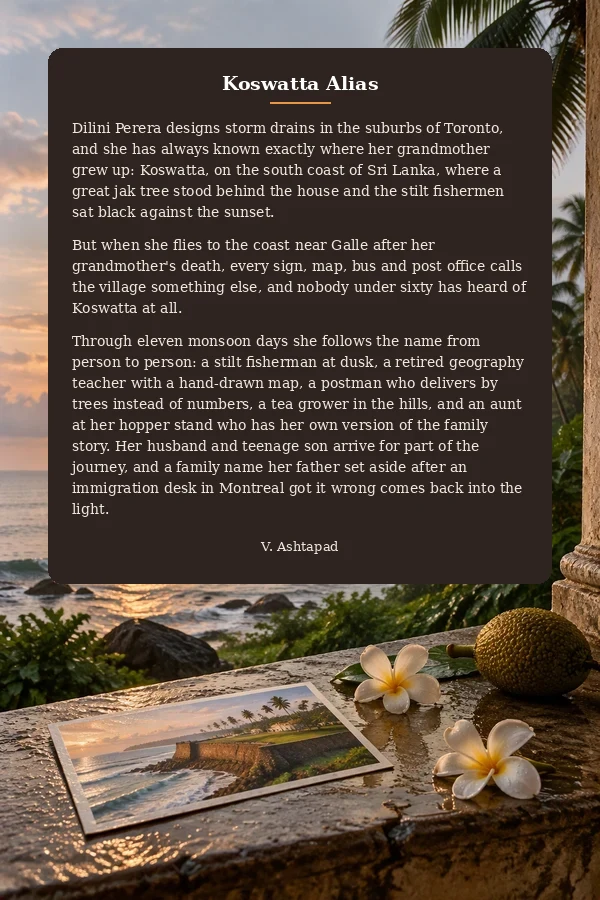
Dilini Perera designs storm drains in the suburbs of Toronto, and she has always known exactly where her grandmother grew up: Koswatta, on the south coast of Sri Lanka, where a great jak tree stood behind the house and the stilt fishermen sat black against the sunset.
But when she flies to the coast near Galle after her grandmother's death, every sign, map, bus and post office calls the village something else, and nobody under sixty has heard of Koswatta at all.
Through eleven monsoon days she follows the name from person to person: a stilt fisherman at dusk, a retired geography teacher with a hand-drawn map, a postman who delivers by trees instead of numbers, a tea grower in the hills, and an aunt at her hopper stand who has her own version of the family story. Her husband and teenage son arrive for part of the journey, and a family name her father set aside after an immigration desk in Montreal got it wrong comes back into the light.
Members can react to this book and talk about it in the members' Library.
Ownership
© 2026 CRUNOD LLC. All rights reserved.
This book is owned by CRUNOD LLC. It is free to read on EternalCurrent.Online. No part of it may be copied, reprinted, sold, recorded or adapted, including as audio, film or translation, without written permission from CRUNOD LLC.
© 2026 CRUNOD LLC. All rights reserved.