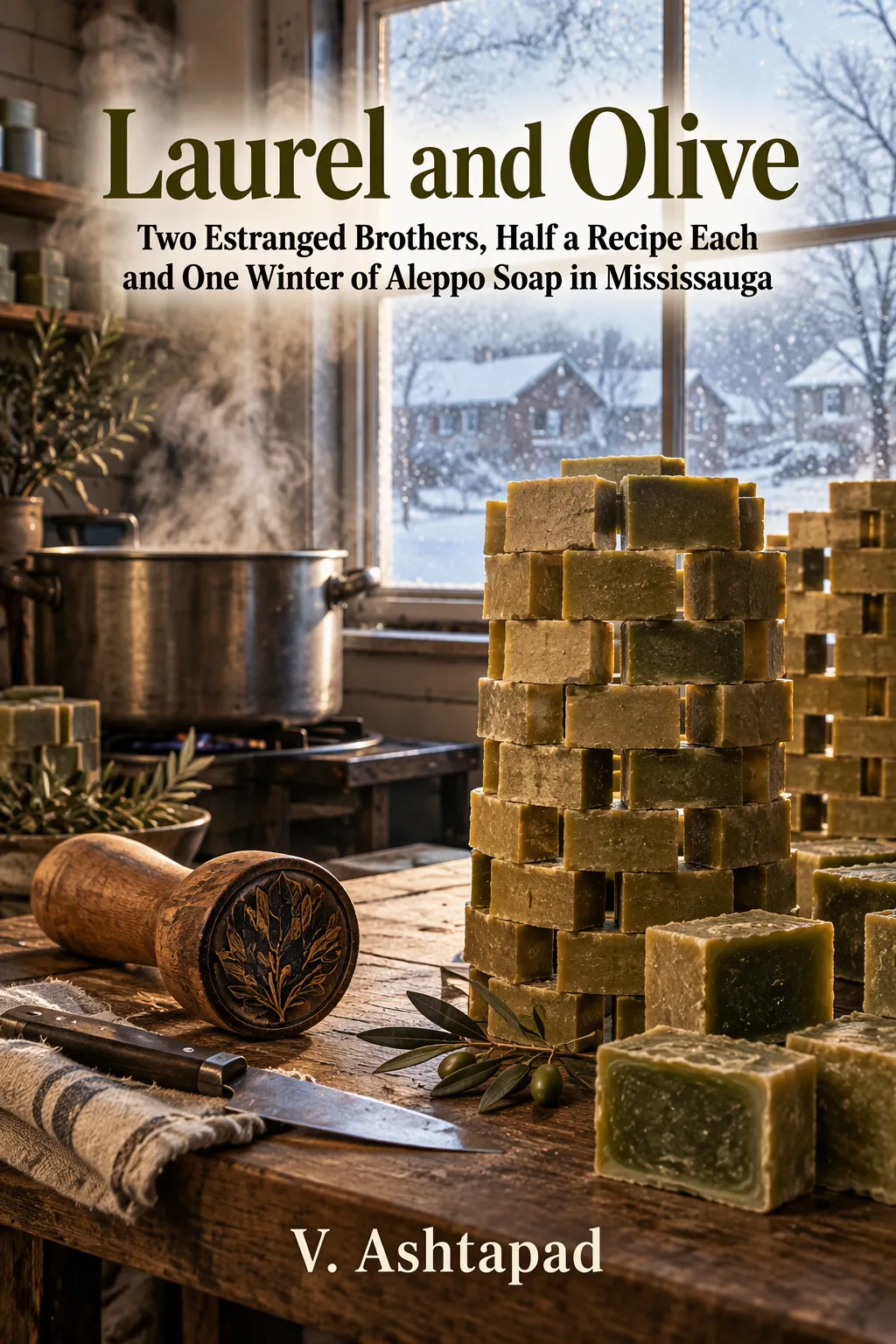
Laurel and Olive
Two Estranged Brothers, Half a Recipe Each and One Winter of Aleppo Soap in Mississauga
by V. Ashtapad
Foreword
This is a work of fiction. Aleppo's laurel and olive oil soap, cooked in winter, walked smooth on the floor and cured for months in hollow towers, is a real craft that Syrian families have carried to new homes around the world. Kassab Soap and Oil, the plaza on Dundas Street and everyone in this book are invented.
For brothers who still have time.
Four Hundred and Eleven
There were four hundred and eleven bars of soap left in the back room when Adib Kassab died, and his elder son counted them twice.
Farid did the first count on the Monday after the funeral, at seven in the morning, before the plaza opened, with the lights off in the shop and only the fluorescent tube burning in the curing room behind it. He counted the way his father had taught him at fourteen, by towers, not by bars. There were six towers left from last winter's batch, each one a hollow column of soap cubes laid in rings, eight cubes to a ring, the rings turned a little each time so that air could move through the gaps. A tower was not a pile. A pile rotted from the middle. A tower breathed. His father had said this so many times that Farid heard it now in his father's voice, a little hoarse, with the long Aleppo vowel on "breathe" that thirty-five years in Mississauga had never shortened.
Six towers. The tallest came to Farid's chin. The shortest, the one they had been selling from since August, came to his hip and leaned a little to the east. He counted every ring of every tower and wrote the numbers on the back of an invoice, and they came to four hundred and eleven, and then he stood in the cold room with the invoice in his hand and could not remember whether he had counted the half-ring on top of the short one.
So he counted again. Four hundred and eleven.
The soap was the color of a wet paper bag on the outside, a soft gold going brown at the corners, and every cube carried his father's seal pressed into its top face: a circle with a laurel branch inside it and, under the branch, three Arabic letters that spelled their family name. When you cut one open, the inside was green. Not a bright green. The green of olives in a jar, of the underside of a bay leaf, a green that had been somewhere and come back. Farid had sold that green to customers for thirty years and had never tired of the moment a stranger broke a bar and saw it.
He set the invoice on the worktable. He put his right hand flat on top of it to stop it curling, and his hand did the thing it had started doing in the spring, a small fast tremble in the fingers, as if the hand were remembering a song he had forgotten. He took it off the paper and put it in his coat pocket and held it there until it stopped.
Four hundred and eleven bars. At the rate the shop sold in winter, that was until the end of February. After that, there was nothing behind the counter but the olive oil in tins and the loofahs and the little dishes of dried roses his mother used to arrange.
---
The lawyer's office was on the fourth floor of a glass building near the big mall, with a view of the parking lot and, beyond it, the highway and, beyond that, a gray line that was Lake Ontario on a clear day and nothing on a day like this one. Ms. Deborah Lam had a round table instead of a desk. His brother came in eleven minutes late and took the chair as far from Farid's as the round table allowed, which was exactly opposite.
Marwan had gained weight in the face since the funeral, or Farid had not looked at him properly at the funeral. He wore a black quilted jacket with the name of a banquet hall stitched on the chest in white thread, and he smelled faintly of onions fried in butter, and he nodded at the lawyer and not at Farid.
"Mr. Kassab," said Ms. Lam to Farid. "And Mr. Kassab." To Marwan. "Thank you both. Your father's instructions are short. He came to see me in June and was very particular about the wording, so I'll read the relevant part as he wrote it."
She read. The house in Cooksville went to Farid, who had lived in it with their father since their mother died. The savings, which were less than Farid had guessed and more than he deserved to have guessed, went to the two sons equally.
"And the shop," said Ms. Lam. She turned a page. "This is the part he dictated, so it reads the way he spoke. 'The shop, Kassab Soap and Oil, the lease, the kettle, the boards, the seal, and the name, I leave to my sons Farid and Marwan together. On one condition. Before the lease ends on the last day of March, they will make one batch of laurel soap together, from my whole recipe, and cure it, and sell it from the shop. I have written the recipe in two halves. Farid has the first half. Marwan has the second. Each half is no good alone. If they do not make the batch together, the stock is to be sold, the money divided between them, and the whole recipe is to be given to Mrs. Lurdes Teixeira, who will know what to do with it.'"
Ms. Lam set the page down.
Marwan laughed. It came out of him like a cough. "Mrs. Teixeira."
"She's your father's landlord," said Ms. Lam.
"I know who she is."
Farid said nothing. He was looking at the two envelopes Ms. Lam had laid on the table between them, long white envelopes sealed with tape, his own name on one and his brother's on the other, written in their father's careful capital letters, the hand of a man who had learned the English alphabet at thirty-nine and never stopped printing it like a schoolboy.
"He gave these to me sealed," said Ms. Lam. "I haven't opened them. I'm to give each of you your own."
She slid them across. Farid's came to him and Marwan's went to Marwan, and for a moment neither of them touched his. Farid thought of their father sitting in this office in June, already thin, already using the cane with the rubber foot, deciding that the only way to make his sons sit at the same table was to tear his life's work in two.
"Did he say anything else," Farid asked. "When he brought them."
Ms. Lam hesitated. "He said, and I wrote it down because he asked me to, 'Tell them the soap does not care who is angry.'"
Marwan stood up. He put his envelope inside his jacket without opening it, and zipped the jacket to the chin.
"I have a wedding for four hundred on Saturday," he said, to the lawyer. "Thank you for your time."
He went out. The door had a slow hinge and took a long time to close behind him.
Farid sat with his envelope in front of him and his right hand in his coat pocket, holding still.
© 2026 CRUNOD LLC. All rights reserved.
Bulgur
Marwan did not open the envelope for six days.
He put it on top of the refrigerator, behind the box of dried mint, where his wife would not see it and ask, and where he would not see it unless he reached for the mint, which he did, in the end, four times a day, because there was no dish in his house that did not want a pinch of mint. So he saw it four times a day.
On the Tuesday, Rania found it anyway. She did not ask. She put it on the kitchen table next to his coffee and went to work.
He made kibbeh instead of opening it. This was what he did with a day off when his hands needed something. He soaked the bulgur in a steel bowl, the fine grade, the number one, until it swelled and went soft at the edges. He took the lamb he had brought home from the banquet hall's butcher, a piece of leg with all the fat and sinew trimmed off by his own knife, and he put it through the grinder twice, and then once more with the bulgur and a quartered onion and salt and the mix of spice he had been keeping in a jar since before his daughter was born: allspice, cinnamon, black pepper, a little cumin, a little of the red Aleppo pepper that came in bags from a shop on Kennedy Road and was never as good as it had been in his mother's kitchen and was good enough.
Then the kneading. His father had kneaded soap the way Marwan kneaded kibbeh, with the heel of the hand and a wet palm, folding and pressing until the thing in the bowl stopped being ingredients and became one material. You knew by the feel. Kibbeh paste was ready when it was smooth as cold putty and it held a fingerprint without cracking.
He shaped them at the kitchen table, his coffee going cold beside the envelope. A ball of paste in the left palm. The right forefinger pushed into the middle and turned, turned, the left hand rotating the ball around the finger until the wall was thin and even, thinner, thin enough that the light from the window came pinkish through it. A spoonful of the filling, minced lamb browned with onion and pine nuts. Then the hard part, closing it, coaxing the open end shut and rolling the whole thing between the palms into a long shape, pointed at both ends, like a small fat torpedo or the olive his mother used to say it was.
Out of practice, he made forty in the morning and looked at them on the tray, forty identical torpedoes in rows, and then he wiped his hands on the towel over his shoulder and opened the envelope.
It was one page, written on both sides in his father's printed English with Arabic words where English had failed him.
The first line said: Marwan. You have the second half. You have the how and the when. Your brother has the what.
The rest was the how and the when. How long to heat the olive oil before the lye went in. How to know, by the sound of the boil and the color of the foam, when the first day was finished. On which day the laurel oil was added, and how slowly, and how you stirred it in with the long paddle in a figure eight and never a circle. How you knew the soap was ready to pour. Here his father had written, in Arabic, the word for tongue, and then in English: You know this one. I taught you on the kitchen stove when you were fifteen and your mother was furious.
Marwan put the page down.
He remembered. His mother had come home from her sister's and found her eldest son reading at the table and her youngest standing at her stove with his father, touching his tongue to a wooden spoon of half-cooked soap. "If it bites, it is not done," his father was saying. "When it only tingles, like a battery, it is done." His mother had said a great many words, some of them in front of her children for the first and only time. His father had laughed so hard he had to sit down.
Farid had been at the table. Farid had not looked up from his book.
The last lines of the page said: How to stack the towers I wrote in your brother's half. Do not let him pretend he cannot read my handwriting.
---
Lina came for dinner on Thursday. She came for dinner every Thursday since she had moved downtown, and she brought her laundry, and she sat on the counter while her mother cooked as if she were still twelve. She was twenty-four and designed the insides of packages for a firm that made packages, and she wore her grandfather's old watch on a strap too big for her wrist.
"Did you open it?" she said.
He looked at his wife. Rania looked at the onions.
"Your mother told you."
"Sido told me." Lina used the word she had used for her grandfather since she could talk. "In September. He said he'd done something with the recipe and you'd both hate him and then you'd both have to stop hating each other. He said it in that voice. You know the voice."
Marwan knew the voice. It was the voice his father used for the ending of jokes.
"You saw him in September."
"I saw him every Sunday." She said it without apology. "Since I was nineteen. Uncle Farid made tea. Sido told me stories and I recorded them on my phone and put them up on the family page so Teta's cousins in Montreal could hear him. You could have heard them too. You're on it. I invited you two years ago."
He had seen the invitation. He had not opened that either.
"Every Sunday," he said again. "With Farid."
"Uncle Farid is sad, Baba. He's sadder than you. He doesn't have anybody to fry things for."
Rania laughed into the onions, and then stopped, because Marwan had not laughed.
"I'm not going to make soap with my brother," he said, "so a seventy-nine-year-old Portuguese widow can keep a recipe she doesn't want."
Lina slid off the counter. She went to the refrigerator, reached behind the dried mint, and found nothing there, because the envelope was in his shirt pocket. She turned around and looked at the pocket.
"Sido said you'd say that," she said. "He said to tell you the kettle is still in the back room and nobody has cleaned it properly since you left."
That was a low blow, and his father had known it would be. Marwan had cleaned that kettle every season from the age of sixteen until the age of thirty-seven. He had cleaned it with vinegar and hot water and a long brush and his whole arm inside it to the shoulder, and he had been proud of it, the steel shining like the inside of a spoon, and when he left the shop he had thought of the kettle more than once, the way you think of a dog you gave away.
He took the envelope out of his pocket and put it on the table, and his daughter and his wife both looked at it.
"I'll go and look at the kettle," he said. "I'm not promising anything. I'll look at it."
© 2026 CRUNOD LLC. All rights reserved.
Dundas Street
The plaza had been built in the sixties and had not been asked how it felt about anything since. It sat back from Dundas Street behind a parking lot full of potholes that filled with brown water in spring and froze in winter into small dangerous mirrors. From the west end: a Polish bakery that sold paczki on Saturdays and sour rye all week; a tax preparer who was only open from February to April; a hair salon called Michelle's run by a woman named Grace; Kassab Soap and Oil; a Jamaican takeout with a line out the door at lunch; a laundromat; and at the far east end a unit that had been empty so long the paper over its windows had faded from brown to the color of weak tea.
Farid opened the shop at ten, as always. He turned on the lights, which buzzed and then caught. He turned the sign. He stood behind the counter with his hands under it.
The shop was narrow and deep, a long room with shelves on both walls going back to a doorway with a bead curtain, and behind the curtain the curing room, which had once been the stockroom of a shoe store and still had the shoe store's steel shelving bolted to one wall, though nobody had kept shoes on it for thirty-five years. In the shop, the shelves held soap. Cubes of laurel soap stacked in little pyramids, each pyramid with a handwritten card. Tins of olive oil from a cooperative his father had dealt with since before Farid could drive. Loofahs, the long dried gourds that his mother had insisted on stocking because no bath in Aleppo had been without one.
At eleven-forty, a black pickup truck pulled into the lot and parked crooked across two spaces, and his brother got out.
Marwan came in with the cold on his jacket and stood just inside the door, letting it close behind him. The bell over the door, an old brass camel bell their father had bought in a market in Toronto and claimed was from home, rang once and settled. Farid watched his brother's eyes go along the shelves. They did not stop on anything. They went all the way to the back, to the bead curtain.
"Still the same," said Marwan.
"Nothing to change."
Marwan nodded, as if this were an opinion he could respect without sharing. He walked down the length of the shop, past the oil, past the loofahs, and parted the bead curtain with his forearm the way you would if your hands were full, though his hands were empty, and Farid understood that his brother's body still remembered carrying things through that curtain, cartons, buckets, trays of cut soap.
Farid followed him.
The kettle stood where it always stood, in the corner of the curing room near the back door, on its own gas burner on a steel stand. It was not a beautiful object. It was a steel vat, waist-high on Marwan and chest-high on most people, two hundred liters, with a lid on a hinge and a long wooden paddle hanging on a hook beside it, the paddle's blade worn pale and smooth where it had moved through thirty-five winters of soap. It had a dent on one side from the time it fell off the truck.
Marwan lifted the lid. He looked inside. He put his hand in, all the way to the elbow, and drew a finger along the bottom and held it up to the light. There was a gray film on it.
"Fourteen years," Marwan said.
"He did his best."
"I know he did." Marwan wiped his finger on his jeans. "I'm not talking about Baba."
Farid felt the old heat climb his neck, the heat he had spent twelve years not having to feel, because a man you do not speak to cannot make you feel anything. He said, very evenly, "I cleaned it. Every year. With the brush."
"With the brush," Marwan agreed. "Not with your arm."
They stood with the kettle between them, two men in their fifties in a cold back room, and Farid thought, This is how it will go. It will go like this for five months, and then we will fail, and Mrs. Teixeira will get Baba's recipe, and she will put it in a drawer with her husband's dentures.
"I read mine," said Marwan. "The how and the when."
"I read mine. The what."
"So we each have half."
"That's what halves are."
Marwan looked at him then, properly, for the first time since the lawyer's office. Farid saw his brother's face and was startled by it, because it was their father's face at fifty, the same heavy lids, the same deep line from the nose to the corner of the mouth, the same way of seeming about to laugh at something that was not funny. He had not seen it at the funeral. He had not let himself.
"How much oil does it say," Marwan said. "For a full kettle."
Farid did not answer for a moment. Then he said, "Let's go and see Mrs. Teixeira first."
---
Mrs. Lurdes Teixeira lived in the brick house behind the plaza, the one with the grapevine on a steel frame over the driveway, bare now and lashed down for winter. She had owned the plaza since nineteen seventy-one, first with her husband and then alone, and she had a cane she did not use and a dog she did not walk and a front room so warm that both brothers began to sweat in their jackets before they had sat down.
"Your father," she said, "was the best tenant I ever had. The worst negotiator. Every five years I said, Adib, the rent goes up. Every five years he brought me soap and said, Lurdes, I have no money, take this. Every five years I took the soap." She looked from one to the other with small black eyes. "I have soap in my linen closet from nineteen ninety-two. It is still good. Better."
"Mrs. Teixeira," said Farid.
"He told me what he was doing. With the envelopes. I told him he was a crazy old man." She smiled, and her face folded up into a hundred pleats. "He said yes. He said, Lurdes, you will keep the lease open until the last day of March, and if my sons come to you together with soap from the new batch, you will renew it to them for five more years. And if they do not come together, you will take the recipe, and you will rent the unit to the phone people, who want it for a second store."
"The phone people," said Marwan.
"They pay more." She shrugged. "Everyone pays more than your father."
Marwan looked at Farid, and for the first time there was something in it that was not anger. It was closer to the look they had exchanged as boys when a teacher said something preposterous, a quick narrow glance that said, Are you hearing this?
"So," said Mrs. Teixeira. She put both her hands on the head of the cane. "Are you going to make soap, or are you going to let an old woman sell your father to a man who fixes telephones?"
© 2026 CRUNOD LLC. All rights reserved.
Lye
Marwan's half said to start the kettle before dawn, so they started it before dawn.
The Saturday before the first snow, he parked crooked across the same two spaces at a quarter to five and found the shop's front window lit and his brother inside, sitting on a stool by the counter in his coat with a thermos.
They had spent the two weeks since Mrs. Teixeira's front room doing the thing Marwan had expected to be the hardest part and that turned out to be merely boring: lists. Farid's half of the recipe gave quantities and suppliers. One hundred and sixty liters of olive oil, the second press, the green-brown kind with sediment in it that nobody wanted for salad, from the cooperative near Hamilton. The laurel berry oil, dark green and smelling like a pharmacy in a forest, from an importer in Montreal. The lye, caustic soda in white pearls, from a chemical supplier in an industrial park near the airport where a man named Gord made them each sign a form promising they knew what they were doing. The water, from the tap. Their father had always said the water in Mississauga came from the lake and the lake did not need help.
They had communicated mostly by text message. Farid's were long and punctuated. Marwan's were short and not.
Now the oil was in the kettle, cold and green and still, and the burner was lit, and the room was filling with the smell of warming olive oil, which was the smell of every kitchen Marwan had ever stood in, and also of this room, specifically, at this hour, when he was sixteen.
"Goggles," said Farid.
"I know."
"Gloves."
"I know, Farid."
His brother handed him the goggles anyway, and the long rubber gloves, and put on his own. They looked, the two of them, Marwan thought, like two dentists who had wandered into a war film. He did not say this. Twelve years ago he would have said it and Farid would have laughed, or would not have, and either way it would have been something.
The lye went into the water first, in a separate steel bucket, in the open back doorway where the cold air could carry away the fumes. You never put water into lye. You put lye into water, slowly, a scoop at a time, and stood back, and let it heat itself up until the bucket was too hot to touch and the air above it shimmered. Their father had made them chant it as children: Lye to water, never water to lye. Farid had made it into a song. Marwan had forgotten that until this moment, standing with the scoop in the doorway with the snow-smell coming off the parking lot, and he heard his brother, beside him, say the words under his breath in the same singsong.
When the lye water had cooled enough, by Marwan's half's instructions, until the outside of the bucket was "as warm as a baby's bath," they poured it into the warm oil in a thin stream while Marwan stirred with the paddle.
And the soap began.
There is no way to describe the first hour of a laurel soap boil to anyone who has not stood over one, Marwan thought. The oil, which a minute before was clear, went cloudy. Then it went pale. Then it thickened, slowly, the paddle meeting more and more resistance, until the whole surface of the kettle was moving like a pudding coming to the boil, slow blisters rising and opening, each one releasing a breath of warm sharp steam. The color went from green to the color of a pistachio's skin to the color of the soft inside of an avocado. The smell went from kitchen to something older, the smell of a laundry, of a hammam, of his grandmother's hands.
He stirred for two hours. Farid took the paddle for one. They did not discuss the handover; Marwan's arms got tired, and he stood back, and Farid stepped up and took the paddle out of the air as if they had rehearsed it.
By noon the soap was thick and the color of milky jade. Marwan's half said, for the first day: When the foam goes from white to yellow and the bubbles sound like a man clearing his throat, turn the fire low and leave it overnight.
They listened.
"That's a throat," said Farid at last.
"That's a cough. A throat is lower."
They listened some more. Out in the shop, the bell rang, and a customer called hello. Farid went out to sell her a bar of last year's soap, and came back, and they listened.
At twenty past two, the bubbles began to make a deep, slow, gravelly sound, rhythmic, like an old man about to say something important.
"There," they said together.
They did not look at each other. Marwan turned the fire low. Farid wrote the time on the back of the invoice he kept in his pocket, the one with four hundred and eleven written on the front.
---
The second day was the long day. The fire came back up at dawn, and the soap boiled, and every hour Marwan took a little of it out on a wooden spoon and let it cool on a saucer and looked at it.
At eleven, he licked it.
It bit. It bit like a wasp, a hot white sting at the tip of the tongue, and he spat into the sink and rinsed with water and swore in two languages, and when he turned around his brother was trying not to laugh and failing, his shoulders going up and down, his goggles up on his forehead.
"Not done," said Farid.
"No kidding, not done."
At one, it bit less. At three, it only stung. At four, Marwan touched his tongue to the cooling paste on the saucer and felt it: the faint electric tingle, like touching your tongue to the end of a nine-volt battery, which he had done as a boy because Farid dared him to. The tingle that meant the lye had found all the oil it was going to find and married it.
"Done," he said. "First stage."
He held the spoon out to Farid. It was a reflex, a thing his hand did before his head could stop it. In the old days, when they were teenagers working for their father after school, whoever did the tongue test held the spoon out to the other one, and the other one tested too, and if they agreed, they called their father.
Farid looked at the spoon. Then he took off his glove, and took the spoon, and touched it to his tongue, and stood still, frowning, the way he had as a boy.
"Battery," said Farid.
"Battery."
They stood there. There was nobody to call.
© 2026 CRUNOD LLC. All rights reserved.
Laurel
On the third morning, Farid's half came into it.
He had read his page so many times he no longer needed to take it out of his wallet. It was written in their father's printed English on lined paper torn from a pad, and at the top their father had written: Farid. You have the first half. You have the what. Your brother has the how and the when. Then the quantities, which were the quantities they had already used. Then the laurel.
The laurel was the whole secret of the soap and everybody knew it. Any fool could boil olive oil with lye and get soap. What made Aleppo soap Aleppo soap was the oil pressed from the berries of the laurel tree, the bay laurel, the same tree whose leaves went into a pot of rice. The berries were small and black and shiny and bitter, and their oil was dark green and thick and smelled of cedar and camphor and a little of rain on hot stone. How much of it you put in was the difference between a soap for washing floors and a soap you gave a bride.
In Aleppo, their father had told them, the cheap soap had a little laurel and the dear soap had a lot. Their grandfather Jamil, who had made soap in a workshop near the old covered market for forty years, had used one part laurel to four parts olive for his best soap, and his customers came from as far as the coast to buy it.
Their father's recipe did not say one in four.
It said: In a mild winter, one in five. In a hard winter, one in four, because the hard winter makes the soap tight and the laurel opens it. You will know which winter it is by the middle of November. Ask your mother's roses.
Their mother's roses had been dead for seven years. They had been in pots on the back deck of the house in Cooksville, three bushes of the old dark pink damask kind that their mother's sister had grown from a cutting somebody smuggled out of somewhere in a damp sock, and every November their mother brought them into the garage and wrapped them in burlap and talked to them.
After she died, Farid had tried to keep them alive and had failed, one bush a year, until there were none. He had not told his father the last one had died. He suspected his father knew.
"So what does it say," said Marwan.
They were standing over the kettle on the third morning, with the fire low and the soap breathing in it, thick and pale green, waiting.
"It says ask Mama's roses."
Marwan looked at him for a long moment. Then he took out his phone and began scrolling with his thumb.
"What are you doing?"
"Checking the long-range forecast."
"Baba didn't trust the forecast."
"Baba didn't have the forecast." Marwan scrolled. "Environment Canada says colder than normal. La Niña something. Look." He held the phone out.
Farid did not look at the phone. He looked out the back door, which they had propped open to let the steam out, at the parking lot behind the plaza. It lay on the dumpsters and on the roof of his car and on the bare branches of the one thin maple the city had planted in a hole in the asphalt, and it was the twenty-third of November, and he could feel in his knuckles, in his bad right hand, that the cold had come to stay.
"One in four," he said.
"You're sure?"
"No." He held out his hand for the measuring jug. "But it's a hard winter. Even I can tell."
---
The laurel went in slowly. Marwan's half was clear about that: a thin stream, not a pour, with the paddle going in a figure eight through the whole depth of the kettle so that the green oil folded into the soap and did not sit on top of it. Farid poured. Marwan stirred. It took forty minutes to add twenty-one liters, and in that forty minutes the soap in the kettle went from the pale green of a celery heart to the green of the inside of the soap that had sat on their father's shelves for thirty-five years, and the smell came up out of the kettle and filled the whole back room and went through the bead curtain into the shop and probably out the front door into the plaza, because Grace from the hair salon came over in her apron at half past ten and stood in the doorway and said, "Oh, my goodness, it smells like your father."
It did.
Farid had not expected it to undo him. He had been standing over this smell every November for thirty years. But he had been standing over it with his father beside him, talking about the price of oil, about the stupid hockey team, about nothing, and now he was standing over it with his brother, who was not talking, and his father was in a cemetery off Dixie Road under a layer of new snow. The smell came up out of the kettle and found him the way smells do, from underneath, and it was not the back room in Mississauga he was standing in.
It was the market. He was nine years old.
He did not say this out loud. He kept pouring, a thin stream, the jug steady in his left hand because he had learned not to trust the right. But in his head he was holding his grandfather's hand under the high stone vaults of the covered market in Aleppo, the souk, the long tunnels of stalls going on forever in the half-dark, with shafts of light coming down through holes in the vault roof and standing in the dusty air like posts. And the spice sellers. The sacks, rolled down at the tops like socks, full of red pepper flakes, of cumin seeds, of something yellow he did not know the name of then and still did not, of dried rosebuds like the ones on the shelf out front, of black lemons, hard as wood. The smell of the spice lane was so thick you could almost lean on it. His grandfather walked through it every morning to the soap workshop, and Farid walked with him, and his grandfather bought him a twist of paper full of salted roasted chickpeas, and they ate them walking.
And at the end of the spice lane, through a low doorway, down three stone steps, his grandfather's workshop, where the towers of soap rose to the roof.
"Farid," said Marwan.
He blinked. He had stopped pouring. The jug was empty in his hand.
"That's twenty-one," said Marwan. "That's all of it."
"Yes."
His brother was looking at him over the steaming kettle with an expression he could not read. Not suspicion. Not the old contempt. Something careful.
"You were somewhere," said Marwan.
"I was here."
Marwan kept the paddle going in its figure eight. "You were in Aleppo," he said. "You get a face. Baba got the same face. Mama used to say, he's gone to the souk again, leave him." He stirred. "I don't remember any of it. I was five."
Farid set the jug down. He did not know what to say to that, so he said nothing, and the soap breathed in the kettle between them, and in the shop Grace was telling a customer that the Kassab boys were making soap again, both of them, together, can you imagine.
© 2026 CRUNOD LLC. All rights reserved.
Boards
The pouring bed was Marwan's job, because it had always been Marwan's job, and because nobody had told him otherwise.
It was a shallow frame of two-by-sixes, eight feet by twelve, that lived in pieces against the wall of the curing room for eleven months of the year. You laid it out on the concrete floor in the open middle of the room, between the steel shelving and the old towers, and screwed the corners together with the same four rusty brackets that had been holding it together since before Lina was born. Then you lined it. Their father had lined it with heavy brown waxed paper from a butcher supply shop on Queen Street, and when that shop closed, with the same paper from a different shop in Scarborough, and Marwan found two rolls of it on the top shelf in the corner, still in their plastic, with the price written on the plastic in his father's hand.
The paper went down in overlapping strips, each strip lapping the last by a hand's width, the edges taped to the frame. You knelt to do it. Marwan knelt, and his knees told him exactly how many years it had been since he had knelt on this floor, and he went on kneeling.
Farid stood over him with a tape measure.
"It's square," said Marwan.
"I didn't say it wasn't."
"You were about to."
"I was about to say," said Farid, "that it's a quarter-inch off on the north side."
Marwan sat back on his heels. He looked at the north side. It was a quarter-inch off. He took out the screw, shifted the board, put the screw back in.
"Thank you," he said, and was surprised to find he meant it, a little.
---
Lina came at nine, before the pour, in a parka so big she looked like a sleeping bag with a face. She brought a tray of coffees from the Polish bakery and a bag of their paczki.
"I want to film it," she said. "For the family page. Teta's cousin Nadia asked. She says she hasn't seen anybody walk soap since nineteen seventy-something."
"Nobody walks soap anymore," said Farid. "Even in Aleppo, they have machines now."
"Sido walked it."
"Sido was a stubborn man," said Marwan, and both of his listeners turned to look at him with the same expression, and he heard what he had said and laughed, and after a second, so did Farid.
That was the first time.
---
The soap came out of the kettle in buckets. It was thick now, the consistency of hot porridge, the green of pond water with the sun on it, and it steamed in the cold air of the room and smelled so strongly of laurel that Lina's eyes watered. Marwan ladled. Farid carried. The buckets were steel with wire handles wrapped in rags, and each one weighed what a five-year-old weighs, and Farid carried them two at a time across the room and tipped them into the bed, and the soap went out across the brown paper in a slow, heavy, steaming tongue, and found the corners, and began to level itself.
It took forty-one buckets. Lina counted out loud.
When the bed was full, the soap in it was four inches deep and lumpy and shining, and it was time for the boards.
The boards were two pieces of plywood each the size of a large book, with leather straps nailed across their tops like the straps on a sandal. Their father had made them in nineteen ninety-one from a picture in a book about the soap factories of Aleppo. You strapped one to each foot over your boots, and you stepped out onto the hot soap, and you walked.
Not walked. Shuffled. Slid. You moved across the surface of the soap in long flat steps, pressing down with each foot, smoothing, leveling, pushing the high places into the low places, working the air out, until the whole bed was flat as a sheet of glass and your thighs were on fire.
"Who goes," said Lina.
The brothers looked at each other.
Marwan had walked the soap for the last time at thirty-seven, the November before he left. He had walked it with his father, who was seventy-one then and still walked it, slowly, with his hands held out at his sides like a man on a ship. Farid had never walked the soap. Farid had carried buckets and measured and kept the books and handled the customers, and when Marwan was fifteen and asked why, their father had said, Your brother has a talent for the shop, and you have a talent for your feet. Marwan had heard the first half of that sentence as a compliment to Farid and the second half as an insult to himself for twenty years.
"I'll go," said Marwan.
He strapped on the boards. He stepped out.
The soap was warmer than he remembered. It came up through the plywood into the soles of his boots, a deep steady heat, and it gave under him the way warm sand gives, and for a moment he stood still in the middle of the bed with his arms out and felt his father's body in his own, the same stance, the same bent knees, and he thought he might cry in front of his daughter's phone and he did not care.
He began to shuffle.
It was harder than he remembered too. By the end of the first length his thighs were burning. The soap pushed back at every step. It wanted to pile up in front of the boards in a little wave, and you had to keep the wave moving, keep pushing it forward and to the side and into the low corners, where it settled and lay down.
On the fourth length his left board caught the edge of the wave and stuck, and his body kept going without it, and for one long ridiculous second he was falling forward toward forty-one buckets of hot laurel soap.
A hand caught his arm above the elbow.
Farid was at the edge of the bed, leaning in, his feet planted on the concrete outside the frame, his fist bunched in Marwan's jacket sleeve. He held on until Marwan had got the board free and his weight back over his feet. Then he let go.
"Don't fall in," said Farid. "It'll take a week to get you out, and you'll come out green."
"Strap on," said Marwan.
"I've never done it."
"I know you've never done it. Strap on. There's a whole side here I can't reach without going back over what I just did."
Farid looked at the bed, and at Lina, who was filming with an expression of enormous innocence, and at his brother. Then he sat down on an upturned bucket and began to strap the boards from the second set, the spare set, the ones their father had made for himself in case he broke one, onto his own boots.
He was bad at it. He was very bad at it. He walked like a man on skis for the first time, stiff in the knees, with his arms flapping, and he pushed the soap into the wrong corners and had to go back, and Marwan, coming the other way, had to stop and wait for him to get out of the way. But he did not fall. And at some point, on the eighth or ninth length, Marwan realized that they were moving in rows, the two of them, one behind the other, shuffling in time, and that Lina had stopped filming and was just watching with the phone hanging from her hand.
They were not singing. But they were close.
---
That night, at home, Marwan watched the video on the family page with his feet in a basin of hot water and Epsom salts. Rania sat beside him on the couch and watched it with him. In the comments, under it, Nadia in Montreal had written a long paragraph in Arabic about her own father and the soap floor in a town whose name Marwan had heard as a boy and forgotten. Someone he did not know, who had been added by Lina and whose name was in English letters, had written: Is that Uncle Adib's boys? Both of them?
He watched it three times. On the third time, he watched only his brother's face, behind him, red with effort, concentrating, the tip of his tongue between his teeth, the exact face he had made at nine doing long division.
© 2026 CRUNOD LLC. All rights reserved.
Seal
The soap had to rest two days on the floor before it could be cut. The cold helped. Farid kept the back door shut and the furnace in the curing room turned down to twelve degrees, which was where their father had always kept it, cold enough to firm the soap and not so cold that it cracked, and on the morning of the third day he came in at six and laid his palm flat on the top of the bed and felt it give, very slightly, and then hold, like the skin over the heel of your hand.
He took his palm off before it could start trembling.
The cutting was the part he had dreaded. Last year he had held the long cutter with his father and drawn the lines and felt nothing in his hands but the heft of the blade. The trembling had started in April, a week after his father was told the thing the doctors told him. Dr. Mehta, Farid's own doctor, a small calm woman with reading glasses on a chain, had watched his hand shake over a cup of water and said the word essential, which meant it was not the other thing, which meant it was not going to kill him, which meant it was only going to make him unable to hold a straight line for the rest of his life. There were pills. He was taking them. They worked on some days.
Today, holding the chalk line in his left hand and the measuring stick in his right, he could feel that it was not one of the days.
The cutter was a steel blade as long as his forearm set into a wooden handle as long as a broom, with a crossbar at the top to push against. You set the blade into the soap at one edge of the bed, and you leaned your weight on the crossbar, and you walked backward, drawing the blade toward you through the whole length of the soap in one long line. Then you turned and did the same thing the other way, until the whole bed was a grid of cubes.
Farid snapped the first chalk line across the surface of the soap. It went down crooked. The string had jumped when his finger let go.
Marwan was watching him. Marwan had come in at seven and taken off his jacket and was standing at the edge of the bed with his sleeves rolled up and the cutter in his hands, and he was watching Farid's right hand.
"I'll snap," said Marwan. "You hold the end."
"I can snap."
"I know you can. You hold the end."
So Farid held the end. He stood at the far side of the bed and held the chalk line pinned to the edge of the frame with his left thumb, and his brother pulled it tight and snapped it, and the line went down on the soap as straight as a ruled page. Then the next. Then the next. When they were done, the top of the bed was a fine white grid, and Farid had not had to use his right hand once.
Marwan cut.
He was not their father. His lines wandered, just slightly, a millimeter here and there, and twice he had to go back and recut where the blade had not gone all the way through to the paper. But he cut with his whole body, leaning into the crossbar, walking backward, and Farid stood at the edge of the bed and called the lines for him, "Left, left, there," and the cubes came apart under the blade, each with a soft wet sigh, and the green inside them showed for a moment at the cut faces before the air began to dull it.
They had stopped talking about anything but soap. It was easier. Soap gave you things to say.
---
Then the seal.
It was in the drawer of their father's desk, the small steel desk at the back of the curing room under the calendar from the oil cooperative. Farid had known it was there all along. He had not opened the drawer since October.
It was brass, the size of a lemon, with a wooden handle worn black from hands. The face of it was cut in reverse: the circle, the laurel branch, the three letters of their name. Their grandfather Jamil had had it made in Aleppo, in a metalworker's shop in the copper lane of the souk, and their father had carried it in his coat pocket on the plane in nineteen seventy-nine, the only thing from the workshop he had kept when the workshop was sold to a cousin.
Farid took it out and held it in his left hand. It was heavier than he remembered. It was always heavier than he remembered.
"Who," said Marwan.
The question had been coming since the lawyer's office. Neither of them had said it. Farid could feel it in the room now, standing between them over the cut soap like a third person, and he could feel his own answer rising up in him, the answer he had been rehearsing for twelve years: Me. I stayed. I'm the one who stayed.
He did not say it.
"You do the odd rows," he said. "I'll do the even."
Marwan looked at him for a long moment.
"With what? There's one seal."
"So we pass it."
They passed it. It took all afternoon. A soap seal is pressed in by hand: you set the face square on the top of the bar and you lean on it, one firm push, and rock it very slightly, and lift. Too light, the image is faint. Too hard, it sinks and the edges crumble. Farid found he could do it with his left hand, pressing down with the heel, holding his right behind his back as if he were a waiter. Marwan did not ask about this. He stamped his row, and handed the seal across the bed, and Farid stamped his row, and handed it back, and the laurel branch went down on the soap over and over, row after row, the brass growing warm in their hands from being passed between them, until the whole bed was covered in a field of small identical circles, each with a branch inside it and their name underneath.
At the end of the day, there were twelve hundred and sixty bars, stamped, cut, lying in their grid on the brown paper in the cold room.
Farid put the seal back in the drawer. Then he took it out again, and hung it on the nail beside the kettle, where either of them could reach it.
Marwan saw him do it. He did not say anything about that either.
---
That night Farid sat in his father's chair in the front room of the house in Cooksville, with the television on without the sound, and opened the family page on his laptop. He had not looked at it in weeks. He found the video Lina had made of the walking and watched it with the sound off, the two of them moving in rows, the steam coming up off the soap.
Under it, there was a new post from Lina. She had found, in the archive of things she had recorded on Sunday afternoons, a clip of their father from last March, at the kitchen table in this house, talking. Farid remembered the afternoon. He had been in the kitchen making the tea.
He turned the sound up.
"The seal," their father was saying in the clip, in Arabic, to Lina, who had asked him something off camera. "My father's. He used to say a seal is not a signature. A signature says, I did this. A seal says, we did this. Everybody who was in the room." He laughed, the cough at the end of it. "So when my boys stamp the soap, they are stamping me in it, and my father, and the man who sold us the oil, and the lady who rents us the roof." He looked straight into the camera. "And each other. Even if they don't like it."
Farid watched it twice. Then he closed the laptop and sat in the dark for a long time with his right hand in his left hand, holding it still.
© 2026 CRUNOD LLC. All rights reserved.
Towers
The instructions for the towers were in Farid's half, which was a joke, and their father had meant it as one, because Farid had never built a tower in his life.
Farid read them out from the stool by the worktable, wearing his reading glasses, in the voice he used for reading invoices aloud to suppliers on the phone. Eight bars to a ring. The bars set on edge, not flat, a finger's width apart. Each ring turned a little from the one beneath it, so the gaps did not line up, the way bricks are laid. The first ring on a board, not on the floor. No higher than a man can reach without a ladder. No closer to the next tower than an arm's length. Never against a wall.
"And then it says," said Farid, and stopped.
"What."
"It says, 'Marwan will tell you he knows how to do this. He does. Let him.'"
Marwan, who had been about to say that he knew how to do this, closed his mouth.
---
He did know how. His hands remembered before he did. You took a bar from the grid on the floor, and it came away from the paper with a soft tearing sound, and it was heavy and cool and smelled of laurel, and its sides were still slightly soft so that you had to handle it by the corners, like a photograph. You set it on edge on the board. Then the next, at an angle to the first, the two of them making the beginning of a circle. Eight bars, and the circle closed, and in the middle of it was a hole you could put your fist through. Then the next ring, turned. Then the next.
As the tower rose, it became a thing. Not a stack of soap. A thing with its own shape, a hollow column, latticed, the light from the fluorescent tube coming through the gaps in a hundred tiny windows, the air moving through it, in at the bottom and up the hollow center and out the top, like a chimney, which was the point. The soap had to breathe for months. It had to lose its water slowly, from every side at once, so that it cured from the outside in and hardened evenly and did not crack. A tower was a lung.
He showed Farid. Farid built the second tower beside him, slowly, with his left hand doing the setting and his right hand only steadying, and his rings came out lopsided at first and then less so.
At eleven Rania came through the bead curtain with a baking tray wrapped in two towels and her car keys still in her other hand.
"Lunch," she said. "Nobody stops. I know. Eat standing."
It was kibbeh in the tray, the kind you bake instead of fry, a layer of the bulgur and lamb shell pressed into the bottom of the pan, then the filling of browned minced meat and onions and pine nuts, then another layer of shell on top, scored into diamonds with a knife and brushed with butter and baked until the top was the color of a walnut and the edges had pulled away from the pan. She set it on the worktable and cut it with the same knife she had brought from home, and the diamonds came out with their layers showing like the stripes in a hillside.
Farid took a piece in his left hand and ate it standing, as instructed.
He chewed for a long time.
"You made this," he said to Rania.
"Marwan made it. Last night. I only baked it."
Farid turned and looked at his brother. Marwan was setting a bar on edge in the seventh ring of the third tower and did not look up.
"This is Mama's," said Farid.
"It's Mama's with more pepper."
"It's Mama's." Farid took another piece. He ate it. He stood there with his mouth full and his eyes on the tower, and Rania, who had been married to one Kassab brother for twenty-six years and had been watching the other from across funeral parlors and wedding halls for twelve, looked from one to the other and then went out through the bead curtain and into the shop and talked to Grace about the weather for a long time.
---
They built eleven towers that day, and four more the next. Fifteen towers in all, standing in rows in the cold back room among the last six of the old batch, the new ones pale green-gold and damp-looking, the old ones gold and dry.
"It looks like the pictures," she said. "Of the old factories. Sido showed me. The towers going up in the dark."
"These are smaller," said Farid.
"They're the same shape."
Marwan sat down on an upturned bucket. His back hurt, and his knees, and his hands were cracked and smelled of laurel even after he washed them, and he was happier than he had been in a long time, and he did not trust it.
"Uncle Farid," Lina said, still filming, "what did it look like? The real one. Sido's father's."
Farid was quiet for a while. Then he said, "Dark. Cool. You went down three steps from the lane. The towers went up into the dark so you couldn't see the tops. There was a window high up on one wall, and the light came in and lay across them, and the dust was in the light." He paused. "Grandfather let me climb one once. When nobody was looking. I got up about as high as a man's shoulder and it started to lean and he caught me and he wasn't even angry. He laughed."
Marwan, on his bucket, felt something go through him like a draft.
"That was me," he said.
They both turned.
"I climbed one," said Marwan. "I remember it. That's the only thing I remember from there. Not the market, not the house, not anything. I remember climbing a tower of soap in the dark and it leaning and somebody catching me and laughing. I thought I made it up. I thought I dreamed it."
Farid stared at him.
"You were four."
"I was four?"
"You were four. You climbed one. Grandfather caught you." Farid took his glasses off. "I was so angry. I'd been wanting to climb one for a year and he never let me, and you just went up it, and he laughed." He shook his head slowly. "I remembered it as me. I've been remembering it as me for forty-seven years."
Lina had lowered the phone again. She was looking at her father and her uncle, one on the bucket and one by the tower, both of them looking at nothing, at a dark room three steps down from a spice lane in a city neither of them had seen since they were children.
"Well," said Lina. "One of you climbed it."
© 2026 CRUNOD LLC. All rights reserved.
Minus Twenty-Six
The cold came in the third week of January, down out of the north across the lake, and stayed.
It was the kind of cold Farid had stopped being surprised by forty years ago and had never stopped resenting. Minus twenty-six on the radio at six in the morning, minus thirty-eight with the wind. The snow in the plaza parking lot went hard and blue and squeaked under boots like polystyrene.
The soap was eight weeks into its cure. The towers had begun to change color, the pale green going gold at the edges, the gold creeping inward from the corners of each bar a little more each week. Farid checked them every morning. He had started doing it the way his father did, walking between the rows with a hand out, touching a bar here and there with one fingertip, not looking for anything in particular.
On the Thursday night, at ten past eleven, his phone rang.
It was the alarm company. The temperature sensor in the curing room, which their father had installed in the nineties and Farid had assumed was decorative, was reporting four degrees and falling.
He was in the car in five minutes, in his pajamas under his coat.
---
The furnace in the back room was a gas unit hung from the ceiling, older than Lina, and it had stopped. The pilot was out. Farid stood under it in the freezing room with a flashlight in his mouth and his good hand on the reset button and pressed it and pressed it, and it clicked and did nothing, and the cold came off the cinderblock walls and into his chest.
Soap does not mind cold, exactly. It minds change. Their father's note was clear on this, in Farid's half, under the towers: Never let the curing room freeze and then warm quickly. The soap will sweat, and the water will come out on the surface, and when it dries it will leave a white bloom, and the bars will crack along the bloom. You can sell a cracked bar. But you will know.
He stood in the dark room, among the towers. The flashlight went over them. Twenty-one towers, his father's six and their fifteen, standing in the cold, and he did not know what to do, and his right hand was shaking so hard the beam of the flashlight shook with it, a little trembling circle of light jumping on the gold soap.
He called his brother.
---
Marwan came in twenty-five minutes with two electric space heaters from his own basement, a camp stove, a thermos, and a sleeping bag under his arm.
"Rania's sister's coming with a third heater," he said. "And an extension cord. Where are the outlets in here, still just the two?"
"Just the two."
"Then we run one from the shop."
They ran one from the shop. They set the heaters at the ends of the rows, turned low, not pointed at anything, so that the warmth spread slowly and evenly through the room and did not hit any one tower. That had been Marwan's idea. Farid would have pointed them straight at the soap. Rania's sister Mona came at a quarter to one with a third heater and a bag of oranges and went home again, and the brothers were alone in the cold room with three humming heaters and twenty-one towers and a thermometer that said three degrees.
By two in the morning it said six.
By three, eight. It was holding.
They sat on overturned buckets with their backs to the steel shelving and their coats on and the sleeping bag spread over both their knees, and drank Marwan's coffee from the thermos cup, passing it, and ate Mona's oranges, and the peel smell mixed with the laurel and the dust.
"You called me," said Marwan.
"I didn't know who else."
"You could've called Lina. She would have come."
"I didn't want Lina. I wanted somebody who knew what to do."
Marwan peeled an orange in one long spiral, the way their mother had, and held the spiral up so it hung from his fingers like a spring. "I didn't know what to do. I just brought everything I had."
"That's what knowing what to do is."
They were quiet. One of the heaters ticked.
"Farid," said Marwan. "Can I ask you something and you don't answer until I'm finished?"
Farid felt it coming. Twelve years of it. He nodded.
"What do you think happened," said Marwan. "With the restaurant. With me and Baba. With the money. I don't mean what you said at the time. I know what you said at the time. I mean what you think happened. Tell me. I won't talk. I swear I won't talk until you're done, and then I'll tell you what I heard, and you tell me if I got it right."
Farid looked at him.
"Where did you learn that?"
"Rania. She made me go to a man. A counselor. Two years ago, when I wouldn't speak to Lina for a month because she went to Baba's on Sundays." Marwan put a section of orange in his mouth. "He made us do this. One talks, the other one shuts up and then says it back. It's stupid. It works. Go on."
So Farid went on.
He told it badly at first, and then better. He told how their father had called him into the kitchen on a Sunday in March, fourteen years ago, and said, Marwan wants to open a restaurant, a kibbeh restaurant, in Brampton, and I am going to give him the money. Forty thousand dollars. All of it. The money for the new kettle and the roof of the house and their mother's teeth. How their father had not asked him. Had told him. How Farid had stood at the kitchen counter and felt the floor go out from under him, because he had been working in the shop since he was fourteen, six days a week, he had given up university for it, he had given up a woman named Helen in nineteen ninety-six because she wanted to move to Vancouver and he could not leave his father alone with the kettle, and his father had never once offered him forty thousand dollars, or forty, for anything. How Marwan had left the shop in April and the shop had gone on, and Farid had done Marwan's work and his own work, and their father's back had started to go, and Farid had done their father's work too, every November, alone, with the old man sitting on a bucket telling him what he was doing wrong. How the restaurant had closed in two years. How Farid had said, at the kitchen table, in front of their mother, You fried Baba's money in a pan. How Marwan had said, You've been waiting your whole life to be the only son. How they had both meant it.
"I thought he loved you more," said Farid. He was surprised to hear it come out. "That's what I think happened. I think he loved you more, because you were funny and you could cook and you had the talent for your feet, and I was the one who stayed, and nobody loves the one who stays. They just expect him."
He stopped.
Marwan sat with the spiral of orange peel in his hand.
"Okay," said Marwan. "What I heard. You worked in the shop since you were fourteen. You gave things up. University. A woman named Helen." He looked up. "I didn't know about Helen."
"Go on."
"Baba gave me forty thousand and never asked you, and never gave you anything like it. I left and you did my work and yours and then his. You did every November alone with him on a bucket. And you thought he loved me more, because I was the fun one, and you were the one who stayed." He paused. "And nobody loves the one who stays. They just expect him to be there."
Farid's throat was tight. He nodded once.
"Did I get it right?"
"You got it right."
Marwan put the orange peel down on the floor between their buckets, carefully, as if it were something that might break.
"My turn," he said. "And you don't talk."
© 2026 CRUNOD LLC. All rights reserved.
Tin
Marwan told it to the heaters, mostly. It was easier than telling it to his brother's face.
He told how the restaurant had not been his idea alone, or not at first. How their father had come to the banquet hall in Brampton where Marwan was a line cook, fourteen years ago, on a Tuesday, and eaten the kibbeh Marwan made for a wedding, and sat in the kitchen afterward on a crate and said, This is better than your mother's. Don't tell her. You should have your own place. How Marwan had laughed and said, With what? And their father had said, With mine. How Marwan had tried to say no, and his father had said, I didn't give your brother the chance to choose the shop. He chose it because I needed him to. Let me give one of my sons the chance to choose.
Farid made a sound. Marwan held up a hand without looking at him, and Farid went quiet.
He told how the restaurant had been good. It had been very good. He had made eleven kinds of kibbeh, including the one their grandmother had made in Aleppo with quince, sour and sweet at once, that nobody in Brampton had ever tasted and that people drove from Hamilton for. How he had closed it on a Sunday night in June and sat in the empty kitchen until four in the morning.
And how he had gone to their father, the week after, with a check for eight hundred dollars, which was all he had, and said, I'll pay it back. All of it. And their father had refused to take it. And how Marwan had then gone home and, on the first of the following month, put two hundred and fifty dollars in an envelope and mailed it to the house in Cooksville with no note. And the month after that. And every month since.
"For twelve years," Marwan said. "I never missed one. Baba never said anything. Never cashed a check, because I sent cash, so I didn't know if he was getting them or throwing them out or giving them to the Polish bakery. I just kept sending. It was the only way I could think of to say it. To say I was sorry for — for what it cost. For what it cost you, too. I didn't know about Helen. I knew you did my work. I knew it the whole time." He looked at the floor. "And I thought, he'll tell Farid. He'll tell Farid I'm paying it back, and Farid will call me, and we'll—" He stopped. "He never told you."
"No," said Farid.
"Your turn to say it back."
Farid said it back. He got all of it. He got the Tuesday in the banquet hall kitchen and the quince kibbeh and the bar's customers and the eight-hundred-dollar check and the envelopes. When he got to the envelopes his voice went strange and he had to stop and start again.
"Did I get it right," said Farid.
"You got it right."
They sat. Three heaters hummed. The thermometer said nine degrees.
"I never saw any envelopes," Farid said finally. "I got the mail every day. For twelve years. I never saw one."
---
At seven in the morning, with the furnace still dead and the thermometer holding at ten and the sky over the plaza going from black to the color of skim milk, Marwan went looking for the furnace's paperwork in their father's desk.
The desk had three drawers. The top one had held the seal. The middle one had invoices in rubber bands, twenty years of them, the paper gone soft. The bottom drawer was deep and stuck, and Marwan had to put his foot against the desk and pull, and when it came open it came open all at once and he nearly went over backward off his bucket.
In the drawer was a tin.
It was a big square biscuit tin, the kind with a picture of a country cottage on the lid, the kind every Arab mother in Canada kept her sewing things in. Marwan's own mother's had been blue. This one was red, the paint worn through to silver at the corners. He took it out. It was heavy.
He opened it.
It was full of envelopes. Plain white envelopes, the cheap kind, in neat upright rows, packed so tightly that he could not get a finger between them. Each one was addressed in his own handwriting. Each one was slit open along the top with a knife, neatly. And each one was empty.
On top of the envelopes, lying flat, was a school exercise book with a green cover. Marwan opened it. On every page, in their father's careful printed English, in two columns: a date, and the number 250. Month after month. Page after page. At the bottom of each page, a total, carried over. On the last page, the last entry was September of last year. And under it, the total: thirty-six thousand, seven hundred and fifty dollars.
And under that, in Arabic, in a hand that was shakier than the rest:
For Farid. To fix the roof, and for the kettle. Your brother paid for it. Tell him I know.
Marwan sat on the bucket with the exercise book open on his knees and could not see it anymore.
"Farid," he said. He did not recognize his own voice. "Farid. Come here."
His brother came. He had been at the back door scraping ice off the outside of the lock. He came in with the scraper still in his hand and the cold coming off his coat, and he looked at the tin and the envelopes and the book on his brother's knees, and he put the scraper down very slowly on the corner of the desk.
Marwan held up the book. Farid took it in his left hand.
He read the last page. Marwan watched him read it. He watched his brother's face do what his own face had just done, and then he watched it do something else, something he had not seen it do since they were boys and Farid had found out the hamster had not, after all, gone to live on a farm.
"He kept it," said Farid. "He kept all of it."
"The money's not here. Just the envelopes."
"It's in the bank. It must be. In something." Farid turned the pages back, and back. The columns of 250. The careful totals. "He was saving it for me. The roof. The kettle." He laughed, a terrible small laugh. "The roof leaks over my bedroom. I've had a bucket under it for three years. He knew. He kept saying, next year, Farid, next year."
"He wanted to give it to you himself. He wanted to tell you it was from me."
"He wanted to make us sit in the same room." Farid closed the book. He put his left hand flat on its green cover, and Marwan saw that his right hand, hanging at his side, was perfectly still. "That old man. That stubborn old man. He tore the recipe in half so we'd have to sit in the same room long enough to find this."
"You think he planned the furnace too?"
Farid stared at him. And then, at seven in the morning, in the freezing back room among twenty-one towers of laurel soap, the two Kassab brothers began to laugh, helplessly, holding on to the steel shelving, the way they had not laughed together since the summer Marwan was fourteen and Farid was eighteen and their father fell off the ladder into the rain barrel.
© 2026 CRUNOD LLC. All rights reserved.
Regulars
By the middle of February the furnace had a new pilot assembly and a new thermostat, and the alarm company had a second phone number on file, and Marwan was working Saturdays.
Nobody had asked him to. He had come in the first Saturday after the cold night to check the towers, and stayed to help Farid with a delivery of olive oil, and then a woman came in wanting soap for her husband's psoriasis and Farid was on the phone with the cooperative, so Marwan sold it to her. The second Saturday he came in at ten and put on their father's canvas apron, which had been hanging on the back of the bead curtain since October, and stood behind the counter. Farid looked at the apron and looked at him and said nothing and went to unpack loofahs.
---
Saturday was the shop's day. On weekdays, in winter, there might be fifteen customers between ten and six. On Saturdays there were sixty, seventy, and some of them had been coming since the shop opened, and some of them came to buy soap and some of them came because the shop was warm and smelled like laurel and somebody would talk to them.
Farid had known all of them for years. Marwan knew none of them, or knew them only as they had been fourteen years ago, and it gave Farid an odd pleasure, that Saturday, to watch his brother meet them again.
Mrs. Kim came at ten-thirty, as she always did, with her grandson Daniel by the hand. She was a tiny woman in a long quilted coat and a knitted hat with a pompom, and she bought two bars every month for the boy, who had had eczema since he was a baby so bad that he had scratched his arms bloody in his sleep. A neighbor from Damascus had told Mrs. Kim's daughter about the laurel soap. Daniel was nine now, and his arms were clear, and every month Mrs. Kim made him push up his sleeves and show Farid.
"Who is this?" she said, looking at Marwan.
"My brother."
Mrs. Kim looked at Marwan for a long time. Then she said, "The one who went away."
"I came back," said Marwan.
"Good." She turned to Daniel. "Show the brother."
Daniel pushed up his sleeves. His forearms were thin and brown and smooth. Marwan looked at them with great seriousness and nodded and said, "That's very good skin," and Daniel said, "I know," and Mrs. Kim laughed, a high sudden laugh, and paid for her soap with exact change from a little red coin purse.
Mr. Abdi came at noon. He drove a taxi out of the airport and bought soap for his mother in Minneapolis, a dozen bars at a time, which he mailed to her in a flat-rate box. He and their father had argued about football for twenty years without either of them ever watching a game.
"Your father," he said to Farid, "owes me money."
"Which game?"
"The final. Two years ago. He bet me twenty dollars. He never paid."
Marwan reached into the till and took out a twenty and put it on the counter.
Mr. Abdi looked at the twenty. Then he slid it back across the counter with one long finger.
"No," he said. "I want him to owe me. It's better." He picked up his dozen bars.
Desmond from the Jamaican takeout came in at one with a foam takeout box of curry goat for Farid, which he did every Saturday, and a second box, which he put in front of Marwan without explanation. A young man in hospital scrubs came in at four and stood for a long time in front of the soap and then asked, shyly, if they had something for hands, because he was a nurse and washed his hands a hundred times a shift and they were cracked and bleeding. Marwan sold him a bar of the old batch and a little bottle of laurel oil and showed him, on his own hands, how to rub the oil into the knuckles at night and sleep in cotton gloves. Farid, watching from the loofahs, remembered their father showing their mother the same thing, in the kitchen, in the house in Cooksville, the first winter, when her hands broke open in the dry cold of a Canadian January and she cried, not from the pain but from the strangeness of a country that could do that to your hands.
At five-thirty there was nobody in the shop. The light outside was already going blue. Farid turned the sign.
---
They sat in the back room with the last two boxes of Desmond's curry goat, among the towers.
"Your hand," said Marwan.
Farid had known it was coming. He had known since the cutting. He put down his fork.
"Can I tell you," he said, "and you don't talk?"
Marwan nodded.
So Farid told him. He told him about April, and the cup of water, and Dr. Mehta and the word essential. He told him about the pills, and the days they worked and the days they did not. He told him that he had not been able to sign his own name on the funeral home's forms, and had signed with his left hand, and the funeral director had looked at the signature and then at him and been kind about it. He told him that he had not been able to do the seal since the summer, and that if Marwan had not come back, if Marwan had stayed away and let the shop go to the phone people, Farid would have been almost relieved, because he did not know how much longer he could do the cutting, and there was nobody else. He told him he was frightened. He had not said that to anyone. He said it now to his brother, among the towers, with the curry goat going cold.
Marwan said it back. All of it. He got the funeral director right, and the left-handed signature, and the word relieved. When he got to frightened, he said it plainly, without softening it, and Farid found that he was grateful.
"Did I get it right?"
"Yes."
Marwan picked up his fork again. He ate a piece of goat. He looked at the nearest tower, at the gold edges on the green bars.
"I can do the cutting," he said. "In November. Every year. I can take the week off. Rania will kill me, but she'll do it slowly." He chewed. "And the walking. You walk like a chicken on ice. I'll do the walking."
"I'll do the laurel."
"You'll do the laurel. And the books and the customers and the oil and Gord at the lye place, who I think is in love with you."
"Gord is not in love with me."
"He calls you Mister Kassab like it's a song."
Farid laughed. It hurt his chest a little. He was not used to it.
"And the seal," said Marwan. "We pass it. Like we did."
"Like we did," said Farid.
© 2026 CRUNOD LLC. All rights reserved.
Souk
Lina asked for it on a Thursday, at Marwan's kitchen table, in front of her mother and her brother Tarek, who was home from Waterloo for reading week and eating everything.
"I want to record Uncle Farid," she said. "About Aleppo. For the family page. Everything he remembers. I did it with Sido, I have forty hours of Sido, but Sido was a grown man when he left. Uncle Farid was nine. It's different. It's a kid's Aleppo." She looked at her father. "And I want you to ask the questions."
"Me."
"You. You're the one who doesn't remember. You'll ask the right things. I'll just ask about dates."
Marwan looked at his wife. Rania looked back at him with an expression he had learned, over twenty-six years, to read as: I already said yes on your behalf.
"Is he coming here?" Marwan said.
"Sunday," said Lina. "For dinner. Mama invited him."
---
He came on Sunday at five with a bag of rosewater-scented ma'amoul from the Lebanese bakery on Dixie and a bottle of pomegranate juice and his good coat on, and he stood in the front hall of his brother's house in Brampton, where he had never been, and looked at the shoes lined up by the door and the framed photograph on the wall of their mother at Marwan's wedding, and Marwan saw his brother's face and understood that Farid had not known this photograph existed.
"She's laughing," said Farid.
"You said something. Right before. I don't know what. You were standing next to the photographer."
Farid looked at the photograph for a long time.
"I said, Mama, the photographer is going to charge you extra for that dress." He shook his head. "She hit me with her purse."
---
They recorded after dinner, in the living room, with the television off and Lina's phone on a little stand on the coffee table and the cup of tea going cold in Farid's left hand. Marwan sat across from him. Lina had given him a page of questions, printed in large type, which he did not use.
"Start with the market," said Marwan.
Farid started with the market.
He told it slowly at first, the way you walk into a dark room. First the narrow lane from their grandfather's house, and the smell of bread from an oven in a wall, flat rounds slapped onto the hot inside and peeled off blistered. Then the arch, and under it, the souk.
"How big," said Marwan.
"Bigger than anything. I thought it was the whole world. The tunnels went on and on and they turned and there were more. The roof was stone, curved, like the inside of an egg, and there were holes in it, round holes, and the light came down through them in columns. Like poles. You walked through the light and then the dark and then the light."
"What did it smell like?"
Farid closed his eyes.
"It depended on where you were. Every lane had its own smell. The soap lane smelled like our back room, like the kettle on the second day. The copper lane smelled like hot metal and men's cigarettes. The meat lane—" He opened his eyes. "Don't put the meat lane on the page. Nadia will faint."
Lina laughed behind her hand.
"The spice lane," said Marwan.
"The spice lane was the best. Grandfather walked through it every morning to the workshop, and I went with him. The sacks were open, all down both sides, with the tops rolled back. Red pepper, the flakes, the real one, Aleppo pepper, deep red and oily, it stained your fingers. Cumin. Coriander. Sumac, dark purple, like dried blood, sour. Dried roses. Black lemons. A yellow powder I never knew the name of. Big blocks of something brown and sticky, dates pressed together, or tamarind. And the spice men sat behind the sacks on stools, with their scoops, and they called to Grandfather by name. Every one of them. Abu Adib, Abu Adib, come and smell this. And he would stop, and lean over a sack, and smell it, and say something, and they would laugh, and he'd move on. It took us half an hour to walk two hundred meters."
"Did he buy anything?"
"Chickpeas. For me. Roasted, with salt, in a twist of newspaper. Every morning. And on Thursdays, a little packet of the pepper for Teta."
"For the kibbeh," said Marwan.
Farid looked at him.
"For the kibbeh," he said. "Yes. And the quince. In the autumn, when the quinces came. Teta made kibbeh with quince and pomegranate molasses and mint, the little round ones, in a stew, sour and sweet. Grandfather said it was the only reason he married her." He set the tea down. "You made that. At your restaurant. Baba told me. He said people drove from Hamilton."
Marwan could not speak for a second.
"He told you about the restaurant?"
"He told me about every dish. Every Sunday for two years. Marwan made the cherry one, Marwan made the one with the yogurt, Marwan made Teta's quince. I didn't want to hear it. I heard it anyway." Farid looked at the phone on its stand, recording. "I never told him I wanted to go. I wanted to go every week. I never went."
The living room was very quiet.
"Tell me about the workshop," said Marwan, after a while. His voice was rough. "The towers. Tell me the part where I climbed."
So Farid told it. Three steps down from the spice lane. The cool dark. The towers going up out of sight. The high window and the light lying across them with the dust in it. And a small boy in short pants and a striped shirt, four years old, who had escaped from his mother's hand at the door, running into the dark between the towers and starting to climb one, quick as a cat, before anyone saw. And the tower beginning to lean. And their grandfather, who was sixty-eight and had a bad hip, crossing the workshop in three steps and catching the boy around the middle and holding him up in the air, the two of them looking at each other, the boy's sandals kicking, and their grandfather laughing so loudly that men came from the spice lane to see.
"And me," said Farid, "standing by the door, so jealous I couldn't breathe."
Marwan put his hand over his eyes.
"Thank you," he said. "Lina. Is that enough. Can we stop."
"That's enough," said Lina gently, and reached over and stopped the recording.
---
She put it on the family page the next day. Fifty-one minutes. By the end of the week it had been listened to by Nadia in Montreal and by her children and by the cousin in Dubai and by someone in Sydney Marwan had never heard of who turned out to be the grandson of one of the spice men from the lane, who had found the family page through Nadia, and who wrote, in careful English, My grandfather always said Abu Adib had the best nose in the souk. Thank you for remembering him.
Marwan read it on his phone in the banquet hall's kitchen on Tuesday, standing by the walk-in cooler, and had to go and stand inside the walk-in for a few minutes among the crates of lettuce, where nobody could see.
© 2026 CRUNOD LLC. All rights reserved.
Green
On the fifteenth of March, a Monday, sixteen weeks after the first boil, Farid cut a bar.
He chose it from the middle of the fourth tower, the one in the center of the room, where the curing had been most even. He took it out of its ring with his left hand and set it on the worktable on a square of brown paper, and Marwan stood beside him with his arms folded, and Lina, who had taken the morning off work, stood behind them both with her phone held against her chest, not filming yet.
The outside of the bar was gold. A pale honey gold, paler than their father's old stock. The seal on top was crisp, the laurel branch sharp, the three letters of their name standing up clean from the surface. Farid ran his thumb over them. It was hard.
He took the knife.
He held the bar with his right hand. That was a decision. He had thought about it all morning. He held the bar with his right hand, which was trembling slightly, and the knife with his left, and he set the blade on the middle of the bar and pushed down.
It went through cleanly. The two halves fell apart on the paper.
The inside was green.
Not pale green. Not the celery green of the boil or the pond green of the pour. The deep, quiet, olive-and-bay green of the inside of every bar their father had ever made, the green Farid had sold for thirty years, the green that had been somewhere and come back. It went all the way through, even, with a thin band of gold at the edges where the air had reached it.
Nobody said anything.
Then Lina said, "Oh," very softly, and lifted her phone.
Marwan reached past Farid and took one of the halves. He held it to his nose. He closed his eyes. Then he wet his thumb under the tap in the corner and rubbed it on the cut face and rubbed his wet thumb against his forefinger, and a little lather came up between them, white and fine and slippery, and the smell of laurel came up with it, sharp and green and clean.
"Done?" said Farid.
"Not done. Baba would say not done. Baba would say six months, nine months, a year." Marwan opened his eyes. "But it's soap. It's our soap. You can sell it."
"The rest of the curing happens in the customer's cupboard," said Farid. "He used to say that."
"He did?"
"When he was behind. When we ran out before the new batch was ready. He'd sell it at four months and say, the rest happens in your cupboard, madam, it will be better every week you keep it. And it was."
Marwan put the half-bar down on the paper next to its other half. He set them so the cut faces touched and the bar was whole again, with a thin line down the middle, and the seal on top joined across the line.
---
Not all of it was good. Farid had known it would not be.
The tower nearest the shop doorway, the one that had stood closest to the heater they ran from the front outlet on the night of the cold, had bloomed. Its bars, on the side that had faced the heater, carried a white powdery crust like frost on a window, and when Farid brushed it with his finger it came away and left a fine crack beneath, running across the bar from corner to corner. Forty-three bars. He took them out one by one and laid them on the worktable in rows.
"You can sell a cracked bar," said Marwan, reading it off the back of Farid's face. "But you'll know."
"Baba wrote that."
"In your half. I read your half. You left it on the desk in January." Marwan picked up one of the cracked bars and turned it over. "So we don't sell them."
"Then what?"
Marwan thought about it.
"Mrs. Kim," he said. "Daniel goes through two bars a month. That's twenty months. And the nurse, the one with the hands, he said there were six nurses on his floor with hands like his. And Mr. Abdi's mother. And Desmond, for all that goat. And Grace." He set the bar down. "We give them away. To the regulars. A cracked bar from the new batch. We tell them it's cracked. We tell them why."
Farid looked at the forty-three bars on the table.
"Baba would have hated that," he said.
"Baba would have done exactly that," said Marwan, "and then complained about it for a year."
---
Mrs. Teixeira came over that afternoon, in a coat with a fur collar and boots with fur at the top, walking with the cane she did not use. She said she had smelled them cutting from her kitchen. She stood at the worktable and looked at the green bar with its two halves pressed together, and then she picked up one half and held it to her nose, the way Marwan had, and closed her eyes.
"Nineteen ninety-two," she said.
"Better," said Farid. "Give it a year."
"I will be eighty in a year." She put the soap down. "The last day of March is two weeks from Wednesday. Your father said you have to sell it. From the shop. Before."
"We know."
"So you will sell it."
"On the twenty-seventh," said Marwan. "Saturday. The last Saturday before the lease ends."
She looked at them, one and then the other, with her small black eyes, and Farid saw her see it: that they had not looked at each other before answering, that they had answered together, that they had already decided.
"Good," she said. "Bring me one. Bring me two. One for the closet. One for me." She turned to go, and stopped, and put her gloved hand flat on the side of the nearest tower. "Your father used to do this. Every time he walked past. Like he was patting a horse."
---
That evening Lina sat on the floor of the shop with her laptop on her knees and designed a card.
She designed the inside of packages for a living, she reminded them, and she was not going to let her family's soap go out into the world with a handwritten index card, no matter how much she loved Teta's handwriting. She had scanned their mother's cards from the shoebox under the counter, and she had pulled the seal's image from a photograph, and she sat there for three hours moving things a millimeter at a time while the two brothers swept the curing room and argued about the price.
When she showed them, it was a small square card, cream colored. On the front, the seal. Under the seal, in their mother's slanted handwriting, scanned and cleaned, the words Laurel and Olive. And under that, in small plain capitals, KASSAB, MISSISSAUGA. On the back, a few lines in English and Arabic: what was in it, how it was made, that it had cured in towers through a Canadian winter, that it would be better every week you kept it.
And at the bottom of the back, very small:
Made by Farid and Marwan Kassab, from their father Adib's recipe, from his father Jamil's.
Farid read it twice. He handed the laptop to his brother. Marwan read it and handed it back to Lina.
"You put us in the right order," said Marwan.
"Alphabetical," said Lina. "F comes before M. Don't make it a thing."
© 2026 CRUNOD LLC. All rights reserved.
Lease
The last Saturday in March came in gray and wet, the snow in the parking lot gone to slush and the potholes full of brown water, and by nine in the morning there was a line outside the door.
Marwan saw it from the truck. He had parked crooked across the two spaces, out of habit, and he sat there for a minute with the engine running and looked at it: eleven people in raincoats and parkas, under umbrellas, outside a soap shop in a strip plaza on Dundas Street at nine in the morning, and some of them he knew and most of them he did not.
Lina had done this. Lina, and the family page, and a cousin of Grace's who wrote a neighborhood newsletter, and Mrs. Kim, who it turned out was the president of something at a seniors' center near the big mall and had told everyone.
Marwan turned off the engine and went in through the back.
---
Farid was in the curing room in their father's apron, his apron now, standing among the towers with a clipboard. He looked up when Marwan came in, and Marwan saw that he had not slept.
"Eleven people," said Marwan.
"Fourteen. Three more came while you were parking." Farid looked at the clipboard. "Twelve hundred and sixty bars, less the forty-three for the regulars. Less the one we cut. Less two for Mrs. Teixeira."
They opened at ten. Lina took the money. Farid stood at the counter and talked to people. Marwan went back and forth through the bead curtain with trays of new soap from the towers, a ring at a time, the bars still a little cool from the back room, and set them out in pyramids on the counter, and the pyramids went down and he went back for more.
He had forgotten what it was like, on a good Saturday. People picking up a bar and smelling it and closing their eyes, nearly every one of them, as if the soap asked them to. A woman from Aleppo, small and old, who came in with her son and held a bar in both her hands and said, in Arabic, to Farid, This is the soap of my mother's bathhouse, where did you get it, and Farid said, We made it, my brother and I, and the old woman looked at Marwan coming through the curtain with a tray and said, The two of you? And Farid said, The two of us.
At three, Desmond came in with curry goat for everyone in the shop, customers included, in a tower of foam takeout boxes, and there was a pause in the selling while people ate standing in the aisles among the loofahs.
At four, Marwan brought out the quince kibbeh.
He had made it the night before, at home, all of it, for the first time in twelve years. The little round ones, the size of walnuts, simmered in a stew of quince and onion and pomegranate molasses and mint. Peeling the quinces at midnight, he had thought of a grandmother he could not remember standing in a kitchen he could not remember making this exact dish for a man who said it was the only reason he married her.
He brought it out in Rania's big pot and set it on the counter by the till with a stack of paper bowls and a ladle.
Farid looked at the pot.
"Is that—"
"It's Teta's. With the quince." Marwan ladled a bowl. He held it out. "You said you wanted to go. Every week. So."
Farid took the bowl in his left hand. He ate standing, as he had learned to. Marwan watched him eat. He watched his brother put the spoon in his mouth and stop and stand perfectly still behind the counter of their father's shop with a paper bowl of their grandmother's kibbeh in his hand while the bell over the door rang and rang.
"Well?" said Marwan.
Farid did not answer. He held out the bowl for more.
---
By six the towers were half gone. By seven, when they turned the sign, there were six of the new towers left and part of a seventh, and the count on Farid's clipboard said they had sold six hundred and forty bars in a day, which was more than their father had ever sold in a month, and Lina had stopped counting the money and was just sitting on the floor behind the counter with her back against it, laughing.
"Baba never sold that many," said Marwan.
"Baba never had a daughter in packaging," said Farid.
They swept. They wiped the counter. They stood in the back room among the towers that were left, the new ones and their father's last one, the short one, which had leaned a little to the east since August and still did.
"Monday," said Farid. "Mrs. Teixeira."
"Monday."
---
They went on Monday, the twenty-ninth, at ten in the morning, together, in the rain, across the wet back lot behind the plaza and through the gate in the chain-link fence and up the path under the bare grapevine to the brick house. Farid carried two bars of the new soap in a paper bag, wrapped in Lina's cards. Marwan carried a container of quince kibbeh, because Rania had told him that a man did not visit a widow's house with only soap.
Mrs. Teixeira let them in to her hot front room and took the bag and the container and set them on the coffee table and looked at them both for a long time, standing side by side on her carpet with their wet coats on.
Then she went to a drawer in the sideboard and took out an envelope.
It was long and white and sealed with tape, and on the front, in their father's careful printed capitals, it said: LURDES. THE WHOLE RECIPE. ONLY IF THEY DO NOT COME.
She held it out to them.
"I never opened it," she said. "Take it. I don't want it. I never wanted it. I told him, Adib, what am I going to do with soap, I'm Portuguese, we have our own soap." She pressed it into Marwan's hand. "Five years. Same rent as your father. Don't tell the phone people."
Marwan looked at the envelope in his hand. Then he gave it to Farid.
Farid held it. He turned it over. On the back, where it was taped, their father had written something else, smaller, in Arabic.
He read it out loud, in English, for Mrs. Teixeira.
"It says, 'If you are reading this, Lurdes, my sons are fools, and I am sorry. If you are not reading this, it is because they came to you together, and they are holding it now, and they do not need it, because they already know everything that is in it. Tell them I said so.'"
Mrs. Teixeira sat down slowly in her armchair.
"Crazy old man," she said, and took out a handkerchief.
---
They did not open it. They talked about it, walking back across the wet lot under one umbrella, which was Marwan's and too small, so that each of them had one shoulder in the rain.
In the end they put it in the drawer of their father's desk, with the seal, which they took down from its nail by the kettle for the first time in four months. They put the seal on top of the envelope and closed the drawer.
"November," said Marwan.
"November," said Farid. "I'll order the oil in October."
Farid went to the back door and opened it. The rain had stopped. The parking lot behind the plaza was gray and shining, and the thin maple in its hole in the asphalt had buds on it, small and red and tight, and the air coming in smelled of wet asphalt and thawing earth and, very faintly, of bread from the Polish bakery.
Behind him, his brother began to take apart the pouring bed, which had been standing in its brackets against the wall since December, unscrewing the corners with their father's old screwdriver, stacking the boards for the summer.
"Leave one bracket," said Farid, without turning around. "The north one. It's a quarter-inch off. We'll fix it in November."
"We'll fix it in November," said Marwan, and Farid heard in his brother's voice what he had not heard in it for fourteen years and had not known, until now, how badly he had missed: their father, at the end of a joke, about to laugh.
He stood in the open doorway with the cold spring air on his face and his right hand at his side, and it was still.
© 2026 CRUNOD LLC. All rights reserved.
About this book
When Adib Kassab dies at eighty-six, he leaves his Mississauga soap shop to both of his sons, and his laurel soap recipe to neither of them whole. Farid, the elder, who never left the shop, gets the first half: what goes into the kettle. Marwan, who walked out fourteen years ago to open a kibbeh restaurant with their father's savings, gets the second: how and when. The brothers have barely spoken since the restaurant closed.
The will is plain. Before the lease ends on the last day of March, they must cook, pour, cut, stamp and cure one batch together and sell it from the shop, or the stock is sold and the recipe goes to their father's elderly landlady. So through one hard Canadian winter, two men in their fifties stand on opposite sides of a two-hundred-liter kettle, passing their grandfather's brass seal back and forth and stacking soap into breathing towers in a cold back room.
One of them is hiding a tremor in his hand. One of them has been mailing an envelope every month for twelve years. And somewhere in their father's desk is the thing the old man most wanted them to find, if they can stay in the same room long enough to look.
Members can react to this book and talk about it in the members' Library.
Ownership
© 2026 CRUNOD LLC. All rights reserved.
This book is owned by CRUNOD LLC. It is free to read on EternalCurrent.Online. No part of it may be copied, reprinted, sold, recorded or adapted, including as audio, film or translation, without written permission from CRUNOD LLC.
© 2026 CRUNOD LLC. All rights reserved.