
Mariposa Mail
Citlali, a Monarch and a Map from Michoacán to San Antonio
by V. Ashtapad
Foreword
This is a made-up story. Citlali, her family, Mr. Hartley, Doctora Inés, the class in La Cumbrita and every butterfly with a name are invented, and so is La Cumbrita itself. The real places are real: the El Rosario monarch reserve in Michoacán, the towns of Ocampo, Angangueo and Zitácuaro, and the West Side of San Antonio, Texas. The monarch facts are kept simple but true. Monarchs really do spend the winter in the fir forests of Michoacán, fly north in spring, and lay their eggs only on milkweed. Scientists really do put tiny tags on some of them. Most tags are never found again. Some are.
For every grandparent who waits on a porch, and every grandchild who keeps calling.
The Trees That Wore Orange
At seven in the morning, the forest above El Rosario looked like it had forgotten to wake up.
Citlali stood on the trail in her brother's old puffy jacket, which was green and too big and smelled a little like horse. Her breath came out in small clouds. Frost had made the grass at the edge of the path crunchy, like toast left too long on the comal. The tall oyamel firs went straight up into a sky so pale it was almost white.
"Where are they?" said a boy from a tour group from Toluca. "I don't see any butterflies."
Citlali did not laugh at him. She wanted to. She pointed up instead.
High in the branches hung great brown bunches, thick as sacks of corn. They looked like dead leaves. They looked like old rags someone had thrown into the trees. The boy squinted.
"Those are leaves," he said.
"Those are monarchs," said Citlali. "Millions. They're asleep. They're cold. Wait until the sun gets on them."
The boy's mother gave Citlali a look that said, *Who is this tiny person?* Citlali was nine. She had been coming up this mountain since before she could walk. Her papá, Rubén, rented horses to the visitors at the bottom of the trail, and on winter weekends she rode up behind him on Chapulín, the brown horse with one white sock and a habit of stopping to eat anything green.
The sun came over the ridge at a quarter to nine.
It touched the top of one cluster first. A few butterflies opened. Their wings were orange on top, bright as a cut mango, with black lines like the cracks in an old painted plate and white dots along the edges. Then a few more opened. Then a whole branch seemed to catch fire without any smoke.
"Oh," said the boy from Toluca.
"I told you," said Citlali, very quietly, because the rule on the mountain was that you whispered.
By eleven, the air was full of them. They floated over the trail and landed on people's hats. One sat on Citlali's sleeve, folded its wings, and showed her the paler underside, the color of a dry corn husk. When thousands flew at once, their wings made a sound. It was soft and dry, like someone flipping through the pages of a very large book, or like the first drops of rain on a tin roof before the real rain comes.
Citlali wanted to keep the sound in her pocket.
Instead she took out her mamá's old phone, which had a cracked corner and only worked on the mountain if you stood on one particular rock. The rock was flat and gray and everyone in the family called it the Office. She climbed onto the Office and called Abuelito.
He answered on the fourth ring. His face filled the screen, upside down.
"Abuelito, turn the phone."
"It is turned."
"It's upside down."
"Then you are standing on your head, mija. Stop that." The picture spun and there he was, right side up, in his straw hat, in the kitchen of Tía Marisol's house in San Antonio, Texas. Behind him a window showed a lemon tree and a blue sky that already looked hot.
"Look," Citlali said, and turned the phone to the forest.
Abuelito did not talk for a moment. He took his hat off. He had been a guide on this mountain for thirty-one years before he went north to help Tía Marisol with the twins. He knew every bend of this trail. He knew which oyamel had a crooked top and which one the colony liked best in a dry year.
"The big tree by the second bench," he said finally. "They're on it again."
"Covered," said Citlali. "You can't even see the bark."
"Good tree. Smart tree." He put his hat back on. "Here, I have nothing. Grackles. You know grackles? Black birds with yellow eyes. They scream in the parking lot like they lost their keys."
Citlali giggled and a man nearby went "Shhh."
"Sorry," she whispered.
"Who's shushing you? Tell him I'm your grandfather and I was shushing people on that trail before he was born."
"Abuelito."
"Fine, fine." He leaned close to the screen. "You know what I want, Citlali? I want one of those. Just one. Send me one."
"I can't send you a butterfly."
"Why not? They're going north anyway. In a month they leave. I'm north. Put my address on one."
"You can't put an address on a butterfly."
"Then put a name. I'll know it." He winked. Abuelito winked with his whole cheek, so his mustache went sideways. "Send me one, and I'll watch for it every day from the porch. That's a deal."
Citlali looked at the sky full of orange. There were more butterflies here than there were people in all of Mexico. Maybe more than in the whole world. Sending one to one porch in Texas sounded about as easy as throwing one bean into the ocean and asking a fish in another country to catch it.
But Abuelito was looking at her with his eyebrows up, the way he did when he had told a joke and was waiting to see if you would get it, or if you would decide it wasn't a joke at all.
"Deal," Citlali said.
"Deal," said Abuelito. "Now go. Your papá is waving at you. I can see him behind you. He looks cold."
He was right. Papá was standing by Chapulín at the bend in the trail, rubbing his hands, his breath puffing.
That evening, at home in La Cumbrita, the little village on the road above Ocampo, Citlali showed her mamá the picture she had taken from the Office. Mamá was at the table with her embroidery hoop, stitching a black outline on a white napkin. She sold the napkins at the stall by the parking lot. Every one had a monarch on it, and no two were the same.
"That's a good one," Mamá said about the picture. "Put it with the others."
The family kept their pictures in a private album that all the relatives could open, from La Cumbrita to San Antonio to a cousin in Chicago. Citlali added hers. Under it she typed, *The big tree by the second bench. Taken by Citlali. Abuelito says it's a smart tree.*
Then she sat on the floor by the stove with her little brother Toño, who was five and was trying to make a butterfly out of a tortilla.
"Toño," she said. "How would you send a butterfly to Texas?"
Toño thought very hard. "In a box," he said. "With holes."
"No boxes."
"Then you have to ask it nicely," said Toño, and he ate the tortilla butterfly, wings first.
A Sticker the Size of a Lentil
The scientist arrived on a Saturday in a dusty white truck with a cracked windshield and a net poking out of the back window like a giant's soup ladle.
Her name was Doctora Inés Calderón. She came from the university in Morelia. She wore hiking boots, a wool hat with a pompom, and three pens clipped in her shirt pocket. She shook Papá's hand, then Chapulín's nose, which Citlali thought was polite.
"I need a horse for my equipment," she said, "and I need somebody who knows where the colony is sitting this week."
"Citlali knows," said Papá.
Doctora Inés looked down. Citlali stood up very straight, which made her almost as tall as the doctora's elbow.
"Is that right?"
"The big tree by the second bench," said Citlali. "And a smaller bunch past the water trough. And some on the low branches where the trail bends, but the visitors keep stopping there, so the guards put up a rope."
The doctora took one of the pens out of her pocket and wrote that down. Citlali had never seen a grown-up write down something she said. It felt like being handed something heavy and important, like a full bucket.
They went up slowly. The morning was cold enough to sting her ears. The forest smelled of pine sap and wet earth and the smoke from the quesadilla stand at the bottom, where Señora Toña made blue corn quesadillas on a griddle as wide as a wagon wheel. Chapulín carried two boxes and a folding table and stopped to eat a fern.
"Does he do that a lot?" asked the doctora.
"He thinks the forest is a salad," said Citlali.
At a clearing just off the trail, with special permission and a guard from the reserve watching, Doctora Inés set up her table. She opened a box. Inside were sheets of tiny round stickers, each one smaller than Citlali's pinky nail. Each had letters and numbers printed on it, so small Citlali had to squint.
"These are tags," said the doctora. "We put one on a few butterflies here and there. If anybody finds a tagged monarch later, farther north, and tells us the code, we learn where it went and how fast."
"Does it hurt them?"
"No. The sticker goes on a spot on the back wing where there aren't many scales, and it weighs almost nothing. A monarch weighs about half a gram. Less than a paper clip. The tag is much, much lighter than that."
Citlali thought about something weighing less than a paper clip flying all the way to Texas. She thought about the heavy bucket feeling. Maybe that was what it felt like to the butterfly, carrying a sticker.
The doctora swept her net once, gently, through a cloud of butterflies warming near the ground. She brought out one monarch, holding its wings closed between two fingers, firm but soft, the way you hold a dry leaf you don't want to crack. She showed Citlali the black veins and the thicker spot on the back wing.
"That one's a boy," said the doctora. "See the little black dot on each back wing? Girls don't have those, and their veins are thicker."
She peeled a sticker and pressed it onto the wing. Then she let the monarch rest on her open palm. It sat for a second. Then it went up and joined the others and was gone.
Citlali opened her mouth and closed it.
"You want to do one?" said the doctora.
Citlali's heart went fast, like Chapulín's when he saw a carrot.
The doctora caught a second butterfly and put it, very carefully, between Citlali's thumb and finger. It was cool and dry. She could feel its legs, thin as eyelashes, tickling her knuckle. This one had thick veins and no dots. A girl.
Doctora Inés held out the sheet of stickers. Citlali peeled one. The code said AXT 058. She pressed it onto the spot on the back wing, light as a stamp on an envelope, and smoothed it once with her fingertip.
"There," said the doctora. "Write it in my notebook. Your best handwriting. Date, place, girl, and the code."
Citlali wrote the code, AXT 058, and the word girl. She wrote the date and the place, El Rosario, by the second bench.
"Does she get a name?" she asked.
"Scientists don't name them," said the doctora. Then she lowered her voice. "But I'm not the boss of you."
Citlali looked at the round white sticker. It looked exactly like a stamp. It looked like the little stamps on the postcards Mamá sometimes sent to Tía Marisol.
"Estampilla," said Citlali.
"Estampilla," the doctora agreed, and wrote it in the margin in pencil, very small, where nobody from the university would notice.
Citlali opened her hand. Estampilla stayed. For one second, two seconds, three, she sat on Citlali's palm and opened and closed her wings in the sun, as if she were warming up her engine. Then she lifted, rose past the ferns and the tall straight trunks, and went into the orange crowd above them.
"Where will she go?" asked Citlali.
"In a few weeks, when it gets warm enough, they'll all start leaving," said the doctora. "They fly north into Texas and the places around it. That's where the milkweed is starting to grow. The girls lay their eggs on it. The caterpillars eat only milkweed. Nothing else."
"And then Estampilla keeps going? To Canada?"
The doctora shook her head. "Not her. Her children go farther. Their children go farther still. It takes three or four generations to get all the way north. Then in the fall, the great-great-grandchildren fly all the way back here, to these same trees, and none of them has ever been here before."
Citlali tried to understand this and her head felt full, like a bag with too many oranges in it.
"How do they know the way?"
"That," said the doctora, "is a very good question that a lot of very smart people are still arguing about." She smiled. "You'd make a fine scientist. You ask the questions that make the rest of us nervous."
That night, Citlali called Abuelito from the Office, standing on the flat rock in the dark with Papá holding a flashlight.
"I sent you one," she said.
"You sent me what?"
"A monarch. She's tagged. Her code is AXT 058. Her name is Estampilla. She's a girl."
Abuelito was quiet on the line. Then he said, in a serious voice, "Spell it."
"A. X. T. Zero. Five. Eight."
She heard him moving around, a drawer opening, a pen scratching.
"I'm writing it on the refrigerator," he said. "In marker. Your tía will be furious."
"Abuelito!"
"She'll get over it. This is official business." He cleared his throat. "Estampilla, AXT 058. Delivery to the porch. I'll be watching."
Citlali laughed so hard that Papá dropped the flashlight, and for a minute they were both just two voices in the dark on a rock on a mountain, with millions of sleeping butterflies somewhere over their heads.
Uriel Does the Math
On Monday, Citlali told the whole class about Estampilla before Maestra Ofelia had even finished taking attendance.
"She's a girl," Citlali said, "and her code is AXT 058, and she's going to my abuelito's porch in San Antonio, Texas."
The classroom in La Cumbrita had one long window that looked out at the mountain and a stove in the corner that ticked as it warmed up. It smelled of chalk and wet wool and the orange peels Paola kept in her desk because she liked the smell. Twenty-two kids sat at eleven tables. The roof was tin. When it rained, nobody could hear the teacher.
Uriel Mendoza put up his hand.
"How many monarchs are in the forest?" he asked.
"Millions," said Citlali.
"So how many are tagged?"
"Some."
"So how many tagged ones get found?"
Citlali didn't know. She looked at Maestra Ofelia. Maestra Ofelia had short gray hair and big glasses and a way of folding her arms that meant she was enjoying herself.
"Not very many," said the maestra. "Most tags are never seen again."
Uriel turned to Citlali with his eyebrows up. Uriel was the best in the class at math and he knew it. He had a cowlick at the back of his head that stood straight up no matter how much water his mother put on it, and it made him look like a surprised chicken.
"So the chances of your grandpa finding *your* butterfly," he said, "are, like, zero."
"Not zero," said Citlali.
"Zero point zero zero zero zero zero."
"That's still not zero."
Some kids laughed. Paola, who was Citlali's best friend, laughed hardest, because Paola laughed at everything, including sad movies.
Maestra Ofelia unfolded her arms. "Uriel is right that it's very unlikely," she said. "Citlali is right that it's not zero. And I think that's a good enough reason to follow the migration this spring. All of it. Not just one butterfly."
So that week, the class made a map.
They taped together six big sheets of brown paper from the store in Ocampo and laid them on the floor. Paola drew the outline of Mexico and the bottom part of the United States, looking at the atlas. It came out a little crooked, so Texas looked like it had eaten a big lunch. Nobody minded. Uriel measured the distances with a ruler and the scale at the bottom of the atlas page, because nobody else wanted to.
"From here to San Antonio is about eleven hundred kilometers," he announced. "Seven hundred miles, for the people in Texas."
"How long does it take a butterfly?" said Paola.
The maestra had looked it up. A monarch flying north in spring might go about forty or fifty kilometers on a good day, she said. Some days more, if there's a nice wind. Some days nothing, if it's cold or raining. They only fly in the daytime, and they need it warm. At night they rest in trees.
"So that's about," said Uriel, and his pencil scratched, "three weeks. Or four. Or six, if it keeps raining."
"Three weeks," said Citlali, who liked that answer best.
They drew a little green line where the forest was and a star where La Cumbrita was. Then everybody drew where their families had gone, because the maestra said it was good to know who lived along the route. Paola had an uncle in Monterrey. Uriel had cousins in Saltillo. Daniel had a sister in Laredo. Citlali drew a tiny house in San Antonio with a porch and a stick figure in a hat.
"Is that your grandpa?" said Uriel. "Why is he so big? He's bigger than Texas."
"He's very important," said Citlali.
Every Friday, the maestra said, she would go to the library in Ocampo and print out the list of sightings that people sent in from towns along the way. Every time somebody saw monarchs flying north and reported it, the class would draw a small orange dot on the map. Then they would see the dots creep up toward Texas, like a line of ants walking toward a dropped piece of bread.
That afternoon, Citlali walked home slowly along the road, kicking a pine cone. The air had warmed up a little, and the sky was a hard, clean blue over the mountain. A truck went by full of firewood. Somebody's radio was playing one of those old ranchera songs with a trumpet that goes up and up like a man calling across a valley.
At home, Mamá was at the table again, stitching.
"Mamá, Uriel says it's impossible."
"Uriel is nine," said Mamá. "He'll say a lot of things." She held up her napkin. The monarch on it had only one wing so far. "Look at this. Impossible to fly with one wing, right? Give me until Thursday."
Citlali sat next to her. "Do we have a map? Of our family?"
Mamá put the hoop down and wiped her hands. She opened the family's map of places that mattered, the one the relatives all kept together, on her phone. Each place had a little note somebody had written. Citlali knew some of them. The forest. The plaza in Ocampo where Mamá and Papá had danced at the fair the year they met. The house in La Cumbrita.
But there were others she had never looked at closely.
"What's that one?" She pointed at a spot down the mountain, in Angangueo.
"That's the mine," said Mamá. "Your abuelito's father worked there. Your bisabuelo. Before the forest was a reserve, before there were tourists, the mine was the work. Your abuelito was going to work there too, when he was young, but the mine closed. So he took visitors up the mountain on horseback instead. Thirty-one years."
"And that one?"
"San Antonio. Your tía's house. Abuelito put that one in himself. Read what he wrote."
Citlali squinted at the little note under the dot.
*Good porch. Bad coffee. Lots of grackles. Waiting for the mail.*
She laughed. "When did he write that?"
"Yesterday," said Mamá. "Right after you told him about Estampilla."
The Porch Off Zarzamora
On Sunday, Abuelito gave Citlali a tour.
"Ready?" he said into the phone. "This is the official inspection. Hold on to something."
He carried the phone out the back door of Tía Marisol's house. The picture jumped and swung. Citlali saw a ceiling fan, a doorframe, a rooster-shaped kitchen timer, the top of Abuelito's hat, and then a bright square of sun.
The house was on the West Side of San Antonio, on a little street off Zarzamora, with a chain-link fence and a big pecan tree that dropped twigs on everything. The porch was painted the blue of a swimming pool. There were two metal chairs on it, one green and one red, and a cooler that Abuelito used as a footstool.
"Already twenty-six degrees," he said, "and it's March. In La Cumbrita you'd be wearing two sweaters. Here I'm wearing one shirt and complaining."
A noise came from somewhere off the screen, a squeal like a rusty gate.
"What's that?"
"Grackle." He pointed the phone up at a power line. A glossy black bird with a long tail and a mean yellow eye looked down at them. It opened its beak and made a noise like a car alarm being stepped on.
"He sounds angry," said Citlali.
"He's always angry. I call him Licenciado. He acts like he owns the street." Abuelito swung the phone down. "Now. The important part."
At the edge of the yard, along the fence, were six small plants in a row. They had long, narrow leaves and pale green stems. Two of them had little round clusters of flowers on top, creamy white with a touch of purple, like tiny crowns.
"Milkweed," said Abuelito proudly. "The kind that grows here in Texas. The man at the plant sale said it's called antelope horns, because the seed pods curve like horns. I asked him if antelopes come to eat it. He didn't think that was funny."
"Is it enough?"
"For one butterfly? It's a palace." He crouched down so Citlali could see the leaves up close. "I water them every morning. I talk to them. Your tía says I talk to them more than I talk to her."
"Do you?"
"They listen better."
A voice called from the other side of the fence. "Chencho! Who you talking to now? The plants or the bird?"
"My granddaughter," Abuelito called back. "In Mexico. Come say hello."
A tall, thin man with white hair and a faded blue cap came over to the fence. He leaned his arms on it and looked into the phone with friendly, crinkled eyes.
"Well, hello there. You must be Citlali."
"Hello," said Citlali, in her best English, which was mostly from school and cartoons.
"This is Mr. Hartley," said Abuelito. "Gus. He carried the mail on this street for thirty-two years. He knows every dog by name."
"And every dog knows me," said Mr. Hartley. "Not all of them like me."
"I told him about Estampilla," Abuelito said.
Mr. Hartley nodded seriously. "I heard. I'll keep an eye out. But I'll tell you what I told every new carrier I ever trained. You can't deliver anything without an address."
"She has a code," said Citlali. "AXT 058."
"Well, that's a start," said Mr. Hartley, and he touched the brim of his cap at her, the way a mail carrier would to a lady on a porch, and went back to his tomatoes.
Abuelito sat in the red chair with a sigh. Through the phone, Citlali could hear a mower somewhere down the block and a dog barking at it, and the twins inside the house arguing about whose turn it was with a toy truck.
"Abuelito," she said. "Can I ask you something and keep the answer?"
"Keep it where?"
"In the family album. I want to record you. If you say yes."
He tipped his hat back. "Record me saying what?"
"About your first day as a guide."
He laughed, a big laugh that made the grackle fly off the wire. "That one? You want that one? All right. Yes. You can keep it. Just tell everybody I was very handsome."
Citlali pressed the button and nodded at him.
"My name is Crescencio Tapia," he began, sitting up straighter, like he was on the radio. "Everyone calls me Chencho. I was seventeen. My father had worked in the mine in Angangueo, and I was supposed to work there too, but the mine closed. So I borrowed a horse from my uncle. Her name was Duquesa. She was gray and she was very proud, like a duchess, and she thought everybody who sat on her was beneath her."
Citlali giggled into her hand so the recording wouldn't catch it.
"My first visitor was a lady from Mexico City. She wore white pants. White, up the mountain, in the dust! And a big hat with a ribbon. Halfway up, Duquesa saw a puddle. And Duquesa hated puddles. She stopped. The lady did not stop."
"No!"
"Yes. Into the puddle. White pants." Abuelito held up his hands. "I thought, that's it, Chencho, your first day is your last day. But the lady stood up, all brown and dripping, and she looked up at the trees, and the butterflies were coming off the branches right then, thousands of them, and some of them landed on her wet pants, because they like the salt and the water. And she started laughing. She laughed so hard she sat back down in the puddle. And she gave me the biggest tip of my life."
"How much?"
"Enough for a pair of boots." He lifted one foot and showed her. "Not these. These are newer. But the habit of buying boots, that started that day."
Citlali stopped the recording. She listened to the start again, holding her breath. There was his voice, slow and warm, *My name is Crescencio Tapia*, with the grackle in the background like an angry trumpet.
"Is it good?" Abuelito asked.
"It's perfect."
"Put my name on it right. Crescencio. With a C, not an S. People always get it wrong."
She typed it in the album carefully. *Crescencio "Chencho" Tapia, his first day as a guide at El Rosario, told on his porch in San Antonio. Shared with his permission.* Then, after a second, she added: *He was very handsome.*
Abuelito leaned close to the phone. "Now go to bed. It's late there."
"It's the same time there as here."
"Is it? Then I should go to bed too." He yawned, a long, loud, fake yawn, and the twins burst through the back door yelling his name, and the picture tipped over into the blue sky and the pecan branches and the angry bird, which had come back.
The Day the River Turned Orange
In the middle of March, the forest got noisy.
Not loud like a soccer game. Butterfly noisy. On warm afternoons, the clusters broke apart and the air between the trees filled up so thick with orange that walking through it felt like walking through a snowstorm made of flower petals. The monarchs chased each other in spirals. They tumbled. Some fell in pairs onto the trail, and the guards had to shoo visitors around them.
"They're getting ready," said Papá. "When they start acting crazy like this, they're almost gone."
On a Thursday, he let Citlali skip the afternoon at school, because Maestra Ofelia said watching the monarchs leave was a kind of school too, as long as Citlali reported back. Toño came along because he would not stop crying until they said yes.
They didn't take the trail up to the big tree. Papá led them down instead, to the little stream that ran past the bottom of the reserve, near the road. The water was cold and fast and clear, brown over the stones, and it smelled like wet moss and iron.
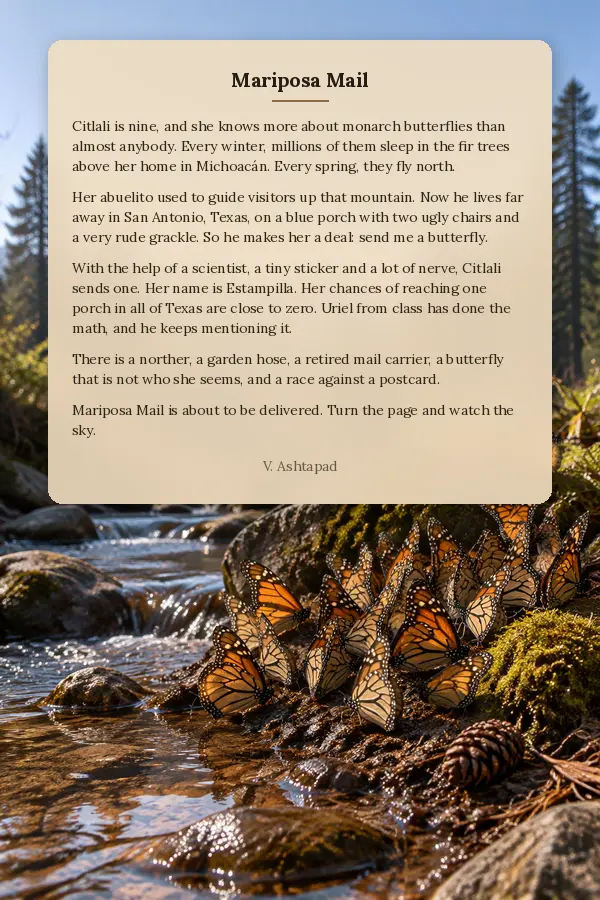
At the edges of the stream, on the mud and the wet rocks, sat thousands of monarchs.
They were drinking. Citlali had never seen it. Their wings were folded and their long, curled tongues were uncurled into the mud. They sat so close together that the bank looked like it had been painted orange and left to dry.
"They need water before the trip," said Papá. "It's dry season. The forest gives them shade and the cold keeps them sleeping, but when they wake up for good, they're thirsty."
Toño crouched down very slowly, which for Toño was a miracle. "Is one of them Estampilla?"
Citlali looked. She looked so hard her eyes hurt. A sticker the size of a lentil, somewhere on one back wing, out of all of them.
"I don't know," she said.
A truck went by on the road above. The monarchs nearest to the edge lifted at the noise, and then the ones behind them, and then the whole bank came up off the mud at once, a great soft orange wave, rising through the cold air above the stream, with that dry rustle like a thousand pages turning.
They didn't go back up to the trees.
They went north.
Not all at once, not in a straight line. They went in loose streams, over the road and over the cornfields, over the red roofs of the houses down in Angangueo, tilting, flapping, gliding. They went up into the bright air until they were just specks, and then they were nothing.
Citlali stood on the bank with her mouth open.
"Bye," said Toño, waving with both arms. "Bye. Bye. Bye."
Papá put his hand on Citlali's head. His hand smelled like leather and horse. "Every year I see it," he said, "and every year I think, how do they know which way?"
"The doctora says nobody knows for sure."
"Well," said Papá, "I'm glad somebody is still asking."
That night, Citlali sat at the table with a postcard.
Mamá had bought a little stack of them at the post office in Ocampo, where a lady with very long red nails sold stamps out of a drawer that squeaked. The postcards showed the forest with monarchs on it. They were a little faded, as if they had been in the drawer since Mamá was a girl.
"How long does a postcard take to get to San Antonio?" Citlali asked.
Mamá made a face. "Two weeks. Three. Sometimes a month. Once your tía got one I sent at Christmas in March."
Citlali smiled slowly. She uncapped her best pen, the purple one.
She wrote:
> Dear Abuelito,
> I left today. I drank from the river first. It was cold. I saw a little boy waving at me. He was very loud. It is warm now and I am flying north. I am hungry for flowers. Please water your milkweed.
> Love,
> Estampilla (AXT 058)
> P.S. I bet I am faster than this postcard.
She drew a tiny butterfly in the corner and colored it orange, and a tiny round sticker on its back wing.
"Is that cheating?" said Toño, leaning over her arm. "Butterflies can't write."
"It's not cheating. It's pretend."
"Pretend is cheating a little."
"Then it's a little cheating," said Citlali, and she wrote Abuelito's address on the other side in big careful letters, with the street and the number and the zip code, *San Antonio, Texas, USA*, and underlined *USA* twice so nobody at the post office could make a mistake.
Mamá looked over her shoulder and laughed. "Mr. Hartley will love that."
Before bed, Mamá opened the family timeline, the one where everybody added the moves, the big dates, the weddings and the babies and the trips. Citlali liked to scroll through it from the beginning. It started with Bisabuelo walking to Angangueo from a ranch in the hills to work in the mine. Then Abuelito's first horse. Then Mamá and Papá dancing at the fair. Citlali's own birthday. Toño's birthday. Tía Marisol moving to San Antonio for a job at a hospital. Then the twins, Leo and Lía. Then, two years ago, a line that said *Abuelito goes to San Antonio to help with the twins, "for six months."* Somebody, probably Tía, had put the "six months" in quotes.
Mamá added a new line.
> March. Estampilla leaves El Rosario for San Antonio. Citlali and Toño saw her go. Probably.
"Probably?" said Citlali.
"We have to be honest," said Mamá. "It's a family record."
Citlali thought about that. Then she nodded. Probably was good. Probably was not zero.
A Norther in the Wrong Month
The first Friday, Maestra Ofelia came back from the library in Ocampo with three pages of sightings, a little warm from the printer.
The class crowded around the map on the floor. Paola read the town names out loud and Uriel found them in the atlas and Citlali drew the orange dots, because it was her butterfly and everybody agreed that was fair.
Zitácuaro. Morelia. A dot near Querétaro. Then San Luis Potosí. Then a big jump, a whole bunch of dots near Monterrey and Saltillo.
"My uncle's city," said Paola, and drew a heart next to the Monterrey dot, which was not scientific.
"My cousins'," said Uriel, and drew nothing, but Citlali saw him smile at the Saltillo dot.
The dots looked like orange freckles climbing up the brown paper, past the mountains Paola had drawn as little triangles, toward the fat crooked shape of Texas. Citlali sat back on her heels. Her knees were covered in chalk dust.
"They're going fast," she said.
"Not all of them," said Uriel. "Those are just the first ones. The fast ones. Your butterfly could be anywhere."
"Or she could be one of the fast ones."
Uriel opened his mouth to argue, then shrugged. "Maybe," he said. It was the nicest thing he had ever said to her.
The second Friday, the maestra came back with almost nothing.
One page. A few dots near Monterrey again. One near Saltillo. None in Texas.
"What happened?" said Citlali.
Maestra Ofelia pointed out the window. All week, even in La Cumbrita, the wind had been cold and sharp, coming down from the north. The sky had stayed gray and low. In the mornings the puddles had a skin of ice on them that the little kids stomped on to hear it crack.
"A norther," said the maestra. "A cold front. It came all the way down through Texas and into the north of Mexico. Monarchs can't fly when it's that cold. Their muscles don't work. They have to wait in the trees until it warms up."
"How cold?"
"Below about thirteen degrees, they mostly can't fly at all."
Citlali looked at the empty paper above the last dots. It looked very big.
"Will they die?"
The class went quiet. Paola reached over and held her sleeve.
"Most of them will wait," said the maestra. "They're good at waiting. They waited all winter on the mountain."
That night, Citlali called Abuelito from the Office. It was so cold that the flat rock felt like a slab of ice through her jeans, and Papá held the flashlight with his other hand tucked into his armpit.
Abuelito answered wearing a scarf. A long, thick, striped scarf that went around his neck three times.
"It's eight degrees here," he said, outraged. "Eight! In San Antonio! In March! Nobody here owns a coat. Mr. Hartley is wearing his mail jacket from 1990. Your tía found this scarf at the back of the closet. It belongs to Tío Gabe. It smells like a basement."
Citlali laughed, but it came out shaky.
Abuelito stopped talking. He looked at her closely through the screen. "What's wrong, mija?"
"There aren't any new dots," she said. "The norther stopped them. Maybe Estampilla is frozen."
"Ah." Abuelito pulled the scarf down off his chin. "Listen. Did I ever tell you about the year of the late snow?"
"No."
"It was before you were born. It was March, like now, and the colony was getting ready to go. And then one night a big storm came. Wind, and rain, and then snow. Snow on the oyamels. Snow on everything. Whole branches came down from the weight."
Citlali hugged her knees.
"In the morning, your papá and I went up with the guards. There were butterflies on the ground. Lots. They were stiff like little pieces of paper. We thought, that's it. It's finished." He held up one finger. "But then the sun came out. And we picked some up, very gently, and put them on the sunny rocks. And some of them, after a while, after they warmed up, they opened their wings. And they flew."
"Some of them?"
"Some. Not all. I won't lie to you." He looked at her steadily. "But a lot more than we thought. And the next year they came back. And the year after. They're tough, Citlali. Tougher than me. They weigh less than a paper clip and they're tougher than me in Tío Gabe's scarf."
"You're pretty tough."
"I'm very tough. But I complain more." He wrapped the scarf around again, all the way up to his nose. His voice came out muffled. "Where's your papá? Ask him. He'll tell you. He was there."
Citlali turned the phone. Papá nodded at the screen.
"It's true," he said. "I carried a whole hat full of them to the rocks."
"Your best hat," said Abuelito. "The one with the silver band."
"It never smelled the same."
"What did it smell like?" asked Citlali.
Papá thought about it. "Like a forest," he said, "that had been crying."
On the walk home, the cold stung her nose. The stars were sharp and many, the kind you only get in the mountains, scattered over the black outline of the firs. Somewhere north, past the dark shapes of the hills, past Monterrey and Saltillo, Estampilla was sitting in a tree with her wings folded, waiting for the sun.
At home, Papá dug through a box on the top shelf of the wardrobe and found a printed photo from the year of the late snow. It showed the forest white and strange, and a younger Papá with less belly and a hat full of orange. Citlali scanned it with Mamá's phone and put it in the family album.
Under it she wrote: *The year of the late snow. Papá carrying monarchs to the sunny rocks in his best hat. Abuelito was there too, but he was taking the picture. Labeled by Papá and Citlali.*
Then she went to bed and dreamed about a scarf so long it went all the way from San Antonio to the mountain.
The Postcard Is Winning
The norther went away on a Tuesday, the way a bad mood goes away, all at once and without saying sorry.
By Wednesday, the sun in La Cumbrita was warm on the back of Citlali's neck. The ice skins on the puddles were gone. The mud on the road went soft and sucked at her shoes. Somebody's chickens were out in the road again, scratching and complaining, and Señor Pancho's donkey dozed among them with its eyes closed like it was on vacation.
On Thursday morning, Uriel came to school early.
He was waiting at the classroom door when Citlali got there, which had never happened in the history of the world. His cowlick was standing straight up and he was holding his mother's phone in both hands like a tray of eggs.
"Look," he said, before she could say good morning. "My cousin sent this. Last night. From Saltillo."
It was a short video, wobbly, of a concrete patio with a clothesline and a plastic table. Over the patio, against a very blue sky, monarchs were going by. Not a few. Dozens. They floated over the clothesline and over a lemon tree in a pot and over the head of a small old woman in a flowered apron who was pointing up with a wooden spoon and counting out loud. Her voice was high and excited.
"That's my great-aunt," said Uriel. "She counted a hundred and three and then she lost track because the beans boiled over."
Citlali watched it three times.
"Uriel," she said. "You're helping."
"I'm not helping," said Uriel. "I'm collecting data." But his ears turned pink.
The maestra let him put a dot on Saltillo himself. He made it a very small, very neat, very scientific dot. Then, while the others argued about Laredo, he drew a tiny wooden spoon next to it.
That Friday's list was long. Four pages. The dots jumped up past Monterrey, up past the border, into Texas. Eagle Pass. Del Rio. Laredo. A dot near Uvalde. Daniel, whose sister lived in Laredo, ran around the room twice.
Citlali drew a line with her finger from the Uvalde dot to the little house with the porch and the very big stick figure.
"That's so close," she whispered.
"Hundred and fifty kilometers, maybe," said Uriel, measuring with his ruler. "Three or four good days."
On Saturday morning, Citlali climbed onto the Office early, while the dew was still on the grass and the whole valley below was filled with a white mist that the sun hadn't burned off yet. She called Abuelito.
He picked up on the first ring. He was on the porch. He was grinning.
"Guess what came," he said.
"A monarch?"
"No. Better. Worse. I don't know." He held something up to the screen. It was her postcard. The faded forest, the orange butterflies, a stamp in the corner with a picture of a parrot. One corner was bent.
"It came yesterday," he said. "Fifteen days. Mr. Hartley says that's very fast for international. He's insulted. He says it's showing off."
A face appeared over the fence. Mr. Hartley, in his faded cap, holding a coffee mug.
"Citlali! Good morning! I have something to report."
"Hello, Mr. Hartley."
"I have been informed," Mr. Hartley said, very formal, "that your postcard is ahead. As of yesterday's delivery, the postcard is winning. The butterfly has not yet arrived at this address."
"She's in Texas," said Citlali. "Probably. The dots are in Uvalde."
"Uvalde! Then it's a race." He set down his mug on the fencepost. "May I read it out loud? For the official record?"
"Can I record you?" said Citlali. "For the family album? Is that okay?"
Mr. Hartley looked surprised, then pleased. "Nobody's asked to record me since my retirement party. Go ahead."
Abuelito passed him the postcard over the fence. Mr. Hartley held it at arm's length, then pulled out reading glasses from his shirt pocket, then held it at arm's length again anyway. He cleared his throat. He read it in a voice like a man on the radio announcing a baseball game, and because his Spanish was not good, Abuelito translated, and because Abuelito's English was very good but very loud, the twins came out to see what the yelling was about.
"Dear Abuelito. I left today. I drank from the river first. It was cold."
"She drank from the river," Abuelito repeated, nodding, as if this were serious news.
"I saw a little boy waving at me. He was very loud."
"That's Toño," said Citlali.
"Of course it is," said Abuelito.
"It is warm now and I am flying north. I am hungry for flowers. Please water your milkweed." Mr. Hartley peered over his glasses at Abuelito. "Have you been watering your milkweed, Chencho?"
"Every morning! Ask the bird!"
"Love, Estampilla. AXT 058. P.S. I bet I am faster than this postcard." Mr. Hartley lowered the card. "Well, young lady. In thirty-two years of carrying the mail, I never once lost a race to a butterfly. And it looks like I still haven't."
Citlali laughed until her stomach hurt and she had to crouch on the rock. The mist had started to lift off the valley. Below her, the red roofs of the village came out one by one, with smoke going up from the chimneys, and the smell of somebody's wood fire came up the hill.
"It's not over," she said. "She's only in Uvalde."
"That's the spirit," said Mr. Hartley. "Never trust a postcard. They're smug."
She stopped the recording. Later that day, she put it in the family album: *Mr. Gus Hartley, retired mail carrier, reads the first Estampilla postcard on the porch in San Antonio. Recorded with his permission. Translated by Abuelito, loudly.*
That night, she wrote a second postcard.
> Dear Abuelito, I am in Texas! The flowers here are blue. I am resting in a tree near a river. A grackle yelled at me. Is he yours? Tell him to be nice. I am coming. Love, Estampilla (AXT 058). P.S. Do NOT let the postcard win.
She mailed it Monday. The lady with the red nails stamped it with a thump.
"Another one for Texas?" she said.
"It's a race," said Citlali.
The lady didn't ask what kind. She just smiled, and put it in the bag.
Yellow Freckles
"Emergency," said Abuelito.
It was Tuesday after school. Citlali had barely gotten onto the Office. Her backpack was still on.
"What emergency?"
"Come look. No, you can't come. I'll bring it to you." The phone swung down toward the fence, toward the six milkweed plants. "Look. Look at this. Look what they did."
Citlali looked. At first she thought the stems had a rash. Then she saw that the tops of the milkweed, the soft new leaves and the stems under the flower crowns, were covered in tiny bright yellow dots. Hundreds of them. They were packed together like grains of mustard seed, all over the plant. A few had black legs.
"They're bugs," she said.
"They're thieves," said Abuelito. "They came overnight. I came out with my coffee and there they were. Sitting on my milkweed. Drinking it. Like they own it. Like Licenciado."
Above him on the wire, the grackle squawked, as if it had heard its name.
"Don't spray anything," said Citlali quickly. "Abuelito. Promise you won't spray anything."
"I was going to ask Gabe if he has something in the garage..."
"No! Wait! I'll ask the doctora."
She sent Doctora Inés a message with the picture. The doctora had given Maestra Ofelia her number for the class, and the maestra had given it to Citlali, because Citlali had asked forty times. The answer came back in ten minutes, while Abuelito paced the porch and the grackle paced the wire.
*Oleander aphids. Very common on milkweed. Don't use any bug spray, it can kill caterpillars too. Wash them off with a strong spray of water, or squish them with your fingers. Ladybugs love them. Good luck. Tell your grandfather he's doing important work.*
Citlali read it out loud. Abuelito stood up taller at the last part.
"Important work," he said. "You hear that, Marisol?" he shouted at the house. Nobody answered. "She heard."
Then he went to find the hose.
What happened next, Citlali watched in pieces, because Abuelito kept putting the phone down on the cooler and forgetting it was on. She saw blue sky and pecan leaves. She saw the hose come out. She heard the twins.
"Can we help?"
"Can we spray?"
"Can I spray Leo?"
"No one is spraying Leo," said Abuelito. Then there was a shriek and a splash and the sound of Leo laughing so hard he got the hiccups, and Citlali understood that somebody had sprayed Leo.
When Abuelito picked the phone back up, his shirt was wet down one side and there was a leaf stuck in his mustache.
"Progress," he said.
The milkweed stems dripped and shone. Most of the yellow dots had washed down into the dirt. A few stubborn ones hung on near the tops. Abuelito leaned in and squished them one by one with his thumb, very carefully, very slowly, as if he were defusing a bomb.
"Disgusting," he said happily. "My thumb is yellow."
Then Mr. Hartley came to the fence with an old jar.
"Heard there was a situation," he said. "I've got a whole squad of these on my tomatoes." He tipped the jar into Abuelito's hands. Five red ladybugs with black spots tumbled out and started walking around on Abuelito's palm.
"They work for free," said Mr. Hartley. "Best employees I ever had."
Abuelito put them one by one on the milkweed. Lía, very solemn, gave each one a name. They were all named Lía.
Citlali was laughing so much that Papá came out of the house to see what was so funny. She showed him. Papá laughed too, a big surprised laugh. "Look at him," he said. "Look at the old man. He fought aphids with a garden hose."
"And won," said Abuelito, from Texas. "Write that down."
That weekend, Tía Marisol got a box down from her closet in San Antonio. It was full of old photos Abuelito had brought north with him and never unpacked. She scanned them one by one on the scanner at her hospital office after her shift and put them in the family album, and on Sunday, the whole family got on a video call to name the people in them.
Citlali sat with Mamá and Papá and Toño, squeezed together on the couch in La Cumbrita. In San Antonio, Abuelito sat on the porch with Tía and the twins, in the green chair and the red one and on the cooler. The cousin in Chicago joined too, from a kitchen with a window full of snow.
"Who's that?" said Tía, holding up the first one.
It was a young man on a gray horse in front of a forest. He had a thick black mustache and a hat with a silver band. The horse had its ears pinned back like it was very offended.
"That's me," said Abuelito. "And that's Duquesa. She was mad at the photographer."
"Who's the photographer?"
"Your mother. That's why the horse is mad. Your mother always said, 'Smile, Duquesa,' and Duquesa never did."
Citlali typed it under the photo. *Crescencio "Chencho" Tapia, about 18, on Duquesa at El Rosario. Photo taken by Abuela Carmen. Duquesa did not smile. Named by Abuelito.*
They went through twenty-three photos that afternoon. The mine in Angangueo, black and white, with men in helmets standing in a row. A wedding where everyone was squinting into the sun. Tía Marisol as a baby, bald as an egg, sitting in a washtub. Papá at eleven, holding up a fish.
"That fish was very small," said Mamá.
"It was the angle," said Papá.
By the end, the sun had gone down in La Cumbrita and the room smelled of the atole Mamá had warmed on the stove, cinnamon and corn. In San Antonio, the porch light had come on. The milkweed along the fence was wet and clean and green, with five ladybugs on it named Lía, and no yellow dots at all.
Porch Watch
The next Friday's list had a dot in San Antonio.
Not at Abuelito's house. Somewhere on the north side of the city, by a school with a butterfly garden, someone had reported three monarchs on the flowers. There were dots in the Hill Country too, and one near a town called Boerne that nobody in the class could pronounce.
"Bur-nee," said Maestra Ofelia, who had looked it up.
"That's not how it's spelled," said Uriel, offended.
Citlali drew the San Antonio dot with her hand shaking a little. It was so close to the little house with the porch that the orange touched the stick figure's very big hat.
"They're there," said Paola. "They're there, they're there."
"They're in the city," said Uriel. "The city's big. It's like... very big."
"How big?"
Uriel didn't know, which made him unhappy. He went to look it up in the atlas.
That evening, Tía Marisol made a page.
It was a private event page, the kind the family used for birthdays and the cousin's graduation, that only the people Tía invited could see. At the top, she had put a photo of the blue porch and the six milkweed plants. The title said *Porch Watch*. Under it, there was a schedule.
- Mornings, 7 to 9: Abuelito (with coffee).
- 9 to 11: Mr. Hartley (by the fence, also with coffee).
- 11 to 12: the twins (supervised, NO HOSE).
- Afternoons: Abuelito again (he refuses to leave the porch anyway).
- Weekends: Tío Gabe, if he wakes up.
At the bottom, she had written, *If you see one, tell everyone right away. If you see a grackle, don't tell anyone, we know.*
Within an hour, people had started writing under it. The cousin in Chicago wrote that she had no monarchs, only snow, and could someone send her a monarch too. Papá's sister in Morelia wrote that she had seen one in her patio and it was definitely Estampilla. Abuelito wrote back, *How do you know?* She wrote, *She looked like she was in a hurry.*
Mamá read them out loud at the table, laughing, while she stitched.
But Citlali didn't laugh as much as she wanted to.
She sat on the floor by the stove with her chin on her knees. Toño was building a tower of corn cobs next to her and narrating its life story. The fire popped. Outside, the wind moved in the firs with a long, low sound like the ocean in a shell.
"What's wrong?" said Mamá, without looking up from the needle.
"Nothing."
Mamá kept stitching. She was very good at waiting. She could wait longer than anybody Citlali knew, longer than monarchs on a mountain.
"I want to be there," Citlali said finally. "On the porch. The twins get to be on the porch. Mr. Hartley gets to be on the porch. Even the grackle gets to be on the porch. I'm the one who sent her."
Mamá put the hoop down. She came and sat on the floor next to Citlali, which she almost never did, because her back didn't like it.
"I know," she said. "I want to be there too. I haven't seen my papá in person in two years. I want to sit in that ugly red chair."
"It's not ugly."
"It's very ugly. He found it on the curb." Mamá put her arm around her. "We can't go this spring, mija. It's a long way and it costs a lot, and you have school, and Papá has the horses. Maybe in the summer. I'm working on it."
"Promise?"
"I promise I'm working on it. That's the only kind of promise I can make."
Citlali leaned on her. Mamá smelled of wood smoke and the lavender soap she bought at the market in Zitácuaro.
"But listen," Mamá said. "Who's the one who knows the most about monarchs in this whole family? Besides Abuelito?"
Citlali thought. "Me."
"So who should be in charge?"
Citlali sat up.
The next morning, she called Abuelito from the Office at exactly seven, when the sun was just touching the tops of the firs and the mountain air was so cold and clean it hurt to breathe through her nose.
"Porch Watch," she said, "this is the dispatcher."
Abuelito, in the green chair with his coffee, nearly spilled it. "The what?"
"The dispatcher. Like for ambulances. I'm in charge. What's the temperature?"
He looked at a thermometer hanging on the porch post. "Eighteen."
"Good. That's warm enough for flying. Any wind?"
He licked his finger and held it up. "A little. From the south."
"That's good too. They like a south wind. It pushes them." She had learned that from the doctora. "Are the milkweed flowers open?"
He pointed the phone at them. The little crowns were cream and purple and open, and a bee was walking around on one.
"Any aphids?"
"Zero."
"Any ladybugs?"
"Four. One left. I think she went to see her family."
"Okay. Abuelito. You know what a monarch looks like?"
"Mija, I have been looking at monarchs for sixty years."
"Just checking. Orange, black lines, white dots on the edges. They glide a lot. They flap, flap, flap, then glide."
"I know."
"Okay," said Citlali. "Dispatcher out."
She called at seven every morning after that, before school. The air on the mountain was getting warmer. The forest was emptier. When she rode up with Papá on Saturday, there were only a few hundred monarchs left on the big tree by the second bench, and the oyamel's dark green needles showed through everywhere. It looked like a house after the guests have gone home and somebody has opened all the windows.
Every morning, Abuelito gave her the report. Temperature. Wind. Flowers. Bugs.
And every morning, the answer at the end was the same.
"Nothing yet."
Her Majesty
The call came on a Wednesday at twenty past three, which was not dispatcher time.
Citlali was in the yard helping Papá clean Chapulín's hooves. That meant she held the bucket while Papá scraped, and Chapulín tried to eat her hair. Mamá came running out of the house holding her phone up over her head like a trophy.
"Your abuelito! He says it's urgent! He says he's been calling you for ten minutes!"
"My phone's on the Office," said Citlali. "It doesn't work anywhere else."
"Well, mine does, sometimes, if I stand on the water tank." Mamá thrust it at her. "Go. Climb."
So Citlali climbed onto the water tank in the corner of the yard, which was round and black and hot from the sun, and Chapulín watched her with an expression of deep disappointment.
Abuelito's face filled the screen. He was out of breath. His hat was crooked. Behind him, she could hear the twins yelling.
"She's here," he gasped. "She's here. Citlali. Estampilla. On the milkweed. Right now."
Citlali's heart jumped so hard she almost fell off the water tank.
"Show me! Show me! Slowly!"
"I'm showing you, I'm showing you." The phone went sideways and down. There was a blur of green. There was the fence. There was a milkweed plant, with its cream and purple crowns. And on one of the crowns, opening and closing its wings in the hot Texas afternoon, was a butterfly.
It was orange.
Kind of.
Citlali squinted. It was a darker orange than a monarch, more like the brown of a cinnamon stick. The black lines that crossed a monarch's wings like the lines of a road weren't there. There were only black edges, and some little white spots scattered on the front wings, here and there, like somebody had flicked a paintbrush at it.
"Abuelito," Citlali said slowly.
"Isn't she beautiful? She came right to the milkweed. Like she read the postcard."
"Abuelito, look at the wings. Where are the black lines?"
There was a pause on the other end.
"What black lines?"
"Monarchs have black lines. Like veins. All over the orange. This one doesn't. And the color's wrong. She's too brown."
Another pause. The butterfly shifted on the flower and showed its wings again. Cinnamon brown. White freckles. No veins.
"Maybe," said Abuelito, "she's tired. From the trip."
"Abuelito."
"Maybe she got dirty."
"I think," said Citlali, "she's a queen."
"A what?"
"A queen. It's a different butterfly. They're cousins with monarchs. They like milkweed too. The doctora told us. They live in Texas and the south and they don't do the big migration. They kind of look like monarchs if you're far away. Or if you're very excited."
There was a very long silence from San Antonio. Citlali heard a car go by, and a dog bark, and then, unmistakably, Mr. Hartley's voice from the other side of the fence.
"Chencho? Is it her? Should I get my cap?"
Abuelito cleared his throat. He brought the phone back up to his face. He looked like someone who has walked into a glass door in front of a lot of people.
"Mija," he said. "Remember when I said I had been looking at monarchs for sixty years?"
"Yes."
"I have been looking at monarchs for sixty years in *Michoacán*. Nobody told me Texas had fake ones."
"They're not fake. They're queens."
"Fake queens." He looked back at the butterfly, which was still sitting on the milkweed, sipping nectar, taking its time, not at all bothered. "She's very relaxed for a fake."
Citlali started giggling. She tried to stop. She couldn't. She giggled until she folded up onto the water tank, which was too hot, so she stood up again, still laughing. Down below, Papá was laughing too, because Mamá had told him, and even Chapulín made a snorting noise that was probably a laugh.
In San Antonio, Abuelito turned toward the fence. "False alarm, Gus!" he called. "It's a queen!"
"A what?"
"Royalty! Very important! But not ours!"
"Should I still get my cap?"
"No!"
The queen finished with the milkweed. She opened her wings, cinnamon and white, and drifted over the fence toward Mr. Hartley's tomatoes, in no hurry at all, like a lady at a party who had decided to see what the other room was like.
Abuelito watched her go. Then he sat down in the red chair and pulled his hat down over his eyes.
"I am an old fool," he announced.
"You're not."
"I am. I called the whole family. Your tía is coming home from work. I texted Chicago. I texted Morelia. I put it on Porch Watch. I wrote SHE IS HERE in capital letters."
"Can I record you?" said Citlali.
He pushed the hat back up and looked at her suspiciously. "Why?"
"For the family album. So everyone knows what happened. With your say-so."
Abuelito narrowed his eyes. Then he sighed. "Fine. Yes. For the record. Go."
She pressed the button.
"My name is Crescencio Tapia," said Abuelito, very dignified. "Sixty years with monarchs. Today I saw a queen and I said she was a monarch. My granddaughter, nine years old, from a water tank in Michoacán, told me the difference. She was right." He paused. "That's all. Stop it there."
Citlali stopped it there.
She put it in the album with a careful label. *Abuelito and the queen butterfly. Porch in San Antonio. Recorded with his permission. He was a good sport.*
Then she put a note on Porch Watch, under SHE IS HERE:
> Not her. A queen. Queens look like monarchs but are browner and don't have the black lines on top. Monarchs: orange with black lines and white dots on the edges. Keep watching. — Dispatcher.
Within five minutes, the cousin in Chicago had written, "I would have thought it was her too." Papá's sister in Morelia wrote, "Mine was definitely her though." And Mr. Hartley, who did not usually write anything, wrote: "Good catch, Dispatcher. Never trust the first delivery."
That night, Citlali lay in bed and listened to the wind in the firs and thought about the queen, sitting so calmly on Abuelito's milkweed, not knowing that she had caused all that trouble. She felt bad for Abuelito, and also, a little, very proud of herself. Both at once. It was a strange feeling, like eating something sweet and spicy at the same time.
Somewhere north, the real Estampilla was still flying. Probably.
Not Zero
After the queen, nothing happened for six days.
Every morning at seven, Citlali climbed onto the Office. Every morning, Abuelito gave his report.
"Twenty-one degrees. Wind from the south. Flowers open. Aphids zero. Ladybugs three. Grackle, unfortunately, one."
"And?"
"Nothing yet."
On the fourth day, he started adding things, so the report would be longer.
"Mr. Hartley's tomatoes have two flowers. Leo lost a tooth. Your tía made coffee that I can drink. That's news. That never happens."
On the fifth day, Citlali didn't laugh at the coffee.
On the sixth day, Friday, the maestra brought back the list from the library, and the dots on it were all in the wrong places. Dallas. Oklahoma. One up in Kansas. There were still some in Texas, but fewer, and nobody had reported anything near San Antonio for a week.
"They're going past," said Citlali. She sat back on her heels by the map. "They're going past him."
Paola didn't say anything, which for Paola was very serious.
Uriel studied the dots for a long time with his ruler. Then he said, in a voice that was trying hard to be scientific, "The ones going up there now might be the children. The doctora said the first ones lay eggs in Texas. Then the babies grow up and keep going."
"So Estampilla's done?"
"Maybe she laid her eggs somewhere else," said Uriel. "Texas is very big. I looked it up. It's bigger than all of France."
That didn't help. Citlali knew it was supposed to.
That afternoon, the maestra got a message, and she read it to the class with her glasses pushed up on her forehead.
It was from Doctora Inés.
> Good news for your class. A girl in a town near Austin, Texas, found one of our tagged monarchs in her grandmother's garden and reported the code. AXT 031. Tagged at El Rosario by my team the same week you met me. She flew about twelve hundred kilometers. Please tell Citlali: it's not zero.
The class went wild. Daniel ran around the room three times. Paola screamed. Even the stove seemed to tick louder.
Citlali sat very still.
AXT 031. Not Estampilla. One of Estampilla's neighbors, probably, from the same sheet of stickers. Somebody had found her. In a grandmother's garden. A girl had found her in a grandmother's garden, and it wasn't Citlali, and it wasn't Abuelito's garden, and it wasn't Estampilla.
She was happy. She was so jealous she felt sick. Both at once again.
Uriel came over and sat down next to her on the floor. He didn't say anything for a minute. He picked at the chalk on his knee.
"So," he said finally. "It's not zero."
"I told you."
"I know. You did." He tugged his cowlick, which popped back up. "I was wrong. I'm only saying it one time."
"Can I record you saying it?"
"No," said Uriel, and then he laughed, and she laughed too, a little.
On Saturday, Papá took her up the mountain.
Just the two of them, on Chapulín, early, with the frost almost gone now and the sun warm on the backs of their hands. The trail was quiet. There were only a few visitors, and they walked slowly, looking up at the trees, looking disappointed.
At the big tree by the second bench, there was nothing.
No clusters. No orange. Just the tall straight trunk with its gray bark, and the dark green needles high up moving a little in the wind, and the light coming down between the branches in long dusty bars. A woodpecker knocked somewhere. The air smelled of resin and warm earth and the very end of winter.
Citlali slid off Chapulín and walked to the tree. She put her hand on the bark. It was rough and sticky in places with sap.
"They're all gone," she said.
"They're all gone from here," said Papá. He sat down on the bench and let Chapulín graze on a patch of clover, which made Chapulín very happy. "That's different."
"It feels the same."
"It does." Papá stretched out his legs. "You know what I think about, every April, when I come up here and it's empty like this?"
"What?"
"November." He pointed up at the empty branches. "In November, they'll be back. On this tree, maybe. The great-great-grandchildren. The ones that haven't even been born yet. They'll come from Canada and Minnesota and Texas, all the way down, and they'll find this mountain, and nobody will show them the way."
"Maybe Estampilla's great-great-grandchildren."
"Maybe."
"Probably," said Citlali.
Papá smiled. "Probably."
They sat for a while. Then Papá started humming. It was the old song Abuelito used to hum to the horses on the trail, low and slow, with a part in the middle that went up and then fell down again like a horse stepping carefully over a log. Citlali knew it from when she was small. She didn't know it had words. Maybe it didn't.
"Papá, does that song have a name?"
"Ask your abuelito. He made it up, I think. Or his papá did, in the mine."
That evening, from the Office, she asked him.
"That song?" Abuelito was in the red chair. The sky behind him was going pink over the pecan tree. "It doesn't have a name. My father hummed it walking up from the mine. To keep his feet going. I hummed it to Duquesa so she wouldn't stop at puddles. It didn't work."
"Will you hum it? So I can keep it? For the album?"
He squinted at the screen as if she had asked to borrow his boots. "With my say-so?"
"With your say-so."
"Yes," he said. "Go."
She pressed the button. He hummed it, sitting on the blue porch in San Antonio, more than a thousand kilometers from the mountain. His voice was rough and low. Behind it, faintly, a mower and a dog and the grackle, and the twins inside arguing about bath time. When he was finished, he coughed and looked embarrassed.
"Bad voice," he said.
"Good voice."
She labeled it: *The walking song, no name. Hummed by Bisabuelo coming up from the mine in Angangueo, then by Abuelito to Duquesa on the El Rosario trail. Hummed here by Abuelito on his porch in San Antonio, with his permission.*
"Mija," said Abuelito, before she hung up. "Same time tomorrow? Seven?"
"Seven," said Citlali. "Dispatcher out."
Delivered
On the seventh day, Abuelito answered the seven o'clock call in a whisper.
"Dispatcher," he breathed. "Don't yell."
Citlali was standing on the Office in her school sweater. The first sun was sliding over the ridge behind her. Down in the valley, the roosters were going, one after another, like a rumor passing from yard to yard.
"What is it?" she whispered back, even though there was no reason for her to whisper on a mountain in Michoacán.
"Look. Slowly. Don't get excited. I got excited last time and look what happened."
He turned the phone very slowly, the way you would turn a full cup of coffee.
There was the blue porch railing. There was the morning sun coming in low and yellow-white across it, sharp as a knife, making long shadows of the pecan twigs. And on the railing, right in the middle of the sunny part, sat a butterfly with its wings open flat.
Orange like a cut mango. Black lines crossing the wings like the streets on a map. A border of black, with white dots all along the edges, like a row of tiny buttons. Thick black veins. No little dots on the back wings.
Citlali could not breathe.
"Abuelito," she whispered. "That's a monarch."
"I know."
"That's a real one. That's a girl."
"I know. I checked. Twice. I checked the lines and the dots and I even looked at the color and thought about cinnamon and it's not cinnamon. It's mango."
"She's warming up," Citlali said. "That's why her wings are open. She's warming up her muscles before she flies."
"She's been warming up for ten minutes. My coffee's cold. Citlali, I think my whole leg is asleep."
"Don't move."
"I'm not moving!"
"Can you see a sticker? On the back wing?"
Abuelito leaned closer. Very slowly. The phone came closer. The butterfly's wings filled the screen, shining in the low sun, every scale catching the light. Citlali looked at the back wings so hard her eyes watered.
No sticker. No little round stamp. Just orange and black and white, and the soft, dusty shine of the scales.
"No," said Abuelito quietly. "I don't see one."
"Oh," said Citlali.
The monarch closed her wings and opened them again. Then she lifted off the railing. Flap, flap, flap, glide. She floated down the porch steps and across the little patch of yard, toward the fence, and landed on one of the milkweed plants.
"Follow her!"
"My leg!"
Abuelito stood up and fell back down into the red chair, and the phone showed the porch ceiling for a second, and then he was up again, limping and hopping across the yard, whispering to himself, "Come on, come on, wake up, leg."
He crouched by the milkweed.
The monarch was on the underside of a leaf. She was holding on with her thin legs, and the end of her body was curled under, touching the leaf, very gently. She stayed like that for a few seconds. Then she moved to another leaf. Did it again.
"What's she doing?" whispered Abuelito.
Citlali knew. She had read the library book four times.
"She's laying eggs," she said. "On your milkweed. Abuelito. She's laying eggs on your milkweed."
The monarch went from leaf to leaf, plant to plant, along the fence. Abuelito followed on his knees, holding the phone. When she was done, she sat for a moment on top of one of the cream and purple flower crowns, sipping. Then she rose up over the fence, over Mr. Hartley's tomatoes, over the power line where Licenciado sat screaming at her, and away north into the bright sky, getting smaller, and smaller, and gone.
Abuelito turned over a leaf with one finger.
Underneath was an egg. One single egg, smaller than a sesame seed, pale cream, shaped like a tiny rugby ball standing on its end, with fine ridges running up it like the lines on a melon.
"Oh," said Abuelito. That was all. Citlali had never heard him say so little.
After a while, Mr. Hartley came to the fence in his cap, carrying his mug.
"Chencho? You're on your knees in the dirt. Is this a medical situation or a butterfly situation?"
"Butterfly," said Abuelito. "A real one. A girl. She laid eggs."
"Well, I'll be." Mr. Hartley leaned over the fence. "Was it her? The one with the code?"
There was a pause.
"No sticker," said Citlali, from the phone. "We looked."
Mr. Hartley set his mug down on the fencepost, the way he did when he was about to say something official. "Can I tell you a thing about the mail?"
"Okay."
"Thirty-two years, I delivered letters to people who'd moved away, to people whose names got spelled wrong. Once, a letter to a cat. You know what I learned? The address is what matters. Not the stamp. Somebody sent something to this porch. Something came to this porch." He picked up his mug again. "In my professional opinion, that's a delivery."
Abuelito looked at the phone. Citlali looked back at him. He had dirt on his knees and a pecan leaf on his hat and his eyes were wet in the corners, though he would have said it was the sun.
"What do you think, Dispatcher?" he said. "Does it count?"
Citlali thought about it. She thought about Uriel and his zero point zero zero zero. About AXT 031 in a grandmother's garden near Austin. About the stream turning orange. About the millions of monarchs going north, and how one of them, just one, had come down out of the sky onto this one porch, out of all the porches in Texas.
"It counts," she said.
"It counts," Abuelito agreed.
"It counts," said Mr. Hartley. "Signed for."
That afternoon, at a quarter past two, the young mail carrier who had Mr. Hartley's old route came up the walk and handed Abuelito the second postcard. "I am in Texas! The flowers here are blue." It had a bent corner and a parrot stamp and a smear of something that might have been mud.
Abuelito held it up to the phone when Citlali called after school.
"The butterfly won," he said. "By seven hours."
"Tell Mr. Hartley."
"I did. He says it was a photo finish and he wants a rematch."
That night, Mamá added a line to the family timeline.
> April. A monarch came to Abuelito's porch in San Antonio and laid her eggs on his milkweed. No sticker. We decided it counts.
Five days later, at the seven o'clock call, Abuelito turned over the same leaf and showed her a caterpillar. It was so tiny it looked like a crumb, and it was already eating, chewing a little round hole in the green.
"Look at him," said Abuelito proudly. "Look at that appetite. He's a Tapia."
"How do you know it's a him?"
"I don't. I'm guessing. Your tía says I'm not allowed to name it until we know." He leaned in close to the leaf, close enough that his mustache almost touched it. Then he started to hum. Low and slow. The walking song, the one with no name, the one with the part in the middle that goes up and steps carefully down again.
The caterpillar kept eating.
On the mountain, the sun was warm on the Office. Citlali sat down on the flat gray rock with the phone in her lap and her knees pulled up, and listened to her grandfather hum to a crumb on a leaf in Texas, while somewhere far to the north, the children of the children of all the butterflies that had left her forest were opening their wings to the morning.
About this book
Citlali is nine, and she knows more about monarch butterflies than almost anybody. Every winter, millions of them sleep in the fir trees above her home in Michoacán. Every spring, they fly north.
Her abuelito used to guide visitors up that mountain. Now he lives far away in San Antonio, Texas, on a blue porch with two ugly chairs and a very rude grackle. So he makes her a deal: send me a butterfly.
With the help of a scientist, a tiny sticker and a lot of nerve, Citlali sends one. Her name is Estampilla. Her chances of reaching one porch in all of Texas are close to zero. Uriel from class has done the math, and he keeps mentioning it.
There is a norther, a garden hose, a retired mail carrier, a butterfly that is not who she seems, and a race against a postcard.
Mariposa Mail is about to be delivered. Turn the page and watch the sky.
Members can react to this book and talk about it in the members' Library.