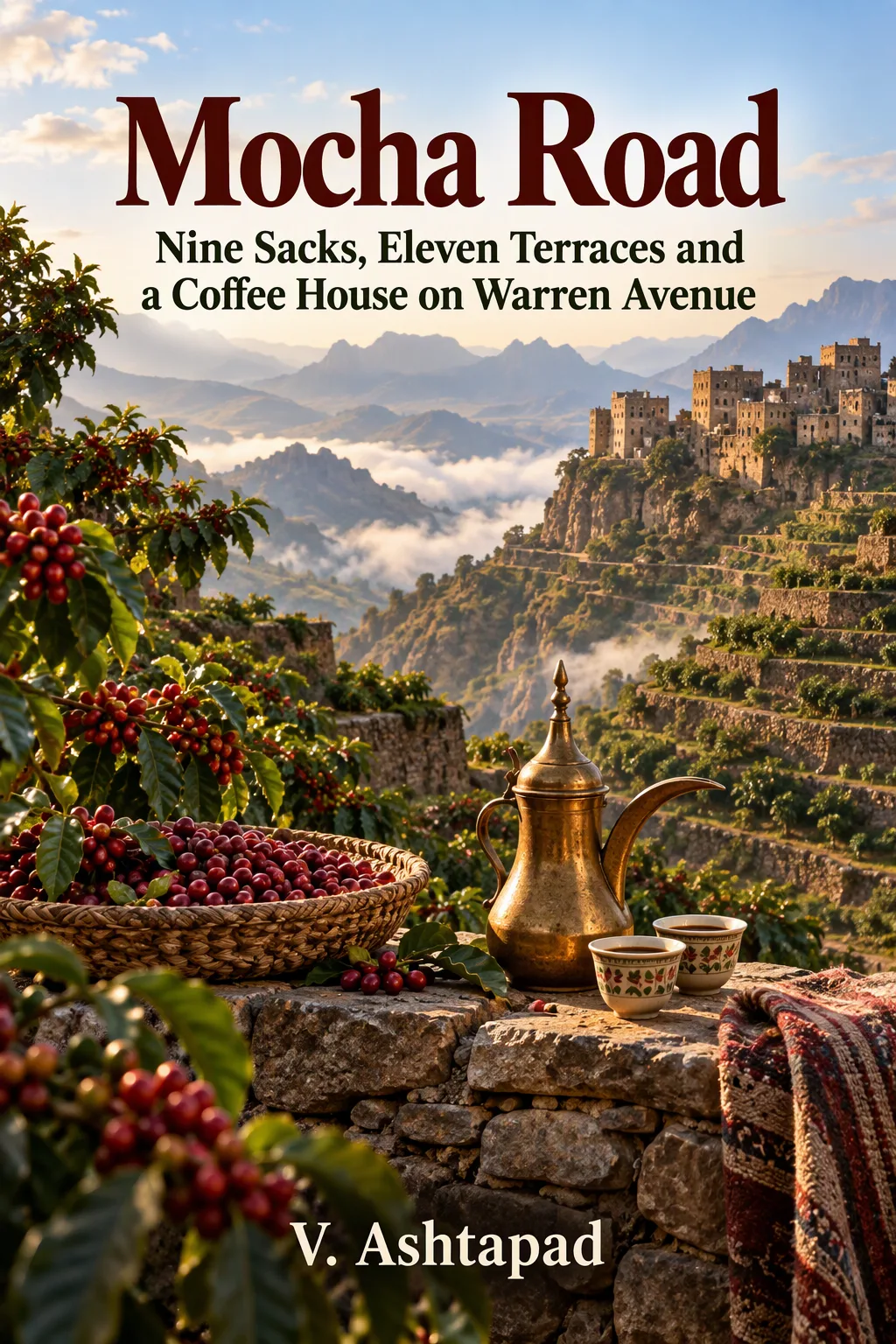
Mocha Road
Nine Sacks, Eleven Terraces and a Coffee House on Warren Avenue
by V. Ashtapad
Foreword
This is a work of fiction. Dearborn, Michigan, is home to one of the largest Yemeni communities in the United States, and the terraced coffee of the Haraz mountains, the rooftop drying of the cherries and the spiced husk drink called qishr are real. The village, the Bayt Hanash coffee house and everyone in this book are invented.
For everyone whose hands are in the cup.
Old Crop
Forty-one cups. Nabil Hanash counted them twice on the back of a receipt after the last customer left, because the register said thirty-eight and he did not trust the register, which had come with the lease along with a sticky drawer and a smell of lemon cleaner that would not leave.
Forty-one cups, eleven of them free. Three to his mother, who came at seven in the morning and stayed until two, sitting at the table by the window with her purse on her lap as if the shop might be repossessed if she let go of it. Two to his father, who came at noon, drank one standing up, and said it was very good in the voice he used for weather. One to Hajj Mansour, who was eighty-one and had not paid for coffee anywhere on Warren Avenue since 1987. Five to the men from the tire shop next door, who had helped him carry the counter in from the truck in August and would be owed coffee, by Nabil's reckoning, until the end of time.
Thirty paid. At four dollars and fifty cents a cup for the pour-over and six for the pot service, that was not enough to pay the rent on a single day of the month, but it was thirty strangers who had walked in off the sidewalk under a sign that said BAYT HANASH in red letters and, underneath, smaller, MOUNTAIN COFFEE FROM HARAZ, and had put down money for something his family had grown.
That was the sentence he had been saying to himself for a year. Something my family grew. He had said it to the bank. He had said it to the landlord, a Lebanese man named Fouad who owned four buildings on the block and had asked, reasonably, why anybody needed another coffee house on Warren Avenue, where you could not throw a shoe without hitting one. He had said it to his sister Rania, who was a pharmacist and believed in spreadsheets. He had said it to his father, who had not said anything back.
He said it now, alone, to the empty room. Then he turned off the lights over the counter and sat in the dark with the receipt.
The shop was narrow and deep, the way the old storefronts on that stretch were, with a pressed-tin ceiling the color of milky tea that he had spent two weeks of evenings scraping and repainting. The counter was walnut, salvaged from a bank in Highland Park that had closed. Behind it, on a shelf he had built himself, stood the brass. Six pots, long-necked, with lids like little domes and spouts like the beaks of herons. Five of them were new, bought from a man in a market in Hamtramck who sold them by weight. The sixth was his grandmother's. It had come from the village in a suitcase in 1978, wrapped in a sweater, and it had a dent in its belly from the day it had fallen off a truck on the road down the mountain, before anyone in the family had ever seen snow.
He did not use that one. It sat in the middle of the shelf, darker than the others, and in the light from the street it looked like it was waiting for something.
---
The beans came from a warehouse in Melvindale, from a man named Karim Abboud, who imported coffee from the Yemeni highlands to roasters in Chicago and Brooklyn and Toronto and had a cousin who knew a cousin. Karim was forty-four, wore pressed khakis to a warehouse, and spoke about coffee the way some men speak about horses, with numbers and a kind of grievance.
"Haraz," he had said in March, when Nabil first came to him. "Which village?"
Nabil told him.
Karim looked it up on a laminated map pinned to the warehouse wall, a map so covered in pushpins and pencil marks that the mountains had become a kind of argument.
"Small," Karim said. "Very high. Good coffee comes off that ridge. Not much of it. It goes into a lot with three or four other villages, usually. I can't promise you only your family's trees."
"I want only my family's trees."
"Everybody wants something." Karim pulled a burlap sack off a pallet, slit the stitching with a box cutter and held out a handful of green beans. They were small and uneven, some pale as bone, some greenish, a few with a faint blue tint, like river stones. "This is last year's crop from that ridge. It's mixed. Some of it is probably your grandfather's trees. Some of it is probably somebody's goats' favorite trees. It's good coffee. Roast it light, it tastes like dried apricot and cardamom and a little like wine. Roast it dark, it tastes like every other coffee in Dearborn."
"And this year's?"
"This year's isn't picked yet." Karim folded the top of the sack closed. "Harvest on that ridge starts in late October, early November, depending on the rain. The cherries dry on the roofs for two, three weeks. Then they get hulled, sorted, bagged, trucked down to the coast, shipped. You might see it by February. If the boats are kind."
So Nabil had opened on last year's crop. Two thousand pounds of it, mixed lot, stacked in the back room on pallets he had bought from a grocery wholesaler. He roasted it himself on a twelve-kilo drum roaster he had bought used from a man in Ann Arbor who was getting divorced and wanted it gone by the weekend. He had learned to roast from videos and from a two-day class in Detroit, and from six weeks of burning things, and he was, he thought, beginning to be decent at it.
Before this he had been a project manager at a company that made seat assemblies for the auto plants. He was good at it. He had worked there eleven years, had an office with a door, had a 401(k) that his sister called "the only sane thing you've ever done." He had cashed it out in January to make the down payment on the roaster and the lease. Rania had not spoken to him for nine days.
His father had not spoken to him about it at all.
---
Qassem Hanash had come to Dearborn in 1978, at nineteen, with a cousin's address on a piece of paper and the sweater with the brass pot rolled inside it. He had worked thirty-one years on the line at an axle plant, the same plant, the same shift, until his shoulders gave out, and in all those years Nabil had never heard him say that he missed the mountain. He did not talk about the village except as a list of people who needed money. He sent money there on the first of every month, through a man on Warren Avenue who sent money there for everyone, and when the phone rang late at night with the village on the other end, he took it into the bedroom and closed the door.
When Nabil was eleven, he had asked his father what the village looked like.
"High," his father had said.
"What else?"
His father thought about it. "Cold, at night. Hot in the day. Stairs."
"Stairs?"
"Everywhere stairs. You go to your neighbor, stairs. You go to the well, stairs. You go to the trees, stairs." He had gone back to the newspaper. "Here you have a car."
That was the whole of it, for twenty-three years.
So when Nabil had told him, last Thanksgiving, at the table, over the turkey his mother cooked every year with a stuffing of rice and lamb and pine nuts that bore no relationship to any American turkey, that he was going to leave the seat company and open a coffee house selling beans from Grandfather Saleh's terraces, his father had put down his fork, and looked at him, and said, "Why?"
"Because it's ours."
"It's not ours. It's your uncle Abdullah's. It's his son's. They grow it. They sell it. We left."
"Then because it's where we're from."
His father had picked up the fork again. "You are from Dearborn," he said. "You were born at Oakwood Hospital. I was there."
---
On the second day he sold fifty-two cups. On the third, thirty-four, because it rained. On the fourth, a Saturday, ninety-one, because a young woman with a large following had come in on Friday and photographed the brass pots against the tin ceiling, and by Saturday morning there was a line out the door of students from the university in their hooded sweatshirts, holding their phones up to the shelf.
Layla Saeed, who was twenty-two and studying chemistry and had answered his help-wanted sign in August by walking in and saying, "I've worked at three coffee places and they were all terrible, so I know what not to do," ran the register and took the orders and, between orders, explained to the students that no, the pots were not for sale, and no, there was no oat milk, and no, they could not have the Haraz pour-over iced.
"Why not?" said a boy in a sweatshirt.
"Because Nabil will cry," Layla said.
Nabil, at the roaster in the back with the door open, did not cry. He was listening to the beans crack. It was the sound he had spent six weeks learning, a sound like popcorn heard through a wall, and then, a few minutes later, if you let it go, a second sound, softer and faster, like twigs in a fire. Somewhere between the first and the second was the coffee he wanted. Before the first, it was grass. After the second, it was charcoal. He pulled the batch at nine minutes and forty seconds and the beans tumbled out into the cooling tray, cinnamon-brown and smelling of bread crust and something sweeter underneath, and he stirred them with the arm of the tray and thought, not bad. Not bad for a man who made seat assemblies.
He came out to the counter with a fresh pot and found Hajj Mansour at the table by the window.
The old man had been born in a village two ridges over from Nabil's grandfather's. He had come to Detroit in 1966 to work at a foundry, and worked there until it closed, and then at two more until they closed, and now he spent his days moving between the coffee houses of Warren Avenue in a circuit known to everyone, drinking one cup in each and offering his opinion of it, which was always low. He wore a gray suit jacket over a sweater over a shirt, every day, in every season, and he carried a cane he did not need.
"Hajji," Nabil said, and set a cup in front of him. "From this morning."
Hajj Mansour lifted it, smelled it, drank. He held the coffee in his mouth a long time, the way a man holds a hard candy. Then he swallowed and set the cup down and looked at the shelf of brass pots, and then at Nabil.
"Who picked it?" he said.
"What?"
"This coffee. Whose hands?"
"It's from the ridge above my grandfather's village. A mixed lot. From—" Nabil hesitated. "From the farmers there."
"Which farmers?"
"I don't know their names, Hajji."
The old man nodded slowly, as if Nabil had confirmed a diagnosis. He drank again.
"It's good," he said, which he had never been heard to say about any coffee on Warren Avenue. "Somebody picked it ripe. Not everybody does. When I was a boy, my mother would slap a child who picked green." He tapped the table with one finger. "But you have a sign out there that says your name. And you don't know who picked it."
He finished the cup and stood, and settled his jacket, and took his cane, and went on to the next coffee house on his circuit. On the table, he had left a dollar, the first dollar anyone could remember Hajj Mansour leaving anywhere. It sat there under the saucer until closing. Nabil did not put it in the register. He put it in his shirt pocket, and later, at home, in the drawer of his nightstand, where it stayed.
© 2026 CRUNOD LLC. All rights reserved.
Ripening
October in Dearborn came in with the smell of leaves burning in somebody's back yard, illegally, and the first cold mornings when Nabil's breath showed on the walk from the parking lot behind the shop. He came in at five-thirty to roast, before the shop opened at seven. He liked the hour. Warren Avenue was dark except for the bakeries, whose windows were already gold, and the men unloading flats of pita from the backs of vans, and once, a fox, trotting down the middle of the street as if it had a lease.
He could not stop thinking about the question.
Who picked it.
He knew, in the general way, how coffee was grown. He had read the books, watched the videos, looked at the photographs of the terraces: the mountains stepped from the valley floor to the ridge like the sides of a ziggurat, the stone walls holding up little shelves of red earth, the coffee trees growing on them in the shade of taller trees, the villages perched on the peaks above, tall houses of gray stone with windows outlined in white. He knew that his grandfather Saleh had owned eleven terraces below the village and that, when Saleh died in 1994, the land had passed in a way that Nabil had never fully understood to his father's cousin Abdullah, because Qassem was in America and did not want it. He knew that Abdullah's son Tariq now did most of the work. He had seen Tariq once, in a photograph on his mother's phone, at a wedding: a lean young man with a short beard and a striped shawl, holding a little girl on his hip.
He did not know what a coffee cherry felt like when it was ripe. He did not know how long it took to walk from the village to the trees. He did not know who picked, or how, or for how much, or whether the people who picked were the same people whose names he had never asked.
He had built a coffee house on a sentence, and the sentence was missing its subject.
---
"So call them," Layla said.
She was behind the counter, wiping down the steam wand, which they used for nothing but hot water and milk for the children's cocoa. It was a Tuesday, slow, eleven in the morning. Two women from the dental office down the block were at the corner table splitting a slice of honey cake.
"I don't have their number."
"Your dad has their number."
"My dad doesn't give out the number."
Layla looked at him over the steam wand. "You're thirty-four years old."
"I'm aware."
"You opened a whole coffee house about these people."
"I'm aware of that too."
She put down the cloth. "My grandmother calls her sister in Taiz every Sunday," she said. "Every Sunday, eight in the morning, for forty years. It costs nothing now. They argue about whose grandchildren are fatter. Just call."
---
He called his mother first, which was cowardice, and both of them knew it.
Fatima Hanash was sixty-two and had worked for twenty years as a school lunch aide and still woke at five-thirty though she had not needed to in four years. She answered on the first ring, the way she always did, as if she had been holding the phone.
"Your father is at the mosque," she said, before he asked. "Then he goes to Ali's for a haircut. Then he comes home and watches the news and complains."
"I wanted to ask you something."
"Ask."
"Do you have Uncle Abdullah's number? Or Tariq's?"
There was a silence on the line, the particular silence of a woman deciding whose side she is on.
"Why?" she said.
"I want to talk to them. About the coffee."
"Your father talks to them."
"About money. I want to talk about the trees." He was standing in the back room among the sacks of green coffee, and he put his hand on one. "Mama, a man asked me who picked the coffee, and I didn't know. It's on my sign. It's my grandfather's name on the sign and I don't know anything."
His mother was quiet again. He heard her moving, a drawer opening.
"I have Amal's number," she said. "Tariq's wife. She sends me pictures of the baby. She's a good girl. She was a teacher before the baby." Another drawer. "You call in the evening, our time. It's morning there. Not too early. Tariq is on the terraces at sunrise in the harvest and if you wake the baby, Amal will never forgive you, and neither will I."
"Thank you."
"Don't tell your father I gave it."
"He'll know."
"Of course he'll know," his mother said. "But he won't have to say he knows. That's different."
---
Amal answered on the fourth ring, at ten o'clock in the evening in Dearborn and seven in the morning in the mountains. The video came up blurred and then cleared, and he was looking at a young woman in a dark scarf, sitting in a room with green walls, with a toddler on her lap trying to put his whole fist in her mouth.
"Nabil," she said, as if she had known him all his life. "Your mother said you would call. She said it would take you three days to be brave. It took you four."
He laughed, startled.
"Tariq!" she called over her shoulder. "It's the coffee cousin."
The picture swung, and there was a window, and through the window, behind a pane of old glass with a crack in one corner, there was the mountain.
He had seen photographs. The photographs had not prepared him. The window looked out and down, a long way down, into a valley full of cloud, white and slow, and out of the cloud rose the mountainsides, terraced so finely that they looked combed, every step of them green, and on the far side of the valley another village stood on another peak, its houses lit pink by the sun coming up behind the camera. Somewhere a rooster was going. Somewhere a motorbike.
Then the picture swung again, and Tariq was there, in the doorway, in a sweater with a towel around his neck, his face still wet from washing.
"Cousin," he said. His voice was lower than Nabil had imagined, and he spoke slowly, the way people do when they are not sure of the other person's Arabic, which was fair. Nabil's Arabic was the Arabic of his mother's kitchen, good for food and scolding and very little else.
"I wanted to ask about the coffee," Nabil said. "The trees. My grandfather's terraces."
Tariq sat down on the edge of something, a cushion against the wall. He took the baby from Amal, who stood up and went out of the frame, and the baby immediately tried to eat the phone.
"What do you want to know?"
"Everything."
Tariq looked at him for a long moment through the screen. Behind him, a girl of about nine came into the room in a school uniform and a pink scarf and peered over her father's shoulder, and said, very clearly, in English, "Hello. My name is Sumaya. How are you? I am fine."
"Hello, Sumaya," Nabil said. "I'm fine too."
She clapped a hand over her mouth and ran away.
"She studies English," Tariq said. "She wants to be a doctor. In America, she says. I say, first the cherries." He shifted the baby to his other arm. "Everything is a lot, cousin. The cherries are turning now. On the low terraces, near the spring, they're red already. Higher up, two weeks more. We pick when they're red. Not orange. Red, like this." He held up the baby's fist. "Like a child who's been crying."
"Who picks them?"
"Me. Amal. My father, when his back lets him. My mother, a little. Hamoud's daughters, from the next house down, we pay them. Their mother picks for us when she has time. Sumaya, on Fridays, she picks for an hour and then eats more than she picks." Tariq almost smiled. "Six, seven people. It's not a big farm. Your grandfather's eleven terraces and four more my father bought from a man who went to Saudi."
"Can I—" Nabil stopped. It came up in him before he had planned it, like the first crack in the roaster. "Can I come? For the harvest?"
Tariq looked at him. The baby looked at him. Somewhere, off the screen, Amal laughed.
"Do you have strong legs?" Tariq asked.
"I don't know."
"You will know," Tariq said. "On the second day."
---
He told his father on a Sunday, after lunch, in the living room, with the television on mute and his mother finding urgent reasons to be in the kitchen.
Qassem listened without looking away from the screen, where men in suits were silently disagreeing about something.
"How long?" he said.
"Three weeks. Layla can run the shop. Rania said she'll come in on weekends."
"Rania said this?"
"She said it like she was accepting a prison sentence. But she said it."
His father nodded. On the screen, the men in suits gave way to a man standing in front of a map with a pointer. Weather. Snow somewhere in the Dakotas.
"You'll go up from the capital?" his father said.
"Tariq says a car. With a driver. Six hours, maybe seven."
"Eight," his father said. "The road up the mountain, the last part. He'll say six. It's eight."
"Okay."
Qassem picked up the remote and turned the sound on, and then, a moment later, turned it off again.
"There's a wall," he said. "On the fourth terrace down from the house. The one with the big fig tree at the end. Your grandfather built that wall when I was a boy. I carried the stones. Thirteen, fourteen. I carried stones all summer." He was still looking at the television. "Every time it rains hard, a wall falls somewhere. Ask Abdullah if that wall is still standing."
"I will."
"Don't ask him in front of people."
"Why not?"
His father finally looked at him, and his face had a strange expression on it, one that Nabil could not remember seeing before, and could not name until much later.
"Because if it fell," his father said, "he won't want to say."
© 2026 CRUNOD LLC. All rights reserved.
The Road Up
He flew out of Detroit on the first Tuesday in November with two suitcases, one of them full of things that were not his. His mother had packed it. There were children's vitamins and a blood pressure cuff for Abdullah and a sack of dates from the store on Schaefer Road, which was absurd, his sister said, like bringing sand to the desert. There were two dozen ballpoint pens for Sumaya's school. There was a down jacket for Tariq's mother, Umm Tariq, who complained of cold on winter nights. There was a set of stainless steel measuring cups, because Amal had asked for them, and a bag of the green coffee from the shop, which Nabil had packed himself and then, at the last minute, almost taken out, because it seemed like bringing coffee back to the trees it came from was a kind of joke.
He left it in. He wanted them to taste what he was doing with it.
The flights were long and dull in the ordinary way. Two connections, a night in a hotel beside a highway near an airport where the call to prayer came through the air conditioning, a morning flight over desert the color of a lion. He landed in the capital in the early afternoon. There was a crowd at the arrivals hall, men in jackets over long white robes with curved daggers at their belts in embroidered sheaths, women in black, children everywhere, and taxi drivers calling out the names of towns. He stood in it with his two suitcases and felt both entirely at home and entirely foreign, which is a feeling he would come to know well over the next three weeks: a man who understood every fourth word and every gesture.
The driver Tariq had found was a man named Fadl, about sixty, with a gray mustache and a white pickup truck whose dashboard was covered in a carpet of red plush, held down with tape. He shook Nabil's hand and took both suitcases at once and put them in the bed of the truck under a tarp, and tied them down with a rope he pulled out from under the seat, and said, "Haraz?"
"Haraz."
"Bayt Hanash?"
"Yes."
"I drove your father," Fadl said, "in 1994. When he came for your grandfather's funeral. He cried the whole way up. Don't tell him I said."
Nabil had not known his father went back in 1994. He had been a toddler. He had not known his father cried. He got into the passenger seat and did not say anything for a long time, and Fadl did not seem to need him to.
---
They left the city and drove west across a high, flat plain where the fields were gold stubble and the villages were built of mud brick the color of the soil, so that they seemed to grow out of it. The road was good for two hours. Fadl played a cassette of a man singing to a lute, a long, unhurried song about a dove, and sang along with it under his breath, badly. They stopped once at a roadside place for tea and a plate of beans in oil with bread so fresh it burned Nabil's fingers. A small boy with a bucket washed the windshield without being asked and Fadl gave him a coin without being asked either.
Then the land began to break.
It happened gradually. First the plain tilted. Then it cracked, and there were wadis, dry riverbeds, running off to the left full of pale stones. Then the mountains stood up out of the ground, not like the mountains Nabil knew from postcards, not like the Rockies, which he had driven through once on a trip to a conference in Denver, but steeper, closer, heaped against each other, and every single one of them, from the bottom of the valley to the top, was terraced.
He had known about the terraces. He had not known about the scale. It was as if someone had taken each mountain and carved it, by hand, into steps, and then gone on to the next mountain and done it again, and then the next, all the way to the horizon, and the steps were not regular, they bent with the slope, they curved around spurs and ducked into gullies, and on every one of them something was growing. Sorghum, gold and tall. Something low and green that Fadl said was alfalfa for the animals. Trees with dark shiny leaves.
"Coffee?" Nabil said, pointing.
Fadl looked. "Some. That one, coffee. That one, no. That one—" he shrugged. "Something else. That's the problem."
"What's the problem?"
"People plant what pays this year. Coffee pays in five years." Fadl changed down a gear as the road began to climb. "Your grandfather, he would never plant anything but coffee. Stubborn. Everyone said so."
The last part of the road was what his father had warned him about. It went up the side of the mountain in a series of switchbacks so tight that the truck had to stop and reverse on some of them, its back wheels a hand's breadth from an edge that went down into nothing. The road was gravel and then it was dirt and then, for a stretch, it was something closer to a staircase, and Fadl took it at a walking pace with his left elbow out the window, talking the whole way about his daughter's wedding and the price of diesel and a donkey he had owned as a boy that could find its way home from any village in Haraz.
It took eight hours. Nabil checked.
---
They came over a saddle in the ridge as the sun was going down, and the village was there, all at once, as villages are in mountains.
It sat on a spur of rock that stuck out from the side of the mountain like the prow of a ship. Twenty, thirty houses, Nabil could not count them, built of gray stone in rough courses, four and five and six stories tall, crowded together on the rock so tightly that their walls seemed to grow from one another, and the windows were outlined in white plaster, arches and circles and half-moons, and some of the upper windows had colored glass in fan shapes above them, red and green and yellow, that caught the last of the sun and glowed like candies. Below the village, all down the mountainside, the terraces fell away into the dusk.
Fadl stopped the truck where the road ended, at a kind of flat place with a water tank and a tree and three parked motorbikes. From here there was only a path, and stairs, as his father had said.
There were people waiting. A tall old man in a gray jacket over a white robe, with a dagger at his belt and a stick in his hand. A boy of fourteen or so who took both suitcases from the truck and put one on each shoulder and set off up the stairs before Nabil could object. Sumaya, in a red dress and a white scarf, jumping up and down. And Tariq, in a work shirt with the sleeves rolled, his hands dark with something.
"You came," Tariq said.
"I said I would."
"People say." He held up his hands, which were stained a deep brownish red. "Cherries. I came straight from the trees. I'm not going to shake hands."
The tall old man stepped forward, and Nabil knew him without being told, because he had his father's nose.
Uncle Abdullah was seventy-one. He was thinner than he had looked in photographs, and his beard was white, and his eyes, deep in his face, were exactly the eyes of Qassem Hanash when Qassem was deciding whether to say a thing or not. He put both hands on Nabil's shoulders and looked at him for a long time, there in the dusk by the water tank, with the motorbikes and the tree and the whole valley falling away below them full of evening.
"Saleh's grandson," he said.
"Yes, Uncle."
"You look like him around the mouth." Abdullah let go. "Your father, he looks like his mother. You look like Saleh. That's lucky. Saleh was the handsome one." He turned and started up the stairs, slowly, with his stick. "Come. Your aunt has made saltah and if it gets cold she'll kill us all."
© 2026 CRUNOD LLC. All rights reserved.
Picking
He woke in the dark to the sound of a rooster under his window and lay for a minute not knowing where he was.
The room was on the third floor of Abdullah's house, a long, low room with cushions all around the walls and a carpet on the floor and a window at each end. It was cold. He had slept in his clothes under three blankets that smelled of woodsmoke and something floral, and his breath showed in the gray light. Through the window at the far end he could see the sky over the next ridge going from black to the color of a bruise.
Downstairs, someone was making bread. He could hear the slap of it against the side of an oven and smell it, and smell the smoke, and under the smoke something sweeter that took him a second to place, because he had only ever smelled it in his own shop: coffee husks, steeping.
He went down the stairs, which were stone, uneven, worn into dips in the middle of each step by a few hundred years of feet, and found the kitchen on the ground floor. It was dark and warm and smoky, with a clay oven built into the corner and a hole in the ceiling for the smoke that did not entirely do its job. Umm Tariq was kneeling at the oven, a small, round woman of perhaps sixty-five in a black dress and a flowered scarf, slapping rounds of dough onto the inside wall of the oven with a cushion on her hand, and peeling them off a minute later, blistered and brown. Amal was at a two-burner gas stove, stirring a pot, with the baby, Faris, strapped to her back in a shawl and asleep.
"Good morning," Amal said. "Did the rooster wake you? That's Hamoud's rooster. Everyone hates it. Hamoud says it's the only creature in the village who works as hard as he does."
"What's in the pot?"
"Qishr." She tipped the pot toward him. Inside, a dark amber liquid was steaming, with flecks of something floating on top. "You know qishr?"
"We make it at the shop." He had a version on the menu: coffee husks steeped with ginger, served in small glasses. It sold well to the older men, badly to the students. He had found the husks at Karim's warehouse in a separate bag, sold cheap, labeled CASCARA, which was a word Karim had taken from somebody else's coffee country.
"Not like this you don't," Amal said. She poured a glass from the pot through a little strainer and handed it to him.
He drank. It was hot and sweet and sharp with ginger, and there was cinnamon in it and cardamom, and under all of that the taste of the husks themselves, which was not like coffee at all but like dried fruit, like cherry skins and hibiscus and a little like tea. It was so much better than what he served that he felt his face go hot.
"Our husks are from this year," Amal said, reading him. "From the roof. Yours come in a bag from somewhere and sit in a warehouse. Husks are like bread. Fresh, they're one thing. Old, they're another." She took the glass back and refilled it. "And you're probably not using enough ginger. Americans are afraid of ginger."
"I'm not American."
Amal and Umm Tariq both looked at him, and then at each other, and then Umm Tariq laughed so hard she nearly lost a round of bread into the fire.
---
They went down to the trees after breakfast, which was the bread with honey and a bowl of something Amal called fatta, bread torn into pieces and soaked in butter and more honey, so rich he felt it in his knees. Tariq led. Behind him came Nabil, then Amal with Faris on her back and a woven basket on her arm, then two girls of about sixteen and eighteen from the house below, Hamoud's daughters, Rahma and Nour, in long dresses and straw hats with wide brims over their scarves, carrying baskets and laughing at something they did not explain. Sumaya was at school, in the village's one-room schoolhouse, which met in the mornings. Uncle Abdullah would come later, when the sun had warmed his back.
The path went down from the village by a stone staircase, and then it was not a staircase but a ledge along the top of a terrace wall, two feet wide, with the terrace on one side and on the other a fall of ten or twelve feet to the next terrace, and then another staircase, and another ledge. Nabil, who had worn running shoes because they were the only shoes he owned that weren't office shoes, slid on the first ledge and caught himself on a branch, and Rahma, behind him, made a small sound that might have been a laugh or might have been concern.
"Look at the stones, not at the valley," Tariq said, without turning around. "The valley is not going anywhere."
They went down for twenty minutes, the air getting warmer as they went, the light coming down the opposite mountain like water being poured. Then they came to a terrace that was not sorghum and not alfalfa, and Tariq stopped.
"This is your grandfather's," he said. "The first of eleven. Here down to the fig tree."
It was not what Nabil had pictured. He had pictured rows, an orchard, the coffee farms in the photographs from South America with their bushes marching in lines across a hill. This was more like a garden someone had let get a little wild. The terrace was perhaps forty feet long and twenty deep, a shelf of dark earth held up by a wall of fitted gray stones. On it, irregularly, grew perhaps two dozen coffee trees. They were taller than he expected, some of them taller than Tariq, with long slender branches that drooped under their own weight, and leaves that were dark green and glossy on top and paler underneath, like the leaves of a magnolia. Between the coffee trees grew other trees: a pair of tall, feathery ones that Tariq said were for shade, a lemon tree, a pomegranate with its last split fruits still hanging. The ground was mulched with dead leaves and something that looked like crushed sorghum stalks.
And on the coffee branches, all along them, clustered close against the wood the way grapes are clustered on a vine but smaller, tighter, were the cherries.
Some were green, hard and shiny as beads. Some were yellow. Some were orange, blushing. And some, many, more toward the ends of the branches where the sun hit them, were red. A deep, glossy, crimson red, almost purple in places, so ripe they looked lacquered.
Tariq reached up, bent a branch down toward him, and with his thumb and forefinger plucked one red cherry and held it out.
"Taste," he said.
Nabil put it in his mouth. It was thin-skinned and tart and then, as he bit through, sweet, a sweetness like watermelon and honey, with a slippery layer around the two hard seeds in the middle. He sucked the sweetness off the seeds and held them on his tongue.
"That's your coffee," Tariq said. "The seeds. Everything else is the cherry. People forget it's a fruit."
Nabil spat the two seeds into his palm. They were pale and slick and had a groove down the flat side of each, where they had lain against each other. He had roasted two thousand pounds of these. He had never once seen them in the fruit.
---
Picking was not hard, at first. That was the deception of it.
You took a branch. You looked along it. You picked the red ones, only the red ones, with a little twist of the wrist, so that the stem stayed on the tree and the cherry came away in your fingers, and you let it fall into the basket that hung from a cord around your neck. The orange ones you left, because they would be red in a week. The green ones you left, because they would be red in two. The black ones, shriveled, overripe, you picked and threw on the ground for the mulch. You went along the branch, and then the next branch, and then you moved around the tree, and then the next tree.
In the first hour he picked perhaps two pounds. Rahma and Nour, working the trees on either side of him, picked what looked like ten. Their hands moved so fast that he could not see the choosing. They talked the whole time, to each other, in rapid mountain Arabic he could barely follow, about a cousin's engagement and a television show and the price of a certain kind of shoe in the market town, and somewhere in the talking, without looking, they were picking only red.
In the second hour his neck began to hurt from looking up. In the third, his shoulders, from holding his arms up. In the fourth, his legs, from standing on the slope, because the terrace was flat but not perfectly flat, and from climbing the little wall at the back of it to reach the high branches, and from going down to the next terrace, which was also his grandfather's, and the next.
At noon they stopped and sat in the shade of the feathery trees, and Amal unpacked bread and a tin of white cheese and a bag of dates and a thermos of qishr, and they ate looking out over the valley, where the clouds had begun, as they would every afternoon, to come up from below like a tide, filling the valley floor, then climbing the terraces, then breaking around the village on its spur so that it looked like an island.
"Well?" said Tariq.
"My shoulders," Nabil said.
"Tomorrow, the legs," said Tariq, satisfied. "I told you."
Uncle Abdullah came down then, slowly, with his stick, and sat beside them on the low wall and accepted a glass of qishr. He looked at Nabil's basket. He reached in and took a handful of what Nabil had picked and let them run through his fingers, and picked out three, one by one, and held them up. Each was orange, not red. Each was one that Nabil had been sure of.
"Your hands are learning," Abdullah said kindly. "Your eyes, not yet." He threw the three orange cherries into the mulch. "Saleh used to say, a man who picks one green cherry spoils ten red. In the cup, you taste it. Somebody somewhere, one cup, it tastes of grass, and they don't know why. It's because one man in Haraz was in a hurry."
Nabil thought of Hajj Mansour, holding the coffee in his mouth like a candy. Somebody picked it ripe.
"How did you know?" he asked his uncle. "Whose picking was in my coffee? Can you taste it?"
Abdullah looked at him with Qassem's eyes and smiled a little.
"In mine I can," he said. "Every cup. I taste Rahma, who is careful. I taste Nour, who is faster and a little less careful. I taste my wife, who has bad eyes now and picks some yellow, and I never say so." He drank his qishr. "I taste Tariq, who is the best picker on this ridge, and does not know it, because nobody tells young men anything good."
Tariq, beside him, looked at the valley and said nothing at all, but the tips of his ears went red as cherries.
© 2026 CRUNOD LLC. All rights reserved.
Rooftops
The cherries went up the mountain on people's backs.
There was no other way. At the end of each day they emptied the picking baskets into woven sacks, and the sacks went up the stairs and the ledges and the stairs again, on Tariq's shoulders and Nabil's, and on the back of a gray donkey named Mishmish who belonged to Hamoud and who stopped, every single time, at the same bend in the path to look at the view. A full sack weighed perhaps forty pounds. By the end of the first week Nabil could carry one all the way to the house without stopping, and he was prouder of that than of anything he had done at the seat company.
The drying happened on the roof. Abdullah's house had a flat roof of packed earth and plaster, with a low wall around the edge and a little stone hut at one corner where the stairs came up, and on that roof, every afternoon, they spread the day's cherries on woven mats and old canvas tarps in a layer no thicker than a single cherry.
"Thin," Tariq said, the first afternoon, raking them out with his fingers. "If they're piled, they sweat. If they sweat, they ferment. If they ferment, the coffee tastes like vinegar. Thin, and turn them, and the sun does the work."
So they turned them. Morning, noon and evening, someone went up and walked along the mats and stirred the cherries with their hands or with a wooden rake with no teeth, a flat board on a stick, so that every cherry saw the sun on every side. In the first days the cherries were bright red and plump, and the roof looked like it had been strewn with jewels. By the fifth day they had darkened to the color of old brick. By the tenth they were brown and wrinkled, like raisins, and when you stirred them they made a dry, hollow rustle, like a handful of beads in a cup.
At night they gathered them into heaps in the middle of the mats and covered them with tarps, because the mountain nights were cold and wet with dew, and the dew would undo a day's sun.
From Abdullah's roof you could see every roof in the village, and on nearly every one, that November, there were mats of drying cherries, red and brick and brown, depending on when the family had picked. In the afternoons, when the clouds came up from the valley and the village became an island, the women went up to the roofs to turn the coffee and called to each other across the gaps between the houses, about children and recipes and who had seen whose son in the market town, and the voices carried in the white air as if everyone were in the same room. Sumaya, home from school, went up with him every afternoon and corrected his raking.
"Not like that," she said, in Arabic. Then, in English, carefully: "You are doing it very bad."
"Badly."
"Badly," she agreed. "You are doing it very badly."
She showed him. You did not push the rake. You drew it toward you, so that the cherries rolled over and did not slide. You worked from the edge in. You did not walk on the mats, ever, even in socks. She was nine and had been doing this for as long as she could remember, and she had the bossy patience of a girl who had been told she was going to be a doctor.
"In America," she said, "do you have coffee trees?"
"No. Too cold."
"Then where does the coffee come from?"
"From here. From other places like here."
She considered this. "So in America you have only the end."
He looked at her.
"The end," she said, waving the rake at the mats. "The cup. We have the beginning. You have the end." She handed him the rake. "Again. Slowly."
---
In the evenings the family sat in the long room on the third floor, the one where he slept, on the cushions along the walls, with a kerosene heater in the middle that ticked and smelled and threw a circle of orange light. Umm Tariq brought up qishr in a tall pot and small glasses on a tray. Faris slept in a hammock made of a shawl slung between two hooks in the wall, and Amal reached up and pushed it every so often without looking. Sumaya did her homework in a notebook, the pen from Dearborn behind her ear.
Uncle Abdullah told stories. He told them in a low, unhurried voice, and he never began at the beginning, and Nabil, at first, could not follow them. By the second week he could.
He told about Saleh, Nabil's grandfather, who had been, by every account, the most stubborn man on the ridge. Saleh had refused, in the 1970s, when everyone else was tearing out their coffee to plant other things, to touch a single tree. People had laughed at him. He had grown poor. His sons had gone away, Qassem to America and a younger brother, Hussein, to work in the Gulf, where he still was, a grandfather now himself in a city by the sea. And Saleh had stayed on his eleven terraces with his coffee and his wife, and the trees had grown old with him.
"Now everyone wants mountain coffee," Abdullah said. "Men come from the city with scales and phones. They say, old trees, old varieties, very special, very rare. And the old trees are Saleh's trees, that everyone laughed at." He drank his qishr. "If he were alive he would be unbearable."
"Was my father a good picker?" Nabil asked.
Abdullah thought about it.
"Your father was a good carrier," he said. "Strong. Quiet. He could carry more than any boy on the ridge. Picking, no. He was always looking at the road." He set his glass down on the tray. "Some boys look at the trees. Some boys look at the road. Saleh knew which one Qassem was when he was eight years old. He said so. It didn't make him love him less. It made him sad, a little, early, so he wouldn't be sad all at once later."
Nabil sat with that for a long time.
Later, when the others had gone to bed and the heater was ticking down, he went up to the roof alone. The cherries were heaped under their tarps. The cloud had gone and the sky was so full of stars that it looked like the mats of drying coffee had been flung upward and left there. Below the village, invisible in the dark, the terraces fell away, and somewhere down there was a fig tree at the end of the fourth terrace, and a wall.
He had not asked about the wall. There had always been people around.
© 2026 CRUNOD LLC. All rights reserved.
The Wall
He asked on the eleventh morning, when Abdullah went down to the trees alone, early, ahead of the others, as he sometimes did to sit on a terrace wall and look at the light. Nabil followed him down the stairs and along the ledges and found him at the end of the fourth terrace below the house, where a fig tree grew out of the slope so big and old that its roots had grown over the top of the wall and down it, like a hand gripping the edge of a table.
Except that past the fig tree, there was no wall.
For perhaps fifteen feet the terrace simply ended in a slope of tumbled stone and earth that ran down onto the terrace below, half burying two coffee trees there. Weeds had grown in it. Someone had made a start at rebuilding, at the near end, beside the fig: three courses of stone, neat and tight, and then nothing. The coffee trees that had stood on that stretch of the fourth terrace were gone. There was only a bare patch of earth, sloping, crusted, and at its edge the stumps of two trees, cut off at the knee.
Abdullah was sitting on the fig tree's roots with his stick across his knees.
"Your father told you," he said, without turning around.
"He asked me to ask you. If it was still standing."
Abdullah nodded slowly.
"Three years ago," he said. "In the rains. In August. It rained for two days and two nights, and on the second night we heard it go. Like thunder, but under us. In the morning, this." He moved the stick a little, at the tumble of stone. "Six trees. Saleh's oldest. The two on the next terrace down are half buried and not doing well."
"Why didn't you tell him?"
His uncle was quiet for a long time.
"What would he do?" he said at last. "Send money. He sends money already. He would send more, and he would worry, and he would say nothing, and it would sit in him." He looked up at the wall that was not there. "He carried these stones. Did he tell you that? One summer. He was thirteen. Saleh built, and Qassem carried. All summer, up from the riverbed, on his back. He was so proud. He used to come and sit on it in the evening." Abdullah's voice did not change, but he stopped for a moment. "I let it fall. I'm an old man and Tariq has fifteen terraces and two children, and Hamoud charges what Hamoud charges, and every year there was something else. So I didn't tell him. I thought, maybe next year it will be built and I will tell him it fell and was built in the same sentence."
Nabil looked at the three courses of stone by the fig tree, the start that someone had made.
"Who started it?"
"Tariq. Last spring. Then the trees needed him." Abdullah lifted his stick and pointed with it at the slope. "It's not hard. It's only heavy. You take the stones that fell and you put them back where they were. Saleh could do fifteen feet in four days. Hamoud could do it in three. Tariq and I, in maybe a month, with my back."
"And me?"
His uncle turned and looked at him then, for the first time that morning, and looked at his hands, and his running shoes, and his shoulders.
"You," he said, "would need Hamoud."
---
Hamoud was fifty-eight and built like one of his own walls, square and gray and close to the ground. He had built and mended terraces up and down that side of the mountain for forty years, and before him his father, and his father's father, and he could look at a heap of fallen stone and tell you where each stone had been, the way a man can look at a scattered deck of cards and tell you how it was dealt. He had also, Nabil discovered, opinions about everything: about the government's road and about the price of sugar and about the correct way to make saltah, which his own wife did wrong, he said, and also about Americans, whom he had never met before Nabil.
"Your hands," he said, on the first morning, looking at them, "are the hands of a man who writes letters."
"I used to manage projects."
"What kind of projects?"
"Car seats. The metal frames inside car seats."
Hamoud thought about this. "So you know about holding up weight."
"I suppose."
"Good." He pointed at the slope. "Today you hold up weight."
They worked for four days. Hamoud, Tariq and Nabil, and on the second and third days Abdullah too, sitting on the fig roots and calling out advice that Hamoud ignored. Hamoud's daughters picked on the terraces above, and every hour or so Rahma or Nour came down the ledge with a thermos of qishr and stood watching with the frank interest of young women who have never seen a grown man so bad at something.
Hamoud did not use mortar. Nothing held the wall together but the shape of the stones and the way they leaned. First he cleared the fallen stone off the slope and sorted it by size into piles on the terrace below: the great foundation stones, square and heavy, two men to lift; the face stones, flat-sided, for the front of the wall; the small rubble for packing behind. Then he dug down at the base, past the loose earth, until he found the old foundation course, still there, still sound, three hundred years old, maybe more, he said, and he put his palm on it like a doctor feeling a pulse.
"This is good," he said. "Whoever laid this, he knew. The wall fell from the top, not from the bottom. The bottom is still his."
Then they built. Hamoud chose each stone. He looked at the gap, looked at the pile, pointed, and Nabil or Tariq brought it, and he turned it in his hands, sometimes three or four times, and set it, and tapped it once with a stone hammer, and it sat. Every stone leaned a little inward, into the mountain. Behind the face, they packed the rubble tight and stamped it down. Then the next course. Then the next.
By the end of the first day Nabil's hands were raw and his back was a long line of fire and he had learned that the stones of Haraz were not, as he had thought, gray, but a dozen colors, rust and lilac and green-gray and something almost pink, and that each one had a face that wanted to be out and a face that wanted to be in, and that Hamoud could see which was which from twenty feet away.
By the end of the second day the wall was waist-high along its whole length.
On the third day, at noon, sitting on the fig roots eating bread and cheese, Nabil took out his phone and took a photograph of it, the new wall rising pale beside the old dark three courses that Tariq had laid, with the fig tree gripping the end of it and the valley falling away beyond. He looked at it a long time. Then he sent it to his father, with no words, because he could not think of any.
It was three in the morning in Dearborn. He did not expect an answer.
The phone rang eleven minutes later.
---
He had never in his life heard his father's voice like that.
"Where is it?" Qassem said. "Is that the fourth? By the fig?"
"Yes, Baba."
"It fell?"
"Three years ago. In the rains. Uncle Abdullah didn't want to worry you." Nabil looked over at his uncle, who had gone very still on the fig roots. "We're building it back. Hamoud and Tariq and me."
There was a long silence on the line, and a sound, a kind of breath, and Nabil understood that his father was standing in the dark kitchen in Dearborn at three in the morning in November with snow on the window, and that he was crying, as Fadl had said he cried the whole way up the mountain in 1994.
"Is Hamoud there?" his father said finally, roughly. "Give him to me."
Nabil held out the phone. Hamoud wiped his hands on his trousers and took it.
"Qassem," he said. "It's been thirty years and more. You're an old man now, I hear." He listened. "Yes. Yes, the bottom course is still good. The old one. Yes." He listened more, and then he laughed, a short bark, and looked at Nabil. "He says the big corner stone, the one by the fig, the one shaped like a sheep's head. He says it should be on the end, against the roots. He says Saleh put it there and it took the two of them half a day to get it up from the riverbed."
They looked. The stone was there, in the pile on the terrace below. Nabil had walked past it twenty times. It was enormous, pale, rounded on one side and squared on the other, and if you looked at it with a certain kind of tired, grateful eye, it did look a little like the head of a sheep.
It took four of them to get it up onto the wall: Hamoud, Tariq, Nabil, and Abdullah, who put down his stick and set his old hands to the stone beside his son's, and grunted, and lifted. They set it at the end, against the fig roots, and Hamoud tapped it once with the hammer, and it sat as if it had never moved.
Nabil picked up the phone from where Hamoud had laid it on the wall. The call was still open.
"It's in," he said.
"Good," his father said. Then, after a moment, in an entirely different voice, the weather voice, the voice for a stranger: "Go to sleep. It's late."
"It's noon here, Baba."
"I know what time it is there," said Qassem Hanash, and hung up.
© 2026 CRUNOD LLC. All rights reserved.
Hulling
On the sixteenth day the first of the cherries were dry.
Tariq tested them by taking a handful and shaking it next to his ear. If they rattled, the seeds loose inside the shriveled fruit, they were ready. If they were silent, they needed more sun. He shook a handful from the first mat, the cherries picked on Nabil's second day, and they rattled like a gourd in a child's hand, and he smiled for the first time that day.
"Now," he said. "Now it's coffee."
The dried cherries went down off the roof in sacks to a stone building at the edge of the village, a low room with a tin door that belonged to a man named Yahya, who owned the only mechanical huller in the village and charged by the sack. The huller was a squat, rattling machine painted a hopeful blue, with a hopper on top and a diesel engine on the side that had to be started with a crank. When Yahya started it, the whole building shook and every dog in the village barked, and the dried cherries went into the hopper and came out of two spouts on the other side: from one, a stream of pale green-gray beans, the coffee, and from the other, in a soft brown rain, the husks.
"Qishr," Amal said, holding a handful of the husks out to him. They were light as paper, brittle, curled, the color of cinnamon bark, and they smelled of raisins and tobacco and dried roses.
"I buy these in a bag," Nabil said, "from a man in Melvindale who calls them by a word from Central America."
"Then your man in Melvindale," said Amal, "is a thief of words."
---
In his grandfather's time, Abdullah said, there had been no huller. They had done it with stones. A great round millstone, turned by hand or by a donkey walking in a circle, or for a small household, a flat stone and a round one, rubbed together like a baker working dough. It took days. The women did it, mostly, in the courtyards, talking.
"And before that," Abdullah said, "before that, they carried it down to the coast in the husk, and the merchants hulled it there. On camels, on donkeys. Down the mountains to the port at Mocha, on the sea. Four days, five days, walking. That's where the name comes from. The coffee went down the Mocha road and onto the ships and out to the whole world, and people in Venice and Amsterdam and London who had never seen a mountain said mocha, mocha, as if it were a kind of bean." He laughed. "It's not a bean. It's a town. A town where the coffee went to be sold. Like calling bread by the name of the market."
"Did Grandfather Saleh walk it down?"
"Saleh's grandfather did. Saleh, no. By Saleh's time there were trucks. But the road is still there, down the mountain. Pieces of it. Stone steps, where the camels went. Some of them you can still see from the road your driver took, if you know where to look." Abdullah lifted his glass of qishr. "Your coffee is going the same way. Just faster, and in a truck, and to Michigan."
---
The beans were not finished when they came out of the huller. That was the second thing Nabil learned that week, and it was harder to learn than the picking.
The hulled beans went back to the house in sacks and up to the long room on the third floor, and there, by the big windows where the light was best, the women sat on the cushions with wide shallow trays of woven straw on their laps and sorted them. Umm Tariq. Amal, with Faris on her back. Hamoud's wife, Umm Rahma, a tall, quiet woman with silver bangles that rang when she moved her hands. And on the third afternoon, after watching for two days, Nabil.
You poured a scoop of beans onto the tray. You spread them out with your palm. And you looked, and with the tips of your fingers you picked out everything that was wrong.
There were black beans, from cherries that had fallen and rotted on the ground before anyone picked them. There were beans with tiny holes in them, from an insect that bored into the cherries on the tree. There were broken beans, chipped by the huller. There were beans still wearing a scrap of husk, which went back for another pass. There were little stones, and twigs, and once, to Sumaya's great joy, a dried beetle. There were beans that were too pale, almost white, from cherries picked unripe: the green ones that a man in a hurry had picked, that would make one cup somewhere taste of grass. And there were beans that were just slightly the wrong shape or the wrong color, and Nabil could not say why they were wrong, only that Umm Rahma took them out and Umm Tariq agreed with her.
The first afternoon he sorted one tray in the time it took Amal to sort four, and when he handed it to Umm Rahma to check, she spread it out, and looked, and with her silver bangles ringing picked out eleven beans he had missed.
"The pale ones," she said, holding one up to the window. "See? Like the moon in the day. You can only see it if you're looking for it."
The second afternoon, she found six. The third afternoon, two.
The fourth afternoon she spread out his tray and looked a long time and picked up one bean, and turned it over, and set it back down among the others.
"That one is fine," she said. "I was wrong."
And Nabil found that he had to look away out the window, at the clouds coming up the valley, for a little while.
---
He had brought his own coffee with him, the bag of Karim's mixed lot, last year's crop, roasted in Dearborn. He had not known when to bring it out. It had sat in his suitcase for two weeks while he picked and carried and turned and built.
On the last night of the sorting he brought it down to the kitchen and asked Amal if he could use her stove.
She gave him a small brass pot, not unlike the ones on his shelf in Dearborn, but older, blackened on the bottom, with a handle wrapped in wire. She gave him a hand grinder, a tall brass cylinder with a crank on top, that had belonged to Umm Tariq's mother. And then she stood back with her arms folded, and Umm Tariq stood beside her, and Abdullah came and sat on a stool by the oven, and Tariq leaned in the doorway, and Sumaya sat on the floor with her chin on her knees, and they all watched him make coffee from their own trees.
He ground it fine, the way his mother did. He boiled the water in the brass pot and put in the coffee, and a little cardamom, and a little sugar, and let it rise three times, and took it off the heat, and poured it into the small glasses Amal set out on a tray. It came out dark and fragrant, with a fine brown foam on top.
They drank.
Abdullah drank his slowly, and held it in his mouth, the way Hajj Mansour had, and Nabil understood at last that it was a mountain way of drinking, that old men all over Haraz must hold their coffee that way, tasting for whose hands.
"This is the ridge," Abdullah said finally. "This is not only ours. This is ours and the Bayt Ali coffee and the coffee from the village across, all together. And some old crop. And someone—" he made a face "—someone picked green."
"I know," Nabil said. "That's what I want to change."
His uncle looked at him over the rim of the glass.
"Then change it," he said, and held out the glass to be filled again.
© 2026 CRUNOD LLC. All rights reserved.
Sacks
The coffee from Saleh's eleven terraces and Abdullah's four came, that season, to nine sacks of sixty kilos each, five hundred and forty kilos of green coffee, a little under twelve hundred pounds. Tariq weighed every sack on a hanging scale hooked to a beam in the ground-floor storeroom, and read out the number, and Sumaya wrote it in her school notebook with the Dearborn pen, in Arabic numerals and then, for practice, in English ones.
"Is it a lot?" Nabil asked.
"For us it's a good year," Tariq said. "The rains came right. For the man in Melvindale it's nothing. One pallet."
"For me it's three months. Maybe four."
Tariq looked at him across the sacks. "Then you'll need to sell slowly."
That evening Nabil sat on the roof with his phone held up toward the one corner where the signal was good, and called Karim Abboud in Melvindale, where it was eight in the morning and Karim was, by the sound of it, driving a forklift.
"Nine sacks," Karim said. "Separate. You want it kept separate the whole way."
"The whole way. Village to Dearborn. Marked."
"It goes down with the ridge lot in the same truck. It sits with the ridge lot at the warehouse on the coast. Somebody has to keep their hands off it." The forklift beeped. "I can do it. It costs. I have to pay a man to watch nine sacks, and I have to pay for a separate certificate, and I have to explain to my partner why I'm doing it for twelve hundred pounds, when my partner thinks anything under a container is a hobby."
"And the price to the family?"
"The ridge price is what it is. The collector pays them at the village and takes it down." Karim told him the number.
Nabil did the arithmetic in his head, the way he had once done it for seat frames, and then did it again. Then he looked down from the roof at the terraces in the dusk, and at the fourth one, where the new wall by the fig tree was pale in the last light, and thought about Rahma's fingers and Umm Rahma's bangles and his uncle's back.
"I'll pay more than that," he said. "Directly. Above what the collector pays. I'll pay what I'd pay for the best lot you sell."
Karim was silent for a while. The forklift stopped beeping.
"You'll lose money," he said.
"I'll make less money."
"In my business," said Karim, "that's what losing money sounds like when it's said by someone who still has some." But he was laughing, a little. "Fine. I'll write it up. It's your cousin's coffee."
---
Tariq would not take it.
They argued on the stairs, in low voices, so that Abdullah would not hear, and then in the storeroom among the sacks, in not-so-low voices, so that Amal came down with Faris on her hip and stood in the doorway watching them the way she watched Sumaya and the neighbor boys when they argued over a ball.
"I don't want charity," Tariq said. "From America. Because we're poor. Because my father's back is bad. Because you came for three weeks and felt sorry."
"It isn't charity."
"Then what is it?"
Nabil had thought about this on the roof for an hour, and he had an answer, and it was not quite the answer he had planned.
"It's the price of the coffee," he said. "Not the ridge. Not the mixed lot. Yours. Nine sacks picked red and sorted by your mother and Umm Rahma until there's nothing pale left. I can taste the difference, Tariq. A man on Warren Avenue who has drunk coffee for eighty years can taste the difference. If somebody else in Dearborn had this coffee, I'd pay them this much for it. So I'm paying you." He stopped. "And I'm putting your names on it. All of you. So I have to pay what it's worth, or I'm a liar with a sign."
Tariq looked at him for a long time across the sacks.
"Taste it first," he said. "In Dearborn. When it's roasted. If it's worth that, you pay that. If it's not, you pay the ridge, and you don't lie on your sign."
"Agreed."
"And you put my father's name first."
"Agreed."
"And Mishmish," said Amal from the doorway. "She carried more than any of you."
---
On the last day, he made a list.
He sat at the kitchen table with his notebook while Umm Tariq made bread, and asked each person's name, the whole name, the one that went on papers, and wrote it down carefully in Arabic and in English. It turned out he did not know most of them. He had been calling them all by what they were called in the house.
Umm Tariq was Hamida. She laughed when he asked, as if nobody had used the name in twenty years. Umm Rahma was Safiya. Hamoud was Hamoud bin Ahmad, and the wall, he said, should go on the list too, as the wall of Saleh and Qassem and Hamoud. Rahma and Nour gave their names with their hands over their mouths. Yahya of the blue huller gave his name and his telephone number and asked if Nabil knew anyone in America who sold parts for diesel engines. Abdullah gave his name, and then his father's name, and then his grandfather's, and then said, "And Saleh. Put Saleh."
"Saleh didn't pick this year, Uncle."
"He planted the trees," Abdullah said. "Put Saleh."
Sumaya gave her name and then took the notebook and wrote it herself, in English letters, very large, at the bottom of the page: SUMAYA TARIQ HANASH. FUTURE DOCTOR.
---
He got up before dawn on the morning he left and went up to the roof one last time.
The mats were bare. The last of the coffee was in the sacks downstairs, and the cherries on the trees below were nearly finished; Tariq and Rahma and Nour would pick the high terraces for another week without him. The village was quiet. Hamoud's rooster had not started. The sky over the eastern ridge was the gray of a cat's belly, and the valley below the village was full to the brim with cloud, white and solid, so that the terraces went down into it and vanished, as if the mountain had been set down in a bowl of milk.
He took the photograph then. He took eleven, in fact, as the light came, but it was the ninth that he kept: the sun just touching the top of the opposite ridge, the terraces below Abdullah's house stepping down out of shadow into gold, the green of the coffee trees, the gray and lilac of the walls, and on the fourth terrace, by a fig tree whose roots gripped the end of it, a stretch of new wall paler than the rest, with one big round stone at the end of it, like the head of a sheep.
Below that, the cloud.
Fadl was waiting at the water tank with the white truck. The family came down to see him off, all of them, and Hamoud and Safiya and the girls, and Yahya, who had written down the name of a diesel part on a scrap of paper. Umm Tariq gave him a cloth bag of this year's husks, as big as a pillow, for the qishr. Amal gave him a folded paper with her ginger written on it in grams, which he understood to be an act of great trust. Sumaya gave him a drawing of a coffee tree with a red cherry on it the size of a fist, and an airplane.
Abdullah came last. He put his hands on Nabil's shoulders as he had on the first night.
"Tell your father the wall is standing," he said. "Tell him it's standing and it has his stone on it. Tell him if he wants to see it, he has to come before I die, because I'm not sending a picture."
"I'll tell him."
"Don't tell him in front of people," said his uncle, and let him go.
© 2026 CRUNOD LLC. All rights reserved.
Snow
He came home to a Dearborn winter.
It had snowed while he was gone, and then thawed, and then frozen, so that the parking lot behind the shop was a rink of gray ice with the shapes of tire tracks fossilized in it, and on Warren Avenue the salt trucks went by at dawn throwing sparks of blue grit against the storefronts. The sky was low and white and stayed that way for weeks. The light came at seven-thirty and left at five. His mother said, as she said every winter, that she had not been born for this, and turned the thermostat to seventy-six.
The shop had survived. Layla had run it with a ferocity that he suspected had frightened several customers away and made several others very loyal. Rania had come in every Saturday and Sunday and, according to Layla, had reorganized the stockroom twice, put labels on everything, including the broom, and built a spreadsheet of daily sales that she now sent to Nabil every night with no message, only the attachment.
The spreadsheet was not good. Sales in November had fallen by almost a third. The students had found other places. The young woman with the large following had moved on to a dessert shop in Hamtramck. People did not walk on Warren Avenue in December if they could drive, and if they drove, they went where there was parking.
"So what do we do?" said Layla, on his first morning back. She was sitting on the counter, which he had told her many times not to do.
Nabil took the cloth bag out of his backpack and put it on the counter beside her. He untied it. The smell came up out of it, raisins and roses and dried fruit, and Layla, who had grown up with a grandmother who made qishr every Sunday, put her face down to it and closed her eyes.
"Oh," she said.
"And this." He gave her Amal's folded paper.
Layla read it. Then she read it again. "That's a lot of ginger."
"Americans are afraid of ginger," Nabil said. "We're not American."
---
They put it on the board outside in chalk: QISHR, THIS YEAR'S, FROM THE FAMILY ROOF. HOT. And by the end of the second week in December, the qishr was paying the rent.
It was the cold that did it. People came in off the sidewalk with their faces red and their glasses fogged, and they wanted something hot that was not coffee, because it was three in the afternoon and they wanted to sleep that night, and Layla poured them a glass of Amal's qishr out of the big brass pot on the warmer, amber and steaming, with the ginger catching in their throats. The older men from the neighborhood came first, because they knew what it was and had not had it like this since they were boys. Then their wives. Then the women's daughters, and their friends. A nurse from the hospital on Oakwood started coming at the end of every night shift and took two glasses in a paper cup, which Layla said was a crime and permitted anyway.
Hajj Mansour came in on the third day of it and drank his glass at the window table, slowly, holding it in his mouth.
"From the roof," he said. It was not a question.
"From my uncle's roof."
"Hm." He drank again. "Your uncle's wife puts too much ginger."
"That's my cousin's wife."
"Then your cousin's wife," said Hajj Mansour, "is a very good woman," and left another dollar under the saucer.
---
His father came into the shop more that winter.
He had never come more than once or twice a month before, and then only to stand at the counter, drink one cup and go. Now he came three or four afternoons a week. He sat at the window table with Hajj Mansour, the two of them in their jackets, and they argued about the village and the ridge and which family had the best terraces in 1960, and whether a certain man named Ali had married a woman from Bayt Ali or from the village across, and Nabil, at the roaster in the back with the door open, heard his father laugh out loud, a sound so unfamiliar that the first time he came out to see what had happened.
Qassem had said almost nothing about the phone call. When Nabil got home, his father had met him at the airport, and taken one suitcase without a word, and in the car, on the freeway in the dark with snow coming down in the headlights, said only: "Is it straight?"
"The wall?"
"The wall."
"Hamoud built it. It's straight."
"Hamoud." His father had nodded at the windshield. "His father was the same. Very good with stones. Very bad at conversation." And then, a little later, at a red light on Michigan Avenue: "Abdullah said something to tell me."
"He said not in front of people."
His father looked at him, and then at the rearview mirror, which showed only the empty back seat and the snow.
"There are no people," he said.
So Nabil told him. Standing. His stone on it. Come before I die.
The light turned green. His father did not move. A car behind them honked, a long, angry Michigan honk, and Qassem Hanash, who had never in his life been honked at without honking back, drove on in silence and did not honk.
---
The coffee was on the water.
Karim had sent him the papers in the middle of December: nine sacks, marked, on a truck down the mountains to the coast, and then on a ship. The ship had a name and a number, and Nabil could look it up and watch it cross the sea, a small green triangle on a map, moving with great slowness up the coast and across, and then, in January, along a line of ocean he could not name.
He checked it every morning at five-thirty before he lit the roaster. He checked it at night, in bed, with the phone lighting his face. Once his mother, coming into the shop with a dish of stuffed grape leaves for Layla, caught him looking at it behind the counter, and said, "What is that?"
"My coffee. On a boat."
His mother put down the dish and leaned over to look. She watched the green triangle for a while.
"It's not moving," she said.
"It's moving. Just slowly."
"Like your father," said Fatima Hanash, and went to give Layla the grape leaves.
© 2026 CRUNOD LLC. All rights reserved.
Resting
The nine sacks came to Karim's warehouse in Melvindale on the last Thursday of February, in a snowstorm, on the back of a truck from the port at Baltimore. Karim called him at seven in the morning.
"Your hobby is here," he said.
Nabil closed the shop. He had never closed the shop. He taped a sign to the door that said BACK AT NOON, COFFEE ARRIVING, and Layla, who had arrived early and was furious at not being invited, crossed it out and wrote underneath, in large letters, HIS COFFEE IS ARRIVING. MINE IS STILL HERE. OPEN 7-7. And opened.
He drove to Melvindale in the storm with his father in the passenger seat. He had not planned to bring his father. His father had been standing in the driveway at a quarter past seven in his heavy coat, with his hat on, as if he had been told, though nobody had told him. Nabil suspected his mother.
The warehouse was cold and enormous and smelled of burlap and diesel and, underneath, faintly, of green coffee, which smells nothing like coffee at all, more like hay and peas. Karim met them at the loading dock in a parka over his pressed khakis.
"There," he said, and pointed.
Nine sacks, on a pallet by themselves, with a sheet of cardboard on top to keep the snowmelt off. They were jute, tan, stitched across the top with blue twine, and on each sack, in black paint, with a brush, in Arabic letters someone had painted slowly and carefully: HANASH. And then, under that, smaller, in English, in letters that were clearly a nine-year-old's, painted with the tip of the same brush: SALEH TREES.
Nabil stood and looked at them.
His father walked past him, slowly, to the pallet. He took off his glove. He put his hand flat on the side of the top sack, the way Hamoud had put his palm on the old foundation stone. He did not say anything. He stood there with his hand on the sack in the cold warehouse in Melvindale, with the forklifts beeping and the snow blowing in at the open dock door, for a long time.
Karim looked at Nabil, and then went away to do something urgent with a clipboard.
---
Green coffee, fresh off a ship, should rest. That was a thing everyone agreed on and nobody could fully explain. The beans had traveled; they had been cold and then warm and then cold again; they had taken on and given off moisture in a dozen places, the roof, the storeroom, the truck, the warehouse on the coast, the hold of the ship. They needed to settle. A week, Karim said. Ten days, the man in Ann Arbor who sold him the roaster said. Abdullah, on the phone, said that in his grandfather's time they would never have thought of roasting coffee less than a month after it came off the roof, and that Americans were always in a hurry.
So the nine sacks sat in the back room of the shop on Warren Avenue for ten days, beside what was left of Karim's ridge lot, and Nabil did not touch them.
He opened one, the first night, to look. He untied the blue twine and folded back the jute and the plastic liner, and there they were, the beans, the color of sage, small and close and even. He put his hand in up to the wrist. They were cool, and they shifted against his fingers with a dry, whispering sound, like sand in an hourglass. He took a handful and spread it on the counter under the lights.
He looked at it for a long time. He was looking for the pale ones. The ones like the moon in the day.
There were none.
---
His father came every day of those ten days.
He did not come into the back room. He sat at the window table with Hajj Mansour, or alone, and drank the ridge coffee, and sometimes Nabil saw him look toward the back-room door. On the sixth day, a Tuesday, slow, with snow coming down outside in big wet flakes that melted on the sidewalk, Nabil came out with a fresh pot and sat down across from him, which he had never done.
His father poured, and drank.
"In the summer," Qassem said, to the window. "Maybe July. When it's not raining there yet."
Nabil waited.
"Abdullah is seventy-one," his father said. "His back is bad. He says he's not sending a picture." He turned the cup on the saucer. "I haven't been since your grandfather died. Thirty-two years. I was afraid—" He stopped. "I thought if I went back, I wouldn't come here again. And I had a family here. And a job. So I didn't go back."
"And now?"
"Now I'm retired," said his father. "And my son is an idiot with a coffee house. So I can go." He drank the rest of his cup and set it down. "Your mother wants to come. She wants to see Amal's baby. She says she's going to bring vitamins."
"She sent vitamins with me."
"She's going to bring more," said Qassem. "You know your mother."
He stood, and buttoned his heavy coat, and put on his hat, and at the door he stopped and turned around.
"The sack," he said. "That writing. That's the girl? Tariq's girl?"
"Sumaya."
His father nodded. He looked out at the snow.
"Saleh trees," he said, to no one, and went out.
© 2026 CRUNOD LLC. All rights reserved.
Roast
He roasted the first batch on the second Sunday in March, at five-thirty in the morning, with the shop dark and the snow on Warren Avenue gone to slush and then to black ice and then, overnight, to a thin rain that smelled, for the first time since November, faintly of dirt.
He had not told anyone. He had wanted it to be quiet. But when he came in through the back door with his keys, the lights over the counter were already on, and Layla was sitting on the counter with a thermos, and Rania was sitting at the window table in her pharmacy fleece with her laptop open, and at the end of the counter, on a stool he must have brought from the back room himself, in his heavy coat and hat, was his father.
"How did you all—"
"Mama," said Rania, without looking up from the laptop.
"Mama," said Layla.
His father said nothing at all, which also meant Mama.
---
The roaster took twenty minutes to heat. He lit it and stood beside it, listening to the drum turn and the gas burners hiss under it, and his father came and stood beside him, not close, with his hands in his coat pockets, and watched the temperature needle climb.
"Like the plant," Qassem said.
"How?"
"Heat. A drum. A gauge. You listen to the machine." He nodded at it. "At the plant, the old men could hear a bad bearing from across the floor. Before the gauge knew."
"Could you?"
"After twenty years," said his father. "Yes."
Nabil weighed out ten kilos of the green coffee from the first sack, the one with Sumaya's letters on it, into a steel bucket, and when the needle came to temperature he lifted the bucket and poured the beans into the hopper on top, and opened the gate, and they fell into the hot drum with a sound like hail on a roof.
Then he waited.
For the first minutes nothing seemed to happen except the smell, which came first as hay, green and sharp, filling the back room, and then as something warmer, like baking bread, like toast. He pulled the sampling spoon out of the front of the drum every thirty seconds and looked at the beans in it. Sage, then pale yellow, then the color of sand, then a light tan like a paper bag. The smell went from bread to something sweeter, and under the sweetness, faint and then stronger, was a smell he had not had from the ridge lot. Something like dried apricots in a bowl on a kitchen table. Something like the roof.
"That's the roof," his father said beside him, and Nabil turned to look at him.
"You can smell it?"
"When I was a boy," his father said, "in the evening, when they covered the mats. That's the smell." He was looking at the drum. "I didn't know you could get it here."
At eight minutes and ten seconds the first crack came. It came all at once this time, not scattered, a quick dense crackle from inside the drum like a fire catching dry kindling, and Layla, out by the counter, called "There it is!" and Rania looked up from her laptop for the first time.
Nabil watched the spoon. He watched the color. He was watching for the moment he had spent six months learning, the moment when the beans were just past the first crack, when they had stopped being grass and had not yet started being smoke, when what was left in the cup would be the most of the mountain and the least of the fire.
"Now?" said his father, softly.
"Not yet."
Thirty seconds. Forty-five.
"Now," said Nabil, and opened the door, and the beans poured out of the drum in a rush of cinnamon-brown into the cooling tray, and the stirring arm began to turn, and the smell came up in a great warm cloud, and the four of them stood in the back room on Warren Avenue at six in the morning and breathed.
---
Layla set up the cupping on the counter. It was the way the professionals did it, the way Karim had shown him in the warehouse a year ago: small glass bowls in a row, the coffee ground coarse into each, hot water poured over, then four minutes of waiting while a crust of grounds formed on top, then the crust broken with a spoon and the smell let out, then the grounds skimmed away, then the tasting, which was done by sucking the coffee off a spoon with a loud slurp, so loud and undignified that Rania, the first time Layla demonstrated, laughed so hard she had to sit down.
They did two rows. One with the last of Karim's ridge lot, roasted the day before. One with the nine sacks.
Rania tasted, and made a note in her laptop, because she made notes about everything.
Layla tasted, and closed her eyes, and said, "Oh, come on," as if the coffee had done something unfair.
Nabil tasted. The ridge lot was what it had been all fall: good, honestly good, with the apricot in it and the cardamom, and somewhere at the back, faint, like a draft from a door left open, a little sharpness, a little green. He had stopped noticing it. Now, beside the other bowl, he could not stop.
The other bowl had no draft in it. It was dried apricot and it was honey and there was something like raisins and something like the skin of a red grape and a warmth that went down slow, like the sun on the roof at noon. It was clean all the way through. It was the coffee of people who had picked only red and sorted until there was nothing pale left.
He turned to his father.
Qassem did not slurp. He had never slurped in his life and was not going to start at sixty-seven in front of his daughter. He took the spoon and lifted it to his mouth and held the coffee there, the way Hajj Mansour did, the way Abdullah did, and Nabil watched him do it and understood that his father had always drunk coffee this way, every cup, every morning of his life in Dearborn, at the kitchen table before the shift at the plant, and that Nabil had seen it ten thousand times and never once known what it meant.
His father swallowed.
"Amal," he said. "And Hamida. And Tariq."
"How do you know?"
"I don't know," said his father. "I'm guessing." He set the spoon down very carefully in the saucer. "But it tastes like somebody was careful."
Nabil took out his phone and called the village, where it was the middle of the afternoon. Tariq answered on the second ring, out of breath, on the terraces.
"Well?" Tariq said.
"It's worth it."
"Worth what?"
"The price. What I said. It's worth it." Nabil held the phone out toward the bowls, as if Tariq could smell them through it. "My father says it tastes like somebody was careful."
There was a long silence on the line, and the wind in it, the high mountain wind that came up the valley in the afternoons with the cloud.
"Tell him," said Tariq, "it was."
© 2026 CRUNOD LLC. All rights reserved.
The Cup
The framer was on Michigan Avenue, an old Armenian man named Garo with half-glasses on a chain and a shop full of paintings of horses that nobody had collected. Nabil brought him the photograph on a memory card and a sheet of paper from his notebook, the page with the names, Sumaya's large English letters at the bottom.
"How big?" said Garo.
"Big. For over a counter."
Garo printed it at three feet wide. He held the print up to the window light, and looked at it a long time over the half-glasses: the cloud in the valley like milk, the sun on the far ridge, the terraces stepping down out of the dark into gold, the gray and lilac of the walls, the fig tree, the new pale stretch, the stone at the end.
"Where is this?"
"My grandfather's village. In the mountains in Yemen."
"Who built all those?"
"Everybody," said Nabil. "For a long time."
Garo nodded. "My grandfather's village had walls like that. In the hills. Apricots, not coffee." He laid the print on his worktable. "And the names?"
"Under it. On a strip of wood. So people can read them."
So Garo cut a strip of walnut to match the counter, and Nabil wrote the names out in his best hand, in Arabic and in English, and Garo engraved them into it with a small machine in the back of his shop that whined like a dentist's drill, and when it was done he brushed the dust away with a soft brush and they stood and read it together:
SALEH HANASH, WHO PLANTED THE TREES
ABDULLAH HANASH. HAMIDA HANASH. TARIQ HANASH. AMAL HANASH.
SUMAYA HANASH, FUTURE DOCTOR. FARIS HANASH, WHO SLEPT.
HAMOUD BIN AHMAD, WHO BUILT THE WALL. SAFIYA. RAHMA. NOUR.
YAHYA, WHO HULLED. MISHMISH, WHO CARRIED.
THE WALL OF SALEH AND QASSEM AND HAMOUD
Garo read it twice. At MISHMISH, WHO CARRIED, he looked at Nabil over the half-glasses.
"A donkey," Nabil said.
"Of course," said Garo, and charged him for the frame but not for the engraving.
---
He hung it on the third Saturday in March, before opening.
It took two of them. Layla held one end and he held the other, both of them standing on chairs behind the counter, while Rania stood back by the door with her arms folded and said "left, no, your left, no, the other left," until his mother, at the window table with her purse on her lap, said "Rania," in a particular voice, and Rania stopped. His father stood at the end of the counter with his hands in his coat pockets and said nothing at all.
They hung it on two steel hooks Nabil had set into the old brick that morning, above the shelf of brass pots. Then he climbed down and screwed the walnut strip to the wall beneath it, under the shelf, at the height of a person's eyes when they stood at the counter to order.
Then he stepped back to the door beside his sister, and they all looked.
The tin ceiling, the color of milky tea. The walnut counter. The six brass pots on their shelf, long-necked, heron-beaked, the five new ones bright and his grandmother's dark one in the middle, with its dent from the road down the mountain. And above them, three feet wide, the terraces in the morning, coming up out of the cloud.
His mother had her hand over her mouth.
"Is that the fig tree?" she said. "Qassem. Is that the fig?"
His father walked forward, slowly, until he was standing at the counter, under the photograph, looking up. He stood there a long time. Then he reached up and touched the glass, at the bottom right, at the end of the pale new stretch of wall, where there was a round stone shaped like the head of a sheep.
"That one," he said. "I carried that one. With my father."
"I know, Baba."
His father took his hand down from the glass.
"In July," he said, still looking at it, "I'm going to sit on it."
---
Nabil made the first pot of the new coffee for the opening that morning, in his grandmother's brass.
He had never used it. He took it down from the middle of the shelf and washed it in the sink behind the counter and dried it with a clean cloth, and the brass came up warm and dark in the light, with the dent in its side. He ground the coffee from the first sack fine, the way his mother did, and boiled the water, and put in the coffee and a little cardamom and let it rise three times, and took it off the heat, and poured.
The first cup went to his father. The second went to his mother. The third, at seven o'clock exactly, when Layla turned the sign on the door, went to Hajj Mansour, who was standing on the sidewalk in his gray suit jacket over his sweater over his shirt, with his cane, as if he had been standing there since dawn, which, Layla said later, he might have been.
The old man sat at the window table. He lifted the cup and smelled it. He drank, and held the coffee in his mouth, a long time.
Then he looked at Nabil.
"Who picked it?" he said.
Nabil did not answer. He turned, and pointed up, over the counter, at the terraces coming up out of the cloud, at the fig tree and the new wall and the stone at the end of it, and then down at the walnut strip beneath the brass pots, where the names were.
Hajj Mansour got up. He took his cane, which he did not need, and walked to the counter, and put on a pair of glasses Nabil had never seen him wear, and read the names, one by one, all of them, his lips moving. Saleh, who planted the trees. Abdullah. Hamida. Tariq. Amal. Sumaya, future doctor. Faris, who slept. Hamoud, who built the wall. Safiya, Rahma, Nour. Yahya, who hulled. Mishmish, who carried.
At the donkey he made a small sound, and his shoulders moved.
"Good," he said. He took off the glasses. "Good. Now you know."
He went back to his table and finished his cup, slowly, and put down a dollar under the saucer, and then, after a moment, a second one.
Outside, the rain had stopped. On Warren Avenue the bakeries were bright and the men were unloading pita from the backs of vans, and a bus went by with its windows fogged, and the last gray heap of snow at the curb in front of the tire shop was going, quietly, into the gutter. Layla wrote the morning board in chalk: THIS YEAR'S COFFEE. HANASH TERRACES, HARAZ. PICKED RED. And underneath, smaller, because she could not help herself: ASK US WHO.
The door opened. A woman came in out of the cold, unwinding her scarf, and stood at the counter, and looked up at the mountain over the brass pots.
"What's this one?" she asked.
Nabil reached for a clean cup.
"Sit down," he said. "I'll tell you whose it is."
© 2026 CRUNOD LLC. All rights reserved.
About this book
Nabil Hanash has left a safe job making car-seat frames to open a coffee house on Warren Avenue in Dearborn, with his family's name on the sign and beans from his late grandfather's terraces in the mountains of Haraz. Then an old man at the window table tastes his coffee and asks a simple question: who picked it? Nabil does not know a single name.
So he does something nobody in his family has done in thirty years. He flies to the village, climbs the stone stairs his father never talks about, and joins his cousins for the harvest. He picks only red cherries until his shoulders burn, turns the crop on the rooftops, sorts beans with women who can spot one pale bean in a thousand, and learns that one wall on the fourth terrace has a story his father has carried for a lifetime.
Back home, a Dearborn winter settles in, the shop is losing money, and nine sacks of coffee are crawling across the sea. Nabil has promised his cousin a fair price and his customers a true sign. Now he has to find out whether the coffee, and his family, can keep both promises.
Members can react to this book and talk about it in the members' Library.
Ownership
© 2026 CRUNOD LLC. All rights reserved.
This book is owned by CRUNOD LLC. It is free to read on EternalCurrent.Online. No part of it may be copied, reprinted, sold, recorded or adapted, including as audio, film or translation, without written permission from CRUNOD LLC.
© 2026 CRUNOD LLC. All rights reserved.