
Overheard in Philipsburg
A Cruise, a Sindhi Jeweler's Back Room and a Ninety-First Birthday in San Fernando
by V. Ashtapad
Foreword
This is a work of fiction. The history around it is real. The first ship carrying indentured laborers from India to Trinidad, the Fatel Razack, arrived on May 30, 1845, and Trinidad and Tobago still marks Indian Arrival Day. Indians first reached British Guiana in 1838 on the Whitby and the Hesperus. Sindhi merchants from Hyderabad in Sindh traded in ports around the world from the 1880s on, and many of their families rebuilt after 1947 in Bombay, Ulhasnagar and the Caribbean. Indian workers built the Uganda Railway in Kenya, and Port Mourant in Berbice really did give the West Indies a remarkable run of cricketers.
The people in this book, their shop on Front Street, the house on Coffee Street and every recording on the family page are invented. Any resemblance to a real family is a coincidence, though many families will recognize themselves.
For every family that moved and kept something.
The Back Room
I want to say at the start that I did not plan to buy anything in St. Maarten.
I said this to Prakash on the tender boat coming in, with the water so blue under us it looked like somebody had spilled ink from a fountain pen, and the town of Philipsburg spread along the beach in pastel colors like a box of sweets from Chhappan Bhog. I said, "Forty-one years married, I have enough gold. I am only looking." And Prakash, who was a pharmacist for thirty-eight years and knows exactly how much people believe what they tell themselves, said, "Of course, Meena," and put his sunhat on.
Front Street is one long road behind the beach, with the boardwalk on one side and the shops on the other, and every third shop is jewelry. Diamonds International. Something International. Somebody's Gems. Men in pressed shirts stand in the doorways and call out, "Come in, come in, free gift, free charm bracelet, just come in, lady," and the air smells of sunscreen and frying conch and the sea. There were four cruise ships in the harbor that morning, white and enormous, like a row of apartment buildings that had decided to go on holiday, and the street was so full of people in matching lanyards that you could hardly see the sidewalk.
I was only looking. I want that on the record.
The shop we went into was a small one, at the quieter end of the street, past the courthouse with its little cupola. It had no man calling in the doorway. It had a hand-painted sign—LALWANI FINE JEWELRY, EST. 1980—and a window with a few good pieces arranged on blue velvet, not a hundred pieces crowded together, which is how I knew it was a serious shop. Inside it was cool and quiet. A ceiling fan turned. There was a glass counter, and behind it a woman in her forties with her hair in a long braid, a white linen blouse, small gold hoops, and the kind of reading glasses on a chain that I have always meant to buy.
"Good morning, welcome," she said. "Take your time."
Her English had a lilt to it, the island lilt, the vowels long and musical, the way the taxi driver had talked when he pointed out the salt pond. She was dark, darker than me, and I took her for a local woman, born here, maybe some mix. Many people in the islands are some mix.
I was only looking. I looked at a pair of earrings, tanzanite with small diamonds, set in white gold. I looked at them for a long time. Prakash sighed in a way he thinks is silent.
"These are very nice," I said.
"They are," the woman agreed. "Tanzanite is only found in one place in the world, near Kilimanjaro. These came from a dealer in Antwerp. Would you like to try them?"
I tried them. They were very nice.
Then we began. I have been bargaining since I was eight years old in Lajpat Nagar market with my mother, and I am not ashamed to say I am good at it. I asked the price. She told me the price. I looked shocked, which is the first step. She smiled, which is the counter step. I asked about cruise passenger discount. She said the price already was the cruise passenger discount. I said I had seen the same earrings two shops back for less, which was not entirely true. She said, very kindly, that I should of course buy them there if I preferred, and that she would be happy to hold these for me until four o'clock in case I changed my mind.
This woman was good.
Prakash leaned close to my ear and said in Hindi, "She's good, Meena. Just pay."
And I said back in Hindi, "Hush. I'm working."
The woman did not react. Of course she didn't; why would a woman in St. Maarten understand Hindi? She only smiled her professional smile and said she would give me five percent off for paying in cash.
That was when the voices started in the back room.
There was a door behind the counter, half open, with a curtain of wooden beads hanging in it, and through it I could hear a man's voice and an older woman's voice, rising. I couldn't see them. The man sounded angry, the woman sounded more angry. They were arguing about something with a lot of feeling, the way only family argues.
And they were arguing in a language I knew.
Not Hindi. Not Gujarati. But close, the way a cousin's voice is close to your own. The rhythm, the endings of the words, the way they said *aahe*—
Prakash heard it too. He stood up very straight. He had been at college in Bombay in 1978 with a boy named Haresh Mirchandani who was his roommate for three years, and Prakash used to go home with him for holidays to Ulhasnagar, and Haresh's mother fed him so much that he gained six kilos in one Diwali vacation and has never forgiven her.
"That's Sindhi," Prakash said, in English, out loud, without meaning to.
The woman behind the counter went very still.
In the back room, the argument stopped mid-word.
There was a long silence. The ceiling fan turned. Somewhere outside, a man was calling "free charm bracelet" to a family from Ohio.
Then the woman behind the counter took off her reading glasses, let them fall on their chain, and looked at us. Her whole face changed. The professional smile went away, and something else came, something embarrassed and amused and curious all together.
She said, in Hindi, with an accent I can only describe as Bollywood by way of the Caribbean Sea: "Auntie. You heard all that?"
I said, "Beta, I heard you understand everything I said about your price."
She laughed. Not her shop laugh. A real one, from the stomach. And then the bead curtain clattered and a man came out—her brother, I found out, nearly sixty, in a polo shirt with the shop's name stitched on it—and behind him a small, fierce old woman in a salwar kameez the color of a ripe mango, with her white hair pulled back tight and her reading glasses pushed up on her head, who looked at Prakash and me for one long moment and then said, in Sindhi, something that made the brother cover his face with his hand.
"What did she say?" I asked.
The woman behind the counter wiped her eyes. "My mother says," she said, "that now the customers know our business, they must stay for lunch."
---
I did buy the earrings. At forty percent off, with a charm bracelet I did not want and an invitation to lunch that I did. I want that on the record too.
Hyderabad, Bombay, Willemstad, Philipsburg
Kavita Lalwani had been taking customers for locals for twenty-six years, and that was the first time one had caught her.
She didn't mind. She closed the shop at noon—something her father would have called madness with four ships in port—and walked the Indian couple from New Jersey up the hill behind Front Street to her mother's house, which was a white concrete house with blue shutters and a bougainvillea over the gate so thick and so pink it looked like a fire. The woman, Meena, talked the whole way. The husband, Prakash, carried his wife's shopping bag and a bottle of water and smiled at everything as if he'd been waiting his whole life to be invited to a stranger's house on a Caribbean island and was only surprised it had taken so long.
Her mother walked ahead, with her cane, refusing help.
Kavita had been born in this house in 1981. Her mother, Pushpa, had been born in a house in Hyderabad, in Sindh, in 1938—the Hyderabad in Pakistan, Kavita always had to explain to customers, not the Hyderabad in India; there were two; it confused everyone. Her mother's family had been traders there for as long as anyone remembered. Her mother's grandfather had been one of the Sindhi merchants who went out from Hyderabad in the 1880s and 1890s with trunks of silk and carved ivory and brassware, on steamers, to everywhere the British Empire had a port: Malta, Gibraltar, Cairo, Colombo, Singapore, Manila, Yokohama, Panama. Sindworkies, they called them, the men who worked abroad and came home every few years with money and stories. They had shops in places Kavita still could not find on a map without looking. One great-great-uncle had died in Kobe. One had married in Accra.
Then, in 1947, the border came.
Her mother was nine. The family left Hyderabad in October, by train, with what they could carry. Her mother remembered the train, the crowd, her grandmother's hand. She did not talk about the rest, and Kavita had learned as a child not to ask. Partition was a word in her house the way a scar is a part of a body: there, and known, and not touched.
They went to Bombay, then to a refugee camp in a place called Kalyan that later became Ulhasnagar—"Wait," the husband, Prakash, said, when Kavita told him this on the walk, "Ulhasnagar? My roommate's family was in Ulhasnagar"—and in a few years Kavita's grandfather, who had nothing left but his name and the network of Sindhi traders scattered around the world like seeds from a split pod, took a ship to Curaçao, where a cousin had a shop selling Japanese cameras and Swiss watches to the sailors and the oil workers in Willemstad.
Kavita's father was born in Hyderabad in 1936 and was fifteen when he followed his own father to Willemstad. He grew up there speaking Sindhi at home, Papiamento on the street, Dutch at school, English with the American sailors, and enough Spanish to sell a watch to a Venezuelan. He married Pushpa in Bombay in 1965, a match arranged by aunties on three continents, and brought her to Curaçao, and in 1980, when the duty-free business in St. Maarten began to boom with the cruise ships, he moved the family north and opened LALWANI FINE JEWELRY on Front Street in a space that had been a fish store.
"So you are Caribbean," Meena said, when Kavita finished.
"I'm St. Maartener," Kavita said. "Born here. I've been to India four times in my life. I've been to Hyderabad—our Hyderabad—never. My mother says she won't go back. She says the house is a bank now."
"And you speak—"
"Sindhi at home. English with customers. Dutch with the government. Papiamento with my cousins in Curaçao. Some French on the other side of the island, St. Martin. Spanish for the Dominican workers. Hindi from the films." She smiled. "Hindi badly. You heard."
"You sounded like a heroine from 1975," Meena said.
"Thank you, Auntie."
"It was not a compliment."
Kavita laughed again. It had been a long time since she laughed like this with a customer. She tried to remember the last time and couldn't.
---
The argument in the back room, she told them over lunch, had been about her son.
Rohan was twenty-two and at university in Toronto, studying engineering, and he had told them on the video call last week that he did not want to come back and take over the shop. He wanted to stay in Canada. He wanted to build bridges, he said, actual bridges, not sell earrings to people from cruise ships. Kavita's brother, Anil, who had no sons, only two daughters in Miami, was furious, because who would run the shop after them? And Kavita's mother, Pushpa, was furious at Anil for being furious, because, she said, her own father had sold everything in Hyderabad and walked away from a shop his family had kept for a hundred years, and he had never once regretted it, because a shop is a shop and a son is a son.
"That's what you heard," Kavita said. "My mother telling my brother that our family has moved from Hyderabad to Bombay to Curaçao to here in seventy-five years, so why not Toronto. And my brother telling her that somebody has to stop moving sometime."
Meena put down her spoon. "Who won?"
Kavita looked at her mother, at the head of the table, eating dal and rice with her fingers, the way she always had, although she owned a whole set of good silver.
"My mother always wins," Kavita said. "Eventually."
The old woman looked up and said something in Sindhi.
"What did she say?"
"She says," Kavita said, "that the argument was not finished. You interrupted it. So now it must be finished at lunch. With you." She paused. "She likes you."
Sai Bhaji and Dal Puri
I will describe the lunch, because the lunch is the reason for everything that came after.
The table was on the back veranda, under a tin roof, with a view down the hill over the red roofs of Philipsburg to the harbor and the four white ships and, beyond them, the sea going from turquoise to navy to a line so far away it looked drawn with a ruler. There was a breeze. There was a mango tree with small green mangoes not yet ripe. There was a yellow bird, a bananaquit, Kavita said, that came and sat on the sugar bowl as if it had been invited, and nobody chased it away.
Pushpa had cooked. Or rather, Pushpa had supervised a woman named Marisol, from the Dominican Republic, who had worked for the family for nineteen years and who cooked better Sindhi food than Kavita did, Kavita said, which made Marisol laugh and say something in Spanish that made Kavita blush.
There was Sindhi curry, which I had never had—a sour, golden gravy made with gram flour and tamarind and vegetables, drumsticks and okra and potatoes and cluster beans, which Pushpa said her own mother made every Sunday in Hyderabad and which tasted, to me, like somebody's grandmother's kitchen even though it was not mine. There was sai bhaji, spinach and dal cooked together with dill until soft, and koki, a thick flatbread made with onions and green chilies that you eat with yogurt. And there was rice, and papad, and a mango pickle so strong that Prakash's eyes watered and he said it was the best thing he had ever eaten and asked for more.
But there was also something I had never seen before. A soft, thin flatbread, folded like a handkerchief, with something golden and powdery inside. And a dish of pumpkin, cooked down until it was almost sweet, with cumin. And a bowl of curried chickpeas and potatoes, very dark, very spicy, that looked like chole but was not chole.
"These are not Sindhi," I said.
"No," said a voice behind me. "Those are mine."
She came out of the kitchen with another plate of the folded bread. A woman of about forty-five, small and round and quick, with short curly hair and a gold nose stud and an apron that said WORLD'S BEST AUNTY, and an accent that was not like Kavita's. It was faster, more musical, rising at the end of the sentences like every sentence was a happy question.
"Shalini," Kavita said. "My brother's wife. From Trinidad."
"From San Fernando," Shalini corrected, setting down the plate. "South. We don't let you call us just Trinidad, Auntie, we're very particular down South. This is dal puri. Roti with ground split peas inside. And that's pumpkin talkari and that's channa and aloo. You eat it with your hand like this—" She tore a piece of the folded roti, scooped up channa, and held it out to me. "Go on."
I ate it. It was soft and warm and tasted of cumin and garlic and something smoky, and the channa was so hot with pepper that my scalp prickled.
"Oh," I said.
"Yes," Shalini said, satisfied.
"But this is Indian food."
"Of course it's Indian food, Auntie. I'm Indian."
I looked at her. She was Indian, I could see it. The face, the hands, the gold nose stud. But she had not said one word of Hindi, and when Pushpa said something to her in Sindhi, she only laughed and said, "Mummy, you know I don't understand a word of that," and Pushpa waved a hand at her in a way that meant *never mind, I love you anyway*.
"My family came to Trinidad in 1890," Shalini said, sitting down next to me. "My great-great-grandmother. On a ship from Calcutta. She was from a village in—what we always say is Basti District. In UP. She was nineteen. She came as an indentured laborer to cut cane."
I stopped eating.
I knew, of course, in the way that you know things from schoolbooks and old films and a paragraph in the newspaper once a year. I knew the British had taken Indians to the West Indies and Fiji and Mauritius and Africa, after slavery ended, to work the sugar. I knew the word *girmitiya*, from *agreement*, the contract they signed, many of them not understanding what they signed. I had seen a film once with Dilip Kumar about it, or maybe I imagined that. I knew it was long ago.
But I had never once sat at a table with someone whose great-great-grandmother had been on the ship.
"A hundred and thirty-six years," Prakash said quietly.
"A hundred and thirty-six years," Shalini said. "And my grandmother is still alive. She's ninety. Turning ninety-one next Saturday. She knew her grandmother, the one off the ship. She heard the stories direct." She took a piece of dal puri and tore it in half and gave half to Prakash, who took it like a holy offering, which is the only way Prakash takes food. "You're going to Trinidad on the ship, no? Thursday? Everybody's going to Trinidad on the ship this week."
"Thursday," I said.
"You must go see my grandmother," Shalini said. "Ma Ramdeen. In San Fernando. Everybody knows her. You tell any taxi in San Fernando 'Ma Ramdeen, Coffee Street,' they'll take you." She looked at Kavita. "Tell her what you were arguing about, Kavi."
Kavita sighed. "We were arguing about Rohan."
"Not only Rohan."
"And about Ma's birthday." Kavita looked at me. "Anil and Shalini want to close the shop for a week and fly to Trinidad for her ninety-first. All of us. My mother too. My brother says we can't close in high season with four ships a day. My mother says Ma Ramdeen is ninety-one and we can close the shop when she's dead, which won't be long, so we'd better close it now."
"So that's what the argument was," I said.
"That's what the argument was."
"And who won?"
Kavita looked at Pushpa.
Pushpa put down her spoon, wiped her fingers carefully on her napkin, and said something long in Sindhi.
Kavita listened. Then she looked at me with an expression that I have since seen many times on her face, and come to love: the look of a grown daughter who has just lost an argument to her mother and is pretending it was her idea all along.
"My mother says," she said, "the shop is closed next week. We are all going to Trinidad. And since you are going to Trinidad on Thursday, you will come to Ma Ramdeen's ninety-first on Saturday." She paused. "My mother says that's what the customer's interruption was for. To settle it."
Fatel Razack
*From a recording in the Ramdeen family collection, made by Shalini Ramdeen Lalwani with her grandmother, Mrs. Dropati Ramdeen, then aged eighty-seven. Shared with permission.*
You want me to say it from the beginning. All right. I'll say it how my grandmother said it to me, sitting on the step of the barrack house in Debe with her pipe. She smoked a clay pipe, you know. All the old Indian women did. I used to fill it for her.
Her name was Sumintra. She was from a village near Basti, in the United Provinces, what they call UP now. She had a husband in the village, but he was sick, and her mother-in-law was hard, and there was a famine coming, there was always a famine coming then, and a man came to the bazaar. An arkatia, a recruiter. He told the young people there was work over the water, light work, sifting sugar, and plenty food, and good pay, and after five years they could come home rich.
She went with him to the depot in Calcutta. On the river. She said it was a big shed with high walls, and they kept them there weeks, men on one side, women on the other, and a doctor looked at their teeth and their hands like you look at a cow. She signed the agreement with her thumb. She couldn't read. Nobody read it to her.
The ship was called the *Rhine*. That's what she said. I looked it up later, when my grandson put the computer in the house. There was a *Rhine* that came in 1890. Sometimes I think it's the same one, sometimes I think she mixed it up. It doesn't matter.
Three months on the sea. She said the sea was black water, *kala pani*, and the old people in the village said if you crossed the black water you lost your caste, you could never go home clean. She said on the ship nobody cared about caste anymore. Brahmin, Chamar, Muslim, everybody ate the same rice from the same pot, slept in the same hold, got sick in the same bucket. She said that's how the ship made them all one people. *Jahaji bhai*. Ship brothers, ship sisters. The people who came on your ship were your family after that, more than blood. When my grandmother died, three old men from the *Rhine* came to the funeral, from all over the island, and they sat with the family like they were her brothers. They were her brothers.
People died on the ship. She didn't say much about that. She said some children. She said they put them in the sea.
They came into the Gulf of Paria in the morning. She said the water was green, not black, and the land was so green it hurt your eyes, and the air smelled like flowers and rotten fruit. They brought them to Nelson Island first, a little island in the gulf, to check them for sickness. Then they brought them to Port of Spain. Then they put them on carts and sent them to the estates.
She went to an estate in the South. Cane. Five years. The barracks were long wooden buildings with little rooms like boxes, one family to a box, no windows, a kitchen fire outside. She said in crop time they worked from before sunrise to after sunset, cutting cane with a cutlass, the leaves cutting your arms like blades, and the overseer on a horse with a whip. If you were sick, they cut your pay. If you left the estate without a pass, they put you in jail.
That's the hard part. I'm telling you because you should know. But I don't want you to only know that.
Because she said this also. She said on Sundays, the Indians would gather under the big samaan tree by the barracks and somebody had a dholak, and somebody had a harmonium that came on a later ship, and they sang. The old songs from the village. Wedding songs, harvest songs, songs for the rain. She said the songs were the only thing they brought that the overseer couldn't take. She sang them to me. I sang them to my children. I'll sing one for you now if my voice holds.
[Mrs. Ramdeen sings, in Bhojpuri, a wedding song. Forty-one seconds. Her voice breaks once and recovers.]
You hear? That song came on the *Rhine*. In 1890. In a nineteen-year-old girl's head. And now it's in this little machine.
She finished her five years. She didn't go home. Nobody went home, not really. They gave you a choice after ten years—a passage back, or a piece of land. She took the land. Five acres of swamp near Penal. She married a man from the *Rhine*, a jahaji, a Muslim boy, Sultan, and nobody in Trinidad cared, because in Trinidad by then they were all just Indians. They grew rice in the swamp. Then cocoa. Then they bought more land. Then her son, my father, went to the Canadian mission school and learned to read, and he became a schoolteacher, the first one in the family who could read the agreement she signed with her thumb.
She lived to ninety-four. I was thirty when she died, with children of my own. She said to me—I remember it, I was sitting on the step with her—she said, Dropati, I came with nothing but my songs and my two hands. Now look. Look at all of you.
I look. A hundred and thirty-six years. I look at my great-grandchildren with their computers and their degrees and their trips to Miami. I look at Shalini cooking dal puri for Sindhis in St. Maarten. And I say, Nani, I'm looking. I see.
Between Islands
Prakash Mehta did not sleep the night the ship sailed from St. Maarten to Barbados.
He lay in the cabin, with the ship rocking gently and the air-conditioning humming and Meena asleep beside him with her new earrings still in, because she wanted to wear them to dinner tomorrow and couldn't be bothered to take them out, and he thought about his grandfather.
He had never told Meena about his grandfather. Not in forty-one years. Not because it was a secret. Because nobody had ever asked, and because his own father had told it to him only once, when Prakash was twelve, in the back of a taxi in Ahmedabad, and then never again.
His grandfather, Jethalal Mehta, had gone to Africa.
Not as a merchant, like the Sindhis. Not as a laborer exactly, either, like Shalini's great-great-grandmother. Something in between. He had gone in 1898, at twenty, from a village in Kutch, to work on the railway the British were building from the coast of Kenya to Lake Victoria. Thirty-two thousand Indians went, Prakash's father said. Masons, carpenters, blacksmiths, clerks. Most of them came home. Some stayed and opened shops and became the Indians of East Africa. Some died—of malaria, of accidents, and, famously, of lions, at a place called Tsavo, where two lions ate railway workers for nine months and nobody could stop them.
His grandfather came home. With a limp from a falling rail, and money enough to buy a small shop in Ahmedabad selling cloth. He never talked about Africa. Prakash's father only knew because of the papers in a tin trunk, which Prakash's father burned in 1971 in a fit of something Prakash never understood.
Lying in the dark on the ship, Prakash realized he didn't know the name of the place in Kutch where his grandfather was born. He didn't know what his grandfather built. He didn't know if he had friends on the railway, jahaji bhai of the rails. He didn't know anything. There was nobody left to ask.
At three in the morning he got up, very quietly, and went out on the little balcony, and sat in the plastic chair, and looked at the dark sea going by under the ship with a long white wake glowing in it. Then he took out his phone and opened the family page his granddaughter Riya had made for them, the private one with the photographs of the grandchildren and the recordings Riya pestered them to make, and he pressed the red circle.
"Riya," he said. "This is Dada. It's three in the morning and I'm on a ship somewhere between St. Maarten and Barbados, and I want to tell you something about your great-great-grandfather that I should have told your father forty years ago."
He talked for twenty-two minutes. He told everything he knew, which was not much. He said the name *Jethalal* four times so she would remember it. He said *Kutch* and *Tsavo* and *railway*. He said that he didn't know the rest. And then he said what he had been thinking since lunch on the veranda in Philipsburg.
"I used to think our family was only from Ahmedabad," he said. "Like we grew there like a tree. But your great-great-grandfather went to Africa. Your Nani's family came from Lahore in 1947, she'll tell you. The Sindhi lady we met went from Hyderabad to Bombay to Curaçao to St. Maarten. Her brother's wife's grandmother's grandmother came to Trinidad on a ship to cut cane. Everybody we met today, their family moved. Maybe every Indian family moved. Maybe that's what an Indian family is. People who moved and kept something."
He stopped. The wake hissed under the ship.
"I don't know what I'm saying, beta. I'm an old pharmacist on a boat. Ask your Nani about Lahore. Make her tell you. She'll pretend she doesn't want to. She does."
When he came back inside, Meena was awake, sitting up in bed with the reading light on.
"You were talking to Riya," she said.
"Yes."
"About what?"
He sat on the edge of the bed. He told her. All of it. Jethalal. Kutch. The railway. The lions. The tin trunk his father burned.
Meena listened without saying a word, which in forty-one years of marriage he had seen perhaps five times. When he finished, she reached up and took off her new earrings, one and then the other, and put them on the bedside table, and turned off the light.
"Tomorrow," she said in the dark, "you'll tell me again. Slowly. And I'll write it down."
San Fernando
I will say this about Trinidad: nobody had warned me about the noise.
I mean the good noise. In Port of Spain, when the ship came in on Thursday morning, there was music before we were even off the gangway, a steel band on the dock playing a calypso so bright and so fast that a man from Minnesota in front of us started dancing with his wife and she let him. Then the taxi stand, where six drivers argued with each other at the top of their voices about who would take us, all of them laughing. Then the highway south, which was not a highway so much as a sixty-kilometer festival of horns, music from every car, men selling coconuts and pholourie at every stoplight, and our driver, a big Afro-Trinidadian man named Desmond with a gold tooth and a cap that said WI CRICKET, singing along with every song on the radio and stopping in the middle of each one to point out something.
"That's Caroni," he said, pointing at flat green land going to the horizon. "All that was cane. Sugar. Your people did that, Auntie. Indian people. A hundred and fifty years. Then the government closed the sugar, 2003. Now it's grass and rice and some housing. But that's Indian land, you see? Every inch."
"You're not Indian," I said, stupidly.
"No, Auntie, I'm from Laventille," Desmond said, as if this explained everything, which I later learned it did. "But my wife is Indian. From Chaguanas. Her mother make the best curry duck in Central. And my grandmother, she make pelau with the same pot as my wife mother's curry. Same pot! You understand? Trinidad, we mix up."
---
Ma Ramdeen's house on Coffee Street in San Fernando was a two-story concrete house painted a sea-foam green, with a gallery across the front—that's what they call a veranda—and plants in old paint buckets all along the edge, and a gate with a sign on it that said BEWARE OF THE DOG, though the dog, a fat brown thing called Biscuit, was asleep in the shade and did not wake up for us.
She was sitting on the gallery in a rocking chair.
She was very small and very dark and very straight, in a cotton dress printed with blue flowers, with an orhni—a light scarf—over her white hair, and gold bangles on both wrists that clinked when she moved, and eyes so bright and so sharp that when she looked at me I felt like I was twelve and had not done my homework.
"So," she said. "You're the Indian people who catch Kavita."
"Yes, Auntie," I said.
"Ma," she said. "Everybody call me Ma. Sit. Sit, sit. You hungry? You must be hungry. Lata! Bring the doubles!"
Doubles, it turns out, are two small fried breads, very soft, with curried channa in between, and hot pepper sauce, and tamarind sauce, and cucumber chutney, and something called shadon beni that tastes like cilantro shouting. You eat them standing up with paper wrapped around them, and they drip down your wrist, and you do not care. Lata, a granddaughter-in-law, brought them on a tray, and Ma Ramdeen watched me eat my first one with an expression of the deepest satisfaction.
"Good?"
"Ma," I said, with my mouth full, "I have eaten in eleven countries and this is the best thing I have ever put in my mouth."
She nodded slowly, like a judge.
"Correct," she said.
---
We stayed all afternoon on that gallery. Ma Ramdeen talked and Prakash and I listened, and Lata brought tea and more doubles and coconut water, and the neighbors came by one by one to see the Indian people from India—from New Jersey, I kept saying, but it didn't matter—and to tell us about their own grandmothers. A man from next door, very old, who had been a cane cutter at fourteen and a union man at thirty and a member of parliament at fifty. A schoolteacher who ran the Indian Arrival Day program for her school and wanted us to know that the first ship, the *Fatel Razack*, came on the thirtieth of May, 1845, and that the whole country had a holiday for it now, the only country in the world that did, she believed. A young man with a tassa drum on a strap over his shoulder, who was Ma Ramdeen's great-grandson Kevin, who played at weddings and at Carnival, and who, when Ma told him to, stood in the road in front of the gate and played a rhythm so fast and so loud that Biscuit the dog finally woke up and left.
And Miss Gloria.
Miss Gloria came at four o'clock, as she apparently did every day, from her house three doors down, with her own tea in a thermos. She was Afro-Trinidadian, eighty-eight, tall and thin and very elegant in a purple head wrap, and she sat in the second rocking chair on the gallery, the one nobody else sat in, and said to Ma Ramdeen, "So you have visitors and nobody tell me."
"I'm telling you now," Ma said.
"Two hours late."
"Gloria, you were asleep."
"I was resting my eyes."
They had been friends for seventy-one years. Since 1955, Ma told me, when they were both young women and both working at the same dry-goods store on High Street, and the Indian girls and the African girls were not supposed to be friends, because the politicians in those days liked to tell each side the other side was taking something from them. Ma's father did not like it. Gloria's mother did not like it. They were friends anyway. They had stood at each other's weddings. They had buried each other's husbands. When Ma's son died young in 1986, Gloria moved into Ma's house for three months and cooked for the whole family. When Gloria's granddaughter got into university in England, it was Ma's family who passed the hat on Coffee Street for the plane ticket.
"People in this country fight," Miss Gloria told me, while Ma pretended not to listen. "Politics. Elections. Who get what. It get ugly sometimes. You'll read about it. But on Coffee Street, we sort it out on the gallery. With tea."
"And doubles," Ma said.
"And doubles," Gloria said. "Which you eat too much of, Dropati."
"I'm ninety, I'll eat what I want."
"You're ninety-one Saturday."
"Then I'll eat more."
Berbice
*From a video call recorded in the Ramdeen family collection. Mrs. Dropati Ramdeen in San Fernando with her younger sister's daughter, Mrs. Indira Persaud, of Richmond Hill, Queens, New York. Shared with permission.*
INDIRA: Ma, I can see you, but you're very close. Move the phone back. No, back. There. Hi! Hi, hello, Auntie and Uncle from New Jersey! I'm Indira! Mummy's sister's daughter!
MA RAMDEEN: Indira, tell them about Berbice. They don't know about Guyana. Nobody knows about Guyana.
INDIRA: Everybody in Queens knows about Guyana, Ma. Liberty Avenue is half Guyanese now. You can get a better roti on Liberty Avenue than in Georgetown.
MA RAMDEEN: That's a lie and you know it. Tell them.
INDIRA: Okay, okay. So. Auntie, you know Ma's sister, my mother, Leela, she married a Guyanese boy in 1958. From Berbice. That's the east side of Guyana, by the Corentyne River, by Suriname. All sugar. Indians came to Guyana even before Trinidad. 1838. Two ships, the *Whitby* and the *Hesperus*. They called them the Gladstone Coolies, because the plantation was owned by Gladstone's father, the prime minister's father. You know Gladstone? English prime minister? His daddy owned slaves and then owned Indians. Anyway.
So my mother went to Berbice with my father, to his family's village, Port Mourant, and that's where I grew up. Port Mourant is famous because it's where all the cricketers come from. Rohan Kanhai. Joe Solomon. Basil Butcher. Alvin Kallicharan. All from that one little estate. My father used to say it's because the cane cutters had the strongest wrists in the world.
PRAKASH: Rohan Kanhai! I saw him play in Bombay in 1967! At the Brabourne Stadium!
INDIRA: No! Uncle, you saw Kanhai?
PRAKASH: I was a boy. My father took me. He fell over when he hit the ball, you know, he swept so hard he fell on the ground and the ball went for six, and the whole crowd stood up—
INDIRA: The falling hook! That's the falling hook! Oh my God, Ma, Uncle saw the falling hook!
MA RAMDEEN: Don't shout, Indira, he's right here.
INDIRA: Sorry. Sorry. Okay. So. Guyana. My parents had a rice farm. Then in the sixties and seventies, it got hard, politically. A lot of fighting between the Indian party and the African party. A lot of people left. My parents left in 1979 for New York, for Queens, Richmond Hill, and they brought me, I was twelve. And now there are maybe a hundred thousand Guyanese in Queens, Indian and African both, and on Liberty Avenue you have the roti shops and the sari shops and the Indian groceries with the Guyanese pepper sauce, and on Sunday the mandirs and the masjids and the churches all let out at the same time and everybody goes to the same roti shop.
MEENA: You're Guyanese in New York.
INDIRA: I'm Indo-Guyanese-American from Queens with a Trini aunt, Auntie. It's very simple.
MA RAMDEEN: Tell them about the curry.
INDIRA: Oh, the curry. So Guyanese curry and Trini curry are different. Trinis put too much—
MA RAMDEEN: Careful.
INDIRA: Trinis put a *lot* of curry powder and they cook it down. Guyanese, we use more garam masala and we roast the masala first, in the pot, till it's almost black, we call it *bunjal*—
MA RAMDEEN: That's burnt.
INDIRA: It's not burnt, Ma, it's bunjal.
MA RAMDEEN: Indira, I love you, but your mother's curry was burnt every Sunday for fifty years.
INDIRA: And you ate it every time you visited!
MA RAMDEEN: Because I'm polite.
[Laughter, sixteen seconds.]
INDIRA: Auntie. Uncle. Can I tell you something serious?
MEENA: Of course.
INDIRA: When my parents came to Queens, the first year, I went to school and the kids called me—they didn't know what I was. The Black kids thought I was Indian. The Indian kids from India thought I was—I don't know, not Indian. Some of them said I wasn't a real Indian because I didn't speak Hindi. Because my family "left" India. My great-great-great-grandfather left India in 1870 on a ship to cut cane. And a girl from Gujarat told me in seventh grade that I wasn't really Indian.
[Pause.]
INDIRA: I'm not saying that to make you feel bad, Auntie. You're not that girl. I'm saying it because when Ma told me two Indians from India were sitting on her gallery eating doubles and listening to her talk about the *Rhine*, I cried a little. In my car. In the parking lot of Stop & Shop.
MEENA: Beta—
INDIRA: Because we kept it. We kept it for a hundred and fifty years across the whole ocean. The songs, the food, the weddings, the Phagwah, the names. We didn't speak the language anymore, but we kept the rest. And nobody from India ever came to see. And now you came.
MEENA: [unclear]
INDIRA: Auntie, don't cry, you'll make me cry. I'm in the Stop & Shop parking lot again.
Missing the Boat
The *Caribbean Serenade* was scheduled to sail from Port of Spain at 5:30 p.m. on Saturday, with all passengers aboard by 5:00, and Prakash Mehta, who in thirty-eight years as a pharmacist had never once been late to open the store, had known the time since he first read the itinerary in March.
At 4:15 p.m. on Saturday, he was standing in Ma Ramdeen's backyard in San Fernando, an hour's drive from the port in good traffic, and there is no good traffic in Trinidad on a Saturday, holding a paper plate of curry duck in one hand and a bottle of Carib beer in the other, watching his wife of forty-one years dance with a ninety-one-year-old woman to a song called "Lotay La" being played very loudly by a man with a keyboard and two tassa drummers in the carport.
Ma Ramdeen's ninety-first birthday party had begun at noon. By two o'clock, there were perhaps eighty people. By four, there were perhaps a hundred and fifty, spilling out of the yard and onto Coffee Street, where somebody had blocked off the road with two plastic chairs and a cooler. There was a tent. There was a pot of curry duck the size of a bathtub, stirred with a paddle by three of Ma's grandsons in turns. There was dal puri and paratha roti—*buss-up-shut*, they called it, because it looks like a busted-up shirt—and curry goat, and curry channa and aloo, and fried bake and saltfish that Miss Gloria's family had brought, and pelau, and macaroni pie, and a cake from a bakery in Marabella with Ma's face printed on it in icing, which Ma said made her look like a mongoose.
Kavita's family had flown in on Friday. All of them: Kavita, her brother Anil, Shalini, old Pushpa with her cane, and—to everyone's surprise—Rohan, the son from Toronto, who had flown down on his own without telling anyone, because, he said, his great-grandmother-in-law (he had worked out the relationship on the plane and it had taken him three flights) was turning ninety-one and you don't miss that.
Pushpa had cried when she saw him at the airport. Then she had told him his hair was too long.
At 4:20 p.m., Prakash looked at his watch again.
He had looked at it eleven times since three o'clock. Meena had noticed every time and said nothing, which was worse than if she'd said something.
At 4:25, Desmond, the taxi driver from Thursday, who had somehow been invited and was now holding a plate of curry goat and dancing with Lata, came over and said, "Uncle. You have a ship, no?"
"Five o'clock," Prakash said.
Desmond looked at his own watch. He whistled. "Uncle," he said kindly, "you will not make that ship."
"If we leave now—"
"Uncle. Saturday. Carnival rehearsal on the highway. Fete in Chaguanas. You will not make that ship if you grow wings."
Prakash looked at his wife, who was being twirled by Ma Ramdeen. He looked at the curry duck. He looked at the tassa drummers, at Kevin, Ma's great-grandson, sweat pouring down his face, his hands flying. He looked at Kavita and Shalini and Indira's cousins and Miss Gloria in her purple head wrap, clapping in her rocking chair, which somebody had carried out to the yard for her. He looked at Rohan, the engineering student from Toronto, sitting on the back step with old Pushpa, showing her something on his phone, and Pushpa, who had walked out of Hyderabad in 1947 holding her grandmother's hand, was laughing.
Then Prakash Mehta, who had never in his life been late for anything, did a thing he had never done before.
He took out his phone. He opened the cruise line's app. He found the button that said NOTIFY SHIP OF LATE RETURN. And under it, a smaller button: I WILL NOT BE RETURNING TO THE SHIP AT THIS PORT.
He pressed it.
Then he put his phone in his pocket, set down his beer, walked across the yard, and tapped Ma Ramdeen on the shoulder.
"May I cut in?" he said.
Ma Ramdeen looked up at him, all four feet ten of her, with her bright sharp eyes.
"You miss your ship," she said. It was not a question.
"I missed my ship."
"Good," she said, and took his hand, and Meena stepped back, staring at him with her mouth open, and Prakash Mehta, retired pharmacist of Edison, New Jersey, sixty-seven years old, danced a chutney with a ninety-one-year-old Trinidadian great-grandmother on Coffee Street in San Fernando while a hundred and fifty people cheered.
---
The ship sailed at 5:30 without them. Somebody on Coffee Street had an app that tracked it, and at 5:31 they all watched the little dot pull away from Port of Spain on a phone screen passed hand to hand around the party, and everybody cheered again.
The cruise line, it turned out, would fly them to Curaçao to meet the ship on Tuesday, for a fee that Meena described as criminal and Prakash paid without blinking.
"Forty-one years," Meena said to him that night, in the guest room Ma Ramdeen had insisted they take, with Biscuit asleep across the foot of the bed. "Forty-one years, you have never missed anything."
"I know."
"Why today?"
Prakash lay in the dark and thought about how to say it.
"My grandfather went to Africa," he said, "and came home and never said one word about it. And his son burned the papers. And I never asked. And now nobody knows." He was quiet. "Ma Ramdeen's grandmother came on a ship in 1890 and she told everything. To her granddaughter, on a step, with a pipe. And her granddaughter told it to Shalini. And Shalini recorded it. And now Riya can hear it in New Jersey. A hundred and thirty-six years, and nobody lost it."
"So?"
"So I didn't want to leave before the party was over," Prakash said. "I wanted to see what it looks like when nobody loses it."
Dal Puri for a Hundred and Fifty
*Notes Meena Mehta recorded on the family page the next morning, Sunday, before anyone else was awake, sitting on Ma Ramdeen's gallery with a cup of tea that Lata left for her.*
I want to write down the recipe before I forget. Ma Ramdeen made me stand next to her in the kitchen at six o'clock this morning and do it with her hands on my hands, so I can't say I didn't learn.
Dal puri. For the dough: flour, a little baking powder, salt, water, knead it until it's soft like your earlobe—that's how Ma says, your earlobe, and she pinched mine to show me. Rest it. For the filling: yellow split peas, boiled with turmeric and garlic until just soft, not mushy, Ma says, if they're mushy you've ruined it and you start again. Drain them. Dry them. Then grind them with geera—that's cumin, roasted until it's dark—and pepper and more garlic, until it's powder. Like sand. Then you take a ball of dough, flatten it in your palm, put a spoonful of the dal in the middle, fold the dough up around it like a little purse, pinch it closed, and roll it out very, very thin, so thin you can almost see through it, without the dal bursting out. That's the trick. That's the whole trick. I burst eleven. Ma burst none. Then you cook it on the tawa—they call it a tawah here, same thing—with a little oil, and slap it with a wooden thing, a dabla, until it's soft.
Ma says her grandmother didn't make dal puri in India. Nobody did. It's not from India. Ma says it was invented here, in the barracks, by Indian women who had split peas and flour and nothing else, and wanted to make something that tasted like home, and made something new instead. Ma says the Indians in Trinidad have been cooking things that taste like home for a hundred and eighty years, and none of it is exactly from home anymore. Doubles. Dal puri. Curry duck. Buss-up-shut. Chow. Kurma. Ma says it's all Indian and it's all Trinidad and if anybody tells me different I should send them to her.
I asked Ma what she wanted for her birthday. She said she had everything. Then she thought about it and she said, "Write down my grandmother's name somewhere it won't get lost."
So I am writing it here.
Sumintra. Came on the *Rhine*, 1890, from a village near Basti. Married Sultan, also from the *Rhine*. Grew rice in a swamp near Penal. Smoked a clay pipe. Sang wedding songs on Sundays under the samaan tree. Died at ninety-four. Her great-great-granddaughter Shalini taught a Sindhi family in St. Maarten to make dal puri. Her great-great-great-grandson Kevin plays the tassa. Her granddaughter Dropati, Ma, taught a Punjabi woman from New Jersey to roll a dal puri without bursting it at six o'clock in the morning on the day after her ninety-first birthday.
Almost without bursting it.
Riya, beta, if you are reading this: I'm going to teach you. When we come home. You will burst eleven. Don't worry. That's how you learn.
Riya
Riya Mehta was fifteen and a sophomore at John P. Stevens High School in Edison, New Jersey, and she had made the family page two years ago because her grandparents kept sending blurry photos of food to a WhatsApp group of forty-three people, and she was tired of it.
She did not expect, when she made it, that it would become the thing she checked first every morning, before Instagram, before her texts, before she was fully awake.
But for the eleven days her grandparents were on the cruise, that's what it was. Every morning there was something new. Her grandmother's notes from Philipsburg, funny and long, with too many exclamation points. Photos of a Sindhi lunch on a veranda with a yellow bird on the sugar bowl. A recording of a ninety-year-old woman in Trinidad singing a song in a language Riya didn't know, in a voice that cracked and recovered. Her grandfather's recording from the ship at three in the morning, which she listened to four times, and then a fifth time with her father in the kitchen, and her father, who was a quiet man and an accountant, sat at the kitchen table with his hand over his mouth for a long time afterward and then said, "I never knew any of that. Your Dada never said."
"He said now," Riya said.
"He said now," her father agreed.
And then, on Saturday night, a video. Her grandfather. Her *Dada*, who had once grounded her for coming home ten minutes late from a friend's house, dancing in a backyard in Trinidad with a tiny old woman in gold bangles, to drums so loud the phone's microphone distorted, while a hundred people cheered, and a text from her grandmother under it: *YOUR DADA MISSED THE SHIP ON PURPOSE. I AM IN SHOCK. SEND HELP.*
---
For her AP World History class that semester, Riya was supposed to do a project on a migration. Most kids were doing Ellis Island or the Great Migration or the Dust Bowl. Riya had been planning to do Partition, because of her Nani, who still would not talk about Lahore.
She changed it.
She called it *Moved and Kept*. She made a map—a real one, on poster board, and a digital one on the family page—with her family in the middle and lines going out. Her Nani's family, from Lahore to Delhi in 1947. Her Dada's grandfather, from a village in Kutch to Mombasa and Tsavo in 1898 and back. The Lalwanis, from Hyderabad in Sindh to Bombay to Curaçao to St. Maarten to Toronto. The Ramdeens, from Basti to Calcutta to Trinidad in 1890. The Persauds, from somewhere in Bihar to Berbice in 1870 to Queens in 1979. Five families. Twenty-one places. A hundred and fifty-six years. She drew each line in a different color and labeled each one with what they'd carried: songs, recipes, a lace of languages, a tin trunk, a clay pipe, a dal puri.
She interviewed everybody. Over video, mostly, with the recordings saved to the family page with each person's permission, which she asked for out loud every time because her grandmother told her that's what Shalini did. Kavita Lalwani told her about the Sindworkies and the shops in Kobe and Accra. Indira Persaud in Queens told her about Port Mourant and the cricketers and the girl in seventh grade who said she wasn't a real Indian. Ma Ramdeen told her about Sumintra and the *Rhine*, and sang the wedding song again, just for her, and then said, "Now you sing it," and Riya tried, and Ma laughed so hard she had to stop the call.
And her Nani, finally, on a Sunday afternoon in Edison, after Riya had asked her eleven times, sat down at the kitchen table, folded her hands, and said, "All right. Lahore. Turn on your machine."
She talked for an hour and a half.
Riya got an A. But that's not why she did it. She did it because at the end of her presentation, in front of thirty kids and Mr. Okafor, who taught AP World and whose own family had come from Nigeria in 1991, she played forty-one seconds of Ma Ramdeen singing a song that came across the ocean in 1890 in the head of a nineteen-year-old girl, and the room was quiet, and nobody looked at their phone, and afterward a boy named Sahil, whose family was from Hyderabad—the one in India, he said, not the other one, it was very confusing—came up to her and said, "My Nani won't talk about Partition either. How did you get yours to talk?"
"I asked her eleven times," Riya said.
Front Street, One Year Later
The ship was called the *Caribbean Serenade* again—Meena insisted, out of what she called loyalty and Prakash called stubbornness—and it anchored in Philipsburg harbor on a bright February morning with three other ships, white and enormous, and Kavita Lalwani stood in the doorway of LALWANI FINE JEWELRY at the quiet end of Front Street and watched the tender boats come in.
She was not calling out "free charm bracelet." She never did. But she was watching.
The shop had changed a little in a year. There was a new display case by the door, small, not for jewelry. It held a round cushion stuffed with straw from Trinidad—a pillow Ma Ramdeen had insisted Kavita take home, for the shop, she said, so the customers sit comfortable—and on the cushion, a brass tawa, a wooden dabla, and a little framed card in Shalini's handwriting with the recipe for dal puri. And next to it a framed photo, printed big: Ma Ramdeen on her ninety-first birthday on Coffee Street, in her blue-flowered dress and her gold bangles, dancing with a startled-looking retired pharmacist from New Jersey, while a crowd of a hundred and fifty people cheered behind them, and in the front of the crowd, if you looked, old Pushpa Lalwani, laughing, with her great-grandson-in-law-cousin-something from Toronto holding her arm.
Customers asked about it all the time. Kavita told them.
She told them in English, with the island lilt, and then, if they were Indian, she told them again in Hindi, with her terrible 1975 heroine accent. She had stopped letting Indian customers think she was a local girl. She had found she liked the look on their faces when they realized. She liked it the way she had liked Meena's face, the morning the Sindhi came through the bead curtain.
Ma Ramdeen had died in October, at ninety-one. In her sleep, Shalini said, after a Sunday lunch of curry duck she was not supposed to eat. Miss Gloria had found her in the rocking chair on the gallery, in the late afternoon, when she came with her thermos of tea at four o'clock as she always did, and had sat with her until the family came, holding her hand, and had not let anybody move her until Kevin played the tassa for her one last time from the road in front of the gate. Kavita had flown down with the whole family. The shop had been closed for a week in October. Nobody argued about it.
Meena and Prakash had flown down too. From New Jersey. With Riya.
---
They came up Front Street at ten in the morning. Kavita saw them from a block away: Meena in a pink sunhat, talking; Prakash beside her, carrying her bag, smiling at everything; and between them a tall girl of sixteen with her grandfather's eyebrows, holding a phone up, recording everything.
Meena saw the sign and walked faster.
"Kavita!"
"Auntie!"
They hugged on the sidewalk, in the crowd of lanyards and sunscreen, and Meena said, into Kavita's shoulder, "I am only looking. I want that on the record."
"Of course, Auntie."
"I have enough gold."
"Of course."
Then Meena stepped back and looked at the new display case by the door. The round cushion. The tawa. The dabla. Shalini's handwriting. The photo.
She didn't say anything for a while.
Riya came up behind her and looked at the photo too, and then at her grandfather, and then at the photo again, and said, "Dada, you look terrified."
"I was terrified," Prakash said. "She was very strong for ninety-one."
Kavita's mother came through the bead curtain then, slower than last year, with the cane in one hand and the other on Rohan's arm. Rohan had come home for the month. He was still going back to Toronto in March; he had a job building a bridge across a river in Ontario, a real one, with his name on the plans. But he came home for the winter, now, every year, to help in the shop. He had told his uncle that on the video call in November, without anyone asking him, and his uncle had not said anything for a long time and then said, "Okay, beta. Okay," and Kavita had heard her brother's voice crack for the first time since their father died.
Pushpa looked at Meena. Meena looked at Pushpa. Two old women, one whose parents had walked out of Lahore in 1947 and one who had walked out of Hyderabad herself that year, holding her grandmother's hand, and who had not known each other existed until a year ago, when one overheard the other's family arguing through a curtain of wooden beads.
Pushpa said something in Sindhi.
"What did she say?" Meena asked.
Kavita smiled.
"She says," she said, "now the customers are family, they must stay for lunch."
---
After lunch—on the veranda, under the tin roof, with a view over the harbor and the four white ships and the sea going all the way out to its ruled line, with a bananaquit on the sugar bowl that nobody chased away, and Marisol's Sindhi curry and sai bhaji, and a plate of dal puri that Riya had rolled herself that morning in Kavita's kitchen, bursting only six—Riya took out her phone and asked everyone if she could record.
Everyone said yes.
She held it up, and turned in a slow circle, getting everyone. Her grandmother, talking. Her grandfather, eating. Kavita, laughing. Anil, pretending not to cry about his nephew. Shalini, on a video call from San Fernando on Kavita's tablet, with Miss Gloria next to her in a purple head wrap, both of them waving. Indira Persaud on another screen, from Queens, in the Stop & Shop parking lot, crying again. Rohan. Old Pushpa at the head of the table, eating with her fingers, though she owned a whole set of good silver.
"Okay," Riya said. "Everybody say where your family's from. Like, originally. All the places."
They went around the table. It took a long time. There were a lot of places.
When it came to Pushpa, she put down her food and wiped her fingers carefully on her napkin, and she looked at Riya's phone, and then out at the sea, and then back.
She said something short in Sindhi.
Everyone looked at Kavita.
"She says," Kavita said slowly, "she's from here."
About this book
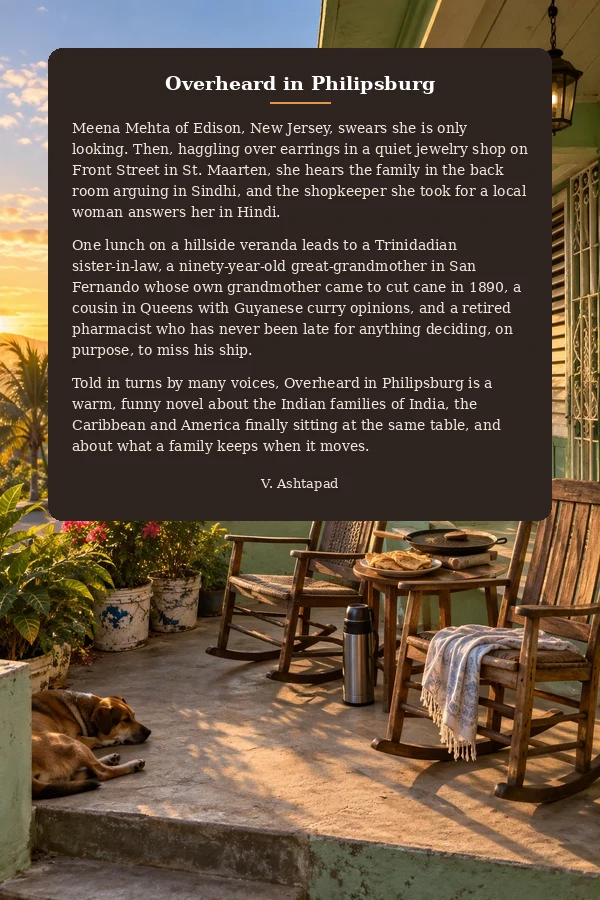
Meena Mehta of Edison, New Jersey, swears she is only looking. Then, haggling over earrings in a quiet jewelry shop on Front Street in St. Maarten, she hears the family in the back room arguing in Sindhi, and the shopkeeper she took for a local woman answers her in Hindi.
One lunch on a hillside veranda leads to a Trinidadian sister-in-law, a ninety-year-old great-grandmother in San Fernando whose own grandmother came to cut cane in 1890, a cousin in Queens with Guyanese curry opinions, and a retired pharmacist who has never been late for anything deciding, on purpose, to miss his ship.
Told in turns by many voices, Overheard in Philipsburg is a warm, funny novel about the Indian families of India, the Caribbean and America finally sitting at the same table, and about what a family keeps when it moves.
Members can react to this book and talk about it in the members' Library.