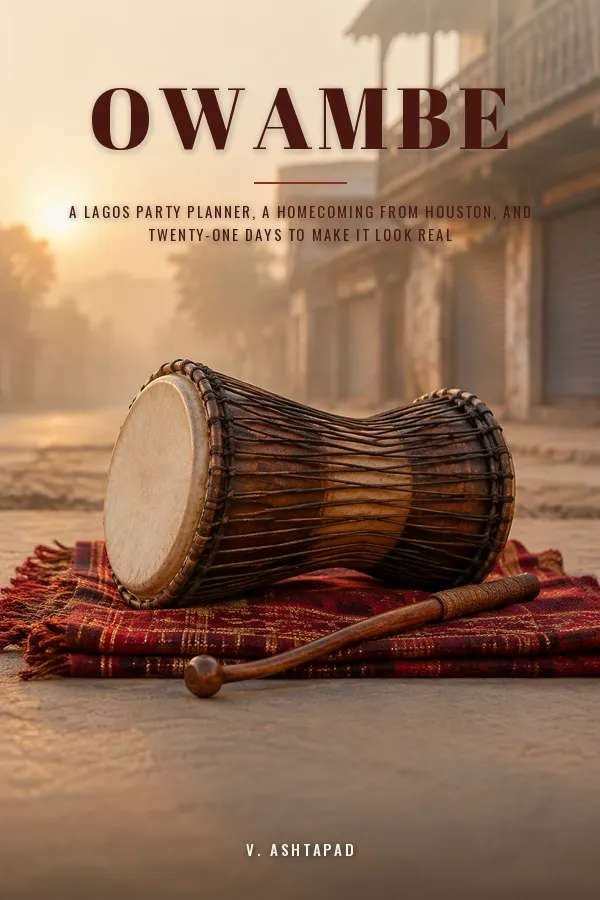
Owambe
A Lagos Party Planner, a Homecoming from Houston, and Twenty-One Days to Make It Look Real
by V. Ashtapad
Foreword
This is a work of fiction. Bisi, her crew, the Adesanya family, Baba Lamidi and the rest of the people here are made up, as are their businesses, their quarrels and their money.
The places are mostly real. Surulere, Yaba, Idumota, Docemo Street, Balogun Market and Breadfruit Street, Isale Eko and its old Brazilian-style houses, Ikoyi and Bourdillon Road, Lekki, Makoko, the Marina, Eko Bridge and Third Mainland Bridge over the lagoon can all be found in Lagos, though I have rearranged a lane or two and closed a road that was never closed.
Invented outright are the Adesanya family house and the oriki of its lineage, which is paraphrased here in English and belongs to no real family; Second Plate Events and Glasshouse Occasions; the band Dele Ajose and His Lagoon Rhythm; the weaver Mr. Adigun; and the burst water main, which the residents of Ikoyi may be glad to hear never happened.
For the caterers, drummers, gele tiers and chair boys who are still counting long after the last guest has gone home.
The Deposit
Twenty-one days out
- Rent owed on office: three months, plus the landlord's opinion of me.
- Guests promised by client: 600. Guests a sane person would invite: 350.
- Folake Bankole: also pitching. Also wearing white, probably.
- Iya Bose's jollof: hot, in the cooler box, do not let Tayo taste it in the car.
At ten minutes to eight the generator downstairs coughs twice and dies, and Mr. Ganiyu's sewing machines go quiet in the same breath, so the whole building hears me say a word my mother would slap out of my mouth.
My office is one room above Ganiyu Tailoring on a side street in Surulere. You climb an outside staircase painted the green of an old bottle, past a landing where Mr. Ganiyu's apprentices eat bread and sardines at noon, and you open a door that sticks in the dry season and swells in the rainy one. Inside there are two desks, one fan that works, one fan that is decorative, a shelf of sample chair covers in eleven shades of champagne, and a whiteboard where Tayo has drawn the next twenty-one days as a train. Each carriage is a day. Some carriages have smoke coming out.
It is the third week of November and the harmattan has not arrived properly, but it has sent a letter. There is a fine tan dust on the windscreens of every car parked on the street, and this morning somebody has written WASH ME on a red saloon, and somebody else has written NO under it.
"The power is not the issue," Tayo says, which is how Tayo begins all sentences about the issue. He is twenty-four, built like a lamp post, and he carries a clipboard the way some men carry a walking stick, partly for use and partly for presence. "The issue is that the call is at eight and your laptop is at thirty-one percent."
"Then we will be quick."
"You have never been quick on a call with a client. You talk about chairs."
"Chairs are important."
"Chairs are important," he agrees, and writes something on the clipboard, which I suspect is the word CHAIRS with a circle around it.
Chuks comes up the stairs at five to eight with diesel on his trousers and a small generator in his arms like a baby goat. He is thirty-five and has been my friend since we were nine and his family moved into the flat across from ours on Bode Thomas, and his mother taught my mother to cook bitterleaf soup wrong, according to my mother, and right, according to his. He sets the generator on the landing, yanks the cord, and it wakes up in a temper. The smell comes in under the door, sweet and dirty. Mr. Ganiyu shouts thank you from below. The fan that works begins to work.
"You are welcome, Mr. Ganiyu," Chuks shouts back. "That will be four thousand naira."
"Put it on Bisi's account," Mr. Ganiyu shouts.
"Bisi doesn't have an account," says Chuks. "Bisi has a story about next month."
"Thank you, everybody," I say. "Truly. I feel very supported."
At eight exactly, the screen lights up with a man in a kitchen in Houston.
Dr. Kunle Adesanya is sixty-one, and he has the kind of face that was handsome at thirty and decided to become kind at fifty. His glasses are on his forehead. Behind him I can see a refrigerator covered with magnets in the shape of states, and a window with a gray Texas morning in it, flat as a tray. It is Friday evening here and Friday early afternoon there, and I can hear a television from another room. He has a cup of something hot and he holds it with both hands, which tells me he is nervous, because nobody holds coffee like that unless the coffee is holding him up.
"Miss Oyewumi," he says. "Abisola. I can call you Bisi?"
"Please."
"Bisi. Good. I have been speaking to many people." He laughs, a little wildly. "Too many people. I have a cousin who knows a man who does weddings in Ibadan. I have a lady in Lekki who sent me a presentation with music in it. Have you seen a presentation with music in it?"
"I have heard of them," I say.
"It played a saxophone at me," he says. "I did not know where to look."
That lady in Lekki is Folake Bankole of Glasshouse Occasions, and I know about the saxophone, because Folake has sent the same presentation to every big client on the Island since 2023, and her saxophone has outlived two of her assistants. Folake has a white office on the Lekki-Epe expressway with a white sofa no one is allowed to sit on, and she says "curated" the way other people say "good morning." She is good. That is the problem with Folake. If she were bad I would sleep.
"Dr. Adesanya," I say, "tell me what you want people to feel when they walk in."
He puts the cup down.
"I want," he says, and then he stops, and looks to one side, at something on the counter I cannot see. "I left Lagos in 1992. I was twenty-seven. I had a scholarship and one suitcase and my mother's address written on the inside of my belt, in case I lost everything else. I have been in Houston thirty-four years. I have a pension, I have a house in Sugar Land with a pool I never use, I have a daughter who is a very serious person. My wife passed two years ago." He says this plainly, like a line in a report. "I am coming home for good. I have bought a flat in Ikoyi that is not finished. Until it is finished I am renting a house there that is too big. And on the twelfth of December I want a party where everybody I ever knew, and everybody they know, comes and sees that I am back. That I am one of them. That I am known again." He touches his glasses. "Does that sound foolish?"
"It sounds like an owambe," I say.
He laughs, properly this time.
Then he sends me pictures. Forty-two of them, in a stream, while we talk. Women in gele the size of satellite dishes. A cake in the shape of a Lagos bus. A stage with a gold throne. A man being sprayed with so much money he looks like he is standing in a snowdrift of naira. A row of drummers in matching caps. Somebody's uncle asleep under a canopy, which I think was sent by accident.
"This is authentic," he says, of all of them. "This is what I remember."
Tayo is writing very fast. I can see over his shoulder. He has written GOLD THRONE?? and BUS CAKE NO and then a long number, which is the number of chairs he thinks we will need if Dr. Kunle Adesanya invites everybody he ever knew. The number is 612. He has crossed it out and written 400 and underlined it, as if the pen could make it true.
We talk money at eight forty. I have done this enough times to know that money is a conversation about trust that is pretending to be about arithmetic.
"For six hundred guests," I say, "at the house in Ikoyi, with canopies, chairs, decor, aso-ebi coordination for the family, two bands, drummers, catering by my own caterer, small chops, bar, security, generators and a backup for the backup, cleaning, and my management, you are looking at fifty-two million four hundred thousand naira."
He does the arithmetic in his head. I watch him do it. Thirty-five thousand dollars, give or take what the naira does on a Tuesday.
"The lady in Lekki said forty-six," he says.
"The lady in Lekki will say forty-six until the week before, and then she will discover the price of diesel." I keep my voice light. "I will show you every line. If I save money, you keep it. If the price of fabric goes up because Balogun has a bad week, I will tell you before I spend it, not after."
He picks up the coffee again.
"Can I tell you what she does not have?" I say. "I have Iya Bose."
Iya Bose is sitting on the decorative fan's side of the room, on an upturned paint bucket, because she refuses the chair. She is sixty-three. She wears a wrapper the brown of cassava skin and a blouse with a small pattern of keys on it and an expression that suggests she has already tasted your cooking and forgiven you. Iya Bose has catered weddings, burials, naming ceremonies, a governor's daughter's thirtieth birthday where the governor's daughter cried into a bowl of her peppered snail. She says very little. When she says something, it is usually a quantity.
I turn the laptop so the camera sees her. She lifts the lid of the cooler box, and the steam comes out and blurs the screen. The smell is the smell of every party I have ever been to, the smoke caught in the rice, tomato and red pepper cooked down until they are sweet and almost black at the edges, bay leaf, thyme, the faint burn of the bottom of the pot where the rice sticks and turns crisp and brown. In Lagos that bottom layer is the part people fight over after midnight, when the guests are gone and the servers are scraping the pots with spoons.
"I can't smell it," says Dr. Kunle Adesanya, in Houston. "This is cruel. I can't smell it."
"You will on the twelfth," I say.
Iya Bose takes a spoon, scrapes the bottom of the foil tray, holds the crisp brown flake of rice up to the camera.
"That one is for you," she says. "When you come."
Dr. Kunle Adesanya puts his hand on his chest.
The deposit lands at nine twenty-six, while Chuks is changing the oil filter on the landing and Tayo is pretending he is not watching my phone. Forty percent. Twenty million nine hundred and sixty thousand naira. I stare at the number until it blurs. I have never had that much money in the business account at one time. It is not my money. It is already spent, in a sense: on canopies, on chairs, on lace, on diesel. But it sits there in the account looking like mine, and my landlord's opinion of me begins, very slightly, to soften.
"Rent," says Tayo.
"Not yet."
"Rent," says Tayo, "is a carriage."
He points at the whiteboard. On the train he has drawn, there is a carriage marked with a small house.
"We are paying the landlord after the party," I say. "When my fee is clean."
"The landlord is not a carriage that waits," says Tayo.
Chuks wipes his hands on a rag. "You know what she is going to say," he says to Tayo, and to me, "You know what she is going to say."
Iya Bose, packing the cooler, says, "Rent."
Before the call ends there is a moment I will think about a lot over the next three weeks. We have finished the money. We have finished the date. Dr. Kunle Adesanya has promised to send me the guest list and his daughter's flight number and his sister-in-law's phone number, and he has asked whether we can have a bus cake, and I have said we will discuss the bus cake, which in my business means no. And then he says, almost to himself, "And the drummers. The drummers have to say our names."
"Of course," I say. "Talking drum. We will get a good group. They will praise you as you come in."
"Not praise me," he says. "Say us. The Adesanya. The family." He rolls the mug slowly between his palms. "My mother used to do it. When I was a boy she would say the lines over me before exams, before I traveled. All the old lines. Who we came from. What our people did. The salt, the lagoon, I remember there was something about a house." He laughs, a small embarrassed laugh. "I never learned it. I thought I would always hear it. And then she was gone, and I was in Texas, and I was busy." He looks up at the camera. "I would like it said. On the night. By somebody who knows it."
"You don't know it at all?"
"I know it the way you know a song from a car going past," he says. "A little. Not enough."
When the screen goes black, the room is quiet except for Chuks's generator on the landing and the machines below, which have started again, Mr. Ganiyu's apprentices finishing a wedding order for a family in Festac. Outside a danfo goes past with its conductor hanging out of the side door shouting stops, Ojuelegba, Ojuelegba, Ojuelegba, the way a man calls a goat home.
"A drummer who knows a family's lines," says Tayo, writing. "Adesanya. Probably from the Island."
"Probably," I say.
"That is a carriage with no wheels," he says.
Iya Bose closes the cooler.
"Somebody always knows," she says. "Somebody old."
She says it like a quantity. Then she goes down the stairs with the box on her head, past the apprentices and their bread, out into the dust, and I sit with fifty-two million four hundred thousand naira of someone else's hope, and a whiteboard train, and one fan that works.
Arrivals
Twenty days out
- Flight from Houston via Frankfurt: landing 5:40 p.m. Lagos traffic at 5:40 p.m.: a closed subject.
- Suitcases declared: six. Suitcases that come out: five.
- Daughter: Morenike, called Renny. Instructions from father: "She is very serious. Be patient."
- Car: Chuks's cousin's minibus, air conditioning on one side only.
The arrivals hall at Murtala Muhammed smells of floor polish, warm bodies, and the cologne of men who have been waiting for a long time and want to look as if they have just arrived. Families stand behind the barrier with printed signs and phones held up for the video call, so that grandmothers in Abeokuta can watch the doors with them. A man in a white agbada is holding a bouquet wrapped in cellophane that crackles every time he shifts his weight. Two little girls in matching yellow dresses sit on a suitcase and eat fried dough nuggets out of a paper bag, crumbs all down their fronts.
I have a sign that says ADESANYA in letters Tayo measured. I also have a cold bottle of water for each of them, two pieces of agege bread wrapped in brown paper because Dr. Kunle said in his last message that he had dreamed about it on the flight, and a small towel for the heat. It is six-fifteen. The sun has gone down behind the car park in a smear of orange through the haze, and the air outside is still thirty-one degrees and has the thick dry grit in it that means the harmattan is walking down from the north.
He comes through the doors at six forty-one pushing a trolley stacked like a wedding cake. He is shorter than he looks on screen and wears a navy blazer that was right for Houston in November and is wrong for Lagos in any month. He sees the sign, sees me, and his whole body lifts as if somebody has hooked him under the arms.
"Bisi," he says. "Bisi, Bisi. You came yourself."
"Of course I came myself, sir."
"Don't call me sir. Call me Uncle. No, call me Kunle. No," he says, "call me Uncle Kunle," and then he hugs me, which clients do not do, and he smells of airplane coffee and a long night.
Behind him is his daughter.
Morenike Adesanya, Renny, is twenty-seven. She is taller than her father, in black jeans and a gray sweatshirt with the name of a Texas university on it, and she has her hair in long braids gathered up on top of her head, and earbuds in both ears, and a face that is reading the room and not enjoying the book. She has one small backpack. Her father has five suitcases and a box that says FRAGILE on all six sides.
"Hi," she says. "You're the planner."
"I'm Bisi. Welcome home."
"It's not my home," she says, pleasantly, as if correcting a spelling. "I was born in Houston. But thank you."
"Renny," says her father.
"What? I said thank you."
The sixth suitcase does not come out. We wait forty minutes at the lost baggage desk while a woman in a blue uniform writes the description on a form in very beautiful handwriting, and Uncle Kunle tells her what is inside, which is gifts. Fourteen bottles of a cologne he bought in a duty free shop, eight shirts for eight cousins, a jar of peanut butter for a nephew who requested it, and three framed photographs.
"Of who?" says the woman, writing.
"Of me," says Uncle Kunle, and then hears himself and laughs. "For my aunties. So they know what I look like now."
Renny closes her eyes, briefly, like a person in pain on a bus.
Outside, Chuks has the minibus at the curb with the hazard lights on and is arguing in a friendly way with an airport tout who wants to be paid for the space. The minibus belongs to Chuks's cousin Ifeanyi and has a sticker on the back window that says NO CONDITION IS PERMANENT, and a second sticker under it, smaller, that says EXCEPT THIS BUS. The air conditioning only works on the left side. I put Uncle Kunle on the left side. Renny gets in on the right, puts her backpack on her lap, and looks out the window as if she is being taken somewhere against her will, which in a sense she is.
The route to Ikoyi at this hour is a choice between bad options. Chuks takes the airport road to Ikorodu Road and then the long sweep up onto Third Mainland Bridge, which is the longest bridge in this part of Africa and which I love the way some people love a difficult aunt. At night it runs out over the lagoon in a long curve of orange lights, and on the left there is the dark water and the stilt houses of Makoko with their small fires and smoke, and on the right, far off, the lit-up towers of the Island floating on the haze. The bridge hums under the tires. The traffic moves in pulses: forty kilometers an hour, then nothing, then forty again, as if the city is breathing.
Uncle Kunle presses his face to the window.
"Makoko is still there," he says.
"Still there."
"When I was a student we would come down to the water at Ebute Metta and watch the canoes. The smoked fish. You could smell it from the road." He sniffs the air-conditioned air. "I can't smell anything. Chuks, can we open the window?"
Chuks opens the window. The lagoon comes in: mud, salt, diesel from the boats, wood smoke, fish, and under it the warm green smell of water that has been sitting in the sun all day. Renny puts her sleeve over her nose.
"That is home," says Uncle Kunle, with his eyes shut. "That is exactly it."
"That's sewage, Dad," says Renny.
"Some of it," I say. "Not all of it."
She looks at me for the first time with something like interest.
"I'm not going to film any of this," she says. "Just so you know. I know he told you I'd make a video. For the family back home in Houston. For the cousins." She takes out one earbud. "I'm not. I'm here because he asked and because my aunt said I'd regret it if I didn't come. I'll come to the party. I'll wear what I'm told to wear. I'm not going to make content out of it."
"Okay," I say.
"Okay?"
"Okay. You don't have to film anything. I have a photographer and a videographer and a drone, if the wind allows. You can sit down and eat."
"I don't think a drone is allowed in Ikoyi," says Uncle Kunle.
"Everything is allowed in Ikoyi," says Chuks, "if you call the right person."
Renny puts the earbud back in.
The house is on a quiet road off Bourdillon, behind a high cream wall with broken glass set in concrete along the top, which in Ikoyi is a decoration. A security man in a beret opens the gate and salutes the minibus, which has never been saluted before and does not know how to behave. Inside there is a paved compound big enough for a small wedding, a frangipani tree dropping white flowers on the bonnet of a parked jeep, a fountain with no water in it, and a house with six bedrooms, eight bathrooms, a lift that goes up one floor, and a kitchen with two ovens and no pots. The landlord's agent, Mr. Ojo, meets us in the hall in a shirt so pressed you could slice yam with it.
"Welcome, Doctor, welcome," he says. "Diesel is full. Generator is serviced. Inverter is new. Pool is clean."
"I don't swim," says Uncle Kunle.
"The pool doesn't know," says Mr. Ojo.
While Chuks carries suitcases, I walk the compound with a measuring wheel and a flashlight, because that is what I do in a new venue at night, and because I need to know how many canopies the front yard will take before I can sleep. The ground is hard and dry. A gecko runs up the wall into the security light and stops there, its little chest going. From somewhere beyond the wall comes the low steady hum of a dozen big generators belonging to a dozen big houses, each one powering a dozen air conditioners, and under that, faint, the sound of a party in another compound, a fuji record with the bass turned all the way up so the drum comes through the walls like a heartbeat in a pillow.
Twenty-two meters by thirty-one. Four canopies of the large size, if we move the jeep and kill the fountain. Three hundred and eighty chairs, tight. Four hundred, with love and violence.
When I come back in, Uncle Kunle has opened the box that says FRAGILE on all sides. He is sitting on the floor of the living room, which is marble and very cold, in his blazer and socks, with bubble wrap around him like foam on a beach. He has taken out a frame, and he holds it in both hands the way he held his coffee.
"Come and see," he says.
It is a black and white photograph that has been scanned and reprinted on good paper and put behind glass. A young woman, maybe twenty-five, sitting on a carved wooden chair outside a house with a balcony. Her gele is high and folded into stiff fans. Her blouse has puffed sleeves and a pattern of small dots. She is not smiling, but she is about to, the way people in old photographs often are, as if the photographer has just said something rude. Behind her, through an open door, you can see a staircase and a child's legs on it.
"My mother," he says. "Abeke Adesanya. Before I was born, I think. I don't know where. I don't know who took it. I don't know the date. My cousin in Houston scanned it from the one my father had. There were others, but they were in a flood in 2017 and only this one dried." He touches the glass with his thumb, over her hand. "I would like to know where she was."
"Your aunties might know."
"My aunties will tell me what I should have asked thirty years ago," he says, "and then they will tell me."
Renny is standing in the doorway with a glass of water. I did not hear her come. She looks at the photograph, and at her father on the floor with it, and something in her face moves and then is put away again, like a cloth folded quickly when guests come in.
"The legs on the stairs," she says. "Is that you?"
"I told you, I don't think I'm born yet."
"Then whose legs are they?"
He looks. He brings the photograph very close to his glasses.
"I don't know," he says, delighted. "I don't know whose legs these are."
Then, because he is Uncle Kunle, he goes to the suitcase that did arrive and comes back with a laptop and shows me his "authentic" folder again, which since yesterday has grown to fifty-eight images. He has added a picture of a cake shaped like a talking drum and a picture of a woman in a gele so tall she has to duck under a doorway.
"This is too much," he says, hopefully. "Is this too much?"
"For the cake, yes," I say. "For the gele, there is no such thing."
At ten-fifty, in the minibus going home over Eko Bridge, Chuks drives with one hand and eats the second piece of agege bread with the other, because Uncle Kunle fell asleep on the sofa before he could eat it. It is soft and sweet and slightly sticky, and it pulls apart in long white threads.
"The girl," says Chuks.
"Renny."
"She's going to give you trouble."
"She's going to give her father trouble," I say. "I'm only standing next to him."
"In Lagos," says Chuks, "standing next to somebody is the same as being them."
Below us the lagoon is black and wide, and the lights of the bridge lie on it in long trembling lines, and a canoe with one lantern is going somewhere very slowly, as if it owns the lagoon and is late for something anyway.
Balogun
Eighteen days out
- Aso-ebi orders on the family page: 87. Orders with a size: 61. Orders with a size that is true: unknown.
- Color: wine lace for the women, gold aso-oke for the gele, cream for the men. Client approved. Client's sister-in-law approved. Client's sister-in-law's sister: pending.
- Lace needed: 140 bundles. Lace found by 9 a.m.: 0.
- Cash in envelope: 3.2 million. Cash in my bra: do not write this down.
Balogun at eight in the morning is a city inside a city, built out of cloth. The lanes are so narrow that the buildings lean toward each other over your head, three and four stories of shops stacked like drawers, and from every balcony and every doorway and every hook there is fabric hanging, so that walking in is like walking down the inside of a folded rainbow. Lace in every color a mouth can name: coral, onion, wine, fuchsia, emerald, a blue the traders call "Ikoyi blue" because a governor's wife wore it once. Bolts of wax print stacked to the ceiling with their paper labels still on. Shining damask. Brocade so stiff it stands by itself. Aso-oke rolled into tight cylinders and tied with string, the strips woven on narrow looms and sewn together edge to edge, so that when they open them for you the cloth comes out in bands like a road on a map.
The smell is new cloth and the chemical they put on it so it holds its fold, and sweat, and roasting corn from a woman with a brazier at the corner of Breadfruit Street, and the warm dust that the harmattan has started to lay over everything, so that the top layers of every pile look slightly faded, as if they were remembering their color instead of having it. Porters push wheelbarrows loaded with bales taller than they are, shouting to get through. Boys with trays of water sachets on their heads call "pure water" like a question. Somebody's radio is playing juju, the guitars curling around each other and the talking drum answering the singer, high, then low, then high.
Renny has come because her father asked her to come and I asked her to come and, I suspect, because the alternative was a day in the Ikoyi house with Mr. Ojo explaining the inverter. She is wearing the same black jeans and a long white shirt, and she has a cross-body bag clutched against her stomach, as if the market is a river she has been told is full of crocodiles. Tayo is with us, with the clipboard and a printout of the orders and a tape measure around his neck like a stethoscope.
"Stay close," I tell Renny. "If somebody pulls your arm and says 'fine sister, come and see,' smile and keep walking."
"Do they pull your arm?"
"They pull my arm for a living."
The family page that Tayo built for the party is the reason we know how much lace to buy. It is a private invitation page that opens only for the people Uncle Kunle has put on the family list; you cannot find it unless you have been sent the link and your name is on it. There is a place for each guest to say yes or no, and a place to order aso-ebi and put in a size. Tayo spent two nights making it, and he is very proud of it, and he shows me the orders every morning the way some men show you pictures of their children.
"Eighty-seven," he says now, walking. "Thirty-four from Houston, nineteen from Lagos, eleven from Ibadan, six from London, two from Atlanta, one from a cousin in Calgary who wants it posted, which I have answered."
"What did you answer?"
"I have answered that we are not a courier company."
"Tayo."
"I have answered politely that we are not a courier company."
"And the sizes?"
He frowns at the printout. "Mrs. Folasade Adeyemi of Katy, Texas has put her size as 'normal.'"
The trader I always buy lace from is Madam Remi's nephew, Wale, who has a shop three floors up a staircase so steep you climb it with your hands. Wale is thirty and talks very fast and always has a small fan clipped to the shelf blowing directly at his face, so that the front of his hair stands up like a wave. When he sees me he spreads his arms wide.
"Bisi! My sister! My customer! My treasure!"
"Wale. Wine lace. One hundred and forty bundles. The one I showed you on the phone, with the small beading, not the cheap one with the glue."
His arms come down. His face does a thing that I have seen many times in my business, on many faces, and it always costs me money.
"Ehh," he says. "Wine."
"Wine."
"The wine is finished."
"Finished how? I sent you a picture last week. You said you had two hundred bundles."
"I had. I had. Two hundred and twelve." He spreads his hands. "Saturday, somebody came. Very nice lady, very fine car. She took everything. Paid cash. Big wedding in Lekki, she said."
I know who has a very fine car and big weddings in Lekki and an assistant who buys whole stocks of lace on a Saturday morning so that nobody else can have them. I do not say her name, because saying Folake's name in Balogun at nine in the morning will not bring back two hundred and twelve bundles of wine lace, and because Renny is watching me with an expression I cannot read.
"Coral," says Wale, helpfully. "I have very fine coral."
"The family has chosen wine."
"Onion. Onion is very fashionable this season."
"Onion is a vegetable."
"Fuchsia," says Wale, more quietly, as if offering a bribe.
We go down the steep staircase again and into the canyon. For two hours we look for wine lace. We go up staircases and down them, through a corridor where every shop sells only white lace, like a wedding with no couple, past a man sewing sequins by hand in a doorway with spectacles balanced low on his nose, into a back courtyard where a woman is cooking beans in a pot on a firewood stove and selling plates of them with fried plantain to the traders, and the smell of the palm oil and the smoke makes Tayo walk more slowly. Everybody has a little wine lace. Nobody has a hundred and forty bundles of the same wine lace. One shop has twenty bundles with the beading; one has forty with a different flower; one has a darker wine that the trader calls "burgundy" and I call "a different color."
"Can't you mix them?" Renny says, at the fifth shop. She has been quiet. Her braids are coming loose in the heat and there is a line of sweat down her back where the shirt sticks. "Like, who's going to know?"
The trader, a heavy woman in a blue blouse who has been fanning herself with a folded newspaper, stops fanning.
"Who will know?" she says to Renny. "Everybody will know."
"Everybody will know," I agree. "The point of aso-ebi is that you are dressed in the same cloth. That you belong to the family that night. If one aunt is in one wine and the other aunt is in a different wine, the second aunt will spend the party standing next to the first aunt so everyone can see that her wine is better."
"That's insane."
"That's Lagos," says Tayo.
"That's family," says the trader, and starts fanning again.
At eleven we stop at the corn woman on Breadfruit Street, and she peels back the husks and turns the cobs on the wire over the coals until the kernels go brown and black in spots and pop, and she gives us each one with a piece of boiled coconut, which is how you eat it, a bite of the corn and a bite of the coconut so the sweetness and the smoke and the cream all go together. Renny holds hers like she has been handed a live bird.
"You just bite it," I say.
She bites it. Her eyebrows go up.
"Okay," she says. "Okay. That's good."
"Your father will cry when he eats this."
"My father cries at commercials for insurance." She chews. "He cried at the airport in Frankfurt because the man at the coffee counter said 'Lagos' right."
"How do you say it?"
"I say it the Houston way. 'Lay-goss.'" She makes a face. "My mom said it right. My dad corrected me when I was little, and then he stopped, because he was at work all the time and I was at school all the time and I guess there wasn't anybody to correct me." She looks at the corn. "Sorry. Why am I telling you this?"
"Corn," I say. "It makes people talk."
Then she does something I do not expect. She takes out her phone, not to film, but to look at a picture. She scrolls back a long way, years. She turns the screen to me.
It is a woman in a gele, in a kitchen with white cabinets, laughing at the camera. The gele is wine. Not this wine, not any wine I have seen this morning: a deep red-brown with a gold thread in it, the color of a kola nut split open.
"My mom," she says. "Yetunde. That's from my cousin's wedding in Houston, like, ten years ago. That's the color she always wore to parties. I think that's why Dad picked wine." She says it flatly, the way her father said his wife had passed, like a line in a report. "He didn't say that. He wouldn't. But I think that's why."
I look at the picture for a long time. The trader in the blue blouse, behind us, leans over to look too, and then she says, "That one is not lace."
"What?"
"That gele," says the trader. "That is aso-oke. Old style, hand woven. Not this machine one." She points to the gold rolls in the corner of her shop with her newspaper. "If you want that color, you are not looking for lace. You are looking for a weaver."
So this is how the morning turns. Not with wine lace, which is gone, but with a color on a dead woman's head in a kitchen in Houston. By two in the afternoon we have found, through the trader in the blue blouse and her sister-in-law and a boy who runs us through three lanes and up a staircase that smells of mothballs, a man named Mr. Adigun who weaves aso-oke on a loom in Oyo and sells it here on Tuesdays, and who has, in a back room, rolls of a hand-woven cloth in deep kola red with a gold thread. Not enough for a hundred and forty women. Enough for the gele of the immediate family. Enough for nineteen women. Enough, if I am clever, to make the immediate family look like the center of the whole room.
"How much?" I say.
He tells me. Renny makes a small sound. I begin.
There is a rhythm to it, haggling in Balogun. You do not argue; you sing. He says the price, and you laugh as if he has told a joke about your mother, and you say a number so low that it insults his whole family, and he puts his hand on his heart, and you put your hand on yours, and you talk about the weather and the price of diesel and his loom in Oyo and how many children he has, and you say a better number, and he says a slightly worse number, and the numbers walk toward each other like two old people crossing a road. It takes twenty-five minutes. At the end of it, Renny, who has been watching like somebody watching a tennis match, says, quite suddenly, "My mom wore this color to every party for twenty years."
Mr. Adigun looks at her.
"She passed," says Renny. "Two years ago."
He takes four thousand naira off each roll without being asked.
On the way out, in the lane, she says, "Was that wrong? To say that?"
"It was true," I say. "It's allowed."
"It felt like a trick."
"It's only a trick if you say it to get the price down."
"I didn't."
"I know you didn't," I say. "That's why it worked."
Tayo, behind us, carrying nineteen rolls of kola-red aso-oke on his head the way the porters do, his clipboard pressed flat against the bundle with one hand, says, "We still need a hundred and twenty-one bundles of wine lace."
"Write it down," I say.
"It is written," says Tayo. "It has been written all day."
Isale Eko
Sixteen days out
- Lace: 121 bundles still missing. Wale "making calls." Wale's calls cost nothing and produce nothing.
- Canopies booked: 4. Canopies that have been seen with my own eyes: 2.
- Client mood: very happy, very nervous, sends a picture of a woman on a horse at 6:12 a.m. "Can we do this?"
- No.
The old Island does not want cars. You can tell by the way the lanes narrow as you go in, as if the houses are leaning closer to look at you. We leave Chuks and the minibus at the edge of the market at Idumota, where the traffic has knotted itself around a broken-down trailer full of tomatoes and a policeman is directing it with a whistle and a great deal of personal disappointment, and we walk.
It is ten in the morning and already hot, a dry flat heat that sits on the backs of your hands. The harmattan has come a little farther south overnight. The sky over the Island is not blue but a pale milky beige, and the sun is a white coin behind it that you can almost look at. Everything has a skin of fine dust: the hoods of parked cars, the leaves of a single almond tree growing out of a crack in a wall, the plastic chairs outside a barber's shop where three men are watching a football match from last weekend on a small television, arguing about it as if it is still being played.
Uncle Kunle walks in front. He has given up the blazer and is wearing a short-sleeved shirt with a pattern of small boats, and he walks fast, turning his head left and right, saying the names of things under his breath. "That was a chemist. That was a chemist. There was a man here who sold radios. That was a bakery, there was a bakery here, the bread was so hot you had to carry it in your shirt." He stops at a corner where a woman is frying bean fritters in a black pan of oil on a firewood stove, the oil spitting, the fritters puffing up gold and then brown, and he buys twelve without asking the price, and she gives him change he doesn't count, and he eats one standing in the street and burns his mouth and does not care.
"This is so unhygienic," says Renny, behind him, taking one.
"It's boiling oil," I say. "Nothing survives it."
She eats it. She eats another.
Isale Eko is the oldest part of Lagos, the bottom of the Island, where the families who were here first have their compounds and their family houses, some of them a hundred years old and more. A lot of them were built in what people call the Brazilian style, by Yoruba families who came back across the ocean in the eighteen hundreds after slavery, from Brazil and Cuba, and brought the houses with them in their heads: two stories, tall shuttered windows, carved wooden balconies, plaster pillars and arches and little curls of molding over the doors, painted in colors that were bright once. Now the paint is peeling in long strips and the balconies sag and some of the houses have been cut up into rooms let out to traders, with a different family's washing hanging from every window. Some have been knocked down and replaced with plain concrete blocks. Some are just a front wall now, with sky behind the windows.
The Adesanya house is still a house. It is on a lane so narrow that if two people with shopping meet in it, one of them has to step into a doorway. It is two stories, the plaster painted a faded salmon pink, with a balcony across the whole front, carved in a pattern of leaves and diamonds, and the wood gone gray-brown and soft-looking with age. On the ground floor the front room has been turned into a provisions shop, its shutters folded back: tins of tomato paste and milk stacked in pyramids, sachets of washing powder hanging in strips, a bag of rice open with a cup in it, a small fridge humming with soft drinks, and a stool, and on the stool, a woman.
"Auntie," says Uncle Kunle.
Auntie Adunni is seventy-six and is Uncle Kunle's father's youngest sister. She wears a wrapper and blouse in a blue wax print with a pattern of birds, a scarf tied flat around her head, reading glasses on a chain, and three gold rings on one hand. She has run this shop for forty-one years, and she looks at her nephew, who has not stood in front of her in person since 2009, the way she would look at a delivery that has come very late and is also the wrong brand.
"So you have come," she says.
"I have come."
"With your stomach," she says, looking at it.
"With my stomach," he agrees, and she gets off the stool, and he bends down, and she takes his face in both her hands and holds it and studies it, silent, for so long that the boy who works in the shop stops counting sachets, and a woman going past with a basin on her head stops too, and I look at the tins of milk, because some things are not my business even when I am being paid.
Then she lets go and slaps him lightly on the cheek and says, "You did not come for your father's burial."
"I sent money."
"Money did not carry the coffin." She turns to Renny. "And this is Yetunde's daughter."
"Hi," says Renny. "Hello. Good morning."
Auntie Adunni looks her up and down: the jeans, the braids, the university sweatshirt tied around her waist. "You have her forehead," she says. "That's all. The rest is your father, poor girl." She looks at me. "And who is this one?"
"Bisi," I say. "I am doing the party, ma."
"The party," says Auntie Adunni, and sits back down on her stool, and folds her hands, and I understand that the party has been discussed in this shop, at length, by many people.
Upstairs there is a long high-ceilinged room with the shutters half open onto the balcony, so the light comes in striped. The floor is old cement painted red, cool under my sandals. There are sofas with crocheted covers on the arms, a cabinet of plates nobody eats from, a big framed photograph of Uncle Kunle's grandfather in a white agbada and a cap, painted over by hand in the old way so his cheeks are slightly pink, and a calendar from a Lagos bank showing a year that was five years ago. A fan turns on the ceiling at the speed of a person thinking.
Uncle Kunle takes out the framed photograph of his mother and hands it to his aunt.
She holds it far off, then near, then gives up and puts on the glasses from the chain.
"This is here," she says.
"Here?"
"Here. Downstairs. Outside the front door." She taps the glass. "This chair. That was my father's chair, they carried it down for her. This is 1964. My brother's naming of his first child, the one who did not live. Before you. She wore that gele for three days, she would not take it off, she slept sitting up." She taps again, higher. "And these legs on the stairs are mine."
"Yours!"
"I was fourteen. I had a new pair of sandals and I wanted them in the photograph." She looks at it a long time. "They are not in the photograph. Only my legs. I was very angry."
Renny laughs, a short surprised sound, and covers her mouth.
"Can I write that down?" she says. "Like, for the picture. So it's on it."
Auntie Adunni looks at her over the glasses. "Write what down?"
"Who's in it. Where it was. The date. Your sandals."
It turns out that the scanned copy of this photograph is already on the family page Uncle Kunle's cousin in Houston started, where they have been putting the old pictures, each one with a space under it for a caption. Nobody has written a caption. Renny opens it on her phone, and sits on the arm of the sofa beside her great-aunt, and holds the phone at the angle old people like, and Auntie Adunni dictates, and Renny types.
Abeke Adesanya, wife of Olu Adesanya, outside the family house in Isale Eko, Lagos Island. 1964. At the naming of her first child. The chair is Pa Adesanya's. Gele worn three days. Legs on the staircase: Adunni Adesanya, age 14, new sandals, not visible. Named by Adunni Adesanya, 2026.
"Put that I was angry," says Auntie Adunni.
Renny puts that she was angry.
Then, because I am paid to make things happen in a certain order, and because it is now sixteen days to the party, I say, "Ma. Uncle Kunle wants the family lines said on the night. The oriki. Do you know it?"
The fan turns. Downstairs the shop boy is counting sachets out loud, slowly, the way you count when you want everyone to know you are working.
"I know pieces," says Auntie Adunni. "Like everybody. I know the salt. I know the two doors." She waves her hand in the air, as if brushing away a fly. "I was in the market from when I was sixteen. I did not have the time to sit and learn. My brother's wife," she nods at the photograph, "Abeke, she had it. She was not even born an Adesanya, she married in, and she learned all of it better than any of us. She sat with the drummers at every naming, every burial, she made them say it again and again until she had it in her mouth. Then she would say it over Kunle every time he went anywhere." She looks at her nephew. "Every exam. Every journey. You remember."
"I remember the sound," he says. "I don't remember the words."
"Because you were always going somewhere." She does not say it unkindly. "You heard it at the door with one foot outside."
Uncle Kunle looks at the floor. Renny looks at her father. I look at the calendar from five years ago.
"There is a man," says Auntie Adunni, after a while. "Lamidi. Lamidi Akanbi. A drummer. His people were the drummers for this family, for our side of the Island. His father drummed at your grandfather's naming, Kunle. Lamidi himself drummed at yours. I remember him, he was a skinny boy, he had a drum almost bigger than him, and the gangan was so loud my mother told him to go outside." She shakes her head. "If anyone has the whole thing, it is Lamidi."
"Is he," says Uncle Kunle carefully. "Is he still."
"He is not dead," says Auntie Adunni. "He is just old and annoying. Like me." She thinks. "He stopped drumming. Some years ago. There was trouble, I don't know. He used to live behind the market. I don't know where he is now." She looks at me, very directly, the look of a woman who has run a shop for forty-one years and knows what a planner is for. "You will find him."
"Yes, ma."
"Before the party."
"Yes, ma."
"And you," she says to Renny, "will go with her. Because if Kunle goes, he will cry, and Lamidi will charge him double."
Renny opens her mouth to say something, and closes it, and looks at me.
"Okay," she says. "Fine. Okay."
On the way back down the lane, with the bean fritter woman packing up her stove and the barber's television now showing a different match, and the sun a white coin over the balconies, Uncle Kunle walks slowly for the first time today. He holds the photograph against his chest, the frame face in.
"She married in," he says, to nobody in particular. "My mother. She was not even born to it. And she learned it all."
Renny walks beside him, not touching him, but close.
"Dad," she says. "You're blocking the whole lane."
He is. A woman with a basin of fish on her head is waiting behind him, patient, the smell of the fish and the heat and the dust all coming together in the narrow space between the houses, and above us, on somebody's balcony, a radio is playing an old fuji song, the drums tumbling over each other like water down steps.
Danfo to Idumota
Fifteen days out
- Baba Lamidi Akanbi: age about 79. Address: "behind the market." The market is one square kilometer.
- Renny: first danfo. Shoes: white. Prognosis: poor.
- Wale on lace: "Tomorrow." Wale said "tomorrow" yesterday.
- Budget line for "finding an old man": none. Create one.
"You want me to get in that," says Renny.
It is seven-forty in the morning at the bus stop at the end of my street in Surulere, and the danfo has stopped in front of us in the way that a danfo stops, which is not completely. It is a yellow minibus with two black stripes down the side, a dent in every panel, and a sliding door that has been removed entirely to save time. Painted across the back in red letters are the words NO FOOD FOR LAZY MAN. Inside there are four rows of benches meant for three people each and holding four, and the conductor is hanging out of the door space with one hand on the roof, a roll of naira notes folded lengthwise between his fingers like a fan of playing cards, shouting.
"CMS! Obalende! CMS! Idumota! Enter with your change! CMS!"
"Yes," I say. "Unless you want to spend two hours in a car on Eko Bridge looking at the back of a tanker."
"I could take a rideshare."
"You could. The driver would also spend two hours on Eko Bridge looking at the back of a tanker. But with air conditioning."
She considers. It is already twenty-eight degrees, and the air smells of exhaust and frying and the dust that has come in overnight, and there is a fine pale film on her white shoes from the walk from my office.
"Fine," she says, and climbs in.
We sit in the back row, squeezed between a woman with a sleeping baby tied to her back with a wrapper and a young man in a pressed white shirt reading a thick textbook on engineering mathematics with his finger. The bench is covered in a cracked vinyl that sticks to the backs of your legs. The window beside Renny does not open, and the one beside me does not close. The driver has a radio station on, two men arguing about a football transfer in a mixture of English and Yoruba, very loud, both of them laughing between insults. The danfo pulls out into the traffic with a lurch that throws Renny into my shoulder.
"Sorry."
"It's okay. That's how they start."
The conductor collects the fares without looking, reaching back over the seats. Renny holds up a five-hundred-naira note. He takes it and hands back change in three dirty notes and one coin, all without turning his head, all while shouting at a man on the roadside who wants to go to Yaba. "Yaba is not this way! Do you have eyes!" He looks at Renny's change, then at Renny. "Sister, you are new," he says, not unkindly. "Next time, have your change."
"How did he know?" she whispers.
"You held the money like it was a question."
We go up and over the bridge. Below, the lagoon is pale with haze, the water flat and brown and silver, the far shore of the Island dim behind the dust like a city drawn in pencil. The danfo swerves past a broken-down truck with a branch stuck in its back bumper to warn people, and the woman with the baby leans into Renny without waking it, and Renny lets her, holding herself very still, the way you do with someone else's sleeping child. The young engineer turns a page.
"Do you know how many people ride these a day?" she says.
"Millions," I say. "Nobody knows. Tayo thinks he knows. Don't ask him."
At Idumota we get down into a noise like a stadium. The market here runs into the streets on all sides: shoes, phones, plastic buckets, padlocks, school uniforms, spices in open sacks, a man selling only the plastic covers for remote controls. Okadas weave through the people like fish through reeds, their riders shouting, though the city says they are not allowed here anymore, and the city is not here, so they are. The air is thick with frying and petrol and something sweet and burnt from a woman roasting groundnuts in sand in a big pan.
"Behind the market," says Renny, turning slowly in a full circle. "Behind which side of the market?"
"That," I say, "is the work."
We start with Auntie Adunni's directions, which are forty years out of date. Past where the cinema was. The cinema is a phone shop. Left at the house with the green gate. There are six houses with green gates. We ask a man selling padlocks. He knows a Lamidi but that Lamidi is a mechanic and is twenty-five. We ask a woman frying yam at the corner; she knew the drummer, her mother used to dance when he played, but he left that house "after the trouble," and she thinks his house was knocked down for the new road. We ask a barber. We ask two boys playing table football on a wooden table with a dent where the ball always goes. We ask an old man sitting in a doorway with his shirt off, his chest gray-haired and thin, chewing on a stick, and he takes his time looking us over.
"The drummer," he says. "Lamidi of the Akanbi."
"Yes, sir."
"What do you want with him?"
"A family wants him to drum their lines," I say. "The Adesanya. At a party."
The old man takes the stick out of his mouth and laughs, a long dry laugh like a piece of paper being torn slowly.
"He will not drum," he says. "But go and see. He is with his grandson. The shoe man by the bus stop at the end of Docemo Street." He puts the stick back. "Tell him Akin sent you. He owes me two hundred naira from 1981."
The shoe man by the bus stop at the end of Docemo Street is a young man of nineteen or twenty under a big faded umbrella with a beer company's name washed off it by years of sun. He sits on a low stool in front of a wooden box full of brushes and tins of polish and a small metal last shaped like a foot, and around him on a sheet of cardboard there are shoes waiting to be fixed: a pair of black school shoes with the soles flapping, a woman's red heels, a man's brown leather sandals with one strap gone. He has earphones in and his head is nodding, and on the box beside him is his phone, on which a little bar of colored lines is jumping, and he is tapping on the screen with one thumb while he stitches a sole with the other hand, an awl going in and out of the leather.
Behind him, on a plastic chair that is too low for him, is an old man.
Baba Lamidi Akanbi is thin and long-boned, with arms like ropes, and big hands with very long fingers. He wears an old white undershirt and a pair of brown trousers and a cap, and he has a face full of deep lines that go in all directions, like a riverbed in the dry season. He is playing draughts with himself on a board balanced on an upside-down bucket, moving the pieces for both sides, and he is clearly winning and losing at the same time and does not seem happy about either.
"Good morning, sir," I say, and kneel a little, because he is old and because I want something.
He looks up at me, then at Renny, then back down at the board.
"I don't buy anything," he says.
"We are not selling anything, sir."
"Everyone is selling something." He moves a piece. "What are you selling?"
"Akin sent us," says Renny, unexpectedly. "He said you owe him two hundred naira from 1981."
Baba Lamidi lifts his head again, and for a moment I think he is going to shout, and then his face opens up into a grin with two teeth missing at the side.
"That thief," he says. "That is a lie. I paid him in 1983. He owes me." He looks at Renny more carefully. "You are not from here."
"Houston," she says.
"Houston," he repeats, and moves a piece. "Where the oil men go."
"My dad's a chemical engineer."
"There it is." He nods, satisfied, as if he has been right about something for many years. "What does Houston want with Lamidi?"
So I tell him. I tell him about Uncle Kunle, and the party, and Auntie Adunni, and the Adesanya house with the salmon-pink plaster and the balcony, and Abeke Adesanya who married in and learned the lines from the drummers, and her son who never learned them, and who wants them said. While I talk, the grandson takes out one earphone and listens, still stitching. Baba Lamidi listens with his eyes on the draughts board. When I finish, he says nothing for long enough that I can hear the awl going through the leather and the traffic and the conductor of a danfo at the stop shouting "CMS! CMS!" like a bird that only knows one song.
"Abeke," he says finally. "Abeke Adesanya. She had a voice like a knife."
"You knew her."
"Everybody knew her. She would sit next to my father at the naming and she would say, Akanbi, that part, once more, slowly, and then once more after that, until my father would say, Madam, I have other families." He moves a piece. "And her son. The one who went to America."
"Kunle."
"I drummed at his naming. I was eighteen. My father let me carry the second drum." He looks up at the sky, which is white with dust. "I don't drum anymore."
"Uncle Kunle will pay very well, sir."
"Everybody pays very well," says Baba Lamidi, "on the phone."
The grandson, without looking up from the sandal, says, "Grandpa."
"Sodiq, stitch your shoe."
"I'm stitching it."
"Then stitch with your mouth closed." To me: "There was a man. A big man, with money, in 1994. He had his daughter's wedding at the Tafawa Balewa Square, a thousand people. He hired my group, eight drummers. We drummed for him two days. He said, my secretary will pay. His secretary said, see my oga. His oga said, see my secretary." The lines in his face don't move. "For two years I went back. Then the group was finished. Men must eat. They went and drove cars, they sold things. My son became a mechanic. Nobody wanted to carry a drum that does not feed you. So." He moves a piece and takes three of the other side's pieces at once, and looks briefly pleased with himself. "I don't drum."
"Uncle Kunle is not that man."
"All the men with money are that man," he says. "Until they pay."
Renny is standing very still, with her white shoes on the edge of Sodiq's cardboard sheet, and dust on them, and a look on her face that I have not seen before. She says, "Would you just say it? Not drum it. Just say it for him. The lines. He doesn't have to pay for that."
Baba Lamidi squints at her over the board.
"Paying is not the matter," he says. "The matter is, who is asking. You are asking. The planner is asking. The auntie in the shop is asking." He taps a draughts piece on the board. "The man whose lines they are, where is he?"
"In Ikoyi," says Renny. "Probably on the phone with somebody about a cake."
Sodiq laughs, a quick sharp laugh, and bends over the sandal.
"Then tell him," says Baba Lamidi, "if he wants to hear who he is, he can come and sit on this chair." He nods at the empty plastic chair across the bucket. "Not his driver. Not his planner. Not his daughter. Him."
He goes back to his game.
On the way back to the danfo stop, Renny walks fast and says nothing for a whole street. Then she says, "He's right."
"I know."
"I mean, it's annoying that he's right. But he's right." She stops at the curb, where a woman is selling oranges peeled in a spiral so the white pith shows, cut open at the top so you can squeeze and drink them. Renny buys two without asking the price, which costs her double, and hands me one. "My dad sends people. That's what he does. He sent people to my school plays. Literally. My aunt. Our neighbor. Once he sent a guy from his office." She squeezes the orange and drinks. "And he showed up to the important ones. He always showed up to the important ones. But you never knew which ones he thought were important until he was there or he wasn't."
The juice is warm and sweet and runs down my wrist.
"You'll tell him?" I say.
She wipes her mouth with the back of her hand.
"You're the planner," she says. "That's your job."
"It's your father."
"That," she says, "is exactly the problem," and the danfo comes, and the conductor shouts "Ojuelegba! Surulere!" and she has her change ready this time, and holds it out like a statement, and he takes it, and nods at her, as if she has passed something.
The Seating Chart
Thirteen days out
- Yes on the family page: 488. Maybe: 71. "Will come if Bayo is not there": 1. "Will come if Gbenga is not there": 1.
- Tables: 48 of ten. Tables where Bayo and Gbenga can both sit without a war: 0.
- Small chops tasting: 3 p.m. Puff-puff count: 60. Puff-puff that will survive Tayo: 52.
- Folake Bankole: seen leaving the client's gate at 11:40 a.m. In white.
On the dining table in the Ikoyi house, which is long enough to land a small aircraft on, Tayo has laid out forty-eight paper plates in rows of six, and on each paper plate he has written a table number with a black marker, and around each one he has placed ten bottle caps, and on each bottle cap there is a tiny folded strip of paper with a name on it. He has been doing this since eight in the morning. The bottle caps came from a bar in Surulere whose owner owes Chuks money.
"This is the old way," Tayo says. "The paper way. You can see the whole room at once. On a screen you see one table and you forget the others."
"You are twenty-four," I say. "How do you know the old way?"
"My mother is a teacher," he says, darkly. "She does seating for the end-of-year party. Nineteen years. She has seen things."
The problem is on plate seventeen and plate thirty-one, and the problem is Uncle Bayo and Uncle Gbenga.
They are first cousins of Uncle Kunle's, sons of two of his father's brothers, both in their late sixties, both living in Lagos, both retired from long careers in which, as far as I can make out from Auntie Adunni's summary on the phone last night, they disagreed with each other professionally. In 2004 there was a plot of family land in Ikorodu. One of them sold it, the other one says it was not his to sell, and the money went into a building in Ogba that has been half-finished for twenty-two years. Since then they have not been in the same room except for burials, and at burials they stand at opposite ends of the canopy and send each other messages through their wives.
"If I put them at opposite ends," says Tayo, "each one will say he has been put at the bad end."
"Is there a good end?"
"The end near the high table," says Tayo, "is the good end. The end near the toilets is the bad end. The end near the band is good for Bayo, because Gbenga is a little deaf, so he will not hear the band, so Bayo will think Gbenga has the bad end, but Gbenga will think he has the good end because it is near the food, which he likes." He moves bottle caps. "It is like chess, except everyone is your king."
"And their wives?"
"Their wives are best friends," says Tayo. "That is the other problem. They want to sit together."
Uncle Kunle comes in from the garden at a quarter to twelve, holding a glossy folder. He is wearing a white linen shirt and a cap, and he has the look on his face of a man who has just been very nicely served something he did not order.
"Folake came," he says.
"I saw her car."
"She was very kind. She brought me a cake." He puts the folder on the table, carefully, so as not to disturb plate twelve. "Just a small one. Coconut. Very good."
Folake's folder has a cover of thick cream paper with gold edges and her company's name pressed into it. Inside, there is a proposal for something called a Heritage Welcome Experience. I turn the pages. Pictures of beautiful young men in matching aso-oke with drums. Pictures of a stage lit in amber. A description: Our curated heritage troupe will greet guests with a personalized talking drum salute and a recitation of the celebrant's family praise poetry, researched and composed by our cultural team. Below that, a price. It is less than I had budgeted for drummers alone.
"Composed," I say.
"She said they have a library," says Uncle Kunle. "Of families. Of lines. They have done it for many people. If they don't have the family's, they research it and write it." He takes off his cap and folds the brim between his fingers. "She said I would not have to go anywhere. They would just come on the night."
I am a professional. I have been a professional in Lagos for nine years, in a business where you are paid to smile at people who are being stupid with their money. So I do not say any of the things I want to say, which include the words "write it" and "composed" and "library," and a short sentence about Folake's coconut cake. I close the folder.
"Uncle," I say, "we found Baba Lamidi."
His face does the thing it does: lifts, all at once, as if somebody has hooked him under the arms. "You found him! Where? Will he do it? How much?"
I tell him. I tell him about the cobbler stall and the plastic chair and the draughts board and the grandson with his phone, and the big man in 1994 and the two years of going back to the secretary, and Abeke with her voice like a knife saying once more, Akanbi, and I tell him the condition. That Baba Lamidi will not come to Ikoyi to discuss it, and will not take a planner or a driver or a daughter in his place. That he wants the man whose lines they are to come and sit on the chair.
The lift is gone from Uncle Kunle's face. He puts the cap back on.
"I have so many things," he says. "The flat. The bank, the bank here is impossible, I have been three times. The agent. The cousins. Bisi, I have been away thirty-four years, there are people who want to see me every single day." He picks up a bottle cap from table twenty-two and looks at the name on it as if it might help. "Can he not record it? Can he not just say it into a phone and send it? I will pay him for the time."
"I don't think so, sir."
"Uncle."
"I don't think so, Uncle."
He puts the bottle cap down on the wrong plate. Tayo moves it back without a word.
"Folake's people would just come," he says, quietly. "On the night."
"Folake's people will say something beautiful," I say. "They will say it about you. It will rhyme. Everybody will clap. And your Auntie Adunni will be sitting at table one, and she knows the salt and the two doors, and she will know it is not yours."
He looks at the folder.
"I hate this," he says, very simply. "I hate that I don't know it."
At one, Chuks arrives to look at the house generator, which is the size of a small car and lives in a concrete shed behind the kitchen with a padlock on it and a sign that says DANGER in red and, under it in pencil, someone's phone number. I go with him because I need to stand somewhere that is not near the folder. He unlocks the shed and the heat comes out at us like the breath of an oven, diesel and hot metal and old oil soaked into the concrete floor. He walks around the machine twice, touching it in places the way a doctor touches a goat, if the doctor loves goats. He reads the service sticker. He wipes a finger along the fuel line and smells it.
"New," he says, of the inverter. "Very nice. Useless for six hundred people." He pats the generator. "This one is fine for the house. For the house and the canopies and two bands and the cold room and Iya Bose's freezers and the lights in the frangipani tree that you are going to tell me you want?"
"I didn't say anything about the frangipani tree."
"You were thinking it." He shuts the shed. "We bring two of mine. The big one and the one that does not like the heat. And we buy diesel from my man in Ijora and not from Mr. Ojo's man, because Mr. Ojo's man puts water in it."
"How do you know?"
"Because everybody's man puts water in it," says Chuks, "except my man, who only puts a little."
At three o'clock Iya Bose arrives for the small chops tasting, and I have never been so glad to see a woman get out of a taxi.
She comes in through the gate with two of her helpers, Kemi and Halima, and three big cool boxes, and a smell, and the smell comes in before them and stops Mr. Ojo in the middle of saying something about the inverter. Puff-puff, fried this morning: dough balls the size of a large walnut, golden brown and slightly uneven, dusted in sugar, soft and springy and warm all the way through. Spring rolls, crisp and blistered, with cabbage and carrot and beef inside, so hot when you bite them that the steam comes out. Samosas folded tight as envelopes. Peppered gizzard, chicken gizzards cooked soft and then fried in a sauce of red pepper and onion and something Iya Bose will not tell anybody, so dark and sticky and shining that the toothpicks stand up in it by themselves. Little puffs of meat pie with fluted edges, crimped with a fork. And a bucket of zobo, the deep red drink of hibiscus flowers boiled with ginger and cloves and pineapple peel and cooled, so dark it is almost purple, with ice floating in it like glass.
Uncle Kunle eats a puff-puff and puts his hand on the table to steady himself.
"Mummy," he says, to no one, to the room.
He eats a gizzard. He eats three. He drinks a glass of zobo and shuts his eyes and his mouth goes small with the sourness and then he opens his eyes and drinks another. Renny comes down the stairs in a long T-shirt and shorts, barefoot, with her braids tied up, drawn by the smell, and stands at the bottom step looking at her father with his mouth full and sugar on his fingers.
"I'm just looking," she says.
Iya Bose hands her a spring roll on a paper napkin without saying a word. Renny eats it in two bites. Iya Bose hands her another.
"These," says Uncle Kunle, "are better than anything. Better than anything."
"Than the coconut cake?" I say, and he has the grace to look sheepish.
Then, because she is Iya Bose and because she has been in rooms with rich anxious men for forty years, she sits down at the long table, on the edge of a chair, without disturbing Tayo's bottle caps, and she picks up Folake's cream and gold folder, which I left beside plate forty-four, and opens it. She does not read, I think. She just looks at the pictures. She turns the pages slowly with one finger. When she gets to the page that says composed, she stops.
"Who is the cook?" she says.
"Sorry?"
"In this one," she says. "Who is the cook?"
"It says a catering partner," I say. "It doesn't name them."
Iya Bose closes the folder. She looks at Uncle Kunle.
"Bridge is empty at six," she says. "In the morning. You will reach Docemo Street by twenty past. He will be there. The old ones are always there early. Before the sun is strong."
Uncle Kunle opens his mouth.
"Twenty past six," says Iya Bose, and gets up, and goes out to the kitchen to tell Kemi that the meat pies are a little dry at the edge, which they are not.
There is sugar on the long table, and there is zobo on the folder, a small round stain on the gold edge like a seal. Uncle Kunle stares at it. Then he picks up a bottle cap and turns it over and reads the name on the little folded strip.
"Bayo," he says. "Why is Bayo at table thirty-one? He will think he is at the toilet end."
"He is at the band end," says Tayo. "It is the good end."
"For Bayo," says Uncle Kunle, "there is no good end." And then, without looking up from the bottle cap, "Bisi. What time do you leave Surulere in the morning?"
"Five-fifteen," I say, which is not true, but will be from tomorrow.
"Then pick me up at a quarter to six," he says, "and if I am not ready, shout."
Terms
Twelve days out
- Alarm: 4:50 a.m. Snooze: 4:59 a.m. Second snooze: forbidden.
- Client pickup: 5:45 a.m., Ikoyi. Client ready: 5:58 a.m. Client's shirt: inside out.
- Lace: Wale has found 30 bundles of wine in Kano. Wale's cousin in Kano: "a very honest man."
- Things to bring for Baba Lamidi: kola nuts, a carton of evaporated milk, money in an envelope, patience.
Surulere at five in the morning is a different city. The street is dark and the air is almost cool, and there is mist on the ground in the gutters, a white low breath that hides your feet. The only light on the street is the single bulb over the bread seller's kiosk at the corner, where a boy is unloading trays of agege bread from the back of a van, the loaves steaming slightly in the cool, and the smell of them comes down the street to meet me, warm yeast and sugar, so that I buy two loaves before I have decided to. A generator is grumbling somewhere behind a wall. A rooster on a balcony is making the most of being the only one awake.
I drive my own car, which is a fourteen-year-old silver saloon with a cracked dashboard I have covered with a piece of aso-oke so clients will not see it. I go up through Yaba, past the dark shuttered stalls of the electronics market and the university gates, and onto Third Mainland Bridge, and I want to tell you about it, because it is the best thing in Lagos and nobody who lives here has the time to see it.
At five-thirty in the morning in the dry season the bridge is almost empty. The streetlights are still on, orange in a long curving chain that runs out ahead of you over the water and disappears into the haze. On both sides there is the lagoon, wide and flat and pale, pearly as the lining of a shell, gray and pink and silver all at once, and the harmattan dust hangs over it so that the far shore is not there yet, only suggested, a darker line where the world might be. Fishermen are out in narrow canoes, standing, throwing their nets in wide circles that open in the air like flowers and fall on the water without a sound. On the left the stilt houses of Makoko sit on the water in their hundreds, low and brown and smoking, small cooking fires already going, a canoe sliding between the houses with a woman paddling and a child at the front. The air coming in my window smells of salt and smoke and mud and the cold tired diesel of last night.
I play no music. I just drive.
Uncle Kunle is ready at five fifty-eight, standing at his gate under the security light with the guard in the beret beside him, holding a plastic bag. His shirt is on inside out, the seams showing, the label at the back of his neck like a flag. I don't tell him until we are on Awolowo Road, because he is so nervous that I think the shirt might be the last thing holding him together.
"Uncle," I say at a red light. "Your shirt."
He looks down. "Oh my," he says. "Oh no." He looks up. "Is there time?"
"There is a petrol station."
He changes his shirt in the petrol station toilet at Obalende while I buy a carton of evaporated milk and a bag of kola nuts from a woman at the side of the road, the nuts pink and white and wrapped in big green leaves. When he comes back his shirt is the right way out and his face is washed.
"What is in the bag?" I ask him.
"A gift," he says. "From Houston. For his wife."
"I don't know if he has a wife."
"Then for him," says Uncle Kunle. "It's cologne."
"Uncle."
"It's a very good cologne, Bisi."
Docemo Street at twenty past six is gray and soft. The sun is not up yet but the light is everywhere, the flat pale light of the harmattan dawn, as if the city is a photograph that has not fully developed. Shutters are going up on the shops one by one with long rattles. A woman is sweeping her doorstep with a short broom of palm ribs, bent double, the dust rising in a little cloud around her ankles. Two boys are pushing a cart loaded with yams. The danfo stop is empty, and the faded umbrella is still folded, leaning against a wall, and the wooden box of brushes and polish is closed with a padlock.
On the plastic chair, in his white undershirt and cap, with a blanket over his knees against the morning cold, is Baba Lamidi.
He is drinking tea out of an enamel mug with a chip in the rim, and he watches us walk the whole length of the street toward him and does not move.
Uncle Kunle stops a few steps away. He takes off his cap. Then, without anyone telling him, he goes down. Not a small bow. He goes all the way down onto the ground, face down on the dusty pavement, flat out, his arms by his sides, the way a Yoruba son greets an elder, the way I have not seen a man of sixty-one do for anyone except his own father. He stays there.
Baba Lamidi drinks his tea.
"Get up," he says at last. "You will spoil the new shirt."
Uncle Kunle gets up. There is dust down his front, all down the white of it, and on his knees and the tip of his nose. He doesn't brush it off.
"Baba," he says. "I am Kunle. Abeke's son."
"I know who you are," says Baba Lamidi. "You were born screaming. You had a big head." He looks at it. "You still have it." He points with his mug at the other plastic chair, across the upside-down bucket, the draughts board put away. "Sit."
Uncle Kunle sits. I stay standing, two steps back, against the wall of the closed shop, holding the kola nuts and the evaporated milk, because I am not a party to this, I am the driver, and Baba Lamidi has been very clear on the subject of drivers.
For a while they just talk. Not about the oriki. About Isale Eko, about who is dead and who has moved and whose house fell down in which year, about the cinema that is now a phone shop. Baba Lamidi asks about Houston, and when Uncle Kunle says it is hot there too, he says, "Not like here. Here the heat has people in it." He asks about the oil. He asks about Abeke, how she passed, and Uncle Kunle tells him, in a hospital in Lagos in 2003, when he was in Houston and could not get a flight in time. Baba Lamidi nods for a long time at that.
I stand against the shutter and do arithmetic, because that is what my head does when it is not allowed to do anything else. Kola nuts, eight hundred. Milk, four thousand two hundred. Petrol from Surulere and back, at this morning's price, call it eleven thousand. Seven mornings. A new skin from Oyo, which I do not know the price of yet and which will be whatever the man in Oyo decides when he hears the word Ikoyi. A second drummer. A fee for the first one that I will not insult him by guessing. I write none of it down. Behind me, through the crack of the shutter, I can smell the inside of the closed shop: rubber soles, glue, and the sharp black wax of shoe polish, the smell of every school morning of my life.
Then Uncle Kunle says, "Baba. I want to hear our lines."
"I know."
"At the party. On the twelfth. I want them said."
"I know what you want," says Baba Lamidi. "Your planner told me. Your daughter told me. Your auntie told the whole of Isale Eko." He puts the mug down on the bucket. "Now I will tell you what I want."
He counts on his long fingers.
"One," he says. "I am paid before. Not after. Not by a secretary. Into my hand, or into Sodiq's account, before I carry anything anywhere." He looks at me, briefly, and I nod. "Two. My drum is finished. The skin split two years ago in the cold. I want a new skin, a proper one, goat, from the man in Oyo, and new strings, and I will tell you which. You will pay for it. It is my drum after. Not yours."
"Yes," says Uncle Kunle.
"Three. I need a second drummer. My hands are good but my back is old, and the gangan needs another drum under it, to hold it up, the way a song needs a floor. There is a man in Mushin who drummed with me in the old days. Ganiyu. Not the tailor, a different Ganiyu. He is driving a taxi. You will pay him what you pay me."
"Yes."
"Four." He stops. He looks at Uncle Kunle, and keeps looking, the lines on his face all very still. "You will come here every morning for seven days. At this time. You will sit on that chair. I will say the lines for you. All of them. You will not write them down. You will not record them on your phone. You will listen with your ears, like your mother did."
Uncle Kunle opens his mouth.
"And on the night," says Baba Lamidi, "when I drum, and I say the lines, and I get to the end, I will stop. And you will say the first part back. The beginning. In front of all your people. With your own mouth."
The street is getting lighter. The woman with the palm broom has finished her step and is sweeping her neighbor's, for no reason except that she has started. A danfo comes round the corner with its headlights still on, the conductor half asleep in the door, not shouting yet.
"Baba," says Uncle Kunle. "I am sixty-one. I can't learn something like that in seven days. My mother took years."
"Your mother did not have it in her ears from birth," says Baba Lamidi. "You do. You heard it every time you went out of that door. It is in there. Somewhere behind all the chemicals." He taps his own temple. "I am not asking you to learn. I am asking you to find."
"And if I can't?"
"Then you will stand there," says Baba Lamidi, "and you will try, and your people will see you try. That is also a kind of saying."
There is a sound at my side. It is Sodiq, arriving for the day, with his earphones around his neck and a key for the padlock in his hand, and he has stopped and is looking at his grandfather with an expression of pure astonishment.
"Grandpa," he says. "You are drumming?"
"Open your box," says Baba Lamidi. "People's shoes are waiting."
Uncle Kunle stays where he is on the plastic chair with dust on his shirt. Then he holds out the plastic bag.
"From Houston," he says. "For you."
Baba Lamidi looks inside. He takes out the cologne. He opens the bottle and smells it, holding it a long way from his nose, then closer.
"What is this?"
"Cologne. It's very good."
"It smells like a bank," says Baba Lamidi, and puts it in his trouser pocket.
In the car, going back over the bridge toward the mainland, because I have a meeting about canopies in Yaba at eight, Uncle Kunle sits with his hands on his knees and does not speak. The sun has come up behind us now, a red disc low in the haze over the Island, and the lagoon has gone from silver to a dull hammered copper, and the fishermen have pulled in their nets, and the traffic going the other way, toward the Island, is already backed up as far as you can see, a long glittering line of windscreens with the dust on them shining.
"Every morning," he says. "Seven days."
"I'll drive you."
"You have a party to plan."
"I'm planning it," I say. "This is the party."
He laughs, a small dusty laugh, and then he looks down at his shirt.
"I lay on the ground," he says, wondering. "I haven't done that since my father."
"You did it very well."
"Did I?" he says. "I think I hurt my knee," and he holds the knee, and smiles at the copper water all the way to Yaba.
Gele
Ten days out
- Client mornings with Baba Lamidi: 3 of 7. Client's report: "He said the salt part four times. I cried twice."
- Kano lace: arrived. Wine: yes. The right wine: yes. Number of bundles: 28, not 30. Wale: "Transport."
- Fittings at Mr. Ganiyu's: immediate family, 19. Immediate family who arrived on time: 6.
- Gele tier: Aunty Lola. Fee: per head. Per head means per head, she says, not per hat.
Mr. Ganiyu's shop on the ground floor of my building is a long room with a concrete floor, two windows with iron bars, and twelve sewing machines in two rows, each with an apprentice bent over it, and a radio on a shelf with the aerial wrapped in tinfoil. The air is full of lint. It floats in the light from the windows like flour in a bakery, Mr. Ganiyu says, every time, and every time I tell him that nobody ever bought a blouse from a bakery, and he says that is the bakery's loss. There is a smell of hot iron and starch and the machine oil the apprentices drip into the bobbins from small plastic bottles. Bolts of cloth lean against the walls. On a row of nails hang finished pieces with paper tags pinned to them: a wedding party's lace blouses in coral, a man's agbada in sky blue with silver embroidery down the front like frost on a window, the uniform skirts for a primary school in Ojuelegba.
Today, the kola-red aso-oke from Mr. Adigun's back room is laid out across the cutting table in long bands, and the gold thread in it catches the light every time somebody walks past, and nobody can walk past it without touching it.
"Don't touch," says Mr. Ganiyu, to everyone, all morning.
The immediate family arrive between ten and two, which is what "ten" means to an immediate family. Auntie Adunni comes first, in a taxi from the Island, with her glasses on their chain and a plastic bag of oranges for the apprentices, and she stands still with her arms out while the youngest apprentice measures her, and tells him he is measuring wrong, and he is not. Then the wives of Uncle Bayo and Uncle Gbenga arrive together, arm in arm, laughing at something, and look at each other's measurements and laugh harder. Then a cousin from Ibadan who has driven two hours and wants to know if there is food. Then two Houston cousins, twin sisters in their forties called Bunmi and Bukola, who flew in last night and are wearing sunglasses on their heads and matching expressions of jet lag and joy, and who hug everyone in the shop, including two apprentices and a man who came to collect a pair of trousers.
Renny comes at one-fifteen, with her father, who has come straight from Docemo Street and the third morning on the plastic chair. There is still a little dust on the knees of his trousers.
"How was it?" I ask him.
"He did the salt part four times," he says. His eyes are red. "There is a line about the women who sold salt at the lagoon edge in the old days, the ones who came in by canoe before light, and they would never measure short. Not a grain. That is us, he says. That is where the money came from in the first place. I knew that. I knew I knew that." He sits down on a bench by the window, heavily, beside a pile of school skirts. "I cried twice. He said that is normal. He said grown men cry every day on that chair because the chair is too low."
Renny is standing in the doorway looking at the kola-red cloth on the cutting table. She stays there without moving.
"That's it," she says. "That's her color."
"That's her color," says her father.
Aunty Lola comes at two, with a suitcase.
She is perhaps fifty, small and broad, with forearms like a baker's and reading glasses parked in her own gele, which is a bright copper and folded into a shape like a crown that has decided to become a flower. Aunty Lola is the best gele tier in Surulere and possibly in Lagos, and she will tell you this herself, as a matter of public information, before she tells you her name. Her suitcase is full of tools: a box of pins, a spray bottle of starch, a pair of scissors, a hand mirror, two combs, and a foam head on a stick, which she sets up on the end of the cutting table with great ceremony. The foam head is wearing a gele so tall and so sculpted that one of the apprentices stops sewing to stare at it.
"This is not a scarf," says Aunty Lola, to the room. "I want everybody to understand. This is architecture."
She does Auntie Adunni first, because Auntie Adunni will not allow anyone else to go first. She sits her on a stool, and takes a length of the stiff hand-woven aso-oke, kola red with its gold thread, and folds it once along its length and lifts it toward the barred window, and squints. Then she wraps it around Auntie Adunni's head, low at the back of the neck, and pulls. Hard. Auntie Adunni's eyes go wide.
"Too tight," says Auntie Adunni.
"It is not too tight. It is correct."
"I am seventy-six years old."
"And you will look sixty," says Aunty Lola, "if you stop moving your head."
Then she begins to build. That is the only word for it. She pleats the cloth with her fingers into fans, one over another, pinching each fold so hard you can hear the cloth crack, tucking the ends in and up and around, pulling, tilting, standing back, coming close. The stiff aso-oke holds every shape she gives it. A curve rises over the forehead like the bow of a canoe. A fan opens on one side like a peacock thinking about it. The gold thread catches the light in every fold. She works for nine minutes without speaking, a pin in her mouth, then two pins, and the whole shop stops to watch, the apprentices with their feet off the pedals, the radio talking to itself on the shelf. When she is done, she takes the hand mirror and holds it up, and Auntie Adunni looks at herself.
She looks and looks.
"Abeke did hers like this," she says, quietly. "Higher on this side."
Aunty Lola takes the pin out of her mouth, adjusts a fold on the left, higher, and steps back.
"Like this?"
Auntie Adunni nods once.
Then Renny. Renny says no three times, and Bunmi and Bukola, the Houston twins, say yes about eleven times between them, loudly, and finally Renny sits down on the stool with her braids gathered up and pinned flat by Aunty Lola's helper, her hands in fists on her knees, and her face set like a person at the dentist.
"Relax your forehead," says Aunty Lola.
"I don't know how."
"Then I will do it for you," says Aunty Lola, and pulls the cloth tight, and Renny says "Ow," and then laughs, and then stops laughing because Aunty Lola has told her to.
It takes eleven minutes, because the girl's head is a new shape to Aunty Lola, she says, "a Houston head," and she has to think. When the mirror comes up, Renny looks at herself and does not say anything at all. The cloth rises over her forehead in two tall curved fans, the gold thread running through them, and the kola red is against her skin the way it was against her mother's in the picture in the kitchen with the white cabinets.
Her father, on the bench by the window, presses his knuckles hard against his lips.
"Don't," says Renny, to the mirror. "Dad. Don't."
"I'm not doing anything."
"You're doing it with your hand."
He takes his hand away. He is doing it with his whole body instead.
Afterward, after the measurements and the fittings and the arguments about sleeve length, after Bunmi and Bukola have each had their gele tied twice because they took pictures of the first one and then wanted a different angle, after Mr. Ganiyu has said "don't touch" another forty times, after Uncle Kunle has gone back to Ikoyi in a rideshare to meet a man about the flat, Renny and I go up the outside staircase, past my office door, to the roof.
The roof is flat concrete with a low wall around it, a water tank on iron legs, a washing line with somebody's shirts on it, and a view over Surulere: other flat roofs and other water tanks, satellite dishes like open hands, the National Stadium to the east with its great curving concrete shell, and beyond everything, toward the lagoon, the haze, which in the late afternoon has turned a dusty peach. Chuks has sent up suya. The man on our corner makes it, beef sliced thin as paper and threaded on sticks and rubbed with a powder of ground peanuts and chili and ginger and spices he will not name, then cooked over a grill cut from an old oil drum, and served wrapped in old newspaper with raw onion and sliced tomato and more of the powder. It is so hot it makes your lips buzz. We sit on the low wall and eat it with our fingers, and the pepper is in my eyes, and the sun goes down red and soft behind the water tanks.
Renny has kept the gele on. She sits very upright because of it.
"My mom," she says, "used to wear this to every Nigerian party in Houston. In community halls. In hotel ballrooms by the airport. She'd get it tied by a lady in Alief who did it out of her garage, and she'd come home at three in the morning with her shoes in her hand and the gele still perfect, and she'd sit at the kitchen table and eat leftover jollof out of a foil tray with her fingers." She pulls a piece of suya off the stick. "And my dad would be asleep, because he had to be at the plant at six. He never went to those parties. He was always working. Or he'd come for an hour, and stand by the wall, and leave."
"And now he wants six hundred people."
"Now he wants six hundred people," she says. "Two years after. When she can't come." She eats the suya. Her eyes are running from the pepper. "It feels like a show. Like, look at me, look how Nigerian I am. To who? She was the one who was Nigerian out loud. He was Nigerian in the bank account."
The sun goes behind the stadium. Somewhere below us a generator starts, then another, then the whole of Surulere is humming.
"He lay down on the ground," I say. "Three days ago. On Docemo Street. Flat on his face in front of an old man in a vest, so he could hear his own mother's lines. His shirt was ruined."
She doesn't say anything.
"I'm not telling you what to think," I say. "I'm telling you about the shirt."
She takes the gele off very carefully, with both hands, the way you take off a crown, and holds it in her lap, the stiff kola-red fans standing up from her knees.
"Can I come tomorrow?" she says. "To Docemo Street. In the morning."
"He said not the daughter."
"I'm not going to sit on the chair," she says. "I'm just going to stand against the wall. Like you." She looks at me sideways. "You stand against the wall, right? I know you do. I know you don't wait in the car."
I laugh, and the pepper goes up my nose, and I cough, and she hits me on the back, and below us on the street a danfo goes past and the conductor is shouting "Ojuelegba! Ojuelegba!" in the dusk, and the suya man's grill is smoking on the corner, and the smoke rises up to us, beef fat and peanut and charcoal, sweet and dark and burnt at the edges.
The Closure
Eight days out
- Road to venue: closed. Reason: burst water main. Duration: "until." Until what: unclear.
- Landlord: has "another arrangement" for the twelfth. Lease in client's name: until January 31. Interesting.
- Lace: 93 bundles still missing. Kano: done. Wale: in hiding.
- Docemo Street mornings: 5 of 7. Renny against the wall: 2 of 2.
The water main bursts at four in the morning under the side road off Bourdillon, and by the time I get there at nine, the road is a river.
Not a big river. A brown shallow one, running down the middle of the tarmac and over the curbs and into the gutters, carrying plastic bags and frangipani flowers and a single flip-flop, steaming faintly where it runs over the hot patches the sun has already found. At the top of the road there is a yellow excavator with its arm in a hole, and men in orange vests standing around the hole looking into it with the expression of people looking into a well that has said something rude. At the bottom of the road there is a barrier made of two oil drums and a plank and a hand-painted sign that says ROAD CLOSED in letters that slope downhill, as if they are leaving too.
"Until when?" I ask the man in the orange vest who seems to be in charge, because he is the only one holding a clipboard.
"Until it is done," he says.
"And when will it be done?"
He looks at the hole. "When it is done," he says, with great patience, as if I am slow.
Tayo, beside me, writes UNTIL on his clipboard and draws a box around it.
The house is halfway down the road on the left. Four canopies are supposed to come in on Thursday, on two flatbed trucks, with eight men, and four hundred chairs on Friday in a lorry, and Iya Bose's gas cylinders and pots and the cold room on Friday afternoon, and the stage and the lights and Chuks's generators on Friday night. None of it can come through a river, and none of it can come past an excavator, and the man with the clipboard tells me that his work hours are nine to five, and that trucks may pass the barrier only before nine in the morning or after ten at night, "when we are not here," as if the hole will behave itself without supervision.
"So we deliver at night," I say.
"So we deliver at night," says Tayo, "and we pay the men night rate, which is one and a half, and we pay the security at the barrier, which is a gift, and we pay Mr. Ojo's guard to stay awake, which is another gift." He is writing. "And the chairs come off the lorry at the top of the road and are carried."
"Carried how far?"
He measures the road with his eyes. "Two hundred meters," he says. "Four hundred chairs. Two at a time, two hundred trips. If we have ten boys, twenty trips each." He looks up. "Plus the tables."
"Write it down."
"It is written," says Tayo, "with a sad face."
At ten-twenty, while I am standing in the river in my sandals trying to see whether a flatbed can turn at the top of the road, my phone rings, and it is Mr. Ojo, and the first thing he says is "Madam, there is a small matter," which in Lagos is the beginning of every large matter.
The small matter is that the landlord, who lives in London and whom no one has ever seen, has "another arrangement" for the house on the twelfth of December. A corporate client. A product launch, with a dinner. They will pay very well for the one night. The landlord is sure that the doctor will understand, and is happy to offer him a refund for the night, and a hotel.
"A hotel," I say.
"A very good hotel," says Mr. Ojo. "Five star."
"Mr. Ojo," I say, "who is the corporate client?"
"I am not at liberty."
"Is the corporate client's events company in Lekki, and is the events company's office white?"
There is a pause on the line, a pause that has a white sofa in it.
"Madam," says Mr. Ojo, "I am only the agent."
Here is something I know that Folake Bankole does not know, because Folake Bankole does not read leases, because Folake has an assistant who reads leases and then is fired. Uncle Kunle did not rent this house for a night. He rented it for three months, from the first of November to the thirty-first of January, while his flat is finished. It is his home. It has his name on a document with a stamp. I know this because on the second day, while he was asleep on the marble with his mother's photograph, I asked Mr. Ojo for a copy of the lease, the way I ask for a copy of every lease in every venue, because nine years in my business have taught me that a party is a contract with a band attached.
"Mr. Ojo," I say, "please tell the landlord in London, with my respect, that the doctor is not a booking. He is a tenant. If the landlord's corporate client wants to launch a product in the doctor's living room on the twelfth of December, they can send him a card, and he will think about whether to invite them. He has a lot of cousins. There may not be room."
Another pause.
"I will tell him," says Mr. Ojo, and I can hear that he is smiling, because Mr. Ojo has a professional dislike of landlords in London that is older than me.
At two in the afternoon a white jeep stops at the barrier at the bottom of the road, and a woman gets out of the back and stands at the edge of the brown water looking at it with her sunglasses on.
Folake Bankole is perhaps forty. She is wearing white linen trousers and a white silk blouse, and white sandals that have never seen a river, and she carries a small white handbag on the crook of her arm like a sleeping cat. Her hair is cut very short and perfect. She is beautiful in a way that is mostly discipline. She looks at me across the water, standing in it ankle-deep with Tayo and the man with the clipboard and two boys I have hired to look at the curb.
"Bisi," she says. "Darling. You're wet."
"Folake."
"I came to see the house. My client was interested in it for a launch. I hear there's a misunderstanding."
"There's a lease," I say. "That's the opposite of a misunderstanding."
She smiles. She has excellent teeth. "I was just thinking of your client," she says. "A road closed, a river, deliveries at night. That's a lot for a first homecoming. I could have moved him to a hotel ballroom with no water and backup power and a parking lot. One phone call. You know that."
"I know that."
"It would have been easier for everyone."
"It would have been easier," I agree. "It wouldn't have been his."
She looks at the house behind me, the cream wall and the broken glass on the top and the frangipani hanging over, and something passes over her face, too quick to name. I have known Folake for six years. Once, at a burial in Abeokuta, when her generator failed and mine didn't, she lent me two of her waiters without being asked, because my waiters had gone to the wrong village. We have never spoken of it. In Lagos two people can owe each other and hate each other at the same time and both feel perfectly comfortable.
"The heritage troupe is still available," she says. "For the night. If your old man doesn't come through."
"My old man," I say, "is teaching my client at six every morning."
"Teaching." She lifts her sunglasses. "Bisi. Nobody learns that in a week."
"Then we'll see him try," I say, "and everyone will see him try."
She considers me. Then she puts the sunglasses back down and goes back to her jeep, stepping very carefully around a puddle, and the jeep backs away up the road, and the brown water closes behind its tires.
"She took the wine lace," says Tayo, beside me, quietly. "At Balogun. She took all of it."
"I know."
"You didn't say anything."
"What would I say?" I say. "We need ninety-three bundles. Saying things to Folake does not make lace."
So at four in the afternoon, with the river still running and the excavator still with its arm in the hole, I do the thing I have been avoiding doing for a week, which is to call my mother.
My mother is sixty and lives in Ibadan in a bungalow with a mango tree, and before she retired she sold lace in Balogun for thirty-one years, from a shop two floors up a staircase on Breadfruit Street, and I grew up in that shop, sitting on bales of cloth doing my homework while women haggled over my head. I did not want to call her because if I call my mother about lace I will have to listen to my mother about lace, and about my rent, and my landlord, and the fact that I am thirty-one and live above a tailor, and about why I did not just marry Chuks, which she still raises, and which neither Chuks nor I have ever wanted.
"Wine," she says, on the phone, before I have finished. "With the small beading. Not the glue one."
"Yes, Mummy."
"Folake took it."
"How do you know that?"
"Everybody knows that," says my mother. "It was a big story. Saturday. A whole shop." I can hear her mango tree, a breeze in the leaves, and a radio playing old juju, the guitars like water. "Call Mama Ronke."
Mama Ronke is not her real name and she is not anybody's real mother. She had the shop next to my mother's for twenty years, and she still has it, and she is seventy and deaf in one ear and has never forgotten a bolt of cloth in her life. When I was nine she gave me a piece of coral lace for my doll and told me it was very expensive and I should not tell my mother. I told my mother. My mother was furious, with Mama Ronke, for giving away such good lace to a doll.
I reach her at five. The connection is terrible, a crackle like frying oil. I shout the color, the beading, the number. She shouts back that she has a man in Cotonou who brings lace across the border from the factory every two weeks, a very honest man, and that he came on Monday, and that she has not opened the bales yet because her back is bad.
"How many bales, Mama?"
"Ten," she shouts. "Ten bundles each."
"What color?"
There is a long crackle. I hold the phone so tight my fingers hurt. In the background on her end I can hear Balogun closing for the day: the shutters coming down, the porters shouting, somebody's radio, a woman calling her child's name over and over down a staircase.
"I have to look," shouts Mama Ronke. "Come tomorrow. Bring your mother's girl."
"I am my mother's girl, Mama."
"Then bring yourself," she shouts, and hangs up.
At ten o'clock that night, when the men with the orange vests have gone home and the excavator stands alone in the dark at the top of the road with its arm still in the hole, the first flatbed truck comes down off Bourdillon with its headlights off, as if it is sneaking, which it is. Chuks is riding on the back on top of the folded canopy poles, holding a flashlight. The river has gone down to a wet black shine. The boys I hired carry the poles down the road in pairs, singing something to keep time, a work song I half know from childhood, the kind with a call and an answer, one boy calling and the others coming in heavy on the answer every time their feet hit the ground. The poles clang. The frangipani drops its flowers on them. The guard in the beret stands at the gate with his arms folded, very awake, very paid.
Renny is at the gate too, in a sweatshirt, though it is twenty-six degrees. She has been at Docemo Street this morning, against the wall. She has not told me about it and I have not asked.
"Can I carry something?" she says.
"You're the client's daughter."
"So?"
I give her the end of a pole. Chuks takes the other end. They carry it down the road together, slowly, in step with the boys and the call and the answer, and when the boys hit the answer Renny tries to come in on it too, a little late and in the wrong place, and the boys laugh, and she laughs, and the pole clangs on the gatepost, and the guard in the beret says "Careful," and nobody is careful, and it is the best hour of my week.
Third Mainland at Dawn
Seven days out
- Lace: Mama Ronke's ten bales opened. Wine: yes. Beading: yes. Bundles: 100. Needed: 93. Spares: 7. Kiss Cotonou.
- New drumskin from Oyo: arrived on a bus in a rice sack. Cost: 85,000 naira and a speech.
- Docemo Street mornings: 6 of 7.
- Passengers in my car at 5:20 a.m.: 1. Passenger's request: "No music."
On the sixth morning Renny is waiting at the bottom of my staircase in Surulere at five-fifteen, in the dark, under the bread seller's single bulb, holding two loaves of agege bread and a flask.
"You said five-fifteen," she says.
"I say five-fifteen to your father. I mean five-twenty."
"I know," she says. "I came at five-ten." She holds up the flask. "It's tea. I made it in Mr. Ojo's kitchen. He showed me the kettle. He showed me the kettle for twenty minutes. Did you know it has a setting for green tea?"
She has been sleeping in my spare room since Thursday, because the Ikoyi house at night is full of delivery men and her father pacing the marble saying the salt part under his breath, and because, she said, she wanted to see where somebody lived who didn't have eight bathrooms. My spare room has one window, a mattress, a fan that works when it is in the mood, and two hundred and forty spare chair covers in champagne stacked against one wall. She says she sleeps better there than she has in two years.
We go up through Yaba in the dark. The electronics market is shuttered, the long rows of stalls locked behind their iron grilles, and a man is asleep on a flattened carton in front of one of them, wrapped in a blanket printed with cartoon lions. The university gates are shut. A few okadas are out already, their single headlights wobbling, the riders hunched in jackets with scarves over their mouths against the dust. Then the road rises, and we are on the bridge.
This morning the harmattan is thick. It has come down properly in the night, the real thing at last, the fine dust off the Sahara that rides the wind a thousand miles south every December and lies over Lagos like a sheet over furniture. The streetlights on the bridge stand in it in a long line of glowing orange balls, each one with its own halo, and the halos run out ahead of us over the water and fade, ten, twenty, thirty of them, and then there is only the whiteness. You cannot see the Island. You cannot see Makoko. You cannot see the far side of anything. There is only the bridge going forward into the white, and on either side, below, the lagoon, which is not silver this morning but the soft dull pale of unpolished pewter, and perfectly flat, and close, so close it seems the bridge is floating on it.
Renny rolls down her window. The air that comes in is cool, almost cold, and dry in the nose, and it smells of the water and of woodsmoke and, faintly, of something like chalk.
"It's like being in a cloud," she says.
"It's like being in a cloud that has been to Kano and back."
A canoe comes out of the white below us, close under the bridge, a man standing in the back with a long pole, pushing, and a pile of something in the front under a tarp, and he looks up at the bridge as we pass, and for a second I can see his face, a young man with a towel around his neck, and then the white has him again.
"Can I ask you something?" Renny says.
"You've been asking me things for two weeks."
"Why do you do this? Parties." She pours tea from the flask into the lid and hands it to me, and I drink it at seventy kilometers an hour, which is a Lagos skill. It is very sweet. Mr. Ojo's kettle has done its best. "You're, like, a genius at logistics. Tayo told me you did a funeral in Abeokuta for two thousand people in four days. You could run a port."
"Ports are boring," I say. "Nobody cries at a port."
"People cry at ports all the time."
"Not for the right reasons."
She looks at me. The bridge hums.
"My mother sold lace for thirty-one years," I say. "In Balogun. I grew up under the counter. Every big party in Lagos came through that shop, before it happened, the families arguing about the color, the aunties, the money. And then afterward, the women would come back, and tell her about it. Who wore what. Who fought. Who danced. Who sprayed who. Who cried. My mother would sit there and listen and nod and sell them more lace, and I would sit under the counter and listen too." I drink the tea. "A party is the only time in Lagos that a whole family stands in one place and agrees, for one night, that it is a family. Even the uncles who hate each other. Even the ones who left. Somebody has to make the place for them to stand in."
Renny is quiet.
"Also," I say, "it pays a year's rent."
"There it is," she says, and laughs.
Uncle Kunle is at his gate at five forty-four, early, with his shirt on the right way, and dust already on the knees of his trousers from the day before because he has stopped having them washed. He gets in the back. He has a rice sack on his lap.
"It came," he says. "Yesterday. On the bus from Oyo. In this."
In the rice sack is the new skin for the drum, a circle of goat hide scraped thin and pale, still faintly smelling of the animal and of the smoke it was dried over. And a coil of new leather thongs, dark and supple, rolled like a rope. And, wrapped in newspaper, a new stick, curved at the end like a walking cane turned upside down, the wood polished smooth by the man who carved it.
"Baba Lamidi said the man in Oyo would make a speech," says Uncle Kunle. "He made a speech. On the phone. Forty minutes. About the price of goats."
"Did you pay it?"
"I paid the goats," says Uncle Kunle, "and I paid the speech."
Docemo Street at twenty past six is white with harmattan. The shops are still shut, the shutters down, the dust lying on the tops of the stalls like a powdering of flour. The palm-broom woman is sweeping. The danfo stop is empty. Sodiq has not come yet; the umbrella is folded. But on the plastic chair Baba Lamidi is sitting with his blanket over his knees and his enamel mug, and beside him, on the pavement, on a cloth, is his drum.
I have never seen it before. It is an hourglass, about as long as my forearm, carved from a single piece of dark wood worn pale at the waist where a hand has held it for fifty years. Its old skin is still on one end, split right across in a ragged line, and on the other end there is no skin at all, only the wooden rim and a few broken strings hanging. It looks like an animal that has been in a fight.
Uncle Kunle kneels and gives him the rice sack. Baba Lamidi takes the skin out and holds it up to the white sky and looks through it. Then he smells it. Then he tests the edge with his thumbnail.
"Goat from Oyo," he says. "Good. The man still makes speeches?"
"Forty minutes."
"Last time it was an hour," says Baba Lamidi. "He is getting old."
For the next fifty minutes, while the harmattan begins to burn off and the street wakes up around us, he rebuilds the drum on the pavement. He does not let anyone help. He soaks the new skin in a basin of water from a jerrycan until it goes soft and gray, and stretches it over the mouth of the drum, and over the other mouth, and laces the two skins together with the new thongs, back and forth along the body of the drum, dozens of them, close together, so that when he is done the drum is wrapped in a cage of leather strings from end to end. He pulls each thong tight with his teeth. His long fingers are fast and sure. Sodiq arrives at six-thirty with his key and his earphones and stops dead and sits down on his own box to watch, his mouth open.
"I didn't know he still could," Sodiq says to me, quietly.
"He still can," says Baba Lamidi, without looking up. "My hands are not deaf."
When the skin is laced, he sets the drum in the sun to dry, and while it dries he does what he has done for five mornings already. He sits back on the chair, and he looks at Uncle Kunle across the bucket, and he says the lines.
I cannot give you the lines. They are not mine to give, and they are not in English, and they do not go into English the way water goes into a cup; they go in the way water goes into sand. But I can tell you what they are about, because Renny asked me afterward and I asked Baba Lamidi and he told me, in English, slowly, with his eyes shut.
They are about the women who sold salt at the lagoon edge, long ago, before there was a bridge or a city, who came in by canoe before the light and never measured short, not by a grain; and how the family's first money came from salt, so that to this day an Adesanya who cheats on a measure is cheating his own grandmothers. They are about a house with two doors, so that no visitor had to go back out the way he came in, and no one who came hungry went out hungry. They are about a crown that went away and came home again, which is what the name means. And at the end there is a part about the ones who travel far, who go so far that the road follows them home and is still on their feet when they come in at the door, and the people of the house wash the road off their feet with water and know them.
That part, Baba Lamidi says, is the part Abeke said every time Kunle went out the door.
This morning Uncle Kunle tries to say the beginning back.
He gets the salt. He gets the canoes and the light. Then he puts the two doors in the wrong place, before the grandmothers, and stops, and tries again, and gets lost in the middle like a man in Balogun looking for a staircase, and stops again, and puts his hands on his knees, and laughs at himself, an awful, helpless laugh.
Baba Lamidi laughs too. It is the first time I have heard him laugh properly. It is a high laugh, like the gangan.
"You have the salt," he says. "That's something. Yesterday you didn't have the salt."
"I had it yesterday."
"You had it yesterday after I said it four times." Baba Lamidi wipes his eyes. "Today you had it after twice." He looks at the drum drying in the sun on the pavement. Then he looks at Renny, standing against the shutter of the shoe shop beside me, where she has stood for three mornings and said nothing.
"You," he says. "Houston."
"Me?"
"You have that phone." He points with his chin. "Your father must not record. That is for his ears. But I am seventy-nine. I have nobody to drum after me." He does not look at Sodiq. Sodiq looks at the ground. "One day there will be a Kunle's grandchild in Houston who wants to know the salt and the two doors, and there will be no Lamidi. So." He sits up straight in the low chair. "You will record me. Once. Today. Not my drum. My voice. And at the start I will say who I am, and who my father was, and that I gave it, and that it belongs to the Adesanya to keep and to me to have said it. And nobody plays it for money. And nobody plays it at a party instead of a drummer."
Renny looks at me. I look at Uncle Kunle. Uncle Kunle looks at Baba Lamidi as if the old man has just handed him a key.
"Yes," says Renny. "Okay. Yes. I can do that."
She kneels on the pavement in front of the old man with her phone held out in both hands, and the dust settles on her braids, and Baba Lamidi clears his throat and says his name, Lamidi Akanbi, son of Akanbi the drummer of Isale Eko, and the date, and that he gives these lines of the Adesanya family freely, to be kept by them, and then he says them, all of them, from the salt to the road on the feet, in a voice that is dry and thin and very strong, while Sodiq sits on his box without moving, and the palm-broom woman stops sweeping, and a danfo pulls up at the stop and the conductor, for once in his life, does not shout.
When it is done Renny stops the recording and holds the phone against her chest.
Baba Lamidi picks up the drum, which has dried tight in the sun. He tucks it under his left arm, his elbow against the leather strings. He takes the new curved stick. He hits it once.
The note comes out high and bright, and then, as he squeezes the strings with his arm, it bends, it rises, like a question, and falls, like an answer, so much like a voice that the hair on my arms stands up. The whole of Docemo Street turns its head.
"It still talks," says Baba Lamidi, pleased. "Good. Sodiq. Open your box."
Out of Season
Five days out
- Rain forecast for December in Lagos: none. Rain received last night: 41 millimeters. Canopy 3: now a swimming pool.
- Second payment from Houston: 20,960,000 naira. Location: "under review."
- My rent savings: 3,400,000 naira. My rent savings after today: let me finish my tea first.
- Iya Bose's helpers available for Saturday: 2 of 6. Folake's Lekki wedding, same night: hiring.
It starts at one in the morning with a sound on my roof like somebody emptying a sack of rice onto it from a great height.
I lie in the dark in Surulere and listen and do not believe it. It is the seventh of December. It does not rain in Lagos in December. The rains finished in October, the way they always finish, with a last bad week of flooding in Lekki and cars floating on the expressway, and then the sky dried and the harmattan came and the city settled into its dusty season, when nobody owns an umbrella because nobody needs one. I lie there and the sound gets louder, and then there is thunder, a long low roll that goes on so long it seems to be going somewhere, and then the window of my spare room bangs open and Renny shouts something in the dark.
"It's raining," she says, at my door, in a T-shirt, holding a flashlight. "Is that normal?"
"No."
"Is it bad?"
"It's not good," I say, and reach for my phone, and there are already eleven messages from Tayo.
By the time I reach Ikoyi at six it has stopped. The sky is a strange color, washed and yellowish, with the harmattan dust knocked out of it all at once, so for the first time in a week you can see the towers on the Island sharp and clean in the morning, every window. The air smells of wet concrete and mud and the bruised sweetness of frangipani flowers that have been beaten off the tree in the night and lie all over the road in drifts, white and yellow, half sunk in red mud. The burst water main's river has been joined by the rain's river, and the hole at the top of the road is a pond, and the excavator is standing in it up to its tracks with its arm raised as if it is trying not to get its sleeve wet.
Inside the gate, it is worse.
We put the canopies up on Friday night, the four of them, in the dark, with Chuks's floodlights and the boys singing. They are big white tents with peaked roofs and scalloped edges, and on Saturday morning they looked like the most beautiful thing I have ever made. This morning, three of them are fine. The fourth, the one over the far end of the compound by the dry fountain, has filled with water in the night where the roof sags between two poles, and the weight has pulled the poles sideways, and the whole thing has come down on one side in a slow white collapse, and the roof is full of a pool of rainwater the size of a family car, brown with harmattan dust, with frangipani flowers floating in it.
Tayo is standing underneath it looking up at the pool, holding his clipboard over his head.
"I have written it," he says, before I can ask.
"What have you written?"
"I have written 'canopy three,'" he says, "and then nothing. There is no word."
Chuks and the boys get the water out by climbing up the poles and slitting a seam at the lowest point with a knife, and the pool comes down in one long brown rope onto the paving, splashing everybody, and the frangipani flowers come down with it and lie in the mud. The canopy man arrives at nine in a temper and says the seam will cost money and the bent pole will cost money and coming on a Monday will cost money. I say yes to all of it, because the party is on Saturday and the only answer to a canopy man on a Monday is yes.
At nine-forty, while I am standing in the mud doing arithmetic, Uncle Kunle comes out of the house with his phone in his hand and a face I have not seen on him before.
"The bank," he says.
The second payment, forty percent, twenty million nine hundred and sixty thousand naira, was due on Friday. He sent it from Houston on Thursday. It has gone somewhere. Not missing; under review. Somebody in a compliance office in a bank on one side of the ocean, or the other, or in the middle, has looked at a sixty-one-year-old Nigerian engineer sending thirty-five thousand dollars to a small company in Surulere called Second Plate Events and has decided to have a long think about it.
"They said five to seven business days," says Uncle Kunle. "Bisi. It's Monday."
"I know what day it is."
"I can try a different bank. I can call my cousin. My cousin in Houston has an account here. I can..." He stops. He is holding the phone so hard that his knuckles have gone pale. "I am so sorry. I didn't think. In Houston you send money, it goes."
"In Lagos," I say, "money is a person. It has moods."
He tries to laugh and cannot.
Here is the arithmetic I have been doing in the mud. The canopy man wants his balance by Wednesday, or he takes his canopies away, and he will, because he did it to a wedding in Ikeja in 2024 and is proud of it. The lorry for the chairs and tables needs a deposit today. Chuks's man in Ijora needs paying for the diesel, two thousand liters, before he will put it on a truck, because diesel is cash and nothing else. The drummers are paid; Baba Lamidi had his fee in his hand on the second morning, as he asked, from the first payment. The lace is paid. Iya Bose is paid in part and will be paid in full on Friday, and Iya Bose has never in nine years asked me for money early, which is exactly why I will not let her be paid late.
The total that cannot wait is three million one hundred thousand naira.
My rent savings, in a separate account that I do not look at because looking at it makes me want to spend it, is three million four hundred thousand naira. It is a year of the flat and the office. It is fourteen months of eating rice and beans at the canteen on the corner instead of anything else.
"Uncle," I say, "I'll front it."
"What?"
"The things that can't wait. I'll pay them now, and when your money comes out of its mood, you'll pay me back."
"No. Bisi, no. That's your money."
"It's my company's money," I say, which is a lie, because my company does not have money, my company has a whiteboard. "It's fine."
Behind me in the mud, Tayo has stopped writing. He is looking at me over the clipboard with an expression that says, very clearly, rent is a carriage, and I look back at him with an expression that says, I know, and he looks down and writes something, and I do not ask what.
It takes eleven minutes to move the money. I stand under canopy one, which is dry, on my phone, with my mother's voice in my head telling me about my rent, and my landlord's voice in my head telling me about my rent, and Mr. Ganiyu, who has nothing to do with this, telling me about the dust in his shop. The canopy man is paid. The lorry is paid. The diesel man in Ijora is paid. Three million one hundred thousand naira goes out, and three hundred thousand stays, looking very small and lonely, like the last puff-puff in a tray.
Uncle Kunle is standing at the edge of the canopy, watching.
"I will not forget this," he says.
"Don't remember it," I say. "Just pay it."
At eleven Iya Bose phones, which she does almost never, and says, in eleven words, that Kemi and Halima and two of her other helpers have been offered double by a firm in Lekki for a wedding on Saturday night, and have taken it.
"Folake," I say.
"Yes," says Iya Bose.
"Iya, I'm so sorry. I'll find you people. I'll call..."
"I have called," says Iya Bose.
"Who?"
"My sister's daughters," she says. "Four. From Abeokuta. They will come on Thursday on the bus."
"Can they cook?"
There is a silence on the line that is so full of contempt it almost has a smell.
"They are my sister's daughters," says Iya Bose, and hangs up.
In the afternoon the sun comes out hard, and the mud starts to dry and crack, and the steam rises off the paving in the compound, and by four o'clock the heat is back and the harmattan, as if embarrassed by the rain, has begun to come down again, a faint haze on the horizon over the lagoon, creeping back. Chuks brings his two generators in on the back of Ifeanyi's minibus, the big one and the one that does not like the heat, and backs them into the yard behind the kitchen beside the landlord's shed, and runs the test.
The big one starts first pull. It is a long dark-green box the size of a chest freezer, and when it runs it shakes the ground under your feet and fills the air with a deep steady roar and a smell of hot diesel so thick you can taste it on your back teeth. Chuks puts his hand on the side of it and stands there with his eyes shut, listening, like a man listening to a radio in another room. Then he nods.
The second one is smaller and orange and has a dent in the side. It coughs. It coughs again. It runs for forty seconds, and coughs, and stops, and Chuks says a word in Igbo that I know and will not write, and opens a panel and puts his whole arm inside.
"It doesn't like the heat," he says.
"It's December."
"It doesn't like December either. It's a very particular generator." He pulls his arm out, black to the elbow. "I'll fix it. Thursday. It will be fine on the night."
"Will it?"
"It will be fine," says Chuks, "until it is not fine. That is the nature of all generators. The big one is the one that matters. The orange one is for the cold room and Iya Bose's freezers. If the orange one dies, the ice cream melts. If the big one dies, the party dies." He looks at me. "The big one will not die."
"Promise?"
"I'm a sound man, not a fortune teller," he says, and goes back in with his arm.
Uncle Kunle is sitting on the edge of the dry fountain in the evening heat, in the steam from the drying paving, with his eyes shut and his lips moving. The seventh morning was yesterday. Baba Lamidi is finished with him. Now he says the beginning to himself, over and over, under his breath, the salt and the canoes and the light and the grandmothers, and sometimes he gets the two doors in the right place, and sometimes he does not. Renny is sitting on the other side of the fountain with her phone in her lap, the recording on it. She does not play it to him. That was the condition. She just sits there with it, like a person keeping a coal warm.
At six, a message comes in on the family page, where Tayo has posted the notice about the road closure and which entrance to use and to bring a fan, and about the rain, and that the party will go ahead whatever the sky does. It is from Auntie Adunni. She has never posted anything before. Somebody in her shop must have helped her.
It says, in full: We have had rain before. Come.
Branches
Three days out
- Names on the family tree this morning: 214. Names at 9 p.m.: 291. Names spelled two different ways: 17.
- Uncle Bayo and Uncle Gbenga: in the same room. Duration: so far, 40 minutes. Casualties: one plate.
- Second payment: out of its mood at 4:12 p.m. My savings: still out on loan. My heart rate: also out.
- Aso-ebi collected: 131 of 140. The other nine: "on the way," which in Lagos is a place.
The tree began in Houston, on a Sunday afternoon a year ago, with Bunmi and Bukola, the twins, on a sofa in Katy with a box of photographs between them, starting a private family space and putting in their own parents, and then their grandparents, and then running out. That is how most family trees begin, I think: two people on a sofa who know three generations, with a blank where the fourth should be. For a year it had thirty-eight names, all in Texas and London, and one in Calgary.
Then the party happened to it.
Tayo put the link to the tree on the invitation page, where the family list could see it, with a line underneath that said something like, if you are coming, put yourself where you belong. And then the Lagos branch arrived. Cousins in Surulere and Ogba and Ibadan and Abeokuta and Ilorin began adding names, and photographs, and birth years, and arguing in the comments. A man in Ikorodu added his great-grandmother. A woman in Ibadan added eleven of her children and grandchildren in one evening, with a picture of each, all in school uniform. Somebody added a cousin who turned out to be the neighbor. By Monday there were two hundred names. By this morning there are two hundred and fourteen, and the tree, which Tayo shows me on his laptop on the long table in Ikoyi at seven a.m. over a cup of tea, looks like the real thing: not a neat triangle but a great sprawling shape, wide at the bottom, with branches crossing the ocean and coming back, and in the middle a heavy trunk of names nobody in Houston knew existed.
"There is a problem," says Tayo.
"Of course there is."
"Two problems." He scrolls. "Here." There is a gap in the tree, two generations up from Uncle Bayo and Uncle Gbenga. Their fathers are there, Uncle Kunle's two uncles, both long gone. But above them, where the grandparents should be, someone has put a question mark. "And here," says Tayo, and scrolls to the comments, where Uncle Bayo's son and Uncle Gbenga's son have spent the last four days arguing about whose father was the elder of the two brothers, which, in this family, apparently decides who is the senior grandson, which, apparently, decides the land in Ikorodu.
"Auntie Adunni," I say.
"I called her," says Tayo. "She says come at five. She says bring both of them."
"Both?"
"She said," Tayo reads from his clipboard, "'Tell them I said so, and tell them I am old.'"
At five in the afternoon, Auntie Adunni's upstairs room in Isale Eko is full. The shutters are open onto the balcony and the light comes in striped across the red cement floor, low and orange and full of dust, the harmattan back in full now after the rain, the sun a red ball over the roofs. The fan turns at the speed of a person thinking. The calendar from five years ago is still on the wall. The room smells of the oranges in a bowl on the cabinet and of camphor and of the evening frying starting down in the lane, and from somewhere close, through the open shutters, a neighbor's radio is playing an old juju record, the guitars wandering and the singer calling and the drum answering.
Uncle Kunle is on the sofa. Renny is on the arm of the sofa beside him, with the recorder on her phone, and since the morning at Docemo Street she has carried it everywhere, the way some people carry a lighter. Bunmi and Bukola are on the floor because there are no more chairs, eating oranges. I am standing by the door, against the wall, where I live.
Uncle Bayo arrives first. He is sixty-eight, tall and heavy, with a deep voice and a walking stick he does not need and carries for emphasis. He greets Auntie Adunni, kneels a little, greets Uncle Kunle with a long hug and a lot of back-slapping, and sits in the best chair, by the window.
Uncle Gbenga arrives eleven minutes later. He is sixty-seven, short and wiry, with a white mustache and a hearing aid in one ear and a newspaper under his arm that he does not intend to read. He greets Auntie Adunni, kneels a little lower than Uncle Bayo did, which everyone notices, greets Uncle Kunle with a longer hug and more back-slapping, and looks at the best chair, and at Uncle Bayo in it, and sits down on a hard stool by the cabinet as if the hard stool were the throne he had been hoping for.
The two men do not look at each other. Their wives, who came with them, sit together on the other sofa and hold hands.
"So," says Auntie Adunni.
She is on her stool from the shop, which she has had carried upstairs, with her glasses on the chain and Tayo's laptop on her knees, open to the tree. She looks at the question mark for a long time.
"Your fathers," she says. "Taiwo and Kehinde."
Uncle Bayo opens his mouth. Uncle Gbenga opens his mouth.
"Twins," says Auntie Adunni. "My elder brothers. Born 1932, the same morning, in this house, downstairs." She looks at Uncle Bayo. "Your father, Taiwo, came out first." She looks at Uncle Gbenga. "Your father, Kehinde, came out second."
"So my father is the elder," says Uncle Bayo, sitting up, "and that is what I have always said, and the land at Ikorodu..."
"Your father came out first," says Auntie Adunni, "because his brother sent him out first."
There is a silence. Bunmi stops peeling her orange.
Among the Yoruba, twins are a special matter. Everyone in the room except the Houston cousins knows this, and the Houston cousins are about to. The first twin out of the womb is called Taiwo, which means, more or less, the one who tastes the world first. The second is Kehinde, the one who comes behind. And the old belief is that Kehinde is the elder, the senior one, who sent Taiwo out ahead to see if the world was a good place to come into, and only followed once the report came back. So the one who is born first is the younger. And the one who is born second is the elder. And this has been the subject of arguments in Yoruba families for as long as there have been Yoruba families.
"So my father is the elder," says Uncle Gbenga, from the stool, very loudly, because of the hearing aid.
"Your father," says Auntie Adunni, "came out second because he was lazy, and your uncle came out first because he was nosy, and they were both like that until the day they died, and they never once argued about which one was older, because they were twins, and they did not care." She closes the laptop halfway, which is how Auntie Adunni ends a conversation. "The land at Ikorodu was bought by their mother. My mother. With her own money, from her own trade. She sold cloth at Balogun. She left it to both of them. Together. Not to the elder. Not to the younger. Both." She looks at Uncle Bayo, and then at Uncle Gbenga. "You two have been fighting for twenty-two years about a thing that neither of you owns alone. Your fathers would be ashamed of you. My mother would have beaten you both with the same stick."
The radio through the shutters finishes its song, and another one begins.
Then Uncle Bayo's wife starts to laugh. Then Uncle Gbenga's wife starts to laugh. They hold each other's hands and laugh until they are wiping their eyes, and Uncle Bayo looks at his wife with great dignity and then at Uncle Gbenga, for the first time, and Uncle Gbenga looks back at him over his white mustache, and both of them have their fathers' faces, I can see it now, the same face, one tall and one short, and they are both trying very hard not to laugh, and failing.
"He was nosy," says Uncle Gbenga. "Your father. Very nosy."
"Yours was lazy," says Uncle Bayo. "It's true. He was lazy."
"He was not lazy. He was calm."
"He slept through his own wedding."
"He was resting his eyes," says Uncle Gbenga, and that seems to be the end of it, because then Uncle Bayo's walking stick knocks a plate of oranges off the cabinet, and everyone is on the floor picking up oranges, and when they stand up again the two of them are standing next to each other, arguing about the plate.
Renny has been recording. Quietly, with the phone on her knee. Before she started she asked Auntie Adunni, and Auntie Adunni said "Record what?" and Renny said "You. Telling about the twins," and Auntie Adunni said "Am I so interesting?" and then, "Fine. But say my name at the beginning, so they know who said it." So Renny said it: Adunni Adesanya, in Isale Eko, about her brothers Taiwo and Kehinde. Now she stops the recording and sits looking at the phone.
Then, while the uncles are arguing about the plate, she opens the tree on her own phone and goes looking for something, and I see her stop.
It is her mother.
Somebody has added her. Yetunde Adesanya, born Oladipo. There is a photograph, not one Renny has, a young woman in a school uniform with her hair in threaded spikes, standing in front of a blackboard with her arms folded and a fierce expression. And above her name, two new names, her parents, Renny's grandparents, from Ibadan. And beside them, three more names, Yetunde's brothers and sister, and below them, cousins, eleven of them. A whole branch that was not there yesterday.
Renny scrolls to see who added it. A woman in Ibadan. Funmilayo Oladipo. Under the photograph she has written a caption: Yetunde in her last year at school in Ibadan, 1989. She was head girl and she was terrible at it, she gave everyone detention. We miss her. This is your family too, Morenike.
Renny reads it three times. I can see her lips moving on the last line.
"I didn't know her family was on here," she says. "I didn't know they knew about this. I haven't talked to them since the funeral. I didn't. I didn't know how."
"They found you," I say.
She looks across the room at her father, who is sitting on the sofa watching his two cousins argue about a plate with an expression of pure happiness, as if somebody has handed him back a piece of furniture he lost thirty-four years ago and he has just remembered where it goes.
"Dad," she says.
He turns.
She holds up the phone. He comes over and looks. He looks at the girl in the school uniform with her arms folded, and he sits down very slowly on the arm of the sofa beside his daughter.
"Head girl," he says. "She told me that. I thought she was lying."
"She gave everyone detention," says Renny.
"She gave me detention," he says, "for thirty years."
And they both laugh, at the same time, in the same way, and I have never before seen them laugh at the same thing.
At nine that night, in my car, going home along the Marina with the lagoon black on my left and the lights of the ships waiting in the harbor scattered on it like dropped coins, my phone buzzes, and it is a transfer, from Uncle Kunle, three million one hundred thousand naira, with a note that says: Your money. Not your company's. I know the difference. Pay your rent.
I pull over by the water and sit there with the engine running and the window down and the warm dusty night air coming in, smelling of salt and diesel and fried yam from a stall across the road.
Then I message Tayo: Rent.
He replies in four seconds. He has been waiting.
Carriage, he writes, and then, a moment later, a picture of the whiteboard train, with the little house carriage colored in, in green marker, all the way.
The Pots
The day before
- Rice: 14 bags of 50 kilograms. Tomatoes and peppers: 3 baskets each, the big baskets, the ones that need two men.
- Firewood: 1 pickup truck. Mr. Ojo's face when he saw it: priceless.
- New notes for spraying, requested from bank: 3,000,000 naira. New notes received: 1,150,000. Queue time: 3 hours 40 minutes. Tayo's opinion of banks: unprintable.
- Iya Bose's nieces: arrived from Abeokuta, 4 of 4. Questions they have asked Iya Bose: 0.
You cannot make party jollof on a gas cooker. I have tried to explain this to clients for nine years, and I tried again this morning to explain it to Mr. Ojo, who stood at the gate with his pressed shirt and his face going slowly gray as the pickup truck of firewood came down the road from the barrier, past the excavator, and backed in under the frangipani tree.
"Madam," he said. "There is a kitchen. Two ovens. Six burners."
"For six hundred people?"
"It is a very good kitchen."
"It is a very good kitchen for a family," I said. "This is a party."
Iya Bose did not say anything. She walked past him with a bundle of split wood on her head and set up her fires in the back yard behind the kitchen, on the paving, between the landlord's generator shed and the wall: six fires, each one built inside a ring of three big stones, and over each one, a pot. The pots are aluminum, battered, black on the outside from a hundred fires and bright as new coins on the inside, and each one is so big that a child could sit in it, and some of them, Iya Bose says, have been sat in. They came from Surulere in Ifeanyi's minibus, nested inside each other like a family.
By four in the afternoon the back yard of the Ikoyi house is the hottest place in Lagos.
The fires are going, all six, and the smoke goes straight up in the still dry air and then spreads out under the frangipani in a blue haze that stings your eyes. The heat comes off the pots in waves you can see. Iya Bose's four nieces from Abeokuta, who arrived on the bus yesterday with one bag each and a cooler of their own dried fish and have not stopped working since, are at the stones, each one with a long wooden paddle the length of an oar, stirring. They are between twenty and thirty-five. They wear old T-shirts and wrappers tied tight at the waist and scarves over their hair, and they sing while they stir, low, all four of them, a song I do not know with a lot of verses, and when one of them stops to wipe her face the others keep going without her and she comes back in exactly where they are.
The base is cooking down. That is the secret of party jollof, if there is a secret, and Iya Bose says there is not, there is only time. Tomatoes and red bell peppers and the small hot peppers and onions, blended in a big grinder at the market this morning, three basketfuls, a red soup that filled eight buckets. Fried in groundnut oil in the pots with more onions and tomato paste and curry and thyme and bay leaf and stock cubes and the stock from forty chickens that were boiled this morning and are now being fried in the kitchen by Iya Bose herself, on Mr. Ojo's very good burners, so that he can say his kitchen was used. The red base has to cook for hours, until the oil rises to the top and the color goes from bright red to dark red to almost brown, and the sourness of the tomatoes is gone, and the whole thing is so sweet and deep and smoky that it does not taste of tomato anymore but of something you remember.
The smell is everywhere. It is over the wall and down the road. The man with the clipboard at the hole has come to the gate twice to ask what time we will be finished. The guard in the beret has eaten four puff-puff that he thinks no one saw.
Chuks is under the orange generator. Only his legs are showing. Every few minutes his hand comes out holding a part, and puts it on a cloth, and goes back in.
Tayo is back from the bank.
He went at eight with Uncle Kunle's letter and Uncle Kunle's account details and a bag, to collect three million naira in new notes for spraying. In Lagos, when a man dances at his own party, his people come up and dance around him and lay money on him, on his forehead and his shoulders and his cap, one note at a time, crisp new notes, so that by the end of a song he is standing in a drift of money, and the children scramble on the floor and pick it all up into a basket. The notes have to be new. Spraying a man with old dirty notes is like giving him a bouquet of dead flowers. But new notes are scarce at the end of the year, and the bank had a queue that went out the door and down the street, and at the end of three hours and forty minutes a tired woman behind the glass gave Tayo one million one hundred and fifty thousand naira in new two hundreds and five hundreds, in bricks wrapped in paper bands, and said that was all, and that he should try again in January.
"In January," says Tayo, standing in the kitchen doorway holding the bag against his chest. "The party is tomorrow. January. I said to her, madam, I am a very patient man, but I am not that patient."
"What did she say?"
"She said next customer."
Iya Bose, frying chicken at the burners without looking round, says, "How much short?"
"One million eight hundred and fifty thousand."
Iya Bose takes a piece of chicken out of the oil with a slotted spoon, drains it, looks at it, puts it on the tray. "My niece," she says. "The second one. Her husband works in a bank in Abeokuta."
"Iya, is that..."
"He has new notes," says Iya Bose. "For weddings. It is normal. He will send a boy on the bus." She takes out another piece of chicken. "Tomorrow, eight o'clock. He will want a plate."
"He can have two plates," says Tayo, with feeling.
"He will want one," says Iya Bose. "He is my niece's husband. He is not greedy."
At seven, the base is ready, and the nieces begin to put in the rice.
It is a long, careful business. The rice is washed first, many times, in big plastic basins, until the water runs clear, and then it is poured into the pots of red base, so much rice that it rises above the sauce like a hill, and the nieces stir it in with the paddles, slowly, so that every grain is coated red, and then they lay sheets of foil over the top of each pot, and then the lids, and then a layer of old newspapers and a wet cloth, to trap the steam. Then the fires are pulled back, the burning wood dragged out from under the pots with tongs, so the pots sit on the low glow of the coals. And now the rice cooks in its own steam and in the smoke that comes up through the coals, slowly, for an hour and more, and the smoke gets into it. That is what makes party jollof taste of a party. Not the recipe. The firewood, and the size of the pot, and the time, and the bottom of the pot, where the rice touches the hot metal and burns, just a little, into a crust.
At nine Uncle Kunle comes out of the house into the back yard. He has been inside all day with cousins arriving from London and Ibadan and Calgary, and phone calls, and an argument with a man about the drone. He stands in the smoke at the edge of the light from the coals and the floodlight Chuks has put up on the shed, in a white vest and shorts, and he looks terrible.
"Bisi," he says. "Can I talk to you?"
We stand by the wall. The nieces are singing. A fire pops. Beyond the wall, in a neighbor's compound, somebody's dog is barking at the smell of the chicken and will not stop.
"I can't do it," he says.
"Do what?"
"Tomorrow. The lines. I can't. I tried all afternoon, in the bathroom, fan running, so nobody would hear. I get the salt. I get the canoes. I lose the doors. Every time, Bisi. Every time I lose the two doors." He rubs his face. "And there will be six hundred people. Auntie Adunni. My cousins. Bayo, who will laugh. People from my school. And I will stand there with my mouth open like a fish." He looks at the pots. "Can we not just have Baba Lamidi say it all, and I stand there, and nobody knows? Or Folake's troupe, I could call her, she said..."
"Uncle."
"I know. I know. I know." He sits down, heavily, on an upturned crate by the wall. "I'm a chemical engineer. I spent thirty years telling men in hard hats that if they don't follow the procedure the whole plant will catch fire. I am very good at procedures. I am not good at this."
I am about to say something. I do not know what. Something professional, about how it will be fine, about how nobody will notice, about how the drummers will cover it, which is the kind of thing I say to clients the night before, which is my job. But somebody comes out of the kitchen door behind him in the smoke, and it is Renny, with a paper plate.
She has been in the kitchen all evening with Iya Bose, frying chicken and being told she is doing it wrong. There is flour on her arms up to the elbow and her braids are tied up in a scarf. She sits down on the paving next to her father's crate, cross-legged, and holds out the plate. On it is a piece of fried chicken and a scraping of jollof from a test pot, a small one Iya Bose made at four to check the base, and at the edge of the rice, the bottom of the pot, a curl of brown crust.
"Iya Bose sent this," she says. "She says you have to eat the bottom first. She says it's a rule."
He takes the crust in his fingers. He eats it. It cracks between his teeth. He shuts his eyes.
"Dad," says Renny. "You know what Mom used to do. After those parties."
"She'd eat leftover rice out of the foil," he says, with his eyes shut. "At the kitchen table. At three in the morning. With her shoes off."
"You knew that?"
"I was awake." He opens his eyes. "I was always awake. I just pretended to be asleep so she'd tell me about it in the morning. She'd tell me everything. Who wore what. Who fought. Who danced." He looks at the plate. "I never went because I didn't know anybody. She knew everybody. I just knew her."
Renny looks at him for a long time.
"You know everybody tomorrow," she says. "Like, everybody. That's the whole point. You made it so you'd know everybody." She picks a piece of the crust off his plate and eats it herself. "So if you lose the doors, you lose them in front of people who know you. That's not the same as losing them in front of strangers."
He doesn't say anything.
"And I'll be there," she says. "I'm not standing by the wall."
He puts his hand on top of her head, on the scarf, and leaves it there. She lets him.
Behind them the nieces have stopped singing, because Iya Bose has stepped out of the kitchen to go from pot to pot, lifting the cloth and the newspaper and the foil at one edge, and putting her face into the steam, and smelling, and putting it back. At the third pot she takes a long spoon and goes all the way down to the bottom and scrapes, and brings it up, and looks at the crust on the end of it in the light from the coals, and nods.
"Tomorrow," she says, to no one, and goes back inside.
At eleven-forty, under the orange generator, Chuks says, "There," and it starts, and runs, and keeps running, and does not cough, and he slides out from under it on his back on a piece of cardboard, covered in oil from his hair to his waist, and lies there on the paving under the frangipani looking up at the dusty orange sky, grinning.
"Particular," he says. "Very particular. But fine."
"Until it's not fine," I say.
"Until it's not fine," he agrees, and closes his eyes, and falls asleep right there on the cardboard, in the smoke, with the jollof steaming in the pots all around him like a ring of small volcanoes.
Owambe
The night
- Guests at the gate by 7 p.m.: 212. By 9 p.m.: 540. By 9:05 p.m.: a man claiming to be "a friend of the band."
- New notes from Abeokuta: arrived 8:10 a.m., one boy, one bus, one plate. Iya Bose was right. He wanted one.
- Bus cake: compromise. A small one, on the dessert table, beside the real cake. Client wept.
- Generators: big one, running. Orange one, running. Me: running.
At six in the evening the sun goes down behind the wall in a red haze, and Chuks throws the switch, and the compound lights up.
I have done many parties. I am still not ready for this part, when a day of cables and ladders and Tayo shouting numbers turns into what it was supposed to be. Under the four white canopies, the four hundred chairs are dressed in their champagne covers with wine sashes tied in bows at the back, and the forty-eight round tables have cream cloths and centerpieces of white frangipani and wine roses in low brass bowls, and down every pole of every canopy run strings of small warm lights, and in the frangipani tree, yes, there are lights, Chuks, there are lights in the tree, hundreds of them, so the white flowers glow among the leaves like something about to speak. The stage at the far end is draped in kola-red aso-oke, the gold thread catching. The dry fountain has been filled at last, with water and floating candles, and Mr. Ojo has stood beside it for twenty minutes, moved, because it has not worked since 2019.
The air is warm and dry and smells of frangipani and diesel and, from behind the kitchen, the jollof, being reheated in the big pots over the coals so that the smoke comes up again through the rice, and the chicken, and the peppered gizzard, and the small chops in their trays, and the zobo with its ginger, and the suya man from my corner in Surulere, whom I have hired with his whole half-oil-drum grill, set up by the gate under a kerosene lamp, so that every guest walks in through the smoke of beef and peanut and chili.
At the gate, two of Tayo's cousins are checking names against the family list on the invitation page, every name a person said yes to, every name with a little mark beside it for the aso-ebi they ordered. The guests come in from the barrier at the top of the road, past the excavator, which someone has decorated with a wine ribbon, and they walk down the dusty road in their clothes.
Their clothes.
The women in the wine lace, Mama Ronke's lace from Cotonou, every one of them the same wine and the same small beading, catching the lights, and gele in gold aso-oke, tied by Aunty Lola and her two assistants since noon in the downstairs living room, three hundred and nine of them, each gele different and all of them rising off the heads of the women in fans and curves and peaks, so that the crowd coming down the road looks like a city skyline walking. The men in cream agbada, the wide flowing robes falling from their shoulders to their ankles, with wine caps. And the immediate family, the nineteen women, in the kola red with the gold thread, Yetunde's color, so that wherever they stand in the compound your eye goes to them first, the way your eye goes to the one lit window in a dark street.
Auntie Adunni is at table one. She has had her gele tied higher on the left side, the way Abeke did. She is sitting very straight and not moving her head.
Uncle Bayo and Uncle Gbenga are at table nine. Together. They insisted, this afternoon, separately, by phone, each of them, that they be put together, and each said it was because the other one would sulk otherwise. Tayo moved forty bottle caps this afternoon to make it happen and has not stopped smiling since.
At eight the juju band starts.
They are called Dele Ajose and His Lagoon Rhythm, and there are eleven of them in matching wine shirts, and they have been playing parties on the Island for thirty years. Guitars, a pedal steel that sounds like something sliding into water, a shaker of beads on a gourd, and two talking drummers who are not Baba Lamidi and who know it. The music comes up out of Chuks's speakers, and it is the sound of every party in my childhood: the guitars weaving around each other in long bright lines, the bass walking under them, the drums answering the singer's calls, the singer praising everyone he can see, by name, in long rolling lines, the doctor who has come home, the aunties in their gele, every one of them, so that people get up from their tables and dance toward the stage and lay notes on the singer's forehead to be praised again.
I see it all and I see nothing. I am on my feet for four hours. I am in the kitchen with Iya Bose, who is plating jollof with her nieces at a speed that should not be possible, two thousand plates in two hours, a scoop of smoky red rice and a piece of chicken and a fried plantain and a spoon of salad and a spoon of the peppered gizzard, and every plate gets a piece of the bottom crust, because Iya Bose says if you give some guests the crust and not others, the others will know. I let in the man who says he is a friend of the band, because it is an owambe, and that is what an owambe is.
At nine-forty, the moment comes.
The band drops down to a low simmer, the guitars just turning over, and Dele Ajose says into the microphone that the celebrant is coming to the dance floor, and the people at the tables stand, all of them, and turn.
Uncle Kunle comes out of the house in a kola-red agbada with gold embroidery down the front, the cloth from Mr. Adigun's back room, made by Mr. Ganiyu in eight days without stopping, and a wine cap, and he walks down the steps into the light with Renny beside him. Renny is in kola red too, a long wrapper and a blouse with puffed sleeves, the way they were worn in the photograph from 1964, and her gele is two tall fans with the gold thread running through them, and she is not standing by the wall.
And from the side of the stage comes the sound of the gangan.
Baba Lamidi is in a white agbada of his own, the one he wore, he says, in 1994, and a cap, and the drum is under his left arm with its new goat skin from Oyo and its new leather strings, and beside him Ganiyu the taxi driver is on the bigger drum underneath, the deep one, the floor, and behind them, carrying the drum bag and the spare sticks, in a shirt with a collar, is Sodiq. Baba Lamidi hits the drum and it speaks. High, then bending as he squeezes the strings, rising like a question, and the deep drum answering underneath, and the whole compound goes quiet to listen.
He drums the family in. You can hear it, even if you do not understand it; everyone over sixty in the compound understands it, and their faces change. The salt. The canoes before the light. Uncle Kunle walks toward the dance floor slowly, with Renny at his side, and the family closes in behind them, the nineteen women in kola red, Auntie Adunni getting up from table one with her gele perfectly still, the uncles from table nine, the twins from Houston, a hundred cousins.
Then the money starts. People come forward with the new notes from the bank and the new notes from Abeokuta and press them on his forehead and his shoulders and his cap, one after another, laughing, and the notes fall around his feet like leaves, and children run in among the legs with a basket and gather them up, and Uncle Kunle is dancing, actually dancing, the small careful steps of a man who has not danced in thirty-four years, and Renny is dancing beside him, worse, and laughing.
And at nine fifty-two, at the top of it, with the whole compound on its feet and the drum talking and the money falling, the big generator dies.
I hear it first. A deep cough from behind the kitchen, a stutter, and then a silence where the roar was, and every light in the compound goes out at once: the canopies, the frangipani tree, the stage, the strings on the poles, only the floating candles left, tiny, and the speakers die with a pop, and the band stops in the middle of a line, and for one second there is total darkness under the harmattan sky, and five hundred and forty people in the dark, and a single long gasp.
Chuks is already running. I hear him go past me in the dark toward the shed, saying the word in Igbo, and I hear him say, half to himself, "Water. He put water in it. My man put water in it."
In the dark, someone's phone light comes on. Then another one. Then dozens, then hundreds, held up over the heads, white and blue, so that the compound is full of little stars, and under each one a face, and under each face the wine lace and the gold gele shining, and in the middle of them, on the dance floor, in a circle of phone light, Uncle Kunle with money stuck to his forehead, and Renny beside him, and Baba Lamidi at the side of the stage with his drum.
Baba Lamidi does not stop. Why would he stop? His drum does not need diesel.
He drums on in the dark, louder now, because the gangan is the loudest thing on earth when it wants to be, and Ganiyu the taxi driver keeps the floor under it, and Sodiq beside them holds up his own phone so his grandfather can see his own hands. And then Baba Lamidi stops drumming and begins to speak the lines in his own dry thin strong voice, the salt, the canoes, the grandmothers, the measure that is never short, and the whole of the dark compound is listening.
He gets to the end of the beginning. And he stops.
He looks at Uncle Kunle across the dance floor in the phone light.
Uncle Kunle opens his mouth.
The salt comes out. Loud. Too loud, in a voice that cracks on it, but there, the salt, the women at the lagoon edge. The canoes. The light. The grandmothers who never measured short. He is shouting it, almost, the way you shout something across a road at someone you are afraid will leave. Bunmi and Bukola are holding each other. And then he comes to the two doors.
And he loses them.
I see it happen. I am standing by the kitchen door in the dark with my phone held up like everyone else's, and I see his face go blank, and his mouth stay open, and nothing come out. One second. Two. The phone lights shake a little. Somebody at table twelve coughs.
Then Auntie Adunni, at the edge of the circle, in her gele tied high on the left, says the two doors. Not loud. Just the first words of it, the way you would remind someone of a name at a market. And Uncle Kunle turns toward her voice, and catches it, and says it after her, the two doors, the visitor who does not go back the way he came, no one who came hungry going out hungry.
And then, beside him, so quietly I almost miss it, Renny says the next part. Houston accent and all. Wrong in every vowel, I would guess, from the faces of the old women near the front, who are laughing and crying at once. But in the right order. She has played that recording every night in my spare room with the fan on, over and over, with her earbuds in, for six nights, and she has not told anybody.
Her father turns and looks at her in the phone light.
Then the two of them say the crown that went away and came home again, together, badly, loudly, and the old people at the front are saying it with them now, the cousins from Ibadan, the uncles from table nine, Uncle Bayo's deep voice and Uncle Gbenga's loud deaf one, all at once and none of it together, a great ragged sound in the dark, and Baba Lamidi lifts the gangan and hits it and the drum comes in under all of them like a hand under an elbow.
Uncle Kunle says the last part alone. The ones who go so far that the road follows them home. The road still on their feet at the door. The people of the house washing it off.
He says it all the way to the end.
And then the lights come back on, because Chuks has switched the canopies onto the orange generator, the particular one, the one that does not like the heat, which is now running the whole party at a pitch like a sewing machine and holding, holding, while somewhere in the kitchen Iya Bose's freezers go dark and four tubs of ice cream begin, slowly, to melt.
Everyone blinks in the light. Uncle Kunle stands at the center of the floor with money stuck all over him and his daughter's hand in his, and his face is wet.
Dele Ajose, on the stage, without his microphone, shouts something to the guitarist. The guitarist shouts back. And the band comes in without the speakers, just the shaker and the drums and the singers' bare voices, loud and thin and joyful in the dusty night, and everybody starts to dance again at once, and the money starts to fall again, and Baba Lamidi tucks his drum under his arm and plays straight through it, over the top of the band, because he can.
Chairs
The morning after
- Chairs rented: 400. Chairs counted: 396. Chair in the fountain: 1. Chairs unaccounted for: 3. Chairs I will be paying for: 3.
- Ice cream: deceased.
- Money sprayed, gathered by the children in baskets, counted by Auntie Adunni personally: 4,870,000 naira. Given by the client to Baba Lamidi, Ganiyu and the band, divided by Auntie Adunni personally: all of it.
- Sleep: 0 hours. Coffee: 2. Feeling: do not ask me yet.
At six in the morning the compound looks like a beach after the tide.
The harmattan has come down thick again in the night, and the light is flat and soft and white, like the inside of a pillowcase, and there is a fine layer of dust over everything: the tables, the champagne chair covers, the stage with its kola-red drapes, the lights still strung down the canopy poles, switched off now, little dead glass berries. The frangipani tree has dropped half its flowers. They lie on the paving in white drifts, and in the fountain, among the burnt-out floating candles, and on the seat of one champagne chair that somebody, at some point after two in the morning, carried into the fountain and sat on, with their feet in the water. Nobody knows who. Tayo has theories.
The smell is diesel, cold now and stale, and spilled zobo gone sticky in the heat, and frangipani, and woodsmoke from the dead fires behind the kitchen, and under it, faintly, the jollof, which is everywhere: in the canopies, in the cloth, in my hair. I will smell it for a week. Iya Bose says that is how you know you were at a real party.
Iya Bose and I are on the floor.
We are sitting on the paving at the edge of canopy two, on a flattened carton, with our backs against a stack of folded tables, with the invoice spread out between us in three pages held down by an empty zobo bottle and a tray with one last puff-puff on it, gone cold and hard. Iya Bose is barefoot. Her wrapper is tied up at the knee. She has been awake since four yesterday morning, and she looks exactly the same as she did then, which is like a woman who has tasted the world and found it slightly undersalted.
Around us the boys are stacking chairs. They take them two at a time, pulling off the champagne covers and the wine sashes and throwing them on a pile, folding the chairs flat with a clack, and stacking them against the wall in columns of twenty, and every time a column is done, one of them shouts the number, and I write it on the back of the invoice, and Iya Bose nods.
"Two hundred and twenty," shouts a boy.
"Two hundred and twenty," I say, writing.
"Two hundred and forty."
"Two hundred and forty."
In the kitchen doorway, the four nieces from Abeokuta are scraping the pots.
This is the last thing that happens at every party in Lagos and the thing nobody ever puts in the pictures. The big black pots are dragged out onto the paving in a row, and the nieces kneel beside them with metal spoons and go round and round the bottoms, scraping off the crust, the brown burnt rice, which comes away in long crisp curls, and they eat it as they go, and put the rest in a bowl, and the bowl goes around. The boys stacking chairs come by and take a handful and go back to the chairs. The guard in the beret comes by. Mr. Ojo, in his pressed shirt, at a quarter past six in the morning, comes by, and looks around to see if anybody is watching, and takes a handful, and eats it standing up, with his eyes closed.
"Three hundred," shouts a boy.
"Three hundred," I say. "Iya, the invoice."
So we do the invoice.
I will spare you most of it, though I could not spare Iya Bose, who wanted every line. The contract was fifty-two million four hundred thousand naira, with my management fee of seven million eight hundred thousand inside it. The lace came in under, because Mr. Adigun took four thousand naira off each roll for a woman he never met, and because Mama Ronke's man from Cotonou is, it turns out, a very honest man, and charged less than Wale would have. The canopies came in over, because of the rain and the seam and the bent pole and the Monday. The chairs came in over, because of the night rate and the boys who carried them two hundred meters, two at a time, singing, and because of the three that are missing and the one in the fountain. The diesel came in over, because there was water in it. Chuks has already been to Ijora this morning to explain this to his man, and has come back, and says that his man has agreed to refund half, and to never do it again, and that his man was very sorry and says the water must have got in by itself.
The drummers came in exactly as agreed. They were paid in advance, in Baba Lamidi's hand, and then they were paid again, last night, with everything that was sprayed on Uncle Kunle on the dance floor, which Auntie Adunni gathered up from the children's baskets with her own hands at one in the morning, sitting at table one with her gele still perfect, and counted, and divided, and gave out, saying in front of everybody that money laid on a man while his people's lines are being drummed belongs to the drum. Nobody argued. Nobody argues with Auntie Adunni at one in the morning.
When we have gone through everything, every line, every receipt in its plastic sleeve, Iya Bose takes the pen from me, and turns over the last page, and adds it up herself, in a column, slowly, her lips moving.
Then she says, "One million two hundred and forty thousand."
"Under?"
"Under."
"After the rain? After the diesel? After the canopy?"
"After everything," says Iya Bose. She hands me back the pen. "You said you would give it back."
"I did say that."
"Then give it back," she says, and picks up the last cold puff-puff off the tray, and eats it, and makes a face, because it is cold, and finishes it anyway.
"Three hundred and eighty," shouts a boy.
At a quarter to seven, the house door opens and Uncle Kunle comes out onto the steps.
He is still in the kola-red agbada. He has slept in it, on the marble floor of the living room, because at three in the morning he lay down on the floor with his cousins from Ibadan to tell stories and fell asleep in the middle of one of Uncle Bayo's. There are creases all down the gold embroidery. There is still a two-hundred-naira note stuck to the back of his cap that nobody has told him about. He stands on the steps and looks at the compound, the canopies with their dead lights, the drifts of white flowers, the boys stacking chairs, the nieces at the pots, the fountain with the chair in it, and he does not say anything for a moment, and then he sits down on the top step.
"Bisi," he says. "Iya."
"Good morning, Uncle."
"Was it good?"
Iya Bose looks up at him from the carton on the floor and takes her time. She has worked for rich anxious men for forty years.
"The generator died," she says.
"I know."
"The ice cream melted."
"I know."
"You lost the doors."
"I know," he says, and something happens to his face. "I know I did."
"Then you found them," says Iya Bose, and goes back to the invoice.
He sits on the step with his elbows on his knees. Twenty-two days ago, on a laptop screen in Houston, he held a cup of coffee with both hands like it was holding him up. This morning his hands are empty and loose between his knees and he does not seem to need anything to hold.
Behind him in the doorway Renny comes out, barefoot, in a T-shirt and the kola-red wrapper from last night tied around her waist like a towel, with her braids loose and her gele under her arm, still in its two tall fans. She has her phone in her other hand. She sits down beside her father on the top step and leans against him. He does not move, in case she stops.
"I put it up," she says. "The recording. In the family space. Under Grandma's picture. With his name on it first, like he said. Lamidi Akanbi, son of Akanbi, Isale Eko. Auntie Adunni's twins one is under it." She yawns. "Funmilayo in Ibadan already listened to it. She sent me a voice note. She was crying. Then she told me I was holding the phone wrong in the picture from the party."
"You were," says her father.
"I know I was."
At seven, my phone buzzes on the carton beside the invoice. It is a message from a number I know.
Heard your lights went out, it says. Heard it didn't matter. F.
I read it three times. Then I put the phone face down on the invoice and pick up the pen.
"Three hundred and ninety-six," shouts a boy, and there are no more chairs to stack.
"Three hundred and ninety-six," I say, writing. "Plus one in the fountain."
"I'll get it," says Renny.
She gets up from the step and goes across the compound barefoot through the white flowers and steps into the fountain, up to her ankles in the water among the burnt-out candles, and pulls the champagne chair out, dripping, and carries it back over her head, the cover streaming water down her arms, and puts it down on the paving beside me, and stands there in the white light with water running off her feet into the dust.
"Bisi," she says. "Can I ask you something?"
"You've been asking me things for three weeks."
"Can I stay?"
I look up at her.
"A month," she says. "Just a month. I have leave. I can work remotely for my actual job for a bit, my boss owes me. I'm good at spreadsheets. I'm better than Tayo at spreadsheets."
"Nobody is better than Tayo at spreadsheets," says Tayo, from across the compound, without turning round.
"I could do the families," she says. "Like, the part where they have to put in their sizes and nobody does. The part where the old photos need names. The part where somebody needs to go and stand against the wall and record the old man." She looks at the chair. "I'm not asking you to pay me much. I'm asking you to let me come to the next one."
Iya Bose, on the carton, without looking up from the invoice, says, "She can fry chicken."
"She fries it wrong," I say.
"She fries it wrong," Iya Bose agrees. "She will learn."
Uncle Kunle, on the step, has gone very still, the way a man goes still when he is trying not to frighten a bird.
I look at Renny, standing there in the white morning in a wet wrapper with a dripping chair beside her, and I think about the spare room with two hundred and forty champagne chair covers in it, and the fan that works when it is in the mood, and the rent, which is paid, and the whiteboard in Surulere, which is clean now, waiting for the next train.
"The pay is terrible," I say.
"I know."
"The hours are worse."
"I know."
"You'll have to take a danfo."
"I have my change ready," she says, and holds out her hand, and in it, damp from the fountain, folded lengthwise between her fingers the way the conductors do, is a two-hundred-naira note. It is the one from the back of her father's cap. She has had it all along.
I take the pen and turn over the invoice to a clean page, and write at the top, in capitals, so Tayo will see it from across the compound: STAFF: 4. Then I cross it out and write 5, and hand the pen to Iya Bose, who reads it, and nods, and puts it on the invoice as a line, with a quantity.
About this book
Abisola "Bisi" Oyewumi runs a small events company from one room above a tailor's shop in Surulere. She is three months behind on the rent and her best fan is decorative. Then Dr. Kunle Adesanya calls from Houston.
He is sixty-one, two years a widower, and coming home to Lagos after thirty-four years away. He wants a six-hundred-guest owambe in a rented Ikoyi mansion, aso-ebi, drummers who know his family's name, and a bus-shaped cake. He wants to be known again. The fee would pay Bisi's rent for a year.
There are problems. His daughter Renny, born in Houston, thinks the whole thing is a show and refuses to film any of it. A glossy rival from Lekki has bought up every bundle of wine lace in Balogun. The road to the venue turns into a river, it rains in December, and the money gets stuck in a bank. And Uncle Kunle cannot say the praise lines of his own lineage. His mother knew every word. He never learned them.
The one man who still knows them is a retired talking-drum player in Isale Eko with a split drum and a grudge from 1994. He has terms.
Owambe is a fast, funny story about jollof smoke, gele, feuding uncles, a generator that dies at exactly the wrong moment, and what a family sounds like in the dark.
Twenty-one days. Six hundred guests. One old drum. Bisi is counting.
Members can react to this book and talk about it in the members' Library.