
Pasar Malam
Thirty Days to a Night Market, a Layer Cake from The Hague and a Son Back at the Griddle in Long Beach
by V. Ashtapad
Foreword
This is a work of fiction. Southern California has been home to Indo families for generations, and the night markets, rijsttafel dishes, spekkoek and krontjong music they carried from Java by way of The Hague are real and still loved. The Pasar Malam Pantai, the Dapur Lien stand, the Orkes Melati and everyone in this book are invented.
For everyone who brought a story to the stand.
Thirty Days
Forty folding tables, six of them wobbly. Eleven pop-up canopies, one with a torn corner patched with silver tape and hope. Four hundred feet of outdoor string lights in twelve coils, each coil wound around a square of cardboard with a strip of masking tape on it that says, in Jet Sluyter's square capitals, TESTED JULY. Two charcoal satay grills, long and narrow as troughs. One flat iron griddle, three feet by two, black as a skillet and heavy as an anchor. Nine coolers. A cash box with a broken hinge. A banner, rolled, that reads PASAR MALAM PANTAI in red letters on white, with a smaller line underneath that Jet had painted on fresh in June: 30TH YEAR.
All of it lives in Jet's garage in the Los Altos neighborhood of Long Beach, and Jet is standing on the second of the three wooden steps that lead down into the garage from her kitchen, holding the doorframe with one hand and a clipboard with the other, and she cannot get down to the third step.
It is not that it hurts. It does hurt. It has hurt for four years, a grinding ache under both kneecaps that she has learned to treat the way you treat a neighbor's dog that barks all night: with irritation, and then with resignation, and then not at all. It is that this morning, the twenty-sixth of August, a Wednesday, thirty days before the thirtieth Pasar Malam Pantai opens its gates, her right knee has simply declined. She tells it to bend and it says no, very politely, like a clerk.
"Mevrouw Sluyter," says Marijke Kroon from the driveway, where she has been waiting by the open garage door for a full minute. "Are you coming down, or are you going to supervise from up there like a queen?"
"I'm thinking."
"Think faster. I've got kroket dough proving in my car."
Jet looks at the third step. She lets go of the doorframe and puts that hand on the wall instead, and she swings her right leg down stiff, like a gate, and lands on it, and there is a moment where everything goes white at the edges, and then she is on the concrete floor among the coolers, breathing.
Marijke comes in from the driveway with her purse over her arm and stands in front of her and looks at her face.
"No," says Marijke.
"No what?"
"No, you are not running a three-night market and standing at that griddle for twelve hours a night. I'm seventy-four. You're sixty-eight. My knees are better than yours and I wouldn't do it."
"I've done it for thirty years."
"Twenty-nine," says Marijke. "This is the thirtieth. You haven't done this one yet."
---
They sit in the kitchen afterward with coffee, the garage door still open behind them, and the August heat coming in off the driveway, and the clipboard on the table between them.
The market is in thirty days. The vendor list is full, fifty-two stands, with nine on a waiting list. The city permits are in. The fire marshal will come on the Thursday before. The band, Oom Freddy's Orkes Melati, has been booked since February, as it has been booked every year since 1998. The community center has the parking lot ready and the hall for the stage. Dewi Hartono, who has run vendor coordination for the last six years with a tablet and a ferocious calm, has the map done. Everything is ready except the one thing that has been ready every year for twenty-nine years without anybody having to think about it, which is Jet, at Dapur Lien, at the griddle.
"You know what the orthopedic said," Marijke says.
"He said October."
"He said October for the surgery. He said until then, no standing more than an hour." Marijke puts down her cup. "So who stands?"
"I'll get someone. Dewi's nephew."
"Dewi's nephew is nineteen and makes smoothies."
"Then Bram from church." Jet hears herself say it and winces; she has not been to church since Frans's funeral, and Bram is eighty.
"Jet." Marijke reaches across the table and puts her hand, which is dry and strong and smells faintly of nutmeg and frying, on top of Jet's hand. "You know who can stand."
Jet takes her hand back and picks up the clipboard and looks at it very hard.
"Seven years," says Marijke. "He's forty now. He's still your son. He still makes rendang, I know he does, because Dana told me at the Christmas thing. He makes it for the hospital potlucks. He makes it the way you taught him."
"He doesn't want anything to do with the market. He said so."
"He said so seven years ago, at a griddle, three hundred people watching, six months after his father died. People say things."
"He meant it."
"Maybe," says Marijke. "Ask him if he still does."
Jet stands up, which takes a while, and gets the coffeepot, which is on the counter four feet away, and pours more for both of them, though neither of them wants it, and sits back down.
"No," she says.
Marijke looks at her for a long time with the same face she uses for overproofed dough.
"All right," Marijke says. "Then I'll go put my kroketten in the fridge before they turn into soup."
---
After Marijke goes, Jet sits alone in her kitchen.
On the wall above the stove is a photograph in a cheap gold frame. It shows a stall at a night market in The Hague, in 1964: a long table under a canvas awning with a hand-lettered sign, cooking pots and steam, and behind the table a tiny woman in a flowered dress and a white apron, her hair pulled back, her face fierce and amused, looking straight at the camera as if daring it to say something about her satay. Oma Lien. Jet's grandmother. Beside her, half-hidden by the steam, is a skinny girl of six in a cardigan, holding a paper cone of something and staring at it with total love.
That girl is Jet. She remembers the cone. It was full of fried banana, still hot, and the sugar on it had melted into the paper, and it was raining outside the awning, a cold Dutch rain that came down in slanting gray sheets onto the cobbles, and inside the awning it smelled of charcoal and coconut and peanut sauce and wet wool, and someone was playing a guitar and someone else was singing in the soft, swaying, three-quarter way her grandmother said was the music of Batavia when she was a girl.
Two years after that picture, Jet's parents took her to California. Oma Lien stayed in The Hague, with her son's family and the market. Jet saw her four more times before she died.
Jet thinks of her own son at the griddle. Not seven years ago. Before. Ruben at eleven, the first year of the market, too short to see over the grill, standing on an upturned milk crate turning satay with a pair of tongs as long as his arm, his face pink and serious in the smoke. Ruben at sixteen, flipping martabak on the big iron griddle and showing off for a girl from the lumpia stand. Ruben at twenty-five, with a beard, arguing with his father about whether the sambal needed more lime. Every one of those years. Every September. Under the lights.
She picks up her phone and looks at his name in the contacts for a long moment.
She puts the phone face down on the table.
Across town, in a cold-storage warehouse by the port, Marijke Kroon is already talking her way past a security guard with a plastic container of kroketten held out in front of her like a ticket.
© 2026 CRUNOD LLC. All rights reserved.
Twenty-Nine Days
The warehouse is thirty-four degrees Fahrenheit inside, which is the point of it, and Ruben Sluyter wears a fleece-lined jacket over his work shirt in August and keeps a knit cap in his pocket for the freezer side, where it is ten below. He is the operations manager for the second shift. He moves frozen shrimp from Ecuador and blueberries from Chile and beef from Australia through a building the size of four football fields, on pallets, on forklifts, on time. He is very good at it. He likes that it is quiet and cold and that everything has a label.
At ten past two on Thursday afternoon, his radio crackles.
"Ruben, there's a lady at the front gate for you. Says she's your aunt. She's got food."
Ruben does not have an aunt in California. He has an aunt in The Hague, technically his mother's cousin, who is seventy-nine and has never been west of Amsterdam. He knows exactly who is at the gate before he gets there.
Tante Marijke is standing in the sun outside the guard booth in a purple blouse with a container of kroketten held against her chest. She is shorter than he remembers. She is also, from the expression on her face, angrier.
"You've gotten fat," she says.
"Hi, Tante."
"It's good. You were too skinny. Take these." She pushes the container into his hands. It is still warm. "Beef. I made them this morning. Your father liked the beef ones."
"I know he did."
She looks up at him. Behind her, a truck goes by with a container from a shipping line and its air brakes sigh.
"Your mother can't get down the steps into her garage," she says.
Ruben holds the kroketten.
"Her knees. She's having them done in October, both, one after the other. Until then the doctor says an hour on her feet, no more. The market's in twenty-nine days. It's the thirtieth year." Marijke's chin goes up. "She won't call you. She's too proud and she's too scared. So I came."
"Tante Marijke."
"Don't Tante Marijke me. I held you when you were three days old. You threw up on my best dress."
Ruben looks over her head at the gray stacks of containers on the dock, the cranes, the water flat and bright beyond them. He thinks of a September night seven years ago, the smoke, the heat coming off the griddle, his mother laughing with a customer, laughing, six months after they buried his father. He thinks of the words he said and the way they sounded in his own ears as he said them, too loud, carrying across the whole stand, across the next two stands, and the way the line of customers went silent.
"She doesn't want me there," he says.
"She doesn't know how to want you there," Marijke says. "It's different. She wants you there so much she can't pick up a phone."
---
He drives home at eleven-thirty that night through empty streets with the kroketten on the passenger seat. He has not eaten one. At a red light on Atlantic he opens the lid and the smell comes out, beef and nutmeg and the crunchy breadcrumbs, and he is ten years old at the market with his father handing him one straight out of Marijke's fryer and saying, Blow on it, jongen, blow on it, you'll burn your mouth, and him not blowing on it, and burning his mouth, and not caring.
He eats one at the red light. It is cold now. It is still perfect.
The house in Bixby Knolls is dark except for the light over the stove. Dana has left a plate wrapped in foil and a note: Noor wants to know what a pasar malam is. She found the banner photo on your dresser. I told her to ask you. Love you. Night shift tomorrow.
He goes upstairs. His daughter is asleep sideways across her bed with one foot hanging off and a library book face down on her chest. He moves the book. It is about a girl who runs a lemonade stand in a heat wave.
On his dresser, propped against the mirror where he has not really looked at it in years, is an old photograph: a crowd under strings of lights in a parking lot at night, smoke rising, a hand-painted banner reading PASAR MALAM PANTAI, and in the middle a big man with a gray mustache at a griddle, laughing, his arm around a small dark-haired woman, and between them a boy of maybe fourteen, all ears, holding up a skewer of satay to the camera like a trophy.
He sits on the edge of the bed and takes out his phone and finds his mother's number. It is a quarter to midnight. She will be awake. She is always awake.
It rings twice.
"Ruben," his mother says. Not hello. Just his name, as if she has been holding it in her mouth for a long time.
"Tante Marijke came to my work," he says.
A pause. "That woman."
"She says you can't stand."
"I can stand. I can't stand long."
"I'll do the stand," Ruben says. He hears himself say it and is surprised by how steady it sounds. "You run the market. I'll run Dapur Lien. Three nights. And the prep. Whatever it needs."
The silence on the line goes on so long he thinks the call has failed.
"Why?" she says finally.
He looks at the photograph. His father's laughing face.
"Because it's the thirtieth," he says. "And because I'm not going to stand in a freezer while you fall over in a parking lot." He breathes. "But Ma. We don't talk about it. That night. We don't talk about it. We just do the stand."
Another silence. Then, very quietly: "All right."
"Sunday," he says. "I'll come Sunday and look at the gear."
"Bring Noor," his mother says, and hangs up before he can answer.
© 2026 CRUNOD LLC. All rights reserved.
Twenty-Six Days
Jet makes three trips to the market on Saturday for Sunday, and she is not going to admit to anyone why.
She buys lemongrass and galangal and kaffir lime leaves from the Indonesian grocery on Cherry, though she has lemongrass in the yard. She buys coconut milk, twelve cans. She buys a whole chicken, which she does not need, and two pounds of beef chuck for a rendang that will take five hours and that nobody has asked for. She buys a jar of the shrimp-paste crackers in the pink and white colors that children like, and then, in the parking lot, she goes back in for a second jar, because she does not know if a nine-year-old prefers the pink or the white, because she does not know her granddaughter well enough to know.
It is her own fault. She knows that. Christmas, Easter, birthdays, stiff and polite at Ruben and Dana's house, with Dana doing all the talking, and Noor shy, and Jet bringing presents that were always slightly wrong, because she was buying for a child she was not allowed to know. Seven years. Noor was two when it started. She does not remember a time when Oma was any different.
On Sunday morning Jet cooks. The rendang goes on the stove at eight: beef browned in the big pot and then simmered in coconut milk with the spice paste she pounded the night before in the stone mortar, chilies and shallots and garlic and ginger and galangal and turmeric, until the milk breaks and the oil comes up red and the meat begins, very slowly, to fry in its own sauce. It will need stirring every fifteen minutes. It is a dish that rewards patience and punishes every other virtue.
At eleven the doorbell rings.
Ruben stands on the step in jeans and a gray T-shirt. He is bigger than she remembers, in the shoulders. He has his father's jaw and his father's habit of holding his car keys in his fist as if he might need to leave quickly. Beside him, holding his other hand, is a thin, serious girl with Dana's dark eyes and Frans's ears, wearing a T-shirt with a cartoon octopus on it.
"Hi, Ma," says Ruben.
"Hi, Oma," says Noor, very carefully, as if she has been practicing in the car.
"Come in," Jet says. "Come in. Take off your shoes. The rendang is on."
Ruben stops in the doorway. He smells it. She watches him smell it. His face does something complicated and then goes still.
"You're making rendang," he says.
"I was making it anyway."
He looks at her. She looks back.
"Sure," he says.
---
He goes into the garage. She hears him in there, moving things, the scrape of a cooler across the concrete, the rattle of the canopy poles, the clank of the grills. She does not go down. She stands at the stove stirring and listening to her son in her garage for the first time in seven years.
Noor sits at the kitchen table and eats pink shrimp crackers, which answers one question.
"Daddy says you have a market," Noor says. "At night."
"Every year. In September."
"With food?"
"With food. And music. And lights." Jet turns down the heat a little. "Fifty-two stands. People come from everywhere. Last year, nine thousand people in three nights."
Noor's eyes go wide. "Nine thousand?"
"Some of them twice." Jet sits down across from her, carefully. Her knees complain. She ignores them. "You want to know where it comes from? The market?"
Noor nods.
So Jet tells her. She tells her about a city called The Hague, in the Netherlands, far away across an ocean and a whole country, where it rains almost every day, a cold fine rain that gets inside your collar. She tells her that a long time ago her own grandparents had come there from Java, which is an island in Indonesia, far away on the other side of the world, where it is hot all the time, like here. That they had brought their food with them, and their music, and their way of being together. And that in the evenings, when the rain came down on the city, they would make a market, a pasar malam, which means night market, with stalls under canvas and lamps and grills, so that everyone who missed the hot country could come and stand in the smoke and eat satay and listen to the old songs and feel warm.
"And my Oma," Jet says, "my grandmother, Oma Lien, had the best stall. Everybody said. She made satay so good that people stood in the rain for an hour to get it. And she let me help. I was six. I was your size, a bit smaller. I put the peanut sauce in the little cups." She points at the photograph over the stove. "That's her. That's me."
Noor gets up and goes to the photograph and looks at it for a long time.
"You look grumpy," Noor says to the photograph.
"I was concentrating on my banana."
Noor laughs. It is a big, surprised laugh, much bigger than she is, and it is Frans's laugh, exactly, and Jet has to get up and stir the rendang so the child will not see her face.
---
When Ruben comes back up the garage steps an hour later, he is sweating and has a smudge of charcoal across his forehead and a list on the back of an envelope.
"Two of the coolers have bad seals," he says. "The griddle needs to be stripped and reseasoned. The left grill's got a crack in the firebox. The extension cords are older than me." He stops. "Noor, are you eating all the krupuk?"
"Oma said I could."
"She did," Jet says.
Ruben looks from his daughter to his mother. He looks at the photograph on the wall. Then he looks at the pot on the stove.
"How long has it been on?" he says.
"Three hours."
He nods. He comes to the stove and takes the spoon from her hand without asking, the way his father used to, and stirs, and looks at the color, and the oil, and tilts the pot to see how much sauce is left.
"Another two," he says. "At least."
"At least," Jet agrees.
They stand side by side at the stove, not talking, and the rendang ticks and spits in the pot between them, and at the kitchen table her granddaughter crunches through a whole jar of pink krupuk and asks, every few minutes, when the satay is coming.
© 2026 CRUNOD LLC. All rights reserved.
Twenty-Three Days
Ruben strips the griddle on Wednesday evening in his own backyard, after a day shift he traded for so he could, with a wire wheel on a drill and a respirator mask and Noor watching from the back step with her chin on her knees.
Twenty-nine years of seasoning comes off in black flakes and dust. Under it is the iron, gray and pitted and surprisingly bright where the wheel has been, like the inside of a stone you have split open. He knows every pit. There is a shallow dent in the far left corner where his father once set down a cast-iron pot too hard in 2004. There is a long scratch down the middle from the year a volunteer tried to clean it with a steel scraper and his mother nearly killed him. There is, in the bottom right corner, a small circle worn smooth and pale where for twenty-nine years someone right-handed has pressed a spatula down on martabak dough at exactly the same spot, every time, and he does not know if that someone was his mother or his father or him.
"Why is it so old?" says Noor.
"Because it's good. You don't throw out a good griddle."
"Why is it so heavy?"
"So it holds the heat." He stops the drill and pushes the mask up. "You can cook on it in the wind and the cold and it doesn't care. Your Opa bought it in 1997 from a restaurant that was closing in Bellflower. It took three men to lift it into the truck."
"Did you know Opa?"
He looks at her. Of course she knows he knew him. She is asking something else.
"Yeah," he says. "I knew him. He was big and loud and he laughed all the time and he could not sing even a little bit, but he sang anyway, every night, at the market. With the band. They'd hand him the microphone for the last song and everybody would groan." He hears himself smile. "He loved it. He loved the market more than anything."
He hears what he has just said. He puts the mask back down and starts the drill.
---
The reseasoning takes three coats over two hours, each one a thin wipe of oil across the hot iron with a rag on the end of a pair of tongs, and then heat until it smokes and goes dark. By the third coat the griddle is a soft, even black with a faint shine, and when Ruben flicks water on it the beads of water skitter and dance across the surface and vanish.
He drives to his mother's at eight with a container of rendang in the passenger seat. He made it last night after his shift, starting at midnight, standing at his own stove until five in the morning stirring every fifteen minutes, the way she taught him. Dana came downstairs at four for water and found him there and stood in the kitchen doorway in her robe looking at him and did not say a word, then kissed the back of his neck and went back to bed.
His mother opens the door before he knocks. She is in a housecoat and has a cane he has never seen before, a cheap aluminum one from a drugstore, and she holds it as if it belongs to someone else.
"I brought rendang," he says.
"I have rendang."
"I know. I want you to taste mine."
She looks at the container. Then she steps back and lets him in.
At the kitchen table she takes the lid off and looks first. She looks for a long time, at the color, which is a dark mahogany brown, at the oil, which has come up and separated and gone clear around the edges of the meat, at the meat itself, which is dark and dry and falling apart in long strands. She tilts the container. She sniffs. Then she takes a fork and takes a single shred of beef and eats it slowly with her eyes closed.
Ruben stands by the counter with his hands in his pockets. He is forty years old. He has a master's degree in supply chain management. He has eighty-four people working under him. He feels exactly the way he felt at fourteen, the first time she let him make the sambal for the stand by himself.
She opens her eyes.
"Too much galangal," she says.
"I like galangal."
"You've always liked galangal. Your father liked galangal. It's not your father's stand, it's Oma Lien's stand. She used half that." She takes another shred. "And you didn't let it fry long enough at the end. It should be almost black at the edges. Another twenty minutes."
"It was five in the morning."
"Rendang doesn't care what time it is." She puts the fork down. "Otherwise," she says, and stops.
He waits.
"Otherwise it's good," she says, and looks at the photograph over the stove instead of at him. "It's very good. It's the best rendang anyone has made in this kitchen in seven years."
It takes him a moment to understand what she means, which is that nobody has made it here at all.
---
They go over the list at the kitchen table. Rendang, sixty pounds over three nights. Satay, chicken, three thousand skewers. Peanut sauce, thirty gallons. Nasi kuning, the yellow rice with turmeric and lemongrass, cooked in the community center kitchen in the big rice cookers. Sambal goreng telor, the eggs in red chili sauce. Sayur lodeh, the vegetable curry. Serundeng, the toasted coconut, eight pounds. Atjar, the pickled cucumber and carrot. Perkedel, the potato fritters. Krupuk. Martabak on the griddle, made to order, a hundred a night. And spekkoek.
"Forty," his mother says.
"Forty spekkoek." He stares at her. "Ma. That's eight hundred layers."
"Seven hundred and twenty. Eighteen layers each. Oma Lien did eighteen." She shrugs. "We sell out by nine on Saturday every year."
"Who made them last year?"
"I did."
"With your knees?"
"Sitting on a stool. Over three weeks." She looks down at the list. "This year I can't stand at the oven long enough to do it. Even sitting. You have to watch every layer. You can't walk away."
Ruben sits back in his chair. He has made spekkoek perhaps three times in his life, the last one at twenty-two, and it was a disaster, the bottom layers burned and the top ones raw and the whole thing sliding sideways on the plate like a tired accordion.
"I'll figure it out," he says.
"There's a trick," his mother says. "Oma Lien had a trick. For pressing each layer. I don't do it right. I never did. Tante Corrie has the press. And the book." She rubs her right knee, slowly, through the housecoat. "Corrie called last month. She said she wants the book to come home for the thirtieth. She won't mail it. She says the post office is full of thieves and Belgians."
Ruben almost laughs.
"Ma," he says. "I'm going to Rotterdam."
She looks up.
"For work. Two weeks from now. A cold-chain partner there, we're doing an audit. Three days. I booked it in June." He spreads his hands. "The Hague is twenty minutes on the train."
His mother looks at him for a long moment, and in her face he sees something he has not seen in seven years, which is surprise that does not have any anger in it.
"Corrie will feed you," she says finally. "Too much. Don't let her give you the green cake. It's a test. Nobody likes the green cake."
© 2026 CRUNOD LLC. All rights reserved.
Twenty Days
The fire marshal is a young woman named Ortega with a clipboard and a tablet and a total lack of interest in Jet's opinions, and by eleven o'clock on Saturday morning she has walked the whole parking lot of the Harbor Pines Community Center twice and made three changes to Dewi's map.
"Your exit lane on the north side is eighteen inches short," she says. "Move these four canopies. And I need the generators thirty feet from any cooking. Not twenty-five. Thirty."
"We've had them at twenty-five for twelve years," says Jet.
"Then you've been lucky for twelve years," says Ortega, and writes something.
Dewi Hartono stands beside Jet with her tablet already open, moving the little squares around on the map with two fingers. Dewi is thirty-six, the daughter of a family from Surabaya who came to Long Beach in the eighties, and has run the vendor side of the Pasar Malam Pantai since she was thirty, ever since Jet realized she was the only person in the community who could make the lumpia people and the batik people and the bubble tea people all park where they were told.
"Done," Dewi says. "I moved the bubble tea to the east row. They'll complain. They complain anyway."
"They're good bubble tea."
"They're great bubble tea, and they complain." Dewi looks up from the tablet at Jet, then down at the cane. "You want to sit down?"
"No."
"There's a chair right there."
"I said no."
They walk the rows together, slowly, Dewi with the tablet and Jet with the cane, and Jet sees the empty asphalt the way she has seen it every year for twenty-nine years, which is not empty at all. Here the rows of tables. Here the canopies, white, all in lines. Here, stretched overhead from the light poles to the hall roof, the strings of bulbs in long swags, not lit yet, waiting for the dark. Here, along the west side by the hedge, the satay grills, six stands of them, and the smoke rising off them into the lights in a long blue-gray haze that you can smell from the 405 freeway if the wind is right. Here, at the head of the middle row, Dapur Lien.
"Jet," Dewi says.
She has stopped walking. They are at the head of the middle row, in the space marked D-1 on the map, where the stand has been every year since 1997. There is nothing there now but a parking stripe and a dark stain on the asphalt that has never come out, from the year the peanut sauce pot went over.
"I'm fine," Jet says.
"You're crying."
"It's the sun."
Dewi does not say anything. She puts her tablet under her arm and stands beside Jet in the space marked D-1 and waits, and Jet is grateful for it, for a young woman with the sense to wait.
---
In the afternoon, Jet goes to Oom Freddy's.
Freddy Lesmana lives in a stucco house in Lakewood with a two-car garage that has not had a car in it since 1990. It has instead a rug, a battered upright piano, a dozen folding chairs, a coffee urn and, on the walls, forty years of photographs of the Orkes Melati: on stages, in parking lots, in a hotel ballroom in Anaheim, at a wedding in Pasadena, in a bowling-alley lounge, at a fair in a park in the rain. In every picture Freddy is in the middle with his cuk, the tiny four-stringed thing like a child's guitar that he plays with a fast, chopping strum, and his mustache gets whiter as the pictures go along the wall.
He is seventy-nine. He does not walk well either. He hugs Jet in the driveway with his cane hooked over his arm and the two of them nearly go down together like a pair of ironing boards.
"Look at us," Freddy says. "Two old wrecks. Come in, sit, sit, they're warming up."
The band is in the garage: Freddy's nephew Hans on guitar, a retired schoolteacher named Paula on the violin, a quiet Filipino man named Romy who has played the cello with them, plucked, never bowed, since 2001, a young man on the cak, the cuk's bigger brother, and on the flute Freddy's granddaughter Inge, who is twenty-four and has blue streaks in her hair. And at the microphone stand, an old woman Jet does not know.
"This is Mrs. Pardede," Freddy says. "Our new singer. Hilda had to stop. Her lungs. Mrs. Pardede sang at the Indo club in Covina for thirty years. Wait. You'll see."
They play. It begins the way krontjong always begins, the cak and cuk together, a bright, interlocking ticking like two clocks that have agreed to disagree, and then the cello comes in under it, plucked, a walking, rolling bass, and the guitar, and then the violin and flute come floating over the top in long sweet curving lines like smoke, and then Mrs. Pardede opens her mouth and sings.
Jet knows the song. Everybody knows the song. It is the one about the moon over the water and the girl waiting on the shore, the one her grandmother used to hum in the kitchen in The Hague with her hands in the rice, the one her mother sang to her when she had a fever, the one Frans used to sing at the end of every last night of the market, terribly, out of tune, with his arm around Freddy, until the whole parking lot sang it with him to drown him out.
She does not cry this time. She sits in the folding chair in Freddy's garage with the cane between her knees and listens to the whole song, and when it is over she claps, alone, and Mrs. Pardede bows.
"Last song," Jet says to Freddy, when the band takes a break. "Last night. Sunday."
"I know," says Freddy. He is looking at her. "Who sings it this year?"
"I don't know yet."
"Ruben?"
"Ruben can't sing either."
"Neither could Frans," says Freddy. "That was the point."
---
At home that evening, she is going up the two steps from the garage into the kitchen when her right knee goes.
It does not hurt more than usual. It simply stops holding her. One moment she is stepping up with a bag of extension cords in her hand and the next she is sitting on the step, hard, and the cords are all over the garage floor, and there is a sound in her ears like the sea.
She sits there for a while. The garage is dim. The coolers are lined up along the wall where Ruben put them last Sunday, the two with bad seals marked with tape. The griddle is gone; he took it home to strip.
She takes out her phone and looks at the screen. She could call Marijke. She could call Dewi.
She calls Ruben.
"Ma?" He sounds alarmed. She never calls him. "What's wrong?"
"Nothing," she says. "I'm fine. I'm sitting on the step. I wanted to ask you." She stops. She does not know what she wanted to ask him. "Did the griddle come out all right?"
There is a pause on the line.
"Do you need me to come over?" he says.
"No. No. I'm fine. I'll get up in a minute."
"Ma."
"The griddle," she says.
He is quiet for a moment. Then: "It came out beautiful. Like new. Better. You can see the spot in the corner where the spatula goes. The pale spot."
"Your father's," she says. "He always pressed there."
"I thought it was yours."
"No. Mine is in the middle. You can't see mine. I move around too much." She shifts on the step and her knee says something rude. "I'm going to get up now."
"I'm coming over," Ruben says, and he does, and he gets her up, and makes her tea, and picks up all the extension cords off the garage floor and coils them, and does not say anything about her knee or the cane or the step, and she does not thank him, and they both know she has.
© 2026 CRUNOD LLC. All rights reserved.
Seventeen Days
The tram is the same green and white that Ruben remembers from the one time he was here, at twelve, for Oma Lien's sister's ninetieth birthday, when his mother brought him and his father stayed home with the stand. It is raining exactly as his mother described it to Noor last week: a cold fine slanting rain that gets inside your collar, though it is only the eighth of September and in Long Beach it was eighty-nine degrees when he left.
He has spent the day in Rotterdam, in a refrigerated warehouse much like his own but newer and very clean and full of very polite men who were very worried about their humidity readings. At five he took the train to The Hague, twenty-five minutes through flat green fields with cows and canals and church spires, and at Central Station he found the tram stop by following the instructions Tante Corrie dictated to his mother over the phone, which his mother then dictated to him in a text eight paragraphs long, the last paragraph of which was: Don't eat the green cake.
The tram rocks and clangs through the streets. The windows fog. Outside, the city slides past in the wet: brick row houses, bicycles everywhere, chained to every railing, bicycles in the rain with people on them in long coats holding umbrellas, a canal with a houseboat with geraniums on the roof, a little shop with a sign in the window that says TOKO and, under it, a list of things he knows: sambal, krupuk, kecap, trassi, and a yellow handwritten card that says SPEKKOEK VERS, fresh layer cake.
He nearly gets off. He stays on.
He gets off at the stop Corrie named, in a neighborhood of brick apartment blocks with deep windows full of plants and small brass nameplates by the doors, and walks two streets in the rain with his collar up and his carry-on bag rolling behind him, and rings the bell beside a nameplate that says C. WOLTERS-SOERJO.
The buzzer goes before his finger is off the button.
---
Corrie Wolters is seventy-nine years old and four feet eleven inches tall and has a face like a walnut and the same fierce, amused eyes as the woman in the photograph over his mother's stove. She opens the door on the third floor in a cardigan and slippers and looks up at him, all the way up, and says, "You're very big. Frans was very big. Come in. You're wet. Take off your shoes. Are you hungry? Of course you're hungry. Sit."
Her apartment is small and very warm and smells, the moment he steps inside, so exactly like his mother's kitchen on a Saturday in September that for a second he cannot move. Coconut. Shallots frying. Lemongrass. The sweet, dark smell of kecap. Clove. Under it, something else, something buttery and spiced, cinnamon and cardamom and nutmeg, that he has not smelled in years.
"I made a spekkoek this morning," Corrie says, seeing his face. "For you to take. And one for here. Sit, sit."
He sits at a small table by the window with a lace cloth on it, and she brings him food, and keeps bringing it. Nasi with a fried egg on top. A bowl of soto, chicken soup yellow with turmeric, with a squeeze of lime. Perkedel. Sambal in a little dish, so hot his eyes water. A plate of something green and wobbly and cut into neat diamonds.
He looks at the green cake.
"Your mother told you not to eat it," Corrie says. "She tells everybody. She's hated it since she was seven." She sits down across from him. "It's pandan. Try it."
He tries it. It is soft and sweet and tastes faintly of grass and vanilla, and he does not hate it.
"There," Corrie says, satisfied. "You're your father's son. Frans ate two pieces in 1985, on their honeymoon, to make her angry."
---
After dinner, she brings out the book.
It is a school exercise book, the cheap kind with a stapled spine, but very old, the cardboard cover gone soft as cloth, held together with tape gone yellow and a rubber band. On the cover, in faded ink, it says L. SOERJO and a date, 1958. Inside, page after page, in a small tight slanting hand, in pencil and in ink and in pencil gone over again in ink, are recipes. Dutch words and Indonesian words and numbers. Measurements in grams and in spoons and in a system Ruben does not understand at all, marked with little drawings of a cup and a glass and a thumb.
"Your great-grandmother couldn't read very well," Corrie says. "She drew. A thumb is a thumb of ginger. A glass is the small glass she had for gin, which she never drank. I have it." She turns the pages carefully. "Here."
The spekkoek page. Thirty-six eggs drawn as thirty-six little circles in three neat rows, the yolks shaded in. Butter, a drawing of a block. Sugar. Flour, a small amount. And then the spices, each one drawn: a cinnamon stick, two cloves, a star of anise, a little ball for nutmeg, a pod of cardamom. And beside each layer, eighteen small horizontal lines, stacked, and next to each line a small drawing of a round, flat thing on a handle, like a stamp.
"The press," Corrie says. She gets up and goes to a cupboard and comes back with it: a round of dark wood the size of a saucer, worn smooth and almost black, on a short turned handle. "After each layer, before you pour the next, you press the whole thing flat with this. All over, gently. It takes out the air. It makes the layers lie down and hold hands. That's what she said. Hold hands." Corrie turns it over in her small fingers. "Your mother never got the hang of it. She pressed too hard. She was always in a hurry. Ever since she was a girl."
She puts the press into his hands. It is heavier than it looks, and warm from the cupboard.
"She wants it to come home," Corrie says. "For the thirtieth. I want it to come home. It belongs where the market is."
Ruben holds the press. Outside, the rain is still coming down, and a tram goes by in the street below, its bell ringing, its lit windows sliding past the dark glass.
"Tante Corrie," he says. "Can I ask you something?"
"You're going to ask me about your mother and your father and that night," Corrie says. "She told me you would."
He stares at her.
"She called me," Corrie says. "Seven years ago. At two o'clock in the morning her time, which is eleven in the morning here, I was doing the shopping. From her car in the parking lot of the market. The night you walked away." Corrie folds her hands on the lace cloth. "She told me everything you said."
"I'm—" Ruben starts.
"Wait," says Corrie. "Before you are sorry. Let me tell you a story first. About your great-grandmother. About when her husband died."
---
Her grandfather, Corrie says, Opa Willem, died in November of 1962, in the apartment on the other side of the city where they all lived then, three families on two floors. His heart. He was sixty. He was a big man too, a tram driver, with a laugh you could hear from the street and a singing voice that made dogs leave the room.
"We buried him on a Tuesday," Corrie says. "In the rain. Everybody came. And on the Friday, there was the market, the night market, the big one in the hall by the park, the way there was every month in the winter. And Oma Lien got up on Friday morning and went to the kitchen and started cooking."
Ruben is very still.
"My mother was furious," Corrie says. "Your grandmother Els was furious. They were her daughters-in-law and her daughter, and they stood in the kitchen and said, Mama, you can't. People will talk. Three days. What will people think. And Oma Lien kept cutting shallots, and she said, Everybody who loved Willem goes to that market. Every month, for ten years, that's where they saw him. At my stall, eating my satay, singing with the band. If I'm not there this Friday, where will they bring him?"
Outside the window, the rain. A bicycle bell.
"I was fifteen," Corrie says. "I went with her. I carried the pots. Your mother was four, she came too, she sat under the table with a paper cone of fried banana and fell asleep on the canvas bags. And all night, Ruben, all night, people came to the stall. Men from the tram depot. Women from the building. The band. People we hardly knew. They came and they bought a plate of satay and they stood there in the smoke and they told her stories about Willem. How he cheated at cards and everybody knew. How he carried a piano up four flights of stairs for a widow on the Laan and then sat down on the landing and cried because he had hurt his back. How he sang so badly on the tram that passengers got off a stop early." Corrie smiles. "And Oma Lien laughed. All night. She laughed at every story. She served satay and she laughed until she couldn't breathe. People who didn't know her thought she was hard. Thought she didn't care."
She reaches across the lace cloth and taps his hand once with a small dry finger.
"She cared so much she couldn't stay home with it," Corrie says. "So she took it where the people were. And she let them give him back to her. One story at a time. That's what the market was for. That's what it was always for. Not the money. Not the satay. That."
Ruben looks down at the wooden press in his hands.
"Your mother didn't remember that night," Corrie says. "She was four. But she grew up with it. Els told it, every November. Everybody told it. That's how we are. We tell it until it's ours." She sits back. "So when your father died. Six months, and the market came. What did she do?"
"She opened," Ruben says. His voice is not working properly.
"She opened," Corrie agrees. "And people came. And they told her stories about Frans. And she laughed. And you heard her laughing, and you were thirty-three and your heart was broken, and you thought—"
"I thought she didn't care," Ruben says.
"Yes."
"I said she loved the market more than she loved him."
"I know. She told me." Corrie's eyes are very bright. "She stayed until midnight. On her own, at the griddle. And then she sat in her car in the parking lot and called me, and she said, Corrie, I didn't tell him. I never told him why. I thought he knew. I thought everybody knew." Corrie shakes her head. "She thought you knew because she knew. But how would you? You were born in California. Nobody told you about the Tuesday and the Friday. We forgot that you didn't have it."
---
He takes the tram back to Central Station at ten, with the press and the book wrapped in a dish towel in his carry-on and a spekkoek in a cake tin on his lap, and the rain coming down on the city, and the tram's windows fogged so that the lights outside are only soft colored shapes, green and gold and red, sliding by.
He wipes a circle in the fog with his sleeve and looks out. A woman with a child on the back of her bicycle, both of them in yellow rain capes. A man under an awning, smoking. A shop with steamed windows and a light inside and people at a counter.
He takes out his phone. In Long Beach it is one in the afternoon. He types: Corrie told me about Opa Willem. The Tuesday and the Friday.
He looks at it for a long time. He does not send it.
He puts the phone back in his pocket and holds the cake tin with both hands and watches the city go by in the rain.
© 2026 CRUNOD LLC. All rights reserved.
Fifteen Days
On Thursday, Jet stands in the parking lot with a can of marking paint.
She is not supposed to be standing. She is supposed to be sitting in the folding chair that Dewi has put beside her, under the one canopy they have set up as a sunshade, with a bottle of water and her cane. Dewi is doing the marking, walking the rows with the tablet and the measuring wheel, spraying small orange crosses on the asphalt at the corners of each space. But Jet has taken a can of paint from the box when Dewi was not looking, and she is standing in space D-1, at the head of the middle row, spraying the outline of the stand herself: ten feet by twenty, grills along the back, griddle at the front left, the serving table across the front, the place where the cash box goes.
She knows exactly where everything goes. She could do it with her eyes closed. She has done it, once, in 2011, during a power outage.
"Jet," Dewi says, from across the lot. "Sit down."
"I'm almost done."
"You're going to fall over and I'm going to have to explain to your son that I let you fall over."
Jet finishes the corner and caps the can and sits down. Her knee is throbbing in a slow, hot, interested way. She does not mind it as much as usual.
Ruben's flight lands at six tonight. He sent one message from Rotterdam, two days ago: Got the book and the press. Corrie fed me. I ate the green cake. Sorry.
She read it fourteen times. She did not know whether to be angry about the cake.
He did not say anything else. He did not say anything about Corrie, or what Corrie told him, and Jet knows Corrie, and she knows Corrie told him something. Corrie has never in her life let a person leave her apartment without telling them something.
---
In the afternoon Dana and Noor come by on their way home from school. Dana is in her scrubs, about to go on a night shift at the hospital, with her hair up and her lunch bag over her shoulder. Noor is in a backpack larger than she is.
"She wanted to see," Dana says, apologetically. "Where the stand goes."
Jet gets up out of the chair and takes Noor by the hand and walks her to the orange lines in D-1.
"Here," she says. "The satay grills go here, along the back. Two of them. Your father does those, and Uncle Bram's grandson, and a boy from the bubble tea family who wants to learn. Here, the griddle. That's for martabak, the folded pancakes with egg and meat inside, and for nasi goreng, fried rice, at the end of the night. Here, the table. All the dishes in a row, in pans, like a rijsttafel. A rice table. You pick what you want and we put it on a plate with the yellow rice in the middle."
"What's the best one?"
"The rendang," says Jet, at the same moment that Dana says, "The spekkoek."
Noor looks between them.
"The spekkoek isn't a dish," Jet says. "It's a cake."
"It's the best thing at the stand," says Dana. "I've had it at Christmas. You bring it every Christmas. It's the only thing anybody talks about."
Jet did not know that. She looks at her daughter-in-law, whom she has spent seven years being polite to across a dining table.
"I didn't know you liked it," she says.
"Jet," Dana says. "Everybody likes it. I ate half of last year's in the car before I got home."
Jet laughs, surprised. Dana laughs too. Noor looks between the two of them as though a strange thing is happening, which it is.
"Can I work at the stand?" Noor says. "With Daddy?"
"You'll have to ask your father," says Jet.
"Ruben said to ask you," says Dana. "He said it's your stand."
"It's Oma Lien's stand." Jet looks down at her granddaughter, at Frans's ears and Dana's eyes and the serious, waiting face. "You can put the peanut sauce in the little cups. That's what I did. When I was your size."
---
That evening, alone, with the light going amber in the kitchen window, Jet takes down a tin from the top of the cupboard over the refrigerator. She has to stand on the step stool to reach it, which she is not supposed to do, which she does anyway, holding the cupboard door with one hand.
It is an old cookie tin, blue, with a picture of a Dutch windmill on the lid, the paint worn off at the corners. It came from the toko on Cherry Avenue in 1988, full of butter cookies, and Frans ate all the cookies in a week and gave her the tin for her buttons.
There are no buttons in it now.
She sits at the kitchen table and opens it. Inside, packed upright, edge to edge, are order tickets. Small, cheap, from a pad of two-part carbon tickets, pale green, the kind she has used at the stand every year since 1997. On the front of each one is an order in her handwriting or Frans's or Ruben's: 2 sate ayam, 1 rendang, xtra sambal. On the back of each one, in pencil, in her own handwriting, hurried and slanting and sometimes nearly illegible, is a story.
She wrote them on the night of September 27, 2019. And the next night, and the next. Every time someone came to the stand and told her something about Frans, she turned an order ticket over and wrote it down while they were still talking, so she would not lose it. Two hundred and eleven of them. She counted them in October that year and has never counted them since.
She takes one out at random.
Hank, from the hardware store. F. came in in 2002 for a single washer and stayed 2 hrs talking about baseball and left without the washer. Came back next day. Forgot again.
Another.
Mrs. Tran, the pho stand. Frans showed my son how to fold a lumpia when he was 7 and now he is a chef in San Francisco. He said tell Frans thank you. I said Frans is gone. He said I know, tell him anyway.
Another. The handwriting is very bad on this one. She was crying, she remembers.
Freddy. Frans sang every last song for 21 yrs. Every one out of tune. Never the same wrong note twice. Freddy says it took real talent.
She puts them back. She closes the tin.
She had meant to give them to Ruben. That night. When the market closed on Sunday. She had planned to walk to his apartment, he lived in an apartment then, and hand him the tin, and say, Here. Look. This is why. This is where your father went. Everybody brought him back to me in pieces and I wrote them all down so you could have them too.
But he walked away from the griddle on the Friday, and did not come back on Saturday or Sunday, and when she called he did not answer, and when he did answer it was to say they would not talk about it. And she was so tired. And so angry. And seven years went by with the tin on top of the cupboard over the refrigerator, where nobody could reach it without a step stool.
At six-forty her phone buzzes.
Landed. Coming by tomorrow with the press. Can we bake Sunday? Your kitchen.
She looks at the tin.
Yes, she types. Bring eggs. Many.
© 2026 CRUNOD LLC. All rights reserved.
Twelve Days
Two hundred and sixteen eggs, in eighteen cartons, stacked on his mother's counter in a tower.
"That's six cakes," Ruben says. "We need forty."
"Today we do six," his mother says, from the stool. "One with me watching, five with me sleeping. Next week you do the rest at your house. Your oven, your time. It's not a race." She pauses. "It's a little bit of a race."
It is Sunday morning, eight o'clock, and the kitchen is already warm. His mother sits on a tall wooden stool at the end of the counter with her cane hooked over the back of it and Oma Lien's book open in front of her, held flat with two salt shakers. The wooden press sits beside it on a clean dish towel, like a guest of honor.
Ruben separates eggs. Thirty-six yolks for the first cake, which seems like too many and is not. They go into the big bowl, bright orange and trembling, and he beats them with sugar until they are pale and thick and fall off the whisk in ribbons. Separately, he beats butter until it is almost white. Then the two together, then the flour, sifted twice. Then the spices, which his mother measures out herself from the jars on the shelf above the stove, in tiny spoons, with her lips pressed together, according to the drawings in the book: the cinnamon, the cloves, the anise, the nutmeg, the cardamom, the mace, a pinch of something she will not name.
"What is it?"
"It's a secret."
"Ma."
"It's white pepper," she says. "Don't tell Marijke. She's been guessing for thirty years."
---
The first layer goes into the buttered, paper-lined square tin, a thin pale pour that he spreads to the corners with the back of a spoon. The tin goes under the broiler, on the top rack, close to the glowing element. He stands at the oven door with it cracked open and watches.
"Not yet," his mother says. "Not yet. Not yet. Now."
He takes it out. The layer is set and has gone golden brown across the top, a deep even color, like a varnished floor. He sets it on the stovetop.
"Now the press," his mother says.
He picks up Oma Lien's press. It is warm from the kitchen. He puts it on the surface of the cake, flat, and presses, gently, and the hot layer gives a little under it and a tiny sigh of steam comes out at the edges, and he lifts it and moves it and presses again, overlapping, all across the layer, the way Corrie showed him in The Hague on her own small cake on her own small table.
"Gently," his mother says. "Not like me. I always pressed too hard."
"Corrie told me."
"Corrie tells everyone." But she is watching his hands, not his face. "Like that. Yes. Hold hands. That's what she said. Oma Lien. The layers have to lie down and hold hands."
Second layer. He pours, he spreads, he broils, he watches, he presses. Third. Fourth. His mother calls the time every layer, not from a clock, from the smell and the color through the oven door. By the sixth layer they have a rhythm. Pour, spread, broil, wait, now, out, press. By the tenth, he has stopped needing her to say now. By the twelfth, his shoulders have stopped hurting from bending at the oven door, or he has stopped noticing.
At the fourteenth layer, he says it.
"Corrie told me about Opa Willem."
His mother's hands go still on the book.
He pours the fifteenth layer, carefully. He spreads it to the corners. He slides it under the broiler and stands with the oven door cracked and the heat on his face.
"The Tuesday and the Friday," he says, to the oven. "She told me how Oma Lien went back to the market. And all the people came. And told stories. And she laughed."
The kitchen is very quiet. The broiler ticks.
"Now," his mother says, in a strange voice.
He takes the tin out and sets it down and picks up the press.
"I didn't know," he says. "Ma. I didn't know any of that. Nobody ever told me."
"I thought you knew," his mother says. "I thought everybody knew." She is looking at the book, at the eighteen little lines, the eighteen little drawings of the press. "I didn't know I'd never told you. I didn't know until I was sitting in the car."
He presses the fifteenth layer. Gently. All across.
"I said you didn't love him," he says.
"Yes."
"I'm sorry."
His mother does not say anything for a long moment. He hears her breathing behind him.
"Pour the sixteenth," she says finally, very quietly. "Don't let the tin get cold. It's the only thing I know about this cake that Corrie doesn't."
---
He pours the sixteenth. And the seventeenth. And the eighteenth. When it comes out of the broiler for the last time, golden and even, and he presses it for the last time, the whole cake is a little less than three inches high.
He runs a knife around the edge of the tin and turns it out onto a cooling rack, and peels off the paper. Then he waits, as long as he can stand, which is twenty minutes, and takes a long serrated knife and cuts one slice off the end.
The inside is eighteen fine stripes, dark and light, dark and light, each one no thicker than a pencil line, lying together perfectly flat, edge to edge, all the way across. No bubbles. No gaps. No sliding.
His mother gets down off the stool and comes and stands beside him, leaning on the counter, and looks at it.
"Oh," she says.
She takes the slice from the board with her fingers and breaks off one corner and eats it, standing, with her eyes closed. Cinnamon and clove and butter and the faint heat of the white pepper underneath.
"That's hers," she says, with her eyes still closed. "That's Oma Lien's. Corrie's is good. This is hers. I haven't tasted this since 1979."
Ruben stands at her elbow with the knife in his hand.
His mother opens her eyes. They are wet. She does not wipe them.
"I have something for you," she says. "Not today. I'm not ready today. But I have something."
"Okay."
"Thirty-four more cakes," she says, and taps the counter. "You'd better go buy eggs."
© 2026 CRUNOD LLC. All rights reserved.
Nine Days
On Wednesday at nine in the morning, the generator company calls Dewi to say that the two big generators reserved since March for the Pasar Malam Pantai have been rented out instead to a film shoot in Burbank, and they are very sorry, and here is a credit toward next year.
By nine-twenty Dewi is at Jet's kitchen table with her tablet and a face Jet has never seen on her before.
"Every company in the county," Dewi says. "I called every one. It's the season. Film shoots, fall festivals, a car show in Pomona. There's nothing big enough until October." She puts the tablet down. "Without generators we have the hall power and that's it. Forty amps. That's the band and the hall kitchen. That's not fifty-two stands. That's not the lights. That's not the coolers."
Jet thinks of the strings of bulbs across the parking lot, dark. The coolers. Thirty gallons of peanut sauce. Five hundred pounds of chicken on ice.
"Call Ruben," she says.
"Ruben's a warehouse manager," says Dewi. "Not a generator."
"Call Ruben," Jet says again.
---
Ruben calls back at a quarter to eleven from the loading dock at work, where he has gone in early, with forklifts beeping in the background.
"How many amps?" he says.
Dewi tells him. Jet listens on speaker.
"The coolers are the real problem," Ruben says. "Lights you can do with a smaller unit. But keeping the food cold for fifty-two stands for three days, that's the big draw." A pause. Forklift beeps. "What if you didn't need the coolers?"
"We need the coolers," says Dewi.
"What if you had a reefer?"
There is a silence at Jet's kitchen table.
"A refrigerated trailer," Ruben says. "Fifty-three feet. Holds at thirty-four degrees for a week on its own diesel unit. We have three in the yard that are out of service rotation for the next month waiting on a contract. I can get one parked behind the hall by tomorrow night. Every vendor brings their food in, it goes in the trailer, labeled, by stand. They take what they need for the night. We restock in the morning." He sounds, Jet thinks, almost happy. "It's just inventory, Ma. It's what I do all day. Then you only need power for lights and the band and the griddles that are electric, and you can rent that from a small outfit."
Dewi is staring at the phone.
"Can you do that?" Jet says.
"I have to ask my boss," Ruben says. "But my boss has eaten your rendang at the hospital potluck. Dana brought it two years ago. He still talks about it." A pause. "I'm going to tell him it was mine."
Jet laughs out loud. Dewi looks at her as if she has grown a second head.
"Tell him it was Oma Lien's," says Jet.
---
The band rehearses that night in Freddy's garage with Jet in a folding chair and the coffee urn going.
They run the whole set for the last night: the opening songs, fast and bright, the cak and cuk ticking against each other; the slow ones in the middle, for the couples, the old men and women who stand up and dance between the tables with their arms around each other's waists and their feet hardly moving; the medley that Hans arranges every year from the songs the grandparents knew; and the last song. The moon over the water. The girl waiting on the shore.
Mrs. Pardede sings it beautifully. When she finishes, Freddy taps the microphone stand with one finger and looks at Jet.
"Still don't know who sings it?" he says. "The last night. The last song."
"I asked Ruben," Jet says. "He said no."
"He said no?"
"He said, Ma, I can't sing. I said, neither could your father. He said, that's why I'm not doing it." She shakes her head. "He's very stubborn."
"I wonder where that comes from," says Freddy.
Inge, on the flute, with her blue hair, catches Jet's eye and smiles.
---
When she gets home, there is a box on the porch with a note taped to the top. Six spekkoek, wrapped in wax paper, each with a tag in Ruben's square handwriting, the handwriting he learned from her, that says the date and the number: 7, 8, 9, 10, 11, 12.
Under the note there is a second note. It says: Did these Monday and Tuesday after shift. Pressed every layer. Noor did number 10's spices herself, don't tell her it has too much nutmeg.
She cuts number 10 standing at the kitchen counter, though she should not be standing.
It has too much nutmeg. It is perfect.
© 2026 CRUNOD LLC. All rights reserved.
Six Days
Three thousand skewers.
They come in bundles of a hundred, bamboo, ten inches long, wrapped in plastic, and on Saturday morning Ruben opens all thirty bundles on the long folding tables set up in the community center hall and dumps them into tubs of water to soak so they will not burn on the grill. The water goes faintly yellow. The hall smells like a bamboo forest after rain.
Then the chicken arrives. Four hundred pounds of boneless thigh, delivered on a pallet by a refrigerated truck from his own warehouse, and the driver, a man named Luis whom Ruben has worked beside for nine years, looks around the hall at the tables and the tubs and the strings of bulbs coiled on the stage and the twenty volunteers in aprons and says, "This is what you do on weekends? I thought you watched football."
"Just this weekend," says Ruben.
"You need help?"
"Can you thread chicken?"
Luis looks at the pallet. "How hard can it be?"
It is harder than it looks. Tante Marijke runs the threading tables like a drill sergeant. The chicken has been cut and marinated overnight in the hall's walk-in in sweet soy and garlic and coriander and lime, and it must go onto the skewers in four pieces, folded, not stretched, pushed tight together with no gaps, leaving exactly two inches of bare bamboo at the bottom for the hand. Marijke walks up and down behind the volunteers and inspects. She pulls skewers off and throws them back in the tub. She makes a retired dentist cry, briefly.
"She's terrifying," Luis whispers to Ruben.
"She held me when I was three days old," says Ruben. "I threw up on her best dress. She's been getting back at me ever since."
Noor sits at the end of the third table on a stack of two chairs, threading with her tongue between her teeth. Her skewers are slow and perfect. Marijke stops behind her and inspects one and holds it up to the light from the high windows and says nothing at all, which from Marijke is a medal.
---
At noon they break for lunch, which is nasi bungkus, rice and rendang and egg and sambal wrapped in paper cones, made by the woman who runs the stand next to theirs, and eaten sitting on the edge of the stage with their legs hanging.
Marijke sits down beside Ruben, slowly, with a plate.
"You and your mother," she says. "You're talking."
"We're baking."
"It's the same thing in this family." She eats a spoonful of rice. "Did she give you the tin yet?"
Ruben looks at her.
"The tin," Marijke says. "The blue one. With the windmill." She sees his face. "She hasn't. Kassian. She's still holding it." She shakes her head. "That woman. She holds on to everything. Grudges. Recipes. Tins."
"What's in the tin, Tante?"
Marijke is quiet for a while, chewing. Across the hall, Noor is showing Luis how to fold the chicken.
"You left on the Friday," Marijke says. "The first night. You walked off and you didn't come back. Your mother worked the griddle alone until midnight. I couldn't help her, I had my own fryer going, the line was out to the street. And people kept coming. To the stand. All night. All three nights." Marijke looks at her plate. "And they told her about your father. Things she knew and things she didn't. And every time, she wrote it down. On the back of an order ticket. While she was cooking. With a pencil behind her ear."
Ruben puts his food down.
"I saw her doing it," Marijke says. "Saturday night, Sunday night. Flip the martabak, write a line. Plate the satay, write a line. People lined up just to tell her. Not to buy, even. To tell her." She turns and looks at him. "She was laughing because they were funny, Ruben. Your father was a very funny man. Everybody had a funny story. She laughed and then she wrote it down and then she went behind the grill where nobody could see her and cried, and then she came back and laughed again at the next one. Three nights."
"I wasn't there," Ruben says.
"No," says Marijke. "You weren't. But she wrote it down for you. That's what's in the tin." She stands up, with an effort, and takes her plate. "Don't tell her I told you. Let her give it to you herself. She's been trying to for seven years."
---
At four o'clock they finish. Three thousand skewers, in rows, in hotel pans, wrapped in plastic film, stacked on carts, rolled out to the reefer trailer that arrived behind the hall on Thursday and is humming on its own diesel unit at a steady thirty-four degrees, exactly as promised. Luis checks the temperature log and nods at Ruben with professional approval.
Ruben stands in the doorway of the trailer with the cold air coming out around him and looks at the racks. Every pan labeled. Every stand's food on its own shelf. Rendang. Peanut sauce. Chicken. Lumpia filling. Kroket dough. Bubble tea syrups. Forty spekkoek in their own rack at the far end in wax paper, numbered one to forty in his handwriting and two of them in Noor's.
It is the most beautiful inventory he has ever seen.
Behind him, in the hall, someone has plugged in one of the strings of lights to test it, and it comes on across the stage in a long swag of warm yellow bulbs, and from the threading tables a cheer goes up, and Noor's voice, high over everyone's, says, "Daddy! Daddy, look!"
He looks.
© 2026 CRUNOD LLC. All rights reserved.
Three Days
The truck is a rented box truck, sixteen feet, white, backed up the driveway so far its rear bumper is nearly in the garage, and Ruben has the ramp down and is walking the folding tables up it two at a time when Jet comes down the kitchen steps.
She comes down slowly. She has the cane in her right hand and the rail in her left and she takes each step the way she has learned to in the last month, good leg first, bad leg after, like a woman lowering a bucket down a well. Ruben hears her and stops on the ramp and does not come to help, which is how she knows he has been paying attention.
"Thirty-eight," he says. "The two with the bent legs I put on the side. I'll fix them at work tomorrow."
"Forty."
"Thirty-eight good ones. And two bad ones." He sets the tables against the truck wall and comes back down the ramp. "Ma, you've been taking those two bad tables to the market for ten years."
"They're good tables. They just lean."
"They lean into the serving line. Somebody's going to lose a plate of rendang."
She sits down on a cooler. It is the Tuesday before the market, three days out, at four in the afternoon, and the September heat has finally broken; there is a breeze coming up the street from the ocean, and the light in the garage has gone long and gold. On the concrete floor around her, in groups, all of it is waiting: the canopies in their bags, the coils of lights on their cardboard squares, the cash box with its broken hinge, the banner rolled tight, the two satay grills, the left one with its cracked firebox welded closed by a man Ruben knows at the port, a seam of bright new metal along the side.
And the griddle, back from Ruben's house, black and gleaming, on a dolly by the door.
She looks at her son. He is wiping his face with the hem of his T-shirt. He is forty years old and there is gray at his temples, which she has not let herself notice until now.
"Ruben," she says. "Sit down a minute."
He looks at her. Then he turns over a milk crate and sits on it, across from her, his forearms on his knees.
---
She has rehearsed this. She has rehearsed it at night in bed, and in the car, and in the shower, and on the step stool reaching for the tin. In every version she says it well. Now she opens her mouth and none of it comes.
"Your father would have hated this," she says instead. "You and me. Seven years. He would have hated it."
"I know."
"He'd have locked us in this garage. With the tables."
Ruben almost smiles. "He tried that once. When I was fifteen and you wouldn't let me go to the beach concert."
"It didn't work."
"No. I climbed out the side window."
"You broke the window."
"Dad paid for it out of my satay money." The smile goes. He looks at his hands. "Ma—"
"Let me," she says. "Please. Let me first."
He waits.
"I didn't tell you," she says. "About Oma Lien. The Tuesday and the Friday. I didn't tell you, and then I went to the market six months after your father died and I laughed, in front of you, in front of everyone, and you didn't know why. And you were hurting. And I didn't see it. I saw the line, and the grill, and the people coming with their stories. I saw them bringing him back to me. I didn't see you." She grips the top of the cane. "And when you said what you said, I didn't go after you. I let you walk away. I stayed at the griddle. I thought, he'll come back tomorrow. And you didn't. And I thought, he'll call. And I didn't call either. I was so angry with you. For not knowing something I never told you."
Ruben is looking at the floor.
"That's not fair," she says. "That's what I wanted to say. It wasn't fair. I'm sorry."
The breeze comes into the garage and moves the edge of a canopy bag. Somewhere down the street a dog barks twice and stops.
"I said you loved the market more than him," Ruben says, still looking at the floor. "That's what I said. With everybody listening. And I knew it wasn't true when I said it. I knew it in the car. I knew it the next morning. I wanted to take it back so much I couldn't stand it, so I didn't go back. And then the longer I didn't go back, the bigger it got." He breathes. "I was so jealous of you. That's what it was. You had a place to put him. All those people. I didn't have anywhere to put him. I went home and sat in my apartment and nobody came."
She did not know that. She has thought about that night for seven years and she did not know that.
"You could have come," she says. "To the stand. They'd have told you too."
"I know that now," he says. "I didn't then."
He looks up at her. His eyes are red. So are hers.
"I'm sorry, Ma," he says. "For what I said. And for seven years of Christmas."
She leans forward on the cane, which hurts her knees, and puts her hand on the side of his face, the way she did when he was small and feverish and she sang him the song about the moon over the water.
"Christmas was terrible," she agrees. "Dana's turkey is dry. Don't tell her."
He laughs. It comes out wet and surprised and it is his father's laugh, all at once, so loud the dog down the street starts up again.
---
They finish loading the truck together. She cannot lift anything, so she directs, from the cooler, and he loads in the order she says, which is the order she has loaded it in for twenty-nine years, the order the stand goes up in: canopy first, then the back tables, then the grills, then the griddle, then the front tables, then the coolers they still need for drinks, then the lights last, so they come off first.
"There's something I want to give you," she says, as he slides the last coil of lights onto the truck bed. "I said I'd give it to you. I'm going to give it to you Sunday."
"Okay."
"At the stand. On the last night. Where I meant to give it to you seven years ago." She stands up, carefully, with the cane. "Is that stupid?"
"No," he says. He knows what it is. She can tell from his face that he knows, and that someone has told him, and she does not need to ask who; there is only one woman in Long Beach who could not keep a tin to herself. "No. Sunday's good."
He pulls the truck's rear door down. It rolls shut with a long rattling crash.
"Freddy asked me again," he says. "About the last song."
"And?"
"And I said no again."
"Good," says his mother. "You can't sing."
© 2026 CRUNOD LLC. All rights reserved.
One Day
The parking lot of the Harbor Pines Community Center at seven in the morning on the Thursday before the market is a hundred and eighty feet of empty gray asphalt with orange paint crosses on it and a reefer trailer humming quietly behind the hall, and by six in the evening it is a city.
Ruben is there for all of it. He took two days off. He has never taken two days off in nine years.
The canopies go up first, fifty-two of them, white, in rows, on Dewi's map, the vendors arriving in pickup trucks and vans and one ancient station wagon with a lumpia stand folded into the back, and every one of them stopping by D-1 to say hello to the son of Jet Sluyter, who they heard was back. Mrs. Tran from the pho stand, with her son the chef, who is visiting from San Francisco and who shakes Ruben's hand and says, "Your father taught me to fold a lumpia. I was seven." Hank from the hardware store, who is eighty-three and still comes every year, though he does not sell anything, just to walk around. The bubble tea family, complaining about the east row.
The fire marshal, Ortega, arrives at eleven with her clipboard and walks the whole lot. She measures the exit lane on the north side with a tape. She checks the distance from the small rented generator to the nearest grill. She looks at the reefer trailer for a long time.
"What is this?"
"Cold storage," says Ruben. "For all fifty-two stands. Temperature log's on the door. Thirty-four degrees. No coolers on the lot except drinks."
Ortega reads the temperature log. She reads it again. She looks at Ruben with something that is almost, but not quite, an expression.
"That's very clean," she says, and signs the permit.
Dewi, behind her, closes her eyes and mouths something to the sky.
---
By two the tables are out. Rows of them, under the canopies, with their folding legs locked and their tops wiped. The two bad ones from Jet's garage, with their legs straightened in the port shop by a welder who owed Ruben a favor, are at the back of the stand, holding the rice cookers. They do not lean.
By three the grills are in. Six satay stands along the west hedge, two of them his. He lays charcoal in both and does not light it yet.
By four the griddle. It takes Ruben and Luis, who came on his day off to help and says he is only there for the kroketten, and Bram's grandson, a large silent young man of twenty, to lift it off the dolly onto its stand at the front left corner of D-1. It goes down with a deep iron thunk. Ruben puts his palm on it. It is cool and smooth and very slightly oily under his hand, and in the bottom right corner the pale smooth circle is there where it has always been.
By five, the band. Freddy and the Orkes Melati set up on the low stage in the hall with the big doors open so the music can go out across the lot, and do a sound check, Hans on guitar going plink, plink, plink into the microphone, and Romy's plucked cello coming out of the speakers so deep that the coffee in Ruben's cup trembles, and then, for one minute, testing, the cak and cuk together, ticking, bright, and everyone on the lot stops what they are doing and looks up.
By six, the lights.
---
They were strung that morning, from the light poles to the hall roof to the poles on the far side, in long swags that cross the whole lot, sixteen of them, four hundred feet of bulbs on twelve coils, every one of them tested in July and labeled in his mother's square capitals. Dewi has the switch. She waits until the sun has gone down behind the hall and the sky over the lot has gone that deep evening blue that is not dark yet but is going to be.
Ruben is standing in D-1, alone, among his tables, in the place marked by his mother's orange paint, by the stain on the asphalt that has never come out.
Noor is at the edge of the stand with Dana, holding her mother's hand.
"Ready?" Dewi calls, from the hall door.
Somebody, across the lot, starts to clap. Then someone else. Then all the vendors.
The lights come on.
It is a strange thing. He has seen it twenty-three times. He saw it every year of his life from the age of eleven until he was thirty-three. He saw it on a milk crate with tongs as long as his arm. He saw it at sixteen trying to impress a girl from the lumpia stand. He saw it with his father's arm around his neck. And he has not seen it for seven years and he has forgotten. The bulbs come on all at once, warm and yellow, and the whole lot changes. The white canopies go gold. The gray asphalt goes soft. The empty rows of tables become a street, a whole little town, with the lights hanging over it like a second sky, and every person standing in it becomes, all at once, part of something, the way people are around a fire.
Noor lets go of her mother's hand and walks out into the middle of the row under the lights and stands with her head tipped all the way back, looking up.
"Daddy," she says, very quietly. "Daddy, it's so pretty."
"I know," Ruben says. His throat is tight. "I know, Bean."
He goes to the left satay grill and takes out the long lighter from his pocket and lights the charcoal. He does not need to. They are not cooking tonight. He does it anyway. He lights both grills and stands between them while the coals catch, and the smoke comes up, thin and blue and sweet, and rises into the lights, and drifts out across the lot in a long slow haze.
Across the lot, at the hall door, somebody gets out of a car very slowly, with a cane.
His mother does not come over. She stands at the hall door in the evening blue and looks at the lights and the canopies and the smoke going up from the grills at D-1, and she stays there a long time. Then she lifts one hand, not high, just to the height of her shoulder.
He lifts one back.
© 2026 CRUNOD LLC. All rights reserved.
Opening Night
At five o'clock on Friday the gates open, and by six there are three thousand people in the parking lot of the Harbor Pines Community Center, and Jet Sluyter is sitting in the passenger seat of a golf cart driven by Dewi's nineteen-year-old nephew, who makes smoothies, at four miles an hour, in a straw hat.
"This is undignified," she tells him.
"Yes, Mrs. Sluyter," says the nephew, whose name is Arief and who has been warned.
"I ran this market on foot for twenty-nine years."
"Yes, Mrs. Sluyter."
"Turn left at the batik."
He turns left at the batik. It is a stand selling sarongs and shirts and table runners in deep browns and indigos, hung from the canopy frame so they sway in the evening breeze, and the woman who runs it, who has been coming since 1999, waves at Jet and calls, "Thirty years! Thirty years, Jet!" and three people in line turn and clap.
The cart goes on. Jet sees all of it, every stand, the way she has seen it every year, and the way she has never seen it, from a seat, at the height of a child. The lumpia stand with its long rolls frying golden in a wok of oil. The pho stand, steam pouring off the stockpots. Marijke's kroket stand, with a line twelve deep and Marijke in the back with her fryer, shouting at someone. The bubble tea family, who have stopped complaining because they are too busy. A table of old men playing cards under a canopy that is not a stand at all and has never been on Dewi's map and has been there every year anyway. The children's corner, with a woman painting faces. The sweets stand, with its trays of kue in every color, green and pink and white and brown, layered and rolled and steamed in leaves.
And over everything, the lights. And under the lights, the smoke from the satay grills along the west hedge, rising in a slow blue haze, catching the bulbs and glowing, so that the whole lot looks like it is underwater, or in a dream, or in a market in another city on another night in the rain sixty years ago.
From the hall, the band. The cak and cuk ticking. Mrs. Pardede singing.
"Go to D-1," Jet says.
"You said not to."
"I said not to until seven. It's seven."
---
They stop at the end of the middle row, twenty yards away, and Jet does not get out.
Dapur Lien has a line. It is not twelve deep like Marijke's. It is thirty deep, and it goes back past the batik stand and around the corner. At the front, under the canopy with its hand-painted sign, the serving table is laid out in a long row of steel pans: the yellow rice heaped in a mound in the middle, the rendang dark and glistening, the eggs in red sambal, the vegetable curry, the toasted coconut, the bright pickles, the potato fritters, the krupuk in a big glass jar. Two volunteers plate. Bram's grandson takes money.
At the end of the table, on a stack of two chairs, with her tongue between her teeth, Noor is spooning peanut sauce into little paper cups and placing them, one by one, very precisely, on each plate.
Behind them, in the smoke, between the two grills, is Ruben.
He has a pair of long tongs in each hand. He is turning satay, two rows at a time, fast, in a rhythm, flip, flip, flip, and the fat drips onto the coals and the coals flare and spit and the smoke goes up around him so that he disappears in it and reappears. His face is red. His shirt is soaked. He is shouting something to the bubble tea boy on the other grill, and laughing, and she can see from here, even from here, that his shoulders are loose.
Then he turns from the grill to the griddle, where the martabak orders are stacking up on a spike, and he takes the dough and slaps it down and stretches it thin with the flat of his hands, and pours the egg and meat and scallion in the middle, and folds it, and presses it down with the spatula, and she sees where he presses.
The bottom right corner. The pale smooth circle.
"Mrs. Sluyter?" says Arief. "Are you okay?"
"Drive on," Jet says. "Drive on. Go to the hall."
---
All night people find her.
They find her at the hall door, where she sits in a folding chair with her cane, checking in with Dewi on the radio. They find her at the band, where she sits by the stage. They find her in the golf cart. They come up to her one at a time and in pairs and in families and they say: Thirty years, Jet. They say: My mother brought me to the first one, now I bring my grandson. They say: The satay is just like before.
And they say: Ruben's back.
"He's at the grill," says Hank, the old man from the hardware store, eighty-three, bending down to her chair with a plate of rendang in one hand. "I saw him. He turns them just like Frans. Two at a time. Right hand over left. You remember?"
"I remember."
"He saw me in the line and he came out from behind the grill and gave me a hug." Hank shakes his head. "In front of everybody. Smoke all over me." He holds up the plate. "I'm going to smell like satay for a week. My wife's going to kill me."
Jet laughs. She takes a pencil from behind her ear, where she put it at five o'clock without thinking, the way she has every opening night for thirty years. She takes a green order ticket from her apron pocket, turns it over, and writes: Hank. R. hugged him in line. Smells like satay. Wife will kill him.
She looks at what she has written. It is the first one she has written about Ruben. She puts it in her apron pocket, and puts her hand over it.
---
At midnight, when the gates are closed and the lights are going off one swag at a time and the vendors are covering their tables and the satay smoke is thinning out over the empty lot, she sits in her car in the parking lot, in the same space where she sat seven years ago, and calls The Hague.
It is nine in the morning there. Corrie answers on the first ring.
"Well?" says Corrie.
"He's at the grill," says Jet.
"I know he's at the grill. Marijke sent me a picture. He's very sweaty. Did you give him the tin?"
"Sunday," says Jet. "The last night."
Corrie is quiet for a moment.
"Oma Lien would say you're being dramatic," Corrie says.
"Oma Lien," says Jet, "went back to the market three days after a funeral and laughed for six hours. Don't talk to me about dramatic."
Corrie laughs, so loud it crackles on the line, and Jet laughs too, alone in her car in the dark lot with the last of the lights going out above her, until she has to put the phone down on the seat and wipe her eyes.
© 2026 CRUNOD LLC. All rights reserved.
Last Night
On Sunday, the last night, at eight o'clock, his mother walks to the stand.
Not in the golf cart. Ruben sees her come around the corner by the batik with her cane in one hand and Dewi at her elbow, walking the whole length of the middle row under the lights through the crowd, slowly, good leg first, bad leg after, people stepping aside for her and calling her name, and she does not stop for any of them. She comes to the back of D-1 and steps in behind the serving table, past the rice cookers on their straightened tables, past Noor on her stack of chairs, past the grills, and stops beside the griddle.
"Ma," he says. "You're not supposed to stand."
"One hour," she says. "The doctor said one hour. I haven't stood all weekend. I saved it."
Dewi unfolds a tall stool and sets it behind her and gives Ruben a look that says, very clearly, this was not my idea, and goes back into the crowd.
The martabak spike is full. Fourteen orders. The line is out past the corner. The smoke from the grills is going up into the lights, and from the hall the Orkes Melati is playing something fast and bright, the cak and cuk chasing each other, and three old couples are dancing in the aisle between the rows, and the night smells of charcoal and coconut and frying and sugar and the sea.
His mother takes off her straw hat and hands it to Noor. She takes an apron off the hook on the canopy pole and ties it on. She holds out her hand.
He gives her the second spatula.
---
They have not worked the same griddle in seven years. They have not worked it together since he was thirty-three. He thought it would be strange. It is not strange. It is like a word you have not said in years that comes back into your mouth whole.
She takes the middle of the griddle. He takes the bottom right corner.
He slaps down a round of dough. She slaps down another. They stretch them thin with their palms, side by side, the iron hot under the dough and the dough going translucent at the edges. He pours the egg, beaten with minced beef and scallion and curry powder, into the middle of his. She pours hers. They fold, four sides into the center, like closing a letter. They press.
She presses too hard. She always has. The edges of hers go crisp and dark.
"You're pressing too hard," he says.
"I like it crisp," she says. "Your father liked it soft. You like it soft. Nobody asked me." She flips it. "The customers like mine better."
"The customers have never said that."
"They never had to."
Noor, on her chairs, giggles.
They work through the spike. Fourteen orders, then nine more, then six. She calls the flips, not by a timer, by the smell and the color and the sound the egg makes on the iron, and after a while he stops needing her to call them, and after a while longer she stops calling them, and they are just working, the two of them, side by side at the griddle, the spatulas going, and the smoke from the grills behind them, and the line moving.
People come to the front of the stand. Not to order. To say things. Mrs. Tran. Hank, again, still smelling of satay. Freddy's nephew Hans on his break from the band. A woman Ruben does not know at all, who tells his mother that Frans once fixed her flat tire in this very parking lot in 2009 in the rain and refused to take any money and instead asked her to buy a spekkoek, which she did, and has every year since.
His mother takes a pencil from behind her ear and a green order ticket from her apron pocket and turns it over and writes it down, with the spatula in her other hand, flipping a martabak with no attention at all. Ruben watches her do it.
"Ma," he says.
She looks at him.
He holds out his hand for the pencil. She gives it to him. He takes a ticket from the pad by the cash box and turns it over and writes, in his square handwriting, the handwriting he learned from her: Woman, red jacket. F. fixed her tire, 2009, in the rain. Asked for a spekkoek instead of money.
He hands the ticket to his mother. She looks at it for a long time. Then she puts it in her apron pocket with her own.
---
At ten minutes to nine, between orders, she reaches under the serving table to the shelf where the cash box sits and takes out a blue tin, with a Dutch windmill on the lid, the paint worn off at the corners.
She does not make a speech. She puts it on the edge of the griddle stand beside him, away from the heat, and puts her hand flat on the lid for a moment, and takes it away.
"Later," she says. "When you're home. Not here. You'll cry on the martabak."
He looks at the tin. He does not open it. He puts his own hand flat on the lid, where hers was. It is warm from the shelf.
"Two hundred and eleven," she says. "Plus one from Friday. Plus the red jacket."
"Plus mine," he says.
His mother looks at him, and then at the tin, and then back at the dough on the iron, which needs turning.
"Plus yours," she says.
---
At eleven, the last song.
The lights are still up. The crowd has thinned to the people who always stay to the end: the old couples, the vendors done for the night and standing in their aprons, the families with sleeping children on their shoulders, the card players under their canopy. The band is playing in the open doorway of the hall now, out on the asphalt, the way they always have for the last song, and Freddy stands in front with his cuk and his cane hooked over his arm and leans into the microphone.
"For twenty-one years," Freddy says, "a friend of ours sang this song at the end of the last night. He could not sing. You all remember. He could not sing at all. And every year we let him, because it was the only way to get him to go home." Laughter, across the lot. "He's gone now. But I think he's still here somewhere, eating Marijke's kroketten, and I think he wants to hear it one more time. So this year, nobody sings it. This year, everybody sings it."
The cak and cuk begin. The plucked cello comes in under. The flute and violin come floating over the top, the way they did in the garage in Lakewood. And Mrs. Pardede does not sing. She stands back from the microphone with her hands folded, and from across the whole parking lot, from under the canopies and at the tables and in the aisles under the lights, people begin to sing. The old couples first. Then the vendors. Then everybody. The moon over the water. The girl waiting on the shore.
At the griddle, at D-1, his mother is singing. Softly, a little sharp. She was never a singer either.
Ruben has two martabak on the iron. He presses the bottom right corner, gently, the way his father did. He opens his mouth.
It comes out terrible. It comes out loud and flat and in no key known to anyone, and on the high note at the end of the second line his voice goes somewhere it has never been and does not come back, and three people at the front of the stand turn around to look, and Noor on her stack of chairs covers her mouth with both hands, and his mother, beside him at the griddle, with the spatula in her hand and the smoke going up around them both into the lights, starts to laugh.
She laughs so hard she has to hold on to the edge of the griddle stand. She laughs the way her grandmother laughed under a canvas awning in The Hague in the rain on a Friday in November in 1962, the way people laugh when somebody has brought someone back to them. Tears run down her face. She does not wipe them.
He keeps singing. Out of tune, all the way to the end, with his mother laughing beside him and the martabak going golden on the iron and the whole parking lot singing over him, until the last note, and the band stops, and in the quiet after it, under the lights, she reaches over and takes the spatula from his hand and flips his martabak for him, just in time, crisp at the edges.
© 2026 CRUNOD LLC. All rights reserved.
About this book
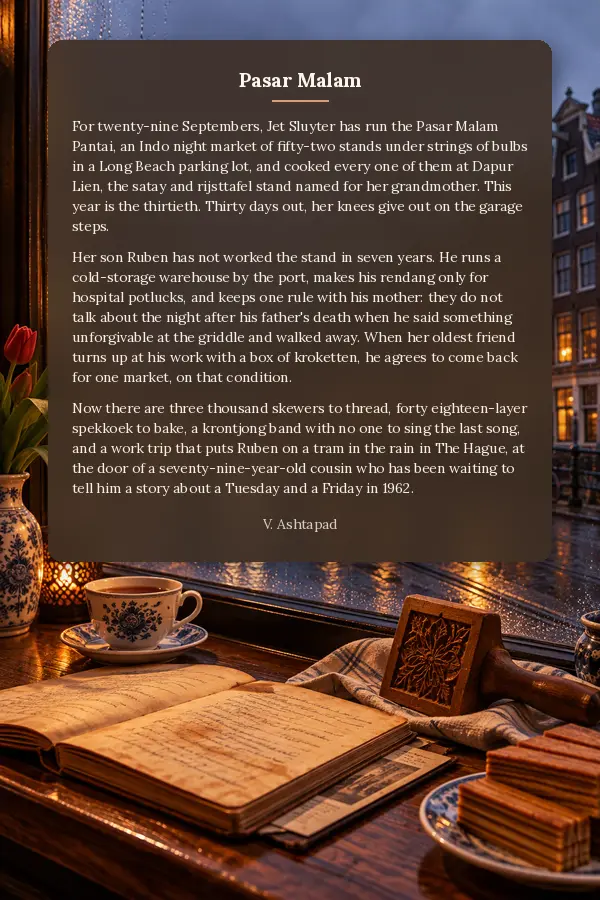
For twenty-nine Septembers, Jet Sluyter has run the Pasar Malam Pantai, an Indo night market of fifty-two stands under strings of bulbs in a Long Beach parking lot, and cooked every one of them at Dapur Lien, the satay and rijsttafel stand named for her grandmother. This year is the thirtieth. Thirty days out, her knees give out on the garage steps.
Her son Ruben has not worked the stand in seven years. He runs a cold-storage warehouse by the port, makes his rendang only for hospital potlucks, and keeps one rule with his mother: they do not talk about the night after his father's death when he said something unforgivable at the griddle and walked away. When her oldest friend turns up at his work with a box of kroketten, he agrees to come back for one market, on that condition.
Now there are three thousand skewers to thread, forty eighteen-layer spekkoek to bake, a krontjong band with no one to sing the last song, and a work trip that puts Ruben on a tram in the rain in The Hague, at the door of a seventy-nine-year-old cousin who has been waiting to tell him a story about a Tuesday and a Friday in 1962.
Members can react to this book and talk about it in the members' Library.
Ownership
© 2026 CRUNOD LLC. All rights reserved.
This book is owned by CRUNOD LLC. It is free to read on EternalCurrent.Online. No part of it may be copied, reprinted, sold, recorded or adapted, including as audio, film or translation, without written permission from CRUNOD LLC.
© 2026 CRUNOD LLC. All rights reserved.