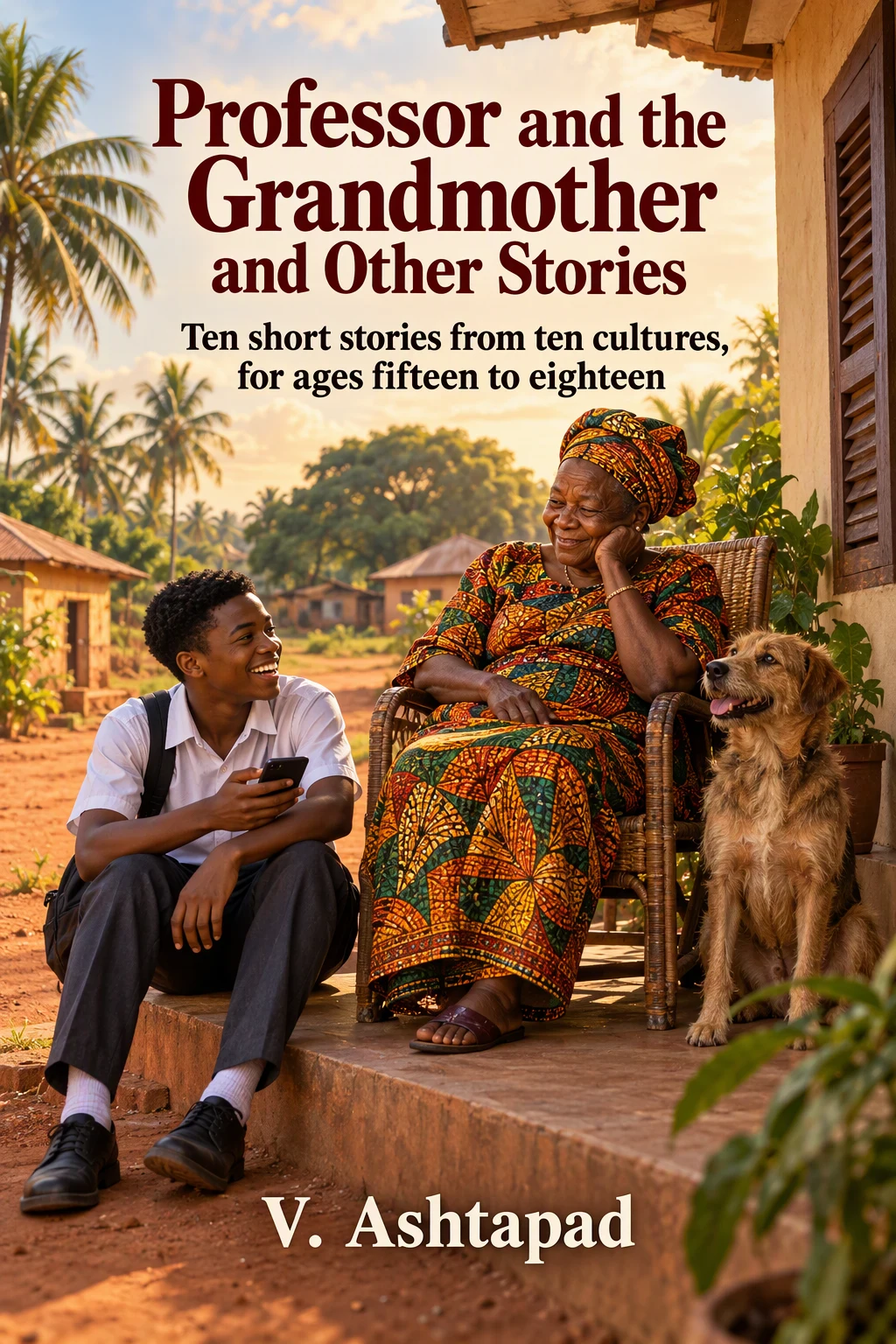
Professor and the Grandmother and Other Stories
Ten short stories from ten cultures, for ages fifteen to eighteen
by V. Ashtapad
Foreword
This is a book of fiction. Each of the ten stories stands on its own and centers on a single culture, and each was written in its own voice. The foods, customs, places and histories in these pages are real and described as faithfully as a story allows. Every named character, family, household and business is invented.
Tiwizi
*A Kabyle story*
**Vaulx-en-Velin. Tuesday, 30 December.**
Nanna fell on Sunday. In her kitchen. Reaching for the couscous pot on the high shelf.
She is fine. Bruised hip. Nothing broken. The doctor at Édouard Herriot said "lucky" four times.
She is not fine to live alone. That is the decision. Baba made it in the hospital corridor. He made it in French. He makes everything in French.
She moves in with us. Saturday. Third floor, our building, no elevator. Her flat is on the eleventh floor of the tower across the ring road. Forty years of things.
Baba says he will hire movers. Baba says it like a man closing a door.
Nanna said one word from her hospital bed. *Tiwizi.*
Baba pretended not to hear.
I heard.
* * *
**Ath Lahcène, Kabylie. 9 August, two summers ago.**
First day in the village. Hot. So hot the road shimmered.
The bus from Tizi Ouzou climbed for an hour. Switchbacks. Goats. Fig trees hanging over walls. The Djurdjura mountains behind everything, grey and huge, like they were leaning in to look.
Nanna's house has walls a meter thick. Inside it is cool and dark and smells of olive oil and dust and smoke from the bread oven.
Nanna changed when she got off the bus. She stood straighter. She talked louder. In Kabyle. Only Kabyle. To everyone.
I understood maybe a third. I said *azul* to everyone. They laughed. Kindly.
Baba did not come. Work, he said.
* * *
**Vaulx-en-Velin. Wednesday, 31 December.**
Asked Baba what *tiwizi* means.
He said, "It's an old word."
I said, "I know it's an old word. What does it mean?"
He said, "It means the movers are already booked."
Then he went to the balcony to smoke, which he quit in 2019.
Mama told me in the kitchen. Quietly. Tiwizi is when the whole village works together for one family. For free. Building a roof. Harvesting olives. Carrying stones. Everyone comes. Then next time, you go to them.
"Your father hates it," she said.
"Why?"
She shrugged. "Ask him. Not tonight."
New Year's Eve. Fireworks over Lyon. Baba stayed on the balcony through all of them.
* * *
**Ath Lahcène. 14 August, two summers ago.**
Woke at five. Shouting outside.
Every woman in the village was on the path to the spring. The old fountain, *tala*, where they used to wash. The pipe had cracked in the winter. The water was going into the mud instead of the basin.
Nanna put on her taqendurt. The yellow one with red and green bands at the hem. Silver bracelets. Both wrists. She handed me a bucket.
"Tiwizi," she said.
I thought it meant "bucket."
It doesn't mean bucket.
By noon there were thirty people. Old men mixing cement. Girls carrying water from the well higher up. Kids hauling sand in plastic bags. Nobody was in charge. Everybody was in charge. A woman with no teeth sang the whole time. Others answered her. Call and answer, back and forth, over the sound of shovels.
My hands blistered. Nobody cared. I didn't either.
At the end, the water ran clear into the stone basin. Everybody clapped. Somebody's grandson jumped in with his clothes on.
We ate on the ground. Couscous with lamb and turnips and chickpeas, in a wooden dish as wide as a tyre. Twenty hands in one dish. Buttermilk in a clay jug, cold from the spring.
Nanna watched me eat with my hand. She didn't say anything. She looked proud. Or tired. Both, maybe.
* * *
**Vaulx-en-Velin. Thursday, 1 January.**
I did something. Probably bad.
I posted in the cousins' group. All of them. Lyon, Grenoble, Saint-Étienne, Marseille, even Samir in Montreal.
I wrote: *Saturday 9 a.m. Nanna's flat. Tower C, 11th floor. Tiwizi. Bring boxes.*
I did not tell Baba.
Samir wrote back first: *I'm in Montreal, cousin.* Then a heart.
Then Aunt Dihya. Then Kamel. Then the twins.
Then Aunt Dihya again: *Does your father know?*
I didn't answer.
* * *
**Ath Lahcène. 20 August, two summers ago.**
Asked Nanna why Baba never comes to the village.
She was rolling berkoukes on the big tray. The fat grains. Flour, water, her palm going round and round. Like she was polishing the tray.
She didn't answer for a long time.
Then: "Your father left in 1994. He was nineteen."
1994. The black years. I know what that means from school. Bombs. Fear. People disappearing on the roads. Night curfews.
"He went to France to be safe," Nanna said. "In France, at the lycée, they called him names. Ugly ones. In the village, after, when he came back for a summer, they called him *the Frenchman*. Too Kabyle there. Too French here. He stopped talking the language. To everyone. Even to me."
She kept rolling. Round and round.
"He thinks I am angry. I am not angry. I am waiting."
* * *
**Vaulx-en-Velin. Friday, 2 January.**
Baba found out.
Aunt Dihya called him. Of course.
He came into my room. He didn't knock. He said, "Cancel it."
I said no.
He said, "This isn't the village, Tanina. This is a tower block in the banlieue. People have jobs. Lives. I'm paying professionals. That's how it works here."
I said, "That's how it works for you."
He went red.
I said, "Nanna said tiwizi. In the hospital. She asked for it. You heard her."
He said, "She's eighty-four, Tanina. She's confused."
I said, "She's not confused. You're scared."
That was the bad thing. I said it. It came out.
He stood in the doorway. He looked old. Older than I'd ever seen him.
He said, "You don't know anything about it." Quiet. Not shouting.
Then he left.
I didn't cry. I counted boxes. I have nineteen.
* * *
**Ath Lahcène. 27 August, two summers ago.**
Last night in the village.
Nanna gave me a bracelet. Silver. Enamel. Blue, green, yellow. Coral. Made in Ath Yenni, the next village over, by a man whose grandfather made her wedding jewelry.
She said, "For when you're married."
I said, "Nanna, I'm fourteen."
She said, "Then wear it now. Marriage is far."
We sat on the roof. The figs were drying on cane racks. Everything smelled like warm sugar. You could see the lights of other villages strung along the ridges. Like necklaces.
Nanna said, "When I die, the words die with me. The old ones. Your father has them. Somewhere. Deep. Like water under stone."
I said, "Then dig."
She laughed. "That's tiwizi. One person cannot dig alone."
* * *
**Vaulx-en-Velin. Saturday, 3 January. Night.**
Writing this on the floor of my room. Nanna is asleep in the bed next to mine. Snoring. Like a small motorbike.
Here's what happened.
8:45. Tower C. Freezing. Fog on the ring road. Concrete everywhere. One lift, broken, obviously.
Me. Mama. Two cousins. That was it. Nineteen boxes.
9:00. Nobody else.
9:10. The twins. With a trolley.
9:20. Aunt Dihya, Uncle Rachid, three kids, a van.
9:40. Kamel and his whole football team from Saint-Fons. Eight boys. Huge. Hungry.
10:00. Madame Ferreira from the eighth floor. Portuguese. Seventy. With a roll of tape. She said, "Your grandmother brought me soup every week when my husband died. Where do I start?"
10:15. The Keita brothers from the fifth floor. Three of them. Their parents are from Bamako. They carried Nanna's wardrobe down eleven flights like it was a cardboard box.
10:30. Two neighbours I didn't know. One from Oran. One from Villeurbanne. They said, "We heard." That's all.
By eleven there were thirty people. On the stairs. In the hall. Passing boxes down the stairwell, hand to hand to hand. Like the buckets. Like the spring.
Nobody in charge. Everybody in charge.
Nanna sat in a plastic chair in the lobby. Blanket on her knees. Directing. In Kabyle. Loud. *Not that one. The blue box is plates. Careful, that pot is older than all of you.*
The couscous pot. The one she fell reaching for.
Kamel's football boys didn't understand a word. They did what she said anyway. You could tell from her hands.
* * *
**Same night. Later.**
The part I need to write down.
At 11:20 Baba came.
He stood in the lobby doorway in his work jacket. Looking at all of it. The chain of people on the stairs. Madame Ferreira taping boxes. The Keita brothers with the bed frame. Nanna in her chair.
I thought he would be angry. I got ready.
He wasn't angry.
He walked to Nanna. He crouched down. His knees cracked.
He said something. In Kabyle.
I didn't understand all of it. I understood *yemma*. Mother. I understood *semmeḥ-iyi*. Forgive me.
Nanna put her hand on his head. Like he was a boy. She didn't say anything. She didn't have to.
Then Baba stood up. Took off his jacket. Went to the stairs. Took a box from Kamel. Passed it down.
He worked until three. He didn't speak French once. Not once. Not even to the Keita brothers, who answered him in French, laughing, and he answered back in Kabyle, and somehow they understood each other perfectly.
* * *
**Vaulx-en-Velin. Monday, 12 January. Yennayer.**
The new year. Our new year. 2976.
Nanna's first night of it in our flat.
Mama made couscous with seven vegetables. Aunt Dihya brought the dried figs. Madame Ferreira came. So did the Keita brothers. Kamel brought two of the football boys. They ate like wolves.
Baba sat at the table next to me. He hadn't said much since the move. Different quiet. Not the balcony kind.
After dinner he said, to me, low, "I'm sorry. For what I said in your room."
I said, "I'm sorry for what I said. About scared."
He said, "You weren't wrong."
Then he said, "My Kabyle is bad now. Rusty. Thirty years."
I said, "Mine is worse."
He said, "Then we're even."
He taught me a word. *Tanemmirt.* Thank you. I knew it already. I let him teach me anyway.
Nanna watched us from the end of the table. She was wearing the yellow taqendurt. Both bracelets.
She said, "Tiwizi." To nobody. To all of us.
This time Baba laughed.
© 2026 CRUNOD LLC. All rights reserved.
The Words She Brought Home
*A Breton story*
We have been on the quay since half past six.
Grey morning. Crachin, the fine Brest rain that doesn't fall so much as hang around, like a cousin who won't leave the party. The water in the harbor the color of a pencil. Gulls on every bollard. Behind us, the cranes of the naval base, and the old stone of the château, and the whole city of Brest climbing its hill in rows of white houses that all look like they've been rinsed.
My little brother Erwan is wearing a sign around his neck that says BIENVENUE MAMAN in letters so big the last N wraps around to his back. My grandmother — Mamm-gozh — is in her good coat, the navy wool one with the brass buttons, sitting on a folding stool someone's father lent her. She is seventy-eight and has never once in her life arrived anywhere late, and she considers the frigate's lateness a personal remark.
And I'm standing with my bombarde case at my feet, with the eleven other members of my bagad, in our black jackets with the embroidered collars, and my lips are already cold, and I am trying not to think about whether my reed will crack in this weather.
The ship was due at eight. It's ten past.
Let me tell you how we got here. It'll pass the time.
* * *
Four months ago. Same quay. Sunny, actually, which in Brest is suspicious.
My mother, Maître Rozenn Le Goff, electrician, twenty-two years in the Marine nationale, hugging us one at a time. Erwan first, because he was crying. Then me. Then Mamm-gozh, last, and stiffly, the way the two of them always hugged — two people holding a box between them that neither wanted to set down.
The box was this. My grandmother grew up in a village near Carhaix speaking Breton. At school, in the 1950s, if a child spoke Breton, the teacher hung a wooden clog around their neck — *le symbole* — and the child had to wear it until they caught someone else speaking Breton and could pass it on. My grandmother wore it for a week, once, when she was seven. She never told us that. My great-aunt did, at a funeral.
So when my grandmother had her own daughter, she didn't teach her a word. Not one. French only. French for school, French for the navy, French for getting on in the world. And my mother grew up and found out what had been held back from her, and was angry, and the anger went quiet, and the quiet sat in the middle of every Sunday lunch like a dish nobody passed.
And then there was me. Who goes to a Diwan lycée in Carhaix, where every class is in Breton, maths and history and all. Who speaks it with Mamm-gozh on the phone every Thursday. Who could feel my mother, in the kitchen, listening to the two of us and not understanding, and not asking.
My mother said goodbye in French. Of course.
Then she walked up the gangway, and turned, and saluted Erwan, who saluted back with his whole arm, and she was gone.
* * *
Month one.
School. Rain. Bagad practice twice a week in a hall that smells of floor polish and wet wool. I play bombarde — a short, loud double-reed oboe, the sound like a gull who has gone to music school. Our pipe-major, Yann, is twenty-four and very serious and says things like "the bombarde is not your feelings, Azilis, the bombarde is the *front of the line*." I nod. I play my feelings anyway.
Emails from my mother, at sea. Short. *All well. Hot here. Food is fine. Kiss Erwan.* No mention of where. You learn not to ask.
* * *
Month two.
Fest-noz in Landerneau. The big hall full to the walls, two singers on the stage doing kan ha diskan, call and answer, one voice picking up the end of the other's line so the song never stops for breath. Hundreds of people in long chains, linked by their little fingers, doing the an dro, stepping and swinging, the whole floor going one way like a school of fish. The smell of galettes on the griddles by the door: buckwheat and butter and the egg cracking and going crispy at the edges.
I danced till one in the morning. I sent my mother a photo. She sent back: *Wish I was there. I never learned the steps properly.* Then, two minutes later: *Never learned a lot of things properly.*
I didn't know what to say. So I said: *I'll teach you.*
She sent back a thumbs-up. That's my mother. A whole conversation in one thumb.
* * *
Month three.
Erwan's birthday. He turned eight. We did a video call, the whole family on the laptop on the kitchen table, my uncle from Lorient in one window, my mother in a tiny square in the corner with grey metal walls behind her and the light very flat and white. The connection kept freezing. Every time it froze, my mother's face stopped mid-laugh, and Erwan laughed at the frozen face, and then she'd come back and not know why he was laughing, which made him laugh harder.
At the end, Mamm-gozh leaned in close to the camera — far too close, so it was mostly her nose — and said, in Breton, "Kenavo, ma merc'h." *Goodbye, my daughter.*
My mother's square froze. When it came back, she was looking down at something. Then the call dropped.
Mamm-gozh sat back and folded her hands and didn't say anything for the rest of the evening. I made her a bowl of chamomile, and she drank it, and the kitchen was very quiet except for the rain against the window and Erwan playing with the new toy boat in the sink.
* * *
Month four.
The plan.
I went to Yann, the pipe-major, and asked if the bagad would play on the quay for the homecoming. He said the base would never allow it. I said, could we ask. He said asking was not the same as allowing. I said, then let's ask.
It took eleven emails, two forms, a phone call from my uncle (who knows someone, who knows someone), and a letter written in my very best French to a commander I'll never meet. And then: yes. Twelve players. Two tunes. Stand behind the yellow line.
We chose the tunes together. The first, a march, loud and proud, for everyone. The second, a slow air my grandmother used to hum while she peeled potatoes. A song from her village. She doesn't know we're playing it.
That was the surprise. That was my whole surprise.
I didn't know it wasn't the only one.
* * *
Back to the quay.
Twenty past eight. A shout from somewhere down the line. Everyone turns.
There it is, coming in past the breakwater out of the grey — a long, low, pale-grey shape, all sharp angles, so much bigger than you remember, with sailors lined up along the rails in their dress uniforms, white and dark blue, so small and neat from here that they look like they've been stitched onto the ship.
Erwan screams. Just screams. No words. Mamm-gozh stands up off her stool, which she has not done unaided since September.
Yann lifts his hand. Drums first — the snare, the tenor, the big bass — and then the binioù braz, the big pipes, and then us, the bombardes, front of the line, and the march goes out over the water as loud as twelve people can make it, which, I promise you, is very loud.
The ship slides in. The ropes fly. The sailors on the rail are grinning, and some are waving, which they're not supposed to, and an officer pretends not to notice.
We finish the march. A breath.
The slow air.
I play it as softly as you can play a bombarde, which is not very softly. Beside me Mamm-gozh has stopped moving completely. She knows it from the first three notes. She puts one hand on my shoulder, and I feel it shaking through the wool.
* * *
The gangway comes down. And then — chaos, the good kind. Sailors pouring off, kids running, a man lifting a woman off her feet, the gulls going mad overhead.
My mother.
Coming down the gangway with her sea bag on her shoulder and her cap pushed back, darker from the sun, thinner. She drops the bag. Erwan hits her at the knees like a rugby player. She picks him up and his sign crunches between them.
Then me. She hugs me with Erwan still on her hip, so it's a three-person hug, which is a lot of elbows.
Then she sets Erwan down. And she turns to her mother.
And this is the part. This is the part I didn't plan.
My mother — Maître Le Goff, who didn't know a single word — stands up very straight, as if for inspection, and takes a breath, and says, carefully, with a terrible accent, every consonant in the wrong place:
"Demat, mamm. Deuet on en-dro."
*Hello, Mother. I've come back.*
Mamm-gozh's hand goes to her mouth.
My mother goes on, slower now, reaching for every word like someone crossing a stream on stones. "There is a cook on my ship. From Pontivy. He taught me. One hour every night, for four months, in the galley, after the dishes. He said I speak like a cow." She is laughing now, and crying, in French again. "But I wanted to say it. I wanted to say it here."
My grandmother doesn't answer for a long moment.
Then she reaches out and takes her daughter's face in both hands, the way she does with Erwan, and she answers in Breton — slowly, so slowly, so her daughter can follow — and I'm the only one in the family close enough to hear it, and I'm not going to tell you what she said.
Some things you bring home. Some things you keep.
* * *
Yann is waving at us. The bagad is supposed to play one more tune, the march again, for the families. My lips are numb and my reed is fine and my face is wet and in Brest you can always blame the rain.
I pick up the bombarde.
Front of the line.
© 2026 CRUNOD LLC. All rights reserved.
Professor and the Grandmother
*A Igbo story*
My grandmother arrived at 7:40 a.m. Professor met her at 7:41.
That was the problem.
Professor is my dog. He is brown. He has one ear up and one ear down, like he is always half listening. He is a local dog, the kind people in Enugu call "local" like it is an insult. Like there are imported dogs who are better. I found him two years ago behind the mechanic workshop on Chime Avenue. He was eating a rubber slipper. I brought him home in a Ghana-Must-Go bag. My mother screamed. Then she fed him.
My grandmother, Nne, does not like dogs inside the house.
Nne does not like many things inside the house. Shoes. Wet hair. Phones at the table. Boys who say "wetin" instead of "what." But dogs were at the top of the list.
So at 7:41, when Professor came racing out of the parlor and put both front paws on her white lace wrapper, there was silence.
The kind of silence that has weight.
"Ebube," Nne said. Very calm. "What is this?"
"That's Professor."
"Professor of what?"
"He's very clever."
She looked down at him. He looked up at her. His tail was going like a ceiling fan on high.
"Outside," she said.
* * *
I took Professor to the back. I tied him to the guava tree with a rope. He looked at me like I had betrayed the whole nation.
"It's one week," I told him. "She goes back to the village on Saturday."
He lay down in the dust and sighed through his nose. Very dramatic. He gets it from me, my mother says.
Inside, Nne was already in the kitchen. She had brought a whole bag from Nsukka. Stockfish, stiff as wood. A huge bundle of bitterleaf. Ugba, the sliced oil bean, wrapped in leaves. Two tubers of yam. A plastic bottle of palm oil so red it looked like it was glowing.
"You are sixteen," she said. "Today you will learn ofe onugbu properly. Not your mother's quick way."
From the parlor my mother called, "I heard that!"
"I meant for you to hear it," said Nne.
* * *
8:30 a.m. Washing bitterleaf.
This is not like washing lettuce. You squeeze it. You rub it between your hands in water until the water turns green and foamy and the leaves lose some of their bitterness. Then you change the water. Then you do it again. And again.
"Again," said Nne.
"My hands are green."
"Good. Your great-grandmother's hands were green for sixty years."
"Was she a farmer?"
"She was a woman who cooked. Again."
My arms hurt. My hands smelled like a forest that was angry. Through the kitchen window I could see Professor. He had dug a hole under the guava tree and was lying in it like a man in a hot bath.
* * *
10:00 a.m. The generator.
NEPA took light at nine. Of course. Nobody in Enugu is surprised when the power goes. You would be more surprised if it stayed.
My father went out to start the generator. It would not start. It coughed and coughed like an old man at a funeral. So he called Emeka, the generator man, who lives two streets over and fixes everything with one screwdriver and a lot of opinions.
Emeka came in through the gate. He did not close the gate.
I want to be clear about who did not close the gate.
Professor had chewed through the rope by then. He is clever. I told you.
He was gone before anyone even saw him go. A brown streak. Out the gate. Down the street. Toward the main road, where the okadas and the kekes and the danfo buses go by blowing their horns at nothing.
"PROFESSOR!"
* * *
10:04 a.m. I ran.
I ran in my bathroom slippers with green hands. I ran past the woman who sells roasted corn and ube at the junction. Past the boys playing football with a ball that was mostly tape. Past the church choir practicing in the open hall. Nobody had seen a brown dog. Everybody had seen a brown dog. In Enugu there are a lot of brown dogs.
At the junction I turned around.
Nne was behind me.
She was walking. Not fast. But she was walking, in her lace wrapper and her headtie, with her walking stick, which she uses more for pointing than walking.
"Nne! Go back! It's too hot!"
"Where is he going?" she said.
"I don't know!"
"A dog that runs knows where it is going," she said. "Think. Where does he go?"
I stopped. I thought.
"The suya man."
* * *
10:20 a.m. The suya man.
Mallam Garba sets up his grill at the corner of Ogui Road in the evening. But in the morning he sits there anyway, cutting meat and threading it onto sticks. He gives Professor the scraps. Professor thinks Mallam Garba invented meat.
We got there. Nne was breathing hard. I gave her my arm. She took it, which she never does.
Professor was there.
He was lying at Mallam Garba's feet. Mallam Garba was feeding him a piece of beef the size of my fist.
"Ah, Ebube!" said Mallam Garba. "Your professor came for his lecture."
Professor looked at me. Then at Nne. His tail went thump. Thump. Very slowly. Like he knew.
Nne looked at him for a long time.
Then she sat down. On Mallam Garba's little wooden bench. In her good lace.
"Bring me water," she said. "And tell this dog to come here."
* * *
10:35 a.m. The story.
I did not have to tell him. He came by himself. He put his chin on her knee. She did not push him away.
"When I was small," Nne said, "my father had a dog. Ogbuagu. That means one who kills a leopard."
"Did he kill a leopard?"
"No. He killed many chickens. Other people's chickens. My father had to pay for them. Every month a woman came to the compound and said, your dog has eaten my fowl, and my father paid, and he said, Ogbuagu, you will finish me."
Professor's ear, the down one, went up a little.
"But my father loved that dog," Nne said. "Because one day, during the war, when we were hiding in the bush near Obollo, the dog did not bark. Not once. For two nights. Every dog in that place was barking. Ogbuagu lay on my feet and did not make a sound. Like he understood."
She was quiet.
"And after?" I said.
"After, he ate chickens again." She almost smiled. "He was a dog. He was not a saint."
She scratched Professor behind the ears. She knew exactly where. Behind the left ear, the up one. Nobody else knows that spot. He groaned like a happy old man.
"Your dog is very rude," she said. "But he knows where he is going. That is something."
* * *
11:30 a.m. We walked home.
Slowly. Nne holding my arm. Professor walking beside her. Not in front. Beside. He kept looking up at her face, like he was checking.
Emeka had fixed the generator. It was roaring in the back. The whole compound smelled of diesel and the bitterleaf I had left in the bowl.
My mother saw us at the gate. She looked at Nne. Then at the dog. Then at me.
"Don't ask," I said.
* * *
2:00 p.m. The soup.
We put the stockfish to boil first, with the beef and the shaki and the dried fish. The kitchen got hot and smelled strong, the stockfish smell that makes visitors stand in the doorway and say "Ah-ah." Then the cocoyam, boiled and pounded to a paste in the mortar, for thickening. Nne made me pound. My arms, again.
Then palm oil. Then crayfish, ground. Then pepper. Then ogiri, which smells like old socks and tastes like the whole village.
Then the bitterleaf, last of all.
Nne tasted it from the wooden spoon. She closed her eyes.
"Hm," she said.
That was all. But it was a good hm. I know her hms.
Professor was lying in the kitchen doorway. Not inside. Not outside. Exactly on the line. Nne stepped over him three times. She did not say anything.
* * *
6:00 p.m. The pictures.
My cousin Chidinma called from Houston. She is the one who rounds everybody up for the family call on the first Saturday of the month. Uncle Obinna in Manchester. Auntie Ifeoma in Abuja. My mother leaned the phone against the radio on the side table.
"Nne!" everyone shouted. "Kedu!"
"I am well," said Nne. "Ebube made the soup."
"Ebube?" said Chidinma. "Ebube who burns noodles?"
"She made it properly," said Nne. "With her hands."
Then she reached down and picked up Professor's front paw and waved it at the phone.
Everybody screamed.
"Nne, is that a DOG?"
"This is Professor," said Nne. "He is clever."
* * *
9:00 p.m. NEPA brought light back at eight-thirty. Everyone shouted "Up NEPA!" from every house on the street, like they do. Like we won a football match.
We ate on the veranda. Pounded yam and ofe onugbu. The soup was bitter in the right way. A good bitter. The kind that tells you it took all day.
Nne sat in the big cane chair. I sat on the step. The mosquitoes came for my ankles. The crickets were loud. Somewhere down the road a radio was playing old highlife, Oliver de Coque, the guitar going round and round.
Professor lay down at Nne's feet. On her feet, actually.
She looked down at him.
"Ebube," she said.
"Yes, Nne?"
"This dog may sleep in the parlor tonight."
"Really?"
"In the parlor. Not the bedroom. And he must not touch my wrapper."
"Thank you, Nne."
"And bring him some of the beef," she said. "He walked very far today. He is an old man like me."
"He's two."
"Then he is wise for his age," she said, and closed her eyes, and kept her feet exactly where they were.
© 2026 CRUNOD LLC. All rights reserved.
Six Yards Before the Van
*A Scottish story*
Right, so for context: it's Saturday, it's March, it's Lewis, and the wind is doing that thing where it comes at the house sideways like it's got a personal problem with the roof. Half eight in the morning. I'm in bed. I've got plans. Proper plans. Mairead's having people round at hers in Stornoway tonight, her mum's away at a wedding in Inverness, and I have been building toward this evening emotionally for about three weeks.
Then my phone goes and it's Mum, and Mum never phones, she texts, so I know straight away something's up.
"Your granny's been at the hens," she says.
Which, okay, she's always at the hens.
"And the wind's took the hen-house door off her and slammed it on her wrist."
* * *
By ten I'm at Granny Peigi's in Shawbost, which is half an hour out the west side, or twenty minutes with Mum driving like she's in a rally. The kitchen smells of peat smoke and toast. Gran's in her big chair with her arm in a splint from the hospital, looking absolutely raging. Not in pain. Raging. Bran, her collie, is lying with his nose on her slipper like he's personally responsible.
"It's not broken," she says, before anyone can say anything. "It's a sprain. The doctor was about twelve."
"Mum," says my mum. "You're seventy-nine."
"I'm aware of my age, Catriona, I was there."
And then she looks at me. And I know that look. That's the look she gave me when I was nine and she said, *You'll be wanting to learn to bake a proper scone, then,* and it was not a question.
"The van's coming at four," she says.
Oh no.
* * *
So. Explainer, for anyone not from here. My gran weaves Harris Tweed. Like, the real stuff. You can only call it Harris Tweed if it's handwoven by islanders in their own homes in the Outer Hebrides, and then the mill finishes it and an inspector stamps it with the wee orb mark, and then some guy in London or Tokyo pays an actual fortune for a jacket made of it. Gran's been weaving since she was younger than me. Her mum wove. Her gran wove. There's a picture in the hall of my great-great-granny at a loom with a clay pipe in her mouth, and honestly she looks harder than anyone I have ever met.
The loom is in the shed out the back. It's the old single-width kind, a cast-iron monster from about a hundred years ago that you work with your feet, like pedalling a bike, and every time you pedal, the shuttle goes flying across through the threads, *clack*, and the beater swings in and packs the thread down, *thump*, and the whole shed shakes. The mill sends out the yarn already on a beam. Gran weaves it into the length of cloth. Then a van comes and takes it back.
There's six yards left on this one. And the van's coming at four.
"Can they not just come Monday?" I say.
Gran gives me a look like I've suggested we sell the dog.
"I've never once missed a van," she says. "Not in sixty-four years."
"You've never once been seventy-nine with a sprained wrist, though."
Mum makes a noise that might be a laugh. Gran ignores it.
"Your feet work," Gran says to me. "Your hands work. And you've sat in that shed beside me since you were in a pram."
"Sat," I say. "Watched. That's not the same."
"It's the start," says Gran.
* * *
Half eleven. I'm in the shed.
It is baltic. There's a wee electric heater in the corner that does basically nothing except smell like burning dust. The shed smells like oil and wool and that sheepy lanolin smell that gets right into your hair, which is my main worry about tonight, if I'm being honest, but whatever. The tweed on the loom is a sort of heathery green with flecks of orange and blue through it, like the hills out the window when the sun comes out for four seconds, which it does about twice a day here.
Gran's sitting on an upturned fish box beside me with a tartan blanket over her knees and her splint arm resting on Bran's head. Mum's gone to the shop in Barvas for messages and to phone my Auntie Mòrag in Glasgow and fret.
"Feet on the pedals," says Gran. "Even. Not like you're running for the bus."
I pedal. The shuttle shoots across. *Clack.* The beater comes in. *Thump.*
"Good," says Gran.
I pedal again. Nothing happens. Well, something happens. The shuttle sort of flops halfway across and stops in the middle of the threads like it's had a wee lie down.
"Too slow," says Gran. "It's not a funeral."
* * *
Half twelve. I've done about a foot.
One foot. Out of six yards. Which is eighteen feet. I did the maths on my phone because I am not built for maths, and then I did it again because I didn't like the answer.
"I'm never going to make it," I say.
"Not with that attitude, you won't," says Gran, who has said that exact sentence to me roughly five hundred times since birth.
But here's the thing. I'm getting it. Sort of. The rhythm. It's like, pedal, *clack*, *thump*, pedal, *clack*, *thump*, and once your body stops arguing with it, it's almost like dancing, except dancing where you're sitting down and your legs are on fire.
Gran starts singing. In Gaelic. It's a waulking song, the kind women used to sing in the old days when they were shrinking the tweed by hand, thumping it on a table, all of them in a row. She's got a voice like gravel in a nice way. I don't understand all the words, my Gaelic's not great, which she is very disappointed about, but I know the chorus because she sang it to me in my cot. I sing it back.
We get two feet done during that one song. Honestly, I'm shook.
* * *
Two o'clock. Disaster.
A thread snaps. One of the warp threads, the long ones. *Ping.* It just goes, and the end of it curls up like a worm, and I stop pedalling and stare at it and feel my entire soul leave my body.
"Gran."
"I see it."
"I've wrecked it."
"You've snapped a thread. It happens forty times a tweed." She leans forward and winces, and I can see it's sore, really sore, and I feel awful. "Now. Get the wee bit of spare yarn off the hook. That one. Tie it on. No, a weaver's knot. I'll show you."
She can't do it with her hands. So she does it with words. "Loop. Over. Under. Through. Pull. No, the other way, a ghràidh. Pull. There." And it holds. And I just did that. Me.
Bran barks once like he's proud as well. Gran says he's barking because there's a sheep on the road, but I choose to believe it's for me.
* * *
Half three. Mum comes into the shed with a flask of tea and a plate of Gran's own oatcakes and some cheese, and she just stands in the doorway for a bit, watching. I don't stop. I can't stop. I'm on the last yard.
"Look at you," Mum says, sort of quiet.
"Don't," I say. "You'll put me off."
My legs are absolutely dying. My back's dying. My hair is definitely going to smell of sheep at Mairead's. I've got a blister on my thumb from where I've been pushing the beater wrong, according to Gran, about forty times.
*Clack. Thump. Clack. Thump.*
And Gran, on her fish box, starts talking. Not instructions. Just talking. About her mum at this loom. About how in the 1950s the van was a horse and cart, and the man who drove it was called Calum Dubh and he had one eye and terrible jokes. About how my granda used to come in from the fishing and sit right where Mum's standing and fall asleep to the noise. About how every tweed she's ever made, she can remember where she was in her life when she wove it.
"This one," she says, "I'll remember."
I keep my eyes on the shuttle, because I am not crying in a shed.
* * *
Five to four.
Last pick. *Clack. Thump.*
And that's it. Six yards. Done.
I just sit there with my legs shaking. Gran shows me how to tie off and how to cut it free, and the three of us roll it up, the whole long length of it, heavy and warm and smelling of oil and wool and the heater, and Mum and me carry it out to the porch like it's a body. A nice body. You know what I mean.
The van pulls up at four on the dot. It's a guy called Ruaridh who's about twenty-five and has a beard he's clearly very proud of.
"Peigi," he says. "Heard about your wrist."
Of course he did. Everyone on the whole island will have heard about the wrist by now.
"My granddaughter did the last six yards," Gran says, cool as anything, like she's telling him the weather.
Ruaridh looks at me. Then at the tweed. Then at me.
"No bad," he says.
Which, from a Lewis man, is the equivalent of a standing ovation.
* * *
It's half nine now. I'm writing this on my phone in the back of Mum's car, outside Mairead's, about to go in. I washed my hair twice but it still smells a wee bit sheepy and you know what, I don't care.
Before I left, Gran was back in her chair with Bran and a dram, which I'm pretty sure the doctor who was about twelve said she shouldn't have, and she called me over.
"Next Saturday," she said. "Ten o'clock."
"Gran, I've got plans next Saturday."
"I've got a new beam coming Wednesday."
"Gran."
"Ten o'clock," she said, and then, in Gaelic, something I didn't catch all of, and she laughed at her own joke, and so did I, even though I didn't get it.
I'll ask her what it meant next Saturday. At ten.
© 2026 CRUNOD LLC. All rights reserved.
The Eldest Daughter Gets the Puan
*A Chin story*
**Kuala Lumpur, a flat above a phone repair shop. Cer Tial is four.**
The first thing Cer Tial ever remembers is losing to her sister.
It was a race from the mattress to the window, which was about six steps, and Sui Par won by shoving her into the rice cooker. The rice cooker was fine. Cer Tial was not fine. She screamed loud enough that the uncle who slept in the hallway banged on the wall, and their mother came in from the balcony where she'd been hanging laundry above the traffic and the smell of frying anchovies from the stall below, and looked at both of them, and said in Hakha, "Who started it?"
"Her," said Sui Par, age six, pointing at Cer Tial, who was on the floor holding her own head.
Their mother believed her. Their mother always believed her. Sui Par had that kind of face. A face like a school ID photo. Clean. Trustworthy. Built to fill out forms.
Cer Tial had the kind of face that got asked to leave the store.
* * *
**Indianapolis, Southport. Cer Tial is nine.**
They'd been in America two years. Sui Par could already do the voice.
The voice was the one she used at the clinic and the bank and the leasing office. It was flat and American and a little bored, like a person reading the terms and conditions out loud. Their mother would speak in Hakha, quietly, and Sui Par would turn to the lady behind the desk and say, "She's asking if the copay is due today or if they'll bill her."
The lady behind the desk would smile at Sui Par like she was a golden retriever who'd learned long division.
Cer Tial sat in the plastic chair and swung her legs and did a word search.
"You could learn to interpret too," their father said in the car.
"I can interpret," said Cer Tial. "That lady thinks Sui is a dog."
Sui Par didn't turn around. "That's not interpreting. That's just being rude in a second language."
"Thank you," said Cer Tial. "I worked hard on it."
* * *
**The basement of the Chin community center. Cer Tial is twelve.**
The puan arrived in a box wrapped in brown tape and string, with stamps from Myanmar that looked like they'd been through something.
It was from Pi, their grandmother, in Hakha. Inside, folded in newspaper, was a puan she'd woven herself on the backstrap loom. Red and black, with the thin diamond lines in gold and green that meant it was from their side of the hills. The kind you wear for Chin National Day, for weddings, for the photo that ends up framed in somebody's living room for forty years.
There was a note pinned to it. Their mother read it out loud in the basement with the aunties around her, with the big pots of sabuti steaming on the folding table, hominy and pork bones and the smell that made every Chin kid in Indianapolis instantly hungry no matter what.
"For the eldest daughter," their mother read. "When she is old enough to wear it properly."
All the aunties made the sound. The *awww*. The sound of an approved outcome.
Sui Par put her hand on her chest like she'd won a pageant.
Cer Tial ate four bowls of sabuti out of spite and was sick in the parking lot.
* * *
**Eighth grade. Cer Tial is thirteen.**
"Okay but like," said Cer Tial's friend Mawi at lunch, "why does it have to be the eldest? That's lowkey medieval."
"It's tradition," said Cer Tial, doing a pretty accurate impression of every auntie at once.
"Is it though? Or did your grandma just like her better?"
Cer Tial thought about it. Pi had met her exactly twice, both times before she could walk. She'd met Sui Par a lot more, back in Hakha, before Malaysia, before the flat above the phone shop. Sui Par could remember the mountains. Pine trees and cold and fog in the morning so thick you couldn't see the church across the road, and Pi's hands on the loom, the shuttle going thup, thup, thup.
Cer Tial remembered the rice cooker.
"Both," she decided. "Probably both."
* * *
**Sui Par's junior year. Cer Tial is fourteen.**
They were not speaking because of the hoodie.
It was technically Cer Tial's hoodie. It had technically been purchased with Cer Tial's birthday money. It had technically been found, at 6:45 a.m., on the floor of Sui Par's side of the room, with a coffee stain on the sleeve shaped like Ohio.
"I'll wash it," said Sui Par.
"You'll *wash* it."
"Like a normal person, yeah."
"You can't wash Ohio out of something, Sui. Ohio is forever."
Their father knocked on the doorframe. He worked nights at the warehouse and had the specific red eyes of a man who'd been awake for nineteen hours. He looked at them both. He said, in Hakha, "Is anybody bleeding?"
"No," said both of them.
"Then I'm going to sleep," he said, and went.
* * *
**Chin National Day. Cer Tial is fifteen.**
The gym at the high school they rented was packed. Folding chairs in rows, little kids running between them, a whole wall of uncles in suits and red-and-black puan draped like sashes. Someone's speaker was too loud. The bamboo dancers were warming up on the side, two lines of girls clacking the poles together on the floor in rhythm while two more girls stepped in and out between them, fast, ankles flashing.
Sui Par was in Pi's puan.
It looked good on her. That was the worst part. It looked like it had been made for her, which, Cer Tial reminded herself, it literally had.
Cer Tial was in the dance line. She had practiced for four months. She had bruised her shins so many times on the bamboo that her gym teacher had asked, carefully, if everything was okay at home.
Halfway through the routine she looked up and saw Sui Par in the third row filming with her phone held sideways. Not scrolling. Not texting. Actually watching. Lips moving along with the count.
Cer Tial missed a step and the bamboo snapped shut on her ankle.
She kept going. She finished. She bowed. She limped off the floor like a soldier in a war movie.
Afterward Sui Par found her by the water fountain.
"You missed the turn on twelve," said Sui Par.
"Wow. Thank you. Very supportive."
"No, I mean—" Sui Par stopped. She had the puan folded over one arm now. "You were looking at me. That's why you missed it."
"I was looking at the exit sign."
"Behind me?"
"It's a very important sign."
* * *
**March. Cer Tial is sixteen. Sui Par is eighteen.**
Sui Par got into Purdue. Engineering. Full ride, practically. The aunties found out before Cer Tial did, which was its own kind of insult.
Their mother cried in the kitchen and made sticky rice wrapped in leaves, which she only made for big things. The whole apartment smelled like steam and banana leaf. Their father came home from the warehouse and stood in the doorway and didn't say anything for a while and then said, "Okay," in English, which for him was the equivalent of fireworks.
Later, after midnight, Cer Tial heard her sister crying through the wall.
Not loud. Just the specific breathing of someone trying very hard not to.
She lay there for a while. She thought about the rice cooker. The clinic. The terms and conditions voice. The hoodie with Ohio on the sleeve. Six years of Sui Par telling ladies at desks what their mother needed, while Cer Tial did word searches in the plastic chair.
She thought about who'd do the voice when Sui Par was in West Lafayette.
She got up.
* * *
**3 a.m. Their room. Same night.**
"Hey," said Cer Tial.
"Go to sleep."
"You go to sleep."
"I'm trying."
"You're not trying, you're leaking."
Sui Par laughed, which turned into a hiccup, which turned into crying for real. Cer Tial sat on the end of her bed. The streetlight came through the blinds in stripes.
"I don't want to go," said Sui Par.
"Bro. You've wanted to go since you were *ten*."
"I know." She wiped her face on the sheet. "But who's going to go with Nu to her appointments? Who's going to call the gas company? Pa can't do the phone, you know he hates the phone, he just says 'yes, yes' until they hang up. Who's going to do it?"
Cer Tial was quiet for long enough that a car went by outside and its headlights slid across the ceiling and down the wall.
"Me," she said. "Obviously. I'm the other one."
"You're going to be rude to them in a second language."
"Only when they deserve it."
Sui Par sat up. She reached under her pillow and pulled out something folded. Red and black. Gold diamonds. She put it in Cer Tial's lap.
"No," said Cer Tial.
"Shut up. Listen. I talked to Nu."
"About what?"
"I asked her what Pi actually wrote. In the note. The real words." Sui Par wiped her nose on her wrist. "Nu read it out wrong at the center. On purpose. Because the aunties were there and it was easier."
Cer Tial stared at her.
"It says, *for the eldest daughter, to give to her sister when she understands what it's for.*"
The streetlight buzzed outside.
"What's it for?" said Cer Tial, finally.
"I think it's for this," said Sui Par. "I think it's for when I leave."
* * *
**Labor Day weekend. West Lafayette, a dorm parking lot.**
Their father carried a mini-fridge up three flights of stairs and refused all help on principle. Their mother lined Sui Par's drawers with newspaper, the way Pi used to. Cer Tial put up string lights crooked and refused to fix them.
At the car, Sui Par hugged her. It was awkward. They had not hugged since roughly the second grade.
"Call me when the gas company is mean," said Sui Par.
"I'll call you when I *win* against the gas company."
"Wear it for Chin Day."
"I'm going to wear it to *school*."
"You're absolutely not."
"I'm going to wear it to the *taco place*."
Sui Par laughed and got the hiccups again.
On the drive home, Cer Tial sat in the back seat with the puan folded on her knees. Her mother, in the front, said something in Hakha too softly to catch. Cer Tial leaned forward.
"What?"
"I said," said her mother, "you'll have to learn the voice now."
"I already have a voice."
Her mother turned around in her seat. She looked at her, really looked, the way she'd looked that day in the flat above the phone shop, with the laundry in her arms and the traffic going by underneath.
"Yes," her mother said. "I know. That's why she gave it to you."
© 2026 CRUNOD LLC. All rights reserved.
Recording: Jjajja, Masaka, Saturday Afternoon
*A Ugandan story*
*Transcript. Senior Four oral history assignment, Buganda heritage unit. Interviewer: Kirabo Nansubuga, 16. Speaker: her grandmother, Mrs. Teopista Nalubega, 83. Recorded on the back verandah of the family house outside Masaka. Translated from Luganda where needed by the interviewer.*
* * *
**KIRABO:** Okay. It's recording. The red dot.
**JJAJJA:** I see the red dot. It is looking at me.
**KIRABO:** It's not looking at you. It's listening.
**JJAJJA:** Worse.
**KIRABO:** Jjajja.
**JJAJJA:** Fine. Fine. Ask.
**KIRABO:** It's thirty percent of the term, Jjajja. Please be serious.
**JJAJJA:** I am always serious. Ask.
**KIRABO:** Please state your name. For the record.
**JJAJJA:** For the record. Ha. Teopista Nalubega. Of the Ngo clan. The leopard. Born in the year the big rains washed the bridge at Kyotera away. Nobody wrote the year. My mother said it was a good year for beans.
**KIRABO:** So you don't know your birthday.
**JJAJJA:** I know it. It was a Tuesday.
**KIRABO:** [laughs] Okay. Tell me about where you grew up.
**JJAJJA:** Here. Two hills over. You can see it. There. Where the eucalyptus is.
**KIRABO:** That's far.
**JJAJJA:** Not for legs. For your legs, maybe. You people walk from the bed to the taxi.
**KIRABO:** What was the house like?
**JJAJJA:** Mud walls. Grass roof. One door. One window with no glass. When it rained, the roof sang. You have never heard a grass roof in the rain. It is like a thousand people whispering a secret. All of them the same secret.
**KIRABO:** What secret?
**JJAJJA:** If I tell you it is not a secret.
* * *
**KIRABO:** What did your family grow?
**JJAJJA:** Matooke. Always matooke. Beans. Groundnuts. And coffee. Robusta. My father's coffee was the pride of the hill. Small red cherries. We picked them in the dry season. Our fingers went black. We dried them on mats in the yard. The smell. Mm. Like bread that is a little bit burnt.
**KIRABO:** Did you like picking?
**JJAJJA:** I hated it. Ants. Red ants. They live in the coffee trees. They bite like a mother-in-law.
**KIRABO:** Jjajja!
**JJAJJA:** You said for the record. That is the record.
* * *
**KIRABO:** Our teacher said to ask about a skill. Something you learned that young people don't know.
**JJAJJA:** Many things.
**KIRABO:** One thing.
**JJAJJA:** Barkcloth. Olubugo.
**KIRABO:** You made barkcloth?
**JJAJJA:** My father made it. I helped. A girl was not supposed to beat the bark. But I was the oldest. There were no boys yet. So.
**KIRABO:** How do you make it?
**JJAJJA:** You go to the mutuba tree. The fig. You cut the bark in one long piece. Carefully. Carefully. You do not kill the tree. You wrap the trunk after with banana leaves. Like a bandage. The tree grows new bark. It forgives you.
**KIRABO:** Then what?
**JJAJJA:** You steam the bark. Over a fire. Then you beat it. With a mallet. Wooden. With grooves in it. On a log. For hours. Tok. Tok. Tok. You beat it until it is wide like a bedsheet. Thin like this. [holds up her hand]
**KIRABO:** Like your hand.
**JJAJJA:** Thinner. Then you lay it in the sun. And it turns. From pale to orange. To brown. To the colour of a lion. Like magic. But it is not magic. It is the sun.
**KIRABO:** How long did it take?
**JJAJJA:** All day. Every day for a week. My arms were like iron. Look. Still. Feel.
**KIRABO:** [laughs] Your arms are still strong.
**JJAJJA:** From barkcloth. And from carrying your father. He was a fat baby.
**KIRABO:** I'm putting that in the assignment.
**JJAJJA:** Good. Let him suffer.
* * *
**KIRABO:** What was barkcloth for?
**JJAJJA:** Everything. Clothes, before cotton came. Blankets. For the dead. We wrap them. For the king's people, the best cloth. My father sold one to a chief once. He came home with a goat. He walked that goat two hills. The goat bit him twice. He loved that goat.
**KIRABO:** What was its name?
**JJAJJA:** [pause] I don't remember. Isn't that funny? I remember the bite. Not the name.
**KIRABO:** It's okay.
**JJAJJA:** It is not okay. It was a good goat.
* * *
**KIRABO:** Jjajja, do you still have any barkcloth?
**JJAJJA:** In the box. Under my bed. One piece. My father's last.
**KIRABO:** Can I see it after?
**JJAJJA:** After. Yes. Now you ask something else. I am enjoying this.
**KIRABO:** You said you hated the red dot.
**JJAJJA:** I changed my mind. Old women are allowed.
* * *
**KIRABO:** Tell me about getting married.
**JJAJJA:** Ah. The kwanjula.
**KIRABO:** The introduction ceremony.
**JJAJJA:** Your grandfather came with his people. Many people. They sat on mats in my father's yard. They brought gifts. Sugar. Salt. Soap. Paraffin. A cock. A kanzu for my father, white, long. A gomesi for my mother. Silk. Purple.
**KIRABO:** What did you wear?
**JJAJJA:** A gomesi. Yellow. Like the inside of a mango. Big sleeves. Puff. Puff. Like I could fly away.
**KIRABO:** Did you know him? Before?
**JJAJJA:** I saw him at the market. Three times. He sold bicycle parts. He had a radio. A small one. He played it on his stall. Every time I walked past, he turned it louder.
**KIRABO:** [laughs] That's so cringe.
**JJAJJA:** What is cringe?
**KIRABO:** It's... it's like. Embarrassing. But sweet.
**JJAJJA:** Then yes. Very cringe. I married him for that radio.
* * *
**KIRABO:** Do you miss him?
**JJAJJA:** [long pause]
**KIRABO:** You don't have to.
**JJAJJA:** I miss him in the mornings. He made the tea. Always. Fifty-one years. Strong tea. Ginger. Too much sugar. He said sugar was his only sin. It was not his only sin.
**KIRABO:** What were the others?
**JJAJJA:** That is not for the record.
* * *
**JJAJJA:** Now I ask you one.
**KIRABO:** That's not how it works.
**JJAJJA:** It is my verandah. Why does the school want this? Old women talking.
**KIRABO:** Because... Our teacher says when an old person dies, a library burns.
**JJAJJA:** Hm. Your teacher is clever. Is she a Muganda?
**KIRABO:** She's from Gulu.
**JJAJJA:** Then she is clever in Acholi. Tell her we have a saying also. *Akwata empola atuuka wala.*
**KIRABO:** "Who goes slowly goes far."
**JJAJJA:** You see? You know things. You only pretend you don't.
**KIRABO:** I don't know half the words you use, Jjajja. My Luganda is... It's school Luganda. Kampala Luganda. My friends speak English mostly. Or mixed.
**JJAJJA:** I hear you on the phone. You say "eh" and "sha" and English, English, English. Like a chicken that went to university.
**KIRABO:** [laughs] Okay. That's fair.
**JJAJJA:** It is not your fault. Your father stopped speaking it at home. He said English would get you a good job. Maybe it will. But you cannot dream in a job.
**KIRABO:** What do you dream in?
**JJAJJA:** In this. [taps the verandah floor] In the hill. In the rain on the grass roof. Luganda. Always.
**KIRABO:** Then teach me more words. Next time. I'll record those too.
**JJAJJA:** Next time. Yes. Bring sugar. Your grandfather's kind. Too much.
* * *
**KIRABO:** Can I ask about my name?
**JJAJJA:** Kirabo.
**KIRABO:** Who chose it?
**JJAJJA:** You don't know?
**KIRABO:** Mum said it was a family name.
**JJAJJA:** It was me.
**KIRABO:** You?
**JJAJJA:** Your mother was very sick when she carried you. Very sick. In hospital in Kampala. At Mulago. Two months. We did not know if she would keep you. I sat with her. Every day. I took the taxi from here. Four hours. I brought her matooke in banana leaves. Steamed. With groundnut sauce. She could not eat. I ate it. I was fat that year.
**KIRABO:** Jjajja.
**JJAJJA:** Then you came. Small. Like a kitten. Loud like a market. And your mother looked at me. And I said: kirabo. Gift. Because you were not promised. You were given.
**KIRABO:** [silence]
**JJAJJA:** Is the red dot still on?
**KIRABO:** Yes.
**JJAJJA:** Good. Let it hear that.
* * *
**KIRABO:** Okay. One more question.
**JJAJJA:** Only one? I was warming up.
**KIRABO:** What do you want people to remember? Like, in a hundred years.
**JJAJJA:** In a hundred years. Ha. In a hundred years you will be a jjajja. Older than me.
**KIRABO:** Maybe.
**JJAJJA:** Then you tell them. Tell them about the tree. The mutuba. That you can take the bark and it forgives you. If you wrap it. If you are careful. Tell them people are like that. You can take from them. You can hurt them. They grow back. If you wrap them after.
**KIRABO:** That's beautiful.
**JJAJJA:** It is not beautiful. It is true. Beautiful is for songs.
**KIRABO:** Okay. True, then.
**JJAJJA:** Good. Now. Turn it off. I want to show you the box.
**KIRABO:** Can I send this to the family? Uncle Ssemakula in Boston. Aunt Nakimuli in Dubai. The cousins. Everyone's always saying they want to hear your stories.
**JJAJJA:** They can come home and hear.
**KIRABO:** They can't, Jjajja. Not right now.
**JJAJJA:** [pause] Then send it. Send it to all of them. Tell Ssemakula his mother says to eat vegetables. Not only meat. Tell him it is for the record.
**KIRABO:** [laughs] Okay.
**JJAJJA:** And Kirabo.
**KIRABO:** Yes?
**JJAJJA:** The goat's name.
**KIRABO:** You remembered?
**JJAJJA:** Kawoowo. It means a good smell. Because it did not have one.
**KIRABO:** [laughing] Jjajja!
**JJAJJA:** Now it is for the record. Turn it off.
* * *
*Interviewer's note, added for the assignment: After the recording I helped my grandmother pull the box from under her bed. The barkcloth was folded in four, wrapped in an old kitenge. It smelled of smoke and dust. It was the colour of a lion, like she said. She unfolded it on the verandah in the evening light and we sat on either side of it, not talking. Then she put my hand flat on it. You could feel the lines from the mallet. Hundreds of them. Tok. Tok. Tok. My great-grandfather's arms, still there. Afterwards we went in and peeled matooke for supper. She showed me how to hold the knife so the sap doesn't stain your fingers. I still got sap on my fingers. She said I would learn. She said there was time.*
© 2026 CRUNOD LLC. All rights reserved.
Seven Fathers, Measured
*A Kazakh story*
The dastarkhan in our grandparents' apartment on the fourth floor of Block 17, Auezov District, Almaty, is two hundred and forty centimeters long when both table leaves are in. Tonight both leaves were in. We know because we put them in, all three of us, at 17:40, while Apa shouted instructions from the kitchen and the radiator under the window made the knocking sound it makes when the city turns the heating up in December.
We are the Sarsenbayeva sisters. Dina is nineteen and studies hydraulic engineering. Aruzhan is seventeen and studies nothing she will admit to. Zhansaya is fifteen and keeps the notebook. We are writing this down now, at the table, in real time, because something is about to happen and Zhansaya says if you do not record a thing as it occurs you are only recording what you wanted to occur.
Our brother is Alpamys. He is sixteen. He is sitting at the end of the dastarkhan nearest the door, which is the lowest seat, which is where the youngest male sits, which is technically correct, since we are girls and do not count for this purpose, and he is the only grandson. He is wearing the grey sweater Apa knitted him, which is too big in the shoulders by approximately four centimeters. He came to our family at the age of three years and two months from the children's home in Taraz. He does not remember Taraz. He remembers a blue bus.
We are telling you this because of what Uncle Serik is about to ask.
* * *
It is 18:52. The guests are seated.
Uncle Serik is our grandfather's cousin's son, from Shymkent. He drove seven hundred kilometers to be here, which he has mentioned four times. He has brought a tablet computer on which he keeps the family shezhire, our genealogy, in a chart he built himself, with colored lines going back eleven generations to an ancestor named Kaipbergen, who was a batyr, a hero, and who, according to Uncle Serik, once stopped a Dzungar raid using only one horse and a strong opinion.
Uncle Serik's tablet is leaning against the bowl of baursaks. The baursaks are golden, puffed, fried this afternoon by Apa in a pot of oil at exactly the right temperature, which she judges by dropping in a single grain of rice and listening. There are ninety-three of them. Aruzhan counted. There are now ninety-one. Aruzhan ate two.
Ata, our grandfather, is in the tor, the seat of honor, at the far end of the table, opposite the door, under the wall rug with the red and black ram's-horn pattern. He is seventy-four. He has a white beard trimmed to two centimeters and a black velvet skullcap with silver stitching and the patience of a mountain that has been rained on for some time.
Our mother and father are on his left. Apa is going back and forth from the kitchen like a shuttle on a loom.
The cat is under the table. The cat is named Kurt, after the dried salty cheese balls, because he is small and round and hard to like. He is waiting for meat.
* * *
It is 19:05. The meat arrives.
Apa carries in the platter of beshbarmak: a wide wooden tabak with the hand-cut sheets of noodle dough laid flat as cloth, the boiled horse meat and mutton piled on top, rings of onion stewed soft in broth scattered over everything. On the very top, in the center, facing Ata, is the sheep's head.
We will explain the sheep's head for readers who do not know. The head is cooked whole and brought to the most honored person at the table. That person carves it and gives out pieces, and every piece means something. Our family has run this procedure at every major gathering for as long as we have been alive. Zhansaya has notes on the distribution from the last six. They are consistent.
Ata picks up the small knife with the bone handle. He looks around the table, one face at a time.
This is when Uncle Serik clears his throat.
* * *
"Before we eat," Uncle Serik says, "I would like to hear the young man."
He means Alpamys.
"Every Kazakh boy," he says, "should know his zheti ata. His seven fathers. It is how we know who we may marry. It is how we know who we are. Alpamys, my boy. Recite."
The radiator knocks twice.
We look at each other. We have discussed this possibility. We discussed it in the stairwell at 17:20, standing next to the lift, which works on alternate Tuesdays, while Dina held the second table leaf.
Here is the problem as we understand it. The zheti ata is a list of seven generations of fathers, each the son of the one before. It goes father, grandfather, great-grandfather, and up. It is not a list of the people who raised you. It is a list of blood.
Alpamys does not have that list. Nobody has that list. The paper from the children's home in Taraz has one line where a father's name should be, and the line is empty.
Under the table, Kurt the cat puts his paw on Aruzhan's foot.
* * *
It is 19:07. Alpamys stands up.
He has practiced. We know because we have heard him through the wall, at night, saying names to the ceiling. He has a calm voice. It wobbles slightly on long vowels. Otherwise it is precise.
"I am Alpamys," he says. "Son of Nurlan." That is our father. "Son of Yerzhan." That is Ata. "Son of Sarsenbay. Son of Dauletkeldi. Son of Omar. Son of Tolegen. Son of Kaipbergen, who was a batyr."
He sits down.
It is correct. It is perfectly correct. It matches the tablet exactly. Zhansaya checks.
Uncle Serik nods slowly. He picks a baursak out of the bowl. Ninety. He turns it in his fingers.
"Very good," he says. "Very well memorized." He pauses. "But these are not yours, are they, son?"
* * *
It is 19:08.
Nobody speaks. Not one person. Not even Apa, who speaks during funerals. The only sounds are the radiator, which has stopped knocking and is now hissing; the trolleybus going past on Abai Avenue four floors down and one block over; and the cat, who has given up waiting and begun to wash.
Our father's face goes the color of beet salad.
Dina's hand closes on the edge of the table.
Alpamys does not move at all. He keeps his eyes on the sheep's head. Later he will tell us he was counting the cloves of garlic in the broth. There were eleven.
We want to report that one of us said something brave. We did not. We are writing this down honestly. We sat there.
* * *
It is 19:09. Ata puts down the knife.
He does it slowly. He sets it on the edge of the tabak with the blade facing in, which is polite. Then he folds his hands. They are large and spotted brown and the knuckles are swollen from forty years of laying railway track across the steppe between Aral and Kyzylorda.
"Serik," he says. "Read me my zheti ata. From your machine."
Uncle Serik frowns. He picks up the tablet and taps it. "Yerzhan," he reads, "son of Sarsenbay, son of Dauletkeldi, son of —"
"Stop," says Ata. "Sarsenbay. Tell me where he was born."
Uncle Serik taps again. "It says Kyzylorda region. 1929."
"It says," Ata agrees. "Now I will tell you what it does not say."
* * *
It is 19:10. Ata tells it.
He tells it plainly, the way he tells us the weather.
In the winter of 1933 there was a famine across the steppe. We know this from school, we know the numbers, which are very large and which we will not write here because they do not fit in a notebook about a dinner. Ata says that a man named Dauletkeldi, a railway worker, was walking home along the line outside Kyzylorda station when he heard a sound from inside a stack of empty grain sacks. He thought it was a dog. It was a boy. Four years old, perhaps. Nobody ever knew exactly. The boy would not say his name. He would only say one word, over and over, which was the word for bread.
Dauletkeldi carried him home inside his coat. His wife, Bibigul, fed him milk with a spoon for three days because he could not hold a cup. They named him Sarsenbay, because they found him on a Wednesday, sarsenbi, and they were practical people.
"That boy was my father," Ata says. "Dauletkeldi is the first name on that machine that we have any right to. And we have that right only because a man picked a child out of a pile of sacks and decided to keep him."
He looks at Uncle Serik.
"So. My seven fathers are borrowed. So are my son's. So are these girls'. So, Serik, are the ones you just heard this boy recite, and they are no less his than they are mine. Shall we all stand up and leave the table?"
* * *
It is 19:13.
Uncle Serik has put the tablet face down on the cloth. He has a strange look. Zhansaya, who sits nearest, says it is not anger. It is the look of a man rechecking a calculation he has done the same way for thirty years.
"Nobody told me this," he says.
"Nobody asked," says Ata. "Everybody asks for names. Names are easy. You can put them on a machine."
Then he picks the knife back up.
* * *
It is 19:14. Ata carves the head.
He cuts the first slice from the cheek and gives it to Uncle Serik, the guest from farthest away, as is correct. He cuts the palate and gives it to Zhansaya, the youngest girl, so she will be clever, as is correct. Zhansaya would like it noted that this has not yet worked. He gives pieces to our mother and father. He gives a piece to Apa, who has finally sat down and is crying into her sleeve without making any noise.
Then he cuts off one ear.
The ear always goes to the youngest boy. You give a child the ear so that he will listen well and obey his elders. Our cousins in Shymkent say it is the worst piece. It is mostly cartilage.
Ata does not give it to Alpamys.
He holds it out to Uncle Serik.
"You," he says. "Listen better."
* * *
It is 19:16. Uncle Serik takes the ear.
There is a very long silence, during which a grown man of fifty-three, who drove seven hundred kilometers and mentioned it four times, looks at a boiled sheep's ear in his palm the way you might look at a summons. Aruzhan makes a noise that she later claims was a cough.
Then Uncle Serik laughs. It starts small and goes up, and up, and he puts his hand over his eyes, and eats the ear, all of it, crunch, and says, "Terrible. Terrible. Thank you, Ata."
Then he picks the tablet back up and turns it on. He finds the place on the chart where Sarsenbay's line begins. He touches it. A small box opens for typing.
He holds the tablet out across the dastarkhan.
Not to Ata. To Alpamys.
"You write it," Uncle Serik says. "You write what happened at the railway. You have better spelling. And below that, write your own line. However you want it."
* * *
It is 19:18.
Alpamys takes the tablet. He looks at it for a long time. Then he looks at Ata, who has gone back to cutting meat as if nothing has happened, the way he does.
Then our brother starts to type. He types with two thumbs, quickly and precisely, the way he does everything.
We cannot see what he is writing. We have agreed not to look. Zhansaya is writing this sentence with her eyes closed to prove it.
Under the table the cat has finally been given a scrap of horse meat. He is eating it with an expression of deep personal triumph.
The radiator has started knocking again.
There are eighty-seven baursaks left.
© 2026 CRUNOD LLC. All rights reserved.
An Account of One Day in Papu's Village
*A Roma story*
I should state at the outset that I did not wish to go.
I am sixteen years old, I live in Sheffield, in a terraced house on a steep street where the buses grind up the hill at a gradient that ought to be illegal, and I had been promised, in writing, by my mother, that this summer I would be permitted to work at the bakery on the corner and save money for a laptop. Instead, on the fourteenth of August, I found myself in a hotel breakfast room in Košice, in eastern Slovakia, at six in the morning, watching my grandfather put eleven hard-boiled eggs into the pockets of his jacket.
"For the road," said Papu.
I observed that the road was ninety minutes long.
"Roads," said Papu, "are longer than they look."
* * *
My grandfather's name is Ladislav, though nobody has called him that since a schoolteacher in 1961. He is seventy-six. He left the village where he was born when he was twenty-two, worked in a steel plant in Ostrava for many years, and came to England in 2004 with my grandmother, my mother, my uncle, and one suitcase that contained, according to family legend, a violin, two shirts, and a frying pan. My grandmother died three winters ago. Since then, Papu has spoken of the village more and more frequently, at volume, in the evenings, while watching football.
The journey was his idea. My mother could not get time off. My uncle has a bad back. I am, therefore, the delegation.
My cousin Marek, who lives in Košice and drives a small silver car with a cracked windscreen and an air freshener in the shape of a strawberry, collected us at seven. He is twenty-four and has very elaborate hair. He kissed Papu on both cheeks and said, "Sar san, papu?" How are you? And Papu said, "Phuro," which means old, and they both laughed for an inordinate time.
My Romani is, I must admit, imperfect. I understand much more than I speak. At home we speak a mixture of Romani, Slovak, and Yorkshire, and I have been told by my grandmother, more than once, that my accent in all three is a crime against the ear.
* * *
We drove north and east.
I had expected something like a postcard. It was not like a postcard. It was green, enormously and wetly green, hills folding into one another under a low sky the color of dishwater, sunflowers with their heads hung down as though they had been scolded, villages with yellow churches and storks' nests on the telegraph poles. At one point we were stopped for four minutes by a man walking a single cow down the center of the road. Neither of them hurried. Papu wound down his window and discussed the weather with him in Slovak, and the man said rain by four, and Papu agreed, rain by four, and the cow considered us with its long-lashed eyes and moved on.
Papu ate two of the eggs.
I asked him, in what I believed was a neutral tone, what exactly he expected to find in the village after fifty-four years.
He thought about it.
"My brother's house," he said. "The river. The tree where I fell and broke my arm. Teta Margita, if she is not dead. And the smell."
"What smell?"
"You will know it," said Papu, "when you smell it."
* * *
We arrived at ten past nine.
I will be honest, as I have promised myself to be in this account. The first part of the village, along the main road, was ordinary: neat houses, painted gates, a woman sweeping her step who stopped sweeping to watch us. The second part of the village, down a track at the bottom of the hill where the asphalt simply ends, as if someone had run out of interest, was the part where Papu was born.
There were perhaps forty houses, some brick and painted pink or green or turquoise, some older and smaller and patched. There were washing lines everywhere, sheets and children's T-shirts snapping in the wind, a horse tethered to a fence, a satellite dish on a roof held on with what appeared to be a belt. A boy of about eight was riding a bicycle with no seat in circles in the mud.
And there was the smell. I regret to inform you that Papu was right. It was woodsmoke and wet earth and frying onions and something sweet that I could not identify, and it was so precisely the smell of my grandmother's kitchen in Sheffield on a winter Sunday that I had to stand very still beside the strawberry car and pretend to check my phone.
* * *
The boy on the bicycle stopped circling and looked at us.
Papu said, "Lačho dives." Good day.
The boy said, "Who are you?"
Papu told him his name and his father's name and his grandfather's name, and the name of the house, which was the one near the river with the crooked chimney.
The boy took this information in, turned, and pedaled at extraordinary speed up the lane, shouting.
Within six minutes there were, by my count, twenty-three people standing around us.
It was not a dignified scene. A woman in a flowered apron came running with her hands still covered in flour. Two old men argued loudly over whether Papu was Ladislav the son of Ferko or Ladislav the son of a different Ferko. A small girl attached herself to my leg and would not let go. Someone brought out a plastic chair for Papu, and then someone else brought a better plastic chair, and the first chair was removed with an air of mild defeat.
And then the crowd parted, and a very small, very old woman in a black headscarf and a cardigan buttoned wrong came down the lane on two sticks, and stopped in front of my grandfather, and looked up at him for a long moment.
"You got fat," said Teta Margita.
My grandfather began to weep. So did she. So did, I am obliged to admit, I.
* * *
The middle of the day I shall summarize, because it contained a great deal of food.
We were taken to Teta Margita's house, which is two rooms, one blue and one yellow, with a stove in the corner and photographs pinned on every wall, some of them so old the faces had faded to ghosts. She is my grandmother's aunt's daughter, or possibly my grandfather's mother's cousin. I attempted to draw a diagram on a napkin. I failed.
We were given goja, which is a kind of sausage stuffed with potato and flour and cooked until the skin crackles. We were given bokeľa, a flatbread baked straight on top of the stove, so hot that I burned my fingers and was laughed at warmly by four separate people. We were given strong black coffee in glasses, with so much sugar that the spoon very nearly stood up by itself. The something sweet I had smelled turned out to be plums, simmering in a huge pot in the yard for jam, attended by a woman stirring with a wooden paddle the length of an oar.
Papu found the river, much smaller than he remembered. He found the tree where he broke his arm, which has been cut down; a cat sleeps on the stump. He found his brother's house, with the crooked chimney, which is still crooked, and is now lived in by his brother's grandson, Erik, who is a mechanic and has a large dog of no clear breed named Lord.
Erik shook Papu's hand and then hugged him and then went inside and came back holding a violin case.
* * *
It was my great-uncle's violin, it turned out, the brother of the one Papu took to England. Papu sold his in Sheffield, the first winter, when money was short; this is a story he has never told us, and he told it now, in the yard, quietly, to Erik, and I listened, and understood most of it.
Then he opened the case.
I have heard my grandfather play perhaps four times in my life, always at weddings, always late at night. His hands are not what they were. He tuned for a long while, head bent close to the strings, while the dog Lord lay down at his feet with an enormous sigh.
Then he played a slow song I have never heard before, and the old women in the yard began, softly, to sing along, and Teta Margita closed her eyes, and the plum jam went on bubbling in its pot, and the wind went on snapping the sheets on the lines, and somewhere a rooster, having lost track of time completely, crowed.
I did something then that I had not planned. I took out my phone and recorded the whole song for my mother, who could not come, and my uncle with his bad back, and the cousins in Leeds and Ostrava who share every christening and birthday cake in one long, chaotic family thread, and who had been waiting all day for news.
Within a minute of my sending it, my mother replied. She did not write anything. She sent a single photograph: my grandmother, young, laughing, standing in this exact yard, in front of this exact crooked chimney.
* * *
The rain came at four, as forecast by the man with the cow.
We sat inside Teta Margita's blue room with the door open and watched it come down on the lane, turning the mud into a small brown river of its own, and the children ran out into it shrieking, and nobody called them back.
Papu was quiet for a long time.
Then he said, to the room, in Romani, so that the others would understand: "This is my village. But England is my home now. And before Slovakia, our people had other villages. Hungary. Romania. Before that, places nobody remembers. Before that, India, they say, a thousand years ago." He shrugged. "We are very good at carrying home in a suitcase. We are not so good at staying in one place long enough to unpack."
Teta Margita said, "So unpack here."
There was a silence.
* * *
At six o'clock, Marek started the strawberry car.
I said goodbye to twenty-three people individually. This took forty minutes. The small girl who had attached herself to my leg gave me a plum. Erik gave Papu the violin. Papu tried to refuse it. Erik put it in the boot of the car himself and shut the boot and stood in front of it with his arms crossed, and Lord the dog stood beside him, and that was the end of the discussion.
Teta Margita took hold of both my ears, gently, as though I were a jug she meant to carry somewhere, and her hands smelled of plums and woodsmoke, and she said, slowly, so I would understand, "You come back. Next summer. You stay a month. I teach you to make bokeľa without burning your fingers."
I said that I had a job at a bakery.
She said, "Good. Then you already know about bread."
I did not answer. I could not, at that moment, think of an answer that was both honest and polite.
We drove away down the track where the asphalt starts again. In the mirror, I could see them all standing in the rain, waving, until the hill folded over them.
Papu was holding the violin case on his knees.
He said, without looking at me, "Well?"
I am still, as I write this in the hotel in Košice at eleven at night, with a plum on the bedside table and the sound of the song still on my phone, deciding what to tell him.
© 2026 CRUNOD LLC. All rights reserved.
What the Tiffin Carrier Told the Cookie Tin
*A Bangladeshi story*
You're new. I can tell.
You smell like butter and a store. You have a picture of a windmill on your lid. Blue. Very nice.
Settle down. It's a long night on this shelf. Nobody opens the cupboard after ten.
I'll tell you how I got here. Then you'll know how things work in this house.
* * *
I am a tiffin carrier. Steel. Three tiers. One clip on each side, one handle on top. I came from New Market in Dhaka in a suitcase, wrapped in a lungi, between a jar of mango pickle and a framed photo of a wedding.
That was twenty-two years ago. I've been dented since. Twice.
My job is simple. Carry food from one place to another. Keep it hot. Don't leak.
I'm very good at my job.
This is a house in Hamtramck, Michigan. Two floors. Narrow. White siding with a crack by the porch light. The street has a mosque at one end and a Polish bakery at the other. On Saturday mornings you can smell both. Rosewater and fried dough. Diesel from the trucks on Joseph Campau.
The family is the Rahmans. Abbu drives for a parts supplier. Ammu sews blouses for weddings in the front room, the machine going all evening like a small, happy train. Two boys. And Ishrat.
Ishrat is the one you need to know. Seventeen. Glasses. Opinions. Lots of them.
She's the one who carried me next door.
* * *
Next door was Mr. Wrona.
Stanisław Wrona. Eighty-one. Born on this street, he said, back when it was all Polish. Every sign. Every church. Every grandmother on every porch.
Now it's Bengali, Yemeni, Bosnian, a little Polish. He did not like the change. He made that clear.
When the Rahmans moved in, he put up a fence. Chain link. Six feet. The day after.
Ammu said, "Maybe he's shy."
Abbu said, "Maybe he's not."
Ishrat said, "He's a grumpy old man, and he's lonely, and those are the same thing."
Like I said. Opinions.
* * *
The first time was a February. Snow up to the mailbox. The power went out on the whole block for a night.
The Rahmans have a gas stove. They were fine. Ammu made khichuri, rice and lentils cooked soft together, with turmeric and ghee and a fried egg on top. The smell went all through the house. Yellow. Warm. The kind of smell that sits on your shoulders like a blanket.
Ishrat looked out the window. Mr. Wrona's house was dark. No candle. Nothing.
"His heat's electric," she said. "He's going to freeze."
Ammu filled me. Khichuri in the bottom tier. Egg bhuna in the middle. Two pieces of shingara on top, the triangle pastries, potato and peas.
Ishrat clipped me shut. She put on Abbu's big coat. She went out the front, around the fence, through the snow, and knocked.
Nothing.
She knocked again.
The door opened two inches. One eye. Blue. Wet-looking. Angry.
"What."
"It's food," Ishrat said. "It's hot. Power's out."
"I don't need—"
"Okay. Then it's a hand warmer."
She pushed me through the gap. He had to take me or drop me.
He took me.
* * *
I spent that night on his kitchen table.
Let me tell you about his kitchen. Yellow linoleum, curling at the edges. A calendar from 2009 still on the wall. A picture of a woman with a big smile and a bigger hairdo. A rosary hanging off a nail, dusty. A radio that didn't work because of the power.
He sat down. He opened my clips. He looked at the khichuri for a long time.
He ate it all.
Then he sat there in the dark with his coat on and cried. Not loud. Just a little.
I don't know why. I'm a tiffin carrier. I don't ask.
* * *
He brought me back the next day. Washed. Dried. Shining.
And inside? Pierogi. Eight of them. Potato and cheese, folded into half-moons, fried in butter with onion. Still warm.
Ishrat opened the top tier on the porch. She laughed out loud.
"Babcia's recipe," Mr. Wrona said. "My grandmother. You don't eat it cold."
Then he went back inside before she could say thank you.
That was the beginning.
* * *
After that I went back and forth. Every Friday. Sometimes more.
Rahman house to Wrona house: dal. Chicken korma. Bhuna khichuri. Chotpoti with tamarind and boiled egg. Rice pitha in winter, stuffed with coconut and molasses. Mishti doi, sweet yogurt, set in a clay pot the night before, which does not fit in me, so it rode on top, tied with string.
Wrona house to Rahman house: pierogi. Gołąbki, cabbage rolls in tomato. Kiełbasa with mustard. Pączki in February, fat jelly doughnuts dusted in sugar, from the bakery at the end of the street. He bought those. He said nobody should fry pączki at home after eighty.
The fence stayed. But Mr. Wrona put a gate in it. A little one. No lock.
* * *
Ishrat started staying.
First five minutes. Then an hour. Then whole Saturday afternoons.
He showed her photographs. The street in 1952. A parade. Girls in flower crowns and embroidered vests. Boys in sashes. Accordions.
"That's me," he said. Pointing at a small boy with a drum. "Terrible drummer."
She showed him photographs on her phone. Pohela Boishakh in Dhaka, the Bengali New Year. Her cousins in red and white saris. Masks of tigers and owls, huge, carried down the street on poles. Her grandmother's village in Sylhet, tea gardens green as a highlighter.
"That's a lot of green," he said.
"That's a lot of accordions," she said.
He gave her a word. *Smacznego.* Enjoy your meal.
She traded him one back. *Kemon acho?* How are you?
He said it wrong for a month. On purpose, she was sure. Just to make her correct him.
* * *
I'm going to tell you the hard part now. Stay with me.
This spring Mr. Wrona's heart gave out on him. Not all the way. Halfway. On his stairs.
Ishrat found him. She came through the gate on a Friday with me full of fish curry, and the door was unlocked, and he was sitting on the third step from the bottom, grey in the face, holding the rail with both hands.
He'd been there since the night before. He couldn't get up. He couldn't get down.
She called the ambulance. She held his hand. She talked to him the whole time, fast, in English and Bangla mixed, about nothing. About school. About the fish. About her little brother putting a sock in the microwave.
He kept saying, "Okay. Okay. Okay."
I sat on the floor next to them. Clips shut. Keeping the curry hot. Doing my job.
Nobody ever ate that curry.
* * *
He was in the hospital for three weeks. Then a rehab place in Warren for six more.
His son came from Arizona. Tall. Tired. Nice enough. He walked through the house with a clipboard.
Ishrat sat on the porch steps and watched.
"Dad can't do stairs anymore," the son said. "He can't live alone. We're going to sell."
A sign went up. *For Sale.* Red and white.
Ishrat stopped eating. Not completely. But Ammu noticed. Ammu notices everything.
I sat on the shelf. Clean. Empty. Nobody to carry anything to.
Six weeks is a long time for a tiffin carrier.
* * *
Here's the part where you think you know what happens.
You think the house sold. You think he went to a home in Arizona, or worse.
You think I'm telling you this because he's gone.
You're a cookie tin. You think in short stories.
Listen.
* * *
One night that summer Ishrat came into the kitchen. Abbu and Ammu were at the table with bills spread out. The ceiling fan clicking.
She said, "The downstairs."
They looked at her.
The Rahman house is a two-flat. Upstairs, the family. Downstairs, a rental. Empty since March. They'd been looking for a tenant.
"No stairs," Ishrat said. "His own door. His own kitchen. We're right here."
Abbu said, "Ishrat. He's not family."
Ishrat said, "He's not *not* family."
Ammu put down her pen. She looked at Abbu. She said something in Bangla, low, that I won't repeat, because it was private, and because it was about Abbu's own father, who died in Sylhet alone while Abbu was here driving trucks and couldn't get a visa in time.
Abbu was quiet a long time.
Then he picked up the phone and called Arizona.
* * *
So.
That windmill on your lid? That's Dutch. Not Polish. Mr. Wrona says the store didn't know the difference. He's annoyed about it. He's annoyed about a lot of things. He's eighty-two now. It's how he stays warm.
He's the one who bought you. Today. He walked to the end of the street with his walker, to the Polish bakery, and came back with you, empty, and a paper bag of kolaczki. Little folded pastries with apricot jam. The bag is on the counter right now, going soft.
They're for tomorrow.
Tomorrow Ishrat leaves for Ann Arbor. University. Engineering. She'll be forty minutes away. She's acting like it's the moon.
Tonight there's a party. You can hear it through the cupboard door. Ammu's cousins. The aunties from the mosque. The Bosnian lady from across the street. Ishrat's two best friends, one Yemeni, one Polish. Somebody playing Bangla songs from a speaker. Somebody else laughing too loud.
And downstairs, in his own kitchen, with his own door and no stairs, a grumpy old man is frying pierogi in butter and onion. A hundred of them. He's been at it since four.
You smell that?
That's him.
* * *
Any minute now, the cupboard's going to open. Two hands are going to reach in. Old ones. Spotted. Shaking a little.
They're going to lift me down. They're going to fill my three tiers with pierogi, hot.
And they're going to fill you with kolaczki.
And then we're both going upstairs. Together. That's our job.
Don't leak.
© 2026 CRUNOD LLC. All rights reserved.
Last Quarter Mutton at Kribs
*A South African Indian story*
It is 11:52 on a Saturday in Durban and the power goes off.
We know it will. The load-shedding schedule said twelve. Load-shedding is never early. Today it is early.
The fridges stop humming. The fan over the counter slows and then hangs there, one blade pointing at the door like it is showing somebody out. The neon sign in the window that says KRIBS TAKEAWAY — EST. 1979 goes from pink to grey. The queue outside does not move. The queue never moves.
"Gas is fine," says Uncle Kribs, from the back. "Gas doesn't care."
There are four of us behind the counter. Yashvir is seventeen and the oldest, so he is in charge of the till, which has stopped working. Me and Tasmiya are sixteen and do bread. Little Dhiren is fifteen and does whatever nobody else will do, which today is the door.
We have worked here every Saturday since we were twelve. Today is the last one.
* * *
The bread is the thing.
You take a loaf of white bread, unsliced, a proper bakery loaf, the square kind. You cut it in quarters. You pull out the middle with your fingers. The middle is called the virgin, which our aunties pretend not to know. Then you fill the hollow with curry. Then you put the virgin back on top like a little hat. That is a bunny chow. If you are from Durban you know this. If you are not from Durban, now you know.
Mutton, chicken, beans. Quarter, half, full. A full is a whole loaf. Nobody under thirty should order a full. People under thirty order a full.
"Quarter mutton, quarter beans, two cold drinks," says the man at the front of the queue.
"Cash only," says Yashvir. "Power's off."
"Ja, obviously," says the man. He is wearing a wetsuit, top half peeled down, and he is dripping on the floor. He has come straight from the beach at North Beach. Salt water on the tiles. Uncle Kribs would normally shout. Today he does not shout.
* * *
12:03.
It is thirty-one degrees outside and wet in the air, the kind of Durban wet where your shirt becomes part of your back. Inside without the fan it is worse. The pots on the gas are still going. The mutton curry has been cooking since six in the morning. It is red-brown, with oil sitting on top in a shiny orange layer, and potatoes broken soft at the edges, and a smell that goes in through your nose and sits down in your chest and refuses to leave. Cinnamon. Clove. Fennel. Curry leaves fried black. Uncle Kribs's own masala, which he mixes himself from fourteen jars, one teaspoon at a time, on a Thursday, never on any other day.
"Why Thursday?" Tasmiya asked him once.
"Because Wednesday I'm tired," he said.
That was the whole recipe. We wrote it down.
* * *
12:07.
A lady comes in with a bird.
It is a grey parrot. It sits on her shoulder. It looks at us with one orange eye.
"Half chicken," says the lady. "Not too hot."
"Half chicken not too hot," says the parrot.
Nobody says anything.
"He's been here before," says the lady. "With my husband. In the eighties."
"The parrot?" says Dhiren.
"The parrot," she says. "He's forty-four."
The parrot is older than Yashvir's father. The parrot has been eating at Kribs for longer than we have been alive. Tasmiya cuts the half loaf with extra respect. Uncle Kribs comes out of the back, wiping his hands on the apron with the burn hole, and looks at the parrot, and the parrot looks at Uncle Kribs.
"Eh, Pillay," says Uncle Kribs. "Still alive?"
"Still alive," says the parrot.
"Me too," says Uncle Kribs, and goes back to the pots.
* * *
12:15.
We are running out of change. The till is a dead box. Yashvir has a shoebox now, with the notes in one side and the coins in the other, and he is doing sums on a paper bag with a pencil, fast, the way his grandmother did them at the market. He gets one wrong. A guy in a Sharks jersey gets two rand too much. The guy gives it back.
"Last day, bru," says the guy. "Can't rob you on the last day."
Everybody knows. The sign has been on the door for three weeks. It is handwritten, in Uncle Kribs's capital letters, on the back of a cardboard box of tomatoes:
AFTER 47 YEARS KRIBS IS GOING TO REST. THANK YOU DURBAN. NO MORE CREDIT.
The last line was a joke. There has not been credit since 1991.
* * *
12:22.
Our mothers arrive. All three of them. Yashvir's mother, Tasmiya's mother, and my mother and Dhiren's mother, who is the same person. They come in a line, in saris, because one of them has a wedding in Chatsworth at four, and they stand in the queue like customers, because Uncle Kribs said this morning nobody is jumping the line today, not even family. Especially not family.
"Shame," says Tasmiya's mother, looking around. "Look at the walls."
The walls are pale green, the colour of an old hospital. There are photos on them. Uncle Kribs in 1979 with a moustache like a broom. Uncle Kribs with Aunty Leela, before she passed, standing outside on Grey Street with the mosque behind them and the market stalls with bags of spice and fake gold bangles. Uncle Kribs holding a baby who is Yashvir. Uncle Kribs holding a baby who is me. Uncle Kribs with the cricket team from the school down the road, every year, a new photo, the same uncle, getting a little more grey and a little more round in every one, like a slow animation.
Yashvir's mother takes photos of the photos with her phone. "For the family archive," she says. "So the cousins in Toronto can see. Before they come down."
We don't know where the photos are going. Nobody has asked. Nobody wants the answer.
* * *
12:30.
Dhiren lets in a group of schoolboys in uniform. Their blazers are maroon. They pool their money on the counter, in coins, and count it out loud, and it comes to exactly the price of one full mutton. They do not have enough for drinks. They order the full. Uncle Kribs comes out with two orange cold drinks from the dead fridge and puts them on the counter and walks away without a word.
The boys stare at the cold drinks.
"Is it for free?" says the smallest one.
"Is it," says Tasmiya, which in Durban is not a question and is not an answer and means everything.
* * *
12:41.
The gas runs low on the second burner. Uncle Kribs turns the bottle on its side and shakes it, which you are not supposed to do. We are not supposed to know he does this. We all know he does this.
"Beans are finished," he calls. "Mutton is finished in maybe ten."
The queue outside hears this, the way a field hears rain coming. It shuffles. It tightens. A man at the back takes off his cap and holds it, like he is at a funeral or a match.
Yashvir looks at the pot. He looks at the queue. He does sums on the paper bag, but not money sums. Pot sums. Bread sums.
"Thirteen quarters," he says. "Maybe fourteen if we are stingy with the gravy."
"Never stingy with the gravy," says Uncle Kribs.
"Thirteen quarters," says Yashvir.
* * *
12:50.
We do the thirteen. We do them fast. Tasmiya cuts. I scoop. Yashvir takes the money and makes the change and writes it on the bag. Dhiren hands them out the door to people's hands, warm loaves in white paper, oil already coming through the paper in the shape of a map.
Number eleven is a lady with a walking frame.
Number twelve is the man in the wetsuit, again. He has come back. He says he forgot to bring one for his mother.
Number thirteen is the parrot lady. She has been standing outside on the pavement this whole time. The parrot has been explaining things to the street.
There is a little curry left at the bottom of the pot. Not a quarter. Maybe an eighth. A spoon of mutton. Some gravy. One potato.
Behind the parrot lady there is one more person.
It is an old man in a white shirt buttoned to the top. Thin. Very upright. He has a newspaper under his arm, the community paper, folded the old way. He doesn't say anything. He doesn't need to.
"Mr. Naidoo," says Uncle Kribs, very quietly, coming out from the back. "You came."
"I came the first day," says Mr. Naidoo. "1979. Quarter mutton. You burned the bread."
"I did burn the bread," says Uncle Kribs.
* * *
12:58.
We give it to him. The eighth. We use the heel of the last loaf, which is not regulation, and Tasmiya carves it out like it is wood and she is making a boat. I scrape the pot with the big spoon until it rings. One potato. Two pieces of mutton, maybe two and a half. All the gravy, every drop, the orange oil and the curry leaves going black at the bottom.
Mr. Naidoo pays exactly. Yashvir writes it on the bag. Then Yashvir stops writing.
"That's the last one," he says. "That's the last one ever."
Nobody says anything.
The parrot says, "Not too hot."
* * *
12:59.
The power comes back on.
Everything starts at once. The fan. The fridges. The neon sign: KRIBS TAKEAWAY — EST. 1979, pink again, buzzing. The till beeps three times and prints a receipt for nothing. The radio on the shelf, which nobody knew was even switched on, bursts out mid-song, some old Bollywood thing from Uncle Kribs's era, all violins and a man singing his heart out to a woman who is not listening.
We start laughing. We can't help it. Even Uncle Kribs.
"Now," says Uncle Kribs. "Now it comes back."
He goes to the door and turns the cardboard sign over. On the other side, in the same capital letters, it says CLOSED. He had written it already. He had written it three weeks ago. We watch him stand there with his hand flat on it.
Then he turns around.
"Who's washing that pot?" he says.
All four of us put up our hands.
© 2026 CRUNOD LLC. All rights reserved.
About this book
An Igbo grandmother and a dog called Professor. A Kabyle village that turns out for tiwizi. A Breton grandmother who brings home the words she was punished for at school. Ten short stories for readers fifteen to eighteen, each set in one culture, Scottish, Chin, Ugandan, Kazakh, Roma, Bangladeshi, South African Indian and Breton among them, about elders, neighbors and the work of listening.
Members can react to this book and talk about it in the members' Library.
Ownership
© 2026 CRUNOD LLC. All rights reserved.
This book is owned by CRUNOD LLC. It is free to read on EternalCurrent.Online. No part of it may be copied, reprinted, sold, recorded or adapted, including as audio, film or translation, without written permission from CRUNOD LLC.
© 2026 CRUNOD LLC. All rights reserved.