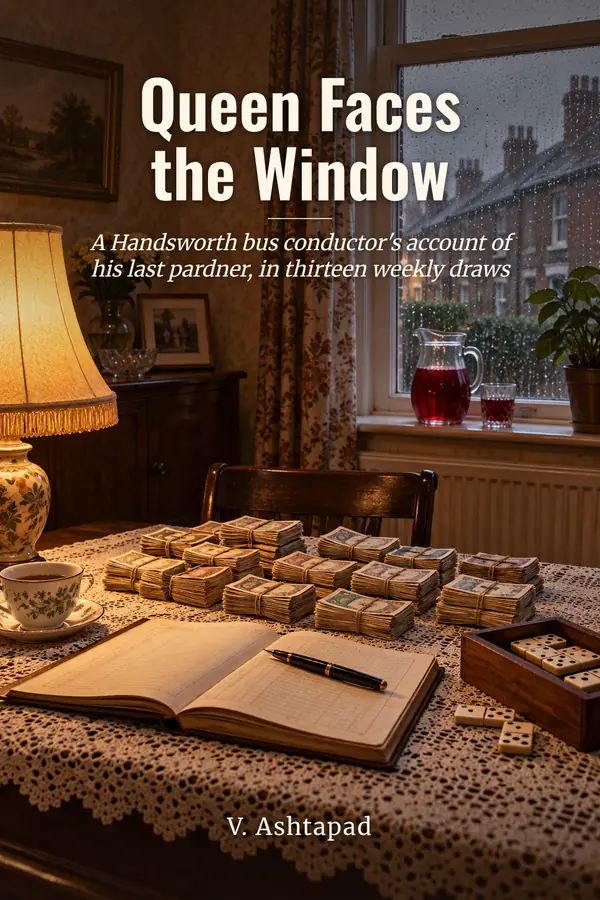
Queen Faces the Window
A Handsworth bus conductor's account of his last pardner, in thirteen weekly draws
by V. Ashtapad
Foreword
This is a novel. Linton Gayle, his family, the members of his pardner hand and the districts of Tamarind Rock and Cassia Hill are invented. Handsworth, Lozells, Hockley, the Soho Road, Frankfield, Chapelton, Spanish Town and the other real places named here are used fictionally, and no real shop, school, office or person is described.
A pardner (partner) hand is a rotating savings circle brought to Britain by Caribbean migrants: each member throws an equal sum every week, and each week one member draws the whole pot, until everyone has drawn once. The patois in the dialogue is kept light and is written as the characters speak it; musicians named in passing are real, and no lyrics are quoted.
For everyone who ever walked a draw home inside their coat.
Mother Ena
*Week one of thirteen. Hands: thirteen at forty pounds. Draw: Mother Ena Spence. Five hundred and twenty pounds.*
**Sunday 22 September 2019**
I am starting this account because my right hand has begun to argue with me. It writes the figures, but the sevens come out leaning like men at a bus stop in a wind, and last week Fitzroy Ricketts looked at the book and asked if that was a one or a seven. Nobody has asked me that in forty-eight years. So this is the last pardner I bank. Thirteen hands, thirteen weeks, done by Christmas. After that the red book goes to somebody younger, and I go back to being what I was before 1971, a man who throws his money in on a Friday and keeps his mouth shut.
My name is Linton Ossie Gayle. I was born in the district of Tamarind Rock, up past Frankfield in Upper Clarendon, in the year 1934. I came to Birmingham in November 1956 and I was a conductor on the Corporation buses from the spring of 1957 until 1986, when the conductors were being taken off one route after another and they moved me into the garage office at Hockley, where I was a clerk until my legs retired me in 1994. Twenty-nine years on the buses, most of them on the back platform. I can still tell you every fare stage on the 74 from the city to Dudley, and I can tell you who used to get on at each one, and which of them paid and which of them looked out of the window and hoped.
Merline says I should not write too much about buses because nobody wants to read about buses. Merline has been my wife for sixty-one years and she is mostly right about what people want. But a man must write about what he knows, and what I know is buses and money and this one patch of Handsworth between the Soho Road and the park.
This afternoon she made the Sunday pot. Kidney beans soaked from last night, coconut milk, a whole Scotch bonnet sitting on top like a little lantern that nobody is allowed to burst, thyme, scallion, the pimento grains. The house smelled of it from one o'clock. I sat at the kitchen table with the new page ruled and wrote the thirteen names down the left side in the order of the draw, the way Mother Ena taught me: need first, then whoever asked first, and the banker last.
**Monday 23 September**
Went round to collect the first throws. In the old days it was all cash in a brown envelope and you walked it to my door on a Friday night. Now half of them still do that and half of them put it in the bank and show me the paper. I write both the same way. A hand is a hand.
Mother Ena is ninety-three. She lives in the sheltered flats on Rookery Road, third floor, with a window that looks over the roofs to the tower of the old library. She has a radiator turned up so high in there that the African violets on her sill grow like weeds. When I came in she was sitting very straight in her good chair with her forty pounds already folded inside a little purse made of crochet, red and yellow and green, that her niece sent from Mandeville.
"Linton," she said. "Yuh hand a shake."
"Is not shaking. Is the cold."
"Cold? Inna dis room?" She laughed at me. She has three teeth on the bottom and she does not care who sees them.
She was the first banker I ever paid into. September 1957, in a back room on Villa Road where six of us young men slept in two beds by shifts, one lot coming in off nights as the other lot went out. I had been in England ten months. I earned seven pound and some shillings a week on the buses and sent two pound home. A woman knocked on the door one Thursday evening with her hair tied in a white cloth and a coat buttoned to her chin, and she said she was starting a hand, one pound a week, twelve people, and did we want in. That was Ena Spence, aged thirty-one, already the most frightening person in Handsworth.
"Mi did see unnu," she said to me today, as if it were last week. "Six bwoy in one room an' not one a dem know fi buy paraffin before the shop shut."
That is true. Our first winter we did not know that the paraffin man came on a Tuesday and the shop on the corner closed at five on Saturday. We learned by sitting in our coats with the frost growing up the inside of the window in ferns. I had never seen frost before that November. I put my finger on it the first morning and it burned like a pepper, and it left a round clear hole in the pattern that I could look through at the gray street. The gray. Nobody tells you about the gray. In Tamarind Rock even the shade has color in it. In Birmingham in 1956 the sky came down and sat on the chimney pots and stayed there.
**Tuesday 24 September**
Kezia telephoned from Leicester. She is my daughter Beverley's girl, twenty-four, and she works in a university office doing something with student records that she has explained to me four times. Since the summer she has been building the family on the computer, a private place that only the people she sends for can get into. She does it a branch at a time, so it does not overwhelm anybody. First it was just Merline and me and our two, Trevor and Beverley. Then she put in my mother and father, Adassa and Ossie, and my brother Vernal who stayed in Clarendon, and Vernal's daughter Petal. Now she is up to my grandmother on my mother's side, and that is where she gets stuck, because I only ever knew her as Granny Puss and nobody remembers what name was on her paper.
"Grandad, I'm putting Mother Ena in," Kezia said. "Not as family. As a friend of the family. There's a way to do that."
"She will like that. She will tell you she is more family than half of the family."
"I want to give her a login. But just to look. I don't want her clicking something and deleting Granny Puss."
So Mother Ena is to be a looker and not a toucher. I told Kezia that is exactly how Ena ran the pardner too. You could look at the book any time you liked. You could not touch the pen.
**Wednesday 25 September**
Cold morning, first real one. The kind that lays a white breath over the back lawn and makes the dustbins ring when you knock against them. I stood at the back door with my tea and watched the blackbird on the fence doing his business with the frost, and I thought about the river.
The Rio Minho comes down out of the hills below Frankfield. When I was a boy it was green in the dry months and brown and loud in October, when the rains came and the river rose up overnight and took the stepping stones. My mother washed clothes on the flat rocks below our district, and I sat on a higher rock with my feet in the water, and the water was the temperature of a person. Bamboo along both banks, so tall it leaned together overhead and made a green tunnel, and when the wind went through it the bamboo knocked and creaked like a ship. Up the hill behind, our yard: one board house on stones, a cocoa walk, a breadfruit tree, a big old mango that we called Bully because it dropped fruit on your head. Red dirt in the track. Pimento drying on a barbecue of concrete in the sun, and the smell of it, hot and sweet and like cloves, coming down to the river on the afternoon breeze.
That is what I am trying to tell the young ones when I say I was cold. It is not only the cold. It is that you have come from a place where the river is the temperature of a person to a place where the frost grows on the inside of your window and the sky is the color of a dishcloth.
**Thursday 26 September**
Merline did two heads in the kitchen today. She is eighty-two and she still does hair for four or five old friends who will not go to the young girls on the Soho Road. She keeps the pressing comb on the back ring of the cooker and the smell of hot oil and singed edges fills the house in a way I have known since 1958. Sonia Duhaney's mother was in the chair this afternoon with a towel round her neck, and Ena's niece after her. They talked about a wedding in Kingston and a funeral in Wolverhampton and whether the price of yam at Audley's had gone up again. I stayed in the front room with the racing on and the door open a crack so I could hear.
That kitchen is where half the pardners of this street were planned. Somebody in the chair says, I need a deposit by spring, and somebody waiting on the stool says, then you should be in Linton's hand, and Merline says nothing, only turns the head a little to the left, and by Friday I have a new name.
**Friday 27 September. Draw.**
All thirteen thrown by seven o'clock. I counted it twice on the kitchen table under the lamp, the old way, notes facing one direction, the Queen all looking at the window. Five hundred and twenty pounds. In 1957 Mother Ena's whole hand drew twelve pounds and a man could put that down on a room.
I walked it to Rookery Road in the dark with the envelope inside my coat against my chest. Trevor wanted to drive me but I said no. There are some things a banker walks. The street was full of that autumn smell they have here, wet leaves and somebody's coal fire, though it is all gas now, and curry from the takeaway on the corner, and the bus going by lit up inside like a front room with nobody in it.
Ena counted it herself. Her fingers are slow but they do not make mistakes. When she was done she put it back in the envelope and laid both hands flat on top of it.
"Yuh know what mi a do wid it?" she said.
I did not. Usually the first draw goes on something sensible. A boiler. A bill.
"The school roof. Cassia Hill All Age. Where mi did go when mi was a likkle gal." She told me the zinc has rusted through over the infant class and the rain comes in on the children's heads. Her niece in Mandeville found a man who will do it before the October rains are finished. Five hundred and twenty pounds, she said, will buy the zinc and the nails and pay the man, and something left for paint.
"Cassia Hill," I said. "Is near the river?"
"Two mile from your mother yard, if yuh walk the short way."
I had not known that. Sixty-two years I have known this woman and I never once asked her which district she came from. We all talked about home as one big place. Jamaica, or the country, or back a yard. Not which hill.
When I got home I told Kezia on the telephone. She made me spell Cassia Hill for her twice, and then she said, "Two miles, Grandad. You could have walked to her school and back before your dinner."
In the book I wrote, *Drawn: E. Spence. £520. School roof, Cassia Hill.* I do not normally write what the money is for. That is nobody's business. But my hand did it before I could stop it, and the sevens came out straight for once.
Shernette
*Week two of thirteen. Draw: Shernette Hylton. Five hundred and twenty pounds.*
**Saturday 28 September**
Shernette Hylton is thirty-one and she drives the 74. She is the youngest in this hand and the only one who pays me by holding up her telephone with the bank paper on it, and she laughs at me every time because I still lean in close and read the numbers out loud. Her grandmother was Miss Beryl Hylton who sold ice in a bucket outside the picture house at Villa Cross in the summer of 1959, and her mother is Joy, who was in Beverley's class at the junior school by the park and came to our kitchen every Saturday to have her plaits done for nothing. So Shernette is not family, but she is that other thing, the thing Kezia's computer has a special box for.
She came by the house this morning on her way to an early shift with her lanyard swinging and her hair scraped back under a little cap against the wind. She had a patty from Icilda's in one hand, still in its paper.
"Mr. Gayle. I'm going to ask you something and you're going to say no first. Then you're going to think about it."
"Ask."
"When you finish this one. I want to take the book."
I said no. She was right about that. Then she ate the patty in four bites standing on my step, the yellow crumbs falling on her uniform jacket, and went off to the garage, and I have been thinking about it all day.
**Sunday 29 September**
Merline says yes.
I said, she is young. Merline said, you were thirty-seven when Ena gave it to you and everybody said you were young. I said, she drives a bus. Merline looked at me as if I had said something about the weather in Leeds. You conducted a bus for twenty-nine years, she said. A bus is the most honest place in England. Everybody on it is going somewhere and paying to get there.
The Sunday pot again. Merline does not change it. Rice and peas, a little brown stew chicken with the gravy dark from burnt sugar, fried plantain, and a slice of hard dough bread on the side for the gravy, which is not proper, but I have done it since 1960 and I will not stop for anybody. After dinner I fell asleep in the chair with the window open a crack and the smell of leaves and bonfires coming in from the allotments behind the park.
**Monday 30 September**
When I started on the buses in the spring of 1957, the driver they gave me was a man named Stan Harrold, from Smethwick, who had driven a tank in the war and did not talk about it. He was the size of a wardrobe and he wore his cap on the back of his head. The first morning he looked at me on the platform, up and down, and said, "You know the stages?"
I said I had learned them off the board.
"Learn them off the street," he said, and that was all he said until dinner.
The buses then were cream and dark blue, with the platform at the back open to the weather and a pole to hold and a cord along the ceiling for the bell. I wore the ticket rack on a strap across my chest and the cash bag on the other side, and the punch hung from my neck, and by the end of a shift my fingers were black with the copper and silver of the whole of Birmingham. In winter there was nothing between you and the wind on that platform. It came off the canal at Hockley and went right up your sleeve. I wore two vests and a pullover under my uniform, and Merline, when she came, knitted me a scarf in the Corporation colors so I would not get told off for wearing something bright.
People got on and some of them looked at me. I will say it plainly, because it happened and I am not going to make a big thing of it or a small thing either. There was a lady who would not put her fare in my hand. She put the coins on the seat and waited for me to pick them up, every day for a month, on the 7:40 from Hamstead. There was a man who called me a name at the Villa Cross stop and told me to go back where I came from, and I said, "Fares please," because that was my job, and he paid. Some of the drivers would not be crewed with us. Stan was crewed with me for nineteen years. He never said anything about any of it. But one day when the lady put her coins on the seat, Stan came round from the cab at the terminus and sat on that exact seat with his tea, and she had to stand all the way to town.
That is all. That is all I am going to say about it. I have more to say about the stages.
**Tuesday 1 October**
Rode Shernette's bus into town. I went upstairs at the front, which at eighty-five is a mountain climb, but a man has to sit at the front of the top deck at least once a year to remember what the city looks like from above.
The buses are another color now, and the doors are at the front, and nobody rides the back platform because there is no back platform. You show your pass to a little glass window and it beeps. The driver does everything, takes the money, watches the mirrors, opens the doors. I watched Shernette's arm in the round mirror, steady on the wheel, and her eyes going from side to side, and I thought, she is doing two jobs, mine and Stan's, and she does them better.
From the top deck down the Soho Road you see the things you cannot see at the curb. The old names painted high up on the brick above the new signs. The roof garden somebody has made over the sari shop. The pigeons asleep along the gutter of the old bank. And the stretch past the Villa Cross where the picture house used to be, where Miss Beryl sold her ice, and the doorway that used to lead down to the first cellar where Sir Cecil played his sound on a Saturday night, before he moved to Heathfield Road. I tried to point it out to the young man beside me but he had wires in his ears.
At the city end Shernette came out of the cab while the bus was standing and climbed up to the top deck to see me.
"You alright up here, Mr. Gayle? You look like you're flying it."
"I am remembering the stages."
"Say them."
So I said them, from Colmore Row out, every stage on the 74 as it was in 1957, and she sat on the seat across the aisle and listened with her chin on her hand. When I got to Dudley she said, "That's not the stages now."
"No."
"I'm going to write them down. The old ones." And she did, on the back of her duty card, with a pen from my pocket.
**Wednesday 2 October**
Kezia has put the old 74 on the map. She found an old Corporation route chart on some enthusiasts' page and she has laid the stages along the road as pins, and on each one I am to tell her something. A thing that happened. A person who got on there. She wants it all typed underneath.
I said this was a lot of work for a bus.
"Grandad, it's not for a bus. It's where you were for twenty-nine years. It's like your district."
I suppose it is. I knew the fare stages better than I ever knew the lanes around Tamarind Rock, because I left the lanes at twenty-two. I told her about the Hockley Flyover being built and the dust of it coming in on the platform. I told her about the boy at Soho Road who got on every morning with a trumpet in a case and practiced scales on the top deck until the passengers complained, and how Stan said leave him, and then two years later we heard the boy on the wireless in a dance band. She typed it all and read it back to me in her office voice.
**Thursday 3 October**
Hard frost again. The first week of October and the windscreens on the street white over. I went out to the gate to watch Trevor scrape his van and his breath went up in a cloud and hung there with the steam off his coffee. Trevor is sixty this year. He has my father's shoulders and Merline's way of looking at you sideways when he thinks you are wrong.
He asked me about the book. Everybody knows, now, that it is going.
"Give it to Shernette," he said.
"Why you say that?"
"Because she's the only one of them who'll still be here in thirty years."
He did not say it to be hard. He is an electrician. He says the thing about the wire, not the thing about the house.
After he drove off I stood at the gate a while longer. The milk float came down the hill humming to itself, the only one left on this side of the park, and the milkman lifted two fingers off the wheel at me the way Stan used to lift two fingers at the other crews when we passed them going the opposite way. A small salute between people doing the same work. Every route in Birmingham had it. You could go a whole shift without a word to another crew and still feel that you belonged to something, because twenty times a day somebody in a cab lifted two fingers and you lifted two back from the platform. I lifted mine to the milkman. He will not know what it meant to me, and that is alright.
**Friday 4 October. Draw.**
All thrown. Shernette came after her shift, still in the jacket, smelling of the diesel and the cold and the hand gel they all carry now. I counted it out on the kitchen table and she watched every note.
"You count the same way every time," she said.
"Queen faces the window. All of them."
"Why?"
I did not know. Ena did it. I asked her once and she said, so yuh can see if one a dem turn him back pon yuh.
Shernette is putting her draw toward the deposit on a flat in Perry Barr, near the stadium, with a little balcony that looks east. She has been saving four years. This pardner is the last bit. She showed me a picture of the balcony on her telephone with the sun coming over the rooftops.
Then, before she went, she put her hand flat on the red book on the table, not on the money, and kept it there a minute. She did not say anything. She looked at the old columns going back to 1971, all the names, half of them gone now. Then she took her hand off and went home.
I wrote, *Drawn: S. Hylton. £520.* Nothing about the flat. I am getting my discipline back.
Icilda
*Week three of thirteen. Draw: Icilda Rowe. Five hundred and twenty pounds.*
**Saturday 5 October**
Icilda Rowe has made patties in the front room of her house on Westminster Road since the winter of 1962. Not in a shop. In her front room, with a hatch cut through the wall to the kitchen and a window onto the street where she slides the glass up and passes them out in white paper bags. The council has come to see her four times in fifty-seven years. Each time the inspector has gone away with a patty in his hand and a certificate on her wall. There are four certificates in a row above the hatch, in frames, going from yellow to white.
She is seventy-nine and comes from Black River, in St Elizabeth, on the south coast where the river runs out dark into the sea and the crocodiles lie on the mud banks like logs that have decided to stay. She tells you the river there is the color of strong tea and it smells of the morass, of salt and rot and sweet water lilies, and at night the fireflies, which she calls peeny-wallies, come down to the river in such numbers that the mangroves look like a town with all its lights on.
Her oven has died. It is the third one she has worn out. That is what her draw is for.
**Sunday 6 October**
This morning I went to Icilda's to help her move the old oven out to the front so the council can take it. It took Delroy Gooden and Trevor and Icilda's grandson Dwayne and me, and I did not lift anything, only directed, which Icilda said was the only thing a bus conductor was ever good for.
While the men sweated with it I stood in her kitchen and looked at her board. It is a big square of pale wood, scrubbed so many times it has gone soft in the middle and dipped like a step that a thousand people have climbed. There was flour in the grain of it. On the wall by the board, held up with a drawing pin, is the recipe. She does not need it. She has not needed it since 1963. But it is there, on a piece of lined paper gone the color of a cracker, in her mother's handwriting, in pencil, with a brown thumbprint in one corner from some long-ago turmeric.
Kezia had asked me to ask Icilda if she would let us photograph it. There is a shelf in the family place on the computer for recipes, with a picture of the paper the recipe was first written on and then the recipe typed out clean underneath, so that the grandchildren can read it but also see the hand. Kezia has put Merline's rice and peas there and my mother's toto, which is a coconut cake that I describe and Merline makes and Kezia types.
Icilda said, "Fi what?"
I said, "For the young ones."
She looked at me a long time. Then she took the drawing pin out of the wall and held the paper up to the window for me with both hands, very still, the light coming through it so that you could see every pencil mark and every grease spot. I took the picture with Trevor's telephone. My hand shook and the first one was blurred, so I did it again.
"Is not di whole recipe," she said, pinning it back up. "Mi mother never write down di pastry. Pastry you learn wid yuh hand."
**Monday 7 October**
What is in the pastry I am not allowed to write here. Icilda told me while we were drinking ginger beer in her front room with the empty space where the oven was, and she said, "Yuh can tell Kezia, but don't put it inna no book," and this is a book, so I will not.
I will write what I know from fifty-seven years of eating. The crust is yellow from the turmeric and the curry and it flakes when you bite so that you must lean forward over the paper or wear it down your coat. It is not like a pasty. The pasty is gray-gold and heavy and you could stop a door with it. A Jamaican patty from Icilda's window is light as a dry leaf on the outside and inside it is beef, minced fine, cooked down with onion and thyme and scallion and black pepper and the heat of a Scotch bonnet, and something in it that tastes like the bottom of a pot in the country, smoky, and soft breadcrumbs to hold it together. When she makes them in the morning the whole of Westminster Road smells of it, and the schoolchildren go past with their noses up like dogs.
In 1962 there was no Scotch bonnet in Birmingham. Not one. Icilda made her first patties with dried chili from a shop in Sparkbrook run by a man from Mirpur, and curry powder from the same shop, and she said they were wrong but they were close, and the men in the lodging houses lined up anyway because close was the nearest thing to home that you could buy for a shilling. When the first box of Scotch bonnets came in on a ship to Liverpool, in 1964, I think, Audley's father drove up in his van and brought back a crate, and Icilda put the price of her patties up by a penny, and nobody complained.
**Tuesday 8 October**
I have been trying to remember the first patty I had in England, and I cannot. I remember the first one I bought from Icilda's window. Snow on the ground, February 1963, the big freeze when the canals went solid and boys walked on them, and the buses ran slow on the hills with chains on the back wheels. I was on a split shift and I walked home in the middle, and there was a light in her front window and steam on the inside of the glass. I knocked. She slid it up and a cloud of hot air came out that smelled of curry and pastry and the paraffin heater in the corner, and she put the patty in my hand in a paper bag and I held it under my chin to warm my face before I ate it.
That year Icilda was twenty-three and newly married to Clement Rowe from Santa Cruz, who worked at the Lucas works and played dominoes like a man settling a debt. Clement is gone fourteen years now. Icilda keeps his domino set on top of the television in the box he made for it out of a mango-wood drawer from home.
**Wednesday 9 October**
Kezia called to say the picture of the recipe came through and she has put it on the shelf. She typed out what was on the paper, and where she could not read the pencil of Icilda's mother she put a little gap with a question mark. She read me the bits she could not get. One word I knew at once. It was *pimento*, which the English call allspice. One word I did not know. It looked like *chuck-chuck*.
I telephoned Icilda and asked her.
"Chuck-chuck? A nuh chuck-chuck. Is *chocho*. Mi mother put chocho inna di beef when meat was dear. Fi stretch it."
So Kezia's children, when she has them, will know that in Black River in the 1940s, when beef was dear, a woman stretched her patties with grated chocho, which is a pale green pear-shaped vegetable with a prickly skin, which in England in 1962 you could not get at any price. Icilda did not put it in her Birmingham patties for forty years. Then Audley started stocking it in 2003 and she tried it once for old times' sake and said it tasted like being nine.
**Thursday 10 October**
The new oven came. A big steel one with two doors and a fan, delivered by two young white men from Halesowen who called her Mrs. Rowe and carried it up her step as if it were a coffin. She stood in the passage with her arms folded and watched every inch. When it was in and connected she put her hand on the top of it the way you put your hand on the neck of a horse.
"Tomorrow," she said. "Not today. Today it fi settle."
While it settled I sat in her front room, which is the shop and the parlor at once. There is a glass cabinet with her good plates in it that have never been eaten off, and a crocheted cover on the back of every chair, white with a pineapple pattern, starched so stiff they crackle when you lean back. A calendar from a Jamaican travel agent in Lozells, three years out of date, kept for the picture of Treasure Beach. A wooden parrot on a swing. The radio on the windowsill tuned to the station that plays oldies after six. And on the floor by the hatch, worn into the carpet, a pale path in the shape of a woman going from the oven to the window and back, fifty-seven years of it, the pile pressed flat as felt.
"Yuh know how many patty pass through dat window?" she asked me.
I said I could not guess.
"Me neither," she said. "Clement used to count. Him stop at a hundred thousand inna 1979 and seh it nuh mek sense fi count no more."
**Friday 11 October. Draw.**
The draw is her money but the oven has already come, so the draw is a formality. That is the beauty of a hand. Everybody knew she would get her week. The shop in Halesowen let her have it on the strength of a letter from me as banker saying the money would come on Friday the eleventh, and they believed the letter, because Dwayne works there and told them what a pardner is.
At five o'clock I went round with the envelope. The window was open on the street and there was a line. Eleven people, in the dark and the cold, with their breath going up. Schoolboys in blazers, two nurses from the City Hospital in their navy coats, a man in a suit with a briefcase who I later found out was the head of planning for the district, and Sonia Duhaney with a carrier bag for the dinner ladies. Icilda had baked the first tray in the new oven. Twenty-four patties. They went in six minutes.
She gave me mine through the hatch, not the window, because the banker does not wait in the line. I held it under my chin the way I did in 1963 and the steam went up into my face.
She counted the draw on her board, in the flour.
I wrote, *Drawn: I. Rowe. £520.* Then I sat on her front step in the cold with crumbs all down my coat while the line went on growing in the streetlight.
Sir Cecil
*Week four of thirteen. Draw: Cecil Brissett. Five hundred and twenty pounds.*
**Saturday 12 October**
Cecil Brissett has been called Sir Cecil since 1961 and he has never been knighted by anybody. In Kingston in those days the men with the big sounds called themselves Duke and King and Sir, and when Cecil built his first set in a cellar on Heathfield Road with two speaker boxes the size of wardrobes, he painted SIR CECIL THE MONARCH on the front of both in white letters with a crown over the C, and that was that. He was twenty-six. He is eighty-four now and he still stands as if somebody is about to ask him to step aside and he has decided not to.
He came round this morning to throw his hand with his flat cap on and a scarf in purple and gold wrapped three times round his neck. He sat in my front room and did not take his coat off.
"Linton," he said. "Mi box dem need new cone."
I knew what he meant. The two wardrobes, the original two, are in his garage on Hamstead Road. They have been there since 1983 under a tarpaulin with a dehumidifier going. Twice a year he takes the tarpaulin off and plays one record through them, very low, so the cones do not tear. In August, he said, one cone tore anyway. Like paper. A sound like somebody clearing his throat and then nothing.
"So that is the draw," I said.
"That is the draw."
**Sunday 13 October**
I want to put down the dances, because Kezia keeps asking and because there will soon be nobody left who stood in those cellars.
You came down steps from the street. The door at the top was just a house door, number something, with a bulb over it. You paid a shilling to a man on a stool. Then you went down into a heat like the inside of a mouth. A red bulb in the ceiling, sometimes blue. The walls sweating. The floor was concrete and by midnight it was slippery. And at the far end the two boxes, Cecil's wardrobes, with the cloth over the front of them shivering with the bass, and between them a table with a turntable and the amplifier, which was all valves in those days, and the valves glowed orange in the dark like a row of little coal fires. Cecil stood behind the table in a white shirt with the sleeves rolled up and a cigarette he never smoked, and he took the records out of their brown sleeves as if they were letters from home.
They were letters from home, in a way. Nobody could buy those records in Birmingham. They came over in suitcases. A man going to Kingston for his mother's funeral would come back with twelve records wrapped in his shirts, and Cecil would pay him whatever he asked, and the next Saturday the cellar would hear a tune that had only been played in Jamaica the month before. Prince Buster. The Skatalites. Derrick Morgan. Cecil would scratch the label off so the other sounds could not find out what it was.
The music then was ska. Fast, with the guitar on the off beat chopping like somebody splitting wood, and the horns going over the top. You danced on your toes with your elbows up. By two in the morning everybody's shirt was stuck to them and the steam came off the people going up the steps into the cold like smoke off a horse. That was the best thing. Coming up out of that cellar at three in the morning in January, soaked, into a frost so hard the street rang under your shoes, and walking home three or four together, still singing the horn line, with the stars out over the railway for once, sharp and white.
**Monday 14 October**
Trevor came for dinner and I asked him what he remembers.
He was born in 1959. He remembers being six or seven and sleeping on top of one of Cecil's boxes at a birthday party in a house on Wills Street, because there was nowhere else to put him. He says he can still feel the bass going up through his back. He says that is why he became an electrician. Merline says it is why he was deaf in one ear by fourteen.
He remembers the change. Around 1966 or 1967 the music slowed down. Rocksteady. The bass came forward and the beat got heavier and slower and the singers sang sweeter, love songs mostly, Alton Ellis and them, and the couples at the dances began to hold on to each other instead of jumping. Trevor was eight and he noticed that the grown-ups stopped laughing at the dances and started closing their eyes.
"It was like they'd stopped trying to get warm," he said, "and started trying to remember something."
I have been thinking about that all day. He is right. The first ten years we danced to keep warm and the second ten years we danced to remember.
Trevor ran his own sound in the 1970s. TAMARIND HI-FI, after my district. He built the boxes in our back garden with Delroy Gooden's father and the whole street knew every time they tested a bass bin because the windows hummed. Merline put up with it for eleven years. Then he married and stopped and became sensible. The boxes went to a youth club in Lozells.
I went to one of Trevor's dances once, in 1976, in a school hall in Handsworth Wood. I stood at the back in my good overcoat and felt like a policeman. The music had changed again. It was heavier and slower than anything Cecil played, with the bass so deep it was more like weather than music, and the young men stood very still in the dark nodding with their arms folded, and the young women danced on their own in small steps. There was a boy on the microphone talking over the record in a fast voice, half singing. Trevor stood behind the turntables with his headphones on one ear, exactly the way Cecil used to stand, and I saw for the first time that he had been watching Cecil all those years from on top of that box, learning, the way I learned the stages off the street.
**Tuesday 15 October**
Kezia came up from Leicester on the train for the day to record Sir Cecil. She has started doing this with the old ones, one at a time, with a little recorder like a bar of soap. Then she types out every word that was said and puts the typing under the sound, so that you can read along while you listen, or read it if you are hard of hearing, or play it if your eyes are going. She did Mother Ena in the summer. She is not making a big thing of it. She sits with them for an hour and asks about their mothers.
We went to Cecil's garage. He had a paraffin heater going and the smell of it took me straight back to 1956, that sweet thick smell, the blue flame behind the little window. He took the tarpaulin off the wardrobes. SIR CECIL THE MONARCH, the white paint cracked like a dry riverbed, the crown over the C half gone.
Kezia sat on an upturned crate with the recorder on her knee. Cecil talked for an hour and twenty minutes. He told her about the night in 1964 when another sound came from Wolverhampton to clash with him and he played them off the floor with one tune nobody had heard, and the Wolverhampton man came round the back afterward and offered him five pound for the name of it and Cecil said no. He told her about his mother in Linstead who sold cane juice at the market and sang while she pressed it. He told her about the police coming down the steps in 1969 because a neighbor had complained about the noise, and how the policeman stood in the doorway, and the record playing was a slow one, and he stayed to the end of it before he asked them to turn it down.
He would not tell her the name of the tune from 1964. Not even now.
When she typed it up that night she sent me the page. Where Cecil said a word in patois she wrote it the way he said it and put the English beside it in brackets. Where he hummed, she wrote *[hums the horn line]*. Where he stopped talking for a long time, she wrote *[pause]*. There are a lot of pauses near the end.
**Wednesday 16 October**
Fog this morning. Real fog, the first of the year, the kind that makes the streetlights into dandelions. Not like the old ones. In the old days the fog was yellow and it tasted of coal and you could not see the bus in front of you. Stan and I once drove the 74 from Hockley to West Bromwich at walking pace with me on foot in front of the radiator holding a lamp, because he could not see the curb. That was December 1957. The passengers clapped when we got to the garage.
Today's fog was white and clean and by eleven it was gone.
**Thursday 17 October**
Cecil found the man for the cones. A young fellow in Digbeth who repairs old speakers for the people who collect them, the ones who pay money for old things now that nobody wanted thirty years ago. The young man came to the garage and stood in front of the wardrobes and said, "Oh," in a small voice, and Cecil liked him at once.
**Friday 18 October. Draw.**
I took the money round. Cecil counted it on top of the amplifier, which is the size of a suitcase and made of steel painted green, with the valves in a row behind a grille.
Then he did a thing I have not seen him do in twenty years. He put the tarpaulin all the way back, plugged the amplifier in, and waited for the valves to warm. It took about a minute. They came up orange in the dark of the garage one by one. He took a record out of a brown sleeve. Not the secret one. A rocksteady tune from 1967, a man singing about a girl who has gone back to the country. He played it through the one good box at the lowest volume you can imagine, so low it was almost only the bass, and the bass came up through the concrete floor of the garage and into my shoes and up my legs.
Neither of us said anything. Trevor was standing in the door with his hands in his pockets, and his eyes were closed.
I wrote, *Drawn: C. Brissett. £520.* In the margin I wrote, very small, *new cones*, and then I crossed it out, because I am a banker and not a newspaper.
Barrington
*Week five of thirteen. Draw: Barrington Lindo. Five hundred and twenty pounds.*
**Saturday 19 October**
Barrington Lindo came to England in a pair of short trousers. That is the first thing he ever told me about himself, in 1971, when he was nineteen and came to throw his first hand in my first year as banker. He arrived on the eighth of January 1962, aged ten, sent for by his mother and father who had come four years before and left him with his grandmother in Spanish Town. He got off the train at Snow Hill in the clothes his grandmother had dressed him in for the plane: short gray trousers, white knee socks, a white shirt, a little bow tie, and a jacket of thin blue cotton. There was snow on the platform. He says he looked at it and thought somebody had spilled sugar.
He worked forty-one years at a foundry in Smethwick, on the casting floor, and his forearms are covered in little white spots like grains of rice where the sparks found him. He is sixty-seven, broad, slow-spoken, and he laughs from his stomach.
His sister Clarice in Spanish Town will be seventy on the second of December. He has not been home since 1985. His draw is for the ticket.
**Sunday 20 October**
After dinner I tried to remember my own arrival properly, for Kezia, who wants it for the first branch of the tree, under my name.
I came on a ship. The *Irpinia*, an Italian ship, from Kingston to Southampton, more than two weeks at sea, with stops on the way that I have mixed up in my head since, in October and November 1956. My mother sold two goats and a cow and the pimento crop to pay my passage, and my father walked me down to the Frankfield road at four in the morning to catch the truck to May Pen, and from May Pen the train to Kingston. He shook my hand at the truck. He did not hug me. He said, "Write yuh madda," and turned round and walked back up the hill in the dark, and I watched his white shirt going up between the bamboo until I could not see it.
I wore my one suit. Light brown, a tropical cloth, which my uncle in May Pen had a tailor make up for me with a double vent at the back and trousers with a turn-up. A felt hat with a narrow brim and a little feather in the band. Shoes in two colors, brown and cream, that pinched. I thought I looked like a man from the pictures. On the boat the young men walked up and down the deck in their suits in the sun and looked at each other.
When we came into Southampton it was the twelfth of November and it was gray and there was a wind off the water that went straight through the tropical cloth as if it were not there. I remember my teeth. I could not stop them. I held my jaw with my hand on the train to London so that the man opposite would not hear them knocking.
**Monday 21 October**
Petal sent photographs. Petal is my brother Vernal's daughter, fifty, a teacher at the secondary school in Frankfield. Vernal died in 2008 and Petal lives in the house he built in 1972 on the same piece of land as our old board house, which is still standing, just about, with the breadfruit tree leaning on it like an old man on a stick.
Kezia set it up so that Petal can put pictures straight into the family place and we see them here the same day. Petal does not write much. She just goes outside in the morning before school and takes a picture of whatever is happening.
Today it was the river. The October rains have come, and the Rio Minho is up and brown and wide, roaring over the place where the stepping stones were. You could see the foam on it. The bamboo on the far side was bent right down with the weight of the wet. And on the near side, on the flat rock where my mother washed, there was a goat standing with its feet together, looking at the water, quite calm, as if it had come to see what all the noise was.
I looked at that goat for a long time. It may be the great-great-great-grandchild of one of my mother's goats. You cannot say it is not.
Then Petal sent a second one, of the old house. The zinc roof has gone the color of an old penny. The door is shut with a piece of wire. In front, in the red dirt, somebody has planted a row of scallion and thyme.
**Tuesday 22 October**
Barrington came to sit with me in the afternoon. He has just retired and he does not know what to do with the afternoons. We sat in the front room with the gas fire on and the curtains half closed against the low sun, which in October in Birmingham comes in sideways at three o'clock like a torch shone under a door.
I asked him about the cold when he came.
He said the cold was not the thing. The thing was the shoes. His grandmother had bought him patent leather shoes for the journey and they had leather soles, and the first week of school in Handsworth there was ice on the pavements and he fell eleven times between home and the gate. He counted. The other boys laughed. One boy, a white boy named Keith whose father was a milkman, did not laugh, and the next day brought him an old pair of his brother's boots with rubber soles in a carrier bag, and said, "Mum says you can have these," and walked off.
"Keith Palfrey," Barrington said. "Him dead now. Him was at the foundry wid me thirty year."
He told me his mother cooked in the evening on a single gas ring in the corner of their room on Church Hill Road, and that the gas ran from a meter that took shillings, and that the worst thing in the world, worse than the cold, was the sound of the gas ring going *pop* and dying in the middle of the dumplings when the shilling ran out and there was not another one in the house.
I knew that sound. Everybody knew that sound. Six men in a room on Villa Road and one ring, and the meter on the wall under the window eating our shillings like a goat eats cardboard. We kept a jam jar of shillings on the mantelpiece and every man put one in on payday, and if a man took one without putting one back the others would know by Sunday. That jam jar was the first pardner I ever saw, I suppose, though nobody called it that.
**Wednesday 23 October**
Kezia sent me a question about my first coat. She is putting little notes on the photographs on the family tree and there is one of me from 1957 standing outside the bus garage in a long dark coat with my uniform cap under my arm.
That coat. I bought it in December 1956, with my second week's wages from a builder's yard in Nechells where I carried bricks that first winter, from a tailor's shop near the old Bull Ring, a navy wool overcoat so heavy it was like wearing a blanket, with a half belt at the back and big horn buttons. Three pounds ten. It took me two months to finish paying. I wore it for nineteen winters until Merline cut it up to make a lining for Trevor's sleeping bag on a school trip.
The suit from May Pen I never wore again after the first January. It hung in the wardrobe in the cold room and got a smell of damp and paraffin, and I could not stand to throw it out, so in the end I folded it into the trunk of a man from Chapelton who was going home for good, with a letter and a pound note pinned inside the breast pocket, and Vernal wore it to his wedding in 1961. It is in his wedding picture, which Petal has also put up. My suit. My brother's shoulders inside it. A Clarendon sun on it at last.
**Thursday 24 October**
Barrington came round again with a bag of oranges and a question. He wanted to know what to take home.
Everybody who goes home takes something. In the old days a man going home carried half the street with him: a letter and a ten-shilling note for this one's mother, a pair of shoes for that one's boy, a wristwatch to be handed to somebody's brother at May Pen market. Now you can buy everything in Kingston. But you still take something.
I said take a good English coat. Clarice will laugh at you. But in January in a Spanish Town yard at four in the morning it will be the warmest thing in the house, and she will think of you.
He said, "Mi was going to take a picture of mi mother an' father."
I said, then take both.
He peeled an orange while we talked, in one long spiral the way the old men did at home, with his thumbnail, and the smell of it filled the front room and fought with the gas fire. He laid the peel on the arm of the chair in one piece like a little orange staircase. My father peeled them like that on the step of the board house in the evening and threw the peel to the fowls, and the fowls fought over it though they never ate it.
"Yuh remember Spanish Town at all?" I asked him.
"Mi remember di square," he said. "Di old buildings wid di columns, an' di tamarind tree, an' mi grandmother buying me a snow cone wid red syrup. Mi remember di heat on di back a mi neck like a hand." He held the orange staircase up to the window and looked through it. "Mi nuh remember di house good. Mi only go back di one time, an' dat was thirty-four year ago. Clarice seh it paint green now."
I told him to bring me back a picture of the green house, so that I could see it too. He said he would bring the house itself if Clarice would let him fold it.
**Friday 25 October. Draw.**
Thrown by six. Barrington came himself, in a new coat already, gray, with a hood, which he wore indoors the whole time to show me. I counted the draw out on the table and he did not count it after me. He said, "Banker count is good enough," which is the highest thing anybody can say to a banker, and folded the envelope into his inside pocket.
Then he took out his own telephone and showed me the ticket he had already booked. Birmingham to Gatwick on the coach, Gatwick to Kingston. Leaving the twenty-eighth of November. Back the tenth of December, in time for my last draw.
"Yuh mus' come back fi dat," I said.
"Mi wouldn't miss it."
When he had gone I sat a while with the book open. There is a column at the back that Ena started and I kept, of people who went home on a draw and came back. And a shorter column, next to it, of people who went home on a draw and did not come back, because they found they could not leave again, or because they found they did not want to. Barrington's name is going in one of those columns in December. I left both blank.
Then I went to bed, and lay a long time thinking about my father's white shirt going up the hill between the bamboo in the dark. Merline was asleep beside me with the blankets pulled up to her ears, the way she has slept every winter night since 1958.
Hortense
*Week six of thirteen. Draw: Hortense McFarlane. Five hundred and twenty pounds.*
**Saturday 26 October**
Hortense McFarlane has sat on the stool in Merline's kitchen longer than anybody still living. Merline did her first head at eleven, her sister's, in Frankfield, with a comb heated in the coals of the cooking fire, and she has done thousands since, but the oldest head still coming to this house is Hortense's. The first time was in 1966, and Hortense was eighteen and had come over to train as a nurse at the Dudley Road Hospital, and she knocked on our door on a Saturday with her hair in a state that she described to me today, fifty-three years later, as "a calamity in two parts."
She is seventy-one, small, very upright, with her white hair cut short and brushed back, and she wears little gold earrings shaped like knots. She was a ward sister for twenty-six years. When she comes into a room, every person in it sits up a little straighter without knowing why.
She threw her hand this morning in an envelope with *Linton* written on it in capitals, the way she must have written names on the charts at the end of a thousand beds.
**Sunday 27 October**
The clocks went back last night. Dark by five. Every year it takes me by surprise like a step that is not there.
I want to put down how Merline came, because nobody has written it, and Kezia says she has a space for it on Merline's branch that is empty.
We were promised before I left Clarendon. Not engaged with a ring. Promised. Her father kept a shop at Frankfield crossroads and sold salt fish and kerosene and cloth, and I used to buy my mother's thread there, more thread than any woman could use, to look at the girl behind the counter. She had a gap between her front teeth and she whistled through it when she was adding up.
I wrote to her every week for two years. Blue airmail letters, the thin kind that fold up into their own envelope. I told her about the frost and the buses and the fog and the jam jar of shillings. I did not tell her about the lady who put her coins on the seat. I told her I had a room of my own now, on Holyhead Road, with a gas fire and a window on the street. That was true from August 1958. Ena's pardner paid the first month.
She came in December 1958. By ship to Southampton and then by train, and I met her at Snow Hill at four in the afternoon when it was already dark, and the station was full of steam and smoke and the smell of wet wool, and there were pigeons in the iron roof. I saw her before she saw me. She was standing by her trunk in a pink coat that was much too thin, with a white hat, and she was holding a round hatbox against her chest with both arms. I thought, she has brought a hat for the wedding. I was moved by that.
There was no hat in the hatbox. There was a pressing comb, a pair of curling irons, a jar of castor oil from her mother, a tin of pomade, a tail comb, two dozen pins and a bag of rollers. Her mother had told her: wherever you go, the women will need their hair done, and if you can do hair you will never starve.
We were married at the register office on Broad Street on the twentieth of December, 1958. Ena was witness. It snowed after. Merline wore the pink coat with my navy overcoat over it.
**Monday 28 October**
The pink coat is in a photograph that Kezia found when she was going through the album in our wardrobe, and which she has now put on the tree with a little note under it that says *Merline Gayle (née Dacres), Broad Street, 20.12.58. Coat: pink. Overcoat: Grandad's.* Merline read the note on my telephone with her glasses on the end of her nose and said, "Why she put the coat?"
I said because the photograph is black and white, and in a hundred years nobody will know it was pink.
Merline looked at the picture again for a long time. Then she said, "Tell her it was the color of the inside of a conch shell. Not baby pink. Not that."
I telephoned Kezia and she changed it.
**Tuesday 29 October**
Hortense came to the house to have her hair done. Merline still does it once a month. They sat in the kitchen with the back door open a crack for the smell, even in this cold, and the comb on the back ring, and I sat in the front room and listened, as I have done since 1966.
Merline's kitchen on a hair day. I must put it down because it is the same as it was in 1958 and it will not be the same for much longer. The oilcloth on the table, yellow with little brown teapots on it. The stool, which is a tall wooden one from a bar that closed on Lozells Road. A towel over the shoulders, always the same one, green and white stripes. The comb heating on the gas until it smokes, then Merline wiping it on a cloth and testing it near her own wrist the way you test a baby's bottle. The sizzle and the smell, a hot, sweetish, slightly burnt smell, castor oil and singed hair, that is in the curtains of this house and will be until it is knocked down. And the talk. The talk goes in a circle and never ends. You come in halfway through a story that started in 1971 and you go out halfway through a story that will finish next month.
Today the talk was about Lascelles, Hortense's husband, who died four years ago this week. Lascelles McFarlane drove the Inner Circle, the number 8, for twenty years, and then a lorry for the chocolate works at Bournville, and he was the best domino player on the Soho Road after Clement Rowe. He smelled of peppermints and diesel and he could not sing a note but he whistled beautifully.
Hortense's daughter has made a page for him, for the anniversary. There is a photograph of Lascelles at the top in a short-sleeved shirt at a domino table, about forty, holding up the double six between two fingers with his lips pursed to whistle. Underneath, people leave wishes. Hortense read them out to Merline in the kitchen while the comb was heating. A man in Montego Bay who was on the 8 with him in 1972. A woman in Kidderminster who said he once stopped the bus outside her house in the snow because she was pregnant and the stop was too far. His granddaughter, Hortense's grandson's sister, who wrote only, *Teach me to whistle, Grandad.*
I asked if I could put something. Hortense said yes. I wrote that Lascelles once lent me his cap on the platform at Colmore Row in 1961 because mine blew into the road under a lorry, and that his cap was too big for me, and I conducted the rest of the shift with it on my ears.
**Wednesday 30 October**
A thick white frost again and the sky hard blue. I walked to Audley's for hard dough bread and the pavement sparkled in the low sun as if somebody had spread salt on it. The leaves in the gutters were frozen into shapes. Every breath went up in front of my face and I walked through it.
Hard dough bread from Audley's is a square loaf, white and dense and slightly sweet, with a soft crust that is almost not a crust. You can press your thumb into it and it stays. In Jamaica they called it hardo. I carried it home under my coat, the way I carried the pardner money to Ena, and it was still a little warm from the bakery van when I got in.
**Thursday 31 October**
Children on the street in masks tonight, the way they do now. When I came nobody did it. Tonight they knocked on our door and Merline gave them each a piece of toto in a napkin and they looked at it the way I looked at the frost.
**Friday 1 November. Draw.**
Hortense came in her good coat, camel, with the knot earrings. Her grandson Jaden came with her, eighteen, very tall, already at Manchester studying to be a physiotherapist. He folds himself into a chair like a deck chair being put away. The draw is for him. Books, a deposit on next year's room, a proper winter coat, because the coat he has is, Hortense said, "an insult to the weather."
I counted it out. Queen faces the window.
Jaden watched. Then he asked me, in his polite English voice, "Mr. Gayle, what happens if somebody doesn't pay?"
That is the question. Every young one asks it eventually. Shernette asked it in 2014 and Kezia asked it last summer.
I said, it has happened. Not often. When it does, the banker pays it out of his own pocket and goes to see the person, and the person pays it back, and nobody else is told. And if they cannot pay it back, then the banker carries it. That is the job.
"So it's on trust."
"It is on trust and on knowing where everybody live."
Hortense laughed, a short bark. Then she said to her grandson, "In 1966 your great-grandmother in Mandeville could not send me the money for my nurse's uniform. Three pound. I had thrown one hand into Mother Ena's pardner. One. Mother Ena put me to the front of the line, and she sent this man round to Dudley Road with the envelope in his overcoat on a Friday night in the snow, and he stood at the nurses' home door like a sentry and would not give it to anybody but me."
I did not remember that. I remember a great many Friday nights with an envelope in my coat. But I remember that Ena used to say a hand is not a queue, it is a family, and family can be moved about when somebody is in trouble, and I suppose that was one of the times she moved it.
Jaden looked at me as if he were seeing a different person in the chair. Then he took the envelope from his grandmother with both hands, the way you would take a plate that is too hot.
Audley
*Week seven of thirteen. Draw: Audley Chin. Five hundred and twenty pounds.*
**Saturday 2 November**
The sign over Audley's shop says CHIN BROS. WEST INDIAN & ORIENTAL PROVISIONS in red letters on a yellow board, with a green border, and a painted hand of green bananas at one end and a painted yam at the other. It was painted in 1967 by a signwriter from Aston named Mr. Dowd who did all the pub signs in the north of the city. It has not been touched since. The red has gone the color of a dry brick. The yam has nearly disappeared. If you did not know it was a yam you would think it was a cloud with a bad temper.
There were never any brothers. Audley's father, Mr. Chin Kwok Leung, who everybody on the Soho Road called Mr. Leung, getting his names the wrong way round, which he never once corrected, thought BROS. made it look like a bigger business. He came from Kingston in 1959 with his wife and his boy, Audley, aged thirteen, and before that his own father came from Guangdong to Jamaica in 1921 and kept a shop in Chapelton, Clarendon, twelve miles from Tamarind Rock. So when I walked into Chin Bros. for the first time in 1960 and the man behind the counter said, "Where yuh come from?" and I said, "Frankfield side," he said, "Mi father did sell to your people," and gave me my salt fish for nothing.
The draw is for the sign.
**Sunday 3 November**
Merline's pot today had gungo peas instead of kidney beans, because Audley had a sack of them in, green and fresh, from a man in Peckham who gets them from somebody's farm in Clarendon. Gungo is what we had at home at Christmas. Pigeon peas, the English call them, though there is no pigeon in it. They are smaller than kidney beans and greener and they taste of the ground, nutty and a little bitter. When Merline lifted the lid the steam came up with the coconut and the thyme and that green smell, and I was nine years old in my mother's kitchen with the door propped open on the hill and the fowls coming in.
I said, "Is Christmas already?"
Merline said, "Is November. Hush."
**Monday 4 November**
Went to Audley's for hard dough and to look at the sign properly. He was up a ladder outside with a scraper and a tin of primer, and his son Gordon was holding the ladder and shouting at him to come down, and Audley was ignoring him with great concentration.
Inside, the shop is the same shop. Narrow and deep, with shelves to the ceiling. On the left the tins: ackee in brine, callaloo, coconut milk, the condensed milk with the cow on it, the tinned mackerel. On the right the packets: cornmeal, flour for dumplings, the bags of dried sorrel that will come into their own next month, pimento grains, the hot pepper sauces in a row of red and orange bottles like a traffic light gone mad. At the back the produce in wooden crates: yam, white and yellow and the big rough ones covered in hairy dirt; dasheen; green bananas; plantain going from green to yellow to black; Scotch bonnets in a basket, all colors, glowing like a basket of little lamps. And on the counter, in a tall wire rack, the bread. Hard dough in square loaves wrapped in thin plastic, coco bread folded over like a wallet, and bulla, which is a round, flat, dark cake made with ginger and molasses that you eat with butter and a piece of cheese.
The smell in Audley's is the same as it was in 1960. Salt fish in the wooden box behind the counter, a strong, sea-and-dust smell. Under it the earth on the yams. Under that, something sweet that I have never identified. Audley says it is the shop itself.
**Tuesday 5 November**
Fireworks night. The whole sky over Handsworth Park banging and fizzing since half past six. The smell of it comes in through the window frames, that sulfur smell, and the smoke hangs low over the roofs in the cold. In 1957, my first Bonfire Night, I did not know what it was. I was walking back from the garage and the sky exploded over the park and I lay down flat on the pavement on Hamstead Road. A white woman with a pram stopped and looked down at me and said, "It's only Guy Fawkes, love," and gave me a toffee out of her pocket. I did not know who Guy Fawkes was. I ate the toffee lying down.
Audley's family did not do fireworks. They did firecrackers, at Chinese New Year, out the back of the shop in the yard, and the first year, 1960, half of Soho Road came out of their houses thinking there was a shooting. Mr. Leung went round afterward with a box of oranges and knocked on every door. Audley told me tonight on the telephone that when he was a boy in Kingston his grandfather used to take him at New Year to a big hall where old men played a kind of mahjong with tiles that clacked like rain on a zinc roof, and ate pork buns, and argued in Hakka, and then all walked home together through the Kingston streets speaking patois. He said he did not know which language he was until he was twelve. Then he came to England and found out he was West Indian, because that was the only word the English had for him, and he decided he did not mind.
"Hakka at home, patois in di shop, English at school," he said. "Mi father seh a man wid three tongue can sell to anybody."
**Wednesday 6 November**
Kezia took me to the elders' office on Heathfield Road. It is in a room above the old bank, with a radiator that clanks and a kettle and a big table covered in a plastic cloth, and a woman named Claudia Fearon who used to be a librarian runs it on Tuesdays and Wednesdays. They keep things. Photographs, mostly, and papers, and some recordings. People bring them in when they clear out their mothers' houses. Claudia scans them and keeps them on the office computer, and the originals in gray boxes on metal shelves, and she has a book in which she writes who brought each one and what they said about it.
Audley's father gave them a whole album of the shop in 1994, before he died. Kezia wanted to see it for the sign. Claudia brought it out and put it on the plastic cloth and we turned the pages very slowly.
There it was: CHIN BROS., newly painted, in 1967, in color, the red like a fire engine and the yam fat and proud. Mr. Leung standing under it in a white shopkeeper's coat with his arms folded and his chin up. Audley beside him, twenty-one, in a narrow suit and a skinny tie, holding a box of green bananas like a trophy.
Other pages. The inside of the shop at Christmas 1968, a queue to the door, women in headscarves and men in hats, everybody's breath showing. The van, a little blue one with the name on the side. A wedding party in 1972 outside the shop, the bride in a long white dress and everybody holding bags of shopping.
Claudia stopped at one page and put her hand flat on it.
"This one we don't put up," she said. "The lady in it asked us not to. She's still living. She said she was having a bad year in that picture and she doesn't want her grandchildren to see her like that. So it's here, and it's kept, but it's not shared."
Kezia nodded at once, as if this were the most normal thing in the world. Then she said, "We've got a few like that. In ours. Ones Grandma said only family."
I did not know that. I asked Merline when I got home and she said yes, there are three photographs she has asked Kezia to keep where only she and Beverley and Kezia can see them, and she did not tell me which three, and I am not going to ask.
**Thursday 7 November**
Claudia sent Audley a copy of the 1967 photograph, big, printed on good paper, so the signwriter can match the letters. The signwriter is a young woman from Kings Heath named Anya Duggan who is, Audley says, the only person in Birmingham still painting signs by hand, and he found her through Gordon, who found her on his telephone, which Audley does not trust.
She came to the shop today. I was there, buying bulla. She stood on the pavement a long time with the photograph in one hand and her other hand shading her eyes, looking up, and then she climbed the ladder and put her face very close to the old board and ran her finger over the letters where the paint was raised.
"This man was good," she said, about Mr. Dowd.
Audley said, "Yuh can do it same way?"
She said she could do it the same way but not the same, because the hand is different. She said she would match the letters exactly. But the yam, she said, she would like to paint from a real yam, if he had one.
Audley went into the back and came out with the biggest yellow yam in the shop, a great rough knobbly thing with dirt still on it, and put it in her arms, and she laughed so hard she nearly dropped it.
**Friday 8 November. Draw.**
Audley paid his hand in the shop, between customers, out of the till, which is against all rules of banking but I let him. Then at six I came back with the draw.
The board had been taken down and was lying on two trestles in the stockroom under a work light, scraped back to the wood, primed white. Anya was there with her brushes standing in a jam jar, a roll of soft chamois, and a little card with all the colors on it. She had drawn the letters on in pencil, light as breath. And on a stool beside the trestles, propped up so she could look at it, was the yellow yam.
I gave Audley the envelope and he did not open it. He gave it straight to Anya. Then he took me out to the front of the shop and we stood on the pavement in the cold looking at the bare brick where the sign had been for fifty-two years. There was a clean rectangle on the wall, paler than the rest, with the ghost of the letters burned into it by the sun, back to front, faint as frost.
"Mi father would be vex," Audley said, "that it tek me so long."
Fitzroy
*Week eight of thirteen. Draw: Fitzroy Ricketts. Five hundred and twenty pounds.*
**Saturday 9 November**
I have a thing to write down that is not to be shown to anybody. When this book is done and Kezia types it up, if she types it up, she is to leave this week out. I am writing it because a banker must write everything, and because if I do not write it I will think about it at night.
Fitzroy Ricketts did not throw in week six.
He is thirty-eight. He is a postman on the Handsworth Wood round, born at the Dudley Road Hospital in 1981, the son of Pearline Ricketts who threw into my hands for twenty-two years before she went back to St Ann in 2011. He is a quiet man, very tall and thin, with a soft voice and a neat little beard, and he walks so fast on his round that the dogs give up chasing him. He has a daughter, Keisha, nine, who lives with her mother in Kingstanding and with him from Friday to Sunday.
On Friday the first of November, his envelope did not come. He did not ring. On Saturday I went to his flat on Hamstead Hill and he was not in, or he did not answer. So I put forty pounds of my own into the hand, which is what a banker does, and wrote *F.R. — thrown* in the book like every other week, which is what a banker also does, and told nobody, not even Merline, though Merline knew, because Merline always knows.
**Sunday 10 November**
I want to set down 1974 so that I remember why I do this the way I do.
In 1974 I had been banker three years. We had a hand of fifteen at five pounds, which was a lot of money then. There was a man in it named Cleveland Mais, a welder, from Port Maria, very charming, with a gold tooth and a gray hat with a short brim that he wore at an angle. He drew in week four. On the Monday of week five he was gone. His room on Wilton Road was empty except for a calendar on the wall. Somebody said Toronto. Somebody said Leeds.
He had drawn seventy-five pounds and he owed eleven more throws. Fifty-five pounds.
I went to see Mother Ena. She was forty-eight then, at the height of her powers, and she was frying dumplings when I came in. She did not stop frying.
I said, "What mi fi do?"
She said, "Yuh pay it."
I said, "Is fifty-five pound."
She turned a dumpling over with her fork and it went gold on the other side and the oil spat. "Linton. If yuh tell di hand, di hand break. Fourteen people stop trust one another. Next year nobody throw. If yuh pay it, di hand finish. Everybody get dem draw. Cleveland Mais is your trouble an' him own. Not theirs."
I paid it. Five pounds a week out of my wages, eleven weeks, and Merline made the money stretch with cornmeal porridge and chicken back and never said a word. Nobody in the hand ever knew. Cleveland Mais never came back to Birmingham.
That was the lesson. A hand is not money. A hand is people believing that everybody else will throw.
**Monday 11 November**
Fitzroy came to the house this morning before his round. Six o'clock, still dark, cold enough that the privet hedges had gone stiff and the streetlights had rings around them. He knocked very softly. I was up, I am always up. I let him in and he stood in the passage in his red jacket with his bag over his shoulder and could not look at me.
He had seen the book. Not the book itself. But he had seen on Friday, from Shernette, that the hand was all thrown in week six, and he knew he had not thrown it.
"Mr. Gayle," he said. "I'm sorry."
I took him into the kitchen and made him tea and fried him a dumpling, because that is what I had seen done.
It was a simple thing. His car failed its test and he needed it to get Keisha to school from his flat on his weekends, and the garage wanted three hundred pounds, and his landlord put the rent up the same week. He had the forty pounds for the hand in an envelope on his table, with my name on it. On the Friday he took it out again for the garage. He was going to put it back. Then it was Saturday and he could not face the door.
"Mum would kill me," he said.
"Yuh mother," I said, "would have done exactly what you did, and then she would have come to see me on the Monday. Which you have done."
He laughed, a little, into his tea.
I told him he would draw on Friday as planned, and from the draw he would give me back forty, and the hand would never know. He said he wanted to give back more, for the trouble. I said a banker does not take interest. That is the bank on the Soho Road. Not me.
**Tuesday 12 November**
Fitzroy brought Keisha round this afternoon, because her mother was on a late shift. They came at four, after his round, and she ran up the path ahead of him in a purple puffer coat with the hood up and fur round the face, like a small fierce animal.
She is learning words. When Pearline was over in the summer, Kezia helped her set up the same kind of private family place for the Ricketts side that she made for us, and on it there is a list of words the way the old people say them, and beside each word a little button you press, and you hear Pearline in St Ann saying it. Keisha had it on her mother's old telephone and she sat on my settee and played me the whole list.
*Pickney.* Pearline's voice, warm and amused. *Nyam.* *Duppy.* *Likkle.* *Yard.* *Fenky-fenky*, which means weak and fussy, and which Pearline said in such a way that I laughed out loud. *Bashment.* *Labrish*, which is gossip. *Walk good.*
Then Keisha said each one after her grandmother, in her Birmingham voice, very serious. When she got to *labrish* she said it wrong and I corrected her and she said it again, right, and then looked at me with great suspicion and played Pearline again to check.
"Mr. Gayle says it the same," she told her father.
"Mr. Gayle is from the country," Fitzroy said. "He says everything the old way."
I asked her which was her favorite word. She thought about it with her whole face. Then she pressed the button for *walk good*, which is what you say to somebody when they are leaving, and held the telephone up to me so I could hear Pearline say it from four and a half thousand miles away, and she said, "That one. Because it's a goodbye that isn't sad."
**Wednesday 13 November**
Thick fog all morning, the white kind. The trees in the park just shapes. I walked to the pillar box on the corner with a card for Clarice in Spanish Town, from me and Merline, to go with Barrington, and by the time I got to the box I could not see my own gate behind me.
There is a smell to a November fog in Birmingham that I have never been able to describe to anybody from home. Wet stone. Chimneys, still, a little, though the coal is long gone. Leaves going soft in the gutter. Something metallic from the railway. When I was new I hated it. Now when it comes I stand at the gate and breathe it the way my father breathed the morning on the hill, as if it were telling him the weather for the whole year.
My father would stand at the edge of the yard at first light with his cutlass hanging from his hand and his face turned toward the ridge, and he would sniff, twice, like a dog, and then say "rain by three" or "dry week" to nobody, and he was right more than the wireless was. I never learned how he did it. When I asked him he said, "Yuh smell di bamboo." I have stood in a great many Birmingham fogs since then sniffing for bamboo.
**Thursday 14 November**
I have been thinking about Cleveland Mais. I have not thought about him in thirty years. Where did he go? Did he make a life? Did he think about the fifty-five pounds? I hope he made a life. I hope he never had to fry his own dumplings in a cold room. But I also hope that sometimes, on a Friday, he felt a little twist under his ribs and did not know why.
That is unkind. I will leave it in. A banker writes everything.
**Friday 15 November. Draw.**
All thirteen thrown, every one, including Fitzroy, who brought his forty in an envelope at half past five with my name on it in a careful hand.
At seven I took him the draw. Five hundred and twenty pounds. He was sitting at the little table in his flat with the heater on, and Keisha was on the floor drawing pictures of the people in the hand with felt pens. She had drawn me as a very tall man with a hat, which I have not worn since 1990, and Merline with enormous hair, and Mother Ena with three teeth exactly.
Fitzroy counted the draw. Then he counted out forty pounds and put it on the table in front of me and pushed it across with two fingers. I took it and put it in my inside pocket and that was the end of it.
Then he did something I did not expect. He took another twenty out, and put it in an envelope, and wrote on the front *Next hand. F. Ricketts*, and gave it to me.
"So it's already there," he said. "For whenever Shernette starts. So I'm first."
Keisha looked up from the floor. "What's a hand?"
He looked at me. I looked at him. He was the one who had to answer, so I waited.
"It's when everybody puts some money in a pot," he said slowly. "Every week. And every week one person gets the whole pot. And then the next week the next person."
"Why don't they just keep their own?"
"Because," he said, and stopped. He looked at the drawing on the floor of all the people. "Because when you keep your own you spend it. And when you give it to everybody, you have to keep your promise."
Keisha thought about that. Then she went back to her drawing and gave Mother Ena a crown.
Sonia
*Week nine of thirteen. Draw: Sonia Duhaney. Five hundred and twenty pounds.*
**Saturday 16 November**
Sonia Duhaney has fed the children of the junior school by the park for twenty-three years. She is fifty-five, round and quick, with a voice that can stop a dinner hall of three hundred with one word, which is usually *Oi*. Her mother, Mrs. Myrtle Duhaney, has had her hair done in Merline's kitchen every second Thursday since 1979. Sonia was born on the Soho Road above the launderette, and she has never been to Jamaica.
Her draw is for that. Three tickets, for her and her two boys, nineteen and sixteen, for Easter. Her mother will pay her own fare. They will go to Chapelton, in Clarendon, where Myrtle was born, and then, Sonia says, "wherever Mum points."
She came round this morning to throw and ended up staying for an hour in the kitchen arguing with Merline about rice and peas.
**Sunday 17 November**
The argument goes like this, and it has been going for forty years in every Jamaican kitchen in England.
Sonia says her mother puts the coconut milk in first, with the peas, and lets the peas cook soft in it, and only then puts in the rice. Merline puts the peas to boil in plain water with garlic, and only when they are soft does she put in the coconut milk and the thyme and the scallion and the whole pepper and the pimento, and lets it come up, and then the rice. Sonia says her mother's way the coconut goes all the way into the peas. Merline says Sonia's mother's way the coconut burns on the bottom. Sonia says that is the best part. Merline says that is a lie that people tell to cover up burning things.
Then they both turn and look at me.
I say, my mother did it in a Dutch pot on three stones in the yard, and she grated the coconut herself on a grater my father made from an old tin punched through with a nail, and she squeezed the milk out through a piece of cloth, first with hot water and then again with cold, and it was the best rice and peas in Upper Clarendon.
They both say, nobody ask you.
**Monday 18 November**
My mother's Sunday pot. I have been trying to set it down properly for the recipe shelf, because Kezia has my mother there with only a photograph of her and no recipe, and it is wrong to have Adassa Gayle and no pot.
There is no paper in her hand. She could write her name and not much more. So the recipe is what I remember, and Merline is going to cook it from my words next Sunday so Kezia can see if it works, and Kezia is going to type it and photograph Merline's hand writing it out on a card, so that there is a handwritten original even if it is not the first one.
What I remember.
Saturday night she put the red peas to soak in a calabash bowl. Red peas, we called them, though they were kidney beans. Sunday morning she was up before light. She lit the fire, three big stones in a triangle under a lean-to roof of zinc at the side of the house, with dry wood from the cocoa walk and a little kerosene to start it, and the smoke went up blue through the gap in the zinc into the trees. She put the peas on with water and two cloves of garlic. While they boiled she sat on a low stool and grated two coconuts. The grater was long, and the coconut flesh came off in white flakes onto a tin plate, and the smell of it was sweet and milky and green at once. Then the cloth. She poured hot water over the flakes, waited, then squeezed the whole thing in the cloth with both fists, and the milk ran into the bowl thick and white. She did it twice more, the second and third times thinner.
Into the peas, when they were soft: the first milk. Then thyme from the bush by the door, a whole bunch, the stalks too. Two stalks of scallion, bruised with the side of her hand. A Scotch bonnet, whole, never broken. Pimento grains from the barbecue. Salt. When it came up to the boil she washed the rice three times in the calabash and put it in, and put the lid on, and put a piece of banana leaf over the top under the lid, and pulled most of the fire away so only the coals were left.
Then she left it. You do not stir. You do not lift the lid. That was the rule. My brother Vernal lifted the lid once when he was seven and she chased him round the breadfruit tree with the spoon.
By the time it was done the whole hill smelled of it. You could tell which yards had Sunday dinner by the smell coming down the track. And at the bottom of the pot, the bun bun, the burnt layer, which Sonia's mother is right about. My mother scraped it out at the end and gave it to whichever child had been good, and it was crisp and smoky and tasted of coconut and the fire.
I read all that back to Merline. She was quiet a while. Then she said, "Banana leaf. I forgot about banana leaf."
**Tuesday 19 November**
Sonia came back with her mother. Mrs. Myrtle is eighty-four and walks with a stick with a silver top. She sat at my kitchen table and Kezia had sent me, on my telephone, the map of places, with Tamarind Rock and Cassia Hill and Frankfield and May Pen on it as pins, and the old 74 stages in Birmingham on the other side of the world, and Myrtle wanted to put Chapelton on it.
I am not good with the telephone. Sonia did it. She put her finger on the screen and moved the map and there was Clarendon, green and brown and folded like a blanket that has been slept in, with the Rio Minho running down the middle like a thread. She found Chapelton. Twelve miles from Tamarind Rock. Myrtle leaned in close with her glasses on and looked at it a long time.
"Is there mi born," she said. "Dat corner. Behind di Chin shop."
"Audley's grandfather," I said.
She looked at me with her mouth open. She had been buying her yam from Audley for forty years and never knew his family had kept the shop round the corner from her mother's house in Chapelton. The Chins left Chapelton in 1955. Myrtle left in 1961. They missed each other by six years and twelve miles, and found each other on the Soho Road, and never asked.
That keeps happening. Sixty years we talk about home as one big place. And now Kezia's map is splitting it into districts, one pin at a time, and every time you split it, two people find out they were neighbors.
Sonia put a pin on the corner. Myrtle asked if you could put a note on it. Kezia had shown me that, so I showed her. And Myrtle dictated, and Sonia typed: *Myrtle Duhaney born here 1935. Mother sold coconut drops. House had blue door. Chinese shop round corner (Audley Chin grandfather).* Then Myrtle said, "An' put dat di breadfruit tree at di back was di sweetest in di parish." Sonia typed that too.
**Wednesday 20 November**
Cold, clear, a hard yellow sun at noon so low it was in your eyes the whole length of the Soho Road. Everybody walking with their heads down and their hands over their brows like sailors.
I want to say something about the cold that I have not said yet. When you first come, the cold is a punishment. It feels personal. You think, this country does not want me and so it has made itself cold. And then one winter, maybe your fifth or sixth, you go outside on a morning like this one, with the frost white on every roof and the sky a high pale blue and the sun throwing long shadows of the chimney pots across the street, and the air so clean in your nose it is like biting an apple, and you realize you are not being punished. It is only weather. It is only a place. And you have learned it, the way you learned the river. You know which side of the street the sun will be on at eleven. You know the sound of a milk bottle on a frosty step. You have a coat for it.
That was the day I stopped being a visitor. I think it was 1962.
**Thursday 21 November**
Petal sent a photograph. Sonia had asked me to ask her whether the road from Frankfield to Chapelton is still the way I told her, past the big cotton tree and down by the river crossing. Petal went out on her day off and drove it for us and took pictures at every turning.
The cotton tree is gone. Cut down in 1988 after a hurricane split it. There is a bus shelter where it stood, painted yellow, with a girl in a school uniform sitting in it reading a book. The river crossing has a bridge now, concrete, with railings. And the little shop at the bend where I told Sonia to ask the way, which in 1956 was a board shack selling cigarettes and sweet drinks, is a two-floor building with a pharmacy downstairs.
So my directions are sixty-three years old. Petal fixed them. She put her pictures on the map, one at each turning, with a note: *Turn left here (where Uncle Linton's cotton tree was).*
I laughed so hard Merline came in to see if I had fallen.
**Friday 22 November. Draw.**
Sonia had her draw in my kitchen with her mother and both boys there, which is the first time in this hand that a draw has come to a crowd. The boys are very large and very polite and sat on the two kitchen chairs as if the chairs might break. The older one, Jerome, is at college doing something with sound engineering, and the moment he heard that Trevor had a sound system and Sir Cecil had a sound system before him, he wanted to know every single thing. I gave him Cecil's number.
I counted it out. Five hundred and twenty pounds. Sonia did not take it. She pushed it across to her mother. Myrtle folded her old hands over it.
"Ticket fi di boys," Myrtle said. "Mi will sit in di front a di plane an' tell dem everything."
Merline had cooked my mother's pot that afternoon, from my words, as a test. Peas boiled first in plain water. Coconut milk grated by hand, because she said if she was doing it she was doing it right, though her wrist ached for two hours after. The thyme with the stalks. The pepper whole. Banana leaf from Audley, who had a box of it frozen in the back. The lid not lifted.
We all ate it at the table, Sonia and her mother and the boys and Merline and me. At the bottom of the pot there was a layer of bun bun, crisp and smoky. Merline scraped it out and looked round the table, and gave it to the younger boy, who had been quietest.
Glenroy
*Week ten of thirteen. Draw: Glenroy Walcott. Five hundred and twenty pounds.*
**Saturday 23 November**
Glenroy Walcott was a bus driver at Hockley garage for seven years before he was a taxi man, and he was there on the last day I worked the platform. He is sixty-one. He drives a black cab, an old one, with a sign in the back window that says *Walcott — Airport, Hospital, Anywhere*, and the inside smells of the little cardboard pine tree hanging from his mirror and the coconut oil he puts on his hair. His gearbox is going. You can hear it from the end of the road, a grinding like somebody chewing gravel. That is his draw.
He threw his hand this morning by leaning out of his cab window at my gate with the engine running and holding the envelope out between two fingers. I had to walk down the path in my slippers in the frost to get it.
"Banker service," he said. "Curbside."
I told him that in my day the passenger came to the conductor.
"In your day," he said, "the passenger couldn't get a cab to come to Handsworth after dark for love nor money."
That is true too. So now we have Glenroy.
**Sunday 24 November**
Audley has the sorrel in. The dried kind, in clear bags, dark red petals curled up like little fists. Merline bought four bags and two big hands of ginger and they are sitting on the kitchen counter waiting for December. The smell of the dried sorrel when you open the bag is sharp and dusty and a little like dried fruit. It is not a Christmas smell yet. It becomes Christmas when it hits the hot water.
In Tamarind Rock the sorrel grew on bushes at the side of the yard, and in December the bushes were covered in the red pods, bright as hibiscus, and my mother sent us out with a basin to pick them, and our fingers were stained red for a week. We pulled the fleshy red outsides off the green seed in the middle, which was slow work, and sat on the step doing it in the evening with the John crows going round and round high up over the ridge in the last light.
I said this to Merline. She said, "Yuh tell me dat every year." I said, every year it is true.
**Monday 25 November**
I want to write about the last day on the platform, because Glenroy brought it up and because Kezia's map has a pin for Hockley garage that is empty.
It was a Saturday in October 1986. They had been taking the conductors off route by route for years, as the buses changed over to the driver taking the fares, and at Hockley there were not many of us left. We all knew my date. Some of the men retired. Some went to other jobs. I was fifty-two and too young to stop and too old to learn to drive a bus, so they put me in the garage office counting the takings and filling in the forms, which is what I did until 1994.
Stan had retired in 1976. My driver that last day was a young man named Paul Kelleher, Irish, who had only been on the route a month, and who did not really understand what was happening. I came on at 5:42. It was dark and cold and there was mist on the canal at Hockley. The open platforms had gone from our garage years before, and for my last years I stood by the stairs of a bus with folding doors at the front. But I stood where a conductor stands, and held the rail all the way to Dudley and back, three times, and I collected the fares and gave the tickets and rang the bell, two for go, one for stop, three for full, and said, "Fares please," and, "Hold tight," and, "Move down inside," the way I had said them maybe a million times.
People knew. That was the thing I did not expect. At the Villa Cross stop an old lady I had been taking to the market every Thursday for fifteen years got on and gave me a Christmas card, in October, because she said she would not see me at Christmas. At Soho Road the boy with the trumpet, who was not a boy any more, he was forty, got on at eleven in the morning with his case and went upstairs and played one long note, very soft, and then came down and got off at the next stop without saying anything. At West Bromwich three men from the Jamaican domino club in the high street were waiting at the stop in their hats, and got on, and rode with me to Dudley and back for no reason, and paid full fare both ways.
On the last trip, coming back into Hockley in the dark at six in the evening, I rang the bell for the garage, one, and then I stood by the stairs with my hand on the rail while the bus turned in under the arch and stopped, and the engine shook and went quiet.
Paul came round from the cab. He looked at me. He did not know what to say. So he said, "Alright, Lint?"
I said, "Alright."
Then Glenroy came across the yard from the canteen with a mug of tea for me. He was twenty-eight, two years on the job. He had been waiting. He gave me the tea and he took my ticket rack off my chest, very carefully, the way you would take a sleeping baby off somebody, and carried it into the office for me so I did not have to do it myself.
I had not remembered that until he told me yesterday.
After that I worked in the office at the back of the garage with a window onto the yard. A small room with a gas fire, a green metal desk, a safe with a brass handle, and a clock that was always four minutes fast so that nobody would be late. Every evening the drivers came in with their takings in canvas bags and I counted them and wrote them up, coins in paper tubes, notes in bundles with a rubber band. I was good at it. I had been counting money in a cold place for thirty years. But I missed the platform the way you miss a limb. For the first year I went out into the yard at the end of every shift and stood by the stairs of whatever old bus was parked at the end of the yard waiting for the scrap man, and held the rail, and did not ring the bell.
Glenroy saw me doing it once and did not say anything to anyone. He is a good man. His gearbox is a disgrace, but he is a good man.
**Tuesday 26 November**
Kezia found a photograph of Hockley garage, from the city archive, from 1961. Rows of cream and blue buses under the big iron roof, and the crews standing in front in their caps and long coats, white men mostly, and four Black men in a group to one side. I looked at it close with the magnifying glass. One of them is me. Twenty-seven, very thin, the navy overcoat to my knees, my cap pushed back the way Stan wore his. Next to me is Lascelles McFarlane, Hortense's husband, with his cap straight. Next to him a man I think was called Rupert Barrett, from Trelawny, who went back in 1970. The fourth I do not know.
Kezia put the photograph on the pin for the garage and wrote under it what I told her. Then she wrote: *Fourth man unknown. If you know him, tell us.*
I said, "Who is going to see that?"
She said, "Anyone we let in. Hortense. Glenroy. Mother Ena. Claudia at the office, if we send it to her."
So the fourth man is waiting on the map for somebody to say his name.
**Wednesday 27 November**
Bitter. The wind came round to the east in the night and the whole city seemed to shrink in on itself. Frost that did not lift all day. The puddles in the park frozen white with bubbles caught under the ice like eyes. The ducks standing on the pond in a group looking offended.
I thought of the east wind on the platform. There is a particular place, at the top of the hill by the Hawthorns football ground, where the road comes out from between the houses and there is nothing between you and the wind but the open ground and the railway, and in an east wind in January it hit the back of the bus like a wave on a boat, and the platform shook, and you held the pole and leaned. I used to tell the new conductors to stand sideways there, like a man fishing on a rock.
That is something I know that no one else will need to know. I put it on the map anyway. Kezia says nothing is too small.
**Thursday 28 November**
Barrington left for Kingston today. He came round at four in the morning to say goodbye with his new gray coat over one arm and a carrier bag in the other. In the bag, he said, there was a coat for Clarice, and the photograph of his mother and father in a frame wrapped in a towel, and a hard dough loaf from Audley's.
"Why yuh tek bread to Jamaica?"
"Because Clarice seh English hard dough is different. Sweeter. She want fi try it."
I did not know that. I suppose it could be. Sixty years in a cold country with English flour, the bread would change, the way we did.
Glenroy drove him to the coach station in the cab. I heard the gearbox grind all the way down the hill.
**Friday 29 November. Draw.**
Glenroy took his draw in the cab. He insisted. He pulled up at my gate at seven and switched on the little light inside and I sat in the back like a fare with the envelope on my knee and counted it out on the fold-down seat opposite, Queen facing the window, all of them.
He watched me in the mirror.
"Lint," he said, when I was done. "Yuh know mi father was in Ena's first hand? Nineteen fifty-seven. One pound a week."
I did not know. I have Ena's first book, the one she gave me with the pen, but the names in the first year are written so faint in her pencil you can hardly read them.
"Cyril Walcott," he said. "From Trelawny. Him draw in week nine. Him spend it on a suit an' a ticket to send for mi mother."
I opened Ena's old book that night when I got in. It took me twenty minutes with the magnifying glass under the lamp. Week nine, November 1957. *C. Walcott. £12.* And in the margin, so faint it was nearly nothing, in a hand I would know anywhere, she had written *suit*.
So Ena wrote down what the money was for too. All those years she told me not to.
I telephoned Kezia and told her, and she said she would put Cyril Walcott on the map at the pin for Villa Road, which is where Ena's first hand was thrown, with the note *suit, and a ticket for his wife*, and that Glenroy could look at it whenever he liked. I did not tell her about Ena writing it down after all, because I have not asked Ena yet, and Ena should be asked first.
Delroy
*Week eleven of thirteen. Draw: Delroy Gooden. Five hundred and twenty pounds.*
**Saturday 30 November**
Delroy Gooden is a carpenter, forty-six, son of Lester Gooden who was a carpenter before him and who built the boxes for TAMARIND HI-FI with Trevor in our back garden in 1974. Delroy has sawdust in the creases of his knuckles that never quite washes out, and a pencil behind his ear that I have never once seen him take down. He makes kitchens for people in Sutton Coldfield who want them to look old. He throws his hand in cash, in a paper bag that once held nails.
On Monday the youth club in Lozells is closing. The building has been sold. Everything inside that nobody claims by Wednesday goes in a skip, and that includes, in the back store, under a pile of gym mats, the two big bass boxes from TAMARIND HI-FI that Trevor gave them in 1985.
Delroy found out on Thursday. He rang Trevor. Trevor rang me. And the club said it would let the boxes go for whatever the new owners would accept, which was a sum Delroy will not say, and then they need rebuilding, because thirty-four years in a damp store under gym mats has done to them what it would do to anybody.
That is his draw.
**Sunday 1 December**
Merline started the sorrel today.
She put the big pot on, the aluminum one with the dent in the side from 1971, full of water, and when it boiled she turned it off and tipped in the four bags of dried sorrel and the two hands of ginger, which she had grated on the fine side of the grater so the whole kitchen smelled of it, hot and sharp, making your eyes run. A handful of pimento grains, crushed under the bottom of a cup. Nothing else. Merline does not hold with cloves or peel in her sorrel; she says the ginger has enough to say on its own. Then the lid went on and she carried the pot into the cold back pantry and left it there on the stone shelf to steep.
It will stay there a week. When she lifts the lid next Sunday the liquid will be a red so deep it is nearly black, and when you hold a glass of it up to the lamp it glows like the red bulb in Sir Cecil's cellar. Then she strains it through a cloth and sweetens it, a lot, and it goes in old glass bottles in the pantry until Christmas, and the whole house begins to smell of it every time the pantry door opens.
In Tamarind Rock my mother did the same, only with fresh sorrel from the bushes and ginger dug that morning from the bed behind the kitchen, and she put it to steep in a big crock in the shade under the house, and we children crept under there to smell it and came out with our knees covered in red dirt.
**Monday 2 December**
Went with Delroy and Trevor to the youth club. It is a long low brick building behind a chain-link fence with a mural on the side of it, painted in 1983, faded nearly to nothing: a big lion in red, gold and green, and a sound system, and a crowd of young people dancing, and a bus. I had forgotten the bus. A cream and blue bus in the corner of the mural with a little figure on the back platform holding the pole.
"Dat's you," Trevor said.
"It is not."
"It is. The kids painted it. I told them about you. You're the conductor."
I looked at the little figure on the wall for a long time. It is no bigger than my hand. It has a black face and a cap and it is leaning out from the pole, the way I used to lean on the corners. They are knocking that wall down in January.
Inside, the store was cold and smelled of damp and old rubber from the gym mats. Delroy and Trevor dragged the mats off. There they were. Two bass boxes, each the size of a fridge, black paint flaking, the front cloth rotted to strings, one corner of one box swollen and split where the water had got in. On the side of each one, in white paint gone yellow, TAMARIND HI-FI, and under it, smaller, a picture of a tamarind tree that Trevor painted himself when he was fifteen, badly, with the pods hanging down like brown fingers.
Delroy put his hand on the split corner and pressed it, gently, the way a doctor presses your stomach.
"Birch ply," he said. "Mi father always use birch ply. Him seh mahogany too good fi a bass box. It sing too much."
**Tuesday 3 December**
Kezia sent the proof of the calendar. This year, for the first time, she is making a calendar from the family place for Christmas, printed on thick paper, one photograph for each month with a little story underneath, enough for every kitchen in the family from Leicester to Frankfield and one for each house in the hand. She asked everybody to choose a month.
January is Vernal's wedding suit, which is to say my suit, the brown tropical one, in Vernal's wedding picture in 1961. February is Petal's goat on my mother's washing rock with the river up behind it. March is Icilda's mother's recipe with the turmeric thumbprint, held up to the light. April is Merline in the conch-shell coat on Broad Street. May is Sir Cecil's wardrobes with the crown over the C. June is the old 74 stages in Shernette's handwriting on the back of a duty card. July is the Hockley garage in 1961 with the fourth man still unknown. August is Audley's sign as it was in 1967, and she says September will be Audley's sign as it is now, when Anya finishes it, if Anya finishes it before the printer's deadline. October is Mother Ena at her window on Rookery Road with her African violets. November is Keisha's drawing of the whole hand, with the crown on Ena.
December is empty. Kezia says it is mine. She says I have to choose, and I have until Friday.
**Wednesday 4 December**
Delroy took the boxes to his workshop in an old railway arch in Hockley, under the line, so that when the trains go over the whole arch shakes and the dust comes down off the bricks onto the bench. He has a paraffin heater in there too. Everybody in this book has a paraffin heater. We are a generation that never trusted the radiators.
His tools hang on a board on the wall, each one inside its own outline drawn in black marker, so that he can see at once which is missing. Chisels in a row from wide to narrow, like a family lined up for a photograph. Planes with their wooden bodies gone dark and shiny from hands. A brace and bit that was Lester's. The smell of the place is pine shavings and the sharp sweet smell of the glue pot, and under it, from the railway above, a cold smell of iron and wet brick.
My father built our board house in Tamarind Rock with a saw, a hammer, an adze and a square, and nothing else, in 1931, from cedar he cut and dragged down off the ridge with a mule. He never wrote anything inside it. But he carved the year on the underside of the doorstep with the point of a nail, and when I was small I used to lie on my back in the red dirt under the house and read it, 1931, upside down, with the hens looking at me.
I sat on a stool while Delroy worked. He took the old front panels off. Behind the rotted cloth the speakers were gone, of course, eaten through. But inside, written in pencil on the raw wood of the box, there were names. Trevor's. Lester's. Delroy's own, in a child's hand, DELROY 1/2 in letters an inch high, because in 1974 he was one and a half and his father held his hand to write it. And under that, very small and neat, a line I did not expect. *Built in Linton Gayle back garden. Tamarind Rock is in Clarendon.*
Delroy looked at it. Then he looked at me.
"Mi father write dat," he said. "Him did always seh if yuh build a ting, yuh write where it come from inside it. Fi when it outlive yuh."
He is not going to sand it off. He is going to rebuild the box around it.
**Thursday 5 December**
I went to see Mother Ena. She was in her chair with the radiator going and her niece's crochet blanket over her knees. I told her about Cyril Walcott and the faint word *suit* in her old book. She laughed until she had to wipe her eyes on the blanket.
"Linton," she said. "Mi tell yuh nuh write it because yuh write too big. Mi write it small. Is different."
I told her about the calendar and the empty December.
She said, "Wha' yuh going put?"
I said I did not know. Not a bus. Merline says nobody wants a bus. Not the river, Petal's river is already in February. Not the red book, because the red book is private.
Ena looked out of her window at the gray roofs a long time. A pigeon on the gutter opposite puffed itself up against the cold until it was round as a ball.
"Put di hand," she said. "Not di book. Di people. All thirteen. Standing up together somewhere cold."
**Friday 6 December. Draw.**
I took Delroy his draw at the arch. He had the first box stripped and clamped, the split corner glued and held with a long sash clamp, and the smell of fresh glue and sawdust and paraffin was so thick you could chew it. The train went over while I was counting and the coins in my pocket rattled.
He has asked Jerome Duhaney, Sonia's boy, to help him with the wiring when it is ready, because Trevor's ear is not what it was. And then, Delroy says, the boxes go to Jerome. Not to keep. To use. That was the agreement with Trevor. If they sit in a garage they are furniture. If they play they are TAMARIND HI-FI.
"Jerome don't even know what rocksteady is," I said.
"Him will," Delroy said. "Cecil a teach him. Every Tuesday."
I gave him the envelope and he did not count it. He put it in the nail bag on the shelf by the door. Then he took the pencil from behind his ear, at last, for the first time in all the years I have known him, and wrote on the raw wood of the new front panel, very small, beside his father's line: *Rebuilt 2019, pardner draw, L. Gayle banker.*
Merline
*Week twelve of thirteen. Draw: Merline Gayle. Five hundred and twenty pounds.*
**Saturday 7 December**
My wife has thrown into every hand I ever banked, forty-eight years of them, and before that into Ena's from 1959. She has never once told me what she did with a draw. Not when we put the deposit on this house in 1964, which I know came from a draw because the timing was too neat. Not when Beverley went to nursing school. Not in 1988, when she drew and then the next week there was a new boiler and a new pair of shoes for me and a ticket to Kingston for her sister Ivy, all at once, and I said, how? and she said, hush.
So I do not expect to know this time either. I write it here so that it is written that I do not know.
Her first pardner money came from hair. In 1959 in our room on Holyhead Road she did heads on a Saturday at a shilling and sixpence each, with the comb heated on the gas ring, and the women sat on our bed and on the stairs outside waiting their turn, four and five at a time, with their scarves on, talking. The landlady, Mrs. Tolley, a widow from Walsall with a cough, came up once to complain about the smell, and stayed, and by the spring Merline was setting her hair too, in rollers, on a Friday night, for nothing, and Mrs. Tolley stopped asking about the noise. Merline kept the shillings in a cocoa tin under the bed. Every Friday she took a pound of them in a twist of paper to Ena. I used to watch her count them on the blanket, under the bulb, in rows of ten.
**Sunday 8 December**
Merline strained the sorrel. She lifted the pot out of the pantry and took the lid off and the smell came up, ginger and pimento and that sharp red smell, so strong it made the cat next door come and sit on our back wall. She poured it through a white cloth stretched over a bowl, and squeezed the petals in the cloth with both hands the way my mother squeezed the coconut, and her hands came out stained to the wrist. Then sugar, a great deal, stirred until the spoon came up clean. Then into the bottles. Eleven bottles. She lined them up on the stone shelf and they glowed in the light from the pantry window like a row of lamps.
No. Lamps is too easy. Let me say instead, they glowed like the taillights of eleven buses waiting at a red light in the rain on Colmore Row, which is a thing I have seen more often.
She gave me a glass. Cold from the pantry. It is sweet and sour at once, and the ginger comes after, a heat in the back of the throat that goes down into your chest and stays there. My mother's was stronger in the ginger. Merline's is stronger in the sweet. Both are right.
**Monday 9 December**
Merline went out this morning in her old gray coat with her handbag and came back at four in the afternoon with somebody else's hair.
That is to say, her own hair, but done by somebody else. For the first time in her life.
She had gone to the young girls on the Soho Road. A salon with a pink sign and a window full of wigs on white heads like a row of very calm people waiting for a bus. The girl who did her is called Akeelah, twenty-three, and she is Shernette's cousin, and when she was fourteen she used to sit on the stool in our kitchen on Saturday mornings watching Merline press Joy's hair, and Merline let her hold the pins.
Merline sat in the chair for three hours. She had it washed, which she said was like sitting in the river at home in the warm part of the day. She had it set and dressed and finished, soft silver waves all over her head, shining. She had her nails done for the first time in her life, in a color called, she told me, *Port Antonio*, which is a kind of coral.
I said, "Yuh look like a film star."
She said, "Mi look like mi mother at her best."
She sat in the front room with her hands held out in front of her, not touching anything, because the nails were still drying, and laughed every time she caught sight of herself in the glass of the cabinet.
**Tuesday 10 December**
Barrington came home this morning. Glenroy fetched him from the coach station at six in the cab and the gearbox did not grind, because the new one went in last week.
He came straight to our house in his gray coat with a parcel under his arm. He has caught the sun. His face is darker and his eyes are rested and he looks ten years younger and very cold. He said Spanish Town was thirty-one degrees on Saturday. He said Clarice wore his English coat to her own party at night in the yard, on top of her party dress, with the sleeves rolled up, and danced in it, and refused to take it off.
He brought a hard dough loaf back. From a bakery in Spanish Town.
"Clarice seh fi compare," he said.
So Merline cut a slice of Audley's and a slice of the Spanish Town one, side by side, on a plate, and we all three of us ate them in silence like judges.
Clarice was right. They are different. The Jamaican one is lighter, a little salty, with a crust that flakes, and it smells faintly of the wood oven. Audley's is denser and sweeter and softer, and it holds its shape when you squeeze it. Like two cousins who grew up apart. You can see the family face in both.
"Which one yuh prefer?" Barrington asked.
Merline said, "Di one mi can get on a Tuesday."
I opened the red book at the back, to the two columns. In the first one, the people who went home on a draw and came back, I wrote *B. Lindo, 2019*. He watched me write it. He did not say anything. But he sat down rather suddenly.
**Wednesday 11 December**
Kezia telephoned about December. I told her what Ena said. All thirteen, standing up together somewhere cold.
Kezia said, "Where?"
I said I had been thinking about that. Not the house, it is too small. Not Audley's, the sign is not up yet. Not the garage, it is not ours any more, and nobody would let thirteen pensioners stand about in a bus yard.
Then I said, the wall at the youth club. The mural. With the little conductor in the corner. Before they knock it down in January.
Kezia was quiet a moment. Then she said, "Saturday. I'll come up. I'll bring Dad's good camera."
Dad is Kezia's father, Alfie, who is from Coventry and a pharmacist and very patient, and who has never once understood the pardner and says so cheerfully every Christmas.
That evening Petal put up a photograph without being asked. Frankfield crossroads, at seven in the morning their time, which is noon ours. The corner where Merline's father had his shop. It is a hardware store now, with a green roof and bags of cement stacked outside and a man in a vest sweeping the step. But the building is the same shape, long and low, with the deep shady veranda on the front where Merline used to sit after closing doing the accounts and whistling through her teeth. The post of the veranda is still there. Petal had stood a little way back so that you could see the whole of it with the hills going up green behind and a white cloud sitting on the ridge like a hat.
I showed Merline on the telephone. She held it close and then far, and then close again. She did not say anything. Then she gave it back and went into the kitchen, and I heard her whistling.
**Thursday 12 December**
Now I know what Merline did with her draw. Some of it, anyway.
She came down the stairs this morning in a new coat.
It is wool. Thick, warm, soft, with a high collar and big buttons covered in the same cloth, and it comes down to the middle of her shins, and it is the color of the inside of a conch shell. Not baby pink. Not that. The color she told Kezia to write on the photograph from Broad Street. She found it at a shop in the city that makes coats to order, and they made it in a week, she says, because she told them she needed it for a photograph on Saturday and she was eighty-two and could not wait.
She stood at the foot of the stairs with her new silver hair and her Port Antonio nails and her conch-shell coat and she turned round once, slowly, with her arms a little out from her sides, the way she must have turned round in front of the mirror in her father's shop in Frankfield in 1958 before she got on the truck to May Pen.
"Mi did cold for sixty-one year," she said. "Mi done now."
I did not say anything for a while. Then I said, "Turn round again." And she did.
**Friday 13 December. Draw.**
I counted her draw at our own kitchen table, the way I have counted it for her forty-eight times. Queen faces the window. Five hundred and twenty pounds. There is a hard frost tonight and the kitchen window is beginning to fern over at the corners, just a little, from the steam of the kettle and the cold outside. I put my finger on it like I did in 1956. It did not burn. It only felt cold, the way glass feels cold.
The coat and the salon are paid already. She paid for them out of the housekeeping and is putting the draw back where it came from. That is how she has always done it. I know that now. She spends first and draws after, and in between, for a few days, she is in debt to herself.
She put the envelope in her handbag and snapped it shut.
Then she said, "Yuh choose fi tomorrow? Where everybody stand?"
I said, the wall.
"An' where yuh stand?"
I said I had not thought about it.
She said, "Under di bus. Under di likkle man pon di pole. Nobody else can stand there."
Linton
*Week thirteen of thirteen. Draw: Linton Gayle. Five hundred and twenty pounds.*
**Saturday 14 December**
Minus three at nine in the morning. A white frost over everything and a sky like a clean plate. Every roof in Lozells furred white, and the smoke from the few chimneys going straight up because there was no wind, which is the only mercy the weather gave us.
We stood at the wall. All thirteen.
Glenroy brought Mother Ena in the cab, the new gearbox purring, with a blanket over her knees and a hot water bottle under the blanket, and lifted her out into a folding chair that Delroy had carried from the arch. She wore a hat with a brim and the crochet scarf from Mandeville. Sir Cecil came in his purple and gold, three times round. Icilda came with a tray of patties under a tea towel, still warm, steaming in the cold, which she said were not for eating until after the picture and which everybody ate before. Audley came with flour on his sleeve and Gordon behind him. Barrington in his gray coat with his Spanish Town color in his face. Hortense very upright with Jaden behind her like a tall shadow. Sonia with her mother on her arm and both boys, and Jerome went straight to Cecil to talk about bass. Fitzroy with Keisha in the purple puffer coat with the fur hood. Shernette, off shift, in her uniform jacket, because she said it was the warmest thing she owns. Delroy with sawdust on his knees. And Merline in the conch-shell coat with her silver hair under a little matching hat she had found at the last minute, and her coral nails, and her face.
Alfie set his camera on a stand in the road and Kezia directed. She put us in two rows along the faded mural, the tall ones at the back, the old ones in front, Ena in the middle in her chair. The red, gold and green lion over our heads. The dancers. The sound system. And in the far right corner the little cream and blue bus with the black figure on the back platform holding the pole, leaning out.
I stood under it. Nobody else could stand there.
It took twenty minutes, because Keisha kept laughing and Cecil kept talking and Barrington had to keep wiping his eyes, from the cold, he said. Our breath went up in a cloud over the two rows and hung there in the still air, all our breaths mixing together into one cloud against the old paint, and Alfie said that was the picture, the one with the breath, and took it.
Then Kezia came and stood beside me with her telephone and showed Mother Ena the photograph of Hockley garage from 1961. The four of us to one side. Ena looked at it a long time through the bottom of her glasses.
"Dat is Ivanhoe Shaw," she said, and put her finger on the fourth man. "From Port Antonio. Him drive di 8. Him was in mi hand from 1960. Him draw fi bring over him two daughter." She looked up at me. "Yuh nuh remember Ivanhoe? Him use fi sing inna di garage washroom. Di whole yard could hear."
I did remember then. A beautiful voice coming out of the washroom block at Hockley at five in the morning, every morning, and the drivers in the canteen going quiet to listen. I never knew whose voice it was.
Kezia typed his name in under the photograph on the map, standing there in the frost with her gloves off, so that he is not unknown any more.
**Sunday 15 December**
The sign went up over Audley's. CHIN BROS. WEST INDIAN & ORIENTAL PROVISIONS, red as a fire engine on yellow, the green border, the hand of green bananas at one end, and at the other end the yam, fat and gold and rough, painted from life, from the very yam that sat on a stool in the stockroom for five weeks while Anya worked. Audley says he is going to keep the yam. It is dried out now and hard as wood. He has put it on a shelf behind the till.
Kezia had held the printer for September. She took the photograph from the top of Audley's ladder at noon today and sent it straight off, and the printer said yes, just.
**Tuesday 17 December**
The calendars came. A box of thirty, from the printer in Leicester, and Kezia brought them up on the train.
December is the wall. All thirteen of us in two rows with our breath going up in one cloud, and the little conductor on the pole over my head. Under it, Kezia has typed what Ena said, word for word, the way she typed Cecil: *Put di hand. Not di book. Di people. All thirteen. Standing up together somewhere cold.*
And under that, smaller, the names, left to right, and what each of us drew for this year. I asked her not to. She said they all said yes. Every one of them. Even Fitzroy. Even Merline, who said, *Put "coat."* I am the only one with nothing written beside my name.
**Wednesday 18 December**
Merline gave out the sorrel. One bottle to every house in the hand, with a calendar, carried round by Trevor in his van with me in the passenger seat holding the bottles on my knees so they would not knock. We did it in an afternoon, door to door, Rookery Road, Westminster Road, Hamstead Road, the arch at Hockley, Perry Barr, Kingstanding. At each door I said the same thing, which was what my mother said in Tamarind Rock when she sent us round the district with sorrel in old rum bottles at Christmas: "Mi madda seh good evening an' a happy Christmas."
Except I said, "Merline seh."
Nobody asked us in. That is not the custom. You give it on the step and you go on.
At Icilda's the window was up and the line was out, and she passed a patty out to me without stopping, and I passed the bottle in.
**Thursday 19 December**
Shernette came for the pen.
When Ena gave me the book in 1971, she gave me a pen with it. A black fountain pen with a gold band and a nib that was already worn to the shape of her hand, so that when I first wrote with it, it scratched, and then over a year it wore round to mine. I have written every week of every hand with it for forty-eight years. It is in a wooden box that Clement Rowe made, the same mango wood as his domino box.
I do not give her the red book. The red book is mine, and Ena's before it is mine, and they are full of things that nobody needs to read, Cleveland Mais and week six and all the small words in the margin. They will go on the shelf in this house with the albums, and Kezia knows where they are, and when I am gone she can decide, with Merline, what to keep private and what to let out.
Shernette has her own book already. A blue one, hardbacked, with the lines ruled in red. She showed me the first page. Thirteen names in her handwriting, and the date, the twenty-seventh of December, a Friday, the first throw of the new hand. Fitzroy at the top, because he paid in advance.
I gave her the pen in the box. She opened it and looked at it a long time. Then she wrote her own name inside the front cover of the blue book with it, slowly. The nib scratched.
"It will wear round," I said. "Give it a year."
**Friday 20 December. Draw.**
The last draw of the last hand I bank. All thirteen thrown by six. I counted it at the kitchen table, notes facing one way, the Queen looking at the window, where the frost had made ferns in every corner of the glass.
Then I pushed the pile across the oilcloth to Shernette, who had come to watch, and asked her to count it back to me. Because the banker does not count his own draw. That is not a rule anybody wrote. But Ena never counted hers. She always gave it to me.
Shernette counted it. Queen facing the window, every one. Her fingers are quicker than mine and she does not move her lips. Five hundred and twenty pounds.
She put it in an envelope and wrote *L. Gayle* on the front with the old pen, and gave it to me.
What I am going to do with it is nobody's business. I will write that much. Merline knows. Ena will guess.
In the red book I wrote, on the last line of the last page of this hand, *Drawn: L. Gayle. £520.* My sevens leaned. I left them.
**Saturday 21 December**
The shortest day. Light at eight and gone again by four, and in between a low gold sun lying along the Soho Road so that every window on the north side blazed and the shadows of the bus shelters stretched right across the road.
I walked to Shernette's flat in Perry Barr. She moved in on the first. It is up four flights, and I rested on every landing. The balcony looks east over the roofs, and from it you can see the floodlights of the stadium and the railway and, far off, the towers of the city in a haze.
Inside it smells of new paint and the sorrel bottle on her counter.
I gave her forty pounds in an envelope with my name on it. My throw. The first hand I have thrown into somebody else's book since 1971.
She opened the blue book at the first page and took the pen out of its box. She asked me where I wanted to be in the order.
I said last.
She looked at me. Last is the banker's place. The banker draws last, because the banker carries the risk until the end.
"You're not the banker," she said.
"No," I said. "I am the thirteenth hand."
She wrote it. *13. L. Gayle.* In her own hand, straight and upright, with the old nib scratching. Then *£40* beside it, and the date.
I walked home in the dark with nothing in my coat. The frost was coming down again. A bus went past me on the Birchfield Road all lit up inside, the windows steamed, and a young woman in the cab with her eyes going from mirror to mirror, and I lifted two fingers off my coat. I do not know if she saw. I did not need to know.
About this book
In the autumn of 2019, Linton Gayle, eighty-five, retired bus conductor and pardner banker on the same few streets of Handsworth since 1971, notices that his sevens have started to lean. He decides that this hand, thirteen members at forty pounds a week, will be his last. He keeps an account of it in short dated entries, one week for each draw. There is the patty maker whose third oven has died, the old sound man whose speaker cones have torn, the postman who misses a week, the dinner lady who has never been to Jamaica, and Merline, his wife of sixty-one years, who has never once told him what she does with a draw. Between the Friday counts he remembers the frost on the inside of a Villa Road window, the back platform of the 74, cellar dances in the steam, and the Rio Minho in flood below his mother's yard. And there is the question of who takes the book next.
Members can react to this book and talk about it in the members' Library.