
Rain on Lane Four
Thirteen Voices from a Kolkata Neighborhood and Its Cousins in Queens
by V. Ashtapad
Foreword
This is a novel, told as thirteen linked stories. Lane 4, its seven houses, and every person who lives on it or remembers it from across the ocean are invented. North Kolkata, the Hooghly, the Book Fair, Jackson Heights, 37th Avenue and the 7 train are real places, used here fictionally, and nothing in these pages describes any real household, shop or family.
The songs Dida and her neighbors love are described rather than quoted, out of respect for the poets and composers who wrote them; the two short rhymes in the book belong to its characters. Bengali words are kept few and simple, and spellings follow common everyday usage on both sides of the border, so Poila Baishakh in Kolkata becomes Pohela Boishakh in the mouths of Dhaka-born neighbors in Queens.
For everyone who has learned a street by its doorsteps.
The Bell
For thirty-six years I rang a bell for a living, so I know what a sound is worth. A tram bell is two notes struck from a cord, and if you pull it right the second note lands a little softer than the first, like a man setting down a bag he has carried too long. Passengers never thought about it. They heard it and stepped back from the rails, or stepped forward, or swore at the driver, and none of them knew that a conductor on the Shyambazar run could tell you from the bell alone whether his driver had slept the night before.
I retired in 2009. The depot gave me a steel tiffin carrier with my name scratched on the lid and a speech by a man who had never once collected a fare. Since then I have sat on the rowak outside No. 2, Lane 4, the raised step that every old house in our para wears at its front like a lower lip, and I have watched the lane's doorsteps instead of the road.
That is how I came to notice it first. Not Anjali, who lives with her. Not the doctor grandson in America. Me, an old conductor on a step.
It was the third week of July, and the monsoon had come in properly, not the polite showers of June but the real weight of it, the kind that arrives over the Hooghly in a gray wall and walks up the lanes from the river ghats. If you watch the steps, you see it before you feel it. First the gutter at the lane mouth fills and climbs the single cracked step of Haren's tea stall, where his rubber chappals sit on the left, always the left. Then it reaches the rowak of No. 2, my own step, and the rice-paste vine Bina draws there every morning begins to blur. Then it finds the three steps of No. 3, where Nitai's son's old school shoes have stood on the top one since the boy went to Bangalore. By the time the water reaches the bottom step below the balcony of No. 7, where Sharmila Basu has sat every evening for sixty-seven years, the whole lane is standing in its doorways, measuring.
She was on her balcony that evening with the green railings and the cane chair her husband bought in 1971. Everyone on the lane calls her Dida, including people older than her grandchildren, including me, and I am only six years younger than she is. She was wearing the white sari with the thin red border that she has worn since her husband died. Her hair was down, which was unusual. She keeps it in a knot.
"Haru," she called to me. "Haru, has the tram gone?"
Now, Haru was my brother. He died in 1987. He was a clerk at the port trust and he had a laugh like a goat. Dida knew him well, because he used to fix her radio, and she knew perfectly well he was dead because she sat with my mother through the whole of that first night.
I said, "Dida, it is Haripada."
She looked down at me through the rain, which was coming slantwise off the balcony's edge in a sheet. The light from the room behind her made her a shape and not a face.
"Of course it is," she said. "Has the tram gone?"
There has not been a tram on our stretch of the main road for some years. The tracks are still there, half sunk in the tar, and on wet nights they shine like two long knives. I did not tell her that. I told her the last one had gone, and she nodded and went inside, and a moment later I heard the harmonium start up, very quietly, the bellows wheezing on the first push the way they do in the wet season when the leather swells.
She played a song of the rains. I will not try to name it properly because I would get it wrong and she would correct me, if she could. It is one of the old songs by the poet that every Bengali child is made to learn and every Bengali adult pretends to have always loved. It goes up slowly, like water filling a clay pot, and then it waits at the top. She played it all the way through without a mistake. Her fingers did not forget a single key.
That is the thing I want written down, if anybody is writing. Her fingers did not forget.
---
The next morning I went to Haren's for tea. Haren's stall is a wooden box with a blue tarpaulin over it and a kettle that has been boiling since 1979, or so he says. He serves the tea in clay cups, bhaars, which you throw into a basket after, where they crack against each other with a sound like a small bell, a cheap one, a bicycle bell from the market. He makes a decent cup. He puts ginger in it during the rains whether you want it or not.
Bapi Dey was there already, the club secretary, with his umbrella hooked over his forearm and his newspaper folded to the crossword. Nitai the kite-maker was there with paper glue on his fingers. Partha Ghosh from No. 5 was standing under the tarp's edge in his office trousers, letting the drips miss him by an inch, which is a skill.
I told them about Haru.
Nobody laughed. That surprised me. On our lane people laugh at everything. When the drain overflowed in 2015 and floated Bapi's scooter halfway to the main road, we laughed for a week.
"She called my daughter by her mother's name last month," Partha said. "Tuli didn't mind. She thought it was funny. I didn't."
"She asked me what year it was," Haren said, "and when I told her, she said, no, that's wrong, and gave me a year in the sixties, and then she counted out the money for her tea exactly right. Exactly. To the paisa."
"There are no paisa anymore," Bapi said.
"She had paisa," Haren said. "She had a little cloth purse of them."
We stood there with the rain hammering the tarpaulin. A rickshaw came down the lane, one of the old hand-pulled ones that still work our part of north Kolkata, and the rickshaw-wallah knocked the little brass bell against the shaft as he passed, tunk, tunk, the way they do. The sound went in under the rain and came out the other side.
"Somebody should write it down," I said.
I want to be honest. I did not mean anything grand. I meant what you say at a tea stall. Somebody should fix the drain. Somebody should tell the boy on No. 6 to stop riding his motorbike past the tap at night. Somebody should write it down. It is a thing you say so you have said something.
But Bapi took his pen out of his shirt pocket.
"Write what down," he said.
"Whatever she knows," I said. "Whatever she remembers about the lane. She's been here longest. She knew my grandfather. She knew the Pal who built No. 3. She knew who lived in No. 4 before the Rozarios."
"The Rozarios have been in No. 4 since before Independence," Nitai said.
"You see?" I said. "I don't even know that. She would know that."
Bapi wrote something in the margin of his crossword. I learned later he had written three words: story, song, recipe. He says he does not remember writing them. He says they came from me. I say they came from him. This is the kind of argument we enjoy on Lane 4. It has no winner and it lasts for years.
---
What happened after that, I can only tell from the edges, because I am not a man who uses a telephone for more than calling the electrician.
Anjali, Dida's daughter-in-law, told her son in New York. That is Arko, the doctor, who is twenty-nine and has been working night shifts in a hospital in Queens for three years now. He telephoned back at an hour that was very late for him and very early for us, and the whole lane heard the conversation because Anjali took it out onto the balcony, where the signal is better. The rain had stopped. You could hear the courtyard tap dripping, which it does all monsoon, and the crows complaining on the wires, and Anjali saying, "No, no, she's all right, she ate, she ate two luchis."
A week later Anjali came to my door with her telephone held out flat like a tray.
"Arko has made a place," she said. "For the lane. You have to say yes to it."
On the little screen was a page with our lane's name on it, Lane 4, and under that the word Members and a short list. Anjali's name. Arko's. Tuli Ghosh, who is fourteen and already knows more about these things than all of us together. And an invitation, waiting for me, with my name spelled wrong.
"It is private," Anjali said. "Only people who are added. One house at a time. Nobody else can see."
"What do I do in it?"
"Nothing yet. Say yes."
So I said yes. Tuli came over that evening, because Anjali sent her, and fixed my name, and showed me where I could press to speak and be recorded. She showed me how the words I spoke would come up afterward as typed writing underneath, so that people could read what I said even if they could not listen.
"Try it," she said. "Say something."
I did not know what to say. It was like being told to sing at a wedding. The rain had come back, light this time, a fine drizzle that made almost no sound on the tiles, only on the leaves of the guava tree that grows crooked out of the wall of No. 3.
So I pressed it, and I said what I knew. I said that a tram bell is two notes. I said that on the Shyambazar run in 1979 there was a woman who got on at the same stop every evening at six-forty with a harmonium in a cloth cover, going to teach somewhere, and that she always paid with exact change, and that she always said thank you to the conductor, which nobody does, and that one wet evening I gave her ten paise short without meaning to, and she counted it on the step and looked up at me, a woman from my own lane, and I was so ashamed I took the other side of the tram for a month so she would not have to see my face.
Then I stopped.
Tuli was looking at me.
"That was Dida," she said. It was not a question.
"That was Dida," I said.
The typed words came up on the screen underneath. They had spelled Shyambazar right and harmonium wrong. Tuli fixed it with her thumb.
---
It was the next evening, I think, that Dida called down to me again. The rain was very heavy. The water in the lane was over the soles of my sandals, brown and quick, carrying a cigarette packet and a marigold. Somewhere on the main road a bus was stuck and its horn kept going like a goose.
"Haripada," she called. She said it right.
"Dida."
"You told them about the tram."
I do not know how she knew. Anjali must have played it for her. Or Tuli. Things on our lane travel by routes nobody can map.
"I did."
"You took the other side," she said. "For a month. I thought I had done something to offend you."
I said nothing. The rain was very loud on the tin over Haren's.
"You never offended me," she said. "Tell them that, too. Put it in." And she went in, and the harmonium did not start that night, and I sat on the rowak until Bina, my wife, called me in to dinner. She had made aloo posto, the potatoes in poppy-seed paste that she makes when she knows I am sad. She has never once been told I am sad. She has always known.
I went back out after, and I pressed Tuli's button, and I said: She was never offended. I was the one who was a fool. Put that in. The typed words came up. They had it all right, this time.
Panels
Panel one. A lane, from above. Seven houses, four on the left and three on the right, leaning toward each other like old men at a funeral who have run out of things to say. Wires everywhere. A crow on every wire, which is not an exaggeration, I counted. At the bottom of the frame, the main road, with the dead tram tracks shining. At the top, past the club, a gap between two buildings where on a clear day you can see a slice of the Hooghly the color of milky tea.
Caption: LANE 4. NORTH KOLKATA. AUGUST. IT HAS BEEN RAINING FOR NINE DAYS.
That's how I start. I always start with the establishing shot. My art teacher says it's lazy. I say it's respect.
I'm Tuli. Tulika Ghosh, No. 5, top floor, the room with the window that won't close all the way, so in the monsoon I keep a steel bowl on the sill and it fills up and I empty it into the bucket and the bucket goes on the roof for the plants. I'm fourteen. I draw comics. Mostly superheroes, mostly mine, a girl called Tram who can stop time by ringing a bell. Haripada-dadu says that's not how bells work. I say that's not how anything works, that's why it's a comic.
Anyway. Arko-da asked me to draw the lane.
Arko-da is Dida's grandson. He lives in New York, in a part called Queens, in an apartment over a sweet shop. He's a doctor and he works at night and sleeps in the day and his face on the screen is always the color of a boiled egg. He set up this private page for the lane, invitation only. You have to be added, and he adds people one house at a time, which takes forever because half the lane doesn't know their own passwords. Haripada-dadu's password is the number of his old tram route. Don't tell him I know that.
The page has a map. A real map, the kind you can zoom into until it's just gray squares, and Arko-da put a pin on every house on Lane 4 and a few more pins over in Queens, where the relatives live. Each pin can have notes and photos stuck to it. He said: Tuli, the real map is boring. Draw it properly. Then we'll put your drawing on top.
So I'm drawing it properly.
---
Panel two. Interior. Dida's balcony. A tiny old woman in white in a cane chair, feet not touching the floor, a harmonium on a low stool beside her with a cloth over it like a sleeping dog. Rain coming off the eaves in strings.
Caption: SHARMILA BASU. 85. HAS LIVED ON THIS LANE SINCE 1958. KNOWS EVERYTHING.
Second caption, smaller: (USED TO.)
I erased the second caption. Then I drew it again. Then I erased it again and the paper went thin and gray there, so now there's a ghost of it no matter what. That's the problem with pencil.
I go to Dida's most afternoons because Ma says it's good for her to have someone, and because Anjali-jethima, that's Arko-da's mother, makes the best nimki on the lane, the little salty fried diamonds, and keeps a steel tin of them on the shelf above the fridge. Dida doesn't always know my name now. Last month she called me Rina, which is my mother. Last week she called me nothing, she just said, there you are, which is better, honestly. You can be anyone if somebody says there you are.
But here's the thing I noticed. Here's the thing nobody else noticed, because nobody else is a comics artist and pays attention to sound effects.
She knows the houses by what they sound like.
---
Panel three. Close on Dida's ear. Small gold stud. Gray hair escaping. Around the ear, floating, the lettering of sounds.
KRRSSHH (rain on Haren's tin). TING-TING (somebody's bicycle). SHHHH-WHEEEEE (pressure cooker, No. 2, Bina-thakuma's dal, every day at twelve-fifteen). PLINK. PLINK. PLINK. (the courtyard tap.) DUM. DUM-DUM. (the club's carrom striker, hitting the board edge). AAAAA (Miss Rozario's student on No. 4 doing scales on the piano, badly).
I asked her, "Dida, which house is that?" when the pressure cooker went.
She didn't even open her eyes. "Bina," she said. "Two. She puts too much water. Hear how it screams?"
Then the piano. "Four. That's not Celia. That's the Mukherjee girl. She doesn't practice."
Then something I couldn't even hear. She put her finger up. Wait. And then I heard it, a sort of dry crackle, very small, from down the lane. "Three," she said. "Nitai is cutting paper."
I sat there with my mouth open. Nitai-kaku's workshop is four houses away, and it was raining.
"How do you do that?"
"I have been sitting here a long time," she said. And then she said a thing in a sort of singsong, a rhyme, very fast, like a skipping rhyme. I made her say it again. And again. On the fourth time I recorded it on Ma's phone, and later Arko-da put it on the page with the typed words under, and my cousin Bablu in Queens tried to make an English version and got it so wrong that I did one myself. Mine isn't perfect either. In Bengali it rhymes better. But it goes roughly like this:
Kettle at one and a bell at two,
paper at three where the kites come through,
keys at four and a radio five,
carrom at six keeps the evenings alive,
and seven sits up on the balcony rail
counting them home through the rain and the gale.
She made it up, she said, in about 1974, for her son Debashish, to teach him the houses when he was small enough to get lost. Kettle is Haren's father's tea stall, because it was his father's before it was his. Bell is Haripada-dadu, because he was a young conductor then. Paper is the Pals, kite people forever. Keys is the Rozarios' piano. Radio five is us. My great-grandfather had the only radio on the lane, a huge wooden thing with a cloth front, and in 1974 everyone used to come and sit on our rowak to listen to the cricket.
I didn't know any of that. I've lived in No. 5 my whole life and nobody ever told me we were the radio house.
---
Panel four. Split panel. Left: the lane in 1974, drawn from Dida's description, with men in dhotis on our rowak around a giant radio, kids on the steps, a boy in shorts standing on the tap. Right: the lane now. Same rowak. Nobody on it. Rain. A satellite dish on our roof, rusted, pointing nowhere.
Caption: WE USED TO BE THE RADIO HOUSE.
I showed it to Baba. He looked at it for a long time. Baba works in an insurance office on Chittaranjan Avenue and mostly he's tired. He said, "Who's the boy on the tap?"
"I don't know. Somebody from the story."
"That's me," Baba said. "I used to climb the tap. My mother used to beat me with a slipper." Then he went inside and I heard him on the phone with my uncle Subrata, who lives in Queens, saying, "Do you remember the radio? The cricket? Do you remember the slipper?" and laughing like I haven't heard him laugh in ages.
---
Okay so here's the actual project. Arko-da wants the drawn map on the page with a pin on every house. Each pin gets the house's sound from Dida's rhyme, plus a photo from now, plus an old photo if anybody has one. I went house to house with Ma's phone. This was a whole adventure.
Haren-kaku gave me a photo of his father in front of the stall in 1981, with the same kettle. Same kettle! It's in the photo! Haripada-dadu gave me a photo of himself in his conductor's uniform with a ticket punch on a string around his neck, looking about twenty and very pleased with his own mustache. Nitai-kaku gave me a kite. Not a photo, an actual kite, a little red one with a white eye painted on it, and said photograph that. Miss Rozario upstairs at No. 4 brought down a black-and-white picture of her mother at the piano in a frock, with a lace runner on the piano lid and a vase of tuberoses on it, and she said, "That's 1952, darling, and the piano is the same piano and it has been out of tune since 1953."
Bapi-jethu at No. 6 gave me a photo of the club's first carrom tournament and made me promise to label every person correctly, and then he couldn't remember half of them, and we had a long argument on his rowak which he enjoyed very much.
I pinned them all. Old photo, new photo, and a note. On ours I wrote: RADIO HOUSE. ASK BABA ABOUT THE SLIPPER.
For No. 7, Dida's, I didn't have an old photo. Anjali-jethima said there must be one somewhere, in the steel trunk, in the albums with the black pages and the little paper corners. But she was busy with the accounts, she's always busy with the accounts, so I drew one instead. I drew the balcony with the green railings and Dida at eighteen, the way she described arriving as a bride. She came in a hired car that got stuck at the mouth of the lane because the lane is too narrow, so she had to walk the last part in her red Benarasi sari in the rain with the whole para watching from the balconies. Somebody blew a conch. Somebody's radio was playing a film song. That would have been us.
Caption: SHE WALKED IN.
---
Panel five. The video call. My uncle's apartment in Queens on a phone screen, with a train going past outside his window so loud that everyone stops talking. Bablu, my cousin, nine, holding the phone too close so all you see is his nostril.
On our side: Dida's balcony, Anjali-jethima holding the phone up, Dida peering into it.
That happened this Sunday. Arko-da had pinned Bablu's building on the map in Queens, and Bablu wanted to show Dida his window. When the train went by, the 7 train, which runs on a bridge thing over the street, it makes this huge metal scream as it brakes for the station. Dida covered her ears and then she laughed and said, "That's worse than the trams."
Bablu said, "What's a tram?"
Haripada-dadu was on the rowak below and he heard that through the balcony and he shouted up, "What's a tram! What's a tram, he says!" and he was so offended I had to draw him a panel by himself.
Panel six. Haripada-dadu, furious, small, in the rain, shaking an umbrella at the sky.
Caption: A TRAM IS TWO NOTES.
He made me put that. He says I'll understand when I'm older.
---
I'm not finished with the map. I don't know when I'll be finished. Every time I go to somebody's house they remember something else and I have to add a pin or a note or an arrow. Bina-thakuma at No. 2 said there used to be a mango tree where the club is and that the boys stole the mangoes and threw the stones at the Rozarios' window. Miss Rozario said yes, and that her mother sent the boys a cake anyway, at Christmas, every year, because she said thieves need feeding too.
Last thing.
Yesterday I went up to Dida's and she was asleep in the chair with her mouth a little open. The harmonium cover had slipped. It was raining, but softly, the kind that just makes the air thick. And from somewhere down the lane I heard the crackle, the tiny dry crackle, Nitai-kaku cutting paper.
I said it out loud, to see. "Three."
She didn't open her eyes. But she smiled. And she said, "Good girl," and then she said a name that wasn't mine and wasn't my mother's, I think it was her own mother's, and went back to sleep. I'm going to draw that. I don't know what the caption is yet.
Fare
You don't mind the radio? I'll turn it down. It's only the Bangla station out of Long Island City, a man reading the news from Dhaka in a voice like he's selling mattresses. There. Better.
LaGuardia, you said, Terminal B. Twenty-five minutes if the Grand Central is moving, forty if it isn't, and on a night like this with water standing in the right lane, I'm going to say forty, but I'll try for thirty. Sit back. The seatbelt sticks a little, pull it slow.
You hear that? That's not thunder. That's the 7 coming into 82nd Street. When it brakes into the station it screams like somebody stood on a cat, and when it's raining the scream gets longer, I don't know why, maybe the wet on the rails. I've lived under that train for twenty-two years. My daughter learned to sleep through it before she learned to walk. When we went back home to Barisal for a visit when she was four, she couldn't sleep at all, the night was too quiet, just frogs and the river, and she cried and said, Abba, where's the train?
You're from where, if I can ask? Ohio. Okay. Ohio is a quiet place, I think. I drove a man to Ohio once. All the way. Paid cash. Long story.
---
Rain like this, in Jackson Heights, it comes down the awnings on 37th Avenue in ropes, and all the shopkeepers run out with brooms and push the water off the sidewalk back into the street, so you drive past and it's like a line of men sweeping the ocean. The sari shop where my wife works, they put the plastic over the mannequins in the window. The sweet shop under my building, they close the door, which they never do, so the whole block loses the smell of hot syrup, and you notice it gone the way you notice a clock stop.
I live on the third floor over that sweet shop, across the landing from a young doctor. Nice boy. Bengali, from Kolkata, the Indian side. Works at the big public hospital in Elmhurst, nights. I'm out at four in the morning with my lunchbox, and when I come back for my break he's coming home with his eyes like two holes in a blanket. We say salaam, we say nomoshkar, we say kemon achen, how are you, and both of us are always lying a little when we say fine.
His name is Arko. And here is a funny thing. His grandmother, in Kolkata, she is from Barisal. Same as me. Same district. She came over to the Indian side in 1950, when she was ten. My family stayed. That's all I'll say about that, because my father always said history is a dog that bites the people who feed it, so you don't feed it.
But you see what I mean. Two Barisal people. Her on one side, me on the other side, and the boy between us carrying groceries up the stairs.
---
How did I find out? I'll tell you. Light's red, we have time.
One Sunday in the spring, Arko knocked on my door. He had his tablet with him and his face was worried. He said, Rafiq-bhai, my grandmother is on a call and she keeps saying words I don't understand. My mother doesn't understand either. Could you listen?
I went across. There on the tablet was this tiny old lady on a balcony with green railings and the rain coming down behind her, in the evening there, and she was talking. Talking, talking. And Arko is right, it's not the Kolkata Bangla. It's Barisal. It's the way my mother talks. Little words. The way we say water, the way we say come here, child. She was saying she wanted to go down to the ghat to see if the boat had come.
I said to her, in our dialect, Nani, which boat?
And she stopped. She looked at the screen. Then she said, the steamer. From Khulna. My father is on it.
I asked her the name of her village. She told me. I know it. It's maybe forty kilometers from my village, on the other side of the Kirtankhola river. I told her that, and she said, then you know the jackfruit, and I said yes, Nani, I know the jackfruit, and she said, the ones by the school are sweeter, and I said yes, they are.
We talked for maybe twenty minutes. I don't know if she knew who I was. I don't think it mattered. Arko was sitting on the floor of his own apartment with his hands over his face. Afterward he walked me to the door and said, She hasn't talked that long in a month.
---
Okay, we're moving. See the water there? I'm going around it. Guy in the van didn't go around it. That's his business.
So after that, Arko started knocking on Sundays. Then he told me about the project. The lane in Kolkata where his grandmother lives, Lane 4, is making a book for her. Not a book book, not at first. A private page online, family only, lane only, where every house puts in one story, one song, one recipe, before she forgets the lane. Because she's forgetting. You understand. Like my mother did, the last years.
He said, Rafiq-bhai, you're not lane, but would you be on it? Because you're the only one who can understand her when she goes back to Barisal.
What can I say? You don't say no to that. He added me. And my wife, Nasreen, because she insisted. And now every few weeks I sit with the tablet and the old lady and we talk Barisal and it gets recorded, and then it comes up in typed words underneath. Except the typed words, they can't spell our dialect, they make a mess of it, so Arko asks me to fix them. So I sit with my reading glasses fixing words in my mother's language. My wife laughs at me. She says, look, the cab driver is an editor.
---
Here is the other thing. I'll tell you because you're a stranger and you're going to Ohio and you'll never see me again, and some things are easier to say to a stranger.
My father's grave is in our village in Barisal. Under a hog plum tree, next to the pond. I haven't been back since my daughter was four. Money, time, papers, everything. My cousin Shamim lives there still. He's a schoolteacher. When Arko showed me how this lane page works, how somebody far away posts a photo and everybody sees it, I thought, why not? So I asked Shamim. Now every month Shamim walks out to the pond and takes a picture of the grave and puts it on our family's own page, the same kind, private, and I look at it on my break.
Last month the tree had fruit. Little green ones. In the picture you could see a boy's sandal print in the mud near the stone, some kid stealing hog plums, like I used to. I looked at that sandal print for my whole lunch break, parked on Ditmars Boulevard with my sandwich in my lap. Maybe that's a strange thing to look at. I don't think it is.
---
My daughter? Mitu. Twelve. She's going to be a lawyer, she says, or a judge, she can't decide, she says it depends on which one shouts more. She doesn't speak Bangla much. Understands it, answers in English. You know how it is. You probably don't. Ohio.
But here's something. Arko's cousin, a little boy called Bablu who lives a few blocks down, he's learning to read Bangla from the grandmother on video calls. And Mitu was watching once, and the old lady said a word, and asked Bablu to write it, and Bablu couldn't, and Mitu leaned in and wrote it. Correctly. On the tablet with her finger. I didn't even know she could.
I said, where did you learn that? She said, Abba, you think I don't look at the signs on 73rd Street? Half the shop signs there are in Bangla. She learned to read from the sweet shop.
---
You want to know what a Barisal word sounds like? I'll give you one for free. When my mother wanted us to come in from the rain she didn't call us by name. She stood at the door and made a sound with her tongue, a click, two clicks, like a gecko on the wall. Every mother in our village had her own click. Thirty children in the rain and each one knew which click was his. I told that to the old lady on one of our calls, and she clicked. Two clicks. And it was not my mother's click, it was a different one, a little faster. Her mother's, I suppose. I put it on the page myself. The typed words underneath just say [clicking sound]. I left it like that. Some things don't need spelling.
Saturdays, if you ever come back to Jackson Heights, go to the little plaza on 37th Road, near the station stairs. That's where the uncles stand. Bangladeshi uncles, Nepali uncles, Indian uncles, all talking with their hands in their jacket pockets, under the train, arguing about cricket and rent. In Kolkata they call that adda, the long talk that goes nowhere and everywhere. In Barisal we called it something else, but it's the same animal. I stand there an hour every Saturday before my shift. My wife says it's my second job. I say no, a job pays.
---
Almost there. You'll make your flight.
You asked me nothing, I know. I talk too much. My wife says I talk to passengers because nobody at home listens. That's not true. I talk because the cab is a small room, and a small room needs talking in it, or it gets sad.
One more thing, and then you're free.
The old lady. Dida, they call her. Two weeks ago Arko and I were on the call with her, and the rain was going there, monsoon, I could hear it on her roof through the tablet, that sound, tin and tile, a sound I hadn't heard since I was a young man, and I knew it before I knew I knew it. And she said to me, in Barisal talk, who are you, son?
I told her. I said, Rafiq, Nani. From near the Kirtankhola. I drive a taxi in America.
She said, America is very far.
I said, not so far. You can hear the train. And I held the tablet to my window, and right then the 7 came screaming into the station, like it heard me, perfect timing.
And she listened to it. And she said, that is a steamer whistle. That is the Khulna steamer. Your father is on it.
What do you say to that? I said, yes, Nani. I said, he's coming.
Terminal B. Thirty-one minutes. Not bad. Cash or card? Card, okay. Tap there. Take your receipt. Watch the curb, it's slippery. Safe flight to Ohio, my friend.
Accounts
October. Household of No. 7, Lane 4. Kept by Anjali Basu.
Opening balance: what we had in September, less what the rains took.
---
Debit. Electricity, ₹2,140. Higher than last month because Ma has started leaving the fan on in her room when she is not in it, and the light in the bathroom, and once the geyser, all night, so that in the morning the water came out of the tap at a temperature you could boil an egg in. I do not scold her. I go behind her and press the switches.
Debit. Milk, ₹1,860. The milkman, Shombhu, comes at six with his cans on the bicycle, and the cans knock together going over the broken bit by the tap with a hollow clank that I have heard every morning of my married life. Ma used to set mishti doi from his milk every Friday in clay pots and wrap them in an old quilt on the kitchen shelf overnight, and the doi would be thick enough to turn the pot upside down. She has not set it since the summer. She tried once, in August. She boiled the milk with the sugar and then forgot the starter, and stood in front of the pots at night with the quilt in her arms, not knowing what she had been about to do. I took the quilt from her and said, Ma, it's late, and she let me.
Debit. Fish, ₹3,400. That is too much fish for two women. I know it. But Ma will eat when there is fish, and she will not when there is not, so I buy it. On Sunday mornings I go to the market by the main road where the fish women sit on low wooden stools behind their flat baskets and call to you by the name of your house. Seven, seven, they say, today's rui is fresh, look at the eye. I still check the gills myself. My husband taught me that. He said, never trust an eye, eyes can be made to shine, but nobody can fake a gill.
He died in March 2019 of a heart that did not tell anybody it was tired. I was fifty-two. Arko was twenty-two and in his last year of medical college. Ma was seventy-nine and she sat on the balcony for three days without speaking and on the fourth day she came down to the kitchen and showed me where Debashish had kept the household accounts, in which drawer, under which old calendar. She said, he did them every Sunday after lunch. Now you do them. And she put the khata in my hands, the long red cloth-bound ledger, and went back up to the balcony.
So I keep the accounts.
---
Credit. Pension, Ma's, from Baba's school. Baba-in-law, Amalendu Basu, taught Bengali at a boys' school near College Street for thirty-four years. The pension is small and has not grown with prices, but it comes on the first of every month and Ma still calls it his salary. She asks me, has his salary come. I say yes, Ma.
Credit. Rent from the ground-floor room, which we let to a quiet young man from Bardhaman who is studying for government examinations and coughs at night.
Credit. Arko. He sends money. I have told him not to. He sends it anyway. I put it in a separate column and I do not spend it unless I must. That column is very long now. When he comes home I will show it to him, and he will be angry, and I will be glad.
---
Puja season. Debit. New clothes, ₹4,200.
On our lane we do not keep a pandal of our own. The lane is too narrow for anything bigger than a bicycle and a rickshaw passing each other with apologies. But the big one on the main road goes up every year. For three weeks before, the bamboo frame rises, men tying the poles with jute rope high on the scaffold, shouting to each other in the rain, and then the cloth goes on, and the lights. This year the lights are blue and gold and they climb the front of the building opposite like ivy. At night our whole lane glows blue from the mouth and you can see your own hand in the dark.
The dhak drummers come in from the villages for the festival days and stay in the school yard. They practice in the evenings. You hear them before you see them: the deep shuddering roll that gets into your chest, and under it the little bright clang of a bell-metal gong, a sound like a spoon hitting a pot very fast. Ma used to know the rhythms. She would tap them on the arm of her chair and tell me which village the drummers came from by their beat, this one is from Nadia, listen, the Nadia men always rush the third beat.
This year she sat on the balcony during the drumming with her hands still in her lap.
I bought her a new sari anyway. White, with a thin red border. Same as last year. She does not want any other color. And for myself, a cotton one, a gray-blue, because a widow on our lane may wear gray-blue now and nobody says anything, which was not true when I was a bride. Times have changed for some things. For Puja everybody gets new clothes. That is not a rule anybody wrote. It is just how the account balances.
---
Here is an entry I did not know how to file.
In September, Arko set the tablet up for Ma so she could see the lane's private page herself. The one where the houses are putting their stories in. Tuli's map is on it with all the pins, and Haripada-da's recording about the tram, and the rhyme Ma made in 1974. Ma liked looking at it. She would sit with the tablet on her knees and press things and laugh.
Then one evening she pressed something and Haripada-da's recording was gone.
Just gone. Tuli came running up the stairs with her hair wet, because she'd seen it on her own phone, and I was in the kitchen with oil hot for luchi, and for a minute everybody was shouting. Haripada-da came up too, and stood at the door very stiff, and said it didn't matter, it was only an old man talking, and that's how I knew it mattered a great deal.
Arko got it back. He telephoned at three in the morning his time, between patients, and did something on his side, and the recording came back with its typed words. And then he changed Ma's way into the page so that she can look at everything, listen to everything, read everything, but not take anything away. Read only, he called it. He said, Ma, she can't break anything now.
I wrote it in the khata. I didn't know which column. In the end I put it under Repairs.
Ma never noticed the difference. She still sits and presses things, and nothing disappears, and she laughs. Sometimes I think the whole lane is doing for her what Arko did on the page. Letting her touch everything. Making sure nothing gets lost when she does.
---
Recipes. Not a column, but I'm putting it here.
Each house is to put in one recipe. Tuli's mother is doing chingri malai curry, prawns in coconut milk, and has already argued with me twice about whether it should have a pinch of sugar. Bina-di at No. 2 is doing her aloo posto. Haren at the stall says his recipe is tea and he refuses to write it down because then anybody could make it. Miss Rozario is doing ball curry, the Anglo-Indian kind, meatballs in a red gravy, which her mother made for every Christmas and every funeral.
For our house, I thought I would do Ma's shorshe ilish, hilsa in mustard. It is the one everybody knows her for. In the monsoon, when the hilsa come up the river fat and silver, she would buy one whole and make the mustard paste herself on the grinding stone, the shil-nora, the flat stone and the round one, because she said a mixer heats the seeds and makes them bitter. You could hear her grinding from the lane. A low dragging sound, back and forth, like someone pulling a heavy box across a floor, steady, steady, for twenty minutes.
But I couldn't remember her proportions. How much yellow mustard to black. Whether the green chilies went in the paste or on top.
So I went looking for her notebook.
It was in the steel trunk under the bed in her room, with the albums with the black pages and Baba's spectacles and a bundle of blue letters tied with string from her friend Protima in Queens. The notebook is a school exercise book, the cheap kind with a picture of a famous cricketer from the eighties on the cover, his face half worn off. Inside, her handwriting. Bengali, small and slanting, the letters hanging from their top line like clothes pegged on a wire. Recipes from 1962 onwards. Some in pencil, some in fountain pen, some in ballpoint that has gone purple. The shorshe ilish is on page nineteen. Next to it, in the margin, in Baba's handwriting, much later: Too much chili. Signed with his initials, like a teacher marking a paper.
Under that, in hers: You ate three pieces.
I sat on the floor of her room for a long time with that page.
Then I took photos of every page with my phone, all ninety-one of them, in the light from the balcony door so that her slanting writing showed clear, and I put the shorshe ilish onto the page's recipe shelf with the photo of the original and my own typed version underneath. Two parts yellow mustard to one black. Green chilies slit and laid on top, not ground. A spoon of curd in the paste, which I never knew. And mustard oil poured raw over the top at the end, which she always did, which makes your eyes water when you lift the lid.
Arko saw it that night and telephoned. He was outside the hospital on his break; I could hear sirens and some kind of bird. He said, Ma, Dadu's note, too much chili. And he laughed until he coughed.
---
Closing balance, October.
The lights are still blue at the mouth of the lane. The drummers have gone back to their villages. The last night of the festival the whole para walked down to the river with the crowds, as everyone does, and I took Ma as far as the corner in a rickshaw and we sat there and watched the lights moving toward the ghat and listened to the drums going away until we couldn't tell them from our own heartbeats. She held my wrist. She said, Anjali. My name. Clear as the morning bell. Then she said, did you remember to pay the milkman. I had. It's in the book.
Night Shift
**7:04 p.m.** Arko comes down the stairs over the sweet shop with his badge clipped to his scrub top and his jacket half zipped. The stairwell smells of cardamom syrup and wet umbrellas. On the landing Rafiq's door is open an inch and the television inside is showing a Dhaka cooking program with the sound off. Rafiq has already gone to bed. Cab drivers keep farmer's hours.
Outside, November in Queens is a cold mist that cannot decide whether it is rain. It beads on the jacket instead of soaking it. The sari shop two doors down has its shutter half down and a man is folding a bolt of green silk inside under a strip light. Above Roosevelt, a block south, the 7 train comes through with its long electrical complaint, and Arko, without deciding to, counts the seconds of the screech. Six. In summer it's four. Rafiq says it's the wet. Arko suspects it's the cold contracting the rails, but he's a doctor, not an engineer, and he likes Rafiq's explanation better.
He walks to the hospital. Twelve minutes. He could take the bus. He never does. The walk is the only part of the day that belongs to nobody.
**7:30 p.m.** Sign-out. The day team hands over their patients in the hard voice of people who have stopped seeing the room around them. Bed 14, chest pain, troponins negative times two. Bed 9, pneumonia, eighty-one, improving. Bed 22, altered mental status, seventy-eight, Bengali-speaking only, family at bedside earlier, gone home now. Arko writes 22 on his list and circles it without knowing why.
**9:15 p.m.** First break, which isn't a break, it's standing in the supply corridor eating a samosa from the cart outside while the pager decides whether to go off. He has his phone out. On the lane's private page there's a new recording. It's from Nitai-kaku at No. 3, the kite-maker, uploaded by Tuli, a practice run, he calls it, for the proper one he wants to make in January, forty-one minutes long. Arko doesn't have forty-one minutes. He scrolls the typed words instead.
The words are a mess. Nitai-kaku talks the way he cuts paper, in small fast snips with long pauses where the knife is being turned. The typed version has turned the word for the glass-coated kite string, manja, into something that looks like the English word for a vegetable, and has turned bhokatta, the shout for a cut kite, into a cricket score. Arko starts fixing them on his thumb and gets four lines in before the pager goes.
**9:21 p.m.** Bed 14 wants to go home. Bed 14 may not go home.
**11:40 p.m.** Bed 22.
She is very small in the bed. A Bangladeshi woman, the chart says, from Sylhet, seventy-eight, found by her son wandering in the lobby of her building in a nightgown. The son had said, she was looking for the pond. There is no pond in her building on 73rd Street. Her vitals are fine. Her blood work is mostly fine. A urinary infection, probably, which in the old can unhinge the mind for a few days like wind banging a loose shutter. Antibiotics are running. She is awake, and frightened, and pulling at the IV line, and the nurse, who is from Manila and very kind and very tired, is saying, Ma'am, ma'am, please, in English.
Arko sits on the edge of the chair by the bed. He says, in Bangla, Nani, I'm the doctor. You're in the hospital. Your son brought you. He'll come back in the morning.
Her hands stop moving.
He doesn't speak Sylheti. He speaks Kolkata Bangla, the schoolbook kind his grandfather taught for thirty-four years, with Dida's Barisal words underneath like old floorboards under a new rug. It doesn't matter. She hears enough of it. She looks at him and asks him something about rice, whether the rice has been brought in, whether it rained enough. He tells her yes, the rice is in. It rained enough.
She sleeps. The nurse looks at him across the bed. "What did you tell her?"
"That the harvest was good," Arko says.
**12:10 a.m.** He goes out to the ambulance bay to breathe. The mist has turned to real rain, thin and steady. It patters on the metal canopy over the bay doors with a sound like fingertips on a tabletop, impatient. An ambulance idles with its lights going and no siren. Somewhere a man is shouting into a phone in Spanish about a car.
Arko thinks about what Dida's voice sounds like on a tin roof in July. He thinks: I have not stood under a monsoon in three years.
He opens the page on his phone again and plays one of Dida's recordings, the short one from August that Tuli made, with the rhyme. He holds the phone against his ear like a shell. Kettle at one. Her voice is quick and girlish in the rhyme and older in the gaps between. At the very end she laughs, and someone says something, and she says, there you are.
The typed words under it read: [laughter] There you are.
He doesn't know who she was talking to. He listens to it four times.
**1:30 a.m.** Bed 9 spikes a fever. Bed 9 is a retired bus driver from Corona who keeps telling everyone he once drove the Q33 for nineteen years without an accident. Arko thinks Haripada-kaku would like him. They could compare bells.
**2:52 a.m.** His phone, in his scrub pocket, starts ringing. It's Dida's number. Not his mother's. Dida's own old phone, the one with the big buttons that his mother leaves charging on the shelf by the balcony door. In Kolkata it's 1:22 in the afternoon. Lunch.
He steps into the stairwell. "Dida?"
"Debu," she says. Debu is what she called his father. "Debu, are you coming for lunch? I made alur dom."
He stands very still on the landing between the second and third floor. The stairwell has a window, and the window has a view of the hospital's generator yard, and rain is falling into the yard under a sodium light, orange. Somewhere above him a door bangs.
What they teach you, in the lectures, is that you don't correct. You don't drag a person out of the year they are living in and into yours. It's unkind and it doesn't work. You go into their year with them. You find the door. Arko knows this. He has said it to families in a soft voice with a box of tissues on the table between them. He has never had to do it standing in a stairwell at three in the morning in his scrubs.
"I'm coming, Ma," he says.
He says Ma, not Dida. He says it the way his father would have said it. He doesn't know how he knows the exact way his father would have said it, but he does: a little too loud, with the second syllable cut short, as if already halfway out the door.
"Don't be late," she says. "The luchis go flat."
"Did you put the hing in?" he asks. "The asafoetida. In the potatoes."
There's a pause, and he hears the lane behind her. Not rain, not in November. A bicycle bell. Somebody's pressure cooker shrieking. A crow. Haren, probably, shouting at a boy to bring back a clay cup.
"Of course I put the hing in," Dida says, offended. "A pinch. And ginger paste. And the potatoes have to be small, the little ones, and you boil them first and peel them while they're hot, and you burn your fingers. That's how you know they're right. If you don't burn your fingers, you peeled them too late."
"Say it again," Arko says. "Slowly."
He has his phone in one hand. With his other hand he finds the record button on the lane's page. He holds the phone away from his ear so the sound can be caught.
She says it again, slowly. Small potatoes. Boil, then peel hot. Mustard oil smoking in the iron pan. Whole cumin, a bay leaf, a dry red chili. Then the hing, a pinch, and it will smell terrible, and then it won't. The ginger paste. Turmeric, chili, a little sugar, more than you think. Then the potatoes, and fry them until the skins are wrinkled like a fingertip after a bath. Then water. Not too much. Cover and wait. You can tell by the sound. When the bubbling goes from thin to thick, it's done. Like the rain when it stops being drizzle.
"Like the rain," Arko repeats.
"You'll hear it," she says. "Come for lunch."
She hangs up. Or the line drops. With that phone it's hard to say.
He stands on the landing. He uploads the recording. He labels it, after some thought: Alur dom, from Dida, 2:52 a.m. New York, 1:22 p.m. Kolkata. He doesn't add the part about his father. He leaves her words as they are and lets the typed version come up underneath, and it gets hing wrong, and he fixes it, and then he goes back up to the third floor because Bed 9's fever needs looking at.
**4:15 a.m.** Bed 22 is awake again and calmer. Her son is due at seven. Arko sits with her for ten minutes while her antibiotic drips, because the department is quiet for once. She tells him about a pond. Lotus leaves, a buffalo in the water, a girl who drowned there in 1962, which she says without much grief, in the way the very old report very old deaths, like the weather of another country. He says, Nani, my grandmother is from Barisal. She says, then she knows. He doesn't ask what. He thinks she's right.
**5:50 a.m.** The rain stops. He knows because the canopy over the bay goes quiet and the sound of the street comes back underneath, a delivery truck, the first sanitation sweeper, its brushes hissing. Then the 7 starts its morning run in earnest, one train every few minutes.
**7:30 a.m.** Sign-out. He hands over Bed 22 to the day team with a note: Patient settles with Bangla. Sylheti preferred if available. Ask son about the pond.
**7:52 a.m.** Walking home, he passes the sweet shop just as the man unrolls the shutter, and the smell of hot syrup comes out into the cold like a door opening onto summer. Arko buys four rosogollas in a little clay pot, which is ridiculous at eight in the morning, and climbs the stairs.
Rafiq is coming up from the street on his break, lunchbox in hand, keys jingling, smelling of cold air and the cab's heater. He looks at the clay pot.
"Bad night?"
"Good night," Arko says. And then, because he's tired enough to say true things: "My grandmother called me by my father's name and gave me her recipe."
Rafiq stops on the step. He doesn't say anything for a moment. Then he says, in his Barisal voice, the one he only uses with Dida, "Did she tell you about burning your fingers?"
Arko stares at him.
"My mother said the same," Rafiq says. "Peel them hot." He goes on past him to his own door. With the key in the lock he calls back, "Sleep, doctor. The book needs you awake."
**8:10 a.m.** Arko eats one rosogolla standing at the sink. The syrup runs down his wrist. He opens his laptop and, before he can think about it, books a flight to Kolkata for April, for Poila Baishakh, the new year, the cheapest fare there is, two stops, thirty-one hours. He decides not to tell his mother until she can no longer argue him out of it, which, knowing her, will be about a day before he lands.
Then he sleeps through the morning trains.
Paper
Is it on? The red thing is on? All right. Tuli, sit there, not there, there, where the light is, you're in my light. Good.
My name is Nitai Pal. House number three, Lane 4. I make kites. My father made kites, Shibu Pal, and his father, who I never met, made kites in a village near Krishnanagar and walked them into the city in a basket on his head every August, ahead of the kite day. Three generations of paper. Four, if my son comes back from Bangalore, which he won't, he writes software for a bank, he says he flies kites on a screen. I tell him, a kite on a screen has no wind. He says, Baba, it has the best wind, it has whatever wind I want. You see what I'm up against.
It's January now. Not the season; the real kite day is in September, everybody knows that, but a kite-maker works all year or he has nothing to sell when September comes. I'll talk while I work, my hands don't know how to sit still. You hear that? That's the paper. Tissue paper, the thin kind, from a wholesaler on the other side of Burrabazar. I cut it with this knife, which was my father's. The sound it makes, that little dry kss, kss, that's what Dida hears from her balcony. Tuli says Dida can hear me cutting from four houses away even in the rain. I believe it. She always could. In 1971 she shouted down at my father from her balcony that his knife needed sharpening. She was right.
---
So. One story, one song, one recipe. That's what Bapi says each house has to give.
The recipe is easy. It's the paste. Not for eating! For kites. Boiled rice, the starch from it, mashed fine and pushed through a cloth, with a pinch of something bitter my father bought from the chemist so the insects leave it alone. That's what holds the paper to the bamboo. My father said, the paste is the whole kite, the rest is decoration. I'll write it out for Tuli. Put it on the recipe shelf with Anjali's fish. Let people be confused.
The song, I don't sing. I'll ask Celia upstairs at four to play something. She knows a tune my father used to whistle when he was splitting bamboo. A film song, from some old picture, a hero on a boat. He whistled it through his teeth, flat, every day of my childhood. I'd know it in my grave.
The story. The story is about Dida and a kite. I've been saving it. Tuli, is the red light still on? All right.
---
You have to understand what the kite day was on this lane. Not now. Before. Before the buildings got tall at the end and blocked the wind off the river, before the boys all had phones.
In September, on the kite day, when the presses and workshops down by the river all shut their gates and every man who works with his hands has the day off, every roof in the para had somebody on it. Every roof. Old men, boys, girls too, though the girls were supposed to stay in the stairwell and hold the spool. The spool is the latai. Wooden, round, spins on a stick. A girl holding a latai for her brother while he fights, that's a picture as old as Kolkata.
And the sky. Ah. The sky over north Kolkata on that day, washed clean by the rains, with the last of the monsoon cloud lifting off the Hooghly like steam off milk, and then by ten o'clock, kites. Hundreds. Red ones, green ones, half-and-half ones, ones with eyes, ones with tails of newspaper. All of them fighting.
Because that's what it is. Fighting. Kite fighting. You coat your string, the manja, with glass ground fine and mixed with glue, and you dry it on poles in the lane in long lines, and it shines like spider silk and cuts your fingers to pieces. And then you go up on the roof and you find a kite in the sky that isn't yours, and you bring yours over, and you cross strings, and you pull. One string cuts the other. One kite goes free.
And when it goes, everyone on every roof shouts the same word. Bhokatta! Like that, the second half long, bho-KAAATTA, the cut, the kite is cut. You'd hear it rolling over the roofs of the whole para like a wave going down a beach. Bhokatta from the Mitras. Bhokatta from the club. Bhokatta from somebody's terrace three lanes over that you'd never even seen.
And then the boys would run. All the small boys of the para, running in the lanes with their heads up, following the cut kite as it floated down, so they could catch it and keep it. Running into rickshaws. Running into my father. Running into the courtyard tap and falling flat in the puddle with the kite in their hands, yelling.
Dida was eighteen when she came here, a bride. A girl from Barisal, a river girl, quiet, they said. She'd been on the lane six years when it happened. I was a boy of eight. This is 1964.
[pause]
My father had made a kite. A big one. Purple and white, with a long tail, the best he'd made that season, he was very proud. He took it up on our roof himself, which he didn't usually do, and he started cutting. One kite. Two. Five. Everyone on the lane was watching, shouting. He was cutting kites from three paras away.
And then from the roof of No. 7, the Basu house, a kite came up. A small one. Plain. Yellow. Nothing special.
And it was flown very well.
My father brought his purple kite around. The yellow one danced off. He came round again. The yellow one went up, high, above him, and dropped, and he never saw the angle, and it crossed his string from above and pulled, and his purple kite, his beautiful kite, just floated away over the lane toward the river like a leaf.
The whole lane went quiet. Nobody shouted bhokatta. Nobody dared.
And then we looked at the Basu roof and we saw who was flying the yellow kite. It wasn't Amalendu-babu, Dida's husband, the schoolteacher, who couldn't fly a kite to save his life. He was standing by the stairwell door holding the latai with his mouth open.
It was her. The quiet bride from Barisal. In her sari, with the end tucked into her waist, barefoot on the hot roof, hauling in her yellow kite hand over hand like a fisherman.
[laughter]
Then old Mrs. Dey, the club founder's mother, shouted it. Bhokatta! And then everyone did, and the whole para was shouting it at once, and the boys ran for my father's kite, and my father, my father sat down on the roof with his head in his hands and laughed until he cried.
She came down to our house that evening with a pot of mishti doi. She said to my father, Shibu-da, forgive me, on the river at home we flew kites from the boats, my brothers taught me. My father said, Boudi, never apologize for a clean cut.
After that he made her kites. Every September. A yellow one, small, plain. He never charged her a paisa. And every kite day until she was past fifty, she flew them from the roof of No. 7, and every year my father went up against her at least once, and lost, mostly. He said she held the string like she was listening to it.
---
Tuli, give me the little brush. No, the other one.
So here is what I wanted to do. For the lane's book. Since Arko made the word lists on the page.
You know the word lists? Tuli showed me. A list of words, and next to each one a button, and you press it, and you hear Dida say the word. Arko started it for his little cousin in Queens who's learning to read. Ma, baba, jol, which is water, bari, which is house. Dida said them in August, when she was having a good day, and now Bablu in America presses them a hundred times a day, Tuli says, until his mother takes the phone away.
I said to Tuli, there should be a list for kites. Before nobody knows the words. Because nobody does anymore, not really. The boys say kite, in English. They don't know what the different shapes are called, the old names, the half-moon, the one with two eyes, the one we called the fighting cock. My son in Bangalore doesn't know them. I'm sixty-nine. Who's going to know them after me?
So last week we went up to Dida's. Tuli brought the tablet. I brought a kite, a yellow one, small, plain. I made it the day before. First one I've made like that since my father died.
[pause]
Dida was in her chair. Anjali said it wasn't a good day. She'd been calling for her mother all morning, her own mother, who died in 1979. I almost went home.
But I held up the kite. Just held it up, in the doorway to the balcony, with the light coming through it so the paper went gold.
And she looked at it. And she said, ghuri.
Kite. Just the word. She said it the way you'd say the name of a person who walked into the room.
Tuli pressed the button and caught it. And then I said, Dida, what's this? And held up the latai. And she said the word for it. And the string. And she said manja and laughed and showed me her finger, the right forefinger, and there's a scar on it, a white line, very old. I'd never seen it. I'd never looked.
And then I asked her the names of the shapes. And she knew some. Not all. She said two of them and then she stopped and looked out at the lane, at the wires, and said she didn't remember.
But here's the thing, Tuli, you were there, you saw. She took the kite from me. She held it up to the light. She turned it, the way you check the balance, with the spine on two fingers, like weighing a fish. And she said, your father would have made the tail longer.
[long pause]
He would have. He would have made the tail longer.
So we have eleven words. Eleven kite words in Dida's voice on the list, with buttons. Ghuri, latai, manja, and eight more. Tuli says it's not many. I say it's eleven more than tomorrow.
---
What else. Last Saturday, an ordinary winter Saturday, no kite day, nothing. I went up on our roof with Tuli and the yellow kite. The air was cold, gray with the city smoke, the sun a white coin through it. There aren't many kites now. You could count them. Ten, twelve over the whole para. Boys on two roofs. A man I didn't know on a new building by the club, flying a plastic one, which is a crime.
I put the kite up. Tuli held the latai. She was terrible at it, she let it spin and the string tangled and she swore in English. But we got it up. Yellow over Lane 4.
And from the balcony of No. 7, Anjali brought Dida out in her chair and wrapped her in two shawls and pointed up. I saw her. Small, white, the green railings. I saw her watching.
I didn't fight. Nobody to fight with. I just flew it. Up and down. Let it dance, let it drop.
And then I heard a voice from her balcony, thin, carrying, like a flute played badly. She was shouting. Shouting up at me, at my kite.
Bhokatta! she shouted. Bhokatta!
Nobody had been cut. There was nothing to cut. She just shouted it. Once, twice, at the sky, like she was calling it home.
And the boys on the other roofs, they heard her, and they didn't know what was happening, but they shouted it back. Bhokatta! From two roofs. From the man with the plastic kite, even. The word rolled over the para again for maybe half a minute, like it used to.
Then it stopped. And Anjali took her in.
Turn it off, Tuli. That's the story. That's the whole one.
[recording continues] No, wait. Leave it. Tell Arko. Tell him to put that on the word list too. The shout. Even if nobody's cut. Put it in as its own word.
Minutes
LANE 4 FRIENDS' CLUB (EST. 1961)
MINUTES OF AN EXTRAORDINARY GENERAL MEETING
Held in the Club Room, Lane 4, on Sunday, the 22nd of February, at 6:30 p.m. (commenced 7:10 p.m.)
Recorded by the Honorary Secretary, S. K. Dey ("Bapi")
---
**Present:** H. Mitra (No. 2), N. Pal (No. 3), C. Rozario (No. 4), P. Ghosh and R. Ghosh (No. 5), S. K. Dey (No. 6, Secretary), A. Basu (No. 7), G. Das (No. 1, tea), Miss T. Ghosh (No. 5, junior member, non-voting, but you try stopping her). Present by video from New York: Dr. A. Basu, Mr. S. Ghosh and Mrs. M. Ghosh, Mr. R. Hossain and Mrs. N. Hossain (guests of the lane). Present by telephone, briefly, before the call dropped: Mrs. P. Chakraborty, Queens, formerly of this lane.
**Absent:** Mrs. B. Mitra, who sent word that her dal was on and she would not abandon it for a committee.
**Apologies:** None offered. On Lane 4 nobody apologizes for anything. It saves time.
---
**Item 1. Opening remarks of the Secretary.**
The Secretary welcomed members and noted for the record that this was the first extraordinary general meeting since 2015, when the matter was the drain and the Secretary's scooter. The Secretary noted that the scooter has since been sold. The Secretary further noted that he did not find the laughter at this remark necessary.
The Secretary set out the purpose of the meeting. Since July, households on this lane have been adding to a private page begun by Dr. Arko Basu for his grandmother, Mrs. Sharmila Basu of No. 7, known to all as Dida. Each household has been asked, informally, without any meeting or vote, to give one story, one song and one recipe, so that what Dida knows of the lane is kept while she still knows it, and so that she can hear it back when she does not.
The Secretary observed that this was all decided without any meeting and that no one had asked the Club. The Secretary wished it minuted that the Club has run this lane's affairs since 1961, including the carrom tournament, the Puja fund collection, the purchase of the water filter for the courtyard tap (1998), and the tea for the electrician (every time). The Secretary wished it minuted that he was not offended. He had simply been waiting to be asked.
Mr. Mitra observed that the Secretary was the one who wrote the three words on his crossword in the first place.
The Secretary did not recall this.
Mr. Mitra said he would hear no more about it.
---
**Item 2. Report of the Map.**
Miss T. Ghosh reported, without being called on, that all seven houses on the lane now have a pin on the map, plus four addresses in Queens: Dr. Basu's apartment on 37th Avenue, the Hossains' across the landing, the Subrata Ghosh family near 80th Street, and Mrs. Chakraborty's son's apartment a few blocks north. Each pin has at least one old photograph and one new one. Miss Ghosh's drawn map has been laid over the real one. She has also drawn the Queens addresses, from photographs, and wished it noted that the 7 train was very hard to draw because it is just a long silver box and has no personality.
Mr. Hossain, by video, said that she should hear it on a wet night before saying that.
Miss Ghosh asked the Secretary to minute that she does not need to hear it, because she has heard it in the background of every single call since August.
So minuted.
---
**Item 3. The Question of Who May See What.**
This was the substantial item and the reason for the meeting.
Mrs. A. Basu explained. In recent weeks, on several good days, Dida has spoken into the recorder about things other than the lane. About Barisal. About the steamer from Khulna in 1950 and the house left behind and a younger brother who did not come. About the first years in Kolkata, in a rented room near the station, with nine people. Mrs. Basu said these are true things. They are hers. She said them clearly and without tears. But they are not lane things. They are family things. And a few of them are things that Mrs. Basu does not think Dida would want everybody hearing, if she could still choose.
Mrs. Basu said that she did not know what to do.
There was a silence.
Mr. Pal said that his father always said a kite belongs to whoever is holding the string.
Miss Rozario asked what that meant in the present instance.
Mr. Pal said he wasn't sure. He said it usually helped.
Mr. Hossain, by video, spoke next. He said that he had helped with some of the Barisal recordings, the dialect, and that he had heard some of these things. He said that on his own family's page, which is a separate one for his relatives in Bangladesh, there are photographs of his father's grave that he has kept only for the brothers and sisters, not for the cousins, because some things belong close. He said, respectfully, that perhaps the lane could do the same.
Dr. Basu, by video, said the same could be done here, one thing at a time. He said nothing needs to be deleted, and nothing needs to be hidden from her own family. Only that the lane does not have to see everything that a family has.
Mrs. R. Ghosh asked who decides.
That was the question.
The Secretary proposed that the Club should decide, as the lane's oldest institution.
Mrs. Basu said, politely, that she thought she, as Dida's household, should decide for Dida's recordings.
Mr. Mitra said that each house should decide for its own and the Club should only keep the list straight. He said, the Club is a conductor, not a driver. It rings the bell. It does not choose the route.
The Secretary objected to this comparison.
Mr. Das said that he had left his kettle on at the stall in 1979 and would like to get back to it.
**Resolved, by show of hands (seven in favor, one abstaining, being the Secretary):** That each household decides who may see its own stories, songs and recipes. That Dida's household decides for Dida. That the Club, through the Secretary, keeps a written list of what is open to the lane and what is kept to a household, and checks it every three months, so nothing is lost or misplaced. That nothing is deleted. That anything a household closes may be opened later, by that household alone.
The Secretary withdrew his abstention after the vote and asked that the resolution be recorded as unanimous.
Mr. Mitra said that is not how voting works.
The Secretary noted that Mr. Mitra is not the Secretary.
---
**Item 4. The Book Fair, and a Proposal.**
The Secretary reported that he attended the Book Fair on four afternoons at the turn of the month, out at its fairground in Salt Lake, as he has attended it every year since 1983, back when it was still held on the Maidan. He described for members the dust, which was considerable, and the noise, which was more: loudspeakers from every publisher's tent announcing new titles over each other, a boy selling jhalmuri from a tin can rattling his spoon against it in a rhythm the Secretary found familiar from his own boyhood, a little band of students singing old songs at the gate, and the long lines of grandparents and grandchildren carrying cloth bags of books away down the path in the late light.
The Secretary reported that he spoke to a small printer from College Street who had a stall at the edge of the fair. That printer makes short runs of books for families. Fifty copies, a hundred. Proper books, sewn, with a cloth cover. Photographs inside. The printer said many families do it now, from what they have collected online.
The Secretary proposed that the lane print its book. Not everything on the page. A selection, chosen by each household, of what it is willing to open. One story, one song, one recipe from every house. With Miss Ghosh's map in the front. And with Dida's rhyme, in Bengali and in Miss Ghosh's English, on the first page.
The Secretary proposed that it be ready for Poila Baishakh, the new year, in April, when Dr. Basu will be home.
Dr. Basu, by video, appeared surprised that this was known. Mrs. Basu appeared more surprised. Dr. Basu stated that he had only booked the ticket in November and told nobody. The Secretary noted that on Lane 4 there is no such thing as telling nobody.
There was some discussion of cost. Mrs. Basu offered to keep the account for it. Mr. Das offered free tea for the printer's visit. Miss Rozario offered to typeset the songs in staff notation where she could, for those who read music. Mr. Pal offered a kite for the cover. Mrs. Hossain, by video, asked whether households in Queens could add one recipe each, and the meeting agreed with some enthusiasm, since it was felt the Queens recipes would be interesting, and possibly wrong.
**Resolved, unanimously (properly this time):** That the lane prints a book for Poila Baishakh. That the Secretary arranges it. That Mrs. Basu keeps its account. That Dida is not told until it is in her hands.
---
**Item 5. Any Other Business.**
Mrs. N. Hossain, by video, reported that on the 21st of February, International Mother Language Day, there was a gathering at the little plaza on 37th Road in Jackson Heights. Children from the Bangladeshi and the Indian Bengali families stood together on a cold morning in their good coats and sang, in Bangla, the old song of that day which everyone on both sides of the border knows. She said her daughter Mitu sang it. She said Mitu has never sung in Bangla in front of anybody before. She said, I am not making a point. I am only telling the lane.
The meeting was quiet for a moment.
Miss Rozario said, "Then put that in the book as well."
Mrs. Hossain said she would ask Mitu.
Miss T. Ghosh asked whether she could draw it.
Mr. Pal asked whether there would be refreshments.
There was then a dispute about the carrom tournament fixtures, which the Secretary has not minuted, because the Secretary lost in the second round to Mr. Das, who plays with his thumb, which the Secretary maintains is permitted under no known rules.
---
**Item 6. Secretary's closing note, not for circulation.**
The meeting closed at 9:20 p.m. Members went out into the lane. It was cold, for Kolkata; the fog had come up from the river after sunset, as it does in February, and the streetlight at the lane's mouth made a yellow room of it with Haren's stall inside. Somebody's radio was playing an old film song. Somebody's pressure cooker went. The courtyard tap dripped. The Secretary stood in the doorway of the Club and put the striker back in its box and swept the boric powder off the carrom board with the side of his hand, as he has every night since he was nineteen, and the board made its small hollow sound under his palm.
Up on the balcony of No. 7, Dida was awake. The Secretary could see her through the fog, a pale shape in the chair, Anjali beside her. As the members went past underneath, one by one, toward their doors, the Secretary heard her saying something, in a low voice, over and over. He went a little closer.
She was counting them home.
One. Two. Three. Four. She counted each person by the house they went into. When Partha and Rina and Tuli went into No. 5, she said five, and when the Secretary himself finally locked the Club and crossed to his own door, she said six. Clearly. Without hesitation. She did not say any names. She did not need them.
The Secretary wishes it minuted that he was not moved by this.
The Secretary wishes it minuted that he went inside and sat on his bed in his coat for some time.
These minutes are a true record.
S. K. Dey, Hon. Secretary
Blue Paper
Jackson Heights, Queens
The 2nd of March
My dear Sharmila-di,
This is the hundred and ninety-first letter. I know because I number them on the back, in pencil, in the corner, the way you taught me to number the pages of my school copybooks so that the teacher could not say any were missing. The first one I sent from Queens was in October of 2012, when Shubho brought me here after his father died, and I sat in this kitchen with the radiator banging like a man hammering a nail into a wall and I could not think of a single thing to say to you except that it was cold. So I wrote that. It is cold. Number one.
It is cold again today. March here is a false month. It pretends to be spring for an afternoon and then it snows on you. Yesterday the snow came down soft and then it turned to rain, and now all the corners on 37th Avenue have gray lakes at them, and the people waiting for the light stand at the very edge with their shoes pointed like dancers, deciding whether to jump. The buses throw the water up on the sidewalk in a brown wave and everybody shouts. You would laugh. You always laughed at people getting splashed. It was your worst quality and I loved it.
Anjali will be reading this to you. Hello, Anjali. Read slowly, please, because my writing has got worse and because she likes to hear things twice.
---
Sharmila-di, I want to remind you of something, in case it has gone.
I was twelve when you came to the lane. My family rented the upper floor of No. 6 then, from the Deys, until my father was transferred to Asansol. I was on our balcony when your hired car got stuck at the lane's mouth in the rain, and you had to get out and walk, in your red sari with the gold border, and your mother-in-law under an umbrella shouting at the driver. Somebody blew a conch from a roof. The radio from No. 5 was playing a song about a boat. And you walked up the middle of the lane with the water over your feet, not looking left and not looking right, holding your sari up out of the wet with one hand, and when you got to the door of No. 7 you turned round and looked up at all of us on all the balconies, the whole para staring at you, and you smiled.
I fell in love with you that minute. Not the way a man does. The way a girl of twelve falls in love with a girl of eighteen who is brave.
After that I followed you everywhere. You know I did. To the market, to the tap, up to the roof where you dried your saris and sang to yourself. You were the first person who ever put my fingers on a harmonium. You moved them, like this, one, two, three, the white keys, and you said, now press with your left hand, and the bellows breathed in and the note came out and I nearly cried, because I had made a sound that was music and not just noise.
You taught me eleven songs that year. I have counted. All of them by the poet. All of them about rain or the river or someone waiting. I still know nine. The other two I lost somewhere between Kolkata and here, like a glove dropped on a train. I used to think I would ask you for them again one day.
---
Now I will tell you about Queens, because you always ask, or you used to.
Shubho's apartment is on the second floor of a brick building with a fire escape on the front that zigzags down like a cardboard staircase. Below us is a shop that sells phones and also, for no reason anybody can tell me, frozen fish. Every afternoon at four a Nepali girl in the apartment next door practices the harmonium. I can hear her through the wall. She is learning a Nepali song I do not know, and she makes the same mistake every day in the same place, and every day I want to knock on the wall and tell her, lift the left hand sooner, the bellows are running out. I never do. It is the nicest sound in the building. Better than the radiator. Better than the train, which goes over Roosevelt Avenue all day and night with a noise like somebody tearing a very long piece of tin.
On Sundays I walk to 74th Street with Shubho's wife and look at saris I will not buy. The sari shops have their windows full of silk on headless women. There is a sweet shop where the man is from Dhaka, and he and I have the rosogolla argument every week. He sells the soft spongy ones, the Kolkata kind, and also the dark fried kalojam, and the chomchom, and he says his chomchom is the true thing and the rosogolla is a Kolkata boast. I tell him, my friend Sharmila-di of Lane 4 would make mincemeat of you. I tell him, she judged the sweet competition at the club in 1977, she ate eleven rosogollas in a row, she spat out the ones from the shop on the main road, she said they had been squeezed by a heavy-handed man. He laughs at me. He gives me a free chomchom.
You see? Even here, you are winning arguments.
---
Anjali tells me things are harder now. She writes on the page that Arko made for the lane, and Shubho reads it to me on his phone, because my eyes are no good for those small letters. I know you call people by the wrong names. I know you forgot the doi starter. I know you were calling for your mother.
Sharmila-di, I am seventy-nine. I forget things too. Last week I put the milk in the cupboard and the sugar in the fridge. I stood in front of the open fridge looking at the sugar like it had insulted me. So I am not frightened for you. Or I am, but not the way they think. I am only frightened that you will forget the songs before you have given the rest of us the two I lost.
That is selfish. I am an old woman. I am allowed.
---
Now I have to tell you about the birthday.
Your birthday is on the 9th. You will be eighty-six. Arko has made a page for it, inside the lane's private space. A page just for your birthday. Your photograph is at the top, the one from Debashish's wedding where you are laughing with your head back and your earrings swinging. And under it, anybody from the lane can leave a wish. Written, or a recording, or a photo, or a song.
I went on it last night with Shubho holding the phone. There were already twenty-three wishes. Tuli Ghosh had drawn you as a superhero with a harmonium for a shield, flying over the lane in your white sari, and the caption said, THE ONE WHO COUNTS US HOME. I did not understand, so Shubho asked her, and she sent a long message about the club meeting in February and you on the balcony counting each house by number as people went in. Sharmila-di, you have become a comic book. I don't know if you would approve. I think you would want to check the drawing of your nose.
Haripada left a recording of himself ringing an old tram bell. He has one, did you know? He kept one from the depot when he retired. Two notes. That was his whole wish.
Miss Rozario played a short tune on her piano, something by an old composer she said your husband liked, though I never knew Amalendu-babu liked anything that wasn't a Bengali grammar book. Nitai Pal posted a photo of a yellow kite. The Hossain girl, Mitu, the cab driver's daughter, wrote something in Bangla, in letters, by herself, short, a little crooked. Shubho read it out to me. It said, Happy birthday, Nani, from the train street. I made him read it twice.
And little Bablu Ghosh, who is learning his letters from you on the calls, recorded himself saying all of the vowels in order, very loudly, and at the end he says, I did it, Dida, and then you can hear his mother say, now say happy birthday, and he says, I already did, the vowels are the birthday.
I did not leave my wish on the page. I am leaving it here, on blue paper, number one hundred and ninety-one, because that is how you and I have always spoken.
---
My wish.
I wish you the roof of No. 7 on a September morning, with a yellow kite going up and the whole para shouting.
I wish you the steamer from Khulna, if you still want it, and your father on it waving, and the river brown and wide.
I wish you the smell of your own mustard on the grinding stone.
I wish you the first rain of June on the cracked step of Haren's stall, and the second on the rowak at No. 2, and the third on the kite man's three steps, and the fourth on your own doorstep under the balcony, so that you see it come up the lane house by house, the way you always told me it did, like a postman.
And I wish you, if there is any room left, the two songs I lost. Not for me. Sing them for the recorder, for the lane, for Bablu. I will hear them later on Shubho's phone. That will be enough.
---
Shubho says I must stop now because the letter will cost more to post. He is wrong. A letter weighs what it weighs. But my hand is tired, and the Nepali girl has started her practice next door, and she is coming up to her mistake, and I want to listen for it.
There. She made it again. Lift the left hand sooner, child.
I am sending you, with this, a dried marigold from the pot on our kitchen windowsill, the first one this year, small and brave, which opened in the one warm week in February, when Shubho's wife put the pot out on the fire escape for the sun, and then got snowed on and did not die. It is pressed flat inside the fold. Anjali, give it to her to hold. Don't let her eat it. She used to eat flowers when we were young, to make me scream.
Your Protima,
who was twelve on the balcony of No. 6
and still is
P.S. Anjali, please ask her about the two songs on a good day. One is about the rain arriving before the person you are waiting for. The other has a line about a lamp. That is all I can remember. She will know.
Letters on a Line
My name is Ayan Ghosh but everybody calls me Bablu, except my teacher, who calls me Ayan, and the lunch lady, who calls me Buddy. I am nine. I live in Jackson Heights in Queens in New York on the fourth floor. Our window is next to the train. Not on top of it. Next to it, sort of, if you lean out, which you are not allowed to do.
My cousin Tuli in Kolkata says I should tell about the letters. She says everybody in the book is telling one thing and my thing is the letters. Tuli is fourteen and she is the boss of everything even though she lives on the other side of the world. She draws comics. She drew me once as a sidekick called Train Boy. I wanted to be the main guy but she said I had to earn it.
So here is the letters.
---
Bengali letters are not like English letters. English letters stand on the floor. Bengali letters hang from the ceiling. Every word has a line along the top, and the letters hang down from it. Dida said it is like washing on a line on the roof. She said each letter is a shirt or a sari pegged up and the line is the rope. If you forget the line the word falls down in the dirt.
The line is called a matra. I know that now. I didn't in September.
Dida is my dad's aunt. No wait. She is not. She is not anybody's aunt in my family. She is just Dida, from the lane where my dad grew up. My dad's real grandma died before I was born. But Dida lived two doors down from my dad his whole life, and she taught him songs, and she fed him, and once she hit him with a slipper for climbing the tap. Actually that was his mom. Dida only shouted. Anyway she is Dida to everybody, my dad says, so she is Dida to me.
We do calls on Sundays. In Queens it is Sunday morning and in Kolkata it is Sunday night. Kolkata is ten and a half hours ahead in winter and nine and a half in summer, because we change our clocks and they don't. The half is weird. My dad says India did that on purpose to confuse Americans. My mom says that is not true, and to stop teaching me lies.
---
The first letter Dida taught me was this one: অ
It is the first vowel. It makes an o sound, like in the word "on" but rounder. It looks like a person sitting on a chair with their knees up, with a hook sticking out the side for their arm. I said that and Dida laughed so hard she coughed and Anjali-jethima had to pat her back.
The second letter is আ. It is the same as the first one but with a stick next to it. The stick makes it say aa, longer, like when the doctor tells you to open. Dida said the stick is a walking stick. She said, the first letter is a young man, and the second letter is the same man when he is old, and he needs his stick, and he talks longer because he has more to say.
I liked that. I told my teacher at school. She said, that is a beautiful way to remember it. I said, it's not mine, it's Dida's.
---
My dad has a phone with the lane's page on it. Arko-da made it. Arko-da is a doctor who lives over the sweet shop on 37th Avenue, a few blocks from us, and he is Dida's real grandson, and he is very tired all the time, but sometimes he comes over for dinner and falls asleep on our couch during the cricket and my mom puts a blanket on him.
On the page there is a list of words. Next to each word there is a little button like a speaker. When you press it you hear Dida saying the word. In her voice. From when she was having good days in the summer. I press them all the time. My mom says I press them so much I'll wear out Dida's voice. I said, that is not how it works, Mom. She said, I know, I'm joking. But she looked sad when she said it.
Here are some of the words on the list, and what they mean.
Ma. That one is easy, it's the same.
Baba. Dad.
Jol. Water.
Bari. House or home.
Brishti. Rain.
Ghuri. Kite. That one Nitai-kaku added, with ten other kite words. He's a kite maker. I've never flown a kite. Tuli says that is a scandal.
Bhokatta. That one isn't a word for a thing, it's the shout you shout when somebody's kite gets cut. Dida shouts it on the recording and it's really loud and it makes the cat next door hiss. I play it to the cat on purpose sometimes.
My favorite is brishti. Rain. Dida says it slow on the recording, brish-ti, and you can hear actual rain behind her, on the roof, like a lot of little drums. I asked Tuli if the rain is real or if it's a sound effect and she said, Bablu, it's July in Kolkata, of course it's real.
---
Here is the bad part. I have to tell it because Tuli says a story has to have the bad part.
In January Dida stopped knowing me. On the calls. She would look at the screen and say, who is this boy? And Anjali-jethima would say, it's Bablu, Partha's brother's son, from America, Ma, and Dida would say, oh, and look at me like I was a stranger on a bus.
The first time it happened I cried after. Not on the call. After. In the bathroom with the fan on so nobody could hear. My mom heard anyway. Moms can hear through fans.
She said, Bablu, Dida isn't forgetting you. She's forgetting faces. It's different.
I said, how is it different?
She said, wait and see.
---
The next Sunday I didn't wait and see. I made a plan.
I got a piece of paper and a fat black marker. And I wrote a letter on it. A Bengali letter. Big. It took me a long time to get it right. It was this one: ম
It's the letter for the m sound. It says mo. It looks like a little box with a doorway in the bottom and a line on top. I practiced it on twenty pieces of paper. My mom said I was wasting paper. My dad said, let him.
Then on the call, when Dida said, who is this boy, I didn't say anything. I just held up the paper to the camera. ম.
Dida looked at it.
She leaned in close to her screen so her face got really big and blurry. Then she leaned back.
And she said, "Mo." Then she said, "Put the stick on it."
So I took my marker and I drew the stick next to it, the walking-stick line, so it said মা. Ma. Like mom.
She said, "Ma." And then she said, "Good. Now you can call your mother."
And everybody laughed, Anjali-jethima, and my mom, and my dad, and Tuli who was on the call too, from the other side of the lane, on her own phone. And then Dida looked at me again, at my face, and she said, "Bablu. You have ink on your nose."
She knew me! She knew me because of the letter!
My mom said, you see? It's different.
---
Now every Sunday I hold up letters. Whatever letter I'm working on. And Dida tells me the sound, and tells me what to fix. Sometimes she knows me after and sometimes she doesn't. But she always knows the letters. Every time. Even on bad days. Even when she calls Anjali-jethima by somebody else's name, she knows ক is ko and খ is kho and she knows when I've made the line on top too short.
She says, the line is too short, the washing will fall off.
My dad says she taught Bengali reading to half the kids on the lane. Even before Arko-da's grandfather, the teacher one. Before that. When she first came there as a bride. My dad says she taught Haripada-dadu's son and Tuli's dad and lots of people. My dad says she probably taught him too, only he doesn't remember, which is funny because he's the one who remembers everything.
---
Here is the secret part. I am allowed to tell because the book won't be printed until after.
The lane is making a book for Dida. A real one, made of paper, with a cloth cover and a kite on the front. It's going to be ready for Poila Baishakh, which is Bengali New Year, in April. Arko-da is flying there to bring it. Everybody put something in it from their house. One story, one song, one recipe. Our house is in Queens, but Bapi-jethu, who is the secretary of the club, says we still count.
Our recipe is my dad's egg curry. He makes it on Sundays after the call. He boils the eggs and then he cuts little lines in them with a knife so the gravy can get inside, and he fries them in a pan with turmeric until they get a yellow skin, and they pop and spit, and he says ow, ow, ow. That is part of the recipe.
Our song is my mom singing a song she learned when she was little. I don't know what it's called. It is slow and it goes up at the end like a question. She sang it into the phone in the kitchen with the water running so she wouldn't be embarrassed.
Our story is mine. This one. The letters.
And here is my extra secret. I'm learning to read the first page of the book. The first page is Dida's rhyme, the one she made for her son about the houses on the lane, in Bengali. Kettle at one. All of it. In real Bengali letters. Tuli sent me a picture of it in Dida's own handwriting, from an old notebook, and I've been reading it every night. It's hard. There are letters stuck together that I don't know yet. I have to ask my dad. But I can read four lines already.
On Poila Baishakh, when Arko-da gives Dida the book, I'm going to be on the call, and I'm going to read her the first page. Out loud. By myself. In her letters. And I'm not going to tell her who I am first.
I'm going to see if she knows me from the reading.
---
Last thing. It's raining in Queens today. Not like Kolkata rain. Just gray rain, March rain, my mom calls it. The train goes past with that long scream and it's even longer when it's wet. Mr. Rafiq, the cab driver from Arko-da's building, says that's because of the wet on the rails. Arko-da says it's because of the cold. I think it's because the train is sad about the weather.
I'm going to write brishti on a piece of paper with my marker. Rain. ব with the little r curl hanging under it, then the sh letter and ট squashed together into one, and the hook for the i, which you write in front of them even though you say it after them. That makes no sense. Dida says it has always been like that. It is hard to stick together. I'll ask Dida on Sunday.
She'll tell me if the line is long enough.
Staff Notation
The piano in my front room is a Broadwood upright that came up the Hooghly on a ship in 1911 and has spent every monsoon since then quietly going flat. My mother bought it in 1949 from a family in Ripon Street who were leaving for Melbourne. Half the Anglo-Indians in Calcutta were leaving for somewhere in those years, darling, Melbourne or Perth or Croydon, with their pianos and their cake tins and their grandmothers' lace, and the ones who could not take the pianos sold them for a song, if you will forgive me, to the ones who stayed.
We stayed. My father was a railway man and would not be moved, and my mother would not be moved from him, and I was born in this house, No. 4, Lane 4, in 1951, upstairs, in the room where I now sleep. I have taught the piano here for fifty-three years. I am the last Rozario on the lane and very probably the last Anglo-Indian in this para, and the children call me Miss Rozario, and their mothers call me Celia-mashi, and the old men at Haren's stall call me Memsahib, which is a joke so old it has turned into a kind of affection.
I tell you all this so you understand that I was not the obvious person to do what I did. I do not sing the poet's songs. I have never sung them. I can play them, if you put the notation in front of me, but I hear them the way an outsider hears them, as beautiful furniture in somebody else's house. My mother's music was hymns and music-hall songs and the waltzes they played at the railway institute dances on Saturday nights. Mine is Schubert and scales and, heaven help me, the Mukherjee girl's Grade Three pieces.
But Anjali came up my stairs with Protima Chakraborty's letter, and read me the postscript. Two songs. One about the rain arriving before the person you are waiting for. One with a line about a lamp. And Anjali said, Celia-mashi, you have the best ears on the lane. If Ma hums them, can you catch them? Can you write them down so that someone can play them even if she never sings them again?
And I said yes, before I could think, which is how I have made most of the important decisions of my life.
---
It is April. The hot weather has come.
Calcutta in April is a city holding a furnace door shut with both hands. The light is white from nine in the morning. The tar on the main road goes soft and takes the print of a cycle tire. The crows sit on the wires with their beaks open. Nobody moves between noon and four except the hawkers, and even their calls go slow: the man who buys old newspapers drags his cry out like a rope, the ice-candy boy rings his little bell once and then waits a long time before ringing it again. Haren keeps the kettle on anyway and sells more lime-water than tea.
And in the afternoons, sometimes, the storms. The kalbaishakhi, the nor'westers of the early summer, which come up out of a clear sky in twenty minutes. The light goes yellow and then purple. The wind arrives first and picks up every piece of loose paper in the lane and throws it at the sky. Then the rain, sideways, and sometimes hail, and the hail on the old tiles of No. 3 makes a sound like somebody emptying a sack of marbles onto a wooden floor, and on Haren's tin it is deafening, a drumroll that never resolves.
My piano hates April. The heat dries the soundboard and then the storm soaks it, and the pitch wanders like a drunk man looking for his house. Mr. Kundu, the tuner, comes on the first Monday of every month and says the same thing: Miss Rozario, this instrument wants to be in Melbourne.
---
I went across to No. 7 on four afternoons. I took a pencil and a pad of manuscript paper, the old-fashioned kind with the staves printed faint blue, and I took Anjali's telephone, with the recorder on the lane's page, so that whatever Sharmila sang would be kept with its typed words, in case my pencil failed me.
The first three afternoons were no good. On the first she slept. On the second she thought I was my mother, and asked me how the Christmas cake was coming along, and whether I had remembered the brandy, and we had a perfectly lovely conversation about a cake that was baked in 1968. On the third she was restless and frightened and called for her father and did not want anybody near her, not even Anjali, and I sat on the balcony stool with my pad on my knee and didn't write a note.
You must not think these afternoons were wasted. I have taught children for fifty-three years. I know that most lessons are not the lesson. Most lessons are the child learning that you will come back.
---
On the fourth afternoon, a Thursday, the storm came at half past three.
I was on the balcony stool. Sharmila was in her cane chair in her white sari, awake, looking at the lane with that expression she gets now, not unhappy, rather like someone listening to a radio in the next room. The sky went yellow. The crows all left the wires at once, in a black sheet, as if somebody had pulled a cloth off a table. Down in the lane Haren was shouting and dragging his tarpaulin. Then the wind, hot first and then suddenly cold, and then the power went, as it always does in a nor'wester, with a little click from inside the house and the fan slowing over our heads, its blades becoming visible one by one.
Then the rain.
And the hail, a minute of it, bouncing white on the balcony floor, on the railings, on the tiles of the roofs all down the lane. Sharmila leaned forward and put her hand out through the railings and caught a hailstone and held it up to me, laughing, like a girl.
"Shil," she said. Hail. And then, "It's come before he has."
I didn't understand. Then I did. I picked up my pencil.
She began to hum. Not sing; hum, with her lips closed, so that the sound came out through her nose, thin and true. The rain was very loud. I leaned in close to catch it. It was a melody that went down first, unusually, and then rose in three steps and hung there, and then fell again more softly, and she repeated that shape twice, and then there was a second part that went somewhere I didn't expect, a little upward turn on a note a quarter-step from where my Western ear wanted it to be, a note my piano cannot play, a note between two keys.
I wrote it. Fast, in the gray light, sixteen bars, with a little cross above the note that has no key. Then she began to sing the words, very quietly. I will not write the words here; they are not mine to write, and they belong to the poet, and anybody on this lane can tell you them better than I could. It is enough to say that it was a song of the first rain of the season coming before the beloved does, and of waiting, and of being not quite sad about it. And she sang the whole thing, both verses, without a single hesitation, her eyes on the hail bouncing in the lane.
Anjali was standing in the doorway behind us with her hand over her mouth. I could see her from the corner of my eye.
"That's one," Anjali whispered.
---
The hail stopped as quickly as it had come. The rain settled into a long, heavy, ordinary rain, steady on the tiles. The air smelled of hot dust going wet, which is the best smell in Calcutta and one that nobody has ever bottled. It was dark as evening, though it was not yet four. Anjali brought out a hurricane lamp, a kerosene one with a glass chimney, because the inverter had died in the summer and nobody had fixed it. She lit it and set it on the floor between us, and the flame stood up behind the glass, and the light came up yellow on Sharmila's face from below.
She looked at the lamp.
And she started the second one.
I don't know if it was the lamp that brought it. I would like to think so. I have known music to come back for less. This one was slower, in a different mode entirely, with a long held note at the start of each line that she leaned into like someone leaning into a wind. The words were about a lamp being lit for someone. That much I understood. I wrote the melody with my pad tilted toward the flame. My hand was shaking a little. I wrote it twice, to be sure, the second time while she sang it again, because she sang it twice, the second time a little lower, with the end of each line trailing off into the noise of the rain.
When she finished she was quiet for a long time.
Then she looked at me and said, "Celia. You've got your mother's hands."
It was the first time in a month she had said my name.
---
I took the pages home and played them that evening on the Broadwood with the windows open, after the power came back. The piano was almost a full quarter-tone flat from the storm. That didn't matter much. The note between the keys was missing, of course, and I played the nearest one and it was wrong and I knew it was wrong. I have marked it in pencil with a small cross on the page and a note in the margin for whoever plays it after me: this note is not on the piano; sing it.
Then I typed the notation out properly, in staff notation, on the lane's page, under the recording with its typed words. Anjali had already marked the recordings for the lane to see, both of them; she said those were not family secrets, those belonged to everybody. Underneath, I put the photograph of my handwritten pages, with the smudges, and the little crosses.
That night Protima telephoned from Queens. She was crying, which was to be expected. She said, I have the lamp one. I have it again. I played it six times. Shubho says I am wearing it out. She said, the other one I had wrong, all these years I've been singing the first line wrong, she goes down first, not up.
I said, yes. She goes down first.
---
The Secretary wishes each house to give a recipe as well, and since I am being thorough I will give you mine. It is my mother's ball curry. You make small balls of minced mutton with green chili and coriander and a little ginger and a beaten egg to bind, and you drop them raw into a red gravy of onion, tomato, chili and coconut milk, and you must not stir. That is the whole secret. You shake the pan, you do not stir, or the balls break. My mother made it every Christmas and for every funeral of every Anglo-Indian in this half of the city. I have put the photograph of her handwritten card on the shelf with the others. Her writing is enormous and leans backwards and she has underlined DO NOT STIR three times.
And for the story, I offer the two songs. I think they are the story. I think a woman of eighty-six who has forgotten her daughter-in-law's name but can still sing the note between the keys is the only story worth telling this month.
The storms will keep coming until the monsoon. My piano will keep going flat. Mr. Kundu will keep wanting it in Melbourne. And on Thursdays, I shall go across to No. 7 with my blue-lined paper and the telephone, and sit on the stool, and wait, and if she hums, I shall write.
White and Red
Every April I sell the same sari two hundred times. White cotton, a red border, sometimes a little red woven into the end piece, a fish or a vine or a row of small flowers. The cheap ones are power-loom and stiff as cardboard. The good ones are from Tangail, handloom, soft as an old pillowcase after the first wash. Women come into the shop on 74th Street from the first of the month, Bangladeshi women and Indian Bengali women both, and they all want the same thing, white with red, for Pohela Boishakh, the new year, and they all want it in a hurry, and they all want a discount.
I am Nasreen. I am Rafiq's wife, the cab driver from the third floor over the sweet shop on 37th Avenue. I am the one who insisted on being added to the lane's page. My husband says I am nosy. I say I am interested. There is a difference, and the difference is that nosy people are not invited.
Our shop is narrow and deep, like a railway carriage, with saris folded in towers on shelves up to the ceiling and a ladder on wheels to reach them, and a carpet in the back where customers sit on cushions while I pull silk down and throw it open in front of them so it falls like water. The owner is a man from Sylhet who is mostly in Florida. I run it. I know every sari in the building by touch with my eyes shut. I could find you a Rajshahi silk in the dark.
Outside, the 7 train goes over Roosevelt Avenue at the end of the block, and every time it does, the glass bangles hanging by the door shiver together with a little sound like ice in a glass. Customers don't notice. I do. Fifteen years, I have heard the bangles shiver.
---
This year in March a thing happened that I want in the lane's book. Tuli says everyone must give a story, and Bapi the secretary agreed that Queens counts, so I am giving this.
Arko showed me photographs of Dida on his phone. To show me what she looks like now, since I had only met her twice through a screen, and screens make everybody look like they're underwater. In every photograph she is wearing the same sari. White, with a thin red border.
I said, Arko, why does she wear the Boishakh sari every day?
He looked at me strangely. He said, that's her widow's sari. She's worn white since my grandfather died. The old widows wore it plain, but she kept the thin red line, because he once told her it suited her. That's the story my mother tells, anyway.
And I said, Arko, that's the new year sari. That's exactly the sari I sell two hundred of every April. Every girl in Dhaka wears that sari on the first morning of Boishakh to go and hear the music under the trees in Ramna. Every girl in Jackson Heights wears it to walk in the parade down 37th Avenue.
And we both stood there in the stairwell, him with his phone, me with my shopping bags, thinking about it. That the one sari meant mourning on one side and beginning on the other. Or not exactly. On his side it also means the new year, he said, he remembered that now, his mother wears it for Poila Baishakh too. And on our side, white is for mourning as well. So it was the same sari meaning the same two things, everywhere, and nobody had ever pointed it out to either of us because it was too obvious.
Rafiq says I make too much of things. Maybe. But I went to the shop the next day and I took down from the top shelf the best one we had. Tangail, handloom, white, with a broad red border and a red end piece woven with a line of small fish. I paid for it myself, full price, which made the owner in Florida very confused when he saw the receipt. I folded it in tissue and gave it to Arko to carry to Kolkata for her.
I said, tell her it's for the new year. Tell her it's from a woman in Queens whose mother was from Old Dhaka. Tell her she doesn't have to wear it. Tell her the fish are for luck.
---
Arko flew last week. He left at five in the morning with two suitcases, one of clothes and one of everything that people on 37th Avenue had given him to carry. The sari. A box of chomchom from the sweet shop downstairs, which will not survive thirty-one hours and he knows it. A jar of the hot mustard pickle from Bablu's mother. A packet of letters from Protima, numbers one hundred and ninety-two to one hundred and ninety-five, because she said the post was too slow now. A kite from the dollar store, plastic, from Bablu, who wanted to send something to Nitai the kite-maker, and who did not understand why Arko laughed so much.
Rafiq drove him to JFK in the cab and wouldn't take money. I made them both eat paratha first, standing up in our kitchen, at four-thirty in the morning, with the train going past outside in the dark, empty, all lit up, like a necklace with nobody in it.
---
Now the recipe. I am supposed to give one recipe for the lane's shelf. Everybody in Kolkata has given these fancy ones, fish in mustard, prawns in coconut, meatballs you must not stir. Very good. I am giving the simplest one in the world. Aloo bhorta.
My mother made it every Boishakh morning in Old Dhaka, in our house in a narrow lane near the river, a lane not so different from Lane 4, from what Tuli's map shows, only more crowded, with more rickshaws and more noise. My mother's family had lived in that house for four generations. Tuli asked me to send a picture, and I did, a picture my cousin took last year, the green door, the iron grille, the plant in the paint tin by the step, and now my mother's house has its own pin on the lane's map. Tuli drew a little red star on it. There are pins in Kolkata, pins in Queens, and one pin in Old Dhaka now, with a star.
For the bhorta you boil potatoes, any potatoes, it doesn't matter, and you mash them with your hand while they are still too hot to touch, which is the same rule Dida gave Arko for the alur dom. Burn your fingers. Then raw mustard oil, a good pour, so strong it goes up your nose. Then raw onion, chopped very fine. Then green chilies, chopped. Then salt. Then dried red chilies that you have fried in oil until they are almost black and crumbled in with your fingers. You mix it all with your hand and you squeeze it into balls. You eat it with plain rice, or on Boishakh morning with panta bhat, the rice soaked overnight in water, and fried hilsa.
That's all. No measurements. My mother never measured anything. When I asked her how much mustard oil she said, until it smells like it's angry.
I did not have her handwriting. She didn't write recipes. So I wrote it myself, on the back of a sari shop receipt, with the shop's name scratched out, and photographed it, and put it on the shelf next to Dida's notebook pages and Miss Rozario's mother's backwards writing. My handwriting next to theirs. I thought, my daughter will see this one day. My daughter will see my writing next to theirs on the same shelf, and she'll know her grandmother's bhorta came from a lane, too.
---
The rosogolla business. I have to put this in because Protima from a few blocks up started it in her letter and somebody has to finish it.
The man at the sweet shop downstairs is from Dhaka, like me. He makes chomchom, the long brown ones, a little dry inside, from a recipe that is supposed to come from a town in Tangail called Porabari. And he makes the Kolkata rosogolla, white and spongy, swimming. He says the chomchom is the real thing. Protima says the rosogolla is the real thing. They have been arguing every Sunday for thirteen years.
My opinion, for the book: they're both right. The chomchom is for eating with tea while you talk. The rosogolla is for eating at the end of a meal when you can't talk anymore because you've eaten too much. They're for different moments. That is what I told them both last Sunday, and they both looked at me like I'd insulted their mothers, and then the sweet-shop man gave Protima a chomchom and Protima gave him half her rosogolla, and they ate them standing at the counter, and that was the first time in thirteen years anybody has seen either of them try the other's.
Mitu took a picture. It's on the page.
---
Tomorrow is Pohela Boishakh. Here in Jackson Heights there will be a fair on 37th Avenue, with a stage near 73rd Street, and singers, and a little parade of children in white and red holding paper masks of birds and tigers on sticks, painted the way they do in Dhaka, big round eyes and bright stripes. The street will smell of fried fish and jalebi and car exhaust. There will be a man selling clay pots. There will be a woman painting red and white designs on girls' cheeks. The 7 train will go over the end of the street every four minutes and nobody will hear the singers for six seconds each time, and they'll keep singing anyway.
And in Kolkata, nine and a half hours ahead, it will already be the new year, and Arko will be on Lane 4 with a book made of paper, and a sari made of cotton, and a box of chomchom that has turned to stone.
Mitu is going to wear white and red to the fair. She asked me to drape her sari for her this morning, to practice, and she stood in the middle of our tiny kitchen with her arms out while I pleated and tucked and pinned, and the cooker went off on the stove behind her with its long whistle, and she jumped. And she said, Ammu, will Dida wear hers?
I said, I don't know, maa. She might not know what it is.
Mitu said, she'll know. It's the same as the one she has. She'll just think it's the one she has.
I hadn't thought of that. It made me sit down on the stool. Because it's true, she'll put it on, if she puts it on, and to her it will just be her white sari, the one she's always worn, the one for mourning. And to everyone else on Lane 4 it will be the new year sari. And to me it will be from Old Dhaka. And it will be all of those at once, on one small woman on one balcony, and none of us will have to explain it to her. I finished pinning Mitu's pleats. She looked very grown up. She looked like my mother.
Kettle at One
Four-forty in the morning. I lift the shutter on the stall and it goes up with the noise it has made since my father bolted it on in 1972, a long iron groan that ends in a clank. The crows on the wire above say what they think of it. I light the stove. The blue ring of flame comes up with its small cough. The kettle goes on. It is the same kettle. I don't care what anybody says; the handle has been replaced twice and the lid once and the spout is new since 2004, but the belly is the same belly my father filled, and so it is the same kettle.
I am Haren Das. House number one, Lane 4, which is a house only in the sense that I sleep behind the stall in a room the size of a bullock cart, with a cot, a shelf, a photograph of my father, and a radio that gets one station. Kettle at one. That's me. Dida put me first in her rhyme. I was not born yet. It was my father she meant. But a stall is a stall, and a kettle is a kettle, and I've decided the rhyme means me now.
Today is Poila Baishakh. The first of the year.
---
Five-fifteen. Shombhu the milkman comes clanking down from the main road with his cans on the bicycle. He hits the broken bit by the tap and the cans knock, and I hear Anjali's window open upstairs at No. 7 before the sound has finished. She is always awake before him. I pour him a cup and he drinks it standing astride the bicycle.
"New year," he says.
"New year," I say.
That is the whole conversation. Shombhu and I have had it every Poila Baishakh for twenty-six years.
Six o'clock. Haripada comes out onto the rowak of No. 2 in a new white kurta that Bina has starched so hard it crackles when he sits. He sits anyway. He doesn't come to the stall. He's waiting for the doctor boy to come down.
The light comes up white and hot over the roofs. April in the city. By nine the tar on the main road will be soft. But now, at six, there is still a little coolness down in the lane, between the houses, like the cool you find at the bottom of a well. The courtyard tap drips. Nitai is already at his door with a broom, sweeping the step, which he does only once a year, today, so that everybody can see him doing it.
---
Seven. This is the part I want in the book, if anybody is listening.
On the first morning of the year the shopkeepers of this city open a new account book. A fresh khata. Red cloth cover, white pages, nothing written in it yet. The old one is closed. The debts in it are settled, or they're carried over in a single line, and the rest is let go. Customers come in and the shopkeeper gives them sweets, a box of something, and they pay off what they owe and start new. It's an old thing. My father did it. His father did it at a stall in Krishnanagar that I never saw.
I don't have many customers who owe me. Tea is cash. But I keep a khata anyway, a small one, because my father did, and in it I write who has drunk on credit when their money was short. The young man in Anjali's ground floor, studying for his examinations, he owes me two hundred and forty rupees for tea since January. Bapi owes me eighty, because he forgets his wallet on Sundays on purpose. The rickshaw-wallah from the main road owes me thirty.
And Dida.
Dida owes me nothing in rupees. She has paid exact change, to the paisa, every day she came to this stall, since before I was born. But in the back of my father's last khata, from 1999, there's a page with her name on it. Not a debt. A list. In my father's writing. It says: Sharmila Boudi, No. 7. And under that, the dates. Eleven dates over twenty years. And beside each date, a few words.
Sang at Bapi's wedding.
Brought doi when Ma was ill.
Taught Haren his letters, two winters.
Sat with us the night of the fire.
My father kept an account of what he owed her. In the back of his tea ledger. Like a debt he could never pay off.
I found it in March when Bapi came round asking each house for its story. I had nothing to say. I'm a tea man. I make tea. Then I went through the old khatas in the tin trunk under my cot looking for a photograph of my father for Tuli's map, and there it was.
I've put the page on the lane's site. Tuli photographed it for me. The page is yellow and the ink has gone brown and my father's handwriting slopes downhill like a man walking to the river. Under it, Tuli typed out the words, so people could read them. And I marked it for the whole lane, because it's not a secret. Everybody should know that a tea stall kept her account.
And this morning, when I opened my new khata for the year, I copied out my father's page onto the first page. All eleven lines. Then I added one more, today's date, and I wrote: Gave the lane its rhyme. And her name. And I closed the book.
That's my story. One story, the secretary says. That's mine.
---
Eight-thirty. The doctor comes down.
He looks terrible, as anyone would after thirty-one hours of airports and a week of his mother feeding him. But he's in a new kurta, cream with a little brown embroidery at the neck, and he has a parcel under his arm wrapped in newspaper and string, and behind him in the doorway of No. 7 Anjali is standing in her gray-blue sari with her hand on the door frame watching him like he's ten years old and going off to school for the first time.
He comes to the stall first. I knew he would. His grandfather did, the schoolteacher, every morning at seven-ten for thirty-four years, before walking to the tram.
"Haren-kaku," he says. "One tea."
"With ginger."
"It's April. You don't put ginger in, in April."
"I put ginger in when I like," I say, and he laughs, and I give it to him in a clay cup, and he drinks it with his eyes closed, the way his grandfather did, and throws the cup in the basket where it cracks against the others. That's a sound I've heard a million times. Today it sounds like the beginning of something.
---
Nine. The club has put out its folding chairs in the lane. All of them. Eleven chairs, one with a broken leg tied up with jute string, which Bapi has given to himself. Bapi is in a dhoti. I have not seen Bapi in a dhoti since his own wedding. Miss Rozario has come down in a cotton frock with blue flowers and a straw hat, and she's carrying a little folding stool of her own, because she doesn't trust the club's chairs, and she's right. Tuli and her parents. Bina and Haripada. Nitai with glue still on his fingers even today. The young examination man from the ground floor, who looks frightened of all of us. And a few neighbors from the next lanes who heard there was something and came to stand at the corner with their arms folded, pretending they weren't interested.
Tuli has a phone set up on a stand against the tap, with Queens on the screen. It's half past eleven at night there, the night before. I can see a living room, and lots of faces squeezed together. The cab driver and his wife and their girl. Protima, very small and old, in a shawl, peering. Bablu's family. And the little boy himself, right up close, his face filling half the screen. Behind them, I hear it: their train. Even through a phone propped against a tap in Kolkata, I hear it. A long metal whine, like a saw stuck in wet wood.
Anjali brings her down.
They've dressed her in a new sari. White, handloom, a broad red border, and at the end a row of little red fish woven in. I don't know where it's from. Later the doctor tells me: from Queens, from Old Dhaka, from the cab driver's wife. Dida walks between Anjali and the doctor with one hand on each, slow, her feet in rubber sandals finding the stones of the lane one by one. She's looking at the chairs, at the people, with the expression of a guest who isn't sure which wedding she has come to.
They sit her in the best chair, the club's one cane chair with arms. They put her under the awning of my stall, in the shade, because it's already hot. The kettle is going behind her. I turn it down so it won't whistle.
The doctor kneels down in front of her and puts the parcel in her lap.
---
She doesn't open it. She just holds it. Anjali has to help her with the string. The newspaper comes away. Underneath is the book.
It is a real book. The College Street printer did it right. Cloth cover, dark green, the color of the railings on her balcony; Tuli chose it. On the front, stamped in yellow, a small plain kite, Nitai's drawing. No title on the front. On the spine, small: Lane 4. Inside, I know because Bapi showed me last night with his hands shaking, there is Tuli's map across the first two pages, every house with its pin and its sound, and the four in Queens, and one in Old Dhaka with a red star. Then the rhyme. Then each house. A story, a song, a recipe, with the photographs of the handwritten pages. Her notebook. My father's ledger. Miss Rozario's music with the crosses. Dida's own two clicks for calling children in from the rain, written out as just a word in brackets, which Bapi says he fought the printer about.
Dida opens it. She turns the cover slowly. She looks at the map for a long time. She puts her finger on No. 7.
Then she turns the page and there's the rhyme. In Bengali, in her own handwriting, photographed from the old notebook, the letters hanging from their line.
Nobody says anything. The lane is completely quiet. Even the crows. A rickshaw bell on the main road, far away, and that's all.
And then, from the phone on the tap, a small voice starts to read.
---
He reads slowly. He trips. He gets the second line wrong and goes back and gets it right. He's reading her own words to her, from the other side of the earth, in the letters she taught him on Sundays holding up pieces of paper. Kettle at one. A bell at two. When he gets to the radio at five, Partha, Tuli's father, makes a noise in his throat and looks at the ground. When he gets to the carrom at six, Bapi takes off his glasses.
When he gets to seven, the balcony rail, the counting them home, he stops for a moment, because there's a joined-up letter he doesn't know. And then, from the cane chair, very softly, Dida says the word for him. And he says it after her. And finishes.
She looks up from the book at the phone.
She looks at the boy's face on the screen for a long time. We all wait. The doctor is still on his knees.
"Bablu," she says. Clear. "Wipe your nose. There's ink on it."
The boy screams. Not a word, just a scream, a nine-year-old's scream of joy, so loud that the phone falls off the tap and Tuli dives to catch it, and in Queens everyone is shouting, and on the lane everyone is laughing, Haripada slapping his knee, Nitai shouting bhokatta for no reason at all. Miss Rozario takes off her straw hat and fans herself with it. Anjali sits down on the step of my stall with her face in her sari end. And Dida turns the next page of her book, as if nothing has happened, and starts to read, her lips moving, the story of the tram bell that Haripada told in July.
I go back behind my stall. I turn the kettle up. It is the new year, and people will want tea, and it is my job to make it, and the lane will want me at one, where I've always been. The whistle starts, low at first and then rising, the way she always said it did, and over it I can hear her reading, slow, aloud, to nobody and to all of us, the first of the stories, all the way through.
Seven
Look down.
That is the first thing I would tell anyone who came to live on this lane. Not up, at the balconies and the wires and the crows. Down, at the doorsteps. Looking up is for people in a hurry. A lane like this one keeps its whole account at the height of your ankles, and I have sat above it for a very long time.
I am Sharmila. I know that. I know it the way you know the floor is under your feet in the dark. Some mornings the other names go, the girl who brings me tea, the man on the step below, the boy on the little screen, and I hold out my hand into the morning for them and close it on nothing. But my own name stays. And the doorsteps stay. I could draw you every one of them with my eyes shut.
So I will tell it by the doorsteps, since they are what I have.
---
This morning: the milk cans, set down on the broken stone by the tap, two of them, handles turned in. That is Shombhu, and it is half past five, and the girl, the woman, my son's wife, is already on our step below me with her bowl of rice paste. She draws the alpana fresh every morning, a lotus in the middle and a vine going round it, and she has a way of finishing the vine, a little flick of the third finger, so the end curls in and does not run off the edge of the step. She has done that every morning since she came here as a bride. I taught her. No. I think she taught herself. I think I only watched.
Anjali. There. It came back. You see, they come back, if you don't chase them. They are like hens.
Then the step at the mouth of the lane. Haren's. His father's. When his rubber chappals appear on the left side of it, toes to the street, I know the lane is open.
Then the shoes come out, house by house, the way other lanes put out flags. Haripada's black office shoes at two, polished for a job he left in 2009 and set out every morning anyway, side by side. The kite man's cracked sandals at three, with a twist of thread caught in one strap. At four, the teacher's, small and white, one heel worn crooked by the pedal. Then far off, at the corner, the two steel rails half sunk in the road, which is wrong, there should be a tram standing on them. I look for it. It is not there. There are no trams on our road now. I know that. Haripada told me. It is only that my eyes were trained for it so long that they still leave a space where it used to stand, every morning, like a chair kept at a table.
---
They have made me a book.
I have it here, on my knees. Green cloth, like the railings. A yellow kite on the front, small and plain. I know whose kite that is. I know whose hand drew it, too, though I could not tell you his name right now: the kite man at three, the one whose father made the long tails. I touch the kite with my thumb. The cloth is rough.
Inside there are all the houses. I open it sometimes and I do not read it; I only turn to the photographs the girl who draws put at the start of each house, the doorstep of every one, with whatever shoes happened to be on it that day. And then I know where I am.
When I do read it, it is like going to visit. Here is the tram man telling about a woman with a harmonium who paid exact change. I know her. I think she was me. Here is the teacher upstairs at four, with music written out in lines and little crosses, and a note in English that says: this note is not on the piano; sing it. I can sing it. I sing it for her on Thursdays. She sits on the stool and closes her eyes and her mouth goes soft like a child's.
Here is my own notebook, my recipes, photographed page by page, in my hand. Here is my husband in the margin. Too much chili. I laughed out loud when I saw it, the first time they showed me, and I don't know if I laughed because I remembered him writing it or because it was funny. Both, maybe. It does not matter which.
---
Now I am supposed to give my three things. Story, song, recipe. Every house has given theirs, and seven has not, because seven is me. The secretary told me so. He was very serious about it. He wore a dhoti.
So here.
---
The recipe is doi. Sweet doi, mishti doi. The one that sets.
My son's wife has been asking me, the last weeks, to show her again, and on Friday we did it. She stood beside me at the stove and held my elbow, not so I would not fall, but so I would not wander off in the middle, which I do now, I know. I walk away from a pot and find myself on the balcony looking at the lane with a spoon in my hand and no idea of the pot. So she held my elbow. A good grip. Like a latai.
You boil the milk a long time. Longer than you think. Until it goes down by a third and turns the color of old ivory. You can see when it is ready: the bubbles change, they stop being little and quick and become slow and heavy, like someone breathing in their sleep. You put in the sugar, which you have first melted in a separate pan until it goes brown, not black, brown, the color of a tea stall's tea. You let the milk cool until you can hold your finger in it and count to ten. That is the hardest part. People are impatient. Then the starter, a spoon of yesterday's doi, stirred in. I forgot the starter once. In the summer. I remember that I forgot it, which is a strange thing to remember.
Then into the clay pots. Then you wrap them in the old quilt, the red one with the patched corner, and put them on the high shelf, and you leave them all night and you do not look.
In the morning Anjali lifted the quilt and took down a pot and turned it upside down over her hand. Nothing fell. She looked at me like I had done magic. I said, child, I have been doing that since before you had teeth.
They photographed the pot upside down. It is going in the next book, they say. There is going to be another book. Every year, Bapi says. A new one every Poila Baishakh. Like a khata.
---
The song I cannot write down because it is not mine. You already have the poet's songs, two of them, that I found for Protima when the hail came. She telephones me now and sings them to me down the line from America, wrong in places, and I tell her where.
So I will give one that is mine. I made it this week, sitting here, in pieces, the way I made the house rhyme for my son when he was small enough to lose. It is in Bengali and it fits the rain. The girl at five, the one who draws, is putting it into English for the boy in Queens. Her English goes like this, more or less. She says it is not as good as mine.
First the gutter, then the stone,
then the step that's Haren's own,
then the rowak, long and wide,
then the shoes all run inside.
Count the steps and don't be slow,
chalk says stay and water go,
seven doorsteps, one long lane,
and all of them inside the rain.
It isn't much. It does not need to be. A song for a lane is a small thing, a thing for counting on your fingers.
---
The story.
I could tell you the steamer. They want that one, I know. My grandson asked and my son's wife asked and the cab driver from my side of the river asked in my mother's own words. The steamer from Khulna, and the river brown and wide, and my father on the deck. And who was not on the deck.
I have told it. It is in the recorder, with the typed words underneath. Anjali has it kept for the family, not the lane; the secretary wrote it in his list. That is right. Some stories belong close. The boy will hear it when he is older. Not now.
So I will tell a different one. A short one.
The day I came to this lane, in 1958, the car stuck at the corner and I walked. Everybody says this. Everybody in the book tells it. The red sari, the rain, the whole para on the balconies, the conch, the radio at five. They tell it as though I was brave.
I was not brave. I will tell you what I was doing.
I was looking down.
I walked up the lane with the water over my feet and I was looking at the doorsteps. I had never been in a city. I had been on the river and then in a rented room by the station, where nobody has a step of their own and anybody's shoes left outside are gone by morning. And now here was this narrow lane, with the rain running down the middle of it, and every house had a different step. One cracked stone, at the corner. Then a long rowak, wide enough for three men to sleep on. Then three steps, with a pair of boy's shoes on the top one. And on every step, even in the rain, the ghost of that morning's alpana, a different flower at every door. And I thought, oh, I could learn this. This is like the river. The river had marks for every part of it: the ghat steps where the water reached in each month, the post with white rings painted on it, the place under the jackfruit trees by the school. If I can learn this lane by its doorsteps, I thought, I will never be lost here.
So I walked slowly. Not proud. Looking down. Counting. And when I reached the door, I turned and looked up, and there was a little girl of twelve on the balcony of six staring at me with her mouth open, and I smiled at her, not because I was brave but because I had just counted seven houses by their steps, and I was pleased with myself, and she was the first person I saw.
That girl writes to me now on blue paper. Two hundred letters. Anjali reads them. I don't always know who they are from, by the end of a letter. But I always know at the start. She starts every one the same way. She tells me if it is cold.
That is my story. That I was looking down. That I have always been looking down. That if the names go, all of them, even mine, this lane will still keep its doorsteps, and I will still know where I am.
---
It is June now. The monsoon is coming. You can feel it for days before, in the weight of the air; the sky goes the color of a pigeon and the crows fly low and the dogs lie flat in the lane with their tongues out. Everyone is waiting. The kite man has covered his paper. The teacher has closed her piano lid. Haren has tied down his tarpaulin with new rope.
And now, this evening, here it is.
I am on the balcony, in my chair. Anjali is in the doorway. The boy from America has gone back across the sea, and he is on the little screen in her hand, and his face is tired and the color of an egg. She turns the screen so that he can look down with me, over the railing, at the lane.
The water comes in from the main road first, brown and quick, carrying a marigold head and a bus ticket. It finds the one cracked step at the mouth of the lane and covers it, and Haren's chappals are already up on his counter, where he put them an hour ago because he knows. One.
Then the long rowak at two. Bina's alpana goes soft at its edges, and the lotus in the middle lets go of its white a petal at a time, and Haripada's office shoes have gone inside to wait. Two.
Then three. The first of the kite man's steps goes under, and the second, and the boy's old school shoes on the top one stay dry, as they have every monsoon for eleven years. Three.
Then four. The teacher has set a brick on her bottom step for the piano children to stand on, and the water rises to the top edge of the brick and stops there, considering. Four.
Then five. A pair of girl's sandals, left out by someone who will be scolded, turning slowly in the water like two small boats. Five.
Then the club's three steps at six, and the carrom boys standing barefoot on the top one with their trousers rolled, cheering it on. Six.
And then it is here. At our own door, under my balcony, on the bottom step, on this morning's vine, where Anjali flicked the end in so it would not run. The water goes all the way round the vine and does not take it.
Seven.
I say the numbers out loud as they come. I always have. Anjali is holding the screen out over the railing so the boy can see the steps, and I can see on the screen that he is leaning close. My hands on the railing are wet. The book is safe inside, on the shelf, on top of the doi quilt, where nothing can reach it.
There. Every house is home. I have counted them all, and nobody is missing, and the rain has come up the lane the way it always does, like a postman, step by step, and has found us every one.
About this book
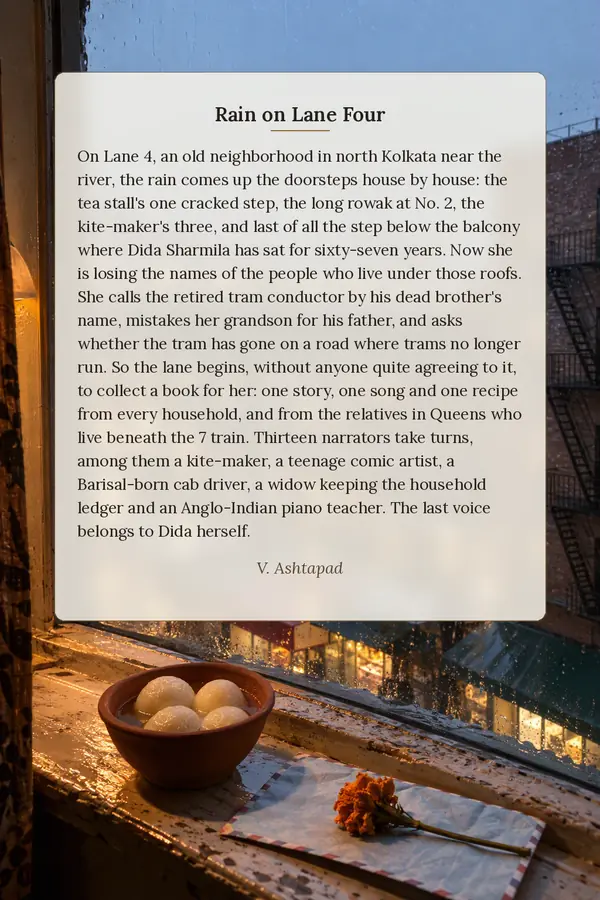
On Lane 4, an old neighborhood in north Kolkata near the river, the rain comes up the doorsteps house by house: the tea stall's one cracked step, the long rowak at No. 2, the kite-maker's three, and last of all the step below the balcony where Dida Sharmila has sat for sixty-seven years. Now she is losing the names of the people who live under those roofs. She calls the retired tram conductor by his dead brother's name, mistakes her grandson for his father, and asks whether the tram has gone on a road where trams no longer run. So the lane begins, without anyone quite agreeing to it, to collect a book for her: one story, one song and one recipe from every household, and from the relatives in Queens who live beneath the 7 train. Thirteen narrators take turns, among them a kite-maker, a teenage comic artist, a Barisal-born cab driver, a widow keeping the household ledger and an Anglo-Indian piano teacher. The last voice belongs to Dida herself.
Members can react to this book and talk about it in the members' Library.