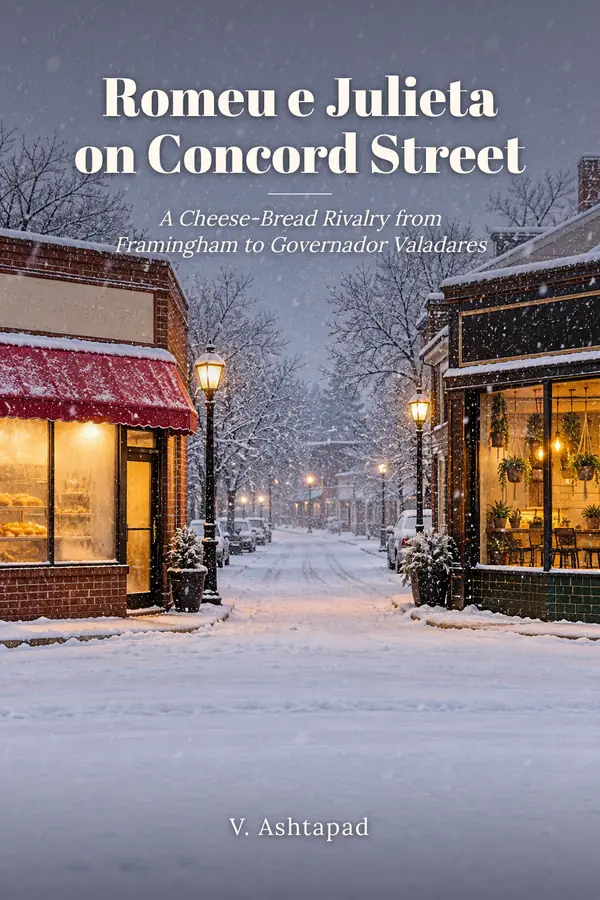
Romeu e Julieta on Concord Street
A Cheese-Bread Rivalry from Framingham to Governador Valadares
by V. Ashtapad
Foreword
This is a novel. Ludmila, Heitor, their families, the bakery, the café, the dance studio and every other person and business in these pages are invented, and any resemblance to real people is coincidence. Framingham, Concord Street, Governador Valadares, the Pico da Ibituruna and the Rio Doce are real places, used here fictionally; the food festival, the Winter Market, the 1964 cattle fair prize and the Belo Horizonte radio cooking hour are made up.
For more than forty years, families from Governador Valadares and the Rio Doce valley have built lives in and around Framingham, Massachusetts, and many still say "home" about both places. Portuguese words are kept few: Vó is grandma, Seu and Dona are respectful titles, padrinhos and madrinhas are the godparents who stand with a couple at a wedding, and polvilho is the tapioca starch, sweet or sour, that makes pão de queijo stretch.
For everyone who has ever stood across the street, waiting for the other one to cross.
Edison Bulbs
The sign went up across Concord Street on the last Tuesday of August, at 6:40 in the morning, while Ludmila Ferreira had both arms in a tub of dough and could do nothing about it.
She watched it happen through the front window of the bakery, past the hand-lettered menu and the curling decal of a cheese bread with a smile that her grandmother had paid a nephew forty dollars to paint in 1998. Two men on a lift. A long black panel. Letters in brushed brass, each one lifted into place like a tooth being set. R, E, S, E, N, D, E. Underneath, smaller, in the kind of thin white script that wedding planners used: café brasileiro.
"Marlene," Ludmila said. "Come and look at this and tell me I'm wrong."
Dona Marlene came out of the back with a sheet pan on each hip. She was sixty-six and had worked the counter at Padaria Dona Dila for twenty-five years, and she had a way of standing at a window that made the window feel observed. She looked for a long time.
"You're not wrong," she said. "That's a lot of brass."
"It's a café."
"It's a café with lightbulbs you can see the insides of." Marlene set down the pans. "My nephew's girlfriend has those in her apartment in Natick. She says they're warm. They're not warm. They're expensive."
Across the street the men on the lift had moved on to the window glass. They were applying a second decal, and when they stepped back Ludmila read it twice, because the first time she assumed she had misread it. In the same thin script, beside an outline of a little round loaf, it said: Our secret pão de queijo.
She took her arms out of the dough.
The dough did not care. It was the morning's third batch, scalded and resting, and it had the particular cool weight of a good mix, the starch gone glossy where the hot milk and oil had reached it and still dusty in the creases where it had not. Ludmila wiped her forearms with a towel and left a white smear across the front of her apron anyway. Tapioca starch got into everything. It lived in the seams of her jeans. It came out of her hair in the shower in little pale drifts, so that every morning for thirty-one years she had smelled faintly, under the shampoo, like the inside of this room.
"Secret," she said.
"Mm," said Marlene.
"Nobody's pão de queijo is secret. It's starch, milk, oil, eggs, cheese, salt. There are five hundred recipes on the internet. My grandmother used to say anyone who calls a cheese bread secret has either never made one or is hiding a bad cheese."
"Your grandmother said a lot of things about people across the street."
That was true. For the first nine years of Ludmila's life, across the street had been a florist, and Vó Dila had said that the florist bought carnations dyed blue and charged for them as if they had grown that way in a field. Then it had been a phone card shop, and Vó Dila had said the owner cut every international call off at fifty-eight minutes on purpose. Then it had been a tax preparer, a nail salon, and for four quiet years an empty unit with a For Lease sign and a slowly yellowing poster for a forró night at a hall in Hudson. Vó Dila had said the empty unit was the best neighbor she ever had.
Ludmila had not had any opinions about across the street until now, because until March she had not owned anything on this street. In March her grandmother had died in her sleep at seventy-nine, with a bag of polvilho open on the kitchen counter at home because she had meant to test a new batch in the morning, and the bakery had come to Ludmila in a will so short it fit on a card. She had given notice at the insurance firm in Natick where she reconciled accounts for a living. Her mother had cried with relief and then cried with worry. Her father, who painted houses and believed every problem could be solved by a second coat, had repainted the bakery's bathroom without being asked.
She had been doing this for five months. She was good at it. She had been good at it since she was seven and standing on a milk crate to roll dough into balls the size of a quail's egg, which Vó Dila said was the right size for the first batch of the morning because the first customers were construction men in a hurry and should be able to eat four at a red light.
"I'm going over there," she said.
"Now?"
"After the trays."
Marlene picked up a pan. "Take a coat. It's going to be cold over there."
It was eighty-one degrees.
---
The trays came out at 7:15 in a long sigh of steam, two dozen rows of small gold domes with their tops just cracked, and the smell went through the bakery and out the propped door and halfway to the train tracks. Ludmila knew it reached the tracks because the commuters on the platform turned around. This was the smell that had built the business: hot cheese and toasted starch and something faintly sour underneath, the tang of Vó Dila's polvilho azedo, the fermented, sun-dried starch that she mixed with the sweet kind so that the bread puffed high and tasted the way, she said, cheese bread had tasted in Valadares before everybody started buying it frozen.
The line was eleven people deep by 7:30. Masons from a job in Ashland. Two nurses coming off night shift who ordered a dozen to split and ate three each before they reached the door. Seu Laércio Pimenta from the shoe repair two doors down, who had come in every morning since 1994 for one cheese bread and one cafezinho and a quarter hour of the news from Brazil as reported by Marlene. Ludmila worked the register and the tongs and the paper bags and smiled at everyone, and between every customer she looked across the street.
At 7:45 the door of RESENDE opened.
From where she stood it seemed to let out a breath of cold air. Its interior was all matte black and pale wood and green tile. There were plants hanging in macramé from the ceiling and the famous bulbs dangling between them on long cords. She could see a chalkboard menu that had clearly been lettered by someone with a steady hand and a lot of time, and a glass case, and in the glass case a pyramid of cheese breads so perfectly round and so evenly colored that they did not look baked so much as minted.
A young man with a tidy beard and a knit cap, too warm for August, came out and set a sandwich board on the sidewalk. Grand opening, it said. First cafezinho free.
Seu Laércio, who was halfway through his own cafezinho at Ludmila's counter, set his cup down with care.
"Seu Laércio," Ludmila said.
"I'm only looking."
"You can look from here."
"I'm a man of seventy-six." He put on his cap. "At my age a free thing is a free thing." And he went out of the bakery, crossed Concord Street with his slow, deliberate, cobbler's walk, and went into RESENDE, and the door closed behind him with what she imagined was a little expensive click.
Ludmila handed the next customer his bag. She gave the one after that her change. Then she untied her apron, hung it on the hook beside the oven under the old ribbon in its frame, and said, "Marlene, the counter is yours."
The ribbon had hung there since before Ludmila was born. It was a satin rosette gone the color of weak coffee, with a cardboard center on which someone had written, in faded fountain pen, 2º lugar, and below it the year: 1964. Vó Dila had brought it from Valadares in her suitcase in 1987 along with two blouses, a pressure cooker, and a coffee strainer made of flannel. When anyone asked, she said she had won second place at the cattle fair with her cheese bread when she was seventeen, and that the girl who won first place had a father on the committee. She said this every time with the same small lift of the chin. It had never once occurred to Ludmila to ask who the girl was.
She did not take a coat.
---
Inside, RESENDE smelled of good coffee and new paint and, under that, of cheese bread. She was annoyed to notice it was the correct smell. Not frozen. Not the smell of a supermarket bag heated in a convection oven at a gas station. Real cheese, browning. The sound system was playing something low with a guitar.
There were six people at the counter. Seu Laércio was at a small marble table by the window with a cafezinho in a glass the size of a thimble, holding it with two fingers like a jeweler. He did not look at her.
The man behind the counter was not the one with the knit cap. The one with the knit cap was at the espresso bar, steaming milk with the expression of a surgeon. The man at the register was taller, a little older, in a white shirt with the sleeves rolled to the elbow and a dark green apron that had not one single smear of anything on it. He had a wide, easy face, black hair cut short, and the kind of smile that suggested he had been told about it and practiced it in the mirror. He was saying something to the woman in front of him that made her laugh.
Ludmila waited her turn. When she reached the counter he looked at her, at the white handprint on her black T-shirt, at the starch in the ends of her hair, and something in his face did a small calculation.
"Good morning," he said in English. Then, because Concord Street was Concord Street: "Bom dia. What can I get you?"
"One of those." She pointed at the pyramid. "And I'll pay for it."
"First cafezinho is free."
"I didn't ask for a cafezinho."
"You'll want one with it." He was already pouring. The cup was a little glass in a metal holder, the old kind from every roadside lanchonete in Minas, which he had clearly bought on purpose. He set it on the counter. He put a single cheese bread on a small white plate. Then, after a pause, he put a second one next to it. "On the house. Neighbors."
"I'm not your neighbor. I'm across the street."
"That's what a neighbor is."
She picked up the bread. It was warm. The crust gave with a faint crackle and the inside stretched in a long, fine, elastic thread when she pulled it apart, which was what a cheese bread was supposed to do and what most of them, in this country, did not. She ate half of it standing at the counter.
It was very good.
It was not as good as Vó Dila's. It was less sour. It was rounder in the mouth, more cheese and less starch, and there was something in the cheese she could not name, a sharper note at the back, a little like the rind of a good aged queijo minas, the kind you could only buy at the place in Everett if you got there before ten on a Saturday. It was the cheese bread of someone who had thought about cheese bread a great deal. It was the cheese bread of someone who wanted to win.
She swallowed. She drank the cafezinho, which was sweet and strong and so hot it took the skin off the roof of her mouth.
"So?" he said. He had not moved. He was watching her eat with a look she recognized from her own face, every morning, watching the first customer.
"It's fine," Ludmila said.
"Fine."
"It's a little heavy on the cheese."
"There's no such thing."
"There is if you're hiding something." She set the glass down. "What's in it?"
He smiled the practiced smile and then, unexpectedly, a second one under it that did not look practiced at all. "It's a secret."
"It's starch, milk, oil, eggs, cheese and salt."
"Then why are you asking?"
The man in the knit cap made a noise at the espresso bar that might have been the milk.
Ludmila put a five on the counter. "I'm Ludmila Ferreira. I run the Padaria Dona Dila."
"I know." He did not take the five. "Heitor Resende. I know the bakery. Everybody in Framingham knows the bakery. I'm sorry about your grandmother."
She had not expected that. It went in under her ribs like a draft from a door left open. "Thank you."
"I didn't know it was still open," he said. "When I signed the lease. Somebody told me it had closed in the spring."
"It closed for nine days."
"I see that now."
They looked at each other across the clean marble counter. Behind her somebody wanted a flat white. Through the window, past the macramé and the plants, she could see her own bakery, its windows completely fogged from the ovens so that the shapes of Marlene and the morning line inside were only soft colors moving behind white glass. From this side it looked like a lantern. She had never seen it from this side before.
"Well," Heitor said. "May the best cheese bread win."
"It already has," said Ludmila, and left the five on the counter, and walked out into the heat.
---
That night, on the family's shared page, where her cousin Thaís had spent the summer adding everyone's addresses to a map so that the out-of-state aunts could stop asking who lived where, there was a new pin. It sat directly across Concord Street from the old pin for the bakery, the two of them so close on the screen that their little teardrop shapes overlapped.
Thaís had labeled it. The enemy (but the coffee is really good).
Ludmila moved it, with her thumb, three blocks east, into the middle of the train tracks. Then, because she was a bookkeeper by training and could not stand an inaccurate record, she moved it back.
Fine
Heitor Resende had been told a great many things about his cheese bread in the eleven days since he started selling it, and he had written most of them down.
He kept a notebook under the register for this purpose, a black one with an elastic band, the same kind he had used in pastry school in Boston to record oven temperatures and the moods of laminated dough. On the first page he had written in capitals: WHAT THEY SAY. Under it, in his small upright hand, was a list. Better than my mother's (woman, forties, Marlborough plates). Tastes like the bus station in Teófilo Otoni, in a good way (man, sixties). Too small (construction guy). Too big (his friend). Can I get these frozen (eleven people). Is it gluten free (fourteen people). Yes. My grandson would marry this (Dona somebody from the laundromat).
At the bottom, written the evening of opening day, after Fabrício had gone home and the bulbs were off and the street outside was blue with dusk, there was one more line.
Fine. A little heavy on the cheese. (Ludmila Ferreira.)
He had underlined it twice, and then, after a while, he had drawn a small box around it.
"You know you're doing it again," Fabrício said now from the espresso bar. It was a Thursday in early September, ten past three, the slow hour, and Fabrício was cleaning the steam wand with the reverent attention he gave everything that touched milk. He was twenty-four, from Ipatinga, and had learned latte art from videos in his uncle's basement in Milford. He wore the knit cap year round. He said it kept his ideas in.
"Doing what?"
"Looking."
Heitor was not looking. He was standing at the window with a clipboard, checking the delivery invoice from the cheese supplier in Everett, and the window happened to face Concord Street, and Concord Street happened to have, on its other side, a small square bakery with a red awning faded to the pink of a watermelon rind and front windows so steamed up from the ovens that it looked, at any hour before noon, as if the building were breathing.
It was not steamed now. The afternoon ovens were off. Through the glass he could see her at the counter, dusting a tray with something, her dark hair tied up in a knot held with a pencil, her face turned down. She had a way of working that was all wrists. He had seen it through the window every morning for eleven days, at five, when he came in to start his own ovens and the only two lit windows on the block were his and hers.
"I'm checking the invoice," he said.
"The invoice is upside down."
He turned it over. It was.
---
He had come to Massachusetts at nineteen with one suitcase, a winter coat borrowed from a cousin who had gone home, and the phone number of his Tio Gilmar, who had a drywall crew in Marlborough and a guest room that was really a corner of a basement with a curtain. That was 2012. Everyone in Governador Valadares knew someone who had done it, and most people knew someone who had done it twice. It had been going on since before his parents were born: first the Americans who came during the Second World War for the mica the war needed and left behind a taste for the idea of the place, then, in the eighties, when money at home went sideways, the long steady stream of young men and then young women who went north to clean houses and frame houses and paint houses and send the dollars back to build bigger houses in Valadares that stood empty most of the year with their satellite dishes pointed at the sky. People at home called the town Valadólares, half joking. Tio Gilmar called Concord Street the Rua Concórdia, also half joking.
Heitor had hung drywall for two years. He had hated it with a clean, uncomplicated hatred, the white dust in his lungs and the sameness of every wall. On Saturdays he cooked for the crew in Tio Gilmar's kitchen, and the men ate his food with their elbows on the table and said nothing, which among men from Minas was a review of the highest kind. On his twenty-first birthday his uncle handed him an envelope with a brochure for a culinary program in Boston and enough cash for the first semester and said, You're no good with a mud knife, but you're good at this.
So he had learned. Croissants, choux, the sugar work that made his hands shake. He had spent five years in the pastry kitchen of a hotel near the harbor making tarts the size of coins for conferences of people who did not eat them. He had saved. He had studied every Brazilian café from Somerville to Danbury and taken notes on their tile, their cups, their music, their prices, their bread. And then, at thirty-three, he had signed a lease on Concord Street because it was the heart of the thing, because if you were going to open a Brazilian café in Massachusetts with your whole life savings and your grandmother's recipe you did it here or you did not do it.
Someone had told him the bakery across the street had closed. He had believed it because the spring he looked at the unit, it had been closed, nine days, a paper sign taped to the door in Portuguese that he had not crossed the street to read.
He had read it since. He had made himself. It had been taken down in March but Seu Laércio, the cobbler, had a photograph of it on his phone and had shown it to Heitor with the solemnity of a man producing evidence. Closed for the family. Dona Dila thanks you for thirty-two years. The bakery will open again.
He had felt, reading it, like a man who had sat down heavily on somebody's coat.
---
At four he called his grandmother.
He called her every Thursday at four, which was five in Valadares, after her nap and before her soap opera, when she was most likely to be on the back porch with the coffee strainer and the radio. His cousin Wellington had set her up with a tablet two years ago, a big one, with the font turned all the way up. He had also put her on the family's shared page, the private one where the Resendes posted everything from wedding photos to pictures of cousins' dogs, and had made her account view-only after the afternoon she accidentally deleted an album of their uncle's fiftieth birthday while trying to make a photo of a cake bigger. She did not mind. She said looking was most of what she did anyway, at her age, and she preferred to do it without a button that could ruin anything.
The tablet rang four times and then her face filled the screen from an alarming angle, mostly chin.
"Lower, Vó."
"I am holding it lower."
"Lower."
The screen swooped. Then there she was: Zélia Resende, seventy-nine, small and square and brown, her white hair cut very short because she had decided at seventy that she was done with it, wearing a housedress printed with lemons. Behind her was the porch, its floor of red tile, the old iron rail, a pot of something green, and beyond the rail the red earth of the yard going up in a slope to the neighbor's wall. Even through the screen the light looked hot. He could almost smell it, that late-afternoon smell of Valadares in the dry season, dust and burnt sugar from somewhere, and the river.
"You're too thin," she said.
"You can't see my body."
"I can see your face. Your face is thin. Are you eating?"
"I own a café, Vó."
"That's not eating. That's selling." She leaned close. "Show me."
He walked her around. The tablet in Valadares tilted as she looked. He showed her the tile, which she called hospital tile; the bulbs, which she called a fire hazard; the glass case, which she leaned toward so closely that he saw nothing for a moment but one magnified eye.
"They're good," she said. "Small."
"People here like them small."
"People everywhere like them big. They only say small so they can eat more." She sat back. "Are they selling?"
"They're selling."
They were, in a way. The first week he had sold out every day by one. The second week, by two. This week he had been throwing away a tray every afternoon, and the faces in line had started to repeat, and some of the faces that had come on opening day had not come back. Some of them, he knew, because he could see them through two panes of glass, were in line every morning across the street.
He did not say this.
"And the recipe," said Zélia. "You did not change it?"
"I didn't change it."
"You did not give it to anyone?"
"Fabrício doesn't even know the cheese."
"Good." She nodded, slow, satisfied. Zélia had given him the recipe at her kitchen table two summers ago, on his last visit home, written on the back of an electricity bill in pencil, and then she had watched him copy it into his notebook and taken the bill back and burned it on the stove, which he had thought was theater until he saw her face. She had made him promise. He had promised the way you promise an old woman things, lightly and with his whole heart.
"There's a bakery across the street," he said.
"There's always a bakery across the street. That's what streets are for."
"It's an old one. It's been there since the nineties. A woman from Valadares started it." He turned the tablet so she could see, out the window, the red awning, the steamed-up glass, the hand-painted smiling bread. "Dona Dila. Odila Ferreira. She died this spring. Her granddaughter runs it now."
There was nothing on the screen for a moment. He thought it had frozen. Then he saw the pot of green on the porch move in a breeze, and his grandmother's face, which had not moved at all.
"Ferreira," she said.
"You know them?"
"Valadares is full of Ferreiras."
"Odila Ferreira. She'd be your age."
"Everybody in Valadares is my age, now, the ones that are left." She looked away from the screen at something to her left, the kitchen door maybe. "Dila's girl," she said, very low, so that he was not sure he had heard it, so that afterward he would play it back in his head and still not be sure.
"Vó?"
"The beans are burning." She was already reaching for the screen. "I have beans on. Eat something, Heitor. You're too thin."
The screen went black.
He stood in the middle of his café with the dark tablet in his hand and the macramé swaying a little over his head in the draft from the door, and he looked across Concord Street. Ludmila Ferreira had come out onto the sidewalk with a broom. She was sweeping polvilho off her step, a pale drift of it, white as frost, and the wind took it up and carried it in a little cloud out into the street where a passing truck broke it apart.
"She hung up on you," Fabrício said.
"She had beans on."
"She doesn't cook on Thursdays. You told me. Thursdays she eats at your Tia Neide's."
Heitor went into the back.
---
He ate standing up, because that was how cooks ate. It was the last of the feijão tropeiro he had made for the staff lunch, beans and toasted manioc flour and crisp bits of bacon and scrambled egg and ribbons of collard greens, the dish the mule drivers had carried in their saddlebags across Minas three hundred years ago and that every Mineiro grandmother made as if she had invented it. He ate it out of a plastic container with a spoon and looked at his notebook, open on the steel counter beside him.
Fine. A little heavy on the cheese.
He thought about the face she had made eating the first half of the bread. It had not been a fine face. He had watched a lot of people eat his cheese bread in eleven days and he knew the difference. Hers had been the face of someone reading a sentence she wished she had written.
He thought about the ribbon. He had seen it over her shoulder that morning through the window, before she came over, a brown satin thing in a frame above her oven. He had assumed it was a joke, or a souvenir, or something her grandmother had bought at a flea market.
He thought, for no reason at all, of the photograph that hung in his grandmother's front room in Valadares, in the hallway between the treadle sewing table and the window. It had hung there his whole life, so long that nobody saw it anymore. It was not a photograph. It was a small yellow rectangle of card in a cheap gold frame, a bus ticket, with a date stamped on it in purple ink. He had asked her about it once when he was nine, and she had told him it was the most expensive thing she owned. He had believed her because she had said it in the voice she used for the weather.
He finished the beans. He washed the container. Then he went back out front, where Fabrício was drawing a fern in somebody's milk foam with the tip of his tongue between his teeth, and he took a white paper bag from under the counter and put in it two cheese breads, still faintly warm from the last tray, and from the case a block of goiabada stacked on a block of queijo fresco cut to match, the dessert every Mineira grandmother set out after Sunday lunch. Everybody called it Romeu e Julieta, after the two lovers from feuding houses, and nobody in Minas had ever needed the joke explained.
He wrote on the bag with a marker. Heavy on the cheese is a style. R.
"Where are you going?" said Fabrício.
"To be a neighbor," said Heitor, and went out the door, and did not look both ways, and nearly got hit by a pickup with a ladder on top. The driver shouted something in Portuguese about his mother. Heitor waved, and kept going, and arrived on the far side of Concord Street with his heart doing something that was entirely, he told himself, about the truck.
Quiabo
The bag sat on the end of Ludmila's counter for an hour and forty minutes before she opened it, which she considered a personal record for discipline.
Marlene had put it there. Marlene had watched the whole thing through the window, Heitor Resende nearly dying under a pickup and then coming in out of breath with his clean green apron and setting the bag on the counter and saying, "From across the street," and leaving before Ludmila could come out of the back. Marlene had described this to her in detail. She had described his forearms. She had described them a second time, when Ludmila did not react the first time, as though Ludmila might not have heard.
"I'm not opening it," Ludmila said.
"Then I'll open it."
"Nobody is opening it."
At ten past five, after Marlene had gone and the floor was mopped and the ovens were ticking as they cooled, Ludmila opened it. She read the writing on the bag. She read it again. Heavy on the cheese is a style. She took out the cheese breads, which were cold now and had gone a little dense, as they all did, and she ate one anyway, slowly, with her eyes closed, the way Vó Dila had taught her to taste another person's bread: without any of your own opinions in your mouth.
The sharp note was still there in the cheese. Something aged, almost nutty. A little salt crystal crunch. She could not place it and it bothered her more than it should have.
Then she unwrapped the Romeu e Julieta.
It was a thick slab of goiabada, the dark red guava paste, cut cleanly with a hot knife so the edges were glassy, set on a block of queijo fresco cut to exactly the same size. Nobody in her family had ever been able to agree on the right proportion. Her father liked it all cheese with a whisper of guava. Her mother liked it the other way round. Vó Dila said the whole point was that they should be equal, that each one tasted like nothing much by itself, that the goiabada was too sweet alone and the cheese was too plain alone and only together did they make any sense, and that if you got the proportion wrong you might as well be eating candy or eating breakfast.
This one was equal. She checked. She set it on the counter and crouched until her eyes were level with it, like a carpenter sighting down a board.
She ate it standing in the empty bakery, and it was sweet and cool and faintly salty and it tasted exactly like being nine years old in the summer.
She put the bag in the recycling. She took it out again and flattened it and put it in the drawer under the register where she kept the receipts. She did not examine why.
---
The flyer came on Saturday, taped to the bakery door by someone who had also taped one to every door on the block, including Heitor's, she noticed, because she checked.
FRAMINGHAM FALL FLAVORS, it said, in a typeface that looked like falling leaves. Saturday, September 26. On the Centre Common. Food trucks! Cider! Live music! And underneath, in a burst of yellow, as if it were the main event: First Annual Cheese Bread Throwdown. Sponsored by a dairy out in the Pioneer Valley that was trying to sell a farmstead cheese to the Brazilian markets. Open to all local bakeries and cafés. Judging at 3 p.m. Prize: a featured booth at the downtown Winter Market in December and a write-up in the weekly paper.
"You're entering," said Marlene.
"I'm not entering."
"You're entering. I've already filled out the form." Marlene produced it from her apron pocket. "I spelled your name right. I put Padaria Dona Dila, est. 1994. I put under Describe your cheese bread: The real one."
"Marlene."
"Your grandmother entered everything. She entered a contest at the Portuguese bakery in Hudson for the best custard tart, and she doesn't even make custard tarts. She came in third."
"She never told me that."
"She didn't tell you a lot of things." Marlene put the form down on the counter and smoothed it with the heel of her hand. "She would have entered."
Ludmila looked out the window. Across the street, a man she did not know was standing outside RESENDE reading the same flyer, and she watched him turn and say something through the open door, and a moment later Heitor came out wiping his hands on a towel and read it too. He stood there a long time. Then he took a pen out of his apron and wrote something on his own hand.
She signed the form.
---
Sunday dinner was at her parents' house in Saxonville, a split-level with aluminum siding her father kept painted the exact blue of a hydrangea, which he said was the color of the shutters on his grandmother's house in Valadares and which every neighbor on the street had asked him about at least once. The kitchen smelled of frango com quiabo when Ludmila came in, chicken browned in a big iron pot until the bottom was dark and sticky, then the okra in coins, sliced and dried on a towel all morning so it would not go slimy, then tomatoes and garlic and a lot of green onion and cilantro. Her mother was stirring a second pot with a long wooden spoon, working the angu, the soft cornmeal that went underneath, and steam was coming off it in slow white curls and fogging the window over the sink, behind which the maples in the backyard were just beginning to rust at the edges.
"You're late," said her mother, Cleide, who was fifty-eight and ran a house cleaning business with four vans and nine employees and believed punctuality was a form of love.
"I was at the bakery."
"It's Sunday."
"Bread doesn't know it's Sunday."
"Your grandmother said that." Cleide pointed the spoon at her. "She said it to get out of things."
Her father, Joel, kissed the top of her head without looking up from the cutting board. He was slicing tomatoes for the salad with a paring knife, the way he did everything, with a painter's evenness, so that every slice came out the thickness of a coin. "Thaís is coming," he said. "She has news."
"What news?"
"If I knew, it wouldn't be news. It would be information." He considered a tomato. "She said to make sure you were here."
Thaís arrived at seven with a bottle of wine she had bought for its label and her hair blown out the way she wore it for weddings and job interviews. She was twenty-seven, Ludmila's first cousin, the daughter of her father's younger sister, and she worked as a dental hygienist in a practice off Route 9 and had the brightest teeth in the family and used them. She had been in love since February with a man named Wellington, whom Ludmila had met twice and liked, a tall quiet electrician from Valadares who had come up six years ago and who laughed with his whole body at jokes nobody else thought were funny.
Thaís did not take her coat off. She stood in the middle of the kitchen. She held up her left hand.
Cleide dropped the spoon in the angu.
There was a great deal of noise after that. Ludmila did a lot of it herself. The ring was small and good, a single stone, and Thaís turned it under the kitchen light so it threw sparks across the ceiling, and her father said, "Well, I'll have to repaint something," and nobody knew what he meant but everybody cried a little.
They ate. The chicken fell off the bone in long dark threads and the okra had kept its shape and gone soft and green and almost sweet, and the angu was smooth and pale and soaked up everything. Thaís talked through the whole meal. December, she said. The second Saturday. In Valadares.
"Valadares," said Cleide.
"Wellington's grandmother can't fly. She had a hip done last year and the doctor said no more airplanes. And she raised him. His mother was up here working his whole childhood, so it was his grandmother who did everything, and he said if she can't be at the wedding then there isn't a wedding." Thaís put her hand over her heart. "So we're going home."
Home. Ludmila had been born at the old hospital on Lincoln Street. She had been to Valadares four times in her life, the last time at nineteen. She still called it home. Everyone did. It was a word that did not need you to have lived there.
"And you," Thaís said, turning, "are my madrinha. Obviously. One of them. The main one."
"Obviously," said Ludmila, and meant it, and was glad.
"There's one thing." Thaís set down her fork. She had the look she used to get when they were children and she had borrowed something of Ludmila's and lost it. "There are six couples of padrinhos. The godparents of the wedding. You walk in together, you sign as witnesses, you dance the first dance after us. And the couples have to be, you know, one from my side and one from his."
"Sure."
"And Wellington has a cousin."
Ludmila put down her own fork.
"His favorite cousin. They grew up in the same house. With the same grandmother." Thaís was smiling now, a wide, bright, fearful smile with every one of her famous teeth. "He has a café."
"No."
"On Concord Street."
"No."
"Across from—"
"I know where it is, Thaís."
Her father had stopped chewing. Her mother had a look on her face that Ludmila recognized from tax season, when a client's receipts were in a shoebox.
"His name is Heitor Resende," said Thaís, unnecessarily. "He's really very nice."
"He has a secret cheese bread."
"Is that bad?"
"It's very bad." Ludmila picked up her fork again and stabbed a piece of okra with it. "Fine. Fine. I'll walk in with him. I'll sign my name next to his. I will not dance with him."
"About the dancing," said Thaís.
---
Later, at home, in her apartment over a hair salon on Hollis Street, where the radiators had not been turned on for the season yet and the bathroom tile was cold under her feet, Ludmila opened the private page Thaís had made for the wedding.
Thaís had built it that afternoon, it seemed, in a burst of joy. It had a countdown in the corner. It had a photo of the ring. It had a folder for the menu and a folder for the dress and a folder called Padrinhos (DO NOT FIGHT) that Ludmila did not open. Thaís had added both families, branch by branch, her own side and Wellington's, and joined them in the middle with a little line and two hearts, so that for the first time the Ferreiras of Framingham and the Resendes of Valadares sat on one tree like two halves of a sandwich.
Ludmila scrolled up through the generations, past her own name and her parents', past Vó Dila and Vô Aldo, who had died when she was fourteen. Then she crossed the middle line out of curiosity and went up the other side. Wellington. His mother. And above them, at the top of the Resende branch, alone, Zélia Resende, born 1947.
Thaís had filled in what Wellington told her. Born in Governador Valadares. And under it, an address.
Ludmila clicked back to her grandmother. She had filled that in herself in April, from Vó Dila's birth certificate, sitting in this same chair, eating cereal for dinner.
Odila Ferreira, born 1947, Governador Valadares. And the address.
It was the same street. The numbers were one apart.
Meia-Cura
The cheese counter at the market in Everett opened at eight on Saturdays, and by 8:04 Heitor was close enough to see that there was one wheel left.
It sat on the top shelf behind the glass with its handwritten card propped in front of it: Queijo Minas Meia-Cura, estilo Serro, Vermont. A low pale wheel of cheese the size of a dessert plate, its rind gone the yellow of old piano keys from two months on a pine board, its sides faintly ridged from the cloth it had been pressed in. The market got four of them a week from a cheesemaker in southern Vermont, a man from the Serro who made it the way his father had and aged it long enough to satisfy the rules on this side of the equator, and Heitor had a standing order for two, but this week the cheesemaker's van had broken down outside Brattleboro, and the man at the counter had called him at six to say: I have one. Come early.
He had come early. He had come so early that he had sat in his car in the parking lot for twenty minutes with a coffee, watching the sky go from gray to a hard, clean, September blue over the Mystic River, the gulls riding the wind off the water, the smell of salt and diesel coming through the cracked window. He had been first to the door when the man unlocked it. He had walked, not run, past the dried beans and the cassava flour and the twelve kinds of guaraná, past the frozen coxinhas in their bags and the rack of flip-flops and the wall of phone cards. He had arrived at the counter with the composure of a man who had already won.
A woman was standing at it.
She had come in through the side door, from the loading dock. She had starch on her sneakers. She had her dark hair tied up with a pencil.
"Good morning," said Ludmila Ferreira to the man behind the glass, in a voice like a contract. "The meia-cura, please. The whole wheel."
"That's mine," said Heitor.
She turned around. Her face did several things and settled on polite. "I'm sorry?"
"That wheel. I have a standing order."
"For two wheels. Seu Antero told me. Your two wheels are in a van in Brattleboro." She turned back to the counter. "This is the market's own wheel. It's for sale to the public. I'm the public."
"How do you know about my standing order?"
"Everybody knows about your standing order. You order the meia-cura from the Serro man in Vermont and you put it in the bread. That's your secret." She said it lightly, the way you might mention someone's middle name to show you had found it out. "Heavy on the cheese."
The man behind the counter, who had been selling cheese to the Brazilians of greater Boston for twenty-two years and had seen everything, set his knife down and folded his arms to watch.
"It's not the whole secret," said Heitor.
"It's most of it."
"You can't make a cheese bread out of one wheel of cheese anyway. You need ten pounds a day."
"I don't need it for the bread." She paid. Antero lifted the wheel down and wrapped it in waxed paper with the tenderness of a man swaddling a baby and handed it to her, and she held it in both arms against her chest. "I need it to find out what you're doing."
"That's espionage."
"It's research." She looked at him over the top of the cheese. She was shorter than he had realized. She had a small white scar through one eyebrow and her eyes were very dark and very amused. "You told me there was no such thing as too much cheese."
"I stand by it."
"Then you won't mind," she said, and walked out through the loading dock with eleven dollars a pound of his future under her arm, and he stood in front of the empty shelf until Antero cleared his throat and said, kindly, in Portuguese, "I have a nice queijo do reino."
---
He bought the queijo do reino. It was not the same. It was good, a little sharper, a little drier, and he spent the drive back down the Mass Pike doing math in his head about how much it would change the stretch of the crumb. The trees along the highway had begun to turn, only a few, scattered red and orange maples standing in the green like people who had arrived at a party too early in costume. He kept the window down. It was the end of summer. The air had a cool thread in it that he had not felt since spring.
At a red light in Framingham his phone rang. It was Wellington.
"So," said his cousin. "Thaís told her."
"Told her what?"
"About the dancing." There was a long pause on the line, the particular silence of a large, quiet man smiling. "Forró. For the padrinhos. Six Thursdays, starting in October. There's a teacher, Professora Nilza, from Caruaru, she has a studio over the tire place on Waverly Street. Thaís already paid."
"I'm not taking a dance class."
"You're taking a dance class."
"Wellington, I have a business. I'm open six days a week. I get up at four."
"The class is at eight at night."
"I'm asleep at eight at night."
"Then you'll have to dance in your sleep, primo." The light turned green. Someone behind him honked. "It's for the wedding. Thaís wants the padrinhos to do the first song after us. With the band. A real band. Vó's going to be watching. She hasn't danced since my grandfather died. She said she wants to see us dance like people from home, not like people who learned from television."
Heitor drove through the intersection. He thought of his grandmother's face on the tablet, her chin, the lemons on her housedress. He thought of her saying Dila's girl in a voice so low it might have been the wind.
"Who am I dancing with?" he said, though he knew.
"Who do you think?"
---
He called Zélia that afternoon, on a Saturday, out of the usual schedule, and she answered on the first ring, which meant she had been sitting with the tablet on her lap.
"You don't call on Saturdays," she said.
"Vó. Did you grow up on the same street as Odila Ferreira?"
The porch was behind her again. The light was coming in sideways now, gold, and somewhere offscreen a neighbor's radio was playing an old seresta, a slow waltz with a lot of yearning in it. His grandmother looked at him for a long moment. She had very black eyes in a very lined face, and when she was deciding something she pressed her lips together so hard they disappeared.
"Wellington put the tree on the page," she said finally. "I saw it. I can look at things. I can't change them, but I can look."
"So you know."
"I've always known where Dila lived, Heitor. She lived across the street from me for forty years. Then she lived in Framingham."
"You never said."
"Nobody asked." She shifted the tablet. "You never asked me what side of the street anybody lived on."
"Were you friends?"
Zélia looked off to the left again, at the kitchen door, or at nothing. Somewhere a dog barked twice. The waltz ended and a man began reading the price of cattle.
"Ask Dila's girl," she said, "what her grandmother did with the bus."
"What bus?"
"She'll know."
"Vó, she doesn't know anything. I don't think she knows anything. She looked as surprised as I was."
"Then it's a family of people who don't know anything," said his grandmother, "and you'll fit right in." And this time she did not say anything about beans. She just looked at him a little longer, as if she were memorizing his face, and then she reached out and the screen went dark.
---
He tested the queijo do reino that night. And the next night, and the next. The festival was two weeks off. He worked after close, alone, the bulbs dimmed to a low amber, the street outside dark except for the yellow of the streetlamps and the green neon of the pharmacy on the corner. He scalded the starch in a steel bowl with the milk and oil just at the boil so that it hissed and turned to a rough white paste, then stirred until it cooled enough to take the eggs, then worked in the cheese with his hands, grated fine, so that it vanished into the dough and came back only in the oven, as stretch and smell. He changed one thing at a time. He wrote down every change. By the fourth night he had something close. Not the same. But close.
He had given his word to his grandmother that he would not change the recipe. He decided that changing the cheese because a van had broken down in Brattleboro did not count, the way rain did not count against a man who had promised to walk somewhere.
On the fifth morning he came in at 4:50 to start the ovens. It was dark. It was cold, really cold for the first time, forty-four degrees on the bank clock down the block, and his breath showed in the streetlight as he unlocked the door.
Across the street, the bakery's windows were lit and already completely white with steam. Her ovens had been going an hour, at least. He could see her shape moving behind the glass, blurred and gold, like something seen underwater.
He stood on his step with his keys in his hand.
The shape came to the window. It stopped. Then a finger touched the inside of the fogged glass and began to write, slowly, in big careful letters, and he realized after the first two that she was writing them backward so that he could read them from where he stood.
STILL HEAVY.
The finger paused. Then it added, smaller, underneath, a single wobbling arrow pointing across the street at him, and a little round shape that might have been a cheese bread, or might have been a face.
He laughed out loud, alone on Concord Street at ten to five in the morning, and his laugh came out white in the cold and hung in the air in front of him for a second like a word.
Throwdown
The Centre Common on the last Saturday of September smelled of fried dough and apple cider and wet grass, and of something underneath all of it, faint and sweet and smoky, that Ludmila finally traced to a man from Holliston with a cast-iron kettle boiling down maple sap into syrup at the far end of the green, as a demonstration, though it was the wrong season and the sap had come out of his freezer.
The maples around the Common had turned in earnest in the past week. Not all at once. One tree by the old town hall had gone entirely scarlet, top to bottom, as if it had made up its mind, while the one beside it was only beginning to yellow at the tips, and the big one by the bandstand was still mostly green except for one long branch on the south side that had caught fire on its own. Leaves were coming down in the wind. They skated across the paths and got into the food. A boy in a Patriots jersey caught one in his cider and held it up for his father like a prize.
The Cheese Bread Throwdown had six tents in a row on the north side of the green, between the face painting and a truck that sold lobster rolls at a price Ludmila's father said was a crime. Each tent had a folding table, a portable convection oven, and a small gas generator that the festival committee had rented in bulk and that made a sound, all six of them together, like a field of very large bees.
Padaria Dona Dila had the fourth tent. RESENDE had the fifth.
Of course it did.
"I didn't ask for it," Heitor said, when he arrived at nine with Fabrício and a dolly loaded with coolers and found her already there, unfolding a red tablecloth. "They assigned them alphabetically."
"Then why is the Pão Mineiro number two?"
"Then by some other system."
"By the system where they think it's funny." She snapped the cloth flat. "Everyone thinks it's funny. Seu Laércio has been telling people for a month. He's selling tickets."
"He's not selling tickets."
"He's taking bets. It's the same thing."
Heitor looked toward the bandstand, where Seu Laércio, in a tweed cap and his best brown jacket, was indeed standing with a small spiral notebook among a group of old men from the domino table at the bakery, writing things down.
"What are the odds?" said Heitor.
"Three to two. For me."
He set down a cooler. He did not seem offended. He seemed, she thought, to be doing math. "That's not bad," he said. "I've only been open a month."
---
The rules were simple and printed on a card taped to each table. Each entrant would bake on site. Judging at three. Two dozen cheese breads to the judges' table, plain, no fillings, no glazes, no tricks. Samples could be sold to the public until two. The public could vote with tokens, one per person, for a People's Pick, which counted for a quarter of the final score.
The judges sat at a long table under a white tent by the town hall. There were three. Gordon Tully had taught culinary arts at the high school for thirty-one years and had, it was said, failed the mayor's son in 1997 for an underseasoned hollandaise. Ana Lúcia Ribeiro was a chef from a restaurant in Cambridge that had been written about in national magazines, a tall woman from Belo Horizonte in a black linen dress who kept her sunglasses on. The third was Sadie Hadaway, who was twenty-six and owned the dairy in the Pioneer Valley that was sponsoring everything, and who was hoping very much that one of the bakeries would agree to use her farmstead cheese, and who had brought free samples of it in a cooler with a cow painted on the side.
Ludmila had a cooler of her own. In it were six quarts of whole milk, two dozen eggs from the farm stand in Sherborn where Vó Dila had bought eggs since the nineties, a bottle of sunflower oil, a block of the plain queijo minas the bakery bought every week, and two bags of polvilho, sweet and sour. The sour starch came from a small producer in the south of Minas who had sold to Vó Dila for twenty years. It came in paper bags stamped in blue ink, and when you opened one, a breath came out of it that was like bread and like yogurt and like a cellar, the smell of starch that had been left in water to ferment for weeks and then spread on long trays to dry in the sun.
She had not used the meia-cura. She had tasted it alone. She had melted it. She had baked one test batch of Vó Dila's recipe with it substituted for half the plain cheese and found that it was wonderful, deep and nutty and brown, and that it was not Vó Dila's at all. It was his. It was missing the sour.
She had eaten the rest of the wheel, over two weeks, with goiabada, alone in her kitchen, reading. It had felt like the right use.
---
The generators started at ten. By eleven there was a line at every tent.
Ludmila worked fast. She scalded the starch in the big steel bowl with the milk and oil poured on at the boil so that it went up in a cloud and she had to step back, then stirred until her forearm burned, then let it rest while she cracked the eggs. Her hands were white to the wrist. Steam rose off the bowl into the cold bright air and blew sideways in the wind and caught the sunlight and for a moment she was standing in a little shining fog with the leaves coming down through it.
The first tray went into the oven at 11:20. At 11:40 she pulled it, and the smell went out over the Common and stopped people in their tracks. She saw it happen. A woman pushing a stroller turned her head. Two teenagers on skateboards stopped. Even the maple syrup man looked up from his kettle.
She sold the first tray in four minutes.
Next door, Heitor was doing the same thing in his own steam, with Fabrício taking money and making cafezinho on a little burner he had not been strictly permitted to bring. His bread was smaller and rounder and more uniform. Hers were a little lopsided and higher and more cracked across the top. His line was younger. Hers was older and louder and kept stopping to tell her stories about her grandmother: how she had once given a whole tray to a crew from Valadares who had been stiffed by a contractor; how she had kept a lockbox of quarters for the laundromat for people whose dryers ate their change; how she had once chased a man down Concord Street with a rolling pin, though nobody could agree on why.
Ludmila had never heard any of these stories. She smiled, and bagged bread, and wondered how much of a person's life happened in the hours you were not in the room.
At 1:15 her generator died.
It did not sputter. It simply stopped, mid-hum, with a little cough like an old man clearing his throat at a funeral, and the oven light went out, and inside the oven a tray of half-baked cheese breads began, very slowly, to sink.
She pulled the cord. She pulled it again. She checked the gas. There was gas. She pulled it a third time and nearly fell over.
"It's the spark plug," said Heitor.
He was standing at the edge of her tent with his hands in his pockets and a smear of starch on his cheek he did not know about.
"It's not the spark plug."
"It's the same model as mine. Mine did that at ten. Fabrício fixed it with a dime." He looked over his shoulder. "Fabrício."
Fabrício came, already holding a dime. He knelt beside the generator with the gravity of a man about to defuse something, and Ludmila, standing in her dead tent with her dough going cold and a line of eleven people watching, said nothing, because there was nothing to say that would not have made her sound like a child.
It took four minutes. Heitor did not leave. He stood there and he did not help and he did not watch her, either; he looked out over the Common at the leaves, at the man with the maple kettle, at the old men around Seu Laércio, as though he happened to be standing near her tent by coincidence while thinking about the weather. She was grateful for it in a way she did not like.
The generator came back with a roar. The oven light came on. Fabrício stood and dusted his knees and handed her back the dime, which she had not given him.
"Thank you," she said to Fabrício. And then, after a moment, to Heitor: "Thank you."
"Neighbors," he said, and went back to his tent, and she looked down and found that the sinking tray had come back up in the returning heat and finished baking anyway, a little flatter than the others, and the masons in her line ate those first and never noticed.
---
The judges tasted at three in the white tent with the public standing around three sides of it. Each bakery's tray came up with a number on it, not a name, and the judges tore the breads apart and pulled the crumb and held it under their noses and chewed. Gordon Tully chewed for a very long time and wrote a great deal. Ana Lúcia Ribeiro took off her sunglasses for the first time all day and closed her eyes. Sadie Hadaway kept saying "wow" in a way that suggested she was saying it about all of them.
Ludmila stood beside Marlene and her mother and Thaís in the front row. Heitor stood three people down with Fabrício and Wellington, who had come straight from a job and still had his tool belt on. Seu Laércio stood exactly in the middle between both groups, holding his notebook.
It took forty minutes. The sun went behind the town hall and the air turned cold all at once, the way it did in New England in fall, as if someone had opened a door. People put on jackets. The leaves kept falling.
Then Gordon Tully stood up with a card.
"Third place," he said, "goes to number two, the Pão Mineiro bakery from Marlborough." Applause. A family in matching T-shirts screamed.
"And this year," he said, and paused, and looked at Ana Lúcia Ribeiro, who shrugged with one shoulder, "for the first time in the very short history of this event, we have a tie for first."
Ludmila did not breathe.
"Number four and number five," said Gordon Tully. "Padaria Dona Dila and RESENDE. We could not separate them. We tried. Ms. Ribeiro has asked me to tell you, and I quote, that one tastes like the past and one tastes like the future and she would like to eat them both every day for the rest of her life. The People's Pick was also a tie. We counted twice."
The crowd made a noise, a laughing, delighted roar. Somebody whistled. Seu Laércio closed his notebook with the expression of a man who had made a great deal of money from the people who had bet on a winner.
"There is, unfortunately, only one booth at the Winter Market," said Gordon Tully. "And only one write-up. So the committee has agreed that the two winners will work it out between themselves, like adults, and let us know by the fifteenth of December. The market is the Saturday before Christmas."
He sat down. Sadie Hadaway said, "Wow," into the silence.
Beside Ludmila, her mother already had her phone up and was posting a photograph of the judges' card to the family page, under the bakery's pin on the map, for the aunts in Newark and the great-aunt in Valadares who would all, within the hour, have opinions.
Ludmila looked down the row at Heitor. He was already looking at her. He did not look triumphant. He looked like a man who had been handed a cat and told it was his now.
Thaís leaned in close to Ludmila's ear. She smelled of cider and of the hairspray she used for job interviews.
"Thursday the fifteenth," she whispered. "Eight o'clock. Waverly Street. Wear shoes that slide."
Two to This Side
The dance studio was over a tire shop on Waverly Street, up a flight of narrow stairs that smelled of new rubber and old radiator dust, and the first thing Professora Nilza Bezerra said to the twelve padrinhos standing awkwardly on her scuffed wooden floor was, "Take off your feet."
Nobody moved.
"Not your shoes," she said. "Your feet. The ones in your heads. I can see them from here. Everybody is standing on their feet like they're on a ladder. Forró is not in the feet." She tapped her own hip, twice, hard, with the flat of her hand. "It's here. The feet only do what the hips tell them. Take them off."
She was perhaps fifty-five and perhaps five feet tall, with gray curls pinned up and gold hoops and a wine-red skirt that swung when she turned. She was from Caruaru, in Pernambuco, which she said in the first five minutes was the capital of forró in the world, and she said it the way other people gave their blood type, as a medical fact. She had danced at the June festivals since she could walk. She had taught in Recife, in São Paulo, in Newark, and for nine years in this room, which had a mirrored wall with a long crack down the middle and a radiator under the window that banged twice every few minutes as if someone inside it wanted to be let out.
Heitor stood at the back. He had come straight from closing. He had changed his shirt in the café bathroom and still smelled of cheese. Beside him, a careful arm's length away, Ludmila Ferreira stood with her arms folded, wearing black jeans and a gray sweater and a pair of old leather-soled shoes that she had clearly bought for the purpose and that made her look like someone planning to escape on ice.
"Couples," said Nilza. "Face each other. Closer. Closer. You're not buying a car."
They faced each other. The other five couples were Thaís and Wellington, who did not need the class and were taking it out of solidarity and kept giggling; two hygienists from Thaís's office and their boyfriends; and two men from Wellington's electrical crew, one of whom was named Edimar and was very large and was paired with Thaís's tiny friend Jaqueline, so that she had to look straight up at him like a person looking up at a water tower.
"Right hand," said Nilza, "on her back. Here." She came over, took Heitor's hand by the wrist, and put it flat between Ludmila's shoulder blades. Ludmila went still as a post. "Left hand holds hers. Up here, by the shoulder. Not like a bag of groceries. Like you're holding a bird you don't want to squeeze."
Ludmila's hand was cool and small and had calluses at the base of each finger, exactly where his own did, from the same work. It also had polvilho in the creases of the knuckles. He wondered if she knew.
"Now," said Nilza, and went to a speaker on a folding chair by the radiator, and pressed something, and the room filled with music.
---
He had grown up with forró the way he had grown up with weather. It came out of every car window in Valadares on a Saturday night. It was what played at every birthday party in every backyard under a string of bulbs, the old men steering their wives in tight, unhurried circles over the packed dirt, the teenagers dancing fast and showing off, the children in between, underfoot, with bare feet stained red from the dirt. He had heard it his whole life. He had never in his life danced to it, because he had been a boy who stood by the grill, and then a young man who stood by the grill, and then a man in Massachusetts who had worked every Saturday night for fourteen years.
It was a recording, but a good one, of an old trio. There was the accordion first, pumping in and out like something breathing, a sound that was somehow both sad and impatient. Then the triangle, bright and fast, a little silver ticking that went straight up the spine. Then the zabumba came in under both of them, that big flat drum beaten on top with a mallet and underneath with a thin stick, the deep one and the dry one, boom and tak, and the floor of the old studio took it up, and he felt it in the boards and then in his heels and then, to his great surprise, exactly where Nilza had tapped her hip.
"Two to this side," said Nilza, "two to that side. Dois pra lá, dois pra cá. Small. Small. The step is the size of a cheese bread."
Ludmila looked up at him sharply.
"I didn't tell her anything," said Heitor.
"Everybody in this room has eaten your bread, Heitor," said Nilza, without turning around. "And hers. Keep it tight. Go."
They went.
It was a disaster.
He stepped left when she stepped left. She corrected, and stepped right at the precise moment he also corrected. He trod on her leather-soled shoe. She trod on his sneaker, harder, and he could not be sure it was an accident. They locked their arms so stiffly that the frame Nilza had set up between them stayed perfectly rigid while everything below it went in different directions, like two people trying to carry a sheet of glass through a revolving door.
"You're counting," Heitor said.
"I'm not counting."
"Your lips are moving."
"I count everything. I was a bookkeeper for eight years. I count stairs. I count the cheese breads on a tray when they're already on the tray. It's not a crime." She trod on him again. "You're leading like you're pushing a dolly."
"I've never led anything in my life."
"You own a café."
"That's different. The café doesn't move."
Behind them Edimar from the electrical crew lifted tiny Jaqueline clean off the floor during a turn, by accident, and set her down again, and apologized at length. Thaís and Wellington, who had been dancing together for eight months at every forró night between Hudson and Lowell, went past in a smooth slow sway, cheek to cheek, with their eyes half-closed, looking so happy that Heitor felt it as a small personal insult.
The music changed. It went slower, a xote, the accordion drawing out its notes like taffy, and Nilza clapped her hands.
"Stop. All of you. Look at me." She stood in the middle of the room with her skirt still swinging. "You are all watching your feet. If you watch your feet you will see your feet. That's all you'll see. Close your eyes."
"What?" said Ludmila.
"Close your eyes. Both of you. Everybody. The man leads with his chest, not his hands. The woman listens with her back, not her ears. You don't look. You feel where the other one is going and you go there too." She folded her arms. "Close them. I'm not asking."
He closed his eyes.
It was very strange at first. The room went away. The cracked mirror went away, and the radiator, and Edimar and Jaqueline, and the fluorescent light. What was left was the music, and the boards under his feet, and his hand flat on the warm wool of her sweater, and her hand in his, and the faint sour-sweet smell of the starch in her hair, which was exactly the smell of the bakery when he passed it at five in the morning.
The zabumba went boom and tak. He stepped. She stepped with him. Not quite. Then quite.
He felt the moment it happened. It was like the moment the dough came together in the bowl, when you had been stirring a rough white mess for so long your arm ached, and then all at once it was a single thing, smooth and elastic, pulling away from the steel. Her back under his palm stopped being a wall. It moved when he moved. He leaned a little to the left with his chest, not knowing what he was doing, and she went left, and the accordion breathed in and out, and the triangle ticked, and they went around once in a slow circle under the fluorescent lights of a room over a tire shop on Waverly Street, and neither of them stepped on anyone.
He heard her laugh. It reached his palm before his ears, a small surprised shake through her back.
"Don't open them," said Nilza, from somewhere close. "Whoever just smiled, keep doing whatever you're doing."
He kept doing it.
---
They came down the stairs at 9:15 into the cold. It was the middle of October and the night had a real edge to it, the first true New England cold of the year, sharp and clean as a knife in the nose. The tire shop was dark below them. The smell of rubber came out from under its door. Across the street a man was scraping something off his windshield, and the scrape carried down the whole block.
Ludmila stopped on the sidewalk to pull on a coat. Heitor stopped, too, because it would have been strange to keep walking.
"You can't dance," she said.
"Neither can you."
"I could, at the end."
"So could I."
"I know. I was there." She did up her buttons. Her breath showed. "Don't think it means anything. It's for Thaís."
"It's for my grandmother," said Heitor, and then, because it was cold and late and the stairs had been dark and the music was still going somewhere at the back of his skull, he said, "She hasn't danced since my grandfather died. She wants to watch us."
Ludmila did not say anything for a moment.
"About the booth," she said.
"We could flip a coin."
"My grandmother never flipped a coin for anything in her life."
"Mine neither." He put his hands in his pockets. "Ludmila. Can I ask you something? It's going to sound strange."
"Everything you say sounds strange."
"Do you know anything about a bus?"
She looked at him. Under the streetlamp her face was half orange and half shadow, and the little white scar through her eyebrow caught the light. "What bus?"
"My grandmother has a bus ticket in a frame. In her hallway. She's had it my whole life. From Valadares to Belo Horizonte. It's never been used. She told me once it was the most expensive thing she owns." He hesitated. "I asked her about your grandmother. She said to ask you what Dila did with the bus."
The man across the street finished his windshield and got into his car and drove away, and in the quiet after it Heitor could hear, faint and far, a train coming through downtown, the long two-note horn of it.
"My grandmother had a ribbon," said Ludmila slowly. "From a cattle fair. It's over the oven. Second place. For cheese bread."
"What year?"
"1964."
He took his hand out of his pocket and showed her his palm. On it, in the blue ballpoint he had written there on the morning the festival flyer was taped to his door, half worn off now from six weeks of washing and dough, and written over twice, but still legible if you knew it was there, was the date he had copied from the ticket in his grandmother's hallway, on his last visit home, for no reason he could have explained.
It said July 1964.
---
That night Thaís posted the video.
She had filmed the last ten minutes of class from the corner by the radiator, on her phone, without telling anyone. It went up on the wedding's private page under the folder Padrinhos (DO NOT FIGHT), with the caption: They figured it out. In the first half of it, Heitor and Ludmila lurched around the room like a pair of shopping carts with one bad wheel each. In the second half, with their eyes closed, they turned in a slow circle under the lights and she laughed against his shoulder and he smiled with his whole face.
By morning it had forty-one comments from both families, in two languages, most of them hearts.
Wellington texted him at six. Vó can't comment, he wrote. She doesn't have the button. But she watched it eleven times. I know because she called me after each one.
Foto Ideal
The photograph arrived on a Tuesday morning at 5:12, while Ludmila was pulling the first tray, and her phone made the small chiming noise it made only for the family page, and she ignored it, because there were forty-eight cheese breads in front of her and each one was approximately four hundred degrees.
She looked at it at 6:30, standing in the back doorway in her coat with a cafezinho, watching the sky over the parking lot turn from black to a thin dirty violet behind the railroad bridge. It was the end of October and the cold had settled in properly. There had been frost on the cars that morning. The dumpster lid had a skin of it, and the puddle by the drain had a crust of ice so thin she could see the oil swirling under it in colors.
The post was from her great-aunt Conceição in Valadares. Tia Conceição was Vó Dila's youngest sister, seventy-five, a retired schoolteacher who had never once left Minas Gerais and did not see why anyone would. She had joined the family page in the spring, after the funeral, and had posted on it every day since, mostly photographs of her garden and of the weather, which was always hot. Ludmila had added her to the family tree herself, in April, and had felt each time she looked at the little square with Tia Conceição's face in it that she was looking through a window into a room she had been told about all her life and never entered.
This post was different. There were six photographs, all black and white, all a little soft at the edges, and a note.
The grandson of Seu Benício from Foto Ideal is putting his grandfather's negatives on a page for the whole town. Thousands of them, from 1952 to 1979. Everybody in Valadares is looking for their mothers. I found mine. And I found these.
Ludmila set down her cafezinho on the step.
The first photograph was of a street. She knew it the way you know a face from a dream. A dirt street, wide, with a drainage ditch down one side and a row of small houses with tiled roofs, their fronts plastered and painted in shades the photograph could not show, and a mango tree in the middle distance so large and dark it seemed to be holding the whole scene down. Two of the houses faced each other across the street. Someone, Tia Conceição, had drawn on the picture with her finger, two little shaky arrows. One said Dila. One said Zélia.
The second photograph was a cattle fair. A big crowd under a tin roof, men in hats, a bull with a ribbon on its horns being led through, the fence posts, the dust. The third was a closer view: a long wooden table under an awning, crowded with trays and baskets, and a hand-lettered sign tacked to the front, and behind it, two girls.
Ludmila put her thumb and forefinger on the screen and pulled.
They were seventeen. They were wearing dresses with full skirts and short sleeves and narrow belts, the same dress in what might have been two different colors, as if they had sewn them together from one pattern. One was taller, with a long face and dark hair pulled back hard and a chin lifted very slightly, and Ludmila knew that chin. She had seen it at the bakery every morning of her life, under the ribbon, explaining that the girl who won first place had a father on the committee. The other girl was shorter and square and laughing at something outside the frame, with her hair cut short, very short for 1964, and her hand on the taller girl's arm.
The sign said: PÃO DE QUEIJO DAS DUAS.
The cheese bread of the two of them.
On the table in front of them, pinned to the edge of the cloth, was a ribbon.
---
Ludmila called Valadares at eight, between the morning rush and the second bake, sitting on an upturned milk crate in the storeroom with the sacks of starch stacked up around her like sandbags. In Valadares it was nine, and the line hissed with distance, and then her great-aunt's voice came through, high and dry and very Mineira, the vowels long and the endings swallowed.
"Uai," said Tia Conceição. "You're up early."
"I've been up since four."
"Dila's girl." Her great-aunt sounded pleased. "She always said you'd be the one."
"Tia. The photographs."
"I know. I cried for two days. I was thirteen, at that fair. I was supposed to be watching the money box. I don't remember any of it except that I ate so much pão de queijo I was sick behind the cattle pens." Ludmila heard a chair scrape. "Did you see the sign?"
"Das Duas."
"They made it together. They did everything together, those two. I used to think they were the same girl with two heads. Zélia's father had a cow, a yellow one, called Princesa, and he made the cheese, and Zélia learned it from him, how to press it and salt it and turn it on the board every day until it went yellow. And Dila was the one with the starch. She learned it from our mother. She'd put the polvilho to sour in big tubs in the backyard and then lay it out on cloths on the roof to dry in the sun. The whole roof would be white. The birds used to land on it and leave footprints." She laughed. "My mother would chase them with a broom."
Ludmila had a sudden sharp picture of it: a tiled roof gone white as snow under a hot blue sky, and a woman with a broom, and the little three-toed prints of birds walking across starch.
"So what happened?" she said.
The line hissed.
"The bus," said Tia Conceição.
"What about the bus?"
"I don't know, querida. Nobody knows. They won at the fair, second place, and there was a prize, and then there was something about the bus, and after that they didn't speak. Twenty-three years. Dila sold her bread at the market and Zélia sold hers at the bus station, every single day, and they lived across the street from each other, and they never said one word. They would go out to sweep their front steps at the same time in the morning and not look at each other. The whole street knew. It was like weather. People stopped asking." She paused. "I thought you knew. I thought she'd have told you. Over there."
"She told me the other girl's father was on the committee."
"Ha," said Tia Conceição. "First place was a widow from Teófilo Otoni with a corn cake. Her father had been dead since before the war. Dila always did need somebody to blame."
---
She went across the street that night at eight, after close, carrying a paper bag and her phone.
The lights at RESENDE were dimmed to their after-hours amber, and through the glass she could see Heitor alone behind the counter with his sleeves rolled up, scraping down the steel with a bench knife. The macramé plants hung still over him. The street was empty. It was cold enough now that the windows of the café had begun, at the bottom corners, to fog from the inside, two little half-moons of mist where the warm air of the room met the glass. She had never seen his windows do that.
She knocked. He looked up. His face did something when he saw her that he got under control very fast, but not fast enough.
"I'm not here to concede the booth," she said when he opened the door.
"I didn't think you were."
"I'm here to show you something." She held up the phone.
They sat at the marble table by the window, the one Seu Laércio liked, and she showed him the photographs one by one, and he did not say anything for a long time. He enlarged the street with the two houses. He enlarged the table at the fair. He stopped on the short-haired girl and looked at her for so long that Ludmila looked away, out the window, at her own bakery across the street with its lights out and its awning furled, because it seemed rude to watch.
"That's her," he said at last. "That's Vó. She cut her hair like that again when she was seventy. I always thought she was being strange."
"Das Duas," said Ludmila.
"Das Duas."
"Tia Conceição says your grandmother made the cheese. From a cow called Princesa. She'd press it and turn it every day until it went yellow." Ludmila set the paper bag on the table between them. "And my grandmother soured the starch. On the roof. In the sun."
He looked at the bag.
"Your secret," she said, "is that you age the cheese. That's what the meia-cura is for. You're trying to get back to something your grandmother did with her own cheese that you can't buy here. That's the sharp note. That's why it stretches like that."
"And yours," he said slowly, "is the sour."
"Polvilho azedo. Half and half with the sweet. From a man in the south of Minas who still dries it in the sun. My grandmother used it for thirty-two years. It's in every tray." She pushed the bag across. Inside it was a brown paper sack stamped in blue ink, half full. "You don't have any sour in yours. None. You use all sweet. That's why it's so round. It doesn't rise like mine. It doesn't crack."
"Vó said the sour was for people who didn't have good cheese."
"Vó Dila said the cheese was for people who didn't have good starch."
They looked at each other across the little table, under the hanging plants. Somewhere behind the counter the refrigerator compressor clicked on and began to hum.
"Do you have milk," said Ludmila, "and eggs."
---
His kitchen was nicer than hers. That was the first thing. It was all stainless steel and it was all new and the ovens had digital panels instead of dials, and there were labeled bins for everything in a handwriting so neat it looked typed, and the floor drain did not gurgle. She was annoyed by all of it for about four minutes and then she forgot.
They worked side by side at the steel counter. She scalded. He grated. She poured the milk and oil on at the boil and the cloud came up off the bowl between them and fogged his glasses, which she had not known he wore, and he took them off and wiped them on his apron and put them back on and laughed. She stirred. He fed in the eggs one by one, without being told when, at exactly the moment she would have done it herself. He brought out a wheel of meia-cura from the walk-in, the good one from the Serro man in Vermont, which the van had finally delivered, and grated it in long pale curls that smelled of hay and cellar and something almost like browned butter, and she worked them into the dough with her hands, and the dough went from stiff to soft to elastic under her fingers, pulling away from the bowl in a single glossy mass.
They rolled the balls together. She made hers a little lopsided, the size of a quail's egg. He made his perfectly round.
"Those are too small," he said.
"They're the size of the first batch of the morning."
"It's eight-thirty at night."
"Then they're very early."
The ovens took them. They stood in front of the glass doors and watched, side by side, not touching, the way you watched a fire. The little white domes went pale gold. Then they rose. They rose higher than his had ever risen and rounder than hers had ever been, and their tops cracked open in a crown of rough peaks, and through the glass she could see the cheese bubbling at the cracks and going brown at the edges.
The smell came out around the oven door. It was not her bread. It was not his. It was sour and sharp and deep and toasted all at once, and it went straight through her like a word in a language she had stopped knowing she knew.
He pulled the tray. He broke one open and held half out to her on his palm. It steamed in the cold air of the kitchen. The inside pulled apart in long fine threads that stretched almost a foot before they broke.
She ate it out of his hand.
Neither of them said anything. He was very close. He had starch on his eyebrow now, a little drift of white, and she reached up without thinking and brushed it away with her thumb, and he went entirely still, the way he had gone still at the forró class when she had stopped stepping on him, and she found that she had not moved her hand.
Someone knocked on the glass.
They both jumped. Heitor knocked over a sheet pan. It went down on the steel floor with a noise like the end of the world.
At the front window, his face pressed to the glass and his cap pushed back, was Seu Laércio, peering in, with his hands cupped around his eyes.
"Is it too late for a coxinha?" he called. "I saw the lights."
First Snow
It snowed for the first time on the eleventh of November, at about two in the afternoon, and Heitor, who had lived in Massachusetts for fourteen years, went out onto the sidewalk in his apron to stand in it like a child.
It was not much. A few dry flakes at first, small as salt, ticking against the window and vanishing on the warm glass. Then more. Then all at once the air over Concord Street was full of it, thick and slow and soundless, coming down out of a sky the color of a nickel, and the street went quiet the way streets did under snow, the traffic muffled, the voices muffled, the whole town turning its volume down. It settled on the red awning of the bakery across the way and on the roofs of the parked cars and on the shoulders of a man hurrying past with a bag of groceries. It settled on Heitor's eyelashes.
He had been born in a town where it was ninety degrees in the shade at Christmas. The first winter in his uncle's basement in Marlborough he had not owned gloves. He had gone outside on the morning of the first snow in a borrowed coat and stood in the yard with his mouth open and his hands out, and his uncle had stood at the kitchen window laughing at him, and then come out without a coat and stood beside him, and neither of them had said anything for a long time. Every year since, he went out for the first one. He could not have explained it. It felt like paying a respect.
Across the street, the door of the bakery opened, and Ludmila Ferreira came out onto her step in her white-smeared apron and turned her face up to the sky.
She saw him. She did not go back in. They stood on opposite sides of Concord Street, twenty yards apart, with the snow coming down between them so thick that for a moment, in a gust, he lost her entirely behind a moving white curtain, and then it cleared and she was still there.
She raised one hand, flat, palm out.
He raised his.
---
Business was bad, and he did not tell anyone.
It had been bad for three weeks. The opening crowd had gone. The curious had been curious and moved on. What was left was a loyal handful of commuters who liked his espresso, and the young couples from the new apartments by the train station who liked his tile, and the women from the hair salon who came in every afternoon for coxinhas, which he made the slow way, a dough cooked in chicken stock and folded around shredded chicken and catupiry, each one pinched up to a point like a small drumstick, rolled in crumbs and fried until the shell crackled when you bit it. He sold more coxinhas than cheese bread now. He did not know how to feel about it.
He had done the math on the back of a supplier invoice at three in the morning, twice. He had enough to get to February. Maybe March, if the meia-cura stayed at the price it was and nothing broke.
Across the street, meanwhile, there was a line every morning. A real one. Rain or frost, the masons and the nurses and the old men and the mothers with strollers, standing in their coats on the sidewalk in the dark while the windows steamed. He watched it from his own counter at six a.m. with his own coffee and felt something that was not quite jealousy, because it was too tired for that.
He had not told Ludmila about the night in his kitchen. That is, he had not told her anything about it, and she had not told him anything about it, and they had both been very careful since to stand an exact and courteous distance apart at the forró classes, and to talk about the wedding and the weather and the class, and never once about the bread, or the thumb, or Seu Laércio's face at the window, or the coxinha, which Heitor had fried for him at 9 p.m. with his hands shaking slightly while Ludmila washed the bowl and left without saying good night.
On the Thursday after the first snow, at the fifth class, Nilza taught them the turn.
"The arrasta-pé," she said. "The fast one. Dragging the foot. In the old days in the northeast they'd dance on dirt floors till the dust came up so thick you couldn't see the musicians." She looked around the studio at the twelve of them, at the scuffed boards, at Edimar, who had grown unexpectedly graceful and now spun Jaqueline like a top. "You'll never see a dirt floor. Pretend."
The music came on fast, the accordion running, the triangle so quick it was almost a shiver, the zabumba hammering under it like a pulse after stairs. Heitor led. He had learned to. He had not known a man could learn a thing like that at thirty-three, with his chest and his hip and the flat of his hand, without words, but he had. He leaned. Ludmila went. He lifted his left hand and she turned under it, a full circle, her skirt swinging out, because she had started wearing a skirt to class at the third week without comment from anyone, and came back into his arm exactly on the beat with her face flushed and her eyes bright.
"Good," said Nilza, behind them. "Good. Again."
They did it again. On the third turn she laughed out loud, that sound he had first felt through her back with his eyes closed. On the fourth he caught himself thinking that he would like to hear it every day for the rest of his life, and was so alarmed by the thought that he missed the beat and she stepped on him, hard, and it was almost a relief.
---
On the Sunday before Thanksgiving, her oven broke.
He knew because Marlene told him. Marlene had taken to crossing the street at least once a day for an espresso she said she did not like, and to sitting at Seu Laércio's table delivering the news. She came in at noon with snow on her hat and sat down and said, before he had asked her anything, "The big oven's dead."
"Dead how?"
"Thermostat. The repairman says Wednesday. He has to order the part from Ohio." She took off her gloves one finger at a time. "She has two hundred dozen for Thanksgiving. Pre-orders. Families from Hudson, Milford, Marlborough. The cheese bread goes on the table next to the turkey. It's been that way for twenty years. Her grandmother never missed a single one." Marlene stirred her espresso, which had no sugar in it, though she always asked for sugar. "She's going to try to do it all in the little oven. Overnight. Three nights."
"She can't do two hundred dozen in that little oven."
"No," said Marlene, and looked at him over her cup, and waited.
He crossed the street at three. The bakery was empty, the closed sign up, the big oven standing open and dark and cold at the back like the mouth of a cave. Ludmila was at the steel table with a calculator and a legal pad covered in columns, and she did not look up when the bell rang.
"We're closed."
"I know." He stood just inside the door, letting the snow on his shoulders melt into his coat. "I have two ovens. They're empty from three in the afternoon until four in the morning. Every day."
She put down her pencil.
"You can use them," he said. "Bring your dough over after you close. Bake all night. I'll give you a key."
"I can't."
"Why not?"
"Because they're yours." She looked at him, finally. She looked very tired. There was a pencil in her hair and starch on her jaw and a line between her eyebrows he had not seen before. "And because you'll see how I do everything. Every step. Every proportion."
"I've already seen."
"Not all of it."
"Ludmila," he said. "I don't want your recipe. I want you to be able to make your Thanksgiving." He held out the key. He had taken it off his own ring on the walk across the street. "You can make me wear a blindfold."
She looked at the key for a long time.
"Don't think I won't," she said, and took it.
---
They baked for three nights. He had not meant to stay. He had meant to let her in and go home and sleep and come back at four to find his kitchen exactly as he had left it, with a few more white smudges on the steel. Instead, on the first night, he stayed to show her how the digital ovens worked, and then to show her where the extra sheet pans were, and then because the snow had started again and the roads were bad and he might as well wait it out, and at two in the morning he was still there, rolling dough beside her at the long counter while the ovens breathed and the radio played forró very low and outside the big front windows the snow came down past the streetlights in slow gold streaks.
The windows steamed. He had never seen them do it so completely. The heat of both ovens running all night against the cold of the glass had turned every pane solid white from the bottom up, so that the café became a closed warm box full of light, its edges soft, Concord Street gone, the whole world gone except the trays and the dough and the two of them. Every hour she pulled forty-eight breads and the steam came off them in a rush and rolled across the ceiling and the plants in their macramé dripped.
Around one, she held her phone up to show him the family's recipe shelf, where her mother had photographed Vó Dila's Thanksgiving card back in the spring: a page torn from a school notebook, blotched with oil, the quantities multiplied in pencil in the margin by somebody who had done it every November for twenty years. Ludmila kept her thumb over the numbers the whole time. He pretended not to notice.
They did not talk much otherwise. When they did it was about nothing. Her father's opinions about paint. His uncle's basement. The cow called Princesa, and whether she had really been yellow. The first time she ever saw her grandmother cry, which was at a movie on television about a dog. The first time he ever saw his grandmother laugh so hard she had to sit down, which was at his grandfather, dancing alone in the yard to a radio with a chicken under one arm, for reasons no one now remembered.
At four on the third morning, she sat down on an overturned bucket by the walk-in and fell asleep sitting up with her back against the steel and a bag of polvilho in her lap.
He finished the last tray himself. He did it exactly the way she had shown him, lopsided, the size of a quail's egg. He boxed all two hundred dozen in the white boxes with her grandmother's smiling bread printed on the lid and stacked them by the door in rows. Then he stood in the middle of his own kitchen in the steam, with dough to his elbows and starch in his hair and the first gray light coming up behind the white windows, and looked at her asleep, and knew.
It did not feel the way he had imagined. It did not feel like falling. It felt like the moment in Nilza's class when he had closed his eyes and the room had gone away and he had stepped and she had stepped with him. As though a thing that had been two things had quietly become one, without asking either of them, and the only thing left to decide was whether to say so.
He did not say so. He took off his apron and put it over her knees, because the kitchen was cooling, and went out front to make her a cafezinho for when she woke.
Fifty Pounds
The bathroom scale in her parents' house in Saxonville was the official scale of every trip the family had taken to Brazil since 1995, and it said, on the first Tuesday of December, that Ludmila's big suitcase weighed fifty-three pounds.
"Three pounds," said her mother, who was kneeling on the bath mat with her reading glasses on. "Take something out."
"There's nothing to take out."
"There's always something to take out." Cleide unzipped the suitcase with the air of a surgeon opening a patient she had operated on many times. Inside, rolled tight and packed into every corner, were the things that every family in Framingham took back to Valadares: four pairs of sneakers for four cousins, in sizes the cousins had posted weeks ago on a list in the wedding's private folder, beside their names on the family tree; vitamins in jars the size of paint cans; a stack of children's T-shirts with American cartoon characters; perfume for the aunts; a box of chocolates that would melt by the second day; and, wrapped in a dish towel in the middle of it all, like something that might go off, a brown paper sack stamped in blue ink.
Her mother held up the sack. "Polvilho."
"It's sour."
"You're taking polvilho to Minas Gerais."
"It's my polvilho. It's the bakery's. Tia Conceição asked." This was not true. "I want to make the bread there. Once. In the kitchen where she grew up."
Cleide looked at her for a long moment over the reading glasses. Then she put the sack back where it had been, very gently, and took out instead one pair of sneakers and a jar of vitamins, and zipped the case, and said nothing, and the scale said fifty pounds exactly.
"Your grandmother packed like this," her mother said, standing up. Her knees cracked. "In 1987. One suitcase. Two blouses and a pressure cooker and that coffee strainer, and that ribbon in an envelope. She sat on it to close it. She said if they made her take something out at the airport she'd take out your grandfather."
Ludmila laughed. Then she did not, quite.
The ribbon was in her carry-on. She had taken it down from over the oven that morning at four, before the first bake, and stood with it in her hands in the dark bakery for a while with the ovens ticking. The wall under it was a slightly different color, a pale square of the old paint her father had not been allowed to touch. Then she had put it in an envelope and put the envelope in a book and put the book in her bag. She had not told anyone. Marlene had noticed the pale square within forty seconds of coming in and had said only, "Good," and gone to put on her apron.
---
The first flight left Boston in the late afternoon and put them in Miami by dark. The long one left Miami at eleven at night. There were nineteen of them in the wedding party flying down, both families, Ferreiras and Resendes together, a whole rolling encampment of carry-ons and neck pillows and plastic bags of duty-free that took over the gate area at Logan, and then the one in Miami, like a small migrating town. Thaís had booked the seats. She had done this months ago, she said, before anything, which no one believed.
Ludmila's boarding pass said 31C. Heitor's said 31B.
"She did it on purpose," Ludmila said, sitting down.
"Obviously."
"She did it in September."
"She did it in August," said Heitor. "Wellington told me. Before the festival. Before the class. Before anything. She took one look at us across Concord Street from your mother's car and called him and said, I have a feeling."
"Thaís has a feeling about everything."
"She was right about Wellington."
The plane went up out of Miami over the black water and the lit causeways, and turned south, and the city fell away behind them in a scatter of gold along a dark shore, and then there was nothing below but cloud. The cabin lights went down. All around them the two families slept, or tried to, Seu Laércio's great-niece snoring in the row behind, Thaís asleep with her head on Wellington's shoulder and her mouth open, Ludmila's father with an eye mask on that said DO NOT DISTURB in sequins, a joke gift from a client, worn without irony.
Ludmila did not sleep. Neither did Heitor. They sat side by side in the dark with the little overhead lights off and the engines going in a long gray roar that she felt in her teeth, and somewhere over the Caribbean she started to talk about her grandmother.
She had not meant to. She had not talked about Vó Dila to anyone since March, not really, not beyond the practical things: the will, the bakery, the suppliers, the regulars. But it was dark and he was close and the plane was so loud that whatever she said seemed to go out of her mouth and be swallowed by the noise before it reached anyone, so it did not count.
She told him about 1987. How Vó Dila and Vô Aldo had come up with one suitcase and Joel, fourteen and furious, because a cousin had written from Framingham that there was work. Everybody in Valadares had a cousin in Framingham by then. It had been going on for years, since the early eighties, when the money at home went bad and the young people started going north for a few years that turned into a few decades, first to Framingham and Somerville and Danbury and Newark, then everywhere. Vó Dila used to say the whole town had a foot on each side of the equator. She used to say you could stand on Concord Street in 1990 and hear more people from Valadares than you could in the main square in Valadares on a weekday.
She told him how Vô Aldo had worked framing houses, and Vó Dila had cleaned them, big houses in Wellesley with eight bathrooms and nobody home. For seven years. How she had saved every dollar that did not go home in a coffee can in the freezer under a bag of frozen peas, because she said no thief in America had ever eaten a pea. How she had opened the bakery in 1994 with the can and a loan from the cousin and a used oven from a pizza place in Natick that had gone under, and for the first year she had sold mostly to men from Valadares who came in at five in the morning and ate standing up and said it tasted like home and cried, some of them. Grown men. Into their cheese bread.
"She never went back," Ludmila said. "Not to live. She went to visit, three times. But she always said the bakery was her house now. She said she'd built Valadares on Concord Street one tray at a time and she wasn't going to leave it to go live in a house with a satellite dish."
Heitor did not say anything. He was looking at her in the dark. She could see the side of his face lit faintly blue by the screen in the seat back in front of him, which was showing a map with a little white airplane on it, inching south over the sea.
"I didn't know she had a friend," Ludmila said. "That's what I keep thinking. Thirty-one years. I knew everything about her. I knew how she took her coffee and which customers she hated and what she thought about the florist. And I didn't know she'd had a friend she made bread with, on a street with a mango tree. I didn't know she'd had a whole—" She stopped. "I didn't ask. That's the thing. She told me about the ribbon every week of my life and I never asked who the other girl was."
"She never told me either," said Heitor. "About the ticket. I asked once, when I was nine. I didn't ask again."
The engines roared. The little airplane on the screen crossed the coast of South America. Somewhere under them in the dark was the whole huge continent, rivers and forests and towns with one light on in each square.
After a while, without either of them deciding it, her head was on his shoulder. She did not remember putting it there. He did not move. He did not say anything. His sweater smelled of cheese and coffee and, faintly, under that, of her own starch, from the three nights in his kitchen, as if it had gotten into the wool and stayed.
She slept, finally, for two hours, and when she woke the window shade was edged with pink and his hand was over hers on the armrest, lightly, as if it had landed there on its own and was not sure it was allowed.
---
It took a change of planes in São Paulo, a short hop to Belo Horizonte, and five hours in two rented vans, northeast from Belo Horizonte on a two-lane highway through hills that went from green to red and back to green, before they came down out of the last hills into the valley of the Rio Doce and saw Governador Valadares spread out below them in the afternoon heat.
The heat came in through the van windows like an oven door opening. Ludmila had forgotten. It was the kind of heat that had a weight, that sat on her shoulders and her scalp and pressed, wet and thick and green-smelling, and the light was so white and so hard that the shadows under the trees looked like holes. Everything was very bright. The sky was a deep enamel blue with towering white clouds standing up in it from the horizon, the afternoon storms building. The river ran wide and brown and slow through the middle of the town with sandbars in it and white egrets standing on the sandbars, and on the far side, rising straight up out of the flat valley floor like something set down there by hand, was the Pico da Ibituruna, a great gray dome of rock, with tiny bright paragliders circling off its summit in the rising heat, red and yellow and green, like seeds blowing off a dandelion.
And the earth was red. She had forgotten that too. Not brown, not orange. Red. The red of a brick, of a clay pot, of the inside of a guava. Red on the shoulders of the road and in the vacant lots and in the dirt yards between the houses, red dust on the tires of every car and on the legs of every child. After three months of maple leaves going brown on Concord Street and snow going gray at the curbs, it hit her eyes like a shout.
The house was on the same street. Tia Conceição still lived in it. It had been painted a soft sea green since the photograph, and the ditch had been paved, and the street had been paved, and there were cars parked along it now and a satellite dish on every third roof. But the mango tree was there. It was enormous, larger even than in the photograph, a dark green dome over the whole middle of the street, and its fallen fruit lay in the gutter splitting open and smelling of turpentine and sugar, and under it the cicadas were going so loud she could feel them in her chest, a dry electric rattle like a fan with something caught in its blades.
Tia Conceição came out onto the step in a housedress printed with tiny birds and held out both arms, and Ludmila went into them.
Over her great-aunt's shoulder, through the mango shade, she could see the house directly across the street. It was small and white with blue shutters and a red tile porch and an iron rail, and a pot of something green on the step.
And on the porch, in a chair, with a cane across her knees and a tablet face down on the little table beside her, a small square woman in a housedress printed with lemons sat very still, with her white hair cut very short, and watched.
The Empty Seat
His father met the vans at the corner in a pressed short-sleeved shirt and the same leather sandals he had worn for thirty years, and he held Heitor for a long time in the middle of the street with the cicadas going and the heat coming up off the paving, and then he held him at arm's length and said, "You're too thin," which was apparently something the whole family had agreed on.
Geraldo Resende had driven the Valadares to Belo Horizonte route for the bus company for thirty-one years before he retired, five hours each way, six days a week, and he still talked about the highway the way other men talked about a difficult brother. He knew every curve and every roadside stand and every truck stop between the Rio Doce and the capital. He had driven half the town to the airport over the decades, he said, one seat at a time, and had driven a good part of it back again for weddings and funerals and visits. He liked to say that the north had taken a lot of people out of Valadares, but he had been the one who drove them to the door.
Heitor's mother, Rosilene, cried in the doorway and then went inside to cry in the kitchen, where it was more efficient because she could also stir something.
The house was small and white with blue shutters, his grandmother's house, where he and Wellington had both grown up while their mothers worked in Massachusetts, and where his parents had moved back after his grandfather died so that she would not be alone. It smelled of floor wax and coffee and the oil from a pan of something frying. In the hallway, between the old treadle sewing table and the window, hung the bus ticket in its cheap gold frame, exactly where it had always been.
He stopped in front of it. He had not really looked at it in twenty years.
It was smaller than he remembered. A rectangle of yellowed card no longer than his finger, printed in faded black with the bus company's name and the words Gov. Valadares – Belo Horizonte, and stamped across the middle in purple ink with a date: 14 JUL 1964. Seat 9. Someone had written on it in pencil, in a small round schoolgirl's hand, almost too faint to read: Z.
And then, under that, in a different pencil and a different hand, tall and slanting: No. D.
And under that, in the first hand again: D!
---
Zélia did not get up when he came out onto the porch. She was sitting where she sat every afternoon, in the iron chair with the flattened cushion, the tablet face down on the little table, her cane across her knees. She looked smaller than she did on the screen. She looked up at him with her black eyes and he bent down and she took his face in both her hands, which were hard and dry and smelled of onion and cloves, and kissed him on both cheeks and then on the forehead, and then held on.
"Thin," she said.
"I know, Vó."
She let him go. She looked past him, across the street, through the mango shade, at the sea-green house where his cousin's new in-laws were unloading their vans in a chaos of suitcases and children and shouting. She looked for a long time.
"Is that her?" she said. "On the step. With the starch in her hair."
He turned. Ludmila was standing on Tia Conceição's front step with a suitcase in each hand, looking back across the street at them. Even from here he could see the pale streak on the shoulder of her black shirt where something had dusted it.
"That's her."
"She looks like Dila," said his grandmother. "That's all this street needs."
He started to say something. She waved it away.
"Bring her," she said. "Tonight. After the storm."
---
The storm came at five, as it did every afternoon in December in Valadares, as if by appointment. The white clouds that had been building all day over the Ibituruna turned the color of a bruise and came down the valley and the light went green and strange and the wind came first, all at once, tearing at the mango leaves and blowing red dust in a sheet down the street. Then the rain. It came down so hard it bounced. It drummed on the tile roofs like the zabumba with a hundred hands, and the street ran red with it, a shallow rushing river of red water in the gutters carrying fallen mangoes along like little boats, and the smell came up off the hot ground, that smell of rain on red dirt that he had not smelled in two years and that went into him like a hook.
It lasted forty minutes. Then it stopped, as suddenly as a tap turned off, and the sun came out low and gold under the edge of the clouds, and everything steamed. The roofs steamed. The street steamed. The leaves of the mango dripped and shone. The cicadas, which had stopped, started again.
Ludmila came across at seven. She had changed into a blue cotton dress and sandals and her hair was down and damp at the ends. She was carrying a book under one arm. She stopped at the bottom of the porch steps and looked up at his grandmother, and his grandmother looked down at her, and neither of them said anything at all.
"Vó," said Heitor. "This is Ludmila."
"I know who she is," said Zélia. "I've watched her step on my grandson eleven times on that tablet. Come up. Sit. Rosilene, bring the doce."
His mother brought the doce de leite out in the copper pan it had been made in, because that was how Zélia served it, on the porch, with spoons, everybody eating from the pan. It was the color of an old saddle. It had been stirred that afternoon over a low flame for three hours, milk and sugar and nothing else, by his mother, under Zélia's supervision from a chair in the kitchen doorway, until it thickened and darkened and began, at the very end, to pull from the sides of the pan in a single glossy sheet. It had set a little as it cooled. When he put his spoon in, it gave and then held, like soft clay.
Ludmila ate a spoonful. Her eyes closed.
"Your grandmother made it too thin," said Zélia. "Always. She never had the patience to let it go dark."
Ludmila opened her eyes. "She made it in a pressure cooker. From a can. In Framingham."
His grandmother looked genuinely shocked for one second. Then she laughed. It was a big, rusty, surprised laugh, like a door that had not been opened in years, and it went out over the wet street and a dog somewhere barked back at it.
"Of course she did," said Zélia. "Of course she did. Dila. A can." She wiped her eyes. "Ask me. You came across the street. Ask."
---
So Ludmila asked, and his grandmother told it, there on the porch with the copper pan between them and the light going from gold to rose to a deep clear violet over the Ibituruna, while the cicadas wound down and the first frogs started up in the wet ditches and the smell of the rain rose off everything.
They had been born six weeks apart, in 1947, in the two houses on either side of this street. They had shared a bath when they were babies, a single tin tub in the yard. They had walked to school together and been sent home together and been punished together. When they were twelve they started making cheese bread together, because Zélia's father had a cow and made cheese and Dila's mother soured starch on the roof, and it seemed stupid not to. By fifteen they were selling it at the market on Saturdays from a basket. By seventeen they had a sign.
In 1964 they had entered the cattle fair. There was a category for baked things. They had won second place, behind a woman from Teófilo Otoni with a corn cake, and had been given a ribbon, and a prize. The prize was an invitation, from a radio station in Belo Horizonte that had a cooking hour on Sunday mornings, for a girl from the interior to come and talk about her bread on the air. The station would pay one fare. One ticket. One seat on the bus.
"One," said his grandmother. "For two girls. Who did everything together."
Dila said Zélia should go, because it was Zélia's cheese that made the bread. Zélia said Dila should go, because it was Dila's starch, and also because Dila talked better and was prettier, and was not afraid of anything. Dila said that was nonsense. Zélia said it was a fact.
The ticket went back and forth across the street for nine days. Dila put it in Zélia's bread basket under a cloth. Zélia slipped it under Dila's door. Dila tucked it into the band of Zélia's straw hat while Zélia was wearing it. Zélia mailed it to her, across the street, with a stamp, which cost money they did not have. Each of them wrote on it, in pencil, the other's initial, and then crossed it out, and then wrote it again.
On the night of the thirteenth, Dila came across the street in the dark and put the ticket into the pocket of Zélia's apron, which was hanging on the line in the yard to dry, and went home.
On the morning of the fourteenth, at six, Zélia took her apron off the line and found it.
"So I ran across the street," said his grandmother, "to put it back in her hand. To make her go. I stood in her yard and shouted for her. I knocked on every door of that house. Her mother came out in her nightgown and said, Dila's not here, she left an hour ago. And I thought, well, then she's gone to the bus station on her own to buy her own ticket, the fool, and wait for me there. So I sat down on her step to wait for her to come back for me." She was quiet a moment. "I sat there for two hours."
"And my grandmother," said Ludmila, very low.
"Your grandmother had gone to the bus station," said Zélia, "at five, in the dark, to make sure I got on. To stand there on the platform and wave and see me go. And she stood there, and the bus came, and the driver called the names, and nobody got in seat nine. And the bus left. And she stood there and watched it go down the road with the empty seat in the window, and she thought, Zélia was too proud to take it from me. Zélia threw it back in my face."
Nobody said anything. The frogs were very loud. Across the street a light had come on in the sea-green house, and someone was standing at its window.
"And I sat on her step," said his grandmother, "with the ticket in my hand, and I thought, Dila was too proud to take it from me. Dila threw it back in my face."
"And then?"
"And then she came home and found me on her step with the ticket. And we stood in the middle of this street, right there, under the mango, and we shouted. In front of everybody. We each said the other one had wasted it. We each said, I gave you that and you threw it away. And the whole street came out to watch. And then she went into her house and I went into mine." Zélia picked up her spoon and put it into the doce de leite and took it out and looked at it. "And we were seventeen, and very stupid, and very proud, and every day that went by it got harder to cross the street, until it was the widest street in Minas Gerais. And then it was twenty-three years."
Ludmila opened the book in her lap. She took out an envelope. She took out of the envelope a satin rosette the color of weak coffee, with a cardboard center, and held it out across the copper pan.
His grandmother took it in both hands.
She did not say anything for a long time. She turned it over. On the back of the cardboard, where Heitor had not known there was anything written, there was a line in pencil in the small round schoolgirl's hand, very faint, that said: Das Duas.
"Heitor," his grandmother said, without looking up. "Go and get the ticket off the wall."
He went inside. The hallway was dark and smelled of floor wax, and the little gold frame came off its nail with a dry click, lighter than he expected, and left behind it on the plaster a pale rectangle where the light had not reached for sixty-two years.
Seat Nine
The morning of the wedding, at five, Ludmila crossed the street in the dark with a brown paper sack under her arm and knocked on the blue shutters of Zélia Resende's kitchen, and Zélia, who had been awake since four, opened them from inside and said, "You're late."
The kitchen was small and hot and painted yellow, with a wood stove in the corner that nobody used anymore and a gas stove beside it that everybody did, and a long table covered in a flowered oilcloth worn through to the weave at the corners where elbows had rested for fifty years. A single bulb hung over it. A radio on the windowsill was playing very low, a man reading the morning's news in a voice like warm sand. Through the window over the sink the sky was just beginning to pale behind the mango tree, and the air coming in already had the day's heat folded inside it, waiting.
Heitor was there, at the counter, grating cheese. He had a dish towel over his shoulder and his glasses on, and when Ludmila came in he looked up and smiled, and she found she had to look somewhere else for a moment, at the stove, at the radio, at anything.
They had not talked about the night on the porch. There had not been time. After his grandmother held the ticket and the ribbon side by side in her lap for a long time, in the dark, without saying anything, she had sent them both away. Go to bed, she had said. Tomorrow you bake. And Ludmila had walked back across the street under the dripping mango with Heitor beside her, not touching, the frogs going, the warm wet earth breathing under their feet, and at the edge of Tia Conceição's step he had said good night and she had said good night and they had stood there for a second longer than people who were saying good night usually stood, and then she had gone in.
"Sit," said Zélia now. "No. Not you. You stand. Him too. I'll sit." She lowered herself into a kitchen chair at the head of the table with her cane across her knees. "I'm seventy-nine and I had a hip done and I'm going to a wedding tonight. I'm saving my legs. You'll do it. I'll tell you."
Ludmila set the sack on the table.
His grandmother looked at it. She looked at the blue ink stamped on the paper. She put out one hand and touched it, the way you would touch the flank of an animal you had not seen in a long while, to see if it remembered you.
"She left one of these on my step," said Zélia. "The night before she went north. In 1987. A sack of her sour starch, the good kind, the kind her mother made on the roof, wrapped in a dish towel. No note. Just that. On my step in the morning." She took her hand back. "I didn't know what it meant. If it was sorry or if it was, here, now you can finally make it right, you who never could. I stood in the street with it and I didn't know. And she was already on the highway."
"What did you do with it?" said Ludmila.
"I used it. Every grain. It lasted me a year and a half. I made the best bread I ever made in my life, with my cheese and her sour, every day at the bus station, and people came from Teófilo Otoni to buy it." She smiled very slightly. "And when it ran out, I never bought another bag. Not once. Not in forty years. Because buying it would have meant she was right. So I told everybody the sour was for people who didn't have good cheese." She looked at Heitor. "And I told you."
"You told me."
"I'm telling you now I was a fool." She lifted her chin. It was not the same chin as Vó Dila's. But it was the same lift. "Scald the starch."
---
They made it the way the girls had made it, in 1964, from the sign on the table at the fair. Half sweet starch, half sour. The milk and oil at the boil, poured over all at once so the cloud came up off the bowl and filled the little yellow kitchen and fogged the window over the sink so that the mango tree outside went soft and green and disappeared. Zélia's own cheese, the last of a wheel she had pressed herself in the spring from a neighbor's milk and turned on a pine board in the cupboard every day for five weeks, until the rind went the yellow of old ivory and the inside went firm and sharp and faintly crumbly. Heitor grated it in long pale curls. Ludmila worked it in with her hands. Zélia watched from the head of the table and corrected them both, constantly, in a running murmur, as if she were narrating a soccer game.
"More. No. Less. Your hands are too cold. Dila had hot hands. She could do it in half the time. Look at him, he's grating like he's angry at it. Gently. It's cheese, it didn't do anything to you."
They rolled the balls between them on the oilcloth. They came out uneven. Some of hers were round now and some of his were lopsided. Neither of them said anything about it.
At 6:40 the first tray came out of the old gas oven.
The smell went through the house. It went out the open window and across the street, and a minute later Tia Conceição came out onto her step in her nightgown and stood there in the gray light under the mango, and lifted her face, and then, slowly, she crossed the street. Ludmila watched her through the window. It was the first time, she would learn later, that anyone from that house had come up these porch steps without being asked since 1964.
Zélia broke a bread open. It steamed. The crumb stretched in long fine threads and then let go. She ate it with her eyes closed.
"There," she said, with her mouth full. "There it is. Das Duas."
Then she put her face in her hands, and her shoulders shook, and Tia Conceição came into the kitchen in her nightgown and stood behind her chair with both hands on its back and said nothing at all, and Ludmila turned around to the sink and ran the water very hard so that she would have something to do with her own face.
---
The wedding was at a sítio twenty minutes outside the city, a small farm belonging to a cousin of Wellington's mother, at the end of a red dirt road between pastures where white cattle stood in the shade of single trees and looked at the cars going by with their ears forward. There was a long low farmhouse with a wide veranda, and a yard of packed red earth swept that morning into patterns by someone with a broom, and an enormous old mango tree at its center, the twin of the one on the street, with strings of bulbs looped through its branches and a dance floor of plywood laid out underneath.
The civil ceremony was on the veranda, at four, before the storm. A justice of the peace with a mustache and a sash read the words. Thaís wore a white dress with a long lace back that her mother had altered three times. Wellington wore a gray suit and cried before she reached him and did not stop. The six couples of padrinhos stood in a curved line behind them, women on one side and men on the other, in their matching colors, the women in green and the men in green ties, and when it came time to sign the book as witnesses, each pair went up together.
Ludmila signed. Then Heitor signed below her. His name went right under hers on the line. She looked at the two signatures for a moment, hers small and slanted and his upright and neat, and thought of the ticket, and the two initials in pencil, and the arrow.
The storm came at five, exactly on schedule. Nobody minded. They had planned for it. Everyone crowded under the veranda and the tarps strung from the eaves while the rain came down so hard on the tin roof that no one could hear anyone else speak, and the yard turned to a shallow red lake, and children ran out into it shrieking and came back painted red to the knees, and the old men laughed, and the cattle in the far pasture stood in the downpour with their heads lowered and their backs steaming, and the whole sky went white with lightning over the hills and then dark again.
Then it stopped. The sun came out under the edge of the clouds. Everything steamed. Thaís's seating chart, printed from the wedding's private folder and taped to a veranda post, had run in the damp so that half the guests' names were blue clouds, and nobody cared. They ate at long tables under the tarps: feijão tropeiro in big aluminum pans, frango com quiabo with angu, rice, collards, a whole roasted pig, and on every table a basket of cheese breads from the morning, which went first. And the band began.
---
There were three of them. They had driven in from a town an hour north in a pickup with the instruments in the bed under a tarp. There was a sanfoneiro, an old man with a white mustache and a straw hat, with an accordion so worn that the mother-of-pearl had come off half its buttons; a young woman with a triangle held up by a loop of string, striking it with a steel rod so fast her hand blurred; and a heavy, solemn man in a damp shirt with the zabumba hung from his shoulder by a strap, beating it on top with a padded mallet and underneath with a thin stick, the deep note and the dry one, boom and tak.
Ludmila felt it in the soles of her shoes first, through the plywood. Then in her knees. Then, exactly where Professora Nilza had tapped her own hip in a cold studio over a tire shop on Waverly Street eight weeks ago, she felt it settle and stay.
Thaís and Wellington danced first. Alone, under the bulbs in the mango, a xote, unhurried, her forehead tipped against his jaw, while everyone stood around the edges of the plywood and watched and the old women wept and the children wove between their legs.
Then the sanfoneiro looked up, and nodded, and the padrinhos went out.
Heitor held out his hand. She took it. His right hand went flat between her shoulder blades, and her left went up to his shoulder, and she did not count.
They danced. They danced better than they ever had in the studio, maybe because the floor was made of plywood laid on red earth, maybe because the music was coming from three people standing ten feet away who were watching them and grinning, maybe because there were two hundred people around them, maybe because there were none. He led with his chest. She went where he went. The accordion breathed in and out, the triangle shivered, the zabumba knocked against the floor of her heart. When the song turned fast he lifted his hand and she turned under it, once, twice, her green dress flaring out, and came back into his arm exactly on the beat, and she was laughing, and so was he.
When the song ended she looked over his shoulder and saw his grandmother.
Zélia was sitting in the front row of chairs at the edge of the plywood, in a navy dress with white dots and a gold brooch, with her cane across her knees. Pinned to the front of her dress, over her heart, beside the brooch, was a satin rosette the color of weak coffee. And in her lap, in its cheap gold frame, face up, was a bus ticket.
She was not crying. She was watching with her lips pressed together and her chin up, with an expression of great severity, as if she were judging a cattle fair.
Then the sanfoneiro started the next song, an old one, a slow one that even Ludmila knew from her grandmother's kitchen radio on Concord Street, and Zélia Resende put her cane down on the red earth, and stood up, by herself, and held out her hand to her grandson.
---
Afterward, much later, when the bulbs in the mango were the only light and the band had gone to eat and the plywood was covered with red footprints and the cattle had come up to the fence in the dark to see what all the noise had been, Ludmila found Heitor at the edge of the yard, under the tree, with two cheese breads wrapped in a napkin.
"From the morning," he said. "I saved two."
She took one. It was cold. It had gone a little dense. She ate it anyway, and it was still the best thing she had ever tasted, and she said so.
"Better than heavy on the cheese?"
"Don't push it."
Water dripped from the mango leaves onto both of them, big warm drops left over from the storm. Somewhere in the dark a frog was going like a creaking gate. He was very close. He had red dirt on his good shoes and the green tie loosened at his throat and starch, somehow, still, on his left ear, though he had showered, and she reached up and brushed it away with her thumb, the way she had in his kitchen in Framingham, and this time when he went still, she did not wait for anyone to knock on the glass.
She kissed him. Or he kissed her. Afterward neither of them could agree, and it became, over the years, the one argument they both enjoyed.
Two Pins
They came back to eleven inches of snow.
It had fallen on Framingham while they were in Valadares, a long nor'easter that had come up the coast on the Thursday and stayed through Saturday, and when the vans from Logan pulled onto Concord Street on the Monday night after the wedding, the whole town was buried. Plow banks taller than a man stood along the curbs, gray with road salt on the street side and still clean white on the sidewalk side. The parked cars were humps. The awning over the bakery had a long sag of snow along its top edge like a cat asleep on a shelf. Every tree on the block was bare, the maples that had been scarlet in September now just black branches against an orange streetlight sky, each one traced along its top with a thin white line, so that the whole street looked drawn in ink and then corrected in chalk.
Heitor stood on the sidewalk with his suitcase and his grandmother's doce de leite in a plastic tub inside his coat, and breathed in, and the cold went into his lungs like water from a mountain stream, and he coughed.
Two days ago he had been standing under a mango tree in a pasture with red earth to his ankles and a woman in a green dress laughing against his mouth. He had a sunburn on the back of his neck. It hurt when he turned his head. It was nine degrees.
Ludmila was getting out of her father's car across the street. She was wearing the big down coat she had left in the trunk for the airport, zipped to her chin, and a knit hat, and she looked across at him through the falling flakes, the snow had started again, and grinned, and he felt it in his sunburn.
"Five o'clock," she called.
"Five o'clock," he called back.
---
She did not come at five. He came to her. He crossed Concord Street at 4:45 in the dark in boots he had not worn since March, climbing over the plow bank at the curb and sliding down the far side, and let himself into the bakery with the key she had given him on the plane, in exchange for his own, as if they were swapping hostages.
The ovens were already going. The windows were already white. The bakery smelled of hot cheese and toasted starch and, under it, that sour, and the radio was on low, and Marlene was not there yet, and Ludmila was at the steel table with her sleeves pushed up, scalding the first batch. She looked up and smiled at him through the steam. Then she looked down.
"What?" he said.
"Nothing."
"You looked down."
"I'm working." She stirred. "Thaís called from the beach. They're in Porto Seguro. She says it's ninety-four degrees and she's never coming back."
"Wellington will bring her back. He has a job on the twenty-eighth. Rewiring a dentist's office." He took off his coat. He hung it on the hook by the oven, beside her apron, under the pale square on the wall where the ribbon used to be. The square was still empty. His grandmother had kept both things, the ribbon and the ticket, on her porch, in her lap, for the rest of their four days in Valadares, and on the last morning she had given them to Ludmila in a single envelope and said only, You'll know where. "Ludmila. What?"
She stopped stirring.
"The committee," she said. "The booth. It's the fifteenth today."
He had known it was coming. He had thought about it on the plane, the whole way north, while she slept on his shoulder again, more easily this time, as if it had been her shoulder too.
"I want you to take it," he said.
She put down the spoon.
"I mean it. Take the booth. Take the write-up. It should be the Padaria Dona Dila. It's thirty-two years. It's your grandmother's name. It's—" He stopped, because she was looking at him in a way he had not seen before. "What?"
"Why?"
"Because it's right."
"Why, Heitor."
He looked at her for a long time across the steel table. The steam rose between them off the bowl and turned gold in the light from the oven door and went up to the ceiling and spread out. Outside, a plow went by on Concord Street with its blade down, a long scraping roar and an orange light turning that swept across the white windows and was gone.
"I can make it to March," he said. "Maybe. If nothing breaks. The café. I've done the numbers. The opening crowd went away. People like the coffee and the coxinhas. They like the tile. But they come here for the bread." He spread his hands. "I'm not saying it so you'll feel sorry. I'm saying it because it's true. You should have the booth. You'll use it better. It's not a sacrifice. It's math."
She came around the table. She came very close. She had starch on her chin and her eyes were very dark and very angry, and she put one floury finger in the middle of his chest and pushed, not hard.
"No," she said.
"Ludmila—"
"No. Listen to me. We are not doing this. We are not doing the ticket." She pushed again. "You're standing in my bakery trying to put a bus ticket in my apron pocket so I'll go to Belo Horizonte by myself. And then what? I'll stand on the platform waving at an empty seat, and you'll be sitting on some step somewhere with your café closed, thinking you were noble, and in fifty years our grandchildren will find a ribbon in a frame and not know who anybody is."
He opened his mouth.
"And you didn't tell me," she said. Her voice changed. "March. You've known since November. You baked two hundred dozen of my grandmother's cheese breads in your kitchen for three nights with your café going under and you didn't say one word."
"I didn't want you to—"
"To what? To know you?" She took her finger off his chest. She looked suddenly very tired, the way she had looked in November with the calculator. "That's the whole thing, Heitor. That's what they did. They didn't tell each other. One of them stood at the station and one of them sat on a step, and neither of them crossed the street for twenty-three years. I'm not doing that. I'm not doing it with you."
The oven timer went off.
Neither of them moved. It went on beeping, high and patient. Out on Concord Street the plow came back the other way, scraping, and its orange light swept the windows again.
"Your bread's burning," he said.
"It's not burning. It has forty seconds."
"How do you know?"
"I count everything," said Ludmila, and went and took it out, and it was exactly right.
---
They figured it out at the steel table at six in the morning, with a legal pad and two cafezinhos, before Marlene came in, before the line formed outside in the snow, in less time than it had taken either of them to roll a tray.
It was not complicated. It was almost embarrassing how uncomplicated it was, once they said it out loud.
She had the bread and the line and the thirty-two years and a kitchen too small for the orders she already had. He had two ovens empty from three in the afternoon until four in the morning, and a beautiful café full of tile and plants that people liked to sit in, and coffee that was better than hers, which she said out loud for the first time and wrote down on the legal pad so she could not take it back. He had the coxinhas. He had Serro-style meia-cura from a man in Vermont, and a grandmother who aged her own cheese on a pine board, and a standing order.
She had sour starch from a man in the south of Minas who still dried it in the sun.
They would make one bread. The one from the yellow kitchen. Both sides of the street. She would bake it in the mornings in her ovens and he would bake it in the afternoons in his, and both shops would sell it, and they would stop fighting over who had the secret, because neither of them had it, and both of them did.
"What do we call it?" he said.
She thought about it. Then she wrote on the legal pad, under the columns, in her small slanted hand.
Das Duas.
"Your grandmother's going to say the cheese is too heavy," he said.
"My grandmother's not here," said Ludmila. "Yours is going to say the starch is too sour."
"She'll say it to me every Thursday at four."
"Then we'll both have someone to argue with." She tore the page off the pad. "The booth. We'll call the committee. We'll tell them we worked it out like adults."
"We'll be lying."
"A little."
"What do we call the stall?"
She looked across the bakery at the glass case, where, beside the cheese breads, stacked in a neat dark pyramid, sat a tray of Romeu e Julieta: dark squares of goiabada on pale squares of queijo fresco, matched edge to edge, each one measured, she had told him once, against her grandmother's thumb.
She did not have to say it. He could see her see it. It went across her face like the plow's orange light across the windows.
"Oh, no," he said. "No. That's too much."
"It's perfect."
"Everybody will make the joke."
"Everybody already makes the joke," said Ludmila. "Seu Laércio has been making the joke since August. He has it in his notebook. He's had the odds on a wedding since the throwdown."
"What are the odds?"
"I didn't ask," she said, and turned red under the starch, and he laughed so hard he had to sit down on the overturned bucket by the walk-in, the same one she had fallen asleep on in November, and she threw a dish towel at him.
---
That night, in his apartment over the laundromat on Waverly Street, with the radiator banging and the snow coming down again past the window, he opened the family page.
Thaís had been busy. Even from a beach in Porto Seguro with a cocktail in her hand, she had been busy. She had added two hundred and eleven photographs from the wedding to the folder. She had moved the whole wedding planning space into an album called Done!!! with three exclamation points. And she had opened the family map, the one with all the aunts' addresses, and added things.
He zoomed in on Concord Street. There were the two pins, across the street from each other, so close their little teardrop shapes overlapped. Hers said Padaria Dona Dila. His no longer said The enemy. Thaís had changed it. It said Heitor's (the coffee is still really good). Between the two pins, Thaís had drawn a line across the street, and on the line, a little heart.
He zoomed out. He kept zooming out, past Massachusetts, past the aunts' pins in Newark and a cousin's pin in Danbury, past the coast and the Caribbean, down the long curve of South America. He zoomed into Minas Gerais. Into the valley of the Rio Doce. Into Governador Valadares. Into a single street.
There were two pins there too. Across the street from each other. So close their shapes overlapped.
One said Dila's house (Tia Conceição). One said Vó Zélia.
Each had a photograph attached. He opened the first. It was the one from Seu Benício's studio, from the town's archive: the dirt street, the ditch, the two small houses, the dark mango holding it all down. He opened the second. It was a photograph Thaís had taken from the porch the morning after the wedding, the same street, paved now, the houses painted, the mango bigger. And in the middle of it, under the tree, crossing the street together, slowly, arm in arm, one with a cane and one in a nightgown and a cardigan, were his grandmother and Tia Conceição, on their way to buy bread.
Under the photograph, Thaís had written: Two pins. One street.
His grandmother could not comment. She did not have the button. But at the bottom of the photograph, where the little counter showed who had looked at it, it said Zélia Resende had viewed it, and Heitor, sitting in his kitchen in the dark with the radiator banging, knew without needing to be told that she had viewed it eleven times.
Flour on Everything
The Winter Market opened at ten on the Saturday before Christmas, on the downtown plaza by the train station, under a sky so clear and hard and blue after a week of snow that it rang, and by 9:15 Ludmila had already burned her wrist twice, lost a glove, and been told by Gordon Tully that the sign was crooked.
"It's not crooked," she said.
"It's two degrees off on the left," said Gordon Tully, who had come early with a thermos and a folding stool to watch the setup, as he did every year, in a red plaid hunting cap with the flaps down. "I taught culinary arts for thirty-one years. I can see two degrees."
Heitor, on a stepladder with a hammer and a mouth full of nails, adjusted the left side of the sign by what might have been two degrees.
The sign was a long board of pine, sanded and painted cream, which her father had made in his garage in Saxonville over three nights and refused to let anyone see until it was done. He had lettered it himself, by hand, in a deep goiabada red, with the brushwork of a man who had been painting the edges of window frames since he was fifteen and did not believe in tape. ROMEU E JULIETA, it said, in big round letters. And underneath, smaller, in white: Pão de Queijo Das Duas, since 1964.
The stall was one of thirty in two long rows across the plaza, little wooden huts with peaked roofs rented from the city, strung together with greenery and white lights. The others sold the things winter markets sold: mittens knitted by a woman from Sudbury, candles that smelled of balsam, maple sugar candy in the shapes of leaves, hot cider in paper cups, wreaths. There was a man roasting chestnuts over a charcoal drum at the end of the row, and the smoke from it drifted across the plaza in a long blue scarf and smelled like a fireplace in someone else's house. The snow had been shoveled into banks around the edges and sparkled in the sun so brightly it hurt to look at it. Everyone's breath showed. The clock on the old bank building rang the quarter hour, and the commuter train came through slow on its way into Boston with its horn going and its windows full of faces turning to look.
Inside the stall it was warm. That was the point. They had two portable ovens on the back counter, the good ones, borrowed from Ana Lúcia Ribeiro's restaurant in Cambridge, who had driven them out herself in her own van on Thursday night and said, when they tried to thank her, only, "I want the first tray," and put her sunglasses back on. The ovens were already going. The small window at the back of the hut had gone white from the inside, and the steam rolled out from under the eaves where the warm air met the cold and went up in a column into the blue morning, so that from across the plaza, Marlene said, the stall looked like a little house with its chimney lit.
---
They opened at ten. By 10:05 there was a line.
It was the strangest line Ludmila had ever seen. It was both lines at once. It was the masons and the nurses from the bakery, and the young couples from the new apartments who came to Heitor's for the tile, and the old men from the domino table, and the women from the hair salon who came in every afternoon for coxinhas, and a family from Marlborough in matching T-shirts who had come third at the throwdown and wanted, they said, to see what the fuss was. It was people neither of them had ever seen before, who had read the write-up in the weekly paper, which had run the Thursday before under the headline CHEESE BREAD RIVALS CALL A TRUCE, with a photograph of the two of them taken on Concord Street, standing on either side of the yellow line in the middle of the road, each pointing at the other's shop, both trying not to laugh and failing.
Fabrício was in the corner of the stall at a little burner, making cafezinho in the old roadside-lanchonete glasses, one after another, sweet and black and scalding, and handing them out the side window with the solemnity of a man handing out medals, which Ludmila told him and which he took as a compliment.
Marlene worked the money box. She had insisted. She had a fanny pack and a calculator and a face like a bank.
Seu Laércio did not work at all. He stood beside the stall in his tweed cap and his good brown coat, holding his spiral notebook, and told everyone in line who came near him, in English or Portuguese depending, the story of the ticket and the ribbon and the bus with the empty seat, with improvements. In his version the bus went over a mountain in a thunderstorm. In his version the two girls had been the most beautiful in all of Minas Gerais and had been courted by the same cattle baron. In his version there was a duel. Every person who heard it bought a dozen.
The ribbon and the ticket hung at the back of the stall in a single frame. Her father had made that too. He had made it out of a piece of old window trim from Vó Dila's bakery that he had saved when he repainted the bathroom in the spring, without telling anyone why, and he had put them in it side by side, the rosette the color of weak coffee and the little yellow rectangle of card with its purple stamp, the two initials crossed out and written again in pencil, and the faint Das Duas on the back of the ribbon turned out so you could read it, and he had hung it on a nail on the back wall of the hut between the two ovens, where the steam went up past it every time a door opened.
She looked at it every few minutes. She did not mean to. Her eyes went there on their own, the way they used to go across Concord Street.
---
At noon they called Valadares.
Heitor propped his phone on a bag of polvilho on the counter, and his grandmother's face came up on it, from her porch, in the full white heat of a December afternoon in the valley of the Rio Doce, with the mango leaves behind her and the light so bright it made the screen look like a window into a furnace. She was wearing the navy dress with the white dots. Beside her, in a second chair, in a housedress with birds on it, sat Tia Conceição.
"Show me," said Zélia.
Heitor showed her. He walked the phone around the stall, past the ovens, past Fabrício, who saluted, past Marlene, who said, "Good afternoon, Dona Zélia," in the voice she used for the bank, past the frame on the wall, where he stopped for a long time and neither old woman said anything. Then out the front, to the line, which had grown, and which stretched now past the chestnut man and the candle woman almost to the edge of the plaza, people in parkas and hats stamping their feet in the snow.
"Too many people," said his grandmother. "Are you making enough?"
"We're making enough, Vó."
"Make more." She leaned close, so that her eye filled the screen. "Turn it to the bread."
He turned it. Ludmila pulled a tray. The steam came off it in a rush, white and enormous, and rolled up past the phone and fogged the lens so that for a second the two old women in Valadares saw nothing but cloud. Then it cleared, and there were the forty-eight little domes, high and gold and cracked across the top in their rough crowns, the cheese bubbling at the cracks and going brown at the edges.
Ludmila broke one open in front of the camera. The crumb stretched in a thread as long as her forearm before it let go.
On the screen, Tia Conceição put her hand over her mouth. Zélia did not move at all. She only looked, with her lips pressed together and her chin up, as if she were judging a cattle fair.
"Too much cheese," she said at last.
"Vó."
"Too sour."
"Vó."
"It's perfect," said Zélia Resende. "Don't change anything. Heitor. Turn me around so I can see her."
He turned the phone. Ludmila, with a cheese bread in each hand and starch to her elbows, looked into the small bright window at the old woman on the porch two thousand miles away, five thousand, she did not know, and the old woman looked back at her.
"Dila's girl," said his grandmother. "You've got her hands."
---
At three the sun went down behind the train station and the cold dropped onto the plaza like a lid. The white lights on the huts came on. The snowbanks went blue. Someone at the far end of the row turned up a speaker, and it was not Christmas music. It was forró.
Ludmila did not know who had done it. Later, Fabrício claimed it. Later still, so did Seu Laércio, and Marlene, and Thaís, who was not even there, who was still in Porto Seguro, and who said she had arranged it by phone with Professora Nilza, who said she knew nothing about it. But the accordion came across the plaza breathing in and out, and then the triangle, bright as frost, and then the zabumba under both of them, boom and tak, and she felt it come up through the soles of her boots from the frozen ground, and settle exactly where it always settled now.
Heitor looked at her across the stall.
"There's no room," she said.
"There's room."
"There are two ovens and a money box and Fabrício."
"Fabrício can move."
Fabrício moved.
Heitor held out his hand. She wiped hers on her apron, which did nothing, and took it. His right hand went flat between her shoulder blades. Two to this side. Two to that. The stall was four feet wide and they danced in it anyway, small, the step the size of a cheese bread, while the line outside cheered and Marlene, without looking up from the money box, said, "Somebody's tray has ninety seconds," and Gordon Tully, from his folding stool, said, "Two degrees," about nothing, and Ana Lúcia Ribeiro, who had come for the first tray at ten and never left, took off her sunglasses for the second time that year.
He lifted his hand. She turned.
Her elbow hit the bag of polvilho on the counter.
It was a fifty-pound sack, the last of the sour starch from the south of Minas, open at the top for the afternoon batch. It went over in slow motion. It hit the edge of the counter and split down the side, and the starch came out of it all at once in a great soft white explosion, a cloud, a blizzard, up and out and over everything, over the ovens and the money box and Marlene and the frame on the wall and the two of them, so that for a moment the whole inside of the stall went white and they were standing inside a soft bright weather of their own, with the forró going and the lights coming through it gold and the steam from the ovens rolling up into it and the snow outside starting, very lightly, to fall again.
When it settled they were white from head to foot. Her hair was white. His eyebrows were white. Marlene was white and had not stopped counting. The frame on the wall was white, ribbon and ticket both, two pale shapes side by side under a drift of starch as fine as the snow on the plaza, and you could not have told where one ended and the other began.
Heitor looked down at her. Starch was coming off his eyelashes when he blinked.
"There's flour on everything," he said.
"It's not flour," said Ludmila. "It's starch. There's no wheat in it. It's a completely different—"
He kissed her. In the middle of the Winter Market, in the middle of a forró, in a cloud of sour polvilho from the south of Minas Gerais, in front of the whole line and Seu Laércio's notebook and Gordon Tully and the chestnut man and two old women on a porch in Valadares watching from a phone propped against what was left of the bag. The line cheered. Somebody whistled. Fabrício, who had moved to the side window, started clapping on the two and the four, and the people in line took it up, clapping in the cold with their mittens on, a soft thudding rhythm under the accordion like a zabumba made of wool.
She kissed him back. It tasted like cheese. It tasted like starch. It tasted like the yellow kitchen and the red earth and the bakery at five in the morning with the windows white, and the snow on Concord Street, and the steam.
Then Marlene said, "Ninety seconds was ninety seconds ago," and they both turned at once to the oven, white as ghosts, laughing, and pulled the tray together, a minute and a half late, the bottoms a shade darker than Vó Dila would ever have allowed, and sold every one.
About this book
Ludmila Ferreira has run her late grandmother's cheese bread bakery on Concord Street for five months when a sleek new café opens directly across the road, promising a "secret" pão de queijo. Its owner, Heitor Resende, is charming, homesick and very sure of his cheese. Ludmila is sure of her starch.
Then a city food festival ends in a tie. Then her cousin gets engaged to his cousin, and both of them are drafted as wedding godparents who must learn forró in a cold studio over a tire shop. And then a family tree shows that their grandmothers were born on the same street in Governador Valadares, in two houses facing each other, and stopped speaking in 1964 for a reason nobody ever explained.
From New England snow to red Minas earth, with oven steam on the windows and an accordion in the hips, this is a warm, funny love story about two families, one bus ticket, and the bread that was always meant to be made by two.
Members can react to this book and talk about it in the members' Library.