
Rumba Reunion
One Week of Rehearsals, a Riverside Club in Kinshasa and the Song an Old Band Never Finished
by V. Ashtapad
Foreword
This is a work of fiction. Kinshasa is one of the great music cities of the world, and Congolese rumba, with its interlocking guitars and its long dancing sebene, is real and much loved on both banks of the river. Mwinda Jazz, Chez Odette and everyone in this book are invented.
For every band that stopped in the middle of a song.
First Rehearsal, Monday Morning
Ferdinand Kasongo came to the first rehearsal with two guitars, and he only meant to play one of them.
The working guitar rode on his back in a soft bag with a broken zipper that his grandson had mended with fishing line. The other one he carried in his left hand, in a hard case covered in brown vinyl that had gone soft and blistered in the heat of thirty-seven Kinshasa dry seasons. The case had a sticker on the lid from a record shop that no longer existed, and a second sticker, half torn away, that said only MWINDA in red letters with a yellow star where the dot of the i should have been.
He walked the last part of the river road on foot because the taxi driver would not go down the hill to the water. The road there was more sand than tar, and the rains had not come yet that week, so each step lifted a little orange cloud around his good shoes. On his right the fences of the boatyards ran along with their lengths of rusted sheet metal and their painted signs. On his left, between the fences, he could see the river.
He always forgot how wide it was. He had lived in this city for sixty-four years and he forgot every time. The water was brown and fast and moved in one enormous sheet, carrying islands of green hyacinth that turned slowly as they went, like dancers who had all the time in the world. On the far side, low and blue in the morning haze, lay the other city, the one you could see from every riverbank in Kinshasa and never quite reach without a boat and a stamp in your passport.
Chez Odette sat where the road ended. It had always sat there. A long concrete platform on stilts, half over the bank and half over the water, with a roof of corrugated iron painted green on the underside so the light inside was green even at noon. Plastic chairs, red and white, stacked in towers. A bar at the back made from the hull of an old whaleboat cut lengthwise. A low stage at the river end, under a string of colored bulbs, with an iron post at each front corner holding up the roof.
Ferdinand stopped at the top of the steps and looked at the left-hand post for longer than he meant to.
Then the smell reached him. Charcoal, and fish skin crisping, and the sharp green bite of crushed pili-pili, and onions going soft in oil. Somewhere behind the bar a man was singing under his breath and slapping something with the flat of a knife.
"Professeur!" a voice called from the stage. "You came. Jipé owes me a thousand francs."
"I said he would come," another voice answered. "I said he would come late. I win."
---
They were all there except two. One of the two was dead, and the other was in Brussels, and of the two Ferdinand found it easier to think about the dead one.
Papa Théophile Ngoy sat in the center of the stage on a kitchen chair with his alto saxophone across his knees, the way a farmer sits with a hoe. He was eighty-one now. His hair had gone entirely white, a soft cap of it close to his skull, and his hands, which had always been large, had become nothing but knuckles. He had founded Mwinda Jazz in this room in 1978, when the roof was palm thatch and Odette Mbuyi was a young widow with a charcoal grill and a dream about a dance floor. He had named the band for the light that came off the river at evening. He did not stand up when Ferdinand came in. He held out one hand and waited for Ferdinand to come and take it.
"You are thin," Théo said.
"You are old."
"I have been old for twenty years. You have only been thin since Tuesday." Théo squeezed his fingers. "Henriette is not feeding you."
"Henriette feeds me very well. I am nervous."
"Good," said Théo, and let go.
Jean-Pierre Ilunga, whom no one had called anything but Jipé since he was nine years old, was crouched over an amplifier at the side of the stage, poking at its back with a screwdriver. He was sixty-six and owned four taxis and drove none of them. He had played rhythm guitar for Mwinda Jazz for eleven years and talked for all eleven. He had a gold tooth he had paid for with the band's first recording money and he showed it now, grinning up at Ferdinand.
"The amplifier is older than Didier," he said. "It is older than my marriage. It is in better condition than my marriage."
"Your marriage is fine," said the big man sitting on the edge of the stage.
"You have not met my marriage, Bébé."
Albert Tshibangu had been called Bébé since the day he joined the band at nineteen, the youngest of them then, and so tall he had to bend his head under the colored bulbs. He was sixty-three now and still had to bend. He had taught mathematics at a secondary school in Lemba for thirty years and had retired the year before, and he held his bass guitar the way he had held a stick of chalk: lightly, without ever looking at it. He nodded to Ferdinand. That was all. Bébé had never needed more than a nod.
At the back, behind a set of tall drums with skins as pale as bread, Mukendi Kalala sat with his eyes closed and his palms resting on the drumheads as if he were taking their temperature. He was seventy-two. He opened one eye, saw Ferdinand, closed it again.
And at the drum kit, where Papa Lutete had sat four nights a week for eleven years with a cigarette behind each ear, there was a man of forty with Lutete's long jaw and his habit of tapping two fingers on his thigh even when there was nothing to tap. Didier. He had been three years old the last time Mwinda Jazz played this stage. He stood up when Ferdinand came close and shook his hand with both of his.
"My father talked about you," Didier said. "He said you were the only guitarist in Kinshasa who never played a wrong note and never played the same note twice."
"Your father was a liar," Ferdinand said, "and a very good drummer."
"He said that too."
Rose Nzuzi had not come up to the stage. She was sitting at a plastic table near the bar with a bottle of water and a fan made from a folded calendar, and she lifted the fan to him like a flag. Rose had joined the band at twenty, the only woman in it, to sing the high answering lines behind the lead. She was sixty now and sold wax-print cloth from a stall at the big market, and on weekends she sang in a choir, and she said her voice had never been better, which was true.
"Ferdinand Kasongo," she said. "You brought it."
She was looking at the brown case.
"Clarisse asked me to," he said.
---
Clarisse Mbuyi came out from behind the whaleboat bar wiping her hands on a cloth tucked into her skirt. She was fifty-two. She had her mother's round face and her mother's way of walking, as though the floor belonged to her and she was only letting other people use it. She had been fifteen the last time Mwinda Jazz played here. She had been carrying a tray of beer to table six when it happened, and she had told Ferdinand later that she stood there with the tray for so long that the bottles sweated through the cardboard.
She kissed him on both cheeks and then held him by the arms.
"Thank you for coming," she said.
"Your mother would have come for me with a stick if I hadn't."
"She told me to tell you that. In the hospital. 'If Ferdinand says no, tell him I will come for him with a stick.' She knew you."
He looked at the floor. The concrete was swept clean, but there was still a scatter of fish scales near the grill, catching the light like sequins.
"So this is the last month," he said.
"Thirty days. Then the land goes back to the boatyard. They want to build a slipway." She shrugged, and he saw how much the shrug cost her. "Fifty-three years, Chez Odette. One more Saturday. You will play it."
"We will play something."
"You will play the show," Clarisse said. "The whole show. All of it. To the end. That is what she wanted."
She held out her hands for the case. He hesitated, then gave it to her. She laid it on the nearest table and thumbed the two brass latches, and they opened with a small double snap that he felt in his teeth.
Inside, on red plush gone pink with age, lay a guitar with a sunburst body, dark at the edges and gold at the center, its lacquer crazed with fine lines like the glaze on an old plate. Six strings, rusted to the color of tea. And where the neck met the head, just below the tuning pegs, a crack ran across the wood at an angle, wide enough to slip a fingernail into. The head sat a little crooked, turned away from the rest of the instrument as if it did not want to look at what it was attached to.
Nobody on the stage moved. Even Jipé stopped poking at the amplifier.
"I want to hang it on the wall," Clarisse said quietly. "Behind the stage. For the last night. So people see."
Ferdinand reached past her and closed the lid.
"After," he said. "Hang it after. Today we rehearse."
He went up onto the stage and took the working guitar out of its bag, and he plugged it into Jipé's terrible amplifier, and he played the opening figure of the first song they had ever recorded, a slow rumba called "Sunday on the Water," and he played it badly. His fingers knew the shape of it and did not know the speed. Bébé came in under him on the bass, patient as a schoolteacher, and Mukendi began to touch the drums. Didier found the rhythm on his father's cymbal. Jipé, behind them, started the steady chopping chords of the rhythm guitar that sat under everything like a floor.
Théo lifted the saxophone to his mouth and played four notes, long and round, and lowered it again, breathing hard.
"Enough," he said. "My lungs have heard what they need to hear. Again. From the top. Ferdinand, you are rushing."
"I am not rushing."
"You are rushing like a man who wants to finish before somebody arrives."
Ferdinand did not answer that. He counted them in again.
Down at the grill, Sylvain, who had been turning fish at Chez Odette since before Clarisse was born, laid a fresh capitaine on the iron, split and flattened and rubbed with salt and garlic and pili-pili. The skin hissed. The smoke went up through the green light and out under the edge of the roof and over the river, where a pirogue was passing with two boys standing in it, poling against the current, and both boys turned their heads at the sound of the guitar.
© 2026 CRUNOD LLC. All rights reserved.
Second Rehearsal, Monday Evening
The electricity went at a quarter to seven, the way it had gone at a quarter to seven in that part of the city for as long as anyone remembered. The colored bulbs over the stage faded to orange threads and then to nothing. Jipé's amplifier gave a long sigh, like an old man sitting down.
"There," said Jipé, satisfied. "Now it is a proper rehearsal."
Sylvain was already pulling the cord on the generator out behind the kitchen. It coughed twice and then caught, a ragged noise that shook the boards, and two work lights on poles came up white and harsh over the bar. But Clarisse would not let them run the amplifiers on it. The generator was for the freezers and the grill lights and nothing else. Fuel was fuel.
So they played acoustic. Ferdinand and Jipé sat side by side on two chairs at the front of the stage with their guitars unplugged, their heads bent close, the way they had sat in 1980 in Jipé's mother's courtyard in Kintambo learning to talk to each other through six strings. Bébé brought his bass close and played it with his thumb, softly, so it was more felt than heard. Mukendi kept to one drum. Didier played on his own knees with two brushes.
It sounded thin and small and very clear. Without the amplifiers, every mistake stood out like a stone on a path. Ferdinand found he did not mind. He could hear his own hands.
Rumba was a conversation between guitars. That was the first thing Théo had told him, forty-six years ago, when he was a skinny boy of eighteen who could play every record he had ever heard note for note and could not play a single thing of his own. The rhythm guitar laid the floor. The second guitar, the middle one, walked across the floor in small repeating steps, a pattern that went around and around like a woman stirring a pot. And the lead guitar, the solo, the one Ferdinand played, sang. Not over the others. Between them. Answering the singer when the singer breathed, and then, when the song turned and the singer stepped back and the dancing part began, the sebene, taking the whole room in its hands and carrying it.
"You do not play at people," Théo had said. "You play with them. If you play at them, they sit down."
Tonight there was no middle guitar. That was a problem they had not solved. Papa Lutete's cousin Ignace had played the middle part for nine years and had gone to Lubumbashi in 1992 and never come back, and now nobody even knew his telephone number. Jipé tried to cover both parts and could not.
"We need a second guitar," Jipé said, stopping. "My hand is not two hands."
"We have six days," Bébé said. "We can find one."
"Who? All the young ones play the fast music. They don't know how to walk slowly. They only know how to run."
Ferdinand said nothing. He was looking past the work lights toward the steps, where a thin boy of fifteen was sitting with his elbows on his knees, a soft guitar bag at his side, pretending to be interested in the river.
---
The boy's name was Ferdinand too, but everyone called him Fefe, so that there would be some difference between him and his grandfather in the house. He was Mireille's boy, Ferdinand's daughter's son, and he had been living with his grandparents since September because his school was close to their house in Ngiri-Ngiri and Mireille's new job at the bank had her leaving before six in the morning. He had carried his grandfather's amplifier down the hill that morning without being asked and had stayed all day without being asked, and he had not touched his own guitar once.
"Come here," Ferdinand said.
Fefe came. He had his mother's long eyelashes and his grandmother's way of looking at you sideways first, to see what kind of mood you were in.
"Sit."
Fefe sat in the chair Jipé vacated with a theatrical sigh. He unzipped the bag. The guitar inside was secondhand, a cheap thing with a too-bright finish that his mother had bought him at a shop near the central market when he was twelve. The frets buzzed on the low strings. Fefe could make it do things that made Ferdinand's own hands ache to watch: fast, glittering runs up the neck, the kind of high bright chattering lines the young bands played over drum machines in the clubs in Matonge until four in the morning.
"Play me the middle part," Ferdinand said. "Of 'Sunday on the Water.'"
"I don't know it."
"You have heard it four hundred times. Your grandmother plays the record every time she cleans the kitchen."
Fefe flushed. He put his left hand on the neck, looked at it, moved it. He began to play, fast and nervous and wrong, a busy little figure that tumbled over itself.
"No," said Ferdinand. "Slower."
Fefe played it slower. It was still too busy.
"Less," said Ferdinand. "Take half the notes away. Then take half of what is left."
"Then there will be nothing."
"Then there will be room."
Jipé started the rhythm again under them, the chop and the rest and the chop. Bébé's thumb found the bottom of it. And slowly, frowning, Fefe took notes away until there were only four of them, going around and around in a small circle, three short and one held. He was not looking at his hand anymore. He was looking at Jipé's hand.
Ferdinand began to play the lead line over the top of it, quietly, and for one whole verse it worked. It was not good. But it was the shape of the thing, the three guitars leaning on one another, the way three people lean on one another to cross a stream on stepping-stones.
Then Fefe got excited and put two notes back in, and the whole thing came apart, and Jipé laughed so hard he had to put his guitar down.
"He is your grandson," Jipé said, wiping his eyes. "He is exactly your grandson. You did that every rehearsal for two years. Théo used to throw his shoe at you."
"I never threw a shoe," said Théo from the dark at the back of the stage, where he was sitting with his eyes closed. "I threw a sandal. It is different."
---
They stopped at nine. The generator had been running long enough, and Mukendi had to take two buses home to Masina.
Sylvain brought out what was left from the grill on a tin tray, three fish split open and blackened at the edges, with a bowl of the green pili-pili paste and a stack of chikwangue still in its leaves, the cassava bread heavy and sour and good. They ate standing up around the bar with their fingers, in the white glare of the work lights, picking the sweet flesh off the bones and dragging it through the pepper. Ferdinand's eyes watered. They always did. Sylvain's pili-pili was legendary on the river road; he made it fresh every afternoon with a stone and a bowl and refused to tell anyone what else he put in it.
"Onion," Jipé said, chewing. "And lime."
"No," said Sylvain.
"Ginger."
"No."
"Love," said Rose, and Sylvain, who was seventy and had never married, turned the color of the coals and went back to the kitchen.
Théo ate very little. He picked at a piece of fish skin and drank water. When the others had gone to the edge of the platform to look at the lights coming on across the river, he caught Ferdinand by the sleeve.
"He lands Tuesday," Théo said. "Tomorrow afternoon. Clarisse's nephew is meeting him at the airport."
"I know when he lands."
"He will come straight here. He asked to."
"Then he can come straight here."
Théo kept hold of the sleeve. His grip was weak, but Ferdinand did not pull away.
"I am eighty-one," the old man said. "I have done everything in my life that I wanted to do except one thing. I want to stand on that stage and play the last song all the way to the end. I do not want to stop in the middle again. Do you understand me?"
"I understand you."
"I do not think you do," Théo said. "But you will."
He let go. Down below the platform, in the black water, the reflected lights of the other city were breaking into long gold pieces and coming back together again, over and over, all the way across.
© 2026 CRUNOD LLC. All rights reserved.
Third Rehearsal, Tuesday Afternoon
Henriette had ironed his blue shirt. He had not asked her to. It was hanging on the back of the bedroom door when he came out of the shower that morning, and the brown one he had worn on Monday had vanished into the wash.
"I am not going to a wedding," he said.
"You are going to see a man you have not spoken to in thirty-seven years," said Henriette. "You will not do it in a shirt with fish on it."
She was sitting at the kitchen table in her housecoat with her reading glasses pushed up into her hair, sorting dried beans on a tray, picking out the small stones. She had been a nurse at the general hospital for thirty-one years and had retired two years ago, and she still woke at five and still could not sit without doing something with her hands. She was sixty-one. She had been twenty-four, and four months pregnant with Mireille, on the night in October 1989 when everything happened, and she had been standing at the back of Chez Odette by the whaleboat bar with Odette herself, and she had seen all of it.
She had seen more of it than he had, in fact. He had been looking at the post.
"He wrote to you," Ferdinand said. "In the nineties. You never told me."
She did not look up from the beans. "He wrote to me twice. I told you both times. You went out and walked around the block for two hours."
"I don't remember that."
"I know you don't." She flicked a tiny stone into the saucer by her elbow. "Wear the blue shirt."
---
He arrived at the club at one and Augustin Makiadi was already there.
Ferdinand saw him from the top of the steps and stopped, and the stopping was in his whole body, the way you stop when you step on a stair that is not there. He had imagined this, of course. He had imagined it so many times over so many years that the imagining had worn a groove. In the groove, Augustin was thirty, in a cream suit with wide lapels and a gold chain, his hair high and his mustache thin, standing at the microphone with his eyes half-closed in that way that made women at the front tables put their hands on their chests.
The man sitting at table six was sixty-seven. He was heavier, wide in the shoulders and soft in the middle, in a gray cardigan in spite of the heat, and his hair was cut very short and was the color of ash. He wore glasses. He was holding a plastic cup of water in both hands and talking to Clarisse, and when he laughed, his laugh was the same. That was the worst of it. Everything else had changed and the laugh had not.
Clarisse saw Ferdinand first. She touched Augustin's arm.
Augustin turned. He put the cup down very carefully on the table, as though it were full to the brim, though it was not, and he stood up.
They looked at each other across the empty dance floor.
"Ferdinand," Augustin said.
His speaking voice had gone lower. It had always been a tenor, light at the top, smooth as oil, the voice that had given him the name the dance-hall crowds called him: Velours. Velvet. Now there was gravel at the bottom of it, a dry place.
Ferdinand nodded once. He did not trust himself to do more. He walked past the table, and past Augustin, and up onto the stage, and took his guitar out of its bag, and began to tune it with great concentration. His hands were shaking slightly. He hoped nobody could see.
Behind him he heard Jipé say, too loudly, "Well! So! Here we all are!" and Rose say, "Jipé," in the tone of a woman telling a dog to sit.
---
The rehearsal was terrible.
It was not terrible because of the music. The music was, if anything, better than Monday. The electricity stayed on all afternoon, by some miracle, and Jipé had found a new valve for the old amplifier in a shop in Kasa-Vubu and it purred now instead of hissing. Fefe sat on the side of the stage with his guitar across his knees and played his four notes in a small careful circle, and only twice added a fifth. Théo played whole phrases on the saxophone before he had to stop and breathe.
And Augustin could still sing.
That was the terrible thing. Ferdinand had told himself, in the groove of all that imagining, that the voice would be gone. That the man would come back from Brussels with nothing, a wreck, a cautionary tale, and the dance-hall crowds who remembered would shake their heads and say, what a pity, the velvet has worn through. It would have been easier.
The voice had changed. It sat lower now. The top notes, the long ones he used to hold until the whole room held its breath with him, he did not try for; he went around them, or under them, or he let Rose take them. But in the middle of his range, where the words of the songs lived, the voice was darker and slower and somehow sadder than it had ever been at thirty, and when he sang the first verse of "Sunday on the Water," about a man waiting on a riverbank for a woman who has gone across to the other side, Clarisse, who was counting bottles behind the bar, stopped counting.
Ferdinand played behind him. He played the answering lines in the spaces between the words, the way he had played them in this room four nights a week for nine years. His fingers went to the places on their own. He kept his eyes on the fretboard.
He did not look at Augustin once. Not once in two hours. It took a great deal of effort, and by the end of the afternoon his neck hurt from it.
"Good," Théo said when they had run through six songs. "Good. Tomorrow we do the rest of the list."
"And the last one?" said Didier. He had been looking from Ferdinand to Augustin all afternoon with the polite worried face of a man watching two dogs on the same street. "Clarisse gave me the list. The last one is 'The River Does Not Wait.' I don't know it. My father never played it for me."
There was a short silence.
"Your father never played it for anyone," said Mukendi from behind his drums. "We never finished it. Not once. Not in rehearsal, not on a record, not on that stage."
"Tomorrow," Théo said. "We will talk about it tomorrow."
---
Augustin caught him at the bottom of the stage steps. Ferdinand was zipping the bag; he saw the gray cardigan from the corner of his eye and kept zipping.
"I brought you something," Augustin said.
He held out a paper bag. It was from a shop at the Brussels airport. Inside, Ferdinand could see, without wanting to, a box of guitar strings, the good kind with a gold label, the kind you could not buy in Kinshasa for any money in 1989 and could buy now for a great deal of money in only one shop.
"Six sets," Augustin said. "I did not know what gauge you use now. I remembered the old ones."
Ferdinand looked at the bag. He thought of a dozen things to say. Some of them he had been saving for thirty-seven years.
"I have strings," he said.
He shouldered the guitar and walked up the steps and out onto the river road, and he did not look back. But at the top of the hill, where the taxis waited, he found that he had left something behind, and it took him half a minute of patting his pockets to realize that it was only his grandson, who came running up the hill after him with the amplifier bumping against his knees and his face very carefully blank.
"He left the bag on your chair," Fefe said. "Mama Clarisse put it behind the bar."
"Let it stay there."
"Okay."
They got into the taxi. The driver had the radio on, a fast young song with a drum machine. Fefe reached forward without being asked and turned it down.
"Grandpa," he said after a while. "Why didn't you finish the song?"
Ferdinand looked out the window at the city going by, the kiosks and the yellow buses and the women with basins of peanuts on their heads, and the boys selling phone credit at the intersections in their bright vests.
"Ask your grandmother," he said. "She remembers it better than I do."
© 2026 CRUNOD LLC. All rights reserved.
Fourth Rehearsal, Wednesday Morning
Henriette told it at breakfast, over bread and margarine and sweet milky coffee, while Ferdinand stood at the sink with his back to the room and washed one cup for a very long time.
"It was a Saturday," she said. "The fourteenth of October. I remember because the next Monday was my first scan at the hospital, and I was afraid of it, and I wanted to dance and forget. Your grandfather did not want me to come. He said the floor would be too crowded for a woman in my condition. I told him my condition was four months and I could still beat him at football."
Fefe laughed. He had his elbows on the table and his chin in his hands.
"It was the biggest night of the year for the band. Odette had put up posters all along the river road. People came from Bandal, from Limete, from all over. There were people standing on the road outside because there was no more room on the platform. And Mwinda Jazz played for four hours. Four hours, Fefe. Your grandfather changed shirts twice."
"Three times," said Ferdinand to the sink.
"Three times. And at the end, at one in the morning, they were going to play a new song. Nobody had heard it. Augustin had written the words, about the river, about how it carries everything away and never comes back for what it carried. And your grandfather had written the guitar part for the sebene. He had been working on it for months. He would sit up at night in our room in Kintambo with the guitar unplugged and play it so quietly I could hear the strings squeak under his fingers. He would not play the end for me. He said the end would come on the night, in front of everybody. That it had to."
"And?"
Henriette put down her coffee.
"They played the first part. The verses. It was beautiful. Everybody stopped dancing to listen, which never happens, you know, at a rumba. People put their drinks down. Odette was standing next to me, and she took my hand. Then they came to the place where the song turns, where the singer steps back and the guitar takes over and everybody starts to dance. And Augustin put the microphone back on the stand. Very carefully. Like this." She set her cup down on the table with exaggerated care. "And he walked off the stage. Down the steps, through the crowd, out the door. There was a white car waiting at the top of the road with the engine running. He got into it and it drove away."
"Where did he go?"
"To the airport. There was a night flight to Brussels. A man there had heard the band's records and wanted him to make a record of his own. Only him. Not the band."
Fefe looked at his grandfather's back. "And Grandpa?"
"Your grandfather kept playing," Henriette said. "He played the sebene. Alone. He kept going and going, and the band kept going behind him, because nobody knew what else to do. People started to dance, a little, and then they stopped dancing and just stood there. He played for maybe five minutes. Maybe ten. And then he got to the place where the end should have been, and he stopped. And he took the guitar off his shoulder, and he swung it against the post."
The cup in Ferdinand's hands was clean. It had been clean for some time. He set it on the rack.
"The left post," he said. "The one by the steps. I was aiming for the steps."
"You were not aiming for anything," said Henriette. "You were not even looking. I was looking."
---
At the club, Théo was waiting for them with the song.
He had it written out in pencil on six sheets of lined paper from a school exercise book, the verses in Augustin's old looping handwriting, copied over at some point by Théo's careful square one, and the chord changes in Théo's own private shorthand that no one else had ever been able to read. He handed the sheets around like a schoolmaster handing back exams. Augustin took his without comment and held it a long way from his face to read it. Ferdinand did not take his. He let it lie on the music stand.
"We rehearse the verses today," Théo said. "Only the verses. Up to the turn."
"I will play the verses," said Ferdinand. "I will not play past the turn."
"Nobody has asked you to play past the turn."
"I am telling you before you ask."
They played the verses. They had not played them in thirty-seven years and they came back slowly, in pieces, the way a dream comes back in the afternoon. Rose remembered her answering lines better than anyone. Bébé had written the bass part in his own notebook in 1989, it turned out, in the precise numbers of a mathematics teacher, and had kept the notebook in a drawer with his school reports and his marriage certificate. Mukendi needed nothing written down. He never had.
When they reached the place where the song turned, all of them stopped. Not on a signal. Their hands just stopped, as though they had reached the edge of a roof.
Didier looked around at them.
"What happens next?" he said.
"Nobody knows," said Mukendi. "That is the point."
---
During the break, Augustin sat with Fefe.
Ferdinand watched it happen from the bar, where he was pretending to drink a soda. Fefe had been working on a bit of the middle guitar part for "Sunday on the Water," and he kept rushing a phrase, and Augustin, passing with his water cup, stopped behind him and listened, and then sat down in Jipé's empty chair.
"Sing it," Augustin said.
"I can't sing."
"Everybody can sing. Not everybody can sing in front of people. That is a different thing. Sing it quietly. Only for me."
Fefe hummed the phrase. Badly. Augustin nodded.
"You see? You breathe there." He tapped the boy's chest with two fingers. "You take a breath in the middle of the phrase, so your hand hurries to catch up. Don't breathe there. Breathe before. Fill up first, like a bucket. Then play it all on one breath."
"I'm playing guitar. I don't breathe on guitar."
"Everybody breathes on guitar," said Augustin. "Ask your grandfather. He used to hold his breath through the whole sebene. He would come off the stage purple."
Fefe looked over at the bar. Ferdinand looked into his soda.
Fefe played the phrase again. Not hurrying. He played it all the way through, and his shoulders came down, and the four notes went around in their circle as smooth as water around a stone. He looked up at Augustin with a startled face.
"There," said Augustin. "That is all I know. Everything else your grandfather knows better."
He stood up and went to the edge of the platform and stood looking at the river with his water cup, his gray cardigan hanging off his shoulders.
Ferdinand found that he was angry. It took him a moment to understand why. It was not that Augustin had taught the boy something. It was that it had taken him three seconds, and it was right, and Ferdinand had been sitting next to the boy for two days and had not seen it.
Sylvain came out from behind the grill with a basket of fish fresh off the morning boats, silver and shining, their eyes still clear, and set them down on the counter beside Ferdinand's elbow.
"You are making a face," Sylvain said, "like my fish."
© 2026 CRUNOD LLC. All rights reserved.
Fifth Rehearsal, Wednesday Evening
It was the hottest day of the week. By five o'clock the sky over the river had turned the color of dirty milk, and the air under the green roof was so thick and still that the colored bulbs seemed to sweat. Clarisse brought out every fan she owned and set them along the front of the stage, and they turned their heads back and forth like a row of slow, disapproving aunts.
Théo had come in a taxi, and his grandson had walked him down the hill holding his elbow, and he had sat down on the kitchen chair and not stood up again. He played less than he had on Monday. He let Rose lead the band in and out. Between songs he sat with the saxophone across his knees and his eyes closed, and his breathing made a small rasping noise that everyone on the stage could hear and nobody mentioned.
They were working on "Lisanga," a fast number from 1984 that had been the band's only real hit on the radio, about a gathering of old friends in a courtyard on a holiday afternoon. It needed the three guitars to lock together tightly, like the gears of a bicycle. Fefe could not keep up with it. Jipé was trying to do too much. And Ferdinand, for the first time all week, kept making mistakes, small ones, a finger landing on the wrong fret, a phrase coming in a half step late.
He knew why. Augustin was standing three feet to his right.
On Tuesday Augustin had kept to the far side of the microphone. Today, in the heat, with the fans, he had drifted closer to the guitars to hear them, as any singer would. And Ferdinand could feel him there, a large gray shape at the edge of his eye, and every time Augustin opened his mouth to sing, Ferdinand's fingers stumbled as though someone had bumped his elbow.
"Again," said Rose. "From the second verse."
They went again. Ferdinand came in late.
"Again."
They went again. This time Augustin missed his entrance, waiting for a guitar figure that came too late, and the whole thing fell over.
Augustin turned to him.
"You are doing that on purpose," he said. Not loudly.
"I am doing nothing."
"You are coming in late so I will look like I do not know the song."
"I do not need to make you look like anything."
"Ferdinand." Augustin took his glasses off and rubbed his eyes with his thumb and finger. "I did not come four thousand miles to—"
"Why did you come?" Ferdinand said. It came out much louder than he meant. The fans went on turning their heads. Out on the dance floor, Clarisse stopped wiping a table. "Thirty-seven years. Why now? Because there is a free plane ticket? Because there is a crowd? You always liked a crowd."
"I came because Odette asked me."
"Odette asked you in 1989 as well. She asked you to stay."
"So did you," said Augustin. "I remember what you said to me that afternoon. You asked me to stay too. In your own way." He put his glasses back on. His voice had gone very quiet. "You could have come with me, Ferdinand. You know you could have."
It was as though someone had opened a door in a hot room and let in a gust of cold air. Ferdinand felt it on the back of his neck. He was aware of Jipé turning to look at him, and of Bébé's thumb going still on the bass string.
"Not here," he said.
"Then where? We have been not here for thirty-seven—"
There was a sound behind them, a scrape and a heavy soft knock. They both turned.
Théo had tried to stand. He had put the saxophone on the floor and pushed himself up out of the kitchen chair, maybe to come between them, maybe only to tell them both to shut up, and his legs had not held, and he had sat down again hard, half on the chair and half off it, and Mukendi had come out from behind his drums faster than a seventy-two-year-old man should be able to move and caught him under the arms.
"I am fine," said Théo, gray in the face. "I am fine. It is the heat. Let go of me. Mukendi, let go."
"I will not let go," said Mukendi.
---
Henriette came in a taxi in twenty minutes. Clarisse had phoned her. She came down the hill in her housecoat with a nurse's canvas bag over her shoulder, as if no time at all had passed since her last shift, and she knelt beside Théo's chair on the concrete and took his wrist between her fingers and looked at her watch and did not say anything for a full minute. Everybody else stood back, silent.
"You have not been drinking," she said finally.
"I have been drinking water all day."
"You have been holding a cup of water all day. It is not the same. I have watched you hold that cup since Monday." She looked up at Clarisse. "Salt, sugar, water, a big jug of it. And bring a cloth wet with cold water from the freezer." She looked back at Théo. "You are going to sit here and drink all of it, and then your grandson is going to take you home and you are going to lie down tomorrow until noon. If you come to rehearsal before noon, I will hear about it, and I will come and sit on you."
"Henriette—"
"Papa Théo," she said, and her voice softened, very slightly. "You have waited thirty-seven years for Saturday. Do not miss it because you were too proud to drink a glass of water."
He looked at her for a long moment. Then he took the jug from Clarisse and drank.
---
Rehearsal was over. Nobody said so. The band packed away in a quiet, careful way, like people leaving a hospital room. Jipé wound cables. Bébé laid his bass in its case and stood over it a while before he closed the lid. Didier helped Mukendi carry the tall drums to the storeroom behind the bar.
Augustin had gone to the far end of the platform, by the rail over the water. He was standing very straight with his hands in the pockets of the cardigan, looking at nothing.
Henriette packed her bag. Then she came and stood next to Ferdinand, at the side of the stage, and they both watched Théo's grandson help the old man up the steps one at a time.
"So," she said. "He told them."
"He did not tell them. He said one sentence."
"It was the right sentence." She was not looking at him. "When are you going to say the rest?"
"There is no rest."
"Ferdinand. I was there that afternoon. I was in the next room. You think I didn't hear you two? The whole street heard you two." She hitched the bag higher on her shoulder. "He asked you to go to Brussels with him. The man in Brussels wanted the voice and one guitar. And you said no, because of me, because of the baby, because your mother was sick, because of a hundred good reasons. And you called him a traitor and a beer-hall singer and a few other things I will not say in front of the river. And then that night, when he walked off, you let everybody think he had walked out on all of you, without a word. You never told them he asked you. Not Théo. Not Jipé. Not anybody. Thirty-seven years."
He said nothing. The fans had been switched off and the platform was very quiet. He could hear the river under the boards, the long low push of it against the stilts.
"I loved you for saying no," Henriette said. "I still do. But you were not the only one who lost something that night, and you know it." She touched his arm. "Take the guitar to Papa Nestor tomorrow. Early. Before rehearsal. I already called him."
"You called him?"
"I am a nurse," said Henriette. "I know a fracture when I see one."
© 2026 CRUNOD LLC. All rights reserved.
Sixth Rehearsal, Thursday Morning
Papa Nestor's workshop was in a courtyard off a side street in Matonge, behind a bar that was closed at that hour and a tailor's shop that was already open, the sewing machine inside it rattling away like rain on a tin roof. Ferdinand went through a blue iron gate and past a mango tree and a line of washing and a rooster with very strong opinions, and found the old man sitting on a low stool in a doorway, planing a strip of pale wood across his knee.
He was seventy-eight. He had been making guitars in this courtyard since 1971, and before that he had made furniture, and before that his father had made coffins, a fact he mentioned to every new customer within the first five minutes, apparently to see what they would do. Every guitarist in Kinshasa over the age of fifty had brought him something broken at least once. He had repaired Ferdinand's first guitar in 1979, when the bridge came off in the middle of a wedding.
"Show me," Nestor said, without getting up.
Ferdinand opened the case on the ground.
Nestor looked for a long time. Then he set down his plane and put on a pair of glasses mended at one hinge with copper wire, and he lifted the guitar out of the case with both hands under the body, the way you lift a sleeping child, and turned it to the light.
"Ah," he said. "Ah, ah, ah."
He ran a thumb along the crack, very lightly. He tilted the headstock to see the angle of it against the neck. He peered into the crack itself with one eye closed. He knocked on the back of the body twice with one knuckle and listened, and then knocked again.
"Thirty years," he said.
"Thirty-seven."
"Thirty-seven years in a box. With old strings on, pulling. You see how the head has turned? The strings have been pulling at it all this time. Little by little. A man should never leave strings tight on a broken guitar. It is like leaving a rope tight on a broken arm." He looked at Ferdinand over the glasses. "You know this. Every guitarist knows this."
"I couldn't open the case."
Nestor considered him a while longer. Then he nodded, as though that explained a great deal, and maybe it did.
"I can glue it," he said. "Hide glue, the old way, hot, not the stuff from the tube. Two little pins of hardwood through the joint, here and here, for strength. Clamp it two nights. Then I clean the frets and set it up. It will play."
"Like before?"
"Nothing plays like before." Nestor laid the guitar back in its case. "It will play. That is a different thing. And you will see the line. I will not hide it. If you want it hidden, go to somebody else."
"I don't want it hidden."
"Good. Saturday morning, early."
"Friday," said Ferdinand. "I need it Friday afternoon. We play Saturday."
The old man sucked his teeth for a long time.
"Friday," he said finally. "Late. And you will owe me one song. At my funeral. Something slow. With your good hands."
"You will bury all of us, Papa."
"That," said Nestor, picking up his plane again, "is my plan."
---
Théo was not at rehearsal. He had obeyed Henriette. He had phoned Rose at ten to say that he was lying down, that he was drinking water like a fish, and that he expected to hear, from several sources, that the band had worked hard in his absence.
Augustin had come, but he had no voice. The heat of the day before, or the shouting, or something else, had closed his throat to a whisper. He sat at table six with a glass of hot water and lemon and honey that Clarisse had made him, and he listened.
So Rose led the band. She stood at the front of the stage in a dress of green and gold wax print from her own stall with her hands on her hips, and she ran them through the list like a market woman running through her stock. She sang Augustin's lines as well as her own, an octave up, and she was very good. She had always been very good. In 1989 nobody had ever thought to let her lead a single song.
"Why didn't you sing more?" Fefe asked her at the break. "Back then."
"Because nobody asked me," said Rose. "And because I was twenty and I thought you had to wait to be asked." She drank from her water bottle. "You don't, by the way. Write that down somewhere."
At noon the cable to the bass amplifier failed. It had been failing all week; Bébé had been nursing it along with electrical tape. Now it gave up entirely with a pop and a smell of burned plastic. Jipé said there was a shop near the boatyard gate at the top of the road that sold cables. He said this looking at Ferdinand. Then he looked at Augustin. Then he looked at Clarisse, who looked at Rose.
"Ferdinand," said Rose. "Go and buy a cable. Augustin, go with him. You are not singing anyway."
"I can buy a cable myself," said Ferdinand.
"I know you can," said Rose. "Go."
---
The cable shop was a tin shed with a single shelf and a sleeping cat on the counter, and the cable cost more than it should have, and Ferdinand paid without arguing. It took four minutes. They came back down the road without speaking, side by side, their shoes lifting orange dust.
At the bottom, instead of turning in at the club steps, Augustin kept walking. There was a path that ran down the side of the platform, under the stilts, to a strip of dark sand and a little wooden jetty where the fishermen tied their pirogues in the morning. Ferdinand hesitated, the cable coiled in his hand. Then he followed.
The jetty was in shade. Underneath the platform the air was cooler and smelled of river mud and old rope and, very faintly, of charcoal smoke drifting down through the boards. Augustin sat down on the end of the jetty with his feet hanging over the water, the way boys sit. After a moment Ferdinand sat too, a little distance away.
Sylvain, who saw everything that happened on that riverbank and always had, came down the path five minutes later with a tin plate. He set it on the boards between them without a word: one fish, a capitaine, grilled until the skin had blistered black and gold, split open, steaming, with a heap of green pepper on the side and a fold of chikwangue. Then he went back up the path.
They looked at the plate.
"He used to do this," Augustin whispered. His voice was mostly air. "When we were fighting. Remember? In 1985, about the solo in 'Lisanga.' He brought us a fish."
"I remember."
"You won that fight."
"I was right."
"You were right." Augustin pulled a piece of white flesh off the bone with his fingers. "You were usually right about the music."
They ate. The fish was very good. The pepper made Ferdinand's eyes run, and he let them.
"Henriette told me," Ferdinand said finally. He was looking at the water, not at Augustin. "Last night. That I never told them. About Brussels. About you asking me."
"I know you never told them. I could see it on Jipé's face yesterday."
"I let them think you just left." He made himself say it. "That you walked out on all of us without a word. I let Théo think it. I let Lutete die thinking it."
Augustin wiped his fingers on his handkerchief.
"I did walk out without a word," he said. "That part was true. I had meant to tell them after the show. The man said the car would come at two. It came at one. It came in the middle of the song." He shook his head slowly. "And I could have told the driver to wait. I could have finished. Ten more minutes. I have thought about it every day. I put the microphone down because I was afraid that if I sang to the end of that song, I would not be able to get in the car."
The river moved under them. A hyacinth island went by, close enough to touch, with a white bird standing on it on one leg.
"How was it?" Ferdinand asked. "Brussels."
Augustin laughed. It was the old laugh, only with no sound in it.
"One record," he whispered. "The man made one record with me and it sold eleven hundred copies, and then he found a younger singer with better hair. After that I sang at weddings. Thirty years of weddings in the Congolese neighborhood there, in Ixelles. Christenings. Birthday parties. A very good living, some years. In the daytime I worked in the laundry of a hospital. I folded sheets." He looked at his hands. "I am very good at folding sheets, Ferdinand. You would be amazed."
"Why did you never come back?"
"Because of this," said Augustin, and he gestured with one greasy hand at the platform over their heads, the stage, the left-hand post. "Because I left a song in the middle, and I did not know how to walk back into a room where it was still waiting for me."
© 2026 CRUNOD LLC. All rights reserved.
Seventh Rehearsal, Thursday Evening
Théo came back at four, exactly as he had been told, walking down the hill on his grandson's arm with a liter bottle of water in his free hand that he held up for everybody to see, like a trophy. He looked better. There was color under the gray of his face again. He sat down on the kitchen chair and put the bottle on the floor beside him where Henriette, if she came, would be sure to notice it.
Ferdinand waited until the whole band was on the stage. He waited until Jipé had tuned and Mukendi had finished taking the temperature of his drums and Didier had stopped tapping. Then he put his guitar on its stand and stood in front of them, and found that his mouth was dry, as though he were the one who had lost his voice.
"I have to tell you something," he said. "About 1989."
He told them.
He did not tell it well. He had never been a talker; Jipé had done the talking for both of them since they were boys in Kintambo. He told it in pieces and out of order. He told them about the afternoon before the show, in the back room behind Odette's kitchen, where Augustin had come to find him with the letter from Brussels in his hand. About the man who wanted the voice and one guitar, only one, and who had seen Ferdinand play at a concert in 1987 and asked for him by name. About how Ferdinand had said no. About the reasons, which were good reasons, Henriette and the baby and his mother's sugar sickness and the rent. About the things he had said after the reasons, which were not good at all. And about the long years after, when anyone had spoken of Augustin Makiadi in his hearing and called him the man who abandoned Mwinda Jazz, and Ferdinand had sat there and let them, and sometimes said it himself.
When he finished, nobody spoke. Down at the bar, Clarisse had stopped pretending to count bottles. Augustin sat at table six with his hot water and lemon, very still.
Jipé was the first to move. He stood up. He walked across the stage to Ferdinand, and Ferdinand, who had known him for fifty-seven years, braced himself for anything.
"Thirty-seven years," said Jipé.
"Yes."
"I named a taxi after him. Did you know that? In 1996. I bought my second car and I painted on the back of it, in big letters, *The Traitor*. As a joke. For him. Every day for nine years I drove a car around this city with that word on it for a man who had asked you to go with him and you said no."
"I know. I'm sorry."
"I should hit you."
"You should."
Jipé looked at him a while longer. Then he turned on his heel and walked to the edge of the stage and looked out at Augustin, and his face did a complicated thing, like a man who has bitten down on a pepper he thought was a bean.
"Velours," he said. "I'm sorry about the taxi."
Augustin raised his water glass very slightly. His whispering voice carried across the floor. "I heard about the taxi in Brussels," he said. "A cousin sent me a photograph. I kept it on the refrigerator for nine years."
And Jipé laughed. He laughed so hard he had to sit down on the edge of the stage, holding his stomach, his gold tooth flashing, and it was the kind of laugh that is mostly something else, and after a moment Rose went and sat beside him and put her hand on his back.
---
Bébé had not moved from his place. He was holding the bass across his knees and looking at the floor.
"Did you know?" Ferdinand asked him.
"No." Bébé lifted his eyes. "But I thought it was strange, all those years. That he never wrote to anybody. That you never said his name. Two people who are angry do not usually agree so well about silence. It is like an equation. If both sides are exactly the same, there is usually a reason." He shrugged his big shoulders. "I did not ask. I should have asked."
Mukendi said nothing at all. He only looked at Ferdinand for a long time from behind the drums, and nodded, once, slowly, as if confirming something he had worked out long ago and had been waiting for someone else to say out loud.
It was Didier who surprised him.
"My father had a photograph," Didier said. He was turning one drumstick over and over in his fingers. "Of the band. From 1988. All of you outside this place, by the steps, in white suits. He kept it on the wall in the room where he slept, and when I was a boy I asked him who the man in the middle was, the singer, and he said, 'That is Velours. He went to Europe. He will come back one day and we will finish the song.'" Didier looked up at Ferdinand. "He did not say anything bad about him. Not once. He said it every time I asked. 'He will come back and we will finish the song.'"
Ferdinand found he had to look away, at the river, for a little while.
Théo let all of it run its course. He had sat through the whole thing on his kitchen chair with his hands folded on top of his saxophone, his eyes half-closed, as though listening to a familiar piece of music played by students.
"I knew he was leaving," he said at last.
Every head turned.
"He came to me at six that evening. Before the show. He told me about the man in Brussels and the car and the flight." Théo opened his eyes. "I asked him to finish the song first. He said he would try. I did not know he had asked Ferdinand. But I guessed, a few years later. I know what that man in Brussels would have wanted, and I know who wrote the sebene. And I watched you, Ferdinand, every time somebody said the word *traitor*. You looked like a man who had swallowed a fishbone."
"Why didn't you say anything?"
"Because it was not my song to finish," said Théo. "It was yours. Both of yours. I was only the bandleader. I could hold the door open. I could not make anybody walk through it." He bent down, slowly, and picked up his water bottle, and drank, so that everybody could see. "Now. We have two days. Let us rehearse."
---
They worked on the verses of "The River Does Not Wait" again, and this time when they came to the turn, nobody stopped. They did not go on, either. They held the last chord of the verse, all of them, Jipé and Bébé and Mukendi and Didier and Ferdinand and Fefe, held it and held it while the fans turned their heads and the bulbs flickered, as though they were standing at the edge of the roof again and looking down.
"Well," said Rose. "Somebody has to jump."
"There is no end," Ferdinand said. "There never was. I never wrote it. I told Henriette it would come on the night, and the night came, and it did not."
"It didn't come," Théo said, "because you were playing alone. It was never meant to be played alone." He looked from Ferdinand to table six, where Augustin was sitting with his eyes shut, listening. "Tomorrow morning, you two will write it. Together. The boy will help you. And the rest of us will go home and sleep."
© 2026 CRUNOD LLC. All rights reserved.
Eighth Rehearsal, Friday Morning
Clarisse let them in at seven, before the fish boats, before the heat, while the river was still pale gray and the far city was only a smudge. She had a pot of coffee on the grill and a plate of fried dough balls dusted with sugar, still hot, wrapped in newspaper, and she set both down on table six and went back to her accounts behind the bar.
Augustin's voice had come back in the night, about halfway. It was hoarse and it cracked at the top, but it was there. He sat on the edge of the stage with Théo's six pencil sheets. Ferdinand sat on a chair below him with the working guitar. Fefe sat cross-legged on the floor between them with his secondhand guitar and, at his grandmother's insistence, a school exercise book and a pencil.
"Write everything," Henriette had told him at the door that morning. "Every note. Your grandfather has never written down anything in his life. When he dies, all of it goes into the ground with him. Your job is to make sure it doesn't."
"Grandma."
"I am a nurse, Fefe. I am very practical about dying."
So Fefe sat with the exercise book open on his knee, and when Ferdinand played the first part of the sebene, the part he had written in 1989 and had played alone that night and never since, Fefe stopped him every eight bars to ask which fret, which string, how many times, and wrote it down in the cramped careful hand of a boy who had been taught by schoolteachers to keep inside the lines.
It was slow. It was maddening. It was, Ferdinand realized somewhere around the third page, the first time anybody had ever asked him to explain what his hands were doing.
"Why do you go up there?" Fefe asked. "On the high string. Why not stay down here, where it's easier?"
Ferdinand opened his mouth to say *because that is how it goes*, and closed it again.
"Because the singer has just stopped," he said slowly. "And the room is waiting for the dancing to start. And they need to hear something that says, it's all right, the song is not over, it is only changing clothes. So the guitar goes up, high, like a voice calling from the other side of a courtyard. Come. Come here. We are starting."
Fefe wrote that down too. Not the notes. The words.
---
The trouble was the end.
The sebene, in the old rumba, was not a single tune. It was a series of sections, each one building on the last, the guitars trading short figures, the drums lifting and lifting, until the whole room was moving as one body. Ferdinand had written four sections in 1989. He had played all four that night. Then he had reached the fifth, the last, the place where the end should be, and there had been nothing in his hands, and he had swung the guitar at the post.
He played the four sections now, one after another, with Fefe walking his circle of middle-guitar notes underneath. They were good. He had forgotten how good. And at the end of the fourth one he stopped and the courtyard of his mind was empty.
"I have nothing," he said.
Augustin had been listening with his chin in his hand.
"Play the verse," he said.
"The verse is finished. This is the sebene."
"Play the verse anyway. The melody. On the guitar."
Ferdinand frowned. He played the first line of the verse melody, the line Augustin had sung on Tuesday about the river carrying everything to the sea and never coming back for what it carried.
"Now slower," said Augustin. "And higher. Up where you went at the beginning of the sebene."
Ferdinand played it again, up on the high strings, slower.
Augustin began to sing. Not the words of the verse. New words. He was making them as he went, his cracked voice feeling for them in the dark like a man feeling for a light switch on an unfamiliar wall.
*The river does not wait,* he sang, *but the bank is still here.*
Ferdinand's hands went on playing. He did not tell them to. They found the shape of the line Augustin was singing and went around it, under it, the way they used to, answering in the spaces where the singer breathed. He felt the hair rise on his arms. Behind him, Fefe had stopped writing. The boy's pencil was frozen above the page.
*The water goes where it goes,* sang Augustin. *The bank stays where it stays. I went with the water. You stayed with the bank. Look. We are both still here.*
He stopped. He was out of breath. His voice had cracked badly on the last word and he put a hand to his throat.
"I don't know," he said hoarsely. "Something like that. You see? The sebene goes up and up, and then at the very end, everything stops, and the singer comes back. Only for one verse. Just the guitar and the voice. Very quiet. And then everybody comes in together for the last chord."
"The singer coming back," said Ferdinand.
"The singer coming back," said Augustin.
They looked at each other. It was the first time all week that Ferdinand had looked straight at him for longer than a moment. Behind the glasses, Augustin's eyes were wet, and he was not bothering to hide it, and Ferdinand thought, he was always like this, I had forgotten. He used to cry at weddings. He used to cry at football.
"It is good," said Fefe from the floor, quite loudly. Both men turned to him. He had gone red. "I mean. I think it's good. Can you do it again? I didn't write it down."
---
They did it again. They did it eleven times. Fefe wrote it all down, the new fifth section of the sebene in Ferdinand's guitar shorthand and the new verse in Augustin's words, and at nine Mukendi arrived early, unasked, and sat down behind his drums and listened to them run it twice before he put his hands on the skins and showed them where the drums would go: not louder at the end, but softer, then nothing, then one single stroke on the lowest drum to bring everyone home.
At ten Clarisse came out from behind the bar with her accounts book under her arm and stood at the foot of the stage, listening.
"My mother used to say," she said, when they stopped, "that this song was the only thing in the world that ever made her stop counting money."
"Did she hear the end?" Fefe asked.
"No," said Clarisse. "Nobody did. Tomorrow, somebody will." She tucked the book tighter under her arm. "I am putting posters up today. All along the river road. 'Mwinda Jazz, the last night of Chez Odette, the whole show.'" She looked at Ferdinand. "Is that true now? Can I say the whole show?"
He looked at Augustin. Augustin nodded.
"Say it," Ferdinand said.
© 2026 CRUNOD LLC. All rights reserved.
Ninth Rehearsal, Friday Afternoon
Papa Nestor came himself. Nobody had expected it. At half past four, as the band was coming back from the break, a taxi stopped at the top of the hill and the old luthier got out of it in a white shirt buttoned to the throat and a straw hat, and he walked down the river road at his own speed with the brown vinyl case held against his chest in both arms.
"I wanted to hear it," he said, when Ferdinand came running up the steps to take it from him. "If I give it to you in my workshop you will take it away and play it badly in front of people and I will never know if my glue held. So. I will hear it here."
He would not give the case to Ferdinand. He carried it all the way down to the stage himself, and laid it on table six, and opened the latches with the same small double snap.
The guitar looked different. Ferdinand saw it at once, before he could have said what had changed. Nestor had cleaned the body, every inch, and the crazed old lacquer gleamed now under the colored bulbs like the inside of a shell. The frets shone. The tuning pegs had been oiled. And the headstock no longer turned its face away. It sat straight on the neck again, looking the same way as the rest of the instrument.
Across the joint ran a line. A thin dark seam, slanting, where the crack had been, and on either side of it, on the back of the neck, two small round dots of darker wood, the ends of the hardwood pins Nestor had driven through. He had not hidden them. He had not tried to. He had sanded them flush and oiled them, so that the line and the two dots looked almost as if they had been put there on purpose, like a signature.
"No strings," said Nestor. "I did not put strings on. A man should string his own guitar."
Clarisse was already coming from behind the bar. She had the paper bag from the Brussels airport in her hand. She did not say anything. She just put it on the table next to the case.
Ferdinand looked at the bag. Then he looked across the stage at Augustin, who was standing at the microphone pretending to adjust its height.
He opened the bag and took out one of the six sets of strings, and he sat down at table six with the guitar across his lap, and he began to string it.
It took him a long time. His fingers were not as quick as they had been. He threaded each string through the bridge and drew it up the neck and wound it around its peg, turning slowly, listening as it tightened from a slack buzz to a low hum to a note. Everybody waited. Even Jipé was quiet. Nestor stood behind him with his hands clasped behind his back, his eyes on the joint, watching it take the pull.
When the last string was on, Ferdinand tuned it. Then he tuned it again. Then he played a chord, very softly.
It sounded like itself. Not like the working guitar, which was a good instrument and bright and loud and had never once made him feel anything. Like itself. A darker, rounder sound, a little hoarse at the bottom, the way Augustin's voice was hoarse now.
"Plug it in," said Nestor.
---
They ran the first half of the show with it. Ferdinand kept stopping to retune; the third string kept slipping a little flat, and Nestor, listening, said that it would do this for a week, maybe two, while the wood remembered how to hold the pull, and that he should simply tune it between every song and not complain. "A guitar is like an old man," he said. "It needs a little attention before it can stand up."
"Thank you," said Théo from his kitchen chair, very dryly.
Fefe sat beside Ferdinand on the working guitar now, the good one, which Ferdinand had handed him without explanation at the start of the afternoon. The boy had held it as though it might bite him. Then he had played his four-note circle on it and the circle came out so warm and full that he stopped and looked at the instrument in his hands with something like fear.
"It's better than mine," he said.
"It's louder than yours," said Ferdinand. "It is not better. You are better than you were on Monday. That is the difference you are hearing."
They played "Lisanga," fast, the three guitars locking together, and this time the gears held. Ferdinand on the dark old guitar with the seam in its neck, singing between the spaces. Fefe on the bright one, going around and around with his four notes, three short and one long, breathing before the phrase instead of in the middle of it. Jipé under them both, chop and rest and chop. Bébé holding the floor up from beneath, Mukendi and Didier pushing it forward. Rose and Augustin together at the microphone, her voice high and his low, the way it had never quite been in 1989, because in 1989 she had always stood one step behind him.
At the edge of the platform, some boys from the boatyard had stopped work and were leaning on the rail with their shirts slung over their shoulders to listen. Two women carrying basins of cassava on their heads had paused on the river road. A pirogue had swung in close to the stilts and the fisherman in it was holding it there with one hand on a post, his head tilted back, looking up through the boards.
Nestor stayed through four songs. Then he put his straw hat back on.
"It holds," he said to Ferdinand. "The glue holds. Do not hit any more posts."
"I won't."
"You will owe me one song," said the old man, "and a fish," and Sylvain, who had heard, came out from behind the grill already wrapping one in paper.
© 2026 CRUNOD LLC. All rights reserved.
Tenth Rehearsal, Friday Night
The dress rehearsal began at eight, after the electricity had gone and come back twice, and Clarisse had decided, against all her principles, that tonight the generator could run the amplifiers.
"Fuel is fuel," she said. "But this is the last Friday."
They played the whole show in order, start to finish, the way they would play it the next night. Twenty-two songs. Théo had made the list himself on the back of an envelope and would not allow a single change to it. They began with "Sunday on the Water," slow and easy, to bring the dancers out of their chairs, and moved through the middle of the list into the fast numbers from the mid-eighties, "Lisanga" and "Taxi to Bandal" and "The Tailor's Daughter," and came back down again into the long slow rumbas from their last year, the ones the old couples in Kinshasa still asked for at weddings without knowing who had made them.
Ferdinand played the whole thing on the old guitar. He tuned it between every song, as Nestor had told him to. Nobody complained about the waiting. Rose used the pauses to tell stories into the microphone to an empty dance floor, stories about 1984 and the night the roof leaked onto the drums and Papa Lutete played the whole second set with a plastic basin on his head.
The empty floor was not quite empty. Clarisse was there, behind the bar, and Sylvain at his grill, and Sylvain's two nephews who would help him carry fish the next day. Henriette had come down after supper and sat at table six with her nurse's bag at her feet, watching Théo like a hawk watching a henhouse. Mireille, Ferdinand's daughter, had come straight from the bank in her office clothes, still with her identity badge clipped to her blouse, to see her son. She sat beside her mother and every time Fefe played his circle of four notes without a mistake, she gripped Henriette's arm.
And at the rail over the river, in the dark, a small crowd had begun to gather. Word had gone along the river road. Boatyard men, fishermen, a few couples from the houses up the hill, some boys on motorbikes who had stopped at the top of the steps and switched off their engines to listen. Nobody had invited them. Nobody sent them away.
---
They came to the last song at a quarter past eleven.
Théo stood up for it. He had not stood all evening. He put down his water bottle and pushed himself up out of the kitchen chair with one hand on Mukendi's shoulder, and he lifted the saxophone, and he played the opening, a long, slow, falling line like water coming over a weir, and then he sat down again, breathing hard, and nodded to Augustin.
Augustin sang the verses. His voice had come almost all the way back. It was lower than it had been on Tuesday, darker, with a roughness at the edges like the bark of a tree, and he did not try for the high notes; he let Rose take them, and she took them and carried them up into the green roof and held them there. The crowd at the rail had gone completely silent. Ferdinand played in the spaces. He played the answering lines he had written in 1989, the ones he had played alone at the turn that night, and they sounded different now, because there was somebody to answer.
They came to the turn.
Augustin put the microphone back on its stand. Carefully. The way Henriette had shown it with her coffee cup. And for a moment Ferdinand's whole body went cold, and he saw Jipé's head come up and Bébé's hands go still.
Then Augustin stepped back from the microphone, one step, two, and turned around to face the band, and stayed there.
Ferdinand went up the neck. High, on the top strings, the voice calling from across a courtyard: come, come here, we are starting. The sebene began.
They played the first section, and the second, and the third. Fefe's four notes went around and around underneath like a wheel. Mukendi lifted the drums, and Didier lifted with him, and Jipé was grinning so widely that his gold tooth caught the light every time he chopped a chord. At the rail, two of the boatyard men had started to dance, small and close, the old way, with their arms bent and their hips doing all the work. One of the motorbike boys was filming on his phone.
They played the fourth section. Ferdinand's hands were burning. The seam in the old guitar's neck passed under his palm every time he slid up the strings, and he could feel it, a tiny ridge, like the line of an old scar.
And they came to the place where the end should be.
Ferdinand lifted his hands from the strings.
The band stopped with him. All at once, cleanly, as if they had rehearsed it, which they had not. One single stroke on Mukendi's lowest drum, and then nothing.
The silence was enormous. The generator chugged behind the kitchen. Down below, the river pushed against the stilts.
Somebody at the rail said, "Eh?"
Ferdinand looked at Théo.
The old man had his eyes closed. He was smiling.
"Good," Théo said. "Tomorrow."
"We could finish it now," Ferdinand said. "We know the end. We wrote it this morning."
"I know you wrote it. I heard you through the wall of Clarisse's kitchen." Théo opened his eyes. "The end has waited thirty-seven years to be played in front of people. It can wait one more day. Tomorrow you will finish it, with the whole river road watching and Odette's daughter behind the bar. Tonight we go home."
---
Afterwards, while the others packed up and Mireille and Henriette argued fondly about whether Fefe should be allowed to stay out so late on a school night, Ferdinand went down the path under the platform to the jetty.
Augustin was already there. Ferdinand had known he would be. He was sitting at the end with his feet hanging over the black water, as he had sat the day before, with his cardigan folded on the boards beside him because the night had finally turned cool.
Ferdinand sat down next to him. Not at a distance, this time. Close enough that their shoulders were almost touching.
For a while they only looked across the river at the lights of the other city, scattered gold along the far bank, broken and remade in the moving water.
"I called you a beer-hall singer," Ferdinand said.
"You did."
"And a traitor. And a—" He stopped. "I called you a lot of things."
"I remember all of them." Augustin's voice was quiet and rough. "I wrote them down, afterward, on the plane. On the back of my ticket. I thought I would write you a letter answering each one. I had the ticket in my wallet for eleven years."
"What happened to it?"
"It went through the wash. In the hospital laundry, in 2000. I was so angry I sat down on a pile of sheets and cried, and my supervisor thought somebody had died." He laughed a little. "Then I thought, well. Maybe that is an answer too."
Ferdinand looked down at his hands. They were resting on his knees in the dark, and they were tired, and they were an old man's hands now, the knuckles thick, a white scar across one thumb from a fishing hook in 1977.
"I was afraid," he said. "That afternoon. When you asked me. I was not only saying no for Henriette and the baby. I was afraid to go. Afraid I would get to Brussels and be nothing. Here, I was the best guitarist on the river road. I did not know what I would be there." He made himself go on. "And when you left without me, it was easier to be angry with you than to be angry with myself. So I chose that. For thirty-seven years, I chose it every morning. Like choosing a shirt."
Augustin said nothing. He was listening the way he had always listened to a guitar line, with his whole head tilted.
"I am sorry," Ferdinand said. "For the things I said. For the taxi. For letting Lutete die thinking—" His throat closed. He waited for it to open. "For letting all of them think what they thought. You did a wrong thing that night. You walked off in the middle of a song. But I did the wrong thing for thirty-seven years after it, every single day. Mine was bigger."
The water moved under the jetty.
"I forgive you," Augustin said. Simply. As if he were telling him the time. "I forgave you a long time ago. In the laundry, maybe, with the sheets. I only did not know how to tell you." He was quiet a moment. "Do you forgive me? For putting the microphone down?"
Ferdinand had imagined this question, too, in the groove of all his imagining. In the groove, he had always said no.
"Yes," he said. "I forgive you." And then, because it was true, and because it had been standing behind the first thing all along, waiting: "I missed you. Every Saturday night. I missed hearing you breathe before the verse."
Augustin took off his glasses. He wiped them on the cardigan. He did not put them back on for a long time.
Up on the platform, Fefe had come to the rail and was looking down at the two of them in the dark. He had the school exercise book under his arm. He did not call to them. After a little while Mireille came and put her arm around his shoulders and turned him gently away, and they went up the steps together toward the road.
© 2026 CRUNOD LLC. All rights reserved.
Eleventh Rehearsal, Saturday Afternoon
The fish came in at dawn. Sylvain had been on the jetty since five with his two nephews and a ledger, buying from every pirogue that tied up: capitaine, long silver ones with their fins still stiff, and tilapia, and a heap of small sweet river fish that would go into leaf parcels with onion and tomato and pepper and be steamed in the coals until the leaves turned black. By nine the counter behind the grill was stacked a foot high, and the smell of the river and the cold scales filled the whole platform.
"Three hundred people," Sylvain said, looking at his ledger. "Maybe four. On the river road they say six."
"On the river road they say a great many things," said Clarisse. But she sent one of the nephews up the hill for more charcoal.
The band came at two for the last rehearsal, which was not a rehearsal at all but a sound check, though Théo insisted on calling it a rehearsal because he said a sound check was something that happened to young people with drum machines. They set up the stage the way it would be. Jipé's amplifier on the left, purring with its new valve. Bébé's on the right, with its new cable. Mukendi's tall drums at the back and Didier's kit beside them. Théo's kitchen chair in the middle, with a fresh liter of water at its foot. Two microphones at the front, one for Augustin and one for Rose. And on either side of the singers' microphones, two chairs. One for Ferdinand. One for Fefe.
Clarisse had wanted to hang the old guitar on the wall behind the stage. She had even put the nail in, on Monday, a long iron nail driven into the concrete above the stage, where everyone at every table would see it.
Ferdinand found her standing under the nail.
"I'm sorry," he said. "You can hang it after. Tomorrow. I will bring it back and you can hang it wherever you like. But tonight I need to play it."
Clarisse looked at the nail for a while. Then she looked at him.
"My mother would have hit you with a stick," she said, "if you had let me hang it up tonight." She reached up and tugged at the nail. It did not come out. "I will hang the poster here instead. And tomorrow I am taking the guitar to my new house, and you will come and play it there on Sundays. That is my price."
"That is a good price."
"It is a terrible price," said Clarisse. "My new house is in Limete. You will have to take two buses."
---
They played four songs to check the sound. Augustin's voice was back, all the way, or as far as it would ever come back now. He sang the first verse of "Sunday on the Water" so softly that Jipé had to turn his amplifier down to hear him, and when he finished Rose said, "Velours," quietly, the old name, as if she were trying it on to see whether it still fit. Augustin smiled at her and shook his head.
"Not velvet anymore," he said. "Something rougher. Cotton, maybe."
"Wax print," said Rose. "From my stall. It lasts forever and it gets softer every time you wash it."
Then she sang "Lisanga" at the front of the stage, all of it, her own lead, while Augustin sang the answering lines one step behind her. Théo had decided this on Thursday and had not consulted anybody. Rose had stood in the middle of the stage for a long moment when he told her, with her hands on her hips, looking as though she might argue with him. Then she had gone home and come back on Friday with a new dress.
Fefe was not doing well. He had been fine all week. Today, with the stage set up the way it would be, and the long rows of plastic chairs laid out across the floor, and Sylvain's nephews hanging an extra string of colored bulbs along the rail, his hands had begun to shake. He missed his entrance on "Lisanga." He rushed his circle of notes. He played five of them, then six.
"Stop," said Ferdinand, and they stopped. He leaned over to his grandson. "What is it?"
"Nothing."
"Fefe."
"It's going to be four hundred people," the boy said, very low. "Maybe six. And they will all know the songs. They will know if I play it wrong. And my mother is coming. And Grandma. And all my friends from school said they would come." He swallowed. "What if I play it wrong in the last song? What if I stop in the middle?"
Ferdinand looked at him. At the long eyelashes, at the hands knotted together on the bright guitar.
He thought about saying many things. That everybody was afraid. That it did not matter. That nobody would notice. None of it was true.
"Then the band will keep playing," he said. "That is what a band is for. If you stop, Jipé will be under you, and Bébé will be under him, and Mukendi will be under all of us. You will find your place again. They will hold the floor up until you do." He paused. "And I will be right next to you. I will not walk away. I promise you that."
Fefe looked at him for a long moment.
"Breathe before," said Augustin, from the microphone, without turning around. "Fill up first. Like a bucket."
Fefe breathed. He played his four notes. They went around and around in their small circle, three short and one long, and did not rush.
---
At six, Théo sent everyone home to change. "Go," he said. "Eat something. Sleep for one hour if you can. Come back at eight in your good clothes, and do not be late, Ferdinand, or Jipé will win another thousand francs."
Ferdinand did not go home. He sat at table six with the old guitar on his knees and tuned it, and tuned it again, while the sun went down over the other city and turned the whole river copper and then rose and then a deep, dark blue. Henriette came at seven with his blue shirt on a hanger and his good shoes in a plastic bag and a parcel of fish and leaves from Sylvain's grill, and she sat beside him and made him eat all of it.
"Are you afraid?" she asked.
"Yes."
"Good," said Henriette, exactly as Théo had said it on Monday. She buttoned the top button of his shirt for him, and then unbuttoned it again, because he looked better that way. "I will be at the back. By the bar. Where I was."
© 2026 CRUNOD LLC. All rights reserved.
The Show, Saturday Night
They said afterward on the river road that there were seven hundred people. There were not. Clarisse counted the plastic chairs and the bottles and the fish, and by her count there were four hundred and twelve on the platform and maybe a hundred more on the road outside and on the hill above it, and on the river, under the stilts, eleven pirogues tied together in a raft with whole families sitting in them, passing plates of grilled fish from boat to boat.
It was enough. It was more than enough.
The colored bulbs were on. All of them, both strings, the old one over the stage and the new one along the rail, red and green and yellow and blue reflecting in the black water below so that the whole platform seemed to float on a pool of broken light. The generator chugged behind the kitchen. Sylvain had six fires going at once and his nephews ran fish from the grill to the tables on tin trays held above their heads, through a crowd so thick they had to turn sideways, calling out *hot, hot, hot* like boys selling peanuts at a football match. The air was charcoal and pepper and river and perfume and cigarette smoke and the cold sweat of beer bottles.
At the front tables, the old couples sat. Women in their best wax-print dresses with matching head wraps tied high, men in pressed shirts and creased trousers, some of them in suits they had not worn since somebody's wedding. Many of them had been here in 1989. Ferdinand could see it in how they looked at the stage: carefully, as if afraid to hope for anything. Behind them the younger people stood, the children and grandchildren who had been brought along or had come on their own because the posters said *the whole show* and they had heard their parents talk about the night it did not happen. Fefe's school friends were in a tight cluster by the rail, five boys and three girls, nudging each other and holding up their phones.
And at the back, by the whaleboat bar, Henriette stood beside Mireille, in the same place where she had stood with Odette thirty-seven years ago. She had her hands folded in front of her. She did not wave. She did not need to.
Mwinda Jazz came out at half past eight in white shirts that Rose had found for them at her market, and the floor gave a sound Ferdinand had not heard in thirty-seven years: a great rolling noise, half shout and half laugh, that went from the front tables to the back and out onto the road and down to the boats on the water.
Théo did not wait for it to end. He sat down on his kitchen chair, and lifted the saxophone, and played the first four notes of "Sunday on the Water," long and round, and the noise of the crowd folded down into nothing, and they began.
---
They played for four hours.
Ferdinand would not remember most of it. Afterward, at home, at the kitchen table at three in the morning, Henriette would tell it back to him piece by piece, and Fefe would tell it, and the motorbike boys' films would go around the river road for weeks, and he would recognize it the way you recognize a photograph of yourself from a party: yes, I was there, that is my shirt, that is my hand on the strings. But inside it, he had been somewhere else.
He would remember Jipé's face during "Taxi to Bandal," the grin that never stopped, the gold tooth catching every color of the bulbs. He would remember Bébé, who never moved on stage, who had stood in exactly one place on this stage for seven years like a lamppost, suddenly lifting his bass high on its strap during "The Tailor's Daughter" and turning in a slow circle, and the front tables shrieking. He would remember Mukendi with his eyes closed and his palms flying, and Didier beside him wearing a cigarette behind each ear, unlit, in honor of his father, which made the old men in the front row laugh until they wept.
He would remember Rose singing "Lisanga" at the front of the stage in a new dress of green and gold, with her hands on her hips, and the whole platform singing the chorus back at her, and how she looked over her shoulder at Augustin standing one step behind her, and how Augustin bowed his head to her as if to say, *yours, it was always yours.*
He would remember Théo. The old man played every song from his chair. He played less than he wanted. Between songs he drank water, conspicuously, every time, and once he held up the bottle to the back of the room where Henriette stood, and she raised her hand to him, and the people who knew the story laughed.
And he would remember the old guitar. How he tuned it between every song, and how the crowd learned, after the third or fourth time, to wait for him, quietly, the way you wait for an old man to tie his shoe. How the seam passed under his palm every time he went up the neck. How the third string slipped a little flat during "The Tailor's Daughter" and he bent it back up into tune without stopping, and Fefe, beside him, looked over in astonishment, and he winked.
---
At a quarter to one, Théo stood up.
He put his water bottle on the floor, and pushed himself out of his chair with one hand on Mukendi's shoulder, and the crowd saw him do it, and they knew. Not all of them. But the old ones at the front tables knew. They had been waiting for this since half past eight. Some of them, Ferdinand thought, had been waiting since 1989. A woman in a yellow head wrap at table four put both hands over her mouth.
Théo played the opening of "The River Does Not Wait." The long falling line, like water over a weir. His breath ran out before the end of it and he did not care; he let the last note crack and fade, and sat down, and nodded to Augustin.
Augustin sang.
He sang the verses about the river, how it carries everything to the sea and never comes back for what it carried, in the new dark voice with the roughness at its edges, and Rose sang above him, and Ferdinand played in the spaces, and the whole platform held still. Nobody danced. People put their drinks down. In the pirogues under the stilts, the families had stopped passing plates.
They came to the turn.
Augustin put the microphone back on its stand. Carefully. And the woman in the yellow head wrap made a small sound, and Ferdinand heard, or thought he heard, four hundred people breathe in at once.
Augustin stepped back. One step, two. And turned around, and faced the band. And stayed.
Ferdinand went up the neck. High on the top strings: come, come here, we are starting.
The sebene began.
---
The first section went by like water. The second. Fefe's four notes went around underneath, steady as a wheel, and Jipé was under him, and Bébé was under Jipé, and Mukendi under all of them, exactly as Ferdinand had promised. In the third section, the floor began to move. Not all at once. One couple at the front, very old, the man in a gray suit and the woman in blue, stood up from their table and came out onto the open concrete in front of the stage and began to dance, slowly, close, the old way, their arms bent and their hips doing all the work. Then another couple. Then ten. Then the floor was full, and the road, and on the hill above, people were dancing between the parked taxis, and in the pirogues under the stilts, children were standing up in the boats and their mothers were pulling them down by their shirts.
In the fourth section, Fefe played a fifth note.
Ferdinand heard it. He felt the boy beside him freeze, felt the circle stumble. For half a second the middle guitar was gone, and the floor under the music wobbled.
And Jipé was there. Jipé's rhythm guitar came up a little louder, steady, chop and rest and chop, and Bébé's bass came up under it, and Mukendi's drums held, and for four bars the band simply carried the space where the boy's part had been, held the floor up, until Fefe, breathing, found his way back in, three short and one long, and went on around.
Ferdinand did not look at him. He did not need to. He leaned a little to his left until his shoulder touched his grandson's, and kept playing.
They finished the fourth section.
They came to the place where the end should be. Where, thirty-seven years ago, there had been nothing in his hands. Where he had swung the guitar at the post.
Ferdinand lifted his hands from the strings.
The band stopped with him. One stroke on Mukendi's lowest drum.
Silence.
The dancers stopped. The whole platform stood frozen with its arms bent, mid-step, under the colored bulbs. Someone at the back said, "No—" and was hushed. At the bar, Clarisse had both hands flat on the whaleboat hull.
And Ferdinand played the verse melody. Up high, slow, on the old guitar alone, the dark round hoarse voice of it in the silence, the seam in its neck under his palm.
Augustin turned around. He walked back to the microphone. He took it off the stand.
*The river does not wait,* he sang, very quietly, *but the bank is still here.*
Ferdinand played in the spaces where he breathed.
*The water goes where it goes. The bank stays where it stays. I went with the water. You stayed with the bank.*
Augustin looked at him, across the two feet of stage between them. Ferdinand looked back.
*Look,* sang Augustin. *We are both still here.*
Mukendi struck the lowest drum, once.
And everybody came in together, the whole band, Théo on his feet again with the saxophone, Rose with her arms up, Jipé and Bébé and Didier and Fefe, all of them on the last chord at once, and held it, and held it, and let it ring out over the platform and the road and the hill and the boats, out across the black moving water toward the lights of the other city, until there was nothing left of it but the river.
---
Nobody clapped for a moment. Then everybody did.
Ferdinand did not hear most of it. He was looking at Théo, who had sat down very suddenly on his kitchen chair with the saxophone in his lap, his eyes shut and his face wet, and Henriette was already pushing her way to the front of the room with her canvas bag, though he could see from here that the old man was fine. More than fine. He was laughing.
Augustin put the microphone back on its stand. Then he turned to Ferdinand and held out his hand. Ferdinand took it. They stood there like that, two old men in white shirts, shaking hands in front of four hundred people, for much longer than anyone shakes hands.
"Finished," said Augustin.
"Finished," said Ferdinand.
Beside them Fefe sat with the bright guitar across his knees, staring at his own fingers as if they belonged to someone else. His school friends at the rail were shouting his name. He did not seem to hear them. He looked up at his grandfather.
"I played a fifth note," he said.
"I know."
"I stopped. In the fourth section."
"I know," said Ferdinand. "And then you came back." He reached over and put his hand on the boy's head, the way Théo used to put his on Ferdinand's, a long time ago, in the back room behind Odette's kitchen. "That is the whole song, Fefe. You have it now. Keep the book."
---
Chez Odette closed four weeks later, on a Sunday, without any music at all. The boatyard men came with their tools and took down the green roof sheet by sheet, and the stilts were pulled out of the mud, and the whaleboat bar was carried up the hill in one piece by eight men and put on a truck and driven to Limete, where Clarisse had promised it a place in her courtyard.
The old guitar went to Limete too. It hangs now on a long iron nail on the wall of Clarisse's front room, above a photograph of her mother, with a thin dark seam slanting across its neck and two small dots of darker wood where the pins went through. On Sundays, Ferdinand takes two buses to get there. He takes it down and tunes it, and tunes it again, and plays.
Sometimes Augustin is there, before he flies back to Brussels for the winter, and then again in the spring. Sometimes Rose comes, or Jipé in one of his taxis, which has nothing painted on the back of it anymore. And most Sundays Fefe comes, with the school exercise book in his bag, the one with every note of the song written in it in a careful hand that keeps inside the lines, and sits on the floor beside his grandfather, and plays the middle part. Four notes. Three short and one long, going around and around.
© 2026 CRUNOD LLC. All rights reserved.
About this book
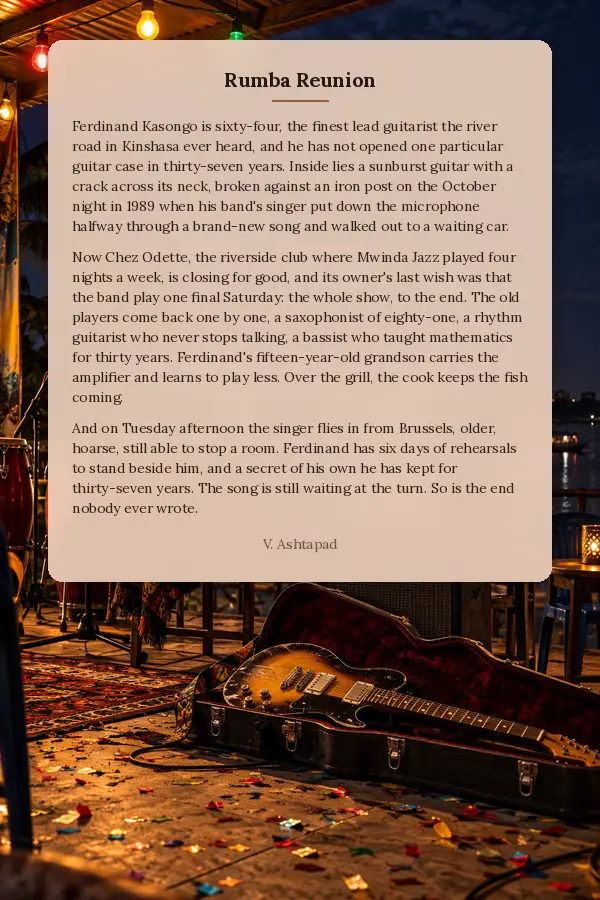
Ferdinand Kasongo is sixty-four, the finest lead guitarist the river road in Kinshasa ever heard, and he has not opened one particular guitar case in thirty-seven years. Inside lies a sunburst guitar with a crack across its neck, broken against an iron post on the October night in 1989 when his band's singer put down the microphone halfway through a brand-new song and walked out to a waiting car.
Now Chez Odette, the riverside club where Mwinda Jazz played four nights a week, is closing for good, and its owner's last wish was that the band play one final Saturday: the whole show, to the end. The old players come back one by one, a saxophonist of eighty-one, a rhythm guitarist who never stops talking, a bassist who taught mathematics for thirty years. Ferdinand's fifteen-year-old grandson carries the amplifier and learns to play less. Over the grill, the cook keeps the fish coming.
And on Tuesday afternoon the singer flies in from Brussels, older, hoarse, still able to stop a room. Ferdinand has six days of rehearsals to stand beside him, and a secret of his own he has kept for thirty-seven years. The song is still waiting at the turn. So is the end nobody ever wrote.
Members can react to this book and talk about it in the members' Library.
Ownership
© 2026 CRUNOD LLC. All rights reserved.
This book is owned by CRUNOD LLC. It is free to read on EternalCurrent.Online. No part of it may be copied, reprinted, sold, recorded or adapted, including as audio, film or translation, without written permission from CRUNOD LLC.
© 2026 CRUNOD LLC. All rights reserved.