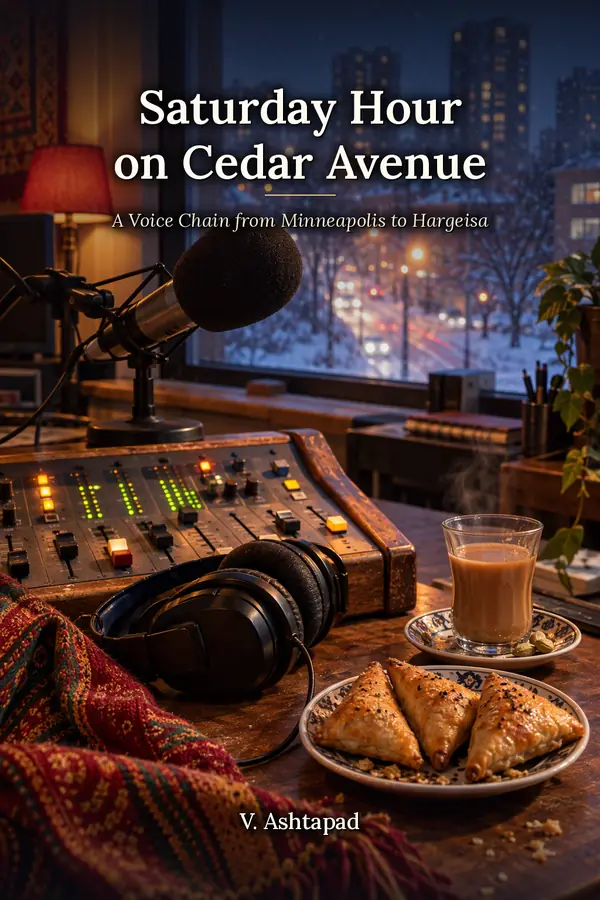
Saturday Hour on Cedar Avenue
A Voice Chain from Minneapolis to Hargeisa
by V. Ashtapad
Foreword
This is a novel, told as thirteen Saturday evenings of a weekly program that begins as a community radio hour and, when the little station goes dark, lives on as a chain of voice messages passed between Minneapolis, Nairobi, Hargeisa and beyond. The people in it, the station, the chain, the hall and its committee, and the families are invented. Real places such as Cedar-Riverside, Lake Street, the Midtown Global Market, Eastleigh in Nairobi, Hargeisa, Helsinki and the coast at Berbera are used fictionally, and nothing here describes real people or real recordings.
The verse in these pages is original to the characters. Buraambur is a form of Somali verse made and recited mostly by women, and the gabay is the long, weighty form; alliteration, keeping one sound through every line, and a steady meter are central to both, as they were to the poetry of the camel herders. The book uses only a few common Somali words, and readers who know the language will hear far more in the lines than an English page can carry.
For everyone who ever sent a voice back to finish someone else's line.
Handover
[Six o'clock. The station identification tone, two notes, slightly flat. A chair rolls on a hard floor.]
MR. YUSUF: Good evening, Cedar Avenue. Good evening, the towers, good evening to the taxi drivers waiting at the airport lot with the heater running. This is Riverside Voice, ninety-nine point three, low power and big heart, and this is the Saturday Hour. I am Yusuf Dualeh, and for nineteen years I have said that sentence on this night of the week. Tonight I say it for the last time, and so does the radio. At midnight Riverside Voice goes quiet for good.
[A pause. Somewhere behind the microphone, a kettle begins to tick on a hot plate.]
MR. YUSUF: Do not call in crying. I can hear the lines lighting up already, and I know who you are. Hooyo Maryan, I see your number. Wait your turn.
[Faint laughter from the studio. Paper shuffles.]
MR. YUSUF: Beside me tonight, at the board, is a young man many of you know only as the boy who fixes the microphone when I break it. Abdirahman Warsame. Seventeen years old. Senior at the high school. Son of Khadra, grandson of Hawa. Abdi, say good evening.
ABDI: Uh. Good evening. Fiid wanaagsan.
MR. YUSUF: You see? He speaks. Not much, but the words are correct. Starting next Saturday, this hour belongs to him, and it will not be on any radio. The frequency is sold, the transmitter goes back to the company, and Ingrid will cry in her car. So the boy will carry the Saturday Hour in the telephones, in the chain of voices people send each other, from Cedar Avenue to Nairobi to Hargeisa. Six o'clock, he says, every Saturday. My wife has agreed most of all, because she wants me home before the evening news.
[Caller line crackles.]
MR. YUSUF: Line one. You are on the Saturday Hour.
CALLER (MARYAN): Yusuf, nineteen years. Who will tell us which pharmacy is open on Sunday?
MR. YUSUF: The boy will tell you. He has a telephone that knows everything.
CALLER (MARYAN): Does he know Somali?
[Silence of almost two seconds. On radio this is a long time.]
ABDI: I'm learning, Eedo.
CALLER (MARYAN): Learning. Good. Learn fast. Nabad, Yusuf. Thank you for everything.
[Click. The kettle reaches a full rattle and someone lifts it off.]
*The studio was a single room above a travel agency and a shop that repaired cracked phone screens, and the room smelled of cardamom and warm dust off the transmitter rack. Abdi had been coming here since he was thirteen, first to carry Mr. Yusuf's folding chair up the narrow stairs, then to coil cables, then because nobody else could make the old mixing board stop humming. He knew every fader by feel. He knew that channel four cut out when the heat came on. What he did not know was how to fill sixty minutes with his own voice in a language he understood well at the kitchen table and badly anywhere else.*
*Mr. Yusuf poured shaah into two paper cups, the tea already milky, the cardamom pods floating like small green boats. He set one beside the board without asking. On the window ledge sat a foil tray of sambuusa that Hooyo Maryan's daughter had dropped off at five, triangles with their corners going dark and crisp, and the whole room had the oily, peppery smell of them. Out the window, Cedar Avenue was still September-bright, the light coming in long and gold off the towers, those tall slabs with their faded panels of red and blue and yellow that you could see from the freeway, from the river, from the airplane when you came home.*
MR. YUSUF: Now, as always at a quarter past, a song. This one was requested by a man who has requested it every month for six years. He knows who he is. It is an old recording from the Mogadishu days, a band with horns and an oud and a singer whose voice could make a whole wedding hall go quiet. I will not say the name, because he asked me never to say it, he only says, play the one with the long beginning. Here is the one with the long beginning.
[Music: a slow oud introduction, then a brass line that sounds as if it is coming across a large room. The recording hisses.]
*While the song played, Mr. Yusuf leaned back in his chair and closed his eyes, and Abdi watched the meters bounce green and amber. The recording was a digital copy of a cassette of a copy of a reel, and every generation had added a layer of hiss, a softness at the top, a wobble where the tape had once been stretched. Abdi had cleaned it up once, two summers ago, filtering out the worst of the hum. Mr. Yusuf had listened to the cleaned version and shaken his head. Put the dust back, he said. The dust is where we were.*
*Abdi had not understood that then. He thought he understood it a little better now, watching the old man's mouth move along with words he was not singing aloud.*
MR. YUSUF: You are back with the Saturday Hour. I want to read you some of what you have sent this week. From a woman in Rochester: Yusuf, my mother listened to you every Saturday until she passed, and now I listen for her. From a student at the university: you taught me the word for patience, which is samir, and I needed it for my exams. From a man in St. Cloud: please tell the young host he must keep the death announcements, because otherwise how will we know.
ABDI: I'll keep them.
MR. YUSUF: You see, he promises already. Write that down, Ingrid.
[From farther off, a woman's voice, Minnesota flat and amused.]
INGRID: I'm writing it down.
MR. YUSUF: Ingrid Halvorsen, our station manager, who has never once complained that I go over time. Ingrid, say something in Somali.
INGRID: Mahadsanid.
MR. YUSUF: Thank you, she says. Nineteen years and still only the one word, but she says it like she means it.
[Caller line crackles. A louder hum underneath, an engine.]
MR. YUSUF: Line two, you are on the air.
CALLER (BASHIR): Yusuf! It's Bashir. I'm outside Sioux Falls, I pulled over just to call you. I got a trailer of frozen chicken and a heart full of sadness.
MR. YUSUF: Bashir from the Road. How many years have you called from that truck?
CALLER (BASHIR): Eleven. Eleven years. You played my daughter's graduation song from a rest area in Iowa. I will never forget. Listen, the boy, is he there?
ABDI: I'm here.
CALLER (BASHIR): Abdi, I will call you every week. Every week. If you are bad, I will tell you.
ABDI: Okay. Thanks. I think.
CALLER (BASHIR): Good. Yusuf, go home and rest. Nabad.
[The engine noise swells, then the line drops.]
*At home the apartment was on the second floor of a brick building on a side street off Riverside Avenue, where the radiators had not yet come on for the year and the kitchen held the morning's smell all day long. Khadra had made canjeero before Abdi woke, ladling the batter from the big steel bowl onto the flat pan, the rounds bubbling up full of small holes and going spongy and sour. Three were left under a dish towel on the counter. Sagal had eaten two with sugar and ghee and left the sticky knife in the sink.*
*Khadra was in the hallway pulling on her work shoes, the soft black ones with thick soles, her badge clipped to the lanyard that said the name of the home care agency. She worked nights with an old man in Edina who could not be left alone after dark. She had the radio on, the small one that lived on top of the refrigerator, and when Mr. Yusuf said the boy will tell you, she stopped with one shoe on and laughed out loud.*
*Sagal was lying on the living room carpet with her feet up on the couch, doing her math homework upside down.*
*"He sounds scared," Sagal said.*
*"He sounds like your uncle Cabdi used to sound," Khadra said, "the first time he talked to the elders at a wedding. And your uncle Cabdi talked for forty years after."*
*"Did Abdi know he was going to say Eedo to her? Because she's not his aunt."*
*"Every woman that age is everybody's aunt." Khadra did up the second shoe. "Finish that before I get back. And if your brother comes home and he's quiet, don't bother him."*
*"I always bother him."*
*"I know," Khadra said, and kissed the top of her daughter's head, and left for the bus.*
MR. YUSUF: We are near the end. Before I go, a word about the hour itself. People ask me, Yusuf, what is the Saturday Hour for? We have satellite television. We have the internet. Our children watch everything on telephones. Why a little radio station you can only hear from the river to Lake Street, and on a good night, as far as the airport? I tell them this. When I came here, in the winter of ninety-four, I did not know where to buy rice. I did not know which bus went to the hospital. I did not know who else from home was alive. I found out on a radio, in a basement, from a man who has since passed. The radio told me there were others. That is all it is for. It tells you there are others. Next week it will be a telephone that tells you. That is all right. The telephone also has others in it.
[A pause. The kettle clicks as it cools.]
MR. YUSUF: Abdi, I will tell you one more thing on the air so everyone hears it. Your grandmother is Hawa. You know who your grandmother is?
ABDI: She's my grandmother.
MR. YUSUF: She is a poet, boy. In the north, among the women, when I was a child, people walked a whole day to hear her aunt recite, and they say Hawa was better. You have a poet in your family and you have never put her on this radio. Now there is no radio. Put her in the telephones. Fix that.
ABDI: She won't come.
MR. YUSUF: Ask her properly. Ask her in Somali.
[Laughter from Ingrid off-mic.]
MR. YUSUF: That's all. That's nineteen years. I leave you with the music that has closed this hour since the beginning, the drums from a wedding in Minneapolis in the year two thousand and seven, recorded by me on a little cassette recorder I held over my head. Good night, Cedar Avenue. Habeen wanaagsan. Look after each other.
[Music: a field recording of wedding drumming, hand drums in a fast, interlocking rhythm, women ululating in the background, a crowd of voices. It plays for nearly a minute and then fades.]
*After the transmitter went silent at the end of the hour, for the last time, the room was very quiet. There was no overnight feed anymore, only the hum of the board. Mr. Yusuf took his headphones off and coiled the cord around his hand in the slow, careful loop he always used, the one he had tried to teach Abdi and that Abdi had never learned. He set them on the board and slid them over.*
*"These are yours," he said. "They are better than they look."*
*They looked terrible. The foam on one ear had split and been mended with black tape, and the band had a crack held together with a hose clamp. Abdi put them around his neck anyway.*
*"I can't really talk," Abdi said. "Not like you. I don't know the words for half the things you say."*
*"Then you will learn them in the chain, and the people listening will learn with you. You think you are the only boy on this avenue who is losing his grandmother's language? You are one of a thousand. Maybe you are the only one with six hundred telephone numbers."*
*He stood, slowly, his knees making a sound, and pulled on his wool coat even though it was not cold yet. On the wall by the door hung a calendar from a Somali restaurant on Lake Street, still turned to August. Mr. Yusuf turned it to September, then looked at it for a moment, as if he had expected something else to be there.*
*"Ingrid has a list for you," he said. "Six hundred numbers. Every person who ever called this hour. And a letter, about the hall. Read it this week. Do not be frightened by it. Be smart."*
*Then he took the last two sambuusa, wrapped them in a napkin for his wife, and went down the stairs one step at a time.*
*Abdi stayed. He pulled up the recording of the hour and listened to the first three minutes again, his own voice saying uh, good evening, the pause before fiid wanaagsan that he could see on the waveform as a flat line, a small canyon. On the station's computer, in the folder where every Saturday Hour since 2009 was saved, Ingrid had already made a new folder with his name on it. It was empty. Below it, in the private archive space the station kept for its members and volunteers, which Ingrid had sworn to keep open after midnight if she had to pay for it herself, there were hundreds of episodes from Mr. Yusuf, many with typed transcripts that Mrs. Ayaan, the retired teacher, had made on her kitchen table every Sunday afternoon, all of them in two languages, side by side.*
*He scrolled to the very first one, a file from a cassette, the date written as a question mark. He played ten seconds. A younger Mr. Yusuf, his voice higher and quicker, said the same opening words, good evening, Cedar Avenue, as if the avenue were a person who might answer.*
*Abdi turned off the lights except the red one over the door and walked home along Riverside in the early dark, the air smelling of fried onion from the restaurants and the river beyond the hospital, the towers lit up floor by floor above him like a set of filing cabinets someone had left open. On the nineteenth floor of the nearest one, three windows from the end, his grandmother's light was on. He stood on the sidewalk with the headphones around his neck and looked up at it for a long time, practicing a sentence under his breath.*
The Asking
[Six o'clock. The chain's opening note: two flat tones Abdi has lifted off the old station recording. A long burst of feedback, cut off fast. A mumbled word that was not meant to be sent.]
ABDI: Sorry. Sorry, that was me. Good evening, Cedar Avenue. There's no Riverside Voice anymore, so this is just the Saturday Hour, on your phones. I'm Abdi Warsame. This note is going to six hundred and eleven numbers, in Minneapolis and Columbus and Nairobi and Hargeisa and places I haven't found yet. If it's three in the morning where you are, listen when you wake up, and send your notes back. Mr. Yusuf is home tonight, probably listening, probably shaking his head at that noise.
[A voice note arrives almost at once.]
ABDI: Already? Okay. First note.
VOICE NOTE (MR. YUSUF): Your gain on channel two is too hot.
ABDI: Mr. Yusuf.
VOICE NOTE (MR. YUSUF): Turn it down a little. Good. Now I will stop sending you notes for a month. Go.
[The note ends. Ingrid laughs off-mic.]
*He had written the whole first segment on index cards, the way his English teacher said to do for speeches, and he had written it in English with the Somali words he needed spelled out in capitals in the margins. Fiid wanaagsan. Dhegeystayaal, listeners, which he had practiced so many times in the bathroom mirror that Sagal had started saying it back to him through the door in a deep man's voice. The cards were already damp at the edges from his hands.*
*Ingrid sat on the stool by the coat rack with her knitting and a laptop, her reading glasses on top of her head. She was sixty-three, had grown up on a dairy farm near Fergus Falls, and had managed the station from its first basement days to the night it went dark, and had not yet worked out what to do with her evenings. She did not speak any of the six languages the station had broadcast in, other than English and a little Spanish, and she knew the names of every host's children. She had kept the room above the travel agency for one more year on her own credit card, and the old board in it, and the list of numbers.*
ABDI: So, first, the announcements, because I promised. Hooyo Maryan asked me to say that the pharmacy on Riverside is open Sunday until four. The community center on Lake Street has the winter coat drive starting the first of October. And there is a death announcement, which I will read the way Mr. Yusuf did, slowly.
[Paper rustles. His voice drops and slows.]
ABDI: Shamsa Ali Farah, age eighty-one, of Minneapolis, formerly of the coast at Berbera, passed on Thursday. She leaves eight children and more grandchildren than her family could count for me on the phone. The family receives visitors at the home of her son in Burnsville through Monday. May she rest.
[A pause.]
ABDI: I didn't know her. But her granddaughter is in my chemistry class, and she sent me a note herself to make sure it was read. So I read it.
*Ingrid stopped knitting for a moment. Then she started again.*
ABDI: Now, a song. This was requested by the trucker, Bashir, who said he would send a note every week, and who texted me today from a gas station in Nebraska. He wants something with drums. So here is a wedding song, a recent one, from a group in Columbus, Ohio. It's got a keyboard and a hand drum and a singer with a very high voice, and it's the kind of song where your aunts all stand up at the same time.
[Music: a bright keyboard riff over a quick drum pattern. Someone in the background of the recording claps on the off-beat.]
*During the song Abdi read the letter again. He had kept it folded in his back pocket all week, and the creases had gone soft. It was from the committee of the community hall on Cedar, sent to Ingrid because she sat on it, and it said in four paragraphs what she had said to him in two sentences on Monday: every spring the committee gave the hall's main room for one Saturday night in June, and a small grant for an archive, to the neighborhood program that could show it served people nobody else served. A wedding-supply company from the suburbs had already asked for the same night. Whoever wanted it would need to show the committee, by March, that it mattered. Letters. Logs. Evidence.*
*"So we need to prove people listen," Abdi had said.*
*"We need to prove it matters that they listen," Ingrid said. "Those aren't the same thing. Nineteen years of Yusuf mattered. But nobody wrote it down in a way nine people on a committee with a budget can understand."*
*She had given him a manila folder. It was empty except for a sticky note that said EVIDENCE in her square farm handwriting. Under it, smaller, she had added: *gabay night? June?**
ABDI: Okay, we're back. I want to say something I've been nervous about all week. Last Saturday, Mr. Yusuf told me on the chain to bring my grandmother on the show. A lot of you called my house about it. Some of you called my grandmother. Eedo Faadumo, I know you went to her apartment with bariis and told her it was her duty.
[Faint laughter from Ingrid.]
ABDI: So I asked her. On Tuesday. I'm going to tell you how that went, because Mr. Yusuf always said the radio should tell the truth even when it's boring.
*The nineteenth floor smelled of the cumin and onion that came through every door at dinner time, and of the industrial floor cleaner the building used, sharp as a cut lemon. Ayeeyo Hawa lived alone in a one-bedroom at the end of the hall with a view east across the river toward St. Paul. She had refused every offer to move in with Khadra, because Khadra's apartment was on the second floor and you could not see anything from the second floor, she said, except other people's cars.*
*She was seventy-eight. She wore a long dirac in a pale green print, a scarf the color of dried apricots, and wool socks under her house sandals from October to May. She was small and very straight. She kept a thermos of shaah on the low table by the window, and next to it a dish of dates, a plastic pill organizer with the days of the week in English, and a transistor radio wrapped in a rubber band to keep the battery cover on.*
*Abdi had sat on the cushion by her feet, as he had since he was small, and tried to say it in Somali. He got as far as the word for radio, which was raadiyo, and which was the easy part. Then he got lost. He knew the word for poem, and he knew the word for Saturday, and he could not find the bridge between them, so he said it in English, and then Ayeeyo had looked at him for a while with her clouded right eye and her sharp left one.*
*"You are asking me in English," she said, in Somali, "to come and say poems in Somali, to people who do not speak Somali anymore, on telephones, now that even the radio is gone."*
*"People can hear it as far as Nairobi," he said.*
*She had laughed at that, a short dry sound like someone shaking a seed pod.*
ABDI: She said no. She said she's too old and her voice is too thin and the poems she knows are for women, not for six hundred telephones with men listening. Buraambur, which is what she does, is a kind of poetry women make and say, mostly at weddings and gatherings. I didn't know that until this week, honestly. I knew she said poems at weddings when I was little. I didn't know there was a name for the kind.
[A voice note comes in.]
ABDI: Next note.
VOICE NOTE (OLDER WOMAN): Abdi, this is Ruqia from the eleventh floor. Your grandmother is being shy. In the north, when we were girls, her voice was not thin. It went across the whole camp. The camels stood up.
ABDI: The camels stood up?
VOICE NOTE (RUQIA): They stood up. You tell her Ruqia said so. And you tell her men have been listening to women's poems for a thousand years whether we let them or not.
ABDI: I'll tell her.
[The note ends.]
ABDI: Next note.
VOICE NOTE (YOUNG MAN): Hey, is this the show? Okay. I'm Jamal. I'm his best friend. I just wanted to say he practiced the opening like forty times in the lunchroom and he still messed it up.
ABDI: Jamal. Hang up.
VOICE NOTE (JAMAL): Also how do you say grandmother? Because I've been calling her Miss Hawa for four years and I feel like that's wrong.
ABDI: Ayeeyo.
VOICE NOTE (JAMAL): Ay-ee-yo.
ABDI: Close enough. Bye, Jamal.
VOICE NOTE (JAMAL): Ayeeyo, if you're listening, I'm sorry about the Miss Hawa thing.
[The note ends. Ingrid is openly laughing now.]
*Jamal Bell lived four floors below Ayeeyo in the same tower, the only American-born Black family on that side of the building, and he and Abdi had been sitting next to each other since seventh grade because their last names were close enough in the alphabet when Warsame got entered wrong. Jamal played trumpet in the jazz band and had opinions about everything. He had been to more Somali weddings than any non-Somali person in the city and had once, at a cousin's party, been told by three separate aunties that he was too thin.*
ABDI: So that was Tuesday. She said no. On Wednesday I went back, and I took Sagal, my sister, who is ten and who Ayeeyo likes better than me.
*Sagal had walked straight in, kicked off her boots, sat on the arm of Ayeeyo's chair, and said in her quick, messy Somali, half of it English, that if Ayeeyo came on the Saturday Hour, Sagal would get to stay up until eight on Saturday, and if Ayeeyo didn't, Sagal would have to go to bed at seven-thirty like a baby, and that was a human rights issue.*
*Ayeeyo had pinched her cheek and told her she talked like a lawyer.*
*Then Ayeeyo said something to Abdi that he did not fully catch. He caught the word for one, and the word for line, and a word that he thought meant teach. He asked her to say it again, slower, and she did, and he still missed the end, so Sagal translated it for him, rolling her eyes.*
*"She says she'll do one line. One line a week. She says the line, and people have to finish it. Like a game. And she says if you turn the music up too loud when she's talking, she's walking home."*
*She called it the radio. She called it the radio from that first night to the end and would not be corrected, and after a few weeks nobody over sixty on the whole chain called it anything else.*
ABDI: So. Starting next Saturday, Ayeeyo Hawa will be on the hour for one segment. She says she will give one line of poetry, and you send voice notes back to complete it. She explained it to me, and I'll try to explain it to you, but I'll probably do it wrong. In Somali poetry, there's a rule that every line has a word starting with the same sound. The whole poem. If it's a poem on the letter D, every line, all the way through, has a D word in it. She says you can tell how good a poet is by how long they can hold the sound without it getting stupid.
[Pause.]
ABDI: That's her word. Stupid. I'm quoting.
*The notes started arriving before he had finished the sentence, five, then nine, then too many to count, the phone on the board shuddering against the wood until Ingrid moved it onto a folded scarf. Ingrid looked up from the laptop. On it she had opened a document and was typing the time of each note, the first name, the town. She turned the screen so Abdi could see it. The heading at the top said EVIDENCE.*
ABDI: Okay. I can't play all of these. I'll play one.
VOICE NOTE (BASHIR): Abdi! Bashir. I am in a truck stop in North Platte eating something they say is a burrito. You got your grandmother?
ABDI: I got her.
VOICE NOTE (BASHIR): Good boy. My mother, may she rest, said buraambur at my sister's wedding in the north, and men cried. I want to finish your grandmother's lines from the road. I will pull over every Saturday. You tell her. Bashir from the Road will finish.
ABDI: I'll tell her you're competing.
VOICE NOTE (BASHIR): Not competing. Helping.
[The note ends.]
ABDI: That's almost the hour. The last song tonight is one Mr. Yusuf always played at the end, the wedding drums from 2007. I asked him if I should keep it or find my own. He said find your own, eventually, but not yet. So, not yet.
[Music: the same wedding drumming, slightly louder than last week, the ululation clearer.]
*At home Khadra had already left for Edina, and the apartment was quiet except for the refrigerator and the radiator, which had finally come on that afternoon and was clanking like someone knocking from inside the wall. Sagal was asleep on the couch in her school sweatshirt with Khadra's old phone on her chest, the Saturday chain still open on it, a note from a woman in Eastleigh, in Nairobi, playing for the third time, sent at four in the Nairobi morning.*
*Abdi took the phone gently off her and switched it off, put the blanket over her, and sat at the kitchen table with the last canjeero from the morning, cold and sour and good with a spoon of sugar. On his phone he opened the old station's private archive, which Ingrid was keeping open on her own card, and found the folder with his name. It now held one file: the hour as he had stitched it together at the board from his own notes and everybody's replies. Under it, someone had already typed the beginning of a transcript, the Somali and English side by side. Mrs. Ayaan had done it within the hour. At his sorry, sorry, that was me, she had typed, simply, [feedback], and moved on.*
*He scrolled down to the part where he had read the death announcement for a woman from the coast at Berbera, a woman he had never met. Beside his English, Mrs. Ayaan had put it in Somali, the way he should have said it. He read the Somali under his breath three times, then went to wash the plate.*
The First Line
[The opening chime. A clean open this time. The soft hiss of a room microphone set farther back than usual.]
ABDI: Good evening, Cedar Avenue. Fiid wanaagsan. This is the Saturday Hour, and I'm Abdi. No feedback tonight. Ingrid checked my levels three times, and Mr. Yusuf texted me at four in the afternoon to say, do not touch channel two.
[A small dry laugh off-mic, an older woman's.]
ABDI: That laugh is my grandmother. She's sitting across the table from me in the guest chair, with her own thermos, because she says the tea up here is too weak. She's going to be on in the second segment. If you're sending notes early to talk to her, please don't. She says she's not here yet. She's only sitting.
*She had come up the narrow stairs with one hand on the rail and the other on Abdi's arm, refusing the elevator in the travel agency next door because she did not trust a box that small. She had looked around the studio the way she looked at a market stall, deciding what was worth the price. The foil tray of sambuusa. The cracked leather couch where volunteers napped on long nights. The framed photograph of Mr. Yusuf from 2010, younger, holding a cassette recorder over his head at a wedding. The microphone on its spring arm. She had tapped the microphone with one finger, gently, as if checking a melon.*
*"It's on," Abdi said. "Everyone heard that."*
*"Good," she said in Somali. "Now they know I am real."*
ABDI: First the announcements. Coat drive at the community center continues, and they need children's sizes, especially boots. The museum on Lake Street has a new exhibit of headrests and milk vessels, the carved wooden ones, and Ayeeyo says that's where her mother's milk jug should be and isn't, so if anyone took it in 1991, please return it.
[The older laugh again, a little louder.]
ABDI: She's joking. I think. And the city says the parking ban for the first snow will be announced soon, so if you have a car on the even side, you know what's coming.
*It was the second week of October and the trees along the river had gone the color of turmeric, and the wind coming up off the water had an edge that you felt in your teeth. In the kitchen that morning Khadra had made the canjeero thinner than usual, and Ayeeyo, who had stayed overnight because of the early start, had stood behind her daughter at the stove and corrected her ladle, saying nothing, just moving Khadra's wrist a little to the left. Khadra had let her. Sagal had watched them both and asked why you couldn't just use a measuring cup, and both women had looked at her with exactly the same face.*
ABDI: Here's a song. It's an old one Ayeeyo asked for. She says she heard it on a radio in a teashop when she was a young woman, a famous singer from the sixties with a voice like a reed flute, singing about rain coming back to the land after a dry year. I found a copy. The quality is bad. Mr. Yusuf would say the dust is where we were. So here's the dust.
[Music: a thin, high woman's voice over a lute and slow hand drum. The recording wavers.]
*While the song played Ayeeyo did not close her eyes the way Mr. Yusuf did. She looked out the window at the towers across the street, at the bus going by with its windows fogged, and her lips moved, and Abdi understood after a moment that she was not singing along with the words but counting the beats of the line with her mouth, one, two, three, the way you count steps on a stair you know in the dark.*
*Ingrid had set up a second laptop at the end of the table for Mrs. Ayaan, who had come in person tonight for the first time in years. Mrs. Ayaan was sixty-nine, had taught mathematics in Mogadishu and then fourth grade in Columbia Heights, and typed faster than anyone Abdi knew, her reading glasses on a beaded chain. She had brought a pack of index cards with the Somali alphabet on them in case anyone needed reminding that the letter C stood for a sound that English did not have, the one deep in the throat, and that X was another, rougher, like clearing dust from a pipe.*
ABDI: Okay. We're back. This is the part. I'm going to try to explain it once more, and then Ayeeyo will just do it, and that will make more sense than me. In Somali poetry the poem stays on one sound, the way a song stays in one key. Every line has to have a word that starts with that sound. The poet picks the sound at the beginning and then she's stuck with it. Ayeeyo is going to say one line in Somali. Then I'll say what it means in English, and Mrs. Ayaan will check that I said it right. Then you send a note with the next line. It has to keep the sound. It has to make sense. And she's going to tell you if it doesn't.
[Pause.]
ABDI: Ayeeyo.
[A chair creaks. A breath, close to the microphone now. When she speaks it is in a low, carrying voice, nothing like thin, the vowels long. She gives one line in Somali. It has a rocking shape to it, a heavy beat in the middle and a fall at the end.]
*Abdi had heard her voice all his life. He had not heard this one. It came from somewhere lower and farther back, and it filled the little room with no effort at all, and on the meter it barely moved, because she was not loud. She was only completely sure.*
ABDI: The sound is G. And the line means, roughly, Mrs. Ayaan, help me. Roughly: The camels come to the water in the gray before morning.
MRS. ASHA: That's right. Geel is camels. She used the word for the first light, the gray one, which also starts with G. Very nice.
AYEEYO HAWA: Very nice, she says. Like I am her student.
[Laughter around the table.]
ABDI: Send your notes. You need a line that keeps going. It has to have a G word.
[A voice note comes in. Then several at once.]
ABDI: Next note.
VOICE NOTE (RUQIA): Hawa! It's Ruqia.
AYEEYO HAWA: I know who it is. Your voice has not changed since you were twelve. Give me a line.
[Ruqia speaks a line in Somali, quick and a little breathless.]
ABDI: She said, um, the herd boy sings to them with a voice like a ...
MRS. ASHA: Like a gourd. A gourd full of milk.
AYEEYO HAWA: A gourd. Hm. A gourd does not sing. But fine. It keeps the sound. You may stay.
VOICE NOTE (RUQIA): Fine? I'll take fine. Thank you, Hawa.
[The note ends.]
ABDI: Next note.
VOICE NOTE (YOUNG WOMAN): Hi, um, I'm Hodan. I'm a student at the university. I don't know if I can do it. Can I try in mostly Somali?
AYEEYO HAWA: Try.
[A careful line, slow, with one word in English in the middle of it.]
AYEEYO HAWA: The English word in the middle. Take it out.
VOICE NOTE (HODAN): I don't know the Somali.
AYEEYO HAWA: Then you will learn it. Abdi, what did she say in English?
ABDI: Grass.
AYEEYO HAWA: Grass is a G in English, very clever, you are trying to cheat. In Somali it is not. So find a different thing that is green and starts with our sound. Call back next week.
VOICE NOTE (HODAN): Okay. I will. Thank you, Ayeeyo.
[The note ends. Mrs. Ayaan is laughing silently, her shoulders moving.]
*The phone lit up again, note after note. Ingrid typed the names into the EVIDENCE file and also, on a separate page, a list of the words that had come up: geel, gourd, gray. Mrs. Ayaan leaned over and corrected her spelling of each one. Then, without anyone asking, Mrs. Ayaan opened the archive and made a new page under the old station's folder, a list, and titled it Ayeeyo's Words.*
ABDI: Next note.
VOICE NOTE (BASHIR): Abdi! Bashir. Hawa, I am Bashir from the Road, from a family in the north. My mother said poems like you. I am on the side of Interstate 80 near Lincoln. Can I give a line?
AYEEYO HAWA: The trucker. Yes. They told me about you. Give me a line.
[The line comes over the engine hum, steady, in a deep man's voice. It has the G sound twice in it.]
AYEEYO HAWA: Twice. Showing off. Abdi?
ABDI: The road is long and the herd... no. Mrs. Ayaan?
MRS. ASHA: He said: The road goes long and the herd goes slowly, but the well does not move. And he used a word for the far side of the plain that starts with G.
AYEEYO HAWA: That is a good line, trucker. That is a man's line, but it is good.
VOICE NOTE (BASHIR): I will tell my sister. She will not believe a poet said I was good.
AYEEYO HAWA: I said the line was good. I said nothing about you.
[A loud laugh down the phone, then the click.]
*They played four more notes before the segment ran out. One was a man in Eden Prairie who gave a line so long that Ayeeyo stopped him halfway and told him to choose. One was a woman named Faadumo who sent a perfect line and nothing else, before anyone could praise it. One was a girl of perhaps twelve, very quiet, who said only two words in Somali, both starting with G, and Ayeeyo said, that is not a line yet, but it is the start of one, and the girl said, okay, and was gone. One was Jamal.*
ABDI: Next note.
VOICE NOTE (JAMAL): Okay. I can't do the poem. I just want to know what geel is again.
AYEEYO HAWA: Camels.
VOICE NOTE (JAMAL): Geel. Like, more than one camel?
AYEEYO HAWA: Many camels.
VOICE NOTE (JAMAL): What's one camel?
AYEEYO HAWA: Abdi. Tell your friend.
[Silence in the room. A paper rustles.]
ABDI: I, uh, I don't remember.
AYEEYO HAWA: You see? My grandson does not know the word for one camel. On the radio. In front of the whole avenue.
[Mrs. Ayaan says the word quietly. Abdi repeats it. Jamal repeats it worse.]
VOICE NOTE (JAMAL): Okay, I've got it. Thanks, Ayeeyo. I learned two words tonight, and that's more than Abdi.
[The note ends. Laughter, including Ingrid's.]
*Abdi's face was hot. He moved a fader to cover the moment, then moved it back, because there was nothing to cover. Ayeeyo was looking at him across the table with the sharp left eye, and he expected her to say something else, but she only poured shaah from her thermos into the lid and pushed it toward him, and that was somehow worse and also better.*
ABDI: Okay. The last song. This one's my choice, not Mr. Yusuf's and not anyone else's. It's a newer thing, an instrumental by a guy in London who plays oud over electronic drums, very slow, a little sad. I found it last year when I couldn't sleep. That's all I'll say about it. Good night, Cedar Avenue. Habeen wanaagsan. Ayeeyo will be back next Saturday with a new sound. Practice.
[Music: an oud, close-miked, the strings buzzing against the frets, over a low, slow electronic pulse.]
*Afterward, while Abdi wrapped the cables and Ingrid read through the call list, Mrs. Ayaan sat beside Ayeeyo at the end of the table with the laptop between them. On the screen was the list she had started, the words from the night in a column, and next to each word a small round button. Mrs. Ayaan explained, slowly, in Somali, that if Ayeeyo would say each word once into the little microphone clipped to the laptop, then the word would be saved with her voice on it, and anyone who opened the list could press the button and hear Hawa say it.*
*Ayeeyo looked at the button for a long time.*
*"Anyone," she said.*
*"Anyone on the chain. Members. Families who sign up."*
*"Not strangers in the government."*
*"Not strangers in the government."*
*Ayeeyo leaned to the laptop and said geel into it, firmly, the way you call an animal that has wandered. Then gray before morning. Then gourd, and she made a small face at gourd. Then, without being asked, she said the word for one camel, the one Abdi had forgotten, and looked at him across the room as she said it, and Mrs. Ayaan saved it at the top of the list.*
*They walked home together in the dark. It was colder than it had been in the afternoon, and the air smelled of fallen leaves and a little of the diesel from the buses idling on Cedar. Ayeeyo held his arm with her gloved hand and did not speak until the bottom of her tower, where the security guard, a young man named Liban, opened the door and said Ayeeyo, I heard you, you were very good, and she said, I know.*
*In the elevator up to nineteen she said, in Somali, "Why don't you know the word for one camel?"*
*He started to say something about school, about English all day, about Mom working nights. He didn't. He said, "I don't know."*
*"Your grandfather knew one hundred words for camels," she said. "For their colors, for their ages, for a camel that has given birth once, for a camel that walks ahead. One hundred. You know one, and you forgot it."*
*"Can you teach me?"*
*The elevator doors opened. She stepped out first. In the hallway, with its smell of onion and floor cleaner, she turned and looked at him.*
*"I just did," she said. "Next week you will have two."*
Wells
[The opening chime. A thump, a giggle, a child's whisper too close to the microphone: "Is it on?"]
SAGAL: It's on. Hi. This is Sagal Warsame. I'm ten. My brother said I could say the first thing if I did my homework, and I did my homework, so. Good evening, Cedar Avenue.
ABDI: Okay. Thank you, Sagal.
SAGAL: Fiid wanaagsan. That's the same thing in Somali. He says it wrong.
ABDI: I don't say it wrong.
SAGAL: You say it like a weatherman.
[Ingrid laughs out loud, off-mic. A chair scrapes.]
ABDI: This is the Saturday Hour. I'm Abdi. My sister is here tonight because our mom is working and Ayeeyo said she wasn't babysitting during a poem. So Sagal gets the guest headphones and she promised not to touch anything.
SAGAL: I'm touching the chair.
ABDI: The chair is fine.
*Khadra had picked up an extra shift. The man in Edina had fallen in the bathroom on Wednesday and come home from the hospital with a cast on his wrist, and his son in Arizona had asked the agency for someone who could stay overnight and also the afternoon, and Khadra had said yes because the agency paid time and a half for afternoons and because the man, whose name was Mr. Lindgren, asked for her by name and held her hand while she changed the dressing. She had left the apartment at two with a bag of sambuusa she had fried at noon, wrapped in a paper towel, and a note on the counter for Abdi: Sagal to bed by nine, no candy after the show, I will know.*
ABDI: Announcements. Thank you to everyone who brought boots to the coat drive. Hooyo Maryan tells me they got sixty pairs. Also, Ingrid wants me to say something official, and I'm going to read it because if I say it in my own words she'll make me do it again.
[Paper rustles.]
ABDI: In the spring, the committee of the community hall on Cedar will decide which neighborhood program gets the hall's main room for a Saturday night in June. The Saturday Hour is asking for that night, for a gabay night: a whole hall of people giving lines and finishing them. As part of that request, we are gathering letters from people on the chain describing what the Saturday Hour means to them and their community. If you would like to write such a letter, please send it to Ingrid Halvorsen at the address on the members' page, or bring it to the room above the travel agency on Saturday evenings. Letters in any language are welcome.
[Pause.]
ABDI: In my words, somebody else wants the hall, and if we can't show we matter, they get it. So write. Even if it's short. Even if it's just, I listen while I cook.
SAGAL: I listen while I do math.
ABDI: That counts.
*The other request was pinned to the hall's corkboard with the rest of the committee papers. Abdi had read all of it on Monday on his way out of the hall, two pages, most of it floor plans and one paragraph about serving the bridal community of the greater metro area. There was no bridal community of the greater metro area that needed the hall on Cedar. There were the towers, the hospital, two universities, the Midtown Global Market with its stalls of injera and pho and Mexican pastries, the Somali malls near Lake Street with their rows of small shops of perfume and fabric and phone cards and gold, and maybe sixty thousand people who could walk to the hall in ten minutes.*
*Abdi had printed the paragraph about the bridal community and pinned it to the corkboard above the board, where he would see it every week.*
ABDI: Song. Tonight Sagal picked it, because that was the other half of the deal. Sagal?
SAGAL: It's the one from Eedo Nimco's wedding. With the drum that goes like, dum dum ka-dum, dum dum ka-dum. And everybody does the thing with the scarves.
ABDI: That's the description. That's what I'm giving you. Dum dum ka-dum.
[Music: a fast wedding beat, a darbuka-style drum and a keyboard playing a winding melody, a crowd clapping along.]
*Sagal danced in her chair through the whole song, carefully, without touching anything, her headphones on crooked. Ayeeyo sat at the end of the table in her winter coat, which she had not taken off, with her thermos and a small bag of halwo that Hooyo Maryan's daughter had left with the sambuusa. The halwo was the deep orange-brown kind, sticky with ghee and sugar and cardamom and nutmeg, cut into diamonds, and Ayeeyo was eating it one small piece at a time with her fingers, slowly, her eyes on Sagal.*
*"She dances like your mother," she said to Abdi, in Somali. He understood that one.*
*"Mom doesn't dance."*
*"Your mother danced at every wedding from the dry plain to the coast before she was fifteen," Ayeeyo said. "Then she came here and got tired. Ask her."*
*He did not know how he would ask that.*
ABDI: We're back. Before Ayeeyo's line tonight, I want to show you something we started this week, and I mean show, even though this is only voices. On the members' page, which you can sign up for if you call Ingrid, there's a map now. Mrs. Ayaan set it up. It's a map of the whole Horn, the north and the coast and the south, and the idea is, you put a pin where your family came from. The town. The well. The place your grandmother grew up. You can put a little note and a photo if you have one.
SAGAL: I put one already. For Ayeeyo. It's a well.
ABDI: She did. Ayeeyo told her the name of the well, and Sagal found it.
AYEEYO HAWA: She did not find it. The map found it. She pressed the screen.
SAGAL: I found it.
*They had done it Thursday after school at the kitchen table, on the laptop that Ingrid had loaned to the house because Abdi's was too old to open the members' page. Ayeeyo had come down for dinner, bariis with raisins and caramelized onions on top and goat that Khadra had cooked with cumin and cardamom until it fell off the bone, a banana on the side, sliced over the rice, the way Ayeeyo had eaten it all her life. Afterward Sagal had dragged the laptop over and asked Ayeeyo where she was born.*
*Ayeeyo had said a name, and then explained that there was no town, only a well, and some years a few houses, and in the dry season everybody left.*
*Sagal typed the name into the map in three different spellings. The third one landed on a speck in a beige, empty space north of a highway, west of a range of low hills, with no road leading to it at all. The satellite picture showed brown ground, a few dark marks that might have been thorn trees, a pale circle that might have been a place where animals had stood for centuries.*
*Ayeeyo leaned close and looked at the screen without speaking for most of a minute.*
*"That is it," she said finally.*
*"How can you tell?"*
*"The way the hills sit."*
*Sagal put the pin. In the note she typed, in English, Ayeeyo was born here. There was no town. There was a well. Then she asked how to spell the name properly and Ayeeyo spelled it, letter by letter, and Sagal fixed the note.*
ABDI: So, tonight, Ayeeyo has chosen a line for that. Ayeeyo.
[The low voice again. A line in Somali, the sound on W, with a long falling end.]
ABDI: The sound is W. The line means, sort of: The well is where the walking ends and where the walking begins. Mrs. Ayaan isn't here tonight, so if I'm wrong, send a note and tell me.
[A voice note comes in. Several.]
ABDI: Next note.
VOICE NOTE (HODAN): It's Hodan again. From the university. I found a word.
AYEEYO HAWA: The girl with the grass.
VOICE NOTE (HODAN): Yes. Okay.
[She gives a line, carefully, slowly. It keeps the W.]
AYEEYO HAWA: Hm. Abdi?
ABDI: She said, the women carry water on their backs from the ... wait, what's the last part?
VOICE NOTE (HODAN): From the well that nobody owns.
AYEEYO HAWA: Good. That is a true line. Nobody owns a well. People think they do. Good, Hodan.
VOICE NOTE (HODAN): Thank you, Ayeeyo. I practiced all week.
[The note ends.]
ABDI: Next note.
VOICE NOTE (YOUNG MAN, SLIGHT ECHO): Hello? Hello, can you hear me? This is Mahad. In Helsinki.
ABDI: Helsinki?
VOICE NOTE (MAHAD): Yes, Finland, it is two in the morning here. Abdi, I am your cousin. Your mother's cousin's son. We met when you were six at the wedding in Columbus. You threw up on my shoes.
SAGAL: He did?
ABDI: I don't remember that.
VOICE NOTE (MAHAD): I remember. Listen, my mother's friend in Columbus added us to the chain. We listened last week in the kitchen. My mother cried when Aunt Hawa started to speak. She says she has not heard that voice since nineteen eighty-nine.
[A pause. Ayeeyo is very still.]
AYEEYO HAWA: Who is your mother?
VOICE NOTE (MAHAD): Saynab. Saynab, the daughter of Cumar.
AYEEYO HAWA: Saynab with the gap in her teeth.
VOICE NOTE (MAHAD): [laughing] Yes. Still the gap.
AYEEYO HAWA: Tell her to call me herself. Not through her son at two in the morning. Tell her Hawa says she is lazy.
VOICE NOTE (MAHAD): I'll tell her. She'll be very happy. Can I give a line? My Somali is half Finnish now, but I'll try.
AYEEYO HAWA: Try.
[He gives a line. It keeps the W, and has a word in the middle that is neither Somali nor English.]
AYEEYO HAWA: What is that word in the middle?
VOICE NOTE (MAHAD): It is Finnish, for winter. Talvi. I'm sorry.
AYEEYO HAWA: It does not start with W.
VOICE NOTE (MAHAD): No.
AYEEYO HAWA: But it is cold there?
VOICE NOTE (MAHAD): Very cold already. And dark. By December the sun comes up after nine and goes down at three.
AYEEYO HAWA: Then the word can stay. Once. Because you are far.
[The note ends. Abdi lets a beat of silence sit.]
*Mrs. Ayaan was home with a cold, but she was listening, and she sent Abdi a message during the next song that said only: Mahad's line, transcribe it, I will fix Finnish word later. Ingrid typed Helsinki, Finland in the EVIDENCE file and put a star next to it, and then, after a moment, a second star.*
*The notes kept coming for the rest of the segment. A woman in Rochester gave a line about a well where her father had been a boy. A man in Toronto who said a cousin had added him to the chain three weeks before gave a line so beautiful that Ayeeyo was quiet for a second before she said, who taught you, and the man said his grandmother, and Ayeeyo said, then she taught you well, and that was all. Bashir sent a note from a truck stop in Wyoming where it was snowing, the first snow of the season, and gave a W line about wind, and said he could see the wind going across the parking lot white as a camel's milk.*
ABDI: That's the hour, almost. Before the last song, I want to say, if you're on the members' page, go look at the map. There are forty-one pins already. People put them all week. There's a pin in a town on the coast with a photo of a blue door. There's a pin on a well near the border with a note that says, my father dug this. There's a pin in Columbus, Ohio, that says, this is not where we came from but this is where we are, which I think is allowed.
SAGAL: Can I say the last thing?
ABDI: Go.
SAGAL: Habeen wanaagsan, Cedar Avenue. Go to bed. I have to.
[Music: the wedding drums of 2007, then a fade.]
*In the apartment, after nine, Sagal was asleep on top of the covers in her clothes with the guest headphones still around her neck, and Abdi did not have the heart to take them off. He sat at the kitchen table and opened the map.*
*There were forty-four pins now. Three more had come in during the last song. He zoomed into the beige space north of the highway, west of the low hills, and found Sagal's pin, the small blue drop. Someone had added a comment under her note an hour ago. It was in Somali, and he read it slowly, word by word, sounding out the vowels. It took him almost five minutes. It was from Saynab in Helsinki.*
*It said: I was there once, as a girl, in the rains. There were five houses. Your grandmother's was the one with the blue cloth over the door. She was already making poems. Tell her I remember.*
*He copied it out by hand onto an index card, the Somali, and under it, his English. Then he propped it against the salt shaker where Ayeeyo would see it on Sunday morning when she came for canjeero.*
Night Shift
[The opening chime. Outside the studio window, faintly, a siren going up Riverside toward the hospital, then fading.]
ABDI: Good evening, Cedar Avenue. Fiid wanaagsan, dhegeystayaal. This is the Saturday Hour. It's the first week of November. Daylight saving ended, so it's been dark since five, and it's twenty-nine degrees, and the first real snow is supposed to come Tuesday. Bring your car in off the even side.
[Ingrid, off-mic: "Odd side."]
ABDI: Odd side. Sorry. Ingrid knows the snow rules better than the city does.
*He had said dhegeystayaal without looking at the index card. He noticed it only after, the way you notice you've walked a whole block without thinking about your feet. There were no index cards on the table tonight at all, just a single sheet of paper with the order of the hour, songs and segments, and in the margin, in his own hand, three Somali words he wanted to use and had looked up on Thursday.*
ABDI: Announcements first. The museum on Lake Street has the evening language class for children starting again on Wednesdays. The community center has free flu shots on the fourteenth. And Hooyo Maryan wants it known that the pharmacy on Riverside will close at two on Sunday, not four, because the pharmacist is going to his nephew's wedding in Columbus. Congratulations to the nephew.
*The studio was warm tonight, too warm, because the building's boiler had only two settings, and the window over the board was fogged at the corners. Someone had drawn a small camel in the fog with one finger. Abdi suspected Jamal, who had come up the stairs at a quarter to six with a trumpet case and a bag of sambuusa from the stall at the Midtown Global Market, the kind with a crust so thin it shattered, filled with ground beef and onion and green chili and a lot of cilantro.*
ABDI: We have a new thing tonight. Last month, my friend Jamal kept calling in to ask what words meant. People wrote to Ingrid about it. Some of the letters said, that's the best part. So Jamal is here now, in the studio, in the guest chair, and we're calling it Jamal's Word. He gets one word a week. He has to use it in a sentence by the end of the hour.
JAMAL: What's up, Cedar Avenue. Jamal Bell. Born at Hennepin County Medical Center, raised on the fifteenth floor. I play trumpet. I don't speak Somali. Yet.
ABDI: What's your word, Jamal?
JAMAL: My word is shaah. Which I know already. It means tea. But Ayeeyo said I say it like I'm sneezing, so she's going to fix it.
[From farther back, the older voice, amused.]
AYEEYO HAWA: Shaah. Long. Like a sigh.
JAMAL: Shaaaah.
AYEEYO HAWA: Too long. Now you are a goat.
[Laughter in the room.]
*It had been Ingrid's idea, Jamal's Word, but Ingrid pretended it had been Abdi's, because she said nobody liked a retired station manager with ideas. On the members' page, under the list Mrs. Ayaan had started in October, there was now a second list called Jamal's Words, and next to each word, the small round button. When you pressed it, you heard Ayeeyo say the word, clean and firm. Then, a second later, if you kept listening, you heard Jamal say it wrong, and then Ayeeyo say it again. Mrs. Ayaan had left all three in on purpose. That's how it is learned, she said. Wrong first.*
ABDI: Song. This one's a request from a listener in Burnsville, a man whose father played oud in one of the old bands in Mogadishu in the seventies, the ones that played at the hotels on the waterfront. He says his father's band never made a record, but there's a song from another band from that time that sounds exactly like his father's hands. Long introduction, horns, a bass line that walks. He says, play it for my father, who is ninety and who listens with the phone against his ear because he won't wear the hearing aid.
[Music: an old, bright horn line over a bouncing bass, the oud entering high and quick, the drummer keeping a light, skipping beat.]
*Jamal listened with his eyes closed and his fingers moving on his knee, pressing invisible valves. When the horn line came back around he opened his eyes and said, to nobody, "Oh, that's a real arrangement. That's somebody who studied." Ayeeyo, who did not understand the English, understood the face, and nodded at him as if he had passed something.*
ABDI: We're back. Before Ayeeyo's line, I have a note I asked for in advance, which Mr. Yusuf never did, so this is new. My mom works nights. Most of you know that. A lot of you work nights too, I know, because the letters to Ingrid say, I listen in the parking lot before my shift, I listen in the cab, I listen in the break room at the hospital. My mom is on her break right now, in a house in Edina, and she said she'd send one. Here it is.
[A voice note comes in. A quieter room, a clock ticking somewhere behind her.]
VOICE NOTE (KHADRA): Hello? Abdi?
ABDI: Hooyo. Go ahead.
VOICE NOTE (KHADRA): I know. I can hear your last note in the other room. Mr. Lindgren has my phone on the speaker. He asked me to put it on. He says he likes the drums.
ABDI: Hi, Mr. Lindgren.
VOICE NOTE (KHADRA): He's waving. He says hi.
*Khadra's voice in the notes was thinner and more careful than at home, her English voice, the one she used with the agency and the families and the doctors. Abdi had not heard it often. At home she spoke Somali to Ayeeyo and English to Sagal and some mix to him, depending on how tired she was, and the more tired she was the more Somali it got.*
ABDI: Hooyo, can I ask you something on the chain?
VOICE NOTE (KHADRA): You are already asking.
ABDI: Ayeeyo says you used to dance. At every wedding. From the dry plain to the coast.
[A long pause before her next note. When it comes, the clock behind her ticks.]
VOICE NOTE (KHADRA): Hooyo, why did you tell him that?
AYEEYO HAWA: Because it is true.
VOICE NOTE (KHADRA): I was fourteen.
AYEEYO HAWA: You were the best one.
[Another pause. Then a short laugh down the line, surprised out of her.]
VOICE NOTE (KHADRA): I was. I was the best one. We danced the dhaanto, where you stamp and clap and the shoulders go, like this, you can't see but I'm doing it. My cousins and me. At a wedding in the city once we danced until the musicians stopped because they were tired, and we kept going with only our hands for the beat. Then the next year everything changed and we left, and when I got here I was sixteen and working, and then I was married, and then I had you. And you don't dance at your own children's school concert.
ABDI: You could.
VOICE NOTE (KHADRA): In Minnesota? In a gymnasium? [She laughs again.] I have to go. Mr. Lindgren needs his pills. Abdi, Sagal is in bed?
SAGAL (OFF-MIC, FROM THE GUEST CHAIR): I'm here!
VOICE NOTE (KHADRA): Why is she there?
ABDI: Bye, Hooyo.
[The note ends.]
*Ingrid wrote on the EVIDENCE file: 7:22 PM, note from Edina, Khadra, home health aide on break, client listening. Then she deleted the client's name and wrote, client (elderly man) listening. Then she sat for a moment with her hands still on the keys.*
*After that, Abdi could not find the next sentence. He looked at his sheet of paper. Ayeeyo was watching him from the end of the table. She did not wait for him. She leaned in to the microphone.*
AYEEYO HAWA: Tonight the sound is D.
[She gives a line in Somali, slower than usual, the D word placed near the end.]
ABDI: The line means, I think, The girl who dances at the wedding will dance again when her daughter is married.
AYEEYO HAWA: Yes. That is what it means.
*The notes poured in. There were more of them than there had been in October, a lot more, and Ingrid had taken to listening to the overflow herself on her phone and sending people, very politely in her Fergus Falls voice, a note asking them to try again next week. Abdi played a woman in Rochester who gave a D line about a drum made from a goat's skin. He played the man from Toronto again. He played a girl who said she was in eighth grade and her mother was standing next to her and helping, and they gave the line together, the girl's voice and the mother's voice a half-second apart like two people singing a round.*
*Then Bashir, from a truck stop outside Gary, Indiana, with the wind roaring around his cab, gave a D line that had the word for door in it, and the word for desert, and then stopped and said, Hawa, I want to say something not in a poem. Ayeeyo said, say it.*
VOICE NOTE (BASHIR): My daughter is getting married in June. In Columbus. I want her to have buraambur at her wedding. My mother is gone. My sisters don't know it. There is no one.
[A pause. In the note, a horn, far off.]
AYEEYO HAWA: I am seventy-eight.
VOICE NOTE (BASHIR): I know.
AYEEYO HAWA: Columbus is far.
VOICE NOTE (BASHIR): I will drive you myself. I have a very comfortable truck.
[Laughter in the studio. Ayeeyo does not laugh.]
AYEEYO HAWA: I will think about it. Give me another line. A better one.
*He did. It was better.*
ABDI: Jamal. Before we close, your word, in a sentence.
JAMAL: Okay. Okay. Ayeeyo, can I have some more shaah? Wait, can I say it in Somali?
AYEEYO HAWA: Try.
[Jamal tries a short sentence in Somali. It is mostly wrong. The word shaah in the middle of it is perfect.]
AYEEYO HAWA: The word is perfect. The rest is a disaster. Yes, you can have more.
[A clink, the thermos lid, liquid pouring.]
ABDI: That's the hour. Thank you, Hooyo, and thank you, Mr. Lindgren. Habeen wanaagsan.
[Music: a slow instrumental on oud and violin, a newer piece, recorded in a small room.]
*After the show, while Jamal packed his trumpet and Sagal slept on the couch in the corner under Ingrid's coat, Ayeeyo sat with Abdi at the laptop. On the members' page, in the family section that Ingrid had told every family on the chain they could use, Abdi had started something on Thursday and had not told anyone. It was a family tree. So far it had one box: Hawa, and under her, one line going down to Khadra, and under Khadra, two lines, to Abdirahman and to Sagal.*
*It looked very small. Five boxes. He had not known how to add anyone else, because he did not know their names.*
*Ayeeyo put her glasses on and looked at it for a long while.*
*"Where is your grandfather?" she said in Somali.*
*"I don't know how to spell his name."*
*She spelled it for him. He typed it. A new box appeared, beside hers. Then she said her own mother's name, and her father's, and he added a line above her and two boxes. Then her mother's mother, a woman whose name was a word for the rains at the end of the dry season. Then she said, "Wait," and sat back, and looked at the screen.*
*"One branch," she said. "Each week. Not all of them. If I tell you everyone tonight, you will forget them all by morning. You will put one branch each week, and you will learn the names of that branch, and you will say them to me on Saturday. Then the next."*
*"That'll take years."*
*"Yes," she said.*
*He saved it. In the corner of the page there was a small setting that said who could see the tree. He set it to family only. Then, after a moment, he added Saynab in Helsinki, and Mahad, because Saynab had already written on the map that she remembered the blue cloth over the door, and Abdi suspected that Saynab would know the names of branches that Ayeeyo had forgotten, or had decided not to say.*
*They woke Sagal and walked home in the cold. The snow had not come yet, but the air had the thick, flat smell that meant it was close, and the towers were lit up behind them, floor after floor, and on the fifteenth Jamal's mother was standing at the window in a bathrobe, and she waved, and Jamal waved back with the trumpet case.*
One Hundred Camels
[The opening chime. A low wind against the window, a steady whistle through a gap in the frame that someone has stuffed with a towel.]
ABDI: Good evening, Cedar Avenue. This is the Saturday Hour. Fiid wanaagsan. The snow came Tuesday, like they said, eight inches, and then Thursday it got to four below, and everyone in the towers found out which windows don't close. Ours doesn't. You can hear it. Ingrid says it's atmosphere.
[Ingrid, off-mic: "It's a towel."]
ABDI: It's a towel and atmosphere.
*Out the window Cedar Avenue had gone white and gray and salt-stained, the snowbanks along the curb already black at the edges from the buses, the sidewalks narrowed to single paths that people stepped off to let elders pass. The light from the towers came down into the snow and made it orange. Somebody in front of the halal grocery across the street had shoveled a perfect rectangle and then stood in it to smoke, and the smoke rose straight up in the still cold like a string.*
*Inside, the radiator under the window clanked with the effort of keeping up. Hooyo Maryan's daughter had brought sambuusa again, and also, tonight, a pot of something wrapped in a towel that turned out to be suqaar, small cubes of beef cooked with onion and green pepper and a lot of cumin, meant to be eaten with the canjeero she had also packed. The whole studio smelled of it. Ingrid had eaten two helpings off a paper plate on her knee and said, for the fourth year in a row, that she would ask for the recipe and never make it.*
ABDI: Announcements. The flu shot clinic was a success, two hundred people, thank you for coming. The museum's language class for children is full, but they're starting a second one on Thursdays. And I have a thing to say from Ingrid about the letters.
[Paper rustles.]
ABDI: As of this week Ingrid has received one hundred and twelve letters for the hall committee. They're in Somali and English, and also Oromo, Amharic, Spanish, Hmong and Swahili, because the hosts of the old station's other programs, who are all running chains of their own now, are asking their people too. Ingrid read every one. She said to tell you thank you. She said to tell you not to stop.
*The manila folder that said EVIDENCE was now a cardboard box that had once held reams of copy paper. Ingrid kept it under the table by her feet. Abdi had read maybe half the letters. Some were a sentence. One was eleven pages, handwritten in Somali on lined paper by a man in Shakopee who had told the story of how he had come from a camp in Kenya to a meatpacking plant in Nebraska to a two-bedroom apartment in the towers where he now lived with his grandchildren, and how on a Saturday in two thousand and seven, his first winter in the towers, he had heard Mr. Yusuf say good evening, Cedar Avenue, and understood that he was not alone in the snow. Mrs. Ayaan had translated it. It had taken her four evenings.*
ABDI: So. Jamal is not here tonight, he has a jazz band concert at school, so his word will be next week. Instead, tonight, Ayeeyo asked if she could do something different. Not a line first. A list. She says I'm going to learn something on the chain, and you're going to watch me fail.
AYEEYO HAWA: Not fail. Try.
ABDI: Try.
AYEEYO HAWA: Last month, I told my grandson that his grandfather knew one hundred words for camels. He knew one, and he forgot it. Now he knows four. Tonight we go to ten.
*She had brought a notebook. It was a school composition book with a marbled black-and-white cover that she had bought at the dollar store on Lake Street, and on the first pages, in her slow, upright handwriting, the letters very careful as if each one was being carved, she had written words. Abdi had not known she could write so much. He knew she had learned the Somali script after it was made official, as a young woman, at an evening class in a schoolroom with a tin roof, but he had only ever seen her write the names of the days on her pill organizer.*
AYEEYO HAWA: A camel that has never given birth. Say it.
[She says a word. Abdi repeats it, slowly.]
AYEEYO HAWA: Good. A camel that has given birth once.
[A different word. He repeats it. He stumbles on the middle sound, tries again.]
AYEEYO HAWA: Again.
[He tries again. Better.]
AYEEYO HAWA: A camel that walks at the front of the herd, that the others follow.
[A word. He repeats it.]
AYEEYO HAWA: A young male camel, too young to carry.
[A word.]
AYEEYO HAWA: A camel that is very white.
[A word. Abdi laughs, a little helplessly, and says it.]
ABDI: Why is there a separate word for a white one?
AYEEYO HAWA: Because a white camel is a white camel. You do not call your sister "the small girl." You call her Sagal.
*It went on. A camel that gives a great deal of milk. A camel that is stubborn about the rope. A camel that has lost its calf and must be given another calf's skin to smell before it will let down its milk. At that one Abdi stopped repeating and asked, what, and Ayeeyo explained it, and he explained it in English for the chain, and the phone lit up with notes, one on top of another, because it turned out a great many people listening had heard their grandmothers explain exactly that, and had forgotten until this moment.*
ABDI: Okay. Okay, I'm going to play some notes, because I think everybody's sending them about the calf.
VOICE NOTE (OLDER MAN): Hello, yes. My name is Cabdullaahi, I am in St. Paul. I was a herder boy until I was nine. I want to tell the young man, there is also a word for the milk that is the first milk after the birth, very thick, very yellow. My mother would boil it with a little sugar. It was the best food in the world.
AYEEYO HAWA: Say the word.
[He says it.]
AYEEYO HAWA: That is the word. Abdi.
[Abdi repeats it.]
VOICE NOTE (CABDULLAAHI): And there is a proverb. Do you want the proverb?
AYEEYO HAWA: Always.
[He says a short proverb in Somali.]
ABDI: Um. Something like, a camel that is slow to the well is still a camel that drinks?
AYEEYO HAWA: Close. It means, being slow is not the same as being lost. For you, Abdi. It is for you.
VOICE NOTE (CABDULLAAHI): [laughing] Yes. For you.
[The note ends.]
*Mrs. Ayaan was back from her cold, her voice still rough, and she typed every word into the list. Under Ayeeyo's Words she had made a new heading, Camels, and under it the words were filling in, each with the little round button. Abdi watched them appear on the screen beside the board, and he felt something he did not have a name for in either language, a feeling like when you clean up an old recording and a voice you could barely hear comes forward out of the hiss.*
ABDI: Song. This is one I chose because Ayeeyo talked about it on the way here. When she was a girl, in the north, in the dry season, the women sang work songs while they watered the animals at the well, call and answer, one woman giving a line and the others giving it back. There aren't really recordings of that. But there's a recording from a folklore collection in the eighties of women in a village singing a watering song, and it's the closest I could find. It's just voices. And a sound that I think is a bucket.
[Music: women's voices in call and response, unaccompanied, a leather bucket slapping water at the end of each phrase.]
*Ayeeyo did not move during the song. Her face did not change. But her hands, which usually rested on the thermos, lay open on the table, palm up, and Abdi noticed that the fingers were moving very slightly, curling and uncurling, the motion of a rope pulled hand over hand.*
*When it ended she said nothing for a while, and he let the silence be, because Mr. Yusuf had told him once that silence on the radio was only dangerous when the host was afraid of it.*
AYEEYO HAWA: In nineteen ninety-one I left the north with my husband and my daughter, who was fourteen. We walked some. Then a truck. Then a camp. I will not tell you about the camp. Everyone who is listening, half of you know the camp, and the other half are young and do not need to know it tonight. I will tell you only this. When we left, we left the animals. Thirty-one camels. My husband named every one of them. I could not sleep in the camp for a long time because I kept hearing them at night, the sound they make when they are thirsty. Then one night, in the camp, a woman in the next shelter sang that song, the watering song. And I could sleep.
[A pause.]
AYEEYO HAWA: That is all. Now. A line. The sound is H.
[She gives a line, quick and firm, as if closing a door.]
*Abdi translated it. He did not trust his voice for a moment and then he did. The line meant, more or less, the herd is gone but the herder still counts them in her sleep. The notes started again and did not stop until the end of the hour.*
*Mahad sent a note from Helsinki to say his mother was sitting beside him and would not speak into the phone because she was crying, but she wanted to say she remembered three of the thirty-one, the ones with names that made the children laugh. Ayeeyo asked which ones, and Mahad asked his mother, and his mother said the names off-mic in a wet voice that came through faint and clear across the Atlantic and eight time zones, and Ayeeyo laughed, actually laughed, and said yes, yes, that one bit my husband on the shoulder.*
*Bashir sent nothing. Ingrid checked her phone twice. At the end of the hour there was a text from him: Snow in Ohio, roads closed, stuck in a lot in Toledo, listening, the H line made me pull my hat down.*
ABDI: That's the hour. Habeen wanaagsan, Cedar Avenue. Stay warm. Next week, Jamal is back, and he says he's bringing his trumpet, so be afraid.
[Music: the 2007 wedding drums.]
*Afterward there was a small problem, and it became a large one for about ten minutes, and then it was solved.*
*Ayeeyo had asked to see the camel list herself. Mrs. Ayaan had given her the laptop, and Ayeeyo, who had never used a laptop's trackpad, had touched it with two fingers the way she touched the screen of her phone to make photos bigger. Something had happened. The camel list was gone. Not the words; the whole heading, Camels, all the buttons with her voice.*
*Mrs. Ayaan went pale. Ayeeyo pushed the laptop away as if it had bitten her.*
*"I did nothing," Ayeeyo said in Somali.*
*"You didn't," Abdi said. "It's not you. It's the computer."*
*Ingrid came over, peered at the screen through the glasses she had finally pulled down off her head, and found, after a long minute of clicking, a small notice at the bottom that said a section had been deleted and could be restored for thirty days. She restored it. The heading came back. The buttons came back. Mrs. Ayaan pressed the first one, and Ayeeyo's voice said the word for a camel that has never given birth, clean and firm, out of the laptop's tinny little speaker, and Ayeeyo let out a breath.*
*"I want to see them," Ayeeyo said. "I do not want to touch them."*
*So Mrs. Ayaan, with Ingrid looking over her shoulder, went into the settings of the members' page and made Ayeeyo her own sign-in, and set it so that Ayeeyo could open everything, every list, every recording, every pin on the map, every box on the family tree Abdi had started, and could press any button and hear any voice, and could not delete a thing. Not by accident. Not on purpose. She could look and listen, and that was all.*
*"Like a museum," Ingrid said.*
*"Like a well," Ayeeyo said, when Abdi translated. "You can drink. You cannot take the well home."*
*Mrs. Ayaan wrote that down. It went at the top of the list the next morning, a new proverb that nobody's grandmother had said before, with a little round button beside it.*
*They walked home on the single-file paths through the snow, Ayeeyo in front, Abdi behind with his hand ready near her elbow, not touching. At the door of the tower, Liban the guard had salted the steps twice. In the elevator she took the composition book out of her coat and gave it to him.*
*"Ten words," she said. "Next week you tell me all ten. Then I give you ten more. When you have one hundred, you can stop."*
*He opened the book in the elevator. The first pages had the camel words. But there were more pages after that, many more, filled with her careful upright script all the way to the back. Not lists. Lines. Poems. The sound each one kept was marked in the margin, a single letter, circled.*
*"These are yours," he said.*
*"They were mine," she said. "I wrote them down in the camp so I would not lose them. Now I am giving them to the radio. You will read them to me on Saturdays, and I will tell you where you are wrong."*
Fourth Period
[The opening chime. Then, unexpectedly, a trumpet: a long, warm note bent upward at the end, then a quick run down, breathy and a little cracked at the bottom.]
JAMAL: That was for Ayeeyo.
AYEEYO HAWA: It was too loud.
JAMAL: That was for Ayeeyo, and it was too loud.
ABDI: Good evening, Cedar Avenue. Fiid wanaagsan. The Saturday Hour, and the last Saturday in November. I hope everyone had a good Thanksgiving, or a good Thursday, whichever one you had. At our apartment we had a turkey that Sagal named, which was a mistake, and bariis, and sambuusa, and my mom fell asleep at the table at six because she'd worked the night before.
*The turkey had been a gift from the agency, frozen solid, handed out to every aide in a parking lot in Bloomington. Khadra had rubbed it with the same spice mix she used on goat, cumin and cardamom and a little turmeric and black pepper, and roasted it until the skin was nearly black in places and the whole building's hallway smelled of it. Mr. Lindgren's son had sent a card with a check in it for her, and a note that said his father talked about the Saturday drums. Khadra had put the card on the refrigerator under a magnet shaped like a camel that Sagal had made in art class out of clay, its legs uneven, its hump enormous.*
ABDI: Jamal's word tonight. Jamal?
JAMAL: My word is macallin. Which means teacher. And I chose it because of something that happened at school this week that Abdi doesn't want me to talk about.
ABDI: I don't mind.
JAMAL: He minds. Look at his face. You can't see it, but he minds.
*It had happened on Tuesday, fourth period, in Ms. Okonjo's English class. Ms. Okonjo was in her second year of teaching. She was from Houston, had a Nigerian father and a mother from Louisiana, and wore enormous earrings in the shape of different fruits, a different fruit every day. She had been doing a unit on oral tradition, Beowulf and the griots of Mali and the Odyssey as something sung before it was ever written down. She had asked if anyone in the class came from a family with a living oral poetry tradition.*
*Eleven hands went up. There were nineteen Somali students in the class.*
*Then a girl named Ifrah, who sat at the back and rarely talked, said, Abdi's grandmother is on the Saturday chain, she does it every week, and Ms. Okonjo had looked at Abdi with an expression he could only describe as hungry.*
*By Wednesday she had found the archive. Ingrid had made a public page for a few episodes, the ones from October, for the hall committee, and Ms. Okonjo had played the first line segment, Ayeeyo's G line about the camels in the gray before morning, through the classroom speakers, at a volume that made the windows hum. Then she played Ruqia's line, and Hodan's, and Bashir's from Interstate 80. Then she stopped it and asked the Somali students what they heard, and for a while nobody said anything, and then everyone said something at once.*
ABDI: Okay. Here's what happened, since Jamal will tell it worse. My English teacher played the show in class. Then she asked us to try to make our own lines, keeping the sound. In Somali if we could, English if we couldn't. And it turns out English is terrible for it. Everything starts with the same ten letters and nothing sounds like anything.
JAMAL: Ms. Okonjo tried to do one with B and said "bright beautiful bananas" and Ifrah laughed so hard she had to go to the nurse.
ABDI: That's true.
JAMAL: Macallin. Teacher. Ms. Okonjo, if you're listening, you're the macallin. Even with the bananas.
AYEEYO HAWA: The teacher played my voice to a classroom.
ABDI: Yes.
AYEEYO HAWA: Without asking me.
[A pause. Abdi looks at the meter. Nothing moves.]
AYEEYO HAWA: Next time, tell her to ask me. Then I will come to the school and say it myself. Through speakers, my voice is like a goat in a well.
*Ms. Okonjo had, in fact, emailed Ingrid that afternoon, asking permission, apologizing for not asking first. Ingrid had forwarded it to Abdi with a note that said, your call, and then another note an hour later that said, actually your grandmother's call. Abdi had not brought it up. He had been afraid of exactly the answer Ayeeyo had just given, which was yes, in the form of no.*
ABDI: Song. This is one Ms. Okonjo asked for, after class. She said, what do Somali kids actually listen to, not the old stuff. So, this is for her and fourth period. It's a newer singer from Minneapolis, actually, from the Cedar-Riverside area, a woman who records in her bedroom and sings in both languages over a beat that a guy in Seattle made. It's slow. It's about missing a place you've never seen.
[Music: a soft, low beat with a looping sample of a lute; a woman's voice, half sung, half spoken.]
*During the song, Sagal came in. She had been downstairs at the travel agency, which stayed open late on Saturdays and where the owner's daughter let her do homework at the back desk under a faded poster of camels at a well. She had a printed sheet of paper in her hand, slightly crumpled, and she put it on the table in front of Ayeeyo without saying anything.*
*It was a drawing of a camel. It had been made in pencil and then colored with marker, very carefully, the hump a reddish brown, the legs long and knobbed at the knees, a white patch on the forehead. Under it, in Sagal's large, round handwriting, she had written the Somali word for a camel that walks at the front of the herd, the one Ayeeyo had taught Abdi two weeks ago. She had spelled it right.*
*"My class did it," Sagal said in English. "Ms. Paulsen let me teach. Everybody made one. Jasmine's is purple."*
*Ayeeyo looked at the drawing for so long that the song ended and Abdi had to start talking again without her.*
ABDI: We're back. Before Ayeeyo's line I want to do something we've never done. Mrs. Ayaan asked if she could say something on the chain. She's done every transcript since two thousand eleven, and she's never once spoken on the show. Mrs. Ayaan.
[A chair creaks. A throat clears. A voice, precise and warm, with a teacher's rhythm.]
MRS. ASHA: Thank you, Abdi. Good evening. I want to say only a small thing, and it is about numbers, because I taught numbers for thirty years. Since the first of October, there are now three hundred and twelve Somali words on the Saturday lists, each one with a recording. Two hundred and four of them are in Hawa's voice. The others are from people who sent lines and then agreed to record a word. That is all. I only wanted to say it on the radio, so someone would hear the number.
ABDI: Thank you, Mrs. Ayaan.
MRS. ASHA: And for the teacher, Ms. Okonjo. For a woman teacher, the word changes a little at the end. Your friend Jamal was close, but not quite.
JAMAL: Aw, man.
*Ingrid wrote the numbers down. Then she took a sticky note off her laptop, the one from September that said EVIDENCE, and looked at it, and stuck it on the lid of the paper box instead. On the laptop she started a new document. The heading said: Program Description, Saturday Hour, for the hall committee. Under it, after a moment's hesitation, she typed: Community language instruction (informal).*
*Then she deleted informal.*
AYEEYO HAWA: The sound tonight is M. For the teacher.
[She gives a line in Somali, steady and even, with M words at the start and near the end.]
ABDI: The line means, the teacher is the one who gives away what she has and is richer after.
AYEEYO HAWA: Yes. Send your notes.
*The notes that night were different. There were more young voices. A boy who said he was in Ms. Okonjo's third period and had been told about the chain by his cousin in fourth period, who gave an M line in Somali that was almost right and then said, I'm going to get it next week. A girl in Burnsville whose teacher had heard about it from Ms. Okonjo at a district meeting. Two sisters in Rochester, eight and eleven, who gave one line between them, each saying half, arguing on the phone in English about which half was whose.*
*Mahad sent a note from Helsinki and said his Finnish language teacher, when he was learning Finnish at nineteen, had told him that a language lives as long as one child dreams in it. Ayeeyo said, a Finnish proverb? and Mahad said, no, I think she just said it, and Ayeeyo said, then it is a Finnish teacher proverb, and that counts.*
*Mr. Yusuf sent no note. But at a quarter to seven he texted Abdi a single photograph: his wife's phone propped against the old silver kitchen radio with the cracked dial that had nothing to play anymore, and next to them on the counter a small plate of dates, and a cup of shaah with the cardamom floating in it, and his reading glasses. No message. Abdi showed the picture to Ayeeyo. She looked at it and said, he is listening with his glasses on, so he can hear better. Abdi didn't understand and then, slowly, did.*
ABDI: That's almost the hour. Before the last song, Ingrid wants me to mention something. Mr. Yusuf turns seventy-five next week, on Thursday. We made a page for him on the members' space, and you can leave him a wish there, in any language, written or recorded. He doesn't know about it. Ingrid says if you call him and tell him, she'll take you off the chain for a year.
INGRID (OFF-MIC): For life.
ABDI: For life.
[Music: the wedding drums of 2007, which tonight end abruptly, mid-phrase, because Abdi has, for the first time, edited them.]
ABDI: Sorry. I mean, not sorry. That's the new ending. Habeen wanaagsan.
*He had cut the last nine seconds of the drums, the part where the recording wobbled and the crowd noise swallowed the beat. He had cut it on Thursday night at the kitchen table on Ingrid's loaned laptop and sat looking at the waveform until past midnight and almost put it back. Mr. Yusuf had never said not to.*
*After the show Ayeeyo sat with Sagal's camel drawing and the composition book open on the table beside it. She turned to the back pages, where the poems were, and found one, and put her finger on it. She read it aloud to Abdi, the whole thing, a short poem, maybe eight lines, on the letter C, the deep throat sound English did not have. Then she told him to read it back to her.*
*He did. It took a long time. He got the C wrong four times, swallowing it, making it a hard K, then an H, then nothing. Each time she stopped him and made the sound for him, from deep in the throat, and each time he tried again, and on the fifth time she said nothing, which meant it was right.*
*"What does it mean?" he asked.*
*"It is about a girl who is sent to the city to school," she said. "She is happy, and she is homesick, and she cannot tell which one is bigger."*
*"Who was the girl?"*
*Ayeeyo closed the book.*
*"Your mother," she said. "Long ago, before. I made it when she was eight and they took the clever girls to the school in the city. Read it to her when she wakes up tomorrow. Not on the radio. In the kitchen."*
*In the morning he did, at the counter, while Khadra stood at the stove making canjeero, her back to him, the batter hissing in the pan. He read it badly. She did not turn around until he had finished. When she did, she said the last line herself, from memory, the C perfect, without looking at the page, and went back to the pan before the canjeero burned.*
*On the members' page that week, under Mr. Yusuf's birthday, there were two hundred and six wishes by Thursday morning. Mrs. Ayaan printed every one of them and bound them with yarn and a cardboard cover, and on the cover Sagal drew a radio with a camel inside it, and Ingrid drove it to Mr. Yusuf's house on the east side of St. Paul in the snow.*
The Blue Door
[The opening chime. A sizzle, close and loud, then a lid clapped down on a pan.]
ABDI: That was halwo. Or the start of it. Good evening, Cedar Avenue, fiid wanaagsan, this is the Saturday Hour, and tonight there is a hot plate on the studio table, which Ingrid says is against three different building codes, and a pan of sugar and ghee on it, and my mother is stirring.
KHADRA: Don't put me on the radio.
ABDI: You're already on the radio, Hooyo.
KHADRA: Then don't put me on the radio while I'm stirring. It needs both hands.
*It was the second Saturday in December, Khadra's one Saturday night off in the month, and she had come up to the old studio for the first time in the eleven weeks since Abdi had taken over, carrying a cast-iron pan in a canvas grocery bag and a jar of cornstarch and a paper sack with cardamom pods and a whole nutmeg in it. Her idea was that halwo needed to be stirred for an hour without stopping, and the show was an hour, and so it was simple.*
*The window over the board had frosted solid at the corners, ferns of ice growing in toward the middle. Below it, Cedar Avenue had the tired, glittering look of mid-December: the strings of lights over the doorway of the coffee shop, the Christmas tree for sale on the lot by the gas station wrapped in netting, a man in a long qamiis and a puffy parka walking fast with a bag of oranges. The towers had a little snow lodged in every ledge, so that from across the street they looked like they had been drawn and then shaded in white pencil.*
ABDI: Announcements. Second children's language class at the museum, also full. They're adding a third. Hooyo Maryan asked me to tell you she's eighty-four on Tuesday and she doesn't want anything, which means she wants something. And there's one death announcement.
[Paper. His voice drops.]
ABDI: Cumar Jaamac Nuur, eighty-eight, of St. Paul, formerly of the dry plain in the north, passed on Wednesday. He was a herder in his youth and a cab driver here for twenty-six years, and his family says he listened to this program since the first night. He leaves six children and nineteen grandchildren. The family receives visitors at the home of his daughter in Roseville. May he rest.
[A pause. Khadra's spoon scrapes the pan.]
*Abdi had read the announcement in Somali first, then in English. He had written the Somali himself on Thursday and sent it to Mrs. Ayaan, and she had sent it back with two corrections, both small. He had read it now without stopping. He did not notice that he had done it until he saw his mother looking at him over the pan, the spoon still moving.*
ABDI: Tonight we have a cousin with us from very far away. Not on the phone. On a picture. Mahad, in Helsinki, is going to send notes in a minute, but first, some of you know he's been in the north this month, visiting his grandmother's side of the family, which is also ours. He took photos. Here's Mahad.
[A voice note comes in. An echo, a different room sound, warmer, a fan running.]
VOICE NOTE (MAHAD): Abdi! Is this sending? I'm in a hotel near the coast. The internet is good tonight, so I'm recording these as fast as I can.
ABDI: We hear you. What time is it there?
VOICE NOTE (MAHAD): After three in the morning this time. I'm always calling you in the middle of the night. It's warm. It's thirty degrees here, in the Celsius. You would say, I don't know.
KHADRA: Eighty-six.
VOICE NOTE (MAHAD): Aunt Khadra! You're there?
KHADRA: I'm making halwo.
VOICE NOTE (MAHAD): On the radio?
KHADRA: Ask my son.
*On the members' page, in the family space, there was a new album with Mahad's name on it. He had been posting photos all week. Ayeeyo had sat in her chair by the window every evening with the laptop on a cushion on her knees, and she had looked at every photo one by one. Some she looked at for a second. Some for ten minutes.*
*The coast at Berbera, very bright, the sea flat and the color of a gas flame, a few old stone buildings with their plaster falling off in sheets, fishing boats pulled up on the sand. A market with a pile of watermelons taller than a man. A road out of the city, empty, going into a haze. A herd of goats crossing it. The dry plain, wide and pale, with acacia trees scattered across it like someone had thrown them. And one photo that Ayeeyo had made Abdi enlarge until it went soft: a narrow street in an older part of the city, a wall the color of cardamom, and a door, painted blue, the paint worn to white along the bottom where a hundred years of feet had kicked it.*
VOICE NOTE (MAHAD): Aunt Hawa, did you see the door?
AYEEYO HAWA: I saw it.
VOICE NOTE (MAHAD): The old men on the street said a poet's family lived there before the war. They said she went to the city later, she married, and her husband was a teacher, and then she went to America. I told them. I said, she is my aunt, she is on the radio in Minnesota. One of them didn't believe me. Another one knew a line of yours. He said it to me. I recorded it.
[A pause, long. The fan hums.]
AYEEYO HAWA: Play it.
*Mahad sent it, holding one phone up to the other, and so it came across the ocean thinned twice over, through two devices and two speakers, before it reached the old board above the travel agency in Minneapolis: an old man's voice, cracked and reedy, in the open air, with a car horn behind it and a child calling. He said a single line. It was on the letter B, and it was about rain arriving at night, so that in the morning the herders woke to find the whole plain green and could not remember having slept.*
*Ayeeyo sat completely still, her hands flat on the table.*
*Khadra had stopped stirring. Abdi saw it, the spoon resting in the pan. He saw the halwo beginning to catch on the bottom and did not say anything. After a moment Khadra saw it too and started stirring again, faster, scraping.*
AYEEYO HAWA: I made that line in nineteen seventy-four. At a wedding. I was twenty-six.
VOICE NOTE (MAHAD): He said everyone in the town knew it.
AYEEYO HAWA: That is not true. Some people knew it.
VOICE NOTE (MAHAD): He knew it.
AYEEYO HAWA: Then one person knew it.
[Ingrid, off-mic, very quietly: "Fifty-two years."]
ABDI: Mahad, thank you. We'll put the recording in the archive, if that's okay.
VOICE NOTE (MAHAD): Of course. I'll send the original. Aunt Hawa, I'll go back to the door tomorrow and take a picture for you in the morning light. The old men say the morning is the best. Okay. I'm going to sleep. Habeen wanaagsan from the coast.
[The note ends.]
ABDI: That's, um. Song. Here's a song.
[Music: an older recording, a man's voice and an oud, slow, a love song from the seventies, the singer's voice cracking upward at the end of each phrase.]
*Ayeeyo did not speak during the song. When it was over she said, quietly, to Abdi but in the direction of the microphone, so that people would hear, that she would not give a line tonight. She had given one already, in nineteen seventy-four, and that was enough for one Saturday. Instead, she said, everyone on the chain should send lines on B, the rain line's sound, and she would only listen.*
*They did. For twenty minutes the phone on the board did not stop. Ruqia. Hodan, whose lines were coming quicker now, almost without a pause. Cabdullaahi in St. Paul, who said he had been at that wedding in nineteen seventy-four, not as a guest, but as a boy outside the tent selling roasted corn, and he had heard the line through the canvas. Ayeeyo said, I do not believe you, and he said, you wore a red scarf, and she said nothing.*
*Bashir sent a note from his own kitchen in Columbus, a rare night at home, his daughter shouting greetings in the background. He gave a B line about a bride. Then he said, Hawa, have you thought about it? About June? And Ayeeyo said, I am still thinking, and Bashir said, think faster, the hall needs a deposit.*
*Abdi gave the lines to Mrs. Ayaan. Mrs. Ayaan typed them all in, and they went into the archive under the date, and Abdi could see the transcript filling beside the board, the two languages lined up next to each other like two people walking side by side.*
ABDI: We're near the end. My mom has been stirring this whole time. The halwo is, I think, done? Hooyo?
KHADRA: Almost. It needs to pull from the sides of the pan. You see? Like that. That means it's ready.
ABDI: Hooyo, can you say how you make it? For the chain. People always ask.
KHADRA: My mother's recipe or mine?
AYEEYO HAWA: Mine.
KHADRA: Hers, then. You melt the sugar first, until it's brown, not black. In another pot, cornstarch and water, mix it until smooth. Then you put them together, and then the ghee, a lot of ghee, more than you think. Then cardamom, nutmeg, a little saffron if you have it. Then you stir. For an hour. And you don't stop, and you don't leave the stove. That's the recipe.
AYEEYO HAWA: She left out one thing.
KHADRA: What?
AYEEYO HAWA: You talk to it.
KHADRA: Hooyo.
AYEEYO HAWA: Your grandmother talked to it. I talked to it. You talk to it too, I heard you. Under your breath.
KHADRA: I'm counting.
AYEEYO HAWA: You are talking to it.
[Laughter. Ingrid's and Mrs. Ayaan's and Abdi's.]
*Mrs. Ayaan had opened a new section in the members' space a week earlier, a shelf for recipes. There were already twelve on it. Most had a photo of the dish and the recipe typed underneath, and some, the ones Mrs. Ayaan liked best, had a second photo too: the original, the recipe as someone's mother had written it on the back of an envelope or a page torn from a calendar or, in one case, the inside of a cigarette carton from 1983, in pencil, in Somali script, smudged with ghee.*
*Ayeeyo's halwo recipe did not exist on paper. Khadra had never seen it written. After the show, while the halwo cooled on the table in the cast-iron pan, Abdi asked his grandmother if she would write it down, and she said no, she would say it, and he could record it, and that would be the recipe. Then she said it, into the laptop's little microphone, in Somali. She said the ingredients and the order. She said how the sugar should smell before you add the starch. She said, at the end, that you should talk to it while you stir, but she did not say what to say.*
*Khadra cut the halwo into diamonds with a butter knife, wiping the knife on a paper towel between each cut. It was the color of dark amber, glossy, trembling slightly on the knife. She put pieces on paper napkins and handed them around, to Ingrid, to Mrs. Ayaan, to Abdi, to her mother. Ayeeyo ate hers slowly and said, too much nutmeg, and Khadra said, there is always too much nutmeg for you, and they looked at each other across the table, and for once, nobody was correcting anybody.*
ABDI: That's the hour. Habeen wanaagsan. Mahad, sleep well on the coast.
[Music: the wedding drums of 2007, the shorter version.]
*At home, at almost eleven, Ayeeyo was asleep on the couch because it was too cold to walk her back to the tower, and Khadra had covered her with two blankets and the big orange shawl. Sagal was asleep in her own bed for once. Abdi sat at the kitchen table, and Khadra sat across from him, with the leftover halwo between them on its plate, wrapped loosely in plastic.*
*"Mahad's photo of the door," Khadra said. "I lived there. Until I was eight."*
*"I didn't know."*
*"I didn't tell you." She picked at a corner of the plastic. "I don't remember it very much. The door was blue. There was a fig tree. A neighbor kept pigeons on the roof. Then we moved to the city for my school."*
*He took out his phone and opened the album and found the photo of the door and turned the screen toward her.*
*She looked at it the way her mother had, without hurrying.*
*"The fig tree is gone," she said finally. "You see? There, where the wall is broken. That's where it was." She handed the phone back. "Ask Mahad to take one of the roof. In the morning, like he said. I want to see if the pigeons are there."*
*Abdi sent the message. On the coast it was nearly eight in the morning. Mahad wrote back within a minute, a single word in Somali, which meant on my way.*
Candlelight
[No opening chime. Instead, a soft scrape and the small pop of a match. A long hiss of wind, very close, against glass. Somewhere in the room, a second phone is playing the last note back, and someone turns it down.]
ABDI: Is it, okay, Ingrid says it's sending. Good evening, Cedar Avenue. Fiid wanaagsan. This is the Saturday Hour. We are not in the studio tonight. We are on the nineteenth floor of the tower on the corner, in my grandmother's apartment, and the power is out in every building on the block, and it's been out since three this afternoon. We are sending from a phone. I'm going to explain how, but not yet. First, are you okay? That's the first thing.
*The storm had come in from the Dakotas on Friday night, earlier than the forecast said and bigger, a low-pressure system the weather people on television had begun calling historic by noon Saturday, as if it had done something in a book. Fourteen inches by four o'clock and still falling, the wind gusting to fifty, the temperature at nine below and dropping. Somewhere around three, a transformer behind the hospital had failed with a flash that lit the whole sky green for a second, and every light in the towers had gone out at once.*
*Abdi had been at Ayeeyo's already, because Khadra had called from Edina at noon and said go to your grandmother and stay there. Sagal was with him. By four, the apartment was cold enough that you could see your breath near the window. Ayeeyo had found candles in a kitchen drawer, the tall glass ones from the dollar store that she bought by the dozen because they were cheap and burned for days, and had put them on the counter and the low table and the windowsill, so that every pane of the window held a small trembling flame.*
*At five, Ingrid had called. Her house in Northeast still had power; it was on a different grid. But Abdi couldn't get to the studio, and nobody could get anywhere; the city had told everyone to stay off the roads, and the sidewalk outside the tower had drifts to Abdi's waist. Ingrid had said, do you have your phone charged? Abdi had said sixty percent. Ingrid had said, then we can do this. She'd talked him through it, the way she must have talked a hundred hosts through a hundred disasters, her voice completely flat and calm: short notes, to save the battery; record, send, wait; she would listen to everything that came back, on her laptop by her own kitchen outlet, and send the best of it out again to the whole chain with the names.*
ABDI: Here's what I know. Liban the security guard says the city crews are working on the transformer. They think it's going to be four to eight hours. The building's heat is out, because the boilers need electricity for the pumps. If you are in the towers and you're cold, the community room on the ground floor of the second building has a generator, and they've got cots and blankets and Hooyo Maryan's daughter is there with a giant pot of shaah. If you have elders alone on high floors, please go knock. If you can't go, send Ingrid a note and she will send someone. The elevators are out, so whoever goes, take the stairs slowly. That's the first ten minutes. I'm going to repeat it at the half hour.
*He had said all of it in English, and then he had said it again in Somali, slowly, Ayeeyo sitting across from him at the low table with a candle between them, correcting him under her breath as he went, a word here, a word there, so that by the end the Somali was nearly right and he had said it without stopping.*
*The phone was propped against a stack of Ayeeyo's composition books. He had borrowed Sagal's phone too, for light, the flashlight pointing at the ceiling, making a small white circle there that made the room seem bigger. The radiator under the window ticked as the last of its heat leaked out. The candles smelled of cheap wax and something like vanilla. Outside the window the city had gone dark in a ragged hole around the towers, but beyond the hole, across the river, St. Paul was lit up, and the snow going past the glass was lit orange by it, sideways, endless.*
ABDI: Ingrid is at her kitchen table in Northeast. She's going to read some notes that came in, because I can't play them on the phone I'm sending from without killing the battery. Ingrid?
INGRID (VOICE NOTE, A LITTLE DISTANT): Thank you, Abdi. From a woman on the fourteenth floor of the first building: my mother is ninety-one, she's with me, she is fine, she says do the poem. From the man in Shakopee who wrote eleven pages: I am in my car outside my daughter's building, the heat is running, I came to check on her, she is fine, I am listening. From a nurse at the hospital: the generators are on, we have power, if anyone in the towers needs oxygen, tell them to come to the emergency entrance on Riverside and say the radio sent them.
*The phone in Abdi's hand grew warm from the effort. He watched the battery number drop: fifty-eight. Fifty-seven.*
INGRID: And one from Bashir, on the road. He says: I am in a truck stop in Fargo, I am not moving tonight, everyone in this truck stop is listening to you because I put it on the speaker. They don't understand Somali. They say do the poem.
ABDI: Okay. We'll do the poem. Ayeeyo?
*Ayeeyo had put on every layer she owned: two dirac, one over the other, a cardigan, the big orange shawl, a wool hat that Sagal had knitted badly in fourth grade with a pompom that had come half off. She had her thermos, still hot from the gas stove, which worked when nothing else did; she had lit it with a match and boiled water for shaah before the candles were lit. She leaned toward the phone, close, the candle making her face gold on one side and dark on the other.*
AYEEYO HAWA: Tonight, the sound is J.
[A pause, the wind loud against the glass.]
AYEEYO HAWA: But first I will tell you why. In the north, when I was a girl, there was a winter like this. Not cold. The opposite. A drought, three years, the jiilaal, the long hard dry season that did not end. The animals died one by one. People sat in the dark because there was no oil for lamps. And at night the women sat together, in the dark, and passed the line around the circle. One woman began. The next woman continued. All night. So nobody would sleep alone in that kind of dark. So tonight we do it like that.
[She gives a line in Somali, quiet and slow, the J at the beginning.]
ABDI: The line means, um. Ayeeyo, can I?
AYEEYO HAWA: Say it.
ABDI: When the season is hard and long, we sit close enough to hear each other breathe.
*She had told him the plan beforehand. Ingrid would read lines that people sent her, one at a time, in whatever language they gave them, and Abdi would translate what he could. And people in the apartment would give lines, too, whoever was in the apartment.*
*By six-thirty there were nine people in the apartment. Ruqia from the eleventh floor, who had climbed eight flights in the dark with a flashlight and a pot of soup because she said her own apartment was too lonely. Liban the guard, on his break, who sat by the door with his coat still on and his walkie-talkie crackling. A young couple from down the hall, the Abdulles, with a baby asleep in a sling, who had knocked to ask if they could sit somewhere with candles because their apartment faced north and the baby's hands were cold. And then, at a quarter past six, a knock at the door, and when Sagal opened it, Jamal was standing there with a headlamp on his forehead and his mother behind him with a case of bottled water, a thermos of spiced shaah she had learned to make from Ruqia, and a foil square of xalwo.*
*"Fifteenth floor is a freezer," Jamal said. "Mom said, go up to Ayeeyo's, that's where the radio is."*
*Ruqia gave the second line, in her quick breathless voice, about a fire made of camel dung that burned all night. Then Ingrid read one from her own phone, a man in Eagan whose line had a J word for the stars. Then Mrs. Ayaan, who was snowed in at her daughter's in Columbia Heights and had sent Ingrid a note, gave one; Ingrid read it, slightly mangling the Somali, and Mrs. Ayaan sent another note at once and said it again herself, and Ingrid sent that one straight out to everybody.*
*Then it went around the room. Liban, who it turned out had grown up in Nairobi and spoke Somali better than Abdi did, gave one about a guard at a gate. The young mother, Fowsiya, gave one under her breath, with the baby asleep against her chest, so quiet that Abdi had to hold the phone right up to her mouth. Jamal's mother, Denise, who did not speak a word of Somali, gave a line in English that started with J, jump, about her own grandmother in Alabama, who had jumped a creek in the dark to get to a neighbor's house during an ice storm in 1951, and the line was so good that Ayeeyo asked Abdi to say it again, and then nodded, and said in Somali, that woman's grandmother was a poet, she did not know it.*
ABDI: Ayeeyo says, that's a poet's line. Your grandmother was a poet.
DENISE (JAMAL'S MOTHER): Lord, she was. She just didn't write it down.
*Then Sagal. Abdi held the phone out to her. She looked at it, at the little red dot, at the faces in the candlelight around the low table. Then she gave a line in Somali, slow, careful, the J at the front, about a girl who was not afraid of the dark because she could hear her grandmother. It was not a perfect line. The grammar wobbled in the middle. Ayeeyo did not correct it.*
*Jamal went last. He had his phone in his lap, open to Jamal's Words, the list with Ayeeyo's voice and then his wrong voice and then hers. He scrolled through it in the dark with his headlamp off, hunting.*
*"Okay," he said. "J. Jiilaal. That's the hard dry season. She said it. I'm using it."*
*He said a line. It had five words in it. Four of them were English. The fifth was jiilaal, and he said it right, the long vowels exactly, the l's soft. It meant, more or less: in my jiilaal, I listen to the radio.*
*Ayeeyo looked at him across the candle and said, in English, which she rarely used and which came out of her slow and deliberate and accented: "That is a line."*
*Then she said it in Somali, for the chain. Then she told Abdi to tell everyone what the score was, and Abdi didn't understand, and she said, how many lines have we done, and he counted: forty-one, from twenty-seven people, in Somali and English and once in what Liban said was the Swahili his teacher had taught him.*
ABDI: I have, my phone is at nineteen percent, so I'm going to have to stop soon. Ingrid is going to send music from her kitchen until the end of the hour. Before I go. I want to say to the man in Shakopee, and the nurse at the hospital, and Bashir and everyone in the truck stop in Fargo. And Mahad, if you're awake in Helsinki, and Saynab. And Mr. Yusuf. I don't know if this is what the Saturday Hour is supposed to be. But this is what it was tonight. Habeen wanaagsan, Cedar Avenue. Stay warm. Knock on doors.
INGRID (VOICE NOTE): Habeen wanaagsan.
*She said it nearly right. It was the second Somali phrase she had learned in nineteen years.*
*Abdi stopped recording. The phone was at sixteen percent. In the apartment, nobody moved for a while. The baby woke up and made a small sound and went back to sleep. Ayeeyo poured the last of the shaah from the thermos into the lid, and passed the lid to Ruqia, who drank and passed it to Denise, who drank and passed it to Fowsiya, and around the circle, one sip each, until it came back empty to Ayeeyo, who looked into it and put it down.*
*The power came back at nine minutes past ten. The lights came on all at once, harsh and white, and everyone blinked and laughed and looked at each other's faces as if seeing them for the first time, all of them a little embarrassed to have been so close. The radiators began, one after another, to knock and hiss. In the hallway, people were opening doors and calling to each other. Ruqia went home down the stairs with Liban, who carried her empty soup pot. The Abdulles left with the baby. Denise and Jamal left with the empty thermos.*
*Sagal fell asleep on Ayeeyo's bed in her coat.*
*In the bright kitchen Abdi plugged in his phone and sat on the floor next to the outlet, waiting for it to come back to life. When it did, there were forty-three messages. Most were notes from the chain, forwarded by Ingrid. One was from his mother: Mr. Lindgren listened to all of it, he says tell the boy he was excellent, I say so too, I am coming home at seven, make canjeero. One was from Mr. Yusuf. It was two words, in Somali, and Abdi knew both without looking them up.*
*It said: Now. Yours.*
*Ingrid's last message came at eleven-forty. She had stitched the evening's notes together into one recording and posted it to the archive, with a note that it had been sent from a phone in the dark from the nineteenth floor during the storm. Under it, she had written for the hall committee, in her careful, plain sentences, what had happened between six and seven, how many notes, from where, who had been checked on, the nurse's message about the oxygen. She had attached it to the program description she had begun in November. And at the very bottom, after a space, she had added one more line, as if she had thought about it a long time and decided it was evidence too:*
*A grandmother on the 19th floor kept a whole building company in the dark.*
Abdi's Line
[The opening chime. Then a second tone, deliberately, a lower one, as if someone is testing a new sound. A short beat of quiet.]
ABDI: That second tone is new. I made it. Ingrid says it sounds like a microwave finishing. Good evening, Cedar Avenue. Fiid wanaagsan. This is the Saturday Hour, on the third Saturday of January. It's eleven below. It was eleven below last Saturday too. I think it's just going to be eleven below now until April.
*The studio window had a sheet of plastic over it now, taped to the frame on all four sides, the kind you shrink with a hair dryer. Ingrid had put it up after the storm. The plastic made the view of Cedar Avenue soft and milky, so that the buses going by were blurred shapes of yellow light and the towers across the street looked like they were being seen through water. The towel was gone. The whistle was gone. The room was quiet in a new way that took some getting used to.*
*On the table, next to the sambuusa, there was a stack of envelopes that had come to Ingrid that week, the first handful of letters since the storm, which Ingrid called the second wave. Most had a stamp. Some had been hand-delivered, slid under the street door. One was addressed in pencil to The Radio Grandmother, 19th Floor, and had been brought over by Liban, who had found it in the tower lobby.*
ABDI: Announcements. Thank you to everyone who knocked on doors during the storm. The city told Ingrid that the towers had zero emergency calls for cold that night, which they said was unusual. Also, the community room is collecting donations for a second generator, so next time there's more than one. And the third children's language class at the museum is starting. And they asked if Ayeeyo would come and visit. She said she'd think about it, which means yes.
AYEEYO HAWA: It means I will think about it.
ABDI: It means yes.
*She had come up the stairs slower tonight. The cold had been in her knees since the storm, and she had stopped twice on the landing, and the second time Abdi had waited beside her without saying anything, looking at the old flyers taped to the wall, a lost cat from 2019, a Somali-English tax help clinic, a poster for a concert in the Cedar Cultural Center by a singer from Mogadishu with a face like a young moon. Then she had gone on.*
ABDI: This week, Jamal is here, and his word is something Ayeeyo picked for him. Jamal.
JAMAL: Okay. My word is gabay. It means poem. Specifically a certain kind of poem, the long serious kind, that historically men did, but Ayeeyo says she's not going to argue about that tonight because she's tired.
AYEEYO HAWA: I am not tired. I am old. That is different.
JAMAL: She's old. And my sentence is going to be, I'm writing a gabay. But I'm not, because I'm just a trumpet guy. Abdi is.
ABDI: Jamal.
JAMAL: He is. He's been writing in a notebook in study hall for three weeks and covering it with his arm like it's a test.
*It had started the week after the storm. Abdi had been sitting in the school library during a free period, ostensibly writing his personal statement for the audio engineering program at the technical college in the city, the one with the recording studios in a converted warehouse by the river and a list of graduates who had gone on to work in film sound and live music and radio. The essay prompt asked: Describe a moment when sound changed something.*
*He had written three drafts. All of them were about the storm. All of them were bad, too full of the word community, which his guidance counselor had underlined twice, and the word passion, which she had circled.*
*So he had put the essay aside and taken out the marbled composition book Ayeeyo had given him, and opened it to a clean page at the back, after her poems, and tried something else.*
ABDI: Okay. I'll say it. I've been trying to write a line. A real one. In Somali. Keeping one sound. I asked Ayeeyo on Thursday if I could send it on the chain, and she said only if I said it first to her, and I did, and she made me fix it four times. And she said okay. So. I'm going to say it, and then I'm going to give you the sound, and you finish it. It's on the letter S.
*He had picked S because it was the first letter of Sagal's name, and because so many of the words he knew best started with it: sambuusa, subax for morning, sanad for year. Shaah did not count. Ayeeyo heard S and SH as two different sounds and would not let a line mix them, and if his did, Ayeeyo would make a face like someone tasting milk that had turned.*
*He had made the face happen eleven times on Thursday.*
ABDI: Here it is.
[A pause. A paper unfolds. When he speaks, his voice is a little higher than usual, careful on each word, the line in Somali, slow. It has four words starting with S. The meter is not perfect; there is a small stumble near the end, and he does not go back to fix it.]
[Silence in the room, perhaps three seconds.]
ABDI: That means: The voice goes out past the river in the dark, and comes back carrying names.
[Another pause.]
AYEEYO HAWA: The meter is wrong at the end. One beat too many.
ABDI: I know.
AYEEYO HAWA: Leave it. It is your first one. The first one should have a mistake in it, so you remember which one it was.
*He had not expected that. He had expected, on the chain, in front of everyone, to be fixed. He sat with his hand on the fader and did not move it. Mrs. Ayaan, at the end of the table, was typing his line into the transcript, the Somali and the English. When she finished she took her glasses off and polished them on her scarf for longer than glasses need polishing.*
ABDI: Send your notes. S.
[A voice note comes in. Then a flood of them.]
ABDI: Next note.
VOICE NOTE (HODAN): Abdi! It's Hodan. Okay. That was really good. Okay, wait. Here.
[She gives an S line, fast, sure. She is not practicing anymore. It answers his: the names come back, she says, like birds to the same tree.]
AYEEYO HAWA: Good. Better than his.
ABDI: Thanks, Ayeeyo.
AYEEYO HAWA: It is true. You should want them to be better than yours. Otherwise what is the point.
*He played Bashir, from a truck stop in Missouri. He played a woman in London who had never sent a note before, who had been added to the chain by her niece in Minneapolis after the niece shared the storm recording. He played Cabdullaahi in St. Paul. He played a boy who said he was in Ms. Okonjo's third period and who gave the line half in Somali and half in English and then said, sorry, I'll do better next week, and Ayeeyo said, you are already better than last week, I remember your voice.*
*Then there was a note from a voice Abdi didn't recognize, an older man with a very quiet voice and a heavy accent that was not Somali.*
VOICE NOTE (MR. LINDGREN): Hello. My name is Arne Lindgren. I'm in Edina. Your mother takes care of me.
ABDI: Mr. Lindgren!
VOICE NOTE (MR. LINDGREN): I can't do the poetry. I'm Swedish. My mother, though. She was from up north, in the Swedish mountains. When I was small she sang songs while she milked the cows, songs from the summer farms. Calls, really. To call the cows in from the high meadows. Kulning, it's called. I haven't heard it in seventy years. When your grandmother speaks, I hear it. That's all. Not the words. The same thing underneath. I wanted to say that. I'll let you go.
AYEEYO HAWA: Wait.
[A pause.]
AYEEYO HAWA: Abdi, ask him to do it.
ABDI: Mr. Lindgren, Ayeeyo is asking if you'd do the call. Your mother's call.
VOICE NOTE (MR. LINDGREN): Oh, no. I'm ninety-two, I've got a bad wrist.
AYEEYO HAWA: I am seventy-eight. My knees are bad. Do it.
[A long pause. Then, thin and cracked and rising, an old man's voice, going high and calling out across a distance that isn't there, a long held note that breaks into a quick falling run of syllables. It lasts maybe five seconds. Then a cough.]
VOICE NOTE (MR. LINDGREN): That's all I remember.
AYEEYO HAWA: That is enough. The cows came.
*Khadra, in Edina, was sitting across from him with the phone on speaker. Abdi knew that, because a second later a note came in her voice, close, laughing and also not quite laughing.*
VOICE NOTE (KHADRA): Hooyo, he's crying.
AYEEYO HAWA: Let him.
*After that Abdi did not trust himself to speak for a moment, and played a song.*
ABDI: Song. Ayeeyo asked for this one. It's an old recording of a buraambur performance, a group of women at a wedding in the north, probably the sixties. There's no instrument except clapping and a drum made from a tin. And somewhere in the middle, Ayeeyo says, one of the women is her aunt. She won't tell me which.
[Music: women's voices in a chanted, rising and falling recitation, clapping on an uneven beat, a tin drum, the recording so old it sounds as if it were made in a tunnel.]
*Abdi watched Ayeeyo listen, and tried to guess which voice was her aunt's by watching her face, and could not. Her face did not change once. When it ended, she said, quietly, it was the third one, and Abdi said, which third one, and she said, the third time someone breathed. He didn't understand. He wrote it in the notebook anyway, so he could understand later.*
*After the show, Abdi did not walk her straight home. He asked her first to sit with him at the laptop, at the end of the table, while Ingrid read through the night's calls and Mrs. Ayaan corrected her spelling of Lindgren's Swedish word.*
*On the screen was the essay. The personal statement. Due Tuesday at midnight.*
*"I don't have a moment," he said in Somali, the best he could. "When sound changed something. I have too many."*
*Ayeeyo did not understand the word essay. He explained. She did not understand the word admissions. He explained that too. She listened, and then asked him to read it to her. He read it, translating as he went, stumbling. When he got to the word community the second time, she stopped him.*
*"What is the moment?" she said.*
*"I don't know. The storm?"*
*"No. When you were a small boy. Before the radio."*
*He thought about it. Then he typed for a while, and she waited, with her hands on the thermos. When he read her what he had, it was about something he had never told anyone: being six, at a wedding in Columbus, sick from too much juice, crying in the hallway outside the hall, and hearing through the wall a woman's voice reciting, very strong, and the room going quiet around it, three hundred people at once, and how he had stopped crying because he wanted to hear what she would say next. And how he had never asked whose voice it was, and had only found out last month, from Saynab on the phone to Helsinki, that it had been his grandmother's.*
*"You remember that," Ayeeyo said.*
*"I didn't. Then I did. During the storm. When you said the line about the dark."*
*She looked at the screen as if she could read it.*
*"Put that in," she said. "Take out the other thing. The word you keep saying."*
*He took out community. He took out passion. He took out four paragraphs. What was left was nine hundred words, a hallway in Columbus, a voice through a wall, a boy who stopped crying to listen. He read it to her once more and she nodded. At the bottom, before he submitted it, he added one more sentence, about the line with too many beats at the end, and why he had left it.*
*He sent it at eleven-fifty on Tuesday night from the kitchen table. Sagal was asleep. Khadra was in Edina. The radiator ticked. He put the composition book back in his backpack and went to bed, and then got up again, and opened the book, and wrote the line down again on its own page, with the extra beat, the wrong one, circled in pencil.*
Eid Week
[The opening chime, both of them, the old and the new. Behind them, a room full of people talking at once, a child shrieking with laughter, the clatter of plates.]
ABDI: Good evening, Cedar Avenue. Fiid wanaagsan, and Ciid wanaagsan, a good Eid to everybody who had it this week. This is the Saturday Hour, and you can hear we are not alone tonight. It's the middle of March, it's thirty-four degrees, which in Minnesota means people are walking around in hoodies, and the snowbanks on Cedar are finally going gray and small and sad. Ingrid opened the window. You can hear the buses.
[Through the window, a bus kneels at the curb with a long hydraulic sigh.]
*It had been Ingrid's idea to open the studio on the Saturday after Eid, the way some families opened their homes, so that anyone who had been listening all winter could come up the stairs and see the room. She had expected maybe ten people. By five-thirty there were thirty, and Liban from the tower had come to stand at the bottom of the stairs and send people up in groups of six so that the floor would not, as Ingrid put it, become a news story.*
*They had brought food. Of course they had brought food. On the long folding table borrowed from the community center there were three trays of sambuusa, two of them still warm; a pot of bariis with raisins and almonds and fried onion on top, the rice yellow with turmeric and fragrant with cinnamon and clove; a platter of goat; bowls of the small sweet fried dough called kac kac; a box of dates from the shop on Lake Street; a cake from the Midtown Global Market with Eid Mubarak written on it in blue frosting in English and Arabic; and, in the middle, a cast-iron pan of halwo that Khadra had made the night before, stirring for an hour in the kitchen while Sagal read her the recipe off the recording on the laptop, Ayeeyo's voice telling her daughter how the sugar should smell.*
ABDI: Before anything else, the announcements. The children's language classes at the museum are taking signups for summer. Hooyo Maryan says the pharmacy is closed tomorrow. And Ingrid has news about the hall, which she's going to tell you herself, because she says I'll make it sound better than it is.
INGRID: Hello. Thank you. Good evening. So, our request went to the hall committee on the first of March. It had four hundred and twelve letters in nine languages, a log of every Saturday since September, the transcripts, and the numbers Mrs. Ayaan keeps. The wedding-supply people sent theirs the same day. The committee staff will look at both and make a recommendation, and then the nine of them vote. That takes time. We'll hear sometime in late spring. I'm not going to say I'm confident. I'm going to say I'm not worried. Those are different.
ABDI: That's the most Ingrid thing she's ever said.
INGRID: Thank you.
*Abdi had helped her put the file together, three evenings in February at the studio, the two of them with a box of letters between them and the radiator clanking. She had asked him to write one section: a plain description of what happened during the Saturday Hour, segment by segment, for someone who had never heard it. He had written it the way he would explain it to Jamal. The death announcements. The songs. The line. The people who complete the line. The word lists, with the recordings. The map. The way a girl in Rochester who had never spoken Somali in public in October had, by February, given a line every week. Ingrid read it and changed nothing except to add, at the end, the number of minutes of Somali spoken on the chain each week in September compared with each week in February. In September it was eleven. In February it was forty-four.*
*"You never told me you were counting," Abdi had said.*
*"Ayaan was counting," Ingrid said. "I only added."*
ABDI: Song. This one's for Eid. It's not a religious song, it's a family song, the kind they play when everyone's at somebody's house in the afternoon and the kids are running in and out and the aunts are on the couch. A singer from Djibouti with a big, happy voice and a band with a keyboard that sounds like nineteen ninety-five, because it is.
[Music: a cheerful mid-tempo song, keyboard and bass, programmed drums, a man's voice full of laughter.]
*Eid had been on Wednesday. Khadra had not taken the day off; Mr. Lindgren had a doctor's appointment, and she was the one who drove him. But she had come home at noon, and made the morning canjeero at six before she left, extra, a whole stack of them, and laid out new clothes for Sagal on the bed the night before, a dress in a deep blue with gold at the cuffs that Ayeeyo had paid for, bought at the shop on Lake Street where the woman behind the counter had known Hawa since nineteen ninety-six.*
*Abdi had gone to school in the morning, because he had a chemistry test, and come home at two to find the apartment full. Ruqia from the eleventh floor. The Abdulles with their baby, who was crawling now and who had pulled every shoe out of the closet by the door. Jamal and his mother, who had brought sweet potato pie, which Ayeeyo had eaten two pieces of and said was too sweet and then asked for the recipe. Liban off-shift in a pressed white shirt. Mrs. Ayaan with her husband, a tall quiet man Abdi had never met, who sat in the corner and fixed the hinge of the closet door with a pocketknife without anyone asking.*
*And in the middle of the afternoon, on Ayeeyo's laptop on the kitchen counter, a call from Helsinki: Saynab, at last, with the gap in her teeth, wearing a green scarf, her face very large on the screen because she held the phone too close, and behind her a kitchen with a window full of gray Finnish light and a stack of pots and Mahad's back as he cooked. Ayeeyo had sat in front of the screen and the two women had talked for an hour and twenty minutes in a Somali so fast and so full of names that Abdi caught perhaps a third of it.*
*At one point Saynab had held up a photograph to the camera, an old black-and-white print with scalloped edges, and Ayeeyo had leaned so close to the screen her nose almost touched it. Abdi had seen it over her shoulder: a row of young women in front of a wall, all of them in light dresses, squinting in the sun, one of them very straight and small at the end of the row, with her chin up.*
*That night Saynab posted the photo in the family space, and Ayeeyo had Abdi add it to the tree, to the branch they had reached that week, her mother's sisters' daughters. There were thirty-one boxes on the tree now. Abdi knew all thirty-one names. He could say them in order, the way Ayeeyo had made him, branch by branch, Saturday by Saturday.*
ABDI: We're back. Before the line, I want to do the names. Ayeeyo has been asking me every Saturday since November to say one branch of our family tree, so I learn them. I've never done it on the chain. She says tonight I should, because if I can say it in front of thirty people with sambuusa in their mouths, I can say it anywhere.
[Murmuring in the room, then it goes quiet.]
*He said them. Thirty-one names. He started with Hawa, then her husband, then her mother and father, then her mother's mother, whose name meant the rains at the end of the dry season. He went down the branches in the order she had given them to him, each one followed by the word for daughter of or son of, so that it became a chain, the names linked hand to hand. He did not use the notebook. He stumbled twice, once on a name with two Xs in it, the rough throat sound, and once on the name of a great-uncle who had been a well-digger, which had a vowel he always got too short. Each time he stopped, and someone in the room said the name, softly, and he said it again, right.*
*When he got to the end, to Khadra, and then to Abdirahman and Sagal, he stopped, and the room was quiet.*
*Then Sagal, from the guest chair, leaned into the microphone and said, "And Mahad. And Saynab. You forgot the Finland branch."*
*And everybody laughed, and somebody started clapping, and then everybody was clapping, and Abdi put his head down on the board for a second, which made a loud noise on channel three, and Ingrid said, off-mic, the board, the board, and he sat back up.*
AYEEYO HAWA: He forgot the Finland branch.
ABDI: I did not forget. I was saving it.
AYEEYO HAWA: He forgot.
*Then she gave the line. The sound was N, she said, for names, which in Somali was magac and did not start with N, so the N was for something else, and she would not say what. Abdi thought it was for nabad, peace, or for nolol, life, and later he found out from Mrs. Ayaan that it was for neither; it was for the name of Ayeeyo's mother's mother, the rains at the end of the dry season, which started with N, and which he had said on the chain that night for the first time.*
[A line in Somali, warm, with two N words. Abdi translates it: a name said aloud is a door left open for the one who carried it.]
*The notes came in fast. A man in Toronto. A woman in Ottawa. A woman in a living room in Eastleigh, in Nairobi, where, she said, the whole family had just been added to the chain, because her nephew in Minneapolis had sent them the storm recording. Mahad, from Helsinki, who gave an N line in Somali that was nearly perfect and then, at the end, the same Finnish word for winter again, talvi, as a joke, and Ayeeyo said, you are not far enough tonight for that, and Mahad laughed and said, I will move farther away, then.*
*Bashir sent a note from his cab in a parking lot in Columbus. His daughter's wedding was in thirteen weeks. He said nothing about it. He gave his N line. Then he said, Hawa, I'm only calling to say I'm still asking. Ayeeyo said, I know you are still asking.*
*Then she said, Abdi, ask Ingrid what the hall committee wants to hear.*
*Abdi turned to Ingrid. Ingrid, who did not understand the Somali, understood her name, and came to the microphone.*
INGRID: She's asking what the committee wants?
ABDI: Yeah.
INGRID: They want to know whether the Saturday Hour does something for this neighborhood that no one else would do if it went away.
[Abdi translates. Ayeeyo listens, nods.]
AYEEYO HAWA: Then tell them this. In June a man's daughter is getting married in Columbus. There is no one in her family who can say buraambur. There was a woman who could, but she is in Minneapolis. She is old. Her knees are bad. She was going to say no. Then she was on the radio for six months, and she heard four hundred people give her back her own lines in her own language, some of them children, some of them in Finland, some of them a Swedish man with a bad wrist. So she will go to Columbus. In a truck, if she has to. Because of the radio. Tell them that.
[Silence. Then, from the phone on the board, a note arriving, a sound like a man trying not to shout.]
VOICE NOTE (BASHIR): Hawa!
AYEEYO HAWA: Not a truck. Khadra will drive me. Go and pay the deposit, trucker.
*Afterward, Ingrid typed it into the file, which had already been submitted, under a heading she made called Supplementary. She read it back to Abdi to make sure she had the words right. Then she asked him how to spell Columbus in Somali, and he said it was the same, and she said, then that's one thing I can spell.*
*The party went on until almost ten. People ate the cake and argued about the halwo and played a wedding song on someone's phone through the old station speakers, and the aunts danced, a little, in the space between the table and the board. Ruqia danced. Mrs. Ayaan danced with her husband. Ayeeyo did not dance, but she clapped, from her chair, and the clapping was in the old uneven rhythm of the recording from the sixties, the women in the north, and two or three of the older women heard it and switched to it, and for a minute the whole room was clapping on her beat.*
*And Khadra danced.*
*She did not mean to. Abdi saw the moment it happened: she was carrying the empty halwo pan to the sink in the corner, and the wedding song turned over into a dhaanto rhythm, the stamping kind, and her feet stopped, and her shoulders went, once, the way she had described on the phone in November. Then she put the pan down, and Ruqia took her hand, and she was in the middle of the room with her eyes half closed, stamping, the shoulders going, and Sagal screamed with joy and jumped in beside her, and the older women ululated, and Jamal put his trumpet to his lips and then, wisely, did not play it.*
*Abdi recorded it. He held his phone up over his head, the way Mr. Yusuf had held up the little cassette recorder at a wedding in two thousand and seven, and caught three minutes and forty seconds of it, his mother dancing in the old radio station's room on Cedar Avenue in the March thaw, the window open, the buses going by, the whole room clapping on his grandmother's beat.*
*That night he put it in the family space and nowhere else. He set it to family only. Within the hour, though it was nearly dawn in Helsinki, Saynab had watched it and written underneath, in Somali, a line. He read it slowly. It kept the sound of D, for dhaanto, and said that the girl who danced from the north to the coast had finally danced again, and the floor remembered her.*
The Committee's Letter
[The opening chime, the new one only. A small, unsteady voice, too close to the microphone, breathing.]
SAGAL: Okay. Okay. Is the red light on? It's on. Good evening, Cedar Avenue. Fiid wanaagsan. This is the Saturday Hour, and I'm running the board tonight. My brother is sitting next to me with his hands in his lap, because I told him if he touches anything I'm going home.
ABDI: My hands are in my lap.
SAGAL: His hands are in his lap. It's May. It's sixty-one degrees. There are tulips in front of the library on Riverside. I picked one. I wasn't supposed to.
*She had been practicing for three weeks. Abdi had started teaching her in April on Sunday afternoons, when the studio was empty except for the hum of the old board and the smell of whatever the Oromo women's group, who used the room on Friday nights now, had cooked the night before. He had shown her the faders first, one at a time, letting her push each one up and down and listen to what happened. Then the meters, green, amber, red. Then the gain, which she learned faster than he had, because she was not afraid of it. Then the little interface box that carried the phone's notes into the board, which she called the talking box until Ingrid made her stop.*
*Channel four still cut out when the heat came on. But the heat did not come on in May, so that was a problem for October.*
*The window was open, and the room was full of Cedar Avenue: diesel and fried onion and the green smell of cut grass from the little park by the towers where the city crew had mowed that morning, and a boy's voice somewhere below shouting a name over and over, and the buses kneeling at the curb, and from a car stopped at the light, a few bars of a song from a stereo, and then it was gone.*
SAGAL: Announcements. I'm reading them because Abdi wrote them down for me. The museum language classes are going to have a summer camp. The community center has a free bike repair day. And there's a death announcement.
[A pause. Abdi, quietly, off-mic: "Slow."]
SAGAL: Faadumo Cali Xasan, seventy-four, of Minneapolis, formerly of the coast. She sent a note on the first night Ayeeyo was on, in October, with a perfect line in it and nothing else, before anyone could say anything. Abdi says that's how he'll always remember her. Her family receives visitors at the home of her son in Brooklyn Park. May she rest.
*Abdi had gone through the archive that week and found the call. October, the G line, the camels in the gray before morning, and there she was, eleven seconds, her line delivered in a clear dry voice, perfect, and then the note ended. He had listened to it four times. He had asked Mrs. Ayaan to put her name on that part of the transcript, which it had not had before, so that her family could find it. Her son had written to Ingrid on Thursday. He said he had not known she ever sent her voice to anything.*
SAGAL: Now my brother is going to talk, because it's his news. I'm giving him the microphone. Not the board.
ABDI: Thanks, Sagal. Okay. Two things. The first thing is about the hall. On Tuesday, Ingrid got a letter from the hall committee. The staff recommendation on our request. Ingrid is here, and she's going to read the important part. Ingrid?
[Paper unfolds. Ingrid's voice, steady, very slightly faster than usual.]
INGRID: I'll read the paragraph. "The record reflects that the Saturday Hour, a weekly Somali-language program carried by voice message among residents of this neighborhood and their relatives abroad, provides a demonstrable and sustained local service, including emergency communication during the severe weather event of December and ongoing community-based language instruction, that is not duplicated by any other program in the neighborhood. The competing request, while orderly, does not originate in the neighborhood. It is therefore recommended that the hall's main room be given to the Saturday Hour for a gabay night on the third Saturday in June, and that the archive grant be made to the same program." End of paragraph.
[Silence. Then the room erupts: shouting, clapping, someone ululating, a chair falling over.]
INGRID: It's a recommendation! The committee still has to vote!
[More noise. Abdi is laughing.]
INGRID: But they always vote with the staff paper.
*There were eleven people in the studio, which was too many. Hooyo Maryan, who had come up the stairs for the first time in four years, on the arm of her granddaughter, and who now sat on the cracked leather couch like a queen receiving visitors. Mrs. Ayaan and her husband. Hodan, the girl from the university, who had come to meet Ayeeyo in person at last and had stood in the doorway for a full minute before she could make herself come in. Liban, off-shift. Jamal. Khadra, with her shoes off, on a Saturday night off. And Ayeeyo in her chair at the end of the table, with her thermos, in a pale yellow dirac and the apricot scarf, the window behind her full of the long gold May light coming off the towers, exactly the light there had been in September.*
*And Mr. Yusuf.*
*He had come up the stairs one step at a time at a quarter to six, in a short-sleeved shirt and the wool coat over it, carrying nothing, and had walked straight to the board and looked at it, at Sagal in his old chair with his old headphones on, the cracked band, the hose clamp, the black tape on the foam. He had looked at the meters. He had reached out with one finger, and touched channel two, and taken the finger away.*
*"Gain is good," he had said, and gone to sit on the couch beside Hooyo Maryan.*
ABDI: Ingrid, thank you. Ingrid did this. Ingrid and Mrs. Ayaan and everyone who wrote a letter. Four hundred and something letters.
INGRID: Four hundred and sixty. Some came late. I put them in anyway.
ABDI: Four hundred and sixty. So, that's the first thing. The second thing is smaller. It's about me.
[A pause.]
ABDI: I got into the audio engineering program at the technical college. In the city. It starts in August. I found out Wednesday. It's two years, and it's in a building by the river with real studios, the kind with glass between the room and the board. They have a track for community audio, radio and podcasts and live rooms. I'm going to do that one.
[More noise in the room, not as loud, warmer. Hooyo Maryan's voice, saying something in Somali, a blessing.]
ABDI: And it's at night, that track, some of it. Tuesdays and Saturdays. Which means.
SAGAL: Which means I'm doing the board.
ABDI: Which means Sagal is doing the board. Some Saturdays. When I can't. With Ingrid next to her.
SAGAL: And not with him next to me.
ABDI: And not with me next to her.
*He had told Ayeeyo first, on Wednesday night, before he told his mother, which he had not planned. He had gone up to the nineteenth floor after dinner with the letter on his phone and sat on the cushion by her feet, the way he had in September, when he had come to ask her to be on the Saturday Hour and gotten lost in the middle of the sentence. This time he had told her the whole thing in Somali. It had taken him a long time, and he had used at least one word wrong, the word for program, which came out sounding like the word for plan, and she had not corrected it.*
*When he finished she had looked out the window, east, toward St. Paul, where the lights were coming on.*
*"Your grandfather wanted to be a teacher of sound," she had said finally. "Not like you. Like a teacher of music. Of the oud. In the city, before. He played in a band at a hotel by the sea for one year. Then he was a teacher of mathematics, because there was money for that and not for oud."*
*"I didn't know that."*
*"You did not ask." She turned from the window. "Now you have asked."*
SAGAL: Okay. Song. I'm going to play it, so if it doesn't play, it's not my fault. It is my fault. But don't say it.
ABDI: What's the song, Sagal?
SAGAL: It's the one the old man in Burnsville asked for in November. The one with the horns, from the hotel bands. Because Ayeeyo said Grandpa played in a band like that one. So this is for Grandpa. His name was Maxamed. He knew a hundred words for camels.
[A pause. A fader goes up, too fast. The music starts loud and then drops, then finds its level.]
[Music: the old horn line, the walking bass, the oud high and bright, the drummer's skipping beat.]
*Mr. Yusuf, on the couch, put his hand over his eyes for the first part of the song. Hooyo Maryan said something to him and he took his hand away. Ayeeyo, at the end of the table, did not close her eyes either. She looked straight at Sagal, at the board, at Sagal's small hand holding the fader steady, and her lips moved, counting the beats.*
*When the song ended Sagal brought the fader down slowly, perfectly, and opened the microphone, and said, in a very small voice, "That was the dust," and Mr. Yusuf laughed out loud from the couch, a big surprised laugh, and said, "Who told her that?" and Abdi said, "You did," and it went out on the chain like that, all of it.*
ABDI: We're back. Ayeeyo has the line. But first she says Hodan gets to give the sound tonight. Hodan, who called every week since October, who started with the English word for grass in the middle of her line. She's here. She's sitting next to Ayeeyo. Hodan?
[A young woman's voice, close to the microphone, nervous and steady at once.]
HODAN: Hi. I'm here. Okay. Ayeeyo said I should choose. So I'm choosing C. The throat one. Because it's the hardest. And because it's the one English doesn't have.
AYEEYO HAWA: Good. Now give the first line.
HODAN: Me?
AYEEYO HAWA: You chose. You give.
[A long breath. Then, in Somali, slowly but without stopping, a line on C. It is about a language as a river that goes underground in the dry season and comes up again in a different country.]
AYEEYO HAWA: That is your line?
HODAN: Yes.
AYEEYO HAWA: You made it?
HODAN: Yes. This week.
[A pause.]
AYEEYO HAWA: It is better than mine.
*The notes came, and kept coming. Ingrid listened to the overflow on her phone. They went past seven, past seven-fifteen, past the time Ingrid had always let Mr. Yusuf go to and no further, and Ingrid did not say anything. People sent C lines from Rochester and St. Paul and St. Cloud and Shakopee; from London and Toronto and Ottawa and Nairobi; Bashir from his kitchen in Columbus, three weeks before the wedding; Mahad from a train in Finland, his voice going in and out between tunnels. Mr. Lindgren in Edina gave one in English, a C word, cows, and Ayeeyo accepted it.*
*Then Mr. Yusuf, from the couch, got up, and came to the microphone, and gave one himself. It was a line on C about an old man who has given away his chair and found that the floor is also comfortable. Ayeeyo said it was a man's line, and a little sentimental, but she would allow it, because it was his last.*
*"It is not my last," Mr. Yusuf said.*
*"It is your last tonight," Ayeeyo said.*
ABDI: That's, Ingrid is pointing at the clock. That's way past the hour. Sagal, take us out.
SAGAL: What do I say?
ABDI: You know what you say.
SAGAL: Habeen wanaagsan, Cedar Avenue. Look after each other. That's what Mr. Yusuf always said, so I'm saying it.
[Music: the wedding drums, a new recording, made by Abdi on his phone over his head at the open house in March, his mother's stamping feet in the middle of it, the room clapping on an old uneven beat.]
*After, when everyone had gone except the family, Sagal sat in the chair at the board and did not want to get out of it. Ayeeyo sat with her. Abdi watched them from the couch, where he lay with his feet over the arm, the way Mr. Yusuf had never allowed.*
*Ayeeyo was showing Sagal something in the composition book. Not a poem. It was a page near the back that Abdi had never noticed, with a drawing on it, done in ballpoint, a little smudged: a herd of camels, very small, walking along the bottom of the page, each one with a name written over it in tiny letters. Thirty-one of them.*
*"Can I put them on the radio?" Sagal said in Somali.*
*"How do you put camels on the radio?"*
*"I say their names. One a week. Like Abdi did with the family. Then everyone knows them."*
*Ayeeyo looked at her, and then at the little herd along the bottom of the page, and closed the book on one finger to keep the place. "Yes," she said. "One a week."*
Four Countries
[Both chimes. Then a drum: not a recording, a real one, a hand drum struck three times in the studio, so close that the meters jump into the red and Sagal pulls them back down.]
SAGAL: Sorry. That was Liban. He brought a drum. Good evening, Cedar Avenue. Fiid wanaagsan. This is the Saturday Hour, and tonight is a gabay night, and also a wedding.
ABDI: It's not a wedding.
SAGAL: It's like a wedding. Ayeeyo said.
ABDI: Okay. It's like a wedding. It's the third Saturday in June. It's eighty-two degrees, and the towers have their windows open, every one, so if you live in the towers and you're listening, lean out, because we're going to be loud.
*It was the last Saturday before Abdi's summer job began at a sound company in Northeast that did concerts in the parks, and the night the hall committee had voted to give them, nine to nothing, which Ingrid said she had known they would, because they always vote with the staff paper. It was the Saturday after Bashir's daughter's wedding in Columbus, and the second Saturday since Abdi had walked across a stage at the convention center in a blue gown, and Ayeeyo had sat in the upper rows with Khadra and Sagal and ululated so loudly at his name that the people in the next section turned around.*
*So there were many reasons, and Ingrid had stopped counting them. The hall on Cedar had given them its main room, the long one with the stage at one end and the tall windows on the avenue, and Abdi and Liban had carried the old board down the stairs from the room above the travel agency in two trips and across the street in a shopping cart. Abdi had spent the afternoon taping cables to the floor. The board sat on a folding table at one end of the room, Sagal behind it on two cushions, Ingrid beside her on a stool with her knitting, which she did not knit.*
*The room smelled of everything. Bariis with raisins, three pots of it. Goat roasted in cumin, cut into pieces small enough to eat with fingers. Sambuusa, a mountain. A tray of canjeero rolled into tubes, the way you serve them at parties. Bowls of the tiny fried sweets. Two pans of halwo, one Khadra's and one Ruqia's, side by side on the table so that people could argue. Big thermoses of shaah with the cardamom floating. Watermelon cut into triangles. Denise's sweet potato pie. A cake from the Global Market, this one decorated with a small sugar radio.*
*And people. The room held about a hundred and twenty, Liban said, and he had stopped counting at a hundred and forty.*
ABDI: Announcements. There are none. The pharmacy is open. Nobody's died this week, and we are grateful. The museum camp is full. That's it. Mrs. Ayaan has a thing.
MRS. ASHA: A small thing. A number. Since October, the Saturday lists have one thousand and eighty-three words, with recordings. Six hundred and forty in Hawa's voice. Also, this.
[A rustle. Something heavy put down on a table.]
MRS. ASHA: This is a book. I made it with the print shop on Lake Street. It is every line Hawa gave on the radio since October, and under each one, the lines that you gave back. All of you. Somali on one side, English on the other. There are twenty-nine of them. That is twenty-nine evenings. It is three hundred pages. We printed fifty. One is for Hawa. One is for the hall. One goes to the museum. The rest, Ingrid will tell you.
INGRID: They're for anyone who gave a line. Come find me.
[Noise in the room. A rush toward the table.]
INGRID: Not now! After!
*The book had a cream cover with a drawing on it that Sagal had made in pencil: a radio tower, very tall, standing on a dry plain with low hills behind it, and around the tower, walking in a long line, a herd of thirty-one camels. Inside, on the first page, before any of the lines, Mrs. Ayaan had put a photograph of Ayeeyo at the studio table in October, small and straight, her hand on the thermos, her mouth open in the middle of the G line about camels in the gray before morning. Under the photograph there was no caption. Ayeeyo had said there should not be one. People will know who it is, she said.*
ABDI: Before the calls, Ayeeyo wants to tell you about Columbus. Ayeeyo?
[A chair. The low, carrying voice, closer to the microphone than usual, a little hoarse.]
AYEEYO HAWA: Last Saturday, in Columbus, Ohio, in a hall next to a car dealership, a girl named Amaal was married. Her father is a truck driver. Many of you know him. He has called this radio from forty-one states. Her grandmother, his mother, was a poet. She is gone. So I went. My daughter drove. It took eleven hours. My knees are still in Indiana.
[Laughter.]
AYEEYO HAWA: I said buraambur at the wedding. Not mine. A poem from the north that every woman knew when I was a girl, for a bride, about the camels her family gives and the well she goes to. I said one line. Then I stopped. And the women in the hall gave it back to me. Not all of them. The old ones. Then some young ones too, who I did not think would know it. I asked them after, how do you know this, it is very old. Three of them said, from the radio. From Saturday. They had been listening on their telephones in Columbus since the storm.
[A pause. The room very quiet.]
AYEEYO HAWA: That is all. Now let the trucker talk. He is sending notes. He has been sending them since five.
SAGAL: First note!
VOICE NOTE (BASHIR): Hawa! Abdi! Sagal, little engineer! I'm in my kitchen, I'm not driving, I'm wearing a suit still from last week because my wife won't let me take it off. Amaal is here. She wants to say something.
VOICE NOTE (AMAAL): Hi. Hi, everyone. I just wanted to say, Ayeeyo Hawa, thank you. My dad has been talking about the radio for eleven years and I never listened. I'm sorry. I listen now.
AYEEYO HAWA: Good. Give a line.
VOICE NOTE (AMAAL): Oh, no, I can't.
AYEEYO HAWA: Everyone can. The sound is A. For Amaal.
[A pause. A whisper in the note, her father helping. Then a short line, in careful Somali, about a bride who carries her grandmother's voice to her new house. The room bursts out.]
*It went like that. Ingrid had promised four countries. They got six.*
*Helsinki first. Mahad, and then Saynab, at last in a note of her own, in her own voice, nervous and laughing, the gap in her teeth audible somehow in her S's. She gave a line on A about the long summer light in Finland, when the sun hardly sets and nobody can sleep, and how it was like the nights in the north of her childhood when there was a wedding and nobody slept either. Then she said something to Ayeeyo in quick Somali that Abdi did not catch, and Ayeeyo answered, and the women in the room who caught it laughed so hard that Ruqia had to sit down.*
*Then London, the woman who had been added to the chain by her niece, calling from a flat in Southall with her sisters crowded around the phone. Then Toronto, the man whose grandmother had taught him well. Then Nairobi, the family in Eastleigh who had joined the chain in March, sending a note from a Sunday breakfast table, all of them talking at once. Then Hargeisa, a cousin of Liban's who held his phone out of a window so they could hear the city waking up, a cart, a call to the market, a radio somewhere playing a song from the seventies. Then the coast, a hotel near Berbera, where Mahad had made friends with the man at the front desk, who had heard about the radio grandmother and wanted to say a line on the chain in her direction. He did, a very old proverb about the sea, which Ayeeyo said was not a line but was true, and allowed.*
*Then, last, a note from the north, from a town on the edge of the dry plain, near the place where Sagal had put the first blue pin in October. The connection was very bad. The voice came and went. It was a woman's voice, old, high. She said her name, and Ayeeyo stood up.*
*Abdi had never seen her stand up during a show. She stood with one hand on the table, leaning toward the microphone, and said the woman's name back, and then a word that he knew meant sister, though he knew the woman was not her sister, not on the tree, not on any branch. The woman in the note said something, and Ayeeyo answered, and they talked in a Somali so old and so fast that even Mrs. Ayaan stopped typing and simply listened.*
*Then the woman in the next note said a line. It was on B. Abdi knew it before Mrs. Ayaan translated. It was Ayeeyo's line from nineteen seventy-four, the rain arriving at night, the herders waking to a green plain and not remembering they had slept. The woman said all of it. Then the note broke up in a hiss and ended.*
*Ayeeyo sat down. Nobody in the room said anything for a moment.*
*"She was at the wedding," Ayeeyo said, in Somali, to no one. "In seventy-four. She was a girl. She held the drum."*
ABDI: That was, um. That was the north. The note cut off. We'll try to reach her again. Sagal, play the song.
SAGAL: Which song?
ABDI: The one I gave you. The new one.
*It was a recording he had made on Thursday at the studio, alone, after midnight. Him, the old oud that Mr. Yusuf had brought up the stairs from his garage in May and given to him without a word, an oud that had belonged to a friend from the hotel bands and had one crack in the bowl mended with glue and a strip of cloth. Abdi could not really play it. He had learned four notes from a video and from Mr. Yusuf, who could not play either, but who knew how it should sound. And Jamal on trumpet, very soft, behind the oud. And then, over both of them, Ayeeyo's voice, from the archive, from October, saying the word for camels, geel, and then from December, in the dark, the line about sitting close enough to hear each other breathe.*
*He had put the dust in. He had left all of it.*
[Music: a slow oud, uncertain, four notes repeating; a trumpet answering, muted, low; the hiss of an old recording and an old woman's voice saying a single word, then a whole line; then the oud and the trumpet alone again, ending on a note held a little too long.]
*When it finished, nobody clapped at first. Then Mr. Yusuf, on a folding chair by the door, started, and everyone else followed.*
ABDI: That was mine. Me and Jamal and Ayeeyo. It doesn't have a name. Okay. We have one more thing, and then it's the drums, and then everyone has to dance or Khadra will make you. Ayeeyo is going to give the last line of the season. And then, for the first time, it's not going to be her, or the people on the chain, who finish it. It's going to be me.
[The room goes quiet again.]
*They had decided on Wednesday, on the nineteenth floor. The sound would be S, she said, because his first line had been S, and the season should end where he began. She would say a line. He would answer it with one of his own. And then the room would answer him, everyone, all at once, the same line, the way the women at the wells used to give back the call, which meant he had to teach it to them first.*
*He had taught it to them during the food. Table by table. He had walked around the community room with the line on an index card, the first index card he had used since September, and said it to each table, and had them say it back. Hooyo Maryan had corrected his vowels. The Abdulles' baby had shouted along. Denise had said it in her Alabama accent and gotten every word. Jamal had said it perfectly and pretended not to.*
AYEEYO HAWA: The sound is S.
[She gives a line. It is about a voice that leaves the house in the evening and comes back late, carrying more than it took.]
ABDI: That means, the voice goes out in the evening and comes home late, carrying more than it took. And this is mine.
[He gives a line in Somali. It is slower than hers, careful, and this time the meter is right, all the way to the end. It means: the grandmother gives one line to the city, and the city gives it back in a thousand voices.]
ABDI: Okay. Everyone. On three. Sagal, open the room mics. One, two —
[On three, the room speaks it, more than a hundred voices, ragged at the start and together by the end, his line given back to him: old women, children, a baby, a Swedish man on speakerphone in Edina, a trucker in Columbus, a cousin in Helsinki, the man from the front desk on the coast, Ingrid, slightly behind everyone, getting every word.]
[A pause. Then Liban strikes the drum.]
*And it was a wedding. There was no bride and no groom, but there was a drum, and then three drums, and a keyboard someone had brought, and the old wedding recording from two thousand and seven from the old station speakers underneath, all of it at once, and the aunties ululating, and the room going round. Khadra danced the dhaanto, stamping, shoulders going, and this time she pulled Ayeeyo up out of her chair, and Ayeeyo did not dance, but she stood in the middle of the room with her hands up, clapping on the old uneven beat, and the women around her picked it up.*
*Sagal stayed at the board. She would not leave it. Abdi stood behind her for a while and watched her hands, small and steady on the faders, keeping the drums under the voices so that you could hear both, bringing the room mics up when the ululation came, pulling them back before they clipped. She did not look up at him once. She did not need to.*
*He went and found Jamal by the door, and they stood in the open doorway together looking out at Cedar Avenue in the long June dusk, the light just going, the towers lit floor by floor above them with every window open and the sound of the party pouring out into the street. People were stopping on the sidewalk. A man came out of the halal grocery with an apron on and stood listening. Two girls on bikes circled back. Across the street, on the nineteenth floor of the nearest tower, three windows from the end, a light was on in the empty apartment, because Ayeeyo always left it on when she went out, so she would know which window was hers when she came home.*
*"So what happens in the fall," Jamal said. "With you at school at night."*
*"Sagal does the board. Ingrid sits with her. Ayeeyo does the line."*
*"And who does the talking?"*
*Abdi thought about it.*
*"Everybody," he said. "That's sort of the point, now."*
*Behind them, Sagal's voice came over the speakers, small and clear above the drums, saying the thing she had been waiting all night to say, the thing Mr. Yusuf had said for nineteen years and Abdi for nine months, and she said it in Somali first and then in English, and on the folding chair by the door the old man mouthed it with her: Habeen wanaagsan, Cedar Avenue. Look after each other.*
About this book
Abdirahman Warsame is seventeen, a senior in Minneapolis, and better with a mixing board than with Somali. When the little neighborhood station that carried the Saturday Hour goes dark for good, its old host hands the hour to Abdi anyway, along with six hundred phone numbers and a warning: the community hall's big June night will go to someone else unless the neighborhood can show it cares. So the Saturday Hour moves into a chain of voice messages. His grandmother Hawa, a poet raised among camel herders in the north, agrees to give one segment a week. She will send a single alliterative line. Whoever is listening must answer it and keep the sound. Over one long Minnesota winter, answers arrive from a truck cab on the interstate, a kitchen in Helsinki, a living room in Nairobi, a hotel on the coast and a classroom across town. Abdi's best friend learns a word a week. His ten-year-old sister learns the faders. A storm sends the hour to a candlelit nineteenth floor, Abdi writes his first line of verse, and in June a whole hall gives it back to him.
Members can react to this book and talk about it in the members' Library.