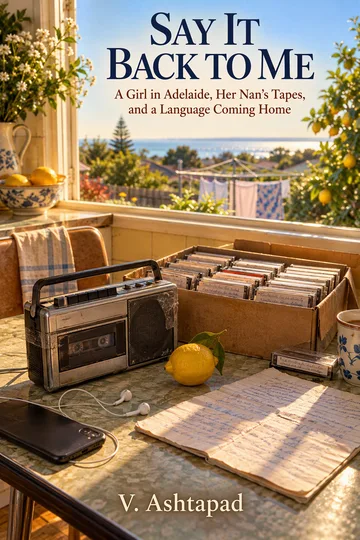
Say It Back to Me
A Girl in Adelaide, Her Nan's Tapes, and a Language Coming Home
by V. Ashtapad
Foreword
Aboriginal and Torres Strait Islander readers are respectfully advised that this book speaks of people who have died.
This is a novel. Shay, her family, her aunties and uncles, her teachers and friends, the Thursday night language class and everyone in it are invented, and so are the school and the families out on the West Coast. Adelaide is real, on Kaurna Country: the Port, Semaphore, the Torrens, the long road west. The small coastal town where the story ends is deliberately left unnamed, and no real community is portrayed. The history is real. Aboriginal children were taken from their families across Australia for much of the twentieth century; the 1997 Bringing Them Home report gathered their stories, and the national Apology was made in Parliament on 13 February 2008. Families and communities in South Australia and elsewhere are bringing their languages back today from old wordlists, archival recordings, the memories of elders and a great deal of patient argument.
Out of respect, the family's own language and language group are never named, and none of its words are printed; they are described by sound and meaning instead. The only Aboriginal words in the book are a greeting and a place name in Kaurna, the language of the Adelaide Plains, both already in public use. People who have passed are called by their relationship, never by name, as many families do. Nothing in these pages is sacred or ceremonial knowledge; the lullaby at its heart, and every word in it, is invented for the story.
For everyone who held the phone, and asked first.
The Shoebox of Tapes
The shoebox came out of the top of Nan's wardrobe on the hottest day of February, which was Mum's idea of good timing.
It was forty-two degrees by eleven in the morning. The air outside our house in Findon had gone white and flat, the way it does in Adelaide when the heat sits down on the plains and refuses to get up. The cicadas in the gum across the road were so loud they sounded like something electrical about to catch fire. Dad had gone to a job in Glenelg North at five so he could finish before the tiles got too hot to lay, and he'd taken the ute, and the air conditioner in the lounge room was making a noise like a dog breathing through its teeth.
"We're not doing anything else today," Mum said. "Too hot to go anywhere. Too hot to fight. So we're doing this."
"This" was Nan's things. Not all of them. Most of Nan's things had been sorted by Mum and Aunty Lorraine in the weeks after the funeral, in March last year, when nobody in our family could sit still and everybody needed something to carry. Clothes to the op shop in Port Adelaide, the good china to Aunty Lorraine, Nan's recliner to Uncle Des from the old neighborhood, who had a bad back and a way of sitting in other people's chairs as if they'd been built for him. What was left came to our place in four plastic tubs and went into the spare room, and the spare room door stayed shut for eleven months.
Mum had a rule about Nan's name, the same rule her mum had before her. Once someone passes, you don't say their name for a good long while. Some families keep it short and some keep it for years. Ours kept it, full stop. So Nan was Nan. She'd been Nan to me my whole life anyway, so it wasn't a hardship, except when I had to fill in a form at school about family and the box said FULL NAME and I sat there with my pen hovering until Ms. Whitlock came past and said, "Leave it, love, it's fine," without me having to explain.
The shoebox was at the bottom of the third tub, under a crocheted rug that smelled of Nan's lavender talc and, faintly, of the cigarettes she'd given up when I was five and pretended she'd never smoked at all. It was a Clarks box. The lid said WOMEN'S SIZE 7 in fading purple letters. Under that, in Nan's handwriting, in blue biro pressed so hard it had dented the cardboard, it said: TAPES. DO NOT CHUCK.
"She labeled everything," Mum said. "Your nan labeled the fridge. She put a sticker on the fridge that said FRIDGE."
"That was for Lachie," I said. "When he was learning to read."
"It was still on there when he was eight."
My little brother, Lachie, was ten and sprawled on the lounge room floor under the vent of the air conditioner like a starfish someone had dropped, playing a game on Dad's old phone with the sound off. He lifted his head when he heard his name. "What's for lunch?"
"Nothing you have to cook," Mum said, and he put his head back down.
I took the lid off. Inside were cassette tapes, maybe thirty of them, standing up in rows like books on a shelf. The clear plastic cases were scratched and cloudy, and each one had a card inside with writing on it. Nan had written on every single one. Some of the writing was neat and some of it was the shaky kind from the last couple of years. Dates. Initials. A few words. One said KITCHEN 1998 SINGING. One said MUM AND ME, OUT WEST, JAN 2001. One said COUNTING (FOR THE BUBS). One said, in red pen, NOT FOR THE KIDS TILL THEY'RE GROWN.
I looked at that one longer than the others.
"Don't," Mum said, without even looking at what I was looking at.
"I wasn't."
"You were." She lifted that cassette out of the row and put it in the pocket of her shorts. "That one we'll talk about."
There was also a cassette player. A real one, silver and black, the size of a loaf of bread, with a handle on top and two round speakers that had once been covered in fabric and were now covered in Nan's sticky tape. A sticker on the side said FOR THE TAPES in Nan's writing, in case anyone thought it was for something else.
"Does it work?" I said.
"Only one way to find out."
But Mum didn't put a tape in. She held the box on her knees and looked at it for a long time, and I could see her jaw doing the thing it does at work when she's about to tell a family something about their dad's heart that they don't want to hear. Mum is a nurse at the hospital in North Adelaide, on the cardiac ward, and she says the hardest part of the job isn't the machines or the blood or the night shifts. The hardest part is the moment before you talk. She was having that moment with a shoebox.
"Mum."
"I know."
"We don't have to do it today."
"We do, though." She rubbed her thumb along the edge of the lid. "It's been eleven months, Shay. Your Aunty Lorraine wants copies. Your Uncle Wayne rang last week and asked, which is the first time he's asked about anything back here since he moved. And the lady from the language class rang me again."
"What language class?"
Mum gave me a look, the one that means she's told me something before and I didn't listen because I was on my phone. Which was probably true.
"Aunty Faye," Mum said. "She runs it at the community center at Ottoway on Thursday nights. For our language. She's been running it three years. She knew your nan. She knows about the tapes, because your nan told everyone she was making them and then never let anyone hear them, which is exactly like her." Mum almost smiled. "Aunty Faye wants to know if there's language on them. If there is, she says it could help. She was polite about it. She's been polite about it four times."
I knew that we had a language. I'd known it my whole life, the way you know there's a room in your house you never go in. Nan used words around the house, sometimes, without making a big deal. A word for come here that she said to Lachie when he was little, half sung, so it went up at the end. A word she said when she burnt her fingers on the oven tray, which Mum told me later was not a swear word, only the word for hot, but Nan said it like a swear word, so I always thought it was one. A word for little sister she called me once, when I was about six, in the car on the way back from the beach, and I said, "I'm not anyone's little sister, I'm the big sister," and she laughed so hard she had to pull over at the servo on Military Road.
That was it, though. Bits. Nan never sat me down and said, here is our language, learn it. When I asked her about it once, when I was eleven, she said, "My mum didn't get to keep much of it, bub. So I didn't get much of it. So you get what's left," and then she changed the subject to my netball, and I let her, because I was eleven and I didn't know what I was letting go of.
I knew the rest too. I knew it in the way you know a fact from school before you know it in your stomach. Nan's mum, my great-grandmother, was taken from her family when she was a little girl. Taken by the government, by the welfare, by people with forms and cars, from Country out on the West Coast. She grew up in a children's home a long way from her family. She wasn't allowed to speak her language there. By the time she was grown, most of it had gone quiet in her. That's how Mum said it once, gone quiet, like it was still in there somewhere, sleeping.
I had never heard Nan's mum's voice. She passed before I was born. There was one photo of her on Nan's wall, in a frame with a bit of the glass cracked in the corner: a small, straight-backed woman in a floral dress, standing beside a Holden with her hand on the bonnet like she owned it, squinting at the camera in strong sun.
"Okay," Mum said, in a voice that meant she'd finished her moment. "Here's what we're doing. We're not just putting these on and listening to whatever comes out. They're your nan's voice. Some of them might be other people's voices too, people who've passed. It's not ours to just play. It's the family's. So we ask."
"Ask who?"
"Everybody. Lorraine. Wayne. Uncle Des, because he's on some of these, I'd put money on it. Aunty Faye, about the language. We get everyone to say what they're comfortable with. Then we listen."
"That'll take forever."
"Yep," Mum said. "That's family."
So instead of putting a tape in, we made a list. It was the most boring and the most important thing I did all summer, and I didn't know that until later. Mum read out each cassette card and I typed it into my phone. Date. What Nan wrote. Whose initials. Then Mum took a photo of each card, front and back, and uploaded them to the family page that Aunty Lorraine had set up after the funeral, the private one, where only our mob can log in and the little kids' school photos sit next to old pictures of people at the beach in the seventies with their hair in their eyes. Under each tape Mum made a note that said NOT YET LISTENED. ASK BEFORE PLAYING. She typed it in capital letters, which in our family is a form of shouting that everyone respects.
It took two hours. The air conditioner kept breathing. Outside the light went from white to a hard copper, and the cicadas stopped one by one as if someone was switching them off down the street.
At the bottom of the box, under the last row of tapes, there was a folded piece of exercise book paper. Mum unfolded it. It was a list in Nan's handwriting, maybe thirty lines long. On the left side of each line there was an English word. Water. Fire. Sun. Fish. Little sister. Big brother. Come here. Go away (cheeky). Sit down. Good. Rain. Mum. Nan. Hungry. Sleep. On the right side of each line was a word I couldn't read. Not because the handwriting was bad. Because Nan had spelled each one about three different ways, crossing out and writing again, with question marks, and in one place, next to the word for fish, she'd written: SOUNDS LIKE A DOOR CLOSING SOFT. ASK D.
"D for Des?" I said.
"Probably."
Mum folded the paper again carefully along the old creases, which were soft as cloth. Then she unfolded it, because she couldn't help it, and ran her finger down the right-hand side of the page, and her lips moved.
"You know some of them," I said.
"A few." She didn't look up. "I know how she said them. I never knew how to spell them. Nobody did. That's half the problem."
"What's the other half?"
Mum laughed, but not a real laugh. "There's no one left who speaks it all the way through, Shay. Not here. Maybe not anywhere. There are old people out west who've got lots of words, and Aunty Faye, and the linguist lady from the university who works with her. And there's old papers and old tapes. Bits and pieces. You put the bits together. That's what Aunty Faye's mob are doing."
"Like a jigsaw."
"Like a jigsaw where the box is gone and half the pieces are under the couch and some of them are from a different jigsaw."
Lachie said, from the floor, "What are you talking about?"
"Nan's tapes," I said.
He sat up. His hair was flat on one side and sticking straight up on the other. He looked at the shoebox, then at the cassette player with FOR THE TAPES on the side, and he said, "Can we hear her?"
Mum didn't answer straight away. Lachie was nine when Nan passed. He'd cried at the funeral in a way that had made adults around him cry harder, big hiccuping sobs, and then for months afterward he'd seemed fine, and then sometimes he'd go quiet in the car for no reason, and you'd turn around and his face would be wet.
"Not today, mate," Mum said gently. "Soon. We've got to ask the family first."
"It's our family."
"That's why we ask."
Lachie thought about that. Then he lay back down under the air conditioner and said, to the ceiling, "She used to say a word when I came in the door. Like a hello but not hello."
"I know the one," Mum said.
"I can't remember it." His voice wobbled. "I keep trying and I can't remember it."
The room went very still. Even the air conditioner seemed to hold its breath for a second. I looked at Mum, and Mum looked at the shoebox, and I could see her deciding something.
She didn't put a tape on. She did something better, or maybe worse. She said the word.
It was short. Two beats. The first part soft, the second part open, rising at the end, the way you'd call out to someone you were glad to see across a yard. It sounded nothing like any English word I knew and also exactly like Nan's front screen door banging shut behind me on a Saturday morning, with the smell of toast and the radio on the racing.
Lachie sat up so fast he cracked his elbow on the coffee table and didn't even notice. "That's it," he said. "That's it. Say it again."
Mum said it again. Lachie said it back. He got the first part wrong, made it hard instead of soft, and Mum fixed it, and he said it again, and that time it was close. He said it four more times, quieter each time, like he was putting it somewhere safe.
"Now don't lose it," Mum said, and her voice had gone thick.
I hadn't said anything. I was holding my phone with the list of tapes on it, and I realized I'd typed the word without meaning to, in the notes app, spelled the way it sounded, which was probably wrong. I looked at the letters I'd made. They looked like nothing. They looked like a typo. But when I said them under my breath, they turned back into Nan at the door.
That night Dad came home sunburnt across the back of his neck, smelling of grout and the sea, and he found the three of us sitting on the lounge room floor with the shoebox in the middle like a campfire. He stood in the doorway with his esky in one hand and his keys in the other and looked at us.
"What's going on?" he said. "Who died?" And then he heard what he'd said and went red under the sunburn, and Mum burst out laughing, really laughing for the first time all day, and Lachie said the word to him, the hello that wasn't hello, and Dad, who is Greek on both sides and can say good morning in four languages and none of them ours, said it back wrong, and Lachie corrected him.
It was the first time anyone in my family had corrected anyone else on a word of our language in my whole life. It was my ten-year-old brother doing it. He was very pleased with himself.
I went to bed that night with the window open and the hot wind coming in off the plains, smelling of dry grass and someone's barbecue three houses down, and I said the word into the dark a few times, quietly, so nobody would hear. I couldn't stop thinking about the other twenty-nine words on Nan's list, and the thirty tapes in the box, and the one in Mum's pocket marked in red.
I didn't know yet what I was starting. I just knew I didn't want to be the person in the family who couldn't remember the word at the door.
Who Gets to Listen
Asking everybody took three weeks, two barbecues, one argument, and a video call that started at half past midnight.
The half past midnight was because of California. Uncle Wayne lives in Long Beach, which is seventeen and a half hours behind us in March, or ahead, or something; I could never keep it straight, and Dad kept saying "they're in yesterday" as if that explained it. Uncle Wayne is Mum's little brother. He went to America in 1999 on a basketball scholarship to a college in Oregon, which nobody in the family could find on a map at the time, and then he hurt his knee and didn't come home. He married Aunty Rosa, who is from Long Beach and whose family is from Mexico, and they had my cousin Tash, who is seventeen and the only person in the world who has the same chin as me.
Tash and I had never met in person. Not once. Uncle Wayne came back for Nan's funeral, by himself, and stayed four days and spent most of them in Nan's backyard staring at the lemon tree. Tash stayed in Long Beach because she had exams. She cried on a video call on the day of the funeral and I watched her cry on Aunty Lorraine's phone while the cousins packed sausages into bread outside, and I remember thinking she looked like she was in a different weather. Which she was. It was raining in California and thirty-four degrees in Salisbury.
Since then, though, Tash and I had started messaging. Little things at first. A photo of a pie floater from the cart on North Terrace, which she said looked like a crime against both pies and peas. Then longer things. She told me she felt like a fake Aboriginal person because she'd never been to Australia. I told her I felt like a fake Aboriginal person because I'd lived in Australia my whole life and didn't know my own language. She said, "Okay, so we're both fakes," and I said, "Fake cousins," and she said, "Fake cousins forever," and that became our thing.
So when Mum said we needed to ask Uncle Wayne about the tapes, I said I'd set up the call. I said it before I could think about whether it was a good idea, which is the way I do most things.
The family meeting happened at Aunty Lorraine's place in Salisbury North on a Sunday in early March, which in Adelaide is still summer no matter what the calendar says. Aunty Lorraine is Mum's big sister. She has a brick veneer house with a carport full of things she's going to fix one day, and a backyard with a trampoline nobody has jumped on since 2019, and a Hills Hoist that she says is older than Mum. She has three kids, all grown, and five grandkids, all loud. When I say the family meeting, I mean about twenty-two people, two dogs, and a slab of sausages.
Uncle Des came too. He's not my uncle by blood exactly. He's Nan's mum's cousin's son, which makes him something with a lot of "removed" in it, but in our family that makes him Uncle Des and there's no discussion. He is seventy-seven and walks with a stick he calls his third leg and grew up across the road from Nan in Port Adelaide when they were both kids in the fifties. Nobody on either side of the road knew they were family until 1963, when Nan's mum found her mother's people out west and it turned out a few of them were already living in the Port, two doors from the milk bar. He sat in the shade of the carport in a camping chair and refused a sausage three times before accepting two.
Mum brought the shoebox. She put it on the outdoor table with the tablecloth weighed down by tomato sauce bottles, and everybody went quieter than I'd ever heard our family go, even quieter than at the funeral, because at the funeral everybody was trying to hold it together and here they didn't have to.
"Right," said Aunty Lorraine. "Here's how I see it."
That was the start of the argument.
It wasn't a big argument. Nobody yelled. It was the quiet kind, where everybody says "I'm just saying" a lot. Aunty Lorraine wanted copies made of every tape so everyone could have one. Her son Dean said some people might not want their voices handed around. Aunty Lorraine said they're dead, Dean, they don't mind, and then went pale and sat down, because you don't say it like that. Uncle Des said, from his camping chair, that his voice was on at least one of those tapes, and he was very much not dead, and he'd like to be asked, ta. Everybody laughed, which helped.
Then Mum talked.
Mum isn't a big talker at family things. She's the one who makes sure the little kids have hats on and that nobody's left the gas going. But when she stood up next to the shoebox, people stopped.
"Mum made these," she said. "Most of them in the last ten years, some of them before. She always said she was making them for us. She never said which us. So I think we decide together. I've written them all down. Lorraine's got the list up on the family page. Each tape, we decide. Who's on it. Whether the people on it would be all right with it being heard. Whether it's for everyone or for grown-ups or for just the people on it. And if there's language on them," she looked at Uncle Des, "we ask Aunty Faye about whether the class can use it. Because that matters too. That's bigger than us."
"Faye'll want the lot," Uncle Des said. "That woman's a vacuum cleaner."
"She'll want what's right," Mum said.
Uncle Des nodded slowly. "Yeah," he said. "She will."
So it was decided. It would take time. It would take everybody. I would set up the call to Long Beach, because I was the one with the cousin.
The call happened that night, at six in the evening our time, which was half past midnight in Long Beach, because I'd done the time difference wrong. Uncle Wayne answered in a T-shirt that said CAL STATE LONG BEACH ATHLETICS and reading glasses pushed up on his head, and Tash was squeezed in beside him on a couch with a cat on her lap, and they both looked like they'd been woken up, because they had.
"Sorry," I said. "I did the maths backwards."
"Math," said Tash. "You're talking to Americans now, cuz."
"I'm talking to you," I said. "Hi, Uncle Wayne."
"Hey, bub." His voice was half American and half Port Adelaide, and every so often a word went one way or the other like a car changing lanes. "Your mum there?"
Mum came and sat beside me with the shoebox. She and Uncle Wayne looked at each other through two phones and the whole Pacific, and for a while neither of them said anything.
"You look old," Uncle Wayne said finally.
"You look worse," Mum said.
"Fair."
Then Mum explained, the same as at Aunty Lorraine's, about the list and the asking. Uncle Wayne listened with his chin in his hand. When she got to the part about language, he took his reading glasses off his head and turned them over and over in his fingers.
"Is there any of it on there?" he said. "Her singing?"
"There's one that says KITCHEN 1998 SINGING," I said.
Uncle Wayne put his glasses down. "I was there for that," he said. "That was the year before I left. I was nineteen, still living at home. She had that tape player on the bench and she was singing to Lorraine's youngest, Dean, he was a baby, and I told her she was embarrassing herself." He rubbed his face. "I said it in front of her friend. I said, nobody talks like that anymore, Mum. She switched it off. She didn't sing the rest."
Not one of us had a word for that. Tash had gone very still, with her hand stopped in the cat's fur.
"Can we listen to it?" Uncle Wayne said. "If everyone says so. I'd like to hear the bit she did sing."
"You're the one who has to say so," Mum said quietly. "You're on it."
"Then I say so."
Mum looked at me. I got the cassette out. KITCHEN 1998 SINGING. My fingers were sweating. I put it in the silver player with FOR THE TAPES on the side, and pressed play, and held my phone up next to the speaker so Long Beach could hear.
There was hiss first. A long, soft hiss like rain on a roof. Then a clunk, and a kitchen. You could hear it was a kitchen. A tap running and stopping. A kettle starting. A baby making a noise that wasn't crying yet but was thinking about it. Somewhere a radio playing a song from the nineties very quietly. And then a woman humming.
I'd heard Nan's voice a thousand times. Telling me to put a hat on. Telling Lachie to get his feet off her good couch. Calling out the answers on the quiz shows before the contestants could. But I'd never heard her younger. In 1998 she was fifty-two. Her voice was higher and quicker and had more air in it, like a window open.
The humming became words. Not English words. Four lines, maybe. A lullaby, slow, rocking. The tune went up on the first line and came down soft on the second, and on the third line it did a little skip, a step up and back, like someone catching their foot on a doorstep and laughing. There was a word in the second line that sounded like water poured from a jug, and a word in the fourth line that I knew. I knew it. It was the word Nan called me in the car on the way home from the beach. Little sister. Or maybe little one. Something small and loved.
She sang the four lines once. Then she started again, and the tune went a different way, the beginning of a second verse. She got three words into it.
And then a young man's voice, cocky and loud, said: "Mum, you're embarrassing yourself. Nobody talks like that anymore."
A woman laughed, someone else, a friend. The singing stopped. There was a pause long enough that I thought the tape had finished. Then Nan's voice, in English, flat and ordinary: "Hand me that bottle, Wayne." The baby started properly crying. The tape ran on for another forty seconds of kettle and radio and baby, and then clicked off.
On the phone screen, Uncle Wayne was looking down at his knees, at his own big hands. Tash had her arm around him. The cat had left.
"Yeah," Uncle Wayne said finally, to his knees. "That's me. I was a real piece of work."
"You were nineteen," Mum said.
"She never sang it again. Not that I heard."
"She sang it," Mum said. "She sang it to Shay. She sang it to Lachie. Just never when you were in the room, I reckon. You were scary, Wayne. Six foot five of opinions."
Uncle Wayne laughed into his hand, the kind of laugh that's mostly something else.
Tash leaned toward the camera. "Shay," she said. "The second verse. She started it. Do you know how it goes?"
"No."
"Does your mum?"
Mum shook her head. "I know the first verse. I've never heard the second. I don't know if there is a whole one. Maybe she was making it up."
"Then we find it," Tash said. "Or we make it."
She said it so fast and so American, like that was a normal thing for a seventeen-year-old in Long Beach to say at half past midnight about a language neither of us spoke, that I laughed. But she wasn't joking. I could tell by her chin. My chin.
After the call, Mum went into the kitchen and stood at the bench for a while, and I left her alone. Dad came in from the shed and put his hand on her back without saying anything, and she leaned into it. I went into my room with the tape player and the shoebox and opened the family page on my laptop.
Aunty Lorraine had been busy. Under the photo of each cassette card there were already comments. Dean said yes to the ones with his kids on them. Uncle Des said no to one, firmly, MY BUSINESS, and yes to six. Aunty Lorraine had marked one ASK ME FIRST AND NO LAUGHING, and I thought for a second it would be something serious and then saw the card said NAN AND LORRAINE TALK ABOUT LORRAINE'S WEDDING 1985, and figured it was more about the perm.
Under KITCHEN 1998 SINGING, Mum had already written: Wayne says yes. Family can hear. Ask Aunty Faye about the language.
I clicked over to the family tree. Aunty Lorraine had built it last year, in the weeks after the funeral when she couldn't sleep. It went back five generations on our side, with photos where there were photos and a little gray outline of a head where there weren't. At the top, on the far left, there was a box for Nan's mum. No name in it, just the words Nan's mum, because Aunty Lorraine kept the rule too. Under her photo, the one with the Holden, there were two dates in her life marked with small symbols. One was a small open circle and a year in the 1930s and the words Taken from Country, aged about 5. The other, farther along, was a small closed circle and a year in the 1960s and the words Found her mother's people again.
Between those two circles there was nothing. Just the line of her life, gray, running along.
I sat and looked at that gap for a long time. Thirty years, nearly. Thirty years of a little girl growing up into a woman somewhere without her mum or her mum's words. Then she found them again, but by then the words had gone quiet. Then she had Nan, and Nan got some of it back, a list on exercise book paper, a lullaby, a hello that wasn't hello. Then Mum got less. Then me.
I opened the notes app on my phone and found the word I'd typed the day of the shoebox, Nan's word at the door. Under it I typed what I could remember of the lullaby. I didn't know the words. So I wrote them the way they sounded. Up on the first line. Soft down on the second. The skip on the third, like catching your foot on a step. Little sister on the fourth.
Then I wrote: SECOND VERSE. THREE WORDS. FIND THE REST.
I didn't know yet how you find the rest of a song from 1998 that was cut off by a teenage boy who grew up to cry about it on a couch in California. But I knew where Aunty Faye's class was. Thursday nights. Ottoway. I looked it up. It was two buses from our place, or one if Dad would drive me, which he would, because he's Dad.
Thursday Nights at Ottoway
The community center at Ottoway was a low brick building behind a car park with cracked bitumen and a bubbler that only worked if you hit it. Inside it smelled of floor polish and instant coffee and the orange cordial they'd made for the after-school program. The room for the class was at the back, past a noticeboard covered in flyers for tax help, line dancing and a lost cockatoo answering to Kevin.
Dad dropped me at quarter to seven on the second Thursday in March. He stayed in the ute with the engine running.
"You right?" he said.
"Yeah."
"You want me to come in?"
"No." I meant it, and also I didn't. "You'd talk to everyone."
"I would," he agreed. "I'd tell them all about your tiles." He meant the bathroom he'd done at our house, which he was very proud of and showed to anyone who stood still.
"Don't come in, Dad."
"Not coming in. I'll be at the chicken shop on Grand Junction Road. Text me." He hesitated. "Your yiayia says good luck. She says when she came here in 1971 she sat in a class at night in a school hall in Thebarton to learn English, and the first thing the teacher taught them was how to say 'I don't understand.' She says that's the most important sentence in any language."
"Is that true?"
"It's true she says it." He grinned. "Go on."
There were eleven people in the room. I counted, because counting things is what I do when I'm nervous. Two old men. Four aunties, ages hard to say, somewhere between fifty and forever. A young mum with a baby in a pram. Two teenage boys in footy shorts who looked like they'd been made to come. A white woman with gray hair in a long plait and big earrings shaped like gumnuts, setting up a laptop and a speaker on the table at the front. And Aunty Faye.
I knew it was Aunty Faye because she came straight at me like she'd been waiting.
She was short and square, with silver hair cropped close and reading glasses on a cord around her neck, and she wore a cardigan even though it was thirty degrees outside. She took my hand in both of hers. Her hands were cool and dry and very strong.
"You're the granddaughter," she said. "You've got her eyes. You've got her chin too, poor thing."
"Thanks?"
"I'm Faye. You call me Aunty. Come and sit by me." She pulled me toward a table near the front. "I've been hassling your mum."
"She told me."
"Did she tell you I was polite?"
"She said four times."
Aunty Faye laughed, a big laugh out of a small person. "Five, if you count the Christmas card."
Before anything else, Aunty Faye stood at the front and did the acknowledgement. I'd heard acknowledgements of Country a million times at school assemblies, read off a card by the principal in the same voice she used for uniform reminders. This was different. Aunty Faye said that we were meeting on Kaurna land, the Country of the Adelaide Plains, and that she paid respect to Kaurna elders past and present, and thanked them for letting other mobs learn and teach their own languages here on their Country. Then she said two words in Kaurna, a greeting, niina marni, which she said meant something like hello, are you good, and that the Kaurna people had brought their own language back from old papers and hard work, and that we should take heart from that every single Thursday. Then she said, "Right," and sat down, and the class started.
The white woman with the gumnut earrings was Helen. Dr. Helen Marsh, from the university's language team, though she said if anyone called her doctor she'd fail them. She'd been working with Aunty Faye and the old people out west for six years. She had a voice like a radio presenter on a late show, low and patient.
"Tonight," Helen said, "I want to show Shay what we're working with, since she's new. Everyone else can practice their counting while I bore her."
"We'll practice," said one of the old men, "but we won't like it."
So while the room filled with people saying the numbers one to five under their breath, over and over, and the baby in the pram squeaked like a gate, Helen opened a folder on the table and showed me how a language comes back from nearly nowhere.
The first thing was a photocopy of a handwritten page, brown and blotched. "This," Helen said, "is from a notebook somebody kept at a mission, a long time ago. Whoever it was wrote down maybe four hundred words. They meant well, mostly. But they had an English ear and a pen nib that blotted, and they never heard a sound they didn't try to turn into an English one."
I looked at the page. In tidy copperplate down the left side were English words. Water. Fire. Kangaroo. Mother. Down the right were the language words, spelled with letters jammed together in ways that made my eyes hurt. A lot of g's and h's and double o's.
"Now this," said Helen, and put down another sheet, a typed card this time, "is from a museum man who went out there later on, with a box of cards. He wrote down about three hundred words. Different ones, a lot of them. Same ones, some of them. And he spelled them differently, because he had his own system, which was better than the mission notebook, but not perfect."
She put a finger on the card. "That's water."
She put a finger on the mission page. "That's also water."
They looked like they'd been written by people on different planets.
"And this," she said, and opened her laptop, "is what we think water actually sounds like." She pressed a key. A recording played, very short, very crackly. An old man's voice saying a single word.
It sounded like water poured from a jug. It was the word from Nan's lullaby, the one in the second line. I sat bolt upright and Aunty Faye, who was watching me sideways while pretending to correct one of the teenage boys, saw it.
"You know that one," she said.
"It's in the song," I said. "Nan's song. On the tape."
The room went quiet. Even the boys stopped counting.
"Which tape?" Aunty Faye said.
I told her. KITCHEN 1998 SINGING. Four lines and three words of a second verse. I didn't tell her about Uncle Wayne. That was his to tell.
Aunty Faye sat down very slowly next to me. "I've been asking your nan to sing me that song for twenty-five years," she said. "She always said she didn't remember it properly. She always said, I'll sing it to you when I get it right."
"She sang it to me," I said. "When I was little."
"Then you've got it," Aunty Faye said. "Haven't you? In here." She tapped my forehead, very lightly. "It's in there with all the rubbish off your phone."
"I'm not on my phone that much."
"Course you don't."
Helen explained the rest while Aunty Faye sat beside me, very still, the way people go still when they're listening to two things at once. The old man's word came from an old tape a linguist had made, back when there were still old people out there who'd grown up talking it. Tapes like that were held now in Canberra, at the national institute, and families could ask for copies about their own people. Some of the tapes had restrictions on them, set by the old people when they were made or by the families since, and nobody played those except who was allowed. The rest, the everyday ones, people talking about the weather and fish and dogs and getting a flat tire on the road into town, were the gold.
"Because that's where the sounds are," Helen said. "The mission notebook can tell me there's a word for water. The museum cards can tell me there are two words for water, one for fresh, one for salt. But only a voice can tell me where the tongue goes."
She put the three pieces side by side on the table. The blotchy page. The typed card. The laptop with the sound wave of the old man's voice on the screen, a little green mountain range.
"We put them together," she said. "We look at where the old spellings agree and where they don't. We listen to every recording we can get. We ask the old people out west what they remember. And then the community decides how to spell it now. Not me. Not the university. The community. Aunty Faye's mob, and the mob out west, sitting in a room arguing about whether there's an h in the word for fish."
"There is no h," said Aunty Faye.
"There is a bit of an h," said one of the old men.
"There was never any h in that word in my life, Clem."
"There's a breath. That's an h."
"A breath isn't an h. A breath is a breath."
Helen smiled at me. "It's been going on for two years."
"Nan wrote that the word for fish sounds like a door closing soft," I said, before I could stop myself. "She wrote ASK D next to it."
Everyone looked at me. The old man called Clem put his hand flat on the table.
"Ask Des," he said. "That's Des. Des'd know. His granny used to say it."
"Des won't come to class," Aunty Faye said. "I've asked him a hundred times."
"He came to my aunty's barbecue on Sunday," I said. "He had two sausages."
"Well, then," Aunty Faye said, "he's not dead, is he. He can come here and eat a Monte Carlo and tell us about the fish."
For the next hour I sat in on my first ever lesson. It was nothing like school. There was no textbook, just a folder of photocopies Aunty Faye had stapled herself, with the words spelled the way the community had agreed so far, and pencil corrections all over them where people had argued since. We did greetings. We did the counting, which only went up to five, because, Helen explained, that's as far as the old records reliably went, and the community hadn't decided yet whether to make up words for six to ten or to borrow them, and that was another two years of arguing waiting to happen. We did kin words. Mum. Dad. Nan. Big brother. Little sister.
When Aunty Faye said the word for little sister, I knew it was the word from the fourth line of the lullaby. I knew it the way you know your own name called across a playground.
The young mum, whose name was Kirra, was learning so she could talk to her baby in language from the very start. "So she never has to come to a class like this," Kirra said, bouncing the pram with one foot. "So she just has it." The teenage boys, Jayden and Rhys, were cousins and their nan had made them come, and they mostly sat at the back, but when Aunty Faye asked Rhys to say the word for big brother, he said it perfectly and then went red and pretended to fix his shoe.
At the end, Aunty Faye walked me out to the car park. The heat had come down a bit and the sky over the port was a pale smoky pink, and gulls were wheeling over the chicken shop on Grand Junction Road where Dad was sitting in the ute eating chips with the door open.
"Will you ask your mum," Aunty Faye said, "if the class can hear that tape? Just the singing. Just the language bit. Not the rest, if there's family business on it."
"There's a bit of family business on it."
"Then not that bit."
"I'll ask."
"And will you bring Des?"
"I'll try."
She nodded. Then she put her hand on my arm.
"Your nan was a stubborn woman," she said. "She was the most stubborn woman on the Port, and I'm counting myself. She didn't sing for me because she thought she'd get it wrong. She thought if she got it wrong, she'd be teaching the kids the wrong thing, and then it'd be wrong forever. That's what they did to your great-granny's lot, the people who took her. Made them so scared of getting it wrong they stopped saying it at all. You understand me?"
"I think so."
"There's no wrong anymore, bub. There's just us. We say it, we fix it, we say it again. You can't break it worse than it's been broke."
Dad tooted the horn, two short ones, which in our family means I'm here and I have chips.
On the way home, along Grand Junction Road with the streetlights coming on and the smell of the ute's hot vinyl and vinegar, I said the word for little sister, out loud. Dad, who was driving with one hand and eating chips with the other, said, "Nice. What's it mean?"
I told him.
"Your yiayia calls you koukla," he said. "Doll. Same thing. Little loved one."
"Not the same thing."
"No," he agreed, and passed me a chip. "But it's a cousin of the same thing."
When we got home, Mum was on the back step in the dark with a cup of tea gone cold. I sat beside her and told her about the class, and Helen's three pieces of water, and Clem and the h, and the word for little sister in the fourth line.
"Aunty Faye wants to hear the song," I said. "Just the singing."
Mum looked out at the backyard, at the dark shape of the lemon tree Dad had planted from a cutting of Nan's lemon tree. Then she got out her phone and opened the family page and typed under KITCHEN 1998 SINGING: Wayne and Renee say the singing can go to Aunty Faye's class. Not the talking after.
"Wayne'll be all right with that," she said. "He'd want it."
"Can I play it for them? Next Thursday?"
"You can," Mum said. "You're the one who's going."
The Breath at the Front
Henley Park Secondary sits between a shopping center and a stormwater drain that the Year 7s call the River Styx, and in March it smells of cut grass, sunscreen and the canteen's sausage rolls, which come out of the warmer at recess in a cloud of steam you can smell from the oval.
I was in Year 10. I had two best friends, Mai and Josh, and a locker with a dent in it from the time Josh tried to prove he could kick a footy through the window of the science block and missed in the most dangerous possible way. Mai's family is Vietnamese and lives in Woodville, and she speaks Vietnamese at home with her grandmother and English everywhere else and something in between with her mum. Josh's family has been in Adelaide since forever, Scottish and English and nobody's quite sure, and he says his heritage is "beige."
I told them about the class at lunch, sitting on the bench behind the music block where the shade from the pepper tree falls, eating Mai's mum's spring rolls, which Mai brings in a container big enough for everyone because her mum has decided Josh and I are underfed.
"That's sick," Josh said. "Say something."
"I only know about fifteen words."
"Say all fifteen."
I said five, the counting. One to five. I said them quietly, because there were Year 8s on the next bench.
Mai put down her spring roll. "Do the greetings again," she said. I did. She repeated the first one back to me. Badly, but not terribly. Mai is good at sounds; she says growing up in two languages gives you extra room in your mouth.
"My bà nội would love this," Mai said. "She's always saying the kids here are losing Vietnamese. My cousins in Melbourne can't even read the menu at the pho place. She says a language is like a pot plant: if nobody waters it, it dies on the windowsill and everyone acts surprised."
"Ours didn't just die on the windowsill," I said. "Someone came and took the pot."
Mai looked at me. Josh looked at his shoes. I hadn't meant to say it so hard. It came out of me in Aunty Faye's voice.
"Sorry," I said.
"No," Mai said. "Don't be sorry. That's true."
The thing with Brianna Kettle happened in History, which figures.
We were doing a unit on Australia in the twentieth century, and Ms. Whitlock, who was young and nice and wore lanyards with cartoon frogs on them, had decided we'd do a lesson on language. She'd been to some professional development day where they told teachers to "embed First Nations perspectives," which in my experience means you get one lesson about it a term and everyone looks at you.
Ms. Whitlock showed a map of Australia with all the language groups on it in different colors, a patchwork of hundreds of shapes, so many that the map looked like broken glass. She said there were more than two hundred and fifty languages before colonization, and that most of them aren't spoken every day now, and that many communities are reviving theirs.
She didn't look at me while she said it. I'll give her that. She'd learned, at least, that much.
Brianna Kettle put her hand up. Brianna sits in the second row and has perfect eyebrows and a dad who owns a car yard in Port Road with inflatable men waving their arms out the front, and a grandad who came out from Glasgow, which she mentions every time anyone says the word heritage. She is not evil. She is just very confident about things she knows nothing about.
"But if a language is dead," Brianna said, "like, if nobody speaks it, isn't it kind of fake to bring it back? Like, you're just making it up? It's not really the same language."
It went quiet. Twenty-six people in a room not looking at me is very loud.
Ms. Whitlock opened her mouth and I knew she was going to say something nice and careful, and I couldn't stand it. I put my hand up. My hand was shaking. I put it down and talked anyway.
"It's not dead," I said. "It's asleep. Or it's in bits. There are old wordlists, and old recordings, and old people who remember parts. You put the bits together."
"Yeah, but you're guessing," Brianna said. "Like, how do you know you're saying it right?"
"How do you know you're saying English right?" I said, which wasn't a good answer, and everyone knew it, and someone at the back laughed.
Brianna shrugged. "Because people speak English. Like, everyone."
I wanted to say a lot of things. I wanted to say that nobody chose for my language to be in bits. That my great-grandmother was a little girl when they took her, and that they told her not to speak it, and that she did what she was told because she was five. I wanted to say that Brianna's family came out from Scotland and nobody in her family spoke Gaelic and nobody thought she was fake. But the words came up into my throat and got jammed there in a lump, all at once, like people trying to get through one door in a fire.
What came out was, "It's not guessing. It's work."
And then I stopped, because my eyes were stinging, and I would rather have walked into the River Styx than cry in History.
Ms. Whitlock said, "That's a really good point, Shay," which made it worse, and moved on to a video about the 1967 referendum.
At lunch I sat behind the music block and didn't eat. Mai sat on one side of me and Josh on the other. Josh offered me half his chocolate milk, which for Josh is basically a declaration of love.
"You did fine," Mai said.
"I said 'how do you know you're saying English right.' Like an idiot."
"It was a bit of an idiot thing to say," Josh admitted. "But she was more of an idiot."
"She just doesn't know," Mai said. "She's never had to think about it. People who've only got one language think language is like air. It's just there."
"I didn't say any of the real stuff," I said. "I had all this real stuff and I didn't say it."
"So say it next time," Mai said. "You'll get a next time. There's always a next time with Brianna."
That night I didn't do my homework. I opened my laptop and went onto the family page and started something Aunty Lorraine had been asking someone to do for months.
There's a part of the page where you can make lists. Aunty Lorraine had used it for the Christmas Kris Kringle and for who was bringing what to Nan's wake. I made a new one. I called it OUR WORDS. I typed in the twenty-nine words from Nan's exercise book page, the English on one side. On the other side, I didn't type Nan's three spellings. I typed the spelling from Aunty Faye's stapled folder, the one the community had agreed on, where there was one. Where there wasn't one yet, I wrote ASK AUNTY FAYE.
Then I did the thing that made it real. Next to each word there's a button where you can add a recording. I took my phone and said the word for water, the jug-pour word, into it. I said it four times before I didn't hate it. I uploaded it. My voice came out of the laptop speaker, small and nervous. It sounded like a kid reading out in class. But it sounded like the word.
I did the word for little sister. I did Nan's hello at the door.
Then I stopped. For the word for fish, the one that sounds like a door closing soft, I didn't record anything. I wrote: ASK UNCLE DES.
Uncle Des did not want to be asked.
"I'm seventy-seven," he said on the phone. "I've got a bad hip and a worse knee and a cousin in Whyalla who keeps ringing me about a boat. I don't need to go and sit in a classroom with a lot of aunties correcting me."
"You'll be correcting them," I said. "You know the fish word."
"Who says?"
"Nan says. She wrote it down. ASK D."
A long silence on the line. In the background I could hear his TV going, the racing from Morphettville, a man's voice speeding up and up as the horses came round the turn.
"She wrote that?"
"In blue biro. On her list. Next to fish."
More silence. The horses came home. Somebody won.
"What time's this class?" Uncle Des said.
Dad and I picked him up on Thursday from his unit in Rosewater, a little cream brick place with a concrete frog by the door and a nature strip he kept mowed so short it looked like carpet. He came out in a pressed shirt with his hair combed wet and his third leg in one hand and a packet of Monte Carlos in the other, for the class, because you don't go empty-handed.
He didn't say much in the ute. Dad talked about tiles. Uncle Des looked out the window at the Port going past, the old warehouses on Commercial Road, the sailmakers that are cafés now, the lighthouse painted red and white down on the wharf.
"We used to fish off that wharf," he said, when we went over the bridge. "Me and your nan, and after sixty-three her mum used to come down sometimes. Long time ago. Before all this." He waved his hand at the cafés and the new apartments. "When it was just the Port."
"Did she speak language? Nan's mum?"
"A bit. After she went out west and got a few words back." He turned his hat around in his hands. "Not at home. She'd been told too many times, at that place they put her. Didn't want the kids to get in trouble. But down at the wharf she'd sometimes forget. Get a bite on the line and say something. The fish word. My granny used to say it too. My granny never got taken, see. She got to keep hers." He was quiet. "It was different, the two of them saying it. Granny said it like it was nothing. Your nan's mum said it like it might go off in her hand."
At the community center, Aunty Faye saw Uncle Des come through the door and stood up so fast she knocked over a chair.
"Well," she said. "Look what the cat dragged in."
"Faye."
"Des."
They looked at each other for a second the way old people do when there are fifty years between them in a single look. Then she pulled out the chair she'd knocked over and he sat in it.
I played the song from Nan's tape that night, with Mum's permission and Uncle Wayne's, just the first verse and the three words of the second, stopping it before the voice from 1998 could cut in. Helen plugged my phone into her little speaker. Nan's young voice came out into the room with the floor polish and the cordial, high and quick and full of air.
Nobody moved while it played. Kirra stopped bouncing the pram. Rhys at the back took his hood down. Clem, the old man who believed in the h, mouthed along with it, a beat behind.
When it finished, Aunty Faye said nothing at all. She just reached over and took my hand and held it, hard, until her knuckles went pale.
Then Uncle Des cleared his throat.
"Fish," he said.
Everyone turned.
"You want the fish word," he said. "I'll give you the fish word. Then you lot can stop arguing about it."
He said it. It was a soft sound, falling. It started with a breath, like Clem said, and closed with a sound almost like a door brushing shut, like Nan wrote. There was no h. There was something that wasn't quite an h and wasn't quite nothing, a little catch of air at the front, the way you'd breathe in before you laughed.
Clem slapped the table. "Breath," he said. "I told you. There's a breath."
"A breath isn't an h," said Aunty Faye.
"Well, write the breath," said Uncle Des. "Make a letter for it. You're making up everything else."
There was a pause, and then the whole room laughed, even Aunty Faye. Even Helen, who wrote something on her pad and underlined it twice.
On the way home, Uncle Des let me record him saying the word on my phone, for the family list. He said it six times. The sixth time he said it softer, like he'd forgotten the phone was there and was somewhere else, down at the wharf with a hand line, and a woman next to him said it first.
When I got home I uploaded it next to the word for fish on OUR WORDS, and typed: Uncle Des. 2026. He says his granny said it like it was nothing.
The next morning at school, Brianna Kettle was at her locker fixing her eyebrows in a little mirror stuck inside the door. I went up to her. My heart was going like the racing on Uncle Des's TV.
"You asked how we know we're saying it right," I said. "We ask the old people. We listen to the tapes. We argue about it. Last night an old man in my class said a word for the first time in about sixty years, and a whole room of people learned it off him. That's how."
Brianna looked at me in her little mirror. She didn't say anything snide. She just looked surprised, the way people look when the furniture talks.
"Okay," she said finally. "That's actually kind of cool."
It wasn't a big win. She went back to her eyebrows. But it was the real stuff, and I'd said it, and my hands had only shaken a little.
Eight Weeks
The form to ask for the old tapes from Canberra was four pages long, and Mum filled it in at the kitchen table on a Saturday morning in April with her reading glasses on and the radio on low and a face like she was doing her tax.
Helen had helped her find which tapes to ask for. There's a catalog you can search, but it's like searching the back of a giant cupboard in the dark: the names of places are spelled a dozen different ways, and the people who made the recordings sometimes wrote the old people down with English nicknames, or just as "old woman, aged about 70," or not at all. They'd found a set of reels a visiting linguist had recorded out west, a few hours all up, and in the notes for one of them there was a mention of a woman from the right family, the family of Nan's mum's mother. An old lady. She'd talked about fishing and weather and the dogs.
"She'd be Nan's mum's aunty," Mum said, and put her pen down. "If it's her. Nan's mum met her once, after she found her people again. In 1963. When Nan was seventeen."
"Was Nan there?"
"Nan drove." Mum smiled. "Got her license on the Monday and drove all the way out west on the Wednesday. In the Holden. The one in the photo."
The form asked for a lot of things. It asked who you were and how you were connected to the people on the recordings. It asked you to explain your family history, because the people at the institute, Helen said, can't know every family's story and they want to send things to the right people. That part took Mum an hour. She wrote it out on paper first in pencil, then typed it. I read it over her shoulder.
It was four paragraphs. It said Nan's mum was taken from her family out on the West Coast as a little girl in the 1930s and placed in a children's home. It said she was not allowed to speak her language there. It said she found her mother's family again in 1963 with help from a cousin, and made the trip out west, and met her mother's sister, who was old by then and who welcomed her. It said that Nan's mum had only a few words left by then, and Nan had more, because she went out west most summers after that and sat with the old people and listened. It said the family was now working with a community language class to bring the language back, and that the recordings would be kept by the family with care, and shared only with family and, with the family's agreement, with the class.
It didn't say what the home was called. It didn't say what happened in it. Mum didn't put that in.
"Do they need to know that?" I said.
"No," Mum said. "They need to know who we are. That's different."
I didn't ask what happened in it. Not then. Mum's face had that closed look, like a shop with the blinds down. I knew some of it from school and from books and from things grown-ups said at barbecues late at night when they thought the kids had gone inside. But the parts that were ours, Nan's mum's parts, nobody had told me, and I'd worked out that you don't ask for them. You wait to be given them, or you don't get them.
Mum read the form through twice and pressed submit. The screen said THANK YOU. YOUR REQUEST HAS BEEN RECEIVED. Helen had told us to expect about eight weeks, maybe more.
"Eight weeks," Mum said. "Your great-granny waited thirty years. We can do eight weeks."
That afternoon we went to Yiayia's.
Yiayia lives in Torrensville, in the same house she and Papou bought in 1974, a red brick bungalow with a front porch tiled in black and white checks that Dad laid himself when he was fifteen. Papou passed when I was nine. Yiayia still keeps his chair by the window and puts the newspaper on it every morning, folded to the form guide, like he might come back and want to check the fourth race at Morphettville. Out the back there's a fig tree as wide as the house and a grapevine over the pergola so heavy in autumn that the wasps get drunk.
Yiayia came out of Greece in 1971, from a village near Kalamata where everyone was related and nobody had a phone. She was twenty-one. She speaks English fine, though she drops her articles when she's cross, and she speaks Greek to Dad when she doesn't want me to understand, which since I was eleven has been pointless, because I understand enough.
She sat me down at her kitchen table, under the calendar from the Greek bakery on Henley Beach Road, and put a plate of koulourakia in front of me and a glass of milk, as if I was six, which I didn't mind.
"Your father says," she said, "you are learning your language. Your mother's language."
"Trying to."
"Good." She nodded hard, once. "Good, koukla. Very good."
"There's not much of it left. Nobody speaks it all the way through."
Yiayia folded her hands on the table. They were brown and spotty and as strong as Aunty Faye's. "When I came here," she said, "I knew one word of English. 'Thank you.' I said thank you to everybody. Thank you to the man who stole my bag at the train station. Thank you." She laughed. "And in my village, there were the old people who spoke a kind of Greek nobody else spoke. Words from the mountains. When I was a girl they were already dying. Now I am the old people. I go back to the village, and nobody knows the mountain words. Only me, and my cousin Stavroula, and she is ninety-one and deaf as a fence post."
"Doornail," Dad said from the doorway, where he was pretending to fix the flyscreen.
"Fence post," said Yiayia firmly. "So I know. I know what it is to have words in your mouth nobody else has. It is lonely." She reached over and took my chin in her hand. "But nobody took me. Nobody told me, Eleni, you will be punished for Greek. Mine got old by itself. Yours was taken off you. You understand?"
"Yes, Yiayia."
"So you take it back," she said. "You take it back properly. You don't say thank you to the man who stole the bag."
Dad laughed in the doorway. I laughed too, and Yiayia looked pleased with herself and gave me another koulouraki.
Before I left she went into the front room and came back with a photo in a cardboard frame. It was her and Papou on the beach at Semaphore in 1972, with the jetty behind them and the old carousel. She was in a striped swimming costume with her hair up in a scarf, looking absolutely furious at the camera, and Papou had his arm around her, laughing his head off.
"Your mother put a map on the family computer," she said. "Your father showed me. With the pictures, and the dates, for her side. All the places. Put this on for our side. Semaphore. 1972. Write: Eleni was angry because the water was too cold. It was February. The water should not be cold in February. In Greece the water is never cold in February."
"It's always cold in Greece in February, Mama," said Dad.
"Not in my village."
The map was another thing Aunty Lorraine had started after the funeral and that Mum had kept going. It was a map of South Australia, mostly, with little pins in it, and each pin opened up to show photos and dates and whatever anyone remembered. Most of the pins were in Adelaide. Nan's house in Port Adelaide, with photos from every decade, the same front fence painted four different colors. The wharf where Uncle Des fished with Nan. The hospital in North Adelaide where Mum worked, with a photo of her in her first nurse's uniform in 1997, about twenty-one, grinning like she'd won something. A pin on Long Beach in California with Tash's school photo from kindergarten, front teeth missing.
Out on the West Coast, there were only a few pins, a long way apart, like the stars you can see when you get out of the city lights. There was a pin on the town where Nan's mum found her mother's people, with a scan of a black and white photo dated January 1963: a group of people standing in front of a fibro house in strong sun, and in the middle, an old, old woman in a dark dress with a walking stick and a dog leaning on her leg, and beside her, the small straight-backed woman from the photo on Nan's wall, and beside her, a skinny girl of seventeen with her hands in her pockets and a fringe in her eyes, looking at the camera as if daring it to say something.
"That's Nan," I said, when I got home and found it.
"That's Nan," Mum agreed, leaning over my shoulder. "Three days with her license. All that way. You can tell she's proud of herself."
"Who's the old lady?"
"Nan's mum's aunty. Her mum's sister." Mum was quiet for a second. "That's who might be on the tape. If we're lucky."
"How old was she?"
"Nobody knew. Older than eighty. She'd been on that Country her whole life. They never got her." Mum touched the screen, very lightly, above the old woman's head. "Nan said she had a voice like gravel in a bucket and she laughed at everything. Nan said when they arrived, the old lady took one look at her mum and said a whole long sentence in language, and Nan's mum just stood there crying, because she didn't understand a word of it, and she knew it was the most important thing anyone had ever said to her."
"What did she say?"
"Nobody knows. Nobody wrote it down." Mum straightened up. "Someone told Nan later it was something like, you're home, you've been gone too long, come and eat. But that's a guess."
There was one more pin out west that I hadn't noticed before, a long way past the others, right on the edge of the coast where the map went from yellow to blue. When I clicked on it there were no photos. There was just a date, a year in the 1930s, and three words in Aunty Lorraine's typing. Where she was.
I kept going back to that empty pin. The place where a little girl was living with her family on the morning before the car came. Nobody had a photo of it. Nobody had a story about it. It was just a blue edge and a date.
I added the Semaphore photo to Dad's side of the map. I typed what Yiayia told me to, word for word: Eleni was angry because the water was too cold. It was February. Then I added: She says the water is never cold in her village. Dad says it is.
Then I went back and looked at the empty pin out west again, and I made myself a promise I didn't tell anyone about. One day I'd go there. I'd stand at the blue edge. And I'd have something to say when I got there, in the right language, even if it was only the hello at the door.
Not for the Kids Till They're Grown
Autumn in Adelaide comes in sideways. One week it's thirty-four and everyone's still in thongs; the next there's a southerly off the gulf that smells of rain and seaweed, and the plane trees along the parklands drop their leaves all at once in big brown rustling drifts that the wind pushes along the footpaths like something alive. By late May the mornings are cold enough to see your breath at the bus stop, and the sky over the hills goes that deep clean blue you only get after a front comes through.
National Sorry Day was a Tuesday. Mum took the day off. She'd never done that before, not in my whole life, not for Sorry Day. She'd always worked it, or gone to something small at the hospital, a morning tea with a candle, and come home and not talked about it. This year she put in for leave in March, the week after the shoebox.
"I want to go to the city thing," she said at breakfast. "In the square. I want you to come."
"I've got school."
"You've got a note."
She wrote me a note. Lachie had to go to school, which he complained about all the way to the gate, until Mum told him she'd take him to the next one when he was older, and he could hold her to it.
We caught the tram from Glenelg. It's the long way round from Findon, but Mum wanted to, because Nan used to take her on the tram into town when she was little, and they'd sit on the wooden seats in the old trams with the windows down and Nan would tell her which stops to remember. The trams are sleek and quiet now and hum like a fridge, but the route's the same: Jetty Road with the gulls sitting on the bins, the backyards of the inner suburbs with their roses and Hills Hoists, and then up King William Street to the square.
Victoria Square is called Tarntanyangga, too. The Kaurna name is on the signs. When I was a kid I thought the square was just a big flat place where the tram stopped and the Christmas tree went up. Now, walking into it with Mum, with the cold wind coming down King William Street and the fountain turned off for the day, I saw it the way Aunty Faye would want me to. A place with a name older than the city, full of people.
There were maybe three hundred people. Old people in good coats and beanies, sitting on fold-up chairs at the front. Mums with prams. Kids from schools, in uniforms, with teachers holding clipboards. Office workers on their lunch break, with lanyards, standing at the edges looking unsure whether they were allowed in. A man selling coffee from a van. Flags. A small stage with a microphone that kept squealing.
Mum held my hand. She hadn't held my hand in public since I was about ten, and I let her.
There were speeches. An elder, a Kaurna woman in a green coat and a beanie, did the welcome. She spoke in Kaurna first and then English, and when she said the Kaurna words the crowd went so quiet I could hear the tram bells back on King William Street. Then other people spoke. A man who'd been taken from his family in the 1960s, from up north, talked about finding his mother when he was forty and her not knowing him at first. A young woman read out a list of things that were in the Bringing Them Home report, the big report in 1997, the one with the stories in it, and how many of the recommendations were never done. Somebody talked about the Apology in 2008, when the Prime Minister said sorry in Parliament, and how people gathered down at Elder Park by the river to watch it on a big screen, first thing on a February morning, and cried.
"Nan was here," Mum said, very quietly, into my hair. "For the Apology. In 2008. She went down to Elder Park with the crowd. I was at work. I watched it on the telly in the staff room with two other nurses and a cleaner. We all cried. The unit manager came in to tell us off and she cried too."
"Where was Nan's mum?"
"Gone by then," Mum said. "Nine years. Nan always said that was the worst part. Her mum never heard anyone say sorry. Not once in her whole life. Not from anyone who did it, not from the government, not from anyone."
At the end, people walked up to a long table at the front and wrote messages on paper leaves and pinned them to a big board shaped like a tree. Mum wrote one. She didn't show me. When she pinned it up she pressed it flat with her whole palm for a long time, the way you'd hold a hand on someone's back.
I wrote one too. I didn't know what to say. In the end I wrote: For Nan's mum. We're bringing your words home. Then, because that sounded like a poster, I added: We're trying anyway.
We had lunch at the Central Market, because Mum said if she didn't eat something she'd fall over. It was loud and warm and smelled of coffee and bread and fish and the cheese place, and stallholders were yelling prices and a busker was playing the accordion badly next to the mushroom stall. We sat at a little table with a bowl of laksa each from the place Mum likes, and steam came up into our faces, and for a while we just ate.
Then Mum put down her spoon and took the red tape out of her bag.
NOT FOR THE KIDS TILL THEY'RE GROWN.
She put it on the table between our bowls. The clear case had a crack in one corner. The card inside said something else under the red writing, smaller, in blue biro. 13 FEB 2008. AFTER.
"I listened to it," Mum said. "In March. After the barbecue. On my own, in the car, in the car park at work."
"You didn't tell me."
"No." She turned the tape over. "It's your nan. Talking. That night, after the Apology. She came home from town and sat in her kitchen and talked into the tape player. About her mum. About what her mum told her, which wasn't much. About what she didn't tell her." Mum looked up at me. "There's nothing on it that's going to hurt you, Shay. She was careful. She was always careful. But it's sad. It's the saddest thing I've ever heard. And she said not for the kids till they're grown."
"I'm not grown."
"No," Mum said. "You're nearly sixteen. You're in a language class with a lot of old people. You stood up to some girl in History who thinks you're making it up. You're doing your great-granny's work, a bit of it." She pushed the tape across the table to me. "I reckon you're grown enough for this. And I reckon your nan would've reckoned it too, if she'd seen you this year. But it's your choice. You don't have to."
I picked it up. The plastic was cold from Mum's bag.
"Will you listen with me?"
"Yeah," Mum said. "Course."
We listened in the car, in the end, because it's the only private place in our family. Dad had dropped it at the market car park on his way to a job in Unley and caught a lift with his offsider, so we'd have it. Mum had brought the silver tape player in a shopping bag. We sat in the front seats with the engine off and the rain starting, finally, small drops on the windscreen, and the car park lights coming on even though it was only two in the afternoon, and Mum put the tape in and pressed play.
Hiss. Then Nan's kitchen again, but quiet this time. No radio. No kettle. A chair scraping. A cough. And then Nan, ten years older than the singing tape, sixty-two, her voice lower and slower and rough at the edges.
"Well," Nan said. "He said it."
A long silence. A sound like she was turning a cup around on the table.
"I don't know who I'm doing this for," Nan said. "For the grandkids, I suppose. When they're bigger. Lorraine's got hers. Renee'll have some one day if she ever settles down." I looked at Mum. Mum made a face at the tape player. "So this is for you lot. Whoever you are. When you're grown."
"I went down to Elder Park this morning, by the river. With about a thousand people. Two thousand. They had it on a big screen. The Prime Minister said sorry. He said it three times. Sorry. Sorry. Sorry. And people cried, and I cried, and an old fella next to me who I didn't know from a bar of soap held my hand the whole time. Then I came home on the tram and I sat here and I thought, she never heard it. Mum never heard it. Nine years too late. Nine years."
Another silence. Rain on the windscreen, getting heavier.
"I want to tell you about her," Nan said. "But I don't know much. That's the truth. She didn't tell me much. She was five when they came. She remembered the sea. She remembered her mum's hands. She remembered a dog. She remembered sitting on a sandhill and her mum saying the word for come here, come here, and running down the sandhill into her arms, and that was the morning they came, or near enough, she wasn't sure. That was all she had of out there. Thirty years she had that and nothing else."
"At the home they gave her a different name. They cut her hair. They told her not to speak her language. They told her if she spoke it she'd be punished, so she stopped. She told me once she used to say the words in her head at night under the blanket. Just the few she had. Come here. Water. Mum. Over and over, under the blanket, so she wouldn't lose them. And then one day she was about eleven and she tried to say them under the blanket and she couldn't find them anymore. They'd gone. And she cried more that night, she said, than the night they took her. Because that was the night she really lost her mum."
I couldn't see the windscreen anymore. I didn't know if it was the rain or me.
"There's things she never told me," Nan said. "About that place. And I'm not going to guess at them. She kept them, and they're hers, and they went with her. I'm not going to put them on a tape. That's her business."
"But I'll tell you this. When she found her people again, in sixty-three, and we went out west, and her aunty said all them words to her, she didn't understand them, and she said to me afterward, in the car, she said, bub, I'm going to get some of them back. And she tried. She was thirty-five. She learned maybe fifty words off the old people before they passed. Fifty words, and she guarded them like gold. And she gave some of them to me. And I've got a few more off the old people out there. And I wrote them down, best I could. And I sang the bits I could remember. And I don't know if any of it's right."
"So here's what I want to say, now he's said sorry. Whoever you are, listening. If you want it, go and get it. Go and get it back. Don't wait for anyone to say you're allowed. They said sorry. That's them. Getting it back, that's us."
A long breath.
"And don't let anyone tell you you're saying it wrong. Mum spent thirty years being told she was wrong for saying it. I spent forty years scared I'd say it wrong. That's enough. Just say it."
A chair scraping. Footsteps. A tap running. And then, very faintly, far away from the tape player, as if she'd forgotten it was still recording, Nan humming. The lullaby. The first line, up. The second line, soft down. The third line with the little skip. The fourth line with the word for little sister. And then the start of the second verse, the three words, and then a fourth word, and a fifth, and a sixth, before the tape ran out and clicked off.
Mum and I sat in the car with the rain coming down so hard now it drummed on the roof. Neither of us said anything for a long time. Mum's face was wet. Mine was too.
"Did you hear that?" I said finally. "At the end."
"I heard."
"There's more of the second verse. Three more words."
"I heard, Shay."
"Can we play it again? Just the end?"
Mum laughed, a wet laugh, and wiped her face with the back of her hand. "You're your nan all over," she said. "She'd have said the same thing. Can we play it again, just the good bit."
We played it again, just the end. Then again. Then I got out my phone and recorded it, with Mum's okay, just the humming at the end, not the talking. Six words of a second verse, very faint, from a kitchen in Port Adelaide on the night of the Apology.
When we got home I opened the family page and found the red tape on the list. Under NOT FOR THE KIDS TILL THEY'RE GROWN, Mum typed: Renee and Shay listened. 26 May 2026. Grown-ups only still. Lorraine and Wayne to decide for themselves.
Then I opened the family tree. I found Nan's mum's box at the top, and the gray line running along between the open circle and the closed one. There's a place on each box where you can add a note. Aunty Lorraine had added a lot of notes on other people's boxes: Loved the Magpies. Worked at the Holden plant at Elizabeth thirty-one years. Hated cats. Nan's mum's box had nothing in it at all.
I didn't write anything about the home. That was hers. I wrote: Kept some words under the blanket. Learned fifty more after 1963. Guarded them like gold. Gave them to her daughter.
Then I sat there with my hands on the keys, listening to the rain on our roof and Lachie in the lounge room watching cartoons too loud, and I thought: and her daughter gave them to her daughter, and her daughter gave them to me, and somewhere in between someone lost a verse of a song and someone else is going to find it.
Gravel in a Bucket
The tapes from Canberra didn't come as tapes. They came as an email, on a Wednesday in the middle of June, while I was on the bus home from school with my forehead against the fogged-up window and the rain sliding sideways off the glass.
Mum rang me. She never rings me. She texts, in capitals, like Aunty Lorraine.
"They're here," she said.
"What are?"
"The old lady."
I got off two stops early and ran the rest of the way home in the rain with my bag over my head, past the stobie poles and the wet nature strips and the man on Findon Road who always washes his car no matter the weather, and when I came through the door dripping, Mum was at the kitchen table with her laptop open and her hands in her lap, not touching anything.
"I haven't played it," she said. "I thought we should do it properly."
The email had a link and a letter. The letter said the files were copies for the family's private use, not to be copied further or put up publicly, and that some of the recordings had notes from when they were made, and that the family should read those notes before listening. There were six files, about an hour each. There were notes for each one, typed up from the linguist's handwritten notebooks: dates, places, who was there. In the notes for the third file, the woman's name was written down, the old lady's name, the one from the photo in front of the fibro house with the dog leaning on her leg.
Mum covered it with her hand. Actually covered the screen with her palm, quick, like it was hot.
"Don't read it out," she said.
"I wasn't going to."
"I know. I'm just saying it." She left her hand there. "She's Nan's mum's aunty. That's what we call her. That's enough."
"Okay."
Mum scrolled down past the name with her other hand, and only then took her palm off the screen.
Doing it properly, it turned out, meant Aunty Lorraine coming over that night in her slippers with a casserole, and Uncle Des getting picked up from Rosewater by Dad with his hair combed wet, and Aunty Faye arriving last in a little blue Corolla with Helen in the passenger seat, both of them with their reading glasses already on. We sat around the dining table, which we only use at Christmas, and Mum put the laptop at the end where everyone could hear, and Helen plugged in her little speaker.
"Before we start," Aunty Faye said. "We don't know what's on here. Not really. The notes say fishing and weather. But the old people sometimes talked about things that aren't for everyone. If we hear anything like that, anything that's not everyday business, we stop. We stop it straight away and we have a talk about who it's for. All right?"
Everyone nodded. Lachie had been allowed to stay up on the condition he didn't say a word, and he nodded hardest of all.
Mum pressed play on the third file.
Hiss, first, like always. A wind noise, a big rough one, booming across a microphone. A dog barking, far away. A man's voice, very English, very polite, saying the date and the place. And then the man stopped talking, and an old woman started.
Nan said she had a voice like gravel in a bucket. Nan was right. It was deep and cracked and fast, and it rolled. It went up and down like waves on a beach, not like English, which walks along flat and then lifts at the end of a question. She talked for maybe a minute without stopping, and then she laughed, a huge laugh, a cackle, and the dog barked again, closer this time, and she said something sharp to it and it stopped.
I didn't understand any of it. Not one word. Then she said a word I knew.
Water. The jug-pour word. Plain as anything, in the middle of a sentence.
And then fish. Uncle Des's fish word, with the breath at the front, and the door closing soft.
Uncle Des, at the end of the table, made a small noise in his chest. He was holding his stick across his knees with both hands.
The old lady went on. Helen had the transcript from the linguist's notebook open on her own laptop, and she was following along, mouthing things, frowning, and every so often she'd write something on a notepad. Aunty Faye had her eyes shut. Aunty Lorraine sat with her cup of tea going cold in both hands. Mum sat very straight, the way Nan's mum stood in the photo with her hand on the Holden.
About ten minutes in, the old lady's voice changed. It went lower. Slower. She said a name, someone's name, and then a place name, and then a word that made Aunty Faye's eyes snap open.
"Stop it there," Aunty Faye said.
Mum stopped it.
The kettle clicked off in the kitchen and nobody got up for it. The rain had stopped outside and the gutters were dripping. Aunty Faye took her glasses off.
"That's not ours," she said. "That bit. She's talking about another family's business. A family from further along the coast. That's for them to hear, not us. Helen, love, can you mark where that starts and where it finishes, so we can skip it? And we'll let that family know it's there. They'll want to know."
Helen was already writing. "Twelve minutes forty. I'll find the end."
"Good."
We skipped it. Helen listened through on headphones by herself, with her eyes on the floor, to find where it stopped. It was about four minutes. When she nodded, we went on, and the old lady was back to fish, and laughing.
It was the most ordinary thing in the world. That was what got me. I'd thought, without knowing I thought it, that a recording of an old lady on Country, all those years ago, would sound like a movie. Serious. Sacred. Full of important things. Instead, as far as Helen could tell from the linguist's rough English notes, she was complaining about the wind. The wind had been blowing for three days and it had knocked her washing off the line. The fish weren't biting because of the wind. The dog had got into somebody's flour. Her nephew had got a flat tire on the way into town and had to walk back, and she laughed about it for two whole minutes and said it was what he got for driving on tires as bald as an egg, and when Helen read that bit out from the notes, Uncle Des laughed so hard he had to take his glasses off.
"She's right," he said, wiping his eyes. "That'd be her nephew. Never checked a tire in his life, he was. Lovely fella. Hopeless with a car."
"You knew him?" I said.
"Went out west in sixty-five, after the trip. Met all that mob. Her nephew gave me a lift in that same truck. It had a hole in the floor you could see the road through."
He stopped. He was looking at the laptop like it was a window.
"That's her," he said quietly. "That's the old lady. I met her too. Once. Sixty-five. She was sitting out the front in a chair with the dog. She gave me a feed of fish and called me something. I didn't know what it meant. I was sixteen. I just said thanks."
"What did she call you?"
"Don't know. I never asked." He shook his head. "Sixty years I never asked."
At about the forty-minute mark the old lady said the word for come here. The word Nan's mum remembered from the sandhill, running down into her mum's arms. The old lady said it to the dog, and the dog came, you could hear its tags jingling. Then she said it again, to someone else, maybe a kid, and it was softer, and longer, and it went up at the end.
It went up at the end exactly the way Nan said the hello at the door.
Lachie, who'd promised not to say a word, said, "That's Nan's one."
"Shh," said three people.
"It is though," Lachie said, quieter. "It's the same. She said it the same."
Helen paused the file. She looked at Lachie with her head on one side, and then she played the bit again, and then she pulled up a recording on her own laptop, the one I'd made for OUR WORDS of Lachie saying Nan's hello, which Mum had shared with the class. She played them one after the other. The old lady in 1964. Lachie in 2026.
They weren't the same. Lachie's voice was high and squeaky and Australian. But the tune was the same. The lift at the end. The way the first part was soft and the second part opened up like a door.
"Your nan wasn't saying hello," Helen said slowly. "Or she was, but she was using the word for come here. Come here, come in. It's the same word. She was saying it the way you'd say it to a child you're glad to see."
Mum got up and went into the kitchen and stood at the sink with her back to us. Dad went in after her. Nobody else moved.
We listened to the whole file that night, and two more over the next week. Aunty Faye and Helen and the family decided together, around the table, which parts the Thursday class could hear and which parts would stay with the family, and which part would go back to the family from further along the coast. Mum put a note on each file on the family page, the same way she had with Nan's tapes, so everyone could see what had been agreed. Family. Family and Thursday class. Not ours: let the other family know. It took a long time. It was very boring. It was the most respectful thing I've ever seen grown-ups do.
The best part came after.
On the Thursday after, Helen brought my six faint words, the ones from the end of Nan's Apology tape, the start of the second verse, to the class. She'd cleaned up the recording as best she could. She played them through the little speaker, slowly. Then she played a bit from the old lady's file, the part where she was complaining about the wind that knocked her washing off the line.
The word for wind was the same as the fourth word of Nan's second verse.
Helen played the old lady talking about the fish not biting because of the sea being rough. The word for sea was the same as the second word in Nan's second verse. Or nearly. Close enough that Clem and Aunty Faye argued about it for five minutes, which in that class means yes.
And the sixth word, the last one before the tape ran out, the one I'd played about four hundred times in my bedroom with my headphones on, was the word for sleep. Kirra knew it, because it was one of the first words she'd learned to say to her baby, every night, in the dark. She said it and then said it again, softer, and looked at the pram.
So now we knew what the second verse of Nan's lullaby was about, sort of. The first verse was water and the little sister. The second verse was the sea and the wind and sleep. The sea wind putting the baby to sleep.
"It's a song about out there," Aunty Faye said slowly. "About the coast. The wind off the sea at night." She looked at me. "Your nan's mum would've heard that wind every night of her life before they took her."
The fluorescent light above the table buzzed. Out in the car park a car alarm went off and stopped.
"We've only got six words," I said. "Out of maybe twenty. We don't know the rest."
"No," Helen said. "We don't. Not from any recording I've ever heard."
"So what do we do?"
Aunty Faye put both her hands flat on the table. "We do what every mob does when they've got half a song," she said. "We do what your nan was trying to do on that tape. We finish it."
"Is that allowed?"
"It's a lullaby, bub. It's not a ceremony. It's a mum singing to a baby about the wind." Aunty Faye smiled. "Every mum who ever sang a lullaby made half of it up. That's what lullabies are. You take what you've got and you make the rest out of what's around you. We'll make it out of the old lady's words. Out of her fish and her wind and her washing. We'll make it right."
That night I called Tash. It was early morning in Long Beach and she was eating cereal standing up in the kitchen in her school hoodie. I told her about the old lady and the flat tire and the nephew with the bald tires, and the wind, and the six words, and the plan to finish the verse.
Tash put her bowl down.
"I want to help," she said. "I know I'm over here. I know I can't come to the class. But I want to help write it."
"You only know about ten words."
"Eleven," she said. "I've been practicing. I've got the list up. I listen to your voice and Uncle Des's every night before bed. My mom says I talk in my sleep in it now."
"You do not."
"I do. She says I said fish. With the breath." Tash grinned. "Send me the old lady's wind word. I'll learn it."
"I can't send you the file. It's family only."
"I'm family."
"I know. I mean, I'll ask Mum. I'll ask Aunty Faye."
"Ask them," Tash said. "I'll wait." Then her face went serious. "Dad's talking about coming home for Christmas. Like, actually. With me. He's been looking at flights. He doesn't know if he can do it. He gets weird when anyone talks about it."
"Weird how?"
"Like he wants to and he's scared of it. Like it's a cold pool."
I thought about Uncle Wayne on the tape, nineteen, telling Nan she was embarrassing herself. And Uncle Wayne on the couch, crying behind his hand. And Uncle Des at our table saying sixty years I never asked.
"Tell him to come," I said. "Tell him the water's not cold. Tell him it's December."
"In Australia," said Tash, "is the water cold in December?"
"At Semaphore it is," I said. "But don't tell him that."
What You Want for the Baby
Dad got Showdown tickets for a Saturday night at the start of July, which in our house is like getting tickets to the Olympics and a royal wedding at once, if the royal wedding was between two teams who hate each other.
Dad goes for Port. Mum goes for Port, because Nan went for Port, because everyone from the Port goes for Port, it's practically the law. Lachie goes for the Crows, because he was six when he picked a team and the Crows had a cooler mascot, and nobody's been able to talk him out of it. I go for Port when I'm with Dad and for nobody when I'm with Josh, who goes for the Crows and would never speak to me again.
The game was at night. We caught the train in from Woodville with about four thousand other people, half in teal and black and half in navy and red and gold, all of us packed in so tight that a man's flag kept poking me in the ear. The windows fogged up.
Adelaide Oval at night in winter is the best place in the city. You come over the footbridge across the Torrens with the cold wind coming off the water and the river black and glittering under the lights, and the big curved roofs of the stands are glowing white, and you can hear the crowd before you can see it, a huge low roar like the sea at Semaphore in a storm. It's always so cold your fingers ache, and nobody cares.
Our seats were up high in the Riverbank Stand. You could see the whole ground, a bright green oval under lights so strong it looked fake, and beyond the roofs the city towers, and past them, dark against the dark, the line of the hills.
It was a good game. Close. Port were up by a goal at three-quarter time, and Lachie was sulking in his Crows beanie, and Dad had shouted himself hoarse, and I'd eaten two pies and was thinking about a third.
The man two rows down started in the last quarter.
He'd been loud all night. Big bloke, Crows scarf, a lot of beers. Most of what he yelled was normal footy yelling, the umpire's blind, kick it, you idiot. Then one of the Port players, a young Aboriginal fella from up north who'd been playing out of his skin all night, took a huge mark right in front of us, flew up off someone's shoulders, and the crowd went off. And the man two rows down stood up and yelled something at him.
I'm not going to write down what he yelled. You can probably guess. It had a word in it about the color of the player's skin and a word about animals and a word I'd only ever heard once before, at a bus stop, from a man who was very drunk at eight in the morning.
The people around him went quiet. Not all of them. A couple of his mates laughed. A lot of people looked at their shoes. A lady near him said, "Mate," in a tired voice, the way you'd say it to a dog that's been on the couch again.
I felt it go into me like cold water. My face got hot and my hands got cold at the same time. I'd heard things before. Kids at primary school. People on the bus who looked at Mum and then at me and then at Dad and tried to work out a sum. A teacher in Year 8 who said "but you don't look Aboriginal" in front of the class as if it was a compliment. You hear it and you swallow it and it sits in you like a stone.
Lachie had gone completely still beside me. He was ten and he was in a Crows beanie, and the man yelling was in a Crows scarf, and I could see Lachie working out what that meant, and I wanted to put my hands over his ears and I was too slow.
Dad stood up.
Dad is not a big man. He's shorter than Uncle Wayne by a foot. He has a tiler's back and a tiler's knees and a voice he mostly uses for telling clients their grout will take forty-eight hours to cure. He went down two rows, sideways along the seats, saying sorry, sorry, sorry to everyone's knees, and he stood next to the big man, and he said something I couldn't hear.
The big man said something back, loud, and swore.
Dad said something else. Quietly.
I don't know what he said. He's never told me, and I've asked. But the big man looked at Dad for a long time, and then he looked up the stand at us, at me and Lachie, and his face did something complicated. Then a security guard in a yellow vest came down the stairs, because someone had texted the number on the big screen, and the big man and the security guard had a talk, and then the big man left. His mates stayed. They didn't look at us for the rest of the game.
Dad came back up and sat down and put his arm around Lachie, and didn't say anything for a while.
Port won by nine points. The Port fans sang the song so loud the roof shook. Lachie didn't even sulk.
On the train home, squashed against the door with the windows fogged, I said, "What did you say to him?"
"Nothing much."
"Dad."
Dad looked out at the black window, at our reflections in it, his and mine and Lachie's asleep against his shoulder. "I told him my kids were up there," he said. "And my wife. And my mother-in-law went for Port for sixty years, and she sat in the old Alberton stands in the rain, and she'd have flattened him. And I told him what his own nan would say if she heard him." He shrugged. "Something like that."
"How do you know what his nan would say?"
"Everyone's nan would say the same thing." He was quiet. "When I was a kid, at school, they called me a wog every day for about three years. Same kind of thing. Different words. It's not the same as what you get, I know that. Nobody ever took my mum off her mum. But I know what it feels like when it goes in." He bumped his shoulder against mine. "You don't have to swallow it, Shay. You hear me? You can spit it out. Or you can let me spit it out for you."
I didn't say anything. I leaned against him, the train rocking, Lachie asleep on his other side, and I thought about Nan's mum under the blanket saying her words so she wouldn't lose them. And I thought, there are two kinds of words people put in you. There are the ones they try to take away and the ones they try to make you swallow. And maybe the work is the same work. Keep the first kind. Spit out the second.
The next afternoon we started on the verse.
We did it at Yiayia's, because Yiayia's kitchen table is the biggest table in the family and because she'd heard about it from Dad and announced she was coming whether we liked it or not. Aunty Faye came, and Kirra with her baby, who was six months old now and spent the whole afternoon trying to eat Yiayia's tablecloth. Helen came with her laptop. Tash came on my phone, propped up against the fruit bowl, in her pajamas, late on Saturday night in Long Beach. Uncle Des came because Dad picked him up and didn't give him a choice.
Yiayia had made enough food for forty. Spanakopita and keftedes and a salad with fat slabs of fetta and olives from the tree in her side yard, which she cures herself in buckets in the laundry. Aunty Faye brought a tin of scones. Uncle Des brought Monte Carlos, because he always brings Monte Carlos. Nobody discussed food. Everyone just ate it, the way you do in a family, and the plates went round and round the table without anyone asking, like a tide.
Helen laid it all out on the table among the plates. The first verse, which we had, four lines, Nan's tune. The six words of the second verse that we had, written on cards. And a long list of words from the old lady's tapes, the everyday ones the family had agreed the class could use, words for wind and washing and sand and dog and stars and the rocks on the shore and the sea when it's rough and the sea when it's calm.
"The tune's the same as the first verse," Helen said. "We know that from your nan's humming. So we've got the shape. Four lines. The sounds have to fit the tune. Up on the first. Soft down on the second. The skip on the third. And something to end with on the fourth, something that matches the little sister word, so it rhymes in its own way."
"Do they rhyme?" I said. "Our songs?"
"Not the way English does," Helen said. "But they echo. The end of one line calls to the end of the next."
It was hard. It was harder than any homework I'd ever had. We'd get a line that meant the right thing and it would have too many beats, and Kirra would sing it to the tune and it would come out like a car going over a speed bump. We'd get a line with the right beats and Aunty Faye would say, "No, that word's for big wind, storm wind, you don't sing a baby to sleep with a storm, you'll give her nightmares." Uncle Des sat at the end and said almost nothing, and then every so often he'd say, "No," quietly, and everyone would stop and wait, and he'd say, "That's not how the old lady said it," and he'd say it the way she said it, and he'd be right.
At about four o'clock, when the light was going gold through Yiayia's kitchen window and the fig tree outside was bare and black against the sky, we got stuck. We had two lines of the second verse. The sea, the wind. We couldn't get the third, the one with the skip.
Yiayia, who had been washing up and listening, dried her hands on her apron and came and sat down.
"In Greece," she said, "our lullabies all start the same. Nani, nani. Sleep, sleep. Every mother sings nani, nani. Then the rest, she makes up. She sings about the baby. She sings about what she wants for the baby. A good husband, a big house, ships from Constantinople full of gold. My mother sang to me that the moon would come down and rock my cradle." She shrugged. "Every mother makes it up. You don't need the old words for every line. You need the old words for the bones. The rest, you sing what you want for the baby."
Everyone was quiet.
"Sing it," Kirra said. "The Greek one. Please."
Yiayia went pink. Then she sang. Just a verse. Her voice was old and thin and wobbly and completely sure of itself. Nani, nani. The tune went up and down like a boat. I didn't understand all of it. I understood the moon.
When she stopped, Aunty Faye was wiping her eyes with a serviette.
"What do you want for the baby?" Aunty Faye said, to the table. "On the third line. What would your nan's mum have wanted?"
And I knew. I didn't even think. It came up out of me the way the words about Brianna hadn't come up in History, easy, like it had been waiting.
"That she'd stay," I said. "That nobody would come. That she'd wake up in the morning and still be home."
Down the table, somebody set the tomato sauce down without using it.
Then Uncle Des, at the end of the table, said a word. A word from the old lady's tape. The word for morning. And then the word for here, this place. And then a little word that Helen said was something like still, or yet, or always.
Kirra sang it to the tune. Morning, still here. It fit. The skip in the third line landed right on the little word for still, so it went up and back like catching your foot on the doorstep and laughing, and then coming down safe.
Tash on the phone screamed. Actually screamed. Yiayia dropped a plate.
Mum wasn't there that afternoon. She was on a shift. When I got home I went to the calendar on our fridge, the free one from the chemist, where Mum writes her rosters and Dad circles the Showdown in red. I found the next Thursday, and I wrote: Second verse. Three lines. One to go. Then I scrolled forward to December, past NAIDOC Week in July and my birthday in August, all the way to Christmas, where somebody, in handwriting I didn't know, had squeezed something in on the twentieth. It said: Wayne and Tash, maybe. In brackets after it, small, it said: (if he's brave).
The Big Thing That Growls
NAIDOC Week in 2026 was the fifth to the twelfth of July, in the middle of the winter school holidays, and the theme was 50 Years of Deadly, which Lachie thought was the best theme anyone had ever picked.
"Fifty years of deadly," he said, walking round the house with a tea towel over his shoulders like a cape. "Fifty years of deadly. That's us. We're deadly."
"It's not about you, mate," Mum said.
"Same thing."
The class had been asked to do something at the community day at the center in Ottoway on the Wednesday. Not the song. The song wasn't finished, and Aunty Faye said it wasn't going out to the public until the family had heard it all the way through first, and not before. Something smaller. The kids from the after-school program, the ones Aunty Faye had started teaching on Tuesday afternoons, would do the counting and the greetings and a little song Helen had helped them make about the parts of the body, head and shoulders, in our language, to an old tune everyone knew.
Lachie was in it. He'd joined the Tuesday kids' group in May without telling anyone, just started going with Kirra's nephew from his school, and by July he knew more words than Mum did, which he mentioned every single day.
The morning of the community day was cold and clear and still, the kind of winter morning in Adelaide where the dew sits silver on the grass until ten and the sky is so blue it hurts. The car park at Ottoway was full by nine. There was a bouncy castle with a Port logo on it, a sausage sizzle run by the local footy club, a stall selling bush tomato relish and quandong jam in little jars, face painting with a huge queue of kids, and the smell of smoke from a fire pit an uncle was tending with a long stick and great seriousness. Flags everywhere, red, black and yellow, and the Torres Strait Islander one, green and blue and black and white, snapping in the wind off the river.
I helped Aunty Faye set up the language table. We had a banner Kirra had painted on an old bedsheet that said, in English, OUR WORDS ARE COMING HOME, because Aunty Faye said she wasn't putting the language up on a banner in a car park for any old person to photograph and pass around. "They can hear it," she said. "If they come and stand here and listen, they can hear it. That's different."
We had cards with pictures on them, a fish, the sun, water, a dog, and when people came to the table we'd say the word and they'd say it back. Lots of people came. Aunties from other mobs who said their own words for the same things, so that the table turned into a big comparing game, how do you lot say water, how do you say dog, and someone would laugh because their word for dog was nearly the same as our word for something rude. A teacher from a primary school who wanted to know if we'd come and do a session, and Aunty Faye said, "Maybe," in a voice that meant you'll have to ask me three more times.
Uncle Des sat behind the table in his camping chair in a beanie and a scarf and a coat and a rug over his knees, and every time anyone said the fish word wrong he said, "Breath," and every time anyone said it right he gave them a Monte Carlo.
At eleven the kids did their bit.
There were fourteen of them, from about five to twelve, lined up on the little stage in front of the hall with their faces painted, some of them in hats, some in NAIDOC T-shirts that came down to their knees. Rhys and Jayden, the teenage cousins from Thursday nights, stood at the side to help, looking embarrassed and proud at the same time. Lachie was in the back row because he was tall for ten. He had a goanna painted on his cheek and was standing so straight I thought he'd snap.
Aunty Faye said a few words, in English and then in language. Then the kids did the greetings. Then the counting, one to five, all together, loud. Then the body song.
They were good. They were really good. They did the actions, head, shoulders, knees, toes, and they sang the words in our language, and the crowd, maybe a hundred people standing around on the cold grass with their coffees and their sausages in bread, clapped along. The littlest kids forgot half of it and just did the actions. A little girl in the front row sang the whole thing about two beats behind everyone else and didn't care at all.
Then they did it again, and Aunty Faye called up the parents and grandparents to do it with them.
That was when it happened.
Mum went up, because Lachie was waving at her from the stage like a windmill. A lot of mums and dads and nans went up. Aunty Lorraine went up, with two of her grandkids hanging off her legs. They stood in a row behind the kids and did the actions, and the kids sang, and the grown-ups tried to sing.
And the grown-ups got it wrong.
Not all of them. But a lot of them. Mum said the word for shoulders with a hard sound at the front when it should have been soft, the same mistake Lachie had made with Nan's hello the day of the shoebox. Aunty Lorraine said the word for knees as if it was the word for nose. A big uncle in a Port jacket mumbled the whole thing and just did the actions with great energy.
And the kids turned around and fixed them.
Lachie turned around, in the middle of the song, while everyone was still singing, and said to Mum, loud enough that the whole crowd heard, "Soft, Mum. It's soft at the front. Like this." And he said it. And Mum said it again, soft. And Lachie nodded, very seriously, like a teacher, and turned back around.
A little girl of about six turned around to the big uncle in the Port jacket and said, "You have to actually say it, Uncle," and the whole crowd laughed, and the big uncle went red and said it, and the little girl said, "Better."
Aunty Lorraine's grandson, who was seven, pointed at her knees and then at her nose and shook his head at her with deep disappointment.
By the end of the second time through, the stage was chaos. Kids were turning around everywhere to correct the grown-ups. Grown-ups were laughing and saying the words again, and getting them right, and getting them wrong again, and laughing more. Aunty Faye was standing at the side with her notebook shut, just watching their mouths. Uncle Des, in his camping chair, was laughing so hard his rug fell off.
I was standing at the back of the crowd next to Helen. I looked at her. She was crying. Not a lot. Just a bit, behind her glasses.
"Are you okay?" I said.
"This is it," she said. "This is the thing. I've worked on six languages in twenty years. This is the bit you hope for. When the kids are correcting the adults. When the kids have it and the adults are catching up." She wiped her eyes with her sleeve. "It means it's going forward. It means it's not just old people and a linguist in a room with a lot of photocopies. It's going to the kids, and the kids are taking it."
"Lachie only knows about sixty words."
"Lachie knows sixty words and he's ten," Helen said. "Your mum knows thirty and she's fifty. In five years Lachie will know three hundred and he'll be making new ones. In twenty years he'll be teaching his kids, and they'll correct him." She laughed. "That's how it works. It goes down the line and then it comes back up the line. Kids teaching their parents. The kids take it and run."
At about two, when things were winding down and the sun had gone round behind the hall and the wind off the river was getting sharp, a kid came up to the table, a boy of about eleven in a Crows jumper, with his dad.
"How do you say phone?" the boy said.
I looked at Aunty Faye. Aunty Faye looked at Helen. Helen looked at the boy.
"There isn't a word," she said. "Not one we know. There weren't any phones."
"But there's phones now," the boy said. "So there should be a word."
His dad said, "Come on, mate," and tried to take him away, embarrassed. But Aunty Faye put her hand up.
"He's right," she said. "There's phones now. There's buses. There's footy. There's computers. If we only have words for the old things, the kids'll say them in class and then go home and talk English about everything else. Words for the old things are a museum. Words for now are a language."
"So make one," the boy said.
"We will," Aunty Faye said. "You come back on a Thursday night and help."
The boy's dad laughed. The boy looked like he might actually do it.
That's how the word committee started. It wasn't official. It was Aunty Faye and Helen and Clem and Uncle Des and Kirra and me and the two teenage cousins and, after the second meeting, the boy in the Crows jumper, whose name was Tyler and whose dad turned out to be from the Port and a distant relation of Clem's, because everyone in the Port is a distant relation of Clem's. We met after class on Thursdays for half an hour, in the corner of the room by the urn, and argued about how to make new words.
There were rules. Helen explained them. You could take old words and stick them together. You could take an old word and stretch its meaning. You could borrow an English word and make it sound like our language. Or you could make up something completely new, but the old people out west had to agree, because Aunty Faye wasn't having the city mob go off and invent a language on their own.
The word for bus took three weeks. Someone wanted to stick together the words for big and box and walk. Someone else said that sounded like a coffin. Clem wanted to borrow the English word, bus, and make it sound right, which came out sounding like a sneeze. In the end Uncle Des said that when he went out west in sixty-five, the old people called the mail truck something that meant the thing that growls, because of the engine. So bus became the big thing that growls. The old people out west said yes on the phone, and one of them, an old man of ninety out on the coast, laughed for about a minute and said that was exactly right, that was what the trucks sounded like.
Phone took longer. We were still arguing about phone in September.
That night, after the community day, I went onto OUR WORDS on the family page. The list had got long since February. Twenty-nine words from Nan's exercise book had become nearly two hundred, with recordings of me and Uncle Des and Kirra and Lachie and, since last month, Tash, who'd sent her recordings by email from Long Beach, very carefully, with notes like ATTEMPT 7, I THINK THE R IS STILL WRONG.
I added a new word at the bottom of the list. The big thing that growls. I recorded it. Then Lachie came in in his pajamas with the goanna still half on his cheek, and wanted to record it too, so he did, and then he said, "Can I do another one?"
"Which one?"
"Shoulders," he said. "Properly. So Mum can hear it how it goes."
He recorded shoulders, soft at the front. Then he went and played it to Mum in the kitchen on my laptop, three times, while she was trying to do the dishes, until she said it back right and he was satisfied.
The One Who Came Back
I turned sixteen on the fourteenth of August, a Friday, in a week of rain so steady that the Torrens came up brown and fast under the bridges and the ducks in the Linear Park gave up and sat on the bike path.
Mum made me a page for it. It's a thing she does for everyone's sixteenth and twenty-first and fiftieth, on the family page: a private page for the day, with a photo at the top and a space underneath where anyone in the family can leave a message or a picture or a recording. Aunty Lorraine had one for her sixtieth that went on for so long it took forty minutes to scroll. Mine had a photo at the top of me at about four, at Semaphore, in a sunhat with a frill, standing in the shallows with Nan's hand around mine and Nan's legs, only her legs, in rolled-up trousers, the rest of her cut off by the top of the picture.
I didn't look at it until the night of my birthday. I was saving it.
The day itself was good. School, which was school. Mai gave me a little jade bangle that had been her bà nội's idea, and Josh gave me a Port beanie, which for a Crows supporter was an enormous personal sacrifice. In the afternoon Dad picked me up in the ute and drove me, without saying where we were going, to Yiayia's, where Yiayia had made a cake so big it looked like a building and half the Thursday class was under the pergola with a gas heater going, and Rhys and Jayden were eating sausages in the rain because someone had to.
Nobody sang the birthday song in our language, because there isn't one. Somebody suggested we make one, right there, and Aunty Faye said, "Not tonight. Tonight we eat cake. One thing at a time."
When I got home, I sat on my bed with my laptop and opened my page.
There were thirty-one messages. Photos of me as a baby. A video Lachie had made of himself doing a handstand against my bedroom door, captioned HAPPY BIRTHDAY FROM YOUR FAVORITE BROTHER, I'M YOUR ONLY BROTHER. Aunty Lorraine had written something so long it had paragraphs. Dean, her son, who never writes anything, had written: Proud of you, cuz. Keep going with the language. Wish I'd started.
Kirra had recorded her baby laughing, and over the top of it, saying happy birthday in English and then the word for little sister.
Aunty Faye had written in capitals: SIXTEEN. YOU'RE STILL A BABY. BUT YOU'RE OUR BABY. SEE YOU THURSDAY.
Tash had left a recording. It was a video. She was on the beach at Long Beach, at sunset, with the oil platforms out in the bay disguised as little islands with palm trees, which she said was the most Californian thing that existed, and the sky going orange. She said happy birthday, fake cousin. Then she took a breath and said something in our language, slowly and carefully, with her face screwed up concentrating. It was the first line of Nan's lullaby. Spoken, not sung, because she said she couldn't sing in front of the camera. Her r's were still wrong. But it was the first line, all of it. She'd learned it from my recording.
"I've been practicing for three weeks," she said in English afterward. "Don't laugh. Okay, you can laugh. Happy birthday. I'll see you in December." And then, quickly, before the video cut off, "Dad says that's definite."
The last message was from Uncle Wayne. It was a recording, voice only, no video. It was short.
He said, "Hey, bub. Happy sixteenth." Then a long pause, a sound of the ocean behind him, or traffic, something. Then he said the hello at the door. Nan's hello. The come-here word, soft at the front, going up at the end.
He got it right.
Then he said, in English, his voice cracking a bit: "That's what she used to say when I came in. Every day. I forgot it for about twenty years. Your mum sent me Lachie's recording. I've been saying it in the car. Rosa thinks I'm losing it." A laugh. "See you at Christmas, bub. I'm coming. For real. Tell your mum. Tell her I'm coming in the door."
I played it four times. Then I took the laptop into the kitchen, where Mum was at the bench writing her rosters, and I played it to her. She put her pen down. She listened with her eyes closed. When it finished, she said, "Play it again," and I did, and she leaned both elbows on the kitchen bench among her rosters and laughed and cried at the same time, the way our family does everything important.
Three weeks later, Uncle Des had a fall.
He was getting out of the shower at his unit in Rosewater, and his bad hip went, and he lay on the bathroom floor for two hours before his neighbor heard him calling out. Mum found out because hers was the number stuck on his fridge. They'd taken him to the Queen Elizabeth at Woodville. He'd broken his hip. They operated the next day.
I went to see him on the Saturday with Mum. He was in a ward on the fourth floor with three other old men, with a window that looked out over the car park and the roofs of Woodville to the gray line of the hills. He was in a hospital gown with his hair not combed and he looked smaller than I'd ever seen him, and older, and his hands on the white blanket shook. His third leg was propped against the bedside cabinet like it was waiting for him.
"Here she is," he said, when he saw me. "Sixteen. Come and sit down. They've got me on the good drugs."
"How do you feel?"
"Like I've been run over by the big thing that growls," he said, and I laughed, because he'd used our word for bus.
Mum went to talk to the nurses, because Mum always goes to talk to the nurses, even in a hospital she doesn't work at, and I sat next to Uncle Des, and we talked about footy and the weather and the man in the next bed who snored like a chainsaw.
Then he went quiet. Then he said a word.
It was a language word. Not one I knew. He said it to the window, not to me.
"What's that mean?" I said.
He looked surprised, like he hadn't noticed he'd said it out loud. "Hills," he said. "Small hills. Sandhills. Like out west, by the water."
He said another word. Then another one. A word for a kind of bird. A word for the bait you put on a hand line. A word that meant the smell of rain coming over dry ground.
"Uncle Des," I said. "Where are these coming from?"
"Don't know." He shook his head on the pillow. "Since the operation. They keep coming up. Like fish. I'm lying here at night with that bloke snoring and they just come up. Things my granny said. Things the old lady said, out the front of her house in sixty-five. Things I haven't thought of in sixty years." He laughed, a small cracked laugh. "The doctor says it's the anesthetic. Shakes things loose."
"Can I record them?"
He looked at me for a long time.
"I've been lying here thinking," he said. "If I'd gone, on that bathroom floor. All them words would've gone with me. All the fish." He reached over and patted my hand with his shaking one. "Yeah, bub. Record them. Put them on that list of yours. But ask me each time. Some of them I might want to keep."
So I recorded them. Over the next three weeks, on Saturdays and some weekday afternoons when Dad could drive me after school, I sat by Uncle Des's bed at the Queen Elizabeth, and then in the rehab ward across town where they moved him, and I held up my phone and he said words. Some days he said ten. Some days he said none and just wanted to talk about the Showdown or complain about the food. Some days he got confused and thought I was Nan, and called me by the nickname they had for each other as kids, which wasn't her real name, so it was all right. On those days I just held his hand and let him.
Every time, before I pressed record, I asked. Every time, he said yes or no. He said no to four words. He didn't say why. I didn't ask.
He said yes to sixty-three.
Helen came to the rehab place twice with her laptop and listened to them with headphones, and she said several of them weren't in any record she'd ever seen. Not the mission notebook. Not the museum cards. Not the tapes from Canberra. "They were only ever in his head," she said, in the corridor, with her hand on my arm. "And his granny's. And now they're on your phone. Do you understand what you've done?"
"I just held the phone."
"You held the phone," Helen said. "That's what we do, mostly. Hold the phone. And ask first."
On the last Saturday in September, the day of the AFL Grand Final, which Dad was recording to watch later with the sound down, I went to see Uncle Des in the morning at the rehab place. He was in a chair by the window in a tracksuit, with his hair combed wet, looking almost like himself. He'd walked to the end of the corridor and back that morning with a frame, and he was very pleased with himself.
"Got something for you," he said.
"A word?"
"Sort of." He looked out the window. Outside, the jacarandas in the garden weren't out yet, but the buds were coming, and a wattlebird was crashing around in a bottlebrush. "Remember I said, the old lady, out west, sixty-five. She called me something. I said I didn't know what."
"I remember."
"Well, it came up. Two nights ago, about three in the morning. I knew what it was straight off. I've known all along, I think. I just never let myself think about it." He said it. A short word, two beats, with a sound in the middle like a bird call. "It means the one who came back. Or the ones who came back. She called all of us that, all the young ones from the city, from the Port, from the homes and the missions and wherever. All the kids whose mums and grannies had been taken off or moved off. Every time one of us turned up at her house she'd say it. Here's another one. Another one come back."
I didn't say anything. I couldn't.
"Your second verse," Uncle Des said. "The last line. You're stuck on it."
"We're stuck on it."
"Put that in it." He tapped the arm of his chair. "The sea, the wind. Morning, still here. And then that. The one who came back. Because that's what the song's for now, isn't it. It's not for the little girl on the sandhill anymore. She didn't get to stay. It's for the ones who came back." He looked at me. "It's for you, bub. And your cousin from America. And your uncle who's scared of the plane. All of you."
I went out into the corridor with my phone and rang Aunty Faye. She was at the supermarket. I could hear the checkout beeping. I told her.
There was a long silence on the line, and the beeping stopped.
"Is that all right?" I said. "To put that in? Is it right?"
"Say it to me," Aunty Faye said. "Say the whole verse. Down the phone. Now."
So I stood in the corridor of a rehab ward with a man in a dressing gown going past on a frame and a nurse pushing a trolley full of jelly cups, and I sang the second verse of Nan's lullaby down the phone to an old woman in the frozen food aisle at Arndale. The sea, the wind. Morning, still here. The one who came back.
It fit. The last word landed where the little sister word lands in the first verse. The ends of the lines called to each other.
At the other end of the line, in the supermarket, I heard Aunty Faye breathe out.
"Yeah," she said. "That's it. That's right." Then, in a different voice, brisk: "Now get off the phone, my ice cream's melting."
For Whichever One of You Starts Asking
The silver tape player died on the second Sunday in October, halfway through a cassette of Nan and Aunty Lorraine arguing about the wedding cake in 1985. The tape slowed down, and Nan's voice went deep and slurred like a record on the wrong speed, and then there was a crunch and a smell of hot rubber and nothing.
"Belt's gone," said Dad, who knows about belts. "It's thirty years old. It's done well."
"Can you fix it?"
"Probably." He turned it over in his hands. "Might need a part from a bloke I know in Kilburn. Leave it with me."
All the tapes were copied onto the family page by then, every single one, so we didn't need the player anymore, not really. But it had FOR THE TAPES on the side in Nan's writing, and it was the machine she'd sat at in her kitchen on the night of the Apology, and nobody in the family was ready for it to go to the tip. So on a Sunday afternoon, with the shed door open and the spring wind blowing the smell of cut grass and someone's jasmine in from the lane, Dad took it apart on his workbench next to a jar of mismatched screws.
He called me out about twenty minutes later.
"Shay. Come and look at this."
He'd opened the battery compartment on the back, the long one that takes six fat batteries, the ones nobody uses anymore. Nan had always used it plugged into the wall, so the batteries had never gone in. Instead, folded very small and wedged in tight along the side where the batteries would go, there was a piece of paper.
Dad hadn't touched it. He'd left it there for me.
I eased it out with my fingernails. It was two pages of lined writing paper, the kind from a pad you buy at the newsagent, folded into eighths. On the outside, in blue biro, in Nan's late handwriting, the shaky kind, it said: For whichever one of you starts asking.
I looked at Dad. Dad looked at me. Then he went and stood at the shed door with his back to me, looking at the lemon tree, so I'd be alone with it but not alone.
I unfolded it on the workbench, next to the jar of screws. It was dated at the top. March 2019. Six years before she passed. I would have been eight.
I'm going to write down what it said, most of it, because it's mine, it was written to me, or to whoever started asking, and I'm the one who did. I asked Mum and Aunty Lorraine and Uncle Wayne before I put it here, and they said yes.
To whichever one of you starts asking,
If you're reading this you've found the tapes and you've found the player and you've gone poking around in it, which means you're nosy, which means you're one of mine. Good.
I've been meaning to sit you down for years and I never have. I'm not good at sitting people down. I'm good at telling people to put a hat on. So I'm writing this instead and hiding it where only someone who's really looking will find it.
There's a song on one of these tapes. A lullaby. You'll know it, I sang it to all of you when you were little and wouldn't settle. I want to tell you where it came from, because I never told anyone, not even your aunty Faye who has been at me for twenty years.
The first verse is old. My mum got it off her aunty out west when she went back in 1963. The old lady sang it to her. Mum said it was the only thing the old lady sang the whole time we were there, and she sang it to Mum like Mum was a baby, even though Mum was thirty-five and had a seventeen-year-old daughter sitting in the car. Mum learned it in about a week. She sang it every night after that for the rest of her life.
The second verse isn't old. I'll be honest with you. My mum made the tune of it up herself. She told me once she used to hum something at that place, under the blanket, at night, when she was little, after she'd lost all her words. Just a tune. No words. Just a tune she'd made up to put herself to sleep, because nobody else was going to. And when she got the first verse back off her aunty, she stuck her own tune on the end of it. She said it was hers and it belonged with it.
She never had words for it. She hummed it. I put some words in. Just a few. The ones I had. The sea and the wind and sleep. I never finished it. I kept thinking I'd get it wrong. I kept thinking someone who knew more would come along and tell me I'd ruined it.
Nobody's come along. So it's you.
Finish it. Don't be scared. Use the old people's words if you can find them. Ask Des, he knows more than he lets on, he just doesn't like being asked. And if you can't find the old words, make something up. My mum made that tune up out of nothing in the worst place in the world, and it was still hers. Whatever you make up will be yours.
There's nobody left to tell you you're wrong. Only us. And we're telling you to go on.
Love from your Nan.
PS. Tell your mother to stop saying the word for shoulders like she's coughing up a hairball.
I read it on the workbench in Dad's shed with the fluoro light buzzing and the jasmine smell coming in, and when I got to the PS I laughed so loud Dad turned around. Then I cried, and he came over and put his arms around me, and I got tears and snot on his work shirt and he didn't care.
The tune of the second verse was Nan's mum's. The little girl under the blanket.
And we'd finished it. Without knowing whose it was. We'd finished it with the sea and the wind and morning, still here, and the one who came back.
That night we read the letter aloud at the kitchen table. Mum, me, Dad, Lachie. Mum read it, because I couldn't. When she got to the PS, Lachie fell off his chair laughing and Mum said, "She's right, though," and said the word for shoulders, softly, perfectly, and Lachie gave her a round of applause.
We scanned it and put it on the family page under Nan's box on the family tree, with a note that said: Found in the tape player, October 2026. For whichever one of you starts asking. Then, because Mum thought of it, we got Nan's old biscuit tin down off the top of the wardrobe and made it a time capsule. Mum wrote For whoever asks next on masking tape across the lid. She said everyone in the family could put something in it if they wanted, and nobody could open it until 2046.
"Why 2046?" said Lachie.
"Twenty years," Mum said. "You'll be thirty. Shay'll be thirty-six. Somebody might have little kids. Somebody might be starting to ask."
I put in one of Nan's blank cassettes with the whole lullaby on it, both verses, sung by me. I'm not a singer, but I sang it all the way through, in my bedroom with the door shut and a towel along the bottom of it so nobody would hear. Then I wrote a letter to go with it, for whoever asks next, explaining where every line came from. I wrote it out like a family tree, but for a song.
At school, in the second week of Term 4, Ms. Whitlock gave us an assignment for History: a presentation on something about the twentieth century that still affects people today. I asked if I could do language revival, and she said yes so fast I think she'd been hoping someone would.
I didn't do the song. The song was ours. I didn't play Nan's tapes or the old lady's voice. Those were ours too, and the family hadn't said yes to History class, and I hadn't asked. I did the rest: the mission notebook and its blotchy nib, the museum man's cards, the form to Canberra, Helen's three pieces of water, the community deciding the spelling, the word committee, the kids correcting the adults at NAIDOC. And an old man in hospital with words coming up like fish, without his name and without the words.
I said, at the end, "My great-grandmother was taken from her family when she was five. They told her not to speak her language. She lost it. That's the twentieth century. This year my little brother corrected my mum on the word for shoulders, in public, in front of a hundred people, and everybody laughed. That's now." Then I sat down very fast, before I could cry in History, which I had sworn I would never do.
The class clapped. Josh clapped too loud and whistled. Mai clapped with her hands up near her face.
Brianna Kettle put her hand up.
I braced myself.
"How do you make a new word?" she said. "Like, actually. Who gets to decide?"
She wasn't being smart. She actually wanted to know. I could tell by her face, which didn't have any eyebrows going on at all, just a frown like she was doing maths.
So I told her. The rules Helen had explained. Sticking old words together. Stretching meanings. The old people out west having to say yes. The old man out west laughing about the trucks.
"That's actually kind of like how English does it," Brianna said slowly. "Like, my dad says 'selfie' is a made-up word. And 'brunch.' Somebody just decided."
"Yeah," I said. "Exactly like that. Except we have to ask our elders first."
"We should probably ask somebody before we make up words," Brianna said, and a few people laughed, and she looked surprised, as if she'd said something funnier than she meant to, and then she smiled. At me. A real one.
Afterward, Ms. Whitlock stopped me at the door.
"Shay," she said. "That was extraordinary. Would you be willing to do it for the Year 8s next year? Or at an assembly?"
I thought about it. I thought about Aunty Faye saying maybe in a voice that meant ask me three more times.
"Maybe," I said. "I'll have to ask my aunty."
Ms. Whitlock nodded as if that was a completely normal answer, which it was.
When I got home, there was an email from Uncle Wayne, sent to the whole family, everybody, every cousin and aunty and uncle. It had a booking confirmation attached. Two passengers. Los Angeles to Sydney, Sydney to Adelaide. Arriving Adelaide 18 December, 11:40 a.m.
The email said only: Coming in the door.
Under it, Aunty Lorraine had already replied, in capitals: ABOUT TIME.
Under that, Uncle Des had replied, which he had never done before, because nobody even knew he had an email address: Bring me some American lollies.
Under that, Lachie had replied, from Mum's account, without asking: THE WATER AT SEMAPHORE IS NOT COLD IN DECEMBER.
And under that, Mum: It is a bit. Bring a towel.
Coming In the Door
Adelaide Airport at half past eleven on a December morning is all glass and white light and families in thongs holding signs. The sun was hot on the car park. Through the big windows you could see the hills to the east, hazy blue, and a plane coming in low over the sea from the west, glinting.
We had a sign. Lachie made it. It said WELCOME HOME UNCLE WAYNE AND TASH in Texta on a sheet of cardboard from a Weet-Bix box, and underneath, a drawing of a front door standing wide open, because he said the word was for saying, not for writing on cardboard in an airport. He'd got that from Aunty Faye.
There were ten of us at the arrivals gate. Mum and Dad and me and Lachie. Aunty Lorraine and Dean and two of the grandkids in pajamas. Yiayia, who had insisted, in her good blouse with a container of koulourakia in her handbag in case the Americans were hungry. And Uncle Des, out of rehab since October, walking with his third leg and a new hip and a beanie even though it was going to be thirty-five degrees.
"You'll cook in that," Aunty Lorraine told him.
"I'll cook how I want."
The flight from Sydney was ten minutes late. The board said LANDED and then nothing happened for twenty-five minutes, while people came out through the sliding doors in ones and twos and threes, and other families shrieked and ran at them, and we all stood there getting more and more wound up, and Lachie held the sign so high his arms shook.
Then the doors slid open and there was Uncle Wayne.
He was enormous. I'd forgotten. On the phone he was a face. In real life he was six foot five of tired man in a Long Beach hoodie with a duffel bag on one shoulder, coming through the doors and stopping dead, as if he'd walked into glass.
And beside him, half his height, in a denim jacket with a backpack and her hair in a messy bun and my chin, was Tash.
She saw me. I saw her. We'd talked nearly every day for nine months. We'd learned the same two hundred words from the same recordings. We'd argued about r's. And for about three seconds we both just stood there like idiots, because neither of us knew what you do when someone stops being a phone and turns into a person.
Then Lachie yelled the come-here word at the top of his lungs, across the whole arrivals hall, so loud that a man in a suit turned around and dropped his coffee.
And Uncle Wayne dropped his bag and stood there in the arrivals hall, big as a door, saying the word back under his breath.
Mum went to him. She didn't run. She walked, fast. She put her arms around him, which was a stretch, because he's so tall her face only came up to his chest, and he bent right down and put his face on top of her head, and they stood like that in the middle of the arrivals hall at Adelaide Airport with people walking around them with their suitcases, and neither of them said anything at all.
Tash and I didn't hug. We sort of crashed. She came at me and I came at her and we hit in the middle and she said, "Oh wow, you're so short," and I said, "You're the same height as me," and she said, "I know, it's so weird," and we both started laughing and couldn't stop. Then Yiayia came up and pinched Tash's cheek and told her she was too thin and gave her a koulouraki, and Tash said, "I love her," and Yiayia said, "Of course."
Uncle Des was last. He waited until Mum and Uncle Wayne let go of each other. Then he went up to Uncle Wayne with his stick and looked up at him, a long way up.
"You've grown," Uncle Des said.
"Uncle Des." Uncle Wayne's voice cracked. "You've shrunk."
"New hip," said Uncle Des. "Bring me any lollies?"
Uncle Wayne laughed, wet and shaky, and unzipped his duffel bag right there on the floor of the arrivals hall, and got out a huge bag of peanut butter cups, and gave it to Uncle Des, who examined it and said, "That'll do."
The next six days went past like a car window.
We took Tash to Semaphore the first afternoon, even though she was so jet-lagged she kept falling asleep in the middle of sentences. The beach was wide and pale and the sea was flat and turquoise and the wind came off it in long cool gusts that smelled of salt and sunscreen and hot chips. The old jetty went out into the water on its wooden legs, with kids jumping off the end into the deep part and screaming. The carousel by the foreshore was going round, the old painted horses going up and down to music from about a hundred years ago. We walked out to the end of the jetty and Tash lay down flat on the hot boards and said she was never getting up.
We went in the water. It was cold. Lachie had lied in his email. Tash screamed when it got to her waist, a proper American scream, and a whole family under an umbrella turned around to look. Then she ducked under and came up gasping and laughing with her hair plastered to her face and said, "Okay. Okay. I'm here. I'm actually here."
Uncle Wayne didn't come in the water. He sat on the sand in his hoodie, even though it was thirty-three degrees, with his knees up and his arms around them, looking at the sea, and Mum sat next to him. They didn't seem to say much. When we came out, shivering, Uncle Wayne was holding Mum's phone and looking at something on it, and I saw over his shoulder it was the family map. The pin on Semaphore. Yiayia's furious photo from 1972. And another one, from Nan's side, that I'd never noticed: Semaphore, 1983, Nan in a big floppy hat on a towel, with three kids around her, a teenage girl with a perm who was Aunty Lorraine, a little girl in a sunhat who was Mum, and a skinny boy of about four with a bucket on his head, who was Uncle Wayne.
"I don't remember this," he said.
"You were four," Mum said. "You cried because a seagull took your chips."
"Sounds right."
He took a photo of us, me and Tash and Lachie, wet and wrapped in towels on the same stretch of sand, in the same light. He added it to the same pin. Under it he typed: Semaphore. December 2026. The kids. Water cold.
On the second day, Uncle Wayne asked Dad to drive him to the Port. He wanted to see Nan's old house. Mum didn't want to go, so I went, and Tash, and Uncle Des, who said he'd show us the way, even though Dad has a phone and knows the Port better than most people.
The house was a little stone cottage on a narrow street off St Vincent Street, with a bullnose verandah and a front fence that someone had painted gray. It had been sold the year after the funeral. A young couple lived there now, with a pram on the verandah and a kombi in the driveway. The lemon tree was still in the backyard; you could see the top of it over the side fence, heavy with fruit.
Uncle Wayne stood on the footpath and looked at it for a long time. He didn't go to the door. He didn't take a photo.
"I used to sit on that step," he said. "And she'd come out with a cup of tea and say come here, come in, in language. And I'd pretend I didn't hear. Every day." He shook his head. "Every day for nineteen years she said it, and I pretended I didn't hear, and then I went to America."
Uncle Des put his hand on Uncle Wayne's arm. "She knew you heard," he said. "She wasn't stupid."
"Yeah."
"And you've come back now. Haven't you."
Uncle Wayne looked down at him. Then, very quietly, he said the come-here word. To the house. To the step. Then he turned around and got back in the car.
On the drive home along Port Road, we got through four sets of lights before anyone spoke. Then Uncle Des said, from the back seat, "Your Tash says it better than you."
"I know," said Uncle Wayne. "She's been practicing. Every night. Drives Rosa mad."
"Your r's are still wrong," Uncle Des told Tash.
"I know!"
On the fourth day we went west.
There were two cars. Dad's and Aunty Lorraine's big silver people mover, the one with the dent in the back door from the time Dean reversed into a bin. Mum and Dad and me and Tash and Lachie in ours. Uncle Wayne and Aunty Lorraine and Dean in hers, with the luggage and three eskies and, at the last minute, Aunty Faye, because Aunty Faye said she hadn't been out west in two years and she wasn't missing this for anything. Uncle Des stayed home. He wanted to come so badly it hurt to watch, but the doctor said no long trips for three months, and his hip agreed with the doctor. He stood at the door of his unit in Rosewater with his concrete frog and waved us off with the peanut butter cups.
"Say it for me," he said to me, through the car window, before we left. "Out there. Say the fish word."
"I'll say it."
"With the breath."
"With the breath, Uncle Des."
We left at five in the morning, to beat the heat. Out along Port Wakefield Road in the dark, with the salt pans going past pale and flat on the left and the sky going pink and then gold over the hills to our right. Past Port Wakefield, where we stopped for a pie and a coffee and Tash finally ate a real pie floater out of a foam tray and called Long Beach to describe it to her mother in horror. Up the long straight road to Port Augusta at the top of the gulf, the water silver and still, the red ranges standing up to the east like the backs of animals.
Then over the bridge at Port Augusta and west, and the country changed.
I'd never been out this far. Tash definitely hadn't. Neither of us talked for the first hour after Port Augusta. The road went out ahead of us dead straight to a point where it shimmered and broke into water that wasn't there. The land was red and then gold and then red again, with low gray-green saltbush and bluebush to the horizon, and then wheat country, endless pale stubble with the grain silos standing up out of it every forty k like a city skyline that had forgotten to build the city. Hawks sat on the fence posts. Emus ran alongside the car for a while, all legs and feathers, and Lachie nearly broke the window waving at them.
We stopped for petrol at a roadhouse with a faded old map of Australia painted on the side wall, and took a photo of all of us under it. Aunty Faye refused to be in it and then stood at the edge of it, so she's in it anyway, looking cross.
Further on, the wheat got thinner and the scrub got thicker. The towns got smaller. Some of them were a pub and a silo and a tennis court with a tree growing out of the middle of it. We drove for hours. Lachie slept. Tash slept. I didn't. I watched the country go past and thought about Nan, seventeen, with a brand new license and a fringe in her eyes, driving her mum this same road in 1963 in a Holden with no air conditioning, the whole long way, toward a family neither of them had ever met.
Late in the afternoon, we came over a rise and there was the sea.
It just appeared. A great flat sheet of blue, so bright it hurt, spreading out to the end of the world, with white sandhills along the edge and a small town sitting low and white along the shore, and a long jetty going out into water so clear and green you could see the sand on the bottom from the road. The air coming in through the car window changed all at once. Salt. Seaweed. Something sweet and dry from the bush.
Mum, who was driving by then, pulled over to the side of the road. She didn't say why. She just stopped the car, and got out, and stood by the door with the wind blowing her hair across her face, and looked at the sea.
Aunty Lorraine's car pulled in behind us. Uncle Wayne got out. Aunty Lorraine got out. Aunty Faye got out.
None of us said anything. We stood on the side of the road with the cars ticking as they cooled and the wind coming off the water, and looked.
Then Tash, beside me, very quietly, said the word for sea. The one from the second verse. With her r still slightly wrong.
"Yeah," said Aunty Faye. "That's the one."
Say It Back to Me
Aunty June lived on the edge of town in a fibro house painted pale green, with a carport made of star pickets and shade cloth, a lemon tree so heavy with fruit it was leaning on the fence, and a front yard where two old dogs lay in the shade and lifted their heads to look at us and then put them down again, unimpressed.
She was seventy-eight. She was Nan's mum's cousin's daughter, which made her something nobody could work out on the drive over, even with the family tree open on Mum's phone. So she was Aunty June. She was small and round and wore a man's checked shirt with the sleeves rolled up and a pair of reading glasses pushed up into her white hair, and when we got out of the cars on the morning after we arrived, hot and creased, she came down the front step and looked at us all for a long time without saying anything.
Then she said the come-here word.
Not to anyone in particular. To all of us. Soft at the front and going up at the end, the way Nan said it at the door, the way the old lady said it to the dog on the old tape. And Uncle Wayne, who was standing at the back because he's always at the back, made a noise like someone had hit him in the chest.
We went in. All of us. There was tea, and a plate of scones Aunty June had made at five that morning, and the house was full in about ten minutes, because the West Coast mob had been waiting for us, and they came in from everywhere: from next door, from up the street, from a car that pulled up straight from a cousin's netball final, still in their bibs. Old people in good shirts and young people in footy shorts, kids underfoot, a baby passed around like a parcel, and somebody's radio playing country music in the kitchen.
I'd been nervous about this the whole way across. That they'd look at us and see city people. Who are these mob, turning up after sixty years with their phones. But nobody said anything like that. They looked at our faces, and said whose we were, and somebody would say, "Oh, you've got the chin," and that was it, you were in.
An old man in a wheelchair by the window, in a pressed white shirt and a straw hat, beckoned me over. He was ninety, the one who'd laughed down the phone about the trucks. He took my hand and said, "The big thing that growls," and laughed all over again.
Aunty June took us out in the afternoon, when the worst of the heat had gone. Just the family from Adelaide, and her, and her eldest son driving the troopy. Out of town on a gravel road, then a sand track, along the coast for about half an hour, through low scrub with the sea flashing blue between the bushes on the left. We stopped where the track ran out.
"Here," said Aunty June. "This is where they were."
It was a beach. That's all. I'd half expected something, I don't know what. A sign. A ruin. A feeling in the air like in a film. There was nothing like that. It was a long curve of white sand, and the sea lying turquoise and green and dark blue in stripes out to the horizon, and a low line of sandhills behind the beach covered in silvery grass that hissed in the wind, and a broken fence post sticking out of the sand at an angle, and a bird I didn't know running along the edge of the water. The wind was coming in off the sea, steady, warm, salty, flattening the grass.
"Not the exact spot," Aunty June said. "Nobody knows the exact spot. But near enough. That family camped along here. Fishing. Before the car came."
Mum walked a little way along the beach by herself. Aunty Lorraine took off her sandals and stood in the edge of the water with her skirt held up in one hand, and didn't move. Uncle Wayne sat down on the sand like his legs had gone. Lachie, who'd been told in the car what this place was, in a way that a ten-year-old could carry, went quiet and held Dad's hand, which he hadn't done in about two years.
Tash and I climbed the nearest sandhill. It was harder than it looked, the sand sliding back under our feet so it was like climbing up a down escalator, and we got to the top sweaty and laughing despite everything, and then we stopped laughing, because from the top you could see the whole curve of the bay, and the sea going all the way out to where it met the sky, and the wind hit us full in the face.
A little girl sat on a sandhill like this one, ninety-something years ago, and her mum stood at the bottom and said the come-here word, and she ran down into her arms.
"This is the empty pin," I said to Tash. "On the map. This is the place with no photos."
Tash didn't say anything. She took my hand.
I'd thought about this moment for eight months, since the day I clicked on the empty pin and made myself a promise. I'd thought about what I'd say. Something important. Something in the right language, in a whole sentence, the way the old lady spoke to Nan's mum in 1963. But standing there with the wind in my face and the sand in my shoes, I didn't have a whole sentence. I had about two hundred words and a song.
So I did the only thing I could think of. I turned around, to face down the sandhill, down toward the beach, where my mum was walking along the edge of the water by herself. And I said the come-here word. Loud, into the wind.
Mum stopped. She turned around. She looked up at us on top of the sandhill.
And then she said it back. Up to us. Come here, come in, come home.
Tash and I ran down the sandhill. You can't walk down a sandhill like that, your legs won't let you. We ran down in huge sliding leaps with the sand pouring around our ankles and the wind behind us, and Mum held her arms out at the bottom, and we crashed into her, both of us at once, and all three of us went over in the sand.
Lachie came running. Then Dad, and Aunty Lorraine with her wet skirt, and Uncle Wayne getting up off the sand like an unfolding ladder. And for a while we were all just a pile of people on a beach on the West Coast with sand in our hair, laughing and crying, and Aunty June standing above us with her hands on her hips and her glasses pushed up in her hair, saying, "Well. Look at that."
Before we left, I took a photo. Just the beach, and the sandhill, and the sea, and the broken fence post. No people in it. I put it on the empty pin on the family map, so it wasn't empty anymore. Under it I typed the date. December 2026. And then: Where she was. We came back.
And then, because I'd promised, I went down to the edge of the water and said the fish word. With the breath. For Uncle Des.
The gathering was that night, in Aunty June's backyard and the yard next door, with the side fence taken down for the occasion so the two yards made one. Somebody had a barbecue plate going on a forty-four-gallon drum cut in half, with whiting and tommy ruffs the cousins had caught off the jetty that morning. Yiayia's koulourakia had come in a tin with a note that said BE CAREFUL THEY ARE FRAGILE, which they weren't. Fairy lights were strung along the clothesline.
There were maybe sixty people. Old people on camp chairs in a half circle under the carport. Kids running in and out of the sprinkler in the dark, shrieking. Teenagers in a clump by the back fence on their phones, pretending not to care, and then caring. Dogs everywhere.
The sun went down over the sea at the end of the street, enormous and orange, and then the stars came out, so many the sky looked dusty with them.
The wind came up after dark. Off the sea. Warm and steady, carrying salt and the smell of the bush, moving the fairy lights on the clothesline back and forth.
The wind off the sea at night. The second verse.
Aunty Faye found me by the barbecue. She'd been sitting with Aunty June and the old man in the wheelchair and some of the other old people for most of the evening, under the carport, talking low, and every so often all of them had looked over at me.
"We've had a talk," Aunty Faye said. "Me and June and the old people. About the song."
My stomach dropped. "Is it wrong?"
"No." She took my hand. "June knows the first verse. Did you know that? Her granny sang it to her. Same old lady. The one on the tape. She sang it to all the kids. June's been singing it to her grandkids for fifty years. She never knew there was a second verse. Nobody out here did. It was your great-granny's. It was made up under a blanket a long way from here, and it never came home." She shook her head. "Twenty-five years I was at your nan to sing me that first verse, and June had it the whole time, a day's drive away. Never thought to ask her. Shows what I know."
I couldn't say anything.
"I sang them your second verse," Aunty Faye said. "Quietly. Just to the old people, under the carport. The sea, the wind. Morning, still here. The one who came back. I told them where every word came from. The old lady's tape. Des. Your nan. All of it. And I asked them if it could be sung here. Tonight. To the family."
"What did they say?"
Aunty Faye smiled. "June cried. The old fella in the wheelchair said it was about time. And they said yes. But they said it's yours to sing. Not mine. You're the one who found it."
"I can't sing."
"Nobody can sing, bub," said Aunty Faye. "That's never stopped anyone."
So I sang it.
Aunty June turned the radio off in the kitchen. Somebody turned off the sprinkler. The kids were called in out of the dark, and they came, wet and grumbling, and sat on the sand in front of the carport in a big wriggling heap. The old people on their camp chairs. The teenagers by the fence put their phones in their pockets. Mum and Dad. Aunty Lorraine. Uncle Wayne at the back, of course. Tash in front of him, sitting cross-legged on the sand with her chin, my chin, on her fists. Dad held up his phone and called Uncle Des in Rosewater, and put him on speaker, and propped him against an esky.
"I'm here," said Uncle Des's voice out of the esky. "Get on with it."
I stood in the middle of the yard under the fairy lights, with the wind off the sea at my back, and I sang Nan's song.
The first verse. Up on the first line. Soft down on the second, the jug-pour word for water. The skip on the third. The word for little sister on the fourth.
And on the first line, Aunty June started singing with me. Quietly, from her camp chair, in a voice like Nan's but rougher, a voice like gravel in a bucket. Then another old lady next to her. Then two of Aunty June's daughters. By the fourth line, half the West Coast mob were singing it, the words they'd known their whole lives, the old lady's words, and I was in the middle of it, my voice wobbling and small, holding the tune up like you'd hold up a bowl full of water.
Then the second verse. They stopped. They didn't know it. Nobody here had ever heard it.
So I sang it by myself.
The sea, the wind. Morning, still here. The one who came back.
Nan's mum's tune, made up under a blanket when she had no words left. Carried for nearly ninety years, hummed in kitchens, cut off by a boy of nineteen, caught at the very end of a tape on the night of the Apology. For most of that time it had no words at all. It had them now: an old lady's washing on the wind, Uncle Des at three in the morning, Yiayia's moon, a kitchen table full of people arguing.
I sang it out over the yard, toward the end of the street where the sea was, in the dark, the wind taking it.
When I got to the last line, the word for the one who came back, Aunty June made a sound, and reached for the clothesline post and held onto it.
Then it was quiet. Just the wind, and the fairy lights clinking on the clothesline, and a dog somewhere scratching.
And then, out of the esky, Uncle Des's voice, crackly, said: "Again."
So I sang it again. And this time I did what Aunty Faye does in class. I sang a line, and stopped, and looked at the kids sitting in the sand in front of me, wet from the sprinkler, and said, "Say it back to me."
And they did.
I sang a line. The kids sang it back. Wrong, mostly, the first time, and then less wrong. Lachie, at the front, loudest of all, fixing the ones next to him. I sang the next line. The kids sang it back. Then the teenagers by the fence, who'd been pretending not to, joined in. Then the grown-ups. Tash, with her r's. Mum. Aunty Lorraine. Dad, with his Greek vowels, singing it wrong and not caring. And at the back, standing up so he was taller than everyone, Uncle Wayne, singing it all the way through, the whole of the second verse, the verse his mum never got to finish because he told her nobody talks like that anymore.
He sang it. He sang the one who came back. And he didn't look away.
We sang it four times. By the fourth time, the whole yard had it. Sixty people and an esky.
Later, much later, when the little kids had fallen asleep in heaps on the couches and the old people had gone home and the fairy lights had been switched off, I sat on Aunty June's front step in the dark with Tash. The dogs lay around our feet. The wind was still coming in off the sea, steady and warm. You could hear the waves on the beach at the end of the street, very soft, breathing.
Tash leaned against me.
"I recorded it," she said. "Was that okay? I asked your mum first. She said ask Aunty June. Aunty June said yes, for the family."
"It's okay."
"I'm going to play it to my mom when I get home. And to my friends. Not the recording. I'm going to sing it to them." She was quiet. "I'm going to sing it to my kids. If I have kids. In Long Beach. And they're going to have the worst r's in the world."
"They'll be fine," I said. "Somebody'll fix them."
We sat there. Above us the stars were thick and close and bright, and the wind was in the grass on the sandhills out past the edge of town, the same wind that blew there ninety years ago over a little girl on a sandhill and her mum at the bottom. The wind off the sea at night, putting the baby to sleep.
I didn't think about the gap on the family tree anymore, the gray line between the open circle and the closed one. I thought about the line after it. Nan's mum, to Nan, to Mum, to me. Nan's mum, to Nan, to Uncle Wayne, to Tash. Uncle Des's granny, to Uncle Des, to a list on the family page with two hundred and sixty-three words on it and a recording beside every one. The old lady, to Aunty June, to a yard full of kids in the dark singing it back.
It's not finished. It's never going to be finished. There are words we'll never find, and words we'll make up, and words we'll argue about with Clem for the next twenty years. There's phone, still. We haven't got phone.
But I know the word at the door. I know it soft at the front and going up at the end. I can say it to anyone who comes in, for the rest of my life. And whoever I say it to can say it back.
About this book
Shay is fifteen, lives in Adelaide, and her little brother can't remember the word their nan used to say at the front door. Then her mum opens a shoebox marked TAPES. DO NOT CHUCK. Inside are thirty cassettes, a list of words spelled three different ways, and a lullaby that breaks off three words into a second verse.
Nan's mum was taken from her family on the West Coast when she was five, and most of the family's language went quiet with her. Now Shay is in a Thursday night class with a stubborn aunty, a linguist with gumnut earrings, an uncle who says he's too old to be asked anything, and a baby who keeps trying to eat the tablecloth. Across the Pacific, her cousin Tash is practicing the same words in Long Beach, r's all wrong.
Between footy nights, a History class that thinks the language is fake, and a family that insists on asking everyone before anyone listens, Shay sets out to find the rest of Nan's song. Some of it is in the archives. Some of it is in Uncle Des's head. Some of it nobody ever wrote down, and the family will have to make it themselves.
Members can react to this book and talk about it in the members' Library.